aads

2018 SkS Weekly Climate Change & Global Warming Digest #19

Story of the Week... Toon of the Week... Graphic of the Week... SkS in the News... SkS Spotlights... Video of the Week...  Coming Soon on SkS... Poster of the Week... SkS Week in Review... 97 Hours of Consensus...

Story of the Week...

2016 Arctic heat would have been virtually impossible without global warming
Arctic Extreme Heat 2016 


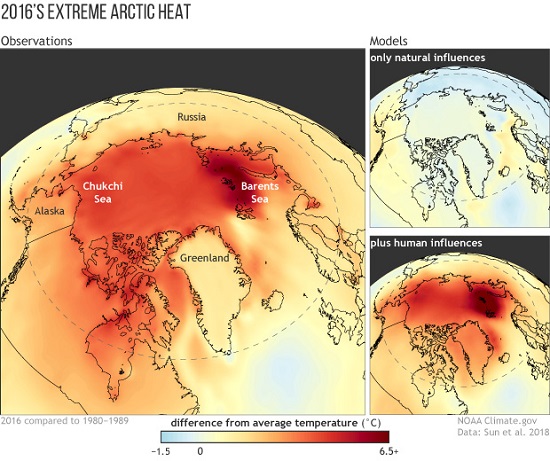
In the fall of 2016, the Arctic experienced heat that was so extreme that one expert called it a black swan event. That warmth helped set a new annual temperature record that was double the magnitude of the record set the year before. New NOAA-led research confirms that the event could not have happened without human-caused global warming and sea ice loss.

These maps compare the observed differences from average temperature in 2016 (left) to two computer simulations of 2016 (right). The top right map shows results from models that included only natural climate influences, using estimated conditions from the late nineteenth century. The bottom right map shows results from models in which things like  greenhouse gases, sea surface temperatures, and sea ice were allowed to change as they have in the real world due to human activities.

None of the simulations using only natural climate influences were able to reproduce the extreme warmth that overtook the Arctic in 2016. Instead, those models projected that there would have been some areas that were cool and some that were warm, but not extremely so. Only the simulations that mirrored human-caused changes in greenhouse gases and the resulting sea ice loss were able to generate a realistic picture of the extreme heat. The most realistic simulations were generated by models in which sea ice was not only allowed to shrink in area, but also to thin—just as it has in the real world.

The scientists concluded that there was virtually zero chance that such an extreme heat event would have occurred without human influence on the climate. But they also concluded that its severity—exactly how far above average the temperatures were— was partially due to natural variability, including the influence of the strong 2015-16 El Niño event in the tropics.

This overlap of the impacts of human-caused climate change and natural variability is a common theme for many types of extreme weather events from high-tide flooding to heavy downpours. Events like the extreme warmth in the Arctic in 2016 are an early preview of what “normal” may look like within as little as a decade if greenhouse gas emissions continue their rapid rise.

References:

Sun, L., Allured, D., Hoerling, M., Smith, L., Perlwitz, J., Murray, D., & Eischeid, J. (2018). Drivers of 2016 record Arctic warmth assessed using climate simulations subjected to Factual and Counterfactual forcing. Weather and Climate Extremes, 19, 1–9. https://doi.org/10.1016/j.wace.2017.11.001 

2016 Arctic heat would have been virtually impossible without global warming by Rebecca Lindsey, NOAA's Climate.gov, May 7, 2018


Toon of the Week...

 2018 Toon 19

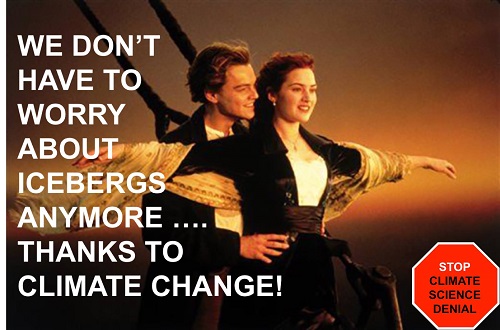
Hat tip to Stop Climate Science Denial.


Graphic of the Week...

Daily Arctic Temps 

2018 Arctic temperatures (red line) compared with other years back to 1958. (Danish Meteorological Institute data adapted by Zachary Labe)

Another extreme heat wave strikes the North Pole by Jason Samenow, Capital Weather Gang, Washington Post, May 7, 2018


SkS in the News...

The Climate Denier Roundup article, Free Speech on Campus Under Attack...By the Koch Bros, posted on the Daily Kos includes the following:

Case in point: the AP last week reported that newly released documents from 2003 to 2011 revealed that the Kochs had influence over the hiring process for their Mercatus center at George Mason University. Considering the Kochs had funded the center to the tune of nearly $50 million, this should be more of a confirmation of suspicions than startling revelation. (To be perfectly clear, the Mercatus Center is somewhat independent of George Mason itself, which employs great folks like climate communications researcher Ed Maibach and Dr. 97% himself, John Cook.) 


SkS Spotlights...

Program in Atmospheres, Oceans and Climate (PAOC)

PAOC oversees a broad program of education and research in atmospheric, oceanic, and climate sciences. We are engaged in some of the most intellectually challenging and important problems in science, such as the physics of hurricanes, and the dynamics of ice ages. PAOC is part of the Department of Earth, Atmospheric and Planetary Sciences at MIT and includes members from other MIT departments and from Woods Hole Oceanographic Institution. 

The phenomena under study involve a large array of scientific disciplines - geophysics, geochemistry, physical and chemical oceanography, meteorology, atmospheric chemistry, and planetary science. The program carries out research and gives instruction in all of these principal areas. Perhaps more than any other program in the world, PAOC offers its students unique opportunities for interdisciplinary study and research. In all areas we emphasize a combination of theoretical, observational and modeling approaches.

Students and researchers come from all over the world attracted not only by our programs but also the city of Cambridge and its environs which contain many institutions active in atmospheric and oceanographic research; Harvard UniversityWoods Hole Oceanographic Institution, and the Boston Office of the National Weather Service, as well as many private companies.

Contact with all of these institutions is maintained through seminars and symposia. Moreover students can formally take subjects at the Woods Hole Oceanographic Institution and Harvard University. The research and educational programs of PAOC also benefit from the larger intellectual milieu provided by MIT with its strengths in science and engineering. In research there are no departmental boundaries and we collaborate freely across discipline. PAOC is also involved in undergraduate education within the Department of Earth, Atmospheric and Planetary Sciences.  


Coming Soon on SkS...

  • California, battered by global warming's weather whiplash, is fighting to stop it (Dana)
  • SkS Analogy 12 - A sinking ship reaches new heights (Evan Whitby)
  • Global warming, hurricanes, and rain (John Abraham)
  • Global solar capacity grew faster than fossil fuels in 2017, says report (Simon Evans)
  • New research this week (Ari)
  • 2017 SkS Weekly Climate Change & Global Warming News Roundup #20 (John Hartz) 
  • 2017 SkS Weekly Climate Change & Global Waming Digest #20 (John Hartz)

Poster of the Week...
2018 Poster 19 


SkS Week in Review... 


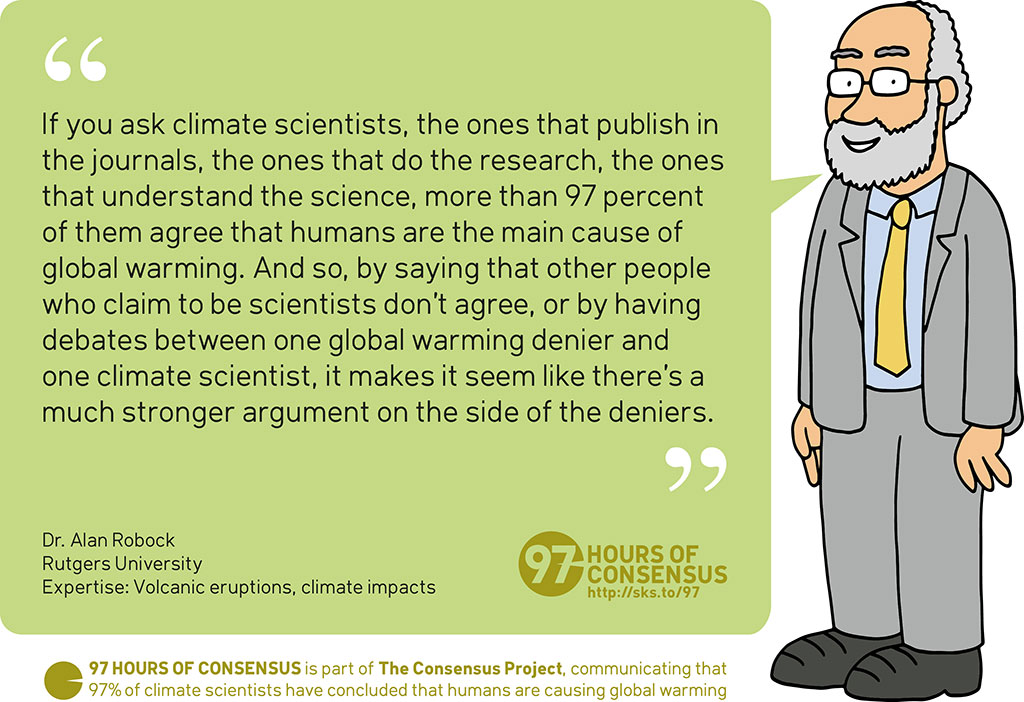
97 Hours of Consensus...

97 Hours: Alan Robock 


Alan Robock's bio page and quote source.

High resolution JPEG (1024 pixels wide)


from Skeptical Science https://ift.tt/2IgePgI

Story of the Week... Toon of the Week... Graphic of the Week... SkS in the News... SkS Spotlights... Video of the Week...  Coming Soon on SkS... Poster of the Week... SkS Week in Review... 97 Hours of Consensus...

Story of the Week...

2016 Arctic heat would have been virtually impossible without global warming

Arctic Extreme Heat 2016 


In the fall of 2016, the Arctic experienced heat that was so extreme that one expert called it a black swan event. That warmth helped set a new annual temperature record that was double the magnitude of the record set the year before. New NOAA-led research confirms that the event could not have happened without human-caused global warming and sea ice loss.

These maps compare the observed differences from average temperature in 2016 (left) to two computer simulations of 2016 (right). The top right map shows results from models that included only natural climate influences, using estimated conditions from the late nineteenth century. The bottom right map shows results from models in which things like  greenhouse gases, sea surface temperatures, and sea ice were allowed to change as they have in the real world due to human activities.

None of the simulations using only natural climate influences were able to reproduce the extreme warmth that overtook the Arctic in 2016. Instead, those models projected that there would have been some areas that were cool and some that were warm, but not extremely so. Only the simulations that mirrored human-caused changes in greenhouse gases and the resulting sea ice loss were able to generate a realistic picture of the extreme heat. The most realistic simulations were generated by models in which sea ice was not only allowed to shrink in area, but also to thin—just as it has in the real world.

The scientists concluded that there was virtually zero chance that such an extreme heat event would have occurred without human influence on the climate. But they also concluded that its severity—exactly how far above average the temperatures were— was partially due to natural variability, including the influence of the strong 2015-16 El Niño event in the tropics.

This overlap of the impacts of human-caused climate change and natural variability is a common theme for many types of extreme weather events from high-tide flooding to heavy downpours. Events like the extreme warmth in the Arctic in 2016 are an early preview of what “normal” may look like within as little as a decade if greenhouse gas emissions continue their rapid rise.

References:

Sun, L., Allured, D., Hoerling, M., Smith, L., Perlwitz, J., Murray, D., & Eischeid, J. (2018). Drivers of 2016 record Arctic warmth assessed using climate simulations subjected to Factual and Counterfactual forcing. Weather and Climate Extremes, 19, 1–9. https://doi.org/10.1016/j.wace.2017.11.001 

2016 Arctic heat would have been virtually impossible without global warming by Rebecca Lindsey, NOAA's Climate.gov, May 7, 2018


Toon of the Week...

 2018 Toon 19

Hat tip to Stop Climate Science Denial.


Graphic of the Week...

Daily Arctic Temps 

2018 Arctic temperatures (red line) compared with other years back to 1958. (Danish Meteorological Institute data adapted by Zachary Labe)

Another extreme heat wave strikes the North Pole by Jason Samenow, Capital Weather Gang, Washington Post, May 7, 2018


SkS in the News...

The Climate Denier Roundup article, Free Speech on Campus Under Attack...By the Koch Bros, posted on the Daily Kos includes the following:

Case in point: the AP last week reported that newly released documents from 2003 to 2011 revealed that the Kochs had influence over the hiring process for their Mercatus center at George Mason University. Considering the Kochs had funded the center to the tune of nearly $50 million, this should be more of a confirmation of suspicions than startling revelation. (To be perfectly clear, the Mercatus Center is somewhat independent of George Mason itself, which employs great folks like climate communications researcher Ed Maibach and Dr. 97% himself, John Cook.) 


SkS Spotlights...

Program in Atmospheres, Oceans and Climate (PAOC)

PAOC oversees a broad program of education and research in atmospheric, oceanic, and climate sciences. We are engaged in some of the most intellectually challenging and important problems in science, such as the physics of hurricanes, and the dynamics of ice ages. PAOC is part of the Department of Earth, Atmospheric and Planetary Sciences at MIT and includes members from other MIT departments and from Woods Hole Oceanographic Institution. 

The phenomena under study involve a large array of scientific disciplines - geophysics, geochemistry, physical and chemical oceanography, meteorology, atmospheric chemistry, and planetary science. The program carries out research and gives instruction in all of these principal areas. Perhaps more than any other program in the world, PAOC offers its students unique opportunities for interdisciplinary study and research. In all areas we emphasize a combination of theoretical, observational and modeling approaches.

Students and researchers come from all over the world attracted not only by our programs but also the city of Cambridge and its environs which contain many institutions active in atmospheric and oceanographic research; Harvard UniversityWoods Hole Oceanographic Institution, and the Boston Office of the National Weather Service, as well as many private companies.

Contact with all of these institutions is maintained through seminars and symposia. Moreover students can formally take subjects at the Woods Hole Oceanographic Institution and Harvard University. The research and educational programs of PAOC also benefit from the larger intellectual milieu provided by MIT with its strengths in science and engineering. In research there are no departmental boundaries and we collaborate freely across discipline. PAOC is also involved in undergraduate education within the Department of Earth, Atmospheric and Planetary Sciences.  


Coming Soon on SkS...

  • California, battered by global warming's weather whiplash, is fighting to stop it (Dana)
  • SkS Analogy 12 - A sinking ship reaches new heights (Evan Whitby)
  • Global warming, hurricanes, and rain (John Abraham)
  • Global solar capacity grew faster than fossil fuels in 2017, says report (Simon Evans)
  • New research this week (Ari)
  • 2017 SkS Weekly Climate Change & Global Warming News Roundup #20 (John Hartz) 
  • 2017 SkS Weekly Climate Change & Global Waming Digest #20 (John Hartz)

Poster of the Week...

2018 Poster 19 


SkS Week in Review... 


97 Hours of Consensus...

97 Hours: Alan Robock 


Alan Robock's bio page and quote source.

High resolution JPEG (1024 pixels wide)


from Skeptical Science https://ift.tt/2IgePgI

Fly over a Mars crater

This animation, based on images by the European Space Agency’s (ESA) Mars Express spacecraft, takes you on a flyover of the Neukum Crater in the southern hemisphere of Mars. The crater is about 63 miles (102 km) wide and .6 miles (1 km) deep, with two shallow depressions and a dune field in its interior.

Neukum Crater is situated in Noachis Terra, one of the oldest known regions on Mars, dating back to at least 3.9 billion years. Here’s how ESA describes the crater:

This complex impact crater has a diverse geologic history, as indicated by various features on the crater rim and floor. Particularly striking are the dark dune fields, likely made up of volcanic material blown in and shaped by strong winds.

The crater’s shallow interior has been infilled by sediments over its history. It is also marked with two irregular depressions that may be a sign of a weaker material that has since eroded away, leaving behind some islands of more resistant material.

Over time the crater rim has undergone varying degrees of collapse, with landslides and slumped material visible in the crater walls. Many smaller craters have also overprinted the rim and pockmarked the interior since Neukum Crater was formed, highlighting its long history.

The crater is named for the German physicist and planetary scientist Gerhard Neukum, one of the founders of ESA’s Mars Express mission. Neukum led the development of the high-resolution stereo camera on Mars Express.

ESA’s Mars Express, a Mars obiter, launched in June 2003.

Bottom line: Video flyover of Mars’ Neukum Crater, based on images from ES’s Mars Express.

Read more from ESA


from EarthSky https://ift.tt/2Gad9j6

This animation, based on images by the European Space Agency’s (ESA) Mars Express spacecraft, takes you on a flyover of the Neukum Crater in the southern hemisphere of Mars. The crater is about 63 miles (102 km) wide and .6 miles (1 km) deep, with two shallow depressions and a dune field in its interior.

Neukum Crater is situated in Noachis Terra, one of the oldest known regions on Mars, dating back to at least 3.9 billion years. Here’s how ESA describes the crater:

This complex impact crater has a diverse geologic history, as indicated by various features on the crater rim and floor. Particularly striking are the dark dune fields, likely made up of volcanic material blown in and shaped by strong winds.

The crater’s shallow interior has been infilled by sediments over its history. It is also marked with two irregular depressions that may be a sign of a weaker material that has since eroded away, leaving behind some islands of more resistant material.

Over time the crater rim has undergone varying degrees of collapse, with landslides and slumped material visible in the crater walls. Many smaller craters have also overprinted the rim and pockmarked the interior since Neukum Crater was formed, highlighting its long history.

The crater is named for the German physicist and planetary scientist Gerhard Neukum, one of the founders of ESA’s Mars Express mission. Neukum led the development of the high-resolution stereo camera on Mars Express.

ESA’s Mars Express, a Mars obiter, launched in June 2003.

Bottom line: Video flyover of Mars’ Neukum Crater, based on images from ES’s Mars Express.

Read more from ESA


from EarthSky https://ift.tt/2Gad9j6

Galaxies look like fireflies

This image, captured by the NASA/ESA Hubble Space Telescope, shows a massive group of galaxies bound together by gravity: a cluster named RXC J0032.1+1808.

Here’s what NASA said about this image:

This image was taken by Hubble’s Advanced Camera for Surveys and Wide-Field Camera 3 as part of an observing program called RELICS (Reionization Lensing Cluster Survey). RELICS imaged 41 massive galaxy clusters with the aim of finding the brightest distant galaxies for the forthcoming NASA/ESA/CSA James Webb Space Telescope (JWST) to study.

Expected to launch in 2018, the JWST is designed to see in infrared wavelengths, which is exceedingly useful for observing distant objects. As a result of the expansion of the universe, very distant objects are highly redshifted (their light is shifted towards the redder end of the spectrum) and so infrared telescopes are needed to study them. While Hubble currently has the ability to peer billions of years into the past to see “toddler” galaxies, the JWST will have the capability to study “baby” galaxies, the first galaxies that formed in the universe.

Bottom line: Hubble image of glowing galaxies in massive cluster.


from EarthSky https://ift.tt/2Gc6Mf1

This image, captured by the NASA/ESA Hubble Space Telescope, shows a massive group of galaxies bound together by gravity: a cluster named RXC J0032.1+1808.

Here’s what NASA said about this image:

This image was taken by Hubble’s Advanced Camera for Surveys and Wide-Field Camera 3 as part of an observing program called RELICS (Reionization Lensing Cluster Survey). RELICS imaged 41 massive galaxy clusters with the aim of finding the brightest distant galaxies for the forthcoming NASA/ESA/CSA James Webb Space Telescope (JWST) to study.

Expected to launch in 2018, the JWST is designed to see in infrared wavelengths, which is exceedingly useful for observing distant objects. As a result of the expansion of the universe, very distant objects are highly redshifted (their light is shifted towards the redder end of the spectrum) and so infrared telescopes are needed to study them. While Hubble currently has the ability to peer billions of years into the past to see “toddler” galaxies, the JWST will have the capability to study “baby” galaxies, the first galaxies that formed in the universe.

Bottom line: Hubble image of glowing galaxies in massive cluster.


from EarthSky https://ift.tt/2Gc6Mf1

Find the Keystone in Hercules

EarthSky astronomy kits are perfect for beginners. Order today from the EarthSky store

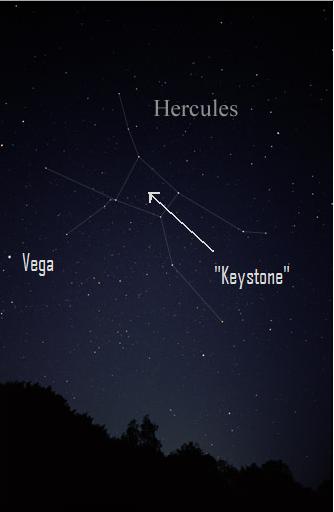
Tonight, from mid-northern latitudes, you can easily find the brilliant star Vega in the eastern sky at dusk and nightfall. Vega acts as your guide star to the Keystone – a pattern of four stars in the constellation Hercules.

Look for the Keystone asterism – star pattern – to the upper right of the brilliant blue-white star Vega. Hold your fist at an arm length. There is easily enough room between Vega and the Keystone for your fist to fit beneath the two.

You can also locate the Keystone by using Vega in conjunction with the brilliant yellow-orange star Arcturus. From mid-northern latitudes, Arcturus is found quite high in the southeast sky at nightfall and evening. By late evening, Arcturus will have moved over to the southern sky. The Keystone is found about one-third the way from Vega to Arcturus, the two brightest stars to grace the Northern Hemisphere’s spring and summertime sky. The only star-like object to outshine these stars is the king planet Jupiter, rather low in the southwest sky at nightfall.

Before you can find M13, you need to find the Keystone in Hercules, a pattern of four stars. As darkness falls, look for the Keystone to the upper right of the brilliant star Vega. Image via Wikimedia Commons

The Keystone, in turn, is your ticket to finding a famous globular star cluster in Hercules, otherwise known as the Great Cluster in Hercules, aka Messier 13 or M13.

Most likely, you’ll need binoculars to see the Hercules cluster, although sharp-eyed people can see it with the unaided eye in a dark, transparent sky. Through binoculars, this cluster looks like a dim and somewhat hazy star. But the telescope begins to resolve this faint fuzzy into what it really is – a great big, globe-shaped stellar city populated with hundreds of thousands of stars!

The Keystone and the Hercules cluster swing high overhead after midnight, and are found in the western sky before dawn.

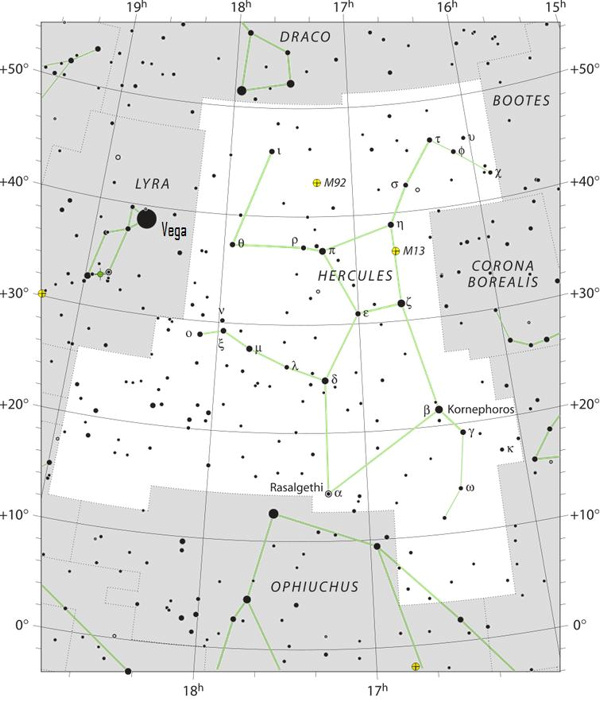
View larger. | Can you find the Keystone on this chart? See the compact grouping of four stars at the center of Hercules? That’s it. Note the whereabouts of Messier 13 within the Keystone pattern.

The Great Cluster in Hercules - aka M13 - as captured by friend Scott MacNeill. Shot April, 19, 2013 at Frosty Drew Observatory in Charlestown, Rhode Island. Thanks, Scott!

The Great Cluster in Hercules – aka M13 – as captured by our friend Scott MacNeill at Frosty Drew Observatory in Charlestown, Rhode Island. Thanks, Scott!

Bottom line: Let the bright star Vega guide you to a famous star pattern in Hercules – called the Keystone – and then to the Great Cluster in Hercules, aka M13, a famous globular star cluster.

Enjoying EarthSky so far? Sign up for our free daily newsletter today!


from EarthSky https://ift.tt/1zYG0Tx

EarthSky astronomy kits are perfect for beginners. Order today from the EarthSky store

Tonight, from mid-northern latitudes, you can easily find the brilliant star Vega in the eastern sky at dusk and nightfall. Vega acts as your guide star to the Keystone – a pattern of four stars in the constellation Hercules.

Look for the Keystone asterism – star pattern – to the upper right of the brilliant blue-white star Vega. Hold your fist at an arm length. There is easily enough room between Vega and the Keystone for your fist to fit beneath the two.

You can also locate the Keystone by using Vega in conjunction with the brilliant yellow-orange star Arcturus. From mid-northern latitudes, Arcturus is found quite high in the southeast sky at nightfall and evening. By late evening, Arcturus will have moved over to the southern sky. The Keystone is found about one-third the way from Vega to Arcturus, the two brightest stars to grace the Northern Hemisphere’s spring and summertime sky. The only star-like object to outshine these stars is the king planet Jupiter, rather low in the southwest sky at nightfall.

Before you can find M13, you need to find the Keystone in Hercules, a pattern of four stars. As darkness falls, look for the Keystone to the upper right of the brilliant star Vega. Image via Wikimedia Commons

The Keystone, in turn, is your ticket to finding a famous globular star cluster in Hercules, otherwise known as the Great Cluster in Hercules, aka Messier 13 or M13.

Most likely, you’ll need binoculars to see the Hercules cluster, although sharp-eyed people can see it with the unaided eye in a dark, transparent sky. Through binoculars, this cluster looks like a dim and somewhat hazy star. But the telescope begins to resolve this faint fuzzy into what it really is – a great big, globe-shaped stellar city populated with hundreds of thousands of stars!

The Keystone and the Hercules cluster swing high overhead after midnight, and are found in the western sky before dawn.

View larger. | Can you find the Keystone on this chart? See the compact grouping of four stars at the center of Hercules? That’s it. Note the whereabouts of Messier 13 within the Keystone pattern.

The Great Cluster in Hercules - aka M13 - as captured by friend Scott MacNeill. Shot April, 19, 2013 at Frosty Drew Observatory in Charlestown, Rhode Island. Thanks, Scott!

The Great Cluster in Hercules – aka M13 – as captured by our friend Scott MacNeill at Frosty Drew Observatory in Charlestown, Rhode Island. Thanks, Scott!

Bottom line: Let the bright star Vega guide you to a famous star pattern in Hercules – called the Keystone – and then to the Great Cluster in Hercules, aka M13, a famous globular star cluster.

Enjoying EarthSky so far? Sign up for our free daily newsletter today!


from EarthSky https://ift.tt/1zYG0Tx

European Space Agency considers 3 new mission concepts

Image via ESA.

Via European Space Observatory (ESA)

A high-energy survey of the early universe, an infrared observatory to study the formation of stars, planets and galaxies, and a Venus orbiter are to be considered for ESA’s fifth medium class mission in its Cosmic Vision science program, with a planned launch date in 2032.

The three candidates, the Transient High Energy Sky and Early Universe Surveyor (Theseus), the SPace Infrared telescope for Cosmology and Astrophysics (Spica), and the EnVision mission to Venus were selected from 25 proposals put forward by the scientific community.

Theseus, Spica and EnVision will be studied in parallel and a final decision is expected in 2021.

Artist’s impression of a gamma ray burst. Image via ESA.

How did the universe begin and what is it made of?

Theseus is a novel mission to monitor transient events in the high-energy universe across the whole sky and over the entirety of cosmic history. In particular, it promises to make a complete census of gamma-ray bursts from the universe’s first billion years, to help shed light on the life cycle of the first stars.

Gamma-ray bursts can be released during a supernova, or as a dying star collapses after such an explosion to form a neutron star or black hole, for example. Theseus would provide real-time triggers and accurate locations of such high-energy events, which could also be followed up by other space- or ground-based facilities operating at complementary wavelengths.

In addition, Theseus would also be able to follow up on gravitational wave observations by locating and identifying radiation from sources spotted by other detectors.

Herschel’s view of new stars and molecular clouds. Image via ESA.

How did the first stars and galaxies form?

Understanding the origin and evolution of galaxies, stars, planets and life itself is a fundamental objective of astronomy. These topics can be explored with a sensitive infrared survey, peering through the clouds of dust that typically obscure the sites of star birth.

Spica, a joint European-Japanese project that offers significant improvement in far-infrared spectroscopic and survey capabilities over NASA’s Spitzer and ESA’s Herschel space observatories, would ensure continuing advances can be made in this field.

It would also complement the capabilities of existing and foreseen major observatories, such as the ground-based Atacama Large Millimetre/submillmetre Array and the space-based Webb telescope.

A comparison of terrestrial planets. Image via ESA.

Why did Earth and Venus evolve so differently?

Venus is often considered as Earth’s evil twin. Despite being roughly the same size and neighbours in the inner solar system, the two planets have evolved very differently: Venus has experienced a catastrophic runaway greenhouse effect and today is enshrouded with a thick toxic atmosphere.

EnVision follows on from ESA’s highly successful Venus Express that focused primarily on atmospheric research. Planned to be implemented with NASA participation, next-generation EnVision would determine the nature and current state of geological activity on Venus and its relationship with the atmosphere, to better understand the different evolutionary pathways of the two planets.

It would map the surface and obtain detailed radar images, improving on those obtained by NASA’s Magellan in the 1990s to provide greater insight into the geological evolution of the surface.

The next years will provide a detailed technical and scientific definition of the three concepts, before one mission is selected to fill the fifth medium-class opportunity in ESA’s Cosmic Vision plan.

Solar Orbiter, Euclid, Plato and Ariel have already been selected as medium-class missions to be launched during the next decade.

Bottom line: Three new ESA mission concepts.


from EarthSky https://ift.tt/2KgQowd

Image via ESA.

Via European Space Observatory (ESA)

A high-energy survey of the early universe, an infrared observatory to study the formation of stars, planets and galaxies, and a Venus orbiter are to be considered for ESA’s fifth medium class mission in its Cosmic Vision science program, with a planned launch date in 2032.

The three candidates, the Transient High Energy Sky and Early Universe Surveyor (Theseus), the SPace Infrared telescope for Cosmology and Astrophysics (Spica), and the EnVision mission to Venus were selected from 25 proposals put forward by the scientific community.

Theseus, Spica and EnVision will be studied in parallel and a final decision is expected in 2021.

Artist’s impression of a gamma ray burst. Image via ESA.

How did the universe begin and what is it made of?

Theseus is a novel mission to monitor transient events in the high-energy universe across the whole sky and over the entirety of cosmic history. In particular, it promises to make a complete census of gamma-ray bursts from the universe’s first billion years, to help shed light on the life cycle of the first stars.

Gamma-ray bursts can be released during a supernova, or as a dying star collapses after such an explosion to form a neutron star or black hole, for example. Theseus would provide real-time triggers and accurate locations of such high-energy events, which could also be followed up by other space- or ground-based facilities operating at complementary wavelengths.

In addition, Theseus would also be able to follow up on gravitational wave observations by locating and identifying radiation from sources spotted by other detectors.

Herschel’s view of new stars and molecular clouds. Image via ESA.

How did the first stars and galaxies form?

Understanding the origin and evolution of galaxies, stars, planets and life itself is a fundamental objective of astronomy. These topics can be explored with a sensitive infrared survey, peering through the clouds of dust that typically obscure the sites of star birth.

Spica, a joint European-Japanese project that offers significant improvement in far-infrared spectroscopic and survey capabilities over NASA’s Spitzer and ESA’s Herschel space observatories, would ensure continuing advances can be made in this field.

It would also complement the capabilities of existing and foreseen major observatories, such as the ground-based Atacama Large Millimetre/submillmetre Array and the space-based Webb telescope.

A comparison of terrestrial planets. Image via ESA.

Why did Earth and Venus evolve so differently?

Venus is often considered as Earth’s evil twin. Despite being roughly the same size and neighbours in the inner solar system, the two planets have evolved very differently: Venus has experienced a catastrophic runaway greenhouse effect and today is enshrouded with a thick toxic atmosphere.

EnVision follows on from ESA’s highly successful Venus Express that focused primarily on atmospheric research. Planned to be implemented with NASA participation, next-generation EnVision would determine the nature and current state of geological activity on Venus and its relationship with the atmosphere, to better understand the different evolutionary pathways of the two planets.

It would map the surface and obtain detailed radar images, improving on those obtained by NASA’s Magellan in the 1990s to provide greater insight into the geological evolution of the surface.

The next years will provide a detailed technical and scientific definition of the three concepts, before one mission is selected to fill the fifth medium-class opportunity in ESA’s Cosmic Vision plan.

Solar Orbiter, Euclid, Plato and Ariel have already been selected as medium-class missions to be launched during the next decade.

Bottom line: Three new ESA mission concepts.


from EarthSky https://ift.tt/2KgQowd

2018 SkS Weekly Climate Change & Global Warming News Roundup #19

A chronological listing of news articles posted on the Skeptical Science Facebook Page during the past week.

Editor's Pick

Methane, Climate Change, and Our Uncertain Future

Methane is generally considered secondary to carbon dioxide in its importance to climate change, but what role might methane play in the future if global temperatures continue to rise?

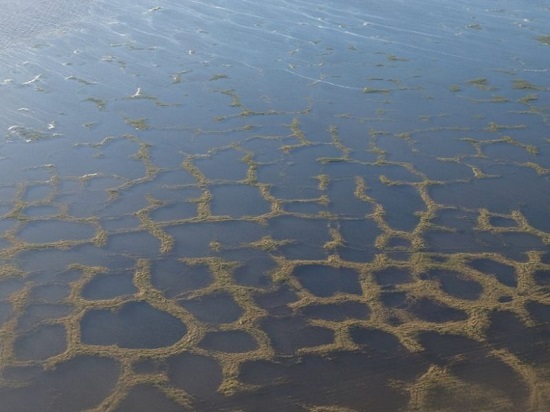
Flooded permafrost tundra in northeast Siberia 

Flooded permafrost tundra in northeast Siberia. Hydrology is a key control on methane emissions in wetland and permafrost ecosystems. Credit: Joshua Dean 

The greenhouse gas, methane, is produced by both natural processes and human activities. While there has been much attention paid to curbing anthropogenic emissions, a changing climate will likely increase the production of natural methane. In an open access article recently published in Reviews of GeophysicsDean et al. [2018] describe the ways in which biological, geochemical, and physical systems influence methane concentrations and explore how methane levels in natural systems may alter in a warming climate. Here the authors answer some questions about the sources and significance of methane, and indicate some future research directions. 

Methane, Climate Change, and Our Uncertain Future by Joshua Dean, Editors' Vox, Eos, May 11, 2018


Links posted on Facebook

Sun May 6, 2018

Mon May 7, 2018

Tue May 8, 2018

Wed May 9, 2018

Thu May 10, 2018

Fri May 11, 2018

Sat May 12, 2018


from Skeptical Science https://ift.tt/2jTbndo
A chronological listing of news articles posted on the Skeptical Science Facebook Page during the past week.

Editor's Pick

Methane, Climate Change, and Our Uncertain Future

Methane is generally considered secondary to carbon dioxide in its importance to climate change, but what role might methane play in the future if global temperatures continue to rise?

Flooded permafrost tundra in northeast Siberia 

Flooded permafrost tundra in northeast Siberia. Hydrology is a key control on methane emissions in wetland and permafrost ecosystems. Credit: Joshua Dean 

The greenhouse gas, methane, is produced by both natural processes and human activities. While there has been much attention paid to curbing anthropogenic emissions, a changing climate will likely increase the production of natural methane. In an open access article recently published in Reviews of GeophysicsDean et al. [2018] describe the ways in which biological, geochemical, and physical systems influence methane concentrations and explore how methane levels in natural systems may alter in a warming climate. Here the authors answer some questions about the sources and significance of methane, and indicate some future research directions. 

Methane, Climate Change, and Our Uncertain Future by Joshua Dean, Editors' Vox, Eos, May 11, 2018


Links posted on Facebook

Sun May 6, 2018

Mon May 7, 2018

Tue May 8, 2018

Wed May 9, 2018

Thu May 10, 2018

Fri May 11, 2018

Sat May 12, 2018


from Skeptical Science https://ift.tt/2jTbndo

‘Lost’ asteroid to pass closely May 15

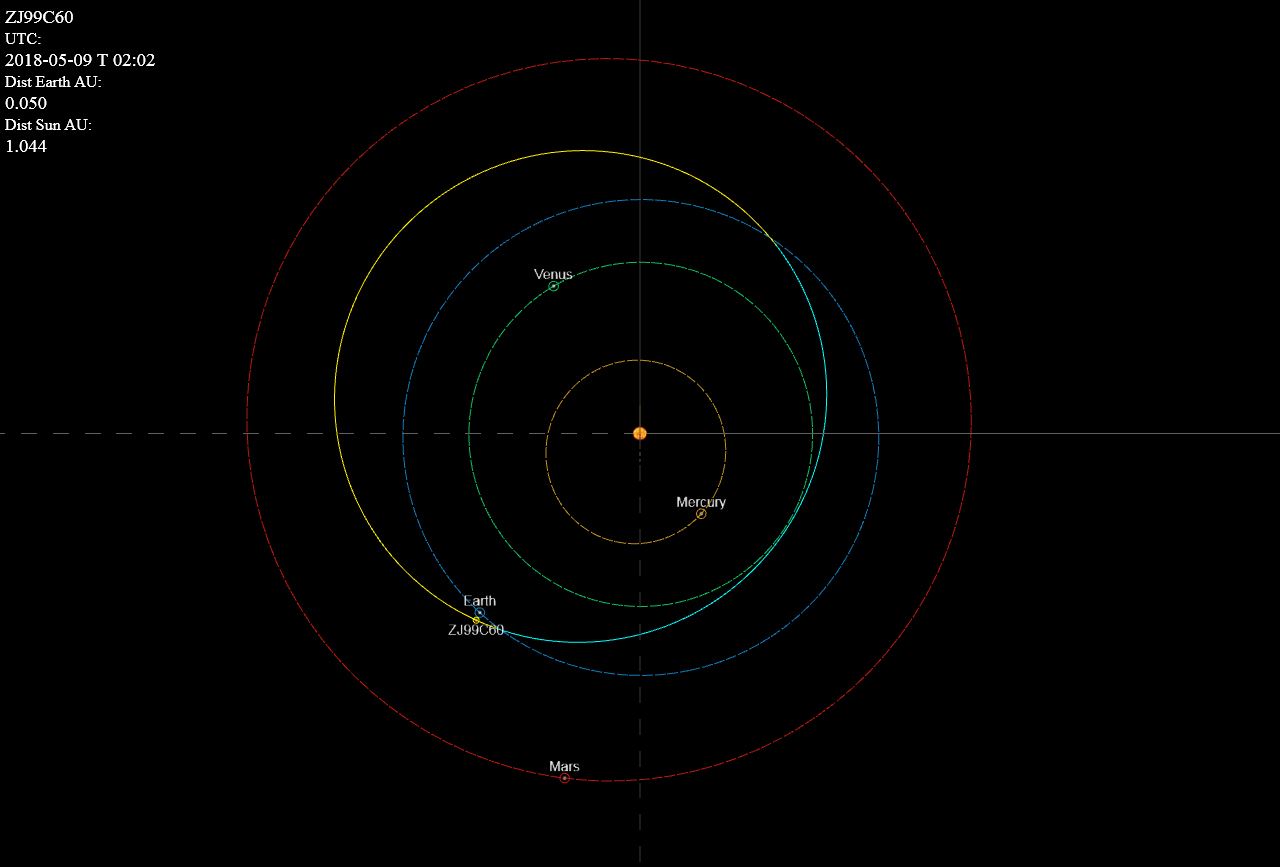
Orbit of asteroid 2010 WC9 (formerly called ZJ99C60) via Asteroid Orbit View and Northolt Branch Observatories.

Asteroid 2010 WC9 will safely pass at about half’s the moon’s distance on Tuesday, May 15, 2018. Estimates of its size range from 197 to 427 feet (60-130 meters), making the May 15 pass one of the closest approaches ever observed of an asteroid of this size. This asteroid was “lost” and then found again. The Catalina Sky Survey in Arizona first detected it on November 30, 2010, and astronomers watched it until December 1, when it became too faint to see. They didn’t enough observations to track its orbit fully and so predict its return. On May 8, 2018 – almost eight years later – astronomers discovered an asteroid and gave it the temporary designation ZJ99C60. Then they realized it was asteroid 2010 WC9, returning.

During the 2018 return, closest approach of asteroid 2010 WC9 will happen on May 15 at 22:05 UTC (6:05 pm EDT; translate to your time zone). At that time, the asteroid will be 0.53 lunar-distances from Earth (126,419 miles or 203,453 km from Earth). According to orbit calculations made by NASA’s Jet Propulsion Laboratory, the May 15 close approach is the closest of this particular asteroid in nearly 300 years.

Is this a large asteroid? No, not by any absolute measure. But it is larger than estimated size of the Chelyabinsk meteor, which entered Earth’s atmosphere, breaking windows in six Russian cities and causing some 1,500 people to seek medical attention, in 2013. Estimates of asteroid 2010 WC9’s diameter range from 197 to 427 feet (60-130 meters); estimates of the Chelyabinsk meteor’s size before encountering Earth’s atmosphere center around 65 feet (20 meters).

Asteroid 2010 WC9 is Apollo type space rock. At no time will it be visible to the eye as it sweeps past Earth. It might get as bright as magnitude +11, which would make it bright enough to be seen in amateur telescopes pointed at the correct location and time.

Asteroid 2010 WC9 is travelling though space at a speed of 28,655 miles per hour (46,116 km/h).

Asteroid 2010 WC9 at Minor Planet Center; at CNEOS

Want to view the asteroid online? Guy Wells at Northolt Branch Observatories in London, England – which specializes in observations of Near-Earth asteroids and other small solar system objects – emailed EarthSky on Friday to say:

We are planning to broadcast this asteroid live to our Facebook page on the night of May 14, likely around midnight, if the weather forecast remains positive. The broadcast will be less than 25 minutes in duration, as the asteroid will cross our field of view within that period of time. The asteroid will be moving quite rapidly (30 arcseconds per minute). Our display will update every five seconds. We are of course collecting astrometric data whilst this is happening, but the motion of the asteroid will be apparent every five seconds!

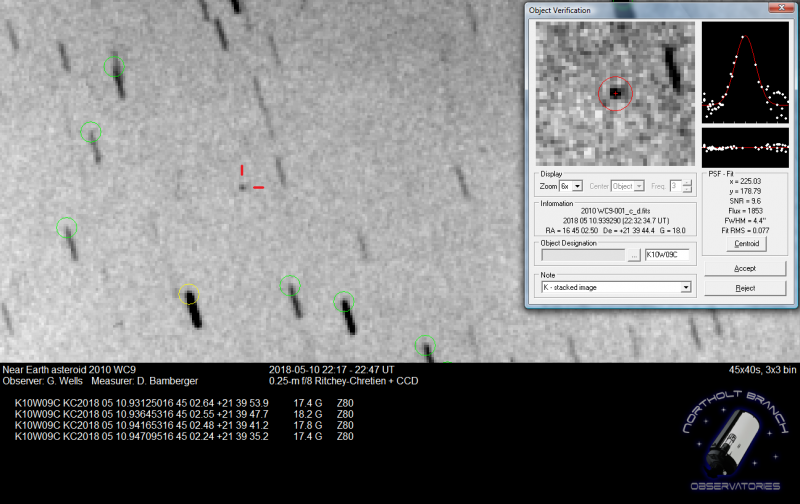
Daniel Bamberger, also at Northolt Branch Observatories, sent along the two images below. He wrote:

We imaged this object twice: First on May 9, when it was still known by its temporary designation ZJ99C60; then again on May 10, after it was identified as asteroid 2010 WC9, which had been a lost asteroid for eight years.

It is still a faint object of 18th magnitude, but it is brightening very rapidly: 2010 WC9 will be brighter than 11th magnitude at closest approach, making it visible in a small telescope!

Asteroid 2010 WC9 on May 9. Image via Daniel Bamberger/ Northolt Branch Observatories.

Asteroid 2010 WC9 on May 10. Image via Daniel Bamberger/ Northolt Branch Observatories.

Bottom line: Asteroid 2010 WC9 will pass at about half the moon’s distance on May 15, 2018. It’s one of the closest approaches ever observed of an asteroid of this size. Northolt Branch Observatories in London will offer a live viewing of the asteroid on its Facebook page, starting around midnight (London time) on May 14.


from EarthSky https://ift.tt/2rCIfeU

Orbit of asteroid 2010 WC9 (formerly called ZJ99C60) via Asteroid Orbit View and Northolt Branch Observatories.

Asteroid 2010 WC9 will safely pass at about half’s the moon’s distance on Tuesday, May 15, 2018. Estimates of its size range from 197 to 427 feet (60-130 meters), making the May 15 pass one of the closest approaches ever observed of an asteroid of this size. This asteroid was “lost” and then found again. The Catalina Sky Survey in Arizona first detected it on November 30, 2010, and astronomers watched it until December 1, when it became too faint to see. They didn’t enough observations to track its orbit fully and so predict its return. On May 8, 2018 – almost eight years later – astronomers discovered an asteroid and gave it the temporary designation ZJ99C60. Then they realized it was asteroid 2010 WC9, returning.

During the 2018 return, closest approach of asteroid 2010 WC9 will happen on May 15 at 22:05 UTC (6:05 pm EDT; translate to your time zone). At that time, the asteroid will be 0.53 lunar-distances from Earth (126,419 miles or 203,453 km from Earth). According to orbit calculations made by NASA’s Jet Propulsion Laboratory, the May 15 close approach is the closest of this particular asteroid in nearly 300 years.

Is this a large asteroid? No, not by any absolute measure. But it is larger than estimated size of the Chelyabinsk meteor, which entered Earth’s atmosphere, breaking windows in six Russian cities and causing some 1,500 people to seek medical attention, in 2013. Estimates of asteroid 2010 WC9’s diameter range from 197 to 427 feet (60-130 meters); estimates of the Chelyabinsk meteor’s size before encountering Earth’s atmosphere center around 65 feet (20 meters).

Asteroid 2010 WC9 is Apollo type space rock. At no time will it be visible to the eye as it sweeps past Earth. It might get as bright as magnitude +11, which would make it bright enough to be seen in amateur telescopes pointed at the correct location and time.

Asteroid 2010 WC9 is travelling though space at a speed of 28,655 miles per hour (46,116 km/h).

Asteroid 2010 WC9 at Minor Planet Center; at CNEOS

Want to view the asteroid online? Guy Wells at Northolt Branch Observatories in London, England – which specializes in observations of Near-Earth asteroids and other small solar system objects – emailed EarthSky on Friday to say:

We are planning to broadcast this asteroid live to our Facebook page on the night of May 14, likely around midnight, if the weather forecast remains positive. The broadcast will be less than 25 minutes in duration, as the asteroid will cross our field of view within that period of time. The asteroid will be moving quite rapidly (30 arcseconds per minute). Our display will update every five seconds. We are of course collecting astrometric data whilst this is happening, but the motion of the asteroid will be apparent every five seconds!

Daniel Bamberger, also at Northolt Branch Observatories, sent along the two images below. He wrote:

We imaged this object twice: First on May 9, when it was still known by its temporary designation ZJ99C60; then again on May 10, after it was identified as asteroid 2010 WC9, which had been a lost asteroid for eight years.

It is still a faint object of 18th magnitude, but it is brightening very rapidly: 2010 WC9 will be brighter than 11th magnitude at closest approach, making it visible in a small telescope!

Asteroid 2010 WC9 on May 9. Image via Daniel Bamberger/ Northolt Branch Observatories.

Asteroid 2010 WC9 on May 10. Image via Daniel Bamberger/ Northolt Branch Observatories.

Bottom line: Asteroid 2010 WC9 will pass at about half the moon’s distance on May 15, 2018. It’s one of the closest approaches ever observed of an asteroid of this size. Northolt Branch Observatories in London will offer a live viewing of the asteroid on its Facebook page, starting around midnight (London time) on May 14.


from EarthSky https://ift.tt/2rCIfeU

adds 2