aads

This week we go between the sun and Jupiter

This week – on the night of May 8-9, 2018 – our planet Earth flies in between the sun and the outer planet Jupiter. That passage places Jupiter – largest world in our solar system, and a very bright planet in our sky – opposite the sun. In other words, Jupiter is now rising in the east as the sun is setting below the western horizon. Astronomers call this event an opposition of Jupiter.

Opposition marks the middle of the best time of year to see a planet. That’s because it’s when the planet is up all night and generally closest for the year (the exact date of Jupiter at its closest this year is May 10).

Your astronomical calendar for 2018 likely gives the date and time of Jupiter’s 2018 opposition as May 9 at 1 UTC. That translates to May 8 at 8 p.m. Central Daylight Time in North America (translate UTC to your time).

Jupiter (red) completes one orbit of the sun (center) for every 11.86 orbits of the Earth (blue). Our orbit is smaller, and we move faster! Animation via Wikimedia Commons.

Rising in the east around sunset, Jupiter climbs highest in the sky at midnight. It sets in the west around sunrise. Jupiter is always bright; it’s the largest planet in our solar system. It shines more brightly than any star in the evening sky.

With the exception of the sun and moon, only Venus – the brightest planet, now in the west after sunset – outshines Jupiter. Try catching both Venus and Jupiter at nightfall now. Venus will be blazing low in the west and Jupiter, a bit fainter but still brighter than any star, will be shining in the east. Venus will set as Jupiter ascends in the eastern sky.

At this 2018 opposition, Jupiter shines in front of the constellation Libra the Scales. The close 2nd-magnitude star to Jupiter is Zubenelgenubi, Libra’s alpha star. Dazzling Jupiter – a planet in our own solar system, and therefore much closer to us – outshines this star by over 100 times.
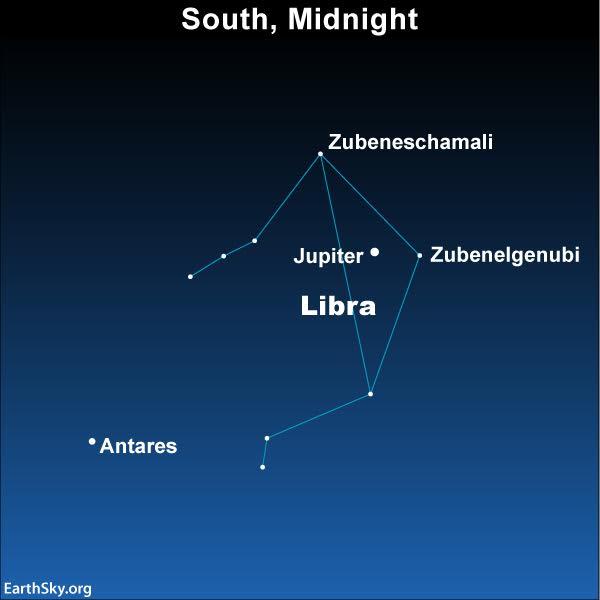
In any year, you can find the constellation Libra between the star Antares (to the east of Libra) and the star Spica (to the west of Libra, outside the chart). But in 2018, the planet Jupiter acts as your guide “star” to this fairly faint constellation. Northern Hemisphere viewers will find Jupiter and Libra in the south around midnight in May 2018. Southern Hemisphere viewers will find Jupiter and Libra closer to overhead at midnight.

Jupiter comes to opposition about every 13 months. That’s how long Earth takes to travel once around the sun relative to Jupiter. As a result – according to our earthly calendars – Jupiter’s opposition comes about a month later each year.

Last year – in 2017 – Jupiter’s opposition date was April 7.

Next year – in 2019 – it’ll be June 10.

Jupiter and its large moon Ganymede as captured on May 3, 2018 by Eric Bayne.

Jupiter is sometimes called a failed star. You would need at least 80 Jupiters – rolled into a ball – to be hot enough inside for thermonuclear reactions to ignite. In other words, Jupiter is not massive enough to shine as stars do.

But Jupiter is the largest and most massive planet in our solar system. So when the sun goes down on this May night, you might — if you’re fanciful enough — you might imagine bright Jupiter as a tiny sun all night long.

Bottom line: Be sure to look for Jupiter on the night of May 8-9, 2019 as this world reaches opposition, the point opposite the sun in our sky. About one and one-half day later, on May 10, at 12 UTC, Jupiter reaches its closest point to Earth for this year!

Donate: Your support means the world to us


from EarthSky https://ift.tt/1UuLm0p

This week – on the night of May 8-9, 2018 – our planet Earth flies in between the sun and the outer planet Jupiter. That passage places Jupiter – largest world in our solar system, and a very bright planet in our sky – opposite the sun. In other words, Jupiter is now rising in the east as the sun is setting below the western horizon. Astronomers call this event an opposition of Jupiter.

Opposition marks the middle of the best time of year to see a planet. That’s because it’s when the planet is up all night and generally closest for the year (the exact date of Jupiter at its closest this year is May 10).

Your astronomical calendar for 2018 likely gives the date and time of Jupiter’s 2018 opposition as May 9 at 1 UTC. That translates to May 8 at 8 p.m. Central Daylight Time in North America (translate UTC to your time).

Jupiter (red) completes one orbit of the sun (center) for every 11.86 orbits of the Earth (blue). Our orbit is smaller, and we move faster! Animation via Wikimedia Commons.

Rising in the east around sunset, Jupiter climbs highest in the sky at midnight. It sets in the west around sunrise. Jupiter is always bright; it’s the largest planet in our solar system. It shines more brightly than any star in the evening sky.

With the exception of the sun and moon, only Venus – the brightest planet, now in the west after sunset – outshines Jupiter. Try catching both Venus and Jupiter at nightfall now. Venus will be blazing low in the west and Jupiter, a bit fainter but still brighter than any star, will be shining in the east. Venus will set as Jupiter ascends in the eastern sky.

At this 2018 opposition, Jupiter shines in front of the constellation Libra the Scales. The close 2nd-magnitude star to Jupiter is Zubenelgenubi, Libra’s alpha star. Dazzling Jupiter – a planet in our own solar system, and therefore much closer to us – outshines this star by over 100 times.

In any year, you can find the constellation Libra between the star Antares (to the east of Libra) and the star Spica (to the west of Libra, outside the chart). But in 2018, the planet Jupiter acts as your guide “star” to this fairly faint constellation. Northern Hemisphere viewers will find Jupiter and Libra in the south around midnight in May 2018. Southern Hemisphere viewers will find Jupiter and Libra closer to overhead at midnight.

Jupiter comes to opposition about every 13 months. That’s how long Earth takes to travel once around the sun relative to Jupiter. As a result – according to our earthly calendars – Jupiter’s opposition comes about a month later each year.

Last year – in 2017 – Jupiter’s opposition date was April 7.

Next year – in 2019 – it’ll be June 10.

Jupiter and its large moon Ganymede as captured on May 3, 2018 by Eric Bayne.

Jupiter is sometimes called a failed star. You would need at least 80 Jupiters – rolled into a ball – to be hot enough inside for thermonuclear reactions to ignite. In other words, Jupiter is not massive enough to shine as stars do.

But Jupiter is the largest and most massive planet in our solar system. So when the sun goes down on this May night, you might — if you’re fanciful enough — you might imagine bright Jupiter as a tiny sun all night long.

Bottom line: Be sure to look for Jupiter on the night of May 8-9, 2019 as this world reaches opposition, the point opposite the sun in our sky. About one and one-half day later, on May 10, at 12 UTC, Jupiter reaches its closest point to Earth for this year!

Donate: Your support means the world to us


from EarthSky https://ift.tt/1UuLm0p

Hear the Milky Way Blues

Scientists often transform astronomy data into pictures, but University of Californa Santa Barbara postdoctoral fellow Greg Salvesen went in a different direction. He decided to map raw data to sound.

Salvesen’s recently launched website, Astronomy Sound of the Month or AstroSoM, features different sounds produced from actual astronomy data, with an explanation by an astronomer. Salvesen said in a statement:

AstroSoM explores how sound complements more traditional astronomy data analysis. Besides, making sounds out of real astronomy data is just plain cool!

For his latest feature (above), Salvesen collaborated with University of Massachusetts astronomy professor Mark Heyer to turn complex data into visual and aural components that track the movement of gas through our galaxy. The resulting Milky Way Blues allow you to “hear” how our galaxy rotates.

For the composition, Heyer developed an algorithm that transforms astronomical data about galactic gases into musical notes. By assigning different tones and length of notes to the observed spectra of each gas phase, said Heyer, an astronomer can express a crucial feature of the galaxy that is missing in astronomical images – movement.

Heyer chose to compose this piece using a pentatonic scale – with five notes in the octave instead of seven – and in a minor key, because, he said:

When I heard the bass notes it sounded jazzy and blue.

But, he added:

I’ve been true to the data, I haven’t massaged it to make it sound nice, but by turning what we actually observe with a radio telescope into a musical scale it gives us familiar tones that sound surprisingly like music with which we’re familiar.

Here’s the explanation of the Milky Way Blues, from AstroSoM:

Radio telescopes observe different spectral emission lines to probe different phases of gas (atomic, molecular, ionized). Astronomers measure the Doppler shifts of these lines to determine gas velocities along the path that the telescope is pointing. To turn one of these observations into musical notes, the measured gas velocities are mapped to a pentatonic minor blues scale.

Each note and circle represents gas that is either coming toward Earth (high notes and blue color) or moving away from it (low notes and red color). Different gas phases are played by different instruments — acoustic bass (atomic), wood blocks (molecular), saxophone (ionized) and piano (molecular) — and are represented by different colored borders on the circles.

A line showing where the telescope was pointing represents each observation, and the positions of the circles along a line show the locations of the gas in the galaxy. The star symbol shows the location of the sun. The intensity of the emission coming from the gas is heard as longer note durations and shown as larger circles.

With every new measure, the lines swing around to new observations. Putting it all together, the variation of musical pitches heard in Milky Way Blues portrays the motion of gas as it orbits around the center of our galaxy.

Check out more pieces on the AstroSoM website, such as The Inner Solar System Plays Radiohead’s Saddest Song, or Never a Mundane Supernova in the Sky. Each post includes a short summary and links for more detailed explanations.

Greg Salvesen. Image via Sonia Fernandez.

Bottom line: An astronomer transforms raw astronomy data into music.

Read more from UC Santa Barbara


from EarthSky https://ift.tt/2KHwdZE

Scientists often transform astronomy data into pictures, but University of Californa Santa Barbara postdoctoral fellow Greg Salvesen went in a different direction. He decided to map raw data to sound.

Salvesen’s recently launched website, Astronomy Sound of the Month or AstroSoM, features different sounds produced from actual astronomy data, with an explanation by an astronomer. Salvesen said in a statement:

AstroSoM explores how sound complements more traditional astronomy data analysis. Besides, making sounds out of real astronomy data is just plain cool!

For his latest feature (above), Salvesen collaborated with University of Massachusetts astronomy professor Mark Heyer to turn complex data into visual and aural components that track the movement of gas through our galaxy. The resulting Milky Way Blues allow you to “hear” how our galaxy rotates.

For the composition, Heyer developed an algorithm that transforms astronomical data about galactic gases into musical notes. By assigning different tones and length of notes to the observed spectra of each gas phase, said Heyer, an astronomer can express a crucial feature of the galaxy that is missing in astronomical images – movement.

Heyer chose to compose this piece using a pentatonic scale – with five notes in the octave instead of seven – and in a minor key, because, he said:

When I heard the bass notes it sounded jazzy and blue.

But, he added:

I’ve been true to the data, I haven’t massaged it to make it sound nice, but by turning what we actually observe with a radio telescope into a musical scale it gives us familiar tones that sound surprisingly like music with which we’re familiar.

Here’s the explanation of the Milky Way Blues, from AstroSoM:

Radio telescopes observe different spectral emission lines to probe different phases of gas (atomic, molecular, ionized). Astronomers measure the Doppler shifts of these lines to determine gas velocities along the path that the telescope is pointing. To turn one of these observations into musical notes, the measured gas velocities are mapped to a pentatonic minor blues scale.

Each note and circle represents gas that is either coming toward Earth (high notes and blue color) or moving away from it (low notes and red color). Different gas phases are played by different instruments — acoustic bass (atomic), wood blocks (molecular), saxophone (ionized) and piano (molecular) — and are represented by different colored borders on the circles.

A line showing where the telescope was pointing represents each observation, and the positions of the circles along a line show the locations of the gas in the galaxy. The star symbol shows the location of the sun. The intensity of the emission coming from the gas is heard as longer note durations and shown as larger circles.

With every new measure, the lines swing around to new observations. Putting it all together, the variation of musical pitches heard in Milky Way Blues portrays the motion of gas as it orbits around the center of our galaxy.

Check out more pieces on the AstroSoM website, such as The Inner Solar System Plays Radiohead’s Saddest Song, or Never a Mundane Supernova in the Sky. Each post includes a short summary and links for more detailed explanations.

Greg Salvesen. Image via Sonia Fernandez.

Bottom line: An astronomer transforms raw astronomy data into music.

Read more from UC Santa Barbara


from EarthSky https://ift.tt/2KHwdZE

Eta Aquarid in moonlight

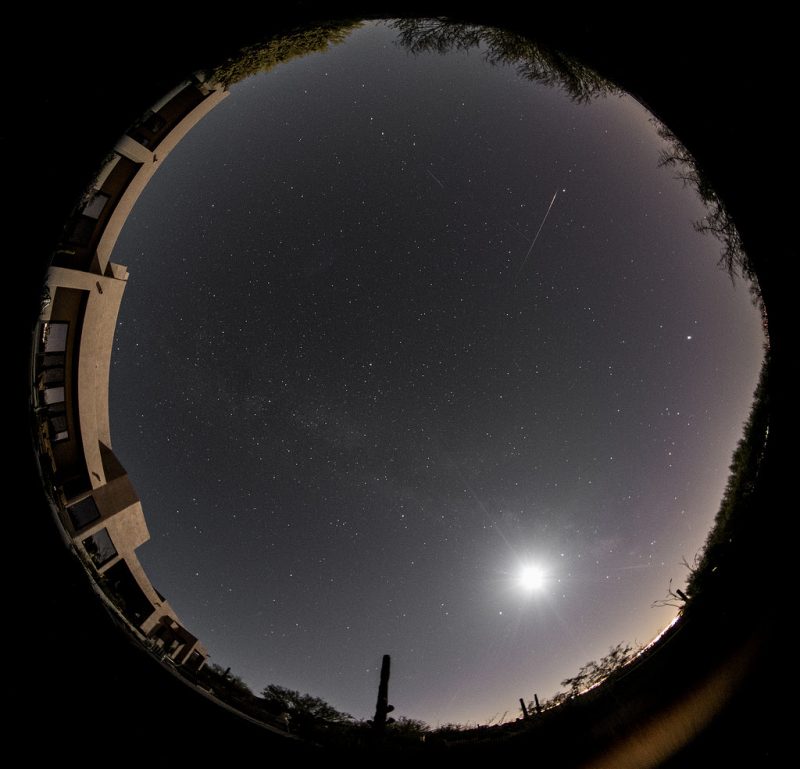
Eliot Herman in Tucson, Arizona captured this Eta Aquariid meteor on May 5, 2018 in the bright light of a waning gibbous moon. He wrote: “One of my favorites because of the color of the meteor is evident in this one and because of these meteors’ origin from Halley’s Comet particles.” Image captured at 3:47 a.m. in the Tucson foothills with a Nikon D810 camera and a Sigma 8 mm lens at 15-sec exposure and 3200 iso using an interval timer. Image processed from a Nikon Raw file. Click here for another image of the same meteor with a 15 mm lens and a second camera.


from EarthSky https://ift.tt/2JXqTQG

Eliot Herman in Tucson, Arizona captured this Eta Aquariid meteor on May 5, 2018 in the bright light of a waning gibbous moon. He wrote: “One of my favorites because of the color of the meteor is evident in this one and because of these meteors’ origin from Halley’s Comet particles.” Image captured at 3:47 a.m. in the Tucson foothills with a Nikon D810 camera and a Sigma 8 mm lens at 15-sec exposure and 3200 iso using an interval timer. Image processed from a Nikon Raw file. Click here for another image of the same meteor with a 15 mm lens and a second camera.


from EarthSky https://ift.tt/2JXqTQG

Springtime at Ladd Observatory

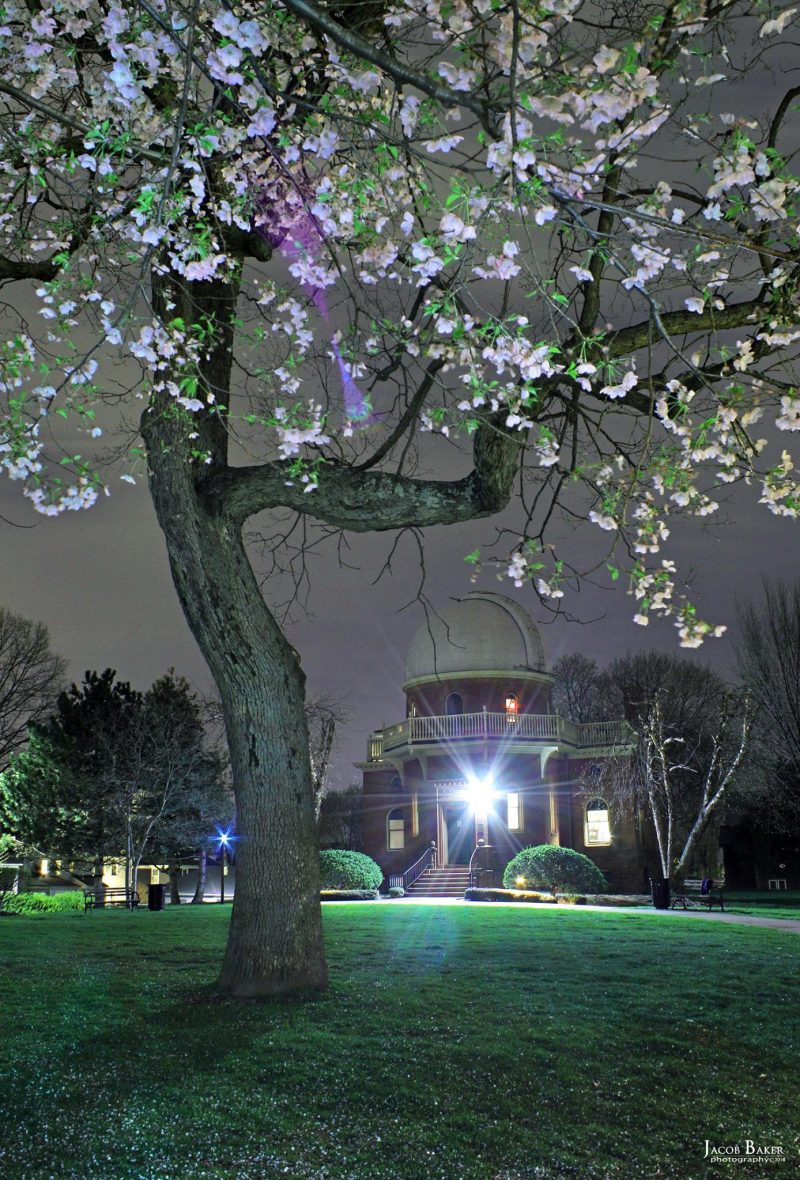
Photo by Jacob Baker.

Jacob Baker posted this beautiful photo at EarthSky Facebook in May, 2018. He wrote:

The Ladd Observatory is an astronomical and educational facility at Brown University in Providence, Rhode Island. The building was designed by architects Stone, Carpenter, and Willson. It opened in 1891 and is listed on the National Register of Historic Places. The Observatory has a collection of 19th and early 20th century scientific instruments including telescopes, precision pendulum clocks, weather instruments, telegraph and wireless equipment. Today the facility is operated as a living museum. It is open to the public for telescope observing on Tuesday evenings.

Thanks, Jacob!


from EarthSky https://ift.tt/2rn6Vb2

Photo by Jacob Baker.

Jacob Baker posted this beautiful photo at EarthSky Facebook in May, 2018. He wrote:

The Ladd Observatory is an astronomical and educational facility at Brown University in Providence, Rhode Island. The building was designed by architects Stone, Carpenter, and Willson. It opened in 1891 and is listed on the National Register of Historic Places. The Observatory has a collection of 19th and early 20th century scientific instruments including telescopes, precision pendulum clocks, weather instruments, telegraph and wireless equipment. Today the facility is operated as a living museum. It is open to the public for telescope observing on Tuesday evenings.

Thanks, Jacob!


from EarthSky https://ift.tt/2rn6Vb2

Arc to Arcturus, spike to Spica

Tonight, look outside in the evening and learn a phrase useful to sky watchers. The phrase is: follow the arc to Arcturus, and drive a spike (or speed on) to Spica. You can use this phrase in any year.

First locate the Big Dipper asterism in the northeastern sky. Then draw an imaginary line following the curve in the Dipper’s handle until you come to a bright orange star. This star is Arcturus in the constellation Bootes, known in skylore as the bear guard.

Arcturus is a giant star with an estimated distance of 37 light-years. It’s special because it’s not moving with the general stream of stars, in the flat disk of the Milky Way galaxy. Instead, Arcturus is cutting perpendicularly through the galaxy’s disk at a tremendous rate of speed … some 100 miles (150 km) per second. Millions of years from now this star will be lost from the view of any future inhabitants of Earth, or at least those who are earthbound and looking with the eye alone.

Now drive a spike or, as some say, speed on to Spica in the constellation Virgo.

Spica in the constellation Virgo looks like one star, but this single point of light is really a multiple star system – with two hot stars orbiting very close together – located an estimated distance of 262 light-years away from Earth.

Here’s another way to verify that you’re looking at Spica, the brightest star in the constellation Virgo.

Bottom line: Follow the arc to Arcturus, and drive a spike to Spica.


Big and Little Dippers: Noticeable in northern sky

Enjoying EarthSky so far? Sign up for our free daily newsletter today!

EarthSky astronomy kits are perfect for beginners. Order today from the EarthSky store

Donate: Your support means the world to us


from EarthSky https://ift.tt/1lLgQgD

Tonight, look outside in the evening and learn a phrase useful to sky watchers. The phrase is: follow the arc to Arcturus, and drive a spike (or speed on) to Spica. You can use this phrase in any year.

First locate the Big Dipper asterism in the northeastern sky. Then draw an imaginary line following the curve in the Dipper’s handle until you come to a bright orange star. This star is Arcturus in the constellation Bootes, known in skylore as the bear guard.

Arcturus is a giant star with an estimated distance of 37 light-years. It’s special because it’s not moving with the general stream of stars, in the flat disk of the Milky Way galaxy. Instead, Arcturus is cutting perpendicularly through the galaxy’s disk at a tremendous rate of speed … some 100 miles (150 km) per second. Millions of years from now this star will be lost from the view of any future inhabitants of Earth, or at least those who are earthbound and looking with the eye alone.

Now drive a spike or, as some say, speed on to Spica in the constellation Virgo.

Spica in the constellation Virgo looks like one star, but this single point of light is really a multiple star system – with two hot stars orbiting very close together – located an estimated distance of 262 light-years away from Earth.

Here’s another way to verify that you’re looking at Spica, the brightest star in the constellation Virgo.

Bottom line: Follow the arc to Arcturus, and drive a spike to Spica.


Big and Little Dippers: Noticeable in northern sky

Enjoying EarthSky so far? Sign up for our free daily newsletter today!

EarthSky astronomy kits are perfect for beginners. Order today from the EarthSky store

Donate: Your support means the world to us


from EarthSky https://ift.tt/1lLgQgD

2018 SkS Weekly Climate Change & Global Warming News Roundup #18

A chronological listing of news articles posted on the Skeptical Science Facebook Page during the past week.

Editor's Pick

Earth’s atmosphere just crossed another troubling climate change threshold 

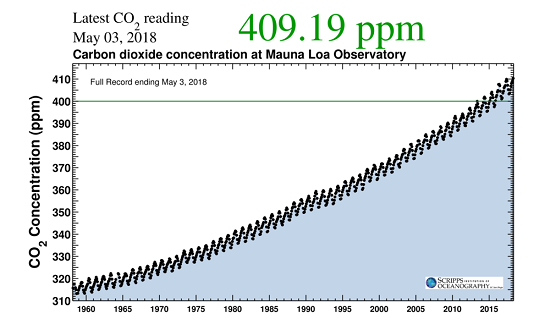
CO2 Concentrations Mauna Loa 1958 - May3 2018 

Recent CO2 measurements at Mauna Loa Observatory in Hawaii. (Scripps Institution of Oceanography)

For the first time since humans have been monitoring, atmospheric concentrations of carbon dioxide have exceeded 410 parts per million averaged across an entire month, a threshold that pushes the planet ever closer to warming beyond levels that scientists and the international community have deemed “safe.”

The reading from the Mauna Loa Observatory in Hawaii finds that concentrations of the climate-warming gas averaged above 410 parts per million throughout April. The first time readings crossed 410 at all occurred on April 18, 2017, or just about a year ago.

Carbon dioxide concentrations — whose “greenhouse gas effect” traps heat and drives climate change — were around 280 parts per million circa 1880, at the dawn of the industrial revolution. They’re now 46 percent higher.

As you can see in the famed “saw-toothed curve” graph above, more formally known as the Keeling Curve, concentrations have ticked upward in an unbroken progression for many decades. But they also go up and down on an annual cycle that’s controlled by the patterns and seasonality of plant growth around the planet. 

Earth’s atmosphere just crossed another troubling climate change threshold by Chris Mooney, Energy & Environment, Washington Post, May 3, 2018


Links posted on Facebook

Sun Apr 29, 2018

Mon Apr 30, 2018

Tue May 1, 2018

Wed May 2, 2018

Thu May 3, 2018

Fri May 4, 2018

Sat May 5, 2018


from Skeptical Science https://ift.tt/2IcIVkH
A chronological listing of news articles posted on the Skeptical Science Facebook Page during the past week.

Editor's Pick

Earth’s atmosphere just crossed another troubling climate change threshold 

CO2 Concentrations Mauna Loa 1958 - May3 2018 

Recent CO2 measurements at Mauna Loa Observatory in Hawaii. (Scripps Institution of Oceanography)

For the first time since humans have been monitoring, atmospheric concentrations of carbon dioxide have exceeded 410 parts per million averaged across an entire month, a threshold that pushes the planet ever closer to warming beyond levels that scientists and the international community have deemed “safe.”

The reading from the Mauna Loa Observatory in Hawaii finds that concentrations of the climate-warming gas averaged above 410 parts per million throughout April. The first time readings crossed 410 at all occurred on April 18, 2017, or just about a year ago.

Carbon dioxide concentrations — whose “greenhouse gas effect” traps heat and drives climate change — were around 280 parts per million circa 1880, at the dawn of the industrial revolution. They’re now 46 percent higher.

As you can see in the famed “saw-toothed curve” graph above, more formally known as the Keeling Curve, concentrations have ticked upward in an unbroken progression for many decades. But they also go up and down on an annual cycle that’s controlled by the patterns and seasonality of plant growth around the planet. 

Earth’s atmosphere just crossed another troubling climate change threshold by Chris Mooney, Energy & Environment, Washington Post, May 3, 2018


Links posted on Facebook

Sun Apr 29, 2018

Mon Apr 30, 2018

Tue May 1, 2018

Wed May 2, 2018

Thu May 3, 2018

Fri May 4, 2018

Sat May 5, 2018


from Skeptical Science https://ift.tt/2IcIVkH

Tangled up in blue

NASA’a Solar Dynamics Observatory (SDO) captured these images between April 24-26, 2018. Here’s NASA’s description:

The lone active region visible on our sun put on a fine display with its tangled magnetic field lines swaying and twisting above it … when viewed in a wavelength of extreme ultraviolet light. The charged particles spinning along these field lines illuminate them.

Bottom line: NASA SDO video shows the sun’s only visible active region putting on a fine display, viewed in extreme ultraviolet light, between April 24-26, 2018.

Read more from NASA.


from EarthSky https://ift.tt/2HNRClU

NASA’a Solar Dynamics Observatory (SDO) captured these images between April 24-26, 2018. Here’s NASA’s description:

The lone active region visible on our sun put on a fine display with its tangled magnetic field lines swaying and twisting above it … when viewed in a wavelength of extreme ultraviolet light. The charged particles spinning along these field lines illuminate them.

Bottom line: NASA SDO video shows the sun’s only visible active region putting on a fine display, viewed in extreme ultraviolet light, between April 24-26, 2018.

Read more from NASA.


from EarthSky https://ift.tt/2HNRClU

adds 2