aads

Don’t miss moon and Mars on May 6

From around the world tonight – May 5, 2018 – if you’re a night owl, you might catch the moon and the red planet Mars climbing above your eastern horizon before your bedtime. From mid-northern latitudes (U.S., Canada, Europe and Russia), the twosome won’t rise until after midnight. From the Southern Hemisphere, they’ll will be up by late evening. Click here for recommended sky almanacs; they can give you the rising time of the moon and Mars in your sky.

Or … get up before daybreak to see the waning gibbous moon and Mars. They’ll be highest up for the night around dawn.

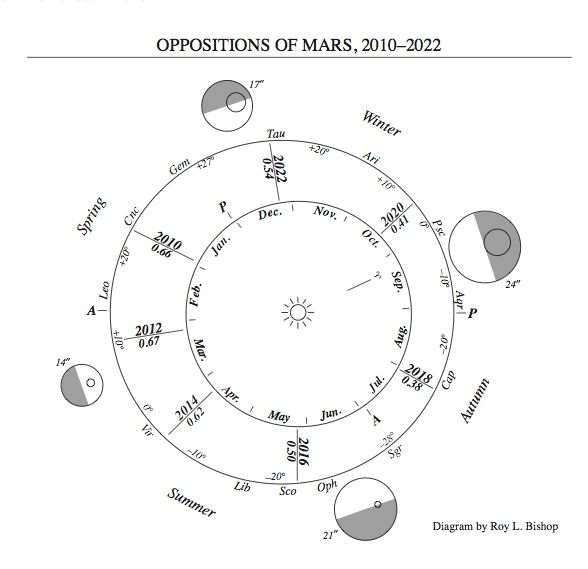
Mars is the planet to watch in 2018. By July, it’ll be brighter in our sky than it’s been since 2003. The chart below shows the cycle of oppositions for Mars, and why, every 15 or so year, we see Mars as brightest:

Mars is closest to Earth about every 2 years, when Earth passes between this planet and the sun. That event is called Mars’ opposition because, at such times, Mars appears opposite the sun in our sky. There’s also a 15-year cycle of close and far Mars oppositions, and that’s what this chart is showing. Notice that, in 2018, Mars will be especially close. The reason is that Mars’ opposition is July 27 and its perihelion – when it’s closest to the sun is relatively soon afterwards, on September 16. In 2018, Mars will be closer and brighter than it’s been since 2003. Diagram by Roy L. Bishop. Copyright Royal Astronomical Society of Canada. Used with permission. Visit the RASC estore to purchase the Observers Handbook, a necessary tool for all skywatchers.

What’s more, you’ll see two other bright planets in the predawn sky: Saturn and Jupiter.

Golden Saturn gleams close to Mars before dawn.

Mars and Saturn are in front of the constellation Sagittarius. This photo is from April 21, 2018 via Dennis Chabot at Posne Night Sky.

Cream-colored Jupiter is farther away from Mars and the moon in the May 6 morning sky, but Jupiter is unmistakably bright. In fact, in May 2018, dazzling Jupiter shines nearly all night. Watch for Jupiter in your eastern sky at nightfall. Then watch for Jupiter to climb highest up for the night around midnight and to sit low in the west at morning dawn. Earth will fly more or less between Jupiter and the sun – bringing Jupiter to its annual opposition – on May 8-9.

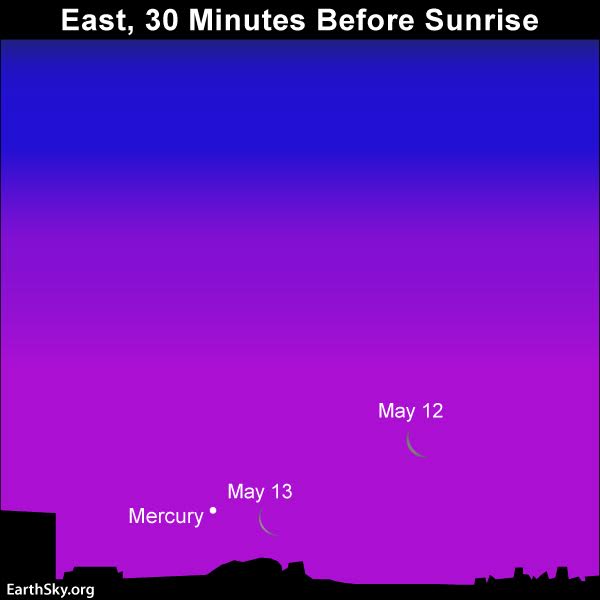
If you live in the Southern Hemisphere or the northern tropics, you also have a reasonably good chance of catching Mercury, the innermost planet of our solar system. Look east, near the sunrise point on the horizon as the predawn darkness is giving way to morning dawn. The moon will be in the vicinity of Mercury on May 12 and 13, as shown on the charts below. Note that the first chart is for the Southern Hemisphere. The second chart is for the Northern Hemisphere, where the view is nowhere near as good:

From southerly latitudes, the waning crescent moon helps to guide your eye to the planet Mercury on April 13 and 14. Read more.

On May 12 and 13, 2018, the moon and Mercury will be much harder to catch at northerly latitudes. Read more.

You can also see Venus, the brightest planet of all, for an hour or two in the evening sky this month. Venus shines opposite of Jupiter at evening dusk in May 2018, and sets beneath the western horizon by nightfall or early evening.

The stars of Taurus were sinking into the sunset behind Venus on April 23, 2018, when Venus was near the tiny dipper-shaped Pleiades star cluster. Photo by Alastair Borthwick at Lake Kennisis, Ontario, Canada.

Bottom line: Don’t miss the moon and Mars together in the predawn sky on May 6, 2018. Plus a word about other bright planets you can see in May.


from EarthSky https://ift.tt/2FMzPFR

From around the world tonight – May 5, 2018 – if you’re a night owl, you might catch the moon and the red planet Mars climbing above your eastern horizon before your bedtime. From mid-northern latitudes (U.S., Canada, Europe and Russia), the twosome won’t rise until after midnight. From the Southern Hemisphere, they’ll will be up by late evening. Click here for recommended sky almanacs; they can give you the rising time of the moon and Mars in your sky.

Or … get up before daybreak to see the waning gibbous moon and Mars. They’ll be highest up for the night around dawn.

Mars is the planet to watch in 2018. By July, it’ll be brighter in our sky than it’s been since 2003. The chart below shows the cycle of oppositions for Mars, and why, every 15 or so year, we see Mars as brightest:

Mars is closest to Earth about every 2 years, when Earth passes between this planet and the sun. That event is called Mars’ opposition because, at such times, Mars appears opposite the sun in our sky. There’s also a 15-year cycle of close and far Mars oppositions, and that’s what this chart is showing. Notice that, in 2018, Mars will be especially close. The reason is that Mars’ opposition is July 27 and its perihelion – when it’s closest to the sun is relatively soon afterwards, on September 16. In 2018, Mars will be closer and brighter than it’s been since 2003. Diagram by Roy L. Bishop. Copyright Royal Astronomical Society of Canada. Used with permission. Visit the RASC estore to purchase the Observers Handbook, a necessary tool for all skywatchers.

What’s more, you’ll see two other bright planets in the predawn sky: Saturn and Jupiter.

Golden Saturn gleams close to Mars before dawn.

Mars and Saturn are in front of the constellation Sagittarius. This photo is from April 21, 2018 via Dennis Chabot at Posne Night Sky.

Cream-colored Jupiter is farther away from Mars and the moon in the May 6 morning sky, but Jupiter is unmistakably bright. In fact, in May 2018, dazzling Jupiter shines nearly all night. Watch for Jupiter in your eastern sky at nightfall. Then watch for Jupiter to climb highest up for the night around midnight and to sit low in the west at morning dawn. Earth will fly more or less between Jupiter and the sun – bringing Jupiter to its annual opposition – on May 8-9.

If you live in the Southern Hemisphere or the northern tropics, you also have a reasonably good chance of catching Mercury, the innermost planet of our solar system. Look east, near the sunrise point on the horizon as the predawn darkness is giving way to morning dawn. The moon will be in the vicinity of Mercury on May 12 and 13, as shown on the charts below. Note that the first chart is for the Southern Hemisphere. The second chart is for the Northern Hemisphere, where the view is nowhere near as good:

From southerly latitudes, the waning crescent moon helps to guide your eye to the planet Mercury on April 13 and 14. Read more.

On May 12 and 13, 2018, the moon and Mercury will be much harder to catch at northerly latitudes. Read more.

You can also see Venus, the brightest planet of all, for an hour or two in the evening sky this month. Venus shines opposite of Jupiter at evening dusk in May 2018, and sets beneath the western horizon by nightfall or early evening.

The stars of Taurus were sinking into the sunset behind Venus on April 23, 2018, when Venus was near the tiny dipper-shaped Pleiades star cluster. Photo by Alastair Borthwick at Lake Kennisis, Ontario, Canada.

Bottom line: Don’t miss the moon and Mars together in the predawn sky on May 6, 2018. Plus a word about other bright planets you can see in May.


from EarthSky https://ift.tt/2FMzPFR

News digest – breast screening error, gene tests, childhood obesity and mobile phones

NHS breast screening error

Around 450,000 women in England between the ages of 68-71 years old weren’t invited for their final breast screening appointment due to an error with NHS computers. The oversight was reported widely and discussions around the coverage of estimates that ‘up to 270 lives may have been shortened by the error’ are ongoing. We also covered this one.

Genetic test could guide chemotherapy for breast cancer

Women with a certain type of hard-to-treat breast cancer could benefit from genetic testing, says the Telegraph and Mirror. The study, that we also reported on, showed women with triple negative breast cancer who had a faulty BRCA gene did better on a different chemotherapy drug than those on standard treatment.

Cancer researchers need phones to process data

Mobile phones could help cancer researchers analyse large sets of data quicker. The new citizen science project involves an app called ‘Dream Lab’, which anyone can download and crunches numbers while the owner of the phone sleeps. The BBC and The Sun have more on this.

Jamie Oliver on obesity

The Guardian, BBC and ITV covered the TV chef’s continuing campaign against childhood obesity. Oliver is now asking for the sugar tax to be applied to milk drinks too. For more on this specific request read the Huffington Post.

Cancer Research UK appoints new CEO

We appointed our new Chief Executive. Michelle Mitchell will be leaving the MS Society in the summer to take the place of Sir Harpal Kumar. Third Sector and our press release have more info.

High earners most likely to be drinkers

Those earning more are more likely to drink alcohol, according to a new study featured in the Mail Online and The Sun. Using alcohol as a method to ‘de-stress’ is suggested as a possible reason why those with bigger banks accounts booze more regularly.

Cancer Research UK commits £18million to brain tumour research

We’re teaming up with The Brain Tumour charity to take on brain tumours. The Guardian covered our new awards that total £18 million to tackle six of the biggest challenges in brain tumour research. Our blog post explores these six research themes in more detail.

HPV vaccine in boys

The BBC reports that a group of doctors have paid for their sons to have the HPV jab, which sparked an MP to call for widespread HPV vaccination in boys. The Mail Online has more on this.

And finally

Reports from the Telegraph and Mail Online suggest that a steep rise in cases of an aggressive brain tumour in England is linked to mobile phones. But this claim, which came from the press release promoting the research to journalists, wasn’t supported by the results of the study. Research calculated the number of brain tumours that were diagnosed in England between 1995 and 2015. The study found a sharp rise in the number of glioblastomas diagnosed over that time, but it wasn’t designed to find out what’s behind the increase. Our blog post takes a closer look at the study and its findings. But as it stands, there isn’t any conclusive evidence linking mobile phones and brain tumours.

Gabi


from Cancer Research UK – Science blog https://ift.tt/2JUn2E1

NHS breast screening error

Around 450,000 women in England between the ages of 68-71 years old weren’t invited for their final breast screening appointment due to an error with NHS computers. The oversight was reported widely and discussions around the coverage of estimates that ‘up to 270 lives may have been shortened by the error’ are ongoing. We also covered this one.

Genetic test could guide chemotherapy for breast cancer

Women with a certain type of hard-to-treat breast cancer could benefit from genetic testing, says the Telegraph and Mirror. The study, that we also reported on, showed women with triple negative breast cancer who had a faulty BRCA gene did better on a different chemotherapy drug than those on standard treatment.

Cancer researchers need phones to process data

Mobile phones could help cancer researchers analyse large sets of data quicker. The new citizen science project involves an app called ‘Dream Lab’, which anyone can download and crunches numbers while the owner of the phone sleeps. The BBC and The Sun have more on this.

Jamie Oliver on obesity

The Guardian, BBC and ITV covered the TV chef’s continuing campaign against childhood obesity. Oliver is now asking for the sugar tax to be applied to milk drinks too. For more on this specific request read the Huffington Post.

Cancer Research UK appoints new CEO

We appointed our new Chief Executive. Michelle Mitchell will be leaving the MS Society in the summer to take the place of Sir Harpal Kumar. Third Sector and our press release have more info.

High earners most likely to be drinkers

Those earning more are more likely to drink alcohol, according to a new study featured in the Mail Online and The Sun. Using alcohol as a method to ‘de-stress’ is suggested as a possible reason why those with bigger banks accounts booze more regularly.

Cancer Research UK commits £18million to brain tumour research

We’re teaming up with The Brain Tumour charity to take on brain tumours. The Guardian covered our new awards that total £18 million to tackle six of the biggest challenges in brain tumour research. Our blog post explores these six research themes in more detail.

HPV vaccine in boys

The BBC reports that a group of doctors have paid for their sons to have the HPV jab, which sparked an MP to call for widespread HPV vaccination in boys. The Mail Online has more on this.

And finally

Reports from the Telegraph and Mail Online suggest that a steep rise in cases of an aggressive brain tumour in England is linked to mobile phones. But this claim, which came from the press release promoting the research to journalists, wasn’t supported by the results of the study. Research calculated the number of brain tumours that were diagnosed in England between 1995 and 2015. The study found a sharp rise in the number of glioblastomas diagnosed over that time, but it wasn’t designed to find out what’s behind the increase. Our blog post takes a closer look at the study and its findings. But as it stands, there isn’t any conclusive evidence linking mobile phones and brain tumours.

Gabi


from Cancer Research UK – Science blog https://ift.tt/2JUn2E1

Breast screening error: women need reassurance, not misleading statistics

On Wednesday, Jeremy Hunt announced that the English breast screening programme had suffered a computer failure, resulting in an estimated 450,000 women not receiving their final breast screening invitation since 2009. This has triggered widespread concern, and is being widely covered by the media.

In his announcement, the Secretary of State for Health and Social Care also said that between 135 and 270 women may have “had their lives shortened as a result” of the error. These numbers are estimates. But, more worryingly, that phrasing is now being reported as a fact of the number of lives lost, rather than an estimate. It’s not possible to know for sure how accurate this figure may be, but talking about it in this way, before the findings of the independent inquiry into the error has even started, has served to stir fear.

That’s why, for women who may have been affected, this announcement is causing worry and distress. And the latest reports of NHS helplines being inundated with calls backs this up.

How reliable is this estimate?

Professor of the Public Understanding of Risk, Sir David Speigelhalter, has pointed out that the 135-270 ‘lives shortened’ claim is likely to be misleading. In part this is because the benefit of screening in older women is more controversial than in younger age groups.

There also isn’t good evidence on what happens if a woman misses her last screen, but has attended previous ones – so it’s unclear how much of an impact one missed screen might have. This of course should not take away from the fact that women affected have had their choice to participate in the screening programme taken away and, potentially, the chance to have a breast cancer diagnosed earlier than it would otherwise have been.

And as Speigelhalter says, screening comes with harms as well as benefits. The fact these harms may have been avoided for some women also needs to be considered. If we accept Jeremy Hunt’s 270 lives shortened figure, Spiegelhalter estimates that “up to 800 women may have been saved from harm by not sending them their final screening appointment letter.” [emphasis in original]

This is down to overdiagnosis. While there’s good evidence that the breast screening programme benefits women through early detection of breast cancers, screening also harms some of the women taking part. These women do not benefit from earlier detection of disease but instead have slow-growing, harmless breast cancers picked up through screening, when they would have otherwise gone undetected. For every 1000 women who take part in the UK screening programme, 5 will have their life saved, but 17 will be unnecessarily treated for a harmless cancer that would not have caused symptoms.

Breast cancer screening

Credit: Cancer Research UK

Overdiagnosis can become more likely when screening older women, as they have a shorter life expectancy and any cancer diagnosed early has less chance of becoming life-threatening. How the benefits of screening older women stack up against the harms of overdiagnosis and overtreatment isn’t clear, which is why, when there aren’t any IT errors, the UK screening programme stops inviting women at age 70.

The role of the AgeX clinical trial?

AgeX, the age extension trial, which in part helped to uncover the algorithm failure, aims to understand more about screening older women (as well as women from age 47-49). Public Health England set up this trial to gather better data to inform the breast screening programme and the service it should offer to women.

Some have taken aim at this study as being to blame for the error. But this thoughtful piece from The Guardian, examining the validity of the “270 deaths” figure as well as the estimate that 450,000 women have been affected, says otherwise.

Among all this debate, it’s important not to lose sight of the alarm caused to women and their families – and heightened by the rhetoric in the media. We need to understand what the actual impact may have been, which is the job of the independent inquiry that has been set up to study individual medical histories of the women affected.

But even then, it may be hard to find out what might have happened had this failure not taken place. In part because it is incredibly difficult to unpick what could have happened to each individual woman, as well as the difficulty in pinning down the precise benefits that final breast screening appointment may offer.

The breast screening programme has been set up to offer women aged 50-70 screening, and it failed to do that for some women in their final screening round. Thousands had a choice they should have been afforded taken away from them. But breast screening isn’t perfect, and the issue is more complex than simple but alarming headlines might lead us to believe.

Sara Hiom is director of early diagnosis and health professional engagement at Cancer Research UK

Any women who think they may be affected can ring Public Health England’s helpline: 0800 169 2692.

As always if any woman is experiencing any unusual or persistent changes, make sure you see your doctor.


from Cancer Research UK – Science blog https://ift.tt/2riC6o6

On Wednesday, Jeremy Hunt announced that the English breast screening programme had suffered a computer failure, resulting in an estimated 450,000 women not receiving their final breast screening invitation since 2009. This has triggered widespread concern, and is being widely covered by the media.

In his announcement, the Secretary of State for Health and Social Care also said that between 135 and 270 women may have “had their lives shortened as a result” of the error. These numbers are estimates. But, more worryingly, that phrasing is now being reported as a fact of the number of lives lost, rather than an estimate. It’s not possible to know for sure how accurate this figure may be, but talking about it in this way, before the findings of the independent inquiry into the error has even started, has served to stir fear.

That’s why, for women who may have been affected, this announcement is causing worry and distress. And the latest reports of NHS helplines being inundated with calls backs this up.

How reliable is this estimate?

Professor of the Public Understanding of Risk, Sir David Speigelhalter, has pointed out that the 135-270 ‘lives shortened’ claim is likely to be misleading. In part this is because the benefit of screening in older women is more controversial than in younger age groups.

There also isn’t good evidence on what happens if a woman misses her last screen, but has attended previous ones – so it’s unclear how much of an impact one missed screen might have. This of course should not take away from the fact that women affected have had their choice to participate in the screening programme taken away and, potentially, the chance to have a breast cancer diagnosed earlier than it would otherwise have been.

And as Speigelhalter says, screening comes with harms as well as benefits. The fact these harms may have been avoided for some women also needs to be considered. If we accept Jeremy Hunt’s 270 lives shortened figure, Spiegelhalter estimates that “up to 800 women may have been saved from harm by not sending them their final screening appointment letter.” [emphasis in original]

This is down to overdiagnosis. While there’s good evidence that the breast screening programme benefits women through early detection of breast cancers, screening also harms some of the women taking part. These women do not benefit from earlier detection of disease but instead have slow-growing, harmless breast cancers picked up through screening, when they would have otherwise gone undetected. For every 1000 women who take part in the UK screening programme, 5 will have their life saved, but 17 will be unnecessarily treated for a harmless cancer that would not have caused symptoms.

Breast cancer screening

Credit: Cancer Research UK

Overdiagnosis can become more likely when screening older women, as they have a shorter life expectancy and any cancer diagnosed early has less chance of becoming life-threatening. How the benefits of screening older women stack up against the harms of overdiagnosis and overtreatment isn’t clear, which is why, when there aren’t any IT errors, the UK screening programme stops inviting women at age 70.

The role of the AgeX clinical trial?

AgeX, the age extension trial, which in part helped to uncover the algorithm failure, aims to understand more about screening older women (as well as women from age 47-49). Public Health England set up this trial to gather better data to inform the breast screening programme and the service it should offer to women.

Some have taken aim at this study as being to blame for the error. But this thoughtful piece from The Guardian, examining the validity of the “270 deaths” figure as well as the estimate that 450,000 women have been affected, says otherwise.

Among all this debate, it’s important not to lose sight of the alarm caused to women and their families – and heightened by the rhetoric in the media. We need to understand what the actual impact may have been, which is the job of the independent inquiry that has been set up to study individual medical histories of the women affected.

But even then, it may be hard to find out what might have happened had this failure not taken place. In part because it is incredibly difficult to unpick what could have happened to each individual woman, as well as the difficulty in pinning down the precise benefits that final breast screening appointment may offer.

The breast screening programme has been set up to offer women aged 50-70 screening, and it failed to do that for some women in their final screening round. Thousands had a choice they should have been afforded taken away from them. But breast screening isn’t perfect, and the issue is more complex than simple but alarming headlines might lead us to believe.

Sara Hiom is director of early diagnosis and health professional engagement at Cancer Research UK

Any women who think they may be affected can ring Public Health England’s helpline: 0800 169 2692.

As always if any woman is experiencing any unusual or persistent changes, make sure you see your doctor.


from Cancer Research UK – Science blog https://ift.tt/2riC6o6

Hope in Kentucky Farm Country

Jeremy Hinton is an eighth-generation Kentucky farmer. He and his wife Joanna own Hinton’s Orchard and Farm Market in Hodgenville, Kentucky – the birthplace of Abraham Lincoln. “Our family came to LaRue County the same year that the Lincolns did, but we just stayed a lot longer,” he joked.

Today, Hinton and his wife grow a wide variety of fruits and vegetables which they sell at their two retail markets – one on the farm and one in nearby Elizabethtown. They are also actively involved in agritourism, hosting school tours and festivals as well as building their own corn maze. And, as if he doesn’t already have enough to do, Hinton sells crop insurance to farmers in the area. He knows firsthand how policies emanating from Washington impact farmers and other small businesses in Kentucky.

He believes that some of policies of the previous administration, if gone to fruition, “could have been very detrimental to our business and lots of others.” “There was a good bit of concern about the Waters of the U.S.,” he said. Other policies, like the previous administration’s changes to worker protection standards, “could have been very difficult to implement on a farm like ours.”

But the EPA’s regulatory reform efforts under Administrator Scott Pruitt have “increased optimism about the future,” stated Hinton. He also believes that there is a new, more friendly and cooperative attitude at EPA toward farmers – one that appreciates the environmental stewardship they practice day in and day out. As Administrator Pruitt likes to say, farmers are among our nation’s first environmentalists and conservationists.

“Our operation, like any farm, wants to do the best that we can to protect our natural resources,” Hinton said. “That’s our livelihood.” He and his wife raise their three children on the farm and hope that someday they will become the next generation of Kentucky farmers.

This week, EPA is recognizing and celebrating National Small Business Week. Small businesses, like the Hinton’s Orchard and Farm Market, are the heart of our nation’s economy. EPA is committed to advancing policies that protect the environment and provide small businesses with the regulatory clarity and certainty they need to thrive and support local communities around the nation.


from The EPA Blog https://ift.tt/2JVyAH5

Jeremy Hinton is an eighth-generation Kentucky farmer. He and his wife Joanna own Hinton’s Orchard and Farm Market in Hodgenville, Kentucky – the birthplace of Abraham Lincoln. “Our family came to LaRue County the same year that the Lincolns did, but we just stayed a lot longer,” he joked.

Today, Hinton and his wife grow a wide variety of fruits and vegetables which they sell at their two retail markets – one on the farm and one in nearby Elizabethtown. They are also actively involved in agritourism, hosting school tours and festivals as well as building their own corn maze. And, as if he doesn’t already have enough to do, Hinton sells crop insurance to farmers in the area. He knows firsthand how policies emanating from Washington impact farmers and other small businesses in Kentucky.

He believes that some of policies of the previous administration, if gone to fruition, “could have been very detrimental to our business and lots of others.” “There was a good bit of concern about the Waters of the U.S.,” he said. Other policies, like the previous administration’s changes to worker protection standards, “could have been very difficult to implement on a farm like ours.”

But the EPA’s regulatory reform efforts under Administrator Scott Pruitt have “increased optimism about the future,” stated Hinton. He also believes that there is a new, more friendly and cooperative attitude at EPA toward farmers – one that appreciates the environmental stewardship they practice day in and day out. As Administrator Pruitt likes to say, farmers are among our nation’s first environmentalists and conservationists.

“Our operation, like any farm, wants to do the best that we can to protect our natural resources,” Hinton said. “That’s our livelihood.” He and his wife raise their three children on the farm and hope that someday they will become the next generation of Kentucky farmers.

This week, EPA is recognizing and celebrating National Small Business Week. Small businesses, like the Hinton’s Orchard and Farm Market, are the heart of our nation’s economy. EPA is committed to advancing policies that protect the environment and provide small businesses with the regulatory clarity and certainty they need to thrive and support local communities around the nation.


from The EPA Blog https://ift.tt/2JVyAH5

New research, April 23-29, 2018

A selection of new climate related research articles is shown below.

Climate change impacts

1. Projected shift of Köppen–Geiger zones in the central Europe: A first insight into the implications for ecosystems and the society

"We examined a future change of Köppen–Geiger climate classification zones in central Europe in the 21st century using the high‐resolution (10 km) bias‐corrected simulations of two regional climate models following the IPCC SRES A1B emission scenario. Temperate oceanic climate (Cfb) will remain the dominant climate type in central Europe but it will extent into higher altitudes and replace boreal or colder climate types that will practically vanish by the end of the 21st century. There is a risk of large‐scale expansion of humid subtropical (Cfa) climate in lower altitudes where 20–50% of population lives nowadays. In the end of the century the majority of arable land and permanent crops areas will be in the Cfa zone. A growing occurrence of Cfa‐like or Mediterranean climate‐like (Csa) years will reach up to 50% at some locations where 1.4 million people live today. Almost all agriculturally important areas and two thirds of the current population will be exposed to the occurrence of Cfa‐ and Csa‐like years at least once in 10 years which may result into a lower production of rain‐fed crops as it was the case of of Cfa‐ and Csa‐like years of 2000, 2012 and 2015."

2. Ground thermal and geomechanical conditions in a permafrost-affected high-latitude rock avalanche site (Polvartinden, northern Norway) (open access)

"It is likely that permafrost in and near the failure zone is presently subject to degradation. This degradation, in combination with the extreme warm year antecedent to the rock failure, is seen to have played an important role in the detaching of the Signaldalen rock avalanche."

Mankind

3. When do Indians feel hot? Internet searches indicate seasonality suppresses adaptation to heat (open access)

"State-level heat thresholds ranged from 25.9 °C in Madhya Pradesh to 31.0 °C in Orissa. Local adaptation was found to occur at state level: the higher the average temperature in a state, the higher the heat threshold; and the higher the intra-annual temperature range (warmest minus coldest month) the lower the heat threshold."

4. Planning for climigration: a framework for effective action

5. Integrated urban water management applied to adaptation to climate change

6. CoastAdapt: an adaptation decision support framework for Australia’s coastal managers (open access)

7. Moving toward 1.5°C of warming: implications for climate adaptation strategies

8. Community vulnerability and resilience in disaster risk reduction: an example from Phojal Nalla, Himachal Pradesh, India

9. Responding to Sea Level Rise: Does Short‐Term Risk Reduction Inhibit Successful Long‐Term Adaptation?

10. Climate gentrification: from theory to empiricism in Miami-Dade County, Florida

11. Transformational adaptation of agricultural systems to climate change

12. The interdecadal worsening of weather conditions affecting aerosol pollution in the Beijing area in relation to climate warming (open access)

Biosphere

13. Warming drives higher rates of prey consumption and increases rates of intraguild predation

Study on dragonfly larvae: "Warming increased feeding rates by 42% on average across species but had no effect on activity rate. The magnitude of change in feeding rate was positively correlated with the maximum temperatures species experience across their ranges. Lastly, warming increased rates of IGP twofold, however, species’ behavioral responses alone were not predictive of their susceptibility to become IG prey of other larvae at warmer temperatures."

14. Spatial and temporal patterns of rainfall variability and its relationship with land surface phenology in central east Argentina

15. Carbonate system parameters of an algal-dominated reef along West Maui (open access)

16. The role of heartwood water storage for sem-arid trees under drought

17. Phytoplankton Increases Induced by Tropical Cyclones in the South China Sea During 1998–2015

18. Phenological sensitivity to climate change is higher in resident than in migrant bird populations among European cavity breeders

"We found that both tits and flycatchers advanced laying in response to spring warming, but resident tit populations advanced more strongly in relation to temperature increases than migratory flycatchers. These different temperature responses have already led to a divergence in laying dates between tits and flycatchers of on average 0.94 days per decade over the current study period. Interestingly, this divergence was stronger at lower latitudes where the interval between tit and flycatcher phenology is smaller and winter conditions can be considered more favorable for resident birds."

19. Use of genetic, climatic, and microbiological data to inform reintroduction of a regionally extinct butterfly

20. Quantifying Australia's dryland vegetation response to flooding and drought at sub-continental scale

21. Long-term impacts of drought on growth and forest dynamics in a temperate beech-oak-birch forest

22. Adaptive management and planning for the conservation of four threatened large Asian mammals in a changing climate

23. Effects of competition and herbivory over woody seedling growth in a temperate woodland trump the effects of elevated CO2

"Our findings do not support the hypothesis that future increases in atmospheric [CO2] will, by itself, promote woody plant recruitment in eucalypt-dominated temperate grassy woodlands."

Climate change mitigation

Climate change communication

24. Positive energies? An empirical study of community energy participation and attitudes to renewable energy

Emission savings

25. Carbon emission and abatement potential outlook in China's building sector through 2050

26. Universal access to clean cookstoves: Evaluation of a public program in Peru

27. Inventory of methane emissions from livestock in China from 1980 to 2013

28. The contribution of transport policies to the mitigation potential and cost of 2 °C and 1.5 °C goals (open access)

Energy production

29. Climate, economic, and environmental impacts of producing wood for bioenergy (open access)

"We find that increasing bioenergy production and pellet exports often increase net emissions of GHGs for decades or longer,..."

30. Does Russian unconventional oil have a future?

31. Carbon overhead: The impact of the expansion in low-carbon electricity in China 2015–2040

Climate Policy

32. Climate governance through partnerships: A study of 150 urban initiatives in China

33. Governing the global climate commons: The political economy of state and local action, after the U.S. flip-flop on the Paris Agreement

34. Zero carbon energy system pathways for Ireland consistent with the Paris Agreement

Climate change

35. Analyzing Regional Climate Change in Africa in a 1.5, 2, and 3°C Global Warming World

36. Climate Model Biases and Modification of the Climate Change Signal by Intensity-Dependent Bias Correction

37. Performance of pattern-scaled climate projections under high-end warming, part I: surface air temperature over land

38. Indices of Canada’s future climate for general and agricultural adaptation applications (open access)

Temperature, precipitation, wind

39. The early 20th century warming: Anomalies, causes, and consequences

"Attribution studies estimate that about a half (40–54%; p > .8) of the global warming from 1901 to 1950 was forced by a combination of increasing greenhouse gases and natural forcing, offset to some extent by aerosols. Natural variability also made a large contribution, particularly to regional anomalies like the Arctic warming in the 1920s and 1930s."

40. Growing Land‐Sea Temperature Contrast and the Intensification of Arctic Cyclones

"By comparing statistics for years with high land‐sea thermal contrast against years with low, we demonstrate that storms over the Arctic Ocean will likely become more frequent and more dynamically intense as the climate warms, increasing the risk to shipping and other human activities."

41. Season‐dependent warming characteristics observed at 12 stations in South Korea over the recent 100 years

42. Maximum and minimum temperatures in the United States: Time trends and persistence

"Our results reveal evidence of significant positive trends in both maximum and minimum temperatures, while the difference between them show a significant negative trend as a consequence of the higher increase in the minimum temperatures."

43. Stochastic modelling of the monthly average maximum and minimum temperature patterns in India 1981–2015

44. Polarized Response of East Asian Winter Temperature Extremes in the Era of Arctic Warming

45. An analysis of changes in temperature extremes in the Three River Headwaters region of the Tibetan Plateau during 1961–2016

46. Projected changes in seasonal temperature extremes across China from 2017 to 2100 based on statistical downscaling

47. Inter‐decadal change of leading pattern of spring rainfall over southern China during 1901–2010

48. How Accurately Can the Air Temperature Lapse Rate Over the Tibetan Plateau Be Estimated From MODIS LSTs?

49. Trend analysis of annual precipitation of Mauritius for the period 1981–2010

50. Global lake response to the recent warming hiatus (open access)

51. Basin-scale Prediction of Sea Surface Temperature with Artificial Neural Networks

Extreme events

52. Extreme heat waves under 1.5 °C and 2 °C global warming (open access)

53. Climate Change and Drought: a Perspective on Drought Indices

54. Projected changes in temperature and precipitation extremes over the Silk Road Economic Belt regions by the Coupled Model Intercomparison Project Phase 5 multi‐model ensembles

55. Declining hailstorm frequency in China during 1961–2015 and its potential influential factors

56. Study of extreme wet and dry periods in Cyprus using climatic indices

Forcings and feedbacks

57. A systematic wavelet-based exploratory analysis of climatic variables

"Shorter-term variations in global surface temperature are associated with internally generated natural climate variability and external climate forcings, while longer-term variations are strongly related to human-induced changes only. In this respect, a long-term component of the net radiative forcing of human activities longer than 30 years displays a statistically significant relationship with global warming and cooling periods identified in the climate change literature."

58. Balloon-borne tropospheric CO2 observations over the equatorial eastern and western Pacific

59. Spatially Resolved Isotopic Source Signatures of Wetland Methane Emissions

"Concentrations of methane are increasing in the atmosphere. In order to understand the reasons behind such variations, carbon isotopes are used to help identify changes in emission sources and sinks. We present a new global map of the carbon isotope signature associated with wetland methane emissions, the largest global source of methane to the atmosphere. We show how this newly synthesized information can lead to more accurate understanding of the causes of variations in the amount and rate of increase of methane in the atmosphere."

60. Analysis of European ozone trends in the period 1995–2014 (open access)

61. Evaluating year-to-year anomalies in tropical wetland methane emissions using satellite CH4 observations (open access)

62. Can reducing black carbon and methane below RCP2.6 levels keep global warming below 1.5 °C?

63. Tundra shrub effects on growing season energy and carbon dioxide exchange (open access)

64. Different Global Precipitation Responses to Solar, Volcanic, and Greenhouse Gas Forcings

"For a given global temperature change, the global precipitation change under volcanic forcing is larger than that under solar and GHG forcings. The reason is that the volcanic forcing induces the strongest solar irradiance change in the wet tropics. Among the three forcings we examined, the GHG forcing excites the strongest high‐latitude warming, especially the Arctic amplification of global warming. There is no Arctic amplification of temperature decrease under the volcanic forcing‐induced global cooling. The volcanic forcing weakens the Intertropical Convergence Zone and reduces precipitation. The results suggest that while volcanic eruptions can reduce precipitation, they do not mitigate the Arctic amplification of temperature increase under the GHG‐induced warming."

65. The Ozone Monitoring Instrument: overview of 14 years in space (open access)

66. Assessing Satellite‐Derived Radiative Forcing From Snow Impurities Through Inverse Hydrologic Modeling

67. Clouds over the Southern Ocean as Observed from The RV Investigator during CAPRICORN. Part 1: Cloud Occurrence and Phase Partitioning

Cryosphere

68. Accelerating glacier mass loss on Franz Josef Land, Russian Arctic

"Mass loss from FJL doubled between 2011 and 2015 compared to 1953–2011/2015, increasing from a rate of −2.18 ± 0.72 Gt yr−1 to −4.43 ± 0.78 Gt yr−1. This 2011−2015 rate indicates an acceleration in ice loss from that observed in 2003–2009 by multiple studies using ICESat and GRACE. Glacier thinning rates are spatially highly variable. We observe glacier thinning rates of up to 10 m per year, and in general we see a trend of increased thinning from the NE towards the SW. Glacier retreat is widespread and has led to the creation of at least one new island. Historically, ice wastage from FJL is thought to have been relatively small, but accelerating ice loss may be the new normal for this archipelago in a warming Arctic."

69. A Century of Stability of Avannarleq and Kujalleq Glaciers, West Greenland, Explained Using High‐Resolution Airborne Gravity and Other Data (open access)

70. Volcanic impacts on modern glaciers: A global synthesis

71. Unabated wastage of the Juneau and Stikine icefields (southeast Alaska) in the early 21st century (open access)

"We find strongly negative mass balances from 2000 to 2016 for both icefields, in agreement with airborne laser altimetry. Mass losses are thus continuing unabated."

72. Simulating ice thickness and velocity evolution of Upernavik Isstrøm 1849–2012 by forcing prescribed terminus positions in ISSM (open access)

73. Aspect controls the survival of ice cliffs on debris-covered glaciers

Atmospheric and oceanic circulation

74. How Robust Are the Surface Temperature Fingerprints of the Atlantic Overturning Meridional Circulation on Monthly Time Scales?

75. Gulf Stream Transport and Mixing Processes via Coherent Structure Dynamics

76. Atlantic Multidecadal Variability as a modulator of precipitation variability in the Southwest US

77. Response of North Pacific and North Atlantic decadal variability to weak global warming (open access)

78. Multidecadal fluctuation of the wintertime Arctic Oscillation pattern and its implication

Carbon cycle

79. Temporal Coupling of Subsurface and Surface Soil CO2 Fluxes: Insights From a Nonsteady State Model and Cross‐Wavelet Coherence Analysis

80. Nongrowing season methane emissions–a significant component of annual emissions across northern ecosystems

81. How does the terrestrial carbon exchange respond to inter-annual climatic variations? A quantification based on atmospheric CO2 data (open access)

82. An Analytical Framework for the Steady State Impact of Carbonate Compensation on Atmospheric CO2

Other papers

Palaeoclimatology

83. Spatio-temporal variability of Arctic summer temperatures over the past 2 millennia (open access)

"The spatial average shows a millennium-scale cooling trend which is reversed in the mid-19th century. While temperatures in the 10th century were probably as warm as in the 20th century, the spatial coherence of the recent warm episodes seems unprecedented."

84. Recent climate variations in Chile: constraints from borehole temperature profiles (open access)


from Skeptical Science https://ift.tt/2FI25tp

A selection of new climate related research articles is shown below.

Climate change impacts

1. Projected shift of Köppen–Geiger zones in the central Europe: A first insight into the implications for ecosystems and the society

"We examined a future change of Köppen–Geiger climate classification zones in central Europe in the 21st century using the high‐resolution (10 km) bias‐corrected simulations of two regional climate models following the IPCC SRES A1B emission scenario. Temperate oceanic climate (Cfb) will remain the dominant climate type in central Europe but it will extent into higher altitudes and replace boreal or colder climate types that will practically vanish by the end of the 21st century. There is a risk of large‐scale expansion of humid subtropical (Cfa) climate in lower altitudes where 20–50% of population lives nowadays. In the end of the century the majority of arable land and permanent crops areas will be in the Cfa zone. A growing occurrence of Cfa‐like or Mediterranean climate‐like (Csa) years will reach up to 50% at some locations where 1.4 million people live today. Almost all agriculturally important areas and two thirds of the current population will be exposed to the occurrence of Cfa‐ and Csa‐like years at least once in 10 years which may result into a lower production of rain‐fed crops as it was the case of of Cfa‐ and Csa‐like years of 2000, 2012 and 2015."

2. Ground thermal and geomechanical conditions in a permafrost-affected high-latitude rock avalanche site (Polvartinden, northern Norway) (open access)

"It is likely that permafrost in and near the failure zone is presently subject to degradation. This degradation, in combination with the extreme warm year antecedent to the rock failure, is seen to have played an important role in the detaching of the Signaldalen rock avalanche."

Mankind

3. When do Indians feel hot? Internet searches indicate seasonality suppresses adaptation to heat (open access)

"State-level heat thresholds ranged from 25.9 °C in Madhya Pradesh to 31.0 °C in Orissa. Local adaptation was found to occur at state level: the higher the average temperature in a state, the higher the heat threshold; and the higher the intra-annual temperature range (warmest minus coldest month) the lower the heat threshold."

4. Planning for climigration: a framework for effective action

5. Integrated urban water management applied to adaptation to climate change

6. CoastAdapt: an adaptation decision support framework for Australia’s coastal managers (open access)

7. Moving toward 1.5°C of warming: implications for climate adaptation strategies

8. Community vulnerability and resilience in disaster risk reduction: an example from Phojal Nalla, Himachal Pradesh, India

9. Responding to Sea Level Rise: Does Short‐Term Risk Reduction Inhibit Successful Long‐Term Adaptation?

10. Climate gentrification: from theory to empiricism in Miami-Dade County, Florida

11. Transformational adaptation of agricultural systems to climate change

12. The interdecadal worsening of weather conditions affecting aerosol pollution in the Beijing area in relation to climate warming (open access)

Biosphere

13. Warming drives higher rates of prey consumption and increases rates of intraguild predation

Study on dragonfly larvae: "Warming increased feeding rates by 42% on average across species but had no effect on activity rate. The magnitude of change in feeding rate was positively correlated with the maximum temperatures species experience across their ranges. Lastly, warming increased rates of IGP twofold, however, species’ behavioral responses alone were not predictive of their susceptibility to become IG prey of other larvae at warmer temperatures."

14. Spatial and temporal patterns of rainfall variability and its relationship with land surface phenology in central east Argentina

15. Carbonate system parameters of an algal-dominated reef along West Maui (open access)

16. The role of heartwood water storage for sem-arid trees under drought

17. Phytoplankton Increases Induced by Tropical Cyclones in the South China Sea During 1998–2015

18. Phenological sensitivity to climate change is higher in resident than in migrant bird populations among European cavity breeders

"We found that both tits and flycatchers advanced laying in response to spring warming, but resident tit populations advanced more strongly in relation to temperature increases than migratory flycatchers. These different temperature responses have already led to a divergence in laying dates between tits and flycatchers of on average 0.94 days per decade over the current study period. Interestingly, this divergence was stronger at lower latitudes where the interval between tit and flycatcher phenology is smaller and winter conditions can be considered more favorable for resident birds."

19. Use of genetic, climatic, and microbiological data to inform reintroduction of a regionally extinct butterfly

20. Quantifying Australia's dryland vegetation response to flooding and drought at sub-continental scale

21. Long-term impacts of drought on growth and forest dynamics in a temperate beech-oak-birch forest

22. Adaptive management and planning for the conservation of four threatened large Asian mammals in a changing climate

23. Effects of competition and herbivory over woody seedling growth in a temperate woodland trump the effects of elevated CO2

"Our findings do not support the hypothesis that future increases in atmospheric [CO2] will, by itself, promote woody plant recruitment in eucalypt-dominated temperate grassy woodlands."

Climate change mitigation

Climate change communication

24. Positive energies? An empirical study of community energy participation and attitudes to renewable energy

Emission savings

25. Carbon emission and abatement potential outlook in China's building sector through 2050

26. Universal access to clean cookstoves: Evaluation of a public program in Peru

27. Inventory of methane emissions from livestock in China from 1980 to 2013

28. The contribution of transport policies to the mitigation potential and cost of 2 °C and 1.5 °C goals (open access)

Energy production

29. Climate, economic, and environmental impacts of producing wood for bioenergy (open access)

"We find that increasing bioenergy production and pellet exports often increase net emissions of GHGs for decades or longer,..."

30. Does Russian unconventional oil have a future?

31. Carbon overhead: The impact of the expansion in low-carbon electricity in China 2015–2040

Climate Policy

32. Climate governance through partnerships: A study of 150 urban initiatives in China

33. Governing the global climate commons: The political economy of state and local action, after the U.S. flip-flop on the Paris Agreement

34. Zero carbon energy system pathways for Ireland consistent with the Paris Agreement

Climate change

35. Analyzing Regional Climate Change in Africa in a 1.5, 2, and 3°C Global Warming World

36. Climate Model Biases and Modification of the Climate Change Signal by Intensity-Dependent Bias Correction

37. Performance of pattern-scaled climate projections under high-end warming, part I: surface air temperature over land

38. Indices of Canada’s future climate for general and agricultural adaptation applications (open access)

Temperature, precipitation, wind

39. The early 20th century warming: Anomalies, causes, and consequences

"Attribution studies estimate that about a half (40–54%; p > .8) of the global warming from 1901 to 1950 was forced by a combination of increasing greenhouse gases and natural forcing, offset to some extent by aerosols. Natural variability also made a large contribution, particularly to regional anomalies like the Arctic warming in the 1920s and 1930s."

40. Growing Land‐Sea Temperature Contrast and the Intensification of Arctic Cyclones

"By comparing statistics for years with high land‐sea thermal contrast against years with low, we demonstrate that storms over the Arctic Ocean will likely become more frequent and more dynamically intense as the climate warms, increasing the risk to shipping and other human activities."

41. Season‐dependent warming characteristics observed at 12 stations in South Korea over the recent 100 years

42. Maximum and minimum temperatures in the United States: Time trends and persistence

"Our results reveal evidence of significant positive trends in both maximum and minimum temperatures, while the difference between them show a significant negative trend as a consequence of the higher increase in the minimum temperatures."

43. Stochastic modelling of the monthly average maximum and minimum temperature patterns in India 1981–2015

44. Polarized Response of East Asian Winter Temperature Extremes in the Era of Arctic Warming

45. An analysis of changes in temperature extremes in the Three River Headwaters region of the Tibetan Plateau during 1961–2016

46. Projected changes in seasonal temperature extremes across China from 2017 to 2100 based on statistical downscaling

47. Inter‐decadal change of leading pattern of spring rainfall over southern China during 1901–2010

48. How Accurately Can the Air Temperature Lapse Rate Over the Tibetan Plateau Be Estimated From MODIS LSTs?

49. Trend analysis of annual precipitation of Mauritius for the period 1981–2010

50. Global lake response to the recent warming hiatus (open access)

51. Basin-scale Prediction of Sea Surface Temperature with Artificial Neural Networks

Extreme events

52. Extreme heat waves under 1.5 °C and 2 °C global warming (open access)

53. Climate Change and Drought: a Perspective on Drought Indices

54. Projected changes in temperature and precipitation extremes over the Silk Road Economic Belt regions by the Coupled Model Intercomparison Project Phase 5 multi‐model ensembles

55. Declining hailstorm frequency in China during 1961–2015 and its potential influential factors

56. Study of extreme wet and dry periods in Cyprus using climatic indices

Forcings and feedbacks

57. A systematic wavelet-based exploratory analysis of climatic variables

"Shorter-term variations in global surface temperature are associated with internally generated natural climate variability and external climate forcings, while longer-term variations are strongly related to human-induced changes only. In this respect, a long-term component of the net radiative forcing of human activities longer than 30 years displays a statistically significant relationship with global warming and cooling periods identified in the climate change literature."

58. Balloon-borne tropospheric CO2 observations over the equatorial eastern and western Pacific

59. Spatially Resolved Isotopic Source Signatures of Wetland Methane Emissions

"Concentrations of methane are increasing in the atmosphere. In order to understand the reasons behind such variations, carbon isotopes are used to help identify changes in emission sources and sinks. We present a new global map of the carbon isotope signature associated with wetland methane emissions, the largest global source of methane to the atmosphere. We show how this newly synthesized information can lead to more accurate understanding of the causes of variations in the amount and rate of increase of methane in the atmosphere."

60. Analysis of European ozone trends in the period 1995–2014 (open access)

61. Evaluating year-to-year anomalies in tropical wetland methane emissions using satellite CH4 observations (open access)

62. Can reducing black carbon and methane below RCP2.6 levels keep global warming below 1.5 °C?

63. Tundra shrub effects on growing season energy and carbon dioxide exchange (open access)

64. Different Global Precipitation Responses to Solar, Volcanic, and Greenhouse Gas Forcings

"For a given global temperature change, the global precipitation change under volcanic forcing is larger than that under solar and GHG forcings. The reason is that the volcanic forcing induces the strongest solar irradiance change in the wet tropics. Among the three forcings we examined, the GHG forcing excites the strongest high‐latitude warming, especially the Arctic amplification of global warming. There is no Arctic amplification of temperature decrease under the volcanic forcing‐induced global cooling. The volcanic forcing weakens the Intertropical Convergence Zone and reduces precipitation. The results suggest that while volcanic eruptions can reduce precipitation, they do not mitigate the Arctic amplification of temperature increase under the GHG‐induced warming."

65. The Ozone Monitoring Instrument: overview of 14 years in space (open access)

66. Assessing Satellite‐Derived Radiative Forcing From Snow Impurities Through Inverse Hydrologic Modeling

67. Clouds over the Southern Ocean as Observed from The RV Investigator during CAPRICORN. Part 1: Cloud Occurrence and Phase Partitioning

Cryosphere

68. Accelerating glacier mass loss on Franz Josef Land, Russian Arctic

"Mass loss from FJL doubled between 2011 and 2015 compared to 1953–2011/2015, increasing from a rate of −2.18 ± 0.72 Gt yr−1 to −4.43 ± 0.78 Gt yr−1. This 2011−2015 rate indicates an acceleration in ice loss from that observed in 2003–2009 by multiple studies using ICESat and GRACE. Glacier thinning rates are spatially highly variable. We observe glacier thinning rates of up to 10 m per year, and in general we see a trend of increased thinning from the NE towards the SW. Glacier retreat is widespread and has led to the creation of at least one new island. Historically, ice wastage from FJL is thought to have been relatively small, but accelerating ice loss may be the new normal for this archipelago in a warming Arctic."

69. A Century of Stability of Avannarleq and Kujalleq Glaciers, West Greenland, Explained Using High‐Resolution Airborne Gravity and Other Data (open access)

70. Volcanic impacts on modern glaciers: A global synthesis

71. Unabated wastage of the Juneau and Stikine icefields (southeast Alaska) in the early 21st century (open access)

"We find strongly negative mass balances from 2000 to 2016 for both icefields, in agreement with airborne laser altimetry. Mass losses are thus continuing unabated."

72. Simulating ice thickness and velocity evolution of Upernavik Isstrøm 1849–2012 by forcing prescribed terminus positions in ISSM (open access)

73. Aspect controls the survival of ice cliffs on debris-covered glaciers

Atmospheric and oceanic circulation

74. How Robust Are the Surface Temperature Fingerprints of the Atlantic Overturning Meridional Circulation on Monthly Time Scales?

75. Gulf Stream Transport and Mixing Processes via Coherent Structure Dynamics

76. Atlantic Multidecadal Variability as a modulator of precipitation variability in the Southwest US

77. Response of North Pacific and North Atlantic decadal variability to weak global warming (open access)

78. Multidecadal fluctuation of the wintertime Arctic Oscillation pattern and its implication

Carbon cycle

79. Temporal Coupling of Subsurface and Surface Soil CO2 Fluxes: Insights From a Nonsteady State Model and Cross‐Wavelet Coherence Analysis

80. Nongrowing season methane emissions–a significant component of annual emissions across northern ecosystems

81. How does the terrestrial carbon exchange respond to inter-annual climatic variations? A quantification based on atmospheric CO2 data (open access)

82. An Analytical Framework for the Steady State Impact of Carbonate Compensation on Atmospheric CO2

Other papers

Palaeoclimatology

83. Spatio-temporal variability of Arctic summer temperatures over the past 2 millennia (open access)

"The spatial average shows a millennium-scale cooling trend which is reversed in the mid-19th century. While temperatures in the 10th century were probably as warm as in the 20th century, the spatial coherence of the recent warm episodes seems unprecedented."

84. Recent climate variations in Chile: constraints from borehole temperature profiles (open access)


from Skeptical Science https://ift.tt/2FI25tp

Emory 'Dog-nition' research coming up on Science Friday


Come. Sit. Stay. And listen to Science Friday's interview at 3:30 pm E.T. today with Emory neuroscientist Gregory Berns, who is exploring the inner workings of the canine mind. Two of the questions the program plans to explore: Do dogs have a concept of time? And how do our furry companions make sense of the world?

You can tweet questions you'd like answered to @scifri. The radio program is based at WNYC Studios, distributed to public radio stations across the United States, and is also accessible online.

Related:
A dog's dilemma: Do canines prefer praise or food?
Recreating the brain of the extinct Tasmanian tiger


from eScienceCommons https://ift.tt/2HSO6mh


Come. Sit. Stay. And listen to Science Friday's interview at 3:30 pm E.T. today with Emory neuroscientist Gregory Berns, who is exploring the inner workings of the canine mind. Two of the questions the program plans to explore: Do dogs have a concept of time? And how do our furry companions make sense of the world?

You can tweet questions you'd like answered to @scifri. The radio program is based at WNYC Studios, distributed to public radio stations across the United States, and is also accessible online.

Related:
A dog's dilemma: Do canines prefer praise or food?
Recreating the brain of the extinct Tasmanian tiger


from eScienceCommons https://ift.tt/2HSO6mh

Find the radiant point for the Eta Aquariid meteor shower

Eta Aquarid meteors appear to radiate from near a famous asterism – or noticeable star pattern – called the Water Jar in Aquarius.

The annual Eta Aquariid meteor shower peaks this weekend, and people will inevitably ask about its radiant point. That’s point in the sky from which meteors in annual showers appear to radiate.

You don’t have to locate the radiant to watch the Eta Aquariid meteors. Instead, the meteors will appear unexpectedly in all parts of the sky. Yet if you traced their paths backwards, all of these meteors would appear to radiate from a single point in our sky, from a Y-shaped group of stars – an asterism – called the Water Jar in the constellation Aquarius.

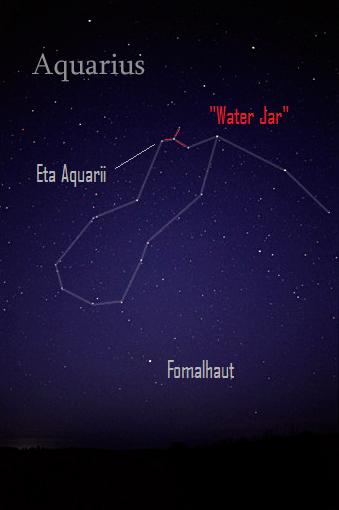
The Y-shaped Water Jar marks the radiant of the Eta Aquarid meteor shower. Notice the bright star Fomalhaut. It can guide your eye to much-fainter Aquarius.

Aquarius is faint. You’ll need a dark sky to spot it. The bright star Fomalhaut in the constellation Pisces Austrinus, the Southern Fish, is near it and can guide your eye. On old star charts, the Aquarius the Water Carrier is often pictured pouring water into the open mouth of the Southern Fish, from the Water Jar. In a very dark sky, you can see a zig zag line of star leading downward from the Water Jar to the star Fomalhaut.

Or try star-hopping to the Water Jar from the Great Square of Pegasus (see star chart below). Four medium-bright stars mark the corners of the Square. Looking eastward at about 4 a.m. (Daylight Saving Time) in May, the Great Square of Pegasus glitters like a celestial baseball diamond. Imagine the bottom star as home base. Draw a line from the third base star through the first base star, then go twice that distance to locate the star Sadal Melik in Aquarius.

To the lower left of Sadal Melik is the small Y-shaped Water Jar, marking the approximate radiant of the Eta Aquarid meteor shower.

Use the Great Square of Pegasus to star-hop to the radiant of the Eta Aquariid meteor shower.

Bottom line: Eta Aquariid meteors radiate from the Water Jar in the constellation Aquarius. Just remember, you don’t need to know the shower’s radiant point to watch the meteors!


from EarthSky https://ift.tt/2FGPc2L

Eta Aquarid meteors appear to radiate from near a famous asterism – or noticeable star pattern – called the Water Jar in Aquarius.

The annual Eta Aquariid meteor shower peaks this weekend, and people will inevitably ask about its radiant point. That’s point in the sky from which meteors in annual showers appear to radiate.

You don’t have to locate the radiant to watch the Eta Aquariid meteors. Instead, the meteors will appear unexpectedly in all parts of the sky. Yet if you traced their paths backwards, all of these meteors would appear to radiate from a single point in our sky, from a Y-shaped group of stars – an asterism – called the Water Jar in the constellation Aquarius.

The Y-shaped Water Jar marks the radiant of the Eta Aquarid meteor shower. Notice the bright star Fomalhaut. It can guide your eye to much-fainter Aquarius.

Aquarius is faint. You’ll need a dark sky to spot it. The bright star Fomalhaut in the constellation Pisces Austrinus, the Southern Fish, is near it and can guide your eye. On old star charts, the Aquarius the Water Carrier is often pictured pouring water into the open mouth of the Southern Fish, from the Water Jar. In a very dark sky, you can see a zig zag line of star leading downward from the Water Jar to the star Fomalhaut.

Or try star-hopping to the Water Jar from the Great Square of Pegasus (see star chart below). Four medium-bright stars mark the corners of the Square. Looking eastward at about 4 a.m. (Daylight Saving Time) in May, the Great Square of Pegasus glitters like a celestial baseball diamond. Imagine the bottom star as home base. Draw a line from the third base star through the first base star, then go twice that distance to locate the star Sadal Melik in Aquarius.

To the lower left of Sadal Melik is the small Y-shaped Water Jar, marking the approximate radiant of the Eta Aquarid meteor shower.

Use the Great Square of Pegasus to star-hop to the radiant of the Eta Aquariid meteor shower.

Bottom line: Eta Aquariid meteors radiate from the Water Jar in the constellation Aquarius. Just remember, you don’t need to know the shower’s radiant point to watch the meteors!


from EarthSky https://ift.tt/2FGPc2L

adds 2