aads

Eta Aquariids before dawn May 5 and 6

Image at top: Eta Aquarids meteors over the Atacama Desert in 2015, via Yuri Beletsky.

Before dawn this weekend – May 5 and 6, 2018 – the Eta Aquariid meteor shower reaches its annual peak. Here’s the bad news. A bright moon will interfere with meteor-watching. Here’s the good news. There are some tricks to watching in moonlight. More good news if you live south of the equator … this shower particularly favors the Southern Hemisphere.

It’s true. The moon will be out in force during the prime time viewing hours of this predawn meteor shower in 2018. To optimize your chances for seeing meteors in midnight, try one or both of these two things. First, try watching in a dark country sky in very late evening, or around midnight, when the moon is either still below the horizon, or low in the sky. You won’t catch as many meteors, but you might catch a few. Don’t know when the moon rises in your sky? Find out with this handy custom sunrise-sunset calendar.

Second, if you’re watching in the prime hours before dawn – when the Eta Aquariid radiant point is highest in your sky, and the most meteors will be flying – try sitting in a moonshadow. That could be the shadow of a barn or large solitary tree or even a mountain, anyplace you can create some extra darkness for yourself while gazing up at an open sky.

6 May 2017 – Eta Aquarid Captured at Mount Bromo (4K Timelapse) from Justin Ng Photo on Vimeo.

It’s hard to say with certainty whether May 5 or May 6 will be the better morning to watch. This shower has a relatively broad peak. Try both mornings. Just remember that – as seen from all parts of Earth – the dark hour before dawn typically presents the greatest number of Eta Aquarid meteors.

And, as always for meteor-watching, be sure to avoid city lights …

Read more: Where’s the radiant point for the Eta Aquarid meteor shower?

Read more: Everything you need to know: Eta Aquarid meteor shower

Read more: EarthSky’s meteor shower guide for 2018

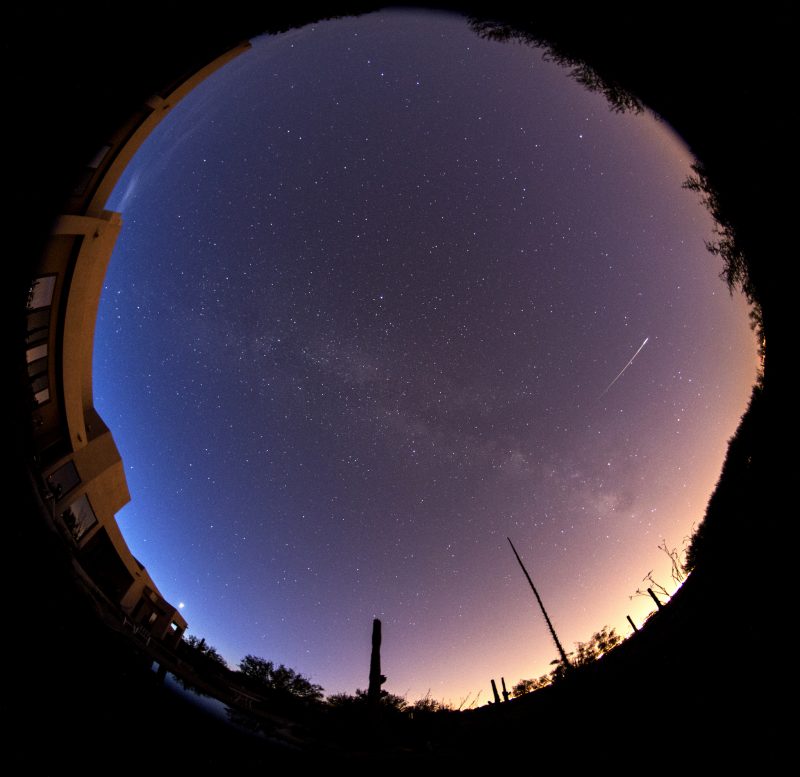
Eliot Herman in Tucson caught this meteor during 2017’s Eta Aquarid shower. He said: “… Got this meteor this morning, predawn, really predawn, just minutes before the light wiped out the camera.”

Under ideal conditions, the Eta Aquariid meteor shower produces up to 20 to 40 meteors per hour. If you’re in the Southern Hemisphere, and you have a very dark sky with no moon, you might see that many in a year when the moon is not in the sky. In the Northern Hemisphere, those living at subtropical and tropical latitudes have the advantage over their more northern counterparts.

North of about 40o north latitude the meteors tend to be sparser. The reason has to do with the time of twilight and sunrise on the various parts of Earth. To learn more, check this post on why more Eta Aquarid meteors are visible in the Southern Hemisphere.

Bottom line: In 2018, the Eta Aquarid meteor produces the most meteors before dawn on May 5 and 6 in the glare of a bright waning gibbous moon.

EarthSky’s meteor shower guide for 2018

A planisphere is virtually indispensable for beginning stargazers. Order your EarthSky planisphere today.


from EarthSky https://ift.tt/1iK4l4X

Image at top: Eta Aquarids meteors over the Atacama Desert in 2015, via Yuri Beletsky.

Before dawn this weekend – May 5 and 6, 2018 – the Eta Aquariid meteor shower reaches its annual peak. Here’s the bad news. A bright moon will interfere with meteor-watching. Here’s the good news. There are some tricks to watching in moonlight. More good news if you live south of the equator … this shower particularly favors the Southern Hemisphere.

It’s true. The moon will be out in force during the prime time viewing hours of this predawn meteor shower in 2018. To optimize your chances for seeing meteors in midnight, try one or both of these two things. First, try watching in a dark country sky in very late evening, or around midnight, when the moon is either still below the horizon, or low in the sky. You won’t catch as many meteors, but you might catch a few. Don’t know when the moon rises in your sky? Find out with this handy custom sunrise-sunset calendar.

Second, if you’re watching in the prime hours before dawn – when the Eta Aquariid radiant point is highest in your sky, and the most meteors will be flying – try sitting in a moonshadow. That could be the shadow of a barn or large solitary tree or even a mountain, anyplace you can create some extra darkness for yourself while gazing up at an open sky.

6 May 2017 – Eta Aquarid Captured at Mount Bromo (4K Timelapse) from Justin Ng Photo on Vimeo.

It’s hard to say with certainty whether May 5 or May 6 will be the better morning to watch. This shower has a relatively broad peak. Try both mornings. Just remember that – as seen from all parts of Earth – the dark hour before dawn typically presents the greatest number of Eta Aquarid meteors.

And, as always for meteor-watching, be sure to avoid city lights …

Read more: Where’s the radiant point for the Eta Aquarid meteor shower?

Read more: Everything you need to know: Eta Aquarid meteor shower

Read more: EarthSky’s meteor shower guide for 2018

Eliot Herman in Tucson caught this meteor during 2017’s Eta Aquarid shower. He said: “… Got this meteor this morning, predawn, really predawn, just minutes before the light wiped out the camera.”

Under ideal conditions, the Eta Aquariid meteor shower produces up to 20 to 40 meteors per hour. If you’re in the Southern Hemisphere, and you have a very dark sky with no moon, you might see that many in a year when the moon is not in the sky. In the Northern Hemisphere, those living at subtropical and tropical latitudes have the advantage over their more northern counterparts.

North of about 40o north latitude the meteors tend to be sparser. The reason has to do with the time of twilight and sunrise on the various parts of Earth. To learn more, check this post on why more Eta Aquarid meteors are visible in the Southern Hemisphere.

Bottom line: In 2018, the Eta Aquarid meteor produces the most meteors before dawn on May 5 and 6 in the glare of a bright waning gibbous moon.

EarthSky’s meteor shower guide for 2018

A planisphere is virtually indispensable for beginning stargazers. Order your EarthSky planisphere today.


from EarthSky https://ift.tt/1iK4l4X

The 1970s Global Cooling Zombie Myth and the Tricks Some People Use to Keep it Alive, Part I

Ten years ago, Thomas Peterson, William Connolley and John Fleck published a paper in the Bulletin of the American Meteorological Society which looked back at the climate science of the 1970s: "The Myth of the Global Cooling Scientific Consensus" (hereafter called PCF08). The goal of the paper was to look at the peer-reviewed literature of the time to see what scientists were saying about the future projections of climate. In the decades since the 1970s, some "skeptics" of global warming/climate change have made claims that "all the scientists" in the 1970s were predicting "global cooling" or an "imminent ice age". But, the PCF08 survey of papers from 1965 to 1979 showed that while there were some concerns about future "cooling", especially at the beginning of the time period, there were many more concerns about future warming caused by human emissions of carbon dioxide.
1970s papers

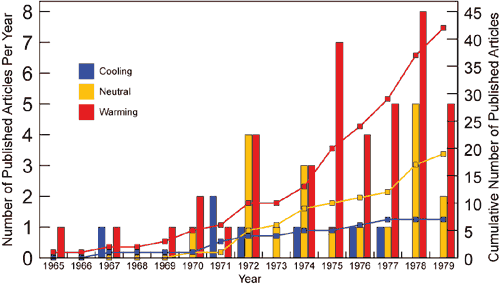
Figure 1. The number of papers classified as predicting, implying, or providing supporting evidence for future global cooling, warming, and neutral categories. During the period from 1965 through 1979, the PCF08 literature survey found 7 cooling, 20 neutral, and 44 warming papers. (Peterson 2008)

Many of today's "skeptics" of AGW remain unconvinced. A few years ago, Kenneth Richard, at the blog site NoTricksZone, penned a critique of PCF08, claiming to find hundreds of papers in support of a 1970's "cooling consensus": "Massive Cover-up Exposed: 285 Papers From 1960s-’80s Reveal Robust Global Cooling Scientific ‘Consensus’" (hereafter called NTZ). PCF08 only found seven peer-reviewed papers supporting a future cooling consensus. Did NTZ really stumble upon a "massive cover-up": a treasure trove of 285 more peer-reviewed papers foretelling a future cooling trend leading to the next ice age?

The short answer, of course, is "no". But, I thought it would be good to take a close look at PCF08 and NTZ to see "what's going on". What were scientists in the 1970s saying about the possible future trajectory of the climate? What facts were well-known and what questions were scientists still trying to answer? How could PCF08 and NTZ come to different conclusions about 1970s climate science from looking at the period's many peer-reviewed papers?

No 1970s Global Cooling Consensus

PCF08 tried to answer a very specific question: was there a scientific consensus in the 1970s "that either global cooling or a full-fledged ice age was imminent"? To answer this question they conducted a review of the peer-reviewed literature from 1965 to 1979, using specific search terms: "to capture the relevant topics, we used global temperature, global warming, and global cooling". The focus of this search was on projections of future climate: "our literature survey was limited to those papers projecting climate change on, or even just discussing an aspect of climate forcing relevant to, time scales from decades to a century". But they noted that many papers grappled with the uncertainties of climate forcings without making clear predictions about future climate.

Their findings? Only 7 papers projected cooling verses 44 warming papers. There were also 20 "neutral" papers that "project no change, that discuss both warming and cooling influences without specifically indicating which are likely to be dominant, or that state not enough is known to make a sound prediction" (See Figure 1)

A side benefit of this literature survey is that it "shows the remarkable way in which the individual threads of climate science of the time—each group of researchers pursuing their own set of questions—was quickly woven into the integrated tapestry that created the basis for climate science as we know it today". These "individual threads of climate science" were:

  1. The realization that slow changes in Earth's orbit and tilt (Milankovitch cycles) had played a large part in past ice ages and interglacials. Some scientists extended these cycles into the future to determine the Earth's possible climate trajectory.
  2. The first global average temperature series compiled by scientists showed a cooling trend since the 1940s.
  3. Scientists working on aerosols and dust (both natural and human-caused) were trying to determine what influence (if any) they had on climate (cooling or warming).
  4. Scientists were also quantifying the “greenhouse effect” of another part of our increasing pollution: carbon dioxide, which should cause the climate to warm.

Throughout the time period covered by the PCF08 survey, scientists were researching these separate but related topics:

As the various threads of climate research came together in the late 1970s into a unified field of study—ice ages, aerosols, greenhouse forcing, and the global temperature trend—greenhouse forcing was coming to be recognized as the dominant term in the climate change equations for time scales from decades to centuries. (PCF08)

No Tricks Zone's Critique of PCF08

PCF08's focus was on what climate scientists of the 1970s were predicting about the Earth's future climate trajectory, but NTZ shifted the focus to the past—to what scientists were saying about the "global cooling" since the 1940s, seen in the newly developed temperature reconstructions:

the global cooling scare during the 1970s was not narrowly or exclusively focused upon what the temperatures might look like in the future, or whether or not an ice age was “imminent”.  It was primarily about the ongoing cooling that had been taking place for decades, the negative impacts this cooling had already exerted (on extreme weather patterns, on food production, etc.), and uncertainties associated with the causes of climatic changes. (NTZ)

This "shifts the goal posts" from the narrow purpose and the narrow definition of "global cooling" used by PCF08 to something entirely different. Yes, as PCF08 showed, one of the main threads of 1970s climate science was a look back at the recent global temperature record, to document and to explain the recent "global cooling". Many papers did so without making specific claims about the future trajectory of climate, which was what the laser-like focus of PCF08 was concerned with.

NTZ also complained about the span of years used by PCF08 in their literature review: 1965-1979. NTZ broadened the 1970s to reach from 1960 to 1989!1 Again, PCF08 had a laser-like focus on the 1970s, while NTZ moved the goal posts to cover the whole field.

NTZ's expanded search found a treasure trove of all types of "cooling" papers, but did this search turn up any additional "warming" papers? We have no way of knowing because, unlike PCF08, he never described what search terms he used or how the search was conducted. He didn't add a single paper to PCF08's 44 "warming" papers, nor to their 20 "neutral" papers, so I think it is safe to say that his focus was entirely one-sided.

NTZ made a bizarre statement about the supposed purpose of PCF08: "the claim that there were only 7 publications from that era disagreeing with the presupposed CO2-warming “consensus” is preposterous" (my emphasis). What "presupposed CO2-warming 'consensus'"? NTZ alluded to this further in this passage:

According to Stewart and Glantz (1985), in the early 1970s it was the “prevailing view” among scientists that the Earth was headed into another ice age.  It wasn’t until the late ’70s that scientists changed their minds and the  “prevailing view” began shifting to warming. This is in direct contradiction to the claims of PCF08, who allege warming was the prevailing view among scientists in the 1960s and early 1970s too. (my emphasis)

PCF08 never claim that there was a "CO2-warming 'consensus'" throughout the time period in question. This is a straw-man argument. PCF08 fully understand the development of climate science throughout the 1970s and how the "various threads" of research converged at the end of the period on an emphasis on future "warming". An emphasis is not a consensus.

The Full List of 285 "Papers"

In Part II I will focus on the content of NTZ's 35 highlighted "papers" from his main blog post. But first, let's look briefly at NTZ's full list of 285 "papers" given in three posts: Part 1, Part 2, and Part 3.

A close look at the numbered list shows some odd counting discrepancies. The last paper listed in Part 3 is numbered 307, but NTZ writes about 285 papers. Going through the counts I noticed these errors:
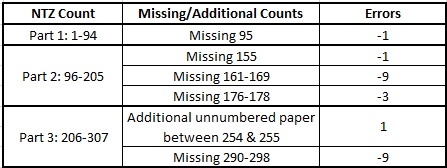
NTZ couning errors

There are also three papers which are included twice in the full list. Collis (1975) is #28 in Part 1 and #98 in Part 2. Fletcher (1968) is #37 in Part 1 and #228 in Part 3. Sancetta et al (1972) is #56 in Part 1 and #141 in Part 2. For that last one, NTZ uses the exact same quote in both instances.

These counting errors are minor mistakes, but they do show the sloppy treatment NTZ gives to his data, especially when you consider the papers which were double counted. This is also seen in the arrangement of the lists: they don't appear to be in any logical order. They aren't arranged chronologically or alphabetically by author. The full list is just a pile of quotes from the papers.

NTZ does arrange the full list into sub-sections as shown in the table below:
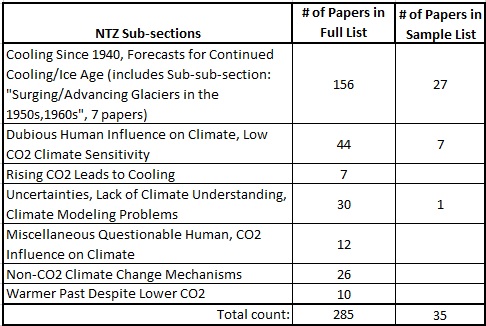
NTZ Sub-sections

A look at these categories shows NTZ's one-sided "cooling" bias. In NTZ's expanded time span from 1960 to 1989 were there no additional papers forecasting global warming? Were there no papers showing high CO2 climate sensitivity? Or did he only look for "cooling" quotes and ignore anything dealing with global warming?

Finally, just how original are NTZ's 285 papers which he claims should be added to those found by the PCF08 review? Figure 2 below reproduces Table 1 from PCF08 which lists their papers, arranged by year and categorized into three groups: "cooling", "neutral" and "warming". Circled in blue are papers which also appear in NTZ's list of 285 papers. (The papers highlighted by red stars appear in NTZ's main blog post of 35 papers, see Part II.) NTZ has double counted 25% of PCF08's list of papers; and he has categorized them all as "cooling". Notice that he has reused five of PCF08's seven "cooling" papers! This again shows the careless treatment NTZ gives to the vast number of papers he "uncovered", as well as an apparent lack of awareness of what papers PCF08 had in their review.
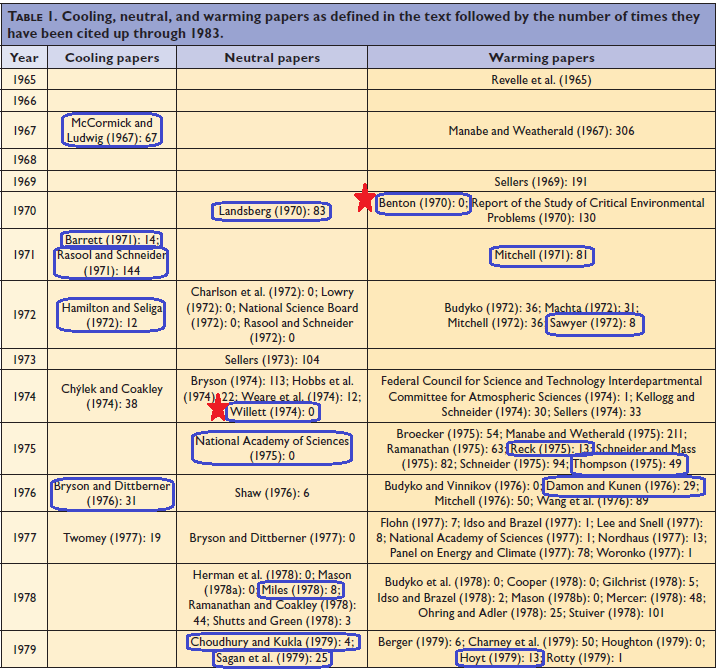
PCF08 Table 1 and NTZFigure 2. Table 1 from PCF08. Blue circles are papers included in NTZ's list of 285 "cooling" papers. The two red stars indicate papers from NTZ's sample list of 35 papers, see Part II. (Click on figure for larger image.)

NTZ's massive list of papers is meant to impress and overwhelm the casual "skeptic". Most people will never dig much deeper than a quick scroll through NTZ's never-ending stream of quotes from papers which he claims all support a 1970s "global cooling consensus". But, a close look at this treasure trove shows a less than careful treatment of the data. And NTZ's critique of PCF08 reveals shifting goal posts and straw-man arguments which distort our understanding of 1970s climate science. In Part II I'll dig a bit deeper into the content of some of NTZ's selected papers, to show how he further distorts the science.


Footnotes

1. Actually, one of NTZ's papers is from 1940! More about this in Part II.


from Skeptical Science https://ift.tt/2wfrHOy

Ten years ago, Thomas Peterson, William Connolley and John Fleck published a paper in the Bulletin of the American Meteorological Society which looked back at the climate science of the 1970s: "The Myth of the Global Cooling Scientific Consensus" (hereafter called PCF08). The goal of the paper was to look at the peer-reviewed literature of the time to see what scientists were saying about the future projections of climate. In the decades since the 1970s, some "skeptics" of global warming/climate change have made claims that "all the scientists" in the 1970s were predicting "global cooling" or an "imminent ice age". But, the PCF08 survey of papers from 1965 to 1979 showed that while there were some concerns about future "cooling", especially at the beginning of the time period, there were many more concerns about future warming caused by human emissions of carbon dioxide.

1970s papers

Figure 1. The number of papers classified as predicting, implying, or providing supporting evidence for future global cooling, warming, and neutral categories. During the period from 1965 through 1979, the PCF08 literature survey found 7 cooling, 20 neutral, and 44 warming papers. (Peterson 2008)

Many of today's "skeptics" of AGW remain unconvinced. A few years ago, Kenneth Richard, at the blog site NoTricksZone, penned a critique of PCF08, claiming to find hundreds of papers in support of a 1970's "cooling consensus": "Massive Cover-up Exposed: 285 Papers From 1960s-’80s Reveal Robust Global Cooling Scientific ‘Consensus’" (hereafter called NTZ). PCF08 only found seven peer-reviewed papers supporting a future cooling consensus. Did NTZ really stumble upon a "massive cover-up": a treasure trove of 285 more peer-reviewed papers foretelling a future cooling trend leading to the next ice age?

The short answer, of course, is "no". But, I thought it would be good to take a close look at PCF08 and NTZ to see "what's going on". What were scientists in the 1970s saying about the possible future trajectory of the climate? What facts were well-known and what questions were scientists still trying to answer? How could PCF08 and NTZ come to different conclusions about 1970s climate science from looking at the period's many peer-reviewed papers?

No 1970s Global Cooling Consensus

PCF08 tried to answer a very specific question: was there a scientific consensus in the 1970s "that either global cooling or a full-fledged ice age was imminent"? To answer this question they conducted a review of the peer-reviewed literature from 1965 to 1979, using specific search terms: "to capture the relevant topics, we used global temperature, global warming, and global cooling". The focus of this search was on projections of future climate: "our literature survey was limited to those papers projecting climate change on, or even just discussing an aspect of climate forcing relevant to, time scales from decades to a century". But they noted that many papers grappled with the uncertainties of climate forcings without making clear predictions about future climate.

Their findings? Only 7 papers projected cooling verses 44 warming papers. There were also 20 "neutral" papers that "project no change, that discuss both warming and cooling influences without specifically indicating which are likely to be dominant, or that state not enough is known to make a sound prediction" (See Figure 1)

A side benefit of this literature survey is that it "shows the remarkable way in which the individual threads of climate science of the time—each group of researchers pursuing their own set of questions—was quickly woven into the integrated tapestry that created the basis for climate science as we know it today". These "individual threads of climate science" were:

  1. The realization that slow changes in Earth's orbit and tilt (Milankovitch cycles) had played a large part in past ice ages and interglacials. Some scientists extended these cycles into the future to determine the Earth's possible climate trajectory.
  2. The first global average temperature series compiled by scientists showed a cooling trend since the 1940s.
  3. Scientists working on aerosols and dust (both natural and human-caused) were trying to determine what influence (if any) they had on climate (cooling or warming).
  4. Scientists were also quantifying the “greenhouse effect” of another part of our increasing pollution: carbon dioxide, which should cause the climate to warm.

Throughout the time period covered by the PCF08 survey, scientists were researching these separate but related topics:

As the various threads of climate research came together in the late 1970s into a unified field of study—ice ages, aerosols, greenhouse forcing, and the global temperature trend—greenhouse forcing was coming to be recognized as the dominant term in the climate change equations for time scales from decades to centuries. (PCF08)

No Tricks Zone's Critique of PCF08

PCF08's focus was on what climate scientists of the 1970s were predicting about the Earth's future climate trajectory, but NTZ shifted the focus to the past—to what scientists were saying about the "global cooling" since the 1940s, seen in the newly developed temperature reconstructions:

the global cooling scare during the 1970s was not narrowly or exclusively focused upon what the temperatures might look like in the future, or whether or not an ice age was “imminent”.  It was primarily about the ongoing cooling that had been taking place for decades, the negative impacts this cooling had already exerted (on extreme weather patterns, on food production, etc.), and uncertainties associated with the causes of climatic changes. (NTZ)

This "shifts the goal posts" from the narrow purpose and the narrow definition of "global cooling" used by PCF08 to something entirely different. Yes, as PCF08 showed, one of the main threads of 1970s climate science was a look back at the recent global temperature record, to document and to explain the recent "global cooling". Many papers did so without making specific claims about the future trajectory of climate, which was what the laser-like focus of PCF08 was concerned with.

NTZ also complained about the span of years used by PCF08 in their literature review: 1965-1979. NTZ broadened the 1970s to reach from 1960 to 1989!1 Again, PCF08 had a laser-like focus on the 1970s, while NTZ moved the goal posts to cover the whole field.

NTZ's expanded search found a treasure trove of all types of "cooling" papers, but did this search turn up any additional "warming" papers? We have no way of knowing because, unlike PCF08, he never described what search terms he used or how the search was conducted. He didn't add a single paper to PCF08's 44 "warming" papers, nor to their 20 "neutral" papers, so I think it is safe to say that his focus was entirely one-sided.

NTZ made a bizarre statement about the supposed purpose of PCF08: "the claim that there were only 7 publications from that era disagreeing with the presupposed CO2-warming “consensus” is preposterous" (my emphasis). What "presupposed CO2-warming 'consensus'"? NTZ alluded to this further in this passage:

According to Stewart and Glantz (1985), in the early 1970s it was the “prevailing view” among scientists that the Earth was headed into another ice age.  It wasn’t until the late ’70s that scientists changed their minds and the  “prevailing view” began shifting to warming. This is in direct contradiction to the claims of PCF08, who allege warming was the prevailing view among scientists in the 1960s and early 1970s too. (my emphasis)

PCF08 never claim that there was a "CO2-warming 'consensus'" throughout the time period in question. This is a straw-man argument. PCF08 fully understand the development of climate science throughout the 1970s and how the "various threads" of research converged at the end of the period on an emphasis on future "warming". An emphasis is not a consensus.

The Full List of 285 "Papers"

In Part II I will focus on the content of NTZ's 35 highlighted "papers" from his main blog post. But first, let's look briefly at NTZ's full list of 285 "papers" given in three posts: Part 1, Part 2, and Part 3.

A close look at the numbered list shows some odd counting discrepancies. The last paper listed in Part 3 is numbered 307, but NTZ writes about 285 papers. Going through the counts I noticed these errors:

NTZ couning errors

There are also three papers which are included twice in the full list. Collis (1975) is #28 in Part 1 and #98 in Part 2. Fletcher (1968) is #37 in Part 1 and #228 in Part 3. Sancetta et al (1972) is #56 in Part 1 and #141 in Part 2. For that last one, NTZ uses the exact same quote in both instances.

These counting errors are minor mistakes, but they do show the sloppy treatment NTZ gives to his data, especially when you consider the papers which were double counted. This is also seen in the arrangement of the lists: they don't appear to be in any logical order. They aren't arranged chronologically or alphabetically by author. The full list is just a pile of quotes from the papers.

NTZ does arrange the full list into sub-sections as shown in the table below:

NTZ Sub-sections

A look at these categories shows NTZ's one-sided "cooling" bias. In NTZ's expanded time span from 1960 to 1989 were there no additional papers forecasting global warming? Were there no papers showing high CO2 climate sensitivity? Or did he only look for "cooling" quotes and ignore anything dealing with global warming?

Finally, just how original are NTZ's 285 papers which he claims should be added to those found by the PCF08 review? Figure 2 below reproduces Table 1 from PCF08 which lists their papers, arranged by year and categorized into three groups: "cooling", "neutral" and "warming". Circled in blue are papers which also appear in NTZ's list of 285 papers. (The papers highlighted by red stars appear in NTZ's main blog post of 35 papers, see Part II.) NTZ has double counted 25% of PCF08's list of papers; and he has categorized them all as "cooling". Notice that he has reused five of PCF08's seven "cooling" papers! This again shows the careless treatment NTZ gives to the vast number of papers he "uncovered", as well as an apparent lack of awareness of what papers PCF08 had in their review.

PCF08 Table 1 and NTZFigure 2. Table 1 from PCF08. Blue circles are papers included in NTZ's list of 285 "cooling" papers. The two red stars indicate papers from NTZ's sample list of 35 papers, see Part II. (Click on figure for larger image.)

NTZ's massive list of papers is meant to impress and overwhelm the casual "skeptic". Most people will never dig much deeper than a quick scroll through NTZ's never-ending stream of quotes from papers which he claims all support a 1970s "global cooling consensus". But, a close look at this treasure trove shows a less than careful treatment of the data. And NTZ's critique of PCF08 reveals shifting goal posts and straw-man arguments which distort our understanding of 1970s climate science. In Part II I'll dig a bit deeper into the content of some of NTZ's selected papers, to show how he further distorts the science.


Footnotes

1. Actually, one of NTZ's papers is from 1940! More about this in Part II.


from Skeptical Science https://ift.tt/2wfrHOy

Press release links rise in aggressive brain tumours to mobile phones, but study doesn’t

Mobile phones hit headlines this morning because a press release linked an increase in brain tumour cases in England with the devices.

But this bold claim isn’t backed up by the results of the study the press release was promoting to journalists, published in the Journal of Environmental and Public Health.

What did the study do?

Researchers looked at the number of people with brain tumours in England, and calculated how this figure changed over time.

They used figures from the UK Office of National Statistics (ONS) from 1995 to 2015.

Using this database, they looked for changes in the diagnosis of specific types of brain tumours, and where these tumours grow in the brain.

What did the study show?

They found that cases of an aggressive type of brain tumour called glioblastoma multiforme, found in the forehead and side regions of the brain, had risen sharply in recent years in England.

Cases of other types of brain tumour had remained consistent or fallen since 1995.

What do the results mean?

The researchers showed that there has been a rise in people diagnosed with this specific type of brain tumour in England.

What they didn’t find is a cause for this increase. They couldn’t, because the study wasn’t set up to answer this question.

There are lots of factors that could explain the increase in this type of brain tumour, including improvements in diagnosis and changes in the way brain tumours are classified. But it’s impossible to know for sure without more information and studies designed to find these answers. Until then, all we have are (hopefully) educated guesses.

That’s where mobile phones came in.

Mobile use was discussed in the paper as one of the factors that could explain the increase. But the press release took it a step further, singling out excessive mobile phone use as a ‘likely cause’.

As scientists speaking to Science Media Centre explain, this is not backed up by the study itself. “This paper does not attempt to link the rise in mobile phone use with a rise in brain tumour incidence directly,” says Dr Lion Shahab, a senior lecturer in epidemiology and public health at University College London.

And Professor Malcolm Sperrin, director of the Department of Medical Physics and Clinical Engineering at Oxford University Hospitals NHS Trust, warned people to “not stretch the data too far” as there are other factors that could explain the results.

The big picture

As it stands, there isn’t any conclusive evidence that links mobile phone use to brain tumours. But there also isn’t enough evidence to say that absolutely no risk exists.

Read our information on mobile phones and cancer.

We’ve summed up the most important findings before, and the take-home message is that while using a mobile phone is unlikely to cause cancer, scientists need more long-term data to be sure.

But one thing is clear: despite the headlines, the latest study doesn’t add all that much to the mobile phone debate.

Katie 


from Cancer Research UK – Science blog https://ift.tt/2w964PV

Mobile phones hit headlines this morning because a press release linked an increase in brain tumour cases in England with the devices.

But this bold claim isn’t backed up by the results of the study the press release was promoting to journalists, published in the Journal of Environmental and Public Health.

What did the study do?

Researchers looked at the number of people with brain tumours in England, and calculated how this figure changed over time.

They used figures from the UK Office of National Statistics (ONS) from 1995 to 2015.

Using this database, they looked for changes in the diagnosis of specific types of brain tumours, and where these tumours grow in the brain.

What did the study show?

They found that cases of an aggressive type of brain tumour called glioblastoma multiforme, found in the forehead and side regions of the brain, had risen sharply in recent years in England.

Cases of other types of brain tumour had remained consistent or fallen since 1995.

What do the results mean?

The researchers showed that there has been a rise in people diagnosed with this specific type of brain tumour in England.

What they didn’t find is a cause for this increase. They couldn’t, because the study wasn’t set up to answer this question.

There are lots of factors that could explain the increase in this type of brain tumour, including improvements in diagnosis and changes in the way brain tumours are classified. But it’s impossible to know for sure without more information and studies designed to find these answers. Until then, all we have are (hopefully) educated guesses.

That’s where mobile phones came in.

Mobile use was discussed in the paper as one of the factors that could explain the increase. But the press release took it a step further, singling out excessive mobile phone use as a ‘likely cause’.

As scientists speaking to Science Media Centre explain, this is not backed up by the study itself. “This paper does not attempt to link the rise in mobile phone use with a rise in brain tumour incidence directly,” says Dr Lion Shahab, a senior lecturer in epidemiology and public health at University College London.

And Professor Malcolm Sperrin, director of the Department of Medical Physics and Clinical Engineering at Oxford University Hospitals NHS Trust, warned people to “not stretch the data too far” as there are other factors that could explain the results.

The big picture

As it stands, there isn’t any conclusive evidence that links mobile phone use to brain tumours. But there also isn’t enough evidence to say that absolutely no risk exists.

Read our information on mobile phones and cancer.

We’ve summed up the most important findings before, and the take-home message is that while using a mobile phone is unlikely to cause cancer, scientists need more long-term data to be sure.

But one thing is clear: despite the headlines, the latest study doesn’t add all that much to the mobile phone debate.

Katie 


from Cancer Research UK – Science blog https://ift.tt/2w964PV

Ample warning of supervolcano eruptions, says study

A supervolcano is a large volcano that has had an eruption of magnitude 8, which is the largest value on the Volcanic Explosivity Index (VEI). This means the volume of deposits for that eruption is greater than 240 cubic miles (1,000 cubic km).

No need to panic about an imminent supervolcano eruption – not from the Yellowstone supervolcano or another other system around the globe. According to a study published in the peer-reviewed journal Geophysical Research Letters on April 19, 2018, geological signs pointing to a catastrophic supervolcano eruption would be clear far in advance.

Scientists had thought that these huge volcanoes gradually built up more and more molten rock until the pressure got to be too much. But scientists are now realizing that much of the period between eruptions — as much as a million years — is probably quiet. To help forecast supervolcano eruptions, a team of geologists quantified the effects of tectonic stress on the rocks that house these sleeping giants.

Study co-author Patricia Gregg is a geology professor at University of Illinois. She said in a statement:

Supervolcanos tend to occur in areas of significant tectonic stress, where plates are moving toward, past or away from each other.

The researchers’ models found that any tectonic stress would have a profound effect on the stability of supervolcanoes. Haley Cabaniss, the study first author, is a graduate student at University of Illinois. She said:

Any tectonic stress will help destabilize rock and trigger eruptions, just on slightly different timescales. The remarkable thing we found is that the timing seems to depend not only on tectonic stress, but also on whether magma is being actively supplied to the volcano.

They found that in any given tectonic setting, the magma reservoirs inside supervolcanoes appear to remain stable for hundreds to thousands of years while new magma is being actively suppled to the system. Gregg said:

We were initially surprised by this very short timeframe of hundreds to thousands of years. But it is important to realize that supervolcanoes can lay dormant for a very long time, sometimes a million years or more. In other words, they may remain stable, doing almost nothing for 999,000 years, then start a period of rejuvenation leading to a large-scale eruption.

The researchers unexpectedly found that their models could help forecast supervolcano eruption timing and inform experts on what to expect, geologically, well before an eruption. Gregg said people tend to panic whenever Yellowstone or Taupo experience any change in seismic or geyser activity, but this research suggests that the precursors to catastrophic eruption will be far greater and long-lasting than anything yet documented, the researchers said. Gregg said:

When new magma starts to rejuvenate a supervolcano system, we can expect to see massive uplift, faulting and earthquake activity, far greater than the meter-scale events we have seen in recent time. We are talking on the range of tens to hundreds of meters of uplift. Even then, our models predict that the system would inflate for hundreds to thousands of years before we witness catastrophic eruption.

Cabaniss added:

It is also important to note that our research suggests that the whole rejuvenation-to-eruption process will take place over several or more human lifetimes. Our models indicate that there should be plenty of warning.

The team created their model based on the Taupo Volcanic Zone in northern New Zealand. They chose this system because of its relatively uncomplicated extensional tectonic setting – the type of area often associated with supervolcanoes.

Bottom line: Before a supervolcano erupts, many warning signs will appear first, says a new study.

Read more about the study from University of Illinois.


from EarthSky https://ift.tt/2rimXC9

A supervolcano is a large volcano that has had an eruption of magnitude 8, which is the largest value on the Volcanic Explosivity Index (VEI). This means the volume of deposits for that eruption is greater than 240 cubic miles (1,000 cubic km).

No need to panic about an imminent supervolcano eruption – not from the Yellowstone supervolcano or another other system around the globe. According to a study published in the peer-reviewed journal Geophysical Research Letters on April 19, 2018, geological signs pointing to a catastrophic supervolcano eruption would be clear far in advance.

Scientists had thought that these huge volcanoes gradually built up more and more molten rock until the pressure got to be too much. But scientists are now realizing that much of the period between eruptions — as much as a million years — is probably quiet. To help forecast supervolcano eruptions, a team of geologists quantified the effects of tectonic stress on the rocks that house these sleeping giants.

Study co-author Patricia Gregg is a geology professor at University of Illinois. She said in a statement:

Supervolcanos tend to occur in areas of significant tectonic stress, where plates are moving toward, past or away from each other.

The researchers’ models found that any tectonic stress would have a profound effect on the stability of supervolcanoes. Haley Cabaniss, the study first author, is a graduate student at University of Illinois. She said:

Any tectonic stress will help destabilize rock and trigger eruptions, just on slightly different timescales. The remarkable thing we found is that the timing seems to depend not only on tectonic stress, but also on whether magma is being actively supplied to the volcano.

They found that in any given tectonic setting, the magma reservoirs inside supervolcanoes appear to remain stable for hundreds to thousands of years while new magma is being actively suppled to the system. Gregg said:

We were initially surprised by this very short timeframe of hundreds to thousands of years. But it is important to realize that supervolcanoes can lay dormant for a very long time, sometimes a million years or more. In other words, they may remain stable, doing almost nothing for 999,000 years, then start a period of rejuvenation leading to a large-scale eruption.

The researchers unexpectedly found that their models could help forecast supervolcano eruption timing and inform experts on what to expect, geologically, well before an eruption. Gregg said people tend to panic whenever Yellowstone or Taupo experience any change in seismic or geyser activity, but this research suggests that the precursors to catastrophic eruption will be far greater and long-lasting than anything yet documented, the researchers said. Gregg said:

When new magma starts to rejuvenate a supervolcano system, we can expect to see massive uplift, faulting and earthquake activity, far greater than the meter-scale events we have seen in recent time. We are talking on the range of tens to hundreds of meters of uplift. Even then, our models predict that the system would inflate for hundreds to thousands of years before we witness catastrophic eruption.

Cabaniss added:

It is also important to note that our research suggests that the whole rejuvenation-to-eruption process will take place over several or more human lifetimes. Our models indicate that there should be plenty of warning.

The team created their model based on the Taupo Volcanic Zone in northern New Zealand. They chose this system because of its relatively uncomplicated extensional tectonic setting – the type of area often associated with supervolcanoes.

Bottom line: Before a supervolcano erupts, many warning signs will appear first, says a new study.

Read more about the study from University of Illinois.


from EarthSky https://ift.tt/2rimXC9

Beaches safer for baby sea turtles, but threats await in ocean

A Kemp’s ridley hatchling makes its way to the water on Padre Island, Texas. Image via Terry Ross/Flickr.

By Pamela T. Plotkin, Texas A&M University

On beaches from North Carolina to Texas and throughout the wider Caribbean, one of nature’s great seasonal events is underway. Adult female sea turtles are crawling out of the ocean, digging deep holes in the sand and laying eggs. After about 60 days turtle hatchlings will emerge and head for the water’s edge, fending for themselves from their first moments.

I have spent 36 years studying sea turtle ecology and conservation. All seven species of sea turtle found around the world are classified as vulnerable or endangered. Nesting season is an important opportunity for us to collect data on turtle abundance and trends. For those of us who have spent decades studying turtles on nesting beaches, anticipation builds as we prepare for their arrival. And when that first turtle comes ashore to usher in the nesting season, it feels as though we are welcoming home old friends.

Today most coastal areas in the United States protect beaches during nesting season. Government agencies, researchers and volunteers monitor many beaches and help hatchlings make it to the water. These measures have helped turtle populations increase. For example, the critically endangered Kemp’s ridley sea turtle (Lepidochelys kempii), which was on the brink of extinction in the mid-1980s, has increased from a few hundred nests to over 20,000 nests laid in 2017.

But turtles face many hazards in the water, including plastic pollution and accidental harm or death in encounters with commercial fishermen. The future of sea turtle research depends on finding new ways to assess turtles’ status and trends at sea as well as on the beach.

National Park Service biologist Shelby Moneysmith at a loggerhead turtle nest in Biscayne National Park, Florida. Image via NPS.

Tallying turtle nests

Female sea turtles typically nest several times in a year. They may leave all of their eggs at one specific beach or nest at several beaches to spread out their reproductive investment. They typically return to the same stretch of coast year after year.

To monitor population trends, scientists count the number of nests made on a beach during an entire nesting season. They estimate how many times an individual female turtle nests during one nesting season, and use simple arithmetic to calculate the estimated number of females that nested that year.

We also walk nesting beaches to find individual turtles, collect data and biological samples from them and attach tags to their flippers. If researchers re-encounter a tagged turtle during a subsequent nesting season, they will record her return and revise their estimate of how many offspring she produces. Sea turtles typically nest every two, three or four years, so biologists need long-term data over multiple decades to track population trends.

On a few beaches, olive ridley sea turtles (Lepidochelys olivacea) emerge synchronously and en masse to nest in enormous groups of hundreds to thousands, known as arribadas (Spanish for “arrival”). When this happens there are so many turtles nesting at one time that a person could walk from shell to shell across the beach without stepping on the sand. It is impossible to count most of these turtles, and finding a tagged individual from among the throngs is like looking for a needle in a haystack.

Witnessing an arribada is the most thrilling wonder of nature I have experienced. The sight, smell and sound of thousands of turtles on a beach digging holes in the sand and laying eggs, choreographed to music only they can hear and understand, is indescribable.

Olive ridley sea turtles in an arribada (mass nesting). Image via Christine Figgener.

An incomplete picture

Although researchers have used these methods for decades, they do not give us a full enough picture to assess how well global conservation efforts are working.

One challenge is that there are too many turtles and not enough funding to record every nest at most beaches. Many nesting sites are remote, hard to access and logistically challenging places to live and work for months at a time. There are tens of thousands of miles of coastline where no one counts sea turtle nests regularly and systematically.

Second, turtles don’t always produce the same number of young from one season to another. Like all animals, they invest their energy into metabolism, growth, survival and reproduction. When food is limited, they often lay fewer eggs.

Third, and perhaps most importantly, breeding females are not the only important sea turtle demographic group. Biologists want to develop population models they can use to interpret population changes, identify threats in marine habitats, predict risk, evaluate the impacts of management activities and assess sea turtle status and trends. To do this, we also need other demographic information, such as age-specific and sex-specific survival rates and age at sexual maturity. Researchers are trying to collect these kinds of data, but it is logistically challenging when we are dealing with turtles at sea.

Juvenile Kemp’s ridley turtle equipped with a miniature solar-powered satellite transmitter to track its movements. Image via Florida FWC/Flickr.

Hazards in the water

These constraints help to explain why a recent study to develop a stock assessment model for Kemp’s ridley sea turtles found that the population was growing at a slower rate than scientists had anticipated. The study did not identify a specific cause, but it took many demographic variables into account, as well as conservation efforts and turtles killed by fishermen. All of these factors are critically important to assessing a population’s status and projecting its future growth.

Another recent study showed that since the 2010 Deepwater Horizon oil spill in the Gulf of Mexico – the prime residence area for Kemp’s ridleys – the turtles have produced fewer young. The spill triggered significant environmental changes in the Gulf, across multiple habitats and species including invertebrates, birds, fish and dolphins.

Oil spills aren’t the only threat. According to a recent estimate, the Pacific Ocean garbage patch covers an area “twice the size of Texas.” According to some projections, by 2050 the oceans will contain more plastic than fish.

Ocean plastic can kill marine animals when they are ensnared by it or ingest it in large quantities. Scientists have found many species feeding on ocean plastics, from fish living in the deepest ocean trenches to seabirds feeding at the surface. Since the early 1980s, I have studied sea turtle diets and have found plastic in the stomachs and intestines of virtually all sea turtle species from the Gulf of Mexico to the Pacific Ocean.

Some advocates assert that most of this trash comes from fishing gear. Fishing certainly is a major source: One survey of the Pacific garbage patch found that broken fishing nets comprised nearly half of it by weight.

But consumer items, like toys and plastic bottles, are also part of the problem. In 2015 a Texas A&M University research team was taking samples from a 77-pound olive ridley sea turtle and found a 4-inch plastic drinking straw completely embedded in its nose, potentially making it harder for the turtle to breathe and smell – and thus to find food. Video footage of these researchers removing the straw from the turtle’s nostril, which has been viewed online more than 10 million times, offers convincing evidence of how much suffering plastic trash can inflict on wildlife.

Biologists conduct in-water research and monitoring of green, Kemp’s ridley, and loggerhead sea turtles off Florida’s Gulf Coast.

Overfishing also threatens sea turtles and other non-target animals, such as marine mammals and seabirds. Researchers believe that fishing pressure in the Pacific Ocean is the primary cause of a recent collapse of the leatherback sea turtle (Dermochelys coriacea) population in the eastern Pacific, and now threatens the dwindling western Pacific leatherback.

Climate change is triggering changes in ocean temperature, chemistry, circulation and sea levels. These shifts also threaten sea turtles, but there is little quantitative research so far on how they will affect any species.

The ConversationThe world’s oceans are changing at an unprecedented pace, and scientists’ methods for assessing sea turtle populations must evolve rapidly too. We need new research tools for observing ocean conditions above and beneath the surface, as well as robust population models that incorporate these new threats, to manage these globally protected species.
Pamela T. Plotkin, Associate Research Professor and Director, Texas Sea Grant, Texas A&M University

This article was originally published on The Conversation. Read the original article.

Bottom line: Status of sea turtles, during nesting season 2018, from a biologist.


from EarthSky https://ift.tt/2FBDia9

A Kemp’s ridley hatchling makes its way to the water on Padre Island, Texas. Image via Terry Ross/Flickr.

By Pamela T. Plotkin, Texas A&M University

On beaches from North Carolina to Texas and throughout the wider Caribbean, one of nature’s great seasonal events is underway. Adult female sea turtles are crawling out of the ocean, digging deep holes in the sand and laying eggs. After about 60 days turtle hatchlings will emerge and head for the water’s edge, fending for themselves from their first moments.

I have spent 36 years studying sea turtle ecology and conservation. All seven species of sea turtle found around the world are classified as vulnerable or endangered. Nesting season is an important opportunity for us to collect data on turtle abundance and trends. For those of us who have spent decades studying turtles on nesting beaches, anticipation builds as we prepare for their arrival. And when that first turtle comes ashore to usher in the nesting season, it feels as though we are welcoming home old friends.

Today most coastal areas in the United States protect beaches during nesting season. Government agencies, researchers and volunteers monitor many beaches and help hatchlings make it to the water. These measures have helped turtle populations increase. For example, the critically endangered Kemp’s ridley sea turtle (Lepidochelys kempii), which was on the brink of extinction in the mid-1980s, has increased from a few hundred nests to over 20,000 nests laid in 2017.

But turtles face many hazards in the water, including plastic pollution and accidental harm or death in encounters with commercial fishermen. The future of sea turtle research depends on finding new ways to assess turtles’ status and trends at sea as well as on the beach.

National Park Service biologist Shelby Moneysmith at a loggerhead turtle nest in Biscayne National Park, Florida. Image via NPS.

Tallying turtle nests

Female sea turtles typically nest several times in a year. They may leave all of their eggs at one specific beach or nest at several beaches to spread out their reproductive investment. They typically return to the same stretch of coast year after year.

To monitor population trends, scientists count the number of nests made on a beach during an entire nesting season. They estimate how many times an individual female turtle nests during one nesting season, and use simple arithmetic to calculate the estimated number of females that nested that year.

We also walk nesting beaches to find individual turtles, collect data and biological samples from them and attach tags to their flippers. If researchers re-encounter a tagged turtle during a subsequent nesting season, they will record her return and revise their estimate of how many offspring she produces. Sea turtles typically nest every two, three or four years, so biologists need long-term data over multiple decades to track population trends.

On a few beaches, olive ridley sea turtles (Lepidochelys olivacea) emerge synchronously and en masse to nest in enormous groups of hundreds to thousands, known as arribadas (Spanish for “arrival”). When this happens there are so many turtles nesting at one time that a person could walk from shell to shell across the beach without stepping on the sand. It is impossible to count most of these turtles, and finding a tagged individual from among the throngs is like looking for a needle in a haystack.

Witnessing an arribada is the most thrilling wonder of nature I have experienced. The sight, smell and sound of thousands of turtles on a beach digging holes in the sand and laying eggs, choreographed to music only they can hear and understand, is indescribable.

Olive ridley sea turtles in an arribada (mass nesting). Image via Christine Figgener.

An incomplete picture

Although researchers have used these methods for decades, they do not give us a full enough picture to assess how well global conservation efforts are working.

One challenge is that there are too many turtles and not enough funding to record every nest at most beaches. Many nesting sites are remote, hard to access and logistically challenging places to live and work for months at a time. There are tens of thousands of miles of coastline where no one counts sea turtle nests regularly and systematically.

Second, turtles don’t always produce the same number of young from one season to another. Like all animals, they invest their energy into metabolism, growth, survival and reproduction. When food is limited, they often lay fewer eggs.

Third, and perhaps most importantly, breeding females are not the only important sea turtle demographic group. Biologists want to develop population models they can use to interpret population changes, identify threats in marine habitats, predict risk, evaluate the impacts of management activities and assess sea turtle status and trends. To do this, we also need other demographic information, such as age-specific and sex-specific survival rates and age at sexual maturity. Researchers are trying to collect these kinds of data, but it is logistically challenging when we are dealing with turtles at sea.

Juvenile Kemp’s ridley turtle equipped with a miniature solar-powered satellite transmitter to track its movements. Image via Florida FWC/Flickr.

Hazards in the water

These constraints help to explain why a recent study to develop a stock assessment model for Kemp’s ridley sea turtles found that the population was growing at a slower rate than scientists had anticipated. The study did not identify a specific cause, but it took many demographic variables into account, as well as conservation efforts and turtles killed by fishermen. All of these factors are critically important to assessing a population’s status and projecting its future growth.

Another recent study showed that since the 2010 Deepwater Horizon oil spill in the Gulf of Mexico – the prime residence area for Kemp’s ridleys – the turtles have produced fewer young. The spill triggered significant environmental changes in the Gulf, across multiple habitats and species including invertebrates, birds, fish and dolphins.

Oil spills aren’t the only threat. According to a recent estimate, the Pacific Ocean garbage patch covers an area “twice the size of Texas.” According to some projections, by 2050 the oceans will contain more plastic than fish.

Ocean plastic can kill marine animals when they are ensnared by it or ingest it in large quantities. Scientists have found many species feeding on ocean plastics, from fish living in the deepest ocean trenches to seabirds feeding at the surface. Since the early 1980s, I have studied sea turtle diets and have found plastic in the stomachs and intestines of virtually all sea turtle species from the Gulf of Mexico to the Pacific Ocean.

Some advocates assert that most of this trash comes from fishing gear. Fishing certainly is a major source: One survey of the Pacific garbage patch found that broken fishing nets comprised nearly half of it by weight.

But consumer items, like toys and plastic bottles, are also part of the problem. In 2015 a Texas A&M University research team was taking samples from a 77-pound olive ridley sea turtle and found a 4-inch plastic drinking straw completely embedded in its nose, potentially making it harder for the turtle to breathe and smell – and thus to find food. Video footage of these researchers removing the straw from the turtle’s nostril, which has been viewed online more than 10 million times, offers convincing evidence of how much suffering plastic trash can inflict on wildlife.

Biologists conduct in-water research and monitoring of green, Kemp’s ridley, and loggerhead sea turtles off Florida’s Gulf Coast.

Overfishing also threatens sea turtles and other non-target animals, such as marine mammals and seabirds. Researchers believe that fishing pressure in the Pacific Ocean is the primary cause of a recent collapse of the leatherback sea turtle (Dermochelys coriacea) population in the eastern Pacific, and now threatens the dwindling western Pacific leatherback.

Climate change is triggering changes in ocean temperature, chemistry, circulation and sea levels. These shifts also threaten sea turtles, but there is little quantitative research so far on how they will affect any species.

The ConversationThe world’s oceans are changing at an unprecedented pace, and scientists’ methods for assessing sea turtle populations must evolve rapidly too. We need new research tools for observing ocean conditions above and beneath the surface, as well as robust population models that incorporate these new threats, to manage these globally protected species.
Pamela T. Plotkin, Associate Research Professor and Director, Texas Sea Grant, Texas A&M University

This article was originally published on The Conversation. Read the original article.

Bottom line: Status of sea turtles, during nesting season 2018, from a biologist.


from EarthSky https://ift.tt/2FBDia9

Comet Halley’s 2 meteor showers

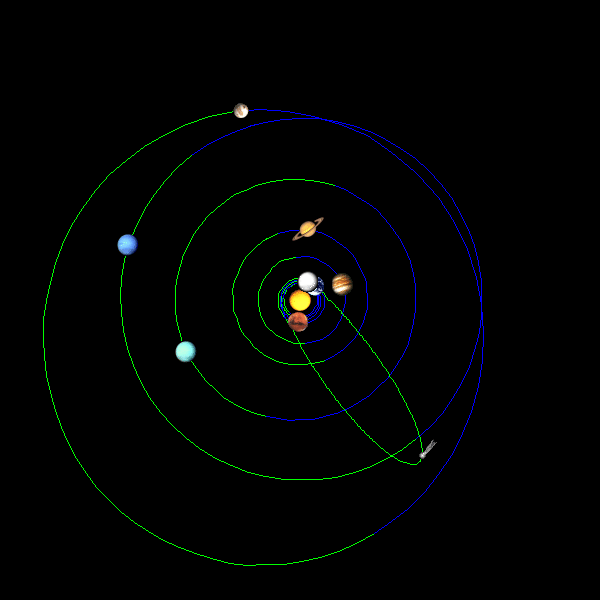
Comet Halley’s position in May, 2017. The view is from the north side of the solar system. Although the planets orbit our sun in a counterclockwise direction, Comet Halley orbits clockwise. Click here for Comet Halley’s present position, or change the date to view its position in any chosen year.

Comet Halley, proud parent of two meteor showers, swings into the inner solar system about every 76 years. At such times, the sun’s heat causes the comet to loosen its icy grip over its mountain-sized conglomeration of ice, dust and gas. At each pass near the sun, the crumbly comet sheds a fresh trail of debris into its orbital stream. It lost about 1/1,000th of its mass during its last flyby in 1986. It’s because comets like Halley are so crumbly that we see annual meteor showers, like the Eta Aquarid meteor shower that’s going on now. Follow the links below to learn more about Comet Halley, the meteor showers it spawns, and about how astronomers calculate the velocities of meteors streaking across our sky.

Comet Halley’s 2 meteor showers

Where is Comet Halley now?

Parent bodies of other major meteor showers

How fast do meteors from Comet Halley travel?

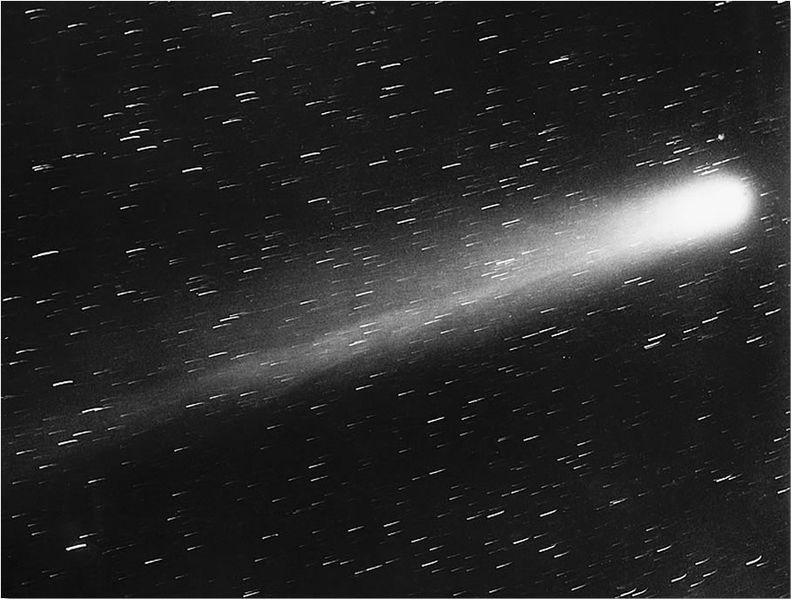
Comet Halley on May 29, 1910 from Wikimedia Commons

Comet Halley on May 29, 1910 via Wikimedia Commons

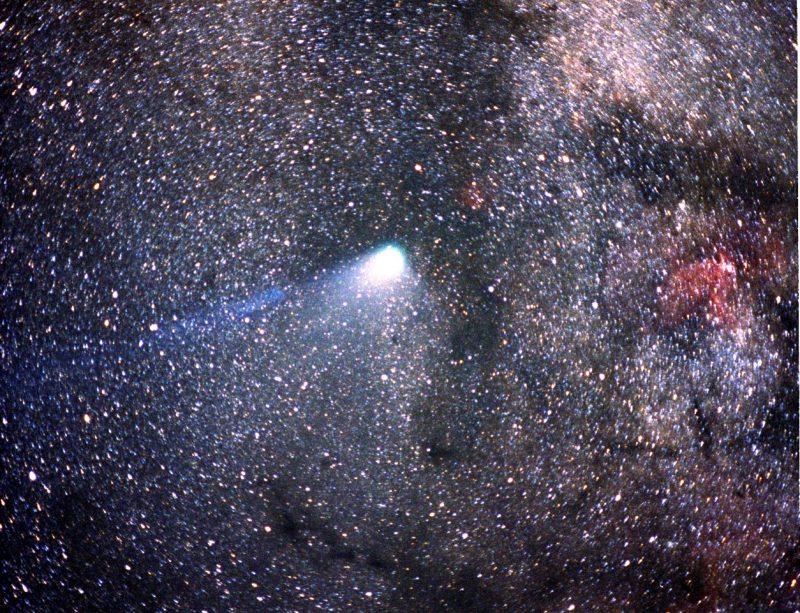
Kuiper Airborne Observatory acquired this image of Comet Halley in April 1986, as the comet crossed in front of the Milky Way. Image via NASA.

Comet Halley’s 2 meteor showers. Because Comet Halley has circled the sun innumerable times over countless millennia, cometary fragments litter its orbit. That’s why the comet doesn’t need to be anywhere near the Earth or the sun in order to produce a meteor shower. Instead, whenever our Earth in its orbit intersects Comet Halley’s orbit, cometary bits and pieces – oftentimes no larger than grains of sand or granules of gravel – smash into Earth’s upper atmosphere, to vaporize as fiery streaks across our sky: meteors.

It so happens we intersect Comet Halley’s orbit not once, but twice each year. In early May, we see bits of this comet as the annual Eta Aquariid meteor shower.

Then some six months later, in October, Earth in its orbit again intersects the orbital path of Comet Halley. This time around, these broken-up chunks from Halley’s Comet burn up in Earth’s atmosphere as the annual Orionid meteor shower.

By the way, these small fragments are called meteoroids when in outer space, and meteors when they vaporize in the Earth’s atmosphere.

Meteors in annual showers – made from the icy debris of comets – don’t hit the ground. They vaporize high in Earth’s atmosphere. The more rocky or metallic asteroids are what sometimes hit the ground, and then they are called meteorites.

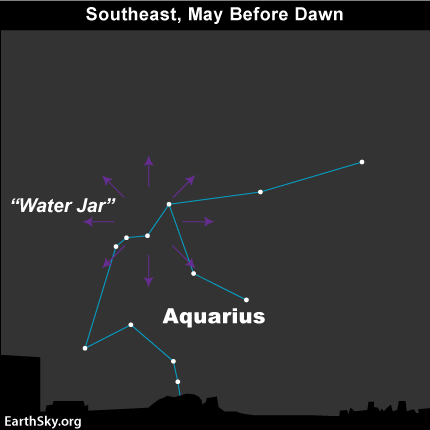
Eta Aquarid meteors appear to radiate from near a famous asterism - or noticeable star pattern - called the Water Jar in Aquarius.

Eta Aquarid meteors appear to radiate from near a famous asterism – or noticeable star pattern – called the Water Jar in Aquarius. The shower is coming up on the mornings of May 5 and 6, 2017.

Where is Comet Halley now? Often, astronomers like to give distances of solar system objects in terms of astronomical units (AU), which is the sun-Earth distance. Comet Halley lodges 0.587 AU from the sun at its closest point to sun (perihelion) and 35.3 AU at its farthest point (aphelion).

In other words, Halley’s Comet resides about 60 times farther from the sun at its closest than it does at its farthest.

It was last at perihelion in 1986, and will again return to perihelion in 2061.

At present, Comet Halley lies outside the orbit of Neptune, and not far from its aphelion point. See the image at the top of this post – for May, 2017 – via Fourmilab.

Even so, meteroids swim throughout Comet Halley’s orbital stream, so each time Earth crosses the orbit of Halley’s Comet, in May and October, these meteoroids turn into incandescent meteors once they plunge into the Earth’s upper atmosphere.

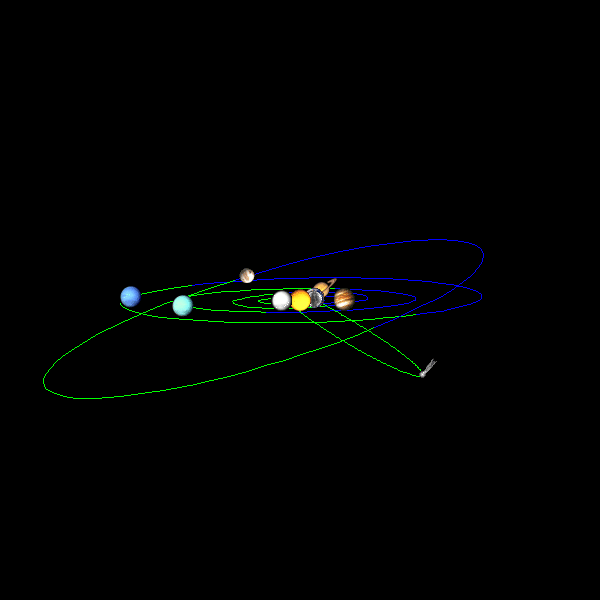
Sideways view shows that the orbit of Halley's Comet is highly inclined to the plane of the ecliptic. Green color depicts the part of orbit to the south of the ecliptic while the blue highlights the part of the orbit to the north of the ecliptic.

Sideways view shows that the orbit of Halley’s Comet is highly inclined to the plane of the ecliptic. Green color depicts the part of orbit to the south of the ecliptic (Earth-sun orbital plane) while the blue highlights the part of the orbit to the north of the ecliptic.

Of course, Comet Halley isn’t the only comet that produces a major meteor shower …

Parent bodies of other major meteor showers

Meteor Shower Parent Body Semi-major axis Orbital Period Perihelion Aphelion
Quadrantids 2003 EH1 (asteroid) 3.12 AU 5.52 years 1.19 AU 5.06 AU
Lyrids Comet Thatcher 55.68 AU 415 years 0.92 AU 110 AU
Eta Aquarids Comet 1/P Halley 17.8 AU 75.3 years 0.59 AU 35.3 AU
Delta Aquarids Comet 96P/Machholz 3.03 AU 5.28 years 0.12 AU 5.94 AU
Perseids Comet 109P/Swift-Tuttle 26.09 AU 133 years 0.96 AU 51.23 AU
Draconids Comet 21P/Giacobini–Zinner 3.52 AU 6.62 years 1.04 AU 6.01 AU
Orionids Comet 1/P Halley 17.8 AU 75.3 years 0.59 AU 35.3 AU
Taurids Comet 2P/Encke 2.22 AU 3.30 years 0.33 AU 4.11 AU
Leonids Comet 55P/Tempel-Tuttle 10.33 AU 33.22 years 0.98 AU 19.69 AU
Geminids 3200 Phaethon (asteroid) 1.27 AU 1.43 years 0.14 AU 2.40 AU

How fast do meteors from Comet Halley travel? If we can figure how fast Comet Halley travels at the Earth’s distance from the sun, we should also be able to figure out how fast these meteors fly in our sky.

Some of you may know that a solar system body, such as a planet or comet, goes faster in its orbit as it nears the sun and more slowly in its orbit as it gets farther away. Halley’s Comet swings inside the orbit of Venus at perihelion – the comet’s nearest point to the sun. At aphelion – its most distant point – Halley’s Comet goes all the way beyond the orbit of Neptune, the solar system’s outermost (known) planet.

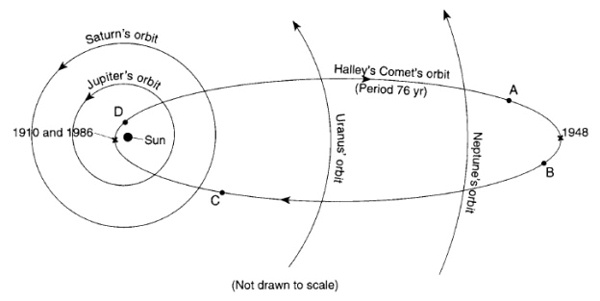
Diagram via SurveyMonkey. We're looking down upon the north side of the solar system plane, whereby the planets revolve around the sun counterclockwise and Halley's Comet revolves around the sun clockwise.

Diagram via SurveyMonkey. We’re looking down upon the north side of the solar system plane. The planets revolve around the sun counterclockwise, and Halley’s Comet revolves around the sun clockwise.

When the meteoroids from the orbital stream of Halley’s Comet streak across the sky as Eta Aquarid or Orionid meteors, we know these meteoroids/meteors have to be one astronomical unit (Earth’s distance) from the sun. It might be tempting to assume that these meteoroids at one astronomical unit from the sun travel through space at the same speed Earth does: 108,000 kilometers or 67,000 miles per hour.

However, the velocity of these meteoroids through space does not equal that of Earth at the Earth’s distance from the sun. For that to happen, Earth and Halley’s Comet would have to orbit the sun in the same period of time. But the orbital periods of Earth and Halley’s Comet are vastly different. Earth takes one year to orbit the sun whereas Halley’s Comet takes about 76 years.

However, thanks to the great genius, Isaac Newton, we can easily compute the velocity of these meteoroids/meteors at the Earth’s distance from the sun by using Isaac Newton’s Vis-viva equation, his poetic rendition of instantaneous motion.

The answer, giving the velocity of these meteoroids through space at the Earth’s distance from the sun, is virtually at our fingertips. All we need to know is Comet Halley’s semi-major axis (mean distance from the sun) in astronomical units. Here you have it:

Comet Halley’s semi-major axis = 17.8 astronomical units.

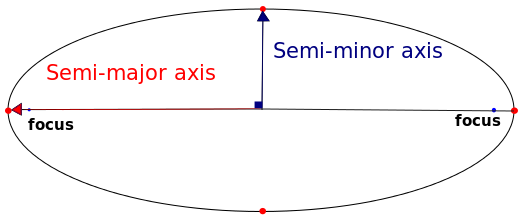
Once we know is a comet's semi-major axis in astronomical units, we can compute its velocity at any distance from the sun with the easy-to-use Vis-viva equation. The sun resides at one of the two foci of the comet's elliptical orbit.

Once we know is a comet’s semi-major axis in astronomical units, we can compute its velocity at any distance from the sun with the easy-to-use Vis-viva equation. The sun resides at one of the two foci of the comet’s elliptical orbit.

In the easy-to-use Vis-viva equation below, r = distance from sun in astronomical units, and a = semi-major axis of Comet Halley’s orbit in astronomical units. In other words, r = 1 AU and a = 17.8 AU.

Vis-viva equation (r = distance from sun = 1 AU; and a = semi-major axis = 17.8 AU):

Velocity = 67,000 x the square root of (2/r – 1/a)
Velocity = 67,000 x the square root of (2/1 – 1/17.8)
Velocity = 67,000 x the square root of (2 – 0.056)
Velocity = 67,000 x the square root of 1.944
Velocity = 67,000 x 1.39
Velocity = 93,130 miles per hour or 25.87 miles per second

The above answer gives the velocity of these meteoroids through space at the Earth’s distance from the sun. However, if these meteoroids were to hit Earth’s atmosphere head-on, that would push the velocity up to an incredible 160,130 miles per hour (93,130 + 67,000 = 160,130). NASA gives the velocity for the Eta Aquarid meteors and Orionid meteors at 148,000 miles per hour, which suggests the collision of these meteoroids/meteors with Earth is not all that far from head-on.

We can also use the Vis-viva equation to find out the velocity of Halley’s Comet (or its meteoroids) at the perihelion distance of 0.59 AU and aphelion distance of 35.3 AU.

Perihelion velocity = 122,331 miles per hour

Aphelion velocity = 1,464 miles per hour

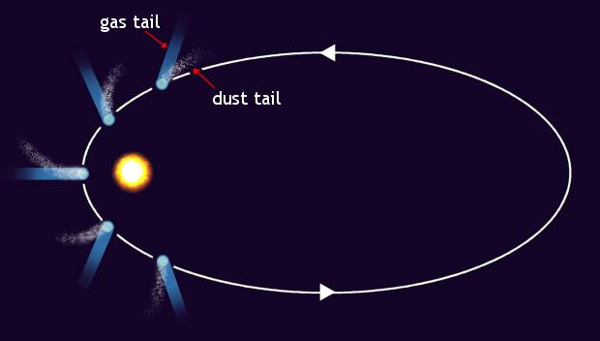
Comets develop gas and dust tails as they approach the sun. Depending on the comet, the comet can orbit the sun counter-clockwise (as above) or clockwise (as Comet Halley does). Read more: Why do comets develop tails?

Comets develop gas and dust tails as they approach the sun. Depending on the comet, the comet can orbit the sun counter-clockwise (as above) or clockwise (as Comet Halley does). Read more: Why do comets develop tails?

Bottom line: Halley’s Comet spawned two annual meteor showers, the Eta Aquarids in May and the Orionids in October. Plus … where the comet is now, parent bodies of other meteor showers … and Isaac Newton’s Vis-viva equation, his poetic rendition of instantaneous motion.


from EarthSky https://ift.tt/24eZU7Y

Comet Halley’s position in May, 2017. The view is from the north side of the solar system. Although the planets orbit our sun in a counterclockwise direction, Comet Halley orbits clockwise. Click here for Comet Halley’s present position, or change the date to view its position in any chosen year.

Comet Halley, proud parent of two meteor showers, swings into the inner solar system about every 76 years. At such times, the sun’s heat causes the comet to loosen its icy grip over its mountain-sized conglomeration of ice, dust and gas. At each pass near the sun, the crumbly comet sheds a fresh trail of debris into its orbital stream. It lost about 1/1,000th of its mass during its last flyby in 1986. It’s because comets like Halley are so crumbly that we see annual meteor showers, like the Eta Aquarid meteor shower that’s going on now. Follow the links below to learn more about Comet Halley, the meteor showers it spawns, and about how astronomers calculate the velocities of meteors streaking across our sky.

Comet Halley’s 2 meteor showers

Where is Comet Halley now?

Parent bodies of other major meteor showers

How fast do meteors from Comet Halley travel?

Comet Halley on May 29, 1910 from Wikimedia Commons

Comet Halley on May 29, 1910 via Wikimedia Commons

Kuiper Airborne Observatory acquired this image of Comet Halley in April 1986, as the comet crossed in front of the Milky Way. Image via NASA.

Comet Halley’s 2 meteor showers. Because Comet Halley has circled the sun innumerable times over countless millennia, cometary fragments litter its orbit. That’s why the comet doesn’t need to be anywhere near the Earth or the sun in order to produce a meteor shower. Instead, whenever our Earth in its orbit intersects Comet Halley’s orbit, cometary bits and pieces – oftentimes no larger than grains of sand or granules of gravel – smash into Earth’s upper atmosphere, to vaporize as fiery streaks across our sky: meteors.

It so happens we intersect Comet Halley’s orbit not once, but twice each year. In early May, we see bits of this comet as the annual Eta Aquariid meteor shower.

Then some six months later, in October, Earth in its orbit again intersects the orbital path of Comet Halley. This time around, these broken-up chunks from Halley’s Comet burn up in Earth’s atmosphere as the annual Orionid meteor shower.

By the way, these small fragments are called meteoroids when in outer space, and meteors when they vaporize in the Earth’s atmosphere.

Meteors in annual showers – made from the icy debris of comets – don’t hit the ground. They vaporize high in Earth’s atmosphere. The more rocky or metallic asteroids are what sometimes hit the ground, and then they are called meteorites.

Eta Aquarid meteors appear to radiate from near a famous asterism - or noticeable star pattern - called the Water Jar in Aquarius.

Eta Aquarid meteors appear to radiate from near a famous asterism – or noticeable star pattern – called the Water Jar in Aquarius. The shower is coming up on the mornings of May 5 and 6, 2017.

Where is Comet Halley now? Often, astronomers like to give distances of solar system objects in terms of astronomical units (AU), which is the sun-Earth distance. Comet Halley lodges 0.587 AU from the sun at its closest point to sun (perihelion) and 35.3 AU at its farthest point (aphelion).

In other words, Halley’s Comet resides about 60 times farther from the sun at its closest than it does at its farthest.

It was last at perihelion in 1986, and will again return to perihelion in 2061.

At present, Comet Halley lies outside the orbit of Neptune, and not far from its aphelion point. See the image at the top of this post – for May, 2017 – via Fourmilab.

Even so, meteroids swim throughout Comet Halley’s orbital stream, so each time Earth crosses the orbit of Halley’s Comet, in May and October, these meteoroids turn into incandescent meteors once they plunge into the Earth’s upper atmosphere.

Sideways view shows that the orbit of Halley's Comet is highly inclined to the plane of the ecliptic. Green color depicts the part of orbit to the south of the ecliptic while the blue highlights the part of the orbit to the north of the ecliptic.

Sideways view shows that the orbit of Halley’s Comet is highly inclined to the plane of the ecliptic. Green color depicts the part of orbit to the south of the ecliptic (Earth-sun orbital plane) while the blue highlights the part of the orbit to the north of the ecliptic.

Of course, Comet Halley isn’t the only comet that produces a major meteor shower …

Parent bodies of other major meteor showers

Meteor Shower Parent Body Semi-major axis Orbital Period Perihelion Aphelion
Quadrantids 2003 EH1 (asteroid) 3.12 AU 5.52 years 1.19 AU 5.06 AU
Lyrids Comet Thatcher 55.68 AU 415 years 0.92 AU 110 AU
Eta Aquarids Comet 1/P Halley 17.8 AU 75.3 years 0.59 AU 35.3 AU
Delta Aquarids Comet 96P/Machholz 3.03 AU 5.28 years 0.12 AU 5.94 AU
Perseids Comet 109P/Swift-Tuttle 26.09 AU 133 years 0.96 AU 51.23 AU
Draconids Comet 21P/Giacobini–Zinner 3.52 AU 6.62 years 1.04 AU 6.01 AU
Orionids Comet 1/P Halley 17.8 AU 75.3 years 0.59 AU 35.3 AU
Taurids Comet 2P/Encke 2.22 AU 3.30 years 0.33 AU 4.11 AU
Leonids Comet 55P/Tempel-Tuttle 10.33 AU 33.22 years 0.98 AU 19.69 AU
Geminids 3200 Phaethon (asteroid) 1.27 AU 1.43 years 0.14 AU 2.40 AU

How fast do meteors from Comet Halley travel? If we can figure how fast Comet Halley travels at the Earth’s distance from the sun, we should also be able to figure out how fast these meteors fly in our sky.

Some of you may know that a solar system body, such as a planet or comet, goes faster in its orbit as it nears the sun and more slowly in its orbit as it gets farther away. Halley’s Comet swings inside the orbit of Venus at perihelion – the comet’s nearest point to the sun. At aphelion – its most distant point – Halley’s Comet goes all the way beyond the orbit of Neptune, the solar system’s outermost (known) planet.

Diagram via SurveyMonkey. We're looking down upon the north side of the solar system plane, whereby the planets revolve around the sun counterclockwise and Halley's Comet revolves around the sun clockwise.

Diagram via SurveyMonkey. We’re looking down upon the north side of the solar system plane. The planets revolve around the sun counterclockwise, and Halley’s Comet revolves around the sun clockwise.

When the meteoroids from the orbital stream of Halley’s Comet streak across the sky as Eta Aquarid or Orionid meteors, we know these meteoroids/meteors have to be one astronomical unit (Earth’s distance) from the sun. It might be tempting to assume that these meteoroids at one astronomical unit from the sun travel through space at the same speed Earth does: 108,000 kilometers or 67,000 miles per hour.

However, the velocity of these meteoroids through space does not equal that of Earth at the Earth’s distance from the sun. For that to happen, Earth and Halley’s Comet would have to orbit the sun in the same period of time. But the orbital periods of Earth and Halley’s Comet are vastly different. Earth takes one year to orbit the sun whereas Halley’s Comet takes about 76 years.

However, thanks to the great genius, Isaac Newton, we can easily compute the velocity of these meteoroids/meteors at the Earth’s distance from the sun by using Isaac Newton’s Vis-viva equation, his poetic rendition of instantaneous motion.

The answer, giving the velocity of these meteoroids through space at the Earth’s distance from the sun, is virtually at our fingertips. All we need to know is Comet Halley’s semi-major axis (mean distance from the sun) in astronomical units. Here you have it:

Comet Halley’s semi-major axis = 17.8 astronomical units.

Once we know is a comet's semi-major axis in astronomical units, we can compute its velocity at any distance from the sun with the easy-to-use Vis-viva equation. The sun resides at one of the two foci of the comet's elliptical orbit.

Once we know is a comet’s semi-major axis in astronomical units, we can compute its velocity at any distance from the sun with the easy-to-use Vis-viva equation. The sun resides at one of the two foci of the comet’s elliptical orbit.

In the easy-to-use Vis-viva equation below, r = distance from sun in astronomical units, and a = semi-major axis of Comet Halley’s orbit in astronomical units. In other words, r = 1 AU and a = 17.8 AU.

Vis-viva equation (r = distance from sun = 1 AU; and a = semi-major axis = 17.8 AU):

Velocity = 67,000 x the square root of (2/r – 1/a)
Velocity = 67,000 x the square root of (2/1 – 1/17.8)
Velocity = 67,000 x the square root of (2 – 0.056)
Velocity = 67,000 x the square root of 1.944
Velocity = 67,000 x 1.39
Velocity = 93,130 miles per hour or 25.87 miles per second

The above answer gives the velocity of these meteoroids through space at the Earth’s distance from the sun. However, if these meteoroids were to hit Earth’s atmosphere head-on, that would push the velocity up to an incredible 160,130 miles per hour (93,130 + 67,000 = 160,130). NASA gives the velocity for the Eta Aquarid meteors and Orionid meteors at 148,000 miles per hour, which suggests the collision of these meteoroids/meteors with Earth is not all that far from head-on.

We can also use the Vis-viva equation to find out the velocity of Halley’s Comet (or its meteoroids) at the perihelion distance of 0.59 AU and aphelion distance of 35.3 AU.

Perihelion velocity = 122,331 miles per hour

Aphelion velocity = 1,464 miles per hour

Comets develop gas and dust tails as they approach the sun. Depending on the comet, the comet can orbit the sun counter-clockwise (as above) or clockwise (as Comet Halley does). Read more: Why do comets develop tails?

Comets develop gas and dust tails as they approach the sun. Depending on the comet, the comet can orbit the sun counter-clockwise (as above) or clockwise (as Comet Halley does). Read more: Why do comets develop tails?

Bottom line: Halley’s Comet spawned two annual meteor showers, the Eta Aquarids in May and the Orionids in October. Plus … where the comet is now, parent bodies of other meteor showers … and Isaac Newton’s Vis-viva equation, his poetic rendition of instantaneous motion.


from EarthSky https://ift.tt/24eZU7Y

Root of the rainbow

Laffen Jensen in Stjørdal, Norway captured this image on April 27, 2018 and named it Root of the Rainbow. Visit Laffens Astronomiske Opplevelser on Facebook.

View a photo gallery: Rainbows around the world

Read more: Why rainbows are curved


from EarthSky https://ift.tt/2KxI8c7

Laffen Jensen in Stjørdal, Norway captured this image on April 27, 2018 and named it Root of the Rainbow. Visit Laffens Astronomiske Opplevelser on Facebook.

View a photo gallery: Rainbows around the world

Read more: Why rainbows are curved


from EarthSky https://ift.tt/2KxI8c7

adds 2