aads

Moon near Castor and Pollux January 29

Tonight – January 29, 2018 – the moon might look full to you, but it’s not yet. Full moon comes when the moon is most opposite the sun. That’ll be during the morning hours on January 31 for us in North America, and, of course, this full moon is a Blue Moon, and a supermoon and will undergo a total eclipse – a super Blue Moon eclipse. Meanwhile, the January 29 moon is a waxing gibbous moon. It’s near the bright stars Castor and Pollux in the constellation Gemini the Twins.

Although we’ve drawn in the stick figure of the Gemini Twins on the chart at the top of this post, you might not see much of Gemini in the moonlight glare except for Castor and Pollux. These two stars are bright and noticeable for being near one another. They form the northeastern part of the Winter Circle.

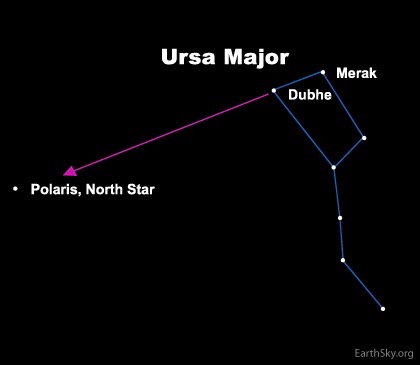
You can also use the Big Dipper to locate Castor and Pollux. Draw an imaginary line diagonally through the bowl of the Big Dipper, as shown on the sky chart above.

That brilliant star on the other side of the January 29 moon is Procyon, sometimes called the Little Dog Star.

You might not know that Procyon – and Castor and Pollux – offer an alternate way of finding Polaris, the North Star. You can draw an imaginary line from Procyon and then in between the two Gemini stars, and then take a long jump northward to locate Polaris, the North Star.

Donate: Your support means the world to us

Most people use the two outer stars in the bowl of the Dipper - Dubhe and Merak - to find Polaris, the North Star. A line between these two stars always points to the North Star.

Most people use the two outer stars in the bowl of the Dipper – Dubhe and Merak – to find Polaris, the North Star. A line between these two stars always points to the North Star.

And speaking of star-hopping … if you’re familiar with the winter constellation Orion, draw an imaginary line from the star Rigel through the star Betelgeuse to locate Castor and Pollux.

On a dark night, star-hop to the constellation Gemini by way of the constellation Orion the Hunter.

Bottom line: On the night of January 29, 2018, let the full-looking waxing gibbous moon guide your eye to the bright Gemini stars, Castor and Pollux!

Gemini? Here’s your constellation

EarthSky astronomy kits are perfect for beginners. Order today from the EarthSky store


from EarthSky http://ift.tt/1nCt5Sb

Tonight – January 29, 2018 – the moon might look full to you, but it’s not yet. Full moon comes when the moon is most opposite the sun. That’ll be during the morning hours on January 31 for us in North America, and, of course, this full moon is a Blue Moon, and a supermoon and will undergo a total eclipse – a super Blue Moon eclipse. Meanwhile, the January 29 moon is a waxing gibbous moon. It’s near the bright stars Castor and Pollux in the constellation Gemini the Twins.

Although we’ve drawn in the stick figure of the Gemini Twins on the chart at the top of this post, you might not see much of Gemini in the moonlight glare except for Castor and Pollux. These two stars are bright and noticeable for being near one another. They form the northeastern part of the Winter Circle.

You can also use the Big Dipper to locate Castor and Pollux. Draw an imaginary line diagonally through the bowl of the Big Dipper, as shown on the sky chart above.

That brilliant star on the other side of the January 29 moon is Procyon, sometimes called the Little Dog Star.

You might not know that Procyon – and Castor and Pollux – offer an alternate way of finding Polaris, the North Star. You can draw an imaginary line from Procyon and then in between the two Gemini stars, and then take a long jump northward to locate Polaris, the North Star.

Donate: Your support means the world to us

Most people use the two outer stars in the bowl of the Dipper - Dubhe and Merak - to find Polaris, the North Star. A line between these two stars always points to the North Star.

Most people use the two outer stars in the bowl of the Dipper – Dubhe and Merak – to find Polaris, the North Star. A line between these two stars always points to the North Star.

And speaking of star-hopping … if you’re familiar with the winter constellation Orion, draw an imaginary line from the star Rigel through the star Betelgeuse to locate Castor and Pollux.

On a dark night, star-hop to the constellation Gemini by way of the constellation Orion the Hunter.

Bottom line: On the night of January 29, 2018, let the full-looking waxing gibbous moon guide your eye to the bright Gemini stars, Castor and Pollux!

Gemini? Here’s your constellation

EarthSky astronomy kits are perfect for beginners. Order today from the EarthSky store


from EarthSky http://ift.tt/1nCt5Sb

Research shows black holes push away their dinners

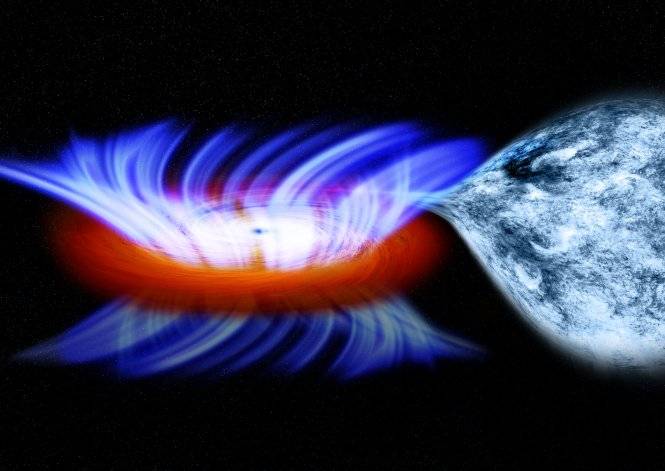
Artist’s concept of a stellar-mass black hole (left) with its companion star. The hole’s gravity pulls gas away from the companion, and the gas forms a disk around the hole. A black hole “wind” is driven off this disk. Image via NASA.

New research provides the first evidence of strong winds from the disks surrounding stellar-mass black holes throughout “gorging” events, during which the holes are rapidly consuming mass. The researchers think the winds might act as a barrier, preventing the holes from consuming as much mass as they otherwise would. The results were published January 22, 2018 in the peer-reviewed journal Nature. Bailey Tetarenko is a University of Alberta Ph.D. student and lead author of the study. She said:

Winds must blow away a large fraction of the matter a black hole could eat. In one of our models, the winds removed 80 per cent of the black hole’s potential meal.

Thus small black holes might have surprisingly large effects, as so much material being pushed away would afterwards interact with the rest of a black hole’s home galaxy.

Tetarenko is part of an international research team that examined several space-based data sources, going back to 1996. The team was looking for bright outbursts of X-ray emission, thought to occur when black holes suddenly and rapidly consume mass. Tetarenko’s professor and co-author Gregory Sivakoff, also of University of Alberta, told TorontoMetro:

When [Bailey] started showing us the results … I think our mouths started dropping. Because we realized that her results were getting at something very, very critical in our field

Oftentimes you’re nibbling at the edges of the field, but this is getting to the heart of our field.

The team saw evidence of consistent and strong winds surrounding black holes throughout outbursts. Until now, strong winds had only been seen in limited parts of these events.

They also observed that stellar-mass black holes can consume everything within a radius of about two to 100 miles (three to 150 km), depending on their size.

Stellar-mass black holes are much smaller than the supermassive black holes thought to lie at the centers of most galaxies. Small black holes have masses of perhaps 5 to several tens of times that of our sun, while, for example, the supermassive black hole at the center of our Milky Way has an estimated four million solar masses.

Yet the small and large black holes might share certain behaviors, and thus Sivakoff said this research sheds light on big questions. He said:

Our galaxy seems to be a fairly typical galaxy. We know that there is a supermassive black hole at the center of our galaxy.

And so it might mean that as we learn how in general black holes feed and affect their environment, we may be learning more about the specifics of how our supermassive black hole affected how our galaxy formed, and in the end … how we got here.

Bottom line: Researchers at University of Alberta have evidence that winds from the disks surrounding stellar-mass black holes push away as much as 80 percent of the material the holes would otherwise consume.

Via Folio and Toronto Metro

Source: Strong Disk Winds Traced Throughout Outbursts in Black-Hole X-ray Binaries


from EarthSky http://ift.tt/2DL43x6

Artist’s concept of a stellar-mass black hole (left) with its companion star. The hole’s gravity pulls gas away from the companion, and the gas forms a disk around the hole. A black hole “wind” is driven off this disk. Image via NASA.

New research provides the first evidence of strong winds from the disks surrounding stellar-mass black holes throughout “gorging” events, during which the holes are rapidly consuming mass. The researchers think the winds might act as a barrier, preventing the holes from consuming as much mass as they otherwise would. The results were published January 22, 2018 in the peer-reviewed journal Nature. Bailey Tetarenko is a University of Alberta Ph.D. student and lead author of the study. She said:

Winds must blow away a large fraction of the matter a black hole could eat. In one of our models, the winds removed 80 per cent of the black hole’s potential meal.

Thus small black holes might have surprisingly large effects, as so much material being pushed away would afterwards interact with the rest of a black hole’s home galaxy.

Tetarenko is part of an international research team that examined several space-based data sources, going back to 1996. The team was looking for bright outbursts of X-ray emission, thought to occur when black holes suddenly and rapidly consume mass. Tetarenko’s professor and co-author Gregory Sivakoff, also of University of Alberta, told TorontoMetro:

When [Bailey] started showing us the results … I think our mouths started dropping. Because we realized that her results were getting at something very, very critical in our field

Oftentimes you’re nibbling at the edges of the field, but this is getting to the heart of our field.

The team saw evidence of consistent and strong winds surrounding black holes throughout outbursts. Until now, strong winds had only been seen in limited parts of these events.

They also observed that stellar-mass black holes can consume everything within a radius of about two to 100 miles (three to 150 km), depending on their size.

Stellar-mass black holes are much smaller than the supermassive black holes thought to lie at the centers of most galaxies. Small black holes have masses of perhaps 5 to several tens of times that of our sun, while, for example, the supermassive black hole at the center of our Milky Way has an estimated four million solar masses.

Yet the small and large black holes might share certain behaviors, and thus Sivakoff said this research sheds light on big questions. He said:

Our galaxy seems to be a fairly typical galaxy. We know that there is a supermassive black hole at the center of our galaxy.

And so it might mean that as we learn how in general black holes feed and affect their environment, we may be learning more about the specifics of how our supermassive black hole affected how our galaxy formed, and in the end … how we got here.

Bottom line: Researchers at University of Alberta have evidence that winds from the disks surrounding stellar-mass black holes push away as much as 80 percent of the material the holes would otherwise consume.

Via Folio and Toronto Metro

Source: Strong Disk Winds Traced Throughout Outbursts in Black-Hole X-ray Binaries


from EarthSky http://ift.tt/2DL43x6

2018 SkS Weekly Climate Change & Global Warming Digest #4

Breaking News... Story of the Week... Toon of the Week... Quote of the Week... Graphic of the Week... SkS in the News... John Cook Quoted... Coming Soon on SkS... Poster of the Week... SkS Week in Review... 97 Hours of Consensus...

Breaking News...

Donald Trump appears to misunderstand basic facts of climate change in Piers Morgan interview

Donal Trump and Piers Morgan

Donald Trump has expressed doubts over the existence of climate change, as it is understood by the vast majority of scientists.  

After proclaiming his belief in “clean air and clean water”, the US President questioned some of the central tenets of climate science in an interview with Piers Morgan.

Mr Trump also repeated previous statements that he could “go back” into the Paris climate agreement, but said that he would only make such a decision if he could get “a good deal” for the US.

US President Donald Trump dismisses climate change and global warming in a TV interview this evening where he justifies leaving the Paris Accord because it was "a disaster" for America.

In a rambling and somewhat incoherent response to questions from Piers Morgan. He says, "There is a cooling, and there's a heating. I mean, look, it used to not be climate change, it used to be global warming. That wasn't working too well because it was getting too cold all over the place.

"The ice caps were going to melt, they were going to be gone by now, but now they're setting records. They're at a record level." 

Donald Trump appears to misunderstand basic facts of climate change in Piers Morgan interview by Josh Gabbatiss, The Independent, Jan 27, 2018


Story of the Week...

Reckoning with climate change will demand ugly tradeoffs from environmentalists — and everyone else

Nuclear Power Plant 

Climate change is a crisis. Serious damages are already underway, there’s enough carbon dioxide in the atmosphere to ensure more damages to come, and if carbon emissions continue unchecked, species-threatening damages become a non-trivial risk.

Lots of people acknowledge this. But it’s one think to acknowledge it and another to really take it on board, to follow all the implications wherever they lead. Very few people have let the reality of the situation sink in deep enough that it reshapes their values and priorities. Being a consistent climate hawk, it turns out, is extremely difficult.

Let’s take a look at an example of what I’m talking about, and then pull back to ponder the broader problem. 

Reckoning with climate change will demand ugly tradeoffs from environmentalists — and everyone else by David Roberts, Energy & Environmnet, Vox, Jan 27, 2018 


Toon of the Week...

2018 Toon 4 


Quote of the Week...

Just a year into his term, President Trump has already gained a reputation for being staunchly anti-science, with his administration recently described as showing “greater distain for science” than any other in modern history. Every day, it seems, there is a new report of the administration reducing public access to scientific information, cutting funding for scientific research, or downplaying the views of qualified scientists. To keep track of these developments, the Sabin Center for Climate Change Law, in association with the Climate Science Legal Defense Fund, today launched a new Silencing Science Tracker (SST).

The SST is intended as a comprehensive record of government attempts to “silence science” since the November 2016 election. By recording all attempts in a single database, the SST enables users to easily see the myriad of ways in which scientific research and discussion are being undermined by government, and (hopefully) take action in response. This is vital as, in the words of Michael Gerrard, Faculty Director of the Sabin Center:

Scientific knowledge is the very foundation of all environmental regulation. When the government ignores science, it’s like a truck driver who wears a blindfold and drives based on what is whispered into his ear — dangerous and intolerable. The vital work of scientists must be supported, made public, and listened to. When government officials block this, we plan to shine a harsh light. 

New Silencing Science Tracker Launched by The Sabin Center and Climate Science Legal Defense Fund by Romany Webb, Climate Law Blog, Sabin Center for Climate Change Law, Jan 19, 2018


Graphic of the Week...
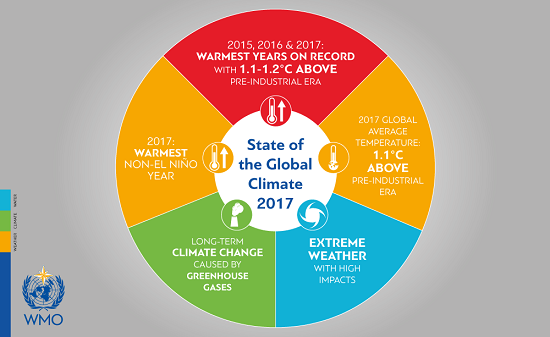
State of the Global Climate 2017 

WMO confirms 2017 among the three warmest years on recordWMO Press Release, Jan 18, 2018


SkS in the News...

In his Independent article, Donald Trump appears to misunderstand basic facts of climate change in Piers Morgan interview, Josh Gabbatiss references and links to:  

Consensus on consensus: a synthesis of consensus estimates on human-caused global warming, Cook et al, Environmental Research LettersVolume 11Number 4, Published 13 April 2016 


John Cook Quoted...

From Monthly Messenger: Could Inoculation be the Cure to Climate Denial? posted by the National Caucus of Environmental Legislators (NCEL): 

A separate study conducted by John Cook – author of the “Debunking Handbook,” which addresses how to debunk myths – resulted in similar findings. Cook’s study found that highlighting scientific consensus could increase people’s perceived consensus on a topic. This reduces the impact of misinformation. Many people believe that the most appropriate way to address false information is to not discuss the myth, rather to only highlight the facts. However, Cook’s research found it is best to address misinformation head on.

“You can’t talk around it; otherwise it persists. What’s important is to lead with the facts — the facts are the headline — then introduce the myth, and then explain why it’s wrong.” –John Cook  

From Dino Grandoni's Washington Post article, The Energy 202: Republicans love NASA. But why do they doubt its climate science?:

But the love for NASA doesn't mean the GOP embraces the agency's stance on climate science.Last year, only 18 percent of Republicans said they worried a great deal about climate change, according to Gallup.

The incongruity between support for the space agency and its climate warnings stems from a "crucial tension in conservative attitudes towards climate change, according to John Cook, a research assistant professor at the Center for Climate Change Communication at George Mason University.

“On the one hand, there is respect for scientific institutions like NASA,” Cook wrote by email. “On the other hand, acceptance of human-caused global warming is low.”


Photo of the Week...
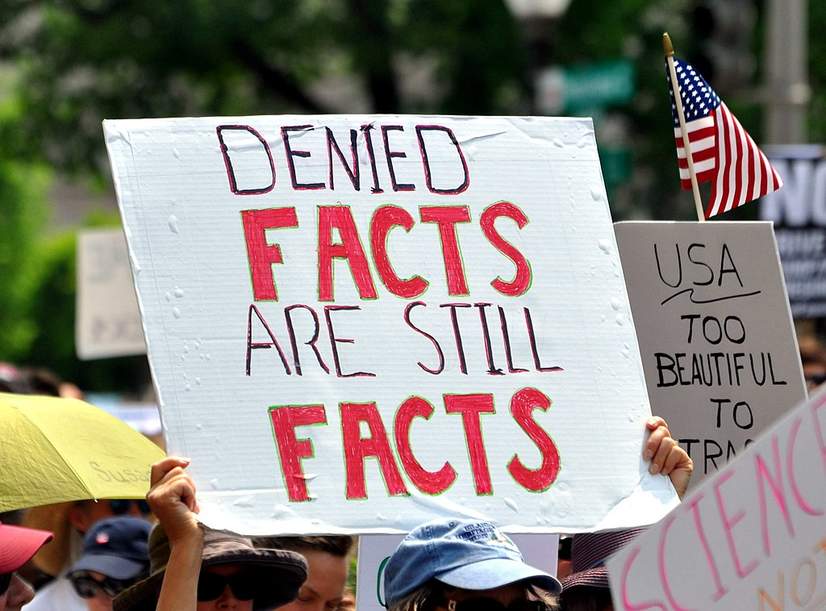
Denied-Facts-Climate_March_2017_credit-Edward-Kimmel 

Trump Officials, Energy Execs Speak Together at Conference Sponsored by Climate Denier Groups by Itai Vardi, DeSmog, Jan 25, 2018


Coming Soon on SkS...

  • State of the climate: how the world warmed in 2017 (Zeke)
  • Natural gas killed coal - now renewables and batteries are taking over (Dana)
  • Is warming in the Arctic behind this year’s crazy winter weather? (Jennifer Francis)
  • Guest Post (John Abraham )
  • New research this week (Ari)
  • 2017 SkS Weekly Climate Change & Global Warming News Roundup #5 (John Hartz)
  • 2017 SkS Weekly Climate Change & Global Waming Digest #5 (John Hartz)

Poster of the Week...
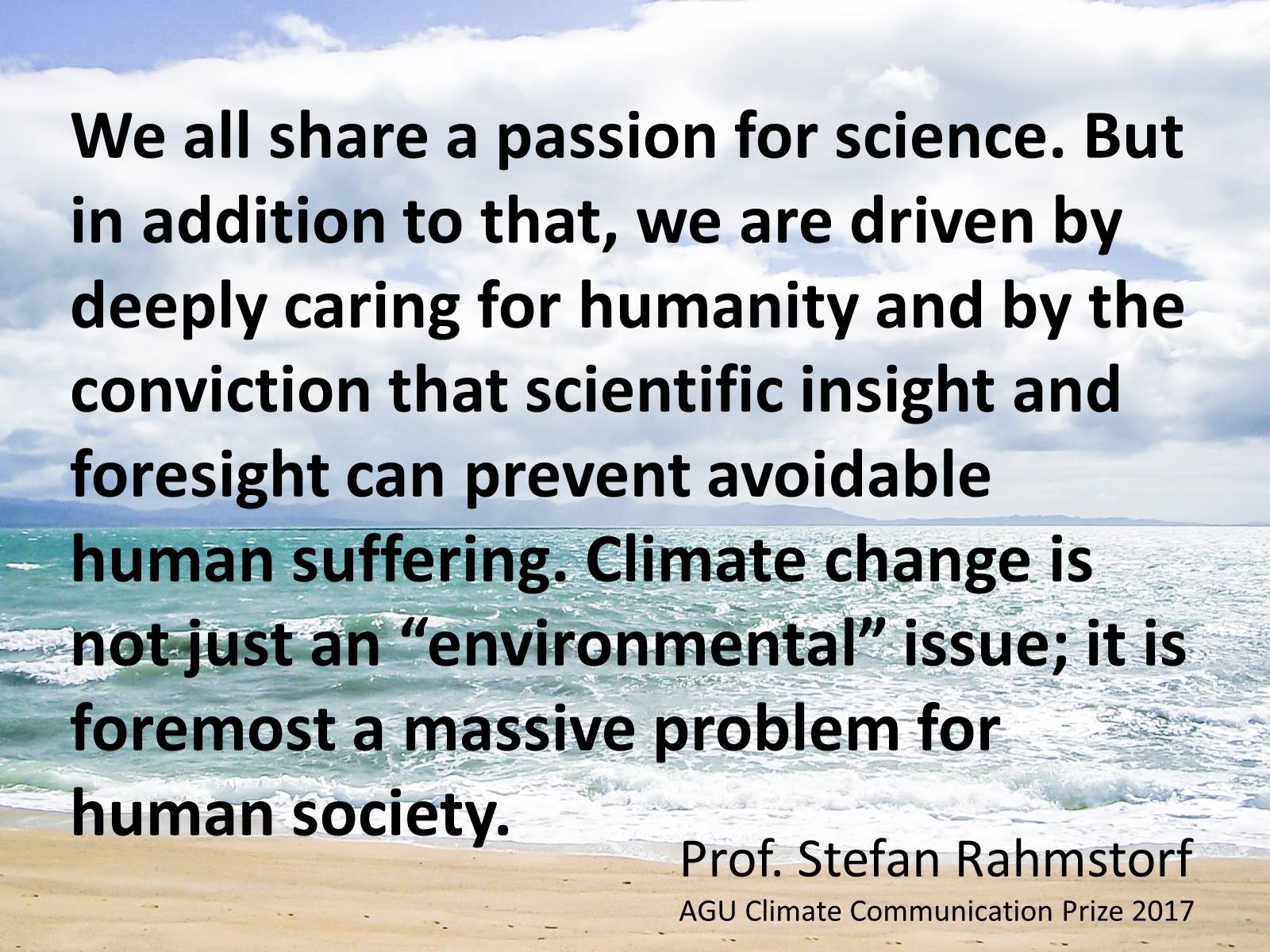
2018 P0ster 4 


SkS Week in Review... 


97 Hours of Consensus...
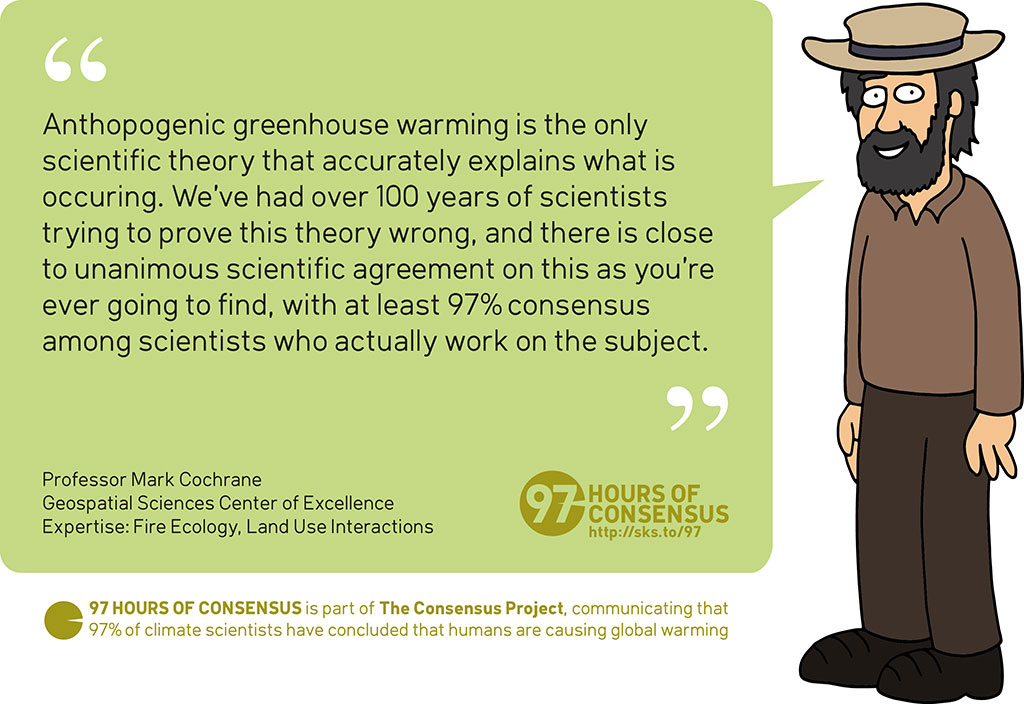
97 Hours: Mark Cochrane 

Mark Cochrane's bio page and Quote source 

High resolution JPEG (1024 pixels wide)


from Skeptical Science http://ift.tt/2no413d

Breaking News... Story of the Week... Toon of the Week... Quote of the Week... Graphic of the Week... SkS in the News... John Cook Quoted... Coming Soon on SkS... Poster of the Week... SkS Week in Review... 97 Hours of Consensus...

Breaking News...

Donald Trump appears to misunderstand basic facts of climate change in Piers Morgan interview

Donal Trump and Piers Morgan

Donald Trump has expressed doubts over the existence of climate change, as it is understood by the vast majority of scientists.  

After proclaiming his belief in “clean air and clean water”, the US President questioned some of the central tenets of climate science in an interview with Piers Morgan.

Mr Trump also repeated previous statements that he could “go back” into the Paris climate agreement, but said that he would only make such a decision if he could get “a good deal” for the US.

US President Donald Trump dismisses climate change and global warming in a TV interview this evening where he justifies leaving the Paris Accord because it was "a disaster" for America.

In a rambling and somewhat incoherent response to questions from Piers Morgan. He says, "There is a cooling, and there's a heating. I mean, look, it used to not be climate change, it used to be global warming. That wasn't working too well because it was getting too cold all over the place.

"The ice caps were going to melt, they were going to be gone by now, but now they're setting records. They're at a record level." 

Donald Trump appears to misunderstand basic facts of climate change in Piers Morgan interview by Josh Gabbatiss, The Independent, Jan 27, 2018


Story of the Week...

Reckoning with climate change will demand ugly tradeoffs from environmentalists — and everyone else

Nuclear Power Plant 

Climate change is a crisis. Serious damages are already underway, there’s enough carbon dioxide in the atmosphere to ensure more damages to come, and if carbon emissions continue unchecked, species-threatening damages become a non-trivial risk.

Lots of people acknowledge this. But it’s one think to acknowledge it and another to really take it on board, to follow all the implications wherever they lead. Very few people have let the reality of the situation sink in deep enough that it reshapes their values and priorities. Being a consistent climate hawk, it turns out, is extremely difficult.

Let’s take a look at an example of what I’m talking about, and then pull back to ponder the broader problem. 

Reckoning with climate change will demand ugly tradeoffs from environmentalists — and everyone else by David Roberts, Energy & Environmnet, Vox, Jan 27, 2018 


Toon of the Week...

2018 Toon 4 


Quote of the Week...

Just a year into his term, President Trump has already gained a reputation for being staunchly anti-science, with his administration recently described as showing “greater distain for science” than any other in modern history. Every day, it seems, there is a new report of the administration reducing public access to scientific information, cutting funding for scientific research, or downplaying the views of qualified scientists. To keep track of these developments, the Sabin Center for Climate Change Law, in association with the Climate Science Legal Defense Fund, today launched a new Silencing Science Tracker (SST).

The SST is intended as a comprehensive record of government attempts to “silence science” since the November 2016 election. By recording all attempts in a single database, the SST enables users to easily see the myriad of ways in which scientific research and discussion are being undermined by government, and (hopefully) take action in response. This is vital as, in the words of Michael Gerrard, Faculty Director of the Sabin Center:

Scientific knowledge is the very foundation of all environmental regulation. When the government ignores science, it’s like a truck driver who wears a blindfold and drives based on what is whispered into his ear — dangerous and intolerable. The vital work of scientists must be supported, made public, and listened to. When government officials block this, we plan to shine a harsh light. 

New Silencing Science Tracker Launched by The Sabin Center and Climate Science Legal Defense Fund by Romany Webb, Climate Law Blog, Sabin Center for Climate Change Law, Jan 19, 2018


Graphic of the Week...

State of the Global Climate 2017 

WMO confirms 2017 among the three warmest years on recordWMO Press Release, Jan 18, 2018


SkS in the News...

In his Independent article, Donald Trump appears to misunderstand basic facts of climate change in Piers Morgan interview, Josh Gabbatiss references and links to:  

Consensus on consensus: a synthesis of consensus estimates on human-caused global warming, Cook et al, Environmental Research LettersVolume 11Number 4, Published 13 April 2016 


John Cook Quoted...

From Monthly Messenger: Could Inoculation be the Cure to Climate Denial? posted by the National Caucus of Environmental Legislators (NCEL): 

A separate study conducted by John Cook – author of the “Debunking Handbook,” which addresses how to debunk myths – resulted in similar findings. Cook’s study found that highlighting scientific consensus could increase people’s perceived consensus on a topic. This reduces the impact of misinformation. Many people believe that the most appropriate way to address false information is to not discuss the myth, rather to only highlight the facts. However, Cook’s research found it is best to address misinformation head on.

“You can’t talk around it; otherwise it persists. What’s important is to lead with the facts — the facts are the headline — then introduce the myth, and then explain why it’s wrong.” –John Cook  

From Dino Grandoni's Washington Post article, The Energy 202: Republicans love NASA. But why do they doubt its climate science?:

But the love for NASA doesn't mean the GOP embraces the agency's stance on climate science.Last year, only 18 percent of Republicans said they worried a great deal about climate change, according to Gallup.

The incongruity between support for the space agency and its climate warnings stems from a "crucial tension in conservative attitudes towards climate change, according to John Cook, a research assistant professor at the Center for Climate Change Communication at George Mason University.

“On the one hand, there is respect for scientific institutions like NASA,” Cook wrote by email. “On the other hand, acceptance of human-caused global warming is low.”


Photo of the Week...

Denied-Facts-Climate_March_2017_credit-Edward-Kimmel 

Trump Officials, Energy Execs Speak Together at Conference Sponsored by Climate Denier Groups by Itai Vardi, DeSmog, Jan 25, 2018


Coming Soon on SkS...

  • State of the climate: how the world warmed in 2017 (Zeke)
  • Natural gas killed coal - now renewables and batteries are taking over (Dana)
  • Is warming in the Arctic behind this year’s crazy winter weather? (Jennifer Francis)
  • Guest Post (John Abraham )
  • New research this week (Ari)
  • 2017 SkS Weekly Climate Change & Global Warming News Roundup #5 (John Hartz)
  • 2017 SkS Weekly Climate Change & Global Waming Digest #5 (John Hartz)

Poster of the Week...

2018 P0ster 4 


SkS Week in Review... 


97 Hours of Consensus...

97 Hours: Mark Cochrane 

Mark Cochrane's bio page and Quote source 

High resolution JPEG (1024 pixels wide)


from Skeptical Science http://ift.tt/2no413d

Will future landers on Europa sink?

Space scientists have every reason to be fascinated with Jupiter’s moon Europa, and, in 2017, NASA and the European Space Agency (ESA) announced they are planning a joint mission to land there. As the video above explains, this little moon is thought to have a liquid ocean submerged beneath an icy crust. Scientists believe it could host extraterrestrial life. But Europa’s surface is much more alien than any we’ve ever visited. With its extremely thin atmosphere, low gravity – and a surface temperature of some -350 degrees F. (–176 °C.) – Europa might not be kind to a landing spacecraft. The moon’s surface might be unexpectedly hard. Or – as evidenced by a study from the Planetary Science Institute announced on January 24, 2018 – Europa’s surface might be so porous that any craft trying to land would simply sink.

The study – published in the peer-reviewed journal Icarus – comes from scientist Robert Nelson. If you’re a student of space history, its results might sound familiar. Nelson pointed out in his statement:

Of course, before the landing of the Luna 2 robotic spacecraft in 1959, there was concern that the moon might be covered in low density dust into which any future astronauts might sink.

Now Europa is the source of a similar scariness, with Nelson’s study showing that Europa’s surface could be as much as 95 percent porous.

The puzzling, fascinating surface of Jupiter’s icy moon Europa. This color composite is made from images taken by NASA’s Galileo spacecraft in the late 1990s. Image via NASA/JPL-Caltech/SETI Institute.

Nelson’s study of Europa is part of a group of studies he has conducted of both asteroids (44 Nysa, 64 Angelina) and jovian moons (Io, Europa, Ganymede). He conducts his studies via photopolarimetry, the measurement of the intensity and polarization of reflected light.

Observations were made using a photopolarimeter located at Mt. San Antonio College in Walnut, California.

According to Nelson, the observations can be explained by extremely fine-grained particles on Europa’s surface with a porosity less than about 95 percent. This corresponds to material that would be less dense than freshly fallen snow, raising questions about risks of sinking for a future Europa lander.

Brown ridges crisscross Europa, indicating the possibility of liquid welling up from below. This suggests an active geology and raises questions about possible life on Europa. Image via NASA/PLAN-PIA01641.

A mission to land on Europa is challenging in other ways. For example, Europa — along with the three other Galilean moons (Io, Ganymede and Callisto) — orbits within Jupiter’s radiation belts. A spacecraft trying to orbit Europa would be quickly fried.

That’s why NASA’s upcoming Europa Clipper mission is designed to orbit Jupiter, not Europa. It’ll sweep in and out of the radiation belts for a period of several earthly years, making flyby observations of Europa each time it passes near this jovian moon. Its observations will help answer questions about what might happen to future spacecraft attempting to land on Europa.

The video below has more about the upcoming flyby mission, Europa Clipper, set for launch around 2022-2025.

Bottom line: A recent study via the Planetary Science Institute indicates that the surface of Jupiter’s moon Europa might be as much as 95 percent porous – less dense than freshly fallen snow – so that a future lander might sink.

Source: Laboratory simulations of planetary surfaces: Understanding regolith physical properties from remote photopolarimetric observations

Via Planetary Science Institute


from EarthSky http://ift.tt/2nhauh5

Space scientists have every reason to be fascinated with Jupiter’s moon Europa, and, in 2017, NASA and the European Space Agency (ESA) announced they are planning a joint mission to land there. As the video above explains, this little moon is thought to have a liquid ocean submerged beneath an icy crust. Scientists believe it could host extraterrestrial life. But Europa’s surface is much more alien than any we’ve ever visited. With its extremely thin atmosphere, low gravity – and a surface temperature of some -350 degrees F. (–176 °C.) – Europa might not be kind to a landing spacecraft. The moon’s surface might be unexpectedly hard. Or – as evidenced by a study from the Planetary Science Institute announced on January 24, 2018 – Europa’s surface might be so porous that any craft trying to land would simply sink.

The study – published in the peer-reviewed journal Icarus – comes from scientist Robert Nelson. If you’re a student of space history, its results might sound familiar. Nelson pointed out in his statement:

Of course, before the landing of the Luna 2 robotic spacecraft in 1959, there was concern that the moon might be covered in low density dust into which any future astronauts might sink.

Now Europa is the source of a similar scariness, with Nelson’s study showing that Europa’s surface could be as much as 95 percent porous.

The puzzling, fascinating surface of Jupiter’s icy moon Europa. This color composite is made from images taken by NASA’s Galileo spacecraft in the late 1990s. Image via NASA/JPL-Caltech/SETI Institute.

Nelson’s study of Europa is part of a group of studies he has conducted of both asteroids (44 Nysa, 64 Angelina) and jovian moons (Io, Europa, Ganymede). He conducts his studies via photopolarimetry, the measurement of the intensity and polarization of reflected light.

Observations were made using a photopolarimeter located at Mt. San Antonio College in Walnut, California.

According to Nelson, the observations can be explained by extremely fine-grained particles on Europa’s surface with a porosity less than about 95 percent. This corresponds to material that would be less dense than freshly fallen snow, raising questions about risks of sinking for a future Europa lander.

Brown ridges crisscross Europa, indicating the possibility of liquid welling up from below. This suggests an active geology and raises questions about possible life on Europa. Image via NASA/PLAN-PIA01641.

A mission to land on Europa is challenging in other ways. For example, Europa — along with the three other Galilean moons (Io, Ganymede and Callisto) — orbits within Jupiter’s radiation belts. A spacecraft trying to orbit Europa would be quickly fried.

That’s why NASA’s upcoming Europa Clipper mission is designed to orbit Jupiter, not Europa. It’ll sweep in and out of the radiation belts for a period of several earthly years, making flyby observations of Europa each time it passes near this jovian moon. Its observations will help answer questions about what might happen to future spacecraft attempting to land on Europa.

The video below has more about the upcoming flyby mission, Europa Clipper, set for launch around 2022-2025.

Bottom line: A recent study via the Planetary Science Institute indicates that the surface of Jupiter’s moon Europa might be as much as 95 percent porous – less dense than freshly fallen snow – so that a future lander might sink.

Source: Laboratory simulations of planetary surfaces: Understanding regolith physical properties from remote photopolarimetric observations

Via Planetary Science Institute


from EarthSky http://ift.tt/2nhauh5

Identify stars in the Winter Circle

Tonight – January 28, 2018 – our chart covers an area of sky wider than we typically show. It’s in answer to a reader in Nashville, who wrote:

I’ve heard mention of the Winter Circle of stars. Could you list the stars in this circle?

We can do better than that. We can advise you to go outside on this date, and look for the waxing gibbous moon, then notice the stars nearby. The moon is within the Winter Circle stars on this date. All the stars of the Winter Circle (sometimes called the Winter Hexagon) are first-magnitude stars, so they should be able to withstand tonight’s drenching moonlight.

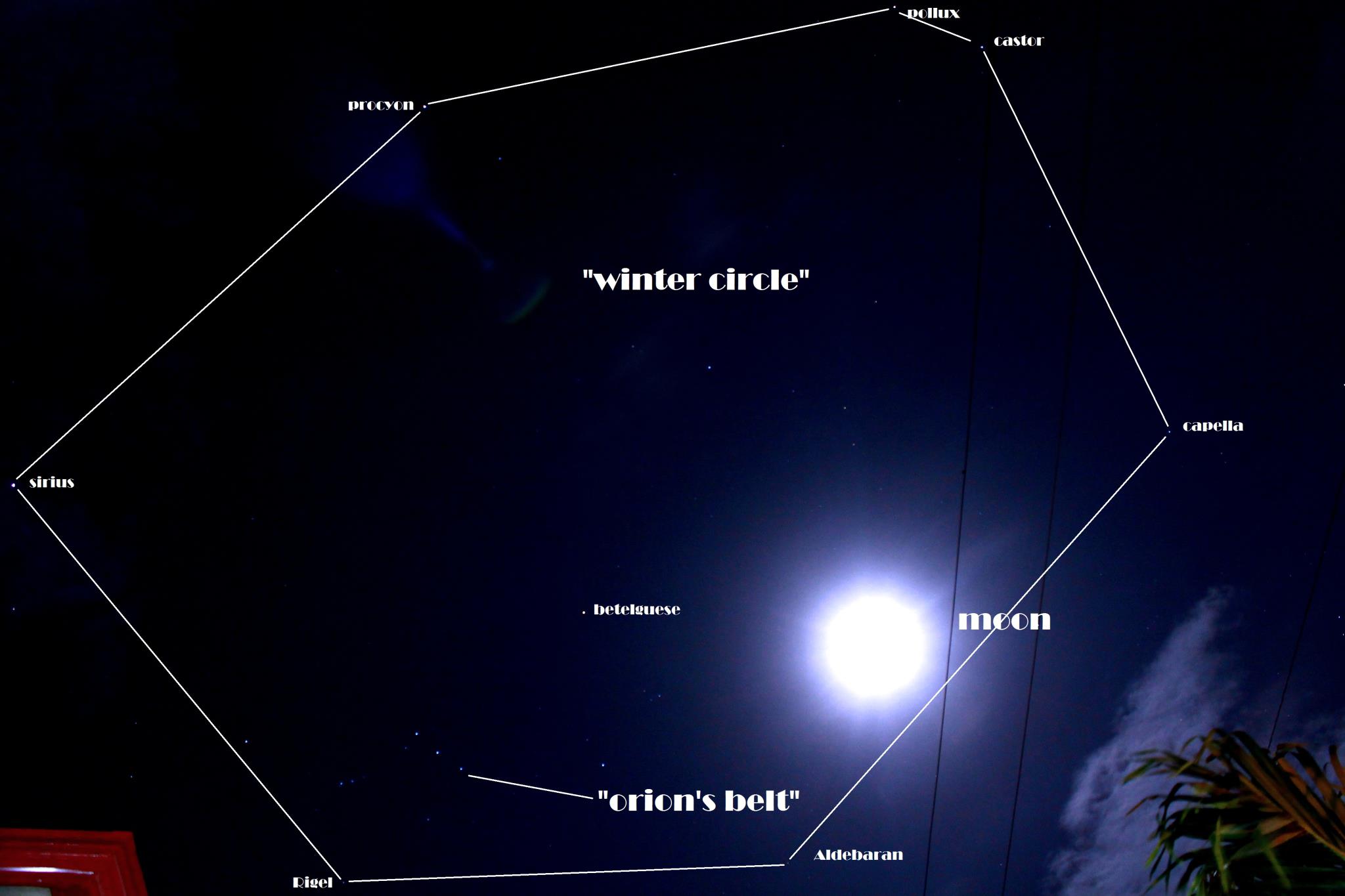
The Winter Circle stars don’t form a perfect circle … is anything ever perfect? Try starting at Capella and moving clockwise to Aldebaran, Rigel, Sirius, Procyon, Pollux, and Castor.

This pattern of stars is not a constellation. It’s a lot of separate stars in different constellations. In other words, it’s what’s called an asterism. From our Northern Hemisphere locations, these same bright stars can be seen before dawn every late summer and early fall. And they can be seen in the evening every winter. Hence the name Winter Circle.

I wonder what these same stars are called in the Southern Hemisphere? They’re visible from there, but of course it’s summer there now. I don’t know if this particular collection of bright stars has some special name as seen from that part of the globe. If any of you do know … tell us in the comments!

Donate: Your support means the world to us

View larger. | The Winter Circle as photographed by EarthSky Facebook friend Zhean Peter Nacionales in the Philippines. Thank you, Zhean!

Bottom line: The stars of the Winter Circle may be seen on these cold winter nights until well after midnight. On January 28, 2018, the moon is inside the Winter Circle.

Read more about the Winter Circle: Brightest winter stars

Live by the moon with your 2018 EarthSky lunar calendar!


from EarthSky http://ift.tt/1ySWuK2

Tonight – January 28, 2018 – our chart covers an area of sky wider than we typically show. It’s in answer to a reader in Nashville, who wrote:

I’ve heard mention of the Winter Circle of stars. Could you list the stars in this circle?

We can do better than that. We can advise you to go outside on this date, and look for the waxing gibbous moon, then notice the stars nearby. The moon is within the Winter Circle stars on this date. All the stars of the Winter Circle (sometimes called the Winter Hexagon) are first-magnitude stars, so they should be able to withstand tonight’s drenching moonlight.

The Winter Circle stars don’t form a perfect circle … is anything ever perfect? Try starting at Capella and moving clockwise to Aldebaran, Rigel, Sirius, Procyon, Pollux, and Castor.

This pattern of stars is not a constellation. It’s a lot of separate stars in different constellations. In other words, it’s what’s called an asterism. From our Northern Hemisphere locations, these same bright stars can be seen before dawn every late summer and early fall. And they can be seen in the evening every winter. Hence the name Winter Circle.

I wonder what these same stars are called in the Southern Hemisphere? They’re visible from there, but of course it’s summer there now. I don’t know if this particular collection of bright stars has some special name as seen from that part of the globe. If any of you do know … tell us in the comments!

Donate: Your support means the world to us

View larger. | The Winter Circle as photographed by EarthSky Facebook friend Zhean Peter Nacionales in the Philippines. Thank you, Zhean!

Bottom line: The stars of the Winter Circle may be seen on these cold winter nights until well after midnight. On January 28, 2018, the moon is inside the Winter Circle.

Read more about the Winter Circle: Brightest winter stars

Live by the moon with your 2018 EarthSky lunar calendar!


from EarthSky http://ift.tt/1ySWuK2

In 2017, the oceans were by far the hottest ever recorded

Among scientists who work on climate change, perhaps the most anticipated information each year is how much the Earth has warmed. That information can only come from the oceans, because almost all heat is stored there. If you want to understand global warming, you need to first understand ocean warming.

This isn’t to say other measurements are not also important. For instance, measurements of the air temperature just above the Earth are really important. We live in this air; it affects us directly. A great commentary on 2017 air temperatures is provided by my colleague Dana Nuccitelli. Another measurement that is important is sea level rise; so too is ocean acidification. We could go on and on identifying the markers of climate change. But in terms of understanding how fast the Earth is warming, the key is the oceans. 

This important ocean information was just released today by a world-class team of researchers from China. The researchers (Lijing Cheng and Jiang Zhu) found that the upper 2000 meters (more than 6000 feet) of ocean waters were far warmer in 2017 than the previous hottest year. We measure heat energy in Joules. It turns out that 2017 was a record-breaking year, 1.51 × 10²² Joules hotter than any other year. For comparison, the annual electrical generation in China is 600 times smaller than the heat increase in the ocean.

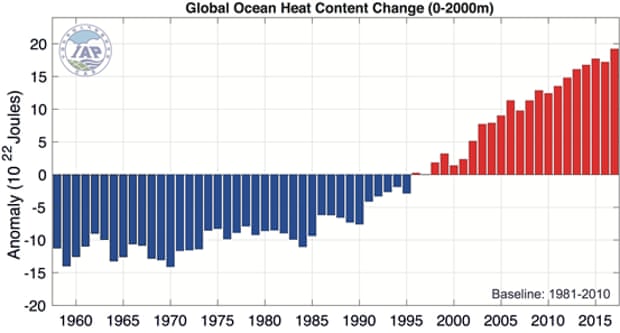
The authors provide a long history of ocean heat, going back to the late 1950s. By then there were enough ocean temperature sensors to get an accurate assessment of the oceans’ warmth. Their results are shown in the figure below. This graph shows ocean heat as an “anomaly,” which means a change from their baseline of 1981–2010. Columns in blue are cooler than the 1981-2010 period, while columns in red are warmer than that period. The best way to interpret this graph is to notice the steady rise in ocean heat over this long time period.

OHC

Ocean heat content change since 1958. Illustration: Cheng and Zhu (2018), Advances in Atmospheric Sciences

What is interesting is that from year to year (or over the span of a few years), the heat in the oceans may increase or decrease. This is because there are natural fluctuations that can transfer extra energy to or from the waters. One such natural event is the well-known El Niño/La Niña cycle in the Pacific Ocean. During an El Niño, the Pacific Ocean tends to have very warm waters at the surface, which causes heat loss to the atmosphere (so the ocean cools and the atmosphere warms). Conversely, during a La Niña, the reverse process occurs. 

There are other fluctuations and natural occurrences like volcanic eruptions and other changes in ocean currents. But it just means we don’t want to take any one year as proof of global warming. The fact that 2017 was the oceans’ hottest year doesn’t prove humans are warming the planet. But, the long term upward trend that extends back many decades does prove global warming. The graph above is the most important image to show someone who denies the reality of a changing climate.

It’s interesting to look at the top five years on record in terms of ocean heat; they are listed below.

  1. 2017: 19.19 × 10²² J
  2. 2015: 17.68 × 1022 J
  3. 2016: 17.18 × 1022 J
  4. 2014: 16.74 × 1022J
  5. 2013: 16.08 × 1022 J


Note that these are the five hottest years ever recorded. Truly astonishing.

Click here to read the rest


from Skeptical Science http://ift.tt/2Gmf7hC

Among scientists who work on climate change, perhaps the most anticipated information each year is how much the Earth has warmed. That information can only come from the oceans, because almost all heat is stored there. If you want to understand global warming, you need to first understand ocean warming.

This isn’t to say other measurements are not also important. For instance, measurements of the air temperature just above the Earth are really important. We live in this air; it affects us directly. A great commentary on 2017 air temperatures is provided by my colleague Dana Nuccitelli. Another measurement that is important is sea level rise; so too is ocean acidification. We could go on and on identifying the markers of climate change. But in terms of understanding how fast the Earth is warming, the key is the oceans. 

This important ocean information was just released today by a world-class team of researchers from China. The researchers (Lijing Cheng and Jiang Zhu) found that the upper 2000 meters (more than 6000 feet) of ocean waters were far warmer in 2017 than the previous hottest year. We measure heat energy in Joules. It turns out that 2017 was a record-breaking year, 1.51 × 10²² Joules hotter than any other year. For comparison, the annual electrical generation in China is 600 times smaller than the heat increase in the ocean.

The authors provide a long history of ocean heat, going back to the late 1950s. By then there were enough ocean temperature sensors to get an accurate assessment of the oceans’ warmth. Their results are shown in the figure below. This graph shows ocean heat as an “anomaly,” which means a change from their baseline of 1981–2010. Columns in blue are cooler than the 1981-2010 period, while columns in red are warmer than that period. The best way to interpret this graph is to notice the steady rise in ocean heat over this long time period.

OHC

Ocean heat content change since 1958. Illustration: Cheng and Zhu (2018), Advances in Atmospheric Sciences

What is interesting is that from year to year (or over the span of a few years), the heat in the oceans may increase or decrease. This is because there are natural fluctuations that can transfer extra energy to or from the waters. One such natural event is the well-known El Niño/La Niña cycle in the Pacific Ocean. During an El Niño, the Pacific Ocean tends to have very warm waters at the surface, which causes heat loss to the atmosphere (so the ocean cools and the atmosphere warms). Conversely, during a La Niña, the reverse process occurs. 

There are other fluctuations and natural occurrences like volcanic eruptions and other changes in ocean currents. But it just means we don’t want to take any one year as proof of global warming. The fact that 2017 was the oceans’ hottest year doesn’t prove humans are warming the planet. But, the long term upward trend that extends back many decades does prove global warming. The graph above is the most important image to show someone who denies the reality of a changing climate.

It’s interesting to look at the top five years on record in terms of ocean heat; they are listed below.

  1. 2017: 19.19 × 10²² J
  2. 2015: 17.68 × 1022 J
  3. 2016: 17.18 × 1022 J
  4. 2014: 16.74 × 1022J
  5. 2013: 16.08 × 1022 J


Note that these are the five hottest years ever recorded. Truly astonishing.

Click here to read the rest


from Skeptical Science http://ift.tt/2Gmf7hC

2018 SkS Weekly Climate Change & Global Warming News Roundup #4

A chronological listing of news articles posted on the Skeptical Science Facebook page during the past week. 

Editor's Pick

Why climate change is worsening public health problems

Port-au-Prince Haiti 11-11-17 Men in Port-au-Prince, Haiti, collect water on Nov. 11, 2017. Years after Hurricane Matthew nearly devastated Haiti, its vulnerability only increases. Reuters/Martinez Casares
Around the world, the health care debate often revolves around access.

Dr. Tedros Adhanom Ghebreyesus, head of the World Health Organization, recently announced: “All roads lead to universal health coverage.” Discussions for how to translate this vision into a road map for action is central to the agenda of the WHO’s executive board meeting this week in Geneva.

Yet focusing on access is not enough. The imperative for access must be paired with a frank acknowledgment that climate change is making communities around the world more vulnerable to ill health. A 2017 commission of The Lancet, a leading health research journal, tracked the effects of climate change on health and found evidence of harms “far worse that previously understood.”

Even as we move to close the access gap, a string of natural disasters in late 2017, including successive hurricanes and widespread forest fires, threaten to widen the vulnerability gap.

As a global health professional (Sosin) and a cultural anthropologist (Kivland), we have witnessed how the global exchange of health technology, expertise and aid has contributed to dramatic gains in the delivery of health care in Haiti and other settings, especially around infectious diseases. Yet climate change threatens to undermine the health gains in vulnerable communities across the globe.

As firsthand witnesses to sharp health disparities globally, we argue that world leaders need to insist that any health care strategy must address the social and environmental vulnerabilities driving poor health in the first place.

Why climate change is worsening public health problems by Chelsey Kivland & Anne Sosin, The Conversation US, Jan 25, 2018


Links posted on Facebook

Sun Jan 21, 2018

Mon Jan 22, 2018

Tue Jan 23, 2018

Wed Jan 24, 2018

Thu Jan 25, 2018

Fri Jan 26, 2018

Sat Jan 27, 2018


from Skeptical Science http://ift.tt/2rILSSX
A chronological listing of news articles posted on the Skeptical Science Facebook page during the past week. 

Editor's Pick

Why climate change is worsening public health problems

Port-au-Prince Haiti 11-11-17 Men in Port-au-Prince, Haiti, collect water on Nov. 11, 2017. Years after Hurricane Matthew nearly devastated Haiti, its vulnerability only increases. Reuters/Martinez Casares

Around the world, the health care debate often revolves around access.

Dr. Tedros Adhanom Ghebreyesus, head of the World Health Organization, recently announced: “All roads lead to universal health coverage.” Discussions for how to translate this vision into a road map for action is central to the agenda of the WHO’s executive board meeting this week in Geneva.

Yet focusing on access is not enough. The imperative for access must be paired with a frank acknowledgment that climate change is making communities around the world more vulnerable to ill health. A 2017 commission of The Lancet, a leading health research journal, tracked the effects of climate change on health and found evidence of harms “far worse that previously understood.”

Even as we move to close the access gap, a string of natural disasters in late 2017, including successive hurricanes and widespread forest fires, threaten to widen the vulnerability gap.

As a global health professional (Sosin) and a cultural anthropologist (Kivland), we have witnessed how the global exchange of health technology, expertise and aid has contributed to dramatic gains in the delivery of health care in Haiti and other settings, especially around infectious diseases. Yet climate change threatens to undermine the health gains in vulnerable communities across the globe.

As firsthand witnesses to sharp health disparities globally, we argue that world leaders need to insist that any health care strategy must address the social and environmental vulnerabilities driving poor health in the first place.

Why climate change is worsening public health problems by Chelsey Kivland & Anne Sosin, The Conversation US, Jan 25, 2018


Links posted on Facebook

Sun Jan 21, 2018

Mon Jan 22, 2018

Tue Jan 23, 2018

Wed Jan 24, 2018

Thu Jan 25, 2018

Fri Jan 26, 2018

Sat Jan 27, 2018


from Skeptical Science http://ift.tt/2rILSSX

adds 2