Waxing gibbous moon (~74.3%) of January 26, 2018 by Andy Bentley.
The moon is now in a waxing gibbous phase, rising between noon and sunset, setting in the wee hours after midnight. You’ll always see a waxing gibbous moon between a first quarter moon and full moon, and, it so happens, the upcoming full moon is a Blue Moon, and a supermoon and will undergo a total eclipse – a super Blue Moon eclipse. For us in North America, the eclipse will happen during the morning hours of January 31, 2018.
Any moon that appears more than half lighted but less than full is called a gibbous moon. The word gibbous comes from a root word that means hump-backed.
People often see a waxing gibbous moon in the afternoon, shortly after moonrise, while it’s ascending in the east as the sun is descending in the west. It’s easy to see a waxing gibbous moon in the daytime because, at this phase of the moon, a respectably large fraction of the moon’s dayside is now facing our way.
Point of interest on a waxing gibbous moon: Sinus Iridum (Bay of Rainbows) surrounded by the Jura Mountains. Photo by Lunar 101-Moon Book in Toronto, Canada.
As the moon orbits Earth, it changes phase in an orderly way. Follow these links to understand the various phases of the moon.
Waxing gibbous moon (~74.3%) of January 26, 2018 by Andy Bentley.
The moon is now in a waxing gibbous phase, rising between noon and sunset, setting in the wee hours after midnight. You’ll always see a waxing gibbous moon between a first quarter moon and full moon, and, it so happens, the upcoming full moon is a Blue Moon, and a supermoon and will undergo a total eclipse – a super Blue Moon eclipse. For us in North America, the eclipse will happen during the morning hours of January 31, 2018.
Any moon that appears more than half lighted but less than full is called a gibbous moon. The word gibbous comes from a root word that means hump-backed.
People often see a waxing gibbous moon in the afternoon, shortly after moonrise, while it’s ascending in the east as the sun is descending in the west. It’s easy to see a waxing gibbous moon in the daytime because, at this phase of the moon, a respectably large fraction of the moon’s dayside is now facing our way.
Point of interest on a waxing gibbous moon: Sinus Iridum (Bay of Rainbows) surrounded by the Jura Mountains. Photo by Lunar 101-Moon Book in Toronto, Canada.
As the moon orbits Earth, it changes phase in an orderly way. Follow these links to understand the various phases of the moon.
France had an especially rainy week last week, and the city of Paris is flooding. Where are the floodwaters coming from? The video above – via NASA – shows rainfall accumulation data from an international project called IMERG, generated during the period from January 17 to 25, 2018. The data show that the area where the Seine River flows toward Paris had rainfall totals greater than 7 inches (180 mm).
Thus, in Paris, the Seine has been rising and is continuing to rise. Many media sources are now looking back to June 2016, when water levels in Paris reached more than 20 feet (six meters).
Flooding in Paris has gotten so bad that the Louvre closed one wing and meteorologists fear that the water could peak at 20 feet.
The Seine River in Paris is expected to rise farther out of its banks through this weekend despite northeastern France catching a break from heavy rain. The flooding has already inundated roads, railways and walking paths in Paris along the river, according to The Local.
The river is projected to challenge the levels recorded during the June 2016 flooding, during which the Louvre Museum was closed for four days as workers evacuated 35,000 pieces of art.
The Louvre said it made the decision last Wednesday (January 24) to close the lower level of the Department of Arts of the Islam at least through Sunday, as a precaution.
Bottom line: Videos showing rainfall accumulation data over France, generated during the period from January 17 to 25, 2018, and flooding of the Seine in Paris.
from EarthSky http://ift.tt/2EfFoxw
France had an especially rainy week last week, and the city of Paris is flooding. Where are the floodwaters coming from? The video above – via NASA – shows rainfall accumulation data from an international project called IMERG, generated during the period from January 17 to 25, 2018. The data show that the area where the Seine River flows toward Paris had rainfall totals greater than 7 inches (180 mm).
Thus, in Paris, the Seine has been rising and is continuing to rise. Many media sources are now looking back to June 2016, when water levels in Paris reached more than 20 feet (six meters).
Flooding in Paris has gotten so bad that the Louvre closed one wing and meteorologists fear that the water could peak at 20 feet.
The Seine River in Paris is expected to rise farther out of its banks through this weekend despite northeastern France catching a break from heavy rain. The flooding has already inundated roads, railways and walking paths in Paris along the river, according to The Local.
The river is projected to challenge the levels recorded during the June 2016 flooding, during which the Louvre Museum was closed for four days as workers evacuated 35,000 pieces of art.
The Louvre said it made the decision last Wednesday (January 24) to close the lower level of the Department of Arts of the Islam at least through Sunday, as a precaution.
Bottom line: Videos showing rainfall accumulation data over France, generated during the period from January 17 to 25, 2018, and flooding of the Seine in Paris.
New fossil finds over the past few years have been forcing anthropologists to reexamine our evolutionary path to becoming human. Now the earliest modern human fossil ever found outside the continent of Africa is pushing back the date for when our ancestors left Africa.
The fossil, an upper left jawbone with most of the teeth attached, comes from Misliya Cave in Israel and dates to 177,000-194,000 years ago. This is considerably older than any other remains from our own species, Homo sapiens, ever discovered outside of Africa, and it coincides with several other recent studies that are changing the view on our evolutionary origins and migration throughout the Old World.
African origins, then spreading from there
The earliest humans, referred to as hominins by anthropologists, lived around 6-7 million years ago in Africa. These early evolutionary ancestors are recognized as belonging to the human family mainly because their bones reveal clear signs of bipedalism: They walked on two feet. It was not until around 2 million years ago that human ancestors first migrated out of Africa and spread throughout the Old World.
Up until recently, anthropologists generally held that Homo sapiens first appeared around 200,000 years ago, in Africa. This was based on findings from genetic studies as well as fossil discoveries. Two sites in Ethiopia, Herto and Omo Kibish, have yielded early Homo sapiens fossils dated to between 160,000-195,000 years ago.
Early modern human fossils from Morocco are older than the new find from Misliya, which is similar in age to fossils from Ethiopia. Overlaid on the map are a 3-D virtual reconstruction of the Misliya-1 jawbone and several Early Middle Paleolithic stone tools also found in the cave. Image via Rolf Quam, Binghamton University, modified from ‘Blue Marble’.
Until recently, the earliest human fossils from our own species discovered outside of Africa dated to around 90,000-120,000 years ago. Two cave sites in Israel – Qafzeh and Skhul – have yielded numerous skeletons of early modern humans. The age of these sites would suggest that our species was restricted to Africa for as long as 200,000 years before migrating out of the continent. Other sites with Homo sapiens fossils from Asia and Europe are generally younger than the finds from the Middle East.
Now an international research team, of which I was a member, has reported finding an early modern human fossil at Misliya Cave in Israel dating as far back as 177,000-194,000 years ago. This date pushes back our species’ exodus from Africa by over 50,000 years.
Misliya Cave is part of a series of prehistoric cave sites located along the western slopes of Mount Carmel, Israel. Image via Mina Weinstein-Evron, Haifa University.
High-tech analysis of ancient remains
The Misliya fossil is just part of one individual’s jawbone. To understand the significance of the find, we needed to be sure about when this individual lived and also what species they belonged to.
To start with, the stone tools associated with the fossil, of a type known as the Early Middle Paleolithic, indicated a considerable antiquity for the specimen. Similar tool kits from other sites in the Middle East generally date to older than 160,000 years ago. To establish the jawbone’s age more precisely, several independent dating techniques were applied to the fossil itself as well as the stone tools and sediments at the site. The results came back with ages that ranged between 177,000-194,000 years ago.
To diagnose which species the Misliya fossil might represent, we studied the original fossil using both traditional anthropological approaches as well as the latest technological advances. We micro-CT scanned and made 3-D virtual models of the specimen to visualize the internal structures of the teeth and quantify their shapes more precisely. The results of these analyses demonstrated very clearly that the Misliya fossil is a member of our own species.
All of the anatomical features in the Misliya fossil are consistent with it being a modern human, just like us. There is nothing in the fossil that would rule it out as a Homo sapiens. And some features in the Misliya fossil’s anterior teeth seem only to occur in Homo sapiens.
A close-up view, showing details of the crown topography and dental features. Image via Gerhard Weber, University of Vienna.
Our study found these teeth lack several features that are found in earlier human species, including the Neanderthals. One of these characteristics is a thickening of the tooth crown along the edges on the inside surface of the incisor and canine. Anthropologists call this trait shoveling. We see shoveling on the teeth of previous species of hominins from before modern humans evolved. But we didn’t see it in the teeth from Misliya, supporting the idea that this jaw is from a Homo sapiens individual. Today some modern human populations actually do have shoveling on their teeth, while others do not; but in the fossil record, the only species that does not show shoveling is Homo sapiens.
Another trait we looked for is a small cusp at the base of the tooth crown on the inside surface of the incisor and canine. This feature is commonly seen in Neanderthals, but is absent in the Misliya fossil.
It’s the absence of these two dental features in the Misliya fossil, together with information from the other teeth and the jawbone itself, that tells us it came from a Homo sapiens.
Fitting more pieces into the puzzle
The findings at Misliya coincide with a recent genetic study that offered tantalizing evidence for the influx of genetic material into the Neanderthal gene pool from Africa. The researchers relied on ancient mitochondrial DNA extracted from a Neanderthal femur (leg bone) discovered in Germany. The African species involved was not clear, but the older dates for the earliest Homo sapiens fossils at Jebel Irhoud in Morocco make it clear that modern humans were already present in Africa at this time. These genetic results suggest the possibility of an earlier modern human migration out of Africa – at least as far back as 220,000 years ago and probably earlier.
While the Misliya fossil is younger than this, it provides the first fossil evidence confirming that modern humans left Africa considerably earlier than previously believed. This series of recent studies and discoveries from disparate sources are providing new insights into our own origins and dispersal around the globe.
New fossil finds over the past few years have been forcing anthropologists to reexamine our evolutionary path to becoming human. Now the earliest modern human fossil ever found outside the continent of Africa is pushing back the date for when our ancestors left Africa.
The fossil, an upper left jawbone with most of the teeth attached, comes from Misliya Cave in Israel and dates to 177,000-194,000 years ago. This is considerably older than any other remains from our own species, Homo sapiens, ever discovered outside of Africa, and it coincides with several other recent studies that are changing the view on our evolutionary origins and migration throughout the Old World.
African origins, then spreading from there
The earliest humans, referred to as hominins by anthropologists, lived around 6-7 million years ago in Africa. These early evolutionary ancestors are recognized as belonging to the human family mainly because their bones reveal clear signs of bipedalism: They walked on two feet. It was not until around 2 million years ago that human ancestors first migrated out of Africa and spread throughout the Old World.
Up until recently, anthropologists generally held that Homo sapiens first appeared around 200,000 years ago, in Africa. This was based on findings from genetic studies as well as fossil discoveries. Two sites in Ethiopia, Herto and Omo Kibish, have yielded early Homo sapiens fossils dated to between 160,000-195,000 years ago.
Early modern human fossils from Morocco are older than the new find from Misliya, which is similar in age to fossils from Ethiopia. Overlaid on the map are a 3-D virtual reconstruction of the Misliya-1 jawbone and several Early Middle Paleolithic stone tools also found in the cave. Image via Rolf Quam, Binghamton University, modified from ‘Blue Marble’.
Until recently, the earliest human fossils from our own species discovered outside of Africa dated to around 90,000-120,000 years ago. Two cave sites in Israel – Qafzeh and Skhul – have yielded numerous skeletons of early modern humans. The age of these sites would suggest that our species was restricted to Africa for as long as 200,000 years before migrating out of the continent. Other sites with Homo sapiens fossils from Asia and Europe are generally younger than the finds from the Middle East.
Now an international research team, of which I was a member, has reported finding an early modern human fossil at Misliya Cave in Israel dating as far back as 177,000-194,000 years ago. This date pushes back our species’ exodus from Africa by over 50,000 years.
Misliya Cave is part of a series of prehistoric cave sites located along the western slopes of Mount Carmel, Israel. Image via Mina Weinstein-Evron, Haifa University.
High-tech analysis of ancient remains
The Misliya fossil is just part of one individual’s jawbone. To understand the significance of the find, we needed to be sure about when this individual lived and also what species they belonged to.
To start with, the stone tools associated with the fossil, of a type known as the Early Middle Paleolithic, indicated a considerable antiquity for the specimen. Similar tool kits from other sites in the Middle East generally date to older than 160,000 years ago. To establish the jawbone’s age more precisely, several independent dating techniques were applied to the fossil itself as well as the stone tools and sediments at the site. The results came back with ages that ranged between 177,000-194,000 years ago.
To diagnose which species the Misliya fossil might represent, we studied the original fossil using both traditional anthropological approaches as well as the latest technological advances. We micro-CT scanned and made 3-D virtual models of the specimen to visualize the internal structures of the teeth and quantify their shapes more precisely. The results of these analyses demonstrated very clearly that the Misliya fossil is a member of our own species.
All of the anatomical features in the Misliya fossil are consistent with it being a modern human, just like us. There is nothing in the fossil that would rule it out as a Homo sapiens. And some features in the Misliya fossil’s anterior teeth seem only to occur in Homo sapiens.
A close-up view, showing details of the crown topography and dental features. Image via Gerhard Weber, University of Vienna.
Our study found these teeth lack several features that are found in earlier human species, including the Neanderthals. One of these characteristics is a thickening of the tooth crown along the edges on the inside surface of the incisor and canine. Anthropologists call this trait shoveling. We see shoveling on the teeth of previous species of hominins from before modern humans evolved. But we didn’t see it in the teeth from Misliya, supporting the idea that this jaw is from a Homo sapiens individual. Today some modern human populations actually do have shoveling on their teeth, while others do not; but in the fossil record, the only species that does not show shoveling is Homo sapiens.
Another trait we looked for is a small cusp at the base of the tooth crown on the inside surface of the incisor and canine. This feature is commonly seen in Neanderthals, but is absent in the Misliya fossil.
It’s the absence of these two dental features in the Misliya fossil, together with information from the other teeth and the jawbone itself, that tells us it came from a Homo sapiens.
Fitting more pieces into the puzzle
The findings at Misliya coincide with a recent genetic study that offered tantalizing evidence for the influx of genetic material into the Neanderthal gene pool from Africa. The researchers relied on ancient mitochondrial DNA extracted from a Neanderthal femur (leg bone) discovered in Germany. The African species involved was not clear, but the older dates for the earliest Homo sapiens fossils at Jebel Irhoud in Morocco make it clear that modern humans were already present in Africa at this time. These genetic results suggest the possibility of an earlier modern human migration out of Africa – at least as far back as 220,000 years ago and probably earlier.
While the Misliya fossil is younger than this, it provides the first fossil evidence confirming that modern humans left Africa considerably earlier than previously believed. This series of recent studies and discoveries from disparate sources are providing new insights into our own origins and dispersal around the globe.
Last night [January 25, 2018] the International Space Station (ISS) flew over the southern sky of the Wood River Valley of Idaho for three minutes from 7:27 p.m. to 7:30 p.m. I was able to capture its path in six 30-second exposures … that I combined into this one photo. The clear sky and a bright waxing gibbous moon at 65% full made for a nice show. And an iridium flare from a satellite below the ISS was a nice addition.
Thank you Nils!
For help spotting the ISS in your night sky, go to NASA’s Spot the Station.
Bottom line: Photo of the International Space Station (ISS) crossing the night sky over Wood River Valley, Idaho.
Last night [January 25, 2018] the International Space Station (ISS) flew over the southern sky of the Wood River Valley of Idaho for three minutes from 7:27 p.m. to 7:30 p.m. I was able to capture its path in six 30-second exposures … that I combined into this one photo. The clear sky and a bright waxing gibbous moon at 65% full made for a nice show. And an iridium flare from a satellite below the ISS was a nice addition.
Thank you Nils!
For help spotting the ISS in your night sky, go to NASA’s Spot the Station.
Bottom line: Photo of the International Space Station (ISS) crossing the night sky over Wood River Valley, Idaho.
Former Labour minister, Tessa Jowell, received a standing ovation in the House of Lords for speaking about her brain tumour diagnosis. The Independent and Mail Online have the full speech, where she called for more research into treatments for brain tumours, which is one of our priorities.
Brain tumours are #Inthenews. We urgently need new approaches to tackling them, that’s why we’re funding research from the lab to clinical trials to make a difference for patients pic.twitter.com/PczVpVsxhG
Cervical Cancer Prevention Week kicked off with a survey from Jo’s Cervical Cancer Trust, which showed that some women might not be going for their smear test because of ‘embarrassment about their bodies’. The Telegraph and Huffington Post have the details.
A modified form of the human flu virus has been engineered to target and destroy pancreatic cancer cells in mice. The Independent covered this early-stage research that needs to be tested further before it could be considered for clinical trials in people.
We reported new figures that show the number of new cases of cancer diagnosed in England are continuing to rise.
The Sun reports on a new study that predicted more older people will have multiple long term health conditions over the next 20 years. But many of these diseases are preventable.
‘Does Dry January work?’, asks the Guardian. Experts, including Cancer Research UK, commented on whether or not cutting out booze for a month could actually change behaviour and who it benefits.
Public sector cuts are harming the health of children in England, according to the BBC and The Sun. The Royal College of Paediatrics and Child Health looked at the changes governments in England, Scotland and Wales had made following suggestions last year. England made the least progress and failed in areas such as addressing issues around junk food like advertising.
Fizzy drinks will soon be smaller and more expensive, says the BBC. The sugar tax comes into action in April this year in an attempt to tackle rising obesity in the UK.
In another bid to cut sugar, the Mirror and Metro report that large sharing bags of chocolate treats should have a 20% price increase. Some health campaigners are calling for a price hike on sweets and chocolate as well as a complete ban on bargain deals and discount offers.
Alcohol bottles could soon be labelled with health warnings similar to those found on cigarette packs, says the Guardian. It’s hoped that this would raise awareness of the impact booze has on health. We’ve blogged about how alcohol can damage DNA in cells before.
And finally
Scientists in China reached what they called a technical milestone this week as two monkeys were successfully cloned. The researchers believe this could help understand genetic diseases, including cancer. This article from New Scientist has the details.
Gabi
from Cancer Research UK – Science blog http://ift.tt/2DOagaJ
Former Labour minister, Tessa Jowell, received a standing ovation in the House of Lords for speaking about her brain tumour diagnosis. The Independent and Mail Online have the full speech, where she called for more research into treatments for brain tumours, which is one of our priorities.
Brain tumours are #Inthenews. We urgently need new approaches to tackling them, that’s why we’re funding research from the lab to clinical trials to make a difference for patients pic.twitter.com/PczVpVsxhG
Cervical Cancer Prevention Week kicked off with a survey from Jo’s Cervical Cancer Trust, which showed that some women might not be going for their smear test because of ‘embarrassment about their bodies’. The Telegraph and Huffington Post have the details.
A modified form of the human flu virus has been engineered to target and destroy pancreatic cancer cells in mice. The Independent covered this early-stage research that needs to be tested further before it could be considered for clinical trials in people.
We reported new figures that show the number of new cases of cancer diagnosed in England are continuing to rise.
The Sun reports on a new study that predicted more older people will have multiple long term health conditions over the next 20 years. But many of these diseases are preventable.
‘Does Dry January work?’, asks the Guardian. Experts, including Cancer Research UK, commented on whether or not cutting out booze for a month could actually change behaviour and who it benefits.
Public sector cuts are harming the health of children in England, according to the BBC and The Sun. The Royal College of Paediatrics and Child Health looked at the changes governments in England, Scotland and Wales had made following suggestions last year. England made the least progress and failed in areas such as addressing issues around junk food like advertising.
Fizzy drinks will soon be smaller and more expensive, says the BBC. The sugar tax comes into action in April this year in an attempt to tackle rising obesity in the UK.
In another bid to cut sugar, the Mirror and Metro report that large sharing bags of chocolate treats should have a 20% price increase. Some health campaigners are calling for a price hike on sweets and chocolate as well as a complete ban on bargain deals and discount offers.
Alcohol bottles could soon be labelled with health warnings similar to those found on cigarette packs, says the Guardian. It’s hoped that this would raise awareness of the impact booze has on health. We’ve blogged about how alcohol can damage DNA in cells before.
And finally
Scientists in China reached what they called a technical milestone this week as two monkeys were successfully cloned. The researchers believe this could help understand genetic diseases, including cancer. This article from New Scientist has the details.
Gabi
from Cancer Research UK – Science blog http://ift.tt/2DOagaJ
Famed primatologist Jane Goodall with Emory disease ecologist Thomas Gillespie, who is working with the Jane Goodall Institute to study the health of chimpanzees in Tanzania's Gombe National Park.
The American Journal of Primatology just published a special edition bringing together experts who have contributed to the understanding of chimpanzee health at Gombe National Park in Tanzania and beyond. Gombe is the site where Jane Goodall pioneered her behavioral research of chimpanzees. Goodall’s work at Gombe began in 1960, and continues today through the Jane Goodall Institute, making it the longest field study of any animal.
Thomas Gillespie, associate professor in Emory’s Department of Environmental Sciences, was a guest editor of the special journal edition, along with fellow scientists Dominic Travis and Elizabeth Lonsdorf. Gillespie works at the interface of biodiversity conservation and global health. Much of his research examines how and why anthropogenic influences within tropical forests alter disease dynamics and place wild primates, people and other animals in such ecosystems at increased risk of pathogen exchange.
Following is an interview with Gillespie about the special journal issue and why research on chimpanzee health is important.
What is the current status of chimpanzees?
Both the common chimpanzee and the bonobo, the two chimpanzee subspecies, are endangered. Chimpanzees are the most closely related species to humans and we see them declining precipitously due to habit loss and poaching. Typical estimates for the chimpanzee population are in the hundreds of thousands. That’s far less than the number of people in Atlanta for the entire chimpanzee species spread across all of Africa. There is a real risk of chimpanzees going locally extinct in core parts of their habitat. Chimpanzees communities in West Africa, for instance, have very little habitat left. They’re often found living in scraps of habitat between villages.
How important is health to conservation?
Wildlife health is a critical conservation issue, but that’s something that’s only recently been recognized. Wildlife populations already dealing with poaching and habitat loss are more vulnerable to being knocked out by disease. It becomes even more difficult when they are exposed to new pathogens, from humans or domesticated animals.
On top of that, primates are dealing with shifts in the dynamics of pathogens like Ebola. Ebola’s been around for a long time in natural systems but now we’re seeing big mortality events in wild chimpanzees and other apes. The Lowland Gorillas are actually listed as critically endangered due to Ebola.
How did you become involved with Gombe and the Jane Goodall Institute?
Fifteen years ago, as evidence mounted that disease was playing an important role in the population declines observed in Gombe chimpanzees in Tanzania, Dominic Travis and Elizabeth Lonsdorf developed a prospective health monitoring system. They began to collect specific behavioral data on signs of respiratory and gastrointestinal illnesses, combined with body condition scoring on a monthly basis for the chimpanzee communities at Gombe, that paralleled efforts by the Mountain Gorilla Veterinary Project in Rwanda and Uganda.
When I met Dom and Elizabeth at a workshop in Germany in 2004, I was six years into efforts to understand how logging and forest fragmentation in and around Kibale National Park, Uganda, affected disease dynamics in resident primates. My findings in Uganda highlighted that some forms of anthropogenic disturbance can alter the dynamics of natural pathogens in wildlife, such as a legacy of selective logging. It also revealed that other forms of disturbance, such as active forest fragmentation, can lead to opportunities for pathogens to jump between species, including the introduction of pathogens from people and domesticated animals to wild primates.
Dom and Elizabeth asked me to join their effort and expand the scope of their project to a One Health approach. I initiated diagnostic surveillance linked to geographical indicators of species overlap for Gombe’s chimpanzees and baboons, as well as the people and domesticated animals within the Greater Gombe Ecosystems. It serves as a map of all the places these species are interacting, for a greater sense of how transmission may be occurring. Integration of these new data streams, along with the ongoing observational health data and in-depth post-mortem necropsies, have allowed us to establish baselines of health indicators to inform outbreak contingency plans.
Dom, Elizabeth and I now co-direct this effort, which is known as the Gombe Ecosystem Health Project.
How does Gombe fit into the bigger picture of wildlife conservation?
As a result of Jane Goodall’s initial observations of disease outbreaks impacting Gombe’s chimpanzees, it became apparent that infectious diseases have the capacity to threaten the conservation of endangered species.
Some people call Gombe “a living laboratory.” It’s unique in the sense that it’s a place where there has been long-term data collection on the behavior patterns of chimpanzees, and for the past 15 years we’ve been collecting all this data on their health.
Methods have been developed at Gombe that allow us to monitor chimpanzee health non-invasively, through fecal sampling, so that we don’t have to dart the animals and tranquilize them to take blood samples. Many of the tools and approaches developed at Gombe have the capacity to manage disease-related threats to other wildlife populations globally.
Ashley Sullivan from the Jane Goodall Institute contributed to this report.
Famed primatologist Jane Goodall with Emory disease ecologist Thomas Gillespie, who is working with the Jane Goodall Institute to study the health of chimpanzees in Tanzania's Gombe National Park.
The American Journal of Primatology just published a special edition bringing together experts who have contributed to the understanding of chimpanzee health at Gombe National Park in Tanzania and beyond. Gombe is the site where Jane Goodall pioneered her behavioral research of chimpanzees. Goodall’s work at Gombe began in 1960, and continues today through the Jane Goodall Institute, making it the longest field study of any animal.
Thomas Gillespie, associate professor in Emory’s Department of Environmental Sciences, was a guest editor of the special journal edition, along with fellow scientists Dominic Travis and Elizabeth Lonsdorf. Gillespie works at the interface of biodiversity conservation and global health. Much of his research examines how and why anthropogenic influences within tropical forests alter disease dynamics and place wild primates, people and other animals in such ecosystems at increased risk of pathogen exchange.
Following is an interview with Gillespie about the special journal issue and why research on chimpanzee health is important.
What is the current status of chimpanzees?
Both the common chimpanzee and the bonobo, the two chimpanzee subspecies, are endangered. Chimpanzees are the most closely related species to humans and we see them declining precipitously due to habit loss and poaching. Typical estimates for the chimpanzee population are in the hundreds of thousands. That’s far less than the number of people in Atlanta for the entire chimpanzee species spread across all of Africa. There is a real risk of chimpanzees going locally extinct in core parts of their habitat. Chimpanzees communities in West Africa, for instance, have very little habitat left. They’re often found living in scraps of habitat between villages.
How important is health to conservation?
Wildlife health is a critical conservation issue, but that’s something that’s only recently been recognized. Wildlife populations already dealing with poaching and habitat loss are more vulnerable to being knocked out by disease. It becomes even more difficult when they are exposed to new pathogens, from humans or domesticated animals.
On top of that, primates are dealing with shifts in the dynamics of pathogens like Ebola. Ebola’s been around for a long time in natural systems but now we’re seeing big mortality events in wild chimpanzees and other apes. The Lowland Gorillas are actually listed as critically endangered due to Ebola.
How did you become involved with Gombe and the Jane Goodall Institute?
Fifteen years ago, as evidence mounted that disease was playing an important role in the population declines observed in Gombe chimpanzees in Tanzania, Dominic Travis and Elizabeth Lonsdorf developed a prospective health monitoring system. They began to collect specific behavioral data on signs of respiratory and gastrointestinal illnesses, combined with body condition scoring on a monthly basis for the chimpanzee communities at Gombe, that paralleled efforts by the Mountain Gorilla Veterinary Project in Rwanda and Uganda.
When I met Dom and Elizabeth at a workshop in Germany in 2004, I was six years into efforts to understand how logging and forest fragmentation in and around Kibale National Park, Uganda, affected disease dynamics in resident primates. My findings in Uganda highlighted that some forms of anthropogenic disturbance can alter the dynamics of natural pathogens in wildlife, such as a legacy of selective logging. It also revealed that other forms of disturbance, such as active forest fragmentation, can lead to opportunities for pathogens to jump between species, including the introduction of pathogens from people and domesticated animals to wild primates.
Dom and Elizabeth asked me to join their effort and expand the scope of their project to a One Health approach. I initiated diagnostic surveillance linked to geographical indicators of species overlap for Gombe’s chimpanzees and baboons, as well as the people and domesticated animals within the Greater Gombe Ecosystems. It serves as a map of all the places these species are interacting, for a greater sense of how transmission may be occurring. Integration of these new data streams, along with the ongoing observational health data and in-depth post-mortem necropsies, have allowed us to establish baselines of health indicators to inform outbreak contingency plans.
Dom, Elizabeth and I now co-direct this effort, which is known as the Gombe Ecosystem Health Project.
How does Gombe fit into the bigger picture of wildlife conservation?
As a result of Jane Goodall’s initial observations of disease outbreaks impacting Gombe’s chimpanzees, it became apparent that infectious diseases have the capacity to threaten the conservation of endangered species.
Some people call Gombe “a living laboratory.” It’s unique in the sense that it’s a place where there has been long-term data collection on the behavior patterns of chimpanzees, and for the past 15 years we’ve been collecting all this data on their health.
Methods have been developed at Gombe that allow us to monitor chimpanzee health non-invasively, through fecal sampling, so that we don’t have to dart the animals and tranquilize them to take blood samples. Many of the tools and approaches developed at Gombe have the capacity to manage disease-related threats to other wildlife populations globally.
Ashley Sullivan from the Jane Goodall Institute contributed to this report.
Artist’s rendering of asteroids and space dust. Image via Berkeley Lab.
Two space rocks, which separately crashed to Earth in 1998 after spending billions of years in our solar system’s asteroid belt, share something in common: the ingredients for life. That’s according to a study published January 10, 2018, in the journal Science Advances.
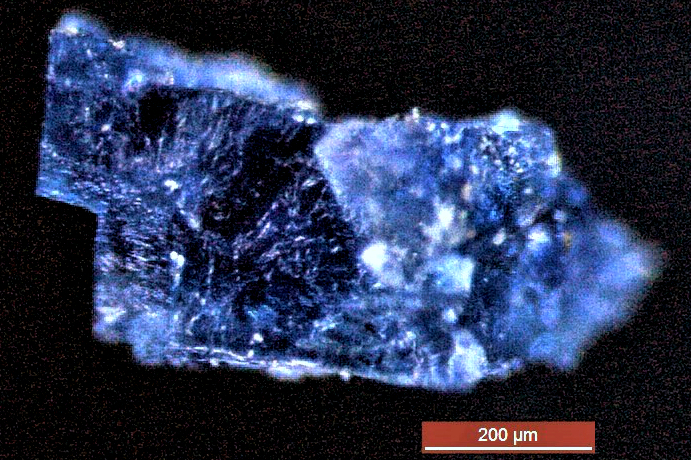
The study scientists analyzed the chemical makeup within tiny blue and purple salt crystals sampled from these meteorites. They said that the two meteorites are the first ever found to contain a mix of complex organic compounds such as hydrocarbons and amino acids, as well as microscopic traces of liquid water believed to date back to the infancy of our solar system – about 4.5 billion years ago.
The researchers also found evidence for the pair’s past intermingling and likely parents – including Ceres, a dwarf planet that’s the largest object in the asteroid belt, and the asteroid Hebe, a major source of meteorites that fall on Earth.
A blue crystal recovered from a meteorite that fell near Morocco in 1998. The scale bar represents 200 microns (millionths of a meter). Image via Berkeley Lab.
Queenie Chan is a planetary scientist and postdoctoral research associate at The Open University in the U.K. and the study’s lead author. Chan said in a statement:
This is really the first time we have found abundant organic matter also associated with liquid water that is really crucial to the origin of life and the origin of complex organic compounds in space.
We’re looking at the organic ingredients that can lead to the origin of life including the amino acids needed to form proteins.
These boys were playing basketball when a meteorite burrowed into the asphalt just yards away from their game on March 22, 1998. The meteorite has been found to contain traces of liquid water and amino acids. Image via Berkeley Lab.
Chan said the similarity of the crystals found in the meteorites – one of which smashed into the ground near a children’s basketball game in Texas in March 1998 and the other which hit near Morocco in August 1998 – suggest that their asteroid hosts may have crossed paths and mixed materials.
There are also structural clues of an impact – perhaps by a small asteroid fragment impacting a larger asteroid, Chan said, which opens up many possibilities for how organic matter may be passed from one host to another in space. Chan said:
Things are not as simple as we thought they were.
Ceres, a dwarf planet in the asteroid belt pictured here in this false-color image, may be the source of organic matter found in two meteorites that crashed to Earth in 1998. Image via Berkeley Lab.
There are also clues, Chan said, based on the organic chemistry and space observations, that the crystals may have originally been seeded by ice- or water-spewing volcanic activity on Ceres.
Everything leads to the conclusion that the origin of life is really possible elsewhere. There is a great range of organic compounds within these meteorites, including a very primitive type of organics that likely represent the early solar system’s organic composition.
Bottom line: New study says two meteorites are the first found to contain both liquid water and a mix of complex organic compounds.
Artist’s rendering of asteroids and space dust. Image via Berkeley Lab.
Two space rocks, which separately crashed to Earth in 1998 after spending billions of years in our solar system’s asteroid belt, share something in common: the ingredients for life. That’s according to a study published January 10, 2018, in the journal Science Advances.
The study scientists analyzed the chemical makeup within tiny blue and purple salt crystals sampled from these meteorites. They said that the two meteorites are the first ever found to contain a mix of complex organic compounds such as hydrocarbons and amino acids, as well as microscopic traces of liquid water believed to date back to the infancy of our solar system – about 4.5 billion years ago.
The researchers also found evidence for the pair’s past intermingling and likely parents – including Ceres, a dwarf planet that’s the largest object in the asteroid belt, and the asteroid Hebe, a major source of meteorites that fall on Earth.
A blue crystal recovered from a meteorite that fell near Morocco in 1998. The scale bar represents 200 microns (millionths of a meter). Image via Berkeley Lab.
Queenie Chan is a planetary scientist and postdoctoral research associate at The Open University in the U.K. and the study’s lead author. Chan said in a statement:
This is really the first time we have found abundant organic matter also associated with liquid water that is really crucial to the origin of life and the origin of complex organic compounds in space.
We’re looking at the organic ingredients that can lead to the origin of life including the amino acids needed to form proteins.
These boys were playing basketball when a meteorite burrowed into the asphalt just yards away from their game on March 22, 1998. The meteorite has been found to contain traces of liquid water and amino acids. Image via Berkeley Lab.
Chan said the similarity of the crystals found in the meteorites – one of which smashed into the ground near a children’s basketball game in Texas in March 1998 and the other which hit near Morocco in August 1998 – suggest that their asteroid hosts may have crossed paths and mixed materials.
There are also structural clues of an impact – perhaps by a small asteroid fragment impacting a larger asteroid, Chan said, which opens up many possibilities for how organic matter may be passed from one host to another in space. Chan said:
Things are not as simple as we thought they were.
Ceres, a dwarf planet in the asteroid belt pictured here in this false-color image, may be the source of organic matter found in two meteorites that crashed to Earth in 1998. Image via Berkeley Lab.
There are also clues, Chan said, based on the organic chemistry and space observations, that the crystals may have originally been seeded by ice- or water-spewing volcanic activity on Ceres.
Everything leads to the conclusion that the origin of life is really possible elsewhere. There is a great range of organic compounds within these meteorites, including a very primitive type of organics that likely represent the early solar system’s organic composition.
Bottom line: New study says two meteorites are the first found to contain both liquid water and a mix of complex organic compounds.


 While the Misliya fossil is younger than this, it provides the first fossil evidence confirming that modern humans left Africa considerably earlier than previously believed. This series of recent studies and discoveries from disparate sources are providing new insights into our own origins and dispersal around the globe.