aads

November sunset over Stainforth

image via Graham Telford.

Thanks for sharing you photo with us Graham!

Enjoying EarthSky so far? Sign up for our free daily newsletter today!

Donate to EarthSky: Your support means the world to us


from EarthSky http://ift.tt/2AkpuPc

image via Graham Telford.

Thanks for sharing you photo with us Graham!

Enjoying EarthSky so far? Sign up for our free daily newsletter today!

Donate to EarthSky: Your support means the world to us


from EarthSky http://ift.tt/2AkpuPc

Use Pegasus to find Andromeda galaxy

Tonight – November 8, 2017 – the moon is out of the sky at early evening, making this an ideal time to search for the Andromeda galaxy. It’s out all night long at this time of year. Yesterday, we told you how to use the constellation Cassiopeia to find it. This evening, however, try locating it by using the Great Square of Pegasus.

You’ll be looking eastward at nightfall. You’ll want a dark, moon-free sky that isn’t drowned by city lights. And you’ll need to be in the Northern Hemisphere. The Andromeda galaxy is located rather far to the north on the sky’s dome, and can’t be seen as well (or at all) from the Southern Hemisphere.

The Great Square consists of a large square pattern of stars in the east at nightfall. By mid-evening, the Great Square swings way up high in your southern sky.

Extending from the Square, you’ll find two graceful streams of stars – another constellation, Andromeda. I learned to find the Andromeda galaxy by “star-hopping” from the star Alpheratz in Great Square to the two stars marked here – first Mirach, then Mu Andromedae.

An imaginary line drawn through these two stars points to the Andromeda galaxy. If you can’t see the Andromeda galaxy with the unaided eye, try binoculars.

From Northern Hemisphere latitudes, by mid-evening, this galaxy will climb almost straight overhead, so you might want to enjoy the comfort of a reclining lawn chair for viewing this deep-sky treasure. The galaxy appears in our sky as a large hazy patch – bigger than a full moon.

It’s very noticeable in a star-filled sky, far from city lights, on a night when the moon is down.


Best gift ever! Order your EarthSky Lunar Calendars for family and friends today!

Navaneeth Unnikrishnan in Kerala,India created this wonderful stacked image of the Andromeda galaxy with images taken on November 9, 2014. Thank you, Navaneeth!

Navaneeth Unnikrishnan created this wonderful stacked image of the Andromeda galaxy with photos taken November, 2014.

Bottom line: The wonderful Andromeda galaxy! Most distant object we can see with the eye alone. Try using the Great Square of Pegasus to find it in a dark sky.

All about the Andromeda galaxy

November 2017 guide to the five visible planets


from EarthSky http://ift.tt/1L8IazR

Tonight – November 8, 2017 – the moon is out of the sky at early evening, making this an ideal time to search for the Andromeda galaxy. It’s out all night long at this time of year. Yesterday, we told you how to use the constellation Cassiopeia to find it. This evening, however, try locating it by using the Great Square of Pegasus.

You’ll be looking eastward at nightfall. You’ll want a dark, moon-free sky that isn’t drowned by city lights. And you’ll need to be in the Northern Hemisphere. The Andromeda galaxy is located rather far to the north on the sky’s dome, and can’t be seen as well (or at all) from the Southern Hemisphere.

The Great Square consists of a large square pattern of stars in the east at nightfall. By mid-evening, the Great Square swings way up high in your southern sky.

Extending from the Square, you’ll find two graceful streams of stars – another constellation, Andromeda. I learned to find the Andromeda galaxy by “star-hopping” from the star Alpheratz in Great Square to the two stars marked here – first Mirach, then Mu Andromedae.

An imaginary line drawn through these two stars points to the Andromeda galaxy. If you can’t see the Andromeda galaxy with the unaided eye, try binoculars.

From Northern Hemisphere latitudes, by mid-evening, this galaxy will climb almost straight overhead, so you might want to enjoy the comfort of a reclining lawn chair for viewing this deep-sky treasure. The galaxy appears in our sky as a large hazy patch – bigger than a full moon.

It’s very noticeable in a star-filled sky, far from city lights, on a night when the moon is down.


Best gift ever! Order your EarthSky Lunar Calendars for family and friends today!

Navaneeth Unnikrishnan in Kerala,India created this wonderful stacked image of the Andromeda galaxy with images taken on November 9, 2014. Thank you, Navaneeth!

Navaneeth Unnikrishnan created this wonderful stacked image of the Andromeda galaxy with photos taken November, 2014.

Bottom line: The wonderful Andromeda galaxy! Most distant object we can see with the eye alone. Try using the Great Square of Pegasus to find it in a dark sky.

All about the Andromeda galaxy

November 2017 guide to the five visible planets


from EarthSky http://ift.tt/1L8IazR

An App for Science Class

Google's Science Journal app brings a powerful toolbox of science equipment to student phones and devices.

from Science Buddies Blog http://ift.tt/2yFdsn2
Google's Science Journal app brings a powerful toolbox of science equipment to student phones and devices.

from Science Buddies Blog http://ift.tt/2yFdsn2

Nickname New Horizons’ next target

Artist’s concept of NASA’s New Horizons spacecraft streaking past 2014 MU69 – which might be 2 objects orbiting each other – on January 1, 2019. Image via Carlos Hernandez/ NASA.

New Horizons is the craft that flew past Pluto and its moons in July of 2015, forever changing our perceptions of those distant worlds. Now the craft is zooming toward its next target, some billion miles (1.6 billion km) past Pluto, due for a flyby on New Year’s Day 2019. This next target – a Kuiper Belt object designated 2014 M69 – made headlines last summer when it occulted, or passed in front of, some stars, causing telltale dips in the stars’ light. Analysis of the light suggested 2014 MU69 has a weird shape. It might be very elongated, or it might be two objects – maybe a binary orbiting pair, or a contact (stuck together) pair, with each tiny body only about 12 miles (20 km) across. This week (November 6, 2017), the team made another cool announcement. It said it’s looking for your ideas on an informal name for 2014 MU69.

The SETI Institute in Mountain View, California is hosting the naming campaign, which is being led by Mark Showalter, a member of the New Horizons science team.

Go to the website to see names currently under consideration; site visitors can also vote for their favorites or nominate names they think should be added to the ballot. Showalter said in a statement:

The campaign is open to everyone. We are hoping that somebody out there proposes the perfect, inspiring name for MU69.

The campaign will close at 3 p.m. EST/noon PST on December 1, 2017. NASA and the New Horizons team will review the top vote-getters and announce their selection in early January, 2018.

Here are 2 possibilties for the shape of 2014 MU69. It might be highly elongated and up to 30 km long (as depicted at left) or a binary body whose halves are each about 15 to 20 km across. Image via NASA/ JHU-APL/ SwRI/ Alex Parker.

Alan Stern, New Horizons principal investigator from Southwest Research Institute in Boulder, Colorado, said:

New Horizons has always been about pure exploration, shedding light on new worlds like we’ve never seen before. Our close encounter with MU69 adds another chapter to this mission’s remarkable story. We’re excited for the public to help us pick a nickname for our target that captures the excitement of the flyby and awe and inspiration of exploring this new and record-distant body in space.

Showalter added:

Many Kuiper Belt Objects have had informal names at first, before a formal name was proposed. After the flyby, once we know a lot more about this intriguing world, we and NASA will work with the International Astronomical Union to assign a formal name to MU69.

Until then, we’re excited to bring people into the mission and share in what will be an amazing flyby on New Year’s Eve and New Year’s Day, 2019!

View larger. | New Horizons, heading out of the solar system, has been given the nod for an extended mission to 2014 MU69. Astronomers are trying to learn all they can about this little body in the Kuiper Belt before the spacecraft’s January 1, 2019 encounter.

Bottom line: To submit your suggested names for New Horizons’ next target – designated 2014 MU69 – and to vote for favorites, go to: http://ift.tt/2iAFtBx


from EarthSky http://ift.tt/2zlnr0C

Artist’s concept of NASA’s New Horizons spacecraft streaking past 2014 MU69 – which might be 2 objects orbiting each other – on January 1, 2019. Image via Carlos Hernandez/ NASA.

New Horizons is the craft that flew past Pluto and its moons in July of 2015, forever changing our perceptions of those distant worlds. Now the craft is zooming toward its next target, some billion miles (1.6 billion km) past Pluto, due for a flyby on New Year’s Day 2019. This next target – a Kuiper Belt object designated 2014 M69 – made headlines last summer when it occulted, or passed in front of, some stars, causing telltale dips in the stars’ light. Analysis of the light suggested 2014 MU69 has a weird shape. It might be very elongated, or it might be two objects – maybe a binary orbiting pair, or a contact (stuck together) pair, with each tiny body only about 12 miles (20 km) across. This week (November 6, 2017), the team made another cool announcement. It said it’s looking for your ideas on an informal name for 2014 MU69.

The SETI Institute in Mountain View, California is hosting the naming campaign, which is being led by Mark Showalter, a member of the New Horizons science team.

Go to the website to see names currently under consideration; site visitors can also vote for their favorites or nominate names they think should be added to the ballot. Showalter said in a statement:

The campaign is open to everyone. We are hoping that somebody out there proposes the perfect, inspiring name for MU69.

The campaign will close at 3 p.m. EST/noon PST on December 1, 2017. NASA and the New Horizons team will review the top vote-getters and announce their selection in early January, 2018.

Here are 2 possibilties for the shape of 2014 MU69. It might be highly elongated and up to 30 km long (as depicted at left) or a binary body whose halves are each about 15 to 20 km across. Image via NASA/ JHU-APL/ SwRI/ Alex Parker.

Alan Stern, New Horizons principal investigator from Southwest Research Institute in Boulder, Colorado, said:

New Horizons has always been about pure exploration, shedding light on new worlds like we’ve never seen before. Our close encounter with MU69 adds another chapter to this mission’s remarkable story. We’re excited for the public to help us pick a nickname for our target that captures the excitement of the flyby and awe and inspiration of exploring this new and record-distant body in space.

Showalter added:

Many Kuiper Belt Objects have had informal names at first, before a formal name was proposed. After the flyby, once we know a lot more about this intriguing world, we and NASA will work with the International Astronomical Union to assign a formal name to MU69.

Until then, we’re excited to bring people into the mission and share in what will be an amazing flyby on New Year’s Eve and New Year’s Day, 2019!

View larger. | New Horizons, heading out of the solar system, has been given the nod for an extended mission to 2014 MU69. Astronomers are trying to learn all they can about this little body in the Kuiper Belt before the spacecraft’s January 1, 2019 encounter.

Bottom line: To submit your suggested names for New Horizons’ next target – designated 2014 MU69 – and to vote for favorites, go to: http://ift.tt/2iAFtBx


from EarthSky http://ift.tt/2zlnr0C

Small Funds Leading to Big Impacts

By Alyssa Edwards

Small funds don’t always mean small impacts. As the EPA’s Environmental Justice Small Grant program has shown us, oftentimes, very small funds, when put in the hands of community-based organizations (CBOs), can achieve big results. Since the program’s inception in 1994, more than 1,400 CBOs have done just that. And we are proud to announce the selection of 36 more organizations that will be joining that cohort as recipients of the 2017 Environmental Justice Small Grant funds.

One example of how small funds can make a difference is seen in the Choctow Nation of Oklahoma. In 2015, the tribe was awarded an EJ Small Grant in support of Project Oka (the Choctaw word for water). The goal was to protect and conserve local waters by helping residents reduce litter. The project has exceeded expectations. To date, the Choctow Nation has collected and recycled more than 12,000 pounds of electronics and more than 1,800 tires. In addition, more than 400 students have been involved in educational and recycling activities. The tribe also created a disaster recovery plan to address disaster preparedness and adaptation strategies as a part of the project.

We know this year’s EJ Small Grants projects will add to the impressive list of community-driven solutions funded by EPA. A significant number will work to ensure clean and safe water, a strategic priority for EPA, as well as address public health concerns from contaminated land. Others will address lead exposure to create safer environments for children, environmental stewardship and conservation in under-resourced rural communities, and job training programs through green infrastructure projects.

Trumbull Neighborhood Partnership in Warren, Ohio will be working to reduce residents’ exposure to potential soil contamination from former industrial activities. Fideicomiso de la Tierra del Caño Martín Peña will work with the community of Buena Vista, Puerto Rico to manage rainfall runoff and reduce the threat of flooding – support even more necessary and timely as the island enters its long recovery from Hurricane Maria.

To expand the geographical reach of the program, during this past funding cycle, we placed a special emphasis on supporting projects in states where we did not have a significant funding history. We are excited that with this latest selection of EJ Small Grants, we will support efforts ranging from Dellslow, West Virginia to Waimea, Hawaii and many communities in between.

For a third of the EJSG recipients, this will be their first time receiving a federal grant. We are honored to support these communities as we know that an EJ Small Grant can be that much needed spark that allows organizations to access additional funding from government and the private sector as they pursue broader community goals.

Read project descriptions on the recently funded awards, as well as to learn more about EJ Small Grant projects from previous years.

And be sure to subscribe to the EJ ListServ to receive up-to-date information about funding opportunities from across the federal government, including our soon-to-be-released grants competition for 2018, upcoming workshops, and related environmental justice topics.

About the Author: Alyssa Edwards is a Program Analyst in the Office of Environmental Justice.


from The EPA Blog http://ift.tt/2Agl63J

By Alyssa Edwards

Small funds don’t always mean small impacts. As the EPA’s Environmental Justice Small Grant program has shown us, oftentimes, very small funds, when put in the hands of community-based organizations (CBOs), can achieve big results. Since the program’s inception in 1994, more than 1,400 CBOs have done just that. And we are proud to announce the selection of 36 more organizations that will be joining that cohort as recipients of the 2017 Environmental Justice Small Grant funds.

One example of how small funds can make a difference is seen in the Choctow Nation of Oklahoma. In 2015, the tribe was awarded an EJ Small Grant in support of Project Oka (the Choctaw word for water). The goal was to protect and conserve local waters by helping residents reduce litter. The project has exceeded expectations. To date, the Choctow Nation has collected and recycled more than 12,000 pounds of electronics and more than 1,800 tires. In addition, more than 400 students have been involved in educational and recycling activities. The tribe also created a disaster recovery plan to address disaster preparedness and adaptation strategies as a part of the project.

We know this year’s EJ Small Grants projects will add to the impressive list of community-driven solutions funded by EPA. A significant number will work to ensure clean and safe water, a strategic priority for EPA, as well as address public health concerns from contaminated land. Others will address lead exposure to create safer environments for children, environmental stewardship and conservation in under-resourced rural communities, and job training programs through green infrastructure projects.

Trumbull Neighborhood Partnership in Warren, Ohio will be working to reduce residents’ exposure to potential soil contamination from former industrial activities. Fideicomiso de la Tierra del Caño Martín Peña will work with the community of Buena Vista, Puerto Rico to manage rainfall runoff and reduce the threat of flooding – support even more necessary and timely as the island enters its long recovery from Hurricane Maria.

To expand the geographical reach of the program, during this past funding cycle, we placed a special emphasis on supporting projects in states where we did not have a significant funding history. We are excited that with this latest selection of EJ Small Grants, we will support efforts ranging from Dellslow, West Virginia to Waimea, Hawaii and many communities in between.

For a third of the EJSG recipients, this will be their first time receiving a federal grant. We are honored to support these communities as we know that an EJ Small Grant can be that much needed spark that allows organizations to access additional funding from government and the private sector as they pursue broader community goals.

Read project descriptions on the recently funded awards, as well as to learn more about EJ Small Grant projects from previous years.

And be sure to subscribe to the EJ ListServ to receive up-to-date information about funding opportunities from across the federal government, including our soon-to-be-released grants competition for 2018, upcoming workshops, and related environmental justice topics.

About the Author: Alyssa Edwards is a Program Analyst in the Office of Environmental Justice.


from The EPA Blog http://ift.tt/2Agl63J

2016 greenhouse gases at record high

As the U.N. Climate Change Conference proceeds this week and next in Bonn, Germany (November 6-17, 2017), negotiators will be trying to hammer out a rule book for the Paris climate agreement reached two years ago. Among many other factors, they will be considering a report released in late October by the World Meteorological Organization (WMO), an intergovernmental organization with a membership of 191 member states and territories. The WMO’s Greenhouse Gas Bulletin for 2016 compiles data from 51 countries. In it, the WMO said that concentrations of carbon dioxide in the atmosphere surged at a record-breaking speed in 2016 to the highest level in 800,000 years. WMO said in a statement:

The abrupt changes in the atmosphere witnessed in the past 70 years are without precedent.

Globally averaged concentrations of CO2 reached 403.3 parts per million in 2016, up from 400.00 ppm in 2015 because of a combination of human activities and a strong El Niño event.

According to the Greenhouse Gas Bulletin, concentrations of CO2 are now 145 per cent of pre-industrial levels, that is, levels before 1750. WMO explained:

Population growth, intensified agricultural practices, increases in land use and deforestation, industrialization and associated energy use from fossil fuel sources have all contributed to increases in concentrations of greenhouse gases in the atmosphere since the industrial era, beginning in 1750.

Since 1990, there has been a 40% increase in total radiative forcing – the warming effect on our climate – by all long-lived greenhouse gases, and a 2.5% increase from 2015 to 2016 alone, according to figures from the US National Oceanic and Atmospheric Administration quoted in the bulletin.

The WMO report urged action now and emphasized that rapidly increasing atmospheric levels of CO2 and other greenhouse gases have the potential to initiate unprecedented changes in climate systems, leading to:

… severe ecological and economic disruptions.

WMO Secretary-General Petteri Taalas said:

Without rapid cuts in CO2 and other greenhouse gas emissions, we will be heading for dangerous temperature increases by the end of this century, well above the target set by the Paris climate change agreement. Future generations will inherit a much more inhospitable planet.

CO2 remains in the atmosphere for hundreds of years and in the oceans for even longer. The laws of physics mean that we face a much hotter, more extreme climate in the future. There is currently no magic wand to remove this CO2 from the atmosphere.

In an interview with the Voice of America in late October, Taalas also said:

We have far exceeded [the] natural variability that took place in the past and we are giving extra energy for our planet. We have already started seeing a growing amount of natural disasters related to weather. And, for example, the economic losses related to these disasters, they have tripled since the ’80s. So, that is a consequence of climate change.

The WMO said that the last time the Earth experienced a comparable concentration of CO2 in its atmosphere was 3-5 million years ago, when the temperature was 2-3°C warmer and sea level was 10-20 meters higher than now.

Read more about the results announced in this year’s Greenhouse Gas Bulletin via WMO

As for the role of the U.S. in this ongoing climate conference, Donald Trump said earlier in 2017 that he would pull our country out of the Paris Agreement. The withdrawal process takes three years, however, leaving the United States as a signatory until then. President Trump has sent a small delegation to Bonn that will try to continue to shape the rules of the agreement.

Otherwise, almost all U.N. states are committed to the accord, with the U.S. standing as an exception.
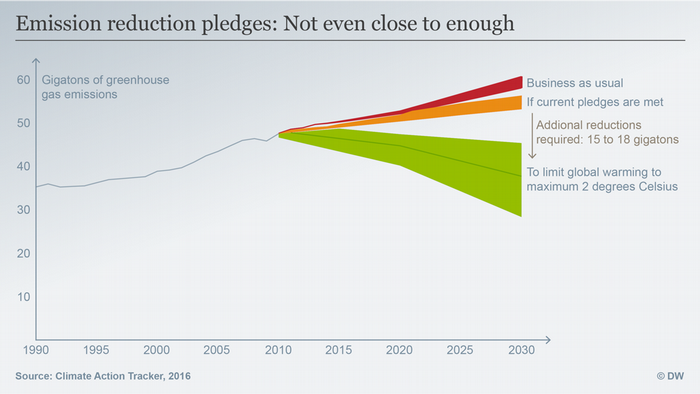
An October 31, 2017 article at Deutsche Welle explained: “The national pledges currently on the table by the signatory countries of the Paris Agreement will only bring a third of the reduction in emissions required by 2030 to meet global climate targets. The biggest roadblock is not with national governments, says the United Nations Environment Program report. Rather, the private sector and regional governments aren’t increasing their climate action at a rate that would help close this gap.”

Bottom line: As climate talks open in Bonn, Germany this week, negotiators are considering a report from the World Meteorological Organization, based on data from 51 countries, saying that concentrations of carbon dioxide in the atmosphere surged at a record-breaking speed in 2016 to the highest level in 800,000 years.


from EarthSky http://ift.tt/2ApyuTW

As the U.N. Climate Change Conference proceeds this week and next in Bonn, Germany (November 6-17, 2017), negotiators will be trying to hammer out a rule book for the Paris climate agreement reached two years ago. Among many other factors, they will be considering a report released in late October by the World Meteorological Organization (WMO), an intergovernmental organization with a membership of 191 member states and territories. The WMO’s Greenhouse Gas Bulletin for 2016 compiles data from 51 countries. In it, the WMO said that concentrations of carbon dioxide in the atmosphere surged at a record-breaking speed in 2016 to the highest level in 800,000 years. WMO said in a statement:

The abrupt changes in the atmosphere witnessed in the past 70 years are without precedent.

Globally averaged concentrations of CO2 reached 403.3 parts per million in 2016, up from 400.00 ppm in 2015 because of a combination of human activities and a strong El Niño event.

According to the Greenhouse Gas Bulletin, concentrations of CO2 are now 145 per cent of pre-industrial levels, that is, levels before 1750. WMO explained:

Population growth, intensified agricultural practices, increases in land use and deforestation, industrialization and associated energy use from fossil fuel sources have all contributed to increases in concentrations of greenhouse gases in the atmosphere since the industrial era, beginning in 1750.

Since 1990, there has been a 40% increase in total radiative forcing – the warming effect on our climate – by all long-lived greenhouse gases, and a 2.5% increase from 2015 to 2016 alone, according to figures from the US National Oceanic and Atmospheric Administration quoted in the bulletin.

The WMO report urged action now and emphasized that rapidly increasing atmospheric levels of CO2 and other greenhouse gases have the potential to initiate unprecedented changes in climate systems, leading to:

… severe ecological and economic disruptions.

WMO Secretary-General Petteri Taalas said:

Without rapid cuts in CO2 and other greenhouse gas emissions, we will be heading for dangerous temperature increases by the end of this century, well above the target set by the Paris climate change agreement. Future generations will inherit a much more inhospitable planet.

CO2 remains in the atmosphere for hundreds of years and in the oceans for even longer. The laws of physics mean that we face a much hotter, more extreme climate in the future. There is currently no magic wand to remove this CO2 from the atmosphere.

In an interview with the Voice of America in late October, Taalas also said:

We have far exceeded [the] natural variability that took place in the past and we are giving extra energy for our planet. We have already started seeing a growing amount of natural disasters related to weather. And, for example, the economic losses related to these disasters, they have tripled since the ’80s. So, that is a consequence of climate change.

The WMO said that the last time the Earth experienced a comparable concentration of CO2 in its atmosphere was 3-5 million years ago, when the temperature was 2-3°C warmer and sea level was 10-20 meters higher than now.

Read more about the results announced in this year’s Greenhouse Gas Bulletin via WMO

As for the role of the U.S. in this ongoing climate conference, Donald Trump said earlier in 2017 that he would pull our country out of the Paris Agreement. The withdrawal process takes three years, however, leaving the United States as a signatory until then. President Trump has sent a small delegation to Bonn that will try to continue to shape the rules of the agreement.

Otherwise, almost all U.N. states are committed to the accord, with the U.S. standing as an exception.

An October 31, 2017 article at Deutsche Welle explained: “The national pledges currently on the table by the signatory countries of the Paris Agreement will only bring a third of the reduction in emissions required by 2030 to meet global climate targets. The biggest roadblock is not with national governments, says the United Nations Environment Program report. Rather, the private sector and regional governments aren’t increasing their climate action at a rate that would help close this gap.”

Bottom line: As climate talks open in Bonn, Germany this week, negotiators are considering a report from the World Meteorological Organization, based on data from 51 countries, saying that concentrations of carbon dioxide in the atmosphere surged at a record-breaking speed in 2016 to the highest level in 800,000 years.


from EarthSky http://ift.tt/2ApyuTW

2017 ozone hole smallest since 1988

Video via NASA’s Goddard Space Flight Center/Kathryn Mersmann Scientific Visualization Studio

Measurements from satellites this year showed the hole in Earth’s ozone layer that forms over Antarctica each September was the smallest since 1988, scientists from NASA and NOAA announced on November 2, 2017. Scientists pointed to an unstable and warmer Antarctic vortex in 2017 – the stratospheric low pressure system that rotates clockwise in the atmosphere above Antarctica – as the reason.

Ozone is a molecule comprised of three oxygen atoms. A layer of ozone high in the atmosphere surrounds the entire Earth. It protects life on our planet from the harmful effects of the sun’s ultraviolet rays. First detected in 1985, the ozone hole is not technically a hole where no ozone is present, but is instead a region of exceptionally depleted ozone in the stratosphere over the Antarctic. This region of depleted ozone typically begins to appear at the beginning of Southern Hemisphere spring (August–October).

According to NASA, this year’s ozone hole reached its peak extent on September 11, covering an area about two and a half times the size of the United States – 7.6 million square miles in extent – and then declined through the remainder of September and into October.

The 2017 ozone hole was similar in area to one of the earliest ozone holes ever observed – that of 1988 – said NASA scientists. The 2017 ozone hole was about 1 million miles smaller in extent than the ozone hole of 2016.

Although scientists predict the ozone hole will continue to shrink over time, due to a global human cooperative effort to ban ozone-depleting chemicals, this year’s smaller ozone hole had more to do with weather conditions in Antarctica than human intervention, these scientists said.

Ozone depletion occurs in cold temperatures, so the ozone hole reaches its annual maximum in September or October, at the end of winter in the Southern Hemisphere. Image via NASA/NASA Ozone Watch/Katy Mersmann.

According to a NASA statement:

The smaller ozone hole in 2017 was strongly influenced by an unstable and warmer Antarctic vortex – the stratospheric low pressure system that rotates clockwise in the atmosphere above Antarctica. This helped minimize polar stratospheric cloud formation in the lower stratosphere. The formation and persistence of these clouds are important first steps leading to the chlorine- and bromine-catalyzed reactions that destroy ozone, scientists said. These Antarctic conditions resemble those found in the Arctic, where ozone depletion is much less severe.

In 2016, warmer stratospheric temperatures also constrained the growth of the ozone hole. Last year, the ozone hole reached a maximum 8.9 million square miles, 2 million square miles less than in 2015. The average area of these daily ozone hole maximums observed since 1991 has been roughly 10 million square miles.

Thirty years ago, the international community signed the Montreal Protocol on Substances that Deplete the Ozone Layer and began regulating ozone-depleting compounds. Scientists expect that the ozone hole over Antarctica will gradually become less severe as the use of chlorofluorocarbons—chlorine-containing synthetic compounds – once frequently used as refrigerants – continues to decline.

Scientists expect the Antarctic ozone hole to recover back to pre-1980 levels around 2070.

Although warmer-than-average stratospheric weather conditions have reduced ozone depletion during the past two years, scientists expect the average size of a modern-day ozone hole will continue to be large compared to ozone holes observed in the 1980s, when the depletion of the ozone layer above Antarctica was first detected.

They base this expectation on the fact that levels of ozone-depleting substances like chlorine and bromine remain high enough in Earth’s atmosphere to produce significant ozone loss.

Read more about how NASA and NOAA measure and monitor the ozone hole.

At its peak on Sept. 11, 2016, the ozone hole extended across an area nearly two and a half times the size of the continental United States. The purple and blue colors are areas with the least ozone. Image via NASA/NASA Ozone Watch/Katy Mersmann.

Bottom line: According to measurements from NOAA and NASA, the ozone hole over Antarctica in 2017 was the smallest since 1988. Its unusually small size is thought to be due to an unstable and warmer Antarctic vortex in 2017.

Read more from NASA


from EarthSky http://ift.tt/2yE0l5u

Video via NASA’s Goddard Space Flight Center/Kathryn Mersmann Scientific Visualization Studio

Measurements from satellites this year showed the hole in Earth’s ozone layer that forms over Antarctica each September was the smallest since 1988, scientists from NASA and NOAA announced on November 2, 2017. Scientists pointed to an unstable and warmer Antarctic vortex in 2017 – the stratospheric low pressure system that rotates clockwise in the atmosphere above Antarctica – as the reason.

Ozone is a molecule comprised of three oxygen atoms. A layer of ozone high in the atmosphere surrounds the entire Earth. It protects life on our planet from the harmful effects of the sun’s ultraviolet rays. First detected in 1985, the ozone hole is not technically a hole where no ozone is present, but is instead a region of exceptionally depleted ozone in the stratosphere over the Antarctic. This region of depleted ozone typically begins to appear at the beginning of Southern Hemisphere spring (August–October).

According to NASA, this year’s ozone hole reached its peak extent on September 11, covering an area about two and a half times the size of the United States – 7.6 million square miles in extent – and then declined through the remainder of September and into October.

The 2017 ozone hole was similar in area to one of the earliest ozone holes ever observed – that of 1988 – said NASA scientists. The 2017 ozone hole was about 1 million miles smaller in extent than the ozone hole of 2016.

Although scientists predict the ozone hole will continue to shrink over time, due to a global human cooperative effort to ban ozone-depleting chemicals, this year’s smaller ozone hole had more to do with weather conditions in Antarctica than human intervention, these scientists said.

Ozone depletion occurs in cold temperatures, so the ozone hole reaches its annual maximum in September or October, at the end of winter in the Southern Hemisphere. Image via NASA/NASA Ozone Watch/Katy Mersmann.

According to a NASA statement:

The smaller ozone hole in 2017 was strongly influenced by an unstable and warmer Antarctic vortex – the stratospheric low pressure system that rotates clockwise in the atmosphere above Antarctica. This helped minimize polar stratospheric cloud formation in the lower stratosphere. The formation and persistence of these clouds are important first steps leading to the chlorine- and bromine-catalyzed reactions that destroy ozone, scientists said. These Antarctic conditions resemble those found in the Arctic, where ozone depletion is much less severe.

In 2016, warmer stratospheric temperatures also constrained the growth of the ozone hole. Last year, the ozone hole reached a maximum 8.9 million square miles, 2 million square miles less than in 2015. The average area of these daily ozone hole maximums observed since 1991 has been roughly 10 million square miles.

Thirty years ago, the international community signed the Montreal Protocol on Substances that Deplete the Ozone Layer and began regulating ozone-depleting compounds. Scientists expect that the ozone hole over Antarctica will gradually become less severe as the use of chlorofluorocarbons—chlorine-containing synthetic compounds – once frequently used as refrigerants – continues to decline.

Scientists expect the Antarctic ozone hole to recover back to pre-1980 levels around 2070.

Although warmer-than-average stratospheric weather conditions have reduced ozone depletion during the past two years, scientists expect the average size of a modern-day ozone hole will continue to be large compared to ozone holes observed in the 1980s, when the depletion of the ozone layer above Antarctica was first detected.

They base this expectation on the fact that levels of ozone-depleting substances like chlorine and bromine remain high enough in Earth’s atmosphere to produce significant ozone loss.

Read more about how NASA and NOAA measure and monitor the ozone hole.

At its peak on Sept. 11, 2016, the ozone hole extended across an area nearly two and a half times the size of the continental United States. The purple and blue colors are areas with the least ozone. Image via NASA/NASA Ozone Watch/Katy Mersmann.

Bottom line: According to measurements from NOAA and NASA, the ozone hole over Antarctica in 2017 was the smallest since 1988. Its unusually small size is thought to be due to an unstable and warmer Antarctic vortex in 2017.

Read more from NASA


from EarthSky http://ift.tt/2yE0l5u

adds 2