View at EarthSky Community Photos. | Andrew Stone in Cave Creek, Arizona, captured the Jellyfish Nebula on February 15, 2026. Andrew wrote: “IC 443, the Jellyfish Nebula, is a galactic supernova remnant in the constellation Gemini, roughly 5,000 light-years from Earth. It is a massive star explosion that occurred between 3,000 and 30,000 years ago. It spans about 70 light-years and features a neutron pulsar star at its center.” Thank you, Andrew! See more deep-sky photos from February 2026 below.
Stunning deep-sky photos from our community
The EarthSky community has many talented astrophotographers who capture stunning images of the deep sky. We gathered some of our favorite deep-sky photos we received in February 2026 for you to enjoy. Do you have some of your own images to share? You can submit them to us here. We would love to see them!
View at EarthSky Community Photos. | Tameem Altameemi in the United Arab Emirates captured Thor’s Helmet in Canis Major on February 20, 2026. Tameem wrote: “This is an emission nebula shaped by the intense stellar winds of a massive Wolf-Rayet star. The powerful outflows from this evolved star collide with surrounding interstellar material, sculpting a complex bubble-like structure that resembles a celestial helmet floating in space. The glowing gases, dominated by hydrogen and oxygen emissions, unveil turbulent arcs and filaments that trace the energetic history of the star.” Thank you, Tameem!View at EarthSky Community Photos. | Aquib Ali Ansari in Jaipur, Rajasthan, India, caught nebulae in Orion on February 11, 2026. Aquib wrote: “This wide-field astrophotograph captures 2 striking deep-sky objects within a single frame. The Monkey Head and Jellyfish Nebulae highlight both stellar birth and stellar death. Although these nebulae appear close together in the night sky, they are separated by vast distances. The Jellyfish Nebula lies about 5,000 light-years from Earth. Meanwhile, the Monkey Head Nebula is located farther away at roughly 6,400 light-years.” Thank you, Aquib!View at EarthSky Community Photos. | Tameem Altameemi in the United Arab Emirates captured nebulae in Auriga on February 22, 2026. Tameem wrote: “The bright emission nebula IC 417, aka the Spider Nebula, is an active star-forming region where ionized hydrogen gas glows under the radiation of young massive stars. Nearby lies NGC 1931, aka the Fly Nebula, a compact nebula containing both emission and reflection components surrounding a young stellar cluster. The wide field also includes 2 open star clusters, Messier 38 and NGC 1907, adding depth and stellar context to this rich galactic region.” Thank you, Tameem!
The Orion Nebula and the Horsehead Nebula
View at EarthSky Community Photos. | Gene Robinson in Goodyear, Arizona, captured the Orion Nebula and its surroundings on February 1, 2026. Gene wrote: “Running Man Nebula (NGC 1977), Orion Nebula (M42), and open star cluster NGC 1980 and Iota Orionis.” Thank you, Gene!View at EarthSky Community Photos. | Mohammed Abdallah in Whales Valley, Fayoum, Egypt, caught the Orion Molecular Complex on February 13, 2026. Mohammed wrote: “This wide-field view of Orion shows the most notable nebulae including Barnard’s loop, Orion Nebula, the Horsehead, the Flame and a very faint Witch’s Head.” Thank you, Mohammed!View at EarthSky Community Photos. | Eric Jensen in Milwaukee, Wisconsin, captured the Horsehead Nebula and its surroundings on February 11, 2026. Eric wrote: “I finally got enough clear skies this winter to be able to spend enough time on an iconic deep sky object. Using the dual narrow-band filter really allowed the hydrogen gases to pop!” Thank you, Eric!View at EarthSky Community Photos. | Ernest Jacobs in North Java, New York, captured the Horsehead Nebula on February 8, 2026. Ernest wrote: “The first clear night in months was Super Bowl Sunday. Temperatures were well below zero. A few of us braved the cold and headed out to our club’s observatory. We captured the Horsehead and Flame Nebulae. The bright star Alnitak (leftmost star of Orion’s Belt) is the bright star above the Flame Nebula.” Thank you, Ernest!
Reflection nebulae in Orion
View at EarthSky Community Photos. | Tameem Altameemi in the United Arab Emirates captured nebulae in Orion on February 20, 2026. Tameem wrote: “This image features the reflection-nebula complex surrounding Messier 78, along with NGC 2064, NGC 2067 and NGC 2071. They’re all embedded within the Orion Molecular Cloud environment. Unlike emission nebulae, these objects shine primarily by scattering and reflecting starlight off interstellar dust, producing the characteristic bluish glow of reflection nebulae.” Thank you, Tameem!
Deep-sky photos of distant galaxies
View at EarthSky Community Photos. | Jelieta Walinski at Desert Bloom Observatory in St. David, Arizona, caught the Black Eye Galaxy on February 9, 2026. Jelieta wrote: “In Coma Berenices lies Messier 64, a spiral galaxy whose beauty carries a striking imperfection. A dark band of absorbing dust sweeps across its luminous core. But this ‘black eye’ is not an injury: it is evidence of cosmic history. The gas in its outer regions rotates in the opposite direction of the inner stars. This unusual motion strongly suggests that M64 absorbed a smaller galaxy long ago.” Thank you, Jelieta!View at EarthSky Community Photos. | Jelieta Walinski in St. David, Arizona, captured the Triangulum Galaxy on February 5, 2026. Jelieta wrote: “Floating nearly 2.7 million light-years away in the modest constellation of Triangulum lies the Triangulum Galaxy. It’s smaller than the Andromeda Galaxy and our own Milky Way. But the Triangulum Galaxy is rich with sprawling hydrogen regions, luminous star-forming knots and delicate, loosely wound spiral arms that breathe with stellar birth.” Thank you, Jelieta!View at EarthSky Community Photos. | Jelieta Walinski in St. David, Arizona, captured Markarian’s Chain of galaxies in Virgo on February 12, 2026. Jelieta wrote: “This ‘chain’ of galaxies is not a true physical line. Rather, it’s a perspective view of galaxies embedded within the gravitational architecture of the Virgo Cluster.” Thank you, Jelieta!
Bottom line: Without a doubt, you’ll enjoy this gallery of deep-sky photos for February 2026 from our EarthSky community. If you have a great photo to share, send it in, too. We love to see them!
View at EarthSky Community Photos. | Andrew Stone in Cave Creek, Arizona, captured the Jellyfish Nebula on February 15, 2026. Andrew wrote: “IC 443, the Jellyfish Nebula, is a galactic supernova remnant in the constellation Gemini, roughly 5,000 light-years from Earth. It is a massive star explosion that occurred between 3,000 and 30,000 years ago. It spans about 70 light-years and features a neutron pulsar star at its center.” Thank you, Andrew! See more deep-sky photos from February 2026 below.
Stunning deep-sky photos from our community
The EarthSky community has many talented astrophotographers who capture stunning images of the deep sky. We gathered some of our favorite deep-sky photos we received in February 2026 for you to enjoy. Do you have some of your own images to share? You can submit them to us here. We would love to see them!
View at EarthSky Community Photos. | Tameem Altameemi in the United Arab Emirates captured Thor’s Helmet in Canis Major on February 20, 2026. Tameem wrote: “This is an emission nebula shaped by the intense stellar winds of a massive Wolf-Rayet star. The powerful outflows from this evolved star collide with surrounding interstellar material, sculpting a complex bubble-like structure that resembles a celestial helmet floating in space. The glowing gases, dominated by hydrogen and oxygen emissions, unveil turbulent arcs and filaments that trace the energetic history of the star.” Thank you, Tameem!View at EarthSky Community Photos. | Aquib Ali Ansari in Jaipur, Rajasthan, India, caught nebulae in Orion on February 11, 2026. Aquib wrote: “This wide-field astrophotograph captures 2 striking deep-sky objects within a single frame. The Monkey Head and Jellyfish Nebulae highlight both stellar birth and stellar death. Although these nebulae appear close together in the night sky, they are separated by vast distances. The Jellyfish Nebula lies about 5,000 light-years from Earth. Meanwhile, the Monkey Head Nebula is located farther away at roughly 6,400 light-years.” Thank you, Aquib!View at EarthSky Community Photos. | Tameem Altameemi in the United Arab Emirates captured nebulae in Auriga on February 22, 2026. Tameem wrote: “The bright emission nebula IC 417, aka the Spider Nebula, is an active star-forming region where ionized hydrogen gas glows under the radiation of young massive stars. Nearby lies NGC 1931, aka the Fly Nebula, a compact nebula containing both emission and reflection components surrounding a young stellar cluster. The wide field also includes 2 open star clusters, Messier 38 and NGC 1907, adding depth and stellar context to this rich galactic region.” Thank you, Tameem!
The Orion Nebula and the Horsehead Nebula
View at EarthSky Community Photos. | Gene Robinson in Goodyear, Arizona, captured the Orion Nebula and its surroundings on February 1, 2026. Gene wrote: “Running Man Nebula (NGC 1977), Orion Nebula (M42), and open star cluster NGC 1980 and Iota Orionis.” Thank you, Gene!View at EarthSky Community Photos. | Mohammed Abdallah in Whales Valley, Fayoum, Egypt, caught the Orion Molecular Complex on February 13, 2026. Mohammed wrote: “This wide-field view of Orion shows the most notable nebulae including Barnard’s loop, Orion Nebula, the Horsehead, the Flame and a very faint Witch’s Head.” Thank you, Mohammed!View at EarthSky Community Photos. | Eric Jensen in Milwaukee, Wisconsin, captured the Horsehead Nebula and its surroundings on February 11, 2026. Eric wrote: “I finally got enough clear skies this winter to be able to spend enough time on an iconic deep sky object. Using the dual narrow-band filter really allowed the hydrogen gases to pop!” Thank you, Eric!View at EarthSky Community Photos. | Ernest Jacobs in North Java, New York, captured the Horsehead Nebula on February 8, 2026. Ernest wrote: “The first clear night in months was Super Bowl Sunday. Temperatures were well below zero. A few of us braved the cold and headed out to our club’s observatory. We captured the Horsehead and Flame Nebulae. The bright star Alnitak (leftmost star of Orion’s Belt) is the bright star above the Flame Nebula.” Thank you, Ernest!
Reflection nebulae in Orion
View at EarthSky Community Photos. | Tameem Altameemi in the United Arab Emirates captured nebulae in Orion on February 20, 2026. Tameem wrote: “This image features the reflection-nebula complex surrounding Messier 78, along with NGC 2064, NGC 2067 and NGC 2071. They’re all embedded within the Orion Molecular Cloud environment. Unlike emission nebulae, these objects shine primarily by scattering and reflecting starlight off interstellar dust, producing the characteristic bluish glow of reflection nebulae.” Thank you, Tameem!
Deep-sky photos of distant galaxies
View at EarthSky Community Photos. | Jelieta Walinski at Desert Bloom Observatory in St. David, Arizona, caught the Black Eye Galaxy on February 9, 2026. Jelieta wrote: “In Coma Berenices lies Messier 64, a spiral galaxy whose beauty carries a striking imperfection. A dark band of absorbing dust sweeps across its luminous core. But this ‘black eye’ is not an injury: it is evidence of cosmic history. The gas in its outer regions rotates in the opposite direction of the inner stars. This unusual motion strongly suggests that M64 absorbed a smaller galaxy long ago.” Thank you, Jelieta!View at EarthSky Community Photos. | Jelieta Walinski in St. David, Arizona, captured the Triangulum Galaxy on February 5, 2026. Jelieta wrote: “Floating nearly 2.7 million light-years away in the modest constellation of Triangulum lies the Triangulum Galaxy. It’s smaller than the Andromeda Galaxy and our own Milky Way. But the Triangulum Galaxy is rich with sprawling hydrogen regions, luminous star-forming knots and delicate, loosely wound spiral arms that breathe with stellar birth.” Thank you, Jelieta!View at EarthSky Community Photos. | Jelieta Walinski in St. David, Arizona, captured Markarian’s Chain of galaxies in Virgo on February 12, 2026. Jelieta wrote: “This ‘chain’ of galaxies is not a true physical line. Rather, it’s a perspective view of galaxies embedded within the gravitational architecture of the Virgo Cluster.” Thank you, Jelieta!
Bottom line: Without a doubt, you’ll enjoy this gallery of deep-sky photos for February 2026 from our EarthSky community. If you have a great photo to share, send it in, too. We love to see them!
Artist’s concept of a tardigrade, or water bear, floating in space. These creatures are small, about the size of the period at the end of this sentence. But a new study says water bears might help future astronauts adapt to and survive on Mars … or elsewhere beyond Earth. That’s why they’re calling them Tardiguardians of the Galaxy. Image via Terranaut/ Pixabay.
Tardigrades – also known as water bears – are tiny animals about 1 mm or less in size. They’re known for being able to survive in extreme environments.
Tardigrades can survive in simulated Martian regolith, researchers found … if you rinse it with water first.
Future astronauts could use tardigrades to help grow plants and survive in habitats on Mars.
Tardiguardians of the Galaxy
You’ve probably heard of tardigrades – commonly known as water bears – microscopic creatures that look like chubby, cute bears. A new study from researchers in the U.S., Poland and the U.K. shows how these critters might help future astronauts survive on Mars. The researchers said on February 27, 2026, that tardigrades could survive in Mars’ regolith and help grow plants in Martian greenhouses. The regolith would simply need to be washed with water first.
The study shows how humans can use tardigrades to help us adapt extraterrestrial resources to support the exploration of Mars or other locations in the solar system. It suggests tardigrades might also be able to help protect against contaminants that human astronauts would bring with them.
The researchers proposed a fun nickname for these tiny creatures: Tardiguardians of the Galaxy.
They published their peer-reviewed study in the International Journal of Astrobiology on December 5, 2025.
View larger. | These images show active tardigrades on Earth (top row) and in the Mars simulation (bottom row). The arrows point to mineral interactions. Image via Corien Bakermans/ Penn State.
Water bears on Mars
Mars is covered in regolith – loose, rocky debris and dust – instead of regular soil as we think of it on Earth. With this in mind, the researchers created two kinds of simulated Martian regolith. Both of them were based on regolith seen by the Curiosity rover at Rocknest in Gale Crater. The first one, MGS-1, represented the regolith on Mars in general. The second, OUCM-1, was more specific to the Rocknest location.
The researchers added living tardigrades to each simulant. They kept an eye on the tiny creatures using microscopes. Surprisingly, the first simulant affected the tardigrades much more than the second one. In fact, the tardigrades no longer showed any activity after only two days of exposure to the simulant. Altoona Professor of Microbiology Corien Bakermans at Penn State is the first author of the new paper. She said:
We know a lot about bacteria and fungi in simulated regolith, but very little about how they impact animals, even microscopic animals, like tardigrades. We investigated the specific, isolated impact of the regolith on tardigrades.
For the MGS-1 simulant, we saw significant inhibition – reduced activity – within two days. It was very damaging compared to OUCM-1, which was still inhibitory but much less so.
Corien Bakermans is the Altoona Professor of Microbiology at Penn State. She is the 1st author of the new study about tardigrades on Mars. Image via Penn State.
Short-term Survival Of Tardigrades In Martian Regolith Simulantsastrobiology.com/2026/02/shor… #astrobiology #Tardigrade #Mars
Why was the first simulant more damaging than the second one? Was there some kind of toxic chemical that killed the tardigrades? If so, the researchers suggested that perhaps it was something that could simply be washed off with water. Bakermans said:
We were a little surprised by how damaging MGS-1 was. We theorized that there might be something specific in the simulant that could be washed away.
To test this idea, the research team rinsed the simulant with water. They then added new tardigrades. And surprise … the tardigrades survived! There was almost no reduction in their activity. The researchers’ hunch seemed to be correct, Bakermans noted:
It seems that there’s something very damaging in MGS-1 that can dissolve in water, maybe salts or some other compound. That was unexpected, but it’s good in a sense, because it means that the regolith’s defense mechanism could stop contaminants. At the same time, it can be washed to help support plant growth or prevent damage to humans who come in contact with it.
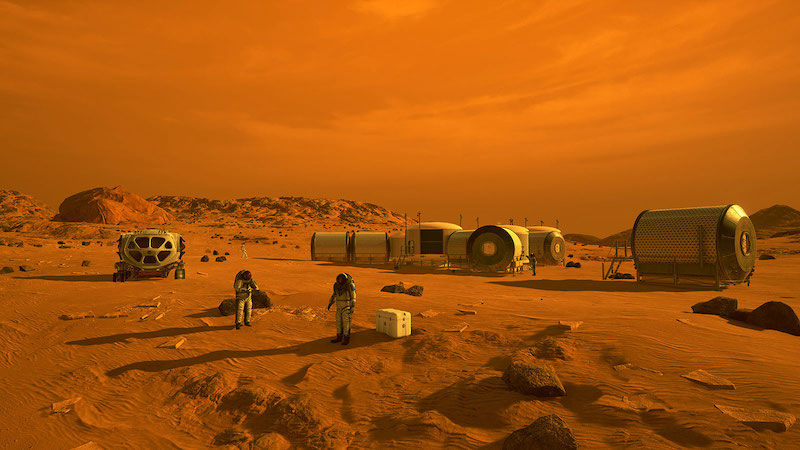
View larger. | Concept of a future human base on Mars. With help from tardigrades, plants could grow in Martian greenhouses. Image via NASA.
Future astronauts and water bears on Mars
The results show that water bears could help future astronauts survive on Mars. The tardigrades would be useful for growing plants in the Martian regolith, in a contained greenhouse though, of course. And the toxic regolith on its own – without water bears added – would help defend against contamination by earthly microbes that might have hitched a ride on the astronauts.
The paper cautions that more study is need though, saying:
These experiments have ramifications for the choice of species for functional soils to support plants and humans on Mars and for the limitations of terrestrial life; however, more testing is necessary to fully understand the potential habitability and dangers of Martian regolith.
Bottom line: Scientists at Penn State said tiny water bears on Mars could help future astronauts survive there. They nicknamed them Tardiguardians of the Galaxy.
Artist’s concept of a tardigrade, or water bear, floating in space. These creatures are small, about the size of the period at the end of this sentence. But a new study says water bears might help future astronauts adapt to and survive on Mars … or elsewhere beyond Earth. That’s why they’re calling them Tardiguardians of the Galaxy. Image via Terranaut/ Pixabay.
Tardigrades – also known as water bears – are tiny animals about 1 mm or less in size. They’re known for being able to survive in extreme environments.
Tardigrades can survive in simulated Martian regolith, researchers found … if you rinse it with water first.
Future astronauts could use tardigrades to help grow plants and survive in habitats on Mars.
Tardiguardians of the Galaxy
You’ve probably heard of tardigrades – commonly known as water bears – microscopic creatures that look like chubby, cute bears. A new study from researchers in the U.S., Poland and the U.K. shows how these critters might help future astronauts survive on Mars. The researchers said on February 27, 2026, that tardigrades could survive in Mars’ regolith and help grow plants in Martian greenhouses. The regolith would simply need to be washed with water first.
The study shows how humans can use tardigrades to help us adapt extraterrestrial resources to support the exploration of Mars or other locations in the solar system. It suggests tardigrades might also be able to help protect against contaminants that human astronauts would bring with them.
The researchers proposed a fun nickname for these tiny creatures: Tardiguardians of the Galaxy.
They published their peer-reviewed study in the International Journal of Astrobiology on December 5, 2025.
View larger. | These images show active tardigrades on Earth (top row) and in the Mars simulation (bottom row). The arrows point to mineral interactions. Image via Corien Bakermans/ Penn State.
Water bears on Mars
Mars is covered in regolith – loose, rocky debris and dust – instead of regular soil as we think of it on Earth. With this in mind, the researchers created two kinds of simulated Martian regolith. Both of them were based on regolith seen by the Curiosity rover at Rocknest in Gale Crater. The first one, MGS-1, represented the regolith on Mars in general. The second, OUCM-1, was more specific to the Rocknest location.
The researchers added living tardigrades to each simulant. They kept an eye on the tiny creatures using microscopes. Surprisingly, the first simulant affected the tardigrades much more than the second one. In fact, the tardigrades no longer showed any activity after only two days of exposure to the simulant. Altoona Professor of Microbiology Corien Bakermans at Penn State is the first author of the new paper. She said:
We know a lot about bacteria and fungi in simulated regolith, but very little about how they impact animals, even microscopic animals, like tardigrades. We investigated the specific, isolated impact of the regolith on tardigrades.
For the MGS-1 simulant, we saw significant inhibition – reduced activity – within two days. It was very damaging compared to OUCM-1, which was still inhibitory but much less so.
Corien Bakermans is the Altoona Professor of Microbiology at Penn State. She is the 1st author of the new study about tardigrades on Mars. Image via Penn State.
Short-term Survival Of Tardigrades In Martian Regolith Simulantsastrobiology.com/2026/02/shor… #astrobiology #Tardigrade #Mars
Why was the first simulant more damaging than the second one? Was there some kind of toxic chemical that killed the tardigrades? If so, the researchers suggested that perhaps it was something that could simply be washed off with water. Bakermans said:
We were a little surprised by how damaging MGS-1 was. We theorized that there might be something specific in the simulant that could be washed away.
To test this idea, the research team rinsed the simulant with water. They then added new tardigrades. And surprise … the tardigrades survived! There was almost no reduction in their activity. The researchers’ hunch seemed to be correct, Bakermans noted:
It seems that there’s something very damaging in MGS-1 that can dissolve in water, maybe salts or some other compound. That was unexpected, but it’s good in a sense, because it means that the regolith’s defense mechanism could stop contaminants. At the same time, it can be washed to help support plant growth or prevent damage to humans who come in contact with it.
View larger. | Concept of a future human base on Mars. With help from tardigrades, plants could grow in Martian greenhouses. Image via NASA.
Future astronauts and water bears on Mars
The results show that water bears could help future astronauts survive on Mars. The tardigrades would be useful for growing plants in the Martian regolith, in a contained greenhouse though, of course. And the toxic regolith on its own – without water bears added – would help defend against contamination by earthly microbes that might have hitched a ride on the astronauts.
The paper cautions that more study is need though, saying:
These experiments have ramifications for the choice of species for functional soils to support plants and humans on Mars and for the limitations of terrestrial life; however, more testing is necessary to fully understand the potential habitability and dangers of Martian regolith.
Bottom line: Scientists at Penn State said tiny water bears on Mars could help future astronauts survive there. They nicknamed them Tardiguardians of the Galaxy.
Here’s how you ring the fish doorbell to help fish migrate in the Netherlands.
Ring the fish doorbell!
Spring is returning to the Northern Hemisphere, and fish in the Netherlands are swimming upstream to their spawning grounds. But in the city of Utrecht, a boat lock is keeping the fish from reaching their destinations. That’s where you come in. There’s a camera at the bottom of the boat lock that livestreams the activity there. Watch the livestream, and when you see a fish, ring the doorbell! That will alert the lock operator to open the lock and let the fish swim through.
The less time the fish have to wait at the lock, the more likely they are to survive to their spawning grounds. Otherwise, predators – such as grebes and cormorants – can dip down to dine on the fish as they pile up and wait for the lock to open.
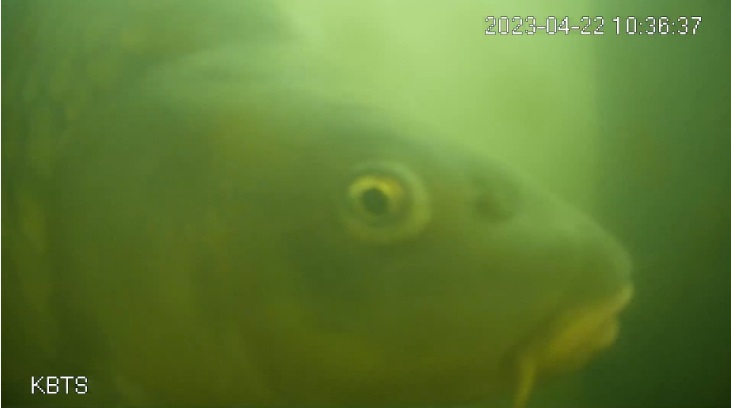
Knock, knock! This fish would like to pass through the lock in Utrecht, the Netherlands. Ring the fish doorbell to help the fish move on to its spawning grounds. Image via Fish Doorbell.
How to see the fish
Currently, the waters are still a bit cold, so not many fish are migrating. But that should change as spring warms up. The best time of day to spot a fish is at night or around dawn. That’s because it’s safer for fish to travel at night to avoid predators.
So when is night or dawn in the Netherlands? Utrecht is in Central European Time, which is currently UTC +1. So, for example, in Utrecht the sun is rising around 7 a.m. at this time of year, which would be midnight CST in the U.S.
March is when the activity starts, but it really picks up in April, when you’re most likely to spot fish waiting for you to let them through.
The ecologists running the program will keep a journal on YouTube as well. So follow along with the journal here.
“Hey, you there. I know you can see me. Let me in!” Image via Fish Doorbell.
Livestreaming the stream life
In these early spring days, there are more people watching the fish doorbell livestream than there are fish. At any one time, it appears there are hundreds of people watching the livestream. But at the moment, fish are scarce.
And if you tune in to the livestream at a time when it’s too crowded, the doorbell won’t be available. You can still watch for the fish, and there’s a checklist where you can keep track of the species you’ve spotted. You can also try again at a less crowded time for a chance to ring the doorbell.
Uh-oh, there’s a predator hunting for fish! Image via Fish Doorbell.
Ding dong! Other fish doorbell benefits
The fish doorbell is not only important to the fish but to the quality of the rivers and canals. A healthy fish population plays a key role in keeping the water clean.
The fish doorbell is a project by the Municipality of Utrecht, Waterboard De Stichtse Rijnlanden and Water Authority Amstel, Gooi and Vecht. These groups want locals and visitors to realize how much life is in the famous Dutch canals. And the images from the doorbell cam provide insight into the species and number of fish that use Utrecht’s waterways. All of this information can help to improve the water quality and freshwater marine life in these ecosystems.
Bottom line: It’s time for the fish in the Netherlands to migrate. But how do they get through the lock? Well, you can help by ringing the fish doorbell to let them through! Here’s how.
Here’s how you ring the fish doorbell to help fish migrate in the Netherlands.
Ring the fish doorbell!
Spring is returning to the Northern Hemisphere, and fish in the Netherlands are swimming upstream to their spawning grounds. But in the city of Utrecht, a boat lock is keeping the fish from reaching their destinations. That’s where you come in. There’s a camera at the bottom of the boat lock that livestreams the activity there. Watch the livestream, and when you see a fish, ring the doorbell! That will alert the lock operator to open the lock and let the fish swim through.
The less time the fish have to wait at the lock, the more likely they are to survive to their spawning grounds. Otherwise, predators – such as grebes and cormorants – can dip down to dine on the fish as they pile up and wait for the lock to open.
Knock, knock! This fish would like to pass through the lock in Utrecht, the Netherlands. Ring the fish doorbell to help the fish move on to its spawning grounds. Image via Fish Doorbell.
How to see the fish
Currently, the waters are still a bit cold, so not many fish are migrating. But that should change as spring warms up. The best time of day to spot a fish is at night or around dawn. That’s because it’s safer for fish to travel at night to avoid predators.
So when is night or dawn in the Netherlands? Utrecht is in Central European Time, which is currently UTC +1. So, for example, in Utrecht the sun is rising around 7 a.m. at this time of year, which would be midnight CST in the U.S.
March is when the activity starts, but it really picks up in April, when you’re most likely to spot fish waiting for you to let them through.
The ecologists running the program will keep a journal on YouTube as well. So follow along with the journal here.
“Hey, you there. I know you can see me. Let me in!” Image via Fish Doorbell.
Livestreaming the stream life
In these early spring days, there are more people watching the fish doorbell livestream than there are fish. At any one time, it appears there are hundreds of people watching the livestream. But at the moment, fish are scarce.
And if you tune in to the livestream at a time when it’s too crowded, the doorbell won’t be available. You can still watch for the fish, and there’s a checklist where you can keep track of the species you’ve spotted. You can also try again at a less crowded time for a chance to ring the doorbell.
Uh-oh, there’s a predator hunting for fish! Image via Fish Doorbell.
Ding dong! Other fish doorbell benefits
The fish doorbell is not only important to the fish but to the quality of the rivers and canals. A healthy fish population plays a key role in keeping the water clean.
The fish doorbell is a project by the Municipality of Utrecht, Waterboard De Stichtse Rijnlanden and Water Authority Amstel, Gooi and Vecht. These groups want locals and visitors to realize how much life is in the famous Dutch canals. And the images from the doorbell cam provide insight into the species and number of fish that use Utrecht’s waterways. All of this information can help to improve the water quality and freshwater marine life in these ecosystems.
Bottom line: It’s time for the fish in the Netherlands to migrate. But how do they get through the lock? Well, you can help by ringing the fish doorbell to let them through! Here’s how.
View at EarthSky Community Photos. | Amit Raka in India submitted this image on January 25, 2025, and wrote: “We gazed upon a breathtaking celestial wonder, the Winter Circle, also known as the Winter Hexagon. The view was truly mesmerizing, leaving all in awe as they admired the countless stars and even spotted planets amidst the vast cosmic expanse.” Thank you, Amit! The Winter Circle or Winter Hexagon is an asterism in the winter night sky. What’s the difference between a constellation and an asterism? Read more below.
A constellation is an official group of stars. An asterism is an obvious pattern or group of stars with a popular name.
Is it a constellation or an asterism?
A constellation is a pattern of stars in the night sky. The word is from the Latin constellatio, meaning a set of stars. There are 88 official constellations, all with well-defined boundaries. Many constellations are very old. They are a link between us and our ancestors, a projection of human imagination into the cosmos. Ancient people looked at the stars and thought they saw mythical beings, beasts and cultural touchstones among the stars.
On the other hand, most asterisms are relatively new. Many are small patterns within a constellation, and some are large patterns made of bright stars from multiple constellations. There is nothing official about an asterism, but many are well known. Generally an asterism is a simple pattern that is easy to recognize.
Some well-known asterisms
For example, the Big Dipper (also known as the Plough) is a pattern of seven stars within the constellation of Ursa Major the Great Bear. It is undoubtedly the most famous asterism in the sky, and not just because it is useful as a guide to other stars and constellations.
The Big Dipper stands out in the night sky. Image via James Wheeler/ Unsplash.
In the Southern Hemisphere, five stars compose the Southern Cross, an asterism within the constellation of Crux.
The Pleiades is a popular asterism in Taurus the Bull; it is a lovely cluster of stars visible to the unaided eye.
More famous asterisms
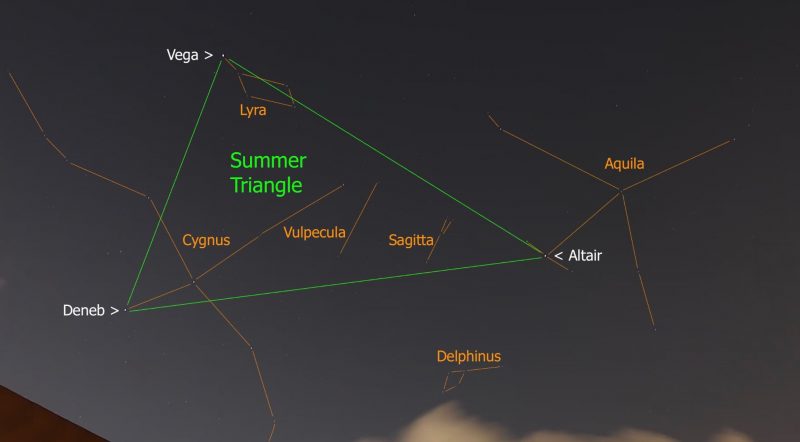
Sometimes asterisms contain stars from more than one constellation: for example, the glorious Summer Triangle is a very prominent in the Northern Hemisphere. The Summer Triangle is made up of the stars Deneb, Vega and Altair. They are the three brightest stars of Cygnus the Swan, Lyra the Harp and Aquila The Eagle.
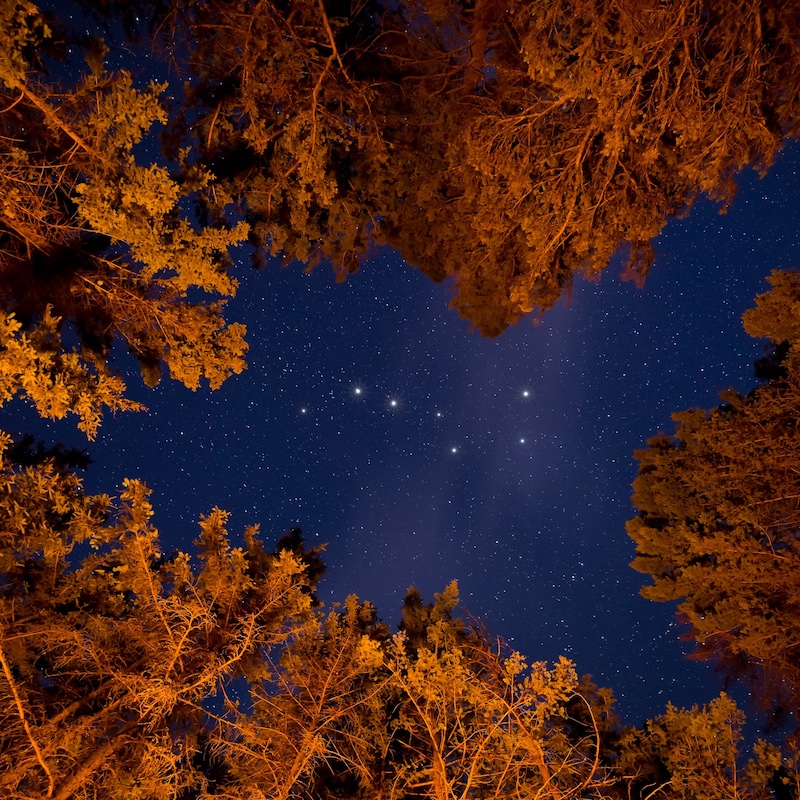
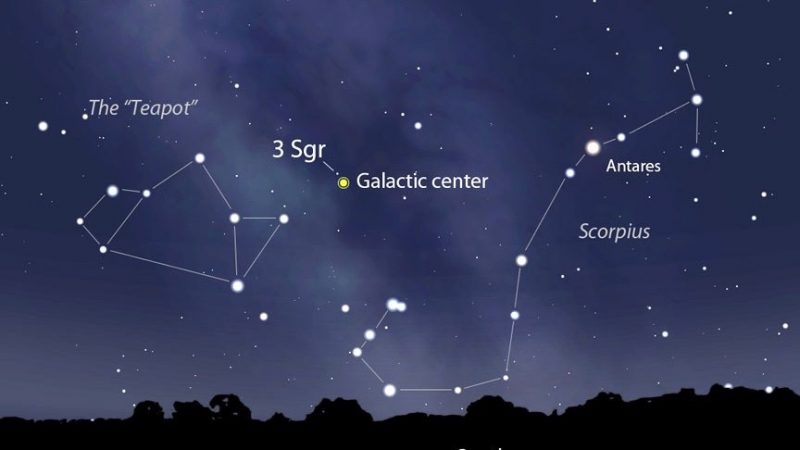
View at EarthSky Community Photos. | Raúl Cortés of EarthSky shared this stunning image of the Summer Triangle with 6 constellations. It’s a busy part of the sky, and fun to see. Thank you, Raúl!The center of the galaxy is located between the Tail of Scorpius and the Teapot – an asterism – of Sagittarius. In a dark sky, you can see clouds of “steam” ascending from the Teapot’s spout in this region. Really, they are stars in our Milky Way galaxy. Chart via Astro Bob. Used with permission.
A closer look at constellations
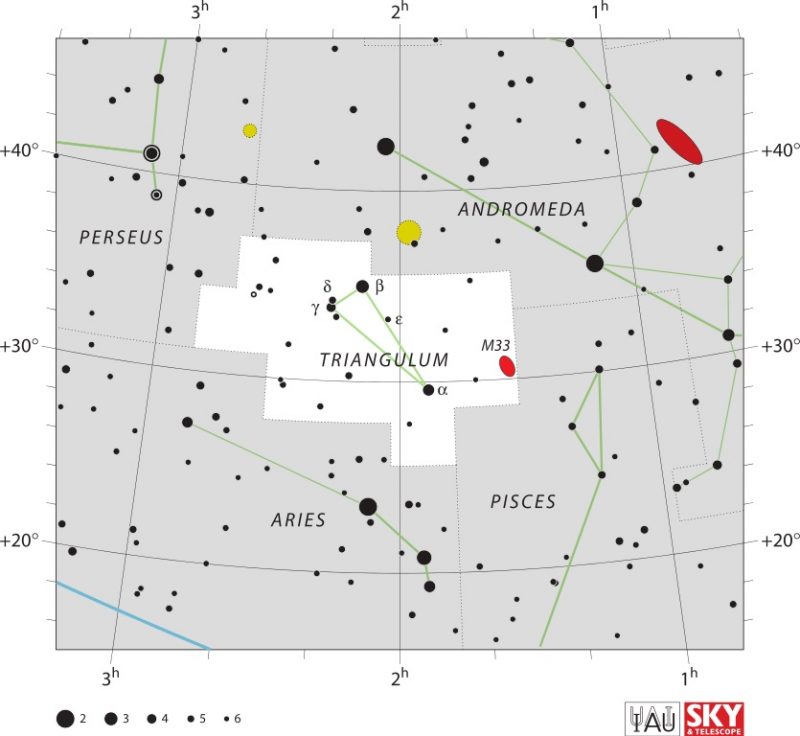
As we mentioned earlier, constellations are official patterns of stars with defined boundaries. The stars in a constellation may lie at different distances from the Earth. For example, the three stars composing the constellation Triangulum are between 35 and 127 light-years away.
Star chart of constellation Triangulum. Chart via IAU.
While a constellation looks like its stars are the same distance away, in reality that is only because stars vary in size and brightness. Generally, when two stars appear to be the same magnitude in the sky they are actually many light-years apart. Thus an alien astronomer on a planet 100 light-years from Earth knows very different constellations, because they see the night sky from a completely different perspective.
Well-known constellations
Many constellations are well-known, such as Orion the Hunter, Ursa Major the Great Bear, Cassiopeia the Queen and Cygnus the Swan. These are some of the famous star patterns you first learn when you begin stargazing.
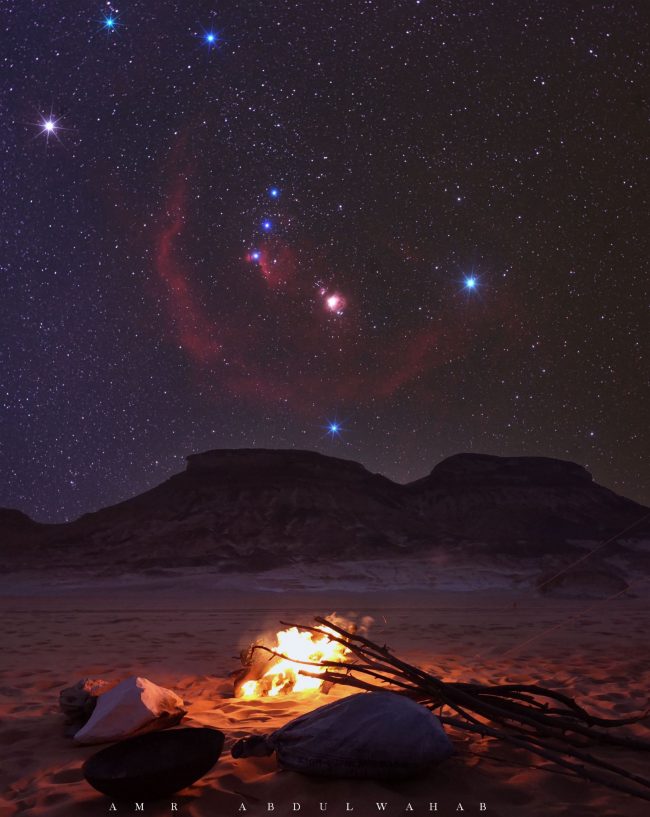
View at EarthSky Community Photos. | Amr Abdulwahab created this composite image of the constellation Orion the Hunter on January 1, 2023, in H-alpha. That wavelength explains why you can see the great red loop around Orion known as Barnard’s Loop. Amr wrote: “Orion is a prominent constellation located on the celestial equator and visible throughout the world. It is one of the oldest and most recognizable constellations, with its 3 main stars forming the distinctive Orion’s Belt. The constellation also features several bright stars, including Betelgeuse and Rigel, as well as the Orion Nebula, a bright cloud of gas and dust where new stars are forming.” Thank you, Amr!
Constellations of the Zodiac
Maybe the most popular constellations are those of the zodiac, such as Aries the Ram, Libra the Scales, Pisces the Fish, Virgo the Maiden, plus the eight other zodiacal constellations.
More than 2,000 years ago, the Babylonians drew the first astrological charts with the 12 zodiacal constellations, although the history of the zodiac probably goes back farther. The 12 constellations of the zodiac determine your sign based on when the sun is in your astrological constellation, based on the sun’s location 2,000 years ago. Two thousand years later, the sun is no longer located in those astrological signs.
Astrology versus astronomy
First, astrology divides the 360-degree zodiac into 12 equal segments, without regard for how many degrees each constellation actually covers in the sky. Second, the Earth is tilted on its axis, causing an effect known as the precession of the equinoxes. This results in the equinoxes moving westward relative to the fixed stars.
Astronomically, the sun passes through a 13th constellation of the zodiac: that of Ophiuchus the Serpent Bearer. This results in changing the dates when the sun “passes through” each zodiacal constellation. So, for example, Aquarius largely occupies the space where Pisces resides. Therefore, this invalidates the dates of the astrological star-signs of horoscopes, as well as the dates of the supposed star sign which people are “born under.”
History of constellation and star names
The Greeks and Romans first recognized and named the constellations of the Northern Hemisphere – around the second century CE – although doubtless prehistoric humans created their own constellations. Indeed, every culture sees its own mythology and stories in the stars. Not surprisingly, the Greeks and Romans saw their mythological heroes, heroines and beasts in the sky, such as Pegasus, Orion, Taurus, Cassiopeia and many others.
The first known list of constellations appears in Ptolemy’s 2nd-century Almagest, covering the apparent motions of stars and planets. It also established a geocentric view of the universe that was to persist for 1,200 years. While the Greeks and Romans bequeathed us the names of the Northern Hemisphere constellations, it was Arabs who were the first to name the individual stars.
Islamic scholars were the first to systematically map the skies. Many of these Arabic star names have survived until today: Aldebaran, Alcor, Altair and Algol. The prefix “Al-” is a sure indication of an Islamic name: It simply means “the.” Hence, Aldebaran is “the follower,” because it appears to follow the Hyades star cluster that makes up the head of the constellation of Taurus the Bull.
Making constellations official
The International Astronomical Union formally recognized the 48 constellations of the Northern Hemisphere and their boundaries in 1928. They published an official list in 1930. The naming of the constellations of the Southern Hemisphere, however, is a little more complicated.
Italian, Dutch and Portuguese explorers of the 14th to 16th centuries named many of the constellations in the Southern Hemisphere. So southern constellations are objects and beasts associated with the great seafaring voyages of that epoch: Telescopium the Telescope, Octans the Octant, Dorado the Swordfish, Vela the Sails (of a ship) and Hydrus the Sea Serpent. But explorers and observers often proposed different constellations with conflicting names. The current list of southern constellations became official in the 19th century.
When a constellation marks a seasonal change
Certain constellations have acquired special significance over the millennia because their appearance marked the onset of seasons. Stars or constellations told ancient peoples when to sow or reap their crops, when to collect food or animal skins. Because of the Earth’s orbit around the sun, different constellations become visible at different times of the year.
For example, in the Northern Hemisphere, the appearance of Orion in the early morning sky warns of the onset of autumn and that temperatures will shortly start to drop. The rising of the Summer Triangle to prominence in the northern sky is a harbinger of summer. Thus, to ancient cultures, constellations were more than just patterns: they marked the passing of the seasons, of years, of life itself.
A circumpolar constellation stays above the horizon
From an observer’s perspective, from sunset to dawn the sky appears to revolve around one fixed point in the sky. This location in the heavens is what the Earth’s axis points at: the celestial pole.
In the Northern Hemisphere, Polaris, the pole star, lies very close to the celestial pole. The Southern Hemisphere does not have a bright star marking the southern celestial pole. The constellations that revolve around the celestial pole but do not dip below the horizon during the night are called circumpolar constellations. In other words, for an observer these constellations will never set. Your location on Earth determines which constellations are circumpolar.
There are five major circumpolar constellations in the Northern Hemisphere: Ursa Major, Ursa Minor, Draco, Cassiopeia and Cepheus. The Southern Hemisphere has three: Crux, Centaurus and Carina.
Learning to identify constellations
A budding astronomer can easily learn the constellations. Start by finding the brighter stars and constellations, and remember, it does take practice! There are many excellent resources and planetarium-type programs available free online. It is certainly worth learning the constellations, even if we sometimes strain to see what the ancients did.
Bottom line: Constellations and asterisms are patterns of stars. Some asterisms consist of stars from different constellations, and some asterisms are part of one constellation.
View at EarthSky Community Photos. | Amit Raka in India submitted this image on January 25, 2025, and wrote: “We gazed upon a breathtaking celestial wonder, the Winter Circle, also known as the Winter Hexagon. The view was truly mesmerizing, leaving all in awe as they admired the countless stars and even spotted planets amidst the vast cosmic expanse.” Thank you, Amit! The Winter Circle or Winter Hexagon is an asterism in the winter night sky. What’s the difference between a constellation and an asterism? Read more below.
A constellation is an official group of stars. An asterism is an obvious pattern or group of stars with a popular name.
Is it a constellation or an asterism?
A constellation is a pattern of stars in the night sky. The word is from the Latin constellatio, meaning a set of stars. There are 88 official constellations, all with well-defined boundaries. Many constellations are very old. They are a link between us and our ancestors, a projection of human imagination into the cosmos. Ancient people looked at the stars and thought they saw mythical beings, beasts and cultural touchstones among the stars.
On the other hand, most asterisms are relatively new. Many are small patterns within a constellation, and some are large patterns made of bright stars from multiple constellations. There is nothing official about an asterism, but many are well known. Generally an asterism is a simple pattern that is easy to recognize.
Some well-known asterisms
For example, the Big Dipper (also known as the Plough) is a pattern of seven stars within the constellation of Ursa Major the Great Bear. It is undoubtedly the most famous asterism in the sky, and not just because it is useful as a guide to other stars and constellations.
The Big Dipper stands out in the night sky. Image via James Wheeler/ Unsplash.
In the Southern Hemisphere, five stars compose the Southern Cross, an asterism within the constellation of Crux.
The Pleiades is a popular asterism in Taurus the Bull; it is a lovely cluster of stars visible to the unaided eye.
More famous asterisms
Sometimes asterisms contain stars from more than one constellation: for example, the glorious Summer Triangle is a very prominent in the Northern Hemisphere. The Summer Triangle is made up of the stars Deneb, Vega and Altair. They are the three brightest stars of Cygnus the Swan, Lyra the Harp and Aquila The Eagle.
View at EarthSky Community Photos. | Raúl Cortés of EarthSky shared this stunning image of the Summer Triangle with 6 constellations. It’s a busy part of the sky, and fun to see. Thank you, Raúl!The center of the galaxy is located between the Tail of Scorpius and the Teapot – an asterism – of Sagittarius. In a dark sky, you can see clouds of “steam” ascending from the Teapot’s spout in this region. Really, they are stars in our Milky Way galaxy. Chart via Astro Bob. Used with permission.
A closer look at constellations
As we mentioned earlier, constellations are official patterns of stars with defined boundaries. The stars in a constellation may lie at different distances from the Earth. For example, the three stars composing the constellation Triangulum are between 35 and 127 light-years away.
Star chart of constellation Triangulum. Chart via IAU.
While a constellation looks like its stars are the same distance away, in reality that is only because stars vary in size and brightness. Generally, when two stars appear to be the same magnitude in the sky they are actually many light-years apart. Thus an alien astronomer on a planet 100 light-years from Earth knows very different constellations, because they see the night sky from a completely different perspective.
Well-known constellations
Many constellations are well-known, such as Orion the Hunter, Ursa Major the Great Bear, Cassiopeia the Queen and Cygnus the Swan. These are some of the famous star patterns you first learn when you begin stargazing.
View at EarthSky Community Photos. | Amr Abdulwahab created this composite image of the constellation Orion the Hunter on January 1, 2023, in H-alpha. That wavelength explains why you can see the great red loop around Orion known as Barnard’s Loop. Amr wrote: “Orion is a prominent constellation located on the celestial equator and visible throughout the world. It is one of the oldest and most recognizable constellations, with its 3 main stars forming the distinctive Orion’s Belt. The constellation also features several bright stars, including Betelgeuse and Rigel, as well as the Orion Nebula, a bright cloud of gas and dust where new stars are forming.” Thank you, Amr!
Constellations of the Zodiac
Maybe the most popular constellations are those of the zodiac, such as Aries the Ram, Libra the Scales, Pisces the Fish, Virgo the Maiden, plus the eight other zodiacal constellations.
More than 2,000 years ago, the Babylonians drew the first astrological charts with the 12 zodiacal constellations, although the history of the zodiac probably goes back farther. The 12 constellations of the zodiac determine your sign based on when the sun is in your astrological constellation, based on the sun’s location 2,000 years ago. Two thousand years later, the sun is no longer located in those astrological signs.
Astrology versus astronomy
First, astrology divides the 360-degree zodiac into 12 equal segments, without regard for how many degrees each constellation actually covers in the sky. Second, the Earth is tilted on its axis, causing an effect known as the precession of the equinoxes. This results in the equinoxes moving westward relative to the fixed stars.
Astronomically, the sun passes through a 13th constellation of the zodiac: that of Ophiuchus the Serpent Bearer. This results in changing the dates when the sun “passes through” each zodiacal constellation. So, for example, Aquarius largely occupies the space where Pisces resides. Therefore, this invalidates the dates of the astrological star-signs of horoscopes, as well as the dates of the supposed star sign which people are “born under.”
History of constellation and star names
The Greeks and Romans first recognized and named the constellations of the Northern Hemisphere – around the second century CE – although doubtless prehistoric humans created their own constellations. Indeed, every culture sees its own mythology and stories in the stars. Not surprisingly, the Greeks and Romans saw their mythological heroes, heroines and beasts in the sky, such as Pegasus, Orion, Taurus, Cassiopeia and many others.
The first known list of constellations appears in Ptolemy’s 2nd-century Almagest, covering the apparent motions of stars and planets. It also established a geocentric view of the universe that was to persist for 1,200 years. While the Greeks and Romans bequeathed us the names of the Northern Hemisphere constellations, it was Arabs who were the first to name the individual stars.
Islamic scholars were the first to systematically map the skies. Many of these Arabic star names have survived until today: Aldebaran, Alcor, Altair and Algol. The prefix “Al-” is a sure indication of an Islamic name: It simply means “the.” Hence, Aldebaran is “the follower,” because it appears to follow the Hyades star cluster that makes up the head of the constellation of Taurus the Bull.
Making constellations official
The International Astronomical Union formally recognized the 48 constellations of the Northern Hemisphere and their boundaries in 1928. They published an official list in 1930. The naming of the constellations of the Southern Hemisphere, however, is a little more complicated.
Italian, Dutch and Portuguese explorers of the 14th to 16th centuries named many of the constellations in the Southern Hemisphere. So southern constellations are objects and beasts associated with the great seafaring voyages of that epoch: Telescopium the Telescope, Octans the Octant, Dorado the Swordfish, Vela the Sails (of a ship) and Hydrus the Sea Serpent. But explorers and observers often proposed different constellations with conflicting names. The current list of southern constellations became official in the 19th century.
When a constellation marks a seasonal change
Certain constellations have acquired special significance over the millennia because their appearance marked the onset of seasons. Stars or constellations told ancient peoples when to sow or reap their crops, when to collect food or animal skins. Because of the Earth’s orbit around the sun, different constellations become visible at different times of the year.
For example, in the Northern Hemisphere, the appearance of Orion in the early morning sky warns of the onset of autumn and that temperatures will shortly start to drop. The rising of the Summer Triangle to prominence in the northern sky is a harbinger of summer. Thus, to ancient cultures, constellations were more than just patterns: they marked the passing of the seasons, of years, of life itself.
A circumpolar constellation stays above the horizon
From an observer’s perspective, from sunset to dawn the sky appears to revolve around one fixed point in the sky. This location in the heavens is what the Earth’s axis points at: the celestial pole.
In the Northern Hemisphere, Polaris, the pole star, lies very close to the celestial pole. The Southern Hemisphere does not have a bright star marking the southern celestial pole. The constellations that revolve around the celestial pole but do not dip below the horizon during the night are called circumpolar constellations. In other words, for an observer these constellations will never set. Your location on Earth determines which constellations are circumpolar.
There are five major circumpolar constellations in the Northern Hemisphere: Ursa Major, Ursa Minor, Draco, Cassiopeia and Cepheus. The Southern Hemisphere has three: Crux, Centaurus and Carina.
Learning to identify constellations
A budding astronomer can easily learn the constellations. Start by finding the brighter stars and constellations, and remember, it does take practice! There are many excellent resources and planetarium-type programs available free online. It is certainly worth learning the constellations, even if we sometimes strain to see what the ancients did.
Bottom line: Constellations and asterisms are patterns of stars. Some asterisms consist of stars from different constellations, and some asterisms are part of one constellation.
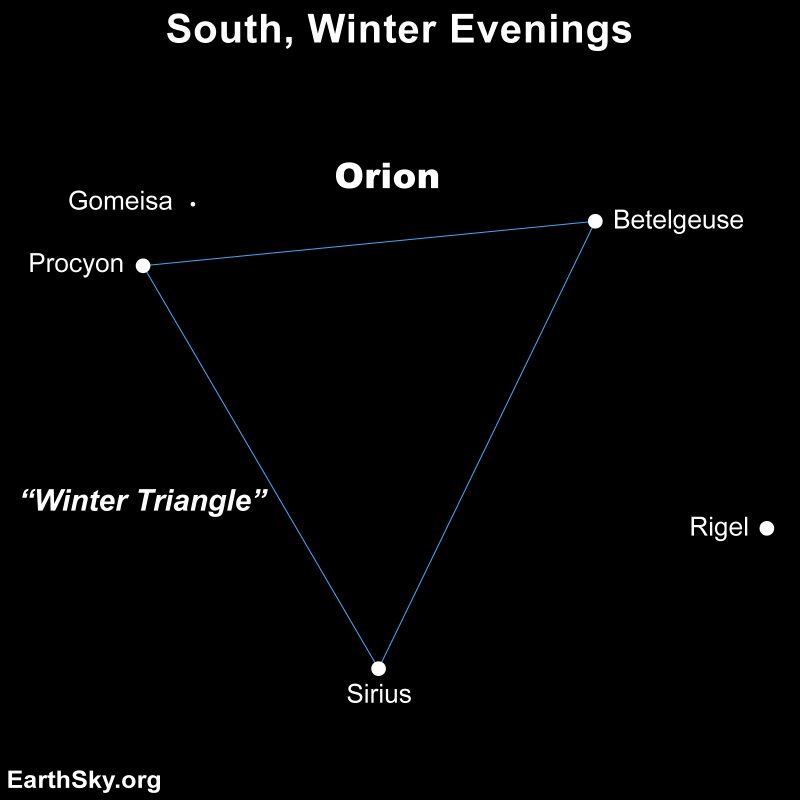
The Winter Triangle is formed by a trio of some of our brightest stars. Brilliant Sirius, bright Procyon and ruddy Betelgeuse make up this celestial triangle. Chart via EarthSky.
The Winter Triangle is one of the most recognizable patterns in the night sky. It isn’t a constellation, but it’s an asterism, or prominent group of stars that form a noticeable pattern. The Winter Triangle is easy to spot and serves as a guide to some of the finest celestial sights of the season.
Three dazzling stars from three different constellations make up the Winter Triangle: Sirius in Canis Major, Procyon in Canis Minor and Betelgeuse in Orion. Together, these three stars form a triangle covering a large area of the sky.
Sirius is the brightest star visible in Earth’s night sky, it’s dazzling white with flashes of color when near the horizon. Procyon shines nearby. It’s slightly fainter than Sirius. Betelgeuse completes the triangle with its distinct reddish-orange glow, marking the shoulder of Orion.
When is it visible?
In the Northern Hemisphere, the Winter Triangle is an obvious pattern in the evening sky from December to March. Then it emerges in the morning sky in September.
In the Southern Hemisphere, the Winter Triangle is prominent during the summer months, from December to March. The triangle looks inverted compared to the Northern Hemisphere view and is visible high overhead on warm summer evenings. And it emerges in the morning sky in May.
Because all three stars are extremely bright, the Winter Triangle is even visible from cities with moderate light pollution. And the Winter Triangle is part of a larger asterism known as the Winter Circle or Winter Hexagon. It’s a six-star asterism that includes Sirius and Procyon plus Rigel, Aldebaran, Capella, and Castor. The Winter Circle stretches across several constellations and forms one of the largest and most obvious patterns visible in the winter sky.
The region in and around the Winter Triangle contains several celestial objects. One of the most famous is the Orion Nebula (M42), a glowing cloud of gas and dust visible to the unaided eye as a faint smudge in Orion’s Sword. And it’s spectacular through binoculars or a small telescope.
Near Sirius lies the open cluster M41, a compact group of young stars that are easy to spot in binoculars.
And under dark skies, the band of the Milky Way flows through this region, particularly around Orion and Monoceros.
Images from EarthSky Community Photos
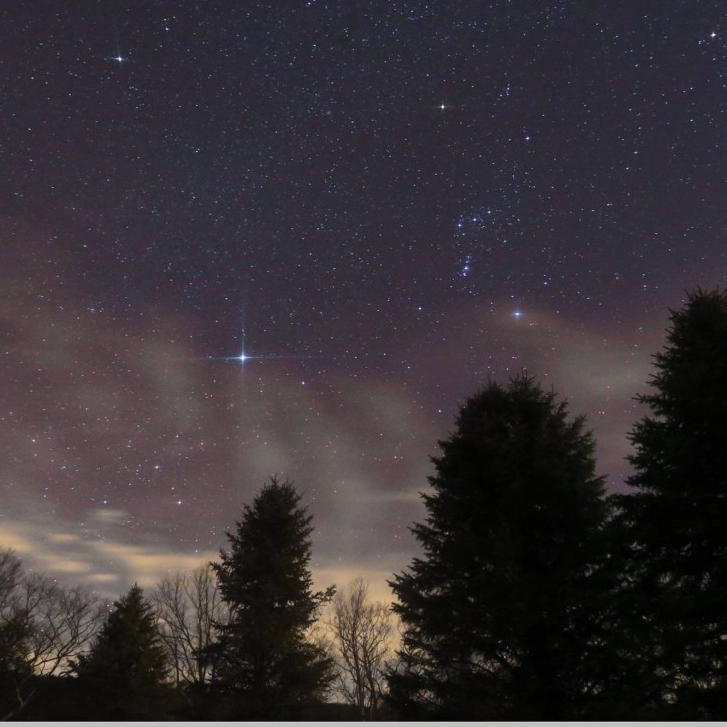
View at EarthSky Community Photos. | Colin Brown in Fairdale, West Virginia, shared this image of the Winter Triangle with us on December 11, 2025. Thank you, Colin! Notice Orion’s Belt to the right side.View at EarthSky Community Photos. | Teresa Molinaro in Sicily, Italy, took this photo on January 28, 2025, and wrote: “An evening at the end of January, in the middle of the boreal winter. Castor and Pollux shine next to Mars in the sky, the Beehive Cluster is visible below, while continuing we see Procyon, Sirius and, looking up, the mythical celestial Hunter, Orion. Betelgeuse is the summit of the Winter Triangle.” Thank you, Teresa!
Bottom line: The Winter Triangle is a distinct pattern of stars in the night sky formed by three bright stars: Sirius, Betelgeuse and Procyon. It’s also part of a larger pattern of stars known as the Winter Circle or Hexagon.
The Winter Triangle is formed by a trio of some of our brightest stars. Brilliant Sirius, bright Procyon and ruddy Betelgeuse make up this celestial triangle. Chart via EarthSky.
The Winter Triangle is one of the most recognizable patterns in the night sky. It isn’t a constellation, but it’s an asterism, or prominent group of stars that form a noticeable pattern. The Winter Triangle is easy to spot and serves as a guide to some of the finest celestial sights of the season.
Three dazzling stars from three different constellations make up the Winter Triangle: Sirius in Canis Major, Procyon in Canis Minor and Betelgeuse in Orion. Together, these three stars form a triangle covering a large area of the sky.
Sirius is the brightest star visible in Earth’s night sky, it’s dazzling white with flashes of color when near the horizon. Procyon shines nearby. It’s slightly fainter than Sirius. Betelgeuse completes the triangle with its distinct reddish-orange glow, marking the shoulder of Orion.
When is it visible?
In the Northern Hemisphere, the Winter Triangle is an obvious pattern in the evening sky from December to March. Then it emerges in the morning sky in September.
In the Southern Hemisphere, the Winter Triangle is prominent during the summer months, from December to March. The triangle looks inverted compared to the Northern Hemisphere view and is visible high overhead on warm summer evenings. And it emerges in the morning sky in May.
Because all three stars are extremely bright, the Winter Triangle is even visible from cities with moderate light pollution. And the Winter Triangle is part of a larger asterism known as the Winter Circle or Winter Hexagon. It’s a six-star asterism that includes Sirius and Procyon plus Rigel, Aldebaran, Capella, and Castor. The Winter Circle stretches across several constellations and forms one of the largest and most obvious patterns visible in the winter sky.
The region in and around the Winter Triangle contains several celestial objects. One of the most famous is the Orion Nebula (M42), a glowing cloud of gas and dust visible to the unaided eye as a faint smudge in Orion’s Sword. And it’s spectacular through binoculars or a small telescope.
Near Sirius lies the open cluster M41, a compact group of young stars that are easy to spot in binoculars.
And under dark skies, the band of the Milky Way flows through this region, particularly around Orion and Monoceros.
Images from EarthSky Community Photos
View at EarthSky Community Photos. | Colin Brown in Fairdale, West Virginia, shared this image of the Winter Triangle with us on December 11, 2025. Thank you, Colin! Notice Orion’s Belt to the right side.View at EarthSky Community Photos. | Teresa Molinaro in Sicily, Italy, took this photo on January 28, 2025, and wrote: “An evening at the end of January, in the middle of the boreal winter. Castor and Pollux shine next to Mars in the sky, the Beehive Cluster is visible below, while continuing we see Procyon, Sirius and, looking up, the mythical celestial Hunter, Orion. Betelgeuse is the summit of the Winter Triangle.” Thank you, Teresa!
Bottom line: The Winter Triangle is a distinct pattern of stars in the night sky formed by three bright stars: Sirius, Betelgeuse and Procyon. It’s also part of a larger pattern of stars known as the Winter Circle or Hexagon.
Maybe you know that Sirius is the brightest star in the night sky. But is Sirius the most luminous star? The answer is no. To astronomers, the word luminous refers to a star’s intrinsic brightness, or its absolute magnitude. To put it more simply, if all the stars were equally distant from Earth, would Sirius be the brightest? Not even close. It just looks bright because it’s close to us, only 8.6 light-years away.
Consider the 25 brightest stars (not counting the sun) as seen from Earth. Sirius is the brightest in apparent magnitude, that is, its brightness as observed from Earth. If you took those exact same 25 stars and ranked them by absolute magnitude, or imagined they were all the same distance from Earth, Sirius would drop from 1st to 21st brightest.
Sirius, in the constellation Canis Major the Greater Dog, looks extraordinarily bright in Earth’s sky. It’s our sky’s brightest star (not counting our daytime star, the sun). But its brightness stems primarily from the fact that it’s close to us, only 8.6 light-years away.
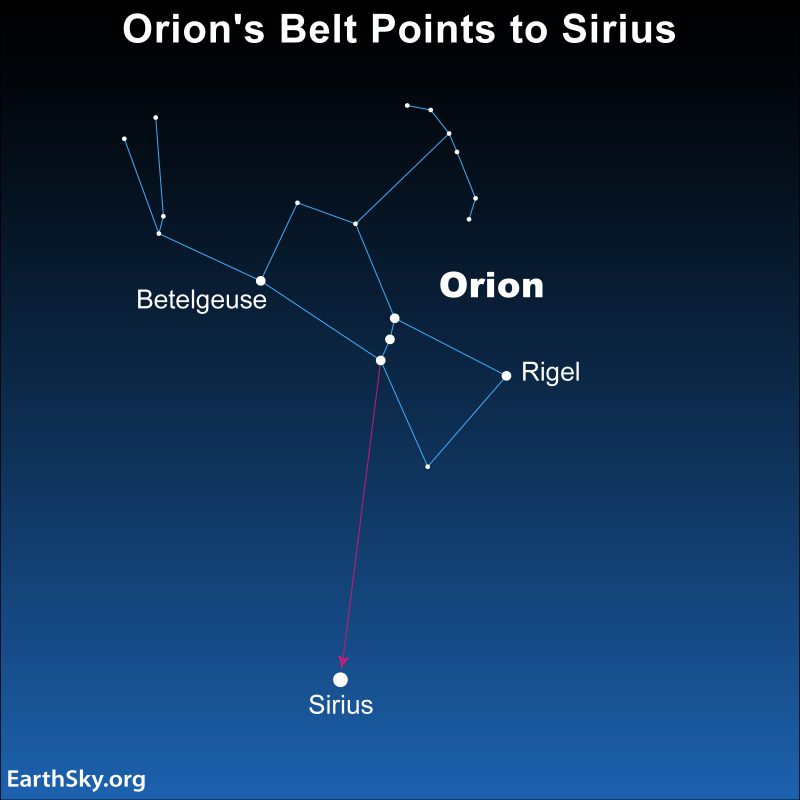
No matter where you live on Earth, just follow the three medium-bright stars in Orion’s Belt to locate Sirius.
Sirius is not only the brightest star in the constellation Canis Major the Greater Dog, it’s the brightest star in the sky. You can be sure you’re looking at the correct bright star by drawing a line from Orion’s Belt to Sirius.
The colors of Sirius
Many people comment that they see Sirius flashing colors. This happens when you see Sirius low in the sky. The colors are just the ordinary rainbow colors in white starlight; all starlight is composed of this mixture of colors. We notice the sparkling colors of Sirius more readily, though, because Sirius is so much brighter than most stars.
The extra thickness of the Earth’s atmosphere near the horizon acts like a lens or prism, breaking up starlight into the colors of the rainbow and causing a star to sparkle. When you see Sirius low in the sky, you’re looking through more atmosphere than when the star is overhead.
If you watch, you’ll notice Sirius sparkling less, and appearing less colorful (more strictly white) when it appears higher in the sky.
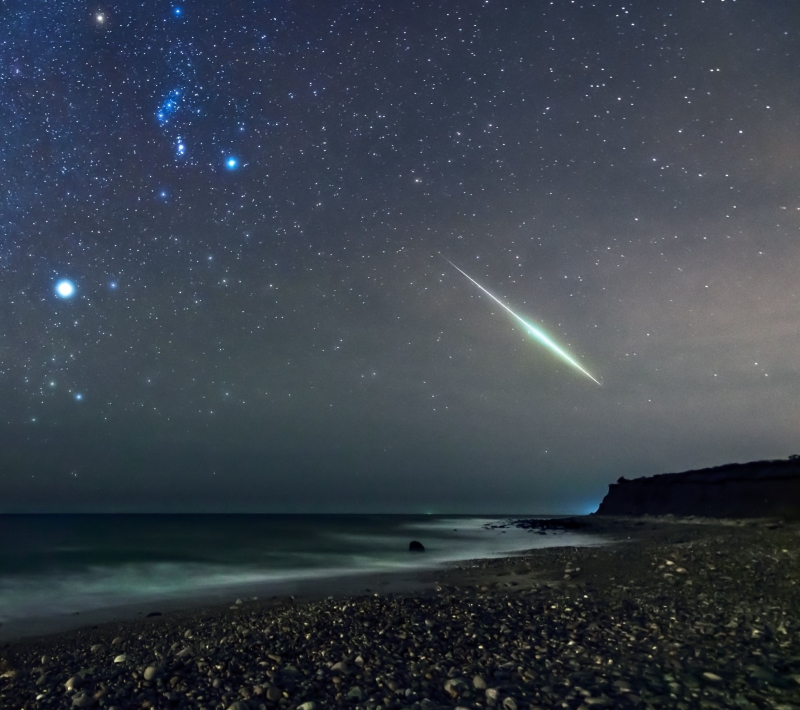
View at EarthSky Community Photos. | Sergei Timofeevski shared this image from November 13, 2023. Sergei wrote: “The constellation Orion the Hunter and the star Sirius rising just above the eastern horizon in the Anza-Borrego Desert State Park, California.” Thank you, Sergei!
Stars more luminous than Sirius
Scientists think at least three stars in the constellation Canis Major, where Sirius resides, are thousands of times more luminous than Sirius: Aludra, Wezen and Omicron 2. Although the distances to these faraway stars are not known with precision. Aludra is estimated to lie about 3,200 light-years away. Omicron 2 lies at an estimated 3,600 light-years distant. Wezen is about 1,800 light-years. That’s in contrast to Sirius’ distance of only 8.6 light-years.
When scientists compare stars by absolute magnitude, they imagine that all the stars are 32.6 light-years away. At this distance, our sun would barely be visible as a speck of light. In stark contrast, Aludra, Wezen and Omicron 2 would outshine Sirius by some 100 to 200 times. And Sirius would be about the same brightness as the star Castor in Gemini. Imagine how much different Canis Major would look!
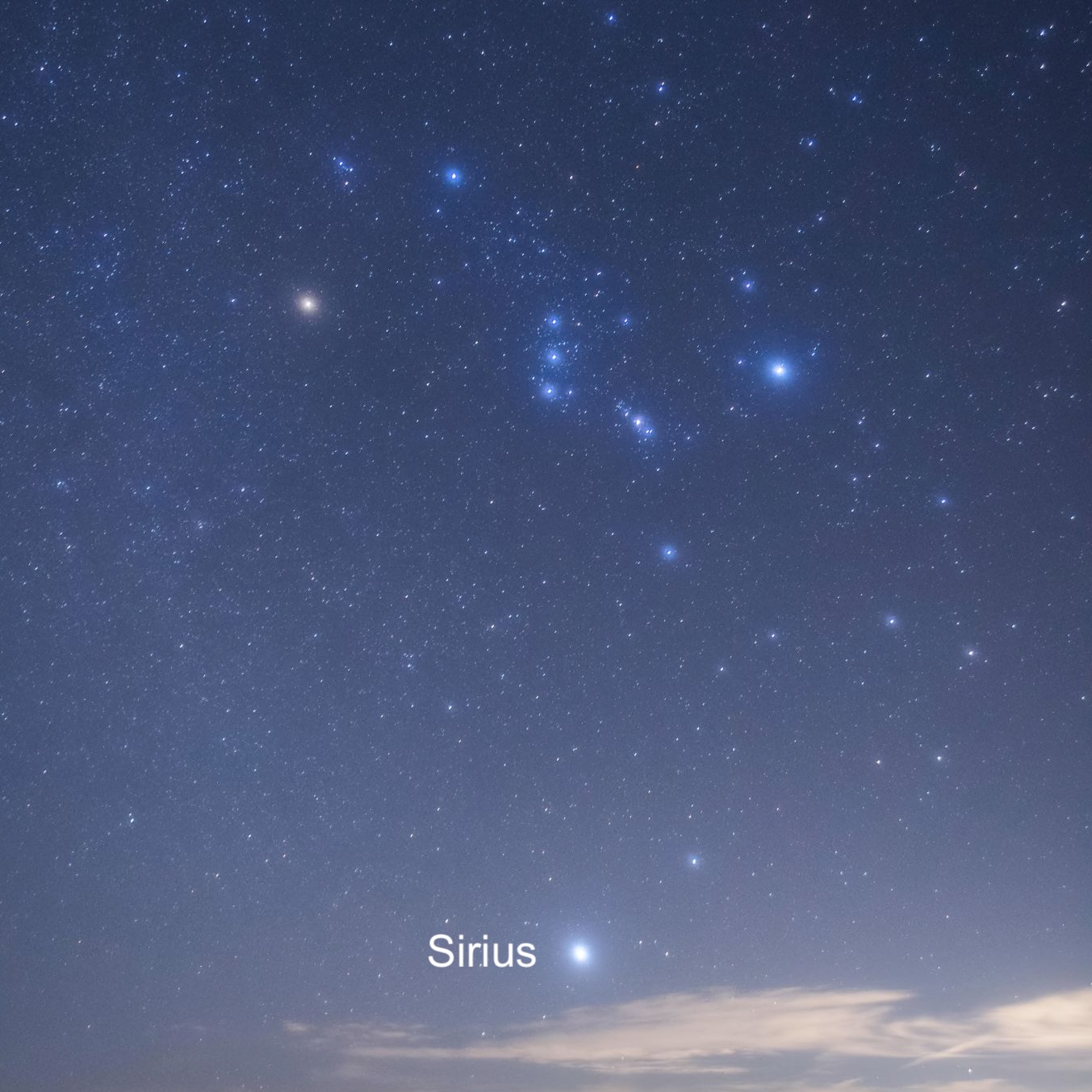
View at EarthSky Community Photos. | Daniel Friedman captured this shot from Montauk, New York, on a December evening. Note bright Sirius is on the left, and Orion’s Belt pointing to it. Thank you, Daniel!
Bottom line: Sirius is the brightest star in Earth’s sky because of how close it is to us. It’s so spectacularly bright that you might see glints of different colors flashing from it.
Maybe you know that Sirius is the brightest star in the night sky. But is Sirius the most luminous star? The answer is no. To astronomers, the word luminous refers to a star’s intrinsic brightness, or its absolute magnitude. To put it more simply, if all the stars were equally distant from Earth, would Sirius be the brightest? Not even close. It just looks bright because it’s close to us, only 8.6 light-years away.
Consider the 25 brightest stars (not counting the sun) as seen from Earth. Sirius is the brightest in apparent magnitude, that is, its brightness as observed from Earth. If you took those exact same 25 stars and ranked them by absolute magnitude, or imagined they were all the same distance from Earth, Sirius would drop from 1st to 21st brightest.
Sirius, in the constellation Canis Major the Greater Dog, looks extraordinarily bright in Earth’s sky. It’s our sky’s brightest star (not counting our daytime star, the sun). But its brightness stems primarily from the fact that it’s close to us, only 8.6 light-years away.
No matter where you live on Earth, just follow the three medium-bright stars in Orion’s Belt to locate Sirius.
Sirius is not only the brightest star in the constellation Canis Major the Greater Dog, it’s the brightest star in the sky. You can be sure you’re looking at the correct bright star by drawing a line from Orion’s Belt to Sirius.
The colors of Sirius
Many people comment that they see Sirius flashing colors. This happens when you see Sirius low in the sky. The colors are just the ordinary rainbow colors in white starlight; all starlight is composed of this mixture of colors. We notice the sparkling colors of Sirius more readily, though, because Sirius is so much brighter than most stars.
The extra thickness of the Earth’s atmosphere near the horizon acts like a lens or prism, breaking up starlight into the colors of the rainbow and causing a star to sparkle. When you see Sirius low in the sky, you’re looking through more atmosphere than when the star is overhead.
If you watch, you’ll notice Sirius sparkling less, and appearing less colorful (more strictly white) when it appears higher in the sky.
View at EarthSky Community Photos. | Sergei Timofeevski shared this image from November 13, 2023. Sergei wrote: “The constellation Orion the Hunter and the star Sirius rising just above the eastern horizon in the Anza-Borrego Desert State Park, California.” Thank you, Sergei!
Stars more luminous than Sirius
Scientists think at least three stars in the constellation Canis Major, where Sirius resides, are thousands of times more luminous than Sirius: Aludra, Wezen and Omicron 2. Although the distances to these faraway stars are not known with precision. Aludra is estimated to lie about 3,200 light-years away. Omicron 2 lies at an estimated 3,600 light-years distant. Wezen is about 1,800 light-years. That’s in contrast to Sirius’ distance of only 8.6 light-years.
When scientists compare stars by absolute magnitude, they imagine that all the stars are 32.6 light-years away. At this distance, our sun would barely be visible as a speck of light. In stark contrast, Aludra, Wezen and Omicron 2 would outshine Sirius by some 100 to 200 times. And Sirius would be about the same brightness as the star Castor in Gemini. Imagine how much different Canis Major would look!
View at EarthSky Community Photos. | Daniel Friedman captured this shot from Montauk, New York, on a December evening. Note bright Sirius is on the left, and Orion’s Belt pointing to it. Thank you, Daniel!
Bottom line: Sirius is the brightest star in Earth’s sky because of how close it is to us. It’s so spectacularly bright that you might see glints of different colors flashing from it.
View at EarthSky Community Photos. | Catherine Hyde in Cambria, California, captured this stunning telescope image of the total lunar eclipse on March 3, 2026. Thank you, Catherine! See more incredible images of the total lunar eclipse below.
Did you see this morning’s total lunar eclipse? If not, don’t worry; EarthSky’s global community has got you covered!
On March 2-3, the moon slipped into Earth’s shadow and transformed into a stunning copper-red orb. This event was especially significant because it was the last total lunar eclipse until 2028. If you didn’t get the chance to see it live, here are some incredible images capturing the magic.
We’re adding photos as they come in. So if you captured your own shot of the eclipse, submit it here!
Images of the total lunar eclipse of March 2-3, 2026
View at EarthSky Community Photos. | Cissy Beasley captured this beautiful shot of the total lunar eclipse from Beeville, Texas, and wrote: “One of a few images shot from my driveway in Bee County, TX, before a bank of clouds rolled in, which obscured the moon for the remainder of the eclipse.” You certainly made the most of it, Cissy. Thank you!View at EarthSky Community Photos. | Larry Isenberg from Ocala, Florida, captured this view of the total lunar eclipse as a jet flew in front of the moon. Thanks, Larry!View at EarthSky Community Photos. | Linda Carlson captured this view of the eclipse from Orlando, Florida. Thank you, Linda!View at EarthSky Community Photos. | Richard Swieca in Hillsboro Beach, Broward County, Florida, submitted the first photo of the event. Thank you, Richard!View at EarthSky Community Photos. | Amy Van Artsdale in Mansfield, Texas, captured this view during the partial phase of the eclipse and wrote: “Woke up early to cloudy skies, which moved in to completely obscure lunar totality in Mansfield, TX.” Sorry, Amy! Thank you for the photo.
Images of the almost full moon
Totality occurred shortly after the moon reached the peak of its full phase at 11:38 UTC on March 3. Here are some images of the dazzling moon from the day before. The moon appears full both the day before and the day after reaching its peak full phase.
View at EarthSky Community Photos. | Kevan Hubbard in Seaton Carew, County Durham, England, captured this wonderful view of the moon on March 2, the evening before the eclipse. Kevan wrote: “On the evening before the eclipse which we, sadly, can’t see from here.” It is a great shot! Thank you, Kevan.View at EarthSky Community Photos. | Claire Shickora in Errol, New Hampshire, shared this gorgeous photo of the moon on March 2, and wrote: “The moon was already higher in the sky than I normally would have shot, and it was getting dark, but for a change there were no clouds over Umbagog Lake so I went for it. The colors were beautiful.” Thank you, Claire!
Bottom line: A total lunar eclipse lit up the sky this morning. See the stunning Blood Moon in all its glory!
View at EarthSky Community Photos. | Catherine Hyde in Cambria, California, captured this stunning telescope image of the total lunar eclipse on March 3, 2026. Thank you, Catherine! See more incredible images of the total lunar eclipse below.
Did you see this morning’s total lunar eclipse? If not, don’t worry; EarthSky’s global community has got you covered!
On March 2-3, the moon slipped into Earth’s shadow and transformed into a stunning copper-red orb. This event was especially significant because it was the last total lunar eclipse until 2028. If you didn’t get the chance to see it live, here are some incredible images capturing the magic.
We’re adding photos as they come in. So if you captured your own shot of the eclipse, submit it here!
Images of the total lunar eclipse of March 2-3, 2026
View at EarthSky Community Photos. | Cissy Beasley captured this beautiful shot of the total lunar eclipse from Beeville, Texas, and wrote: “One of a few images shot from my driveway in Bee County, TX, before a bank of clouds rolled in, which obscured the moon for the remainder of the eclipse.” You certainly made the most of it, Cissy. Thank you!View at EarthSky Community Photos. | Larry Isenberg from Ocala, Florida, captured this view of the total lunar eclipse as a jet flew in front of the moon. Thanks, Larry!View at EarthSky Community Photos. | Linda Carlson captured this view of the eclipse from Orlando, Florida. Thank you, Linda!View at EarthSky Community Photos. | Richard Swieca in Hillsboro Beach, Broward County, Florida, submitted the first photo of the event. Thank you, Richard!View at EarthSky Community Photos. | Amy Van Artsdale in Mansfield, Texas, captured this view during the partial phase of the eclipse and wrote: “Woke up early to cloudy skies, which moved in to completely obscure lunar totality in Mansfield, TX.” Sorry, Amy! Thank you for the photo.
Images of the almost full moon
Totality occurred shortly after the moon reached the peak of its full phase at 11:38 UTC on March 3. Here are some images of the dazzling moon from the day before. The moon appears full both the day before and the day after reaching its peak full phase.
View at EarthSky Community Photos. | Kevan Hubbard in Seaton Carew, County Durham, England, captured this wonderful view of the moon on March 2, the evening before the eclipse. Kevan wrote: “On the evening before the eclipse which we, sadly, can’t see from here.” It is a great shot! Thank you, Kevan.View at EarthSky Community Photos. | Claire Shickora in Errol, New Hampshire, shared this gorgeous photo of the moon on March 2, and wrote: “The moon was already higher in the sky than I normally would have shot, and it was getting dark, but for a change there were no clouds over Umbagog Lake so I went for it. The colors were beautiful.” Thank you, Claire!
Bottom line: A total lunar eclipse lit up the sky this morning. See the stunning Blood Moon in all its glory!
This artist’s illustration represents the start of the alert stream from NSF–DOE Vera C. Rubin Observatory. The summit facility is on a rocky ridge with the Milky Way above. The multiple alert pings in the sky represent individual alerts from Rubin that something in the sky has changed in brightness or position. Different icons represent various types of alerts, including asteroids, supernovas, active galactic nuclei and variable stars. Image via NSF–DOE Vera C. Rubin Observatory/ NOIRLab /SLAC /AURA /P. Marenfeld/ J. Pinto.
The Vera C. Rubin Observatory has launched a near-real-time discovery machine for monitoring the night sky. Its alert system will enable scientists around the world to coordinate follow-up observations like never before.
The observatory will document events as they unfold, from new supernovas to asteroid discoveries and variable stars to the active black holes at the centers of distant galaxies.
The public nature of Rubin’s alert system will allow scientists using other ground and space-based telescopes around the world to coordinate follow-up observations. This collaboration will enable fast and detailed studies of unfolding phenomena.
The Vera C. Rubin Observatory, jointly funded by the U.S. National Science Foundation and the U.S. Department of Energy’s Office of Science, has released its first alerts documenting astronomical events spotted by the observatory. Rubin issued 800,000 alerts the night of February 24. These alerts called scientists’ attention to new asteroids, exploding stars and other changes in the night sky. This milestone marks the launch of a system expected to eventually produce up to 7 million alerts per night.
Among the first alerts are detections of supernovas, variable stars, active galactic nuclei and objects whizzing around our solar system, such as asteroids. The beginning of scientific alerts is one of the last major milestones before Rubin Observatory begins its Legacy Survey of Space and Time (LSST) later this year.
During the LSST, Rubin will scan the Southern Hemisphere sky nightly for 10 years to precisely capture every visible change using the largest digital camera ever made. These alerts will chronicle the treasure trove of scientific discoveries that Rubin will make through its time-lapse record of the universe. In the first year of the LSST, Rubin is expected to capture images of more objects than all other optical observatories combined in human history.
Luca Rizzi, a program director for research infrastructure at NSF, said:
By connecting scientists to a vast and continuous stream of information, NSF–DOE Rubin Observatory will make it possible to follow the universe’s events as they unfold, from the explosive to the most faint and fleeting.
Kathy Turner, program manager in the High Energy Physics program in the DOE’s Office of Science, said:
Rubin Observatory’s groundbreaking capabilities are revealing untold astrophysical treasures and expanding scientists’ access to the ever-changing cosmos.
Alerts from the universe
Rubin’s alerts will power discoveries in many areas of astronomy, astrophysics and cosmology. While the night sky seems calm and unchanging to the casual viewer, it’s actually alive with motion and transformation. Each alert signals something that has changed in the sky since Rubin last looked. That may be a new source of light, a star that brightened or dimmed, or an object that moved.
With Rubin’s alerts, scientists will have a greater ability to catch supernovas in their earliest moments, discover and track asteroids to assess potential threats to Earth and spot rare interstellar objects as they race through the solar system. Scientists can then use these data to better understand the nature of dark matter, dark energy and other unknown aspects of the universe.
Eric Bellm, Alert Production Pipeline Group Lead for Rubin Data Management from NSF NOIRLab and the University of Washington, said:
Rubin’s alert system was designed to allow anyone to identify interesting astronomical events with enough notice to rapidly obtain time-critical follow-up observations. Enabling real-time discovery on 10 terabytes of images nightly has required years of technical innovation in image processing algorithms, databases and data orchestration. We can’t wait to see the exciting science that comes from these data.
The near-real-time public nature of Rubin’s alert system will enable scientists using other ground and space-based telescopes around the world to coordinate follow-up observations like never before. This collaboration will enable fast and detailed studies of unfolding phenomena.
The first Rubin Observatory alerts distributed to researchers worldwide were generated on the night of February 24. The alerts contained the flares of new supernovas and the flickers of stars, actively feeding black holes in distant galaxies and asteroids cruising through our solar system.
The Rubin Observatory
Located in Chile, the Rubin Observatory is jointly operated by NSF NOIRLab and DOE’s SLAC National Accelerator Laboratory. The telescope is equipped with the LSST Camera, the largest digital camera ever built. With 3200 megapixels, Rubin is capable of detecting faint and distant objects in the universe.
Every 40 seconds during nighttime observations, Rubin captures a new region of the sky. It then sends the data on a seconds-long journey from Chile to the U.S. Data Facility (USDF) at SLAC in California for initial processing. Rubin’s data management system automatically compares it to a template made from previous images of the same region. This comparison allows it to detect the slightest variations.
With every change, such as the appearance of a new point of light, an object’s movement or a change in brightness, the system generates a public alert within a record two-minute interval. With such a large and sensitive camera and the ability to quickly process historic amounts of data, Rubin can produce up to 7 million alerts each night.
Hsin-Fang Chiang, a SLAC software developer leading operations for data processing at the USDF, said:
The scale and speed of the alerts are unprecedented. After generating hundreds of thousands of test alerts in the last few months, we are now able to say, within minutes, with each image, ‘here is everything’ and ‘go’.
Using machine learning to process the data
To interpret the immense flow of data from the Rubin alert stream, scientists rely on a network of intelligent software platforms known as brokers. These systems use machine learning algorithms to filter, sort and classify the alerts before distributing them to scientific teams and observatories.
Tom Matheson is Interim Director of the Community Science and Data Center (CSDC), a Program of NSF NOIRLab, and head of Time-Domain Services, which developed the ANTARES alert broker. Matheson said:
The extraordinary number of alerts that Rubin will produce presents an exciting challenge for both astronomers and software engineers. The broker teams have built systems that operate rapidly at scale so that scientists can find all of the objects of interest to them, as well as things we’ve never seen before.
Brokers also cross-reference alerts with data from multi-wavelength astronomical catalogs. Some of them specialize in specific types of objects and events. These events include early identification of supernovas and solar system objects. Identifying these events early allows scientists to provide tailored analysis and respond more quickly.
Rosaria Bonito is a researcher at the Italian National Institute for Astrophysics (INAF) in Palermo, Italy, and co-chair of the Rubin LSST Transients and Variable Stars (TVS) science collaboration. Bonito said:
What’s revolutionary about Rubin is its ability to capture both rapid changes and long-term evolution in the sky. Young stars, for example, are highly dynamic and can experience sudden bursts of brightness caused by infalling matter. These events are often short-lived and scientists can easily miss them without continuous monitoring. Rubin will allow us to detect these changes as they happen right there, right now, and also to track the evolution of stars over a decade.
Public data
Rubin’s alerts are public to the world. That means anyone – from professional researchers to students and citizen scientists – can access and explore them. You can access alerts through any of the seven official community brokers, as well as two downstream services. These services form an international network that enables prompt, real-time data exploration from anywhere on Earth. Additionally, through collaborations with platforms like Zooniverse, Rubin will empower the global community to classify cosmic events and contribute directly to discovery.
As new images are taken, Rubin Observatory’s sophisticated software automatically compares each one with a template image. Then the template image is subtracted from the new image, leaving only the changes. Each change triggers an alert within minutes of image capture. The vast majority of these alerts are supernovas, variable stars, active galactic nuclei and solar system objects, such as asteroids. In these examples, the left shows the template image, the center shows the new image and the right shows the subtracted, or difference, image. Image via NSF–DOE Vera C. Rubin Observatory/ NOIRLab/ SLAC/ AURA.
Bottom line: The Rubin Observatory is now sending out real-time alerts of its discoveries. These alerts include objects such as newly discovered supernovas, asteroids and more.
This artist’s illustration represents the start of the alert stream from NSF–DOE Vera C. Rubin Observatory. The summit facility is on a rocky ridge with the Milky Way above. The multiple alert pings in the sky represent individual alerts from Rubin that something in the sky has changed in brightness or position. Different icons represent various types of alerts, including asteroids, supernovas, active galactic nuclei and variable stars. Image via NSF–DOE Vera C. Rubin Observatory/ NOIRLab /SLAC /AURA /P. Marenfeld/ J. Pinto.
The Vera C. Rubin Observatory has launched a near-real-time discovery machine for monitoring the night sky. Its alert system will enable scientists around the world to coordinate follow-up observations like never before.
The observatory will document events as they unfold, from new supernovas to asteroid discoveries and variable stars to the active black holes at the centers of distant galaxies.
The public nature of Rubin’s alert system will allow scientists using other ground and space-based telescopes around the world to coordinate follow-up observations. This collaboration will enable fast and detailed studies of unfolding phenomena.
The Vera C. Rubin Observatory, jointly funded by the U.S. National Science Foundation and the U.S. Department of Energy’s Office of Science, has released its first alerts documenting astronomical events spotted by the observatory. Rubin issued 800,000 alerts the night of February 24. These alerts called scientists’ attention to new asteroids, exploding stars and other changes in the night sky. This milestone marks the launch of a system expected to eventually produce up to 7 million alerts per night.
Among the first alerts are detections of supernovas, variable stars, active galactic nuclei and objects whizzing around our solar system, such as asteroids. The beginning of scientific alerts is one of the last major milestones before Rubin Observatory begins its Legacy Survey of Space and Time (LSST) later this year.
During the LSST, Rubin will scan the Southern Hemisphere sky nightly for 10 years to precisely capture every visible change using the largest digital camera ever made. These alerts will chronicle the treasure trove of scientific discoveries that Rubin will make through its time-lapse record of the universe. In the first year of the LSST, Rubin is expected to capture images of more objects than all other optical observatories combined in human history.
Luca Rizzi, a program director for research infrastructure at NSF, said:
By connecting scientists to a vast and continuous stream of information, NSF–DOE Rubin Observatory will make it possible to follow the universe’s events as they unfold, from the explosive to the most faint and fleeting.
Kathy Turner, program manager in the High Energy Physics program in the DOE’s Office of Science, said:
Rubin Observatory’s groundbreaking capabilities are revealing untold astrophysical treasures and expanding scientists’ access to the ever-changing cosmos.
Alerts from the universe
Rubin’s alerts will power discoveries in many areas of astronomy, astrophysics and cosmology. While the night sky seems calm and unchanging to the casual viewer, it’s actually alive with motion and transformation. Each alert signals something that has changed in the sky since Rubin last looked. That may be a new source of light, a star that brightened or dimmed, or an object that moved.
With Rubin’s alerts, scientists will have a greater ability to catch supernovas in their earliest moments, discover and track asteroids to assess potential threats to Earth and spot rare interstellar objects as they race through the solar system. Scientists can then use these data to better understand the nature of dark matter, dark energy and other unknown aspects of the universe.
Eric Bellm, Alert Production Pipeline Group Lead for Rubin Data Management from NSF NOIRLab and the University of Washington, said:
Rubin’s alert system was designed to allow anyone to identify interesting astronomical events with enough notice to rapidly obtain time-critical follow-up observations. Enabling real-time discovery on 10 terabytes of images nightly has required years of technical innovation in image processing algorithms, databases and data orchestration. We can’t wait to see the exciting science that comes from these data.
The near-real-time public nature of Rubin’s alert system will enable scientists using other ground and space-based telescopes around the world to coordinate follow-up observations like never before. This collaboration will enable fast and detailed studies of unfolding phenomena.
The first Rubin Observatory alerts distributed to researchers worldwide were generated on the night of February 24. The alerts contained the flares of new supernovas and the flickers of stars, actively feeding black holes in distant galaxies and asteroids cruising through our solar system.
The Rubin Observatory
Located in Chile, the Rubin Observatory is jointly operated by NSF NOIRLab and DOE’s SLAC National Accelerator Laboratory. The telescope is equipped with the LSST Camera, the largest digital camera ever built. With 3200 megapixels, Rubin is capable of detecting faint and distant objects in the universe.
Every 40 seconds during nighttime observations, Rubin captures a new region of the sky. It then sends the data on a seconds-long journey from Chile to the U.S. Data Facility (USDF) at SLAC in California for initial processing. Rubin’s data management system automatically compares it to a template made from previous images of the same region. This comparison allows it to detect the slightest variations.
With every change, such as the appearance of a new point of light, an object’s movement or a change in brightness, the system generates a public alert within a record two-minute interval. With such a large and sensitive camera and the ability to quickly process historic amounts of data, Rubin can produce up to 7 million alerts each night.
Hsin-Fang Chiang, a SLAC software developer leading operations for data processing at the USDF, said:
The scale and speed of the alerts are unprecedented. After generating hundreds of thousands of test alerts in the last few months, we are now able to say, within minutes, with each image, ‘here is everything’ and ‘go’.
Using machine learning to process the data
To interpret the immense flow of data from the Rubin alert stream, scientists rely on a network of intelligent software platforms known as brokers. These systems use machine learning algorithms to filter, sort and classify the alerts before distributing them to scientific teams and observatories.
Tom Matheson is Interim Director of the Community Science and Data Center (CSDC), a Program of NSF NOIRLab, and head of Time-Domain Services, which developed the ANTARES alert broker. Matheson said:
The extraordinary number of alerts that Rubin will produce presents an exciting challenge for both astronomers and software engineers. The broker teams have built systems that operate rapidly at scale so that scientists can find all of the objects of interest to them, as well as things we’ve never seen before.
Brokers also cross-reference alerts with data from multi-wavelength astronomical catalogs. Some of them specialize in specific types of objects and events. These events include early identification of supernovas and solar system objects. Identifying these events early allows scientists to provide tailored analysis and respond more quickly.
Rosaria Bonito is a researcher at the Italian National Institute for Astrophysics (INAF) in Palermo, Italy, and co-chair of the Rubin LSST Transients and Variable Stars (TVS) science collaboration. Bonito said:
What’s revolutionary about Rubin is its ability to capture both rapid changes and long-term evolution in the sky. Young stars, for example, are highly dynamic and can experience sudden bursts of brightness caused by infalling matter. These events are often short-lived and scientists can easily miss them without continuous monitoring. Rubin will allow us to detect these changes as they happen right there, right now, and also to track the evolution of stars over a decade.
Public data
Rubin’s alerts are public to the world. That means anyone – from professional researchers to students and citizen scientists – can access and explore them. You can access alerts through any of the seven official community brokers, as well as two downstream services. These services form an international network that enables prompt, real-time data exploration from anywhere on Earth. Additionally, through collaborations with platforms like Zooniverse, Rubin will empower the global community to classify cosmic events and contribute directly to discovery.
As new images are taken, Rubin Observatory’s sophisticated software automatically compares each one with a template image. Then the template image is subtracted from the new image, leaving only the changes. Each change triggers an alert within minutes of image capture. The vast majority of these alerts are supernovas, variable stars, active galactic nuclei and solar system objects, such as asteroids. In these examples, the left shows the template image, the center shows the new image and the right shows the subtracted, or difference, image. Image via NSF–DOE Vera C. Rubin Observatory/ NOIRLab/ SLAC/ AURA.
Bottom line: The Rubin Observatory is now sending out real-time alerts of its discoveries. These alerts include objects such as newly discovered supernovas, asteroids and more.