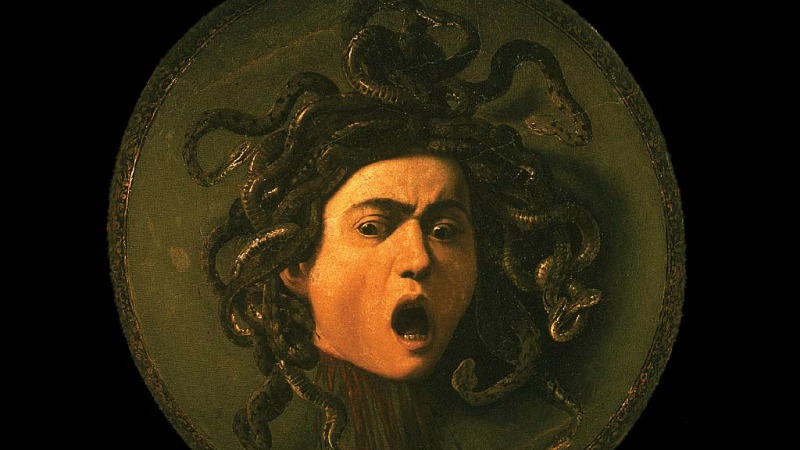
The Gorgon Medusa had snakes in place of hair. Eek! She is associated with Algol the Demon Star. Image via Caravaggio/ Wikimedia Commons.
Algol is the Demon Star?
What’s the scariest star in the sky? If you were one of the early stargazers, you might have chosen Algol in the constellation Perseus. Early astronomers nicknamed it Algol the Demon Star for its strange behavior. Shivers!
When you look at Algol, it doesn’t appear any scarier than any other star, at least not at first. But, in skylore, the star is associated with a mythical scary monster – the Gorgon Medusa – who had snakes for hair. Legend said that her appearance was so terrifying that if anyone even looked at her, they would turn to stone.
The star Algol takes its name from an Arabic word meaning the Demon’s Head or, literally the Ghoul. It represents the terrifying snaky head of the Medusa monster.
But why? Why did the early stargazers associate the star Algol with the Goron Medusa? It seems the ancients might have associated this star’s variable brightness with the evil, winking eye of the Medusa.
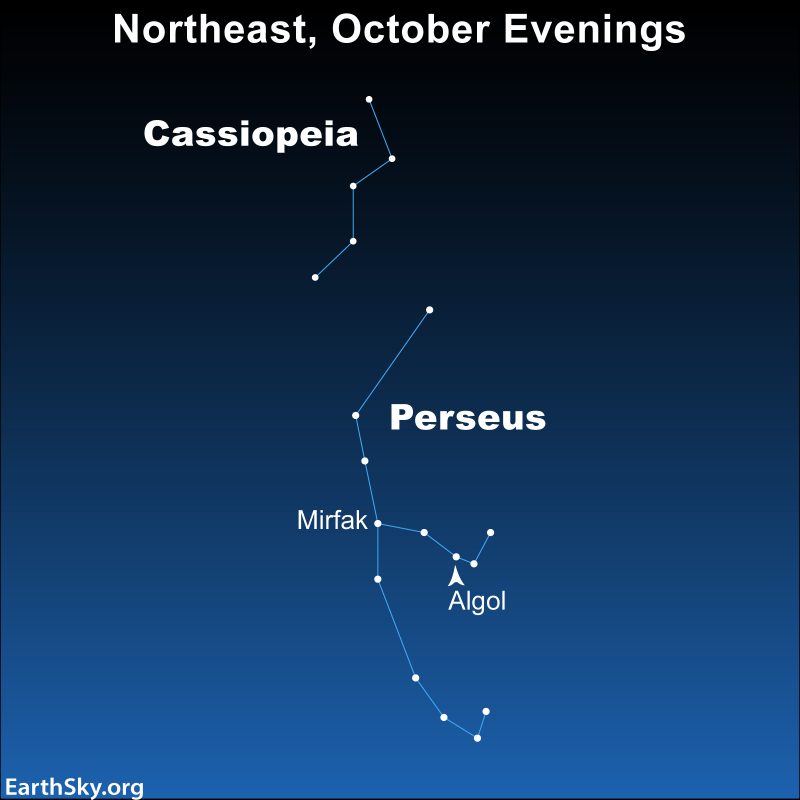
Find Algol the Demon Star in the constellation Perseus on autumn evenings. Perseus lies below the easy-to-recognize W-shaped constellation Cassiopeia.
What’s so scary about it?
In skylore, Perseus was a great hero often depicted mounted on Pegasus the Flying Horse. In the mythology of the skies, Perseus slew Medusa. Then, he used Medusa’s head to his advantage, showing it to Cetus the Sea-monster to turn him into stone.
All of these constellations are in the sky at this time of year.
And Algol is a known variable star, which waxes and wanes in brightness.
The early stargazers surely knew about its changing brightness. This probably led them to name the strangely behaving star in the sky for a mythological demon.
Algol is a variable star
There are many variable stars known throughout the heavens. But Algol might be the most famous of them. That’s because the Demon Star brightens and dims with clockwork regularity. It completes one cycle in 2 days, 20 hours and 49 minutes.
Plus, you can view its entire cycle with your eye alone.
At its brightest, Algol shines about three times more brightly than at its faintest. When it reaches maximum brilliance, Algol matches the brightness of the nearby second-magnitude star Almach. At minimum, Algol’s light output fades to that of the star Epsilon Persei.
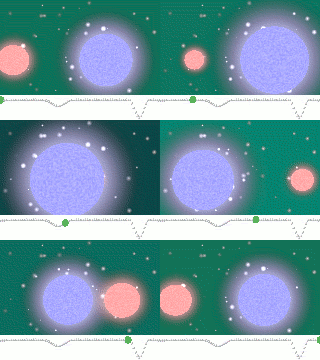
Modern-day astronomy has unlocked the secret of Algol’s mood swings. It’s an eclipsing binary star. This kind of binary star is composed of two stars, with each star revolving around the other. From Earth, we see the orbital plane of this binary star almost exactly edge-on. Therefore, when the dimmer of the two stars swings in front of the brighter star, we see Algol at minimum brightness.
Animation of an eclipsing binary star. The brightness drops when the small star is in front of the large one, as seen from Earth. Image via Wikimedia Commons (public domain).
How to find Algol the Demon Star
Luckily, the Demon Star is easy to find. Our sky chart shows the northeastern sky for autumn evenings, especially around Halloween.
First, look for the conspicuous W or M-shaped constellation Cassiopeia. It’ll enable you to star-hop to Perseus. Then, look below Cassiopeia toward the horizon to spot the dangling icicle shape of Perseus. Off to the right of the icicle is Algol. At mid-northern latitudes, the Demon Star appears for at least part of the night all year round. But it’s best seen in the evening sky from autumn to spring. It’s visible in the northeast sky in autumn, shines high overhead in winter, then swings to the northwest sky by spring.
Bottom line: Algol has the nickname the Demon Star because it represents the head of Medusa. This variable star probably intrigued the ancients with its fluctuating behavior.
The Gorgon Medusa had snakes in place of hair. Eek! She is associated with Algol the Demon Star. Image via Caravaggio/ Wikimedia Commons.
Algol is the Demon Star?
What’s the scariest star in the sky? If you were one of the early stargazers, you might have chosen Algol in the constellation Perseus. Early astronomers nicknamed it Algol the Demon Star for its strange behavior. Shivers!
When you look at Algol, it doesn’t appear any scarier than any other star, at least not at first. But, in skylore, the star is associated with a mythical scary monster – the Gorgon Medusa – who had snakes for hair. Legend said that her appearance was so terrifying that if anyone even looked at her, they would turn to stone.
The star Algol takes its name from an Arabic word meaning the Demon’s Head or, literally the Ghoul. It represents the terrifying snaky head of the Medusa monster.
But why? Why did the early stargazers associate the star Algol with the Goron Medusa? It seems the ancients might have associated this star’s variable brightness with the evil, winking eye of the Medusa.
Find Algol the Demon Star in the constellation Perseus on autumn evenings. Perseus lies below the easy-to-recognize W-shaped constellation Cassiopeia.
What’s so scary about it?
In skylore, Perseus was a great hero often depicted mounted on Pegasus the Flying Horse. In the mythology of the skies, Perseus slew Medusa. Then, he used Medusa’s head to his advantage, showing it to Cetus the Sea-monster to turn him into stone.
All of these constellations are in the sky at this time of year.
And Algol is a known variable star, which waxes and wanes in brightness.
The early stargazers surely knew about its changing brightness. This probably led them to name the strangely behaving star in the sky for a mythological demon.
Algol is a variable star
There are many variable stars known throughout the heavens. But Algol might be the most famous of them. That’s because the Demon Star brightens and dims with clockwork regularity. It completes one cycle in 2 days, 20 hours and 49 minutes.
Plus, you can view its entire cycle with your eye alone.
At its brightest, Algol shines about three times more brightly than at its faintest. When it reaches maximum brilliance, Algol matches the brightness of the nearby second-magnitude star Almach. At minimum, Algol’s light output fades to that of the star Epsilon Persei.
Modern-day astronomy has unlocked the secret of Algol’s mood swings. It’s an eclipsing binary star. This kind of binary star is composed of two stars, with each star revolving around the other. From Earth, we see the orbital plane of this binary star almost exactly edge-on. Therefore, when the dimmer of the two stars swings in front of the brighter star, we see Algol at minimum brightness.
Animation of an eclipsing binary star. The brightness drops when the small star is in front of the large one, as seen from Earth. Image via Wikimedia Commons (public domain).
How to find Algol the Demon Star
Luckily, the Demon Star is easy to find. Our sky chart shows the northeastern sky for autumn evenings, especially around Halloween.
First, look for the conspicuous W or M-shaped constellation Cassiopeia. It’ll enable you to star-hop to Perseus. Then, look below Cassiopeia toward the horizon to spot the dangling icicle shape of Perseus. Off to the right of the icicle is Algol. At mid-northern latitudes, the Demon Star appears for at least part of the night all year round. But it’s best seen in the evening sky from autumn to spring. It’s visible in the northeast sky in autumn, shines high overhead in winter, then swings to the northwest sky by spring.
Bottom line: Algol has the nickname the Demon Star because it represents the head of Medusa. This variable star probably intrigued the ancients with its fluctuating behavior.
Notice the jet from the supermassive black hole at the center of giant elliptical galaxy Centaurus A. The jet is extending into the upper left corner of this image. Researchers have gained new insights about this jet by focusing on the motion of the bright spots, or knots, within it. Image via the University of Michigan/ D. Bogensberger et al. Astrophys (CC-BY 4.0 license).
A supermassive black hole in giant galaxy Centaurus A is shooting a powerful stream of energy, called a “jet,” out into space.
Scientists studied bright spots, or “knots,” in this jet and found that some move almost as fast as light! They even look like they’re moving faster than light, but this is just because of the way we see them from Earth.
This discovery helps scientists learn more about how black holes work, and they plan to study similar jets in other galaxies too.
Researchers led by the University of Michigan have pored over more than two decades of data from NASA’s Chandra X-Ray Observatory, looking closely at the high-energy jet of particles being blasted across space by the supermassive black hole at the center of the giant galaxy Centaurus A.
The new study is the latest effort in a small but growing body of research that’s digging deeper into data to spot subtle, meaningful differences between radio and X-ray observations.
A key to understanding what’s going on in the jet could be understanding how different wavelength bands [for example, differences between the X-ray data and the radio data] trace different parts of the environment.
Bogensberger explained:
The jet in X-rays is different from the jet in radio waves. The X-ray data traces a unique picture that you can’t see in any other wavelength.
Bogensberger and an international team of colleagues published their findings on October 18, 2024, in The Astrophysical Journal.
The video below, from NASA, shows what we knew about the galaxy Centaurus A – and its central black hole and jet – a decade ago:
Knots in the jet
In the new study, the Michigan team developed a computer algorithm to look at Chandra’s observations of Centaurus A from 2000 to 2022. The algorithm tracked bright, lumpy features in the jet, called “knots” by scientists. By following knots that moved during the observation period, the team could then measure their speed.
The speed of one knot was particularly remarkable. In fact, it appeared to be moving faster than the speed of light! the speed of light is 186,000 miles (250,000 km/s). Faster-than-light speed is impossible, according to modern physical laws. But this knot has the appearance of superluminal speed due to its motion relative to Chandra’s vantage point near Earth. The distance between the knot and Chandra shrinks almost as fast as light can travel.
Still, the knot is moving fast! The team determined its actual speed is at least 94% the speed of light. A knot in a similar location had previously had its speed measured using radio observations. That result clocked the knot with a slightly slower speed, about 80% of the speed of light. Bogensberger said:
What this means is that [knots in the jet visible at radio wavelengths, and knots visible at X-ray wavelengths] move differently.
New insights from the knots
That’s a big clue as to what these knots might be, and how they behave. And that finding wasn’t the only one that stood out from the data.
For example, radio observations of knots suggested the structures closest to the black hole move the fastest. In the new study, however, Bogensberger and his colleagues found the fastest X-ray knot in a sort of middle region. It wasn’t the farthest from the black hole, but it wasn’t the nearest to it either. Bogensberger said:
There’s a lot we still don’t really know about how jets work in the X-ray band. This highlights the need for further research. We’ve shown a new approach to studying jets, and I think there’s a lot of interesting work to be done.
The jet in Centaurus A is special to us because it’s the closest supermassive black hole jet we know, at about 12 million light-years away. This relative proximity makes it a good first option for testing and validating new methodology.
But, for his part, Bogensberger will be stepping further out from here, using the team’s approach to examine other supermassive black hole jets, in other, more distant galaxies. Features like knots become more challenging to resolve in jets that are farther away. Bogensberger said:
But there are other galaxies where this analysis can be done. And that’s what I plan to do next.
Bottom line: There’s new knotty science to discover around black holes. A new study looked at the high-energy jet of particles being blasted across space by the supermassive black hole at the center of the galaxy Centaurus A.
Notice the jet from the supermassive black hole at the center of giant elliptical galaxy Centaurus A. The jet is extending into the upper left corner of this image. Researchers have gained new insights about this jet by focusing on the motion of the bright spots, or knots, within it. Image via the University of Michigan/ D. Bogensberger et al. Astrophys (CC-BY 4.0 license).
A supermassive black hole in giant galaxy Centaurus A is shooting a powerful stream of energy, called a “jet,” out into space.
Scientists studied bright spots, or “knots,” in this jet and found that some move almost as fast as light! They even look like they’re moving faster than light, but this is just because of the way we see them from Earth.
This discovery helps scientists learn more about how black holes work, and they plan to study similar jets in other galaxies too.
Researchers led by the University of Michigan have pored over more than two decades of data from NASA’s Chandra X-Ray Observatory, looking closely at the high-energy jet of particles being blasted across space by the supermassive black hole at the center of the giant galaxy Centaurus A.
The new study is the latest effort in a small but growing body of research that’s digging deeper into data to spot subtle, meaningful differences between radio and X-ray observations.
A key to understanding what’s going on in the jet could be understanding how different wavelength bands [for example, differences between the X-ray data and the radio data] trace different parts of the environment.
Bogensberger explained:
The jet in X-rays is different from the jet in radio waves. The X-ray data traces a unique picture that you can’t see in any other wavelength.
Bogensberger and an international team of colleagues published their findings on October 18, 2024, in The Astrophysical Journal.
The video below, from NASA, shows what we knew about the galaxy Centaurus A – and its central black hole and jet – a decade ago:
Knots in the jet
In the new study, the Michigan team developed a computer algorithm to look at Chandra’s observations of Centaurus A from 2000 to 2022. The algorithm tracked bright, lumpy features in the jet, called “knots” by scientists. By following knots that moved during the observation period, the team could then measure their speed.
The speed of one knot was particularly remarkable. In fact, it appeared to be moving faster than the speed of light! the speed of light is 186,000 miles (250,000 km/s). Faster-than-light speed is impossible, according to modern physical laws. But this knot has the appearance of superluminal speed due to its motion relative to Chandra’s vantage point near Earth. The distance between the knot and Chandra shrinks almost as fast as light can travel.
Still, the knot is moving fast! The team determined its actual speed is at least 94% the speed of light. A knot in a similar location had previously had its speed measured using radio observations. That result clocked the knot with a slightly slower speed, about 80% of the speed of light. Bogensberger said:
What this means is that [knots in the jet visible at radio wavelengths, and knots visible at X-ray wavelengths] move differently.
New insights from the knots
That’s a big clue as to what these knots might be, and how they behave. And that finding wasn’t the only one that stood out from the data.
For example, radio observations of knots suggested the structures closest to the black hole move the fastest. In the new study, however, Bogensberger and his colleagues found the fastest X-ray knot in a sort of middle region. It wasn’t the farthest from the black hole, but it wasn’t the nearest to it either. Bogensberger said:
There’s a lot we still don’t really know about how jets work in the X-ray band. This highlights the need for further research. We’ve shown a new approach to studying jets, and I think there’s a lot of interesting work to be done.
The jet in Centaurus A is special to us because it’s the closest supermassive black hole jet we know, at about 12 million light-years away. This relative proximity makes it a good first option for testing and validating new methodology.
But, for his part, Bogensberger will be stepping further out from here, using the team’s approach to examine other supermassive black hole jets, in other, more distant galaxies. Features like knots become more challenging to resolve in jets that are farther away. Bogensberger said:
But there are other galaxies where this analysis can be done. And that’s what I plan to do next.
Bottom line: There’s new knotty science to discover around black holes. A new study looked at the high-energy jet of particles being blasted across space by the supermassive black hole at the center of the galaxy Centaurus A.
An artist’s concept of the pterosaur Dorygnathus banthensis. Scientists know little about the diets of pterosaurs, but a new study reveals this species fed on small fish. Image via Dmitry Bogdanov/ Wikimedia Commons (CC BY-SA 3.0).
Scientists uncovered the diets of two pterosaur species found in Germany from fossilized stomach contents.
Dorygnathus banthensis mainly ate small fish, while Campylognathoides zitteli consumed squid, showing they had different diets.
The fossilized stomach contents offer valuable information about the feeding habits and ecosystems of pterosaurs in the Jurassic period.
What did pterosaurs eat?
Pterosaurs were winged reptiles that dominated the skies during the age of the dinosaurs. Historically, scientists knew little about the diet and feeding strategies of these creatures. On October 23, 2024, a group of researchers said they’ve examined two pterosaur specimens in great detail. Remarkably, they were able to find fossilized stomach contents. Moreover, they were even able to identify the prey consumed by the pterosaurs.
The scientists published their findings in the peer-reviewedJournal of Vertebrate Paleontology on October 23, 2024.
A look at pterosaur fossil number one
The researchers conducted a detailed study of two previously collected fossilized pterosaur species. The 182-million-year-old specimens came from a shale formation at Baden-Württemberg in southwest Germany.
They found one of the fossilized remains – belonging to the species Dorygnathus banthensis – had eaten small fish (from the genus Leptolepis) shortly before it died. Consequently, there was little time for the stomach acids to break down the fish bones. Thus, the bones of the food were also preserved in the fossil.
The top panel shows the pterosaur fossil Dorygnathus banthensis. At the bottom is a diagram describing the bones, with a scale bar representing 0.8 inches (20 mm). The shaded gray area in the diagram with the arrow shows the location of the stomach where fish bones were. Image via Cooper, L.A.S., et al./ Journal of Vertebrate Paleontology/ (CC BY-NC-ND 4.0).
Pterosaur fossil number two
The other pterosaur species they examined was Campylognathoides zitteli. In this case, the stomach contents examination revealed the animal had consumed squid shortly before its death. The scientists knew it was squid because tiny hooks, attached to tentacles to grab prey, survived in fossilized form. Furthermore, based on the hooks, they could identify the squid species: Clarkeiteuthis conocauda. Thus, this discovery suggests that Campylognathoides may have been a nocturnal hunter, because squid travel to the sea surface at night.
The left panel shows the pterosaur fossil Campylognathoides zitteli with an accompanying diagram describing the bones. A scale bar at the bottom of the left panel shows 2 inches (51 mm). The shaded gray area in the diagram with an arrow indicates the location of the stomach where scientists found squid hooks. Image via Cooper, L.A.S., et al./ Journal of Vertebrate Paleontology/ (CC BY-NC-ND 4.0).
Fossilized stomach contents are extremely rare
These pterosaurs, like modern-day seabirds, spent much of their time flying in search of prey. They once soared over the warm tropical seas that covered south Germany during the Jurassic Period. In order to stay aloft for long periods, they had to digest their food quickly to reduce the weight in their stomaches. Therefore, it’s rare to find fossilized stomach contents in pterosaurs.
David Martill, from the University of Portsmouth, a co-author of the paper, said:
It is incredibly rare to find 180-million-year-old pterosaurs preserved with their stomach contents, and provides “smoking gun” evidence for pterosaur diets. The discovery offers a unique and fascinating glimpse into how these ancient creatures lived, what they ate, and the ecosystems they thrived in millions of years ago.
What these results tell us about the pterosaurs’ world
The scientists discovered two different pterosaur species, which existed at the same time, but appear to have had different diets. Samuel Cooper of the State Museum of Natural History Stuttgart, the lead author of the paper, said:
The fossilized stomach contents tell us a lot about the ecosystem at that time and how the animals interacted with each other. For me, this evidence of squid remains in the stomach of Campylognathoides is therefore particularly exciting. Until now, we tended to assume that it fed on fish, similar to Dorygnathus, in which we found small fish bones as stomach contents. The fact that these two pterosaur species ate different prey shows that they were likely specialized for different diets. This allowed Dorygnathus and Campylognathoides to coexist in the same habitat without much competition for food between the two species.
The pterosaurs were found in a unique fossil site
The geologic formation that held the fossilized remains of the two pterosaurs provides more insight into their aquatic world. It’s called the Posidonia Shale. This is a black shale formation, dated at 182 million years old. A part of this formation, where scientists found the two pterosaurs, lies in southwest Germany.
This region was once a muddy seabed. There, animals quickly sank into the soft mud before scavengers could get to them or sea currents could disturb their remains. And low oxygen levels kept the remains in good condition for fossilization.
The site is notable for its diverse and well-preserved fossilized marine fauna. Scientists have found remarkable specimens there, including a pregnant ichthyosaur with fossilized embryos, plesiosaurs, marine crocodiles, several large fish species, crustaceans, cuttlefish, ammonites and more pterosaurs.
Bottom line: Fossilized stomach contents of two well-preserved pterosaur species from southwestern Germany offered valuable information about the feeding habits and ecosystems of pterosaurs in the Jurassic period.
An artist’s concept of the pterosaur Dorygnathus banthensis. Scientists know little about the diets of pterosaurs, but a new study reveals this species fed on small fish. Image via Dmitry Bogdanov/ Wikimedia Commons (CC BY-SA 3.0).
Scientists uncovered the diets of two pterosaur species found in Germany from fossilized stomach contents.
Dorygnathus banthensis mainly ate small fish, while Campylognathoides zitteli consumed squid, showing they had different diets.
The fossilized stomach contents offer valuable information about the feeding habits and ecosystems of pterosaurs in the Jurassic period.
What did pterosaurs eat?
Pterosaurs were winged reptiles that dominated the skies during the age of the dinosaurs. Historically, scientists knew little about the diet and feeding strategies of these creatures. On October 23, 2024, a group of researchers said they’ve examined two pterosaur specimens in great detail. Remarkably, they were able to find fossilized stomach contents. Moreover, they were even able to identify the prey consumed by the pterosaurs.
The scientists published their findings in the peer-reviewedJournal of Vertebrate Paleontology on October 23, 2024.
A look at pterosaur fossil number one
The researchers conducted a detailed study of two previously collected fossilized pterosaur species. The 182-million-year-old specimens came from a shale formation at Baden-Württemberg in southwest Germany.
They found one of the fossilized remains – belonging to the species Dorygnathus banthensis – had eaten small fish (from the genus Leptolepis) shortly before it died. Consequently, there was little time for the stomach acids to break down the fish bones. Thus, the bones of the food were also preserved in the fossil.
The top panel shows the pterosaur fossil Dorygnathus banthensis. At the bottom is a diagram describing the bones, with a scale bar representing 0.8 inches (20 mm). The shaded gray area in the diagram with the arrow shows the location of the stomach where fish bones were. Image via Cooper, L.A.S., et al./ Journal of Vertebrate Paleontology/ (CC BY-NC-ND 4.0).
Pterosaur fossil number two
The other pterosaur species they examined was Campylognathoides zitteli. In this case, the stomach contents examination revealed the animal had consumed squid shortly before its death. The scientists knew it was squid because tiny hooks, attached to tentacles to grab prey, survived in fossilized form. Furthermore, based on the hooks, they could identify the squid species: Clarkeiteuthis conocauda. Thus, this discovery suggests that Campylognathoides may have been a nocturnal hunter, because squid travel to the sea surface at night.
The left panel shows the pterosaur fossil Campylognathoides zitteli with an accompanying diagram describing the bones. A scale bar at the bottom of the left panel shows 2 inches (51 mm). The shaded gray area in the diagram with an arrow indicates the location of the stomach where scientists found squid hooks. Image via Cooper, L.A.S., et al./ Journal of Vertebrate Paleontology/ (CC BY-NC-ND 4.0).
Fossilized stomach contents are extremely rare
These pterosaurs, like modern-day seabirds, spent much of their time flying in search of prey. They once soared over the warm tropical seas that covered south Germany during the Jurassic Period. In order to stay aloft for long periods, they had to digest their food quickly to reduce the weight in their stomaches. Therefore, it’s rare to find fossilized stomach contents in pterosaurs.
David Martill, from the University of Portsmouth, a co-author of the paper, said:
It is incredibly rare to find 180-million-year-old pterosaurs preserved with their stomach contents, and provides “smoking gun” evidence for pterosaur diets. The discovery offers a unique and fascinating glimpse into how these ancient creatures lived, what they ate, and the ecosystems they thrived in millions of years ago.
What these results tell us about the pterosaurs’ world
The scientists discovered two different pterosaur species, which existed at the same time, but appear to have had different diets. Samuel Cooper of the State Museum of Natural History Stuttgart, the lead author of the paper, said:
The fossilized stomach contents tell us a lot about the ecosystem at that time and how the animals interacted with each other. For me, this evidence of squid remains in the stomach of Campylognathoides is therefore particularly exciting. Until now, we tended to assume that it fed on fish, similar to Dorygnathus, in which we found small fish bones as stomach contents. The fact that these two pterosaur species ate different prey shows that they were likely specialized for different diets. This allowed Dorygnathus and Campylognathoides to coexist in the same habitat without much competition for food between the two species.
The pterosaurs were found in a unique fossil site
The geologic formation that held the fossilized remains of the two pterosaurs provides more insight into their aquatic world. It’s called the Posidonia Shale. This is a black shale formation, dated at 182 million years old. A part of this formation, where scientists found the two pterosaurs, lies in southwest Germany.
This region was once a muddy seabed. There, animals quickly sank into the soft mud before scavengers could get to them or sea currents could disturb their remains. And low oxygen levels kept the remains in good condition for fossilization.
The site is notable for its diverse and well-preserved fossilized marine fauna. Scientists have found remarkable specimens there, including a pregnant ichthyosaur with fossilized embryos, plesiosaurs, marine crocodiles, several large fish species, crustaceans, cuttlefish, ammonites and more pterosaurs.
Bottom line: Fossilized stomach contents of two well-preserved pterosaur species from southwestern Germany offered valuable information about the feeding habits and ecosystems of pterosaurs in the Jurassic period.
AST SpaceMobile provided this artist’s rendering of its newly unfurled BlueBird satellite constellation. The massive communications satellites are 693-square-feet (64-square-meters) in area. The company plans to place 100 of the enormous satellites in orbit, much to the consternation of the astronomical community. Image via AST SpaceMobile
Giant satellites outshining nearly all the stars
Five huge satellites – each blocking an area of the sky about the size of two city buses – unfurled their giant antennae in low Earth orbit this week. The spacecrafts’ enormous surface areas are expected to make them shine at up to magnitude 0.4. That’s brighter than nine of the 10 brightest stars.
AST SpaceMobile announced the craft – BlueBirds 1-5 – successfully unfolded their 639-square-foot (64-square-meter) antennae on Friday, October 25, 2024. Company founder and CEO Abel Avellan said plans to place 100 or more of the craft in space is quickly moving ahead:
These five satellites are the largest commercial communications arrays ever launched in low Earth orbit. It is a significant achievement to commission these satellites, and we are now accelerating our path to commercial activity.
The company says its satellites will benefit regions with little or no cellular telephone coverage. But the International Astronomical Union (IAU) believes the plan will further degrade the night sky.
Made in TX — size matters! #BlueWalker3's 693 sq ft array would be largest-ever commercial comms array in LEO. We're building the first & only cellular broadband network in space backed by 2,400 patent and patent-pending claims. Removing before-flight tags today!!! ???? #5G?? pic.twitter.com/Vx4oNVNYCK
BlueBird causes concern among professional astronomers
A peer-reviewed paper published in Nature in October of 2023 confirmed the astronomical community’s fears. The study tracked the brightness of BlueWalker 3, the prototype for the BlueBird, which matches it in size.
The peak brightness of the satellite reached an apparent magnitude of 0.4. This made the new satellite one of the brightest objects in the night sky.
BlueWalker 3 grew and dimmed in brightness. At its weakest, it shone at magnitude 6, the limit of human vision. But it retuned to its brightest level, especially when it passed high overhead. At magnitude 0.4, BlueBird will be visible in even the most light-polluted locations.
The BlueBird constellation could also pose a threat to radio astronomy. Broadcast frequencies used by AST SpaceMobile are of particular concern, the IAU said:
Frequencies allocated to cell phones are already challenging to observe even in radio quiet zones we have created for our facilities. New satellites such as BlueWalker 3 have the potential to worsen this situation and compromise our ability to do science if not properly mitigated.
The IAU also acknowledged the need for satellite constellations … as well as caution. And BlueBird will provide what appears to be a worthwhile service, according to the company’s marketing department:
Our engineers and space scientists are on a mission to eliminate the connectivity gaps faced by today’s five billion mobile subscribers and finally bring broadband to the billions who remain unconnected.
BlueBird constellation highlights crowding of low Earth orbit
AST SpaceMobile is far from the only company filling low Earth orbit with hundreds of new satellites. Or more. Projects such as SpaceX’s Starlink plan to fly tens of thousands of satellites. This rapid growth is raising the specter of catastrophic runaway satellite collisions, even outside the spaceflight community. The venerable publication Popular Science addressed the danger in its coverage of BlueBird:
In these scenarios, the untenable amount of human-made objects leads to ever-increasing collisions, causing debris to deorbit and pose a danger to anything in its path.
Experts have long feared this scenario, known as the Kessler syndrome. EarthSky reported on the danger in March 2024 after space junk from the ISS struck Earth:
As early as 1978, NASA scientist Donald Kessler was pondering what would happen as more satellites took up residence in orbit around Earth. Now known as the Kessler syndrome, the scenario imagines the density of objects in low-Earth orbit becoming high enough that it creates a cascade of collisions, with each collision generating space debris that increases the likelihood of further collisions.
Because of their large size, the AST SpaceMobile BlueBird constellation may be particularly at risk of collision.
Bottom line: BlueBird, the largest communications satellites ever, opened their antennae this week. Astronomers believe the bright craft will further degrade the night sky.
AST SpaceMobile provided this artist’s rendering of its newly unfurled BlueBird satellite constellation. The massive communications satellites are 693-square-feet (64-square-meters) in area. The company plans to place 100 of the enormous satellites in orbit, much to the consternation of the astronomical community. Image via AST SpaceMobile
Giant satellites outshining nearly all the stars
Five huge satellites – each blocking an area of the sky about the size of two city buses – unfurled their giant antennae in low Earth orbit this week. The spacecrafts’ enormous surface areas are expected to make them shine at up to magnitude 0.4. That’s brighter than nine of the 10 brightest stars.
AST SpaceMobile announced the craft – BlueBirds 1-5 – successfully unfolded their 639-square-foot (64-square-meter) antennae on Friday, October 25, 2024. Company founder and CEO Abel Avellan said plans to place 100 or more of the craft in space is quickly moving ahead:
These five satellites are the largest commercial communications arrays ever launched in low Earth orbit. It is a significant achievement to commission these satellites, and we are now accelerating our path to commercial activity.
The company says its satellites will benefit regions with little or no cellular telephone coverage. But the International Astronomical Union (IAU) believes the plan will further degrade the night sky.
Made in TX — size matters! #BlueWalker3's 693 sq ft array would be largest-ever commercial comms array in LEO. We're building the first & only cellular broadband network in space backed by 2,400 patent and patent-pending claims. Removing before-flight tags today!!! ???? #5G?? pic.twitter.com/Vx4oNVNYCK
BlueBird causes concern among professional astronomers
A peer-reviewed paper published in Nature in October of 2023 confirmed the astronomical community’s fears. The study tracked the brightness of BlueWalker 3, the prototype for the BlueBird, which matches it in size.
The peak brightness of the satellite reached an apparent magnitude of 0.4. This made the new satellite one of the brightest objects in the night sky.
BlueWalker 3 grew and dimmed in brightness. At its weakest, it shone at magnitude 6, the limit of human vision. But it retuned to its brightest level, especially when it passed high overhead. At magnitude 0.4, BlueBird will be visible in even the most light-polluted locations.
The BlueBird constellation could also pose a threat to radio astronomy. Broadcast frequencies used by AST SpaceMobile are of particular concern, the IAU said:
Frequencies allocated to cell phones are already challenging to observe even in radio quiet zones we have created for our facilities. New satellites such as BlueWalker 3 have the potential to worsen this situation and compromise our ability to do science if not properly mitigated.
The IAU also acknowledged the need for satellite constellations … as well as caution. And BlueBird will provide what appears to be a worthwhile service, according to the company’s marketing department:
Our engineers and space scientists are on a mission to eliminate the connectivity gaps faced by today’s five billion mobile subscribers and finally bring broadband to the billions who remain unconnected.
BlueBird constellation highlights crowding of low Earth orbit
AST SpaceMobile is far from the only company filling low Earth orbit with hundreds of new satellites. Or more. Projects such as SpaceX’s Starlink plan to fly tens of thousands of satellites. This rapid growth is raising the specter of catastrophic runaway satellite collisions, even outside the spaceflight community. The venerable publication Popular Science addressed the danger in its coverage of BlueBird:
In these scenarios, the untenable amount of human-made objects leads to ever-increasing collisions, causing debris to deorbit and pose a danger to anything in its path.
Experts have long feared this scenario, known as the Kessler syndrome. EarthSky reported on the danger in March 2024 after space junk from the ISS struck Earth:
As early as 1978, NASA scientist Donald Kessler was pondering what would happen as more satellites took up residence in orbit around Earth. Now known as the Kessler syndrome, the scenario imagines the density of objects in low-Earth orbit becoming high enough that it creates a cascade of collisions, with each collision generating space debris that increases the likelihood of further collisions.
Because of their large size, the AST SpaceMobile BlueBird constellation may be particularly at risk of collision.
Bottom line: BlueBird, the largest communications satellites ever, opened their antennae this week. Astronomers believe the bright craft will further degrade the night sky.
The Voyager 2 spacecraft took this image of Uranus’s moon Miranda on January 24, 1986. New research shows that Miranda may have an ocean beneath its surface. Image via NASA/ JPL-Caltech/ Johns Hopkins.
Uranus’s moon Miranda may harbor an ocean
Uranus is the sixth planet from the sun in our solar system, orbiting some 19 times farther away from the sun than Earth does. One of its moons, Miranda, is 1/7 the size of our moon and has a crazy-quilt surface of scarps and craters. On October 28, 2024, researchers from Johns Hopkins University said they’ve modeled how the interior structure of the moon could create the bizarre surface patterns. The model with the best fit required the existence of a vast ocean beneath Miranda’s ice some 100 to 500 million years ago. Co-author Tom Nordheim of Johns Hopkins said:
To find evidence of an ocean inside a small object like Miranda is incredibly surprising. It helps build on the story that some of these moons at Uranus may be really interesting … that there may be several ocean worlds around one of the most distant planets in our solar system, which is both exciting and bizarre.
The researchers published their peer-reviewed findings in The Planetary Science Journal on October 15, 2024.
Evidence for an ocean
The only part of Miranda we’ve seen is its southern hemisphere. Scientists believe its grooved terrain (pockmarked with craters) is a result of heating from the moon’s internal tidal forces. The team of scientists took another look at the Voyager 2 images and decided to try to work backward:
to uncover what the moon’s interior structure must have been to shape the moon’s geology in response to tidal forcing.
Lead author Caleb Strom, a graduate student at the University of North Dakota, worked with scientists from the Planetary Science Institute in Arizona. They mapped Miranda’s surface features and then used computer models to match the stress patterns to the moon.
What they found was the best match required a vast ocean under Miranda’s surface. The ocean would have to be no more than 19 miles (30 km) beneath the moon’s crust of ice. And the ocean itself would have to be at least 62 miles (100 km) deep. The little moon is only 292 miles (470 km) across. So the ocean would take up a big chunk of the moon’s interior. Strom said:
That result was a big surprise to the team.
A thin ocean might remain under ice on Uranus’s moon
Uranus has 28 known moons. Miranda and some of its neighboring moons tug on each other as they orbit. This would lead to deformations and friction that would warm the moons’ interiors. The scientists found that Miranda and its nearby moons once likely had what is called an orbital resonance. For example, one moon might make one orbit of Uranus in the same time it takes another moon to orbit twice.
But today, the moons no longer have this synchronicity. So that means their insides are cooling and freezing. But the scientists said Miranda is not completely cool yet. If it were, they would be able to see cracks on its surface from the expansion as the liquid turned to ice. And so Miranda may still have an ocean today. The remaining ocean would probably be quite smaller than what it would have been some 100 to 500 million years ago. Still, Strom said:
But the suggestion of an ocean inside one of the most distant moons in the solar system is remarkable.
Uranus with 6 of its moons. Miranda is the 2nd moon from the left. Image via NASA/ Wikimedia Commons.
Other moons in our solar system with possible oceans
One of the remarkable aspects of the discovery is that ocean moons in our solar system are locations where scientists believe life could exist. Currently, Jupiter’s Europa and Saturn’s Enceladus are the top contenders for icy worlds that harbor hidden oceans. On October 14, 2024, NASA launched the Europa Clipper mission toward Jupiter’s icy moon Enceladus. Scientists want to know more about the habitability – the ability for some form of live to exist – on this large moon.
There’s also ESA’s JUICE mission – JUICE stands for JUpiter Icy Moons Explorer – which launched in 2023 and will explore the icy Jovian moons when it arrives in 2031. And Saturn’s moon Enceladus is a top target for a future ESA mission. Co-author Alex Patthoff of the Planetary Science Institute compared the surprise of Miranda to the one scientists previously got from Enceladus. Patthoff said:
Few scientists expected Enceladus to be geologically active. However, it’s shooting water vapor and ice out of its southern hemisphere as we speak.
Perhaps one day Miranda and other moons of Uranus will get missions of their own.
Bottom line: A new study of Uranus’s moon Miranda looked at its crazy surface and used computer models to see how it might have gotten that way. The best fit for the jumbled terrain is an underground ocean.
The Voyager 2 spacecraft took this image of Uranus’s moon Miranda on January 24, 1986. New research shows that Miranda may have an ocean beneath its surface. Image via NASA/ JPL-Caltech/ Johns Hopkins.
Uranus’s moon Miranda may harbor an ocean
Uranus is the sixth planet from the sun in our solar system, orbiting some 19 times farther away from the sun than Earth does. One of its moons, Miranda, is 1/7 the size of our moon and has a crazy-quilt surface of scarps and craters. On October 28, 2024, researchers from Johns Hopkins University said they’ve modeled how the interior structure of the moon could create the bizarre surface patterns. The model with the best fit required the existence of a vast ocean beneath Miranda’s ice some 100 to 500 million years ago. Co-author Tom Nordheim of Johns Hopkins said:
To find evidence of an ocean inside a small object like Miranda is incredibly surprising. It helps build on the story that some of these moons at Uranus may be really interesting … that there may be several ocean worlds around one of the most distant planets in our solar system, which is both exciting and bizarre.
The researchers published their peer-reviewed findings in The Planetary Science Journal on October 15, 2024.
Evidence for an ocean
The only part of Miranda we’ve seen is its southern hemisphere. Scientists believe its grooved terrain (pockmarked with craters) is a result of heating from the moon’s internal tidal forces. The team of scientists took another look at the Voyager 2 images and decided to try to work backward:
to uncover what the moon’s interior structure must have been to shape the moon’s geology in response to tidal forcing.
Lead author Caleb Strom, a graduate student at the University of North Dakota, worked with scientists from the Planetary Science Institute in Arizona. They mapped Miranda’s surface features and then used computer models to match the stress patterns to the moon.
What they found was the best match required a vast ocean under Miranda’s surface. The ocean would have to be no more than 19 miles (30 km) beneath the moon’s crust of ice. And the ocean itself would have to be at least 62 miles (100 km) deep. The little moon is only 292 miles (470 km) across. So the ocean would take up a big chunk of the moon’s interior. Strom said:
That result was a big surprise to the team.
A thin ocean might remain under ice on Uranus’s moon
Uranus has 28 known moons. Miranda and some of its neighboring moons tug on each other as they orbit. This would lead to deformations and friction that would warm the moons’ interiors. The scientists found that Miranda and its nearby moons once likely had what is called an orbital resonance. For example, one moon might make one orbit of Uranus in the same time it takes another moon to orbit twice.
But today, the moons no longer have this synchronicity. So that means their insides are cooling and freezing. But the scientists said Miranda is not completely cool yet. If it were, they would be able to see cracks on its surface from the expansion as the liquid turned to ice. And so Miranda may still have an ocean today. The remaining ocean would probably be quite smaller than what it would have been some 100 to 500 million years ago. Still, Strom said:
But the suggestion of an ocean inside one of the most distant moons in the solar system is remarkable.
Uranus with 6 of its moons. Miranda is the 2nd moon from the left. Image via NASA/ Wikimedia Commons.
Other moons in our solar system with possible oceans
One of the remarkable aspects of the discovery is that ocean moons in our solar system are locations where scientists believe life could exist. Currently, Jupiter’s Europa and Saturn’s Enceladus are the top contenders for icy worlds that harbor hidden oceans. On October 14, 2024, NASA launched the Europa Clipper mission toward Jupiter’s icy moon Enceladus. Scientists want to know more about the habitability – the ability for some form of live to exist – on this large moon.
There’s also ESA’s JUICE mission – JUICE stands for JUpiter Icy Moons Explorer – which launched in 2023 and will explore the icy Jovian moons when it arrives in 2031. And Saturn’s moon Enceladus is a top target for a future ESA mission. Co-author Alex Patthoff of the Planetary Science Institute compared the surprise of Miranda to the one scientists previously got from Enceladus. Patthoff said:
Few scientists expected Enceladus to be geologically active. However, it’s shooting water vapor and ice out of its southern hemisphere as we speak.
Perhaps one day Miranda and other moons of Uranus will get missions of their own.
Bottom line: A new study of Uranus’s moon Miranda looked at its crazy surface and used computer models to see how it might have gotten that way. The best fit for the jumbled terrain is an underground ocean.
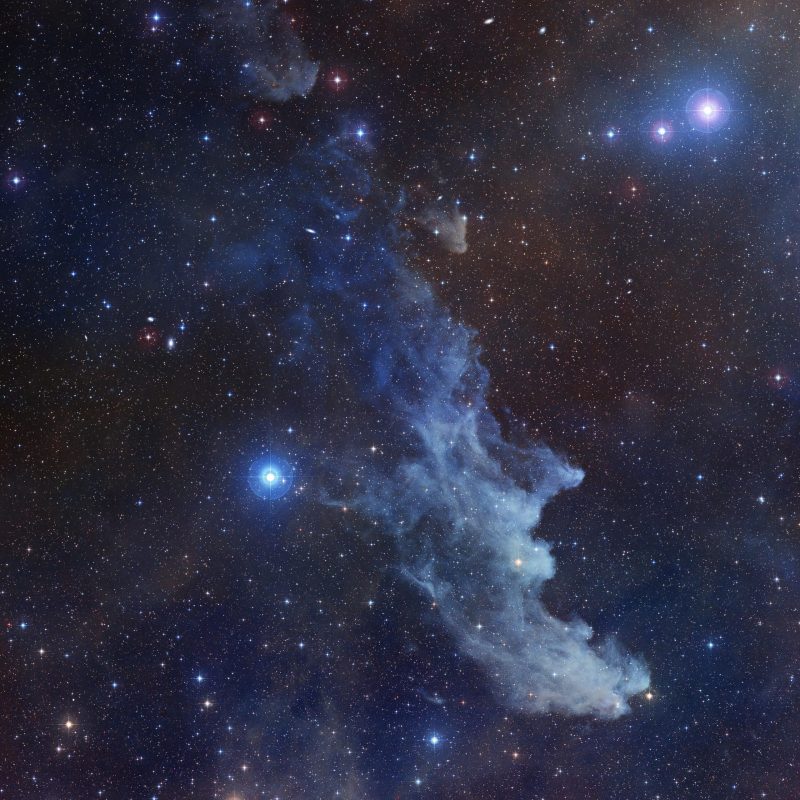
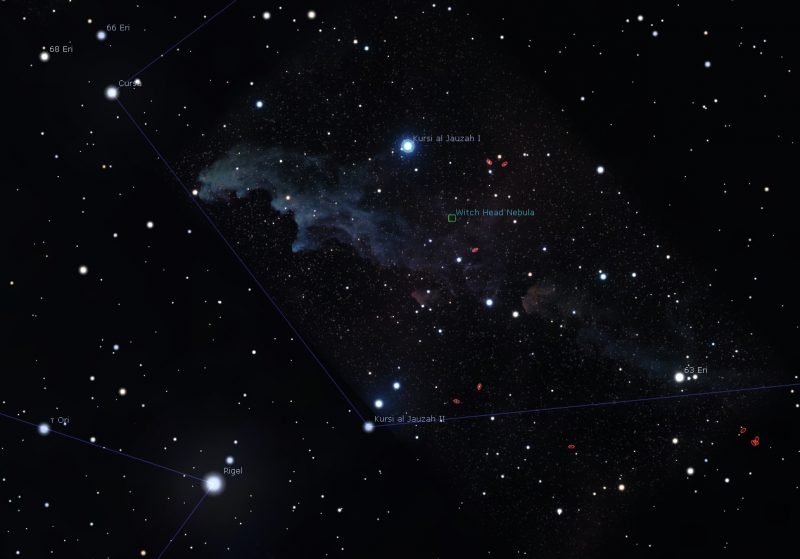
The Witch Head Nebula – IC 2118 – lies near the bright star Rigel in Orion. This reflection nebula is the perfect complement to the spooky season. Image via NASA/ STScI Digitized Sky Survey/ Noel Carboni.
Witch Head Nebula
It’s that time of year again, when creepy-crawlies and spine-chilling images tickle our imaginations. One of the spookiest views in the night sky is of the Witch Head Nebula, with the catalog designation IC 2118. The Witch Head Nebula is located near Orion’s brightest star, Rigel. But Rigel is just outside the image above, so the witch gets all the attention. If the field of view was large enough to include the blue supergiant star, you could see that the witch appears to be gazing at Rigel.
The constellation Orion, accompanied by the Witch Head Nebula, rises from the eastern horizon before midnight on Halloween. This lengthy nebula spans 70 light-years across and lies 900 light-years from Earth. The nebula is extraordinarily faint, at magnitude 13, so it can only be spotted with large telescopes.
Scientists think it might be an ancient supernova remnant. The Witch Head Nebula is categorized as a reflection nebula, or one that shines with the aid of a nearby star. In this case, Rigel shines its bright light on the gas and dust to create the reflection that we see. The dust reflects more blue light than red, which gives it its eerie purplish-blue hue.
View larger. | The Witch Head Nebula is facing down in this chart toward Rigel, the brightest star in Orion. Image via Stellarium. Used with permission.
Want to learn how to “capture the witch” on film? Try this post from the Galactic Hunter.
Bottom line: The Witch Head Nebula rises near the star Rigel in Orion on Halloween night, but you need a telescope to see it.
The Witch Head Nebula – IC 2118 – lies near the bright star Rigel in Orion. This reflection nebula is the perfect complement to the spooky season. Image via NASA/ STScI Digitized Sky Survey/ Noel Carboni.
Witch Head Nebula
It’s that time of year again, when creepy-crawlies and spine-chilling images tickle our imaginations. One of the spookiest views in the night sky is of the Witch Head Nebula, with the catalog designation IC 2118. The Witch Head Nebula is located near Orion’s brightest star, Rigel. But Rigel is just outside the image above, so the witch gets all the attention. If the field of view was large enough to include the blue supergiant star, you could see that the witch appears to be gazing at Rigel.
The constellation Orion, accompanied by the Witch Head Nebula, rises from the eastern horizon before midnight on Halloween. This lengthy nebula spans 70 light-years across and lies 900 light-years from Earth. The nebula is extraordinarily faint, at magnitude 13, so it can only be spotted with large telescopes.
Scientists think it might be an ancient supernova remnant. The Witch Head Nebula is categorized as a reflection nebula, or one that shines with the aid of a nearby star. In this case, Rigel shines its bright light on the gas and dust to create the reflection that we see. The dust reflects more blue light than red, which gives it its eerie purplish-blue hue.
View larger. | The Witch Head Nebula is facing down in this chart toward Rigel, the brightest star in Orion. Image via Stellarium. Used with permission.
Want to learn how to “capture the witch” on film? Try this post from the Galactic Hunter.
Bottom line: The Witch Head Nebula rises near the star Rigel in Orion on Halloween night, but you need a telescope to see it.
Porcupines are calm and peaceful rodents that live in many parts of the world. There are two families of porcupines with different lifestyles. But if they have something in common, it is the painful weapon they won’t hesitate to use if they feel threatened: sharp quills.
Porcupines were first discovered in Africa. And there are around 29 species of porcupines throughout the world. These are adaptable creatures that can live in various terrain from rocky to semi-arid areas, deserts, savannahs, grasslands, forests and tropical jungles. Porcupines are classified into two families, those of the Old World, which are found in Europe, Africa and Asia, and those of the New World, which are located in the Americas.
The Old World porcupine
Old World porcupines are larger than their New World counterparts. With a length of between 25 and 35 inches (60 and 90 cm), Old World porcupines can weigh between 22 and 55 pounds (10 and 25 kg). They have a life expectancy of 15 years in the wild, although in captivity they live up to 20 years because they face fewer threats.
Their front legs have four fingers armed with strong claws, while the hind legs have five fingers. They have short legs and therefore move slowly. But when in danger, they can speed up. However, who needs to run when you have an impressive defense? If these striking animals stand out for something, it is for their quills.
The porcupine is a calm and peaceful rodent found in many parts of the world. There are around 29 species and 2 families: those of the Old World and those of the New World. Image via Anca Silvia Orosz/ Pexels.
What are porcupines’ quills like?
These animals actually have soft brown or black hair on their faces, necks and the lower parts of their bodies. But they also have thick bristles on their heads and the napes of their necks, and sharp quills on their backs, sides and tails. The lower half of the back contains the longest quills, which can measure up to 12 inches (30 cm).
These are modified hairs wrapped in a thick keratin duct; therefore, they are hollow inside. The quills originate in the musculature of the skin, and in the case of Old World porcupines, they are found in groups or clusters. On the outside, the quills have black and white stripes.
Old World porcupines are medium to large in size and have soft brown or black hair on some parts of the body, but also thick bristles and sharp quills. Image via Alena Maruk/ Pexels.
Do porcupine quills contain poison?
Porcupines warn their enemies many times. When the porcupine feels threatened, it stomps heavily on the ground and trembles deliberately to rattle its quills and scare anyone who disturbs its peace. Ultimately, it bristles and raises its quills in warning, making it appear larger.
If its enemy still persists, then the porcupine moves sideways or backward to charge at its enemy and prick them with its larger, backside quills.
It’s not true that porcupines can throw their quills. When the quills come into contact with another body, they break off, but porcupines do not shoot them. In addition, they are quite fragile and when they enter the victim’s body they break, leaving behind fragments.
Regarding the poison … the wounds from a porcupine are quite painful, which is why people think they’re poisonous. The problem is if the wounds are not treated, they can become infected. In the wild, animals that attack porcupines can die from infection.
Another curious fact about their spikes is besides being good defense, quills don’t sink in water. This makes porcupines great swimmers. So quills are both a formidable weapon and tool. Two in one!
Porcupines are not poisonous. But if wounds from porcupines don’t get treated, they can become infected. Porcupines only attack if they feel threatened. Image via Jeffrey Hamilton/ Unsplash.
What else is there to know about this rodent?
Well, like all rodents, porcupines have large incisor teeth that they have to wear down, since they constantly grow. Furthermore, these incisors are extremely strong, so much so that they can even break through wire.
Porcupines are silent animals. It’s rare to hear their vocalizations, but in case of discontent or anxiety, these animals growl. On the other hand, they do not have a very developed sense of hearing or sight, since their eyes and ears are quite small. However, they do have an incredible sense of smell.
These rodents have small eyes and ears, but have an excellent sense of smell. Image via Dušan Veverkolog/ Unsplash.
What do porcupines eat?
These are mainly herbivorous animals. Thus, they eat all parts of the plants. They also eat fruits, bulbs and seeds. In the absence of other food, they eat insects and small vertebrates. Additionally, they can eat carrion. It is common to see them gnawing on bones, since it provides them with calcium and lets them wear down their teeth at the same time. Likewise, they constantly gnaw the bark of trees.
Porcupines are nocturnal animals. They feed at night and in pairs. The male and female walk side by side, or the male stays a little behind his mate.
Porcupines are mostly herbivorous and feed on plants, fruits, bulbs and seeds. Bur they can also eat insects, small vertebrates and carrion. They wear down their teeth by gnawing the bark of trees. Image via Alena Maruk/ Pexels.
Home sweet home
During the day, these animals usually hide in rock crevices, caves and burrows. It turns out that porcupines are good diggers, since they have strong legs with claws.
The burrows can reach 33 feet (10 meters) in length and a depth of up to 13 feet (4 meters). In winter their activity is significantly reduced and they spend most of their time in their burrows, although they do not hibernate. Additionally, porcupines do not tolerate the cold well, so even though they are nocturnal, they often stay in their burrows at night if it is cold.
These rodents sleep in rock crevices, caves and burrows. And they don’t like cold temperatures, so even though they don’t hibernate, they are less active in cold weather. Image via Demure Storyteller/ Unsplash.
Family life
Our prickly friends form monogamous pairs and live in their burrows in small family groups.
Normally, the female breeds only once a year and has one or two babies per litter, although she can have four babies. Gestation lasts 93 to 105 days, and the offspring are born fully formed, with their eyes open and teeth developed. They are even born with spines, although they are soft and flexible to facilitate birth. These harden after a few days.
The babies do not leave the burrow until they stop drinking milk, at two months. Afterward, they accompany their parents on their nights out to learn what to do. The babies learn from their parents by repetition. And there is no need to be scared about babies’ safety, since the quills harden quickly and they have attentive parents who take care of them.
Porcupines are monogamous and live together in their burrows. Females usually have a baby or 2 per litter per year. Both parents take care of their offspring. Image via Dušan Veverkolog/ Unsplash.
The New World porcupine
The members of this family are more agile, since they are small or medium-sized. They measure 8 to 21 inches (20 to 53 cm) long and weigh about 9 pounds (4 kg). They live about 15 years in the wild and 20 in captivity.
This family of porcupines has developed a practically arboreal life. In fact, they live among tree branches and barely touch the ground. To make it easier for them to move between the branches, they have long, flexible tails, about 19 inches (48 cm) in some species. They cling to the branches as monkeys do.
New World porcupines have many strong quills that grow close together on all parts of the body, except the snout, underside and tail. In fact, the tails do not have quills because otherwise they would constantly break when in contact with the branches. Likewise, the feet have wide pads and four strong claws bent inward to move comfortably among trees.
New World porcupines are smaller, live among tree branches and have long tails, wide pads and strong claws to move among trees. Image via Kangjie Liu/ Pexels.
How are the two porcupines different?
The New World porcupine has a covering of thick hair combined with thick bristles and quills. Its quills are shorter and individual. Additionally, the quills of New World porcupines do not break when they hit their victim.
The quills of some New World species are coated with fatty acids that contain bactericidal properties. Porcupines that spend a lot of time in trees sometimes fall and are likely to be injured by their own quills. Bactericidal properties protect them from infections.
In the event of a threat, Old World porcupines tend to fight, while New World porcupines flee and climb trees.
The gestation of tree porcupines lasts about 200 days. Females give birth to one single baby. The offspring is born covered in hair and small spines that harden after birth. The difference is that as soon as the New World porcupine is born, it’s ready to climb trees. Weaning occurs around 10 weeks of age.
The American porcupine is covered in thick hair combined with thick bristles and quills. Its quills are shorter and individual. Image via Derek Otway/ Unsplash.
What do both families have in common?
Well, they both have long whiskers. These are highly sensitive hairs that act as tactile organs, allowing porcupines to explore their environment and detect nearby objects. Also, in both cases, when the quills detach from the body, they grow back. Awesome!
New World porcupines are also nocturnal and spend the day sleeping curled up on branches. Likewise, they are herbivores, since they feed on leaves and tender shoots, and they love fruit. Their incisors are also large and do not stop growing, so rodents in this family also gnaw the bark of trees to obtain nutrients and to wear down teeth.
And did you know that sexual dimorphism exists in porcupines? This means that one gender is different from the other in some aspect. In this case, the female is larger than the male. It’s a good way to know their gender without touching them!
Both families are herbivores and gnaw the bark of trees to obtain nutrients and to wear down teeth. Image via Connor McManus/ Pexels.
More New World porcupine images
Awwwwww! Image via Skyler Ewing/ Unsplash.Porcupines have long whiskers. These are highly sensitive hairs that act as tactile organs, allowing the porcupines to explore their environment and detect nearby objects. Image via Tomáš Malík/ Unsplash.Females are bigger than males. Image via Derek Otway/ Unsplash.New World porcupines have sharp claws to climb. Their quills are mixed with their hair too. Image via Pete Nuij/ Unsplash.
Bottom line: Porcupines are peaceful rodents, but if they feel threatened, they have a dangerous weapon they are not afraid to use: sharp quills.
Porcupines are calm and peaceful rodents that live in many parts of the world. There are two families of porcupines with different lifestyles. But if they have something in common, it is the painful weapon they won’t hesitate to use if they feel threatened: sharp quills.
Porcupines were first discovered in Africa. And there are around 29 species of porcupines throughout the world. These are adaptable creatures that can live in various terrain from rocky to semi-arid areas, deserts, savannahs, grasslands, forests and tropical jungles. Porcupines are classified into two families, those of the Old World, which are found in Europe, Africa and Asia, and those of the New World, which are located in the Americas.
The Old World porcupine
Old World porcupines are larger than their New World counterparts. With a length of between 25 and 35 inches (60 and 90 cm), Old World porcupines can weigh between 22 and 55 pounds (10 and 25 kg). They have a life expectancy of 15 years in the wild, although in captivity they live up to 20 years because they face fewer threats.
Their front legs have four fingers armed with strong claws, while the hind legs have five fingers. They have short legs and therefore move slowly. But when in danger, they can speed up. However, who needs to run when you have an impressive defense? If these striking animals stand out for something, it is for their quills.
The porcupine is a calm and peaceful rodent found in many parts of the world. There are around 29 species and 2 families: those of the Old World and those of the New World. Image via Anca Silvia Orosz/ Pexels.
What are porcupines’ quills like?
These animals actually have soft brown or black hair on their faces, necks and the lower parts of their bodies. But they also have thick bristles on their heads and the napes of their necks, and sharp quills on their backs, sides and tails. The lower half of the back contains the longest quills, which can measure up to 12 inches (30 cm).
These are modified hairs wrapped in a thick keratin duct; therefore, they are hollow inside. The quills originate in the musculature of the skin, and in the case of Old World porcupines, they are found in groups or clusters. On the outside, the quills have black and white stripes.
Old World porcupines are medium to large in size and have soft brown or black hair on some parts of the body, but also thick bristles and sharp quills. Image via Alena Maruk/ Pexels.
Do porcupine quills contain poison?
Porcupines warn their enemies many times. When the porcupine feels threatened, it stomps heavily on the ground and trembles deliberately to rattle its quills and scare anyone who disturbs its peace. Ultimately, it bristles and raises its quills in warning, making it appear larger.
If its enemy still persists, then the porcupine moves sideways or backward to charge at its enemy and prick them with its larger, backside quills.
It’s not true that porcupines can throw their quills. When the quills come into contact with another body, they break off, but porcupines do not shoot them. In addition, they are quite fragile and when they enter the victim’s body they break, leaving behind fragments.
Regarding the poison … the wounds from a porcupine are quite painful, which is why people think they’re poisonous. The problem is if the wounds are not treated, they can become infected. In the wild, animals that attack porcupines can die from infection.
Another curious fact about their spikes is besides being good defense, quills don’t sink in water. This makes porcupines great swimmers. So quills are both a formidable weapon and tool. Two in one!
Porcupines are not poisonous. But if wounds from porcupines don’t get treated, they can become infected. Porcupines only attack if they feel threatened. Image via Jeffrey Hamilton/ Unsplash.
What else is there to know about this rodent?
Well, like all rodents, porcupines have large incisor teeth that they have to wear down, since they constantly grow. Furthermore, these incisors are extremely strong, so much so that they can even break through wire.
Porcupines are silent animals. It’s rare to hear their vocalizations, but in case of discontent or anxiety, these animals growl. On the other hand, they do not have a very developed sense of hearing or sight, since their eyes and ears are quite small. However, they do have an incredible sense of smell.
These rodents have small eyes and ears, but have an excellent sense of smell. Image via Dušan Veverkolog/ Unsplash.
What do porcupines eat?
These are mainly herbivorous animals. Thus, they eat all parts of the plants. They also eat fruits, bulbs and seeds. In the absence of other food, they eat insects and small vertebrates. Additionally, they can eat carrion. It is common to see them gnawing on bones, since it provides them with calcium and lets them wear down their teeth at the same time. Likewise, they constantly gnaw the bark of trees.
Porcupines are nocturnal animals. They feed at night and in pairs. The male and female walk side by side, or the male stays a little behind his mate.
Porcupines are mostly herbivorous and feed on plants, fruits, bulbs and seeds. Bur they can also eat insects, small vertebrates and carrion. They wear down their teeth by gnawing the bark of trees. Image via Alena Maruk/ Pexels.
Home sweet home
During the day, these animals usually hide in rock crevices, caves and burrows. It turns out that porcupines are good diggers, since they have strong legs with claws.
The burrows can reach 33 feet (10 meters) in length and a depth of up to 13 feet (4 meters). In winter their activity is significantly reduced and they spend most of their time in their burrows, although they do not hibernate. Additionally, porcupines do not tolerate the cold well, so even though they are nocturnal, they often stay in their burrows at night if it is cold.
These rodents sleep in rock crevices, caves and burrows. And they don’t like cold temperatures, so even though they don’t hibernate, they are less active in cold weather. Image via Demure Storyteller/ Unsplash.
Family life
Our prickly friends form monogamous pairs and live in their burrows in small family groups.
Normally, the female breeds only once a year and has one or two babies per litter, although she can have four babies. Gestation lasts 93 to 105 days, and the offspring are born fully formed, with their eyes open and teeth developed. They are even born with spines, although they are soft and flexible to facilitate birth. These harden after a few days.
The babies do not leave the burrow until they stop drinking milk, at two months. Afterward, they accompany their parents on their nights out to learn what to do. The babies learn from their parents by repetition. And there is no need to be scared about babies’ safety, since the quills harden quickly and they have attentive parents who take care of them.
Porcupines are monogamous and live together in their burrows. Females usually have a baby or 2 per litter per year. Both parents take care of their offspring. Image via Dušan Veverkolog/ Unsplash.
The New World porcupine
The members of this family are more agile, since they are small or medium-sized. They measure 8 to 21 inches (20 to 53 cm) long and weigh about 9 pounds (4 kg). They live about 15 years in the wild and 20 in captivity.
This family of porcupines has developed a practically arboreal life. In fact, they live among tree branches and barely touch the ground. To make it easier for them to move between the branches, they have long, flexible tails, about 19 inches (48 cm) in some species. They cling to the branches as monkeys do.
New World porcupines have many strong quills that grow close together on all parts of the body, except the snout, underside and tail. In fact, the tails do not have quills because otherwise they would constantly break when in contact with the branches. Likewise, the feet have wide pads and four strong claws bent inward to move comfortably among trees.
New World porcupines are smaller, live among tree branches and have long tails, wide pads and strong claws to move among trees. Image via Kangjie Liu/ Pexels.
How are the two porcupines different?
The New World porcupine has a covering of thick hair combined with thick bristles and quills. Its quills are shorter and individual. Additionally, the quills of New World porcupines do not break when they hit their victim.
The quills of some New World species are coated with fatty acids that contain bactericidal properties. Porcupines that spend a lot of time in trees sometimes fall and are likely to be injured by their own quills. Bactericidal properties protect them from infections.
In the event of a threat, Old World porcupines tend to fight, while New World porcupines flee and climb trees.
The gestation of tree porcupines lasts about 200 days. Females give birth to one single baby. The offspring is born covered in hair and small spines that harden after birth. The difference is that as soon as the New World porcupine is born, it’s ready to climb trees. Weaning occurs around 10 weeks of age.
The American porcupine is covered in thick hair combined with thick bristles and quills. Its quills are shorter and individual. Image via Derek Otway/ Unsplash.
What do both families have in common?
Well, they both have long whiskers. These are highly sensitive hairs that act as tactile organs, allowing porcupines to explore their environment and detect nearby objects. Also, in both cases, when the quills detach from the body, they grow back. Awesome!
New World porcupines are also nocturnal and spend the day sleeping curled up on branches. Likewise, they are herbivores, since they feed on leaves and tender shoots, and they love fruit. Their incisors are also large and do not stop growing, so rodents in this family also gnaw the bark of trees to obtain nutrients and to wear down teeth.
And did you know that sexual dimorphism exists in porcupines? This means that one gender is different from the other in some aspect. In this case, the female is larger than the male. It’s a good way to know their gender without touching them!
Both families are herbivores and gnaw the bark of trees to obtain nutrients and to wear down teeth. Image via Connor McManus/ Pexels.
More New World porcupine images
Awwwwww! Image via Skyler Ewing/ Unsplash.Porcupines have long whiskers. These are highly sensitive hairs that act as tactile organs, allowing the porcupines to explore their environment and detect nearby objects. Image via Tomáš Malík/ Unsplash.Females are bigger than males. Image via Derek Otway/ Unsplash.New World porcupines have sharp claws to climb. Their quills are mixed with their hair too. Image via Pete Nuij/ Unsplash.
Bottom line: Porcupines are peaceful rodents, but if they feel threatened, they have a dangerous weapon they are not afraid to use: sharp quills.
Deep ocean animals such as giant tubeworms commonly live on the seafloor around hydrothermal vents. But a new study discovered they’re also one of several species that can survive beneath these vents, in subseafloor cavities. Image via Schmidt Ocean Institute (CC BY-NC-SA 4.0).
Scientists discover ocean animals beneath the seafloor
For the first time, researchers have discovered animal communities thriving beneath the bottom of the ocean. They found the ocean animals – including giant tubeworms and sea snails – below hydrothermal vents some 8,250 feet (2,515 m) from the Pacific Ocean’s surface. And they said these seafloor and subseafloor communities connect through passageways at the bottom of the ocean.
The scientists, led by Monika Bright of the Schmidt Ocean Institute, made the discovery during an expedition in the summer of 2023. And now they’ve released a paper detailing their findings. The peer-reviewed journal Naturepublished the paper on October 15, 2024.
Thriving communities beneath hydrothermal vents
We’ve known that animal communities thrive around hydrothermal vents since the discovery of these ocean features in 1977. Hydrothermal vents are like hot springs on the seafloor, where seawater seeps through cracks in the ocean crust and magma superheats it from below. This causes the heated water to rise with force, dissolving minerals from the crust as it does so. And the spreading of minerals allows animals to live around the vents. But it was thought that only microbes and viruses were hardy enough to live beneath them.
But now we know the space below these vents is habitable for animal life, too. Exploring a part of the volcanic mid-ocean ridge known as the East Pacific Rise, Bright’s research team used the Schmidt Ocean Institute’s underwater robot SuBastian to peel back small sections of the seafloor. They found roughly 4-inch (10-cm) tall cavities teeming with life. Volcanic activity heats the water in the cavities to a balmy 77 degrees F (25 C), making it a suitable home for creatures including giant tubeworms, polychaete worms, mussels and sea snails.
The scientists used a remote-controlled machine to peel back the ocean floor. There, they found giant tubeworms and other species. Image via Schmidt Ocean Institute (CC BY-NC-SA 4.0).
Ocean animals take pathways from above to below the seafloor
One of the key findings of the new paper centers on the giant tubeworm Riftia pachyptila. This species is a common feature of hydrothermal vents, but few tubeworm larvae have been found in the ocean around them. How do the larvae make their way to new vents? The team hypothesized they could be traveling through passages beneath the seafloor. And that’s exactly what they found: Giant tubeworm larvae, the scientists said, are able to traverse these cavities until they come across new hydrothermal habitats. Vent currents then draw some of them to the seafloor. But others simply settle and mature in the cavities below.
So not only has the team discovered a new ecosystem below the seafloor, but they’ve established that it’s intertwined with the seafloor community. Bright said:
Two dynamic vent habitats exist. Vent animals above and below the surface thrive together in unison, depending on vent fluid from below and oxygen in the seawater from above.
A new ecosystem to protect
We don’t yet know how far these hidden communities could spread, or how widespread they might be. The team is planning further investigation. They hope more knowledge could aid a push for better management of the ocean floor. In particular, they highlighted the urgency of protecting this newfound habitat from deep-sea mining.
Bottom line: Scientists have discovered ocean animals beneath the bottom of the ocean, where worms and snails thrive in cavities beneath hydrothermal vents.
Deep ocean animals such as giant tubeworms commonly live on the seafloor around hydrothermal vents. But a new study discovered they’re also one of several species that can survive beneath these vents, in subseafloor cavities. Image via Schmidt Ocean Institute (CC BY-NC-SA 4.0).
Scientists discover ocean animals beneath the seafloor
For the first time, researchers have discovered animal communities thriving beneath the bottom of the ocean. They found the ocean animals – including giant tubeworms and sea snails – below hydrothermal vents some 8,250 feet (2,515 m) from the Pacific Ocean’s surface. And they said these seafloor and subseafloor communities connect through passageways at the bottom of the ocean.
The scientists, led by Monika Bright of the Schmidt Ocean Institute, made the discovery during an expedition in the summer of 2023. And now they’ve released a paper detailing their findings. The peer-reviewed journal Naturepublished the paper on October 15, 2024.
Thriving communities beneath hydrothermal vents
We’ve known that animal communities thrive around hydrothermal vents since the discovery of these ocean features in 1977. Hydrothermal vents are like hot springs on the seafloor, where seawater seeps through cracks in the ocean crust and magma superheats it from below. This causes the heated water to rise with force, dissolving minerals from the crust as it does so. And the spreading of minerals allows animals to live around the vents. But it was thought that only microbes and viruses were hardy enough to live beneath them.
But now we know the space below these vents is habitable for animal life, too. Exploring a part of the volcanic mid-ocean ridge known as the East Pacific Rise, Bright’s research team used the Schmidt Ocean Institute’s underwater robot SuBastian to peel back small sections of the seafloor. They found roughly 4-inch (10-cm) tall cavities teeming with life. Volcanic activity heats the water in the cavities to a balmy 77 degrees F (25 C), making it a suitable home for creatures including giant tubeworms, polychaete worms, mussels and sea snails.
The scientists used a remote-controlled machine to peel back the ocean floor. There, they found giant tubeworms and other species. Image via Schmidt Ocean Institute (CC BY-NC-SA 4.0).
Ocean animals take pathways from above to below the seafloor
One of the key findings of the new paper centers on the giant tubeworm Riftia pachyptila. This species is a common feature of hydrothermal vents, but few tubeworm larvae have been found in the ocean around them. How do the larvae make their way to new vents? The team hypothesized they could be traveling through passages beneath the seafloor. And that’s exactly what they found: Giant tubeworm larvae, the scientists said, are able to traverse these cavities until they come across new hydrothermal habitats. Vent currents then draw some of them to the seafloor. But others simply settle and mature in the cavities below.
So not only has the team discovered a new ecosystem below the seafloor, but they’ve established that it’s intertwined with the seafloor community. Bright said:
Two dynamic vent habitats exist. Vent animals above and below the surface thrive together in unison, depending on vent fluid from below and oxygen in the seawater from above.
A new ecosystem to protect
We don’t yet know how far these hidden communities could spread, or how widespread they might be. The team is planning further investigation. They hope more knowledge could aid a push for better management of the ocean floor. In particular, they highlighted the urgency of protecting this newfound habitat from deep-sea mining.
Bottom line: Scientists have discovered ocean animals beneath the bottom of the ocean, where worms and snails thrive in cavities beneath hydrothermal vents.
Is Earth surrounded by potentially dangerous dark comets? These mysterious rocky bodies combine characteristics of both asteroids and comets. But how many dark comets are out there? And do they pose a threat to Earth? Find out at 12:15 p.m. CT (17:15 UTC) on Monday, October 28 when EarthSky’s Dave Adalian chats live with astronomer and dark comet discoverer Aster G. Taylor.
Dark comets discoverer to join EarthSky live Monday
At 12:15 p.m. CDT (17:15 UTC) on Monday, October 28, dark comet discoverer Aster Taylor will join EarthSky’s Dave Adalian for a live chat. Head over to YouTube to watch the trailer now. While you’re there, turn on notifications and share the link.
Meanwhile, to find out all about Taylor’s discovery read the story below. Then ask your dark comet questions right now. Put them in the chat today … Get your answers during the stream!
Dark comets might surround the Earth
Up to 60% of near-Earth objects could be dark comets. Dark comets are mysterious asteroids that orbit the sun in our solar system. They likely contain or previously contained ice and could have been a route for delivering water to Earth. That’s according to Aster Taylor of the University of Michigan, lead author of a new study published in the peer-reviewed journal Icarus on July 6, 2024.
The findings suggest that asteroids in the asteroid belt – a region between Jupiter and Mars that contains much of the solar system’s rocky asteroids – have subsurface ice. According to Taylor, scientists have suspected this since the 1980s. The study also shows a potential pathway for delivering ice into the near-Earth solar system, Taylor says. How Earth got its water is a longstanding question.
We don’t know if these dark comets delivered water to Earth. We can’t say that. But we can say that there is still debate over how exactly the Earth’s water got here. The work we’ve done has shown that this is another pathway to get ice from somewhere in the rest of the solar system to the Earth’s environment.
The research further suggests that one large object may come from the Jupiter-family comets, comets whose orbits take them close to the planet Jupiter.
A comet mixed with an asteroid
Dark comets are a bit of a mystery, because they combine characteristics of both asteroids and comets. Asteroids are rocky bodies with no ice that orbit closer to the sun, typically within what’s called the ice line. This means they’re close enough to the sun for any ice the asteroid may have been carrying to sublimate, or change from solid ice directly into gas.
Comets are icy bodies that show a fuzzy coma, a cloud that often surrounds a comet. Sublimating ice carries dust along with it, creating the cloud. Additionally, comets typically have slight accelerations propelled not by gravity, but by the sublimation of ice, called nongravitational accelerations.
The study examined seven dark comets and estimates that between 0.5% and 60% of all near-Earth objects could be dark comets, which do not have comae but do have nongravitational accelerations. The researchers also suggest that these dark comets likely come from the asteroid belt. And because these dark comets have nongravitational accelerations, the study findings suggest asteroids in the asteroid belt contain ice. Taylor said:
We think these objects came from the inner and/or outer main asteroid belt, and the implication of that is that this is another mechanism for getting some ice into the inner solar system. There may be more ice in the inner main belt than we thought. There may be more objects like this out there. This could be a significant fraction of the nearest population. We don’t really know, but we have many more questions because of these findings.
A new study from the University of Michigan said dark comets may make up 60% of near-Earth objects. Image via University of Michigan/ Nicole Smith/ Made with Midjourney.
Dark comets come from the asteroid belt
In previous work, a team of researchers including Taylor identified nongravitational accelerations on a set of near-Earth objects, naming them dark comets. They determined the dark comets’ nongravitational accelerations are likely the result of small amounts of sublimating ice.
In the current work, Taylor and colleagues wanted to discover where the dark comets came from. The researchers said:
Near-Earth objects don’t stay on their current orbits very long, because the near-Earth environment is messy. They only stay in the near-Earth environment for around 10 million years. Because the solar system is much older than that, that means near-Earth objects are coming from somewhere … that we’re constantly being fed near-Earth objects from another, much larger source.
To determine the origin of this dark comet population, Taylor and co-authors created dynamical models that assigned nongravitational accelerations to objects from different populations. Then, they modeled a path these objects would follow given the assigned nongravitational accelerations over a period of 100,000 years. The researchers observed many of these objects ended up where dark comets are today. And they found that out of all potential sources, the main asteroid belt is the most likely place of origin.
But not all …
One of the dark comets – called 2003 RM – passes in an elliptical orbit close to Earth, then out to Jupiter and back past Earth. 2003 RM follows the same path that would be expected from a Jupiter-family comet. That is, its position is consistent with a comet that was knocked inward from its orbit.
Ice in the asteroid belt
Meanwhile, the study finds the rest of the dark comets likely came from the inner band of the asteroid belt. Since the dark comets likely have ice, this shows ice is present in the inner main belt.
Breaking into pieces
Then, the researchers applied a previously suggested theory to their population of dark comets to determine why the objects are so small and quickly rotating. Comets are rocky structures bound together by ice. Picture a dirty ice cube, Taylor said. Once they get bumped within the solar system’s ice line, that ice starts to off-gas. This causes the object’s acceleration. But it can also cause the object to spin quite fast … fast enough for the object to break apart. Taylor said:
These pieces will also have ice on them, so they will also spin out faster and faster until they break into more pieces. You can just keep doing this as you get smaller and smaller and smaller. What we suggest is that the way you get these small, fast rotating objects is you take a few bigger objects and break them into pieces.
As this happens, the objects continue to lose their ice, get even smaller, and rotate even more rapidly.
The researchers believe that while the larger dark comet, 2003 RM, was likely a larger object that got kicked out of the outer main belt of the asteroid belt, the six other objects they were examining likely came from the inner main belt and were made by an object that had gotten knocked inward and then broke apart.
Bottom line: Dark comets are icy bodies that likely come from the inner band of the asteroid belt. Approximately 60% of near-Earth objects may be dark comets.
Is Earth surrounded by potentially dangerous dark comets? These mysterious rocky bodies combine characteristics of both asteroids and comets. But how many dark comets are out there? And do they pose a threat to Earth? Find out at 12:15 p.m. CT (17:15 UTC) on Monday, October 28 when EarthSky’s Dave Adalian chats live with astronomer and dark comet discoverer Aster G. Taylor.
Dark comets discoverer to join EarthSky live Monday
At 12:15 p.m. CDT (17:15 UTC) on Monday, October 28, dark comet discoverer Aster Taylor will join EarthSky’s Dave Adalian for a live chat. Head over to YouTube to watch the trailer now. While you’re there, turn on notifications and share the link.
Meanwhile, to find out all about Taylor’s discovery read the story below. Then ask your dark comet questions right now. Put them in the chat today … Get your answers during the stream!
Dark comets might surround the Earth
Up to 60% of near-Earth objects could be dark comets. Dark comets are mysterious asteroids that orbit the sun in our solar system. They likely contain or previously contained ice and could have been a route for delivering water to Earth. That’s according to Aster Taylor of the University of Michigan, lead author of a new study published in the peer-reviewed journal Icarus on July 6, 2024.
The findings suggest that asteroids in the asteroid belt – a region between Jupiter and Mars that contains much of the solar system’s rocky asteroids – have subsurface ice. According to Taylor, scientists have suspected this since the 1980s. The study also shows a potential pathway for delivering ice into the near-Earth solar system, Taylor says. How Earth got its water is a longstanding question.
We don’t know if these dark comets delivered water to Earth. We can’t say that. But we can say that there is still debate over how exactly the Earth’s water got here. The work we’ve done has shown that this is another pathway to get ice from somewhere in the rest of the solar system to the Earth’s environment.
The research further suggests that one large object may come from the Jupiter-family comets, comets whose orbits take them close to the planet Jupiter.
A comet mixed with an asteroid
Dark comets are a bit of a mystery, because they combine characteristics of both asteroids and comets. Asteroids are rocky bodies with no ice that orbit closer to the sun, typically within what’s called the ice line. This means they’re close enough to the sun for any ice the asteroid may have been carrying to sublimate, or change from solid ice directly into gas.
Comets are icy bodies that show a fuzzy coma, a cloud that often surrounds a comet. Sublimating ice carries dust along with it, creating the cloud. Additionally, comets typically have slight accelerations propelled not by gravity, but by the sublimation of ice, called nongravitational accelerations.
The study examined seven dark comets and estimates that between 0.5% and 60% of all near-Earth objects could be dark comets, which do not have comae but do have nongravitational accelerations. The researchers also suggest that these dark comets likely come from the asteroid belt. And because these dark comets have nongravitational accelerations, the study findings suggest asteroids in the asteroid belt contain ice. Taylor said:
We think these objects came from the inner and/or outer main asteroid belt, and the implication of that is that this is another mechanism for getting some ice into the inner solar system. There may be more ice in the inner main belt than we thought. There may be more objects like this out there. This could be a significant fraction of the nearest population. We don’t really know, but we have many more questions because of these findings.
A new study from the University of Michigan said dark comets may make up 60% of near-Earth objects. Image via University of Michigan/ Nicole Smith/ Made with Midjourney.
Dark comets come from the asteroid belt
In previous work, a team of researchers including Taylor identified nongravitational accelerations on a set of near-Earth objects, naming them dark comets. They determined the dark comets’ nongravitational accelerations are likely the result of small amounts of sublimating ice.
In the current work, Taylor and colleagues wanted to discover where the dark comets came from. The researchers said:
Near-Earth objects don’t stay on their current orbits very long, because the near-Earth environment is messy. They only stay in the near-Earth environment for around 10 million years. Because the solar system is much older than that, that means near-Earth objects are coming from somewhere … that we’re constantly being fed near-Earth objects from another, much larger source.
To determine the origin of this dark comet population, Taylor and co-authors created dynamical models that assigned nongravitational accelerations to objects from different populations. Then, they modeled a path these objects would follow given the assigned nongravitational accelerations over a period of 100,000 years. The researchers observed many of these objects ended up where dark comets are today. And they found that out of all potential sources, the main asteroid belt is the most likely place of origin.
But not all …
One of the dark comets – called 2003 RM – passes in an elliptical orbit close to Earth, then out to Jupiter and back past Earth. 2003 RM follows the same path that would be expected from a Jupiter-family comet. That is, its position is consistent with a comet that was knocked inward from its orbit.
Ice in the asteroid belt
Meanwhile, the study finds the rest of the dark comets likely came from the inner band of the asteroid belt. Since the dark comets likely have ice, this shows ice is present in the inner main belt.
Breaking into pieces
Then, the researchers applied a previously suggested theory to their population of dark comets to determine why the objects are so small and quickly rotating. Comets are rocky structures bound together by ice. Picture a dirty ice cube, Taylor said. Once they get bumped within the solar system’s ice line, that ice starts to off-gas. This causes the object’s acceleration. But it can also cause the object to spin quite fast … fast enough for the object to break apart. Taylor said:
These pieces will also have ice on them, so they will also spin out faster and faster until they break into more pieces. You can just keep doing this as you get smaller and smaller and smaller. What we suggest is that the way you get these small, fast rotating objects is you take a few bigger objects and break them into pieces.
As this happens, the objects continue to lose their ice, get even smaller, and rotate even more rapidly.
The researchers believe that while the larger dark comet, 2003 RM, was likely a larger object that got kicked out of the outer main belt of the asteroid belt, the six other objects they were examining likely came from the inner main belt and were made by an object that had gotten knocked inward and then broke apart.
Bottom line: Dark comets are icy bodies that likely come from the inner band of the asteroid belt. Approximately 60% of near-Earth objects may be dark comets.
Artist’s concept of the black hole called V404 Cygni. The black hole is consuming the star at left; another star (upper right) orbits the 1st 2 objects from farther away. This is the 1st black hole in a triple star sytem and the first thought to have formed by direct collapse, rather than in a supernova. Image via Jorge Lugo/ MIT.
Black holes form when the core of a very massive star collapses in on itself at the end of its life, gravitationally crushing all its huge mass into a tiny point in space.
It’s logical that black holes would form alongside supernova explosions. As the outer layers of a star blast violently outward, the inner part of the star collapses violently inward.
Now astronomers have found a black hole that’s part of a triple system. It suggests that a history where no supernova occurred, and where the black hole formed by the more “gentle” method of direct collapse.
Black hole in a triple star system
In theory, all you need to create a black hole is a large mass in a small space. A large-enough mass in a small-enough space will inevitably collapse to become a black hole. It’ll be forced to collapse by its own self-gravity. But typically we think of something as triggering that collapse. The star runs out of fuel and explodes as a supernova, for example, crushing the star inward, sparking the collapse, until gravity can take over and do the rest. In the real space of our Milky Way galaxy, astronomers have seen stellar-mass black holes – objects of, say, 5 to 50 times our sun’s mass – in double systems. They’re possible to see in double systems because the presence of a 2nd star means astronomers can see the hole’s effect on the star, often in the form of an accretion disk swirling around the hole. Now, for the first time, astronomers have confirmed a black hole in a triple star system. They say it’s evidence that no supernova took place in this system and that instead the black hole formed by direct collapse.
So here, these astronomers say, is the first stellar-mass black hole ever found that apparently formed without the aid of a supernova. The system is called – called V404 Cygni, and it’s about 8,000 light-years away.
Researchers the Massachusetts Institute of Technology (MIT) and Caltech announced the find on October 23, 2024. They are (somewhat misleadingly) calling it a “black hole triple.” But it’s not three black holes. It’s one black hole in a triple system, with two stars.
The researchers, led by lead author Kevin Burdge in the MIT Department of Physics, published their peer-reviewed discovery in Nature on October 23, 2024. There is also a preprint version of the paper available on arXiv.
1st known ‘black hole triple’
So this is the first known stellar-mass black hole, in a system with three objects instead of just two. The closer star orbits so near the black hole that its “year” is only 6.5 Earth-days long. The black hole is consuming that star, and there’s evidence for an accretion disk of soon-to-be-eaten star-stuff, swirling around the hole. A 2nd star is orbiting much farther out than the first one. The 2nd star takes the star 70,000 years to complete one orbit!
Black holes, of course, are known for their powerful gravitational pull. And gravity is directly dependent on mass; the greater the mass, the stronger the pull. But gravity inversely dependent on distance; that is, the greater the distance, the weaker the pull. And a star orbiting every 70,000 years would be really far from the black hole. So – so if that black hole were once a massive star, and if that star exploded as a supernova – how did the hole hold on to the 3rd, more distant star? That mystery is making astronomers question how the black hole first originated.
Scientists think that black holes tend to form violently. This happens when a dying star explodes in a supernova. The star erupts in one last massive burst of energy and light, then collapses into a much smaller black hole. It isn’t really a hole, but a small object so dense that even light cannot escape it. This renders it invisible to human eyes, hence the name black hole.
A surprising discovery
V404 Cygni is a well-known and studied black hole, first confirmed in 1992. Yet what Burdge and his colleagues found had never been observed before. The researchers used the Aladin Lite sky atlas, an online repository of astronomical observations from telescopes in space and all around the world, for their study. They were actually looking for new black holes in the Milky Way galaxy.
The researchers decided to review images of V404 Cygni as well. They noticed two blobs of light close to each other. Astronomers already knew about the first blob, which was the material around the black hole and an orbiting star. But astronomers had never studied the second blob before. The research team said it was probably another star, much farther away than the first one. They calculated that the outer star was 3,500 astronomical units (AU) away from the black hole. 1 AU is the distance between the Earth and sun. That’s also about 100 times the distance of Pluto from the sun. Burdge said:
The fact that we can see two separate stars over this much distance actually means that the stars have to be really very far apart.
Astrophysicists from Caltech and MIT report that they have observed for the first time a "black hole triple"—a system of three stars, one of which is a black hole.https://t.co/1U0Cjix9l7
But was this second star actually gravitationally associated with the other star and black hole? Or was it completely separate? Using the Gaia satellite, the researchers determined that the second star moved exactly in tandem with the first star and black hole. So they were all part of the same system. Gaia’s mission has been to track the motions of all stars in the Milky Way since 2014. With calculated odds of about one in 10 million, that couldn’t be a coincidence, the researchers noted. Burdge said:
It’s almost certainly not a coincidence or accident. We’re seeing two stars that are following each other because they’re attached by this weak string of gravity. So this has to be a triple system.
A more gentle formation?
But there’s a problem with knowing how V404 Cygni formed. If it was the result of a typical supernova, then the second star shouldn’t even be there. The incredible force of the explosion should have “kicked it away” completely from the exploding star. So why is it still orbiting the black hole, albeit at a great distance?
The researchers think that it formed through a gentler process, which they call “direct collapse.” Instead of the star ending its life in a fiery explosion, it simply collapses in on itself. This can also theoretically form a black hole, but without the fireworks. The V404 Cygni system may be the first direct evidence of that formation process. As Burdge said:
We think most black holes form from violent explosions of stars, but this discovery helps call that into question. This system is super exciting for black hole evolution, and it also raises questions of whether there are more triples out there.
Artist’s concept of a black hole binary called GW150914. Many black holes come in such pairs, but V404 Cygni is the 1st confirmed black ole triple. Image via Lensing (SXS)/ Wikimedia Commons (CC BY 4.0).
Like pulling a kite
Burdge likened the process to pulling a kite:
Imagine you’re pulling a kite, and instead of a strong string, you’re pulling with a spider web. If you tugged too hard, the web would break and you’d lose the kite. Gravity is like this barely bound string that’s really weak, and if you do anything dramatic to the inner binary, you’re going to lose the outer star.
The researchers tested thousands of computer simulations, all beginning with three stars (the third star being the one that will become the black hole). For the supernova, the simulations varied the amount of energy the blast would give off, and in what direction. They also compared the supernova versus direct collapse scenarios.
Direct collapse was the clear winner. As Burdge noted:
The vast majority of simulations show that the easiest way to make this triple work is through direct collapse.
Black hole triple is almost as old as our solar system
The simulations not only showed how the V404 Cygni system came to be. They also revealed its age. The outer distant star is in the process of becoming a red giant. That means it is around 4 billion years old. Our own solar system is about 4.5 billion years old. The rest of the V404 Cygni system is also likely to be the same age, since other nearby stars are also thought to have first formed about the same time as the outer star in the system. As Burdge concluded:
We’ve never been able to do this before for an old black hole. Now we know V404 Cygni is part of a triple, it could have formed from direct collapse, and it formed about 4 billion years ago, thanks to this discovery.
In 2021, astronomers also identified eight concentric rings of material around V404 Cygni, only seen in X-rays and not visible light. The astronomers used NASA’s Chandra X-ray Observatory and the Neil Gehrels Swift Observatory (Swift) to detect the rings.
Bottom line: Physicists say they have discovered the 1st-known black hole in a triple system. Two stars orbit with the black hole, 1 very close and the other farther away.
Artist’s concept of the black hole called V404 Cygni. The black hole is consuming the star at left; another star (upper right) orbits the 1st 2 objects from farther away. This is the 1st black hole in a triple star sytem and the first thought to have formed by direct collapse, rather than in a supernova. Image via Jorge Lugo/ MIT.
Black holes form when the core of a very massive star collapses in on itself at the end of its life, gravitationally crushing all its huge mass into a tiny point in space.
It’s logical that black holes would form alongside supernova explosions. As the outer layers of a star blast violently outward, the inner part of the star collapses violently inward.
Now astronomers have found a black hole that’s part of a triple system. It suggests that a history where no supernova occurred, and where the black hole formed by the more “gentle” method of direct collapse.
Black hole in a triple star system
In theory, all you need to create a black hole is a large mass in a small space. A large-enough mass in a small-enough space will inevitably collapse to become a black hole. It’ll be forced to collapse by its own self-gravity. But typically we think of something as triggering that collapse. The star runs out of fuel and explodes as a supernova, for example, crushing the star inward, sparking the collapse, until gravity can take over and do the rest. In the real space of our Milky Way galaxy, astronomers have seen stellar-mass black holes – objects of, say, 5 to 50 times our sun’s mass – in double systems. They’re possible to see in double systems because the presence of a 2nd star means astronomers can see the hole’s effect on the star, often in the form of an accretion disk swirling around the hole. Now, for the first time, astronomers have confirmed a black hole in a triple star system. They say it’s evidence that no supernova took place in this system and that instead the black hole formed by direct collapse.
So here, these astronomers say, is the first stellar-mass black hole ever found that apparently formed without the aid of a supernova. The system is called – called V404 Cygni, and it’s about 8,000 light-years away.
Researchers the Massachusetts Institute of Technology (MIT) and Caltech announced the find on October 23, 2024. They are (somewhat misleadingly) calling it a “black hole triple.” But it’s not three black holes. It’s one black hole in a triple system, with two stars.
The researchers, led by lead author Kevin Burdge in the MIT Department of Physics, published their peer-reviewed discovery in Nature on October 23, 2024. There is also a preprint version of the paper available on arXiv.
1st known ‘black hole triple’
So this is the first known stellar-mass black hole, in a system with three objects instead of just two. The closer star orbits so near the black hole that its “year” is only 6.5 Earth-days long. The black hole is consuming that star, and there’s evidence for an accretion disk of soon-to-be-eaten star-stuff, swirling around the hole. A 2nd star is orbiting much farther out than the first one. The 2nd star takes the star 70,000 years to complete one orbit!
Black holes, of course, are known for their powerful gravitational pull. And gravity is directly dependent on mass; the greater the mass, the stronger the pull. But gravity inversely dependent on distance; that is, the greater the distance, the weaker the pull. And a star orbiting every 70,000 years would be really far from the black hole. So – so if that black hole were once a massive star, and if that star exploded as a supernova – how did the hole hold on to the 3rd, more distant star? That mystery is making astronomers question how the black hole first originated.
Scientists think that black holes tend to form violently. This happens when a dying star explodes in a supernova. The star erupts in one last massive burst of energy and light, then collapses into a much smaller black hole. It isn’t really a hole, but a small object so dense that even light cannot escape it. This renders it invisible to human eyes, hence the name black hole.
A surprising discovery
V404 Cygni is a well-known and studied black hole, first confirmed in 1992. Yet what Burdge and his colleagues found had never been observed before. The researchers used the Aladin Lite sky atlas, an online repository of astronomical observations from telescopes in space and all around the world, for their study. They were actually looking for new black holes in the Milky Way galaxy.
The researchers decided to review images of V404 Cygni as well. They noticed two blobs of light close to each other. Astronomers already knew about the first blob, which was the material around the black hole and an orbiting star. But astronomers had never studied the second blob before. The research team said it was probably another star, much farther away than the first one. They calculated that the outer star was 3,500 astronomical units (AU) away from the black hole. 1 AU is the distance between the Earth and sun. That’s also about 100 times the distance of Pluto from the sun. Burdge said:
The fact that we can see two separate stars over this much distance actually means that the stars have to be really very far apart.
Astrophysicists from Caltech and MIT report that they have observed for the first time a "black hole triple"—a system of three stars, one of which is a black hole.https://t.co/1U0Cjix9l7
But was this second star actually gravitationally associated with the other star and black hole? Or was it completely separate? Using the Gaia satellite, the researchers determined that the second star moved exactly in tandem with the first star and black hole. So they were all part of the same system. Gaia’s mission has been to track the motions of all stars in the Milky Way since 2014. With calculated odds of about one in 10 million, that couldn’t be a coincidence, the researchers noted. Burdge said:
It’s almost certainly not a coincidence or accident. We’re seeing two stars that are following each other because they’re attached by this weak string of gravity. So this has to be a triple system.
A more gentle formation?
But there’s a problem with knowing how V404 Cygni formed. If it was the result of a typical supernova, then the second star shouldn’t even be there. The incredible force of the explosion should have “kicked it away” completely from the exploding star. So why is it still orbiting the black hole, albeit at a great distance?
The researchers think that it formed through a gentler process, which they call “direct collapse.” Instead of the star ending its life in a fiery explosion, it simply collapses in on itself. This can also theoretically form a black hole, but without the fireworks. The V404 Cygni system may be the first direct evidence of that formation process. As Burdge said:
We think most black holes form from violent explosions of stars, but this discovery helps call that into question. This system is super exciting for black hole evolution, and it also raises questions of whether there are more triples out there.
Artist’s concept of a black hole binary called GW150914. Many black holes come in such pairs, but V404 Cygni is the 1st confirmed black ole triple. Image via Lensing (SXS)/ Wikimedia Commons (CC BY 4.0).
Like pulling a kite
Burdge likened the process to pulling a kite:
Imagine you’re pulling a kite, and instead of a strong string, you’re pulling with a spider web. If you tugged too hard, the web would break and you’d lose the kite. Gravity is like this barely bound string that’s really weak, and if you do anything dramatic to the inner binary, you’re going to lose the outer star.
The researchers tested thousands of computer simulations, all beginning with three stars (the third star being the one that will become the black hole). For the supernova, the simulations varied the amount of energy the blast would give off, and in what direction. They also compared the supernova versus direct collapse scenarios.
Direct collapse was the clear winner. As Burdge noted:
The vast majority of simulations show that the easiest way to make this triple work is through direct collapse.
Black hole triple is almost as old as our solar system
The simulations not only showed how the V404 Cygni system came to be. They also revealed its age. The outer distant star is in the process of becoming a red giant. That means it is around 4 billion years old. Our own solar system is about 4.5 billion years old. The rest of the V404 Cygni system is also likely to be the same age, since other nearby stars are also thought to have first formed about the same time as the outer star in the system. As Burdge concluded:
We’ve never been able to do this before for an old black hole. Now we know V404 Cygni is part of a triple, it could have formed from direct collapse, and it formed about 4 billion years ago, thanks to this discovery.
In 2021, astronomers also identified eight concentric rings of material around V404 Cygni, only seen in X-rays and not visible light. The astronomers used NASA’s Chandra X-ray Observatory and the Neil Gehrels Swift Observatory (Swift) to detect the rings.
Bottom line: Physicists say they have discovered the 1st-known black hole in a triple system. Two stars orbit with the black hole, 1 very close and the other farther away.