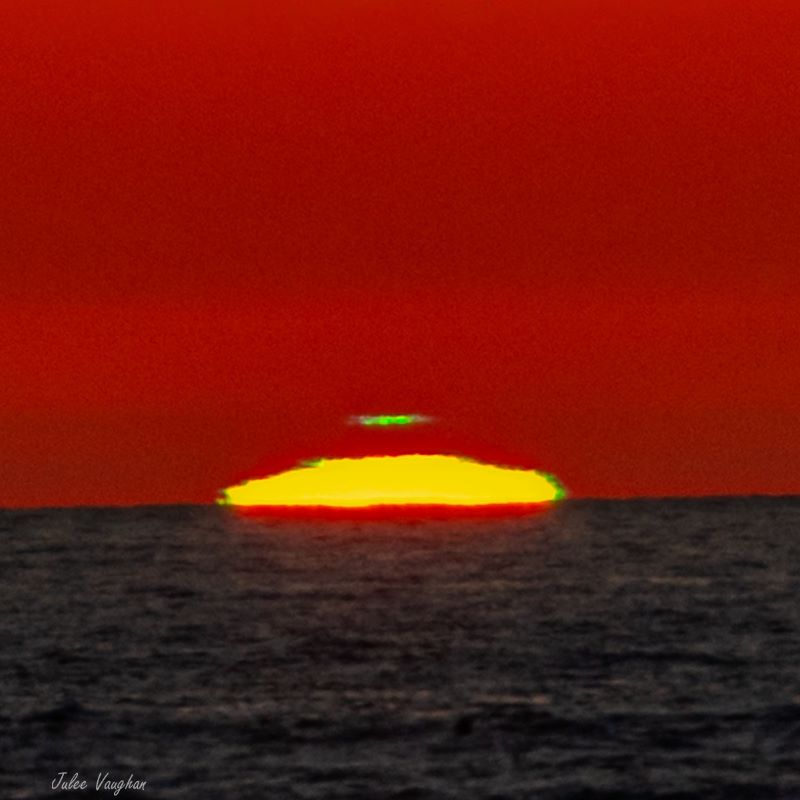
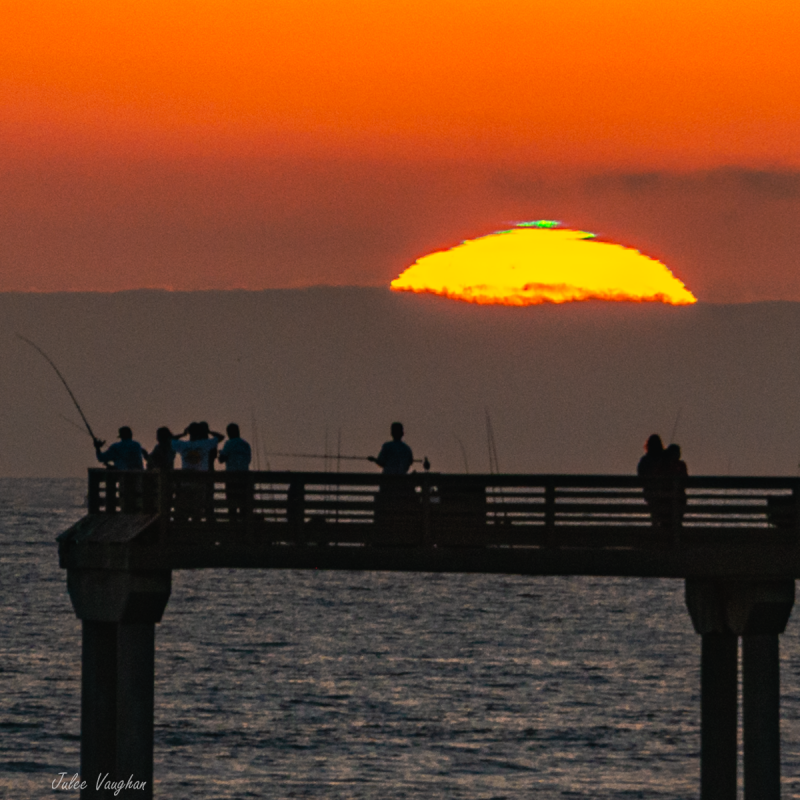
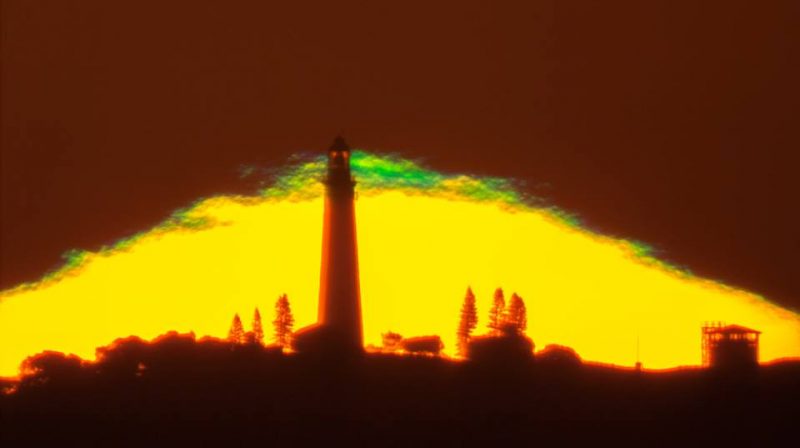
View at EarthSky Community Photos. | Julee Vaughan in Ocean Beach, San Diego, California, captured this green flash on November 11, 2023. Julee wrote: “This was one of three green flash shots I got Saturday, Mother Nature put on a show!” Thank you, Julee!
What is a green flash?
People say that when you go to the beach to look at the sunset, you can try to see a green flash. But what is it? The green flash is an optical phenomenon that you can see shortly after sunset or before sunrise. It happens when the sun is almost entirely below the horizon, with the upper edge still visible. For a second or two, that upper rim of the sun will appear green in color, sometimes blue. It’s a brief flash of the color green, and quite exciting to see, especially if you’ve been looking for one!
Green flashes do play a role in some legends. It’s said that once you’ve seen a green flash, you’ll never again go wrong in matters of the heart.
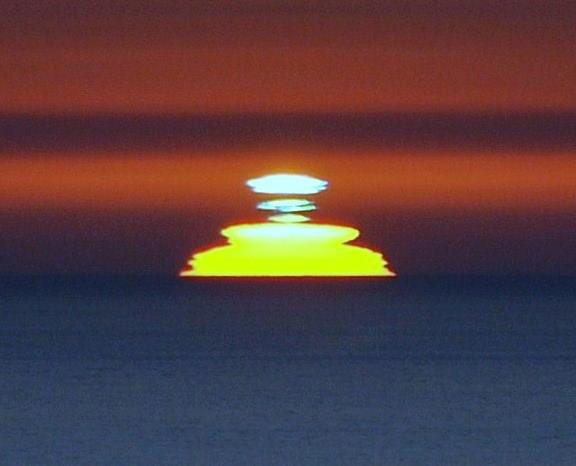
Mock mirage and green flash over the Pacific, seen by Jim Grant in San Diego. Published with permission.
How can you see one?
You just need two things to see a green flash:
1. A clear day with no haze or clouds on the horizon.
2. A distant horizon, and a distinct edge to the horizon. You can see the green flash from a mountaintop or high building. But most often people on the beach or in boats see them over the ocean.
Important tip: Don’t look at the sun until it is nearly entirely below the horizon. If you do, you will dazzle (or damage) your eyes and ruin your green flash chances for that day.
Because you need to know exactly where to look along the horizon, and because most of us aren’t up before dawn, green flashes are most often seen after sunset. But diligent observers can see them before dawn, too. And it’s possible to see green flashes over land, too, if your horizon is far enough away.
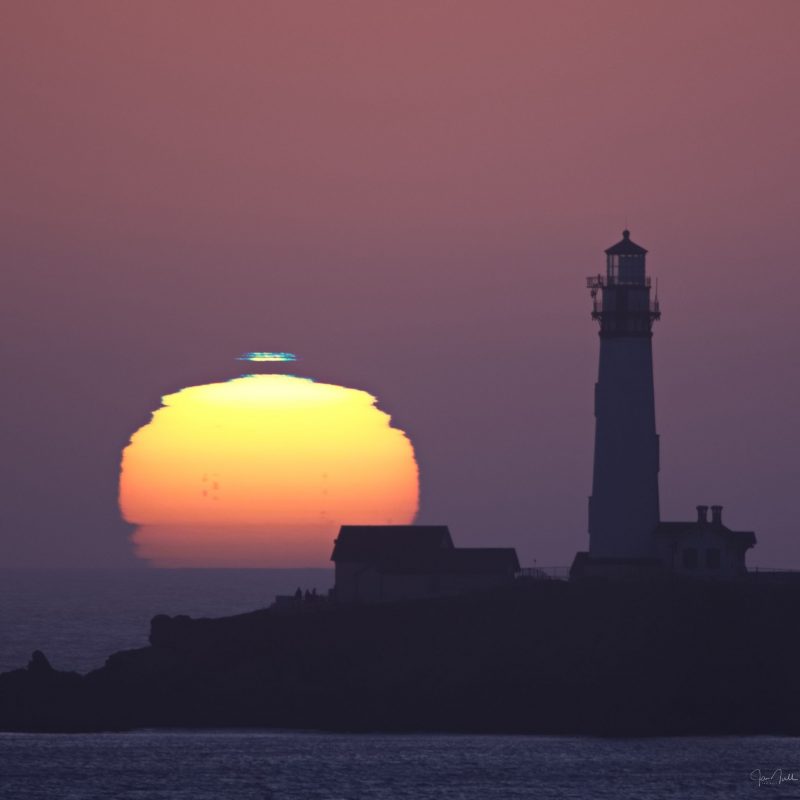
View at EarthSky Community Photos. | Jan Null took this photo on July 21, 2023, from Pigeon Point, California. Jan wrote: “Photographing Pigeon Point Lighthouse and capturing the green (and occasionally blue) flash are two of my favorite subjects on the San Mateo County Coast of California. There was slight inversion on one of the few fog-free days this summer. I drove there hoping to possibly catch one or the other. Fortunately, I was able to get both with probably the most distinct blue color I have seen, with a very strong blue spike on the histogram.” Thank you, Jan!
Inferior mirages are produced by warm air at the ocean or earth’s surface and an air temperature gradient changing rapidly with height. Rays from a low sun are refracted back upward as they pass between the cool and warm layers. Refraction always tends to deflect rays toward the denser layer. An observer above the layer sees two solar images or parts of them (1) an erect image from rays that pass relatively undeflected above the warm layer and (2) a lower inverted image from rays mirrored upward by the warm layer. Each sun image is as ‘real’ as the other. The effect is not dissimilar to the mirage seen above a hot road surface.
As the sunset proceeds, the upper and lower images approach, touch and eventually overlap to form an ‘omega’ shaped sun.
A green flash occurs because at a later stage the deflection by the warm layer/cooler air boundary becomes very sensitive to the angle of incidence of the sun’s rays. Small deviations are vertically magnified including the difference in deflection between red and green rays. This amplification provides the separation between green and red that refraction through a normal atmosphere cannot accomplish.
What is the green ray?
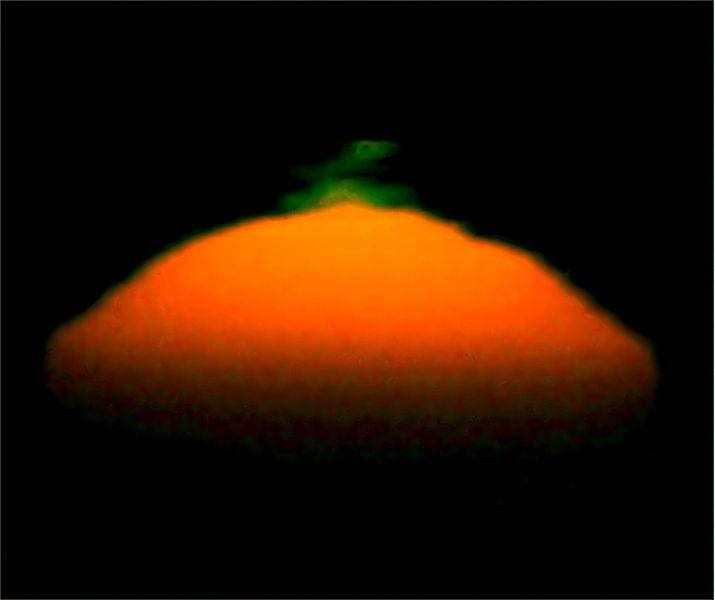
The flash can be like a flame that shoots above the horizon. In that case, it’s called a green ray. I’ve seen lots of green flashes, but never a green ray, although I was once walking on a beach in Mexico and turned away just as my companion saw one.
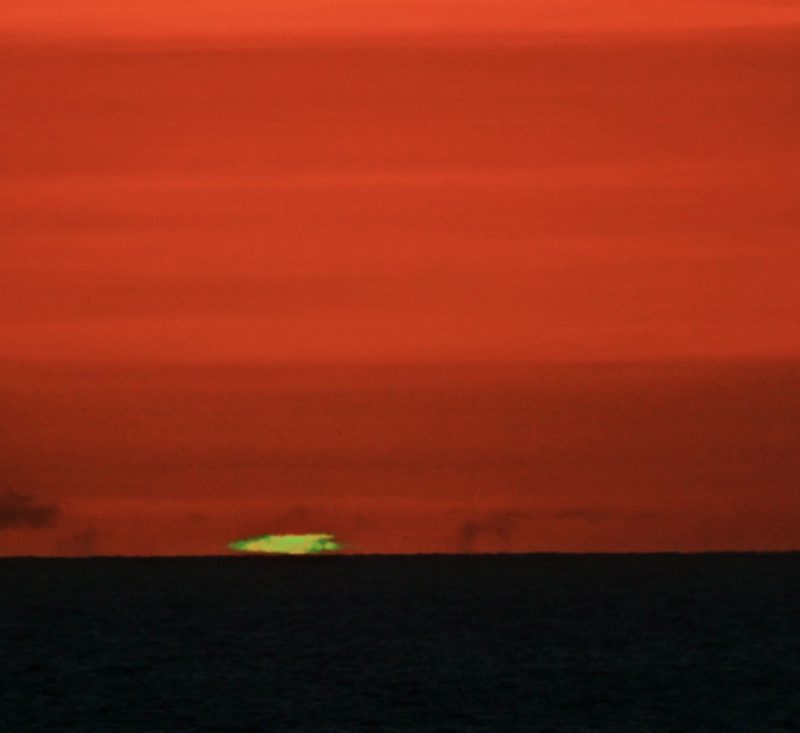
I did not find any photos of flamelike green rays (if you know of one, let me know), but the photo below suggests the beginnings of a ray.
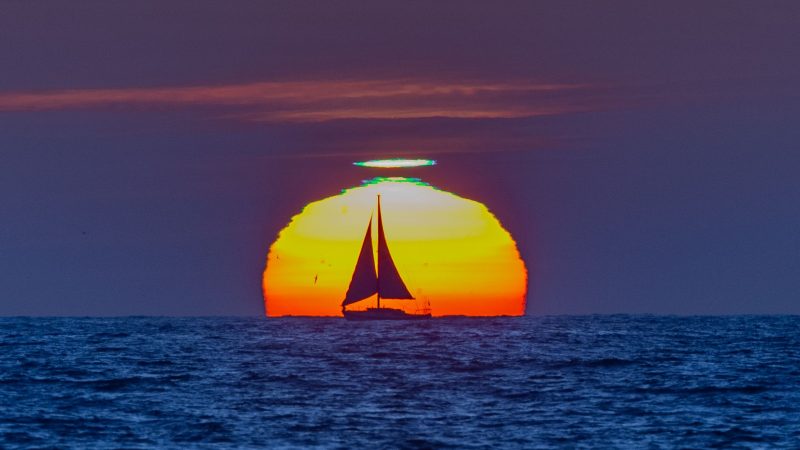
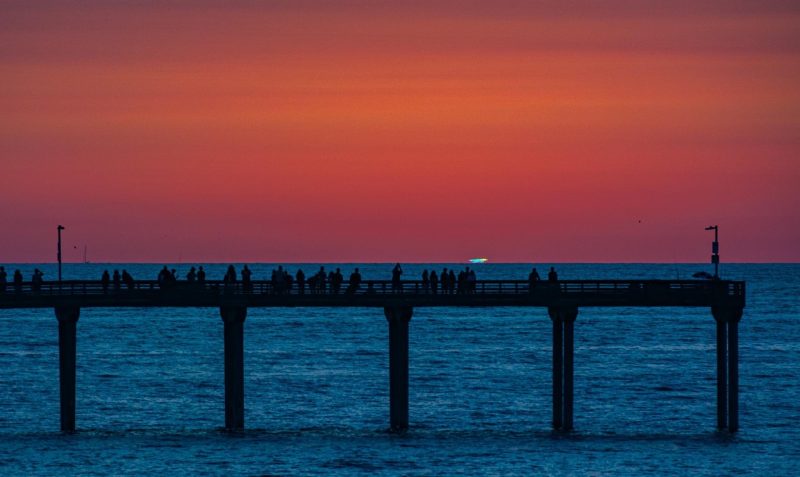
View at EarthSky Community Photos. | Julee Vaughan caught this green flash at Ocean Beach Fishing Pier, San Diego, California, on July 14, 2023. She commented: “A lot of people think the flash is just a myth, but it isn’t. It’s very real.” So true! Thanks, Julia!View at EarthSky Community Photos. | Jim Grant caught this green flash at the Ocean Beach Pier in San Diego, California, on July 19, 2023. Jim wrote: “This sailboat was drifting close to the Ocean Beach Pier, I knew the sunset was going to be stunning, and I started tracking the boat, hoping to get it centered in the sun. The green rim and green flash above were a bonus.” Thank you, Jim!View at EarthSky Community Photos. | Jim Grant in San Diego, California, captured this green flash on July 12, 2023. Jim wrote: “I took this from an elevated deck directly across the street from the Ocean Beach Pier. I was 40 feet above sea level on a pretty clear day with a slight inversion layer in place.” Thank you, Jim!View larger at EarthSky Community Photos. | Bill Miller caught this green flash in Sint Maarten on April 27, 2020. He wrote: “We see green flashes frequently, but it is always a challenge to get a good picture of one … timing is everything.” Thanks, Bill!Green flash atop sun pyramid, in 2014, via Colin Legg. Used with permission.Jim Grant photographed this green flash on April 27, 2012, off the coast of San Diego. Used with permission.
More great green flash photos
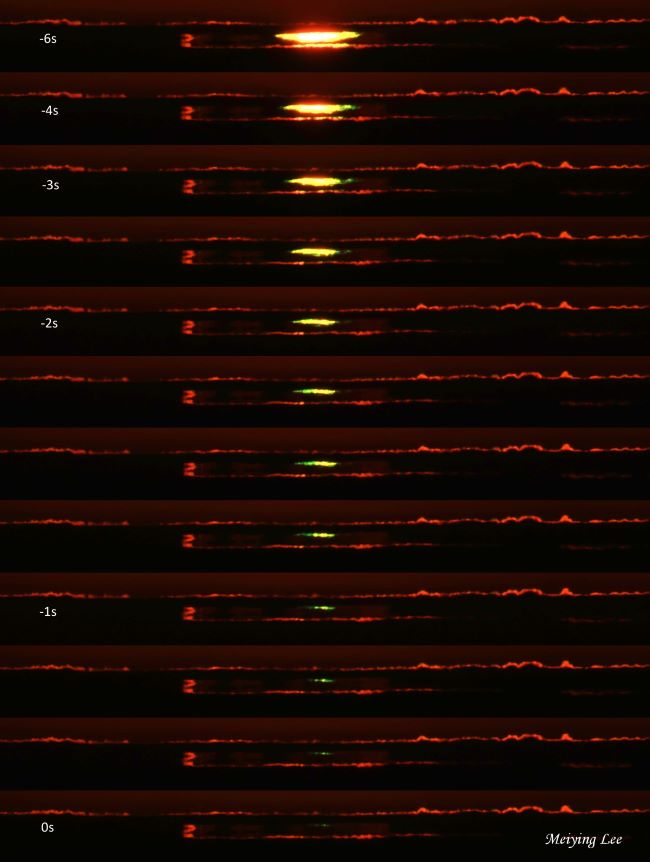
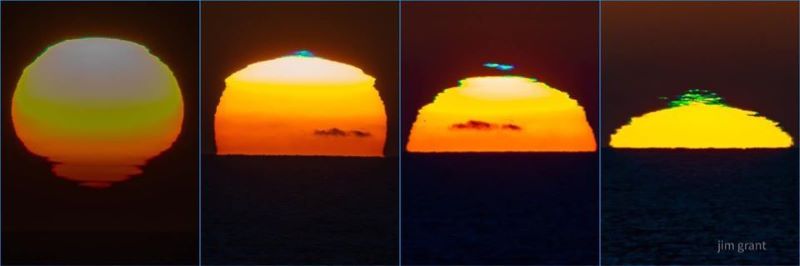
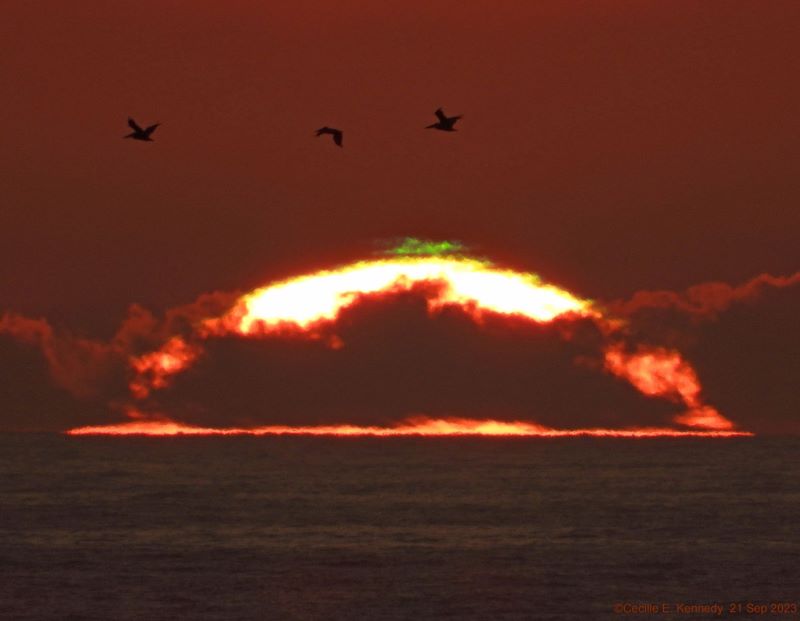
View at EarthSky Community Photos. | Meiying Lee in Mount Hehuan, Nantou, Taiwan, captured these images on January 31, 2023. Meiying wrote: “The last 6 seconds of sunset. When the sun has fallen below the horizon, we can continue to see sunlight because of atmospheric refraction. In the last few seconds, when there is only one line of sunlight left, because of the different refractive indices of various colors of light, we can see different colors of light … yellow, green, and blue are arranged on that line like pearls!” Thank you, Meiying!View at EarthSky Community Photos. | Jim Grant in San Diego, California, captured this series showing the green flash on February 19, 2020. Thank you, Jim!View at EarthSky Community Photos. | Cecille Kennedy on the Oregon Coast captured this image on September 21, 2023. Cecille wrote: “The green flash appeared on top of the fiery red sun as it was setting on the ocean horizon. Over the sun the birds flying south are brown pelicans migrating to South California and Mexico.” Thank you, Cecille!
Bottom line: Learn what a green flash is and how to see one here. Plus, enjoy great photos!
View at EarthSky Community Photos. | Julee Vaughan in Ocean Beach, San Diego, California, captured this green flash on November 11, 2023. Julee wrote: “This was one of three green flash shots I got Saturday, Mother Nature put on a show!” Thank you, Julee!
What is a green flash?
People say that when you go to the beach to look at the sunset, you can try to see a green flash. But what is it? The green flash is an optical phenomenon that you can see shortly after sunset or before sunrise. It happens when the sun is almost entirely below the horizon, with the upper edge still visible. For a second or two, that upper rim of the sun will appear green in color, sometimes blue. It’s a brief flash of the color green, and quite exciting to see, especially if you’ve been looking for one!
Green flashes do play a role in some legends. It’s said that once you’ve seen a green flash, you’ll never again go wrong in matters of the heart.
Mock mirage and green flash over the Pacific, seen by Jim Grant in San Diego. Published with permission.
How can you see one?
You just need two things to see a green flash:
1. A clear day with no haze or clouds on the horizon.
2. A distant horizon, and a distinct edge to the horizon. You can see the green flash from a mountaintop or high building. But most often people on the beach or in boats see them over the ocean.
Important tip: Don’t look at the sun until it is nearly entirely below the horizon. If you do, you will dazzle (or damage) your eyes and ruin your green flash chances for that day.
Because you need to know exactly where to look along the horizon, and because most of us aren’t up before dawn, green flashes are most often seen after sunset. But diligent observers can see them before dawn, too. And it’s possible to see green flashes over land, too, if your horizon is far enough away.
View at EarthSky Community Photos. | Jan Null took this photo on July 21, 2023, from Pigeon Point, California. Jan wrote: “Photographing Pigeon Point Lighthouse and capturing the green (and occasionally blue) flash are two of my favorite subjects on the San Mateo County Coast of California. There was slight inversion on one of the few fog-free days this summer. I drove there hoping to possibly catch one or the other. Fortunately, I was able to get both with probably the most distinct blue color I have seen, with a very strong blue spike on the histogram.” Thank you, Jan!
Inferior mirages are produced by warm air at the ocean or earth’s surface and an air temperature gradient changing rapidly with height. Rays from a low sun are refracted back upward as they pass between the cool and warm layers. Refraction always tends to deflect rays toward the denser layer. An observer above the layer sees two solar images or parts of them (1) an erect image from rays that pass relatively undeflected above the warm layer and (2) a lower inverted image from rays mirrored upward by the warm layer. Each sun image is as ‘real’ as the other. The effect is not dissimilar to the mirage seen above a hot road surface.
As the sunset proceeds, the upper and lower images approach, touch and eventually overlap to form an ‘omega’ shaped sun.
A green flash occurs because at a later stage the deflection by the warm layer/cooler air boundary becomes very sensitive to the angle of incidence of the sun’s rays. Small deviations are vertically magnified including the difference in deflection between red and green rays. This amplification provides the separation between green and red that refraction through a normal atmosphere cannot accomplish.
What is the green ray?
The flash can be like a flame that shoots above the horizon. In that case, it’s called a green ray. I’ve seen lots of green flashes, but never a green ray, although I was once walking on a beach in Mexico and turned away just as my companion saw one.
I did not find any photos of flamelike green rays (if you know of one, let me know), but the photo below suggests the beginnings of a ray.
View at EarthSky Community Photos. | Julee Vaughan caught this green flash at Ocean Beach Fishing Pier, San Diego, California, on July 14, 2023. She commented: “A lot of people think the flash is just a myth, but it isn’t. It’s very real.” So true! Thanks, Julia!View at EarthSky Community Photos. | Jim Grant caught this green flash at the Ocean Beach Pier in San Diego, California, on July 19, 2023. Jim wrote: “This sailboat was drifting close to the Ocean Beach Pier, I knew the sunset was going to be stunning, and I started tracking the boat, hoping to get it centered in the sun. The green rim and green flash above were a bonus.” Thank you, Jim!View at EarthSky Community Photos. | Jim Grant in San Diego, California, captured this green flash on July 12, 2023. Jim wrote: “I took this from an elevated deck directly across the street from the Ocean Beach Pier. I was 40 feet above sea level on a pretty clear day with a slight inversion layer in place.” Thank you, Jim!View larger at EarthSky Community Photos. | Bill Miller caught this green flash in Sint Maarten on April 27, 2020. He wrote: “We see green flashes frequently, but it is always a challenge to get a good picture of one … timing is everything.” Thanks, Bill!Green flash atop sun pyramid, in 2014, via Colin Legg. Used with permission.Jim Grant photographed this green flash on April 27, 2012, off the coast of San Diego. Used with permission.
More great green flash photos
View at EarthSky Community Photos. | Meiying Lee in Mount Hehuan, Nantou, Taiwan, captured these images on January 31, 2023. Meiying wrote: “The last 6 seconds of sunset. When the sun has fallen below the horizon, we can continue to see sunlight because of atmospheric refraction. In the last few seconds, when there is only one line of sunlight left, because of the different refractive indices of various colors of light, we can see different colors of light … yellow, green, and blue are arranged on that line like pearls!” Thank you, Meiying!View at EarthSky Community Photos. | Jim Grant in San Diego, California, captured this series showing the green flash on February 19, 2020. Thank you, Jim!View at EarthSky Community Photos. | Cecille Kennedy on the Oregon Coast captured this image on September 21, 2023. Cecille wrote: “The green flash appeared on top of the fiery red sun as it was setting on the ocean horizon. Over the sun the birds flying south are brown pelicans migrating to South California and Mexico.” Thank you, Cecille!
Bottom line: Learn what a green flash is and how to see one here. Plus, enjoy great photos!
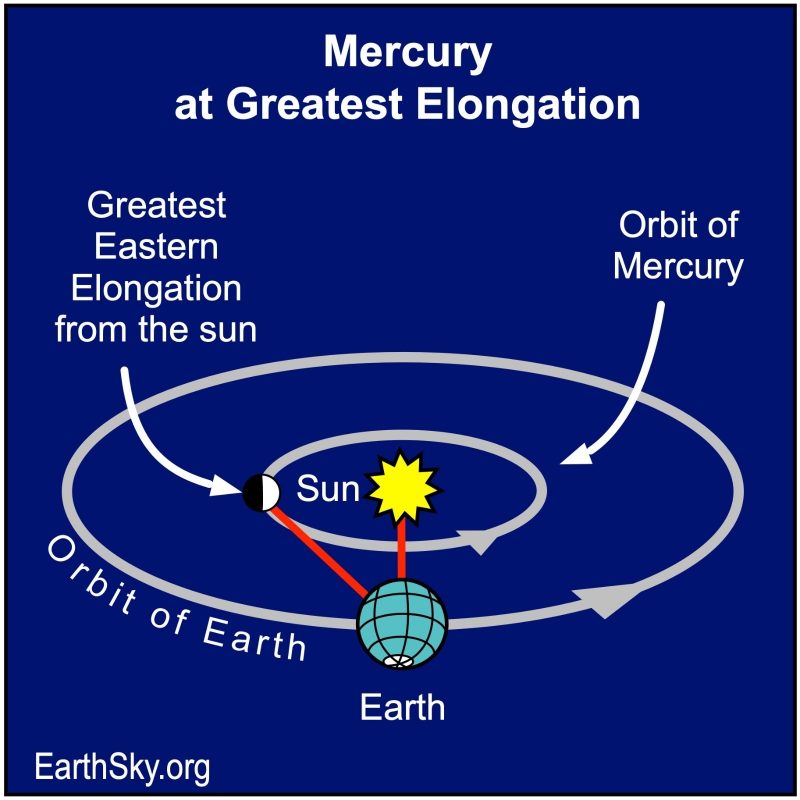
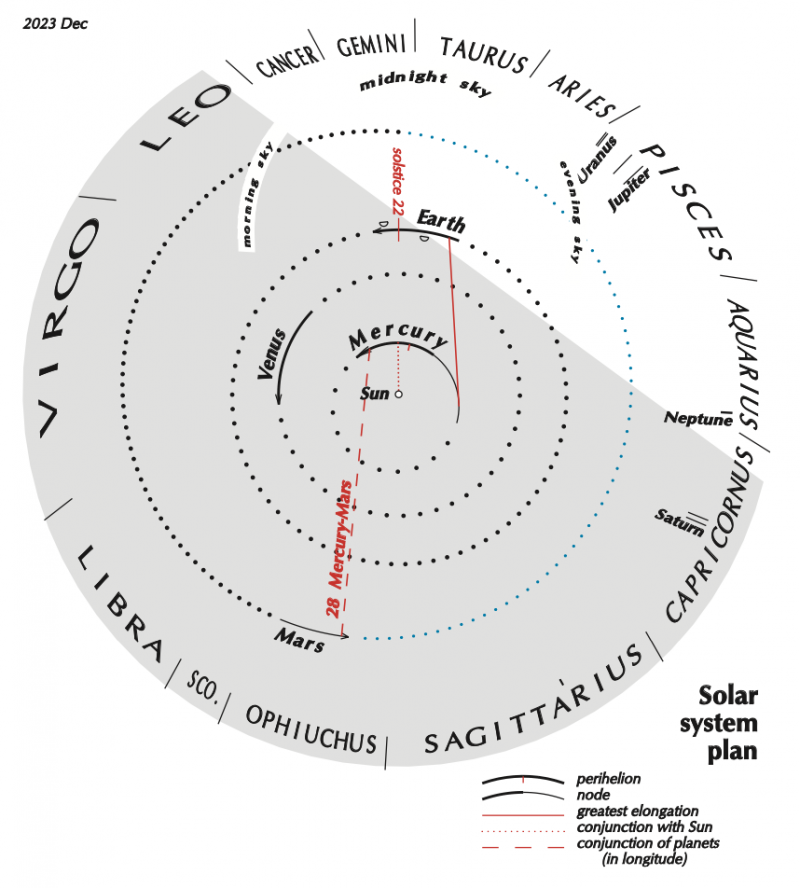
On December 4, Mercury reaches its furthest angular distance from the sun, known as greatest eastern elongation. On this date, it lies low in the southwest. Chart via John Jardine Goss/ EarthSky.
Where to look: Look west, in the sunset direction – shortly after sunset – for Mercury. The sun’s innermost planet may be challenging even for the more favored view from the Southern Hemisphere. Greatest elongation: Mercury is farthest from the sun – at greatest elongation – at 14 UTC on December 4, 2023 (8 a.m. CDT on December 4). It’s 21 degrees from the sun. Brightness: Mercury will emerge in the evening sky the second week of November at -0.5 magnitude but it’s at a far southerly declination so it’ll be difficult for the Northern Hemisphere. At greatest elongation, Mercury shines at magnitude -0.3, making it brighter than most stars. But, after greatest elongation, the innermost planet will rapidly fade as it sweeps toward Earth. It’ll probably disappear by mid-month and will reach inferior conjunction – when it will pass between Earth and the sun – on December 22. Through a telescope: Mercury will appear about 62% illuminated, at greatest elongation. It’ll measure 6.7 arcseconds across. Constellation: Mercury will lie in front of the constellation Sagittarius the Archer at this elongation. But most of stars of this constellation will be lost in the twilight. Note: As the innermost planet, Mercury is tied to the sun in our sky. As a result, it never ventures very far above the horizon after sunset. So as soon as the sun disappears below your horizon, your clock starts ticking. Will you see the glowing point of light that is Mercury before it drops below the horizon, following the setting sun?
At greatest elongation, Mercury is on one side of the sun and is at its greatest distance from the sun on our sky’s dome. Mercury reaches greatest eastern (evening) elongation from the sun on December 4, 2023. And it is 21 degrees from the sun in the evening sky. Chart via John Jardine Goss/ EarthSky.
Finder charts for November Northern Hemisphere evenings
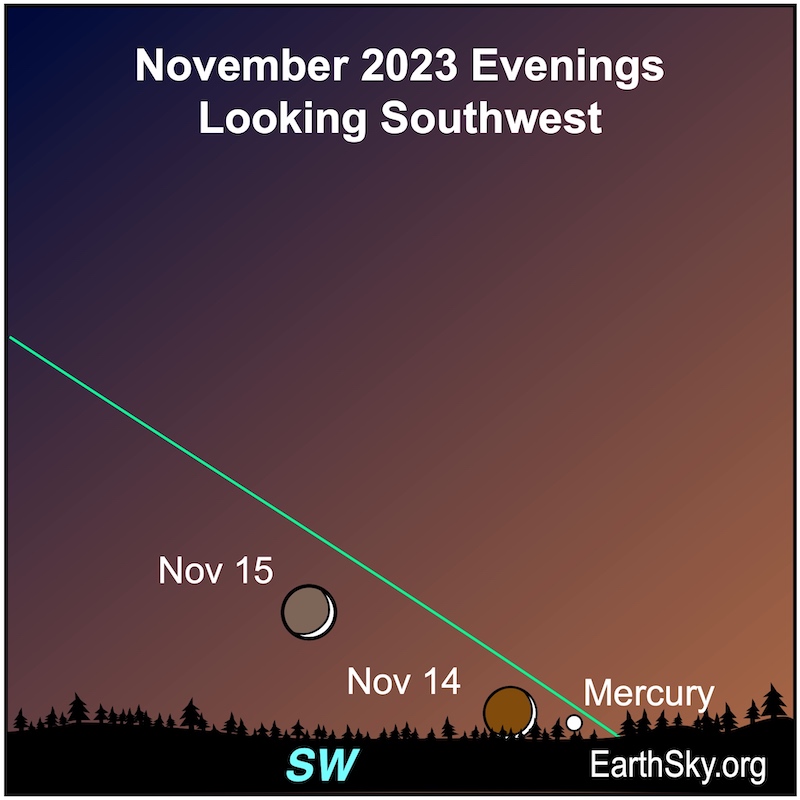
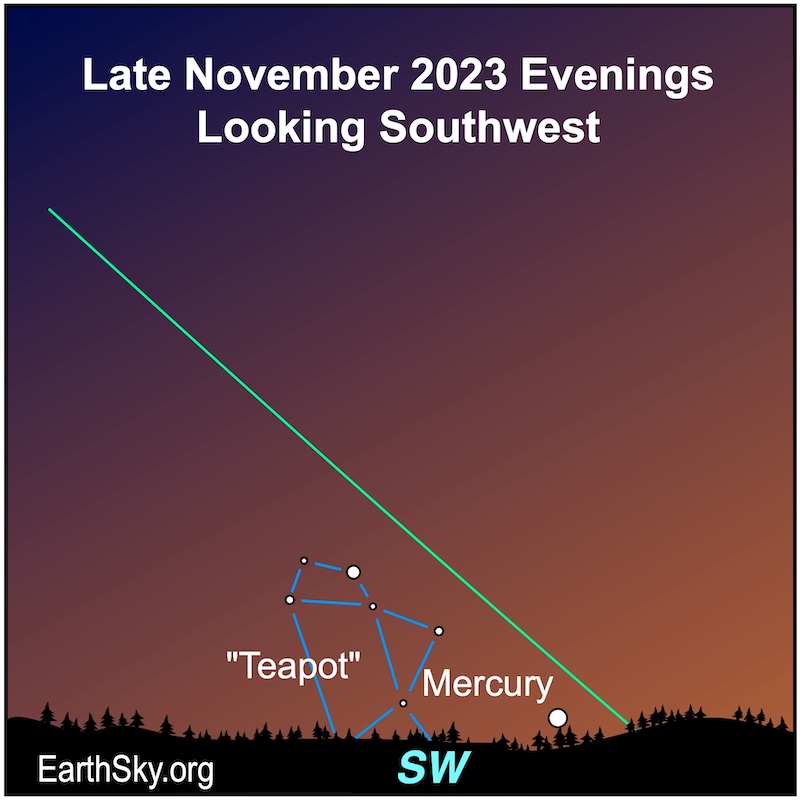
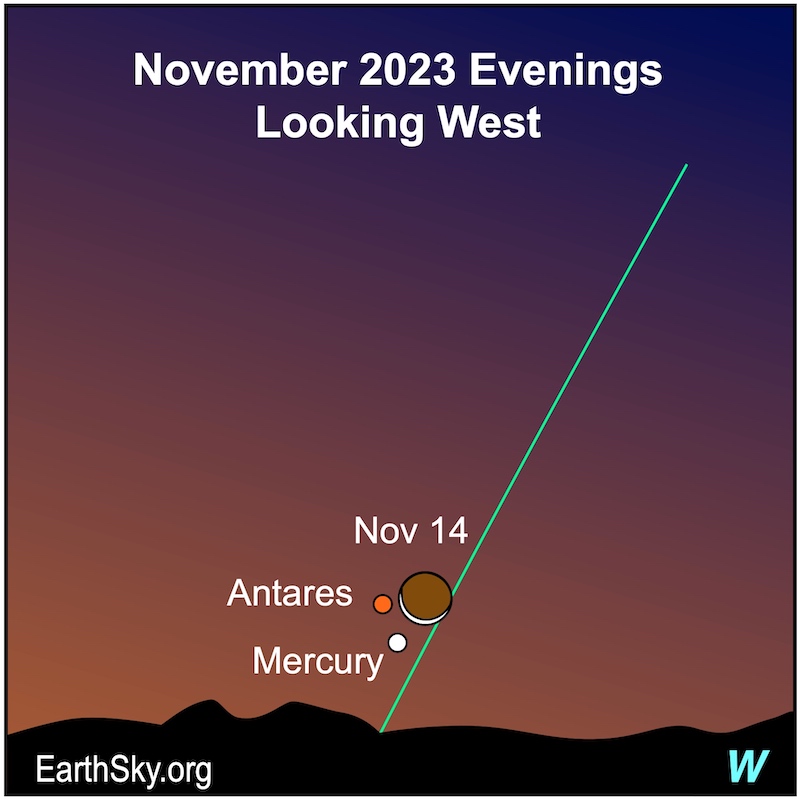
The slender waxing crescent moon will hang low in the southwest shortly after sunset on the evenings of November 14 and 15, 2023. Binoculars will help spot Mercury near the moon in the bright twilight on November 14, 2023. Chart via John Jardine Goss/ EarthSky.For viewers in the Northern Hemisphere, Mercury will lie just above the horizon in the bright twilight shortly after sunset in the second half of November 2023. The Teapot asterism of Sagittarius is nearby but it will be difficult to spot in the bright evening twilight. Chart via John Jardine Goss/ EarthSky.
Finder charts for November Southern Hemisphere evenings
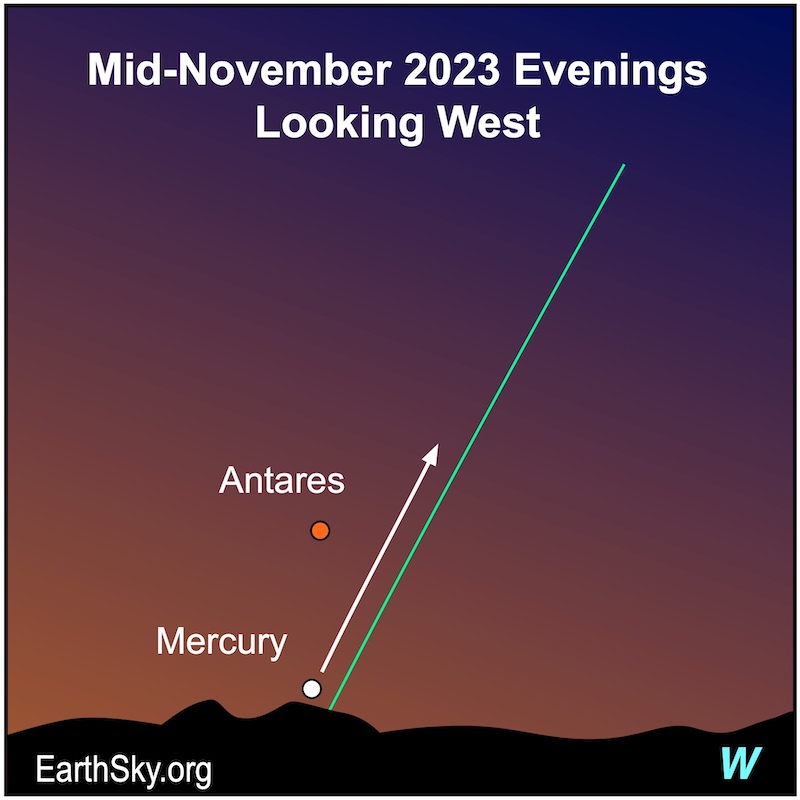
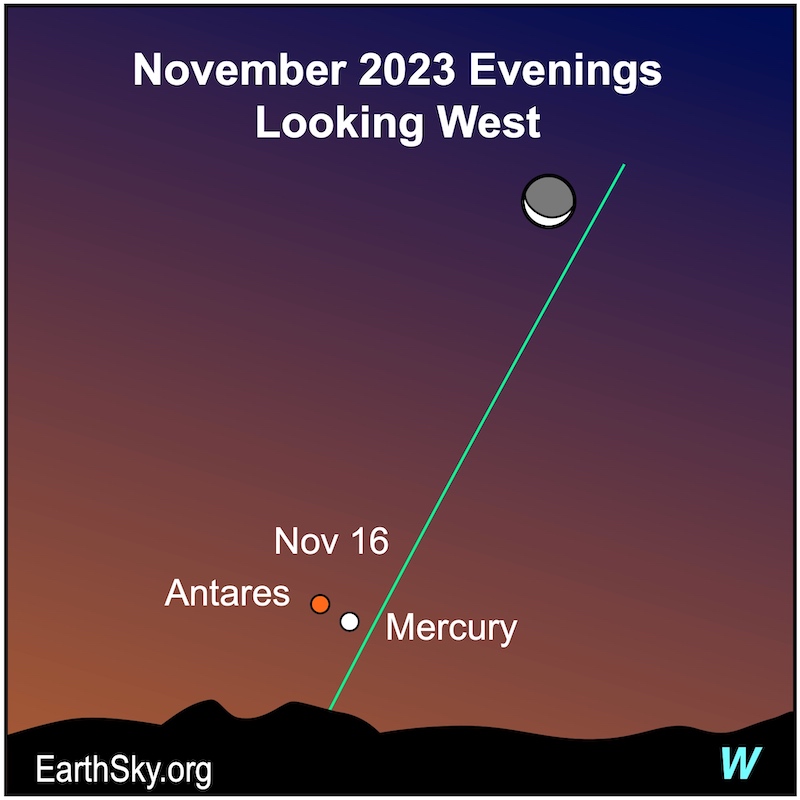
As viewed from the Southern Hemisphere, Mercury will appear low in the west shortly after sunset after November 10, 2023. Look for the bright red star Antares nearby. Chart via John Jardine Goss/ EarthSky.As viewed from the Southern Hemisphere, the waxing crescent moon will form an attractive triangle with Mercury and Antares shortly after sunset on November 14, 2023. Chart via John Jardine Goss/ EarthSky.As viewed from the Southern Hemisphere, Mercury will pass the star Antares on November 16, 2023. Chart via John Jardine Goss/ EarthSky.During the second half of November 2023, Mercury will lie low in the west below the Teapot asterism of Sagittarius shortly after sunset. Chart via John Jardine Goss/ EarthSky.
For precise sun and Mercury rising times at your location:
Jan 7, 2023:Inferior conjunction (races between Earth and sun) Jan 30, 2023: Greatest elongation (morning) Mar 17, 2023:Superior conjunction (passes behind sun from Earth) Apr 11, 2023: Greatest elongation (evening) May 1, 2023: Inferior conjunction (races between Earth and sun) May 29, 2023: Greatest elongation (morning) Jul 1, 2023: Superior conjunction (passes behind sun from Earth) Aug 10, 2023: Greatest elongation (evening) Sep 6, 2023: Inferior conjunction (races between Earth and sun) Sep 22, 2023: Greatest elongation (morning) Oct 20, 2023: Superior conjunction (passes behind sun from Earth) Dec 4, 2023: Greatest elongation (evening) Dec 22, 2023: Inferior conjunction (races between Earth and sun)
Jan 12, 2024: Greatest elongation (morning) Feb 28, 2024:Superior conjunction (passes behind sun from Earth) Mar 24, 2024: Greatest elongation (evening) Apr 11, 2024: Inferior conjunction (races between Earth and sun) May 9, 2024: Greatest elongation (morning) Jun 14, 2024: Superior conjunction (passes behind sun from Earth) Jul 22, 2024: Greatest elongation (evening) Aug 19, 2024: Inferior conjunction (races between Earth and sun) Sep 5, 2024: Greatest elongation (morning) Sep 30, 2024: Superior conjunction (passes behind sun from Earth) Nov 16, 2024: Greatest elongation (evening) Dec 5, 2024: Inferior conjunction (races between Earth and sun) Dec 25, 2024: Greatest elongation (morning)
The farthest from the sun that Mercury can ever appear on the sky’s dome is about 28 degrees. And the least distance is around 18 degrees.
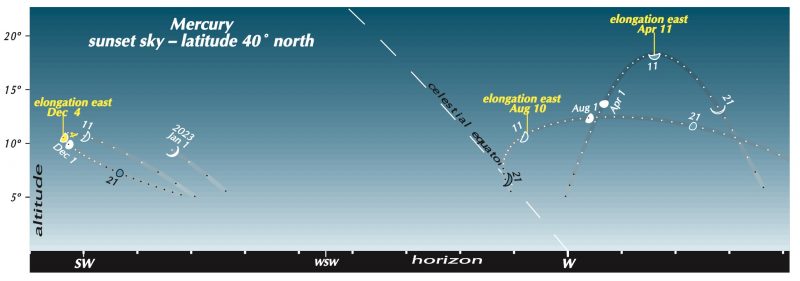
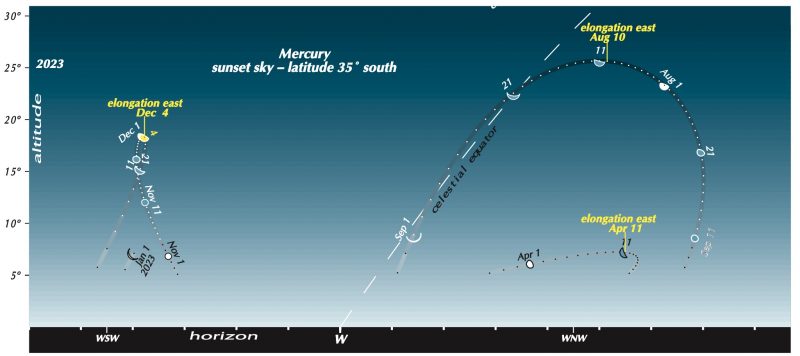
Also, elongations are better or worse depending on the time of year they occur. So in 2023, the Southern Hemisphere had the best evening elongation of Mercury in August 2023. And the Northern Hemisphere had the best evening apparition in April.
In the autumn for either hemisphere, the ecliptic – or path of the sun, moon and planets – makes a narrow angle to the horizon in the evening. But it makes a steep slant, nearly perpendicular, in the morning. So, in autumn from either hemisphere, morning elongations of Mercury are best. That’s when Mercury appears higher above the horizon and farther from the glow of the sun. However, evening elongations in autumn are harder to see.
In the spring for either hemisphere, the situation reverses. The ecliptic and horizon meet at a sharper angle on spring evenings and a narrower angle on spring mornings. So, in springtime for either hemisphere, evening elongations of Mercury are best. Meanwhile, morning elongations in springtime are harder to see.
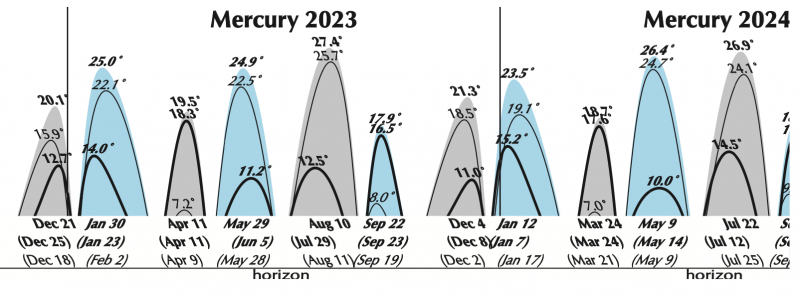
View larger. | Mercury elongations compared. Here, gray areas represent evening apparitions (eastward elongation). And blue areas represent morning apparitions (westward elongation). The top figures are the maximum elongations, reached at the top dates shown beneath. Curves show the altitude of the planet above the horizon at sunrise or sunset, for latitude 40 degrees north (thick line) and 35 degrees south (thin). Maxima are reached at the parenthesized dates below (40 degrees north bold). Chart via Guy Ottewell’s 2023 Astronomical Calendar. Used with permission.
More Mercury elongation comparisons for 2023
View larger. | Mercury’s greatest evening elongations in 2023 from the Northern Hemisphere as viewed through a powerful telescope. The planet images are at the 1st, 11th, and 21st of each month. Dots show the actual positions of the planet for every day. Chart via Guy Ottewell. Used with permission.View larger. | Mercury’s greatest evening elongations in 2023 from the Southern Hemisphere as viewed through a powerful telescope. The planet images are at the 1st, 11th, and 21st of each month. Dots show the actual positions of the planet for every day. Chart via Guy Ottewell. Used with permission.
Mercury photos from our community
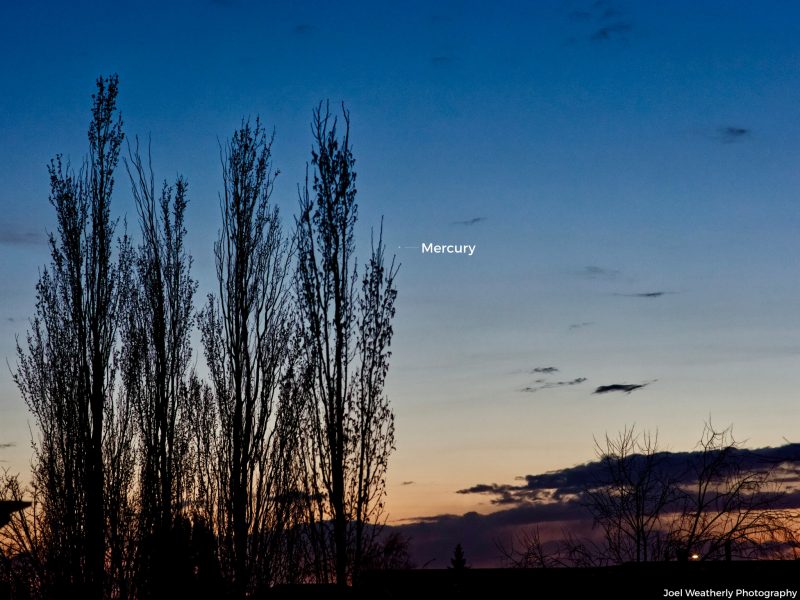
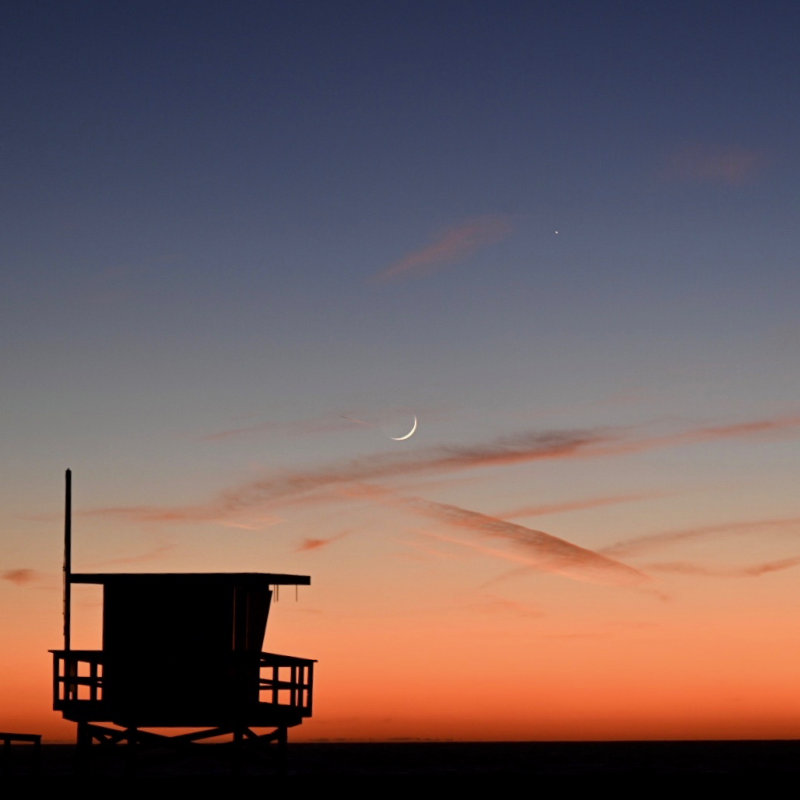
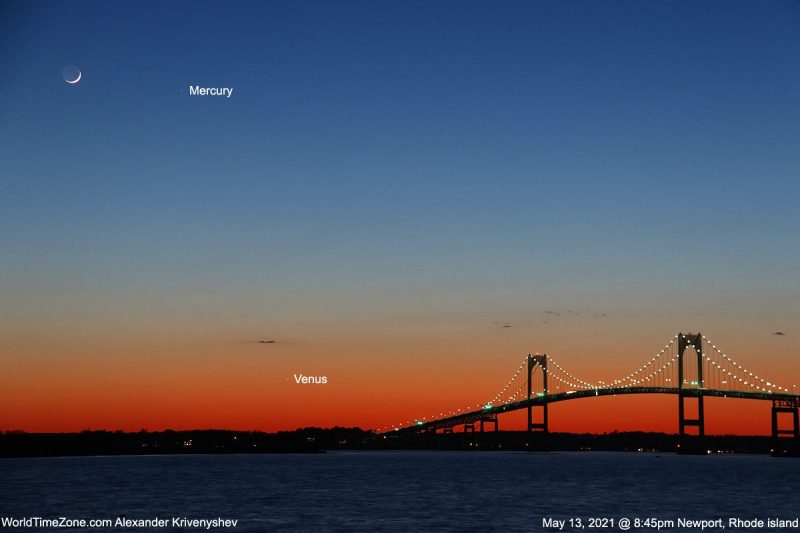
View at EarthSky Community Photos. | Joel Weatherly in Edmonton, Alberta, Canada, took this image on April 23, 2022. Joel wrote: “Lonely little Mercury is making an appearance in our evening skies. Despite being elusive, it was easy to see without optical aid once sighted.” Thank you, Joel!View at EarthSky Community Photos. | Chix RC captured this image on January 3, 2022, from Hermosa Beach, California. See Mercury to the upper right of the crescent? Chix wrote: “A faint young moon at 1% illumination and Mercury.” Thank you, Chix!View at EarthSky Community Photos. | Alexander Krivenyshev of the website WorldTimeZone.com captured this photo of the moon together with Mercury and Venus on May 13, 2021, from Newport, Rhode Island. Thank you, Alexander!
Bottom line: Mercury is visible in the evening sky. Look in the west as the sky is darkening. The planet will reach its greatest elongation overnight on December 4, 2023.
On December 4, Mercury reaches its furthest angular distance from the sun, known as greatest eastern elongation. On this date, it lies low in the southwest. Chart via John Jardine Goss/ EarthSky.
Where to look: Look west, in the sunset direction – shortly after sunset – for Mercury. The sun’s innermost planet may be challenging even for the more favored view from the Southern Hemisphere. Greatest elongation: Mercury is farthest from the sun – at greatest elongation – at 14 UTC on December 4, 2023 (8 a.m. CDT on December 4). It’s 21 degrees from the sun. Brightness: Mercury will emerge in the evening sky the second week of November at -0.5 magnitude but it’s at a far southerly declination so it’ll be difficult for the Northern Hemisphere. At greatest elongation, Mercury shines at magnitude -0.3, making it brighter than most stars. But, after greatest elongation, the innermost planet will rapidly fade as it sweeps toward Earth. It’ll probably disappear by mid-month and will reach inferior conjunction – when it will pass between Earth and the sun – on December 22. Through a telescope: Mercury will appear about 62% illuminated, at greatest elongation. It’ll measure 6.7 arcseconds across. Constellation: Mercury will lie in front of the constellation Sagittarius the Archer at this elongation. But most of stars of this constellation will be lost in the twilight. Note: As the innermost planet, Mercury is tied to the sun in our sky. As a result, it never ventures very far above the horizon after sunset. So as soon as the sun disappears below your horizon, your clock starts ticking. Will you see the glowing point of light that is Mercury before it drops below the horizon, following the setting sun?
At greatest elongation, Mercury is on one side of the sun and is at its greatest distance from the sun on our sky’s dome. Mercury reaches greatest eastern (evening) elongation from the sun on December 4, 2023. And it is 21 degrees from the sun in the evening sky. Chart via John Jardine Goss/ EarthSky.
Finder charts for November Northern Hemisphere evenings
The slender waxing crescent moon will hang low in the southwest shortly after sunset on the evenings of November 14 and 15, 2023. Binoculars will help spot Mercury near the moon in the bright twilight on November 14, 2023. Chart via John Jardine Goss/ EarthSky.For viewers in the Northern Hemisphere, Mercury will lie just above the horizon in the bright twilight shortly after sunset in the second half of November 2023. The Teapot asterism of Sagittarius is nearby but it will be difficult to spot in the bright evening twilight. Chart via John Jardine Goss/ EarthSky.
Finder charts for November Southern Hemisphere evenings
As viewed from the Southern Hemisphere, Mercury will appear low in the west shortly after sunset after November 10, 2023. Look for the bright red star Antares nearby. Chart via John Jardine Goss/ EarthSky.As viewed from the Southern Hemisphere, the waxing crescent moon will form an attractive triangle with Mercury and Antares shortly after sunset on November 14, 2023. Chart via John Jardine Goss/ EarthSky.As viewed from the Southern Hemisphere, Mercury will pass the star Antares on November 16, 2023. Chart via John Jardine Goss/ EarthSky.During the second half of November 2023, Mercury will lie low in the west below the Teapot asterism of Sagittarius shortly after sunset. Chart via John Jardine Goss/ EarthSky.
For precise sun and Mercury rising times at your location:
Jan 7, 2023:Inferior conjunction (races between Earth and sun) Jan 30, 2023: Greatest elongation (morning) Mar 17, 2023:Superior conjunction (passes behind sun from Earth) Apr 11, 2023: Greatest elongation (evening) May 1, 2023: Inferior conjunction (races between Earth and sun) May 29, 2023: Greatest elongation (morning) Jul 1, 2023: Superior conjunction (passes behind sun from Earth) Aug 10, 2023: Greatest elongation (evening) Sep 6, 2023: Inferior conjunction (races between Earth and sun) Sep 22, 2023: Greatest elongation (morning) Oct 20, 2023: Superior conjunction (passes behind sun from Earth) Dec 4, 2023: Greatest elongation (evening) Dec 22, 2023: Inferior conjunction (races between Earth and sun)
Jan 12, 2024: Greatest elongation (morning) Feb 28, 2024:Superior conjunction (passes behind sun from Earth) Mar 24, 2024: Greatest elongation (evening) Apr 11, 2024: Inferior conjunction (races between Earth and sun) May 9, 2024: Greatest elongation (morning) Jun 14, 2024: Superior conjunction (passes behind sun from Earth) Jul 22, 2024: Greatest elongation (evening) Aug 19, 2024: Inferior conjunction (races between Earth and sun) Sep 5, 2024: Greatest elongation (morning) Sep 30, 2024: Superior conjunction (passes behind sun from Earth) Nov 16, 2024: Greatest elongation (evening) Dec 5, 2024: Inferior conjunction (races between Earth and sun) Dec 25, 2024: Greatest elongation (morning)
The farthest from the sun that Mercury can ever appear on the sky’s dome is about 28 degrees. And the least distance is around 18 degrees.
Also, elongations are better or worse depending on the time of year they occur. So in 2023, the Southern Hemisphere had the best evening elongation of Mercury in August 2023. And the Northern Hemisphere had the best evening apparition in April.
In the autumn for either hemisphere, the ecliptic – or path of the sun, moon and planets – makes a narrow angle to the horizon in the evening. But it makes a steep slant, nearly perpendicular, in the morning. So, in autumn from either hemisphere, morning elongations of Mercury are best. That’s when Mercury appears higher above the horizon and farther from the glow of the sun. However, evening elongations in autumn are harder to see.
In the spring for either hemisphere, the situation reverses. The ecliptic and horizon meet at a sharper angle on spring evenings and a narrower angle on spring mornings. So, in springtime for either hemisphere, evening elongations of Mercury are best. Meanwhile, morning elongations in springtime are harder to see.
View larger. | Mercury elongations compared. Here, gray areas represent evening apparitions (eastward elongation). And blue areas represent morning apparitions (westward elongation). The top figures are the maximum elongations, reached at the top dates shown beneath. Curves show the altitude of the planet above the horizon at sunrise or sunset, for latitude 40 degrees north (thick line) and 35 degrees south (thin). Maxima are reached at the parenthesized dates below (40 degrees north bold). Chart via Guy Ottewell’s 2023 Astronomical Calendar. Used with permission.
More Mercury elongation comparisons for 2023
View larger. | Mercury’s greatest evening elongations in 2023 from the Northern Hemisphere as viewed through a powerful telescope. The planet images are at the 1st, 11th, and 21st of each month. Dots show the actual positions of the planet for every day. Chart via Guy Ottewell. Used with permission.View larger. | Mercury’s greatest evening elongations in 2023 from the Southern Hemisphere as viewed through a powerful telescope. The planet images are at the 1st, 11th, and 21st of each month. Dots show the actual positions of the planet for every day. Chart via Guy Ottewell. Used with permission.
Mercury photos from our community
View at EarthSky Community Photos. | Joel Weatherly in Edmonton, Alberta, Canada, took this image on April 23, 2022. Joel wrote: “Lonely little Mercury is making an appearance in our evening skies. Despite being elusive, it was easy to see without optical aid once sighted.” Thank you, Joel!View at EarthSky Community Photos. | Chix RC captured this image on January 3, 2022, from Hermosa Beach, California. See Mercury to the upper right of the crescent? Chix wrote: “A faint young moon at 1% illumination and Mercury.” Thank you, Chix!View at EarthSky Community Photos. | Alexander Krivenyshev of the website WorldTimeZone.com captured this photo of the moon together with Mercury and Venus on May 13, 2021, from Newport, Rhode Island. Thank you, Alexander!
Bottom line: Mercury is visible in the evening sky. Look in the west as the sky is darkening. The planet will reach its greatest elongation overnight on December 4, 2023.
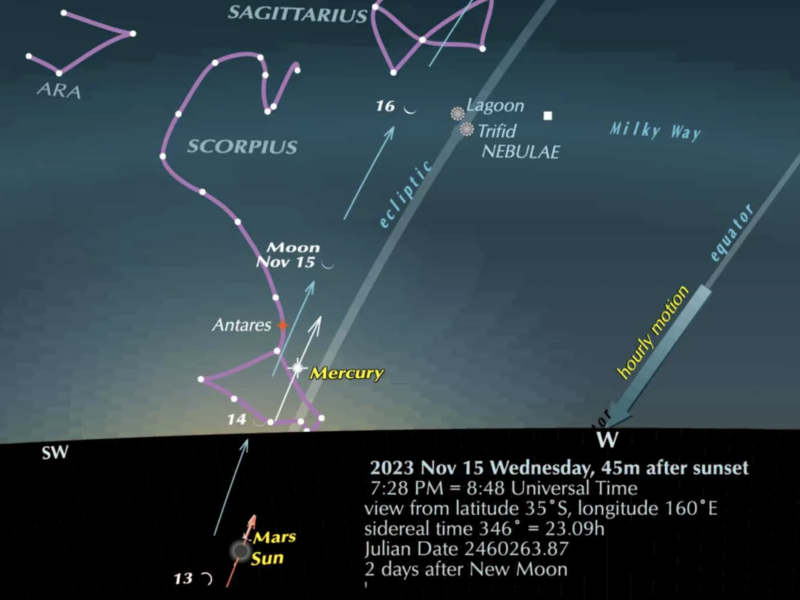
View larger. | This chart shows the sky trio – the young moon, Mercury and star Antares – on the evening of November 15, 2023, for latitude 35 degrees south, longitude 160 degrees east, in other words, around Australia and New Zealand. Image via Guy Ottewell. Used with permission.
Sometimes we get notes from people in Australia and New Zealand – who are across the International Date Line – that they wish we’d provide our charts a day earlier. This chart is for you!
There’ll be a pretty gathering of three objects low in the west after sunset on November 15, 2023. But the meetup is more likely to be seen from Earth’s Southern Hemisphere. As the young moon – a waxing crescent in the evening sky – climbs away from the sun, it’ll pass close to Mercury and the red star Antares.
Why Southern Hemisphere? Don’t we all see the same sky? We do, to a large extent. But our orientation – from our various parts of Earth – gives us a varying perspective on the sky. And – for all of us around the globe right now – the moon, Antares and Mercury are now low in the evening sky, in the west only shortly after sunset. From the Southern Hemisphere now, the ecliptic (pathway of the sun, moon and planets) makes a reasonably steep angle with the western evening horizon, placing the trio above the sunset. But the moon, Mercury and Antares are all on a part of the ecliptic that slopes south from where the sun now is. And this fact depresses the view still more for Northern Hemisphere observers.
So our scene this time is drawn for a location that approximates Australia and New Zealand.
The moment when this trio of bright bodies is tightest – fitting within a circle of diameter just over 4 degrees – is at 21 UTC on November 14. But they are then still so low in the western sky, only about 17 degrees from the sun, that the following evening probably gives a better chance of spotting them.
What’s more, on November 15, the crescent of the moon will be slightly thicker and easier to see. Good luck spotting this pretty sky scene.
Bottom line: A tight grouping of the waxing crescent moon, planet Mercury and red star Antares appears in this chart showing the trio as seen from Australia and New Zealand on the evening of November 15, 2023. Be sure to look as soon as possible after sunset!
View larger. | This chart shows the sky trio – the young moon, Mercury and star Antares – on the evening of November 15, 2023, for latitude 35 degrees south, longitude 160 degrees east, in other words, around Australia and New Zealand. Image via Guy Ottewell. Used with permission.
Sometimes we get notes from people in Australia and New Zealand – who are across the International Date Line – that they wish we’d provide our charts a day earlier. This chart is for you!
There’ll be a pretty gathering of three objects low in the west after sunset on November 15, 2023. But the meetup is more likely to be seen from Earth’s Southern Hemisphere. As the young moon – a waxing crescent in the evening sky – climbs away from the sun, it’ll pass close to Mercury and the red star Antares.
Why Southern Hemisphere? Don’t we all see the same sky? We do, to a large extent. But our orientation – from our various parts of Earth – gives us a varying perspective on the sky. And – for all of us around the globe right now – the moon, Antares and Mercury are now low in the evening sky, in the west only shortly after sunset. From the Southern Hemisphere now, the ecliptic (pathway of the sun, moon and planets) makes a reasonably steep angle with the western evening horizon, placing the trio above the sunset. But the moon, Mercury and Antares are all on a part of the ecliptic that slopes south from where the sun now is. And this fact depresses the view still more for Northern Hemisphere observers.
So our scene this time is drawn for a location that approximates Australia and New Zealand.
The moment when this trio of bright bodies is tightest – fitting within a circle of diameter just over 4 degrees – is at 21 UTC on November 14. But they are then still so low in the western sky, only about 17 degrees from the sun, that the following evening probably gives a better chance of spotting them.
What’s more, on November 15, the crescent of the moon will be slightly thicker and easier to see. Good luck spotting this pretty sky scene.
Bottom line: A tight grouping of the waxing crescent moon, planet Mercury and red star Antares appears in this chart showing the trio as seen from Australia and New Zealand on the evening of November 15, 2023. Be sure to look as soon as possible after sunset!
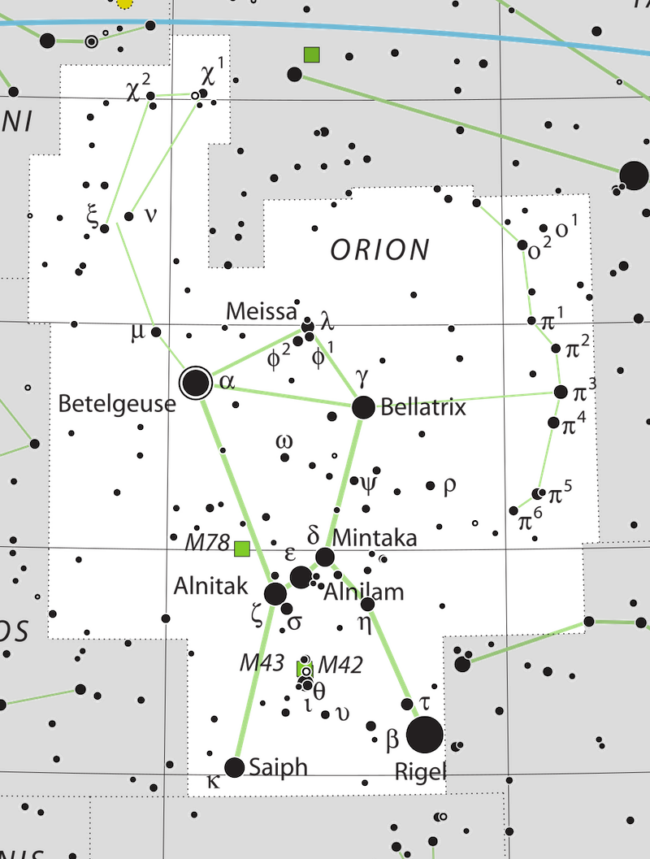
Orion the Hunter – a very noticeable constellation – rises in the east on November evenings. You can’t miss it! Chart via Chelynne Campion/ EarthSky.
Orion the Hunter’s season in the sky
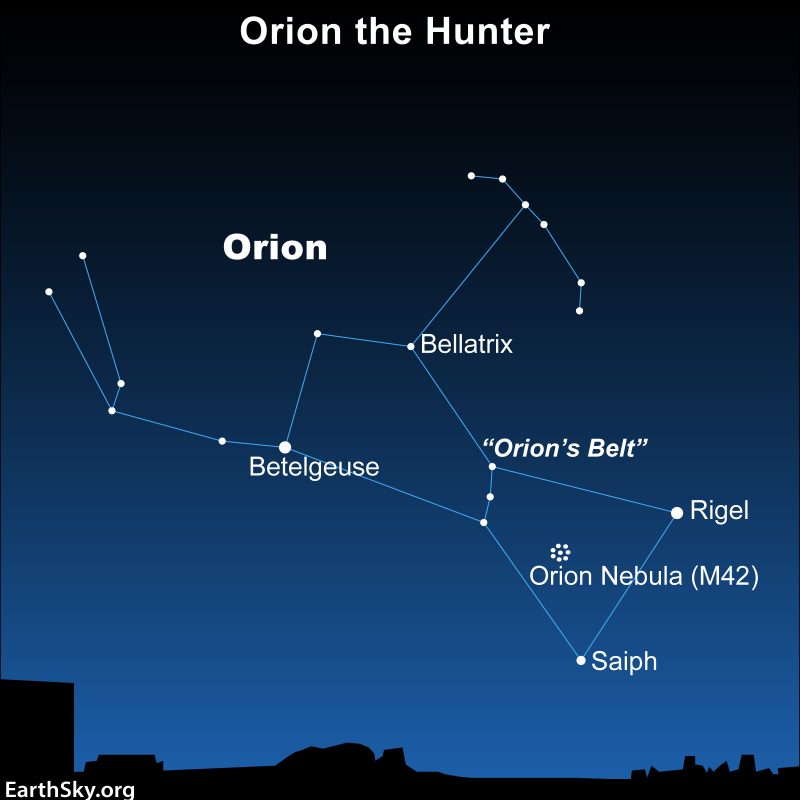
November evenings are a great time to say hello to everyone’s favorite constellation: Orion the Hunter. Find Orion now and enjoy it for months to come! Without a doubt, Orion is the easiest-to-identify of all constellations. Look for it in the eastern sky this month, say, between the hours of 10 p.m. and midnight (that’s your local time, the time on your clock no matter where you are). You’ll notice Orion’s Belt first. The Belt is made of three stars in a short, straight row. The Belt stars aren’t the brightest in the sky. But they’re the reason Orion will catch your eye.
And you’ll also notice Orion’s two brightest stars – Betelgeuse and Rigel – shining on opposite sides of the Belt.
You can find this constellation easily. You can point it out to your friends!
So look for Orion. It’s at this time of year – say, around mid-November and into early December – that casual skywatchers start to notice Orion and comment on it.
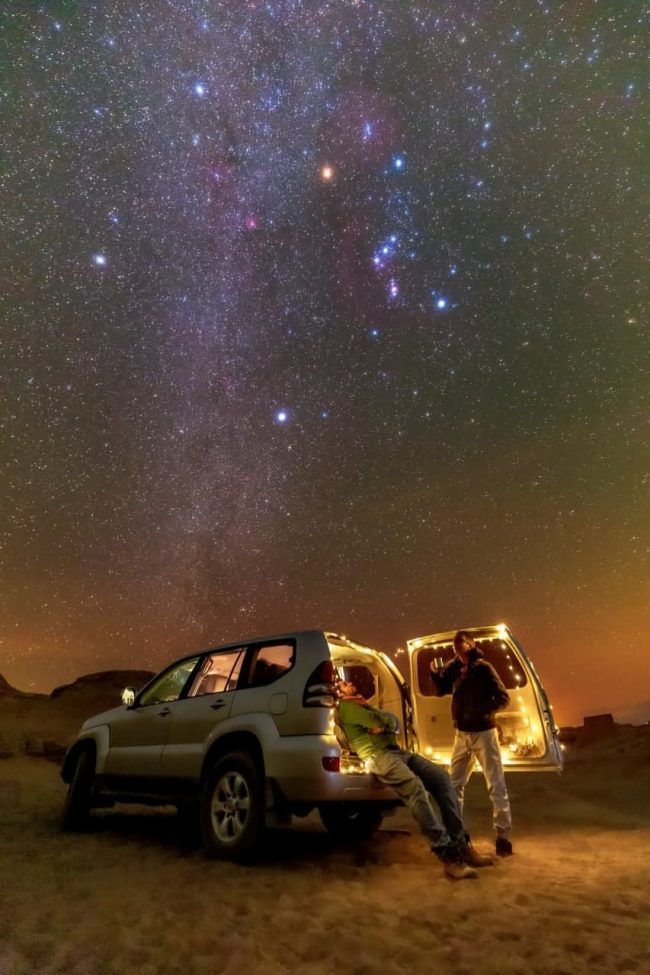
View at EarthSky Community Photos. | Parisa Bajelan took this photo of Orion after midnight on November 17, 2017, from Iran and shared it with EarthSky. Parisa wrote: “Lut Desert is one of the hottest and darkest areas on earth.” Thank you, Parisa!
As the weeks pass …
In mid-November, Orion doesn’t reach its highest point until an hour or two after midnight your local time. Northern Hemisphere skywatchers will find it high in the south at its highest point. Southern Hemisphere skywatchers will find it generally northward.
Like all the stars, Orion’s stars rise some four minutes earlier with each passing day, or about two hours earlier with each passing month. If you see Orion shining in the east at 10 p.m. tonight, look for this constellation to be in the same place in the sky at about 8 p.m. a month from now. Or if Orion is due south at 2 a.m. tomorrow, look for Orion to be due south at midnight one month later.
This shift in Orion’s location is due to Earth’s movement in orbit around the sun. As we move around the sun, our perspective on the stars surrounding us shifts. At the same hour daily, all the stars in the eastern half of the sky climb up a bit higher. And at the same time on your clock each day, all the stars in the western half of the sky sink a bit closer to the western horizon.
Star map of Orion
A map of Orion the Hunter, showing the locations of Betelgeuse and Rigel. Image via IAU/ Sky & Telescope magazine/ Wikimedia Commons (CC BY 3.0).
Bottom line: By mid-to-late November, the famous constellation Orion the Hunter is back in the evening sky! Its most recognizable feature is called Orion’s Belt: a short, straight line of three medium-bright stars.
Orion the Hunter – a very noticeable constellation – rises in the east on November evenings. You can’t miss it! Chart via Chelynne Campion/ EarthSky.
Orion the Hunter’s season in the sky
November evenings are a great time to say hello to everyone’s favorite constellation: Orion the Hunter. Find Orion now and enjoy it for months to come! Without a doubt, Orion is the easiest-to-identify of all constellations. Look for it in the eastern sky this month, say, between the hours of 10 p.m. and midnight (that’s your local time, the time on your clock no matter where you are). You’ll notice Orion’s Belt first. The Belt is made of three stars in a short, straight row. The Belt stars aren’t the brightest in the sky. But they’re the reason Orion will catch your eye.
And you’ll also notice Orion’s two brightest stars – Betelgeuse and Rigel – shining on opposite sides of the Belt.
You can find this constellation easily. You can point it out to your friends!
So look for Orion. It’s at this time of year – say, around mid-November and into early December – that casual skywatchers start to notice Orion and comment on it.
View at EarthSky Community Photos. | Parisa Bajelan took this photo of Orion after midnight on November 17, 2017, from Iran and shared it with EarthSky. Parisa wrote: “Lut Desert is one of the hottest and darkest areas on earth.” Thank you, Parisa!
As the weeks pass …
In mid-November, Orion doesn’t reach its highest point until an hour or two after midnight your local time. Northern Hemisphere skywatchers will find it high in the south at its highest point. Southern Hemisphere skywatchers will find it generally northward.
Like all the stars, Orion’s stars rise some four minutes earlier with each passing day, or about two hours earlier with each passing month. If you see Orion shining in the east at 10 p.m. tonight, look for this constellation to be in the same place in the sky at about 8 p.m. a month from now. Or if Orion is due south at 2 a.m. tomorrow, look for Orion to be due south at midnight one month later.
This shift in Orion’s location is due to Earth’s movement in orbit around the sun. As we move around the sun, our perspective on the stars surrounding us shifts. At the same hour daily, all the stars in the eastern half of the sky climb up a bit higher. And at the same time on your clock each day, all the stars in the western half of the sky sink a bit closer to the western horizon.
Star map of Orion
A map of Orion the Hunter, showing the locations of Betelgeuse and Rigel. Image via IAU/ Sky & Telescope magazine/ Wikimedia Commons (CC BY 3.0).
Bottom line: By mid-to-late November, the famous constellation Orion the Hunter is back in the evening sky! Its most recognizable feature is called Orion’s Belt: a short, straight line of three medium-bright stars.
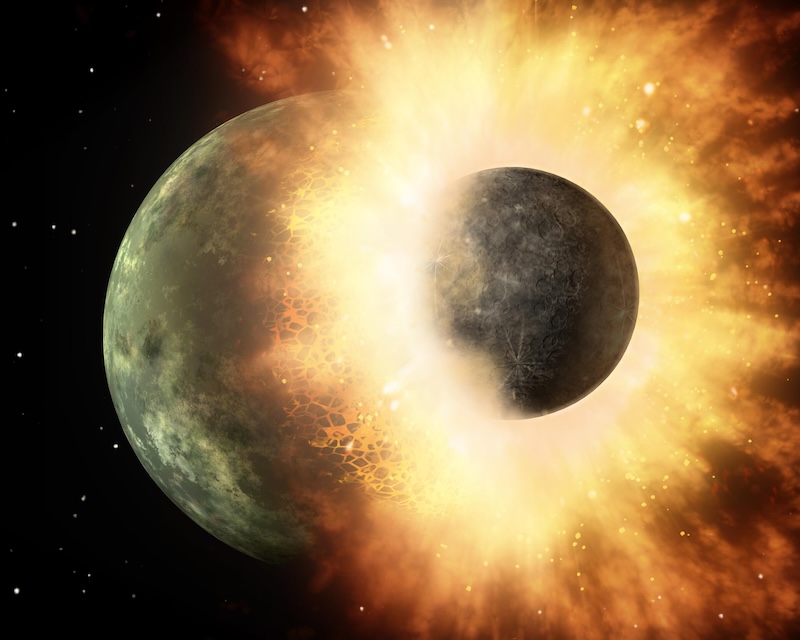
View larger. | Artist’s concept of an ancient collision between a planet-sized body and a planet about the size of our Earth. Scientists say such a collision happened billions of years ago, between the young Earth and a smaller body they call Theia. They say impact of Theia created our moon. And now, according to one theory, the impact also left behind 2 massive blobs inside Earth, composed of material which used to be part of Theia. Image via NASA/ JPL-Caltech.
Did you know Earth has two large “blobs” inside it? One is beneath Africa and the other is below the Pacific Ocean. And they’re big, too, both about twice the size of Earth’s moon! They’re not part of our world’s mantle, the layer of silicate rock between Earth’s crust and outer core. They’re made of different elements than the mantle. So how did these great blobs inside Earth come to be? An international team of researchers said on November 1, 2023, that the blobs are likely left over from an ancient collision, which many scientists believe happened billions of years ago. That was when a young planet – called Theia (THAY-eh) by scientists – might have collided with the early Earth. According to this theory, this massive impact also created Earth’s moon.
Ed Garnero, at Arizona State University’s School of Earth and Space Exploration and one of the researchers involved with this study, said:
It appears that Earth’s blobs are remnants of a planetary collision that formed our moon. In other words, the massive blobs currently inside Earth, deep beneath our feet, are extraterrestrial. Earth not only has ‘blobs,’ Earth has extraterrestrial blobs!
The researchers, led by geophysicist Qian Yuan at Caltech in California, published their peer-reviewed findings on November 1, 2023.
Scientists have known about the two blobs for over 20 years. Geophysicists first discovered them in the 1980s. Their composition was different from the surrounding mantle. If you could somehow melt them and place them on the Earth’s surface, they would form a layer 60 miles (100 km) thick around our entire planet. That’s huge when you consider that the typical cruising altitude for most commercial airplanes is between about 6 and nearly 8 miles (10 and 12 km) above sea level.
So these blobs inside Earth are big. And scientists know they’re there, inside Earth. But where did they come from?
When Theia collided with Earth
The new study suggests that the blobs formed from the same collision that created our moon. That collision was with the hypothesized Theia, a young planet smaller than Earth. Scientists think that material from the impact formed into the moon. But what about the rest of Theia? Where did the rest of the material go?
Scientists have still not found any trace of it in meteorites or the asteroid belt. But now, the researchers behind the new study said that Earth probably absorbed most of Theia.
Steven Desch is a professor in the School of Earth and Space Exploration at Arizona State University. He said:
The moon appears to have materials within it representative of both the pre-impact Earth and Theia, but it was thought that any remnants of Theia in the Earth would have been ‘erased’ and homogenized by billions of years of dynamics (e.g., mantle convection) within the Earth. This is the first study to make the case that distinct ‘pieces’ of Theia still reside within the Earth, at its core-mantle boundary.
Seismic waves
Scientists first discovered the blobs – called large low-velocity provinces, or LLVPs – using seismic waves. Seismic waves are vibrations generated by an earthquake, explosion or other energetic source. The waves travel through the Earth, at different speeds and through different materials.
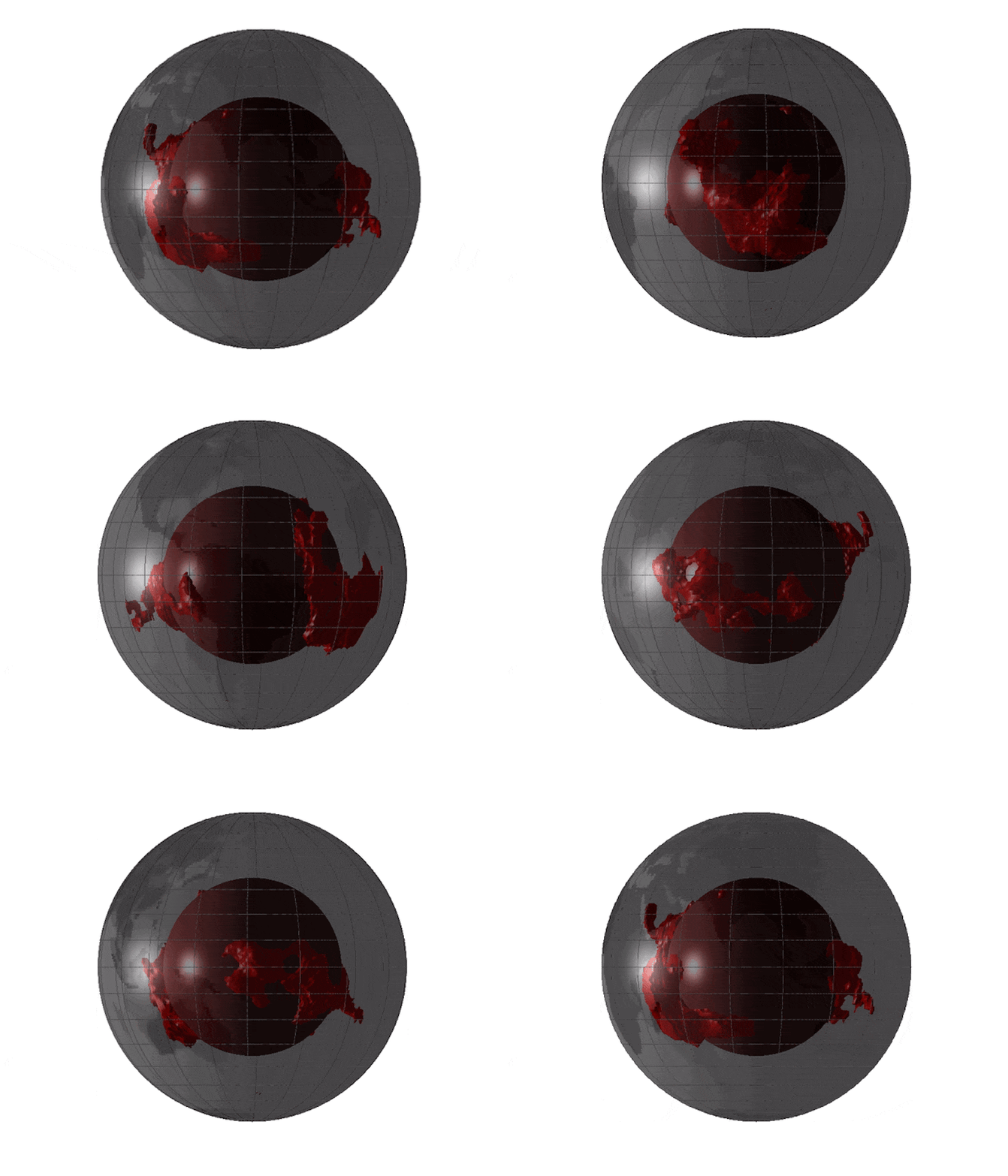
In the 1980s, studies of the seismic waves showed something unusual. There were large variations deep in the mantle. What was causing them? As it turned out, it was two structures – the two blobs – very deep below the surface, near the Earth’s core. They were hotter and denser than the surrounding mantle, and contained unusually high amounts of iron. And they were huge, the size of continents.
That’s how the blobs became known to scientists.
Extraterrestrial blobs
So the question became, how did they get there? And why are they made of such different materials from the rest of the mantle? The new study proposes an answer, after decades of research. They are remnants of Theia and the collision with Earth billions of years ago. The same collision gave birth to the moon.
This origin of the moon is called the giant impact hypothesis. Yuan had once attended a presentation about it by Mikhail Zolotov. Yuan suddenly realized that he might know where the blobs came from: Theia! No other trace of the impacting body had been found yet, and the moon is rich in iron. He said:
Right after Mikhail had said that no one knows where the impactor is now, I had a ‘eureka moment’ and realized that the iron-rich impactor could have transformed into mantle blobs.
So the remains of the impactor, Theia, were here all along, just deeply buried inside the Earth.
This animated gif depicts the 2 continent-sized blobs deep inside Earth’s mantle. Image via Cottaar and Lekic/ Live Science (CC BY 4.0).
Moon and blobs inside Earth have same origin
Of course, Theia is long gone. And we can’t drill far enough into Earth to extract a piece of the blobs and measure their composition. But these researchers tested their ideas by modeling possible chemical compositions of Theia. The results supported the idea that the blobs came from Theia, according to Mingming Li at Arizona State University:
This work showed that the large blobs (the LLVPs) in Earth’s deep mantle may be made of materials from a planetary body that impacted the proto-Earth and formed the moon. Therefore, the moon and the blobs have the same origin.
Now here’s another question. Why did the material form into two larger blobs instead of mixing with the mantle? The researchers explained this puzzle by saying that most of the energy from the impact remained in the upper half of the mantle. Since the lower mantle didn’t melt, despite the incredibly violent impact, the material from Theia remained intact for the most part. Instead of mixing in with the mantle, it formed into the two large blobs.
The researchers also said the material from Theia would likely remain at the bottom of the mantle. As Li explained:
Through mantle convection simulations, we found that the dense, iron-rich materials from Theia could sink to and accumulate at the base of Earth’s mantle. These materials could stay there throughout Earth’s history of about 4.5 billion years.
More evidence for moon-forming impact
So this study helps explain how the blobs inside Earth got there. The study also provides more evidence for the impact origin of the moon. Co-author Travis Gabriel at the U.S. Geological Survey said:
By looking inward, toward Earth’s interior, instead of outward, toward the moon, we have found yet another piece of evidence of the cosmic catastrophe that is the moon-forming giant impact.
A NASA study in 2022 also showed that the moon might have formed incredibly fast, in only a matter of hours. Wow!
Prior to our time, the origin of our moon was long debated. But modern scientists mostly agree it appears our moon formed as a result of a giant impact between Earth and another smaller rocky planet, Theia. Now it seems that collision left behind evidence, in the form of the two blobs inside Earth.
Those blobs have been mysterious since their discovery decades ago. Now they’re helping scientists solve another great mystery: the origin of our moon.
Bottom line: A new study from an international team of researchers says that two huge blobs inside Earth came from the collision with the planet Theia billions of years ago.
View larger. | Artist’s concept of an ancient collision between a planet-sized body and a planet about the size of our Earth. Scientists say such a collision happened billions of years ago, between the young Earth and a smaller body they call Theia. They say impact of Theia created our moon. And now, according to one theory, the impact also left behind 2 massive blobs inside Earth, composed of material which used to be part of Theia. Image via NASA/ JPL-Caltech.
Did you know Earth has two large “blobs” inside it? One is beneath Africa and the other is below the Pacific Ocean. And they’re big, too, both about twice the size of Earth’s moon! They’re not part of our world’s mantle, the layer of silicate rock between Earth’s crust and outer core. They’re made of different elements than the mantle. So how did these great blobs inside Earth come to be? An international team of researchers said on November 1, 2023, that the blobs are likely left over from an ancient collision, which many scientists believe happened billions of years ago. That was when a young planet – called Theia (THAY-eh) by scientists – might have collided with the early Earth. According to this theory, this massive impact also created Earth’s moon.
Ed Garnero, at Arizona State University’s School of Earth and Space Exploration and one of the researchers involved with this study, said:
It appears that Earth’s blobs are remnants of a planetary collision that formed our moon. In other words, the massive blobs currently inside Earth, deep beneath our feet, are extraterrestrial. Earth not only has ‘blobs,’ Earth has extraterrestrial blobs!
The researchers, led by geophysicist Qian Yuan at Caltech in California, published their peer-reviewed findings on November 1, 2023.
Scientists have known about the two blobs for over 20 years. Geophysicists first discovered them in the 1980s. Their composition was different from the surrounding mantle. If you could somehow melt them and place them on the Earth’s surface, they would form a layer 60 miles (100 km) thick around our entire planet. That’s huge when you consider that the typical cruising altitude for most commercial airplanes is between about 6 and nearly 8 miles (10 and 12 km) above sea level.
So these blobs inside Earth are big. And scientists know they’re there, inside Earth. But where did they come from?
When Theia collided with Earth
The new study suggests that the blobs formed from the same collision that created our moon. That collision was with the hypothesized Theia, a young planet smaller than Earth. Scientists think that material from the impact formed into the moon. But what about the rest of Theia? Where did the rest of the material go?
Scientists have still not found any trace of it in meteorites or the asteroid belt. But now, the researchers behind the new study said that Earth probably absorbed most of Theia.
Steven Desch is a professor in the School of Earth and Space Exploration at Arizona State University. He said:
The moon appears to have materials within it representative of both the pre-impact Earth and Theia, but it was thought that any remnants of Theia in the Earth would have been ‘erased’ and homogenized by billions of years of dynamics (e.g., mantle convection) within the Earth. This is the first study to make the case that distinct ‘pieces’ of Theia still reside within the Earth, at its core-mantle boundary.
Seismic waves
Scientists first discovered the blobs – called large low-velocity provinces, or LLVPs – using seismic waves. Seismic waves are vibrations generated by an earthquake, explosion or other energetic source. The waves travel through the Earth, at different speeds and through different materials.
In the 1980s, studies of the seismic waves showed something unusual. There were large variations deep in the mantle. What was causing them? As it turned out, it was two structures – the two blobs – very deep below the surface, near the Earth’s core. They were hotter and denser than the surrounding mantle, and contained unusually high amounts of iron. And they were huge, the size of continents.
That’s how the blobs became known to scientists.
Extraterrestrial blobs
So the question became, how did they get there? And why are they made of such different materials from the rest of the mantle? The new study proposes an answer, after decades of research. They are remnants of Theia and the collision with Earth billions of years ago. The same collision gave birth to the moon.
This origin of the moon is called the giant impact hypothesis. Yuan had once attended a presentation about it by Mikhail Zolotov. Yuan suddenly realized that he might know where the blobs came from: Theia! No other trace of the impacting body had been found yet, and the moon is rich in iron. He said:
Right after Mikhail had said that no one knows where the impactor is now, I had a ‘eureka moment’ and realized that the iron-rich impactor could have transformed into mantle blobs.
So the remains of the impactor, Theia, were here all along, just deeply buried inside the Earth.
This animated gif depicts the 2 continent-sized blobs deep inside Earth’s mantle. Image via Cottaar and Lekic/ Live Science (CC BY 4.0).
Moon and blobs inside Earth have same origin
Of course, Theia is long gone. And we can’t drill far enough into Earth to extract a piece of the blobs and measure their composition. But these researchers tested their ideas by modeling possible chemical compositions of Theia. The results supported the idea that the blobs came from Theia, according to Mingming Li at Arizona State University:
This work showed that the large blobs (the LLVPs) in Earth’s deep mantle may be made of materials from a planetary body that impacted the proto-Earth and formed the moon. Therefore, the moon and the blobs have the same origin.
Now here’s another question. Why did the material form into two larger blobs instead of mixing with the mantle? The researchers explained this puzzle by saying that most of the energy from the impact remained in the upper half of the mantle. Since the lower mantle didn’t melt, despite the incredibly violent impact, the material from Theia remained intact for the most part. Instead of mixing in with the mantle, it formed into the two large blobs.
The researchers also said the material from Theia would likely remain at the bottom of the mantle. As Li explained:
Through mantle convection simulations, we found that the dense, iron-rich materials from Theia could sink to and accumulate at the base of Earth’s mantle. These materials could stay there throughout Earth’s history of about 4.5 billion years.
More evidence for moon-forming impact
So this study helps explain how the blobs inside Earth got there. The study also provides more evidence for the impact origin of the moon. Co-author Travis Gabriel at the U.S. Geological Survey said:
By looking inward, toward Earth’s interior, instead of outward, toward the moon, we have found yet another piece of evidence of the cosmic catastrophe that is the moon-forming giant impact.
A NASA study in 2022 also showed that the moon might have formed incredibly fast, in only a matter of hours. Wow!
Prior to our time, the origin of our moon was long debated. But modern scientists mostly agree it appears our moon formed as a result of a giant impact between Earth and another smaller rocky planet, Theia. Now it seems that collision left behind evidence, in the form of the two blobs inside Earth.
Those blobs have been mysterious since their discovery decades ago. Now they’re helping scientists solve another great mystery: the origin of our moon.
Bottom line: A new study from an international team of researchers says that two huge blobs inside Earth came from the collision with the planet Theia billions of years ago.
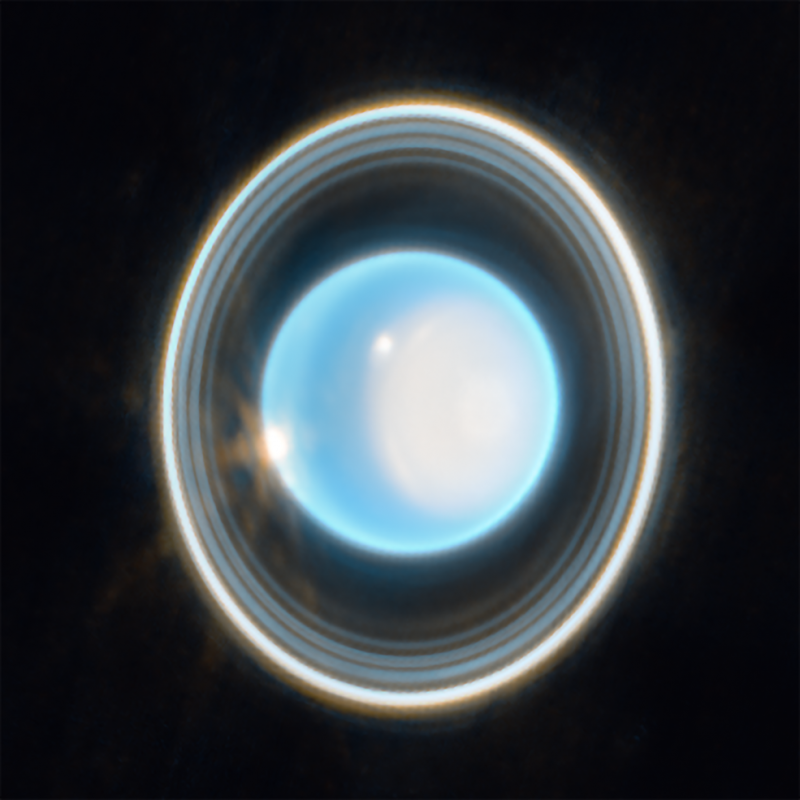
NASA released this new Uranus image on April 6, 2023. It’s from the mighty Webb space telescope. In this zoomed-in view, you can see Uranus’ dusty rings and dynamic atmosphere. Notice anything strange about the rings? Yep. Uranus’ rings lie sideways with respect to the ring-and-moon planes of the other planets. Uranus is our solar system’s sideways planet. And that means its the seasons of Uranus are strange! Read more about them below. Image via NASA/ ESA/ CSA/ STScI/ J. DePasquale (STScI).
Strange seasons of Uranus
Uranus has bizarre seasons, at least from our earthly perspective. As we explore distant exoplanets – or think about moons or rocky asteroids in this solar system – who knows what range of differences we’ll find? But for the moment we do know this. Uranus has unusual seasons, in contrast to Earth and the other major known planets. It’s because Uranus’ spin axis lies nearly sideways with respect to the plane of its orbit around the sun. Compared to Mercury, Venus, Earth, Mars, Jupiter, Saturn and Neptune – all of which spin elegantly, nearly upright, as they orbit our local star – Uranus seems almost as if it’s rolling around the sun, like a rolling ball.
Earth’s axis is tilted 23.5 degrees from perpendicular with respect to the plane of our orbit around the sun. Uranus’s axis is tilted at 98 degrees! So Uranus is tilted nearly sideways to the plane of the solar system, the single flat sheet of space in which nearly all the planets and moons orbit.
And, speaking of its orbit, Uranus orbits 1.8 billion miles (2.9 billion km) from the sun. Therefore, Uranus takes a long time to orbit the sun once. Its “year” is 84 Earth-years long. That makes each of its four seasons 21 years long. That’s another reason we on Earth think of Uranus’ seasons as strange.
Like Earth, Uranus has a nearly circular orbit, so it always remains at roughly the same distance from the sun. Unlike Mars – whose orbit is more elliptical than that of Earth or Uranus – Uranus’ distance from the sun isn’t a factor in its seasonal change.
Instead, as on Earth, the planet’s tilt is what gives Uranus its four seasons.
So think about how Uranus’ tilt affects its seasons, in contrast to earthly seasons. Here’s one difference. Earth’s tilt means our north and south polar regions have a midnight sun in summer and a long polar night in winter. Since Earth’s axis tilt is relatively small, those dark and bright times at Earth’s poles affect a relatively small part of our planet.
But the tilt of Uranus’ spin axis – 98 degrees – is huge. As a result, in summer, one pole of Uranus plus a large section of that pole’s hemisphere faces the sun continuously for 21 years. Meanwhile, the other half of Uranus – the winter half – is in darkness for 21 years. That’s a long polar night, and a long midnight sun!
Spring and fall on Uranus are equally bizarre. Around the equinoxes on Uranus, sunlight strikes the equatorial region of the planet. During those seasons, the length of a day on Uranus plays an important role in its climate. Uranus spins on its axis about every 17 hours, 14 minutes. So its day-night cycle lasts that long.
So, for much of the planet’s spring and fall, a large percentage of the planet has day and night about every 17 hours. It’s quite a contrast to the summer and winter seasons when half the planet is either in darkness or daylight.
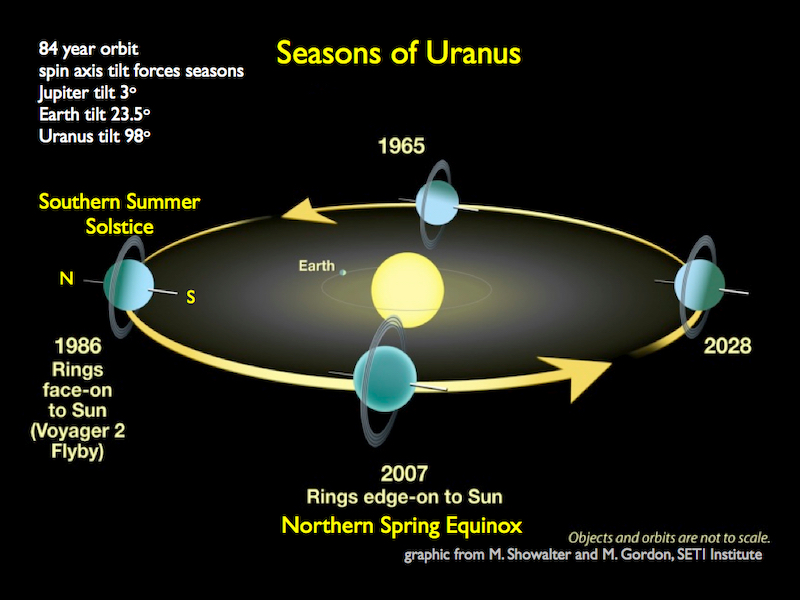
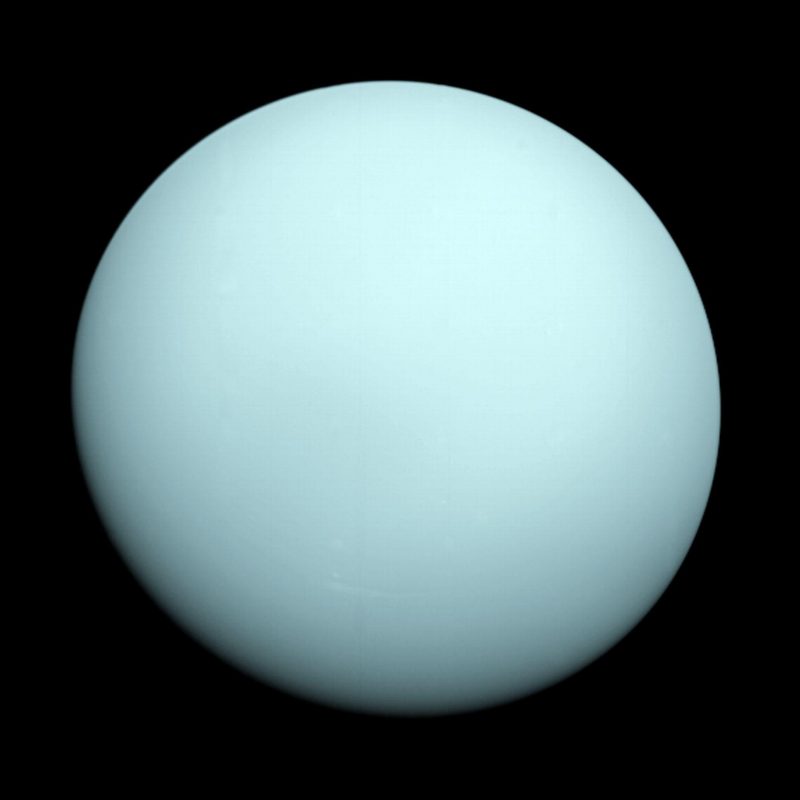
This diagram shows Uranus at four locations in its orbit. When Voyager 2 passed by in 1986, the planet’s south pole was facing the sun and the atmosphere did not show much activity. In 2007, the sun was shining over the planet’s equator, resulting in 17-hour day-night cycles. Earth- and space-based observatories revealed more activity in Uranus’ atmosphere, such as cloud features and atmospheric bands. Image via NASA/ ESA/ SETI/ M. Showalter.A blue and featureless Uranus, as seen by Voyager 2 in 1986. Voyager encountered Uranus during the planet’s southern hemisphere summer season. Image via NASA PhotoJournal.
What we see from Earth and spacecraft
The extreme seasonal changes cause dramatic shifts in Uranus’ cloud patterns. Earth- and space-based observatories have observed this change over decades of Uranus-watching. The Voyager 2 spacecraft is the only craft from Earth that has ever flown past Uranus. That was in 1986. Voyager 2 encountered this world during its southern hemisphere summer. The spacecraft saw Uranus as blue and featureless.
In the years since Voyager 2’s flyby of Uranus, astronomical observing technologies have become more powerful. As Uranus moved in its 84-year orbit around the sun, we’ve seen the seasons on Uranus change.
Since the Voyager 2 observations, Uranus has emerged from the grip of its decades-long winter/summer season. Its southern hemisphere autumn equinox occurred in 2007; that’s when the sun was shining above Uranus’ equator. Sunlight reached some latitudes for the first time in years. Light and warmth in the atmosphere triggered gigantic storms comparable in size to North America (but with temperatures of -300 Fahrenheit/-184 Celsius), visible as bright spots in the planet’s atmosphere.
Following seasonal changes from Earth
Around that time, Earth- and space-based telescopes revealed more clouds in the atmosphere of Uranus. Bands encircling the planet changed in size and brightness as sunlight struck parts of the planet for the first time in decades. Plus, a dark spot appeared – and more bright spots – which observers were able to follow for years.
What more will we see in the decades and years ahead as Uranus moves toward the long winter/summer portion of its orbit once more?
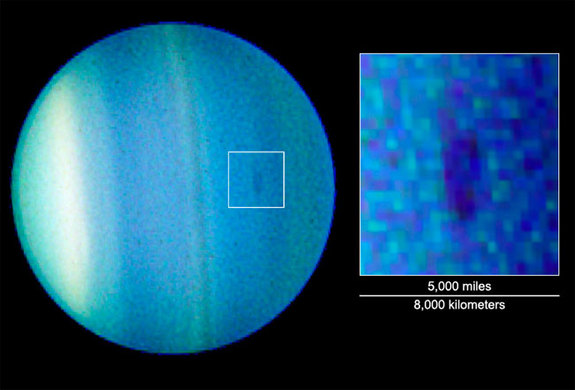
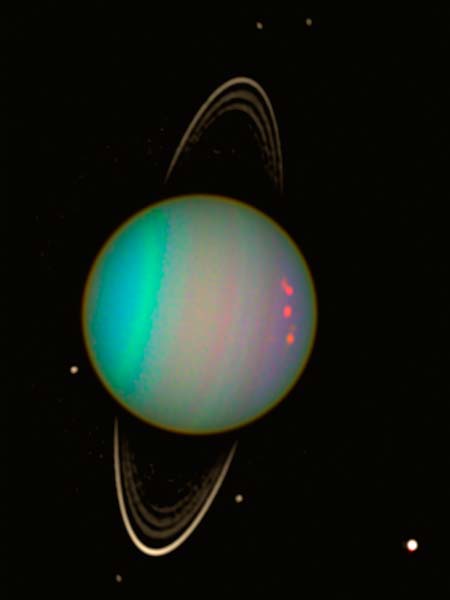
The dark spot on Uranus, which appeared as the planet’s northern hemisphere approached its autumn equinox, was large enough to engulf 2/3 of the United States. Image via NASA/ ESA/ L. Sromovsky and P. Fry.This 2004 image of Uranus was taken using filters designed to isolate very specific wavelengths of light to bring out features – in this case, variations in the altitude and thickness of clouds – that would otherwise not be visible. Images of the area around the planet were enhanced to show the rings and some of the planet’s moons. Image via NASA/ Erich Karkoschka.
Bottom line: The rotation axis of Uranus has a very large tilt that causes extreme seasonal changes. This results in increased activity in its atmosphere during the planet’s spring and fall seasons.
NASA released this new Uranus image on April 6, 2023. It’s from the mighty Webb space telescope. In this zoomed-in view, you can see Uranus’ dusty rings and dynamic atmosphere. Notice anything strange about the rings? Yep. Uranus’ rings lie sideways with respect to the ring-and-moon planes of the other planets. Uranus is our solar system’s sideways planet. And that means its the seasons of Uranus are strange! Read more about them below. Image via NASA/ ESA/ CSA/ STScI/ J. DePasquale (STScI).
Strange seasons of Uranus
Uranus has bizarre seasons, at least from our earthly perspective. As we explore distant exoplanets – or think about moons or rocky asteroids in this solar system – who knows what range of differences we’ll find? But for the moment we do know this. Uranus has unusual seasons, in contrast to Earth and the other major known planets. It’s because Uranus’ spin axis lies nearly sideways with respect to the plane of its orbit around the sun. Compared to Mercury, Venus, Earth, Mars, Jupiter, Saturn and Neptune – all of which spin elegantly, nearly upright, as they orbit our local star – Uranus seems almost as if it’s rolling around the sun, like a rolling ball.
Earth’s axis is tilted 23.5 degrees from perpendicular with respect to the plane of our orbit around the sun. Uranus’s axis is tilted at 98 degrees! So Uranus is tilted nearly sideways to the plane of the solar system, the single flat sheet of space in which nearly all the planets and moons orbit.
And, speaking of its orbit, Uranus orbits 1.8 billion miles (2.9 billion km) from the sun. Therefore, Uranus takes a long time to orbit the sun once. Its “year” is 84 Earth-years long. That makes each of its four seasons 21 years long. That’s another reason we on Earth think of Uranus’ seasons as strange.
Like Earth, Uranus has a nearly circular orbit, so it always remains at roughly the same distance from the sun. Unlike Mars – whose orbit is more elliptical than that of Earth or Uranus – Uranus’ distance from the sun isn’t a factor in its seasonal change.
Instead, as on Earth, the planet’s tilt is what gives Uranus its four seasons.
So think about how Uranus’ tilt affects its seasons, in contrast to earthly seasons. Here’s one difference. Earth’s tilt means our north and south polar regions have a midnight sun in summer and a long polar night in winter. Since Earth’s axis tilt is relatively small, those dark and bright times at Earth’s poles affect a relatively small part of our planet.
But the tilt of Uranus’ spin axis – 98 degrees – is huge. As a result, in summer, one pole of Uranus plus a large section of that pole’s hemisphere faces the sun continuously for 21 years. Meanwhile, the other half of Uranus – the winter half – is in darkness for 21 years. That’s a long polar night, and a long midnight sun!
Spring and fall on Uranus are equally bizarre. Around the equinoxes on Uranus, sunlight strikes the equatorial region of the planet. During those seasons, the length of a day on Uranus plays an important role in its climate. Uranus spins on its axis about every 17 hours, 14 minutes. So its day-night cycle lasts that long.
So, for much of the planet’s spring and fall, a large percentage of the planet has day and night about every 17 hours. It’s quite a contrast to the summer and winter seasons when half the planet is either in darkness or daylight.
This diagram shows Uranus at four locations in its orbit. When Voyager 2 passed by in 1986, the planet’s south pole was facing the sun and the atmosphere did not show much activity. In 2007, the sun was shining over the planet’s equator, resulting in 17-hour day-night cycles. Earth- and space-based observatories revealed more activity in Uranus’ atmosphere, such as cloud features and atmospheric bands. Image via NASA/ ESA/ SETI/ M. Showalter.A blue and featureless Uranus, as seen by Voyager 2 in 1986. Voyager encountered Uranus during the planet’s southern hemisphere summer season. Image via NASA PhotoJournal.
What we see from Earth and spacecraft
The extreme seasonal changes cause dramatic shifts in Uranus’ cloud patterns. Earth- and space-based observatories have observed this change over decades of Uranus-watching. The Voyager 2 spacecraft is the only craft from Earth that has ever flown past Uranus. That was in 1986. Voyager 2 encountered this world during its southern hemisphere summer. The spacecraft saw Uranus as blue and featureless.
In the years since Voyager 2’s flyby of Uranus, astronomical observing technologies have become more powerful. As Uranus moved in its 84-year orbit around the sun, we’ve seen the seasons on Uranus change.
Since the Voyager 2 observations, Uranus has emerged from the grip of its decades-long winter/summer season. Its southern hemisphere autumn equinox occurred in 2007; that’s when the sun was shining above Uranus’ equator. Sunlight reached some latitudes for the first time in years. Light and warmth in the atmosphere triggered gigantic storms comparable in size to North America (but with temperatures of -300 Fahrenheit/-184 Celsius), visible as bright spots in the planet’s atmosphere.
Following seasonal changes from Earth
Around that time, Earth- and space-based telescopes revealed more clouds in the atmosphere of Uranus. Bands encircling the planet changed in size and brightness as sunlight struck parts of the planet for the first time in decades. Plus, a dark spot appeared – and more bright spots – which observers were able to follow for years.
What more will we see in the decades and years ahead as Uranus moves toward the long winter/summer portion of its orbit once more?
The dark spot on Uranus, which appeared as the planet’s northern hemisphere approached its autumn equinox, was large enough to engulf 2/3 of the United States. Image via NASA/ ESA/ L. Sromovsky and P. Fry.This 2004 image of Uranus was taken using filters designed to isolate very specific wavelengths of light to bring out features – in this case, variations in the altitude and thickness of clouds – that would otherwise not be visible. Images of the area around the planet were enhanced to show the rings and some of the planet’s moons. Image via NASA/ Erich Karkoschka.
Bottom line: The rotation axis of Uranus has a very large tilt that causes extreme seasonal changes. This results in increased activity in its atmosphere during the planet’s spring and fall seasons.
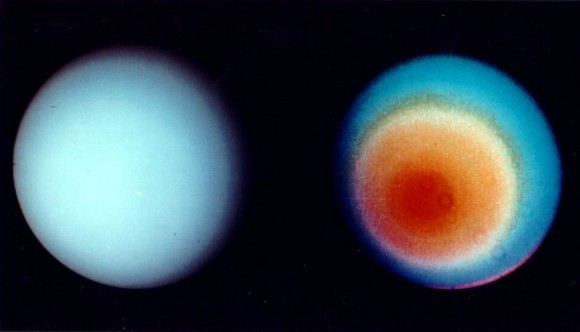
Pale blue Uranus as seen by Voyager 2 in 1986. Voyager 2 is the only spacecraft ever to have glimpsed Uranus up close. Image via NASA.
March 13, 1781: A happy accident
The 7th planet – Uranus – was discovered on March 13, 1781, completely by accident. British astronomer William Herschel was performing a survey of all stars of at least magnitude 8. These are stars slightly too faint to see with the eye alone. That’s when he noticed a very faint object – only barely above the limit for viewing with the eye – that moved in front of the fixed stars. This movement clearly demonstrated that the object was closer to us than the stars. At first, he thought he had found a comet. Later, he and others realized it was a new planet in orbit around our sun, the first new planet discovered since ancient times.
Astronomers later learned they had observed Uranus as far back as 1690. They’d just never really noticed it before. It was Herschel who first realized the true nature of this distant light in our sky.
William Herschel’s famous 40-foot (12-meter) telescope, constructed between 1785 and 1789 at Observatory House in Slough, England. It was the largest telescope in the world for 50 years. Image via Wikimedia Commons (public domain).
How Uranus got its name
Herschel proposed to name the object Georgium Sidus, after King George III, but those outside of Britain weren’t pleased with the idea. Instead, on the suggestion of astronomer Johann Elert Bode, astronomers decided to follow the convention of naming planets for the ancient gods.
Uranus – an ancient sky god, and one of the earliest gods in Greek mythology – was sometimes called Father Sky and was considered to be the son and husband of Gaia, or Mother Earth.
King George III was pleased, whatever the name. As a result of Herschel’s discovery, the king knighted him and appointed him to the position of court astronomer. The pension attached let Herschel quit his day job as a musician and focus his full attention on observing the heavens. He went on to discover several moons around other gas giant planets. He also compiled a catalog of 2,500 celestial objects that’s still in use today.
View larger. | Today, Uranus is known to possess a complicated ring system (although nowhere near as complicated as the rings encircling Saturn). In this schematic, the rings are shown in solid color and the orbits of moons in dotted lines. Image via Wikimedia Commons (public domain).
Rings of Uranus
In 1977, astronomers using the Kuiper Airborne Observatory made another serendipitous discovery. They found rings around the planet Uranus. That discovery made Uranus the second known ringed planet in our solar system. Currently Uranus has 13 known rings and 27 known moons, most of which are small.
The closest we humans have come to Uranus was in 1986, when the Voyager 2 spacecraft swung by the planet. At its closest, the spacecraft came within 81,500 kilometers (50,600 miles) of Uranus’s cloud tops on January 24, 1986. Voyager 2 radioed thousands of images and voluminous amounts of other scientific data on the planet, its moons, rings, atmosphere, interior and the magnetic environment surrounding Uranus.
Voyager 2 image showing Uranus in true and false color. Image via NASA.
Bottom line: British astronomer William Herschel discovered the planet Uranus – the first planet discovered since ancient times – on March 13, 1781.
Pale blue Uranus as seen by Voyager 2 in 1986. Voyager 2 is the only spacecraft ever to have glimpsed Uranus up close. Image via NASA.
March 13, 1781: A happy accident
The 7th planet – Uranus – was discovered on March 13, 1781, completely by accident. British astronomer William Herschel was performing a survey of all stars of at least magnitude 8. These are stars slightly too faint to see with the eye alone. That’s when he noticed a very faint object – only barely above the limit for viewing with the eye – that moved in front of the fixed stars. This movement clearly demonstrated that the object was closer to us than the stars. At first, he thought he had found a comet. Later, he and others realized it was a new planet in orbit around our sun, the first new planet discovered since ancient times.
Astronomers later learned they had observed Uranus as far back as 1690. They’d just never really noticed it before. It was Herschel who first realized the true nature of this distant light in our sky.
William Herschel’s famous 40-foot (12-meter) telescope, constructed between 1785 and 1789 at Observatory House in Slough, England. It was the largest telescope in the world for 50 years. Image via Wikimedia Commons (public domain).
How Uranus got its name
Herschel proposed to name the object Georgium Sidus, after King George III, but those outside of Britain weren’t pleased with the idea. Instead, on the suggestion of astronomer Johann Elert Bode, astronomers decided to follow the convention of naming planets for the ancient gods.
Uranus – an ancient sky god, and one of the earliest gods in Greek mythology – was sometimes called Father Sky and was considered to be the son and husband of Gaia, or Mother Earth.
King George III was pleased, whatever the name. As a result of Herschel’s discovery, the king knighted him and appointed him to the position of court astronomer. The pension attached let Herschel quit his day job as a musician and focus his full attention on observing the heavens. He went on to discover several moons around other gas giant planets. He also compiled a catalog of 2,500 celestial objects that’s still in use today.
View larger. | Today, Uranus is known to possess a complicated ring system (although nowhere near as complicated as the rings encircling Saturn). In this schematic, the rings are shown in solid color and the orbits of moons in dotted lines. Image via Wikimedia Commons (public domain).
Rings of Uranus
In 1977, astronomers using the Kuiper Airborne Observatory made another serendipitous discovery. They found rings around the planet Uranus. That discovery made Uranus the second known ringed planet in our solar system. Currently Uranus has 13 known rings and 27 known moons, most of which are small.
The closest we humans have come to Uranus was in 1986, when the Voyager 2 spacecraft swung by the planet. At its closest, the spacecraft came within 81,500 kilometers (50,600 miles) of Uranus’s cloud tops on January 24, 1986. Voyager 2 radioed thousands of images and voluminous amounts of other scientific data on the planet, its moons, rings, atmosphere, interior and the magnetic environment surrounding Uranus.
Voyager 2 image showing Uranus in true and false color. Image via NASA.
Bottom line: British astronomer William Herschel discovered the planet Uranus – the first planet discovered since ancient times – on March 13, 1781.
State of Emergency: The Department of Civil Protection in Iceland has just ordered a mandatory evacuation of the city of Grindavík and the Svartsengi Power Station as a volcanic eruption appears imminent. Over 1,000 earthquakes reported over the past 24 hours. pic.twitter.com/VkPgBz61VR
Fagradalsfjall volcano might be poised to erupt again
The BBC and other media are reporting today (November 11, 2023) that Iceland has declared a state of emergency after a series of earthquakes raised fears of a volcanic eruption at Fagradalsfjall volcano. The BBC said:
Authorities have ordered thousands living in the southwestern town of Grindavík to evacuate … The Icelandic Met Office says it is concerned large amounts of magma – molten rock- is spreading underground and could surface there.
Thousands of tremors have been recorded around the nearby Fagradalsfjall volcano in recent weeks.
And the Icelandic Met Office reported near midnight last night that:
The seismic activity has moved south towards Grindavík.
The tremors have been concentrated in Iceland’s Reykjanes Peninsula. This area had remained dormant to volcanic activity for 800 years before a 2021 eruption of Fagradalsfjall.
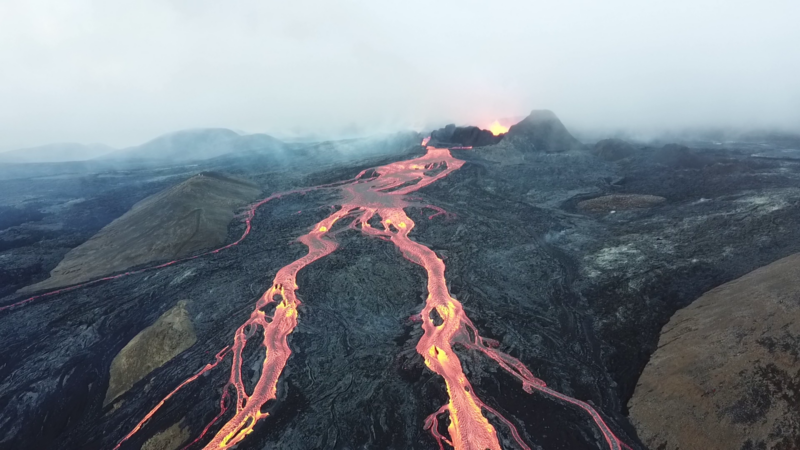
Iceland’s Fagradalsfjall volcano in 2021. A rash of earthquakes prompted Iceland to declare a state of emergency on November 11, 2023.
Watch the livestream
At this YouTube link, you can keep an eye on different views from the Reykjanes Peninsula in Iceland where the earthquakes have been occurring. And in the photos below, you can see some of the effects of the recent earthquakes in the region.
Huge cracks have opened up on the Grindavík golf course in #Iceland due to the many earthquakes they have had….?
?Iceland declares state of emergency, evacuates residents over threat of volcanic eruption ?
Emergency in the city of Grindavik inIceland, is currently under mandatory evacuation, an earthquake every 5 second, Over 1,400 small earthquakes have been recorded… pic.twitter.com/QmuRYBzkhl
The 2021 Fagradalsfjall eruption was unexpected. Since then, the volcano has become an attraction for local people and foreign tourists.
Another eruption, very similar to the 2021 eruption, began on August 3, 2022, and ceased on August 21, 2022. A third eruption appeared to the north of Fagradalsfjall on July 10, 2023, and ended on August 5, 2023.
Fagradalsfjall volcano in Iceland. Image via Wikipedia.
Significant changes have occurred in the seismic activity measured near Sundhnjúkagígar north of Grindavík and deformation observed in the Reykjanes Peninsula this afternoon … In light of this outcome, the police chief in Suðurnes, in cooperation with the Civil Protection Authorities, has decided to evacuate Grindavík.
An emergency level of civil protection is now in effect. This is not an emergency evacuation. Residents of Grindavík are advised to proceed with caution.
At this stage, it is not possible to determine exactly whether and where magma might reach the surface. There are indications that a considerable amount of magma is moving in an area extending from Sundhnjúkagígum in the north towards Grindavík. The amount of magma involved is significantly more than what was observed in the largest magma intrusions associated with the eruptions at Fagradalsfjall.
Further data is being collected to calculate models that provide a more accurate picture of the magma intrusion. It is currently not possible to say when this work will be completed.
‘Panic’ at a popular tourist area
Authorities called for calm, but the evacuations have not always been smooth. Associated Press (AP) reported on November 10 that there was “panic” at the Blue Lagoon geothermal spa – one of Iceland’s biggest tourist attractions. AP said the spa:
… closed temporarily as a swarm of earthquakes put the island nation’s most populated region on alert for a possible volcanic eruption.
Guests rushed to leave the spa’s hotels in the early hours of Thursday, after they were rattled awake shortly before 1 a.m. by a magnitude 4.8 quake, the strongest to hit the region since the recent wave of seismic activity began on October 25.
Bjarni Stefansson, a local taxi driver, described a scene of confusion when he arrived at the Retreat Hotel, where lava rocks had fallen on the roadway and the parking lot was jammed with 20 to 30 cabs.
‘There was a panic situation,’ Stefansson told The Associated Press. ‘People thought a volcanic eruption was about to happen.’
Bottom line: Iceland declared a state of emergency on November 10, 2023, for the area around Fagradalsfjall volcano. It was dormant for 800 years until a 2021 eruption. Now it looks poised to erupt again.
State of Emergency: The Department of Civil Protection in Iceland has just ordered a mandatory evacuation of the city of Grindavík and the Svartsengi Power Station as a volcanic eruption appears imminent. Over 1,000 earthquakes reported over the past 24 hours. pic.twitter.com/VkPgBz61VR
Fagradalsfjall volcano might be poised to erupt again
The BBC and other media are reporting today (November 11, 2023) that Iceland has declared a state of emergency after a series of earthquakes raised fears of a volcanic eruption at Fagradalsfjall volcano. The BBC said:
Authorities have ordered thousands living in the southwestern town of Grindavík to evacuate … The Icelandic Met Office says it is concerned large amounts of magma – molten rock- is spreading underground and could surface there.
Thousands of tremors have been recorded around the nearby Fagradalsfjall volcano in recent weeks.
And the Icelandic Met Office reported near midnight last night that:
The seismic activity has moved south towards Grindavík.
The tremors have been concentrated in Iceland’s Reykjanes Peninsula. This area had remained dormant to volcanic activity for 800 years before a 2021 eruption of Fagradalsfjall.
Iceland’s Fagradalsfjall volcano in 2021. A rash of earthquakes prompted Iceland to declare a state of emergency on November 11, 2023.
Watch the livestream
At this YouTube link, you can keep an eye on different views from the Reykjanes Peninsula in Iceland where the earthquakes have been occurring. And in the photos below, you can see some of the effects of the recent earthquakes in the region.
Huge cracks have opened up on the Grindavík golf course in #Iceland due to the many earthquakes they have had….?
?Iceland declares state of emergency, evacuates residents over threat of volcanic eruption ?
Emergency in the city of Grindavik inIceland, is currently under mandatory evacuation, an earthquake every 5 second, Over 1,400 small earthquakes have been recorded… pic.twitter.com/QmuRYBzkhl
The 2021 Fagradalsfjall eruption was unexpected. Since then, the volcano has become an attraction for local people and foreign tourists.
Another eruption, very similar to the 2021 eruption, began on August 3, 2022, and ceased on August 21, 2022. A third eruption appeared to the north of Fagradalsfjall on July 10, 2023, and ended on August 5, 2023.
Fagradalsfjall volcano in Iceland. Image via Wikipedia.
Significant changes have occurred in the seismic activity measured near Sundhnjúkagígar north of Grindavík and deformation observed in the Reykjanes Peninsula this afternoon … In light of this outcome, the police chief in Suðurnes, in cooperation with the Civil Protection Authorities, has decided to evacuate Grindavík.
An emergency level of civil protection is now in effect. This is not an emergency evacuation. Residents of Grindavík are advised to proceed with caution.
At this stage, it is not possible to determine exactly whether and where magma might reach the surface. There are indications that a considerable amount of magma is moving in an area extending from Sundhnjúkagígum in the north towards Grindavík. The amount of magma involved is significantly more than what was observed in the largest magma intrusions associated with the eruptions at Fagradalsfjall.
Further data is being collected to calculate models that provide a more accurate picture of the magma intrusion. It is currently not possible to say when this work will be completed.
‘Panic’ at a popular tourist area
Authorities called for calm, but the evacuations have not always been smooth. Associated Press (AP) reported on November 10 that there was “panic” at the Blue Lagoon geothermal spa – one of Iceland’s biggest tourist attractions. AP said the spa:
… closed temporarily as a swarm of earthquakes put the island nation’s most populated region on alert for a possible volcanic eruption.
Guests rushed to leave the spa’s hotels in the early hours of Thursday, after they were rattled awake shortly before 1 a.m. by a magnitude 4.8 quake, the strongest to hit the region since the recent wave of seismic activity began on October 25.
Bjarni Stefansson, a local taxi driver, described a scene of confusion when he arrived at the Retreat Hotel, where lava rocks had fallen on the roadway and the parking lot was jammed with 20 to 30 cabs.
‘There was a panic situation,’ Stefansson told The Associated Press. ‘People thought a volcanic eruption was about to happen.’
Bottom line: Iceland declared a state of emergency on November 10, 2023, for the area around Fagradalsfjall volcano. It was dormant for 800 years until a 2021 eruption. Now it looks poised to erupt again.
Launch of mission CRS-29 – a resupply mission to the International Space Station (ISS) – on the night of November 9, 2023. SpaceX launched the mission via a Falcon 9 rocket. The SpaceX Dragon spacecraft is now on its way to the ISS, due to arrive on Saturday. Image via Greg Diesel Walck.
SpaceX successfully launched its 29th cargo mission to the International Space Station (ISS) on Thursday, November 9, 2023. The CRS-29 mission lifted off atop a Falcon 9 rocket from NASA’s Kennedy Space Center in Florida at 8:28 p.m. EST on November 9 (1:28 UTC on November 10). Dragon is to deliver over 6,500 pounds (3,000 kg) of supplies and scientific hardware to the ISS, including seasonal treats like chocolate, pumpkin spice coffee, and cranberry sauce.
NASA astronauts and Expedition 70 Flight Engineers Jasmin Moghbeli and Loral O’Hara will monitor the CRS-29 Dragon capsule’s docking with the ISS on Saturday, November 11. NASA TV will begin its docking coverage at 3:45 a.m. EST (8:45 UTC) on Saturday. The docking itself is scheduled to take place at 5:21 a.m. EST (10:21 UTC).
NASA astronauts and Expedition 70 Flight Engineers Jasmin Moghbeli and Loral O’Hara will monitor Dragon’s docking with the ISS on Saturday, November 11. Image via NASA.
See the launch in the video below
You can watch a recorded livestream of the launch in the video below, or on SpaceX’s X account.
AWE and ILLUMA-T
Among the cargo are two distinguished experiments, AWE (Atmospheric Waves Experiment) and ILLUMA-T (Integrated Laser Communications Relay Demonstration Low Earth Orbit User Modem and Amplifier Terminal). Both are funded by NASA’s Space Communications and Navigation Program.
The AWE experiment seeks to determine the forces driving space weather, challenging the previous belief that only the sun’s solar wind influences the upper atmosphere. Specifically, it will help scientists study airglow patterns. Airglow refers to the faint, predominantly greenish or reddish glow of the Earth’s upper atmosphere, particularly in the night sky.
ILLUMA-T, on the other hand, is poised to revolutionize space communications. The experiment will test high-speed laser communications, working in tandem with NASA’s Laser Communications Relay Demonstration mission. By creating NASA’s first two-way laser communications relay system, ILLUMA-T opens the door to improving how we send data in space, adding to the existing radio systems and preparing scientists for more advanced exploration in outer space.
Scientists prepare the optical assembly for AWE (Atmospheric Waves Experiment) for launch in a clean room at Space Dynamics Laboratory facilities. Image via Space Dynamics Laboratory/ Allison Bills/ NASA.
After CRS-29, more spaceflight to come
After Thursday night’s launch, the Falcon 9’s first stage landed back on Earth at Cape Canaveral Space Force Station’s Landing Zone 1. The November 10 launch marked the 9th flight on the Commercial Resupply Services-2 SpaceX contract and the second flight of this Dragon spacecraft, which previously flew on NASA’s SpaceX 26th resupply services mission. Previously, this Dragon supported the Crew-7 mission.
The ISS is celebrating its 25th anniversary this month. With 273 individuals from 21 countries having visited the ISS, the orbiting laboratory continues to symbolize global collaboration: not a bad message for these trying times.
A space jellyfish, or exhaust plume, caught by our photographer – Greg Diesel Walck – following the CRS-29 Dragon launch on November 10, 2023. These atmospheric jellyfish become visible following MECO (main engine cutoff) only under certain conditions. It happens when the observer on the ground is in darkness (during an evening or predawn launch), when the sun has set on the observer’s part of Earth … but still illuminates the plume high above Earth. Thanks, Greg!
Bottom line: SpaceX launched its 29th cargo mission to the ISS atop a Falcon 9 rocket from Florida at 8:28 p.m. EST (01:28 UTCon November 10). The cargo is expected to arrive at the ISS at 5:21 a.m. EST (10:21 UTC) on November 11.
Launch of mission CRS-29 – a resupply mission to the International Space Station (ISS) – on the night of November 9, 2023. SpaceX launched the mission via a Falcon 9 rocket. The SpaceX Dragon spacecraft is now on its way to the ISS, due to arrive on Saturday. Image via Greg Diesel Walck.
SpaceX successfully launched its 29th cargo mission to the International Space Station (ISS) on Thursday, November 9, 2023. The CRS-29 mission lifted off atop a Falcon 9 rocket from NASA’s Kennedy Space Center in Florida at 8:28 p.m. EST on November 9 (1:28 UTC on November 10). Dragon is to deliver over 6,500 pounds (3,000 kg) of supplies and scientific hardware to the ISS, including seasonal treats like chocolate, pumpkin spice coffee, and cranberry sauce.
NASA astronauts and Expedition 70 Flight Engineers Jasmin Moghbeli and Loral O’Hara will monitor the CRS-29 Dragon capsule’s docking with the ISS on Saturday, November 11. NASA TV will begin its docking coverage at 3:45 a.m. EST (8:45 UTC) on Saturday. The docking itself is scheduled to take place at 5:21 a.m. EST (10:21 UTC).
NASA astronauts and Expedition 70 Flight Engineers Jasmin Moghbeli and Loral O’Hara will monitor Dragon’s docking with the ISS on Saturday, November 11. Image via NASA.
See the launch in the video below
You can watch a recorded livestream of the launch in the video below, or on SpaceX’s X account.
AWE and ILLUMA-T
Among the cargo are two distinguished experiments, AWE (Atmospheric Waves Experiment) and ILLUMA-T (Integrated Laser Communications Relay Demonstration Low Earth Orbit User Modem and Amplifier Terminal). Both are funded by NASA’s Space Communications and Navigation Program.
The AWE experiment seeks to determine the forces driving space weather, challenging the previous belief that only the sun’s solar wind influences the upper atmosphere. Specifically, it will help scientists study airglow patterns. Airglow refers to the faint, predominantly greenish or reddish glow of the Earth’s upper atmosphere, particularly in the night sky.
ILLUMA-T, on the other hand, is poised to revolutionize space communications. The experiment will test high-speed laser communications, working in tandem with NASA’s Laser Communications Relay Demonstration mission. By creating NASA’s first two-way laser communications relay system, ILLUMA-T opens the door to improving how we send data in space, adding to the existing radio systems and preparing scientists for more advanced exploration in outer space.
Scientists prepare the optical assembly for AWE (Atmospheric Waves Experiment) for launch in a clean room at Space Dynamics Laboratory facilities. Image via Space Dynamics Laboratory/ Allison Bills/ NASA.
After CRS-29, more spaceflight to come
After Thursday night’s launch, the Falcon 9’s first stage landed back on Earth at Cape Canaveral Space Force Station’s Landing Zone 1. The November 10 launch marked the 9th flight on the Commercial Resupply Services-2 SpaceX contract and the second flight of this Dragon spacecraft, which previously flew on NASA’s SpaceX 26th resupply services mission. Previously, this Dragon supported the Crew-7 mission.
The ISS is celebrating its 25th anniversary this month. With 273 individuals from 21 countries having visited the ISS, the orbiting laboratory continues to symbolize global collaboration: not a bad message for these trying times.
A space jellyfish, or exhaust plume, caught by our photographer – Greg Diesel Walck – following the CRS-29 Dragon launch on November 10, 2023. These atmospheric jellyfish become visible following MECO (main engine cutoff) only under certain conditions. It happens when the observer on the ground is in darkness (during an evening or predawn launch), when the sun has set on the observer’s part of Earth … but still illuminates the plume high above Earth. Thanks, Greg!
Bottom line: SpaceX launched its 29th cargo mission to the ISS atop a Falcon 9 rocket from Florida at 8:28 p.m. EST (01:28 UTCon November 10). The cargo is expected to arrive at the ISS at 5:21 a.m. EST (10:21 UTC) on November 11.
The Summer Triangle is a famous asterism, consisting of 3 bright stars overhead in northern summer. But you can also easily see it through the northern autumn, and even into winter.
The Summer Triangle and its 3 stars
The Summer Triangle is the signature star formation in the Northern Hemisphere’s summer sky. However, as the September equinox comes and goes – and as the weeks of autumn begin to slide by – you’ll still notice this famous trio of stars. So, look for the Summer Triangle after dark in early November. It will actually continue to shine after dark in November and December, and is even visible still in January. Look for it tonight in the early evening, high in your western sky.
By the way, the Summer Triangle isn’t a constellation. It’s an asterism, or an obvious pattern or group of stars with a popular name. In fact, the Summer Triangle consists of three bright stars in three separate constellations. The bright star Vega is in Lyra the Harp. Deneb is in Cygnus the Swan. And Altair is in Aquila the Eagle.
In the month of June – around the June solstice – the Summer Triangle pops out in the east as darkness falls and shines all night long. But now – after sunset in November – the Summer Triangle appears high in the western evening sky. As evening deepens, the Summer Triangle descends westward, with all three of its stars staying above the horizon until mid-to-late evening.
Altair – the Summer Triangle’s southernmost star – will set around 10 to 11 p.m. tonight at mid-northern latitudes. Notice where you see the Summer Triangle at a given time this evening. The Summer Triangle will return to this same place in the sky some four minutes earlier with each passing day, or two hours earlier with each passing month.
Then as the Summer Triangle sinks close to the western horizon around mid-evening, turn around to see Orion the Hunter – the signpost constellation of winter – rising in the east.
Bottom line: Look westward this evening for the three brilliant stars of the humongous Summer Triangle: Vega, Deneb and Altair. In fact, you can still see the Summer Triangle through January.
The Summer Triangle is a famous asterism, consisting of 3 bright stars overhead in northern summer. But you can also easily see it through the northern autumn, and even into winter.
The Summer Triangle and its 3 stars
The Summer Triangle is the signature star formation in the Northern Hemisphere’s summer sky. However, as the September equinox comes and goes – and as the weeks of autumn begin to slide by – you’ll still notice this famous trio of stars. So, look for the Summer Triangle after dark in early November. It will actually continue to shine after dark in November and December, and is even visible still in January. Look for it tonight in the early evening, high in your western sky.
By the way, the Summer Triangle isn’t a constellation. It’s an asterism, or an obvious pattern or group of stars with a popular name. In fact, the Summer Triangle consists of three bright stars in three separate constellations. The bright star Vega is in Lyra the Harp. Deneb is in Cygnus the Swan. And Altair is in Aquila the Eagle.
In the month of June – around the June solstice – the Summer Triangle pops out in the east as darkness falls and shines all night long. But now – after sunset in November – the Summer Triangle appears high in the western evening sky. As evening deepens, the Summer Triangle descends westward, with all three of its stars staying above the horizon until mid-to-late evening.
Altair – the Summer Triangle’s southernmost star – will set around 10 to 11 p.m. tonight at mid-northern latitudes. Notice where you see the Summer Triangle at a given time this evening. The Summer Triangle will return to this same place in the sky some four minutes earlier with each passing day, or two hours earlier with each passing month.
Then as the Summer Triangle sinks close to the western horizon around mid-evening, turn around to see Orion the Hunter – the signpost constellation of winter – rising in the east.
Bottom line: Look westward this evening for the three brilliant stars of the humongous Summer Triangle: Vega, Deneb and Altair. In fact, you can still see the Summer Triangle through January.