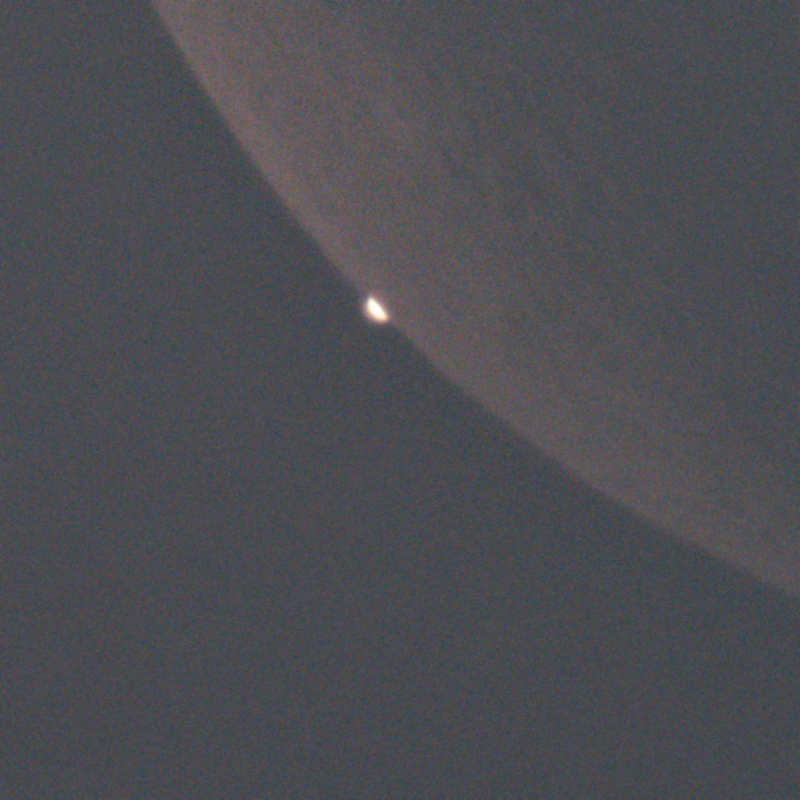
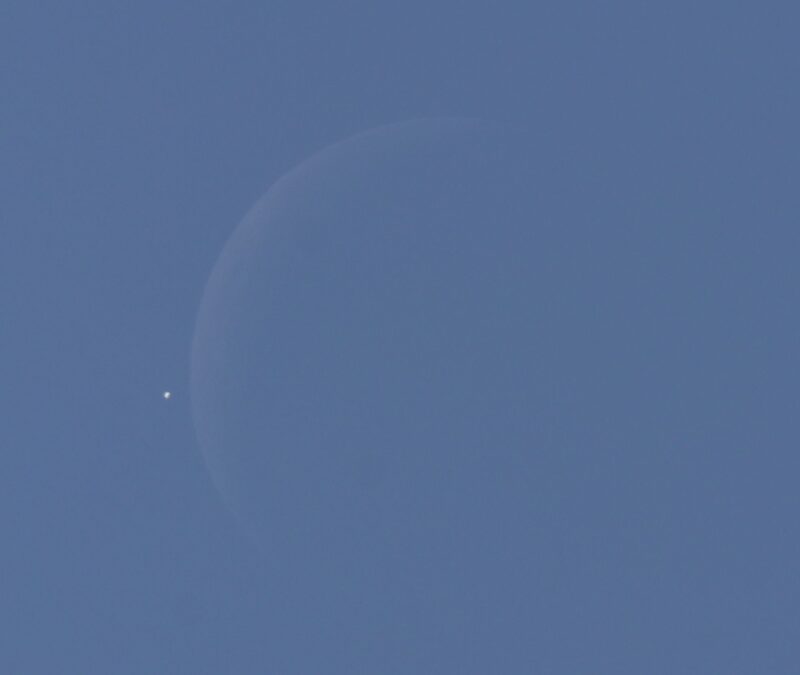
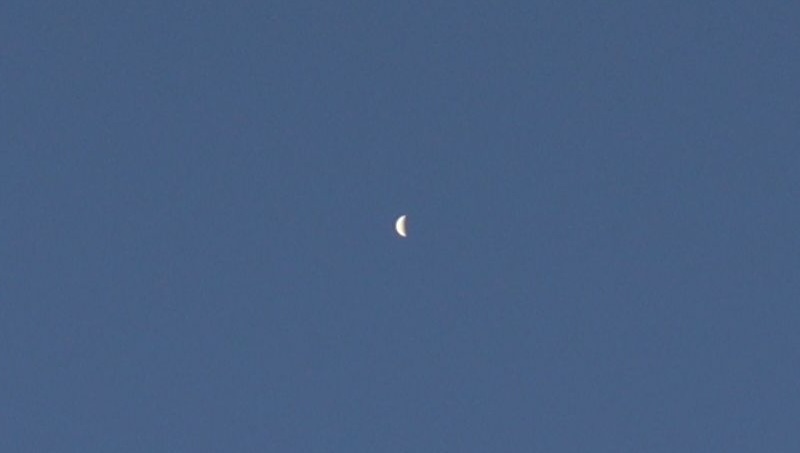
View at EarthSky Community Photos. | Aurelian Neacsu in Visina, Dâmbovita, România, captured this image of the moon occulting Venus on Novmeber 9, 2023. Aurelian wrote: “Venus hiding behind the moon.” Thank you, Aurelian! See more photos of Venus and the moon from around the globe, below.
Photos of Venus and the moon
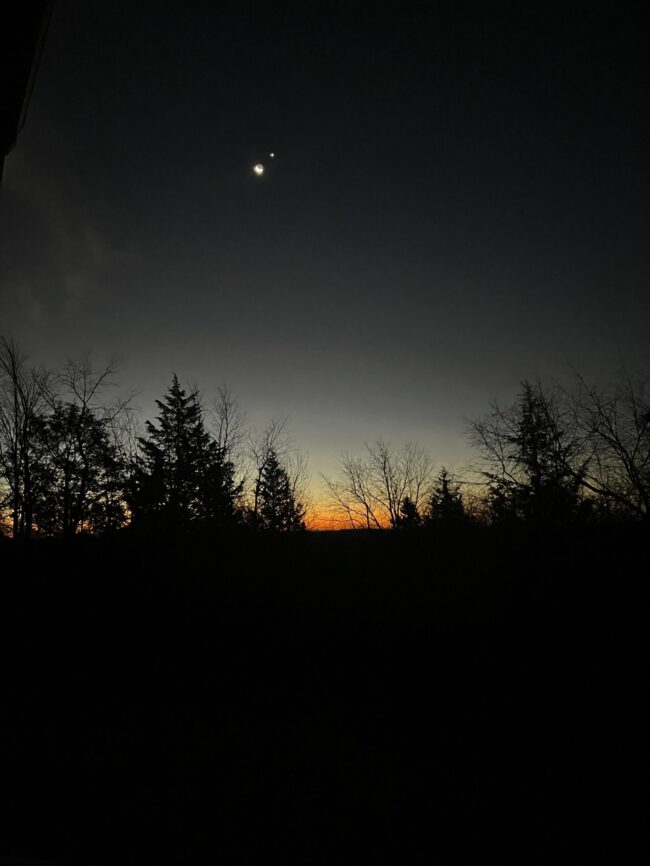
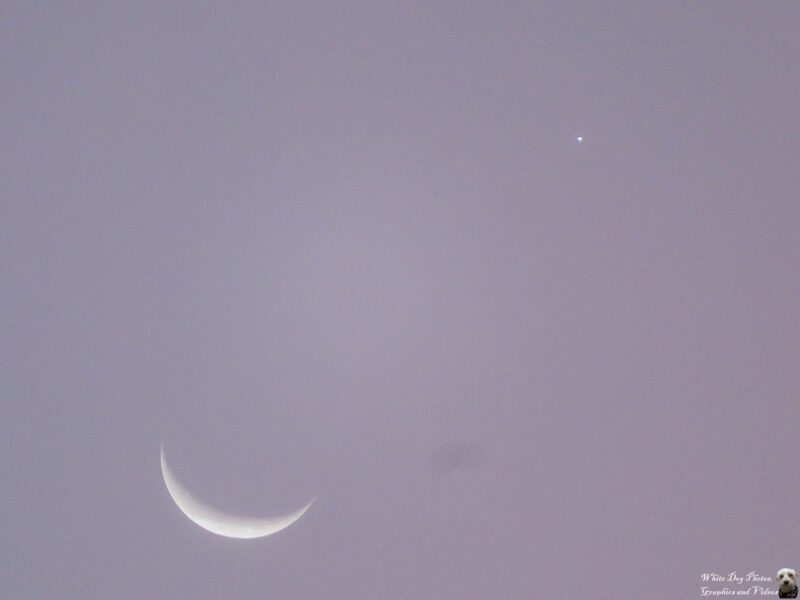
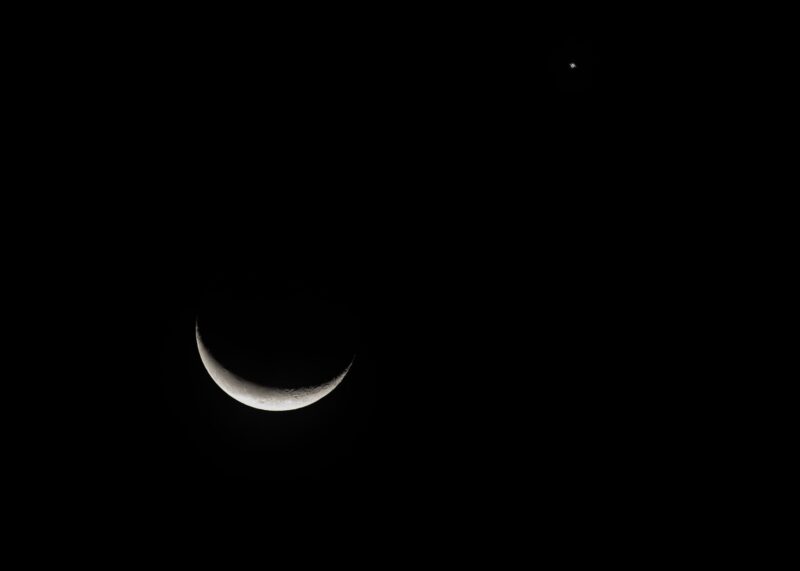
On the morning of November 9, 2023, Venus and the moon paired closely in the sky. Some places on the globe even got to watch the moon pass in front of, or occult, Venus! Enjoy these images of Earth’s two closest solar system neighbors from the EarthSky community. Have a great photo of your own to share? You can submit it to us here.
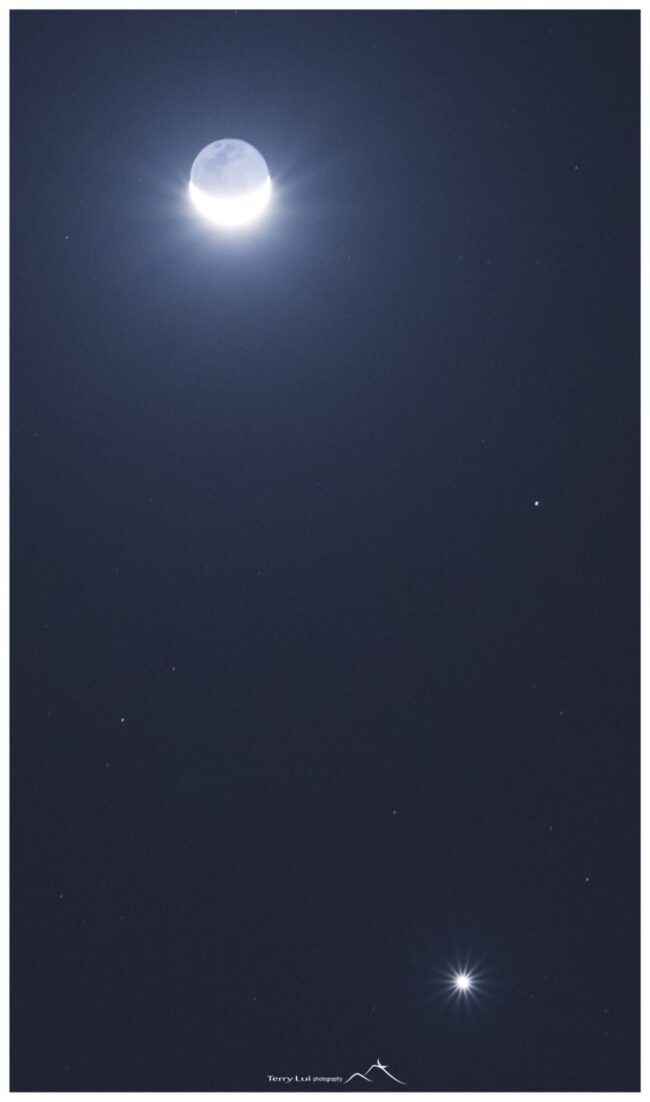
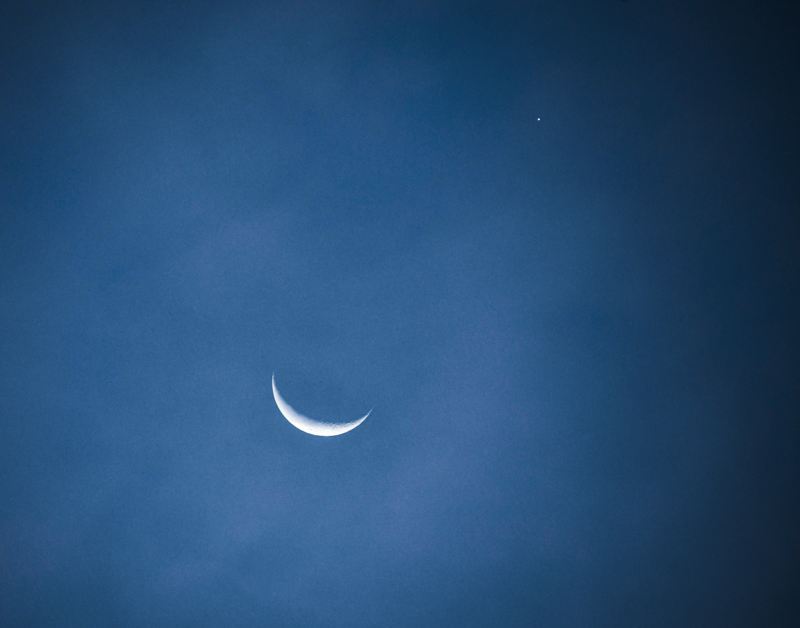
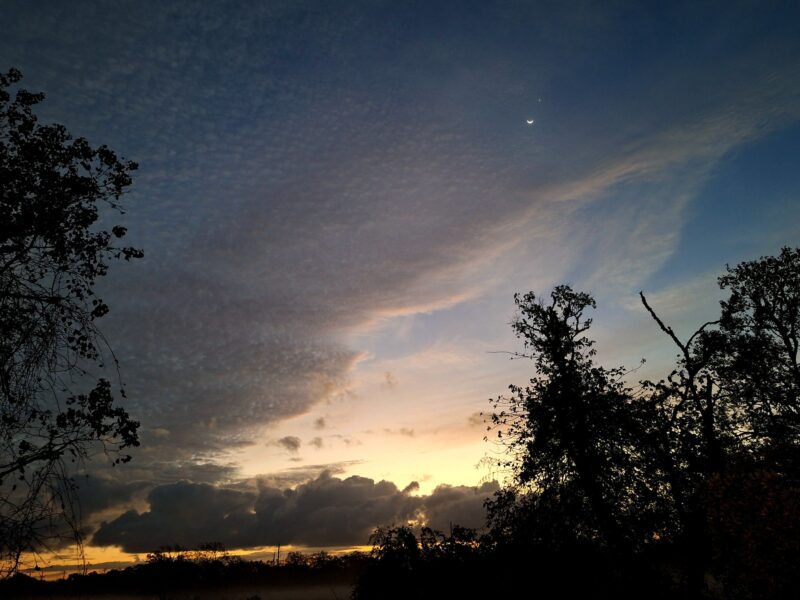
View at EarthSky Community Photos. | Terry Lui in Hong Kong captured this image on November 9, 2023. Terry wrote: “I woke up this morning and saw the moon and Venus shining through my bedroom window in the clear sky.” Thank you, Terry!View at EarthSky Community Photos. | Chuck Reinhart in Vincennes, Indiana, caught this image on November 9, 2023. Chuck wrote: “Shortly before sunrise I was able to capture the crescent moon and Venus in a cloudy sky.” Thank you, Chuck!View at EarthSky Community Photos. | Ashley Ewing in Alvin, Texas, caught the moon and Venus on November 9, 2023. Ashley wrote: “My front porch view of the sunrise with the crescent moon, and Venus right above the moon.” Thank you, Ashley!
More moon and Venus photos
View at EarthSky Community Photos. | Gadi Eidelheit in Israel captured this image on November 9, 2023. Gadi wrote: “Beautiful daytime occultation of Venus. It was even possible to see with the unaided eye almost until the occultation. In my 12-inch Dobsonian telescope it was perfect to see Venus in a half phase and the very thin moon together. Magnificent celestial event.” Thank you, Gadi!View at EarthSky Community Photos. | Lisa Kendall in Burlington, Wisconsin, captured this view on November 9, 2023. Lisa wrote: “I woke up to this beautiful sight this morning and looked it up to find out what the star was, only to find it is Venus! Stunning sight.” Thank you, Lisa!View at EarthSky Community Photos. | Gerald Barney in Port Wentworth, Georgia, captured this image on November 9, 2023. Gerald wrote: “This morning, waning crescent moon and Venus.” Thank you, Gerald!View at EarthSky Community Photos. | Mike Baxter in Springfield, Missouri, captured this image on November 9, 2023. Mike wrote: “Woke up today around 4:30 and looked out our front window to see this marvelous view! I was going to go back to bed and decided I might not get this chance again, loaded up the camera onto a tripod and headed outside.” Thank you, Mike!
Bottom line: EarthSky’s global community shared fabulous photos of Venus and the moon from their close approach and occultation on November 9, 2023.
View at EarthSky Community Photos. | Aurelian Neacsu in Visina, Dâmbovita, România, captured this image of the moon occulting Venus on Novmeber 9, 2023. Aurelian wrote: “Venus hiding behind the moon.” Thank you, Aurelian! See more photos of Venus and the moon from around the globe, below.
Photos of Venus and the moon
On the morning of November 9, 2023, Venus and the moon paired closely in the sky. Some places on the globe even got to watch the moon pass in front of, or occult, Venus! Enjoy these images of Earth’s two closest solar system neighbors from the EarthSky community. Have a great photo of your own to share? You can submit it to us here.
View at EarthSky Community Photos. | Terry Lui in Hong Kong captured this image on November 9, 2023. Terry wrote: “I woke up this morning and saw the moon and Venus shining through my bedroom window in the clear sky.” Thank you, Terry!View at EarthSky Community Photos. | Chuck Reinhart in Vincennes, Indiana, caught this image on November 9, 2023. Chuck wrote: “Shortly before sunrise I was able to capture the crescent moon and Venus in a cloudy sky.” Thank you, Chuck!View at EarthSky Community Photos. | Ashley Ewing in Alvin, Texas, caught the moon and Venus on November 9, 2023. Ashley wrote: “My front porch view of the sunrise with the crescent moon, and Venus right above the moon.” Thank you, Ashley!
More moon and Venus photos
View at EarthSky Community Photos. | Gadi Eidelheit in Israel captured this image on November 9, 2023. Gadi wrote: “Beautiful daytime occultation of Venus. It was even possible to see with the unaided eye almost until the occultation. In my 12-inch Dobsonian telescope it was perfect to see Venus in a half phase and the very thin moon together. Magnificent celestial event.” Thank you, Gadi!View at EarthSky Community Photos. | Lisa Kendall in Burlington, Wisconsin, captured this view on November 9, 2023. Lisa wrote: “I woke up to this beautiful sight this morning and looked it up to find out what the star was, only to find it is Venus! Stunning sight.” Thank you, Lisa!View at EarthSky Community Photos. | Gerald Barney in Port Wentworth, Georgia, captured this image on November 9, 2023. Gerald wrote: “This morning, waning crescent moon and Venus.” Thank you, Gerald!View at EarthSky Community Photos. | Mike Baxter in Springfield, Missouri, captured this image on November 9, 2023. Mike wrote: “Woke up today around 4:30 and looked out our front window to see this marvelous view! I was going to go back to bed and decided I might not get this chance again, loaded up the camera onto a tripod and headed outside.” Thank you, Mike!
Bottom line: EarthSky’s global community shared fabulous photos of Venus and the moon from their close approach and occultation on November 9, 2023.
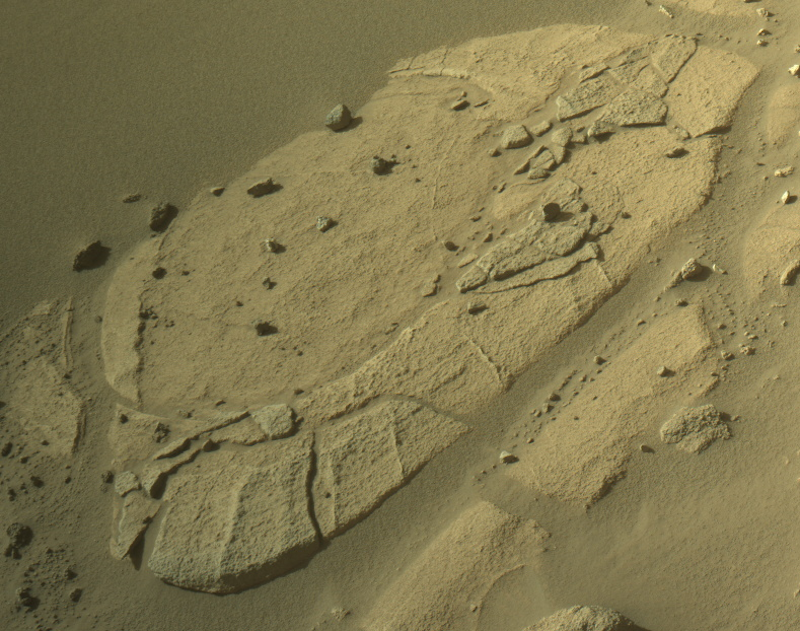
View larger. | This is one of the unusual round rock features on Mars that the Perseverance rover saw on September 27, 2023 (sol 925 of the mission). It resembles those formed by a combination of microbes and geology in some earthly lakes. But it also looks like possible weathering, called spheroidal weathering, which is common on Earth. Image via NASA/ JPL-Caltech.
Rock features on Mars raise questions
Was there ever life on Mars? After 21 Mars landers, and a host of spacecraft observing from orbit, we still don’t know. The search of past Martian life has focused primarily on biosignatures – chemical evidence in rocks, or in the air – left behind by once-living microorganisms. Those sorts of clues need to be puzzled out in laboratory analysis. But what if we could see telltale signs of biology in Mars’ rocky landscape? The Mars rovers have sometimes seen tantalizing and unusual shapes or other features. Mostly, these have been explained as erosion due to Mars’ thin atmosphere. But on September 27, 2023, the Perseverance rover came across another oddity: circular formations that resemble those made on Earth by microbes in some lakes.
The jury is still out, but let’s take a look.
Space journalist Leonard David, in his blog Leonard David’s INSIDE OUTER SPACE, wrote about the finding on November 5, 2023. NASA released the images recently as part of the daily upload of new images from the rover. There’s no published analysis or paper yet, so right now we just have the images and comments from scientists on the mission team.
The rover has been exploring the remains of an ancient delta in Jezero crater. This is where a river once flowed into the lake that existed inside the crater billions of years ago. The delta is still clearly visible from above. NASA sent Perseverance to Jezero crater specifically for this reason, as it would be an ideal location to search for evidence of past microbial life.
As noted above, that search is mostly about looking for traces of biosignatures that originated from microbes. To be sure, the rover has already discovered abundant organic molecules in the samples it has tested in its onboard laboratory. However, this isn’t proof of past life yet. That will likely require – if any life did actually exist – getting some of those samples back to Earth to study in more advanced labs.
Several weeks ago, Perseverance came across something intriguing: circular formations of rock with concentric curves. They seemed to resemble similar formations on Earth called stromatolites and microbialites. They are created by microbial communities in some lakes, in a process combining biology and geology. Could it be? Perseverance did land in an ancient lake bed … The Great Salt Lake in Utah has some great examples of stromatolites. On Earth, they are created by a combination of bacteria and calcium carbonate. They also resemble reefs, but are not actually made of coral. Could a similar process have happened on Mars?
Mars Guy
Steven Ruff, a Mars geologist at Arizona State University, weighed in on the discovery on his YouTube channel Mars Guy. As quoted in the blog post by Leonard David, Ruff said:
In the very place it might be reasonable to expect, Perseverance discovered circular rock structures resembling ones formed by microbial communities in some lakes on Earth. This exciting possibility called for a closer look.
In this video, Steven Ruff, a Mars geologist at Arizona State University, discusses the discovery of the interesting circular formations and what they might be. Video via Mars Guy/ YouTube.
Biology or no biology?
The formations do resemble stromatolites, or even more specifically, microbialites. There’s another possibility, however, as Mars Guy pointed out in the video. It’s called spheroidal weathering. That is when chemical weathering affects jointed bedrock and results in the formation of concentric or spherical layers of highly decayed rock. This produces concentric “shells” of rock, kind of like the layers of an onion. These also have a similarity to the features seen on Mars. Leonard David quoted Kenneth Farley, a geochemist at the California Institute of Technology. He said:
We investigated that rock with our remote sensing instruments, and we acquired two abrasion patches and two sample cores from similar rocks in close proximity. We also recognized the very peculiar and suggestive concentric-domelike morphology.
David also said:
Farley said as an alternative to a biological origin – for example, a stromatolite – Mars scientists on the rover mission also considered the hypothesis that these features are simply spheroidal weathering. That’s a very common phenomenon on Earth, Farley pointed out, and one seen elsewhere in Jezero, in both igneous and sedimentary rocks.
Farley added:
Although we are still interpreting the data, the latter hypothesis is far less extraordinary, and at least partly for this reason, currently favored.
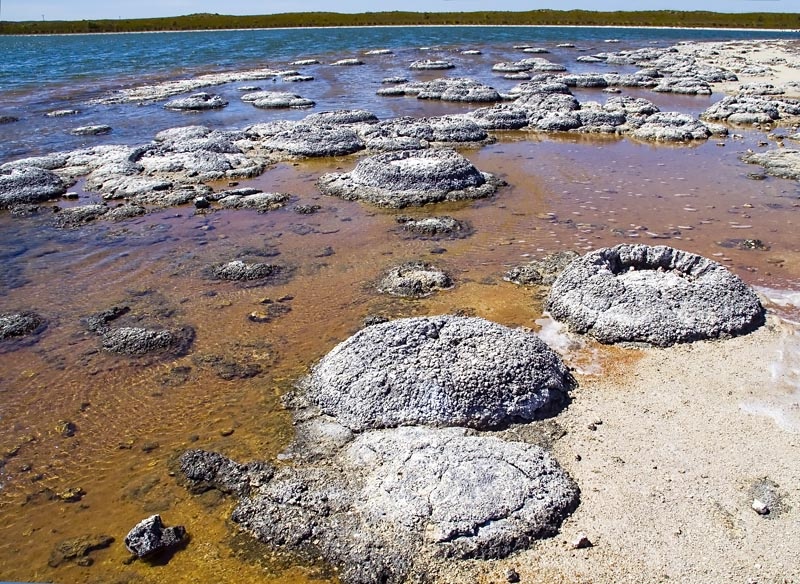
View larger. | Circular stromatolites at Lake Thetis, Western Australia (March 30, 2006). Image via Ruth Ellison/ Wikimedia Commons (CC BY 2.0).
Could the Perseverance rover recognize visible signs of life?
This brings us back to the question of whether Perseverance could recognize visible signs of past life, such as those produced by microbes. Farley answered, saying:
My answer is ‘maybe.’ Based on ancient terrestrial analogs, there are plausible manifestations we could detect with our instrument suite, but many plausible manifestations too subtle for us to confidently identify. This is, of course, a key motivation for sample return. As an example, compared to the organic molecule detection capabilities on Perseverance, those in terrestrial laboratories are at least a factor of 10,000 more sensitive.
It will be interesting to see if Perseverance comes across any more similar features in its travels, or even the Curiosity rover in Gale Crater.
Bottom line: NASA’s Perseverance rover recently found some odd circular formations on Mars, similar to ones made by microbes on Earth in lakes. Evidence of life or geology?
View larger. | This is one of the unusual round rock features on Mars that the Perseverance rover saw on September 27, 2023 (sol 925 of the mission). It resembles those formed by a combination of microbes and geology in some earthly lakes. But it also looks like possible weathering, called spheroidal weathering, which is common on Earth. Image via NASA/ JPL-Caltech.
Rock features on Mars raise questions
Was there ever life on Mars? After 21 Mars landers, and a host of spacecraft observing from orbit, we still don’t know. The search of past Martian life has focused primarily on biosignatures – chemical evidence in rocks, or in the air – left behind by once-living microorganisms. Those sorts of clues need to be puzzled out in laboratory analysis. But what if we could see telltale signs of biology in Mars’ rocky landscape? The Mars rovers have sometimes seen tantalizing and unusual shapes or other features. Mostly, these have been explained as erosion due to Mars’ thin atmosphere. But on September 27, 2023, the Perseverance rover came across another oddity: circular formations that resemble those made on Earth by microbes in some lakes.
The jury is still out, but let’s take a look.
Space journalist Leonard David, in his blog Leonard David’s INSIDE OUTER SPACE, wrote about the finding on November 5, 2023. NASA released the images recently as part of the daily upload of new images from the rover. There’s no published analysis or paper yet, so right now we just have the images and comments from scientists on the mission team.
The rover has been exploring the remains of an ancient delta in Jezero crater. This is where a river once flowed into the lake that existed inside the crater billions of years ago. The delta is still clearly visible from above. NASA sent Perseverance to Jezero crater specifically for this reason, as it would be an ideal location to search for evidence of past microbial life.
As noted above, that search is mostly about looking for traces of biosignatures that originated from microbes. To be sure, the rover has already discovered abundant organic molecules in the samples it has tested in its onboard laboratory. However, this isn’t proof of past life yet. That will likely require – if any life did actually exist – getting some of those samples back to Earth to study in more advanced labs.
Several weeks ago, Perseverance came across something intriguing: circular formations of rock with concentric curves. They seemed to resemble similar formations on Earth called stromatolites and microbialites. They are created by microbial communities in some lakes, in a process combining biology and geology. Could it be? Perseverance did land in an ancient lake bed … The Great Salt Lake in Utah has some great examples of stromatolites. On Earth, they are created by a combination of bacteria and calcium carbonate. They also resemble reefs, but are not actually made of coral. Could a similar process have happened on Mars?
Mars Guy
Steven Ruff, a Mars geologist at Arizona State University, weighed in on the discovery on his YouTube channel Mars Guy. As quoted in the blog post by Leonard David, Ruff said:
In the very place it might be reasonable to expect, Perseverance discovered circular rock structures resembling ones formed by microbial communities in some lakes on Earth. This exciting possibility called for a closer look.
In this video, Steven Ruff, a Mars geologist at Arizona State University, discusses the discovery of the interesting circular formations and what they might be. Video via Mars Guy/ YouTube.
Biology or no biology?
The formations do resemble stromatolites, or even more specifically, microbialites. There’s another possibility, however, as Mars Guy pointed out in the video. It’s called spheroidal weathering. That is when chemical weathering affects jointed bedrock and results in the formation of concentric or spherical layers of highly decayed rock. This produces concentric “shells” of rock, kind of like the layers of an onion. These also have a similarity to the features seen on Mars. Leonard David quoted Kenneth Farley, a geochemist at the California Institute of Technology. He said:
We investigated that rock with our remote sensing instruments, and we acquired two abrasion patches and two sample cores from similar rocks in close proximity. We also recognized the very peculiar and suggestive concentric-domelike morphology.
David also said:
Farley said as an alternative to a biological origin – for example, a stromatolite – Mars scientists on the rover mission also considered the hypothesis that these features are simply spheroidal weathering. That’s a very common phenomenon on Earth, Farley pointed out, and one seen elsewhere in Jezero, in both igneous and sedimentary rocks.
Farley added:
Although we are still interpreting the data, the latter hypothesis is far less extraordinary, and at least partly for this reason, currently favored.
View larger. | Circular stromatolites at Lake Thetis, Western Australia (March 30, 2006). Image via Ruth Ellison/ Wikimedia Commons (CC BY 2.0).
Could the Perseverance rover recognize visible signs of life?
This brings us back to the question of whether Perseverance could recognize visible signs of past life, such as those produced by microbes. Farley answered, saying:
My answer is ‘maybe.’ Based on ancient terrestrial analogs, there are plausible manifestations we could detect with our instrument suite, but many plausible manifestations too subtle for us to confidently identify. This is, of course, a key motivation for sample return. As an example, compared to the organic molecule detection capabilities on Perseverance, those in terrestrial laboratories are at least a factor of 10,000 more sensitive.
It will be interesting to see if Perseverance comes across any more similar features in its travels, or even the Curiosity rover in Gale Crater.
Bottom line: NASA’s Perseverance rover recently found some odd circular formations on Mars, similar to ones made by microbes on Earth in lakes. Evidence of life or geology?
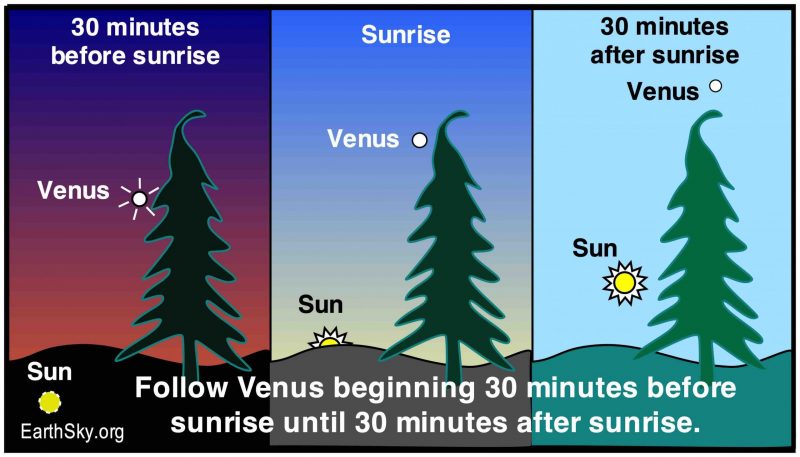
View larger. | The easiest way to see Venus in the daytime is to start when it’s still night. Find Venus near the sunrise point in the morning. Be sure to position it near a tree, lamppost or building in your foreground. Then keep track of it after the sun rises and the sky turns blue. You’ll be amazed how easy it is to pick out Venus, once you know where to look. Chart via John Jardine Goss/ EarthSky.
Seeing Venus in the daytime
Venus is bright! After the sun and the moon, it’s the brightest natural object in our sky. It’s so bright, you can sometimes see it during the day. That’s why some languages have a designated name for Venus as a daystar. For example, in Slavic mythology, Venus is known as Danica, which means daystar.
In late 2023, if you look east before sunrise, you can easily see Venus. This fall is also a good time to look for Venus in the east after sunrise. The planet reached its greatest brilliancy for this morning apparition on September 19. It’ll remain a dazzlingly bright light in the morning sky through the end of the year.
It reached its greatest elongation – its greatest apparent distance from the sunrise – on October 23, 2023. And now, Venus is descending each morning in the east before sunrise. It’s getting closer to the sunrise each day until it disappears from view in March 2024.
The very best time to see Venus during the day is when the moon is nearby. Check out the chart below for a great opportunity to see Venus in a blue sky on the morning of November 9, 2023.
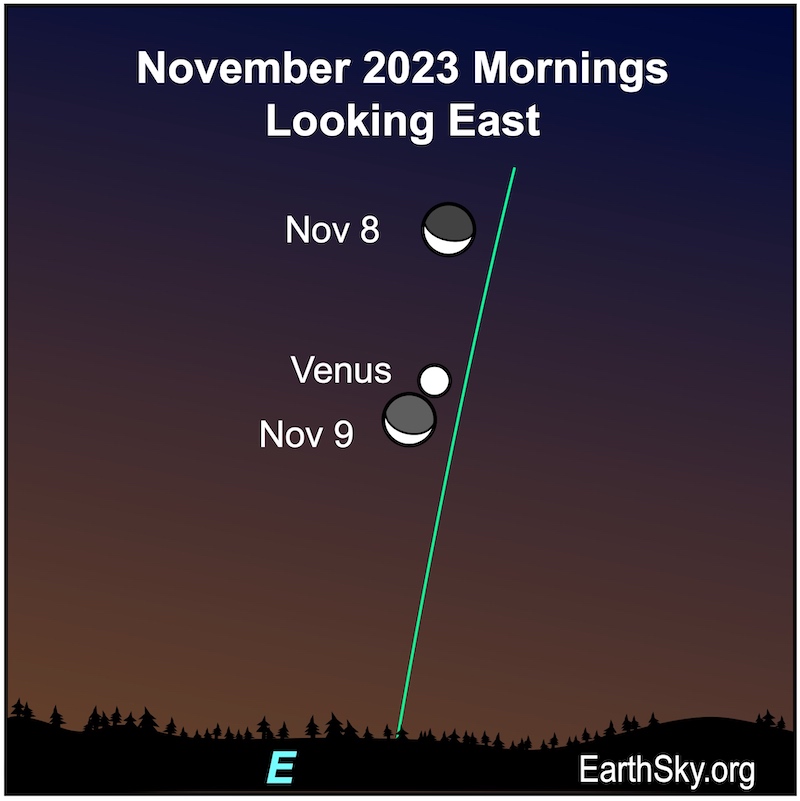
On the mornings of November 8 and 9, 2023, the waning crescent moon will float near the dazzlingly bright planet Venus. The pair will be especially close on the morning of November 9, making a captivating pair. They’ll be about 1 degree apart in darkness – the width of 2 full moons side-by-side – and a daytime occultation is visible from north Canada, most of Greenland, Iceland, Svalbard, west Russia, most of Europe, parts of north Africa and most of the Middle East. Chart via EarthSky.
Why is Venus so bright?
Why can you see Venus during the day? And why is Venus so bright? There are two reasons.
First, Venus is close to us. It’s the planet next-inward from Earth in orbit around the sun.
Second, Venus is covered with highly reflective clouds. Sunlight bouncing from those clouds makes Venus bright in our sky.
How to see Venus in the daytime
There are many different techniques for spotting Venus in the daytime. We discuss some of the more common methods here:
On the morning of November 9, 2023, the waning crescent moon will be close to Venus in the morning sky. In fact, some parts of the globe can see a lunar occultation of Venus that day.
The easiest way to find Venus in the daytime is just before or after an occultation by the moon. During such events, the moon passes in front of Venus from our earthly perspective. And – especially if the occultation happens in daytime from your location – you might glimpse Venus near the lighted (or darkened) edge of the moon. Unfortunately, for any fixed location on Earth, occultations of Venus are rare. Luckily, there will be an occultation of Venus visible from most of Europe and the Middle East on November 9, 2023.
Even on the days the moon is not especially close to Venus in our skies, it can still help you navigate to this bright planet. That is especially true when Venus is positioned exactly halfway between the moon and the sun. This happens somewhere on Earth every month, although the three objects might not be in a perfect line. Use Stellarium to find out when this will happen next for you. Just set the scene for the early morning sky at your location, and click forward through the dates.
Observe Venus in the daytime on the meridian
Venus orbits one step inward from Earth. So we always see it near the sun in our sky, and, generally speaking, after sunrise it’s hard to see. But Venus is up there, every day, following or leading in the path of the sun across our sky. Therefore, if you could see Venus any day, you’d always notice it passing due south in your sky once a day (as seen from the Northern Hemisphere), or due north once a day (as seen from the Southern Hemisphere), just as the sun does. When Venus passes due south (or due north), astronomers say that Venus is transiting the meridian in your sky.
To find Venus as its transits your meridian, you need to know the direction south (from the Northern Hemisphere) or north (from the Southern Hemisphere). In many cities in North America, streets are aligned with north/south or east/west directions. In such cities, it’s easy to find those cardinal points.
No north-south streets? Here’s another way to find due south (or due north) in your sky. Try putting a stick in the ground and observing when the sun is highest in your sky, using your astronomy app. At the instant the sun is highest (aka astronomical noon or solar noon), the sun will be due south from the Northern Hemisphere (and due north from the Southern Hemisphere). The shadow of your stick will point to the north (or south). If you mark these cardinal directions with respect to your favorite observing spot, it’ll make your observing easier! And it’ll help you find Venus during the day.
The meridian is just an imaginary line across your sky – a great circle from due south to due north – passing through your local zenith or highest point in the sky. So at the moment it transits the meridian, Venus is at its highest in the sky for that day.
If you know the direction of south (or north), the next step is to find out how high in your sky Venus is as it transits your meridian. Your astronomy app (or Stellarium) can help you with the exact moment of meridian transit as well as exact altitude of Venus at that time.
Since it’s not easy to judge angles in the sky, start observing low in the direction of south (or north) and then move slowly upward, until you meet a bright point of light.
Observe Venus in the predawn sky
Take advantage of Venus’s brilliance by tracking it down in daylight. Finding Venus in daylight in the morning sky is much easier than finding it in the evening sky. That’s because you can start watching it before sunrise, then follow it until after sunrise. Although Venus reached greatest brilliancy in September, it still ends the month of November at a very bright magnitude -4.3.
No matter where you are on Earth, here are some general rules to follow for seeing Venus shortly after sunrise:
– Use a free astronomy app, such as Stellarium, and enter your exact location. You can find out where Venus is with respect to the sunrise (or the moon) in your sky on a specific date.
– Check a good sunrise/sunset calculator for the exact time of sunrise at your location, such as this one at Sunrise Sunset Calendars.
– Find Venus before sunrise. It’ll be easy because it’ll be the brightest starlike object in the sunrise direction. Then keep an eye on it, as long as you can, after the sun pokes above the horizon. Be sure not to look at the sun! To make it easier, position yourself so that Venus is placed in your sky in relation to a foreground object, such as a tree or utility pole. When you spot Venus in daylight, it will be small and inconspicuous. If you look away and look back, it will be hard to find it again. It helps a lot if you have an object nearby, such as a tree or the moon.
Venus in the daytime photo gallery
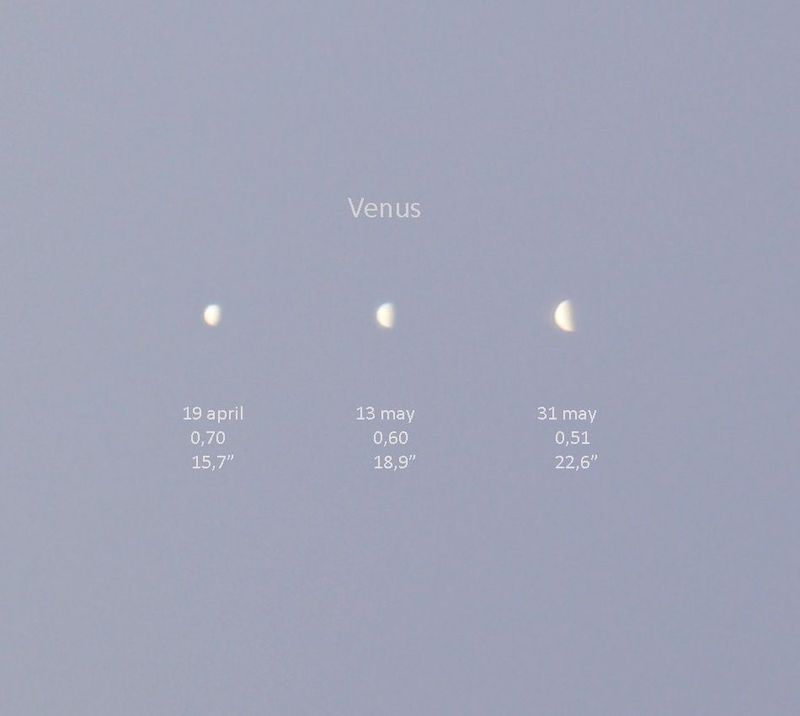
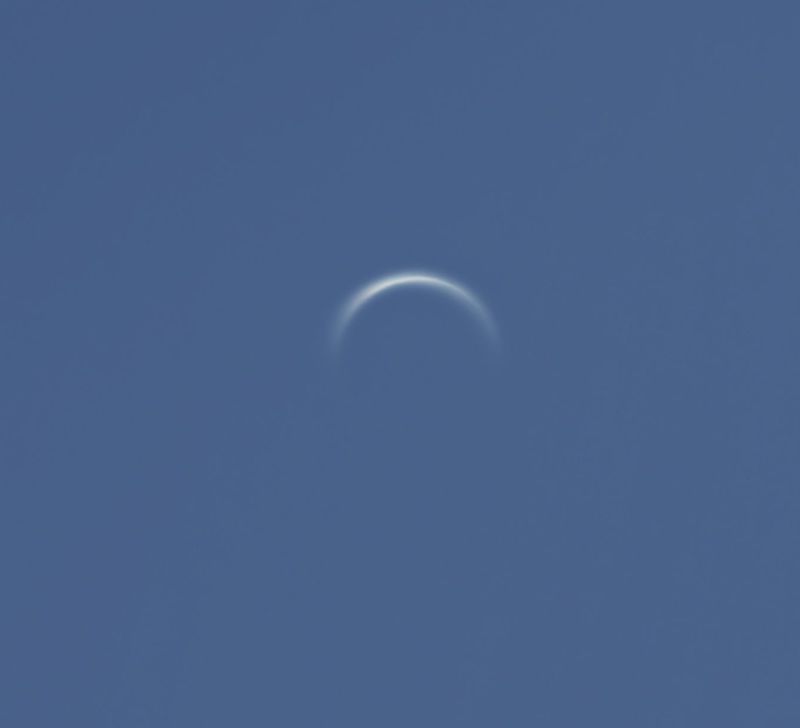
View at EarthSky Community Photos. | Steven Bellavia of Mattituck, New York, captured this image of Venus near noon his local time on October 4, 2023. Thank you, Steven!View at EarthSky Community Photos. | Patricio Leon in Santiago, Chile, caught Venus around noon, on the day it last passed most nearly between the Earth and sun for this orbit of Venus (August 13, 2023). He wrote: “Venus was just 7.5 degrees from the sun’s limb [edge]. First, I located the planet with 10x50s, then had to find it in the screen using a hood to cover head and camera … it was quite a relief to see the planet appear in the screen and obtain the so desired shot. The planet and the photographer were smiling at the same time.” Thank you, Patricio!View at EarthSky Community Photos. | Patricio Leon of Santiago, Chile, captured these images of Venus in April and May of 2023 – when the planet was on its way to passing between the Earth and sun – and so waning in phase. Patricio wrote: “The evolving phase of planet Venus is seen in the above composite image, photos taken during day hours with inevitable hazy skies.” Thank you, Patricio!
More Venus images
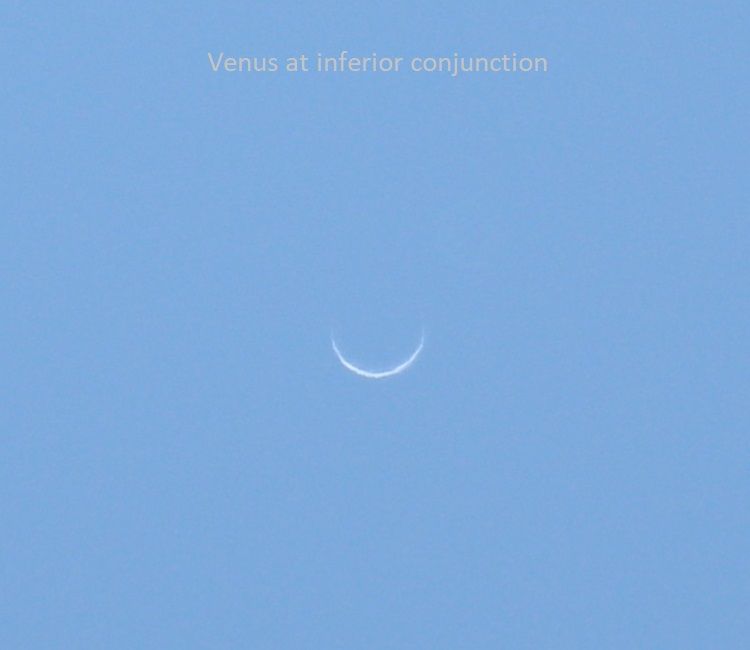
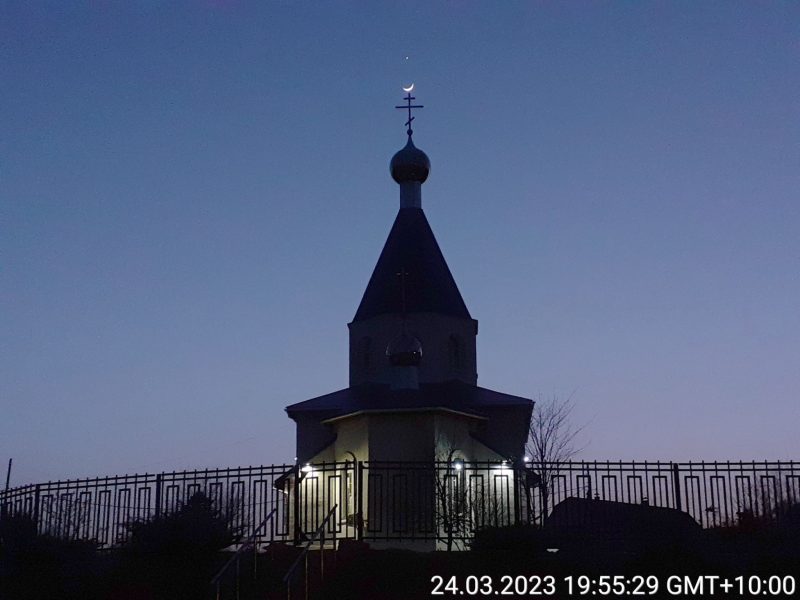
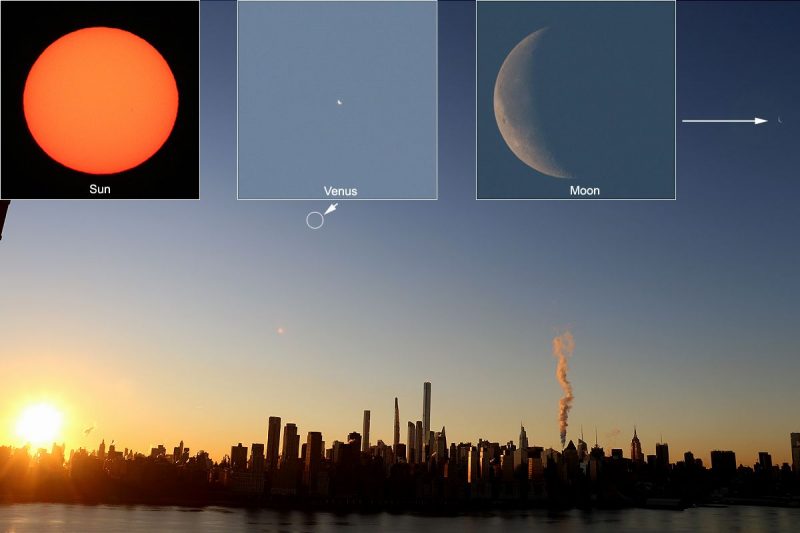
View at EarthSky Community Photos. | Steven Bellavia of Mattituck, New York, captured this image on August 13, 2023, at 3:28 p.m. He wrote: “Venus, 0.9% illuminated, at (or very close to) inferior conjunction.” Thank you, Steven!View at EarthSky Community Photos. | Filipp Romanov near Nakhodka, Primorsky Krai, Russia, captured this image on March 24, 2023. Filipp wrote: “Crescent moon and Venus conjunction above the Orthodox Church. Photographed with a mobile phone camera.” Thank you, Filipp!View at EarthSky Community Photos. | Alexander Krivenyshev of the website WorldTimeZone.com caught Venus in the daytime on January 27, 2022, over New York City. Note the inset at the far right, showing the moon in a waning crescent phase that day. Now notice the middle inset. That’s a crescent Venus. It looks that way because its lighted face was turned mostly away from us then. The inset on the left shows the sun itself, which was just breaching the horizon when Alexander captured this image. Thank you, Alexander!
Bottom line: The moon is near Venus on November 9, 2023. That makes that morning a great time to try to spot Venus in a daytime sky.
View larger. | The easiest way to see Venus in the daytime is to start when it’s still night. Find Venus near the sunrise point in the morning. Be sure to position it near a tree, lamppost or building in your foreground. Then keep track of it after the sun rises and the sky turns blue. You’ll be amazed how easy it is to pick out Venus, once you know where to look. Chart via John Jardine Goss/ EarthSky.
Seeing Venus in the daytime
Venus is bright! After the sun and the moon, it’s the brightest natural object in our sky. It’s so bright, you can sometimes see it during the day. That’s why some languages have a designated name for Venus as a daystar. For example, in Slavic mythology, Venus is known as Danica, which means daystar.
In late 2023, if you look east before sunrise, you can easily see Venus. This fall is also a good time to look for Venus in the east after sunrise. The planet reached its greatest brilliancy for this morning apparition on September 19. It’ll remain a dazzlingly bright light in the morning sky through the end of the year.
It reached its greatest elongation – its greatest apparent distance from the sunrise – on October 23, 2023. And now, Venus is descending each morning in the east before sunrise. It’s getting closer to the sunrise each day until it disappears from view in March 2024.
The very best time to see Venus during the day is when the moon is nearby. Check out the chart below for a great opportunity to see Venus in a blue sky on the morning of November 9, 2023.
On the mornings of November 8 and 9, 2023, the waning crescent moon will float near the dazzlingly bright planet Venus. The pair will be especially close on the morning of November 9, making a captivating pair. They’ll be about 1 degree apart in darkness – the width of 2 full moons side-by-side – and a daytime occultation is visible from north Canada, most of Greenland, Iceland, Svalbard, west Russia, most of Europe, parts of north Africa and most of the Middle East. Chart via EarthSky.
Why is Venus so bright?
Why can you see Venus during the day? And why is Venus so bright? There are two reasons.
First, Venus is close to us. It’s the planet next-inward from Earth in orbit around the sun.
Second, Venus is covered with highly reflective clouds. Sunlight bouncing from those clouds makes Venus bright in our sky.
How to see Venus in the daytime
There are many different techniques for spotting Venus in the daytime. We discuss some of the more common methods here:
On the morning of November 9, 2023, the waning crescent moon will be close to Venus in the morning sky. In fact, some parts of the globe can see a lunar occultation of Venus that day.
The easiest way to find Venus in the daytime is just before or after an occultation by the moon. During such events, the moon passes in front of Venus from our earthly perspective. And – especially if the occultation happens in daytime from your location – you might glimpse Venus near the lighted (or darkened) edge of the moon. Unfortunately, for any fixed location on Earth, occultations of Venus are rare. Luckily, there will be an occultation of Venus visible from most of Europe and the Middle East on November 9, 2023.
Even on the days the moon is not especially close to Venus in our skies, it can still help you navigate to this bright planet. That is especially true when Venus is positioned exactly halfway between the moon and the sun. This happens somewhere on Earth every month, although the three objects might not be in a perfect line. Use Stellarium to find out when this will happen next for you. Just set the scene for the early morning sky at your location, and click forward through the dates.
Observe Venus in the daytime on the meridian
Venus orbits one step inward from Earth. So we always see it near the sun in our sky, and, generally speaking, after sunrise it’s hard to see. But Venus is up there, every day, following or leading in the path of the sun across our sky. Therefore, if you could see Venus any day, you’d always notice it passing due south in your sky once a day (as seen from the Northern Hemisphere), or due north once a day (as seen from the Southern Hemisphere), just as the sun does. When Venus passes due south (or due north), astronomers say that Venus is transiting the meridian in your sky.
To find Venus as its transits your meridian, you need to know the direction south (from the Northern Hemisphere) or north (from the Southern Hemisphere). In many cities in North America, streets are aligned with north/south or east/west directions. In such cities, it’s easy to find those cardinal points.
No north-south streets? Here’s another way to find due south (or due north) in your sky. Try putting a stick in the ground and observing when the sun is highest in your sky, using your astronomy app. At the instant the sun is highest (aka astronomical noon or solar noon), the sun will be due south from the Northern Hemisphere (and due north from the Southern Hemisphere). The shadow of your stick will point to the north (or south). If you mark these cardinal directions with respect to your favorite observing spot, it’ll make your observing easier! And it’ll help you find Venus during the day.
The meridian is just an imaginary line across your sky – a great circle from due south to due north – passing through your local zenith or highest point in the sky. So at the moment it transits the meridian, Venus is at its highest in the sky for that day.
If you know the direction of south (or north), the next step is to find out how high in your sky Venus is as it transits your meridian. Your astronomy app (or Stellarium) can help you with the exact moment of meridian transit as well as exact altitude of Venus at that time.
Since it’s not easy to judge angles in the sky, start observing low in the direction of south (or north) and then move slowly upward, until you meet a bright point of light.
Observe Venus in the predawn sky
Take advantage of Venus’s brilliance by tracking it down in daylight. Finding Venus in daylight in the morning sky is much easier than finding it in the evening sky. That’s because you can start watching it before sunrise, then follow it until after sunrise. Although Venus reached greatest brilliancy in September, it still ends the month of November at a very bright magnitude -4.3.
No matter where you are on Earth, here are some general rules to follow for seeing Venus shortly after sunrise:
– Use a free astronomy app, such as Stellarium, and enter your exact location. You can find out where Venus is with respect to the sunrise (or the moon) in your sky on a specific date.
– Check a good sunrise/sunset calculator for the exact time of sunrise at your location, such as this one at Sunrise Sunset Calendars.
– Find Venus before sunrise. It’ll be easy because it’ll be the brightest starlike object in the sunrise direction. Then keep an eye on it, as long as you can, after the sun pokes above the horizon. Be sure not to look at the sun! To make it easier, position yourself so that Venus is placed in your sky in relation to a foreground object, such as a tree or utility pole. When you spot Venus in daylight, it will be small and inconspicuous. If you look away and look back, it will be hard to find it again. It helps a lot if you have an object nearby, such as a tree or the moon.
Venus in the daytime photo gallery
View at EarthSky Community Photos. | Steven Bellavia of Mattituck, New York, captured this image of Venus near noon his local time on October 4, 2023. Thank you, Steven!View at EarthSky Community Photos. | Patricio Leon in Santiago, Chile, caught Venus around noon, on the day it last passed most nearly between the Earth and sun for this orbit of Venus (August 13, 2023). He wrote: “Venus was just 7.5 degrees from the sun’s limb [edge]. First, I located the planet with 10x50s, then had to find it in the screen using a hood to cover head and camera … it was quite a relief to see the planet appear in the screen and obtain the so desired shot. The planet and the photographer were smiling at the same time.” Thank you, Patricio!View at EarthSky Community Photos. | Patricio Leon of Santiago, Chile, captured these images of Venus in April and May of 2023 – when the planet was on its way to passing between the Earth and sun – and so waning in phase. Patricio wrote: “The evolving phase of planet Venus is seen in the above composite image, photos taken during day hours with inevitable hazy skies.” Thank you, Patricio!
More Venus images
View at EarthSky Community Photos. | Steven Bellavia of Mattituck, New York, captured this image on August 13, 2023, at 3:28 p.m. He wrote: “Venus, 0.9% illuminated, at (or very close to) inferior conjunction.” Thank you, Steven!View at EarthSky Community Photos. | Filipp Romanov near Nakhodka, Primorsky Krai, Russia, captured this image on March 24, 2023. Filipp wrote: “Crescent moon and Venus conjunction above the Orthodox Church. Photographed with a mobile phone camera.” Thank you, Filipp!View at EarthSky Community Photos. | Alexander Krivenyshev of the website WorldTimeZone.com caught Venus in the daytime on January 27, 2022, over New York City. Note the inset at the far right, showing the moon in a waning crescent phase that day. Now notice the middle inset. That’s a crescent Venus. It looks that way because its lighted face was turned mostly away from us then. The inset on the left shows the sun itself, which was just breaching the horizon when Alexander captured this image. Thank you, Alexander!
Bottom line: The moon is near Venus on November 9, 2023. That makes that morning a great time to try to spot Venus in a daytime sky.
Astronomers found the most distant black hole ever detected in X-rays (in a galaxy dubbed UHZ1) using the Chandra and Webb space telescopes. X-ray emission is a telltale signature of a growing supermassive black hole. The finding may explain how some of the first supermassive black holes in the universe formed. These images show the galaxy cluster Abell 2744 that UHZ1 is located behind, in X-rays from Chandra and infrared data from Webb. The insets are closeups of the black hole host galaxy UHZ1. Image via NASA. Used with permission.
Astronomers have discovered the most distant black hole yet seen in X-rays, using NASA telescopes. The black hole is at an early stage of growth that had never been witnessed before, where its mass is similar to that of its host galaxy.
This result may explain how some of the first supermassive black holes in the universe formed.
Akos Bogdan of the Center for Astrophysics at Harvard & Smithsonian (CfA), lead author of a new paper in the journal Nature Astronomy (a preprint is available online), said:
We needed Webb to find this remarkably distant galaxy and Chandra to find its supermassive black hole. We also took advantage of a cosmic magnifying glass that boosted the amount of light we detected. This magnifying effect is known as gravitational lensing.
Bogdan and his team found the black hole in a galaxy named UHZ1 in the direction of the galaxy cluster Abell 2744. It’s located 3.5 billion light-years from Earth. Webb data, however, has revealed the galaxy is much more distant than the cluster, at 13.2 billion light-years from Earth, when the universe was only 3% of its current age.
More than two weeks of observations with Chandra showed the presence of intense, superheated, X-ray emitting gas in this galaxy. That is a trademark for a growing supermassive black hole. The light from the galaxy and the X-rays from gas around its supermassive black hole are magnified by about a factor of four by intervening matter in Abell 2744 (due to gravitational lensing), enhancing the infrared signal detected by Webb and enabling Chandra to detect the faint X-ray source.
This discovery is important for understanding how some supermassive black holes can reach colossal masses soon after the Big Bang. Do they form directly from the collapse of massive clouds of gas, creating black holes weighing between about 10,000 and 100,000 suns? Or do they come from explosions of the first stars that create black holes weighing only between about 10 and 100 suns?
There are physical limits on how quickly black holes can grow once they’ve formed, but ones that are born more massive have a head start. It’s like planting a sapling, which takes less time to grow into a full-size tree than if you started with only a seed.
It appears it was born as a supermassive black hole
Bogdan’s team has found strong evidence that the newly discovered black hole was born massive. Its mass is estimated to fall between 10 million and 100 million suns, based on the brightness and energy of the X-rays. This mass range is similar to that of all the stars in the galaxy where it lives. That is in stark contrast to black holes in the centers of galaxies in the nearby universe that usually contain only about 1/10 percent of the mass of their host galaxy’s stars.
The large mass of the black hole at a young age, plus the amount of X-rays it produces and the brightness of the galaxy detected by Webb, all agree with theoretical predictions made in 2017. Co-author Priyamvada Natarajan of Yale University predicted an “Outsize Black Hole” that directly formed from the collapse of a huge cloud of gas. Natarajan said:
We think that this is the first detection of an Outsize Black Hole and the best evidence yet obtained that some black holes form from massive clouds of gas. For the first time we are seeing a brief stage where a supermassive black hole weighs about as much as the stars in its galaxy, before it falls behind.
How the black hole formed
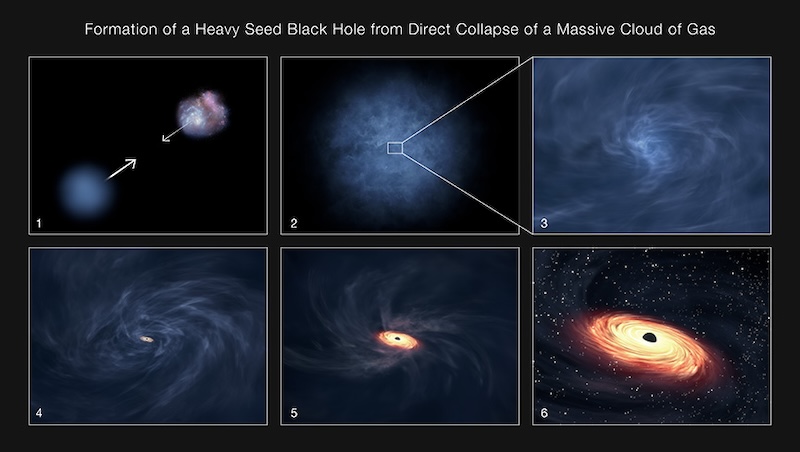
This set of illustrations explains how a large black hole can form from the direct collapse of a massive cloud of gas a few hundred million years after the Big Bang. More details about each illustration below. Image via NASA/ STScI/ Leah Hustak. Used with permission.
#1 shows a massive gas cloud and a galaxy moving towards each other. If the formation of stars in the gas cloud is stalled by radiation from the incoming galaxy – preventing it from forming a new galaxy – the gas can instead be driven to collapse and form a disk and black hole.
#2 and #3 show the beginning of this gas collapse in the center of the cloud.
#4 shows a small black hole forming in the center of the disk and the black hole and disk then continuing to grow.
#5 shows the massive black hole “seed” and its disk merging with the galaxy shown in illustration #1.
#6 for a period the black hole is unusually massive compared to the mass of the stars in the galaxy, making it an Outsize Black Hole. Stars and gas from the galaxy are pulled in by the black hole, causing the black hole and disk to grow even larger.
It’s another piece in the puzzle of the early universe
The researchers plan to use this and other results pouring in from Webb, along with data from other telescopes, to fill out a larger picture of the early universe.
NASA’s Hubble Space Telescope previously showed that light from distant galaxies is highly magnified by matter in the intervening galaxy cluster, providing part of the motivation for the Webb and Chandra observations described here.
Bottom line: NASA announced the discovery of the most distant black hole yet. The supermassive black hole is at an early stage of growth and its mass is about the same as its host galaxy.
Astronomers found the most distant black hole ever detected in X-rays (in a galaxy dubbed UHZ1) using the Chandra and Webb space telescopes. X-ray emission is a telltale signature of a growing supermassive black hole. The finding may explain how some of the first supermassive black holes in the universe formed. These images show the galaxy cluster Abell 2744 that UHZ1 is located behind, in X-rays from Chandra and infrared data from Webb. The insets are closeups of the black hole host galaxy UHZ1. Image via NASA. Used with permission.
Astronomers have discovered the most distant black hole yet seen in X-rays, using NASA telescopes. The black hole is at an early stage of growth that had never been witnessed before, where its mass is similar to that of its host galaxy.
This result may explain how some of the first supermassive black holes in the universe formed.
Akos Bogdan of the Center for Astrophysics at Harvard & Smithsonian (CfA), lead author of a new paper in the journal Nature Astronomy (a preprint is available online), said:
We needed Webb to find this remarkably distant galaxy and Chandra to find its supermassive black hole. We also took advantage of a cosmic magnifying glass that boosted the amount of light we detected. This magnifying effect is known as gravitational lensing.
Bogdan and his team found the black hole in a galaxy named UHZ1 in the direction of the galaxy cluster Abell 2744. It’s located 3.5 billion light-years from Earth. Webb data, however, has revealed the galaxy is much more distant than the cluster, at 13.2 billion light-years from Earth, when the universe was only 3% of its current age.
More than two weeks of observations with Chandra showed the presence of intense, superheated, X-ray emitting gas in this galaxy. That is a trademark for a growing supermassive black hole. The light from the galaxy and the X-rays from gas around its supermassive black hole are magnified by about a factor of four by intervening matter in Abell 2744 (due to gravitational lensing), enhancing the infrared signal detected by Webb and enabling Chandra to detect the faint X-ray source.
This discovery is important for understanding how some supermassive black holes can reach colossal masses soon after the Big Bang. Do they form directly from the collapse of massive clouds of gas, creating black holes weighing between about 10,000 and 100,000 suns? Or do they come from explosions of the first stars that create black holes weighing only between about 10 and 100 suns?
There are physical limits on how quickly black holes can grow once they’ve formed, but ones that are born more massive have a head start. It’s like planting a sapling, which takes less time to grow into a full-size tree than if you started with only a seed.
It appears it was born as a supermassive black hole
Bogdan’s team has found strong evidence that the newly discovered black hole was born massive. Its mass is estimated to fall between 10 million and 100 million suns, based on the brightness and energy of the X-rays. This mass range is similar to that of all the stars in the galaxy where it lives. That is in stark contrast to black holes in the centers of galaxies in the nearby universe that usually contain only about 1/10 percent of the mass of their host galaxy’s stars.
The large mass of the black hole at a young age, plus the amount of X-rays it produces and the brightness of the galaxy detected by Webb, all agree with theoretical predictions made in 2017. Co-author Priyamvada Natarajan of Yale University predicted an “Outsize Black Hole” that directly formed from the collapse of a huge cloud of gas. Natarajan said:
We think that this is the first detection of an Outsize Black Hole and the best evidence yet obtained that some black holes form from massive clouds of gas. For the first time we are seeing a brief stage where a supermassive black hole weighs about as much as the stars in its galaxy, before it falls behind.
How the black hole formed
This set of illustrations explains how a large black hole can form from the direct collapse of a massive cloud of gas a few hundred million years after the Big Bang. More details about each illustration below. Image via NASA/ STScI/ Leah Hustak. Used with permission.
#1 shows a massive gas cloud and a galaxy moving towards each other. If the formation of stars in the gas cloud is stalled by radiation from the incoming galaxy – preventing it from forming a new galaxy – the gas can instead be driven to collapse and form a disk and black hole.
#2 and #3 show the beginning of this gas collapse in the center of the cloud.
#4 shows a small black hole forming in the center of the disk and the black hole and disk then continuing to grow.
#5 shows the massive black hole “seed” and its disk merging with the galaxy shown in illustration #1.
#6 for a period the black hole is unusually massive compared to the mass of the stars in the galaxy, making it an Outsize Black Hole. Stars and gas from the galaxy are pulled in by the black hole, causing the black hole and disk to grow even larger.
It’s another piece in the puzzle of the early universe
The researchers plan to use this and other results pouring in from Webb, along with data from other telescopes, to fill out a larger picture of the early universe.
NASA’s Hubble Space Telescope previously showed that light from distant galaxies is highly magnified by matter in the intervening galaxy cluster, providing part of the motivation for the Webb and Chandra observations described here.
Bottom line: NASA announced the discovery of the most distant black hole yet. The supermassive black hole is at an early stage of growth and its mass is about the same as its host galaxy.
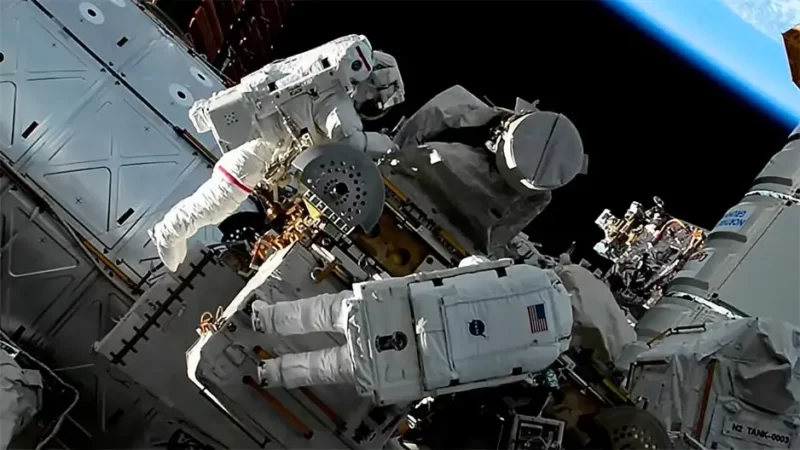
A tool bag is orbiting Earth, and night sky observers might catch a glimpse of it. NASA astronauts Jasmin Moghbeli and Loral O’Hara were conducting a spacewalk from the International Space Station (ISS) on November 2, 2023, when Moghbeli somehow let a tool bag slip away. The tool bag is now orbiting Earth just ahead of the International Space Station. It’s surprisingly bright (for a tool bag), shining just below the limit of visibility to the unaided eye at around magnitude +6. That means some sky observers should be able to pick it up with binoculars.
A tool bag was lost during last week’s EVA to replace a trundle bearing on the port solar alpha array. The object is now listed in the catalog as ID 1998-067WC/58229. The tool bag as a +6th magnitude ‘star’ currently about a minute ahead of the ISS.https://t.co/2YZf3PnjzV
The tool bag should remain in orbit around Earth for a few months, after which it’ll disintegrate in Earth’s atmosphere. Unlike the ISS, the tool bag will rapidly descend in orbit until, after a few months, it will reach about 70 miles (113 km) and disintegrate.
The spacewalkers were conducting repairs on assemblies that allow the ISS solar arrays to track the sun continuously. A blog post at SciTechDaily, which was describing the spacewalk, explained:
During the activity, one tool bag was inadvertently lost. Flight controllers spotted the tool bag using external station cameras. The tools were not needed for the remainder of the spacewalk. Mission Control analyzed the bag’s trajectory and determined that risk of recontacting the station is low and that the onboard crew and space station are safe with no action required.
(From left) Astronauts Jasmin Moghbeli and Loral O’Hara are pictured trying on their spacesuits and testing their suits’ components aboard the space station. Image via NASA.
Seeing it with binoculars
Meanwhile, observers that have a visible pass of the International Space Station can also try to spot the tool bag, which is a dim object (around visual magnitude +6), visible using binoculars. The strategy is to observe the trajectory of the ISS, and to scan the sky in the area just ahead of the space station.
As the small object gradually loses height, it should appear a few seconds ahead of the ISS during the next few days, and a minute or two ahead during the next weeks.
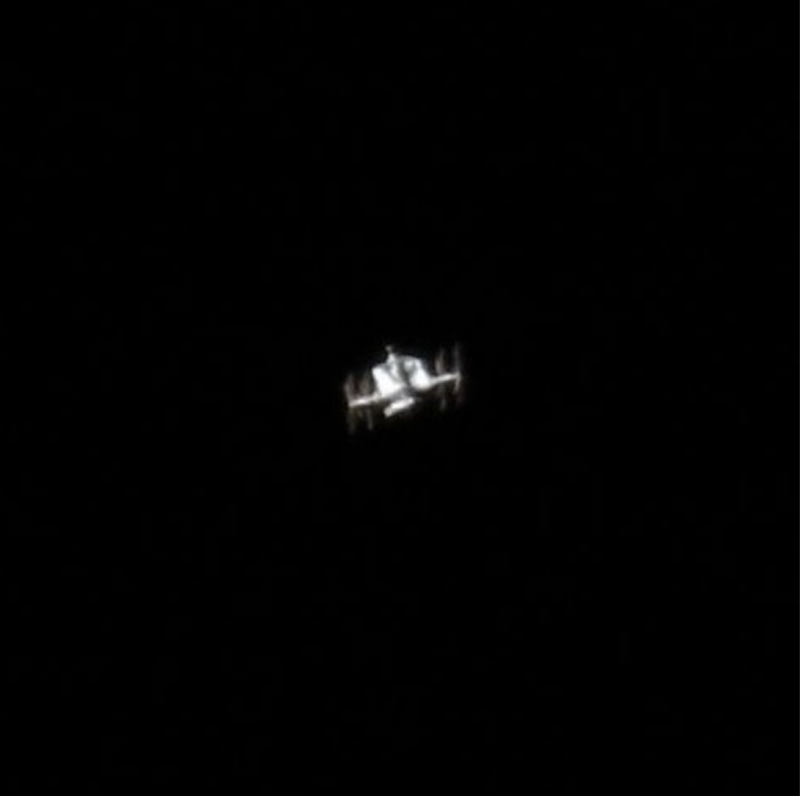
View at EarthSky Community Photos. | Patricio León in Santiago, Chile, happened to capture a telescopic view of the ISS on November 2, 2023, the same day the errant tool bag went into orbit. Patricio wrote: “Radiators illuminated very favorably, USA modules below them, Soyuz capsule at top.” Thank you, Patricio!
Not the first time
And this isn’t the first time a NASA astronaut has lost a tool bag. On November 18, 2008, astronaut Heide Stefanyshyn-Piper was performing a similar repair at the International Space Station when she inadvertently lost a tool bag.
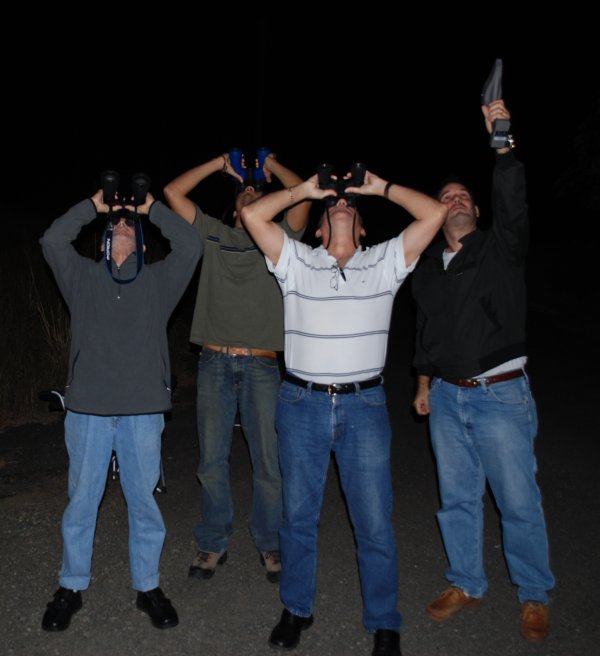
Even some two months later, on January 12, 2009, the object was still visible ahead of ISS and was seen with binoculars by Joxelle Velazquez among others during a star party at Cabo Rojo, Puerto Rico. See the image below.
It’s far from the first time astronauts have lost track of tools in space. Back in 1965, NASA astronaut Ed White infamously lost a spare glove during a spacewalk outside of his Gemini 4 spacecraft. Over the decades, several other astronauts have lost other objects, from spare bolts in 2006 to an entire bag ironically containing a debris shield in 2017.
And, although NASA has determined that the 2023 tool bag isn’t on a trajectory that’s dangerous to the astronauts aboard ISS at this time, the problem of litter in near-Earth orbit remains and is serious. As Tangermann wrote at Futurism:
The problem, of course, is that not every piece of space debris will stay out of the way of future space travelers.
And that is a sad truth.
Another lost tool bag – which also orbited Earth – was seen from Puerto Rico on January 12, 2009. Later that year, that tool bag met a fiery end in Earth’s atmosphere. Image via Eddie Irizarry/ Sociedad de Astronomia del Caribe. Used with permission.
Bottom line: NASA astronauts were servicing the solar panels on the International Space Station on November 2, when one of them lost a tool bag. It’s now orbiting just ahead of ISS.
A tool bag is orbiting Earth, and night sky observers might catch a glimpse of it. NASA astronauts Jasmin Moghbeli and Loral O’Hara were conducting a spacewalk from the International Space Station (ISS) on November 2, 2023, when Moghbeli somehow let a tool bag slip away. The tool bag is now orbiting Earth just ahead of the International Space Station. It’s surprisingly bright (for a tool bag), shining just below the limit of visibility to the unaided eye at around magnitude +6. That means some sky observers should be able to pick it up with binoculars.
A tool bag was lost during last week’s EVA to replace a trundle bearing on the port solar alpha array. The object is now listed in the catalog as ID 1998-067WC/58229. The tool bag as a +6th magnitude ‘star’ currently about a minute ahead of the ISS.https://t.co/2YZf3PnjzV
The tool bag should remain in orbit around Earth for a few months, after which it’ll disintegrate in Earth’s atmosphere. Unlike the ISS, the tool bag will rapidly descend in orbit until, after a few months, it will reach about 70 miles (113 km) and disintegrate.
The spacewalkers were conducting repairs on assemblies that allow the ISS solar arrays to track the sun continuously. A blog post at SciTechDaily, which was describing the spacewalk, explained:
During the activity, one tool bag was inadvertently lost. Flight controllers spotted the tool bag using external station cameras. The tools were not needed for the remainder of the spacewalk. Mission Control analyzed the bag’s trajectory and determined that risk of recontacting the station is low and that the onboard crew and space station are safe with no action required.
(From left) Astronauts Jasmin Moghbeli and Loral O’Hara are pictured trying on their spacesuits and testing their suits’ components aboard the space station. Image via NASA.
Seeing it with binoculars
Meanwhile, observers that have a visible pass of the International Space Station can also try to spot the tool bag, which is a dim object (around visual magnitude +6), visible using binoculars. The strategy is to observe the trajectory of the ISS, and to scan the sky in the area just ahead of the space station.
As the small object gradually loses height, it should appear a few seconds ahead of the ISS during the next few days, and a minute or two ahead during the next weeks.
View at EarthSky Community Photos. | Patricio León in Santiago, Chile, happened to capture a telescopic view of the ISS on November 2, 2023, the same day the errant tool bag went into orbit. Patricio wrote: “Radiators illuminated very favorably, USA modules below them, Soyuz capsule at top.” Thank you, Patricio!
Not the first time
And this isn’t the first time a NASA astronaut has lost a tool bag. On November 18, 2008, astronaut Heide Stefanyshyn-Piper was performing a similar repair at the International Space Station when she inadvertently lost a tool bag.
Even some two months later, on January 12, 2009, the object was still visible ahead of ISS and was seen with binoculars by Joxelle Velazquez among others during a star party at Cabo Rojo, Puerto Rico. See the image below.
It’s far from the first time astronauts have lost track of tools in space. Back in 1965, NASA astronaut Ed White infamously lost a spare glove during a spacewalk outside of his Gemini 4 spacecraft. Over the decades, several other astronauts have lost other objects, from spare bolts in 2006 to an entire bag ironically containing a debris shield in 2017.
And, although NASA has determined that the 2023 tool bag isn’t on a trajectory that’s dangerous to the astronauts aboard ISS at this time, the problem of litter in near-Earth orbit remains and is serious. As Tangermann wrote at Futurism:
The problem, of course, is that not every piece of space debris will stay out of the way of future space travelers.
And that is a sad truth.
Another lost tool bag – which also orbited Earth – was seen from Puerto Rico on January 12, 2009. Later that year, that tool bag met a fiery end in Earth’s atmosphere. Image via Eddie Irizarry/ Sociedad de Astronomia del Caribe. Used with permission.
Bottom line: NASA astronauts were servicing the solar panels on the International Space Station on November 2, when one of them lost a tool bag. It’s now orbiting just ahead of ISS.
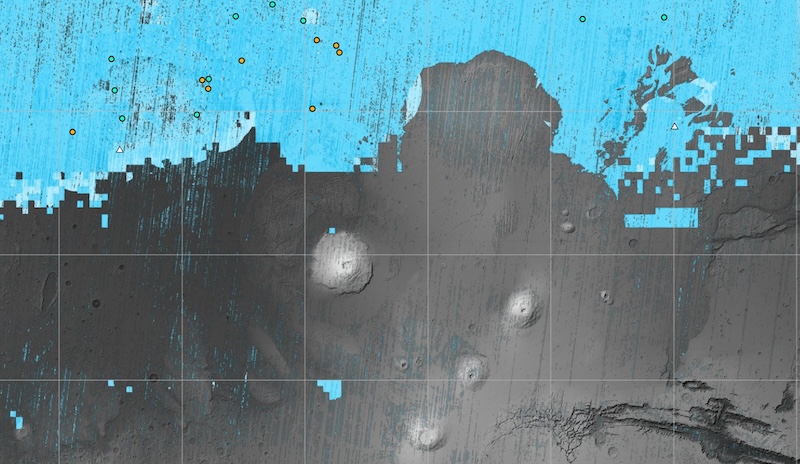
View larger. | This is part of the new map from the Mars Subsurface Water Ice Mapping project. The blue areas show locations of underground water ice on Mars. The famous Olympus Mons and 3 other volcanoes are in the center part of the image. Image via NASA/ JPL-Caltech/ Planetary Science Institute.
Mars has a lot of water ice, both on the surface and underground. But most of the surface ice is at the planet’s poles. So buried subsurface ice in other places across the planet will someday be an important resource for future Mars astronauts. In late October 2023, NASA said it has released the newest version of its water ice on Mars map. The NASA-funded Subsurface Water Ice Mapping project – aka SWIM – started releasing the maps back in 2017. This is now the 4th version of the map. The map will help future visitors to the red planet decide on the best landing spots. They’ll use maps like this one to know where ice can be drilled and extracted. How is this map better than previous versions? Keep reading …
The Planetary Science Institute (PSI) in Tucson, Arizona, leads the SWIM project and NASA’s Jet Propulsion Laboratory (JPL) in Pasadena, California, manages it.
The new map uses data compiled from several different NASA missions, including the Mars Reconnaissance Orbiter, Mars Odyssey and Mars Global Surveyor, which is no longer active. The primary purpose of the map is to identify the most likely places for buried ice.
The data show that the ice is close enough to the surface that astronauts could access it. We known that much of the ice is in the mid-latitudes, the northern mid-latitudes in particular.
Finding the best locations of ice on Mars
The northern mid-latitudes would be the most ideal for future human missions. This is because the atmosphere is slightly thicker over these regions, which would help a descending spacecraft to land safely. But the best locations would also be ones closest to the equator, where temperatures are warmest. Sydney Do, JPL’s SWIM project manager, said:
If you send humans to Mars, you want to get them as close to the equator as you can. The less energy you have to expend on keeping astronauts and their supporting equipment warm, the more you have for other things they’ll need.
A new and improved map of ice on Mars
Previous versions of the SWIM map were able to show where buried ice was probably located, but couldn’t confirm it. They used lower-resolution imagers, radar, thermal mappers and spectrometers than what is available now. The new map, on the other hand, uses data from higher-resolution cameras on the Mars Reconnaissance Orbiter.
The map uses Context Camera (CTX) data to further refine the northern hemisphere maps. Also, for the first time, the map incorporates data from the High-Resolution Imaging Science Experiment (HiRISE) camera. This provides a detailed perspective of the ice’s boundary line as close to the equator as possible.
Craters reveal hidden ice
Sometimes, ice that is below the surface gets excavated naturally by meteorite impacts. HiRISE has found many such ice-containing craters. That would be ideal for astronauts, since not all of the ice would need to be brought to the surface from below. Some is already there! Those ice deposits also act as an “X marks the spot,” showing where more ice is likely just under the surface. As SWIM’s co-lead at the Planetary Science Institute, Gareth Morgan, said:
These ice-revealing impacts provide a valuable form of ground truth in that they show us locations where the presence of ground ice is unequivocal. We can then use these locations to test that our mapping methods are sound.
HiRISE has also viewed polygon terrain on Mars. This is similar to terrain on Earth where expanding and contracting subsurface ice causes polygonal-shaped cracks in the ground. The polygons are another signpost pointing to ice just below the surface.
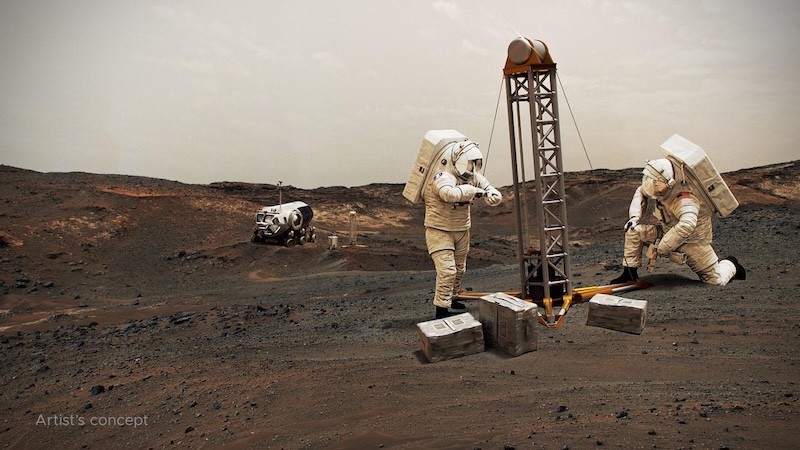
View larger. | NASA will use the new maps to find the best subsurface ice deposits that future astronauts will be able to use as a water resource. Artist’s concept via NASA.
More icy mysteries
The new map can help scientists solve other mysteries about ice on Mars as well. For example, the subsurface ice is more abundant at mid-latitudes. However, the distribution of that ice isn’t consistent, and actually varies quite a bit. Why? Nathaniel Putzig is SWIM’s other co-lead at the Planetary Science Institute. He explained:
The amount of water ice found in locations across the Martian mid-latitudes isn’t uniform; some regions seem to have more than others, and no one really knows why. The newest SWIM map could lead to new hypotheses for why these variations happen.
The answer may be related to how the Martian climate has changed over billions of years. Due to that variation, more ice may simply have been deposited in some areas and less ice in others.
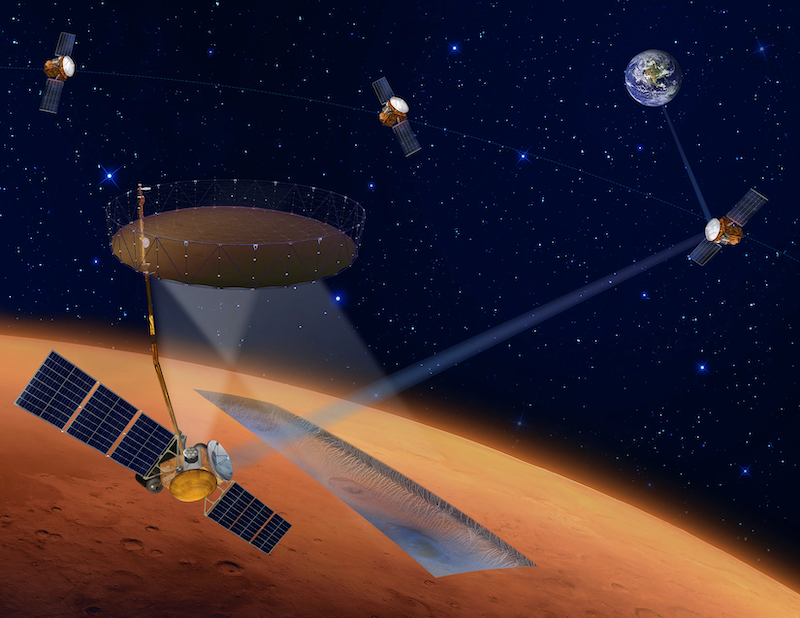
View larger. | The International Mars Ice Mapper (I-MIM), a proposed new mission as seen in this artist’s concept, would locate and map subsurface ice deposits on Mars in even more detail. Image via NASA.
Mars Ice Mapper
HiRISE has been invaluable in locating deposits, and suspected deposits, of ice on Mars. But there’s always room for improvement. NASA has proposed a new mission called International Mars Ice Mapper (I-MIM). It would continue the work of HiRISE, but custom-designed specifically to locate ice deposits. Finding ice is just one of many of HiRISE’s tasks.
The International Mars Ice Mapper mission would consist of four orbiters: one each from NASA, the Italian Space Agency (ASI), the Canadian Space Agency (CSA) and the Japan Aerospace Exploration Agency (JAXA). If approved, the mission could be ready to launch by 2026. It would detect the location, depth, spatial extent and abundance of near-surface ice deposits.
Bottom line: NASA has released a new map of ice on Mars as part of the Subsurface Water Ice Mapping project. It shows all the known and suspected areas of underground ice.
View larger. | This is part of the new map from the Mars Subsurface Water Ice Mapping project. The blue areas show locations of underground water ice on Mars. The famous Olympus Mons and 3 other volcanoes are in the center part of the image. Image via NASA/ JPL-Caltech/ Planetary Science Institute.
Mars has a lot of water ice, both on the surface and underground. But most of the surface ice is at the planet’s poles. So buried subsurface ice in other places across the planet will someday be an important resource for future Mars astronauts. In late October 2023, NASA said it has released the newest version of its water ice on Mars map. The NASA-funded Subsurface Water Ice Mapping project – aka SWIM – started releasing the maps back in 2017. This is now the 4th version of the map. The map will help future visitors to the red planet decide on the best landing spots. They’ll use maps like this one to know where ice can be drilled and extracted. How is this map better than previous versions? Keep reading …
The Planetary Science Institute (PSI) in Tucson, Arizona, leads the SWIM project and NASA’s Jet Propulsion Laboratory (JPL) in Pasadena, California, manages it.
The new map uses data compiled from several different NASA missions, including the Mars Reconnaissance Orbiter, Mars Odyssey and Mars Global Surveyor, which is no longer active. The primary purpose of the map is to identify the most likely places for buried ice.
The data show that the ice is close enough to the surface that astronauts could access it. We known that much of the ice is in the mid-latitudes, the northern mid-latitudes in particular.
Finding the best locations of ice on Mars
The northern mid-latitudes would be the most ideal for future human missions. This is because the atmosphere is slightly thicker over these regions, which would help a descending spacecraft to land safely. But the best locations would also be ones closest to the equator, where temperatures are warmest. Sydney Do, JPL’s SWIM project manager, said:
If you send humans to Mars, you want to get them as close to the equator as you can. The less energy you have to expend on keeping astronauts and their supporting equipment warm, the more you have for other things they’ll need.
A new and improved map of ice on Mars
Previous versions of the SWIM map were able to show where buried ice was probably located, but couldn’t confirm it. They used lower-resolution imagers, radar, thermal mappers and spectrometers than what is available now. The new map, on the other hand, uses data from higher-resolution cameras on the Mars Reconnaissance Orbiter.
The map uses Context Camera (CTX) data to further refine the northern hemisphere maps. Also, for the first time, the map incorporates data from the High-Resolution Imaging Science Experiment (HiRISE) camera. This provides a detailed perspective of the ice’s boundary line as close to the equator as possible.
Craters reveal hidden ice
Sometimes, ice that is below the surface gets excavated naturally by meteorite impacts. HiRISE has found many such ice-containing craters. That would be ideal for astronauts, since not all of the ice would need to be brought to the surface from below. Some is already there! Those ice deposits also act as an “X marks the spot,” showing where more ice is likely just under the surface. As SWIM’s co-lead at the Planetary Science Institute, Gareth Morgan, said:
These ice-revealing impacts provide a valuable form of ground truth in that they show us locations where the presence of ground ice is unequivocal. We can then use these locations to test that our mapping methods are sound.
HiRISE has also viewed polygon terrain on Mars. This is similar to terrain on Earth where expanding and contracting subsurface ice causes polygonal-shaped cracks in the ground. The polygons are another signpost pointing to ice just below the surface.
View larger. | NASA will use the new maps to find the best subsurface ice deposits that future astronauts will be able to use as a water resource. Artist’s concept via NASA.
More icy mysteries
The new map can help scientists solve other mysteries about ice on Mars as well. For example, the subsurface ice is more abundant at mid-latitudes. However, the distribution of that ice isn’t consistent, and actually varies quite a bit. Why? Nathaniel Putzig is SWIM’s other co-lead at the Planetary Science Institute. He explained:
The amount of water ice found in locations across the Martian mid-latitudes isn’t uniform; some regions seem to have more than others, and no one really knows why. The newest SWIM map could lead to new hypotheses for why these variations happen.
The answer may be related to how the Martian climate has changed over billions of years. Due to that variation, more ice may simply have been deposited in some areas and less ice in others.
View larger. | The International Mars Ice Mapper (I-MIM), a proposed new mission as seen in this artist’s concept, would locate and map subsurface ice deposits on Mars in even more detail. Image via NASA.
Mars Ice Mapper
HiRISE has been invaluable in locating deposits, and suspected deposits, of ice on Mars. But there’s always room for improvement. NASA has proposed a new mission called International Mars Ice Mapper (I-MIM). It would continue the work of HiRISE, but custom-designed specifically to locate ice deposits. Finding ice is just one of many of HiRISE’s tasks.
The International Mars Ice Mapper mission would consist of four orbiters: one each from NASA, the Italian Space Agency (ASI), the Canadian Space Agency (CSA) and the Japan Aerospace Exploration Agency (JAXA). If approved, the mission could be ready to launch by 2026. It would detect the location, depth, spatial extent and abundance of near-surface ice deposits.
Bottom line: NASA has released a new map of ice on Mars as part of the Subsurface Water Ice Mapping project. It shows all the known and suspected areas of underground ice.
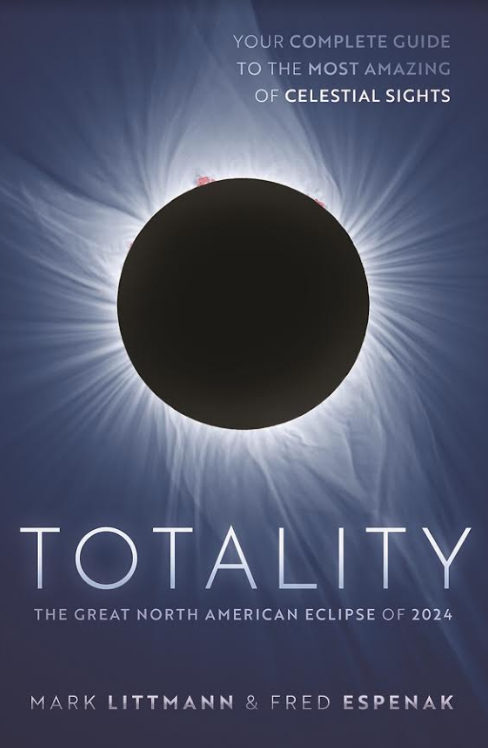
“Totality: The Great North American Eclipse of 2024” is a new book out by Mark Littmann and Fred Espenak. Image via Oxford University Press.
Book review for “Totality”
Oscar Wilde once quipped that a book exhausting its subject only succeeds in exhausting its readers. I’m proud to present a book that stands as a notable exception to this rule: Totality: The Great North American Eclipse of 2024 by Mark Littmann and Fred Espenak. It’s one of the most enjoyable reads that I’ve had in a long time.
Edifying as well as entertaining, Littmann and Espenak masterfully interweave eclipse history, folklore, superstition, geography, science and technology. “Totality” is sure to charm people across the board, from novice to maven. The friendly and conversational style almost makes one forget to be intimidated by technicalities.
Yes, a whole cavalcade of geeks contributed to the production of this great opus. Even so, these eclipse aficionados are more interested in sharing their joyous passion than in imposing a dissertation upon you. They – as much as anyone – can sympathize with the exasperating words of Alfonso X, King of Castile (1252), who complained:
If God had consulted with me before embarking upon creation, I would have recommended something simpler.
The theme of the book is simple and can’t be repeated often enough: A total eclipse of the sun counts as nature’s grandest visual spectacle. In fact, an eclipse chaser who witnessed 30 total solar eclipses hardly exaggerates in proclaiming:
In rating natural wonders, on a scale of 1 to 10, a total eclipse of the sun is a million.
Total solar eclipse once in 375 years
A total solar eclipse only comes once to your part of the world in an average of 375 years. If you live in North America, and the path of this upcoming total solar eclipse passes through your neighborhood, take full advantage. That’ll probably be your once-in-lifetime opportunity to witness a total eclipse of the sun in your own backyard. Absolutely nothing compares to the ultimate experience of standing inside a moon shadow.
Alas, the average figure of 375 years stated above proves to be quite misleading overall. For instance, people in Carbondale, Illinois, get to see two total solar eclipses in the span of seven years (2017 and 2024). Yet, the next total solar eclipse in Antwerp, Belgium, (on May 25, 2142) will be the first to occur there in at least seven centuries. (According to Jean Meeus in Mathematical Astronomy Morsels I, page 92.) No wonder King Alfonso X admonished the creator for the hard-to-fathom cosmos.
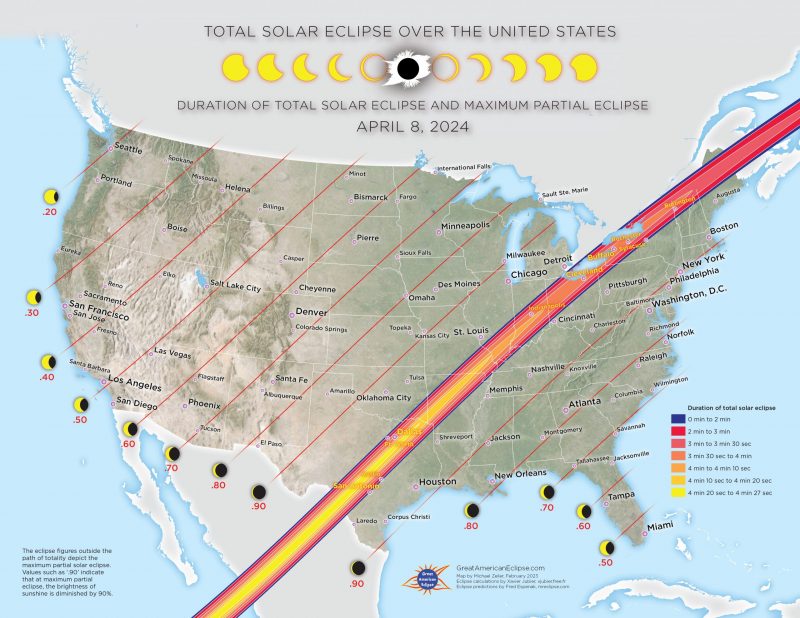
View larger. | The total solar eclipse only falls along a narrow path across the United States on April 8, 2024. And the farther south you are on the track of totality, the longer the duration of totality. Image via GreatAmericanEclipse.com. Used with permission.
Treasure trove of information
The authors are begging and pleading with all those living on or near the path of the total solar eclipse (and those willing to travel) to enjoy nature’s greatest visible spectacle. Most likely, another total eclipse of the sun won’t happen in your neck of the woods for hundreds of years. So let this treasure trove of information ready you for the thrill of a lifetime.
Our tour guides – Mark Littmann and Fred Espenak – say in way of conclusion:
If the weather cooperates, the total eclipse of the sun on April 8, 2024, could mark the biggest outdoor spectator event in American history – a 2,140-mile-long (3,444-km-long) tailgate party to watch the heavenly performance of the moon and sun.
Bottom line: Read a book review of “Totality: The Great North American Eclipse of 2024” by Mark Littmann and Fred Espenak. Reviewed by Bruce McClure.
“Totality: The Great North American Eclipse of 2024” is a new book out by Mark Littmann and Fred Espenak. Image via Oxford University Press.
Book review for “Totality”
Oscar Wilde once quipped that a book exhausting its subject only succeeds in exhausting its readers. I’m proud to present a book that stands as a notable exception to this rule: Totality: The Great North American Eclipse of 2024 by Mark Littmann and Fred Espenak. It’s one of the most enjoyable reads that I’ve had in a long time.
Edifying as well as entertaining, Littmann and Espenak masterfully interweave eclipse history, folklore, superstition, geography, science and technology. “Totality” is sure to charm people across the board, from novice to maven. The friendly and conversational style almost makes one forget to be intimidated by technicalities.
Yes, a whole cavalcade of geeks contributed to the production of this great opus. Even so, these eclipse aficionados are more interested in sharing their joyous passion than in imposing a dissertation upon you. They – as much as anyone – can sympathize with the exasperating words of Alfonso X, King of Castile (1252), who complained:
If God had consulted with me before embarking upon creation, I would have recommended something simpler.
The theme of the book is simple and can’t be repeated often enough: A total eclipse of the sun counts as nature’s grandest visual spectacle. In fact, an eclipse chaser who witnessed 30 total solar eclipses hardly exaggerates in proclaiming:
In rating natural wonders, on a scale of 1 to 10, a total eclipse of the sun is a million.
Total solar eclipse once in 375 years
A total solar eclipse only comes once to your part of the world in an average of 375 years. If you live in North America, and the path of this upcoming total solar eclipse passes through your neighborhood, take full advantage. That’ll probably be your once-in-lifetime opportunity to witness a total eclipse of the sun in your own backyard. Absolutely nothing compares to the ultimate experience of standing inside a moon shadow.
Alas, the average figure of 375 years stated above proves to be quite misleading overall. For instance, people in Carbondale, Illinois, get to see two total solar eclipses in the span of seven years (2017 and 2024). Yet, the next total solar eclipse in Antwerp, Belgium, (on May 25, 2142) will be the first to occur there in at least seven centuries. (According to Jean Meeus in Mathematical Astronomy Morsels I, page 92.) No wonder King Alfonso X admonished the creator for the hard-to-fathom cosmos.
View larger. | The total solar eclipse only falls along a narrow path across the United States on April 8, 2024. And the farther south you are on the track of totality, the longer the duration of totality. Image via GreatAmericanEclipse.com. Used with permission.
Treasure trove of information
The authors are begging and pleading with all those living on or near the path of the total solar eclipse (and those willing to travel) to enjoy nature’s greatest visible spectacle. Most likely, another total eclipse of the sun won’t happen in your neck of the woods for hundreds of years. So let this treasure trove of information ready you for the thrill of a lifetime.
Our tour guides – Mark Littmann and Fred Espenak – say in way of conclusion:
If the weather cooperates, the total eclipse of the sun on April 8, 2024, could mark the biggest outdoor spectator event in American history – a 2,140-mile-long (3,444-km-long) tailgate party to watch the heavenly performance of the moon and sun.
Bottom line: Read a book review of “Totality: The Great North American Eclipse of 2024” by Mark Littmann and Fred Espenak. Reviewed by Bruce McClure.
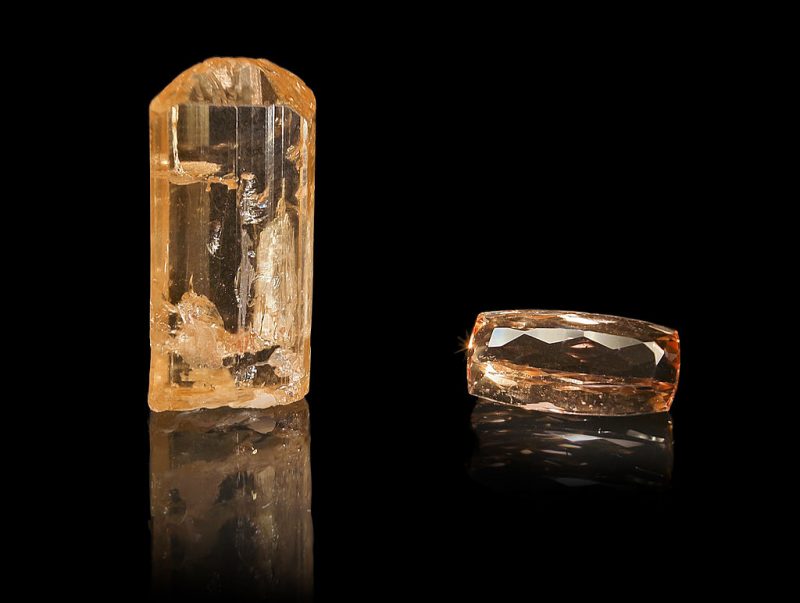
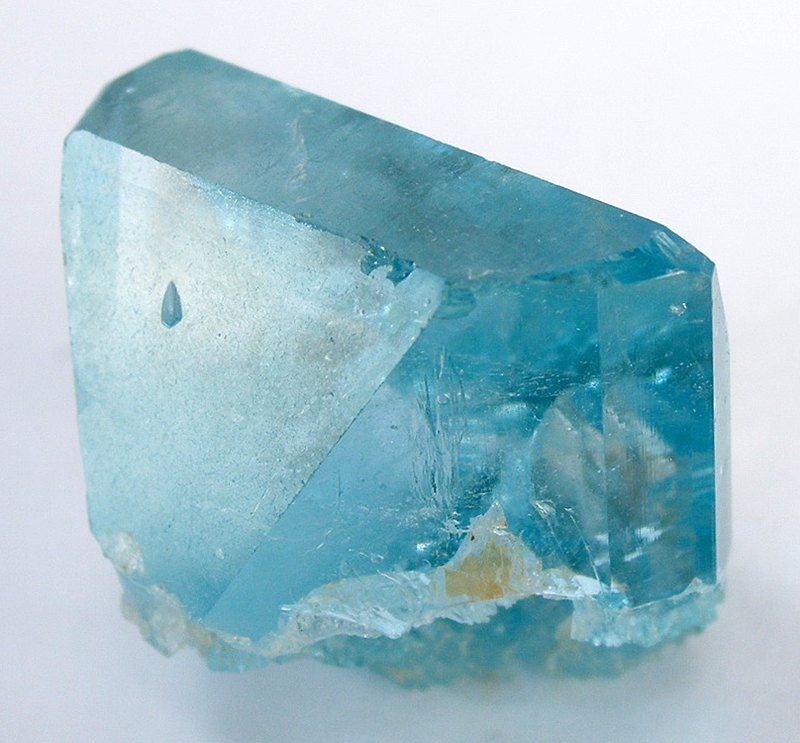
A crystal and faceted topaz. Topaz is 1 of the 2 options for the November birthstone. The other choice is citrine. Image via Didier Descouens/ Wikipedia.
Topaz, one of two November birthstones, an exquisite gem of many colors, is a much sought-after gemstone for jewelry. In ancient times, people believed that topaz possessed magical and healing qualities. Its name may originate from the Sanskrit word for fire.
Colors of the November birthstone
Topaz occurs in a range of magnificent colors: pale blue, pink, red, brown, varying shades of yellow, and even black. Pure topaz itself is a colorless stone. Red and some pink topazes get their colors from chromium atoms in the crystal. Most other colors occur due to minor element substitutions and defects in the crystal. Some colors are unstable and can fade away. In other stones, heat can cause color changes. High-energy irradiation of colorless topaz can transform it to blue gemstones.
Chemically, topaz is an aluminum silicate mineral containing fluorine and hydroxide (a hydrogen-oxygen molecule). Strong chemical bonds within topaz make it the hardest of silicate minerals, rating 8 on the Mohs scale. According to Geoscience Australia, high concentrations of flourine – a condition needed for topaz formation – are geologically rare. They explained that topaz forms in cavities in certain igneous rocks:
The crystals grow in the late stages of a magma cooling, when there is enough fluorine to enable the formation of topaz. Some topaz crystals grow after hot fluids (hydrothermal solutions), rich in fluorine, flow through cracks in rocks that have already cooled.
Different colors of topaz. Image via Michelle Jo/ Wikipedia.
Topaz on display
Topaz gemstones occur in many sizes, from tiny crystals to large rocks. One of the biggest uncut topaz stones, a specimen from Brazil, weighs almost 600 pounds (270 kg). It’s on display at the American Museum of Natural History in New York.
Weighing ~600 lbs (272 kg), this tremendous topaz is one of the largest single crystals of topaz in any museum in the world! It's just 1 example of how large crystals in pegmatites can grow. See it in the Mignone Halls of Gems and Minerals, opening THIS Sat., 6/12! #NewYorkRockspic.twitter.com/gqyG0wdUkg
— American Museum of Natural History (@AMNH) June 10, 2021
And one of the largest cut topazes in the world – the American Golden Topaz – resides at the Smithsonian Museum of Natural History in Washington D.C. It weighs 10.1 pounds (4.6 kg) and is about 7 inches (18 cm) in length.
Uses for topaz
The lively fire, clarity, colors and hardness of topaz make it ideal for jewelry such as necklaces, brooches and bracelets. People sometimes mistake the brilliantly cut, colorless, pure topaz for a diamond. Because of its rarity, topaz is an expensive gem. The most valued and rarest color is red. Imperial topaz – sherry-colored varieties of brownish-yellow, orange-yellow and reddish brown – are the most popular topaz stones. They command high prices, as do pink stones. Light blue and pale yellow topaz are of less value, but are nevertheless stunning gemstones.
Besides its use in jewelry, topaz has industrial applications. It’s used as a refractory material in kilns and furnaces because it maintains its strength under extreme heat. That property also makes it useful as a mold for molten glass and metals.
Brazil is the largest producer of topaz, the most notable source being the Minas Geranis region. Topaz is also mined in several countries including Pakistan, Sri Lanka, Russia and Australia. And in the United States, people have found it in Utah, Texas and California.
Topaz lore
The gemstone’s name, topaz, may have originated from the Sanskrit word meaning fire. There’s also a more convoluted alternate story. The gemstone’s name might be from an ancient Greek island in the Red Sea called Topazos. The island, supposedly difficult to locate, was where people mined a yellow stone. Most now think that stone is actually chrysolite.
In ancient lore, the topaz had the power to cool boiling water. These gemstones supposedly made their owners cheerful, giving them pleasant dreams. People also believed that those who wore topaz would have a long life with beauty and intelligence.
During the Middle Ages, people believed that gemstones with special engravings held great powers. The 13th century Book of Wings by Ragiel said about the topaz:
The figure of a falcon, if on a topaz, helps to acquire the goodwill of kings, princes, and magnates.
As medication, people tried to cure fevers with topaz. They added powdered topaz to wine to prevent asthma and insomnia. They believed that a topaz held in the hand of a woman during childbirth lessened her pain.
Saint Hildegard, a 12th century German Benedictine abbess, recommended topaz as a cure for weak vision. People immersed the stone in wine for three days and nights, then rubbed the liquid on the eyes. A 15th century Roman physician claimed to have cured plague sores by touching them with a topaz that once belonged to two Catholic popes.
Blue topaz from Zimbabwe. The rock measures about 1.4 x 1.1 x 1 inches (3.5 x 2.8 x 2.5 cm). Image via Robert M. Lavinsky/ Wikimedia Commons.
Citrine is another choice
Yellow citrine is one of the many colors found in the quartz family. Citrine colors range from a pale yellow, reddish-orange to brown. Occasionally, citrine is a yellow-green color. It’s coloring agent is iron. Also, natural citrine is rare, so most citrine you find in jewelry are heat-treated smoky quartz or amethyst.
Even though yellow topaz and citrine look alike visually, they have a different rating on the Mohs hardness scale. Topaz is slightly a harder gemstone than citrine rated at eight on the Mohs scale, and citrine is a seven. Other yellow gemstones include golden beryl and tourmaline.
A unique gemstone – ametrine – is sometimes unearthed, it’s a mixture of citrine and amethyst. It occurs in the same crystal. It is especially attractive when both the yellow and purple are vibrant and the split is down the middle of the gemstone.
A combination of 2 forms of quartz – citrine and amethyst – called ametrine. Image via Wikimedia. Used with permission.
Brazil produces the most citrine. Citrine is also found in Madagascar, the United States, Argentina, Myanmar, Namibia, Russia, Scotland and Spain.
Citrine crystals. Image via Parent Géry/ Wikimedia Commons. Used with permission.
History of citrine
Citrine comes from the Latin word citrina which means “yellow”.
Using citrine as a gemstone began in Greece starting about 300 BC, during the Hellenistic Age. Since citrine was associated with prosperity, it is also called the “merchant’s stone” or the “money stone.”
Bottom line: Topaz and citrine are the November birthstones. Topaz is a hard mineral popular in jewelry, with an enduring mythology of magical and healing powers. Citrine is a member of the quartz family. So November babies have some colorful choices for their birthstone.
A crystal and faceted topaz. Topaz is 1 of the 2 options for the November birthstone. The other choice is citrine. Image via Didier Descouens/ Wikipedia.
Topaz, one of two November birthstones, an exquisite gem of many colors, is a much sought-after gemstone for jewelry. In ancient times, people believed that topaz possessed magical and healing qualities. Its name may originate from the Sanskrit word for fire.
Colors of the November birthstone
Topaz occurs in a range of magnificent colors: pale blue, pink, red, brown, varying shades of yellow, and even black. Pure topaz itself is a colorless stone. Red and some pink topazes get their colors from chromium atoms in the crystal. Most other colors occur due to minor element substitutions and defects in the crystal. Some colors are unstable and can fade away. In other stones, heat can cause color changes. High-energy irradiation of colorless topaz can transform it to blue gemstones.
Chemically, topaz is an aluminum silicate mineral containing fluorine and hydroxide (a hydrogen-oxygen molecule). Strong chemical bonds within topaz make it the hardest of silicate minerals, rating 8 on the Mohs scale. According to Geoscience Australia, high concentrations of flourine – a condition needed for topaz formation – are geologically rare. They explained that topaz forms in cavities in certain igneous rocks:
The crystals grow in the late stages of a magma cooling, when there is enough fluorine to enable the formation of topaz. Some topaz crystals grow after hot fluids (hydrothermal solutions), rich in fluorine, flow through cracks in rocks that have already cooled.
Different colors of topaz. Image via Michelle Jo/ Wikipedia.
Topaz on display
Topaz gemstones occur in many sizes, from tiny crystals to large rocks. One of the biggest uncut topaz stones, a specimen from Brazil, weighs almost 600 pounds (270 kg). It’s on display at the American Museum of Natural History in New York.
Weighing ~600 lbs (272 kg), this tremendous topaz is one of the largest single crystals of topaz in any museum in the world! It's just 1 example of how large crystals in pegmatites can grow. See it in the Mignone Halls of Gems and Minerals, opening THIS Sat., 6/12! #NewYorkRockspic.twitter.com/gqyG0wdUkg
— American Museum of Natural History (@AMNH) June 10, 2021
And one of the largest cut topazes in the world – the American Golden Topaz – resides at the Smithsonian Museum of Natural History in Washington D.C. It weighs 10.1 pounds (4.6 kg) and is about 7 inches (18 cm) in length.
Uses for topaz
The lively fire, clarity, colors and hardness of topaz make it ideal for jewelry such as necklaces, brooches and bracelets. People sometimes mistake the brilliantly cut, colorless, pure topaz for a diamond. Because of its rarity, topaz is an expensive gem. The most valued and rarest color is red. Imperial topaz – sherry-colored varieties of brownish-yellow, orange-yellow and reddish brown – are the most popular topaz stones. They command high prices, as do pink stones. Light blue and pale yellow topaz are of less value, but are nevertheless stunning gemstones.
Besides its use in jewelry, topaz has industrial applications. It’s used as a refractory material in kilns and furnaces because it maintains its strength under extreme heat. That property also makes it useful as a mold for molten glass and metals.
Brazil is the largest producer of topaz, the most notable source being the Minas Geranis region. Topaz is also mined in several countries including Pakistan, Sri Lanka, Russia and Australia. And in the United States, people have found it in Utah, Texas and California.
Topaz lore
The gemstone’s name, topaz, may have originated from the Sanskrit word meaning fire. There’s also a more convoluted alternate story. The gemstone’s name might be from an ancient Greek island in the Red Sea called Topazos. The island, supposedly difficult to locate, was where people mined a yellow stone. Most now think that stone is actually chrysolite.
In ancient lore, the topaz had the power to cool boiling water. These gemstones supposedly made their owners cheerful, giving them pleasant dreams. People also believed that those who wore topaz would have a long life with beauty and intelligence.
During the Middle Ages, people believed that gemstones with special engravings held great powers. The 13th century Book of Wings by Ragiel said about the topaz:
The figure of a falcon, if on a topaz, helps to acquire the goodwill of kings, princes, and magnates.
As medication, people tried to cure fevers with topaz. They added powdered topaz to wine to prevent asthma and insomnia. They believed that a topaz held in the hand of a woman during childbirth lessened her pain.
Saint Hildegard, a 12th century German Benedictine abbess, recommended topaz as a cure for weak vision. People immersed the stone in wine for three days and nights, then rubbed the liquid on the eyes. A 15th century Roman physician claimed to have cured plague sores by touching them with a topaz that once belonged to two Catholic popes.
Blue topaz from Zimbabwe. The rock measures about 1.4 x 1.1 x 1 inches (3.5 x 2.8 x 2.5 cm). Image via Robert M. Lavinsky/ Wikimedia Commons.
Citrine is another choice
Yellow citrine is one of the many colors found in the quartz family. Citrine colors range from a pale yellow, reddish-orange to brown. Occasionally, citrine is a yellow-green color. It’s coloring agent is iron. Also, natural citrine is rare, so most citrine you find in jewelry are heat-treated smoky quartz or amethyst.
Even though yellow topaz and citrine look alike visually, they have a different rating on the Mohs hardness scale. Topaz is slightly a harder gemstone than citrine rated at eight on the Mohs scale, and citrine is a seven. Other yellow gemstones include golden beryl and tourmaline.
A unique gemstone – ametrine – is sometimes unearthed, it’s a mixture of citrine and amethyst. It occurs in the same crystal. It is especially attractive when both the yellow and purple are vibrant and the split is down the middle of the gemstone.
A combination of 2 forms of quartz – citrine and amethyst – called ametrine. Image via Wikimedia. Used with permission.
Brazil produces the most citrine. Citrine is also found in Madagascar, the United States, Argentina, Myanmar, Namibia, Russia, Scotland and Spain.
Citrine crystals. Image via Parent Géry/ Wikimedia Commons. Used with permission.
History of citrine
Citrine comes from the Latin word citrina which means “yellow”.
Using citrine as a gemstone began in Greece starting about 300 BC, during the Hellenistic Age. Since citrine was associated with prosperity, it is also called the “merchant’s stone” or the “money stone.”
Bottom line: Topaz and citrine are the November birthstones. Topaz is a hard mineral popular in jewelry, with an enduring mythology of magical and healing powers. Citrine is a member of the quartz family. So November babies have some colorful choices for their birthstone.