aads

Meteor shower guide: Up next the Taurids and Leonids

Now that autumn is here, we can look forward to several more meteor showers this year. Next up are the November Taurids and the Leonids.

October into early November … the South and North Taurids

Predicted peak: The South Taurids’ predicted** peak is November 6, 2023, at 0:47 UTC. The North Taurids’ predicted** peak is November 13, 2023, at 0:21 UTC. Both the South and North Taurids don’t have very definite peaks. They ramble along in October and November and are especially noticeable from late October into early November, when they overlap.
When to watch: Best around midnight, and on the days around November 13 when the moon won’t interfere.
Overall duration of shower: The South Taurids run from about September 23 to November 12. North Taurids are active from about October 13 to December 2.
Radiant: Rises in early evening, highest in the sky around midnight. See chart below.
Nearest moon phase: In 2023, the last quarter moon falls on November 5. New moon is November 13. Near the first predicted peak, the waning crescent moon may interfere with meteors after midnight and before dawn. So you may wait a few days after then to watch for meteors. Or watch on the days around November 13 – during the second predicted peak – near the new moon when you can enjoy watching for meteors in a moonless sky. You’ll catch Taurid meteors throughout October and November. Visit Sunrise Sunset Calendars to see moon rising times for your location. Be sure to check the moon rising time box.
Expected meteors at peak, under ideal conditions: Under dark skies with no moon, both the South and North Taurid meteor showers produce about five meteors per hour (10 total when they overlap). Also, watch for fireballs.
Note: Taurid meteors tend to be slow-moving but sometimes very bright. The showers sometimes produce fireballs, which made their cyclical reappearance in 2022. The American Meteor Society pointed to “a seven-year periodicity” with Taurid fireballs. 2008 and 2015 both produced them. 2022 did as well. The Taurid fireball display, in 2015, was really fun! Photos and video of 2015 Taurid fireballs here.

Read more: All you need to know about the Taurid meteors
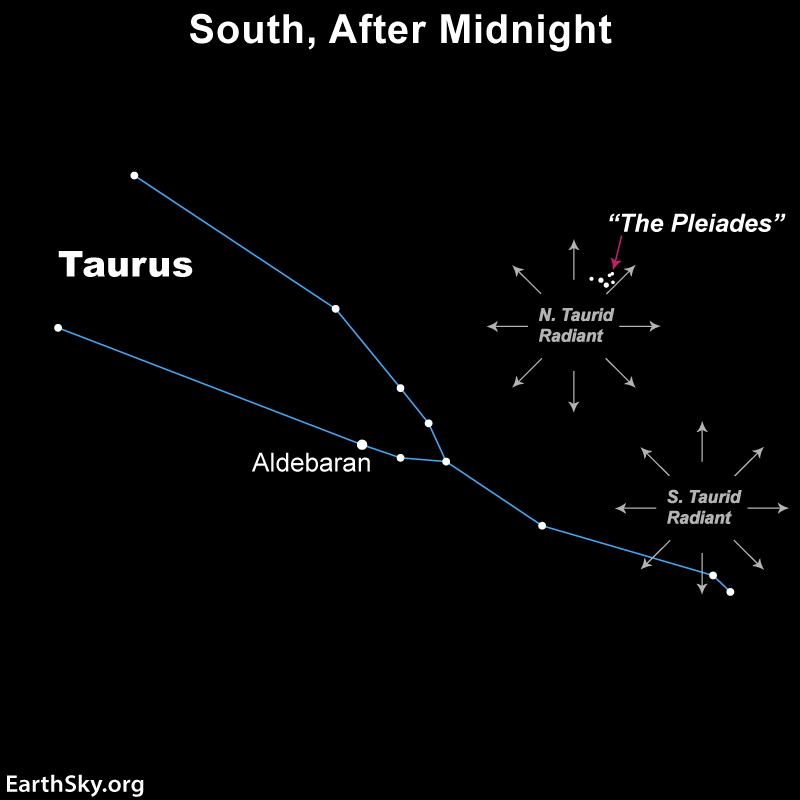
Star chart showing constellation Taurus with 2 sets of radial arrows, 1 near the Pleiades.
The Taurid meteors consist of 2 streams, the South Taurid meteors and North Taurid meteors. Both streams appear to originate from the constellation Taurus the Bull. Typically, you see the maximum numbers at or around midnight, when Taurus is highest in the sky.

Meteor shower-watching resources

Mid-November meteors … the Leonids

Predicted peak: The peak is predicted** for November 18, 2023, at 5:33 UTC.
When to watch: Watch late on the night of November 17 until dawn on November 18. The morning of November 17 might be worthwhile, too.
Duration of shower: November 3 through December 2.
Radiant: Rises around midnight, highest in the sky at dawn.
Nearest moon phase: In 2023, first quarter moon falls on November 20. So there will be very little interference from moonlight in 2023.
Expected meteors at peak, under ideal conditions: Under a dark sky with no moon, you might see 10 to 15 Leonid meteors per hour.
Note: The famous Leonid meteor shower produced one of the greatest meteor storms in living memory. Rates were as high as thousands of meteors per minute during a 15-minute span on the morning of November 17, 1966. That night, Leonid meteors did, briefly, fall like rain. Some who witnessed it had a strong impression of Earth moving through space, fording the meteor stream. Leonid meteor storms sometimes recur in cycles of 33 to 34 years. But the Leonids around the turn of the century – while wonderful for many observers – did not match the shower of 1966. And, in most years, the Lion whimpers rather than roars.

Read more: All you need to know about Leonid meteors
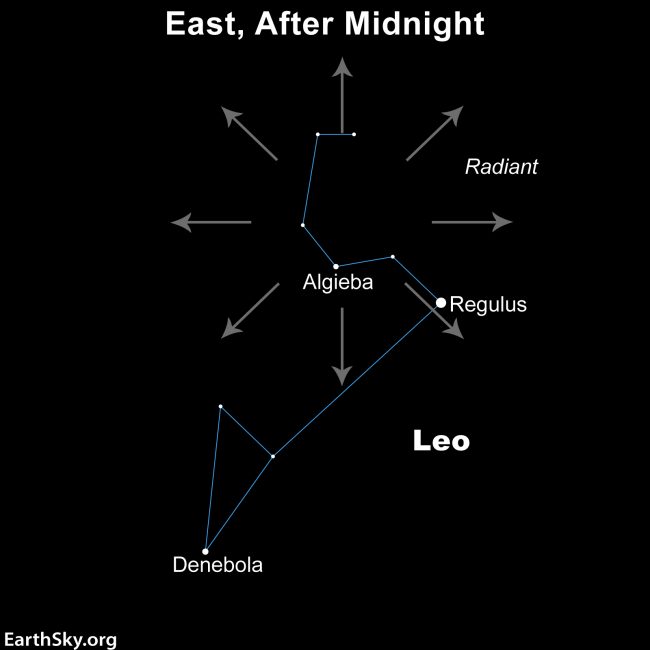
Star chart of constellation Leo with radial arrows indicating source of Leonid meteor shower.
Leonids stream from a single point in the sky – their radiant point – in the constellation Leo the Lion. Leo rises just before midnight in mid-November. Regulus, the brightest star in Leo the, dots a backwards question mark of stars known as the Sickle.

Early to mid-December meteors … the Geminids

Predicted peak: is predicted** for December 14, 2023, at 19:27 UTC.
When to watch: Since the radiant rises in mid-evening, you can watch for Geminids all night around the peak dates of December 13 and 14. Plus, a young waxing crescent moon will not interfere with the Geminids in 2023.
Overall duration of shower: November 19 to December 24.
Radiant: Rises in mid-evening, highest around 2 a.m. See chart below.
Nearest moon phase: In 2023, the new moon falls on December 12. So there will be a dark sky during the peak of the 2023 Geminid meteor shower.
Expected meteors at peak, under ideal conditions: Under a dark sky with no moon, you might catch 120 Geminid meteors per hour.
Note: The bold, white, bright Geminids give us one of the Northern Hemisphere’s best showers, especially in years when there’s no moon. They’re also visible, at lower rates, from the Southern Hemisphere. The meteors are plentiful, rivaling the August Perseids.

Read more: All you need to know about Geminid meteors
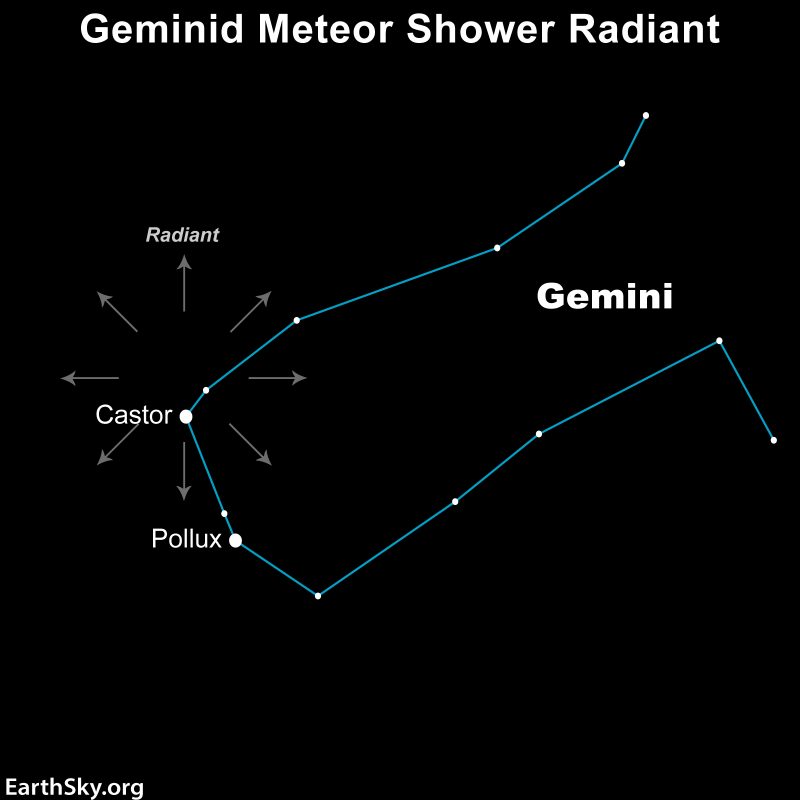
Sky chart showing the constellation Gemini with radial arrows near star Castor.
Geminid meteors radiate from near the bright star Castor in the constellation Gemini the Twins, in the east on December evenings.

Meteor shower around the December solstice … the Ursids

Predicted peak: is predicted** for December 23, 2023, at 4 UTC.
When to watch: Watch for Ursid meteors in the early morning hours of December 22 and 23.
Duration of shower: Ursids range from December 13 to 24, so you might see some intermingling with the Geminids’ peak.
Radiant: Circumpolar at northerly latitudes.
Nearest moon phase: A 1st quarter moon occurs at 18:39 UTC on December 19. So the waxing gibbous moon – at 86% illumination – may interfere with the Ursids in 2023 until the moon sets about three hours before sunrise.
Expected meteors at peak, under ideal conditions: Under a dark sky with no moon, the Ursids offer perhaps five to 10 meteors per hour.
Note: This low-key meteor shower – which always peaks around the solstice – is somewhat overlooked due to the holiday season. Its hourly rate is lower than that of the popular Geminid shower, which peaks just a week before.

Read more: Ursid meteors peak around December solstice
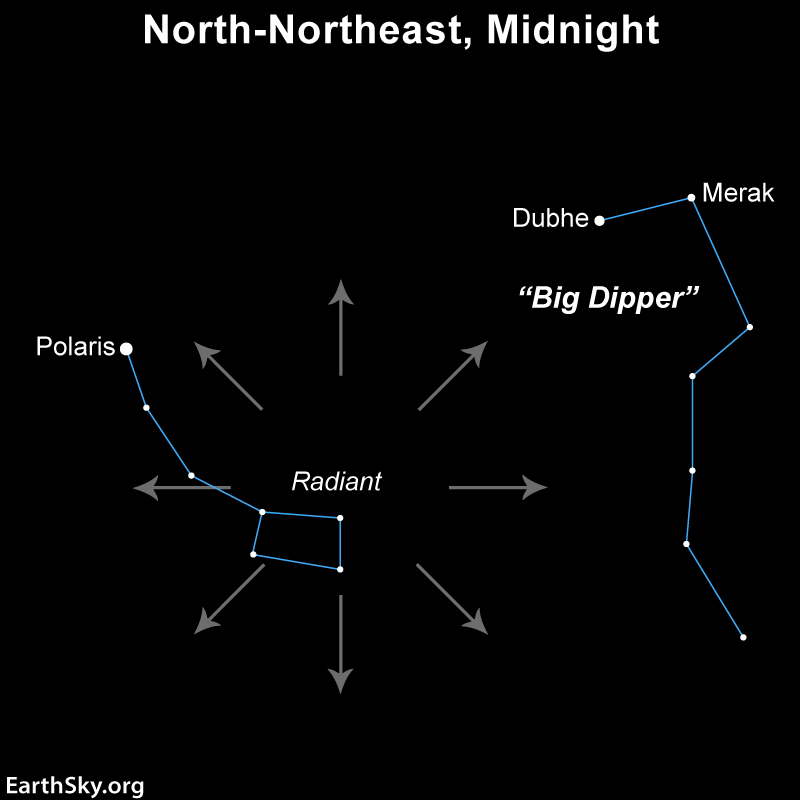
Chart with Big and Little Dippers and radial arrows from Little Dipper's bowl.
The Ursids are named for their radiant point in the constellation Ursa Minor, which contains the Little Dipper. And the Little Dipper contains the North Pole. So for the Northern Hemisphere, the radiant is above the horizon all night long. Chart via Chelynne Campion/ EarthSky.

Early January 2024 meteors … the Quadrantids

When to watch: The best night for the 2024 Quadrantids is January 3-4 (The predicted peak** is 12:53 UTC on January 4). A bright last quarter moon will rise around midnight and shine the rest of the night. Try late night January 3 to dawn January 4, in moonlight.
Nearest moon phase: Last quarter moon will come late on January 3, 2024 (CST).
Radiant: Rises in the north-northeast after midnight and is highest up before dawn. The radiant point for the Quadrantids is in a now-obsolete constellation, Quadrans Muralis the Mural Quadrant. Nowadays, we see the radiant near the famous Big Dipper asterism. Because the Quadrantid radiant is far to the north on the sky’s dome, this is mostly a far-northern shower, not as good for the Southern Hemisphere.
Expected meteors at peak, under ideal conditions: Under a dark sky with no moon, when the radiant is high in the sky, the Quadrantids can (briefly) produce over 100 meteors per hour.
Duration of shower: The Quadrantid meteor shower runs from mid-November through mid-January each year, according to this 2017 article in the journal Icarus. You might see a Quadrantid streak by any time during that interval. But most activity is centered on the peak.
Note: The Quadrantid shower is one of four major meteor showers each year with a sharp peak (the other three are the Lyrids, Leonids, and Ursids).

Read more: All you need to know about Quadrantid meteors
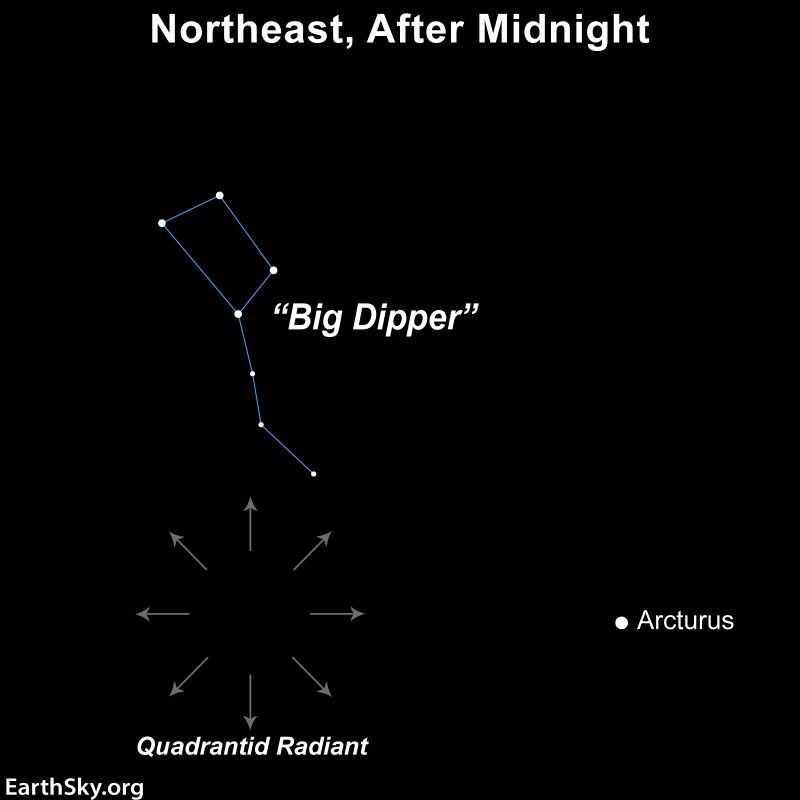
Sky chart showing arrows radiating out from a point south of Big Dipper.
The radiant point for the Quadrantid meteor shower is far to the north in the sky and so best seen from Earth’s Northern Hemisphere. From mid-northern latitudes, the radiant point for the Quadrantid meteor shower climbs over the horizon after midnight and is highest up before dawn.

April 2024 meteors … the Lyrids

When to watch in 2024: Late evening April 21 until dawn April 22 will be best. The predicted** peak is 9:23 UTC on April 22. The peak of the Lyrids is narrow (no weeks-long stretches of meteor-watching, as with some showers). In 2024, the full moon falls at 23:49 UTC on April 23. So meteor watching will be impacted by a bright waxing gibbous moon.
Radiant: Rises before midnight, highest in the sky at dawn.
Nearest moon phase: Full moon falls at 23:49 UTC on April 23. So a bright waxing gibbous moon will be in the sky during the peak morning for the 2023’s Lyrid meteor shower.
Duration of shower: April 15 to April 29.
Expected meteors at peak, under ideal conditions: In a dark sky with no moon, you might see 10 to 15 Lyrids per hour. The Lyrids are known for uncommon surges that can sometimes bring rates of up to 100 per hour! Read more about Lyrid outbursts.
Note for Southern Hemisphere: This shower’s radiant point is far to the north on the sky’s dome. So the Southern Hemisphere will see fewer Lyrid meteors. Still, you might see some!

Read more: All you need to know about Lyrid meteors
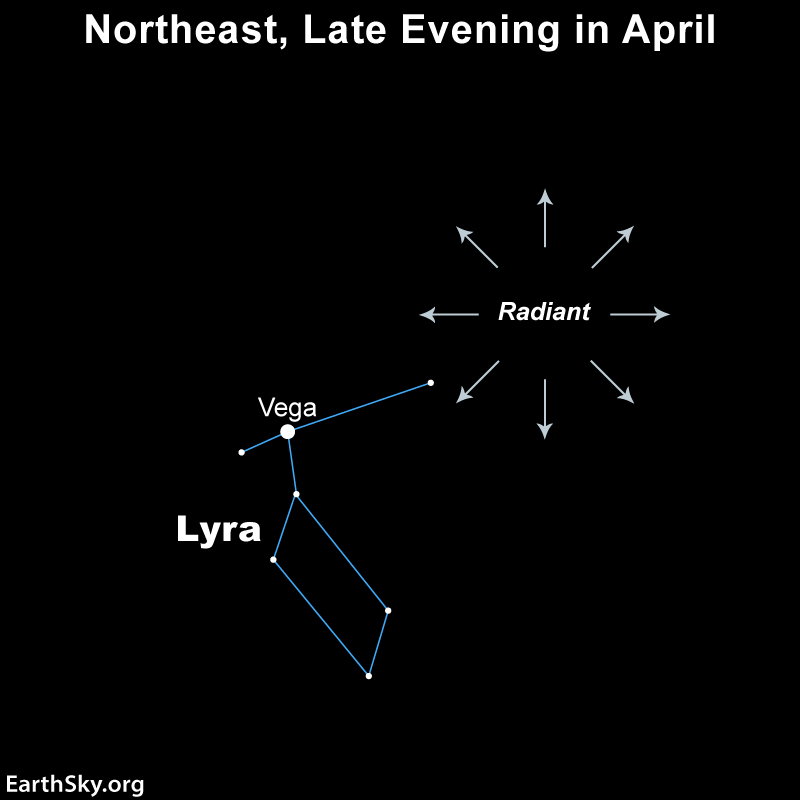
Chart showing two stars and radial arrows from meteor shower radiant point.
Lyrid meteors radiate from near the bright star Vega in the constellation Lyra the Harp. You don’t need to identify Vega or Lyra in order to watch the Lyrid meteor shower. But you do need to know when the radiant rises, in this case in the northeast before midnight. That’s why the Lyrids are typically best between midnight and dawn.

May 2024 meteors … the Eta Aquariids

When to watch: New moon will fall a few days after the peak of the 2024 Eta Aquariid shower. So, mornings around the peak will be dark and moonless. The best mornings to watch are May 5 and 6, 2024, in the hours before dawn. Why before dawn? See “Radiant” below.The American Meteor Society is listing 8:43 UTC on May 5 as the shower’s predicted** peak time. But times vary between different experts. And the peak of this shower stretches out over several days. So you can expect elevated numbers of meteors a few days before and after the peak time.
Nearest moon phase: New moon will fall at 03:22 UTC on May 8. So moonlight will not obscure the 2024 Eta Aquariids.
Radiant: Will rise in the wee hours, climbing toward its highest point at dawn. That’s why before dawn will be the best time to watch this shower.
Duration of shower: April 15 to May 27.
Expected meteors at peak, under ideal conditions: In the southern half of the U.S., you might see 10 to 20 meteors per hour under a dark sky, with no moon, when the radiant is high in the sky. Farther south – at latitudes in the Southern Hemisphere – you might see two to three times that number.
Note: The Eta Aquariids’ radiant will be on the ecliptic, which will ride low in the sky on spring mornings as seen from the Northern Hemisphere. That’s why this shower favors the Southern Hemisphere. It’s often that hemisphere’s best meteor shower of the year.

Read more: All you need to know about Eta Aquariid meteors
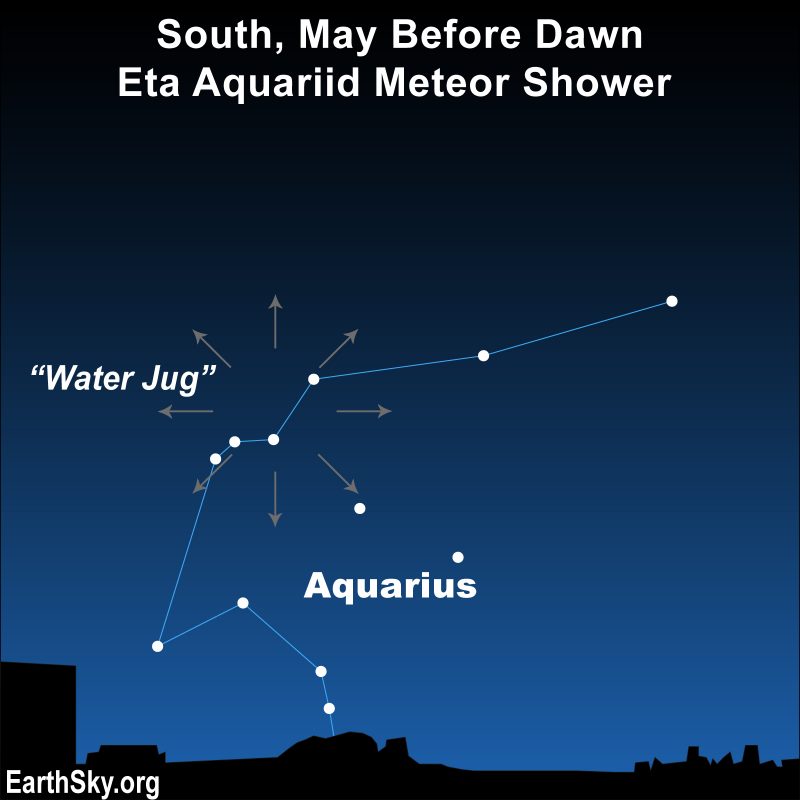
Lines marking constellation with radial arrows near middle of it.
The radiant point of the Eta Aquariid meteor shower will be near the star Eta Aquarii in the constellation Aquarius the Water Bearer. The radiant will rise in the wee hours after midnight and will continue climbing toward its highest point at dawn. That highest point will be in the south as viewed from the Northern Hemisphere, closer to overhead for the Southern Hemisphere. That’s why the Southern Hemisphere will see more meteors (the radiant will be higher up), and it’s why – for all of us around the globe – the hours before dawn will be best for this shower.

June 2024 daytime meteor shower … the Arietids

Most meteor showers are easy to observe. Just find a dark sky, and look up! But what about meteor showers that happen in the daytime, when the sun is up? The Arietids are sometimes said to be the most active daytime meteor shower. In 2024, their predicted** peak will be the morning of June 7. You might catch some Arietids that morning in the dark hour before dawn.

When to watch: Watch from May 29 to June 17. There’s a predicted** peak on June 7, 2024. Watch for them in the sunrise direction in the dark hour before dawn breaks.
Nearest moon phase: In 2024, a new moon occurs at 12:38 UTC on June 6. So the mornings around the peak will be completely moon free.
Radiant: The shower’s radiant point – the point in the sky from which the meteors appear to radiate – is in the constellation Aries the Ram. You’ll find this constellation in the east before sunrise.
Duration of shower: May 29 to June 17.
Expected meteors at peak: This is tricky for daytime meteor showers because once the sun comes up, you won’t be able to see them. But the Arietids have a strong zenithal hourly rate (ZHR)! Meteor counts with radar and radio echoes have indicated a rate of 60 meteors per hour, and perhaps as high as 200 meteors per hour.
Note: The Arietids are sometimes said to be the most active daytime meteor shower.

Read more: Arietids, most active daytime meteor shower
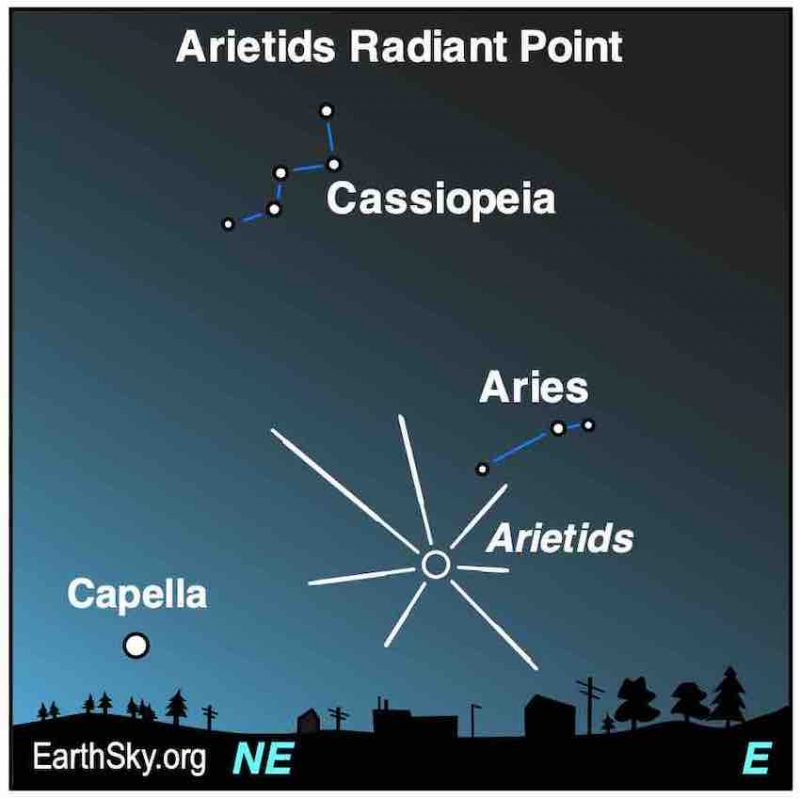
Star chart: Cassiopiea, Aries, and Capella with radial lines from a point in the sky.
The Arietids are an active shower, but they’re visible mostly in daytime. Watch for them in the sunrise direction in the dark hour before dawn from May 29 to June 17. You’ll be looking for meteors that shoot up from the horizon. The radiant is below the constellation Aries the Ram. Chart by John Jardine Goss.

Late July to mid-August 2024 meteors … the Delta Aquariids

Predicted peak: The peak is predicted** for July 30, 2024, at 15:16 UTC. But this shower doesn’t have a noticeable peak. It rambles along steadily from late July through early August, joining forces with the August Perseids.
When to watch: Watch late July through early August, mid-evening to dawn.
Duration of shower: July 18 to August 21.
Radiant: Rises in mid-evening, highest around 2 a.m. and low in the sky by dawn. See chart below.
Nearest moon phase: In 2024, last quarter moon falls at 2:51 UTC on August 1. Take advantage of the moon-free evenings in late July for watching the Delta Aquariids (and the early Perseids).
Expected meteors at peak, under ideal conditions: The Delta Aquariids’ maximum hourly rate can reach 15 to 20 meteors in a dark sky with no moon. You’ll typically see plenty of Delta Aquariids mixed in with the Perseids, if you’re watching in early August.
Note: Like May’s Eta Aquariids, July’s Delta Aquariids favors the Southern Hemisphere. Skywatchers at high northern latitudes tend to discount it. But the shower can be excellent from latitudes like those in the southern U.S. Delta Aquariid meteors tend to be fainter than Perseid meteors. So a moon-free dark sky is essential. About 5% to 10% of the Delta Aquariid meteors leave persistent trains, glowing ionized gas trails that last a second or two after the meteor has passed.

Read more: All you need to know about Delta Aquariid meteors
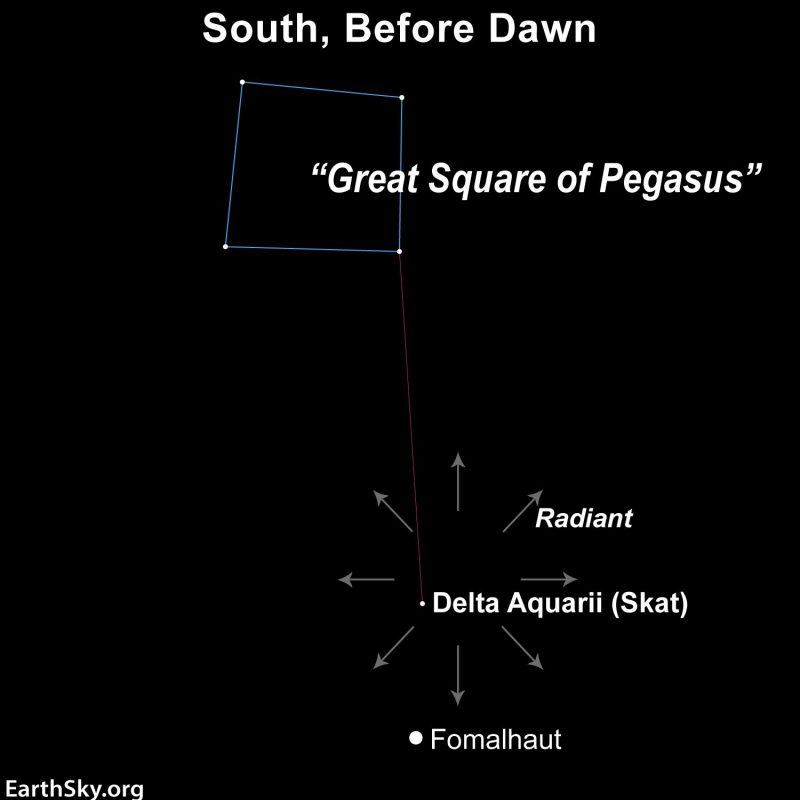
Star chart showing the Great Square of Pegasus to Fomalhaut to the Delta Aquariid radiant point.
Delta Aquariid meteors radiate from near the star Skat, aka Delta Aquarii, in the constellation Aquarius the Water Bearer. This star is near bright Fomalhaut. In late July to early August, Fomalhaut is highest around 2 a.m. (on your clock no matter where you are). It’s southward from the Northern Hemisphere, closer to overhead from the Southern Hemisphere. Fomalhaut appears bright and solitary in the sky. To find it, draw a line roughly southward through the stars on the west side of the Great Square of Pegasus.

Mid-July to mid-August 2024 meteors … the Perseids

Predicted peak: The peak is predicted** for August 12, 2024, at 14:00 UTC. So the mornings of August 11, 12 and 13 are probably your best bet.
When to watch: The moon will be a 1st quarter and 50% illuminated during 2024’s peak of the Perseid meteor shower. So the best time to watch for Perseids will be starting around midnight until dawn. This shower rises to a peak gradually, then falls off rapidly. And Perseid meteors tend to strengthen in number as late night deepens into the wee hours before dawn. The shower is often best just before dawn.
Radiant: The radiant rises in the middle of the night and is highest at dawn. See chart below.
Nearest moon phase: First quarter moon falls at 15:19 UTC on August 12. And a 1st quarter moon sets around midnight, so you’ll have dark skies after then until dawn.
Duration of shower: July 14 to September 1.
Expected meteors at peak, under ideal conditions: Under a dark sky with no moon, skywatchers frequently report 90 meteors per hour, or more. In 2023, the waning crescent moon will not interfere with the meteor shower.
Note: The August Perseid meteor shower is rich and steady, from early August through the peak. The meteors are colorful. And they frequently leave persistent trains. All of these factors make the Perseid shower perhaps the most beloved meteor shower for the Northern Hemisphere.

Read more: All you need to know about Perseid meteors
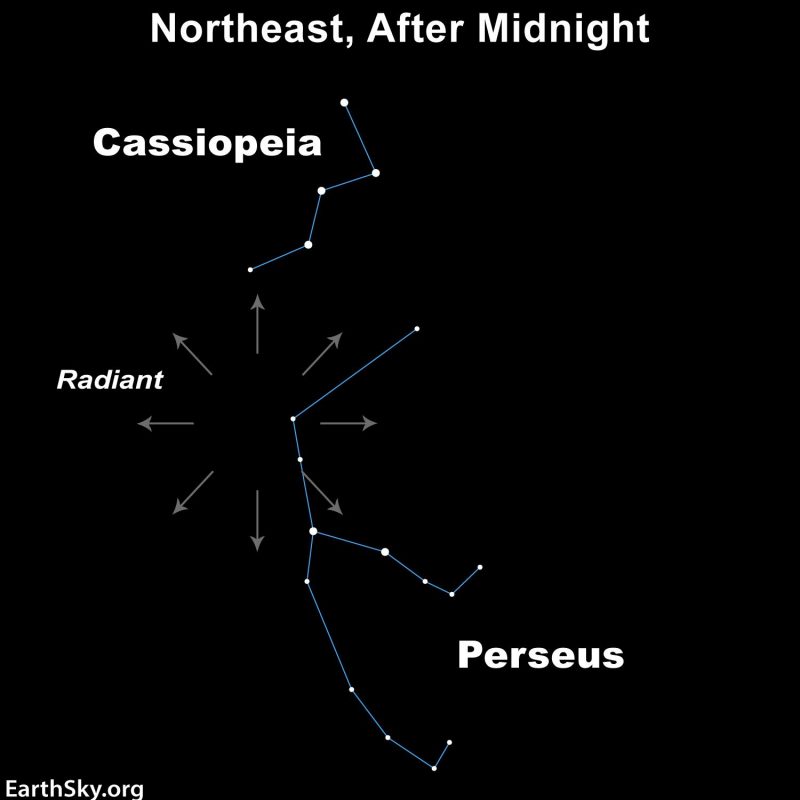
Star chart with radiant arrows in one spot.
Perseid meteors radiate from a point in the constellation Perseus the Hero. The radiant rises in late evening and is highest at dawn. Remember … you don’t have to find a shower’s radiant point to see meteors. The meteors will be flying in all parts of the sky.

Early October meteors … the Draconids

Predicted peak: The peak is predicted** for October 8, 2024, at 3 UTC.
When to watch: The best time to watch the Draconids in 2024 is the evening of October 7 through the wee hours of the morning on October 8. The waxing crescent moon (27% illuminated) will set before 9 p.m. your local time. So you can watch for meteors in a moonless sky.
Overall duration of shower: October 6 through 10.
Radiant: Highest in the sky in the evening hours. See chart below.
Nearest moon phase: First quarter moon is 18:55 UTC on October 10.
Expected meteors at peak, under ideal conditions: Under a dark sky with no moon, you might catch 10 Draconid meteors per hour.
Note: The Draconid shower is a real oddity, in that the radiant point stands highest in the sky as darkness falls. That means that, unlike many meteor showers, more Draconids are likely to fly in the evening hours than in the morning hours after midnight. This shower is usually a sleeper, producing only a handful of languid meteors per hour in most years. But watch out if the Dragon awakes! In rare instances, fiery Draco has been known to spew forth many hundreds of meteors in a single hour. That possibility keeps many skywatchers outside – even in moonlight – during this shower.

Read more: All you need to know about Draconid meteors
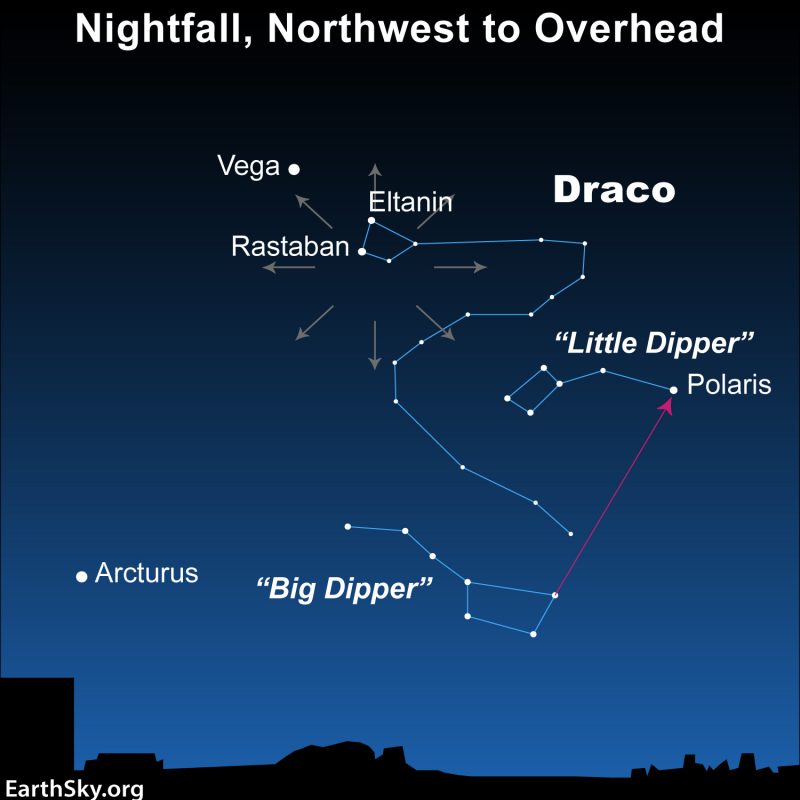
Star chart with set of radial arrows at one end of constellation Draco.
The radiant point for the Draconid meteor shower almost coincides with the head of the constellation Draco the Dragon in the northern sky. That’s why you can view the Draconids best from the Northern Hemisphere. This chart faces northward at nightfall in October. The Big Dipper sits low in the northwest. From the southern U.S. and comparable latitudes, in October, obstructions on your northern horizon might hide the Big Dipper from view. From farther south – say, the Southern Hemisphere – you won’t see the Dipper at all in the evening at this time of year. But, if you can spot it low in the sky, use the Big Dipper to star-hop to the star Polaris. Polaris marks the end star in the handle of the Little Dipper. Got all these stars? Then you should also be able to spot Eltanin and Rastaban, the Draconids’ radiant point, high in the northwest sky at nightfall in early October. Draconid meteors radiate from near these stars, which are known as the Dragon’s Eyes.

Late October meteors … the Orionids

Predicted peak: The peak is predicted** for October 20, 2024, at 18:14 UTC.
When to watch: Watch for Orionid meteors on both the mornings of October 20 and 21, starting after midnight through the wee hours before dawn.
Overall duration of shower: September 26 to November 22.
Radiant: The radiant rises before midnight and is highest in the sky around 2 a.m. See chart below.
Nearest moon phase: The full moon falls at 11:26 UTC on October 17. So, at the Orionids’ peak, the the waning gibbous moon will interfere with the meteor shower.
Expected meteors at peak, under ideal conditions: Under a dark sky with no moon, the Orionids exhibit a maximum of about 10 to 20 meteors per hour.
Note: These fast-moving meteors occasionally leave persistent trains. The Orionids sometimes produce bright fireballs.

Read more: Everything you need to know Orionid meteors
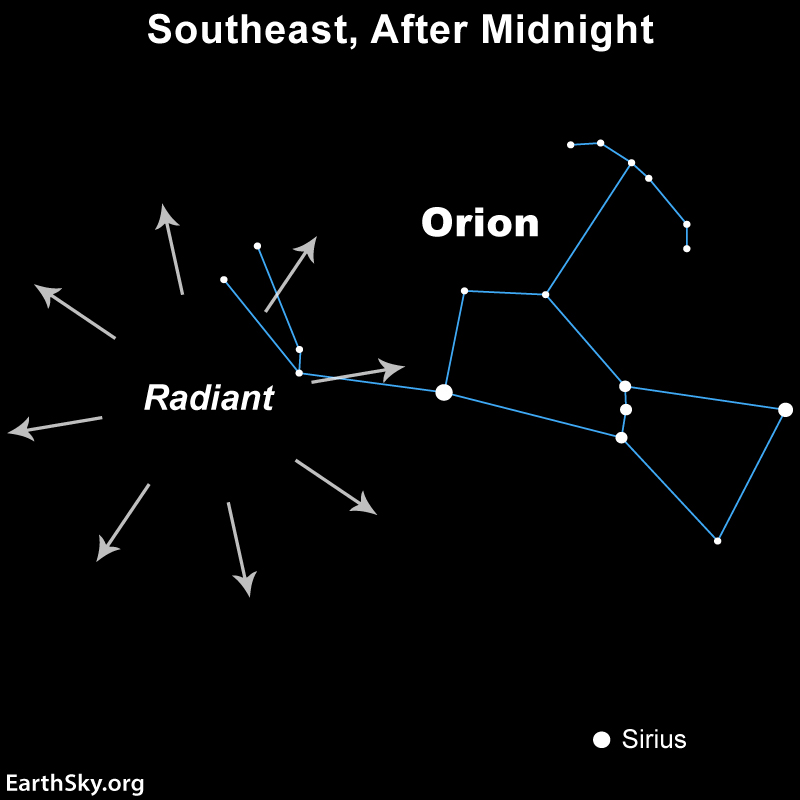
Chart with dots for constellation Orion and a circle of arrows showing the radient of the Orionid meteor shower.
If you trace Orionid meteors backward on the sky’s dome, they seem to radiate from the upraised club of the famous constellation Orion the Hunter. This is the shower’s radiant point. The bright star near the radiant point is reddish Betelgeuse. Chart via Chelynne Campion/ EarthSky.

How high up are meteors when they begin to glow?

Find a Dark Sky Place, from the International Dark Sky Association

Heavens-Above: Satellite predictions customized to your location

Stellarium Online: Star maps customized to your location

Dark Site Finder, from astrophotographer Kevin Palmer

Blue Marble Navigator

EarthSky’s tips for meteor-watchers

Why do meteor showers have a radiant point?

RASC Observer’s Handbook, an indispensable tool for stargazers. The peak dates dates and times listed in this article are (mostly) from there

Meteor shower guide: photos from the EarthSky community
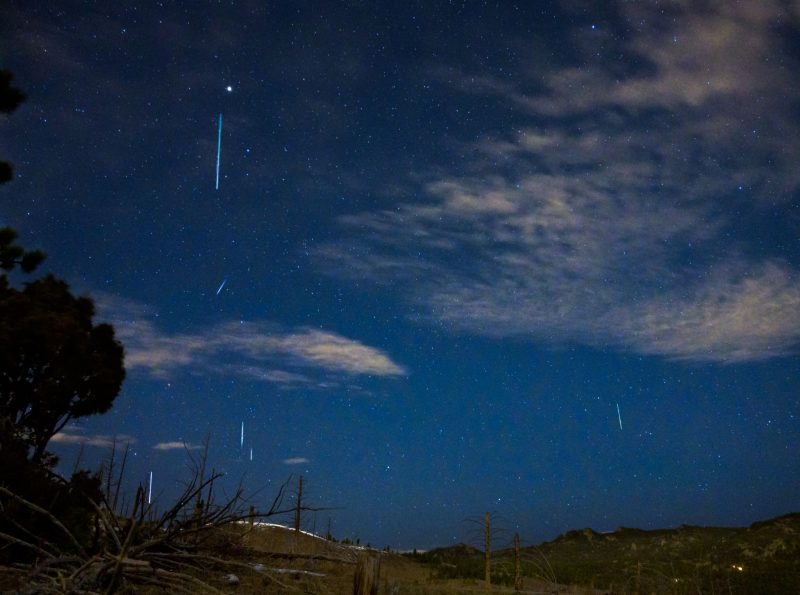
Dark blue sky with a few clouds and stars and vertical white streaks.
View at EarthSky Community Photos. | Photographer Thomas Hollowell in Colorado caught these Lyrid meteors on the morning of April 22, 2020, and said: “The 6 meteors in this frame were stacked in Photoshop on a set of 3 background frames.” Thanks, Thomas!
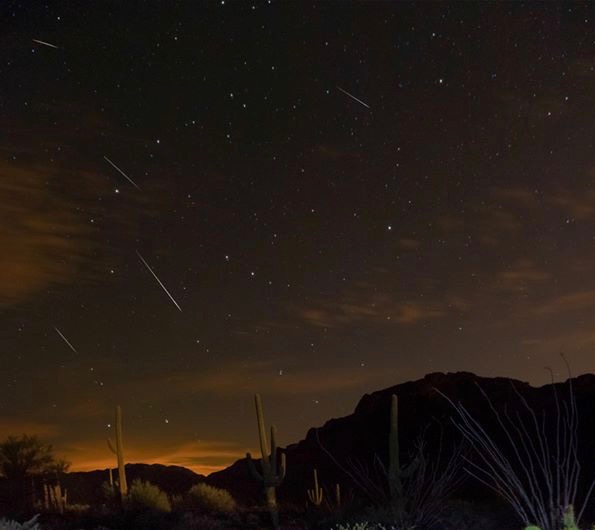
Several meteor trails over a desert landscape with tall cacti.
Draconids near Tucson, Arizona, in 2013, by our friend Sean Parker Photography.
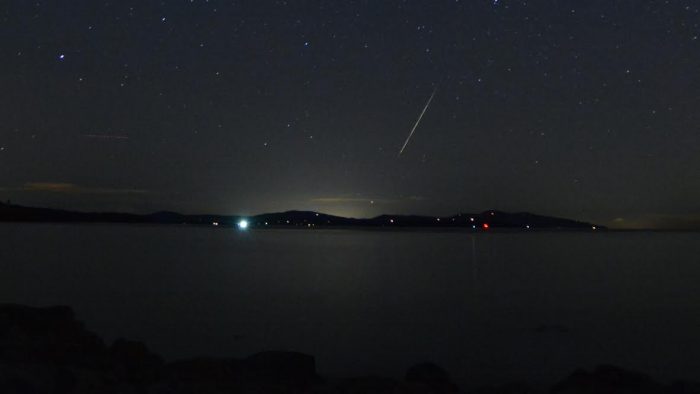
Meteor streak over low-lying hills with sea in foreground.
James Younger sent in this photo during the 2015 peak of the Leonid meteor shower. It’s a meteor over the San Juan Islands in the Pacific Northwest.
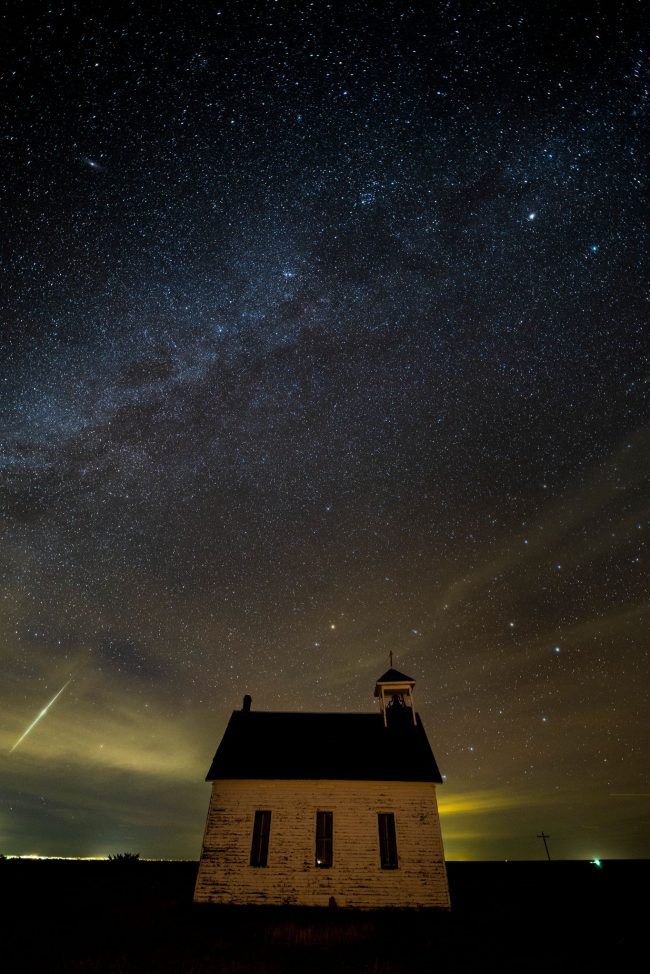
Small, old church in isolated location, dark sky, with a bright meteor.
View at EarthSky Community Photos. | William Mathe captured this image on December 20, 2019, in Lindon, Colorado. He wrote: “My wife and I made a 100-mile jaunt out into the eastern plains to try to capture one or more meteors from the Ursid meteor shower. We took this image facing due north. As you can see, just to the right of the little white church is Ursa Major pointing up to Polaris, and just to the left is a green ‘fireball’ meteor that lit up the sky for a second or two.” Thank you, William!
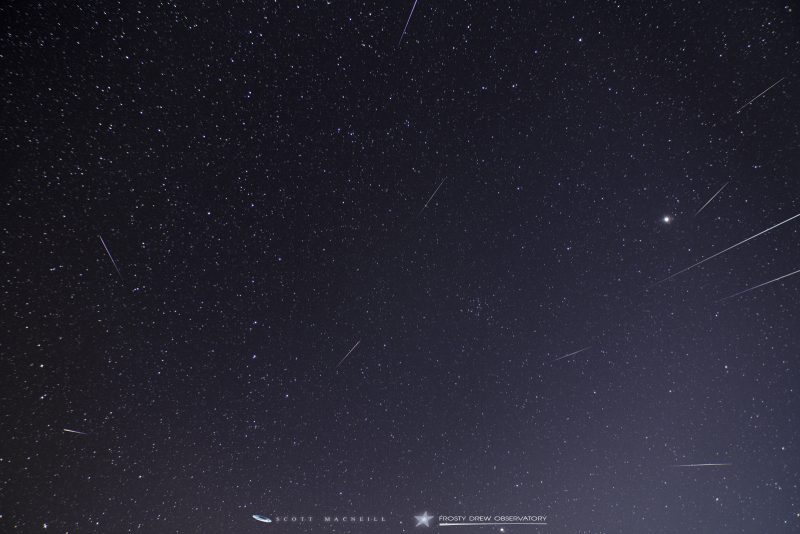
Starry sky with many thin meteor trails radiating out from one point.
Quadrantid radiant composite via Scott MacNeill of Frosty Drew Observatory in Charleston, Rhode Island.

Meteor shower words of wisdom

A wise person once said that meteor showers are like fishing. You go, you enjoy nature … and sometimes you catch something.

Bottom line: We’ve got several more meteor showers this year. Next up are the South and North Taurids followed by the Leonids. Your 2023 meteor shower guide here.


**Peak times for meteor showers provided by Robert Lunsford of the American Meteor Society. Note that predictions for meteor shower peak times may vary. Back to top.

The post Meteor shower guide: Up next the Taurids and Leonids first appeared on EarthSky.


from EarthSky https://ift.tt/ZNHW8cD

Now that autumn is here, we can look forward to several more meteor showers this year. Next up are the November Taurids and the Leonids.

October into early November … the South and North Taurids

Predicted peak: The South Taurids’ predicted** peak is November 6, 2023, at 0:47 UTC. The North Taurids’ predicted** peak is November 13, 2023, at 0:21 UTC. Both the South and North Taurids don’t have very definite peaks. They ramble along in October and November and are especially noticeable from late October into early November, when they overlap.
When to watch: Best around midnight, and on the days around November 13 when the moon won’t interfere.
Overall duration of shower: The South Taurids run from about September 23 to November 12. North Taurids are active from about October 13 to December 2.
Radiant: Rises in early evening, highest in the sky around midnight. See chart below.
Nearest moon phase: In 2023, the last quarter moon falls on November 5. New moon is November 13. Near the first predicted peak, the waning crescent moon may interfere with meteors after midnight and before dawn. So you may wait a few days after then to watch for meteors. Or watch on the days around November 13 – during the second predicted peak – near the new moon when you can enjoy watching for meteors in a moonless sky. You’ll catch Taurid meteors throughout October and November. Visit Sunrise Sunset Calendars to see moon rising times for your location. Be sure to check the moon rising time box.
Expected meteors at peak, under ideal conditions: Under dark skies with no moon, both the South and North Taurid meteor showers produce about five meteors per hour (10 total when they overlap). Also, watch for fireballs.
Note: Taurid meteors tend to be slow-moving but sometimes very bright. The showers sometimes produce fireballs, which made their cyclical reappearance in 2022. The American Meteor Society pointed to “a seven-year periodicity” with Taurid fireballs. 2008 and 2015 both produced them. 2022 did as well. The Taurid fireball display, in 2015, was really fun! Photos and video of 2015 Taurid fireballs here.

Read more: All you need to know about the Taurid meteors

Star chart showing constellation Taurus with 2 sets of radial arrows, 1 near the Pleiades.
The Taurid meteors consist of 2 streams, the South Taurid meteors and North Taurid meteors. Both streams appear to originate from the constellation Taurus the Bull. Typically, you see the maximum numbers at or around midnight, when Taurus is highest in the sky.

Meteor shower-watching resources

Mid-November meteors … the Leonids

Predicted peak: The peak is predicted** for November 18, 2023, at 5:33 UTC.
When to watch: Watch late on the night of November 17 until dawn on November 18. The morning of November 17 might be worthwhile, too.
Duration of shower: November 3 through December 2.
Radiant: Rises around midnight, highest in the sky at dawn.
Nearest moon phase: In 2023, first quarter moon falls on November 20. So there will be very little interference from moonlight in 2023.
Expected meteors at peak, under ideal conditions: Under a dark sky with no moon, you might see 10 to 15 Leonid meteors per hour.
Note: The famous Leonid meteor shower produced one of the greatest meteor storms in living memory. Rates were as high as thousands of meteors per minute during a 15-minute span on the morning of November 17, 1966. That night, Leonid meteors did, briefly, fall like rain. Some who witnessed it had a strong impression of Earth moving through space, fording the meteor stream. Leonid meteor storms sometimes recur in cycles of 33 to 34 years. But the Leonids around the turn of the century – while wonderful for many observers – did not match the shower of 1966. And, in most years, the Lion whimpers rather than roars.

Read more: All you need to know about Leonid meteors

Star chart of constellation Leo with radial arrows indicating source of Leonid meteor shower.
Leonids stream from a single point in the sky – their radiant point – in the constellation Leo the Lion. Leo rises just before midnight in mid-November. Regulus, the brightest star in Leo the, dots a backwards question mark of stars known as the Sickle.

Early to mid-December meteors … the Geminids

Predicted peak: is predicted** for December 14, 2023, at 19:27 UTC.
When to watch: Since the radiant rises in mid-evening, you can watch for Geminids all night around the peak dates of December 13 and 14. Plus, a young waxing crescent moon will not interfere with the Geminids in 2023.
Overall duration of shower: November 19 to December 24.
Radiant: Rises in mid-evening, highest around 2 a.m. See chart below.
Nearest moon phase: In 2023, the new moon falls on December 12. So there will be a dark sky during the peak of the 2023 Geminid meteor shower.
Expected meteors at peak, under ideal conditions: Under a dark sky with no moon, you might catch 120 Geminid meteors per hour.
Note: The bold, white, bright Geminids give us one of the Northern Hemisphere’s best showers, especially in years when there’s no moon. They’re also visible, at lower rates, from the Southern Hemisphere. The meteors are plentiful, rivaling the August Perseids.

Read more: All you need to know about Geminid meteors

Sky chart showing the constellation Gemini with radial arrows near star Castor.
Geminid meteors radiate from near the bright star Castor in the constellation Gemini the Twins, in the east on December evenings.

Meteor shower around the December solstice … the Ursids

Predicted peak: is predicted** for December 23, 2023, at 4 UTC.
When to watch: Watch for Ursid meteors in the early morning hours of December 22 and 23.
Duration of shower: Ursids range from December 13 to 24, so you might see some intermingling with the Geminids’ peak.
Radiant: Circumpolar at northerly latitudes.
Nearest moon phase: A 1st quarter moon occurs at 18:39 UTC on December 19. So the waxing gibbous moon – at 86% illumination – may interfere with the Ursids in 2023 until the moon sets about three hours before sunrise.
Expected meteors at peak, under ideal conditions: Under a dark sky with no moon, the Ursids offer perhaps five to 10 meteors per hour.
Note: This low-key meteor shower – which always peaks around the solstice – is somewhat overlooked due to the holiday season. Its hourly rate is lower than that of the popular Geminid shower, which peaks just a week before.

Read more: Ursid meteors peak around December solstice

Chart with Big and Little Dippers and radial arrows from Little Dipper's bowl.
The Ursids are named for their radiant point in the constellation Ursa Minor, which contains the Little Dipper. And the Little Dipper contains the North Pole. So for the Northern Hemisphere, the radiant is above the horizon all night long. Chart via Chelynne Campion/ EarthSky.

Early January 2024 meteors … the Quadrantids

When to watch: The best night for the 2024 Quadrantids is January 3-4 (The predicted peak** is 12:53 UTC on January 4). A bright last quarter moon will rise around midnight and shine the rest of the night. Try late night January 3 to dawn January 4, in moonlight.
Nearest moon phase: Last quarter moon will come late on January 3, 2024 (CST).
Radiant: Rises in the north-northeast after midnight and is highest up before dawn. The radiant point for the Quadrantids is in a now-obsolete constellation, Quadrans Muralis the Mural Quadrant. Nowadays, we see the radiant near the famous Big Dipper asterism. Because the Quadrantid radiant is far to the north on the sky’s dome, this is mostly a far-northern shower, not as good for the Southern Hemisphere.
Expected meteors at peak, under ideal conditions: Under a dark sky with no moon, when the radiant is high in the sky, the Quadrantids can (briefly) produce over 100 meteors per hour.
Duration of shower: The Quadrantid meteor shower runs from mid-November through mid-January each year, according to this 2017 article in the journal Icarus. You might see a Quadrantid streak by any time during that interval. But most activity is centered on the peak.
Note: The Quadrantid shower is one of four major meteor showers each year with a sharp peak (the other three are the Lyrids, Leonids, and Ursids).

Read more: All you need to know about Quadrantid meteors

Sky chart showing arrows radiating out from a point south of Big Dipper.
The radiant point for the Quadrantid meteor shower is far to the north in the sky and so best seen from Earth’s Northern Hemisphere. From mid-northern latitudes, the radiant point for the Quadrantid meteor shower climbs over the horizon after midnight and is highest up before dawn.

April 2024 meteors … the Lyrids

When to watch in 2024: Late evening April 21 until dawn April 22 will be best. The predicted** peak is 9:23 UTC on April 22. The peak of the Lyrids is narrow (no weeks-long stretches of meteor-watching, as with some showers). In 2024, the full moon falls at 23:49 UTC on April 23. So meteor watching will be impacted by a bright waxing gibbous moon.
Radiant: Rises before midnight, highest in the sky at dawn.
Nearest moon phase: Full moon falls at 23:49 UTC on April 23. So a bright waxing gibbous moon will be in the sky during the peak morning for the 2023’s Lyrid meteor shower.
Duration of shower: April 15 to April 29.
Expected meteors at peak, under ideal conditions: In a dark sky with no moon, you might see 10 to 15 Lyrids per hour. The Lyrids are known for uncommon surges that can sometimes bring rates of up to 100 per hour! Read more about Lyrid outbursts.
Note for Southern Hemisphere: This shower’s radiant point is far to the north on the sky’s dome. So the Southern Hemisphere will see fewer Lyrid meteors. Still, you might see some!

Read more: All you need to know about Lyrid meteors

Chart showing two stars and radial arrows from meteor shower radiant point.
Lyrid meteors radiate from near the bright star Vega in the constellation Lyra the Harp. You don’t need to identify Vega or Lyra in order to watch the Lyrid meteor shower. But you do need to know when the radiant rises, in this case in the northeast before midnight. That’s why the Lyrids are typically best between midnight and dawn.

May 2024 meteors … the Eta Aquariids

When to watch: New moon will fall a few days after the peak of the 2024 Eta Aquariid shower. So, mornings around the peak will be dark and moonless. The best mornings to watch are May 5 and 6, 2024, in the hours before dawn. Why before dawn? See “Radiant” below.The American Meteor Society is listing 8:43 UTC on May 5 as the shower’s predicted** peak time. But times vary between different experts. And the peak of this shower stretches out over several days. So you can expect elevated numbers of meteors a few days before and after the peak time.
Nearest moon phase: New moon will fall at 03:22 UTC on May 8. So moonlight will not obscure the 2024 Eta Aquariids.
Radiant: Will rise in the wee hours, climbing toward its highest point at dawn. That’s why before dawn will be the best time to watch this shower.
Duration of shower: April 15 to May 27.
Expected meteors at peak, under ideal conditions: In the southern half of the U.S., you might see 10 to 20 meteors per hour under a dark sky, with no moon, when the radiant is high in the sky. Farther south – at latitudes in the Southern Hemisphere – you might see two to three times that number.
Note: The Eta Aquariids’ radiant will be on the ecliptic, which will ride low in the sky on spring mornings as seen from the Northern Hemisphere. That’s why this shower favors the Southern Hemisphere. It’s often that hemisphere’s best meteor shower of the year.

Read more: All you need to know about Eta Aquariid meteors

Lines marking constellation with radial arrows near middle of it.
The radiant point of the Eta Aquariid meteor shower will be near the star Eta Aquarii in the constellation Aquarius the Water Bearer. The radiant will rise in the wee hours after midnight and will continue climbing toward its highest point at dawn. That highest point will be in the south as viewed from the Northern Hemisphere, closer to overhead for the Southern Hemisphere. That’s why the Southern Hemisphere will see more meteors (the radiant will be higher up), and it’s why – for all of us around the globe – the hours before dawn will be best for this shower.

June 2024 daytime meteor shower … the Arietids

Most meteor showers are easy to observe. Just find a dark sky, and look up! But what about meteor showers that happen in the daytime, when the sun is up? The Arietids are sometimes said to be the most active daytime meteor shower. In 2024, their predicted** peak will be the morning of June 7. You might catch some Arietids that morning in the dark hour before dawn.

When to watch: Watch from May 29 to June 17. There’s a predicted** peak on June 7, 2024. Watch for them in the sunrise direction in the dark hour before dawn breaks.
Nearest moon phase: In 2024, a new moon occurs at 12:38 UTC on June 6. So the mornings around the peak will be completely moon free.
Radiant: The shower’s radiant point – the point in the sky from which the meteors appear to radiate – is in the constellation Aries the Ram. You’ll find this constellation in the east before sunrise.
Duration of shower: May 29 to June 17.
Expected meteors at peak: This is tricky for daytime meteor showers because once the sun comes up, you won’t be able to see them. But the Arietids have a strong zenithal hourly rate (ZHR)! Meteor counts with radar and radio echoes have indicated a rate of 60 meteors per hour, and perhaps as high as 200 meteors per hour.
Note: The Arietids are sometimes said to be the most active daytime meteor shower.

Read more: Arietids, most active daytime meteor shower

Star chart: Cassiopiea, Aries, and Capella with radial lines from a point in the sky.
The Arietids are an active shower, but they’re visible mostly in daytime. Watch for them in the sunrise direction in the dark hour before dawn from May 29 to June 17. You’ll be looking for meteors that shoot up from the horizon. The radiant is below the constellation Aries the Ram. Chart by John Jardine Goss.

Late July to mid-August 2024 meteors … the Delta Aquariids

Predicted peak: The peak is predicted** for July 30, 2024, at 15:16 UTC. But this shower doesn’t have a noticeable peak. It rambles along steadily from late July through early August, joining forces with the August Perseids.
When to watch: Watch late July through early August, mid-evening to dawn.
Duration of shower: July 18 to August 21.
Radiant: Rises in mid-evening, highest around 2 a.m. and low in the sky by dawn. See chart below.
Nearest moon phase: In 2024, last quarter moon falls at 2:51 UTC on August 1. Take advantage of the moon-free evenings in late July for watching the Delta Aquariids (and the early Perseids).
Expected meteors at peak, under ideal conditions: The Delta Aquariids’ maximum hourly rate can reach 15 to 20 meteors in a dark sky with no moon. You’ll typically see plenty of Delta Aquariids mixed in with the Perseids, if you’re watching in early August.
Note: Like May’s Eta Aquariids, July’s Delta Aquariids favors the Southern Hemisphere. Skywatchers at high northern latitudes tend to discount it. But the shower can be excellent from latitudes like those in the southern U.S. Delta Aquariid meteors tend to be fainter than Perseid meteors. So a moon-free dark sky is essential. About 5% to 10% of the Delta Aquariid meteors leave persistent trains, glowing ionized gas trails that last a second or two after the meteor has passed.

Read more: All you need to know about Delta Aquariid meteors

Star chart showing the Great Square of Pegasus to Fomalhaut to the Delta Aquariid radiant point.
Delta Aquariid meteors radiate from near the star Skat, aka Delta Aquarii, in the constellation Aquarius the Water Bearer. This star is near bright Fomalhaut. In late July to early August, Fomalhaut is highest around 2 a.m. (on your clock no matter where you are). It’s southward from the Northern Hemisphere, closer to overhead from the Southern Hemisphere. Fomalhaut appears bright and solitary in the sky. To find it, draw a line roughly southward through the stars on the west side of the Great Square of Pegasus.

Mid-July to mid-August 2024 meteors … the Perseids

Predicted peak: The peak is predicted** for August 12, 2024, at 14:00 UTC. So the mornings of August 11, 12 and 13 are probably your best bet.
When to watch: The moon will be a 1st quarter and 50% illuminated during 2024’s peak of the Perseid meteor shower. So the best time to watch for Perseids will be starting around midnight until dawn. This shower rises to a peak gradually, then falls off rapidly. And Perseid meteors tend to strengthen in number as late night deepens into the wee hours before dawn. The shower is often best just before dawn.
Radiant: The radiant rises in the middle of the night and is highest at dawn. See chart below.
Nearest moon phase: First quarter moon falls at 15:19 UTC on August 12. And a 1st quarter moon sets around midnight, so you’ll have dark skies after then until dawn.
Duration of shower: July 14 to September 1.
Expected meteors at peak, under ideal conditions: Under a dark sky with no moon, skywatchers frequently report 90 meteors per hour, or more. In 2023, the waning crescent moon will not interfere with the meteor shower.
Note: The August Perseid meteor shower is rich and steady, from early August through the peak. The meteors are colorful. And they frequently leave persistent trains. All of these factors make the Perseid shower perhaps the most beloved meteor shower for the Northern Hemisphere.

Read more: All you need to know about Perseid meteors

Star chart with radiant arrows in one spot.
Perseid meteors radiate from a point in the constellation Perseus the Hero. The radiant rises in late evening and is highest at dawn. Remember … you don’t have to find a shower’s radiant point to see meteors. The meteors will be flying in all parts of the sky.

Early October meteors … the Draconids

Predicted peak: The peak is predicted** for October 8, 2024, at 3 UTC.
When to watch: The best time to watch the Draconids in 2024 is the evening of October 7 through the wee hours of the morning on October 8. The waxing crescent moon (27% illuminated) will set before 9 p.m. your local time. So you can watch for meteors in a moonless sky.
Overall duration of shower: October 6 through 10.
Radiant: Highest in the sky in the evening hours. See chart below.
Nearest moon phase: First quarter moon is 18:55 UTC on October 10.
Expected meteors at peak, under ideal conditions: Under a dark sky with no moon, you might catch 10 Draconid meteors per hour.
Note: The Draconid shower is a real oddity, in that the radiant point stands highest in the sky as darkness falls. That means that, unlike many meteor showers, more Draconids are likely to fly in the evening hours than in the morning hours after midnight. This shower is usually a sleeper, producing only a handful of languid meteors per hour in most years. But watch out if the Dragon awakes! In rare instances, fiery Draco has been known to spew forth many hundreds of meteors in a single hour. That possibility keeps many skywatchers outside – even in moonlight – during this shower.

Read more: All you need to know about Draconid meteors

Star chart with set of radial arrows at one end of constellation Draco.
The radiant point for the Draconid meteor shower almost coincides with the head of the constellation Draco the Dragon in the northern sky. That’s why you can view the Draconids best from the Northern Hemisphere. This chart faces northward at nightfall in October. The Big Dipper sits low in the northwest. From the southern U.S. and comparable latitudes, in October, obstructions on your northern horizon might hide the Big Dipper from view. From farther south – say, the Southern Hemisphere – you won’t see the Dipper at all in the evening at this time of year. But, if you can spot it low in the sky, use the Big Dipper to star-hop to the star Polaris. Polaris marks the end star in the handle of the Little Dipper. Got all these stars? Then you should also be able to spot Eltanin and Rastaban, the Draconids’ radiant point, high in the northwest sky at nightfall in early October. Draconid meteors radiate from near these stars, which are known as the Dragon’s Eyes.

Late October meteors … the Orionids

Predicted peak: The peak is predicted** for October 20, 2024, at 18:14 UTC.
When to watch: Watch for Orionid meteors on both the mornings of October 20 and 21, starting after midnight through the wee hours before dawn.
Overall duration of shower: September 26 to November 22.
Radiant: The radiant rises before midnight and is highest in the sky around 2 a.m. See chart below.
Nearest moon phase: The full moon falls at 11:26 UTC on October 17. So, at the Orionids’ peak, the the waning gibbous moon will interfere with the meteor shower.
Expected meteors at peak, under ideal conditions: Under a dark sky with no moon, the Orionids exhibit a maximum of about 10 to 20 meteors per hour.
Note: These fast-moving meteors occasionally leave persistent trains. The Orionids sometimes produce bright fireballs.

Read more: Everything you need to know Orionid meteors

Chart with dots for constellation Orion and a circle of arrows showing the radient of the Orionid meteor shower.
If you trace Orionid meteors backward on the sky’s dome, they seem to radiate from the upraised club of the famous constellation Orion the Hunter. This is the shower’s radiant point. The bright star near the radiant point is reddish Betelgeuse. Chart via Chelynne Campion/ EarthSky.

How high up are meteors when they begin to glow?

Find a Dark Sky Place, from the International Dark Sky Association

Heavens-Above: Satellite predictions customized to your location

Stellarium Online: Star maps customized to your location

Dark Site Finder, from astrophotographer Kevin Palmer

Blue Marble Navigator

EarthSky’s tips for meteor-watchers

Why do meteor showers have a radiant point?

RASC Observer’s Handbook, an indispensable tool for stargazers. The peak dates dates and times listed in this article are (mostly) from there

Meteor shower guide: photos from the EarthSky community
Dark blue sky with a few clouds and stars and vertical white streaks.
View at EarthSky Community Photos. | Photographer Thomas Hollowell in Colorado caught these Lyrid meteors on the morning of April 22, 2020, and said: “The 6 meteors in this frame were stacked in Photoshop on a set of 3 background frames.” Thanks, Thomas!
Several meteor trails over a desert landscape with tall cacti.
Draconids near Tucson, Arizona, in 2013, by our friend Sean Parker Photography.
Meteor streak over low-lying hills with sea in foreground.
James Younger sent in this photo during the 2015 peak of the Leonid meteor shower. It’s a meteor over the San Juan Islands in the Pacific Northwest.
Small, old church in isolated location, dark sky, with a bright meteor.
View at EarthSky Community Photos. | William Mathe captured this image on December 20, 2019, in Lindon, Colorado. He wrote: “My wife and I made a 100-mile jaunt out into the eastern plains to try to capture one or more meteors from the Ursid meteor shower. We took this image facing due north. As you can see, just to the right of the little white church is Ursa Major pointing up to Polaris, and just to the left is a green ‘fireball’ meteor that lit up the sky for a second or two.” Thank you, William!
Starry sky with many thin meteor trails radiating out from one point.
Quadrantid radiant composite via Scott MacNeill of Frosty Drew Observatory in Charleston, Rhode Island.

Meteor shower words of wisdom

A wise person once said that meteor showers are like fishing. You go, you enjoy nature … and sometimes you catch something.

Bottom line: We’ve got several more meteor showers this year. Next up are the South and North Taurids followed by the Leonids. Your 2023 meteor shower guide here.


**Peak times for meteor showers provided by Robert Lunsford of the American Meteor Society. Note that predictions for meteor shower peak times may vary. Back to top.

The post Meteor shower guide: Up next the Taurids and Leonids first appeared on EarthSky.


from EarthSky https://ift.tt/ZNHW8cD

Cassiopeia the Queen is overhead on autumn evenings

Cassiopeia overhead on autumn evenings

The constellation Cassiopeia the Queen can be found high in the sky on October and November evenings, not far from Polaris, the North Star. At any time of year, you can use the Big Dipper to find Cassiopeia. These two star formations are like riders on opposite sides of a Ferris wheel. They’re part of a great spinning wheel of stars seen moving counterclockwise around Polaris, the North Star, once each day. As Cassiopeia rises upward, the Big Dipper plunges downward, and vice versa.

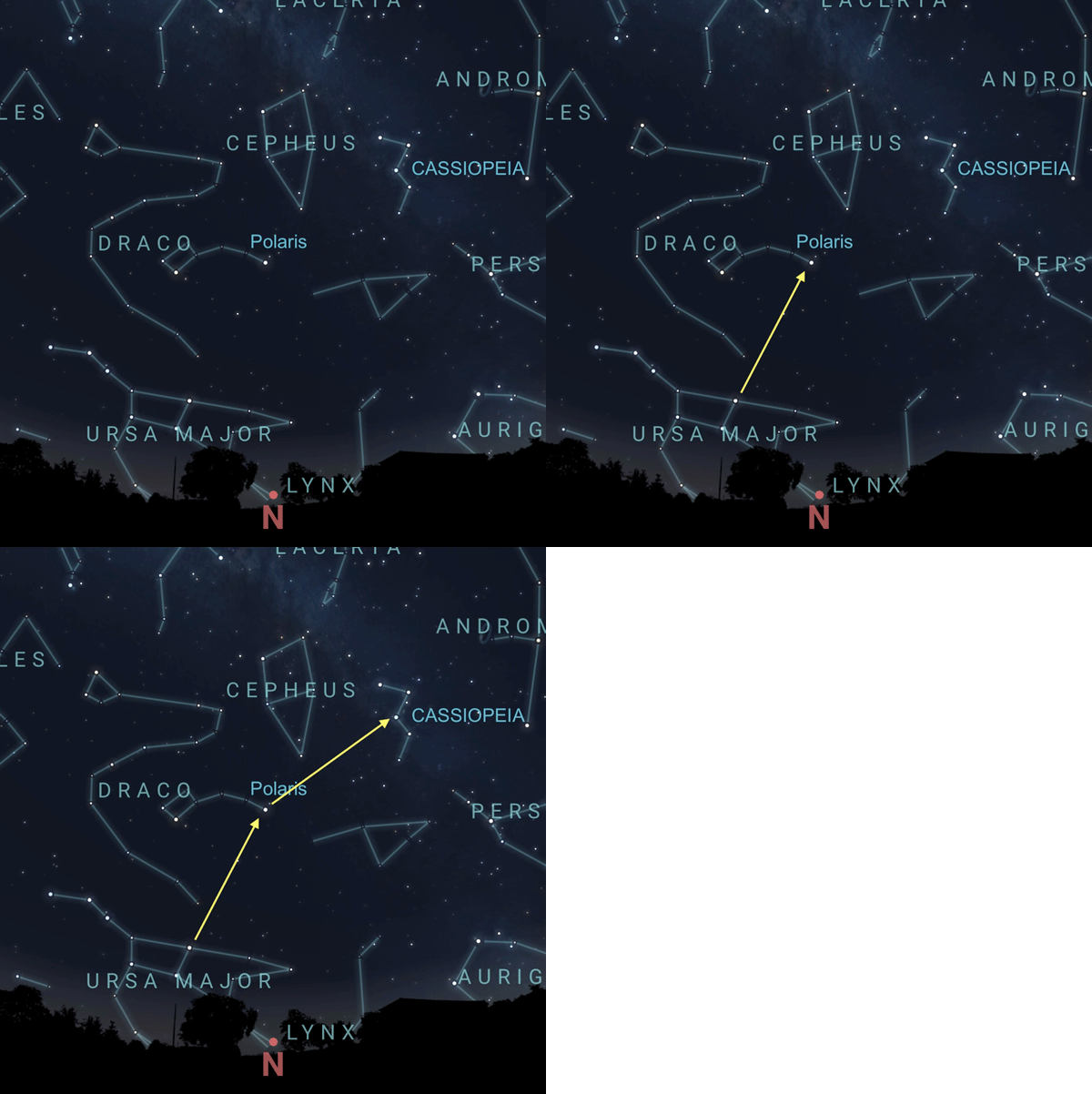
Some of you know how to star-hop to Polaris, the North Star, by using the Big Dipper’s pointer stars, as displayed on the sky chart below. Because the Big Dipper’s handle and Cassiopeia shine on opposite sides of Polaris, an imaginary line from any star on the Big Dipper handle through Polaris reliably points to Cassiopeia.

Star chart with constellations and animation of arrows pointing from the Big Dipper to Polaris to Cassiopeia.
You can find Cassiopeia somewhere in the north for much of the year, and much of the night. Here it is on autumn evenings relative to Polaris, the North Star. But no matter the time of year, you can use the Big Dipper and Polaris to find Cassiopeia. Chart via Stellarium.org. Used with permission.

The 2024 lunar calendars are here! Best Christmas gifts in the universe! Check ’em out here.

Cassiopeia is bright and easy to pick out in the sky

However, you won’t need the Big Dipper and Polaris to find Cassiopeia. That’s because Cassiopeia is very easy to pick out. It’s small and compact and looks like the letter M or W, depending on the time of night and time of year.

Like the Big Dipper, Cassiopeia can be seen even on moonlit nights.

Bonus for you if you live north of about 40 degrees north latitude, about the latitude of New York City! From that latitude and farther north, the Big Dipper and Cassiopeia are both circumpolar. That means they’re always above the horizon at any time of night, all year round.

Sky chart of constellation Cassiopeia with stars in black on white and other objects as small colored symbols.
Chart of the constellation Cassiopeia the Queen. Chart via IAU. Used with permission.

Star lore of Cassiopeia

Cassiopeia used to be known among astronomers and skywatchers alike as Cassiopeia’s Chair. In the 1930s, the International Astronomical Union gave this constellation the official name of Cassiopeia the Queen.

Cassiopeia was a queen in ancient Greek mythology. According to legend, she boasted she was more beautiful than the sea nymphs called the Nereids. Her boast angered Poseidon, god of the sea, who sent a sea monster, Cetus, to ravage the kingdom. To pacify the monster, Cassiopeia’s daughter, Princess Andromeda, was left tied to a rock by the sea. Cetus was about to devour her when Perseus the Hero looked down upon her from Pegasus, the Flying Horse. Perseus rescued the Princess, and all lived happily.

The gods were so pleased, that all of these characters were elevated to the heavens as stars. Only Cassiopeia suffered an indignity; her vanity caused her to be bound to a chair and placed in the heavens so that, as she revolves around the north celestial pole, she is sometimes in an upside-down position.

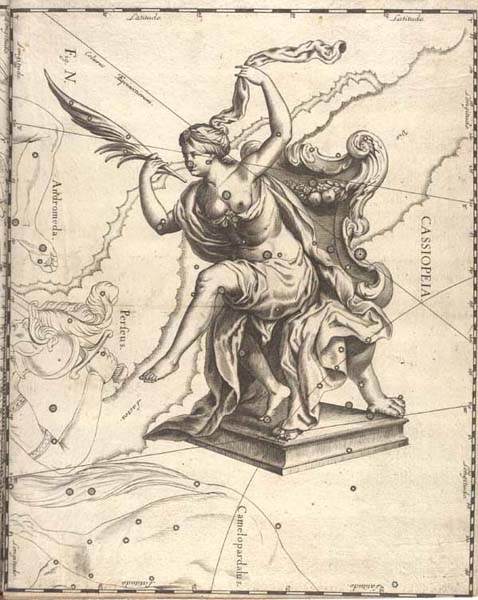
Old-fashioned drawing of Queen Cassiopeia in Greek garb on her throne, with scattered stars.
Cassiopeia as depicted by Johannes Hevelius in the 1600s. Image via Wikimedia Commons (public domain).

Bottom line: Spot the constellation Cassiopeia the Queen somewhere in the northern sky during much of the year, and throughout much of the night.

The post Cassiopeia the Queen is overhead on autumn evenings first appeared on EarthSky.


from EarthSky https://ift.tt/TFmVxJZ

Cassiopeia overhead on autumn evenings

The constellation Cassiopeia the Queen can be found high in the sky on October and November evenings, not far from Polaris, the North Star. At any time of year, you can use the Big Dipper to find Cassiopeia. These two star formations are like riders on opposite sides of a Ferris wheel. They’re part of a great spinning wheel of stars seen moving counterclockwise around Polaris, the North Star, once each day. As Cassiopeia rises upward, the Big Dipper plunges downward, and vice versa.

Some of you know how to star-hop to Polaris, the North Star, by using the Big Dipper’s pointer stars, as displayed on the sky chart below. Because the Big Dipper’s handle and Cassiopeia shine on opposite sides of Polaris, an imaginary line from any star on the Big Dipper handle through Polaris reliably points to Cassiopeia.

Star chart with constellations and animation of arrows pointing from the Big Dipper to Polaris to Cassiopeia.
You can find Cassiopeia somewhere in the north for much of the year, and much of the night. Here it is on autumn evenings relative to Polaris, the North Star. But no matter the time of year, you can use the Big Dipper and Polaris to find Cassiopeia. Chart via Stellarium.org. Used with permission.

The 2024 lunar calendars are here! Best Christmas gifts in the universe! Check ’em out here.

Cassiopeia is bright and easy to pick out in the sky

However, you won’t need the Big Dipper and Polaris to find Cassiopeia. That’s because Cassiopeia is very easy to pick out. It’s small and compact and looks like the letter M or W, depending on the time of night and time of year.

Like the Big Dipper, Cassiopeia can be seen even on moonlit nights.

Bonus for you if you live north of about 40 degrees north latitude, about the latitude of New York City! From that latitude and farther north, the Big Dipper and Cassiopeia are both circumpolar. That means they’re always above the horizon at any time of night, all year round.

Sky chart of constellation Cassiopeia with stars in black on white and other objects as small colored symbols.
Chart of the constellation Cassiopeia the Queen. Chart via IAU. Used with permission.

Star lore of Cassiopeia

Cassiopeia used to be known among astronomers and skywatchers alike as Cassiopeia’s Chair. In the 1930s, the International Astronomical Union gave this constellation the official name of Cassiopeia the Queen.

Cassiopeia was a queen in ancient Greek mythology. According to legend, she boasted she was more beautiful than the sea nymphs called the Nereids. Her boast angered Poseidon, god of the sea, who sent a sea monster, Cetus, to ravage the kingdom. To pacify the monster, Cassiopeia’s daughter, Princess Andromeda, was left tied to a rock by the sea. Cetus was about to devour her when Perseus the Hero looked down upon her from Pegasus, the Flying Horse. Perseus rescued the Princess, and all lived happily.

The gods were so pleased, that all of these characters were elevated to the heavens as stars. Only Cassiopeia suffered an indignity; her vanity caused her to be bound to a chair and placed in the heavens so that, as she revolves around the north celestial pole, she is sometimes in an upside-down position.

Old-fashioned drawing of Queen Cassiopeia in Greek garb on her throne, with scattered stars.
Cassiopeia as depicted by Johannes Hevelius in the 1600s. Image via Wikimedia Commons (public domain).

Bottom line: Spot the constellation Cassiopeia the Queen somewhere in the northern sky during much of the year, and throughout much of the night.

The post Cassiopeia the Queen is overhead on autumn evenings first appeared on EarthSky.


from EarthSky https://ift.tt/TFmVxJZ

Ancient mud lake on Mars could hold traces of life


Simulated flyover view of Mars. This is a region of chaotic terrain called Hydraotes Chaos. Researchers found an ancient mud lake in this region, which you can see beginning around minute 2:35. Could this mud lake on Mars hold traces of ancient microbial life? The data for the simulation is from ESA’s Mars Express orbiter. Video via ESA/ DLR/ FU Berlin.

On Earth, water means life. So ancient lakes on Mars would be good places to look for Martian life. On October 18, 2023, researchers at the Planetary Science Institute in Tucson, Arizona, announced they’ve found evidence for an ancient mud lake on Mars. They said it’s an ideal place for preserving microscopic biosignatures on Mars – evidence of past or present life – if such life ever existed.

They said a mud lake is a lake with accumulating muddy sediments on the bottom. You can see the mud lake on Mars in the video above, starting around 2:35. It’s near Mars’ northern lowlands, in a region of complex terrain, thought to have formed from ancient flood channels and aquifers.

The researchers – led by Alexis Rodriguez at the Planetary Science Institute – published their peer reviewed paper in Scientific Reports (Nature) on October 18.

The 2024 lunar calendars are here! Best Christmas gifts in the universe! Check ’em out here.

An ancient mud lake on Mars in Hydraotes Chaos

The mud lake is in a region called Hydraotes Chaos, which is just above the equator near the east end of the massive canyon Valles Marineris. This area is what scientists call chaotic terrain or chaos terrain, where aquifers once existed below the surface. In fact, the mud lake’s source of water was the aquifers in this area. The drier surface collapsed above the aquifers in this region, creating the jumbled “chaotic” terrain we see today.

Drainage – the natural removal of excess water – from the aquifers also formed the sedimentary plains within Hydraotes Chaos. Those sediments, once rich in water, could have preserved traces of ancient Martian microorganisms, just as they do on Earth. That subsurface environment could also have persisted long after all the water dried up on the surface and became inhospitable.

Rodriguez said:

Our research focuses on a sedimentary unit within Hydraotes Chaos, which we interpret to be the remnants of a mud lake formed by discharges from gas-charged mudstone stratigraphy dating back to nearly 4 billion years ago, a time when the surface of Mars was likely habitable. These sediments might harbor evidence of life from that or subsequent periods. It is important to remember that the subsurface of Mars might have included habitability lasting the duration of life’s history on Earth.

A complex landscape

In addition, ancient flood channels, thousands of miles long, cut across the Martian surface and end in the northern lowlands. Scientists have long postulated that a former ocean once filled these lowlands. The channels caused extensive erosion and released subsurface sediments from the aquifers. That material now covers much of the northern lowlands. This complexity of the landscape can make it difficult to study the ancient aquifers. As Rodriguez explained:

Venturing into the northern plains for sampling could prove precarious, as distinguishing between materials sourced from the aquifers and those eroded and transported during channel formation could become an intricate task. The plains, situated within Hydraotes Chaos, offer a unique glimpse into ancient aquifer materials. These plains, which we think formed from mud extruding into a basin directly above their source aquifer, provide a more targeted exploration opportunity. Unlike vast flood channels with their complex erosion patterns, this finding simplifies the examination of Martian aquifers, reducing the risk of overland sedimentary acquisition, and opens a new window into Mars’ geological past.

There are also mud volcanoes in this region. Those small volcanoes once released wet sediments containing salts to the surface, instead of hot magma.

Huge water-filled caverns

In addition to the aquifers – which are water-rich porous rock – there were also huge water-filled chambers in this chaotic terrain. Co-author Bryan Travis at the Planetary Science Institute said:

Our numerical models reveal a fascinating story. The lake’s source aquifer likely originated from phase segregation within the mudstone, forming vast water-filled chambers, several kilometers wide and hundreds of meters deep. This process was likely triggered by intrusive igneous activity. Moreover, the observed segmented subsidence across the chaotic terrain suggests an interconnected network of chambers, depicting stable water-filled giant caverns, some reaching kilometers in widths and lengths, way larger than any known Earth counterparts.

Brownish and blue cratered terrain seen from above with a white outlined area in middle and black arrow.
This map shows the Hydraotes Chaos region and the location of the ancient mud lake. Image via NASA/ Planetary Science Institute.
Mud lake on Mars: Red, yellow and blue terrain seen from above, with large fractures and craters and black and white text.
View larger. | Hydraotes Chaos (labeled with white text on right side) is located near the eastern end of the Valles Marineris canyon system. Image via USGS.

Mud lake on Mars could preserve ancient biomolecules

The resulting mud lake would have been an ideal place to preserve any biomolecules (biological molecules) associated with life. Rodriguez said:

Initially, biomolecules could have been dispersed throughout the volume of large groundwater-filled cavities. As the water was released to the surface and ponded, the water went away, leaving behind lags of sediments and potentially high concentrations of biomolecules.

As the paper said:

The meltwater, originating from varying thermally affected mudstone depths, could have potentially harbored diverse biosignatures, which could have become concentrated within the lake’s sedimentary residue.

A mission to Hydraotes Chaos?

The sediments left behind on the surface, from the original aquifers, are still there today. They would be a good target for sampling in a future Mars mission. And in fact, NASA is considering doing just that, as co-author Mary Beth Wilhelm, at NASA Ames Research Center, noted:

NASA Ames is considering the plains as a possible landing site for a mission to search for evidence of biomarkers, specifically lipids. These biomolecules are extremely resistant and could have endured billions of years on Mars.

The paper added:

Thus, we propose that Hydraotes Chaos merits priority consideration in future missions aiming to detect Martian biosignatures.

Co-author Jeffrey Kargel at the Planetary Science Institute added:

In addition, the study region includes widespread mud volcanoes and possible diapirs, providing additional windows into subsurface, potentially habitable rocks. A small rover could, within short distances, sample the mud lake sediments and these materials, dramatically increasing the odds of biosignature detection.

Bottom line: Researchers at the Planetary Science Institute said that an ancient mud lake on Mars would be an ideal place to search for evidence of ancient microbial life.

Source: Exploring the evidence of Middle Amazonian aquifer sedimentary outburst residues in a Martian chaotic terrain

Via Planetary Science Institute

The post Ancient mud lake on Mars could hold traces of life first appeared on EarthSky.


from EarthSky https://ift.tt/JKPRN5h


Simulated flyover view of Mars. This is a region of chaotic terrain called Hydraotes Chaos. Researchers found an ancient mud lake in this region, which you can see beginning around minute 2:35. Could this mud lake on Mars hold traces of ancient microbial life? The data for the simulation is from ESA’s Mars Express orbiter. Video via ESA/ DLR/ FU Berlin.

On Earth, water means life. So ancient lakes on Mars would be good places to look for Martian life. On October 18, 2023, researchers at the Planetary Science Institute in Tucson, Arizona, announced they’ve found evidence for an ancient mud lake on Mars. They said it’s an ideal place for preserving microscopic biosignatures on Mars – evidence of past or present life – if such life ever existed.

They said a mud lake is a lake with accumulating muddy sediments on the bottom. You can see the mud lake on Mars in the video above, starting around 2:35. It’s near Mars’ northern lowlands, in a region of complex terrain, thought to have formed from ancient flood channels and aquifers.

The researchers – led by Alexis Rodriguez at the Planetary Science Institute – published their peer reviewed paper in Scientific Reports (Nature) on October 18.

The 2024 lunar calendars are here! Best Christmas gifts in the universe! Check ’em out here.

An ancient mud lake on Mars in Hydraotes Chaos

The mud lake is in a region called Hydraotes Chaos, which is just above the equator near the east end of the massive canyon Valles Marineris. This area is what scientists call chaotic terrain or chaos terrain, where aquifers once existed below the surface. In fact, the mud lake’s source of water was the aquifers in this area. The drier surface collapsed above the aquifers in this region, creating the jumbled “chaotic” terrain we see today.

Drainage – the natural removal of excess water – from the aquifers also formed the sedimentary plains within Hydraotes Chaos. Those sediments, once rich in water, could have preserved traces of ancient Martian microorganisms, just as they do on Earth. That subsurface environment could also have persisted long after all the water dried up on the surface and became inhospitable.

Rodriguez said:

Our research focuses on a sedimentary unit within Hydraotes Chaos, which we interpret to be the remnants of a mud lake formed by discharges from gas-charged mudstone stratigraphy dating back to nearly 4 billion years ago, a time when the surface of Mars was likely habitable. These sediments might harbor evidence of life from that or subsequent periods. It is important to remember that the subsurface of Mars might have included habitability lasting the duration of life’s history on Earth.

A complex landscape

In addition, ancient flood channels, thousands of miles long, cut across the Martian surface and end in the northern lowlands. Scientists have long postulated that a former ocean once filled these lowlands. The channels caused extensive erosion and released subsurface sediments from the aquifers. That material now covers much of the northern lowlands. This complexity of the landscape can make it difficult to study the ancient aquifers. As Rodriguez explained:

Venturing into the northern plains for sampling could prove precarious, as distinguishing between materials sourced from the aquifers and those eroded and transported during channel formation could become an intricate task. The plains, situated within Hydraotes Chaos, offer a unique glimpse into ancient aquifer materials. These plains, which we think formed from mud extruding into a basin directly above their source aquifer, provide a more targeted exploration opportunity. Unlike vast flood channels with their complex erosion patterns, this finding simplifies the examination of Martian aquifers, reducing the risk of overland sedimentary acquisition, and opens a new window into Mars’ geological past.

There are also mud volcanoes in this region. Those small volcanoes once released wet sediments containing salts to the surface, instead of hot magma.

Huge water-filled caverns

In addition to the aquifers – which are water-rich porous rock – there were also huge water-filled chambers in this chaotic terrain. Co-author Bryan Travis at the Planetary Science Institute said:

Our numerical models reveal a fascinating story. The lake’s source aquifer likely originated from phase segregation within the mudstone, forming vast water-filled chambers, several kilometers wide and hundreds of meters deep. This process was likely triggered by intrusive igneous activity. Moreover, the observed segmented subsidence across the chaotic terrain suggests an interconnected network of chambers, depicting stable water-filled giant caverns, some reaching kilometers in widths and lengths, way larger than any known Earth counterparts.

Brownish and blue cratered terrain seen from above with a white outlined area in middle and black arrow.
This map shows the Hydraotes Chaos region and the location of the ancient mud lake. Image via NASA/ Planetary Science Institute.
Mud lake on Mars: Red, yellow and blue terrain seen from above, with large fractures and craters and black and white text.
View larger. | Hydraotes Chaos (labeled with white text on right side) is located near the eastern end of the Valles Marineris canyon system. Image via USGS.

Mud lake on Mars could preserve ancient biomolecules

The resulting mud lake would have been an ideal place to preserve any biomolecules (biological molecules) associated with life. Rodriguez said:

Initially, biomolecules could have been dispersed throughout the volume of large groundwater-filled cavities. As the water was released to the surface and ponded, the water went away, leaving behind lags of sediments and potentially high concentrations of biomolecules.

As the paper said:

The meltwater, originating from varying thermally affected mudstone depths, could have potentially harbored diverse biosignatures, which could have become concentrated within the lake’s sedimentary residue.

A mission to Hydraotes Chaos?

The sediments left behind on the surface, from the original aquifers, are still there today. They would be a good target for sampling in a future Mars mission. And in fact, NASA is considering doing just that, as co-author Mary Beth Wilhelm, at NASA Ames Research Center, noted:

NASA Ames is considering the plains as a possible landing site for a mission to search for evidence of biomarkers, specifically lipids. These biomolecules are extremely resistant and could have endured billions of years on Mars.

The paper added:

Thus, we propose that Hydraotes Chaos merits priority consideration in future missions aiming to detect Martian biosignatures.

Co-author Jeffrey Kargel at the Planetary Science Institute added:

In addition, the study region includes widespread mud volcanoes and possible diapirs, providing additional windows into subsurface, potentially habitable rocks. A small rover could, within short distances, sample the mud lake sediments and these materials, dramatically increasing the odds of biosignature detection.

Bottom line: Researchers at the Planetary Science Institute said that an ancient mud lake on Mars would be an ideal place to search for evidence of ancient microbial life.

Source: Exploring the evidence of Middle Amazonian aquifer sedimentary outburst residues in a Martian chaotic terrain

Via Planetary Science Institute

The post Ancient mud lake on Mars could hold traces of life first appeared on EarthSky.


from EarthSky https://ift.tt/JKPRN5h

Solar eclipse photos keep coming, and they’re awesome

Wow. The solar eclipse photos from last Saturday (October 14, 2023) still haven’t stopped coming in. Here are a few more great ones! Thanks to all who contributed to EarthSky Community Photos!

Click here to see our earlier October 14 solar eclipse gallery.
Submit your photo here.

The 2024 lunar calendars are here! Best Christmas gifts in the universe! Check ’em out here.

Solar eclipse photos in composites

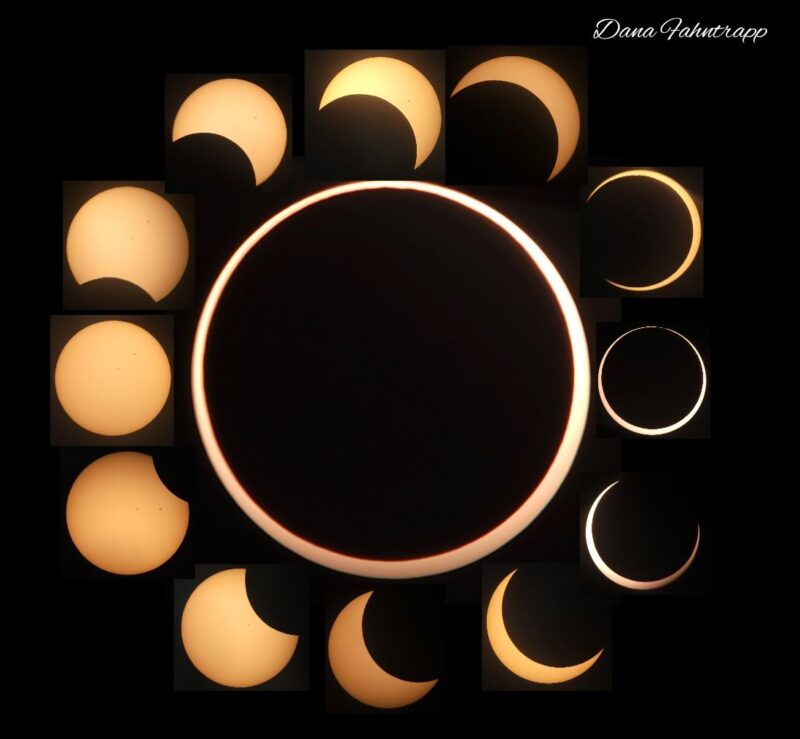
Solar eclipse photos: A bright ring surrounded by different phases of an eclipsed sun.
View at EarthSky Community Photos. | How about this composite image by Dana Fahntrapp, from San Angelo, Texas? So beautiful! Thank you, Dana.
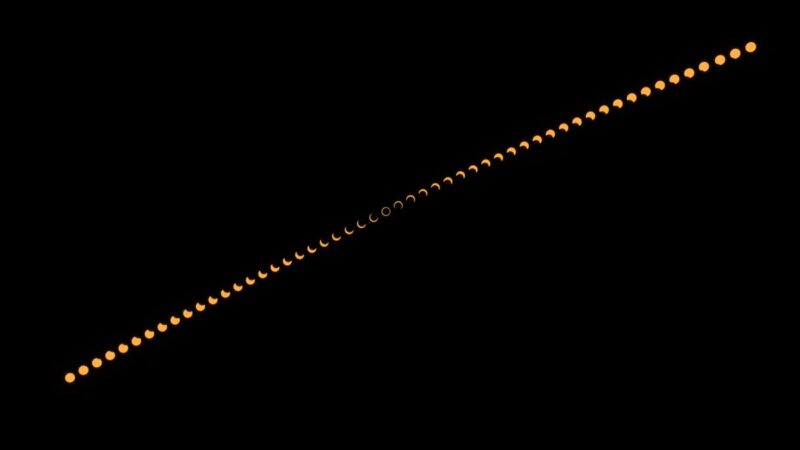
solar eclipse photos: A multitude of yellow solar eclipse images along the diagonal.
View at EarthSky Community Photos. | Charlie Favret in Medina, Texas, took these images of the eclipse and wrote about the process: “The morning started off cloudy at sunrise. Luckily the skies cleared up 10 minutes before 1st contact between the moon and the sun. The full range of the eclipse fit within the field of view of a 17mm lens on an Olympus EM-5 (equivalent to 38mm lens). It is 53 exposures at a 3 and 1/2 minute interval and maps out the graceful movement of the moon and the sun through the sky.” Thank you, Charlie!
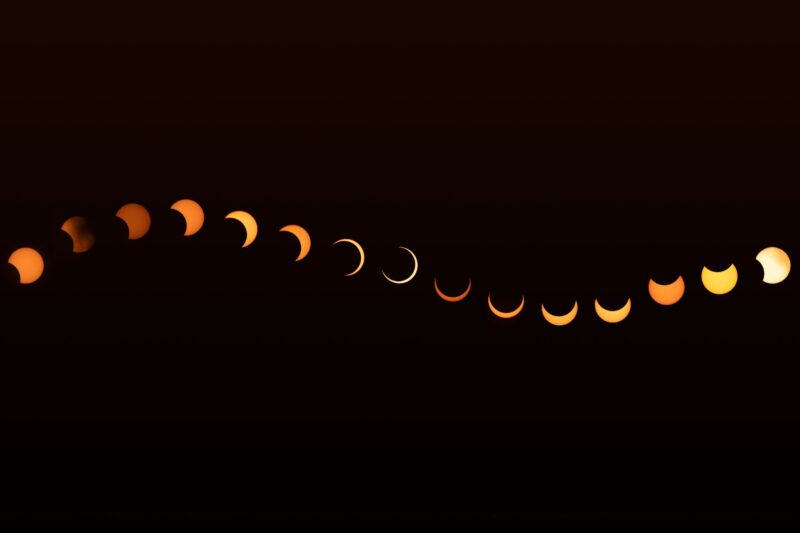
15 shapes of the sun, all of them in orange tones. All of them are put together in a wavy line.
View at EarthSky Community Photos. | Maynor Mijangos in Peten, Guatemala, shared these photos of the eclipse during its different phases, and put them into this cool shape! Thank you, Maynor.

The ring of fire

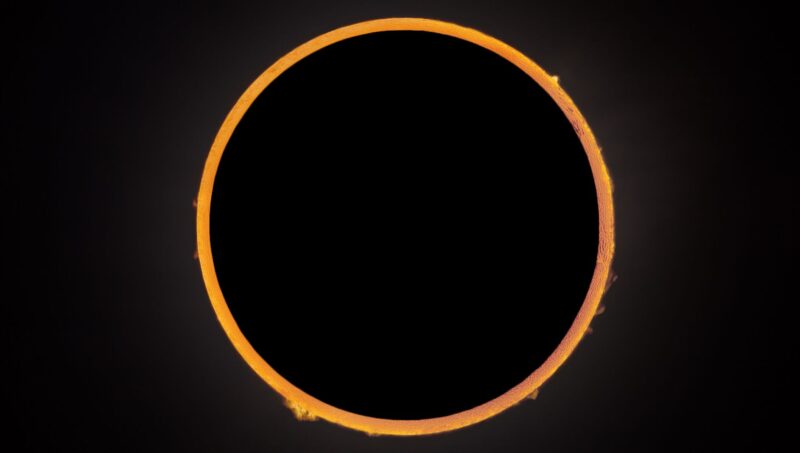
Orange ring with some little flames coming out ou it.
View at EarthSky Community Photos. | Alan Howell from Albuquerque, New Mexico, took this photo in Mariposa Basin Park during the maximum annularity and wrote: “What an incredible adventure! It took months of planning, gear testing, software and equipment training, booking flights and hotels, car traveling, weather forecast monitoring, and location scouting to produce this colorized H-alpha image of the ‘ring of fire’ eclipse, showing prominences … This was certainly one of the most challenging and rewarding astrophotography images I’ve taken.” No doubt why … Very well done!
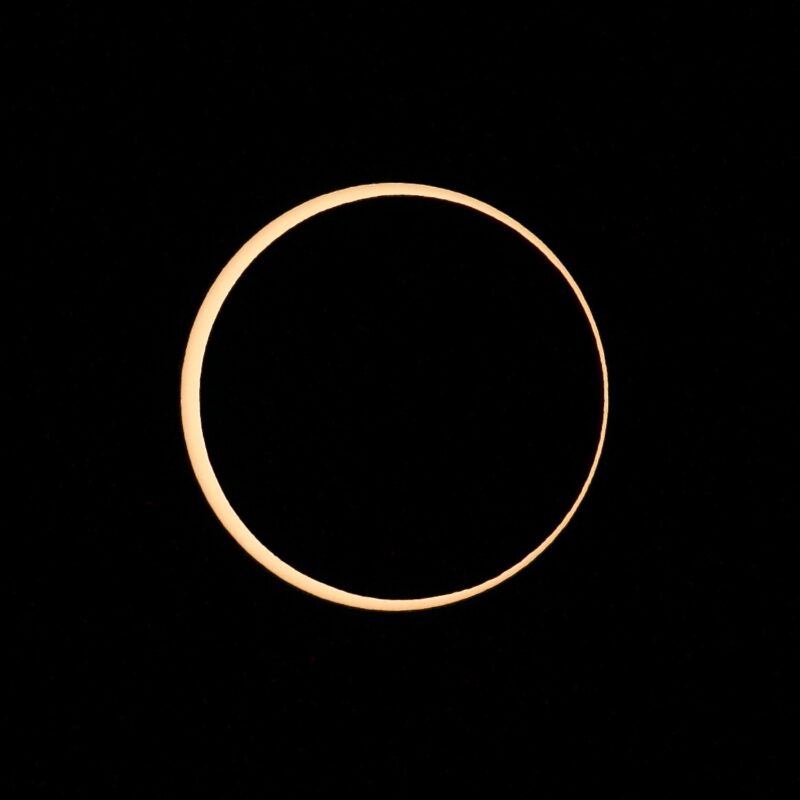
Pale yellow ring, a tiny bit bigger on the left side.
View at EarthSky Community Photos. | Check this wonderful photo by Charlie Seligman in Harper, Texas … Great moment! Thanks, Charlie!

Indirect viewing, and solar binoculars

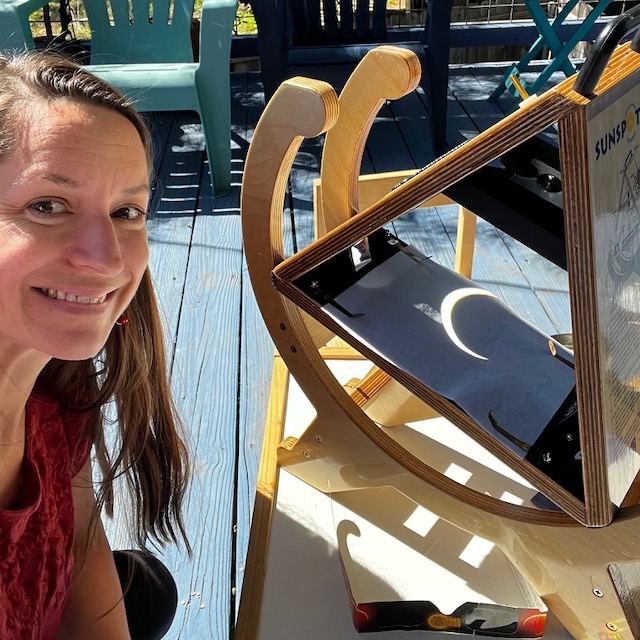
A woman with long brown hair in front of a triangular wood object that creates a crescent shape.
View at EarthSky Community Photos. | Abigail Hart from Austin, Texas, enjoyed using this cool Sunspotter telescope during maximum eclipse. Thanks, Abi!
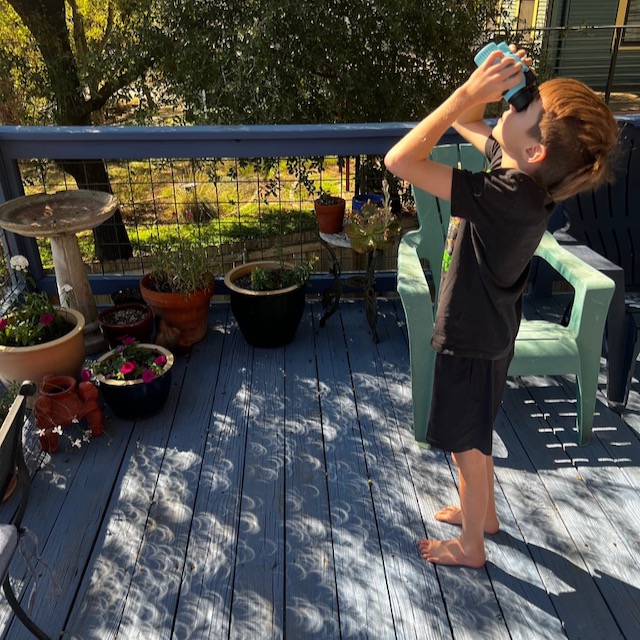
Boy on dark T-shirt and shorts looking through solar binoculars.
This young astronomer in Austin, Texas, is using solar binoculars, especially designed for watching eclipses and tracking sunspots. See the crescent suns at his feet?

Solar eclipse photos of stunning landscapes

A chain of mountains around a water surface. There is another mountain in the middle of the immage, surrounded by water. There is a grey sky covered in clouds. There are some bright areas in the sky, one of them reflects in the water, creating a crescent shape.
View at EarthSky Community Photos. | Andrea Boyle at Crater Lake National Park, Oregon, took this photo on Saturday, October 14, 2023, and wrote: “Eclipse reflection in Crater Lake. This was such a lucky shot as the cloud cover was too heavy to directly photograph the annular eclipse. However, the clouds provided a “pinhole” effect 3 minutes past totality as the moon’s shadow was passing out of the sun and into a crescent phase.” Thank you, Andrea. Wow! See that bright crescent shape in the water, next to the mountains in the background? That’s the eclipse displayed on the water.
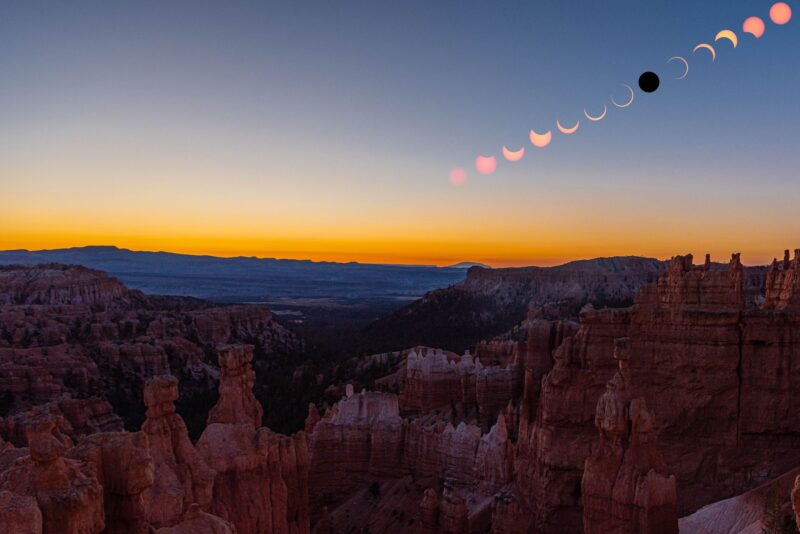
Mountain in the foreground with sharp red peaks. Orange horizon. 13 shapes for the eclipse at top right. They go from full orange sphere, to an orange ring, then a black sphere and back to orange ring and sphere.
View at EarthSky Community Photos. | Christine Ho at Bryce Canyon National Park, Utah, created this composite image and wrote: “I visited Bryce Canyon at Sunset Point with my mom and 5 other photographer friends on October 14, 2023, for the annular solar eclipse. I hiked down the Navajo Trail for the ‘blue hour’ foreground scene. Then hiked back up to join my mom and friends for photographing the entire eclipse event, from start to finish. The skies were mostly clear, but we had some thin clouds around totality time. Thankfully, the clouds did not ruin our photos and our ability to see the eclipse with our eclipse glasses.” Thank you, Christine!
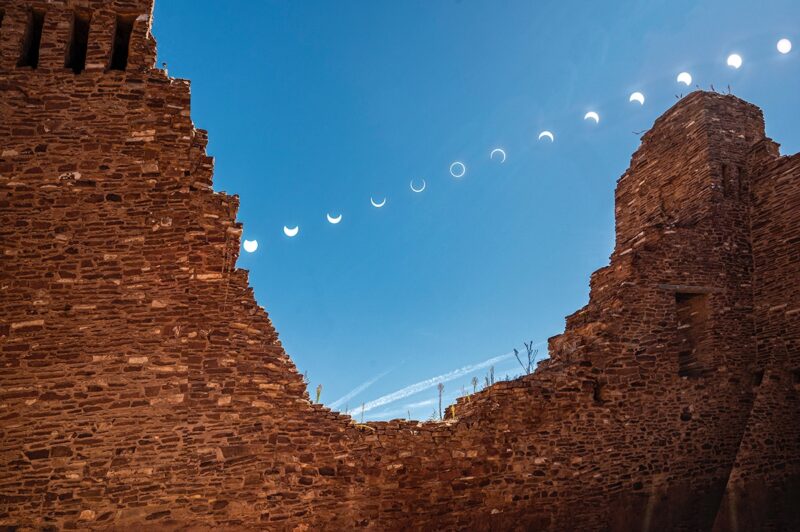
Wall of bricks in the foreground with a big hole in the middle. Different shapes for the eclipse are located in the middle of this hole.
View at EarthSky Community Photos. | Smita Parida in Mountainair, New Mexico, shared this composite image with us of the eclipse and wrote: “I wanted to capture a sense of peace with the progression of the eclipse. Quarai ruins are part of the Salinas Pueblo Missions National Monument in New Mexico. Later that day I was invited to join a group of people holding a fiesta in their church who said their ancestors were buried on the grounds there and had so many stories to tell!” That is a doubly interesting experience, thank you Smita!

Family fun

Two people holding a small dog, all wearing eclipse glasses.
View at EarthSky Community Photos. | Christy Lau in Claremont, California, wrote: “Teresa, David and Tom enjoying the eclipse …” Thanks, y’all!
Man and woman, in an open field, wearing eclipse glasses. The sky looks cloudy and grey, but there are some areas without clouds.
View at EarthSky Community Photos. | Jean K. sent in this shot from Great Salt Lake Shorelands Preserve in Utah. Thank you, Jean!

Partial solar eclipse photos

A partially eclipsed sun, above clouds. There are some clouds below and a red haze.
View at EarthSky Community Photos. | Many who were not in the path of annularity could still enjoy a partial eclipse. Helio C. Vital in Araruna, Paraíba, Brazil wrote: “A few minutes before setting, the eclipsed sun was about to hide behind distant clouds hovering over the western horizon.” Thanks, Helio!
Yellow sphere for the sun with a black sphere for the moon blocking part of the sun. There are 2 black dots on the sun surface.
View at EarthSky Community Photos. | Did you know? There were some sunspots visible on the sun’s surface. Michael Flynn in Pine Mountain Club, Kern County, California, captured 2 of them. Thank you, Michael!
Yellow sphere with the top right blocked by a black figure. There are 2 black dots on the yellow sphere.
View at EarthSky Community Photos. | Doug Short in Clermont, Florida captured this photo of the partial eclipse, including the sunspots. Thank you, Doug!
Orange sphere with the bottom right blocked by a black figure. The orange sphere has 2 black dots.
View at EarthSky Community Photos. | William Gaudet in southern New Hampshire took this photo and wrote: “Clouds cancelled the rest of our show. This was the last good one, about a half-hour before maximum eclipse (expected maximum 18% for southern NH).” Thank you, William. You made it to our gallery!

Fun on campus

A crowd of people on a college campus, many wearing eclipse glasses.
Emily Howard of McDonald Observatory – whose administrative offices are on the University of Texas campus, in Austin, Texas – reported in on a campus eclipse-watching event. “Good energy in the crowd. Estimated 5000+ showed up,” she wrote. Thanks, Emily!

More ways to see the eclipse

The shadow of a colander on the floor. There are tens of tiny circles inside the colander shadow.
View at EarthSky Community Photos. | Apart from solar filters and eclipse glasses, there are other methods to see a solar eclipse. Kim Moss-Allen in Albuquerque, New Mexico, took this photo and wrote: “I intended to do this ‘pinhole camera’ trick with a colander in 2017 (a total solar eclipse) but forgot to! So I was thrilled to see the colander make terrific, clear images of the partial eclipse AND annularity (pictured)!” See? How cool, thank you Kim!
A shadow with the shape of a ruler in the floor. There are 2 bands of tiny crescents in the shadow.
View at EarthSky Community Photos. | Check out this curious photo! Louis Kennedy in Tijeras, New Mexico, captured the eclipse through a roadside sign post along Route 66. Wow! Thank you, Louis.

Bottom line: Solar eclipse photos from last Saturday (October 14, 2023) are still coming in. Here are more great ones. Thanks to all who contributed to EarthSky Community Photos!

The post Solar eclipse photos keep coming, and they’re awesome first appeared on EarthSky.


from EarthSky https://ift.tt/vR5A3iI

Wow. The solar eclipse photos from last Saturday (October 14, 2023) still haven’t stopped coming in. Here are a few more great ones! Thanks to all who contributed to EarthSky Community Photos!

Click here to see our earlier October 14 solar eclipse gallery.
Submit your photo here.

The 2024 lunar calendars are here! Best Christmas gifts in the universe! Check ’em out here.

Solar eclipse photos in composites

Solar eclipse photos: A bright ring surrounded by different phases of an eclipsed sun.
View at EarthSky Community Photos. | How about this composite image by Dana Fahntrapp, from San Angelo, Texas? So beautiful! Thank you, Dana.
solar eclipse photos: A multitude of yellow solar eclipse images along the diagonal.
View at EarthSky Community Photos. | Charlie Favret in Medina, Texas, took these images of the eclipse and wrote about the process: “The morning started off cloudy at sunrise. Luckily the skies cleared up 10 minutes before 1st contact between the moon and the sun. The full range of the eclipse fit within the field of view of a 17mm lens on an Olympus EM-5 (equivalent to 38mm lens). It is 53 exposures at a 3 and 1/2 minute interval and maps out the graceful movement of the moon and the sun through the sky.” Thank you, Charlie!
15 shapes of the sun, all of them in orange tones. All of them are put together in a wavy line.
View at EarthSky Community Photos. | Maynor Mijangos in Peten, Guatemala, shared these photos of the eclipse during its different phases, and put them into this cool shape! Thank you, Maynor.

The ring of fire

Orange ring with some little flames coming out ou it.
View at EarthSky Community Photos. | Alan Howell from Albuquerque, New Mexico, took this photo in Mariposa Basin Park during the maximum annularity and wrote: “What an incredible adventure! It took months of planning, gear testing, software and equipment training, booking flights and hotels, car traveling, weather forecast monitoring, and location scouting to produce this colorized H-alpha image of the ‘ring of fire’ eclipse, showing prominences … This was certainly one of the most challenging and rewarding astrophotography images I’ve taken.” No doubt why … Very well done!
Pale yellow ring, a tiny bit bigger on the left side.
View at EarthSky Community Photos. | Check this wonderful photo by Charlie Seligman in Harper, Texas … Great moment! Thanks, Charlie!

Indirect viewing, and solar binoculars

A woman with long brown hair in front of a triangular wood object that creates a crescent shape.
View at EarthSky Community Photos. | Abigail Hart from Austin, Texas, enjoyed using this cool Sunspotter telescope during maximum eclipse. Thanks, Abi!
Boy on dark T-shirt and shorts looking through solar binoculars.
This young astronomer in Austin, Texas, is using solar binoculars, especially designed for watching eclipses and tracking sunspots. See the crescent suns at his feet?

Solar eclipse photos of stunning landscapes

A chain of mountains around a water surface. There is another mountain in the middle of the immage, surrounded by water. There is a grey sky covered in clouds. There are some bright areas in the sky, one of them reflects in the water, creating a crescent shape.
View at EarthSky Community Photos. | Andrea Boyle at Crater Lake National Park, Oregon, took this photo on Saturday, October 14, 2023, and wrote: “Eclipse reflection in Crater Lake. This was such a lucky shot as the cloud cover was too heavy to directly photograph the annular eclipse. However, the clouds provided a “pinhole” effect 3 minutes past totality as the moon’s shadow was passing out of the sun and into a crescent phase.” Thank you, Andrea. Wow! See that bright crescent shape in the water, next to the mountains in the background? That’s the eclipse displayed on the water.
Mountain in the foreground with sharp red peaks. Orange horizon. 13 shapes for the eclipse at top right. They go from full orange sphere, to an orange ring, then a black sphere and back to orange ring and sphere.
View at EarthSky Community Photos. | Christine Ho at Bryce Canyon National Park, Utah, created this composite image and wrote: “I visited Bryce Canyon at Sunset Point with my mom and 5 other photographer friends on October 14, 2023, for the annular solar eclipse. I hiked down the Navajo Trail for the ‘blue hour’ foreground scene. Then hiked back up to join my mom and friends for photographing the entire eclipse event, from start to finish. The skies were mostly clear, but we had some thin clouds around totality time. Thankfully, the clouds did not ruin our photos and our ability to see the eclipse with our eclipse glasses.” Thank you, Christine!
Wall of bricks in the foreground with a big hole in the middle. Different shapes for the eclipse are located in the middle of this hole.
View at EarthSky Community Photos. | Smita Parida in Mountainair, New Mexico, shared this composite image with us of the eclipse and wrote: “I wanted to capture a sense of peace with the progression of the eclipse. Quarai ruins are part of the Salinas Pueblo Missions National Monument in New Mexico. Later that day I was invited to join a group of people holding a fiesta in their church who said their ancestors were buried on the grounds there and had so many stories to tell!” That is a doubly interesting experience, thank you Smita!

Family fun

Two people holding a small dog, all wearing eclipse glasses.
View at EarthSky Community Photos. | Christy Lau in Claremont, California, wrote: “Teresa, David and Tom enjoying the eclipse …” Thanks, y’all!
Man and woman, in an open field, wearing eclipse glasses. The sky looks cloudy and grey, but there are some areas without clouds.
View at EarthSky Community Photos. | Jean K. sent in this shot from Great Salt Lake Shorelands Preserve in Utah. Thank you, Jean!

Partial solar eclipse photos

A partially eclipsed sun, above clouds. There are some clouds below and a red haze.
View at EarthSky Community Photos. | Many who were not in the path of annularity could still enjoy a partial eclipse. Helio C. Vital in Araruna, Paraíba, Brazil wrote: “A few minutes before setting, the eclipsed sun was about to hide behind distant clouds hovering over the western horizon.” Thanks, Helio!
Yellow sphere for the sun with a black sphere for the moon blocking part of the sun. There are 2 black dots on the sun surface.
View at EarthSky Community Photos. | Did you know? There were some sunspots visible on the sun’s surface. Michael Flynn in Pine Mountain Club, Kern County, California, captured 2 of them. Thank you, Michael!
Yellow sphere with the top right blocked by a black figure. There are 2 black dots on the yellow sphere.
View at EarthSky Community Photos. | Doug Short in Clermont, Florida captured this photo of the partial eclipse, including the sunspots. Thank you, Doug!
Orange sphere with the bottom right blocked by a black figure. The orange sphere has 2 black dots.
View at EarthSky Community Photos. | William Gaudet in southern New Hampshire took this photo and wrote: “Clouds cancelled the rest of our show. This was the last good one, about a half-hour before maximum eclipse (expected maximum 18% for southern NH).” Thank you, William. You made it to our gallery!

Fun on campus

A crowd of people on a college campus, many wearing eclipse glasses.
Emily Howard of McDonald Observatory – whose administrative offices are on the University of Texas campus, in Austin, Texas – reported in on a campus eclipse-watching event. “Good energy in the crowd. Estimated 5000+ showed up,” she wrote. Thanks, Emily!

More ways to see the eclipse

The shadow of a colander on the floor. There are tens of tiny circles inside the colander shadow.
View at EarthSky Community Photos. | Apart from solar filters and eclipse glasses, there are other methods to see a solar eclipse. Kim Moss-Allen in Albuquerque, New Mexico, took this photo and wrote: “I intended to do this ‘pinhole camera’ trick with a colander in 2017 (a total solar eclipse) but forgot to! So I was thrilled to see the colander make terrific, clear images of the partial eclipse AND annularity (pictured)!” See? How cool, thank you Kim!
A shadow with the shape of a ruler in the floor. There are 2 bands of tiny crescents in the shadow.
View at EarthSky Community Photos. | Check out this curious photo! Louis Kennedy in Tijeras, New Mexico, captured the eclipse through a roadside sign post along Route 66. Wow! Thank you, Louis.

Bottom line: Solar eclipse photos from last Saturday (October 14, 2023) are still coming in. Here are more great ones. Thanks to all who contributed to EarthSky Community Photos!

The post Solar eclipse photos keep coming, and they’re awesome first appeared on EarthSky.


from EarthSky https://ift.tt/vR5A3iI

October birthstone: Colorful opal and tourmaline

October birthstone: Several polished oval opals, primarily white with iridescent blue, green, yellow and red specks.
Polished opals from Australia. The opal is an October birthstone. Image via Sevenopal/ Wikimedia Commons.

Opal, the primary October birthstone

The best known October birthstone is the opal. And tourmaline is another October birthstone. Let’s talk about opals first. They’re amazingly diverse rocks, taking on different appearances depending on how they formed. Precious opals, known for their flashy iridescent colors, are popular in some jewelry. But even the less dazzling common opals possess a quiet beauty that makes them popular in specimen collections.

Unlike most other gemstones, opals don’t qualify as minerals in the usual sense. They contain myriads of tiny silica spheres in a tightly-packed lattice. These gemstones are famous for their play of colors. They flash rainbow hues when moved. The colors come from the interference of light with their internal structures.

Opals form in near-surface volcanic rocks, within cavities and cracks. In sedimentary volcanic ash rock, percolating water in the ground dissolves silica that eventually precipitates to form the opal. On rare occasions, it becomes the replacement material for fossils – shells, bones, wood – whose original material had dissolved away.

The 2024 lunar calendars are here! Best Christmas gifts in the universe! Check ’em out here.

Characteristics of opals

An opal is a soft stone, easily altered in appearance by changes in heat and pressure. Varying amounts of water within it determine the appearance of the gemstone. When water evaporates out of an opal, the stone appears slightly smaller and the stress of the evaporation creates cracks on it.

Australia mines most of the world’s opals. That’s especially the case for magnificent black opals. Ethiopia is another emerging source of opals. At a smaller scale, a wide variety of opals are found in northern Nevada; some of those opals are in the form of fossilized wood. Other commercial sources of opal are Mexico, Canada, Brazil, Honduras, Nicaragua, Guatemala, Turkey and the Czech Republic.

Impurities within the stones create the characteristic colors of opals. Milky or pearly opals indicate tiny gas bubble inclusions. Yellows and reds indicate included iron oxides. The spectacular black opals that sometimes flash green, blue and red get their color from magnesium oxides and organic carbon within the stone. Perhaps the most valuable opal pattern is the harlequin. It has large angular patches of red, yellow and green resembling the checks on a clown’s costume.

An oval polished opal showing roughly squarish colors of red, yellow, blue and green.
A Harlequin opal. Image via Aisha Brown/ Wikimedia Commons.

Opal lore

The name opal is derived from the Sanskrit word “upala,” as well as the Latin “opalus,” meaning “precious stone.”

The ancient Roman natural historian Pliny the Elder wrote about the captivating iridescence of the opal in his book, The Natural History of Precious Stones.

Of all precious stones, it is opal that presents the greatest difficulties of description, it displaying at once the piercing fire of carbunculus, the purple brilliancy of amethystos, and the sea-green of smaragdus, the whole blended together and refulgent with a brightness that is quite incredible.

There is an Indian legend about the origin of the opal. As Willard Heaps wrote in Gemstones:

… the gods Brahma, Vishnu and Shiva once vied in jealous love for a beautiful woman. This angered the Eternal, who changed the fair mortal into a creature made of mist. Thereupon each of the three gods endowed her with his own color so as to be able to recognize her. Brahma gave her the glorious blue of the heavens, Vishnu enriched her with the splendor of gold and Shiva lent her his flaming red. But all this was in vain, since the lovely phantom was whisked away by the winds. Finally, the Eternal took pity on her and transformed her into a stone, the opal, that sparkles in all the colors of the rainbow.

Heaps also wrote that ancient cultures attached meaning to opals. Romans called opals the Cupid stone. Asians called it the anchor of hope. Arabians believed they fell from the sky. In Poland, People thought that opals made their wearer invisible, hence the opal was the talisman of thieves and spies.

October birthstone: evil superstitions

During the medieval period, a change in color intensity of an opal was believed to indicate if its wearer was ill or in good health. Supposedly the opal maintained a strong heart, prevented fainting, protected against infection and cleansed foul-smelling air. The stone, as in ancient times, still represented a symbol of hope.

But the opal’s reputation changed in the mid-14th century. The Black Death swept across Europe, killing 1/4 of its population. People thought the gem was the cause of death. When worn by someone struck with the deadly plague, it would appear brilliant only until the person died. Then it would change in appearance, losing its luster. In reality, it was the sensitivity of this stone to changes in temperature that altered its appearance, as the heat from a burning fever gave way to the cold of death.

In Elizabethan England, people treasured the opal for its beauty. Shakespeare wrote of it in his play Twelfth Night as the queen of gems. Queen Victoria is said to have loved opals and presented them to her children, thus making the stone popular. But the stone continued to have a mixed reputation, chiefly due to a novel, Anne of Geierstein, written by Sir Walter Scott in 1829 that depicted it as a stone of evil.

In Australia, opals have long been a part of Australian Aboriginal cultures. In one story, set during the Dreamtime, a pelican was resting in an area of beautiful colors. When he pecked at the colored stones, a spark flew out and lit the dry grass on fire. As the fire spread, it reached his people who, for the first time, were able to cook fish and meat.

Tourmaline, an alternate October birthstone

An alternate October birthstone is tourmaline, a gemstone that exhibits the broadest spectrum of gemstone colors. Gem-quality forms of this mineral have in the past been misidentified as rubies, emeralds and sapphires. In fact, a famous tourmaline – the size of a pigeon’s egg – belonging to the Russian empress Catherine the Great, was long thought to be a ruby.

The name of this gemstone is believed to derive from the Singhalese (Sri Lankan) word toramalli, a term applied to colorful stones.

A squarish green linear crystal with an inclusion of some white crystals at the top.
A green elbaite crystal, a type of tourmaline, from Brazil. (The white crystal is the mineral albite.) Image via Ivar Leidus/ Wikimedia Commons.

Tourmaline characteristics

Tourmaline is a complex boron-bearing silicate mineral that can also contain other elements such as aluminum, magnesium, sodium, iron and lithium. They come in a myriad of colors: yellow, green, red, blue, pink, brown and black. Metals within the crystal structure are responsible for the gemstone colors. Pink, for example, comes from the presence of manganese. Iron produces black to deep brown colors, while magnesium creates browns and yellows. Tourmalines rich in lithium can produce several different colors such as blues, greens and reds. Some crystals even have bicolored properties. One variety, called the watermelon tourmaline, has green outer edges that transition to a transparent white zone that gives way to a pink or light red interior.

When tourmalines are warmed or rubbed, they attract small bits of paper, lint and ash. This occurs because the gem becomes charged with static electricity. In fact, Benjamin Franklin used this gem in his studies of electricity. Maintaining a tourmaline exhibit at museums requires frequent cleaning of the gemstone because heat from lights of the display case create a charge in the stone that attracts dust.

Compared with other gemstones, tourmalines are a relatively recent discovery. Hence, it lacks the rich lore that accompanies many other precious gems. However, some people think of tourmaline as the peace stone, believed to dispel fear and make its wearer calm.

Black rectangular tourmaline crystals on white rock, with a small green fluorite crystal.
Schorl is the most commonly found form of tourmaline. In this specimen from Namibia, a small piece of green fluorite is perched atop the tourmaline crystals. Image via Robert M. Lavinsky/ Wikimedia Commons/ CC BY-SA 3.0.

Find out about birthstones for the rest of the year

January birthstone
February birthstone
March birthstone
April birthstone
May birthstone
June birthstone
July birthstone
August birthstone
September birthstone
October birthstone
November birthstone
December birthstone

Bottom line: October has two birthstones, opal and tourmaline.

The post October birthstone: Colorful opal and tourmaline first appeared on EarthSky.


from EarthSky https://ift.tt/1Tdb3Nf
October birthstone: Several polished oval opals, primarily white with iridescent blue, green, yellow and red specks.
Polished opals from Australia. The opal is an October birthstone. Image via Sevenopal/ Wikimedia Commons.

Opal, the primary October birthstone

The best known October birthstone is the opal. And tourmaline is another October birthstone. Let’s talk about opals first. They’re amazingly diverse rocks, taking on different appearances depending on how they formed. Precious opals, known for their flashy iridescent colors, are popular in some jewelry. But even the less dazzling common opals possess a quiet beauty that makes them popular in specimen collections.

Unlike most other gemstones, opals don’t qualify as minerals in the usual sense. They contain myriads of tiny silica spheres in a tightly-packed lattice. These gemstones are famous for their play of colors. They flash rainbow hues when moved. The colors come from the interference of light with their internal structures.

Opals form in near-surface volcanic rocks, within cavities and cracks. In sedimentary volcanic ash rock, percolating water in the ground dissolves silica that eventually precipitates to form the opal. On rare occasions, it becomes the replacement material for fossils – shells, bones, wood – whose original material had dissolved away.

The 2024 lunar calendars are here! Best Christmas gifts in the universe! Check ’em out here.

Characteristics of opals

An opal is a soft stone, easily altered in appearance by changes in heat and pressure. Varying amounts of water within it determine the appearance of the gemstone. When water evaporates out of an opal, the stone appears slightly smaller and the stress of the evaporation creates cracks on it.

Australia mines most of the world’s opals. That’s especially the case for magnificent black opals. Ethiopia is another emerging source of opals. At a smaller scale, a wide variety of opals are found in northern Nevada; some of those opals are in the form of fossilized wood. Other commercial sources of opal are Mexico, Canada, Brazil, Honduras, Nicaragua, Guatemala, Turkey and the Czech Republic.

Impurities within the stones create the characteristic colors of opals. Milky or pearly opals indicate tiny gas bubble inclusions. Yellows and reds indicate included iron oxides. The spectacular black opals that sometimes flash green, blue and red get their color from magnesium oxides and organic carbon within the stone. Perhaps the most valuable opal pattern is the harlequin. It has large angular patches of red, yellow and green resembling the checks on a clown’s costume.

An oval polished opal showing roughly squarish colors of red, yellow, blue and green.
A Harlequin opal. Image via Aisha Brown/ Wikimedia Commons.

Opal lore

The name opal is derived from the Sanskrit word “upala,” as well as the Latin “opalus,” meaning “precious stone.”

The ancient Roman natural historian Pliny the Elder wrote about the captivating iridescence of the opal in his book, The Natural History of Precious Stones.

Of all precious stones, it is opal that presents the greatest difficulties of description, it displaying at once the piercing fire of carbunculus, the purple brilliancy of amethystos, and the sea-green of smaragdus, the whole blended together and refulgent with a brightness that is quite incredible.

There is an Indian legend about the origin of the opal. As Willard Heaps wrote in Gemstones:

… the gods Brahma, Vishnu and Shiva once vied in jealous love for a beautiful woman. This angered the Eternal, who changed the fair mortal into a creature made of mist. Thereupon each of the three gods endowed her with his own color so as to be able to recognize her. Brahma gave her the glorious blue of the heavens, Vishnu enriched her with the splendor of gold and Shiva lent her his flaming red. But all this was in vain, since the lovely phantom was whisked away by the winds. Finally, the Eternal took pity on her and transformed her into a stone, the opal, that sparkles in all the colors of the rainbow.

Heaps also wrote that ancient cultures attached meaning to opals. Romans called opals the Cupid stone. Asians called it the anchor of hope. Arabians believed they fell from the sky. In Poland, People thought that opals made their wearer invisible, hence the opal was the talisman of thieves and spies.

October birthstone: evil superstitions

During the medieval period, a change in color intensity of an opal was believed to indicate if its wearer was ill or in good health. Supposedly the opal maintained a strong heart, prevented fainting, protected against infection and cleansed foul-smelling air. The stone, as in ancient times, still represented a symbol of hope.

But the opal’s reputation changed in the mid-14th century. The Black Death swept across Europe, killing 1/4 of its population. People thought the gem was the cause of death. When worn by someone struck with the deadly plague, it would appear brilliant only until the person died. Then it would change in appearance, losing its luster. In reality, it was the sensitivity of this stone to changes in temperature that altered its appearance, as the heat from a burning fever gave way to the cold of death.

In Elizabethan England, people treasured the opal for its beauty. Shakespeare wrote of it in his play Twelfth Night as the queen of gems. Queen Victoria is said to have loved opals and presented them to her children, thus making the stone popular. But the stone continued to have a mixed reputation, chiefly due to a novel, Anne of Geierstein, written by Sir Walter Scott in 1829 that depicted it as a stone of evil.

In Australia, opals have long been a part of Australian Aboriginal cultures. In one story, set during the Dreamtime, a pelican was resting in an area of beautiful colors. When he pecked at the colored stones, a spark flew out and lit the dry grass on fire. As the fire spread, it reached his people who, for the first time, were able to cook fish and meat.

Tourmaline, an alternate October birthstone

An alternate October birthstone is tourmaline, a gemstone that exhibits the broadest spectrum of gemstone colors. Gem-quality forms of this mineral have in the past been misidentified as rubies, emeralds and sapphires. In fact, a famous tourmaline – the size of a pigeon’s egg – belonging to the Russian empress Catherine the Great, was long thought to be a ruby.

The name of this gemstone is believed to derive from the Singhalese (Sri Lankan) word toramalli, a term applied to colorful stones.

A squarish green linear crystal with an inclusion of some white crystals at the top.
A green elbaite crystal, a type of tourmaline, from Brazil. (The white crystal is the mineral albite.) Image via Ivar Leidus/ Wikimedia Commons.

Tourmaline characteristics

Tourmaline is a complex boron-bearing silicate mineral that can also contain other elements such as aluminum, magnesium, sodium, iron and lithium. They come in a myriad of colors: yellow, green, red, blue, pink, brown and black. Metals within the crystal structure are responsible for the gemstone colors. Pink, for example, comes from the presence of manganese. Iron produces black to deep brown colors, while magnesium creates browns and yellows. Tourmalines rich in lithium can produce several different colors such as blues, greens and reds. Some crystals even have bicolored properties. One variety, called the watermelon tourmaline, has green outer edges that transition to a transparent white zone that gives way to a pink or light red interior.

When tourmalines are warmed or rubbed, they attract small bits of paper, lint and ash. This occurs because the gem becomes charged with static electricity. In fact, Benjamin Franklin used this gem in his studies of electricity. Maintaining a tourmaline exhibit at museums requires frequent cleaning of the gemstone because heat from lights of the display case create a charge in the stone that attracts dust.

Compared with other gemstones, tourmalines are a relatively recent discovery. Hence, it lacks the rich lore that accompanies many other precious gems. However, some people think of tourmaline as the peace stone, believed to dispel fear and make its wearer calm.

Black rectangular tourmaline crystals on white rock, with a small green fluorite crystal.
Schorl is the most commonly found form of tourmaline. In this specimen from Namibia, a small piece of green fluorite is perched atop the tourmaline crystals. Image via Robert M. Lavinsky/ Wikimedia Commons/ CC BY-SA 3.0.

Find out about birthstones for the rest of the year

January birthstone
February birthstone
March birthstone
April birthstone
May birthstone
June birthstone
July birthstone
August birthstone
September birthstone
October birthstone
November birthstone
December birthstone

Bottom line: October has two birthstones, opal and tourmaline.

The post October birthstone: Colorful opal and tourmaline first appeared on EarthSky.


from EarthSky https://ift.tt/1Tdb3Nf

Double Cluster in Perseus on October evenings

Star chart of Cassiopeia with a line pointing to 2 tiny dotted circles, labeled Perseus Double Cluster.
Here’s the relationship between the prominent M or W shape of Cassiopeia and the Double Cluster in Perseus.

Double Cluster in Perseus

The Double Cluster in Perseus consists of two open star clusters near each other on the sky’s dome. Amateur astronomers know them as h and Chi Persei. The two clusters reside in the northern part of the constellation Perseus, quite close to the constellation Cassiopeia the Queen. If you have a dark sky and find Cassiopeia – which is easy, because the constellation has a distinctive M or W shape – be sure to look for Perseus, too. Then just scan between the two constellations with your binoculars for two glittering groups of stars. The Double Cluster – a breathtaking pair of open clusters, each containing supergiant suns – will be there.

These two star clusters are located about 7,640 (Chi) and 7,460 (h) light-years away. So, they’re separated from one another by a few hundred light-years. It’s amazing that we can see these stars at all across this great span of space. Plus, we know they must be bright stars, intrinsically, or we wouldn’t be able to see them. Each cluster contains a few hundred stars, and, indeed, these stars are young, hot supergiant suns that are many thousands of times more luminous than our sun.

Astronomers tell us that the Double Cluster lies within the Perseus arm of the Milky Way galaxy. However, our solar system resides in the inner part of the Orion arm. Therefore, looking at the Double Cluster, we are looking through our local spiral arm and all the way to the next spiral arm outward from the galactic center.

Star chart showing Cassiopeia and Perseus constellations with stars Mirfak and Algol labeled.
Cassiopeia is easy to find with its shape of an M or W. The constellation Perseus follows Cassiopeia across the sky.

How to find the Double Cluster

To locate the Double Cluster, find the W- or M-shaped constellation Cassiopeia the Queen. If your sky is dark enough, you will be able to see the graceful pattern of Perseus the Hero nearby. Then scan between them with binoculars to find the Double Cluster.

Star chart showing location of the Perseus Double Cluster between Cassiopeia and Perseus.
The Perseus Double Cluster is located between Cassiopeia and Perseus. Scan the area between them with binoculars and you’ll find the 2 glittering star clusters. Image via Stellarium.org. Used with permission.

At mid- and far-northern latitudes, the Double Cluster is circumpolar – above the horizon every night of the year at any hour of the night. If you are farther south (but still in the Northern Hemisphere), try looking for the Double Cluster in the evening in autumn or winter.

Just remember … the Double Cluster is harder to see when it’s close to the horizon. If you can’t spot it between Cassiopeia and Perseus, wait until later at night. Or look later in the year, when it’s higher in the sky.

For general reference, the Double Cluster is high in the sky when the Big Dipper is low, and vice versa. Because the Big Dipper is lowest in the northern sky on late autumn and early winter evenings, the Double Cluster is highest in the northern sky at these times. As a matter of fact, the Double Cluster is pretty much always visible in the evening except in late spring and summer.

The Double Cluster is visible to the unaided eye

The Double Cluster rates among the most magnificent deep-sky objects not to be included in the famous Messier catalog. Of course, Charles Messier (1730-1817) was looking for deep-sky objects that could be mistaken for comets. Maybe he thought nobody would see this pair of glittery clusters as a comet in the sky.

Although considered a deep-sky jewel, the Double Cluster is visible to the unaided eye in a dark country sky.

If you zoom in on them with binoculars or a wide view telescope, you’ll see them as two glorious star clusters. Also they’re an easy target through a telescope and will wow your friends!

The position of h Persei is Right Ascension: 2h 19m; Declination: 57o 9′ north

The position of Chi Persei is Right Ascension: 2h 22.4m; Declination: 57o 7′ north

Two large but loose groupings of many bright stars in dense starfield.
View at EarthSky Community Photos. | Mario Rana in Hampton, Virginia, captured this telescopic view of the Double Cluster in Perseus (NGC 869 and NGC 884) on September 18, 2023. Mario explained this could be his favorite deep-sky object. Thank you, Mario!
Star field with two bunches of dozens of stars close together.
View at EarthSky Community Photos. | David Hoskin in Halifax, Nova Scotia, Canada captured the Double Clustert on November 4, 2021. Thank you, David!

Bottom line: On an autumn or winter evening, scan between Cassiopeia and Perseus for the magnificent Double Cluster in Perseus. The stars in these two clusters are young, hot supergiant suns that are many thousands of times more luminous than our sun.

The post Double Cluster in Perseus on October evenings first appeared on EarthSky.


from EarthSky https://ift.tt/XIS5fYB
Star chart of Cassiopeia with a line pointing to 2 tiny dotted circles, labeled Perseus Double Cluster.
Here’s the relationship between the prominent M or W shape of Cassiopeia and the Double Cluster in Perseus.

Double Cluster in Perseus

The Double Cluster in Perseus consists of two open star clusters near each other on the sky’s dome. Amateur astronomers know them as h and Chi Persei. The two clusters reside in the northern part of the constellation Perseus, quite close to the constellation Cassiopeia the Queen. If you have a dark sky and find Cassiopeia – which is easy, because the constellation has a distinctive M or W shape – be sure to look for Perseus, too. Then just scan between the two constellations with your binoculars for two glittering groups of stars. The Double Cluster – a breathtaking pair of open clusters, each containing supergiant suns – will be there.

These two star clusters are located about 7,640 (Chi) and 7,460 (h) light-years away. So, they’re separated from one another by a few hundred light-years. It’s amazing that we can see these stars at all across this great span of space. Plus, we know they must be bright stars, intrinsically, or we wouldn’t be able to see them. Each cluster contains a few hundred stars, and, indeed, these stars are young, hot supergiant suns that are many thousands of times more luminous than our sun.

Astronomers tell us that the Double Cluster lies within the Perseus arm of the Milky Way galaxy. However, our solar system resides in the inner part of the Orion arm. Therefore, looking at the Double Cluster, we are looking through our local spiral arm and all the way to the next spiral arm outward from the galactic center.

Star chart showing Cassiopeia and Perseus constellations with stars Mirfak and Algol labeled.
Cassiopeia is easy to find with its shape of an M or W. The constellation Perseus follows Cassiopeia across the sky.

How to find the Double Cluster

To locate the Double Cluster, find the W- or M-shaped constellation Cassiopeia the Queen. If your sky is dark enough, you will be able to see the graceful pattern of Perseus the Hero nearby. Then scan between them with binoculars to find the Double Cluster.

Star chart showing location of the Perseus Double Cluster between Cassiopeia and Perseus.
The Perseus Double Cluster is located between Cassiopeia and Perseus. Scan the area between them with binoculars and you’ll find the 2 glittering star clusters. Image via Stellarium.org. Used with permission.

At mid- and far-northern latitudes, the Double Cluster is circumpolar – above the horizon every night of the year at any hour of the night. If you are farther south (but still in the Northern Hemisphere), try looking for the Double Cluster in the evening in autumn or winter.

Just remember … the Double Cluster is harder to see when it’s close to the horizon. If you can’t spot it between Cassiopeia and Perseus, wait until later at night. Or look later in the year, when it’s higher in the sky.

For general reference, the Double Cluster is high in the sky when the Big Dipper is low, and vice versa. Because the Big Dipper is lowest in the northern sky on late autumn and early winter evenings, the Double Cluster is highest in the northern sky at these times. As a matter of fact, the Double Cluster is pretty much always visible in the evening except in late spring and summer.

The Double Cluster is visible to the unaided eye

The Double Cluster rates among the most magnificent deep-sky objects not to be included in the famous Messier catalog. Of course, Charles Messier (1730-1817) was looking for deep-sky objects that could be mistaken for comets. Maybe he thought nobody would see this pair of glittery clusters as a comet in the sky.

Although considered a deep-sky jewel, the Double Cluster is visible to the unaided eye in a dark country sky.

If you zoom in on them with binoculars or a wide view telescope, you’ll see them as two glorious star clusters. Also they’re an easy target through a telescope and will wow your friends!

The position of h Persei is Right Ascension: 2h 19m; Declination: 57o 9′ north

The position of Chi Persei is Right Ascension: 2h 22.4m; Declination: 57o 7′ north

Two large but loose groupings of many bright stars in dense starfield.
View at EarthSky Community Photos. | Mario Rana in Hampton, Virginia, captured this telescopic view of the Double Cluster in Perseus (NGC 869 and NGC 884) on September 18, 2023. Mario explained this could be his favorite deep-sky object. Thank you, Mario!
Star field with two bunches of dozens of stars close together.
View at EarthSky Community Photos. | David Hoskin in Halifax, Nova Scotia, Canada captured the Double Clustert on November 4, 2021. Thank you, David!

Bottom line: On an autumn or winter evening, scan between Cassiopeia and Perseus for the magnificent Double Cluster in Perseus. The stars in these two clusters are young, hot supergiant suns that are many thousands of times more luminous than our sun.

The post Double Cluster in Perseus on October evenings first appeared on EarthSky.


from EarthSky https://ift.tt/XIS5fYB

Argentina wildfire nears city, with wall of smoke

Argentina wildfire encroaches on city

Villa Carlos Paz is a resort city of 56,000 people west of Córdoba in central Argentina. As of October 10, 2023, a wildfire was encroaching on the city. Fede Krypner shared scenes from a drone on his Instagram account @fedekrypner on Monday night and again on Tuesday. The scene from Tuesday showed flames with towering black smoke creating a wall at one end of town. Police arrested a 27-year-old man in connection with the fire. The man claimed he lit a fire to make coffee and then lost control of the fire in a strong wind.

On Tuesday, the temperature in Carlos Paz hit 91 F (32 C). A day earlier, temperatures were 99 F (37 C), with winds up to 22 miles per hour (35 kph). NOAA’s Global Drought Monitor shows areas of drought around Cordoba.

Some residents have evacuated, and the fire was headed toward a neighborhood called 400 Homes. Locals were trying to moisten the landscape with water from swimming pools. (Read more tips to protect yourself from wildfire.)

But there are other wildfires burning in the province of Cordoba. Satellite images show numerous hot spots and smoke from October 9 and 10.

More about the fires on social media

Bottom line: An Argentina wildfire was encroaching on the city of Villa Carlos Paz on October 10, 2023. Drone footage showed flames and a towering wall of smoke near the city.

Read more: This Is Wildfire: Tips on preparing yourself and your home

The post Argentina wildfire nears city, with wall of smoke first appeared on EarthSky.


from EarthSky https://ift.tt/xH6nikp

Argentina wildfire encroaches on city

Villa Carlos Paz is a resort city of 56,000 people west of Córdoba in central Argentina. As of October 10, 2023, a wildfire was encroaching on the city. Fede Krypner shared scenes from a drone on his Instagram account @fedekrypner on Monday night and again on Tuesday. The scene from Tuesday showed flames with towering black smoke creating a wall at one end of town. Police arrested a 27-year-old man in connection with the fire. The man claimed he lit a fire to make coffee and then lost control of the fire in a strong wind.

On Tuesday, the temperature in Carlos Paz hit 91 F (32 C). A day earlier, temperatures were 99 F (37 C), with winds up to 22 miles per hour (35 kph). NOAA’s Global Drought Monitor shows areas of drought around Cordoba.

Some residents have evacuated, and the fire was headed toward a neighborhood called 400 Homes. Locals were trying to moisten the landscape with water from swimming pools. (Read more tips to protect yourself from wildfire.)

But there are other wildfires burning in the province of Cordoba. Satellite images show numerous hot spots and smoke from October 9 and 10.

More about the fires on social media

Bottom line: An Argentina wildfire was encroaching on the city of Villa Carlos Paz on October 10, 2023. Drone footage showed flames and a towering wall of smoke near the city.

Read more: This Is Wildfire: Tips on preparing yourself and your home

The post Argentina wildfire nears city, with wall of smoke first appeared on EarthSky.


from EarthSky https://ift.tt/xH6nikp

Lightning on Venus? It’s rare, if it exists, says a study

Lightning on Venus: Dark brooding clouds with brilliant forked streak of light hitting the barren ground below.
View larger. | Artist’s illustration of lightning on Venus. Because the planet is shrouded in thick clouds, we’ve tended to think Venus and lightning should go hand in hand. But a new study suggests that lightning might be rare on Venus, if it exists at all. Image via ESA/ C. Carreau.

Is there lightning on Venus?

Is there lightning on Venus? Scientists have debated this question for decades. With its thick, cloudy atmosphere, we might expect Venus to have lightning, just as Earth does. Many artist’s concepts have depicted mighty lightning bolts crashing down under Venus’ heavy clouds. But now, a new study from researchers at the University of Colorado Boulder casts doubt on the idea of Venus lightning. The findings were announced on October 2, 2023. Interestingly, the insights come from data collected not by an earthly telescope or a Venus spacecraft, but by NASA’s Parker Solar Probe, first spacecraft to touch the sun. The new results suggest lightning is rare on Venus, if it happens at all.

Lead author Harriet George and her colleagues published their peer-reviewed paper in Geophysical Research Letters on September 29.

George said:

There’s been debate about lightning on Venus for close to 40 years. Hopefully, with our newly available data, we can help to reconcile that debate.

Parker Solar Probe provides another explanation

As its name implies, Parker Solar Probe is a sun-focused space mission. It’s been busily studying the sun since it launched in 2018. So how would it study Venus? It did so in February 2021, when it passed by the planet at a distance of only 1,500 miles (2,400 km). George and her colleagues used the PSP/FIELDS Experiment, a set of electric and magnetic field sensors on the spacecraft, to analyze the atmosphere.

During the flyby, Parker Solar Probe detected electromagnetic waves called whistler waves in Venus’ atmosphere. On Earth, lightning can cause these pulses of energy. But is the same true for Venus? Analysis of the data provided another plausible cause: disturbances in Venus’ weak magnetic field. More specifically, magnetic reconnection-in, a phenomenon where the twisting magnetic field lines that surround Venus come apart then snap back together. The effects can be explosive.

Analysis of the whistlers showed something unusual: they were moving downward instead of upward. Whistlers from lightning would be expected to move upward and out of the atmosphere. Co-author David Malaspina said:

They were heading backward from what everybody had been imagining for the last 40 years.

The new results also agree with a previous study from 2021. That study, led by Marc Pulupa of the University of California, Berkeley, did not detect any radio waves from lightning strikes as had been hoped for.

Animation of a distant spacecraft passing by a cloud-covered planet.
Artist’s animation showing Parker Solar Probe during one of its flybys of Venus, on October 16, 2021. Image via NASA/ Johns Hopkins APL/ Steve Gribben.

What are whistler waves?

One of the primary reasons scientists suspected Venus might have lightning was the detection of whistler waves. NASA’s Pioneer Venus spacecraft first detected whistler waves back in 1978. The whistler waves were hundreds of miles above the ground, leading scientists to think that lightning may have caused them. On Earth, light can disturb electrons in the atmosphere. The electrons, in turn, generate whistler waves. Those waves then travel up through the atmosphere and into space. George said:

Some scientists saw those signatures and said, ‘That could be lightning.’ Others have said, ‘Actually, it could be something else.’ There’s been back and forth about it for decades since.

Why are they called whistler waves? The answer, simply, is that they create audible whistling tones. Radar operators at the time could actually hear them in their headphones.

More data needed to confirm or refute lightning on Venus

Going by the number of whistler waves detected on Venus, if lightning did caused them, then that would mean there are about seven times more lightning strikes on Venus than on Earth.

Now, Parker Solar Probe, a mission not even designed to study Venus, may finally provide a conclusive answer. Its previous flyby of Venus wasn’t the only one. In fact, it will pass by the planet seven times altogether, and has already conducted five of those flybys.

Even though Parker Solar Probe isn’t a Venus mission, it has still provided valuable insights into the planet’s atmosphere and how it behaves. As Malaspina said:

Parker Solar Probe is a very capable spacecraft. Everywhere it goes, it finds something new.

The new results aren’t quite a full refutation of lightning existing on Venus. The researchers say they want to analyze more whistler wave data before finally ruling it out. Parker Solar Probe’s final flyby of Venus will be in November 2024. The spacecraft will skim the top of the atmosphere at only 250 miles (400 km) above the surface. That will be an excellent opportunity to gather the data needed.

Bottom line: Is there lightning on Venus? Contrary to previous belief, a new study from the University of Colorado Boulder suggests it is rare, if it even exists at all.

Source: Non-Lightning-Generated Whistler Waves in Near-Venus Space

Via University of Colorado Boulder

Read more: Natural radio signal buzzes in Venus’ atmosphere

Read more: Parker Solar Probe captures a glimpse of Venus

The post Lightning on Venus? It’s rare, if it exists, says a study first appeared on EarthSky.


from EarthSky https://ift.tt/2WgoHmB
Lightning on Venus: Dark brooding clouds with brilliant forked streak of light hitting the barren ground below.
View larger. | Artist’s illustration of lightning on Venus. Because the planet is shrouded in thick clouds, we’ve tended to think Venus and lightning should go hand in hand. But a new study suggests that lightning might be rare on Venus, if it exists at all. Image via ESA/ C. Carreau.

Is there lightning on Venus?

Is there lightning on Venus? Scientists have debated this question for decades. With its thick, cloudy atmosphere, we might expect Venus to have lightning, just as Earth does. Many artist’s concepts have depicted mighty lightning bolts crashing down under Venus’ heavy clouds. But now, a new study from researchers at the University of Colorado Boulder casts doubt on the idea of Venus lightning. The findings were announced on October 2, 2023. Interestingly, the insights come from data collected not by an earthly telescope or a Venus spacecraft, but by NASA’s Parker Solar Probe, first spacecraft to touch the sun. The new results suggest lightning is rare on Venus, if it happens at all.

Lead author Harriet George and her colleagues published their peer-reviewed paper in Geophysical Research Letters on September 29.

George said:

There’s been debate about lightning on Venus for close to 40 years. Hopefully, with our newly available data, we can help to reconcile that debate.

Parker Solar Probe provides another explanation

As its name implies, Parker Solar Probe is a sun-focused space mission. It’s been busily studying the sun since it launched in 2018. So how would it study Venus? It did so in February 2021, when it passed by the planet at a distance of only 1,500 miles (2,400 km). George and her colleagues used the PSP/FIELDS Experiment, a set of electric and magnetic field sensors on the spacecraft, to analyze the atmosphere.

During the flyby, Parker Solar Probe detected electromagnetic waves called whistler waves in Venus’ atmosphere. On Earth, lightning can cause these pulses of energy. But is the same true for Venus? Analysis of the data provided another plausible cause: disturbances in Venus’ weak magnetic field. More specifically, magnetic reconnection-in, a phenomenon where the twisting magnetic field lines that surround Venus come apart then snap back together. The effects can be explosive.

Analysis of the whistlers showed something unusual: they were moving downward instead of upward. Whistlers from lightning would be expected to move upward and out of the atmosphere. Co-author David Malaspina said:

They were heading backward from what everybody had been imagining for the last 40 years.

The new results also agree with a previous study from 2021. That study, led by Marc Pulupa of the University of California, Berkeley, did not detect any radio waves from lightning strikes as had been hoped for.

Animation of a distant spacecraft passing by a cloud-covered planet.
Artist’s animation showing Parker Solar Probe during one of its flybys of Venus, on October 16, 2021. Image via NASA/ Johns Hopkins APL/ Steve Gribben.

What are whistler waves?

One of the primary reasons scientists suspected Venus might have lightning was the detection of whistler waves. NASA’s Pioneer Venus spacecraft first detected whistler waves back in 1978. The whistler waves were hundreds of miles above the ground, leading scientists to think that lightning may have caused them. On Earth, light can disturb electrons in the atmosphere. The electrons, in turn, generate whistler waves. Those waves then travel up through the atmosphere and into space. George said:

Some scientists saw those signatures and said, ‘That could be lightning.’ Others have said, ‘Actually, it could be something else.’ There’s been back and forth about it for decades since.

Why are they called whistler waves? The answer, simply, is that they create audible whistling tones. Radar operators at the time could actually hear them in their headphones.

More data needed to confirm or refute lightning on Venus

Going by the number of whistler waves detected on Venus, if lightning did caused them, then that would mean there are about seven times more lightning strikes on Venus than on Earth.

Now, Parker Solar Probe, a mission not even designed to study Venus, may finally provide a conclusive answer. Its previous flyby of Venus wasn’t the only one. In fact, it will pass by the planet seven times altogether, and has already conducted five of those flybys.

Even though Parker Solar Probe isn’t a Venus mission, it has still provided valuable insights into the planet’s atmosphere and how it behaves. As Malaspina said:

Parker Solar Probe is a very capable spacecraft. Everywhere it goes, it finds something new.

The new results aren’t quite a full refutation of lightning existing on Venus. The researchers say they want to analyze more whistler wave data before finally ruling it out. Parker Solar Probe’s final flyby of Venus will be in November 2024. The spacecraft will skim the top of the atmosphere at only 250 miles (400 km) above the surface. That will be an excellent opportunity to gather the data needed.

Bottom line: Is there lightning on Venus? Contrary to previous belief, a new study from the University of Colorado Boulder suggests it is rare, if it even exists at all.

Source: Non-Lightning-Generated Whistler Waves in Near-Venus Space

Via University of Colorado Boulder

Read more: Natural radio signal buzzes in Venus’ atmosphere

Read more: Parker Solar Probe captures a glimpse of Venus

The post Lightning on Venus? It’s rare, if it exists, says a study first appeared on EarthSky.


from EarthSky https://ift.tt/2WgoHmB

adds 2