aads

Younger trees excel at capturing – and storing – carbon

Younger trees: Satellite view of deep green tropical forest and lighter green fields, with snaky river.
Satellite image of forests around the Capim River (Rio Capim) in Brazil. Thanks to their ability to absorb and store carbon dioxide from the atmosphere, forests have long been recognized as a key tool in the fight against climate change. New research, based on data from ESA’s SMOS satellite mission has found that younger trees are champions at carbon capture. Image via ESA.

Original article published by ESN on October 5, 2023. Edits by EarthSky.

Research shows younger trees store more carbon

Thanks to their ability to absorb and store carbon dioxide from the atmosphere, forests have long been recognized as a key tool in the fight against climate change. But not all forests are equal. New research based on data from ESA’s SMOS satellite mission has found that, surprisingly, young trees are champions at carbon capture.

To better understand the complexities of our climate system and predict the effects of change, scientists need to be able to account for carbon storage. However, their efforts have been thwarted by uncertainty when it comes to the carbon contained in vegetation on land, making it difficult to estimate the global carbon balance, until now.

A paper published recently in the journal Nature Geosciences describes how ESA-funded scientists have, for the first time, directly observed how terrestrial carbon stocks have changed at regional and global scales using observations from ESA’s SMOS satellite.

Global map with land areas in yellow spotted with green and red.
New research based on data from ESA’s SMOS L-band satellite mission has found that, surprisingly, young trees are champions at carbon capture. The image shows biomass change between 2010 and 2019. Image via ESA.

Biomass changes over 10 years

The team, led by researchers at the French Laboratoire des Sciences du Climat et de l’Environnement (LSCE), found that land-based carbon stocks increased by an average of 510 million tons of carbon per year during the 2010–2019 study period.

The gain in carbon-rich biomass was largely by boreal and temperate forests – with tropical forests adding only small increases in carbon – the result of deforestation and agricultural disturbances.

Surprisingly, the research, which was undertaken as part of ESA’s Climate Change Initiative RECCAP-2 project, found that young and middle-aged forests – comprising trees between 50 to 140 years of age – played a dominant role in absorbing atmospheric carbon and accumulating biomass.

However, forests that were 140 years old and above were approximately carbon neutral, which is the opposite of vegetation model predictions.

Global map with different colors of green covering land areas.
This image shows the estimated age of forests around the world through 2021. Image via ESA.

Look at the age of forests

Hui Yang from LSCE said:

Vegetation models that predict terrestrial carbon stores do not represent forest demographics and tend to overestimate the carbon sequestration capacity of old-growth forests and underestimate of carbon absorbed by boreal and temperate forests.

Using space-based observations we can track and better understand long-term variations in terrestrial living-biomass. Our study highlights the importance of forest age in predicting carbon dynamics in a changing climate.

Delaying and decreasing the harvesting of timber from young forests could be a way forward for climate-friendly forest management.

ESA’s Earth Explorer Soil Moisture and Ocean Salinity (SMOS) satellite has been in orbit since 2009. The satellite carries an interferometric radiometer that operates in the L-band microwave range.

This captures “brightness temperature” images to derive, as the mission’s name suggests, global maps of moisture in surface soils and salt in ocean surface waters.

Recent technical advances that remove interference and data artifacts have made it possible to obtain sufficiently robust measurements of L-band microwave vegetation optical depth (L-VOD) to assess live woody vegetative biomass, and diagnose global changes in terrestrial carbon stocks.

Philippe Ciais, also from LSCE, explained:

Using L-VOD data from SMOS has provided valuable insights into global terrestrial carbon storage.

The study’s findings have important implications for climate change mitigation efforts, as they contribute to a more accurate estimation of the global carbon balance which is needed to inform and track progress towards achieving the Paris Agreement goals.

Small boxy satellite with large umbrella-shaped antenna in orbit over a rain forest.
ESA’s upcoming Biomass Earth Explorer satellite mission delivers completely new information on forest height and above-ground forest biomass from space. This information will provide new insight into the state of our forests and how they are changing, and further our knowledge of the role forests play in the carbon cycle. Image via ESA.

Upcoming mission to sturdy forest carbon

Another ESA Earth Explorer mission called Biomass, which is slated to launch later next year, will also shed new light on forest carbon. It will carry a novel P-band synthetic aperture radar to deliver crucial information about the state of our forests and how they are changing, and to further our knowledge of the role forests play in the carbon cycle.

ESA’s Director of Earth Observation Programmes, Simonetta Cheli, noted:

The use of SMOS to understand more about carbon capture by forests is another example of one of our Earth Explorer research missions surpassing expectations.

With the carbon cycle so fundamental to our climate system and to the health of our planet, we are busy preparing the Biomass Earth Explorer mission, which is dedicated to measuring forest height and biomass. Information from this upcoming mission will not only shed new light on the carbon cycle, but also contribute to international efforts to reduce carbon emissions from deforestation and land degradation.

Bottom line: New research indicates younger trees are better able to absorb and store carbon from the atmosphere. Read more why this might help fight climate change.

Via ESA

Read more: Wildfires turn world’s largest forests into carbon emitters

The post Younger trees excel at capturing – and storing – carbon first appeared on EarthSky.


from EarthSky https://ift.tt/i6Fu375
Younger trees: Satellite view of deep green tropical forest and lighter green fields, with snaky river.
Satellite image of forests around the Capim River (Rio Capim) in Brazil. Thanks to their ability to absorb and store carbon dioxide from the atmosphere, forests have long been recognized as a key tool in the fight against climate change. New research, based on data from ESA’s SMOS satellite mission has found that younger trees are champions at carbon capture. Image via ESA.

Original article published by ESN on October 5, 2023. Edits by EarthSky.

Research shows younger trees store more carbon

Thanks to their ability to absorb and store carbon dioxide from the atmosphere, forests have long been recognized as a key tool in the fight against climate change. But not all forests are equal. New research based on data from ESA’s SMOS satellite mission has found that, surprisingly, young trees are champions at carbon capture.

To better understand the complexities of our climate system and predict the effects of change, scientists need to be able to account for carbon storage. However, their efforts have been thwarted by uncertainty when it comes to the carbon contained in vegetation on land, making it difficult to estimate the global carbon balance, until now.

A paper published recently in the journal Nature Geosciences describes how ESA-funded scientists have, for the first time, directly observed how terrestrial carbon stocks have changed at regional and global scales using observations from ESA’s SMOS satellite.

Global map with land areas in yellow spotted with green and red.
New research based on data from ESA’s SMOS L-band satellite mission has found that, surprisingly, young trees are champions at carbon capture. The image shows biomass change between 2010 and 2019. Image via ESA.

Biomass changes over 10 years

The team, led by researchers at the French Laboratoire des Sciences du Climat et de l’Environnement (LSCE), found that land-based carbon stocks increased by an average of 510 million tons of carbon per year during the 2010–2019 study period.

The gain in carbon-rich biomass was largely by boreal and temperate forests – with tropical forests adding only small increases in carbon – the result of deforestation and agricultural disturbances.

Surprisingly, the research, which was undertaken as part of ESA’s Climate Change Initiative RECCAP-2 project, found that young and middle-aged forests – comprising trees between 50 to 140 years of age – played a dominant role in absorbing atmospheric carbon and accumulating biomass.

However, forests that were 140 years old and above were approximately carbon neutral, which is the opposite of vegetation model predictions.

Global map with different colors of green covering land areas.
This image shows the estimated age of forests around the world through 2021. Image via ESA.

Look at the age of forests

Hui Yang from LSCE said:

Vegetation models that predict terrestrial carbon stores do not represent forest demographics and tend to overestimate the carbon sequestration capacity of old-growth forests and underestimate of carbon absorbed by boreal and temperate forests.

Using space-based observations we can track and better understand long-term variations in terrestrial living-biomass. Our study highlights the importance of forest age in predicting carbon dynamics in a changing climate.

Delaying and decreasing the harvesting of timber from young forests could be a way forward for climate-friendly forest management.

ESA’s Earth Explorer Soil Moisture and Ocean Salinity (SMOS) satellite has been in orbit since 2009. The satellite carries an interferometric radiometer that operates in the L-band microwave range.

This captures “brightness temperature” images to derive, as the mission’s name suggests, global maps of moisture in surface soils and salt in ocean surface waters.

Recent technical advances that remove interference and data artifacts have made it possible to obtain sufficiently robust measurements of L-band microwave vegetation optical depth (L-VOD) to assess live woody vegetative biomass, and diagnose global changes in terrestrial carbon stocks.

Philippe Ciais, also from LSCE, explained:

Using L-VOD data from SMOS has provided valuable insights into global terrestrial carbon storage.

The study’s findings have important implications for climate change mitigation efforts, as they contribute to a more accurate estimation of the global carbon balance which is needed to inform and track progress towards achieving the Paris Agreement goals.

Small boxy satellite with large umbrella-shaped antenna in orbit over a rain forest.
ESA’s upcoming Biomass Earth Explorer satellite mission delivers completely new information on forest height and above-ground forest biomass from space. This information will provide new insight into the state of our forests and how they are changing, and further our knowledge of the role forests play in the carbon cycle. Image via ESA.

Upcoming mission to sturdy forest carbon

Another ESA Earth Explorer mission called Biomass, which is slated to launch later next year, will also shed new light on forest carbon. It will carry a novel P-band synthetic aperture radar to deliver crucial information about the state of our forests and how they are changing, and to further our knowledge of the role forests play in the carbon cycle.

ESA’s Director of Earth Observation Programmes, Simonetta Cheli, noted:

The use of SMOS to understand more about carbon capture by forests is another example of one of our Earth Explorer research missions surpassing expectations.

With the carbon cycle so fundamental to our climate system and to the health of our planet, we are busy preparing the Biomass Earth Explorer mission, which is dedicated to measuring forest height and biomass. Information from this upcoming mission will not only shed new light on the carbon cycle, but also contribute to international efforts to reduce carbon emissions from deforestation and land degradation.

Bottom line: New research indicates younger trees are better able to absorb and store carbon from the atmosphere. Read more why this might help fight climate change.

Via ESA

Read more: Wildfires turn world’s largest forests into carbon emitters

The post Younger trees excel at capturing – and storing – carbon first appeared on EarthSky.


from EarthSky https://ift.tt/i6Fu375
Venus in the daytime: Best ways to see it

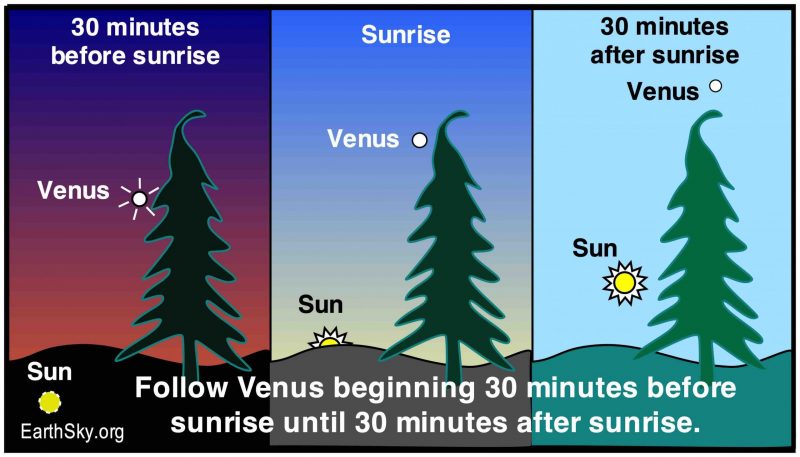
Venus in the daytime: Three diagrams showing Venus as a dot rising higher in the sky beside a tree as the sun rises.
View larger. | The easiest way to see Venus in the daytime is to start when it’s still night. Find Venus near the sunrise point in the morning. Be sure to position it near a tree, lamppost or building in your foreground. Then keep track of it after the sun rises and the sky turns blue. You’ll be amazed how easy it is to pick out Venus, once you know where to look. Chart via John Jardine Goss/ EarthSky.

Seeing Venus in the daytime

Venus is bright! After the sun and the moon, it’s the brightest object in our sky. It’s so bright, you can sometimes see it during the day. That’s why languages have a designated name for Venus as a daystar. For example, in Slavic mythology, Venus is known as Danica, which means daystar.

In late 2023, if you look east before sunrise, you can see Venus easily. And this fall is also a good time to look for Venus in the east after sunrise. The planet reached its greatest brilliancy for this morning apparition on September 19. And it’ll remain a dazzlingly bright light in the morning sky through the end of the year.

What’s more, Venus is still ascending each morning in the east before sunrise. It’s getting farther from the sunrise each day. It’ll reach its greatest elongation – its greatest apparent distance from the sunrise – on October 23, 2023.

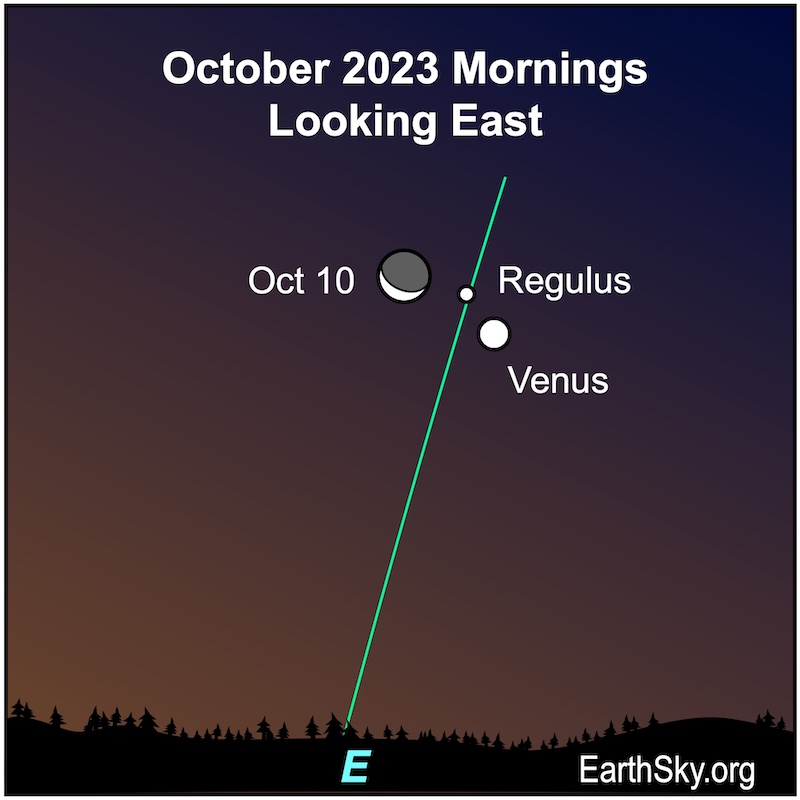
The very best time to see Venus during the day is when the moon is nearby. Check out the chart below for a great opportunity to see Venus in a blue sky on the morning of October 10, 2023.

If you catch a good photo of Venus, be sure to submit it to EarthSky!

Thin crescent moon near two white dots for Venus and star Regulus along a green ecliptic line.
On the morning of October 10, 2023, the waning crescent moon will lie near Venus and the bright star Regulus. And Venus is not long past its greatest brilliancy for this morning apparition, which happened on September 19. All in all, it’ll be a great morning to see Venus in the daytime. Keep reading for more details. Chart via John Jardine Goss/ EarthSky.

Why is Venus so bright?

Why can you see Venus during the day? And why is Venus so bright? There are two reasons.

First, Venus is close to us. It’s the planet next-inward from Earth in orbit around the sun.

Second, Venus is covered with highly reflective clouds. Sunlight bouncing from those clouds makes Venus bright in our sky.

How to see Venus in the daytime

There are many different techniques for spotting Venus in the daytime. We discuss some of the more common methods here:

1. Venus when the moon is nearby

2. Venus when it’s transiting through the meridian

3. Venus in the predawn sky

Observe Venus when the moon is nearby

On the morning of October 10, 2023, the waning crescent moon and Venus will be close to Venus in the morning sky. That’ll be an excellent time to look because Venus will still be relatively near its September 19, 2023, greatest brilliancy. If you catch a good photo of the moon and Venus, be sure to submit it to EarthSky!

Even on the days the moon is not especially close to Venus in our skies, it can still help you navigate to this bright planet. That is especially true when Venus is positioned exactly halfway between the moon and the sun. This happens somewhere on Earth every month, although the three objects might not be in a perfect line. Use Stellarium to find out when this will happen next for you. Just set the scene for the early morning sky at your location, and click forward through the dates.

Of course, the easiest way to find Venus in the daytime is just before or after an occultation by the moon. During such events, the moon passes in front of Venus from our earthly perspective. And – especially if the occultation happens in daytime from your location – you might glimpse Venus near the lighted (or darkened) edge of the moon. Unfortunately, for any fixed location on Earth, occultations of Venus are rare. There will be an occultation of Venus visible from most of Europe and the Middle East on November 9, 2023.

See our gallery of the March 24, 2023, lunar occultation of Venus.

Observe Venus in the daytime on the meridian

Venus orbits one step inward from Earth. So we always see it near the sun in our sky, and, generally speaking, after sunrise it’s hard to see. But Venus is up there, every day, following or leading in the path of the sun across our sky. So, if you could see Venus any day, you’d always notice it passing due south in your sky once a day (as seen from the Northern Hemisphere), or due north once a day (as seen from the Southern Hemisphere), just as the sun does. When Venus passes due south (or due north), astronomers say that Venus is transiting the meridian in your sky.

To find Venus as its transits your meridian, you need to know the direction south (from the Northern Hemisphere) or north (from the Southern Hemisphere). In many cities in North America, streets are aligned with north/south or east/west directions. In such cities, it’s easy to find those cardinal points.

No north-south streets? Here’s another way to find due south (or due north) in your sky. Try putting a stick in the ground and observing when the sun is highest in your sky, using your astronomy app. At the instant the sun is highest (aka astronomical noon or solar noon), the sun will be due south from the Northern Hemisphere (and due north from the Southern Hemisphere). And the shadow of your stick will point to the north (or south). If you mark these cardinal directions with respect to your favorite observing spot, it’ll make your observing easier! And it’ll help you find Venus during the day.

The meridian is just an imaginary line across your sky – a great circle from due south to due north – passing through your local zenith or highest point in the sky. So at the moment it transits the meridian, Venus is at its highest in the sky for that day.

If you know the direction of south (or north), the next step is to find out how high in your sky Venus is as it transits your meridian. Your astronomy app (or Stellarium) can help you with the exact moment of meridian transit as well as exact altitude of Venus at that time.

Since it’s not easy to judge angles in the sky, start observing low in the direction of south (or north) and then move slowly upward, until you meet a bright point of light.

Observe Venus in the predawn sky

Take advantage of Venus’s brilliance by tracking it down in daylight. Finding Venus in daylight in the morning sky is much easier than finding it in the evening sky. That’s because you can start watching it before sunrise, then follow it until after sunrise. Although Venus reached greatest brilliancy in September, it still ends the month of October at a very bright magnitude -4.5.

No matter where you are on Earth, here are some general rules to follow for seeing Venus shortly after sunrise:

– Use a free astronomy app, such as Stellarium, and enter your exact location. You can find out where Venus is with respect to the sunrise (or the moon) in your sky on a specific date.

– Check a good sunrise/sunset calculator for the exact time of sunrise at your location, such as this one at Sunrise Sunset Calendars.

– Find Venus before sunrise. It’ll be easy because it’ll be the brightest starlike object in the sunrise direction. Then keep an eye on it, as long as you can, after the sun pokes above the horizon. Be sure not to look at the sun! To make it easier, position yourself so that Venus is placed in your sky in relation to a foreground object, such as a tree or utility pole. When you spot Venus in daylight, it will be small and inconspicuous. If you look away and look back, it will be hard to find it again. It helps a lot if you have an object nearby, such as a tree or the moon.

Venus in the daytime photo gallery

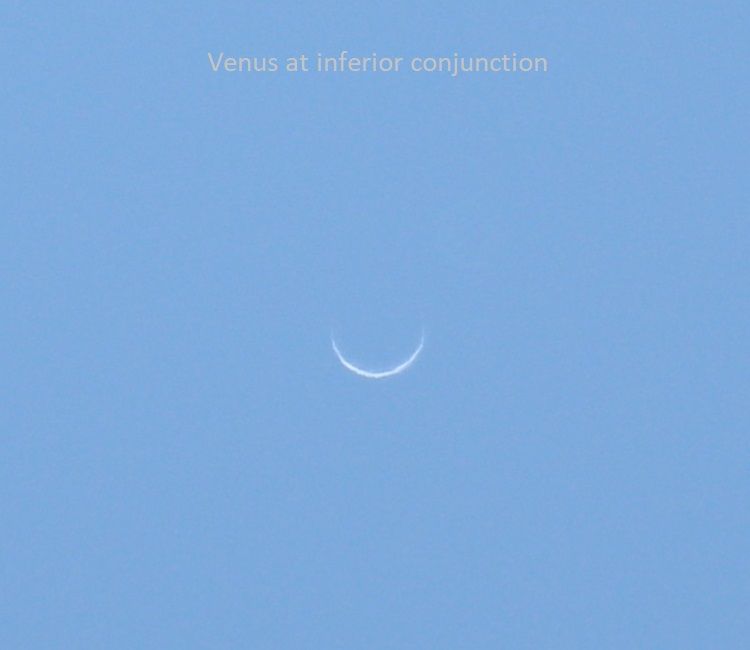
Large, very thin crescent Venus in a light blue sky.
View at EarthSky Community Photos. | Patricio Leon in Santiago, Chile, caught Venus around noon, on the day it last passed most nearly between the Earth and sun for this orbit of Venus (August 13, 2023). He wrote: “Venus was just 7.5 degrees from the sun’s limb [edge]. First, I located the planet with 10x50s, then had to find it in the screen using a hood to cover head and camera … it was quite a relief to see the planet appear in the screen and obtain the so desired shot. The planet and the photographer were smiling at the same time.” Thank you, Patricio!
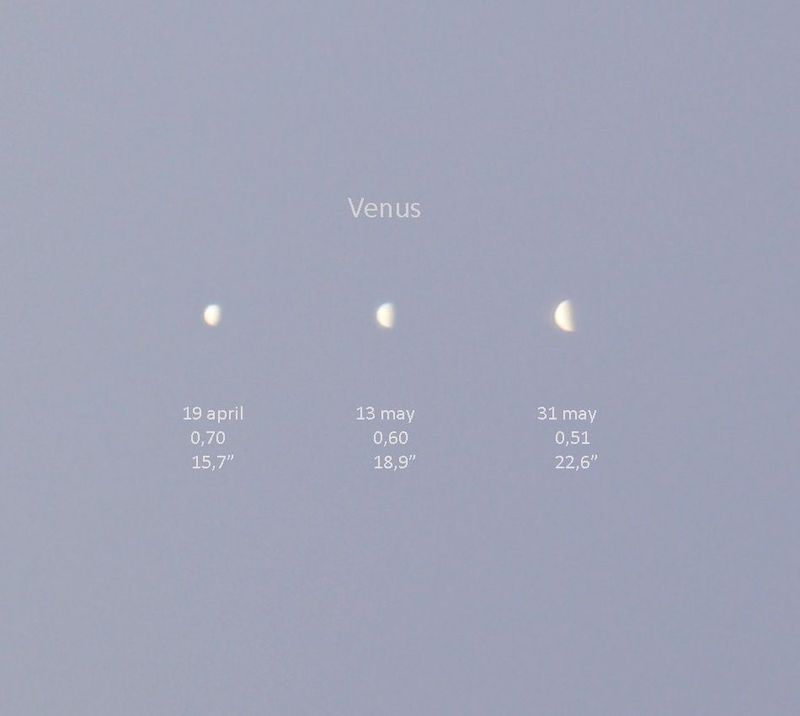
A roundish white dot, a larger half-circle, and a still larger crescent in a blue sky.
View at EarthSky Community Photos. | Patricio Leon of Santiago, Chile, captured these images of Venus in April and May of 2023 – when the planet was on its way to passing between the Earth and sun – and so waning in phase. Patricio wrote: “The evolving phase of planet Venus is seen in the above composite image, photos taken during day hours with inevitable hazy skies.” Thank you, Patricio!
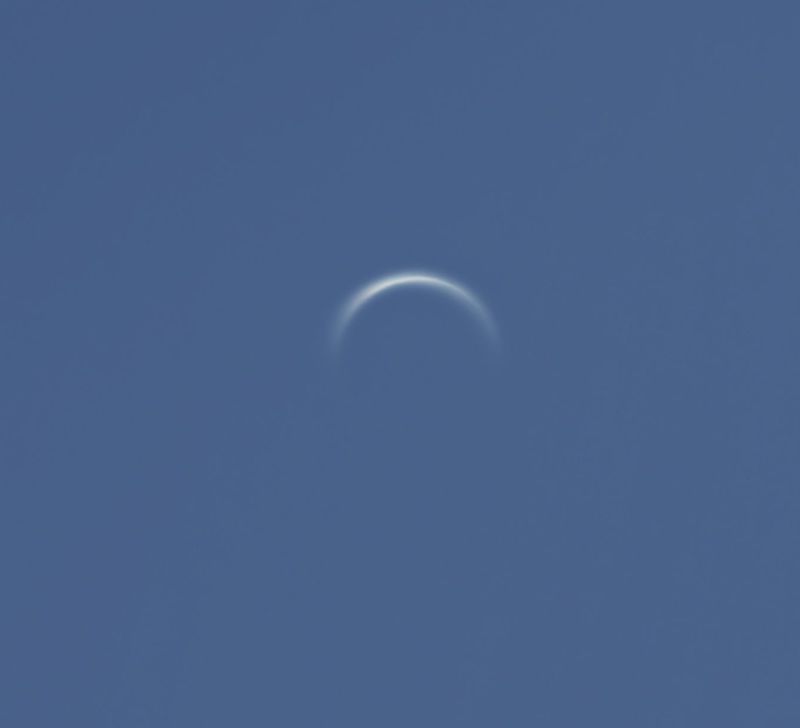
Thin, slightly fuzzy crescent Venus in a slate blue sky.
View at EarthSky Community Photos. | Steven Bellavia of Mattituck, New York, captured this image on August 13, 2023, at 3:28 p.m. He wrote: “Venus, 0.9% illuminated, at (or very close to) inferior conjunction.” Thank you, Steven!
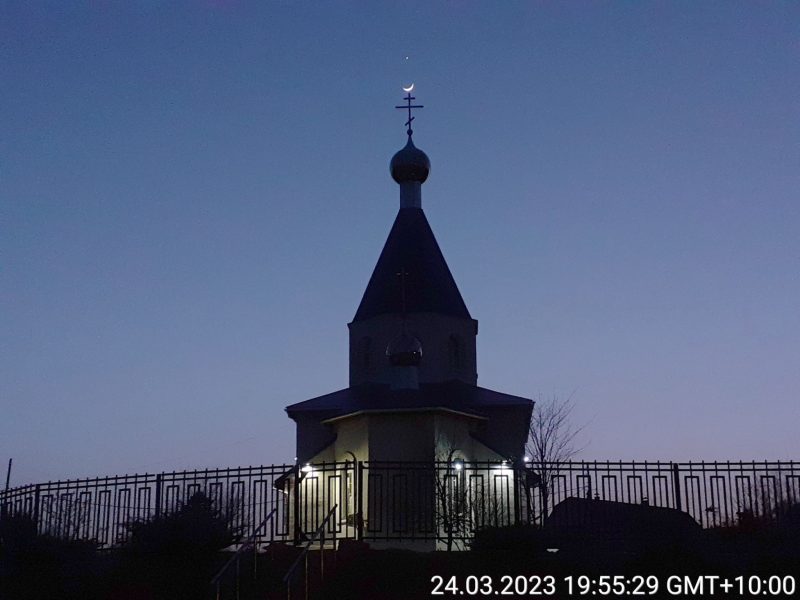
Church steeple with crescent moon positioned on top and bright dot of Venus above that in twilight sky.
View at EarthSky Community Photos. | Filipp Romanov near Nakhodka, Primorsky Krai, Russia, captured this image on March 24, 2023. Filipp wrote: “Crescent moon and Venus conjunction above the Orthodox Church. Photographed with a mobile phone camera.” Thank you, Filipp!
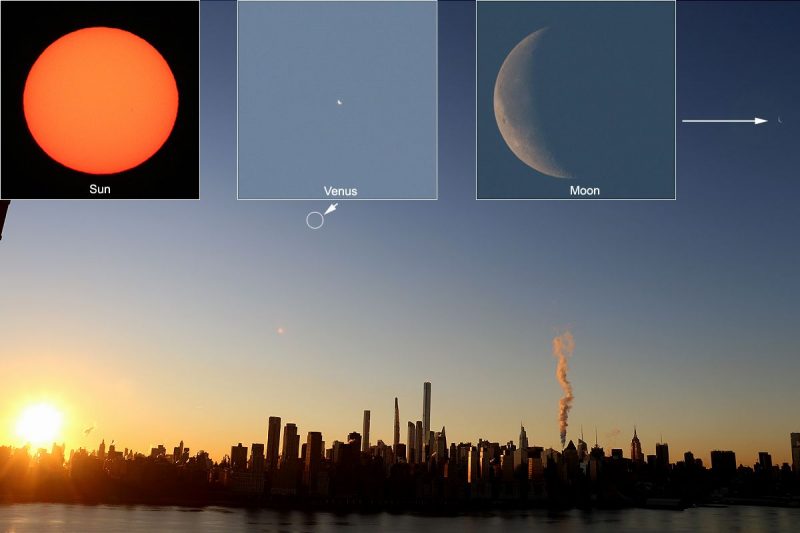
Early morning sky, just at daybreak, with Venus and moon visible above city skyline; inset with crescent in dark blue sky.
View at EarthSky Community Photos. | Alexander Krivenyshev of the website WorldTimeZone.com caught Venus in the daytime on January 27, 2022, over New York City. Note the inset at the far right, showing the moon in a waning crescent phase that day. Now notice the middle inset. That’s a crescent Venus. It looks that way because its lighted face was turned mostly away from us then. The inset on the left shows the sun itself, which was just breaching the horizon when Alexander captured this image. Thank you, Alexander!

Bottom line: The moon is near Venus on October 10, 2023. That makes that morning a great time to try to spot Venus in a daytime sky.

Read more: Top 10 space objects to see during the day

The post Venus in the daytime: Best ways to see it first appeared on EarthSky.


from EarthSky https://ift.tt/R6KHNCb
Venus in the daytime: Three diagrams showing Venus as a dot rising higher in the sky beside a tree as the sun rises.
View larger. | The easiest way to see Venus in the daytime is to start when it’s still night. Find Venus near the sunrise point in the morning. Be sure to position it near a tree, lamppost or building in your foreground. Then keep track of it after the sun rises and the sky turns blue. You’ll be amazed how easy it is to pick out Venus, once you know where to look. Chart via John Jardine Goss/ EarthSky.

Seeing Venus in the daytime

Venus is bright! After the sun and the moon, it’s the brightest object in our sky. It’s so bright, you can sometimes see it during the day. That’s why languages have a designated name for Venus as a daystar. For example, in Slavic mythology, Venus is known as Danica, which means daystar.

In late 2023, if you look east before sunrise, you can see Venus easily. And this fall is also a good time to look for Venus in the east after sunrise. The planet reached its greatest brilliancy for this morning apparition on September 19. And it’ll remain a dazzlingly bright light in the morning sky through the end of the year.

What’s more, Venus is still ascending each morning in the east before sunrise. It’s getting farther from the sunrise each day. It’ll reach its greatest elongation – its greatest apparent distance from the sunrise – on October 23, 2023.

The very best time to see Venus during the day is when the moon is nearby. Check out the chart below for a great opportunity to see Venus in a blue sky on the morning of October 10, 2023.

If you catch a good photo of Venus, be sure to submit it to EarthSky!

Thin crescent moon near two white dots for Venus and star Regulus along a green ecliptic line.
On the morning of October 10, 2023, the waning crescent moon will lie near Venus and the bright star Regulus. And Venus is not long past its greatest brilliancy for this morning apparition, which happened on September 19. All in all, it’ll be a great morning to see Venus in the daytime. Keep reading for more details. Chart via John Jardine Goss/ EarthSky.

Why is Venus so bright?

Why can you see Venus during the day? And why is Venus so bright? There are two reasons.

First, Venus is close to us. It’s the planet next-inward from Earth in orbit around the sun.

Second, Venus is covered with highly reflective clouds. Sunlight bouncing from those clouds makes Venus bright in our sky.

How to see Venus in the daytime

There are many different techniques for spotting Venus in the daytime. We discuss some of the more common methods here:

1. Venus when the moon is nearby

2. Venus when it’s transiting through the meridian

3. Venus in the predawn sky

Observe Venus when the moon is nearby

On the morning of October 10, 2023, the waning crescent moon and Venus will be close to Venus in the morning sky. That’ll be an excellent time to look because Venus will still be relatively near its September 19, 2023, greatest brilliancy. If you catch a good photo of the moon and Venus, be sure to submit it to EarthSky!

Even on the days the moon is not especially close to Venus in our skies, it can still help you navigate to this bright planet. That is especially true when Venus is positioned exactly halfway between the moon and the sun. This happens somewhere on Earth every month, although the three objects might not be in a perfect line. Use Stellarium to find out when this will happen next for you. Just set the scene for the early morning sky at your location, and click forward through the dates.

Of course, the easiest way to find Venus in the daytime is just before or after an occultation by the moon. During such events, the moon passes in front of Venus from our earthly perspective. And – especially if the occultation happens in daytime from your location – you might glimpse Venus near the lighted (or darkened) edge of the moon. Unfortunately, for any fixed location on Earth, occultations of Venus are rare. There will be an occultation of Venus visible from most of Europe and the Middle East on November 9, 2023.

See our gallery of the March 24, 2023, lunar occultation of Venus.

Observe Venus in the daytime on the meridian

Venus orbits one step inward from Earth. So we always see it near the sun in our sky, and, generally speaking, after sunrise it’s hard to see. But Venus is up there, every day, following or leading in the path of the sun across our sky. So, if you could see Venus any day, you’d always notice it passing due south in your sky once a day (as seen from the Northern Hemisphere), or due north once a day (as seen from the Southern Hemisphere), just as the sun does. When Venus passes due south (or due north), astronomers say that Venus is transiting the meridian in your sky.

To find Venus as its transits your meridian, you need to know the direction south (from the Northern Hemisphere) or north (from the Southern Hemisphere). In many cities in North America, streets are aligned with north/south or east/west directions. In such cities, it’s easy to find those cardinal points.

No north-south streets? Here’s another way to find due south (or due north) in your sky. Try putting a stick in the ground and observing when the sun is highest in your sky, using your astronomy app. At the instant the sun is highest (aka astronomical noon or solar noon), the sun will be due south from the Northern Hemisphere (and due north from the Southern Hemisphere). And the shadow of your stick will point to the north (or south). If you mark these cardinal directions with respect to your favorite observing spot, it’ll make your observing easier! And it’ll help you find Venus during the day.

The meridian is just an imaginary line across your sky – a great circle from due south to due north – passing through your local zenith or highest point in the sky. So at the moment it transits the meridian, Venus is at its highest in the sky for that day.

If you know the direction of south (or north), the next step is to find out how high in your sky Venus is as it transits your meridian. Your astronomy app (or Stellarium) can help you with the exact moment of meridian transit as well as exact altitude of Venus at that time.

Since it’s not easy to judge angles in the sky, start observing low in the direction of south (or north) and then move slowly upward, until you meet a bright point of light.

Observe Venus in the predawn sky

Take advantage of Venus’s brilliance by tracking it down in daylight. Finding Venus in daylight in the morning sky is much easier than finding it in the evening sky. That’s because you can start watching it before sunrise, then follow it until after sunrise. Although Venus reached greatest brilliancy in September, it still ends the month of October at a very bright magnitude -4.5.

No matter where you are on Earth, here are some general rules to follow for seeing Venus shortly after sunrise:

– Use a free astronomy app, such as Stellarium, and enter your exact location. You can find out where Venus is with respect to the sunrise (or the moon) in your sky on a specific date.

– Check a good sunrise/sunset calculator for the exact time of sunrise at your location, such as this one at Sunrise Sunset Calendars.

– Find Venus before sunrise. It’ll be easy because it’ll be the brightest starlike object in the sunrise direction. Then keep an eye on it, as long as you can, after the sun pokes above the horizon. Be sure not to look at the sun! To make it easier, position yourself so that Venus is placed in your sky in relation to a foreground object, such as a tree or utility pole. When you spot Venus in daylight, it will be small and inconspicuous. If you look away and look back, it will be hard to find it again. It helps a lot if you have an object nearby, such as a tree or the moon.

Venus in the daytime photo gallery

Large, very thin crescent Venus in a light blue sky.
View at EarthSky Community Photos. | Patricio Leon in Santiago, Chile, caught Venus around noon, on the day it last passed most nearly between the Earth and sun for this orbit of Venus (August 13, 2023). He wrote: “Venus was just 7.5 degrees from the sun’s limb [edge]. First, I located the planet with 10x50s, then had to find it in the screen using a hood to cover head and camera … it was quite a relief to see the planet appear in the screen and obtain the so desired shot. The planet and the photographer were smiling at the same time.” Thank you, Patricio!
A roundish white dot, a larger half-circle, and a still larger crescent in a blue sky.
View at EarthSky Community Photos. | Patricio Leon of Santiago, Chile, captured these images of Venus in April and May of 2023 – when the planet was on its way to passing between the Earth and sun – and so waning in phase. Patricio wrote: “The evolving phase of planet Venus is seen in the above composite image, photos taken during day hours with inevitable hazy skies.” Thank you, Patricio!
Thin, slightly fuzzy crescent Venus in a slate blue sky.
View at EarthSky Community Photos. | Steven Bellavia of Mattituck, New York, captured this image on August 13, 2023, at 3:28 p.m. He wrote: “Venus, 0.9% illuminated, at (or very close to) inferior conjunction.” Thank you, Steven!
Church steeple with crescent moon positioned on top and bright dot of Venus above that in twilight sky.
View at EarthSky Community Photos. | Filipp Romanov near Nakhodka, Primorsky Krai, Russia, captured this image on March 24, 2023. Filipp wrote: “Crescent moon and Venus conjunction above the Orthodox Church. Photographed with a mobile phone camera.” Thank you, Filipp!
Early morning sky, just at daybreak, with Venus and moon visible above city skyline; inset with crescent in dark blue sky.
View at EarthSky Community Photos. | Alexander Krivenyshev of the website WorldTimeZone.com caught Venus in the daytime on January 27, 2022, over New York City. Note the inset at the far right, showing the moon in a waning crescent phase that day. Now notice the middle inset. That’s a crescent Venus. It looks that way because its lighted face was turned mostly away from us then. The inset on the left shows the sun itself, which was just breaching the horizon when Alexander captured this image. Thank you, Alexander!

Bottom line: The moon is near Venus on October 10, 2023. That makes that morning a great time to try to spot Venus in a daytime sky.

Read more: Top 10 space objects to see during the day

The post Venus in the daytime: Best ways to see it first appeared on EarthSky.


from EarthSky https://ift.tt/R6KHNCb

Double stars: How to find, observe and enjoy

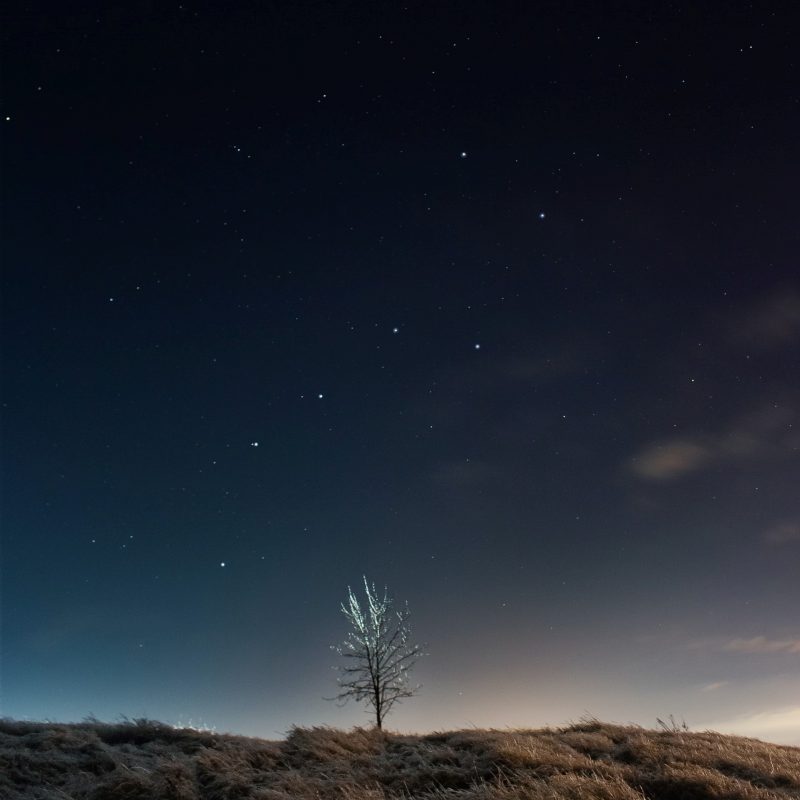
Lone tree with Big Dipper above, handle pointing down. Double stars Mizar and Alcor visible.
View larger. | The Big Dipper has 2 parts: a bowl and a handle. Look closely at the handle stars hanging down from the Big Dipper in this photo. It contains one of the most famous double stars. Can you spot it? Image via Unsplash/ Nadiia Ploshchenko.

Double stars are two stars that appear close together in the sky. They might be physically related or they might only appear to lie together along our line of sight. Double stars that aren’t gravitationally bound systems – but are only located near one another along our line of sight – are optical doubles. Double stars that are gravitationally bound and orbit a common center of mass are true binary star systems. Unlike our sun, scientists believe that most stars in our Milky Way galaxy orbit the galactic center in binary pairs. In fact, some estimates suggest that up to 85% of stars might reside in binary systems.

Like snowflakes, no two double-star systems are alike. So gazing at them is a lot of fun. You’ll see a huge range of star brightnesses, and a range of different distances between the stars. And sometimes you’ll notice a contrast in colors between the two stars. This post will give you some tips on observing double stars with your eye alone, with binoculars and, if you want to take the plunge, with a small telescope. Read on, and learn to enjoy the sky’s delightful double stars!

Double star observing tips

To see double stars, Earth’s atmosphere needs to be still. A lot of motion in different layers of our atmosphere makes a star waver and dance. Astronomers will then say the seeing is poor. On nights of bad seeing, it can be very difficult for an observer with a telescope to “split” a binary pair into its two components. You might only see a single star. Whenever you’re looking toward a horizon, you’re looking through a thicker layer of atmosphere. So it’s better – when observing double stars – if your target is located near the sky’s zenith (overhead).

A couple of other observing factors contribute to whether you can see both components of a double star. Are you under a dark sky? How bright are the two stars you’re trying to see, that is, what are their magnitudes? Stars that shine at 5th or 6th magnitude are quite challenging but possible to observe. And lastly, how far apart are the stars? Anything closer together than 5 arcminutes and you’ll probably want to try using binoculars.

Mizar and Alcor in the Big Dipper

For those new to double stars and new to observing the sky, it’s best to start with something simple. The optical double star Mizar and Alcor in the Big Dipper are a cinch to find. The Big Dipper asterism is a pattern that stands out due to its large size and bright stars. It’s visible year-round from latitudes like those in the northern U.S. and Canada.

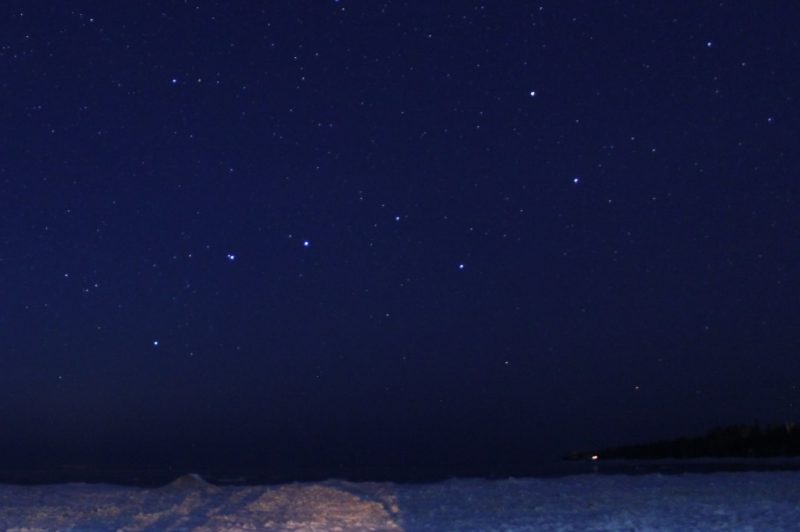
Star field with prominent Big Dipper stars in deep blue sky over rough lake ice.
View at EarthSky Community Photos. | Jim Peacock in Cornucopia, Wisconsin, captured this photo of the Big Dipper on January 3, 2021. He wrote: “Big Dipper over the horizon of a freezing bay of Lake Superior in northern Wisconsin.” Thanks, Jim! Notice how you can see the 2 stars, Mizar and Alcor, snug together at the bend in the handle of the Big Dipper?

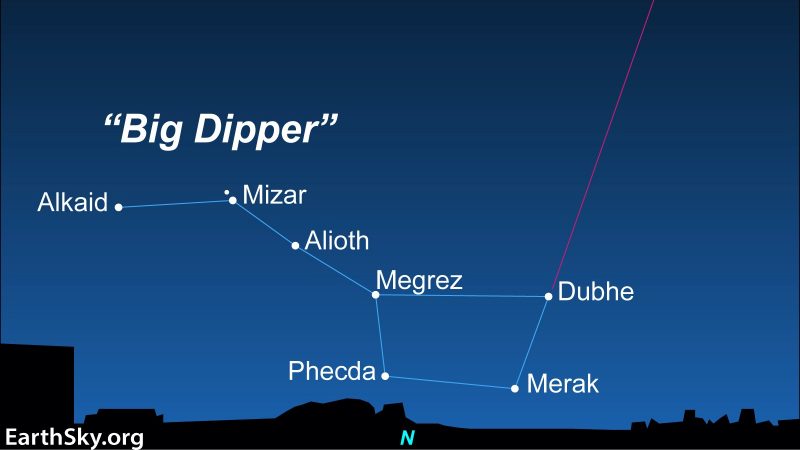
Seven stars make up the Big Dipper: four in the bowl and three in the handle. The middle of the three handle stars is the Mizar/Alcor pair. The stars appear about 12 arcminutes apart. So anyone with fair eyesight should be able to see them as two stars. Mizar is the brighter of the two, and Alcor is the dimmer one. Mizar shines at magnitude 2.2 from some 82 light-years away. And Alcor shines at magnitude 4 from about 81 light-years distant. These two stars are physically bound in space.

Chart of Big Dipper with stars labeled, including Mizar in handle.
This chart of the Big Dipper includes a label for Mizar, while its companion star, Alcor, appears next to it without a label.

Mizar and Alcor with magnification

If you’re unable to split Mizar and Alcor with your eyes alone, go ahead and turn a pair of binoculars on them. Splitting Mizar and Alcor was a test of eyesight once upon a time. If you can’t see both without optical aid, maybe it’s time for a visit to the eye doctor?

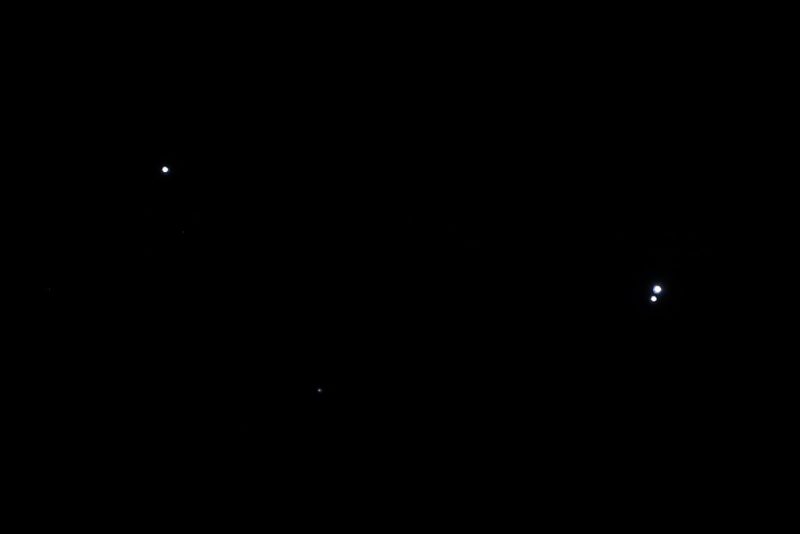
To go deeper with these stars, look through a telescope and you’ll find that Mizar itself is a double star. The two parts of Mizar are 14 arcseconds apart. Fun fact: each of the two parts of Mizar are also double stars, making it a quadruple star system, not counting Alcor. Alcor is a double star, so in total, this is a sextuple star system.

Black background with one white dot at left and two white dots close together at right.
Through a telescope, you can turn the double star Mizar and Alcor into a triple system. At left is Alcor, and at right is Mizar and its companion. Image via Nikolay Nikolov/ Wikimedia Commons (CC BY-SA 4.0).

Scorpius holds 2 double star targets

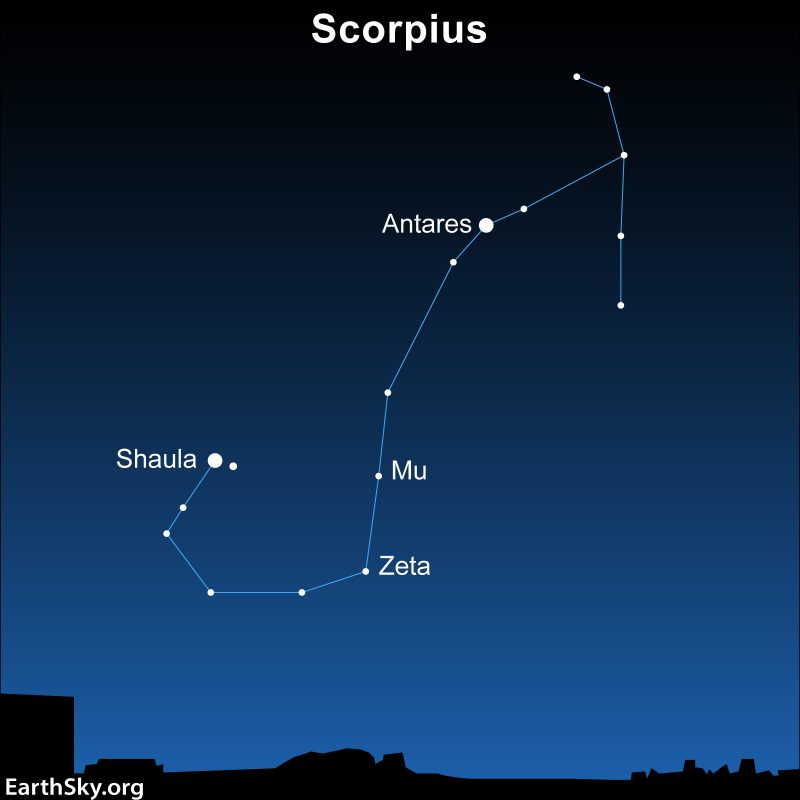
Scorpius, a constellation best viewed in the Northern Hemisphere summer, has two pairs of double stars that you can try to separate using just your eyes. The easier target is Mu Scorpii. Its two components are a binary pair, one at magnitude 2.9 and one at 3.5. Use the chart here to find Mu and then let your eyes adjust to the dark to see if you can spot both the Mu stars. This pair is a little under 6 arcminutes apart.

If you can see them both without optical aid, try looking just below them for the two Zeta stars. These stars are merely an optical double. Zeta 1 is nearly 40 times farther away than Zeta 2. Zeta 2 is magnitude 3.6, just a hair dimmer than the dimmer member of Mu you spotted above. Zeta 1 is the hardest to spot at magnitude 4.7. If you need to use binoculars, go ahead and get a look, then try again without them. These two are about 6 1/2 arcminutes apart.

Sky chart showing Scorpius with stars Mu and Zeta Scorpii and Antares labeled.
Mu Scorpii should not be a difficult pair to “split” with the unaided eye. But the Zeta Scorpii pair will be more challenging. Use the bright red star Antares as a guide to find Mu and Zeta.

Alpha Capricorni with or without binoculars

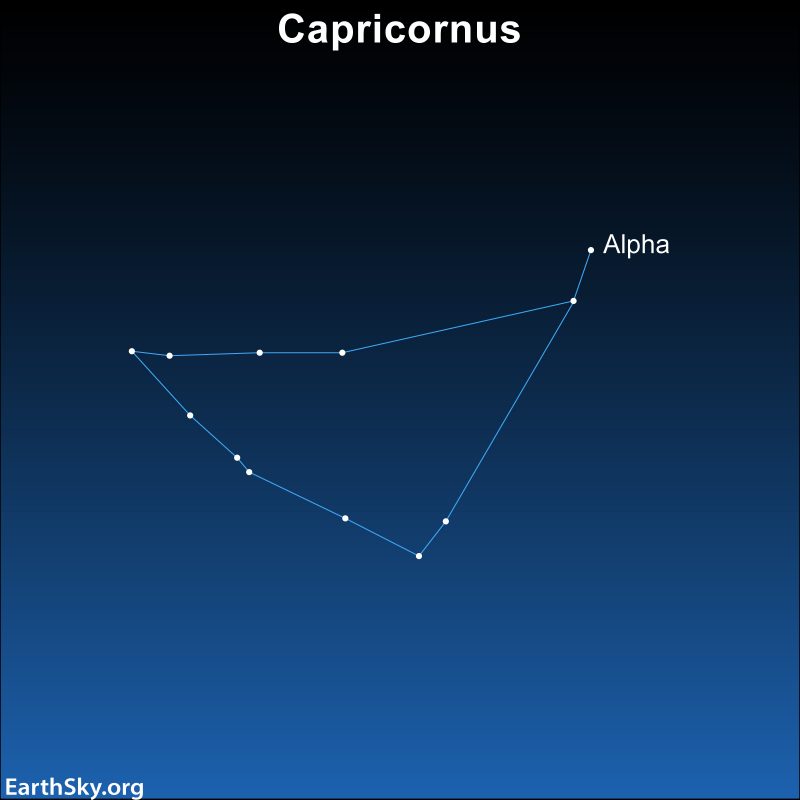
Like the double stars in Scorpius, the Alpha star in Capricornus will be visible to some people without any optical aid, while others will need to use a pair of binoculars. Alpha Capricorni is an optical double, that is, they only appear close together from our point of view. Alpha 1 shines at magnitude 4.2 and lies 633 light-years away. Its partner, Alpha 2, which also bears the name Algedi, shines at magnitude 3.5 and lies 107 light-years away. The pair are about 6 1/2 arcminutes apart.

Star chart of triangle-shaped wedge of stars with star in upper right labeled Alpha.
Alpha Capricorni is a double star that some may see without optical aid while others will need to use binoculars.

Theta Tauri in the Bull’s head

Next up is Theta Tauri. You might be able to spy both parts of this double star without optical aid, but a steadily held pair of binoculars will make it easier. Theta Tauri is in the V-shape of Taurus’ head, near the brilliant, reddish Aldebaran. Theta 1 and Theta 2 lie about 5 1/2 arcminutes apart and shine at magnitudes 3.3 and 3.8.

When the two parts of the double star are similar in brightness or magnitude, they’re easier to split than when one is brighter than the other. Is Theta Tauri easier for you to see than Mu Scorpii?

Scattered bright glowing stars with a tight yellow and blue pair at center.
Theta Tauri, the yellow and blue pair at center, lie close to brilliant Aldebaran in Taurus’ star cluster the Hyades. Image via NASA/ ESA/ STScI/ Wikimedia Commons (CC BY-SA 4.0).

Epsilon Lyrae, the famous Double Double

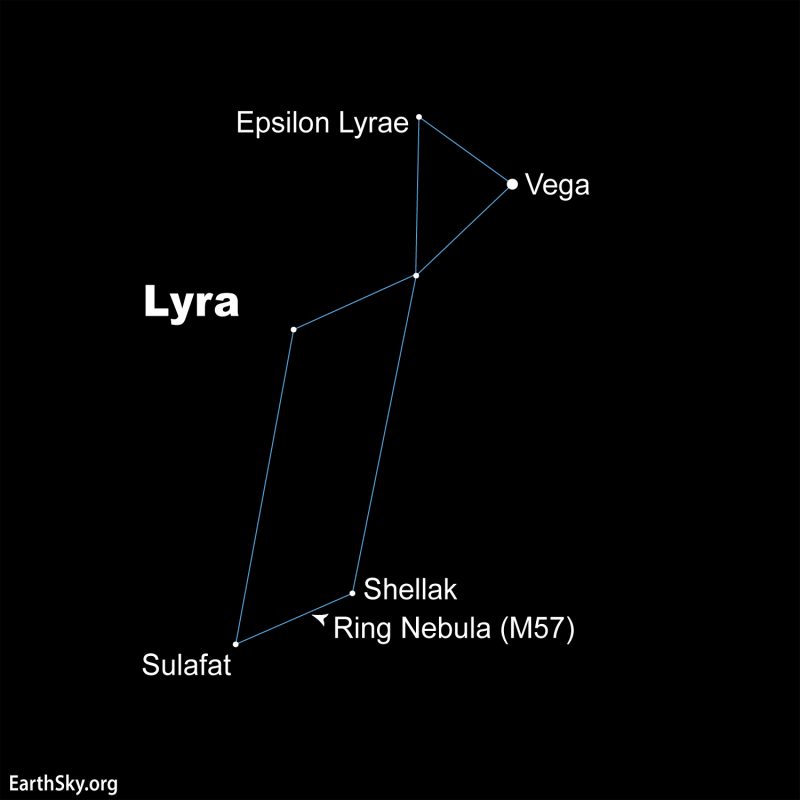
The Double Double – Epsilon Lyrae – is a system of two pairs of double stars in the summer constellation Lyra the Harp. But you can still see Lyra in the evening through November before it sets in the west. Lyra has many double stars. How many can you find if you sweep the area in binoculars?

The famous Double Double has stars around magnitude 5. The stars are simple to find, next to the brilliant Vega. Epsilon 1 and Epsilon 2 are about 3 arcminutes apart, with the additional two parts of both Epsilon 1 and Epsilon 2 each being about 2 arcseconds apart. Look for the first pair of stars in binoculars. You may need a telescope to see each of those stars separate into two more stars.

Star chart showing constellation Lyra with stars and Ring nebula labeled.
The constellation Lyra the Harp. It’s made of a triangle and a parallelogram. Its brightest star is Vega. Look next to it for the famous Epsilon Lyrae, a double-double star, really 4 stars in all.
Black background with two white dots close together at left and two white dots close together at right.
Epsilon Lyrae is the famous Double Double. Under magnification, you should be able to see the double stars split into double stars themselves. Image via Nikolay Nikolov/ Wikimedia Commons (CC BY-SA 4.0).

Colorful Albireo

Albireo – or Beta Cygni – has earned the nickname of the most beautiful double star in the heavens. This blue and yellow pair lies just 35 arcseconds apart from our point of view. Astronomers don’t yet know if this is a physically bound pair or just a line-of-sight coincidence. The two parts of Albireo shine at magnitudes 3.1 and 5.1. Albireo marks the head of Cygnus the Swan.

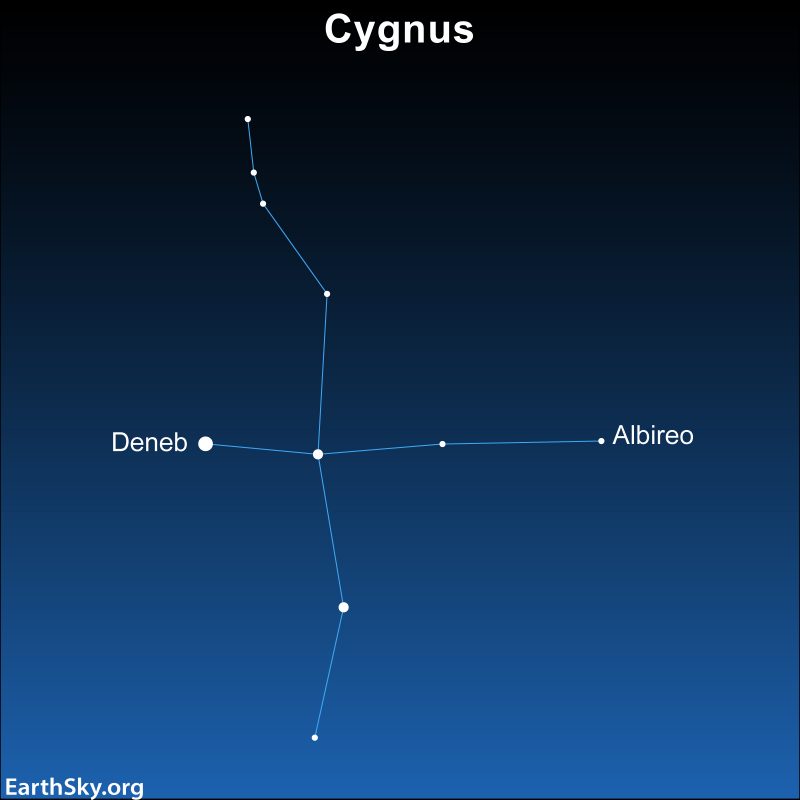
Sky chart showing Cygnus looking like a sideways cross with stars Deneb and Albireo labeled.
Albireo is a tighter pair discernible using larger binoculars or a small telescope. The star lies in the constellation Cygnus the Swan, opposite the bright star Deneb.
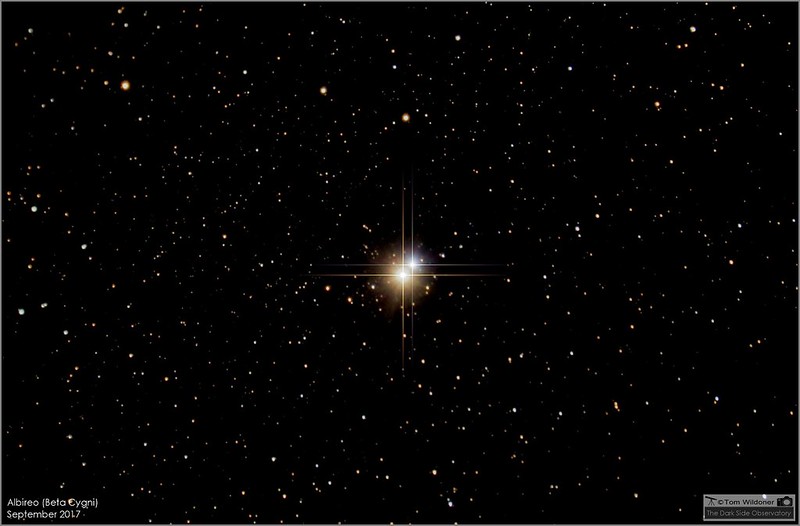
A star-studded field of mostly faint stars with two bright stars in the center, an orange-yellow and a dimmer blue.
Here’s one of the most colorful – and most beloved – double stars in the sky. The eye sees it as just one star, called Albireo. Tom Wildoner captured this image of Albireo with a camera attached to a 12-inch telescope. Image via Tom and Jane Wildoner/ Tom’s Flickr page. Used with permission.

The Southern Hemisphere’s Alpha Centauri

The brightest star in Centaurus, found in the Southern Hemisphere, is not only a multiple star system but the closest star to Earth at 4.37 light-years. Alpha Centauri can be split into its components A and B. They are a true binary pair, being gravitationally bound.

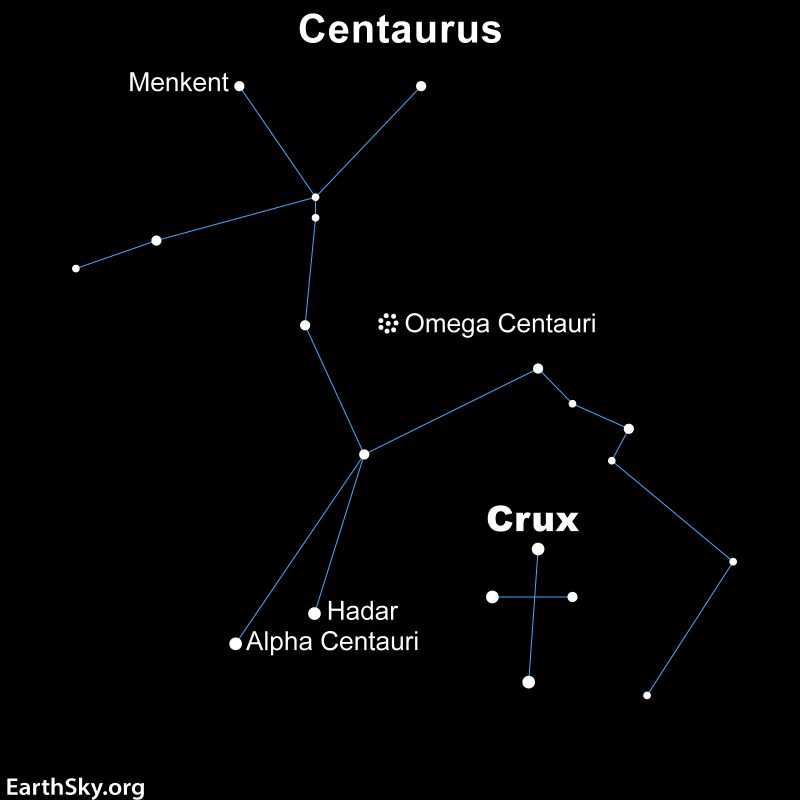
Star chart of Centaurus constellation and Crux, with Omega Centauri and several stars labeled.
Alpha Centauri – which is visible to the unaided eye as a single bright star – is a tighter pair that you can split using a small telescope. Use the bright constellation Crux, the Southern Cross, as a guide to find Alpha Centauri.
Light blue sky with two points of light nearly touching.
Using a 110mm refractor (a 4.3-inch telescope), the photographer captured this image of the double star Alpha Centauri in daylight. Image via Skatebiker/ Wikimedia Commons (CC BY-SA 4.0).

Once you get used to spotting double stars, you’ll find them in constellations everywhere. Good luck, and clear skies!

Bottom line: This double star observing guide gives you a range of choices for observing with your eyes alone. Or go further using binoculars or a telescope.

The post Double stars: How to find, observe and enjoy first appeared on EarthSky.


from EarthSky https://ift.tt/yOghK3s
Lone tree with Big Dipper above, handle pointing down. Double stars Mizar and Alcor visible.
View larger. | The Big Dipper has 2 parts: a bowl and a handle. Look closely at the handle stars hanging down from the Big Dipper in this photo. It contains one of the most famous double stars. Can you spot it? Image via Unsplash/ Nadiia Ploshchenko.

Double stars are two stars that appear close together in the sky. They might be physically related or they might only appear to lie together along our line of sight. Double stars that aren’t gravitationally bound systems – but are only located near one another along our line of sight – are optical doubles. Double stars that are gravitationally bound and orbit a common center of mass are true binary star systems. Unlike our sun, scientists believe that most stars in our Milky Way galaxy orbit the galactic center in binary pairs. In fact, some estimates suggest that up to 85% of stars might reside in binary systems.

Like snowflakes, no two double-star systems are alike. So gazing at them is a lot of fun. You’ll see a huge range of star brightnesses, and a range of different distances between the stars. And sometimes you’ll notice a contrast in colors between the two stars. This post will give you some tips on observing double stars with your eye alone, with binoculars and, if you want to take the plunge, with a small telescope. Read on, and learn to enjoy the sky’s delightful double stars!

Double star observing tips

To see double stars, Earth’s atmosphere needs to be still. A lot of motion in different layers of our atmosphere makes a star waver and dance. Astronomers will then say the seeing is poor. On nights of bad seeing, it can be very difficult for an observer with a telescope to “split” a binary pair into its two components. You might only see a single star. Whenever you’re looking toward a horizon, you’re looking through a thicker layer of atmosphere. So it’s better – when observing double stars – if your target is located near the sky’s zenith (overhead).

A couple of other observing factors contribute to whether you can see both components of a double star. Are you under a dark sky? How bright are the two stars you’re trying to see, that is, what are their magnitudes? Stars that shine at 5th or 6th magnitude are quite challenging but possible to observe. And lastly, how far apart are the stars? Anything closer together than 5 arcminutes and you’ll probably want to try using binoculars.

Mizar and Alcor in the Big Dipper

For those new to double stars and new to observing the sky, it’s best to start with something simple. The optical double star Mizar and Alcor in the Big Dipper are a cinch to find. The Big Dipper asterism is a pattern that stands out due to its large size and bright stars. It’s visible year-round from latitudes like those in the northern U.S. and Canada.

Star field with prominent Big Dipper stars in deep blue sky over rough lake ice.
View at EarthSky Community Photos. | Jim Peacock in Cornucopia, Wisconsin, captured this photo of the Big Dipper on January 3, 2021. He wrote: “Big Dipper over the horizon of a freezing bay of Lake Superior in northern Wisconsin.” Thanks, Jim! Notice how you can see the 2 stars, Mizar and Alcor, snug together at the bend in the handle of the Big Dipper?

Seven stars make up the Big Dipper: four in the bowl and three in the handle. The middle of the three handle stars is the Mizar/Alcor pair. The stars appear about 12 arcminutes apart. So anyone with fair eyesight should be able to see them as two stars. Mizar is the brighter of the two, and Alcor is the dimmer one. Mizar shines at magnitude 2.2 from some 82 light-years away. And Alcor shines at magnitude 4 from about 81 light-years distant. These two stars are physically bound in space.

Chart of Big Dipper with stars labeled, including Mizar in handle.
This chart of the Big Dipper includes a label for Mizar, while its companion star, Alcor, appears next to it without a label.

Mizar and Alcor with magnification

If you’re unable to split Mizar and Alcor with your eyes alone, go ahead and turn a pair of binoculars on them. Splitting Mizar and Alcor was a test of eyesight once upon a time. If you can’t see both without optical aid, maybe it’s time for a visit to the eye doctor?

To go deeper with these stars, look through a telescope and you’ll find that Mizar itself is a double star. The two parts of Mizar are 14 arcseconds apart. Fun fact: each of the two parts of Mizar are also double stars, making it a quadruple star system, not counting Alcor. Alcor is a double star, so in total, this is a sextuple star system.

Black background with one white dot at left and two white dots close together at right.
Through a telescope, you can turn the double star Mizar and Alcor into a triple system. At left is Alcor, and at right is Mizar and its companion. Image via Nikolay Nikolov/ Wikimedia Commons (CC BY-SA 4.0).

Scorpius holds 2 double star targets

Scorpius, a constellation best viewed in the Northern Hemisphere summer, has two pairs of double stars that you can try to separate using just your eyes. The easier target is Mu Scorpii. Its two components are a binary pair, one at magnitude 2.9 and one at 3.5. Use the chart here to find Mu and then let your eyes adjust to the dark to see if you can spot both the Mu stars. This pair is a little under 6 arcminutes apart.

If you can see them both without optical aid, try looking just below them for the two Zeta stars. These stars are merely an optical double. Zeta 1 is nearly 40 times farther away than Zeta 2. Zeta 2 is magnitude 3.6, just a hair dimmer than the dimmer member of Mu you spotted above. Zeta 1 is the hardest to spot at magnitude 4.7. If you need to use binoculars, go ahead and get a look, then try again without them. These two are about 6 1/2 arcminutes apart.

Sky chart showing Scorpius with stars Mu and Zeta Scorpii and Antares labeled.
Mu Scorpii should not be a difficult pair to “split” with the unaided eye. But the Zeta Scorpii pair will be more challenging. Use the bright red star Antares as a guide to find Mu and Zeta.

Alpha Capricorni with or without binoculars

Like the double stars in Scorpius, the Alpha star in Capricornus will be visible to some people without any optical aid, while others will need to use a pair of binoculars. Alpha Capricorni is an optical double, that is, they only appear close together from our point of view. Alpha 1 shines at magnitude 4.2 and lies 633 light-years away. Its partner, Alpha 2, which also bears the name Algedi, shines at magnitude 3.5 and lies 107 light-years away. The pair are about 6 1/2 arcminutes apart.

Star chart of triangle-shaped wedge of stars with star in upper right labeled Alpha.
Alpha Capricorni is a double star that some may see without optical aid while others will need to use binoculars.

Theta Tauri in the Bull’s head

Next up is Theta Tauri. You might be able to spy both parts of this double star without optical aid, but a steadily held pair of binoculars will make it easier. Theta Tauri is in the V-shape of Taurus’ head, near the brilliant, reddish Aldebaran. Theta 1 and Theta 2 lie about 5 1/2 arcminutes apart and shine at magnitudes 3.3 and 3.8.

When the two parts of the double star are similar in brightness or magnitude, they’re easier to split than when one is brighter than the other. Is Theta Tauri easier for you to see than Mu Scorpii?

Scattered bright glowing stars with a tight yellow and blue pair at center.
Theta Tauri, the yellow and blue pair at center, lie close to brilliant Aldebaran in Taurus’ star cluster the Hyades. Image via NASA/ ESA/ STScI/ Wikimedia Commons (CC BY-SA 4.0).

Epsilon Lyrae, the famous Double Double

The Double Double – Epsilon Lyrae – is a system of two pairs of double stars in the summer constellation Lyra the Harp. But you can still see Lyra in the evening through November before it sets in the west. Lyra has many double stars. How many can you find if you sweep the area in binoculars?

The famous Double Double has stars around magnitude 5. The stars are simple to find, next to the brilliant Vega. Epsilon 1 and Epsilon 2 are about 3 arcminutes apart, with the additional two parts of both Epsilon 1 and Epsilon 2 each being about 2 arcseconds apart. Look for the first pair of stars in binoculars. You may need a telescope to see each of those stars separate into two more stars.

Star chart showing constellation Lyra with stars and Ring nebula labeled.
The constellation Lyra the Harp. It’s made of a triangle and a parallelogram. Its brightest star is Vega. Look next to it for the famous Epsilon Lyrae, a double-double star, really 4 stars in all.
Black background with two white dots close together at left and two white dots close together at right.
Epsilon Lyrae is the famous Double Double. Under magnification, you should be able to see the double stars split into double stars themselves. Image via Nikolay Nikolov/ Wikimedia Commons (CC BY-SA 4.0).

Colorful Albireo

Albireo – or Beta Cygni – has earned the nickname of the most beautiful double star in the heavens. This blue and yellow pair lies just 35 arcseconds apart from our point of view. Astronomers don’t yet know if this is a physically bound pair or just a line-of-sight coincidence. The two parts of Albireo shine at magnitudes 3.1 and 5.1. Albireo marks the head of Cygnus the Swan.

Sky chart showing Cygnus looking like a sideways cross with stars Deneb and Albireo labeled.
Albireo is a tighter pair discernible using larger binoculars or a small telescope. The star lies in the constellation Cygnus the Swan, opposite the bright star Deneb.
A star-studded field of mostly faint stars with two bright stars in the center, an orange-yellow and a dimmer blue.
Here’s one of the most colorful – and most beloved – double stars in the sky. The eye sees it as just one star, called Albireo. Tom Wildoner captured this image of Albireo with a camera attached to a 12-inch telescope. Image via Tom and Jane Wildoner/ Tom’s Flickr page. Used with permission.

The Southern Hemisphere’s Alpha Centauri

The brightest star in Centaurus, found in the Southern Hemisphere, is not only a multiple star system but the closest star to Earth at 4.37 light-years. Alpha Centauri can be split into its components A and B. They are a true binary pair, being gravitationally bound.

Star chart of Centaurus constellation and Crux, with Omega Centauri and several stars labeled.
Alpha Centauri – which is visible to the unaided eye as a single bright star – is a tighter pair that you can split using a small telescope. Use the bright constellation Crux, the Southern Cross, as a guide to find Alpha Centauri.
Light blue sky with two points of light nearly touching.
Using a 110mm refractor (a 4.3-inch telescope), the photographer captured this image of the double star Alpha Centauri in daylight. Image via Skatebiker/ Wikimedia Commons (CC BY-SA 4.0).

Once you get used to spotting double stars, you’ll find them in constellations everywhere. Good luck, and clear skies!

Bottom line: This double star observing guide gives you a range of choices for observing with your eyes alone. Or go further using binoculars or a telescope.

The post Double stars: How to find, observe and enjoy first appeared on EarthSky.


from EarthSky https://ift.tt/yOghK3s

Cassiopeia and Perseus on October evenings

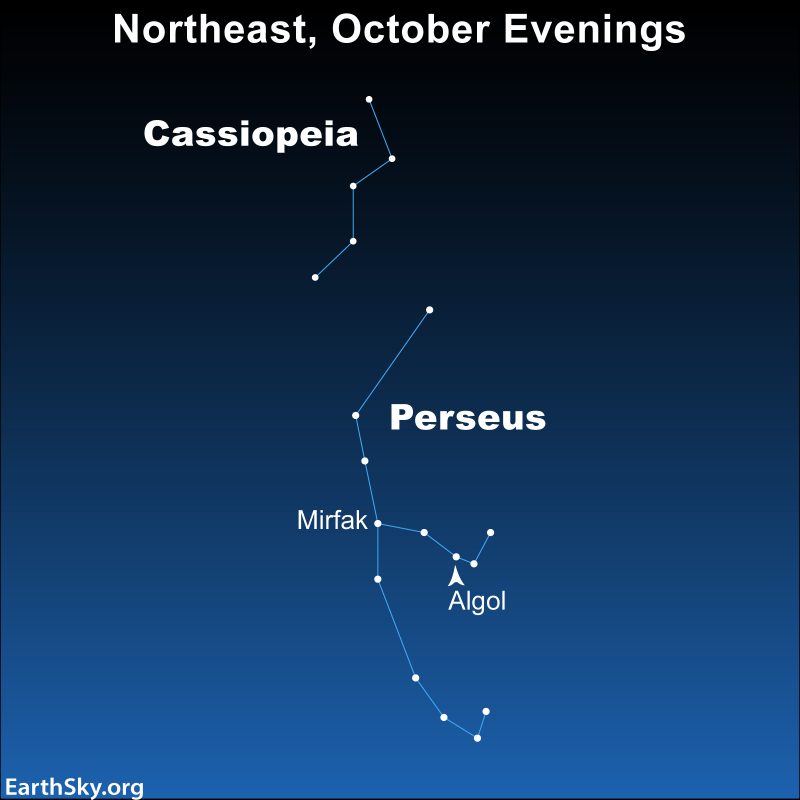
Star chart shows Cassiopeia and Perseus constellations, with stars Mirfak and Algol labeled.
Find Perseus with the help of the constellation Cassiopeia the Queen. Cassiopeia’s distinctive M or W shape is ascending in the northeast on Northern Hemisphere autumn evenings, with Perseus following. Cassiopeia and Perseus travel together in a great arc around the northern sky. Be sure to look for the star Algol, sometimes called the Ghoul Star or Demon Star … a perfect star for Halloween this month!

If you know how to locate the easy-to-spot constellation Cassiopeia the Queen, with its distinctive M or W shape, then you’re ready to find Perseus. Perseus the Hero follows Cassiopeia across the sky as seen from the Northern Hemisphere on autumn and winter evenings. Cassiopeia and Perseus are tokens of autumn in the Northern Hemisphere.

Cassiopeia’s bright stars and easy-to-recognize shape makes it easy to identify and, therefore, one of the most famous constellations in the sky. Perseus’s stars are fainter than Cassiopeia’s, and its shape is less pronounced. Because it appears at its best during the evening on cold months, I think of its brightest stars as forming an icicle dangling down from Cassiopeia, with the star Algol off to the side. If you have access to a dark sky, it will be that much easier to spot Perseus.

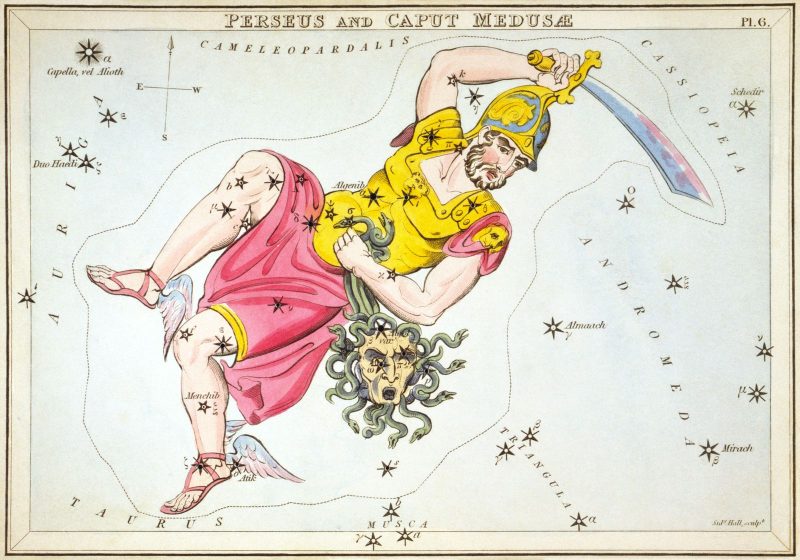
Antique etching of Perseus the Hero in Greek warrior garb, holding a sword and the snaky head of Medusa.
In skylore and mythology, Perseus beheaded Medusa, a witch who had snakes for hair. This image is from Urania’s Mirror, a set of constellation cards published in London around 1825. Image via Wikimedia Commons (public domain).

Where to find Cassiopeia and Perseus

You’ll see both Cassiopeia and Perseus in the northeast on October evenings. The pair will be higher up in the evening sky in late autumn and winter. Or, as night passes, you’ll see them both ascending in the northeast, then arcing high in the north, then descending in the northwest, with Perseus following Cassiopeia all the while. Both Perseus and Cassiopeia are circumpolar from about 40 degrees north latitude to farther north. In other words, as seen from northern parts of the U.S. and Canada, they never set below the horizon, but instead circle endlessly around Polaris, the North Star.

The brightest star in Cassiopeia is Schedar. However, all the stars shine similarly bright, which is part of what makes the constellation so easy to pick out.

The brightest star in Perseus is Mirfak. But its second brightest star, Algol, gets more attention. Algol is the Demon Star. It marks the head of the demon, Medusa, while it’s also a variable star. That means it varies in brightness at a regular rate, every few days, that observers can watch without the need for optical aid.

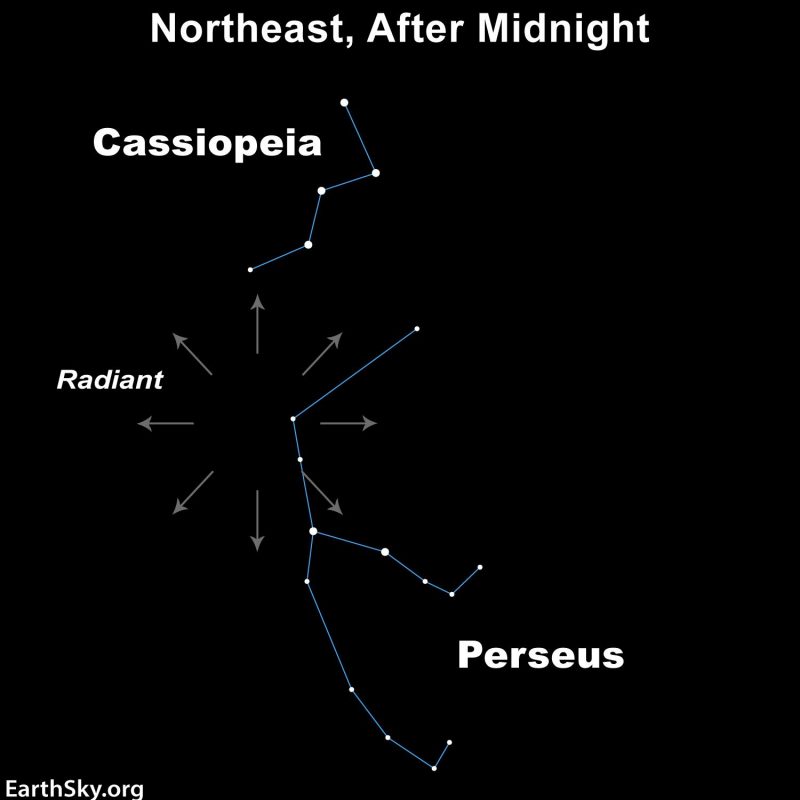
The radiant for the Perseids

Although these constellations are best seen in the evening in autumn and winter, you can also see Cassiopeia and Perseus in the latter part of Northern Hemisphere summer, from late night until dawn. Plus, the annual Perseid meteor shower peaks around August 12 or 13, and if you trace the paths of these Perseid meteors backward, they’ll appear to originate between the two constellations.

Star chart with constellations Cassiopeia and Perseus with radial arrows between them.
The annual Perseid meteors radiate from a point in the constellation Perseus the Hero. In August, the radiant rises in late evening and is highest at dawn.
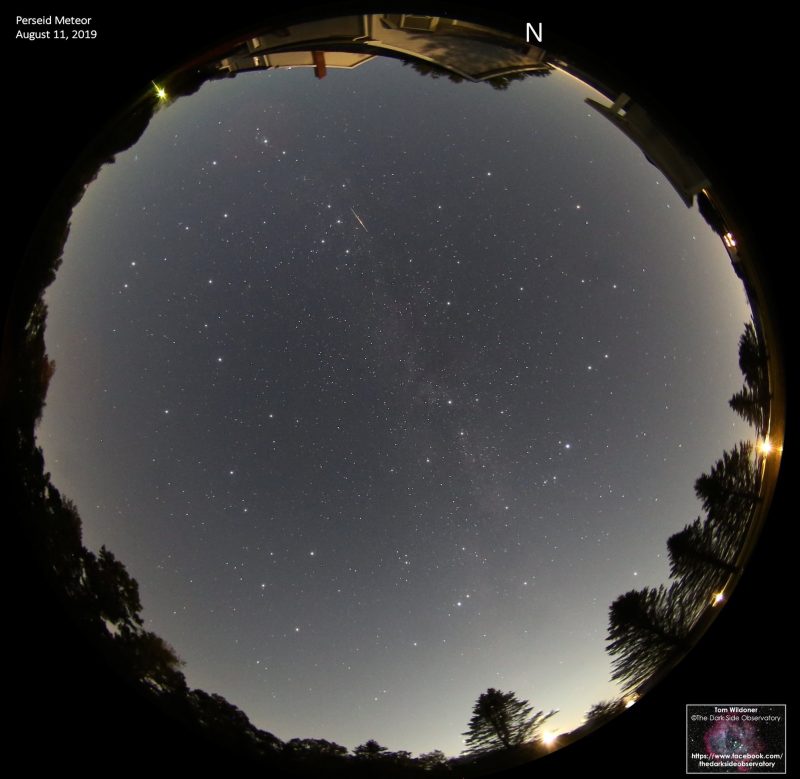
Circular photo of entire sky with stars and Milky Way and short bright streak above center.
View at EarthSky Community Photos. | Tom Wildoner of the Dark Side Observatory in Weatherly, Pennsylvania, has an automatic camera set up for meteor observing. He caught this one on August 11, 2019, and wrote: “You can see this bright meteor streak above center near the constellation Cassiopeia (sideways W) and pointing in the direction of Perseus. The brighter stars have been enhanced in this image to help orient your view. North is marked on the image.” Thanks, Tom and Jane Wildoner! Used with permission.

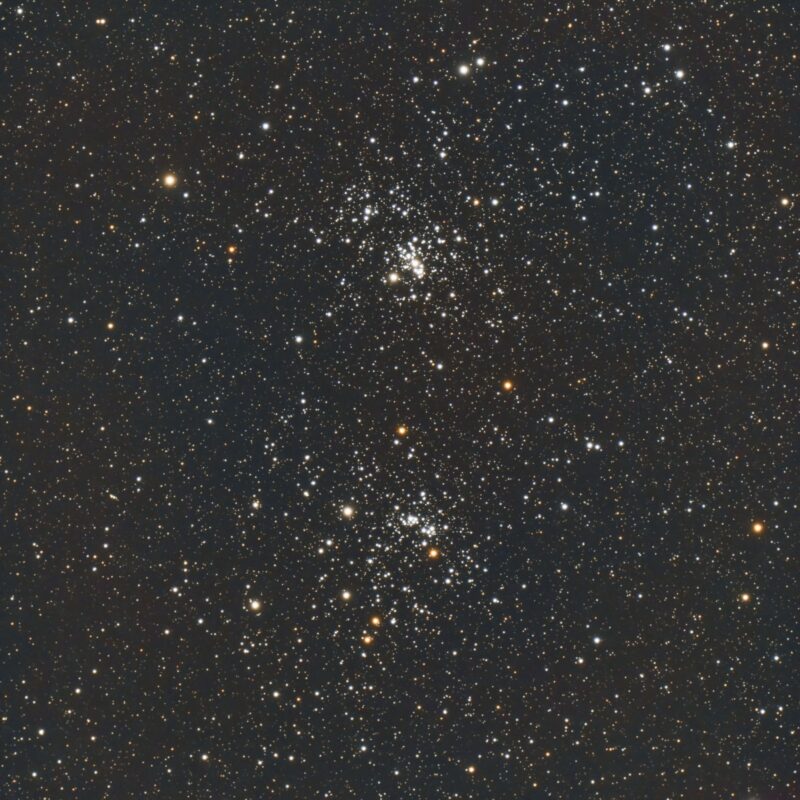
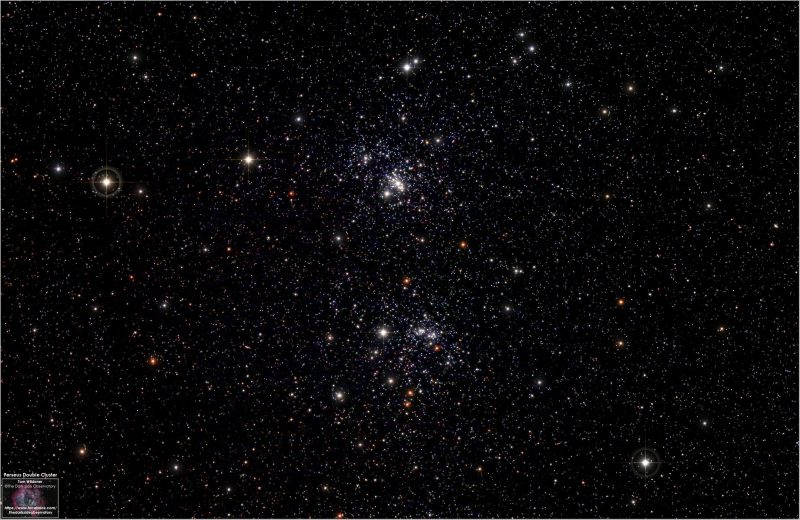
The Double Cluster in Perseus

Last, but not least, after you’ve found Cassiopeia and Perseus, be sure to scan between them with your binoculars. Assuming your sky is dark, you’ll easily spot the magnificent Double Cluster in Perseus. This pair of open clusters makes for an easy target through a telescope and will wow your friends.

Two large but loose groupings of many bright stars in dense starfield.
View at EarthSky Community Photos. | Mario Rana in Hampton, Virginia, captured this telescopic view of the Double Cluster in Perseus (NGC 869 and NGC 884) on September 18, 2023. Mario explained that this could be his favorite deep-sky object. Thank you, Mario!
Star field with two separate loose groupings of multiple bright stars.
View larger.| The Double Cluster in Perseus, via Tom and Jane Wildoner at the Dark Side Observatory in Weatherly, Pennsylvania. Used with permission.

Bottom line: Cassiopeia and Perseus are neighbors in the fall sky. Use Cassiopeia’s distinctive W or M shape to locate the dimmer Perseus on autumn and winter evenings.

The post Cassiopeia and Perseus on October evenings first appeared on EarthSky.


from EarthSky https://ift.tt/DnTZeEq
Star chart shows Cassiopeia and Perseus constellations, with stars Mirfak and Algol labeled.
Find Perseus with the help of the constellation Cassiopeia the Queen. Cassiopeia’s distinctive M or W shape is ascending in the northeast on Northern Hemisphere autumn evenings, with Perseus following. Cassiopeia and Perseus travel together in a great arc around the northern sky. Be sure to look for the star Algol, sometimes called the Ghoul Star or Demon Star … a perfect star for Halloween this month!

If you know how to locate the easy-to-spot constellation Cassiopeia the Queen, with its distinctive M or W shape, then you’re ready to find Perseus. Perseus the Hero follows Cassiopeia across the sky as seen from the Northern Hemisphere on autumn and winter evenings. Cassiopeia and Perseus are tokens of autumn in the Northern Hemisphere.

Cassiopeia’s bright stars and easy-to-recognize shape makes it easy to identify and, therefore, one of the most famous constellations in the sky. Perseus’s stars are fainter than Cassiopeia’s, and its shape is less pronounced. Because it appears at its best during the evening on cold months, I think of its brightest stars as forming an icicle dangling down from Cassiopeia, with the star Algol off to the side. If you have access to a dark sky, it will be that much easier to spot Perseus.

Antique etching of Perseus the Hero in Greek warrior garb, holding a sword and the snaky head of Medusa.
In skylore and mythology, Perseus beheaded Medusa, a witch who had snakes for hair. This image is from Urania’s Mirror, a set of constellation cards published in London around 1825. Image via Wikimedia Commons (public domain).

Where to find Cassiopeia and Perseus

You’ll see both Cassiopeia and Perseus in the northeast on October evenings. The pair will be higher up in the evening sky in late autumn and winter. Or, as night passes, you’ll see them both ascending in the northeast, then arcing high in the north, then descending in the northwest, with Perseus following Cassiopeia all the while. Both Perseus and Cassiopeia are circumpolar from about 40 degrees north latitude to farther north. In other words, as seen from northern parts of the U.S. and Canada, they never set below the horizon, but instead circle endlessly around Polaris, the North Star.

The brightest star in Cassiopeia is Schedar. However, all the stars shine similarly bright, which is part of what makes the constellation so easy to pick out.

The brightest star in Perseus is Mirfak. But its second brightest star, Algol, gets more attention. Algol is the Demon Star. It marks the head of the demon, Medusa, while it’s also a variable star. That means it varies in brightness at a regular rate, every few days, that observers can watch without the need for optical aid.

The radiant for the Perseids

Although these constellations are best seen in the evening in autumn and winter, you can also see Cassiopeia and Perseus in the latter part of Northern Hemisphere summer, from late night until dawn. Plus, the annual Perseid meteor shower peaks around August 12 or 13, and if you trace the paths of these Perseid meteors backward, they’ll appear to originate between the two constellations.

Star chart with constellations Cassiopeia and Perseus with radial arrows between them.
The annual Perseid meteors radiate from a point in the constellation Perseus the Hero. In August, the radiant rises in late evening and is highest at dawn.
Circular photo of entire sky with stars and Milky Way and short bright streak above center.
View at EarthSky Community Photos. | Tom Wildoner of the Dark Side Observatory in Weatherly, Pennsylvania, has an automatic camera set up for meteor observing. He caught this one on August 11, 2019, and wrote: “You can see this bright meteor streak above center near the constellation Cassiopeia (sideways W) and pointing in the direction of Perseus. The brighter stars have been enhanced in this image to help orient your view. North is marked on the image.” Thanks, Tom and Jane Wildoner! Used with permission.

The Double Cluster in Perseus

Last, but not least, after you’ve found Cassiopeia and Perseus, be sure to scan between them with your binoculars. Assuming your sky is dark, you’ll easily spot the magnificent Double Cluster in Perseus. This pair of open clusters makes for an easy target through a telescope and will wow your friends.

Two large but loose groupings of many bright stars in dense starfield.
View at EarthSky Community Photos. | Mario Rana in Hampton, Virginia, captured this telescopic view of the Double Cluster in Perseus (NGC 869 and NGC 884) on September 18, 2023. Mario explained that this could be his favorite deep-sky object. Thank you, Mario!
Star field with two separate loose groupings of multiple bright stars.
View larger.| The Double Cluster in Perseus, via Tom and Jane Wildoner at the Dark Side Observatory in Weatherly, Pennsylvania. Used with permission.

Bottom line: Cassiopeia and Perseus are neighbors in the fall sky. Use Cassiopeia’s distinctive W or M shape to locate the dimmer Perseus on autumn and winter evenings.

The post Cassiopeia and Perseus on October evenings first appeared on EarthSky.


from EarthSky https://ift.tt/DnTZeEq

Jupiter racing toward opposition on November 2-3, 2023

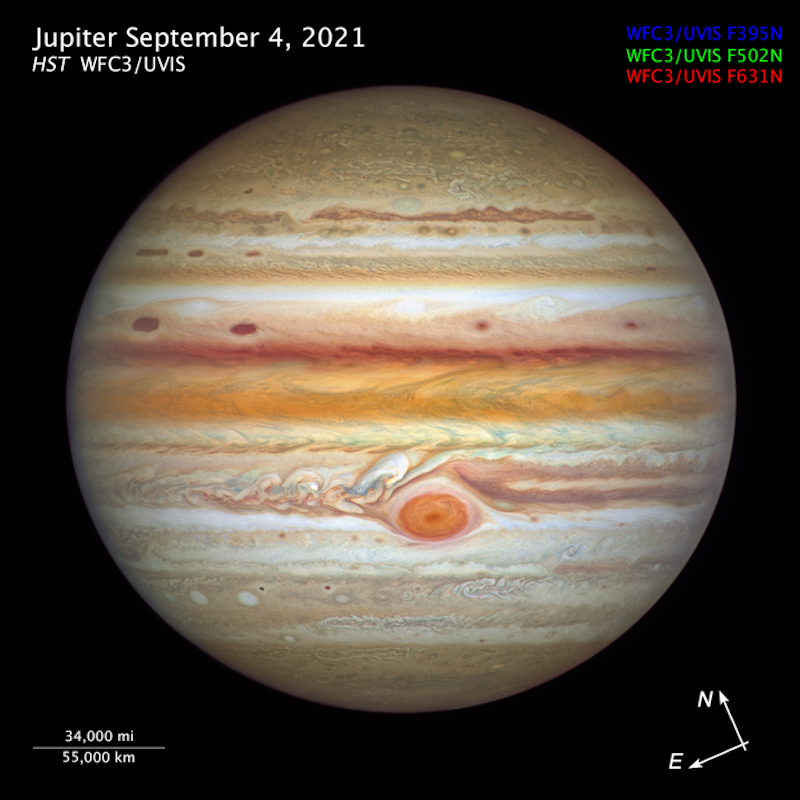
Jupiter with colorful, swirly banded atmosphere and oval storms, with text annotations.
Jupiter and its stormy atmosphere as seen by the Hubble Space Telescope on September 4, 2021. Image via Amy Simon (NASA-GSFC)/ Michael H. Wong (UC Berkeley)/ Hubblesite.

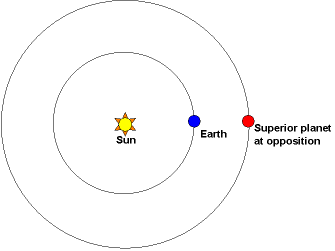
Earth will fly between the sun and Jupiter – bringing Jupiter to its yearly opposition – on November 2-3, 2023. That’s one day after Jupiter reaches perigee – its closest point – to Earth.

Jupiter in 2023: Maybe you’ve noticed Jupiter. It’s been the very bright object ascending in the east earlier each evening. Brighter than all the stars!
It reaches opposition on November 2-3 at 5 UTC (12 a.m. CDT) bringing Jupiter opposite the sun in our sky. It happens as Earth flies between the sun and Jupiter.
Jupiter is closest to Earth not on the day of opposition, but one day earlier, overnight (by American clocks) on November 1-2. At that time, its distance will be 3.982 astronomical units (Earth-sun units, aka AU)/ 370 million miles/ 595 million km/ 33.11 light-minutes from Earth.
Opposition constellation: Aries the Ram.
Brightness at opposition: Magnitude -2.9. Jupiter will shine as the 4th-brightest object in the sky, after the sun, the moon and the planet Venus. It’ll be the brightest starlike object visible for most of the night (until Venus rises before dawn).
Size at opposition (as seen through a telescope): 49.45 arcseconds across.
Through binoculars (anytime): Jupiter reveals a bright disk. If you look closely, you’ll see several of its four Galilean moons appearing as pinpoints of light, arrayed in a line that bisects the giant planet.

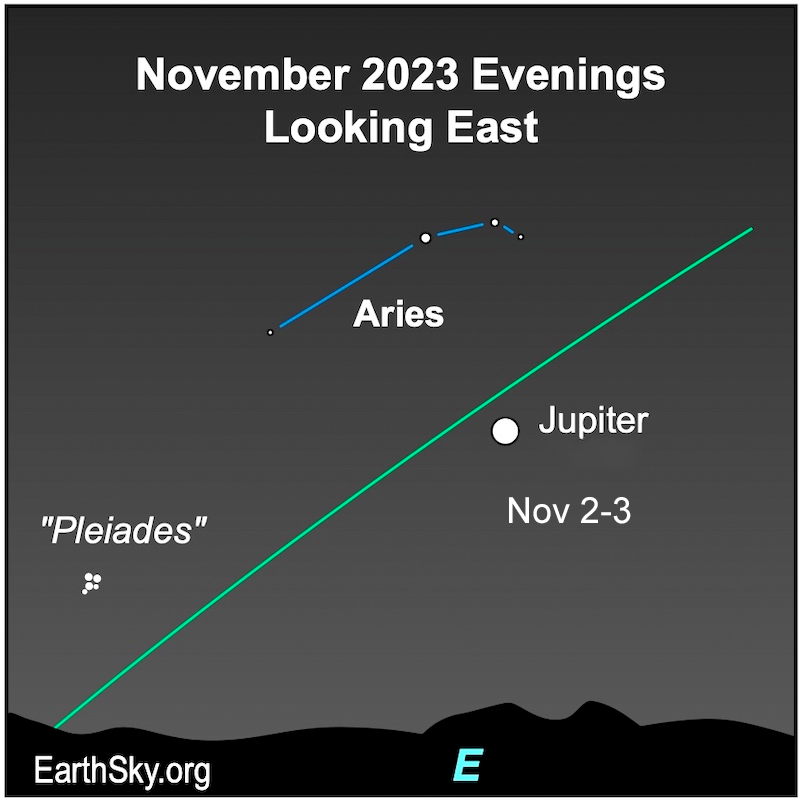
Green ecliptic line, dots for Jupiter, Pleiades and Aries near the line.
On November evenings, look for Jupiter above the eastern horizon after sunset. It lies in the dim constellation Aries the Ram. Jupiter – the 2nd brightest of all planets – reaches opposition at 5 UTC on November 3, 2023. At opposition, Jupiter is 33 light-minutes (3.992 AU) distant from Earth. The beautiful star cluster Pleiades is near the giant planet. Chart via John Jardine Goss / EarthSky.

For precise sun and Jupiter rising times at your location:

Old Farmer’s Almanac (U.S. and Canada)

timeanddate.com (worldwide).

Stellarium (online planetarium program)

In-the-sky information and finder chart for your location

Diagram showing Earth between an outer planet and the sun.
Opposition happens when Earth flies between an outer planet, like Jupiter, and the sun. Illustration via Chris Peat/ Heavens-Above.

How often does Jupiter reach opposition?

Jupiter takes 12 earthly years to orbit the sun once. So Jupiter comes to opposition roughly every 13 months. That’s how long Earth takes to travel once around the sun relative to Jupiter. So – according to our earthly calendars – Jupiter’s opposition comes about a month later each year. Add to that the fact that there are 12 constellations of the zodiac. And there are 12 months in a year. So Jupiter is in a new zodiacal constellation at each year’s opposition (last year, Pisces; this year, Aries).

2023 Jupiter opposition – November 3
2024 Jupiter opposition – December 7
2026 Jupiter opposition – January 10
2027 Jupiter opposition – February 10

Jupiter events in 2023

January 20, 2023: Jupiter’s perihelion or closest point to the sun.
April 11, 2023: Jupiter at solar conjunction, or behind the sun as seen from Earth.
September 4, 2023: Jupiter begins retrograde motion, or westward motion on the sky’s dome, a sign that opposition is coming.
November 1, 2023: Jupiter at perigee, or closest to Earth for 2023.
November 3, 2023: Jupiter at opposition, or opposite the sun as seen from Earth.
December 30, 2023: Jupiter ends retrograde motion, a sign that the best time of year to observe Jupiter is ending. But the planet will remain somewhere in our night sky for many more months, and in fact is visible somewhere in our night sky for most of every year.

Two photos of Jupiter side by side with one of them considerably larger, with labels.
A comparison of the apparent size of Jupiter at opposition (November 1-2, 2023) and when it is most distant from the Earth at solar conjunction (May 18, 2024). Image via Dominic Ford’s In-the-Sky.org. Used with permission.

View from above the solar system, November 2023

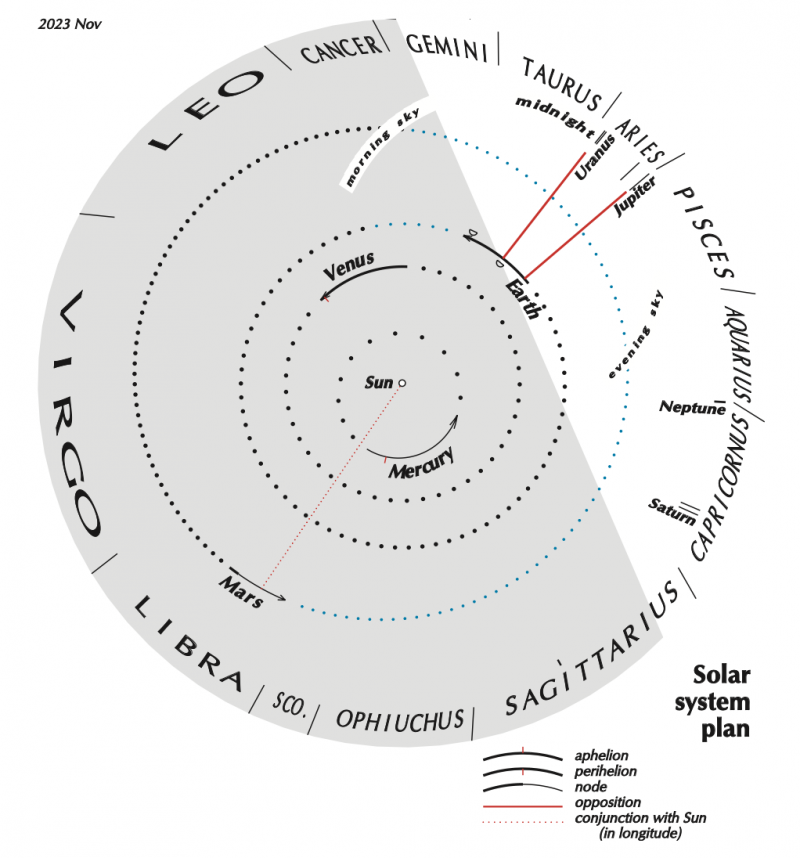
Circle with sun at center, planets around, and zodiac names on outer edge.
View larger. | Heliocentric view of solar system, November 2023. Chart via Guy Ottewell. Used with permission.

A failed star

Perhaps you know that Jupiter isn’t a rocky planet like Earth. It’s more like a failed star, not massive enough or hot enough inside to spark thermonuclear fusion reactions, but some 2 1/2 times more massive than all the other planets in our solar system combined. Jupiter is big! But without that thermonuclear reaction it can’t shine as stars do.

You’d need some 80 Jupiters – rolled into a ball – to be hot enough inside to spark fusion. So Jupiter isn’t a star. That is, it doesn’t shine with its own light, but instead by reflected sunlight.

Yet in late October and early November 2023 – as bright Jupiter rises in the east more or less opposite the sunset – you can stand on Earth all night and peer toward bright Jupiter in our sky. And you can imagine that, if the giant planet did have enough mass to shine as stars do, then around Jupiter’s opposition, we’d have no night at all. Instead, Jupiter would shine as a 2nd sun, all night long.

Read more: How to see Jupiter’s moons

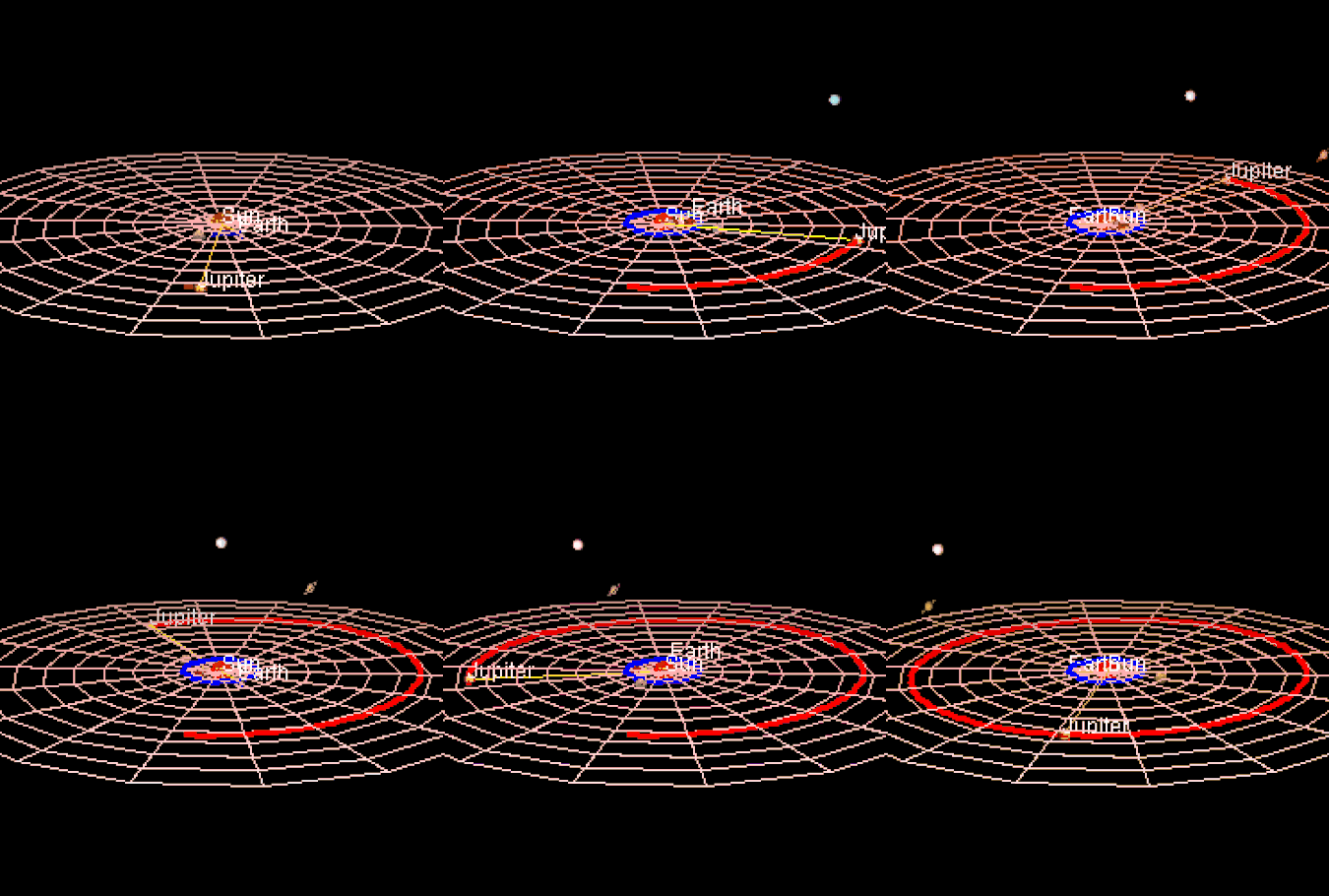
Animation showing Earth moving around and around the sun faster than Jupiter.
In fact, Jupiter (red) completes one orbit of the sun (center) for every 11.86 orbits of the Earth (blue), since our orbit is smaller, and we move faster! Animation via Wikimedia Commons (CC BY-SA 3.0).

EarthSky Community Photos

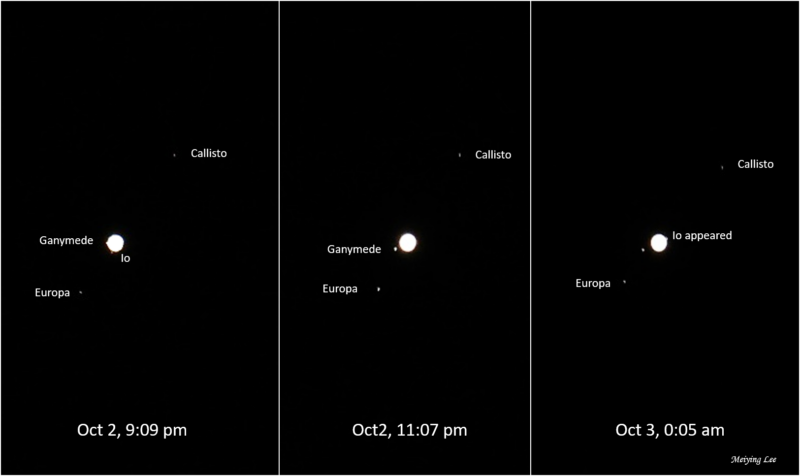
3 images with a big dot in the middle, for Jupiter, and 4 small dots in line, for its moons in different positions.
View at EarthSky Community Photos. | Meiying Lee in Taipei, Taiwan, took these images of Jupiter’s 4 largest moons over the course of a single night. She wrote: “I always thought that to see obvious changes in the 4 major satellites of Jupiter would take several nights of continuous observation. Later, I discovered that the Galilean satellites move very fast around Jupiter.” See the volcanic moon Io move behind Jupiter and emerge on the other side just a few hours later? Amazing! Thanks, Meiying.
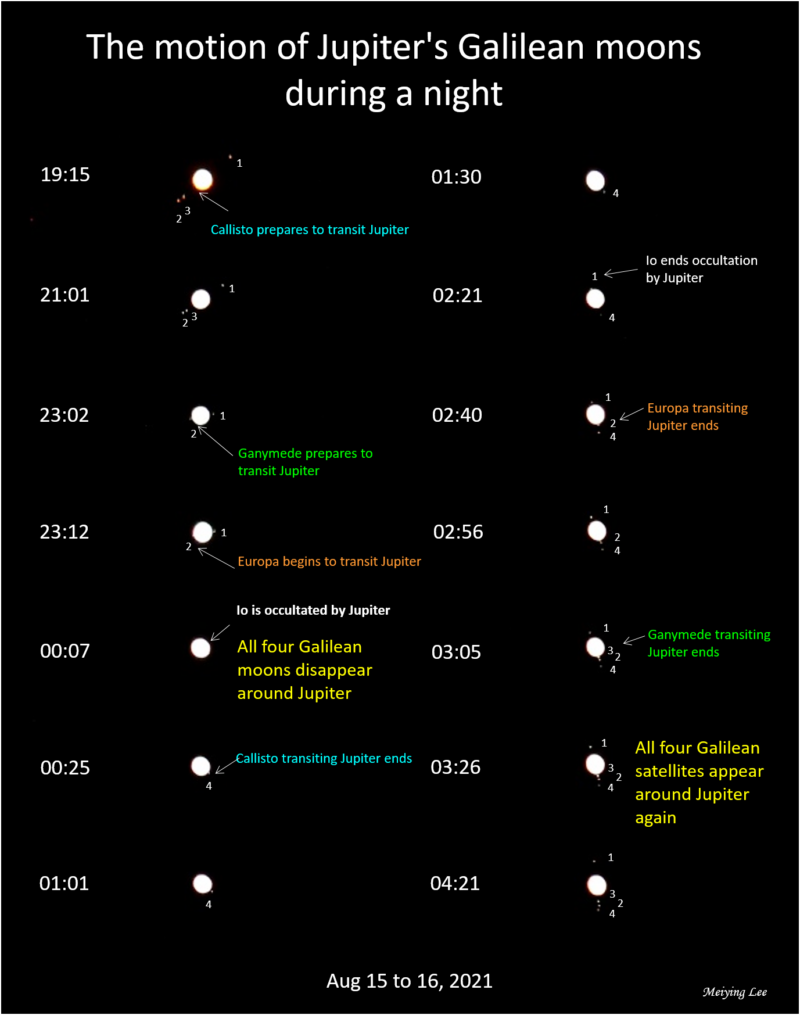
Jupiter as a big white dot with smaller dots around, and different timings.
View at EarthSky Community Photos. | Meiying Lee in Taipei, Taiwan, shared this chart with us on October 6, 2023, and wrote: “From the evening of August 15 to the early morning of August 16, 2021, the Galilean satellites experienced very exciting changes. Callisto, Ganymede, and Europa passed through the surface of Jupiter one after another, while Io was occulted by Jupiter. This resulted in the rare phenomenon that there was no Galilean satellites around Jupiter for 20 minutes late at night on August 16th. Finally, before dawn, the 4 satellites appeared around Jupiter one after another. I watched the Galilean satellites show all night, it was really exciting!” Thank you, Meiying.
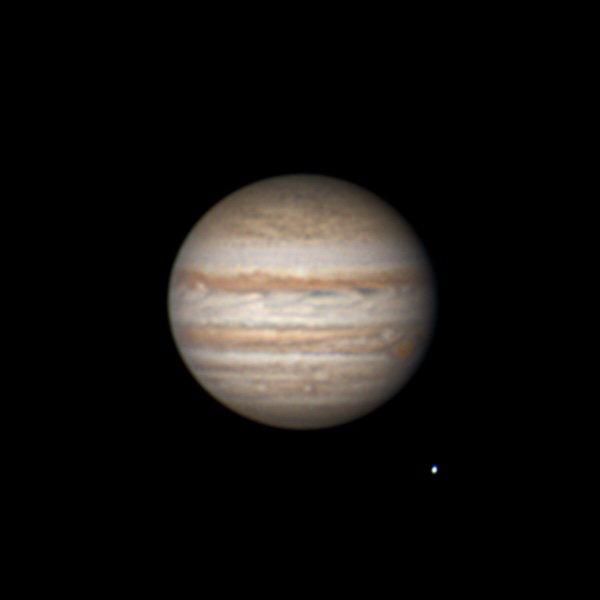
View at EarthSky Community Photos. | Aurelian Neacsu of Visina, Dambovita, Romania, captured this image of Jupiter on August 22, 2023, and wrote: “The bright dot visible on the right bottom corner is not a planet’s satellite; it’s the star Sigma Arietis.” Thank you, Aurelian.

Bottom line: Jupiter will reach opposition on November 2-3, 2023, when Earth will fly between the sun and Jupiter. It’ll be closest to Earth on November 1-2, 2023.

Read more: Jupiter: Closest to the sun November 1, 2023

The post Jupiter racing toward opposition on November 2-3, 2023 first appeared on EarthSky.


from EarthSky https://ift.tt/GLhPiUI
Jupiter with colorful, swirly banded atmosphere and oval storms, with text annotations.
Jupiter and its stormy atmosphere as seen by the Hubble Space Telescope on September 4, 2021. Image via Amy Simon (NASA-GSFC)/ Michael H. Wong (UC Berkeley)/ Hubblesite.

Earth will fly between the sun and Jupiter – bringing Jupiter to its yearly opposition – on November 2-3, 2023. That’s one day after Jupiter reaches perigee – its closest point – to Earth.

Jupiter in 2023: Maybe you’ve noticed Jupiter. It’s been the very bright object ascending in the east earlier each evening. Brighter than all the stars!
It reaches opposition on November 2-3 at 5 UTC (12 a.m. CDT) bringing Jupiter opposite the sun in our sky. It happens as Earth flies between the sun and Jupiter.
Jupiter is closest to Earth not on the day of opposition, but one day earlier, overnight (by American clocks) on November 1-2. At that time, its distance will be 3.982 astronomical units (Earth-sun units, aka AU)/ 370 million miles/ 595 million km/ 33.11 light-minutes from Earth.
Opposition constellation: Aries the Ram.
Brightness at opposition: Magnitude -2.9. Jupiter will shine as the 4th-brightest object in the sky, after the sun, the moon and the planet Venus. It’ll be the brightest starlike object visible for most of the night (until Venus rises before dawn).
Size at opposition (as seen through a telescope): 49.45 arcseconds across.
Through binoculars (anytime): Jupiter reveals a bright disk. If you look closely, you’ll see several of its four Galilean moons appearing as pinpoints of light, arrayed in a line that bisects the giant planet.

Green ecliptic line, dots for Jupiter, Pleiades and Aries near the line.
On November evenings, look for Jupiter above the eastern horizon after sunset. It lies in the dim constellation Aries the Ram. Jupiter – the 2nd brightest of all planets – reaches opposition at 5 UTC on November 3, 2023. At opposition, Jupiter is 33 light-minutes (3.992 AU) distant from Earth. The beautiful star cluster Pleiades is near the giant planet. Chart via John Jardine Goss / EarthSky.

For precise sun and Jupiter rising times at your location:

Old Farmer’s Almanac (U.S. and Canada)

timeanddate.com (worldwide).

Stellarium (online planetarium program)

In-the-sky information and finder chart for your location

Diagram showing Earth between an outer planet and the sun.
Opposition happens when Earth flies between an outer planet, like Jupiter, and the sun. Illustration via Chris Peat/ Heavens-Above.

How often does Jupiter reach opposition?

Jupiter takes 12 earthly years to orbit the sun once. So Jupiter comes to opposition roughly every 13 months. That’s how long Earth takes to travel once around the sun relative to Jupiter. So – according to our earthly calendars – Jupiter’s opposition comes about a month later each year. Add to that the fact that there are 12 constellations of the zodiac. And there are 12 months in a year. So Jupiter is in a new zodiacal constellation at each year’s opposition (last year, Pisces; this year, Aries).

2023 Jupiter opposition – November 3
2024 Jupiter opposition – December 7
2026 Jupiter opposition – January 10
2027 Jupiter opposition – February 10

Jupiter events in 2023

January 20, 2023: Jupiter’s perihelion or closest point to the sun.
April 11, 2023: Jupiter at solar conjunction, or behind the sun as seen from Earth.
September 4, 2023: Jupiter begins retrograde motion, or westward motion on the sky’s dome, a sign that opposition is coming.
November 1, 2023: Jupiter at perigee, or closest to Earth for 2023.
November 3, 2023: Jupiter at opposition, or opposite the sun as seen from Earth.
December 30, 2023: Jupiter ends retrograde motion, a sign that the best time of year to observe Jupiter is ending. But the planet will remain somewhere in our night sky for many more months, and in fact is visible somewhere in our night sky for most of every year.

Two photos of Jupiter side by side with one of them considerably larger, with labels.
A comparison of the apparent size of Jupiter at opposition (November 1-2, 2023) and when it is most distant from the Earth at solar conjunction (May 18, 2024). Image via Dominic Ford’s In-the-Sky.org. Used with permission.

View from above the solar system, November 2023

Circle with sun at center, planets around, and zodiac names on outer edge.
View larger. | Heliocentric view of solar system, November 2023. Chart via Guy Ottewell. Used with permission.

A failed star

Perhaps you know that Jupiter isn’t a rocky planet like Earth. It’s more like a failed star, not massive enough or hot enough inside to spark thermonuclear fusion reactions, but some 2 1/2 times more massive than all the other planets in our solar system combined. Jupiter is big! But without that thermonuclear reaction it can’t shine as stars do.

You’d need some 80 Jupiters – rolled into a ball – to be hot enough inside to spark fusion. So Jupiter isn’t a star. That is, it doesn’t shine with its own light, but instead by reflected sunlight.

Yet in late October and early November 2023 – as bright Jupiter rises in the east more or less opposite the sunset – you can stand on Earth all night and peer toward bright Jupiter in our sky. And you can imagine that, if the giant planet did have enough mass to shine as stars do, then around Jupiter’s opposition, we’d have no night at all. Instead, Jupiter would shine as a 2nd sun, all night long.

Read more: How to see Jupiter’s moons

Animation showing Earth moving around and around the sun faster than Jupiter.
In fact, Jupiter (red) completes one orbit of the sun (center) for every 11.86 orbits of the Earth (blue), since our orbit is smaller, and we move faster! Animation via Wikimedia Commons (CC BY-SA 3.0).

EarthSky Community Photos

3 images with a big dot in the middle, for Jupiter, and 4 small dots in line, for its moons in different positions.
View at EarthSky Community Photos. | Meiying Lee in Taipei, Taiwan, took these images of Jupiter’s 4 largest moons over the course of a single night. She wrote: “I always thought that to see obvious changes in the 4 major satellites of Jupiter would take several nights of continuous observation. Later, I discovered that the Galilean satellites move very fast around Jupiter.” See the volcanic moon Io move behind Jupiter and emerge on the other side just a few hours later? Amazing! Thanks, Meiying.
Jupiter as a big white dot with smaller dots around, and different timings.
View at EarthSky Community Photos. | Meiying Lee in Taipei, Taiwan, shared this chart with us on October 6, 2023, and wrote: “From the evening of August 15 to the early morning of August 16, 2021, the Galilean satellites experienced very exciting changes. Callisto, Ganymede, and Europa passed through the surface of Jupiter one after another, while Io was occulted by Jupiter. This resulted in the rare phenomenon that there was no Galilean satellites around Jupiter for 20 minutes late at night on August 16th. Finally, before dawn, the 4 satellites appeared around Jupiter one after another. I watched the Galilean satellites show all night, it was really exciting!” Thank you, Meiying.
View at EarthSky Community Photos. | Aurelian Neacsu of Visina, Dambovita, Romania, captured this image of Jupiter on August 22, 2023, and wrote: “The bright dot visible on the right bottom corner is not a planet’s satellite; it’s the star Sigma Arietis.” Thank you, Aurelian.

Bottom line: Jupiter will reach opposition on November 2-3, 2023, when Earth will fly between the sun and Jupiter. It’ll be closest to Earth on November 1-2, 2023.

Read more: Jupiter: Closest to the sun November 1, 2023

The post Jupiter racing toward opposition on November 2-3, 2023 first appeared on EarthSky.


from EarthSky https://ift.tt/GLhPiUI

Autumn Meteor showers are here: Top 10 tips for watching

When is the next meteor shower? Click here for EarthSky’s meteor shower guide

It’s autumn meteor time! There are several meteor showers starting in October and before the December solstice. How can you optimize your chances for seeing the most meteors? Follow the tips below. See EarthSky’s meteor guide for upcoming meteor showers.

Long green line of a meteor above a beach, with constellation Orion bright star Sirius below it.
View at EarthSky Community Photos. | Daniel Friedman captured this beautiful shot from Montauk, New York, on December 13, 2020. Note how bright Sirius is on the left, and how its color contrasts with the star Betelgeuse in the top left corner. Daniel wrote: “Out on the beach late with no one around for miles. Never captured a bolt like this and have been chasing meteor showers for years and years.” Thank you, Daniel!

1. Know the peak time

Meteor showers generally happen over many days as Earth encounters a wide stream of icy particles in space. These particles are debris left behind by a comet. The peak is a point in time when Earth is expected to encounter the greatest number of comet particles. To find the peak dates of meteor showers, try EarthSky’s meteor guide.

And here’s the catch … the peak of the shower comes at the same time for all of us on Earth. Meanwhile, our clocks are saying different times. You’ll often need to adjust from UTC to your local time.

The predictions are not always right on the money, by the way. And remember … it’s possible to see nice meteor displays in the hours – even days – before or after the predicted peak.

Just remember, meteor showers are part of nature. They often defy prediction.

2. Location, location, location

We can’t say this strongly enough. You need a dark place to observe in the country. Visit EarthSky’s Best Places to Stargaze.

And … you need a wide-open view of the sky. A farmer’s field? A stretch of country road? A campsite with a clear view in one or more directions? An open sky will increase your chances of seeing some meteors.

3. Oh no! The moon is out

In meteor showers, a bright moon is not your friend. Nothing dampens the display of a meteor shower more effectively than a bright moon.

If the moon is out, look at areas of the sky away from the moon. Anything in the moon’s vicinity – including meteors – will likely be washed out by its bright light. Another tip for watching in moonlight: place some object between yourself and the moon. Observing from the shadow of a barn, or vehicle, even a tree, can help you see more meteors.

4. Know the expected rate

Here we touch on a topic that sometimes leads to some disappointment, especially among novice meteor-watchers: the rate.

Tables of meteor showers almost always list what is known as the zenithal hourly rate (ZHR) for each shower.

The ZHR is the number of meteors you’ll see if you’re watching in a very dark sky, with the radiant overhead, when the shower is at its peak. In other words, the ZHR represents the number of meteors you might see per hour given the very best observing conditions during the shower’s maximum.

If the peak occurs when it’s still daylight at your location, if most of the meteors are predominantly faint, if a bright moon is out, or if you’re located in a light-polluted area, the total number of meteors you see will be considerably reduced.

5. Don’t worry too much about radiant points

You don’t need to stare all night in a single direction – or even locate the radiant point – to have fun watching the shower. The meteors will appear all over the sky.

But … although you can see meteors shoot up from the horizon before a shower’s radiant rises, you’ll see more meteors after it rises. And you’ll see the most when the radiant is highest in the sky. So find out the radiant point’s rising time. It can help you pinpoint the best time of night to watch the shower.

And … the radiant point is interesting. If you track meteors backward on the sky’s dome, you’ll find them streaming from their radiant point, a single point within a given constellation. Hence the meteor shower’s name.

6. Watch for an hour or more

Meteor showers will be better if you let your eyes adapt to the dark. That can take as long as 20 minutes. Plus, the meteors tend to come in spurts, followed by lulls. Be patient! You’ll see some.

7. Notice the meteors’ speeds and colors

The Leonid meteors seem to zip across the sky, while the Taurids are slow enough everyone can see them when someone yells “Meteor!” Also, some meteor showers, such as the Perseids, can be colorful. Another beloved shower, the Geminids, tend to be bright and white.

8. Watch for meteor trains

A meteor train is a persistent glow in the air left by some meteors after they have faded from view. Trains are from luminous ionized matter left in the wake of this incoming space debris.

9. Bring a blanket, a buddy, a hot drink and a lawn chair

A reclining lawn chair helps you lie back in comfort for an hour or more of meteor-watching.

If several of you are watching, take different parts of the sky. If you see one, shout “Meteor!” Dress warmly; the nights can be cool or cold, even during the spring and summer months. You’ll probably appreciate that blanket and warm drink in the wee hours of the morning. Also, leave your laptops and tablets home; even using the nighttime dark mode will ruin your night vision. And this will be tough on some people: leave your cell phone in your pocket or the car. It can also ruin your night vision.

10. Enjoy nature

Relax and enjoy the night sky. Not every meteor shower is a winner. Sometimes, you may come away from a shower seeing only one meteor. But if that one meteor is bright, and takes a slow path across a starry night sky … it’ll be worth it.

To be successful at observing any meteor shower, you need to get into a kind of zen state, waiting and expecting the meteors to come to you, if you place yourself in a good position (country location, wide open sky) to see them.

Or forget the zen state, and let yourself be guided by this old meteor watcher’s motto:

You might see a lot or you might not see many, but if you stay in the house, you won’t see any.

Photos of meteors from EarthSky’s community

Water with light on the incoming waves plus the Milky Way and other lights behind.
View at EarthSky Community Photos. | Amr Abdulwahab in Fayoum Oasis, Egypt, captured this image on August 13, 2023. Amr wrote: “On August 13th, I was shooting a time-lapse of the presides meteor shower from the shore of Lake Rayan in Fayoum Oasis in the Western Desert of Egypt, when I saw lights twinkling on the shore of the lake. At that time, I did not know what these lights were, but when I asked one of the fishermen in the lake, he told me that they were jellyfish. And as soon as I returned to the city and shared the pictures, my colleagues told me that it was the phenomenon of bioluminescence of a type of bacteria.” Thank you, Amr!
Hooded person going into igloo-like building with Milky Way in background.
View at EarthSky Community Photos. | Makrem Larnaout in Tunisia captured this image on August 12, 2023. Makrem wrote: “Seizing an incredible opportunity to breathe life into an iconic Star Wars moment, captured through my lens. Luke, poised to cross the threshold of his home, with the breathtaking Milky Way rising majestically in the backdrop. A dazzling Perseid meteor streaks through the sky, guided by a cosmic destiny. This captured instant unveils the magic of Tunisia, the backdrop that served the Star Wars universe. The Lars homestead, rooted in Tatooine’s sands, stood as the Lars family’s haven for 3 generations. A tribute to this cinematic legacy that continues to inspire us. The adventure persists between fiction and reality.” Thank you, Makrem!
Black sky with a few scattered stars and bright streak crossing it.
View at EarthSky Community Photos. | V.Liard Photography in Epernay, France, wrote: “Hi EarthSky, on the occasion of the night of the stars 2023 I was able to photograph this magnificent Perseid fireball above the city of Epernay … It’s my first … Celebrating! :-)” Thank you and congratulations, dear Vegastar!

Post your own photos at EarthSky Community Photos

Bottom line: Meteor showers are unpredictable but always a fun and relaxing time. Maximize your viewing time with these tips.

The post Autumn Meteor showers are here: Top 10 tips for watching first appeared on EarthSky.


from EarthSky https://ift.tt/9YSwqzu

When is the next meteor shower? Click here for EarthSky’s meteor shower guide

It’s autumn meteor time! There are several meteor showers starting in October and before the December solstice. How can you optimize your chances for seeing the most meteors? Follow the tips below. See EarthSky’s meteor guide for upcoming meteor showers.

Long green line of a meteor above a beach, with constellation Orion bright star Sirius below it.
View at EarthSky Community Photos. | Daniel Friedman captured this beautiful shot from Montauk, New York, on December 13, 2020. Note how bright Sirius is on the left, and how its color contrasts with the star Betelgeuse in the top left corner. Daniel wrote: “Out on the beach late with no one around for miles. Never captured a bolt like this and have been chasing meteor showers for years and years.” Thank you, Daniel!

1. Know the peak time

Meteor showers generally happen over many days as Earth encounters a wide stream of icy particles in space. These particles are debris left behind by a comet. The peak is a point in time when Earth is expected to encounter the greatest number of comet particles. To find the peak dates of meteor showers, try EarthSky’s meteor guide.

And here’s the catch … the peak of the shower comes at the same time for all of us on Earth. Meanwhile, our clocks are saying different times. You’ll often need to adjust from UTC to your local time.

The predictions are not always right on the money, by the way. And remember … it’s possible to see nice meteor displays in the hours – even days – before or after the predicted peak.

Just remember, meteor showers are part of nature. They often defy prediction.

2. Location, location, location

We can’t say this strongly enough. You need a dark place to observe in the country. Visit EarthSky’s Best Places to Stargaze.

And … you need a wide-open view of the sky. A farmer’s field? A stretch of country road? A campsite with a clear view in one or more directions? An open sky will increase your chances of seeing some meteors.

3. Oh no! The moon is out

In meteor showers, a bright moon is not your friend. Nothing dampens the display of a meteor shower more effectively than a bright moon.

If the moon is out, look at areas of the sky away from the moon. Anything in the moon’s vicinity – including meteors – will likely be washed out by its bright light. Another tip for watching in moonlight: place some object between yourself and the moon. Observing from the shadow of a barn, or vehicle, even a tree, can help you see more meteors.

4. Know the expected rate

Here we touch on a topic that sometimes leads to some disappointment, especially among novice meteor-watchers: the rate.

Tables of meteor showers almost always list what is known as the zenithal hourly rate (ZHR) for each shower.

The ZHR is the number of meteors you’ll see if you’re watching in a very dark sky, with the radiant overhead, when the shower is at its peak. In other words, the ZHR represents the number of meteors you might see per hour given the very best observing conditions during the shower’s maximum.

If the peak occurs when it’s still daylight at your location, if most of the meteors are predominantly faint, if a bright moon is out, or if you’re located in a light-polluted area, the total number of meteors you see will be considerably reduced.

5. Don’t worry too much about radiant points

You don’t need to stare all night in a single direction – or even locate the radiant point – to have fun watching the shower. The meteors will appear all over the sky.

But … although you can see meteors shoot up from the horizon before a shower’s radiant rises, you’ll see more meteors after it rises. And you’ll see the most when the radiant is highest in the sky. So find out the radiant point’s rising time. It can help you pinpoint the best time of night to watch the shower.

And … the radiant point is interesting. If you track meteors backward on the sky’s dome, you’ll find them streaming from their radiant point, a single point within a given constellation. Hence the meteor shower’s name.

6. Watch for an hour or more

Meteor showers will be better if you let your eyes adapt to the dark. That can take as long as 20 minutes. Plus, the meteors tend to come in spurts, followed by lulls. Be patient! You’ll see some.

7. Notice the meteors’ speeds and colors

The Leonid meteors seem to zip across the sky, while the Taurids are slow enough everyone can see them when someone yells “Meteor!” Also, some meteor showers, such as the Perseids, can be colorful. Another beloved shower, the Geminids, tend to be bright and white.

8. Watch for meteor trains

A meteor train is a persistent glow in the air left by some meteors after they have faded from view. Trains are from luminous ionized matter left in the wake of this incoming space debris.

9. Bring a blanket, a buddy, a hot drink and a lawn chair

A reclining lawn chair helps you lie back in comfort for an hour or more of meteor-watching.

If several of you are watching, take different parts of the sky. If you see one, shout “Meteor!” Dress warmly; the nights can be cool or cold, even during the spring and summer months. You’ll probably appreciate that blanket and warm drink in the wee hours of the morning. Also, leave your laptops and tablets home; even using the nighttime dark mode will ruin your night vision. And this will be tough on some people: leave your cell phone in your pocket or the car. It can also ruin your night vision.

10. Enjoy nature

Relax and enjoy the night sky. Not every meteor shower is a winner. Sometimes, you may come away from a shower seeing only one meteor. But if that one meteor is bright, and takes a slow path across a starry night sky … it’ll be worth it.

To be successful at observing any meteor shower, you need to get into a kind of zen state, waiting and expecting the meteors to come to you, if you place yourself in a good position (country location, wide open sky) to see them.

Or forget the zen state, and let yourself be guided by this old meteor watcher’s motto:

You might see a lot or you might not see many, but if you stay in the house, you won’t see any.

Photos of meteors from EarthSky’s community

Water with light on the incoming waves plus the Milky Way and other lights behind.
View at EarthSky Community Photos. | Amr Abdulwahab in Fayoum Oasis, Egypt, captured this image on August 13, 2023. Amr wrote: “On August 13th, I was shooting a time-lapse of the presides meteor shower from the shore of Lake Rayan in Fayoum Oasis in the Western Desert of Egypt, when I saw lights twinkling on the shore of the lake. At that time, I did not know what these lights were, but when I asked one of the fishermen in the lake, he told me that they were jellyfish. And as soon as I returned to the city and shared the pictures, my colleagues told me that it was the phenomenon of bioluminescence of a type of bacteria.” Thank you, Amr!
Hooded person going into igloo-like building with Milky Way in background.
View at EarthSky Community Photos. | Makrem Larnaout in Tunisia captured this image on August 12, 2023. Makrem wrote: “Seizing an incredible opportunity to breathe life into an iconic Star Wars moment, captured through my lens. Luke, poised to cross the threshold of his home, with the breathtaking Milky Way rising majestically in the backdrop. A dazzling Perseid meteor streaks through the sky, guided by a cosmic destiny. This captured instant unveils the magic of Tunisia, the backdrop that served the Star Wars universe. The Lars homestead, rooted in Tatooine’s sands, stood as the Lars family’s haven for 3 generations. A tribute to this cinematic legacy that continues to inspire us. The adventure persists between fiction and reality.” Thank you, Makrem!
Black sky with a few scattered stars and bright streak crossing it.
View at EarthSky Community Photos. | V.Liard Photography in Epernay, France, wrote: “Hi EarthSky, on the occasion of the night of the stars 2023 I was able to photograph this magnificent Perseid fireball above the city of Epernay … It’s my first … Celebrating! :-)” Thank you and congratulations, dear Vegastar!

Post your own photos at EarthSky Community Photos

Bottom line: Meteor showers are unpredictable but always a fun and relaxing time. Maximize your viewing time with these tips.

The post Autumn Meteor showers are here: Top 10 tips for watching first appeared on EarthSky.


from EarthSky https://ift.tt/9YSwqzu

adds 2