aads

How to photograph a solar eclipse, with Alan Dyer


Watch this video with Alan Dyer to learn how to photograph a solar eclipse.

Astronomy author and photographer Alan Dyer spoke to the Hamilton Amateur Astronomers group about how to photograph (and still enjoy!) the 2024 total solar eclipse. These tips can also apply to the upcoming annular solar eclipse that will be crossing the Americas on October 14, 2023. So, if you also want to try your hand at photography, you can watch Alan Dyer’s advice in the video above. Or read on for a summary of his tips.

How to photograph a solar eclipse

Total solar eclipses go by pretty quickly. In 2017, I was in Wyoming and was treated to the fastest two minutes and 19 seconds of my life as the moon blotted out the sun. So first you have to decide if it’s really worth your effort and the stress of photographing the eclipse. For me, personally, I only plan to hold my phone up a couple times during the 2024 totality and snap a couple amateurish shots. I know that I won’t be able to get anything as beautiful as astrophotographers can do. And that’s what Alan Dyer recommends in his first of five possible levels for photographing the eclipse: the easiest method is taking a photo with your phone.

Here are his five options for photographing the eclipse, in increasing order of difficulty:

  1. Phone camera
  2. Wide-angle time-lapse
  3. Telephoto videos
  4. Telephoto stills
  5. Telescope on tracking mount
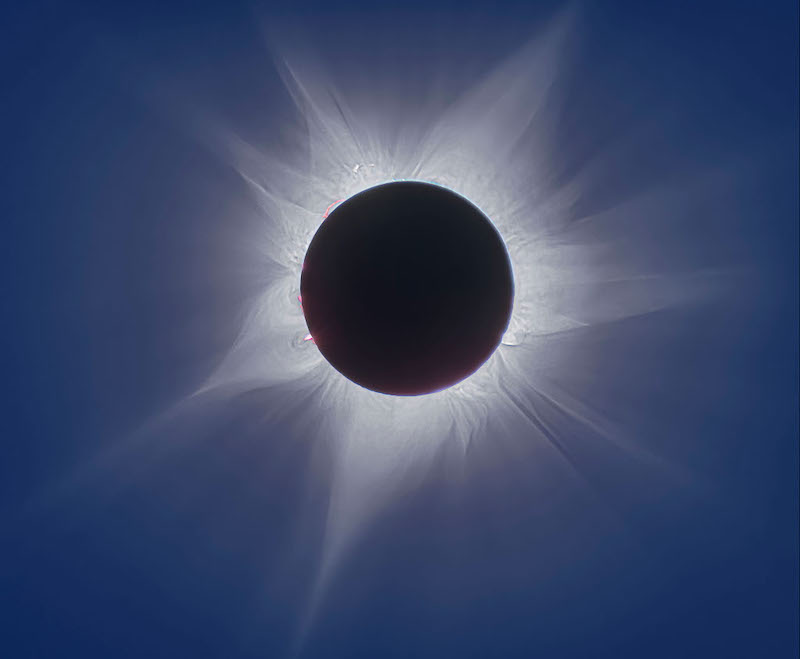
Photograph a solar eclipse: Black circle over the sun with bright white streamers showing corona and some pink promeninces along the limb.
Fred Espenak captured this image of the hybrid solar eclipse on April 20, 2023, from a ship in the Indian Ocean. The image is a composite of 11 images shot with different shutter speeds to record the vivid detail of the corona. This photo was the Astronomy Picture of the Day for April 29, 2023. Image via APOD/ Fred Espenak. Used with permission.

1. A phone camera photograph of a solar eclipse

Alan says that you can set your camera on a wide-angle lens view in order to capture the ground and the sun at the same time. Or you could zoom in to capture a closeup of the sun during totality. But he says the best shot with your phone’s camera will be to mount it on some type of tripod and then set it to take a time-lapse. Or, perhaps better yet, is take a 4K movie that will capture your expressions of awe and wonder as the eclipse progresses. In this case, he recommends starting a minute or two before totality, so you don’t have to fuss with it and can just enjoy the event.

2. Wide-angle time-lapse

Set your camera up on a tripod and set it on auto exposure. Manually focus the lens on infinity. Then start the camera before totality and let it do all the work! The camera will take hundreds of images while you enjoy the view live.

Depending on what size lens you use, you may be able to include the landscape in your photo. This will be more challenging in areas where the sun will be higher in the sky. You may want to use planetarium software with field-of-view indicators to set up the framing and composition of your images. You’ll want to do the planning and framing in advance, so you’re not under a time crunch when the moment of eclipse arrives.

Some of the more technical aspects that Alan includes are: set the exposure with wide area sampling (not spot metering), set exposure compensation to -1 EV, and use an intervalometer with 1-second interval.

Using the same camera, you could also shoot 4K video, and this time you’ll capture the audio as well.

And don’t forget to turn off your camera when totality ends!

3. Telephoto videos

To take a telephoto video through your camera, Alan recommends using a 300mm to 500mm lens on a fixed tripod. For the partial phases, you’ll want an approved solar filter. Set up and practice taking images of the sun before the day of the eclipse.

Alan sets up his camera with the filter on, and rechecks the focus a couple minutes before totality. Then, about a minute before totality, he takes the filter off when he is no longer looking through the lens. Of course, as always, keep in mind that looking through a camera at the sun can result in blindness. So don’t do that! And remember to replace the filter after totality.

As with the previous methods, he says that you can use autofocus for easy and clear results. And just let the sun drift through the frame. Some of the other technical specifications he recommends are to leave the lens aperture wide open and have a low ISO. Make sure you have a solid tripod and head.

4. Telephoto stills

If you want close-up still images of the eclipse, you’ll want to use a telephoto lens on a camera with a tripod, or else a small telescope. The exposure length can vary widely depending on what you want to capture. A one-second exposure can capture more of the wisps of the corona and earthshine on the dark side of the moon. While a 1/1000 exposure will give you a better look at the diamond ring.

Alan says to shoot the largest RAW image you can and to use your DSLR camera on live view. With a mirror-less camera, Alan recommends using the electrical 1st-curtain shutter.

Auto-exposure bracketing will let you click the shutter once and have it take a range of exposures for you. You can set this up as a custom shooting mode so that you can click in and out of it easily.

5. Telescope on a tracking mount to photograph a solar eclipse

The most difficult option is to use your telescope on a tracking mount to photograph the eclipse. Hopefully you already have experience with your telescope and mount and have practiced photographing with your setup. But if you want to have a really close-up view of the eclipse, you’ll need to have it tracking the sun and moon so that there’s no blurring in your images.

Alan suggests using the crescent moon as practice for the eclipse. Here are some questions to ask yourself while practicing taking images with the moon:

  • Does everything connect securely?
  • Can you focus accurately?
  • When you handle the camera, does it blur your image?
  • How long of an exposure can you take?

And if it’s cloudy on eclipse day … go ahead and shoot long exposures anyway, especially during the partial or diamond ring phases. Who knows what your camera might capture? As long as you have the tracking set up, your camera knows where the eclipse is even through the clouds.

If you want even more tips from Alan, watch the full video above!

Bottom line: Get tips on how to photograph a solar eclipse with author and astrophotographer Alan Dyer. Use these tips for the October 14, 2023, annular eclipse and the April 8, 2024, total solar eclipse.

Via Alan Dyer on Hamilton Amateur Astronomers’ YouTube

The post How to photograph a solar eclipse, with Alan Dyer first appeared on EarthSky.


from EarthSky https://ift.tt/Y2BPrCd


Watch this video with Alan Dyer to learn how to photograph a solar eclipse.

Astronomy author and photographer Alan Dyer spoke to the Hamilton Amateur Astronomers group about how to photograph (and still enjoy!) the 2024 total solar eclipse. These tips can also apply to the upcoming annular solar eclipse that will be crossing the Americas on October 14, 2023. So, if you also want to try your hand at photography, you can watch Alan Dyer’s advice in the video above. Or read on for a summary of his tips.

How to photograph a solar eclipse

Total solar eclipses go by pretty quickly. In 2017, I was in Wyoming and was treated to the fastest two minutes and 19 seconds of my life as the moon blotted out the sun. So first you have to decide if it’s really worth your effort and the stress of photographing the eclipse. For me, personally, I only plan to hold my phone up a couple times during the 2024 totality and snap a couple amateurish shots. I know that I won’t be able to get anything as beautiful as astrophotographers can do. And that’s what Alan Dyer recommends in his first of five possible levels for photographing the eclipse: the easiest method is taking a photo with your phone.

Here are his five options for photographing the eclipse, in increasing order of difficulty:

  1. Phone camera
  2. Wide-angle time-lapse
  3. Telephoto videos
  4. Telephoto stills
  5. Telescope on tracking mount
Photograph a solar eclipse: Black circle over the sun with bright white streamers showing corona and some pink promeninces along the limb.
Fred Espenak captured this image of the hybrid solar eclipse on April 20, 2023, from a ship in the Indian Ocean. The image is a composite of 11 images shot with different shutter speeds to record the vivid detail of the corona. This photo was the Astronomy Picture of the Day for April 29, 2023. Image via APOD/ Fred Espenak. Used with permission.

1. A phone camera photograph of a solar eclipse

Alan says that you can set your camera on a wide-angle lens view in order to capture the ground and the sun at the same time. Or you could zoom in to capture a closeup of the sun during totality. But he says the best shot with your phone’s camera will be to mount it on some type of tripod and then set it to take a time-lapse. Or, perhaps better yet, is take a 4K movie that will capture your expressions of awe and wonder as the eclipse progresses. In this case, he recommends starting a minute or two before totality, so you don’t have to fuss with it and can just enjoy the event.

2. Wide-angle time-lapse

Set your camera up on a tripod and set it on auto exposure. Manually focus the lens on infinity. Then start the camera before totality and let it do all the work! The camera will take hundreds of images while you enjoy the view live.

Depending on what size lens you use, you may be able to include the landscape in your photo. This will be more challenging in areas where the sun will be higher in the sky. You may want to use planetarium software with field-of-view indicators to set up the framing and composition of your images. You’ll want to do the planning and framing in advance, so you’re not under a time crunch when the moment of eclipse arrives.

Some of the more technical aspects that Alan includes are: set the exposure with wide area sampling (not spot metering), set exposure compensation to -1 EV, and use an intervalometer with 1-second interval.

Using the same camera, you could also shoot 4K video, and this time you’ll capture the audio as well.

And don’t forget to turn off your camera when totality ends!

3. Telephoto videos

To take a telephoto video through your camera, Alan recommends using a 300mm to 500mm lens on a fixed tripod. For the partial phases, you’ll want an approved solar filter. Set up and practice taking images of the sun before the day of the eclipse.

Alan sets up his camera with the filter on, and rechecks the focus a couple minutes before totality. Then, about a minute before totality, he takes the filter off when he is no longer looking through the lens. Of course, as always, keep in mind that looking through a camera at the sun can result in blindness. So don’t do that! And remember to replace the filter after totality.

As with the previous methods, he says that you can use autofocus for easy and clear results. And just let the sun drift through the frame. Some of the other technical specifications he recommends are to leave the lens aperture wide open and have a low ISO. Make sure you have a solid tripod and head.

4. Telephoto stills

If you want close-up still images of the eclipse, you’ll want to use a telephoto lens on a camera with a tripod, or else a small telescope. The exposure length can vary widely depending on what you want to capture. A one-second exposure can capture more of the wisps of the corona and earthshine on the dark side of the moon. While a 1/1000 exposure will give you a better look at the diamond ring.

Alan says to shoot the largest RAW image you can and to use your DSLR camera on live view. With a mirror-less camera, Alan recommends using the electrical 1st-curtain shutter.

Auto-exposure bracketing will let you click the shutter once and have it take a range of exposures for you. You can set this up as a custom shooting mode so that you can click in and out of it easily.

5. Telescope on a tracking mount to photograph a solar eclipse

The most difficult option is to use your telescope on a tracking mount to photograph the eclipse. Hopefully you already have experience with your telescope and mount and have practiced photographing with your setup. But if you want to have a really close-up view of the eclipse, you’ll need to have it tracking the sun and moon so that there’s no blurring in your images.

Alan suggests using the crescent moon as practice for the eclipse. Here are some questions to ask yourself while practicing taking images with the moon:

  • Does everything connect securely?
  • Can you focus accurately?
  • When you handle the camera, does it blur your image?
  • How long of an exposure can you take?

And if it’s cloudy on eclipse day … go ahead and shoot long exposures anyway, especially during the partial or diamond ring phases. Who knows what your camera might capture? As long as you have the tracking set up, your camera knows where the eclipse is even through the clouds.

If you want even more tips from Alan, watch the full video above!

Bottom line: Get tips on how to photograph a solar eclipse with author and astrophotographer Alan Dyer. Use these tips for the October 14, 2023, annular eclipse and the April 8, 2024, total solar eclipse.

Via Alan Dyer on Hamilton Amateur Astronomers’ YouTube

The post How to photograph a solar eclipse, with Alan Dyer first appeared on EarthSky.


from EarthSky https://ift.tt/Y2BPrCd

Which bird migrates the farthest?

A white bird with a black head has long pointy wings spread in flight.
Which bird migrates the farthest? The Arctic tern wins that award. Image via Pexels/ Phil Mitchell.

Which bird migrates the farthest?

The Arctic tern, an elegant white seabird, migrates farther than any other bird. It travels from pole to pole. It breeds on the shores of the Arctic Ocean in the Northern Hemisphere’s summer. Then, it heads to the Southern Hemisphere to continue its life of endless summertime. In fact, this bird also sees more daylight than any other.

North American Arctic terns fly about 24,000 miles (40,000 km) each year. That’s a distance approximately equal to the circumference of the Earth (24,901 miles). An Arctic tern can live up to 30 years. So in its life-long quest for summer, it can fly 620,000 miles, or a million kilometers. As an illustration, that’s roughly three times the distance from Earth to the moon!

Other long-migrating birds

In addition, some other long-migrating birds include the short-tailed shearwater. By comparison, it travels 18,500 miles (30,000 km) from southern Australia to Russia and Alaska. Also, the red knot flies 9,000 miles (15,000 km) from New England to far southern South America.

Warm brown colored speckled bird with long beak, wading at a beach.
This red knot wades in the water. Image via Chuck Homler/ Focus on Wildlife/ Wikimedia Commons.

Likewise, the bar-tailed godwit holds the record for longest nonstop flight. It travels 6,800 miles (11,000 km) from Alaska to New Zealand without any layovers. That’s remarkable endurance for what amounts to a nine-day flight. The bar-tailed godwit is currently migrating south. Check out some tagged birds’ ongoing flight paths at Global Flyway Network.

White and grayish bird with long pointy beak and tall arcing wings flies over water.
The bar-tailed godwit flies over the Pacific Ocean in the longest known recorded nonstop flights. Image via Paul van de Velde/ Wikimedia Commons.

And then there’s the wandering albatross. As the name implies, it’s not migrating as much as it is wandering. It spends most of its life aloft, circling the world over the oceans of the Southern Hemisphere. The wandering albatross might fly 18,000 miles (30,000 km) between breedings.

White bird with gray/black wings stretched out over water.
The wandering albatross spends most of its life in flight. Image via JJ Harrison/ Wikimedia Commons.

So which bird migrates the least? North America’s blue grouse lives in mountainous forests in winter. Later, in the spring, it descends almost 1,000 feet (300 m) to woodlands.

Bottom line: The Arctic tern is the bird that migrates the farthest. In its lifetime it can fly as far as three times the distance from Earth to the moon.

The post Which bird migrates the farthest? first appeared on EarthSky.


from EarthSky https://ift.tt/rlBcbU6
A white bird with a black head has long pointy wings spread in flight.
Which bird migrates the farthest? The Arctic tern wins that award. Image via Pexels/ Phil Mitchell.

Which bird migrates the farthest?

The Arctic tern, an elegant white seabird, migrates farther than any other bird. It travels from pole to pole. It breeds on the shores of the Arctic Ocean in the Northern Hemisphere’s summer. Then, it heads to the Southern Hemisphere to continue its life of endless summertime. In fact, this bird also sees more daylight than any other.

North American Arctic terns fly about 24,000 miles (40,000 km) each year. That’s a distance approximately equal to the circumference of the Earth (24,901 miles). An Arctic tern can live up to 30 years. So in its life-long quest for summer, it can fly 620,000 miles, or a million kilometers. As an illustration, that’s roughly three times the distance from Earth to the moon!

Other long-migrating birds

In addition, some other long-migrating birds include the short-tailed shearwater. By comparison, it travels 18,500 miles (30,000 km) from southern Australia to Russia and Alaska. Also, the red knot flies 9,000 miles (15,000 km) from New England to far southern South America.

Warm brown colored speckled bird with long beak, wading at a beach.
This red knot wades in the water. Image via Chuck Homler/ Focus on Wildlife/ Wikimedia Commons.

Likewise, the bar-tailed godwit holds the record for longest nonstop flight. It travels 6,800 miles (11,000 km) from Alaska to New Zealand without any layovers. That’s remarkable endurance for what amounts to a nine-day flight. The bar-tailed godwit is currently migrating south. Check out some tagged birds’ ongoing flight paths at Global Flyway Network.

White and grayish bird with long pointy beak and tall arcing wings flies over water.
The bar-tailed godwit flies over the Pacific Ocean in the longest known recorded nonstop flights. Image via Paul van de Velde/ Wikimedia Commons.

And then there’s the wandering albatross. As the name implies, it’s not migrating as much as it is wandering. It spends most of its life aloft, circling the world over the oceans of the Southern Hemisphere. The wandering albatross might fly 18,000 miles (30,000 km) between breedings.

White bird with gray/black wings stretched out over water.
The wandering albatross spends most of its life in flight. Image via JJ Harrison/ Wikimedia Commons.

So which bird migrates the least? North America’s blue grouse lives in mountainous forests in winter. Later, in the spring, it descends almost 1,000 feet (300 m) to woodlands.

Bottom line: The Arctic tern is the bird that migrates the farthest. In its lifetime it can fly as far as three times the distance from Earth to the moon.

The post Which bird migrates the farthest? first appeared on EarthSky.


from EarthSky https://ift.tt/rlBcbU6

World Space Week is October 4 to 10. Find events here

World Space Week: Artist's concept of someone in a space suit holding a briefcase and a water bottle and floating above earth.
Artist’s concept showcasing World Space Week for 2023. This year’s theme is space and entrepreneurship. Image via WSW.

World Space Week dates back to 1999, when the UN General Assembly declared a week-long international celebration of science and technology every October 4 to 10. These dates were picked in honor of the October 4, 1957, launch of Sputnik 1 and the October 10, 1967, outer space treaty regarding exploration and peace. The theme of this year’s celebration is space and entrepreneurship.

The mission of World Space Week is:

… to strengthen the link between space and society through public education, participation and dialogue on the future of space activity.

According to the website, the goals of World Space Week are to:

  • Provide unique leverage in space outreach and education.
  • Educate people around the world about the benefits that they receive from space.
  • Encourage greater use of space for sustainable economic development.
  • Demonstrate public support for space programs.
  • Excite young people about science, technology, engineering, and math.
  • Foster international cooperation in space outreach and education.

World Space Week activities

Activities this year will center around the recognition of the growing significance of the commercial space industry. The World Space Week Association hopes to inspire students worldwide to study science, technology, engineering, and mathematics (STEM) and business. It also hopes space companies can take this opportunity to recruit workers needed for the expanding commercial space industry.

Anyone can create a World Space Week event. Here are some steps to follow.

Some of the unique events happening around the world include:

Find an event near you.

Bottom line: World Space Week runs every year from October 4 to 10. This year’s theme is space and entrepreneurship. Find events here.

The post World Space Week is October 4 to 10. Find events here first appeared on EarthSky.


from EarthSky https://ift.tt/SlEgoFk
World Space Week: Artist's concept of someone in a space suit holding a briefcase and a water bottle and floating above earth.
Artist’s concept showcasing World Space Week for 2023. This year’s theme is space and entrepreneurship. Image via WSW.

World Space Week dates back to 1999, when the UN General Assembly declared a week-long international celebration of science and technology every October 4 to 10. These dates were picked in honor of the October 4, 1957, launch of Sputnik 1 and the October 10, 1967, outer space treaty regarding exploration and peace. The theme of this year’s celebration is space and entrepreneurship.

The mission of World Space Week is:

… to strengthen the link between space and society through public education, participation and dialogue on the future of space activity.

According to the website, the goals of World Space Week are to:

  • Provide unique leverage in space outreach and education.
  • Educate people around the world about the benefits that they receive from space.
  • Encourage greater use of space for sustainable economic development.
  • Demonstrate public support for space programs.
  • Excite young people about science, technology, engineering, and math.
  • Foster international cooperation in space outreach and education.

World Space Week activities

Activities this year will center around the recognition of the growing significance of the commercial space industry. The World Space Week Association hopes to inspire students worldwide to study science, technology, engineering, and mathematics (STEM) and business. It also hopes space companies can take this opportunity to recruit workers needed for the expanding commercial space industry.

Anyone can create a World Space Week event. Here are some steps to follow.

Some of the unique events happening around the world include:

Find an event near you.

Bottom line: World Space Week runs every year from October 4 to 10. This year’s theme is space and entrepreneurship. Find events here.

The post World Space Week is October 4 to 10. Find events here first appeared on EarthSky.


from EarthSky https://ift.tt/SlEgoFk

Gamma Cephei, aka Errai, a future North Star

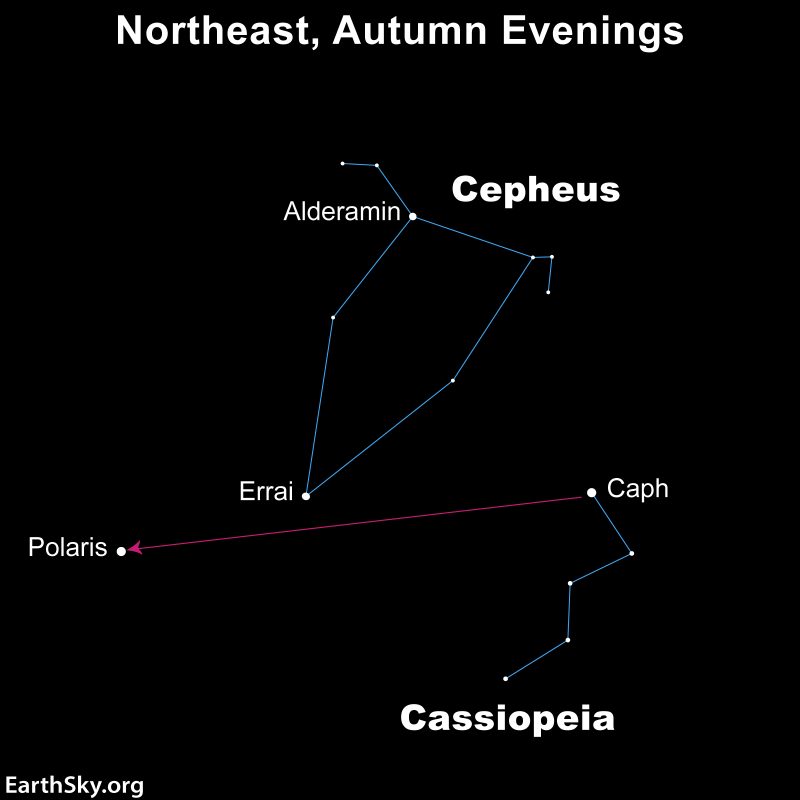
Chart showing Cepheus with its house shape and Gamma Cephei at peak, near constellation Cassiopeia.
Look for the constellation Cepheus the King in the northern sky. It resembles a child’s drawing of a house. The star Gamma Cephei, or Errai, marks the peak of the house’s roof. It can be found about 2/3 of the way along a line between the star Caph in Cassiopeia, and Polaris, the North Star.

Gamma Cephei, also called Errai, is a moderately bright 3rd-magnitude star in the northern constellation Cepheus the King. Cepheus looks like a child’s drawing of a house, with Gamma Cephei marking the peak of the roof. This fascinating star has played a major role in our understanding of exoplanets, especially in multiple star systems. And interestingly, by 4,000 CE, the slow wobble of Earth’s axis will have moved Gamma Cephei into position as our North Star.

How to find Gamma Cephei

For much of the Northern Hemisphere, orange-yellow Gamma Cephei shines as a circumpolar star. Circumpolar stars closely circle the North Star (or Pole Star), neither rising nor setting because they’re always above the horizon.

Cepheus the King is not a particularly prominent constellation, but you’ll know that you’ve found Cepheus when you see his more striking wife, Cassiopeia the Queen, standing at his side.

Do you know the W-shaped constellation Cassiopeia? It’s visible in northern autumn and early winter evenings from northerly latitudes. Imagine a line between the star Caph, at one end of the W, toward Polaris, our present-day North Star. Gamma Cephei is about 2/3 of the way along that line, and very slightly westward.

Another way to find Gamma Cephei is to use the familiar Big Dipper asterism on spring and summer evenings. The two outer stars in the Dipper’s bowl are Merak and Dubhe, sometimes called the Pointers, because a line between them extended northward points to Polaris. Then jump one fist-width – held at arm’s length – beyond Polaris and you’ll find Gamma Cephei.

A future North Star

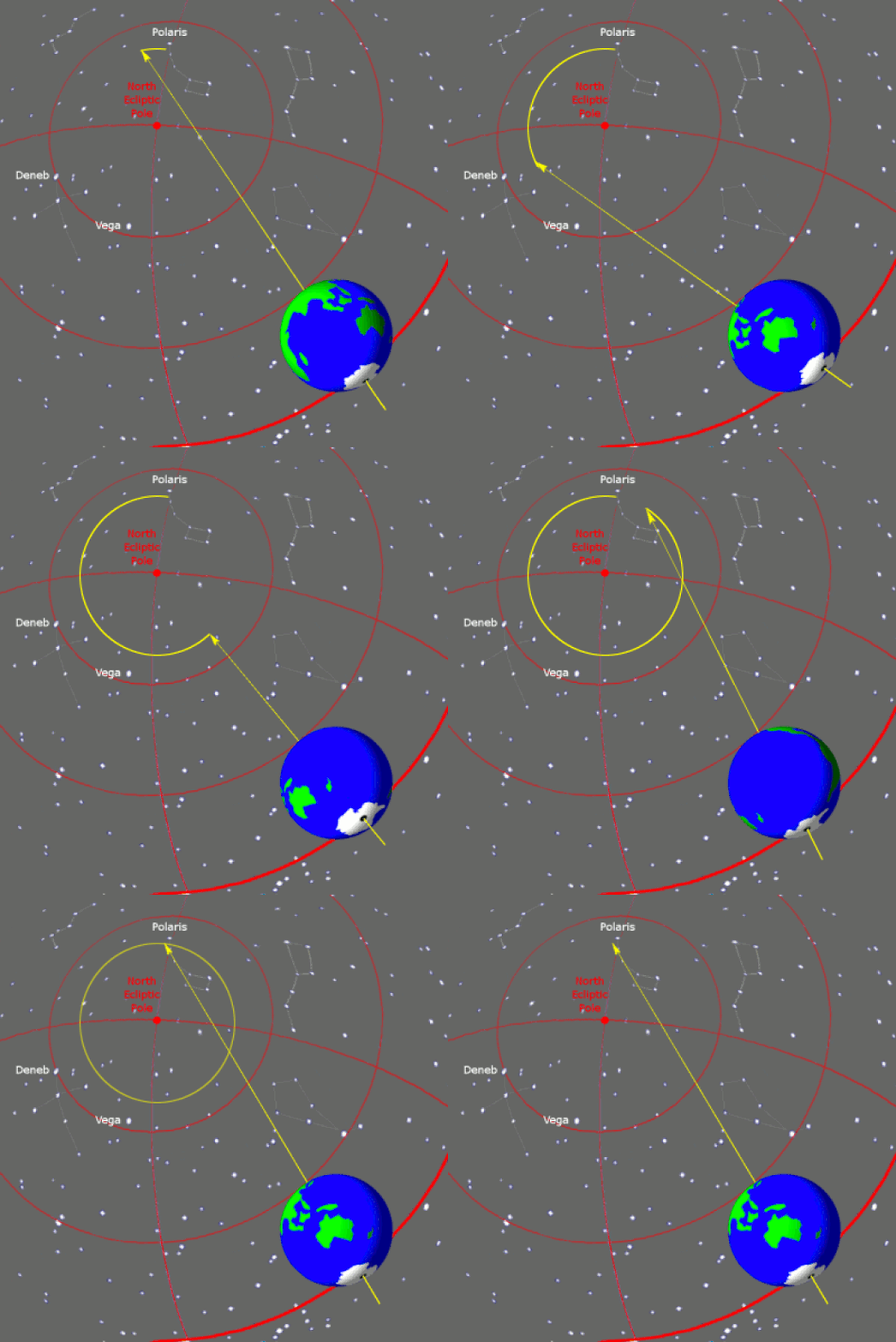
The Earth’s north rotation axis points to the north celestial pole, and this is very close to Polaris, our present North Star. However, this hasn’t always been the case. A wobbling motion of Earth known as axial precession changes the north celestial pole’s location with respect to the stars, tracing a circle in the sky approximately every 26,000 years.

A line from Earth's axis. Its far end moves around a circle on the stellar background.
The 26,000-year cycle of precession. It’s caused by a wobble of Earth. Over this cycle, Earth’s northern axis traces a circle on the celestial sphere. Image via Tfr000/ Wikimedia Commons.

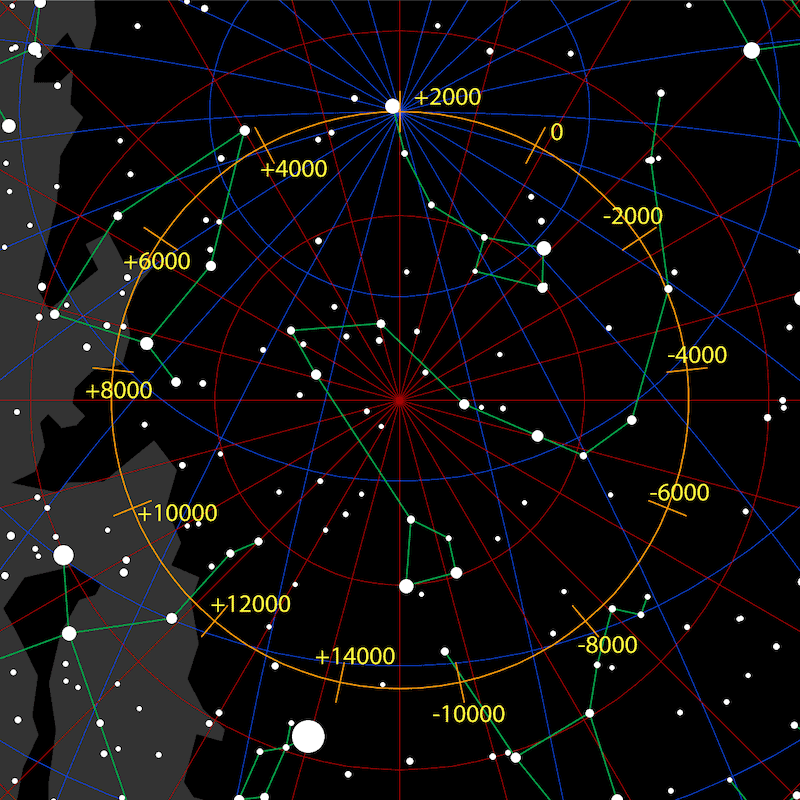
Polaris will continue to reign as the North Star for a couple more millenia. Gamma Cephei stands next in line to inherit the North Star title in around 4,000 CE. And as axial precession continues to trace this cosmic circle, other stars will take over the mantle of North Star. Around 7,500 CE, Alderamin – Cepheus’ brightest star – will become the North Star. And ultimately, of course, in about 26,000 years, the crown will return to Polaris.

Crowded chart with stars, constellation lines, precessional circle, and dates on circle.
The circular path of the north celestial pole (in orange) relative to the stars. Over the course of about 26,000 years, the Earth’s rotational axis, projected onto the sky, will trace a circle in northern and southern skies. Positive numbers in yellow show dates in CE (Common Era) where the north celestial pole will be located relative to the stars. Negative numbers in yellow represent BCE (Before Common Era) dates. Polaris is shown near the top of the circle at 2,000 CE, our current period. Image via Tau’olunga/ Wikimedia Commons.

The science of Gamma Cephei

Gamma Cephei is about 45 light-years away from us. It’s a binary star, with two stars revolving around a common center of mass every 67 years. The larger star, about 1.4 times the mass of our sun, is an ordinary main sequence star, somewhat similar to our sun. The small star, less than half our sun’s mass, is a red dwarf star.

First exoplanet discovered, lost and rediscovered

Astronomers announced they had found a planet around the Gamma Cephei stellar system in 1988. Over the years, confusion about what type of stars existed in the system called into question whether the planet really existed, so the scientists retracted their finding in 1992. But in 2002, new observations allowed astronomers to refine their data on the two stars in Gamma Cephei, and they realized once again that a planet did indeed circle the binary pair.

The planet, named Tadmor or Gamma Cephei Ab, revolves roughly every two years around the bigger star in this binary system. Tadmor is about 1.5 times the size of Jupiter. If it were placed in our solar system, it would circle the sun in an orbit between Mars and the asteroid belt.

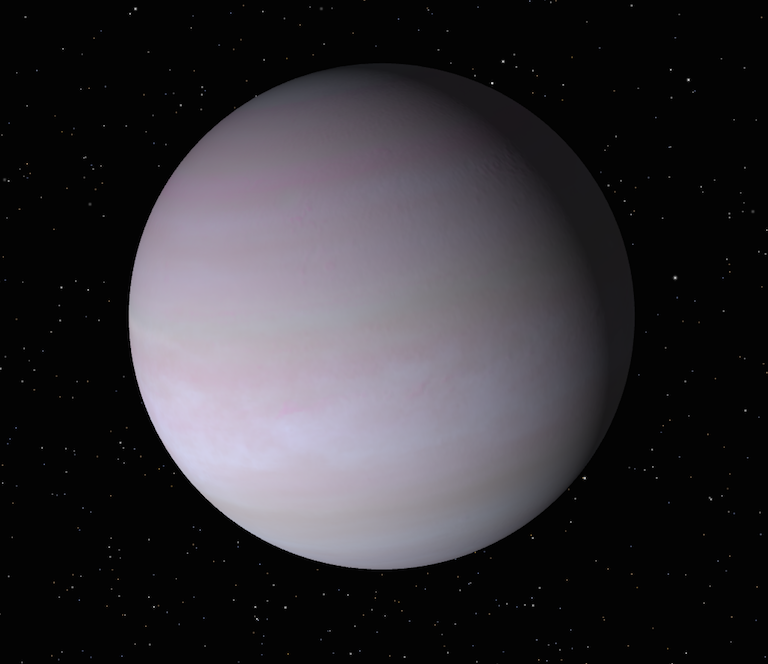
A round purplish-grey sphere with faint darker purple bands across it.
An artist’s concept of Tadmor, the planet in the Gamma Cephei binary system. Image via NASA.

Bottom line: Gamma Cephei – or Errai – is a binary star system that will one day be Earth’s North Star. It’s home to the first exoplanet ever discovered.

The post Gamma Cephei, aka Errai, a future North Star first appeared on EarthSky.


from EarthSky https://ift.tt/uSlHQDc
Chart showing Cepheus with its house shape and Gamma Cephei at peak, near constellation Cassiopeia.
Look for the constellation Cepheus the King in the northern sky. It resembles a child’s drawing of a house. The star Gamma Cephei, or Errai, marks the peak of the house’s roof. It can be found about 2/3 of the way along a line between the star Caph in Cassiopeia, and Polaris, the North Star.

Gamma Cephei, also called Errai, is a moderately bright 3rd-magnitude star in the northern constellation Cepheus the King. Cepheus looks like a child’s drawing of a house, with Gamma Cephei marking the peak of the roof. This fascinating star has played a major role in our understanding of exoplanets, especially in multiple star systems. And interestingly, by 4,000 CE, the slow wobble of Earth’s axis will have moved Gamma Cephei into position as our North Star.

How to find Gamma Cephei

For much of the Northern Hemisphere, orange-yellow Gamma Cephei shines as a circumpolar star. Circumpolar stars closely circle the North Star (or Pole Star), neither rising nor setting because they’re always above the horizon.

Cepheus the King is not a particularly prominent constellation, but you’ll know that you’ve found Cepheus when you see his more striking wife, Cassiopeia the Queen, standing at his side.

Do you know the W-shaped constellation Cassiopeia? It’s visible in northern autumn and early winter evenings from northerly latitudes. Imagine a line between the star Caph, at one end of the W, toward Polaris, our present-day North Star. Gamma Cephei is about 2/3 of the way along that line, and very slightly westward.

Another way to find Gamma Cephei is to use the familiar Big Dipper asterism on spring and summer evenings. The two outer stars in the Dipper’s bowl are Merak and Dubhe, sometimes called the Pointers, because a line between them extended northward points to Polaris. Then jump one fist-width – held at arm’s length – beyond Polaris and you’ll find Gamma Cephei.

A future North Star

The Earth’s north rotation axis points to the north celestial pole, and this is very close to Polaris, our present North Star. However, this hasn’t always been the case. A wobbling motion of Earth known as axial precession changes the north celestial pole’s location with respect to the stars, tracing a circle in the sky approximately every 26,000 years.

A line from Earth's axis. Its far end moves around a circle on the stellar background.
The 26,000-year cycle of precession. It’s caused by a wobble of Earth. Over this cycle, Earth’s northern axis traces a circle on the celestial sphere. Image via Tfr000/ Wikimedia Commons.

Polaris will continue to reign as the North Star for a couple more millenia. Gamma Cephei stands next in line to inherit the North Star title in around 4,000 CE. And as axial precession continues to trace this cosmic circle, other stars will take over the mantle of North Star. Around 7,500 CE, Alderamin – Cepheus’ brightest star – will become the North Star. And ultimately, of course, in about 26,000 years, the crown will return to Polaris.

Crowded chart with stars, constellation lines, precessional circle, and dates on circle.
The circular path of the north celestial pole (in orange) relative to the stars. Over the course of about 26,000 years, the Earth’s rotational axis, projected onto the sky, will trace a circle in northern and southern skies. Positive numbers in yellow show dates in CE (Common Era) where the north celestial pole will be located relative to the stars. Negative numbers in yellow represent BCE (Before Common Era) dates. Polaris is shown near the top of the circle at 2,000 CE, our current period. Image via Tau’olunga/ Wikimedia Commons.

The science of Gamma Cephei

Gamma Cephei is about 45 light-years away from us. It’s a binary star, with two stars revolving around a common center of mass every 67 years. The larger star, about 1.4 times the mass of our sun, is an ordinary main sequence star, somewhat similar to our sun. The small star, less than half our sun’s mass, is a red dwarf star.

First exoplanet discovered, lost and rediscovered

Astronomers announced they had found a planet around the Gamma Cephei stellar system in 1988. Over the years, confusion about what type of stars existed in the system called into question whether the planet really existed, so the scientists retracted their finding in 1992. But in 2002, new observations allowed astronomers to refine their data on the two stars in Gamma Cephei, and they realized once again that a planet did indeed circle the binary pair.

The planet, named Tadmor or Gamma Cephei Ab, revolves roughly every two years around the bigger star in this binary system. Tadmor is about 1.5 times the size of Jupiter. If it were placed in our solar system, it would circle the sun in an orbit between Mars and the asteroid belt.

A round purplish-grey sphere with faint darker purple bands across it.
An artist’s concept of Tadmor, the planet in the Gamma Cephei binary system. Image via NASA.

Bottom line: Gamma Cephei – or Errai – is a binary star system that will one day be Earth’s North Star. It’s home to the first exoplanet ever discovered.

The post Gamma Cephei, aka Errai, a future North Star first appeared on EarthSky.


from EarthSky https://ift.tt/uSlHQDc

How to see and enjoy Jupiter’s moons

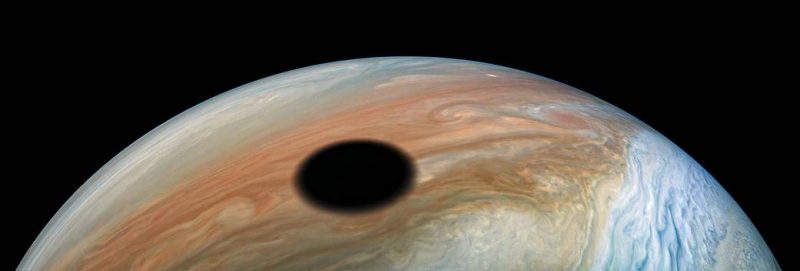
A large, dark, round shadow above a slice of Jupiter's cloudtops.
The shadow of Io, one of Jupiter’s moons, is cast on the giant planet’s cloud tops. This image was captured by the JunoCam camera aboard NASA’s Juno spacecraft, currently orbiting Jupiter. The image was acquired on September 19, 2019. Kevin M. Gill, a software engineer at NASA’s Jet Propulsion Laboratory, created this mosaic. Image via NASA/ JPL-Caltech/ SwRI/ MSSS/ Kevin M. Gill/ CC-BY 4.0.

How to see Jupiter’s moons

All you need is a good pair of binoculars (or a telescope) to see the four largest moons of the biggest planet in our solar system, Jupiter.

Three of the four moons are bigger than Earth’s moon. And one – Ganymede – is the largest moon in the solar system. These four satellites are collectively called the Galilean moons to honor the Italian astronomer Galileo, who discovered them in 1610. October 2023 is a great month to look for Jupiter’s four large moons. That’s because the king of planets is nearing opposition – when Earth will sweep between it and the sun – in early November. So the distance between Earth and Jupiter is now less than usual. And Jupiter is bright!

From Earth, through a small telescope or strong binoculars, the moons of Jupiter look like tiny starlike pinpricks of light. But you’ll know they’re not stars because you’ll see them stretched out in a line that bisects the giant planet.

Depending on what sort of optical aid you use, you might glimpse just one moon or see all four. If you see fewer than four moons, that might be because a moon is behind – or in front of – Jupiter. If a moon is in front of the planet, you can sometimes see the moon’s shadow on Jupiter’s cloud-tops. That shadow is called a transit.

Going from the moon closest to Jupiter to the outermost, their order going outward from Jupiter is Io, Europa, Ganymede and Callisto.

Jupiter near moon October 1 and 2

Moon over 2 days near orange dots for Pleiades and Jupiter along a green ecliptic line.
The bright waning gibbous moon will glow near Jupiter on the evenings of October 1 and 2, 2023. Also nearby is the lovely and delicate Pleiades star cluster, one of the cosmic gems in Taurus the Bull. The moon will rise about an hour after sunset, so this eye-catching trio will be visible traveling across the sky together until dawn. Chart via EarthSky.

Jupiter in October 2023

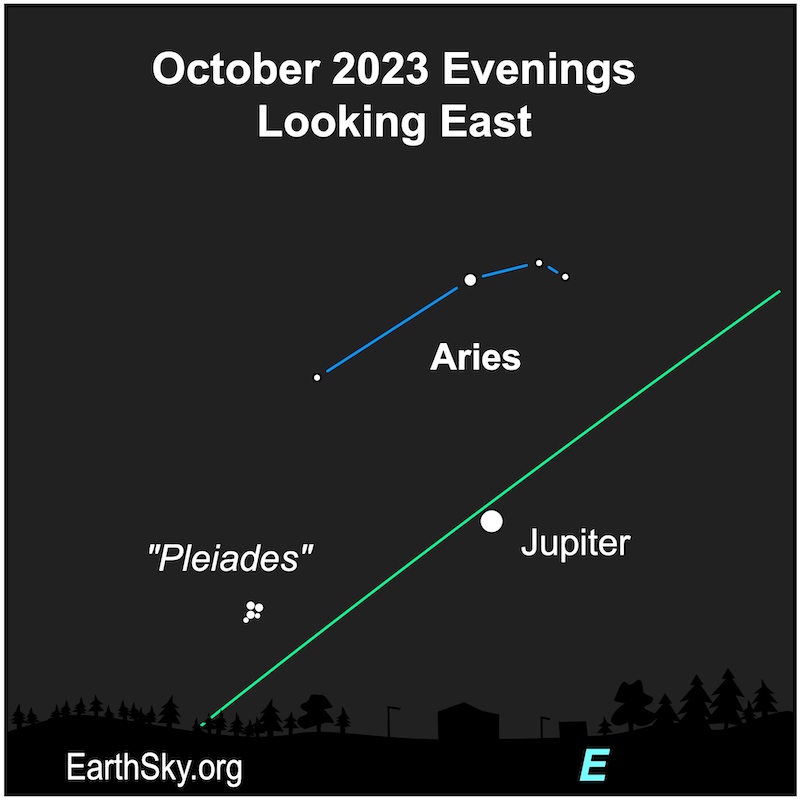
In October 2023, Jupiter will rise in the east shortly after evening twilight subsides and will be visible until dawn. It will shine near the pretty Pleiades star cluster in the constellation of Taurus the Bull. It’s racing toward opposition on the evening of November 1-2, 2023, when we fly between it and the sun. By then, Jupiter will be visible all night. Jupiter lies in the dim constellation of Aries the Ram. It brightens from -2.7 to -2.8 magnitude in October. The moon will float by Jupiter on October 2 and October 29, 2023.

White dots for Jupiter, Pleiades and the constellation Aries along a green ecliptic line.
Chart via EarthSky.

What you’ll see

Writing at SkyandTelescope.com, Bob King has said:

Etched in my brain cells is an image of a sharp, gleaming disk striped with two dark belts and accompanied by four starlike moons through my 2.4-inch refractor in the winter of 1966. A 6-inch reflector will make you privy to nearly all of the planet’s secrets …

When magnified at 150x or higher [Jupiter’s 4 largest moons] lose their starlike appearance and show disks that range in size from 1.0″ to 1.7″ (current opposition). Europa’s the smallest and Ganymede largest.

Ganymede also casts the largest shadow on the planet’s cloud tops when it transits in front of Jupiter. Shadow transits are visible at least once a week with ‘double transits’ – two moons casting shadows simultaneously – occurring once or twice a month. Ganymede’s shadow looks like a bullet hole, while little Europa’s more resembles a pinprick. Moons also fade away and then reappear over several minutes when they enter and exit Jupiter’s shadow during eclipse. Or a moon may be occulted by the Jovian disk and hover at the planet’s edge like a pearl before fading from sight.

Images of Jupiter’s moons from the EarthSky community

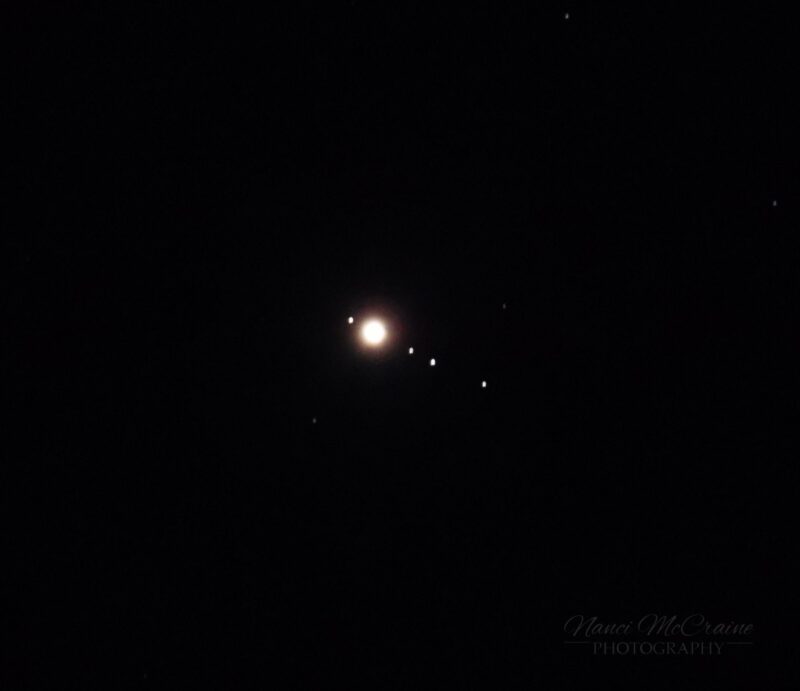
Five dots in a line, with Jupiter the biggest dot.
View at EarthSky Community Photos. | Nanci McCraine at Finger Lakes, New York, took this photo on September 30 and wrote: “I noticed craggy edges around Jupiter. Zooming in, I spotted this line of 4 straight lights across the planet that I assume are satellites.” That is correct! Binoculars or a small telescope will show Jupiter’s moons. And – on the nights of October 1 and 2, 2023 – you can watch Jupiter and Earth’s moon traveling across the sky all night, until dawn.
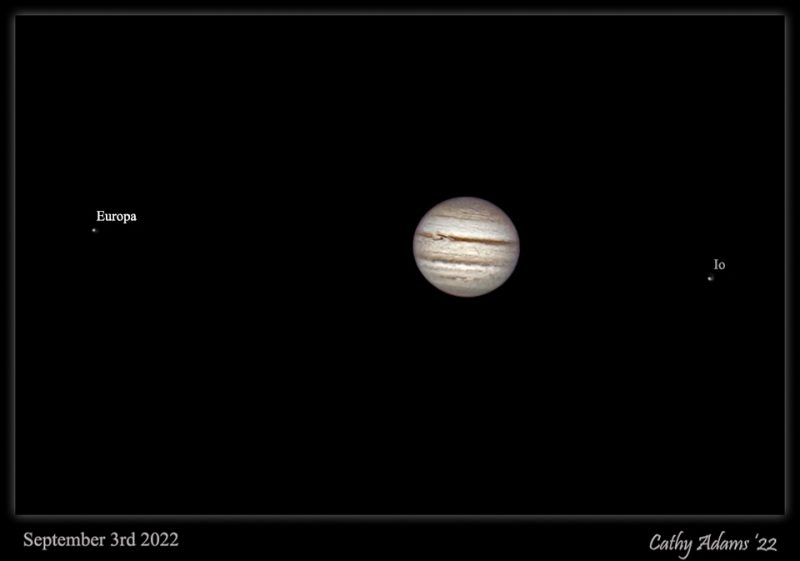
Jupiter's moons: Jupiter through a telescope with two labeled dots of light, one on each side.
View at EarthSky Community Photos. | Cathy Adams in St. Stephen, New Brunswick, Canada, captured 2 of Jupiter’s moons and giant Jupiter itself on September 3, 2022. Cathy wrote: “After so many cloudy nights I was fortunate to get a beautiful clear one! And it was absolutely wonderful to enjoy a night out observing, and imaging our neighboring planets!!” Thank you, Cathy!
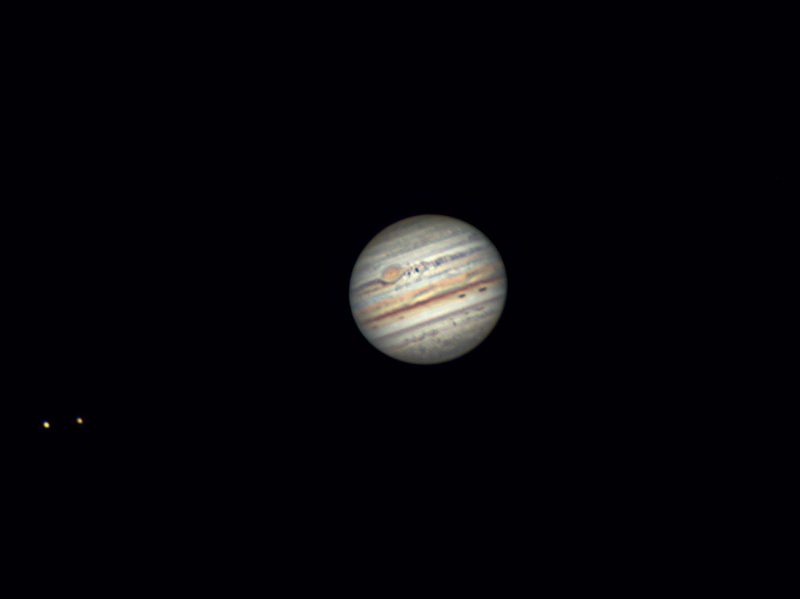
Jupiter: A banded planet, with 2 little dots of light (its moons) nearby.
View at EarthSky Community Photos. | Around the time of its yearly opposition, Jupiter is brightest in our sky, best through a telescope, and visible all night. Michael Terhune in Lunenburg, Massachusetts, captured Jupiter near last year’s opposition, in August of 2021. He wrote: “My sharpest image of Jupiter! Showing 2 of its Galilean satellites, Io and Europa. The Great Red Spot is also visible.” Thank you, Michael.
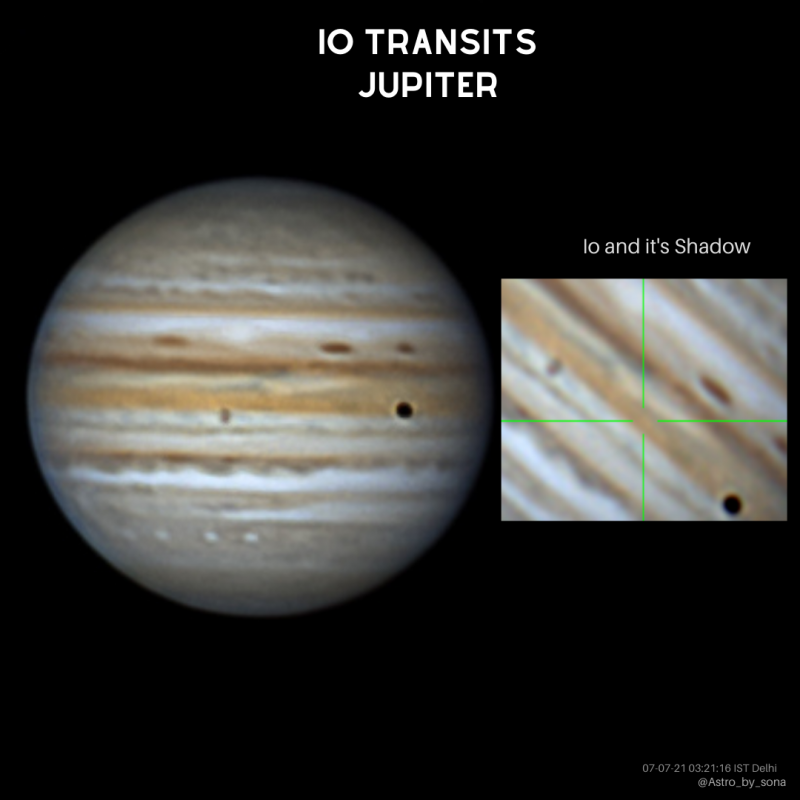
A full Jupiter on the left and a close-up of the moon and its shadow on Jupiter's clouds on the right.
View at EarthSky Community Photos. | Sona Shahani Shukla in New Delhi, India, caught a transit of the innermost Galilean moon, Io, across the face of Jupiter on July 7, 2021, and wrote: “Io appears to be skimming Jupiter’s cloud tops, but it’s actually 310,000 miles (500,000 km) from Jupiter. Io zips around Jupiter in 1.8 days, whereas our moon circles Earth every 28 days. The conspicuous black spot on Jupiter is Io’s shadow and is about the size of the moon itself (2,262 miles or 3,640 km across). This shadow sails across the face of Jupiter at 38,000 mph (17 km per second).” Thank you, Sona!

Special viewings of Jupiter’s moons

As with most moons and planets, the Galilean moons orbit Jupiter around its equator. We do see their orbits almost exactly edge-on, but, as with so much in astronomy, there’s a cycle for viewing the edge-on-ness of Jupiter’s moons. This particular cycle is six years long. So every six years we view Jupiter’s equator – and the moons orbiting above its equator – at the most edge-on. During these special times, we can see the moons eclipse and cast shadows on not just giant Jupiter but on each other.

In 2021 we were able to view a number of mutual events (eclipses and shadow transits) involving Jupiter’s moons. The next cycle of mutual events will be in 2027.

Another special event, a rare triple transit, occurs on October 18, 2025, when three of Jupiter’s moons will pass in front of the giant planet at once. The last time Earth could witness a triple transit was in 2021. Triple transits are not visible from all parts of the globe, however.

You can find information here for dates and times to observe the Galilean moons.

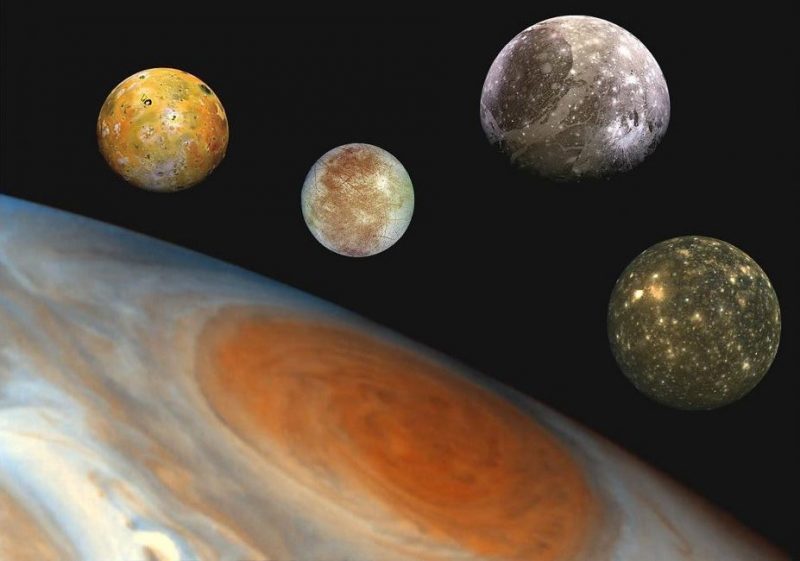
Part of Jupiter with Great Red Spot and 4 largest moons, enlarged and colorful, on black background.
Composite image of Jupiter and its 4 Galilean moons. From left to right the moons are Io, Europa, Ganymede and Callisto. The Galileo spacecraft obtained the images to make this composite in 1996. Image via NASA Photojournal.

Jupiter at opposition in November 2023

On November 2-3, 2023, Jupiter is at opposition, when the planet is opposite the sun in the sky as seen from Earth. When Earth passes directly between Jupiter and the sun, we’ll see Jupiter rise at sunset and set at sunrise. Opposition is the middle of the best time of the year to see a planet, since that’s when the planet is up and viewable all night and is generally closest for the year. But any time Jupiter is visible in your sky you can view Jupiter’s four major moons.

So if you get a chance, grab some binoculars or a small telescope and go see Jupiter’s Galilean moons with your own eyes!

Click here for recommended sky almanacs; they can tell you Jupiter’s rising time in your sky.

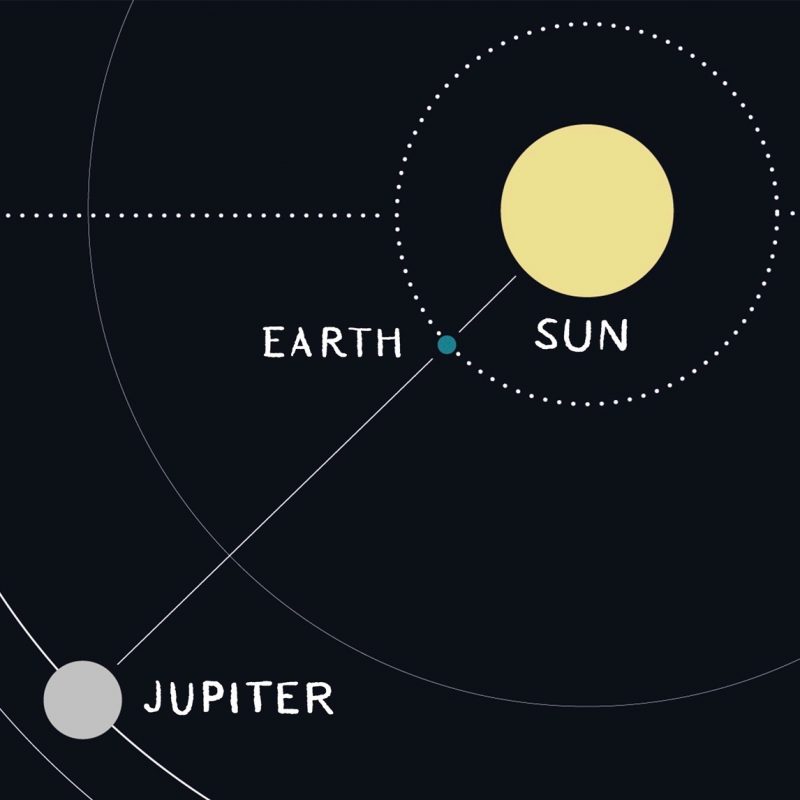
Diagram of sun, Earth, and Jupiter lined up with orbits and line of sight shown.
Opposition – when Earth is directly between Jupiter and the sun – is the best time to observe the largest planet and its 4 Galilean moons. In 2023, Jupiter’s opposition is November 2-3. Image via EarthSky.

Bottom line: October and November 2023 are great months for seeing four of Jupiter’s moons – Io, Europa, Ganymede and Callisto – with binoculars or a small telescope.

Check here for dates and times to observe the Great Red Spot

The post How to see and enjoy Jupiter’s moons first appeared on EarthSky.


from EarthSky https://ift.tt/OfgkxWG
A large, dark, round shadow above a slice of Jupiter's cloudtops.
The shadow of Io, one of Jupiter’s moons, is cast on the giant planet’s cloud tops. This image was captured by the JunoCam camera aboard NASA’s Juno spacecraft, currently orbiting Jupiter. The image was acquired on September 19, 2019. Kevin M. Gill, a software engineer at NASA’s Jet Propulsion Laboratory, created this mosaic. Image via NASA/ JPL-Caltech/ SwRI/ MSSS/ Kevin M. Gill/ CC-BY 4.0.

How to see Jupiter’s moons

All you need is a good pair of binoculars (or a telescope) to see the four largest moons of the biggest planet in our solar system, Jupiter.

Three of the four moons are bigger than Earth’s moon. And one – Ganymede – is the largest moon in the solar system. These four satellites are collectively called the Galilean moons to honor the Italian astronomer Galileo, who discovered them in 1610. October 2023 is a great month to look for Jupiter’s four large moons. That’s because the king of planets is nearing opposition – when Earth will sweep between it and the sun – in early November. So the distance between Earth and Jupiter is now less than usual. And Jupiter is bright!

From Earth, through a small telescope or strong binoculars, the moons of Jupiter look like tiny starlike pinpricks of light. But you’ll know they’re not stars because you’ll see them stretched out in a line that bisects the giant planet.

Depending on what sort of optical aid you use, you might glimpse just one moon or see all four. If you see fewer than four moons, that might be because a moon is behind – or in front of – Jupiter. If a moon is in front of the planet, you can sometimes see the moon’s shadow on Jupiter’s cloud-tops. That shadow is called a transit.

Going from the moon closest to Jupiter to the outermost, their order going outward from Jupiter is Io, Europa, Ganymede and Callisto.

Jupiter near moon October 1 and 2

Moon over 2 days near orange dots for Pleiades and Jupiter along a green ecliptic line.
The bright waning gibbous moon will glow near Jupiter on the evenings of October 1 and 2, 2023. Also nearby is the lovely and delicate Pleiades star cluster, one of the cosmic gems in Taurus the Bull. The moon will rise about an hour after sunset, so this eye-catching trio will be visible traveling across the sky together until dawn. Chart via EarthSky.

Jupiter in October 2023

In October 2023, Jupiter will rise in the east shortly after evening twilight subsides and will be visible until dawn. It will shine near the pretty Pleiades star cluster in the constellation of Taurus the Bull. It’s racing toward opposition on the evening of November 1-2, 2023, when we fly between it and the sun. By then, Jupiter will be visible all night. Jupiter lies in the dim constellation of Aries the Ram. It brightens from -2.7 to -2.8 magnitude in October. The moon will float by Jupiter on October 2 and October 29, 2023.

White dots for Jupiter, Pleiades and the constellation Aries along a green ecliptic line.
Chart via EarthSky.

What you’ll see

Writing at SkyandTelescope.com, Bob King has said:

Etched in my brain cells is an image of a sharp, gleaming disk striped with two dark belts and accompanied by four starlike moons through my 2.4-inch refractor in the winter of 1966. A 6-inch reflector will make you privy to nearly all of the planet’s secrets …

When magnified at 150x or higher [Jupiter’s 4 largest moons] lose their starlike appearance and show disks that range in size from 1.0″ to 1.7″ (current opposition). Europa’s the smallest and Ganymede largest.

Ganymede also casts the largest shadow on the planet’s cloud tops when it transits in front of Jupiter. Shadow transits are visible at least once a week with ‘double transits’ – two moons casting shadows simultaneously – occurring once or twice a month. Ganymede’s shadow looks like a bullet hole, while little Europa’s more resembles a pinprick. Moons also fade away and then reappear over several minutes when they enter and exit Jupiter’s shadow during eclipse. Or a moon may be occulted by the Jovian disk and hover at the planet’s edge like a pearl before fading from sight.

Images of Jupiter’s moons from the EarthSky community

Five dots in a line, with Jupiter the biggest dot.
View at EarthSky Community Photos. | Nanci McCraine at Finger Lakes, New York, took this photo on September 30 and wrote: “I noticed craggy edges around Jupiter. Zooming in, I spotted this line of 4 straight lights across the planet that I assume are satellites.” That is correct! Binoculars or a small telescope will show Jupiter’s moons. And – on the nights of October 1 and 2, 2023 – you can watch Jupiter and Earth’s moon traveling across the sky all night, until dawn.
Jupiter's moons: Jupiter through a telescope with two labeled dots of light, one on each side.
View at EarthSky Community Photos. | Cathy Adams in St. Stephen, New Brunswick, Canada, captured 2 of Jupiter’s moons and giant Jupiter itself on September 3, 2022. Cathy wrote: “After so many cloudy nights I was fortunate to get a beautiful clear one! And it was absolutely wonderful to enjoy a night out observing, and imaging our neighboring planets!!” Thank you, Cathy!
Jupiter: A banded planet, with 2 little dots of light (its moons) nearby.
View at EarthSky Community Photos. | Around the time of its yearly opposition, Jupiter is brightest in our sky, best through a telescope, and visible all night. Michael Terhune in Lunenburg, Massachusetts, captured Jupiter near last year’s opposition, in August of 2021. He wrote: “My sharpest image of Jupiter! Showing 2 of its Galilean satellites, Io and Europa. The Great Red Spot is also visible.” Thank you, Michael.
A full Jupiter on the left and a close-up of the moon and its shadow on Jupiter's clouds on the right.
View at EarthSky Community Photos. | Sona Shahani Shukla in New Delhi, India, caught a transit of the innermost Galilean moon, Io, across the face of Jupiter on July 7, 2021, and wrote: “Io appears to be skimming Jupiter’s cloud tops, but it’s actually 310,000 miles (500,000 km) from Jupiter. Io zips around Jupiter in 1.8 days, whereas our moon circles Earth every 28 days. The conspicuous black spot on Jupiter is Io’s shadow and is about the size of the moon itself (2,262 miles or 3,640 km across). This shadow sails across the face of Jupiter at 38,000 mph (17 km per second).” Thank you, Sona!

Special viewings of Jupiter’s moons

As with most moons and planets, the Galilean moons orbit Jupiter around its equator. We do see their orbits almost exactly edge-on, but, as with so much in astronomy, there’s a cycle for viewing the edge-on-ness of Jupiter’s moons. This particular cycle is six years long. So every six years we view Jupiter’s equator – and the moons orbiting above its equator – at the most edge-on. During these special times, we can see the moons eclipse and cast shadows on not just giant Jupiter but on each other.

In 2021 we were able to view a number of mutual events (eclipses and shadow transits) involving Jupiter’s moons. The next cycle of mutual events will be in 2027.

Another special event, a rare triple transit, occurs on October 18, 2025, when three of Jupiter’s moons will pass in front of the giant planet at once. The last time Earth could witness a triple transit was in 2021. Triple transits are not visible from all parts of the globe, however.

You can find information here for dates and times to observe the Galilean moons.

Part of Jupiter with Great Red Spot and 4 largest moons, enlarged and colorful, on black background.
Composite image of Jupiter and its 4 Galilean moons. From left to right the moons are Io, Europa, Ganymede and Callisto. The Galileo spacecraft obtained the images to make this composite in 1996. Image via NASA Photojournal.

Jupiter at opposition in November 2023

On November 2-3, 2023, Jupiter is at opposition, when the planet is opposite the sun in the sky as seen from Earth. When Earth passes directly between Jupiter and the sun, we’ll see Jupiter rise at sunset and set at sunrise. Opposition is the middle of the best time of the year to see a planet, since that’s when the planet is up and viewable all night and is generally closest for the year. But any time Jupiter is visible in your sky you can view Jupiter’s four major moons.

So if you get a chance, grab some binoculars or a small telescope and go see Jupiter’s Galilean moons with your own eyes!

Click here for recommended sky almanacs; they can tell you Jupiter’s rising time in your sky.

Diagram of sun, Earth, and Jupiter lined up with orbits and line of sight shown.
Opposition – when Earth is directly between Jupiter and the sun – is the best time to observe the largest planet and its 4 Galilean moons. In 2023, Jupiter’s opposition is November 2-3. Image via EarthSky.

Bottom line: October and November 2023 are great months for seeing four of Jupiter’s moons – Io, Europa, Ganymede and Callisto – with binoculars or a small telescope.

Check here for dates and times to observe the Great Red Spot

The post How to see and enjoy Jupiter’s moons first appeared on EarthSky.


from EarthSky https://ift.tt/OfgkxWG

Sycamore Gap tree in the UK, remembered in images

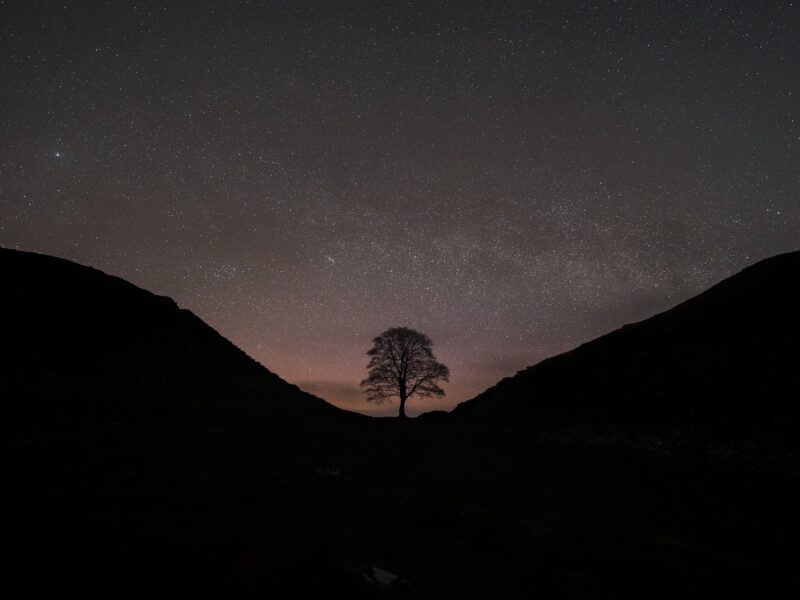
Sycamore Gap: Lone tree stands in a dip between hills with stars behind.
It appears that a vandal or vandals cut has down the iconic Sycamore Gap tree in the UK. The tree was felled overnight on September 27-28, 2023. It was located along Hadrian’s Wall in Northumberland National Park. The tree was prominent in many astrophotos and other nature photos from the region. Image via Unsplash/ Jonny Gios.

R.I.P, Sycamore Gap tree

Residents of Northumbria awoke to a marred landscape on September 28, 2023. Overnight, it seems, someone unexpectedly cut down the famous tree at Sycamore Gap along Hadrian’s Wall in Northumberland National Park. This iconic tree was popular in astrophotography and landscape photography and featured prominently in the 1991 movie Robin Hood.

Local police say they’ve already made an arrest of a 16-year-old boy.

We’ve collected peoples’ online memorials to this magnificent tree and share them here with you.

The police have made an arrest

More images of Sycamore Gap

Additional memories of the Sycamore Gap tree

Bottom line: Sycamore Gap tree in Northumberland National Park was felled overnight last night (September 27-28, 2023). Here are a few of the many images of the tree flooding social media today.

Submit your images to EarthSky here.

The post Sycamore Gap tree in the UK, remembered in images first appeared on EarthSky.


from EarthSky https://ift.tt/2jnrE8W
Sycamore Gap: Lone tree stands in a dip between hills with stars behind.
It appears that a vandal or vandals cut has down the iconic Sycamore Gap tree in the UK. The tree was felled overnight on September 27-28, 2023. It was located along Hadrian’s Wall in Northumberland National Park. The tree was prominent in many astrophotos and other nature photos from the region. Image via Unsplash/ Jonny Gios.

R.I.P, Sycamore Gap tree

Residents of Northumbria awoke to a marred landscape on September 28, 2023. Overnight, it seems, someone unexpectedly cut down the famous tree at Sycamore Gap along Hadrian’s Wall in Northumberland National Park. This iconic tree was popular in astrophotography and landscape photography and featured prominently in the 1991 movie Robin Hood.

Local police say they’ve already made an arrest of a 16-year-old boy.

We’ve collected peoples’ online memorials to this magnificent tree and share them here with you.

The police have made an arrest

More images of Sycamore Gap

Additional memories of the Sycamore Gap tree

Bottom line: Sycamore Gap tree in Northumberland National Park was felled overnight last night (September 27-28, 2023). Here are a few of the many images of the tree flooding social media today.

Submit your images to EarthSky here.

The post Sycamore Gap tree in the UK, remembered in images first appeared on EarthSky.


from EarthSky https://ift.tt/2jnrE8W

Guy Ottewell’s Astronomical Calendar 2024 is here

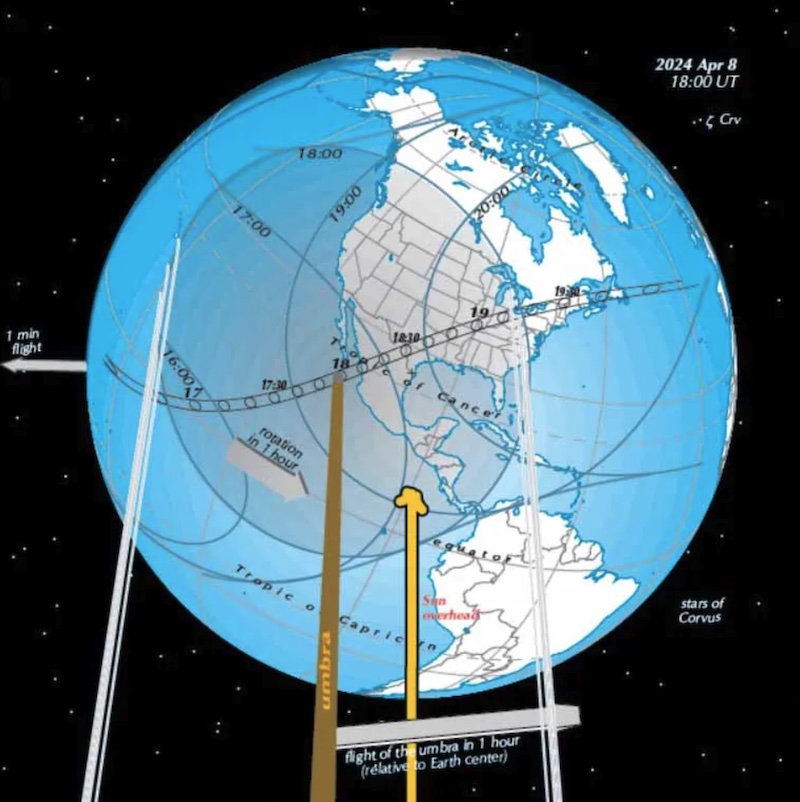
Astronomical calendar: Globe of Earth showing the path of the April 8, 2024, eclipse over the Americas.
A sample of one of Guy’s charts in the Astronomical Calendar 2024 showing the path of the moon’s shadow on the Earth during the total solar eclipse on April 8, 2024. Image via Guy Ottewell.

Beloved British astronomer Guy Ottewell announced his Astronomical Calendar 2024 is out and ready for purchase. Reprinted with permission. Edits by EarthSky.

The popular Astronomical Calendar

Guy Ottewell’s Astronomical calendar is well-known and popular among amateur astronomers. Previously, it was available in printed form from 1974 to 2016, and used by thousands of sky-lovers in more than 100 countries. Later, after 2016, the Astronomical Calendar was released in an electronic format. Luckily for book lovers, last year Guy started releasing it in both printed and electronic formats.

The 2024 release has 141 pages, with hundreds of illustrations, including charts and 3-D views of space. For each month there are six pages, with about 50 events, a sky dome, and a diagram showing where the planets are in their orbits. Plus, there are about 20 of the most interesting sky scenes for that month.

Also, after the monthly section, there are several sections on the sun and seasons, the moon, eclipses, occultations, each planet, asteroids and meteor showers. Guy offers a full explanation of the main features, and a glossary of terms.

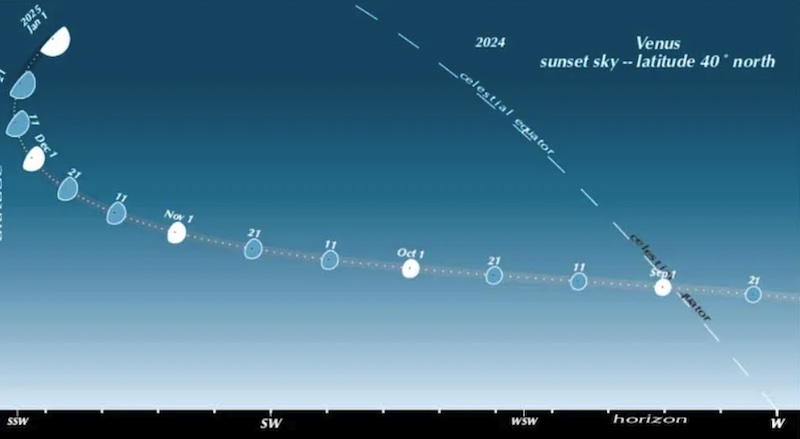
Blue sky at sunset showing the position of Venus from January through September.
Every year, Guy includes charts showing the position of Venus and Mercury throughout the year in the morning and evening sky. This is the type of information you can find in the Astronomical Calendar 2024. Image via Guy Ottewell.

About the Astronomical Calendar 2024

The Astronomical Calendar 2024 in printed form is handy for using as a typical reference book. On the dates when there is a meteor shower or an opposition of a planet like Jupiter, you can find more detailed information in the section on the planets or the meteors showers. Also, there is detailed information and charts enabling you to visualize the globe during for the eclipses in 2024.

As for the electronic book, the advantage to that format is that you can zoom in to see the illustrations in exquisite detail, and magnitfy them to full resolution. Plus it’s easy to search the file for a specific term.

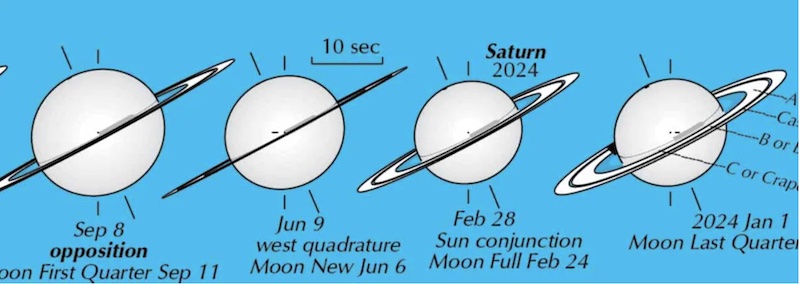
Saturn shown four times during the year.
Guy’s charts in the Astronomical Calendar 2024 give you a visual aid showing you what to expect for all sorts of astronomical events. An example, is this illustration showing Saturn and the position of its rings in 2024. Image via Guy Ottewell.

About the cover illustration

The 2024 cover picture story is the myth of an in-prisoned princess Danae, who gave birth to Perseus, a son of Zeus who appeared to her in a golden shower.

What are others saying about the Astronomical Calendar?

Philip Morrison of Scientific American said:

The large Ottewell calendar deserves pride of place … a work of kinematics-made-vivid… a piece of original samizdat … its author is a gifted artist … to his talented brush, his sense of form in space, and his apt and pithy choice of words, he has added a deft hand at the computer keyboard.

And a reader in New Hampshire commented:

My husband just cries if he doesn’t find it under the Christmas tree …

Plus a professor in California wrote:

I found enough in the budget to buy 10 for our class. I don’t believe we could make it without them. It’s an amazing amount of information for so little money.

Bottom line: Guy Ottewell’s popular and beloved Astronomical Calendar is out for 2024. You can get it in electronic or printed form. Amateur astronomers everywhere look forward to its annual release.

Read more at Goy Ottewell’s blog

The post Guy Ottewell’s Astronomical Calendar 2024 is here first appeared on EarthSky.


from EarthSky https://ift.tt/wjI0YuO
Astronomical calendar: Globe of Earth showing the path of the April 8, 2024, eclipse over the Americas.
A sample of one of Guy’s charts in the Astronomical Calendar 2024 showing the path of the moon’s shadow on the Earth during the total solar eclipse on April 8, 2024. Image via Guy Ottewell.

Beloved British astronomer Guy Ottewell announced his Astronomical Calendar 2024 is out and ready for purchase. Reprinted with permission. Edits by EarthSky.

The popular Astronomical Calendar

Guy Ottewell’s Astronomical calendar is well-known and popular among amateur astronomers. Previously, it was available in printed form from 1974 to 2016, and used by thousands of sky-lovers in more than 100 countries. Later, after 2016, the Astronomical Calendar was released in an electronic format. Luckily for book lovers, last year Guy started releasing it in both printed and electronic formats.

The 2024 release has 141 pages, with hundreds of illustrations, including charts and 3-D views of space. For each month there are six pages, with about 50 events, a sky dome, and a diagram showing where the planets are in their orbits. Plus, there are about 20 of the most interesting sky scenes for that month.

Also, after the monthly section, there are several sections on the sun and seasons, the moon, eclipses, occultations, each planet, asteroids and meteor showers. Guy offers a full explanation of the main features, and a glossary of terms.

Blue sky at sunset showing the position of Venus from January through September.
Every year, Guy includes charts showing the position of Venus and Mercury throughout the year in the morning and evening sky. This is the type of information you can find in the Astronomical Calendar 2024. Image via Guy Ottewell.

About the Astronomical Calendar 2024

The Astronomical Calendar 2024 in printed form is handy for using as a typical reference book. On the dates when there is a meteor shower or an opposition of a planet like Jupiter, you can find more detailed information in the section on the planets or the meteors showers. Also, there is detailed information and charts enabling you to visualize the globe during for the eclipses in 2024.

As for the electronic book, the advantage to that format is that you can zoom in to see the illustrations in exquisite detail, and magnitfy them to full resolution. Plus it’s easy to search the file for a specific term.

Saturn shown four times during the year.
Guy’s charts in the Astronomical Calendar 2024 give you a visual aid showing you what to expect for all sorts of astronomical events. An example, is this illustration showing Saturn and the position of its rings in 2024. Image via Guy Ottewell.

About the cover illustration

The 2024 cover picture story is the myth of an in-prisoned princess Danae, who gave birth to Perseus, a son of Zeus who appeared to her in a golden shower.

What are others saying about the Astronomical Calendar?

Philip Morrison of Scientific American said:

The large Ottewell calendar deserves pride of place … a work of kinematics-made-vivid… a piece of original samizdat … its author is a gifted artist … to his talented brush, his sense of form in space, and his apt and pithy choice of words, he has added a deft hand at the computer keyboard.

And a reader in New Hampshire commented:

My husband just cries if he doesn’t find it under the Christmas tree …

Plus a professor in California wrote:

I found enough in the budget to buy 10 for our class. I don’t believe we could make it without them. It’s an amazing amount of information for so little money.

Bottom line: Guy Ottewell’s popular and beloved Astronomical Calendar is out for 2024. You can get it in electronic or printed form. Amateur astronomers everywhere look forward to its annual release.

Read more at Goy Ottewell’s blog

The post Guy Ottewell’s Astronomical Calendar 2024 is here first appeared on EarthSky.


from EarthSky https://ift.tt/wjI0YuO

Space is hard on the human body. Here’s what we’re learning

Space is hard on the human body.

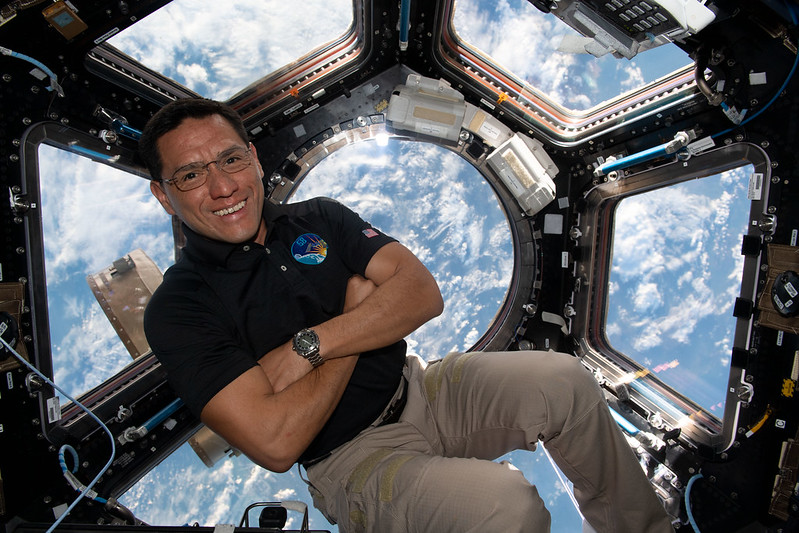
When NASA astronaut Frank Rubio lands back on Earth today, he’ll have completed a mission spanning 157 million miles (253 million km) and nearly 6,000 orbits of Earth. He’ll have spent 371 consecutive days in space, a new world record for an American. Meanwhile, we’ve known for decades now that space is hard on the human body. Rachael Seidler of the University of Florida explains more below. Edits by EarthSky.

With NASA and other federal space agencies planning more manned missions and commercial companies bringing people to space, opportunities for human space travel are rapidly expanding.

However, traveling to space poses risks to the human body. Since NASA wants to send a manned mission to Mars in the 2030s, scientists need to find solutions for these hazards sooner rather than later.

As a kinesiologist (kinesiology is the study of human movement) who works with astronauts, I’ve spent years studying the effects space can have on the body and brain. I’m also involved in a NASA project that aims to mitigate the health hazards that participants of a future mission to Mars might face.

Human body: Man with dark hair and steel-rimmed glasses floating in front of windows on space station.
Frank Rubio has set a new record for most consecutive days in space for an American. Originally scheduled for a 6-month mission, a faulty Soyuz spacecraft extended his stay to 371 days in space. Rubio returns to Earth on September 27, 2023. Space – especially long stays – is hard on the human body. Image via NASA.

Space radiation and the human body

The Earth has a protective shield called a magnetosphere. It’s the area of space around a planet that is controlled by its magnetic field. This shield filters out cosmic radiation. However, astronauts traveling farther than the International Space Station will face continuous exposure to this radiation, the equivalent to between 150 and 6,000 chest X-rays.

This radiation can harm the nervous and cardiovascular systems, including heart and arteries, leading to cardiovascular disease. In addition, it can make the blood-brain barrier leak. This can expose the brain to chemicals and proteins that are harmful to it … compounds that are safe in the blood but toxic to the brain.


This video explains the blood-brain barrier and how it keeps compounds flowing through your circulatory system out of your brain.

NASA is developing technology that can shield travelers from radiation on a Mars mission. It’s looking at building deflecting materials such as kevlar and polyethylene into space vehicles and spacesuits. Certain diets and supplements such as enterade may also minimize the effects of radiation. Supplements like this, also used in cancer patients on Earth during radiation therapy, can alleviate gastrointestinal side effects of radiation exposure.

Gravitational changes and the human body

Astronauts have to exercise in space to minimize the muscle loss they’ll face after a long mission. Missions that go as far as Mars will have to make sure astronauts have supplements such as bisphosphonate. This medicine prevents bone breakdown in osteoporosis (a desease that causes bones to become weak and brittle). These supplements should keep their muscles and bones in good condition over long periods of time spent without the effects of Earth’s gravity.

Microgravity also affects the nervous and circulatory systems. On Earth, your heart pumps blood upward, and specialized valves in your circulatory system keep bodily fluids from pooling at your feet. In the absence of gravity, fluids shift toward the head.

My work and that of others has shown that this results in an expansion of fluid-filled spaces in the middle of the brain. Having extra fluid in the skull and no gravity to “hold the brain down” causes the brain to sit higher in the skull. In this position, the inside of the skull compresses the top of the brain.

Counteracting the fluid shift

These fluid shifts may contribute to spaceflight-associated neuro-ocular syndrome. It’s a condition many astronauts experience that affects the structure and function of the eyes. The back of the eye can become flattened, and the nerves that carry visual information from the eye to the brain swell and bend. Astronauts can still see, though visual function may worsen for some. Though it hasn’t been well studied yet, case studies suggest this condition may persist even a few years after returning to Earth.

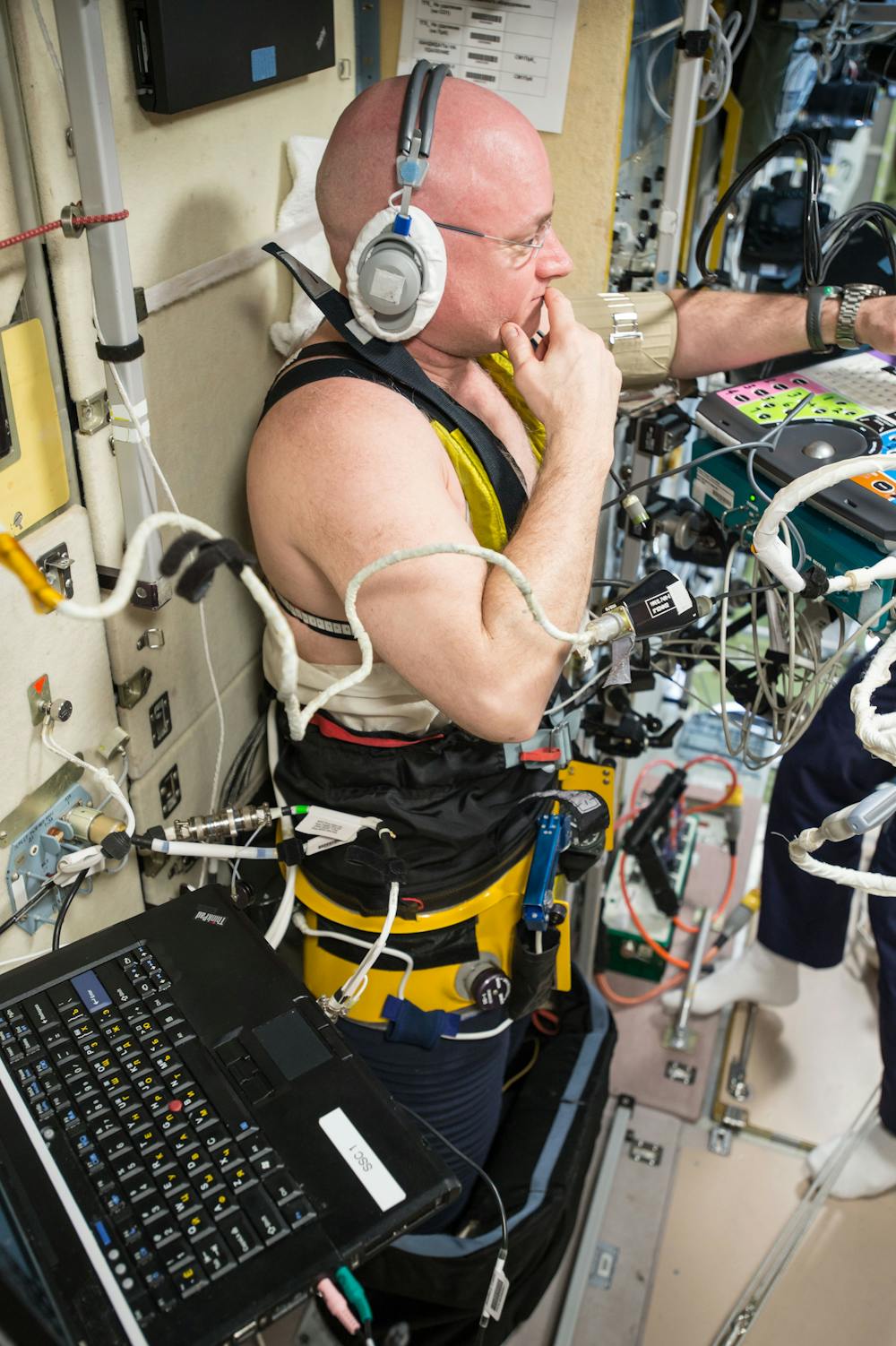
Scientists may be able to shift the fluids back toward the lower body using specialized pants that pull fluids back down toward the lower body like a vacuum. These pants could be used to redistribute the body’s fluids in a way that is more similar to what occurs on Earth.

A bald man in a white headset and tight, dark pants with many wires attaching them to surrounding machinery.
NASA astronaut Scott Kelly, pictured here, is wearing the Chibis lower body negative pressure suit, which may help counteract the negative effects of gravity-caused fluid shifts in the body. Image via NASA.

Mental health and isolation

While space travel can damage the body, the isolating nature of space travel can also have profound effects on the mind.

Imagine having to live and work with the same small group of people, without being able to see your family or friends, for months on end. To learn to manage extreme environments and maintain communication and leadership dynamics, astronauts first undergo team training on Earth.

They spend weeks in either NASA’s Extreme Environment Mission Operations at the Aquarius Research Station, found underwater off the Florida Keys, or mapping and exploring caves with the European Space Agency’s CAVES program. These programs help astronauts build camaraderie with their teammates and learn how to manage stress and loneliness in a hostile, faraway environment.

Researchers are studying how to best monitor and support behavioral mental health under these extreme and isolating conditions.

The positive effects of space travel

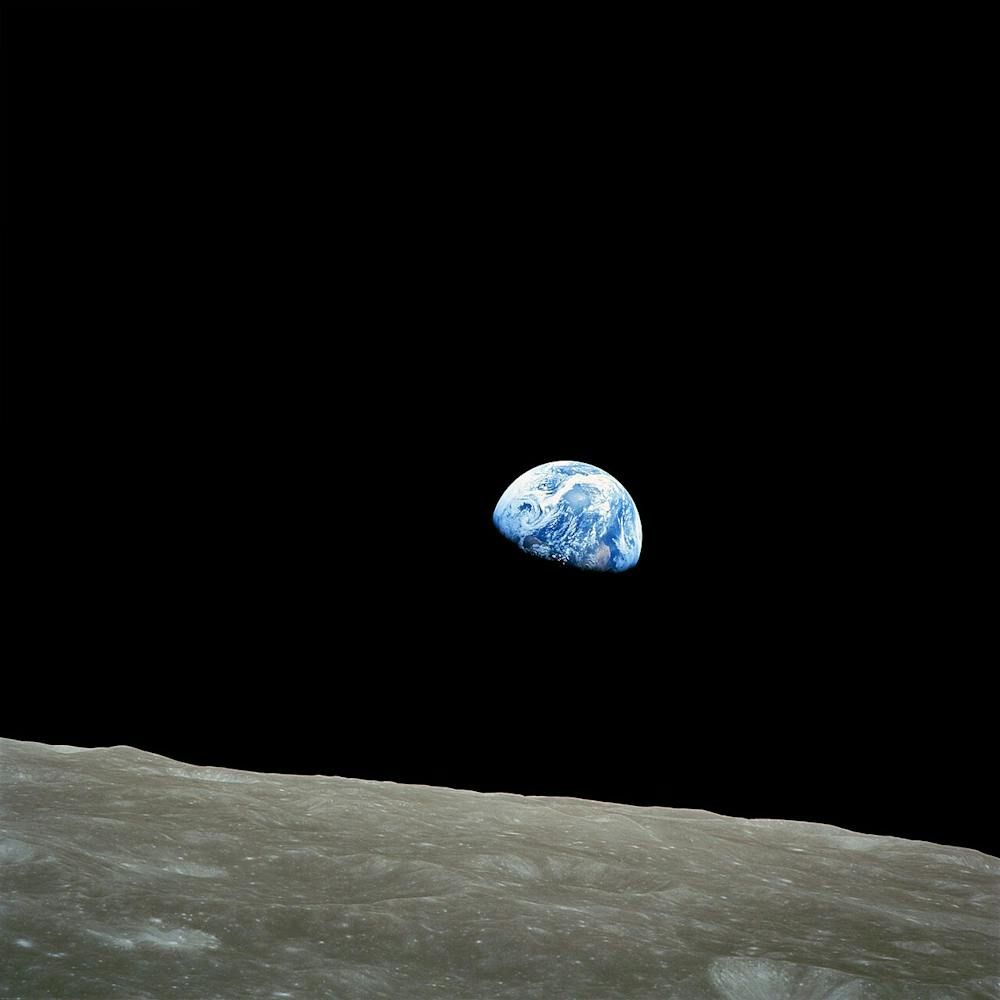
While space travel comes with stressors and the potential for loneliness, astronauts describe experiencing an overview effect: a sense of awe and connectedness with all humankind. This often happens when viewing Earth from the International Space Station.

Blue and white Earth, half-obscured by shadow, seen hanging in darkness over a stark lunar landscape.
Earthrise, a famous image taken during an Apollo mission, shows Earth from space. While seeing the Earth from afar, many astronauts report feeling an awed “overview effect.” Image via NASA.

Learning how to support human health and physiology in space also has numerous benefits for life on Earth. For example, products that shield astronauts from space radiation and counter its harmful effects on our body can also treat cancer patients receiving radiation treatments.

Understanding how to protect our bones and muscles in microgravity could improve how doctors treat the frailty that often accompanies aging. And space exploration has led to many technological achievements advancing water purification and satellite systems.

Researchers like me who study ways to preserve astronaut health expect our work will benefit people both in space and here at home. The Conversation

Rachael Seidler, Professor of Applied Physiology & Kinesiology, University of Florida

This article is republished from The Conversation under a Creative Commons license. Read the original article.

Bottom line: Space is hard on the human body and also takes a toll on the mind. Scientists are working to find ways to improve the lives and health of astronauts in space and back at home.

Read more: Astronauts’ brains need a 3-year break after long missions

The post Space is hard on the human body. Here’s what we’re learning first appeared on EarthSky.


from EarthSky https://ift.tt/NiZT1ls

Space is hard on the human body.

When NASA astronaut Frank Rubio lands back on Earth today, he’ll have completed a mission spanning 157 million miles (253 million km) and nearly 6,000 orbits of Earth. He’ll have spent 371 consecutive days in space, a new world record for an American. Meanwhile, we’ve known for decades now that space is hard on the human body. Rachael Seidler of the University of Florida explains more below. Edits by EarthSky.

With NASA and other federal space agencies planning more manned missions and commercial companies bringing people to space, opportunities for human space travel are rapidly expanding.

However, traveling to space poses risks to the human body. Since NASA wants to send a manned mission to Mars in the 2030s, scientists need to find solutions for these hazards sooner rather than later.

As a kinesiologist (kinesiology is the study of human movement) who works with astronauts, I’ve spent years studying the effects space can have on the body and brain. I’m also involved in a NASA project that aims to mitigate the health hazards that participants of a future mission to Mars might face.

Human body: Man with dark hair and steel-rimmed glasses floating in front of windows on space station.
Frank Rubio has set a new record for most consecutive days in space for an American. Originally scheduled for a 6-month mission, a faulty Soyuz spacecraft extended his stay to 371 days in space. Rubio returns to Earth on September 27, 2023. Space – especially long stays – is hard on the human body. Image via NASA.

Space radiation and the human body

The Earth has a protective shield called a magnetosphere. It’s the area of space around a planet that is controlled by its magnetic field. This shield filters out cosmic radiation. However, astronauts traveling farther than the International Space Station will face continuous exposure to this radiation, the equivalent to between 150 and 6,000 chest X-rays.

This radiation can harm the nervous and cardiovascular systems, including heart and arteries, leading to cardiovascular disease. In addition, it can make the blood-brain barrier leak. This can expose the brain to chemicals and proteins that are harmful to it … compounds that are safe in the blood but toxic to the brain.


This video explains the blood-brain barrier and how it keeps compounds flowing through your circulatory system out of your brain.

NASA is developing technology that can shield travelers from radiation on a Mars mission. It’s looking at building deflecting materials such as kevlar and polyethylene into space vehicles and spacesuits. Certain diets and supplements such as enterade may also minimize the effects of radiation. Supplements like this, also used in cancer patients on Earth during radiation therapy, can alleviate gastrointestinal side effects of radiation exposure.

Gravitational changes and the human body

Astronauts have to exercise in space to minimize the muscle loss they’ll face after a long mission. Missions that go as far as Mars will have to make sure astronauts have supplements such as bisphosphonate. This medicine prevents bone breakdown in osteoporosis (a desease that causes bones to become weak and brittle). These supplements should keep their muscles and bones in good condition over long periods of time spent without the effects of Earth’s gravity.

Microgravity also affects the nervous and circulatory systems. On Earth, your heart pumps blood upward, and specialized valves in your circulatory system keep bodily fluids from pooling at your feet. In the absence of gravity, fluids shift toward the head.

My work and that of others has shown that this results in an expansion of fluid-filled spaces in the middle of the brain. Having extra fluid in the skull and no gravity to “hold the brain down” causes the brain to sit higher in the skull. In this position, the inside of the skull compresses the top of the brain.

Counteracting the fluid shift

These fluid shifts may contribute to spaceflight-associated neuro-ocular syndrome. It’s a condition many astronauts experience that affects the structure and function of the eyes. The back of the eye can become flattened, and the nerves that carry visual information from the eye to the brain swell and bend. Astronauts can still see, though visual function may worsen for some. Though it hasn’t been well studied yet, case studies suggest this condition may persist even a few years after returning to Earth.

Scientists may be able to shift the fluids back toward the lower body using specialized pants that pull fluids back down toward the lower body like a vacuum. These pants could be used to redistribute the body’s fluids in a way that is more similar to what occurs on Earth.

A bald man in a white headset and tight, dark pants with many wires attaching them to surrounding machinery.
NASA astronaut Scott Kelly, pictured here, is wearing the Chibis lower body negative pressure suit, which may help counteract the negative effects of gravity-caused fluid shifts in the body. Image via NASA.

Mental health and isolation

While space travel can damage the body, the isolating nature of space travel can also have profound effects on the mind.

Imagine having to live and work with the same small group of people, without being able to see your family or friends, for months on end. To learn to manage extreme environments and maintain communication and leadership dynamics, astronauts first undergo team training on Earth.

They spend weeks in either NASA’s Extreme Environment Mission Operations at the Aquarius Research Station, found underwater off the Florida Keys, or mapping and exploring caves with the European Space Agency’s CAVES program. These programs help astronauts build camaraderie with their teammates and learn how to manage stress and loneliness in a hostile, faraway environment.

Researchers are studying how to best monitor and support behavioral mental health under these extreme and isolating conditions.

The positive effects of space travel

While space travel comes with stressors and the potential for loneliness, astronauts describe experiencing an overview effect: a sense of awe and connectedness with all humankind. This often happens when viewing Earth from the International Space Station.

Blue and white Earth, half-obscured by shadow, seen hanging in darkness over a stark lunar landscape.
Earthrise, a famous image taken during an Apollo mission, shows Earth from space. While seeing the Earth from afar, many astronauts report feeling an awed “overview effect.” Image via NASA.

Learning how to support human health and physiology in space also has numerous benefits for life on Earth. For example, products that shield astronauts from space radiation and counter its harmful effects on our body can also treat cancer patients receiving radiation treatments.

Understanding how to protect our bones and muscles in microgravity could improve how doctors treat the frailty that often accompanies aging. And space exploration has led to many technological achievements advancing water purification and satellite systems.

Researchers like me who study ways to preserve astronaut health expect our work will benefit people both in space and here at home. The Conversation

Rachael Seidler, Professor of Applied Physiology & Kinesiology, University of Florida

This article is republished from The Conversation under a Creative Commons license. Read the original article.

Bottom line: Space is hard on the human body and also takes a toll on the mind. Scientists are working to find ways to improve the lives and health of astronauts in space and back at home.

Read more: Astronauts’ brains need a 3-year break after long missions

The post Space is hard on the human body. Here’s what we’re learning first appeared on EarthSky.


from EarthSky https://ift.tt/NiZT1ls

Do you sleep less before a full moon? Research says yes


Read below about research showing it’s true … we sleep less before a full moon.

The full super Harvest Moon is coming up overnight on September 28-29, 2023, for us in the Americas. And we know there are lots of superstitions about full moons. Scientists have debunked many, while others are still under study. But here’s one that appears to be true: people do sleep less before a full moon.

That was the conclusion of a 2021 study in the peer-reviewed journal Science Advances.

Scientists at the University of Washington, the National University of Quilmes in Argentina and Yale University conducted the study. They analyzed sleep patterns in two very different locales. First, they studied Toba/ Qom communities of rural Argentina, where people have little to no access to artificial light sources. Then, they studied college students living in downtown Seattle, Washington.

Their results show that, even in urbanized locations where the light of the full moon is drowned by city lights, the phases of the moon still influence people’s sleep patterns.

Do you sleep less before a full moon?

In the not-too-distant past – before the days of electric lights – people would spend more hours outside after dark around the time of a waxing gibbous or a full moon. On those nights, the moon shines in the evening sky as the sun goes down. The full or nearly full brightens the evening sky. It provides extra light for human work and play to extend past daylight hours.

The best-known example of a full moon that lights up human activities is probably the full Harvest Moon. It happens in the autumn months when, for several nights in a row around the time of full moon, there’s no long period of darkness between sunset and moonrise.

And, of course, autumn is also harvest time, so farmers would gather in their crops by the light of the moon.

Read about this year’s Harvest Moon

Sleep less before a full moon: Diagram of moon phases with graphs of sleep patterns with text annotations.
This diagram shows how people go to sleep later and sleep less overall on nights leading up to a full moon. Image via Rebecca Gourley/ University of Washington.

How our ancestors slept

In preindustrial society, humans’ lives revolved around sunrise and sunset. When it was dark, it wasn’t safe outside anymore to hunt or gather food.

But with the advent of artificial lighting, humans could and quickly did change their sleep-and-wake patterns. Now people are up – working and playing – at all hours of the day and night.

And yet, as with humans of old – and as with animals living in the wild – we modern humans are still subject to circadian rhythms. Those 24-hour cycles dictate when wakefulness and sleep should occur.

And the cycles are tied to light, with sunlight waking diurnal creatures and sending nocturnal animals back to their lairs.

How people sleep now

Participants in the 2021 sleep-moon study wore wristwatches that monitored their sleeping and waking.

Scientists who participated in the study were able to show that the oscillation patterns in people’s sleep coincided with moon phases. These researchers – led by University of Washington professor of biology Horacio de la Iglesia – reported that from three to five days leading up to a full moon, people tended to go to bed later in the evening and sleep less overall.

The study showed that whether the people are in a dark rural environment or an urban environment, where moonlight can’t compete with the lights of the big city, their test subjects still followed the pattern of falling asleep later and sleeping less in the week leading up to full moon.

So – even if you’re not aware of the moon phase – it likely still has an effect on you.

What did they learn?

People in the study groups fell asleep up to a half hour later on full moon nights in contrast to new moon nights (which are nights with no moon at all). And they slept for up to an hour less on full moon nights than during new moon.

The more rural the people in the study were, the stronger the effect. But those in the big city still responded to the moon’s influence.

In the nights following a full moon, a now-waning moon will rise later in the evening, often after most people have already fallen asleep. On those nights, the researchers found no effect via moon phase on the sleep patterns of people studied.

Future sleep researchers will probe questions of the full moon’s effect on our circadian rhythms.

For now, if you find yourself tossing and turning on nights leading up to a full moon, no need to stress. And if – around the time of full moon – it seems as if you’re going to bed later, and sleeping less overall … don’t stress! This study has your back.

A nearly full moon with the small silhouette of an airplane crossing in front.
View at EarthSky Community Photos. | Tawnya Silloway in Colorado Springs, Colorado, captured this image on August 28, 2023, a couple nights before full moon. Tawnya wrote: “Gazing at the moon last night and captured a flight to the moon!” Thank you, Tawnya!

Bottom line: A new study shows that – whether you live in a rural or urban environment – your sleep patterns might be affected by the full moon. On the nights leading up to full moon, people fall asleep later and sleep less overall.

Source: Moonstruck sleep: Synchronization of human sleep with the moon cycle under field conditions

Via University of Washington

The post Do you sleep less before a full moon? Research says yes first appeared on EarthSky.


from EarthSky https://ift.tt/TIqRcja


Read below about research showing it’s true … we sleep less before a full moon.

The full super Harvest Moon is coming up overnight on September 28-29, 2023, for us in the Americas. And we know there are lots of superstitions about full moons. Scientists have debunked many, while others are still under study. But here’s one that appears to be true: people do sleep less before a full moon.

That was the conclusion of a 2021 study in the peer-reviewed journal Science Advances.

Scientists at the University of Washington, the National University of Quilmes in Argentina and Yale University conducted the study. They analyzed sleep patterns in two very different locales. First, they studied Toba/ Qom communities of rural Argentina, where people have little to no access to artificial light sources. Then, they studied college students living in downtown Seattle, Washington.

Their results show that, even in urbanized locations where the light of the full moon is drowned by city lights, the phases of the moon still influence people’s sleep patterns.

Do you sleep less before a full moon?

In the not-too-distant past – before the days of electric lights – people would spend more hours outside after dark around the time of a waxing gibbous or a full moon. On those nights, the moon shines in the evening sky as the sun goes down. The full or nearly full brightens the evening sky. It provides extra light for human work and play to extend past daylight hours.

The best-known example of a full moon that lights up human activities is probably the full Harvest Moon. It happens in the autumn months when, for several nights in a row around the time of full moon, there’s no long period of darkness between sunset and moonrise.

And, of course, autumn is also harvest time, so farmers would gather in their crops by the light of the moon.

Read about this year’s Harvest Moon

Sleep less before a full moon: Diagram of moon phases with graphs of sleep patterns with text annotations.
This diagram shows how people go to sleep later and sleep less overall on nights leading up to a full moon. Image via Rebecca Gourley/ University of Washington.

How our ancestors slept

In preindustrial society, humans’ lives revolved around sunrise and sunset. When it was dark, it wasn’t safe outside anymore to hunt or gather food.

But with the advent of artificial lighting, humans could and quickly did change their sleep-and-wake patterns. Now people are up – working and playing – at all hours of the day and night.

And yet, as with humans of old – and as with animals living in the wild – we modern humans are still subject to circadian rhythms. Those 24-hour cycles dictate when wakefulness and sleep should occur.

And the cycles are tied to light, with sunlight waking diurnal creatures and sending nocturnal animals back to their lairs.

How people sleep now

Participants in the 2021 sleep-moon study wore wristwatches that monitored their sleeping and waking.

Scientists who participated in the study were able to show that the oscillation patterns in people’s sleep coincided with moon phases. These researchers – led by University of Washington professor of biology Horacio de la Iglesia – reported that from three to five days leading up to a full moon, people tended to go to bed later in the evening and sleep less overall.

The study showed that whether the people are in a dark rural environment or an urban environment, where moonlight can’t compete with the lights of the big city, their test subjects still followed the pattern of falling asleep later and sleeping less in the week leading up to full moon.

So – even if you’re not aware of the moon phase – it likely still has an effect on you.

What did they learn?

People in the study groups fell asleep up to a half hour later on full moon nights in contrast to new moon nights (which are nights with no moon at all). And they slept for up to an hour less on full moon nights than during new moon.

The more rural the people in the study were, the stronger the effect. But those in the big city still responded to the moon’s influence.

In the nights following a full moon, a now-waning moon will rise later in the evening, often after most people have already fallen asleep. On those nights, the researchers found no effect via moon phase on the sleep patterns of people studied.

Future sleep researchers will probe questions of the full moon’s effect on our circadian rhythms.

For now, if you find yourself tossing and turning on nights leading up to a full moon, no need to stress. And if – around the time of full moon – it seems as if you’re going to bed later, and sleeping less overall … don’t stress! This study has your back.

A nearly full moon with the small silhouette of an airplane crossing in front.
View at EarthSky Community Photos. | Tawnya Silloway in Colorado Springs, Colorado, captured this image on August 28, 2023, a couple nights before full moon. Tawnya wrote: “Gazing at the moon last night and captured a flight to the moon!” Thank you, Tawnya!

Bottom line: A new study shows that – whether you live in a rural or urban environment – your sleep patterns might be affected by the full moon. On the nights leading up to full moon, people fall asleep later and sleep less overall.

Source: Moonstruck sleep: Synchronization of human sleep with the moon cycle under field conditions

Via University of Washington

The post Do you sleep less before a full moon? Research says yes first appeared on EarthSky.


from EarthSky https://ift.tt/TIqRcja

Caddisfly larvae are tiny rock masons. One built this case

Caddisfly: Small tubelike structure, built of many tiny, colorful rocks, like a mosaic.
View at EarthSky Community Photos. | Sheryl R. Garrison was at Waterton Lakes National Park in Alberta, Canada, when she captured this cool photo of the casing of a caddisfly larva on September 23, 2023.

Caddisflies dwell in creeks and are a favorite food of trout. Their larvae live underwater and build these intricate structures – made of tiny stones – to protect themselves from predators and from the rush of the stream. Sheryl Garrison – who captured the photo above on September 23, 2023 – told EarthSky:

The case of a caddisfly – constructed with silk and rocks from the creek bed – serves as a portable protective shelter until the larva pupates. Recent studies have shown evidence of microplastics in some casings. But this one emerged from a mountain creek in the Rockies. Its case was constructed with argillite, limestone, dolomite, and igneous rocks.

And she wrote at her blog:

This crystal-clear creek brings me hope … [Caddisfly larvae] are an indicator of a healthy, functioning ecosystem. The structure in the image is a casing built by the caddisfly out of silk and stones from the creek bed. It serves as a protective stone house for the aquatic insect until it crawls to the water’s edge and pupates.

By the way, the “glue” that holds together the intricate rock structures of caddisfly larvae is particularly remarkable stuff. The larvae secrete this glue – which scientists call “silk” – from a gland under their chins. It works a bit like double-sided tape. But caddisfly silk can stick rocks together, even under water!

If scientists could learn to mimic it, they could use it for human medicine …

Thank you, Sheryl! Find out more about caddisfly cases and the possible future uses for caddisfly silk in the video below:

Bottom line: A longtime contributor to EarthSky Community Photos, Sheryl R. Garrison, captured this cool image of a rock casing built by a caddisfly. Read Sheryl’s story here.

The post Caddisfly larvae are tiny rock masons. One built this case first appeared on EarthSky.


from EarthSky https://ift.tt/jy45hlW
Caddisfly: Small tubelike structure, built of many tiny, colorful rocks, like a mosaic.
View at EarthSky Community Photos. | Sheryl R. Garrison was at Waterton Lakes National Park in Alberta, Canada, when she captured this cool photo of the casing of a caddisfly larva on September 23, 2023.

Caddisflies dwell in creeks and are a favorite food of trout. Their larvae live underwater and build these intricate structures – made of tiny stones – to protect themselves from predators and from the rush of the stream. Sheryl Garrison – who captured the photo above on September 23, 2023 – told EarthSky:

The case of a caddisfly – constructed with silk and rocks from the creek bed – serves as a portable protective shelter until the larva pupates. Recent studies have shown evidence of microplastics in some casings. But this one emerged from a mountain creek in the Rockies. Its case was constructed with argillite, limestone, dolomite, and igneous rocks.

And she wrote at her blog:

This crystal-clear creek brings me hope … [Caddisfly larvae] are an indicator of a healthy, functioning ecosystem. The structure in the image is a casing built by the caddisfly out of silk and stones from the creek bed. It serves as a protective stone house for the aquatic insect until it crawls to the water’s edge and pupates.

By the way, the “glue” that holds together the intricate rock structures of caddisfly larvae is particularly remarkable stuff. The larvae secrete this glue – which scientists call “silk” – from a gland under their chins. It works a bit like double-sided tape. But caddisfly silk can stick rocks together, even under water!

If scientists could learn to mimic it, they could use it for human medicine …

Thank you, Sheryl! Find out more about caddisfly cases and the possible future uses for caddisfly silk in the video below:

Bottom line: A longtime contributor to EarthSky Community Photos, Sheryl R. Garrison, captured this cool image of a rock casing built by a caddisfly. Read Sheryl’s story here.

The post Caddisfly larvae are tiny rock masons. One built this case first appeared on EarthSky.


from EarthSky https://ift.tt/jy45hlW

adds 2