aads

Great Square of Pegasus gallops into the autumn sky

Great Square of Pegasus

Look east just after dark for the Great Square of Pegasus around the time of the September equinox (in 2023, it was on September 23). Throughout late September and October evenings, the Great Square will be ascending in the eastern evening sky. The Great Square consists of four stars of nearly equal brightness. Specifically, they are Scheat, Alpheratz, Markab and Algenib. Incidentally, the constellation Pegasus represents a Flying Horse. But the Great Square – a prominent asterism within Pegasus – is a landmark of the Northern Hemisphere’s autumn sky.
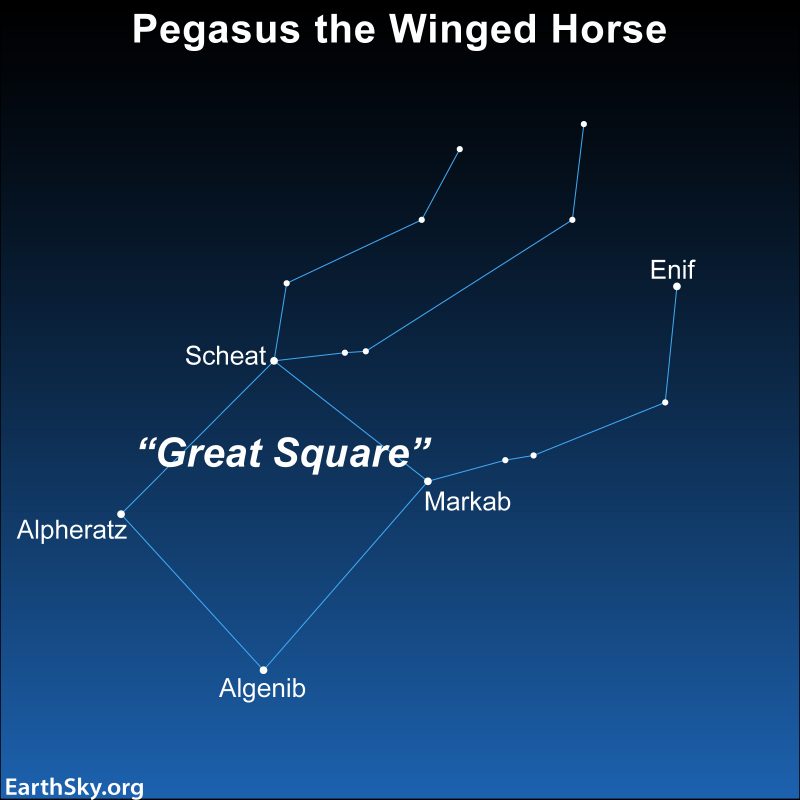
Great Square of Pegasus: Sky chart of the constellation Pegasus the Winged Horse with stars and Great Square labeled.
The Great Square of Pegasus consists of 4 stars of nearly equal brightness: Scheat, Alpheratz, Markab and Algenib. The Great Square is an asterism within the constellation Pegasus.

To find the Great Square

First of all, to find the Great Square, use the Big Dipper to star-hop to Polaris, the North Star. Then draw an imaginary line from Polaris until you land an outer star on the W or M-shaped constellation Cassiopeia the Queen.

Finally, a line from Cassiopeia faithfully escorts you to the Great Square of Pegasus.
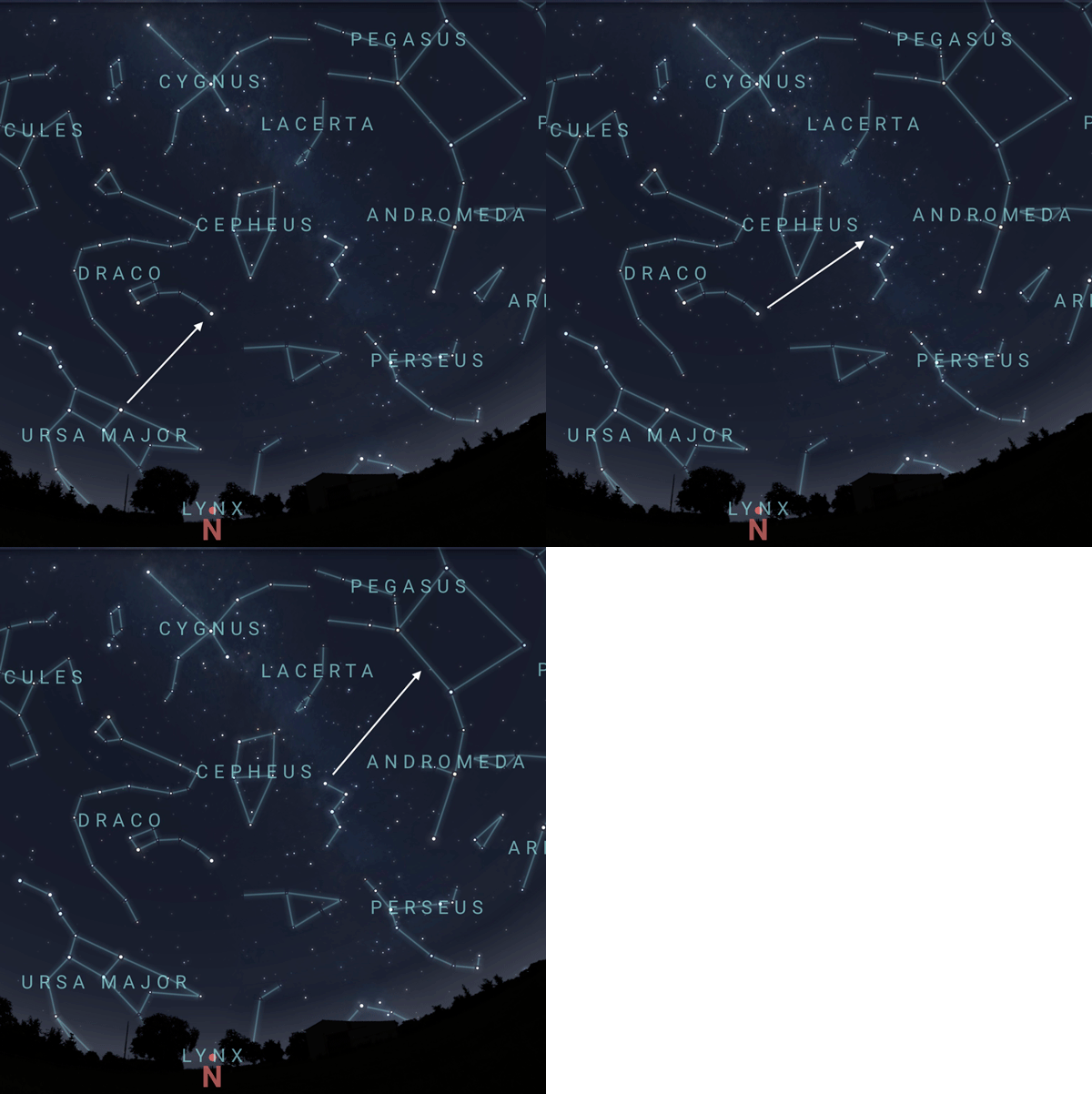
Animation showing constellations with arrows pointing from the Big Dipper to Cassiopeia to the Great Square.
Use the two stars at the end of the bowl in the Big Dipper to find Polaris. Then use Polaris to find Cassiopeia. From there you can find the Great Square of Pegasus. Chart via Stellarium. Used with permission. Animation by EarthSky.

The moon can guide you to the Great Square

The moon will often be near the Great Square. Here are charts for late September and October 2023.
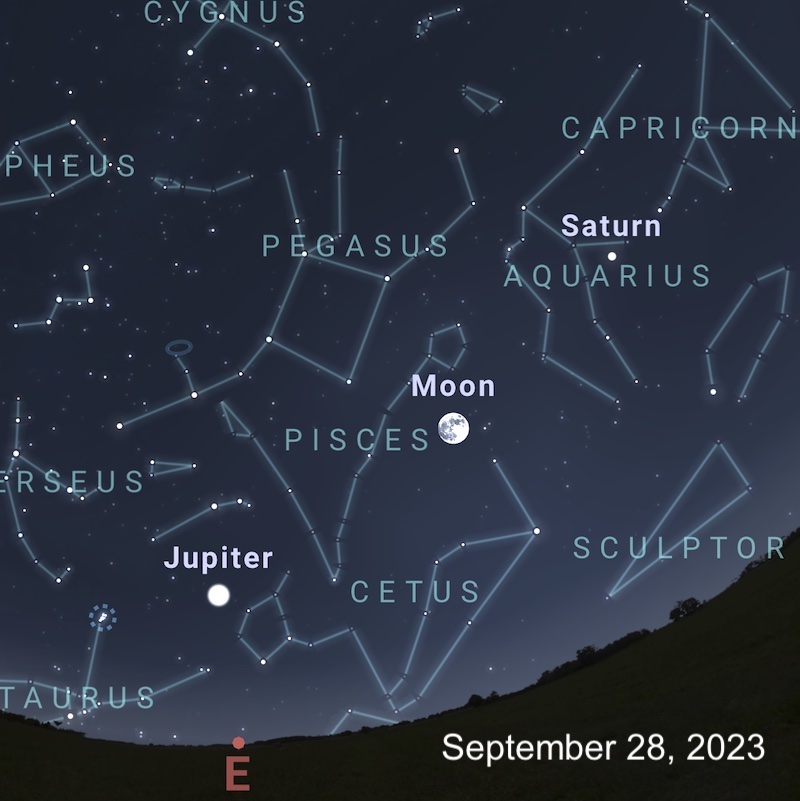
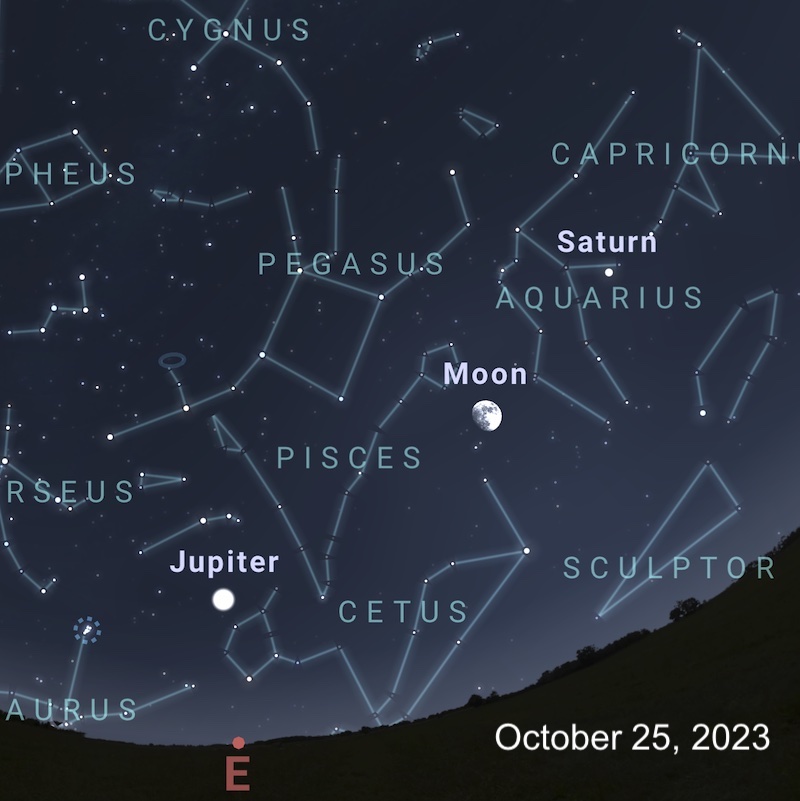
Star chart showing labeled constellations and the full moon between two planets.
On the evening of September 28, 2023, the full Harvest Moon – and supermoon – will lie below the Great Square of Pegasus and the “Circlet” of Pisces. Starting around 10 p.m. your local time, look for the bright planets Jupiter and Saturn as well. Chart via Stellarium. Used with permission.
Star chart showing labeled constellations and the gibbous moon between two planets.
On the evening of October 25, 2023, the waxing gibbous moon will lie below the Great Square of Pegasus and the “Circlet” of Pisces. Starting around 8 p.m. your local time, look for the bright planets Jupiter and Saturn as well. Chart via Stellarium. Used with permission.

Also check EarthSky’s Visible planets and night sky guide for current information.

Great Square is an asterism, not a constellation

Like the Big Dipper, the Great Square of Pegasus isn’t a constellation. Instead, it’s an asterism, or noticeable pattern on our sky’s dome. And, like the Big Dipper, the Great Square can be used to help you find other sky treasures, the most notable being the Andromeda galaxy, another famous sight on autumn evenings in the Northern Hemisphere.

Read more: 2 ways to find the Andromeda galaxy

Constellation Andromeda and asterism Great Square with the Andromeda galaxy and stars labeled.
As you can see, the Great Square of Pegasus can help guide you to the Andromeda galaxy. Here’s how to do it.

Great Square of Pegasus: A big square of nothing

Often, at events where many are stargazing for the first time, one may hear:

… the Great Square has nothing in it.

But, of course, the Great Square isn’t empty. In fact, no part of the night sky is really empty. But because the stars inside the Great Square are so faint, the unaided eye can’t easily detect them. However, if you use binoculars or a small telescope you can see many stars within the Great Square. Counting stars inside the Great Square is a good way to determine how dark your sky is when observing.

First discovery of an exoplanet orbiting a sun-like star

One of the most famous faint stars near the Great Square is 51 Pegasi. In 1995, astronomers announced in the journal Nature they’d discovered a planet around this star, and it is now called 51 Pegasi b. After a few months of skepticism from the astronomical community, it was confirmed that the first planet beyond our solar system had been discovered.

Now we know that at least 12 stars in Pegasus have exoplanets, and astronomers have confirmed more than 5,500 exoplanets in our Milky Way galaxy. The astronomers who found 51 Pegasi b – Michel Mayor of the University of Geneva and Didier Queloz at the Cavendish Laboratory and Geneva University – received the 2019 Nobel Prize in Physics for their discovery.

Some books say that 51 Pegasi is visible with the unaided eye alone. But it’s a challenge. Using binoculars, look roughly halfway between Scheat and Markab in the Great Square of Pegasus. Note that you won’t be able to see the planets. Pegasus 51 is approximately 50 light-years away from Earth.
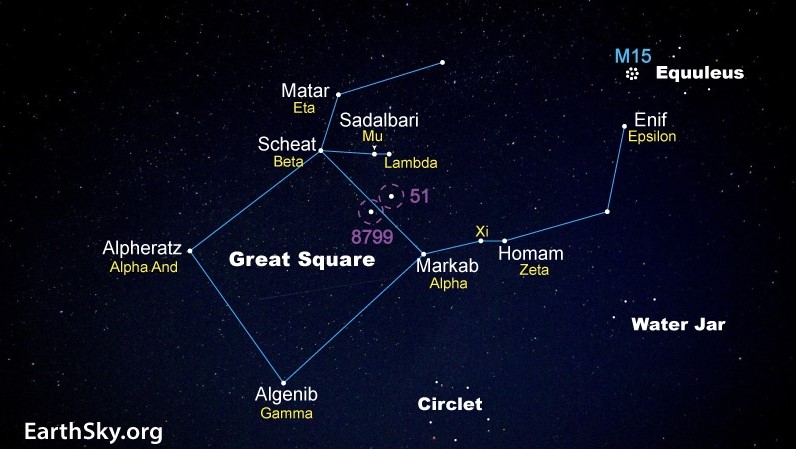
Star chart of Pegasus showing star names, Greek letter designations, and deep-sky objects.
Learn the stars of Pegasus and where to find its deep-sky targets. Look near the center for 51 Pegasi. Chart via Chelynne Campion/ EarthSky.

Mythology of the Great Square of Pegasus

You might recall that Pegasus was a winged horse in Greek mythology. The constellation Pegasus is one of seven constellations in the autumn sky that explain why it’s never a good idea to claim a mortal’s beauty is greater than that of the gods. This story is plastered all over the autumn night sky, and Pegasus figures into it prominently.

The story goes that Cassiopeia the Queen bragged that she (or her daughter Andromeda the Princess) was more beautiful than the immortal Nereids, or sea nymphs. This angered the gods, who asked the sea-god Poseidon to take revenge. The punishment was that Cepheus the King and Cassiopeia had to sacrifice Andromeda to Cetus the Whale (sometimes called a sea monster). Andromeda was chained to a rock at sea. She was about to be gobbled up by Cetus, when she saw Perseus the Hero – riding Pegasus the Flying Horse – swooping toward her.

Perseus had a trick up his sleeve. He faced Cetus, holding up the head of the Gorgon Medusa. It’s said the sight of the Medusa turned Cetus to stone. Then Perseus whacked the chains that bound Andromeda and freed her. They rode off on Pegasus the Flying Horse and lived happily ever after. Later, Zeus placed all of them in the sky as stars, along with Delphinus the Dolphin, who’d provided comfort to Andromeda.
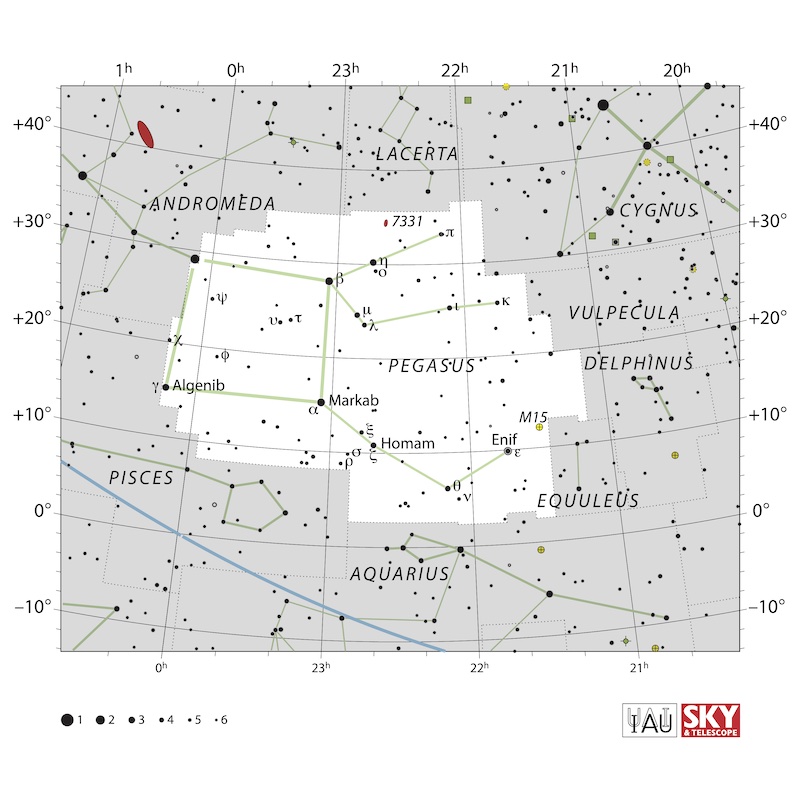
Star chart with black stars on white of constellation Pegasus with galaxy as small red oval.
The Great Square of Pegasus makes up the eastern (left) half of the constellation Pegasus. Image via International Astronomical Union. Used with permission.

Bottom line: How you can see the Great Square of Pegasus star pattern.

Enjoying EarthSky so far? Sign up for our free daily newsletter today!

The post Great Square of Pegasus gallops into the autumn sky first appeared on EarthSky.


from EarthSky https://ift.tt/LSEZunR

Great Square of Pegasus

Look east just after dark for the Great Square of Pegasus around the time of the September equinox (in 2023, it was on September 23). Throughout late September and October evenings, the Great Square will be ascending in the eastern evening sky. The Great Square consists of four stars of nearly equal brightness. Specifically, they are Scheat, Alpheratz, Markab and Algenib. Incidentally, the constellation Pegasus represents a Flying Horse. But the Great Square – a prominent asterism within Pegasus – is a landmark of the Northern Hemisphere’s autumn sky.

Great Square of Pegasus: Sky chart of the constellation Pegasus the Winged Horse with stars and Great Square labeled.
The Great Square of Pegasus consists of 4 stars of nearly equal brightness: Scheat, Alpheratz, Markab and Algenib. The Great Square is an asterism within the constellation Pegasus.

To find the Great Square

First of all, to find the Great Square, use the Big Dipper to star-hop to Polaris, the North Star. Then draw an imaginary line from Polaris until you land an outer star on the W or M-shaped constellation Cassiopeia the Queen.

Finally, a line from Cassiopeia faithfully escorts you to the Great Square of Pegasus.

Animation showing constellations with arrows pointing from the Big Dipper to Cassiopeia to the Great Square.
Use the two stars at the end of the bowl in the Big Dipper to find Polaris. Then use Polaris to find Cassiopeia. From there you can find the Great Square of Pegasus. Chart via Stellarium. Used with permission. Animation by EarthSky.

The moon can guide you to the Great Square

The moon will often be near the Great Square. Here are charts for late September and October 2023.

Star chart showing labeled constellations and the full moon between two planets.
On the evening of September 28, 2023, the full Harvest Moon – and supermoon – will lie below the Great Square of Pegasus and the “Circlet” of Pisces. Starting around 10 p.m. your local time, look for the bright planets Jupiter and Saturn as well. Chart via Stellarium. Used with permission.
Star chart showing labeled constellations and the gibbous moon between two planets.
On the evening of October 25, 2023, the waxing gibbous moon will lie below the Great Square of Pegasus and the “Circlet” of Pisces. Starting around 8 p.m. your local time, look for the bright planets Jupiter and Saturn as well. Chart via Stellarium. Used with permission.

Also check EarthSky’s Visible planets and night sky guide for current information.

Great Square is an asterism, not a constellation

Like the Big Dipper, the Great Square of Pegasus isn’t a constellation. Instead, it’s an asterism, or noticeable pattern on our sky’s dome. And, like the Big Dipper, the Great Square can be used to help you find other sky treasures, the most notable being the Andromeda galaxy, another famous sight on autumn evenings in the Northern Hemisphere.

Read more: 2 ways to find the Andromeda galaxy

Constellation Andromeda and asterism Great Square with the Andromeda galaxy and stars labeled.
As you can see, the Great Square of Pegasus can help guide you to the Andromeda galaxy. Here’s how to do it.

Great Square of Pegasus: A big square of nothing

Often, at events where many are stargazing for the first time, one may hear:

… the Great Square has nothing in it.

But, of course, the Great Square isn’t empty. In fact, no part of the night sky is really empty. But because the stars inside the Great Square are so faint, the unaided eye can’t easily detect them. However, if you use binoculars or a small telescope you can see many stars within the Great Square. Counting stars inside the Great Square is a good way to determine how dark your sky is when observing.

First discovery of an exoplanet orbiting a sun-like star

One of the most famous faint stars near the Great Square is 51 Pegasi. In 1995, astronomers announced in the journal Nature they’d discovered a planet around this star, and it is now called 51 Pegasi b. After a few months of skepticism from the astronomical community, it was confirmed that the first planet beyond our solar system had been discovered.

Now we know that at least 12 stars in Pegasus have exoplanets, and astronomers have confirmed more than 5,500 exoplanets in our Milky Way galaxy. The astronomers who found 51 Pegasi b – Michel Mayor of the University of Geneva and Didier Queloz at the Cavendish Laboratory and Geneva University – received the 2019 Nobel Prize in Physics for their discovery.

Some books say that 51 Pegasi is visible with the unaided eye alone. But it’s a challenge. Using binoculars, look roughly halfway between Scheat and Markab in the Great Square of Pegasus. Note that you won’t be able to see the planets. Pegasus 51 is approximately 50 light-years away from Earth.

Star chart of Pegasus showing star names, Greek letter designations, and deep-sky objects.
Learn the stars of Pegasus and where to find its deep-sky targets. Look near the center for 51 Pegasi. Chart via Chelynne Campion/ EarthSky.

Mythology of the Great Square of Pegasus

You might recall that Pegasus was a winged horse in Greek mythology. The constellation Pegasus is one of seven constellations in the autumn sky that explain why it’s never a good idea to claim a mortal’s beauty is greater than that of the gods. This story is plastered all over the autumn night sky, and Pegasus figures into it prominently.

The story goes that Cassiopeia the Queen bragged that she (or her daughter Andromeda the Princess) was more beautiful than the immortal Nereids, or sea nymphs. This angered the gods, who asked the sea-god Poseidon to take revenge. The punishment was that Cepheus the King and Cassiopeia had to sacrifice Andromeda to Cetus the Whale (sometimes called a sea monster). Andromeda was chained to a rock at sea. She was about to be gobbled up by Cetus, when she saw Perseus the Hero – riding Pegasus the Flying Horse – swooping toward her.

Perseus had a trick up his sleeve. He faced Cetus, holding up the head of the Gorgon Medusa. It’s said the sight of the Medusa turned Cetus to stone. Then Perseus whacked the chains that bound Andromeda and freed her. They rode off on Pegasus the Flying Horse and lived happily ever after. Later, Zeus placed all of them in the sky as stars, along with Delphinus the Dolphin, who’d provided comfort to Andromeda.

Star chart with black stars on white of constellation Pegasus with galaxy as small red oval.
The Great Square of Pegasus makes up the eastern (left) half of the constellation Pegasus. Image via International Astronomical Union. Used with permission.

Bottom line: How you can see the Great Square of Pegasus star pattern.

Enjoying EarthSky so far? Sign up for our free daily newsletter today!

The post Great Square of Pegasus gallops into the autumn sky first appeared on EarthSky.


from EarthSky https://ift.tt/LSEZunR

What is this weird golden orb from the seafloor?

Earth’s oceans are mysterious. And a recent National Oceanic and Atmospheric Administration (NOAA) expedition found an intriguing mystery in the Gulf of Alaska. The NOAA ship Okeanos Explorer discovered something strange on the ocean bottom on August 30, 2023. Some media have since dubbed it the “golden orb.” The small dome-shaped gold-colored object has puzzled both scientists and the public. What is it? Scientists still don’t know for sure. But they’ve now determined that it’s biological in origin.

NOAA first announced the discovery on September 7.

Golden orb: Gold-colored, roundish object with layers and a large dome in the center, held in a gloved hand.
View larger. | The NOAA ship Okeanos Explorer retrieved this “golden orb” from the seafloor in the Gulf of Alaska on August 30, 2023. Scientists still aren’t sure what it is. But they say it’s biological in origin. Image via NOAA Ocean Exploration/ Seascape Alaska.

How did they find the golden orb?

On August 30, 2023, NOAA was using remotely operated vehicles to explore an underwater seamount in the Gulf of Alaska. They were operating as part of the Seascape Alaska 5 expedition, whose overall goal is the study of unexplored and poorly understood deepwater areas off the shores of Alaska. On the ocean surface, NOAA personnel were on the NOAA ship Okeanos Explorer.

Then – about two miles (3,300 meters) deep, on the ocean bottom, amidst some of the usual white sponges – one of the underwater vehicles came across something odd.

It was small, about four inches (10 cm) across. And it was dome-shaped. It was also smooth and exquisitely golden in color. It was firmly attached to a rock. There was a hole or tear near its bottom. And it appeared to be the same color inside as outside.

The scientists hadn’t seen anything like it before. Media dubbed it the “golden orb” or “golden egg.” Initial theories included a dead sponge attachment, coral or an egg casing.

Golden object is biological in origin

The scientists say they still don’t know exactly what the object is.

But they say they’ve determined it is biological in origin. NOAA Ocean Exploration’s Sam Candio was the expedition coordinator. He described the discovery in a NOAA blog post, saying:

Isn’t the deep sea so delightfully strange? While we were able to collect the ‘golden orb’ and bring it onto the ship, we still are not able to identify it beyond the fact that it is biological in origin.

We likely won’t learn more until we are able to get it into a laboratory setting where we can continue to pull from the collective expertise of the scientific community with more sophisticated tools than we are able to maintain on the ship.

While somewhat humbling to be stumped by this finding, it serves as a reminder of how little we know about our own planet and how much is left to learn and appreciate about our ocean.

Gold-colored domed object emerging from rough gray rocks with squashy ocean life, maybe sponges, nearby.
View larger. | This is the “golden orb” as first discovered on August 30, 2023, tightly attached to a rock at a depth of about 2 miles (3,300 meters). Image via NOAA Ocean Exploration/ Seascape Alaska.

A new ocean species?

The scientists are still debating if the golden orb is a known species or a new species. It could also be something from an unknown life stage of an existing species. With this in mind, Candio said it’s an important finding, especially if it is a new species not seen before:

New species have the potential to reveal new sources for medical therapies and vaccines, food, energy and other societal benefits and knowledge. Collectively, the data and information gathered during this expedition will help us close gaps in our understanding of this part of the planet, so we can better manage and protect it.

This latest discovery is certainly a weird one. And it won’t be the last. Remember when other NOAA scientists found those unusual long lines of holes in the seabed in the Atlantic Ocean last year?

Just as in outer space, the ocean depths can hold many surprises.

What do you think the “golden orb” is? Let us know in the comments!

Bottom line: On August 30, 2023, scientists retrieved a weird object from the Gulf of Alaska. Dubbed the “golden orb,” it’s still a mystery. But now we know it’s biological in origin.

Via NOAA

Read more: Weird ocean holes are an unsolved mystery

The post What is this weird golden orb from the seafloor? first appeared on EarthSky.


from EarthSky https://ift.tt/CZrutei

Earth’s oceans are mysterious. And a recent National Oceanic and Atmospheric Administration (NOAA) expedition found an intriguing mystery in the Gulf of Alaska. The NOAA ship Okeanos Explorer discovered something strange on the ocean bottom on August 30, 2023. Some media have since dubbed it the “golden orb.” The small dome-shaped gold-colored object has puzzled both scientists and the public. What is it? Scientists still don’t know for sure. But they’ve now determined that it’s biological in origin.

NOAA first announced the discovery on September 7.

Golden orb: Gold-colored, roundish object with layers and a large dome in the center, held in a gloved hand.
View larger. | The NOAA ship Okeanos Explorer retrieved this “golden orb” from the seafloor in the Gulf of Alaska on August 30, 2023. Scientists still aren’t sure what it is. But they say it’s biological in origin. Image via NOAA Ocean Exploration/ Seascape Alaska.

How did they find the golden orb?

On August 30, 2023, NOAA was using remotely operated vehicles to explore an underwater seamount in the Gulf of Alaska. They were operating as part of the Seascape Alaska 5 expedition, whose overall goal is the study of unexplored and poorly understood deepwater areas off the shores of Alaska. On the ocean surface, NOAA personnel were on the NOAA ship Okeanos Explorer.

Then – about two miles (3,300 meters) deep, on the ocean bottom, amidst some of the usual white sponges – one of the underwater vehicles came across something odd.

It was small, about four inches (10 cm) across. And it was dome-shaped. It was also smooth and exquisitely golden in color. It was firmly attached to a rock. There was a hole or tear near its bottom. And it appeared to be the same color inside as outside.

The scientists hadn’t seen anything like it before. Media dubbed it the “golden orb” or “golden egg.” Initial theories included a dead sponge attachment, coral or an egg casing.

Golden object is biological in origin

The scientists say they still don’t know exactly what the object is.

But they say they’ve determined it is biological in origin. NOAA Ocean Exploration’s Sam Candio was the expedition coordinator. He described the discovery in a NOAA blog post, saying:

Isn’t the deep sea so delightfully strange? While we were able to collect the ‘golden orb’ and bring it onto the ship, we still are not able to identify it beyond the fact that it is biological in origin.

We likely won’t learn more until we are able to get it into a laboratory setting where we can continue to pull from the collective expertise of the scientific community with more sophisticated tools than we are able to maintain on the ship.

While somewhat humbling to be stumped by this finding, it serves as a reminder of how little we know about our own planet and how much is left to learn and appreciate about our ocean.

Gold-colored domed object emerging from rough gray rocks with squashy ocean life, maybe sponges, nearby.
View larger. | This is the “golden orb” as first discovered on August 30, 2023, tightly attached to a rock at a depth of about 2 miles (3,300 meters). Image via NOAA Ocean Exploration/ Seascape Alaska.

A new ocean species?

The scientists are still debating if the golden orb is a known species or a new species. It could also be something from an unknown life stage of an existing species. With this in mind, Candio said it’s an important finding, especially if it is a new species not seen before:

New species have the potential to reveal new sources for medical therapies and vaccines, food, energy and other societal benefits and knowledge. Collectively, the data and information gathered during this expedition will help us close gaps in our understanding of this part of the planet, so we can better manage and protect it.

This latest discovery is certainly a weird one. And it won’t be the last. Remember when other NOAA scientists found those unusual long lines of holes in the seabed in the Atlantic Ocean last year?

Just as in outer space, the ocean depths can hold many surprises.

What do you think the “golden orb” is? Let us know in the comments!

Bottom line: On August 30, 2023, scientists retrieved a weird object from the Gulf of Alaska. Dubbed the “golden orb,” it’s still a mystery. But now we know it’s biological in origin.

Via NOAA

Read more: Weird ocean holes are an unsolved mystery

The post What is this weird golden orb from the seafloor? first appeared on EarthSky.


from EarthSky https://ift.tt/CZrutei

Asteroid sample returned safely to Earth

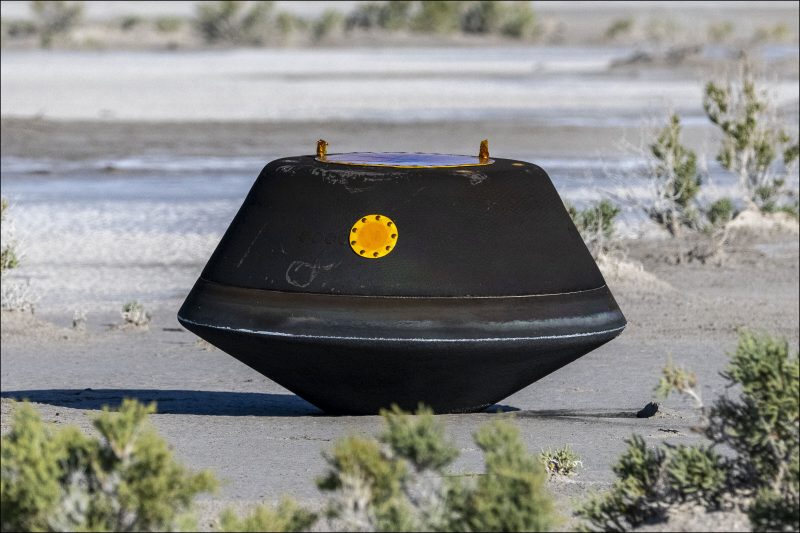
A black container with an orange disk sits on the sand in the desert.
The asteroid sample return mission had a smooth descent and landing in the Utah desert on September 24, 2023. Image via NASA HQ Photo.

The OSIRIS-REx spacecraft dropped off an asteroid sample from Bennu on September 24, 2023. NASA aired live footage of the descent as it impacted with the Utah desert three minutes ahead of schedule. You can watch a replay of the coverage here. Teams on the ground quickly reached the landing site and determined that it was safe to transport the sample to a clean room in Utah. It will soon make a journey to Johnson Space Center in Houston, where a portion of it will be divided up and sent to scientists around the world for study. The spacecraft, now under the name OSIRIS-APEX, sped off toward its next mission: a rendezvous with asteroid Apophis.

OSIRIS-REx’s journey to Bennu and back

OSIRIS-REx arrived at Bennu in 2018. In 2020, it touched down on the asteroid and scooped up material from the surface. Then, in 2021, the spacecraft left Bennu on its return mission to Earth.

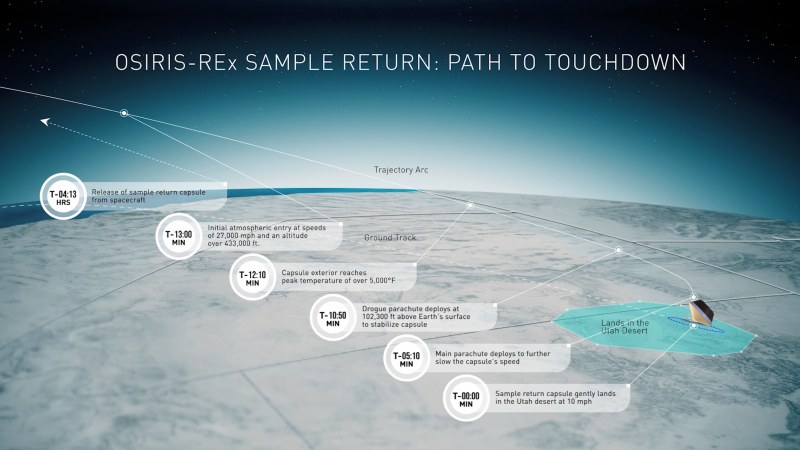
When OSIRIS-REx dropped off the asteroid sample early Sunday morning, the capsule spiraled downward for hours before hitting Earth’s atmosphere. When it first hit the atmosphere, it was speeding at about 27,650 mph (44,500 kph). A heat shield protected the sample inside as the capsule temporarily became a superheated ball of fire.

Eventually, a series of parachutes deployed to slow the capsule further. By the time the capsule impacted the Utah desert, it slowed down to a speed of 11 mph (18 kph).

Asteroid sample: Graphic showing capsule landing path through atmospher with 6 important milestones marked.
View larger. | This was the path of the asteroid sample after OSIRIS-REx dropped it off on Sunday, September 24, 2023. The capsule reentered Earth’s atmosphere just south of San Francisco. Then the sample return flew over central California and Nevada as it headed for its landing site in the Utah desert, southwest of Salt Lake City. Image via NASA.

More about the asteroid sample from Bennu

NASA said the rocky asteroid sample from Bennu is an estimated 8.8 ounces, or 250 grams. It’s NASA’s first asteroid sample and the largest ever collected in space. Watch the video below for more.


Watch a video detailing OSIRIS-REx’s delivery of an asteroid sample to Earth. The sample from asteroid Bennu landed on Earth on September 24, 2023.

Continuing on to Apophis

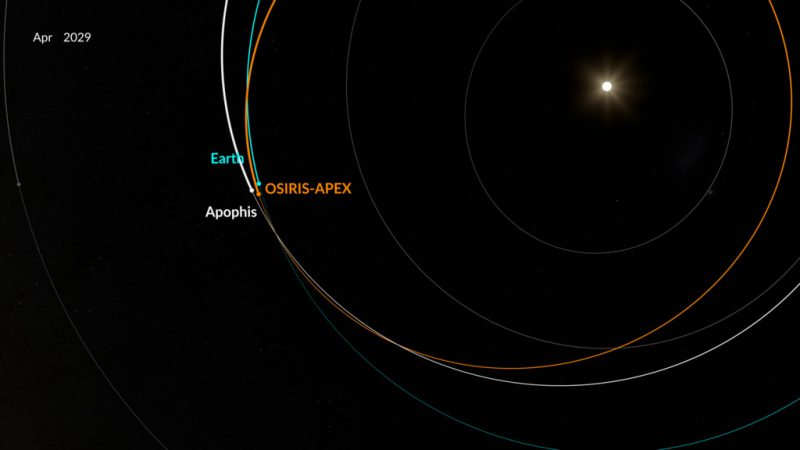
After OSIRIS-REx fired its thrusters to keep it from colliding with Earth, it continued on its way, eventually headed for Apophis. Apophis is an asteroid famous for how close it will come to Earth. On Friday, April 13, 2029, the 1,100-foot (340-meter) space rock will come within 19,662 miles (31,643 km) of Earth’s surface. That’s closer than many Earth-orbiting satellites. As the asteroid encounters Earth’s gravitational field, one result could be asteroid-quakes on Apophis. This passage will also change the orbit of Apophis slightly. Some observers will even be able to see Apophis as it passes.

OSIRIS-APEX, now renamed for its new target of Apophis, will reach the asteroid in 2029. This extended mission will have OSIRIS-APEX orbiting and studying Apophis for a year and a half. The spacecraft will venture close enough to the asteroid to stir up loose material.

Diagram of Earth, Apophis and OSIRIS orbits with all 3 meeting close together, labeled April 2029.
In April 2029, when asteroid Apophis makes its closest approach to Earth, the spacecraft OSIRIS-APEX will be there to observe. Image via NASA.

Bottom line: The spacecraft OSIRIS-REx dropped off an asteroid sample from Bennu on September 24, 2023, before continuing on a mission to Apophis as OSIRIS-APEX.

Via NASA

The post Asteroid sample returned safely to Earth first appeared on EarthSky.


from EarthSky https://ift.tt/coS3d1D
A black container with an orange disk sits on the sand in the desert.
The asteroid sample return mission had a smooth descent and landing in the Utah desert on September 24, 2023. Image via NASA HQ Photo.

The OSIRIS-REx spacecraft dropped off an asteroid sample from Bennu on September 24, 2023. NASA aired live footage of the descent as it impacted with the Utah desert three minutes ahead of schedule. You can watch a replay of the coverage here. Teams on the ground quickly reached the landing site and determined that it was safe to transport the sample to a clean room in Utah. It will soon make a journey to Johnson Space Center in Houston, where a portion of it will be divided up and sent to scientists around the world for study. The spacecraft, now under the name OSIRIS-APEX, sped off toward its next mission: a rendezvous with asteroid Apophis.

OSIRIS-REx’s journey to Bennu and back

OSIRIS-REx arrived at Bennu in 2018. In 2020, it touched down on the asteroid and scooped up material from the surface. Then, in 2021, the spacecraft left Bennu on its return mission to Earth.

When OSIRIS-REx dropped off the asteroid sample early Sunday morning, the capsule spiraled downward for hours before hitting Earth’s atmosphere. When it first hit the atmosphere, it was speeding at about 27,650 mph (44,500 kph). A heat shield protected the sample inside as the capsule temporarily became a superheated ball of fire.

Eventually, a series of parachutes deployed to slow the capsule further. By the time the capsule impacted the Utah desert, it slowed down to a speed of 11 mph (18 kph).

Asteroid sample: Graphic showing capsule landing path through atmospher with 6 important milestones marked.
View larger. | This was the path of the asteroid sample after OSIRIS-REx dropped it off on Sunday, September 24, 2023. The capsule reentered Earth’s atmosphere just south of San Francisco. Then the sample return flew over central California and Nevada as it headed for its landing site in the Utah desert, southwest of Salt Lake City. Image via NASA.

More about the asteroid sample from Bennu

NASA said the rocky asteroid sample from Bennu is an estimated 8.8 ounces, or 250 grams. It’s NASA’s first asteroid sample and the largest ever collected in space. Watch the video below for more.


Watch a video detailing OSIRIS-REx’s delivery of an asteroid sample to Earth. The sample from asteroid Bennu landed on Earth on September 24, 2023.

Continuing on to Apophis

After OSIRIS-REx fired its thrusters to keep it from colliding with Earth, it continued on its way, eventually headed for Apophis. Apophis is an asteroid famous for how close it will come to Earth. On Friday, April 13, 2029, the 1,100-foot (340-meter) space rock will come within 19,662 miles (31,643 km) of Earth’s surface. That’s closer than many Earth-orbiting satellites. As the asteroid encounters Earth’s gravitational field, one result could be asteroid-quakes on Apophis. This passage will also change the orbit of Apophis slightly. Some observers will even be able to see Apophis as it passes.

OSIRIS-APEX, now renamed for its new target of Apophis, will reach the asteroid in 2029. This extended mission will have OSIRIS-APEX orbiting and studying Apophis for a year and a half. The spacecraft will venture close enough to the asteroid to stir up loose material.

Diagram of Earth, Apophis and OSIRIS orbits with all 3 meeting close together, labeled April 2029.
In April 2029, when asteroid Apophis makes its closest approach to Earth, the spacecraft OSIRIS-APEX will be there to observe. Image via NASA.

Bottom line: The spacecraft OSIRIS-REx dropped off an asteroid sample from Bennu on September 24, 2023, before continuing on a mission to Apophis as OSIRIS-APEX.

Via NASA

The post Asteroid sample returned safely to Earth first appeared on EarthSky.


from EarthSky https://ift.tt/coS3d1D

Avi Loeb and ‘Oumuamua. Why the controversy?

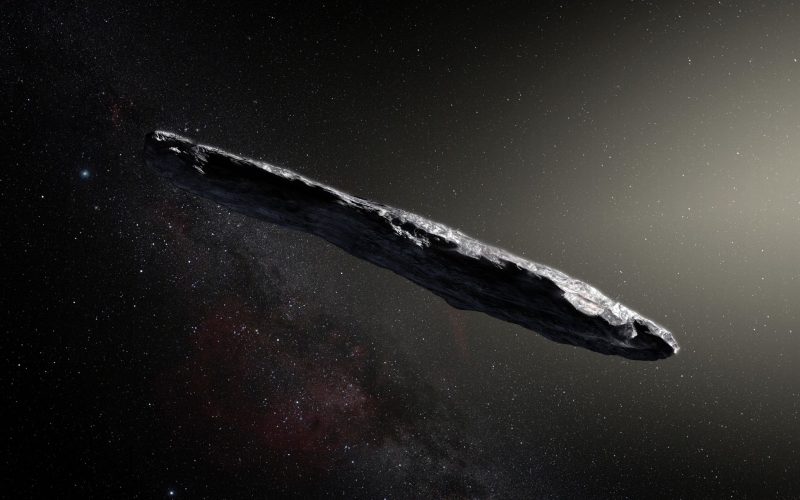
Avi Loeb: Long, narrow rocky object with field of stars in background.
Artist’s concept of ‘Oumuamua, which passed through our solar system in 2017 and became known as the first confirmed interstellar visitor. Was it natural, or something more exotic, as suggested by Avi Loeb? Here, Jason Wright describes the controversy around Loeb’s work on, among other things, this interstellar visitor. Image via ESO/ M. Kornmesser.

Originally published on July 18, 2023, by Jason Wright. Republished with permission. Edits by EarthSky. Read the original article at AstroWright.

Avi Loeb and alien tech research

As an astrophysicist who searches for signs of alien technology beyond Earth, I’m often asked these days what I think about Avi Loeb.

Loeb, you might know, recently rose to public prominence with his claims that the first discovered interstellar comet, ‘Oumuamua, is actually a piece of an alien spacecraft passing through the solar system. Since then he has headlined UAP conventions, written a very popular book about his claim (now two), and raised millions of dollars to study Unidentified Aerial Phenomena (UAPs, or UFOs) with his Galileo Project initiative. His latest venture with that money is to sweep a metal detector across the Pacific to find fragments of what he claims is another interstellar visitor that the U.S. military detected crashing into the ocean. This resulted in headlines such as Why a Harvard professor thinks he may have found fragments of an alien spacecraft in the Independent.

Not a quack

Loeb has the credentials to be taken seriously. He is a well-respected theoretical cosmologist who has made foundational contributions to our understanding of the early universe. He served as the chair of the Harvard astronomy department, and leads the distinguished Institute for Theory and Computation at the Harvard-Smithsonian Center for Astrophysics. He is well known as an outside-the-box thinker who is brave enough to be wrong often enough to occasionally be right in important and unexpected ways. As well, he is a prolific paper writer, mentor to many students and postdoctoral researchers, and a leader in the community. I, in particular, was strongly influenced by a lecture he gave on diversifying one’s research portfolio to include a lot of safe but passé research, some more risky cutting edge work, and a small amount of outré science. It’s important advice for any scientific field.

But his shenanigans have lately strongly changed the astronomy community’s perceptions of him. His recent claims about alien spacecraft and comets and asteroids largely come across to experts as, at best, terribly naïve, and often as simply erroneous (Loeb has no formal training or previous track record to speak of in planetary science, which has little in common with the plasma physics he is known for). His promotion of his claims in the media is particularly galling to professionals who discover and study comets, who were very excited about the discovery of ‘Oumuamua but have found their careful work dismissed and ridiculed by Loeb, who is the most visible scientist discussing it in the media.

The Pacific discoveries

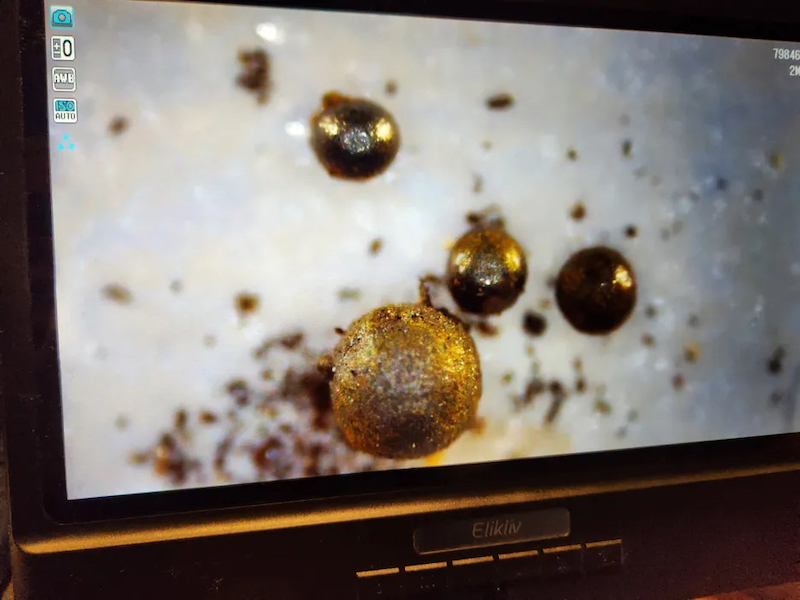
Most recently, his claims to have discovered possible fragments of an alien ship in the Pacific have been criticized by meteoriticists at a recent conference. Loeb claims the metallic spherules he found trawling the ocean floor are from the impact site of an interstellar object (dubbed 20140108 CNEOS/USG). Critics point out that they are much more likely to have come from ordinary meteorites or even terrestrial volcanoes, or human activities like coal burning ships or WWII warfare in the area. And, they argue, 20140108 most likely did not come from outside the solar system at all. (It also appears that Loeb may have violated legal and ethical norms by removing material from Papua New Guinean waters – you’re not supposed to just go into other countries and collect things without permission.)

Vivid photo of 4 metallic, gold-colored, rough-textured spheres on a computer screen.
A sample of the some of the spherules that Avi Loeb’s team found after combing the ocean floor for alien fragments. These fragments are tiny, only about 0.3 mm (about 1/100 of an inch) in size. Image via Avi Loeb. Used with permission.

Avi Loeb in the media and in the astronomical community

Also frustrating is how Loeb’s book and media interviews paint him as a heroic, transformational figure in science, while career-long experts in the fields he is opining on are characterized as obstinate and short-sighted. His Galileo Project has that name because it is “daring to look through new telescopes.” In his book claiming ‘Oumuamua is an alien spacecraft, he unironically compares himself to the father of telescopic astronomy, Galileo himself. The community was aghast when he blew up at Jill Tarter, a well-respected giant in the field of SETI and one of the best known women in science in the world. (When Tarter expressed annoyance at his dismissal of others’ work in SETI, he angrily accused her of “opposing” him, and of not doing enough for SETI, as if anyone had done more! Loeb later apologized to Tarter and his colleagues, calling his actions “inappropriate.”)

It is true that there is much work to be done to normalize work on SETI and UAPs in scientific circles. Tarter herself has worked for decades to change attitudes about SETI at NASA and among astronomers generally, to get them to embrace the serious, peer-reviewed work to answer one of the biggest questions in science (as I’ve written about before). Scientifically rigorous studies of UAPs have also begun to make inroads, most notably with NASA’s recent panel advising on the topic (Loeb was pointedly not involved; I must note that I see the UAP and SETI questions as scientifically unrelated). But Loeb’s work is unambiguously counterproductive, alienating the community working on these problems and misinforming the public about the state of the field.

Closeup of man in glasses with hand by face and 'Are we alone' written on palm with marker.
Avi Loeb is the Frank B. Baird, Jr., Professor of Science at Harvard University and a best-selling author. He suggests alien technology might have crashed into the Pacific Ocean in 2014. Image via Harvard/ Avi Loeb/ Herlinde Koelbl.

A balanced perspective of Avi Loeb

So it is against all of this background that, even when asked, I have generally stayed quiet lately when it comes to Loeb, or tried to give a balanced and nuanced perspective. I do appreciate that he is moving the scientific Overton Window, making SETI, which used to (unfairly) seem like an outlandish corner of science, seem practically mainstream by comparison. I appreciate the support he’s given to my work in SETI, and I generally discourage too much public or indiscriminate criticism of him lest the rest of the field suffer “splash damage.”

I have noticed, however, that Loeb’s work and behavior have been seen as so outrageous in many quarters that it essentially goes unrebutted in popular forums by those who are in the best position to explain what, exactly, is wrong about it. This leaves a vacuum, where the public hears only Loeb’s persuasive and articulate voice, with no obvious public pushback from experts beyond exasperated eye-rolling that feeds right into his hero narrative.

Correcting the record

So for the past several months, I’ve worked with Steve Desch and Sean Raymond, two planetary scientists and experts on ‘Oumuamua, to correct the record. It has taken a lot of time: as Jonathan Swift wrote, “… falsehood flies, and the truth comes limping after it.” I read Loeb’s book on ‘Oumuamua, cover to cover, and carefully noted each of his arguments that ‘Oumuamua is anything other than a comet or asteroid. The three of us then went through and did our best to take an objective look at whether his statement of the evidence is correct, whether it really supports the alien spacecraft hypothesis, and whether it is actually consistent with ‘Oumuamua being a comet. No surprise, we find that under careful scrutiny his claims are often incorrect, and that there is little to no evidence that ‘Oumuamua is an artificial object. We’ve done our best in our rebuttal to avoid criticizing Loeb or his behavior, and to focus instead just on what we do and do not know about ‘Oumuamua. You can find our analysis here.

There is little joy in or reward for debunking claims in science. We would all rather be finding new natural phenomena to celebrate than spending a lot of time correcting the mistakes or false claims of others published years earlier.

A thrilling astronomical future

Because the truth is, we’re entering a new era of astronomy where we can, for the first time, contemplate studying samples from other solar systems, where we are seeing the first serious and comprehensive searches for signs of alien technology among the stars, and where truly new telescopes and methods are unlocking secrets of the universe that will thrill fans of science around the world, all without any need for sensationalism. Now that we’ve addressed Loeb’s most outlandish claims about ‘Oumuamua, I’m excited to get back to work on it!

Bottom line: Astronomer Jason Wright of the blog AstroWright explains why some of Avi Loeb’s recent work is seen as outrageous by some, but also highlights some benefits that have come out of his endeavors.

Via AstroWright

Read more:
Interstellar, a new book by Avi Loeb
Was ‘Oumuamua a comet? Avi Loeb responds to new research
Sea-going search for alien fragments yields odd spherules

The post Avi Loeb and ‘Oumuamua. Why the controversy? first appeared on EarthSky.


from EarthSky https://ift.tt/Q0CjrSm
Avi Loeb: Long, narrow rocky object with field of stars in background.
Artist’s concept of ‘Oumuamua, which passed through our solar system in 2017 and became known as the first confirmed interstellar visitor. Was it natural, or something more exotic, as suggested by Avi Loeb? Here, Jason Wright describes the controversy around Loeb’s work on, among other things, this interstellar visitor. Image via ESO/ M. Kornmesser.

Originally published on July 18, 2023, by Jason Wright. Republished with permission. Edits by EarthSky. Read the original article at AstroWright.

Avi Loeb and alien tech research

As an astrophysicist who searches for signs of alien technology beyond Earth, I’m often asked these days what I think about Avi Loeb.

Loeb, you might know, recently rose to public prominence with his claims that the first discovered interstellar comet, ‘Oumuamua, is actually a piece of an alien spacecraft passing through the solar system. Since then he has headlined UAP conventions, written a very popular book about his claim (now two), and raised millions of dollars to study Unidentified Aerial Phenomena (UAPs, or UFOs) with his Galileo Project initiative. His latest venture with that money is to sweep a metal detector across the Pacific to find fragments of what he claims is another interstellar visitor that the U.S. military detected crashing into the ocean. This resulted in headlines such as Why a Harvard professor thinks he may have found fragments of an alien spacecraft in the Independent.

Not a quack

Loeb has the credentials to be taken seriously. He is a well-respected theoretical cosmologist who has made foundational contributions to our understanding of the early universe. He served as the chair of the Harvard astronomy department, and leads the distinguished Institute for Theory and Computation at the Harvard-Smithsonian Center for Astrophysics. He is well known as an outside-the-box thinker who is brave enough to be wrong often enough to occasionally be right in important and unexpected ways. As well, he is a prolific paper writer, mentor to many students and postdoctoral researchers, and a leader in the community. I, in particular, was strongly influenced by a lecture he gave on diversifying one’s research portfolio to include a lot of safe but passé research, some more risky cutting edge work, and a small amount of outré science. It’s important advice for any scientific field.

But his shenanigans have lately strongly changed the astronomy community’s perceptions of him. His recent claims about alien spacecraft and comets and asteroids largely come across to experts as, at best, terribly naïve, and often as simply erroneous (Loeb has no formal training or previous track record to speak of in planetary science, which has little in common with the plasma physics he is known for). His promotion of his claims in the media is particularly galling to professionals who discover and study comets, who were very excited about the discovery of ‘Oumuamua but have found their careful work dismissed and ridiculed by Loeb, who is the most visible scientist discussing it in the media.

The Pacific discoveries

Most recently, his claims to have discovered possible fragments of an alien ship in the Pacific have been criticized by meteoriticists at a recent conference. Loeb claims the metallic spherules he found trawling the ocean floor are from the impact site of an interstellar object (dubbed 20140108 CNEOS/USG). Critics point out that they are much more likely to have come from ordinary meteorites or even terrestrial volcanoes, or human activities like coal burning ships or WWII warfare in the area. And, they argue, 20140108 most likely did not come from outside the solar system at all. (It also appears that Loeb may have violated legal and ethical norms by removing material from Papua New Guinean waters – you’re not supposed to just go into other countries and collect things without permission.)

Vivid photo of 4 metallic, gold-colored, rough-textured spheres on a computer screen.
A sample of the some of the spherules that Avi Loeb’s team found after combing the ocean floor for alien fragments. These fragments are tiny, only about 0.3 mm (about 1/100 of an inch) in size. Image via Avi Loeb. Used with permission.

Avi Loeb in the media and in the astronomical community

Also frustrating is how Loeb’s book and media interviews paint him as a heroic, transformational figure in science, while career-long experts in the fields he is opining on are characterized as obstinate and short-sighted. His Galileo Project has that name because it is “daring to look through new telescopes.” In his book claiming ‘Oumuamua is an alien spacecraft, he unironically compares himself to the father of telescopic astronomy, Galileo himself. The community was aghast when he blew up at Jill Tarter, a well-respected giant in the field of SETI and one of the best known women in science in the world. (When Tarter expressed annoyance at his dismissal of others’ work in SETI, he angrily accused her of “opposing” him, and of not doing enough for SETI, as if anyone had done more! Loeb later apologized to Tarter and his colleagues, calling his actions “inappropriate.”)

It is true that there is much work to be done to normalize work on SETI and UAPs in scientific circles. Tarter herself has worked for decades to change attitudes about SETI at NASA and among astronomers generally, to get them to embrace the serious, peer-reviewed work to answer one of the biggest questions in science (as I’ve written about before). Scientifically rigorous studies of UAPs have also begun to make inroads, most notably with NASA’s recent panel advising on the topic (Loeb was pointedly not involved; I must note that I see the UAP and SETI questions as scientifically unrelated). But Loeb’s work is unambiguously counterproductive, alienating the community working on these problems and misinforming the public about the state of the field.

Closeup of man in glasses with hand by face and 'Are we alone' written on palm with marker.
Avi Loeb is the Frank B. Baird, Jr., Professor of Science at Harvard University and a best-selling author. He suggests alien technology might have crashed into the Pacific Ocean in 2014. Image via Harvard/ Avi Loeb/ Herlinde Koelbl.

A balanced perspective of Avi Loeb

So it is against all of this background that, even when asked, I have generally stayed quiet lately when it comes to Loeb, or tried to give a balanced and nuanced perspective. I do appreciate that he is moving the scientific Overton Window, making SETI, which used to (unfairly) seem like an outlandish corner of science, seem practically mainstream by comparison. I appreciate the support he’s given to my work in SETI, and I generally discourage too much public or indiscriminate criticism of him lest the rest of the field suffer “splash damage.”

I have noticed, however, that Loeb’s work and behavior have been seen as so outrageous in many quarters that it essentially goes unrebutted in popular forums by those who are in the best position to explain what, exactly, is wrong about it. This leaves a vacuum, where the public hears only Loeb’s persuasive and articulate voice, with no obvious public pushback from experts beyond exasperated eye-rolling that feeds right into his hero narrative.

Correcting the record

So for the past several months, I’ve worked with Steve Desch and Sean Raymond, two planetary scientists and experts on ‘Oumuamua, to correct the record. It has taken a lot of time: as Jonathan Swift wrote, “… falsehood flies, and the truth comes limping after it.” I read Loeb’s book on ‘Oumuamua, cover to cover, and carefully noted each of his arguments that ‘Oumuamua is anything other than a comet or asteroid. The three of us then went through and did our best to take an objective look at whether his statement of the evidence is correct, whether it really supports the alien spacecraft hypothesis, and whether it is actually consistent with ‘Oumuamua being a comet. No surprise, we find that under careful scrutiny his claims are often incorrect, and that there is little to no evidence that ‘Oumuamua is an artificial object. We’ve done our best in our rebuttal to avoid criticizing Loeb or his behavior, and to focus instead just on what we do and do not know about ‘Oumuamua. You can find our analysis here.

There is little joy in or reward for debunking claims in science. We would all rather be finding new natural phenomena to celebrate than spending a lot of time correcting the mistakes or false claims of others published years earlier.

A thrilling astronomical future

Because the truth is, we’re entering a new era of astronomy where we can, for the first time, contemplate studying samples from other solar systems, where we are seeing the first serious and comprehensive searches for signs of alien technology among the stars, and where truly new telescopes and methods are unlocking secrets of the universe that will thrill fans of science around the world, all without any need for sensationalism. Now that we’ve addressed Loeb’s most outlandish claims about ‘Oumuamua, I’m excited to get back to work on it!

Bottom line: Astronomer Jason Wright of the blog AstroWright explains why some of Avi Loeb’s recent work is seen as outrageous by some, but also highlights some benefits that have come out of his endeavors.

Via AstroWright

Read more:
Interstellar, a new book by Avi Loeb
Was ‘Oumuamua a comet? Avi Loeb responds to new research
Sea-going search for alien fragments yields odd spherules

The post Avi Loeb and ‘Oumuamua. Why the controversy? first appeared on EarthSky.


from EarthSky https://ift.tt/Q0CjrSm

Fomalhaut is the loneliest star in the southern sky

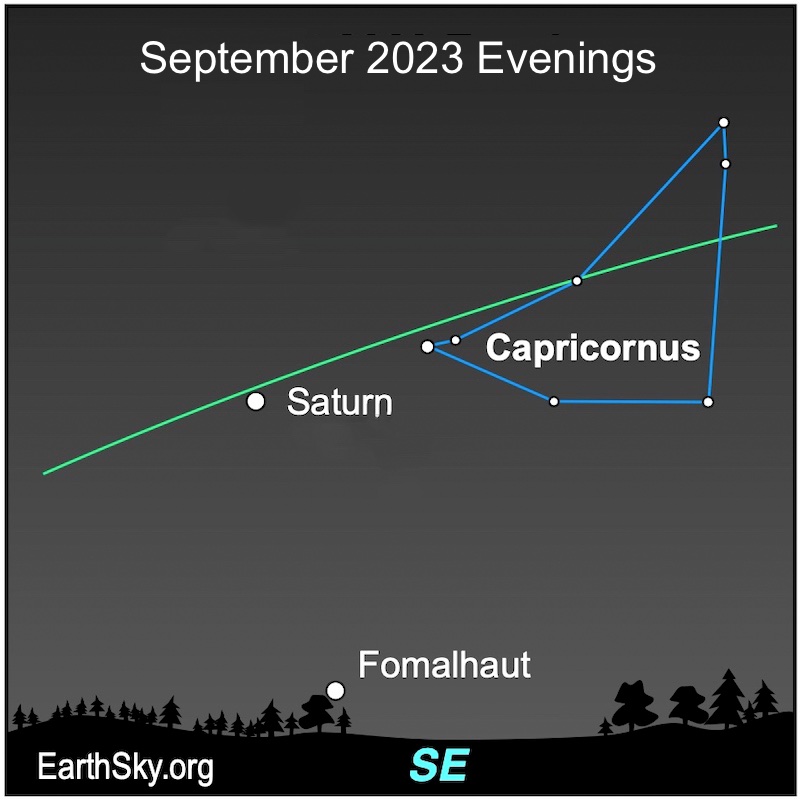
Green ecliptic line with white dots for Saturn, Fomalhaut and the stars of outlined constellation Capricornus.
On September evenings in 2023, Saturn can guide you to the lonely, but bright, star Fomalhaut. If you are under dark skies, they are near the faint arrowhead-shaped constellation Capricornus the Sea-Goat. By the way, they’ll rise in the east around sunset and they are visible all night. Chart via John Jardine Goss / EarthSky.

Fomalhaut, bright and lonely

Fomalhaut, aka Alpha Piscis Austrinus, is also called the Loneliest Star. It’s because Fomalhaut is the only bright star in a wide stretch of sky. From the Northern Hemisphere, Fomalhaut arcs in solitary splendor across the southern sky in autumn. Therefore, some call it the Autumn Star. From the Southern Hemisphere, you’ll look higher up to see Fomalhaut in your season of spring. In 2023, Fomalhaut isn’t so solitary. A bright planet, Saturn, appears near it in the sky. Of course, Fomalhaut will be the one that’s twinkling since Saturn will shine with a steady light.

Keep reading to learn more about this young star. It’s of special interest to astronomers because it has a debris ring around it. As a matter of fact, astronomers think new worlds are forming in Fomalhaut’s ring, at an early stage in the planet-forming process.

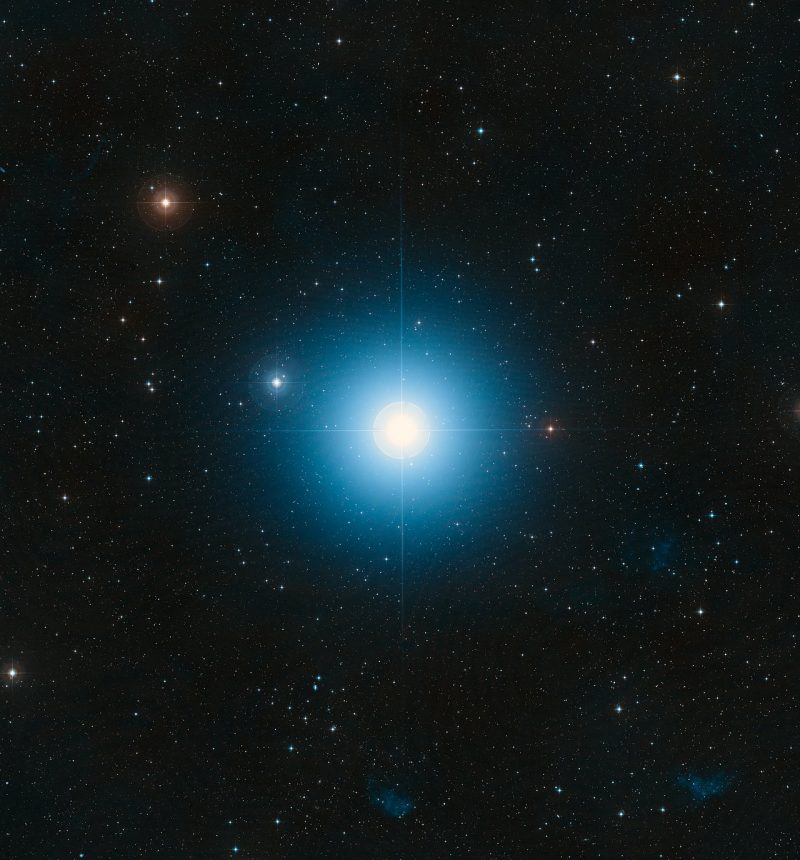
Very bright bluish star with many more stars in background.
The star Fomalhaut as seen by an Earth-based telescope on November 13, 2008. Image via NASA/ ESA/ Digitized Sky Survey 2/ Davide De Martin (ESA/Hubble)/ Hubble Space Telescope.

How to see it

Fomalhaut is the 18th brightest star in the night sky. It’s part of the faint constellation Piscis Austrinus the Southern Fish. In a dark sky, you’ll see a half-circle of faint stars of which bright Fomalhaut is a part. This star pattern marks the open mouth of the Southern Fish.

In early September, Fomalhaut is opposite the sun. So, it shines in the sky all night. It reaches its culmination – its highest point in the sky – around local midnight in mid-September.

Fomalhaut culminates (reaches its highest point in the sky) at different times on different dates. Here are just a few approximate times and dates of culmination:

July 15: 4:30 a.m. daylight saving time (DST)
August 15: 2:30 a.m. DST
September 15: 12:30 a.m. DST
October 15: 10:30 p.m. DST
November 15: 8:30 p.m. DST
December 15: 5:30 p.m. standard time

The view from different hemispheres

From the Northern Hemisphere, you can see Fomalhaut from as far north as 60 degrees latitude (southern Alaska, central Canada, northern Europe), where it just skims the southern horizon. From the Southern Hemisphere, Fomalhaut appears much higher in the sky. You can use one of several stargazing smartphone apps, some that are free, to help you find it. Or visit Stellarium-Web.org, the free online planetarium, and enter your location and time.

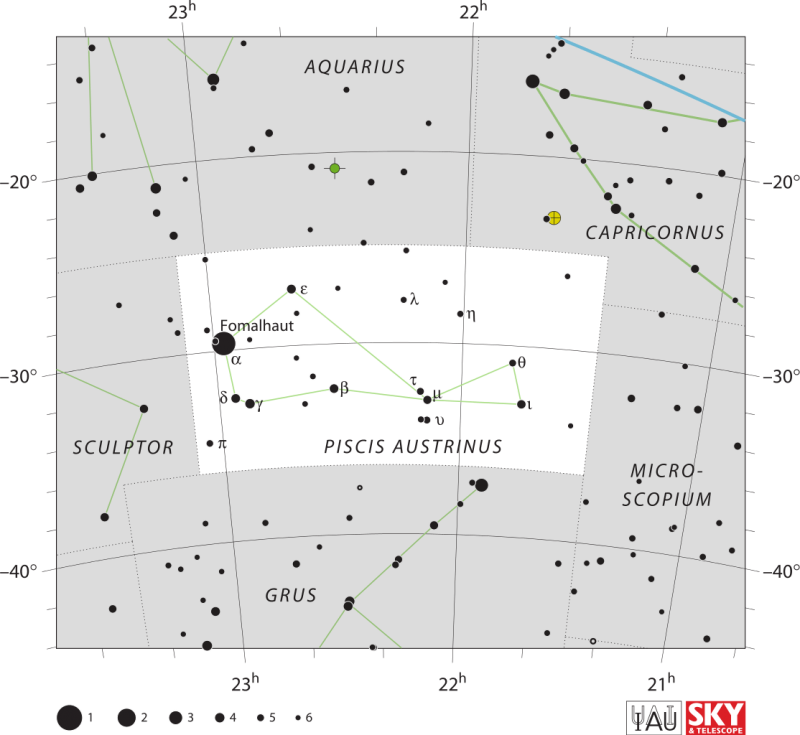
A gray, black, and white star chart (with stars represented as black dots).
Stars in Piscis Austrinus, the Southern Fish, include Fomalhaut. Image via International Astronomical Union/ Sky & Telescope/ Wikimedia Commons (CC BY 3.0).
Stars in black sky. Labeled constellations are shown with blue lines connecting the stars.
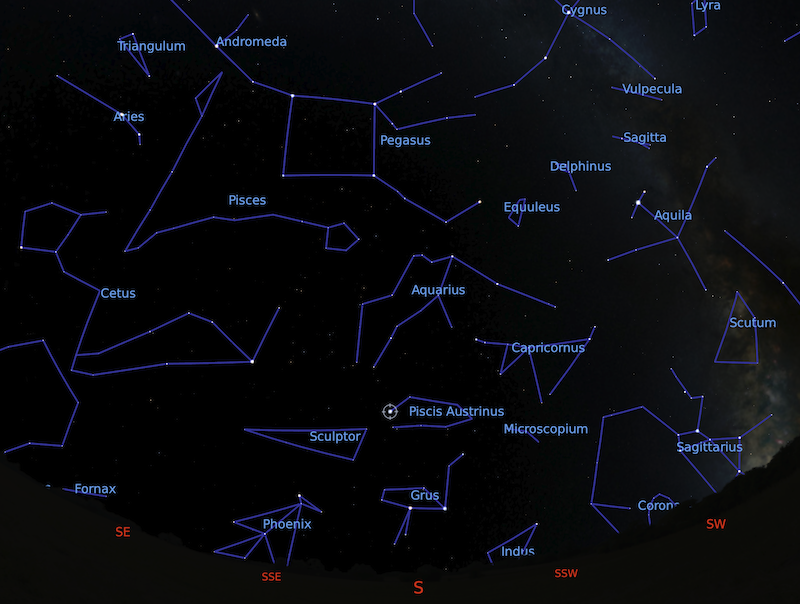
View larger. | A wide view of the sky from Austin, Texas, 30 minutes past midnight on September 15. Fomalhaut, marked in this chart with crosshairs, is approximately 30 degrees above the horizon at its highest altitude. (From Washington, D.C., the star would be about 21 degrees above the horizon, and in Montreal, Canada, around 15 degrees.) To get your bearings, locate the great square of Pegasus. Then use the west side of the square to guide you south, about three times its length, toward Fomalhaut. Image via Stellarium.

Rings of dust and gas

Fomalhaut is a hot white star about 25 light-years away. It’s almost twice the mass and size of our sun but radiates over 16 times the sun’s energy. Fomalhaut has a companion star less than a light-year away from it. The companion is an orange dwarf star, about 70% the mass of our sun. A third member of the Fomalhaut star system was announced in 2013, a small reddish star about 2.5 light-years from Fomalhaut. From Earth, we see the third star located in the constellation Aquarius instead of Piscis Austrinus.

Fomalhaut itself is a young star, just 440 million years old. That’s in contrast to 4 1/2 billion years for our sun. Fomalhaut is of special interest to astronomers because it has several rings of dust and gas around it, early indications of planets in the process of formation around this star. Astronomers have detected inner debris disks close to the star, within a few astronomical units (AU) from the star.

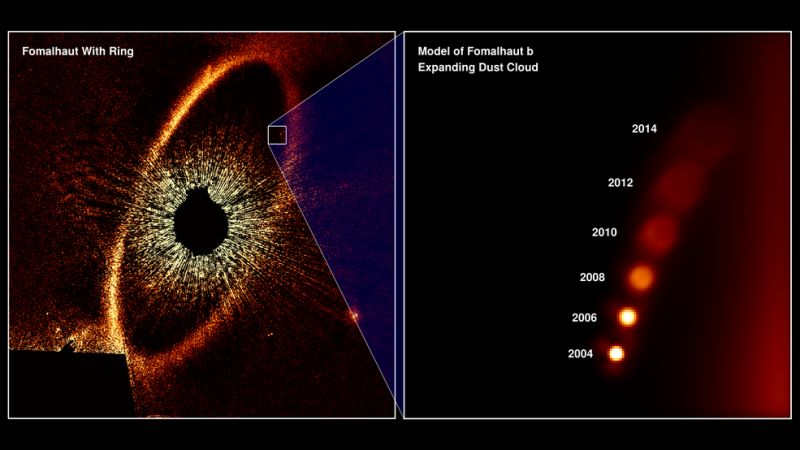
There’s a much larger, thicker debris ring about 133 AU from the star. A study published in 2008 generated a lot of excitement when Hubble Space Telescope images, taken in 2004, 2006 and 2008 showed an apparent planet very close to this debris ring. Astronomers first thought it was the first directly imaged exoplanet. But data from other telescopes brought that conclusion under scrutiny. And, by 2014, this object was no longer visible to Hubble.

A possible explanation

So what happened? Astronomers think that the “planet” was actually a large dust cloud generated by the collision of two large bodies near the ring. And over time, that dust cloud may have dissipated. And even though it turned out not to be a planet, astronomers were pleased. Catching the aftermath of a collision in a planet-forming disk was good, too! The event provided clues to a deeper understanding about how planets form.

Left: a dark circle with a fuzzy red ring around it. Right: a series of dots, fading from bright to dim.
On the left, a Hubble Space Telescope image showing Fomalhaut’s debris disk. The star itself has been blocked so its brightness doesn’t drown out the view of the faint ring. The small box shows the object once thought to be a planet (but no more). On the right is a simulation, based on observations, of how the object appeared from 2004 to 2014. The object is now thought to be the result of a collision in the disk. Image via NASA.

Fomalhaut in history and mythology

The name Fomalhaut derives from the Arabic Fum al Hut, meaning Mouth of the Fish.

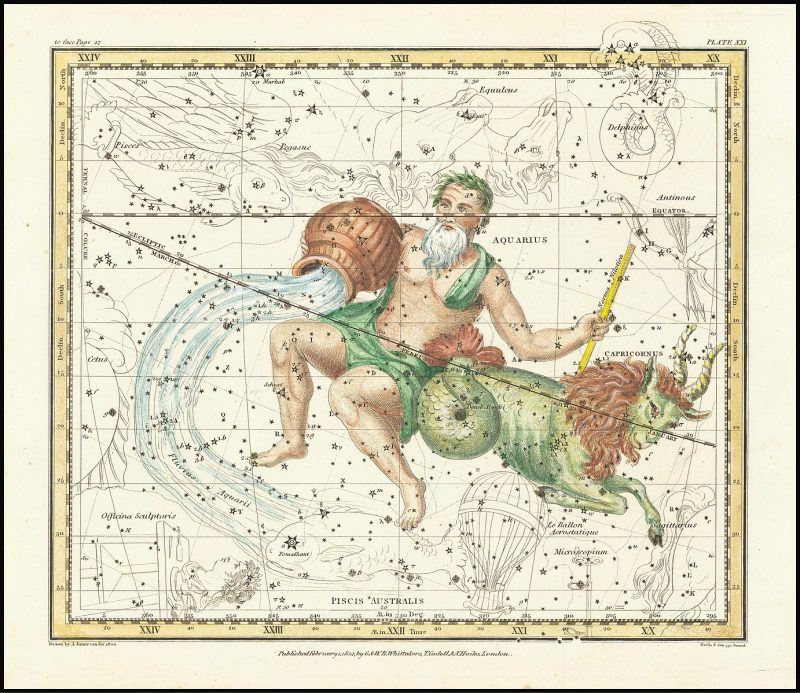
In the sky visible from the Northern Hemisphere, the constellation Aquarius the Water Bearer resides above Fomalhaut’s constellation Piscis Austrinus. You can see a zigzag line of stars from Aquarius to Piscis Austrinus. In sky lore, this line of stars represents water from the Jar of the Water Bearer, trickling into the open Mouth of the Fish.

According to Richard Hinckley Allen, Fomalhaut was one of the four guardians of the heavens to the ancient Persians, in 3,000 BCE, called by them Hastorang. (The other guardians were Aldebaran in Taurus, Antares in Scorpius, and Regulus in Leo.) Around 2,500 BCE, Fomalhaut helped mark the location of the winter solstice, meaning that it helped to define the location in the sky where the sun crossed the meridian at noon on the first day of winter. Also Allen also says that in 500 BCE, people worshipped Fomalhaut at the temple of Demeter in Eleusis, in ancient Greece.

Antique etching of an old man carrying a water jug. Below him is a fish. Stars are scattered over the chart.
View larger. | Aquarius the Water Carrier appears above Piscis Austrinus the Southern Fish, in the Celestial Atlas by Alexander Jamieson, published in 1822. In the illustration, water from the Water Jar of Aquarius is going into the Mouth of the Southern Fish. if it’s dark where you are, you can easily see a zigzag line of stars representing this flow of water. Image via Wikimedia (public domain).

Bottom line: Fomalhaut is relatively easy to spot as it shines brightly in an area of sky with no other bright stars nearby. And it’s of special interest to astronomers because of debris rings around it that are possibly the beginnings of a planetary system.

Read more: Fomalhaut has 3 nested belts around the star

The post Fomalhaut is the loneliest star in the southern sky first appeared on EarthSky.


from EarthSky https://ift.tt/FIsWQqf
Green ecliptic line with white dots for Saturn, Fomalhaut and the stars of outlined constellation Capricornus.
On September evenings in 2023, Saturn can guide you to the lonely, but bright, star Fomalhaut. If you are under dark skies, they are near the faint arrowhead-shaped constellation Capricornus the Sea-Goat. By the way, they’ll rise in the east around sunset and they are visible all night. Chart via John Jardine Goss / EarthSky.

Fomalhaut, bright and lonely

Fomalhaut, aka Alpha Piscis Austrinus, is also called the Loneliest Star. It’s because Fomalhaut is the only bright star in a wide stretch of sky. From the Northern Hemisphere, Fomalhaut arcs in solitary splendor across the southern sky in autumn. Therefore, some call it the Autumn Star. From the Southern Hemisphere, you’ll look higher up to see Fomalhaut in your season of spring. In 2023, Fomalhaut isn’t so solitary. A bright planet, Saturn, appears near it in the sky. Of course, Fomalhaut will be the one that’s twinkling since Saturn will shine with a steady light.

Keep reading to learn more about this young star. It’s of special interest to astronomers because it has a debris ring around it. As a matter of fact, astronomers think new worlds are forming in Fomalhaut’s ring, at an early stage in the planet-forming process.

Very bright bluish star with many more stars in background.
The star Fomalhaut as seen by an Earth-based telescope on November 13, 2008. Image via NASA/ ESA/ Digitized Sky Survey 2/ Davide De Martin (ESA/Hubble)/ Hubble Space Telescope.

How to see it

Fomalhaut is the 18th brightest star in the night sky. It’s part of the faint constellation Piscis Austrinus the Southern Fish. In a dark sky, you’ll see a half-circle of faint stars of which bright Fomalhaut is a part. This star pattern marks the open mouth of the Southern Fish.

In early September, Fomalhaut is opposite the sun. So, it shines in the sky all night. It reaches its culmination – its highest point in the sky – around local midnight in mid-September.

Fomalhaut culminates (reaches its highest point in the sky) at different times on different dates. Here are just a few approximate times and dates of culmination:

July 15: 4:30 a.m. daylight saving time (DST)
August 15: 2:30 a.m. DST
September 15: 12:30 a.m. DST
October 15: 10:30 p.m. DST
November 15: 8:30 p.m. DST
December 15: 5:30 p.m. standard time

The view from different hemispheres

From the Northern Hemisphere, you can see Fomalhaut from as far north as 60 degrees latitude (southern Alaska, central Canada, northern Europe), where it just skims the southern horizon. From the Southern Hemisphere, Fomalhaut appears much higher in the sky. You can use one of several stargazing smartphone apps, some that are free, to help you find it. Or visit Stellarium-Web.org, the free online planetarium, and enter your location and time.

A gray, black, and white star chart (with stars represented as black dots).
Stars in Piscis Austrinus, the Southern Fish, include Fomalhaut. Image via International Astronomical Union/ Sky & Telescope/ Wikimedia Commons (CC BY 3.0).
Stars in black sky. Labeled constellations are shown with blue lines connecting the stars.
View larger. | A wide view of the sky from Austin, Texas, 30 minutes past midnight on September 15. Fomalhaut, marked in this chart with crosshairs, is approximately 30 degrees above the horizon at its highest altitude. (From Washington, D.C., the star would be about 21 degrees above the horizon, and in Montreal, Canada, around 15 degrees.) To get your bearings, locate the great square of Pegasus. Then use the west side of the square to guide you south, about three times its length, toward Fomalhaut. Image via Stellarium.

Rings of dust and gas

Fomalhaut is a hot white star about 25 light-years away. It’s almost twice the mass and size of our sun but radiates over 16 times the sun’s energy. Fomalhaut has a companion star less than a light-year away from it. The companion is an orange dwarf star, about 70% the mass of our sun. A third member of the Fomalhaut star system was announced in 2013, a small reddish star about 2.5 light-years from Fomalhaut. From Earth, we see the third star located in the constellation Aquarius instead of Piscis Austrinus.

Fomalhaut itself is a young star, just 440 million years old. That’s in contrast to 4 1/2 billion years for our sun. Fomalhaut is of special interest to astronomers because it has several rings of dust and gas around it, early indications of planets in the process of formation around this star. Astronomers have detected inner debris disks close to the star, within a few astronomical units (AU) from the star.

There’s a much larger, thicker debris ring about 133 AU from the star. A study published in 2008 generated a lot of excitement when Hubble Space Telescope images, taken in 2004, 2006 and 2008 showed an apparent planet very close to this debris ring. Astronomers first thought it was the first directly imaged exoplanet. But data from other telescopes brought that conclusion under scrutiny. And, by 2014, this object was no longer visible to Hubble.

A possible explanation

So what happened? Astronomers think that the “planet” was actually a large dust cloud generated by the collision of two large bodies near the ring. And over time, that dust cloud may have dissipated. And even though it turned out not to be a planet, astronomers were pleased. Catching the aftermath of a collision in a planet-forming disk was good, too! The event provided clues to a deeper understanding about how planets form.

Left: a dark circle with a fuzzy red ring around it. Right: a series of dots, fading from bright to dim.
On the left, a Hubble Space Telescope image showing Fomalhaut’s debris disk. The star itself has been blocked so its brightness doesn’t drown out the view of the faint ring. The small box shows the object once thought to be a planet (but no more). On the right is a simulation, based on observations, of how the object appeared from 2004 to 2014. The object is now thought to be the result of a collision in the disk. Image via NASA.

Fomalhaut in history and mythology

The name Fomalhaut derives from the Arabic Fum al Hut, meaning Mouth of the Fish.

In the sky visible from the Northern Hemisphere, the constellation Aquarius the Water Bearer resides above Fomalhaut’s constellation Piscis Austrinus. You can see a zigzag line of stars from Aquarius to Piscis Austrinus. In sky lore, this line of stars represents water from the Jar of the Water Bearer, trickling into the open Mouth of the Fish.

According to Richard Hinckley Allen, Fomalhaut was one of the four guardians of the heavens to the ancient Persians, in 3,000 BCE, called by them Hastorang. (The other guardians were Aldebaran in Taurus, Antares in Scorpius, and Regulus in Leo.) Around 2,500 BCE, Fomalhaut helped mark the location of the winter solstice, meaning that it helped to define the location in the sky where the sun crossed the meridian at noon on the first day of winter. Also Allen also says that in 500 BCE, people worshipped Fomalhaut at the temple of Demeter in Eleusis, in ancient Greece.

Antique etching of an old man carrying a water jug. Below him is a fish. Stars are scattered over the chart.
View larger. | Aquarius the Water Carrier appears above Piscis Austrinus the Southern Fish, in the Celestial Atlas by Alexander Jamieson, published in 1822. In the illustration, water from the Water Jar of Aquarius is going into the Mouth of the Southern Fish. if it’s dark where you are, you can easily see a zigzag line of stars representing this flow of water. Image via Wikimedia (public domain).

Bottom line: Fomalhaut is relatively easy to spot as it shines brightly in an area of sky with no other bright stars nearby. And it’s of special interest to astronomers because of debris rings around it that are possibly the beginnings of a planetary system.

Read more: Fomalhaut has 3 nested belts around the star

The post Fomalhaut is the loneliest star in the southern sky first appeared on EarthSky.


from EarthSky https://ift.tt/FIsWQqf

Europa’s carbon dioxide likely came from its ocean

Europa's carbon dioxide: Blue and white mottled sphere on black background.
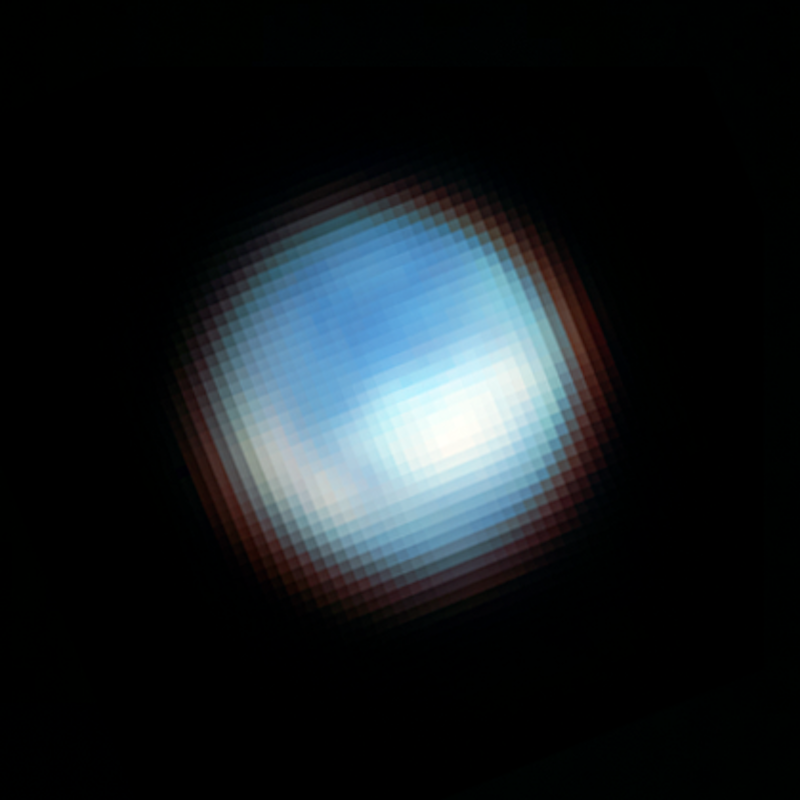
This pixelated image is Jupiter’s moon Europa on November 9, 2022, from the Near Infrared Camera (NIRCam) on the James Webb Space Telescope. The white areas in the image correspond with the type of jumbled landscape known as chaos terrain. The white region at left (Powys Regio) and at center right (Tara Regio) are areas that have carbon dioxide ice on the surface. Two new studies show that Europa’s carbon dioxide likely originated in its subsurface ocean. The discovery has implications for the ability of life to survive there. Image via Science: NASA/ ESA/ CSA/ Gerónimo Villanueva (NASA-GSFC)/ Samantha K Trumbo (Cornell University); Image Processing: Gerónimo Villanueva (NASA-GSFC)/ Alyssa Pagan (STScI).

Jupiter’s moon Europa has a salty global ocean topped with a thick layer of ice. Now, astronomers have identified carbon dioxide on the moon’s icy surface and found that it’s a relatively recent deposit. On September 21, 2023, NASA announced two new studies that suggest the carbon dioxide came from deep in Europa’s ocean. If so, that could have significant implications for the habitability of the ocean, or even possible life itself. The studies used new data from NASA’s James Webb Space Telescope. The American Association for the Advancement of Science (AAAS) also reported the discovery via EurekAlert!.

The researchers published the two new peer-reviewed papers on September 21 in the journal Science. Read the 1st paper here and the 2nd paper here.

Where did Europa’s carbon dioxide come from?

So how did the carbon dioxide on Europa’s surface get there? Did it originate directly from the ocean below or did meteorites deliver it to Europa? Or could Jupiter’s magnetosphere interacting with chemicals on the surface have produced it?

Scientists want to know the source because it can tell them a lot about what conditions are like in the ocean. Whether the carbon dioxide originated in the ocean or not can make a big difference in terms of chemistry and potential habitability.

Carbon is most likely from Europa’s ocean

Both of the studies used recent data from NASA’s James Webb Space Telescope. Webb analyzed the moon’s surface in near-infrared wavelengths. It mapped out the distribution of carbon dioxide ice and found that the highest concentration was in Tara Regio. That region is about 695 square miles (1,800 square km) and is dominated by what scientists call chaos terrain. In chaos terrain, surface materials show geological disruption and resurfacing. And there’s an exchange of material between the subsurface ocean and the icy surface. It’s some of the youngest terrain on Europa’s surface.

The analysis results suggest that the enriched levels of carbon dioxide in Tara Regio may mean that the carbon originated in Europa’s ocean. This is the endogenous scenario, where the carbon came from within Europa. The researchers said that the carbon came to the surface relatively recently on a geological timescale. In addition, this is also supported by the fact that carbon is unstable on Europa’s surface. So any deposits must be geologically young.

Samantha Trumbo of Cornell University, lead author of the 2nd paper, stated:

Previous observations from the Hubble Space Telescope show evidence for ocean-derived salt in Tara Regio. Now we’re seeing that carbon dioxide is heavily concentrated there as well. We think this implies that the carbon probably has its ultimate origin in the internal ocean.

Other carbonates or organics as a source

The researchers added, however, that it is still possible the formation of the carbon dioxide occurred on the surface itself, from carbonates or other organics. The 1st paper said:

A second potential source of CO2 could be carbonate-bearing fluids (e.g., sodium bicarbonate dissolved in water). Enceladus has a carbonate-rich ocean that degases CO2; some of that degassed CO2 freezes out on the surface. A similar process could occur on Europa.

A third possibility is that the carbon might be from organic compounds that were originally dissolved or suspended in a subsurface liquid-water reservoir, which were later converted to CO2. CO2 might be generated by irradiation on the surface, when material sourced from Europa’s interior, rich in carbonate salts and/or organics mixed with H2O, is bombarded by charged particles trapped in Jupiter’s magnetosphere.

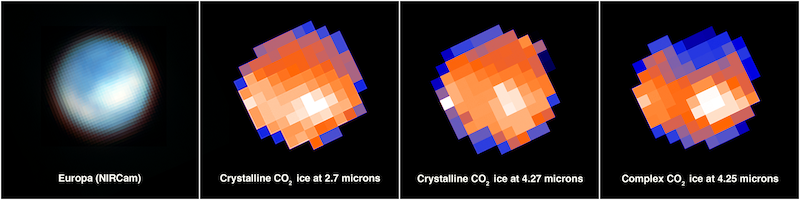
Blue and white sphere and 3 multi-colored pixelated spheres on black background.
View larger. | This graphic shows a map of Europa’s surface with its Near Infrared Camera (NIRCam) on NASA’s James Webb Space Telescope in the 1st panel. The other 3 panels are compositional maps derived from Webb’s Near Infrared Spectrograph (NIRSpec) data. In the compositional maps, the white pixels correspond to carbon dioxide in Tara Regio (center and right), with additional concentrations within portions of the chaos region Powys Regio (left). The 2nd and 3rd panels show evidence of crystalline carbon dioxide, while the 4th panel indicates a complex and amorphous form of carbon dioxide. Image via Science: NASA/ ESA/ CSA/ Gerónimo Villanueva (NASA-GSFC)/ Samantha K Trumbo (Cornell University); Image Processing: Gerónimo Villanueva (NASA-GSFC)/ Alyssa Pagan (STScI).

External source of Europa’s carbon dioxide is unlikely

Significantly, the studies cast doubt on an exogenous – external – source of the carbon dioxide, such as meteorites. As the 1st paper notes:

Exogenous explanations for the observed CO2 on Europa are possible, but an exogenous source would likely produce a more global distribution, not the observed local concentration that is associated with salts (which are presumably endogenous). CO2 ice is also localized on Enceladus, where it is known to be endogenous. Exogenous interplanetary dust grains might deliver carbonaceous material to Europa’s icy surface, which could then yield CO2 through radiolysis, but no silicate features indicative of such exogenous material have been reported for Europa. Given the CO2 association with NaCl, and our laboratory results, we conclude that the most likely origin of the observed CO2 is endogenous, at least within Tara Regio.

Life in Europa’s ocean?

There is also, of course, the question of what originally produced the carbon dioxide if it does come from the ocean. Could it possibly be biological? Indeed, carbon is essential for life as we know it, and all life on Earth is carbon-based.

Unfortunately, as discussed in the 2nd paper, the researchers did analyze the isotopic ratio but couldn’t determine whether or not it was associated with life. But carbon in the ocean is still an encouraging sign for the possibility of life. Lead author of the first paper, Geronimo Villanueva of NASA’s Goddard Space Flight Center, said:

On Earth, life likes chemical diversity; the more diversity, the better. We’re carbon-based life. Understanding the chemistry of Europa’s ocean will help us determine whether it’s hostile to life as we know it, or if it might be a good place for life.

Trumbo added:

We now think that we have observational evidence that the carbon we see on Europa’s surface came from the ocean. That’s not a trivial thing. Carbon is a biologically essential element.

Previous studies have also supported the possibility that this alien ocean is habitable, by earthly standards.

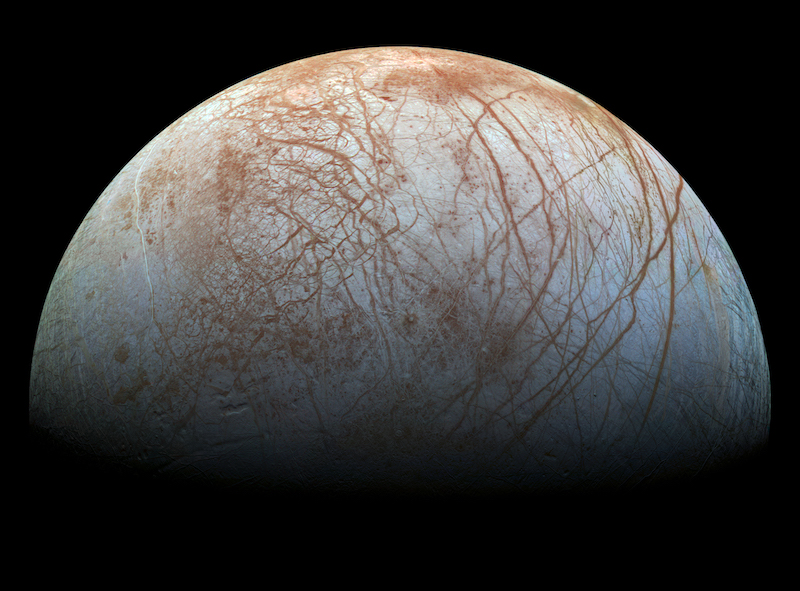
Smooth planet-like body with many long cracks and splotches in its surface.
View larger. | NASA’s Galileo spacecraft captured this view of Europa’s cracked, icy surface in the 1990s. It combines images from 1995 and 1998. Image via NASA/ JPL-Caltech/ SETI Institute.

No water plumes in new search

The researchers also looked for signs of Europa’s tentative water vapor plumes in the Webb data but didn’t see any. As has been surmised before, the plumes may be infrequent and smaller than those on Saturn’s moon Enceladus. It’s also possible that the plumes didn’t contain the volatile gases that the researchers included in their search. Heidi Hammel of the Association of Universities for Research in Astronomy (AURA) said:

There is always a possibility that these plumes are variable and that you can only see them at certain times. All we can say with 100% confidence is that we did not detect a plume at Europa when we made these observations with Webb.

The new results are not only exciting, but they also show how powerful and efficient Webb is. It only took Webb a few minutes to conduct these observations, as Hammel noted:

These observations only took a few minutes of the observatory’s time. Even with this short period of time, we were able to do really big science. This work gives a first hint of all the amazing solar system science we’ll be able to do with Webb.

Bottom line: Two new studies suggest that Europa’s carbon dioxide deposits originate in the moon’s subsurface ocean. The results support a habitable ocean environment.

Source: Endogenous CO2 ice mixture on the surface of Europa and no detection of plume activity

Source: The distribution of CO2 on Europa indicates an internal source of carbon

Via Webb Space Telescope

Via EurekAlert!

Read more: Do Europa’s odd ridges indicate life?

The post Europa’s carbon dioxide likely came from its ocean first appeared on EarthSky.


from EarthSky https://ift.tt/lL0qWtQ
Europa's carbon dioxide: Blue and white mottled sphere on black background.
This pixelated image is Jupiter’s moon Europa on November 9, 2022, from the Near Infrared Camera (NIRCam) on the James Webb Space Telescope. The white areas in the image correspond with the type of jumbled landscape known as chaos terrain. The white region at left (Powys Regio) and at center right (Tara Regio) are areas that have carbon dioxide ice on the surface. Two new studies show that Europa’s carbon dioxide likely originated in its subsurface ocean. The discovery has implications for the ability of life to survive there. Image via Science: NASA/ ESA/ CSA/ Gerónimo Villanueva (NASA-GSFC)/ Samantha K Trumbo (Cornell University); Image Processing: Gerónimo Villanueva (NASA-GSFC)/ Alyssa Pagan (STScI).

Jupiter’s moon Europa has a salty global ocean topped with a thick layer of ice. Now, astronomers have identified carbon dioxide on the moon’s icy surface and found that it’s a relatively recent deposit. On September 21, 2023, NASA announced two new studies that suggest the carbon dioxide came from deep in Europa’s ocean. If so, that could have significant implications for the habitability of the ocean, or even possible life itself. The studies used new data from NASA’s James Webb Space Telescope. The American Association for the Advancement of Science (AAAS) also reported the discovery via EurekAlert!.

The researchers published the two new peer-reviewed papers on September 21 in the journal Science. Read the 1st paper here and the 2nd paper here.

Where did Europa’s carbon dioxide come from?

So how did the carbon dioxide on Europa’s surface get there? Did it originate directly from the ocean below or did meteorites deliver it to Europa? Or could Jupiter’s magnetosphere interacting with chemicals on the surface have produced it?

Scientists want to know the source because it can tell them a lot about what conditions are like in the ocean. Whether the carbon dioxide originated in the ocean or not can make a big difference in terms of chemistry and potential habitability.

Carbon is most likely from Europa’s ocean

Both of the studies used recent data from NASA’s James Webb Space Telescope. Webb analyzed the moon’s surface in near-infrared wavelengths. It mapped out the distribution of carbon dioxide ice and found that the highest concentration was in Tara Regio. That region is about 695 square miles (1,800 square km) and is dominated by what scientists call chaos terrain. In chaos terrain, surface materials show geological disruption and resurfacing. And there’s an exchange of material between the subsurface ocean and the icy surface. It’s some of the youngest terrain on Europa’s surface.

The analysis results suggest that the enriched levels of carbon dioxide in Tara Regio may mean that the carbon originated in Europa’s ocean. This is the endogenous scenario, where the carbon came from within Europa. The researchers said that the carbon came to the surface relatively recently on a geological timescale. In addition, this is also supported by the fact that carbon is unstable on Europa’s surface. So any deposits must be geologically young.

Samantha Trumbo of Cornell University, lead author of the 2nd paper, stated:

Previous observations from the Hubble Space Telescope show evidence for ocean-derived salt in Tara Regio. Now we’re seeing that carbon dioxide is heavily concentrated there as well. We think this implies that the carbon probably has its ultimate origin in the internal ocean.

Other carbonates or organics as a source

The researchers added, however, that it is still possible the formation of the carbon dioxide occurred on the surface itself, from carbonates or other organics. The 1st paper said:

A second potential source of CO2 could be carbonate-bearing fluids (e.g., sodium bicarbonate dissolved in water). Enceladus has a carbonate-rich ocean that degases CO2; some of that degassed CO2 freezes out on the surface. A similar process could occur on Europa.

A third possibility is that the carbon might be from organic compounds that were originally dissolved or suspended in a subsurface liquid-water reservoir, which were later converted to CO2. CO2 might be generated by irradiation on the surface, when material sourced from Europa’s interior, rich in carbonate salts and/or organics mixed with H2O, is bombarded by charged particles trapped in Jupiter’s magnetosphere.

Blue and white sphere and 3 multi-colored pixelated spheres on black background.
View larger. | This graphic shows a map of Europa’s surface with its Near Infrared Camera (NIRCam) on NASA’s James Webb Space Telescope in the 1st panel. The other 3 panels are compositional maps derived from Webb’s Near Infrared Spectrograph (NIRSpec) data. In the compositional maps, the white pixels correspond to carbon dioxide in Tara Regio (center and right), with additional concentrations within portions of the chaos region Powys Regio (left). The 2nd and 3rd panels show evidence of crystalline carbon dioxide, while the 4th panel indicates a complex and amorphous form of carbon dioxide. Image via Science: NASA/ ESA/ CSA/ Gerónimo Villanueva (NASA-GSFC)/ Samantha K Trumbo (Cornell University); Image Processing: Gerónimo Villanueva (NASA-GSFC)/ Alyssa Pagan (STScI).

External source of Europa’s carbon dioxide is unlikely

Significantly, the studies cast doubt on an exogenous – external – source of the carbon dioxide, such as meteorites. As the 1st paper notes:

Exogenous explanations for the observed CO2 on Europa are possible, but an exogenous source would likely produce a more global distribution, not the observed local concentration that is associated with salts (which are presumably endogenous). CO2 ice is also localized on Enceladus, where it is known to be endogenous. Exogenous interplanetary dust grains might deliver carbonaceous material to Europa’s icy surface, which could then yield CO2 through radiolysis, but no silicate features indicative of such exogenous material have been reported for Europa. Given the CO2 association with NaCl, and our laboratory results, we conclude that the most likely origin of the observed CO2 is endogenous, at least within Tara Regio.

Life in Europa’s ocean?

There is also, of course, the question of what originally produced the carbon dioxide if it does come from the ocean. Could it possibly be biological? Indeed, carbon is essential for life as we know it, and all life on Earth is carbon-based.

Unfortunately, as discussed in the 2nd paper, the researchers did analyze the isotopic ratio but couldn’t determine whether or not it was associated with life. But carbon in the ocean is still an encouraging sign for the possibility of life. Lead author of the first paper, Geronimo Villanueva of NASA’s Goddard Space Flight Center, said:

On Earth, life likes chemical diversity; the more diversity, the better. We’re carbon-based life. Understanding the chemistry of Europa’s ocean will help us determine whether it’s hostile to life as we know it, or if it might be a good place for life.

Trumbo added:

We now think that we have observational evidence that the carbon we see on Europa’s surface came from the ocean. That’s not a trivial thing. Carbon is a biologically essential element.

Previous studies have also supported the possibility that this alien ocean is habitable, by earthly standards.

Smooth planet-like body with many long cracks and splotches in its surface.
View larger. | NASA’s Galileo spacecraft captured this view of Europa’s cracked, icy surface in the 1990s. It combines images from 1995 and 1998. Image via NASA/ JPL-Caltech/ SETI Institute.

No water plumes in new search

The researchers also looked for signs of Europa’s tentative water vapor plumes in the Webb data but didn’t see any. As has been surmised before, the plumes may be infrequent and smaller than those on Saturn’s moon Enceladus. It’s also possible that the plumes didn’t contain the volatile gases that the researchers included in their search. Heidi Hammel of the Association of Universities for Research in Astronomy (AURA) said:

There is always a possibility that these plumes are variable and that you can only see them at certain times. All we can say with 100% confidence is that we did not detect a plume at Europa when we made these observations with Webb.

The new results are not only exciting, but they also show how powerful and efficient Webb is. It only took Webb a few minutes to conduct these observations, as Hammel noted:

These observations only took a few minutes of the observatory’s time. Even with this short period of time, we were able to do really big science. This work gives a first hint of all the amazing solar system science we’ll be able to do with Webb.

Bottom line: Two new studies suggest that Europa’s carbon dioxide deposits originate in the moon’s subsurface ocean. The results support a habitable ocean environment.

Source: Endogenous CO2 ice mixture on the surface of Europa and no detection of plume activity

Source: The distribution of CO2 on Europa indicates an internal source of carbon

Via Webb Space Telescope

Via EurekAlert!

Read more: Do Europa’s odd ridges indicate life?

The post Europa’s carbon dioxide likely came from its ocean first appeared on EarthSky.


from EarthSky https://ift.tt/lL0qWtQ

Pablo Neruda, a poet who embraced cosmic beauty

Pablo Neruda poem printed over starry scene with seagull flying in a beam of light.
View larger. | Image composed with Photoshop via Michael West. Poem by Pablo Neruda.

Playing with the light of the universe

The great Chilean poet Pablo Neruda (1904-1973) died 50 years ago today, on September 23, 1973. Some years ago, astronomer Michael West of Lowell Observatory in Flagstaff, Arizona, shared the image above with us. It’s a photo he took inscribed with Neruda’s words. West wrote:

Astronomical imagery often figured in Neruda’s poetry, for example, one of his poems begins: Every day you play with the light of the universe.

Another poem titled The Future is Space describes black space with room for many dreams.

In the attached composite image (made from photos I took in Chile) I’ve included a portion of Neruda’s poem titled La Poesía in which the Nobel Prize winner described the feeling of discovering poetry as a youth, comparing it to the beauty of the universe.

… As you know, Neruda’s homeland of Chile, which he loved, is now home to many of the world’s greatest telescopes, including the future European Southern Observatory Extremely Large Telescope (ELT) and the Giant Magellan Telescope (GMT).

Original photo taken with a Canon 5D MkIII.

Post-processing via Photoshop CC + Nik plug-ins.

Thank you for sharing your image with Neruda’s words, Michael!

Pablo Neruda’s life

Serious-looking young man in a suit and tie, with a park in the background.
Pablo Neruda as a young man. Read more about him. Image via Wikipedia (public domain).

Pablo Neruda was born Ricardo Eliécer Neftalí Reyes Basoalto on July 12, 1904. And he began writing poems at the age of 13, and later became a poet-diplomat and politician who won the Nobel Prize for Literature in 1971. In fact, the space imagery in his poems inspired scientists to name a crater on Mercury in his honor. Neruda Crater is 70 miles (112 km) across.

The Johns Hopkins Applied Physics Laboratory website describes Neruda Crater as follows:

The crater exhibits several central peaks punctuated by a more recent, small crater, resulting in a rugged profile of ups and downs if one were to traverse the crater floor. Similarly, the crater’s namesake Neruda experienced a number of ups and downs in his life, from success as a poet, through poverty, war and ultimately alleged poisoning.

An exhumation and studies of Neruda’s remains from 2013 to 2017 found that Neruda had prostate cancer and may have had a staph infection at the time of his death. His manner of death is listed as a heart attack, and foul play has never been proven.

Stark black and white orbital image of a crater with peaks and indentations on crater floor.
MESSENGER, a spacecraft that visited Mercury, took this image of the Neruda Crater, named for Chilean poet Pablo Neruda, on July 24, 2012. Image via NASA/ Wikipedia (public domain).

Bottom line: On September 23, 1973, the great Chilean poet, Pablo Neruda, passed away. Fifty years later, we honor his connection to astronomy.

The post Pablo Neruda, a poet who embraced cosmic beauty first appeared on EarthSky.


from EarthSky https://ift.tt/Nxz3jUD
Pablo Neruda poem printed over starry scene with seagull flying in a beam of light.
View larger. | Image composed with Photoshop via Michael West. Poem by Pablo Neruda.

Playing with the light of the universe

The great Chilean poet Pablo Neruda (1904-1973) died 50 years ago today, on September 23, 1973. Some years ago, astronomer Michael West of Lowell Observatory in Flagstaff, Arizona, shared the image above with us. It’s a photo he took inscribed with Neruda’s words. West wrote:

Astronomical imagery often figured in Neruda’s poetry, for example, one of his poems begins: Every day you play with the light of the universe.

Another poem titled The Future is Space describes black space with room for many dreams.

In the attached composite image (made from photos I took in Chile) I’ve included a portion of Neruda’s poem titled La Poesía in which the Nobel Prize winner described the feeling of discovering poetry as a youth, comparing it to the beauty of the universe.

… As you know, Neruda’s homeland of Chile, which he loved, is now home to many of the world’s greatest telescopes, including the future European Southern Observatory Extremely Large Telescope (ELT) and the Giant Magellan Telescope (GMT).

Original photo taken with a Canon 5D MkIII.

Post-processing via Photoshop CC + Nik plug-ins.

Thank you for sharing your image with Neruda’s words, Michael!

Pablo Neruda’s life

Serious-looking young man in a suit and tie, with a park in the background.
Pablo Neruda as a young man. Read more about him. Image via Wikipedia (public domain).

Pablo Neruda was born Ricardo Eliécer Neftalí Reyes Basoalto on July 12, 1904. And he began writing poems at the age of 13, and later became a poet-diplomat and politician who won the Nobel Prize for Literature in 1971. In fact, the space imagery in his poems inspired scientists to name a crater on Mercury in his honor. Neruda Crater is 70 miles (112 km) across.

The Johns Hopkins Applied Physics Laboratory website describes Neruda Crater as follows:

The crater exhibits several central peaks punctuated by a more recent, small crater, resulting in a rugged profile of ups and downs if one were to traverse the crater floor. Similarly, the crater’s namesake Neruda experienced a number of ups and downs in his life, from success as a poet, through poverty, war and ultimately alleged poisoning.

An exhumation and studies of Neruda’s remains from 2013 to 2017 found that Neruda had prostate cancer and may have had a staph infection at the time of his death. His manner of death is listed as a heart attack, and foul play has never been proven.

Stark black and white orbital image of a crater with peaks and indentations on crater floor.
MESSENGER, a spacecraft that visited Mercury, took this image of the Neruda Crater, named for Chilean poet Pablo Neruda, on July 24, 2012. Image via NASA/ Wikipedia (public domain).

Bottom line: On September 23, 1973, the great Chilean poet, Pablo Neruda, passed away. Fifty years later, we honor his connection to astronomy.

The post Pablo Neruda, a poet who embraced cosmic beauty first appeared on EarthSky.


from EarthSky https://ift.tt/Nxz3jUD

Why does Earth have 4 seasons every year?

4 seasons: Trees with brilliant red leaves and a gap showing gray rain clouds behind.
View at EarthSky Community Photos. | Sharon Kizer, who is mother to EarthSky’s Kelly Kizer Whitt, took this image of fiery maples and rain clouds on October 9, 2022, in Madison, Wisconsin. It illustrates some of the vivid reds of autumn. Thank you, Sharon! But why does Earth have 4 seasons every year? Read more below.

Tomorrow’s September equinox signals the change of season, from summer to fall in the Northern Hemisphere and from winter to spring in the Southern Hemisphere. But why do Earth’s seasons change?

The 4 seasons come from Earth’s tilt

Some assume our planet’s changing distance from the sun causes the change in the seasons. It’s logical, but not the case for Earth. Instead, Earth has seasons because our planet’s axis of rotation is tilted at an angle of 23.5 degrees relative to our orbital plane, that is, the plane of Earth’s orbit around the sun.

The tilt in the axis of the Earth is called its obliquity by scientists.

Earth, showing the slant of its axis, the poles, and the celestial equator, with text annotations.
Obliquity. Image via Wikipedia.

Over the course of a year, the angle of tilt does not vary. In other words, Earth’s northern axis is always pointing the same direction in space. At this time, that direction is more or less toward the star we call Polaris, the North Star.

If Earth did not tilt at all, but instead orbited exactly upright with respect to our orbit around the sun, there would be minor variations in temperature throughout each year as Earth moved slightly closer to the sun and then slightly farther away. But, without Earth’s tilt, we’d lack Earth’s wonderful seasonal changes and our association of them with the various times of year. For example, associating a crisp feeling in the air with autumn.

But wait, there’s more

However, the orientation of Earth’s tilt with respect to the sun – our source of light and warmth – does change as we orbit the sun. In other words, the Northern Hemisphere is oriented toward the sun for half of the year and away from the sun for the other half. The same is true of the Southern Hemisphere.

Sun in center with four Earths around it, different faces lit by sunlight, each labeled equinox or solstice.
The fact is, our seasons result from the Earth’s rotational axis tilting 23.5 degrees out of the perpendicular to the ecliptic, or Earth’s orbital plane. So at different times of the year, different parts of the globe receive more direct sunlight. Image via weather.gov.

When the Northern Hemisphere is oriented toward the sun, that region of Earth warms because of the corresponding increase in solar radiation. The sun’s rays are striking that part of Earth at a more direct angle. It’s summer.

When the Northern Hemisphere is oriented away from the sun, the sun’s rays are less direct. Hence, that part of Earth cools. It’s winter.

Seasons in the Southern Hemisphere occur at opposite times of the year from those in the Northern Hemisphere. Northern summer = southern winter.

Why does Earth’s axis tilt?

Row of snow-covered pine trees with a birdhouse in front of them.
View at EarthSky Community Photos. | Elmarie van Rooyen captured this snowy scene at Smoky Lake, Alberta, Canada, on December 31, 2022, and wrote: “It was one of the most beautiful days yesterday before saying goodbye to 2022.” Thank you, Elmarie!

The tilt in Earth’s axis is strongly influenced by the way mass is distributed over the planet. Large amounts of land mass and ice sheets in the Northern Hemisphere make Earth top-heavy. An analogy for obliquity is imagining what would happen if you were to spin a ball with a big piece of bubble gum stuck near the top. The extra weight would cause the ball to tilt when spun.

Over long periods of geological time, the angle of Earth’s obliquity cycles between 21.1 and 24.5 degrees. This cycle lasts approximately 41,000 years. And it may play a key role in the formation of ice ages – a scientific theory proposed by Milutin Milankovitch in 1930.

The Earth is currently decreasing in obliquity. Decreases in obliquity can set the stage for more moderate seasons (cooler summers and warmer winters). On the other hand, increases in obliquity create more extreme seasons (hotter summers and colder winters). Glaciers tend to grow when the Earth has many cool summers that fail to melt back the winter snows. Remember, we’re talking about a 41,000-year cycle here, so these changes in obliquity are not the primary driver of Earth’s climate. Temperatures on Earth are influenced not just by obliquity. Many other factors contribute to our complex climate system and the global temperatures we experience from year to year. 

All the planets in the solar system tilt on their axis

Other planets in our solar system also tilt at various degrees. Uranus rotates almost sideways at 97 degrees and has extreme seasons. The axial tilt on Venus is 177.3 degrees. Hence, Venus has very little in the way of seasons.

Earth’s distance from the sun does change throughout the year. So it’s logical to assume that an increase or decrease in any sun-planet distance could cause a cyclical change in the seasons. But – at least in the case of our planet – this change is too small to cause seasonal changes.

However, some extrasolar planets – planets orbiting distant stars – have been found with more extreme orbits. And even in our own solar system, for example, the planet Mars has a more elliptical orbit than Earth does. Its distance from the sun changes more dramatically through its year than Earth’s does. And the change in Mars’ distance from the sun does cause some more pronounced cyclical changes on this red desert world.

Two lounging chairs on the beach with an umbrella.
The hottest days occur after the summer solstice and it’s a lovely time to spend on the beach. Image via Quang Nguyen Vinh / pexels.com. Used with permission.

Bottom line: It’s logical to assume our planet’s changing distance from the sun causes the change in the seasons. But Earth’s distance from the sun doesn’t change enough to cause seasonal differences. Instead, our seasons change because Earth tilts on its axis, and the angle of tilt causes the Northern and Southern Hemispheres to trade places throughout the year in receiving the sun’s light and warmth most directly.

The post Why does Earth have 4 seasons every year? first appeared on EarthSky.


from EarthSky https://ift.tt/d4MO3py
4 seasons: Trees with brilliant red leaves and a gap showing gray rain clouds behind.
View at EarthSky Community Photos. | Sharon Kizer, who is mother to EarthSky’s Kelly Kizer Whitt, took this image of fiery maples and rain clouds on October 9, 2022, in Madison, Wisconsin. It illustrates some of the vivid reds of autumn. Thank you, Sharon! But why does Earth have 4 seasons every year? Read more below.

Tomorrow’s September equinox signals the change of season, from summer to fall in the Northern Hemisphere and from winter to spring in the Southern Hemisphere. But why do Earth’s seasons change?

The 4 seasons come from Earth’s tilt

Some assume our planet’s changing distance from the sun causes the change in the seasons. It’s logical, but not the case for Earth. Instead, Earth has seasons because our planet’s axis of rotation is tilted at an angle of 23.5 degrees relative to our orbital plane, that is, the plane of Earth’s orbit around the sun.

The tilt in the axis of the Earth is called its obliquity by scientists.

Earth, showing the slant of its axis, the poles, and the celestial equator, with text annotations.
Obliquity. Image via Wikipedia.

Over the course of a year, the angle of tilt does not vary. In other words, Earth’s northern axis is always pointing the same direction in space. At this time, that direction is more or less toward the star we call Polaris, the North Star.

If Earth did not tilt at all, but instead orbited exactly upright with respect to our orbit around the sun, there would be minor variations in temperature throughout each year as Earth moved slightly closer to the sun and then slightly farther away. But, without Earth’s tilt, we’d lack Earth’s wonderful seasonal changes and our association of them with the various times of year. For example, associating a crisp feeling in the air with autumn.

But wait, there’s more

However, the orientation of Earth’s tilt with respect to the sun – our source of light and warmth – does change as we orbit the sun. In other words, the Northern Hemisphere is oriented toward the sun for half of the year and away from the sun for the other half. The same is true of the Southern Hemisphere.

Sun in center with four Earths around it, different faces lit by sunlight, each labeled equinox or solstice.
The fact is, our seasons result from the Earth’s rotational axis tilting 23.5 degrees out of the perpendicular to the ecliptic, or Earth’s orbital plane. So at different times of the year, different parts of the globe receive more direct sunlight. Image via weather.gov.

When the Northern Hemisphere is oriented toward the sun, that region of Earth warms because of the corresponding increase in solar radiation. The sun’s rays are striking that part of Earth at a more direct angle. It’s summer.

When the Northern Hemisphere is oriented away from the sun, the sun’s rays are less direct. Hence, that part of Earth cools. It’s winter.

Seasons in the Southern Hemisphere occur at opposite times of the year from those in the Northern Hemisphere. Northern summer = southern winter.

Why does Earth’s axis tilt?

Row of snow-covered pine trees with a birdhouse in front of them.
View at EarthSky Community Photos. | Elmarie van Rooyen captured this snowy scene at Smoky Lake, Alberta, Canada, on December 31, 2022, and wrote: “It was one of the most beautiful days yesterday before saying goodbye to 2022.” Thank you, Elmarie!

The tilt in Earth’s axis is strongly influenced by the way mass is distributed over the planet. Large amounts of land mass and ice sheets in the Northern Hemisphere make Earth top-heavy. An analogy for obliquity is imagining what would happen if you were to spin a ball with a big piece of bubble gum stuck near the top. The extra weight would cause the ball to tilt when spun.

Over long periods of geological time, the angle of Earth’s obliquity cycles between 21.1 and 24.5 degrees. This cycle lasts approximately 41,000 years. And it may play a key role in the formation of ice ages – a scientific theory proposed by Milutin Milankovitch in 1930.

The Earth is currently decreasing in obliquity. Decreases in obliquity can set the stage for more moderate seasons (cooler summers and warmer winters). On the other hand, increases in obliquity create more extreme seasons (hotter summers and colder winters). Glaciers tend to grow when the Earth has many cool summers that fail to melt back the winter snows. Remember, we’re talking about a 41,000-year cycle here, so these changes in obliquity are not the primary driver of Earth’s climate. Temperatures on Earth are influenced not just by obliquity. Many other factors contribute to our complex climate system and the global temperatures we experience from year to year. 

All the planets in the solar system tilt on their axis

Other planets in our solar system also tilt at various degrees. Uranus rotates almost sideways at 97 degrees and has extreme seasons. The axial tilt on Venus is 177.3 degrees. Hence, Venus has very little in the way of seasons.

Earth’s distance from the sun does change throughout the year. So it’s logical to assume that an increase or decrease in any sun-planet distance could cause a cyclical change in the seasons. But – at least in the case of our planet – this change is too small to cause seasonal changes.

However, some extrasolar planets – planets orbiting distant stars – have been found with more extreme orbits. And even in our own solar system, for example, the planet Mars has a more elliptical orbit than Earth does. Its distance from the sun changes more dramatically through its year than Earth’s does. And the change in Mars’ distance from the sun does cause some more pronounced cyclical changes on this red desert world.

Two lounging chairs on the beach with an umbrella.
The hottest days occur after the summer solstice and it’s a lovely time to spend on the beach. Image via Quang Nguyen Vinh / pexels.com. Used with permission.

Bottom line: It’s logical to assume our planet’s changing distance from the sun causes the change in the seasons. But Earth’s distance from the sun doesn’t change enough to cause seasonal differences. Instead, our seasons change because Earth tilts on its axis, and the angle of tilt causes the Northern and Southern Hemispheres to trade places throughout the year in receiving the sun’s light and warmth most directly.

The post Why does Earth have 4 seasons every year? first appeared on EarthSky.


from EarthSky https://ift.tt/d4MO3py

On the equinox, are day and night equal?

Equinox: Wide partial arc of setting sun, glowing orange below and yellow above.
Flattened sunset by Helio C. Vital in Rio de Janeiro, Brazil. A flattened sunset is an effect of atmospheric refraction. Refraction also gives us a few more minutes of daylight on the equinox than we would have otherwise.

The September equinox happens at 6:50 UTC (1:50 a.m. CDT) on September 23, 2023.

Are day and night equal on the equinox?

Twice a year – on the March and September equinoxes – everyone worldwide supposedly receives exactly 12 hours of day and exactly 12 hours of night. But that’s not precisely true. In fact, there’s about eight more minutes of daylight – at mid-temperate latitudes – on the day of an equinox. And there are two reasons why. They are:

1. The sun is a disk, not a point.

2. Atmospheric refraction.

Keep reading to learn more …

The sun is a disk, not a point

Watch any sunset, and you know the sun appears in Earth’s sky as a disk.

It’s not pointlike, as stars are, and yet – by definition – most almanacs regard sunrise as when the leading edge of the sun first touches the eastern horizon. They define sunset as when the sun’s trailing edge finally touches the western horizon.

This alone provides an extra 2 1/2 to 3 minutes of daylight at mid-temperate latitudes.

There is a straight line originating from the top of half a sphere. On the other side of the line, there are 2 same-sized spheres. Other 2 lines originate from the top of the half sphere, 1 is straight and goes up, to the center of the sphere on top, and the other one is curved and goes down, to the center of the bottom sphere.
Atmospheric refraction raises the sun about 1/2 degree upward in our sky at both sunrise and sunset. This advances the time of actual sunrise, while delaying the time of actual sunset. The result is several minutes of extra daylight, not just at an equinox, but every day. Image via Wikipedia.

Atmospheric refraction and the equinox

The Earth’s atmosphere acts like a lens or prism, uplifting the sun about half a degree from its true geometrical position whenever the sun nears the horizon. Coincidentally, the sun’s angular diameter spans about half a degree, as well.

In other words, when you see the sun on the horizon, it’s actually just below the horizon geometrically.

What does atmospheric refraction mean for the length of daylight? It advances the sunrise and delays the sunset, adding nearly another six minutes of daylight at mid-temperate latitudes. Hence, more daylight than night at the equinox.

Astronomical almanacs usually don’t give sunrise or sunset times to the second. That’s because atmospheric refraction varies somewhat, depending on air temperature, humidity and barometric pressure. Lower temperature, higher humidity and higher barometric pressure all increase atmospheric refraction.

On the day of the equinox, the center of the sun would set about 12 hours after rising, given a level horizon, as at sea, and no atmospheric refraction.

What is an equilux?

Here’s a new word for you: equilux. The word is used to describe the day on which day and night are equal. The equilux happens a few to several days after the autumn equinox, and a few to several days before the spring equinox.

Much as earliest sunrises and latest sunsets vary with latitude, so the exact date of an equilux varies with latitude. That’s in contrast to the equinox itself, which is a whole-Earth event, happening at the same instant worldwide. At and near the equator, there is no equilux whatsoever, because the daylight period is over 12 hours long every day of the year.

Earth, with axis vertical and sun's rays hitting day side perpendicularly.
Illustrations like this one make it seem as if day and night should be equal at the equinox. In fact, they aren’t exactly equal. Image via Wikimedia Commons.

Visit timeanddate.com for the approximate date of equal day and night at your latitude

Bottom line: There’s slightly more day than night on the day of an equinox. That’s because the sun is a disk, not a point of light, and because Earth’s atmosphere refracts (bends) sunlight.

Read more about the September 2023 equinox: All you need to know

The post On the equinox, are day and night equal? first appeared on EarthSky.


from EarthSky https://ift.tt/lX1AEnj
Equinox: Wide partial arc of setting sun, glowing orange below and yellow above.
Flattened sunset by Helio C. Vital in Rio de Janeiro, Brazil. A flattened sunset is an effect of atmospheric refraction. Refraction also gives us a few more minutes of daylight on the equinox than we would have otherwise.

The September equinox happens at 6:50 UTC (1:50 a.m. CDT) on September 23, 2023.

Are day and night equal on the equinox?

Twice a year – on the March and September equinoxes – everyone worldwide supposedly receives exactly 12 hours of day and exactly 12 hours of night. But that’s not precisely true. In fact, there’s about eight more minutes of daylight – at mid-temperate latitudes – on the day of an equinox. And there are two reasons why. They are:

1. The sun is a disk, not a point.

2. Atmospheric refraction.

Keep reading to learn more …

The sun is a disk, not a point

Watch any sunset, and you know the sun appears in Earth’s sky as a disk.

It’s not pointlike, as stars are, and yet – by definition – most almanacs regard sunrise as when the leading edge of the sun first touches the eastern horizon. They define sunset as when the sun’s trailing edge finally touches the western horizon.

This alone provides an extra 2 1/2 to 3 minutes of daylight at mid-temperate latitudes.

There is a straight line originating from the top of half a sphere. On the other side of the line, there are 2 same-sized spheres. Other 2 lines originate from the top of the half sphere, 1 is straight and goes up, to the center of the sphere on top, and the other one is curved and goes down, to the center of the bottom sphere.
Atmospheric refraction raises the sun about 1/2 degree upward in our sky at both sunrise and sunset. This advances the time of actual sunrise, while delaying the time of actual sunset. The result is several minutes of extra daylight, not just at an equinox, but every day. Image via Wikipedia.

Atmospheric refraction and the equinox

The Earth’s atmosphere acts like a lens or prism, uplifting the sun about half a degree from its true geometrical position whenever the sun nears the horizon. Coincidentally, the sun’s angular diameter spans about half a degree, as well.

In other words, when you see the sun on the horizon, it’s actually just below the horizon geometrically.

What does atmospheric refraction mean for the length of daylight? It advances the sunrise and delays the sunset, adding nearly another six minutes of daylight at mid-temperate latitudes. Hence, more daylight than night at the equinox.

Astronomical almanacs usually don’t give sunrise or sunset times to the second. That’s because atmospheric refraction varies somewhat, depending on air temperature, humidity and barometric pressure. Lower temperature, higher humidity and higher barometric pressure all increase atmospheric refraction.

On the day of the equinox, the center of the sun would set about 12 hours after rising, given a level horizon, as at sea, and no atmospheric refraction.

What is an equilux?

Here’s a new word for you: equilux. The word is used to describe the day on which day and night are equal. The equilux happens a few to several days after the autumn equinox, and a few to several days before the spring equinox.

Much as earliest sunrises and latest sunsets vary with latitude, so the exact date of an equilux varies with latitude. That’s in contrast to the equinox itself, which is a whole-Earth event, happening at the same instant worldwide. At and near the equator, there is no equilux whatsoever, because the daylight period is over 12 hours long every day of the year.

Earth, with axis vertical and sun's rays hitting day side perpendicularly.
Illustrations like this one make it seem as if day and night should be equal at the equinox. In fact, they aren’t exactly equal. Image via Wikimedia Commons.

Visit timeanddate.com for the approximate date of equal day and night at your latitude

Bottom line: There’s slightly more day than night on the day of an equinox. That’s because the sun is a disk, not a point of light, and because Earth’s atmosphere refracts (bends) sunlight.

Read more about the September 2023 equinox: All you need to know

The post On the equinox, are day and night equal? first appeared on EarthSky.


from EarthSky https://ift.tt/lX1AEnj

adds 2