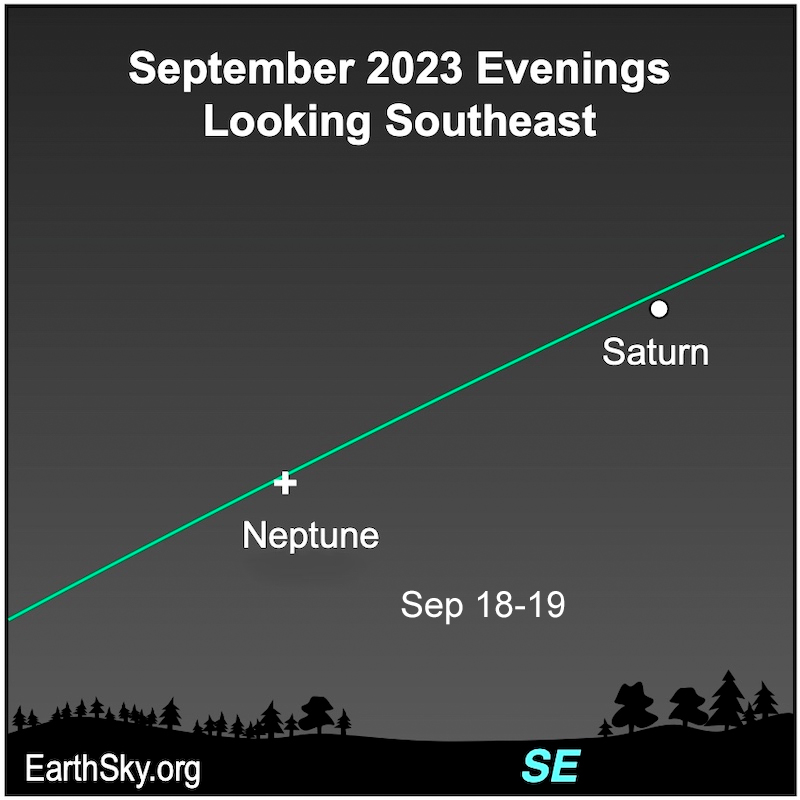
Chart showing Neptune at opposition at 11 UTC on September 19, 2023 (6 a.m. CDT), in front of the constellation Pisces. You’ll need strong binoculars or a telescope, and a detailed chart, to find Neptune. Neptune is 4 light-hours (28.9 AU) from Earth. The bright planet Saturn is nearby and can be a good starting point to help locate Neptune. Chart via John Jardine Goss / EarthSky.
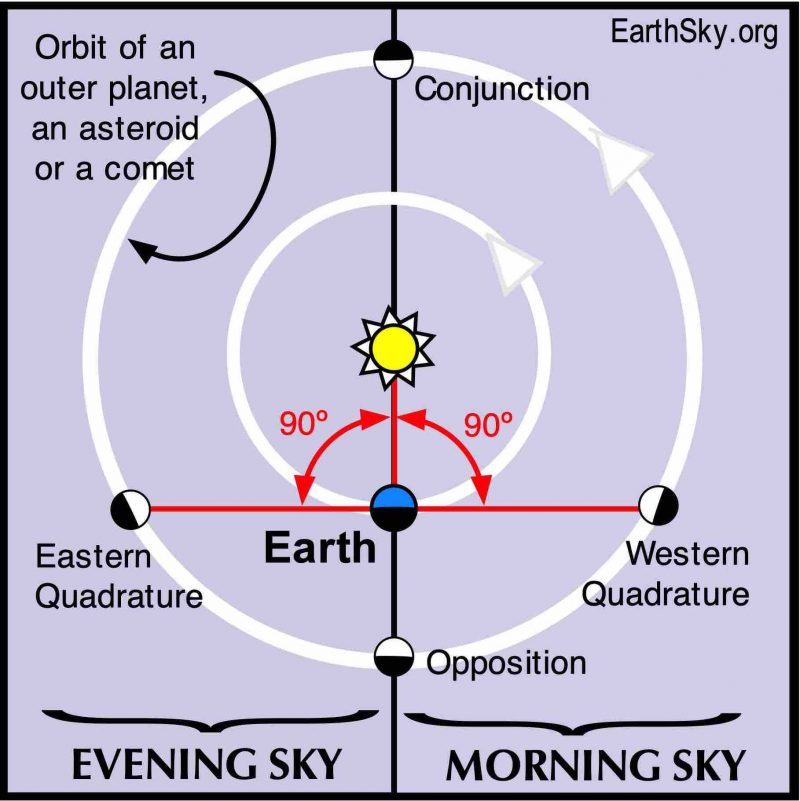
Earth will sweep between the sun and Neptune at 11 UTC on September 19, 2023, placing the distant planet opposite the sun in our sky.
Neptune at opposition in 2023
When and where to watch in 2023: Neptune emerged in the east before sunrise by April 2023 and was visible in good binoculars or a telescope in the morning sky through August. By the time of its September 19 opposition, Neptune is rising in the east at sunset and visible all night. For the rest of 2023, Neptune is up in the evening. It remains visible in good binoculars or a telescope in the evening sky through February of 2024. Opposition for Neptune will fall at 11 UTC (6 a.m. CDT) on September 19, 2022. To catch it in dark skies, many places should look overnight on September 18-19. Constellation at opposition: Neptune is in front of the constellation Pisces the Fish. Brightness at opposition: The 8th planet shines at magnitude +7.8. Distance from Earth: Neptune is at its least distance from Earth for 2023, 240 light-minutes or 28.9 AU from Earth on September 19. Through a telescope: Through a telescope, Neptune appears 2.3 arcseconds across. Neptune’s brightest moon, Triton, is visible in medium-size telescopes. Through binoculars: Through binoculars, Neptune will appear as a star-like object if you know where to find it. Note: Opposition marks the middle of the best time of year to see an outer planet. Neptune reaches a yearly maximum in brightness at or near opposition. From mid-July to mid-November, Neptune will be at its brightest but it won’t be visible to the unaided eye. Think of us on Earth, sweeping between the sun and Neptune in our smaller, faster orbit. Around the same time as Neptune reaches opposition, it is also making its closest approach to Earth.
Neptune is the 8th planet from our sun. A year on Neptune is 165 Earth years long. Because Neptune’s orbit around the sun is so gigantic, and because Earth whips around the sun so quickly in comparison, Neptune’s opposition date comes only a few days later each year.
2023 Neptune opposition – September 19
2024 Neptune opposition – September 20
2025 Neptune opposition – September 23
Neptune events in 2023
March 15, 2023: Neptune at solar conjunction June 30, 2023: Neptune begins retrograde motion September 1, 2023: Lunar occultation of Neptune September 19, 2023: Neptune at opposition
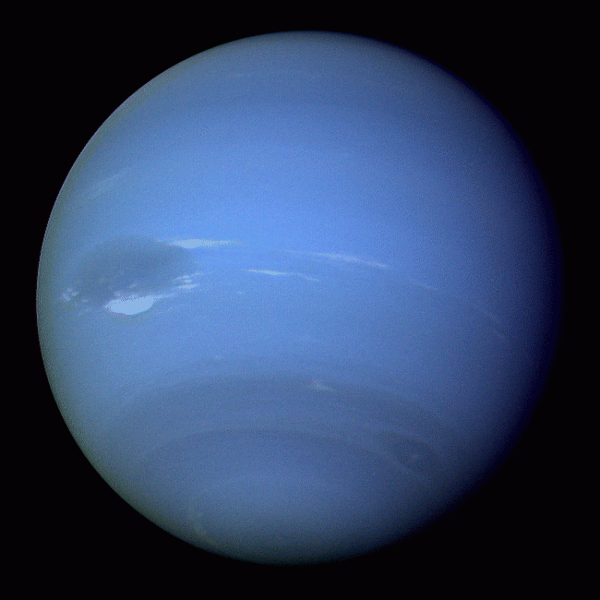
In 1989, NASA’s Voyager 2 became the first spacecraft to observe Neptune. Image via NASA. See more images from Voyager.
Planets are brightest when at opposition. But Neptune, the 8th planet, is never truly bright. It’s the only major solar system planet that’s never visible to the unaided eye. This world is about five times fainter than the dimmest star you can see on a moonless night under dark skies. You’ll need binoculars or a telescope for Neptune, plus a detailed sky chart.
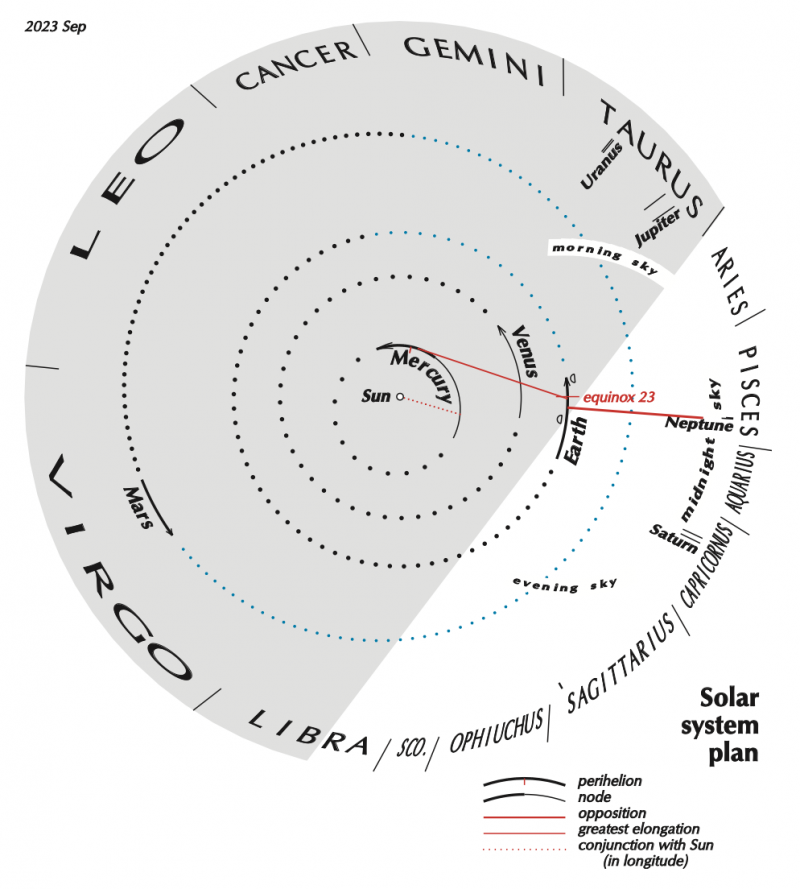
Because we’re more or less between Neptune and the sun around opposition, Neptune is rising in the east around the time of sunset, climbing highest up for the night around midnight and setting in the west around sunrise. As viewed from Earth now, this world is in front of the constellation Pisces the Fish and near the planet Saturn.
Even with optical aid, Neptune may look like a faint star. You need to magnify Neptune by about 200 times and have a steady night of seeing to view this distant world as a small disk.
Bottom line: Neptune at opposition – when it’s 180 degrees from the sun on the sky’s dome – comes early on September 19, 2023. You need optical aid to spot it and many places will see it reach opposition overnight on September 18-19.
Chart showing Neptune at opposition at 11 UTC on September 19, 2023 (6 a.m. CDT), in front of the constellation Pisces. You’ll need strong binoculars or a telescope, and a detailed chart, to find Neptune. Neptune is 4 light-hours (28.9 AU) from Earth. The bright planet Saturn is nearby and can be a good starting point to help locate Neptune. Chart via John Jardine Goss / EarthSky.
Earth will sweep between the sun and Neptune at 11 UTC on September 19, 2023, placing the distant planet opposite the sun in our sky.
Neptune at opposition in 2023
When and where to watch in 2023: Neptune emerged in the east before sunrise by April 2023 and was visible in good binoculars or a telescope in the morning sky through August. By the time of its September 19 opposition, Neptune is rising in the east at sunset and visible all night. For the rest of 2023, Neptune is up in the evening. It remains visible in good binoculars or a telescope in the evening sky through February of 2024. Opposition for Neptune will fall at 11 UTC (6 a.m. CDT) on September 19, 2022. To catch it in dark skies, many places should look overnight on September 18-19. Constellation at opposition: Neptune is in front of the constellation Pisces the Fish. Brightness at opposition: The 8th planet shines at magnitude +7.8. Distance from Earth: Neptune is at its least distance from Earth for 2023, 240 light-minutes or 28.9 AU from Earth on September 19. Through a telescope: Through a telescope, Neptune appears 2.3 arcseconds across. Neptune’s brightest moon, Triton, is visible in medium-size telescopes. Through binoculars: Through binoculars, Neptune will appear as a star-like object if you know where to find it. Note: Opposition marks the middle of the best time of year to see an outer planet. Neptune reaches a yearly maximum in brightness at or near opposition. From mid-July to mid-November, Neptune will be at its brightest but it won’t be visible to the unaided eye. Think of us on Earth, sweeping between the sun and Neptune in our smaller, faster orbit. Around the same time as Neptune reaches opposition, it is also making its closest approach to Earth.
Neptune is the 8th planet from our sun. A year on Neptune is 165 Earth years long. Because Neptune’s orbit around the sun is so gigantic, and because Earth whips around the sun so quickly in comparison, Neptune’s opposition date comes only a few days later each year.
2023 Neptune opposition – September 19
2024 Neptune opposition – September 20
2025 Neptune opposition – September 23
Neptune events in 2023
March 15, 2023: Neptune at solar conjunction June 30, 2023: Neptune begins retrograde motion September 1, 2023: Lunar occultation of Neptune September 19, 2023: Neptune at opposition
In 1989, NASA’s Voyager 2 became the first spacecraft to observe Neptune. Image via NASA. See more images from Voyager.
Planets are brightest when at opposition. But Neptune, the 8th planet, is never truly bright. It’s the only major solar system planet that’s never visible to the unaided eye. This world is about five times fainter than the dimmest star you can see on a moonless night under dark skies. You’ll need binoculars or a telescope for Neptune, plus a detailed sky chart.
Because we’re more or less between Neptune and the sun around opposition, Neptune is rising in the east around the time of sunset, climbing highest up for the night around midnight and setting in the west around sunrise. As viewed from Earth now, this world is in front of the constellation Pisces the Fish and near the planet Saturn.
Even with optical aid, Neptune may look like a faint star. You need to magnify Neptune by about 200 times and have a steady night of seeing to view this distant world as a small disk.
Bottom line: Neptune at opposition – when it’s 180 degrees from the sun on the sky’s dome – comes early on September 19, 2023. You need optical aid to spot it and many places will see it reach opposition overnight on September 18-19.
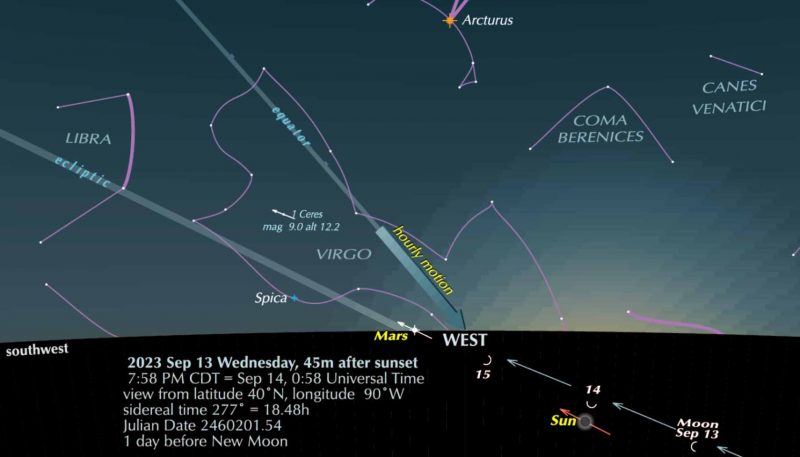
The view of the western horizon after sunset from the Northern Hemisphere for the evenings around September 13, 2023. Chart via Guy Ottewell. Used with permission.
EarthSky joins the many fans of beloved UK astronomer Guy Ottewell in wishing him a speedy recovery from a recent heart surgery. We were thrilled to see this post at Guy’s blog on September 13, 2023. Reprinted here with permission. Edits by EarthSky. Live long and prosper, Guy!
Finding patterns in stars
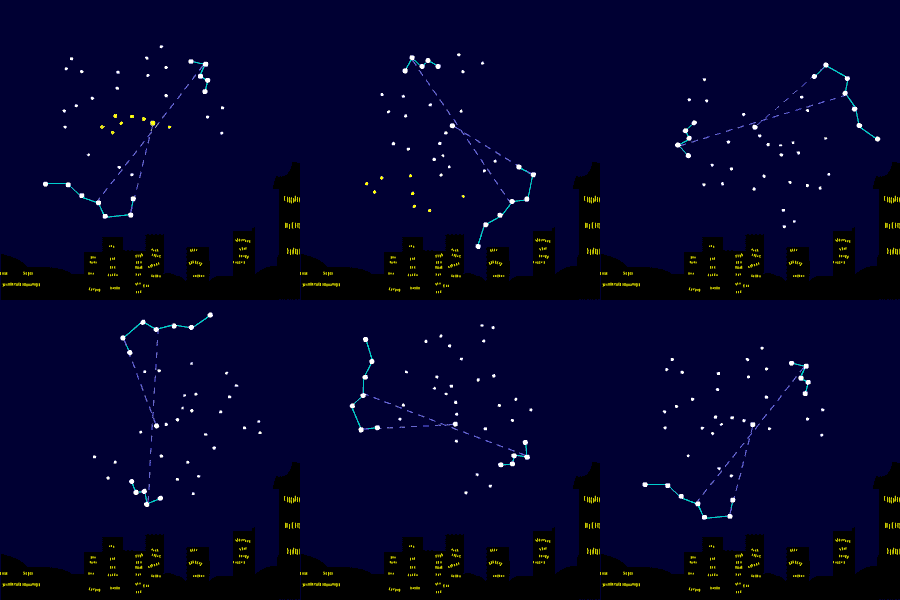
It’s human nature to see patterns in things, and definitely among the stars. Can you find a cosmic smile, an east-west line of at least four stars, the end ones tilted to the north? EarthSky’s John Jardine Goss found this one: A smiling cyclops asterism. If you find one, link to it in the comments below.
The western evening sky this week
The top chart shows the current evening sky. Not much is happening to the left (east) of the sun. Mars is on the horizon but is faint right now and lost in the evening twilight. Ceres, largest of the dwarf planets, is far below the visibility needed for the unaided eye. Arrows through the solar system objects and the sun show how they move, in relation to the starry background, over five days. The moon is below the horizon, and it is shown on five different dates. You can see how it will later emerge in the evening twilight as a slender crescent.
Most other features shown are either abstract – such as the celestial equator, and the antapex of Earth’s motion or the opposite direction we are flying – or too low to see in the bright twilight. But the broad arrow showing how far the sky rotates in one hour suggests how it will darken as the sun goes lower, and the stars pop in to view.
The view from the Southern Hemisphere
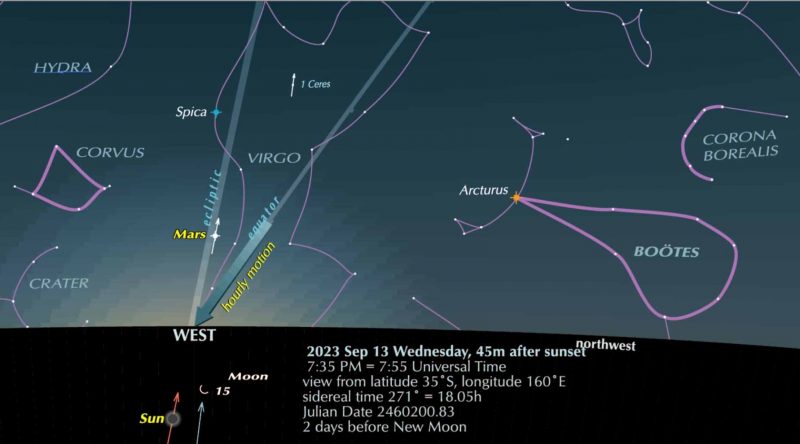
The view of the western horizon after sunset from the Southern Hemisphere on the evenings around September 13, 2023. Chart via Guy Ottewell. Used with permission.
Let’s see how different it is if you are in Australia or New Zealand:
The lines in the sky – the celestial equator and the ecliptic – cut the evening horizon at a different angle, because you are on a southerly part of the globe. They lean over to the right instead of the left. And Mars, being on a part of the ecliptic south of the equator, has been swung by this change of angle to a position 10 degrees vertically above the western point on the horizon. Also, Ceres is higher in the sky.
Bottom line: Guy Ottewell explores and explains the different view of the current objects near the western horizon from the Northern and Southern Hemispheres.
The view of the western horizon after sunset from the Northern Hemisphere for the evenings around September 13, 2023. Chart via Guy Ottewell. Used with permission.
EarthSky joins the many fans of beloved UK astronomer Guy Ottewell in wishing him a speedy recovery from a recent heart surgery. We were thrilled to see this post at Guy’s blog on September 13, 2023. Reprinted here with permission. Edits by EarthSky. Live long and prosper, Guy!
Finding patterns in stars
It’s human nature to see patterns in things, and definitely among the stars. Can you find a cosmic smile, an east-west line of at least four stars, the end ones tilted to the north? EarthSky’s John Jardine Goss found this one: A smiling cyclops asterism. If you find one, link to it in the comments below.
The western evening sky this week
The top chart shows the current evening sky. Not much is happening to the left (east) of the sun. Mars is on the horizon but is faint right now and lost in the evening twilight. Ceres, largest of the dwarf planets, is far below the visibility needed for the unaided eye. Arrows through the solar system objects and the sun show how they move, in relation to the starry background, over five days. The moon is below the horizon, and it is shown on five different dates. You can see how it will later emerge in the evening twilight as a slender crescent.
Most other features shown are either abstract – such as the celestial equator, and the antapex of Earth’s motion or the opposite direction we are flying – or too low to see in the bright twilight. But the broad arrow showing how far the sky rotates in one hour suggests how it will darken as the sun goes lower, and the stars pop in to view.
The view from the Southern Hemisphere
The view of the western horizon after sunset from the Southern Hemisphere on the evenings around September 13, 2023. Chart via Guy Ottewell. Used with permission.
Let’s see how different it is if you are in Australia or New Zealand:
The lines in the sky – the celestial equator and the ecliptic – cut the evening horizon at a different angle, because you are on a southerly part of the globe. They lean over to the right instead of the left. And Mars, being on a part of the ecliptic south of the equator, has been swung by this change of angle to a position 10 degrees vertically above the western point on the horizon. Also, Ceres is higher in the sky.
Bottom line: Guy Ottewell explores and explains the different view of the current objects near the western horizon from the Northern and Southern Hemispheres.
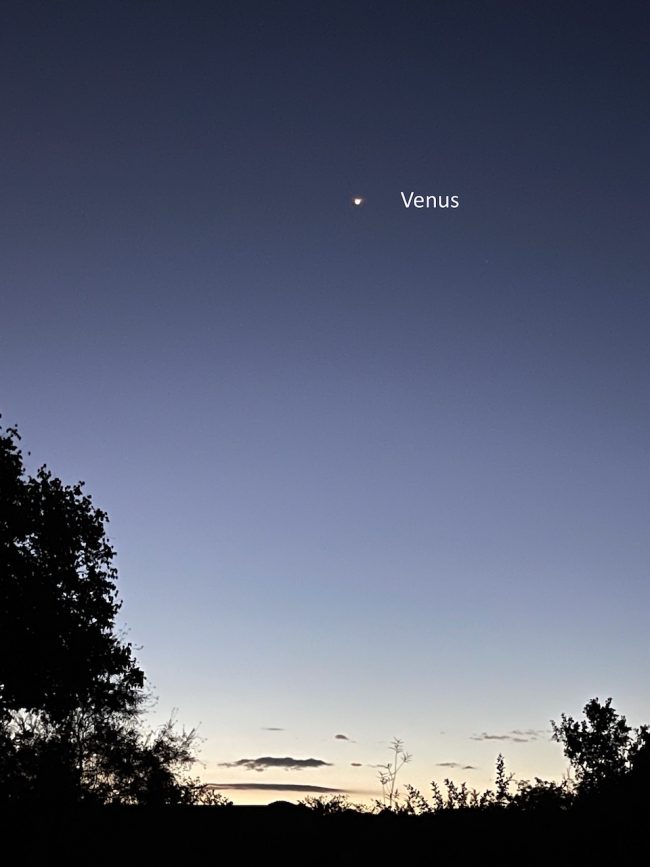
View at EarthSky Community Photos. | EarthSky’s Deborah Byrd caught Venus with an iPhone, over the desert west of Santa Fe, New Mexico, on September 14, 2023. It was super bright! It’s easy to see, even from cities. When is Venus brightest? Read more below.
Greatest brilliancy for Venus is a treat! Watch for Venus in the east before sunrise around mid-September 2023.
Venus brightest in morning sky, around September 19
Venus is the brightest planet. It outshines any other object in our sky, with the exception of the sun and moon. And it’s dazzling around September 19, brightest for 2023. You can’t miss Venus! Look for it in the sunrise direction on any clear morning around now. When it’s this bright, Venus appears as an eerily eye-catching beacon in the morning sky. It’s visible not just in a dark sky, but in bright morning twilight as well.
Venus will reach its peak in brilliancy – at magnitude -4.8 – on September 19. It won’t appear this bright to us again until February 2025, when it’ll reside in the west after sunset.
Venus before sunrise in 2023
Venus was in our evening sky when 2023 began. It left the evening sky – passing more or less between us and the sun – on August 13. Astronomers called the August 13 event an inferior conjunction of Venus.
But, by late August, Venus had emerged from the twilight glare at dawn. As seen from the Northern Hemisphere in early September, it made a beeline to a point high above the sunrise. Southern Hemisphere viewers can see Venus blazing in their eastern dawn skies now, too. From there, Venus isn’t as high in the sky before sunrise. It’s more to one side of the sunrise.
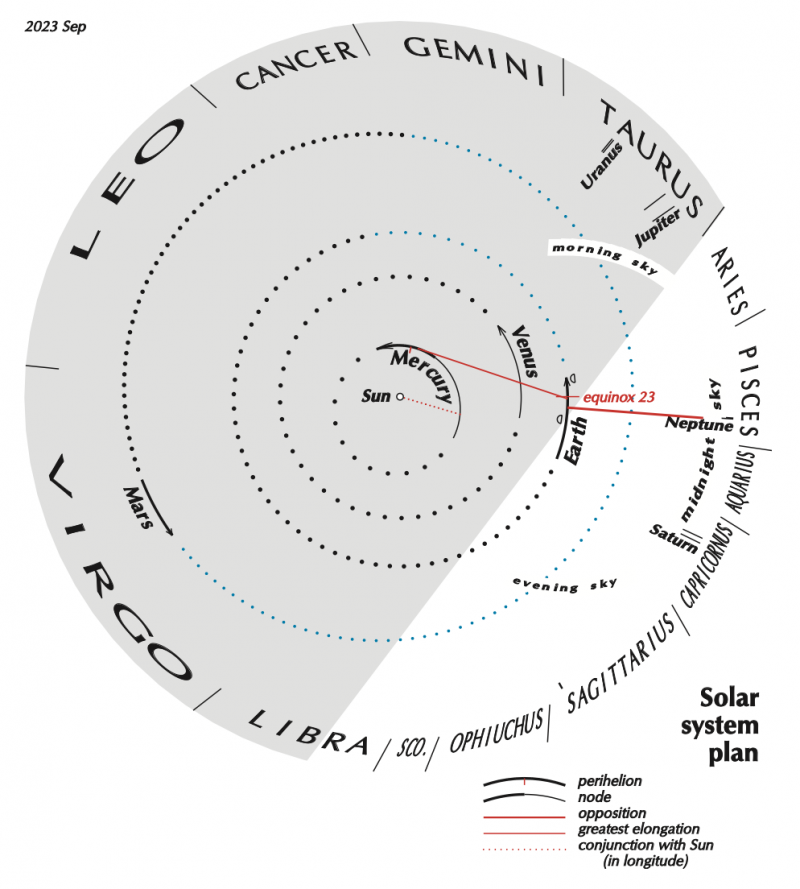
All this time Earth and Venus are moving in their orbits around the sun. Venus moves faster. And its orbit is smaller. Since its August 13 inferior conjunction, Venus has been fleeing ahead of Earth in its orbit.
View larger. | Heliocentric view of solar system, September 2023. Notice Earth and Venus. Chart via Guy Ottewell.
What is greatest brilliancy?
Greatest brilliancy for Venus is a combination of two factors: illumination and disk size. Remember … Venus passed us in its smaller, faster orbit on August 13. It was hard to catch that day (even in photos), because its lighted face was turned mostly away from us.
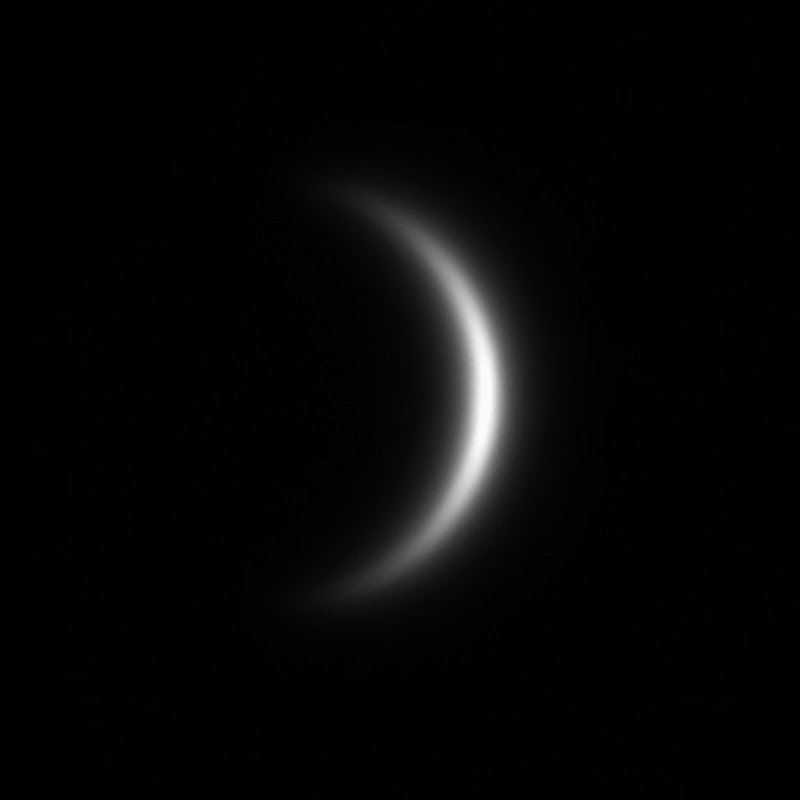
Even now, we’re still not seeing a fully illuminated Venus. Instead, as seen through telescopes – as Venus flees ahead – its phase has been increasing, like a tiny waxing moon. But, meanwhile, again as seen through telescopes, the disk size of Venus has been decreasing as the planet races ahead.
Illumination. Venus reaches its greatest illuminated extent on September 19. That’s when the lighted portion of the planet – the crescent Venus, seen through telescopes now – will cover its greatest area on our sky’s dome. Does this mean the phase will stop increasing now? No. It means Venus is at a maximum phase (25%) for its disk size.
Disk size. Remember, again as seen through a telescope, the disk of Venus is shrinking. In September, 2023, Venus goes from a 49-arcsecond crescent disk through telescopes to a 32-arcsecond crescent disk.
So greatest brilliancy for Venus is combination of maximum phase and disk size. The two combine to give us a bright planet Venus.
Then, as it flees ahead of us, the phase continues to increase … but the disk size decreases. So Venus will appear a smidgeon fainter to us a month from now, and fainter still (but still very bright!) by the year’s end.
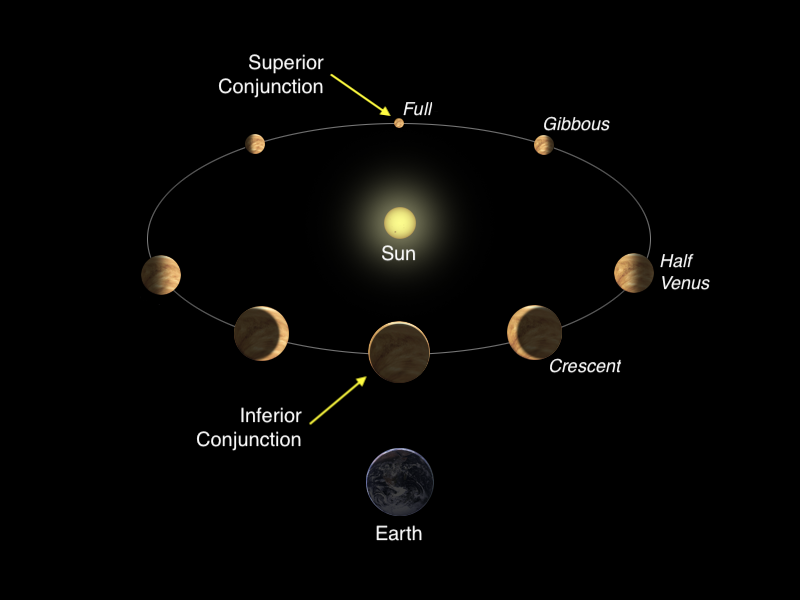
The phases of Venus – and its locations at inferior and superior conjunction – as viewed from Earth. Adapted from an image by NASA/ Chmee2/ Wikimedia Commons/ CC BY-SA 3.0.
When greatest brilliancy happens
Venus’ greatest illuminated extent – or greatest brilliancy – in our morning sky always happens about a month before Venus reaches greatest western (morning) elongation. Its next greatest western (morning) elongation will fall on October 23, 2023.
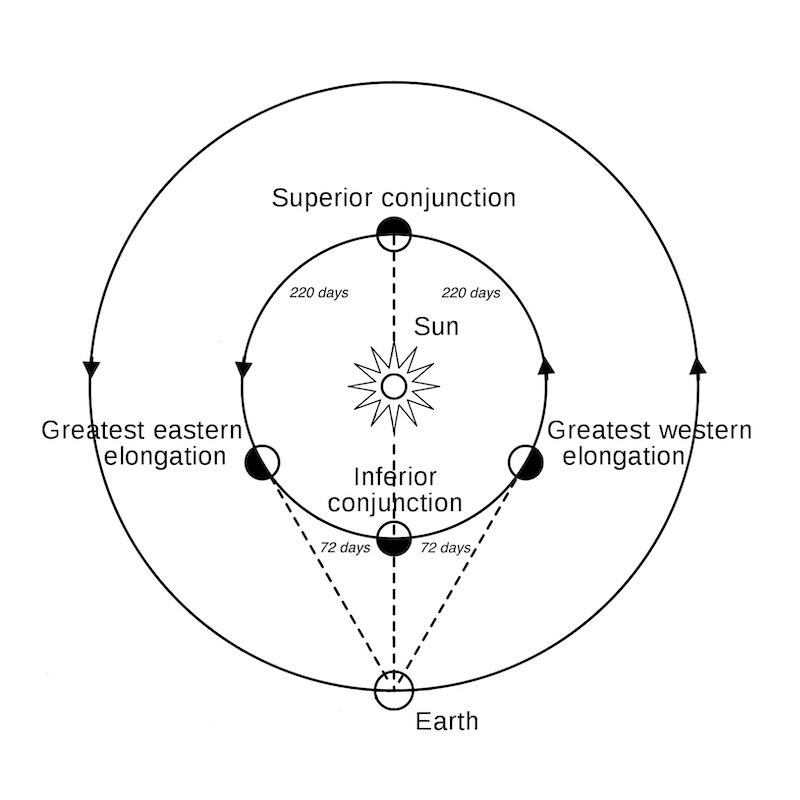
Earth and Venus orbit the sun counterclockwise as seen from the north side of the solar system. Venus reaches its greatest eastern elongation in the evening sky about 72 days before inferior conjunction and its greatest western elongation in the morning sky about 72 days after inferior conjunction. Greatest illuminated extent for Venus comes midway between a greatest elongation and an inferior conjunction. Adapted from an image by Wmheric/ Wikimedia Commons/ CC BY-SA 3.0.
Venus charts for 2023, from Guy Ottewell
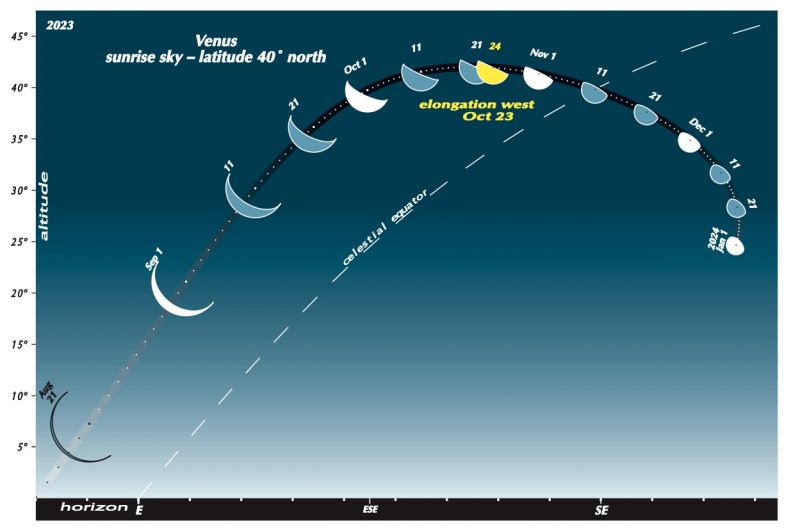
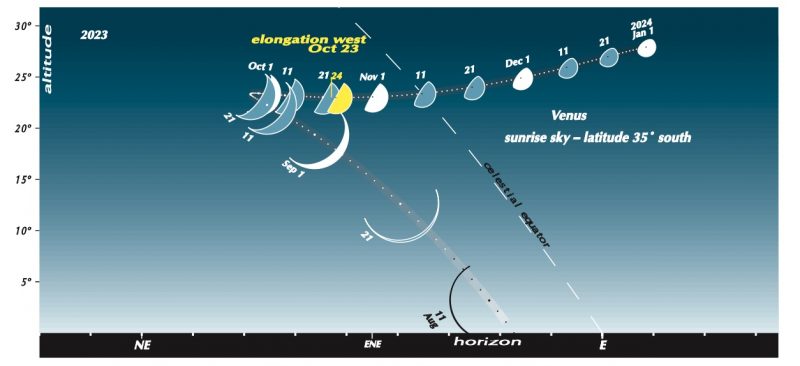
View larger. | Venus’ greatest morning elongation in 2023 from the Northern Hemisphere as viewed through a powerful telescope. Greatest elongation will come on October 23. The planet images are at the 1st, 11th, and 21st of each month. Dots show the actual positions of Venus every day. Chart via Guy Ottewell’s 2023 Astronomical Calendar. Used with permission.View larger. | Venus’ greatest morning elongation in 2023 from the Southern Hemisphere as viewed through a powerful telescope. Greatest elongation will come on October 23. The planet images are at the 1st, 11th, and 21st of each month. And the dots show the actual positions of Venus every day. Chart via Guy Ottewell’s 2023 Astronomical Calendar. Used with permission.
Venus photos from our community
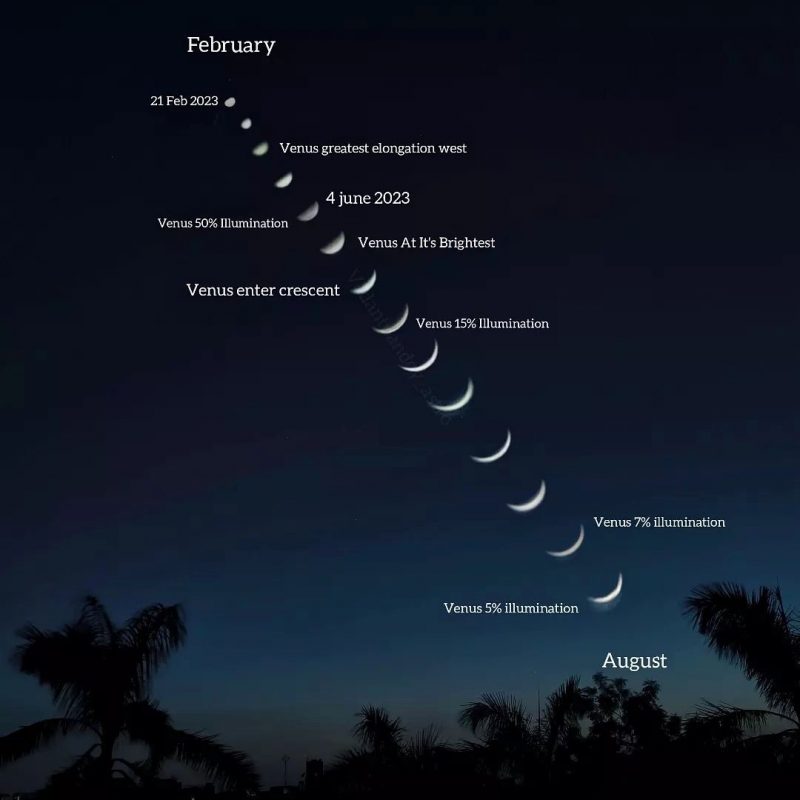
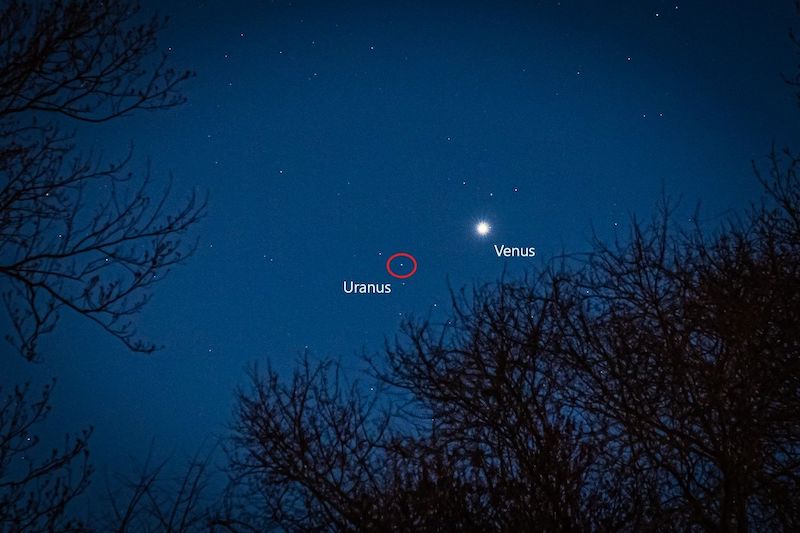
View at EarthSky Community Photos. | Vedant Pandey wrote: “I am Vedant Pandey, a 17 year old amateur astrophotographer from Varanasi, Uttar Pradesh, India. I photographed Venus since it appeared in the evening sky in February, 2023. And here are the phases of Venus, from waxing gibbous in February to its crescent phase in August, as seen by my telescope.” Wow! Thank you, Vedant!View at EarthSky Community Photos. | Jim Bruzek of Dayton, Maryland, captured this image on March 23, 2023, and wrote: “Venus and Uranus at dusk from Dayton, Maryland.” Thank you, Jim!
More Venus images
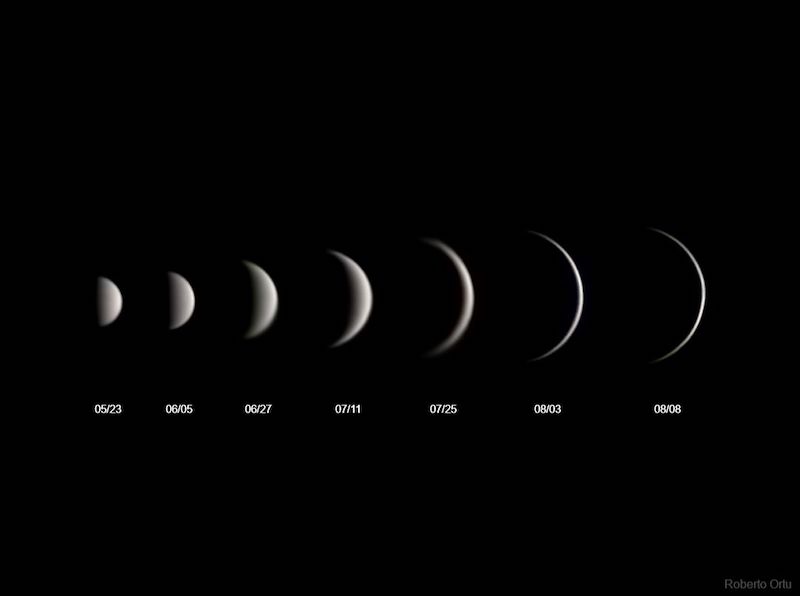
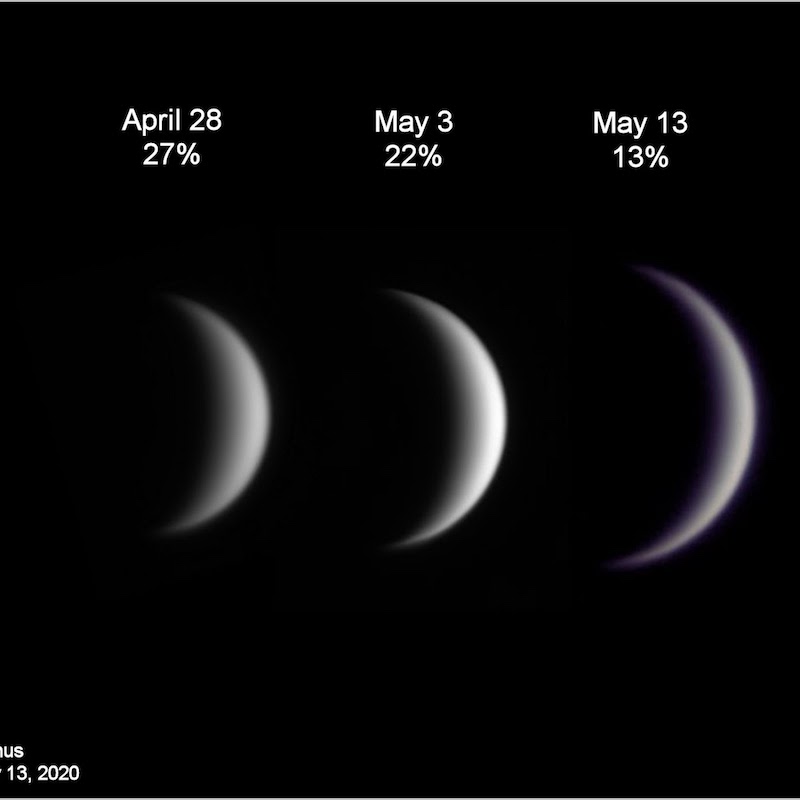
View at EarthSky Community Photos. | Roberto Ortu of Cabras, Sardinia, Italy, captured these images of Venus and wrote: “This is a mosaic with the best photos of the planet that I got from May 23, 2023, until August 8, 2023. The images show its phases, very similar to those of the moon, and the increase in its apparent diameter caused by the approach to the Earth.” Thank you, Roberto!View larger. | This composite images shows how Venus changes in size and phases as it gets closer to Earth. Image via Tom and Jane Wildoner/ Dark Side Observatory. Used with permission.This image of Venus was captured during daylight when Venus was 6% illuminated. Image via Tom and Jane Wildoner/ Dark Side Observatory. Used with permission.
What’s next for Venus?
Though it’s brightest in September, 2023, Venus will be farthest from the sunrise – at greatest morning elongation – in October, 2023.
And it’ll continue to blaze in our morning sky – east before dawn – through March, 2024.
Bottom line: Venus will be brightest in the morning sky around September 19, 2023. After that, Venus won’t be this bright again until February and April of 2025.
View at EarthSky Community Photos. | EarthSky’s Deborah Byrd caught Venus with an iPhone, over the desert west of Santa Fe, New Mexico, on September 14, 2023. It was super bright! It’s easy to see, even from cities. When is Venus brightest? Read more below.
Greatest brilliancy for Venus is a treat! Watch for Venus in the east before sunrise around mid-September 2023.
Venus brightest in morning sky, around September 19
Venus is the brightest planet. It outshines any other object in our sky, with the exception of the sun and moon. And it’s dazzling around September 19, brightest for 2023. You can’t miss Venus! Look for it in the sunrise direction on any clear morning around now. When it’s this bright, Venus appears as an eerily eye-catching beacon in the morning sky. It’s visible not just in a dark sky, but in bright morning twilight as well.
Venus will reach its peak in brilliancy – at magnitude -4.8 – on September 19. It won’t appear this bright to us again until February 2025, when it’ll reside in the west after sunset.
Venus before sunrise in 2023
Venus was in our evening sky when 2023 began. It left the evening sky – passing more or less between us and the sun – on August 13. Astronomers called the August 13 event an inferior conjunction of Venus.
But, by late August, Venus had emerged from the twilight glare at dawn. As seen from the Northern Hemisphere in early September, it made a beeline to a point high above the sunrise. Southern Hemisphere viewers can see Venus blazing in their eastern dawn skies now, too. From there, Venus isn’t as high in the sky before sunrise. It’s more to one side of the sunrise.
All this time Earth and Venus are moving in their orbits around the sun. Venus moves faster. And its orbit is smaller. Since its August 13 inferior conjunction, Venus has been fleeing ahead of Earth in its orbit.
View larger. | Heliocentric view of solar system, September 2023. Notice Earth and Venus. Chart via Guy Ottewell.
What is greatest brilliancy?
Greatest brilliancy for Venus is a combination of two factors: illumination and disk size. Remember … Venus passed us in its smaller, faster orbit on August 13. It was hard to catch that day (even in photos), because its lighted face was turned mostly away from us.
Even now, we’re still not seeing a fully illuminated Venus. Instead, as seen through telescopes – as Venus flees ahead – its phase has been increasing, like a tiny waxing moon. But, meanwhile, again as seen through telescopes, the disk size of Venus has been decreasing as the planet races ahead.
Illumination. Venus reaches its greatest illuminated extent on September 19. That’s when the lighted portion of the planet – the crescent Venus, seen through telescopes now – will cover its greatest area on our sky’s dome. Does this mean the phase will stop increasing now? No. It means Venus is at a maximum phase (25%) for its disk size.
Disk size. Remember, again as seen through a telescope, the disk of Venus is shrinking. In September, 2023, Venus goes from a 49-arcsecond crescent disk through telescopes to a 32-arcsecond crescent disk.
So greatest brilliancy for Venus is combination of maximum phase and disk size. The two combine to give us a bright planet Venus.
Then, as it flees ahead of us, the phase continues to increase … but the disk size decreases. So Venus will appear a smidgeon fainter to us a month from now, and fainter still (but still very bright!) by the year’s end.
The phases of Venus – and its locations at inferior and superior conjunction – as viewed from Earth. Adapted from an image by NASA/ Chmee2/ Wikimedia Commons/ CC BY-SA 3.0.
When greatest brilliancy happens
Venus’ greatest illuminated extent – or greatest brilliancy – in our morning sky always happens about a month before Venus reaches greatest western (morning) elongation. Its next greatest western (morning) elongation will fall on October 23, 2023.
Earth and Venus orbit the sun counterclockwise as seen from the north side of the solar system. Venus reaches its greatest eastern elongation in the evening sky about 72 days before inferior conjunction and its greatest western elongation in the morning sky about 72 days after inferior conjunction. Greatest illuminated extent for Venus comes midway between a greatest elongation and an inferior conjunction. Adapted from an image by Wmheric/ Wikimedia Commons/ CC BY-SA 3.0.
Venus charts for 2023, from Guy Ottewell
View larger. | Venus’ greatest morning elongation in 2023 from the Northern Hemisphere as viewed through a powerful telescope. Greatest elongation will come on October 23. The planet images are at the 1st, 11th, and 21st of each month. Dots show the actual positions of Venus every day. Chart via Guy Ottewell’s 2023 Astronomical Calendar. Used with permission.View larger. | Venus’ greatest morning elongation in 2023 from the Southern Hemisphere as viewed through a powerful telescope. Greatest elongation will come on October 23. The planet images are at the 1st, 11th, and 21st of each month. And the dots show the actual positions of Venus every day. Chart via Guy Ottewell’s 2023 Astronomical Calendar. Used with permission.
Venus photos from our community
View at EarthSky Community Photos. | Vedant Pandey wrote: “I am Vedant Pandey, a 17 year old amateur astrophotographer from Varanasi, Uttar Pradesh, India. I photographed Venus since it appeared in the evening sky in February, 2023. And here are the phases of Venus, from waxing gibbous in February to its crescent phase in August, as seen by my telescope.” Wow! Thank you, Vedant!View at EarthSky Community Photos. | Jim Bruzek of Dayton, Maryland, captured this image on March 23, 2023, and wrote: “Venus and Uranus at dusk from Dayton, Maryland.” Thank you, Jim!
More Venus images
View at EarthSky Community Photos. | Roberto Ortu of Cabras, Sardinia, Italy, captured these images of Venus and wrote: “This is a mosaic with the best photos of the planet that I got from May 23, 2023, until August 8, 2023. The images show its phases, very similar to those of the moon, and the increase in its apparent diameter caused by the approach to the Earth.” Thank you, Roberto!View larger. | This composite images shows how Venus changes in size and phases as it gets closer to Earth. Image via Tom and Jane Wildoner/ Dark Side Observatory. Used with permission.This image of Venus was captured during daylight when Venus was 6% illuminated. Image via Tom and Jane Wildoner/ Dark Side Observatory. Used with permission.
What’s next for Venus?
Though it’s brightest in September, 2023, Venus will be farthest from the sunrise – at greatest morning elongation – in October, 2023.
And it’ll continue to blaze in our morning sky – east before dawn – through March, 2024.
Bottom line: Venus will be brightest in the morning sky around September 19, 2023. After that, Venus won’t be this bright again until February and April of 2025.
Watch this video with Alan Dyer to learn how to photograph a solar eclipse.
Astronomy author and photographer Alan Dyer spoke to the Hamilton Amateur Astronomers group about how to photograph (and still enjoy!) the 2024 total solar eclipse. These tips can also apply to the upcoming annular solar eclipse that will be crossing the Americas on October 14, 2023. As well as the total solar eclipse crossing from Mexico across the United States to northeastern Canada on April 8, 2024, millions will have the chance to capture a solar eclipse. So, if you also want to try your hand at photography, you can watch Alan Dyer’s advice in the video above. Or read on for a summary of his tips.
How to photograph a solar eclipse
Total solar eclipses go by pretty quickly. In 2017, I was in Wyoming and was treated to the fastest two minutes and 19 seconds of my life as the moon blotted out the sun. So first you have to decide if it’s really worth your effort and the stress of photographing the eclipse. For me, personally, I only plan to hold my phone up a couple times during the 2024 totality and snap a couple amateurish shots. I know that I won’t be able to get anything as beautiful as astrophotographers can do. And that’s what Alan Dyer recommends in his first of five possible levels for photographing the eclipse: the easiest method is taking a photo with your phone.
Here are his five options for photographing the eclipse, in increasing order of difficulty:
Phone camera
Wide-angle time-lapse
Telephoto videos
Telephoto stills
Telescope on tracking mount
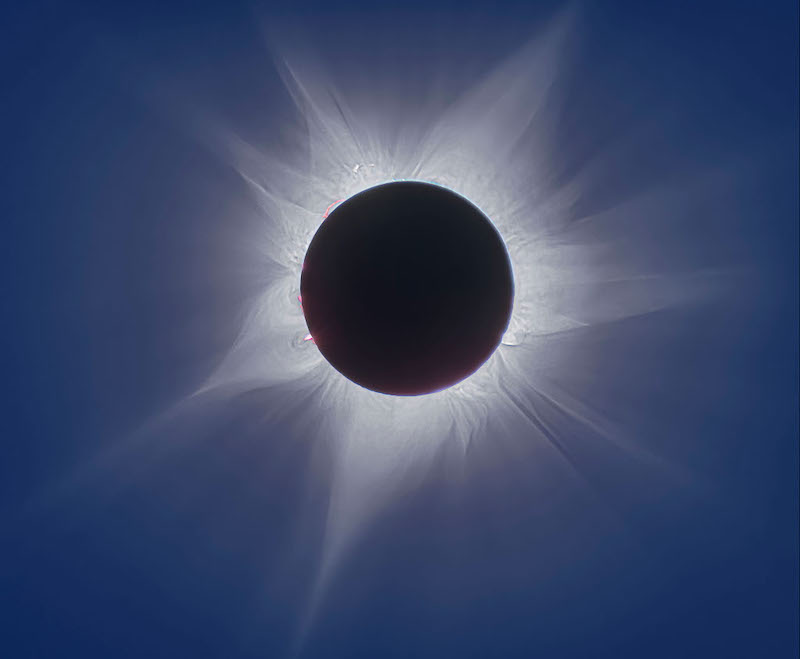
Fred Espenak captured this image of the hybrid solar eclipse on April 20, 2023, from a ship in the Indian Ocean. The image is a composite of 11 images shot with different shutter speeds to record the vivid detail of the corona. This photo was the Astronomy Picture of the Day for April 29, 2023. Image via APOD/ Fred Espenak. Used with permission.
1. A phone camera photograph of a solar eclipse
Alan says that you can set your camera on a wide-angle lens view in order to capture the ground and the sun at the same time. Or you could zoom in to capture a closeup of the sun during totality. But he says the best shot with your phone’s camera will be to mount it on some type of tripod and then set it to take a time-lapse. Or, perhaps better yet, is take a 4K movie that will capture your expressions of awe and wonder as the eclipse progresses. In this case, he recommends starting a minute or two before totality, so you don’t have to fuss with it and can just enjoy the event.
2. Wide-angle time-lapse
Set your camera up on a tripod and set it on auto exposure. Manually focus the lens on infinity. Then start the camera before totality and let it do all the work! The camera will take hundreds of images while you enjoy the view live.
Depending on what size lens you use, you may be able to include the landscape in your photo. This will be more challenging in areas where the sun will be higher in the sky. You may want to use planetarium software with field-of-view indicators to set up the framing and composition of your images. You’ll want to do the planning and framing in advance, so you’re not under a time crunch when the moment of eclipse arrives.
Some of the more technical aspects that Alan includes are: set the exposure with wide area sampling (not spot metering), set exposure compensation to -1 EV, and use an intervalometer with 1-second interval.
Using the same camera, you could also shoot 4K video, and this time you’ll capture the audio as well.
And don’t forget to turn off your camera when totality ends!
3. Telephoto videos
To take a telephoto video through your camera, Alan recommends using a 300mm to 500mm lens on a fixed tripod. For the partial phases, you’ll want an approved solar filter. Set up and practice taking images of the sun before the day of the eclipse.
Alan sets up his camera with the filter on, and rechecks the focus a couple minutes before totality. Then, about a minute before totality, he takes the filter off when he is no longer looking through the lens. Of course, as always, keep in mind that looking through a camera at the sun can result in blindness. So don’t do that! And remember to replace the filter after totality.
As with the previous methods, he says that you can use autofocus for easy and clear results. And just let the sun drift through the frame. Some of the other technical specifications he recommends are to leave the lens aperture wide open and have a low ISO. Make sure you have a solid tripod and head.
4. Telephoto stills
If you want close-up still images of the eclipse, you’ll want to use a telephoto lens on a camera with a tripod, or else a small telescope. The exposure length can vary widely depending on what you want to capture. A one-second exposure can capture more of the wisps of the corona and earthshine on the dark side of the moon. While a 1/1000 exposure will give you a better look at the diamond ring.
Alan says to shoot the largest RAW image you can and to use your DSLR camera on live view. With a mirror-less camera, Alan recommends using the electrical 1st-curtain shutter.
Auto-exposure bracketing will let you click the shutter once and have it take a range of exposures for you. You can set this up as a custom shooting mode so that you can click in and out of it easily.
5. Telescope on a tracking mount to photograph a solar eclipse
The most difficult option is to use your telescope on a tracking mount to photograph the eclipse. Hopefully you already have experience with your telescope and mount and have practiced photographing with your setup. But if you want to have a really close-up view of the eclipse, you’ll need to have it tracking the sun and moon so that there’s no blurring in your images.
Alan suggests using the crescent moon as practice for the eclipse. Here are some questions to ask yourself while practicing taking images with the moon:
Does everything connect securely?
Can you focus accurately?
When you handle the camera, does it blur your image?
How long of an exposure can you take?
And if it’s cloudy on eclipse day … go ahead and shoot long exposures anyway, especially during the partial or diamond ring phases. Who knows what your camera might capture? As long as you have the tracking set up, your camera knows where the eclipse is even through the clouds.
If you want even more tips from Alan, watch the full video above!
Bottom line: Get tips on how to photograph a solar eclipse with author and astrophotographer Alan Dyer. Use these tips for the October 14, 2023, annular eclipse and the April 8, 2024, total solar eclipse.
Watch this video with Alan Dyer to learn how to photograph a solar eclipse.
Astronomy author and photographer Alan Dyer spoke to the Hamilton Amateur Astronomers group about how to photograph (and still enjoy!) the 2024 total solar eclipse. These tips can also apply to the upcoming annular solar eclipse that will be crossing the Americas on October 14, 2023. As well as the total solar eclipse crossing from Mexico across the United States to northeastern Canada on April 8, 2024, millions will have the chance to capture a solar eclipse. So, if you also want to try your hand at photography, you can watch Alan Dyer’s advice in the video above. Or read on for a summary of his tips.
How to photograph a solar eclipse
Total solar eclipses go by pretty quickly. In 2017, I was in Wyoming and was treated to the fastest two minutes and 19 seconds of my life as the moon blotted out the sun. So first you have to decide if it’s really worth your effort and the stress of photographing the eclipse. For me, personally, I only plan to hold my phone up a couple times during the 2024 totality and snap a couple amateurish shots. I know that I won’t be able to get anything as beautiful as astrophotographers can do. And that’s what Alan Dyer recommends in his first of five possible levels for photographing the eclipse: the easiest method is taking a photo with your phone.
Here are his five options for photographing the eclipse, in increasing order of difficulty:
Phone camera
Wide-angle time-lapse
Telephoto videos
Telephoto stills
Telescope on tracking mount
Fred Espenak captured this image of the hybrid solar eclipse on April 20, 2023, from a ship in the Indian Ocean. The image is a composite of 11 images shot with different shutter speeds to record the vivid detail of the corona. This photo was the Astronomy Picture of the Day for April 29, 2023. Image via APOD/ Fred Espenak. Used with permission.
1. A phone camera photograph of a solar eclipse
Alan says that you can set your camera on a wide-angle lens view in order to capture the ground and the sun at the same time. Or you could zoom in to capture a closeup of the sun during totality. But he says the best shot with your phone’s camera will be to mount it on some type of tripod and then set it to take a time-lapse. Or, perhaps better yet, is take a 4K movie that will capture your expressions of awe and wonder as the eclipse progresses. In this case, he recommends starting a minute or two before totality, so you don’t have to fuss with it and can just enjoy the event.
2. Wide-angle time-lapse
Set your camera up on a tripod and set it on auto exposure. Manually focus the lens on infinity. Then start the camera before totality and let it do all the work! The camera will take hundreds of images while you enjoy the view live.
Depending on what size lens you use, you may be able to include the landscape in your photo. This will be more challenging in areas where the sun will be higher in the sky. You may want to use planetarium software with field-of-view indicators to set up the framing and composition of your images. You’ll want to do the planning and framing in advance, so you’re not under a time crunch when the moment of eclipse arrives.
Some of the more technical aspects that Alan includes are: set the exposure with wide area sampling (not spot metering), set exposure compensation to -1 EV, and use an intervalometer with 1-second interval.
Using the same camera, you could also shoot 4K video, and this time you’ll capture the audio as well.
And don’t forget to turn off your camera when totality ends!
3. Telephoto videos
To take a telephoto video through your camera, Alan recommends using a 300mm to 500mm lens on a fixed tripod. For the partial phases, you’ll want an approved solar filter. Set up and practice taking images of the sun before the day of the eclipse.
Alan sets up his camera with the filter on, and rechecks the focus a couple minutes before totality. Then, about a minute before totality, he takes the filter off when he is no longer looking through the lens. Of course, as always, keep in mind that looking through a camera at the sun can result in blindness. So don’t do that! And remember to replace the filter after totality.
As with the previous methods, he says that you can use autofocus for easy and clear results. And just let the sun drift through the frame. Some of the other technical specifications he recommends are to leave the lens aperture wide open and have a low ISO. Make sure you have a solid tripod and head.
4. Telephoto stills
If you want close-up still images of the eclipse, you’ll want to use a telephoto lens on a camera with a tripod, or else a small telescope. The exposure length can vary widely depending on what you want to capture. A one-second exposure can capture more of the wisps of the corona and earthshine on the dark side of the moon. While a 1/1000 exposure will give you a better look at the diamond ring.
Alan says to shoot the largest RAW image you can and to use your DSLR camera on live view. With a mirror-less camera, Alan recommends using the electrical 1st-curtain shutter.
Auto-exposure bracketing will let you click the shutter once and have it take a range of exposures for you. You can set this up as a custom shooting mode so that you can click in and out of it easily.
5. Telescope on a tracking mount to photograph a solar eclipse
The most difficult option is to use your telescope on a tracking mount to photograph the eclipse. Hopefully you already have experience with your telescope and mount and have practiced photographing with your setup. But if you want to have a really close-up view of the eclipse, you’ll need to have it tracking the sun and moon so that there’s no blurring in your images.
Alan suggests using the crescent moon as practice for the eclipse. Here are some questions to ask yourself while practicing taking images with the moon:
Does everything connect securely?
Can you focus accurately?
When you handle the camera, does it blur your image?
How long of an exposure can you take?
And if it’s cloudy on eclipse day … go ahead and shoot long exposures anyway, especially during the partial or diamond ring phases. Who knows what your camera might capture? As long as you have the tracking set up, your camera knows where the eclipse is even through the clouds.
If you want even more tips from Alan, watch the full video above!
Bottom line: Get tips on how to photograph a solar eclipse with author and astrophotographer Alan Dyer. Use these tips for the October 14, 2023, annular eclipse and the April 8, 2024, total solar eclipse.
Any late summer evening and throughout northern autumn, Cassiopeia the Queen can be found ascending in the northeast after nightfall. The shape of this constellation makes Cassiopeia’s stars very noticeable. Cassiopeia looks like the letter W (or M).
Look for the Queen starting at nightfall every September. She’ll be higher up in the northeast as autumn unfolds.
For those in the northern U.S. and Canada, Cassiopeia is circumpolar, meaning above the horizon all night long.
How to see Cassiopeia
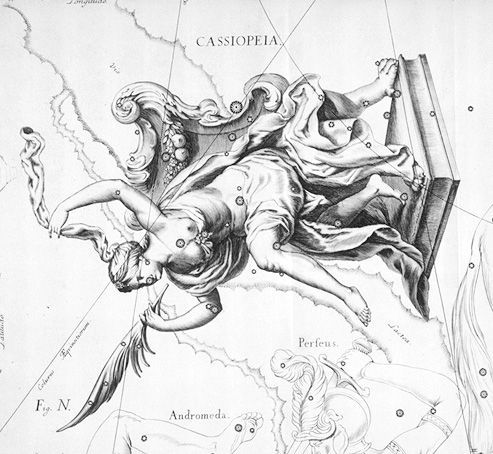
Cassiopeia represents an ancient queen of Ethiopia. You still sometimes hear the old name for this constellation: Cassiopeia’s Chair. And some old star maps depict the queen sitting on the chair, marked by five stars.
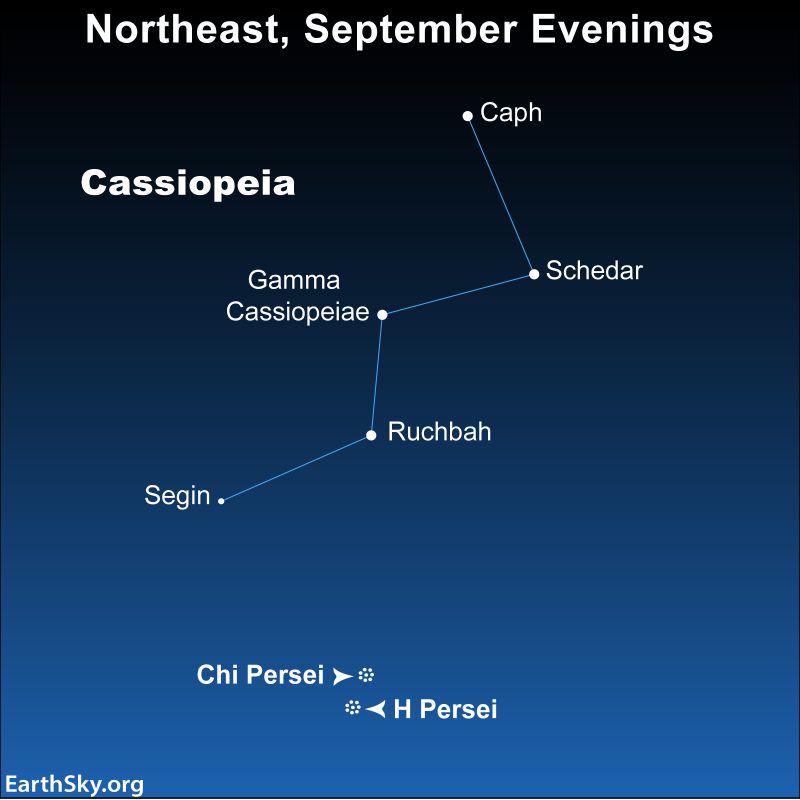
These stars – the brightest ones in Cassiopeia – are Schedar, Caph, Gamma Cassiopeiae, Ruchbah and Segin.
Around the middle of the night during the autumn months, Cassiopeia swings above Polaris, the North Star.
Before dawn, look in the northwest.
You can find Cassiopeia the Queen in the northeast around the month of September. If you have a dark sky, look below Cassiopeia for a famous binocular object. This object is called the Double Cluster in Perseus.
Opposite the Big Dipper
Cassiopeia is opposite the Big Dipper in the northern sky.
That is, the two constellations lie on opposite sides of the pole star, Polaris.
So when Cassiopeia is high in the sky, as it is on evenings from about September through February, the Big Dipper is low in the sky. Every March, when the Dipper is ascending in the northeast, getting ready to appear prominent again in the evening sky, Cassiopeia can be seen descending in the northwest.
The Big Dipper and the W-shaped constellation Cassiopeia the Queen circle around Polaris, the North Star, in a period of 23 hours and 56 minutes. The Dipper is circumpolar at 41 degrees north latitude and all latitudes farther north.
These are two open star clusters, each of which consists of young stars still moving together from the primordial cloud of gas and dust that gave birth to the cluster’s stars.
These clusters are familiarly known to stargazers as H and Chi Persei.
Stargazers smile when they peer at them through their binoculars, not only because they are beautiful, but also because of their names. They are named from two different alphabets, the Greek and the Roman. Stars have Greek letter names, but most star clusters don’t. Johann Bayer (1572-1625) gave Chi Persei its Greek letter name.
Then, it’s said, he ran out of Greek letters. That’s when he used a Roman letter – the letter H – to name the other cluster.
In the 1930s, the International Astronomical Union (IAU) – an organization of professional astronomers – decided to define boundaries and officially name 88 constellations. This is the realm of night sky they identified as Cassiopeia. Read more from the IAU.
Lore of Cassiopeia
In skylore and in Greek mythology, Cassiopeia was a beautiful and vain queen of Ethiopia. It’s said that she committed the sin of pride by boasting that both she and her daughter Andromeda were more beautiful than Nereids, or sea nymphs. Pridefulness, in mythology, is never wise.
Her boast angered Poseidon, god of the sea, who sent a sea monster (Cetus the Whale) to ravage the kingdom. To pacify the monster, Cassiopeia’s daughter, Princess Andromeda, was left tied to a rock by the sea. Cetus was about to devour her when Perseus the Hero happened by on Pegasus, the Flying Horse.
Perseus rescued the princess, and all lived happily … and the gods were pleased, so all of these characters were elevated to the heavens as stars.
But – because of her vanity – Cassiopeia suffered an indignity. At some times of the night or year, this constellation has more the shape of the letter M, and you might imagine the Queen reclining on her starry throne. At other times of year or night – as in the wee hours between midnight and dawn in February and March – Cassiopeia’s Chair dips below the celestial pole. And then this constellation appears to us on Earth more like the letter W.
It’s then that the Lady of the Chair, as she is sometimes called, is said to hang on for dear life. If Cassiopeia the Queen lets go, she will drop from the sky into the ocean below, where the Nereids must still be waiting.
Bottom line: Cassiopeia the Queen is an easy-to-find constellation. It has the shape of a W or M. Look in the north-northeast sky on September and October evenings.
Any late summer evening and throughout northern autumn, Cassiopeia the Queen can be found ascending in the northeast after nightfall. The shape of this constellation makes Cassiopeia’s stars very noticeable. Cassiopeia looks like the letter W (or M).
Look for the Queen starting at nightfall every September. She’ll be higher up in the northeast as autumn unfolds.
For those in the northern U.S. and Canada, Cassiopeia is circumpolar, meaning above the horizon all night long.
How to see Cassiopeia
Cassiopeia represents an ancient queen of Ethiopia. You still sometimes hear the old name for this constellation: Cassiopeia’s Chair. And some old star maps depict the queen sitting on the chair, marked by five stars.
These stars – the brightest ones in Cassiopeia – are Schedar, Caph, Gamma Cassiopeiae, Ruchbah and Segin.
Around the middle of the night during the autumn months, Cassiopeia swings above Polaris, the North Star.
Before dawn, look in the northwest.
You can find Cassiopeia the Queen in the northeast around the month of September. If you have a dark sky, look below Cassiopeia for a famous binocular object. This object is called the Double Cluster in Perseus.
Opposite the Big Dipper
Cassiopeia is opposite the Big Dipper in the northern sky.
That is, the two constellations lie on opposite sides of the pole star, Polaris.
So when Cassiopeia is high in the sky, as it is on evenings from about September through February, the Big Dipper is low in the sky. Every March, when the Dipper is ascending in the northeast, getting ready to appear prominent again in the evening sky, Cassiopeia can be seen descending in the northwest.
The Big Dipper and the W-shaped constellation Cassiopeia the Queen circle around Polaris, the North Star, in a period of 23 hours and 56 minutes. The Dipper is circumpolar at 41 degrees north latitude and all latitudes farther north.
These are two open star clusters, each of which consists of young stars still moving together from the primordial cloud of gas and dust that gave birth to the cluster’s stars.
These clusters are familiarly known to stargazers as H and Chi Persei.
Stargazers smile when they peer at them through their binoculars, not only because they are beautiful, but also because of their names. They are named from two different alphabets, the Greek and the Roman. Stars have Greek letter names, but most star clusters don’t. Johann Bayer (1572-1625) gave Chi Persei its Greek letter name.
Then, it’s said, he ran out of Greek letters. That’s when he used a Roman letter – the letter H – to name the other cluster.
In the 1930s, the International Astronomical Union (IAU) – an organization of professional astronomers – decided to define boundaries and officially name 88 constellations. This is the realm of night sky they identified as Cassiopeia. Read more from the IAU.
Lore of Cassiopeia
In skylore and in Greek mythology, Cassiopeia was a beautiful and vain queen of Ethiopia. It’s said that she committed the sin of pride by boasting that both she and her daughter Andromeda were more beautiful than Nereids, or sea nymphs. Pridefulness, in mythology, is never wise.
Her boast angered Poseidon, god of the sea, who sent a sea monster (Cetus the Whale) to ravage the kingdom. To pacify the monster, Cassiopeia’s daughter, Princess Andromeda, was left tied to a rock by the sea. Cetus was about to devour her when Perseus the Hero happened by on Pegasus, the Flying Horse.
Perseus rescued the princess, and all lived happily … and the gods were pleased, so all of these characters were elevated to the heavens as stars.
But – because of her vanity – Cassiopeia suffered an indignity. At some times of the night or year, this constellation has more the shape of the letter M, and you might imagine the Queen reclining on her starry throne. At other times of year or night – as in the wee hours between midnight and dawn in February and March – Cassiopeia’s Chair dips below the celestial pole. And then this constellation appears to us on Earth more like the letter W.
It’s then that the Lady of the Chair, as she is sometimes called, is said to hang on for dear life. If Cassiopeia the Queen lets go, she will drop from the sky into the ocean below, where the Nereids must still be waiting.
Bottom line: Cassiopeia the Queen is an easy-to-find constellation. It has the shape of a W or M. Look in the north-northeast sky on September and October evenings.
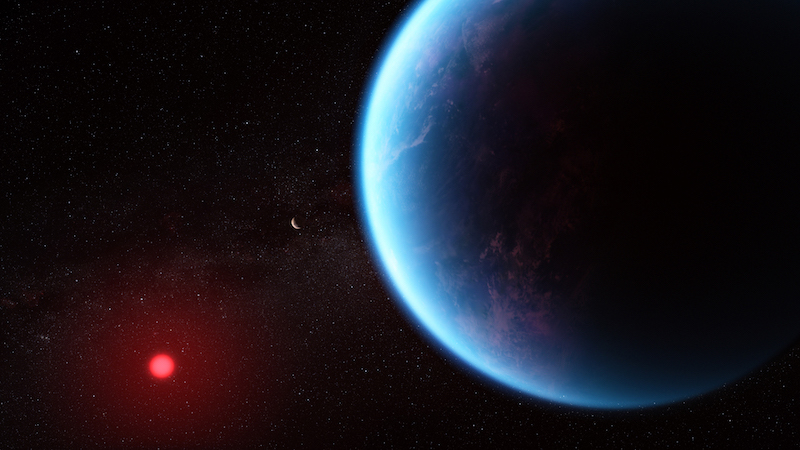
View larger. | This is an artist’s concept of exoplanet K2-18 b. NASA’s James Webb Space Telescope has found that its deep hydrogen atmosphere contains methane and carbon dioxide. The findings mean that K2-18 b might have a global ocean beneath its atmosphere. Webb also tentatively detected dimethyl sulfide (DMS) in the atmosphere, which on Earth is only produced by life. Image via NASA/ CSA/ ESA/ J. Olmsted (STScI); Science: N. Madhusudhan (Cambridge University).
Did the James Webb Space Telescope spot signs of life on a distant planet? On September 11, 2023, NASA announced that Webb made some exciting discoveries while observing an exoplanet called K2-18 b. They said the planet has methane and carbon dioxide in its atmosphere, which indicates it might be a Hycean world, one with a deep hydrogen atmosphere and global water ocean. But the extraordinary news is that Webb found hints of a molecule called dimethyl sulfide (DMS). On Earth, only life produces dimethyl sulfide, such as bacteria and phytoplankton in oceans.
Does that mean Webb has found signs of life on exoplanet K2-18 b? Well, first, the finding of dimethyl sulfide needs to be confirmed. And then, scientists have to learn more about the exoplanet. While it is in the habitable zone of its star, its environment could still be unfavorable to life. As NASA said, it may have a hostile environment due to its active star, or its ocean may also be too hot to be habitable. Still, the new discovery is tantalizing.
While studying the exoplanet K2-18 b, @NASAWebb hinted at a detection of dimethyl sulphide (DMS). On Earth, this molecule is only produced by microbial life. Because the detection needs to be confirmed, the team will follow up with additional observations. https://t.co/lYRNSVgI0Mpic.twitter.com/Ui3c1fDbSf
K2-18 b is what scientists call a sub-Neptune or mini-Neptune. The exoplanet is 2.6 times larger and 8.6 times more massive than Earth. The new data from Webb show that the exoplanet is also likely a Hycean world. And unlike many sub-Neptunes, scientists say that Hyceans may be habitable. In this instance, habitable means the conditions could be right for life to form. It does not mean that we are planning to send earthly life to the exoplanet.
The Webb discovery is also the first time that astronomers have discovered carbon molecules in the atmosphere of a planet in its star’s habitable zone.
The new research paper has been accepted for publication in The Astrophysical Journal Letters. In the meantime, a draft version of the paper is available from ESA.
A Hycean world with an ocean?
K2-18 b orbits in the habitable zone of a red dwarf star about 124 light-years from Earth, in the constellation Leo the Lion. The habitable zone is the region around a star where temperatures could allow liquid water to exist. To be clear, this doesn’t prove that K2-18 b is actually habitable, although the new findings from Webb support that it is possible.
Also, Hyceans are a newer identified class of exoplanet, and there is still a lot that we don’t know about them. Unlike most sub-Neptunes, however, they may be able to have solid surfaces beneath their deep hydrogen atmospheres. And below the atmosphere, a global water ocean. They would still be hotter than Earth, but perhaps not too hot for life of some kind.
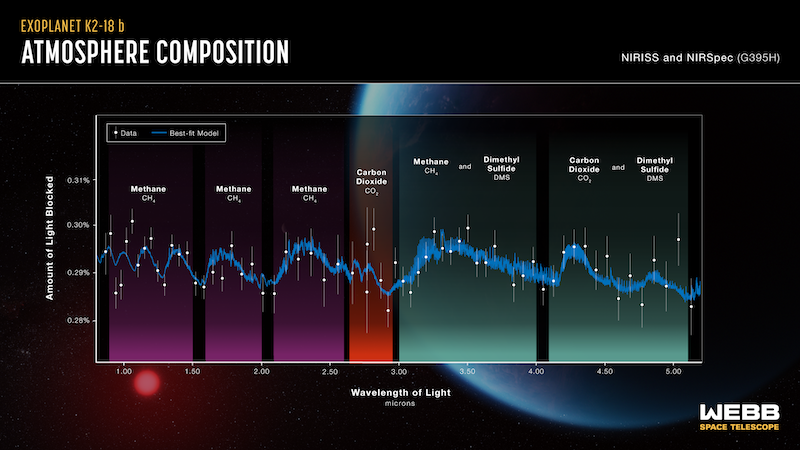
The discovery of methane (CH4) and carbon dioxide (CO2) – and a lack of ammonia – support the hypothesis that K2-18 b is a Hycean planet, the researchers said. Lead author Nikku Madhusudhan, an astronomer at the University of Cambridge, said that:
Our findings underscore the importance of considering diverse habitable environments in the search for life elsewhere. Traditionally, the search for life on exoplanets has focused primarily on smaller rocky planets, but the larger Hycean worlds are significantly more conducive to atmospheric observations.
The researchers said that K2-18 b likely has a mantle of high-pressure ice, similar to Neptune. The Webb results support the possibility of a planet-wide ocean on the surface, although it is still possible that the planet is too hot. Or at least too hot for the ocean to be habitable. Only additional observations will help astronomers determine the actual conditions.
Webb detects possible biosignature
The presence of methane, carbon dioxide and a possible ocean are certainly interesting on their own of course. But Webb also potentially detected something even more tantalizing in the atmosphere of K2-18 b: dimethyl sulfide (DMS). Dimethyl sulfide is an organic sulfur compound. On Earth, it is only produced naturally by biological processes from organisms such as bacteria and phytoplankton in marine environments.
This is still tentative, however. While there is a possible detection, it is less robust than the detections of methane and carbon dioxide. The paper stated:
The potential inference of DMS is of high importance as it is known to be a robust biomarker on the Earth and has been extensively advocated to be a promising biomarker for exoplanets.
Overall, we find CH4 and CO2 to be our most confident detections, followed by DMS, with the abundance estimates reported above. While our results provide important first insights into the chemical composition of K2-18 b, upcoming observations will be able to verify our present findings.
These findings support the Hycean nature of K2-18 b and the potential for biological activity on the planet.
The possibility of DMS in the atmosphere is highly promising, but we are planning to take another look to robustly establish its presence.
View larger. | Atmospheric composition of K2-18 b from the Webb telescope. The atmosphere is primarily hydrogen; this graph shows the detections of methane, carbon dioxide and dimethyl sulfide. Image via NASA/ CSA/ ESA/ R. Crawford (STScI)/ J. Olmsted (STScI); Science: N. Madhusudhan (Cambridge University).
Most detailed spectrum of a habitable zone sub-Neptune
Webb’s observations are the most detailed yet of a sub-Neptune in the habitable zone. Co-author Subhajit Sarkar of Cardiff University said:
Although this kind of planet does not exist in our solar system, sub-Neptunes are the most common type of planet known so far in the galaxy. We have obtained the most detailed spectrum of a habitable zone sub-Neptune to date, and this allowed us to work out the molecules that exist in its atmosphere.
These results are the product of just two observations of K2-18 b, with many more on the way. This means our work here is but an early demonstration of what Webb can observe in habitable-zone exoplanets.
Future observations with Webb
Of course, now we want to know if Webb will be doing any follow-up observations. The answer is yes. The team will use the telescope’s MIRI (Mid-Infrared Instrument) spectrograph to further analyze the planet’s atmosphere. As Madhusudhan said:
Our ultimate goal is the identification of life on a habitable exoplanet, which would transform our understanding of our place in the universe. Our findings are a promising step toward a deeper understanding of Hycean worlds in this quest.
Bottom line: NASA’s Webb telescope looked at the sub-Neptune exoplanet K2-18 b. It found methane, carbon dioxide, a possible ocean, and even … maybe … a biosignature.
View larger. | This is an artist’s concept of exoplanet K2-18 b. NASA’s James Webb Space Telescope has found that its deep hydrogen atmosphere contains methane and carbon dioxide. The findings mean that K2-18 b might have a global ocean beneath its atmosphere. Webb also tentatively detected dimethyl sulfide (DMS) in the atmosphere, which on Earth is only produced by life. Image via NASA/ CSA/ ESA/ J. Olmsted (STScI); Science: N. Madhusudhan (Cambridge University).
Did the James Webb Space Telescope spot signs of life on a distant planet? On September 11, 2023, NASA announced that Webb made some exciting discoveries while observing an exoplanet called K2-18 b. They said the planet has methane and carbon dioxide in its atmosphere, which indicates it might be a Hycean world, one with a deep hydrogen atmosphere and global water ocean. But the extraordinary news is that Webb found hints of a molecule called dimethyl sulfide (DMS). On Earth, only life produces dimethyl sulfide, such as bacteria and phytoplankton in oceans.
Does that mean Webb has found signs of life on exoplanet K2-18 b? Well, first, the finding of dimethyl sulfide needs to be confirmed. And then, scientists have to learn more about the exoplanet. While it is in the habitable zone of its star, its environment could still be unfavorable to life. As NASA said, it may have a hostile environment due to its active star, or its ocean may also be too hot to be habitable. Still, the new discovery is tantalizing.
While studying the exoplanet K2-18 b, @NASAWebb hinted at a detection of dimethyl sulphide (DMS). On Earth, this molecule is only produced by microbial life. Because the detection needs to be confirmed, the team will follow up with additional observations. https://t.co/lYRNSVgI0Mpic.twitter.com/Ui3c1fDbSf
K2-18 b is what scientists call a sub-Neptune or mini-Neptune. The exoplanet is 2.6 times larger and 8.6 times more massive than Earth. The new data from Webb show that the exoplanet is also likely a Hycean world. And unlike many sub-Neptunes, scientists say that Hyceans may be habitable. In this instance, habitable means the conditions could be right for life to form. It does not mean that we are planning to send earthly life to the exoplanet.
The Webb discovery is also the first time that astronomers have discovered carbon molecules in the atmosphere of a planet in its star’s habitable zone.
The new research paper has been accepted for publication in The Astrophysical Journal Letters. In the meantime, a draft version of the paper is available from ESA.
A Hycean world with an ocean?
K2-18 b orbits in the habitable zone of a red dwarf star about 124 light-years from Earth, in the constellation Leo the Lion. The habitable zone is the region around a star where temperatures could allow liquid water to exist. To be clear, this doesn’t prove that K2-18 b is actually habitable, although the new findings from Webb support that it is possible.
Also, Hyceans are a newer identified class of exoplanet, and there is still a lot that we don’t know about them. Unlike most sub-Neptunes, however, they may be able to have solid surfaces beneath their deep hydrogen atmospheres. And below the atmosphere, a global water ocean. They would still be hotter than Earth, but perhaps not too hot for life of some kind.
The discovery of methane (CH4) and carbon dioxide (CO2) – and a lack of ammonia – support the hypothesis that K2-18 b is a Hycean planet, the researchers said. Lead author Nikku Madhusudhan, an astronomer at the University of Cambridge, said that:
Our findings underscore the importance of considering diverse habitable environments in the search for life elsewhere. Traditionally, the search for life on exoplanets has focused primarily on smaller rocky planets, but the larger Hycean worlds are significantly more conducive to atmospheric observations.
The researchers said that K2-18 b likely has a mantle of high-pressure ice, similar to Neptune. The Webb results support the possibility of a planet-wide ocean on the surface, although it is still possible that the planet is too hot. Or at least too hot for the ocean to be habitable. Only additional observations will help astronomers determine the actual conditions.
Webb detects possible biosignature
The presence of methane, carbon dioxide and a possible ocean are certainly interesting on their own of course. But Webb also potentially detected something even more tantalizing in the atmosphere of K2-18 b: dimethyl sulfide (DMS). Dimethyl sulfide is an organic sulfur compound. On Earth, it is only produced naturally by biological processes from organisms such as bacteria and phytoplankton in marine environments.
This is still tentative, however. While there is a possible detection, it is less robust than the detections of methane and carbon dioxide. The paper stated:
The potential inference of DMS is of high importance as it is known to be a robust biomarker on the Earth and has been extensively advocated to be a promising biomarker for exoplanets.
Overall, we find CH4 and CO2 to be our most confident detections, followed by DMS, with the abundance estimates reported above. While our results provide important first insights into the chemical composition of K2-18 b, upcoming observations will be able to verify our present findings.
These findings support the Hycean nature of K2-18 b and the potential for biological activity on the planet.
The possibility of DMS in the atmosphere is highly promising, but we are planning to take another look to robustly establish its presence.
View larger. | Atmospheric composition of K2-18 b from the Webb telescope. The atmosphere is primarily hydrogen; this graph shows the detections of methane, carbon dioxide and dimethyl sulfide. Image via NASA/ CSA/ ESA/ R. Crawford (STScI)/ J. Olmsted (STScI); Science: N. Madhusudhan (Cambridge University).
Most detailed spectrum of a habitable zone sub-Neptune
Webb’s observations are the most detailed yet of a sub-Neptune in the habitable zone. Co-author Subhajit Sarkar of Cardiff University said:
Although this kind of planet does not exist in our solar system, sub-Neptunes are the most common type of planet known so far in the galaxy. We have obtained the most detailed spectrum of a habitable zone sub-Neptune to date, and this allowed us to work out the molecules that exist in its atmosphere.
These results are the product of just two observations of K2-18 b, with many more on the way. This means our work here is but an early demonstration of what Webb can observe in habitable-zone exoplanets.
Future observations with Webb
Of course, now we want to know if Webb will be doing any follow-up observations. The answer is yes. The team will use the telescope’s MIRI (Mid-Infrared Instrument) spectrograph to further analyze the planet’s atmosphere. As Madhusudhan said:
Our ultimate goal is the identification of life on a habitable exoplanet, which would transform our understanding of our place in the universe. Our findings are a promising step toward a deeper understanding of Hycean worlds in this quest.
Bottom line: NASA’s Webb telescope looked at the sub-Neptune exoplanet K2-18 b. It found methane, carbon dioxide, a possible ocean, and even … maybe … a biosignature.
Imagine you’re far away from city lights, under a dark sky, on a night with no moon, no clouds and no haze. How many stars could you see with your unaided eye? There’s really no definitive answer to this question. No one has counted all the stars in the night sky, and astronomers use different numbers as theoretical estimates.
Considering all the stars visible in all directions around Earth, the upper end on the estimates is close to 10,000 visible stars. Here’s how one source, astronomytrek.com, comes up with that number:
The brighter the star, the lower the apparent magnitude value assigned to it, with the most luminous given a negative number. In total there are 22 stars with magnitudes of between -1 and 1, making them the night sky’s brightest stars. In the meantime, there are 71 stars of 2nd magnitude, 190 stars of 3rd magnitude, 610 of 4th magnitude, 1,929 of 5th magnitude, and 5,946 of 6th magnitude. When we include another 3,150 stars at the limit of our visual acuity of magnitude +6.5, then this adds up to 9,096 stars that it is possible to see in the night sky from both the Northern and Southern Hemispheres with the unaided eye.
Of course, in the Northern Hemisphere, for example, you can’t see stars below the southern horizon in the Southern Hemisphere. So, therefore, each hemisphere can only see about 5,000 stars. And, at any given time, half of Earth is in daylight. So only half the estimated number – perhaps 2,500 stars – would be visible from Earth’s night side. Plus, another fraction of those visible stars would be lost in the murk surrounding your horizon. That could bring you down to around 2,000, the most common number you’ll see for these estimates.
View at EarthSky Community Photos. | How many stars can you see? Well, twice as many if you count their reflections in the water. Chuck Reinhart in Vincennes, Indiana, captured this image on August 6, 2023. Chuck wrote: “This is a composite of 4 photos taken at different times and places to show the Milky Way on the Wabash River.” Thank you, Chuck!
Factors that affect your seeing
Why can’t astronomers agree on the number of visible stars? It’s because we don’t all see the sky in the same way. Even under ideal conditions, there’s a fair amount of variation between how well people can see the stars. Some of the factors include the strength of your vision and your age. As you get older, for example, your eyes become much less sensitive to faint light. Remember, too, that it takes up to 30 minutes for your eyes to adapt to the darkness.
You also have to take into account the brightness of your night sky. Even on a moonless night, the glow of lights from Earth’s surface brightens the sky.
Still, far from city lights – under absolutely perfect conditions of darkness and sky clarity – a young to middle-aged person with normal vision should be able to see thousands of stars.
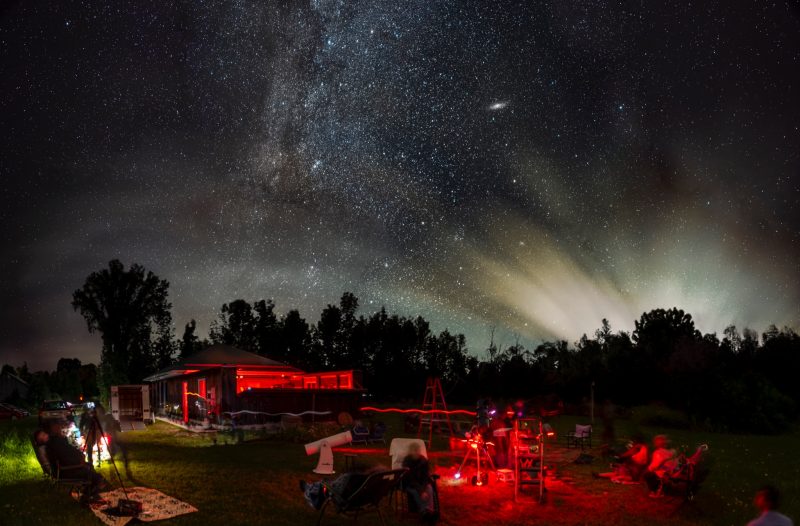
View at EarthSky Community Photos. | Irwin Seidman captured this image on August 12, 2023. Irwin wrote: “This image is a 9-panel long-exposure panorama looking northward over the Fox Observatory (Bruce Peninsula, Ontario) at the Milky Way and the Andromeda galaxy. While still 2 hours before moonrise, the bright light behind the trees is the glow from the moon creeping over the horizon.” Thank you, Irwin!
Bottom line: Have you ever wondered how many stars are visible on a given night? It all depends on how dark your sky is, what your age is, and other limiting factors.
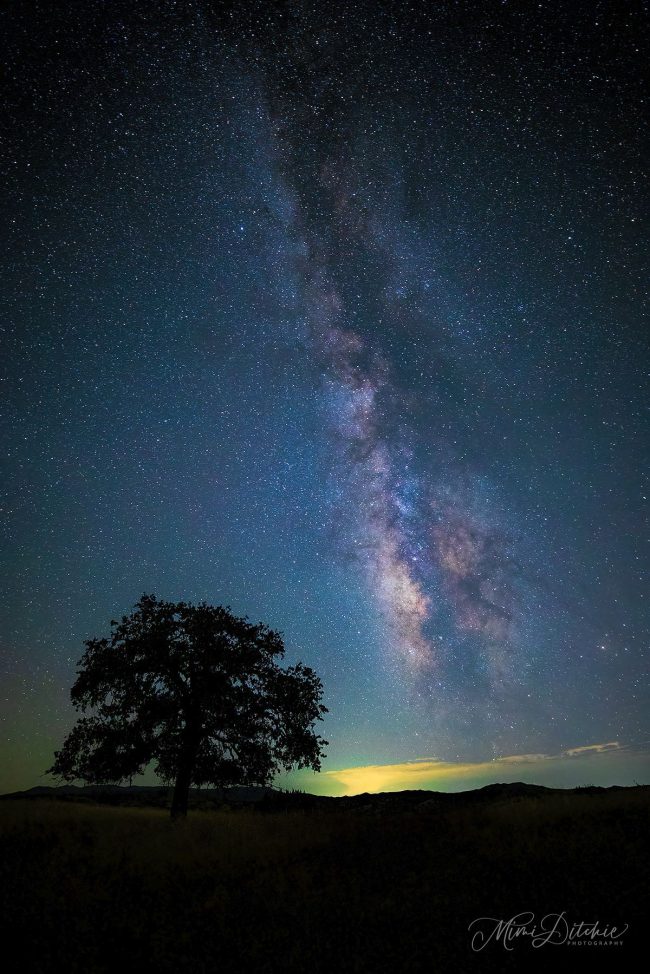
View at EarthSky Community Photos. | Mary Ditchie near Santa Margarita, California, captured this image on August 11, 2023. Mary wrote: “The town of Santa Margarita glows on the horizon through some clouds. The night sky was very clear there and the Milky Way showed up brilliantly next to an old oak tree.” Thank you, Mary! How many stars can you see in the night sky? Good luck counting all those!
Imagine you’re far away from city lights, under a dark sky, on a night with no moon, no clouds and no haze. How many stars could you see with your unaided eye? There’s really no definitive answer to this question. No one has counted all the stars in the night sky, and astronomers use different numbers as theoretical estimates.
Considering all the stars visible in all directions around Earth, the upper end on the estimates is close to 10,000 visible stars. Here’s how one source, astronomytrek.com, comes up with that number:
The brighter the star, the lower the apparent magnitude value assigned to it, with the most luminous given a negative number. In total there are 22 stars with magnitudes of between -1 and 1, making them the night sky’s brightest stars. In the meantime, there are 71 stars of 2nd magnitude, 190 stars of 3rd magnitude, 610 of 4th magnitude, 1,929 of 5th magnitude, and 5,946 of 6th magnitude. When we include another 3,150 stars at the limit of our visual acuity of magnitude +6.5, then this adds up to 9,096 stars that it is possible to see in the night sky from both the Northern and Southern Hemispheres with the unaided eye.
Of course, in the Northern Hemisphere, for example, you can’t see stars below the southern horizon in the Southern Hemisphere. So, therefore, each hemisphere can only see about 5,000 stars. And, at any given time, half of Earth is in daylight. So only half the estimated number – perhaps 2,500 stars – would be visible from Earth’s night side. Plus, another fraction of those visible stars would be lost in the murk surrounding your horizon. That could bring you down to around 2,000, the most common number you’ll see for these estimates.
View at EarthSky Community Photos. | How many stars can you see? Well, twice as many if you count their reflections in the water. Chuck Reinhart in Vincennes, Indiana, captured this image on August 6, 2023. Chuck wrote: “This is a composite of 4 photos taken at different times and places to show the Milky Way on the Wabash River.” Thank you, Chuck!
Factors that affect your seeing
Why can’t astronomers agree on the number of visible stars? It’s because we don’t all see the sky in the same way. Even under ideal conditions, there’s a fair amount of variation between how well people can see the stars. Some of the factors include the strength of your vision and your age. As you get older, for example, your eyes become much less sensitive to faint light. Remember, too, that it takes up to 30 minutes for your eyes to adapt to the darkness.
You also have to take into account the brightness of your night sky. Even on a moonless night, the glow of lights from Earth’s surface brightens the sky.
Still, far from city lights – under absolutely perfect conditions of darkness and sky clarity – a young to middle-aged person with normal vision should be able to see thousands of stars.
View at EarthSky Community Photos. | Irwin Seidman captured this image on August 12, 2023. Irwin wrote: “This image is a 9-panel long-exposure panorama looking northward over the Fox Observatory (Bruce Peninsula, Ontario) at the Milky Way and the Andromeda galaxy. While still 2 hours before moonrise, the bright light behind the trees is the glow from the moon creeping over the horizon.” Thank you, Irwin!
Bottom line: Have you ever wondered how many stars are visible on a given night? It all depends on how dark your sky is, what your age is, and other limiting factors.
View at EarthSky Community Photos. | Mary Ditchie near Santa Margarita, California, captured this image on August 11, 2023. Mary wrote: “The town of Santa Margarita glows on the horizon through some clouds. The night sky was very clear there and the Milky Way showed up brilliantly next to an old oak tree.” Thank you, Mary! How many stars can you see in the night sky? Good luck counting all those!
Although several dozen minor galaxies lie closer to our Milky Way, the Andromeda galaxy is the closest large spiral galaxy to ours. Excluding the Large and Small Magellanic Clouds, visible from Earth’s Southern Hemisphere, the Andromeda galaxy is the brightest external galaxy you can see. At 2.5 million light-years, it’s the most distant thing most of us humans can see with the unaided eye.
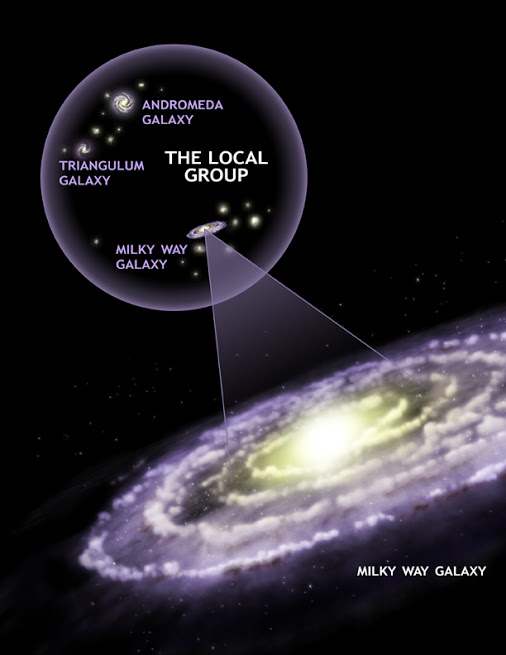
Note: The large spiral Triangulum galaxy is slightly more distant at 2.7 million light-years. Like the Andromeda galaxy, it’s a member of our Local Group of galaxies. And it’s sometimes said to be visible to the eye also. But it’s turned face-on to us, and so has a low surface brightness. Unlike the Andromeda galaxy, it’s very hard to see.
Astronomers sometimes call the Andromeda galaxy by the name Messier 31, or M31. It was the 31st on a famous list of fuzzy sky objects compiled by the French astronomer Charles Messier (1730-1817). His catalog listed “objects to avoid” when comet-hunting. Nowadays, amateur astronomers seek out these objects with their telescopes and binoculars. They’re some of most beautiful deep-sky objects known.
Most Messier objects are star clusters or gas clouds in our Milky Way galaxy. But the Andromeda galaxy is a whole separate galaxy, even bigger than our Milky Way. In a dark sky, you can see that it’s big on the sky as well, a smudge of distant light larger than a full moon.
Some images of M31 from our EarthSky community
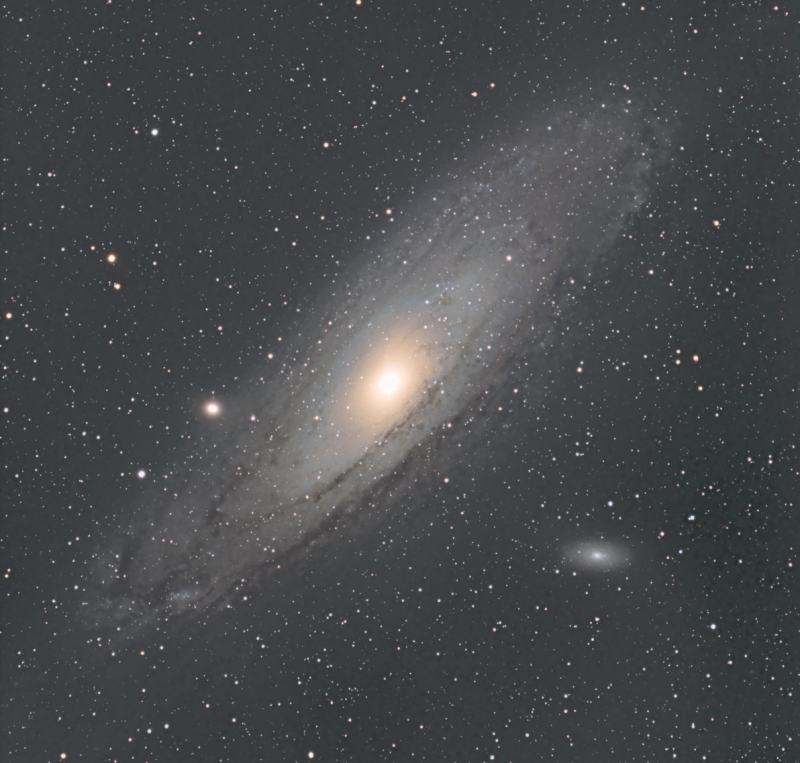
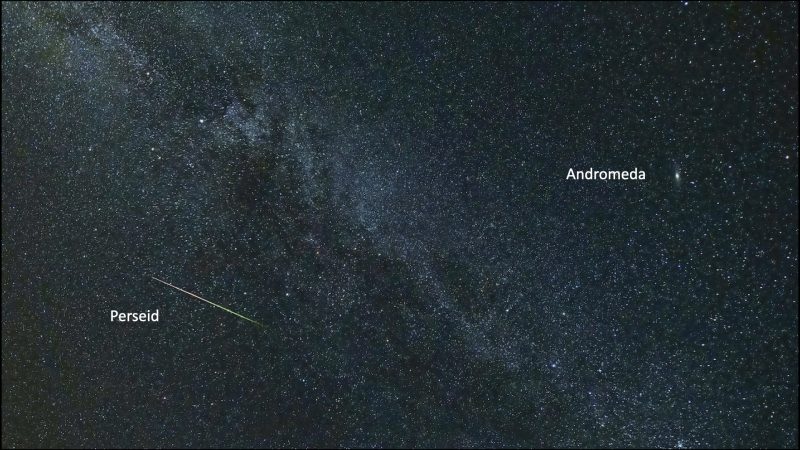
View at EarthSky Community Photos. | David Hoskin in Halifax, Nova Scotia, Canada, captured this telescopic view of the Andromeda galaxy on July 27, 2022. He wrote: “The Andromeda galaxy (Messier 31), at 2.5 million light-years from Earth, is the nearest large galaxy. It has a barred spiral structure and over 20 satellite dwarf galaxies that include Messier 32 (middle left) and Messier 101 (bottom right). In 4 to 5 billion years, the Andromeda galaxy will collide with our Milky Way galaxy!” Thank you, David!View at EarthSky Community Photos. | Roland Kueng in Wolfhausen, Zurich, Switzerland, captured this colorful Perseid on August 13, 2023. And see the little galaxy nearby? It’s the large spiral galaxy next door to our Milky Way, called the Andromeda galaxy. Roland wrote: “Waiting a long time to get a reasonably nice Perseid meteor, together with Milky Way and our neighbor galaxy Andromeda. I used 20-second exposure time with 4-second interval.” Thank you, Roland!View at EarthSky Community Photos. | Stunning capture of the Andromeda galaxy by Peter Forister. He caught the galaxy early in the morning on July 14, 2021, and wrote: “This was my first opportunity to photograph the Andromeda galaxy in 2021! I set up my equipment at 3:30 a.m. on my front porch in Charlottesville, Virginia … ” Thank you for sharing with us, Peter!
When to look for it
From mid-northern latitudes, you can see Andromeda – M31 – for at least part of every night, all year long. But most people see the galaxy first around August or September, when it’s high enough in the sky to be seen from evening until daybreak.
In early September, begin looking for the galaxy in mid-evening, about midway between your local nightfall and midnight.
In late September and early October, the Andromeda galaxy shines in your eastern sky at nightfall, swings high overhead in the middle of the night, and stands rather high in the west at the onset of morning dawn.
Winter evenings are also good for viewing the Andromeda galaxy.
If you are far from city lights, and you’re stargazing during a moonless night during the late summer, or on any autumn or winter evening, it’s possible that you’ll simply notice the galaxy there in your night sky. But if you don’t manage to easily see it, you can star-hop to find the galaxy in one of two ways. The easiest way is to use the constellation Cassiopeia the Queen. You can also use the Great Square of Pegasus.
Use Cassiopeia to find the Andromeda galaxy
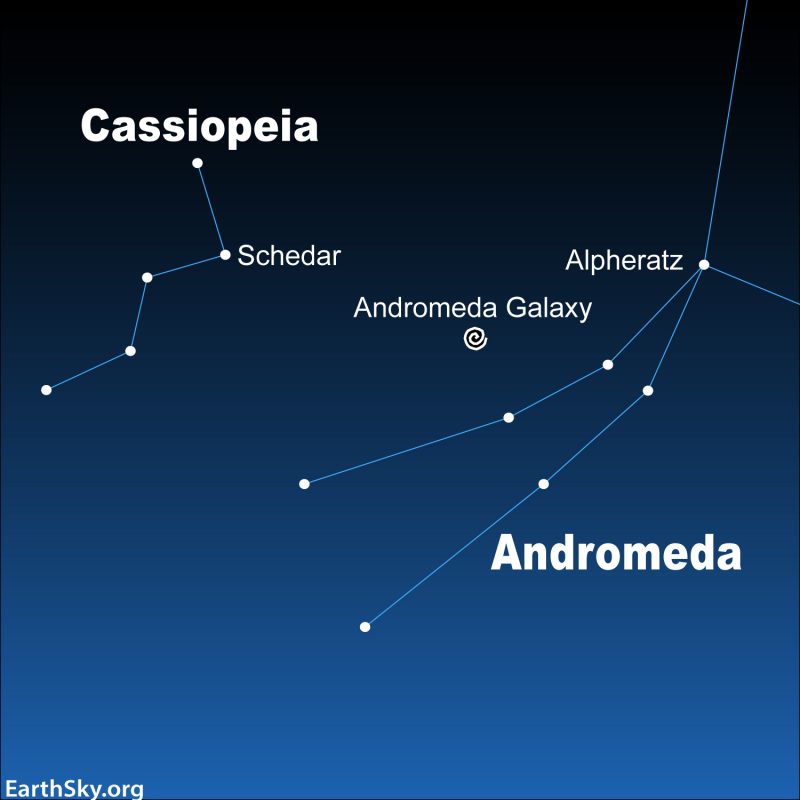
Here’s the technique most people use to find the Andromeda galaxy. Just be sure you’re looking in a dark sky. Look northward for the M – or W – shaped constellation Cassiopeia the Queen. Now locate the star Schedar in Cassiopeia. It’s the constellation’s brightest star, and it points to the Andromeda galaxy.
The constellation Cassiopeia is easy to find. Look generally northward on the sky’s dome for a pattern of stars shaped like the letter M or W. If you can recognize the North Star, Polaris – and if you know how to find the Big Dipper – be aware that the Big Dipper and Cassiopeia move around Polaris like the hands of a clock, always opposite each other.
Once you’ve found Cassiopeia, look for its star Schedar. In the illustration above, see how Schedar points to the Andromeda galaxy?
Or use the Great Square to find M31
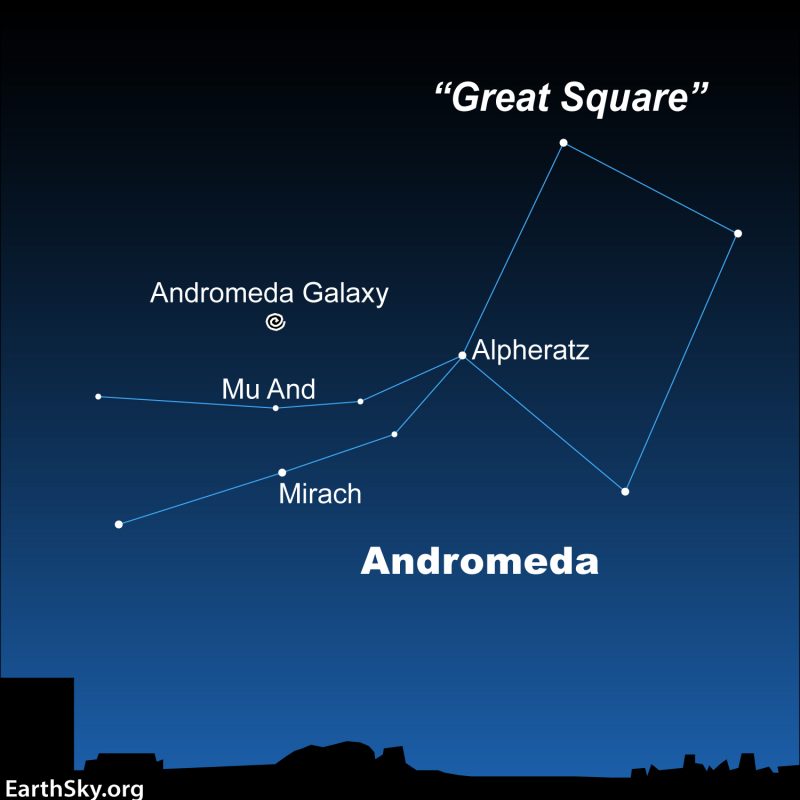
Here’s another way to find the Andromeda galaxy. The constellation Andromeda can be seen as 2 streams of stars extending from one side of the Great Square of Pegasus. See the star Alpheratz? It joins Pegasus to Andromeda. Now notice the star Mirach, then Mu Andromedae. An imaginary line drawn through Mirach to Mu points to the Andromeda galaxy.
You can also star-hop to the Andromeda galaxy, using the Great Square of Pegasus. It’s a longer route. But, in many ways, it’s more beautiful.
You’ll be hopping to the Andromeda galaxy from the Great Square of Pegasus. In autumn, the Great Square of Pegasus looks like a great big baseball diamond in the eastern sky. Envision the bottom star of the Square’s four stars as home plate, then draw an imaginary line from the “1st base” star though the “3rd base” star to locate two streamers of stars flying away from the Great Square. These stars belong to the constellation Andromeda the Princess.
On each streamer, go two stars north (left) of the third base star, locating the stars Mirach and Mu Andromedae. Draw a line from Mirach through Mu Andromedae, going twice the Mirach/Mu Andromedae distance. You’ve just landed on the Andromeda galaxy, which looks like a smudge of light to the unaided eye.
If you can’t see the Andromeda galaxy with the eye alone, by all means use binoculars.
History of our knowledge of the Andromeda galaxy
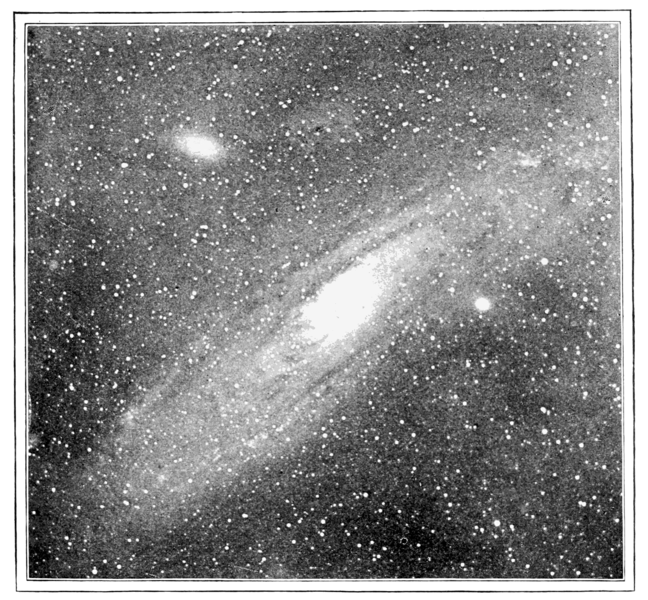
The Great Andromeda Nebula, photographed in the year 1900. At this point, astronomers couldn’t discern individual stars in the galaxy. Many thought this object was a cloud of gas within our Milky Way, a place where new stars were forming. Image via Wikimedia Commons (public domain).
At one time, the Andromeda galaxy was called the Great Andromeda Nebula. Astronomers thought this patch of light was composed of glowing gases, or was perhaps a solar system in the process of formation.
It wasn’t until the 20th century that astronomers were able to resolve the Andromeda spiral nebula into individual stars. This discovery lead to a controversy about whether the Andromeda spiral nebula and other spiral nebulae lie within or outside the Milky Way.
In the 1920s Edwin Hubble finally put the matter to rest, when he used Cepheid variable stars within the Andromeda galaxy to determine that it is indeed an “island universe” residing beyond the bounds of our Milky Way galaxy.
The Andromeda and Milky Way galaxies reign as the two most massive and dominant galaxies within the Local Group of galaxies. The Andromeda galaxy is the largest galaxy of the Local Group, which, in addition to the Milky Way, also contains the Triangulum galaxy and about 30 other smaller galaxies.
Both the Milky Way and the Andromeda galaxies lay claim to about a dozen satellite galaxies. Both are some 100,000 light-years across, containing enough mass to make billions of stars.
Astronomers have discovered that our Local Group is on the outskirts of a giant cluster of several thousand galaxies, which astronomers call the Virgo Cluster.
We also know of an irregular supercluster of galaxies, which contains the Virgo Cluster, which in turn contains our Local Group, which in turn contains our Milky Way galaxy and the nearby Andromeda galaxy. At least 100 galaxy groups and clusters are located within this Virgo Supercluster. Its diameter is thought to be about 110 million light-years.
And the Virgo Supercluster is thought to be one of millions of superclusters in the observable universe.
View larger. | A closeup of one of the spiral arm regions of the Andromeda galaxy. Image via NASA/ ESA.
Will the Andromeda galaxy collide with the Milky Way?
One of our readers wrote:
I’ve heard that the Andromeda galaxy will someday collide with our galaxy! Is that still a definite possibility?
A definite possibility describes much of what we know – or think we know – about the universe. As for the Andromeda galaxy and its future collision with our Milky Way: the first attempt to measure the radial velocity of this galaxy (its motion forward or back, along our line of sight) was made in 1912. After that, astronomers believed for some decades that the galaxy was approaching at nearly 200 miles per second (321 km/s), but later astronomers disagreed.
Then in May 2012, NASA astronomers announced they can now predict the time of this collision of titanic galaxies with certainty. Remember, though, that the Andromeda galaxy is 2.2 million light-years away, with a single light-year being almost 6 trillion miles (10 trillion kilometers). So although it does appear that this galaxy is approaching our Milky Way galaxy … it’s nothing to lose sleep over. When will they collide? According to NASA astronomers in 2012, it’ll be four billion years from now.
However, in March 2022, the peer-reviewed Astrophysical Journal published new research revealing that the collision between our galaxies is already underway. Or at least our galactic halos – which consist of gas, dust and stray stars – may already be touching.
What happens when galaxies collide? They don’t exactly crash into each other. Because there’s so much more space than stars even in a galaxy, colliding galaxies pass through each other, like ghosts.
This image represents Earth’s night sky in 3.75 billion years. The Andromeda galaxy (left) will fill our field of view then, astronomers say, as it heads toward a collision with our Milky way galaxy. Image via NASA/ ESA/ Z. Levay and R. van der Marel, STScI/ T. Hallas/ A. Mellinger.
The Andromeda galaxy (M31) is located at the coordinates RA: 0h 42.7m; Dec: 41o 16′ north.
Bottom line: At 2.5 million light-years, the great Andromeda galaxy (Messier 31) rates as the most distant object you can see with the unaided eye.
Although several dozen minor galaxies lie closer to our Milky Way, the Andromeda galaxy is the closest large spiral galaxy to ours. Excluding the Large and Small Magellanic Clouds, visible from Earth’s Southern Hemisphere, the Andromeda galaxy is the brightest external galaxy you can see. At 2.5 million light-years, it’s the most distant thing most of us humans can see with the unaided eye.
Note: The large spiral Triangulum galaxy is slightly more distant at 2.7 million light-years. Like the Andromeda galaxy, it’s a member of our Local Group of galaxies. And it’s sometimes said to be visible to the eye also. But it’s turned face-on to us, and so has a low surface brightness. Unlike the Andromeda galaxy, it’s very hard to see.
Astronomers sometimes call the Andromeda galaxy by the name Messier 31, or M31. It was the 31st on a famous list of fuzzy sky objects compiled by the French astronomer Charles Messier (1730-1817). His catalog listed “objects to avoid” when comet-hunting. Nowadays, amateur astronomers seek out these objects with their telescopes and binoculars. They’re some of most beautiful deep-sky objects known.
Most Messier objects are star clusters or gas clouds in our Milky Way galaxy. But the Andromeda galaxy is a whole separate galaxy, even bigger than our Milky Way. In a dark sky, you can see that it’s big on the sky as well, a smudge of distant light larger than a full moon.
Some images of M31 from our EarthSky community
View at EarthSky Community Photos. | David Hoskin in Halifax, Nova Scotia, Canada, captured this telescopic view of the Andromeda galaxy on July 27, 2022. He wrote: “The Andromeda galaxy (Messier 31), at 2.5 million light-years from Earth, is the nearest large galaxy. It has a barred spiral structure and over 20 satellite dwarf galaxies that include Messier 32 (middle left) and Messier 101 (bottom right). In 4 to 5 billion years, the Andromeda galaxy will collide with our Milky Way galaxy!” Thank you, David!View at EarthSky Community Photos. | Roland Kueng in Wolfhausen, Zurich, Switzerland, captured this colorful Perseid on August 13, 2023. And see the little galaxy nearby? It’s the large spiral galaxy next door to our Milky Way, called the Andromeda galaxy. Roland wrote: “Waiting a long time to get a reasonably nice Perseid meteor, together with Milky Way and our neighbor galaxy Andromeda. I used 20-second exposure time with 4-second interval.” Thank you, Roland!View at EarthSky Community Photos. | Stunning capture of the Andromeda galaxy by Peter Forister. He caught the galaxy early in the morning on July 14, 2021, and wrote: “This was my first opportunity to photograph the Andromeda galaxy in 2021! I set up my equipment at 3:30 a.m. on my front porch in Charlottesville, Virginia … ” Thank you for sharing with us, Peter!
When to look for it
From mid-northern latitudes, you can see Andromeda – M31 – for at least part of every night, all year long. But most people see the galaxy first around August or September, when it’s high enough in the sky to be seen from evening until daybreak.
In early September, begin looking for the galaxy in mid-evening, about midway between your local nightfall and midnight.
In late September and early October, the Andromeda galaxy shines in your eastern sky at nightfall, swings high overhead in the middle of the night, and stands rather high in the west at the onset of morning dawn.
Winter evenings are also good for viewing the Andromeda galaxy.
If you are far from city lights, and you’re stargazing during a moonless night during the late summer, or on any autumn or winter evening, it’s possible that you’ll simply notice the galaxy there in your night sky. But if you don’t manage to easily see it, you can star-hop to find the galaxy in one of two ways. The easiest way is to use the constellation Cassiopeia the Queen. You can also use the Great Square of Pegasus.
Use Cassiopeia to find the Andromeda galaxy
Here’s the technique most people use to find the Andromeda galaxy. Just be sure you’re looking in a dark sky. Look northward for the M – or W – shaped constellation Cassiopeia the Queen. Now locate the star Schedar in Cassiopeia. It’s the constellation’s brightest star, and it points to the Andromeda galaxy.
The constellation Cassiopeia is easy to find. Look generally northward on the sky’s dome for a pattern of stars shaped like the letter M or W. If you can recognize the North Star, Polaris – and if you know how to find the Big Dipper – be aware that the Big Dipper and Cassiopeia move around Polaris like the hands of a clock, always opposite each other.
Once you’ve found Cassiopeia, look for its star Schedar. In the illustration above, see how Schedar points to the Andromeda galaxy?
Or use the Great Square to find M31
Here’s another way to find the Andromeda galaxy. The constellation Andromeda can be seen as 2 streams of stars extending from one side of the Great Square of Pegasus. See the star Alpheratz? It joins Pegasus to Andromeda. Now notice the star Mirach, then Mu Andromedae. An imaginary line drawn through Mirach to Mu points to the Andromeda galaxy.
You can also star-hop to the Andromeda galaxy, using the Great Square of Pegasus. It’s a longer route. But, in many ways, it’s more beautiful.
You’ll be hopping to the Andromeda galaxy from the Great Square of Pegasus. In autumn, the Great Square of Pegasus looks like a great big baseball diamond in the eastern sky. Envision the bottom star of the Square’s four stars as home plate, then draw an imaginary line from the “1st base” star though the “3rd base” star to locate two streamers of stars flying away from the Great Square. These stars belong to the constellation Andromeda the Princess.
On each streamer, go two stars north (left) of the third base star, locating the stars Mirach and Mu Andromedae. Draw a line from Mirach through Mu Andromedae, going twice the Mirach/Mu Andromedae distance. You’ve just landed on the Andromeda galaxy, which looks like a smudge of light to the unaided eye.
If you can’t see the Andromeda galaxy with the eye alone, by all means use binoculars.
History of our knowledge of the Andromeda galaxy
The Great Andromeda Nebula, photographed in the year 1900. At this point, astronomers couldn’t discern individual stars in the galaxy. Many thought this object was a cloud of gas within our Milky Way, a place where new stars were forming. Image via Wikimedia Commons (public domain).
At one time, the Andromeda galaxy was called the Great Andromeda Nebula. Astronomers thought this patch of light was composed of glowing gases, or was perhaps a solar system in the process of formation.
It wasn’t until the 20th century that astronomers were able to resolve the Andromeda spiral nebula into individual stars. This discovery lead to a controversy about whether the Andromeda spiral nebula and other spiral nebulae lie within or outside the Milky Way.
In the 1920s Edwin Hubble finally put the matter to rest, when he used Cepheid variable stars within the Andromeda galaxy to determine that it is indeed an “island universe” residing beyond the bounds of our Milky Way galaxy.
The Andromeda and Milky Way galaxies reign as the two most massive and dominant galaxies within the Local Group of galaxies. The Andromeda galaxy is the largest galaxy of the Local Group, which, in addition to the Milky Way, also contains the Triangulum galaxy and about 30 other smaller galaxies.
Both the Milky Way and the Andromeda galaxies lay claim to about a dozen satellite galaxies. Both are some 100,000 light-years across, containing enough mass to make billions of stars.
Astronomers have discovered that our Local Group is on the outskirts of a giant cluster of several thousand galaxies, which astronomers call the Virgo Cluster.
We also know of an irregular supercluster of galaxies, which contains the Virgo Cluster, which in turn contains our Local Group, which in turn contains our Milky Way galaxy and the nearby Andromeda galaxy. At least 100 galaxy groups and clusters are located within this Virgo Supercluster. Its diameter is thought to be about 110 million light-years.
And the Virgo Supercluster is thought to be one of millions of superclusters in the observable universe.
View larger. | A closeup of one of the spiral arm regions of the Andromeda galaxy. Image via NASA/ ESA.
Will the Andromeda galaxy collide with the Milky Way?
One of our readers wrote:
I’ve heard that the Andromeda galaxy will someday collide with our galaxy! Is that still a definite possibility?
A definite possibility describes much of what we know – or think we know – about the universe. As for the Andromeda galaxy and its future collision with our Milky Way: the first attempt to measure the radial velocity of this galaxy (its motion forward or back, along our line of sight) was made in 1912. After that, astronomers believed for some decades that the galaxy was approaching at nearly 200 miles per second (321 km/s), but later astronomers disagreed.
Then in May 2012, NASA astronomers announced they can now predict the time of this collision of titanic galaxies with certainty. Remember, though, that the Andromeda galaxy is 2.2 million light-years away, with a single light-year being almost 6 trillion miles (10 trillion kilometers). So although it does appear that this galaxy is approaching our Milky Way galaxy … it’s nothing to lose sleep over. When will they collide? According to NASA astronomers in 2012, it’ll be four billion years from now.
However, in March 2022, the peer-reviewed Astrophysical Journal published new research revealing that the collision between our galaxies is already underway. Or at least our galactic halos – which consist of gas, dust and stray stars – may already be touching.
What happens when galaxies collide? They don’t exactly crash into each other. Because there’s so much more space than stars even in a galaxy, colliding galaxies pass through each other, like ghosts.
This image represents Earth’s night sky in 3.75 billion years. The Andromeda galaxy (left) will fill our field of view then, astronomers say, as it heads toward a collision with our Milky way galaxy. Image via NASA/ ESA/ Z. Levay and R. van der Marel, STScI/ T. Hallas/ A. Mellinger.
The Andromeda galaxy (M31) is located at the coordinates RA: 0h 42.7m; Dec: 41o 16′ north.
Bottom line: At 2.5 million light-years, the great Andromeda galaxy (Messier 31) rates as the most distant object you can see with the unaided eye.