aads

Astronomer probes idea of ET ‘lurkers’

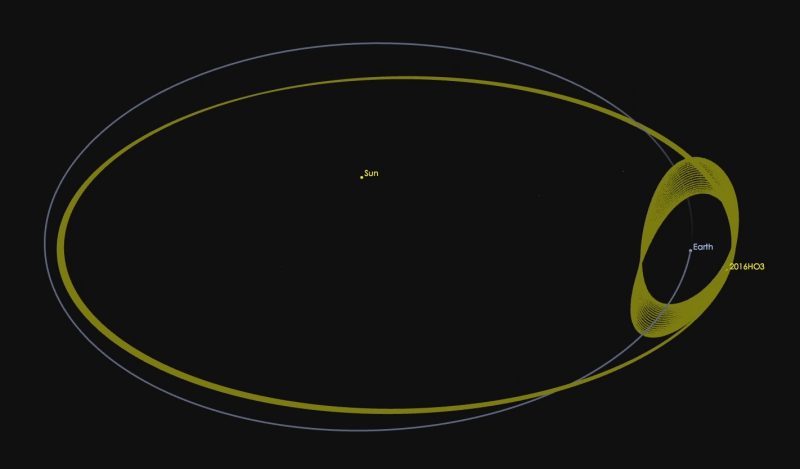
Artist's concept of 2 orbits around the sun, one Earth's and one asteroid 2016 HO3's.

View larger. | Asteroid 2016 HO3 is a co-orbital object, or quasi-satellite. It’s a natural object whose orbit around the sun keeps it near Earth. A new study suggests it’s the perfect hiding place for an extraterrestrial probe, or “lurker.” Image via NASA/JPL-Caltech/ James Benford.

Could there be alien probes “lurking” near Earth? That’s a scenario recently explored in a new paper by James Benford of Microwave Sciences. The idea is that a group of co-orbital, rocky asteroids near Earth – also known as quasi-satellites – would be the perfect place to hide a probe, in order to conduct observations of Earth undetected.

Benford’s new peer-reviewed paper discussing this possibility was published in The Astronomical Journal on September 20, 2019 (preprint here).

From the paper:

A recently discovered group of nearby co-orbital objects is an attractive location for extraterrestrial intelligence (ETI) to locate a probe to observe Earth, while not being easily seen. These near-Earth objects provide an ideal way to watch our world from a secure natural object. That provides resources an ETI might need: materials, a firm anchor, concealment. These have been little studied by astronomy and not at all by SETI or planetary radar observations.

Benford goes on in his paper to describe co-orbital objects (aka quasi-satellites) found thus far and to propose both passive and active observations of them as possible sites for ET probes.

Rocky co-orbital object near Earth.

Artist’s concept of 2016 HO3, a co-orbital asteroid near Earth. Image via Inverse.

Basically, his premise is that this group of recently discovered co-orbital rocky asteroids near Earth – sharing a similar orbit to Earth’s but not orbiting Earth itself – would be an ideal location to hide an alien probe. From the vantage point of a co-orbital asteroid, the extraterrestrial civilization could gather observations of Earth while remaining hidden.

It’s an intriguing idea. Not only would these sorts of asteroids allow concealment of the probe, but they would also supply raw materials (via some kind of mining activity) and constant solar energy, if the probe needed them.

These co-orbitals have been little studied by astronomers so far, and not at all yet by SETI or planetary radar observations.

Benford calls hypothetical, hidden, unknown and unseen alien probes by the name lurkers. In theory, they would be robotic, like our own robot probes sent out to explore our solar system, but doubtless much more advanced. It’s possible that a lurker could be in our solar system, hiding on one of Earth’s co-orbital asteroids, for thousands or millions of years, just silently watching.

Benford suggests that searching for lurkers would be an interesting new type of SETI, which traditionally has focused on looking for artificial radio or light signals from distant stars. But if there were alien probes literally in our own backyard, we could actually go and observe them. Scientists could first look for them in the electromagnetic spectrum of microwaves and light or by using planetary radar.

Can you imagine finding an alien probe in our own backyard? The scene in the Stanley Kubrick’s epic 1968 film 2001: A Space Odyssey – where the apes first see the black monolith – comes to mind:

At the moment, the best target to explore for alien lurkers is asteroid 2016 HO3, sometimes called, Earth’s constant companion or Earth’s pet asteroid. It is the smallest, closest, and most stable (known) co-orbital. Indeed, China has announced it has plans to send a probe to 2016 HO3, on a 10-year mission that will launch in the year 2024 or later. This object is very similar to small asteroids elsewhere in the solar system. According to astronomer Vishnu Reddy:

While HO3 is close to the Earth, its small size – possibly not larger than 100 feet [30 meters] – makes it challenging target to study. Our observations show that HO3 rotates once every 28 minutes and is made of materials similar to asteroids.

Benford has also previously advocated using what he calls Benford Beacons, short microwave bursts to attract attention, kind of like lighthouses, as well as using powerful electromagnetic beams to send light spacecraft – solar sails – into the solar system for interplanetary exploration.

Groups of asteroids near Jupiter.

Earth isn’t the only planet with co-orbitals. Jupiter has two large groups of co-orbital asteroids, called the Trojans, which precede it and follow it in its orbit. Image via Paul Weigert/Western University/Gizmodo.

The lurker idea is an interesting one. It relates to the famous Fermi Paradox, which asks the question where are they? In other words, if there are highly advanced civilizations in our galaxy – technologically ahead of us by thousands or millions of years – then they could have/ should have expanded across the galaxy and found us by now. Lurkers could be a form of the sentinel hypothesis – such as Bracewell Probes – which, according to the new paper, suggests:

If advanced alien civilizations exist they might place AI monitoring devices on or near the worlds of other evolving species to track their progress. Such a robotic sentinel might establish contact with a developing race once that race had reached a certain technological threshold, such as large-scale radio communication or interplanetary flight. A probe located nearby could bide its time while our civilization developed technology that could find it, and, once contacted, could undertake a conversation in real time. Meanwhile, it could have been routinely reporting back on our biosphere and civilization for long eras.

Looking for lurkers is certainly speculative and might sound too much like science fiction to some people’s taste. But it has an appealing logic about it. And now the idea is published in a major, peer-reviewed journal.

The fact is, we don’t have a clue how an alien civilization would think. That’s why, when it comes to searching for evidence of alien intelligence, the more possibilities that can be considered, the better!

Rocky objects near Earth.

A new theory suggests that co-orbital objects or quasi-satellites – objects whose orbits around the sun keep them near Earth – would be ideal hiding places for an alien probe, or “lurker.” Image via NASA/Inverse.

Bottom line: A new study proposes searching for lurkers, alien probes that might be hiding among co-orbital rocky asteroids near Earth.

Source: Looking for Lurkers: Co-orbiters as SETI Observables


from EarthSky https://ift.tt/2ojDb0a
Artist's concept of 2 orbits around the sun, one Earth's and one asteroid 2016 HO3's.

View larger. | Asteroid 2016 HO3 is a co-orbital object, or quasi-satellite. It’s a natural object whose orbit around the sun keeps it near Earth. A new study suggests it’s the perfect hiding place for an extraterrestrial probe, or “lurker.” Image via NASA/JPL-Caltech/ James Benford.

Could there be alien probes “lurking” near Earth? That’s a scenario recently explored in a new paper by James Benford of Microwave Sciences. The idea is that a group of co-orbital, rocky asteroids near Earth – also known as quasi-satellites – would be the perfect place to hide a probe, in order to conduct observations of Earth undetected.

Benford’s new peer-reviewed paper discussing this possibility was published in The Astronomical Journal on September 20, 2019 (preprint here).

From the paper:

A recently discovered group of nearby co-orbital objects is an attractive location for extraterrestrial intelligence (ETI) to locate a probe to observe Earth, while not being easily seen. These near-Earth objects provide an ideal way to watch our world from a secure natural object. That provides resources an ETI might need: materials, a firm anchor, concealment. These have been little studied by astronomy and not at all by SETI or planetary radar observations.

Benford goes on in his paper to describe co-orbital objects (aka quasi-satellites) found thus far and to propose both passive and active observations of them as possible sites for ET probes.

Rocky co-orbital object near Earth.

Artist’s concept of 2016 HO3, a co-orbital asteroid near Earth. Image via Inverse.

Basically, his premise is that this group of recently discovered co-orbital rocky asteroids near Earth – sharing a similar orbit to Earth’s but not orbiting Earth itself – would be an ideal location to hide an alien probe. From the vantage point of a co-orbital asteroid, the extraterrestrial civilization could gather observations of Earth while remaining hidden.

It’s an intriguing idea. Not only would these sorts of asteroids allow concealment of the probe, but they would also supply raw materials (via some kind of mining activity) and constant solar energy, if the probe needed them.

These co-orbitals have been little studied by astronomers so far, and not at all yet by SETI or planetary radar observations.

Benford calls hypothetical, hidden, unknown and unseen alien probes by the name lurkers. In theory, they would be robotic, like our own robot probes sent out to explore our solar system, but doubtless much more advanced. It’s possible that a lurker could be in our solar system, hiding on one of Earth’s co-orbital asteroids, for thousands or millions of years, just silently watching.

Benford suggests that searching for lurkers would be an interesting new type of SETI, which traditionally has focused on looking for artificial radio or light signals from distant stars. But if there were alien probes literally in our own backyard, we could actually go and observe them. Scientists could first look for them in the electromagnetic spectrum of microwaves and light or by using planetary radar.

Can you imagine finding an alien probe in our own backyard? The scene in the Stanley Kubrick’s epic 1968 film 2001: A Space Odyssey – where the apes first see the black monolith – comes to mind:

At the moment, the best target to explore for alien lurkers is asteroid 2016 HO3, sometimes called, Earth’s constant companion or Earth’s pet asteroid. It is the smallest, closest, and most stable (known) co-orbital. Indeed, China has announced it has plans to send a probe to 2016 HO3, on a 10-year mission that will launch in the year 2024 or later. This object is very similar to small asteroids elsewhere in the solar system. According to astronomer Vishnu Reddy:

While HO3 is close to the Earth, its small size – possibly not larger than 100 feet [30 meters] – makes it challenging target to study. Our observations show that HO3 rotates once every 28 minutes and is made of materials similar to asteroids.

Benford has also previously advocated using what he calls Benford Beacons, short microwave bursts to attract attention, kind of like lighthouses, as well as using powerful electromagnetic beams to send light spacecraft – solar sails – into the solar system for interplanetary exploration.

Groups of asteroids near Jupiter.

Earth isn’t the only planet with co-orbitals. Jupiter has two large groups of co-orbital asteroids, called the Trojans, which precede it and follow it in its orbit. Image via Paul Weigert/Western University/Gizmodo.

The lurker idea is an interesting one. It relates to the famous Fermi Paradox, which asks the question where are they? In other words, if there are highly advanced civilizations in our galaxy – technologically ahead of us by thousands or millions of years – then they could have/ should have expanded across the galaxy and found us by now. Lurkers could be a form of the sentinel hypothesis – such as Bracewell Probes – which, according to the new paper, suggests:

If advanced alien civilizations exist they might place AI monitoring devices on or near the worlds of other evolving species to track their progress. Such a robotic sentinel might establish contact with a developing race once that race had reached a certain technological threshold, such as large-scale radio communication or interplanetary flight. A probe located nearby could bide its time while our civilization developed technology that could find it, and, once contacted, could undertake a conversation in real time. Meanwhile, it could have been routinely reporting back on our biosphere and civilization for long eras.

Looking for lurkers is certainly speculative and might sound too much like science fiction to some people’s taste. But it has an appealing logic about it. And now the idea is published in a major, peer-reviewed journal.

The fact is, we don’t have a clue how an alien civilization would think. That’s why, when it comes to searching for evidence of alien intelligence, the more possibilities that can be considered, the better!

Rocky objects near Earth.

A new theory suggests that co-orbital objects or quasi-satellites – objects whose orbits around the sun keep them near Earth – would be ideal hiding places for an alien probe, or “lurker.” Image via NASA/Inverse.

Bottom line: A new study proposes searching for lurkers, alien probes that might be hiding among co-orbital rocky asteroids near Earth.

Source: Looking for Lurkers: Co-orbiters as SETI Observables


from EarthSky https://ift.tt/2ojDb0a

New insights on Venus’ cloud-tops and super-rotation

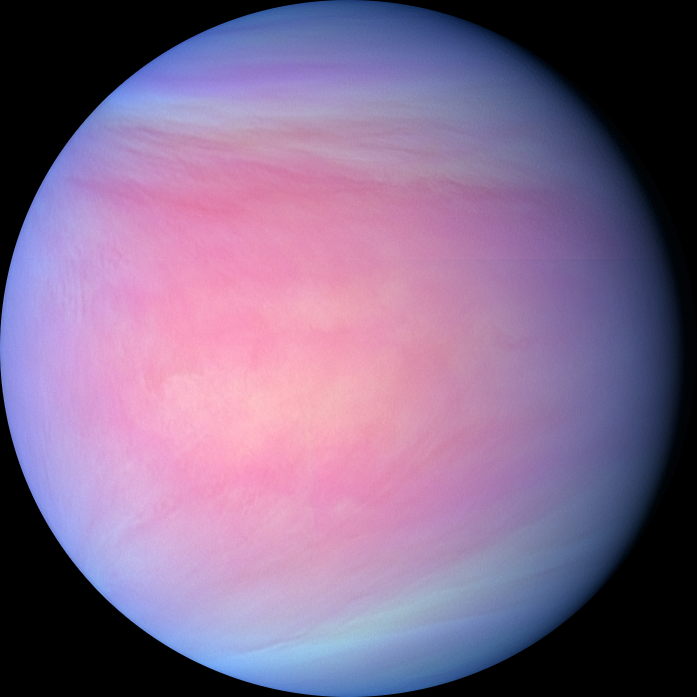
a big ball, blue around the outside and pink in the middle.

Venus dayside in false color via PLANET-C Project Team/ EuroPlanet.

Japan’s Akatsuki spacecraft – aka the Venus Climate Orbiter – got off a rocky start but has been sending back useful data from Venus for several years now. Akatsuki launched in May, 2010, but failed to enter orbit around Venus in December of that year. Space engineers saved the day with a 20-minute firing of the craft’s attitude control thrusters, placing the craft into an alternative orbit around Venus – albeit a highly elliptical one – five years later, in 2015. This month, at the EPSC-DPS Joint Meeting 2019 in Geneva, Switzerland, Kiichi Fukuya of the University of Tokyo reported on new insights into the mysterious super-rotation of Venus’ atmosphere, made possible by Akatsuki’s data. That is, the upper atmosphere of Venus rotates around the planet much faster than the planet spins; the atmosphere rotates around the planet in just 4 Earth-days, while the planet itself takes 243 Earth-days to spin once. Fukuuya said:

The most exciting discovery is the frequent occurrence of equator-ward motions [of the atmosphere] on the nightside. This is in contrast to the strong poleward circulation on the dayside we have observed previously at other wavelengths.

Overall, these scientists reported that data from Akatsuki show:

… striking variety in wind speeds year-on-year and between the planet’s northern and southern hemispheres.

Takeshi Horinouchi of Hokkaido University, Japan, and Yeon Joo Lee of JAXA/ISAS and TU Berlin also detected planetary-scale atmospheric waves at the cloud tops, which may interact with the super-rotation. For these studies they used:

… advanced cloud-tracking and quality control techniques to analyze with high accuracy the direction and speed of cloud top winds using data collected by [Akatsuki’s] Ultraviolet Imager instrument over three years.

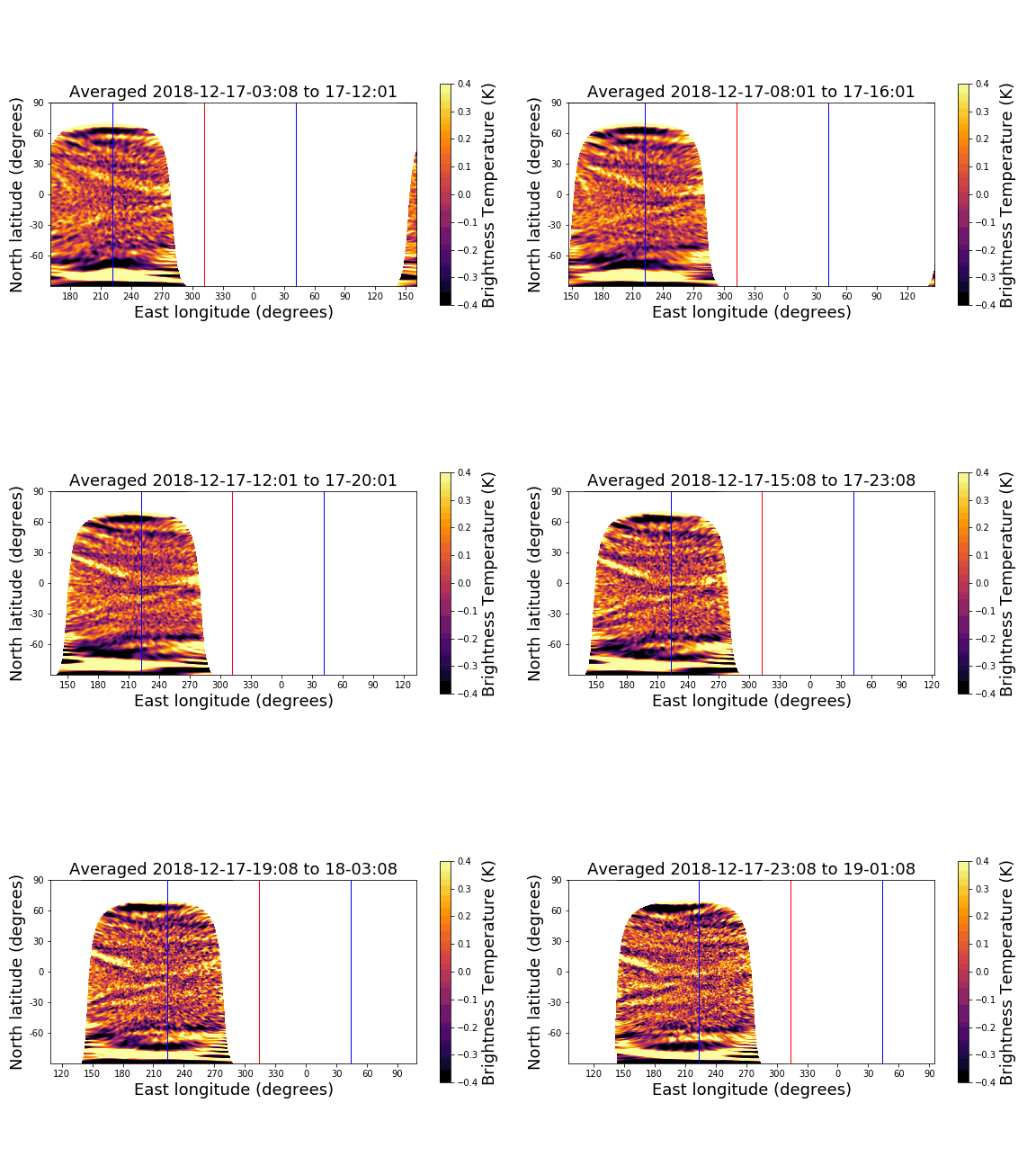
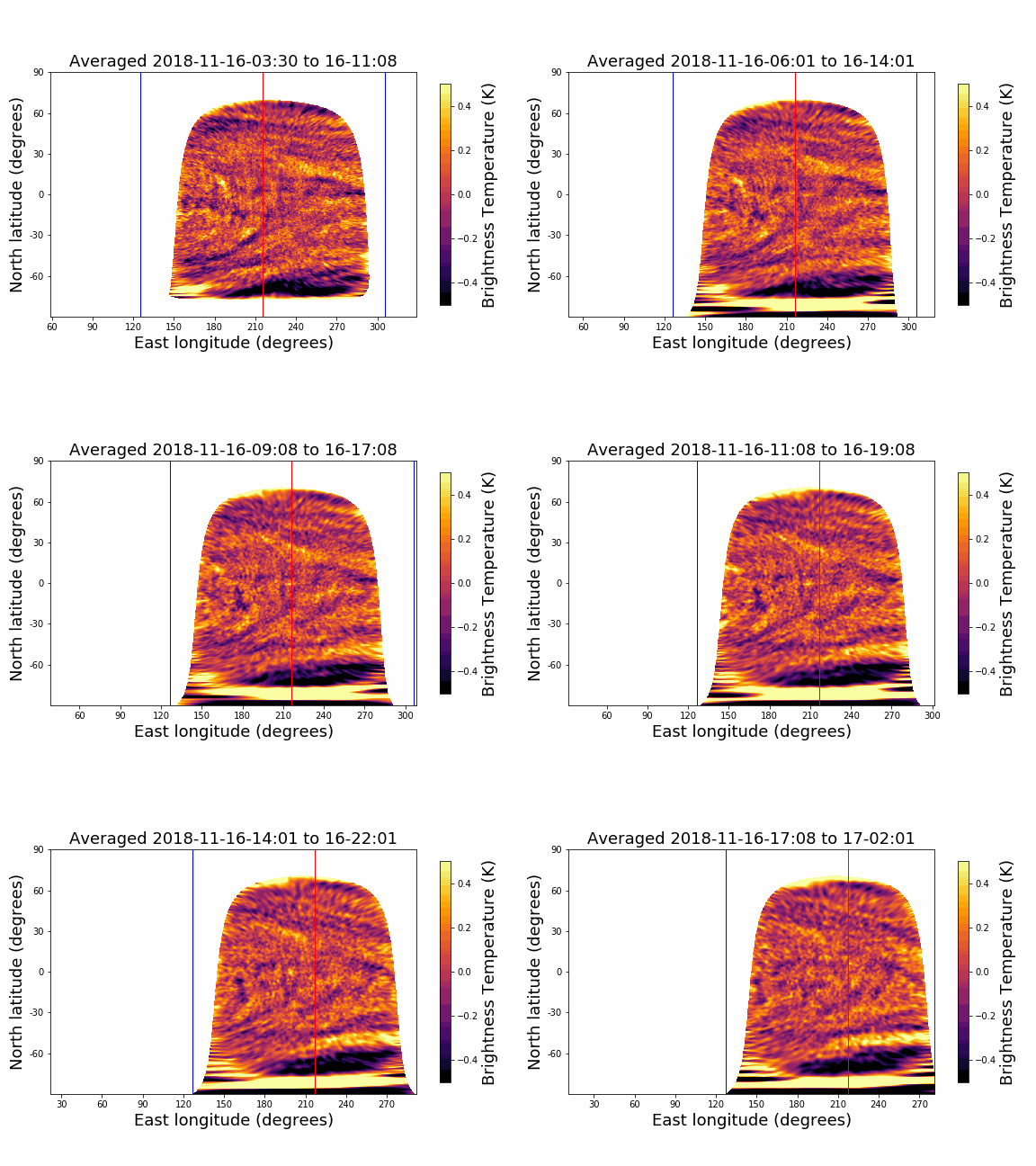
Chart with rightward-moving orange blob

Equator-wards motion of clouds on night side. Image via University of Tokyo.

Chart with rightward-moving orange blob

Pole-wards motion of clouds on day side. Image via University of Tokyo.

And they said the difference they observed in Venus winds between the planet’s hemispheres might be linked to a second mystery at Venus: an as-yet unidentified chemical in the atmosphere that strongly absorbs ultraviolet radiation from the sun. You might know that Venus is considered Earth’s “twin” in size and desnity. It’s a world very similar to Earth in many ways, but its atmosphere sets it apart. The atmosphere of Venus – which is mostly carbon dioxide – is extremely dense and hot; atmospheric pressure on Venus’ surface is some 90 times that of Earth. This as-yet-unknown ultraviolet absorber in the atmosphere is interesting to these scientists because its variability in Venus’ atmosphere might cause the asymmetry in wind speeds between the planet’s northern and southern hemispheres. Thus the scientists commented:

Our results provide new questions about the atmosphere of Venus, as well as revealing the richness of variety of the Venus atmosphere over space and time.

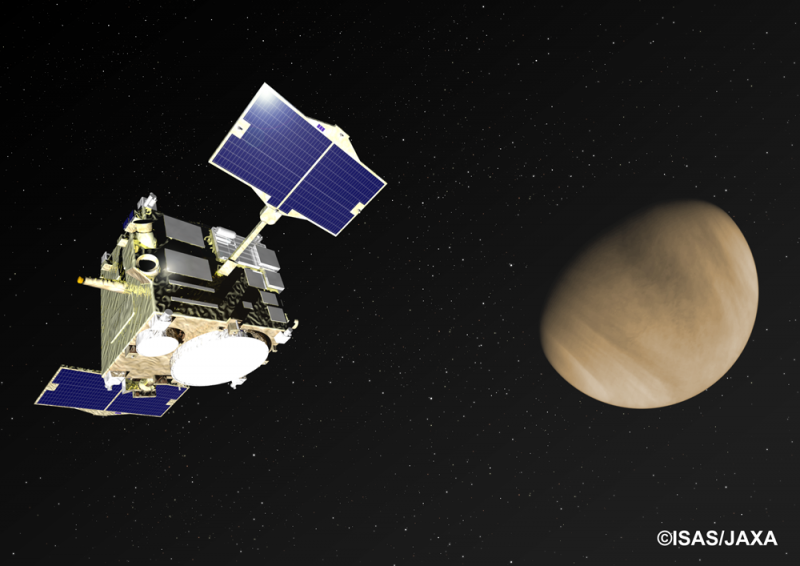
A spacecraft and a planet against a black background.

Artist’s concept of Akatsuki in orbit around Venus. Image via ISAS/JAXA.

Bottom line: Japan’s Akatsuki spacecraft has provided new insights on the mysterious super-rotation of Venus’ dense atmosphere.

Via Europlanet Society


from EarthSky https://ift.tt/2mPSyNg
a big ball, blue around the outside and pink in the middle.

Venus dayside in false color via PLANET-C Project Team/ EuroPlanet.

Japan’s Akatsuki spacecraft – aka the Venus Climate Orbiter – got off a rocky start but has been sending back useful data from Venus for several years now. Akatsuki launched in May, 2010, but failed to enter orbit around Venus in December of that year. Space engineers saved the day with a 20-minute firing of the craft’s attitude control thrusters, placing the craft into an alternative orbit around Venus – albeit a highly elliptical one – five years later, in 2015. This month, at the EPSC-DPS Joint Meeting 2019 in Geneva, Switzerland, Kiichi Fukuya of the University of Tokyo reported on new insights into the mysterious super-rotation of Venus’ atmosphere, made possible by Akatsuki’s data. That is, the upper atmosphere of Venus rotates around the planet much faster than the planet spins; the atmosphere rotates around the planet in just 4 Earth-days, while the planet itself takes 243 Earth-days to spin once. Fukuuya said:

The most exciting discovery is the frequent occurrence of equator-ward motions [of the atmosphere] on the nightside. This is in contrast to the strong poleward circulation on the dayside we have observed previously at other wavelengths.

Overall, these scientists reported that data from Akatsuki show:

… striking variety in wind speeds year-on-year and between the planet’s northern and southern hemispheres.

Takeshi Horinouchi of Hokkaido University, Japan, and Yeon Joo Lee of JAXA/ISAS and TU Berlin also detected planetary-scale atmospheric waves at the cloud tops, which may interact with the super-rotation. For these studies they used:

… advanced cloud-tracking and quality control techniques to analyze with high accuracy the direction and speed of cloud top winds using data collected by [Akatsuki’s] Ultraviolet Imager instrument over three years.

Chart with rightward-moving orange blob

Equator-wards motion of clouds on night side. Image via University of Tokyo.

Chart with rightward-moving orange blob

Pole-wards motion of clouds on day side. Image via University of Tokyo.

And they said the difference they observed in Venus winds between the planet’s hemispheres might be linked to a second mystery at Venus: an as-yet unidentified chemical in the atmosphere that strongly absorbs ultraviolet radiation from the sun. You might know that Venus is considered Earth’s “twin” in size and desnity. It’s a world very similar to Earth in many ways, but its atmosphere sets it apart. The atmosphere of Venus – which is mostly carbon dioxide – is extremely dense and hot; atmospheric pressure on Venus’ surface is some 90 times that of Earth. This as-yet-unknown ultraviolet absorber in the atmosphere is interesting to these scientists because its variability in Venus’ atmosphere might cause the asymmetry in wind speeds between the planet’s northern and southern hemispheres. Thus the scientists commented:

Our results provide new questions about the atmosphere of Venus, as well as revealing the richness of variety of the Venus atmosphere over space and time.

A spacecraft and a planet against a black background.

Artist’s concept of Akatsuki in orbit around Venus. Image via ISAS/JAXA.

Bottom line: Japan’s Akatsuki spacecraft has provided new insights on the mysterious super-rotation of Venus’ dense atmosphere.

Via Europlanet Society


from EarthSky https://ift.tt/2mPSyNg

2019’s Arctic sea ice minimum 2nd-lowest on record

The Arctic sea ice cap is a huge expanse of frozen seawater floating on top of the Arctic Ocean and neighboring seas. The Arctic is frozen water, in other words, unlike the Antarctic, which is an actual continent covered by ice. Every year, Arctic sea ice expands and thickens during fall and winter and grows smaller and thinner in spring and summer. This year’s Arctic sea ice minimum is believed to have come on September 18, 2019, at 1.6 million square miles (4.15 million square km) unless, unexpectedly, the ice cap gets smaller still. If September 18 was indeed the sea ice minimum for 2019, this year’s minimum is in a three-way tie – with 2007 and 2016 – for second-lowest minumum since modern record-keeping began in the late 1970s, according to NASA and the National Snow and Ice Data Center (NSIDC).

The lowest Arctic sea ice minimum ever recorded was in 2012, when the ice cap shrank to 1.32 million square miles (3.41 million square km).

In recent decades, increasing temperatures have caused marked decreases in Arctic sea ice in all seasons, with particularly rapid reductions in the minimum end-of-summer ice extent. The shrinking of the Arctic sea ice cover can ultimately affect local ecosystems, global weather patterns, and the circulation of the oceans.

Changes in Arctic sea ice cover have wide-ranging impacts. The sea ice affects local ecosystems, regional and global weather patterns, and the circulation of the oceans.

This map shows the extent of Arctic sea ice as measured by satellites on September 18, 2019. Extent is defined as the total area in which the ice concentration is at least 15 percent. Darkest blue indicates open water or ice concentration less than 15 percent. Lighter blue to white indicates 15–100 percent ice cover. The yellow outline shows the median September sea ice extent from 1981–2010; according to NSIDC data, the median minimum extent for 1979–2010 was 2.44 million square miles (6.33 million square km). Microwave instruments onboard U.S. Department of Defense meteorological satellites monitored the changes from space. Image via NASA

Claire Parkinson is a climate change senior scientist at NASA’s Goddard Space Flight Center in Greenbelt, Maryland. She said in a statement:

This year’s minimum sea ice extent shows that there is no sign that the sea ice cover is rebounding. The long-term trend for Arctic sea ice extent has been definitively downward. But in recent years, the extent is low enough that weather conditions can either make that particular year’s extent into a new record low or keep it within the group of the lowest.

An opening in the sea ice cover north of Greenland is partially filled in by much smaller sea ice rubble and floes, as seen during an Operation IceBridge flight on September 9, 2019. Image via NASA/Linette Boisvert.

Why does sea ice matter? Here’s an explanation from Climate.gov:

Arctic sea ice is as fundamental to the environment and ecosystems of the Arctic as trees are to the Amazon Rainforest. Since 1979, ice extent has shrunk by 40 percent, and the loss is transforming Alaska’s climate, accelerating coastal erosion, reducing walrus and other marine mammal habitat, changing the timing and location of blooms of the food web’s microscopic plant life, and lowering survival rates for young walleye pollock—the nation’s largest commercial fishery.

Mark Brandon, polar oceanographer at Open University, wrote in The Conversation:

Sea ice is declining rapidly, and an ice-free Arctic ocean will become a regular summer occurrence as things stand. Indigenous peoples who live in the Arctic are already having to change how they hunt and travel, and some coastal communities are already planning for relocation. Populations of seals, walruses, polar bears, whales and other mammals and sea birds who depend on the ice may crash if sea ice is regularly absent. And as water in its bright-white solid form is much more effective at reflecting heat from the sun, its rapid loss is also accelerating global heating.

Bottom line: The Arctic sea ice minimum extent for 2019 was 1.6 million square miles (4.15 million square km), This minimum is tied for 2nd-smallest in the satellite record.

Via NASA

Via NASA Earth Observatory


from EarthSky https://ift.tt/2m2AnUi

The Arctic sea ice cap is a huge expanse of frozen seawater floating on top of the Arctic Ocean and neighboring seas. The Arctic is frozen water, in other words, unlike the Antarctic, which is an actual continent covered by ice. Every year, Arctic sea ice expands and thickens during fall and winter and grows smaller and thinner in spring and summer. This year’s Arctic sea ice minimum is believed to have come on September 18, 2019, at 1.6 million square miles (4.15 million square km) unless, unexpectedly, the ice cap gets smaller still. If September 18 was indeed the sea ice minimum for 2019, this year’s minimum is in a three-way tie – with 2007 and 2016 – for second-lowest minumum since modern record-keeping began in the late 1970s, according to NASA and the National Snow and Ice Data Center (NSIDC).

The lowest Arctic sea ice minimum ever recorded was in 2012, when the ice cap shrank to 1.32 million square miles (3.41 million square km).

In recent decades, increasing temperatures have caused marked decreases in Arctic sea ice in all seasons, with particularly rapid reductions in the minimum end-of-summer ice extent. The shrinking of the Arctic sea ice cover can ultimately affect local ecosystems, global weather patterns, and the circulation of the oceans.

Changes in Arctic sea ice cover have wide-ranging impacts. The sea ice affects local ecosystems, regional and global weather patterns, and the circulation of the oceans.

This map shows the extent of Arctic sea ice as measured by satellites on September 18, 2019. Extent is defined as the total area in which the ice concentration is at least 15 percent. Darkest blue indicates open water or ice concentration less than 15 percent. Lighter blue to white indicates 15–100 percent ice cover. The yellow outline shows the median September sea ice extent from 1981–2010; according to NSIDC data, the median minimum extent for 1979–2010 was 2.44 million square miles (6.33 million square km). Microwave instruments onboard U.S. Department of Defense meteorological satellites monitored the changes from space. Image via NASA

Claire Parkinson is a climate change senior scientist at NASA’s Goddard Space Flight Center in Greenbelt, Maryland. She said in a statement:

This year’s minimum sea ice extent shows that there is no sign that the sea ice cover is rebounding. The long-term trend for Arctic sea ice extent has been definitively downward. But in recent years, the extent is low enough that weather conditions can either make that particular year’s extent into a new record low or keep it within the group of the lowest.

An opening in the sea ice cover north of Greenland is partially filled in by much smaller sea ice rubble and floes, as seen during an Operation IceBridge flight on September 9, 2019. Image via NASA/Linette Boisvert.

Why does sea ice matter? Here’s an explanation from Climate.gov:

Arctic sea ice is as fundamental to the environment and ecosystems of the Arctic as trees are to the Amazon Rainforest. Since 1979, ice extent has shrunk by 40 percent, and the loss is transforming Alaska’s climate, accelerating coastal erosion, reducing walrus and other marine mammal habitat, changing the timing and location of blooms of the food web’s microscopic plant life, and lowering survival rates for young walleye pollock—the nation’s largest commercial fishery.

Mark Brandon, polar oceanographer at Open University, wrote in The Conversation:

Sea ice is declining rapidly, and an ice-free Arctic ocean will become a regular summer occurrence as things stand. Indigenous peoples who live in the Arctic are already having to change how they hunt and travel, and some coastal communities are already planning for relocation. Populations of seals, walruses, polar bears, whales and other mammals and sea birds who depend on the ice may crash if sea ice is regularly absent. And as water in its bright-white solid form is much more effective at reflecting heat from the sun, its rapid loss is also accelerating global heating.

Bottom line: The Arctic sea ice minimum extent for 2019 was 1.6 million square miles (4.15 million square km), This minimum is tied for 2nd-smallest in the satellite record.

Via NASA

Via NASA Earth Observatory


from EarthSky https://ift.tt/2m2AnUi

Watch for the young moon after sunset

For a number of intrepid sky watchers, the hunt for the young moon counts as great sport. Seeking out a young moon that might – or might not – fleetingly show itself as a pale, skinny crescent in the western evening twilight demands fortitude and patience. That’ll be the situation on September 29, 2019, when chance of seeing the extremely young moon will vary around the globe. On that evening, the moon will be exceedingly low in the western sky after sunset, very near the place where the sun went down. Binoculars come in handy.

Following that – on September 30 and into the first couple of evenings of October – the young moon will be easier to see. It’ll be higher up in the west after sunset, edging closer each evening to the bright red star Antares – Heart of the Scorpion in the constellation Scorpius – and the even-brighter planet Jupiter.

So let’s focus on that first evening again for a bit: September 29. It’s quite difficult to catch a young moon that’s less than one day (24 hours) old, and for the world’s Eastern Hemisphere, the moon will be less than one day old as the sun sets on September 29.

Line of sunset aligns with the prime meridian one day after new moon.

Quite by coincidence, the line of sunset pretty much aligns with Earth’s prime meridian one day after new moon (2019 September 29 at 18:26 UTC). By the time that the line of sunset reaches Central Time Zone in North America, the moon will be about 30 hours old. Map via EarthView.

The further west you live on the Earth’s globe, the better your chances of spotting the young moon after sunset on September 29. That’s because the moon is somewhat older when the sun sets at more westerly longitudes.

Click here to find out the moon’s setting time in your sky, remembering to check the moonrise and moonset box.

Also, the further south you live, the better are your chances of catching the young moon on any of these evenings. That’s because the ecliptic – the approximate monthly path of the moon in front of the constellations of the zodiac – hits the sunset horizon at a steep angle in the Southern Hemisphere yet a a shallow angle in the Northern Hemisphere.

This particular young moon swings a maximum 5 degrees (10 moon-diameters) north of the ecliptic (5 degrees in ecliptic latitude). That erases much of the Northern Hemisphere’s disadvantage. This time around, the Northern Hemisphere finds itself in a better position than it usually does for spotting an early autumn young moon.

Click here to find out the present ecliptic latitude of the moon.

Seeing the young moon near the planets Venus and Mercury in the Southern Hemisphere

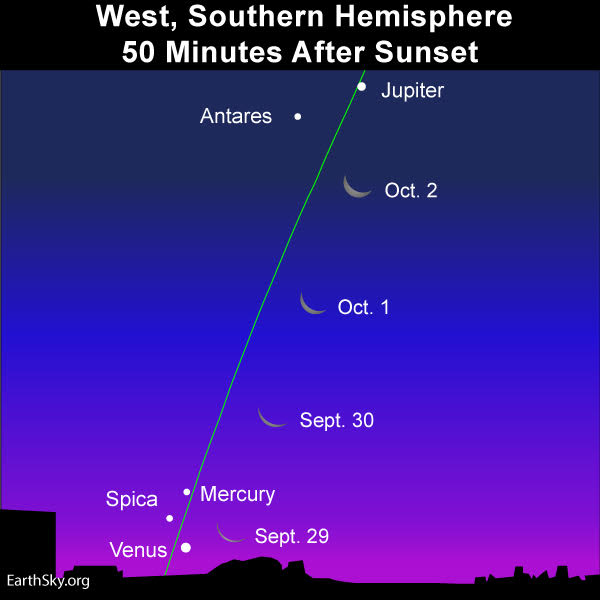
It’ll be easier to view the planets Mercury and Venus, plus the star Spica, from the Southern Hemisphere, because of the steep tilt of the ecliptic. Contrast with the feature sky chart at top for mid-northern latitudes,

Click here to know the moon’s place upon the zodiac.

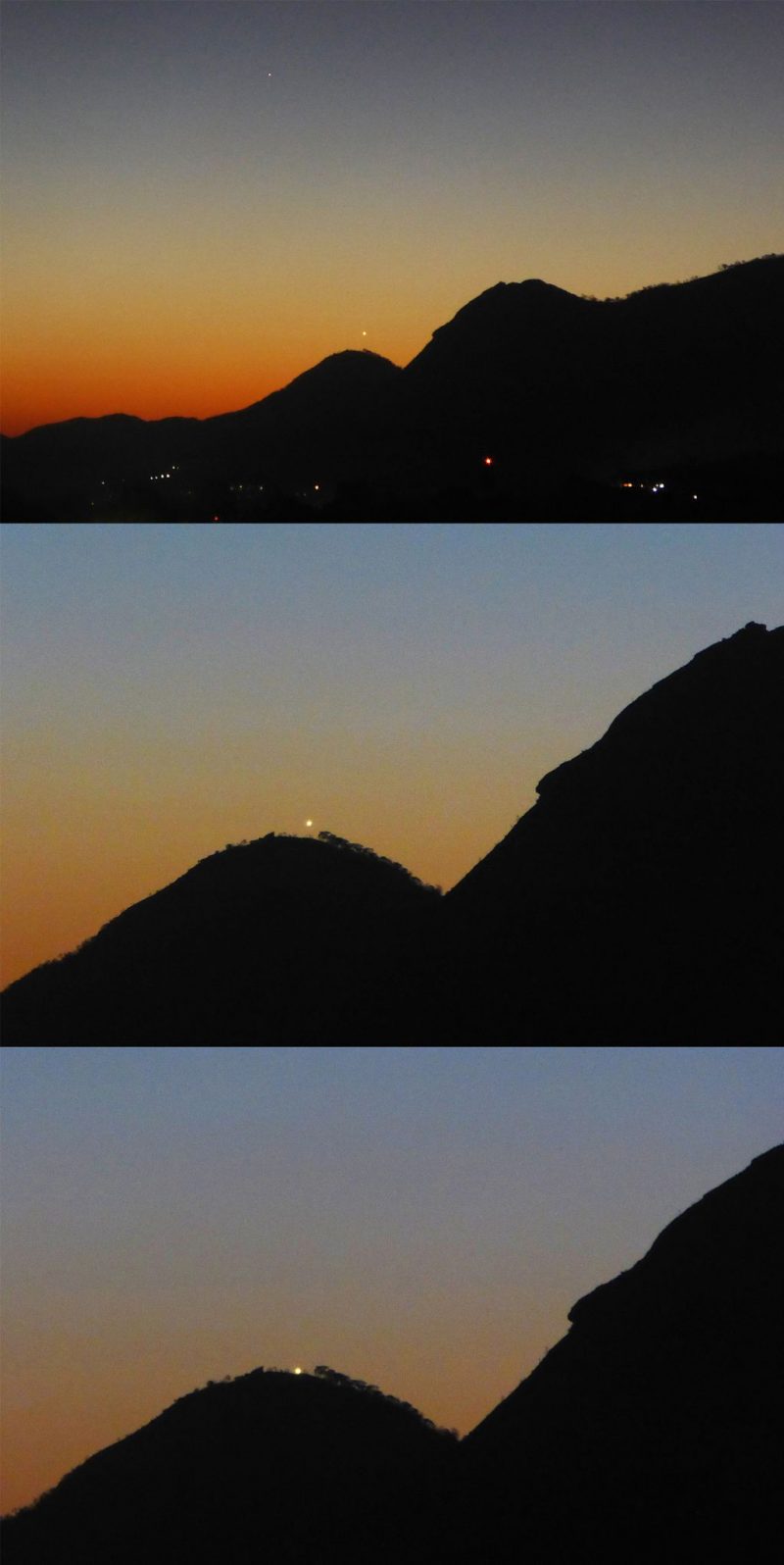
Three images after sunset, as the sky is darkening, of Mercury and Venus.

View at EarthSky Community Photos. | Two planets – Mercury and Venus – also sit low in the west after sunset. They’re tough to spot, especially from the Northern Hemisphere. Peter Lowenstein in Mutare, Zimbabwe captured this series of images on September 27, 2019. Both Mercury and Venus very quickly follow the sun below the western horizon. Venus is much brighter than Mercury. Thank you, Peter!

Bottom line: Wherever you may live, the young moon is hard to catch on September 29, 2019, but easier on September 30, and on October 1 and 2.


from EarthSky https://ift.tt/2mBbteZ

For a number of intrepid sky watchers, the hunt for the young moon counts as great sport. Seeking out a young moon that might – or might not – fleetingly show itself as a pale, skinny crescent in the western evening twilight demands fortitude and patience. That’ll be the situation on September 29, 2019, when chance of seeing the extremely young moon will vary around the globe. On that evening, the moon will be exceedingly low in the western sky after sunset, very near the place where the sun went down. Binoculars come in handy.

Following that – on September 30 and into the first couple of evenings of October – the young moon will be easier to see. It’ll be higher up in the west after sunset, edging closer each evening to the bright red star Antares – Heart of the Scorpion in the constellation Scorpius – and the even-brighter planet Jupiter.

So let’s focus on that first evening again for a bit: September 29. It’s quite difficult to catch a young moon that’s less than one day (24 hours) old, and for the world’s Eastern Hemisphere, the moon will be less than one day old as the sun sets on September 29.

Line of sunset aligns with the prime meridian one day after new moon.

Quite by coincidence, the line of sunset pretty much aligns with Earth’s prime meridian one day after new moon (2019 September 29 at 18:26 UTC). By the time that the line of sunset reaches Central Time Zone in North America, the moon will be about 30 hours old. Map via EarthView.

The further west you live on the Earth’s globe, the better your chances of spotting the young moon after sunset on September 29. That’s because the moon is somewhat older when the sun sets at more westerly longitudes.

Click here to find out the moon’s setting time in your sky, remembering to check the moonrise and moonset box.

Also, the further south you live, the better are your chances of catching the young moon on any of these evenings. That’s because the ecliptic – the approximate monthly path of the moon in front of the constellations of the zodiac – hits the sunset horizon at a steep angle in the Southern Hemisphere yet a a shallow angle in the Northern Hemisphere.

This particular young moon swings a maximum 5 degrees (10 moon-diameters) north of the ecliptic (5 degrees in ecliptic latitude). That erases much of the Northern Hemisphere’s disadvantage. This time around, the Northern Hemisphere finds itself in a better position than it usually does for spotting an early autumn young moon.

Click here to find out the present ecliptic latitude of the moon.

Seeing the young moon near the planets Venus and Mercury in the Southern Hemisphere

It’ll be easier to view the planets Mercury and Venus, plus the star Spica, from the Southern Hemisphere, because of the steep tilt of the ecliptic. Contrast with the feature sky chart at top for mid-northern latitudes,

Click here to know the moon’s place upon the zodiac.

Three images after sunset, as the sky is darkening, of Mercury and Venus.

View at EarthSky Community Photos. | Two planets – Mercury and Venus – also sit low in the west after sunset. They’re tough to spot, especially from the Northern Hemisphere. Peter Lowenstein in Mutare, Zimbabwe captured this series of images on September 27, 2019. Both Mercury and Venus very quickly follow the sun below the western horizon. Venus is much brighter than Mercury. Thank you, Peter!

Bottom line: Wherever you may live, the young moon is hard to catch on September 29, 2019, but easier on September 30, and on October 1 and 2.


from EarthSky https://ift.tt/2mBbteZ

News digest – alcohol pricing success, cancer treatment experience, European drug approval and garlic

Doctor discussing a prostate cancer scan with patient

Exciting new breed of cancer drugs approved in Europe

The BBC covers the approval of a new breed of cancer drug by the European Medicines Agency (EMA), called ‘tumour agnostic’ drugs. They’re different from most cancer drugs because instead of being developed based on where the cancer is growing in the body, the drugs target specific changes in cancer cells’ DNA. This means people with different types of cancer may benefit from them. But while the latest tumour agnostic drug may provide a valuable option for patients with some rare cancers, it’s a way off being available on the NHS, as we’ve blogged about before.

PM pledges £200 million for new NHS equipment to detect cancer

The UK Prime Minister, Boris Johnson, has announced a £200 million funding boost to help diagnose people with cancer earlier. The money will be spent on new diagnostic machines that can be used to test for cancer, including MRI and CT scanners. Read The Telegraph for more.

‘My body feels like it is dying from the drugs that are meant to save me’

Take a look at this Guardian long-read for a poignant and honest account of one woman’s experience of going through gruelling chemotherapy treatment.

Study links certain male fertility treatment with possible increased prostate cancer risk

A new Swedish study suggests that men who have had a certain type of fertility treatment could have a higher risk of developing prostate cancer compared to those who have conceived naturally. According to the BBC, the researchers looked at 1.2 million pregnancies in Sweden over 20 years, but more research is needed to see if the link is there in larger groups and the underlying reasons at play.

Some men treated with surgery for prostate cancer may not need radiotherapy

Our prostate cancer trial results, presented at the European Society for Medical Oncology (ESMO) conference, show that men with early prostate cancer who’ve had surgery do just as well without radiotherapy as those having the additional treatment. As The Telegraph explains, this could save men from life-changing side effects.

Language change around obesity suggested to prevent weight stigma

The British Psychological Society released a new report advising on the best language to use when talking about obesity. The Telegraph covered the recommendations, which aim to reframe obesity as a complex condition which has many causes.

Alcohol pricing policy cuts drinking rates in Scotland

Minimum pricing of alcohol in Scotland is having its desired effect, reports the Mail Online. The policy, introduced in May 2018, sets the minimum pricing of alcohol to 50p per unit. And research suggests it’s cut the nation’s drinking rate. On average, people in Scotland are now drinking 1 unit of booze less a week than before the price hike, leading to suggestions that the legislation should be adopted across the UK.

Tasmanian devil tumours teach us about immunotherapy resistance

A cluster of interacting proteins that are active in some human cancers and Tasmanian devil facial tumours have given scientists new clues as to how cancers evade the immune system. BT.com covered the research, that we part-funded, and we also blogged about this one.

UK home to 3.6 million vapers

Figures from Action on Smoking and Health reveal there are now almost half as many vapers in the UK as those who smoke tobacco. The BBC covered the report, which also indicates that the majority of people using e-cigarettes are former smokers.

Pancreatic cancer urine test set to start trials

An experimental urine test that aims to detect pancreatic cancer earlier is set to enter clinical trials, reports the Mail Online. The study, which will cost £1.6 million, will help researchers assess how accurately the test can pick up the early signs of the hard-to-treat disease.

Cancer Research UK boost entrepreneurs in science

Pharma Times covers our first entrepreneurship initiative, which will provide support and education to early career researchers. The business accelerator programmes aim to help scientists turn their innovative ideas into viable companies that could benefit patients. Our press release has the details.

And finally

A nutritional study, reported by the Scotsman, looked at the consumption of a sauce packed with garlic and onions in a group of women in Puerto Rico. Researchers said the study suggests that eating at least two helpings of sofrito a day may reduce breast cancer risk and that these pungent vegetables were behind the link. But they only looked at a small and very specific group of people, so there’s no need to stock up on onions and garlic.

Gabi


from Cancer Research UK – Science blog https://ift.tt/2mwZwGY
Doctor discussing a prostate cancer scan with patient

Exciting new breed of cancer drugs approved in Europe

The BBC covers the approval of a new breed of cancer drug by the European Medicines Agency (EMA), called ‘tumour agnostic’ drugs. They’re different from most cancer drugs because instead of being developed based on where the cancer is growing in the body, the drugs target specific changes in cancer cells’ DNA. This means people with different types of cancer may benefit from them. But while the latest tumour agnostic drug may provide a valuable option for patients with some rare cancers, it’s a way off being available on the NHS, as we’ve blogged about before.

PM pledges £200 million for new NHS equipment to detect cancer

The UK Prime Minister, Boris Johnson, has announced a £200 million funding boost to help diagnose people with cancer earlier. The money will be spent on new diagnostic machines that can be used to test for cancer, including MRI and CT scanners. Read The Telegraph for more.

‘My body feels like it is dying from the drugs that are meant to save me’

Take a look at this Guardian long-read for a poignant and honest account of one woman’s experience of going through gruelling chemotherapy treatment.

Study links certain male fertility treatment with possible increased prostate cancer risk

A new Swedish study suggests that men who have had a certain type of fertility treatment could have a higher risk of developing prostate cancer compared to those who have conceived naturally. According to the BBC, the researchers looked at 1.2 million pregnancies in Sweden over 20 years, but more research is needed to see if the link is there in larger groups and the underlying reasons at play.

Some men treated with surgery for prostate cancer may not need radiotherapy

Our prostate cancer trial results, presented at the European Society for Medical Oncology (ESMO) conference, show that men with early prostate cancer who’ve had surgery do just as well without radiotherapy as those having the additional treatment. As The Telegraph explains, this could save men from life-changing side effects.

Language change around obesity suggested to prevent weight stigma

The British Psychological Society released a new report advising on the best language to use when talking about obesity. The Telegraph covered the recommendations, which aim to reframe obesity as a complex condition which has many causes.

Alcohol pricing policy cuts drinking rates in Scotland

Minimum pricing of alcohol in Scotland is having its desired effect, reports the Mail Online. The policy, introduced in May 2018, sets the minimum pricing of alcohol to 50p per unit. And research suggests it’s cut the nation’s drinking rate. On average, people in Scotland are now drinking 1 unit of booze less a week than before the price hike, leading to suggestions that the legislation should be adopted across the UK.

Tasmanian devil tumours teach us about immunotherapy resistance

A cluster of interacting proteins that are active in some human cancers and Tasmanian devil facial tumours have given scientists new clues as to how cancers evade the immune system. BT.com covered the research, that we part-funded, and we also blogged about this one.

UK home to 3.6 million vapers

Figures from Action on Smoking and Health reveal there are now almost half as many vapers in the UK as those who smoke tobacco. The BBC covered the report, which also indicates that the majority of people using e-cigarettes are former smokers.

Pancreatic cancer urine test set to start trials

An experimental urine test that aims to detect pancreatic cancer earlier is set to enter clinical trials, reports the Mail Online. The study, which will cost £1.6 million, will help researchers assess how accurately the test can pick up the early signs of the hard-to-treat disease.

Cancer Research UK boost entrepreneurs in science

Pharma Times covers our first entrepreneurship initiative, which will provide support and education to early career researchers. The business accelerator programmes aim to help scientists turn their innovative ideas into viable companies that could benefit patients. Our press release has the details.

And finally

A nutritional study, reported by the Scotsman, looked at the consumption of a sauce packed with garlic and onions in a group of women in Puerto Rico. Researchers said the study suggests that eating at least two helpings of sofrito a day may reduce breast cancer risk and that these pungent vegetables were behind the link. But they only looked at a small and very specific group of people, so there’s no need to stock up on onions and garlic.

Gabi


from Cancer Research UK – Science blog https://ift.tt/2mwZwGY

Use Great Square to find Andromeda galaxy

Tonight, find the large spiral galaxy next door. As shown on the chart at the top of this post, the Great Square of Pegasus serves as a great jumping off point for finding the Andromeda galaxy, otherwise known as M31. The Great Square sparkles over your eastern horizon at nightfall and travels westward across the sky throughout the night. For some idea of the Great Square’s size, extend your hand an arm’s length from your eye. You’ll see that any two Great Square stars are farther apart than the width of your hand.

As seen from mid-northern latitudes, the Square of Pegasus looks like a baseball diamond whenever it resides in the eastern sky. Imagine the farthest star to the left – Alpheratz – as the third-base star. An imaginary line drawn from the first-base star through Alpheratz points in the general direction of the Andromeda galaxy.

The Andromeda galaxy and two satellite galaxies as seen through a powerful telescope. To the eye, the galaxy looks like a fuzzy patch. It’s an island of stars in space, much like our Milky Way. Image Credit: NOAO

If it’s dark enough, you’ll see two streamers of stars flying to the north (or left) of the star Alpheratz. To some people, this grouping of stars looks like a bugle or a cornucopia. Along the bottom streamer, star-hop from Alpheratz to the star Mirach. Draw an imaginary line from Mirach through the upper streamer star (Mu Andromedae), and go twice the distance. You’ve just located the Andromeda galaxy!

If you can’t see this fuzzy patch of light with the unaided eye, maybe your sky isn’t dark enough. Try binoculars! Or try going to darker sky.

Read more: Andromeda galaxy, closest spiral to Milky Way

Enjoying EarthSky so far? Sign up for our free daily newsletter today!

View larger. | The Andromeda galaxy (right side of photo) as seen by EarthSky Facebook friend Ted Van at a Montana campsite in mid-August 2012. Thank you, Ted!

Bottom line: If you can find the Great Square of Pegasus, then you can star-hop to the Andromeda galaxy.

Donate: Your support means the world to us


from EarthSky https://ift.tt/2nrfDWQ

Tonight, find the large spiral galaxy next door. As shown on the chart at the top of this post, the Great Square of Pegasus serves as a great jumping off point for finding the Andromeda galaxy, otherwise known as M31. The Great Square sparkles over your eastern horizon at nightfall and travels westward across the sky throughout the night. For some idea of the Great Square’s size, extend your hand an arm’s length from your eye. You’ll see that any two Great Square stars are farther apart than the width of your hand.

As seen from mid-northern latitudes, the Square of Pegasus looks like a baseball diamond whenever it resides in the eastern sky. Imagine the farthest star to the left – Alpheratz – as the third-base star. An imaginary line drawn from the first-base star through Alpheratz points in the general direction of the Andromeda galaxy.

The Andromeda galaxy and two satellite galaxies as seen through a powerful telescope. To the eye, the galaxy looks like a fuzzy patch. It’s an island of stars in space, much like our Milky Way. Image Credit: NOAO

If it’s dark enough, you’ll see two streamers of stars flying to the north (or left) of the star Alpheratz. To some people, this grouping of stars looks like a bugle or a cornucopia. Along the bottom streamer, star-hop from Alpheratz to the star Mirach. Draw an imaginary line from Mirach through the upper streamer star (Mu Andromedae), and go twice the distance. You’ve just located the Andromeda galaxy!

If you can’t see this fuzzy patch of light with the unaided eye, maybe your sky isn’t dark enough. Try binoculars! Or try going to darker sky.

Read more: Andromeda galaxy, closest spiral to Milky Way

Enjoying EarthSky so far? Sign up for our free daily newsletter today!

View larger. | The Andromeda galaxy (right side of photo) as seen by EarthSky Facebook friend Ted Van at a Montana campsite in mid-August 2012. Thank you, Ted!

Bottom line: If you can find the Great Square of Pegasus, then you can star-hop to the Andromeda galaxy.

Donate: Your support means the world to us


from EarthSky https://ift.tt/2nrfDWQ

NASA creates stunning new black hole visualization

Simulated black hole.

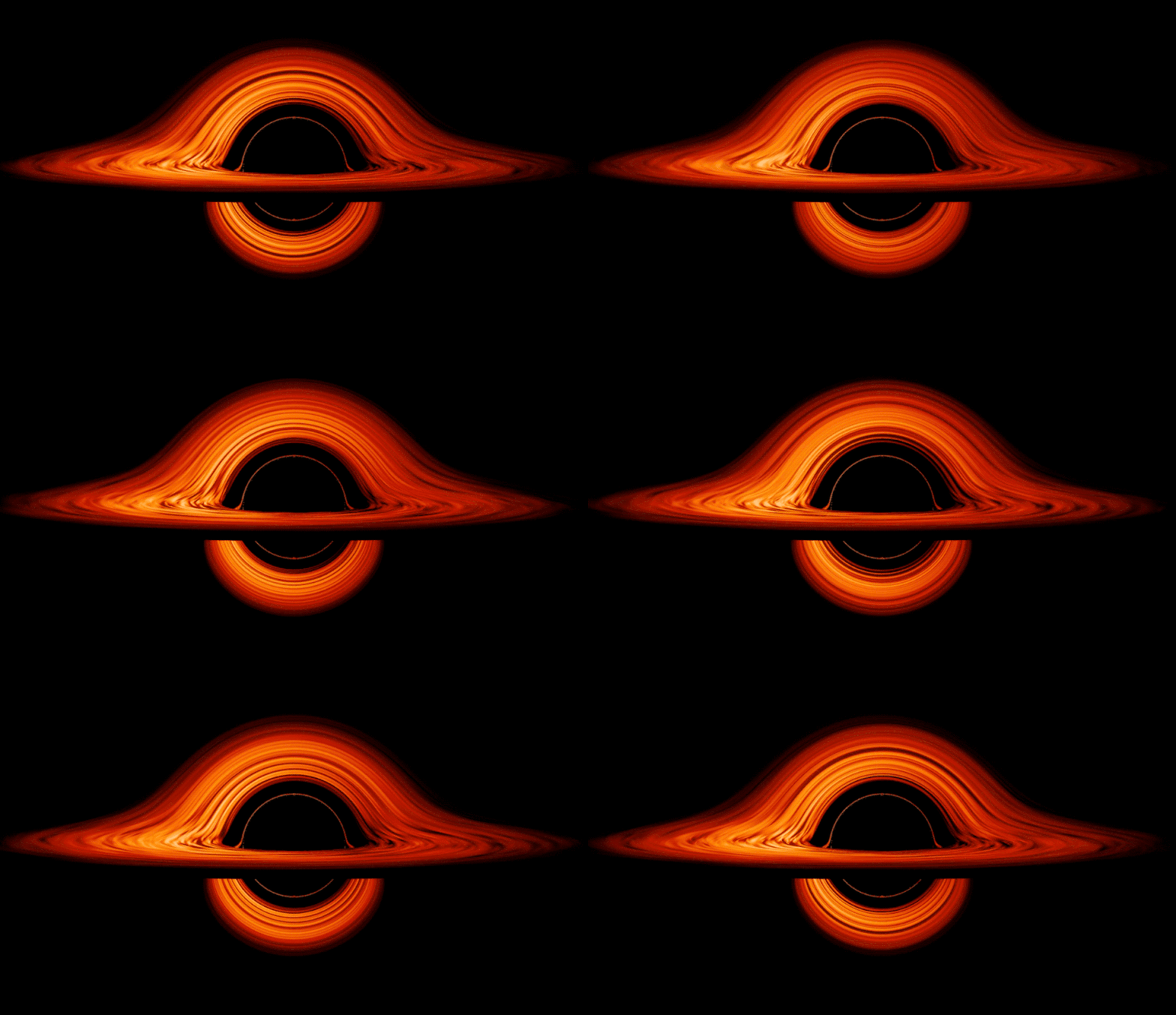
Click in to see more angles. | The black hole is seen nearly edgewise in this new visualization from NASA. The turbulent disk of gas around the hole takes on a double-humped appearance. The black hole’s extreme gravity alters the paths of light coming from different parts of the disk, producing the warped image. “What we see depends on our viewing angle,” NASA said. Image via NASA’s Goddard Space Flight Center/Jeremy Schnittman.

NASA released this new new visualization of a black hole this week, generated by astrophysicist Jeremy Schnittman, using custom software at NASA’s Goddard Space Flight Center in Greenbelt, Maryland. Schnittman’s areas of expertise include computational modeling of black hole accretion flows. That’s what you’re seeing in this visualization, the flow of material around a black hole as it might appear if you could see the hole up close (but not too close!), and from the side. Yes, black holes are black; no light can escape them. All the action is in the area immediately surrounding the hole, because the hole’s powerful gravity warps its surroundings, distorting our view, NASA said, “as if seen in a carnival mirror.” NASA explained on September 25, 2019:

The visualization simulates the appearance of a black hole where infalling matter has collected into a thin, hot structure called an accretion disk. The black hole’s extreme gravity skews light emitted by different regions of the disk, producing the misshapen appearance.

Bright knots constantly form and dissipate in the disk as magnetic fields wind and twist through the churning gas. Nearest the black hole, the gas orbits at close to the speed of light, while the outer portions spin a bit more slowly. This difference stretches and shears the bright knots, producing light and dark lanes in the disk.

Viewed from the side, the disk looks brighter on the left than it does on the right. Glowing gas on the left side of the disk moves toward us so fast that the effects of Einstein’s relativity give it a boost in brightness; the opposite happens on the right side, where gas moving away us becomes slightly dimmer. This asymmetry disappears when we see the disk exactly face on because, from that perspective, none of the material is moving along our line of sight.

Closest to the black hole, the gravitational light-bending becomes so excessive that we can see the underside of the disk as a bright ring of light seemingly outlining the black hole. This so-called “photon ring” is composed of multiple rings, which grow progressively fainter and thinner, from light that has circled the black hole two, three, or even more times before escaping to reach our eyes. Because the black hole modeled in this visualization is spherical, the photon ring looks nearly circular and identical from any viewing angle. Inside the photon ring is the black hole’s shadow, an area roughly twice the size of the event horizon — its point of no return.

Click in to see the black hole visualization from many different angles.

Or check out the video below.

Schnittman said:

Simulations and movies like these really help us visualize what Einstein meant when he said that gravity warps the fabric of space and time. Until very recently, these visualizations were limited to our imagination and computer programs. I never thought that it would be possible to see a real black hole.

Yet – as many recall – on April 10 of this year, the Event Horizon Telescope team released the first-ever image of a black hole’s shadow using radio observations of the heart of the galaxy M87.

Yellow-orange doughnut shape with brighter streaks in wider part.

It’s not a simulation. It’s not an artist’s concept. It’s the 1st radio image of a black hole, in the galaxy M87. This long-sought image – released April 10, 2019 by the Event Horizon Telescope team – has provided the strongest evidence to date for the existence of supermassive black holes. It opened a new window onto the study of black holes, their event horizons, and gravity. Image via Event Horizon Telescope Collaboration. Read more about this image.

Bottom line: For decades, astronomical theorists have told us that a black hole’s powerful gravity would warp the space around it. This new visualization from NASA’s Goddard Space Flight Center is the best yet at showing exactly how.

Click in to see the black hole visualization from many different angles.

Via NASA


from EarthSky https://ift.tt/2na62DD
Simulated black hole.

Click in to see more angles. | The black hole is seen nearly edgewise in this new visualization from NASA. The turbulent disk of gas around the hole takes on a double-humped appearance. The black hole’s extreme gravity alters the paths of light coming from different parts of the disk, producing the warped image. “What we see depends on our viewing angle,” NASA said. Image via NASA’s Goddard Space Flight Center/Jeremy Schnittman.

NASA released this new new visualization of a black hole this week, generated by astrophysicist Jeremy Schnittman, using custom software at NASA’s Goddard Space Flight Center in Greenbelt, Maryland. Schnittman’s areas of expertise include computational modeling of black hole accretion flows. That’s what you’re seeing in this visualization, the flow of material around a black hole as it might appear if you could see the hole up close (but not too close!), and from the side. Yes, black holes are black; no light can escape them. All the action is in the area immediately surrounding the hole, because the hole’s powerful gravity warps its surroundings, distorting our view, NASA said, “as if seen in a carnival mirror.” NASA explained on September 25, 2019:

The visualization simulates the appearance of a black hole where infalling matter has collected into a thin, hot structure called an accretion disk. The black hole’s extreme gravity skews light emitted by different regions of the disk, producing the misshapen appearance.

Bright knots constantly form and dissipate in the disk as magnetic fields wind and twist through the churning gas. Nearest the black hole, the gas orbits at close to the speed of light, while the outer portions spin a bit more slowly. This difference stretches and shears the bright knots, producing light and dark lanes in the disk.

Viewed from the side, the disk looks brighter on the left than it does on the right. Glowing gas on the left side of the disk moves toward us so fast that the effects of Einstein’s relativity give it a boost in brightness; the opposite happens on the right side, where gas moving away us becomes slightly dimmer. This asymmetry disappears when we see the disk exactly face on because, from that perspective, none of the material is moving along our line of sight.

Closest to the black hole, the gravitational light-bending becomes so excessive that we can see the underside of the disk as a bright ring of light seemingly outlining the black hole. This so-called “photon ring” is composed of multiple rings, which grow progressively fainter and thinner, from light that has circled the black hole two, three, or even more times before escaping to reach our eyes. Because the black hole modeled in this visualization is spherical, the photon ring looks nearly circular and identical from any viewing angle. Inside the photon ring is the black hole’s shadow, an area roughly twice the size of the event horizon — its point of no return.

Click in to see the black hole visualization from many different angles.

Or check out the video below.

Schnittman said:

Simulations and movies like these really help us visualize what Einstein meant when he said that gravity warps the fabric of space and time. Until very recently, these visualizations were limited to our imagination and computer programs. I never thought that it would be possible to see a real black hole.

Yet – as many recall – on April 10 of this year, the Event Horizon Telescope team released the first-ever image of a black hole’s shadow using radio observations of the heart of the galaxy M87.

Yellow-orange doughnut shape with brighter streaks in wider part.

It’s not a simulation. It’s not an artist’s concept. It’s the 1st radio image of a black hole, in the galaxy M87. This long-sought image – released April 10, 2019 by the Event Horizon Telescope team – has provided the strongest evidence to date for the existence of supermassive black holes. It opened a new window onto the study of black holes, their event horizons, and gravity. Image via Event Horizon Telescope Collaboration. Read more about this image.

Bottom line: For decades, astronomical theorists have told us that a black hole’s powerful gravity would warp the space around it. This new visualization from NASA’s Goddard Space Flight Center is the best yet at showing exactly how.

Click in to see the black hole visualization from many different angles.

Via NASA


from EarthSky https://ift.tt/2na62DD

Found: 3 black holes due to collide

Astronomers working with data from the space-based Chandra X-ray Observatory said this week (September 25, 2019) that they’ve located three supermassive black holes on a collision course. The system where this triple black hole merger is happening is called SDSS J0849+1114. It’s located about a billion light years from Earth. Telescopes on the ground and in space – including Chandra, Hubble, WISE and NuSTAR – captuted the scene, which scientists are calling:

… the best evidence yet for a trio of giant black holes.

So we haven’t seen many systems like this so far. And yet, astronomers believe, triplet collisions like this one play a critical role in how the biggest black holes grow over time. Ryan Pfeifle of George Mason University in Fairfax, Virginia is first author of a new paper in the peer-reviewed Astrophysical Journal, which describes these results (preprint here). He said:

We were only looking for pairs of black holes at the time, and yet, through our selection technique, we stumbled upon this amazing system. This is the strongest evidence yet found for such a triple system of actively feeding supermassive black holes.

These scientists’ statement described their process:

To uncover this rare black hole trifecta, researchers needed to combine data from telescopes both on the ground and in space. First, the Sloan Digital Sky Survey telescope, which scans large swaths of the sky in optical light from New Mexico, imaged SDSS J0849+1114. With the help of citizen scientists participating in a project called Galaxy Zoo, it was then tagged as a system of colliding galaxies.

Then, data from NASA’s Wide-field Infrared Survey Explorer (WISE) mission revealed that the system was glowing intensely in infrared light during a phase in the galaxy merger when more than one of the black holes is expected to be feeding rapidly. To follow up on these clues, astronomers then turned to Chandra and the Large Binocular Telescope in Arizona.

The Chandra data revealed X-ray sources — a telltale sign of material being consumed by the black holes — at the bright centers of each galaxy in the merger, exactly where scientists expect supermassive black holes to reside. Chandra and NASA’s Nuclear Spectroscopic Telescope Array (NuSTAR) also found evidence for large amounts of gas and dust around one of the black holes, typical for a merging black hole system.

Co-author Christina Manzano-King of University of California, Riverside said:

Optical spectra contain a wealth of information about a galaxy. They are commonly used to identify actively accreting supermassive black holes and can reflect the impact they have on the galaxies they inhabit.

These astronomers said one reason it’s difficult to find a triplet of supermassive black holes is that the holes are likely to be shrouded in gas and dust, blocking much of their light. The infrared images from WISE, the infrared spectra from LBT and the X-ray images from Chandra bypass this issue, they said, because infrared and X-ray light pierce clouds of gas much more easily than optical light. Pfeifle explained:

Through the use of these major observatories, we have identified a new way of identifying triple supermassive black holes. Each telescope gives us a different clue about what’s going on in these systems. We hope to extend our work to find more triples using the same technique.

Another co-author on the new paper, Shobita Satyapal, also of George Mason, explained why this system is exciting to scientists:

Dual and triple black holes are exceedingly rare, but such systems are actually a natural consequence of galaxy mergers, which we think is how galaxies grow and evolve.

As you might expect, these scientists said, three supermassive black holes merging behave differently than just a pair:

When there are three such black holes interacting, a pair should merge into a larger black hole much faster than if the two were alone. This may be a solution to a theoretical conundrum called the ‘final parsec problem,’ in which two supermassive black holes can approach to within a few light-years of each other, but would need some extra pull inwards to merge because of the excess energy they carry in their orbits. The influence of a third black hole, as in SDSS J0849+1114, could finally bring them together.

Computer simulations have shown that 16% of pairs of supermassive black holes in colliding galaxies will have interacted with a third supermassive black hole before they merge. Such mergers will produce ripples through spacetime called gravitational waves. These waves will have lower frequencies than the National Science Foundation’s Laser Interferometer Gravitational-Wave Observatory (LIGO) and European Virgo gravitational-wave detector can detect. However, they may be detectable with radio observations of pulsars, as well as future space observatories, such as the European Space Agency’s Laser Interferometer Space Antenna (LISA), which will detect black holes up to one million solar masses.

Bottom line: Astronomers have discovered a system of 3 galaxies – called SDSS J0849+1114 – all orbiting each other a billion light years from Earth. Each galaxy contains a supermassive black hole, which are circling each other, about to collide.

Via Chandra


from EarthSky https://ift.tt/2n6ULUC

Astronomers working with data from the space-based Chandra X-ray Observatory said this week (September 25, 2019) that they’ve located three supermassive black holes on a collision course. The system where this triple black hole merger is happening is called SDSS J0849+1114. It’s located about a billion light years from Earth. Telescopes on the ground and in space – including Chandra, Hubble, WISE and NuSTAR – captuted the scene, which scientists are calling:

… the best evidence yet for a trio of giant black holes.

So we haven’t seen many systems like this so far. And yet, astronomers believe, triplet collisions like this one play a critical role in how the biggest black holes grow over time. Ryan Pfeifle of George Mason University in Fairfax, Virginia is first author of a new paper in the peer-reviewed Astrophysical Journal, which describes these results (preprint here). He said:

We were only looking for pairs of black holes at the time, and yet, through our selection technique, we stumbled upon this amazing system. This is the strongest evidence yet found for such a triple system of actively feeding supermassive black holes.

These scientists’ statement described their process:

To uncover this rare black hole trifecta, researchers needed to combine data from telescopes both on the ground and in space. First, the Sloan Digital Sky Survey telescope, which scans large swaths of the sky in optical light from New Mexico, imaged SDSS J0849+1114. With the help of citizen scientists participating in a project called Galaxy Zoo, it was then tagged as a system of colliding galaxies.

Then, data from NASA’s Wide-field Infrared Survey Explorer (WISE) mission revealed that the system was glowing intensely in infrared light during a phase in the galaxy merger when more than one of the black holes is expected to be feeding rapidly. To follow up on these clues, astronomers then turned to Chandra and the Large Binocular Telescope in Arizona.

The Chandra data revealed X-ray sources — a telltale sign of material being consumed by the black holes — at the bright centers of each galaxy in the merger, exactly where scientists expect supermassive black holes to reside. Chandra and NASA’s Nuclear Spectroscopic Telescope Array (NuSTAR) also found evidence for large amounts of gas and dust around one of the black holes, typical for a merging black hole system.

Co-author Christina Manzano-King of University of California, Riverside said:

Optical spectra contain a wealth of information about a galaxy. They are commonly used to identify actively accreting supermassive black holes and can reflect the impact they have on the galaxies they inhabit.

These astronomers said one reason it’s difficult to find a triplet of supermassive black holes is that the holes are likely to be shrouded in gas and dust, blocking much of their light. The infrared images from WISE, the infrared spectra from LBT and the X-ray images from Chandra bypass this issue, they said, because infrared and X-ray light pierce clouds of gas much more easily than optical light. Pfeifle explained:

Through the use of these major observatories, we have identified a new way of identifying triple supermassive black holes. Each telescope gives us a different clue about what’s going on in these systems. We hope to extend our work to find more triples using the same technique.

Another co-author on the new paper, Shobita Satyapal, also of George Mason, explained why this system is exciting to scientists:

Dual and triple black holes are exceedingly rare, but such systems are actually a natural consequence of galaxy mergers, which we think is how galaxies grow and evolve.

As you might expect, these scientists said, three supermassive black holes merging behave differently than just a pair:

When there are three such black holes interacting, a pair should merge into a larger black hole much faster than if the two were alone. This may be a solution to a theoretical conundrum called the ‘final parsec problem,’ in which two supermassive black holes can approach to within a few light-years of each other, but would need some extra pull inwards to merge because of the excess energy they carry in their orbits. The influence of a third black hole, as in SDSS J0849+1114, could finally bring them together.

Computer simulations have shown that 16% of pairs of supermassive black holes in colliding galaxies will have interacted with a third supermassive black hole before they merge. Such mergers will produce ripples through spacetime called gravitational waves. These waves will have lower frequencies than the National Science Foundation’s Laser Interferometer Gravitational-Wave Observatory (LIGO) and European Virgo gravitational-wave detector can detect. However, they may be detectable with radio observations of pulsars, as well as future space observatories, such as the European Space Agency’s Laser Interferometer Space Antenna (LISA), which will detect black holes up to one million solar masses.

Bottom line: Astronomers have discovered a system of 3 galaxies – called SDSS J0849+1114 – all orbiting each other a billion light years from Earth. Each galaxy contains a supermassive black hole, which are circling each other, about to collide.

Via Chandra


from EarthSky https://ift.tt/2n6ULUC

Every visible star is within Milky Way

The image at top, showing a campfire under the Milky Way, is by Ben Coffman Photography in Oregon. He wrote:

These good folks – co-workers from one of the resorts on Mt. Hood, if I remember correctly – let me take their photo on the beach near Cape Kiwanda [a state natural area near in Pacific City, Oregon]. They looked like they were having fun.

And so they do. What could be better than a beautiful night under the Milky Way? But did you know that every night of your life is a night under the Milky Way? By that we mean … every individual star you can see with the unaided eye, in all parts of the sky, lies within the confines of our Milky Way galaxy.

Our galaxy – seen in Ben’s photo above as a bright and hazy band of stars – is estimated to be some 100,000 light-years wide and only about 1,000 light-years thick. That’s why the starlit band of the Milky Way, which is still visible in the evening this month but will soon be less so, appears so well-defined in our sky.

Gazing into it, we’re really looking edgewise into the thin plane of our own galaxy:

This image is mosaic of multiple shots on large-format film. It comprises all 360 degrees of the galaxy from our earthly vantage point. Photography was done in Ft. Davis, Texas for the northern hemisphere shots and from Broken Hill, New South Wales, Australia, for the southern portions. Note the dust lanes, which obscure our view of some features beyond them. Image via Digital Sky LLC

In the image directly above – comprising all 360 degrees of the galaxy as seen from our earthly vantage point – note that the galaxy is brightest at its center, where most of the stars and a 4-million-solar-mass black hole reside. This image shows stars down to 11th magnitude – fainter than the eye alone can see.

If you’re standing under a clear, dark night sky, you’ll see the Milky Way clearly as a band of stars stretched across the sky on late summer evenings.

The band of the Milky Way is tough to see unless you’re far from the artificial lights of the city and you’re looking on a night when the moon is down.

If you do look in a dark country sky, you’ll easily spot the Milky Way. And, assuming you’re looking from the Northern Hemisphere, you’ll notice that it gets broader and richer in the southern part of the sky, in the direction of the constellations Scorpius and Sagittarius. This is the direction toward the galaxy’s center.

If you’re in the Southern Hemisphere, the galactic center is still in the direction of Sagittarius. But from the southern part of Earth’s globe, this constellation is closer to overhead.

The image below gives you an idea of the awesome beauty of our Milky Way galaxy in the night sky.

Bottom line: If you look in a dark country sky, you’ll easily spot the starlit band of our huge, flat Milky Way galaxy. Every star in our night sky that’s visible to the unaided eye lies inside this galaxy.

A planisphere is virtually indispensable for beginning stargazers. Order your EarthSky planisphere from our store.

Enjoying EarthSky so far? Sign up for our free daily newsletter today!

Donate: Your support means the world to us


from EarthSky https://ift.tt/2m2Eobw

The image at top, showing a campfire under the Milky Way, is by Ben Coffman Photography in Oregon. He wrote:

These good folks – co-workers from one of the resorts on Mt. Hood, if I remember correctly – let me take their photo on the beach near Cape Kiwanda [a state natural area near in Pacific City, Oregon]. They looked like they were having fun.

And so they do. What could be better than a beautiful night under the Milky Way? But did you know that every night of your life is a night under the Milky Way? By that we mean … every individual star you can see with the unaided eye, in all parts of the sky, lies within the confines of our Milky Way galaxy.

Our galaxy – seen in Ben’s photo above as a bright and hazy band of stars – is estimated to be some 100,000 light-years wide and only about 1,000 light-years thick. That’s why the starlit band of the Milky Way, which is still visible in the evening this month but will soon be less so, appears so well-defined in our sky.

Gazing into it, we’re really looking edgewise into the thin plane of our own galaxy:

This image is mosaic of multiple shots on large-format film. It comprises all 360 degrees of the galaxy from our earthly vantage point. Photography was done in Ft. Davis, Texas for the northern hemisphere shots and from Broken Hill, New South Wales, Australia, for the southern portions. Note the dust lanes, which obscure our view of some features beyond them. Image via Digital Sky LLC

In the image directly above – comprising all 360 degrees of the galaxy as seen from our earthly vantage point – note that the galaxy is brightest at its center, where most of the stars and a 4-million-solar-mass black hole reside. This image shows stars down to 11th magnitude – fainter than the eye alone can see.

If you’re standing under a clear, dark night sky, you’ll see the Milky Way clearly as a band of stars stretched across the sky on late summer evenings.

The band of the Milky Way is tough to see unless you’re far from the artificial lights of the city and you’re looking on a night when the moon is down.

If you do look in a dark country sky, you’ll easily spot the Milky Way. And, assuming you’re looking from the Northern Hemisphere, you’ll notice that it gets broader and richer in the southern part of the sky, in the direction of the constellations Scorpius and Sagittarius. This is the direction toward the galaxy’s center.

If you’re in the Southern Hemisphere, the galactic center is still in the direction of Sagittarius. But from the southern part of Earth’s globe, this constellation is closer to overhead.

The image below gives you an idea of the awesome beauty of our Milky Way galaxy in the night sky.

Bottom line: If you look in a dark country sky, you’ll easily spot the starlit band of our huge, flat Milky Way galaxy. Every star in our night sky that’s visible to the unaided eye lies inside this galaxy.

A planisphere is virtually indispensable for beginning stargazers. Order your EarthSky planisphere from our store.

Enjoying EarthSky so far? Sign up for our free daily newsletter today!

Donate: Your support means the world to us


from EarthSky https://ift.tt/2m2Eobw

What can tumours in Tasmanian devils teach us about immunotherapy resistance?

Tasmanian devil sits on grass

A peculiar type of tumour, in an even more peculiar type of animal, could hold some clues to help scientists overcome immunotherapy resistance in humans.

Not many of us will have come across a Tasmanian devil in the wild – they’re only found on the island state of Tasmania. These creatures, similar in size to a small dog, are susceptible to a particular form of cancer, called devil facial tumour. And what’s unique about these tumours is that, unlike human cancers, they can be passed from devil to devil.

Tasmanian devils transmit the tumours by biting each other on the mouth, which they often do as part of a mating ritual. The cancer is almost always lethal, and with DFT now covering most of Tasmania, the future of devils in the wild is uncertain. Teams at the University of Tasmania Menzies Institute for Medical Research and School of Medicine are working to understand devil facial tumour in an attempt to conserve the population.

Serendipitously, this work could help cancer scientists understand why some people don’t respond to immunotherapy.

But first, we need to come back to the UK.

Cancer resistance and immunotherapy

In Cambridge, Dr Marian Burr and her colleagues were trying to understand why some immunotherapies were not getting the responses they were anticipating.

Immunotherapy treatments can work in lots of different ways, but they all aim to harness our immune system to fight cancer. Many target molecules on the surface of immune cells to help boost their ability to recognise and attack cancer cells.

But they’re not always as effective as expected.

“There are still a large number of patients who don’t respond to immunotherapy treatments and for the most part we still don’t understand the reasons for that,” says Burr.

To begin unpicking those reasons, the team homed in on a molecule that plays a vital role in our immune response, called MHC class I. This molecule helps immune cells identify and destroy potential threats, including cancer cells.

But some cancer cells find a way to evade detection, by removing MHC class I molecules from their surface. This could render them resistant to immunotherapy, by making them practically invisible to the immune system.

The big question the team wanted to answer was, how? Working with Professor Paul Lehner, they used gene editing tools to see what causes MHC class I to disappear from the surface of tumour cells.

“We were looking to see if there were any genes that we could take out that would put MHC class I back on the surface of the cancer cell,” says Burr. “And that was how we found the PRC2 complex.”

Publishing their work in Cancer Cell, a team led by Burr and Professor Mark Dawson at the Peter MacCallum Cancer Centre found that a group of proteins, called PRC2, could stop MHC class I appearing on the surface of some tumour cells in the lab.

The next step was to stop the PRC2 complex from doing this.

“In a range of cancers, particularly small cell lung cancer (SCLC), Merkel cell carcinoma and Neuroblastoma, we were able to show that by interrupting this group of proteins, MHC class I was put back on the surface of the tumour,” said Burr.

And blocking PRC2 activity in mice made immune cells more able to find and destroy tumour cells.

This isn’t the first time the PRC2 complex has been targeted. “Inhibitors are already in clinical trials in a range of different cancers,” says Burr. “And they have been fairly well tolerated.”

Burr thinks that the next step is to look at combining PRC2 inhibitors with different immunotherapies, to find the most effective treatment for cancers that have low levels of MHC class I.

Interestingly, other researchers in Cambridge had made the discovery that devil facial tumours had low levels of MHC class I too.

Which led the team to think – could the devil facial tumour also be using the PRC2 complex to avoid the immune system?

The devil in the detail

“As it is contagious, the devil facial tumour provides an extreme model of tumour immune evasion,” says Burr. To avoid being destroyed as they spread between devils, the tumour cells have evolved sophisticated ways to hide from the immune system.

And it turns out one of those ways involves our old friend, the PRC2 complex.

The team saw the same thing happening in Tasmanian devil tumours cells as in human cells and mice. MHC class I was being suppressed by the activity of PRC2.

The fact that PRC2 helps cancer cells evade the immune system in multiple species could be an indicator of how much cancer cells rely on this pathway to avoid the immune system. And resist the effects of immunotherapy.

“What we think is really important about this function of PRC2 is the fact that we see it in devils, we see it in mice and we see it in humans, which means it is highly conserved and is likely to be an important mechanism of resistance for the tumour cells.”

Ethan

Reference

Burr et al. (2019). An Evolutionarily Conserved Function of Polycomb Silences the MHC Class I Antigen Presentation Pathway and Enables Immune Evasion in Cancer. Cancer Cell. DOI: 10.1016/j.ccell.2019.08.008


from Cancer Research UK – Science blog https://ift.tt/2lQHq2x
Tasmanian devil sits on grass

A peculiar type of tumour, in an even more peculiar type of animal, could hold some clues to help scientists overcome immunotherapy resistance in humans.

Not many of us will have come across a Tasmanian devil in the wild – they’re only found on the island state of Tasmania. These creatures, similar in size to a small dog, are susceptible to a particular form of cancer, called devil facial tumour. And what’s unique about these tumours is that, unlike human cancers, they can be passed from devil to devil.

Tasmanian devils transmit the tumours by biting each other on the mouth, which they often do as part of a mating ritual. The cancer is almost always lethal, and with DFT now covering most of Tasmania, the future of devils in the wild is uncertain. Teams at the University of Tasmania Menzies Institute for Medical Research and School of Medicine are working to understand devil facial tumour in an attempt to conserve the population.

Serendipitously, this work could help cancer scientists understand why some people don’t respond to immunotherapy.

But first, we need to come back to the UK.

Cancer resistance and immunotherapy

In Cambridge, Dr Marian Burr and her colleagues were trying to understand why some immunotherapies were not getting the responses they were anticipating.

Immunotherapy treatments can work in lots of different ways, but they all aim to harness our immune system to fight cancer. Many target molecules on the surface of immune cells to help boost their ability to recognise and attack cancer cells.

But they’re not always as effective as expected.

“There are still a large number of patients who don’t respond to immunotherapy treatments and for the most part we still don’t understand the reasons for that,” says Burr.

To begin unpicking those reasons, the team homed in on a molecule that plays a vital role in our immune response, called MHC class I. This molecule helps immune cells identify and destroy potential threats, including cancer cells.

But some cancer cells find a way to evade detection, by removing MHC class I molecules from their surface. This could render them resistant to immunotherapy, by making them practically invisible to the immune system.

The big question the team wanted to answer was, how? Working with Professor Paul Lehner, they used gene editing tools to see what causes MHC class I to disappear from the surface of tumour cells.

“We were looking to see if there were any genes that we could take out that would put MHC class I back on the surface of the cancer cell,” says Burr. “And that was how we found the PRC2 complex.”

Publishing their work in Cancer Cell, a team led by Burr and Professor Mark Dawson at the Peter MacCallum Cancer Centre found that a group of proteins, called PRC2, could stop MHC class I appearing on the surface of some tumour cells in the lab.

The next step was to stop the PRC2 complex from doing this.

“In a range of cancers, particularly small cell lung cancer (SCLC), Merkel cell carcinoma and Neuroblastoma, we were able to show that by interrupting this group of proteins, MHC class I was put back on the surface of the tumour,” said Burr.

And blocking PRC2 activity in mice made immune cells more able to find and destroy tumour cells.

This isn’t the first time the PRC2 complex has been targeted. “Inhibitors are already in clinical trials in a range of different cancers,” says Burr. “And they have been fairly well tolerated.”

Burr thinks that the next step is to look at combining PRC2 inhibitors with different immunotherapies, to find the most effective treatment for cancers that have low levels of MHC class I.

Interestingly, other researchers in Cambridge had made the discovery that devil facial tumours had low levels of MHC class I too.

Which led the team to think – could the devil facial tumour also be using the PRC2 complex to avoid the immune system?

The devil in the detail

“As it is contagious, the devil facial tumour provides an extreme model of tumour immune evasion,” says Burr. To avoid being destroyed as they spread between devils, the tumour cells have evolved sophisticated ways to hide from the immune system.

And it turns out one of those ways involves our old friend, the PRC2 complex.

The team saw the same thing happening in Tasmanian devil tumours cells as in human cells and mice. MHC class I was being suppressed by the activity of PRC2.

The fact that PRC2 helps cancer cells evade the immune system in multiple species could be an indicator of how much cancer cells rely on this pathway to avoid the immune system. And resist the effects of immunotherapy.

“What we think is really important about this function of PRC2 is the fact that we see it in devils, we see it in mice and we see it in humans, which means it is highly conserved and is likely to be an important mechanism of resistance for the tumour cells.”

Ethan

Reference

Burr et al. (2019). An Evolutionarily Conserved Function of Polycomb Silences the MHC Class I Antigen Presentation Pathway and Enables Immune Evasion in Cancer. Cancer Cell. DOI: 10.1016/j.ccell.2019.08.008


from Cancer Research UK – Science blog https://ift.tt/2lQHq2x

What can tumours in Tasmanian devils teach us about immunotherapy resistance?

Tasmanian devil sat on grass

A peculiar type of tumour, in an even more peculiar type of animal, could hold some clues to help scientists overcome immunotherapy resistance in humans.

Not many of us will have come across a Tasmanian devil in the wild – they’re only found on the island state of Tasmania. These creatures, similar in size to a small dog, are susceptible to a particular form of cancer, called devil facial tumour. And what’s unique about these tumours is that, unlike human cancers, they can be passed from devil to devil.

Tasmanian devils transmit the tumours by biting each other on the mouth, which they often do as part of a mating ritual. The cancer is almost always lethal, and with DFT now covering most of Tasmania, the future of devils in the wild is uncertain. Teams at the University of Tasmania Menzies Institute for Medical Research and School of Medicine are working to understand devil facial tumour in an attempt to conserve the population.

Serendipitously, this work could help cancer scientists understand why some people don’t respond to immunotherapy.

But first, we need to come back to the UK.

Cancer resistance and immunotherapy

In Cambridge, Dr Marian Burr and her colleagues were trying to understand why some immunotherapies were not getting the responses they were anticipating.

Immunotherapy treatments can work in lots of different ways, but they all aim to harness our immune system to fight cancer. Many target molecules on the surface of immune cells to help boost their ability to recognise and attack cancer cells.

But they’re not always as effective as expected.

“There are still a large number of patients who don’t respond to immunotherapy treatments and for the most part we still don’t understand the reasons for that,” says Burr.

To begin unpicking those reasons, the team homed in on a molecule that plays a vital role in our immune response, called MHC class I. This molecule helps immune cells identify and destroy potential threats, including cancer cells.

But some cancer cells find a way to evade detection, by removing MHC class I molecules from their surface. This could render them resistant to immunotherapy, by making them practically invisible to the immune system.

The big question the team wanted to answer was, how? Working with Professor Paul Lehner, they used gene editing tools to see what causes MHC class I to disappear from the surface of tumour cells.

“We were looking to see if there were any genes that we could take out that would put MHC class I back on the surface of the cancer cell,” says Burr. “And that was how we found the PRC2 complex.”

Publishing their work in Cancer Cell, a team led by Burr and Professor Mark Dawson at the Peter MacCallum Cancer Centre found that a group of proteins, called PRC2, could stop MHC class I appearing on the surface of some tumour cells in the lab.

The next step was to stop the PRC2 complex from doing this.

“In a range of cancers, particularly small cell lung cancer (SCLC), Merkel cell carcinoma and neuroblastoma, we were able to show that by interrupting this group of proteins, MHC class I was put back on the surface of the tumour,” said Burr.

And blocking PRC2 activity in mice made immune cells more able to find and destroy tumour cells.

This isn’t the first time the PRC2 complex has been targeted. “Inhibitors are already in clinical trials in a range of different cancers,” says Burr. “And they have been fairly well tolerated.”

Burr thinks that the next step is to look at combining PRC2 inhibitors with different immunotherapies, to find the most effective treatment for cancers that have low levels of MHC class I.

Interestingly, other researchers in Cambridge had made the discovery that devil facial tumours had low levels of MHC class I too.

Which led the team to think – could the devil facial tumour also be using the PRC2 complex to avoid the immune system?

The devil in the detail

“As it is contagious, the devil facial tumour provides an extreme model of tumour immune evasion,” says Burr. To avoid being destroyed as they spread between devils, the tumour cells have evolved sophisticated ways to hide from the immune system.

And it turns out one of those ways involves our old friend, the PRC2 complex.

The team saw the same thing happening in Tasmanian devil tumours cells as in human cells and mice. MHC class I was being suppressed by the activity of PRC2.

The fact that PRC2 helps cancer cells evade the immune system in multiple species could be an indicator of how much cancer cells rely on this pathway to avoid the immune system. And resist the effects of immunotherapy.

“What we think is really important about this function of PRC2 is the fact that we see it in devils, we see it in mice and we see it in humans, which means it is highly conserved and is likely to be an important mechanism of resistance for the tumour cells.”

Ethan


from Cancer Research UK – Science blog https://ift.tt/2lnlrjd
Tasmanian devil sat on grass

A peculiar type of tumour, in an even more peculiar type of animal, could hold some clues to help scientists overcome immunotherapy resistance in humans.

Not many of us will have come across a Tasmanian devil in the wild – they’re only found on the island state of Tasmania. These creatures, similar in size to a small dog, are susceptible to a particular form of cancer, called devil facial tumour. And what’s unique about these tumours is that, unlike human cancers, they can be passed from devil to devil.

Tasmanian devils transmit the tumours by biting each other on the mouth, which they often do as part of a mating ritual. The cancer is almost always lethal, and with DFT now covering most of Tasmania, the future of devils in the wild is uncertain. Teams at the University of Tasmania Menzies Institute for Medical Research and School of Medicine are working to understand devil facial tumour in an attempt to conserve the population.

Serendipitously, this work could help cancer scientists understand why some people don’t respond to immunotherapy.

But first, we need to come back to the UK.

Cancer resistance and immunotherapy

In Cambridge, Dr Marian Burr and her colleagues were trying to understand why some immunotherapies were not getting the responses they were anticipating.

Immunotherapy treatments can work in lots of different ways, but they all aim to harness our immune system to fight cancer. Many target molecules on the surface of immune cells to help boost their ability to recognise and attack cancer cells.

But they’re not always as effective as expected.

“There are still a large number of patients who don’t respond to immunotherapy treatments and for the most part we still don’t understand the reasons for that,” says Burr.

To begin unpicking those reasons, the team homed in on a molecule that plays a vital role in our immune response, called MHC class I. This molecule helps immune cells identify and destroy potential threats, including cancer cells.

But some cancer cells find a way to evade detection, by removing MHC class I molecules from their surface. This could render them resistant to immunotherapy, by making them practically invisible to the immune system.

The big question the team wanted to answer was, how? Working with Professor Paul Lehner, they used gene editing tools to see what causes MHC class I to disappear from the surface of tumour cells.

“We were looking to see if there were any genes that we could take out that would put MHC class I back on the surface of the cancer cell,” says Burr. “And that was how we found the PRC2 complex.”

Publishing their work in Cancer Cell, a team led by Burr and Professor Mark Dawson at the Peter MacCallum Cancer Centre found that a group of proteins, called PRC2, could stop MHC class I appearing on the surface of some tumour cells in the lab.

The next step was to stop the PRC2 complex from doing this.

“In a range of cancers, particularly small cell lung cancer (SCLC), Merkel cell carcinoma and neuroblastoma, we were able to show that by interrupting this group of proteins, MHC class I was put back on the surface of the tumour,” said Burr.

And blocking PRC2 activity in mice made immune cells more able to find and destroy tumour cells.

This isn’t the first time the PRC2 complex has been targeted. “Inhibitors are already in clinical trials in a range of different cancers,” says Burr. “And they have been fairly well tolerated.”

Burr thinks that the next step is to look at combining PRC2 inhibitors with different immunotherapies, to find the most effective treatment for cancers that have low levels of MHC class I.

Interestingly, other researchers in Cambridge had made the discovery that devil facial tumours had low levels of MHC class I too.

Which led the team to think – could the devil facial tumour also be using the PRC2 complex to avoid the immune system?

The devil in the detail

“As it is contagious, the devil facial tumour provides an extreme model of tumour immune evasion,” says Burr. To avoid being destroyed as they spread between devils, the tumour cells have evolved sophisticated ways to hide from the immune system.

And it turns out one of those ways involves our old friend, the PRC2 complex.

The team saw the same thing happening in Tasmanian devil tumours cells as in human cells and mice. MHC class I was being suppressed by the activity of PRC2.

The fact that PRC2 helps cancer cells evade the immune system in multiple species could be an indicator of how much cancer cells rely on this pathway to avoid the immune system. And resist the effects of immunotherapy.

“What we think is really important about this function of PRC2 is the fact that we see it in devils, we see it in mice and we see it in humans, which means it is highly conserved and is likely to be an important mechanism of resistance for the tumour cells.”

Ethan


from Cancer Research UK – Science blog https://ift.tt/2lnlrjd

adds 2