aads

Tsunamis, wildfires followed dinosaur-killing impact

Flaming debris falling from roiling orange clouds with screaming dinosaurs in foreground.

Image via Curtin University.

Scientists have long believed that the end of the dinosaurs came as a result of a giant asteroid that crashed into Earth about 66 million years ago. Now, a new study by an international team of geologists, published in the peer-reviewed journal Proceedings of the National Academy of Sciences on September 9, 2019, has found hard evidence of the theory by analyzing the hundreds of feet of rocks that filled the impact crater within the first 24 hours after impact.

The geologists say the evidence shows that the asteroid impact caused wildfires, triggered tsunamis and blasted so much sulfur into the atmosphere that it blocked the sun, which caused the global cooling that ultimately doomed the non-avian dinosaurs.

The researcher drilled 1,640 to 4,265 feet (500 to 1,300 meters) into the seafloor below the Chicxulub crater off the coast of what’s now Mexico, in order to extract core samples of the rocks which filled the crater within 24 hours after the asteroid hit.

Map of North America in pale yellow with circle around the tip of the Yucatan peninsula.

Location of Chicxulub crater. Image via Wikipedia.

Sean Gulick, a research professor at the University of Texas Institute for Geophysics (UTIG) at the Jackson School of Geosciences, is lead author of the study. Gulick said in a statement:

It’s an expanded record of events that we were able to recover from within ground zero. It tells us about impact processes from an eyewitness location.

Curtin University geochemist Kliti Grice is a study co-author. She said:

The asteroid impact that formed the Chicxulub crater on the Yucatán Peninsula in Mexico, where this research was carried out, is thought to be the cause of the late Cretaceous Period mass extinction event which led to 76 per cent of all plant and animal species world-wide, including all non-flying dinosaurs, being killed off.

According to the researchers, most of the material that filled the crater within hours of the asteroid’s impact was either produced at the impact site, or swept in by seawater pouring back into the crater. Just one day deposited about 425 feet (130 meters) of material, said the geologists, a rate that’s among the highest ever encountered in the geologic record. That breakneck rate of accumulation means that the rocks in the crater record what was happening within and around the crater in the minutes and hours after the impact.

According to a University of Texas statement:

Researchers estimate the asteroid hit with the equivalent power of 10 billion atomic bombs of the size used in World War II. The blast ignited trees and plants that were thousands of miles away and triggered a massive tsunami that reached as far inland as Illinois. Inside the crater, researchers found charcoal and a chemical biomarker associated with soil fungi within or just above layers of sand that shows signs of being deposited by resurging waters. This suggests that the charred landscape was pulled into the crater with the receding waters of the tsunami.

Cross section of tumbled multicolored rock pieces.

A portion of the drilled cores from the rocks that filled the crater. Scientists found melted and broken rocks such as sandstone, limestone and granite — but no sulfur-bearing minerals, despite the area’s high concentration of sulfur containing rocks. This finding suggests that the impact vaporized these rocks forming sulfate aerosols in the atmosphere, causing cooling on the global scale. Image via International Ocean Discovery Program.

One of the most important findings from the research is what was missing from the core samples. The area surrounding the impact crater is full of sulfur-rich rocks. But there was no sulfur in the core. This lack supports the idea that when the asteroid hit, sulfur from the crater was vaporized into the atmosphere, where it wreaked havoc on the Earth’s climate, reflecting sunlight away from the planet and causing global cooling. Researchers estimate that at least 325 billion metric tons would have been released by the impact. To put that in perspective, that’s about four orders of magnitude greater than the sulfur that was spewed during the 1883 eruption of Krakatoa — which cooled the Earth’s climate by an average of 2.2 degrees Fahrenheit (1.2 degrees Celsius) for five years.

Although the asteroid impact created mass destruction at the regional level, it was this global climate change that caused a mass extinction, killing off the dinosaurs along with most other life on the planet at the time, Gulick said.

The real killer has got to be atmospheric. The only way you get a global mass extinction like this is an atmospheric effect.

Two people in hard hats and red-orange jumpsuits looking at long gray cylinders lying on a table.

Geologists Sean Gulick, of University of Texas and Joanna Morgan, of Imperial College London, on the 2016 research expedition that retrieved cores from the submerged and buried impact crater. Image via The University of Texas at Austin/Jackson School of Geosciences.

Bottom line: A new study analyzed rock from deep within the Chicxulub impact crater to learn what happened immediately after the asteroid impact that doomed the dinosaurs.

Source: The first day of the Cenozoic

Via The University of Texas at Austin and Curtin University


from EarthSky https://ift.tt/2NlIGXe
Flaming debris falling from roiling orange clouds with screaming dinosaurs in foreground.

Image via Curtin University.

Scientists have long believed that the end of the dinosaurs came as a result of a giant asteroid that crashed into Earth about 66 million years ago. Now, a new study by an international team of geologists, published in the peer-reviewed journal Proceedings of the National Academy of Sciences on September 9, 2019, has found hard evidence of the theory by analyzing the hundreds of feet of rocks that filled the impact crater within the first 24 hours after impact.

The geologists say the evidence shows that the asteroid impact caused wildfires, triggered tsunamis and blasted so much sulfur into the atmosphere that it blocked the sun, which caused the global cooling that ultimately doomed the non-avian dinosaurs.

The researcher drilled 1,640 to 4,265 feet (500 to 1,300 meters) into the seafloor below the Chicxulub crater off the coast of what’s now Mexico, in order to extract core samples of the rocks which filled the crater within 24 hours after the asteroid hit.

Map of North America in pale yellow with circle around the tip of the Yucatan peninsula.

Location of Chicxulub crater. Image via Wikipedia.

Sean Gulick, a research professor at the University of Texas Institute for Geophysics (UTIG) at the Jackson School of Geosciences, is lead author of the study. Gulick said in a statement:

It’s an expanded record of events that we were able to recover from within ground zero. It tells us about impact processes from an eyewitness location.

Curtin University geochemist Kliti Grice is a study co-author. She said:

The asteroid impact that formed the Chicxulub crater on the Yucatán Peninsula in Mexico, where this research was carried out, is thought to be the cause of the late Cretaceous Period mass extinction event which led to 76 per cent of all plant and animal species world-wide, including all non-flying dinosaurs, being killed off.

According to the researchers, most of the material that filled the crater within hours of the asteroid’s impact was either produced at the impact site, or swept in by seawater pouring back into the crater. Just one day deposited about 425 feet (130 meters) of material, said the geologists, a rate that’s among the highest ever encountered in the geologic record. That breakneck rate of accumulation means that the rocks in the crater record what was happening within and around the crater in the minutes and hours after the impact.

According to a University of Texas statement:

Researchers estimate the asteroid hit with the equivalent power of 10 billion atomic bombs of the size used in World War II. The blast ignited trees and plants that were thousands of miles away and triggered a massive tsunami that reached as far inland as Illinois. Inside the crater, researchers found charcoal and a chemical biomarker associated with soil fungi within or just above layers of sand that shows signs of being deposited by resurging waters. This suggests that the charred landscape was pulled into the crater with the receding waters of the tsunami.

Cross section of tumbled multicolored rock pieces.

A portion of the drilled cores from the rocks that filled the crater. Scientists found melted and broken rocks such as sandstone, limestone and granite — but no sulfur-bearing minerals, despite the area’s high concentration of sulfur containing rocks. This finding suggests that the impact vaporized these rocks forming sulfate aerosols in the atmosphere, causing cooling on the global scale. Image via International Ocean Discovery Program.

One of the most important findings from the research is what was missing from the core samples. The area surrounding the impact crater is full of sulfur-rich rocks. But there was no sulfur in the core. This lack supports the idea that when the asteroid hit, sulfur from the crater was vaporized into the atmosphere, where it wreaked havoc on the Earth’s climate, reflecting sunlight away from the planet and causing global cooling. Researchers estimate that at least 325 billion metric tons would have been released by the impact. To put that in perspective, that’s about four orders of magnitude greater than the sulfur that was spewed during the 1883 eruption of Krakatoa — which cooled the Earth’s climate by an average of 2.2 degrees Fahrenheit (1.2 degrees Celsius) for five years.

Although the asteroid impact created mass destruction at the regional level, it was this global climate change that caused a mass extinction, killing off the dinosaurs along with most other life on the planet at the time, Gulick said.

The real killer has got to be atmospheric. The only way you get a global mass extinction like this is an atmospheric effect.

Two people in hard hats and red-orange jumpsuits looking at long gray cylinders lying on a table.

Geologists Sean Gulick, of University of Texas and Joanna Morgan, of Imperial College London, on the 2016 research expedition that retrieved cores from the submerged and buried impact crater. Image via The University of Texas at Austin/Jackson School of Geosciences.

Bottom line: A new study analyzed rock from deep within the Chicxulub impact crater to learn what happened immediately after the asteroid impact that doomed the dinosaurs.

Source: The first day of the Cenozoic

Via The University of Texas at Austin and Curtin University


from EarthSky https://ift.tt/2NlIGXe

We stand corrected

View larger at EarthSky Community Photos. Image via Dr Ski, who said: “In the above image, I moved the camera a bit to expose just a small portion of the sun’s limb to get those cool diffraction spikes (caused by the small aperture blades).”

Our friend Dr Ski, in Valencia, Philippines, has been noticing images of the sun posted at EarthSky Community Photos, and he gave us a stern talking-to.

The sun can create some dramatic images. But all of posts I see here that promote unsafe solar viewing and are very disturbing!

He offered these guidelines for taking images of the sun:

1) Always have something handy to block the sun (like your hand!) when looking for solar phenomena or trying to compose a shot.

2) Never aim your camera at the sun without something to block the solar disc.

3) Never use your electronic viewfinder, if you have one.

4) Telephoto lenses are a bad idea; they magnify the sun’s intensity.

5) Use your slowest aperture (e.g. f16) and slowest ISO (e. g. ISO100). Even at those slow conditions, the shutter speed will be fast enough to preclude the use a tripod! (although a tripod helps in fine-tuning your composition)

6) Always block the sun’s disc! Then you won’t get those annoying lens flares that might be mistaken for Neptune.

Thanks so much Dr Ski!

Bottom line: How protect you eyes when taking photos of the sun.


from EarthSky https://ift.tt/305eINd

View larger at EarthSky Community Photos. Image via Dr Ski, who said: “In the above image, I moved the camera a bit to expose just a small portion of the sun’s limb to get those cool diffraction spikes (caused by the small aperture blades).”

Our friend Dr Ski, in Valencia, Philippines, has been noticing images of the sun posted at EarthSky Community Photos, and he gave us a stern talking-to.

The sun can create some dramatic images. But all of posts I see here that promote unsafe solar viewing and are very disturbing!

He offered these guidelines for taking images of the sun:

1) Always have something handy to block the sun (like your hand!) when looking for solar phenomena or trying to compose a shot.

2) Never aim your camera at the sun without something to block the solar disc.

3) Never use your electronic viewfinder, if you have one.

4) Telephoto lenses are a bad idea; they magnify the sun’s intensity.

5) Use your slowest aperture (e.g. f16) and slowest ISO (e. g. ISO100). Even at those slow conditions, the shutter speed will be fast enough to preclude the use a tripod! (although a tripod helps in fine-tuning your composition)

6) Always block the sun’s disc! Then you won’t get those annoying lens flares that might be mistaken for Neptune.

Thanks so much Dr Ski!

Bottom line: How protect you eyes when taking photos of the sun.


from EarthSky https://ift.tt/305eINd

Use Big Dipper to find North Star

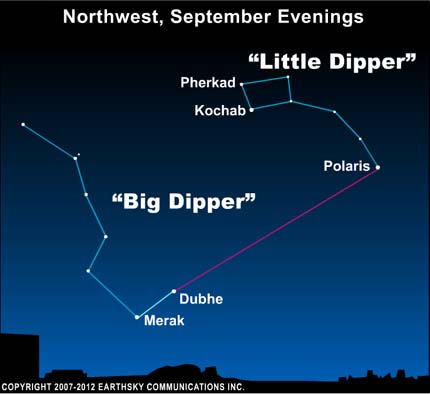
Tonight’s chart shows Polaris and the Big and Little Dippers for a September evening. You can use the Big Dipper to find Polaris, which is also known as the North Star. Notice that a line from the two outermost stars in the bowl of the Big Dipper points to Polaris. And notice that Polaris marks the tip of the handle of the Little Dipper.

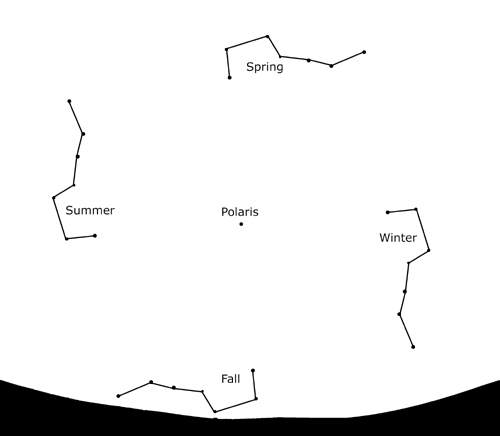
The northern sky is a large clock, with Polaris at its center. The hour hand is a line drawn through Dubhe and Merak, the two pointer stars of the Big Dipper. Because the stars make a full circle in 23 hours 56 minutes instead of exactly 24 hours, this star clock is not exactly the same as the one on the wall, but with a little practice you can learn to read it well.

The Big and Little Dippers: All you need to know

EarthSky astronomy kits are perfect for beginners. Order today from the EarthSky store

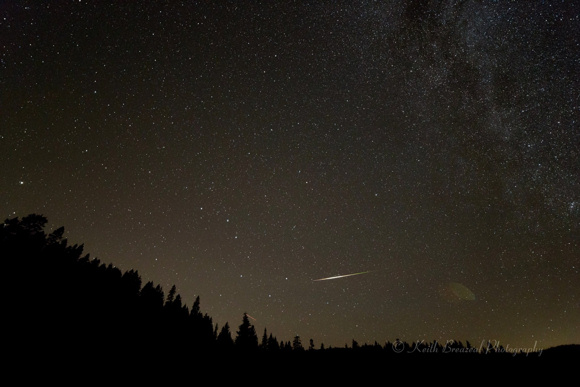
View larger. Keith Breazeal's photo of a meteor streaking past the Big Dipper. Perseid Meteor Shower 12-13 Aug 2015. One of the many captured last night at the Bear River Dam in the California Sierra Nevada mountains. This one was at 10:32 Canon 5D Mark III Rokinon 14mm f2.8 25 seconds ISO 5000. Thank you Keith!

View larger. | Keith Breazeal’s photo of a meteor streaking past the Big Dipper during the 2015 Perseid meteor shower. Captured at the Bear River Dam in the California Sierra Nevada mountains. Can you find Polaris in this photo?

The Big Dipper swings full circle – 360 degrees – around Polaris in about 23 hours and 56 minutes. In 24 hours, the Big Dipper actually swings more than full circle, or 361 degrees. Does that make a difference? Yes! It means that – if you look at the same time each evening – the Big Dipper will appear just a little bit lower in the northwestern evening sky.

If you’re in the northern U.S., Canada or at a similar latitude, the Big Dipper is circumpolar for you – always above the horizon. Image via burro.astr.cwru.edu

A month from now at mid-evening, the Big Dipper will be noticeably lower in the northwest. It’ll actually beneath the horizon as seen from the southern latitudes in the United States – although it’s circumpolar, or always above the northern horizon, as seen from the northern U.S., Canada and similarly northern latitudes.

The constant motion from night to night of these stars circling Polaris is a bit like a bear circling its prey, looking for a way to attack. Several ancient cultures from the Greeks and Romans to the Micmac Indians likened these stars to a bear.

In Greek mythology, the Big Dipper asterism represents the hindquarters and tail of the constellation Ursa Major, the Great Bear. The Micmacs saw the three stars of the Big Dipper handle as hunters chasing the bear.

Watch the Big and Little Dippers circle around Polaris tonight! To locate Polaris, the North Star, just draw a line between the two outer stars in the bowl of the Big Dipper.

Enjoying EarthSky so far? Sign up for our free daily newsletter today!


from EarthSky https://ift.tt/34O5RPB

Tonight’s chart shows Polaris and the Big and Little Dippers for a September evening. You can use the Big Dipper to find Polaris, which is also known as the North Star. Notice that a line from the two outermost stars in the bowl of the Big Dipper points to Polaris. And notice that Polaris marks the tip of the handle of the Little Dipper.

The northern sky is a large clock, with Polaris at its center. The hour hand is a line drawn through Dubhe and Merak, the two pointer stars of the Big Dipper. Because the stars make a full circle in 23 hours 56 minutes instead of exactly 24 hours, this star clock is not exactly the same as the one on the wall, but with a little practice you can learn to read it well.

The Big and Little Dippers: All you need to know

EarthSky astronomy kits are perfect for beginners. Order today from the EarthSky store

View larger. Keith Breazeal's photo of a meteor streaking past the Big Dipper. Perseid Meteor Shower 12-13 Aug 2015. One of the many captured last night at the Bear River Dam in the California Sierra Nevada mountains. This one was at 10:32 Canon 5D Mark III Rokinon 14mm f2.8 25 seconds ISO 5000. Thank you Keith!

View larger. | Keith Breazeal’s photo of a meteor streaking past the Big Dipper during the 2015 Perseid meteor shower. Captured at the Bear River Dam in the California Sierra Nevada mountains. Can you find Polaris in this photo?

The Big Dipper swings full circle – 360 degrees – around Polaris in about 23 hours and 56 minutes. In 24 hours, the Big Dipper actually swings more than full circle, or 361 degrees. Does that make a difference? Yes! It means that – if you look at the same time each evening – the Big Dipper will appear just a little bit lower in the northwestern evening sky.

If you’re in the northern U.S., Canada or at a similar latitude, the Big Dipper is circumpolar for you – always above the horizon. Image via burro.astr.cwru.edu

A month from now at mid-evening, the Big Dipper will be noticeably lower in the northwest. It’ll actually beneath the horizon as seen from the southern latitudes in the United States – although it’s circumpolar, or always above the northern horizon, as seen from the northern U.S., Canada and similarly northern latitudes.

The constant motion from night to night of these stars circling Polaris is a bit like a bear circling its prey, looking for a way to attack. Several ancient cultures from the Greeks and Romans to the Micmac Indians likened these stars to a bear.

In Greek mythology, the Big Dipper asterism represents the hindquarters and tail of the constellation Ursa Major, the Great Bear. The Micmacs saw the three stars of the Big Dipper handle as hunters chasing the bear.

Watch the Big and Little Dippers circle around Polaris tonight! To locate Polaris, the North Star, just draw a line between the two outer stars in the bowl of the Big Dipper.

Enjoying EarthSky so far? Sign up for our free daily newsletter today!


from EarthSky https://ift.tt/34O5RPB

Mystery green blob appears and disappears in distant galaxy

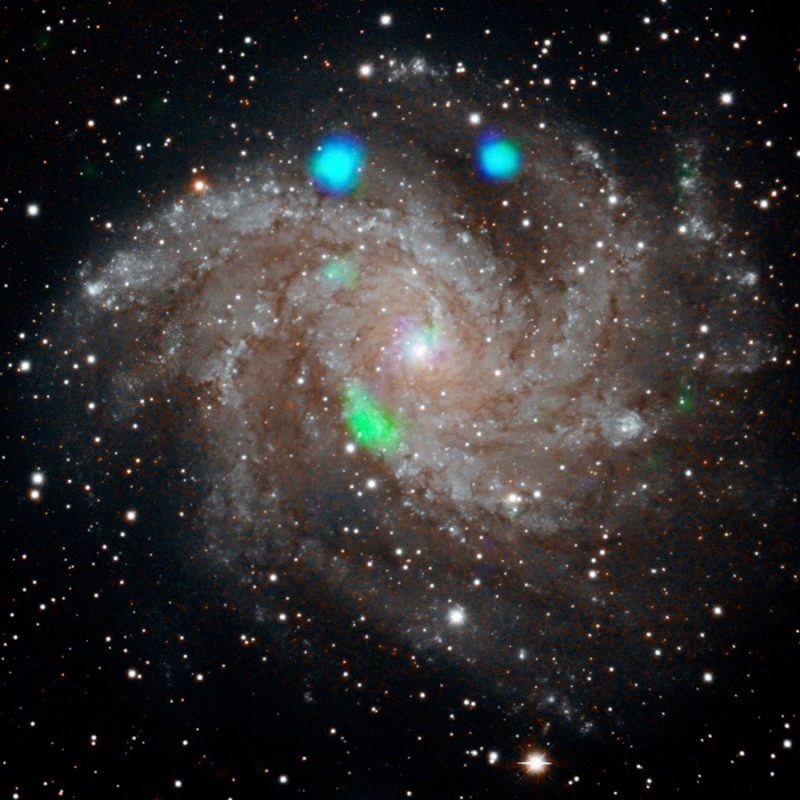
Spiral galaxy with oblong glowing green feature and two prominent blue spots.

This visible-light image of the Fireworks Galaxy (NGC 6946) comes from the Sloan Digital Sky Survey. It’s overlaid with data from NASA’s NuSTAR X-ray telescope (in blue and green). The mystery green blob is toward the middle of the galaxy, apparently coincident with one of its spiral arms. Image via NASA/JPL-Caltech.

The universe is full of mysteries, and now there’s a new one for astronomers to puzzle over. A space-based X-ray observatory – NASA’s NuSTAR – saw what astronomers described as a green blob in the galaxy known as NGC 6946, aka the Fireworks Galaxy. The blob appeared within a 10-day period and then disappeared again just as quickly.

A new peer-reviewed paper discussing the intriguing finding was published in The Astronomical Journal on August 9, 2019.

It’s really unusual for a celestial object to appear and then vanish again over such a short time period. The object was given the label ULX-4, as it was the fourth ULX – ultraluminous X-ray source – found in that galaxy.

NuSTAR’s primary mission at the time had been to study a supernova in the galaxy, which appears as a bright blue-green spot in the upper right of the image above. The mystery green blob is closer to the galaxy’s center in the image, apparently coincident with one of its spiral arms.

An intense-looking short-haired woman in a hoodie.

Hannah Penn Earnshaw is a postdoctoral scholar in physics at Caltech. She’s lead author of the new study about the mystery green blob. Image via Caltech.

The mystery object probably isn’t a supernova, however, because it was only detected in X-ray but not visible light images. It had first been seen by NuSTAR, and then later was found to have disappeared by NASA’s Chandra X-ray Observatory.

One of the main questions right now is how the object appeared and disappeared so quickly. According to Hannah Earnshaw, a postdoctoral researcher at Caltech:

Ten days is a really short amount of time for such a bright object to appear. Usually with NuSTAR, we observe more gradual changes over time, and we don’t often observe a source multiple times in quick succession. In this instance, we were fortunate to catch a source changing extremely quickly, which is very exciting.

So if the object isn’t a supernova, then what is it?

Spacecraft: long narrow metal grid with machinery at each end and solar panel wing.

Artist’s concept of the NuSTAR spacecraft. Image via NASA/JPL-Caltech.

One possibility is that it is a black hole. According to that theory, the greenish light came from a black hole that was consuming another object, perhaps a star. We tend to think of black holes as “sucking in” material, but the immense gravity from the black hole could also rip the object apart, with the resulting debris going into orbit around the black hole. That debris can be heated to millions of degrees, emitting X-rays. So even though light can’t escape from inside a black hole, the light emitted by super-heated debris orbiting the black hole can easily be seen.

Usually, ULXs are long-lived, since black holes will feed for a long time on the stars they destroy. But if, say, a small star is destroyed more quickly, then that could explain short-term events like ULX-4.

ULX-4 could also possibly be a neutron star, an extremely dense object that forms when a star explodes, but isn’t massive enough to create a black hole. They can also have disks of debris orbiting them, creating slow-feeding ultraluminous X-ray sources. Material is channeled down to the surface in “columns” by powerful magnetic fields. But material can be blocked by those magnetic fields from reaching the surface if the neutron star is spinning too fast.

Glowing orange and yellow ring around a black central circular area.

One possible explanation for ULX-4 is that it is a black hole. This image is the first black hole ever photographed, in the center of the galaxy M87. Image via Event Horizon Telescope/JPL-Caltech.

The only times you would then see the neutron star as a bright source of X-rays would be at the moment when the magnetic field barrier wavers a bit. This could explain the sudden appearance and disappearance of the light coming from ULX-4. According to Earnshaw:

It would kind of be like trying to jump onto a carousel that’s spinning at thousands of miles per hour. This result is a step towards understanding some of the rarer and more extreme cases in which matter accretes onto black holes or neutron stars.

Further observations will be needed to determine which of these theories – if either of them – is the right one. There may still turn out to be a different explanation altogether. Space is full of weird and mysterious phenomena, and “the case of the appearing and disappearing green blob” is certainly an odd one!

Colorful galaxy mostly pink blue and white spiral arms in medium dense starfield.

Another view of the beautiful Fireworks Galaxy. This one was posted as an Astronomy Picture of the Day on January 1, 2011. Image via Adam Block/Mt. Lemmon SkyCenter/U. Arizona/APOD.

Bottom line: A mysterious “green blob” of light appeared in the Fireworks Galaxy, and then just as quickly disappeared again.

Source: A Broadband Look at the Old and New ULXs of NGC 6946

Via Jet Propulsion Laboratory


from EarthSky https://ift.tt/2O6jAvc
Spiral galaxy with oblong glowing green feature and two prominent blue spots.

This visible-light image of the Fireworks Galaxy (NGC 6946) comes from the Sloan Digital Sky Survey. It’s overlaid with data from NASA’s NuSTAR X-ray telescope (in blue and green). The mystery green blob is toward the middle of the galaxy, apparently coincident with one of its spiral arms. Image via NASA/JPL-Caltech.

The universe is full of mysteries, and now there’s a new one for astronomers to puzzle over. A space-based X-ray observatory – NASA’s NuSTAR – saw what astronomers described as a green blob in the galaxy known as NGC 6946, aka the Fireworks Galaxy. The blob appeared within a 10-day period and then disappeared again just as quickly.

A new peer-reviewed paper discussing the intriguing finding was published in The Astronomical Journal on August 9, 2019.

It’s really unusual for a celestial object to appear and then vanish again over such a short time period. The object was given the label ULX-4, as it was the fourth ULX – ultraluminous X-ray source – found in that galaxy.

NuSTAR’s primary mission at the time had been to study a supernova in the galaxy, which appears as a bright blue-green spot in the upper right of the image above. The mystery green blob is closer to the galaxy’s center in the image, apparently coincident with one of its spiral arms.

An intense-looking short-haired woman in a hoodie.

Hannah Penn Earnshaw is a postdoctoral scholar in physics at Caltech. She’s lead author of the new study about the mystery green blob. Image via Caltech.

The mystery object probably isn’t a supernova, however, because it was only detected in X-ray but not visible light images. It had first been seen by NuSTAR, and then later was found to have disappeared by NASA’s Chandra X-ray Observatory.

One of the main questions right now is how the object appeared and disappeared so quickly. According to Hannah Earnshaw, a postdoctoral researcher at Caltech:

Ten days is a really short amount of time for such a bright object to appear. Usually with NuSTAR, we observe more gradual changes over time, and we don’t often observe a source multiple times in quick succession. In this instance, we were fortunate to catch a source changing extremely quickly, which is very exciting.

So if the object isn’t a supernova, then what is it?

Spacecraft: long narrow metal grid with machinery at each end and solar panel wing.

Artist’s concept of the NuSTAR spacecraft. Image via NASA/JPL-Caltech.

One possibility is that it is a black hole. According to that theory, the greenish light came from a black hole that was consuming another object, perhaps a star. We tend to think of black holes as “sucking in” material, but the immense gravity from the black hole could also rip the object apart, with the resulting debris going into orbit around the black hole. That debris can be heated to millions of degrees, emitting X-rays. So even though light can’t escape from inside a black hole, the light emitted by super-heated debris orbiting the black hole can easily be seen.

Usually, ULXs are long-lived, since black holes will feed for a long time on the stars they destroy. But if, say, a small star is destroyed more quickly, then that could explain short-term events like ULX-4.

ULX-4 could also possibly be a neutron star, an extremely dense object that forms when a star explodes, but isn’t massive enough to create a black hole. They can also have disks of debris orbiting them, creating slow-feeding ultraluminous X-ray sources. Material is channeled down to the surface in “columns” by powerful magnetic fields. But material can be blocked by those magnetic fields from reaching the surface if the neutron star is spinning too fast.

Glowing orange and yellow ring around a black central circular area.

One possible explanation for ULX-4 is that it is a black hole. This image is the first black hole ever photographed, in the center of the galaxy M87. Image via Event Horizon Telescope/JPL-Caltech.

The only times you would then see the neutron star as a bright source of X-rays would be at the moment when the magnetic field barrier wavers a bit. This could explain the sudden appearance and disappearance of the light coming from ULX-4. According to Earnshaw:

It would kind of be like trying to jump onto a carousel that’s spinning at thousands of miles per hour. This result is a step towards understanding some of the rarer and more extreme cases in which matter accretes onto black holes or neutron stars.

Further observations will be needed to determine which of these theories – if either of them – is the right one. There may still turn out to be a different explanation altogether. Space is full of weird and mysterious phenomena, and “the case of the appearing and disappearing green blob” is certainly an odd one!

Colorful galaxy mostly pink blue and white spiral arms in medium dense starfield.

Another view of the beautiful Fireworks Galaxy. This one was posted as an Astronomy Picture of the Day on January 1, 2011. Image via Adam Block/Mt. Lemmon SkyCenter/U. Arizona/APOD.

Bottom line: A mysterious “green blob” of light appeared in the Fireworks Galaxy, and then just as quickly disappeared again.

Source: A Broadband Look at the Old and New ULXs of NGC 6946

Via Jet Propulsion Laboratory


from EarthSky https://ift.tt/2O6jAvc

'Trollbots' Swarm Twitter with Attacks on Climate Science Ahead of UN Summit

This is a re-post from Inside Climate News by Marianne Lavelle

CNN's seven-hour climate change town hall for presidential candidates was not a TV ratings bonanza, but it set off a marked surge of activity on Twitter aimed at ridiculing the Democrats and dismissing the science.

"Climate change" became the top two-word trending topic on Twitter for several hours after the event among the accounts being tracked by Bot Sentinel, a free platform designed to track what it considers untrustworthy or automated accounts. It was quite an unusual feat for the topic to beat out—even temporarily—the phrase that sits almost constantly atop the trending list for accounts on Bot Sentinel's watchlist: "President Trump."

Scientists, activists and politicians who are engaged in climate policy say they are being besieged by a surge of online attacks. It is difficult to divine whether the bursts of "climate change"-related Twitter activity are spontaneous or part of coordinated campaigns; some experts say that likely a small number of influencers are touching off postings by a far larger number of followers. But in a post-2016 world that is keenly aware of the role that social media played in the election of Donald Trump, the targets of climate attacks are concerned about the potential for online onslaughts to manipulate opinion and neutralize growing public support for climate action.

"I believe this is a concerted effort, likely by bad state actors and fossil fuel interests, to create disinformation, discord and division as we approach the all-important UN Summit and children's youth event later this month," said climate scientist Michael Mann of Pennsylvania State University, a frequent target of attacks.

Twitter did not immediately respond to a request for comment on the activity.

Tracking 'Trollbot' Attacks

Bot Sentinel has become a tool for those trying to fight the spread of disinformation on Twitter. The platform uses an algorithm to identify accounts it labels as "trollbots"—those that frequently retweet known propaganda accounts, exhibit repetitive behavior or violate Twitter's terms of service by harassing other users. Following CNN's climate forum on Sept. 4, there was an unusually high 700 mentions of climate change in a 24-hour period from the 100,000-some accounts Bot Sentinel is tracking as trollbots.

When a topic like "climate change" trends among the trollbots, it is likely there is some amount of coordination involved, said software developer Christopher Bouzy, founder of the year-old Bot Sentinel platform.

"What we are noticing is these phrases are more than likely being pushed by accounts that have an agenda," Bouzy said.

"It's fascinating to see this stuff happen in real time," he said. "Sometimes we can see literally five or 10 accounts able to manipulate a hashtag because they have so many people following them. It doesn't take that many accounts to get something going."

Bot Sentinel's Sept. 5 report for two-word key phrases. Credit: Bot Sentinel

Following the CNN climate forum, for example, many accounts began sharing video clip montages of the event edited together by Trump's re-election campaign and by the far-right web outlet the Gateway Pundit to portray the candidates in the worst possible light.  

"Democrat #Socialists want to ban: - everything made from plastic - red meat - nuclear power...I don't think even Venezuelans have ever been this brainwashed!" commented @Condor_Law, an account rated "alarming" by Bot Sentinel—84 percent of its posts exhibit patterns that match the activity of trollbots (spreading information from sites known to be unreliable or violating Twitters terms of service and doing so repetitively.) "The Dems position is ban straws, portion our meat, take our guns, take our cars, abort on a massive scale for population control, and all so we can die from climate change in 11 years!!" another accounted rated "alarming," @JenniferKrist28, chimed in.

Mann, the climate scientist, found himself on the receiving end of some of this activity after he posted a Tweet thanking CNN for a "full evening of informed, detailed climate change conversation." "Climate change is a hoax," replied @fdnymt, another account identified as exhibiting trollbot behavior by Bot Sentinel.

Swedish teen climate activist Greta Thunberg, who traveled to the United States for the UN Summit, has been a frequent target of toxic online attacks. Soon after Thunberg started her two-week sailboat voyage across the Atlantic, British political donor and co-founder of the Leave.EU campaign Arron Banks tweeted, "freak yachting accidents do happen in August." Following the lead of figures like Banks, lesser-known Twitter handles have piled on.

Thunberg has brushed off the attacks: "When haters go after your looks and differences, it means they have nowhere left to go," she tweeted. "I have Aspergers and that means I'm sometimes a bit different from the norm. And - given the right circumstances- being different is a superpower."  U.S. climate change denier Steve Milloy, who served on Trump's transition team, responded to the teenager on Twitter, "I don't know about you... but I am not going communist because Greta the Climate Puppet believes she has 'superpowers.'"

In Canada, Politicians and an Election Targeted

Government policies on climate change also appear to be triggering toxic online activity. Early this week, Canada Environment Minister Catherine McKenna, who is implementing that nation's carbon tax policy, said that she has been assigned an additional security detail because of abuse she has received both online and in person.

And last week, a Canadian government agency issued a report concluding there was evidence of a campaign of coordinated, false social media postings around last April's election for premier of Alberta—a campaign in which climate policy was a key issue. The majority of the questionable postings were in support of the eventual winner, conservative Jason Kenney, who won the election while pledging to repeal the province's carbon tax, which he did in May, and to create a "war room" to combat the oil industry's opponents.

The government agency, Rapid Response Mechanism Canada, was created as part of the G7 nation's effort to respond to foreign influence in democratic elections. RRM Canada said there was no evidence of foreign actors involved in the questionable social media activity around the Alberta election. But, the agency said, "some national actors were disseminating material using tactics that were similar to those used by foreign actors."

Gerald Kutney, an Ottawa-based consultant and author of a 2014 book on climate politics, said it has become difficult to discern what is genuine discussion and what is coordinated attack messaging on Twitter around climate change.

"It's no longer social media, it's bot media," he said. "It's difficult to know the difference."

Twitter Deactivated a Way to Block 'Trollbots'

Kutney endured so many online attacks after he got into a debate on climate change last fall with the Dilbert cartoon creator and prominent Trump supporter Scott Adams that he found a way to call for online help. He launched a hashtag, #climatebrawl, to signal when someone is under attack by climate deniers on Twitter. That hashtag, too, has often been swarmed by climate deniers; he doesn't know if these are human-controlled or automated accounts.

Bouzy said he got the idea for Bot Sentinel after seeing the impact of social media on the 2016 election in the United States. It is designed to identify coordinated online messaging campaigns regardless of politics; Bouzy said the algorithm is indifferent to whether accounts lean left or right.

At one point, Bouzy said Bot Sentinel had a feature that allowed users to block trollbots from their Twitter feeds, but he said Twitter deactivated the import tool without warning, rendering the feature unusable.

Bot Sentinel still gives Twitter users a way to analyze the behavior of individual accounts and see which topics are sparking trollbot activity.

"There are coordinated campaigns being run every single day. It's pretty much open season on these platforms," Bouzy said. "We're just trying to give people a heads-up that this is happening—this is a narrative that's being pushed right now. You may want to be careful."


from Skeptical Science https://ift.tt/2LTAjz3

This is a re-post from Inside Climate News by Marianne Lavelle

CNN's seven-hour climate change town hall for presidential candidates was not a TV ratings bonanza, but it set off a marked surge of activity on Twitter aimed at ridiculing the Democrats and dismissing the science.

"Climate change" became the top two-word trending topic on Twitter for several hours after the event among the accounts being tracked by Bot Sentinel, a free platform designed to track what it considers untrustworthy or automated accounts. It was quite an unusual feat for the topic to beat out—even temporarily—the phrase that sits almost constantly atop the trending list for accounts on Bot Sentinel's watchlist: "President Trump."

Scientists, activists and politicians who are engaged in climate policy say they are being besieged by a surge of online attacks. It is difficult to divine whether the bursts of "climate change"-related Twitter activity are spontaneous or part of coordinated campaigns; some experts say that likely a small number of influencers are touching off postings by a far larger number of followers. But in a post-2016 world that is keenly aware of the role that social media played in the election of Donald Trump, the targets of climate attacks are concerned about the potential for online onslaughts to manipulate opinion and neutralize growing public support for climate action.

"I believe this is a concerted effort, likely by bad state actors and fossil fuel interests, to create disinformation, discord and division as we approach the all-important UN Summit and children's youth event later this month," said climate scientist Michael Mann of Pennsylvania State University, a frequent target of attacks.

Twitter did not immediately respond to a request for comment on the activity.

Tracking 'Trollbot' Attacks

Bot Sentinel has become a tool for those trying to fight the spread of disinformation on Twitter. The platform uses an algorithm to identify accounts it labels as "trollbots"—those that frequently retweet known propaganda accounts, exhibit repetitive behavior or violate Twitter's terms of service by harassing other users. Following CNN's climate forum on Sept. 4, there was an unusually high 700 mentions of climate change in a 24-hour period from the 100,000-some accounts Bot Sentinel is tracking as trollbots.

When a topic like "climate change" trends among the trollbots, it is likely there is some amount of coordination involved, said software developer Christopher Bouzy, founder of the year-old Bot Sentinel platform.

"What we are noticing is these phrases are more than likely being pushed by accounts that have an agenda," Bouzy said.

"It's fascinating to see this stuff happen in real time," he said. "Sometimes we can see literally five or 10 accounts able to manipulate a hashtag because they have so many people following them. It doesn't take that many accounts to get something going."

Bot Sentinel's Sept. 5 report for two-word key phrases. Credit: Bot Sentinel

Following the CNN climate forum, for example, many accounts began sharing video clip montages of the event edited together by Trump's re-election campaign and by the far-right web outlet the Gateway Pundit to portray the candidates in the worst possible light.  

"Democrat #Socialists want to ban: - everything made from plastic - red meat - nuclear power...I don't think even Venezuelans have ever been this brainwashed!" commented @Condor_Law, an account rated "alarming" by Bot Sentinel—84 percent of its posts exhibit patterns that match the activity of trollbots (spreading information from sites known to be unreliable or violating Twitters terms of service and doing so repetitively.) "The Dems position is ban straws, portion our meat, take our guns, take our cars, abort on a massive scale for population control, and all so we can die from climate change in 11 years!!" another accounted rated "alarming," @JenniferKrist28, chimed in.

Mann, the climate scientist, found himself on the receiving end of some of this activity after he posted a Tweet thanking CNN for a "full evening of informed, detailed climate change conversation." "Climate change is a hoax," replied @fdnymt, another account identified as exhibiting trollbot behavior by Bot Sentinel.

Swedish teen climate activist Greta Thunberg, who traveled to the United States for the UN Summit, has been a frequent target of toxic online attacks. Soon after Thunberg started her two-week sailboat voyage across the Atlantic, British political donor and co-founder of the Leave.EU campaign Arron Banks tweeted, "freak yachting accidents do happen in August." Following the lead of figures like Banks, lesser-known Twitter handles have piled on.

Thunberg has brushed off the attacks: "When haters go after your looks and differences, it means they have nowhere left to go," she tweeted. "I have Aspergers and that means I'm sometimes a bit different from the norm. And - given the right circumstances- being different is a superpower."  U.S. climate change denier Steve Milloy, who served on Trump's transition team, responded to the teenager on Twitter, "I don't know about you... but I am not going communist because Greta the Climate Puppet believes she has 'superpowers.'"

In Canada, Politicians and an Election Targeted

Government policies on climate change also appear to be triggering toxic online activity. Early this week, Canada Environment Minister Catherine McKenna, who is implementing that nation's carbon tax policy, said that she has been assigned an additional security detail because of abuse she has received both online and in person.

And last week, a Canadian government agency issued a report concluding there was evidence of a campaign of coordinated, false social media postings around last April's election for premier of Alberta—a campaign in which climate policy was a key issue. The majority of the questionable postings were in support of the eventual winner, conservative Jason Kenney, who won the election while pledging to repeal the province's carbon tax, which he did in May, and to create a "war room" to combat the oil industry's opponents.

The government agency, Rapid Response Mechanism Canada, was created as part of the G7 nation's effort to respond to foreign influence in democratic elections. RRM Canada said there was no evidence of foreign actors involved in the questionable social media activity around the Alberta election. But, the agency said, "some national actors were disseminating material using tactics that were similar to those used by foreign actors."

Gerald Kutney, an Ottawa-based consultant and author of a 2014 book on climate politics, said it has become difficult to discern what is genuine discussion and what is coordinated attack messaging on Twitter around climate change.

"It's no longer social media, it's bot media," he said. "It's difficult to know the difference."

Twitter Deactivated a Way to Block 'Trollbots'

Kutney endured so many online attacks after he got into a debate on climate change last fall with the Dilbert cartoon creator and prominent Trump supporter Scott Adams that he found a way to call for online help. He launched a hashtag, #climatebrawl, to signal when someone is under attack by climate deniers on Twitter. That hashtag, too, has often been swarmed by climate deniers; he doesn't know if these are human-controlled or automated accounts.

Bouzy said he got the idea for Bot Sentinel after seeing the impact of social media on the 2016 election in the United States. It is designed to identify coordinated online messaging campaigns regardless of politics; Bouzy said the algorithm is indifferent to whether accounts lean left or right.

At one point, Bouzy said Bot Sentinel had a feature that allowed users to block trollbots from their Twitter feeds, but he said Twitter deactivated the import tool without warning, rendering the feature unusable.

Bot Sentinel still gives Twitter users a way to analyze the behavior of individual accounts and see which topics are sparking trollbot activity.

"There are coordinated campaigns being run every single day. It's pretty much open season on these platforms," Bouzy said. "We're just trying to give people a heads-up that this is happening—this is a narrative that's being pushed right now. You may want to be careful."


from Skeptical Science https://ift.tt/2LTAjz3

Why carbon dioxide has such outsized influence on Earth’s climate

Cylindrical spacecraft with two wide solar panel wings in space above Earth.

The Orbiting Carbon Observatory satellite makes precise measurements of Earth’s carbon dioxide levels from space. Image via NASA/JPL

By Jason West, University of North Carolina at Chapel Hill

I am often asked how carbon dioxide can have an important effect on global climate when its concentration is so small – just 0.041% of Earth’s atmosphere. And human activities are responsible for just 32% of that amount.

I study the importance of atmospheric gases for air pollution and climate change. The key to carbon dioxide’s strong influence on climate is its ability to absorb heat emitted from our planet’s surface, keeping it from escaping out to space.

Graph of years from 1960 to 2015 with sawtooth line steadily ascending left to right.

The ‘Keeling Curve,’ named for scientist Charles David Keeling, tracks the accumulation of carbon dioxide in Earth’s atmosphere, measured in parts per million. Image via Scripps Institution of Oceanography.

Early greenhouse science

The scientists who first identified carbon dioxide’s importance for climate in the 1850s were also surprised by its influence. Working separately, John Tyndall in England and Eunice Foote in the United States found that carbon dioxide, water vapor and methane all absorbed heat, while more abundant gases did not.

Scientists had already calculated that the Earth was about 59 degrees Fahrenheit (33 degrees Celsius) warmer than it should be, given the amount of sunlight reaching its surface. The best explanation for that discrepancy was that the atmosphere retained heat to warm the planet.

Tyndall and Foote showed that nitrogen and oxygen, which together account for 99% of the atmosphere, had essentially no influence on Earth’s temperature because they did not absorb heat. Rather, they found that gases present in much smaller concentrations were entirely responsible for maintaining temperatures that made the Earth habitable, by trapping heat to create a natural greenhouse effect.

A blanket in the atmosphere

Earth constantly receives energy from the sun and radiates it back into space. For the planet’s temperature to remain constant, the net heat it receives from the sun must be balanced by outgoing heat that it gives off.

Since the sun is hot, it gives off energy in the form of shortwave radiation at mainly ultraviolet and visible wavelengths. Earth is much cooler, so it emits heat as infrared radiation, which has longer wavelengths.

Diagram of light spectrum from gamma rays through visible light to radio waves.

The electromagnetic spectrum is the range of all types of EM radiation – energy that travels and spreads out as it goes. The sun is much hotter than the Earth, so it emits radiation at a higher energy level, which has a shorter wavelength. Image via NASA.

Carbon dioxide and other heat-trapping gases have molecular structures that enable them to absorb infrared radiation. The bonds between atoms in a molecule can vibrate in particular ways, like the pitch of a piano string. When the energy of a photon corresponds to the frequency of the molecule, it is absorbed and its energy transfers to the molecule.

Carbon dioxide and other heat-trapping gases have three or more atoms and frequencies that correspond to infrared radiation emitted by Earth. Oxygen and nitrogen, with just two atoms in their molecules, do not absorb infrared radiation.

Most incoming shortwave radiation from the sun passes through the atmosphere without being absorbed. But most outgoing infrared radiation is absorbed by heat-trapping gases in the atmosphere. Then they can release, or re-radiate, that heat. Some returns to Earth’s surface, keeping it warmer than it would be otherwise.

Diagram with yellow lines of incoming sunlight and red lines of heat rising from surface.

Earth receives solar energy from the sun (yellow), and returns energy back to space by reflecting some incoming light and radiating heat (red). Greenhouse gases trap some of that heat and return it to the planet’s surface. Image via NASA/Wikimedia.

Research on heat transmission

During the Cold War, the absorption of infrared radiation by many different gases was studied extensively. The work was led by the U.S. Air Force, which was developing heat-seeking missiles and needed to understand how to detect heat passing through air.

This research enabled scientists to understand the climate and atmospheric composition of all planets in the solar system by observing their infrared signatures. For example, Venus is about 870 F (470 C) because its thick atmosphere is 96.5% carbon dioxide.

It also informed weather forecast and climate models, allowing them to quantify how much infrared radiation is retained in the atmosphere and returned to Earth’s surface.

People sometimes ask me why carbon dioxide is important for climate, given that water vapor absorbs more infrared radiation and the two gases absorb at several of the same wavelengths. The reason is that Earth’s upper atmosphere controls the radiation that escapes to space. The upper atmosphere is much less dense and contains much less water vapor than near the ground, which means that adding more carbon dioxide significantly influences how much infrared radiation escapes to space.

Observing the greenhouse effect

Have you ever noticed that deserts are often colder at night than forests, even if their average temperatures are the same? Without much water vapor in the atmosphere over deserts, the radiation they give off escapes readily to space. In more humid regions radiation from the surface is trapped by water vapor in the air. Similarly, cloudy nights tend to be warmer than clear nights because more water vapor is present.

The influence of carbon dioxide can be seen in past changes in climate. Ice cores from over the past million years have shown that carbon dioxide concentrations were high during warm periods – about 0.028%. During ice ages, when the Earth was roughly 7 to 13 F (4-7 C) cooler than in the 20th century, carbon dioxide made up only about 0.018% of the atmosphere.

Even though water vapor is more important for the natural greenhouse effect, changes in carbon dioxide have driven past temperature changes. In contrast, water vapor levels in the atmosphere respond to temperature. As Earth becomes warmer, its atmosphere can hold more water vapor, which amplifies the initial warming in a process called the “water vapor feedback.” Variations in carbon dioxide have therefore been the controlling influence on past climate changes.

Small change, big effects

It shouldn’t be surprising that a small amount of carbon dioxide in the atmosphere can have a big effect. We take pills that are a tiny fraction of our body mass and expect them to affect us.

Today the level of carbon dioxide is higher than at any time in human history. Scientists widely agree that Earth’s average surface temperature has already increased by about 2 F (1 C) since the 1880s, and that human-caused increases in carbon dioxide and other heat-trapping gases are extremely likely to be responsible.

Without action to control emissions, carbon dioxide might reach 0.1% of the atmosphere by 2100, more than triple the level before the Industrial Revolution. This would be a faster change than transitions in Earth’s past that had huge consequences. Without action, this little sliver of the atmosphere will cause big problems.

Jason West, Professor of Environmental Sciences and Engineering, University of North Carolina at Chapel Hill

This article is republished from The Conversation under a Creative Commons license. Read the original article.

Bottom line: An environmental scientist explains why carbon dioxide – CO2 – has such a big effect on Earth’s atmosphere and the greenhouse effect.

The Conversation


from EarthSky https://ift.tt/2NinRvO
Cylindrical spacecraft with two wide solar panel wings in space above Earth.

The Orbiting Carbon Observatory satellite makes precise measurements of Earth’s carbon dioxide levels from space. Image via NASA/JPL

By Jason West, University of North Carolina at Chapel Hill

I am often asked how carbon dioxide can have an important effect on global climate when its concentration is so small – just 0.041% of Earth’s atmosphere. And human activities are responsible for just 32% of that amount.

I study the importance of atmospheric gases for air pollution and climate change. The key to carbon dioxide’s strong influence on climate is its ability to absorb heat emitted from our planet’s surface, keeping it from escaping out to space.

Graph of years from 1960 to 2015 with sawtooth line steadily ascending left to right.

The ‘Keeling Curve,’ named for scientist Charles David Keeling, tracks the accumulation of carbon dioxide in Earth’s atmosphere, measured in parts per million. Image via Scripps Institution of Oceanography.

Early greenhouse science

The scientists who first identified carbon dioxide’s importance for climate in the 1850s were also surprised by its influence. Working separately, John Tyndall in England and Eunice Foote in the United States found that carbon dioxide, water vapor and methane all absorbed heat, while more abundant gases did not.

Scientists had already calculated that the Earth was about 59 degrees Fahrenheit (33 degrees Celsius) warmer than it should be, given the amount of sunlight reaching its surface. The best explanation for that discrepancy was that the atmosphere retained heat to warm the planet.

Tyndall and Foote showed that nitrogen and oxygen, which together account for 99% of the atmosphere, had essentially no influence on Earth’s temperature because they did not absorb heat. Rather, they found that gases present in much smaller concentrations were entirely responsible for maintaining temperatures that made the Earth habitable, by trapping heat to create a natural greenhouse effect.

A blanket in the atmosphere

Earth constantly receives energy from the sun and radiates it back into space. For the planet’s temperature to remain constant, the net heat it receives from the sun must be balanced by outgoing heat that it gives off.

Since the sun is hot, it gives off energy in the form of shortwave radiation at mainly ultraviolet and visible wavelengths. Earth is much cooler, so it emits heat as infrared radiation, which has longer wavelengths.

Diagram of light spectrum from gamma rays through visible light to radio waves.

The electromagnetic spectrum is the range of all types of EM radiation – energy that travels and spreads out as it goes. The sun is much hotter than the Earth, so it emits radiation at a higher energy level, which has a shorter wavelength. Image via NASA.

Carbon dioxide and other heat-trapping gases have molecular structures that enable them to absorb infrared radiation. The bonds between atoms in a molecule can vibrate in particular ways, like the pitch of a piano string. When the energy of a photon corresponds to the frequency of the molecule, it is absorbed and its energy transfers to the molecule.

Carbon dioxide and other heat-trapping gases have three or more atoms and frequencies that correspond to infrared radiation emitted by Earth. Oxygen and nitrogen, with just two atoms in their molecules, do not absorb infrared radiation.

Most incoming shortwave radiation from the sun passes through the atmosphere without being absorbed. But most outgoing infrared radiation is absorbed by heat-trapping gases in the atmosphere. Then they can release, or re-radiate, that heat. Some returns to Earth’s surface, keeping it warmer than it would be otherwise.

Diagram with yellow lines of incoming sunlight and red lines of heat rising from surface.

Earth receives solar energy from the sun (yellow), and returns energy back to space by reflecting some incoming light and radiating heat (red). Greenhouse gases trap some of that heat and return it to the planet’s surface. Image via NASA/Wikimedia.

Research on heat transmission

During the Cold War, the absorption of infrared radiation by many different gases was studied extensively. The work was led by the U.S. Air Force, which was developing heat-seeking missiles and needed to understand how to detect heat passing through air.

This research enabled scientists to understand the climate and atmospheric composition of all planets in the solar system by observing their infrared signatures. For example, Venus is about 870 F (470 C) because its thick atmosphere is 96.5% carbon dioxide.

It also informed weather forecast and climate models, allowing them to quantify how much infrared radiation is retained in the atmosphere and returned to Earth’s surface.

People sometimes ask me why carbon dioxide is important for climate, given that water vapor absorbs more infrared radiation and the two gases absorb at several of the same wavelengths. The reason is that Earth’s upper atmosphere controls the radiation that escapes to space. The upper atmosphere is much less dense and contains much less water vapor than near the ground, which means that adding more carbon dioxide significantly influences how much infrared radiation escapes to space.

Observing the greenhouse effect

Have you ever noticed that deserts are often colder at night than forests, even if their average temperatures are the same? Without much water vapor in the atmosphere over deserts, the radiation they give off escapes readily to space. In more humid regions radiation from the surface is trapped by water vapor in the air. Similarly, cloudy nights tend to be warmer than clear nights because more water vapor is present.

The influence of carbon dioxide can be seen in past changes in climate. Ice cores from over the past million years have shown that carbon dioxide concentrations were high during warm periods – about 0.028%. During ice ages, when the Earth was roughly 7 to 13 F (4-7 C) cooler than in the 20th century, carbon dioxide made up only about 0.018% of the atmosphere.

Even though water vapor is more important for the natural greenhouse effect, changes in carbon dioxide have driven past temperature changes. In contrast, water vapor levels in the atmosphere respond to temperature. As Earth becomes warmer, its atmosphere can hold more water vapor, which amplifies the initial warming in a process called the “water vapor feedback.” Variations in carbon dioxide have therefore been the controlling influence on past climate changes.

Small change, big effects

It shouldn’t be surprising that a small amount of carbon dioxide in the atmosphere can have a big effect. We take pills that are a tiny fraction of our body mass and expect them to affect us.

Today the level of carbon dioxide is higher than at any time in human history. Scientists widely agree that Earth’s average surface temperature has already increased by about 2 F (1 C) since the 1880s, and that human-caused increases in carbon dioxide and other heat-trapping gases are extremely likely to be responsible.

Without action to control emissions, carbon dioxide might reach 0.1% of the atmosphere by 2100, more than triple the level before the Industrial Revolution. This would be a faster change than transitions in Earth’s past that had huge consequences. Without action, this little sliver of the atmosphere will cause big problems.

Jason West, Professor of Environmental Sciences and Engineering, University of North Carolina at Chapel Hill

This article is republished from The Conversation under a Creative Commons license. Read the original article.

Bottom line: An environmental scientist explains why carbon dioxide – CO2 – has such a big effect on Earth’s atmosphere and the greenhouse effect.

The Conversation


from EarthSky https://ift.tt/2NinRvO

All you need to know: September equinox

Glowing yellow sun on horizon lined up with crystal ball on a table.

First sunrise of fall from central North Carolina – September 22, 2018 – via our friend Lee Capps.

The September equinox will arrive on September 23, 2019 at 07:50 UTC. Although the equinox happens at the same moment worldwide, your clock time will depend on your time zone. For time zones in the continental U.S., this equinox comes early in the morning on September 23 (3:50 a.m. EDT, 2:50 a.m. CDT, 1:50 a.m. MDT and 12:50 a.m. PDT). Translate UTC to your time zone.

At the equinox, days and nights will be approximately equal in length. For us in the Northern Hemisphere, the sun is rising later now, and nightfall comes sooner. We’re enjoying the cooler days of almost-autumn.

Meanwhile, south of the equator, spring is about to begin.

Earth perfectly upright with vertical axis, laft half sunlit, right half in shadow.

Around the time of an equinox, Earth’s Northern and Southern Hemispheres are receiving the sun’s rays as equally as they can. Image via Wikipedia.

What is an equinox? The earliest humans spent more time outside than we do. They used the sky as both a clock and a calendar. They could easily see that the sun’s path across the sky, the length of daylight, and the location of the sunrise and sunset all shift in a regular way throughout the year.

Our ancestors built the first observatories to track the sun’s progress. One example is at Machu Picchu in Peru, where the Intihuatana stone, shown below, has been shown to be a precise indicator of the date of the two equinoxes and other significant celestial periods. The word Intihuatana, by the way, literally means for tying the sun.

Stacked slabs of rock with one vertical rock sticking up from the center.

The Intihuatana stone – also called the Hitching Post of the Sun – at Machu Picchu in Peru. It was used to track the sun throughout the year. Photo via Imagesofanthropology.com.

Today, we know each equinox and solstice is an astronomical event, caused by Earth’s tilt on its axis and ceaseless orbit around the sun.

Because Earth doesn’t orbit upright, but is instead tilted on its axis by 23 1/2 degrees, Earth’s Northern and Southern Hemispheres trade places throughout the year in receiving the sun’s light and warmth most directly.

We have an equinox twice a year – spring and fall – when the tilt of the Earth’s axis and Earth’s orbit around the sun combine in such a way that the axis is inclined neither away from nor toward the sun.

Earth’s two hemispheres are receiving the sun’s rays about equally around equinox-time. The sun is overhead at noon as seen from the equator. Night and day are approximately equal in length.

The name equinox comes from the Latin aequus (equal) and nox (night).

Of course, Earth never stops moving around the sun. So these days of approximately equal sunlight and night will change quickly.

Symmetrical oak tree starting to turn orange against partly cloudy blue sky.

Autumn in Sweden via EarthSky Facebook friend Jörgen Norrland Andersson.

Where should I look to see signs of the equinox in nature? The knowledge that summer is gone – and winter is coming – is everywhere now, on the northern half of Earth’s globe.

If you live in the Northern Hemisphere, you can easily notice the later dawns and earlier sunsets.

Also notice the arc of the sun across the sky each day. You’ll find it’s shifting toward the south. Birds and butterflies are migrating southward, too, along with the path of the sun.

The shorter days are bringing cooler weather. A chill is in the air. In New York City and other fashionable places, some people have stopped wearing white. Creatures of the wild are putting on their winter coats.

All around us, trees and plants are ending this year’s cycle of growth. Perhaps they are responding with glorious autumn leaves, or a last burst of bloom before winter comes.

In the night sky, Fomalhaut – the Autumn Star – is making its way across the heavens each night.

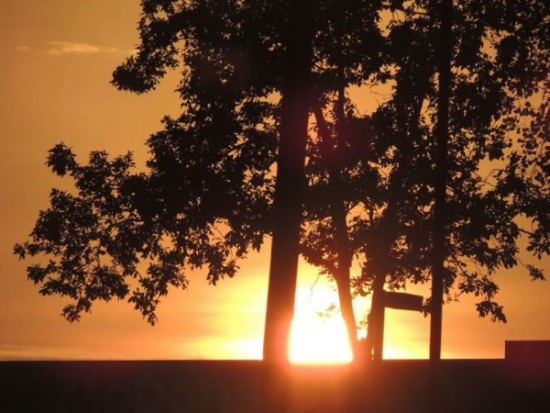
Trees silhouetted against blazing white sun on horizon in orange twilight sky.

A first sunrise of autumn by EarthSky Facebook friend Mary C. Cox in North Carolina.

Does the sun rise due east and set due west at the equinox? Generally speaking, yes, it does. And that’s true no matter where you live on Earth, because we all see the same sky.

Everywhere on Earth, except at the North and South Poles, you have a due east and due west point on your horizon. That point marks the intersection of your horizon with the celestial equator – the imaginary line above the true equator of the Earth.

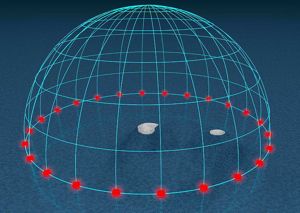
At the equinoxes, the sun appears overhead at noon as seen from Earth’s equator, as the illustration below shows.

Diagram of hemsipherical dome with lines of latitude and longitude.

Illustration of the sun’s location on the celestial equator, every hour, on the day of an equinox, via Tau’olunga/Wikimedia Commons.

That’s why the sun rises due east and sets due west for all of us. The sun is on the celestial equator, and the celestial equator intersects all of our horizons at points due east and due west.

This fact makes the day of an equinox a good day for finding due east and due west from your yard or other favorite site for watching the sky. Just go outside around sunset or sunrise and notice the location of the sun on the horizon with respect to familiar landmarks.

If you do this, you’ll be able to use those landmarks to find those cardinal directions in the weeks and months ahead, long after Earth has moved on in its orbit around the sun, carrying the sunrise and sunset points southward.

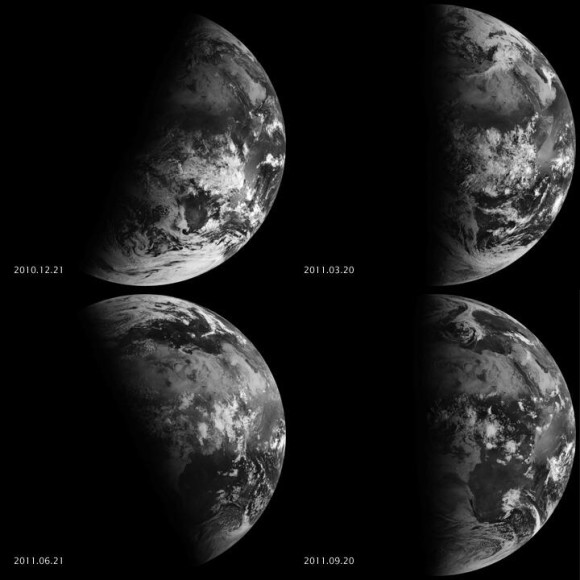
Four pictures of Earth with two on left with slanted axis and two on right with upright axis.

Equinoxes and solstices. In each of the images, Earth’s rotational axis is perpendicular (straight up and down), with the North Pole at top and South Pole at bottom. Earth at the equinoxes shown at right; Earth at solstices shown at left. Images via Geosync.

Bottom line: Enjoy the 2019 equinox – a seasonal signpost in Earth’s orbit around the sun!

Equinox sun rises due east, sets due west

Why aren’t day and night exactly equal on the equinox?

Year’s fastest sunsets at equinox

Sun over Earth’s equator at equinox


from EarthSky https://ift.tt/304qjfE
Glowing yellow sun on horizon lined up with crystal ball on a table.

First sunrise of fall from central North Carolina – September 22, 2018 – via our friend Lee Capps.

The September equinox will arrive on September 23, 2019 at 07:50 UTC. Although the equinox happens at the same moment worldwide, your clock time will depend on your time zone. For time zones in the continental U.S., this equinox comes early in the morning on September 23 (3:50 a.m. EDT, 2:50 a.m. CDT, 1:50 a.m. MDT and 12:50 a.m. PDT). Translate UTC to your time zone.

At the equinox, days and nights will be approximately equal in length. For us in the Northern Hemisphere, the sun is rising later now, and nightfall comes sooner. We’re enjoying the cooler days of almost-autumn.

Meanwhile, south of the equator, spring is about to begin.

Earth perfectly upright with vertical axis, laft half sunlit, right half in shadow.

Around the time of an equinox, Earth’s Northern and Southern Hemispheres are receiving the sun’s rays as equally as they can. Image via Wikipedia.

What is an equinox? The earliest humans spent more time outside than we do. They used the sky as both a clock and a calendar. They could easily see that the sun’s path across the sky, the length of daylight, and the location of the sunrise and sunset all shift in a regular way throughout the year.

Our ancestors built the first observatories to track the sun’s progress. One example is at Machu Picchu in Peru, where the Intihuatana stone, shown below, has been shown to be a precise indicator of the date of the two equinoxes and other significant celestial periods. The word Intihuatana, by the way, literally means for tying the sun.

Stacked slabs of rock with one vertical rock sticking up from the center.

The Intihuatana stone – also called the Hitching Post of the Sun – at Machu Picchu in Peru. It was used to track the sun throughout the year. Photo via Imagesofanthropology.com.

Today, we know each equinox and solstice is an astronomical event, caused by Earth’s tilt on its axis and ceaseless orbit around the sun.

Because Earth doesn’t orbit upright, but is instead tilted on its axis by 23 1/2 degrees, Earth’s Northern and Southern Hemispheres trade places throughout the year in receiving the sun’s light and warmth most directly.

We have an equinox twice a year – spring and fall – when the tilt of the Earth’s axis and Earth’s orbit around the sun combine in such a way that the axis is inclined neither away from nor toward the sun.

Earth’s two hemispheres are receiving the sun’s rays about equally around equinox-time. The sun is overhead at noon as seen from the equator. Night and day are approximately equal in length.

The name equinox comes from the Latin aequus (equal) and nox (night).

Of course, Earth never stops moving around the sun. So these days of approximately equal sunlight and night will change quickly.

Symmetrical oak tree starting to turn orange against partly cloudy blue sky.

Autumn in Sweden via EarthSky Facebook friend Jörgen Norrland Andersson.

Where should I look to see signs of the equinox in nature? The knowledge that summer is gone – and winter is coming – is everywhere now, on the northern half of Earth’s globe.

If you live in the Northern Hemisphere, you can easily notice the later dawns and earlier sunsets.

Also notice the arc of the sun across the sky each day. You’ll find it’s shifting toward the south. Birds and butterflies are migrating southward, too, along with the path of the sun.

The shorter days are bringing cooler weather. A chill is in the air. In New York City and other fashionable places, some people have stopped wearing white. Creatures of the wild are putting on their winter coats.

All around us, trees and plants are ending this year’s cycle of growth. Perhaps they are responding with glorious autumn leaves, or a last burst of bloom before winter comes.

In the night sky, Fomalhaut – the Autumn Star – is making its way across the heavens each night.

Trees silhouetted against blazing white sun on horizon in orange twilight sky.

A first sunrise of autumn by EarthSky Facebook friend Mary C. Cox in North Carolina.

Does the sun rise due east and set due west at the equinox? Generally speaking, yes, it does. And that’s true no matter where you live on Earth, because we all see the same sky.

Everywhere on Earth, except at the North and South Poles, you have a due east and due west point on your horizon. That point marks the intersection of your horizon with the celestial equator – the imaginary line above the true equator of the Earth.

At the equinoxes, the sun appears overhead at noon as seen from Earth’s equator, as the illustration below shows.

Diagram of hemsipherical dome with lines of latitude and longitude.

Illustration of the sun’s location on the celestial equator, every hour, on the day of an equinox, via Tau’olunga/Wikimedia Commons.

That’s why the sun rises due east and sets due west for all of us. The sun is on the celestial equator, and the celestial equator intersects all of our horizons at points due east and due west.

This fact makes the day of an equinox a good day for finding due east and due west from your yard or other favorite site for watching the sky. Just go outside around sunset or sunrise and notice the location of the sun on the horizon with respect to familiar landmarks.

If you do this, you’ll be able to use those landmarks to find those cardinal directions in the weeks and months ahead, long after Earth has moved on in its orbit around the sun, carrying the sunrise and sunset points southward.

Four pictures of Earth with two on left with slanted axis and two on right with upright axis.

Equinoxes and solstices. In each of the images, Earth’s rotational axis is perpendicular (straight up and down), with the North Pole at top and South Pole at bottom. Earth at the equinoxes shown at right; Earth at solstices shown at left. Images via Geosync.

Bottom line: Enjoy the 2019 equinox – a seasonal signpost in Earth’s orbit around the sun!

Equinox sun rises due east, sets due west

Why aren’t day and night exactly equal on the equinox?

Year’s fastest sunsets at equinox

Sun over Earth’s equator at equinox


from EarthSky https://ift.tt/304qjfE

Fomalhaut: The loneliest star

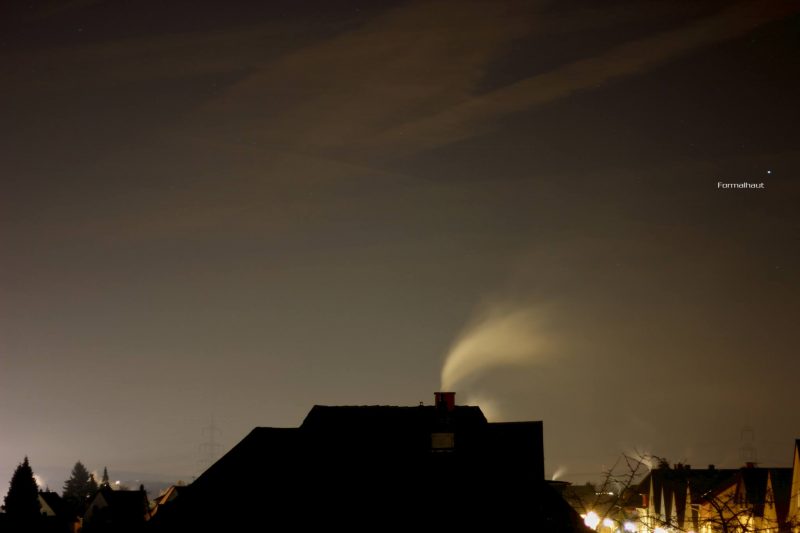
A darkened skyline, with smoke from a chimney blowing sideways and a single star, Fomalhaut, above.

View larger. | Fomalhaut is sometimes called the Loneliest Star because no other bright stars shine near it in the sky. Photo by EarthSky Facebook friend Tony Gieracki. Thank you, Tony!

The star Fomalhaut is sometimes called the Autumn Star by people in the Northern Hemisphere, but it’s a spring star south of the equator. It’s famous in astronomical science as the first star with a visible exoplanet. It appears in a part of the sky that’s largely empty of bright stars. For this reason, in skylore, Fomalhaut is often called the Lonely One or Solitary One. It’s an easy star to spot and one you’ll want to meet.

How to see Fomalhaut. Fomalhaut – the 18th brightest star in the sky – is more or less opposite the sun in early September. And so it shines in the sky all night during the autumn months in the Northern Hemisphere (all night in spring for the Southern Hemisphere). In most years, finding Fomalhaut from latitudes like those in the U.S. is simple. Just face south in mid-evening in autumn and look. Fomalhaut is the brightest star in front of us on autumn evenings, as we face south. It’s typically less than a third of the way up in the sky (higher from far southern Texas or Florida, lower from more northerly locations).

From the Southern Hemisphere. Those at far southern latitudes on Earth see Fomalhaut high in their sky, for more of the year, than we do on the northern part of Earth. For your specific view, try Stellarium online.

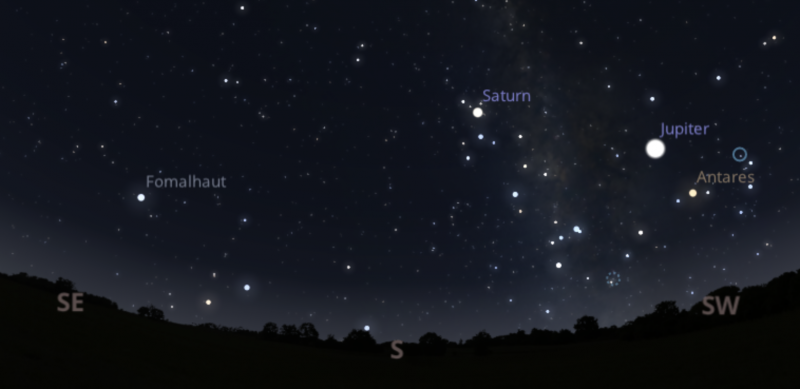
Star chart showing Fomalhaut, Saturn and Jupiter.

For a larger view, and your specific view, see Stellarium online. | This chart shows the view southward around 9 p.m. in mid-September, from the Northern Hemisphere. In 2019, Fomalhaut has company. The 2 bright planets Jupiter and Saturn can be found near it in the sky.

In early September, Fomalhaut reaches its midnight culmination, meaning that it is highest in the sky to the south at local midnight. Finding Fomalhaut at the time it culminates is easiest, but this happens at different times on different dates. Here are just a few times and dates of culmination, but keep in mind that the times are only rough, although they are adjusted for daylight saving time as needed:

July 15, 4 a.m.
August 15, 1 a.m.
September 15, midnight
October 15, 10 p.m.
November 15 , 7 p.m.
December 15, 5 p.m.

Fomalhaut is part of the faint constellation Piscis Austrinus the Southern Fish. It’s part of a round pattern of stars, supposedly the open mouth of the Fish. But don’t expect to see a fish in these stars.

Fomalhaut is probably is the most southerly bright star that many North Americans know. Granted, a few bright stars farther to the south are visible from tropical and subtropic northern latitudes, but these brighter stars lurk near or beneath the horizon as seen as from middle and far northern latitudes in the Northern Hemisphere. Fomalhaut can be seen from as far north as 60 degrees latitude (southern Alaska, central Canada, northern Europe), where it just skims the southern horizon.

Oval constellation of 10 stars with Fomalhaut at one end.

Fomalhaut lies in the constellation Piscis Austrinus the Southern Fish. Its name means Mouth of the Fish in Arabic. This irregular circle of stars – visible in a dark sky – represents the fish’s open mouth.

Constellation chart showing Piscis Austrinus and Fomalhaut.

Another representation of Piscis Austrinus and its bright star Fomalhaut via Torsten Bronger/Wikimedia Commons.

Fomalhaut’s planet, Fomalhaut b or Dagon. The star Fomalhaut, which is known to be surrounded by several debris disks, holds a special place in the search for planets beyond our solar system. In 2008, scientists announced a visible planet for Fomalhaut. It was the first extrasolar planet visible to the eye in photographic images. In 2008, when astronomers made this announcement, we knew other planets were out there, orbiting distant suns. But, prior to the images of Fomalhaut b, all extrasolar planets, or exoplanets, made their presence known indirectly, for example, in some instances, by their gravitational tugging on their stars.

Fomalhaut’s planet was confirmed as real in 2012, from images taken with the Hubble Space Telescope (see the image below).

This planet – Fomalhaut b, recently given the name Dagon by the International Astronomical Union as part of its public process for giving proper names to exoplanets. Dagon was a Semitic deity that was half man and half fish.

The planet has a 1,700-year, highly elliptical orbit around its parent star. It has a periastron – that is, a closest point to its star – of 7.4 billion kilometers or 46 billion miles (~50 time the Earth-sun distance) and an apastron (farthest point from its star) of about 44 billion km or 27 billion miles (~300 the Earth-sun distance). According to Wikipedia – as of May 25, 2013 – Dagon is 110 Earth-sun distances from its parent star.

It should be mentioned that there was controversy surrounding the existence of Dagon for some years. You still sometimes see stories disputing that it exists.

Black circle with white rays and glowing oval ring, inset showing planet positions 2004-2012.

View larger. | This false-color composite image, taken with the Hubble Space Telescope, reveals the orbital motion of the planet Fomalhaut b, aka Dagon. Based on these observations, astronomers calculated that the planet is in a 2,000-year-long, highly elliptical orbit. The planet will appear to cross a vast belt of debris around the star roughly 20 years from now. If the planet’s orbit lies in the same plane with the belt, icy and rocky debris in the belt could crash into the planet’s atmosphere and produce various phenomena. The black circle at the center of the image blocks out the light from the bright star, allowing reflected light from the belt and planet to be photographed. The Hubble images were taken with the Space Telescope Imaging Spectrograph in 2010 and 2012. Image via NASA/ ESA/ P. Kalas.

Fomalhaut in history and mythology. Fomalhaut is Alpha Piscis Austrinus (the brightest star in the Southern Fish), and the name Fomalhaut derives from the Arabic Fum al Hut, meaning Mouth of the Fish. Strangely, another Arabic title for the star means The First Frog.

In the sky visible from the Northern Hemisphere, the constellation Aquarius the Water Carrier resides above Fomalhaut’s constellation Piscis Austrinus. You can see a zig-zag line of stars that goes from Aquarius to Piscis Austrinus. In skylore, this line of stars represents water from the Jar of the Water Carrier, trickling into the open Mouth of the Fish, as shown in the illustration below.

According to Richard Hinckley Allen, Fomalhaut was one of the four guardians of the heavens to the ancient Persians, and given the name of Hastorang. (The other guardians were Aldebaran in Taurus, Antares in Scorpius, and Regulus in Leo.) Allen also says that Fomalhaut was a source of worship at the temple of Demeter at Eleusis in ancient Greece. In about 2500 B.C., Fomalhaut helped mark the location of the winter solstice, meaning that it helped to define the location in the sky where the sun crossed the meridian at noon on the first day of winter.

Antique etching of nearly naked old man with beard holding jug, part of fish below his feet.

Water from the Water Jar of Aquarius can be seen going into the Mouth of the Southern Fish (located just off the bottom of this chart), in this depiction of these constellations from Urania’s Mirror, 1825. In the actual sky – if it’s dark where you are – you can easily see a zig-zag line of stars representing this flow of water. Chart via Wikimedia Commons.

The star Fomalhaut, and a word about the Main Sequence. As determined by an analysis of its light, Fomalhaut is classified as an A3V star. It’s considerably hotter and heavier than our sun. Imagine you could place our sun and Fomalhaut side by side in space – say, at 10 parsecs or 32.6 light-years away. In that case, Fomalhaut would outshine our sun in visible light by nearly 17 times. The “V” in Fomalhaut’s classification is called a luminosity class, and it designates the largest category of all, ordinary stars like our sun in the mature and stable part of their life spans.

These numbers and letters refer to what astronomers call the Main Sequence, a way of categorizing stars by mass and luminosity. The Main Sequence follows the rather odd progression of OBAFGKM. Os are the hottest and most massive stars, and Ms are the coolest and least massive stars. In addition, there is a numerical subdivision running from 0 to 9 with each letter. Our sun is a G2V, as is Alpha Centauri. Since Fomalhaut’s designation is significantly to the left of the sun’s in this sequence, you know it is hotter and more massive than our sun.

Fomalhaut’s actual distance from Earth, as determined by analysis of data from the Hipparcos mission, is 25 light-years. Fomalhaut’s mass and radius are, respectively, a little more than twice and a little less than twice solar values. Being hotter than the sun (about 8500 kelvins/8227 degrees Celsius or nearly 15,000 degrees F, compared to 10,000 degrees F or 5538 C for the sun), this star burns its fuel faster and has a shorter lifetime. In fact, it is estimated that Fomalhaut may have a lifespan of only about a billion years, a tenth of that of our cooler sun. Currently, Fomalhaut is likely less than halfway through its life.

Fomalhaut appears to the eye to be a single star like the sun, but there is another faint star a couple of degrees below (south of) Fomalhaut that is at about the same distance and moving through space in the same manner. This other star was recently found to be a companion to Fomalhaut, despite the fact that the two stars are separated by about a light-year. In 2013, researchers found that Fomalhaut is actually a triple star. It is one of the widest triple stars known. Read more about the third star in the Fomalhaut system.

A white sun surrounded by asteroids, dust, and gas with a ringed planet.

Artist’s concept of what a planet orbiting Fomalhaut might have to endure as it plows through the dusty disk around this star. Image via NASA.

Fomalhaut’s position is RA: 22h 57m 39s, dec: -29° 37′ 19″.

Bottom line: Look for the star Fomalhaut in the constellation Piscis Austrinus the Southern Fish on Northern Hemisphere autumn evenings (Southern Hemisphere spring evenings). Because it’s the only bright star in its region of sky, Fomalhaut is sometimes called the Loneliest Star. This star is famous for its planet – Fomalhaut b, now called Dagon – which was the first visible extrasolar planet.


from EarthSky https://ift.tt/34QpJl1
A darkened skyline, with smoke from a chimney blowing sideways and a single star, Fomalhaut, above.

View larger. | Fomalhaut is sometimes called the Loneliest Star because no other bright stars shine near it in the sky. Photo by EarthSky Facebook friend Tony Gieracki. Thank you, Tony!

The star Fomalhaut is sometimes called the Autumn Star by people in the Northern Hemisphere, but it’s a spring star south of the equator. It’s famous in astronomical science as the first star with a visible exoplanet. It appears in a part of the sky that’s largely empty of bright stars. For this reason, in skylore, Fomalhaut is often called the Lonely One or Solitary One. It’s an easy star to spot and one you’ll want to meet.

How to see Fomalhaut. Fomalhaut – the 18th brightest star in the sky – is more or less opposite the sun in early September. And so it shines in the sky all night during the autumn months in the Northern Hemisphere (all night in spring for the Southern Hemisphere). In most years, finding Fomalhaut from latitudes like those in the U.S. is simple. Just face south in mid-evening in autumn and look. Fomalhaut is the brightest star in front of us on autumn evenings, as we face south. It’s typically less than a third of the way up in the sky (higher from far southern Texas or Florida, lower from more northerly locations).

From the Southern Hemisphere. Those at far southern latitudes on Earth see Fomalhaut high in their sky, for more of the year, than we do on the northern part of Earth. For your specific view, try Stellarium online.

Star chart showing Fomalhaut, Saturn and Jupiter.

For a larger view, and your specific view, see Stellarium online. | This chart shows the view southward around 9 p.m. in mid-September, from the Northern Hemisphere. In 2019, Fomalhaut has company. The 2 bright planets Jupiter and Saturn can be found near it in the sky.

In early September, Fomalhaut reaches its midnight culmination, meaning that it is highest in the sky to the south at local midnight. Finding Fomalhaut at the time it culminates is easiest, but this happens at different times on different dates. Here are just a few times and dates of culmination, but keep in mind that the times are only rough, although they are adjusted for daylight saving time as needed:

July 15, 4 a.m.
August 15, 1 a.m.
September 15, midnight
October 15, 10 p.m.
November 15 , 7 p.m.
December 15, 5 p.m.

Fomalhaut is part of the faint constellation Piscis Austrinus the Southern Fish. It’s part of a round pattern of stars, supposedly the open mouth of the Fish. But don’t expect to see a fish in these stars.

Fomalhaut is probably is the most southerly bright star that many North Americans know. Granted, a few bright stars farther to the south are visible from tropical and subtropic northern latitudes, but these brighter stars lurk near or beneath the horizon as seen as from middle and far northern latitudes in the Northern Hemisphere. Fomalhaut can be seen from as far north as 60 degrees latitude (southern Alaska, central Canada, northern Europe), where it just skims the southern horizon.

Oval constellation of 10 stars with Fomalhaut at one end.

Fomalhaut lies in the constellation Piscis Austrinus the Southern Fish. Its name means Mouth of the Fish in Arabic. This irregular circle of stars – visible in a dark sky – represents the fish’s open mouth.

Constellation chart showing Piscis Austrinus and Fomalhaut.

Another representation of Piscis Austrinus and its bright star Fomalhaut via Torsten Bronger/Wikimedia Commons.

Fomalhaut’s planet, Fomalhaut b or Dagon. The star Fomalhaut, which is known to be surrounded by several debris disks, holds a special place in the search for planets beyond our solar system. In 2008, scientists announced a visible planet for Fomalhaut. It was the first extrasolar planet visible to the eye in photographic images. In 2008, when astronomers made this announcement, we knew other planets were out there, orbiting distant suns. But, prior to the images of Fomalhaut b, all extrasolar planets, or exoplanets, made their presence known indirectly, for example, in some instances, by their gravitational tugging on their stars.

Fomalhaut’s planet was confirmed as real in 2012, from images taken with the Hubble Space Telescope (see the image below).

This planet – Fomalhaut b, recently given the name Dagon by the International Astronomical Union as part of its public process for giving proper names to exoplanets. Dagon was a Semitic deity that was half man and half fish.

The planet has a 1,700-year, highly elliptical orbit around its parent star. It has a periastron – that is, a closest point to its star – of 7.4 billion kilometers or 46 billion miles (~50 time the Earth-sun distance) and an apastron (farthest point from its star) of about 44 billion km or 27 billion miles (~300 the Earth-sun distance). According to Wikipedia – as of May 25, 2013 – Dagon is 110 Earth-sun distances from its parent star.

It should be mentioned that there was controversy surrounding the existence of Dagon for some years. You still sometimes see stories disputing that it exists.

Black circle with white rays and glowing oval ring, inset showing planet positions 2004-2012.

View larger. | This false-color composite image, taken with the Hubble Space Telescope, reveals the orbital motion of the planet Fomalhaut b, aka Dagon. Based on these observations, astronomers calculated that the planet is in a 2,000-year-long, highly elliptical orbit. The planet will appear to cross a vast belt of debris around the star roughly 20 years from now. If the planet’s orbit lies in the same plane with the belt, icy and rocky debris in the belt could crash into the planet’s atmosphere and produce various phenomena. The black circle at the center of the image blocks out the light from the bright star, allowing reflected light from the belt and planet to be photographed. The Hubble images were taken with the Space Telescope Imaging Spectrograph in 2010 and 2012. Image via NASA/ ESA/ P. Kalas.

Fomalhaut in history and mythology. Fomalhaut is Alpha Piscis Austrinus (the brightest star in the Southern Fish), and the name Fomalhaut derives from the Arabic Fum al Hut, meaning Mouth of the Fish. Strangely, another Arabic title for the star means The First Frog.

In the sky visible from the Northern Hemisphere, the constellation Aquarius the Water Carrier resides above Fomalhaut’s constellation Piscis Austrinus. You can see a zig-zag line of stars that goes from Aquarius to Piscis Austrinus. In skylore, this line of stars represents water from the Jar of the Water Carrier, trickling into the open Mouth of the Fish, as shown in the illustration below.

According to Richard Hinckley Allen, Fomalhaut was one of the four guardians of the heavens to the ancient Persians, and given the name of Hastorang. (The other guardians were Aldebaran in Taurus, Antares in Scorpius, and Regulus in Leo.) Allen also says that Fomalhaut was a source of worship at the temple of Demeter at Eleusis in ancient Greece. In about 2500 B.C., Fomalhaut helped mark the location of the winter solstice, meaning that it helped to define the location in the sky where the sun crossed the meridian at noon on the first day of winter.

Antique etching of nearly naked old man with beard holding jug, part of fish below his feet.

Water from the Water Jar of Aquarius can be seen going into the Mouth of the Southern Fish (located just off the bottom of this chart), in this depiction of these constellations from Urania’s Mirror, 1825. In the actual sky – if it’s dark where you are – you can easily see a zig-zag line of stars representing this flow of water. Chart via Wikimedia Commons.

The star Fomalhaut, and a word about the Main Sequence. As determined by an analysis of its light, Fomalhaut is classified as an A3V star. It’s considerably hotter and heavier than our sun. Imagine you could place our sun and Fomalhaut side by side in space – say, at 10 parsecs or 32.6 light-years away. In that case, Fomalhaut would outshine our sun in visible light by nearly 17 times. The “V” in Fomalhaut’s classification is called a luminosity class, and it designates the largest category of all, ordinary stars like our sun in the mature and stable part of their life spans.

These numbers and letters refer to what astronomers call the Main Sequence, a way of categorizing stars by mass and luminosity. The Main Sequence follows the rather odd progression of OBAFGKM. Os are the hottest and most massive stars, and Ms are the coolest and least massive stars. In addition, there is a numerical subdivision running from 0 to 9 with each letter. Our sun is a G2V, as is Alpha Centauri. Since Fomalhaut’s designation is significantly to the left of the sun’s in this sequence, you know it is hotter and more massive than our sun.

Fomalhaut’s actual distance from Earth, as determined by analysis of data from the Hipparcos mission, is 25 light-years. Fomalhaut’s mass and radius are, respectively, a little more than twice and a little less than twice solar values. Being hotter than the sun (about 8500 kelvins/8227 degrees Celsius or nearly 15,000 degrees F, compared to 10,000 degrees F or 5538 C for the sun), this star burns its fuel faster and has a shorter lifetime. In fact, it is estimated that Fomalhaut may have a lifespan of only about a billion years, a tenth of that of our cooler sun. Currently, Fomalhaut is likely less than halfway through its life.

Fomalhaut appears to the eye to be a single star like the sun, but there is another faint star a couple of degrees below (south of) Fomalhaut that is at about the same distance and moving through space in the same manner. This other star was recently found to be a companion to Fomalhaut, despite the fact that the two stars are separated by about a light-year. In 2013, researchers found that Fomalhaut is actually a triple star. It is one of the widest triple stars known. Read more about the third star in the Fomalhaut system.

A white sun surrounded by asteroids, dust, and gas with a ringed planet.

Artist’s concept of what a planet orbiting Fomalhaut might have to endure as it plows through the dusty disk around this star. Image via NASA.

Fomalhaut’s position is RA: 22h 57m 39s, dec: -29° 37′ 19″.

Bottom line: Look for the star Fomalhaut in the constellation Piscis Austrinus the Southern Fish on Northern Hemisphere autumn evenings (Southern Hemisphere spring evenings). Because it’s the only bright star in its region of sky, Fomalhaut is sometimes called the Loneliest Star. This star is famous for its planet – Fomalhaut b, now called Dagon – which was the first visible extrasolar planet.


from EarthSky https://ift.tt/34QpJl1

2019 SkS Weekly Climate Change & Global Warming Digest #37

Story of the Week... Editorial of the Week... Toon of the Week... Coming Soon on SkS... Climate Feedback Reviews... SkS Week in Review... Poster of the Week...

Story of the Week...

'Going to the streets again': what you need to know about Friday's climate strike

Organisers expect a stronger presence from unions, workers and companies as student activists reach out to adults

School Strike for Climate

Australian school students are set to walk out of classrooms again to call for climate action as part of a global strike three days before a UN summit. Photograph: Dan Peled/AAP

Thousands of Australian school students are again preparing to walk out of classrooms across the country to demand action on the climate crisis.

The global mass day of action will take place on Friday 20 September, three days before the United Nations climate summit in New York.

It follows strikes in March this year in which 150,000 people marched in Australia and 1.5 million took part worldwide.

Organisers expect next week’s global strikes will be bigger and, this time there will be a much stronger presence from unions, workers and companies that have signed up to strike in solidarity with the young activists.

Here’s a guide to what’s happening.

'Going to the streets again': what you need to know about Friday's climate strike by Lisa Cox, Environment, Guardian, Sep 14, 2019

Click here to access the entire article as posted on the Guardian website.


Editorial of the Week...

Can we please base our climate change discussions on facts?

Nuclear Power Plant

One flawed assumption about global warming is that nuclear power has to be part of the solution. (Allen J. Schaben / Los Angeles Times)

In the debate about global warming, as last week’s climate change town hall on CNN made clear, policy discussions are often based on false premises. In Thursday’s debate, the Democratic presidential candidates will again discuss climate issues. Here are a few faulty assumptions they should reject.

One oft-repeated canard is that we won’t be able to reach zero net carbon dioxide emissions without re-embracing nuclear power. Several candidates responded to this claim last week by saying they could not support nuclear power because it was too expensive and we haven’t solved the waste disposal problem. Both those things are true, but they leave a crucial point out of the discussion.

If it were really the case that we couldn’t meet our energy needs without nuclear power, then we could certainly suck up the cost (currently about double that of solar, and as much as three times that of wind) and get back to work on waste disposal. But the assertion that we can’t decarbonize the energy system without additional nuclear power is flawed.

Can we please base our climate change discussions on facts?, Opinion by Naomi Oreskes, Los Angeles Times, Sep 12, 2019

Click here to access the entire Op-ed as published on the Los Angeles Times website.


Toon of the Week...

 2019 Toon 37


Coming Soon on SkS...

  • Skeptical Science New Research for Week #36, 2019 (Doug Bostrom)
  • Climate change and food (Yale Climate Connections)
  • Skeptical Science to join the Global Climate Strike (Baerbel)
  • The Consensus Handbook: Download and (German) translation (Baerbel)
  • 2019 SkS Weekly Climate Change & Global Warming News Roundup #38 (John Hartz)
  • 2019 SkS Weekly Climate Change & Global Warming Digest #38 (John Hartz) 

Climate Feedback Reviews...

[To be added.] 


Poster of the Week...

 2019 Poster 37


SkS Week in Review... 


from Skeptical Science https://ift.tt/305YzrW

Story of the Week... Editorial of the Week... Toon of the Week... Coming Soon on SkS... Climate Feedback Reviews... SkS Week in Review... Poster of the Week...

Story of the Week...

'Going to the streets again': what you need to know about Friday's climate strike

Organisers expect a stronger presence from unions, workers and companies as student activists reach out to adults

School Strike for Climate

Australian school students are set to walk out of classrooms again to call for climate action as part of a global strike three days before a UN summit. Photograph: Dan Peled/AAP

Thousands of Australian school students are again preparing to walk out of classrooms across the country to demand action on the climate crisis.

The global mass day of action will take place on Friday 20 September, three days before the United Nations climate summit in New York.

It follows strikes in March this year in which 150,000 people marched in Australia and 1.5 million took part worldwide.

Organisers expect next week’s global strikes will be bigger and, this time there will be a much stronger presence from unions, workers and companies that have signed up to strike in solidarity with the young activists.

Here’s a guide to what’s happening.

'Going to the streets again': what you need to know about Friday's climate strike by Lisa Cox, Environment, Guardian, Sep 14, 2019

Click here to access the entire article as posted on the Guardian website.


Editorial of the Week...

Can we please base our climate change discussions on facts?

Nuclear Power Plant

One flawed assumption about global warming is that nuclear power has to be part of the solution. (Allen J. Schaben / Los Angeles Times)

In the debate about global warming, as last week’s climate change town hall on CNN made clear, policy discussions are often based on false premises. In Thursday’s debate, the Democratic presidential candidates will again discuss climate issues. Here are a few faulty assumptions they should reject.

One oft-repeated canard is that we won’t be able to reach zero net carbon dioxide emissions without re-embracing nuclear power. Several candidates responded to this claim last week by saying they could not support nuclear power because it was too expensive and we haven’t solved the waste disposal problem. Both those things are true, but they leave a crucial point out of the discussion.

If it were really the case that we couldn’t meet our energy needs without nuclear power, then we could certainly suck up the cost (currently about double that of solar, and as much as three times that of wind) and get back to work on waste disposal. But the assertion that we can’t decarbonize the energy system without additional nuclear power is flawed.

Can we please base our climate change discussions on facts?, Opinion by Naomi Oreskes, Los Angeles Times, Sep 12, 2019

Click here to access the entire Op-ed as published on the Los Angeles Times website.


Toon of the Week...

 2019 Toon 37


Coming Soon on SkS...

  • Skeptical Science New Research for Week #36, 2019 (Doug Bostrom)
  • Climate change and food (Yale Climate Connections)
  • Skeptical Science to join the Global Climate Strike (Baerbel)
  • The Consensus Handbook: Download and (German) translation (Baerbel)
  • 2019 SkS Weekly Climate Change & Global Warming News Roundup #38 (John Hartz)
  • 2019 SkS Weekly Climate Change & Global Warming Digest #38 (John Hartz) 

Climate Feedback Reviews...

[To be added.] 


Poster of the Week...

 2019 Poster 37


SkS Week in Review... 


from Skeptical Science https://ift.tt/305YzrW

Sub auroral arc over Peyto Lake, Alberta

A vast, multicolored arc set against a background of northern lights.

View larger on Flickr. | Auroral arc panorama (STEVE) from Christy Turner Photography. Used with permission.

Christy Turner posted this amazing arc on Flickr on September 10, while reminding us that STEVE stands for Strong Thermal Emission Velocity Enhancement. In this photo, the arc appears with the northern lights, and, as Christy writes, it’s:

…a very cool phenomenon!

This series of photos I shot have been published as a co-author in the Journal of Geophysical Research Letters, Space Physics in collaboration with Dr. Stephen Mende at UC Berkeley, thereby contributing to space weather research! Exciting use for my photos! I continue to do active data collection for Berkeley.

agupubs.onlinelibrary.wiley.com/toc/21699402/2019/124/7

I shoot with Tamron lenses, in this case Tamron 15-30F2.8

Follow more of my internationally published aurora borealis work and more here:
www.facebook.com/christyturnerphotography

Thank for allowing us to publish your photo, Christy!

Read Christy’s blog post on chasing sub auroral arcs

Bottom line: Sub auroral arc (STEVE) with the northern lights over Peyto Lake, Alberta.


from EarthSky https://ift.tt/30lIXeQ
A vast, multicolored arc set against a background of northern lights.

View larger on Flickr. | Auroral arc panorama (STEVE) from Christy Turner Photography. Used with permission.

Christy Turner posted this amazing arc on Flickr on September 10, while reminding us that STEVE stands for Strong Thermal Emission Velocity Enhancement. In this photo, the arc appears with the northern lights, and, as Christy writes, it’s:

…a very cool phenomenon!

This series of photos I shot have been published as a co-author in the Journal of Geophysical Research Letters, Space Physics in collaboration with Dr. Stephen Mende at UC Berkeley, thereby contributing to space weather research! Exciting use for my photos! I continue to do active data collection for Berkeley.

agupubs.onlinelibrary.wiley.com/toc/21699402/2019/124/7

I shoot with Tamron lenses, in this case Tamron 15-30F2.8

Follow more of my internationally published aurora borealis work and more here:
www.facebook.com/christyturnerphotography

Thank for allowing us to publish your photo, Christy!

Read Christy’s blog post on chasing sub auroral arcs

Bottom line: Sub auroral arc (STEVE) with the northern lights over Peyto Lake, Alberta.


from EarthSky https://ift.tt/30lIXeQ

Milky Way’s black hole appears to be getting hungrier

Star's positions in a white funnel-shaped net representing the black hole's gravity field.

Artist’s concept of an object called S0-2 orbiting our Milky Way’s supermassive black hole. Astronomers tracked this object for years, hoping to catch it falling over the hole’s event horizon. It did not fall in, but its close approach in 2018 might be one reason for the black hole’s growing appetite now. Image via Nicolle Fuller/National Science Foundation.

UCLA astronomers announced on September 11, 2019, that, last May, they caught the supermassive black hole at the center of our Milky Way galaxy having an unusually large meal of interstellar gas and dust. They caught the feast on May 13 (although of course it happened some 25,000 years ago earlier, since the center of the galaxy is about 25,000 light-years away). What they saw was this. The black hole – called Sagittarius A*, pronounced Sagittarius A-star – became extremely bright in May 2019, growing 75 times as bright for a few hours. Yet, as of now, the researchers don’t yet understand why. Why did the area just outside the black hole’s event horizon – its point of no return – suddenly become brighter? What did it ingest, and why at that time?

Astronomer Tuan Do is lead author of new research describing this event, published September 11 in Astrophysical Journal Letters. He also produced the timelapse in the tweet below, which depicts the brightness changes at Sgr A*. Andrea Ghez, of the UCLA Galactic Center Group, is co-senior author on the new paper. She said:

We have never seen anything like this in the 24 years we have studied the supermassive black hole. It’s usually a pretty quiet, wimpy black hole on a diet. We don’t know what is driving this big feast.

In a statement, the researchers also said they:

… analyzed more than 13,000 observations of the black hole from 133 nights since 2003. The images were gathered by the W. M. Keck Observatory in Hawaii and the European Southern Observatory’s Very Large Telescope in Chile. The team found that on May 13, the area just outside the black hole’s ‘point of no return’ (so called because once matter enters, it can never escape) was twice as bright as the next-brightest observation.

They observed large changes on two other nights this year; all three of those changes were ‘unprecedented,’ Ghez said.

They said the brightness surrounding the black hole always varies somewhat, but the extreme variations in brightness observed this year left them “stunned.”

So what is going on?

In an absolute sense, the increased brightness on a few nights in 2019 can be explained by radiation from gas and dust falling into the black hole. One hypothesis about the increased activity is that when a star called S0-2 made its closest approach to the black hole during the summer 2018, it launched a large quantity of gas that reached the black hole this year. Tuan Do, the study’s lead author, said:

The first image I saw that night, the black hole was so bright I initially mistook it for the star S0-2, because I had never seen Sagittarius A* that bright. But it quickly became clear the source had to be the black hole, which was really exciting.

Another possibility involves a bizarre object known as G2, which is most likely a pair of binary stars, which made its closest approach to the black hole in 2014. It’s possible the black hole could have stripped off the outer layer of G2, Ghez said, which could help explain the increased brightness just outside the black hole.

Morris said another possibility is that the brightening corresponds to the demise of large asteroids that have been drawn in to the black hole.

The question for astronomers is, what does this activity mean? Is it simply an extraordinary singular event, or is it a precursor to significantly increased activity for Sgr A*? Mark Morris, UCLA professor of physics and astronomy, is another author on the paper. He said:

The big question is whether the black hole is entering a new phase – for example if the spigot has been turned up and the rate of gas falling down the black hole ‘drain’ has increased for an extended period – or whether we have just seen the fireworks from a few unusual blobs of gas falling in.

The team has continued to observe the area. They say they’ll try to settle the question based on what they see from new images. Ghez said:

We want to know how black holes grow and affect the evolution of galaxies and the universe. We want to know why the supermassive hole gets brighter and how it gets brighter.

By the way, these astronomers commented:

The black hole is some 26,000 light-years away and poses no danger to our planet. Do said the radiation would have to be 10 billion times as bright as what the astronomers detected to affect life on Earth.

Astrophysical Journal Letters also published a second article by the researchers, describing speckle holography, the technique that enabled them to extract and use very faint information from 24 years of data they recorded from near the black hole.

Ghez’s research team reported July 25 in the journal Science the most comprehensive test of Einstein’s iconic general theory of relativity near the black hole. Their conclusion that Einstein’s theory passed the test and is correct, at least for now, was based on their study of S0-2 as it made a complete orbit around the black hole.

Ghez’s team said it:

… studies more than 3,000 stars that orbit the supermassive black hole. Since 2004, the scientists have used a powerful technology that Ghez helped pioneer, called adaptive optics, which corrects the distorting effects of the Earth’s atmosphere in real time. But speckle holography enabled the researchers to improve the data from the decade before adaptive optics came into play. Reanalyzing data from those years helped the team conclude that they had not seen that level of brightness near the black hole in 24 years.

Ghez said:

It was like doing LASIK surgery on our early images. We collected the data to answer one question and serendipitously unveiled other exciting scientific discoveries that we didn’t anticipate.

Twitter Talk: Flashing Supermassive Black Hole from Keck Observatory on Vimeo.

Bottom line: UCLA astronomers announced on September 11, 2019, that – in May – they caught the supermassive black hole at the center of our Milky Way galaxy having an unusually large meal of interstellar gas and dust. Why did the area just outside the black hole’s event horizon – its point of no return – suddenly become dramatically brighter? What did it ingest, and why at that time?

Source: Unprecedented Near-infrared Brightness and Variability of Sgr A*

Via UCLA


from EarthSky https://ift.tt/30jb3aL
Star's positions in a white funnel-shaped net representing the black hole's gravity field.

Artist’s concept of an object called S0-2 orbiting our Milky Way’s supermassive black hole. Astronomers tracked this object for years, hoping to catch it falling over the hole’s event horizon. It did not fall in, but its close approach in 2018 might be one reason for the black hole’s growing appetite now. Image via Nicolle Fuller/National Science Foundation.

UCLA astronomers announced on September 11, 2019, that, last May, they caught the supermassive black hole at the center of our Milky Way galaxy having an unusually large meal of interstellar gas and dust. They caught the feast on May 13 (although of course it happened some 25,000 years ago earlier, since the center of the galaxy is about 25,000 light-years away). What they saw was this. The black hole – called Sagittarius A*, pronounced Sagittarius A-star – became extremely bright in May 2019, growing 75 times as bright for a few hours. Yet, as of now, the researchers don’t yet understand why. Why did the area just outside the black hole’s event horizon – its point of no return – suddenly become brighter? What did it ingest, and why at that time?

Astronomer Tuan Do is lead author of new research describing this event, published September 11 in Astrophysical Journal Letters. He also produced the timelapse in the tweet below, which depicts the brightness changes at Sgr A*. Andrea Ghez, of the UCLA Galactic Center Group, is co-senior author on the new paper. She said:

We have never seen anything like this in the 24 years we have studied the supermassive black hole. It’s usually a pretty quiet, wimpy black hole on a diet. We don’t know what is driving this big feast.

In a statement, the researchers also said they:

… analyzed more than 13,000 observations of the black hole from 133 nights since 2003. The images were gathered by the W. M. Keck Observatory in Hawaii and the European Southern Observatory’s Very Large Telescope in Chile. The team found that on May 13, the area just outside the black hole’s ‘point of no return’ (so called because once matter enters, it can never escape) was twice as bright as the next-brightest observation.

They observed large changes on two other nights this year; all three of those changes were ‘unprecedented,’ Ghez said.

They said the brightness surrounding the black hole always varies somewhat, but the extreme variations in brightness observed this year left them “stunned.”

So what is going on?

In an absolute sense, the increased brightness on a few nights in 2019 can be explained by radiation from gas and dust falling into the black hole. One hypothesis about the increased activity is that when a star called S0-2 made its closest approach to the black hole during the summer 2018, it launched a large quantity of gas that reached the black hole this year. Tuan Do, the study’s lead author, said:

The first image I saw that night, the black hole was so bright I initially mistook it for the star S0-2, because I had never seen Sagittarius A* that bright. But it quickly became clear the source had to be the black hole, which was really exciting.

Another possibility involves a bizarre object known as G2, which is most likely a pair of binary stars, which made its closest approach to the black hole in 2014. It’s possible the black hole could have stripped off the outer layer of G2, Ghez said, which could help explain the increased brightness just outside the black hole.

Morris said another possibility is that the brightening corresponds to the demise of large asteroids that have been drawn in to the black hole.

The question for astronomers is, what does this activity mean? Is it simply an extraordinary singular event, or is it a precursor to significantly increased activity for Sgr A*? Mark Morris, UCLA professor of physics and astronomy, is another author on the paper. He said:

The big question is whether the black hole is entering a new phase – for example if the spigot has been turned up and the rate of gas falling down the black hole ‘drain’ has increased for an extended period – or whether we have just seen the fireworks from a few unusual blobs of gas falling in.

The team has continued to observe the area. They say they’ll try to settle the question based on what they see from new images. Ghez said:

We want to know how black holes grow and affect the evolution of galaxies and the universe. We want to know why the supermassive hole gets brighter and how it gets brighter.

By the way, these astronomers commented:

The black hole is some 26,000 light-years away and poses no danger to our planet. Do said the radiation would have to be 10 billion times as bright as what the astronomers detected to affect life on Earth.

Astrophysical Journal Letters also published a second article by the researchers, describing speckle holography, the technique that enabled them to extract and use very faint information from 24 years of data they recorded from near the black hole.

Ghez’s research team reported July 25 in the journal Science the most comprehensive test of Einstein’s iconic general theory of relativity near the black hole. Their conclusion that Einstein’s theory passed the test and is correct, at least for now, was based on their study of S0-2 as it made a complete orbit around the black hole.

Ghez’s team said it:

… studies more than 3,000 stars that orbit the supermassive black hole. Since 2004, the scientists have used a powerful technology that Ghez helped pioneer, called adaptive optics, which corrects the distorting effects of the Earth’s atmosphere in real time. But speckle holography enabled the researchers to improve the data from the decade before adaptive optics came into play. Reanalyzing data from those years helped the team conclude that they had not seen that level of brightness near the black hole in 24 years.

Ghez said:

It was like doing LASIK surgery on our early images. We collected the data to answer one question and serendipitously unveiled other exciting scientific discoveries that we didn’t anticipate.

Twitter Talk: Flashing Supermassive Black Hole from Keck Observatory on Vimeo.

Bottom line: UCLA astronomers announced on September 11, 2019, that – in May – they caught the supermassive black hole at the center of our Milky Way galaxy having an unusually large meal of interstellar gas and dust. Why did the area just outside the black hole’s event horizon – its point of no return – suddenly become dramatically brighter? What did it ingest, and why at that time?

Source: Unprecedented Near-infrared Brightness and Variability of Sgr A*

Via UCLA


from EarthSky https://ift.tt/30jb3aL

adds 2