aads

Is K2-18b really a habitable super-Earth?

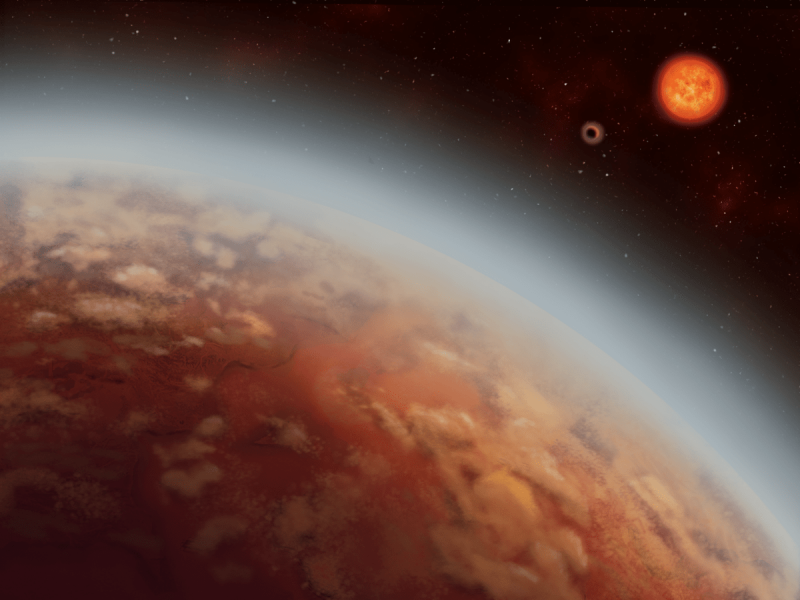
Patchy tan-orange planet with atmosphere; roiling reddish star in distance.

Artist’s concept of K2-18b, as well as another planet in this system, K2-18c, with the parent star, a red dwarf, in the background. Image via Alex Boersma/iREx.

A couple of days ago, EarthSky reported that for the first time ever, water vapor had been detected in the atmosphere of a potentially habitable super-Earth exoplanet. We weren’t alone in our report. As might be expected, the finding received a lot of attention from media. But, it turns out, that the story might not be quite as first reported and was mis-characterized to some extent.

The discovery was outlined in two different papers, the first one published on ArXiv on September 10, 2019 and the second in Nature Astronomy on September 11, 2019.

The papers detail the finding of water vapor in the atmosphere of K2-18b, an exoplanet in the habitable zone of its star – where temperatures could allow liquid water to exist – 110 light-years from Earth. It’s accurate that this is the first time that water vapor has been identified in the atmosphere of a smaller exoplanet (non-gas-giant) in the habitable zone of its star, but soon after the announcement, many planetary scientists critiqued how the discovery was covered in media and social media.

The water vapor detection itself is confirmed, but there is a lot of debate as to just what kind of planet K2-18b actually is, and how habitable it may be (or not).
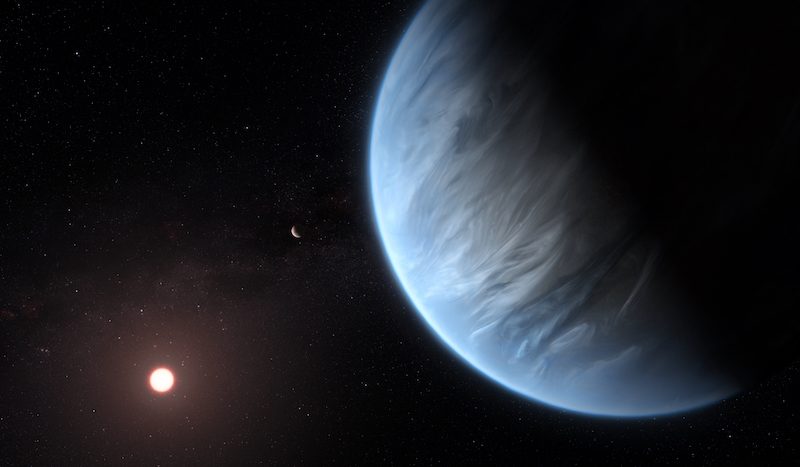
Half-lit blue planet with white bands in its atmosphere and distant sun.

Another artist’s concept of super-Earth K2-18b. Scientists have detected water vapor in its atmosphere, but is it habitable? Most scientists say it’s unlikely. Image via ESA/Hubble, M. Kornmesser/UCL News.

Some scientists, including in the Nature Astronomy paper, have referred to the planet as a super-Earth. A super-Earth is larger than Earth but smaller than Neptune – typically up to about a maximum of twice the size of Earth – and many have been discovered already. Most are thought to be rocky, like Earth, but there is a transition point – starting about 1.6 – two times Earth’s radius – where a planet can become a mini-gas-giant, or a mini-Neptune as they are usually called. They are larger than super-Earths, but still smaller than Neptune. Most scientists now consider K2-18b to be a mini-Neptune, not a super-Earth, with a deep atmosphere of hydrogen and/or helium, and possibly no solid surface at all.

K2-18b has a radius of about 2.7 times that of Earth, and a mass about nine times that of Earth. While some scientists would still consider that to be a possible super-Earth, most it seems would classify it as a mini-Neptune. All of this can be a bit confusing.

The 2017 study previously linked to considered that K2-18b might be either large and rocky or covered with water and/or ice. But that study didn’t account for atmospheric constraints, only mass and radius. As exoplanet scientist Erin May told me on Twitter:

My PhD partially focused on the distinction between these classes of planets. Many studies show that it’s extremely difficult to make a planet > than 2 Earth-radii without a large atmosphere. Mass & radius (density) alone are actually not very useful here. I’d also like to point out that from mass and radius alone, this planet should have never been considered a super-Earth. I think there’s a tendency to throw this term around because it’s more “exciting”, but we as astronomers need to keep our terminology straight.

Néstor Espinoza, an astronomer at the Max Planck Institute for Astronomy (MPIA), also told me:

If you believe the water feature, you have to believe it is an H/He dominated atmosphere so yes. And the source you cite is not “outdated” – at that time we just didn’t have atmospheric constraints, only mass and radius. Also: the very fact that we see a water feature *implies* a H/He dominated atmosphere. There is no way around it.

There is a good Twitter thread about all this here, from Jessie Christiansen, a research scientist at NASA Exoplanet Science Institute (NExScI):


Also from Nature correspondent Alexandra Witze:


And another thread, from Marina Koren at The Atlantic:

So what about habitability? Since the planet is considered – by most scientists – to now be a mini-Neptune, this lowers the chances significantly. Water vapor itself, or even rain (as still considered possible in this planet’s atmosphere), is great, but life-as-we-know-it requires a rocky surface/interior for chemical nutrients, and bodies of liquid water. There may indeed be planets out there with life forms in only a gaseous atmosphere, but for Earth-kind of life at least, K2-18b would seem to be ill-suited for this.
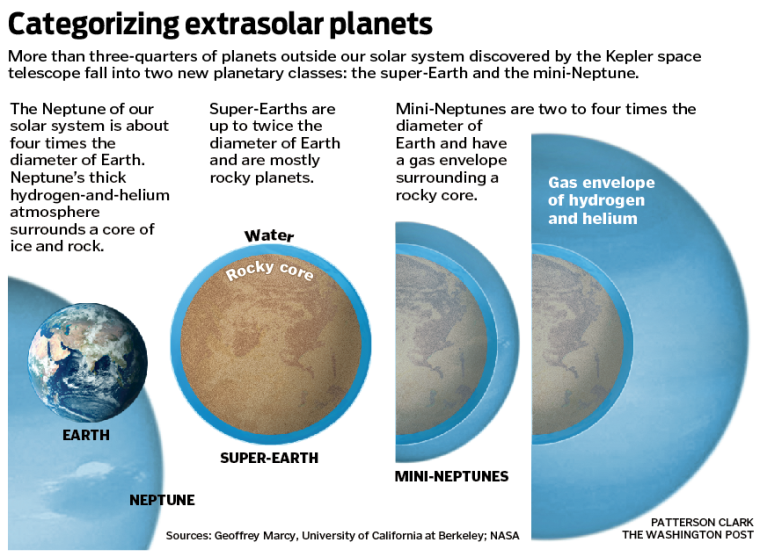
Earth, super-Earth and mini-Neptunes showing depth of water and gas envelopes.

There has been a lot of debate over whether K2-18b is a super-Earth or mini-Neptune. Most scientists now agree that it is a mini-Neptune, making habitability much less likely. Image via Patterson Clark/Washington Post/Quora.

Finding evidence for water vapor on a distant exoplanet in its star’s habitable zone is exciting, but in itself not proof of habitability. There are many factors that need to be considered, including composition of the planet and its atmosphere. However, K2-18b is the smallest exoplanet so far found to have water vapor in its atmosphere, which is a good sign: it supports the contention of scientists that even smaller planets with water vapor and/or liquid water will be found, worlds that are more Earth-like in terms of both size and composition. Upcoming space-based telescopes such as the James Webb Space Telescope (JWST) will be able to study the atmospheres of planets like this, and smaller, in greater detail than ever before, and even search for biosignatures, which could be evidence for life.

Bottom line: The exoplanet K2-18b does have water vapor in its atmosphere, but the planet itself is probably very un-Earth-like.

Source: Water vapour in the atmosphere of the habitable-zone eight-Earth-mass planet K2-18 b

Source: Water Vapor on the Habitable-Zone Exoplanet K2-18b

Via UCL News


from EarthSky https://ift.tt/34Lknrn
Patchy tan-orange planet with atmosphere; roiling reddish star in distance.

Artist’s concept of K2-18b, as well as another planet in this system, K2-18c, with the parent star, a red dwarf, in the background. Image via Alex Boersma/iREx.

A couple of days ago, EarthSky reported that for the first time ever, water vapor had been detected in the atmosphere of a potentially habitable super-Earth exoplanet. We weren’t alone in our report. As might be expected, the finding received a lot of attention from media. But, it turns out, that the story might not be quite as first reported and was mis-characterized to some extent.

The discovery was outlined in two different papers, the first one published on ArXiv on September 10, 2019 and the second in Nature Astronomy on September 11, 2019.

The papers detail the finding of water vapor in the atmosphere of K2-18b, an exoplanet in the habitable zone of its star – where temperatures could allow liquid water to exist – 110 light-years from Earth. It’s accurate that this is the first time that water vapor has been identified in the atmosphere of a smaller exoplanet (non-gas-giant) in the habitable zone of its star, but soon after the announcement, many planetary scientists critiqued how the discovery was covered in media and social media.

The water vapor detection itself is confirmed, but there is a lot of debate as to just what kind of planet K2-18b actually is, and how habitable it may be (or not).

Half-lit blue planet with white bands in its atmosphere and distant sun.

Another artist’s concept of super-Earth K2-18b. Scientists have detected water vapor in its atmosphere, but is it habitable? Most scientists say it’s unlikely. Image via ESA/Hubble, M. Kornmesser/UCL News.

Some scientists, including in the Nature Astronomy paper, have referred to the planet as a super-Earth. A super-Earth is larger than Earth but smaller than Neptune – typically up to about a maximum of twice the size of Earth – and many have been discovered already. Most are thought to be rocky, like Earth, but there is a transition point – starting about 1.6 – two times Earth’s radius – where a planet can become a mini-gas-giant, or a mini-Neptune as they are usually called. They are larger than super-Earths, but still smaller than Neptune. Most scientists now consider K2-18b to be a mini-Neptune, not a super-Earth, with a deep atmosphere of hydrogen and/or helium, and possibly no solid surface at all.

K2-18b has a radius of about 2.7 times that of Earth, and a mass about nine times that of Earth. While some scientists would still consider that to be a possible super-Earth, most it seems would classify it as a mini-Neptune. All of this can be a bit confusing.

The 2017 study previously linked to considered that K2-18b might be either large and rocky or covered with water and/or ice. But that study didn’t account for atmospheric constraints, only mass and radius. As exoplanet scientist Erin May told me on Twitter:

My PhD partially focused on the distinction between these classes of planets. Many studies show that it’s extremely difficult to make a planet > than 2 Earth-radii without a large atmosphere. Mass & radius (density) alone are actually not very useful here. I’d also like to point out that from mass and radius alone, this planet should have never been considered a super-Earth. I think there’s a tendency to throw this term around because it’s more “exciting”, but we as astronomers need to keep our terminology straight.

Néstor Espinoza, an astronomer at the Max Planck Institute for Astronomy (MPIA), also told me:

If you believe the water feature, you have to believe it is an H/He dominated atmosphere so yes. And the source you cite is not “outdated” – at that time we just didn’t have atmospheric constraints, only mass and radius. Also: the very fact that we see a water feature *implies* a H/He dominated atmosphere. There is no way around it.

There is a good Twitter thread about all this here, from Jessie Christiansen, a research scientist at NASA Exoplanet Science Institute (NExScI):


Also from Nature correspondent Alexandra Witze:


And another thread, from Marina Koren at The Atlantic:

So what about habitability? Since the planet is considered – by most scientists – to now be a mini-Neptune, this lowers the chances significantly. Water vapor itself, or even rain (as still considered possible in this planet’s atmosphere), is great, but life-as-we-know-it requires a rocky surface/interior for chemical nutrients, and bodies of liquid water. There may indeed be planets out there with life forms in only a gaseous atmosphere, but for Earth-kind of life at least, K2-18b would seem to be ill-suited for this.

Earth, super-Earth and mini-Neptunes showing depth of water and gas envelopes.

There has been a lot of debate over whether K2-18b is a super-Earth or mini-Neptune. Most scientists now agree that it is a mini-Neptune, making habitability much less likely. Image via Patterson Clark/Washington Post/Quora.

Finding evidence for water vapor on a distant exoplanet in its star’s habitable zone is exciting, but in itself not proof of habitability. There are many factors that need to be considered, including composition of the planet and its atmosphere. However, K2-18b is the smallest exoplanet so far found to have water vapor in its atmosphere, which is a good sign: it supports the contention of scientists that even smaller planets with water vapor and/or liquid water will be found, worlds that are more Earth-like in terms of both size and composition. Upcoming space-based telescopes such as the James Webb Space Telescope (JWST) will be able to study the atmospheres of planets like this, and smaller, in greater detail than ever before, and even search for biosignatures, which could be evidence for life.

Bottom line: The exoplanet K2-18b does have water vapor in its atmosphere, but the planet itself is probably very un-Earth-like.

Source: Water vapour in the atmosphere of the habitable-zone eight-Earth-mass planet K2-18 b

Source: Water Vapor on the Habitable-Zone Exoplanet K2-18b

Via UCL News


from EarthSky https://ift.tt/34Lknrn

Look west after sunrise for the daytime moon

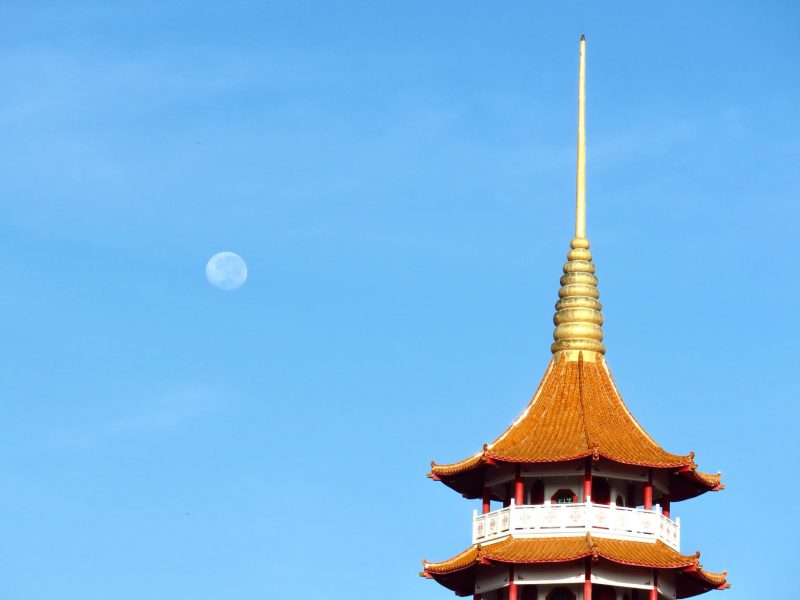
At top: Paul Schulz caught a daytime moon in September 2018, above and then behind Mt. Graham, Safford, Arizona. Thanks, Paul! Click here to view it larger.

The September 2019 full moon has passed. Now the moon is in a waning gibbous phase, which means it rises in the east later and later each evening. Beginning around the morning of September 15 or 16, 2019, look west after sunrise for the daytime moon.

So you’d look east before going to bed tonight to catch the moon over the eastern horizon. Then you’d look in the west after sunrise tomorrow, or in the next few mornings, to see the daytime moon over your western horizon.

Sylvia asked:

When is the best time to see the moon in the sky during daylight hours?

The answer is that a daytime moon is up there much of the time, but, because it’s pale against the blue sky, it’s not as noticeable as the moon at night.

The most noticeable moon at night is the one that stays out all night long. That would be around the time of full moon each month, when the moon is 180 degrees from the sun, or opposite the sun in our sky. Full moon was on September 14, 2019, at 4:33 UTC; translate UTC to your time.

A full moon rises around sunset and sets around sunrise. But now the moon is in a waning gibbous phase – rising later each night – and setting in the west later each day after sunrise.

At mid-northern latitudes in North America, the moon will set roughly an hour after sunrise on September 15, and will set about an hour later each day thereafter.

These recommended almanacs can help you find the moon’s setting time in your sky

By the way, the moon is up during the day half the time. It has to be, since it orbits around the whole Earth once a month. The crescent moon is hard to see because it’s so near the sun in the sky. At the vicinity of last quarter moon about a week from now, you might have to crane your neck, looking up, to notice it after sunrise.

Ordinarily, we don’t look up to see the waning last quarter moon and waning crescent after sunrise. That’s one reason why people so often miss the moon during the day.

Day by day, the lighted portion of the waning gibbous moon will shrink and the half-lit last quarter moon will come on September 22. Watch for the daytime moon to climb higher and higher into the western sky after sunrise all this coming week!

Jenney Disimon caught this daytime moon – a waning gibbous moon, 94.7 percent illuminated – from Sabah North Borneo on August 29, 2018.

Bottom line: Starting around the morning of September 15 or 16, 2019, look for the daytime moon in the west after sunrise!

September 2018 guide to the bright planets

The lunar calendars are almost here! They’ll show you the moon phases throughout the year.


from EarthSky https://ift.tt/300vRZh

At top: Paul Schulz caught a daytime moon in September 2018, above and then behind Mt. Graham, Safford, Arizona. Thanks, Paul! Click here to view it larger.

The September 2019 full moon has passed. Now the moon is in a waning gibbous phase, which means it rises in the east later and later each evening. Beginning around the morning of September 15 or 16, 2019, look west after sunrise for the daytime moon.

So you’d look east before going to bed tonight to catch the moon over the eastern horizon. Then you’d look in the west after sunrise tomorrow, or in the next few mornings, to see the daytime moon over your western horizon.

Sylvia asked:

When is the best time to see the moon in the sky during daylight hours?

The answer is that a daytime moon is up there much of the time, but, because it’s pale against the blue sky, it’s not as noticeable as the moon at night.

The most noticeable moon at night is the one that stays out all night long. That would be around the time of full moon each month, when the moon is 180 degrees from the sun, or opposite the sun in our sky. Full moon was on September 14, 2019, at 4:33 UTC; translate UTC to your time.

A full moon rises around sunset and sets around sunrise. But now the moon is in a waning gibbous phase – rising later each night – and setting in the west later each day after sunrise.

At mid-northern latitudes in North America, the moon will set roughly an hour after sunrise on September 15, and will set about an hour later each day thereafter.

These recommended almanacs can help you find the moon’s setting time in your sky

By the way, the moon is up during the day half the time. It has to be, since it orbits around the whole Earth once a month. The crescent moon is hard to see because it’s so near the sun in the sky. At the vicinity of last quarter moon about a week from now, you might have to crane your neck, looking up, to notice it after sunrise.

Ordinarily, we don’t look up to see the waning last quarter moon and waning crescent after sunrise. That’s one reason why people so often miss the moon during the day.

Day by day, the lighted portion of the waning gibbous moon will shrink and the half-lit last quarter moon will come on September 22. Watch for the daytime moon to climb higher and higher into the western sky after sunrise all this coming week!

Jenney Disimon caught this daytime moon – a waning gibbous moon, 94.7 percent illuminated – from Sabah North Borneo on August 29, 2018.

Bottom line: Starting around the morning of September 15 or 16, 2019, look for the daytime moon in the west after sunrise!

September 2018 guide to the bright planets

The lunar calendars are almost here! They’ll show you the moon phases throughout the year.


from EarthSky https://ift.tt/300vRZh

2019 SkS Weekly Climate Change & Global Warming News Roundup #37

A chronological listing of news articles linked to on the Skeptical Science Facebook Page during the past week, i.e., Sun, Sep 8 through Sat, Sep 14, 2019

Editor's Pick

Greta Thunberg To U.S.: 'You Have A Moral Responsibility' On Climate Change

Greta Thunberg in Washington DC on Sep 13, 2019 

Swedish activist Greta Thunberg, 16, attends a protest outside the White House on Friday. She launched the Friday school strikes last year, and since then, her notoriety has steadily grown. She is known for speaking in clear and powerful terms about why people — particularly young people — must pay attention to Earth's climate.  Photo: Mhari Shaw/NPR

Greta Thunberg led a protest at the White House on Friday. But she wasn't looking to go inside — "I don't want to meet with people who don't accept the science," she says.

The young Swedish activist joined a large crowd of protesters who had gathered outside, calling for immediate action to help the environment and reverse an alarming warming trend in average global temperatures.

She says her message for President Trump is the same thing she tells other politicians: Listen to science, and take responsibility.

Thunberg, 16, arrived in the U.S. last week after sailing across the Atlantic to avoid the carbon emissions from jet travel. She plans to spend nearly a week in Washington, D.C. — but she doesn't plan to meet with anyone from the Trump administration during that time.

"I haven't been invited to do that yet. And honestly I don't want to do that," Thunberg tells NPR's Ailsa Chang. If people in the White House who reject climate change want to change their minds, she says, they should rely on scientists and professionals to do that. 

Greta Thunberg To U.S.: 'You Have A Moral Responsibility' On Climate Change by Bill Chappell & Ailsa Chang, Environment, NPR, Sep 13, 2019

Click here to access the entire article posted on NPR.


Articles Linked to on Facebook

Sun Sep 8, 2019

Mon Sep 9, 2019

Tue Sep 10, 2019

Wed Sep 11, 2019

Thu Sep 12, 2019

Fri Sep 13, 2019

Sat Sep 14, 2019


from Skeptical Science https://ift.tt/2I91t45
A chronological listing of news articles linked to on the Skeptical Science Facebook Page during the past week, i.e., Sun, Sep 8 through Sat, Sep 14, 2019

Editor's Pick

Greta Thunberg To U.S.: 'You Have A Moral Responsibility' On Climate Change

Greta Thunberg in Washington DC on Sep 13, 2019 

Swedish activist Greta Thunberg, 16, attends a protest outside the White House on Friday. She launched the Friday school strikes last year, and since then, her notoriety has steadily grown. She is known for speaking in clear and powerful terms about why people — particularly young people — must pay attention to Earth's climate.  Photo: Mhari Shaw/NPR

Greta Thunberg led a protest at the White House on Friday. But she wasn't looking to go inside — "I don't want to meet with people who don't accept the science," she says.

The young Swedish activist joined a large crowd of protesters who had gathered outside, calling for immediate action to help the environment and reverse an alarming warming trend in average global temperatures.

She says her message for President Trump is the same thing she tells other politicians: Listen to science, and take responsibility.

Thunberg, 16, arrived in the U.S. last week after sailing across the Atlantic to avoid the carbon emissions from jet travel. She plans to spend nearly a week in Washington, D.C. — but she doesn't plan to meet with anyone from the Trump administration during that time.

"I haven't been invited to do that yet. And honestly I don't want to do that," Thunberg tells NPR's Ailsa Chang. If people in the White House who reject climate change want to change their minds, she says, they should rely on scientists and professionals to do that. 

Greta Thunberg To U.S.: 'You Have A Moral Responsibility' On Climate Change by Bill Chappell & Ailsa Chang, Environment, NPR, Sep 13, 2019

Click here to access the entire article posted on NPR.


Articles Linked to on Facebook

Sun Sep 8, 2019

Mon Sep 9, 2019

Tue Sep 10, 2019

Wed Sep 11, 2019

Thu Sep 12, 2019

Fri Sep 13, 2019

Sat Sep 14, 2019


from Skeptical Science https://ift.tt/2I91t45

A distant galaxy’s black hole seen to flare unexpectedly

Flickering orange blob with graph with evenly spaced spikes.

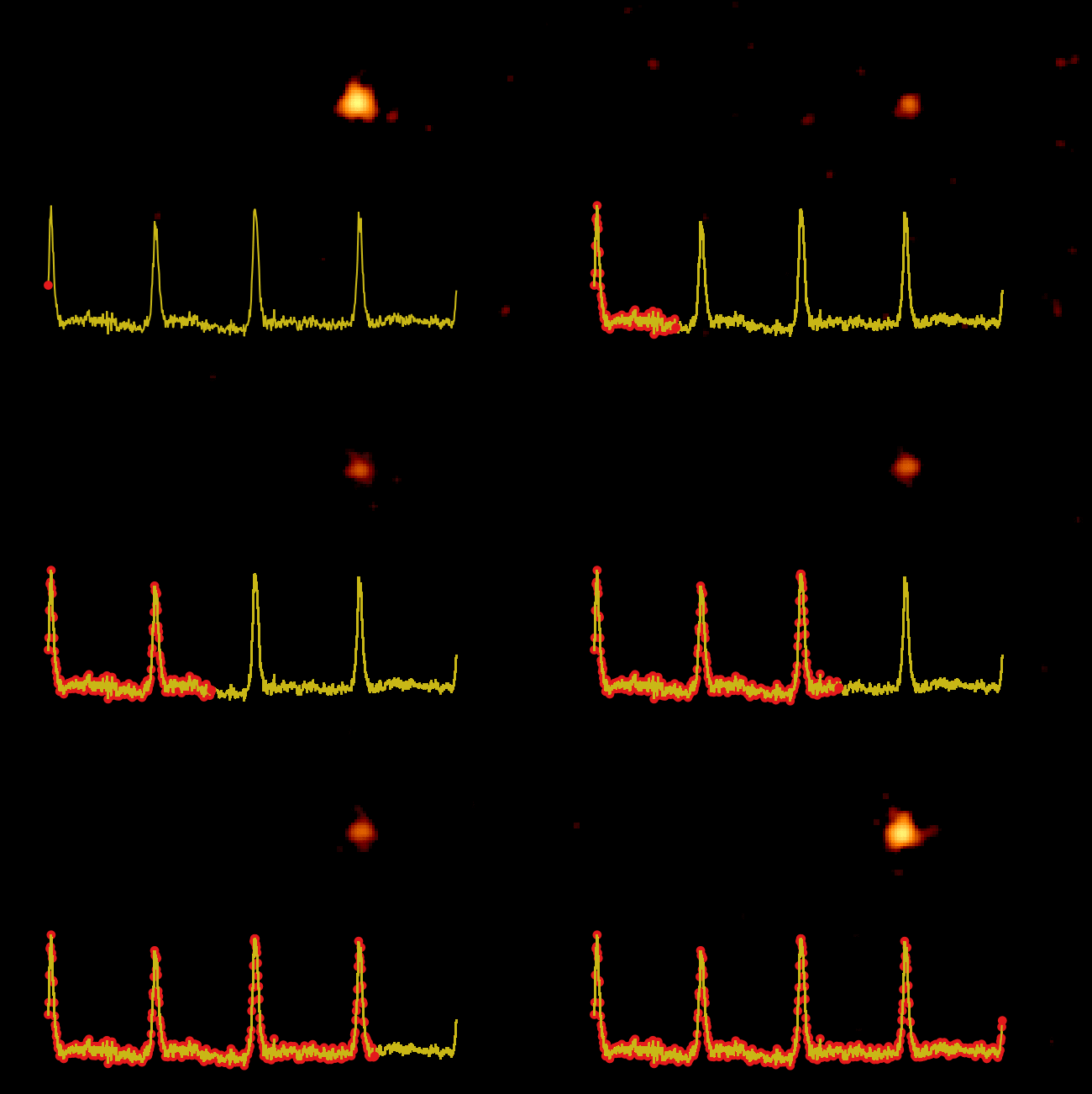
An X-ray view of the active black hole at the core of distant galaxy GSN 069, about 250 million light-years away. The upper part of the animation shows observations from ESA’s X-ray space telescope XMM-Newton. The graph in the lower part shows variations of the X-ray brightness of the black hole relative to its ‘dormant’ level. Read more about this image, which is via ESA/XMM-Newton/G. Miniutti and M. Giustini.

ESA said on September 11, 2019, that its X-ray space telescope XMM-Newton has detected never-before-seen periodic flares of X-ray radiation from a giant black hole in a distant galaxy. These scientists said in a statement that the flares:

… could help explain some enigmatic behaviors of active black holes

Active black holes are those that are still actively swallowing material – stars, gas, dust – supplied by their home galaxies. We tend to see active supermassive black holes – like the one observed to flare in a galaxy known as GSN 069, located about 250 million light-years away – in distant galaxies, in contrast to the more quiescent supermassive black hole at the center of our own Milky Way (although even the Milky Way’s central black hole appeared to gobble something up earlier this year). Of the flares seen coming from the central black hole in GSN 069, astronomers said:

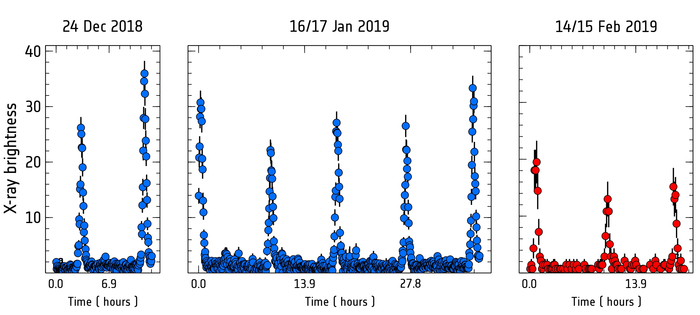
On December 24, 2018, the source was seen to suddenly increase its brightness by up to a factor of 100, then dimmed back to its normal levels within one hour and lit up again nine hours later.

Giovanni Miniutti, of the Centro de Astrobiología in Madrid, Spain, is lead author of a new paper published September 11 in the peer-reviewed journal Nature. He said:

It was completely unexpected. Giant black holes regularly flicker like a candle but the rapid, repeating changes seen in GSN 069 from December onwards are something completely new.

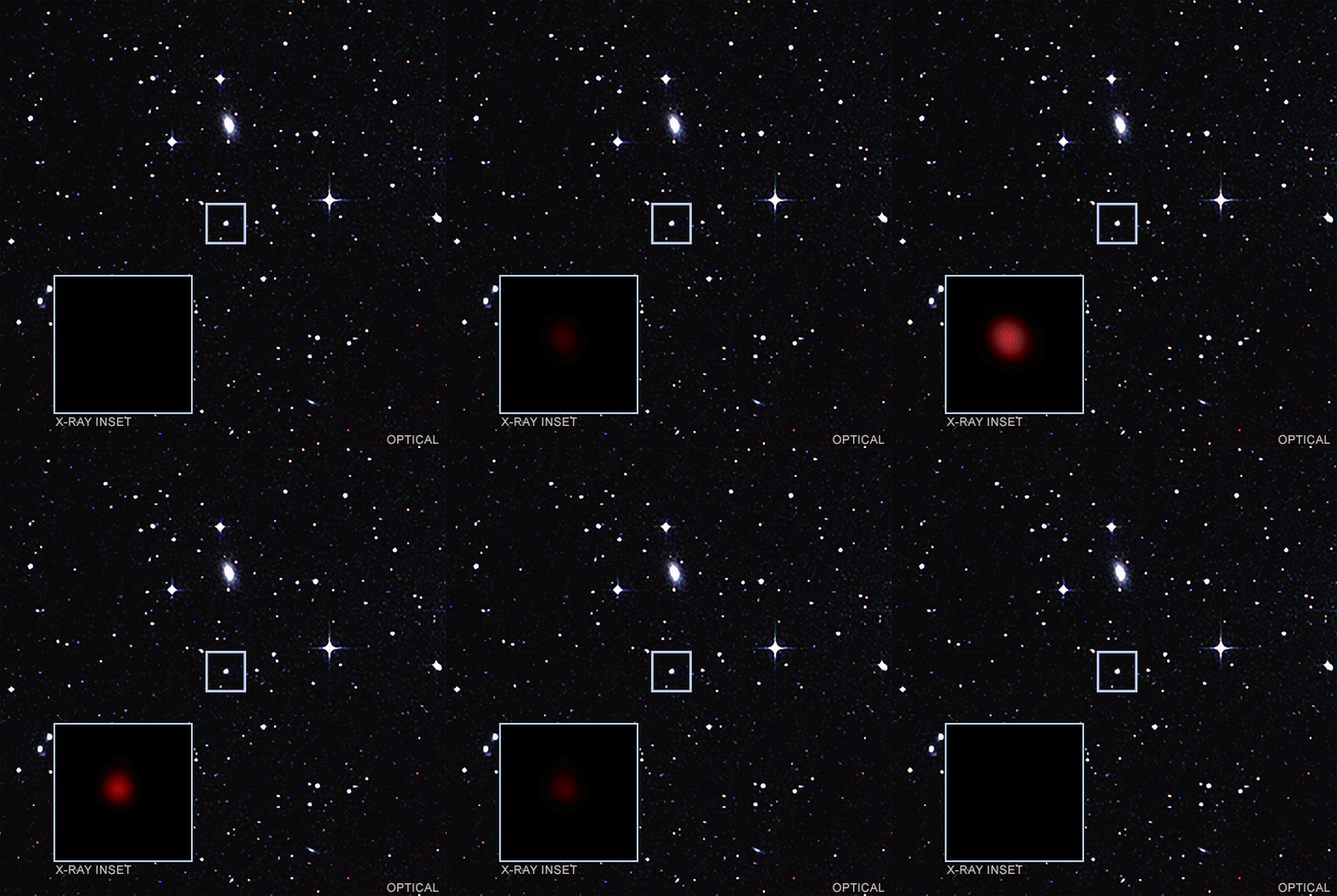
After word got around that this black hole was flaring, other telescopes were turned in its direction. XMM-Newton performed follow-up observations in the following couple of months, as did NASA’s Chandra X-ray observatory. These telescopes confirmed:

… that the distant black hole was still keeping the tempo, emitting nearly periodic bursts of X-rays every nine hours.

The researchers are calling the new phenomenon “quasi-periodic eruptions”, or QPEs.

Star field with inset showing repeatedly appearing and disappearing orange blob.

Optical and X-ray view of active galaxy GSN 069. More about this image. Image via ESA.

You’ve probably heard that black holes are black because no light can escape them. So what is doing the flaring? The flares are coming from the process of accretion. It happens just before the gas, dust or stellar debris falls past the point of no return, known as the event horizon. Prior to that ultimate plunge over the event horizon, the material forms a flattened ring of spinning matter, known as an accretion disk. Miniutti explained that the X-ray flares:

… come from material that is being accreted into the black hole and heats up in the process.

There are various mechanisms in the accretion disk that could give rise to this type of quasi-periodic signal, potentially linked to instabilities in the accretion flow close to the central black hole.

Alternatively, the eruptions could be due to the interaction of the disk material with a second body – another black hole or perhaps the remnant of a star previously disrupted by the black hole.

Giovanni and colleagues said that – although no one has observed this phenomenon before – the periodic flares like those just seen might be common in the universe. Their statement explained:

It is possible that the phenomenon had not been identified before because most black holes at the cores of distant galaxies, with masses millions to billions of times the mass of our sun, are much larger than the one in GSN 069, which is only about 400,000 times more massive than our sun.

The bigger and more massive the black hole, the slower the fluctuations in brightness it can display, so a typical supermassive black hole would erupt not every nine hours, but every few months or years. This would make detection unlikely as observations rarely span such long periods of time.

They said that quasi-periodic eruptions like those found in GSN 069 could provide a natural framework to interpret some puzzling patterns observed in a significant fraction of active black holes, whose brightness seems to vary too fast to be easily explained by current theoretical models. Miniutti said:

We know of many massive black holes whose brightness rises or decays by very large factors within days or months, while we would expect them to vary at a much slower pace.

But if some of this variability corresponds to the rise or decay phases of eruptions similar to those discovered in GSN 069, then the fast variability of these systems, which appears currently unfeasible, could naturally be accounted for.

New data and further studies will tell if this analogy really holds.

Three graphs with evenly spaced spikes with periodicity of less than a day.

X-ray flares from active galaxy GSN 069. More about this image. Image via ESA/XMM-Newton; NASA/CXC; G. Miniutti (CAB, CSIC-INTA, Spain).

The quasi-periodic eruptions spotted in GSN 069 could also explain other intriguing properties observed in the X-ray emission from nearly all bright, accreting supermassive black holes, which you can read about at ESA Space News.

For now, this team of astronomers is trying to organize their studies of the distant galaxy GSN 069; for example, they are trying to pinpoint this galaxy’s defining properties at the time when the periodic eruptions were first detected. Norbert Schartel, ESA’s XMM-Newton project scientist, said:

GSN 069 is an extremely fascinating source, with the potential to become a reference in the field of black hole accretion.

Knowing what to look for, they said, will also help them more efficiently use X-ray telescopes like XMM-Newton and Chandra to search for more quasi-periodic eruptions from other supermassive black holes in other distant galaxies. Margherita Giustini of Madrid’s Centro de Astrobiología – a study co-author – said the goal is:

… to further understand the physical origin of this new phenomenon.

Bottom line: In late 2018, the supermassive black hole in the galaxy GSN 069 – about 250 million light-years away – was seen to suddenly increase its brightness by up to a factor 100, then dim back to its normal levels within one hour, and then light up again nine hours later. Since then it has continued these quasi-periodic flares. Scientists want to know what’s causing them.

Source: Nine-hour X-ray quasi-periodic eruptions from a low-mass black hole galactic nucleus

Via ESA


from EarthSky https://ift.tt/2O3HjMn
Flickering orange blob with graph with evenly spaced spikes.

An X-ray view of the active black hole at the core of distant galaxy GSN 069, about 250 million light-years away. The upper part of the animation shows observations from ESA’s X-ray space telescope XMM-Newton. The graph in the lower part shows variations of the X-ray brightness of the black hole relative to its ‘dormant’ level. Read more about this image, which is via ESA/XMM-Newton/G. Miniutti and M. Giustini.

ESA said on September 11, 2019, that its X-ray space telescope XMM-Newton has detected never-before-seen periodic flares of X-ray radiation from a giant black hole in a distant galaxy. These scientists said in a statement that the flares:

… could help explain some enigmatic behaviors of active black holes

Active black holes are those that are still actively swallowing material – stars, gas, dust – supplied by their home galaxies. We tend to see active supermassive black holes – like the one observed to flare in a galaxy known as GSN 069, located about 250 million light-years away – in distant galaxies, in contrast to the more quiescent supermassive black hole at the center of our own Milky Way (although even the Milky Way’s central black hole appeared to gobble something up earlier this year). Of the flares seen coming from the central black hole in GSN 069, astronomers said:

On December 24, 2018, the source was seen to suddenly increase its brightness by up to a factor of 100, then dimmed back to its normal levels within one hour and lit up again nine hours later.

Giovanni Miniutti, of the Centro de Astrobiología in Madrid, Spain, is lead author of a new paper published September 11 in the peer-reviewed journal Nature. He said:

It was completely unexpected. Giant black holes regularly flicker like a candle but the rapid, repeating changes seen in GSN 069 from December onwards are something completely new.

After word got around that this black hole was flaring, other telescopes were turned in its direction. XMM-Newton performed follow-up observations in the following couple of months, as did NASA’s Chandra X-ray observatory. These telescopes confirmed:

… that the distant black hole was still keeping the tempo, emitting nearly periodic bursts of X-rays every nine hours.

The researchers are calling the new phenomenon “quasi-periodic eruptions”, or QPEs.

Star field with inset showing repeatedly appearing and disappearing orange blob.

Optical and X-ray view of active galaxy GSN 069. More about this image. Image via ESA.

You’ve probably heard that black holes are black because no light can escape them. So what is doing the flaring? The flares are coming from the process of accretion. It happens just before the gas, dust or stellar debris falls past the point of no return, known as the event horizon. Prior to that ultimate plunge over the event horizon, the material forms a flattened ring of spinning matter, known as an accretion disk. Miniutti explained that the X-ray flares:

… come from material that is being accreted into the black hole and heats up in the process.

There are various mechanisms in the accretion disk that could give rise to this type of quasi-periodic signal, potentially linked to instabilities in the accretion flow close to the central black hole.

Alternatively, the eruptions could be due to the interaction of the disk material with a second body – another black hole or perhaps the remnant of a star previously disrupted by the black hole.

Giovanni and colleagues said that – although no one has observed this phenomenon before – the periodic flares like those just seen might be common in the universe. Their statement explained:

It is possible that the phenomenon had not been identified before because most black holes at the cores of distant galaxies, with masses millions to billions of times the mass of our sun, are much larger than the one in GSN 069, which is only about 400,000 times more massive than our sun.

The bigger and more massive the black hole, the slower the fluctuations in brightness it can display, so a typical supermassive black hole would erupt not every nine hours, but every few months or years. This would make detection unlikely as observations rarely span such long periods of time.

They said that quasi-periodic eruptions like those found in GSN 069 could provide a natural framework to interpret some puzzling patterns observed in a significant fraction of active black holes, whose brightness seems to vary too fast to be easily explained by current theoretical models. Miniutti said:

We know of many massive black holes whose brightness rises or decays by very large factors within days or months, while we would expect them to vary at a much slower pace.

But if some of this variability corresponds to the rise or decay phases of eruptions similar to those discovered in GSN 069, then the fast variability of these systems, which appears currently unfeasible, could naturally be accounted for.

New data and further studies will tell if this analogy really holds.

Three graphs with evenly spaced spikes with periodicity of less than a day.

X-ray flares from active galaxy GSN 069. More about this image. Image via ESA/XMM-Newton; NASA/CXC; G. Miniutti (CAB, CSIC-INTA, Spain).

The quasi-periodic eruptions spotted in GSN 069 could also explain other intriguing properties observed in the X-ray emission from nearly all bright, accreting supermassive black holes, which you can read about at ESA Space News.

For now, this team of astronomers is trying to organize their studies of the distant galaxy GSN 069; for example, they are trying to pinpoint this galaxy’s defining properties at the time when the periodic eruptions were first detected. Norbert Schartel, ESA’s XMM-Newton project scientist, said:

GSN 069 is an extremely fascinating source, with the potential to become a reference in the field of black hole accretion.

Knowing what to look for, they said, will also help them more efficiently use X-ray telescopes like XMM-Newton and Chandra to search for more quasi-periodic eruptions from other supermassive black holes in other distant galaxies. Margherita Giustini of Madrid’s Centro de Astrobiología – a study co-author – said the goal is:

… to further understand the physical origin of this new phenomenon.

Bottom line: In late 2018, the supermassive black hole in the galaxy GSN 069 – about 250 million light-years away – was seen to suddenly increase its brightness by up to a factor 100, then dim back to its normal levels within one hour, and then light up again nine hours later. Since then it has continued these quasi-periodic flares. Scientists want to know what’s causing them.

Source: Nine-hour X-ray quasi-periodic eruptions from a low-mass black hole galactic nucleus

Via ESA


from EarthSky https://ift.tt/2O3HjMn

News digest – cancer survival comparisons, NHS nurse shortages, antibiotics and chicken?

Doctor and nurse discussing results in a hospital.

UK cancer survival improving, but still lagging behind other countries

An international study published this week revealed the number of people surviving cancer in the UK has increased since 1995. But it also revealed how much progress still needs to be made, as the UK has some of the lowest survival figures of the 7 high-income countries studied. Experts say the necessary improvements won’t be seen until NHS staff shortages are addressed, as our blog post explains. The story was widely covered by news outlets including BBC News, The Guardian and Mail Online.

NHS staff shortages leaving cancer nurses stretched

Almost half of specialist nurses working in the NHS said their workload made it difficult to properly care for their patients, according to survey results from Macmillan Cancer Support. And around 4 in 10 called they workload ‘unmanageable’, as the Telegraph reports. And it’s not just nurses that are feeling the strain of an underfunded NHS. In our blog post we spoke to Dawn Chaplin, a consultant radiographer who has been working full-time on the NHS for 10 years.

In another story about the NHS workloads this week, Siobgan McArdle, who’s been the CEO of South Tees hospital for 4 years, has decided to resign at the end of the month. In her resignation letter, she cited the latest round of financial forecasting and an increasingly tight strain of the NHS as key reasons for her departure, as The Guardian explains.

Researchers fear for work that spans EU borders

UK researchers have voiced their concerns about being able to work with EU member states on international clinical trials in the event of a no-deal Brexit. The Guardian highlighted the ongoing Phitt clinical trial , which is testing new ways to treat children with rare liver cancers and is part of a European research network that received €7.9 million from the EU. Scientists worry these types of collaborative projects may be under threat in the future if the UK was to leave the EU without a deal.

Our blog post gives you all you need to know about what a no-deal Brexit could mean for cancer treatment and research in the UK.

Research on new lung cancer blood test hits the headlines

A new blood test that could one day help catch lung cancer at an earlier stage made headlines this week. BBC News and Sky News covered the research, presented at a lung cancer conference, which found that people with a high risk of lung cancer who had the blood test were diagnosed earlier than those who didn’t. However, the study only compared people who had both the test and follow up scans to people who’d had neither, making it difficult to unpick the benefits of the blood test alone. More research would be needed to understand the blood test’s potential value. CT scans are already being used in some parts of England to diagnose lung cancer earlier in people with a high risk of developing the disease.

Bowel cancer becoming more common in young adults

New figures covered by Reuters showed that, in certain countries, bowel cancer is becoming more common in adults under the age of 50. Canada, Germany, New Zealand and the UK were among the countries that saw an increase in early-onset bowel cancer. It’s not the first study to find that bowel cancer rates are rising in young adults and, as our blog post explains, it’s not entirely clear what’s causing the increase.

Finding the right cancer drug targets

This week, The New York Times asked a simple question: why aren’t cancer drugs better? A fascinating read, the article explores new work that suggests the targets for some cancer drugs may not be what we think they are.

Scientists discover potential new way to protect against hair loss during cancer treatment

Progress is being made towards preventing hair loss during cancer treatment, according to the Huffington Post. Scientists discovered how some chemotherapy drugs used to treat breast and lung cancer damage hair follicles, which brings them one step closer to finding a way to treat it. They found that treating hair follicles with a targeted cancer treatment in the lab made them less susceptible to the damaging effects of chemotherapy. The team hope to use this knowledge to develop new medicines to help prevent hair loss during treatment.

Exploring the link between antibiotics, cancer treatment and survival

A small study in two NHS hospitals found that taking antibiotics in the month before starting immunotherapy could affect the treatment’s success. Scientists who ran the study suggest that by killing helpful bacteria in the gut, antibiotics could affect how well immunotherapy works. But while the study asks some interesting questions about antibiotic use, it’s still early days. The next step is to see if the same pattern is seen in larger groups of patients, as The Guardian explains.

The bugs that live our gut, and the role they play in health, is a fascinating area of scientific discovery at the moment. Our researchers are investigating how the gut microbiome links to cancer, which you read can about in our blog post.

Lung cancer drug delivers promising results

More news from the lung cancer conference in Barcelona this week, as the immunotherapy drug nivolumab was found to improve the 5-year survival of patients with advanced lung cancer compared to standard chemotherapy. Nivolumab is already available in England for these patients through the Cancer Drugs Fund, while long-term data is collected on the drugs benefits. The Telegraph has this one.

Vaping linked to 6 deaths in the US, but true cause unknown

There have been several cases in the US of a serious lung disease that have been reportedly linked to vaping, as The Sun reports.

Health investigators in the US are trying to establish the reasons behind these deaths, as BBC News explains. This includes looking for contaminated substances added to the vape fluid. Health experts aren’t aware of similar incidents occurring in the UK and say that stricter controls are in place here and in Europe.

And finally

The Sun and The Times (£) covered new results from a study looking at the diets of over 450,000 people in the UK, over an 8 year period. The findings, presented at a conference, suggested a link between eating chicken and developing prostate cancer, melanoma and non-Hodgkin lymphoma. But as the researchers acknowledged, the majority of previous research, hasn’t found a link between chicken and cancer. Our blog post gives you the facts about meat eating and cancer risk.

Ethan


from Cancer Research UK – Science blog https://ift.tt/2LPfBjV
Doctor and nurse discussing results in a hospital.

UK cancer survival improving, but still lagging behind other countries

An international study published this week revealed the number of people surviving cancer in the UK has increased since 1995. But it also revealed how much progress still needs to be made, as the UK has some of the lowest survival figures of the 7 high-income countries studied. Experts say the necessary improvements won’t be seen until NHS staff shortages are addressed, as our blog post explains. The story was widely covered by news outlets including BBC News, The Guardian and Mail Online.

NHS staff shortages leaving cancer nurses stretched

Almost half of specialist nurses working in the NHS said their workload made it difficult to properly care for their patients, according to survey results from Macmillan Cancer Support. And around 4 in 10 called they workload ‘unmanageable’, as the Telegraph reports. And it’s not just nurses that are feeling the strain of an underfunded NHS. In our blog post we spoke to Dawn Chaplin, a consultant radiographer who has been working full-time on the NHS for 10 years.

In another story about the NHS workloads this week, Siobgan McArdle, who’s been the CEO of South Tees hospital for 4 years, has decided to resign at the end of the month. In her resignation letter, she cited the latest round of financial forecasting and an increasingly tight strain of the NHS as key reasons for her departure, as The Guardian explains.

Researchers fear for work that spans EU borders

UK researchers have voiced their concerns about being able to work with EU member states on international clinical trials in the event of a no-deal Brexit. The Guardian highlighted the ongoing Phitt clinical trial , which is testing new ways to treat children with rare liver cancers and is part of a European research network that received €7.9 million from the EU. Scientists worry these types of collaborative projects may be under threat in the future if the UK was to leave the EU without a deal.

Our blog post gives you all you need to know about what a no-deal Brexit could mean for cancer treatment and research in the UK.

Research on new lung cancer blood test hits the headlines

A new blood test that could one day help catch lung cancer at an earlier stage made headlines this week. BBC News and Sky News covered the research, presented at a lung cancer conference, which found that people with a high risk of lung cancer who had the blood test were diagnosed earlier than those who didn’t. However, the study only compared people who had both the test and follow up scans to people who’d had neither, making it difficult to unpick the benefits of the blood test alone. More research would be needed to understand the blood test’s potential value. CT scans are already being used in some parts of England to diagnose lung cancer earlier in people with a high risk of developing the disease.

Bowel cancer becoming more common in young adults

New figures covered by Reuters showed that, in certain countries, bowel cancer is becoming more common in adults under the age of 50. Canada, Germany, New Zealand and the UK were among the countries that saw an increase in early-onset bowel cancer. It’s not the first study to find that bowel cancer rates are rising in young adults and, as our blog post explains, it’s not entirely clear what’s causing the increase.

Finding the right cancer drug targets

This week, The New York Times asked a simple question: why aren’t cancer drugs better? A fascinating read, the article explores new work that suggests the targets for some cancer drugs may not be what we think they are.

Scientists discover potential new way to protect against hair loss during cancer treatment

Progress is being made towards preventing hair loss during cancer treatment, according to the Huffington Post. Scientists discovered how some chemotherapy drugs used to treat breast and lung cancer damage hair follicles, which brings them one step closer to finding a way to treat it. They found that treating hair follicles with a targeted cancer treatment in the lab made them less susceptible to the damaging effects of chemotherapy. The team hope to use this knowledge to develop new medicines to help prevent hair loss during treatment.

Exploring the link between antibiotics, cancer treatment and survival

A small study in two NHS hospitals found that taking antibiotics in the month before starting immunotherapy could affect the treatment’s success. Scientists who ran the study suggest that by killing helpful bacteria in the gut, antibiotics could affect how well immunotherapy works. But while the study asks some interesting questions about antibiotic use, it’s still early days. The next step is to see if the same pattern is seen in larger groups of patients, as The Guardian explains.

The bugs that live our gut, and the role they play in health, is a fascinating area of scientific discovery at the moment. Our researchers are investigating how the gut microbiome links to cancer, which you read can about in our blog post.

Lung cancer drug delivers promising results

More news from the lung cancer conference in Barcelona this week, as the immunotherapy drug nivolumab was found to improve the 5-year survival of patients with advanced lung cancer compared to standard chemotherapy. Nivolumab is already available in England for these patients through the Cancer Drugs Fund, while long-term data is collected on the drugs benefits. The Telegraph has this one.

Vaping linked to 6 deaths in the US, but true cause unknown

There have been several cases in the US of a serious lung disease that have been reportedly linked to vaping, as The Sun reports.

Health investigators in the US are trying to establish the reasons behind these deaths, as BBC News explains. This includes looking for contaminated substances added to the vape fluid. Health experts aren’t aware of similar incidents occurring in the UK and say that stricter controls are in place here and in Europe.

And finally

The Sun and The Times (£) covered new results from a study looking at the diets of over 450,000 people in the UK, over an 8 year period. The findings, presented at a conference, suggested a link between eating chicken and developing prostate cancer, melanoma and non-Hodgkin lymphoma. But as the researchers acknowledged, the majority of previous research, hasn’t found a link between chicken and cancer. Our blog post gives you the facts about meat eating and cancer risk.

Ethan


from Cancer Research UK – Science blog https://ift.tt/2LPfBjV

Yesterday evening’s Venus-Mercury conjunction

Brighter dot, fainter cot, in orange twilight above a roofline.

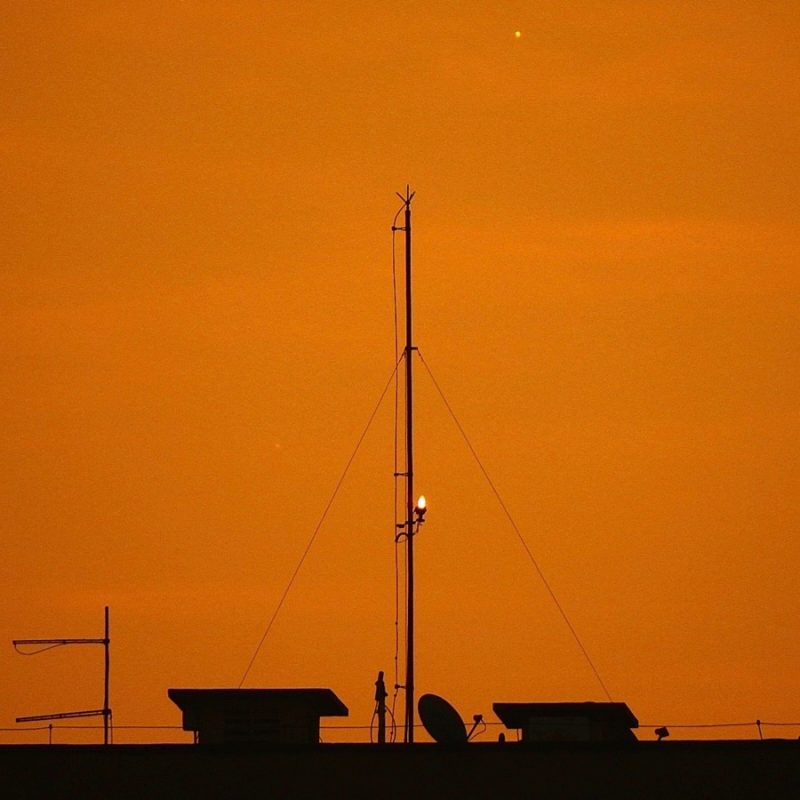
View at EarthSky Community Photos. | Venus and Mercury conjunction – September 12, 2019, just 8 degrees from the sunset – captured by Helio C. Vital in Rio. Venus is the brighter object above and to the right of the tall pole. Mercury is the fainter object, left of the pole, about midway up. Thank you, Helio!

Helio C. Vital in Rio de Janeiro, Brazil, mentioned to us earlier this week that he planned to try to capture this month’s Venus-Mercury conjunction. Neither of these planets is visible to the eye alone now, although both are in the evening sky. Their conjunction took place about 8 degrees east of the sun at sunset; thus, they are now exceedingly low in the west after sunset, buried in bright twilight. But Venus is bright. Helio managed to capture it a few days ago. And Venus doubtless helped him find fainter Mercury, too, on the evening of September 12, 2019. He wrote last night:

Fortunately, the weather helped, and I managed to get some photos of the Venus-Mercury close conjunction at today’s sunset. Only 27 arcminutes separated Venus (magnitude -3.9) from Mercury (magnitude -1.0) and the pair was still deeply inside the sun`s glare, as their angular distances from the Sun were respectively :7.8° and 8.2°. Catching Mercury at sunset using only the camera was quite a challenge, since it is shining 15 times dimmer than Venus.

All photos were taken around 17:48 +- 3 min. (UTC-3h) with a Nikon CoolPix P900 camera at manual mode and settings: texp=1/60s, F=6.5 and ISO 100.

Magnifications used were between 40 and 120 times. Only the camera (on a tripod) was used. No telescope was attached.

What makes this report interesting (in my opinion) is that a planetary conjunction so near the sun is very rarely recorded, let alone using only a digital camera without guiding or setting circles.

Amazing catch, Helio! Thanks for sending in the photos.

Diagram of sky with stars, Venus, Mercury, and the sun below the horizon.

Helio provided this simulation of the September 12-13, 2019, Venus-Mercury conjunction. At the conjunction point, the pair were 0.3 degrees apart, just 8 degrees from the sun.

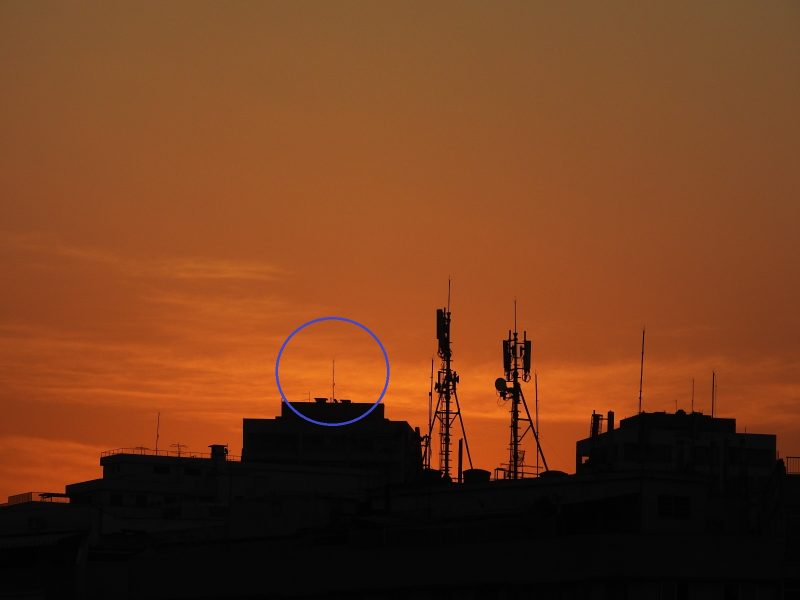
Orange twilight behind city roofline with blue circle around one distant radio tower.

Here is the target area, where Helio searched to find Venus and Mercury. He had captured Venus in this area just a few days earlier.

Bottom line: Photo showing the September 12-13, 2019, Venus-Mercury conjunction.


from EarthSky https://ift.tt/30aOOUs
Brighter dot, fainter cot, in orange twilight above a roofline.

View at EarthSky Community Photos. | Venus and Mercury conjunction – September 12, 2019, just 8 degrees from the sunset – captured by Helio C. Vital in Rio. Venus is the brighter object above and to the right of the tall pole. Mercury is the fainter object, left of the pole, about midway up. Thank you, Helio!

Helio C. Vital in Rio de Janeiro, Brazil, mentioned to us earlier this week that he planned to try to capture this month’s Venus-Mercury conjunction. Neither of these planets is visible to the eye alone now, although both are in the evening sky. Their conjunction took place about 8 degrees east of the sun at sunset; thus, they are now exceedingly low in the west after sunset, buried in bright twilight. But Venus is bright. Helio managed to capture it a few days ago. And Venus doubtless helped him find fainter Mercury, too, on the evening of September 12, 2019. He wrote last night:

Fortunately, the weather helped, and I managed to get some photos of the Venus-Mercury close conjunction at today’s sunset. Only 27 arcminutes separated Venus (magnitude -3.9) from Mercury (magnitude -1.0) and the pair was still deeply inside the sun`s glare, as their angular distances from the Sun were respectively :7.8° and 8.2°. Catching Mercury at sunset using only the camera was quite a challenge, since it is shining 15 times dimmer than Venus.

All photos were taken around 17:48 +- 3 min. (UTC-3h) with a Nikon CoolPix P900 camera at manual mode and settings: texp=1/60s, F=6.5 and ISO 100.

Magnifications used were between 40 and 120 times. Only the camera (on a tripod) was used. No telescope was attached.

What makes this report interesting (in my opinion) is that a planetary conjunction so near the sun is very rarely recorded, let alone using only a digital camera without guiding or setting circles.

Amazing catch, Helio! Thanks for sending in the photos.

Diagram of sky with stars, Venus, Mercury, and the sun below the horizon.

Helio provided this simulation of the September 12-13, 2019, Venus-Mercury conjunction. At the conjunction point, the pair were 0.3 degrees apart, just 8 degrees from the sun.

Orange twilight behind city roofline with blue circle around one distant radio tower.

Here is the target area, where Helio searched to find Venus and Mercury. He had captured Venus in this area just a few days earlier.

Bottom line: Photo showing the September 12-13, 2019, Venus-Mercury conjunction.


from EarthSky https://ift.tt/30aOOUs

NHS diaries: ‘It’s like Groundhog Day, we just wait for the phone to ring’  

Photo of Neil, who was diagnosed with penile cancer in 2014

Waiting to hear if you have cancer, or if your cancer has come back, can be an extremely stressful time – especially if the results take weeks to come back. Neil, from Bristol, tells us what it’s been like for him to wait for scan results. 

“Going for a scan is like a wavy line really – you get more and more apprehensive the nearer you get to the scan date because you’re worrying what they’ll find.”

Neil’s anxiety usually starts to come down after the scan, knowing the results are imminent. But that wasn’t the case earlier this year.

Diagnosed with penile cancer 5 years ago, Neil went to see his consultant in June when he developed severe pain in his abdomen. His doctor immediately ordered a scan to see if the pain meant his cancer had come back or spread. But getting the results was nowhere near as quick.

“We waited 5 weeks to hear the results and every day we were just in limbo. You try and put it to the back of your mind but it’s impossible really.”

This isn’t the first time Neil’s had to wait for results. Last year, he had a similar scare. His consultant was quick to order a scan, but Neil had to wait over a month to hear the results.

“I was constantly phoning the hospital. In the end my consultant’s secretary pulled some strings to get the results, or it would have been longer.”

Both delays have been put down to NHS staff shortages.

“They told me there’s a shortage of the people who report the scan results and send them back to the consultants.” Neil was told the backlog was so big that urgent scans were taking 4 weeks to get through.

“You’re waiting for someone to give you what could be the worst news possible, for a month or longer. It doesn’t matter if it’s you’re first scan or if it’s recurring like me, that’s a long time in anyone’s life to find out if you have cancer.”

‘This is my life’

Neil with his wife, Amanda.

Neil with his wife, Amanda.

Neil’s experiences of the NHS in the last year are worlds apart from when he was told he had cancer in 2014.

“When I first diagnosed, it was very quick.” Neil went to the GP after noticing a rash on his penis. The first doctor he saw gave him some cream to try and clear the symptoms, but when it didn’t work, Neil made another appointment.

“The GP took another look and referred me to hospital. I was called into hospital within a couple of days and they told me there and then, before I’d had any scans, that it was penile cancer.” Neil was sent for scans to confirm the diagnosis and 3 weeks later he had his first operation.

It’s been the first of many surgeries, culminating in a full penis amputation when his cancer came back in 2017.

Since then, scans have become even more important. “It’s the only way they can see if the cancer has come back or spread. When it was in the penis, they could see it but now the only way to see it is through the scans.”

He says it’s never easy to hear the cancer may be back. But the waiting makes it so much harder, for him and his family.

“It’s like Groundhog Day every day, we just wait for the phone to ring. And you’re badgering the consultant for results. You feel bad for doing it, and you know you’re not the only one, but this is my life.”

Neil says the treatment he’s received so far has been first class, but his faith in the system is slipping. “When you wait so long for results you feel extremely let down that you’re losing that time. If it’s bad news you feel like you could have had a head start on treatment. And that’s your worry, that you’re potentially giving cancer another head start on you.”

Fortunately, Neil’s scans results came back in August and showed no sign the cancer had come back. He’s having follow up tests now and will continue to be monitored by his consultant. Which will mean more scans in the future.

Enough is enough

Right now, 1 in 10 NHS diagnostic staff jobs are vacant in England. And with more and more patients being diagnosed with cancer, the demand for scans is only going to increase.

It’s in the hands of the Government to make sure the NHS has enough cancer staff, so everyone who’s diagnosed with cancer has the best chance of survival. And time is running out.

“The staff are amazing in the NHS, you won’t find more dedicated people anywhere else in the world. But they’re so overworked. The system is close to breaking.”

>> Join us in telling the Government that enough is enough with NHS staff shortages

Katie 


from Cancer Research UK – Science blog https://ift.tt/2Lthio1
Photo of Neil, who was diagnosed with penile cancer in 2014

Waiting to hear if you have cancer, or if your cancer has come back, can be an extremely stressful time – especially if the results take weeks to come back. Neil, from Bristol, tells us what it’s been like for him to wait for scan results. 

“Going for a scan is like a wavy line really – you get more and more apprehensive the nearer you get to the scan date because you’re worrying what they’ll find.”

Neil’s anxiety usually starts to come down after the scan, knowing the results are imminent. But that wasn’t the case earlier this year.

Diagnosed with penile cancer 5 years ago, Neil went to see his consultant in June when he developed severe pain in his abdomen. His doctor immediately ordered a scan to see if the pain meant his cancer had come back or spread. But getting the results was nowhere near as quick.

“We waited 5 weeks to hear the results and every day we were just in limbo. You try and put it to the back of your mind but it’s impossible really.”

This isn’t the first time Neil’s had to wait for results. Last year, he had a similar scare. His consultant was quick to order a scan, but Neil had to wait over a month to hear the results.

“I was constantly phoning the hospital. In the end my consultant’s secretary pulled some strings to get the results, or it would have been longer.”

Both delays have been put down to NHS staff shortages.

“They told me there’s a shortage of the people who report the scan results and send them back to the consultants.” Neil was told the backlog was so big that urgent scans were taking 4 weeks to get through.

“You’re waiting for someone to give you what could be the worst news possible, for a month or longer. It doesn’t matter if it’s you’re first scan or if it’s recurring like me, that’s a long time in anyone’s life to find out if you have cancer.”

‘This is my life’

Neil with his wife, Amanda.

Neil with his wife, Amanda.

Neil’s experiences of the NHS in the last year are worlds apart from when he was told he had cancer in 2014.

“When I first diagnosed, it was very quick.” Neil went to the GP after noticing a rash on his penis. The first doctor he saw gave him some cream to try and clear the symptoms, but when it didn’t work, Neil made another appointment.

“The GP took another look and referred me to hospital. I was called into hospital within a couple of days and they told me there and then, before I’d had any scans, that it was penile cancer.” Neil was sent for scans to confirm the diagnosis and 3 weeks later he had his first operation.

It’s been the first of many surgeries, culminating in a full penis amputation when his cancer came back in 2017.

Since then, scans have become even more important. “It’s the only way they can see if the cancer has come back or spread. When it was in the penis, they could see it but now the only way to see it is through the scans.”

He says it’s never easy to hear the cancer may be back. But the waiting makes it so much harder, for him and his family.

“It’s like Groundhog Day every day, we just wait for the phone to ring. And you’re badgering the consultant for results. You feel bad for doing it, and you know you’re not the only one, but this is my life.”

Neil says the treatment he’s received so far has been first class, but his faith in the system is slipping. “When you wait so long for results you feel extremely let down that you’re losing that time. If it’s bad news you feel like you could have had a head start on treatment. And that’s your worry, that you’re potentially giving cancer another head start on you.”

Fortunately, Neil’s scans results came back in August and showed no sign the cancer had come back. He’s having follow up tests now and will continue to be monitored by his consultant. Which will mean more scans in the future.

Enough is enough

Right now, 1 in 10 NHS diagnostic staff jobs are vacant in England. And with more and more patients being diagnosed with cancer, the demand for scans is only going to increase.

It’s in the hands of the Government to make sure the NHS has enough cancer staff, so everyone who’s diagnosed with cancer has the best chance of survival. And time is running out.

“The staff are amazing in the NHS, you won’t find more dedicated people anywhere else in the world. But they’re so overworked. The system is close to breaking.”

>> Join us in telling the Government that enough is enough with NHS staff shortages

Katie 


from Cancer Research UK – Science blog https://ift.tt/2Lthio1

Astronomers spy a 2nd interstellar visitor

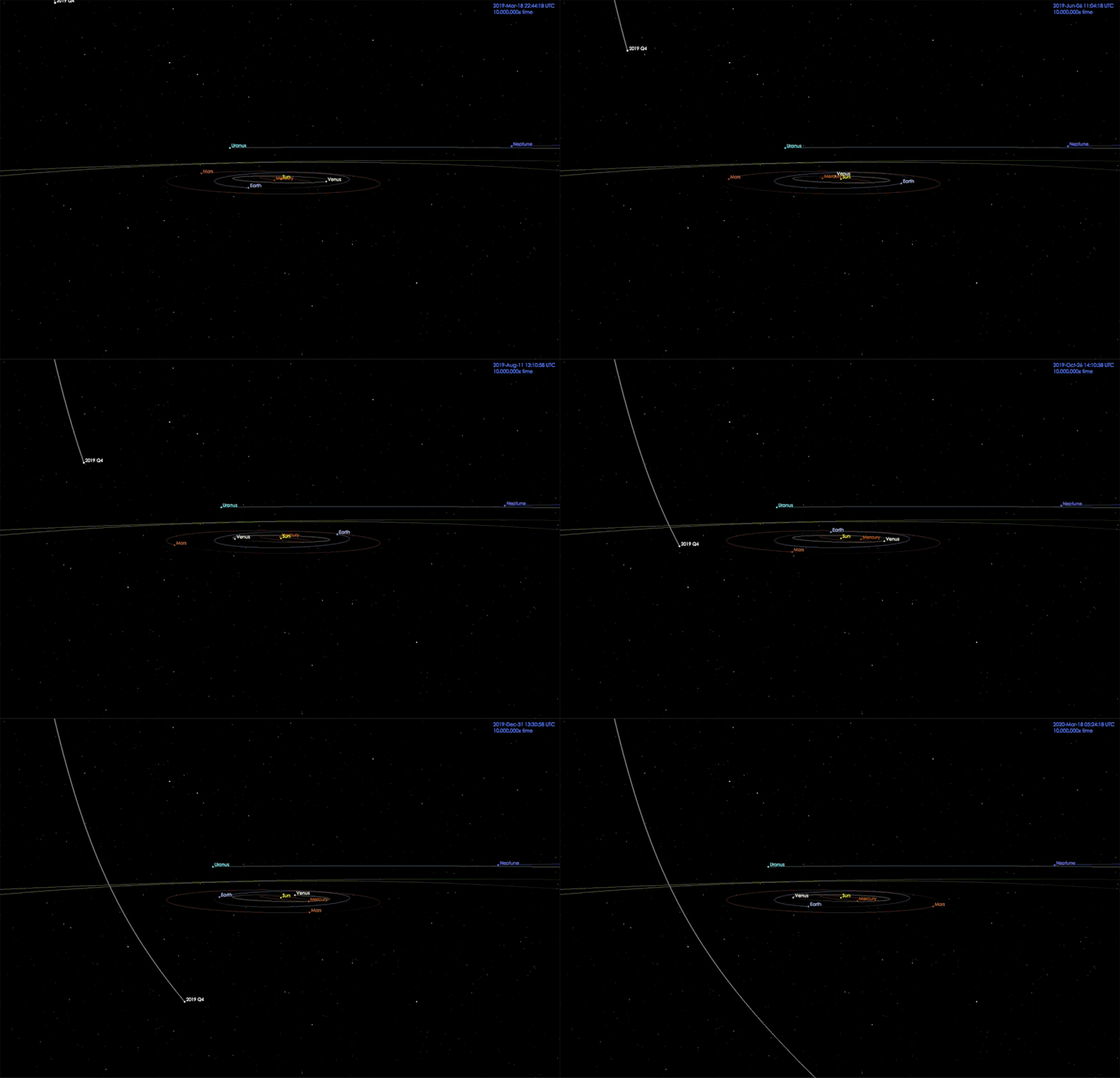
This illustration depicts the trajectory of the object now known as C/2019 Q4. Deemed a possible interstellar object, it will approach no closer to Earth than about 190 million miles (300 million km). Image via NASA/JPL-Caltech

Astronomers are buzzing with excitement this week about a newly discovered object that appears to have come from interstellar space. The official confirmation that this object – labled C/2019 Q4 – is interstellar has not yet been made, but if it is, it would be only the second such object detected. How exciting is that? First, there was only one known object – which earthly astronomers named ‘Oumuamua – observed and confirmed as interstellar, in October 2017. And now there are two. The second (“likely”) interstellar object has been designated C/2019 Q4 (Borisov). Gennady Borisov of the Ukraine – an optician by trade – discovered it on August 30, 2019 at the MARGO observatory in Nauchnij, Crimea.

A statement from NASA called the object a “comet” and said:

The new comet, C/2019 Q4, is still inbound toward the sun, but it will remain farther than the orbit of Mars and will approach no closer to Earth than about 190 million miles (300 million km).

After the initial detections of the comet, Scout system, which is located at NASA’s Jet Propulsion Laboratory in Pasadena, California, automatically flagged the object as possibly being interstellar. Davide Farnocchia of NASA’s Center for Near-Earth Object Studies at JPL worked with astronomers and the European Space Agency’s Near-Earth Object Coordination Center in Frascati, Italy, to obtain additional observations. He then worked with the NASA-sponsored Minor Planet Center in Cambridge, Massachusetts, to estimate the comet’s precise trajectory and determine whether it originated within our solar system or came from elsewhere in the galaxy.

Farnocchia said:

The comet’s current velocity is high, about 93,000 mph [150,000 kph], which is well above the typical velocities of objects orbiting the sun at that distance. The high velocity indicates not only that the object likely originated from outside our solar system, but also that it will leave and head back to interstellar space.

Do we know what C/2019 Q4 looks like? No. It’s mainly just a moving speck to us, albeit, apparently, a slightly fuzzy one. Its orbit resembles the orbits of long-period comets. NASA called it a comet in its announcement, but, in another announcement from the European Space Agency, astronomers used the more neutral word “object.” The NASA statement explained the results of observations completed by Karen Meech and her team at the University of Hawaii, indicating the comet nucleus is somewhere between 1.2 and 10 miles (2 and 16 km) in diameter:

2019 Q4 was established as being cometary due to its fuzzy appearance, which indicates that the object has a central icy body that is producing a surrounding cloud of dust and particles as it approaches the sun and heats up.

“Established” is a strong word, and our guess is that not every astronomer will agree with it. And of course science fiction fans, like me, are hoping it’s something more exciting than a comet, even a (likely) interstellar one.

Could the object be something other than a comet? With ‘Oumuamua, some astronomers speculated that the object might be an alien artifact, perhaps similar to the two Voyager spacecraft that are now hurtling outward away from our solar system, with their golden records attached. Astronomers hunted for signals from ‘Oumuamua, but they didn’t find any. ‘Oumuamua went on its way with many mysteries still unsolved, just as this object will reach its closest point to our sun – its perihelion – on December 8, 2019, at a distance of about 190 million miles (300 million km). Then, if it is truly interstellar, it will – like ‘Oumuamua – flee again into the space between the stars.

White fuzzy dots on black background.

This illustration depicts Comet C/2019 Q4’s trajectory. Deemed a possible interstellar object, it will approach no closer to Earth than about 190 million miles (300 million km). Image via NASA/JPL-Caltech

According to NASA, C/2019 Q4 will be within reach of professional telescopes for months to come. Farnocchia said:

The object will peak in brightness in mid-December and continue to be observable with moderate-size telescopes until April 2020. After that, it will only be observable with larger professional telescopes through October 2020.

NASA said that astronomers will continue collect observations to further characterize the comet’s physical properties (size, rotation, etc.) and also continue to better identify its trajectory.

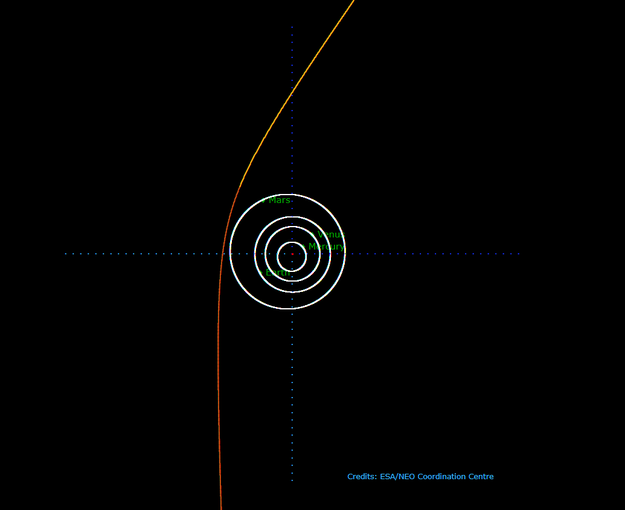
Hyperbolic orbit of comet C/2019 Q4. Image via ESA.

So the second-ever known interstellar object has entered our solar system, and we will doubtless hear more about it in the months to come as astronomers continue to scrutinize it.

By the way [SPOILER ALERT AHEAD], if you never read Rendezvous with Rama – a 1973 sci fi book by Arthur C. Clarke about an object that enters our solar system from interstellar space, and turns out to be an alien spacecraft – then you might not appreciate the words:

And on far-off Earth, Dr. Carlisle Perera had as yet told no one how he had wakened from a restless sleep with the message from his subconscious still echoing in his brain: The Ramans do everything in threes.

If you did read it … you know why I (longingly) mention that quote!

Bottom line: Astronomers discovered the second interstellar object on August 30, 2019. They labeled it C/2019 Q4. If it’s confirmed as interstellar, it would be only the 2nd such object detected, after ‘Oumuamua, observed in 2017.

Read more from NASA/JPL

Read more from ESA


from EarthSky https://ift.tt/34Iev1W

This illustration depicts the trajectory of the object now known as C/2019 Q4. Deemed a possible interstellar object, it will approach no closer to Earth than about 190 million miles (300 million km). Image via NASA/JPL-Caltech

Astronomers are buzzing with excitement this week about a newly discovered object that appears to have come from interstellar space. The official confirmation that this object – labled C/2019 Q4 – is interstellar has not yet been made, but if it is, it would be only the second such object detected. How exciting is that? First, there was only one known object – which earthly astronomers named ‘Oumuamua – observed and confirmed as interstellar, in October 2017. And now there are two. The second (“likely”) interstellar object has been designated C/2019 Q4 (Borisov). Gennady Borisov of the Ukraine – an optician by trade – discovered it on August 30, 2019 at the MARGO observatory in Nauchnij, Crimea.

A statement from NASA called the object a “comet” and said:

The new comet, C/2019 Q4, is still inbound toward the sun, but it will remain farther than the orbit of Mars and will approach no closer to Earth than about 190 million miles (300 million km).

After the initial detections of the comet, Scout system, which is located at NASA’s Jet Propulsion Laboratory in Pasadena, California, automatically flagged the object as possibly being interstellar. Davide Farnocchia of NASA’s Center for Near-Earth Object Studies at JPL worked with astronomers and the European Space Agency’s Near-Earth Object Coordination Center in Frascati, Italy, to obtain additional observations. He then worked with the NASA-sponsored Minor Planet Center in Cambridge, Massachusetts, to estimate the comet’s precise trajectory and determine whether it originated within our solar system or came from elsewhere in the galaxy.

Farnocchia said:

The comet’s current velocity is high, about 93,000 mph [150,000 kph], which is well above the typical velocities of objects orbiting the sun at that distance. The high velocity indicates not only that the object likely originated from outside our solar system, but also that it will leave and head back to interstellar space.

Do we know what C/2019 Q4 looks like? No. It’s mainly just a moving speck to us, albeit, apparently, a slightly fuzzy one. Its orbit resembles the orbits of long-period comets. NASA called it a comet in its announcement, but, in another announcement from the European Space Agency, astronomers used the more neutral word “object.” The NASA statement explained the results of observations completed by Karen Meech and her team at the University of Hawaii, indicating the comet nucleus is somewhere between 1.2 and 10 miles (2 and 16 km) in diameter:

2019 Q4 was established as being cometary due to its fuzzy appearance, which indicates that the object has a central icy body that is producing a surrounding cloud of dust and particles as it approaches the sun and heats up.

“Established” is a strong word, and our guess is that not every astronomer will agree with it. And of course science fiction fans, like me, are hoping it’s something more exciting than a comet, even a (likely) interstellar one.

Could the object be something other than a comet? With ‘Oumuamua, some astronomers speculated that the object might be an alien artifact, perhaps similar to the two Voyager spacecraft that are now hurtling outward away from our solar system, with their golden records attached. Astronomers hunted for signals from ‘Oumuamua, but they didn’t find any. ‘Oumuamua went on its way with many mysteries still unsolved, just as this object will reach its closest point to our sun – its perihelion – on December 8, 2019, at a distance of about 190 million miles (300 million km). Then, if it is truly interstellar, it will – like ‘Oumuamua – flee again into the space between the stars.

White fuzzy dots on black background.

This illustration depicts Comet C/2019 Q4’s trajectory. Deemed a possible interstellar object, it will approach no closer to Earth than about 190 million miles (300 million km). Image via NASA/JPL-Caltech

According to NASA, C/2019 Q4 will be within reach of professional telescopes for months to come. Farnocchia said:

The object will peak in brightness in mid-December and continue to be observable with moderate-size telescopes until April 2020. After that, it will only be observable with larger professional telescopes through October 2020.

NASA said that astronomers will continue collect observations to further characterize the comet’s physical properties (size, rotation, etc.) and also continue to better identify its trajectory.

Hyperbolic orbit of comet C/2019 Q4. Image via ESA.

So the second-ever known interstellar object has entered our solar system, and we will doubtless hear more about it in the months to come as astronomers continue to scrutinize it.

By the way [SPOILER ALERT AHEAD], if you never read Rendezvous with Rama – a 1973 sci fi book by Arthur C. Clarke about an object that enters our solar system from interstellar space, and turns out to be an alien spacecraft – then you might not appreciate the words:

And on far-off Earth, Dr. Carlisle Perera had as yet told no one how he had wakened from a restless sleep with the message from his subconscious still echoing in his brain: The Ramans do everything in threes.

If you did read it … you know why I (longingly) mention that quote!

Bottom line: Astronomers discovered the second interstellar object on August 30, 2019. They labeled it C/2019 Q4. If it’s confirmed as interstellar, it would be only the 2nd such object detected, after ‘Oumuamua, observed in 2017.

Read more from NASA/JPL

Read more from ESA


from EarthSky https://ift.tt/34Iev1W

Latest Saturn portrait, from Hubble

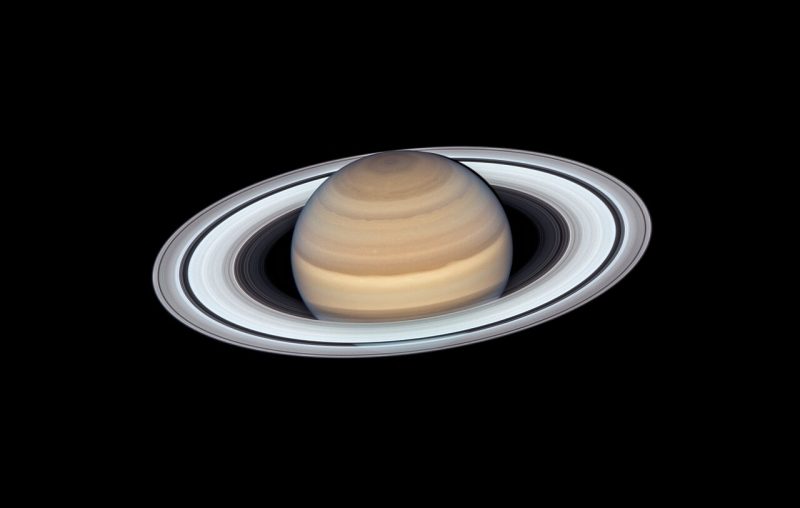
Saturn, with rings wide open, and a lot of details on the body of the planet.

View larger. | The Hubble Space Telescope’s Wide Field Camera 3 observed Saturn on June 20, 2019. That was shortly before Earth flew between Saturn and the sun on July 9, and thus Saturn was generally at its closest to Earth for this year, at nearly a billion miles (1.36 billion km) away. Image via NASA/ ESA/ A. Simon/ M.H. Wong/ Spacetelescope.org.

Saturn is still in the evening sky. Click here for EarthSky’s planet guide.


from EarthSky https://ift.tt/2ZRrz5D
Saturn, with rings wide open, and a lot of details on the body of the planet.

View larger. | The Hubble Space Telescope’s Wide Field Camera 3 observed Saturn on June 20, 2019. That was shortly before Earth flew between Saturn and the sun on July 9, and thus Saturn was generally at its closest to Earth for this year, at nearly a billion miles (1.36 billion km) away. Image via NASA/ ESA/ A. Simon/ M.H. Wong/ Spacetelescope.org.

Saturn is still in the evening sky. Click here for EarthSky’s planet guide.


from EarthSky https://ift.tt/2ZRrz5D

Harvest Moon on Friday the 13th

These next several nights – September 12, 13 and 14, 2019 – look for a full-looking moon to light up the nighttime sky from dusk till dawn. Depending on where you live worldwide, this upcoming full moon will fall on Friday, September 13, or Saturday, September 14. For the Northern Hemisphere, this September full moon counts as the closest full moon to the September autumn equinox, so it’s the Northern Hemisphere’s full Harvest Moon.

Read more: Two Friday the 13ths in 2019

In the Southern Hemisphere, the September equinox ushers in their spring season. Therefore, the Southern Hemisphere’s autumn equinox will come six months later, on March 20, 2020. And the full moon on March 9, 2020, will be the Southern Hemisphere’s Harvest Moon – the full moon closest to their autumn equinox.

Although the moon appears full to the eye for a few to several days in succession, it is only truly full for a fleeting instant. Astronomically speaking, the moon is full at the moment that it’s exactly 180 degrees opposite the sun in ecliptic longitude. This moment falls on September 14, at 04:33 Universal Time.

The full moon occurs at the same instant worldwide, but the local clock time varies by time zone. At time zones in the mainland United States, the full moon falls on Saturday, September 14, at 12:33 a.m. EDT – yet on Friday, September 13 at all other U.S. times – at 11:33 p.m. CDT, 10:33 p.m. MDT and 9:33 p.m. PDT. The last time that the Northern Hemisphere’s full Harvest Moon fell on a Friday the 13th (for at least a portion of the world) was in the year 1935, and the next time won’t be until the year 2171.

Visit Sunrise Sunset Calendars to find out when the moon turns full in your time zone, remembering to check the Moon phases box.

By Universal Time, the last time the full moon fell on Friday the 13th was on June 13, 2014, and the next time will have to wait until August 13, 2049. In the 21st century (2001 to 2100), a full moon falls on Friday the 13th for a total of eight times (by Universal Time).

Read more: When does Friday the 13th have a full moon?

The full moon occurring most closely to the autumnal equinox (the Northern Hemisphere’s September equinox/Southern Hemisphere’s March equinox) enjoys the designation of Harvest Moon. By Universal Time, the full Harvest Moon will come on September 14, 2019, in the Northern Hemisphere – and to the Southern Hemisphere on March 20, 2020.

There is no Harvest Moon at the equator and not enough of one to say so in the tropical regions of the globe. You really have to be well north (or south) of the tropics to observe the year’s grandest parade of moonlit nights around the time of the autumn equinox. The farther north or south of the Earth’s equator you live, the longer the procession of moonlit nights accompanying the Harvest Moon.

Diagram: Celestial sphere with slanted circle of ecliptic at a low angle to the horzon.

In early autumn, at sunset, the angle of the ecliptic – the sun’s yearly path or the moon’s monthly path in front of the constellations of the zodiac – makes a narrow angle with the horizon. Image via classicalastronomy.com.

The term Harvest Moon might be of European origin, because northern Europe is much closer to the Arctic than the tropics. Before the advent of artificial lighting, people planned nocturnal activity around the moon, knowing the moon provides dusk-till-dawn moonlight on the night of the full moon. But farmers of old were also aware that the Harvest Moon – the closest full moon to the autumn equinox – could be relied upon to provide dusk-till-dawn moonlight for several days in a row at mid-temperate latitudes, or even as long as a week straight at far-northern latitudes.

This bonanza of moonlight in the season of waning daylight remains the legacy of the Harvest Moon. The Harvest Moon distinguishes itself from other full moons with several nights of dusk-till-dawn moonlight.

At the vicinity of full moon, the moon stays more or less opposite the sun throughout the night. A full moon (or nearly full moon) rises in the east around sunset, climbs highest up for the night around midnight and sets in the west around sunrise. In this respect, this applies to any full moon at any season of the year.

Yet this closest full moon to the September equinox displays special characteristics for both the Northern and Southern Hemispheres. From around the world, the September full moon rises pretty much eastward. Again, from both the Northern and Southern Hemispheres, you’ll find the moon rising farther and farther north along your eastern horizon each evening for the next week or so. Don’t know which way is north? No problem. As you stand facing eastward, north is to your left.

On the average, the moon rises 50 minutes later each day. For us in the Northern Hemisphere, however, the northbound moonrises following the September full moon reduce the lag time between successive moonrises to a yearly minimum. In the Southern Hemisphere, these more northern moonrises increase the lag time between successive moonrises to a yearly maximum.

Check out the chart below.

Horizon with the slanted path of the moon.

The narrow angle of the ecliptic means the moon rises noticeably farther north on the horizon, from one night to the next. So, as viewed from northerly latitudes, there’s no long period of darkness between sunset and moonrise. Image via classicalastronomy.com.

From 40 degrees north (Denver, Colorado; Philadelphia, Pennsylvania; Beijing, China), the moon now rises some 25 (instead of 50) minutes later daily. From Anchorage, Alaska (just north of 60 degrees north latitude), the moon rises about eight minutes later daily.

The higher the latitude, the greater the Harvest Moon effect – the effect of no great lag time between sunset and moonrise – in the season of waning daylight.

By the way, this full moon is also being called a micro-moon or mini-moon because it’s the farthest (and therefore the smallest) full moon of the year. This full moon comes one fortnight (approximately two weeks) after the new moon supermoon on August 30, 2019, and one fortnight before the new moon supermoon of September 28, 2019.

Four years ago, the Harvest Moon of September 28, 2015, presented the closest (and therefore the largest) full moon of 2015.

Read more: Super Blood Moon eclipse on September 28, 2015

The September 2019 full moon is the nearest full moon to the September equinox; yet, at the same time, it’s the farthest full moon of the year.

Bottom line: The Harvest Moon – closest full moon to the September equinox – falls on Friday, September 13, in 2019.


from EarthSky https://ift.tt/2Aefnxu

These next several nights – September 12, 13 and 14, 2019 – look for a full-looking moon to light up the nighttime sky from dusk till dawn. Depending on where you live worldwide, this upcoming full moon will fall on Friday, September 13, or Saturday, September 14. For the Northern Hemisphere, this September full moon counts as the closest full moon to the September autumn equinox, so it’s the Northern Hemisphere’s full Harvest Moon.

Read more: Two Friday the 13ths in 2019

In the Southern Hemisphere, the September equinox ushers in their spring season. Therefore, the Southern Hemisphere’s autumn equinox will come six months later, on March 20, 2020. And the full moon on March 9, 2020, will be the Southern Hemisphere’s Harvest Moon – the full moon closest to their autumn equinox.

Although the moon appears full to the eye for a few to several days in succession, it is only truly full for a fleeting instant. Astronomically speaking, the moon is full at the moment that it’s exactly 180 degrees opposite the sun in ecliptic longitude. This moment falls on September 14, at 04:33 Universal Time.

The full moon occurs at the same instant worldwide, but the local clock time varies by time zone. At time zones in the mainland United States, the full moon falls on Saturday, September 14, at 12:33 a.m. EDT – yet on Friday, September 13 at all other U.S. times – at 11:33 p.m. CDT, 10:33 p.m. MDT and 9:33 p.m. PDT. The last time that the Northern Hemisphere’s full Harvest Moon fell on a Friday the 13th (for at least a portion of the world) was in the year 1935, and the next time won’t be until the year 2171.

Visit Sunrise Sunset Calendars to find out when the moon turns full in your time zone, remembering to check the Moon phases box.

By Universal Time, the last time the full moon fell on Friday the 13th was on June 13, 2014, and the next time will have to wait until August 13, 2049. In the 21st century (2001 to 2100), a full moon falls on Friday the 13th for a total of eight times (by Universal Time).

Read more: When does Friday the 13th have a full moon?

The full moon occurring most closely to the autumnal equinox (the Northern Hemisphere’s September equinox/Southern Hemisphere’s March equinox) enjoys the designation of Harvest Moon. By Universal Time, the full Harvest Moon will come on September 14, 2019, in the Northern Hemisphere – and to the Southern Hemisphere on March 20, 2020.

There is no Harvest Moon at the equator and not enough of one to say so in the tropical regions of the globe. You really have to be well north (or south) of the tropics to observe the year’s grandest parade of moonlit nights around the time of the autumn equinox. The farther north or south of the Earth’s equator you live, the longer the procession of moonlit nights accompanying the Harvest Moon.

Diagram: Celestial sphere with slanted circle of ecliptic at a low angle to the horzon.

In early autumn, at sunset, the angle of the ecliptic – the sun’s yearly path or the moon’s monthly path in front of the constellations of the zodiac – makes a narrow angle with the horizon. Image via classicalastronomy.com.

The term Harvest Moon might be of European origin, because northern Europe is much closer to the Arctic than the tropics. Before the advent of artificial lighting, people planned nocturnal activity around the moon, knowing the moon provides dusk-till-dawn moonlight on the night of the full moon. But farmers of old were also aware that the Harvest Moon – the closest full moon to the autumn equinox – could be relied upon to provide dusk-till-dawn moonlight for several days in a row at mid-temperate latitudes, or even as long as a week straight at far-northern latitudes.

This bonanza of moonlight in the season of waning daylight remains the legacy of the Harvest Moon. The Harvest Moon distinguishes itself from other full moons with several nights of dusk-till-dawn moonlight.

At the vicinity of full moon, the moon stays more or less opposite the sun throughout the night. A full moon (or nearly full moon) rises in the east around sunset, climbs highest up for the night around midnight and sets in the west around sunrise. In this respect, this applies to any full moon at any season of the year.

Yet this closest full moon to the September equinox displays special characteristics for both the Northern and Southern Hemispheres. From around the world, the September full moon rises pretty much eastward. Again, from both the Northern and Southern Hemispheres, you’ll find the moon rising farther and farther north along your eastern horizon each evening for the next week or so. Don’t know which way is north? No problem. As you stand facing eastward, north is to your left.

On the average, the moon rises 50 minutes later each day. For us in the Northern Hemisphere, however, the northbound moonrises following the September full moon reduce the lag time between successive moonrises to a yearly minimum. In the Southern Hemisphere, these more northern moonrises increase the lag time between successive moonrises to a yearly maximum.

Check out the chart below.

Horizon with the slanted path of the moon.

The narrow angle of the ecliptic means the moon rises noticeably farther north on the horizon, from one night to the next. So, as viewed from northerly latitudes, there’s no long period of darkness between sunset and moonrise. Image via classicalastronomy.com.

From 40 degrees north (Denver, Colorado; Philadelphia, Pennsylvania; Beijing, China), the moon now rises some 25 (instead of 50) minutes later daily. From Anchorage, Alaska (just north of 60 degrees north latitude), the moon rises about eight minutes later daily.

The higher the latitude, the greater the Harvest Moon effect – the effect of no great lag time between sunset and moonrise – in the season of waning daylight.

By the way, this full moon is also being called a micro-moon or mini-moon because it’s the farthest (and therefore the smallest) full moon of the year. This full moon comes one fortnight (approximately two weeks) after the new moon supermoon on August 30, 2019, and one fortnight before the new moon supermoon of September 28, 2019.

Four years ago, the Harvest Moon of September 28, 2015, presented the closest (and therefore the largest) full moon of 2015.

Read more: Super Blood Moon eclipse on September 28, 2015

The September 2019 full moon is the nearest full moon to the September equinox; yet, at the same time, it’s the farthest full moon of the year.

Bottom line: The Harvest Moon – closest full moon to the September equinox – falls on Friday, September 13, in 2019.


from EarthSky https://ift.tt/2Aefnxu

Plastic pollution has entered fossil record, says study

A beach covered with plastic trash.

A beach in Ghana, 2018. Image via Wikipedia.

Plastic pollution is now in the fossil record, according to new research from the Scripps Institution of Oceanography at the University of California San Diego. For the study, which was published September 4, 2019, in the journal Scientific Advances, scientists studied layers of earth in California’s Santa Barbara Basin dating back to 1834. They found that deposits of plastic have increased exponentially since the end of World War II, doubling around every 15 years.

Most of the plastic particles were fibers from synthetic fabrics used in clothes, said the researchers, suggesting that plastics are flowing into the ocean via waste water.

The increase of plastics in the sediments matches a rise in the rate of plastic production worldwide and a surge in California’s coastal population during the same time period. Jennifer Brandon of Scripps is the study’s lead author. She said in a statement:

This study shows that our plastic production is being almost perfectly copied in our sedimentary record. Our love of plastic is actually being left behind in our fossil record.

Brandon also told The Guardian:

It is a very clear signature. Plastic was invented and pretty much immediately we can see it appear in the sedimentary record.

Tiny bits of plastic fibers and pieces with cutaway vew of sediment core sample.

Seen under the microscope, varied bits of plastic begin to accumulate in sediment after World War II. Image via Scripps Institution of Oceanography.

The researchers analyzed annual sediment layers, collected from a core sample, that they dated back to 1834, looking for microplastics – tiny bits of plastic than 5 millimeters long (or about the size of a sesame seed) in the core sample layers. Most plastics were invented in the 1920s, but not used in significant commercial quantities until after World War II. The researchers found plastic in sediment dated to 1945, with the amount later increasing rapidly, so that by 2010 (when the samples were collected), people were depositing 10 times as much plastic into the basin as they were before World War II. The researchers said that the postwar period also showed a greater diversity of plastics, including fragments of plastic bag materials and plastic particles in addition to fibers.

Brandon suggested that the study results support the idea of using plastic accumulation as a defining signifier of the Anthropocene, a proposed new geological epoch marked by humanity’s influence on Earth. Specifically, Brandon said, the rise of plastics beginning in 1945, when the world recovered from war, could serve as a proxy for a time period within the Anthropocene that scientists have labeled the Great Acceleration, a period when humanity’s impact on our planet is increasing significantly. Brandon told The Guardian:

We all learn in school about the Stone Age, the Bronze Age and Iron Age. Is this going to be known as the plastic age?

It is a scary thing that this is what our generations will be remembered for.

Bottom line: New research suggests that plastics have entered Earth’s fossil record.

Source: Multidecadal increase in plastic particles in coastal ocean sediments

Via Scripps Institution of Oceanography


from EarthSky https://ift.tt/2ZWrHAW
A beach covered with plastic trash.

A beach in Ghana, 2018. Image via Wikipedia.

Plastic pollution is now in the fossil record, according to new research from the Scripps Institution of Oceanography at the University of California San Diego. For the study, which was published September 4, 2019, in the journal Scientific Advances, scientists studied layers of earth in California’s Santa Barbara Basin dating back to 1834. They found that deposits of plastic have increased exponentially since the end of World War II, doubling around every 15 years.

Most of the plastic particles were fibers from synthetic fabrics used in clothes, said the researchers, suggesting that plastics are flowing into the ocean via waste water.

The increase of plastics in the sediments matches a rise in the rate of plastic production worldwide and a surge in California’s coastal population during the same time period. Jennifer Brandon of Scripps is the study’s lead author. She said in a statement:

This study shows that our plastic production is being almost perfectly copied in our sedimentary record. Our love of plastic is actually being left behind in our fossil record.

Brandon also told The Guardian:

It is a very clear signature. Plastic was invented and pretty much immediately we can see it appear in the sedimentary record.

Tiny bits of plastic fibers and pieces with cutaway vew of sediment core sample.

Seen under the microscope, varied bits of plastic begin to accumulate in sediment after World War II. Image via Scripps Institution of Oceanography.

The researchers analyzed annual sediment layers, collected from a core sample, that they dated back to 1834, looking for microplastics – tiny bits of plastic than 5 millimeters long (or about the size of a sesame seed) in the core sample layers. Most plastics were invented in the 1920s, but not used in significant commercial quantities until after World War II. The researchers found plastic in sediment dated to 1945, with the amount later increasing rapidly, so that by 2010 (when the samples were collected), people were depositing 10 times as much plastic into the basin as they were before World War II. The researchers said that the postwar period also showed a greater diversity of plastics, including fragments of plastic bag materials and plastic particles in addition to fibers.

Brandon suggested that the study results support the idea of using plastic accumulation as a defining signifier of the Anthropocene, a proposed new geological epoch marked by humanity’s influence on Earth. Specifically, Brandon said, the rise of plastics beginning in 1945, when the world recovered from war, could serve as a proxy for a time period within the Anthropocene that scientists have labeled the Great Acceleration, a period when humanity’s impact on our planet is increasing significantly. Brandon told The Guardian:

We all learn in school about the Stone Age, the Bronze Age and Iron Age. Is this going to be known as the plastic age?

It is a scary thing that this is what our generations will be remembered for.

Bottom line: New research suggests that plastics have entered Earth’s fossil record.

Source: Multidecadal increase in plastic particles in coastal ocean sediments

Via Scripps Institution of Oceanography


from EarthSky https://ift.tt/2ZWrHAW

adds 2