aads

What has China’s rover found on the moon’s far side?

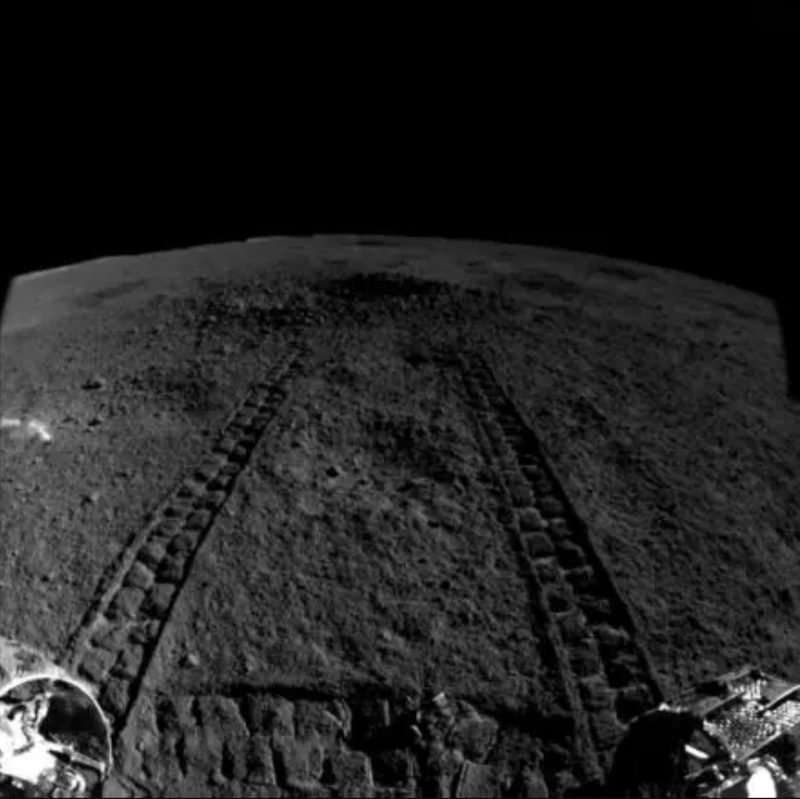
Rover tracks on rocky gray landscape with black sky.

Tracks from China’s Yutu-2 rover approaching the crater where the rover has reportedly discovered a “gel-like” substance on the far side of the moon. Few details are known at this point. Image via China Lunar Exploration Program (CLEP)/Space.com.

What has China’s Yutu-2 rover discovered on the far side of the moon? That is a question a lot of people are asking after an intriguing report came out from Space.com a few days ago, which referenced a “gel-like” substance discovered in a small crater. Not many details are known right now, but there are some possible clues, as provided by planetary scientists who have commented on the finding.

The discovery was published in the “Drive Diary” for Yutu-2 (literally “Jade Rabbit”) in the Chinese government-sanctioned publication Our Space, on August 17, 2019. It was also tweeted by the state-run People’s Daily newspaper.

Yutu-2, the follow-up to the first Yutu rover and part of the Chang’e 4 mission, first made the discovery back on July 25, day 8 of its mission. Previous driving plans were postponed, so scientists could take a better look at the material with the rover’s instruments. The oddity was first noticed by mission team member Yu Tianyi while he was checking images from the main camera on the rover. There were many small craters around, but one of them looked unusual, containing something with an unexpected color and luster.

The material has been described as gel-like, but it should be noted that the actual appearance still isn’t known for certain yet. As others have noted, it’s possible that this is a mistranslation from Chinese reports. Some planetary scientists have speculated that what has been found may be impact melt glass from a meteorite strike (and the substance is in a crater) or perhaps volcanic glass from an ancient volcanic explosion. Both of those have been found before on the moon, including by Apollo astronauts.

According to Mahesh Anand, a planetary scientist at the Open University in the United Kingdom, in Newsweek:

The fact that it has been observed associated with a small impact crater, this finding could be extremely exciting as it would indicate that a very different material could just be hiding underneath the very top surface. This would assume even a greater significance if these material turn out to have experienced interaction with water-ice (as the possibility of existence of water-ice in the top few meters of the lunar south polar region is predicted on the basis of recent remote sensing dataset).

As Walter Freeman, a physicist at Syracuse University, also noted:

We have lots of processes on Earth that cause interesting geology: the action of water, wind, and volcanism. But the moon has none of these, so meteorite impacts are the main thing that reshapes its surface. There’s a bit of precedent for this on Earth: at the site where the first nuclear bomb was tested in New Mexico, there is a glassy mineral called “trinitite” formed from the heat of the explosion. The same thing happens around meteorite impacts here.
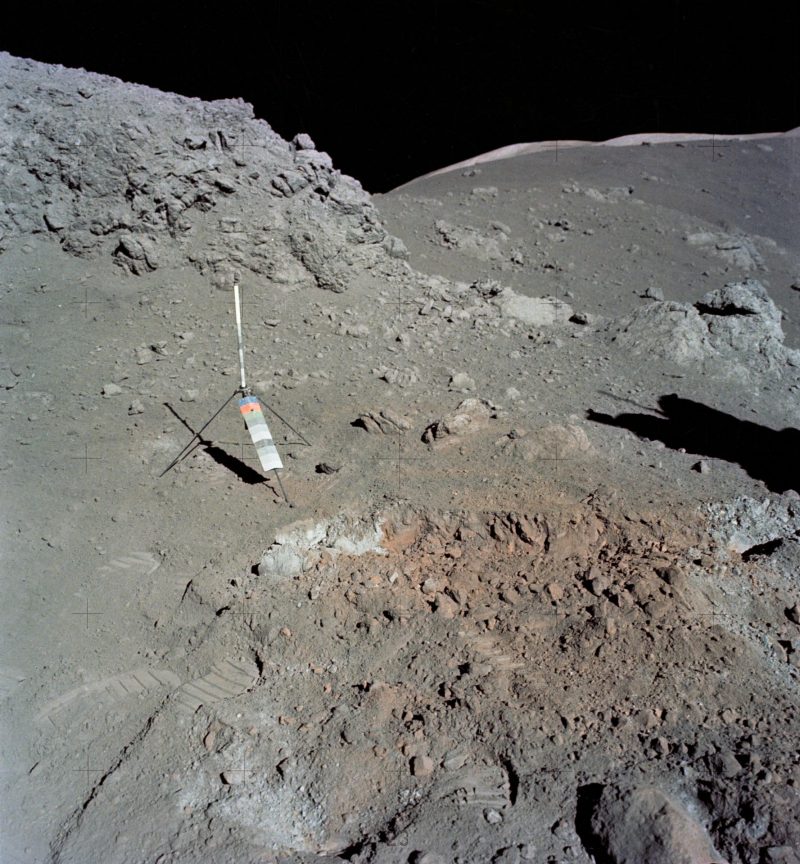
Orange soil patch on gray rocky soil with three-legged instrument to one side.

In 1972, Apollo 17 astronauts discovered unusual orange-colored soil on the moon. Could the Chinese rover discovery be of something similar? Image via NASA/Space.com.

In Our Space, the material was described as being significantly different from the surrounding lunar soil in shape and color, but not specifically how.

Both the material and the crater itself were examined with the rover’s Visible and Near-Infrared Spectrometer (VNIS) instrument, which detects light that is scattered or reflected, to reveal their makeup. As previously reported, VNIS also detected material that originated from the lunar mantle, in the regolith of Von Kármán crater. That discovery was announced last May.

Is this new material the same or similar to what was found in Von Kármán crater? We don’t know yet, and there is still little information to go on. It would be odd if it actually was gel-like, but at the moment, most other scientists think that it is probably more like impact melt or volcanic glass. We don’t even know the specific color yet, other than it is “unusual.”

Could it also be similar to what Apollo 17 astronauts found in 1972? They discovered orange-colored soil near the Taurus-Littrow landing site, created during a volcanic eruption 3.64 billion years ago.
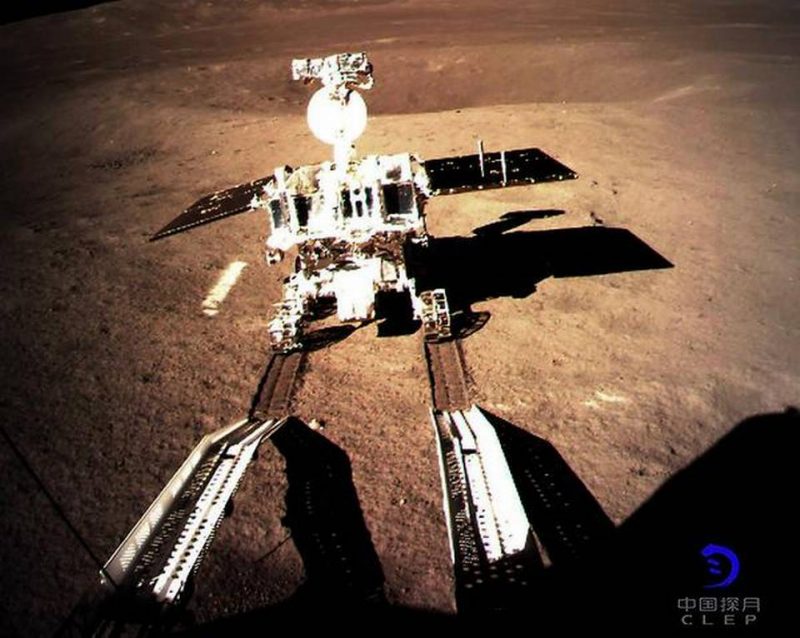
Wheeled machine with solar panel wings, having just rolled down twin ramps.

View of the Yutu-2 rover as it rolled off the Chang’e-4 lander last January. Image via China National Space Administration (CNSA)/The Hindu.

So far, there haven’t been any photos or analysis results released of the “gel” itself, so we will just have to wait for more information.

The Yutu-2 rover will now continue its journey west of the landing site. What else might it find? Yutu-2 was launched in December 2018 on the Chang’e 4 lander, landing in Aitken Basin near the south pole of the moon in January, and is the first rover to explore the far side of our closest celestial neighbor. As Zou Yongliao at the Chinese Academy of Sciences told Xinhua:

The far side of the moon has unique features never before explored on site. The exploration of this virgin land by Chang’e-4 might bring breakthrough findings.

For now, the “moon gel” finding remains a mystery, but stay tuned for further updates when more information becomes available.

Bottom line: The Chinese rover Yutu-2 has discovered an unusual “gel-like” material on the far side of the moon, according to state-run sources. But details are limited right now as to what it might actually be.

Via Space.com

Via Smithsonian.com

Via Newsweek.com


from EarthSky https://ift.tt/31cS6Yq
Rover tracks on rocky gray landscape with black sky.

Tracks from China’s Yutu-2 rover approaching the crater where the rover has reportedly discovered a “gel-like” substance on the far side of the moon. Few details are known at this point. Image via China Lunar Exploration Program (CLEP)/Space.com.

What has China’s Yutu-2 rover discovered on the far side of the moon? That is a question a lot of people are asking after an intriguing report came out from Space.com a few days ago, which referenced a “gel-like” substance discovered in a small crater. Not many details are known right now, but there are some possible clues, as provided by planetary scientists who have commented on the finding.

The discovery was published in the “Drive Diary” for Yutu-2 (literally “Jade Rabbit”) in the Chinese government-sanctioned publication Our Space, on August 17, 2019. It was also tweeted by the state-run People’s Daily newspaper.

Yutu-2, the follow-up to the first Yutu rover and part of the Chang’e 4 mission, first made the discovery back on July 25, day 8 of its mission. Previous driving plans were postponed, so scientists could take a better look at the material with the rover’s instruments. The oddity was first noticed by mission team member Yu Tianyi while he was checking images from the main camera on the rover. There were many small craters around, but one of them looked unusual, containing something with an unexpected color and luster.

The material has been described as gel-like, but it should be noted that the actual appearance still isn’t known for certain yet. As others have noted, it’s possible that this is a mistranslation from Chinese reports. Some planetary scientists have speculated that what has been found may be impact melt glass from a meteorite strike (and the substance is in a crater) or perhaps volcanic glass from an ancient volcanic explosion. Both of those have been found before on the moon, including by Apollo astronauts.

According to Mahesh Anand, a planetary scientist at the Open University in the United Kingdom, in Newsweek:

The fact that it has been observed associated with a small impact crater, this finding could be extremely exciting as it would indicate that a very different material could just be hiding underneath the very top surface. This would assume even a greater significance if these material turn out to have experienced interaction with water-ice (as the possibility of existence of water-ice in the top few meters of the lunar south polar region is predicted on the basis of recent remote sensing dataset).

As Walter Freeman, a physicist at Syracuse University, also noted:

We have lots of processes on Earth that cause interesting geology: the action of water, wind, and volcanism. But the moon has none of these, so meteorite impacts are the main thing that reshapes its surface. There’s a bit of precedent for this on Earth: at the site where the first nuclear bomb was tested in New Mexico, there is a glassy mineral called “trinitite” formed from the heat of the explosion. The same thing happens around meteorite impacts here.

Orange soil patch on gray rocky soil with three-legged instrument to one side.

In 1972, Apollo 17 astronauts discovered unusual orange-colored soil on the moon. Could the Chinese rover discovery be of something similar? Image via NASA/Space.com.

In Our Space, the material was described as being significantly different from the surrounding lunar soil in shape and color, but not specifically how.

Both the material and the crater itself were examined with the rover’s Visible and Near-Infrared Spectrometer (VNIS) instrument, which detects light that is scattered or reflected, to reveal their makeup. As previously reported, VNIS also detected material that originated from the lunar mantle, in the regolith of Von Kármán crater. That discovery was announced last May.

Is this new material the same or similar to what was found in Von Kármán crater? We don’t know yet, and there is still little information to go on. It would be odd if it actually was gel-like, but at the moment, most other scientists think that it is probably more like impact melt or volcanic glass. We don’t even know the specific color yet, other than it is “unusual.”

Could it also be similar to what Apollo 17 astronauts found in 1972? They discovered orange-colored soil near the Taurus-Littrow landing site, created during a volcanic eruption 3.64 billion years ago.

Wheeled machine with solar panel wings, having just rolled down twin ramps.

View of the Yutu-2 rover as it rolled off the Chang’e-4 lander last January. Image via China National Space Administration (CNSA)/The Hindu.

So far, there haven’t been any photos or analysis results released of the “gel” itself, so we will just have to wait for more information.

The Yutu-2 rover will now continue its journey west of the landing site. What else might it find? Yutu-2 was launched in December 2018 on the Chang’e 4 lander, landing in Aitken Basin near the south pole of the moon in January, and is the first rover to explore the far side of our closest celestial neighbor. As Zou Yongliao at the Chinese Academy of Sciences told Xinhua:

The far side of the moon has unique features never before explored on site. The exploration of this virgin land by Chang’e-4 might bring breakthrough findings.

For now, the “moon gel” finding remains a mystery, but stay tuned for further updates when more information becomes available.

Bottom line: The Chinese rover Yutu-2 has discovered an unusual “gel-like” material on the far side of the moon, according to state-run sources. But details are limited right now as to what it might actually be.

Via Space.com

Via Smithsonian.com

Via Newsweek.com


from EarthSky https://ift.tt/31cS6Yq

New names for 5 Jupiter moons

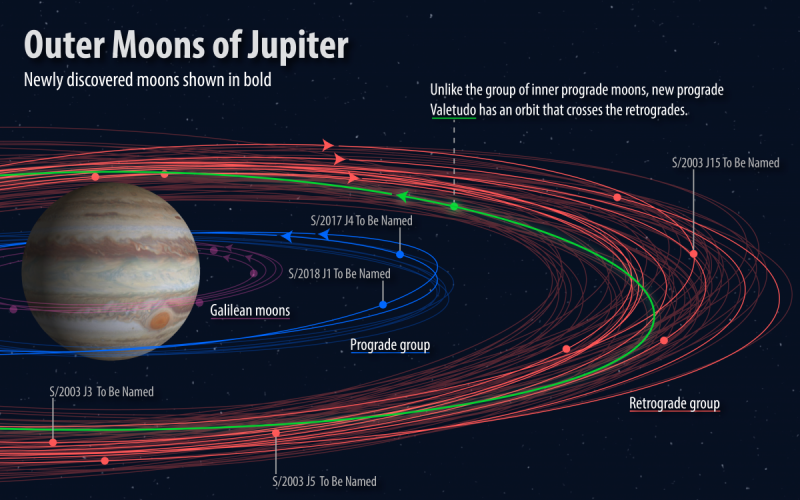
Jupiter with very many orbits of moons, including newly discovered ones.

Jupiter officially has 12 new moons, discovered in 2018. They are outer moons; their orbits are shown here. Image via Carnegie Science.

The Carnegie Institution for Science – headquartered in Washington, D.C. – announced in late August that the winners of its Jupiter-moon-naming contest have been selected. From February to April, this institution had solicited name suggestions for five of the 12 moons of Jupiter discovered in 2018 by a team led by Carnegie’s Scott S. Sheppard.

Sheppard commented:

I was blown away by the enthusiastic response for this contest. I hope the thought of these moons let everyone ponder the wonder and amazement that is our universe.

A smiling man in a button-down shirt.

Astronomer Scott Sheppard of Carnegie Science led a team that discovered 12 new moons for Jupiter in 2018. Now 5 of those new moons have been given new names. Image via Carnegie Science. Visit Scott Sheppard’s Jupiter-moons page.

He added that there are many rules in place – regulated by the International Astronomical Union (IAU) – when it comes to naming new moons:

Most notably, Jovian naming conventions require its many moons to be named after characters from Greek and Roman mythology who were either descendants or consorts of Zeus, or Jupiter.

And there are other strictures as well, including a maximum character length and the final letter of each name, depending on the direction of a moon’s orbit. Carnegie Science combed through people’s suggestions and sent what they felt were the best-suited names to the IAU, which published the final names on August 23, 2019. Here they are:

S/2017 J4 is now Pandia. Carnegie Science said:

She is the daughter of Zeus and the Moon goddess Selene. Pandia is the goddess of the full moon and the sister of Ersa. The name Pandia was one of the more popular names entered into the contest. Our favorite submission was representing the astronomy club of the Lanivet School in Cornwall, England. Emma Hugo (@emmabray182) tweeted a picture of the astro club with a Pandia sign and the school’s Panda mascot, which is in honor of the village’s former role as bamboo supplier to the London zoo.

S/2018 J1 is now Ersa. Carnegie Science said:

She is the sister of Pandia and, as such, also the daughter of Zeus and the Moon goddess Selene. Ersa is the goddess of dew. There were more than 20 tweets suggesting the name Ersa. Being the daughter of a Moon goddess seemed very appropriate for a Jovian moon. The first submission was from space news aggregator Aaron Quah (@8603103) and the submissions that most caught our eye about Ersa were submitted by the 12th grade students of Saint Sauveur High School in Redon, France (@StSauMoons), on behalf of the fifth grade at Hillside Traditional Academy in Mission, British Columbia (@mrgrouchypants), and on behalf of a 4-year-old lunar expert Walter who sang us a moon song (@Thoreson).

S/2003 J5 is now Eirene. Carnegie Science said:

She is the goddess of peace and the daughter of Zeus and Themis. About 16 tweets suggested naming a Jupiter moon Eirene. The first submission was from Quadrupoltensor (@Quadrupoltensor), and the entry for Eirene that caught our eye (@PJRYYC) was submitted on behalf of a 10-year-old who loves Greek and Roman mythology.

S/2003 J15 is now Philophrosyne. Carnegie Science said:

She is the spirit of welcome and kindness and is the granddaughter of Zeus and sister of Eupheme. Winning submissions were from an 11th grade history class with a proclaimed interest in Greek and Roman mythology, CHW3M Myth Experts (@Chw3mmyths); Victoria (@CharmedScribe); and Lunartic (@iamalunartic), an account dedicated to moons, which posted several videos about the contest, including one that evaluated this suggestion.

S/2003 J3 is now Eupheme. Carnegie Science said:

She is the spirit of praise and good omen, the granddaughter of Zeus, and the sister of Philophrosyne. Winning submission was from the same video by Lunartic (@iamalunartic).

Bottom line: The Carnegie Institution of Science has announced new names for 5 of Jupiter’s newly discovered moons.

Via Carnegie Science


from EarthSky https://ift.tt/2LneiK3
Jupiter with very many orbits of moons, including newly discovered ones.

Jupiter officially has 12 new moons, discovered in 2018. They are outer moons; their orbits are shown here. Image via Carnegie Science.

The Carnegie Institution for Science – headquartered in Washington, D.C. – announced in late August that the winners of its Jupiter-moon-naming contest have been selected. From February to April, this institution had solicited name suggestions for five of the 12 moons of Jupiter discovered in 2018 by a team led by Carnegie’s Scott S. Sheppard.

Sheppard commented:

I was blown away by the enthusiastic response for this contest. I hope the thought of these moons let everyone ponder the wonder and amazement that is our universe.

A smiling man in a button-down shirt.

Astronomer Scott Sheppard of Carnegie Science led a team that discovered 12 new moons for Jupiter in 2018. Now 5 of those new moons have been given new names. Image via Carnegie Science. Visit Scott Sheppard’s Jupiter-moons page.

He added that there are many rules in place – regulated by the International Astronomical Union (IAU) – when it comes to naming new moons:

Most notably, Jovian naming conventions require its many moons to be named after characters from Greek and Roman mythology who were either descendants or consorts of Zeus, or Jupiter.

And there are other strictures as well, including a maximum character length and the final letter of each name, depending on the direction of a moon’s orbit. Carnegie Science combed through people’s suggestions and sent what they felt were the best-suited names to the IAU, which published the final names on August 23, 2019. Here they are:

S/2017 J4 is now Pandia. Carnegie Science said:

She is the daughter of Zeus and the Moon goddess Selene. Pandia is the goddess of the full moon and the sister of Ersa. The name Pandia was one of the more popular names entered into the contest. Our favorite submission was representing the astronomy club of the Lanivet School in Cornwall, England. Emma Hugo (@emmabray182) tweeted a picture of the astro club with a Pandia sign and the school’s Panda mascot, which is in honor of the village’s former role as bamboo supplier to the London zoo.

S/2018 J1 is now Ersa. Carnegie Science said:

She is the sister of Pandia and, as such, also the daughter of Zeus and the Moon goddess Selene. Ersa is the goddess of dew. There were more than 20 tweets suggesting the name Ersa. Being the daughter of a Moon goddess seemed very appropriate for a Jovian moon. The first submission was from space news aggregator Aaron Quah (@8603103) and the submissions that most caught our eye about Ersa were submitted by the 12th grade students of Saint Sauveur High School in Redon, France (@StSauMoons), on behalf of the fifth grade at Hillside Traditional Academy in Mission, British Columbia (@mrgrouchypants), and on behalf of a 4-year-old lunar expert Walter who sang us a moon song (@Thoreson).

S/2003 J5 is now Eirene. Carnegie Science said:

She is the goddess of peace and the daughter of Zeus and Themis. About 16 tweets suggested naming a Jupiter moon Eirene. The first submission was from Quadrupoltensor (@Quadrupoltensor), and the entry for Eirene that caught our eye (@PJRYYC) was submitted on behalf of a 10-year-old who loves Greek and Roman mythology.

S/2003 J15 is now Philophrosyne. Carnegie Science said:

She is the spirit of welcome and kindness and is the granddaughter of Zeus and sister of Eupheme. Winning submissions were from an 11th grade history class with a proclaimed interest in Greek and Roman mythology, CHW3M Myth Experts (@Chw3mmyths); Victoria (@CharmedScribe); and Lunartic (@iamalunartic), an account dedicated to moons, which posted several videos about the contest, including one that evaluated this suggestion.

S/2003 J3 is now Eupheme. Carnegie Science said:

She is the spirit of praise and good omen, the granddaughter of Zeus, and the sister of Philophrosyne. Winning submission was from the same video by Lunartic (@iamalunartic).

Bottom line: The Carnegie Institution of Science has announced new names for 5 of Jupiter’s newly discovered moons.

Via Carnegie Science


from EarthSky https://ift.tt/2LneiK3

Neptune opposite sun September 10

On September 9, Earth and Neptune were closest for 2019. One day later, on September 10, Neptune reaches opposition, when it is 180 degrees from the sun in our sky. In other words, on September 10, Earth passes more or less between Neptune and the sun, as we do every year in our yearly orbit.

By closest, we don’t mean close. Neptune, the eighth planet outward from the sun, lodges in the outskirts of our solar system. Its current distance is about approximately 2.7 billion miles (4.3 billion km).

Click here to know Neptune’s present distance in astronomical units.

For any superior planet – that is, for any solar system planet beyond Earth’s orbit – opposition is a special event. When any planet outside of Earth’s orbit is at or near opposition, Earth comes closest to that planet for the year, and that planet, in turn, shines most brightly in our sky. Even at opposition, however, Neptune, the eighth planet, is not bright. In fact, Neptune is the only major solar system planet that’s absolutely not visible to the unaided eye. This world is about five times fainter than the dimmest star that you can see on an inky black night. You’ll need binoculars (at least) and a detailed sky chart to see Neptune in front of the constellation Aquarius.

Here’s a chart showing Neptune for the June 2019 to March 2020 observing season

Here’s another detailed sky chart showing Neptune

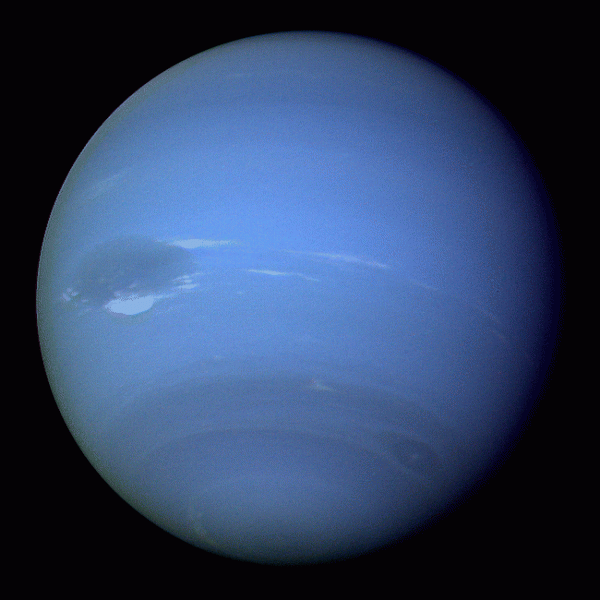
In 1989, NASA's Voyager 2 became the first spacecraft to observe Neptune. More about this image and more photos from Voyager 1's flyby.

In 1989, NASA’s Voyager 2 became the first spacecraft to observe Neptune. More images from Voyager.

Because we’re more or less between Neptune and the sun around now, Neptune is rising in the east around the time of sunset, climbing highest up for the night around midnight and setting in the west around sunrise. As viewed from Earth now, this world is in front of the constellation Aquarius the Water Carrier, right next to the 4th-magnitude star Phi Aquarii.

Phi Aquarii, though faint, is easily visible to the eye alone on a dark night. However, the moon displays a bright waxing gibbous phase on the day of Neptune’s opposition; and a few days thereafter, on September 13, the nearly full moon swings 4 degrees (8 moon-diameters) south of Neptune. So you’ll have to wait until the second half of the month to view Neptune in a dark sky.

Neptune and Phi Aquarii are so close together on the sky’s dome at present that the two readily fit within a single binocular field. In fact, you can see them together even through the telescope, with blue-green Neptune offering a color contrast to the ruddy tint of Phi Aquarii. Neptune is nearly 30 times fainter than the star Phi Aquarii. You may well be able to view Neptune with this star tonight, despite the lunar glare.

Even with an optical aid, Neptune may look like a faint star. You need to magnify Neptune by about 200 times and a steady night of seeing to view this distant world as a small disk.

Sky chart of the constellation Aquarius via IAU. Seek for Neptune near the star Phi Aquarii.

We know it’s unlikely you’ll see Neptune unless you have optical aid and a detailed star chart via Sky & Telescope.

Read more: September guide to the bright planets

By the way, if Earth and Neptune both orbited the sun in perfect circles and on the same plane, then Neptune would be closest to Earth right at opposition. Yet, the Earth actually comes closer to Neptune on September 9 than on the day of its September 10 opposition. That’s because, on September 10, the Earth is a bit closer to the sun (and, therefore, a bit farther from Neptune) than on September 9. Neptune is also closer to the sun on September 10 than on September 9. But Earth’s change in distance is much more significant than that of Neptune.

Bottom line: We’re closest to Neptune for 2019 on September 9. Neptune’s opposition – when it’s 180 degrees from the sun on the sky’s dome – is one day later, on September 10. You need optical aid to spot it. Links to charts here.

Resources:

Geocentric Ephemeris for Sun: 2019

Geocentric Ephemeris for Neptune: 2019


from EarthSky https://ift.tt/2ZT3FGQ

On September 9, Earth and Neptune were closest for 2019. One day later, on September 10, Neptune reaches opposition, when it is 180 degrees from the sun in our sky. In other words, on September 10, Earth passes more or less between Neptune and the sun, as we do every year in our yearly orbit.

By closest, we don’t mean close. Neptune, the eighth planet outward from the sun, lodges in the outskirts of our solar system. Its current distance is about approximately 2.7 billion miles (4.3 billion km).

Click here to know Neptune’s present distance in astronomical units.

For any superior planet – that is, for any solar system planet beyond Earth’s orbit – opposition is a special event. When any planet outside of Earth’s orbit is at or near opposition, Earth comes closest to that planet for the year, and that planet, in turn, shines most brightly in our sky. Even at opposition, however, Neptune, the eighth planet, is not bright. In fact, Neptune is the only major solar system planet that’s absolutely not visible to the unaided eye. This world is about five times fainter than the dimmest star that you can see on an inky black night. You’ll need binoculars (at least) and a detailed sky chart to see Neptune in front of the constellation Aquarius.

Here’s a chart showing Neptune for the June 2019 to March 2020 observing season

Here’s another detailed sky chart showing Neptune

In 1989, NASA's Voyager 2 became the first spacecraft to observe Neptune. More about this image and more photos from Voyager 1's flyby.

In 1989, NASA’s Voyager 2 became the first spacecraft to observe Neptune. More images from Voyager.

Because we’re more or less between Neptune and the sun around now, Neptune is rising in the east around the time of sunset, climbing highest up for the night around midnight and setting in the west around sunrise. As viewed from Earth now, this world is in front of the constellation Aquarius the Water Carrier, right next to the 4th-magnitude star Phi Aquarii.

Phi Aquarii, though faint, is easily visible to the eye alone on a dark night. However, the moon displays a bright waxing gibbous phase on the day of Neptune’s opposition; and a few days thereafter, on September 13, the nearly full moon swings 4 degrees (8 moon-diameters) south of Neptune. So you’ll have to wait until the second half of the month to view Neptune in a dark sky.

Neptune and Phi Aquarii are so close together on the sky’s dome at present that the two readily fit within a single binocular field. In fact, you can see them together even through the telescope, with blue-green Neptune offering a color contrast to the ruddy tint of Phi Aquarii. Neptune is nearly 30 times fainter than the star Phi Aquarii. You may well be able to view Neptune with this star tonight, despite the lunar glare.

Even with an optical aid, Neptune may look like a faint star. You need to magnify Neptune by about 200 times and a steady night of seeing to view this distant world as a small disk.

Sky chart of the constellation Aquarius via IAU. Seek for Neptune near the star Phi Aquarii.

We know it’s unlikely you’ll see Neptune unless you have optical aid and a detailed star chart via Sky & Telescope.

Read more: September guide to the bright planets

By the way, if Earth and Neptune both orbited the sun in perfect circles and on the same plane, then Neptune would be closest to Earth right at opposition. Yet, the Earth actually comes closer to Neptune on September 9 than on the day of its September 10 opposition. That’s because, on September 10, the Earth is a bit closer to the sun (and, therefore, a bit farther from Neptune) than on September 9. Neptune is also closer to the sun on September 10 than on September 9. But Earth’s change in distance is much more significant than that of Neptune.

Bottom line: We’re closest to Neptune for 2019 on September 9. Neptune’s opposition – when it’s 180 degrees from the sun on the sky’s dome – is one day later, on September 10. You need optical aid to spot it. Links to charts here.

Resources:

Geocentric Ephemeris for Sun: 2019

Geocentric Ephemeris for Neptune: 2019


from EarthSky https://ift.tt/2ZT3FGQ

Key facts about the new EPA plan to reverse the Obama-era methane leaks rule

This is a re-post from Yale Climate Connections

President Trump’s EPA is moving to roll back 2016 Obama administration methane leak regulations for key parts of the oil and gas industry, another example of what seems an across-the-board repudiation of Obama-era environmental and climate change initiatives. The new proposal, if made final, is certain to face legal challenges, with its ultimate fate perhaps being decided only by the administration in office in 2021.

EPA Administrator Andrew Wheeler in late August signed and later announced a proposed rule that would significantly weaken the methane leak reporting regulations. The proposed approach generally would allow transmission and storage sectors of the industry to self-regulate and self-report leaks of the highly-potent greenhouse gas.

In a prepared statement, Wheeler said “methane is valuable, and the industry has an incentive to minimize leaks and maximize its use.” He said that since 1990, “methane emissions across the natural gas industry have fallen by nearly 15%,” and that the new EPA approach “should not stifle this innovation and progress.” Separate rules on volatile organic chemicals “also reduce methane,” making the existing rule “redundant,” Wheeler argued.

Some large oil and gas companies, including BP, Exxon, and Shell, had voiced opposition to the new rules rollback.

But smaller companies and the industry’s principal trade association, the American Petroleum Institute, with more than 620 oil and gas company members, had pushed for weakening the methane regulations. They argue that mandated leak inspections are too costly and could make operation of small, often-leaky wells uneconomical. Wheeler appeared persuaded by these arguments, announcing that the new plan “removes unnecessary and duplicative regulatory burdens from the oil and gas industry” and will save fossil fuel companies around $100 million over the next six years.

The larger oil and gas companies appear to have opposed the new EPA move at least in part because their natural gas interests benefit from being seen as a climate-friendly alternative to coal, and a “bridge fuel” for the transition from coal to renewable energy.

But some scientific research has suggested that methane leakage from natural gas infrastructure such as fracking can erase much of its claimed climate benefits. For instance, authors of a 2018 study published in Science found that the amount of methane resulting from leaks exceeds by 60% the estimates made by EPA. “Considerable amounts of the greenhouse gas methane leak from the U.S. oil and natural gas supply chain,” the authors of that study wrote. They said the difference between EPA’s estimates and their own are the result of “current inventory methods [that] miss emissions that occur during abnormal operating conditions.”

Methane and CO2 comparisons

Carbon dioxide exceeds by a factor of more than 200 times the levels of methane in Earth’s atmosphere, but methane is a much more potent greenhouse gas.

The Intergovernmental Panel on Climate Change, IPCC, in 2013 estimated that the greenhouse effect from methane is 34 times stronger than carbon dioxide over a 100-year period, and 86 times stronger over a 20-year period. Its potency decreases over time because methane is a relatively short-lived greenhouse gas, mostly breaking down under chemical reactions after about 12 years, whereas carbon dioxide persists in the atmosphere for centuries.

However, a 2017 study noted that most of the heat trapped by methane and other greenhouse gases is absorbed by the oceans and transported through Earth’s climate system for hundreds of years. As a result, their effects on climate impacts like sea-level rise last well beyond just the individual greenhouse gases’ atmospheric lifetimes.

Overall, methane is responsible for about 16% of human-caused global warming, carbon dioxide for 65%.

Methane levels in the atmosphere had flattened out between the years 2000 and 2006 but have risen sharply since then. Scientists have struggled to determine the source of this rise – could it be from agriculture (e.g. cattle burps), tropical wetlands, and/or fossil fuels?

Some previous studies have suggested agriculture could be the primary source, but an August 2019 study in Biogeosciences concluded, “shale-gas production in North America over the past decade may have contributed more than half of all of the increased [methane] emissions from fossil fuels globally and approximately one-third of the total increased emissions from all sources globally over the past decade … the commercialization of shale gas and oil in the 21st century has dramatically increased global methane emissions.”

Shale gas production has boomed in the U.S. in recent years as a result of a rapid expansion of fracking, lending weight to this conclusion. And the industry is poised to continue expanding – a recent report from the advocacy group Food & Water Watch found more than 700 fracked gas infrastructure projects recently built or proposed for development in the U.S.

Click here to read the rest


from Skeptical Science https://ift.tt/316u1CA

This is a re-post from Yale Climate Connections

President Trump’s EPA is moving to roll back 2016 Obama administration methane leak regulations for key parts of the oil and gas industry, another example of what seems an across-the-board repudiation of Obama-era environmental and climate change initiatives. The new proposal, if made final, is certain to face legal challenges, with its ultimate fate perhaps being decided only by the administration in office in 2021.

EPA Administrator Andrew Wheeler in late August signed and later announced a proposed rule that would significantly weaken the methane leak reporting regulations. The proposed approach generally would allow transmission and storage sectors of the industry to self-regulate and self-report leaks of the highly-potent greenhouse gas.

In a prepared statement, Wheeler said “methane is valuable, and the industry has an incentive to minimize leaks and maximize its use.” He said that since 1990, “methane emissions across the natural gas industry have fallen by nearly 15%,” and that the new EPA approach “should not stifle this innovation and progress.” Separate rules on volatile organic chemicals “also reduce methane,” making the existing rule “redundant,” Wheeler argued.

Some large oil and gas companies, including BP, Exxon, and Shell, had voiced opposition to the new rules rollback.

But smaller companies and the industry’s principal trade association, the American Petroleum Institute, with more than 620 oil and gas company members, had pushed for weakening the methane regulations. They argue that mandated leak inspections are too costly and could make operation of small, often-leaky wells uneconomical. Wheeler appeared persuaded by these arguments, announcing that the new plan “removes unnecessary and duplicative regulatory burdens from the oil and gas industry” and will save fossil fuel companies around $100 million over the next six years.

The larger oil and gas companies appear to have opposed the new EPA move at least in part because their natural gas interests benefit from being seen as a climate-friendly alternative to coal, and a “bridge fuel” for the transition from coal to renewable energy.

But some scientific research has suggested that methane leakage from natural gas infrastructure such as fracking can erase much of its claimed climate benefits. For instance, authors of a 2018 study published in Science found that the amount of methane resulting from leaks exceeds by 60% the estimates made by EPA. “Considerable amounts of the greenhouse gas methane leak from the U.S. oil and natural gas supply chain,” the authors of that study wrote. They said the difference between EPA’s estimates and their own are the result of “current inventory methods [that] miss emissions that occur during abnormal operating conditions.”

Methane and CO2 comparisons

Carbon dioxide exceeds by a factor of more than 200 times the levels of methane in Earth’s atmosphere, but methane is a much more potent greenhouse gas.

The Intergovernmental Panel on Climate Change, IPCC, in 2013 estimated that the greenhouse effect from methane is 34 times stronger than carbon dioxide over a 100-year period, and 86 times stronger over a 20-year period. Its potency decreases over time because methane is a relatively short-lived greenhouse gas, mostly breaking down under chemical reactions after about 12 years, whereas carbon dioxide persists in the atmosphere for centuries.

However, a 2017 study noted that most of the heat trapped by methane and other greenhouse gases is absorbed by the oceans and transported through Earth’s climate system for hundreds of years. As a result, their effects on climate impacts like sea-level rise last well beyond just the individual greenhouse gases’ atmospheric lifetimes.

Overall, methane is responsible for about 16% of human-caused global warming, carbon dioxide for 65%.

Methane levels in the atmosphere had flattened out between the years 2000 and 2006 but have risen sharply since then. Scientists have struggled to determine the source of this rise – could it be from agriculture (e.g. cattle burps), tropical wetlands, and/or fossil fuels?

Some previous studies have suggested agriculture could be the primary source, but an August 2019 study in Biogeosciences concluded, “shale-gas production in North America over the past decade may have contributed more than half of all of the increased [methane] emissions from fossil fuels globally and approximately one-third of the total increased emissions from all sources globally over the past decade … the commercialization of shale gas and oil in the 21st century has dramatically increased global methane emissions.”

Shale gas production has boomed in the U.S. in recent years as a result of a rapid expansion of fracking, lending weight to this conclusion. And the industry is poised to continue expanding – a recent report from the advocacy group Food & Water Watch found more than 700 fracked gas infrastructure projects recently built or proposed for development in the U.S.

Click here to read the rest


from Skeptical Science https://ift.tt/316u1CA

What asteroid Ryugu told us

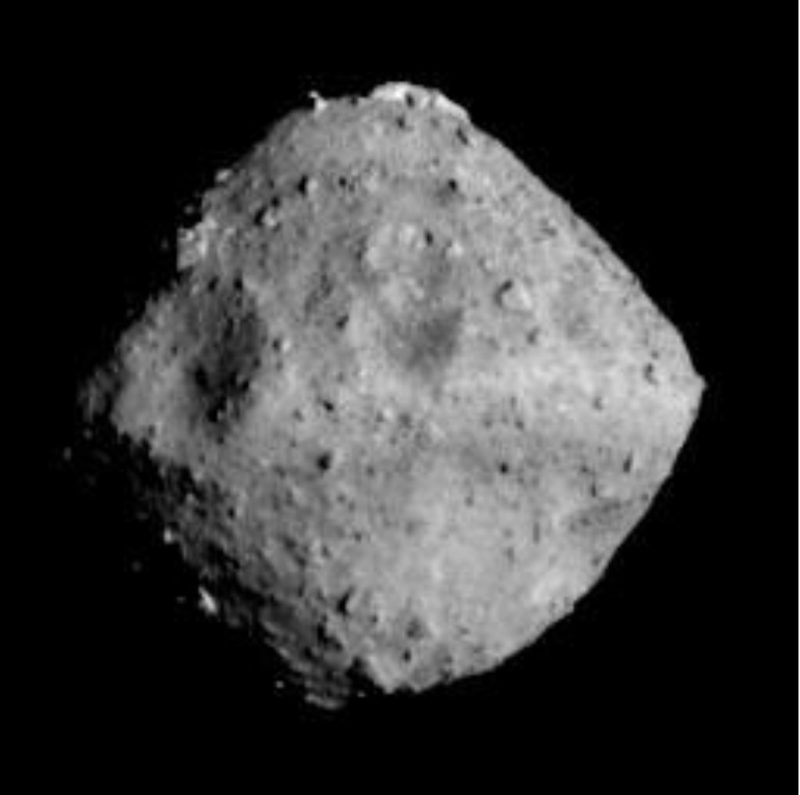
A blocky gray asteroid, shaped somewhat like a spinning top, with rough rocky surface.

Here’s asteroid 162173 Ryugu in June 2018, as seen by Japan’s Hayabusa2 spacecraft. This mission is the 2nd-ever sample-return mission to an asteroid. The earlier one was the original Hayabusa mission, which returned a sample from asteroid 25143 Itokawa in 2010. Image via the Japanese space agency, JAXA.

Japan’s Hayabusa2 spacecraft – launched in December, 2014 – traveled some 200 million miles to near-Earth asteroid Ryugu. It closed to within 12 miles (20 km) of the asteroid’s surface in June 2018. Hayabusa2 will continue traveling with this asteroid until December 2019, when it’ll begin making its way back to Earth. It’s due to return a sample of the asteroid to scientists in December 2020. In the meantime – in two studies published this summer – the Hayabusa2 mission has already given us valuable information about asteroids like Ryugu. Among other things, it showed that, if an asteroid like Ryugu were headed toward Earth – and if we on Earth decided to send a spacecraft out in an attempt to divert the asteroid – we’d need to take “great care” in the attempt.

Hayabusa2 released several small rovers to Ryugu’s surface. One was a German-French device, called the Mobile Asteroid Surface Scout (MASCOT). It was “no bigger than a microwave oven” and equipped with four instruments. On October 3, 2018, MASCOT separated from Hayabusa2 when the craft was 41 meters (about 100 feet) above the asteroid. MASCOT touched down on Ryugu for the first time six minutes after deployment, bounced a bit in the asteroid’s low gravity, then settled on its surface about 11 minutes later.

MASCOT lasted 17 hours on Ryugu, an hour longer than anticipated, until its non-rechargeable battery ran out. It carried out experiments in various places amid Ryugu’s large boulders, possible because MASCOT was designed to tumble to reposition itself.

Researchers learned Ryugu’s surface is dominated by two types of rock. They were surprised to find no evidence for fine-grained dust. They noted that millimeter-sized inclusions in the rocks are similar to those present in carbonaceous meteorites found on Earth. This group includes some of the most primitive known meteorites, some of which date back 4.5 billion years. In other words, these meteorites are some of the oldest stuff in our neighborhood of space, formed when our solar system was condensing solid material from its original primordial nebula of gas and dust.

Scientists knew thiz sort of meteorite was fragile. Hayabusa2 confirmed just how fragile this sort of material is.

Planetary researcher Ralf Jaumann from the DLR Institute of Planetary Research in Berlin-Adlershof led a research team that analyzed MASCOT’s results. These scientists reported on their results in the August 23, 2019, issue of the peer-reviewed journal Science. Jaumann explained in a statement on August 22:

If Ryugu or another similar asteroid were ever to come dangerously close to Earth and an attempt had to be made to divert it, this would need to be done with great care. In the event that it was impacted with great force, the entire asteroid, weighing approximately half-a-billion tons, would break up into numerous fragments. Then, many individual parts weighing several tons would impact Earth.

Ryugu was found to have an average density of just 1.2 grams per cubic centimeter (.043 pounds per cubic inch). In other words, the asteroids is only a little “heavier” than water ice. But, the scientists said:

… as the asteroid is made up of numerous pieces of rock of different sizes, this means that much of its volume must be traversed by cavities, which probably makes this diamond-shaped body extremely fragile. This is also indicated by the measurements conducted by the DLR MASCOT Radiometer (MARA) experiment, which were published recently.

Graphic of dotted line on false-color image of bumpy-surfaced Ryugu.

MASCOT’s descent and path across Ryugu, via DLR.

In that earlier study – published July 15 in the peer-reviewed journal Nature Astronomy – scientists using Hayabusa2 data to study Ryugu pointed out an upside to the asteroid’s fragility. Their statement on July 15 said:

Ryugu and other asteroids of the common ‘C-class’ consist of more porous material than was previously thought. Small fragments of their material are therefore too fragile to survive entry into the atmosphere in the event of a collision with Earth.

These two studies of asteroid Ryugu were made possible by a space mission that, like all space missions, required years for planning and implementation. Thanks to the mission, scientists learned that what we knew from Earth-based observations about the nature of these asteroids was essentially correct. But they confirmed and refined their knowledge; they know more details now.

Ryugu is what’s called a near-Earth object (NEO). That’s an asteroid or comet that comes close to or intersects Earth’s orbit.

Ryugu itself is not on a collision course with Earth and likely never will be. That’s good because Ryugu is 850 meters (about a half a mile) across, large enough to do some serious damage to any world it might strike. It could wipe out a city, for example. But, again, Ryugu isn’t going to strike us. In part because we sent a spacecraft to it, we know a lot about the orbit of this asteroid. Its orbit around the sun is almost coplanar to that of Earth. The asteroid approaches us at an angle of 5.9 degrees to within a distance of approximately 100,000 kilometers (60,000 miles). These scientists said:

Ryugu will never come within the immediate vicinity of Earth, but knowing the properties of bodies like Ryugu is of great importance when it comes to assessing how such near-Earth objects (NEOs) could be dealt with in the future.

Bottom line: Two studies published this summer about asteroid Ryugu – based on data from the Hayabusa2 mission – confirm that the asteroid is fragile, even more fragile than scientists had thought. The good news is that fragments of this asteroid (or asteroids like it) might more easily burn up in our atmosphere. The bad news is that, if an asteroid like this one were on a collision course with Earth, and we planned to try to divert it (for example, by setting off a nuclear device in its vicinity), we’d have to do so with “great care” in order not to create multiple large bodies that would then impact Earth. By the way, in case you’re interested, Hayabusa is Japanese for Peregrine falcon, which is Earth’s fastest bird.

Source: Images from the surface of asteroid Ryugu show rocks similar to carbonaceous chondrite meteorites

Source: Low thermal conductivity boulder with high porosity identified on C-type asteroid (162173) Ryugu

Via July 15 DLR statement

Via August 22 DLR statement


from EarthSky https://ift.tt/2HWoKpC
A blocky gray asteroid, shaped somewhat like a spinning top, with rough rocky surface.

Here’s asteroid 162173 Ryugu in June 2018, as seen by Japan’s Hayabusa2 spacecraft. This mission is the 2nd-ever sample-return mission to an asteroid. The earlier one was the original Hayabusa mission, which returned a sample from asteroid 25143 Itokawa in 2010. Image via the Japanese space agency, JAXA.

Japan’s Hayabusa2 spacecraft – launched in December, 2014 – traveled some 200 million miles to near-Earth asteroid Ryugu. It closed to within 12 miles (20 km) of the asteroid’s surface in June 2018. Hayabusa2 will continue traveling with this asteroid until December 2019, when it’ll begin making its way back to Earth. It’s due to return a sample of the asteroid to scientists in December 2020. In the meantime – in two studies published this summer – the Hayabusa2 mission has already given us valuable information about asteroids like Ryugu. Among other things, it showed that, if an asteroid like Ryugu were headed toward Earth – and if we on Earth decided to send a spacecraft out in an attempt to divert the asteroid – we’d need to take “great care” in the attempt.

Hayabusa2 released several small rovers to Ryugu’s surface. One was a German-French device, called the Mobile Asteroid Surface Scout (MASCOT). It was “no bigger than a microwave oven” and equipped with four instruments. On October 3, 2018, MASCOT separated from Hayabusa2 when the craft was 41 meters (about 100 feet) above the asteroid. MASCOT touched down on Ryugu for the first time six minutes after deployment, bounced a bit in the asteroid’s low gravity, then settled on its surface about 11 minutes later.

MASCOT lasted 17 hours on Ryugu, an hour longer than anticipated, until its non-rechargeable battery ran out. It carried out experiments in various places amid Ryugu’s large boulders, possible because MASCOT was designed to tumble to reposition itself.

Researchers learned Ryugu’s surface is dominated by two types of rock. They were surprised to find no evidence for fine-grained dust. They noted that millimeter-sized inclusions in the rocks are similar to those present in carbonaceous meteorites found on Earth. This group includes some of the most primitive known meteorites, some of which date back 4.5 billion years. In other words, these meteorites are some of the oldest stuff in our neighborhood of space, formed when our solar system was condensing solid material from its original primordial nebula of gas and dust.

Scientists knew thiz sort of meteorite was fragile. Hayabusa2 confirmed just how fragile this sort of material is.

Planetary researcher Ralf Jaumann from the DLR Institute of Planetary Research in Berlin-Adlershof led a research team that analyzed MASCOT’s results. These scientists reported on their results in the August 23, 2019, issue of the peer-reviewed journal Science. Jaumann explained in a statement on August 22:

If Ryugu or another similar asteroid were ever to come dangerously close to Earth and an attempt had to be made to divert it, this would need to be done with great care. In the event that it was impacted with great force, the entire asteroid, weighing approximately half-a-billion tons, would break up into numerous fragments. Then, many individual parts weighing several tons would impact Earth.

Ryugu was found to have an average density of just 1.2 grams per cubic centimeter (.043 pounds per cubic inch). In other words, the asteroids is only a little “heavier” than water ice. But, the scientists said:

… as the asteroid is made up of numerous pieces of rock of different sizes, this means that much of its volume must be traversed by cavities, which probably makes this diamond-shaped body extremely fragile. This is also indicated by the measurements conducted by the DLR MASCOT Radiometer (MARA) experiment, which were published recently.

Graphic of dotted line on false-color image of bumpy-surfaced Ryugu.

MASCOT’s descent and path across Ryugu, via DLR.

In that earlier study – published July 15 in the peer-reviewed journal Nature Astronomy – scientists using Hayabusa2 data to study Ryugu pointed out an upside to the asteroid’s fragility. Their statement on July 15 said:

Ryugu and other asteroids of the common ‘C-class’ consist of more porous material than was previously thought. Small fragments of their material are therefore too fragile to survive entry into the atmosphere in the event of a collision with Earth.

These two studies of asteroid Ryugu were made possible by a space mission that, like all space missions, required years for planning and implementation. Thanks to the mission, scientists learned that what we knew from Earth-based observations about the nature of these asteroids was essentially correct. But they confirmed and refined their knowledge; they know more details now.

Ryugu is what’s called a near-Earth object (NEO). That’s an asteroid or comet that comes close to or intersects Earth’s orbit.

Ryugu itself is not on a collision course with Earth and likely never will be. That’s good because Ryugu is 850 meters (about a half a mile) across, large enough to do some serious damage to any world it might strike. It could wipe out a city, for example. But, again, Ryugu isn’t going to strike us. In part because we sent a spacecraft to it, we know a lot about the orbit of this asteroid. Its orbit around the sun is almost coplanar to that of Earth. The asteroid approaches us at an angle of 5.9 degrees to within a distance of approximately 100,000 kilometers (60,000 miles). These scientists said:

Ryugu will never come within the immediate vicinity of Earth, but knowing the properties of bodies like Ryugu is of great importance when it comes to assessing how such near-Earth objects (NEOs) could be dealt with in the future.

Bottom line: Two studies published this summer about asteroid Ryugu – based on data from the Hayabusa2 mission – confirm that the asteroid is fragile, even more fragile than scientists had thought. The good news is that fragments of this asteroid (or asteroids like it) might more easily burn up in our atmosphere. The bad news is that, if an asteroid like this one were on a collision course with Earth, and we planned to try to divert it (for example, by setting off a nuclear device in its vicinity), we’d have to do so with “great care” in order not to create multiple large bodies that would then impact Earth. By the way, in case you’re interested, Hayabusa is Japanese for Peregrine falcon, which is Earth’s fastest bird.

Source: Images from the surface of asteroid Ryugu show rocks similar to carbonaceous chondrite meteorites

Source: Low thermal conductivity boulder with high porosity identified on C-type asteroid (162173) Ryugu

Via July 15 DLR statement

Via August 22 DLR statement


from EarthSky https://ift.tt/2HWoKpC

T. rex had an air conditioner in its head

How did the Tyrannosaurus rex, one of the largest meat-eating dinosaurs, regulate its body temperature? The giant reptile had a built-in “air conditioner” via two large holes in the roof of its skull, according to a team of researchers, who suggest that blood vessels acted as an internal thermostat on a T. rex, much like alligators have today for body temperature control.

The new study, published July 1, 2109, in the peer-reviewed journal The Anatomical Record, challenges over a century of previous beliefs. In the past, scientists believed two large holes — called the dorsotemporal fenestra — were filled with muscles that assisted with jaw movements. But that assertion puzzled University of Missouri’s Casey Holliday, lead author of the study. Holliday said in a statement:

It’s really weird for a muscle to come up from the jaw, make a 90-degree turn, and go along the roof of the skull. Yet, we now have a lot of compelling evidence for blood vessels in this area, based on our work with alligators and other reptiles.

Top view of long-jawed skull in colors from yellow to magenta with two holes visible at top.

A graphic thermal image of a T. rex skull. Image via Brian Engh.

The researchers used thermal imaging – devices that translate heat into visible light – to study alligators at a zoological park in Florida. They believe their evidence offers a different theory and new insight into the anatomy of a T. rex’s head. University of Florida’s Kent Vliet is a study co-author. He said:

An alligator’s body heat depends on its environment. Therefore, we noticed when it was cooler and the alligators are trying to warm up, our thermal imaging showed big hot spots in these holes in the roof of their skull, indicating a rise in temperature. Yet, later in the day when it’s warmer, the holes appear dark, like they were turned off to keep cool. This is consistent with prior evidence that alligators have a cross-current circulatory system – or an internal thermostat, so to speak.

Front view of alligator with open jaw showing pink mouth and lots of pointy teeth.

An alligator’s body heat depends on its environment. The researchers found when alligators are trying to cool off, the holes in the roof of their skulls were dark, as if they were turned off. Image via University of Missouri.

Hand holding camera with false-color image on its little viewfinder screen.

Thermal imaging — devices that translate heat into visible light — allowed researchers to capture the body heat of alligators at the St. Augustine Alligator Farm Zoological Park in Florida. Image via University of Missouri.

The researchers took their thermal imaging data and examined fossilized remains of dinosaurs and crocodiles to see how this hole in the skull changed over time. Study co-author Larry Witmer, of Ohio University, said:

We know that, similarly to the T. rex, alligators have holes on the roof of their skulls, and they are filled with blood vessels. Yet, for over 100 years we’ve been putting muscles into a similar space with dinosaurs. By using some anatomy and physiology of current animals, we can show that we can overturn those early hypotheses about the anatomy of this part of the T. rex’s skull.

Glowing yellow standing T. rex looking at a pair of glowing alligators.

Artist’s concept of a thermal image of a T. rex with its dorsotemporal fenestra glowing on the skull. Image via Brian Engh.

Bottom line: A new study says a structure in the top of the T. rex skull helped the dinosaur regulate its body temperature.

Source: The Frontoparietal Fossa and Dorsotemporal Fenestra of Archosaurs and Their Significance for Interpretations of Vascular and Muscular Anatomy in Dinosaurs

Via University of Missouri


from EarthSky https://ift.tt/2UM60yy

How did the Tyrannosaurus rex, one of the largest meat-eating dinosaurs, regulate its body temperature? The giant reptile had a built-in “air conditioner” via two large holes in the roof of its skull, according to a team of researchers, who suggest that blood vessels acted as an internal thermostat on a T. rex, much like alligators have today for body temperature control.

The new study, published July 1, 2109, in the peer-reviewed journal The Anatomical Record, challenges over a century of previous beliefs. In the past, scientists believed two large holes — called the dorsotemporal fenestra — were filled with muscles that assisted with jaw movements. But that assertion puzzled University of Missouri’s Casey Holliday, lead author of the study. Holliday said in a statement:

It’s really weird for a muscle to come up from the jaw, make a 90-degree turn, and go along the roof of the skull. Yet, we now have a lot of compelling evidence for blood vessels in this area, based on our work with alligators and other reptiles.

Top view of long-jawed skull in colors from yellow to magenta with two holes visible at top.

A graphic thermal image of a T. rex skull. Image via Brian Engh.

The researchers used thermal imaging – devices that translate heat into visible light – to study alligators at a zoological park in Florida. They believe their evidence offers a different theory and new insight into the anatomy of a T. rex’s head. University of Florida’s Kent Vliet is a study co-author. He said:

An alligator’s body heat depends on its environment. Therefore, we noticed when it was cooler and the alligators are trying to warm up, our thermal imaging showed big hot spots in these holes in the roof of their skull, indicating a rise in temperature. Yet, later in the day when it’s warmer, the holes appear dark, like they were turned off to keep cool. This is consistent with prior evidence that alligators have a cross-current circulatory system – or an internal thermostat, so to speak.

Front view of alligator with open jaw showing pink mouth and lots of pointy teeth.

An alligator’s body heat depends on its environment. The researchers found when alligators are trying to cool off, the holes in the roof of their skulls were dark, as if they were turned off. Image via University of Missouri.

Hand holding camera with false-color image on its little viewfinder screen.

Thermal imaging — devices that translate heat into visible light — allowed researchers to capture the body heat of alligators at the St. Augustine Alligator Farm Zoological Park in Florida. Image via University of Missouri.

The researchers took their thermal imaging data and examined fossilized remains of dinosaurs and crocodiles to see how this hole in the skull changed over time. Study co-author Larry Witmer, of Ohio University, said:

We know that, similarly to the T. rex, alligators have holes on the roof of their skulls, and they are filled with blood vessels. Yet, for over 100 years we’ve been putting muscles into a similar space with dinosaurs. By using some anatomy and physiology of current animals, we can show that we can overturn those early hypotheses about the anatomy of this part of the T. rex’s skull.

Glowing yellow standing T. rex looking at a pair of glowing alligators.

Artist’s concept of a thermal image of a T. rex with its dorsotemporal fenestra glowing on the skull. Image via Brian Engh.

Bottom line: A new study says a structure in the top of the T. rex skull helped the dinosaur regulate its body temperature.

Source: The Frontoparietal Fossa and Dorsotemporal Fenestra of Archosaurs and Their Significance for Interpretations of Vascular and Muscular Anatomy in Dinosaurs

Via University of Missouri


from EarthSky https://ift.tt/2UM60yy

Orion’s Belt points to dazzling Sirius

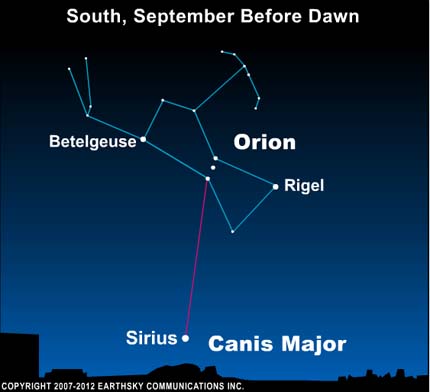
It’s one of the neatest tricks in all the heavens … Orion’s Belt points to Sirius in the constellation Canis Major the Greater Dog. Sirius is the brightest star in the nighttime sky. It’s up before dawn now but will be shifting into the evening sky as the months pass. Orion is found in the predawn morning sky every September.

Sirius is Dog Star and brightest star

Yes, you can find Orion. If you go outside and look south to southeast before dawn now, you’ll notice Orion’s Belt, which consists of a short, straight row of medium-bright stars. Just draw a line through Orion’s Belt and extend that line toward the horizon. You’ll easily spot Sirius, the sky’s brightest star.

Sirius is in the constellation Canis Major the Greater Dog. It’s often called the Dog Star.

Two planets (Venus and Jupiter) shine more brilliantly than Sirius but you simply can’t mistake either planet for Sirius in the September 2019 morning sky. Venus is now lost in the sun’s glare, whereas Jupiter sets before Sirius rises. Once again, use Orion’s Belt to locate Sirius in the southeast sky.

Orion, Sirius, Venus and more as seen on August 30, 2017, by Tom Wildoner. He took the photo from the U.S. state of Pennsylvania, but these stars and Venus can be seen from around the world now, in the direction of sunrise before the sun comes up. Read more about this photo.

Bottom line: In September 2019, you’ll find the constellation Orion, whose three Belt stars make a short, straight row in the southeast before dawn. Orion’s Belt points to Sirius, the brightest star of the nighttime sky.

Fastest sunsets of the year around equinox time

Help support EarthSky! Check out the EarthSky store for fun astronomy gifts and tools for all ages!

EarthSky astronomy kits are perfect for beginners. Order yours from the EarthSky store.


from EarthSky https://ift.tt/319MgY2

It’s one of the neatest tricks in all the heavens … Orion’s Belt points to Sirius in the constellation Canis Major the Greater Dog. Sirius is the brightest star in the nighttime sky. It’s up before dawn now but will be shifting into the evening sky as the months pass. Orion is found in the predawn morning sky every September.

Sirius is Dog Star and brightest star

Yes, you can find Orion. If you go outside and look south to southeast before dawn now, you’ll notice Orion’s Belt, which consists of a short, straight row of medium-bright stars. Just draw a line through Orion’s Belt and extend that line toward the horizon. You’ll easily spot Sirius, the sky’s brightest star.

Sirius is in the constellation Canis Major the Greater Dog. It’s often called the Dog Star.

Two planets (Venus and Jupiter) shine more brilliantly than Sirius but you simply can’t mistake either planet for Sirius in the September 2019 morning sky. Venus is now lost in the sun’s glare, whereas Jupiter sets before Sirius rises. Once again, use Orion’s Belt to locate Sirius in the southeast sky.

Orion, Sirius, Venus and more as seen on August 30, 2017, by Tom Wildoner. He took the photo from the U.S. state of Pennsylvania, but these stars and Venus can be seen from around the world now, in the direction of sunrise before the sun comes up. Read more about this photo.

Bottom line: In September 2019, you’ll find the constellation Orion, whose three Belt stars make a short, straight row in the southeast before dawn. Orion’s Belt points to Sirius, the brightest star of the nighttime sky.

Fastest sunsets of the year around equinox time

Help support EarthSky! Check out the EarthSky store for fun astronomy gifts and tools for all ages!

EarthSky astronomy kits are perfect for beginners. Order yours from the EarthSky store.


from EarthSky https://ift.tt/319MgY2

2019 SkS Weekly Climate Change & Global Warming Digest #36

Story of the Week... Toon of the Week... Coming Soon on SkS... Climate Feedback Reviews... SkS Week in Review... Poster of the Week...

Story of the Week...

The air above Antarctica is suddenly getting warmer – here’s what it means for Australia

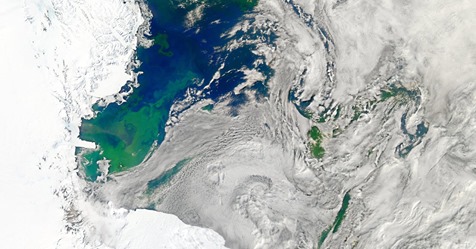
Antarctica via NASA satellite

Antarctic winds have a huge effect on weather in other places. Photo: NASA Goddard Space Flight Center/Flickr CC BY-SA

Record warm temperatures above Antarctica over the coming weeks are likely to bring above-average spring temperatures and below-average rainfall across large parts of New South Wales and southern Queensland.

The warming began in the last week of August, when temperatures in the stratosphere high above the South Pole began rapidly heating in a phenomenon called “sudden stratospheric warming”.

In the coming weeks the warming is forecast to intensify, and its effects will extend downward to Earth’s surface, affecting much of eastern Australia over the coming months.

The Bureau of Meteorology is predicting the strongest Antarctic warming on record, likely to exceed the previous record of September 2002.

The air above Antarctica is suddenly getting warmer – here’s what it means for Australia by Harry Hendon, Andrew B. Watkins, Eun-Pa Lim & Griffith Young , The Conversation AU, Sep 6, 2019

Click here to access the entire article. 


Toon of the Week...

 2019 Toon 36

Hat tip to the Facebook page of Stop Climate Science Denial


Coming Soon on SkS...

  • Climate implications of the EPA methane rule rollback (Dana)
  • Skeptical Science New Research for Week #36, 2019 (Doug Bostrom)
  • How climate change is making hurricanes more dangerous (Jeff Berardelli)
  • What psychotherapy can do for the climate and biodiversity crises (Caroline Hickman)
  • A small electric plane demonstrates promise, obstacles of climate-friendly air travel (Lindsay Fendt)
  • 2019 SkS Weekly Climate Change & Global Warming News Roundup #37 (John Hartz)
  • 2019 SkS Weekly Climate Change & Global Warming Digest #37 (John Hartz)

Climate Feedback Reviews...

[To be added.]


Poster of the Week...

2019 Poster 36 


SkS Week in Review... 


from Skeptical Science https://ift.tt/300gUl7

Story of the Week... Toon of the Week... Coming Soon on SkS... Climate Feedback Reviews... SkS Week in Review... Poster of the Week...

Story of the Week...

The air above Antarctica is suddenly getting warmer – here’s what it means for Australia

Antarctica via NASA satellite

Antarctic winds have a huge effect on weather in other places. Photo: NASA Goddard Space Flight Center/Flickr CC BY-SA

Record warm temperatures above Antarctica over the coming weeks are likely to bring above-average spring temperatures and below-average rainfall across large parts of New South Wales and southern Queensland.

The warming began in the last week of August, when temperatures in the stratosphere high above the South Pole began rapidly heating in a phenomenon called “sudden stratospheric warming”.

In the coming weeks the warming is forecast to intensify, and its effects will extend downward to Earth’s surface, affecting much of eastern Australia over the coming months.

The Bureau of Meteorology is predicting the strongest Antarctic warming on record, likely to exceed the previous record of September 2002.

The air above Antarctica is suddenly getting warmer – here’s what it means for Australia by Harry Hendon, Andrew B. Watkins, Eun-Pa Lim & Griffith Young , The Conversation AU, Sep 6, 2019

Click here to access the entire article. 


Toon of the Week...

 2019 Toon 36

Hat tip to the Facebook page of Stop Climate Science Denial


Coming Soon on SkS...

  • Climate implications of the EPA methane rule rollback (Dana)
  • Skeptical Science New Research for Week #36, 2019 (Doug Bostrom)
  • How climate change is making hurricanes more dangerous (Jeff Berardelli)
  • What psychotherapy can do for the climate and biodiversity crises (Caroline Hickman)
  • A small electric plane demonstrates promise, obstacles of climate-friendly air travel (Lindsay Fendt)
  • 2019 SkS Weekly Climate Change & Global Warming News Roundup #37 (John Hartz)
  • 2019 SkS Weekly Climate Change & Global Warming Digest #37 (John Hartz)

Climate Feedback Reviews...

[To be added.]


Poster of the Week...

2019 Poster 36 


SkS Week in Review... 


from Skeptical Science https://ift.tt/300gUl7

Yellowstone’s Steamboat geyser breaks record

Huge plume of water and steam erupting from an active geyser at edge of forest.

Steamboat geyser in the Norris Geyser Basin in Wyoming’s Yellowstone National Park. Image via USGS.

In the Yellowstone Volcano Observatory’s monthly update in early September, the U.S. Geological Survey (USGS) announced that Steamboat geyser – one of Yellowstone’s famous geysers, often said to be Earth’s tallest geyser – had broken its own yearly eruption record. USGS said:

August 2019 was another record-setting month for Steamboat geyser, which experienced water eruptions on August 12, 20, and 27. The August 27 eruption was the 33rd of 2019, breaking the record for eruptions in a calendar year that was set in 2018.

Unlike Old Faithful – a highly predictable geyser, also in Yellowstone Park, which has erupted every 44 to 125 minutes since the year 2000 – Steamboat Geyser is unpredictable. Major eruptions have been observed from this geyser on timescales from 4 days to 50 years apart. Steamboat geyser saw an uptick in eruptions in the 1960s after being dormant for about 50 years, for example. It also saw increased eruptions in the 1980s. But, until 2018, Steamboat geyser had been mostly calm for about 15 years.

Nowadays, the Yellowstone Volcano Observatory (founded in 2001) monitors this type of activity in the Yellowstone National Park region, home to Earth’s largest and most diverse collection of natural geothermal features, including not just geysers but also hot springs, mud pots and fumaroles. Its many thermal features are the reason Yellowstone became the first U.S. national park in 1872.

Sometimes, nobody sees the eurptions from Steamboat geyser. The Yellowstone Volcano Observatory tracks them using sensors in Norris Geyser Basin. Data from the sensors includes seismic and temperature data and can help scientists determine when a geyser has erupted, especially one the size of Steamboat.

A man in outdoor gear and sunglasses, against a snowy background.

Michael Poland is Scientist-in-Charge at the Yellowstone Volcano Observatory. Image via USGS.

According to scientists, there’s no cause for concern about the recent uptick in activity from Steamboat geysers. It’s just the way geysers work. Michael Poland, the USGS scientist-in-charge of the Yellowstone Volcano Observatory, wrote in an email to CNN:

They’re mostly random and experience phases of alternating eruptive activity. So while fascinating, it’s not unusual, nor cause for concern.

You can follow Poland’s work, and the work of the Yellowstone Volcano Observatory, on Twitter:

By the way, about being the tallest geyser in the world … steam from Steamboat geyser can rise upward to heights of up to 380 feet (116 meters). That’s about three time as high as the bursts from Old Faithful geyser.

On the other hand, compare Steamboat geyser to the geysers on Saturn’s moon Enceladus. This little Saturnian moon – only 310 miles (500 km) in diameter – is thought to have a global ocean of liquid salty water beneath its icy crust. Jets of icy particles from that ocean gush into space continuously from Enceladus. The material shoots out at about 800 miles per hour (400 meters per second) and forms a plume that extends hundreds of miles into space. Some of the material falls back onto Enceladus, and some escapes to form Saturn’s E ring. Read more about Enceladus.

Here’s a National Park Service page with general info about Steamboat Geyser

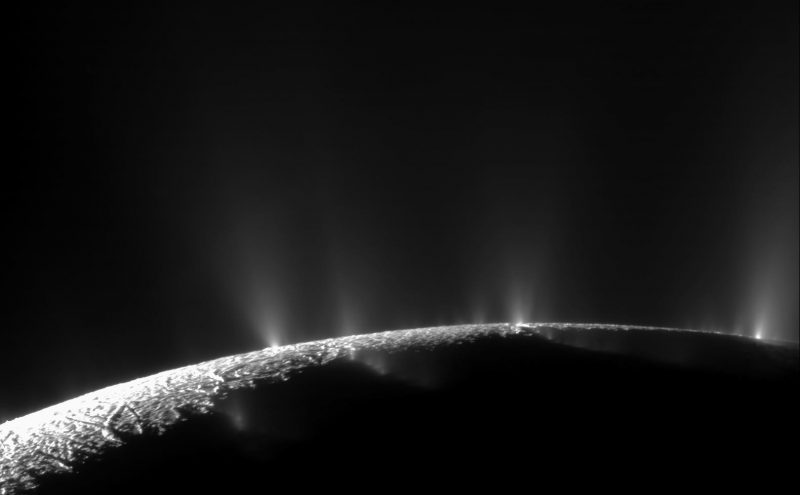
Geysers erupting into black space from the lighted limb of Saturn's moon.

Geysers on Saturn’s moon Enceladus, via NASA’s Cassini spacecraft. Read more about this image.

Bottom line: Steamboat geyser in Yellowstone National Park broke its own yearly eruption record on August 27, 2019, with its 33rd eruption of the year. The earlier record for eruptions in a calendar year was set in 2018.


from EarthSky https://ift.tt/2ZG2r2u
Huge plume of water and steam erupting from an active geyser at edge of forest.

Steamboat geyser in the Norris Geyser Basin in Wyoming’s Yellowstone National Park. Image via USGS.

In the Yellowstone Volcano Observatory’s monthly update in early September, the U.S. Geological Survey (USGS) announced that Steamboat geyser – one of Yellowstone’s famous geysers, often said to be Earth’s tallest geyser – had broken its own yearly eruption record. USGS said:

August 2019 was another record-setting month for Steamboat geyser, which experienced water eruptions on August 12, 20, and 27. The August 27 eruption was the 33rd of 2019, breaking the record for eruptions in a calendar year that was set in 2018.

Unlike Old Faithful – a highly predictable geyser, also in Yellowstone Park, which has erupted every 44 to 125 minutes since the year 2000 – Steamboat Geyser is unpredictable. Major eruptions have been observed from this geyser on timescales from 4 days to 50 years apart. Steamboat geyser saw an uptick in eruptions in the 1960s after being dormant for about 50 years, for example. It also saw increased eruptions in the 1980s. But, until 2018, Steamboat geyser had been mostly calm for about 15 years.

Nowadays, the Yellowstone Volcano Observatory (founded in 2001) monitors this type of activity in the Yellowstone National Park region, home to Earth’s largest and most diverse collection of natural geothermal features, including not just geysers but also hot springs, mud pots and fumaroles. Its many thermal features are the reason Yellowstone became the first U.S. national park in 1872.

Sometimes, nobody sees the eurptions from Steamboat geyser. The Yellowstone Volcano Observatory tracks them using sensors in Norris Geyser Basin. Data from the sensors includes seismic and temperature data and can help scientists determine when a geyser has erupted, especially one the size of Steamboat.

A man in outdoor gear and sunglasses, against a snowy background.

Michael Poland is Scientist-in-Charge at the Yellowstone Volcano Observatory. Image via USGS.

According to scientists, there’s no cause for concern about the recent uptick in activity from Steamboat geysers. It’s just the way geysers work. Michael Poland, the USGS scientist-in-charge of the Yellowstone Volcano Observatory, wrote in an email to CNN:

They’re mostly random and experience phases of alternating eruptive activity. So while fascinating, it’s not unusual, nor cause for concern.

You can follow Poland’s work, and the work of the Yellowstone Volcano Observatory, on Twitter:

By the way, about being the tallest geyser in the world … steam from Steamboat geyser can rise upward to heights of up to 380 feet (116 meters). That’s about three time as high as the bursts from Old Faithful geyser.

On the other hand, compare Steamboat geyser to the geysers on Saturn’s moon Enceladus. This little Saturnian moon – only 310 miles (500 km) in diameter – is thought to have a global ocean of liquid salty water beneath its icy crust. Jets of icy particles from that ocean gush into space continuously from Enceladus. The material shoots out at about 800 miles per hour (400 meters per second) and forms a plume that extends hundreds of miles into space. Some of the material falls back onto Enceladus, and some escapes to form Saturn’s E ring. Read more about Enceladus.

Here’s a National Park Service page with general info about Steamboat Geyser

Geysers erupting into black space from the lighted limb of Saturn's moon.

Geysers on Saturn’s moon Enceladus, via NASA’s Cassini spacecraft. Read more about this image.

Bottom line: Steamboat geyser in Yellowstone National Park broke its own yearly eruption record on August 27, 2019, with its 33rd eruption of the year. The earlier record for eruptions in a calendar year was set in 2018.


from EarthSky https://ift.tt/2ZG2r2u

Word of the week: Electromagnetic spectrum

Color spectrum via Shutterstock.

When you think of light, you probably think of what your eyes can see. But the light to which our eyes are sensitive is just the beginning; it is a sliver of the total amount of light that surrounds us. The electromagnetic spectrum is the term used by scientists to describe the entire range of light that exists. From radio waves to gamma rays, most of the light in the universe is, in fact, invisible to us!

Light is a wave of alternating electric and magnetic fields. The propagation of light isn’t much different than waves crossing an ocean. Like any other wave, light has a few fundamental properties that describe it. One is its frequency, measured in Hertz, which counts the number of waves that pass by a point in one second. Another closely related property is wavelength: the distance from the peak of one wave to the peak of the next. These two attributes are inversely related. The larger the frequency, the smaller the wavelength – and vice versa.

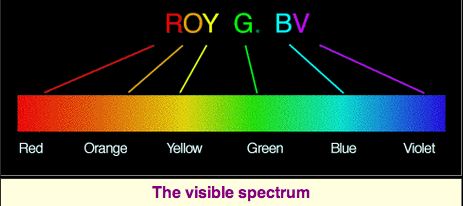
You can remember the order of the colors in the visible spectrum with the mnemonic ROY G BV. Image via University of Tennessee.

The electromagnetic waves your eyes detect – visible light – oscillates between 400 and 790 terahertz (THz). That’s several hundred trillion times a second. The wavelengths are roughly the size of a large virus: 390 – 750 nanometers (1 nanometer = 1 billionth of a meter). Our brain interprets the various wavelengths of light as different colors. Red has the longest wavelength, and violet the shortest. When we pass sunlight through a prism, we see that it’s actually composed of many wavelengths of light. The prism creates a rainbow by redirecting each wavelength out a slightly different angle.

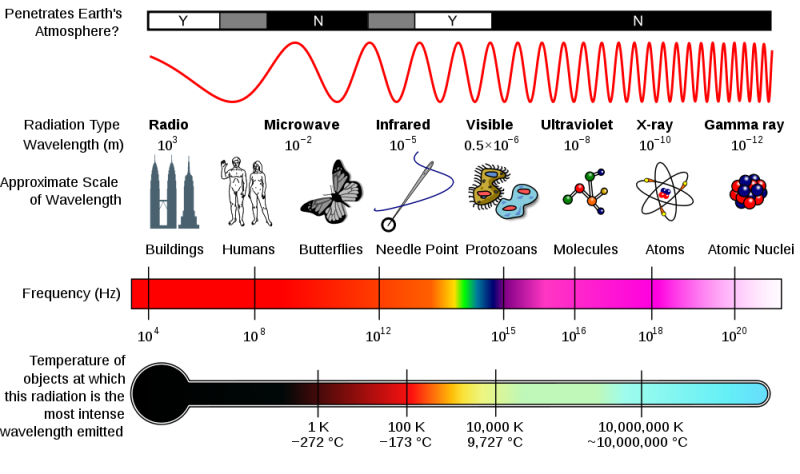
The electromagnetic spectrum

The entire electromagnetic spectrum is much more than just visible light. It encompasses of range of wavelengths of energy that our human eyes can’t see. Image via NASA/Wikipedia.

But light doesn’t stop at red or violet. Just like there are sounds we can’t hear (but other animals can), there is also an enormous range of light that our eyes can’t detect. In general, the longer wavelengths come from the coolest and darkest regions of space. Meanwhile, the shorter wavelengths measure extremely energetic phenomena.

Astronomers use the entire electromagnetic spectrum to observe a variety of things. Radio waves and microwaves – the longest wavelengths and lowest energies of light – are used to peer inside dense interstellar clouds and track the motion of cold, dark gas. Radio telescopes have been used to map the structure of our galaxy while microwave telescopes are sensitive to the remnant glow of the Big Bang.

Radio map of galaxy M33

This image from the Very Large Baseline Array (VLBA) shows what the galaxy M33 would look like if you could see in radio waves. This image maps atomic hydrogen gas in the galaxy. The different colors map velocities in the gas: red shows gas moving away from us, blue is moving towards us. Image via NRAO/AUI

Infrared telescopes excel at finding cool, dim stars, slicing through interstellar dust bands, and even measuring the temperatures of planets in other solar systems. The wavelengths of infrared light are long enough to navigate through clouds that would otherwise block our view. By using large infrared telescopes, astronomers have been able to peer through the dust lanes of the Milky Way into the core of our galaxy.

Infrared image of the galactic center

This image from the Hubble and Spitzer space telescopes show the central 300 light-years of our Milky Way galaxy, as we would see it if our eyes could see infrared energy.  The image reveals massive star clusters and swirling gas clouds.  Image via NASA, ESA, JPL, Q.D. Wang, and S. Stolovy.

The majority of stars emit most of their electromagnetic energy as visible light, the tiny portion of the spectrum to which our eyes are sensitive. Because wavelength correlates with energy, the color of a star tells us how hot it is: red stars are coolest, blue are hottest. The coldest of stars emit hardly any visible light at all; they can only be seen with infrared telescopes.

At wavelengths shorter than violet, we find the ultraviolet, or UV, light. You may be familiar with UV from its ability to give you a sunburn. Astronomers use it to hunt out the most energetic of stars and identify regions of star birth. When viewing distant galaxies with UV telescopes, most of the stars and gas disappear, and all the stellar nurseries flare into view.

UV image of spiral galaxy M81

A view of the spiral galaxy M81 in the ultraviolet, made possible by the Galex space observatory.  The bright regions show stellar nurseries in the spiral arms.  Image via NASA.

Beyond UV, comes the highest energies in the electromagnetic spectrum: X-rays and gamma rays. Our atmosphere blocks this light, so astronomers must rely on telescopes in space to see the x-ray and gamma ray universe. X-rays come from exotic neutron stars, the vortex of superheated material spiraling around a black hole, or diffuse clouds of gas in galactic clusters that are heated to many millions of degrees. Meanwhile, gamma rays – the shortest wavelength of light and deadly to humans – unveil violent supernova explosions, cosmic radioactive decay, and even the destruction of antimatter. Gamma ray bursts – the brief flickering of gamma ray light from distant galaxies when a star explodes and creates a black hole – are among the most energetic singular events in the universe.

X-ray image of pulsar PSR B1509-58

If you could see in x-rays, over long distances, you’d see this view of the nebula surrounding pulsar PSR B1509-58. This image is from the Chandra telescope.  Located 17,000 light-years away, the pulsar is the rapidly spinning remnant of a stellar core left behind after a supernova.  Image via NASA.

Bottom line: The electromagnetic spectrum describes all the wavelengths of light – both seen and unseen.


from EarthSky https://ift.tt/2rwEUM3

Color spectrum via Shutterstock.

When you think of light, you probably think of what your eyes can see. But the light to which our eyes are sensitive is just the beginning; it is a sliver of the total amount of light that surrounds us. The electromagnetic spectrum is the term used by scientists to describe the entire range of light that exists. From radio waves to gamma rays, most of the light in the universe is, in fact, invisible to us!

Light is a wave of alternating electric and magnetic fields. The propagation of light isn’t much different than waves crossing an ocean. Like any other wave, light has a few fundamental properties that describe it. One is its frequency, measured in Hertz, which counts the number of waves that pass by a point in one second. Another closely related property is wavelength: the distance from the peak of one wave to the peak of the next. These two attributes are inversely related. The larger the frequency, the smaller the wavelength – and vice versa.

You can remember the order of the colors in the visible spectrum with the mnemonic ROY G BV. Image via University of Tennessee.

The electromagnetic waves your eyes detect – visible light – oscillates between 400 and 790 terahertz (THz). That’s several hundred trillion times a second. The wavelengths are roughly the size of a large virus: 390 – 750 nanometers (1 nanometer = 1 billionth of a meter). Our brain interprets the various wavelengths of light as different colors. Red has the longest wavelength, and violet the shortest. When we pass sunlight through a prism, we see that it’s actually composed of many wavelengths of light. The prism creates a rainbow by redirecting each wavelength out a slightly different angle.

The electromagnetic spectrum

The entire electromagnetic spectrum is much more than just visible light. It encompasses of range of wavelengths of energy that our human eyes can’t see. Image via NASA/Wikipedia.

But light doesn’t stop at red or violet. Just like there are sounds we can’t hear (but other animals can), there is also an enormous range of light that our eyes can’t detect. In general, the longer wavelengths come from the coolest and darkest regions of space. Meanwhile, the shorter wavelengths measure extremely energetic phenomena.

Astronomers use the entire electromagnetic spectrum to observe a variety of things. Radio waves and microwaves – the longest wavelengths and lowest energies of light – are used to peer inside dense interstellar clouds and track the motion of cold, dark gas. Radio telescopes have been used to map the structure of our galaxy while microwave telescopes are sensitive to the remnant glow of the Big Bang.

Radio map of galaxy M33

This image from the Very Large Baseline Array (VLBA) shows what the galaxy M33 would look like if you could see in radio waves. This image maps atomic hydrogen gas in the galaxy. The different colors map velocities in the gas: red shows gas moving away from us, blue is moving towards us. Image via NRAO/AUI

Infrared telescopes excel at finding cool, dim stars, slicing through interstellar dust bands, and even measuring the temperatures of planets in other solar systems. The wavelengths of infrared light are long enough to navigate through clouds that would otherwise block our view. By using large infrared telescopes, astronomers have been able to peer through the dust lanes of the Milky Way into the core of our galaxy.

Infrared image of the galactic center

This image from the Hubble and Spitzer space telescopes show the central 300 light-years of our Milky Way galaxy, as we would see it if our eyes could see infrared energy.  The image reveals massive star clusters and swirling gas clouds.  Image via NASA, ESA, JPL, Q.D. Wang, and S. Stolovy.

The majority of stars emit most of their electromagnetic energy as visible light, the tiny portion of the spectrum to which our eyes are sensitive. Because wavelength correlates with energy, the color of a star tells us how hot it is: red stars are coolest, blue are hottest. The coldest of stars emit hardly any visible light at all; they can only be seen with infrared telescopes.

At wavelengths shorter than violet, we find the ultraviolet, or UV, light. You may be familiar with UV from its ability to give you a sunburn. Astronomers use it to hunt out the most energetic of stars and identify regions of star birth. When viewing distant galaxies with UV telescopes, most of the stars and gas disappear, and all the stellar nurseries flare into view.

UV image of spiral galaxy M81

A view of the spiral galaxy M81 in the ultraviolet, made possible by the Galex space observatory.  The bright regions show stellar nurseries in the spiral arms.  Image via NASA.

Beyond UV, comes the highest energies in the electromagnetic spectrum: X-rays and gamma rays. Our atmosphere blocks this light, so astronomers must rely on telescopes in space to see the x-ray and gamma ray universe. X-rays come from exotic neutron stars, the vortex of superheated material spiraling around a black hole, or diffuse clouds of gas in galactic clusters that are heated to many millions of degrees. Meanwhile, gamma rays – the shortest wavelength of light and deadly to humans – unveil violent supernova explosions, cosmic radioactive decay, and even the destruction of antimatter. Gamma ray bursts – the brief flickering of gamma ray light from distant galaxies when a star explodes and creates a black hole – are among the most energetic singular events in the universe.

X-ray image of pulsar PSR B1509-58

If you could see in x-rays, over long distances, you’d see this view of the nebula surrounding pulsar PSR B1509-58. This image is from the Chandra telescope.  Located 17,000 light-years away, the pulsar is the rapidly spinning remnant of a stellar core left behind after a supernova.  Image via NASA.

Bottom line: The electromagnetic spectrum describes all the wavelengths of light – both seen and unseen.


from EarthSky https://ift.tt/2rwEUM3

Venus returns to evening sky

A bright orange twilight sky, with Venus shining between clouds.

View at EarthSky Community Photos. | Radu Anghel in Romania caught Venus with a 4-inch refracting telescope and a Canon 750D on September 6, 2019. As another indication of how tough it is to catch Venus now, Radu said this was a crop of a larger image. Thanks Radu!

Planet guides (like ours) will tell you that the brightest planet Venus is not visible in September 2019. That’s because Venus reached superior conjunction on August 14. At that time, Venus was behind the sun as viewed from Earth. Now Venus is still mostly lost in the sun’s glare, but it has officially transitioned from our morning sky, where it lingered for most of 2019, to our evening sky. And behold! An EarthSky community member has glimpsed Venus already through a telescope. Radu Anghel of Bacau, Romania wrote on September 6, 2019:

Venus, the Evening Star, at 5 degrees away from the sun. Visible only with the telescope for now, but will get farther from the sun and shine in the next weeks, in the west after sunset. One shot, ISO 100, 1/200s.

By the way, Venus comes to superior conjunction every 584 days. Southern Hemisphere Observers might catch Venus with the eye alone by the end of September. Here in the Northern Hemisphere, the autumn angle of the ecliptic to the western horizon in the evening will place Venus lower in the sky, closer to the sunset horizon. We in the north might have to wait until October to see Venus with the eye alone.

Visit EarthSky’s guide to the bright planets

Nearly vertical line of ecliptic. Thin crescent moon position for each day and planets plus stars.

At the end of September 2019, it’ll be easier to view the planets Mercury and Venus than it was when this month began. The star Spica – brightest light in the constellation Virgo the Maiden – will be nearby. All of these objects will be easier to see from Earth’s Southern Hemisphere, because the ecliptic – or path of the sun, moon and planets – tilts steeply with respect to the sunset horizon in late winter/early spring, and spring begins in the Southern Hemisphere on the September equinox. Read more.

Bottom line: Photo from an EarthSky community member of Venus in the evening sky, just 5 degrees from the sun.


from EarthSky https://ift.tt/2LwtP9c
A bright orange twilight sky, with Venus shining between clouds.

View at EarthSky Community Photos. | Radu Anghel in Romania caught Venus with a 4-inch refracting telescope and a Canon 750D on September 6, 2019. As another indication of how tough it is to catch Venus now, Radu said this was a crop of a larger image. Thanks Radu!

Planet guides (like ours) will tell you that the brightest planet Venus is not visible in September 2019. That’s because Venus reached superior conjunction on August 14. At that time, Venus was behind the sun as viewed from Earth. Now Venus is still mostly lost in the sun’s glare, but it has officially transitioned from our morning sky, where it lingered for most of 2019, to our evening sky. And behold! An EarthSky community member has glimpsed Venus already through a telescope. Radu Anghel of Bacau, Romania wrote on September 6, 2019:

Venus, the Evening Star, at 5 degrees away from the sun. Visible only with the telescope for now, but will get farther from the sun and shine in the next weeks, in the west after sunset. One shot, ISO 100, 1/200s.

By the way, Venus comes to superior conjunction every 584 days. Southern Hemisphere Observers might catch Venus with the eye alone by the end of September. Here in the Northern Hemisphere, the autumn angle of the ecliptic to the western horizon in the evening will place Venus lower in the sky, closer to the sunset horizon. We in the north might have to wait until October to see Venus with the eye alone.

Visit EarthSky’s guide to the bright planets

Nearly vertical line of ecliptic. Thin crescent moon position for each day and planets plus stars.

At the end of September 2019, it’ll be easier to view the planets Mercury and Venus than it was when this month began. The star Spica – brightest light in the constellation Virgo the Maiden – will be nearby. All of these objects will be easier to see from Earth’s Southern Hemisphere, because the ecliptic – or path of the sun, moon and planets – tilts steeply with respect to the sunset horizon in late winter/early spring, and spring begins in the Southern Hemisphere on the September equinox. Read more.

Bottom line: Photo from an EarthSky community member of Venus in the evening sky, just 5 degrees from the sun.


from EarthSky https://ift.tt/2LwtP9c

India’s moon mission: “95% of mission objectives accomplished”

Computer-generated image of the Vikram lander descending to the moon's surface.

This was the view on computer screens at the Chandrayaan-2 mission control center in Bengaluru, India, just minutes before space scientists lost communications with the Vikram lander on Saturday. Image via ISRO/Space.com.

Only three nations of Earth – the former Soviet Union, the U.S. and, as of this year, China – have successfully landed spacecraft on the moon. On September 7, 2019, India hoped to become the fourth nation to soft land on the moon successfully, with the Vikram lander in its Chandrayaan-2 mission. But, only minutes before touchdown, something happened; communications with the lander were lost.

K. Sivan, chief of the Indian Space Research Organization (ISRO), said in his first TV interview after the attempted landing:

Powered descent included four stages. The first three phases were executed nicely, but the last one was not executed in a nice way and we lost the link with the lander.

He also described the mission as 90% to 95% successful so far.

Throughout the day on Saturday, there were the inevitable comparisons of Vikram’s situation with the crash landing on the moon of Israel’s Beresheet spacecraft in April 2019. For example, in an article posted Saturday at PlanetarySociety.org, Jason Davis mentioned Israel’s attempt as he described the scene at Chandrayaan-2’s mission control center in Bengaluru, India:

Just moments before landing, telemetry screens at the Indian Space Research Organisation (ISRO) mission control center froze, in a scene eerily reminiscent to the crash of Israel’s Beresheet lander in April. Those screens reported the spacecraft was traveling at a horizontal speed of about 48 meters per second and a vertical speed of about 60 meters per second, just over 1 kilometer from the landing site. A flight controller said communications with NASA’s Deep Space Network in Madrid had stopped. Several minutes later, K. Sivan said that Vikram’s descent was nominal until an altitude of 2.1 kilometers, and communications were lost shortly thereafter.

When Israel’s Beresheet lander crashed in April, the reason was said to be that its gyroscopes had failed, causing its main engine to shut down and resulting in a crash to the lunar surface.

But what happened to Vikram?

At this writing, we do not know. In fact, ISRO is still trying to contact the lander. Hindustantimes.com reported that these efforts will continue during the next 14 Earth-days (one period of lunar daylight).

It’s possible, in other words, that Vikram did not crash, that the problem is simply one of communications. Former ISRO Director D. Sasikumar sounded upbeat on Saturday when he told ANINews:

We have to find out from the communication data whether it is a soft landing or it is a crash landing. In my opinion, it is not a crash landing because the communication channel is on between the lander and the orbiter. It should be intact. So, let us hope after the analysis done, we may be able to get the final figure.

ISRO’s Chandrayaan-2 mission update page also posted information on September 7, pointing out that the mission’s orbiter is still there, still orbiting the moon, and still able to gather date. In fact, the update said, the orbiter is expected to explore the moon’s surface from above for the coming seven years, in contrast to its original mission timeline of one year:

Chandrayaan-2 mission [is] a highly complex mission, which represented a significant technological leap compared to the previous missions of ISRO, which brought together an orbiter, lander and rover to explore the unexplored south pole of the moon.

Since the launch of Chandrayaan-2 on July 22, 2019, not only India but the whole world watched its progress from one phase to the next with great expectations and excitement. This was a unique mission which aimed at studying not just one area of the moon but all the areas combining the exosphere, the surface as well as the sub-surface of the moon in a single mission.

The orbiter has already been placed in its intended orbit around the moon and shall enrich our understanding of the moon’s evolution and mapping of the minerals and water molecules in the polar regions, using its eight state-of-the-art scientific instruments. The orbiter camera is the highest resolution camera (0.3m) in any lunar mission so far and shall provide high resolution images which will be immensely useful to the global scientific community. The precise launch and mission management has ensured a long life of almost seven years instead of the planned one year.

The Vikram lander followed the planned descent trajectory from its orbit of 35 km to just below 2 km above the surface. All the systems and sensors of the lander functioned excellently until this point and proved many new technologies such as variable thrust propulsion technology used in the lander. The success criteria was defined for each and every phase of the mission and to date 90 to 95% of the mission objectives have been accomplished and will continue contribute to lunar science , notwithstanding the loss of communication with the lander.

It’s also likely that ISRO will use the Chandrayaan-2 orbiter to view Vikram’s proposed landing site to gather more information about the fate of the lander.

Two alternating images of bump gray square. Second image shows lighter spot in the center.

Before and after comparison of the proposed touchdown site of Israel’s Beresheet moon lander, which crashed while attempting landing last April. This image is from NASA’s Lunar Reconnaissance Orbiter. India is likely to attempt to use its own Chandrayaan-2 orbiter to view Vikram’s proposed landing site, to determine if the lander crashed, or if it is intact but with communications lost. Read more about this image.

Bottom line: The Vikram lander of the Chandrayaan-2 mission was scheduled to touch down on the moon on September 7, 2019. As of now, communications with the lander have been lost; however, India’s space scientists remain upbeat.


from EarthSky https://ift.tt/2ZW2EKj
Computer-generated image of the Vikram lander descending to the moon's surface.

This was the view on computer screens at the Chandrayaan-2 mission control center in Bengaluru, India, just minutes before space scientists lost communications with the Vikram lander on Saturday. Image via ISRO/Space.com.

Only three nations of Earth – the former Soviet Union, the U.S. and, as of this year, China – have successfully landed spacecraft on the moon. On September 7, 2019, India hoped to become the fourth nation to soft land on the moon successfully, with the Vikram lander in its Chandrayaan-2 mission. But, only minutes before touchdown, something happened; communications with the lander were lost.

K. Sivan, chief of the Indian Space Research Organization (ISRO), said in his first TV interview after the attempted landing:

Powered descent included four stages. The first three phases were executed nicely, but the last one was not executed in a nice way and we lost the link with the lander.

He also described the mission as 90% to 95% successful so far.

Throughout the day on Saturday, there were the inevitable comparisons of Vikram’s situation with the crash landing on the moon of Israel’s Beresheet spacecraft in April 2019. For example, in an article posted Saturday at PlanetarySociety.org, Jason Davis mentioned Israel’s attempt as he described the scene at Chandrayaan-2’s mission control center in Bengaluru, India:

Just moments before landing, telemetry screens at the Indian Space Research Organisation (ISRO) mission control center froze, in a scene eerily reminiscent to the crash of Israel’s Beresheet lander in April. Those screens reported the spacecraft was traveling at a horizontal speed of about 48 meters per second and a vertical speed of about 60 meters per second, just over 1 kilometer from the landing site. A flight controller said communications with NASA’s Deep Space Network in Madrid had stopped. Several minutes later, K. Sivan said that Vikram’s descent was nominal until an altitude of 2.1 kilometers, and communications were lost shortly thereafter.

When Israel’s Beresheet lander crashed in April, the reason was said to be that its gyroscopes had failed, causing its main engine to shut down and resulting in a crash to the lunar surface.

But what happened to Vikram?

At this writing, we do not know. In fact, ISRO is still trying to contact the lander. Hindustantimes.com reported that these efforts will continue during the next 14 Earth-days (one period of lunar daylight).

It’s possible, in other words, that Vikram did not crash, that the problem is simply one of communications. Former ISRO Director D. Sasikumar sounded upbeat on Saturday when he told ANINews:

We have to find out from the communication data whether it is a soft landing or it is a crash landing. In my opinion, it is not a crash landing because the communication channel is on between the lander and the orbiter. It should be intact. So, let us hope after the analysis done, we may be able to get the final figure.

ISRO’s Chandrayaan-2 mission update page also posted information on September 7, pointing out that the mission’s orbiter is still there, still orbiting the moon, and still able to gather date. In fact, the update said, the orbiter is expected to explore the moon’s surface from above for the coming seven years, in contrast to its original mission timeline of one year:

Chandrayaan-2 mission [is] a highly complex mission, which represented a significant technological leap compared to the previous missions of ISRO, which brought together an orbiter, lander and rover to explore the unexplored south pole of the moon.

Since the launch of Chandrayaan-2 on July 22, 2019, not only India but the whole world watched its progress from one phase to the next with great expectations and excitement. This was a unique mission which aimed at studying not just one area of the moon but all the areas combining the exosphere, the surface as well as the sub-surface of the moon in a single mission.

The orbiter has already been placed in its intended orbit around the moon and shall enrich our understanding of the moon’s evolution and mapping of the minerals and water molecules in the polar regions, using its eight state-of-the-art scientific instruments. The orbiter camera is the highest resolution camera (0.3m) in any lunar mission so far and shall provide high resolution images which will be immensely useful to the global scientific community. The precise launch and mission management has ensured a long life of almost seven years instead of the planned one year.

The Vikram lander followed the planned descent trajectory from its orbit of 35 km to just below 2 km above the surface. All the systems and sensors of the lander functioned excellently until this point and proved many new technologies such as variable thrust propulsion technology used in the lander. The success criteria was defined for each and every phase of the mission and to date 90 to 95% of the mission objectives have been accomplished and will continue contribute to lunar science , notwithstanding the loss of communication with the lander.

It’s also likely that ISRO will use the Chandrayaan-2 orbiter to view Vikram’s proposed landing site to gather more information about the fate of the lander.

Two alternating images of bump gray square. Second image shows lighter spot in the center.

Before and after comparison of the proposed touchdown site of Israel’s Beresheet moon lander, which crashed while attempting landing last April. This image is from NASA’s Lunar Reconnaissance Orbiter. India is likely to attempt to use its own Chandrayaan-2 orbiter to view Vikram’s proposed landing site, to determine if the lander crashed, or if it is intact but with communications lost. Read more about this image.

Bottom line: The Vikram lander of the Chandrayaan-2 mission was scheduled to touch down on the moon on September 7, 2019. As of now, communications with the lander have been lost; however, India’s space scientists remain upbeat.


from EarthSky https://ift.tt/2ZW2EKj

Moon near Saturn on September 7 and 8

Look for the planet Saturn in the vicinity of the moon as darkness falls on September 7 and 8, 2019. Saturn is actually a bit brighter than a 1st-magnitude star, but this world still might be hard to see in the moon’s glare. If so, try placing your finger over the obtrusive waxing gibbous moon for a better view of Saturn, the most distant world that you can easily see with the eye alone.

For all the world, the moon is seen in between Saturn and the king planet Jupiter on September 7. Below, we show you a more expanded view of the sky that includes both Saturn and Jupiter. Although the chart is especially made for mid-northern North American latitudes, you can still find Saturn rather easily from anywhere worldwide. Look first for Jupiter – by far the brightest “star” in the evening sky, and that “star” on the other side of the moon on September 7 will be Saturn.

Moon and planets adorn the evening twilight.

For the last few days, the moon has been moving eastward along the ecliptic from Jupiter to Saturn.

From North America, we see the moon to the west of Saturn as darkness falls on September 7, and then to the east of the moon as darkness falls on September 8. Keep in mind that the moon appears much larger on our charts than in the real sky. From nightfall September 7 until nightfall September 8, the moon’s change of position amounts to about 12 degrees (24 moon-diameters).

At nightfall on September 7, from the world’s Eastern Hemisphere, the moon will appear farther west of Saturn, and more offset in the direction of Jupiter, than it’ll be at nightfall September 7 in North America. Here, in North America, the moon is more or less equally distant from the moon on September 7 and 8; from the Eastern Hemisphere, the moon will be closer to Saturn on September 8 than on September 7.

At nightfall on September 8, most of the world’s Eastern Hemisphere (Europe, Africa, western Asia) will see the moon to the east of Saturn (as we do in North America). From the far-eastern regions of the Eastern Hemisphere (eastern Asia, Indonesia, Australia and New Zealand), as darkness falls on September 8, the moon will actually appear to the west (not to the east) of Saturn.

Worldwide map of Saturn occultation

See the white lines on the worldwide map? It’s in this part of the world that the occultation of Saturn takes place in a nighttime sky on the night of September 8-9, 2019. Image via IOTA.

Best of all, if you live in just the right spots in Australia and Indonesia, you can watch the moon occult (cover over) Saturn in a nighttime sky as the moon moves from the west of Saturn to the east of Saturn on the night of September 8-9. 2019. Saturn will disappear behind the moon’s dark side and then reappear from behind the moon’s illuminated side.

We are at the tail end of a monthly series of 14 Saturn occultations that started on December 9, 2018, and will end on November 29, 2019. However, you have to be at just the right spot on Earth to witness any one of these occultations. The next series will present 12 Saturn occultations from April 6, 2024 until February 1, 2025.

These next couple of nights – September 7 and 8, 2019 – use the waxing gibbous moon to find the planet Saturn.


from EarthSky https://ift.tt/2ZQaN2I

Look for the planet Saturn in the vicinity of the moon as darkness falls on September 7 and 8, 2019. Saturn is actually a bit brighter than a 1st-magnitude star, but this world still might be hard to see in the moon’s glare. If so, try placing your finger over the obtrusive waxing gibbous moon for a better view of Saturn, the most distant world that you can easily see with the eye alone.

For all the world, the moon is seen in between Saturn and the king planet Jupiter on September 7. Below, we show you a more expanded view of the sky that includes both Saturn and Jupiter. Although the chart is especially made for mid-northern North American latitudes, you can still find Saturn rather easily from anywhere worldwide. Look first for Jupiter – by far the brightest “star” in the evening sky, and that “star” on the other side of the moon on September 7 will be Saturn.

Moon and planets adorn the evening twilight.

For the last few days, the moon has been moving eastward along the ecliptic from Jupiter to Saturn.

From North America, we see the moon to the west of Saturn as darkness falls on September 7, and then to the east of the moon as darkness falls on September 8. Keep in mind that the moon appears much larger on our charts than in the real sky. From nightfall September 7 until nightfall September 8, the moon’s change of position amounts to about 12 degrees (24 moon-diameters).

At nightfall on September 7, from the world’s Eastern Hemisphere, the moon will appear farther west of Saturn, and more offset in the direction of Jupiter, than it’ll be at nightfall September 7 in North America. Here, in North America, the moon is more or less equally distant from the moon on September 7 and 8; from the Eastern Hemisphere, the moon will be closer to Saturn on September 8 than on September 7.

At nightfall on September 8, most of the world’s Eastern Hemisphere (Europe, Africa, western Asia) will see the moon to the east of Saturn (as we do in North America). From the far-eastern regions of the Eastern Hemisphere (eastern Asia, Indonesia, Australia and New Zealand), as darkness falls on September 8, the moon will actually appear to the west (not to the east) of Saturn.

Worldwide map of Saturn occultation

See the white lines on the worldwide map? It’s in this part of the world that the occultation of Saturn takes place in a nighttime sky on the night of September 8-9, 2019. Image via IOTA.

Best of all, if you live in just the right spots in Australia and Indonesia, you can watch the moon occult (cover over) Saturn in a nighttime sky as the moon moves from the west of Saturn to the east of Saturn on the night of September 8-9. 2019. Saturn will disappear behind the moon’s dark side and then reappear from behind the moon’s illuminated side.

We are at the tail end of a monthly series of 14 Saturn occultations that started on December 9, 2018, and will end on November 29, 2019. However, you have to be at just the right spot on Earth to witness any one of these occultations. The next series will present 12 Saturn occultations from April 6, 2024 until February 1, 2025.

These next couple of nights – September 7 and 8, 2019 – use the waxing gibbous moon to find the planet Saturn.


from EarthSky https://ift.tt/2ZQaN2I

adds 2