aads

2019 SkS Weekly Climate Change & Global Warming News Roundup #34

A chronological listing of news articles posted on the Skeptical Science Facebook Page during the past week, i.e., Sun, Aug 18 through Sat, Aug 24, 2019

Editor's Pick

How teen Greta Thunberg shifted world's gaze to climate change

“Instead of worrying about how that future might turn out, I’m going to try to change that future while I still can,” the teen told NBC News.

Greta Thunberg

Greta Thunberg is the driving force behind a movement that has seen more than 2 million teens around the world take part in school strikes against climate change. Eleanor Taylor for NBC News

LAUSANNE, Switzerland ⁠— Staring through a swarm of photographers and television crews, self-described introvert Greta Thunberg took the stage at a Swiss university last week to pointedly reiterate a message that has captured the attention of leaders and like-minded young women around the globe: The world must take drastic action now to avert ecological and civilizational collapse.

“We know that our future is at risk,” the small, soft-spoken 16-year-old Swede tells journalists at the start of a weeklong youth summit at the University of Lausanne. “We would love to go back to school and continue with our everyday lives, but as crucial as this situation is, as serious as this situation is, we feel like we must do something about this now.”

Thunberg — whose central point is that humanity must immediately reduce greenhouse gas emissions that have unrelentingly increased since the start of the industrial revolution, resulting in global warming — is the driving force behind a movement that has seen more than 2 million teens around the world take part in Fridays for Future school strikes against climate change.

On Wednesday, she set off from Britain’s shores on a monthslong journey — she is sailing to avoid flying — that will take her to a U.N. summit on climate change in New York in September, and the COP25 conference in Santiago, Chile, in December.

How teen Greta Thunberg shifted world's gaze to climate change by Linda Givetash, World, NBC News. Aug 17, 2019


Links posted on Facebook

Sun Aug 18, 2019

Mon Aug 19, 2019

Tue Aug 20, 2019

Wed Aug 21, 2019

Thu Aug 22, 2019

Fri Aug 23, 2019

Sat Aug 24, 2019


from Skeptical Science https://ift.tt/33VsvoP
A chronological listing of news articles posted on the Skeptical Science Facebook Page during the past week, i.e., Sun, Aug 18 through Sat, Aug 24, 2019

Editor's Pick

How teen Greta Thunberg shifted world's gaze to climate change

“Instead of worrying about how that future might turn out, I’m going to try to change that future while I still can,” the teen told NBC News.

Greta Thunberg

Greta Thunberg is the driving force behind a movement that has seen more than 2 million teens around the world take part in school strikes against climate change. Eleanor Taylor for NBC News

LAUSANNE, Switzerland ⁠— Staring through a swarm of photographers and television crews, self-described introvert Greta Thunberg took the stage at a Swiss university last week to pointedly reiterate a message that has captured the attention of leaders and like-minded young women around the globe: The world must take drastic action now to avert ecological and civilizational collapse.

“We know that our future is at risk,” the small, soft-spoken 16-year-old Swede tells journalists at the start of a weeklong youth summit at the University of Lausanne. “We would love to go back to school and continue with our everyday lives, but as crucial as this situation is, as serious as this situation is, we feel like we must do something about this now.”

Thunberg — whose central point is that humanity must immediately reduce greenhouse gas emissions that have unrelentingly increased since the start of the industrial revolution, resulting in global warming — is the driving force behind a movement that has seen more than 2 million teens around the world take part in Fridays for Future school strikes against climate change.

On Wednesday, she set off from Britain’s shores on a monthslong journey — she is sailing to avoid flying — that will take her to a U.N. summit on climate change in New York in September, and the COP25 conference in Santiago, Chile, in December.

How teen Greta Thunberg shifted world's gaze to climate change by Linda Givetash, World, NBC News. Aug 17, 2019


Links posted on Facebook

Sun Aug 18, 2019

Mon Aug 19, 2019

Tue Aug 20, 2019

Wed Aug 21, 2019

Thu Aug 22, 2019

Fri Aug 23, 2019

Sat Aug 24, 2019


from Skeptical Science https://ift.tt/33VsvoP

The sun is between us and Mars now

It happens about every two years. Moving in its smaller and faster orbit around the sun, Earth “turns the corner” ahead of Mars, placing the sun between us and the Red Planet. At these times, Mars is gone from our night sky, traveling across the sky with the sun during the day. Astronomers call this event a conjunction; Mars will be precisely in conjunction with the sun on September 2, 2019. For space engineers, though – those responsible for Earth’s fleet of active spacecraft now orbiting or roving on Mars – having the sun between us and Mars poses a potential risk. The risk is that – due to radio interference from hot, ionized gas in the sun’s corona, or outer atmosphere – a command from Earth might become garbled, causing a spacecraft to respond in an unexpected way. To be safe, NASA engineers say they’ll hold off sending commands to Mars spacecraft from August 28 to September 7, 2019. Roy Gladden, manager of the Mars Relay Network at NASA’s Jet Propulsion Laboratory in Pasadena, California, said:

It’s that time again. Our engineers have been preparing our spacecraft for conjunction for months. They’ll still be collecting science data at Mars, and some will attempt to send that data home. But we won’t be commanding the spacecraft out of concern that they could act on a corrupted command.

So the chatter that typically goes on between Earth and Mars will be silent in the coming weeks. What will NASA’s Mars craft do in the meantime?

Animation showing Earth and Mars on opposite sides of the sun.

Animation showing Earth and Mars on opposite sides of the sun. Astronomers say that Mars is “in conjunction” with the sun. Mars is traveling with the sun across our sky each day.

A statement from NASA on August 23 explained:

Although some instruments aboard spacecraft – especially cameras that generate large amounts of data – will be inactive, all of NASA’s Mars spacecraft will continue their science; they’ll just have much simpler ‘to-do’ lists than they normally would carry out.

On the surface of Mars, the Curiosity rover will stop driving, while the InSight lander won’t move its robotic arm. Above Mars, both the Odyssey orbiter and the Mars Reconnaissance Orbiter will continue collecting data from Curiosity and InSight for return to Earth. However, only Odyssey will attempt to relay that data to Earth before conjunction ends. Meantime, another orbiter, MAVEN, will continue to collect its own science data but won’t support any relay operations during this time.

All of this means that there will be a temporary pause in the stream of raw images available from Curiosity, InSight and the other Mars missions.

Mars solar conjunction impacts operations of all spacecraft currently at Mars, not just NASA’s.

Once conjunction is over, NASA said, the spacecraft will beam the data they’ve collected to NASA’s Deep Space Network, a system of massive Earth-based radio antennas managed by the Jet Propulsion Laboratory. Engineers will spend about a week downloading the information before normal spacecraft operations resume. NASA also said:

If the teams monitoring these missions determine any of the collected science data are corrupted, they can usually have that data retransmitted after the moratorium ends on September 7.

As for the engineers themselves, they intend to use this time to catch up on necessary tasks, or even take some R&R.

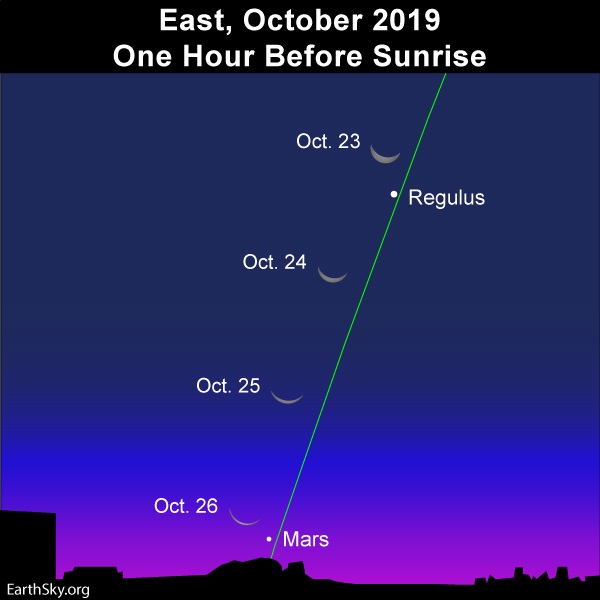
And when will Mars return to Earth’s night sky? It’ll take longer for Mars to become visible in our night sky than it will for signals to and from Mars to resume. You can expect to see Mars again in October. In fact, late October may feature your first decent chance to catch this world in the east before sunrise, as shown on the chart below.

Moon and Mars illuminate he sky at dawn.

When will you next see Mars in your night sky? A good time to look would be the mornings of October 23, 24 and 25, 2019, when the waning crescent moon will point to it. On October 26 – as seen from the Americas – look for the moon to swing close to Mars on the sky’s dome. Read more.

Bottom line: Between August 28 to September 7, 2019, there will be a radio silence imposed between Earth and Mars. The reason is that the sun is between us and Mars now. Hot, ionized gases in the sun’s corona can corrupt radio signals, leading to unexpected results from commands sent to our spacecraft from Earth.

For more about NASA’s Mars Exploration Program, visit:

https://mars.jpl.nasa.gov

https://www.nasa.gov/mars

Want to see planets? Visit EarthSky’s monthly planet guide

Via NASA


from EarthSky https://ift.tt/2KSnMwt

It happens about every two years. Moving in its smaller and faster orbit around the sun, Earth “turns the corner” ahead of Mars, placing the sun between us and the Red Planet. At these times, Mars is gone from our night sky, traveling across the sky with the sun during the day. Astronomers call this event a conjunction; Mars will be precisely in conjunction with the sun on September 2, 2019. For space engineers, though – those responsible for Earth’s fleet of active spacecraft now orbiting or roving on Mars – having the sun between us and Mars poses a potential risk. The risk is that – due to radio interference from hot, ionized gas in the sun’s corona, or outer atmosphere – a command from Earth might become garbled, causing a spacecraft to respond in an unexpected way. To be safe, NASA engineers say they’ll hold off sending commands to Mars spacecraft from August 28 to September 7, 2019. Roy Gladden, manager of the Mars Relay Network at NASA’s Jet Propulsion Laboratory in Pasadena, California, said:

It’s that time again. Our engineers have been preparing our spacecraft for conjunction for months. They’ll still be collecting science data at Mars, and some will attempt to send that data home. But we won’t be commanding the spacecraft out of concern that they could act on a corrupted command.

So the chatter that typically goes on between Earth and Mars will be silent in the coming weeks. What will NASA’s Mars craft do in the meantime?

Animation showing Earth and Mars on opposite sides of the sun.

Animation showing Earth and Mars on opposite sides of the sun. Astronomers say that Mars is “in conjunction” with the sun. Mars is traveling with the sun across our sky each day.

A statement from NASA on August 23 explained:

Although some instruments aboard spacecraft – especially cameras that generate large amounts of data – will be inactive, all of NASA’s Mars spacecraft will continue their science; they’ll just have much simpler ‘to-do’ lists than they normally would carry out.

On the surface of Mars, the Curiosity rover will stop driving, while the InSight lander won’t move its robotic arm. Above Mars, both the Odyssey orbiter and the Mars Reconnaissance Orbiter will continue collecting data from Curiosity and InSight for return to Earth. However, only Odyssey will attempt to relay that data to Earth before conjunction ends. Meantime, another orbiter, MAVEN, will continue to collect its own science data but won’t support any relay operations during this time.

All of this means that there will be a temporary pause in the stream of raw images available from Curiosity, InSight and the other Mars missions.

Mars solar conjunction impacts operations of all spacecraft currently at Mars, not just NASA’s.

Once conjunction is over, NASA said, the spacecraft will beam the data they’ve collected to NASA’s Deep Space Network, a system of massive Earth-based radio antennas managed by the Jet Propulsion Laboratory. Engineers will spend about a week downloading the information before normal spacecraft operations resume. NASA also said:

If the teams monitoring these missions determine any of the collected science data are corrupted, they can usually have that data retransmitted after the moratorium ends on September 7.

As for the engineers themselves, they intend to use this time to catch up on necessary tasks, or even take some R&R.

And when will Mars return to Earth’s night sky? It’ll take longer for Mars to become visible in our night sky than it will for signals to and from Mars to resume. You can expect to see Mars again in October. In fact, late October may feature your first decent chance to catch this world in the east before sunrise, as shown on the chart below.

Moon and Mars illuminate he sky at dawn.

When will you next see Mars in your night sky? A good time to look would be the mornings of October 23, 24 and 25, 2019, when the waning crescent moon will point to it. On October 26 – as seen from the Americas – look for the moon to swing close to Mars on the sky’s dome. Read more.

Bottom line: Between August 28 to September 7, 2019, there will be a radio silence imposed between Earth and Mars. The reason is that the sun is between us and Mars now. Hot, ionized gases in the sun’s corona can corrupt radio signals, leading to unexpected results from commands sent to our spacecraft from Earth.

For more about NASA’s Mars Exploration Program, visit:

https://mars.jpl.nasa.gov

https://www.nasa.gov/mars

Want to see planets? Visit EarthSky’s monthly planet guide

Via NASA


from EarthSky https://ift.tt/2KSnMwt

How did Pluto become a dwarf planet?

Black round planet with glowing edge, faint narrow lighted crescent on right.

Pluto backlit, via New Horizons spacecraft on July 14, 2015. Image via NASA/JHUAPL/SwRI.

August 24, 2006. Today is the 13th anniversary of the decision by the International Astronomical Union (IAU) to demote Pluto to dwarf planet status. Our solar system went from having nine major planets to having eight major planets. Pluto, once considered the outermost planet, became more widely known as the largest of a number of small bodies in the outer solar system. Neptune, the eighth large planet out from our sun, is now considered outermost major planet. The IAU formulated a new definition of what it means to be a planet. The IAU’s XXVIth General Assembly formalized the decision and announced it on August 24, 2006. The public and many astronomers didn’t take it lightly, with some declaring they would still consider Pluto a planet. The word plutoed – meaning to demote or devalue something – entered the global lexicon.

Why did it happen? We still get questions about this today. Prior to 2006, astronomers hadn’t gotten around to establishing clear standards – such as a minimum size or mass, or other considerations – by which an object might be categorized as a solar system “planet” versus “dwarf planet.”

They began to see a need when many small bodies – such as Haumea and Makemake – began to be discovered in the outer solar system. Eris, also considered a dwarf planet, is even more massive than Pluto! So if Pluto is a planet, why shouldn’t Eris be granted planet status as well? That was the question the IAU asked itself, which led to its formation of a Planet Definition Committee and ultimately the 2006 decision.

Casually dressed scientists - five men, two women - posing for photo.

Meet the Planet Definition Committee of the International Astronomical Union. This group made the final decision to demote Pluto to dwarf planet status. But, even within the committee, not all agreed.

The committee had a few possible roads to travel down. One would be to make the decision by size (or mass) so that Pluto would remain a planet, and therefore Eris and Ceres – the largest body in the asteroid belt in the inner solar system – would become planets, too. For a while, it looked as if that might happen with some IAU committee members favoring that decision.

Another option for the IAU might have been to define the concept of a planet without any specific logic: Earth is a planet, Pluto is a planet, but Eris is not just because.

On August 24, 2006, the IAU announced its solution to the questions raised by having so many new objects in the outer solar system. It had decided to create a scientific definition of what it means to be a planet. Unfortunately, the definition excluded Pluto from major planet status. Here’s the definition:

A planet is a celestial body that
(a) is in orbit around the Sun,
(b) has sufficient mass for its self-gravity to overcome rigid body forces so that it assumes a hydrostatic equilibrium (nearly round) shape, and
(c) has cleared the neighbourhood around its orbit.

It’s “c” that causes Pluto to fail as a planet, according to the IAU. For an object to be a major planet, according to this definition, it must be the dominant gravitational object in its orbit. It must either sling other objects away or merge with them.

Pluto is only 0.07 times the mass of the objects in its orbit. Meanwhile, Earth is 1.7 million times the mass of the objects in its orbit.

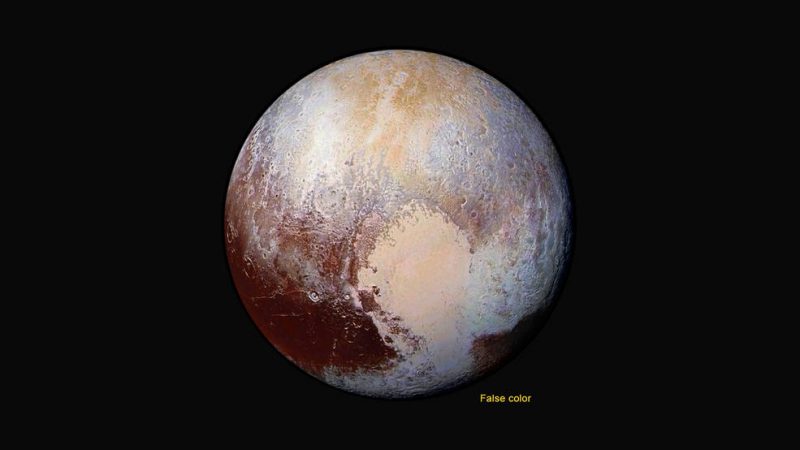
Round planet with red area to lower left and large heart-shaped white area at lower middle.

When Pluto lost its full planet status, it was revealed as one of the world’s most beloved astronomical objects. So it was ironic when New Horizons – first spacecraft ever to visit Pluto – discovered a heart-shaped region on it in 2015. Image taken 280,000 miles (450,000 km) from Pluto, via NASA/JHUAPL/SwRI.

Black and white partial view of planet against black sky.

New Horizons captured this image just 15 minutes after its closest approach to Pluto on July 14, 2015, as the spacecraft looked back toward the sun. This near-sunset view shows Pluto’s rugged, icy mountains and flat ice plains, plus haze layers in Pluto’s tenuous but distended atmosphere. The image was taken from a distance of 11,000 miles (18,000 km); the scene is 780 miles (1,250 km) wide. Image via NASA/JHUAPL/SwRI.

On that fateful day – August 24, 2006 – the IAU also created a new category of celestial objects for Pluto and all Pluto-like objects:

A “dwarf planet” is a celestial body that
(a) is in orbit around the sun,
(b) has sufficient mass for its self-gravity to overcome rigid body forces so that it assumes a hydrostatic equilibrium (nearly round) shape,
(c) has not cleared the neighbourhood around its orbit, and
(d) is not a satellite.

According to the IAU, there are currently five dwarf planets: Pluto, Ceres, Eris, Haumea, and Makemake. However, there is a likely potential sixth dwarf planet candidate temporarily designated as 2007 OR10, and many other known dwarf planet candidates.

Astronomers believe there may be hundreds of undiscovered dwarf planets in the Kuiper Belt of the outer solar system. There may be up to 10,000 in the region beyond.

Cartoon: Sun hugging planets, Pluto to one side saying 'I miss you guys'.

Still love Pluto? You might like this tee from Hadria Beth, Quark Tees.

By the way, it’s not common knowledge that many astronomers started out quite careful about their use of the word “planet” with respect to Pluto. In 1932, for example, only two years after American astronomer Clyde Tombaugh discovered Pluto, another astronomer, Armin Otto Leuschner, wrote in a journal article:

You may observe that with extreme conservatism I am still referring to Pluto as an object rather than as a planet. There is every probability that it is a planet, as is now universally concluded, from available material … So far only an upper limit for the mass of Pluto … has been established, and such a mass is believed from gravitational considerations to be too small to affect the motions of Uranus and Neptune sufficiently … There is also a remote chance that later investigations will render its mass comparable to that of comets.

Recall why astronomers began searching for Pluto in the first place. They expected to find an object large enough to gravitationally disturb the orbit of Neptune. If Pluto had been discovered a decade or so later, when Edgeworth speculated about the existence of the Kuiper Belt, it might have never been awarded the status of planet.

As it was, like it or not, Pluto became the world’s eye-opener when it came to the classification of solar system objects.

Bottom line: August 24, 2019, is the 13th anniversary of Pluto’s demotion to dwarf planet status. According to a new definition by the International Astronomical Union, Pluto became a dwarf planet because it is has not “cleared the neighborhood around its orbit.”

Read more about Pluto here

The IAU talks about its decision to demote Pluto here


from EarthSky https://ift.tt/2Zpmtx8
Black round planet with glowing edge, faint narrow lighted crescent on right.

Pluto backlit, via New Horizons spacecraft on July 14, 2015. Image via NASA/JHUAPL/SwRI.

August 24, 2006. Today is the 13th anniversary of the decision by the International Astronomical Union (IAU) to demote Pluto to dwarf planet status. Our solar system went from having nine major planets to having eight major planets. Pluto, once considered the outermost planet, became more widely known as the largest of a number of small bodies in the outer solar system. Neptune, the eighth large planet out from our sun, is now considered outermost major planet. The IAU formulated a new definition of what it means to be a planet. The IAU’s XXVIth General Assembly formalized the decision and announced it on August 24, 2006. The public and many astronomers didn’t take it lightly, with some declaring they would still consider Pluto a planet. The word plutoed – meaning to demote or devalue something – entered the global lexicon.

Why did it happen? We still get questions about this today. Prior to 2006, astronomers hadn’t gotten around to establishing clear standards – such as a minimum size or mass, or other considerations – by which an object might be categorized as a solar system “planet” versus “dwarf planet.”

They began to see a need when many small bodies – such as Haumea and Makemake – began to be discovered in the outer solar system. Eris, also considered a dwarf planet, is even more massive than Pluto! So if Pluto is a planet, why shouldn’t Eris be granted planet status as well? That was the question the IAU asked itself, which led to its formation of a Planet Definition Committee and ultimately the 2006 decision.

Casually dressed scientists - five men, two women - posing for photo.

Meet the Planet Definition Committee of the International Astronomical Union. This group made the final decision to demote Pluto to dwarf planet status. But, even within the committee, not all agreed.

The committee had a few possible roads to travel down. One would be to make the decision by size (or mass) so that Pluto would remain a planet, and therefore Eris and Ceres – the largest body in the asteroid belt in the inner solar system – would become planets, too. For a while, it looked as if that might happen with some IAU committee members favoring that decision.

Another option for the IAU might have been to define the concept of a planet without any specific logic: Earth is a planet, Pluto is a planet, but Eris is not just because.

On August 24, 2006, the IAU announced its solution to the questions raised by having so many new objects in the outer solar system. It had decided to create a scientific definition of what it means to be a planet. Unfortunately, the definition excluded Pluto from major planet status. Here’s the definition:

A planet is a celestial body that
(a) is in orbit around the Sun,
(b) has sufficient mass for its self-gravity to overcome rigid body forces so that it assumes a hydrostatic equilibrium (nearly round) shape, and
(c) has cleared the neighbourhood around its orbit.

It’s “c” that causes Pluto to fail as a planet, according to the IAU. For an object to be a major planet, according to this definition, it must be the dominant gravitational object in its orbit. It must either sling other objects away or merge with them.

Pluto is only 0.07 times the mass of the objects in its orbit. Meanwhile, Earth is 1.7 million times the mass of the objects in its orbit.

Round planet with red area to lower left and large heart-shaped white area at lower middle.

When Pluto lost its full planet status, it was revealed as one of the world’s most beloved astronomical objects. So it was ironic when New Horizons – first spacecraft ever to visit Pluto – discovered a heart-shaped region on it in 2015. Image taken 280,000 miles (450,000 km) from Pluto, via NASA/JHUAPL/SwRI.

Black and white partial view of planet against black sky.

New Horizons captured this image just 15 minutes after its closest approach to Pluto on July 14, 2015, as the spacecraft looked back toward the sun. This near-sunset view shows Pluto’s rugged, icy mountains and flat ice plains, plus haze layers in Pluto’s tenuous but distended atmosphere. The image was taken from a distance of 11,000 miles (18,000 km); the scene is 780 miles (1,250 km) wide. Image via NASA/JHUAPL/SwRI.

On that fateful day – August 24, 2006 – the IAU also created a new category of celestial objects for Pluto and all Pluto-like objects:

A “dwarf planet” is a celestial body that
(a) is in orbit around the sun,
(b) has sufficient mass for its self-gravity to overcome rigid body forces so that it assumes a hydrostatic equilibrium (nearly round) shape,
(c) has not cleared the neighbourhood around its orbit, and
(d) is not a satellite.

According to the IAU, there are currently five dwarf planets: Pluto, Ceres, Eris, Haumea, and Makemake. However, there is a likely potential sixth dwarf planet candidate temporarily designated as 2007 OR10, and many other known dwarf planet candidates.

Astronomers believe there may be hundreds of undiscovered dwarf planets in the Kuiper Belt of the outer solar system. There may be up to 10,000 in the region beyond.

Cartoon: Sun hugging planets, Pluto to one side saying 'I miss you guys'.

Still love Pluto? You might like this tee from Hadria Beth, Quark Tees.

By the way, it’s not common knowledge that many astronomers started out quite careful about their use of the word “planet” with respect to Pluto. In 1932, for example, only two years after American astronomer Clyde Tombaugh discovered Pluto, another astronomer, Armin Otto Leuschner, wrote in a journal article:

You may observe that with extreme conservatism I am still referring to Pluto as an object rather than as a planet. There is every probability that it is a planet, as is now universally concluded, from available material … So far only an upper limit for the mass of Pluto … has been established, and such a mass is believed from gravitational considerations to be too small to affect the motions of Uranus and Neptune sufficiently … There is also a remote chance that later investigations will render its mass comparable to that of comets.

Recall why astronomers began searching for Pluto in the first place. They expected to find an object large enough to gravitationally disturb the orbit of Neptune. If Pluto had been discovered a decade or so later, when Edgeworth speculated about the existence of the Kuiper Belt, it might have never been awarded the status of planet.

As it was, like it or not, Pluto became the world’s eye-opener when it came to the classification of solar system objects.

Bottom line: August 24, 2019, is the 13th anniversary of Pluto’s demotion to dwarf planet status. According to a new definition by the International Astronomical Union, Pluto became a dwarf planet because it is has not “cleared the neighborhood around its orbit.”

Read more about Pluto here

The IAU talks about its decision to demote Pluto here


from EarthSky https://ift.tt/2Zpmtx8

Moon and Winter Circle at dawn August 25

Although it’s summer in the Northern Hemisphere, a major sign of winter now looms large in the August predawn/dawn sky. These next few mornings – August 25 and 26, 2019 – the waning crescent moon shines right in front of the great big lasso of stars known as the Winter Circle. The Winter Circle (sometimes called the Winter Hexagon) is an asterism – a star pattern that is not a recognized constellation. This humongous star formation consists of six 1st-magnitude stars in six different constellations.

Capella of the constellation Auriga the charioteer
Pollux of the constellation Gemini the Twins
Procyon of the constellation Canis Minor the Smaller Dog
Sirius of the constellation Canis Major the Big Dog
Rigel of the constellation Orion the Hunter
Aldebaran in the constellation Taurus the Bull

The star Castor in the constellation Gemini, although not a 1st-magnitude star, counts as the sky’s brightest 2nd-magnitude star.

By the way, are you familiar with the constellation Orion the Hunter? The Winter Circle even dwarfs the Mighty Hunter, which only makes up the southwest (lower right) portion of the Winter Circle. If you’ve never seen the Winter Circle, but are acquainted with Orion, this constellation presents a great jumping off place for circumnavigating this brilliant circle of stars. Best of all, these stars are so bright that the’re even visible in the morning twilight.

Winter Circle

Steve Pauken captured the Winter Circle on February 24, 2016, and wrote: “After seeing an illustration in EarthSky, I went out the back door to look for it. It was directly overhead, so I put my camera on the tripod, aimed straight up, and captured the image after a few tweeks for focus.”

The Winter Circle is so named because we in the Northern Hemisphere see this star formation on winter evenings. The Winter Circle is also visible from the Southern Hemisphere, though on their summer evenings.

The green line on the feature sky chart at top depicts the ecliptic – the Earth’s orbital plane projected onto the sky. The ecliptic can also be regarded as the sun’s apparent yearly pathway in front of the constellations of the zodiac. If you could see the stars in the daytime, you’d see the sun directly north of the star Aldebaran around June 1. Thereafter, the sun stays in front of the Winter Circle for about 1 1/2 months. Then the sun passes to the south (below) the Gemini stars, Castor and Pollux, in mid-July.

We don’t see the Winter Circle in June and July because it’s lost in the glare of the sun. In late August, the Winter Circle returns to the morning sky. But we still won’t see the Winter Circle in the evening sky for months to come.

Aldebaran is out all night long, from dusk till dawn, around December 1; and the Gemini stars, Castor and Pollux, are out all night long, from dusk till dawn, around mid-January. Hence, we in the Northern Hemisphere associate the Winter Circle with short days and long nights, when these brilliant stars light up the dark months of the year.

These next few days, before daybreak, let the waning crescent moon show you the majestic Winter Circle.


from EarthSky https://ift.tt/2ZaJnJn

Although it’s summer in the Northern Hemisphere, a major sign of winter now looms large in the August predawn/dawn sky. These next few mornings – August 25 and 26, 2019 – the waning crescent moon shines right in front of the great big lasso of stars known as the Winter Circle. The Winter Circle (sometimes called the Winter Hexagon) is an asterism – a star pattern that is not a recognized constellation. This humongous star formation consists of six 1st-magnitude stars in six different constellations.

Capella of the constellation Auriga the charioteer
Pollux of the constellation Gemini the Twins
Procyon of the constellation Canis Minor the Smaller Dog
Sirius of the constellation Canis Major the Big Dog
Rigel of the constellation Orion the Hunter
Aldebaran in the constellation Taurus the Bull

The star Castor in the constellation Gemini, although not a 1st-magnitude star, counts as the sky’s brightest 2nd-magnitude star.

By the way, are you familiar with the constellation Orion the Hunter? The Winter Circle even dwarfs the Mighty Hunter, which only makes up the southwest (lower right) portion of the Winter Circle. If you’ve never seen the Winter Circle, but are acquainted with Orion, this constellation presents a great jumping off place for circumnavigating this brilliant circle of stars. Best of all, these stars are so bright that the’re even visible in the morning twilight.

Winter Circle

Steve Pauken captured the Winter Circle on February 24, 2016, and wrote: “After seeing an illustration in EarthSky, I went out the back door to look for it. It was directly overhead, so I put my camera on the tripod, aimed straight up, and captured the image after a few tweeks for focus.”

The Winter Circle is so named because we in the Northern Hemisphere see this star formation on winter evenings. The Winter Circle is also visible from the Southern Hemisphere, though on their summer evenings.

The green line on the feature sky chart at top depicts the ecliptic – the Earth’s orbital plane projected onto the sky. The ecliptic can also be regarded as the sun’s apparent yearly pathway in front of the constellations of the zodiac. If you could see the stars in the daytime, you’d see the sun directly north of the star Aldebaran around June 1. Thereafter, the sun stays in front of the Winter Circle for about 1 1/2 months. Then the sun passes to the south (below) the Gemini stars, Castor and Pollux, in mid-July.

We don’t see the Winter Circle in June and July because it’s lost in the glare of the sun. In late August, the Winter Circle returns to the morning sky. But we still won’t see the Winter Circle in the evening sky for months to come.

Aldebaran is out all night long, from dusk till dawn, around December 1; and the Gemini stars, Castor and Pollux, are out all night long, from dusk till dawn, around mid-January. Hence, we in the Northern Hemisphere associate the Winter Circle with short days and long nights, when these brilliant stars light up the dark months of the year.

These next few days, before daybreak, let the waning crescent moon show you the majestic Winter Circle.


from EarthSky https://ift.tt/2ZaJnJn

News digest – ovarian cancer blood test, obesity in Scotland, cancer waiting times in Wales and statins

Experimental blood test may detect ovarian cancer earlier than current tests

Our scientists in Belfast have developed a test that can pick up signs of the most common type ovarian cancer, says The Telegraph. According to the lead researchers, the experimental test has the potential to detect this hard-to-treat disease up to two years earlier than current methods. Now they need to see if it can pick up ovarian cancer in a larger group of people.

Campaigners call on Scotland’s First Minister to tackle obesity crisis

Health campaigners have called on the First Minister of Scotland to act on junk food deals, in a bid to tackle the nation’s obesity crisis. According to the BBC, around 20 health charities and professional bodies, including Cancer Research UK, have signed a letter urging Nicola Sturgeon to introduce legislation that will help regulate the promotion and marketing of foods high in fat, sugar and salt.

Calorie labels on menus in Scotland proposed

More on obesity in Scotland: in a bid to encourage healthy eating, The Scotsman covers an important proposal by Food Standards Scotland (FSS) to implement calorie labels on restaurant menus. FSS encouraged urgent action saying that around a quarter of the calories consumed in Scotland comes from food eaten out of home.

Certain statins may reduce liver cancer risk in people with chronic Hepatitis B and C

The Express covered research suggesting a possible link between a certain type of statin, which is used to reduce cholesterol, and the risk of developing liver cancer. The Swedish study found that people with chronic liver disease, prescribed fat-soluble statins had a reduced risk of liver cancer. Over a 10-year period, more than 3 in 100 people taking the medication developed liver cancer compared to around 8 in 100 of those not taking it.

Antibiotics study gives insight into gut bacteria and bowel cancer

According to The Sun, scientists in the US have found a link between a certain type of antibiotic and an increased risk of developing bowel cancer. This finding adds to evidence that gut bacteria plays a role in cancer starting, but in a twist of events, they also showed that some of these bacteria-killing drugs were protective against rectal cancer. Lifestyle details for those taking part in the study, like diet and levels of physical activity, weren’t taken into account during calculations, all of which can impact risk. So further work is needed to solidify the link.

Wales first to introduce single waiting time target for cancer patients

Wales is the first UK nation to introduce a new single waiting time target for people with cancer, reports the BBC. All patients will now have their waiting time measured from when cancer is first suspected, not from when they are first referred for tests. It is hoped this new target will drive improvement of Wales’ diagnostic services and help them to address issues such as not having enough professionals to carry out these tests.

Teen smokers hits record low

The number of teenagers who smoke has hit a record low, according to The Independent’s report on new NHS figures. More than 13,000 pupils aged 11 to 15 across nearly 200 schools in England were asked about their smoking and drinking habits with every 16 out of 100 out of participants saying they had smoked a cigarette in their lifetime. This is down from 19 in 100 in 2016 and 49 in 100 in 1996.

And finally…

There’s always a lot of interest around cannabis and cancer treatment and this latest research is no different. An experimental drug that contains a chemical derived from the cannabis plant has been shown in lab tests to kill pancreatic cancer cells in a dish. The Independent reports this early stage research, that also shows if the potential treatment is given to mice with pancreatic cancer, the disease stopped getting worse and boosted their survival. Now the chemical cocktail needs to be put through its paces in clinical trials to see if it’s safe and effective in people with this devastating disease. You can find more about cannabis and cancer in this blog post.

Gabi


from Cancer Research UK – Science blog https://ift.tt/30xc9jW

Experimental blood test may detect ovarian cancer earlier than current tests

Our scientists in Belfast have developed a test that can pick up signs of the most common type ovarian cancer, says The Telegraph. According to the lead researchers, the experimental test has the potential to detect this hard-to-treat disease up to two years earlier than current methods. Now they need to see if it can pick up ovarian cancer in a larger group of people.

Campaigners call on Scotland’s First Minister to tackle obesity crisis

Health campaigners have called on the First Minister of Scotland to act on junk food deals, in a bid to tackle the nation’s obesity crisis. According to the BBC, around 20 health charities and professional bodies, including Cancer Research UK, have signed a letter urging Nicola Sturgeon to introduce legislation that will help regulate the promotion and marketing of foods high in fat, sugar and salt.

Calorie labels on menus in Scotland proposed

More on obesity in Scotland: in a bid to encourage healthy eating, The Scotsman covers an important proposal by Food Standards Scotland (FSS) to implement calorie labels on restaurant menus. FSS encouraged urgent action saying that around a quarter of the calories consumed in Scotland comes from food eaten out of home.

Certain statins may reduce liver cancer risk in people with chronic Hepatitis B and C

The Express covered research suggesting a possible link between a certain type of statin, which is used to reduce cholesterol, and the risk of developing liver cancer. The Swedish study found that people with chronic liver disease, prescribed fat-soluble statins had a reduced risk of liver cancer. Over a 10-year period, more than 3 in 100 people taking the medication developed liver cancer compared to around 8 in 100 of those not taking it.

Antibiotics study gives insight into gut bacteria and bowel cancer

According to The Sun, scientists in the US have found a link between a certain type of antibiotic and an increased risk of developing bowel cancer. This finding adds to evidence that gut bacteria plays a role in cancer starting, but in a twist of events, they also showed that some of these bacteria-killing drugs were protective against rectal cancer. Lifestyle details for those taking part in the study, like diet and levels of physical activity, weren’t taken into account during calculations, all of which can impact risk. So further work is needed to solidify the link.

Wales first to introduce single waiting time target for cancer patients

Wales is the first UK nation to introduce a new single waiting time target for people with cancer, reports the BBC. All patients will now have their waiting time measured from when cancer is first suspected, not from when they are first referred for tests. It is hoped this new target will drive improvement of Wales’ diagnostic services and help them to address issues such as not having enough professionals to carry out these tests.

Teen smokers hits record low

The number of teenagers who smoke has hit a record low, according to The Independent’s report on new NHS figures. More than 13,000 pupils aged 11 to 15 across nearly 200 schools in England were asked about their smoking and drinking habits with every 16 out of 100 out of participants saying they had smoked a cigarette in their lifetime. This is down from 19 in 100 in 2016 and 49 in 100 in 1996.

And finally…

There’s always a lot of interest around cannabis and cancer treatment and this latest research is no different. An experimental drug that contains a chemical derived from the cannabis plant has been shown in lab tests to kill pancreatic cancer cells in a dish. The Independent reports this early stage research, that also shows if the potential treatment is given to mice with pancreatic cancer, the disease stopped getting worse and boosted their survival. Now the chemical cocktail needs to be put through its paces in clinical trials to see if it’s safe and effective in people with this devastating disease. You can find more about cannabis and cancer in this blog post.

Gabi


from Cancer Research UK – Science blog https://ift.tt/30xc9jW

Wow! What if 1 in 4 sunlike stars has an Earth?

Cylindrical spacecraft with very many planets of varying sizes in background.

Artist’s concept of the Kepler Space Telescope against a background of planets and stars. Kepler discovered over 1,000 of the 4,000+ known exoplanets. Now, based on Kepler data, scientists estimate that 1 in 4 sunlike stars has at least 1 planet about the same size as Earth. Image via NASA/Ames Research Center/W. Stenzel/D. Rutter/Penn State News.

How many Earth-sized planets – orbiting in their star’s habitable zone, where liquid water could exist – are out there in our Milky Way galaxy? Scientists have been discovering exoplanets by the thousands in recent years, and now they have a better idea of what the answer to that question is. According to a new study from Penn State University based on data from the Kepler Space Telescope, it turns out that one in four sunlike stars should have at least one planet similar in size to Earth and orbiting in its star’s habitable zone.

The new peer-reviewed paper describing the results was published in The Astronomical Journal on August 14, 2019.

Clearly, this is an exciting study! It has direct implications for the possibility of life on other worlds. There are about 200 billion stars altogether in our galaxy, and about 10 percent of those are sunlike stars. That’s 20 billion sunlike stars, and if a quarter of them have at least one of these Earth-sized planets, that’s 5 billion in our galaxy alone!

Earth-like planet with clouds and landforms and reddish distant sun.

Artist’s concept of Kepler-186f, an Earth-sized exoplanet orbiting a red dwarf star 582 light-years from Earth. There could be billions of such worlds in our galaxy alone. Image via NASA Ames/SETI Institute/JPL–Caltech/Astrobiology Magazine.

More specifically, the researchers estimated that planets almost the same size as Earth, from 3/4 to 1 1/2 times Earth’s diameter, and with orbital periods ranging from 237 to 500 days, occur around approximately one in four sun-like stars. To account for uncertainties, they recommend that future planet-finding missions plan for an occurrence rate ranging from as low as about one planet for every 33 stars, to as high as nearly one planet for every two stars. According to Eric B. Ford, professor of astronomy and astrophysics at Penn State:

Knowing how often we should expect to find planets of a given size and orbital period is extremely helpful for optimizing surveys for exoplanets and the design of upcoming space missions to maximize their chance of success. Penn State is a leader in bringing state-of-the-art statistical and computational methods to the analysis of astronomical observations to address these sorts of questions. Our Institute for CyberScience (ICS) and Center for Astrostatistics (CASt) provide infrastructure and support that makes these types of projects possible.

Most of the Earth-sized planets actually found so far have been discovered by the Kepler Space Telescope. But they can be difficult to find, as Ford explained:

Kepler discovered planets with a wide variety of sizes, compositions and orbits. We want to use those discoveries to improve our understanding of planet formation and to plan future missions to search for planets that might be habitable. However, simply counting exoplanets of a given size or orbital distance is misleading, since it’s much harder to find small planets far from their star than to find large planets close to their star.

Seven roughly Earth-sized planets lined up next to a much larger sun.

The TRAPPIST-1 planetary system (artist’s concept), 39.6 light-years away, has at least 7 Earth-sized rocky planets, including 3 in the habitable zone. Could any of them have life? Image via NASA/JPL-Caltech.

So how did the researchers use the Kepler data to determine how many Earth-sized, potentially habitable planets there likely are?

They designed a new method to infer the occurrence rate of planets across a wide range of sizes and orbital distances, not just the planets that are the main focus of the study. The new model simulates “universes” of stars and planets and then “observes” these simulated universes to determine how many of the planets would have been discovered by Kepler in each “universe.” As Danley Hsu, a graduate student at Penn State, further explained:

We used the final catalog of planets identified by Kepler and improved star properties from the European Space Agency’s Gaia spacecraft to build our simulations. By comparing the results to the planets cataloged by Kepler, we characterized the rate of planets per star and how that depends on planet size and orbital distance. Our novel approach allowed the team to account for several effects that have not been included in previous studies.

While most of the stars that Kepler observed are typically thousands of light years away from the sun, Kepler observed a large enough sample of stars that we can perform a rigorous statistical analysis to estimate the rate of Earth-size planets in the habitable zone of nearby sun-like stars.

Bright Milky Way reflected in lake with low hills in background.

How many other worlds? How many possible civilizations? Image via Manish Mamtani.

The findings of this study can now be used to help plan for upcoming space telescopes, such as the James Webb Space Telescope (JWST), that will be able to study the atmospheres of some of these worlds and search for signs of biomarkers – gases like oxygen or methane – that could indicate life. According to Ford:

Scientists are particularly interested in searching for biomarkers – molecules indicative of life – in the atmospheres of roughly Earth-size planets that orbit in the ‘habitable-zone’ of sun-like stars. The habitable zone is a range of orbital distances at which the planets could support liquid water on their surfaces. Searching for evidence of life on Earth-size planets in the habitable zone of sun-like stars will require a large new space mission.

Not that long ago, we didn’t know if any other stars had planets orbiting them. Now we’ve learned that most of them do, and when it comes to stars similar to our own sun, at least a quarter of them have worlds that could be similar to our own …

Bottom line: A new study using data from the Kepler Space Telescope suggests there might be a large number of Earth-sized worlds in our galaxy orbiting in their star’s habitable zone. Our galaxy, the Milky Way, has about 200 billion stars altogether and about 20 billion sunlike stars. If one in four sunlike stars has at least one Earth-sized planet, that’s 5 billion such worlds in our galaxy alone!

Source: Occurrence Rates of Planets Orbiting FGK Stars: Combining Kepler DR25, Gaia DR2, and Bayesian Inference

Via Penn State News


from EarthSky https://ift.tt/31U991i
Cylindrical spacecraft with very many planets of varying sizes in background.

Artist’s concept of the Kepler Space Telescope against a background of planets and stars. Kepler discovered over 1,000 of the 4,000+ known exoplanets. Now, based on Kepler data, scientists estimate that 1 in 4 sunlike stars has at least 1 planet about the same size as Earth. Image via NASA/Ames Research Center/W. Stenzel/D. Rutter/Penn State News.

How many Earth-sized planets – orbiting in their star’s habitable zone, where liquid water could exist – are out there in our Milky Way galaxy? Scientists have been discovering exoplanets by the thousands in recent years, and now they have a better idea of what the answer to that question is. According to a new study from Penn State University based on data from the Kepler Space Telescope, it turns out that one in four sunlike stars should have at least one planet similar in size to Earth and orbiting in its star’s habitable zone.

The new peer-reviewed paper describing the results was published in The Astronomical Journal on August 14, 2019.

Clearly, this is an exciting study! It has direct implications for the possibility of life on other worlds. There are about 200 billion stars altogether in our galaxy, and about 10 percent of those are sunlike stars. That’s 20 billion sunlike stars, and if a quarter of them have at least one of these Earth-sized planets, that’s 5 billion in our galaxy alone!

Earth-like planet with clouds and landforms and reddish distant sun.

Artist’s concept of Kepler-186f, an Earth-sized exoplanet orbiting a red dwarf star 582 light-years from Earth. There could be billions of such worlds in our galaxy alone. Image via NASA Ames/SETI Institute/JPL–Caltech/Astrobiology Magazine.

More specifically, the researchers estimated that planets almost the same size as Earth, from 3/4 to 1 1/2 times Earth’s diameter, and with orbital periods ranging from 237 to 500 days, occur around approximately one in four sun-like stars. To account for uncertainties, they recommend that future planet-finding missions plan for an occurrence rate ranging from as low as about one planet for every 33 stars, to as high as nearly one planet for every two stars. According to Eric B. Ford, professor of astronomy and astrophysics at Penn State:

Knowing how often we should expect to find planets of a given size and orbital period is extremely helpful for optimizing surveys for exoplanets and the design of upcoming space missions to maximize their chance of success. Penn State is a leader in bringing state-of-the-art statistical and computational methods to the analysis of astronomical observations to address these sorts of questions. Our Institute for CyberScience (ICS) and Center for Astrostatistics (CASt) provide infrastructure and support that makes these types of projects possible.

Most of the Earth-sized planets actually found so far have been discovered by the Kepler Space Telescope. But they can be difficult to find, as Ford explained:

Kepler discovered planets with a wide variety of sizes, compositions and orbits. We want to use those discoveries to improve our understanding of planet formation and to plan future missions to search for planets that might be habitable. However, simply counting exoplanets of a given size or orbital distance is misleading, since it’s much harder to find small planets far from their star than to find large planets close to their star.

Seven roughly Earth-sized planets lined up next to a much larger sun.

The TRAPPIST-1 planetary system (artist’s concept), 39.6 light-years away, has at least 7 Earth-sized rocky planets, including 3 in the habitable zone. Could any of them have life? Image via NASA/JPL-Caltech.

So how did the researchers use the Kepler data to determine how many Earth-sized, potentially habitable planets there likely are?

They designed a new method to infer the occurrence rate of planets across a wide range of sizes and orbital distances, not just the planets that are the main focus of the study. The new model simulates “universes” of stars and planets and then “observes” these simulated universes to determine how many of the planets would have been discovered by Kepler in each “universe.” As Danley Hsu, a graduate student at Penn State, further explained:

We used the final catalog of planets identified by Kepler and improved star properties from the European Space Agency’s Gaia spacecraft to build our simulations. By comparing the results to the planets cataloged by Kepler, we characterized the rate of planets per star and how that depends on planet size and orbital distance. Our novel approach allowed the team to account for several effects that have not been included in previous studies.

While most of the stars that Kepler observed are typically thousands of light years away from the sun, Kepler observed a large enough sample of stars that we can perform a rigorous statistical analysis to estimate the rate of Earth-size planets in the habitable zone of nearby sun-like stars.

Bright Milky Way reflected in lake with low hills in background.

How many other worlds? How many possible civilizations? Image via Manish Mamtani.

The findings of this study can now be used to help plan for upcoming space telescopes, such as the James Webb Space Telescope (JWST), that will be able to study the atmospheres of some of these worlds and search for signs of biomarkers – gases like oxygen or methane – that could indicate life. According to Ford:

Scientists are particularly interested in searching for biomarkers – molecules indicative of life – in the atmospheres of roughly Earth-size planets that orbit in the ‘habitable-zone’ of sun-like stars. The habitable zone is a range of orbital distances at which the planets could support liquid water on their surfaces. Searching for evidence of life on Earth-size planets in the habitable zone of sun-like stars will require a large new space mission.

Not that long ago, we didn’t know if any other stars had planets orbiting them. Now we’ve learned that most of them do, and when it comes to stars similar to our own sun, at least a quarter of them have worlds that could be similar to our own …

Bottom line: A new study using data from the Kepler Space Telescope suggests there might be a large number of Earth-sized worlds in our galaxy orbiting in their star’s habitable zone. Our galaxy, the Milky Way, has about 200 billion stars altogether and about 20 billion sunlike stars. If one in four sunlike stars has at least one Earth-sized planet, that’s 5 billion such worlds in our galaxy alone!

Source: Occurrence Rates of Planets Orbiting FGK Stars: Combining Kepler DR25, Gaia DR2, and Bayesian Inference

Via Penn State News


from EarthSky https://ift.tt/31U991i

In 1966, 1st photo of Earth from the moon

Fuzzy black and white view of crescent Earth in black sky over orbital view of lunar landscape.

Image via NASA/Lunar Orbiter 1.

August 23, 1966. This is the anniversary of a historic photo, the first view of Earth from the moon, taken by Lunar Orbiter 1. The photo was shot from a distance of about 236,000 miles (380,000 km) and shows half of Earth, from Istanbul to Cape Town and areas east, shrouded in night.

Lunar Orbiter 1 was one of five Lunar Orbiters sent to the moon in the 1960s by NASA. This particular Lunar Orbiter’s mission was primarily to take photographs in preparation for the manned Apollo mission just three years later. Read about the Lunar Orbiter missions, 1966-1967

Though the photo revealed no detail on Earth’s surface when it was taken in 1966, those on Earth who saw this photo must have been stunned by it.

In 2008, NASA released a newly restored version of the original 1966 image of Earth. Using refurbished machinery and modern digital technology, NASA produced the image at a much higher resolution than was possible when it was originally taken.

You’ll see the restored image below.

Crisp, clear black and white photo of crescent Earth above lunar landscape from orbit.

First image of Earth from moon, taken via Lunar Orbiter 1 on August 23, 1966, restored in 2008 by NASA, using photographic techniques that were not available when that early spacecraft originally acquired this historic photo. Read more about this photo from NASA.

Enjoying EarthSky so far? Sign up for our free daily newsletter today!

Bottom line: Photo showing the first view of Earth from the moon, August 23, 1966.


from EarthSky https://ift.tt/2MBA66j
Fuzzy black and white view of crescent Earth in black sky over orbital view of lunar landscape.

Image via NASA/Lunar Orbiter 1.

August 23, 1966. This is the anniversary of a historic photo, the first view of Earth from the moon, taken by Lunar Orbiter 1. The photo was shot from a distance of about 236,000 miles (380,000 km) and shows half of Earth, from Istanbul to Cape Town and areas east, shrouded in night.

Lunar Orbiter 1 was one of five Lunar Orbiters sent to the moon in the 1960s by NASA. This particular Lunar Orbiter’s mission was primarily to take photographs in preparation for the manned Apollo mission just three years later. Read about the Lunar Orbiter missions, 1966-1967

Though the photo revealed no detail on Earth’s surface when it was taken in 1966, those on Earth who saw this photo must have been stunned by it.

In 2008, NASA released a newly restored version of the original 1966 image of Earth. Using refurbished machinery and modern digital technology, NASA produced the image at a much higher resolution than was possible when it was originally taken.

You’ll see the restored image below.

Crisp, clear black and white photo of crescent Earth above lunar landscape from orbit.

First image of Earth from moon, taken via Lunar Orbiter 1 on August 23, 1966, restored in 2008 by NASA, using photographic techniques that were not available when that early spacecraft originally acquired this historic photo. Read more about this photo from NASA.

Enjoying EarthSky so far? Sign up for our free daily newsletter today!

Bottom line: Photo showing the first view of Earth from the moon, August 23, 1966.


from EarthSky https://ift.tt/2MBA66j

Moon and Taurus before dawn August 23-25

Unless you’re a night owl, you probably won’t see the moon and the constellation Taurus the Bull climbing up into your sky before your bedtime. Your best view will be before dawn, or before the beginning of astronomical twilight, on August 23, 24 and 25. That’s because the moon and Taurus climb highest up just before daybreak.

Click here to find out when dawn’s first light (astronomical twilight) begins in your sky, remembering to check the astronomical twilight box.

The chart at top is designed for mid-northern North American latitudes. Even so, the moon will still be passing in front of this constellation as seen from around the world. Before dawn on these dates in the world’s Eastern Hemisphere – Europe, Africa, Asia, Australia and New Zealand – look for the moon to be offset toward the previous date. The farther east you live, the greater the offset.

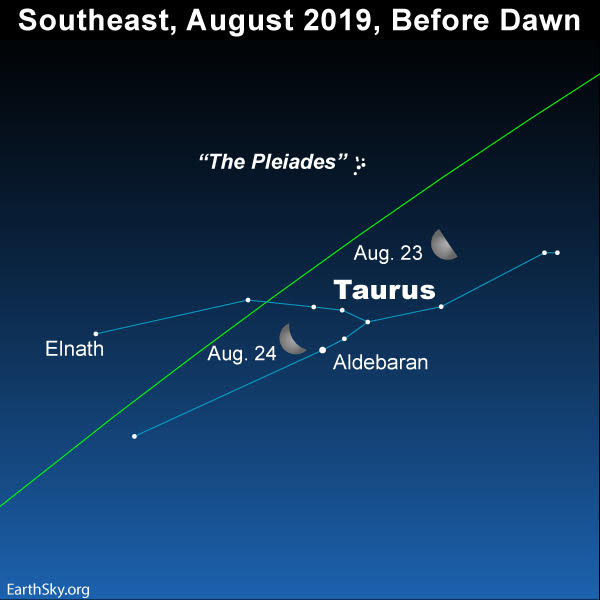
On the morning of August 23, the moon is at or near its half-illuminated last quarter phase, as it passes to the south of the Pleiades star cluster. The following day, August 24, finds the moon sweeping to the north of Aldebaran, the brightest star in the constellation Taurus.

The lit side of a waning moon always points eastward, or in the moon’s direction of travel through the constellations of the zodiac. Relative to the backdrop stars, the moon travels eastward at the rate of about 1/2 degree (the moon’s own angular diameter) per hour. Hence, from around the world, the moon will appear closer to the star Aldebaran on August 24 than on August 23.

constellation Taurus

When the moon is far enough north of the ecliptic, it can occult the Pleiades star cluster – or even the star Elnath. On the other hand, when the moon resides south of the ecliptic, it can occult the star Aldebaran. When the moon passes through Taurus, it can swing anywhere from 5o north to 5o south of the ecliptic, depending on where the moon is positioned in its 18.6-year cycle.

Aldebaran, the star depicting the eye of the Bull, crowns a V-shaped assemblage of stars that outlines the Bull’s face. Extend this starlit V upwards to Elnath, Taurus’ 2nd-brightest star. Elnath marks the tip of the Bull’s northern horn. The fainter star at the tip of the Bull’s southern horn is Zeta Tauri. This 3rd-magnitude star, though rather faint, is easy to see on a dark, moonless night. We don’t see the this star, Zeta Tauri, on the feature sky chart at top because it’s covered over by the August 25th moon, but you can see it on the IAU chart of Taurus immediately above – or, below, where we remove the August 25th moon.

Moon and Taurus June 23 and 24, 2019.

The star below Elnath, the northern horn star, is Zeta Tauri, the southern horn star. If you live along the West Coast of the U.S. and Mexico, you might be able to see an occultation of this star before dawn on August 25, 2019.

Occultation of Zeta Tauri

Everyplace in between the solid white lines can see the lunar occultation of the star Zeta in a nighttime sky. The short blue lines show where the occultation happens at dawn, and the dotted red lines depict where the occultation takes place in a daytime sky. Worldwide map via IOTA (International Occultation Timing Association).

By the way, if you live along or near the Pacific Coast of the United States and Mexico, you can watch the moon occult (cover over) the star Zeta Tauri before dawn on August 25. Zeta Tauri will disappear behind the moon’s illuminated side and then reappear on the moon’s dark side.

We give the occultation times for two localities in local time:

San Diego, California
Occultation begins (Zeta Tauri disappears: 3:49:03 a.m. PDT
Occultation ends (Zeta Tauri reappears): 4:39:39 a.m. PDT

Guadalajara, Mexico
Occultation begins (Zeta Tauri disappears): 5:34:20 a.m. CDT
Occultation ends (Zeta Tauri disapppears): 6:42:07 a.m. CDT

Click here to find out the occultation times for nearly 700 localities, but remember to convert from Universal Time to your local time. Here’s how.

Before dawn these next several mornings – August 23, 24 and 25, 2019 – watch for the waning moon to cross the constellation Taurus the Bull.


from EarthSky https://ift.tt/31TKmdR

Unless you’re a night owl, you probably won’t see the moon and the constellation Taurus the Bull climbing up into your sky before your bedtime. Your best view will be before dawn, or before the beginning of astronomical twilight, on August 23, 24 and 25. That’s because the moon and Taurus climb highest up just before daybreak.

Click here to find out when dawn’s first light (astronomical twilight) begins in your sky, remembering to check the astronomical twilight box.

The chart at top is designed for mid-northern North American latitudes. Even so, the moon will still be passing in front of this constellation as seen from around the world. Before dawn on these dates in the world’s Eastern Hemisphere – Europe, Africa, Asia, Australia and New Zealand – look for the moon to be offset toward the previous date. The farther east you live, the greater the offset.

On the morning of August 23, the moon is at or near its half-illuminated last quarter phase, as it passes to the south of the Pleiades star cluster. The following day, August 24, finds the moon sweeping to the north of Aldebaran, the brightest star in the constellation Taurus.

The lit side of a waning moon always points eastward, or in the moon’s direction of travel through the constellations of the zodiac. Relative to the backdrop stars, the moon travels eastward at the rate of about 1/2 degree (the moon’s own angular diameter) per hour. Hence, from around the world, the moon will appear closer to the star Aldebaran on August 24 than on August 23.

constellation Taurus

When the moon is far enough north of the ecliptic, it can occult the Pleiades star cluster – or even the star Elnath. On the other hand, when the moon resides south of the ecliptic, it can occult the star Aldebaran. When the moon passes through Taurus, it can swing anywhere from 5o north to 5o south of the ecliptic, depending on where the moon is positioned in its 18.6-year cycle.

Aldebaran, the star depicting the eye of the Bull, crowns a V-shaped assemblage of stars that outlines the Bull’s face. Extend this starlit V upwards to Elnath, Taurus’ 2nd-brightest star. Elnath marks the tip of the Bull’s northern horn. The fainter star at the tip of the Bull’s southern horn is Zeta Tauri. This 3rd-magnitude star, though rather faint, is easy to see on a dark, moonless night. We don’t see the this star, Zeta Tauri, on the feature sky chart at top because it’s covered over by the August 25th moon, but you can see it on the IAU chart of Taurus immediately above – or, below, where we remove the August 25th moon.

Moon and Taurus June 23 and 24, 2019.

The star below Elnath, the northern horn star, is Zeta Tauri, the southern horn star. If you live along the West Coast of the U.S. and Mexico, you might be able to see an occultation of this star before dawn on August 25, 2019.

Occultation of Zeta Tauri

Everyplace in between the solid white lines can see the lunar occultation of the star Zeta in a nighttime sky. The short blue lines show where the occultation happens at dawn, and the dotted red lines depict where the occultation takes place in a daytime sky. Worldwide map via IOTA (International Occultation Timing Association).

By the way, if you live along or near the Pacific Coast of the United States and Mexico, you can watch the moon occult (cover over) the star Zeta Tauri before dawn on August 25. Zeta Tauri will disappear behind the moon’s illuminated side and then reappear on the moon’s dark side.

We give the occultation times for two localities in local time:

San Diego, California
Occultation begins (Zeta Tauri disappears: 3:49:03 a.m. PDT
Occultation ends (Zeta Tauri reappears): 4:39:39 a.m. PDT

Guadalajara, Mexico
Occultation begins (Zeta Tauri disappears): 5:34:20 a.m. CDT
Occultation ends (Zeta Tauri disapppears): 6:42:07 a.m. CDT

Click here to find out the occultation times for nearly 700 localities, but remember to convert from Universal Time to your local time. Here’s how.

Before dawn these next several mornings – August 23, 24 and 25, 2019 – watch for the waning moon to cross the constellation Taurus the Bull.


from EarthSky https://ift.tt/31TKmdR

Great Square points to Andromeda galaxy

Tonight, look for the nearest large spiral galaxy to our Milky Way. It’s becoming well placed for evening viewing from Northern Hemisphere locations. The Great Square of Pegasus is a great jumping-off point for finding the famous Andromeda galaxy, also known to astronomers as Messier 31.

The Great Square of Pegasus looks like a … well … a big square. Go figure. At mid-northern latitudes, the Great Square of Pegasus sparkles over the eastern horizon at about 8 or 9 p.m. in late August and early September. That’s 8 or 9 p.m. local time. Some two weeks from now – around mid-September – the Great Square will return to the same place in the sky about an hour earlier. By autumn, people at northerly latitudes will see the Great Square of Pegasus at nightfall.

For some idea of the Great Square’s size, extend your hand an arm length from your eye. You’ll see that any two Great Square stars are farther apart than the width of your hand.

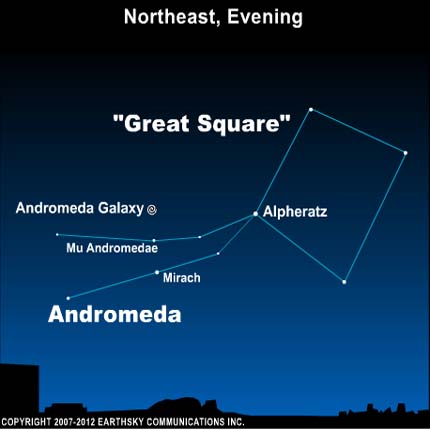
Now let’s find the Andromeda galaxy. To get your bearings, locate the Great Square of Pegasus in your eastern sky this evening (or on the chart at the top of this post). But instead of thinking of the Great Square as a square, think of it as a baseball diamond. Now imagine the farthest star to the left – Alpheratz – as the third-base star. A line drawn from the first-base star through Alpheratz points in the general direction of the Andromeda galaxy.

Enjoying EarthSky so far? Sign up for our free daily newsletter today!

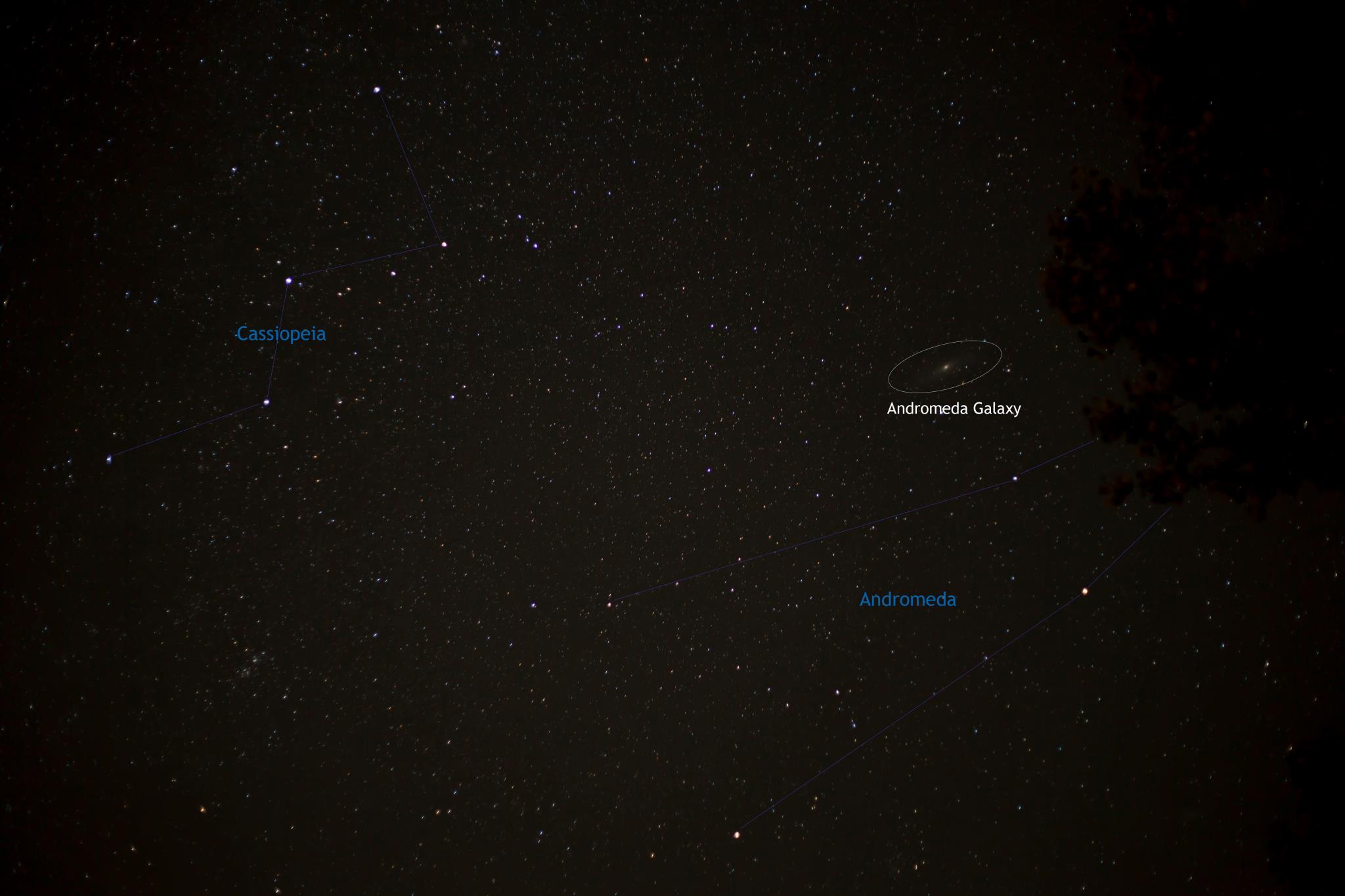
View larger. | Many people find the Andromeda galaxy from the two streamers of stars extending from the Great Square (they are the constellation Andromeda). Or they find the galaxy via the constellation Cassiopeia. This photo via EarthSky Facebook friend Cattleya Flores Viray.

Now let’s get more specific. If it’s dark enough, you’ll see two streamers of stars flying to the north (or left) of the star Alpheratz on August and September evenings. To me, these two streamers make a pattern much like a bugle or a cornucopia. They are actually another constellation, the constellation Andromeda the Princess. Along the bottom streamer, star-hop from Alpheratz to the star Mirach. Draw a line from Mirach through the upper streamer star – which is called Mu Andromedae – and go about the same distance again as that between Mirach and Mu. You’ve just located the Andromeda galaxy!

View larger. | The Andromeda galaxy (right side of photo) as seen by EarthSky Facebook friend Ted Van at a Montana campsite in mid-August 2012.

What does the Andromeda galaxy look like the eye alone? It looks like a fuzzy patch in a dark sky. If you can’t see this fuzzy patch of light with the unaided eye, maybe your sky isn’t dark enough. Try binoculars! Don’t worry if you miss it tonight, for the Andromeda galaxy will be in the evening sky from now until spring.

The Andromeda galaxy and two satellite galaxies as seen through a powerful telescope. To the eye, the galaxy looks like a fuzzy patch. It’s an island of stars in space, much like our Milky Way. Image via NOAO.

Bottom line: The Andromeda galaxy can be seen somewhere in our sky for much of every year. Every August, it’s ascending in the sky during the evening hours. To the eye, it looks like a fuzzy patch.

Help support EarthSky! Visit the EarthSky store for to see the great selection of educational tools and team gear we have to offer.

Mirach: Guide star to three galaxies

Cassiopeia the Queen also points to the Andromeda galaxy


from EarthSky https://ift.tt/2NlrOzh

Tonight, look for the nearest large spiral galaxy to our Milky Way. It’s becoming well placed for evening viewing from Northern Hemisphere locations. The Great Square of Pegasus is a great jumping-off point for finding the famous Andromeda galaxy, also known to astronomers as Messier 31.

The Great Square of Pegasus looks like a … well … a big square. Go figure. At mid-northern latitudes, the Great Square of Pegasus sparkles over the eastern horizon at about 8 or 9 p.m. in late August and early September. That’s 8 or 9 p.m. local time. Some two weeks from now – around mid-September – the Great Square will return to the same place in the sky about an hour earlier. By autumn, people at northerly latitudes will see the Great Square of Pegasus at nightfall.

For some idea of the Great Square’s size, extend your hand an arm length from your eye. You’ll see that any two Great Square stars are farther apart than the width of your hand.

Now let’s find the Andromeda galaxy. To get your bearings, locate the Great Square of Pegasus in your eastern sky this evening (or on the chart at the top of this post). But instead of thinking of the Great Square as a square, think of it as a baseball diamond. Now imagine the farthest star to the left – Alpheratz – as the third-base star. A line drawn from the first-base star through Alpheratz points in the general direction of the Andromeda galaxy.

Enjoying EarthSky so far? Sign up for our free daily newsletter today!

View larger. | Many people find the Andromeda galaxy from the two streamers of stars extending from the Great Square (they are the constellation Andromeda). Or they find the galaxy via the constellation Cassiopeia. This photo via EarthSky Facebook friend Cattleya Flores Viray.

Now let’s get more specific. If it’s dark enough, you’ll see two streamers of stars flying to the north (or left) of the star Alpheratz on August and September evenings. To me, these two streamers make a pattern much like a bugle or a cornucopia. They are actually another constellation, the constellation Andromeda the Princess. Along the bottom streamer, star-hop from Alpheratz to the star Mirach. Draw a line from Mirach through the upper streamer star – which is called Mu Andromedae – and go about the same distance again as that between Mirach and Mu. You’ve just located the Andromeda galaxy!

View larger. | The Andromeda galaxy (right side of photo) as seen by EarthSky Facebook friend Ted Van at a Montana campsite in mid-August 2012.

What does the Andromeda galaxy look like the eye alone? It looks like a fuzzy patch in a dark sky. If you can’t see this fuzzy patch of light with the unaided eye, maybe your sky isn’t dark enough. Try binoculars! Don’t worry if you miss it tonight, for the Andromeda galaxy will be in the evening sky from now until spring.

The Andromeda galaxy and two satellite galaxies as seen through a powerful telescope. To the eye, the galaxy looks like a fuzzy patch. It’s an island of stars in space, much like our Milky Way. Image via NOAO.

Bottom line: The Andromeda galaxy can be seen somewhere in our sky for much of every year. Every August, it’s ascending in the sky during the evening hours. To the eye, it looks like a fuzzy patch.

Help support EarthSky! Visit the EarthSky store for to see the great selection of educational tools and team gear we have to offer.

Mirach: Guide star to three galaxies

Cassiopeia the Queen also points to the Andromeda galaxy


from EarthSky https://ift.tt/2NlrOzh

Skeptical Science New Research for Week #33, 2019

39 articles, 5 open access. 

Keep calm but don't carry on

Skeptical Science was founded for the purpose of debunking misunderstandings and intentional misinformation about anthropogenic climate change. In this interest, this week we've included an article from the Journal of Environmental Studies and Sciences that is not a research paper but rather a critique of Wolfgang Behringer’s A Cultural History of Climate. Behringer's extended exercise in motivated reasoning illustrates the durability of denial; keeping calm is always good but at this late date in our schedule of planet-warping activities Behringer's advice is delivered with all the wrong reasons. 

Articles:

Physical Science

Extreme Conditions in the Bering Sea (2017–2018): Record‐Breaking Low Sea‐Ice Extent

Emergence of anthropogenic signals in the ocean carbon cycle

Summer weather becomes more persistent in a 2 °C world

Robustness and uncertainties in global multivariate wind-wave climate projections

Reconciling Observation and Model Trends in North Atlantic Surface CO2

Radiative control of the interannual variability of Arctic sea ice

Winter sea ice export from the Beaufort Sea as a preconditioning mechanism for enhanced summer melt: A case study of 2016

The Ocean CO2 Sink in the Canadian Arctic Archipelago: A Present Day Budget and Past Trends Due to Climate Change

The response of the ozone layer to quadrupled CO2 concentrations: implications for climate

Rising Temperatures Increase Importance of Oceanic Evaporation as a Source for Continental Precipitation

Ocean swells along the global coastlines and their climate projections for the 21st century

Modelling ice sheet evolution and atmospheric CO2 during the Late Pliocene (open access)

Future projections of cyclone activity in the Arctic for the 21st century from regional climate models (Arctic-CORDEX)

Projected changes in extreme precipitation at sub-daily and daily time scales

The local dependency of precipitation on historical changes in temperature

The extreme year—analysis of thermal conditions in Poland in 2018 (open access)

Impact of sea ice decline in the Arctic Ocean on the number of extreme low temperature days over China

Analysis of extreme precipitation and its variability under climate change in a river basin

Detection of fossil fuel emission trends in the presence of natural carbon cycle variability (open access)

A probabilistic assessment of geomechanical reservoir integrity during CO2 sequestration in flood basalt formations


Humans think about and deal with our climate change impacts

The visual framing of climate change impacts and adaptation in the IPCC assessment reports

Think globally, act locally: adoption of climate action plans in California

How contemporary bioclimatic and human controls change global fire regimes

Tackling climate change with blockchain

Evolution of international carbon markets: lessons for the Paris Agreement

Climate change and the far right

Are liberal states greener? Political ideology and CO 2 emissions in American states, 1980–2012

“Keep calm? A critique of Wolfgang Behringer’s “A Cultural History of Climate”

Turning the corner on US power sector CO 2 emissions—a 1990–2015 state level analysis (open access)

Interacting implications of climate change, population dynamics, and urban heat mitigation for future exposure to heat extremes (open access)

Investigation of GHG emission sources and reducing GHG emissions in a municipal wastewater treatment plant

Recent developments in carbon capture utilisation and storage

Carbon dioxide utilization: The way to the circular economy


Biology and global warming

Potential impacts of climate change on vegetation dynamics and ecosystem function in a mountain watershed on the Qinghai-Tibet Plateau

We need more realistic climate change experiments for understanding ecosystems of the future

Yield response of field‐grown soybean exposed to heat waves under current and elevated [CO2]

Widespread drought‐induced tree mortality at dry range edges indicates that climate stress exceeds species' compensating mechanisms

Suggestions

Please let us know if you're aware of an article you think may be of interest for Skeptical Science research news, or if we've missed something that may be important. Send your input to Skeptical Science via our contact form.

The previous edition of Skeptical Science new research may be found here. 


from Skeptical Science https://ift.tt/2Nf8cNc

39 articles, 5 open access. 

Keep calm but don't carry on

Skeptical Science was founded for the purpose of debunking misunderstandings and intentional misinformation about anthropogenic climate change. In this interest, this week we've included an article from the Journal of Environmental Studies and Sciences that is not a research paper but rather a critique of Wolfgang Behringer’s A Cultural History of Climate. Behringer's extended exercise in motivated reasoning illustrates the durability of denial; keeping calm is always good but at this late date in our schedule of planet-warping activities Behringer's advice is delivered with all the wrong reasons. 

Articles:

Physical Science

Extreme Conditions in the Bering Sea (2017–2018): Record‐Breaking Low Sea‐Ice Extent

Emergence of anthropogenic signals in the ocean carbon cycle

Summer weather becomes more persistent in a 2 °C world

Robustness and uncertainties in global multivariate wind-wave climate projections

Reconciling Observation and Model Trends in North Atlantic Surface CO2

Radiative control of the interannual variability of Arctic sea ice

Winter sea ice export from the Beaufort Sea as a preconditioning mechanism for enhanced summer melt: A case study of 2016

The Ocean CO2 Sink in the Canadian Arctic Archipelago: A Present Day Budget and Past Trends Due to Climate Change

The response of the ozone layer to quadrupled CO2 concentrations: implications for climate

Rising Temperatures Increase Importance of Oceanic Evaporation as a Source for Continental Precipitation

Ocean swells along the global coastlines and their climate projections for the 21st century

Modelling ice sheet evolution and atmospheric CO2 during the Late Pliocene (open access)

Future projections of cyclone activity in the Arctic for the 21st century from regional climate models (Arctic-CORDEX)

Projected changes in extreme precipitation at sub-daily and daily time scales

The local dependency of precipitation on historical changes in temperature

The extreme year—analysis of thermal conditions in Poland in 2018 (open access)

Impact of sea ice decline in the Arctic Ocean on the number of extreme low temperature days over China

Analysis of extreme precipitation and its variability under climate change in a river basin

Detection of fossil fuel emission trends in the presence of natural carbon cycle variability (open access)

A probabilistic assessment of geomechanical reservoir integrity during CO2 sequestration in flood basalt formations


Humans think about and deal with our climate change impacts

The visual framing of climate change impacts and adaptation in the IPCC assessment reports

Think globally, act locally: adoption of climate action plans in California

How contemporary bioclimatic and human controls change global fire regimes

Tackling climate change with blockchain

Evolution of international carbon markets: lessons for the Paris Agreement

Climate change and the far right

Are liberal states greener? Political ideology and CO 2 emissions in American states, 1980–2012

“Keep calm? A critique of Wolfgang Behringer’s “A Cultural History of Climate”

Turning the corner on US power sector CO 2 emissions—a 1990–2015 state level analysis (open access)

Interacting implications of climate change, population dynamics, and urban heat mitigation for future exposure to heat extremes (open access)

Investigation of GHG emission sources and reducing GHG emissions in a municipal wastewater treatment plant

Recent developments in carbon capture utilisation and storage

Carbon dioxide utilization: The way to the circular economy


Biology and global warming

Potential impacts of climate change on vegetation dynamics and ecosystem function in a mountain watershed on the Qinghai-Tibet Plateau

We need more realistic climate change experiments for understanding ecosystems of the future

Yield response of field‐grown soybean exposed to heat waves under current and elevated [CO2]

Widespread drought‐induced tree mortality at dry range edges indicates that climate stress exceeds species' compensating mechanisms

Suggestions

Please let us know if you're aware of an article you think may be of interest for Skeptical Science research news, or if we've missed something that may be important. Send your input to Skeptical Science via our contact form.

The previous edition of Skeptical Science new research may be found here. 


from Skeptical Science https://ift.tt/2Nf8cNc

Skeletal shapes key to rapid recognition of objects

"You can think of it like a child's stick drawing of a person," says Emory psychologist Stella Lourenco, explaining the skeletal geometry that aids the vision system in object recognition. (Getty Images)

By Carol Clark

In the blink of an eye, the human visual system can process an object, determining whether it’s a cup or a sock within milliseconds, and with seemingly little effort. It’s well-established that an object’s shape is a critical visual cue to help the eyes and brain perform this trick. A new study, however, finds that while the outer shape of an object is important for rapid recognition, the object’s inner “skeleton” may play an even more important role.

Scientific Reports published the research by psychologists at Emory University, showing that a key visual tool for object recognition is the medial axis of an object, or its skeletal geometry.

“When we think of an object’s shape, we typically imagine the outer contours,” explains Vladislav Ayzenberg, first author of the paper and an Emory PhD candidate in psychology. “But there is also a deeper, more abstract property of shape that’s described by skeletal geometry. Our research suggests that this inner, invisible mechanism may be crucial to recognizing an object so quickly.”

“You can think of it like a child’s stick drawing of a person,” adds Stella Lourenco, senior author of the study and an associate professor of psychology at Emory. “Using a stick figure to represent a person gives you the basic visual information you need to immediately perceive the figure’s meaning.”

The Lourenco lab researches human visual perception, cognition and development. Visual perception of an object begins when light hits our eyes and the object is projected as a two-dimensional image onto the photoreceptor cells of the retina.

“A lot of internal machinery is whirring between the eyes and brain to facilitate perception and recognition within 70 milliseconds,” Ayzenberg says. “I’m fascinated by the neural computations that go into that process.”

Although most people take it for granted, object recognition is a remarkable feat. “You can teach a two-year-old what a dog is by pointing out a real dog or showing the child a picture in a book,” Lourenco says. “After seeing such examples a child can rapidly and with ease recognize other dogs as dogs, despite variations in their individual appearances.”


Click here if video does not appear on screen

The human ability at object recognition is robust despite changes in a class of objects such as outer contours, sizes, textures and colors. For the current paper, the researchers developed a series of experiments to test the role of skeletal geometry in the process.

In one experiment, participants were presented with paired images of 150 abstract 3D objects on a computer. The objects had 30 different skeletal structures. Each object was rendered with five different surface forms, to change the visible shape of the object, without altering the underlying skeleton. The participants were asked to judge whether each pair of images showed the same or different objects. The results found that skeletal similarity was a significant predictor for a correct response.

A second experiment, based on adaptations of three of the objects, tested the effects of proportional changes to the shape skeleton. Participants were able to accurately predict object similarity at a rate significantly above chance at every level of skeletal change.

A third experiment tested whether an object’s skeleton was a better predictor of object similarity than its surface form. Participants successfully matched objects by their skeletal structure or surface forms when each cue was presented in isolation. They showed a preference, however, to match objects by their skeletons, as opposed to their surface forms, when these cues conflicted with one another.

The results suggest that the visual system is not only highly sensitive to the skeletal structure of objects, but that this sensitivity may play an even bigger role in shape perception than object contours.

“Skeletal geometry appears to be more important than previously realized, but it is certainly not the only tool used in object recognition,” Lourenco says. “It may be that the visual system starts with the skeletal structure, instead of the outline of an object, and then maps other properties, such as textures and colors, onto it.”

In addition to adding to fundamental knowledge of the human vision system, the study may give insights into improving capabilities for artificial intelligence (AI). Rapid and accurate object recognition, for example, is vital for AI systems on self-driving cars.

“The best model for a machine-learning system is likely a human-learning system,” Ayzenberg says. “The human vision system has solved the problem of object recognition through evolution and adapted quite well.”

Related:
Babies' spatial reasoning predicts later math skills
How babies use numbers, space and time 
How fear skews our spatial perception
Psychologists closing in on claustrophobia 

from eScienceCommons https://ift.tt/2KLNfYF
"You can think of it like a child's stick drawing of a person," says Emory psychologist Stella Lourenco, explaining the skeletal geometry that aids the vision system in object recognition. (Getty Images)

By Carol Clark

In the blink of an eye, the human visual system can process an object, determining whether it’s a cup or a sock within milliseconds, and with seemingly little effort. It’s well-established that an object’s shape is a critical visual cue to help the eyes and brain perform this trick. A new study, however, finds that while the outer shape of an object is important for rapid recognition, the object’s inner “skeleton” may play an even more important role.

Scientific Reports published the research by psychologists at Emory University, showing that a key visual tool for object recognition is the medial axis of an object, or its skeletal geometry.

“When we think of an object’s shape, we typically imagine the outer contours,” explains Vladislav Ayzenberg, first author of the paper and an Emory PhD candidate in psychology. “But there is also a deeper, more abstract property of shape that’s described by skeletal geometry. Our research suggests that this inner, invisible mechanism may be crucial to recognizing an object so quickly.”

“You can think of it like a child’s stick drawing of a person,” adds Stella Lourenco, senior author of the study and an associate professor of psychology at Emory. “Using a stick figure to represent a person gives you the basic visual information you need to immediately perceive the figure’s meaning.”

The Lourenco lab researches human visual perception, cognition and development. Visual perception of an object begins when light hits our eyes and the object is projected as a two-dimensional image onto the photoreceptor cells of the retina.

“A lot of internal machinery is whirring between the eyes and brain to facilitate perception and recognition within 70 milliseconds,” Ayzenberg says. “I’m fascinated by the neural computations that go into that process.”

Although most people take it for granted, object recognition is a remarkable feat. “You can teach a two-year-old what a dog is by pointing out a real dog or showing the child a picture in a book,” Lourenco says. “After seeing such examples a child can rapidly and with ease recognize other dogs as dogs, despite variations in their individual appearances.”


Click here if video does not appear on screen

The human ability at object recognition is robust despite changes in a class of objects such as outer contours, sizes, textures and colors. For the current paper, the researchers developed a series of experiments to test the role of skeletal geometry in the process.

In one experiment, participants were presented with paired images of 150 abstract 3D objects on a computer. The objects had 30 different skeletal structures. Each object was rendered with five different surface forms, to change the visible shape of the object, without altering the underlying skeleton. The participants were asked to judge whether each pair of images showed the same or different objects. The results found that skeletal similarity was a significant predictor for a correct response.

A second experiment, based on adaptations of three of the objects, tested the effects of proportional changes to the shape skeleton. Participants were able to accurately predict object similarity at a rate significantly above chance at every level of skeletal change.

A third experiment tested whether an object’s skeleton was a better predictor of object similarity than its surface form. Participants successfully matched objects by their skeletal structure or surface forms when each cue was presented in isolation. They showed a preference, however, to match objects by their skeletons, as opposed to their surface forms, when these cues conflicted with one another.

The results suggest that the visual system is not only highly sensitive to the skeletal structure of objects, but that this sensitivity may play an even bigger role in shape perception than object contours.

“Skeletal geometry appears to be more important than previously realized, but it is certainly not the only tool used in object recognition,” Lourenco says. “It may be that the visual system starts with the skeletal structure, instead of the outline of an object, and then maps other properties, such as textures and colors, onto it.”

In addition to adding to fundamental knowledge of the human vision system, the study may give insights into improving capabilities for artificial intelligence (AI). Rapid and accurate object recognition, for example, is vital for AI systems on self-driving cars.

“The best model for a machine-learning system is likely a human-learning system,” Ayzenberg says. “The human vision system has solved the problem of object recognition through evolution and adapted quite well.”

Related:
Babies' spatial reasoning predicts later math skills
How babies use numbers, space and time 
How fear skews our spatial perception
Psychologists closing in on claustrophobia 

from eScienceCommons https://ift.tt/2KLNfYF

adds 2