aads

Arecibo Observatory gets $12.3 million grant

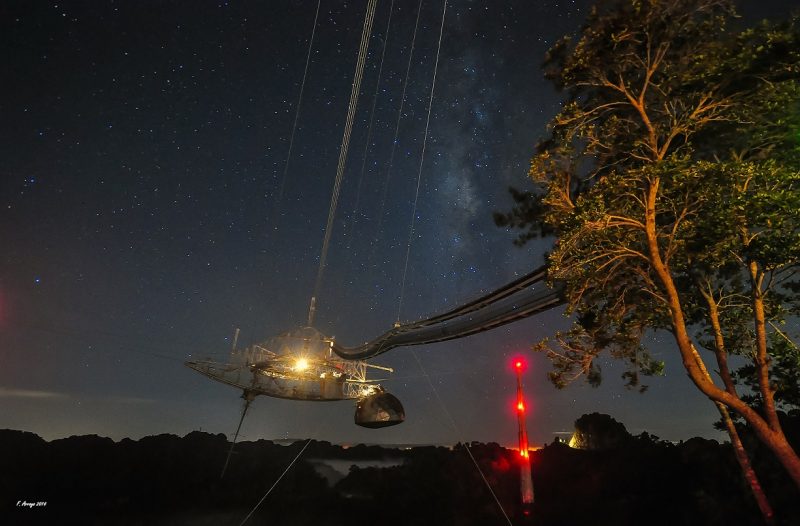
Night sky behind Arecibo radio telescope steering mechanism, lighted machinery at end of long beam.

The beam-steering mechanism and some antennas at world-famous Arecibo Observatory in Puerto Rico. Ferdinand Arroyo, from Sociedad de Astronomía del Caribe (Astronomical Society of the Caribbean) took this beautiful photo in 2014. Read more about this image.

You’ve likely seen photos – or a movie, or played a video game – featuring Arecibo Observatory’s radio telescope in Puerto Rico. It was the world’s largest single-aperture telescope from its completion in 1963 until July 2016, when China completed its Five hundred meter Aperture Spherical Telescope (FAST). Still, the big radio telescope at Arecibo – built into a natural depression in the landscape of this Caribbean island – is used for professional research not just in radio astronomy, but also for radar and atmospheric studies. And, in recent years, as multiple hurricanes have swept across the Caribbean, including Hurricanes Irma and Maria in 2017, it’s been more of a struggle to keep the telescope in good repair. That is why the U.S. Congress has now supported emergency supplemental funds for the site. The new funds ($12.3 million, to be used over four years) represent an investment in Arecibo’s future.

Arecibo received a $2 million grant in June 2018, not long after Irma and María ripped through the island and damaged the facility. According to a statement from the University of Central Florida (UCF), which operates the facility for the U.S. National Science Foundation:

Those funds were used to make emergency repairs such as fixing the catwalk that leads to the reflectors suspended above the 305-meter [1,000-foot] dish. In addition, buildings were repaired, generators were serviced, and first responder equipment was replaced. This funding also enabled the facility to prepare for the 2019 hurricane season.

Scientists gathered earlier this year to discuss future objectives of the observatory. No doubt they talked about projects that needed to be undertaken at the site, and that can now be undertaken thanks to the new grant, including:

– Repairing one of the suspension cables holding the primary telescope platform, ensuring long-term structural integrity of one of the main structural elements of the telescope.
– Recalibrating the primary reflector, which will restore the observatory’s sensitivity at higher frequencies.
– Aligning the Gregorian Reflector, improving current calibration and pointing.
– Installing a new control system for S band radar, which is part of the microwave band of the electromagnetic spectrum.
– Replacing the modulator on the 430 MHz transmitter, increasing consistency of power output and data quality.
– Improving the telescope’s pointing controls and data tracking systems.

UCF also said:

Each of these projects is essential to the work conducted at the facility, which includes research in the areas of planetary radar, astronomy and space and atmospheric sciences, administrators say. The telescope has assisted in the understanding of gravitational waves, the theory of relativity, the discovery of new planets, and other research. The instruments also play an important role in monitoring asteroids that could pose a hazard to Earth.

Arecibo also has a place in popular culture. You might know it for the 1974 Arecibo radio message to interstellar space. Aimed toward globular star cluster M13, it carried basic information about humanity and Earth skyward, setting off a controversy over whether we want extraterrestrials to find us, which has raged on ever since.

Or you might know Arecibo from the 1997 film “Contact,” from a wonderful novel of the same name by Carl Sagan. In the book and movie, Dr. Eleanor “Ellie” Arroway, a SETI scientist played by Jodie Foster, finds strong evidence of extraterrestrial life while seated in an Arecibo control room.

Or you might know it from the SETI@home project, a scientific experiment, based at UC Berkeley, that lets citizen scientists help search for ETs. Arecibo began collecting data for SETI@home in 1999.

Or you might know Arecibo in some other way. For its research in space and atmospheric sciences and its multiple roles in human culture, Arecibo holds a place in the hearts of many.

It’s great that they’re fixing it!

Giant white in-ground parabolic dish with receiver hung from cables above its center.

Here’s a wider-field view of Arecibo Observatory and its large radio dish, which is 1,000 feet (305 meters) in diameter, constructed inside the depression left by a sinkhole. Image via Arecibo Observatory.

Bottom line: Arecibo Observatory will receive $12.3 million in emergency supplemental funds, administered by the U.S. National Science Foundation, for necessary repairs over the coming four years.

Via University of Central Florida


from EarthSky https://ift.tt/2z51mBz
Night sky behind Arecibo radio telescope steering mechanism, lighted machinery at end of long beam.

The beam-steering mechanism and some antennas at world-famous Arecibo Observatory in Puerto Rico. Ferdinand Arroyo, from Sociedad de Astronomía del Caribe (Astronomical Society of the Caribbean) took this beautiful photo in 2014. Read more about this image.

You’ve likely seen photos – or a movie, or played a video game – featuring Arecibo Observatory’s radio telescope in Puerto Rico. It was the world’s largest single-aperture telescope from its completion in 1963 until July 2016, when China completed its Five hundred meter Aperture Spherical Telescope (FAST). Still, the big radio telescope at Arecibo – built into a natural depression in the landscape of this Caribbean island – is used for professional research not just in radio astronomy, but also for radar and atmospheric studies. And, in recent years, as multiple hurricanes have swept across the Caribbean, including Hurricanes Irma and Maria in 2017, it’s been more of a struggle to keep the telescope in good repair. That is why the U.S. Congress has now supported emergency supplemental funds for the site. The new funds ($12.3 million, to be used over four years) represent an investment in Arecibo’s future.

Arecibo received a $2 million grant in June 2018, not long after Irma and María ripped through the island and damaged the facility. According to a statement from the University of Central Florida (UCF), which operates the facility for the U.S. National Science Foundation:

Those funds were used to make emergency repairs such as fixing the catwalk that leads to the reflectors suspended above the 305-meter [1,000-foot] dish. In addition, buildings were repaired, generators were serviced, and first responder equipment was replaced. This funding also enabled the facility to prepare for the 2019 hurricane season.

Scientists gathered earlier this year to discuss future objectives of the observatory. No doubt they talked about projects that needed to be undertaken at the site, and that can now be undertaken thanks to the new grant, including:

– Repairing one of the suspension cables holding the primary telescope platform, ensuring long-term structural integrity of one of the main structural elements of the telescope.
– Recalibrating the primary reflector, which will restore the observatory’s sensitivity at higher frequencies.
– Aligning the Gregorian Reflector, improving current calibration and pointing.
– Installing a new control system for S band radar, which is part of the microwave band of the electromagnetic spectrum.
– Replacing the modulator on the 430 MHz transmitter, increasing consistency of power output and data quality.
– Improving the telescope’s pointing controls and data tracking systems.

UCF also said:

Each of these projects is essential to the work conducted at the facility, which includes research in the areas of planetary radar, astronomy and space and atmospheric sciences, administrators say. The telescope has assisted in the understanding of gravitational waves, the theory of relativity, the discovery of new planets, and other research. The instruments also play an important role in monitoring asteroids that could pose a hazard to Earth.

Arecibo also has a place in popular culture. You might know it for the 1974 Arecibo radio message to interstellar space. Aimed toward globular star cluster M13, it carried basic information about humanity and Earth skyward, setting off a controversy over whether we want extraterrestrials to find us, which has raged on ever since.

Or you might know Arecibo from the 1997 film “Contact,” from a wonderful novel of the same name by Carl Sagan. In the book and movie, Dr. Eleanor “Ellie” Arroway, a SETI scientist played by Jodie Foster, finds strong evidence of extraterrestrial life while seated in an Arecibo control room.

Or you might know it from the SETI@home project, a scientific experiment, based at UC Berkeley, that lets citizen scientists help search for ETs. Arecibo began collecting data for SETI@home in 1999.

Or you might know Arecibo in some other way. For its research in space and atmospheric sciences and its multiple roles in human culture, Arecibo holds a place in the hearts of many.

It’s great that they’re fixing it!

Giant white in-ground parabolic dish with receiver hung from cables above its center.

Here’s a wider-field view of Arecibo Observatory and its large radio dish, which is 1,000 feet (305 meters) in diameter, constructed inside the depression left by a sinkhole. Image via Arecibo Observatory.

Bottom line: Arecibo Observatory will receive $12.3 million in emergency supplemental funds, administered by the U.S. National Science Foundation, for necessary repairs over the coming four years.

Via University of Central Florida


from EarthSky https://ift.tt/2z51mBz

Ophiuchus is part of the zodiac, too

Tonight, look for the faint constellation Ophiuchus the Serpent Bearer. Fortunately, in 2019, the dazzling planet Jupiter helps you to locate this constellation. Jupiter, after all, is the brightest “star” (really, planet) in the night sky now. It’s been hovering around the Scorpius/Ophiuchus border throughout this northern summer (southern winter) of 2019.

From Northern Hemisphere latitudes, you’ll the Serpent Bearer in the south to southwest on August and September evenings. From the Southern Hemisphere, Ophiuchus is closer to overhead. The bright red star Antares – brightest light in the constellation Scorpius the Scorpion – is also nearby.

Poor Ophiuchus. Nobody ever claims him as a birth sign, despite the fact that the ecliptic runs across him, too, just as it does the 12 better-known constellations of the zodiac. But the sun, moon and planets do regularly move within this constellation’s boundaries. The sun moves in front of Ophiuchus from about November 30 to December 18 each year.

The zodiac – or “pathway of animals” – represents a rather narrow band of of sky astride the ecliptic, which is the plane of Earth’s orbit projected onto the sphere of stars. The signs of the zodiac are familiar to all who read online astrology advice. There are 12 familiar signs of the zodiac: Aries, Taurus, Gemini, Cancer and so on. But … no Ophiuchus.

Read more: Sun in zodiac constellations, 2019

Read more: Sun’s entry into zodiac signs, 2019

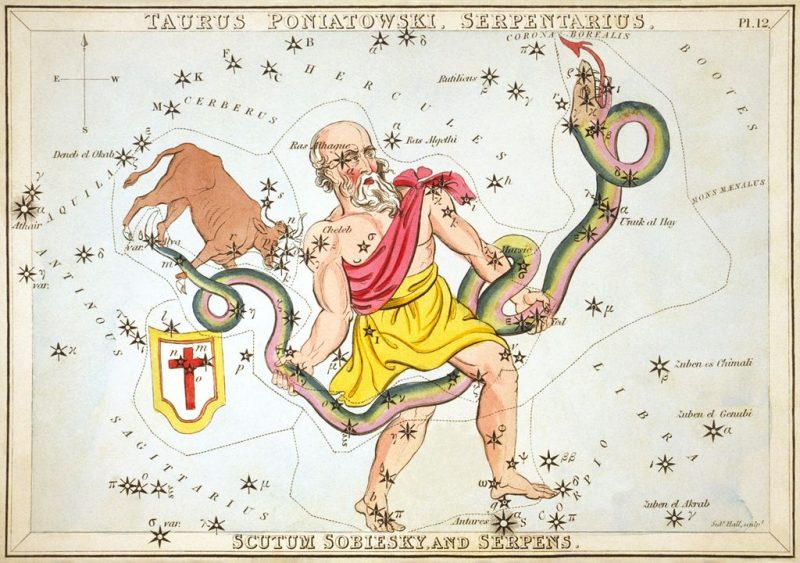
Antique colored etching of old man in ancient Greek garb holding a long snake.

Ophiuchus holding the serpent, Serpens, as depicted in Urania’s Mirror, a set of constellation cards published in London c. 1825. Image via Wikipedia.

On sky maps, Ophiuchus the Serpent Bearer is depicted as holding Serpens the Serpent, which is considered a separate constellation. According to ancient Greek star lore, Ophiuchus is Asclepius, Greek god of medicine and doctors. Asclepius is said to have concocted a healing potion from the venom of Serpens the Serpent, mixing it with a Gorgon’s blood and an unknown herb. This potion gave humans access to immortality, until the god of the underworld, Pluto, appealed to the king of the gods, Zeus, to reconsider the ramifications of the death of death.

Even today, the Staff of Asclepius – symbol of the World Health Organization and other medical organizations – pays tribute to the constellation Ophiuchus the Serpent Bearer.

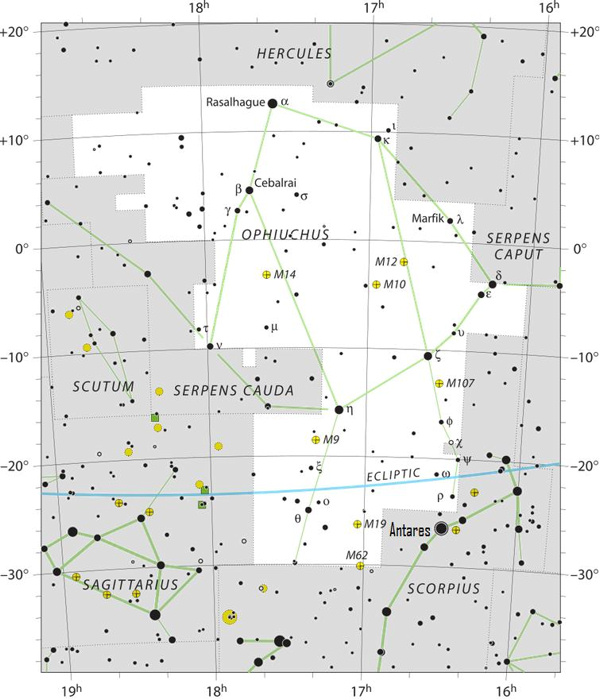
Star chart of Ophiuchus the Serpent Bearer with ecliptic line.

View larger. | Ophiuchus the Serpent Bearer.

How can you find this constellation? First of all, you need a dark sky. With the moon waning now, you’ll have one in the evenings ahead. We show the southernmost portion of Ophiuchus on the chart at top, and the constellation in full on the sky chart below. To see Ophiuchus, stand outside under your light-free sky until your eyes are fully adjusted to the dark. Ophiuchus is faint. But you’ll easily recognize the constellation Scorpius nearby. From our Northern Hemisphere locations, Ophiuchus looming up above Scorpius. He’s a mighty figure that your eyes will pick out, if you’re looking for him.

The official boundary lines for all 88 constellations were drawn up by the International Astronomical Union in the 1930s. The photo below of the constellation Ophiuchus labels Ophiuchus’ brightest star, Rasalhague, and Scorpius’ brightest star, Antares. Rasalhague marks the head of Ophiuchus but is nowhere as bright as Antares, the star that depicts the Scorpion’s beating heart.

Constellation drawn on star field with stars Antares and Rasalhague marked.

Photo via Wikipedia.

Bottom line: Poor Ophiuchus. Astrologers don’t typically mention him, because he’s a constellation – not a sign – of the zodiac. However, the sun moves in front of this constellation’s stars from about November 30 to December 18, every year. Find Ophiuchus in the sky tonight!

Born late November to middle December? Here’s your constellation

Enjoying EarthSky so far? Sign up for our free daily newsletter today!


from EarthSky https://ift.tt/31RDm1j

Tonight, look for the faint constellation Ophiuchus the Serpent Bearer. Fortunately, in 2019, the dazzling planet Jupiter helps you to locate this constellation. Jupiter, after all, is the brightest “star” (really, planet) in the night sky now. It’s been hovering around the Scorpius/Ophiuchus border throughout this northern summer (southern winter) of 2019.

From Northern Hemisphere latitudes, you’ll the Serpent Bearer in the south to southwest on August and September evenings. From the Southern Hemisphere, Ophiuchus is closer to overhead. The bright red star Antares – brightest light in the constellation Scorpius the Scorpion – is also nearby.

Poor Ophiuchus. Nobody ever claims him as a birth sign, despite the fact that the ecliptic runs across him, too, just as it does the 12 better-known constellations of the zodiac. But the sun, moon and planets do regularly move within this constellation’s boundaries. The sun moves in front of Ophiuchus from about November 30 to December 18 each year.

The zodiac – or “pathway of animals” – represents a rather narrow band of of sky astride the ecliptic, which is the plane of Earth’s orbit projected onto the sphere of stars. The signs of the zodiac are familiar to all who read online astrology advice. There are 12 familiar signs of the zodiac: Aries, Taurus, Gemini, Cancer and so on. But … no Ophiuchus.

Read more: Sun in zodiac constellations, 2019

Read more: Sun’s entry into zodiac signs, 2019

Antique colored etching of old man in ancient Greek garb holding a long snake.

Ophiuchus holding the serpent, Serpens, as depicted in Urania’s Mirror, a set of constellation cards published in London c. 1825. Image via Wikipedia.

On sky maps, Ophiuchus the Serpent Bearer is depicted as holding Serpens the Serpent, which is considered a separate constellation. According to ancient Greek star lore, Ophiuchus is Asclepius, Greek god of medicine and doctors. Asclepius is said to have concocted a healing potion from the venom of Serpens the Serpent, mixing it with a Gorgon’s blood and an unknown herb. This potion gave humans access to immortality, until the god of the underworld, Pluto, appealed to the king of the gods, Zeus, to reconsider the ramifications of the death of death.

Even today, the Staff of Asclepius – symbol of the World Health Organization and other medical organizations – pays tribute to the constellation Ophiuchus the Serpent Bearer.

Star chart of Ophiuchus the Serpent Bearer with ecliptic line.

View larger. | Ophiuchus the Serpent Bearer.

How can you find this constellation? First of all, you need a dark sky. With the moon waning now, you’ll have one in the evenings ahead. We show the southernmost portion of Ophiuchus on the chart at top, and the constellation in full on the sky chart below. To see Ophiuchus, stand outside under your light-free sky until your eyes are fully adjusted to the dark. Ophiuchus is faint. But you’ll easily recognize the constellation Scorpius nearby. From our Northern Hemisphere locations, Ophiuchus looming up above Scorpius. He’s a mighty figure that your eyes will pick out, if you’re looking for him.

The official boundary lines for all 88 constellations were drawn up by the International Astronomical Union in the 1930s. The photo below of the constellation Ophiuchus labels Ophiuchus’ brightest star, Rasalhague, and Scorpius’ brightest star, Antares. Rasalhague marks the head of Ophiuchus but is nowhere as bright as Antares, the star that depicts the Scorpion’s beating heart.

Constellation drawn on star field with stars Antares and Rasalhague marked.

Photo via Wikipedia.

Bottom line: Poor Ophiuchus. Astrologers don’t typically mention him, because he’s a constellation – not a sign – of the zodiac. However, the sun moves in front of this constellation’s stars from about November 30 to December 18, every year. Find Ophiuchus in the sky tonight!

Born late November to middle December? Here’s your constellation

Enjoying EarthSky so far? Sign up for our free daily newsletter today!


from EarthSky https://ift.tt/31RDm1j

Millions of times later, 97 percent climate consensus still faces denial

A few weeks ago, the Bulletin ran a story referring to how Frank Luntz—the GOP message master who convinced party politicians to use the phrase “climate change” instead of “global warming” because the former sounded “less frightening”—is now offering his services to the cause of climate action. The idea that someone who had once crafted talking points defending some of the world’s worst carbon polluters had changed his tune to now advocate for “cleaner, safer, healthier” energy alternatives seemed to signal the dawn of a new era, right?

Not so fast.

In July, the Exxon- and Koch- funded Competitive Enterprise Institute (CEI) issued a formal complaint, asking NASA to “correct” a statement on the space agency’s website that said that “Multiple studies published in peer-reviewed scientific journals show that 97 percent or more of actively publishing climate scientists agree: Climate-warming trends over the past century are extremely likely due to human activities.”  In its complaint about NASA’s accurate statement, CEI cited 5-year-old disproved blog posts with titles like “1.6%, Not 97%, Agree that Humans are the Main Cause of Global Warming.” (It also cited conservative media outlets like ForbesNational Review, and the Daily Caller.)

So, what is the real percentage of climate researchers who agree that climate change is largely man-made? And what is the origin of the widely held perception among the American public that the science is still unsettled?

The numbers. By coincidence, also in July, a 2013 paper that I co-authored with my colleagues at Skeptical Science on the expert consensus about human-caused climate change in peer-reviewed literature was downloaded for the millionth time. In that study, our team examined the abstracts of nearly 12,000 peer-reviewed climate science studies published between 1991 and 2011, and categorized each one based on its position on the causes of global warming. In a second phase of our analysis we e-mailed the authors of each study and asked them to categorize their own papers using the same criteria, receiving 1,200 responses. Our team’s review of the abstracts yielded a 97.1 percent consensus that humans are primarily responsible for recent global warming; the author self-ratings yielded a 97.2 percent consensus.

Our analysis built upon a previous study published by Naomi Oreskes in the peer-reviewed journal Science in 2004. In her paper, which also just surpassed 1 million downloads, Oreskes examined the abstracts of 928 peer-reviewed climate papers published between 1993 and 2003. In her review, none of the abstracts disputed human-caused global warming. Not a single one out of 928. In 2016, our two groups teamed with the authors of five other climate consensus studies to publish a paper documenting the ‘consensus on consensus,’ in which we demonstrated that between 90 and 100 percent of climate scientists and their peer-reviewed research agree that humans are the main cause of recent global warming.

There has been a fairly steady increase in American public perception that most scientists agree on global warming, recently rising to record levels. Yet only 1-in-5 Americans realize that over 90 percent of climate scientists have concluded human-caused global warming is happening. Even Americans “alarmed” about climate change only think that 80 percent of climate scientists have reached this conclusion, which illustrates how widespread the public underestimation of the expert climate consensus remains to this day.

Origins. That so-called “consensus gap” between public perception and the reality of expert agreement is largely due to a sustained misinformation campaign. “There is no consensus” has been one of the most popular climate myths and can be traced back to a memo authored circa 2001 by that same Republican political strategist, Frank Luntz, who wrote then: “Voters believe that there is no consensus about global warming within the scientific community. Should the public come to believe that the scientific issues are settled, their views about global warming will change accordingly. Therefore, you need to continue to make the lack of scientific certainty a primary issue in the debate.” (To be fair, Luntz recently testified before the House Special Committee on the Climate Crisis, acknowledging, “I’m here before you to say that I was wrong in 2001 … Just stop using something that I wrote 18 years ago, because it’s not accurate today.”)

Fossil fuel-funded think tanks have apparently not heeded Luntz’s pleas; the formal complaint issued to NASA argued that our study excluded papers that did not take a position on the cause of global warming—which is akin to arguing that there’s no consensus as to whether the Earth is round or flat: Scientists publishing relevant research in a peer-reviewed journal don’t waste precious space stating a position on topics that have been settled.

It is in the fossil fuel industry’s best short-term self-interest to spread doubt on this issue. As our 97 percent consensus study lead author and cognitive scientist John Cook has documented, social science research shows that accepting the presence of expert climate consensus is a ‘Gateway Belief.

Click here to read the rest


from Skeptical Science https://ift.tt/2Z7Rlhr

A few weeks ago, the Bulletin ran a story referring to how Frank Luntz—the GOP message master who convinced party politicians to use the phrase “climate change” instead of “global warming” because the former sounded “less frightening”—is now offering his services to the cause of climate action. The idea that someone who had once crafted talking points defending some of the world’s worst carbon polluters had changed his tune to now advocate for “cleaner, safer, healthier” energy alternatives seemed to signal the dawn of a new era, right?

Not so fast.

In July, the Exxon- and Koch- funded Competitive Enterprise Institute (CEI) issued a formal complaint, asking NASA to “correct” a statement on the space agency’s website that said that “Multiple studies published in peer-reviewed scientific journals show that 97 percent or more of actively publishing climate scientists agree: Climate-warming trends over the past century are extremely likely due to human activities.”  In its complaint about NASA’s accurate statement, CEI cited 5-year-old disproved blog posts with titles like “1.6%, Not 97%, Agree that Humans are the Main Cause of Global Warming.” (It also cited conservative media outlets like ForbesNational Review, and the Daily Caller.)

So, what is the real percentage of climate researchers who agree that climate change is largely man-made? And what is the origin of the widely held perception among the American public that the science is still unsettled?

The numbers. By coincidence, also in July, a 2013 paper that I co-authored with my colleagues at Skeptical Science on the expert consensus about human-caused climate change in peer-reviewed literature was downloaded for the millionth time. In that study, our team examined the abstracts of nearly 12,000 peer-reviewed climate science studies published between 1991 and 2011, and categorized each one based on its position on the causes of global warming. In a second phase of our analysis we e-mailed the authors of each study and asked them to categorize their own papers using the same criteria, receiving 1,200 responses. Our team’s review of the abstracts yielded a 97.1 percent consensus that humans are primarily responsible for recent global warming; the author self-ratings yielded a 97.2 percent consensus.

Our analysis built upon a previous study published by Naomi Oreskes in the peer-reviewed journal Science in 2004. In her paper, which also just surpassed 1 million downloads, Oreskes examined the abstracts of 928 peer-reviewed climate papers published between 1993 and 2003. In her review, none of the abstracts disputed human-caused global warming. Not a single one out of 928. In 2016, our two groups teamed with the authors of five other climate consensus studies to publish a paper documenting the ‘consensus on consensus,’ in which we demonstrated that between 90 and 100 percent of climate scientists and their peer-reviewed research agree that humans are the main cause of recent global warming.

There has been a fairly steady increase in American public perception that most scientists agree on global warming, recently rising to record levels. Yet only 1-in-5 Americans realize that over 90 percent of climate scientists have concluded human-caused global warming is happening. Even Americans “alarmed” about climate change only think that 80 percent of climate scientists have reached this conclusion, which illustrates how widespread the public underestimation of the expert climate consensus remains to this day.

Origins. That so-called “consensus gap” between public perception and the reality of expert agreement is largely due to a sustained misinformation campaign. “There is no consensus” has been one of the most popular climate myths and can be traced back to a memo authored circa 2001 by that same Republican political strategist, Frank Luntz, who wrote then: “Voters believe that there is no consensus about global warming within the scientific community. Should the public come to believe that the scientific issues are settled, their views about global warming will change accordingly. Therefore, you need to continue to make the lack of scientific certainty a primary issue in the debate.” (To be fair, Luntz recently testified before the House Special Committee on the Climate Crisis, acknowledging, “I’m here before you to say that I was wrong in 2001 … Just stop using something that I wrote 18 years ago, because it’s not accurate today.”)

Fossil fuel-funded think tanks have apparently not heeded Luntz’s pleas; the formal complaint issued to NASA argued that our study excluded papers that did not take a position on the cause of global warming—which is akin to arguing that there’s no consensus as to whether the Earth is round or flat: Scientists publishing relevant research in a peer-reviewed journal don’t waste precious space stating a position on topics that have been settled.

It is in the fossil fuel industry’s best short-term self-interest to spread doubt on this issue. As our 97 percent consensus study lead author and cognitive scientist John Cook has documented, social science research shows that accepting the presence of expert climate consensus is a ‘Gateway Belief.

Click here to read the rest


from Skeptical Science https://ift.tt/2Z7Rlhr

2019 SkS Weekly Climate Change & Global Warming News Roundup #33

A chronological listing of news articles posted on the Skeptical Science Facebook Page during the past week, i.e., Sun, Aug 11 through Sat, Aug 17, 2019

Editor's Pick

In Iowa, Candidates Are Talking About Farming's Climate Change Connections Like No Previous Election

About half the candidates have policy proposals or statements addressing climate change impacts on agriculture or farming's potential as a climate solution.

Bernie Sanders campaigns in Iowa Aug 2019

The Democrats running for president were all over the Iowa State Fair the past two weeks, and they're talking about agriculture connections to climate change. Credit: Alex Edelman/AFP/Getty Images

Bernie Sanders and Elizabeth Warren munched on corn dogs. Pete Buttigieg opted for pork-on-a-stick. Kamala Harris flipped burgers and joked that she could "flip Republicans," too.

As the Democratic candidates for president made their requisite swing through the Iowa State Fair this week, they stumped near hay bales and posted about it on Twitter. They also brought an unprecedented focus on agriculture's connections with climate change—an issue that's getting more traction among rural Midwestern voters and farmers in the wake of massive flooding and heat waves.

Of the two dozen candidates vying to challenge President Donald Trump next year, at least eight have released rural policy platforms. Three—Sens. Warren, Amy Klobuchar and Kirsten Gillibrand—rolled out their platforms just before the fair. Buttigieg, the mayor of South Bend, Indiana, released his this week.

"Climate change is not happening in a hundred years, it's happening right now," Klobuchar told a crowd in a 20-minute stump speech. "We can do a lot with soil and conservation." 

In Iowa, Candidates Are Talking About Farming's Climate Change Connections Like No Previous Election by Georgina Gustin, Inside Climate News, Aug 15, 2019


Links posted on Facebook

Sun Aug 11, 2019

Mon Aug 12, 2019

Tue Aug 13, 2019

Wed Aug 14, 2019

Thu Aug 15, 2019

Fri Aug 16, 2019

Sat Aug 17, 2019


from Skeptical Science https://ift.tt/2H9UXcU
A chronological listing of news articles posted on the Skeptical Science Facebook Page during the past week, i.e., Sun, Aug 11 through Sat, Aug 17, 2019

Editor's Pick

In Iowa, Candidates Are Talking About Farming's Climate Change Connections Like No Previous Election

About half the candidates have policy proposals or statements addressing climate change impacts on agriculture or farming's potential as a climate solution.

Bernie Sanders campaigns in Iowa Aug 2019

The Democrats running for president were all over the Iowa State Fair the past two weeks, and they're talking about agriculture connections to climate change. Credit: Alex Edelman/AFP/Getty Images

Bernie Sanders and Elizabeth Warren munched on corn dogs. Pete Buttigieg opted for pork-on-a-stick. Kamala Harris flipped burgers and joked that she could "flip Republicans," too.

As the Democratic candidates for president made their requisite swing through the Iowa State Fair this week, they stumped near hay bales and posted about it on Twitter. They also brought an unprecedented focus on agriculture's connections with climate change—an issue that's getting more traction among rural Midwestern voters and farmers in the wake of massive flooding and heat waves.

Of the two dozen candidates vying to challenge President Donald Trump next year, at least eight have released rural policy platforms. Three—Sens. Warren, Amy Klobuchar and Kirsten Gillibrand—rolled out their platforms just before the fair. Buttigieg, the mayor of South Bend, Indiana, released his this week.

"Climate change is not happening in a hundred years, it's happening right now," Klobuchar told a crowd in a 20-minute stump speech. "We can do a lot with soil and conservation." 

In Iowa, Candidates Are Talking About Farming's Climate Change Connections Like No Previous Election by Georgina Gustin, Inside Climate News, Aug 15, 2019


Links posted on Facebook

Sun Aug 11, 2019

Mon Aug 12, 2019

Tue Aug 13, 2019

Wed Aug 14, 2019

Thu Aug 15, 2019

Fri Aug 16, 2019

Sat Aug 17, 2019


from Skeptical Science https://ift.tt/2H9UXcU

Astronomy ambassadors to Chile: ALMA radio telescope

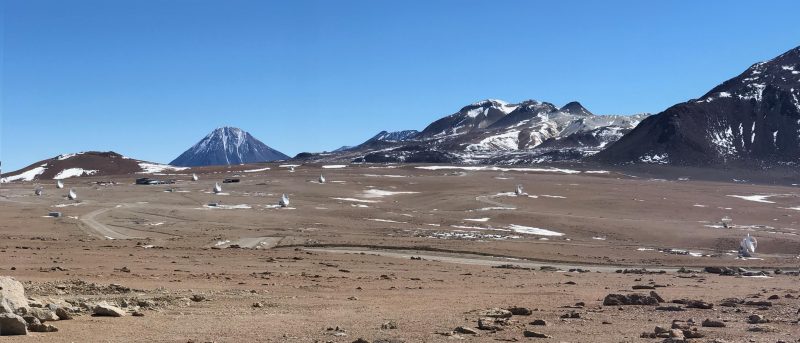
Barren, rocky landscape with snow patches. Blue sky.

ALMA 40-foot (12-meter) antennas can cover an area up to 10 miles (16 km) across. Image via Rob Pettengill/ NRAO/ AUI/ NSF.

Where do we come from? What are we? Where are we going? These questions are as old as humankind. The search for answers impels many quests, for example, the painter Gauguin’s voyage to Tahiti … and astronomers to the remote Chajnantor plateau in the Chilean Andes. That is the site of the Atacama Large Millimeter/sub-millimeter Array (ALMA), one of the most powerful telescopes on Earth.

The Array Operations Site (AOS) for ALMA is located at 16,500 feet (5,000 meters) of altitude. At that altitude, supplemental oxygen is required. Nearby in a more sheltered location – at 10,000 feet (3,000 meters) – is the ALMA Operations Support Facility (OSF) in the Atacama Desert. OSF hosts the couple hundred scientists, engineers, and staff needed to operate and maintain the telescope. The massive amount of data produced by ALMA requires reduction, archive, and distribution centers on four continents to deliver observational data to investigating scientists.

The dedicated staff of a couple hundred at the OSF, with the dozen or two essential personnel at AOS during the day, must cope with isolation and separation from family and comforts of home. Most commute from Santiago and face about about a six-hour commute, including the two-hour flight. A common shift is eight work days and four days off. Staff with families far away may spend six months apart. Pride, intelligence, and sense of purpose shone in everyone we spoke with from the director Sean Dougherty to the casino staff (casino is Chilean for cafeteria)!

All together, including the thousands needed at supporting locations, ALMA is a knowledge factory helping answer some of our species’ most profound questions. I visited there in late July and early August 2019 with the Astronomy in Chile Educator Ambassador Program, aka ACEAP. The ACEAP 2019 cadre were thrilled to have the rare opportunity to stay overnight at the OSF and make the 45-minute trip for a two-hour stay at the AOS high site. In exchange we all are sharing our experiences.

The day before included a tour of the OSF and presentations including one about ALMA’s role in the Event Horizon image of the M87 black hole shadow. We also heard about new capabilities for signal polarization measurements that will enable understanding of the motions of targets.

Man in a black t-shirt leaning over a laptop.

Paulo Cortes. Image via R. Pettengill (NRAO/AUI/NSF).

Paulo Cortes, the ALMA operations astronomer, dreamed of being a truck driver in a Chilean public school. His high school physics teacher prepared Paulo and a few others for university entrance exams. Now the whole world benefits from his talents and many others like him. Thank teachers! Just one small example of the human capitol available to answer questions and solve problems that have proven too difficult for developed world alone.

The lights of this large engineering and residence complex did nothing to dim the spectacular Atacama view of the Milky Way and Jupiter.

Jupiter above the Milky Way from ALMA OSF. Image via R. Pettengill (NRAO/AUI/NSF).

In the morning, not only did the ACEAP 2019 team have to pass a medical exam before proceeding, but drivers to the high site must pass one before every trip. Visitors are allowed a maximum of a two-hour visit. Essential staff are limited to six hours. No one is permitted to stay overnight. The day before our visit, staff was evacuated due to high winds.

We were fitted with our oxygen, then crammed into two trucks for the 45-minute trip. The road is straight and wide for a mountain road, because it used to transport the giant dish antennas. A majestic snow capped volcano dominated the view to our left. We also encountered several groups of wild vicuña. Near the AOS the ground looks remarkably like rover images of Mars with the blue sky the only hint that we are still on Earth.

gray-brown rocky landscape with blue snow-capped mountain in the background.

Road to ALMA AOS with vicuña and the Licancabur Volcano. Image via A. Borja/ NRAO /AUI /NSF).

After a brief stop at the small engineering building with the correlators that combine signals from the antennas, we begin touring the array.

ALMA includes both smaller antennas for sub-millimeter signals and larger ones for longer wavelengths. There are a total of 66 antennas: 54 of them are 40-foot (12-meter) dishes, and the other 12 dishes are about half that wide (7-meter). Antennas made in the U.S., Europe, and Japan have distinctive looks and parts, but function identically.

Japanese 7-meter radio dishes and European 12-meter radio dish in a compact array. Image via R. Pettengill/ NRAO /AUI /NSF.

We were lucky with a calm sunny day, but looks are deceptive. My roommate Art discovered his oxygen line was pinched when his fingertips started to become numb.

Huge antenna transporters position the dish antennas on mounting pads with sub-millimeter precision. A visit with Otto, the transporter, was a highlight worthy of a group picture.

Ten people in coats with cameras.

The ACEAP 2019 team with Sonia Daffau and our driver in front of Otto the transporter and an American dish. Image via V. Foncia (NRAO/AUI/NSF).

The ACEAP team went from ALMA to visits at the wonderful Tatio Mallku geyser park and Moon Valley, both near San Pedro. Back in Santiago, we were introduced to the powerful European Southern Observatories observatories that will have to wait for others visits. The big picture of astronomy and economic development in Chile was given by Luis Chavarria, Director of Astronomy at Chile’s CONICYT.

I left with profound admiration for those who have created one of the great scientific enterprises of history in Chile. Thanks to the NSF, AUI, and National Optical and Radio Astronomy Observatories for making this trip possible. Learn about ACEAP and meet the 2019 and previous cadres at AstroAmbassadors.com. I’m entranced by the warmth of the people of Chile and the wonderful food and wine. The Texan in me may smuggle in a little hot sauce on the next visit, because the astrophotographer in me has to go back.

Crescent moon

Even the familiar moon takes on a new look in the Atacama. Earthshine on the crescent moon takes on colors of the desert as it sinks behind a ridge, from the ALMA OSF Residencia. Imag via Rob Pettengill/ NRAO /AUI /NSF).

Bottom line: Report on the ALMA radio telescope in Chile from Robert Pettengill, a member of 2019’s Astronomy in Chile Educator Ambassador Program.

Read more: Astronomy ambassadors in Chile: Cerro Pachón and Cerro Tololo

Read more: Astronomy educators to rendezvous in Chile


from EarthSky https://ift.tt/2TGnlbn
Barren, rocky landscape with snow patches. Blue sky.

ALMA 40-foot (12-meter) antennas can cover an area up to 10 miles (16 km) across. Image via Rob Pettengill/ NRAO/ AUI/ NSF.

Where do we come from? What are we? Where are we going? These questions are as old as humankind. The search for answers impels many quests, for example, the painter Gauguin’s voyage to Tahiti … and astronomers to the remote Chajnantor plateau in the Chilean Andes. That is the site of the Atacama Large Millimeter/sub-millimeter Array (ALMA), one of the most powerful telescopes on Earth.

The Array Operations Site (AOS) for ALMA is located at 16,500 feet (5,000 meters) of altitude. At that altitude, supplemental oxygen is required. Nearby in a more sheltered location – at 10,000 feet (3,000 meters) – is the ALMA Operations Support Facility (OSF) in the Atacama Desert. OSF hosts the couple hundred scientists, engineers, and staff needed to operate and maintain the telescope. The massive amount of data produced by ALMA requires reduction, archive, and distribution centers on four continents to deliver observational data to investigating scientists.

The dedicated staff of a couple hundred at the OSF, with the dozen or two essential personnel at AOS during the day, must cope with isolation and separation from family and comforts of home. Most commute from Santiago and face about about a six-hour commute, including the two-hour flight. A common shift is eight work days and four days off. Staff with families far away may spend six months apart. Pride, intelligence, and sense of purpose shone in everyone we spoke with from the director Sean Dougherty to the casino staff (casino is Chilean for cafeteria)!

All together, including the thousands needed at supporting locations, ALMA is a knowledge factory helping answer some of our species’ most profound questions. I visited there in late July and early August 2019 with the Astronomy in Chile Educator Ambassador Program, aka ACEAP. The ACEAP 2019 cadre were thrilled to have the rare opportunity to stay overnight at the OSF and make the 45-minute trip for a two-hour stay at the AOS high site. In exchange we all are sharing our experiences.

The day before included a tour of the OSF and presentations including one about ALMA’s role in the Event Horizon image of the M87 black hole shadow. We also heard about new capabilities for signal polarization measurements that will enable understanding of the motions of targets.

Man in a black t-shirt leaning over a laptop.

Paulo Cortes. Image via R. Pettengill (NRAO/AUI/NSF).

Paulo Cortes, the ALMA operations astronomer, dreamed of being a truck driver in a Chilean public school. His high school physics teacher prepared Paulo and a few others for university entrance exams. Now the whole world benefits from his talents and many others like him. Thank teachers! Just one small example of the human capitol available to answer questions and solve problems that have proven too difficult for developed world alone.

The lights of this large engineering and residence complex did nothing to dim the spectacular Atacama view of the Milky Way and Jupiter.

Jupiter above the Milky Way from ALMA OSF. Image via R. Pettengill (NRAO/AUI/NSF).

In the morning, not only did the ACEAP 2019 team have to pass a medical exam before proceeding, but drivers to the high site must pass one before every trip. Visitors are allowed a maximum of a two-hour visit. Essential staff are limited to six hours. No one is permitted to stay overnight. The day before our visit, staff was evacuated due to high winds.

We were fitted with our oxygen, then crammed into two trucks for the 45-minute trip. The road is straight and wide for a mountain road, because it used to transport the giant dish antennas. A majestic snow capped volcano dominated the view to our left. We also encountered several groups of wild vicuña. Near the AOS the ground looks remarkably like rover images of Mars with the blue sky the only hint that we are still on Earth.

gray-brown rocky landscape with blue snow-capped mountain in the background.

Road to ALMA AOS with vicuña and the Licancabur Volcano. Image via A. Borja/ NRAO /AUI /NSF).

After a brief stop at the small engineering building with the correlators that combine signals from the antennas, we begin touring the array.

ALMA includes both smaller antennas for sub-millimeter signals and larger ones for longer wavelengths. There are a total of 66 antennas: 54 of them are 40-foot (12-meter) dishes, and the other 12 dishes are about half that wide (7-meter). Antennas made in the U.S., Europe, and Japan have distinctive looks and parts, but function identically.

Japanese 7-meter radio dishes and European 12-meter radio dish in a compact array. Image via R. Pettengill/ NRAO /AUI /NSF.

We were lucky with a calm sunny day, but looks are deceptive. My roommate Art discovered his oxygen line was pinched when his fingertips started to become numb.

Huge antenna transporters position the dish antennas on mounting pads with sub-millimeter precision. A visit with Otto, the transporter, was a highlight worthy of a group picture.

Ten people in coats with cameras.

The ACEAP 2019 team with Sonia Daffau and our driver in front of Otto the transporter and an American dish. Image via V. Foncia (NRAO/AUI/NSF).

The ACEAP team went from ALMA to visits at the wonderful Tatio Mallku geyser park and Moon Valley, both near San Pedro. Back in Santiago, we were introduced to the powerful European Southern Observatories observatories that will have to wait for others visits. The big picture of astronomy and economic development in Chile was given by Luis Chavarria, Director of Astronomy at Chile’s CONICYT.

I left with profound admiration for those who have created one of the great scientific enterprises of history in Chile. Thanks to the NSF, AUI, and National Optical and Radio Astronomy Observatories for making this trip possible. Learn about ACEAP and meet the 2019 and previous cadres at AstroAmbassadors.com. I’m entranced by the warmth of the people of Chile and the wonderful food and wine. The Texan in me may smuggle in a little hot sauce on the next visit, because the astrophotographer in me has to go back.

Crescent moon

Even the familiar moon takes on a new look in the Atacama. Earthshine on the crescent moon takes on colors of the desert as it sinks behind a ridge, from the ALMA OSF Residencia. Imag via Rob Pettengill/ NRAO /AUI /NSF).

Bottom line: Report on the ALMA radio telescope in Chile from Robert Pettengill, a member of 2019’s Astronomy in Chile Educator Ambassador Program.

Read more: Astronomy ambassadors in Chile: Cerro Pachón and Cerro Tololo

Read more: Astronomy educators to rendezvous in Chile


from EarthSky https://ift.tt/2TGnlbn

Snow algae thrives in some of Earth’s most extreme conditions

Image via GlacierHub.

This article is republished with permission from GlacierHub. This post was written by Elza Bouhassira.

A new study found snow algae on Nieves Penitentes at high elevations in the Chilean Andes.

Steven Schmidt is a University of Colorado, Boulder professor and one of the paper’s authors. He told GlacierHub.

The expedition was an epic and very arduous trip to a remote mountain. [The] original goal was to sample a lake below a remnant glacier high on the mountain, but the lake was frozen solid and the winds were horrendous, so we worked lower on the mountain and carried out the first ever search for life on Nieves Penitentes.

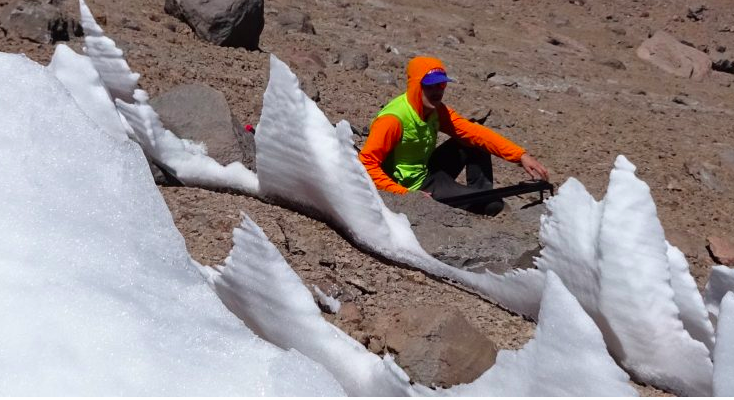
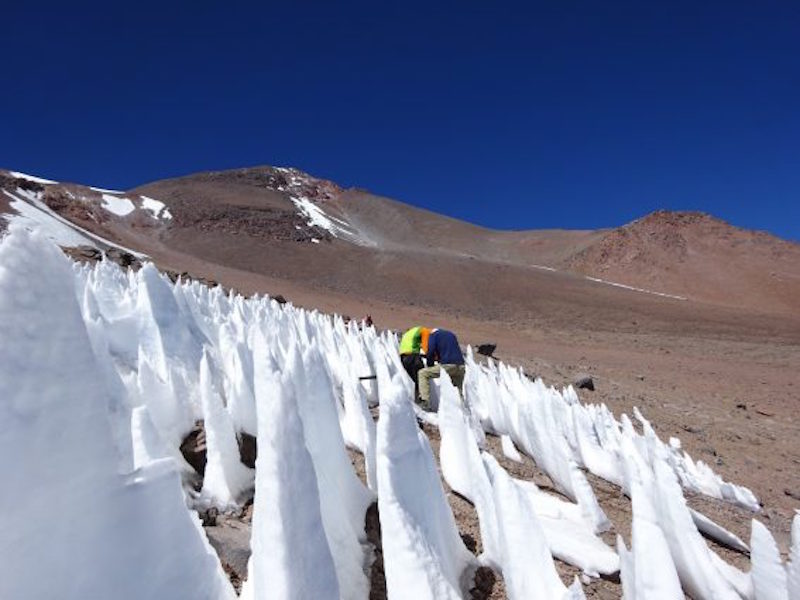
Nieves Penitentes are elongated ice structures. They form when windblown snow banks build up and melt due to a combination of high radiation, low humidity, and dry winds. The snow melts into the pinnacle-shape which earned Penitentes their name—they are said to resemble monks in white robes paying penance. Penitentes are important to the dry, high-altitude areas where they are found because they can be a periodic source of meltwater for the rocky ground.

Ice cones on brown dirt, blue sky.

Nieves Penitentes at the research site. Image via Steven Schimdt.

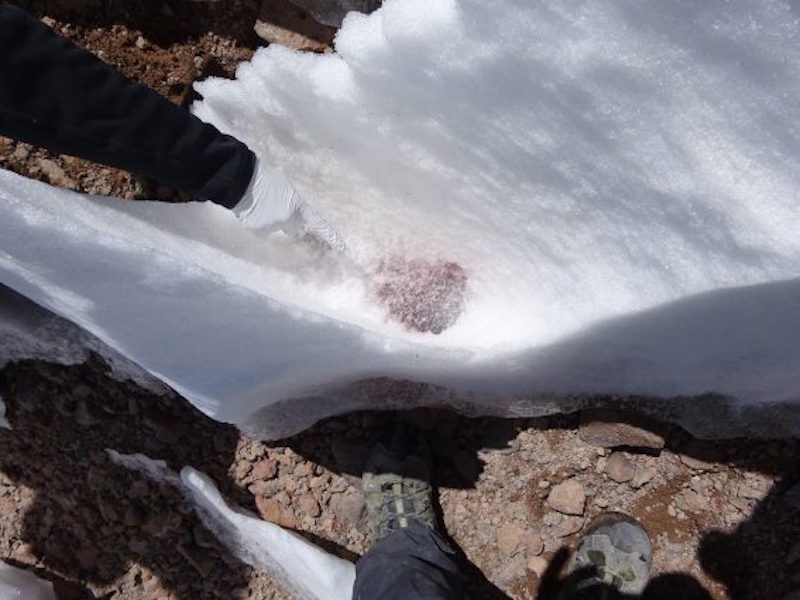
Schimdt described how the researchers were surprised to find patches of red ice on the sides of some of the penitentes. He told GlacierHub:

We took samples from these patches and later found that they contained some unique snow algae and a thriving community of other microbes.

The study was published the journal Arctic, Antarctic, and Alpine Research on June 12, 2019.

Matthew Davey, a plant and algal physiologist at Cambridge University, who was not involved in the study, told GlacierHub:

Snow algae are microscopic plant-like organisms that are able to live on and within the snowpack.

Snow algae is also known as watermelon snow because of the color it creates on the surface of snow and ice. The snow’s watermelon hue is caused by an abundance of natural reddish pigments called carotenoids which also shield the algae from ultraviolet light, drought, and cold, contributing to their ability to survive in extreme environments.

Red snow algae on Nieves Penitentes. Image via Steven Schmidt.

Researchers don’t entirely understand how the algae bloom in high density given the low temperatures and high light levels they live with. Davey explained:

There is evidence that they can be deposited by wind, they could already be in the rock surface from previous years or they could be brought by animals. Once the snow has melted slightly, so there is liquid water, the algae can reproduce and bloom within days or weeks. During this time they can start green, then turn red, or stay green or stay red—it depends on the algal species.

The samples of snow algae were collected from Penitentes on the Chilean side of Volcán Llullaillaco. It is the second tallest active volcano in the world after Ojos del Salado and it sits on Chile’s border with Argentina. The Penitentes were between 1-1.5 meters tall. The presence of snow algae on Penitentes is notable because the algae can change the albedo of ice and increase melting rates.

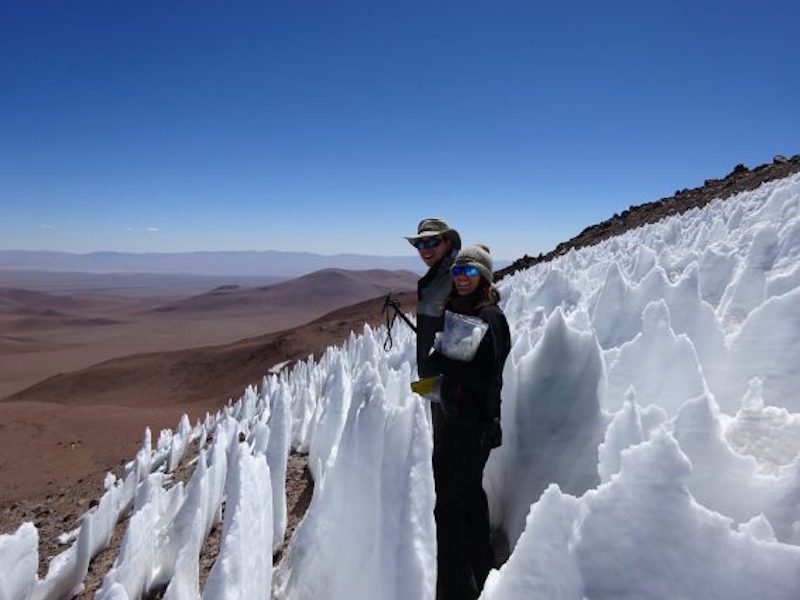
Lara Vimercati and Jack Darcy, two members of the research team, on Volcán Llullaillaco. Image via Steven Schmidt.

The study describes the environment that the samples were collected in as “perhaps the best earthly analog for surface and near-surface soils on Mars,” opening the door for implications in astrobiological research. The high elevation where the snow algae was found is responsible for the conditions that create an almost extraterrestrial environment; there are very high levels of ultraviolet radiation, intense daily freeze-thaw cycles, and one of the driest climates on the planet.

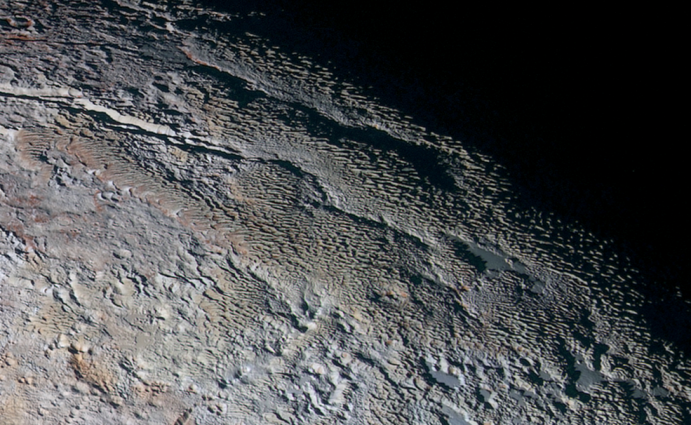
Penitente-like structures were recently found on Pluto and possibly on Europa, one of Jupiter’s moons. In the context of these discoveries, Schmidt said that “penitentes and the harsh environment that surrounds them provide a new terrestrial analog for astrobiological studies of life beyond Earth.” The finding in the new study that “penitentes are oases of life in the otherwise barren expanses” pushes the boundaries of the current understanding of the cold-dry limits of life.

The surface of Pluto’s Tartarus Dorsa region, where penitentes were found. Image via NASA/JHUAPL/SwRI.

Lead author Lara Vimercati reflected on the study’s broader implications. She said:

Our study shows how no matter how challenging the environmental conditions, life finds a way when there is availability of liquid water.

Bottom line: Scientists found snow algae living in ice high in the Chilean Andes.


from EarthSky https://ift.tt/2MlWsJa

Image via GlacierHub.

This article is republished with permission from GlacierHub. This post was written by Elza Bouhassira.

A new study found snow algae on Nieves Penitentes at high elevations in the Chilean Andes.

Steven Schmidt is a University of Colorado, Boulder professor and one of the paper’s authors. He told GlacierHub.

The expedition was an epic and very arduous trip to a remote mountain. [The] original goal was to sample a lake below a remnant glacier high on the mountain, but the lake was frozen solid and the winds were horrendous, so we worked lower on the mountain and carried out the first ever search for life on Nieves Penitentes.

Nieves Penitentes are elongated ice structures. They form when windblown snow banks build up and melt due to a combination of high radiation, low humidity, and dry winds. The snow melts into the pinnacle-shape which earned Penitentes their name—they are said to resemble monks in white robes paying penance. Penitentes are important to the dry, high-altitude areas where they are found because they can be a periodic source of meltwater for the rocky ground.

Ice cones on brown dirt, blue sky.

Nieves Penitentes at the research site. Image via Steven Schimdt.

Schimdt described how the researchers were surprised to find patches of red ice on the sides of some of the penitentes. He told GlacierHub:

We took samples from these patches and later found that they contained some unique snow algae and a thriving community of other microbes.

The study was published the journal Arctic, Antarctic, and Alpine Research on June 12, 2019.

Matthew Davey, a plant and algal physiologist at Cambridge University, who was not involved in the study, told GlacierHub:

Snow algae are microscopic plant-like organisms that are able to live on and within the snowpack.

Snow algae is also known as watermelon snow because of the color it creates on the surface of snow and ice. The snow’s watermelon hue is caused by an abundance of natural reddish pigments called carotenoids which also shield the algae from ultraviolet light, drought, and cold, contributing to their ability to survive in extreme environments.

Red snow algae on Nieves Penitentes. Image via Steven Schmidt.

Researchers don’t entirely understand how the algae bloom in high density given the low temperatures and high light levels they live with. Davey explained:

There is evidence that they can be deposited by wind, they could already be in the rock surface from previous years or they could be brought by animals. Once the snow has melted slightly, so there is liquid water, the algae can reproduce and bloom within days or weeks. During this time they can start green, then turn red, or stay green or stay red—it depends on the algal species.

The samples of snow algae were collected from Penitentes on the Chilean side of Volcán Llullaillaco. It is the second tallest active volcano in the world after Ojos del Salado and it sits on Chile’s border with Argentina. The Penitentes were between 1-1.5 meters tall. The presence of snow algae on Penitentes is notable because the algae can change the albedo of ice and increase melting rates.

Lara Vimercati and Jack Darcy, two members of the research team, on Volcán Llullaillaco. Image via Steven Schmidt.

The study describes the environment that the samples were collected in as “perhaps the best earthly analog for surface and near-surface soils on Mars,” opening the door for implications in astrobiological research. The high elevation where the snow algae was found is responsible for the conditions that create an almost extraterrestrial environment; there are very high levels of ultraviolet radiation, intense daily freeze-thaw cycles, and one of the driest climates on the planet.

Penitente-like structures were recently found on Pluto and possibly on Europa, one of Jupiter’s moons. In the context of these discoveries, Schmidt said that “penitentes and the harsh environment that surrounds them provide a new terrestrial analog for astrobiological studies of life beyond Earth.” The finding in the new study that “penitentes are oases of life in the otherwise barren expanses” pushes the boundaries of the current understanding of the cold-dry limits of life.

The surface of Pluto’s Tartarus Dorsa region, where penitentes were found. Image via NASA/JHUAPL/SwRI.

Lead author Lara Vimercati reflected on the study’s broader implications. She said:

Our study shows how no matter how challenging the environmental conditions, life finds a way when there is availability of liquid water.

Bottom line: Scientists found snow algae living in ice high in the Chilean Andes.


from EarthSky https://ift.tt/2MlWsJa

Perseids over Denmark

Milky Way and meteors, orange horizon, silhouette of a tree.

Image via Ruslan Merzlyakov.

Astrophotographer Ruslan Merzlyakov said:

Proud to present the biggest project I have ever made! Perseid meteor shower 2019 over Scandinavia’s first dark sky park, the island of Møn [in Denmark].

Five nights. Two cameras. Fifteen hours of observation. Some 3000+ images. Over 70 GB of data.

Visit Ruslan Merzlyakov on Instagram


from EarthSky https://ift.tt/2H6bn5Z
Milky Way and meteors, orange horizon, silhouette of a tree.

Image via Ruslan Merzlyakov.

Astrophotographer Ruslan Merzlyakov said:

Proud to present the biggest project I have ever made! Perseid meteor shower 2019 over Scandinavia’s first dark sky park, the island of Møn [in Denmark].

Five nights. Two cameras. Fifteen hours of observation. Some 3000+ images. Over 70 GB of data.

Visit Ruslan Merzlyakov on Instagram


from EarthSky https://ift.tt/2H6bn5Z

Summer Triangle on August evenings

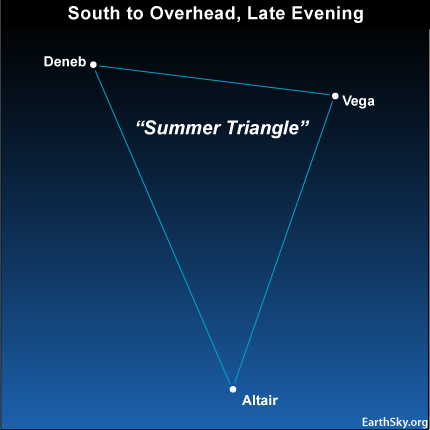
We’ve recently seen Orion’s return to the east before dawn, which means our northern summer is beginning to draw to a close. But the Summer Triangle asterism still rules the skies. It pops out first thing at nightfall and climbs highest up for the night at late evening. From mid-northern latitudes, Vega – the Summer Triangle’s brightest star – shines high overhead around 10 p.m. local daylight saving time (9 p.m. local standard time). Altair resides to the southeast (lower left) of Vega, and Deneb lies to Vega’s east (left).

The Summer Triangle is not a constellation. It’s three bright stars in three different constellations, as the wonderful photo below – by Susan Jensen in Odessa, Washington – shows.

Enjoying EarthSky so far? Sign up for our free daily newsletter today!

Star field with 3 constellations and Summer Triangle drawn on it.

Here is the Summer Triangle asterism – 3 bright stars in 3 different constellations – as photographed by Susan Jensen in Odessa, Washington.

As the stars drift westward during the night Deneb will swing upward, to replace Vega as the overhead star some two hours later. Of course, the stars aren’t really moving. It’s the Earth’s rotation that causes the stars to move westward during the night, and the sun to go westward during the day.

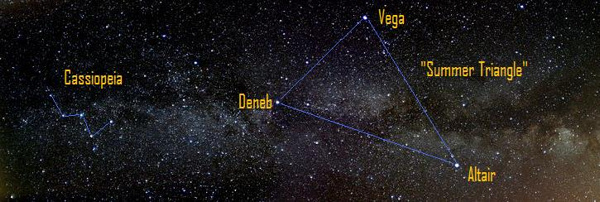
Horizontal Milky Way with Cassiopeia and Summer Triangle drawn in front of it.

Great rift of Milky Way passes through the constellation Cassiopeia and the Summer Triangle. Click here for a larger photo

Because the three stars making up the Summer Triangle are 1st-magnitude stars, you can easily see the brilliant Summer Triangle on moonlit nights. However, you need a dark sky free of moonlight to see the great swath of stars known as the Milky Way passing in between the Summer Triangle stars Vega and Altair. The star Deneb bobs in the middle of this river of stars that meanders through the Summer Triangle, arcing across the sky from horizon to horizon. Although every star that you see with the unaided eye is actually a member of our Milky Way galaxy, the term Milky Way often refers to the cross-sectional view of the galactic disk, whereby innumerable far-off suns congregate into a cloudy trail of stars.

Make friends Summer Triangle and its three brilliant stars – Vega, Deneb and Altair – tonight. Note the great boulevard of stars that streams right through the Summer Triangle on an inky-dark night. That’s actually an edgewise view into the flat disk of our Milky Way galaxy.

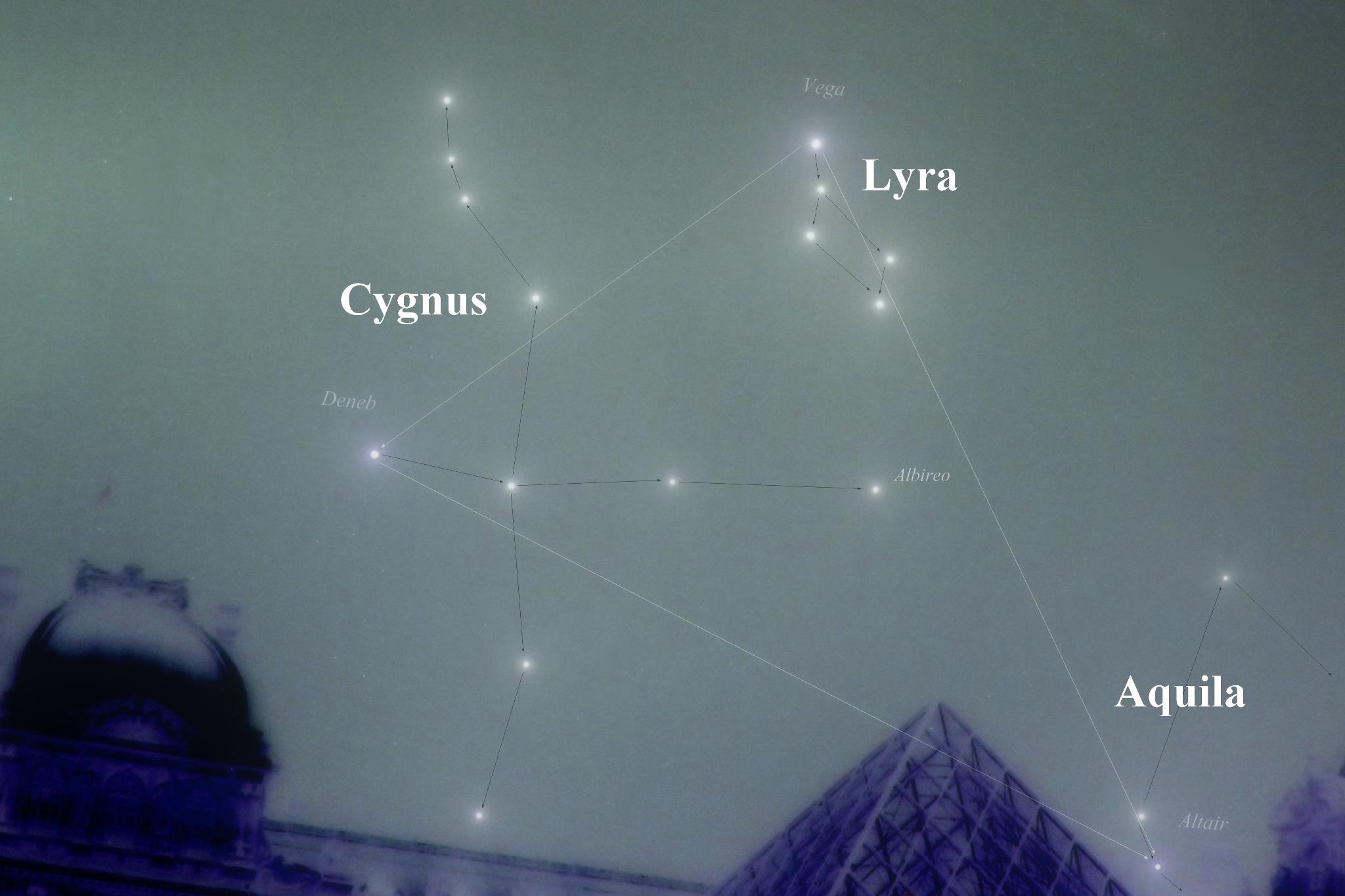
Fuzzy bright stars against greenish sky with 3 constellations labeled.

Summer Triangle and the top of the Louvre Pyramid from EarthSky Facebook friend VegaStar Carpentier in Paris. Thanks, VegaStar!

By the way, you can see the Summer Triangle in the Southern Hemisphere, too – although there do you call it the Winter Triangle? I wonder. South of the equator, people see an upside-down version of tonight’s sky scene, in contrast to our northern perspective. Late tonight, Southern Hemisphere residents will see Altair at the top of the Summer Triangle, and Vega and Deneb sparkling at bottom.

Summer Triangle: Vega, Deneb, Altair

Bottom line: The Summer Triangle asterism can be seen overhead at late evening now. The Summer Triangle isn’t a constellation, but it’s still very prominent. It’s three bright stars in three different constellations. These stars are Vega in the constellation Lyra the Harp, Deneb in the constellation Cygnus the Swan, and Altair in the constellation Aquila the Eagle.


from EarthSky https://ift.tt/2TCRN6r

We’ve recently seen Orion’s return to the east before dawn, which means our northern summer is beginning to draw to a close. But the Summer Triangle asterism still rules the skies. It pops out first thing at nightfall and climbs highest up for the night at late evening. From mid-northern latitudes, Vega – the Summer Triangle’s brightest star – shines high overhead around 10 p.m. local daylight saving time (9 p.m. local standard time). Altair resides to the southeast (lower left) of Vega, and Deneb lies to Vega’s east (left).

The Summer Triangle is not a constellation. It’s three bright stars in three different constellations, as the wonderful photo below – by Susan Jensen in Odessa, Washington – shows.

Enjoying EarthSky so far? Sign up for our free daily newsletter today!

Star field with 3 constellations and Summer Triangle drawn on it.

Here is the Summer Triangle asterism – 3 bright stars in 3 different constellations – as photographed by Susan Jensen in Odessa, Washington.

As the stars drift westward during the night Deneb will swing upward, to replace Vega as the overhead star some two hours later. Of course, the stars aren’t really moving. It’s the Earth’s rotation that causes the stars to move westward during the night, and the sun to go westward during the day.

Horizontal Milky Way with Cassiopeia and Summer Triangle drawn in front of it.

Great rift of Milky Way passes through the constellation Cassiopeia and the Summer Triangle. Click here for a larger photo

Because the three stars making up the Summer Triangle are 1st-magnitude stars, you can easily see the brilliant Summer Triangle on moonlit nights. However, you need a dark sky free of moonlight to see the great swath of stars known as the Milky Way passing in between the Summer Triangle stars Vega and Altair. The star Deneb bobs in the middle of this river of stars that meanders through the Summer Triangle, arcing across the sky from horizon to horizon. Although every star that you see with the unaided eye is actually a member of our Milky Way galaxy, the term Milky Way often refers to the cross-sectional view of the galactic disk, whereby innumerable far-off suns congregate into a cloudy trail of stars.

Make friends Summer Triangle and its three brilliant stars – Vega, Deneb and Altair – tonight. Note the great boulevard of stars that streams right through the Summer Triangle on an inky-dark night. That’s actually an edgewise view into the flat disk of our Milky Way galaxy.

Fuzzy bright stars against greenish sky with 3 constellations labeled.

Summer Triangle and the top of the Louvre Pyramid from EarthSky Facebook friend VegaStar Carpentier in Paris. Thanks, VegaStar!

By the way, you can see the Summer Triangle in the Southern Hemisphere, too – although there do you call it the Winter Triangle? I wonder. South of the equator, people see an upside-down version of tonight’s sky scene, in contrast to our northern perspective. Late tonight, Southern Hemisphere residents will see Altair at the top of the Summer Triangle, and Vega and Deneb sparkling at bottom.

Summer Triangle: Vega, Deneb, Altair

Bottom line: The Summer Triangle asterism can be seen overhead at late evening now. The Summer Triangle isn’t a constellation, but it’s still very prominent. It’s three bright stars in three different constellations. These stars are Vega in the constellation Lyra the Harp, Deneb in the constellation Cygnus the Swan, and Altair in the constellation Aquila the Eagle.


from EarthSky https://ift.tt/2TCRN6r

News digest – early diagnosis, fighting talk, bladder cancer deaths, and a poem on a pill

Nurse talking to patient on the phone

Increase in early stage cancer diagnoses in Scotland

The latest figures from NHS Scotland show that more cancers are being diagnosed at an early stage. The figures reported by the BBC and The Scotsman show that the number of people diagnosed with stage one cancer of the breast, lung and bowel has increased by 9.4% since 2010. However, the stats also reveal fewer early diagnoses in Scotland’s most deprived areas compared to the least. Getting diagnosed early means people have a greater chance of successful treatment.

Fighting talk may be doing more harm than good

The Guardian covered the latest research looking at the harmful psychological effects of using military terminology when describing a disease. This study adds to the body of evidence that fighting talk may not be helping patients and further highlights the importance of being sensitive when communicating about cancer.

Aspirin and breast cancer outcomes

The Mail Online covered a small study that has suggested that taking aspirin could affect breast cancer outcomes. Researchers said this might be due to the genetics of the disease. But the picture isn’t clear. Previous research has looked into whether taking aspirin may affect breast cancer survival but results have been inconsistent. More research like this is needed in bigger groups of patients, to further investigate the link between aspirin and breast cancer. It’s important for anyone thinking about taking aspirin regularly to talk to their GP first.

New treatment option for certain leukaemia patients in Scotland

A targeted combination treatment for patients with a specific type of chronic blood cancer will soon be available on the NHS in Scotland. Our news report has the details.

Rise in bladder cancer deaths could be due to a shortage of a particular drug

In England, the proportion of bladder cancer patients surviving five years or longer after their diagnosis has fallen from 55.1% to 52.6%, according to the Office for National Statistics. The Telegraph reports warnings from experts suggesting this could be due to supply problems of a particular immunotherapy drug called Bacille Calmette-Guérin (BCG).

Tracing evolution of cancer in dogs may help us understand our own cancers

WIRED covered a recent study that constructed the first genetic map of a particular type of canine cancer. Tracing the cancer history in dogs may reveal some secrets about the evolution of human disease.

And finally…

The BBC and The Guardian reports on the poet Laureate, Simon Armitage’s, latest work entitled ‘Finishing It’ that has been engraved on a tiny cancer pill. It’s intended to raise awareness for, and celebrate, the work being done in the advancement of cancer treatment.

Ethan


from Cancer Research UK – Science blog https://ift.tt/2N7PPcZ
Nurse talking to patient on the phone

Increase in early stage cancer diagnoses in Scotland

The latest figures from NHS Scotland show that more cancers are being diagnosed at an early stage. The figures reported by the BBC and The Scotsman show that the number of people diagnosed with stage one cancer of the breast, lung and bowel has increased by 9.4% since 2010. However, the stats also reveal fewer early diagnoses in Scotland’s most deprived areas compared to the least. Getting diagnosed early means people have a greater chance of successful treatment.

Fighting talk may be doing more harm than good

The Guardian covered the latest research looking at the harmful psychological effects of using military terminology when describing a disease. This study adds to the body of evidence that fighting talk may not be helping patients and further highlights the importance of being sensitive when communicating about cancer.

Aspirin and breast cancer outcomes

The Mail Online covered a small study that has suggested that taking aspirin could affect breast cancer outcomes. Researchers said this might be due to the genetics of the disease. But the picture isn’t clear. Previous research has looked into whether taking aspirin may affect breast cancer survival but results have been inconsistent. More research like this is needed in bigger groups of patients, to further investigate the link between aspirin and breast cancer. It’s important for anyone thinking about taking aspirin regularly to talk to their GP first.

New treatment option for certain leukaemia patients in Scotland

A targeted combination treatment for patients with a specific type of chronic blood cancer will soon be available on the NHS in Scotland. Our news report has the details.

Rise in bladder cancer deaths could be due to a shortage of a particular drug

In England, the proportion of bladder cancer patients surviving five years or longer after their diagnosis has fallen from 55.1% to 52.6%, according to the Office for National Statistics. The Telegraph reports warnings from experts suggesting this could be due to supply problems of a particular immunotherapy drug called Bacille Calmette-Guérin (BCG).

Tracing evolution of cancer in dogs may help us understand our own cancers

WIRED covered a recent study that constructed the first genetic map of a particular type of canine cancer. Tracing the cancer history in dogs may reveal some secrets about the evolution of human disease.

And finally…

The BBC and The Guardian reports on the poet Laureate, Simon Armitage’s, latest work entitled ‘Finishing It’ that has been engraved on a tiny cancer pill. It’s intended to raise awareness for, and celebrate, the work being done in the advancement of cancer treatment.

Ethan


from Cancer Research UK – Science blog https://ift.tt/2N7PPcZ

Large 2019 dead zone in Gulf of Mexico

Blue ship with white superstructure and large double crane-like apparatus at stern.

The R/V Pelican. Image appears courtesy of Arne Diercks, University of Southern Mississippi, via NOAA.

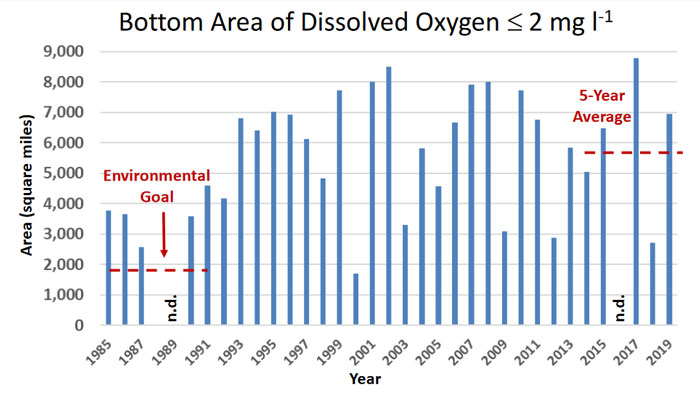
A dead zone of oxygen-depleted waters forms every summer in the Gulf of Mexico in response to nutrient runoff from the Mississippi River watershed. Scientists have been tracking the summer dead zone for 33 years now, and have found that this year’s area of low oxygen waters extends for 6,952 square miles (18,006 square km). It is the eighth largest dead zone ever recorded.

Nutrient-rich runoff containing nitrogen and phosphorus from agricultural lands and sewage causes the summer dead zone in the Gulf of Mexico. These nutrients, in combination with sunlight and warm waters in the Gulf, trigger algal blooms. Then, as the algae die off and are decomposed by bacteria, oxygen in the bottom waters drops to levels that can be deadly for many marine organisms.

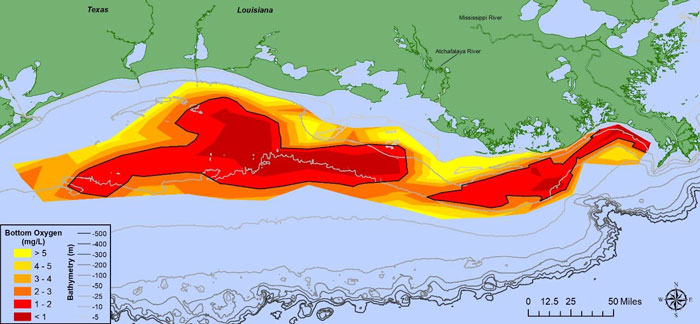
Map: Long yellow, orange, red, deep red area south of the coast of Louisiana.

Extent of the summer dead zone in the Gulf of Mexico according to sampling data collected by Louisiana scientists in July 2019. Image via LUMCON.

Scientists took measurements of the extent of this year’s dead zone from onboard the R/V Pelican over July 23–29, 2019. The area of the dead zone was estimated at 6,952 square miles (18,006 square km). This is the 8th largest dead zone recorded in the 33 year historical record of such events.

The dead zone was actually smaller in size than that predicted back in spring based on the amount of rainfall and runoff generated this year. Scientists suspect that Hurricane Barry, which made landfall along the Louisiana coast on July 13 as a Category 1 storm, stirred up the waters and disrupted the growth of the dead zone. The dead zone is expected to continue its rapid growth if future conditions remain calm. The dead zone will eventually dissipate in the autumn as water temperatures cool and oxygen-rich waters become well mixed.

Marine ecologist Nancy Rabalais, of Louisiana State University led the sampling effort. She commented on the survey results in a statement:

Past research indicates that hypoxia can take a week to reform in the summer after major wind events such as the recent passage of Hurricane Barry. We didn’t know what we would find when we went out to map the zone. We found that, despite the storm, the zone reformed and was in the process of rapidly expanding.

The dead zone in the Gulf of Mexico has harmful effects on marine life and fisheries, and so scientists have set a target to have the dead zone grow to no larger than 1,900 square miles (4921 square km) on average (with data collected over a 5 year period) by 2035. To achieve such a remedial goal, further reductions in nutrient runoff from farms and urban areas will be necessary.

Graph of coverage of dead zone from 0 to 8000 square miles for years from 1985 to 2019.

Trend in the size of the dead zone that forms each summer in the Gulf of Mexico. Image via LUMCON.

The annual summer sampling in the Gulf of Mexico is a joint endeavor of Louisiana State University and LUMCON (Louisiana Universities Marine Consortium), and the scientists receive funding support from NOAA (National Oceanic and Atmospheric Administration) for their work.

Bottom line: A large dead zone formed in the Gulf of Mexico during the summer of 2019. The size of the dead zone was smaller than expected because of Hurricane Barry, but it was estimated to be the eighth largest on record. Large dead zones in the Gulf of Mexico are harmful to marine life, and further reductions in nutrient runoff are needed to reduce the size of the summer dead zone that forms every year.


from EarthSky https://ift.tt/2N4qH6K
Blue ship with white superstructure and large double crane-like apparatus at stern.

The R/V Pelican. Image appears courtesy of Arne Diercks, University of Southern Mississippi, via NOAA.

A dead zone of oxygen-depleted waters forms every summer in the Gulf of Mexico in response to nutrient runoff from the Mississippi River watershed. Scientists have been tracking the summer dead zone for 33 years now, and have found that this year’s area of low oxygen waters extends for 6,952 square miles (18,006 square km). It is the eighth largest dead zone ever recorded.

Nutrient-rich runoff containing nitrogen and phosphorus from agricultural lands and sewage causes the summer dead zone in the Gulf of Mexico. These nutrients, in combination with sunlight and warm waters in the Gulf, trigger algal blooms. Then, as the algae die off and are decomposed by bacteria, oxygen in the bottom waters drops to levels that can be deadly for many marine organisms.

Map: Long yellow, orange, red, deep red area south of the coast of Louisiana.

Extent of the summer dead zone in the Gulf of Mexico according to sampling data collected by Louisiana scientists in July 2019. Image via LUMCON.

Scientists took measurements of the extent of this year’s dead zone from onboard the R/V Pelican over July 23–29, 2019. The area of the dead zone was estimated at 6,952 square miles (18,006 square km). This is the 8th largest dead zone recorded in the 33 year historical record of such events.

The dead zone was actually smaller in size than that predicted back in spring based on the amount of rainfall and runoff generated this year. Scientists suspect that Hurricane Barry, which made landfall along the Louisiana coast on July 13 as a Category 1 storm, stirred up the waters and disrupted the growth of the dead zone. The dead zone is expected to continue its rapid growth if future conditions remain calm. The dead zone will eventually dissipate in the autumn as water temperatures cool and oxygen-rich waters become well mixed.

Marine ecologist Nancy Rabalais, of Louisiana State University led the sampling effort. She commented on the survey results in a statement:

Past research indicates that hypoxia can take a week to reform in the summer after major wind events such as the recent passage of Hurricane Barry. We didn’t know what we would find when we went out to map the zone. We found that, despite the storm, the zone reformed and was in the process of rapidly expanding.

The dead zone in the Gulf of Mexico has harmful effects on marine life and fisheries, and so scientists have set a target to have the dead zone grow to no larger than 1,900 square miles (4921 square km) on average (with data collected over a 5 year period) by 2035. To achieve such a remedial goal, further reductions in nutrient runoff from farms and urban areas will be necessary.

Graph of coverage of dead zone from 0 to 8000 square miles for years from 1985 to 2019.

Trend in the size of the dead zone that forms each summer in the Gulf of Mexico. Image via LUMCON.

The annual summer sampling in the Gulf of Mexico is a joint endeavor of Louisiana State University and LUMCON (Louisiana Universities Marine Consortium), and the scientists receive funding support from NOAA (National Oceanic and Atmospheric Administration) for their work.

Bottom line: A large dead zone formed in the Gulf of Mexico during the summer of 2019. The size of the dead zone was smaller than expected because of Hurricane Barry, but it was estimated to be the eighth largest on record. Large dead zones in the Gulf of Mexico are harmful to marine life, and further reductions in nutrient runoff are needed to reduce the size of the summer dead zone that forms every year.


from EarthSky https://ift.tt/2N4qH6K

This weekend, watch for a morning moon

Image at top via Buddy Puckhaper of Charleston, South Carolina.

Full moon was August 15, 2019, and by August 16 the moon is in a waning gibbous phase, already beginning to rise later at night. For the mainland United States, the August 16 moon rises in the east roughly an hour after sunset. The days following full moon present the perfect time to catch a daytime moon over your western horizon after sunrise. Watch for it!

View the moon in your eastern sky late in the evening this weekend, perhaps before going to bed. It’ll be ascending in the east later and later each evening. Then look for it low in your western sky right after sunrise. Day by day, the lighted portion of the waning gibbous moon will shrink. The half-lit last quarter moon will come on August 23, 2019.

The moon is up in the daytime much of the time. But, because it’s pale against the blue sky, it’s not as noticeable during the day as at night. However, there are certain times of the month when the daytime moon is more noticeable, and this weekend presents one of those times.

Huge very faint pale moon against blue sky behind radio tower with large antennas.

You’ll often miss the moon during the day because it’s so pale against the blue daytime sky. Look closely this weekend, especially in the hours after sunrise. Look west! You’ll see it. Our friend Jenney Disimon in Sabah, North Borneo, caught this daytime moon on January 4, 2018.

Why is the daytime moon most noticeable now? The moon is up during the day half the time. It must be, since it orbits around the whole Earth once a month. A crescent moon is hard to see, though, because it’s so near the sun in the sky. At the vicinity of last quarter moon about a week from now, you might have to crane your neck, looking up, to notice it after sunrise.

This weekend’s moon is noticeable simply because the moon is still showing us most of its lighted face; it appears large in our sky. Also, in the hours after sunrise, the moon is fairly near the western horizon, so people out and about early this weekend might catch sight of it.

At mid-northern latitudes in North America, the moon will set nearly two hours after sunrise on August 17. It’ll set roughly one hour later after sunrise each day thereafter.

These recommended almanacs can help you find the moon’s setting time in your sky

Pale gibbous moon against sky-blue background.

Daytime moon seen on December 18, 2010. Image by Brian Pate. Used with permission.

Bottom line: The moon is now in a waning gibbous phase. Beginning Saturday morning – August 17, 2019 – shortly after sunrise, you’ll see it floating pale and beautiful against a blue sky. Look west!

Donate: Your support means the world to us


from EarthSky https://ift.tt/2YPWZcR

Image at top via Buddy Puckhaper of Charleston, South Carolina.

Full moon was August 15, 2019, and by August 16 the moon is in a waning gibbous phase, already beginning to rise later at night. For the mainland United States, the August 16 moon rises in the east roughly an hour after sunset. The days following full moon present the perfect time to catch a daytime moon over your western horizon after sunrise. Watch for it!

View the moon in your eastern sky late in the evening this weekend, perhaps before going to bed. It’ll be ascending in the east later and later each evening. Then look for it low in your western sky right after sunrise. Day by day, the lighted portion of the waning gibbous moon will shrink. The half-lit last quarter moon will come on August 23, 2019.

The moon is up in the daytime much of the time. But, because it’s pale against the blue sky, it’s not as noticeable during the day as at night. However, there are certain times of the month when the daytime moon is more noticeable, and this weekend presents one of those times.

Huge very faint pale moon against blue sky behind radio tower with large antennas.

You’ll often miss the moon during the day because it’s so pale against the blue daytime sky. Look closely this weekend, especially in the hours after sunrise. Look west! You’ll see it. Our friend Jenney Disimon in Sabah, North Borneo, caught this daytime moon on January 4, 2018.

Why is the daytime moon most noticeable now? The moon is up during the day half the time. It must be, since it orbits around the whole Earth once a month. A crescent moon is hard to see, though, because it’s so near the sun in the sky. At the vicinity of last quarter moon about a week from now, you might have to crane your neck, looking up, to notice it after sunrise.

This weekend’s moon is noticeable simply because the moon is still showing us most of its lighted face; it appears large in our sky. Also, in the hours after sunrise, the moon is fairly near the western horizon, so people out and about early this weekend might catch sight of it.

At mid-northern latitudes in North America, the moon will set nearly two hours after sunrise on August 17. It’ll set roughly one hour later after sunrise each day thereafter.

These recommended almanacs can help you find the moon’s setting time in your sky

Pale gibbous moon against sky-blue background.

Daytime moon seen on December 18, 2010. Image by Brian Pate. Used with permission.

Bottom line: The moon is now in a waning gibbous phase. Beginning Saturday morning – August 17, 2019 – shortly after sunrise, you’ll see it floating pale and beautiful against a blue sky. Look west!

Donate: Your support means the world to us


from EarthSky https://ift.tt/2YPWZcR

It was cold in Australia last weekend

Soccer players huddling in the snow.

Snow fell on an Australian Football League game for the first time last weekend, as the GWS Giants and Hawthorn Hawks had their round 21 clash in Canberra, Australia’s capital. Image via SportingNews.com.

It’s winter in Earth’s Southern Hemisphere now. But last weekend – about August 9 to 12, 2019, as we in the Northern Hemisphere continued our summer of record high temps and melting sea ice, plus widespread Arctic fires – Australians in Victoria and New South Wales had extra-wintry weather and unusual snowfall. Writing for The Conversation, Australian climate and atmospheric scientists noted it was one of the longest cold stretches and greatest snowfall totals in Australia in the 2000s. They said that, although snow falls on Australia’s mountains almost every year, it “only rarely” spreads down onto the plains and cities. And they said explained:

Last weekend’s event was probably the most significant snowfall since 2000 in parts of Victoria north of the ranges, and in southern inland New South Wales. In central and northern New South Wales, the last snowfall on this scale was in 2015, while in the hills around Melbourne it was on a par with 2008.

Plus it snowed on an Australian Football League game – called a footy by those down south – for the first time last weekend, as the image above shows.

Read more via The Conservation

Read more via NASA Earth Observatory

Read more via SportingNews.com

Two kangaroos in a snowy woods.

Kangaroos in the snow in Lyonville, in Victoria’s central highlands. Image via Nicholas Dunand/ The Conversation.

Bottom line: Unusual cold in Australia August 9 to 12, 2019.


from EarthSky https://ift.tt/2Z6nE0g
Soccer players huddling in the snow.

Snow fell on an Australian Football League game for the first time last weekend, as the GWS Giants and Hawthorn Hawks had their round 21 clash in Canberra, Australia’s capital. Image via SportingNews.com.

It’s winter in Earth’s Southern Hemisphere now. But last weekend – about August 9 to 12, 2019, as we in the Northern Hemisphere continued our summer of record high temps and melting sea ice, plus widespread Arctic fires – Australians in Victoria and New South Wales had extra-wintry weather and unusual snowfall. Writing for The Conversation, Australian climate and atmospheric scientists noted it was one of the longest cold stretches and greatest snowfall totals in Australia in the 2000s. They said that, although snow falls on Australia’s mountains almost every year, it “only rarely” spreads down onto the plains and cities. And they said explained:

Last weekend’s event was probably the most significant snowfall since 2000 in parts of Victoria north of the ranges, and in southern inland New South Wales. In central and northern New South Wales, the last snowfall on this scale was in 2015, while in the hills around Melbourne it was on a par with 2008.

Plus it snowed on an Australian Football League game – called a footy by those down south – for the first time last weekend, as the image above shows.

Read more via The Conservation

Read more via NASA Earth Observatory

Read more via SportingNews.com

Two kangaroos in a snowy woods.

Kangaroos in the snow in Lyonville, in Victoria’s central highlands. Image via Nicholas Dunand/ The Conversation.

Bottom line: Unusual cold in Australia August 9 to 12, 2019.


from EarthSky https://ift.tt/2Z6nE0g

Chandrayaan-2 is on its way to the moon

Animation of Chandrayaan-2 around Earth

Animation showing Chandryaan-2’s initial orbit around the Earth and the successful maneuver that now has sent it on a path to the moon. Image via Wikipedia.

After the five Earth-bound maneuvers that had raised Chandrayaan-2’s orbit around Earth, the spacecraft has now entered a lunar transfer trajectory, that is, a trajectory that will carry it to the moon. The Indian Space Research Organisation (ISRO) performed the final maneuver yesterday (August 14, 2019) according to clocks in India. A statement from ISRO said:

The final orbit-raising maneuver of Chandrayaan-2 spacecraft was successfully carried out today … at 02:21 a.m. IST [21:00 UTC on August 13]. During this maneuver, the spacecraft’s liquid engine was fired for about 1,203 seconds. With this, Chandrayaan-2 entered the lunar transfer trajectory. Since its launch on July 22, 2019 by GSLV MkIII-M1 vehicle, all systems onboard Chandryaan-2 spacecraft are performing normally.

This trajectory will take Chandrayaan-2 to the moon’s vicinity on August 20, 2019. Once there, the spacecraft’s engines will fire again, with the goal of inserting the craft into an orbit around the moon. Four orbit maneuvers are planned to decrease its orbit until it is about 60 miles (100 km) above the moon’s surface, at which point the mission’s Vikram lander will attempt to soft-land at the moon’s south pole.

Vikram carries a six-wheeled, solar-powered rover designed to travel 500 meters (about the length of five American football fields, end to end) to perform on-site chemical analysis for one lunar day (14 Earth days). Meanwhile, the orbiter, among other tasks, has the goal of providing a quantitative estimation of water content present at the moon’s poles. The orbiter is expected to last for one year.

Key dates: 

August 20, 2019: Chandrayaan-2’s lunar insertion burn.

September 1, 2019: After the fifth burn, the desired orbit of 70 to 80 miles (114 x 128 km) around the moon is expected to be achieved.

September 2, 2019: The lander Vikram along with the rover Pragyan will separate and begin its descent towards the moon’s south pole.

September 7, 2019: Vikram will soft-land on a high plain between Manzinus and Simpelius – two craters in the moon’s southern hemisphere.

Bottom line: The spacecraft has shifted trajectories and is now on its way to the moon.

Via ISRO.


from EarthSky https://ift.tt/33Bortw
Animation of Chandrayaan-2 around Earth

Animation showing Chandryaan-2’s initial orbit around the Earth and the successful maneuver that now has sent it on a path to the moon. Image via Wikipedia.

After the five Earth-bound maneuvers that had raised Chandrayaan-2’s orbit around Earth, the spacecraft has now entered a lunar transfer trajectory, that is, a trajectory that will carry it to the moon. The Indian Space Research Organisation (ISRO) performed the final maneuver yesterday (August 14, 2019) according to clocks in India. A statement from ISRO said:

The final orbit-raising maneuver of Chandrayaan-2 spacecraft was successfully carried out today … at 02:21 a.m. IST [21:00 UTC on August 13]. During this maneuver, the spacecraft’s liquid engine was fired for about 1,203 seconds. With this, Chandrayaan-2 entered the lunar transfer trajectory. Since its launch on July 22, 2019 by GSLV MkIII-M1 vehicle, all systems onboard Chandryaan-2 spacecraft are performing normally.

This trajectory will take Chandrayaan-2 to the moon’s vicinity on August 20, 2019. Once there, the spacecraft’s engines will fire again, with the goal of inserting the craft into an orbit around the moon. Four orbit maneuvers are planned to decrease its orbit until it is about 60 miles (100 km) above the moon’s surface, at which point the mission’s Vikram lander will attempt to soft-land at the moon’s south pole.

Vikram carries a six-wheeled, solar-powered rover designed to travel 500 meters (about the length of five American football fields, end to end) to perform on-site chemical analysis for one lunar day (14 Earth days). Meanwhile, the orbiter, among other tasks, has the goal of providing a quantitative estimation of water content present at the moon’s poles. The orbiter is expected to last for one year.

Key dates: 

August 20, 2019: Chandrayaan-2’s lunar insertion burn.

September 1, 2019: After the fifth burn, the desired orbit of 70 to 80 miles (114 x 128 km) around the moon is expected to be achieved.

September 2, 2019: The lander Vikram along with the rover Pragyan will separate and begin its descent towards the moon’s south pole.

September 7, 2019: Vikram will soft-land on a high plain between Manzinus and Simpelius – two craters in the moon’s southern hemisphere.

Bottom line: The spacecraft has shifted trajectories and is now on its way to the moon.

Via ISRO.


from EarthSky https://ift.tt/33Bortw

adds 2