aads

The consensus on consensus messaging

A scientist would never tolerate statements about climate change that weren't based on scientific research and empirical evidence. However, the same evidentiary standards don't always seem to apply to statements about how to communicate about climate change. For example, on the topic of communicating the scientific consensus on human-caused global warming, there are lots of opinions on whether communicating the scientific consensus is effective or not. Many of these opinions are not based on the body of empirical research into consensus messaging. 

So this post is a summary of the empirical research into consensus messaging and how people think about consensus. In psychological research, public perception of scientific consensus has been found to be so important that researchers now describe this dynamic as the Gateway Belief Model. This model finds that communicating the scientific consensus on climate change increased beliefs about climate change, which subsequently increases public support for climate policy. The vast majority of research in this field either confirms the Gateway Belief Model or confirms the efficacy of consensus messaging.

Consensus on Consensus messaging

The following table lists any papers that test either consensus messaging or the Gateway Belief Model. Studies are either correlational (surveys that explore whether there's an association between perceived consensus and other climate beliefs) or experimental (randomized tests that measure the impact of consensus messaging). The Country column lists which countries the participants come from. The Support column indicates whether the study supports the Gateway Belief Model or the positive effect of consensus messaging.

Table: Studies into the Gateway Belief Model or Consensus Messaging

  Author (year) Study type Country Finding Support
1 Malka et al. (2009) Correlational USA Perceived consensus mediates association of knowledge with climate concern among Democrats and Independents who trust scientists. Y
2 Ding et al. (2011) Correlational USA Low perceived consensus is associated with lower climate beliefs and lower policy support. Y
3 Lewandowsky et al. (2013) Experimental Australia Consensus messaging increases acceptance of AGW. Y
4 Rolfe-Redding et al. (2011) Correlational USA Perceived consensus predicts climate beliefs and attitudes among Republicans. Y
5 McCright et al. (2013) Correlational USA Perceived consensus affects policy support, mediated by global warming beliefs. Y
6 Aklin & Urpelainen (2014) Experimental USA Modest amounts of scientific dissent undermine public support for environmental policy. Y
7 Bolsen et al. (2014) Experimental USA Consensus messaging reduces partisan differences on behavioral intent and belief in AGW. Y
8 van der Linden et al. (2014) Experimental USA Consensus messaging (in pie-chart form) reduces partisan difference in perceived consensus. Y
9 Myers et al. (2015) Experimental USA Consensus messaging is equally effective among liberals and conservatives. Y
10 van der Linden et al. (2015) Experimental USA Increasing perceived consensus is significantly and causally associated with climate beliefs, which predicts increased policy support. Y
11 Cook & Lewandowsky (2016) Experimental Australia, USA Consensus messaging reduces partisan differences on belief in AGW for Australians. It increases partisan differences for Americans but still have an overall positive effect on belief in AGW. Y
12 Deryugina & Shurchkov (2016) Experimental USA Consensus messaging increases acceptance of climate change and human causation. Y
13 Hamilton (2016) Correlational USA Acceptance of AGW correlates with perceived consensus. Y
14 Hornsey et al. (2016) Correlational USA, UK, Australia, 30 European countries Perceived consensus is a strong predictor of belief in climate change (stronger than cultural cognition). Y
15 Schuldt & Pearson (2016) Correlational USA Perceived consensus is associated with mitigation support for both whites and non-whites. Y
16 Brewer & McKnight (2017) Experimental USA Comedy segment about consensus has strongest effect on belief in climate change among participants with low interest in the environment. Y
17 Cook et al. (2017) Experimental USA Consensus messaging neutralizes polarizing influence of misinformation. Y
18 Dixon et al. (2017) Experimental USA Consensus messaging does not produce significant effects (including no backfire effect among conservatives). Neutral
19 van der Linden et al. (2017a) Experimental USA Consensus messaging reduces partisan differences on perceived consensus. Y
20 Bolsen & Druckman (2018a) Experimental USA Consensus messaging backfires with conspiracy theorists, but consensus messaging coupled with belief validation increases acceptance of AGW among conspiracy theorists. Neutral
21 Bolsen & Druckman (2018b) Experimental USA Consensus message increases perceived consensus with indirect effect on belief in AGW and policy support. Y
22 Harris et al. (2018) Experimental UK Consensus messaging increases perceived consensus and climate beliefs. Y
23 Kerr & Wilson (2018a) Correlational New Zealand Perceived consensus does not predict later personal climate beliefs. N
24 Kerr & Wilson (2018b) Experimental New Zealand Consensus messaging increases perceived consensus with indirect effect on belief in AGW. Y
25 Kobayashi (2018b)

Correlational, Experimental

Japan Perceived consensus predicts climate beliefs. Consensus messaging increases climate beliefs through perceived consensus.   Y
26  Tom (2018) Correlational USA  Misconception about consensus is one of the most important factors in predicting scientifically deviant beliefs.  Y
27 van der Linden et al. (2018b) Correlational USA Perceived consensus did predict later personal climate beliefs.  Y
28 Zhang et al. (2018) Experimental USA Consensus messaging is most effective in conservative parts of the USA.  Y
29 Bertoldo et al. (2019) Correlational  UK, France, Germany, & Norway Perceived consensus predicts belief in anthropogenic climate change with the relationship moderated by whether people’s model of science is “truth” vs “debate.”  Y
30 Goldberg et al. (2019) Experimental USA Consensus messaging reduces partisan differences on perceived consensus. Y
31 Ma et al. (2019) Experimental   Consensus messaging produces reactance among conservative dismissives. N
32 van der Linden et al. (2019a) Experimental USA Consensus messaging increased climate beliefs and attitudes, which were associated with increases in support for action. Conservatives showed greater belief updates. Y
33 van der Linden et al. (2019b) Experimental USA No evidence of psychological reactance in response to consensus messaging among Republicans, conservatives, or those with dismissive prior views. Y

This is a quickly growing body of literature and I will continue to add to this list as more studies are published (so please don't hesitate to let me know if there are new studies or if I missed any).

References

Aklin, M., & Urpelainen, J. (2014). Perceptions of scientific dissent undermine public support for environmental policy. Environmental Science & Policy, 38, 173-177.

Bertoldo, R., Mays, C., Böhm, G., Poortinga, W., Poumadere, M., Tvinnereim, E., Arnold, A.,Steentjes, K., & Pidgeon, N. (2019). Scientific truth or debate: On the link between perceived scientific consensus and belief in anthropogenic climate change. Public Understanding of Science, https://doi.org/10.1177/0963662519865448

Bolsen, T., Leeper, T. J., & Shapiro, M. A. (2014). Doing What Others Do Norms, Science, and Collective Action on Global Warming. American Politics Research, 42(1), 65-89.

Bolsen, T. and Druckman, J.N., (2018a). Validating Conspiracy Beliefs and Effectively Communicating Scientific Consensus. Weather, Climate, and Society, 10(3), pp.453-458.

Bolsen, T., & Druckman, J. N. (2018b). Do partisanship and politicization undermine the impact of a scientific consensus message about climate change? Group Processes & Intergroup Relations, 21(3), 389-402.

Brewer, P. R., & McKnight, J. (2017). “A Statistically Representative Climate Change Debate”: Satirical Television News, Scientific Consensus, and Public Perceptions of Global Warming. Atlantic Journal of Communication, 25(3), 166-180.

Cook, J. & Lewandowsky, S. (2016). Rational Irrationality: Modeling Climate Change Belief Polarization Using Bayesian Networks. Topics in Cognitive Science, 8(1), 160-179.

Cook, J., Lewandowsky, S., & Ecker, U. K. (2017). Neutralizing misinformation through inoculation: Exposing misleading argumentation techniques reduces their influence. PLoS One, 12(5), e0175799.

Deryugina, T., & Shurchkov, O. (2016). The Effect of Information Provision on Public Consensus about Climate Change. PLoS One, 11(4), e0151469.

Ding, D., Maibach, E. W., Zhao, X., Roser-Renouf, C., & Leiserowitz, A. (2011). Support for climate policy and societal action are linked to perceptions about scientific agreement. Nature Climate Change, 1(9), 462-466.

Dixon, G., Hmielowski, J., & Ma, Y. (2017). Improving Climate Change Acceptance Among US Conservatives Through Value-Based Message Targeting. Science Communication, 1075547017715473.

Goldberg, M. H., van der Linden, S., Ballew, M. T., Rosenthal, S. A., & Leiserowitz, A. (2019). The role of anchoring in judgments about expert consensus. Journal of Applied Social Psychology, e0001.

Hamilton, L. C. (2016). Public Awareness of the Scientific Consensus on Climate. SAGE Open, 6(4), 2158244016676296.

Harris, A. J., Sildmäe, O., Speekenbrink, M., & Hahn, U. (2018). The potential power of experience in communications of expert consensus levels. Journal of Risk Research, 1-17.

Hornsey, M. J., Harris, E. A., Bain, P. G., Fielding, K. S. (2016). Meta-analyses of the determinants and outcomes of belief in climate change. Nature Climate Change, DOI: 10.1038/NCLIMATE2943.

Kerr, J. R., & Wilson, M. S. (2018a). Changes in perceived scientific consensus shift beliefs about climate change and GM food safety. PloS One, 13(7), e0200295.

Kerr, J. R., & Wilson, M. S. (2018b). Perceptions of scientific consensus do not predict later beliefs about the reality of climate change: A test of the gateway belief model using cross-lagged panel analysis. Journal of Environmental Psychology.

Kobayashi, K. (2018b). The Impact of Perceived Scientific and Social Consensus on Scientific Beliefs. Science Communication, 40(1), 63-88.

Lewandowsky, S., Gignac, G. E., & Vaughan, S. (2013). The pivotal role of perceived scientific consensus in acceptance of science. Nature Climate Change, 3(4), 399-404.

Ma, Y., Dixon, G., & Hmielowski, J. D. (2019). Psychological Reactance From Reading Basic Facts on Climate Change: The Role of Prior Views and Political Identification. Environmental Communication: A Journal of Nature and Culture13(1), 71-86.

Malka, A., Krosnick, J. A., & Langer, G. (2009). The association of knowledge with concern about global warming: Trusted information sources shape public thinking. Risk Analysis, 29(5), 633-647.

McCright, A. M., Dunlap, R. E., & Xiao, C. (2013). Perceived scientific agreement and support for government action on climate change in the USA. Climatic Change, 119(2), 511-518.

Myers, T. A., Maibach, E., Peters, E., & Leiserowitz, A. (2015). Simple Messages Help Set the Record Straight about Scientific Agreement on Human-Caused Climate Change: The Results of Two Experiments. PloS One, 10(3), e0120985-e0120985.

Rolfe-Redding, J., Maibach, E. W., Feldman, L., & Leiserowitz, A. (2011). Republicans and climate change: An audience analysis of predictors for belief and policy preferences. Available at SSRN 2026002. [accessed 6 Feb 2019]. http://papers.ssrn.com/abstract=2026002

Schuldt, J. P., & Pearson, A. R. (2016). The role of race and ethnicity in climate change polarization: evidence from a US national survey experiment. Climatic Change, 136(3-4), 495-505.

Tom, J. C. (2018). Social Origins of Scientific Deviance: Examining Creationism and Global Warming Skepticism. Sociological Perspectives, 0731121417710459.

van der Linden, S. L., Leiserowitz, A. A., Feinberg, G. D., & Maibach, E. W. (2014). How to communicate the scientific consensus on climate change: plain facts, pie charts or metaphors? Climatic Change, 126(1-2), 255-262.

van der Linden, S., Leiserowitz, A. A., Feinberg, G. D., & Maibach, E. W. (2015). The scientific consensus on climate change as a gateway belief: Experimental evidence. PLoS One, 10(2), e0118489.

van der Linden, S., Leiserowitz, A., Rosenthal, S., & Maibach, E. (2017a). Inoculating the public against misinformation about climate change. Global Challenges, 1(2), 1600008.

van der Linden, S., Leiserowitz, A., & Maibach, E. (2018b). Perceptions of scientific consensus predict later beliefs about the reality of climate change using cross-lagged panel analysis: A response to Kerr and Wilson (2018). Journal of Environmental Psychology, 60, 110-111.

van der Linden, S., Leiserowitz, A., & Maibach, E. (2019a). The gateway belief model: A large-scale replication. Journal of Environmental Psychology, 62, 49-58.

van der Linden, S., Maibach, E., & Leiserowitz, A. (2019b). Exposure to Scientific Consensus Does Not Cause Psychological Reactance. Environmental Communication, 1-8.

Zhang, B., van der Linden, S., Mildenberger, M., Marlon, J. R., Howe, P. D., & Leiserowitz, A. (2018). Experimental effects of climate messages vary geographically. Nature Climate Change8(5), 370.


from Skeptical Science https://ift.tt/2OSGBUC

A scientist would never tolerate statements about climate change that weren't based on scientific research and empirical evidence. However, the same evidentiary standards don't always seem to apply to statements about how to communicate about climate change. For example, on the topic of communicating the scientific consensus on human-caused global warming, there are lots of opinions on whether communicating the scientific consensus is effective or not. Many of these opinions are not based on the body of empirical research into consensus messaging. 

So this post is a summary of the empirical research into consensus messaging and how people think about consensus. In psychological research, public perception of scientific consensus has been found to be so important that researchers now describe this dynamic as the Gateway Belief Model. This model finds that communicating the scientific consensus on climate change increased beliefs about climate change, which subsequently increases public support for climate policy. The vast majority of research in this field either confirms the Gateway Belief Model or confirms the efficacy of consensus messaging.

Consensus on Consensus messaging

The following table lists any papers that test either consensus messaging or the Gateway Belief Model. Studies are either correlational (surveys that explore whether there's an association between perceived consensus and other climate beliefs) or experimental (randomized tests that measure the impact of consensus messaging). The Country column lists which countries the participants come from. The Support column indicates whether the study supports the Gateway Belief Model or the positive effect of consensus messaging.

Table: Studies into the Gateway Belief Model or Consensus Messaging

  Author (year) Study type Country Finding Support
1 Malka et al. (2009) Correlational USA Perceived consensus mediates association of knowledge with climate concern among Democrats and Independents who trust scientists. Y
2 Ding et al. (2011) Correlational USA Low perceived consensus is associated with lower climate beliefs and lower policy support. Y
3 Lewandowsky et al. (2013) Experimental Australia Consensus messaging increases acceptance of AGW. Y
4 Rolfe-Redding et al. (2011) Correlational USA Perceived consensus predicts climate beliefs and attitudes among Republicans. Y
5 McCright et al. (2013) Correlational USA Perceived consensus affects policy support, mediated by global warming beliefs. Y
6 Aklin & Urpelainen (2014) Experimental USA Modest amounts of scientific dissent undermine public support for environmental policy. Y
7 Bolsen et al. (2014) Experimental USA Consensus messaging reduces partisan differences on behavioral intent and belief in AGW. Y
8 van der Linden et al. (2014) Experimental USA Consensus messaging (in pie-chart form) reduces partisan difference in perceived consensus. Y
9 Myers et al. (2015) Experimental USA Consensus messaging is equally effective among liberals and conservatives. Y
10 van der Linden et al. (2015) Experimental USA Increasing perceived consensus is significantly and causally associated with climate beliefs, which predicts increased policy support. Y
11 Cook & Lewandowsky (2016) Experimental Australia, USA Consensus messaging reduces partisan differences on belief in AGW for Australians. It increases partisan differences for Americans but still have an overall positive effect on belief in AGW. Y
12 Deryugina & Shurchkov (2016) Experimental USA Consensus messaging increases acceptance of climate change and human causation. Y
13 Hamilton (2016) Correlational USA Acceptance of AGW correlates with perceived consensus. Y
14 Hornsey et al. (2016) Correlational USA, UK, Australia, 30 European countries Perceived consensus is a strong predictor of belief in climate change (stronger than cultural cognition). Y
15 Schuldt & Pearson (2016) Correlational USA Perceived consensus is associated with mitigation support for both whites and non-whites. Y
16 Brewer & McKnight (2017) Experimental USA Comedy segment about consensus has strongest effect on belief in climate change among participants with low interest in the environment. Y
17 Cook et al. (2017) Experimental USA Consensus messaging neutralizes polarizing influence of misinformation. Y
18 Dixon et al. (2017) Experimental USA Consensus messaging does not produce significant effects (including no backfire effect among conservatives). Neutral
19 van der Linden et al. (2017a) Experimental USA Consensus messaging reduces partisan differences on perceived consensus. Y
20 Bolsen & Druckman (2018a) Experimental USA Consensus messaging backfires with conspiracy theorists, but consensus messaging coupled with belief validation increases acceptance of AGW among conspiracy theorists. Neutral
21 Bolsen & Druckman (2018b) Experimental USA Consensus message increases perceived consensus with indirect effect on belief in AGW and policy support. Y
22 Harris et al. (2018) Experimental UK Consensus messaging increases perceived consensus and climate beliefs. Y
23 Kerr & Wilson (2018a) Correlational New Zealand Perceived consensus does not predict later personal climate beliefs. N
24 Kerr & Wilson (2018b) Experimental New Zealand Consensus messaging increases perceived consensus with indirect effect on belief in AGW. Y
25 Kobayashi (2018b)

Correlational, Experimental

Japan Perceived consensus predicts climate beliefs. Consensus messaging increases climate beliefs through perceived consensus.   Y
26  Tom (2018) Correlational USA  Misconception about consensus is one of the most important factors in predicting scientifically deviant beliefs.  Y
27 van der Linden et al. (2018b) Correlational USA Perceived consensus did predict later personal climate beliefs.  Y
28 Zhang et al. (2018) Experimental USA Consensus messaging is most effective in conservative parts of the USA.  Y
29 Bertoldo et al. (2019) Correlational  UK, France, Germany, & Norway Perceived consensus predicts belief in anthropogenic climate change with the relationship moderated by whether people’s model of science is “truth” vs “debate.”  Y
30 Goldberg et al. (2019) Experimental USA Consensus messaging reduces partisan differences on perceived consensus. Y
31 Ma et al. (2019) Experimental   Consensus messaging produces reactance among conservative dismissives. N
32 van der Linden et al. (2019a) Experimental USA Consensus messaging increased climate beliefs and attitudes, which were associated with increases in support for action. Conservatives showed greater belief updates. Y
33 van der Linden et al. (2019b) Experimental USA No evidence of psychological reactance in response to consensus messaging among Republicans, conservatives, or those with dismissive prior views. Y

This is a quickly growing body of literature and I will continue to add to this list as more studies are published (so please don't hesitate to let me know if there are new studies or if I missed any).

References

Aklin, M., & Urpelainen, J. (2014). Perceptions of scientific dissent undermine public support for environmental policy. Environmental Science & Policy, 38, 173-177.

Bertoldo, R., Mays, C., Böhm, G., Poortinga, W., Poumadere, M., Tvinnereim, E., Arnold, A.,Steentjes, K., & Pidgeon, N. (2019). Scientific truth or debate: On the link between perceived scientific consensus and belief in anthropogenic climate change. Public Understanding of Science, https://doi.org/10.1177/0963662519865448

Bolsen, T., Leeper, T. J., & Shapiro, M. A. (2014). Doing What Others Do Norms, Science, and Collective Action on Global Warming. American Politics Research, 42(1), 65-89.

Bolsen, T. and Druckman, J.N., (2018a). Validating Conspiracy Beliefs and Effectively Communicating Scientific Consensus. Weather, Climate, and Society, 10(3), pp.453-458.

Bolsen, T., & Druckman, J. N. (2018b). Do partisanship and politicization undermine the impact of a scientific consensus message about climate change? Group Processes & Intergroup Relations, 21(3), 389-402.

Brewer, P. R., & McKnight, J. (2017). “A Statistically Representative Climate Change Debate”: Satirical Television News, Scientific Consensus, and Public Perceptions of Global Warming. Atlantic Journal of Communication, 25(3), 166-180.

Cook, J. & Lewandowsky, S. (2016). Rational Irrationality: Modeling Climate Change Belief Polarization Using Bayesian Networks. Topics in Cognitive Science, 8(1), 160-179.

Cook, J., Lewandowsky, S., & Ecker, U. K. (2017). Neutralizing misinformation through inoculation: Exposing misleading argumentation techniques reduces their influence. PLoS One, 12(5), e0175799.

Deryugina, T., & Shurchkov, O. (2016). The Effect of Information Provision on Public Consensus about Climate Change. PLoS One, 11(4), e0151469.

Ding, D., Maibach, E. W., Zhao, X., Roser-Renouf, C., & Leiserowitz, A. (2011). Support for climate policy and societal action are linked to perceptions about scientific agreement. Nature Climate Change, 1(9), 462-466.

Dixon, G., Hmielowski, J., & Ma, Y. (2017). Improving Climate Change Acceptance Among US Conservatives Through Value-Based Message Targeting. Science Communication, 1075547017715473.

Goldberg, M. H., van der Linden, S., Ballew, M. T., Rosenthal, S. A., & Leiserowitz, A. (2019). The role of anchoring in judgments about expert consensus. Journal of Applied Social Psychology, e0001.

Hamilton, L. C. (2016). Public Awareness of the Scientific Consensus on Climate. SAGE Open, 6(4), 2158244016676296.

Harris, A. J., Sildmäe, O., Speekenbrink, M., & Hahn, U. (2018). The potential power of experience in communications of expert consensus levels. Journal of Risk Research, 1-17.

Hornsey, M. J., Harris, E. A., Bain, P. G., Fielding, K. S. (2016). Meta-analyses of the determinants and outcomes of belief in climate change. Nature Climate Change, DOI: 10.1038/NCLIMATE2943.

Kerr, J. R., & Wilson, M. S. (2018a). Changes in perceived scientific consensus shift beliefs about climate change and GM food safety. PloS One, 13(7), e0200295.

Kerr, J. R., & Wilson, M. S. (2018b). Perceptions of scientific consensus do not predict later beliefs about the reality of climate change: A test of the gateway belief model using cross-lagged panel analysis. Journal of Environmental Psychology.

Kobayashi, K. (2018b). The Impact of Perceived Scientific and Social Consensus on Scientific Beliefs. Science Communication, 40(1), 63-88.

Lewandowsky, S., Gignac, G. E., & Vaughan, S. (2013). The pivotal role of perceived scientific consensus in acceptance of science. Nature Climate Change, 3(4), 399-404.

Ma, Y., Dixon, G., & Hmielowski, J. D. (2019). Psychological Reactance From Reading Basic Facts on Climate Change: The Role of Prior Views and Political Identification. Environmental Communication: A Journal of Nature and Culture13(1), 71-86.

Malka, A., Krosnick, J. A., & Langer, G. (2009). The association of knowledge with concern about global warming: Trusted information sources shape public thinking. Risk Analysis, 29(5), 633-647.

McCright, A. M., Dunlap, R. E., & Xiao, C. (2013). Perceived scientific agreement and support for government action on climate change in the USA. Climatic Change, 119(2), 511-518.

Myers, T. A., Maibach, E., Peters, E., & Leiserowitz, A. (2015). Simple Messages Help Set the Record Straight about Scientific Agreement on Human-Caused Climate Change: The Results of Two Experiments. PloS One, 10(3), e0120985-e0120985.

Rolfe-Redding, J., Maibach, E. W., Feldman, L., & Leiserowitz, A. (2011). Republicans and climate change: An audience analysis of predictors for belief and policy preferences. Available at SSRN 2026002. [accessed 6 Feb 2019]. http://papers.ssrn.com/abstract=2026002

Schuldt, J. P., & Pearson, A. R. (2016). The role of race and ethnicity in climate change polarization: evidence from a US national survey experiment. Climatic Change, 136(3-4), 495-505.

Tom, J. C. (2018). Social Origins of Scientific Deviance: Examining Creationism and Global Warming Skepticism. Sociological Perspectives, 0731121417710459.

van der Linden, S. L., Leiserowitz, A. A., Feinberg, G. D., & Maibach, E. W. (2014). How to communicate the scientific consensus on climate change: plain facts, pie charts or metaphors? Climatic Change, 126(1-2), 255-262.

van der Linden, S., Leiserowitz, A. A., Feinberg, G. D., & Maibach, E. W. (2015). The scientific consensus on climate change as a gateway belief: Experimental evidence. PLoS One, 10(2), e0118489.

van der Linden, S., Leiserowitz, A., Rosenthal, S., & Maibach, E. (2017a). Inoculating the public against misinformation about climate change. Global Challenges, 1(2), 1600008.

van der Linden, S., Leiserowitz, A., & Maibach, E. (2018b). Perceptions of scientific consensus predict later beliefs about the reality of climate change using cross-lagged panel analysis: A response to Kerr and Wilson (2018). Journal of Environmental Psychology, 60, 110-111.

van der Linden, S., Leiserowitz, A., & Maibach, E. (2019a). The gateway belief model: A large-scale replication. Journal of Environmental Psychology, 62, 49-58.

van der Linden, S., Maibach, E., & Leiserowitz, A. (2019b). Exposure to Scientific Consensus Does Not Cause Psychological Reactance. Environmental Communication, 1-8.

Zhang, B., van der Linden, S., Mildenberger, M., Marlon, J. R., Howe, P. D., & Leiserowitz, A. (2018). Experimental effects of climate messages vary geographically. Nature Climate Change8(5), 370.


from Skeptical Science https://ift.tt/2OSGBUC

When Jupiter and Saturn meet

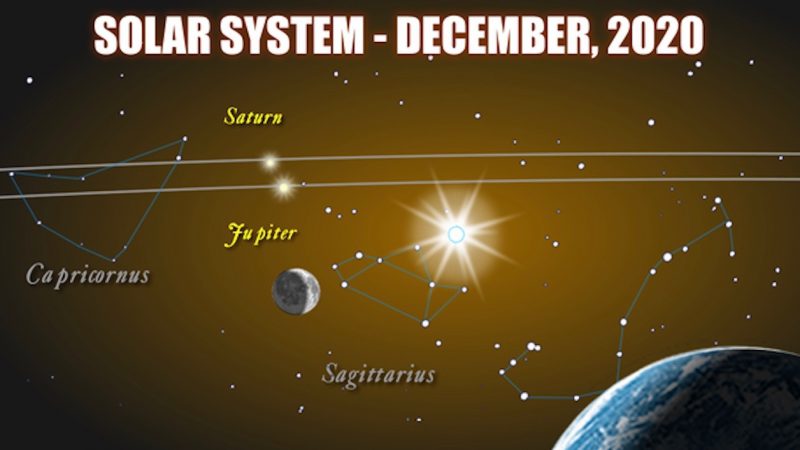
Crescent Earth, distant crescent moon, Jupiter and Saturn close together with their orbits.

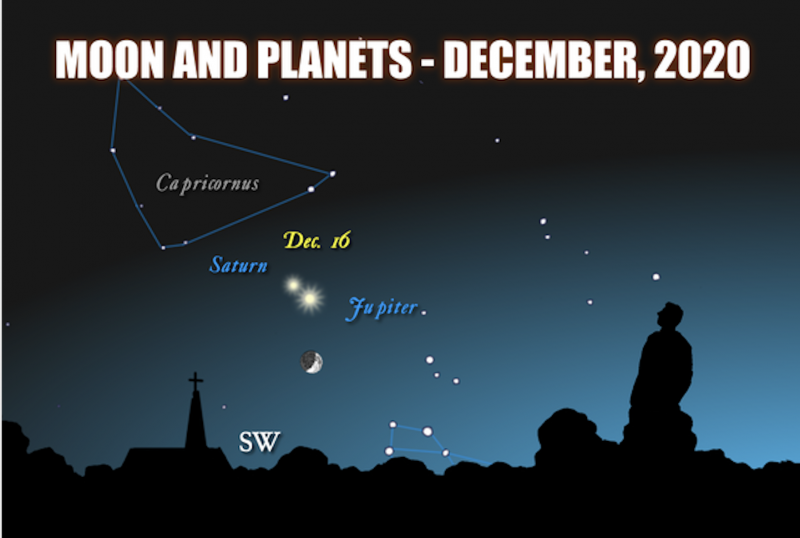
Artist’s concept of Jupiter and Saturn in December of 2020, as viewed from a space-based perspective. Notice that – on December 16, 2020 – the moon will also be part of the view. Chart via Jay Ryan at ClassicalAstronomy.com.

Reprinted with permission from Jay Ryan at ClassicalAstronomy.com

Editor’s Note: Astronomers use the word conjunction to describe meetings of planets and other objects on our sky’s dome. When two objects are in conjunction in our sky, they are located along the same line of sight in space, as viewed from Earth. Jupiter and Saturn have a conjunction about every 20 years. The next one will be December 21, 2020. Between now and then … watch Jupiter and Saturn draw close together in our sky!

Jupiter has been dominating the evening sky all summer. If you’ve never spotted Jupiter before, you might be surprised by the blazing, brilliant brightness of this object. The planets are among the brightest “stars” in the night sky, and Jupiter is the fourth brightest object visible from the Earth, after the sun, moon and Venus. If you’re in the Northern Hemisphere, look for Jupiter above the southern horizon in the early evening sky after night falls; if you’re in the Southern Hemisphere, look closer to overhead. You can’t miss Jupiter; it is brighter than any star. Jupiter is currently passing through the constellation Scorpius, and is to the upper left of the bright star Antares in Scorpius.

Also sharing the evening sky with Jupiter in the current season is the planet Saturn, currently passing through the constellation Sagittarius, the next constellation to the east from Scorpius. Saturn is not as bright as Jupiter, but it’s still comparable in brightness to the brightest stars in the sky.

Saturn is an amazing object in even small amateur telescopes since its famous rings are easy to see. Jupiter itself is also very cool, with the four Galilean moons readily visible in even the smallest scopes. While it’s still summer, everyone should visit a local astronomy club, planetarium or observatory to see these objects. These organizations all have public events where families can visit and look through ‘scopes. Check out this searchable database from Sky & Telescope magazine to find one in your area.

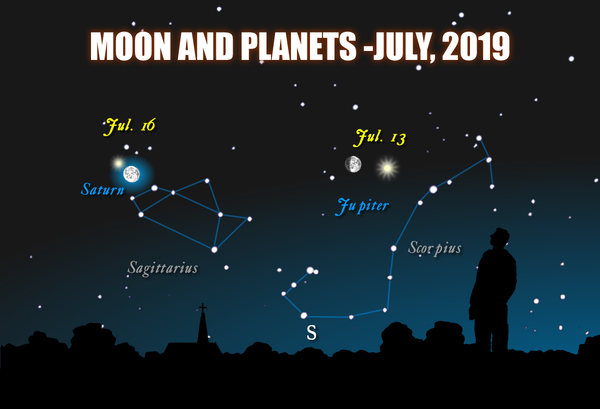
One of the features of the planets is that they all lie along the ecliptic, which is a circle in the sky that roughly corresponds to the plane of the solar system. So each month, the moon passes by each of the planets. Since Jupiter and Saturn are currently so close together, look for the moon to pass between these planets over a span of successive evenings. Here’s how the scene appeared last month, in July 2019.

Chart showing the moon, Jupiter and Saturn in front of the constellations Scorpius and Sagittarius, July, 2019.

Here’s how Jupiter and Saturn looked last month – July 2019 – when the moon passed near. Chart via Jay Ryan at ClassicalAstronomy.com.

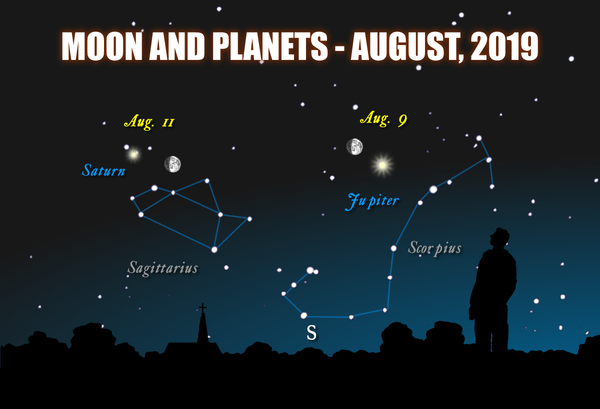
A similar scene will repeat this month, when the waxing gibbous moon passes near Jupiter on the evening of Friday, August 9. On the next day, Saturday, the moon will appear between Jupiter and Saturn. By Sunday evening, August 11, the moon will have shifted further to the east, appearing to draw close to Saturn. The moon’s conjunction (or closest alignment) with Saturn will occur many hours later, when it is daytime over the U.S. Observers in the Pacific, including Australia and New Zealand, will see an occultation of Saturn by the moon, which happens when the moon’s face passes over the planet, blocking the view for a time.

Read more: Moon, Jupiter, Saturn … Perseid meteors?

Chart showing the moon, Jupiter and Saturn in front of the constellations Scorpius and Sagittarius, August, 2019.

Here’s how Jupiter and Saturn will look later this month – August 9 to 11, 2019 – when the moon will pass near again. Chart via Jay Ryan at ClassicalAstronomy.com. Read more about the upcoming sweep of the moon past from and Saturn from EarthSky.

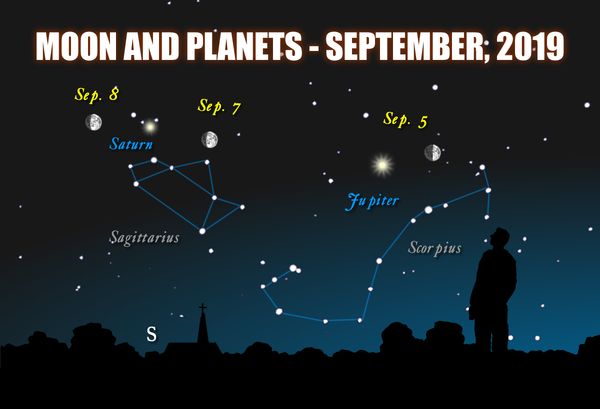
Keep your eyes on the moon and planets through the next month when you’ll see another pair of lunar-planetary conjunctions in September. The first quarter moon draws close to Jupiter on the evening of Thursday, September 5, and the gibbous phase is seen on either side of Saturn on the following Saturday and Sunday, September 7 and 8.

Chart showing the moon, Jupiter and Saturn in front of the constellations Scorpius and Sagittarius, September, 2019.

And here are these planets again – Jupiter and Saturn – from September 5 to 8, 2019, when the moon will pass near yet again. Chart via Jay Ryan at ClassicalAstronomy.com.

If you’ve been following Jupiter and Saturn over the last several years, you may now notice that these planets were not so close together in recent times. Due to the movements of the planets in their orbits, Jupiter and Saturn are slowly drawing into alignment with each other. This is because of the relative speeds of their orbits.

According to Kepler’s Laws of Planetary Motion, planets move faster in their orbits if they are closer to the sun. Conversely, the further a planet is away from the sun, the slower it moves.

Jupiter is quite far from the sun at five astronomical units, and a “year” on Jupiter is as long as 12 Earth years. So Jupiter is seen passing through the zodiac at the leisurely rate of one constellation to the east per year. This is why Jupiter was passing through Libra last year and is now in Scorpius in 2019.

Saturn is nearly twice as far from the sun as Jupiter, 9.5 astronomical units, and thus the Saturn “year” is 29.5 years in length. Saturn therefore requires more than two years to move through a single zodiac constellation.

At this rate, Jupiter “catches up” with Saturn after a span of years. About every 20 years, Jupiter and Saturn line up in a rare planetary conjunction. When that happens, Jupiter and Saturn are lined up with each as seen from the sun.

The conjunction of Jupiter and Saturn will occur on December 21, 2020. At that time, these planets will line up quite close to the sun, as seen from the Earth. They will be low in the sunset sky.

Silhouette of man looking at the moon and the close-together planets Jupiter and Saturn.

Artist’s concept of Jupiter and Saturn in December of 2020, as viewed from Earth’s surface. Notice that – on December 16, 2020 – the moon will also be part of the view. However, Jupiter and Saturn will be close to the sun in our sky then. Chart via Jay Ryan at ClassicalAstronomy.com.

Over the coming year, Jupiter and Saturn will be steadily moving closer and closer toward convergence. During the summer of 2020, it should be a lot of fun to watch these two planets draw together into alignment. By December 2020, this planetary pair will be hanging low in the evening sky, soon to disappear into the sunset. On the evening of December 16, 2020, the waxing crescent moon will align with these planets, making an amazing sight in the twilight sky on the threshold of winter.

Jupiter and Saturn last aligned on May 21, 2000. After the date of conjunction in 2020, Jupiter will progress to the east and draw further and further away from Saturn throughout the decade of the 20s. After that, the two planets will approach each other through the 2030s, reaching conjunction again on November 5, 2040.

Beyond that, Jupiter-Saturn conjunctions will occur on April 10, 2060, March 15, 2080, and September 24, 2100. This is something to discuss with your grandchildren! But for those of us “of a certain age,” the 2020 conjunction might be our last chance to see Jupiter and Saturn align!

It’s not too early to circle that date on your calendar!

Bottom line: Watch for Jupiter and Saturn in the night sky. They are well placed for viewing in the evening now as seen from the entire Earth. Jupiter is brighter than any star. In the coming months, these two bright planets will draw closer. Their conjunction will come in December of 2020, when they’ll appear low in the west after sunset.


from EarthSky https://ift.tt/2ORfrgS
Crescent Earth, distant crescent moon, Jupiter and Saturn close together with their orbits.

Artist’s concept of Jupiter and Saturn in December of 2020, as viewed from a space-based perspective. Notice that – on December 16, 2020 – the moon will also be part of the view. Chart via Jay Ryan at ClassicalAstronomy.com.

Reprinted with permission from Jay Ryan at ClassicalAstronomy.com

Editor’s Note: Astronomers use the word conjunction to describe meetings of planets and other objects on our sky’s dome. When two objects are in conjunction in our sky, they are located along the same line of sight in space, as viewed from Earth. Jupiter and Saturn have a conjunction about every 20 years. The next one will be December 21, 2020. Between now and then … watch Jupiter and Saturn draw close together in our sky!

Jupiter has been dominating the evening sky all summer. If you’ve never spotted Jupiter before, you might be surprised by the blazing, brilliant brightness of this object. The planets are among the brightest “stars” in the night sky, and Jupiter is the fourth brightest object visible from the Earth, after the sun, moon and Venus. If you’re in the Northern Hemisphere, look for Jupiter above the southern horizon in the early evening sky after night falls; if you’re in the Southern Hemisphere, look closer to overhead. You can’t miss Jupiter; it is brighter than any star. Jupiter is currently passing through the constellation Scorpius, and is to the upper left of the bright star Antares in Scorpius.

Also sharing the evening sky with Jupiter in the current season is the planet Saturn, currently passing through the constellation Sagittarius, the next constellation to the east from Scorpius. Saturn is not as bright as Jupiter, but it’s still comparable in brightness to the brightest stars in the sky.

Saturn is an amazing object in even small amateur telescopes since its famous rings are easy to see. Jupiter itself is also very cool, with the four Galilean moons readily visible in even the smallest scopes. While it’s still summer, everyone should visit a local astronomy club, planetarium or observatory to see these objects. These organizations all have public events where families can visit and look through ‘scopes. Check out this searchable database from Sky & Telescope magazine to find one in your area.

One of the features of the planets is that they all lie along the ecliptic, which is a circle in the sky that roughly corresponds to the plane of the solar system. So each month, the moon passes by each of the planets. Since Jupiter and Saturn are currently so close together, look for the moon to pass between these planets over a span of successive evenings. Here’s how the scene appeared last month, in July 2019.

Chart showing the moon, Jupiter and Saturn in front of the constellations Scorpius and Sagittarius, July, 2019.

Here’s how Jupiter and Saturn looked last month – July 2019 – when the moon passed near. Chart via Jay Ryan at ClassicalAstronomy.com.

A similar scene will repeat this month, when the waxing gibbous moon passes near Jupiter on the evening of Friday, August 9. On the next day, Saturday, the moon will appear between Jupiter and Saturn. By Sunday evening, August 11, the moon will have shifted further to the east, appearing to draw close to Saturn. The moon’s conjunction (or closest alignment) with Saturn will occur many hours later, when it is daytime over the U.S. Observers in the Pacific, including Australia and New Zealand, will see an occultation of Saturn by the moon, which happens when the moon’s face passes over the planet, blocking the view for a time.

Read more: Moon, Jupiter, Saturn … Perseid meteors?

Chart showing the moon, Jupiter and Saturn in front of the constellations Scorpius and Sagittarius, August, 2019.

Here’s how Jupiter and Saturn will look later this month – August 9 to 11, 2019 – when the moon will pass near again. Chart via Jay Ryan at ClassicalAstronomy.com. Read more about the upcoming sweep of the moon past from and Saturn from EarthSky.

Keep your eyes on the moon and planets through the next month when you’ll see another pair of lunar-planetary conjunctions in September. The first quarter moon draws close to Jupiter on the evening of Thursday, September 5, and the gibbous phase is seen on either side of Saturn on the following Saturday and Sunday, September 7 and 8.

Chart showing the moon, Jupiter and Saturn in front of the constellations Scorpius and Sagittarius, September, 2019.

And here are these planets again – Jupiter and Saturn – from September 5 to 8, 2019, when the moon will pass near yet again. Chart via Jay Ryan at ClassicalAstronomy.com.

If you’ve been following Jupiter and Saturn over the last several years, you may now notice that these planets were not so close together in recent times. Due to the movements of the planets in their orbits, Jupiter and Saturn are slowly drawing into alignment with each other. This is because of the relative speeds of their orbits.

According to Kepler’s Laws of Planetary Motion, planets move faster in their orbits if they are closer to the sun. Conversely, the further a planet is away from the sun, the slower it moves.

Jupiter is quite far from the sun at five astronomical units, and a “year” on Jupiter is as long as 12 Earth years. So Jupiter is seen passing through the zodiac at the leisurely rate of one constellation to the east per year. This is why Jupiter was passing through Libra last year and is now in Scorpius in 2019.

Saturn is nearly twice as far from the sun as Jupiter, 9.5 astronomical units, and thus the Saturn “year” is 29.5 years in length. Saturn therefore requires more than two years to move through a single zodiac constellation.

At this rate, Jupiter “catches up” with Saturn after a span of years. About every 20 years, Jupiter and Saturn line up in a rare planetary conjunction. When that happens, Jupiter and Saturn are lined up with each as seen from the sun.

The conjunction of Jupiter and Saturn will occur on December 21, 2020. At that time, these planets will line up quite close to the sun, as seen from the Earth. They will be low in the sunset sky.

Silhouette of man looking at the moon and the close-together planets Jupiter and Saturn.

Artist’s concept of Jupiter and Saturn in December of 2020, as viewed from Earth’s surface. Notice that – on December 16, 2020 – the moon will also be part of the view. However, Jupiter and Saturn will be close to the sun in our sky then. Chart via Jay Ryan at ClassicalAstronomy.com.

Over the coming year, Jupiter and Saturn will be steadily moving closer and closer toward convergence. During the summer of 2020, it should be a lot of fun to watch these two planets draw together into alignment. By December 2020, this planetary pair will be hanging low in the evening sky, soon to disappear into the sunset. On the evening of December 16, 2020, the waxing crescent moon will align with these planets, making an amazing sight in the twilight sky on the threshold of winter.

Jupiter and Saturn last aligned on May 21, 2000. After the date of conjunction in 2020, Jupiter will progress to the east and draw further and further away from Saturn throughout the decade of the 20s. After that, the two planets will approach each other through the 2030s, reaching conjunction again on November 5, 2040.

Beyond that, Jupiter-Saturn conjunctions will occur on April 10, 2060, March 15, 2080, and September 24, 2100. This is something to discuss with your grandchildren! But for those of us “of a certain age,” the 2020 conjunction might be our last chance to see Jupiter and Saturn align!

It’s not too early to circle that date on your calendar!

Bottom line: Watch for Jupiter and Saturn in the night sky. They are well placed for viewing in the evening now as seen from the entire Earth. Jupiter is brighter than any star. In the coming months, these two bright planets will draw closer. Their conjunction will come in December of 2020, when they’ll appear low in the west after sunset.


from EarthSky https://ift.tt/2ORfrgS

Will you catch Mercury at dawn?

The photo above – by Radu Anghel in Bacau, Romania – shows our sun’s innermost planet Mercury after sunset in February 2019. Although it’s intrinsically a bright object, Mercury often appears as this photo shows it, in a sky washed with twilight colors. Seeing it often requires a search. On the other hand, for much of every year, Mercury, the innermost planet, is lost in the glare of the sun, not visible at all. It’s only at opportune times, when Mercury nears or reaches its greatest elongation (maximum angular separation) from the sun on the sky’s dome, that it’s possible to catch Mercury at its highest above the sunset or sunrise. Now is such a time.

In early August – as viewed from around Earth’s globe – Mercury appears in the east before sunrise. On August 9, 2019, Mercury will reach its greatest elongation of 19 degrees west of the sun. Given clear skies, there’s a good chance that you’ll see Mercury with the eye alone, for this world is a bright as a 1st-magnitude star.

Mercury will be over 18 degrees west of the sun all this upcoming week, from August 7 to 14. The amount of time that Mercury rises before the sun, however, depends on your latitude, with the Northern Hemisphere enjoying the advantage. We give the rising times for various latitudes below, but please keep in mind that these times presume a level horizon.

40 degrees north latitude
August 7: Mercury rises 1 hour and 26 minutes before the sun
August 14: Mercury rises 1 hour and 28 minutes before the sun

Equator (0 degrees latitude)
August 7: Mercury rises 1 hour and 16 minutes before the sun
August 14: Mercury rises 1 hour and 12 minutes before the sun

35 degrees south latitude
August 7: Mercury rises 1 hour and 9 minutes before the sun
August 14: Mercury rises 56 minutes before the sun

Source: US Naval Observatory

Want more specific rising times? Click here for a recommended sky almanac.

Looking things over, it appears that the opportunity for catching Mercury in the morning sky stays roughly the same throughout the week, especially at northerly latitudes. However, the one thing these rising times don’t tell you is that Mercury is actually brightening day by day. This world will be some 2 1/2 times brighter on August 14 than it appeared on August 7. By August 20, Mercury will be nearly 5 times brighter than it was on August 7. Moreover, from 40 degrees north latitude, Mercury will still rise 1 1/4 hours before the sun on August 20, so this world still may be visible on that date from northerly latitudes.

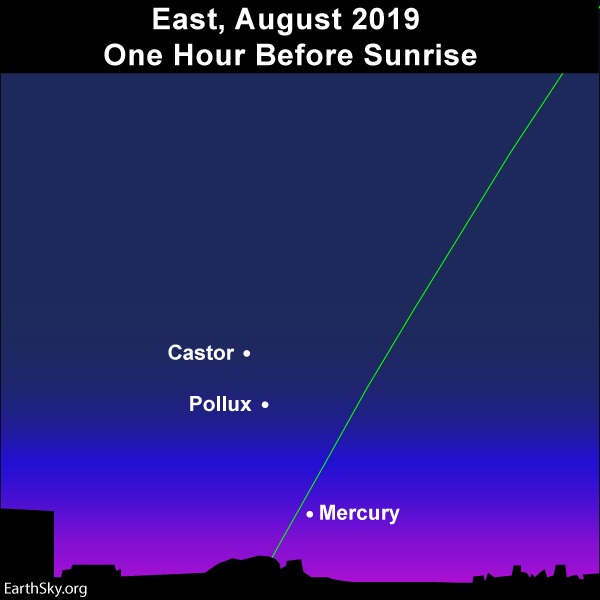
The planet Mercury lines up with the stars Castor and Pollux.

On or near August 11, 2019, the planet Mercury will line up with the Gemini stars, Castor and Pollux. They’ll be pointing to Mercury and can help you find it. Appreciably before that date, by the way, Mercury will be found to the west (right) of the Castor-Pollux line.

Given that Mercury is getting brighter by the day, you may be able to catch Mercury before sunrise for the next two weeks at northerly latitudes. Mercury brightens in our sky whenever this world waxes in phase. Mercury’s disk is about 30 percent illuminated by sunshine on August 7, yet about 80 percent illuminated on August 20. Although you need a telescope to see Mercury’s phase, its waxing phase nonetheless increases this world’s overall brightness to the unaided eye.

For the next couple of weeks, try to catch Mercury as the predawn darkness is giving way to dawn. To maximize your chances of catching Mercury, which looks like a star to the naked eye, find an unobstructed horizon in the direction of sunrise.

Want more information? Geocentric Ephemeris for Mercury 2019

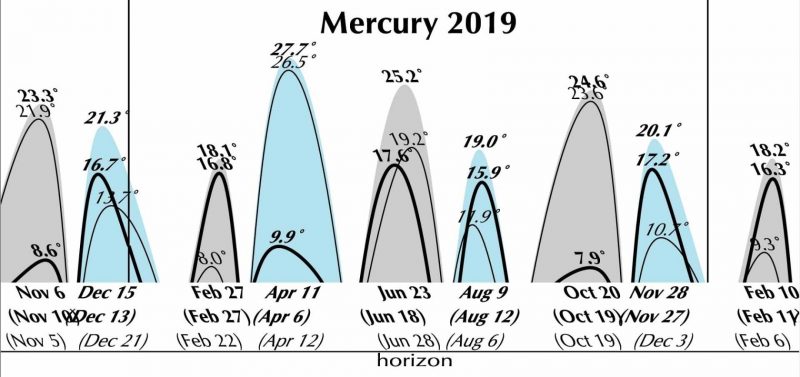
Graph showing Mercury's elongations from the sun in 2019.

View larger. | Here are the year’s apparitions of Mercury compared: 3 swings out from the neighborhood of the sun into the evening sky (gray) and 3 into the morning sky (blue). The top figures are the maximum elongations – maximum apparent distance from the sun – reached at the top dates given beneath. Curving lines show the altitude of the planet above the horizon at sunrise or sunset, for latitude 40 degrees north (thick line) and 35 degrees south (thin), with maxima reached at the parenthesized dates below (40 degrees north bold). Chart via Guy Ottewell’s blog.

Bottom line: Mercury will be over 18 degrees west of the sun – that is, visible in our eastern sky before sunrise – all this upcoming week, from about August 7 to 14, 2019. With Mercury getting brighter by the day, you might it before sunrise for the next two weeks at latitudes in the Northern Hemisphere.


from EarthSky https://ift.tt/33gDIjd

The photo above – by Radu Anghel in Bacau, Romania – shows our sun’s innermost planet Mercury after sunset in February 2019. Although it’s intrinsically a bright object, Mercury often appears as this photo shows it, in a sky washed with twilight colors. Seeing it often requires a search. On the other hand, for much of every year, Mercury, the innermost planet, is lost in the glare of the sun, not visible at all. It’s only at opportune times, when Mercury nears or reaches its greatest elongation (maximum angular separation) from the sun on the sky’s dome, that it’s possible to catch Mercury at its highest above the sunset or sunrise. Now is such a time.

In early August – as viewed from around Earth’s globe – Mercury appears in the east before sunrise. On August 9, 2019, Mercury will reach its greatest elongation of 19 degrees west of the sun. Given clear skies, there’s a good chance that you’ll see Mercury with the eye alone, for this world is a bright as a 1st-magnitude star.

Mercury will be over 18 degrees west of the sun all this upcoming week, from August 7 to 14. The amount of time that Mercury rises before the sun, however, depends on your latitude, with the Northern Hemisphere enjoying the advantage. We give the rising times for various latitudes below, but please keep in mind that these times presume a level horizon.

40 degrees north latitude
August 7: Mercury rises 1 hour and 26 minutes before the sun
August 14: Mercury rises 1 hour and 28 minutes before the sun

Equator (0 degrees latitude)
August 7: Mercury rises 1 hour and 16 minutes before the sun
August 14: Mercury rises 1 hour and 12 minutes before the sun

35 degrees south latitude
August 7: Mercury rises 1 hour and 9 minutes before the sun
August 14: Mercury rises 56 minutes before the sun

Source: US Naval Observatory

Want more specific rising times? Click here for a recommended sky almanac.

Looking things over, it appears that the opportunity for catching Mercury in the morning sky stays roughly the same throughout the week, especially at northerly latitudes. However, the one thing these rising times don’t tell you is that Mercury is actually brightening day by day. This world will be some 2 1/2 times brighter on August 14 than it appeared on August 7. By August 20, Mercury will be nearly 5 times brighter than it was on August 7. Moreover, from 40 degrees north latitude, Mercury will still rise 1 1/4 hours before the sun on August 20, so this world still may be visible on that date from northerly latitudes.

The planet Mercury lines up with the stars Castor and Pollux.

On or near August 11, 2019, the planet Mercury will line up with the Gemini stars, Castor and Pollux. They’ll be pointing to Mercury and can help you find it. Appreciably before that date, by the way, Mercury will be found to the west (right) of the Castor-Pollux line.

Given that Mercury is getting brighter by the day, you may be able to catch Mercury before sunrise for the next two weeks at northerly latitudes. Mercury brightens in our sky whenever this world waxes in phase. Mercury’s disk is about 30 percent illuminated by sunshine on August 7, yet about 80 percent illuminated on August 20. Although you need a telescope to see Mercury’s phase, its waxing phase nonetheless increases this world’s overall brightness to the unaided eye.

For the next couple of weeks, try to catch Mercury as the predawn darkness is giving way to dawn. To maximize your chances of catching Mercury, which looks like a star to the naked eye, find an unobstructed horizon in the direction of sunrise.

Want more information? Geocentric Ephemeris for Mercury 2019

Graph showing Mercury's elongations from the sun in 2019.

View larger. | Here are the year’s apparitions of Mercury compared: 3 swings out from the neighborhood of the sun into the evening sky (gray) and 3 into the morning sky (blue). The top figures are the maximum elongations – maximum apparent distance from the sun – reached at the top dates given beneath. Curving lines show the altitude of the planet above the horizon at sunrise or sunset, for latitude 40 degrees north (thick line) and 35 degrees south (thin), with maxima reached at the parenthesized dates below (40 degrees north bold). Chart via Guy Ottewell’s blog.

Bottom line: Mercury will be over 18 degrees west of the sun – that is, visible in our eastern sky before sunrise – all this upcoming week, from about August 7 to 14, 2019. With Mercury getting brighter by the day, you might it before sunrise for the next two weeks at latitudes in the Northern Hemisphere.


from EarthSky https://ift.tt/33gDIjd

Climate change made Europe’s 2019 record heatwave up to ‘100 times more likely’

This is a re-post from Carbon Brief by Daisy Dunne

The run of unprecedented temperatures in July – which sent records tumbling in the UK, the Netherlands, Belgium and Germany – would have been “extremely unlikely” without climate change, according to a new quick-fire analysis.

The hot weather seen in the Netherlands and France was made up to “100 times more likely” by climate change, the study finds.

And the heat in Cambridge in the UK – which saw a new country-wide record of 38.7C in July – was made around “20 times more likely” by human-caused warming.

The findings come from the latest analysis from the World Weather Attribution network. “Attribution” refers to a fast-growing field of science that aims to quantify the “fingerprint” of climate change on extreme-weather events.

Across Europe, the July heatwave was “much more extreme than any other heatwave we’ve looked at over the last few years”, a scientist from the network tells Carbon Brief.

Heat goes on

Following a record-breaking early heatwave in June, Europe has now seen a second episode of unprecedented temperatures.

The extreme heat began across the continent on Sunday 21 July and reached its peak on Thursday 25 July – when the UK recorded its highest ever temperature of 38.7C at the Cambridge University Botanic Garden.

The hot weather caused days of travel chaos in the UK – as train engineers rushed to repair damaged rail lines and UK airports grappled with air traffic control issues.

Meanwhile, Belgium, Germany and the Netherlands also saw new temperature records, of 41.8C, 41.5C and 40.7C, respectively.

Paris also saw its hottest ever day on Thursday when temperatures reached 42.6C – hampering restoration work on Notre Dame Cathedral.

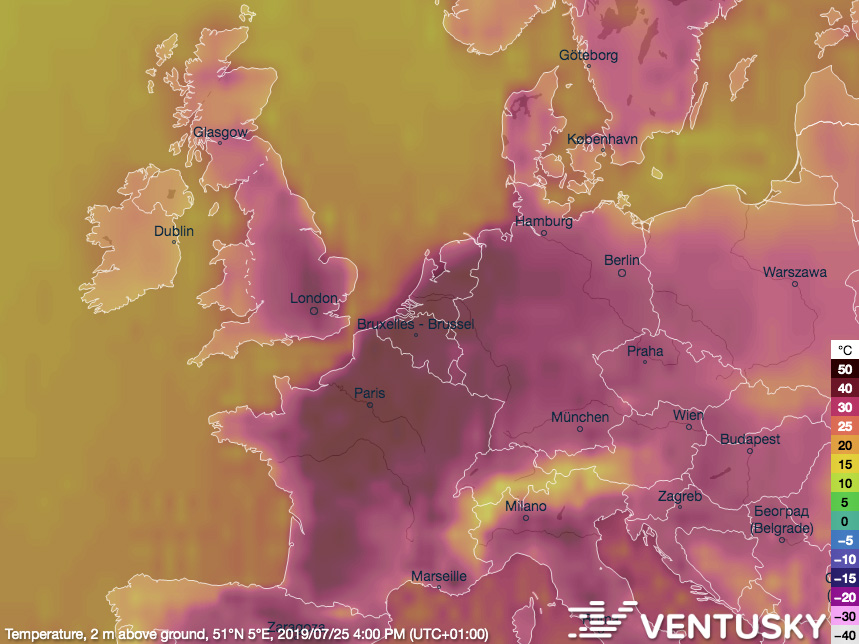
The map below shows the spread of temperatures across Europe as the heatwave reached its peak on Thursday, 25 July.

Data visualisation of air temperatures over Europe on Thursday, 25 July at 16:00 BST. Created with Ventusky.

Data visualisation of air temperatures over Europe on Thursday, 25 July at 16:00 BST. Created with Ventusky.

The source of the unusual heat was North Africa, scientists say, drawn up to Europe because of high pressure to the east of the UK.

The new analysis explores how the likelihood of such an event could have been boosted by human-caused climate change.

To do this, the research team gathered temperature data taken from across 75 weather stations in France, Germany, the Netherlands and the UK, including in Oxford and Cambridge.

The findings show that the July heatwave was “unprecedented” in scale and intensity, says Dr Geert Jan van Oldenborgh, a member of the WWA network from the Royal Netherlands Meteorological Institute. He tells Carbon Brief:

“We find that it was much more extreme than any other heatwave we’ve looked at over the last few years. [It impacted] France, Luxembourg, Belgium, the Netherlands, western Germany, eastern England and also parts of Scandinavia – and at the moment it’s inducing a large melting event over Greenland.”

Falling odds

For the first part of their analysis, the researchers used long-term temperature data to work out how often a heatwave on the same scale as that seen in July is likely to occur in today’s climate.

They find that, in France and the Netherlands, the temperatures seen in the July heatwave had around a one-in-50 and one-in-150 chance of occurring, respectively. This means that the heat seen in France and the Netherlands was “rare”, the authors say.

The heat seen in the UK in July, however, was “less rare”, van Oldernborgh says:

“For Britain, it was not all that unusual. For Oxford, it was a one-in-10 year event. For Cambridge, it was a one-in-30 year event.”

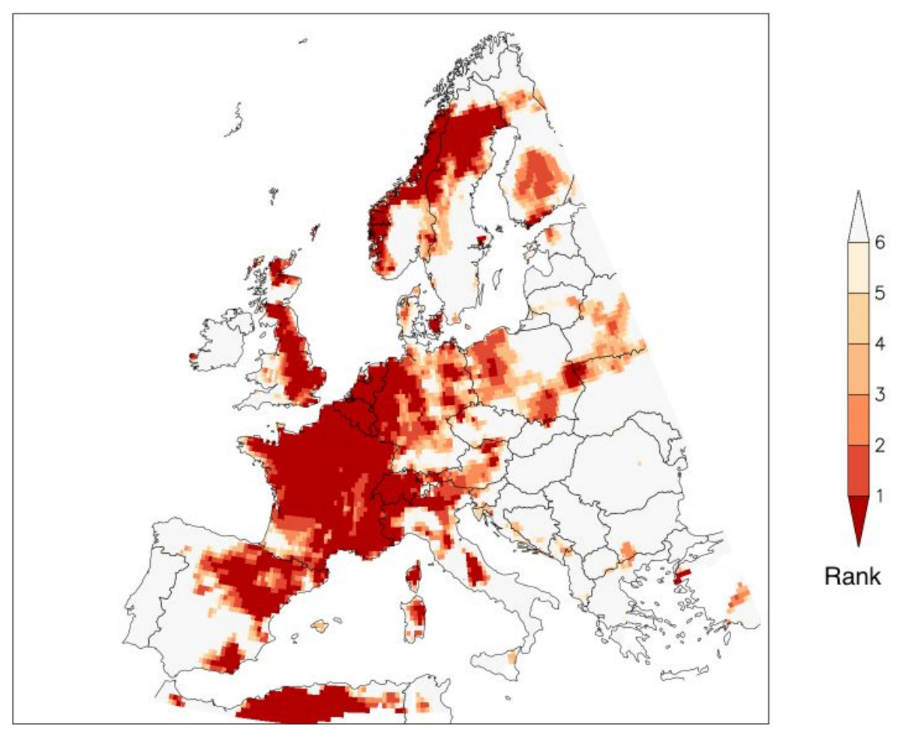
The chart below, taken from the analysis, shows the rank of annual maximum temperatures observed in Europe in 2019 when compared to 1950-2018. On the map, dark red indicates that the warmest annual temperature seen in 2019 is ranked first when compared to all the years between 1950 and 2018.

The rank of annual maximum temperatures observed in Europe in 2019 when compared to 1950-2018. On the map, dark red indicates that the warmest annual temperature seen in 2019 is ranked first when compared to 1950-2018. The authors say: “This figure is made with preliminary data and should be taken with caution as some measurements are not yet validated.” Source: World Weather Attribution

The rank of annual maximum temperatures observed in Europe in 2019 when compared to 1950-2018. On the map, dark red indicates that the warmest annual temperature seen in 2019 is ranked first when compared to 1950-2018. The authors say: “This figure is made with preliminary data and should be taken with caution as some measurements are not yet validated.” Source: World Weather Attribution

To explore the influence of climate change on France’s heatwave, the authors carried out an “attribution analysis” using a selection of climate models.

For each model, the authors produced two sets of simulations. These simulations compare the chances of a heatwave on the same scale as that seen in Europe in July occurring in today’s climate to the climate of 1900 – a time when the human impact on the climate was much less pronounced.

The simulations of today’s climate included many of the factors that can influence the climate, including human-driven greenhouse gases, volcanic eruptions and solar variability. The simulations from 1900 included all of these factors except for human-driven greenhouse gases.

The researchers then studied the simulations to see how often heatwaves on the same scale as that seen in July occur in both today’s climate and the climate of 1900.

The research finds that, in France and the Netherlands, “such temperatures would have had extremely little chance to occur without human influence on climate”. Climate change likely boosted the odds of the heat seen in these countries by up to 100 times, the authors say.

In comparison, climate change made the heat seen in the UK and Germany around “five to 10 times more likely”, the researchers say.

However, in Cambridge specifically – where the all-time UK temperature record was broken – the heat was made around 20 times more likely by climate change, according to the analysis.

Burning up

As part of the analysis, the authors also looked at how extreme the temperatures seen during the July heatwave were in comparison to those seen in the past.

The authors find that the temperatures seen during this heatwave were around 3C higher than they would have been in 1900.

This is double the heatwave temperature increase expected by climate models – which are used to make projections about future climate change, van Oldernborgh says:

“The models only predict that heatwaves get warmer at about 1.5C per degree of global warming. So for every degree of global warming, they predict that heatwaves get 1.5C hotter – a little bit faster but not really exceptional.”

The world has seen around 1C of global warming so far – meaning that the models would expect heatwaves to be around 1.5C hotter today than in pre-industrial times. However, temperatures during this heatwave were actually around 3C warmer, he says:

“We really need to do a lot more serious research than we can do within one week to look at why there is such a big discrepancy between the observed trends and the modelled trends.

“But heatwaves are very special. A lot of things come together for a heatwave – heat from the Sahara, local heating due to sunshine, the reaction of vegetation due to very hot conditions – and all these things have to be modelled right. I’m just afraid that these models that have been designed to project the average climate correctly cannot handle these very extreme situations very well.”

The findings are yet to be published in a peer-reviewed journal. However, the methods used in the analysis have been published in previous attribution studies.


from Skeptical Science https://ift.tt/31gYJsg

This is a re-post from Carbon Brief by Daisy Dunne

The run of unprecedented temperatures in July – which sent records tumbling in the UK, the Netherlands, Belgium and Germany – would have been “extremely unlikely” without climate change, according to a new quick-fire analysis.

The hot weather seen in the Netherlands and France was made up to “100 times more likely” by climate change, the study finds.

And the heat in Cambridge in the UK – which saw a new country-wide record of 38.7C in July – was made around “20 times more likely” by human-caused warming.

The findings come from the latest analysis from the World Weather Attribution network. “Attribution” refers to a fast-growing field of science that aims to quantify the “fingerprint” of climate change on extreme-weather events.

Across Europe, the July heatwave was “much more extreme than any other heatwave we’ve looked at over the last few years”, a scientist from the network tells Carbon Brief.

Heat goes on

Following a record-breaking early heatwave in June, Europe has now seen a second episode of unprecedented temperatures.

The extreme heat began across the continent on Sunday 21 July and reached its peak on Thursday 25 July – when the UK recorded its highest ever temperature of 38.7C at the Cambridge University Botanic Garden.

The hot weather caused days of travel chaos in the UK – as train engineers rushed to repair damaged rail lines and UK airports grappled with air traffic control issues.

Meanwhile, Belgium, Germany and the Netherlands also saw new temperature records, of 41.8C, 41.5C and 40.7C, respectively.

Paris also saw its hottest ever day on Thursday when temperatures reached 42.6C – hampering restoration work on Notre Dame Cathedral.

The map below shows the spread of temperatures across Europe as the heatwave reached its peak on Thursday, 25 July.

Data visualisation of air temperatures over Europe on Thursday, 25 July at 16:00 BST. Created with Ventusky.

Data visualisation of air temperatures over Europe on Thursday, 25 July at 16:00 BST. Created with Ventusky.

The source of the unusual heat was North Africa, scientists say, drawn up to Europe because of high pressure to the east of the UK.

The new analysis explores how the likelihood of such an event could have been boosted by human-caused climate change.

To do this, the research team gathered temperature data taken from across 75 weather stations in France, Germany, the Netherlands and the UK, including in Oxford and Cambridge.

The findings show that the July heatwave was “unprecedented” in scale and intensity, says Dr Geert Jan van Oldenborgh, a member of the WWA network from the Royal Netherlands Meteorological Institute. He tells Carbon Brief:

“We find that it was much more extreme than any other heatwave we’ve looked at over the last few years. [It impacted] France, Luxembourg, Belgium, the Netherlands, western Germany, eastern England and also parts of Scandinavia – and at the moment it’s inducing a large melting event over Greenland.”

Falling odds

For the first part of their analysis, the researchers used long-term temperature data to work out how often a heatwave on the same scale as that seen in July is likely to occur in today’s climate.

They find that, in France and the Netherlands, the temperatures seen in the July heatwave had around a one-in-50 and one-in-150 chance of occurring, respectively. This means that the heat seen in France and the Netherlands was “rare”, the authors say.

The heat seen in the UK in July, however, was “less rare”, van Oldernborgh says:

“For Britain, it was not all that unusual. For Oxford, it was a one-in-10 year event. For Cambridge, it was a one-in-30 year event.”

The chart below, taken from the analysis, shows the rank of annual maximum temperatures observed in Europe in 2019 when compared to 1950-2018. On the map, dark red indicates that the warmest annual temperature seen in 2019 is ranked first when compared to all the years between 1950 and 2018.

The rank of annual maximum temperatures observed in Europe in 2019 when compared to 1950-2018. On the map, dark red indicates that the warmest annual temperature seen in 2019 is ranked first when compared to 1950-2018. The authors say: “This figure is made with preliminary data and should be taken with caution as some measurements are not yet validated.” Source: World Weather Attribution

The rank of annual maximum temperatures observed in Europe in 2019 when compared to 1950-2018. On the map, dark red indicates that the warmest annual temperature seen in 2019 is ranked first when compared to 1950-2018. The authors say: “This figure is made with preliminary data and should be taken with caution as some measurements are not yet validated.” Source: World Weather Attribution

To explore the influence of climate change on France’s heatwave, the authors carried out an “attribution analysis” using a selection of climate models.

For each model, the authors produced two sets of simulations. These simulations compare the chances of a heatwave on the same scale as that seen in Europe in July occurring in today’s climate to the climate of 1900 – a time when the human impact on the climate was much less pronounced.

The simulations of today’s climate included many of the factors that can influence the climate, including human-driven greenhouse gases, volcanic eruptions and solar variability. The simulations from 1900 included all of these factors except for human-driven greenhouse gases.

The researchers then studied the simulations to see how often heatwaves on the same scale as that seen in July occur in both today’s climate and the climate of 1900.

The research finds that, in France and the Netherlands, “such temperatures would have had extremely little chance to occur without human influence on climate”. Climate change likely boosted the odds of the heat seen in these countries by up to 100 times, the authors say.

In comparison, climate change made the heat seen in the UK and Germany around “five to 10 times more likely”, the researchers say.

However, in Cambridge specifically – where the all-time UK temperature record was broken – the heat was made around 20 times more likely by climate change, according to the analysis.

Burning up

As part of the analysis, the authors also looked at how extreme the temperatures seen during the July heatwave were in comparison to those seen in the past.

The authors find that the temperatures seen during this heatwave were around 3C higher than they would have been in 1900.

This is double the heatwave temperature increase expected by climate models – which are used to make projections about future climate change, van Oldernborgh says:

“The models only predict that heatwaves get warmer at about 1.5C per degree of global warming. So for every degree of global warming, they predict that heatwaves get 1.5C hotter – a little bit faster but not really exceptional.”

The world has seen around 1C of global warming so far – meaning that the models would expect heatwaves to be around 1.5C hotter today than in pre-industrial times. However, temperatures during this heatwave were actually around 3C warmer, he says:

“We really need to do a lot more serious research than we can do within one week to look at why there is such a big discrepancy between the observed trends and the modelled trends.

“But heatwaves are very special. A lot of things come together for a heatwave – heat from the Sahara, local heating due to sunshine, the reaction of vegetation due to very hot conditions – and all these things have to be modelled right. I’m just afraid that these models that have been designed to project the average climate correctly cannot handle these very extreme situations very well.”

The findings are yet to be published in a peer-reviewed journal. However, the methods used in the analysis have been published in previous attribution studies.


from Skeptical Science https://ift.tt/31gYJsg

Skeptical Science New Research for Week #31, 2019

56 articles this week.

What articles are open access?

When Ari was running this page open access articles were flagged as such. That feature is now restored. Note that identification of open access articles is largely mechanized under the new regime and so it's possible there will be omissions. Performance should improve over time.

Open access article titles are appended with "(open access)" in our list.  

What's "open access?" This denotes a scientific article free to read by any member of the public, without them needing to pay money or be affiliated to library privileges at an institution. Open access is closer approximation to ideal means for propagation and transfer of scientific information, refinement made possible by fundamental changes in the mechanics and logistics of scientific publishing. The open access publisher PLOS articulately explains the philosophical underpinnings. of open access.

The drive to open access in the verb sense has been profound and swift. 67% of this week's collection of publications are published as free to read. This begs a question: is the inability of a researcher or research team to pay fees for open access to their work a feature of a true meritocracy?

The Earth as systems engineering task

The International Space Station (ISS) functions as required— as a semi-closed system— because it's the subject of fanatical measurement and analysis. Everything that can possibly be accounted for, is. Rational planning coupled with regulation makes the operation of the ISS feasible. In a similar vein, today's largest cruise ships can support total human occupancy of nearly 9,000 persons for a few days at a time thanks to accounting, planning and boundaries on behavior. Passengers and crew of space stations and ships are not expected to figure out how they'll eat and breath without any plan or engineering support, and they're not free to behave exactly as they choose at all times.

With the Earth increasingly filling the role of a cruise ship packed to the gunnels with passengers and crew (7.5 billion souls on board, growing) and traveling an endless circular course around the Sun, it seems as though more "systems thinking" along the lines of what we freely admit is necessary for successful operation of smaller artifacts would be good practice to adopt. In this week's roundup of climate research pertaining to human affairs we find an explicit reference to that philosophy, The Earth System Governance Project as a network organization: a critical assessment after ten years  Many articles in the human affairs related section of research news are reflective of systems thinking of a kind we've not previously had to adopt but which is now increasingly obviously missing in our habits, to our detriment. Star-shaped cities alleviate trade-off between climate change mitigation and adaptation integrates various findings to produce a more systematic approach to urban design, an attempt at engineering cities that will function better than a random assemblage:

One strand of literature demonstrates that compact cities of sufficient density result in lower GHG emissions in the transport and the buildings sectors compared to sprawled cities. Another strand of literature, however, reveals that compactness hinders climate adaptation by amplifying the urban heat island (UHI) effect. As a result, mitigation and adaptation objectives of cities appear to contradict each other. Here, we develop a geometrical optimization framework and model of a three-dimensional city that minimizes this conflict. It makes use of the observation that low-carbon efficient transport can be realized via linear public transport axes, and that GHG emissions and UHI effects scale differently with varying geometric properties, thus enabling design that reflects both the economics and the climate of cities. We find that star-shaped cities, in contrast to radially symmetric cities, are well suited to alleviate the problematic trade-off. ... The results are of particular importance for city planners of rapidly urbanizing cities in Asia and Africa who still have the potential to shape urban layout.

What's the probability of this work being realized in a pure implementation? Probably low, but formally exploring engineered cultural systems allows us to assess our real world results against the realm of the possible, and to have tools readily available when we find improvement is mandatory.

More broadly, it's hard to say if our human culture systems thinking will evolve and its results be implemented with sufficient rapidity. So far our adjustments are lagging. But we can certainly bear in mind lessons from operation of our smaller engineered artifacts. It's safe to say that a cigar shop and cigar smokers on the ISS would require an engineering response to handle effluvia or a "no, you can't do that." Similarly, here on Earth it seems incumbent on promoters of coal mines to either provide a successfully engineered outcome for the side-effects or their trade, or be told that coal sales are not permitted as combustion of coal has proven incompatible with successful operation of Earth.

Engineering implies regulation. Regulation of behaviors isn't a radical concept— regulation of usage is part of successful engineering outcomes. A bridge is engineered to handle a certain amount of weight and this is not a matter of controversy. As it is performing the same effective role of the ISS at a much larger scale but without possibility of supply missions to make up for inefficiencies, Earth is also an engineering topic and conclusions necessarily arise from that fact. 

Suggestions

Please let us know if you're aware of an article you think may be of interest for Skeptical Science research news, or if we've missed something that may be important. Send your input to Skeptical Science via our contact form.

Articles:

Biology and climate change

The impact of climate change and human activity on the ecological status of Bosten Lake, NW China, revealed by a diatom record for the last 2000 years

Cross‐scale interactions dictate regional lake carbon flux and productivity response to future climate (open access)

Ecological water stress under projected climate change across hydroclimate gradients in the north central United States

Diverging phenological responses of Arctic seabirds to an earlier spring

Cloud cover and delayed herbivory relative to timing of spring onset interact to dampen climate change impacts on net ecosystem exchange in a coastal Alaskan wetland (open access)

Impacts of climate and insect herbivory on productivity and physiology of trembling aspen (Populus tremuloides) in Alaskan boreal forests (open access)

Renewable absorbents for CO2 capture: from biomass to nature

Sugarcane straw management for bioenergy: effects of global warming on greenhouse gas emissions and soil carbon storage (open access)

Large herbivore assemblages in a changing climate: incorporating water dependence and thermoregulation (open access)

Physical science and climate change

Trends in Precipitation Days in the United States (open access)

Future climate and land use change impacts on river flows in the Tapajós Basin in the Brazilian Amazon (open access)

Pliocene warmth consistent with greenhouse gas forcing (open access)

Explaining Differences between Recent Model and Satellite Tropospheric Warming Rates with Tropical SSTs (open access)

The polar stratosphere as an arbiter of the projected tropical versus polar tug‐of‐war (open access)

Multi‐Model Analysis of the Atmospheric Response to Antarctic Sea Ice Loss at Quadrupled CO2 (open access)

The relationship of cloud number and size with their large‐scale environment in deep tropical convection (open access)

Sea ice detection using GNSS‐R data from TechDemoSat‐1 (open access)

Ecohydrology controls the geomorphic response to climate change (open access)

MJO teleconnections over the PNA region in climate models. Part I: Performance- and process-based skill metrics

The 2015–2016 carbon cycle as seen from OCO-2 and the global in situ network

Changes in concentrations of fine and coarse particles under the CO2-induced global warming

Improved probabilistic twenty-first century projections of sea surface temperature over East Asian marginal seas by considering uncertainty owing to model error and internal variability (open access)

Consecutive extreme flooding and heat wave in Japan: Are they becoming a norm? (open access)

Significant feedbacks of wetland methane release on climate change and the causes of their uncertainty (open access)

Development of quantitative metrics of plume migration at geologic CO2 storage sites

Impact of geochemical and geomechanical changes on CO2 sequestration potential in sandstone and limestone aquifers

Humans deal with climate change

Modeling of power sector decarbonization in China: comparisons of early and delayed mitigation towards 2-degree target (open access)

The carbon footprint of Danish diets (open access)

Evidence-informed climate policy: mobilising strategic research and pooling expertise for rapid evidence generation (open access)

Redesigning knowledge systems for urban resilience

Star-shaped cities alleviate trade-off between climate change mitigation and adaptation (open access)

Amplification of risks to water supply at 1.5 °C and 2 °C in drying climates: a case study for Melbourne, Australia (open access)

The development of children’s environmental attitude and behavior

The contribution of carbon dioxide emissions from the aviation sector to future climate change (open access)

Climate change and air pollution: the connection between traffic intervention policies and public acceptance in a local context (open access)

Loss of profit in the hotel industry of the United States due to climate change (open access)

Assessment of policy conflict using systems thinking: A case study of carbon footprint reduction on Irish dairy farms

The Earth System Governance Project as a network organization: a critical assessment after ten years

Scarcity and Safe Operating Spaces: The Example of Natural Forests (open access)

The Effects of Discussion of Familiar or Non-Familiar Information on Opinions of Anthropogenic Climate Change (open access)

Predicting climate change risk perception and willingness to act

Estimating Chinese rural and urban residents’ carbon consumption and its drivers: considering capital formation as a productive input (open access)

Climate change and agriculture in South Asia: adaptation options in smallholder production systems (open access)

Greenhouse gas fluxes and mitigation potential for managed lands in the Russian Federation (open access)

Parametric loss and damage insurance schemes as a means to enhance climate change resilience in developing countries (open access)

Mapping and clustering the adoption of carbon pricing policies: what polities price carbon and why? (open access)

Assessing negative carbon dioxide emissions from the perspective of a national “fair share” of the remaining global carbon budget (open access)

The levelized cost of carbon: a practical, if imperfect, method to compare CO2 abatement projects (open access)

Mid-Century Strategies: pathways to a low-carbon future? (open access)

Carbon storage and CO2 dynamics from wood products harvested in Brazil during 1900–2016 (open access)

Perceived fairness and public acceptability of carbon pricing: a review of the literature (open access)

Impact of climate change on financial analysis of a small hydropower project


The previous edition of Skeptical Science new research may be found here. 


from Skeptical Science https://ift.tt/31jVbFS

56 articles this week.

What articles are open access?

When Ari was running this page open access articles were flagged as such. That feature is now restored. Note that identification of open access articles is largely mechanized under the new regime and so it's possible there will be omissions. Performance should improve over time.

Open access article titles are appended with "(open access)" in our list.  

What's "open access?" This denotes a scientific article free to read by any member of the public, without them needing to pay money or be affiliated to library privileges at an institution. Open access is closer approximation to ideal means for propagation and transfer of scientific information, refinement made possible by fundamental changes in the mechanics and logistics of scientific publishing. The open access publisher PLOS articulately explains the philosophical underpinnings. of open access.

The drive to open access in the verb sense has been profound and swift. 67% of this week's collection of publications are published as free to read. This begs a question: is the inability of a researcher or research team to pay fees for open access to their work a feature of a true meritocracy?

The Earth as systems engineering task

The International Space Station (ISS) functions as required— as a semi-closed system— because it's the subject of fanatical measurement and analysis. Everything that can possibly be accounted for, is. Rational planning coupled with regulation makes the operation of the ISS feasible. In a similar vein, today's largest cruise ships can support total human occupancy of nearly 9,000 persons for a few days at a time thanks to accounting, planning and boundaries on behavior. Passengers and crew of space stations and ships are not expected to figure out how they'll eat and breath without any plan or engineering support, and they're not free to behave exactly as they choose at all times.

With the Earth increasingly filling the role of a cruise ship packed to the gunnels with passengers and crew (7.5 billion souls on board, growing) and traveling an endless circular course around the Sun, it seems as though more "systems thinking" along the lines of what we freely admit is necessary for successful operation of smaller artifacts would be good practice to adopt. In this week's roundup of climate research pertaining to human affairs we find an explicit reference to that philosophy, The Earth System Governance Project as a network organization: a critical assessment after ten years  Many articles in the human affairs related section of research news are reflective of systems thinking of a kind we've not previously had to adopt but which is now increasingly obviously missing in our habits, to our detriment. Star-shaped cities alleviate trade-off between climate change mitigation and adaptation integrates various findings to produce a more systematic approach to urban design, an attempt at engineering cities that will function better than a random assemblage:

One strand of literature demonstrates that compact cities of sufficient density result in lower GHG emissions in the transport and the buildings sectors compared to sprawled cities. Another strand of literature, however, reveals that compactness hinders climate adaptation by amplifying the urban heat island (UHI) effect. As a result, mitigation and adaptation objectives of cities appear to contradict each other. Here, we develop a geometrical optimization framework and model of a three-dimensional city that minimizes this conflict. It makes use of the observation that low-carbon efficient transport can be realized via linear public transport axes, and that GHG emissions and UHI effects scale differently with varying geometric properties, thus enabling design that reflects both the economics and the climate of cities. We find that star-shaped cities, in contrast to radially symmetric cities, are well suited to alleviate the problematic trade-off. ... The results are of particular importance for city planners of rapidly urbanizing cities in Asia and Africa who still have the potential to shape urban layout.

What's the probability of this work being realized in a pure implementation? Probably low, but formally exploring engineered cultural systems allows us to assess our real world results against the realm of the possible, and to have tools readily available when we find improvement is mandatory.

More broadly, it's hard to say if our human culture systems thinking will evolve and its results be implemented with sufficient rapidity. So far our adjustments are lagging. But we can certainly bear in mind lessons from operation of our smaller engineered artifacts. It's safe to say that a cigar shop and cigar smokers on the ISS would require an engineering response to handle effluvia or a "no, you can't do that." Similarly, here on Earth it seems incumbent on promoters of coal mines to either provide a successfully engineered outcome for the side-effects or their trade, or be told that coal sales are not permitted as combustion of coal has proven incompatible with successful operation of Earth.

Engineering implies regulation. Regulation of behaviors isn't a radical concept— regulation of usage is part of successful engineering outcomes. A bridge is engineered to handle a certain amount of weight and this is not a matter of controversy. As it is performing the same effective role of the ISS at a much larger scale but without possibility of supply missions to make up for inefficiencies, Earth is also an engineering topic and conclusions necessarily arise from that fact. 

Suggestions

Please let us know if you're aware of an article you think may be of interest for Skeptical Science research news, or if we've missed something that may be important. Send your input to Skeptical Science via our contact form.

Articles:

Biology and climate change

The impact of climate change and human activity on the ecological status of Bosten Lake, NW China, revealed by a diatom record for the last 2000 years

Cross‐scale interactions dictate regional lake carbon flux and productivity response to future climate (open access)

Ecological water stress under projected climate change across hydroclimate gradients in the north central United States

Diverging phenological responses of Arctic seabirds to an earlier spring

Cloud cover and delayed herbivory relative to timing of spring onset interact to dampen climate change impacts on net ecosystem exchange in a coastal Alaskan wetland (open access)

Impacts of climate and insect herbivory on productivity and physiology of trembling aspen (Populus tremuloides) in Alaskan boreal forests (open access)

Renewable absorbents for CO2 capture: from biomass to nature

Sugarcane straw management for bioenergy: effects of global warming on greenhouse gas emissions and soil carbon storage (open access)

Large herbivore assemblages in a changing climate: incorporating water dependence and thermoregulation (open access)

Physical science and climate change

Trends in Precipitation Days in the United States (open access)

Future climate and land use change impacts on river flows in the Tapajós Basin in the Brazilian Amazon (open access)

Pliocene warmth consistent with greenhouse gas forcing (open access)

Explaining Differences between Recent Model and Satellite Tropospheric Warming Rates with Tropical SSTs (open access)

The polar stratosphere as an arbiter of the projected tropical versus polar tug‐of‐war (open access)

Multi‐Model Analysis of the Atmospheric Response to Antarctic Sea Ice Loss at Quadrupled CO2 (open access)

The relationship of cloud number and size with their large‐scale environment in deep tropical convection (open access)

Sea ice detection using GNSS‐R data from TechDemoSat‐1 (open access)

Ecohydrology controls the geomorphic response to climate change (open access)

MJO teleconnections over the PNA region in climate models. Part I: Performance- and process-based skill metrics

The 2015–2016 carbon cycle as seen from OCO-2 and the global in situ network

Changes in concentrations of fine and coarse particles under the CO2-induced global warming

Improved probabilistic twenty-first century projections of sea surface temperature over East Asian marginal seas by considering uncertainty owing to model error and internal variability (open access)

Consecutive extreme flooding and heat wave in Japan: Are they becoming a norm? (open access)

Significant feedbacks of wetland methane release on climate change and the causes of their uncertainty (open access)

Development of quantitative metrics of plume migration at geologic CO2 storage sites

Impact of geochemical and geomechanical changes on CO2 sequestration potential in sandstone and limestone aquifers

Humans deal with climate change

Modeling of power sector decarbonization in China: comparisons of early and delayed mitigation towards 2-degree target (open access)

The carbon footprint of Danish diets (open access)

Evidence-informed climate policy: mobilising strategic research and pooling expertise for rapid evidence generation (open access)

Redesigning knowledge systems for urban resilience

Star-shaped cities alleviate trade-off between climate change mitigation and adaptation (open access)

Amplification of risks to water supply at 1.5 °C and 2 °C in drying climates: a case study for Melbourne, Australia (open access)

The development of children’s environmental attitude and behavior

The contribution of carbon dioxide emissions from the aviation sector to future climate change (open access)

Climate change and air pollution: the connection between traffic intervention policies and public acceptance in a local context (open access)

Loss of profit in the hotel industry of the United States due to climate change (open access)

Assessment of policy conflict using systems thinking: A case study of carbon footprint reduction on Irish dairy farms

The Earth System Governance Project as a network organization: a critical assessment after ten years

Scarcity and Safe Operating Spaces: The Example of Natural Forests (open access)

The Effects of Discussion of Familiar or Non-Familiar Information on Opinions of Anthropogenic Climate Change (open access)

Predicting climate change risk perception and willingness to act

Estimating Chinese rural and urban residents’ carbon consumption and its drivers: considering capital formation as a productive input (open access)

Climate change and agriculture in South Asia: adaptation options in smallholder production systems (open access)

Greenhouse gas fluxes and mitigation potential for managed lands in the Russian Federation (open access)

Parametric loss and damage insurance schemes as a means to enhance climate change resilience in developing countries (open access)

Mapping and clustering the adoption of carbon pricing policies: what polities price carbon and why? (open access)

Assessing negative carbon dioxide emissions from the perspective of a national “fair share” of the remaining global carbon budget (open access)

The levelized cost of carbon: a practical, if imperfect, method to compare CO2 abatement projects (open access)

Mid-Century Strategies: pathways to a low-carbon future? (open access)

Carbon storage and CO2 dynamics from wood products harvested in Brazil during 1900–2016 (open access)

Perceived fairness and public acceptability of carbon pricing: a review of the literature (open access)

Impact of climate change on financial analysis of a small hydropower project


The previous edition of Skeptical Science new research may be found here. 


from Skeptical Science https://ift.tt/31jVbFS

A closer look at Io’s weird volcanoes

Large crescent banded planet with small varicolored moon in front of it.

A montage of Jupiter and its volcanic moon Io, taken during by the New Horizons spacecraft – en route to Pluto – in early 2007. Notice the volcanic plume above Io’s darkened surface. Image via NASA/Johns Hopkins University Applied Physics Laboratory/Southwest Research Institute/Goddard Space Flight Center/Cosmos.

When we hear about volcanoes, we naturally tend to think of some of Earth’s most famous ones, including the Hawaiian volcanoes, Krakatoa or Mount St. Helens. Earth is a very volcanically active place; however, it is not the most active in the solar system. That would be Jupiter’s moon Io.

We on Earth first learned about Io’s volcanoes nearly 40 years ago, when NASA’s Voyager 1 spacecraft flew past this Jovian moon. Now, scientists have completed a comprehensive new peer-reviewed report on Io’s volcanoes, first published in The Astrophysical Journal on June 21, 2019, based on ground-based observations. The report covers five years of observations from 2013-2018, using advanced instrumentation on the Keck and Gemini telescopes.

Scientists had already known how volcanically active Io is. Its surface is dotted with hundreds of active volcanoes, despite this moon’s small size and its location at Jupiter’s orbit, much farther from the sun than Earth, in a much-colder part of the solar system. The new study shows, again, that Io is essentially continuously erupting, and it also reveals some new mysteries. In other words, nearly 40 years after Voyager 1’s momentous discovery, Io’s volcanoes aren’t behaving exactly as scientists expected.

For example, there are volcanoes in the “wrong” places, with the biggest eruptions mostly limited to a single hemisphere on Io. And Loki Patera – an 8,100-square-mile caldera filled with lava and Io’s most active volcano – is an enigma in itself.

Jupiter's moon Io, close up, with Loki Patera indicated, many large and small bright-colored splotches.

NASA’s Galileo spacecraft obtained this view of Io on September 19, 1997, at a range of more than 310,000 miles (500,000 km). In this image, deposits of sulfur dioxide frost appear in white and gray hues while yellowish and brownish hues are probably due to other sulfurous materials. Bright red materials and dark spots with low brightness mark areas of recent volcanic activity and are usually associated with high temperatures and surface changes. Image via NASA/JPL/University of Arizona/Sci-News.com.

Small blue eruption on a the horizon of a colorful moon.

An erupting volcano on Io, as seen by NASA’s Galileo spacecraft in November 1997. Image via NASA/JPL/University of Arizona/NASA Science|Solar System Exploration.

The kinds of eruptions occurring now on Io are also thought to be similar to ones on Earth when it was much younger. As Ashley Davies, a volcanologist at NASA’s Jet Propulsion Laboratory said simply:

It’s a window into Earth’s past.

Loki Patera, the source of 10 percent of Io’s heat output, shows an odd pattern of brightening and dimming. The pattern was found by combining old and new data, and repeats about every 460-480 days, which is consistent with repeated variations in Io’s elliptical orbit. But the pattern isn’t always consistent. An eruption was predicted for May 2018, and it happened, but then the scientists predicted another big eruption September of this year, and it came early, in early July, ending just a few days later. As noted by Julie Rathbun, a scientist at the Planetary Science Institute:

We need to stop naming features after trickster gods!

Scientists aren’t sure yet why Loki Patera brightens and dims the way it does, but it may have something to do with a nearby lava lake that regenerates. When parts of the lava lake cool, they sink beneath the surface, possibly triggering a progressive, sweeping wave pattern seen at the surface. Wow … yes?

Another mystery is why the biggest eruptions tend to occur on the trailing hemisphere of Io, as it orbits Jupiter. Why this disparity?

Earth, moon, Io and Europa.

Io is just slightly larger than our moon and Europa. Image via Galileo’s Pendulum.

Also, computer models predicted that Io’s volcanoes should be concentrated either near the poles or near the equator. But that’s not what is seen, and so there is an unexplained mismatch.

Scientists also still don’t know what the subsurface of Io is really like. It’s been theorized that there is an underground ocean of magma but there may actually just be pockets of magma instead, or even a fluid-filled sponge layer.

Io’s volcanic eruptions can also be very powerful, with one blast sometimes causing the moon’s brightness to double. But that itself is another mystery. Katherine de Kleer, a scientist at the California Institute of Technology, saw three of them in just two weeks in 2013, but then nothing for the next five years:

That’s weird. Where are they?

The weirdness of Io’s volcanoes is an opportunity to not only understand the Jovian moon itself better, but also volcanism on other solar system bodies, including Earth. As Alfred McEwen, a planetary geologist at the University of Arizona, noted:

The history of volcanology is that you look at ancient deposits and you’re puzzled. Then you see it erupt, and then you go, Ah-ha, now I understand.

Io's mottled terrain. Gray background with large irregular black and blue spots.

A mosaic of images of Io’s south polar region, from Voyager 1. Image via NASA/JPL/USGS/Universe Today.

Since Io is continuously erupting, its surface is covered by sulfur lava flows new and old, giving it a very colorful and mottled appearance. That surface is no more than a couple million years old at the most at any given time, even though Io itself is about 4.5 billion years old. The moon has been described as basically turning itself inside out on an ongoing basis, thanks to Jupiter’s powerful gravity tugging at its insides. The lava flows can reach 3,000 degrees Fahrenheit (1650 Celsius) in temperature, although the surface temperature on average is -202 degrees F (-130 C). This is because Io has virtually no atmosphere to trap heat, much like our own moon.

Io’s volcanoes may be reminiscent of Earth’s, but they seem to “dance to their own tune” as it were, behaving in unexpected and puzzling ways. Io is a very strange and alien place.

Bottom line: Not only is Io the most volcanically active body in the solar system, its volcanoes are also some of the most unusual. This new report highlights Io’s most puzzling mysteries.

Source: Io’s Volcanic Activity from Time Domain Adaptive Optics Observations: 2013–2018

Via National Geographic


from EarthSky https://ift.tt/2Ku5akW
Large crescent banded planet with small varicolored moon in front of it.

A montage of Jupiter and its volcanic moon Io, taken during by the New Horizons spacecraft – en route to Pluto – in early 2007. Notice the volcanic plume above Io’s darkened surface. Image via NASA/Johns Hopkins University Applied Physics Laboratory/Southwest Research Institute/Goddard Space Flight Center/Cosmos.

When we hear about volcanoes, we naturally tend to think of some of Earth’s most famous ones, including the Hawaiian volcanoes, Krakatoa or Mount St. Helens. Earth is a very volcanically active place; however, it is not the most active in the solar system. That would be Jupiter’s moon Io.

We on Earth first learned about Io’s volcanoes nearly 40 years ago, when NASA’s Voyager 1 spacecraft flew past this Jovian moon. Now, scientists have completed a comprehensive new peer-reviewed report on Io’s volcanoes, first published in The Astrophysical Journal on June 21, 2019, based on ground-based observations. The report covers five years of observations from 2013-2018, using advanced instrumentation on the Keck and Gemini telescopes.

Scientists had already known how volcanically active Io is. Its surface is dotted with hundreds of active volcanoes, despite this moon’s small size and its location at Jupiter’s orbit, much farther from the sun than Earth, in a much-colder part of the solar system. The new study shows, again, that Io is essentially continuously erupting, and it also reveals some new mysteries. In other words, nearly 40 years after Voyager 1’s momentous discovery, Io’s volcanoes aren’t behaving exactly as scientists expected.

For example, there are volcanoes in the “wrong” places, with the biggest eruptions mostly limited to a single hemisphere on Io. And Loki Patera – an 8,100-square-mile caldera filled with lava and Io’s most active volcano – is an enigma in itself.

Jupiter's moon Io, close up, with Loki Patera indicated, many large and small bright-colored splotches.

NASA’s Galileo spacecraft obtained this view of Io on September 19, 1997, at a range of more than 310,000 miles (500,000 km). In this image, deposits of sulfur dioxide frost appear in white and gray hues while yellowish and brownish hues are probably due to other sulfurous materials. Bright red materials and dark spots with low brightness mark areas of recent volcanic activity and are usually associated with high temperatures and surface changes. Image via NASA/JPL/University of Arizona/Sci-News.com.

Small blue eruption on a the horizon of a colorful moon.

An erupting volcano on Io, as seen by NASA’s Galileo spacecraft in November 1997. Image via NASA/JPL/University of Arizona/NASA Science|Solar System Exploration.

The kinds of eruptions occurring now on Io are also thought to be similar to ones on Earth when it was much younger. As Ashley Davies, a volcanologist at NASA’s Jet Propulsion Laboratory said simply:

It’s a window into Earth’s past.

Loki Patera, the source of 10 percent of Io’s heat output, shows an odd pattern of brightening and dimming. The pattern was found by combining old and new data, and repeats about every 460-480 days, which is consistent with repeated variations in Io’s elliptical orbit. But the pattern isn’t always consistent. An eruption was predicted for May 2018, and it happened, but then the scientists predicted another big eruption September of this year, and it came early, in early July, ending just a few days later. As noted by Julie Rathbun, a scientist at the Planetary Science Institute:

We need to stop naming features after trickster gods!

Scientists aren’t sure yet why Loki Patera brightens and dims the way it does, but it may have something to do with a nearby lava lake that regenerates. When parts of the lava lake cool, they sink beneath the surface, possibly triggering a progressive, sweeping wave pattern seen at the surface. Wow … yes?

Another mystery is why the biggest eruptions tend to occur on the trailing hemisphere of Io, as it orbits Jupiter. Why this disparity?

Earth, moon, Io and Europa.

Io is just slightly larger than our moon and Europa. Image via Galileo’s Pendulum.

Also, computer models predicted that Io’s volcanoes should be concentrated either near the poles or near the equator. But that’s not what is seen, and so there is an unexplained mismatch.

Scientists also still don’t know what the subsurface of Io is really like. It’s been theorized that there is an underground ocean of magma but there may actually just be pockets of magma instead, or even a fluid-filled sponge layer.

Io’s volcanic eruptions can also be very powerful, with one blast sometimes causing the moon’s brightness to double. But that itself is another mystery. Katherine de Kleer, a scientist at the California Institute of Technology, saw three of them in just two weeks in 2013, but then nothing for the next five years:

That’s weird. Where are they?

The weirdness of Io’s volcanoes is an opportunity to not only understand the Jovian moon itself better, but also volcanism on other solar system bodies, including Earth. As Alfred McEwen, a planetary geologist at the University of Arizona, noted:

The history of volcanology is that you look at ancient deposits and you’re puzzled. Then you see it erupt, and then you go, Ah-ha, now I understand.

Io's mottled terrain. Gray background with large irregular black and blue spots.

A mosaic of images of Io’s south polar region, from Voyager 1. Image via NASA/JPL/USGS/Universe Today.

Since Io is continuously erupting, its surface is covered by sulfur lava flows new and old, giving it a very colorful and mottled appearance. That surface is no more than a couple million years old at the most at any given time, even though Io itself is about 4.5 billion years old. The moon has been described as basically turning itself inside out on an ongoing basis, thanks to Jupiter’s powerful gravity tugging at its insides. The lava flows can reach 3,000 degrees Fahrenheit (1650 Celsius) in temperature, although the surface temperature on average is -202 degrees F (-130 C). This is because Io has virtually no atmosphere to trap heat, much like our own moon.

Io’s volcanoes may be reminiscent of Earth’s, but they seem to “dance to their own tune” as it were, behaving in unexpected and puzzling ways. Io is a very strange and alien place.

Bottom line: Not only is Io the most volcanically active body in the solar system, its volcanoes are also some of the most unusual. This new report highlights Io’s most puzzling mysteries.

Source: Io’s Volcanic Activity from Time Domain Adaptive Optics Observations: 2013–2018

Via National Geographic


from EarthSky https://ift.tt/2Ku5akW

A big earthquake in the US Pacific Northwest?

Field with yellow flowers, and in the distance, a conical snow-capped mountain.

What’s going on about 90 miles (150 km) below the Earth’s surface? Image via Good Free Photos.

By Miles Bodmer, University of Oregon and Doug Toomey, University of Oregon

The Pacific Northwest is known for many things – its beer, its music, its mythical large-footed creatures. Most people don’t associate it with earthquakes, but they should. It’s home to the Cascadia megathrust fault that runs 600 miles (966 km) from Northern California up to Vancouver Island in Canada, spanning several major metropolitan areas including Seattle and Portland, Oregon.

This geologic fault has been relatively quiet in recent memory. There haven’t been many widely felt quakes along the Cascadia megathrust, certainly nothing that would rival a catastrophic event like the 1989 Loma Prieta earthquake along the active San Andreas in California. That doesn’t mean it will stay quiet, though. Scientists know it has the potential for large earthquakes – as big as magnitude 9.

Geophysicists have known for over a decade that not all portions of the Cascadia megathrust fault behave the same. The northern and southern sections are much more seismically active than the central section – with frequent small earthquakes and ground deformations that residents don’t often notice. But why do these variations exist and what gives rise to them?

Our research tries to answer these questions by constructing images of what’s happening deep within the Earth, more than 90 miles (144 km) below the fault. We’ve identified regions that are rising up beneath these active sections which we think are leading to the observable differences along the Cascadia fault.

Cascadia and the ‘Really Big One’

The Cascadia subduction zone is a region where two tectonic plates are colliding. The Juan de Fuca, a small oceanic plate, is being driven under the North American plate, atop which the continental U.S. sits.

Diagram of US Pacific Northwest coast with tectonic plate features and earthquake locations.

The Juan de Fuca plate meets the North American plate beneath the Cascadia fault. Image via USGS.

Subduction systems – where one tectonic plate slides over another – are capable of producing the world’s largest known earthquakes. A prime example is the 2011 Tohoku earthquake that rocked Japan.

Cascadia is seismically very quiet compared to other subduction zones – but it’s not completely inactive. Research indicates the fault ruptured in a magnitude 9.0 event in 1700. That’s roughly 30 times more powerful than the largest predicted San Andreas earthquake. Researchers suggest that we are within the roughly 300- to 500-year window during which another large Cascadia event may occur.

Many smaller undamaging and unfelt events take place in northern and southern Cascadia every year. However, in central Cascadia, underlying most of Oregon, there is very little seismicity. Why would the same fault behave differently in different regions?

Over the last decade, scientists have made several additional observations that highlight variations along the fault.

One has to do with plate locking, which tells us where stress is accumulating along the fault. If the tectonic plates are locked – that is, really stuck together and unable to move past each other – stress builds. Eventually that stress can be released rapidly as an earthquake, with the magnitude depending on how large the patch of fault that ruptures is.

Metal dome on tripod of three short poles next to a metal box on a pole, in a field.

A GPS geosensor in Washington. Image via Bdelisle.

Geologists have recently been able to deploy hundreds of GPS monitors across Cascadia to record the subtle ground deformations that result from the plates’ inability to slide past each other. Just like historic seismicity, plate locking is more common in the northern and southern parts of Cascadia.

Geologists are also now able to observe difficult-to-detect seismic rumblings known as tremor. These events occur over the time span of several minutes up to weeks, taking much longer than a typical earthquake. They don’t cause large ground motions even though they can release significant amounts of energy. Researchers have only discovered these signals in the last 15 years, but permanent seismic stations have helped build a robust catalog of events. Tremor, too, seems to be more concentrated along the northern and southern parts of the fault.

What would cause this situation, with the area beneath Oregon relatively less active by all these measures? To explain we had to look deep, over 100 kilometers (60 miles) below the surface, into the Earth’s mantle.

Map of US Pacific Northwest covered with little green triangles and blue circles.

Green dots and blue triangles show locations of seismic monitoring stations. Image via Bodmer et al., 2018, Geophysical Research Letters.

Imaging the Earth using distant quakes

Physicians use electromagnetic waves to “see” internal structures like bones without needing to open up a human patient to view them directly. Geologists image the Earth in much the same way. Instead of X-rays, we use seismic energy radiating out from distant magnitude 6.0-plus earthquakes to help us “see” features we physically just can’t get to. This energy travels like sound waves through the structures of the Earth. When rock is hotter or partially molten by even a tiny amount, seismic waves slow down. By measuring the arrival times of seismic waves, we create 3-D images showing how fast or slow the seismic waves travel through specific parts of the Earth.

Deck of ship with orange boxes and spheres lined up, and waves crashing over the stern.

Ocean bottom seismometers waiting to be deployed during the Cascadia Initiative. Image via Emilie Hooft.

To see these signals, we need records from seismic monitoring stations. More sensors provide better resolution and a clearer image – but gathering more data can be problematic when half the area you’re interested in is underwater. To address this challenge, we were part of a team of scientists that deployed hundreds of seismometers on the ocean floor off the western U.S. over the span of four years, starting in 2011. This experiment, the Cascadia Initiative, was the first ever to cover an entire tectonic plate with instruments at a spacing of roughly 30 miles (50 km).

What we found are two anomalous regions beneath the fault where seismic waves travel slower than expected. These anomalies are large, about 90 miles (150 km) in diameter, and show up beneath the northern and southern sections of the fault. Remember, that’s where researchers have already observed increased activity: the seismicity. Interestingly, the anomalies are not present beneath the central part of the fault, under Oregon, where we see a decrease in activity.

Three maps of coast with long colored areas.

Regions where seismic waves moved more slowly, on average, are redder, while the areas where they moved more quickly are bluer. The slower anomalous areas 90 miles (150 km) beneath the Earth’s surface corresponded to where the colliding plates are more locked and where tremor is more common. Image via Bodmer et al., 2018, Geophysical Research Letters.

So what exactly are these anomalies?

The tectonic plates float on the Earth’s rocky mantle layer. Where the mantle is slowly rising over millions of years, the rock decompresses. Since it’s at such high temperatures, nearly 1500 degrees Celsius (2700 F) at 100 km (60 mi) depth, it can melt ever so slightly.

These physical changes cause the anomalous regions to be more buoyant – melted hot rock is less dense than solid cooler rock. It’s this buoyancy that we believe is affecting how the fault above behaves. The hot, partially molten region pushes upwards on what’s above, similar to how a helium balloon might rise up against a sheet draped over it. We believe this increases the forces between the two plates, causing them to be more strongly coupled and thus more fully locked.

A general prediction for where, but not when

Our results provide new insights into how this subduction zone, and possibly others, behaves over geologic timeframes of millions of years. Unfortunately our results can’t predict when the next large Cascadia megathrust earthquake will occur. This will require more research and dense active monitoring of the subduction zone, both onshore and offshore, using seismic and GPS-like stations to capture short-term phenomena.

Our work does suggest that a large event is more likely to start in either the northern or southern sections of the fault, where the plates are more fully locked, and gives a possible reason for why that may be the case.

It remains important for the public and policymakers to stay informed about the potential risk involved in cohabiting with a subduction zone fault and to support programs such as Earthquake Early Warning that seek to expand our monitoring capabilities and mitigate loss in the event of a large rupture.

Miles Bodmer, Ph.D. Student in Earth Sciences, University of Oregon and Doug Toomey, Professor of Earth Sciences, University of Oregon

This article is republished from The Conversation under a Creative Commons license. Read the original article.

Bottom line: Parts of the Pacific Northwest’s Cascadia fault are more seismically active than others. Imaging data suggests why.

The Conversation


from EarthSky https://ift.tt/2ZDRZ7K
Field with yellow flowers, and in the distance, a conical snow-capped mountain.

What’s going on about 90 miles (150 km) below the Earth’s surface? Image via Good Free Photos.

By Miles Bodmer, University of Oregon and Doug Toomey, University of Oregon

The Pacific Northwest is known for many things – its beer, its music, its mythical large-footed creatures. Most people don’t associate it with earthquakes, but they should. It’s home to the Cascadia megathrust fault that runs 600 miles (966 km) from Northern California up to Vancouver Island in Canada, spanning several major metropolitan areas including Seattle and Portland, Oregon.

This geologic fault has been relatively quiet in recent memory. There haven’t been many widely felt quakes along the Cascadia megathrust, certainly nothing that would rival a catastrophic event like the 1989 Loma Prieta earthquake along the active San Andreas in California. That doesn’t mean it will stay quiet, though. Scientists know it has the potential for large earthquakes – as big as magnitude 9.

Geophysicists have known for over a decade that not all portions of the Cascadia megathrust fault behave the same. The northern and southern sections are much more seismically active than the central section – with frequent small earthquakes and ground deformations that residents don’t often notice. But why do these variations exist and what gives rise to them?

Our research tries to answer these questions by constructing images of what’s happening deep within the Earth, more than 90 miles (144 km) below the fault. We’ve identified regions that are rising up beneath these active sections which we think are leading to the observable differences along the Cascadia fault.

Cascadia and the ‘Really Big One’

The Cascadia subduction zone is a region where two tectonic plates are colliding. The Juan de Fuca, a small oceanic plate, is being driven under the North American plate, atop which the continental U.S. sits.

Diagram of US Pacific Northwest coast with tectonic plate features and earthquake locations.

The Juan de Fuca plate meets the North American plate beneath the Cascadia fault. Image via USGS.

Subduction systems – where one tectonic plate slides over another – are capable of producing the world’s largest known earthquakes. A prime example is the 2011 Tohoku earthquake that rocked Japan.

Cascadia is seismically very quiet compared to other subduction zones – but it’s not completely inactive. Research indicates the fault ruptured in a magnitude 9.0 event in 1700. That’s roughly 30 times more powerful than the largest predicted San Andreas earthquake. Researchers suggest that we are within the roughly 300- to 500-year window during which another large Cascadia event may occur.

Many smaller undamaging and unfelt events take place in northern and southern Cascadia every year. However, in central Cascadia, underlying most of Oregon, there is very little seismicity. Why would the same fault behave differently in different regions?

Over the last decade, scientists have made several additional observations that highlight variations along the fault.

One has to do with plate locking, which tells us where stress is accumulating along the fault. If the tectonic plates are locked – that is, really stuck together and unable to move past each other – stress builds. Eventually that stress can be released rapidly as an earthquake, with the magnitude depending on how large the patch of fault that ruptures is.

Metal dome on tripod of three short poles next to a metal box on a pole, in a field.

A GPS geosensor in Washington. Image via Bdelisle.

Geologists have recently been able to deploy hundreds of GPS monitors across Cascadia to record the subtle ground deformations that result from the plates’ inability to slide past each other. Just like historic seismicity, plate locking is more common in the northern and southern parts of Cascadia.

Geologists are also now able to observe difficult-to-detect seismic rumblings known as tremor. These events occur over the time span of several minutes up to weeks, taking much longer than a typical earthquake. They don’t cause large ground motions even though they can release significant amounts of energy. Researchers have only discovered these signals in the last 15 years, but permanent seismic stations have helped build a robust catalog of events. Tremor, too, seems to be more concentrated along the northern and southern parts of the fault.

What would cause this situation, with the area beneath Oregon relatively less active by all these measures? To explain we had to look deep, over 100 kilometers (60 miles) below the surface, into the Earth’s mantle.

Map of US Pacific Northwest covered with little green triangles and blue circles.

Green dots and blue triangles show locations of seismic monitoring stations. Image via Bodmer et al., 2018, Geophysical Research Letters.

Imaging the Earth using distant quakes

Physicians use electromagnetic waves to “see” internal structures like bones without needing to open up a human patient to view them directly. Geologists image the Earth in much the same way. Instead of X-rays, we use seismic energy radiating out from distant magnitude 6.0-plus earthquakes to help us “see” features we physically just can’t get to. This energy travels like sound waves through the structures of the Earth. When rock is hotter or partially molten by even a tiny amount, seismic waves slow down. By measuring the arrival times of seismic waves, we create 3-D images showing how fast or slow the seismic waves travel through specific parts of the Earth.

Deck of ship with orange boxes and spheres lined up, and waves crashing over the stern.

Ocean bottom seismometers waiting to be deployed during the Cascadia Initiative. Image via Emilie Hooft.

To see these signals, we need records from seismic monitoring stations. More sensors provide better resolution and a clearer image – but gathering more data can be problematic when half the area you’re interested in is underwater. To address this challenge, we were part of a team of scientists that deployed hundreds of seismometers on the ocean floor off the western U.S. over the span of four years, starting in 2011. This experiment, the Cascadia Initiative, was the first ever to cover an entire tectonic plate with instruments at a spacing of roughly 30 miles (50 km).

What we found are two anomalous regions beneath the fault where seismic waves travel slower than expected. These anomalies are large, about 90 miles (150 km) in diameter, and show up beneath the northern and southern sections of the fault. Remember, that’s where researchers have already observed increased activity: the seismicity. Interestingly, the anomalies are not present beneath the central part of the fault, under Oregon, where we see a decrease in activity.

Three maps of coast with long colored areas.

Regions where seismic waves moved more slowly, on average, are redder, while the areas where they moved more quickly are bluer. The slower anomalous areas 90 miles (150 km) beneath the Earth’s surface corresponded to where the colliding plates are more locked and where tremor is more common. Image via Bodmer et al., 2018, Geophysical Research Letters.

So what exactly are these anomalies?

The tectonic plates float on the Earth’s rocky mantle layer. Where the mantle is slowly rising over millions of years, the rock decompresses. Since it’s at such high temperatures, nearly 1500 degrees Celsius (2700 F) at 100 km (60 mi) depth, it can melt ever so slightly.

These physical changes cause the anomalous regions to be more buoyant – melted hot rock is less dense than solid cooler rock. It’s this buoyancy that we believe is affecting how the fault above behaves. The hot, partially molten region pushes upwards on what’s above, similar to how a helium balloon might rise up against a sheet draped over it. We believe this increases the forces between the two plates, causing them to be more strongly coupled and thus more fully locked.

A general prediction for where, but not when

Our results provide new insights into how this subduction zone, and possibly others, behaves over geologic timeframes of millions of years. Unfortunately our results can’t predict when the next large Cascadia megathrust earthquake will occur. This will require more research and dense active monitoring of the subduction zone, both onshore and offshore, using seismic and GPS-like stations to capture short-term phenomena.

Our work does suggest that a large event is more likely to start in either the northern or southern sections of the fault, where the plates are more fully locked, and gives a possible reason for why that may be the case.

It remains important for the public and policymakers to stay informed about the potential risk involved in cohabiting with a subduction zone fault and to support programs such as Earthquake Early Warning that seek to expand our monitoring capabilities and mitigate loss in the event of a large rupture.

Miles Bodmer, Ph.D. Student in Earth Sciences, University of Oregon and Doug Toomey, Professor of Earth Sciences, University of Oregon

This article is republished from The Conversation under a Creative Commons license. Read the original article.

Bottom line: Parts of the Pacific Northwest’s Cascadia fault are more seismically active than others. Imaging data suggests why.

The Conversation


from EarthSky https://ift.tt/2ZDRZ7K

How mosquitoes find us

Close-up of long-legged winged insect against a black background.

A tethered mosquito. Image via Kiley Riffell.

First they smell our breath, then they coming looking for us.

A new study, using behavioral experiments and real-time recording of the female mosquito brain, looked at how mosquitoes integrates signals from two sensory systems — visual and olfactory — to identify, track and hone in on a potential host for her next blood meal.

Only female mosquitoes feed on blood. The new findings, published July 18, 2019 in the journal Current Biology, suggest that an olfactory cue – a smell – triggers the mosquito brain to start scanning her surroundings for specific types of shapes and fly towards them.

The smell cue that the study focused on was carbon dioxide, or CO2. For mosquitoes, smelling CO2 is a telltale sign that a potential meal is nearby. Jeffrey Riffell is a University of Washington professor of biology and a co-author of the study. He said in a statement:

Our breath is just loaded with CO2. It’s a long-range attractant, which mosquitoes use to locate a potential host that could be more than 100 feet (30 meters) away.

Cylinder lined with green LEDs with tweezers and test tubes.

The team collected data from approximately 250 individual mosquitoes during behavioral trials conducted in a small circular arena, about 7 inches in diameter. A 360-degree LED display framed the arena and a tungsten wire tether in the middle held each mosquito. This is a top-view image of the arena, or flight simulator, used to present different visual objects and olfactory cues to tethered mosquitoes. More about how the scientists conducted the study. Image via Kiley Riffell.

That potential host could be a person or another warm-blooded animal. Prior research suggested that smelling CO2 can “prime” the mosquito’s visual system to hunt for a host. In this new research, the researchers measured how CO2 triggers precise changes in mosquito flight behavior and visualized how the mosquito brain responds to combinations of olfactory and visual cues. Riffell said:

We found that CO2 influences the mosquito’s ability to turn toward an object that isn’t directly in their flight path. When they smell the CO2, they essentially turn toward the object in their visual field faster and more readily than they would without CO2.

Magnified image of mosquito attached to a wire against a green background.

A tethered Aedes aegypti mosquito flying in the arena. Image via Kiley Riffell.

According to the study results, the mosquito sense of smell operates at long distances, picking up scents more than 100 feet (30.5 meters) away. But their eyesight is most effective for objects 15-20 feet (4.5-6 meters) away, said Riffell.

Olfaction is a long-range sense for mosquitoes, while vision is for intermediate-range tracking. So, it makes sense that we see an odor — in this case CO2 — affecting parts of the mosquito brain that control vision, and not the reverse.

Bottom line: Female mosquitoes use smell and sight to find their next blood meal.

Source: Visual-Olfactory Integration in the Human Disease Vector Mosquito Aedes aegypti

Via University of Washington


from EarthSky https://ift.tt/2T6Ooww
Close-up of long-legged winged insect against a black background.

A tethered mosquito. Image via Kiley Riffell.

First they smell our breath, then they coming looking for us.

A new study, using behavioral experiments and real-time recording of the female mosquito brain, looked at how mosquitoes integrates signals from two sensory systems — visual and olfactory — to identify, track and hone in on a potential host for her next blood meal.

Only female mosquitoes feed on blood. The new findings, published July 18, 2019 in the journal Current Biology, suggest that an olfactory cue – a smell – triggers the mosquito brain to start scanning her surroundings for specific types of shapes and fly towards them.

The smell cue that the study focused on was carbon dioxide, or CO2. For mosquitoes, smelling CO2 is a telltale sign that a potential meal is nearby. Jeffrey Riffell is a University of Washington professor of biology and a co-author of the study. He said in a statement:

Our breath is just loaded with CO2. It’s a long-range attractant, which mosquitoes use to locate a potential host that could be more than 100 feet (30 meters) away.

Cylinder lined with green LEDs with tweezers and test tubes.

The team collected data from approximately 250 individual mosquitoes during behavioral trials conducted in a small circular arena, about 7 inches in diameter. A 360-degree LED display framed the arena and a tungsten wire tether in the middle held each mosquito. This is a top-view image of the arena, or flight simulator, used to present different visual objects and olfactory cues to tethered mosquitoes. More about how the scientists conducted the study. Image via Kiley Riffell.

That potential host could be a person or another warm-blooded animal. Prior research suggested that smelling CO2 can “prime” the mosquito’s visual system to hunt for a host. In this new research, the researchers measured how CO2 triggers precise changes in mosquito flight behavior and visualized how the mosquito brain responds to combinations of olfactory and visual cues. Riffell said:

We found that CO2 influences the mosquito’s ability to turn toward an object that isn’t directly in their flight path. When they smell the CO2, they essentially turn toward the object in their visual field faster and more readily than they would without CO2.

Magnified image of mosquito attached to a wire against a green background.

A tethered Aedes aegypti mosquito flying in the arena. Image via Kiley Riffell.

According to the study results, the mosquito sense of smell operates at long distances, picking up scents more than 100 feet (30.5 meters) away. But their eyesight is most effective for objects 15-20 feet (4.5-6 meters) away, said Riffell.

Olfaction is a long-range sense for mosquitoes, while vision is for intermediate-range tracking. So, it makes sense that we see an odor — in this case CO2 — affecting parts of the mosquito brain that control vision, and not the reverse.

Bottom line: Female mosquitoes use smell and sight to find their next blood meal.

Source: Visual-Olfactory Integration in the Human Disease Vector Mosquito Aedes aegypti

Via University of Washington


from EarthSky https://ift.tt/2T6Ooww

2019 SkS Weekly Climate Change & Global Warming Digest #31

Story of the Week... Toon of the Week... Coming Soon on SkS... Poster of the Week... SkS Week in Review... 

Story of the Week...

China’s emissions ‘could peak 10 years earlier than Paris climate pledge’

Coal-fired Power Plant in China

Shutterstock

CO2 emissions in China may peak up to a decade earlier than the nation has pledged under the Paris Agreement, according to a new study.

With its enormous population and heavy reliance on coal, China is by far the world’s biggest polluter, responsible for more emissions than the US and EU combined.

One of the drivers behind Chinese emissions is the intense urbanisation that has taken place across the country in recent years, as millions of people flock from rural areas to rapidly expanding cities.

However, in new analysis published in Nature Sustainability, a team of researchers has shown that as China’s burgeoning cities become wealthier, their per capita emissions begin to drop.

According to their analysis, this trend could in turn trigger an overall dip in CO2 levels across the nation, and mean that despite the current target for emissions peaking by 2030, they may in fact level out at some point between 2021 and 2025.

It is not the first time a study has suggested a premature dip in China’s emissions, but its timing is significant given an imminent UN summit where world leaders will under pressure to step up their Paris targets.

China’s emissions ‘could peak 10 years earlier than Paris climate pledge’ by Josh Gabbatiss, Rest of World Emissions, Carbon Brief, July 29, 2019 


Toon of the Week...

2019 Toon 31 


Coming Soon on SkS...

  • Climate change made Europe’s 2019 record heatwave up to ‘100 times more likely’ (Daisy Dunne)
  • Skeptical Science New Research for Week #31 (Doug Bostrom)
  • Why German coal power is falling fast in 2019 (Karsten Capion)
  • What psychotherapy can do for the climate and biodiversity crises (Caroline Hickman)
  • How climate change is making hurricanes more dangerous (Jeff Berardelli)
  • 2019 SkS Weekly Climate Change & Global Warming News Roundup #32 (John Hartz)
  • 2019 SkS Weekly Climate Change & Global Warming Digest #32 (John Hartz)

Poster of the Week...

2019 Poster 31 


SkS Week in Review...  


from Skeptical Science https://ift.tt/2yCFHAi

Story of the Week... Toon of the Week... Coming Soon on SkS... Poster of the Week... SkS Week in Review... 

Story of the Week...

China’s emissions ‘could peak 10 years earlier than Paris climate pledge’

Coal-fired Power Plant in China

Shutterstock

CO2 emissions in China may peak up to a decade earlier than the nation has pledged under the Paris Agreement, according to a new study.

With its enormous population and heavy reliance on coal, China is by far the world’s biggest polluter, responsible for more emissions than the US and EU combined.

One of the drivers behind Chinese emissions is the intense urbanisation that has taken place across the country in recent years, as millions of people flock from rural areas to rapidly expanding cities.

However, in new analysis published in Nature Sustainability, a team of researchers has shown that as China’s burgeoning cities become wealthier, their per capita emissions begin to drop.

According to their analysis, this trend could in turn trigger an overall dip in CO2 levels across the nation, and mean that despite the current target for emissions peaking by 2030, they may in fact level out at some point between 2021 and 2025.

It is not the first time a study has suggested a premature dip in China’s emissions, but its timing is significant given an imminent UN summit where world leaders will under pressure to step up their Paris targets.

China’s emissions ‘could peak 10 years earlier than Paris climate pledge’ by Josh Gabbatiss, Rest of World Emissions, Carbon Brief, July 29, 2019 


Toon of the Week...

2019 Toon 31 


Coming Soon on SkS...

  • Climate change made Europe’s 2019 record heatwave up to ‘100 times more likely’ (Daisy Dunne)
  • Skeptical Science New Research for Week #31 (Doug Bostrom)
  • Why German coal power is falling fast in 2019 (Karsten Capion)
  • What psychotherapy can do for the climate and biodiversity crises (Caroline Hickman)
  • How climate change is making hurricanes more dangerous (Jeff Berardelli)
  • 2019 SkS Weekly Climate Change & Global Warming News Roundup #32 (John Hartz)
  • 2019 SkS Weekly Climate Change & Global Warming Digest #32 (John Hartz)

Poster of the Week...

2019 Poster 31 


SkS Week in Review...  


from Skeptical Science https://ift.tt/2yCFHAi

adds 2