aads

ACEAP 2019: Cerro Pachón and Cerro Tololo

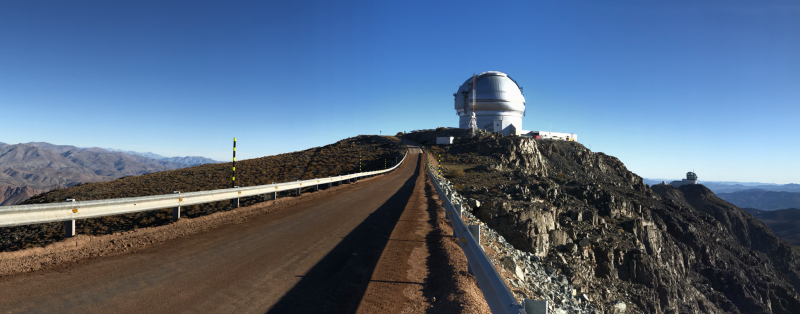
Looking along a road toward a large telescope dome, with a second dome to the right.

The Gemini Observatory consists of twin 8.1-meter diameter optical/infrared telescopes located in Hawai’i and Chile. Here is Gemini South – located on the summit of Cerro Pachón in Chile – with the Large Synoptic Survey Telescope (LSST) to the right. Image via R. Pettengill (NRAO/AUI/NSF).

About an hour’s flight north of Santiago near the city of Vicuña, in the Equi Valle, lie some of the world’s best sites for observatories: Cerro Pachón and Cerro Tololo. Vicuña, in the Elqui Valley, calls itself the world capitol of astronomy, with many tourist and research observatories nearby. The ACEAP (Astronomy in Chile Educator Ambassador Program) cadre was treated to a night of stargazing at the lovely Alpha Aldea and learned about the many educational programs that they support.

The 2019 ACEAP expedition was given full access to both locations and spent two nights with the astronomers there.

Cerro Pachón is the newer facility including the 4 meter SOAR (Southern Astrophysical Research) telescope, 10 m Gemini South, and under construction the 8.4 m LSST (Large Synoptic Survey Telescope). The Gemini telescope is the southern skies twin to the Gemini on Mauna Kea in Hawaii. Both SOAR and Gemini use adaptive optics correcting for atmospheric turbulence with sodium laser guide stars.

Nearby, Cerro Tololo hosts most of the U.S. National Science Foundation and National Optical Astronomy Observatory facilities. Cerro Tololo is ground zero for astronomical collaboration between the U.S. and Chile.

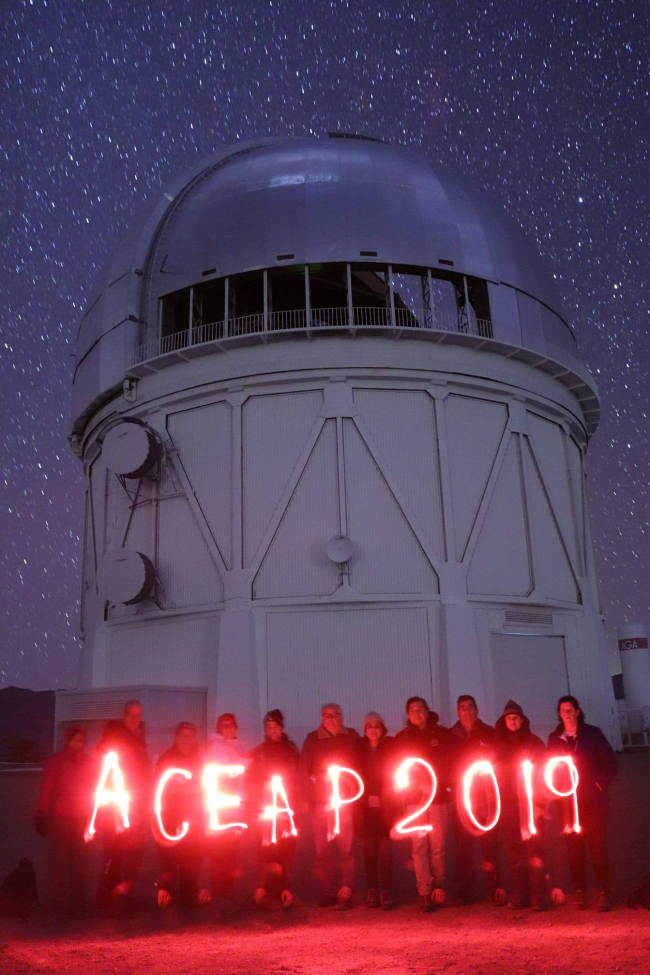
Group photo in front of large telescope, inside a large dome.

Cerro Tololo Inter-American Observatory (CTIO) is a complex of astronomical telescopes and instruments located approximately 50 miles (80 km) to the east of La Serena, Chile, at an altitude of 7,200 feet (2,200 meters). Here is the CTIO 1.5-meter telescope with ACEAP 2019. Image via K Flores/ C Johns (NRAO/AUI/NSF).

Professor Federico Rutllant of the University of Chile collaborated with AURA (Association of Universities for Research in Astronomy) to identify a site for a large Chilean American telescope in 1959 with the 1.5-meter telescope completed in 1965. The 4-meter telescope completed in 1976 named for Puerto Rican astronomer Victor Blanco is now the CTIO’s largest.

Large telescope with astronomy group in front, holding up a lighted sign reading ACEAP 2019.

Astronomy in Chile Educator Ambassador Program (ACEAP 2019) in front of the Blanco telescope on Cerro Tololo. Image via L. Sparks (NRAO/AUI/NSF).

The profound darkness and silence of these sites at night is broken only by the deep hum of the telescopes dancing with the stars. We were treated to spectacular views of the Milky Way and the Magellanic Clouds.

Daytime at the observatories were filled with talks and questions. Our meals at the cafeteria (casino to Chileans) were good with spectacular vistas.

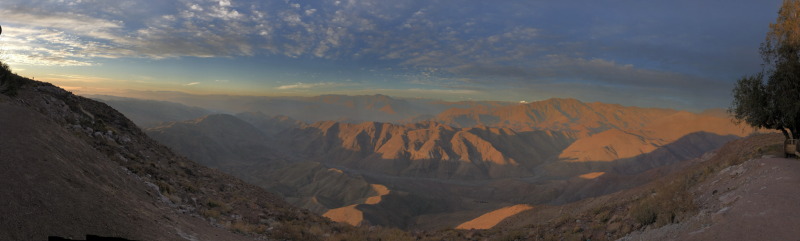
Spectacular view of mountains and valleys in the Chilean Andes.

The view from the Cerro Tololo casino (cafeteria), via R. Pettengill (NRAO/AUI/NSF).

We are headed next to San Pedro de Atacama and up to the ALMA radio telescope at 16,500-feet elevation.

Bottom line: Robert Pettengill reports from the busy ACEAP (Astronomy in Chile Educator Ambassador Program) trip to Chile in July and August 2019. Read his first dispatch here: Astronomy educators to rendezvous in Chile


from EarthSky https://ift.tt/2OC4wrd
Looking along a road toward a large telescope dome, with a second dome to the right.

The Gemini Observatory consists of twin 8.1-meter diameter optical/infrared telescopes located in Hawai’i and Chile. Here is Gemini South – located on the summit of Cerro Pachón in Chile – with the Large Synoptic Survey Telescope (LSST) to the right. Image via R. Pettengill (NRAO/AUI/NSF).

About an hour’s flight north of Santiago near the city of Vicuña, in the Equi Valle, lie some of the world’s best sites for observatories: Cerro Pachón and Cerro Tololo. Vicuña, in the Elqui Valley, calls itself the world capitol of astronomy, with many tourist and research observatories nearby. The ACEAP (Astronomy in Chile Educator Ambassador Program) cadre was treated to a night of stargazing at the lovely Alpha Aldea and learned about the many educational programs that they support.

The 2019 ACEAP expedition was given full access to both locations and spent two nights with the astronomers there.

Cerro Pachón is the newer facility including the 4 meter SOAR (Southern Astrophysical Research) telescope, 10 m Gemini South, and under construction the 8.4 m LSST (Large Synoptic Survey Telescope). The Gemini telescope is the southern skies twin to the Gemini on Mauna Kea in Hawaii. Both SOAR and Gemini use adaptive optics correcting for atmospheric turbulence with sodium laser guide stars.

Nearby, Cerro Tololo hosts most of the U.S. National Science Foundation and National Optical Astronomy Observatory facilities. Cerro Tololo is ground zero for astronomical collaboration between the U.S. and Chile.

Group photo in front of large telescope, inside a large dome.

Cerro Tololo Inter-American Observatory (CTIO) is a complex of astronomical telescopes and instruments located approximately 50 miles (80 km) to the east of La Serena, Chile, at an altitude of 7,200 feet (2,200 meters). Here is the CTIO 1.5-meter telescope with ACEAP 2019. Image via K Flores/ C Johns (NRAO/AUI/NSF).

Professor Federico Rutllant of the University of Chile collaborated with AURA (Association of Universities for Research in Astronomy) to identify a site for a large Chilean American telescope in 1959 with the 1.5-meter telescope completed in 1965. The 4-meter telescope completed in 1976 named for Puerto Rican astronomer Victor Blanco is now the CTIO’s largest.

Large telescope with astronomy group in front, holding up a lighted sign reading ACEAP 2019.

Astronomy in Chile Educator Ambassador Program (ACEAP 2019) in front of the Blanco telescope on Cerro Tololo. Image via L. Sparks (NRAO/AUI/NSF).

The profound darkness and silence of these sites at night is broken only by the deep hum of the telescopes dancing with the stars. We were treated to spectacular views of the Milky Way and the Magellanic Clouds.

Daytime at the observatories were filled with talks and questions. Our meals at the cafeteria (casino to Chileans) were good with spectacular vistas.

Spectacular view of mountains and valleys in the Chilean Andes.

The view from the Cerro Tololo casino (cafeteria), via R. Pettengill (NRAO/AUI/NSF).

We are headed next to San Pedro de Atacama and up to the ALMA radio telescope at 16,500-feet elevation.

Bottom line: Robert Pettengill reports from the busy ACEAP (Astronomy in Chile Educator Ambassador Program) trip to Chile in July and August 2019. Read his first dispatch here: Astronomy educators to rendezvous in Chile


from EarthSky https://ift.tt/2OC4wrd

A new species of duck-billed dinosaur

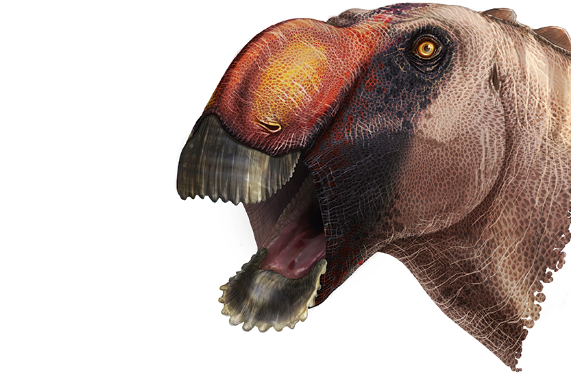
Head of duck-billed dinosaur with bulbous red crest on its nose.

Meet Aquilarhinus palimentus, a new species of hadrosaurid – a duck-billed dinosaur – discovered in Texas. Image via ICRA Art/Taylor & Francis Group.

New species of dinosaurs – well, their fossils – continue to be discovered by scientists. Now, an unusual species of duck-billed dinosaur, a hadrosaurid, has been found, which lived 80 million years ago in southwestern Texas. The skull is the most complete yet discovered of a duck-billed dinosaur from Big Bend National Park.

The finding was announced by Albert Prieto-Márquez at the Catalan Institute of Palaeontology in Barcelona, and the peer-reviewed results were published in the Journal of Systematic Palaeontology on July 12, 2019.

The exquisite skull specimen reveals a a new genus and species of duck-billed dinosaur, and has been named Aquilarhinus palimentus. Its aquiline nose, curved like an eagle’s beak, and wide lower jaw, shaped like two trowels laid side by side, give it a unique appearance among the duck-billed dinosaurs. Prieto-Márquez explained the significance of the finding:

This new animal is one of the more primitive hadrosaurids known and can therefore help us to understand how and why the ornamentation on their heads evolved, as well as where the group initially evolved and migrated from. Its existence adds another piece of evidence to the growing hypothesis, still up in the air, that the group began in the southeastern area of the US.

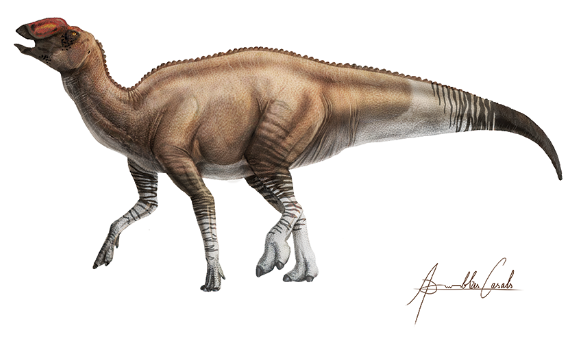
Four-legged dinosaur with raised head, open mouth, long stiff striped tail.

A complete view of Aquilarhinus palimentus as it might have looked when still alive. Image via ICRA Art/Taylor & Francis Group.

The facial and cranial construction of the dinosaur suggests that it fed itself by shoveling loose, wet sediment to scoop up loosely-rooted aquatic plants from the tidal marshes of an ancient delta. It is one of the oldest and most primitive hadrosaurids found to date.

The skull and other bones had first been found in the 1980s by Tom Lehman at Texas Tech University, in rock layers on Rattlesnake Mountain in Big Bend National Park. However, some of them were stuck together, making analysis difficult. The arched nasal crest and unique jaw were discovered by research in the 1990s. At first, the bones were thought to belong to a hadrosaurid called Gryposaurus, but the more recent analysis showed that they were more primitive.

Aquilarhinus palimentus did not fit in with the main group of hadrosaurids, called Saurolophidae. The fact that it is more primitive is evidence that there were a greater number of lineages than previously thought. Bony cranial crests were common on the heads of hadrosaurids, and came in a variety of shapes and sizes. Some of these were solid, while others were hollow. The bony crest of Aquilarhinus palimentus, however, was simpler in structure, shaped simply like a humped nose. This crest was solid, providing evidence that all such crests evolved from a common ancestor, a hadrosaurid with a simple humped nose.

Oblong brown fossil with spoon-like feature at left end.

A fossilized mandible of Aquilarhinus palimentus, with unusual upturned end. Image via Albert Prieto-Marquez/The University of Texas at Austin/Taylor & Francis Group.

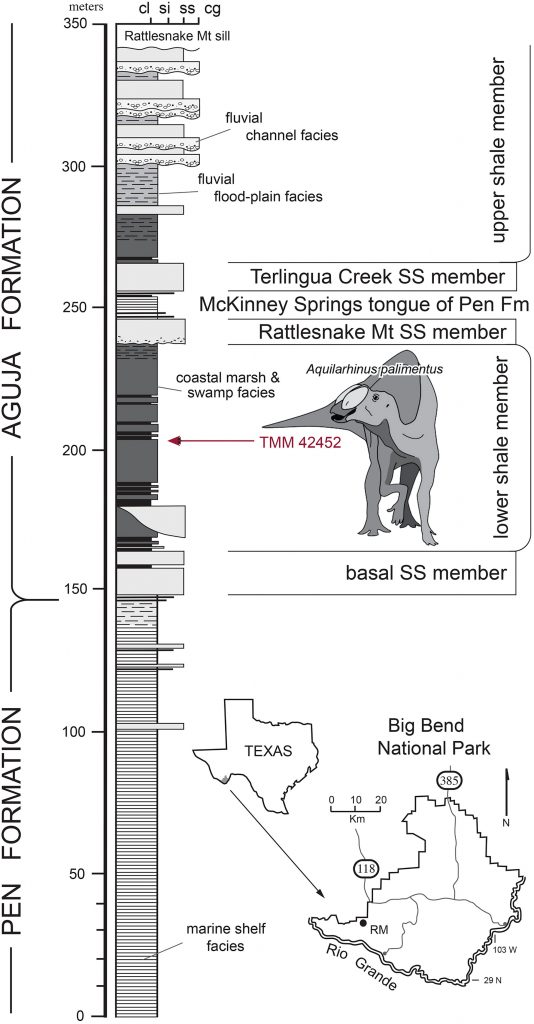
Fossil location on Rattlesnake Mountain with vertical chart of rock formations on left side of drawing.

The location of the Aquilarhinus palimentus skull and other bones on Rattlesnake Mountain in Big Bend National Park, Texas. Image via Albert Prieto-Márquez/Journal of Systematic Palaeontology.

Hadrosaurids were the most common herbivorous – plant-eating – dinosaurs in the late Mesozoic Era. While there were some differences among species, these duck-billed dinosaurs generally look similar, where the front of the jaws would meet in a U-shape to support a cupped beak. Aquilarhinus palimentus is the first known species of this dinosaur to show significant differences in facial and cranial structure. Unlike other hadrosaurids, the lower jaws of Aquilarhinus palimentus met in a weird W-shape, which created a wide, flattened scoop. This would have been ideal for eating the loose aquatic plants in the marshes. As well as in North America, hadrosaurids were also common in Asia and Europe. Fossil evidence suggests that they had camel-like feet and stiff tails, and spent most of their time on land, but close to bodies of water. The cranial crests on some hadrosaurids are thought to most likely have served as resonating chambers, allowing them to make deep, loud sounds.

Bottom line: Scientists have discovered a previously unknown species of a duck-billed dinosaur that used to roam in what is now southwestern Texas. The skull is the most complete hadrosaurid skull ever found so far.

Source: An unusual ‘shovel-billed’ dinosaur with trophic specializations from the early Campanian of Trans-Pecos Texas, and the ancestral hadrosaurian crest

Via Taylor & Francis Group


from EarthSky https://ift.tt/2YissnG
Head of duck-billed dinosaur with bulbous red crest on its nose.

Meet Aquilarhinus palimentus, a new species of hadrosaurid – a duck-billed dinosaur – discovered in Texas. Image via ICRA Art/Taylor & Francis Group.

New species of dinosaurs – well, their fossils – continue to be discovered by scientists. Now, an unusual species of duck-billed dinosaur, a hadrosaurid, has been found, which lived 80 million years ago in southwestern Texas. The skull is the most complete yet discovered of a duck-billed dinosaur from Big Bend National Park.

The finding was announced by Albert Prieto-Márquez at the Catalan Institute of Palaeontology in Barcelona, and the peer-reviewed results were published in the Journal of Systematic Palaeontology on July 12, 2019.

The exquisite skull specimen reveals a a new genus and species of duck-billed dinosaur, and has been named Aquilarhinus palimentus. Its aquiline nose, curved like an eagle’s beak, and wide lower jaw, shaped like two trowels laid side by side, give it a unique appearance among the duck-billed dinosaurs. Prieto-Márquez explained the significance of the finding:

This new animal is one of the more primitive hadrosaurids known and can therefore help us to understand how and why the ornamentation on their heads evolved, as well as where the group initially evolved and migrated from. Its existence adds another piece of evidence to the growing hypothesis, still up in the air, that the group began in the southeastern area of the US.

Four-legged dinosaur with raised head, open mouth, long stiff striped tail.

A complete view of Aquilarhinus palimentus as it might have looked when still alive. Image via ICRA Art/Taylor & Francis Group.

The facial and cranial construction of the dinosaur suggests that it fed itself by shoveling loose, wet sediment to scoop up loosely-rooted aquatic plants from the tidal marshes of an ancient delta. It is one of the oldest and most primitive hadrosaurids found to date.

The skull and other bones had first been found in the 1980s by Tom Lehman at Texas Tech University, in rock layers on Rattlesnake Mountain in Big Bend National Park. However, some of them were stuck together, making analysis difficult. The arched nasal crest and unique jaw were discovered by research in the 1990s. At first, the bones were thought to belong to a hadrosaurid called Gryposaurus, but the more recent analysis showed that they were more primitive.

Aquilarhinus palimentus did not fit in with the main group of hadrosaurids, called Saurolophidae. The fact that it is more primitive is evidence that there were a greater number of lineages than previously thought. Bony cranial crests were common on the heads of hadrosaurids, and came in a variety of shapes and sizes. Some of these were solid, while others were hollow. The bony crest of Aquilarhinus palimentus, however, was simpler in structure, shaped simply like a humped nose. This crest was solid, providing evidence that all such crests evolved from a common ancestor, a hadrosaurid with a simple humped nose.

Oblong brown fossil with spoon-like feature at left end.

A fossilized mandible of Aquilarhinus palimentus, with unusual upturned end. Image via Albert Prieto-Marquez/The University of Texas at Austin/Taylor & Francis Group.

Fossil location on Rattlesnake Mountain with vertical chart of rock formations on left side of drawing.

The location of the Aquilarhinus palimentus skull and other bones on Rattlesnake Mountain in Big Bend National Park, Texas. Image via Albert Prieto-Márquez/Journal of Systematic Palaeontology.

Hadrosaurids were the most common herbivorous – plant-eating – dinosaurs in the late Mesozoic Era. While there were some differences among species, these duck-billed dinosaurs generally look similar, where the front of the jaws would meet in a U-shape to support a cupped beak. Aquilarhinus palimentus is the first known species of this dinosaur to show significant differences in facial and cranial structure. Unlike other hadrosaurids, the lower jaws of Aquilarhinus palimentus met in a weird W-shape, which created a wide, flattened scoop. This would have been ideal for eating the loose aquatic plants in the marshes. As well as in North America, hadrosaurids were also common in Asia and Europe. Fossil evidence suggests that they had camel-like feet and stiff tails, and spent most of their time on land, but close to bodies of water. The cranial crests on some hadrosaurids are thought to most likely have served as resonating chambers, allowing them to make deep, loud sounds.

Bottom line: Scientists have discovered a previously unknown species of a duck-billed dinosaur that used to roam in what is now southwestern Texas. The skull is the most complete hadrosaurid skull ever found so far.

Source: An unusual ‘shovel-billed’ dinosaur with trophic specializations from the early Campanian of Trans-Pecos Texas, and the ancestral hadrosaurian crest

Via Taylor & Francis Group


from EarthSky https://ift.tt/2YissnG

What does a marsquake feel like?

Fifty years after Apollo 11 astronauts deployed the first seismometer on the surface of the moon, data from NASA InSight’s seismic experiment has given researchers the opportunity to compare marsquakes to moon and earthquakes.

Southern California got all shook up after a set of recent earthquakes. But Earth isn’t the only place that experiences quakes: Both the moon and Mars have them as well.

The Apollo 11 mission took the first seismometer to the moon in 1969. In late 2018, NASA’s InSight lander brought the first seismometer to Mars. The seismometer, called the Seismic Experiment for Interior Structure (SEIS), detected its first marsquake on April 6, 2019. Scientists at ETH Zurich in Switzerland compared moonquakes detected by Apollo-era seismometers, with two quakes recently detected by SEIS on Mars, and quakes recorded here on Earth.

Quakes look and feel different depending on the material their seismic waves pass through. While seismic waves that travel through the Earth typically persist between tens of seconds to a few minutes, moonquakes can last up to an hour or more. The extent of the seismic signal is due to distance and to differences in geological structures.In a new video (above), the researchers demonstrate this by using data from the Apollo-era seismometers on the moon, two of the first quakes detected on Mars by SEIS and quakes recorded here on Earth. By running data from these worlds through a quake simulator, or shake room, scientists can experience for themselves how different the earthquakes can be.

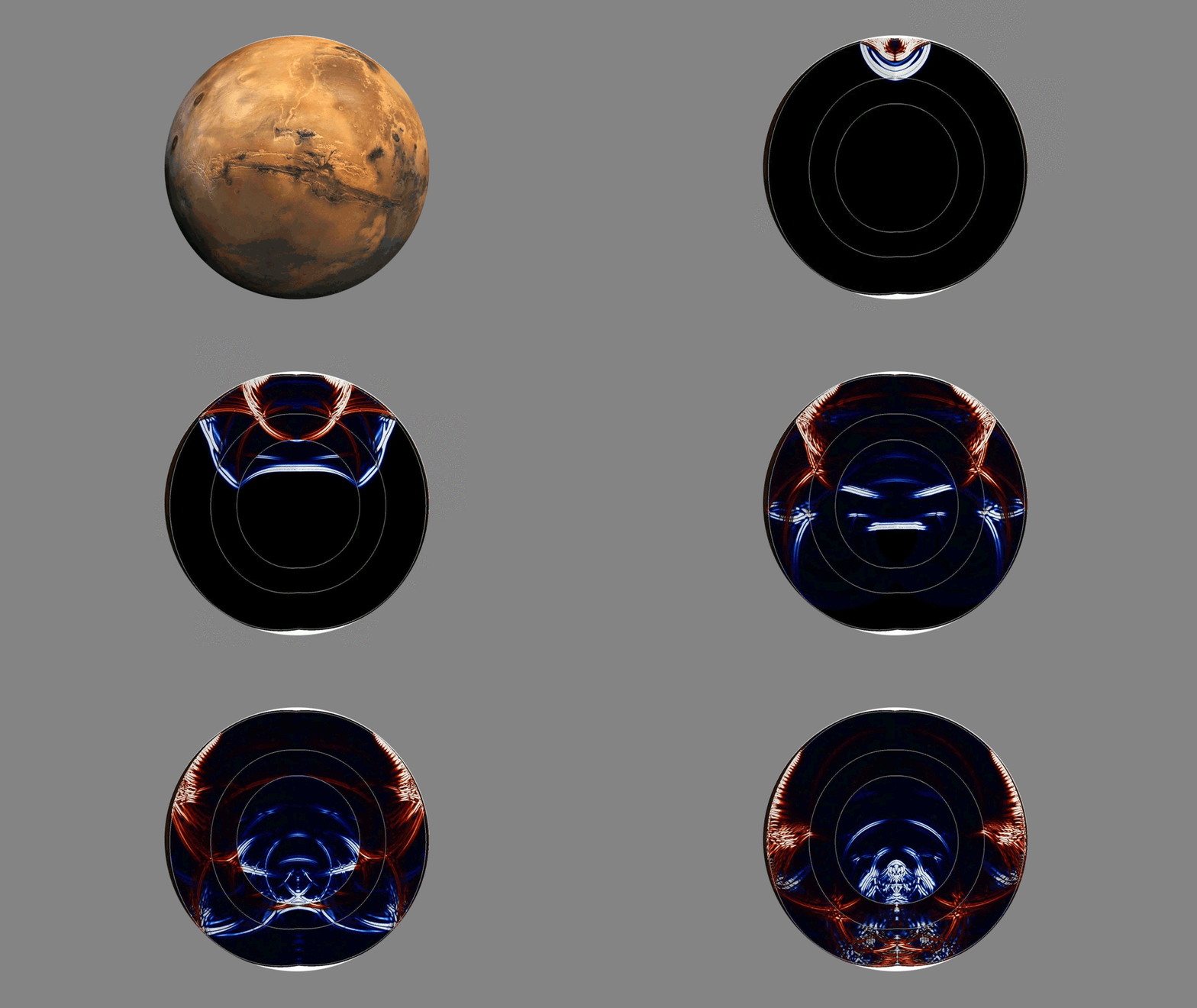
Arc-shaped waves from a point source travel through planet to break upon the surface far away.

This artist’s concept is a simulation of what seismic waves from a marsquake might look like as they move through different layers of the Martian interior. Image via NASA/JPL-Caltech/ETH Zurich/Van Driel.

Bottom line: New video compares marsquakes, moonquakes, and earthquakes.

Via NASA


from EarthSky https://ift.tt/2YlHXLJ

Fifty years after Apollo 11 astronauts deployed the first seismometer on the surface of the moon, data from NASA InSight’s seismic experiment has given researchers the opportunity to compare marsquakes to moon and earthquakes.

Southern California got all shook up after a set of recent earthquakes. But Earth isn’t the only place that experiences quakes: Both the moon and Mars have them as well.

The Apollo 11 mission took the first seismometer to the moon in 1969. In late 2018, NASA’s InSight lander brought the first seismometer to Mars. The seismometer, called the Seismic Experiment for Interior Structure (SEIS), detected its first marsquake on April 6, 2019. Scientists at ETH Zurich in Switzerland compared moonquakes detected by Apollo-era seismometers, with two quakes recently detected by SEIS on Mars, and quakes recorded here on Earth.

Quakes look and feel different depending on the material their seismic waves pass through. While seismic waves that travel through the Earth typically persist between tens of seconds to a few minutes, moonquakes can last up to an hour or more. The extent of the seismic signal is due to distance and to differences in geological structures.In a new video (above), the researchers demonstrate this by using data from the Apollo-era seismometers on the moon, two of the first quakes detected on Mars by SEIS and quakes recorded here on Earth. By running data from these worlds through a quake simulator, or shake room, scientists can experience for themselves how different the earthquakes can be.

Arc-shaped waves from a point source travel through planet to break upon the surface far away.

This artist’s concept is a simulation of what seismic waves from a marsquake might look like as they move through different layers of the Martian interior. Image via NASA/JPL-Caltech/ETH Zurich/Van Driel.

Bottom line: New video compares marsquakes, moonquakes, and earthquakes.

Via NASA


from EarthSky https://ift.tt/2YlHXLJ

Rare reflection rainbow over Michigan

There are primary and secondary rainbows in the sky here (the 2 outside bows; note their colors are reversed). The 3rd bow (the inner one) is called a reflection rainbow. Beverly Ulfig caught this rare rainbow with an iPhone 6.

Beverly Ulfig captured this rainbow photo at Sands Park on Manistee Lake in Kalkaska, Michigan, on July 23, 2018. She wrote:

The entire day had a feel of rain off and on. It did rain at approximately 5:30 p.m. for about 10 minutes. But it remained somewhat cloudy. The sun appeared about 7 p.m., and then we were treated to this special occurrence.

What Beverly caught is a rare type of rainbow, called a reflection rainbow. You sometimes see one over water, as in the photo above. At the great website Atmospheric Optics, Les Cowley explains:

Sunlight reflected off the water and traveling upwards makes the reflection bow. To raindrops, the reflected light appears to come from a second sun the same angular distance below the water as the real sun is above it.

Les has a lot more to say about reflection rainbows, which you can read here.

Thank you, Beverly and Les!

Bottom line: July 23, 2018, photo of a rare reflection rainbow, captured in Michigan.


from EarthSky https://ift.tt/2YAfmxn

There are primary and secondary rainbows in the sky here (the 2 outside bows; note their colors are reversed). The 3rd bow (the inner one) is called a reflection rainbow. Beverly Ulfig caught this rare rainbow with an iPhone 6.

Beverly Ulfig captured this rainbow photo at Sands Park on Manistee Lake in Kalkaska, Michigan, on July 23, 2018. She wrote:

The entire day had a feel of rain off and on. It did rain at approximately 5:30 p.m. for about 10 minutes. But it remained somewhat cloudy. The sun appeared about 7 p.m., and then we were treated to this special occurrence.

What Beverly caught is a rare type of rainbow, called a reflection rainbow. You sometimes see one over water, as in the photo above. At the great website Atmospheric Optics, Les Cowley explains:

Sunlight reflected off the water and traveling upwards makes the reflection bow. To raindrops, the reflected light appears to come from a second sun the same angular distance below the water as the real sun is above it.

Les has a lot more to say about reflection rainbows, which you can read here.

Thank you, Beverly and Les!

Bottom line: July 23, 2018, photo of a rare reflection rainbow, captured in Michigan.


from EarthSky https://ift.tt/2YAfmxn

Protection from mosquitos key to avoid West Nile virus

"In Georgia, West Nile virus is primarily spread by the southern house mosquito Culex quinquefasciatus," says Gonzalo Vazquez-Prokopec, associate professor in Emory's Department of Environmental Sciences. (CDC/James Gathany)

August to September is the peak of the West Nile virus (WNV) season and Atlanta area health officials have reported finding mosquitoes testing positive for the pathogen, including from 11 locations across DeKalb County. No human cases, however, have been reported.

WNV is most commonly spread to people by the bite of an infected mosquito. Most people who become infected do not feel sick, but about one in five develop a fever and other symptoms. And about one out of 150 people infected develop a serious, sometimes fatal, illness, according to the CDC.

Gonzalo Vazquez-Prokopec, associate professor in Emory University's Department of Environmental Sciences, is an expert in mosquito-borne diseases. His lab has studied the urban ecology of metro Atlanta and the Culex mosquito — a vector for WNV and other human pathogens.

Vazquez-Prokopec is currently in the field in Brazil, but we caught up with him via email for a brief Q and A.

What should people know about the particular type of mosquito that spreads WNV?

In Georgia, West Nile virus is primarily spread by the southern house mosquito Culex quinquefasciatus. This light-brown colored species bites at dusk and dawn, and is found in high numbers in and around houses and in open areas, such as parks.

Is it normal to detect WNV in so many Atlanta-area mosquitoes this time of year? 

Yes, the infection rates in mosquitoes, gathered from different mosquito traps, are following trends that we’ve seen in previous years. What we do not see is human cases — so far this year none have been reported for Georgia.

Is Atlanta normally at higher or average risk for human cases of WNV? 

Human infection with WNV is low in Georgia compared to some states in the Northeast or Midwest. This is remarkably different from what we see in mosquitoes and birds which, in Atlanta, have equally high WNV levels compared to the Northeast and Midwest. What seems to be different is the rate of spillover of the virus, or transfer from the wildlife cycle to humans, which definitely appears to be suppressed in the Southeastern United States.

How can people best protect themselves? 

Reducing human exposure to Culex mosquitoes is key to maintaining the low rates of human infection. It’s best to follow the recommendations on the CDC web site to use insect repellent and wear long-sleeved shirts and long pants when outside to protect yourself from mosquito bites, and to remove any standing water around your home. Dekalb County has a great checklist on its web site to help locate potential mosquito breeding sites around your yard.

Related:
Cardinals may reduce West Nile virus spillover in Atlanta
Sewage raises West Nile virus risk

from eScienceCommons https://ift.tt/2YC2qLF
"In Georgia, West Nile virus is primarily spread by the southern house mosquito Culex quinquefasciatus," says Gonzalo Vazquez-Prokopec, associate professor in Emory's Department of Environmental Sciences. (CDC/James Gathany)

August to September is the peak of the West Nile virus (WNV) season and Atlanta area health officials have reported finding mosquitoes testing positive for the pathogen, including from 11 locations across DeKalb County. No human cases, however, have been reported.

WNV is most commonly spread to people by the bite of an infected mosquito. Most people who become infected do not feel sick, but about one in five develop a fever and other symptoms. And about one out of 150 people infected develop a serious, sometimes fatal, illness, according to the CDC.

Gonzalo Vazquez-Prokopec, associate professor in Emory University's Department of Environmental Sciences, is an expert in mosquito-borne diseases. His lab has studied the urban ecology of metro Atlanta and the Culex mosquito — a vector for WNV and other human pathogens.

Vazquez-Prokopec is currently in the field in Brazil, but we caught up with him via email for a brief Q and A.

What should people know about the particular type of mosquito that spreads WNV?

In Georgia, West Nile virus is primarily spread by the southern house mosquito Culex quinquefasciatus. This light-brown colored species bites at dusk and dawn, and is found in high numbers in and around houses and in open areas, such as parks.

Is it normal to detect WNV in so many Atlanta-area mosquitoes this time of year? 

Yes, the infection rates in mosquitoes, gathered from different mosquito traps, are following trends that we’ve seen in previous years. What we do not see is human cases — so far this year none have been reported for Georgia.

Is Atlanta normally at higher or average risk for human cases of WNV? 

Human infection with WNV is low in Georgia compared to some states in the Northeast or Midwest. This is remarkably different from what we see in mosquitoes and birds which, in Atlanta, have equally high WNV levels compared to the Northeast and Midwest. What seems to be different is the rate of spillover of the virus, or transfer from the wildlife cycle to humans, which definitely appears to be suppressed in the Southeastern United States.

How can people best protect themselves? 

Reducing human exposure to Culex mosquitoes is key to maintaining the low rates of human infection. It’s best to follow the recommendations on the CDC web site to use insect repellent and wear long-sleeved shirts and long pants when outside to protect yourself from mosquito bites, and to remove any standing water around your home. Dekalb County has a great checklist on its web site to help locate potential mosquito breeding sites around your yard.

Related:
Cardinals may reduce West Nile virus spillover in Atlanta
Sewage raises West Nile virus risk

from eScienceCommons https://ift.tt/2YC2qLF

ESA and ESO confirm asteroid will miss Earth in September

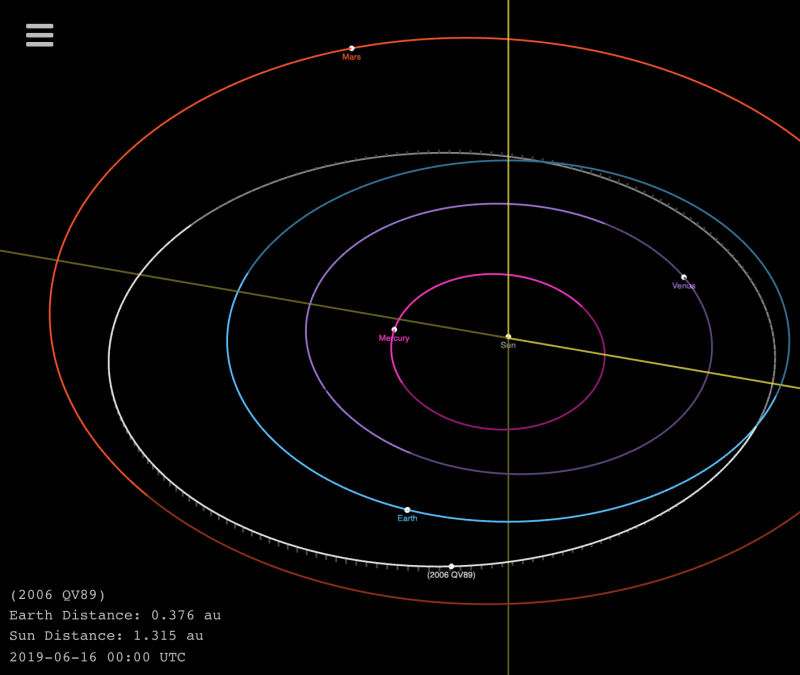
Diagram showing orbits of Earth, inner planets, and asteroid 2006 QV89.

Viewed on this scale, from above the solar system, it looks as if the paths of Earth and asteroid 2006 QV89 intersect. Yet this asteroid’s pass on September 9, 2019 shouldn’t be a particularly close one. Image via NASA’s Center for Near Earth Object Studies.

We’re still getting emails from people asking about asteroid 2006 QV89, a space rock that’ll pass closest to Earth on September 9, 2019. Since June, there’ve been numerous online articles (for example, here and here), some focusing the minuscule chance this asteroid might strike Earth in September. We’re here to focus on the much, much, much greater chance this asteroid will not strike us. In fact, asteroid 2006 QV89 is currently classified by astronomers as NO HAZARD. It is not expected to hit Earth. In July, for example, in what astronomers said is “the first known case of ruling out an asteroid impact through a ‘non-detection’,” the European Space Agency (ESA) and the European Southern Observatory (ESO) concluded that this asteroid is not on a collision course with Earth in 2019 – and the chance of any future impact is also extremely remote. More about the ESA/ESO non-detection below.

Before we get into ESA and ESO’s non-detection and no-collision conclusion, though, let’s ask … what does NASA say? As of June 2019, calculations made by NASA/JPL with the available data suggest the space rock will not even have a particularly close approach to Earth in September 2019. According to NASA’s Center for Near Earth Object Studies, 2006 QV89 will likely pass so far from our planet that there is a 99.989 percent chance the space rock will miss the Earth in September 2019.

Why the uproar about asteroid 2006 QV89 in the first place? The reason stems in part from the fact that this asteroid does appear on a “risk objects list” from the ESA, as do many other objects. In the case of asteroid 2006 QV89, it’s important to note that the asteroid has a Torino Scale of 0, which indicates its no hazard status. You can note that for yourself on the chart below, from ESA. Like many asteroids, 2006 QV89 is on a “risk” list, but ESA currently classifies it as a non-priority risk.
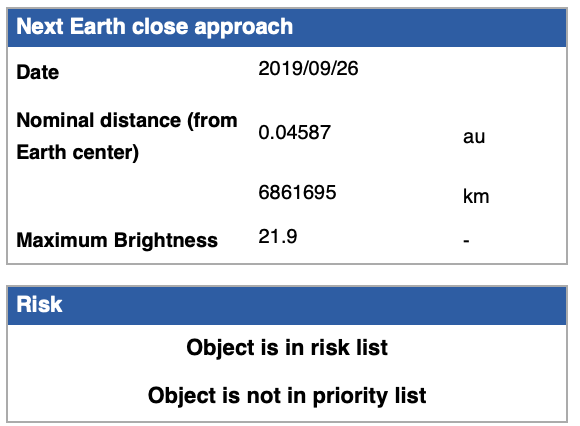
ESA chart showing various orbital parameters for 2006 QV89.

This chart from the European Space Agency – published in June 2019 – shows the September 2019 distance of asteroid 2006 QV89 as 4,263,660 miles (6,861,695 km), or some 17 times the moon’s distance. The object is in astronomers’ “risk” category, but it’s not on their “priority” list.

Many asteroids temporarily appear in a risk list due to uncertainties in their orbits. These sorts of uncertainties typically occur when an object has been recently discovered by observatories, and seen only during a few nights after the discovery, afterwards becaming too faint to observe. As an asteroid is re-observed – and astronomers’ asteroid-orbit modeling programs recognize it as an asteroid previously detected – the incoming new observations let astronomers better refine its orbit. The Catalina Sky Survey in Arizona discovered 2006 QV89 on August 29, 2006. At that time, it had a very short (10-day) observation arc. The Arecibo Observatory made radar observations of this asteroid on September 6, 2006. Then, as it sped on, it was lost from view again and has not been detected since 2006.

And that brings us to ESA and ESO’s recent non-detection of the asteroid. ESA said on July 16, 2019:

While we do not know 2006 QV89’s trajectory exactly, we do know where it would appear in the sky if it were on a collision course with our planet. Therefore, we can simply observe this small area of the sky to check that the asteroid is indeed, hopefully, not there.

This way, we have the chance to indirectly exclude any risk of an impact, even without actually seeing the asteroid.

This is precisely what ESA and the European Southern Observatory (ESO) did on July 4 and 5, 2019, as part of the ongoing collaboration between the two organizations to observe high-risk asteroids using ESO’s Very Large Telescope (VLT).

Teams obtained very ‘deep’ images of a small area in the sky, where the asteroid would have been located if it were on track to impact Earth in September.

Nothing was seen.

The image below shows the region of the sky where asteroid 2006 QV89 would have been seen, only if it were on a collision course with Earth in 2019.

A blank image, with 3 red crosses on it.

The segment shown by the three red crosses in this VLT image shows where asteroid 2006 QV89 would have appeared had it been on a collision course with Earth in September 2019. The image has been processed to remove background star contamination, so the object would have appeared as a single bright round source inside the segment. ESA said, “Even if the asteroid were smaller than expected, at only a few meters across, it would have been seen in the image. Any smaller than this and the VLT could not have spotted it, but it would also be considered harmless as anything this size would burn up in Earth’s atmosphere.” Image via ESA.

From their brief observations of it – and from their knowledge of asteroids in general, which has grown dramatically in recent decades – astronomers can estimate that 2006 QV89 is about 98-131 feet (30-40 meters) in diameter, or about the length of an American football field. It’s classified as an Apollo type asteroid, which are Earth-crossing asteroids, of which some 20,000 are known as of January 2019.

Writing at Science20, Robert Walker had a good explanation for the status on asteroid 2006 QV89. He wrote on June 7, 2019:

Short summary for the panicking: Expected to miss and currently classified NO HAZARD. Tiny, most likely for an asteroid of that size is ‘Splosh in Pacific’. Likely many thousands of years before any such asteroid hits an urban area.

It is just a random asteroid, there are many in the table every year with dates that they ‘could’ hit, but they are classified as no hazard because they are all expected to miss. The press just picks up one of those many asteroids at random from time to time. Every year many asteroids are removed from the table that had dates of possible impacts that year. It is just one of numerous NO HAZARD asteroids currently in the table.

Some time in the next century or two then we can expect one of those many asteroids to hit, but if they are being tracked we would have at least 10 years warning to evacuate any city. The most likely thing is that the next asteroid to hit just sploshes harmlessly in the ocean. Hitting a city is extremely unlikely and most likely have to wait many thousands of years for that. An impact close enough to a city to warn residents to watch out for flying glass like Chelyabinsk is more likely and could happen, but not nearly as likely as a harmless splosh in the ocean.

This is an example of a ‘sensationalist press chose a random asteroid’ story. NASA didn’t warn us about it, and nor did ESA. It is expected to miss and is currrently classified as no hazard.

In short … don’t worry about ateroid 2006 QV89. It’s not going to hit us.

So how about seeing it as it passes? According to ESA, asteroid 2006 QV89 will show a maximum brightness or magnitude of +21.9 in September 2019, which means the space rock will appear extremely faint. It’ll be so faint that it will not even be visible with most telescopes, except for a few huge, observatory-type instruments.
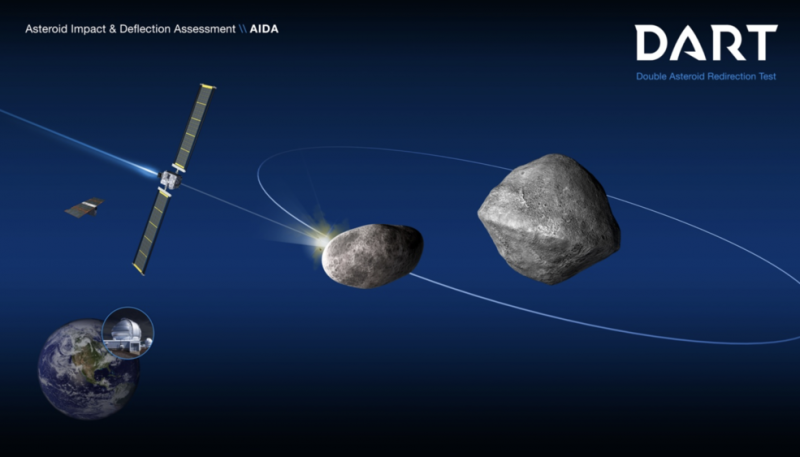
Diagram of spacecraft's trajectory toward small space rock in orbit around slightly larger one.

NASA plans to try to deflect a space rock from its path around September 2022. This schematic of the DART mission shows the impact on the moonlet of asteroid Didymos. Post-impact observations from Earth-based optical telescopes and planetary radar would, in turn, measure the change in the moonlet’s orbit about the parent body. Image via NASA/Johns Hopkins Applied Physics Lab.

Astronomers and other scientists are practicing with every close pass of an asteroid, in order to better prepare for a real scenario of any dangerous close approach on the future. What’s more, NASA is going to practice deflecting an asteroid from its path. The Double Asteroid Redirection Test (DART mission) is a planned space probe that will demonstrate the effects of crashing an impactor spacecraft into an asteroid moon for planetary defense purposes. It will launch in June 2021 and will try to impact a 525-foot (160-meter) moonlet in the binary asteroid Didymos. The intentional impact should occur sometime in September 2022. Read more about DART.

Eventually, it’s likely we will learn to deflect an incoming asteroid. Right now, though, if scientists were to detect an incoming asteroid, the best defense we have is to determine the impact area as precisely as possible, and then to evacuate the area. An excellent exercise occurred on November 13, 2015. A small object – which then was determined to be space debris – was detected with a trajectory that would intercept Earth. A team of scientists was able to determine it would enter Earth’s atmosphere over the ocean near Sri Lanka, and a “no fly”and “no fishing” zone was issued.

So there you have it. As we’ve said many times before, and as is still true, as of now, there’s no known dangerous asteroid that poses any imminent risk of Earth impact. Could an asteroid strike Earth? Of course. That’s why astronomers continue to be watchful.

Bottom line: Asteroid 2006 QV89 has been unfairly hyped as posing a threat to Earth in September 2019. In fact, it’s one of many asteroids on astronomers’ risk list, but it’s not classified as a priority risk. It’s classified as “no hazard.” In July, the European Space Agency and the European Southern Observatory concluded that this asteroid is not on a collision course this year – and the chance of any future impact is extremely remote.


from EarthSky https://ift.tt/2YiThYV
Diagram showing orbits of Earth, inner planets, and asteroid 2006 QV89.

Viewed on this scale, from above the solar system, it looks as if the paths of Earth and asteroid 2006 QV89 intersect. Yet this asteroid’s pass on September 9, 2019 shouldn’t be a particularly close one. Image via NASA’s Center for Near Earth Object Studies.

We’re still getting emails from people asking about asteroid 2006 QV89, a space rock that’ll pass closest to Earth on September 9, 2019. Since June, there’ve been numerous online articles (for example, here and here), some focusing the minuscule chance this asteroid might strike Earth in September. We’re here to focus on the much, much, much greater chance this asteroid will not strike us. In fact, asteroid 2006 QV89 is currently classified by astronomers as NO HAZARD. It is not expected to hit Earth. In July, for example, in what astronomers said is “the first known case of ruling out an asteroid impact through a ‘non-detection’,” the European Space Agency (ESA) and the European Southern Observatory (ESO) concluded that this asteroid is not on a collision course with Earth in 2019 – and the chance of any future impact is also extremely remote. More about the ESA/ESO non-detection below.

Before we get into ESA and ESO’s non-detection and no-collision conclusion, though, let’s ask … what does NASA say? As of June 2019, calculations made by NASA/JPL with the available data suggest the space rock will not even have a particularly close approach to Earth in September 2019. According to NASA’s Center for Near Earth Object Studies, 2006 QV89 will likely pass so far from our planet that there is a 99.989 percent chance the space rock will miss the Earth in September 2019.

Why the uproar about asteroid 2006 QV89 in the first place? The reason stems in part from the fact that this asteroid does appear on a “risk objects list” from the ESA, as do many other objects. In the case of asteroid 2006 QV89, it’s important to note that the asteroid has a Torino Scale of 0, which indicates its no hazard status. You can note that for yourself on the chart below, from ESA. Like many asteroids, 2006 QV89 is on a “risk” list, but ESA currently classifies it as a non-priority risk.

ESA chart showing various orbital parameters for 2006 QV89.

This chart from the European Space Agency – published in June 2019 – shows the September 2019 distance of asteroid 2006 QV89 as 4,263,660 miles (6,861,695 km), or some 17 times the moon’s distance. The object is in astronomers’ “risk” category, but it’s not on their “priority” list.

Many asteroids temporarily appear in a risk list due to uncertainties in their orbits. These sorts of uncertainties typically occur when an object has been recently discovered by observatories, and seen only during a few nights after the discovery, afterwards becaming too faint to observe. As an asteroid is re-observed – and astronomers’ asteroid-orbit modeling programs recognize it as an asteroid previously detected – the incoming new observations let astronomers better refine its orbit. The Catalina Sky Survey in Arizona discovered 2006 QV89 on August 29, 2006. At that time, it had a very short (10-day) observation arc. The Arecibo Observatory made radar observations of this asteroid on September 6, 2006. Then, as it sped on, it was lost from view again and has not been detected since 2006.

And that brings us to ESA and ESO’s recent non-detection of the asteroid. ESA said on July 16, 2019:

While we do not know 2006 QV89’s trajectory exactly, we do know where it would appear in the sky if it were on a collision course with our planet. Therefore, we can simply observe this small area of the sky to check that the asteroid is indeed, hopefully, not there.

This way, we have the chance to indirectly exclude any risk of an impact, even without actually seeing the asteroid.

This is precisely what ESA and the European Southern Observatory (ESO) did on July 4 and 5, 2019, as part of the ongoing collaboration between the two organizations to observe high-risk asteroids using ESO’s Very Large Telescope (VLT).

Teams obtained very ‘deep’ images of a small area in the sky, where the asteroid would have been located if it were on track to impact Earth in September.

Nothing was seen.

The image below shows the region of the sky where asteroid 2006 QV89 would have been seen, only if it were on a collision course with Earth in 2019.

A blank image, with 3 red crosses on it.

The segment shown by the three red crosses in this VLT image shows where asteroid 2006 QV89 would have appeared had it been on a collision course with Earth in September 2019. The image has been processed to remove background star contamination, so the object would have appeared as a single bright round source inside the segment. ESA said, “Even if the asteroid were smaller than expected, at only a few meters across, it would have been seen in the image. Any smaller than this and the VLT could not have spotted it, but it would also be considered harmless as anything this size would burn up in Earth’s atmosphere.” Image via ESA.

From their brief observations of it – and from their knowledge of asteroids in general, which has grown dramatically in recent decades – astronomers can estimate that 2006 QV89 is about 98-131 feet (30-40 meters) in diameter, or about the length of an American football field. It’s classified as an Apollo type asteroid, which are Earth-crossing asteroids, of which some 20,000 are known as of January 2019.

Writing at Science20, Robert Walker had a good explanation for the status on asteroid 2006 QV89. He wrote on June 7, 2019:

Short summary for the panicking: Expected to miss and currently classified NO HAZARD. Tiny, most likely for an asteroid of that size is ‘Splosh in Pacific’. Likely many thousands of years before any such asteroid hits an urban area.

It is just a random asteroid, there are many in the table every year with dates that they ‘could’ hit, but they are classified as no hazard because they are all expected to miss. The press just picks up one of those many asteroids at random from time to time. Every year many asteroids are removed from the table that had dates of possible impacts that year. It is just one of numerous NO HAZARD asteroids currently in the table.

Some time in the next century or two then we can expect one of those many asteroids to hit, but if they are being tracked we would have at least 10 years warning to evacuate any city. The most likely thing is that the next asteroid to hit just sploshes harmlessly in the ocean. Hitting a city is extremely unlikely and most likely have to wait many thousands of years for that. An impact close enough to a city to warn residents to watch out for flying glass like Chelyabinsk is more likely and could happen, but not nearly as likely as a harmless splosh in the ocean.

This is an example of a ‘sensationalist press chose a random asteroid’ story. NASA didn’t warn us about it, and nor did ESA. It is expected to miss and is currrently classified as no hazard.

In short … don’t worry about ateroid 2006 QV89. It’s not going to hit us.

So how about seeing it as it passes? According to ESA, asteroid 2006 QV89 will show a maximum brightness or magnitude of +21.9 in September 2019, which means the space rock will appear extremely faint. It’ll be so faint that it will not even be visible with most telescopes, except for a few huge, observatory-type instruments.

Diagram of spacecraft's trajectory toward small space rock in orbit around slightly larger one.

NASA plans to try to deflect a space rock from its path around September 2022. This schematic of the DART mission shows the impact on the moonlet of asteroid Didymos. Post-impact observations from Earth-based optical telescopes and planetary radar would, in turn, measure the change in the moonlet’s orbit about the parent body. Image via NASA/Johns Hopkins Applied Physics Lab.

Astronomers and other scientists are practicing with every close pass of an asteroid, in order to better prepare for a real scenario of any dangerous close approach on the future. What’s more, NASA is going to practice deflecting an asteroid from its path. The Double Asteroid Redirection Test (DART mission) is a planned space probe that will demonstrate the effects of crashing an impactor spacecraft into an asteroid moon for planetary defense purposes. It will launch in June 2021 and will try to impact a 525-foot (160-meter) moonlet in the binary asteroid Didymos. The intentional impact should occur sometime in September 2022. Read more about DART.

Eventually, it’s likely we will learn to deflect an incoming asteroid. Right now, though, if scientists were to detect an incoming asteroid, the best defense we have is to determine the impact area as precisely as possible, and then to evacuate the area. An excellent exercise occurred on November 13, 2015. A small object – which then was determined to be space debris – was detected with a trajectory that would intercept Earth. A team of scientists was able to determine it would enter Earth’s atmosphere over the ocean near Sri Lanka, and a “no fly”and “no fishing” zone was issued.

So there you have it. As we’ve said many times before, and as is still true, as of now, there’s no known dangerous asteroid that poses any imminent risk of Earth impact. Could an asteroid strike Earth? Of course. That’s why astronomers continue to be watchful.

Bottom line: Asteroid 2006 QV89 has been unfairly hyped as posing a threat to Earth in September 2019. In fact, it’s one of many asteroids on astronomers’ risk list, but it’s not classified as a priority risk. It’s classified as “no hazard.” In July, the European Space Agency and the European Southern Observatory concluded that this asteroid is not on a collision course this year – and the chance of any future impact is extremely remote.


from EarthSky https://ift.tt/2YiThYV
Spot the young moon in early August

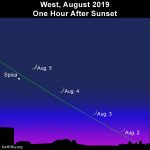
Most of us in the world’s Eastern Hemisphere – and even a good deal of the world’s Western Hemisphere – won’t spot this month’s young moon until August 2, 2019. Then – as the chart above shows – day by day, the moon will be a waxing crescent in the west after sunset, showing more of its day side in our sky and staying out longer each evening after sunset.

As for moon sightings on August 1 … some in western North America or islands in the Pacific might catch the exceedingly thin crescent very shortly after sunset. For example, as seen from Seattle, Washington, the young moon will be only about 1.7 percent illuminated as it sets some 48 minutes after the sun on August 1.

Seeing the moon on August 1 will be a challenge. You’ll need an unobstructed horizon in the direction of sunset. Start looking for the moon before it gets completely dark. You might also want to bring along your binoculars to help you to tease out the whisker-thin moon from the bright haze of evening twilight.

After all, the new moon happens on August 1, 2019, at 03:12 UTC; translate UTC to your time. At that instant of new moon, according to astronomers’ definitions, the old moon becomes a young moon again, as the moon transitions out of the morning sky and into evening sky.

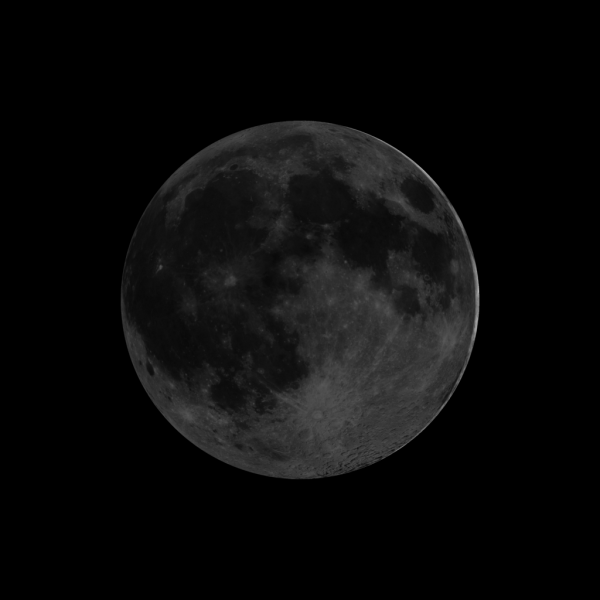
The simulated image below – via the U.S. Naval Observatory – shows a young moon as seen from Seattle, Washington, on August 1.

Read more: What’s the youngest moon you can see?

Visit the Sunrise Sunset Calendars site to find out when the sun and moon set in your sky, remembering to check the moonrise and moonset box. The setting times presume a level horizon.

Almost black moon with very thin crescent line on right side.

Simulated image of the young moon on August 1, 2019, as seen from Seattle, Washington.

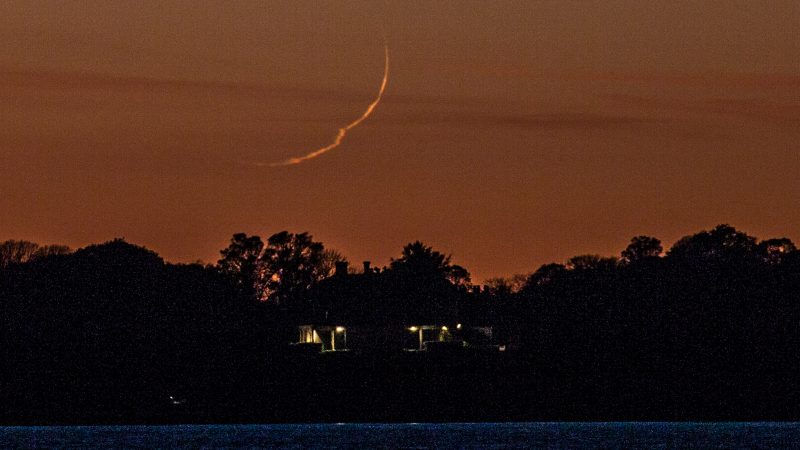
Very narrow irregular yellow crescent shimmering above trees on horizon.

Young moon refracted by the atmosphere as it nears the horizon – October 20, 2017 – by Mike Cohea.

Day by day, as the moon in its orbit moves farther away from the sun in our sky, the moon will be higher up at sunset and will stay out longer after dark. Moreover, the waxing moon’s illuminated side will continue to grow. Thus on August 3, 4 and 5, the moon will be easily visible to all, a lovely sight in the western twilight sky.

On all of these evenings – August 1 to 5, 2019 – watch for the soft glow of earthshine on the dark side of the crescent moon. Earthshine is twice-reflected sunlight. Consider that – when we see the moon as a thin sliver in our sky – people standing on the moon’s near side would be gazing at a nearly full Earth. A bright Earth lights up the nighttime side of the moon in much the same way that a bright moon lights up the nighttime terrain here on Earth. And that bright glow – sunlight that has bounced off Earth and is now bouncing off the moon’s dark side – is earthshine. Watch for it in the evenings ahead.

View of almost-full Earth from moon with East Asia and Australia on left, dark crescent on right.

Simulation of the nearly full Earth, as seen from the moon, as the sun sets over North America exactly 3 days after new moon (August 3, 2019, at 8:12 p.m. PDT – or August 4, at 3:12 UTC). This almost-full waning gibbous Earth will be casting its light on the dark side of a slender crescent moon seen in Earth’s sky. Thus, from Earth, the moon’s darkened portion will shine with the soft glow of earthshine. Image via Fourmilab’s EarthView.

On a waxing moon, the lunar terminator – the line between dark and light on the moon’s disk – shows you where sunrise is on the moon. It’s along the terminator that you have your best three-dimensional views of the lunar terrain through binoculars or the telescope. Because the lunar glare can be overpowering at night, it might be to your advantage to view the sights along the terminator in a daytime or twilight sky, as the moon waxes in phase this week.

Bottom line: Watch for the young moon as it first appears in the western evening sky in early August 2019.


from EarthSky https://ift.tt/2GFDfh0

Most of us in the world’s Eastern Hemisphere – and even a good deal of the world’s Western Hemisphere – won’t spot this month’s young moon until August 2, 2019. Then – as the chart above shows – day by day, the moon will be a waxing crescent in the west after sunset, showing more of its day side in our sky and staying out longer each evening after sunset.

As for moon sightings on August 1 … some in western North America or islands in the Pacific might catch the exceedingly thin crescent very shortly after sunset. For example, as seen from Seattle, Washington, the young moon will be only about 1.7 percent illuminated as it sets some 48 minutes after the sun on August 1.

Seeing the moon on August 1 will be a challenge. You’ll need an unobstructed horizon in the direction of sunset. Start looking for the moon before it gets completely dark. You might also want to bring along your binoculars to help you to tease out the whisker-thin moon from the bright haze of evening twilight.

After all, the new moon happens on August 1, 2019, at 03:12 UTC; translate UTC to your time. At that instant of new moon, according to astronomers’ definitions, the old moon becomes a young moon again, as the moon transitions out of the morning sky and into evening sky.

The simulated image below – via the U.S. Naval Observatory – shows a young moon as seen from Seattle, Washington, on August 1.

Read more: What’s the youngest moon you can see?

Visit the Sunrise Sunset Calendars site to find out when the sun and moon set in your sky, remembering to check the moonrise and moonset box. The setting times presume a level horizon.

Almost black moon with very thin crescent line on right side.

Simulated image of the young moon on August 1, 2019, as seen from Seattle, Washington.

Very narrow irregular yellow crescent shimmering above trees on horizon.

Young moon refracted by the atmosphere as it nears the horizon – October 20, 2017 – by Mike Cohea.

Day by day, as the moon in its orbit moves farther away from the sun in our sky, the moon will be higher up at sunset and will stay out longer after dark. Moreover, the waxing moon’s illuminated side will continue to grow. Thus on August 3, 4 and 5, the moon will be easily visible to all, a lovely sight in the western twilight sky.

On all of these evenings – August 1 to 5, 2019 – watch for the soft glow of earthshine on the dark side of the crescent moon. Earthshine is twice-reflected sunlight. Consider that – when we see the moon as a thin sliver in our sky – people standing on the moon’s near side would be gazing at a nearly full Earth. A bright Earth lights up the nighttime side of the moon in much the same way that a bright moon lights up the nighttime terrain here on Earth. And that bright glow – sunlight that has bounced off Earth and is now bouncing off the moon’s dark side – is earthshine. Watch for it in the evenings ahead.

View of almost-full Earth from moon with East Asia and Australia on left, dark crescent on right.

Simulation of the nearly full Earth, as seen from the moon, as the sun sets over North America exactly 3 days after new moon (August 3, 2019, at 8:12 p.m. PDT – or August 4, at 3:12 UTC). This almost-full waning gibbous Earth will be casting its light on the dark side of a slender crescent moon seen in Earth’s sky. Thus, from Earth, the moon’s darkened portion will shine with the soft glow of earthshine. Image via Fourmilab’s EarthView.

On a waxing moon, the lunar terminator – the line between dark and light on the moon’s disk – shows you where sunrise is on the moon. It’s along the terminator that you have your best three-dimensional views of the lunar terrain through binoculars or the telescope. Because the lunar glare can be overpowering at night, it might be to your advantage to view the sights along the terminator in a daytime or twilight sky, as the moon waxes in phase this week.

Bottom line: Watch for the young moon as it first appears in the western evening sky in early August 2019.


from EarthSky https://ift.tt/2GFDfh0

Chemists teach old drug new tricks to target deadly staph bacteria

Emory chemist Bill Wuest, far right, with some of his graduate students, from left: Erika Csatary, Madeleine Dekarske and Ingrid Wilt. Photo by Ann Watson.

"Saying superbugs, one antibiotic at a time,” is the motto of Bill Wuest’s chemistry lab at Emory University. Wuest (it rhymes with “beast”) leads a team of students fighting drug-resistant bacteria — some of the scariest, most dangerous bugs on the planet.

Most recently, they created new molecules for a study published in PNAS. Their work helped verify how bithionol — a drug used to treat parasitic infections — can weaken the cell membranes of “persister” cells of methicillin-resistant Staphylococcus aureus (MRSA), a deadly staph bacterium. They also synthesized new compounds, to learn more about how bithionol works and enhance its potential for clinical use.

“Just before I entered graduate school, my mother was diagnosed with a severe staph infection,” says Ingrid Wilt, a PhD candidate, explaining what drives her passion to tackle MRSA.

“She was in a hospital in the ICU for about two weeks,” Wilt adds. “Luckily, a last-resort antibiotic worked for her and she’s okay now.”

Click here to read the full story.

Related:
Chemistry students sing their studies, hoping for a good reaction
Brazilian peppertree packs power to knock out antibiotic-resistant bacteria

from eScienceCommons https://ift.tt/2OFhtAe
Emory chemist Bill Wuest, far right, with some of his graduate students, from left: Erika Csatary, Madeleine Dekarske and Ingrid Wilt. Photo by Ann Watson.

"Saying superbugs, one antibiotic at a time,” is the motto of Bill Wuest’s chemistry lab at Emory University. Wuest (it rhymes with “beast”) leads a team of students fighting drug-resistant bacteria — some of the scariest, most dangerous bugs on the planet.

Most recently, they created new molecules for a study published in PNAS. Their work helped verify how bithionol — a drug used to treat parasitic infections — can weaken the cell membranes of “persister” cells of methicillin-resistant Staphylococcus aureus (MRSA), a deadly staph bacterium. They also synthesized new compounds, to learn more about how bithionol works and enhance its potential for clinical use.

“Just before I entered graduate school, my mother was diagnosed with a severe staph infection,” says Ingrid Wilt, a PhD candidate, explaining what drives her passion to tackle MRSA.

“She was in a hospital in the ICU for about two weeks,” Wilt adds. “Luckily, a last-resort antibiotic worked for her and she’s okay now.”

Click here to read the full story.

Related:
Chemistry students sing their studies, hoping for a good reaction
Brazilian peppertree packs power to knock out antibiotic-resistant bacteria

from eScienceCommons https://ift.tt/2OFhtAe

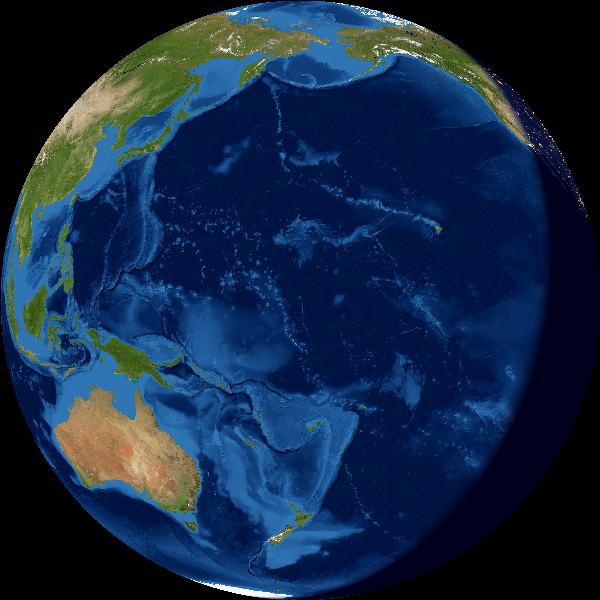
Black Moon supermoon on July 31

Image at top via EarthView.

Depending on where you live worldwide, the new moon falls on July 31 or August 1, 2019. Same new moon … different time zones. Thus this new moon is either the second of two July 2019 new moons. Or it’s the first of two August 2019 new moons. Either way, the second of two new moons in one calendar month is sometimes called a Black Moon. Here, in the United States, the Black Moon – July’s second new moon – falls on July 31. In the world’s Eastern Hemisphere, a Black Moon falls in late August.

You can’t see a new moon. It travels across the sky with the sun during the day. But the gravitational influence of the new moon and sun combine to physically affect our water planet, which people along the ocean coastlines may notice in the coming days.

Moreover, this new moon is a supermoon, that is, a new moon happening in close conjunction with lunar perigee – the moon’s closest point to Earth in its monthly orbit. Don’t listen to curmudgeon-y old astronomers telling you supermoons are “hype.” Supermoons aren’t hype; the name has arisen from folklore, like Blue Moon or Black Moon or the beloved Harvest Moon.

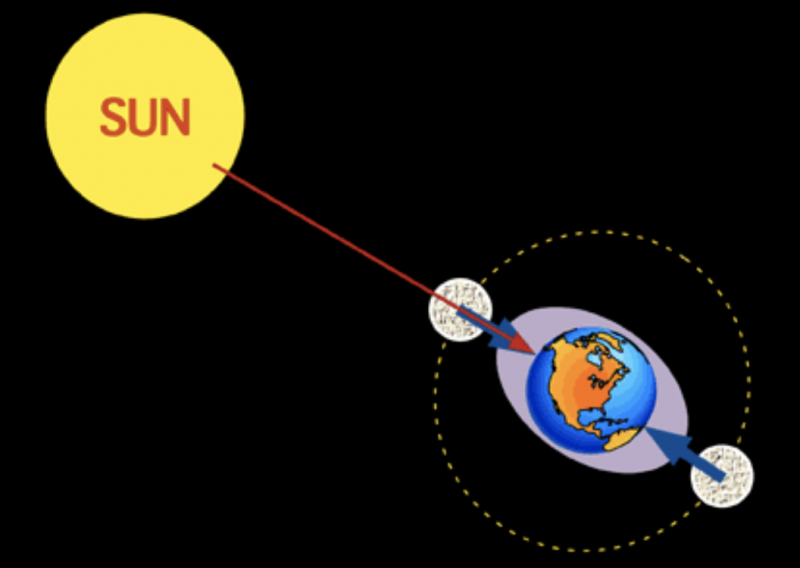
And, although you can’t see a new supermoon (because it’s in the sun’s glare), a new supermoon’s impact is real and profound. The tidal force of the extra-close new moon and the sun team up to usher in extra-large spring tides, where the variation in high and low tide is especially great. High spring tides typically follow the new or full moon by a day or so; as always, the variation in your local tide will depend on a number of factors, including the weather and the shape of your coast.

In any case, spring tides – especially the large spring tides caused by supermoons – are in stark contrast to even-keeled neap tides, when there’s a minimal variation between high and low tide, around the time of the first and last quarter moon.

So supermoons – particularly close new or full moons – increase the range between high and low spring tides all the more. Spring tides are not named for the season, by the way, but in the sense of jump, burst forth, or rise.

Diagram: the sun, Earth and moon in a line, and tide represented by an oval around Earth.

Supermoons affect earthly tides. A day or so after every new moon and full moon – when the sun, Earth, and moon are located more or less on a line in space – the whole Earth has its highest and lowest tides. These are called “spring tides.” A supermoon – close moon at the new or full phase – will accentuate the range between high and low tides even more. Image via physicalgeography.net. Read more: Tides, and the pull of the moon and sun.

The exact time of this new moon is August 1 at 03:12 Universal Time. Although the new moon comes at the same instant worldwide, our clocks read differently by time zone. At North American and U.S. time zones, the new moon instant falls on August 1, at 12:12 a.m. ADT – yet on July 31 at 11:12 p.m. EDT, 10:12 p.m. CDT, 9:12 p.m. MDT, 8:12 p.m. PDT, 7:12 p.m. AKDT, and 5:12 p.m. HST.

At new moon, the moon swings (more or less) between the Earth and sun, to transition from the morning to evening sky. Around new moon, the moon is lost in the sun’s glare for a day or two. Expect to see the moon next in the western evening sky after sunset. You might see it as soon as August 2, for example.

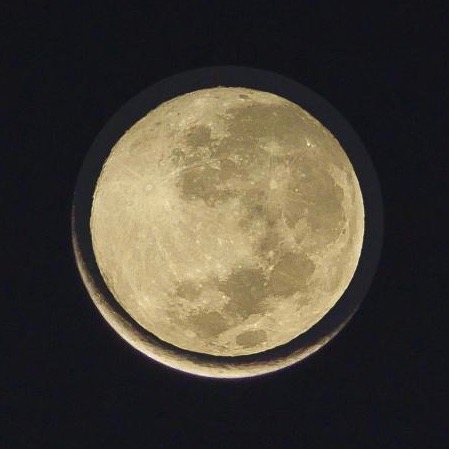
A smaller full moon superimposed on a larger crescent moon.

How much bigger is a supermoon? Above, Peter Lowenstein superimposed a mini-moon (full moon at apogee, its farthest from Earth for that month) on a young crescent moon (covered over in earthshine) near perigee, its closest to Earth for that month. The size difference is proportionally similar to that of a U.S. quarter versus a U.S. nickel.

The astrologer Richard Nolle is credited for coining the word supermoon. That’s probably one reason some astronomers object to it, although others embrace it as a simpler and catchier name than perigean new or full moon, which is what we called these moons before the term supermoon came along. Nolle defined a supermoon as:

… a new moon or full moon at or near (within 90 percent) of its closest approach to earth in a given orbit.

The moon in its orbit comes closest to Earth at perigee and swings farthest from Earth at apogee. At apogee, the moon is at 0 percent of its closest distance to Earth; and at perigee, it’s at 100 percent of its closest distance to Earth. A new or full moon aligning with perigee is about 30,000 miles (50,000 km) closer to Earth than a new or full moon aligning with apogee.

Based on Nolle’s definition of a supermoon, the relative nearness of the next three new moons gives us a “season” of new supermoons:

New moon distance (2019 Aug 01): 224,074 miles or 360,612 km
New moon distance (2019 Aug 30): 221,971 miles or 357,227 km
New moon distance (2019 Sep 28): 222,596 miles or 358,233 km

Source: The Moon Tonight

By the way, this year’s farthest new moon happened on February 4, 2019, when it was a whopping 252,566 miles (406,466 km) away. This new moon micro-moon took place one fortnight (approximately two weeks) after the full moon supermoon of January 21 and one fortnight before the full moon supermoon of February 19, 2019.

And guess what? The year’s farthest and smallest full moon (micro-moon) will occur on September 14, 2019, exactly one fortnight after the new moon supermoon of August 30 and one fortnight before the new moon supermoon of September 28, 2019.

In fact, the July 31-August 1, 2019, new moon will present the first in a series of three straight new moon supermoons, to fall (by Universal Time) on August 1, August 30, and September 28.

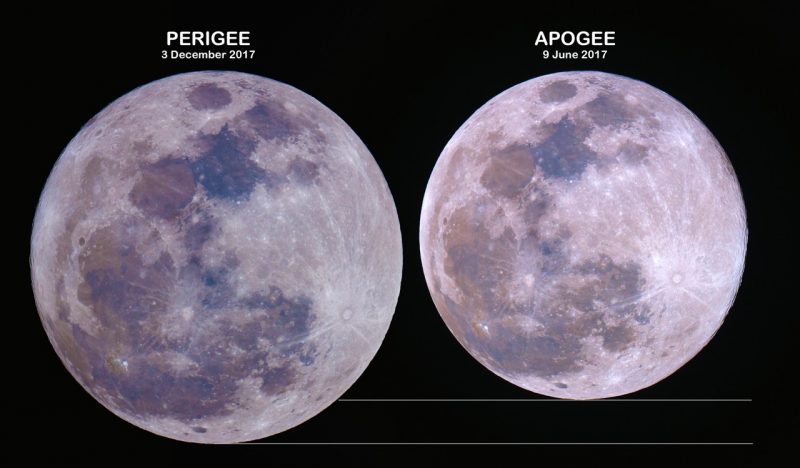
Two full moons side by side, one labeled perigee and distinctly larger, the other labeled apogee.

Here’s another far moon/near moon comparison between the December 3, 2017 close full moon and 2017’s farthest full moon in June by Muzamir Mazlan at Telok Kemang Observatory, Port Dickson, Malaysia.

Bottom line: Depending on where you live worldwide, this new moon happens on July 31 or August 1. It is either the second of two July 2019 new moons, or the first of two August 2019 new moons, depending on your time zone. By popular decree, the second of two new moons in one calendar month is called a Black Moon. This July 31/August 1 new moon is also a supermoon.


from EarthSky https://ift.tt/2yotMWL

Image at top via EarthView.

Depending on where you live worldwide, the new moon falls on July 31 or August 1, 2019. Same new moon … different time zones. Thus this new moon is either the second of two July 2019 new moons. Or it’s the first of two August 2019 new moons. Either way, the second of two new moons in one calendar month is sometimes called a Black Moon. Here, in the United States, the Black Moon – July’s second new moon – falls on July 31. In the world’s Eastern Hemisphere, a Black Moon falls in late August.

You can’t see a new moon. It travels across the sky with the sun during the day. But the gravitational influence of the new moon and sun combine to physically affect our water planet, which people along the ocean coastlines may notice in the coming days.

Moreover, this new moon is a supermoon, that is, a new moon happening in close conjunction with lunar perigee – the moon’s closest point to Earth in its monthly orbit. Don’t listen to curmudgeon-y old astronomers telling you supermoons are “hype.” Supermoons aren’t hype; the name has arisen from folklore, like Blue Moon or Black Moon or the beloved Harvest Moon.

And, although you can’t see a new supermoon (because it’s in the sun’s glare), a new supermoon’s impact is real and profound. The tidal force of the extra-close new moon and the sun team up to usher in extra-large spring tides, where the variation in high and low tide is especially great. High spring tides typically follow the new or full moon by a day or so; as always, the variation in your local tide will depend on a number of factors, including the weather and the shape of your coast.

In any case, spring tides – especially the large spring tides caused by supermoons – are in stark contrast to even-keeled neap tides, when there’s a minimal variation between high and low tide, around the time of the first and last quarter moon.

So supermoons – particularly close new or full moons – increase the range between high and low spring tides all the more. Spring tides are not named for the season, by the way, but in the sense of jump, burst forth, or rise.

Diagram: the sun, Earth and moon in a line, and tide represented by an oval around Earth.

Supermoons affect earthly tides. A day or so after every new moon and full moon – when the sun, Earth, and moon are located more or less on a line in space – the whole Earth has its highest and lowest tides. These are called “spring tides.” A supermoon – close moon at the new or full phase – will accentuate the range between high and low tides even more. Image via physicalgeography.net. Read more: Tides, and the pull of the moon and sun.

The exact time of this new moon is August 1 at 03:12 Universal Time. Although the new moon comes at the same instant worldwide, our clocks read differently by time zone. At North American and U.S. time zones, the new moon instant falls on August 1, at 12:12 a.m. ADT – yet on July 31 at 11:12 p.m. EDT, 10:12 p.m. CDT, 9:12 p.m. MDT, 8:12 p.m. PDT, 7:12 p.m. AKDT, and 5:12 p.m. HST.

At new moon, the moon swings (more or less) between the Earth and sun, to transition from the morning to evening sky. Around new moon, the moon is lost in the sun’s glare for a day or two. Expect to see the moon next in the western evening sky after sunset. You might see it as soon as August 2, for example.

A smaller full moon superimposed on a larger crescent moon.

How much bigger is a supermoon? Above, Peter Lowenstein superimposed a mini-moon (full moon at apogee, its farthest from Earth for that month) on a young crescent moon (covered over in earthshine) near perigee, its closest to Earth for that month. The size difference is proportionally similar to that of a U.S. quarter versus a U.S. nickel.

The astrologer Richard Nolle is credited for coining the word supermoon. That’s probably one reason some astronomers object to it, although others embrace it as a simpler and catchier name than perigean new or full moon, which is what we called these moons before the term supermoon came along. Nolle defined a supermoon as:

… a new moon or full moon at or near (within 90 percent) of its closest approach to earth in a given orbit.

The moon in its orbit comes closest to Earth at perigee and swings farthest from Earth at apogee. At apogee, the moon is at 0 percent of its closest distance to Earth; and at perigee, it’s at 100 percent of its closest distance to Earth. A new or full moon aligning with perigee is about 30,000 miles (50,000 km) closer to Earth than a new or full moon aligning with apogee.

Based on Nolle’s definition of a supermoon, the relative nearness of the next three new moons gives us a “season” of new supermoons:

New moon distance (2019 Aug 01): 224,074 miles or 360,612 km
New moon distance (2019 Aug 30): 221,971 miles or 357,227 km
New moon distance (2019 Sep 28): 222,596 miles or 358,233 km

Source: The Moon Tonight

By the way, this year’s farthest new moon happened on February 4, 2019, when it was a whopping 252,566 miles (406,466 km) away. This new moon micro-moon took place one fortnight (approximately two weeks) after the full moon supermoon of January 21 and one fortnight before the full moon supermoon of February 19, 2019.

And guess what? The year’s farthest and smallest full moon (micro-moon) will occur on September 14, 2019, exactly one fortnight after the new moon supermoon of August 30 and one fortnight before the new moon supermoon of September 28, 2019.

In fact, the July 31-August 1, 2019, new moon will present the first in a series of three straight new moon supermoons, to fall (by Universal Time) on August 1, August 30, and September 28.

Two full moons side by side, one labeled perigee and distinctly larger, the other labeled apogee.

Here’s another far moon/near moon comparison between the December 3, 2017 close full moon and 2017’s farthest full moon in June by Muzamir Mazlan at Telok Kemang Observatory, Port Dickson, Malaysia.

Bottom line: Depending on where you live worldwide, this new moon happens on July 31 or August 1. It is either the second of two July 2019 new moons, or the first of two August 2019 new moons, depending on your time zone. By popular decree, the second of two new moons in one calendar month is called a Black Moon. This July 31/August 1 new moon is also a supermoon.


from EarthSky https://ift.tt/2yotMWL

Opinion: ‘Building an NHS workforce for the future must be Boris Johnson’s top health priority’

Michelle Mitchell chief executive Cancer Research UK

The dust has just about settled on the latest busy week in politics. The Conservative party has a new leader and so the UK has a new Prime Minister.

Outside 10 Downing Street, Boris Johnson used his first speech to commit to supporting the NHS and building on the strength of our science in the UK.

These are vital ambitions. And now more than ever, they must become reality.

Why should the Government prioritise cancer?

Brexit will be the biggest thing on the Government’s plate. But cancer can’t be forgotten.

Cancer affects all of us. In the UK, 1 in 2 people born after 1960 will be diagnosed with cancer in their lifetime. And the public consistently see health as one of the most important issues facing the country.

Preventing more cancers and making sure people are diagnosed early and treated quickly matters deeply to those affected. That’s why it should be a priority for anyone leading the country, from MPs up to the Prime Minister.

So, what should the new Government do?

Early diagnosis is crucial. The commitment from Government and the NHS last year that it will diagnose 3 in 4 cancers early by 2028 was hugely positive. This will save thousands of lives. But getting there will mean hospitals have to carry out more tests, leaving an already short-staffed NHS under growing pressure.

To prevent this, the new Government must now invest in the NHS workforce. This is essential in the short-term, but it also goes much further.

Without investment in training and education to grow vital staff numbers, the ambitions of the NHS long term plan are at risk of being lost. And it will become even more challenging to help the growing number of people who will be diagnosed with cancer in the future.

But relieving the strain on our much-loved NHS doesn’t just rely on staff numbers.

Preventing more cancers should also be an essential goal for the new Government. This means delivering on the recent promises to make England smokefree by 2030 and acting on evidence that will help people make healthier choices, including through restrictions on junk food advertising. If the Prime Minister prioritises cancer prevention, he can protect future generations, while saving the NHS time and money.

Progress on all these fronts relies on one thing: great science. It’s what builds the evidence for us, and Government, to save lives. Thanks to research, cancer survival in the UK has doubled since the 1970s, so today half of all people diagnosed with cancer survive.

That’s why I fully support the Prime Minister’s commitment to UK science. And as Brexit discussions continue, science must be front and centre in our future relationship with the EU.

I hear time and again from our scientists that international collaboration is at the heart of developing life-saving treatments. If it’s harder to work together, progress is likely to be slower.

How will Cancer Research UK help?

Whatever the Prime Minister’s priorities, we’ll be working hard – with your help – to make sure that early diagnosis, prevention and world-class research are high on the Government’s agenda.

We will also continue our work with MPs from all political parties, because it’s not just the Government of the day that influences the agenda for change. Our priorities are long-term, not just for the course of one Government.

And as we do this our message will be clear: together we will beat cancer.

Michelle Mitchell is chief executive of Cancer Research UK


from Cancer Research UK – Science blog https://ift.tt/2KeKvRZ
Michelle Mitchell chief executive Cancer Research UK

The dust has just about settled on the latest busy week in politics. The Conservative party has a new leader and so the UK has a new Prime Minister.

Outside 10 Downing Street, Boris Johnson used his first speech to commit to supporting the NHS and building on the strength of our science in the UK.

These are vital ambitions. And now more than ever, they must become reality.

Why should the Government prioritise cancer?

Brexit will be the biggest thing on the Government’s plate. But cancer can’t be forgotten.

Cancer affects all of us. In the UK, 1 in 2 people born after 1960 will be diagnosed with cancer in their lifetime. And the public consistently see health as one of the most important issues facing the country.

Preventing more cancers and making sure people are diagnosed early and treated quickly matters deeply to those affected. That’s why it should be a priority for anyone leading the country, from MPs up to the Prime Minister.

So, what should the new Government do?

Early diagnosis is crucial. The commitment from Government and the NHS last year that it will diagnose 3 in 4 cancers early by 2028 was hugely positive. This will save thousands of lives. But getting there will mean hospitals have to carry out more tests, leaving an already short-staffed NHS under growing pressure.

To prevent this, the new Government must now invest in the NHS workforce. This is essential in the short-term, but it also goes much further.

Without investment in training and education to grow vital staff numbers, the ambitions of the NHS long term plan are at risk of being lost. And it will become even more challenging to help the growing number of people who will be diagnosed with cancer in the future.

But relieving the strain on our much-loved NHS doesn’t just rely on staff numbers.

Preventing more cancers should also be an essential goal for the new Government. This means delivering on the recent promises to make England smokefree by 2030 and acting on evidence that will help people make healthier choices, including through restrictions on junk food advertising. If the Prime Minister prioritises cancer prevention, he can protect future generations, while saving the NHS time and money.

Progress on all these fronts relies on one thing: great science. It’s what builds the evidence for us, and Government, to save lives. Thanks to research, cancer survival in the UK has doubled since the 1970s, so today half of all people diagnosed with cancer survive.

That’s why I fully support the Prime Minister’s commitment to UK science. And as Brexit discussions continue, science must be front and centre in our future relationship with the EU.

I hear time and again from our scientists that international collaboration is at the heart of developing life-saving treatments. If it’s harder to work together, progress is likely to be slower.

How will Cancer Research UK help?

Whatever the Prime Minister’s priorities, we’ll be working hard – with your help – to make sure that early diagnosis, prevention and world-class research are high on the Government’s agenda.

We will also continue our work with MPs from all political parties, because it’s not just the Government of the day that influences the agenda for change. Our priorities are long-term, not just for the course of one Government.

And as we do this our message will be clear: together we will beat cancer.

Michelle Mitchell is chief executive of Cancer Research UK


from Cancer Research UK – Science blog https://ift.tt/2KeKvRZ

Dark Rift in the Milky Way

Starry Milky Way band, divided by irregular dark dust streak along its length.

View at EarthSky Community Photos. | The Great Rift or Dark Rift is a dark area in the starlit band of the Milky Way. It’s really clouds of dust, where new stars are forming. Photo captured July 19, 2019, by Chuck Reinhart in Vincennes, Indiana. Thank you, Chuck!

Have you ever looked up from a dark place on a starry July or August evening and noticed the dark areas in the Milky Way? For centuries, skywatchers pondered this Great Rift or Dark Rift, as it’s called, but today’s astronomers know it consists of dark, obscuring dust in the disk of our Milky Way galaxy.

How can you see it? It’s best to wait until the moon is gone from your night sky, as it will be around late July and early August 2019. Under a dark sky, far from city lights, the Milky Way is easy to see at this time of year. It’s a shining band stretching across the sky. If you want to see the Dark Rift, that’s easy, too, as long as you realize you aren’t looking for a bright object. You’re looking instead for dark lanes of dust running the length of the starlit Milky Way band.

Chart with large Triangle to upper left, little Teapot to lower right, divided Milky Way.

The Great Rift - also known as the Dark Rift - and the Milky Way pass through the Summer Triangle and above the Teapot asterism in Sagittarius

You can see the Milky Way most easily in the evening from around June or July through about October. From a Northern Hemisphere location, you’ll see the thickest part of the Milky Way above the southern horizon. From the Southern Hemisphere, the thickest part of the Milky Way appears more overhead. Notice that the Milky Way band looks milky white. The skies aren’t really black like ink between stars in the Milky Way. You’ll know when you see the Dark Rift, because it is as if someone took a marker and colored parts of the Milky Way darker.

The Dark Rift begins just above the constellation Sagittarius the Archer. Follow the Milky Way up until you see a black area in the Milky Way just before you get to the constellation Cygnus, which has the shape of a cross. Deneb is the brightest star in Cygnus; it’s part of the famous Summer Triangle asterism. You can see the Dark Rift inside the Summer Triangle.

Be sure to keep your binoculars handy for any Milky Way viewing session. There are many interesting star-forming regions, star clusters and millions of stars that will capture your attention.

Brilliant colorful long exposure Milky Way above lake with Rift prominent.

Photo via Manish Mamtani.

The Dark Rift is dark due to dust. Stars are formed from great clouds of gas and dust in our Milky Way galaxy and other galaxies. When we look up at the starry band of the Milky Way and see the Dark Rift, we are looking into our galaxy’s star-forming regions. Imagine the vast number of new stars that will emerge, in time, from these clouds of dust!

Oval with irregular stripe, dark in middle, with blue arc lines above and below.

Shown is the interaction between interstellar dust in the Milky Way and the structure of our galaxy’s magnetic field, as detected by ESA’s Planck satellite over the entire sky. Image via ESA on Pinterest.

Ancient cultures focused on the dark areas, not the light areas. You know those paintings where if you look at the light areas you see one thing, but in the dark areas you see something else?

The Dark Rift is a bit like that. A few ancient cultures in Central and South America saw the dark areas of the Milky Way as constellations. These dark constellations had a variety of myths associated with them. For example, one important dark constellation was Yacana the Llama. It rises above Cuzco, the ancient city of the Incas, every year in November.

By the way, the other famous area of the sky that is obscured by molecular dust is visible from the Southern Hemisphere. It’s the famous Coalsack Nebula near the Southern Cross, also known as the constellation Crux. The Coalsack is another region of star-forming activity in our night sky – much like the Dark Rift.

Milky Way dark areas labeled Shepherd, Fox, Baby Llama, Llama, Partridge, Toad, Serpent.

This painting shows some of the animal shapes that the Incas saw in the Dark Rift of the Milky Way. Image via Coricancha Sun Temple in Cusco/Futurism.

Bottom line: On a late July or August evening, looking edgewise into our galaxy’s disk, you’ll notice a long, dark lane dividing the bright starry band of the Milky Way. This so-called Dark Rift or Great Rift is a place where new stars are forming.


from EarthSky https://ift.tt/2u4hK18
Starry Milky Way band, divided by irregular dark dust streak along its length.

View at EarthSky Community Photos. | The Great Rift or Dark Rift is a dark area in the starlit band of the Milky Way. It’s really clouds of dust, where new stars are forming. Photo captured July 19, 2019, by Chuck Reinhart in Vincennes, Indiana. Thank you, Chuck!

Have you ever looked up from a dark place on a starry July or August evening and noticed the dark areas in the Milky Way? For centuries, skywatchers pondered this Great Rift or Dark Rift, as it’s called, but today’s astronomers know it consists of dark, obscuring dust in the disk of our Milky Way galaxy.

How can you see it? It’s best to wait until the moon is gone from your night sky, as it will be around late July and early August 2019. Under a dark sky, far from city lights, the Milky Way is easy to see at this time of year. It’s a shining band stretching across the sky. If you want to see the Dark Rift, that’s easy, too, as long as you realize you aren’t looking for a bright object. You’re looking instead for dark lanes of dust running the length of the starlit Milky Way band.

Chart with large Triangle to upper left, little Teapot to lower right, divided Milky Way.

The Great Rift - also known as the Dark Rift - and the Milky Way pass through the Summer Triangle and above the Teapot asterism in Sagittarius

You can see the Milky Way most easily in the evening from around June or July through about October. From a Northern Hemisphere location, you’ll see the thickest part of the Milky Way above the southern horizon. From the Southern Hemisphere, the thickest part of the Milky Way appears more overhead. Notice that the Milky Way band looks milky white. The skies aren’t really black like ink between stars in the Milky Way. You’ll know when you see the Dark Rift, because it is as if someone took a marker and colored parts of the Milky Way darker.

The Dark Rift begins just above the constellation Sagittarius the Archer. Follow the Milky Way up until you see a black area in the Milky Way just before you get to the constellation Cygnus, which has the shape of a cross. Deneb is the brightest star in Cygnus; it’s part of the famous Summer Triangle asterism. You can see the Dark Rift inside the Summer Triangle.

Be sure to keep your binoculars handy for any Milky Way viewing session. There are many interesting star-forming regions, star clusters and millions of stars that will capture your attention.

Brilliant colorful long exposure Milky Way above lake with Rift prominent.

Photo via Manish Mamtani.

The Dark Rift is dark due to dust. Stars are formed from great clouds of gas and dust in our Milky Way galaxy and other galaxies. When we look up at the starry band of the Milky Way and see the Dark Rift, we are looking into our galaxy’s star-forming regions. Imagine the vast number of new stars that will emerge, in time, from these clouds of dust!

Oval with irregular stripe, dark in middle, with blue arc lines above and below.

Shown is the interaction between interstellar dust in the Milky Way and the structure of our galaxy’s magnetic field, as detected by ESA’s Planck satellite over the entire sky. Image via ESA on Pinterest.

Ancient cultures focused on the dark areas, not the light areas. You know those paintings where if you look at the light areas you see one thing, but in the dark areas you see something else?

The Dark Rift is a bit like that. A few ancient cultures in Central and South America saw the dark areas of the Milky Way as constellations. These dark constellations had a variety of myths associated with them. For example, one important dark constellation was Yacana the Llama. It rises above Cuzco, the ancient city of the Incas, every year in November.

By the way, the other famous area of the sky that is obscured by molecular dust is visible from the Southern Hemisphere. It’s the famous Coalsack Nebula near the Southern Cross, also known as the constellation Crux. The Coalsack is another region of star-forming activity in our night sky – much like the Dark Rift.

Milky Way dark areas labeled Shepherd, Fox, Baby Llama, Llama, Partridge, Toad, Serpent.

This painting shows some of the animal shapes that the Incas saw in the Dark Rift of the Milky Way. Image via Coricancha Sun Temple in Cusco/Futurism.

Bottom line: On a late July or August evening, looking edgewise into our galaxy’s disk, you’ll notice a long, dark lane dividing the bright starry band of the Milky Way. This so-called Dark Rift or Great Rift is a place where new stars are forming.


from EarthSky https://ift.tt/2u4hK18

How to find Delta Aquariid radiant point

Star chart of the constellation Aquarius with six stars labeled, including Skat.

The star Skat – near the radiant for the Delta Aquariids – is the 3rd-brightest in the faint constellation Aquarius.

The Delta Aquariid meteor shower has a broad maximum and produces meteors throughout late July and early August. It overlaps with the more famous Perseid meteor shower, which peaks this year on the mornings of August 12 and 13. The Delta Aquariid shower takes its name from the star Skat – also known by its Greek name Delta Aquarii. If you trace the paths of the meteors backward, you’ll find that all Delta Aquariids appear to originate from a point near this star. This point – near Skat – is called the radiant point of the Delta Aquariid meteor shower.

Skat isn’t a bright star. It ranks as only the third-brightest in the dim constellation Aquarius the Water Bearer. Still, you can glimpse this constellation and this star, if you go someplace nice and dark. If you’re in the Northern Hemisphere, you’ll also need a good view to the south. From mid-latitudes in the Southern Hemisphere, the star and constellation are northward and higher in the sky.

Skat or Delta Aquarii appears modestly bright in a dark country sky. It’s near on the sky’s dome to a very bright star, Fomalhaut in the constellation Piscis Austrinus the Southern Fish.

If you can see the Great Square of Pegasus and Fomalhaut, they can help you find Skat. See the chart below.

Outlined square of stars with arrow pointing down and radial arrows from point near star Skat.

Find the star Skat by first finding the Great Square of Pegasus. Skat is found roughly on a line drawn southward through stars on Square’s west side. It’s between the Great Square and the bright star Fomalhaut.

Of course, in actuality, the Delta Aquariid meteors have nothing whatever to do with the star Skat. The meteors burn up some 60 miles (100 km) above Earth’s surface. Skat lies about 160 light-years away.

A meteor shower results when the Earth passes through the orbital path of a comet, and the debris from this passing comet vaporizes in the Earth’s upper atmosphere. The meteors enter Earth’s atmosphere on parallel paths.

Seeing them come from a radiant point in the sky is much the same illusion as standing on railroad tracks and seeing the tracks converge in the distance.

View of train tracks as if wide apart close to you and close together in the distance.

When you stand on a railroad track, you can see the illusion of tracks converging in the distance. Likewise, the paths of meteors in a single meteor shower appear to converge at a point – the radiant point – on the sky’s dome. Image via Shutterstock.

In late July and early August, when the Delta Aquariid meteors are flying, Skat and its constellation Aquarius rise above the horizon in the hours between midnight and dawn. They’re best seen in the evening sky in the months of October, November and December.

No matter when you look, you’ll always find Skat to the south (or below) the Great Square of Pegasus and to the north (or above) the bright star Fomalhaut.

Star chart of constellation Aquarius with red circle around star Skat.

View larger. | Want to see the star Skat? This chart can help, and you also need a dark sky. Chart via Wikimedia Commons.

Bottom line: How to find the star Skat, or Delta Aquarii, third-brightest star in the constellation Aquarius the Water Bearer, radiant point for the Delta Aquariid meteor shower. Plus an explanation of why meteors in annual showers have radiant points.

Great Square of Pegasus: Easy to see

Read about all the major meteor showers: EarthSky’s meteor shower guide


from EarthSky https://ift.tt/318acKX
Star chart of the constellation Aquarius with six stars labeled, including Skat.

The star Skat – near the radiant for the Delta Aquariids – is the 3rd-brightest in the faint constellation Aquarius.

The Delta Aquariid meteor shower has a broad maximum and produces meteors throughout late July and early August. It overlaps with the more famous Perseid meteor shower, which peaks this year on the mornings of August 12 and 13. The Delta Aquariid shower takes its name from the star Skat – also known by its Greek name Delta Aquarii. If you trace the paths of the meteors backward, you’ll find that all Delta Aquariids appear to originate from a point near this star. This point – near Skat – is called the radiant point of the Delta Aquariid meteor shower.

Skat isn’t a bright star. It ranks as only the third-brightest in the dim constellation Aquarius the Water Bearer. Still, you can glimpse this constellation and this star, if you go someplace nice and dark. If you’re in the Northern Hemisphere, you’ll also need a good view to the south. From mid-latitudes in the Southern Hemisphere, the star and constellation are northward and higher in the sky.

Skat or Delta Aquarii appears modestly bright in a dark country sky. It’s near on the sky’s dome to a very bright star, Fomalhaut in the constellation Piscis Austrinus the Southern Fish.

If you can see the Great Square of Pegasus and Fomalhaut, they can help you find Skat. See the chart below.

Outlined square of stars with arrow pointing down and radial arrows from point near star Skat.

Find the star Skat by first finding the Great Square of Pegasus. Skat is found roughly on a line drawn southward through stars on Square’s west side. It’s between the Great Square and the bright star Fomalhaut.

Of course, in actuality, the Delta Aquariid meteors have nothing whatever to do with the star Skat. The meteors burn up some 60 miles (100 km) above Earth’s surface. Skat lies about 160 light-years away.

A meteor shower results when the Earth passes through the orbital path of a comet, and the debris from this passing comet vaporizes in the Earth’s upper atmosphere. The meteors enter Earth’s atmosphere on parallel paths.

Seeing them come from a radiant point in the sky is much the same illusion as standing on railroad tracks and seeing the tracks converge in the distance.

View of train tracks as if wide apart close to you and close together in the distance.

When you stand on a railroad track, you can see the illusion of tracks converging in the distance. Likewise, the paths of meteors in a single meteor shower appear to converge at a point – the radiant point – on the sky’s dome. Image via Shutterstock.

In late July and early August, when the Delta Aquariid meteors are flying, Skat and its constellation Aquarius rise above the horizon in the hours between midnight and dawn. They’re best seen in the evening sky in the months of October, November and December.

No matter when you look, you’ll always find Skat to the south (or below) the Great Square of Pegasus and to the north (or above) the bright star Fomalhaut.

Star chart of constellation Aquarius with red circle around star Skat.

View larger. | Want to see the star Skat? This chart can help, and you also need a dark sky. Chart via Wikimedia Commons.

Bottom line: How to find the star Skat, or Delta Aquarii, third-brightest star in the constellation Aquarius the Water Bearer, radiant point for the Delta Aquariid meteor shower. Plus an explanation of why meteors in annual showers have radiant points.

Great Square of Pegasus: Easy to see

Read about all the major meteor showers: EarthSky’s meteor shower guide


from EarthSky https://ift.tt/318acKX

New moon is July 31 – August 1

Extremely thin, threadlike crescent against blue background.

Youngest possible lunar crescent, with the moon’s age being exactly zero when this photo was taken — at the instant of new moon – 07:14 UTC on July 8, 2013. Image by Thierry Legault.

The next new moon falls on August 1, 2019, at 03:12 UTC; that is, July 31 at 23:12 p.m. EDT. Translate UTC to your time. For some parts of the world, then, this will be the second new moon of July, and thus some will called it a Black Moon. It’s also a supermoon. Following this new moon, you’ll likely see the young crescent moon again – in the west after sunset – in early August.

New moons can’t be seen, or at least they can’t without special equipment and a lot of moon-watching experience. The photo at the top of this post shows the moon at the instant it became new in July 2013. When the moon is new, it’s most nearly between the Earth and sun for any particular month. There’s a new moon about once a month, because the moon takes about a month to orbit Earth. The moon is nearly between the Earth and sun. In most months, there’s no eclipse because, most of the time, the new moon passes not in front of the sun, but simply near it in our sky.

Either way – in front of the sun or just near it – on the day of new moon, the moon travels across the sky with the sun during the day, hidden in the sun’s glare.

A day or two after each month’s new moon, a slim crescent moon always becomes visible in the west after sunset. In the language of astronomy, this slim crescent is called a young moon by astronomers. When you can you expect to see the moon in the evening again? Probably around August 4, 5 or 6, when it’ll appear in the sunset direction for a brief time after sunset.

New moons, and young moons, are fascinating to many. The Farmer’s Almanac, for example, still offers information on gardening by the moon. And many cultures have holidays based on moon phases.

Chart showing crescent moons and Spica on August 4 to 6, 2019.

Watch the young moon – a slim crescent moon visible in the west after sunset – swing past the star S;pica on August 4, 5, and 6, 2019. Read more.

Bottom line: New moon is August 1, 2019, at 03:12 UTC; that is, July 31 at 23:12 p.m. EDT. Translate UTC to your time.

Read more: Spot the young moon in early August, 2019

Read more: 4 keys to understanding moon phases

Read more: EarthSky’s guide to the bright planets

Help EarthSky keep going! Please donate.


from EarthSky https://ift.tt/2QpMvsB
Extremely thin, threadlike crescent against blue background.

Youngest possible lunar crescent, with the moon’s age being exactly zero when this photo was taken — at the instant of new moon – 07:14 UTC on July 8, 2013. Image by Thierry Legault.

The next new moon falls on August 1, 2019, at 03:12 UTC; that is, July 31 at 23:12 p.m. EDT. Translate UTC to your time. For some parts of the world, then, this will be the second new moon of July, and thus some will called it a Black Moon. It’s also a supermoon. Following this new moon, you’ll likely see the young crescent moon again – in the west after sunset – in early August.

New moons can’t be seen, or at least they can’t without special equipment and a lot of moon-watching experience. The photo at the top of this post shows the moon at the instant it became new in July 2013. When the moon is new, it’s most nearly between the Earth and sun for any particular month. There’s a new moon about once a month, because the moon takes about a month to orbit Earth. The moon is nearly between the Earth and sun. In most months, there’s no eclipse because, most of the time, the new moon passes not in front of the sun, but simply near it in our sky.

Either way – in front of the sun or just near it – on the day of new moon, the moon travels across the sky with the sun during the day, hidden in the sun’s glare.

A day or two after each month’s new moon, a slim crescent moon always becomes visible in the west after sunset. In the language of astronomy, this slim crescent is called a young moon by astronomers. When you can you expect to see the moon in the evening again? Probably around August 4, 5 or 6, when it’ll appear in the sunset direction for a brief time after sunset.

New moons, and young moons, are fascinating to many. The Farmer’s Almanac, for example, still offers information on gardening by the moon. And many cultures have holidays based on moon phases.

Chart showing crescent moons and Spica on August 4 to 6, 2019.

Watch the young moon – a slim crescent moon visible in the west after sunset – swing past the star S;pica on August 4, 5, and 6, 2019. Read more.

Bottom line: New moon is August 1, 2019, at 03:12 UTC; that is, July 31 at 23:12 p.m. EDT. Translate UTC to your time.

Read more: Spot the young moon in early August, 2019

Read more: 4 keys to understanding moon phases

Read more: EarthSky’s guide to the bright planets

Help EarthSky keep going! Please donate.


from EarthSky https://ift.tt/2QpMvsB

Ten million stars

The fuzzy blueish blob in this image is Omega Centauri, a globular cluster of 10 million stars about 15,800 light-years from Earth.

Globular clusters orbit the Milky Way outside the galactic disk. They harbor tens of thousands to millions of stars. Tightly bound by gravity, globular clusters remain intact after 12 billion years. Omega Centauri has a diameter of 230 light-years. Having a mass of 5 million suns, Omega Centauri is 10 times more massive than a typical globular cluster.

According to the European Space Agency (ESA), Omega Centauri is a picture-perfect example of a globular cluster: tightly bound by gravity, it has a very high density of stars at its center and a nearly perfect spherical shape. In addition:

As other globular clusters, Omega Centauri is made up of very old stars and it is almost devoid of gas and dust, indicating star formation in the cluster has long ceased. Its stars have a low proportion of elements heavier than hydrogen and helium, signaling they were formed earlier in the history of the universe than stars like our sun. Unlike in many other globular clusters, however, the stars in Omega Centauri don’t all have the same age and chemical abundances, making astronomers puzzle over the formation and evolution of this cluster. Some scientists have even suggested that Omega Centauri may not be a true cluster at all, but rather the leftovers of a dwarf galaxy that collided with the Milky Way.

Omega Centauri is also special in many other ways, not least because of the sheer number of stars it contains. It is the largest globular cluster in our galaxy, at about 150 light years in diameter, and is also the brightest and most massive of its type, its stars having a combined mass of about four million solar masses.

The image above was captured by Wouter van Reeven, a software engineer at ESA’s European Space Astronomy Centre in Spain, during his recent visit to Chile to observe the July 2019 total solar eclipse. From Chile’s La Silla Observatory, Omega Centauri was high in the sky, presenting the ideal opportunity to photograph it. To create the composition, Wouter combined eight images taken with an exposure time of 10 seconds, seven images of 30 seconds each and another seven images of 60 seconds each. He used a SkyWatcher Esprit 80 ED telescope and a Canon EOS 200D camera.

Bottom line: Image of globular cluster Omega Centauri.

Via ESA


from EarthSky https://ift.tt/2Yy7aOt

The fuzzy blueish blob in this image is Omega Centauri, a globular cluster of 10 million stars about 15,800 light-years from Earth.

Globular clusters orbit the Milky Way outside the galactic disk. They harbor tens of thousands to millions of stars. Tightly bound by gravity, globular clusters remain intact after 12 billion years. Omega Centauri has a diameter of 230 light-years. Having a mass of 5 million suns, Omega Centauri is 10 times more massive than a typical globular cluster.

According to the European Space Agency (ESA), Omega Centauri is a picture-perfect example of a globular cluster: tightly bound by gravity, it has a very high density of stars at its center and a nearly perfect spherical shape. In addition:

As other globular clusters, Omega Centauri is made up of very old stars and it is almost devoid of gas and dust, indicating star formation in the cluster has long ceased. Its stars have a low proportion of elements heavier than hydrogen and helium, signaling they were formed earlier in the history of the universe than stars like our sun. Unlike in many other globular clusters, however, the stars in Omega Centauri don’t all have the same age and chemical abundances, making astronomers puzzle over the formation and evolution of this cluster. Some scientists have even suggested that Omega Centauri may not be a true cluster at all, but rather the leftovers of a dwarf galaxy that collided with the Milky Way.

Omega Centauri is also special in many other ways, not least because of the sheer number of stars it contains. It is the largest globular cluster in our galaxy, at about 150 light years in diameter, and is also the brightest and most massive of its type, its stars having a combined mass of about four million solar masses.

The image above was captured by Wouter van Reeven, a software engineer at ESA’s European Space Astronomy Centre in Spain, during his recent visit to Chile to observe the July 2019 total solar eclipse. From Chile’s La Silla Observatory, Omega Centauri was high in the sky, presenting the ideal opportunity to photograph it. To create the composition, Wouter combined eight images taken with an exposure time of 10 seconds, seven images of 30 seconds each and another seven images of 60 seconds each. He used a SkyWatcher Esprit 80 ED telescope and a Canon EOS 200D camera.

Bottom line: Image of globular cluster Omega Centauri.

Via ESA


from EarthSky https://ift.tt/2Yy7aOt

adds 2