aads

Skeptical Science New Research for Week #30, 2019

56 articles this week. 

Dual Use Technology

There's a move in the United States to muzzle and curtail research into climate change, particularly climate change caused by humans. The interests driving this regression are primarily concerned with maintaining the present vectors of money but manage to attract a large and supportive rabble of ideologically fixated folks who have a hard time with what they view as coercive pressure to behave responsibly, avoid creating messes that other people have to clean up etc.

The trouble is that voluntary or simulated ignorance bears opportunity costs. It's impossible to anticipate the the full benefit of scientific research; asking one question may answer others even as other avenues of inquiry open in the process of exploring the first query. Research truncated for commercial or ideological reasons denies us an unimaginable range of benefits. 

As a case in point, just as  methods such as "2+2=4" might be employed to calculate dimensions of wood for a project even as the same tools can add up money, so does climate research produce insight quite other than assessing how much doom our fossil fuel habits are depositing in our worry accounts. This week's collection includes a new evaluation (let's not say "projection") of how a plausibly scaled nuclear exchange between the United States and the Russian Federation would affect the world's climate, employing the latest climate modeling techniques— resources unavailable when the term "nuclear winter" first entered our vernacular. The results are quite chilling. Now— thanks to research primarily intended to model another problem— we can better understand a different avoidable scenario, hopefully helping us to make wiser choices.

The issue with wearing blinkers is that when you're blind, you can't predict what might stub your toe or how much it may hurt. This is such a simple and obvious concept that it's astounding we need to be reminded but for what it's worth: Don't choose to be blind.

No substitute for boots on the ground (or dipping instruments in water) 

Long time reader Philippe C. pointed us to an article in the most recent AAAS Science conveying startling findings about melt rates of tidewater glaciers via direct observations, measurements that should help models perform better as discrepancies between observation and prediction are resolved. The format and acuity of the data gathered in this project seems well suited as fodder for mathematical derivations. 

Suggestions welcome

This week's harvest of research includes other items (the first three in "Physical sciences") that came to us by suggestion (thank you, GEUS and BaerbelW). By "new research" we don't imply that what's published in this weekly synopsis must still be reeking of wet ink. And we certainly are not omniscient! Omissions are inevitable not least because we must employ the help of machines for providing much of our input. If you think we've missed something important, please let us know in comments below or via emailing contact(at)skepticalscience.com.

Physical sciences: 

Update of annual calving front lines for 47 marine terminating outlet glaciers in Greenland (1999–2018)

Sea-level rise in Denmark: Bridging local reconstructions and global projections

Modeling the Influence of the Weddell Polynya on the Filchner–Ronne Ice Shelf Cavity

Direct observations of submarine melt and subsurface geometry at a tidewater glacier

Permafrost-carbon mobilization in Beringia caused by deglacial meltwater runoff, sea-level rise and warming

Energetically Consistent Scale Adaptive Stochastic and Deterministic Energy Backscatter Schemes for an Atmospheric Model

The glass half-empty: climate change drives lower freshwater input in the coastal system of the Chilean Northern Patagonia

1.5°, 2°, and 3° global warming: visualizing European regions affected by multiple changes

Interannual lake fluctuations in the Argentine Puna: relationships with its associated peatlands and climate change

Reassessment of the common concept to derive the surface cloud radiative forcing in the Arctic: Consideration of surface albedo – cloud interactions

Holocene sea-level variability from Chesapeake Bay Tidal Marshes, USA

Are the Observed Changes in Heat Extremes Associated with a Half‐degree Warming Increment Analogues for Future Projections?

Hemispheric asymmetry of tropical expansion under CO2 forcing

Stability of the Atlantic Meridional Overturning Circulation: A Review and Synthesis

Nuclear Winter Responses to Nuclear War Between the United States and Russia in the Whole Atmosphere Community Climate Model Version 4 and the Goddard Institute for Space Studies ModelE

The Spectral Dimension of Arctic Outgoing Longwave Radiation and Greenhouse Efficiency Trends from 2003‐2016

Investigating the Fast Response of Precipitation Intensity and Boundary Layer Temperature to Atmospheric Heating Using a Cloud‐Resolving Model

Changing salinity gradients in the Baltic Sea as a consequence of altered freshwater budgets

Global and Regional Projected Changes in 100-Year Sub-Daily, Daily and Multi-Day Precipitation Extremes Estimated from Three Large Ensembles of Climate Simulation

Sixty Years of Widespread Warming in the Southern Mid- and High-Latitudes (1957-2016)

Mechanisms for global warming impacts on Madden-Julian Oscillation precipitation amplitude

Decomposition of Future Moisture Flux Changes over the Tibetan Plateau Projected by Global and Regional Climate Models

Response of the Indian Ocean to the Tibetan Plateau thermal forcing in late spring

Getz Ice Shelf melt enhanced by freshwater discharge from beneath the West Antarctic Ice Sheet

On the possibility of a long subglacial river under the north Greenland ice sheet

Impacts of climate change on characteristics of daily‐scale rainfall events based on nine selected GCMs under four CMIP5 RCP scenarios in Qu River basin, East China

A simple equation to study changes in rainfall statistics 

Biology and anthropogenic climate change:

What do we know about soil carbon destabilization?

Future ocean climate homogenizes communities across habitats through diversity loss and rise of generalist species

Regulation of carbon dioxide and methane in small agricultural reservoirs: Optimizing potential for greenhouse gas uptake

Reviews and syntheses: Greenhouse gas exchange data from drained organic forest soils – a review of current approaches and recommendations for future research

Metabolic tradeoffs and heterogeneity in microbial responses to temperature determine the fate of litter carbon in a warmer world

Ecosystem carbon storage affected by intertidal locations and climatic factors in three estuarine mangrove forests of South China

Snowmelt and early to mid‐growing season water availability augment tree growth during rapid warming in southern Asian boreal forests

The brighter side of climate change: How local oceanography amplified a lobster boom in the Gulf of Maine

Increasing microbial carbon use efficiency with warming predicts soil heterotrophic respiration globally

Negative feedback processes following drainage slow down permafrost degradation

Differing climate and landscape effects on regional dryland vegetation responses during wet periods allude to future patterns 

Humans cope with and mitigate their global warming:

Learning from the Climate Change Debate to Avoid Polarisation on Negative Emissions

Customising global climate science for national adaptation: A case study of climate projections in UNFCCC’s National Communications

Emissions and emergence: a new index comparing relative contributions to climate change with relative climatic consequences

Adopting LEDs changes attitudes towards climate change: experimental evidence from China

Social benefit cost analysis of ecosystem-based climate change adaptations: a community-level case study in Tanna Island, Vanuatu

Piercing the corporate veil: Towards a better assessment of the position of transnational oil and gas companies in the global carbon budget

Supporting climate change adaptation using historical climate analysis

Exploring local perspectives on the performance of a community-based adaptation project on Aniwa, Vanuatu

Experiential Learning Processes Informing Climate Change Decision Support

Isolating the climate change impacts on air-pollution-related-pathologies over central and southern Europe – a modelling approach on cases and costs

Future changes and uncertainty in decision-relevant measures of East African climate

Barriers and drivers to adaptation to climate change—a field study of ten French local authorities

Bioclimatic conditions of the Portuguese wine denominations of origin under changing climates

A mobilities perspective on migration in the context of environmental change

Planning for an uncertain future: the challenges of a locally based collaborative approach to coastal development decisions

Assessing future climate change impacts in the EU and the USA: insights and lessons from two continental-scale projects

Costs to achieve target net emissions reductions in the US electric sector using direct air capture

Normalisation of Paris agreement NDCs to enhance transparency and ambition

Discussing global warming leads to greater acceptance of climate science


The previous edition of Skeptical Science research news may be found here. 


from Skeptical Science https://ift.tt/2K4K3qB

56 articles this week. 

Dual Use Technology

There's a move in the United States to muzzle and curtail research into climate change, particularly climate change caused by humans. The interests driving this regression are primarily concerned with maintaining the present vectors of money but manage to attract a large and supportive rabble of ideologically fixated folks who have a hard time with what they view as coercive pressure to behave responsibly, avoid creating messes that other people have to clean up etc.

The trouble is that voluntary or simulated ignorance bears opportunity costs. It's impossible to anticipate the the full benefit of scientific research; asking one question may answer others even as other avenues of inquiry open in the process of exploring the first query. Research truncated for commercial or ideological reasons denies us an unimaginable range of benefits. 

As a case in point, just as  methods such as "2+2=4" might be employed to calculate dimensions of wood for a project even as the same tools can add up money, so does climate research produce insight quite other than assessing how much doom our fossil fuel habits are depositing in our worry accounts. This week's collection includes a new evaluation (let's not say "projection") of how a plausibly scaled nuclear exchange between the United States and the Russian Federation would affect the world's climate, employing the latest climate modeling techniques— resources unavailable when the term "nuclear winter" first entered our vernacular. The results are quite chilling. Now— thanks to research primarily intended to model another problem— we can better understand a different avoidable scenario, hopefully helping us to make wiser choices.

The issue with wearing blinkers is that when you're blind, you can't predict what might stub your toe or how much it may hurt. This is such a simple and obvious concept that it's astounding we need to be reminded but for what it's worth: Don't choose to be blind.

No substitute for boots on the ground (or dipping instruments in water) 

Long time reader Philippe C. pointed us to an article in the most recent AAAS Science conveying startling findings about melt rates of tidewater glaciers via direct observations, measurements that should help models perform better as discrepancies between observation and prediction are resolved. The format and acuity of the data gathered in this project seems well suited as fodder for mathematical derivations. 

Suggestions welcome

This week's harvest of research includes other items (the first three in "Physical sciences") that came to us by suggestion (thank you, GEUS and BaerbelW). By "new research" we don't imply that what's published in this weekly synopsis must still be reeking of wet ink. And we certainly are not omniscient! Omissions are inevitable not least because we must employ the help of machines for providing much of our input. If you think we've missed something important, please let us know in comments below or via emailing contact(at)skepticalscience.com.

Physical sciences: 

Update of annual calving front lines for 47 marine terminating outlet glaciers in Greenland (1999–2018)

Sea-level rise in Denmark: Bridging local reconstructions and global projections

Modeling the Influence of the Weddell Polynya on the Filchner–Ronne Ice Shelf Cavity

Direct observations of submarine melt and subsurface geometry at a tidewater glacier

Permafrost-carbon mobilization in Beringia caused by deglacial meltwater runoff, sea-level rise and warming

Energetically Consistent Scale Adaptive Stochastic and Deterministic Energy Backscatter Schemes for an Atmospheric Model

The glass half-empty: climate change drives lower freshwater input in the coastal system of the Chilean Northern Patagonia

1.5°, 2°, and 3° global warming: visualizing European regions affected by multiple changes

Interannual lake fluctuations in the Argentine Puna: relationships with its associated peatlands and climate change

Reassessment of the common concept to derive the surface cloud radiative forcing in the Arctic: Consideration of surface albedo – cloud interactions

Holocene sea-level variability from Chesapeake Bay Tidal Marshes, USA

Are the Observed Changes in Heat Extremes Associated with a Half‐degree Warming Increment Analogues for Future Projections?

Hemispheric asymmetry of tropical expansion under CO2 forcing

Stability of the Atlantic Meridional Overturning Circulation: A Review and Synthesis

Nuclear Winter Responses to Nuclear War Between the United States and Russia in the Whole Atmosphere Community Climate Model Version 4 and the Goddard Institute for Space Studies ModelE

The Spectral Dimension of Arctic Outgoing Longwave Radiation and Greenhouse Efficiency Trends from 2003‐2016

Investigating the Fast Response of Precipitation Intensity and Boundary Layer Temperature to Atmospheric Heating Using a Cloud‐Resolving Model

Changing salinity gradients in the Baltic Sea as a consequence of altered freshwater budgets

Global and Regional Projected Changes in 100-Year Sub-Daily, Daily and Multi-Day Precipitation Extremes Estimated from Three Large Ensembles of Climate Simulation

Sixty Years of Widespread Warming in the Southern Mid- and High-Latitudes (1957-2016)

Mechanisms for global warming impacts on Madden-Julian Oscillation precipitation amplitude

Decomposition of Future Moisture Flux Changes over the Tibetan Plateau Projected by Global and Regional Climate Models

Response of the Indian Ocean to the Tibetan Plateau thermal forcing in late spring

Getz Ice Shelf melt enhanced by freshwater discharge from beneath the West Antarctic Ice Sheet

On the possibility of a long subglacial river under the north Greenland ice sheet

Impacts of climate change on characteristics of daily‐scale rainfall events based on nine selected GCMs under four CMIP5 RCP scenarios in Qu River basin, East China

A simple equation to study changes in rainfall statistics 

Biology and anthropogenic climate change:

What do we know about soil carbon destabilization?

Future ocean climate homogenizes communities across habitats through diversity loss and rise of generalist species

Regulation of carbon dioxide and methane in small agricultural reservoirs: Optimizing potential for greenhouse gas uptake

Reviews and syntheses: Greenhouse gas exchange data from drained organic forest soils – a review of current approaches and recommendations for future research

Metabolic tradeoffs and heterogeneity in microbial responses to temperature determine the fate of litter carbon in a warmer world

Ecosystem carbon storage affected by intertidal locations and climatic factors in three estuarine mangrove forests of South China

Snowmelt and early to mid‐growing season water availability augment tree growth during rapid warming in southern Asian boreal forests

The brighter side of climate change: How local oceanography amplified a lobster boom in the Gulf of Maine

Increasing microbial carbon use efficiency with warming predicts soil heterotrophic respiration globally

Negative feedback processes following drainage slow down permafrost degradation

Differing climate and landscape effects on regional dryland vegetation responses during wet periods allude to future patterns 

Humans cope with and mitigate their global warming:

Learning from the Climate Change Debate to Avoid Polarisation on Negative Emissions

Customising global climate science for national adaptation: A case study of climate projections in UNFCCC’s National Communications

Emissions and emergence: a new index comparing relative contributions to climate change with relative climatic consequences

Adopting LEDs changes attitudes towards climate change: experimental evidence from China

Social benefit cost analysis of ecosystem-based climate change adaptations: a community-level case study in Tanna Island, Vanuatu

Piercing the corporate veil: Towards a better assessment of the position of transnational oil and gas companies in the global carbon budget

Supporting climate change adaptation using historical climate analysis

Exploring local perspectives on the performance of a community-based adaptation project on Aniwa, Vanuatu

Experiential Learning Processes Informing Climate Change Decision Support

Isolating the climate change impacts on air-pollution-related-pathologies over central and southern Europe – a modelling approach on cases and costs

Future changes and uncertainty in decision-relevant measures of East African climate

Barriers and drivers to adaptation to climate change—a field study of ten French local authorities

Bioclimatic conditions of the Portuguese wine denominations of origin under changing climates

A mobilities perspective on migration in the context of environmental change

Planning for an uncertain future: the challenges of a locally based collaborative approach to coastal development decisions

Assessing future climate change impacts in the EU and the USA: insights and lessons from two continental-scale projects

Costs to achieve target net emissions reductions in the US electric sector using direct air capture

Normalisation of Paris agreement NDCs to enhance transparency and ambition

Discussing global warming leads to greater acceptance of climate science


The previous edition of Skeptical Science research news may be found here. 


from Skeptical Science https://ift.tt/2K4K3qB
'No doubt left' about scientific consensus on global warming, say experts

This is a re-post from The Guardian by Jonathan Watts

The scientific consensus that humans are causing global warming is likely to have passed 99%, according to the lead author of the most authoritative study on the subject, and could rise further after separate research that clears up some of the remaining doubts.

Three studies published in Nature and Nature Geoscience use extensive historical data to show there has never been a period in the last 2,000 years when temperature changes have been as fast and extensive as in recent decades.

It had previously been thought that similarly dramatic peaks and troughs might have occurred in the past, including in periods dubbed the Little Ice Age and the Medieval Climate Anomaly. But the three studies use reconstructions based on 700 proxy records of temperature change, such as trees, ice and sediment, from all continents that indicate none of these shifts took place in more than half the globe at any one time.

The Little Ice Age, for example, reached its extreme point in the 15th century in the Pacific Ocean, the 17th century in Europe and the 19th century elsewhere, says one of the studies. This localisation is markedly different from the trend since the late 20th century when records are being broken year after year over almost the entire globe, including this summer’s European heatwave.

Major temperature shifts in the distant past are also likely to have been primarily caused by volcanic eruptions, according to another of the studies, which helps to explain the strong global fluctuations in the first half of the 18th century as the world started to move from a volcanically cooled era to a climate warmed by human emissions. This has become particularly pronounced since the late 20th century, when temperature rises over two decades or longer have been the most rapid in the past two millennia, notes the third.

The authors say this highlights how unusual warming has become in recent years as a result of industrial emissions.

“There is no doubt left – as has been shown extensively in many other studies addressing many different aspects of the climate system using different methods and data sets,” said Stefan Brönnimann, from the University of Bern and the Pages 2K consortium of climate scientists.

Commenting on the study, other scientists said it was an important breakthrough in the “fingerprinting” task of proving how human responsibility has changed the climate in ways not seen in the past.

“This paper should finally stop climate change deniers claiming that the recent observed coherent global warming is part of a natural climate cycle. This paper shows the truly stark difference between regional and localised changes in climate of the past and the truly global effect of anthropogenic greenhouse emissions,” said Mark Maslin, professor of climatology at University College London.

Previous studies have shown near unanimity among climate scientists that human factors – car exhausts, factory chimneys, forest clearance and other sources of greenhouse gases – are responsible for the exceptional level of global warming.

A 2013 study in Environmental Research Letters found 97% of climate scientists agreed with this link in 12,000 academic papers that contained the words “global warming” or “global climate change” from 1991 to 2011. Last week, that paper hit 1m downloads, making it the most accessed paper ever among the 80+ journals published by the Institute of Physics, according to the authors.

The pushback has been political rather than scientific. In the US, the rightwing thinktank the Competitive Enterprise Institute (CEI) is reportedly putting pressure on Nasa to remove a reference to the 97% study from its webpage. The CEI has received event funding from the American Fuel and Petrochemical Manufacturers and Charles Koch Institute, which have much to lose from a transition to a low-carbon economy.

But among academics who study the climate, the convergence of opinion is probably strengthening, according to John Cook, the lead author of the original consensus paper and a follow-up study on the “consensus about consensus” that looked at a range of similar estimates by other academics.

He said that at the end of his 20-year study period there was more agreement than at the beginning: “There was 99% scientific consensus in 2011 that humans are causing global warming.” With ever stronger research since then and increasing heatwaves and extreme weather, Cook believes this is likely to have risen further and is now working on an update.

“As expertise in climate science increases, so too does agreement with human-caused global warming,” Cook wrote on the Skeptical Science blog. “The good news is public understanding of the scientific consensus is increasing. The bad news is there is still a lot of work to do yet as climate deniers continue to persistently attack the scientific consensus.”


from Skeptical Science https://ift.tt/2K4JZHn

This is a re-post from The Guardian by Jonathan Watts

The scientific consensus that humans are causing global warming is likely to have passed 99%, according to the lead author of the most authoritative study on the subject, and could rise further after separate research that clears up some of the remaining doubts.

Three studies published in Nature and Nature Geoscience use extensive historical data to show there has never been a period in the last 2,000 years when temperature changes have been as fast and extensive as in recent decades.

It had previously been thought that similarly dramatic peaks and troughs might have occurred in the past, including in periods dubbed the Little Ice Age and the Medieval Climate Anomaly. But the three studies use reconstructions based on 700 proxy records of temperature change, such as trees, ice and sediment, from all continents that indicate none of these shifts took place in more than half the globe at any one time.

The Little Ice Age, for example, reached its extreme point in the 15th century in the Pacific Ocean, the 17th century in Europe and the 19th century elsewhere, says one of the studies. This localisation is markedly different from the trend since the late 20th century when records are being broken year after year over almost the entire globe, including this summer’s European heatwave.

Major temperature shifts in the distant past are also likely to have been primarily caused by volcanic eruptions, according to another of the studies, which helps to explain the strong global fluctuations in the first half of the 18th century as the world started to move from a volcanically cooled era to a climate warmed by human emissions. This has become particularly pronounced since the late 20th century, when temperature rises over two decades or longer have been the most rapid in the past two millennia, notes the third.

The authors say this highlights how unusual warming has become in recent years as a result of industrial emissions.

“There is no doubt left – as has been shown extensively in many other studies addressing many different aspects of the climate system using different methods and data sets,” said Stefan Brönnimann, from the University of Bern and the Pages 2K consortium of climate scientists.

Commenting on the study, other scientists said it was an important breakthrough in the “fingerprinting” task of proving how human responsibility has changed the climate in ways not seen in the past.

“This paper should finally stop climate change deniers claiming that the recent observed coherent global warming is part of a natural climate cycle. This paper shows the truly stark difference between regional and localised changes in climate of the past and the truly global effect of anthropogenic greenhouse emissions,” said Mark Maslin, professor of climatology at University College London.

Previous studies have shown near unanimity among climate scientists that human factors – car exhausts, factory chimneys, forest clearance and other sources of greenhouse gases – are responsible for the exceptional level of global warming.

A 2013 study in Environmental Research Letters found 97% of climate scientists agreed with this link in 12,000 academic papers that contained the words “global warming” or “global climate change” from 1991 to 2011. Last week, that paper hit 1m downloads, making it the most accessed paper ever among the 80+ journals published by the Institute of Physics, according to the authors.

The pushback has been political rather than scientific. In the US, the rightwing thinktank the Competitive Enterprise Institute (CEI) is reportedly putting pressure on Nasa to remove a reference to the 97% study from its webpage. The CEI has received event funding from the American Fuel and Petrochemical Manufacturers and Charles Koch Institute, which have much to lose from a transition to a low-carbon economy.

But among academics who study the climate, the convergence of opinion is probably strengthening, according to John Cook, the lead author of the original consensus paper and a follow-up study on the “consensus about consensus” that looked at a range of similar estimates by other academics.

He said that at the end of his 20-year study period there was more agreement than at the beginning: “There was 99% scientific consensus in 2011 that humans are causing global warming.” With ever stronger research since then and increasing heatwaves and extreme weather, Cook believes this is likely to have risen further and is now working on an update.

“As expertise in climate science increases, so too does agreement with human-caused global warming,” Cook wrote on the Skeptical Science blog. “The good news is public understanding of the scientific consensus is increasing. The bad news is there is still a lot of work to do yet as climate deniers continue to persistently attack the scientific consensus.”


from Skeptical Science https://ift.tt/2K4JZHn

Orion the Hunter returns before dawn

Meteors ahead! Everything you need to know: Perseid meteor shower

Around late July or early August, if you’re up early and have an unobstructed view to the east, be sure to look in that direction in the hour before dawn. You might find a familiar figure – a constellation that always returns to the sky around this time of year. It’s the beautiful constellation Orion the Hunter – recently behind the sun as seen from our earthly vantage point – now ascending once more in the east before sunrise.

The Hunter appears each northern winter as a mighty constellation arcing across the south during the evening hours. Many people see it then, and notice it, because the pattern of Orion’s stars is so distinctive.

But, at the crack of dawn in late summer, you can spot Orion in the east. Thus Orion has been called the ghost of the shimmering summer dawn.

The Hunter rises on his side, with his three Belt stars – Mintaka, Alnitak and Alnilam – pointing straight up.

Enjoying EarthSky so far? Sign up for our free daily newsletter today!

Photo: bright stars of Orion seen to the side and over a round dark hill.

The constellation Orion as viewed at morning dawn in early August. Image via Flickr user Michael C. Rael.

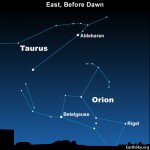
Also, notice the star Aldebaran in the constellation Taurus the Bull. Aldebaran is the brightest star in Taurus the Bull. It’s said to be the Bull’s fiery red eye. See the V-shaped pattern of stars around Aldebaran? This pattern represents the Bull’s face. In skylore, Orion is said to be holding up a great shield … fending off the charging Bull. Can you imagine this by looking at the chart at top? It’s easy to imagine when you look at the real sky before dawn at this time of year.

Bottom line: The return of Orion and Taurus to your predawn sky happens around late July or early August every year. In the Northern Hemisphere, Orion is sometimes called the ghost of the summer dawn.

Donate: Your support means the world to us

EarthSky’s meteor shower guide for 2019


from EarthSky https://ift.tt/2GBhcrM

Meteors ahead! Everything you need to know: Perseid meteor shower

Around late July or early August, if you’re up early and have an unobstructed view to the east, be sure to look in that direction in the hour before dawn. You might find a familiar figure – a constellation that always returns to the sky around this time of year. It’s the beautiful constellation Orion the Hunter – recently behind the sun as seen from our earthly vantage point – now ascending once more in the east before sunrise.

The Hunter appears each northern winter as a mighty constellation arcing across the south during the evening hours. Many people see it then, and notice it, because the pattern of Orion’s stars is so distinctive.

But, at the crack of dawn in late summer, you can spot Orion in the east. Thus Orion has been called the ghost of the shimmering summer dawn.

The Hunter rises on his side, with his three Belt stars – Mintaka, Alnitak and Alnilam – pointing straight up.

Enjoying EarthSky so far? Sign up for our free daily newsletter today!

Photo: bright stars of Orion seen to the side and over a round dark hill.

The constellation Orion as viewed at morning dawn in early August. Image via Flickr user Michael C. Rael.

Also, notice the star Aldebaran in the constellation Taurus the Bull. Aldebaran is the brightest star in Taurus the Bull. It’s said to be the Bull’s fiery red eye. See the V-shaped pattern of stars around Aldebaran? This pattern represents the Bull’s face. In skylore, Orion is said to be holding up a great shield … fending off the charging Bull. Can you imagine this by looking at the chart at top? It’s easy to imagine when you look at the real sky before dawn at this time of year.

Bottom line: The return of Orion and Taurus to your predawn sky happens around late July or early August every year. In the Northern Hemisphere, Orion is sometimes called the ghost of the summer dawn.

Donate: Your support means the world to us

EarthSky’s meteor shower guide for 2019


from EarthSky https://ift.tt/2GBhcrM

Chandrayaan-2 successfully completes 3rd orbit-raising maneuver

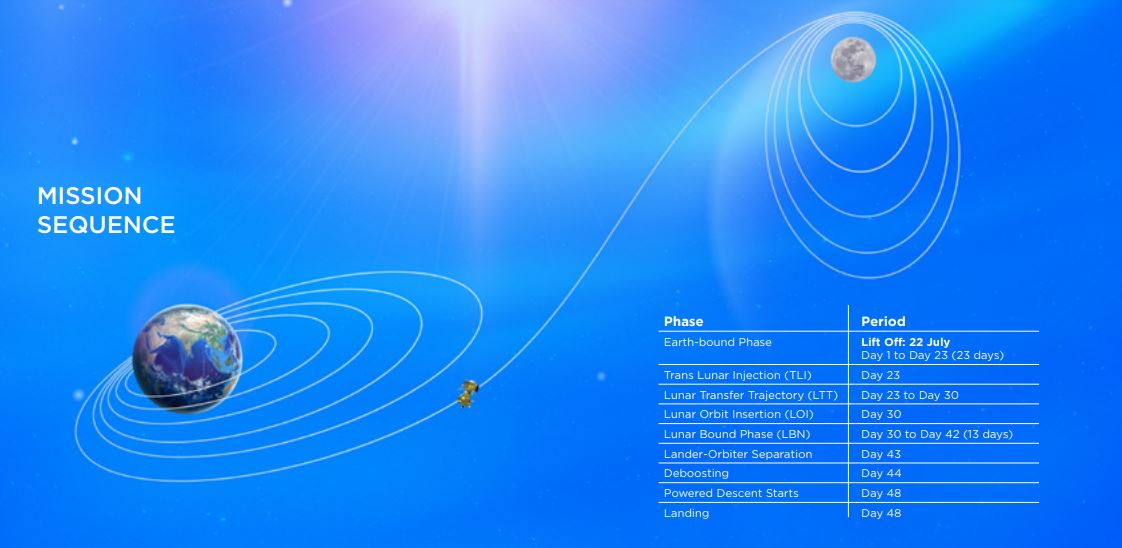
Mission sequence Chandrayaan-2

Mission sequence showing Chandrayaan-2’s trajectory. Image via ISRO.

India’s second spacecraft to the moon – an unprecedented attempt to soft-land on the lunar south pole – is steadily breaking free of Earth’s gravity. Chandrayaan-2, consisting of an orbiter, lander and rover, launched on July 22, 2019 from India’s spaceport in Sriharikota, Andhra Pradesh.

Once launched, the spacecraft entered a highly elliptical orbit around Earth. Multiple orbit-raising maneuvers have been now steadily increasing its altitude until Earth’s gravitational force becomes weaker and the moon’s influence can begin to take over. The third such maneuver was carried out successfully today, according to ISRO:

Third earthbound orbit raising maneuver for Chandryaan-2 spacecraft has been performed successfully today (July 29, 2019) at 1512 hrs (IST) as planned, using the onboard propulsion system for a firing duration of 989 seconds. The orbit achieved is 276 x 71792 km. All spacecraft parameters are normal. The fourth orbit raising maneuver is scheduled on August 2, 2019, between 1400 – 1500 hrs (IST).

If everything goes well, Chandrayaan-2 will soon enter trans-lunar orbit and land on the moon on September 7, 2019.

The instruments onboard the spacecraft will study the moon’s topography, chemical composition, and map the abundance of lunar water, especially at the polar regions. Chandrayaan-2’s predecessor, Chandrayaan-1 that was launched back in 2008 had confirmed the presence of lunar water.

The moon is positioned in such a way that some parts of the polar regions are permanently shadowed. Chandrayaan-1 also provided evidence of ice being present in craters of the south pole. Places like these allow water to freeze and to remain frozen. Building upon its precursor’s findings, Chandrayaan-2 will land on a high plain in between two such craters in the southern hemisphere – Manzinus C and Simpelius N.

While the evidence of lunar water is not new knowledge, the south pole is still unfamiliar terrain. The complexity of such a mission is so huge that only three countries have been successful. If Chandrayaan-2 is successful, India will be the fourth country after the US, China, and Europe to soft-land on an extraterrestrial body. A recent attempt by Israeli group failed.

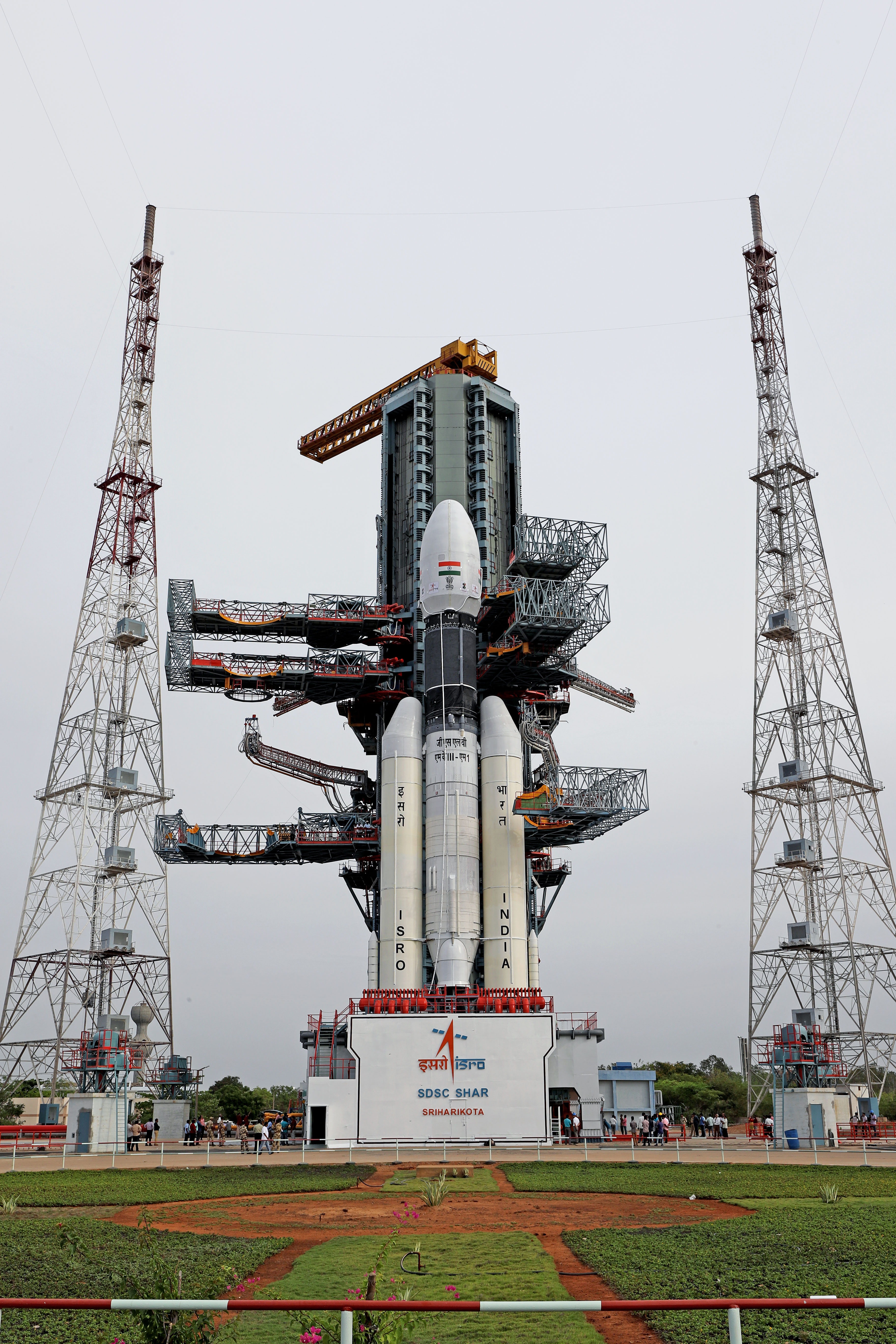
Chandrayaan-2 launch

Chandrayaan-2 sits atop the GSLV MkIII-M1 rocket at the Satish Dhawan Space Centre in India. Image via ISRO

Chandrayaan-2’s orbiter, rover, and lander are housed inside the Geosynchronous Satellite Launch Vehicle MkIII-M1 – India’s most powerful rocket.

Soon, the spacecraft will enter a Lunar Bound Phase where its propulsion systems will be fired to slow it down and insert it into an orbit around the moon. On day 43, the lander, called Vikram, will separate from the orbiter from a distance of 62 miles (100 km).

The lander will then attempt to soft-land – a first of its kind for India – using complex breaking mechanisms. A few meters above the ground, all thrusters will shut off to allow a free fall. The quiet landing will ensure that the moon’s surface remains undisturbed and its dust unmoved, dust which could otherwise spurt all around the spacecraft due to the thrusters’ force and spoil its circuitry systems. 

Once firmly on the ground, the lander shall deploy its rover, called Pragyaan, which will perform on-site chemical analysis for 1 lunar day (14 earth days). Onboard Pragyaan, a suite of spectroscopic instruments will fire lasers at different locations on the lunar surface to analyze its chemical compositions. The rover will primarily hunt for major rock-forming minerals such as sodium, magnesium, and iron. The orbiter carries the highest number of instruments and is also responsible for a large chunk of information. 3D mapping of the lunar surface, solar radiation monitoring, and analyzing the moon’s ionosphere are crucial to understanding the moon’s evolution. 

All in all, Chandrayaan-2 will not only help us understand our natural satellite better, but will also inform future manned missions to the moon, such as NASA’s Artemis in 2024. 

Watch the complete Chandrayaan-2 launch here.

Bottom line: India’s second spacecraft to the moon – Chandrayaan-2 – is steadily breaking free of Earth’s gravity. If everything goes well, it will soon enter trans-lunar orbit and land on the moon on September 7, 2019.

Source: GSLC MkIII-M1 Successfully Launches Chandrayaan-2 Spacecraft.

Read more from ISRO


from EarthSky https://ift.tt/2SUchqY
Mission sequence Chandrayaan-2

Mission sequence showing Chandrayaan-2’s trajectory. Image via ISRO.

India’s second spacecraft to the moon – an unprecedented attempt to soft-land on the lunar south pole – is steadily breaking free of Earth’s gravity. Chandrayaan-2, consisting of an orbiter, lander and rover, launched on July 22, 2019 from India’s spaceport in Sriharikota, Andhra Pradesh.

Once launched, the spacecraft entered a highly elliptical orbit around Earth. Multiple orbit-raising maneuvers have been now steadily increasing its altitude until Earth’s gravitational force becomes weaker and the moon’s influence can begin to take over. The third such maneuver was carried out successfully today, according to ISRO:

Third earthbound orbit raising maneuver for Chandryaan-2 spacecraft has been performed successfully today (July 29, 2019) at 1512 hrs (IST) as planned, using the onboard propulsion system for a firing duration of 989 seconds. The orbit achieved is 276 x 71792 km. All spacecraft parameters are normal. The fourth orbit raising maneuver is scheduled on August 2, 2019, between 1400 – 1500 hrs (IST).

If everything goes well, Chandrayaan-2 will soon enter trans-lunar orbit and land on the moon on September 7, 2019.

The instruments onboard the spacecraft will study the moon’s topography, chemical composition, and map the abundance of lunar water, especially at the polar regions. Chandrayaan-2’s predecessor, Chandrayaan-1 that was launched back in 2008 had confirmed the presence of lunar water.

The moon is positioned in such a way that some parts of the polar regions are permanently shadowed. Chandrayaan-1 also provided evidence of ice being present in craters of the south pole. Places like these allow water to freeze and to remain frozen. Building upon its precursor’s findings, Chandrayaan-2 will land on a high plain in between two such craters in the southern hemisphere – Manzinus C and Simpelius N.

While the evidence of lunar water is not new knowledge, the south pole is still unfamiliar terrain. The complexity of such a mission is so huge that only three countries have been successful. If Chandrayaan-2 is successful, India will be the fourth country after the US, China, and Europe to soft-land on an extraterrestrial body. A recent attempt by Israeli group failed.

Chandrayaan-2 launch

Chandrayaan-2 sits atop the GSLV MkIII-M1 rocket at the Satish Dhawan Space Centre in India. Image via ISRO

Chandrayaan-2’s orbiter, rover, and lander are housed inside the Geosynchronous Satellite Launch Vehicle MkIII-M1 – India’s most powerful rocket.

Soon, the spacecraft will enter a Lunar Bound Phase where its propulsion systems will be fired to slow it down and insert it into an orbit around the moon. On day 43, the lander, called Vikram, will separate from the orbiter from a distance of 62 miles (100 km).

The lander will then attempt to soft-land – a first of its kind for India – using complex breaking mechanisms. A few meters above the ground, all thrusters will shut off to allow a free fall. The quiet landing will ensure that the moon’s surface remains undisturbed and its dust unmoved, dust which could otherwise spurt all around the spacecraft due to the thrusters’ force and spoil its circuitry systems. 

Once firmly on the ground, the lander shall deploy its rover, called Pragyaan, which will perform on-site chemical analysis for 1 lunar day (14 earth days). Onboard Pragyaan, a suite of spectroscopic instruments will fire lasers at different locations on the lunar surface to analyze its chemical compositions. The rover will primarily hunt for major rock-forming minerals such as sodium, magnesium, and iron. The orbiter carries the highest number of instruments and is also responsible for a large chunk of information. 3D mapping of the lunar surface, solar radiation monitoring, and analyzing the moon’s ionosphere are crucial to understanding the moon’s evolution. 

All in all, Chandrayaan-2 will not only help us understand our natural satellite better, but will also inform future manned missions to the moon, such as NASA’s Artemis in 2024. 

Watch the complete Chandrayaan-2 launch here.

Bottom line: India’s second spacecraft to the moon – Chandrayaan-2 – is steadily breaking free of Earth’s gravity. If everything goes well, it will soon enter trans-lunar orbit and land on the moon on September 7, 2019.

Source: GSLC MkIII-M1 Successfully Launches Chandrayaan-2 Spacecraft.

Read more from ISRO


from EarthSky https://ift.tt/2SUchqY

Late July and August guide to the bright planets

Click the name of a planet to learn more about its visibility in August 2019: Venus, Jupiter, Saturn, Mars and Mercury.

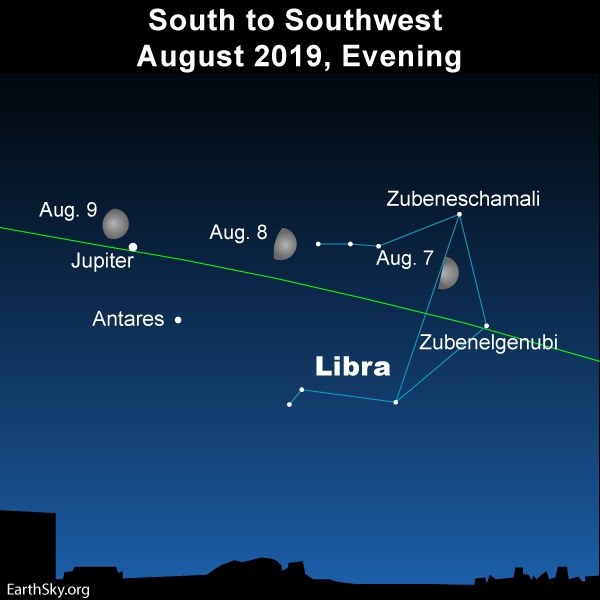
Moon in Libra, to the west of Jupiter.

The moon will meet up with the king planet Jupiter on or near August 9, 2019. Moon passes by the planets Jupiter and Saturn. The moon will meet up with the king planet Jupiter on or near August 9, 2019. Read more. It’s this same bright, waxing moon that’ll drown out the peak of 2019’s Perseid meteor shower.
Jupiter – the second-brightest planet after Venus – reigns supreme in the late July and August 2019 night sky. With Venus lost in the sun’s glare now, dazzling Jupiter – the second-brightest planet after Venus – rules the night. It pops out at dusk – brighter than any star – and stays out until late night. Not sure which one is Jupiter? See the moon in Jupiter’s vicinity for several days, centered on or near August 9.

Jupiter’s yearly opposition was June 10, 2019. Then the planet was opposite the sun, rising at sunset, lighting up the night sky from dusk until dawn. Now, since Jupiter is already well up when night begins, it doesn’t stay out until dawn. From around the world in early August, Jupiter sets in the wee morning hours.

By the month’s end, at mid-northern latitudes, Jupiter will set around midnight (1 a.m. daylight time). By midnight, we mean the middle of the night, or midway between sunset and sunrise.

By the end of the month at temperate latitudes in the Southern Hemisphere, Jupiter will set about one hour after the midnight hour.

That bright ruddy star rather close to Jupiter on our sky’s dome this year is Antares, the Heart of the Scorpion in the constellation Scorpius. In 2019, Jupiter can be seen to “wander” relative to this zodiac star. In other words, in the first three months of 2019, Jupiter was traveling eastward, away from Antares. But starting on April 10, 2019, Jupiter appeared to reverse course, moving toward Antares. For four months (April 10 to August 11, 2019), Jupiter will be traveling in retrograde (or westward), closing the gap between itself and the star Antares. Midway through this retrograde – on June 10, 2019 – Jupiter reached opposition.

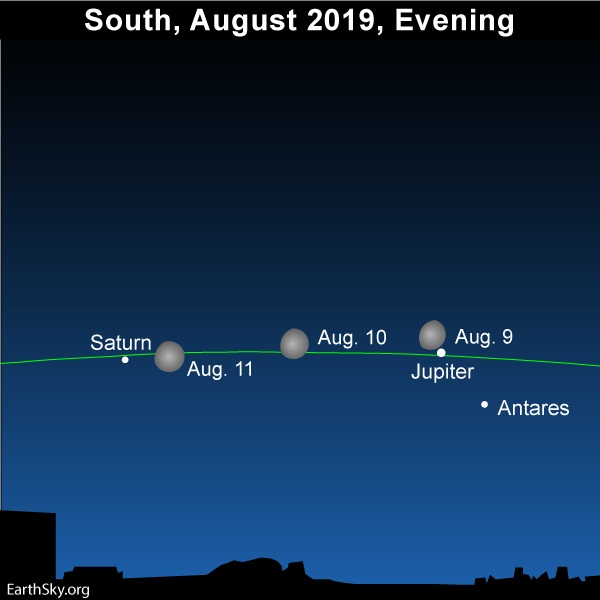
Moon passes by the planets Jupiter and Saturn.

The nearly-full waxing gibbous moon will swing by the planets Jupiter and Saturn on August 9, 10 and 11, 2019. Read more.

Saturn reached its yearly opposition about a month behind Jupiter, on July 9, 2019. So you know these two worlds must be near each other in our sky. At opposition, Saturn rose in the east around sunset, climbed highest up for the night at midnight (midway between sunset and sunrise) and set in the west around sunrise. Like Jupiter now – since it’s still so near its time of opposition – Saturn is nearly at its brightest. Like Jupiter – since opposition came a few weeks back – Saturn is now rising shortly before sunset.

In August 2019, you can see Saturn pop out in the eastern part of the sky first thing at nightfall. This golden world still shines more brilliantly than a 1st-magnitude star, and, even now, stays out for most of the night. Around the world, Saturn sets at about the time of dawn’s first light (astronomical twilight) in early August. Want to know when astronomical twilight starts in your part of the world? Click here and remember to check the astronomical twilight box.

Viewing Saturn’s rings soon? Read me 1st

By the month’s end, at mid-northern latitudes, Saturn is highest in the east at nightfall and sets about one hour after midnight. This is happening because Earth is fleeing ahead of Saturn now, in the race of the planets around the sun.

By the end of the month at temperate latitudes in the Southern Hemisphere, Saturn sets about 3 hours after the midnight hour.

You won’t mistake Jupiter for Saturn. Jupiter is brighter than Saturn. Jupiter is the fourth-brightest celestial object after the sun, moon and Venus, respectively, and it outshines Saturn by a good 10 times. What’s more, at nightfall and early evening in August 2019, Jupiter shines well to the west of Saturn.

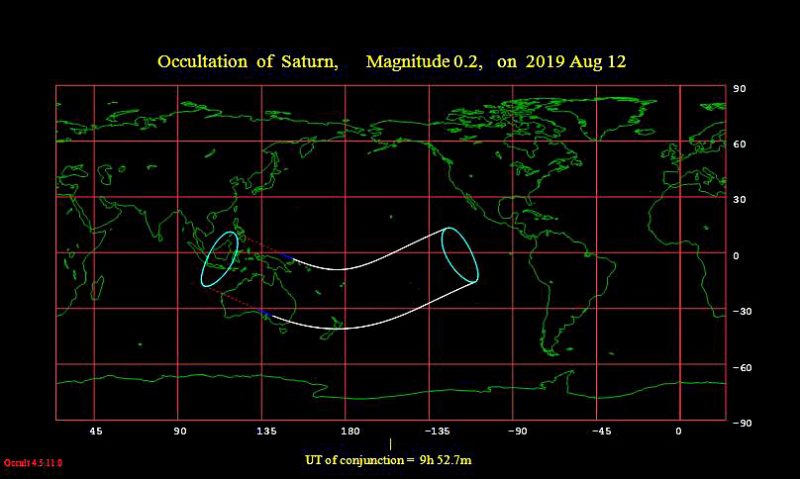
Watch for the bright moon to couple up with Saturn on or near August 11, as shown on the sky chart above. If you’re in just the right spot in eastern Australia or northern New Zealand, you can actually watch the moon occult (cover over) Saturn for a portion of the night on August 11-12, 2019.

Occultation of Saturn August 12, 2019.

The occultation of Saturn happens in a nighttime sky in between the white lines, at dusk in between the blue lines, and in a daytime sky in between the dotted red lines. Worldwide map via IOTA.

We give the local times for the occultation for two localities:

Sydney, Australia (August 12, 2019)
Occultation begins (Saturn disappears): 6:34 p.m. local time
Occultation ends (Saturn reappears): 7:23 p.m. local time

Auckland, New Zealand (August 12, 2019)
Occultation begins (Saturn disappears): 9:16 p.m. local time
Occultation ends (Saturn reappears): 10:15 p.m. local time

Click here for the occultation times for numerous localities but remember to convert Universal Time to local time. Here’s how.

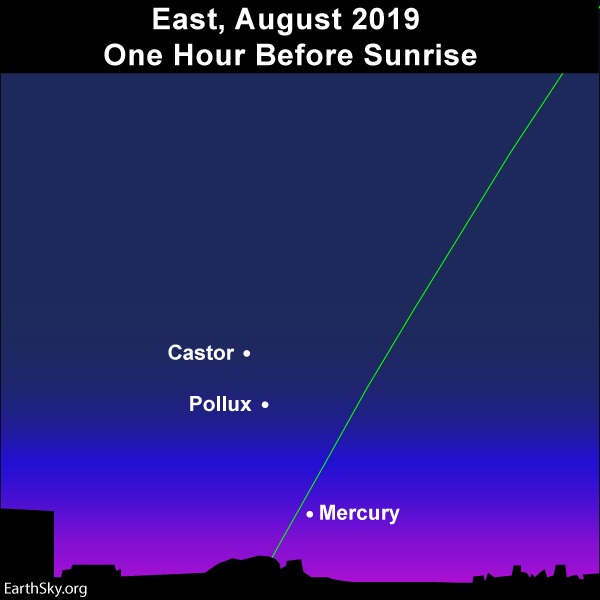
The planet Mercury lines up with the stars Castor and Pollux.

On or near August 11, 2019, the planet Mercury lines up with the Gemini stars, Castor and Pollux. Appreciably before that date, Mercury is still found near the ecliptic but to the west (right) of the Castor-Pollux line. Read more.

Mercury swept more or less in front of the sun at inferior conjunction on July 21, 2019, thereby transitioning out of the evening sky and into the morning sky. It’ll be a morning object all throughout August, yet this faint world will be rather hard to see in the early part of the month. Mercury’s waxing phase will cause this world to brighten dramatically all month long, but Mercury will sink too close to the sun to be visible during the final week of August.

Try catching Mercury an hour or more before sunrise, starting at the end of the first week of August. It should remain in pretty good view in the morning sky for another two weeks after that. Remember that binoculars always come in handy for any Mercury quest, since the solar system’s innermost planet oftentimes has to contend with the glow of twilight.

By the way, at Mercury’s most recent inferior conjunction on July 21, 2019, Mercury swung to the south of the sun’s disk as seen from Earth. But when Mercury reaches its next inferior conjunction on November 11, 2019, the innermost planet will swing directly in front of the sun, to stage a transit of Mercury. Transits of Mercury happen more frequently than transits of Venus; they happen 13 or 14 times per century. The last transit of Mercury happened on May 9, 2016, and – after the one on this upcoming November 11 – the next Mercury transit won’t be until November 13, 2032.

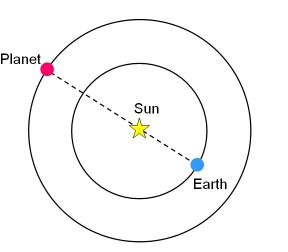
Diagram shows orbits with a planet passing behind the sun viewed from Earth.

Here’s a superior conjunction. The planet sweeps behind the sun as seen from Earth. Image via COSMOS.

Diagram of orbits. An inner planet is passing between the Earth and sun.

Here’s an inferior conjunction. The planet sweeps between the Earth and sun. As seen from Earth, only Venus and Mercury can have inferior conjunctions. Image via COSMOS.

Where is Venus? The brightest planet must contend with the sun’s glare throughout late July and August 2019. Venus begins August in the glare of sunrise and ends the month in the glare of sunset. In other words – on August 14, 2019 – Venus will reach superior conjunction, as it swings behind the sun in Earth’s sky. Superior conjunction for Venus marks the time of its transition from the morning to evening sky. Most of us will probably first see Venus as a bright evening “star” in the western sky after sunset in September or October 2019.

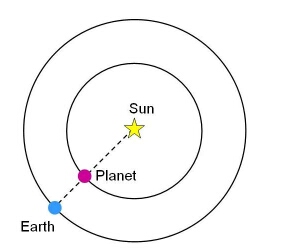
As seen from above the solar system, Venus is fleeing far ahead of Earth in the race of the planets around the sun. It has gotten so far ahead that it’s essentially “turned the corner” in front of us, so that the sun is now between us and Venus.

Where is Mars? The red planet sits way too close to the afterglow of sunset to be visible in August 2019. It’ll swing on the far side of the sun at superior conjunction on September 2, 2019, to transition from the evening to morning sky. For about six weeks or so on either side of that date, Mars is pretty much absent from our sky, hiding in the sun’s glare.

Look for Mars to return to visibility in the eastern sky before sunrise in November 2019.

What do we mean by bright planet? By bright planet, we mean any solar system planet that is easily visible without an optical aid and that has been watched by our ancestors since time immemorial. In their outward order from the sun, the five bright planets are Mercury, Venus, Mars, Jupiter and Saturn. These planets actually do appear bright in our sky. They are typically as bright as – or brighter than – the brightest stars. Plus, these relatively nearby worlds tend to shine with a steadier light than the distant, twinkling stars. You can spot them, and come to know them as faithful friends, if you try.

silhouette of man against the sunset sky with bright planet and crescent moon.

Skywatcher, by Predrag Agatonovic.

Bottom line: In late July and August 2019, two planets – Jupiter and Saturn – are easy to see throughout the month. They both come out at nightfall and are out till late night. Mercury appears in the east before sunrise. Mars is lost in the afterglow of sunset, whereas Venus swings behind the sun, to transition from the morning to evening sky. Click here for recommended almanacs; they can help you know when the planets rise and set in your sky.

Don’t miss anything. Subscribe to EarthSky News by email

Visit EarthSky’s Best Places to Stargaze, and recommend a place we can all enjoy. Zoom out for worldwide map.

Help EarthSky keep going! Donate now.

Post your planet photos at EarthSky Community Photos


from EarthSky https://ift.tt/1YD00CF

Click the name of a planet to learn more about its visibility in August 2019: Venus, Jupiter, Saturn, Mars and Mercury.

Moon in Libra, to the west of Jupiter.

The moon will meet up with the king planet Jupiter on or near August 9, 2019. Moon passes by the planets Jupiter and Saturn. The moon will meet up with the king planet Jupiter on or near August 9, 2019. Read more. It’s this same bright, waxing moon that’ll drown out the peak of 2019’s Perseid meteor shower.
Jupiter – the second-brightest planet after Venus – reigns supreme in the late July and August 2019 night sky. With Venus lost in the sun’s glare now, dazzling Jupiter – the second-brightest planet after Venus – rules the night. It pops out at dusk – brighter than any star – and stays out until late night. Not sure which one is Jupiter? See the moon in Jupiter’s vicinity for several days, centered on or near August 9.

Jupiter’s yearly opposition was June 10, 2019. Then the planet was opposite the sun, rising at sunset, lighting up the night sky from dusk until dawn. Now, since Jupiter is already well up when night begins, it doesn’t stay out until dawn. From around the world in early August, Jupiter sets in the wee morning hours.

By the month’s end, at mid-northern latitudes, Jupiter will set around midnight (1 a.m. daylight time). By midnight, we mean the middle of the night, or midway between sunset and sunrise.

By the end of the month at temperate latitudes in the Southern Hemisphere, Jupiter will set about one hour after the midnight hour.

That bright ruddy star rather close to Jupiter on our sky’s dome this year is Antares, the Heart of the Scorpion in the constellation Scorpius. In 2019, Jupiter can be seen to “wander” relative to this zodiac star. In other words, in the first three months of 2019, Jupiter was traveling eastward, away from Antares. But starting on April 10, 2019, Jupiter appeared to reverse course, moving toward Antares. For four months (April 10 to August 11, 2019), Jupiter will be traveling in retrograde (or westward), closing the gap between itself and the star Antares. Midway through this retrograde – on June 10, 2019 – Jupiter reached opposition.

Moon passes by the planets Jupiter and Saturn.

The nearly-full waxing gibbous moon will swing by the planets Jupiter and Saturn on August 9, 10 and 11, 2019. Read more.

Saturn reached its yearly opposition about a month behind Jupiter, on July 9, 2019. So you know these two worlds must be near each other in our sky. At opposition, Saturn rose in the east around sunset, climbed highest up for the night at midnight (midway between sunset and sunrise) and set in the west around sunrise. Like Jupiter now – since it’s still so near its time of opposition – Saturn is nearly at its brightest. Like Jupiter – since opposition came a few weeks back – Saturn is now rising shortly before sunset.

In August 2019, you can see Saturn pop out in the eastern part of the sky first thing at nightfall. This golden world still shines more brilliantly than a 1st-magnitude star, and, even now, stays out for most of the night. Around the world, Saturn sets at about the time of dawn’s first light (astronomical twilight) in early August. Want to know when astronomical twilight starts in your part of the world? Click here and remember to check the astronomical twilight box.

Viewing Saturn’s rings soon? Read me 1st

By the month’s end, at mid-northern latitudes, Saturn is highest in the east at nightfall and sets about one hour after midnight. This is happening because Earth is fleeing ahead of Saturn now, in the race of the planets around the sun.

By the end of the month at temperate latitudes in the Southern Hemisphere, Saturn sets about 3 hours after the midnight hour.

You won’t mistake Jupiter for Saturn. Jupiter is brighter than Saturn. Jupiter is the fourth-brightest celestial object after the sun, moon and Venus, respectively, and it outshines Saturn by a good 10 times. What’s more, at nightfall and early evening in August 2019, Jupiter shines well to the west of Saturn.

Watch for the bright moon to couple up with Saturn on or near August 11, as shown on the sky chart above. If you’re in just the right spot in eastern Australia or northern New Zealand, you can actually watch the moon occult (cover over) Saturn for a portion of the night on August 11-12, 2019.

Occultation of Saturn August 12, 2019.

The occultation of Saturn happens in a nighttime sky in between the white lines, at dusk in between the blue lines, and in a daytime sky in between the dotted red lines. Worldwide map via IOTA.

We give the local times for the occultation for two localities:

Sydney, Australia (August 12, 2019)
Occultation begins (Saturn disappears): 6:34 p.m. local time
Occultation ends (Saturn reappears): 7:23 p.m. local time

Auckland, New Zealand (August 12, 2019)
Occultation begins (Saturn disappears): 9:16 p.m. local time
Occultation ends (Saturn reappears): 10:15 p.m. local time

Click here for the occultation times for numerous localities but remember to convert Universal Time to local time. Here’s how.

The planet Mercury lines up with the stars Castor and Pollux.

On or near August 11, 2019, the planet Mercury lines up with the Gemini stars, Castor and Pollux. Appreciably before that date, Mercury is still found near the ecliptic but to the west (right) of the Castor-Pollux line. Read more.

Mercury swept more or less in front of the sun at inferior conjunction on July 21, 2019, thereby transitioning out of the evening sky and into the morning sky. It’ll be a morning object all throughout August, yet this faint world will be rather hard to see in the early part of the month. Mercury’s waxing phase will cause this world to brighten dramatically all month long, but Mercury will sink too close to the sun to be visible during the final week of August.

Try catching Mercury an hour or more before sunrise, starting at the end of the first week of August. It should remain in pretty good view in the morning sky for another two weeks after that. Remember that binoculars always come in handy for any Mercury quest, since the solar system’s innermost planet oftentimes has to contend with the glow of twilight.

By the way, at Mercury’s most recent inferior conjunction on July 21, 2019, Mercury swung to the south of the sun’s disk as seen from Earth. But when Mercury reaches its next inferior conjunction on November 11, 2019, the innermost planet will swing directly in front of the sun, to stage a transit of Mercury. Transits of Mercury happen more frequently than transits of Venus; they happen 13 or 14 times per century. The last transit of Mercury happened on May 9, 2016, and – after the one on this upcoming November 11 – the next Mercury transit won’t be until November 13, 2032.

Diagram shows orbits with a planet passing behind the sun viewed from Earth.

Here’s a superior conjunction. The planet sweeps behind the sun as seen from Earth. Image via COSMOS.

Diagram of orbits. An inner planet is passing between the Earth and sun.

Here’s an inferior conjunction. The planet sweeps between the Earth and sun. As seen from Earth, only Venus and Mercury can have inferior conjunctions. Image via COSMOS.

Where is Venus? The brightest planet must contend with the sun’s glare throughout late July and August 2019. Venus begins August in the glare of sunrise and ends the month in the glare of sunset. In other words – on August 14, 2019 – Venus will reach superior conjunction, as it swings behind the sun in Earth’s sky. Superior conjunction for Venus marks the time of its transition from the morning to evening sky. Most of us will probably first see Venus as a bright evening “star” in the western sky after sunset in September or October 2019.

As seen from above the solar system, Venus is fleeing far ahead of Earth in the race of the planets around the sun. It has gotten so far ahead that it’s essentially “turned the corner” in front of us, so that the sun is now between us and Venus.

Where is Mars? The red planet sits way too close to the afterglow of sunset to be visible in August 2019. It’ll swing on the far side of the sun at superior conjunction on September 2, 2019, to transition from the evening to morning sky. For about six weeks or so on either side of that date, Mars is pretty much absent from our sky, hiding in the sun’s glare.

Look for Mars to return to visibility in the eastern sky before sunrise in November 2019.

What do we mean by bright planet? By bright planet, we mean any solar system planet that is easily visible without an optical aid and that has been watched by our ancestors since time immemorial. In their outward order from the sun, the five bright planets are Mercury, Venus, Mars, Jupiter and Saturn. These planets actually do appear bright in our sky. They are typically as bright as – or brighter than – the brightest stars. Plus, these relatively nearby worlds tend to shine with a steadier light than the distant, twinkling stars. You can spot them, and come to know them as faithful friends, if you try.

silhouette of man against the sunset sky with bright planet and crescent moon.

Skywatcher, by Predrag Agatonovic.

Bottom line: In late July and August 2019, two planets – Jupiter and Saturn – are easy to see throughout the month. They both come out at nightfall and are out till late night. Mercury appears in the east before sunrise. Mars is lost in the afterglow of sunset, whereas Venus swings behind the sun, to transition from the morning to evening sky. Click here for recommended almanacs; they can help you know when the planets rise and set in your sky.

Don’t miss anything. Subscribe to EarthSky News by email

Visit EarthSky’s Best Places to Stargaze, and recommend a place we can all enjoy. Zoom out for worldwide map.

Help EarthSky keep going! Donate now.

Post your planet photos at EarthSky Community Photos


from EarthSky https://ift.tt/1YD00CF

How fireflies glow and what signals they’re sending

A firefly lighting up on a leaf.

A firefly’s light is part of its mating strategy. Image via Japan’s Fireworks/Shutterstock.com.

By Clyde Sorenson, North Carolina State University

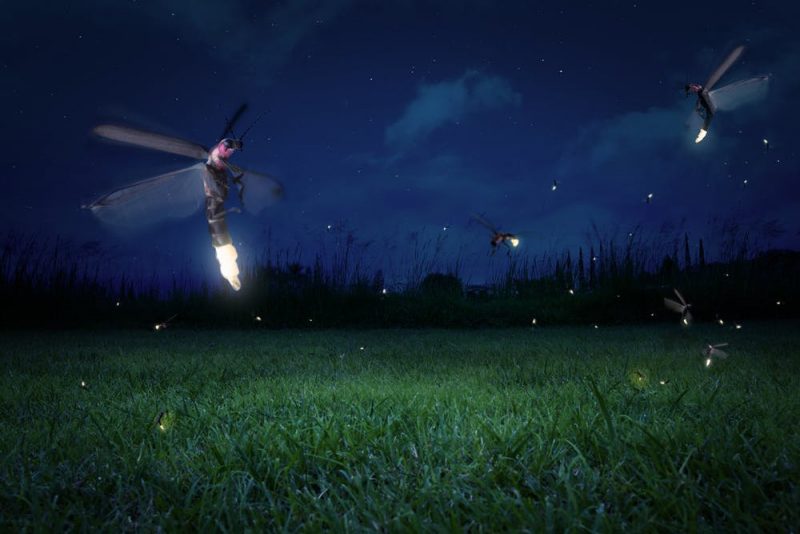
You might not really be sure you saw what you think you saw when the first one shows up. But you stare in the direction of the flicker of light and there it is again – the first firefly of the evening. If you are in good firefly habitat, soon there are dozens, or even hundreds, of the insects flying about, flashing their mysterious signals.

Fireflies – alternatively known as lightning bugs in much of the United States – are neither flies nor bugs. They’re soft-winged beetles, related to click beetles and others. The most dramatic aspect of their biology is that they can produce light; this ability in a living organism, called bioluminescence, is relatively rare.

I’m an entomologist who does research on, and teaches about, the ecology and biology of insects. Recently, I’ve been trying to understand the diversity and ecology of fireflies in my home state of North Carolina. Fireflies are found widely across North America, including many places in the west, but they are most abundant and diverse in the eastern half of the continent, from Florida to southern Canada.

A lit up firefly, seen from underneath.

A chemical reaction in the beetle’s abdomen gives it its bioluminescence. Image via Cathy Keifer/Shutterstock.com

Bioluminescent beetles

Fireflies produce light in special organs in their abdomens by combining a chemical called luciferin, enzymes called luciferases, oxygen and the fuel for cellular work, ATP. Entomologists think they control their flashing by regulating how much oxygen goes to their light-producing organs.

Fireflies probably originally evolved the ability to light up as a way to ward off predators, but now they mostly use this ability to find mates. Interestingly, not all fireflies produce light; there are several species that are day-flying and apparently rely on the odors of pheromones to find each other.

Each firefly species has its own signaling system. In most North American species, the males fly around at the right height, in the right habitat and at the right time of night for their species, and flash a signal unique to their kind. The females are sitting on the ground or in vegetation, watching for males. When a female sees one making her species’ signal – and doing it well – she flashes back with a species-appropriate flash of her own. Then the two reciprocally signal as the male flies down to her. If everything goes right, they mate.

A good example is Photinus pyralis, a common backyard species often called the Big Dipper. A male flies at dusk about 3 feet (.9 meters) off the ground. Every five seconds or so, he makes a one-second flash as he flies in the shape of a “J.” The female Photinus pyralis sits in low vegetation. If she sees a fellow she likes, she waits two seconds before making a half second flash of her own at the third second.

Some species may “call” for many hours a night, while others flash for only 20 minutes or so right at dusk. Firefly light communication can get much more complicated; some species have multiple signaling systems, and some might use their light organs for other purposes.

Some Tennessee fireflies put on a synchronized show.

While most male fireflies do their own thing and flash independently of other males of the same species, there are those that synchronize their flashes when there are many others around. In North America, the two most famous species that do this are the Photinus carolinus of the Appalachian Mountains, including in Great Smoky Mountains National Park, and the Photuris frontalis that light up places like Congaree National Park in South Carolina.

In both these species, scientists think the males synchronize so everyone has a chance to look for females, and for females to signal males. These displays are spectacular, and the crush of folks wanting to see them at the most famous locations has made it necessary to conduct a lottery for permission to view them. Both species, however, occur over wide geographic ranges, and it might be possible to see them in other, less congested places.

Stinky chemical defenses

Many fireflies protect themselves from predators with chemicals called lucibufagins. These are molecules the insects synthesize from other chemicals they eat in their diet. Lucibufagins are chemically very similar to the toxins toads exude on their skins, and while they are toxic in the right doses, they are also extremely distasteful.

Birds and other predators quickly learn to avoid fireflies. I’ve watched a toad on my back porch eat a firefly and promptly spit it back out; the insect walked away, gooey but apparently unharmed. A colleague of mine once put a firefly in his mouth – and his mouth went numb for an hour!

Mating Photinus pyralis. Image via Clyde Sorenson

Many other insects visually mimic fireflies in order to reap the benefit of looking like something unpleasant to eat and poisonous. Fireflies appear to produce other defensive chemicals, too, some of which may contribute to their distinctive smell.

Many Photuris fireflies can’t manufacture these defensive chemicals. So the females of these big, long-legged lightning bugs do something surprising: Once they’ve mated, they start mimicking the flashes of female Photinus and then eat the males that respond. These femme fatales go on to use the lucibufagins they acquire from ingesting their severely disappointed prey to protect themselves and their eggs from predators. They quickly transfer the chemicals to their blood, and spontaneously bleed if a predator grabs them.

a dark field lit up with fireflies.

Once fireflies lose a pocket of habitat, it’s unlikely they’ll come back. Image via Fer Gregory/Shutterstock.com

No place like home

Most fireflies are habitat specialists, using woodlands, meadows and marshes. They rely on that habitat remaining undisturbed for the year or more it takes them to complete their life cycles. These insects spend most of their lives as larvae preying on earthworms and other animals in the soil or leaf litter – most adults don’t feed at all. If that habitat is disrupted during their youth, populations can be extinguished.

Adding to this vulnerability is the fact that the females of many species – like the famous blue ghosts of the southern Appalachians and elsewhere – are wingless and can’t disperse any further than they can walk. If a population of blue ghosts is destroyed by logging or other disruption, there will be no reestablishment. Habitat destruction is therefore one of the greatest threats to fireflies. Other hazards include light pollution from artificial lights and perhaps insecticide applications for mosquito control.

There is much yet to learn about fireflies. Entomologists like me have identified about 170 or so species in North America, but it is clear that many more species occur here. Pay attention to the fireflies in your neighborhood; observe their flash patterns and behavior. Perhaps you’ll discover one of those new species.

Clyde Sorenson, Professor of Entomology, North Carolina State University

This article is republished from The Conversation under a Creative Commons license. Read the original article.

Bottom line: Why fireflies, or lightning bugs, light up and what signals they send.

The Conversation


from EarthSky https://ift.tt/2LNQG2M
A firefly lighting up on a leaf.

A firefly’s light is part of its mating strategy. Image via Japan’s Fireworks/Shutterstock.com.

By Clyde Sorenson, North Carolina State University

You might not really be sure you saw what you think you saw when the first one shows up. But you stare in the direction of the flicker of light and there it is again – the first firefly of the evening. If you are in good firefly habitat, soon there are dozens, or even hundreds, of the insects flying about, flashing their mysterious signals.

Fireflies – alternatively known as lightning bugs in much of the United States – are neither flies nor bugs. They’re soft-winged beetles, related to click beetles and others. The most dramatic aspect of their biology is that they can produce light; this ability in a living organism, called bioluminescence, is relatively rare.

I’m an entomologist who does research on, and teaches about, the ecology and biology of insects. Recently, I’ve been trying to understand the diversity and ecology of fireflies in my home state of North Carolina. Fireflies are found widely across North America, including many places in the west, but they are most abundant and diverse in the eastern half of the continent, from Florida to southern Canada.

A lit up firefly, seen from underneath.

A chemical reaction in the beetle’s abdomen gives it its bioluminescence. Image via Cathy Keifer/Shutterstock.com

Bioluminescent beetles

Fireflies produce light in special organs in their abdomens by combining a chemical called luciferin, enzymes called luciferases, oxygen and the fuel for cellular work, ATP. Entomologists think they control their flashing by regulating how much oxygen goes to their light-producing organs.

Fireflies probably originally evolved the ability to light up as a way to ward off predators, but now they mostly use this ability to find mates. Interestingly, not all fireflies produce light; there are several species that are day-flying and apparently rely on the odors of pheromones to find each other.

Each firefly species has its own signaling system. In most North American species, the males fly around at the right height, in the right habitat and at the right time of night for their species, and flash a signal unique to their kind. The females are sitting on the ground or in vegetation, watching for males. When a female sees one making her species’ signal – and doing it well – she flashes back with a species-appropriate flash of her own. Then the two reciprocally signal as the male flies down to her. If everything goes right, they mate.

A good example is Photinus pyralis, a common backyard species often called the Big Dipper. A male flies at dusk about 3 feet (.9 meters) off the ground. Every five seconds or so, he makes a one-second flash as he flies in the shape of a “J.” The female Photinus pyralis sits in low vegetation. If she sees a fellow she likes, she waits two seconds before making a half second flash of her own at the third second.

Some species may “call” for many hours a night, while others flash for only 20 minutes or so right at dusk. Firefly light communication can get much more complicated; some species have multiple signaling systems, and some might use their light organs for other purposes.

Some Tennessee fireflies put on a synchronized show.

While most male fireflies do their own thing and flash independently of other males of the same species, there are those that synchronize their flashes when there are many others around. In North America, the two most famous species that do this are the Photinus carolinus of the Appalachian Mountains, including in Great Smoky Mountains National Park, and the Photuris frontalis that light up places like Congaree National Park in South Carolina.

In both these species, scientists think the males synchronize so everyone has a chance to look for females, and for females to signal males. These displays are spectacular, and the crush of folks wanting to see them at the most famous locations has made it necessary to conduct a lottery for permission to view them. Both species, however, occur over wide geographic ranges, and it might be possible to see them in other, less congested places.

Stinky chemical defenses

Many fireflies protect themselves from predators with chemicals called lucibufagins. These are molecules the insects synthesize from other chemicals they eat in their diet. Lucibufagins are chemically very similar to the toxins toads exude on their skins, and while they are toxic in the right doses, they are also extremely distasteful.

Birds and other predators quickly learn to avoid fireflies. I’ve watched a toad on my back porch eat a firefly and promptly spit it back out; the insect walked away, gooey but apparently unharmed. A colleague of mine once put a firefly in his mouth – and his mouth went numb for an hour!

Mating Photinus pyralis. Image via Clyde Sorenson

Many other insects visually mimic fireflies in order to reap the benefit of looking like something unpleasant to eat and poisonous. Fireflies appear to produce other defensive chemicals, too, some of which may contribute to their distinctive smell.

Many Photuris fireflies can’t manufacture these defensive chemicals. So the females of these big, long-legged lightning bugs do something surprising: Once they’ve mated, they start mimicking the flashes of female Photinus and then eat the males that respond. These femme fatales go on to use the lucibufagins they acquire from ingesting their severely disappointed prey to protect themselves and their eggs from predators. They quickly transfer the chemicals to their blood, and spontaneously bleed if a predator grabs them.

a dark field lit up with fireflies.

Once fireflies lose a pocket of habitat, it’s unlikely they’ll come back. Image via Fer Gregory/Shutterstock.com

No place like home

Most fireflies are habitat specialists, using woodlands, meadows and marshes. They rely on that habitat remaining undisturbed for the year or more it takes them to complete their life cycles. These insects spend most of their lives as larvae preying on earthworms and other animals in the soil or leaf litter – most adults don’t feed at all. If that habitat is disrupted during their youth, populations can be extinguished.

Adding to this vulnerability is the fact that the females of many species – like the famous blue ghosts of the southern Appalachians and elsewhere – are wingless and can’t disperse any further than they can walk. If a population of blue ghosts is destroyed by logging or other disruption, there will be no reestablishment. Habitat destruction is therefore one of the greatest threats to fireflies. Other hazards include light pollution from artificial lights and perhaps insecticide applications for mosquito control.

There is much yet to learn about fireflies. Entomologists like me have identified about 170 or so species in North America, but it is clear that many more species occur here. Pay attention to the fireflies in your neighborhood; observe their flash patterns and behavior. Perhaps you’ll discover one of those new species.

Clyde Sorenson, Professor of Entomology, North Carolina State University

This article is republished from The Conversation under a Creative Commons license. Read the original article.

Bottom line: Why fireflies, or lightning bugs, light up and what signals they send.

The Conversation


from EarthSky https://ift.tt/2LNQG2M

See the constellation Scutum the Shield

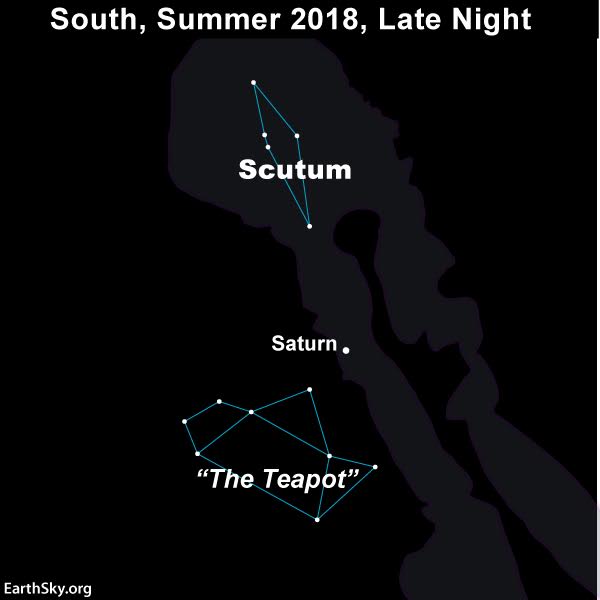
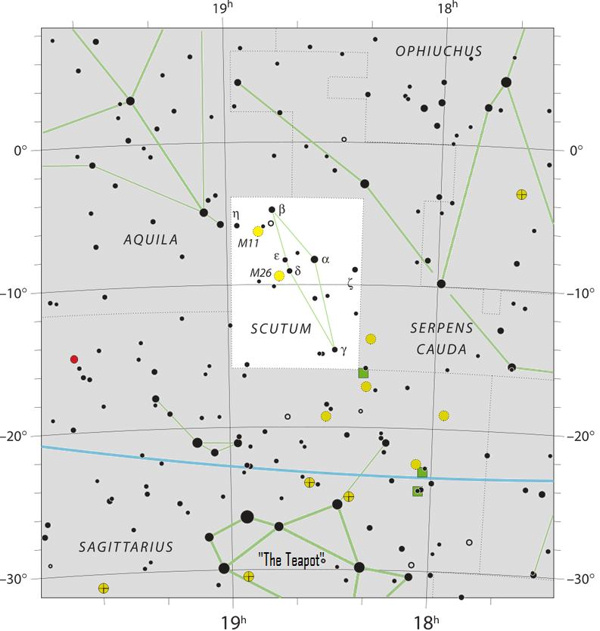
Tonight, look for one of the most beautiful celestial sights visible at this time of year. Look in a dark country sky, far away from the the glare of city lights. You’ll find a hazy pathway stretched across the sky. This band is the starlit trail of our own Milky Way galaxy. If you see it, you can also find the very small constellation called Scutum the Shield. There are only four to five stars outlining the constellation, but Scutum is noticeable in a dark sky because the Milky Way is so rich here. At late night, look southward from the Northern Hemisphere, or overhead from the Southern Hemisphere – toward the richest part of the Milky Way – to see Scutum.

Last year, in 2018, sky watchers also used the planet Saturn, because this distant planet stays in the same constellation of the zodiac for about 2 1/2 years. Jupiter stays with a given constellation for roughly a year.

Scutum has a fascinating history. The Polish astronomer Johannes Hevelius named it Scutum Sobiescianum, meaning the shield of Sobieski, in 1683. He named it for Jan III Sobieski, a Polish king who led his armies to victory in the Battle of Vienna. The constellation in charts of the era resembles the king’s coat of arms on his shield. Today, you still sometimes hear amateur astronomers refer to this part of the sky as Scutum Sobieski.

Scutum is one of two constellations named after real people. The other one is Coma Berenices, named for an Egyptian queen.

The Shield isn’t big, and it requires a dark sky to be seen, but – to those who find it in dark skies – it provides some very nice views with the unaided eye or binoculars. The very noticeable Teapot of Sagittarius is below Scutum. And the bright star Vega shines high above Scutum.

Sky chart of the constellation Scutum the Shield

Some famous deep-sky objects reside in this part of the sky, too. One is the Wild Duck Cluster, also known as M11. It’s an open star cluster – one of the densest ones ever found – containing some 3,000 stars.

Another open cluster in this part of the sky is M26, discovered by Charles Messier in 1764.

Bottom line: Look for the constellation Scutum the Shield. It’s located in a rich region of the Milky Way and requires a dark sky to be seen.

It’s meteor season. Look here for EarthSky’s meteor shower guide

EarthSky astronomy kits are perfect for beginners. Order yours today.


from EarthSky https://ift.tt/2SJ3B6s

Tonight, look for one of the most beautiful celestial sights visible at this time of year. Look in a dark country sky, far away from the the glare of city lights. You’ll find a hazy pathway stretched across the sky. This band is the starlit trail of our own Milky Way galaxy. If you see it, you can also find the very small constellation called Scutum the Shield. There are only four to five stars outlining the constellation, but Scutum is noticeable in a dark sky because the Milky Way is so rich here. At late night, look southward from the Northern Hemisphere, or overhead from the Southern Hemisphere – toward the richest part of the Milky Way – to see Scutum.

Last year, in 2018, sky watchers also used the planet Saturn, because this distant planet stays in the same constellation of the zodiac for about 2 1/2 years. Jupiter stays with a given constellation for roughly a year.

Scutum has a fascinating history. The Polish astronomer Johannes Hevelius named it Scutum Sobiescianum, meaning the shield of Sobieski, in 1683. He named it for Jan III Sobieski, a Polish king who led his armies to victory in the Battle of Vienna. The constellation in charts of the era resembles the king’s coat of arms on his shield. Today, you still sometimes hear amateur astronomers refer to this part of the sky as Scutum Sobieski.

Scutum is one of two constellations named after real people. The other one is Coma Berenices, named for an Egyptian queen.

The Shield isn’t big, and it requires a dark sky to be seen, but – to those who find it in dark skies – it provides some very nice views with the unaided eye or binoculars. The very noticeable Teapot of Sagittarius is below Scutum. And the bright star Vega shines high above Scutum.

Sky chart of the constellation Scutum the Shield

Some famous deep-sky objects reside in this part of the sky, too. One is the Wild Duck Cluster, also known as M11. It’s an open star cluster – one of the densest ones ever found – containing some 3,000 stars.

Another open cluster in this part of the sky is M26, discovered by Charles Messier in 1764.

Bottom line: Look for the constellation Scutum the Shield. It’s located in a rich region of the Milky Way and requires a dark sky to be seen.

It’s meteor season. Look here for EarthSky’s meteor shower guide

EarthSky astronomy kits are perfect for beginners. Order yours today.


from EarthSky https://ift.tt/2SJ3B6s

2019 SkS Weekly Climate Change & Global Warming Digest #30

Story of the Week... Toon of the Week... Coming Soon on SkS... Climate Feedback Reviews... SkS Week in Review... Poster of the Week...

Story of the Week...

Global Footprint Network promotes real-world solutions that #MoveTheDate, accelerating the transition to one-planet prosperity

On July 29, humanity will have used nature’s resource budget for the entire year, according to Global Footprint Network, an international sustainability organization that has pioneered the Ecological Footprint. It is Earth Overshoot Day. Its date has moved up two months over the past 20 years to the 29th of July this year, the earliest date ever.

2019 Past Overshoot Days by Global Carbon Footprint 


Earth Overshoot Day falling on July 29th means that humanity is currently using nature 1.75 times faster than our planet’s ecosystems can regenerate. This is akin to using 1.75 Earths. Overshoot is possible because we are depleting our natural capital – which compromises humanity’s future resource security. The costs of this global ecological overspending are becoming increasingly evident in the form of deforestation, soil erosion, biodiversity loss, or the buildup of carbon dioxide in the atmosphere. The latter leads to climate change and more frequent extreme weather events.

“We have only got one Earth – this is the ultimately defining context for human existence. We can’t use 1.75 without destructive consequences,” said Mathis Wackernagel, co-inventor of Ecological Footprint accounting and founder of Global Footprint Network.

His just released book, Ecological Footprint: Managing Our Biocapacity Budgetdemonstrates that overshoot can only be temporary. Humanity will eventually have to operate within the means of Earth’s ecological resources, whether that balance is restored by disaster or by design. “Companies and countries that understand and manage the reality of operating in a one-planet context are in a far better position to navigate the challenges of the 21st century,” Wackernagel writes. 

Global Footprint Network promotes real-world solutions that #MoveTheDate, accelerating the transition to one-planet prosperity. Press Release, Global Footprint Network, July 23, 2019


Toon of the Week...

2019 Toon 30 


Hat tip to the Stop Climate Science Denial Facebook page. 


Coming Soon on SkS...

  • 'No doubt left' about scientific consensus on global warming, say experts (Jonathan Watts)
  • Skeptical Science New Research for Week #30 (Doug Bostrom)
  • The 'war on coal' myth (Karin Kirk)
  • What psychotherapy can do for the climate and biodiversity crises (Caroline Hickman)
  • How climate change is making hurricanes more dangerous (Jeff Berardelli)
  • 2019 SkS Weekly Climate Change & Global Warming News Roundup #31 (John Hartz)
  • 2019 SkS Weekly Climate Change & Global Warming Digest #31 (John Hartz)

Climate Feedback Claim Review...

Data shows the Earth is currently warmer globally than at any time in the past 2,000 years

CLAIM:

"A graph of the Earth’s mean temperature over the last 2,000 years shows two previous periods when temperatures were warmer than they are now; from 1–200 A.D., an epoch called the Roman Warm Period, and more recently the Medieval Warm Period from 900–1100 A.D.[…] It is worth noting that both of these climate optima occurred centuries before the discovery of fossil fuels and the invention of the internal combustion engine."

SOURCE:

Apocalyptic Sea-Level Rise—Just a Thing of the Past?, Opinion by Gregory Rummo, Town Hall, July 23, 2019

 VERDICT:

 Inaccurate 

DETAILS:

Factually Inaccurate: Available climate records show that recent global temperatures are likely the highest of the last 2,000 years and there is no data supporting the claim that, globally, the Earth was warmer during the Roman or Medieval eras.

Flawed Reasoning: Natural climate change events in the past do not provide evidence that human emissions of greenhouse gas are incapable of changing the climate today.

KEY TAKE AWAY:

It's not true that the world has been warmer at other times during the last 2,000 years. But even if that were the case, it would not change the fact that human emissions of greenhouse gases are causing Earth's climate to warm.

Data shows the Earth is currently warmer globally than at any time in the past 2,000 years, Edited by Scott Johnson, Claim Reviews, Climate Feedback, July 26, 2019


Poster of the Week...

 2019 Poster 30


SkS Week in Review... 


from Skeptical Science https://ift.tt/2GzhC1J

Story of the Week... Toon of the Week... Coming Soon on SkS... Climate Feedback Reviews... SkS Week in Review... Poster of the Week...

Story of the Week...

Global Footprint Network promotes real-world solutions that #MoveTheDate, accelerating the transition to one-planet prosperity

On July 29, humanity will have used nature’s resource budget for the entire year, according to Global Footprint Network, an international sustainability organization that has pioneered the Ecological Footprint. It is Earth Overshoot Day. Its date has moved up two months over the past 20 years to the 29th of July this year, the earliest date ever.

2019 Past Overshoot Days by Global Carbon Footprint 


Earth Overshoot Day falling on July 29th means that humanity is currently using nature 1.75 times faster than our planet’s ecosystems can regenerate. This is akin to using 1.75 Earths. Overshoot is possible because we are depleting our natural capital – which compromises humanity’s future resource security. The costs of this global ecological overspending are becoming increasingly evident in the form of deforestation, soil erosion, biodiversity loss, or the buildup of carbon dioxide in the atmosphere. The latter leads to climate change and more frequent extreme weather events.

“We have only got one Earth – this is the ultimately defining context for human existence. We can’t use 1.75 without destructive consequences,” said Mathis Wackernagel, co-inventor of Ecological Footprint accounting and founder of Global Footprint Network.

His just released book, Ecological Footprint: Managing Our Biocapacity Budgetdemonstrates that overshoot can only be temporary. Humanity will eventually have to operate within the means of Earth’s ecological resources, whether that balance is restored by disaster or by design. “Companies and countries that understand and manage the reality of operating in a one-planet context are in a far better position to navigate the challenges of the 21st century,” Wackernagel writes. 

Global Footprint Network promotes real-world solutions that #MoveTheDate, accelerating the transition to one-planet prosperity. Press Release, Global Footprint Network, July 23, 2019


Toon of the Week...

2019 Toon 30 


Hat tip to the Stop Climate Science Denial Facebook page. 


Coming Soon on SkS...

  • 'No doubt left' about scientific consensus on global warming, say experts (Jonathan Watts)
  • Skeptical Science New Research for Week #30 (Doug Bostrom)
  • The 'war on coal' myth (Karin Kirk)
  • What psychotherapy can do for the climate and biodiversity crises (Caroline Hickman)
  • How climate change is making hurricanes more dangerous (Jeff Berardelli)
  • 2019 SkS Weekly Climate Change & Global Warming News Roundup #31 (John Hartz)
  • 2019 SkS Weekly Climate Change & Global Warming Digest #31 (John Hartz)

Climate Feedback Claim Review...

Data shows the Earth is currently warmer globally than at any time in the past 2,000 years

CLAIM:

"A graph of the Earth’s mean temperature over the last 2,000 years shows two previous periods when temperatures were warmer than they are now; from 1–200 A.D., an epoch called the Roman Warm Period, and more recently the Medieval Warm Period from 900–1100 A.D.[…] It is worth noting that both of these climate optima occurred centuries before the discovery of fossil fuels and the invention of the internal combustion engine."

SOURCE:

Apocalyptic Sea-Level Rise—Just a Thing of the Past?, Opinion by Gregory Rummo, Town Hall, July 23, 2019

 VERDICT:

 Inaccurate 

DETAILS:

Factually Inaccurate: Available climate records show that recent global temperatures are likely the highest of the last 2,000 years and there is no data supporting the claim that, globally, the Earth was warmer during the Roman or Medieval eras.

Flawed Reasoning: Natural climate change events in the past do not provide evidence that human emissions of greenhouse gas are incapable of changing the climate today.

KEY TAKE AWAY:

It's not true that the world has been warmer at other times during the last 2,000 years. But even if that were the case, it would not change the fact that human emissions of greenhouse gases are causing Earth's climate to warm.

Data shows the Earth is currently warmer globally than at any time in the past 2,000 years, Edited by Scott Johnson, Claim Reviews, Climate Feedback, July 26, 2019


Poster of the Week...

 2019 Poster 30


SkS Week in Review... 


from Skeptical Science https://ift.tt/2GzhC1J

2019 SkS Weekly Climate Change & Global Warming News Roundup #30

A chronological listing of news articles posted on the Skeptical Science Facebook Page during the past week, i.e., Sun, July 21 through Sat, July 27, 2019

Editor's Pick

Europe's record heatwave threatens Greenland ice sheet

The hot air moving up from North Africa has not merely broken European temperature records but surpassed them by 2, 3 or 4 degrees Celsius

Greenland

Shutterstock

The hot air that smashed European weather records this week looks set to move towards Greenland and could cause record melting of the world's second largest ice sheet, the United Nations said on Friday.

Clare Nullis, spokeswoman for the U.N. World Meteorological Organization, said the hot air moving up from North Africa had not merely broken European temperature records on Thursday but surpassed them by 2, 3 or 4 degrees Celsius, which she described as "absolutely incredible".

"According to forecasts, and this is of concern, the atmospheric flow is now going to transport that heat towards Greenland," she told a regular U.N. briefing in Geneva.

"This will result in high temperatures and consequently enhanced melting of the Greenland ice sheet," she said. "We don't know yet whether it will beat the 2012 level, but it's close."

Nullis cited data from Denmark's Polar Portal, which measures the daily gains and losses in surface mass of the Greenland Ice Sheet.

"In July alone, it lost 160 billion tonnes of ice through surface melting. That's roughly the equivalent of 64 million Olympic-sized swimming pools. Just in July. Just surface melt - it's not including ocean melt as well."

Europe's record heatwave threatens Greenland ice sheet by Tom Miles, Reuters, July 26, 2019


Links posted on Facebook

Sun July 21, 2019

Mon July 22, 2019

Tue July 23, 2019

Wed July 24, 2019

Thu July 25, 2019

Fri July 26, 2019

Sat July 27, 2019


from Skeptical Science https://ift.tt/2GxVQLV
A chronological listing of news articles posted on the Skeptical Science Facebook Page during the past week, i.e., Sun, July 21 through Sat, July 27, 2019

Editor's Pick

Europe's record heatwave threatens Greenland ice sheet

The hot air moving up from North Africa has not merely broken European temperature records but surpassed them by 2, 3 or 4 degrees Celsius

Greenland

Shutterstock

The hot air that smashed European weather records this week looks set to move towards Greenland and could cause record melting of the world's second largest ice sheet, the United Nations said on Friday.

Clare Nullis, spokeswoman for the U.N. World Meteorological Organization, said the hot air moving up from North Africa had not merely broken European temperature records on Thursday but surpassed them by 2, 3 or 4 degrees Celsius, which she described as "absolutely incredible".

"According to forecasts, and this is of concern, the atmospheric flow is now going to transport that heat towards Greenland," she told a regular U.N. briefing in Geneva.

"This will result in high temperatures and consequently enhanced melting of the Greenland ice sheet," she said. "We don't know yet whether it will beat the 2012 level, but it's close."

Nullis cited data from Denmark's Polar Portal, which measures the daily gains and losses in surface mass of the Greenland Ice Sheet.

"In July alone, it lost 160 billion tonnes of ice through surface melting. That's roughly the equivalent of 64 million Olympic-sized swimming pools. Just in July. Just surface melt - it's not including ocean melt as well."

Europe's record heatwave threatens Greenland ice sheet by Tom Miles, Reuters, July 26, 2019


Links posted on Facebook

Sun July 21, 2019

Mon July 22, 2019

Tue July 23, 2019

Wed July 24, 2019

Thu July 25, 2019

Fri July 26, 2019

Sat July 27, 2019


from Skeptical Science https://ift.tt/2GxVQLV

The black hole disk that shouldn’t exist

Right, a face-on spiral galaxy. Left, artist's concept of black hole and disk.

Left, a Hubble Space Telescope image of the spiral galaxy NGC 3147, located 130 million light-years away in the direction to the northern constellation Draco. Right, an artist’s illustration of the supermassive black hole residing at the galaxy’s core. This monster black hole weighs about 250 million times the mass of our sun. Yet NGC 3147’s black hole is relatively quiescent, and astronomers did not expect to find a thin disk. Image via NASA (Hubble image: NASA/ ESA/ S. Bianchi, A. Laor, and M. Chiaberge. Illustration: NASA/ ESA/ A. Feild / L. Hustak).

Astronomers using the Hubble Space Telescope said earlier this month that they’ve found a thin disk of material that shouldn’t be there, whirling around a supermassive black hole at the heart of a spiral galaxy some 130 million light-years away. The astronomers did not expect to see a disk around the black hole at the center of galaxy NGC 3147. This galaxy was thought to contain a great example of a quiescent supermassive black hole, one that was not “feeding” on massive amounts of material swirling into it from an accompanying disk. Yet, apparently, the disk does exist. It looks like the same sort of disk that – in the case of well-fed black holes in other galaxies – has been seen to produce a brilliant beacon called a quasar. But there’s no quasar here. The central black hole is quiet. And so … a mystery!

The study’s first author, Stefano Bianchi of Università degli Studi Roma Tre, in Rome, Italy (@astrobianchi on Twitter), said:

The type of disk we see is a scaled-down quasar that we did not expect to exist. It’s the same type of disk we see in objects that are 1,000 or even 100,000 times more luminous. The predictions of current models for gas dynamics in very faint active galaxies clearly failed.

Yet the team is excited about this discovery. It gives them a chance to explore the physics of black holes and their disk more thoroughly. Plus, they said, the black hole and its disk offer:

… a unique opportunity to test Albert Einstein’s theories of relativity. General relativity describes gravity as the curvature of space, and special relativity describes the relationship between time and space.

The team’s paper is published July 11, 2019 in the peer-reviewed journal Monthly Notices of the Royal Astronomical Society.

Why didn’t the astronomers expect this black hole disk? Aren’t black holes typically surrounded by disks like this one? Not exactly. Central supermassive black holes in galaxies like NGC 3147 appear to astronomers as “malnourished.” That’s thought to be because there’s not enough gravitationally captured material to feed them regularly. NASA explained:

So, the thin haze of infalling material puffs up like a donut rather than flattening out in a pancake-shaped disk. Therefore, it is very puzzling why there is a thin disk encircling a starving black hole in NGC 3147 that mimics much more powerful disks found in extremely active galaxies with engorged, monster black holes.

The astronomers initially selected this galaxy to validate accepted models explaining galaxies like NGC 3147, those with black holes on a meager diet of material. One of the astronomers involved in the study – Ari Laor of the Technion-Israel Institute of Technology located in Haifa, Israel – commented in a statement:

We thought this was the best candidate to confirm that below certain luminosities, the accretion disk doesn’t exist anymore. What we saw was something completely unexpected. We found gas in motion producing features we can explain only as being produced by material rotating in a thin disk very close to the black hole.

Artist's concept of black hole surrounded by bright swirling disk.

Artist’s concept of the black hole disk around galaxy NGC 3147. Hubble Space Telescope observations of the black hole demonstrate 2 of Einstein’s theories of relativity. Image via NASA.

These astronomers said this galaxy, its black hole and its mysterious disk are giving them an opportunity to use Einstein’s theories of relativity to explore the dynamic processes close to a black hole. The black hole’s mass is thought to be around 250 million suns; that’s in contrast to 4 million suns for the quiescent central black hole at the center of our own Milky Way galaxy. The study’s first author, Stefano Bianchi of Università degli Studi Roma Tre, in Rome, Italy (@astrobianchi on Twitter), said:

This is an intriguing peek at a disk very close to a black hole, so close that the velocities and the intensity of the gravitational pull are affecting how the photons of light look. We cannot understand the data unless we include the theories of relativity.

In the illustration above, the reddish-yellow features swirling around the black hole represent the glow of light from gas trapped by the hole’s powerful gravity. Hubble clocked material whirling around the black hole as moving at more than 10% of the speed of light. NASA explained:

The black hole is embedded deep within its gravitational field, shown by the green grid that illustrates warped space. The gravitational field is so strong that light is struggling to climb out, a principal described in Einstein’s theory of general relativity. Material also is whipping so fast around the black hole that it brightens as it approaches Earth on one side of the disk and gets fainter as it moves away. This effect, called relativistic beaming, was predicted by Einstein’s theory of special relativity.

Team member Marco Chiaberge commented:

We’ve never seen the effects of both general and special relativity in visible light with this much clarity.

Bottom line: Astronomers did not expect to see a thin disk around the supermassive black hole at the center of galaxy NGC 3147. They said the discovery helps them probe the physics of black holes and their disks. The velocities involved, and the intensity of the gravitational pull of the hole itself, require Einstein’s theories of relativity to understand what is happening in this distant system, 130 million light-years away.

Source: HST unveils a compact mildly relativistic broad-line region in the candidate true type 2 NGC 3147

Via NASA


from EarthSky https://ift.tt/2MkRYlg
Right, a face-on spiral galaxy. Left, artist's concept of black hole and disk.

Left, a Hubble Space Telescope image of the spiral galaxy NGC 3147, located 130 million light-years away in the direction to the northern constellation Draco. Right, an artist’s illustration of the supermassive black hole residing at the galaxy’s core. This monster black hole weighs about 250 million times the mass of our sun. Yet NGC 3147’s black hole is relatively quiescent, and astronomers did not expect to find a thin disk. Image via NASA (Hubble image: NASA/ ESA/ S. Bianchi, A. Laor, and M. Chiaberge. Illustration: NASA/ ESA/ A. Feild / L. Hustak).

Astronomers using the Hubble Space Telescope said earlier this month that they’ve found a thin disk of material that shouldn’t be there, whirling around a supermassive black hole at the heart of a spiral galaxy some 130 million light-years away. The astronomers did not expect to see a disk around the black hole at the center of galaxy NGC 3147. This galaxy was thought to contain a great example of a quiescent supermassive black hole, one that was not “feeding” on massive amounts of material swirling into it from an accompanying disk. Yet, apparently, the disk does exist. It looks like the same sort of disk that – in the case of well-fed black holes in other galaxies – has been seen to produce a brilliant beacon called a quasar. But there’s no quasar here. The central black hole is quiet. And so … a mystery!

The study’s first author, Stefano Bianchi of Università degli Studi Roma Tre, in Rome, Italy (@astrobianchi on Twitter), said:

The type of disk we see is a scaled-down quasar that we did not expect to exist. It’s the same type of disk we see in objects that are 1,000 or even 100,000 times more luminous. The predictions of current models for gas dynamics in very faint active galaxies clearly failed.

Yet the team is excited about this discovery. It gives them a chance to explore the physics of black holes and their disk more thoroughly. Plus, they said, the black hole and its disk offer:

… a unique opportunity to test Albert Einstein’s theories of relativity. General relativity describes gravity as the curvature of space, and special relativity describes the relationship between time and space.

The team’s paper is published July 11, 2019 in the peer-reviewed journal Monthly Notices of the Royal Astronomical Society.

Why didn’t the astronomers expect this black hole disk? Aren’t black holes typically surrounded by disks like this one? Not exactly. Central supermassive black holes in galaxies like NGC 3147 appear to astronomers as “malnourished.” That’s thought to be because there’s not enough gravitationally captured material to feed them regularly. NASA explained:

So, the thin haze of infalling material puffs up like a donut rather than flattening out in a pancake-shaped disk. Therefore, it is very puzzling why there is a thin disk encircling a starving black hole in NGC 3147 that mimics much more powerful disks found in extremely active galaxies with engorged, monster black holes.

The astronomers initially selected this galaxy to validate accepted models explaining galaxies like NGC 3147, those with black holes on a meager diet of material. One of the astronomers involved in the study – Ari Laor of the Technion-Israel Institute of Technology located in Haifa, Israel – commented in a statement:

We thought this was the best candidate to confirm that below certain luminosities, the accretion disk doesn’t exist anymore. What we saw was something completely unexpected. We found gas in motion producing features we can explain only as being produced by material rotating in a thin disk very close to the black hole.

Artist's concept of black hole surrounded by bright swirling disk.

Artist’s concept of the black hole disk around galaxy NGC 3147. Hubble Space Telescope observations of the black hole demonstrate 2 of Einstein’s theories of relativity. Image via NASA.

These astronomers said this galaxy, its black hole and its mysterious disk are giving them an opportunity to use Einstein’s theories of relativity to explore the dynamic processes close to a black hole. The black hole’s mass is thought to be around 250 million suns; that’s in contrast to 4 million suns for the quiescent central black hole at the center of our own Milky Way galaxy. The study’s first author, Stefano Bianchi of Università degli Studi Roma Tre, in Rome, Italy (@astrobianchi on Twitter), said:

This is an intriguing peek at a disk very close to a black hole, so close that the velocities and the intensity of the gravitational pull are affecting how the photons of light look. We cannot understand the data unless we include the theories of relativity.

In the illustration above, the reddish-yellow features swirling around the black hole represent the glow of light from gas trapped by the hole’s powerful gravity. Hubble clocked material whirling around the black hole as moving at more than 10% of the speed of light. NASA explained:

The black hole is embedded deep within its gravitational field, shown by the green grid that illustrates warped space. The gravitational field is so strong that light is struggling to climb out, a principal described in Einstein’s theory of general relativity. Material also is whipping so fast around the black hole that it brightens as it approaches Earth on one side of the disk and gets fainter as it moves away. This effect, called relativistic beaming, was predicted by Einstein’s theory of special relativity.

Team member Marco Chiaberge commented:

We’ve never seen the effects of both general and special relativity in visible light with this much clarity.

Bottom line: Astronomers did not expect to see a thin disk around the supermassive black hole at the center of galaxy NGC 3147. They said the discovery helps them probe the physics of black holes and their disks. The velocities involved, and the intensity of the gravitational pull of the hole itself, require Einstein’s theories of relativity to understand what is happening in this distant system, 130 million light-years away.

Source: HST unveils a compact mildly relativistic broad-line region in the candidate true type 2 NGC 3147

Via NASA


from EarthSky https://ift.tt/2MkRYlg

adds 2