aads

News digest – smokefree 2030, NICE decision, proton beam therapy and CAR T cell boost in mice

Cigarette burning

Government says England will be ‘smokefree by 2030’

The BBC reported on the now former Government’s newly published ‘green paper’, which lays out the ambition to make England smokefree by 2030, among other targets. It’s a bold goal, with a handful of possible routes to delivering this on the table, including the potential to make tobacco companies pay for the damage they cause. Our blog post has all you need to know.

Also, as an interesting read for the sofa statisticians out there, the BBC looked at the statistics behind how likely you are to smoke. The article points out the socioeconomic divide between smokers and non-smokers, highlighting some of the problems that must be addressed if the Government is to meet its smokefree 2030 target.

Targeted drug will be offered earlier for advanced ovarian cancers

Described as a ‘wonder drug’ in The Sun, and a ‘game changer’ in The Telegraph, the National Institute for health and Care Excellence (NICE) has recommended the drug olaparib (Lynparza) be offered earlier for some patients on the NHS in England. With headlines like those it can be hard to figure out what this drug is, who it’s for, and how ‘game changing’ it really is. For everything you need to know about olaparib, check out our news report.

Documentary tracks NHS proton beam therapy centre construction

BBC Horizon followed the NHS through the process of building two new cancer treatment centres that will offer proton beam therapy. The centre at the Christie Hospital in Manchester is open and starting to treat patients, while the one at University College Hospital in London is due to open next year. For everything you need to know about this type of radiotherapy, read our blog post.

New kind of CAR T cell therapy effective in mice with brain tumours

CAR T cell therapy uses cellular engineering to take a patient’s immune cells and turn them into a cancer-fighting treatment. It has been shown to be effective against particular blood cancers in some adults and children, but progress in treating solid tumours has been limited. This week, STAT reported that a newly adapted form of CAR T cells proved effective against a particular type of brain tumour in mice. There is still a long, long way to go for this treatment, but the ingenuity of the approach shows scientists are hard at work in the hunt for progress.

Precision radiotherapy trial helping patients previously considered incurable

The BBC have reported on the phase two clinical trial in Scotland of a high-precision radiotherapy called SABR. The treatment could become a new option for patients with cancer that has spread around their body. If you want to find out a little more about what SABR is, and how it works, check out our blog post.

Doctors say results of at-home genetic testing kits should be treated with caution

The Guardian reported on the growing burden that home genetic testing kits are having on the NHS. Doctors say that the kits are putting pressure on the NHS when people are referred thinking they may carry faulty genes linked to certain diseases. In some cases, follow-up NHS testing is revealing that the results of at-home testing kits are false.

And finally

The Sun, The Telegraph and Mail Online reported on a new observational study that looked at the diets of around 500,000 people and found that eating fish regularly slightly reduced the risk of bowel cancer. But one observational study alone cannot prove that eating fish reduces cancer risk, and more research is needed. For a full explanation on what the study does, and doesn’t mean, take a look at NHS behind the headlines.

Ethan


from Cancer Research UK – Science blog https://ift.tt/2Ok1RlG
Cigarette burning

Government says England will be ‘smokefree by 2030’

The BBC reported on the now former Government’s newly published ‘green paper’, which lays out the ambition to make England smokefree by 2030, among other targets. It’s a bold goal, with a handful of possible routes to delivering this on the table, including the potential to make tobacco companies pay for the damage they cause. Our blog post has all you need to know.

Also, as an interesting read for the sofa statisticians out there, the BBC looked at the statistics behind how likely you are to smoke. The article points out the socioeconomic divide between smokers and non-smokers, highlighting some of the problems that must be addressed if the Government is to meet its smokefree 2030 target.

Targeted drug will be offered earlier for advanced ovarian cancers

Described as a ‘wonder drug’ in The Sun, and a ‘game changer’ in The Telegraph, the National Institute for health and Care Excellence (NICE) has recommended the drug olaparib (Lynparza) be offered earlier for some patients on the NHS in England. With headlines like those it can be hard to figure out what this drug is, who it’s for, and how ‘game changing’ it really is. For everything you need to know about olaparib, check out our news report.

Documentary tracks NHS proton beam therapy centre construction

BBC Horizon followed the NHS through the process of building two new cancer treatment centres that will offer proton beam therapy. The centre at the Christie Hospital in Manchester is open and starting to treat patients, while the one at University College Hospital in London is due to open next year. For everything you need to know about this type of radiotherapy, read our blog post.

New kind of CAR T cell therapy effective in mice with brain tumours

CAR T cell therapy uses cellular engineering to take a patient’s immune cells and turn them into a cancer-fighting treatment. It has been shown to be effective against particular blood cancers in some adults and children, but progress in treating solid tumours has been limited. This week, STAT reported that a newly adapted form of CAR T cells proved effective against a particular type of brain tumour in mice. There is still a long, long way to go for this treatment, but the ingenuity of the approach shows scientists are hard at work in the hunt for progress.

Precision radiotherapy trial helping patients previously considered incurable

The BBC have reported on the phase two clinical trial in Scotland of a high-precision radiotherapy called SABR. The treatment could become a new option for patients with cancer that has spread around their body. If you want to find out a little more about what SABR is, and how it works, check out our blog post.

Doctors say results of at-home genetic testing kits should be treated with caution

The Guardian reported on the growing burden that home genetic testing kits are having on the NHS. Doctors say that the kits are putting pressure on the NHS when people are referred thinking they may carry faulty genes linked to certain diseases. In some cases, follow-up NHS testing is revealing that the results of at-home testing kits are false.

And finally

The Sun, The Telegraph and Mail Online reported on a new observational study that looked at the diets of around 500,000 people and found that eating fish regularly slightly reduced the risk of bowel cancer. But one observational study alone cannot prove that eating fish reduces cancer risk, and more research is needed. For a full explanation on what the study does, and doesn’t mean, take a look at NHS behind the headlines.

Ethan


from Cancer Research UK – Science blog https://ift.tt/2Ok1RlG
Astronomy educators to rendezvous in Chile

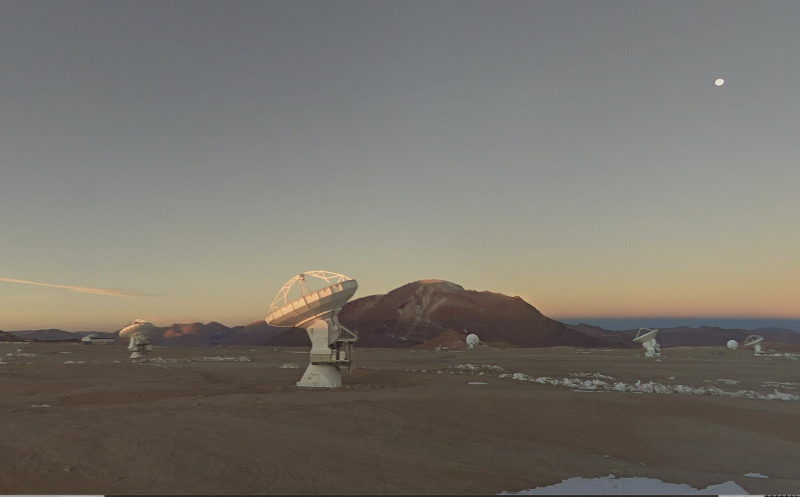
Radio dishes on a high plain in the Chilean Andes.

The view from the ALMA Webcam – at Chajnantor plateau in the Chilean Andes – on July 14, 2019 via NRAO/ Robert Pettengill.

How crazy does an astronomy group have to be to head to Chile in late July of 2019, missing this month’s July 2 total solar eclipse, also in Chile? The members of the Astronomy in Chile Educator Ambassadors Program (ACEAP) 2019 cadre will be answering that question this July 27 through August 5, as they visit locations in Chile like the ALMA telescope array, above.

Diplomatic license plates are not part of the deal of being an astronomy ambassador; our cars still get towed. We are scientific and cultural ambassadors, a bit like Marco Polo was once for Kublai Khan. The team will have backstage access to the great observatories of Chile and the scientists and staff that keep them running. On our return we share what we’ve learned along with our experiences with the people and country of Chile with the curious public that makes these observatories possible. ACEAP ambassadors include teachers, planetarium educators, and amateur astronomers from across the United States and Chile. Communicating our experiences strengthens the bonds of collaboration and understanding between America and Chile.

Nearly every week we hear of new discoveries made by astronomers with these world class instruments. Chilean President Michelle Bachelet has announced that by next year Chile will host 70% of the worlds astronomical infrastructure. With the darkest skies in the world, Chile is full of opportunities for professional and amateur astronomers. The ACEAP team will see how private observatories cater to growing numbers of amateur astronomers who visit Chile for its dark skies, learn about Chilean culture and aid astronomical educators training the next generation of scientists in Chile.

The 2019 ACEAP team’s travels will range from Santiago to the far north Atacama. Visits to Cerro Tololo Inter-American Observatory (CTIO), Gemini South, see the Large Synoptic Survey Telescope (LSST) under construction, and visit the Atacama Large Millimeter/submillimeter Array (ALMA) array site at 16,500 feet (5,000 meters). At each location seminars with observatory staff will cover present and future science, public outreach, and access to observational data.

Preparations have included training in communication skills, astrophotography, and high altitude health. The team is very interested in the astrophotography opportunities on the trip and there has been lots of discussion about the photography equipment to bring.

A suitcase full of camera equipment.

Here’s what I’m packing for Chile. Photo by Robert Pettengill.

The preparation is over, and we rendezvous in Santiago on Saturday July 27. You can follow the adventures of the team in near real time on your favorite social media platform. Look for tags #AstroAmbassadors and #ACEAP2019 for adventures of the entire team. I’ll be posting to BadAstroPhotos pages on accounts on FaceBook, Twitter, and Instagram. Follow any of those to see my daily posts.

The Astronomy in Chile Educator Ambassadors Program is a collaboration between Associated Universities Inc., the National Radio Astronomy Observatory, the Association of Universities for Research in Astronomy, the National Optical Astronomy Observatory, and Gemini Observatory, and is supported by the National Science Foundation. Thanks to Tim Spunk of AUI (PI) and Charles Blue of NRAO (co-PI) and their team for putting this project together and getting us ready.

Bottom line: Members of the Astronomy in Chile Educator Ambassadors Program (ACEAP) 2019 cadre will be touring the great observatories of Chile July 27 through August 5, 2019.


from EarthSky https://ift.tt/2YqsEwE
Radio dishes on a high plain in the Chilean Andes.

The view from the ALMA Webcam – at Chajnantor plateau in the Chilean Andes – on July 14, 2019 via NRAO/ Robert Pettengill.

How crazy does an astronomy group have to be to head to Chile in late July of 2019, missing this month’s July 2 total solar eclipse, also in Chile? The members of the Astronomy in Chile Educator Ambassadors Program (ACEAP) 2019 cadre will be answering that question this July 27 through August 5, as they visit locations in Chile like the ALMA telescope array, above.

Diplomatic license plates are not part of the deal of being an astronomy ambassador; our cars still get towed. We are scientific and cultural ambassadors, a bit like Marco Polo was once for Kublai Khan. The team will have backstage access to the great observatories of Chile and the scientists and staff that keep them running. On our return we share what we’ve learned along with our experiences with the people and country of Chile with the curious public that makes these observatories possible. ACEAP ambassadors include teachers, planetarium educators, and amateur astronomers from across the United States and Chile. Communicating our experiences strengthens the bonds of collaboration and understanding between America and Chile.

Nearly every week we hear of new discoveries made by astronomers with these world class instruments. Chilean President Michelle Bachelet has announced that by next year Chile will host 70% of the worlds astronomical infrastructure. With the darkest skies in the world, Chile is full of opportunities for professional and amateur astronomers. The ACEAP team will see how private observatories cater to growing numbers of amateur astronomers who visit Chile for its dark skies, learn about Chilean culture and aid astronomical educators training the next generation of scientists in Chile.

The 2019 ACEAP team’s travels will range from Santiago to the far north Atacama. Visits to Cerro Tololo Inter-American Observatory (CTIO), Gemini South, see the Large Synoptic Survey Telescope (LSST) under construction, and visit the Atacama Large Millimeter/submillimeter Array (ALMA) array site at 16,500 feet (5,000 meters). At each location seminars with observatory staff will cover present and future science, public outreach, and access to observational data.

Preparations have included training in communication skills, astrophotography, and high altitude health. The team is very interested in the astrophotography opportunities on the trip and there has been lots of discussion about the photography equipment to bring.

A suitcase full of camera equipment.

Here’s what I’m packing for Chile. Photo by Robert Pettengill.

The preparation is over, and we rendezvous in Santiago on Saturday July 27. You can follow the adventures of the team in near real time on your favorite social media platform. Look for tags #AstroAmbassadors and #ACEAP2019 for adventures of the entire team. I’ll be posting to BadAstroPhotos pages on accounts on FaceBook, Twitter, and Instagram. Follow any of those to see my daily posts.

The Astronomy in Chile Educator Ambassadors Program is a collaboration between Associated Universities Inc., the National Radio Astronomy Observatory, the Association of Universities for Research in Astronomy, the National Optical Astronomy Observatory, and Gemini Observatory, and is supported by the National Science Foundation. Thanks to Tim Spunk of AUI (PI) and Charles Blue of NRAO (co-PI) and their team for putting this project together and getting us ready.

Bottom line: Members of the Astronomy in Chile Educator Ambassadors Program (ACEAP) 2019 cadre will be touring the great observatories of Chile July 27 through August 5, 2019.


from EarthSky https://ift.tt/2YqsEwE

Delta Aquariid meteors peak around now

This week presents the nominal peak of the Delta Aquariid meteor shower. That supposed peak comes during the predawn hours on or near July 28, 2019. Should you set your alarm and get up to watch the shower? Maybe. However, the Delta Aquariids are a long, rambling shower, stretching out out for weeks beyond their nominal peak. Because the peak itself isn’t very definite, the shower might be even better at the month’s end, around the time of new moon (August 1, 2019, at 03:12 UTC). With no moon at all in late July/early August 2019, this could be the best time to watch for these rather faint meteors. You may see as many as 10 to 15 meteors per hour in a dark sky.

On the other hand, if you do get up early on July 27 or 28, you can see the waning crescent moon moving through Taurus. And you might catch some Delta Aquariids as well.

Star chart: Crescent moons, constellation Taurus, Pleiades, Aldebaran.

As the month of July wanes, so does the moon. On July 26 to 28, the moon is moving through Taurus the Bull. Depending on where you live worldwide, the moon turns new on July 31 or August 1. Read more.

No matter where you are on Earth – and no matter whether you watch this week, or in the next few weeks – the most favorable viewing window for the Delta Aquarids begins around 1 a.m. (2 a.m. daylight saving time). Watch through the onset of morning dawn. Although this shower is visible from both the Northern and Southern Hemispheres, it tends to favor the more southerly latitudes. North of the equator, it’s better seen in the tropical and subtropical regions rather than farther north. This shower combines with the more-famous Perseid meteor shower, now also rising to its peak, but whose peak in 2019 will have to contend with the light of a bright moon.

That’s why the coming week or so – from now through early August – might present your best opportunity to watch meteors. That’s in contrast to waiting for the Perseids’ peak mornings. By the time of the Perseid meteor shower’s annual peak around August 12 or 13, 2019, the moonlight will be washing some of the meteors in its glare.

Optimize your summer meteor watching experience with EarthSky’s 2019 meteor guide

The Delta Aquarid shower is, at best, a modest shower. About five to 10 percent of these relatively faint, medium-speed meteors leave persistent trains – glowing ionized gas trails that last a second or two after the meteor has passed.

This shower recurs annually in late July, because the Earth crosses the orbital path of Comet 96P Machholz at this time of year. The stream of debris left behind by this comet smashes into the Earth’s upper atmosphere, to burn up in our sky as Delta Aquariid meteors.

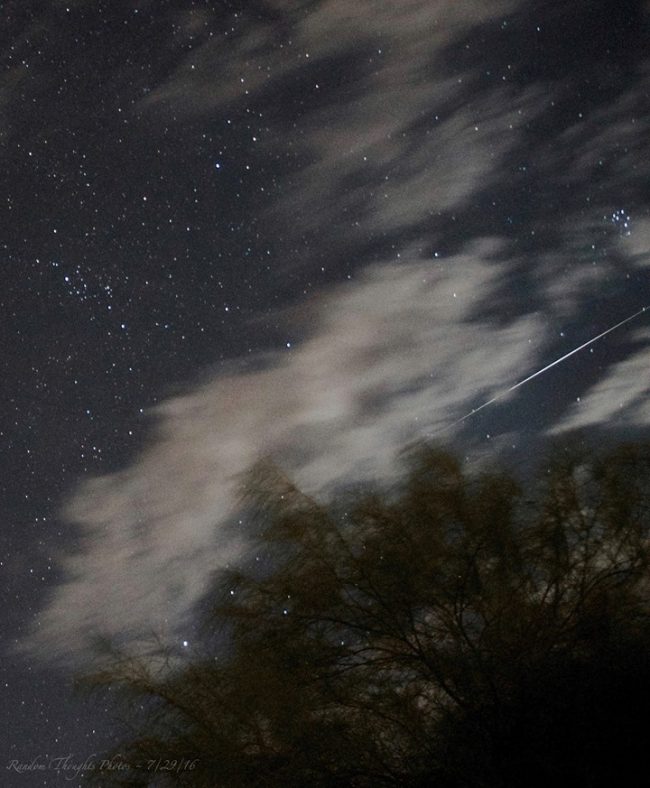
Bright diagonal line of meteor streaking among clouds.

Kelly Dreller in Lake Havasu City, Arizona, caught this meteor in late July 2016.

If you trace the paths of the Delta Aquariid meteors backward, they all appear to radiate from a certain point in the starry heavens – near the star Delta Aquarii (Skat). This point is called the radiant of the Delta Aquariid meteor shower. As a rule of thumb, the higher the radiant point is in your sky, the more meteors that you’re likely to see. In late July, this star climbs highest up in the sky at roughly 2:30 a.m. (3:30 a.m. daylight saving time).

Of course, you don’t have to find the radiant point of the Delta Aquariid shower to enjoy this shower. Radiating from near the star Skat, the meteors will streak every which way across the starry heavens. Just find an open view of the sky away from artificial lights, sprawl out comfortably on a reclining lawn chair, preferably between midnight and dawn, and watch.

Bottom line: Unless you live in the far northern part of the globe – where there is little or no nighttime at this time of year – the Delta Aquariid meteor shower can be seen from all around the world. The nominal peak is around July 27 or 28, in the dark hours before dawn. But the Delta Aquariids will still be going when the Perseids peak a couple of weeks from now. At that time, a bright waxing gibbous moon will interfere with the show. So start your meteor-watching now!

Read more: Black Moon supermoon on July 31

EarthSky’s 2019 meteor guide

EarthSky astronomy kits are perfect for beginners. Order yours today.

Skat: Radiant for Delta Aquarid meteors


from EarthSky https://ift.tt/2MhBGJC

This week presents the nominal peak of the Delta Aquariid meteor shower. That supposed peak comes during the predawn hours on or near July 28, 2019. Should you set your alarm and get up to watch the shower? Maybe. However, the Delta Aquariids are a long, rambling shower, stretching out out for weeks beyond their nominal peak. Because the peak itself isn’t very definite, the shower might be even better at the month’s end, around the time of new moon (August 1, 2019, at 03:12 UTC). With no moon at all in late July/early August 2019, this could be the best time to watch for these rather faint meteors. You may see as many as 10 to 15 meteors per hour in a dark sky.

On the other hand, if you do get up early on July 27 or 28, you can see the waning crescent moon moving through Taurus. And you might catch some Delta Aquariids as well.

Star chart: Crescent moons, constellation Taurus, Pleiades, Aldebaran.

As the month of July wanes, so does the moon. On July 26 to 28, the moon is moving through Taurus the Bull. Depending on where you live worldwide, the moon turns new on July 31 or August 1. Read more.

No matter where you are on Earth – and no matter whether you watch this week, or in the next few weeks – the most favorable viewing window for the Delta Aquarids begins around 1 a.m. (2 a.m. daylight saving time). Watch through the onset of morning dawn. Although this shower is visible from both the Northern and Southern Hemispheres, it tends to favor the more southerly latitudes. North of the equator, it’s better seen in the tropical and subtropical regions rather than farther north. This shower combines with the more-famous Perseid meteor shower, now also rising to its peak, but whose peak in 2019 will have to contend with the light of a bright moon.

That’s why the coming week or so – from now through early August – might present your best opportunity to watch meteors. That’s in contrast to waiting for the Perseids’ peak mornings. By the time of the Perseid meteor shower’s annual peak around August 12 or 13, 2019, the moonlight will be washing some of the meteors in its glare.

Optimize your summer meteor watching experience with EarthSky’s 2019 meteor guide

The Delta Aquarid shower is, at best, a modest shower. About five to 10 percent of these relatively faint, medium-speed meteors leave persistent trains – glowing ionized gas trails that last a second or two after the meteor has passed.

This shower recurs annually in late July, because the Earth crosses the orbital path of Comet 96P Machholz at this time of year. The stream of debris left behind by this comet smashes into the Earth’s upper atmosphere, to burn up in our sky as Delta Aquariid meteors.

Bright diagonal line of meteor streaking among clouds.

Kelly Dreller in Lake Havasu City, Arizona, caught this meteor in late July 2016.

If you trace the paths of the Delta Aquariid meteors backward, they all appear to radiate from a certain point in the starry heavens – near the star Delta Aquarii (Skat). This point is called the radiant of the Delta Aquariid meteor shower. As a rule of thumb, the higher the radiant point is in your sky, the more meteors that you’re likely to see. In late July, this star climbs highest up in the sky at roughly 2:30 a.m. (3:30 a.m. daylight saving time).

Of course, you don’t have to find the radiant point of the Delta Aquariid shower to enjoy this shower. Radiating from near the star Skat, the meteors will streak every which way across the starry heavens. Just find an open view of the sky away from artificial lights, sprawl out comfortably on a reclining lawn chair, preferably between midnight and dawn, and watch.

Bottom line: Unless you live in the far northern part of the globe – where there is little or no nighttime at this time of year – the Delta Aquariid meteor shower can be seen from all around the world. The nominal peak is around July 27 or 28, in the dark hours before dawn. But the Delta Aquariids will still be going when the Perseids peak a couple of weeks from now. At that time, a bright waxing gibbous moon will interfere with the show. So start your meteor-watching now!

Read more: Black Moon supermoon on July 31

EarthSky’s 2019 meteor guide

EarthSky astronomy kits are perfect for beginners. Order yours today.

Skat: Radiant for Delta Aquarid meteors


from EarthSky https://ift.tt/2MhBGJC

Why do birds sing?

Yellow bird with wide open beak, perched on a branch, against a green background.

A male olive-backed euphonia (Euphonia gouldi), photographed in Costa Rica. Image via Andy Morffew.

By David Steadman, University of Florida

Birds are some of the most attractive creatures on earth. Who doesn’t like to watch a blue jay, cardinal or Baltimore oriole going about its business?

But the beauty of birds isn’t just their looks – it’s also their noises. Bird songs are among nature’s most distinctive and musically satisfying sounds. Why do birds spend so much time and energy singing?

There are two main purposes, and they are connected. First, male birds sing to mark territories. A singing bird is saying, “This place is mine, and I’m willing to defend it, especially from others of my species.” He may patrol his chosen space and sing often, either from the middle or the edges of what he considers his turf.

The second purpose of singing is to attract a mate for nesting. Female birds often choose their mates based on some blend of visual and vocal cues. Even male birds with beautiful breeding-season plumage can have trouble finding mates if their songs don’t measure up.

Each bird species typically has its own unique song. That allows an individual bird to hear a song and recognize whether the singer is from its own species.

Birds are most vocal during nesting season. For example, in Florida where I live, cardinals live year-round. They usually start singing in January, just a few weeks after the days begin to get longer. After the nesting period is over, birds sing much less and their territories break down.


Birders can learn to recognize different bird species by memorizing the sonic patterns of their songs.

Many species of North American birds migrate with the seasons instead of staying in one place all year. As they fly south in the fall, they make little “chip” notes or “contact calls” that allow them to stay in touch with other birds.

In many species only male birds sing, but in others, both males and females sing. And some birds don’t sing at all. For example, vultures and storks can barely produce any sound – let alone something musical enough that we would call it a song.

Learning to identify birds by their songs is as much fun as spotting them by sight. In fact, good ears are often as important as good eyes in appreciating the birds you encounter. Take off your headphones and listen to your neighborhood birds – especially when they are active in the morning or evening. You’ll be surprised by what you hear.

David Steadman, Curator of Ornithology, Florida Museum of Natural History, University of Florida

This article is republished from The Conversation under a Creative Commons license. Read the original article.

Bottom line: Why birds sing.

The Conversation


from EarthSky https://ift.tt/2JPuJ0J
Yellow bird with wide open beak, perched on a branch, against a green background.

A male olive-backed euphonia (Euphonia gouldi), photographed in Costa Rica. Image via Andy Morffew.

By David Steadman, University of Florida

Birds are some of the most attractive creatures on earth. Who doesn’t like to watch a blue jay, cardinal or Baltimore oriole going about its business?

But the beauty of birds isn’t just their looks – it’s also their noises. Bird songs are among nature’s most distinctive and musically satisfying sounds. Why do birds spend so much time and energy singing?

There are two main purposes, and they are connected. First, male birds sing to mark territories. A singing bird is saying, “This place is mine, and I’m willing to defend it, especially from others of my species.” He may patrol his chosen space and sing often, either from the middle or the edges of what he considers his turf.

The second purpose of singing is to attract a mate for nesting. Female birds often choose their mates based on some blend of visual and vocal cues. Even male birds with beautiful breeding-season plumage can have trouble finding mates if their songs don’t measure up.

Each bird species typically has its own unique song. That allows an individual bird to hear a song and recognize whether the singer is from its own species.

Birds are most vocal during nesting season. For example, in Florida where I live, cardinals live year-round. They usually start singing in January, just a few weeks after the days begin to get longer. After the nesting period is over, birds sing much less and their territories break down.


Birders can learn to recognize different bird species by memorizing the sonic patterns of their songs.

Many species of North American birds migrate with the seasons instead of staying in one place all year. As they fly south in the fall, they make little “chip” notes or “contact calls” that allow them to stay in touch with other birds.

In many species only male birds sing, but in others, both males and females sing. And some birds don’t sing at all. For example, vultures and storks can barely produce any sound – let alone something musical enough that we would call it a song.

Learning to identify birds by their songs is as much fun as spotting them by sight. In fact, good ears are often as important as good eyes in appreciating the birds you encounter. Take off your headphones and listen to your neighborhood birds – especially when they are active in the morning or evening. You’ll be surprised by what you hear.

David Steadman, Curator of Ornithology, Florida Museum of Natural History, University of Florida

This article is republished from The Conversation under a Creative Commons license. Read the original article.

Bottom line: Why birds sing.

The Conversation


from EarthSky https://ift.tt/2JPuJ0J

Find M4 near the Scorpion’s Heart

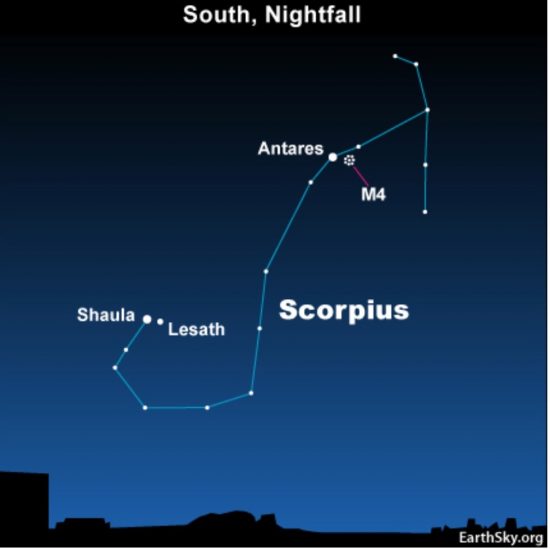
Star chart of hook-shaped constellation Scorpius with Antares and cluster M4 marked.

Assuming you have a dark sky, look just to the right of Antares for M4.

Red Antares – the brightest star in Scorpius, often called the Heart of the Scorpion – is up in the evening now. It’s a bright red star known for twinkling rapidly. If you have binoculars, sweep for an object near Antares on the sky’s dome. This object is called Messier 4 or M4. It’s a globular cluster, one of our galaxy’s oldest inhabitants. M4 has an estimated age of 12.2 billion years, in contrast to about 4.5 billion years for our sun.

If you’ve never found a deep-sky object on your own before, M4 is a grand place to start. The M4 globular star cluster is easy to find, because it’s right next to the first-magnitude star Antares, the brightest in the constellation Scorpius the Scorpion. Your first step to locating M4 is to find Antares, the Scorpion’s heart star.

Antares and M4 are best seen in July, or the months around July, from around the globe. In early June, Antares is highest in the sky around midnight (1 a.m. daylight saving time). That means it’s high in the south for Northern Hemisphere viewers, and overhead for Southern Hemisphere viewers. The stars return to the same place in the sky some two hours earlier every month. So Antares is highest up around 10 p.m. (11 p.m. daylight saving time) in early July, and 8 p.m. (9 p.m. daylight saving time) in early August.

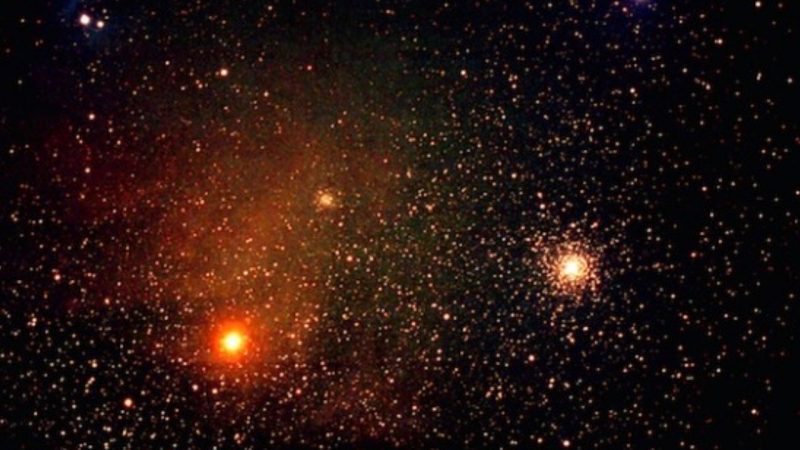
Dense starfield photo, 1 orange star, 1 larger reddish star, and 1 large white fuzzy object.

Red star Antares (l) and nearby star cluster M4. Image via StargazerBob@aol.com.

In short, Northern Hemisphere summer evenings – or Southern Hemisphere winter evenings – are probably your best bet for catching M4.

You might glimpse M4 on a very dark, moonless night. If you can’t see it, use binoculars to sweep for it. Antares and M4 readily fit inside the same binocular field of view, with M4 appearing a bit more than 1 degree to the west (or right) of Antares. For reference, a typical binocular field has a diameter of 5 to 6 degrees. M4 looks like a rather dim, hazy star in binoculars, and you might want a telescope to begin to resolve this cluster into stars.

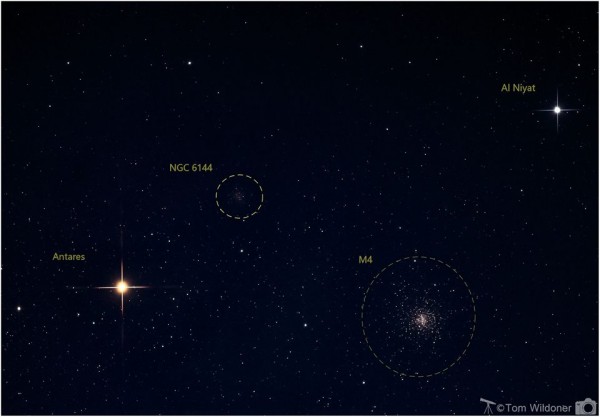
Star photo. Bright Antares, large fuzzy M4, dim NGC 6144, and another star labeled.

A 5-minute stacked image of Antares and the surrounding region including the globular cluster Messier 4 (M4). Photo by our friend Tom Wildoner at LeisurelyScientist.com.

History and science of M4. The comet hunter Charles Messier (1730-1817) listed M4 as object #4 in his famous Messier catalog. The Messier catalog listed over 100 deep-sky objects that look like comets, but really aren’t. Charles Messier wanted to steer comet hunters away from these faint fuzzies that masquerade as comets.

Modern astronomy tells us that M4 is a globular star cluster – a globe-shape stellar city packed with perhaps a hundred thousand stars. Unlike open star clusters – such as the Pleiades and the Hyades – the Milky Way galaxy’s 200 or so globular star clusters are not part of the galactic disk.

Instead, globular clusters populate the galactic halo – the sphere-shaped region of the Milky Way circling above and below the pancake-shaped galactic disk.

At about 7,000 light-years from Earth, M4 is one of the two closest globular clusters to our sun and Earth (the other is NGC 6397). That’s among the Milky Way’s 200 or so globular clusters. Most globulars reside tens of thousands of light-years away. The farthest of globular clusters, M54, is thought to be 70,000 light-years distant.

M4 is about 75 light-years across.

Globular clusters are tightly packed with tens to hundreds of thousands of stars, whereas open clusters are loosely-bound stellar confederations with only a few hundred to a thousand stars. Globular clusters contain primitive stars that are billions of years old and almost as old as the universe itself. On the other hand, open clusters consist of young, hot stars that tend to disperse after hundreds of millions of years.

Dense globe of stars with increasing distance between them farther from center.

Messier 4 or M4. Image via European Southern Observatory.

M4’s position is at Right Ascension: 16h 23.6m; Declination: 26 degrees 32′ south

Bottom line: M4 or Messier 4 is a globular star cluster, one of the nearest to our solar system. It’s also one of the easiest of all globular clusters to find, in a dark sky, because it’s near the bright red star Antares in the constellation Scorpius.


from EarthSky https://ift.tt/30SdRw8
Star chart of hook-shaped constellation Scorpius with Antares and cluster M4 marked.

Assuming you have a dark sky, look just to the right of Antares for M4.

Red Antares – the brightest star in Scorpius, often called the Heart of the Scorpion – is up in the evening now. It’s a bright red star known for twinkling rapidly. If you have binoculars, sweep for an object near Antares on the sky’s dome. This object is called Messier 4 or M4. It’s a globular cluster, one of our galaxy’s oldest inhabitants. M4 has an estimated age of 12.2 billion years, in contrast to about 4.5 billion years for our sun.

If you’ve never found a deep-sky object on your own before, M4 is a grand place to start. The M4 globular star cluster is easy to find, because it’s right next to the first-magnitude star Antares, the brightest in the constellation Scorpius the Scorpion. Your first step to locating M4 is to find Antares, the Scorpion’s heart star.

Antares and M4 are best seen in July, or the months around July, from around the globe. In early June, Antares is highest in the sky around midnight (1 a.m. daylight saving time). That means it’s high in the south for Northern Hemisphere viewers, and overhead for Southern Hemisphere viewers. The stars return to the same place in the sky some two hours earlier every month. So Antares is highest up around 10 p.m. (11 p.m. daylight saving time) in early July, and 8 p.m. (9 p.m. daylight saving time) in early August.

Dense starfield photo, 1 orange star, 1 larger reddish star, and 1 large white fuzzy object.

Red star Antares (l) and nearby star cluster M4. Image via StargazerBob@aol.com.

In short, Northern Hemisphere summer evenings – or Southern Hemisphere winter evenings – are probably your best bet for catching M4.

You might glimpse M4 on a very dark, moonless night. If you can’t see it, use binoculars to sweep for it. Antares and M4 readily fit inside the same binocular field of view, with M4 appearing a bit more than 1 degree to the west (or right) of Antares. For reference, a typical binocular field has a diameter of 5 to 6 degrees. M4 looks like a rather dim, hazy star in binoculars, and you might want a telescope to begin to resolve this cluster into stars.

Star photo. Bright Antares, large fuzzy M4, dim NGC 6144, and another star labeled.

A 5-minute stacked image of Antares and the surrounding region including the globular cluster Messier 4 (M4). Photo by our friend Tom Wildoner at LeisurelyScientist.com.

History and science of M4. The comet hunter Charles Messier (1730-1817) listed M4 as object #4 in his famous Messier catalog. The Messier catalog listed over 100 deep-sky objects that look like comets, but really aren’t. Charles Messier wanted to steer comet hunters away from these faint fuzzies that masquerade as comets.

Modern astronomy tells us that M4 is a globular star cluster – a globe-shape stellar city packed with perhaps a hundred thousand stars. Unlike open star clusters – such as the Pleiades and the Hyades – the Milky Way galaxy’s 200 or so globular star clusters are not part of the galactic disk.

Instead, globular clusters populate the galactic halo – the sphere-shaped region of the Milky Way circling above and below the pancake-shaped galactic disk.

At about 7,000 light-years from Earth, M4 is one of the two closest globular clusters to our sun and Earth (the other is NGC 6397). That’s among the Milky Way’s 200 or so globular clusters. Most globulars reside tens of thousands of light-years away. The farthest of globular clusters, M54, is thought to be 70,000 light-years distant.

M4 is about 75 light-years across.

Globular clusters are tightly packed with tens to hundreds of thousands of stars, whereas open clusters are loosely-bound stellar confederations with only a few hundred to a thousand stars. Globular clusters contain primitive stars that are billions of years old and almost as old as the universe itself. On the other hand, open clusters consist of young, hot stars that tend to disperse after hundreds of millions of years.

Dense globe of stars with increasing distance between them farther from center.

Messier 4 or M4. Image via European Southern Observatory.

M4’s position is at Right Ascension: 16h 23.6m; Declination: 26 degrees 32′ south

Bottom line: M4 or Messier 4 is a globular star cluster, one of the nearest to our solar system. It’s also one of the easiest of all globular clusters to find, in a dark sky, because it’s near the bright red star Antares in the constellation Scorpius.


from EarthSky https://ift.tt/30SdRw8

What is a fogbow?

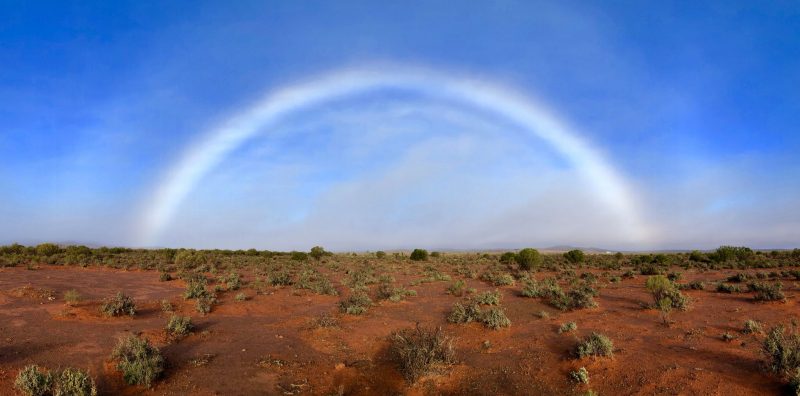
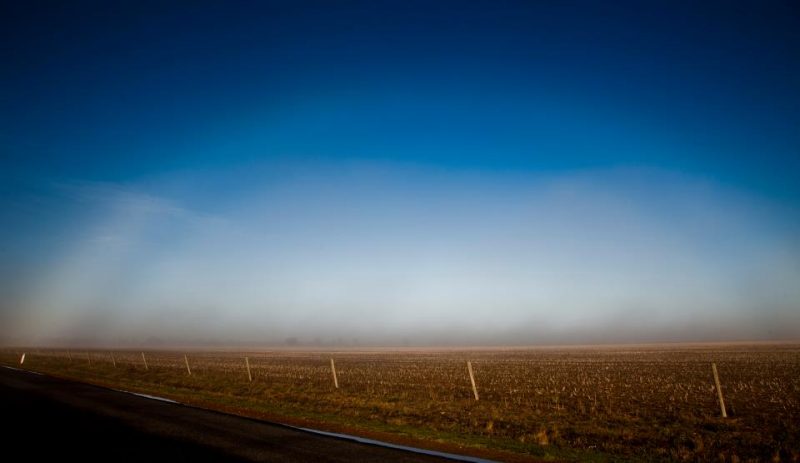
Fogbow - aka a white rainbow - over a desert landscape.

View at EarthSky Community Photos. | Alan Nicolle in New South Wales, Australia, captured this image on July 16, 2019. He wrote: “I was out geocaching in the outskirts of Broken Hill, when I turned back to see this fogbow developing. I took quite a few photos with the iPhone, and rode back to the car on my bike, but by the time I got back to the car to use my SLR, it had faded.” Thank you, Alan!

Fogbows – sometimes called white rainbows, cloudbows or ghost rainbows – are made much as rainbows are, from the same configuration of sunlight and moisture. Rainbows happen when the air is filled with raindrops, and you always see a rainbow in the direction opposite the sun. Fogbows are much the same, always opposite the sun, but fogbows are caused by the small droplets inside a fog or cloud rather than larger raindrops.

Look for fogbows in a thin fog when the sun is bright. You might see one when the sun breaks through a fog. Or watch for fogbows over the ocean.

Because the water droplets in fog are so small, fogbows have only weak colors or are colorless.

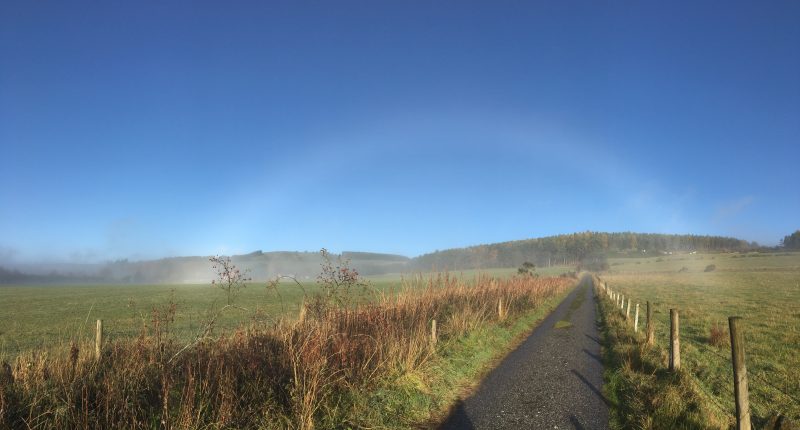
Faint white arc over rolling green landscape and straight country road.

Edith Smith in Aberdeenshire, Scotland, captured this fogbow on November 1, 2018. She wrote: “The camera spotted it before I did with eye, as I was too engrossed in foggy conditions.”

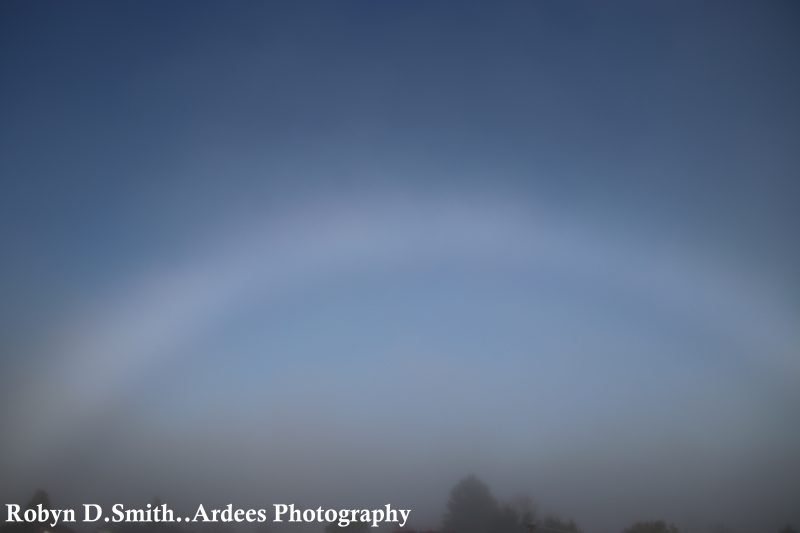
Diffuse white arc in slate blue dawn sky.

Wonderful fogbow caught by Robyn Smith in New Zealand on the morning of September 19, 2017 … “opposite the foggy sunrise.”

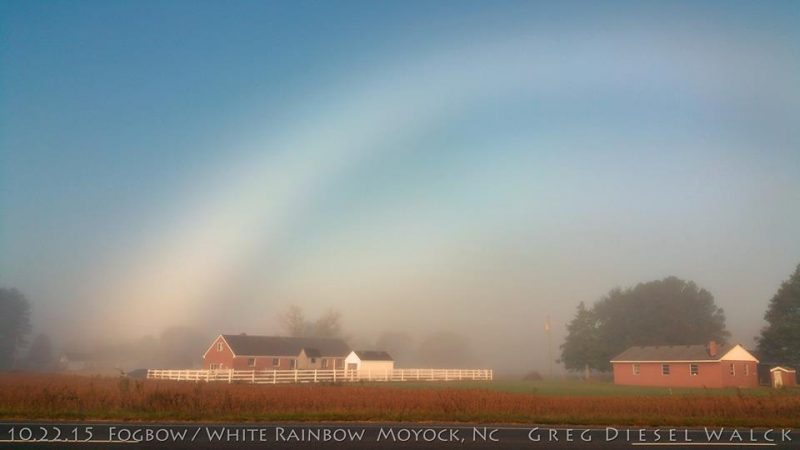
Partial white arc over bucolic scene with white fence and barn in distance.

GregDiesel Landscape Photography wrote in October 2015: “Saw my first fogbow / white rainbow. Photo taken with cell phone. Moyock, North Carolina.”

Diffuse white arc over rocky seacoast with white lighthouse in distance.

Katherine Keyes Millet captured this fogbow in July 2014 at Winter Island Park in Salem, Massachusetts.

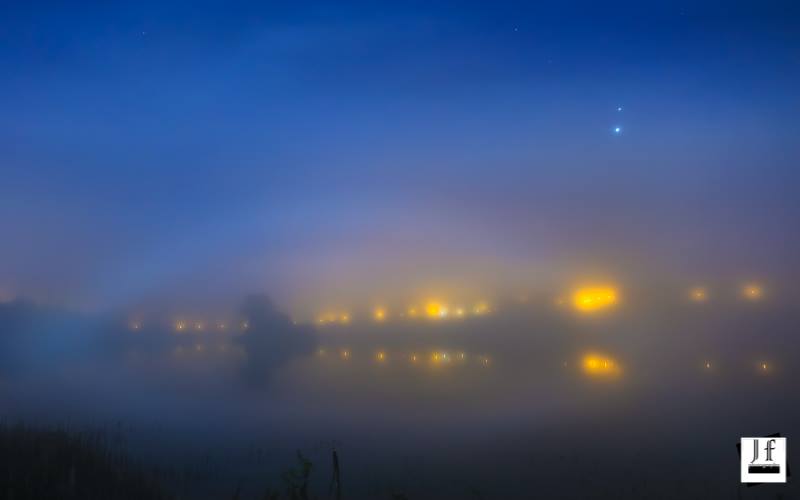
Very diffuse whit arc over blurry gold city lights, 2 bright dots in sky over fogbow.

Venus and Jupiter above a fogbow in Blacklough, Dungannon, Ireland. Mars is up there, too, but tough to see. John Fagan captured them all in October 2015.

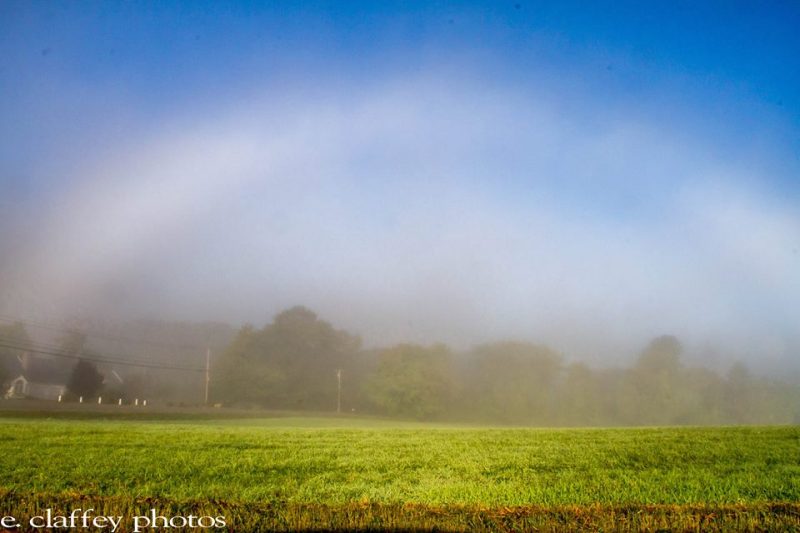
Cloudy-looking white arc over bright green field bordered with trees.

Eileen Claffey in Brookline, Massachusetts, captured this fogbow over a field in September 2014.

Les Cowley of the great website Atmospheric Optics says:

Look away from the sun and at an angle of 35-40 degrees from your shadow which marks the direction of the antisolar point. Some fogbows have very low contrast so look for small brightenings in the misty background. Once caught, they are unmistakable.

The sun must be less than 30-40 degrees high unless you are on a hill or high up on a ship where the mist and fogbow can be viewed from above.

Fogbows are huge, almost as large as a rainbow and much, much broader.

Look here for Les Cowley’s explanation of how fogbows form.

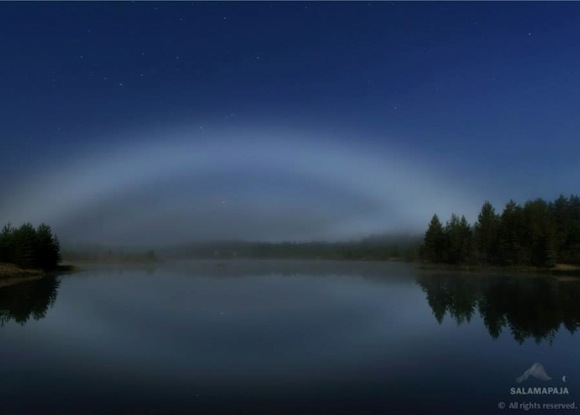
White arc in dark blue sky reflected in a lake.

Thomas Kast in Finland captured this fogbow in 2013. He wrote: “In this rather cold August night (+8C [46F]) there was patchy fog, especially in open fields. This lake remained clear for a long time. At one point I saw this white bow with moon in waning gibbous phase behind me.”

Rocks on seacoast with arc nearly touching them on left, higher on right end.

Jim Grant caught this fogbow over Sunset Cliffs in San Diego. He wrote: “The skies were sunny and clear, and then the fog rolled in, and with it this beautiful fogbow.”

Pale arc over fog over brown stubbly field past a wire fence.

Lynton Brown of Australia captured this fogbow over a barren field in the autumn of 2012.

Bottom line: Fogbows are made by much the same process as rainbows, but with the small water droplets inside a fog instead of larger raindrops. Because the water droplets in fog are so small, fogbows have only weak colors or are colorless.


from EarthSky https://ift.tt/2RuWZ9W
Fogbow - aka a white rainbow - over a desert landscape.

View at EarthSky Community Photos. | Alan Nicolle in New South Wales, Australia, captured this image on July 16, 2019. He wrote: “I was out geocaching in the outskirts of Broken Hill, when I turned back to see this fogbow developing. I took quite a few photos with the iPhone, and rode back to the car on my bike, but by the time I got back to the car to use my SLR, it had faded.” Thank you, Alan!

Fogbows – sometimes called white rainbows, cloudbows or ghost rainbows – are made much as rainbows are, from the same configuration of sunlight and moisture. Rainbows happen when the air is filled with raindrops, and you always see a rainbow in the direction opposite the sun. Fogbows are much the same, always opposite the sun, but fogbows are caused by the small droplets inside a fog or cloud rather than larger raindrops.

Look for fogbows in a thin fog when the sun is bright. You might see one when the sun breaks through a fog. Or watch for fogbows over the ocean.

Because the water droplets in fog are so small, fogbows have only weak colors or are colorless.

Faint white arc over rolling green landscape and straight country road.

Edith Smith in Aberdeenshire, Scotland, captured this fogbow on November 1, 2018. She wrote: “The camera spotted it before I did with eye, as I was too engrossed in foggy conditions.”

Diffuse white arc in slate blue dawn sky.

Wonderful fogbow caught by Robyn Smith in New Zealand on the morning of September 19, 2017 … “opposite the foggy sunrise.”

Partial white arc over bucolic scene with white fence and barn in distance.

GregDiesel Landscape Photography wrote in October 2015: “Saw my first fogbow / white rainbow. Photo taken with cell phone. Moyock, North Carolina.”

Diffuse white arc over rocky seacoast with white lighthouse in distance.

Katherine Keyes Millet captured this fogbow in July 2014 at Winter Island Park in Salem, Massachusetts.

Very diffuse whit arc over blurry gold city lights, 2 bright dots in sky over fogbow.

Venus and Jupiter above a fogbow in Blacklough, Dungannon, Ireland. Mars is up there, too, but tough to see. John Fagan captured them all in October 2015.

Cloudy-looking white arc over bright green field bordered with trees.

Eileen Claffey in Brookline, Massachusetts, captured this fogbow over a field in September 2014.

Les Cowley of the great website Atmospheric Optics says:

Look away from the sun and at an angle of 35-40 degrees from your shadow which marks the direction of the antisolar point. Some fogbows have very low contrast so look for small brightenings in the misty background. Once caught, they are unmistakable.

The sun must be less than 30-40 degrees high unless you are on a hill or high up on a ship where the mist and fogbow can be viewed from above.

Fogbows are huge, almost as large as a rainbow and much, much broader.

Look here for Les Cowley’s explanation of how fogbows form.

White arc in dark blue sky reflected in a lake.

Thomas Kast in Finland captured this fogbow in 2013. He wrote: “In this rather cold August night (+8C [46F]) there was patchy fog, especially in open fields. This lake remained clear for a long time. At one point I saw this white bow with moon in waning gibbous phase behind me.”

Rocks on seacoast with arc nearly touching them on left, higher on right end.

Jim Grant caught this fogbow over Sunset Cliffs in San Diego. He wrote: “The skies were sunny and clear, and then the fog rolled in, and with it this beautiful fogbow.”

Pale arc over fog over brown stubbly field past a wire fence.

Lynton Brown of Australia captured this fogbow over a barren field in the autumn of 2012.

Bottom line: Fogbows are made by much the same process as rainbows, but with the small water droplets inside a fog instead of larger raindrops. Because the water droplets in fog are so small, fogbows have only weak colors or are colorless.


from EarthSky https://ift.tt/2RuWZ9W

Moon and Taurus before dawn July 26 to 28

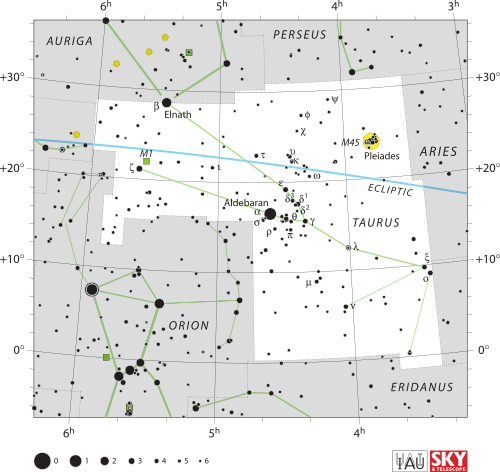
Before dawn on July 26, 27, 28, 2019, watch for the waning crescent moon to travel in front of Taurus the Bull. Assuming your sky is dark enough, the Bull is instantly recognizable; it’s one of the more prominent constellations of the zodiac. Look for this constellation’s bright reddish star Aldebaran plus its two signpost star clusters, the V-shaped Hyades and the tiny, misty, dipper-shaped Pleiades.

The moon is close to the Pleaides on the morning of July 26.

It’s closer to the Hyades on the mornings of July 27 and 28, at least as seen from North America. Your exact view will vary. How can you see your personalized view. We hear good things about the free open source planetarium software called Stellarium.

On all of these mornings, it’ll be easy to spot Aldebaran, which represents the ruddy eye of the Bull. The lit side of the moon will point directly at this star, Taurus’ one and only 1st-magnitude star on July 26 and 27. Look closely and you’ll see this star atop the famous V-shaped pattern of stars that outlines the Bull’s face.

The V-pattern is the Hyades, and it’s an actual star cluster in space, comprised of sibling stars that were born from the same cloud of dust and gas over 600 million years ago. Although Aldebaran isn’t a true member of the Hyades star cluster, this bright star accentuates the V shape of the Hyades on the sky’s dome. Aldebaran is about 65 light-years away, whereas the more far-off Hyades stars lie at about two-and-a-half times Aldebaran’s distance.

The more compact Pleiades cluster, on the other hand, is thought to be more distant (about 430 light-years versus 150 light-years) yet more youthful (100 million years versus 625 million light-years) than the Hyades. The constellation Taurus is a rarity indeed in that it showcases two easy-to-see open clusters.

The constellation Taurus the Bull.

The ecliptic – the sun’s yearly path through the constellations of the zodiac – passes through the constellation Taurus the Bull, to the north of the star Aldebaran and to the south of the Pleiades stars cluster. The sun shines in front of Taurus from about May 14 to June 21.

The lit side of a waning moon points in its direction of travel: east or toward sunrise. So watch the moon throughout the final week of July 2019, as the waning crescent sweeps through the constellation Taurus the Bull and then disappears into the glare of sunrise.

Depending on where you live worldwide, the upcoming new moon will be the second of two July 2019 new moons or the first of two August 2019 new moons. When there are two new moons in a month, some people call the second one a Black Moon.

Read more: Black Moon supermoon on July 31

Bottom line: On the mornings of July 26, 27 and 28, let the waning crescent moon show you the Taurus the Bull and introduce to the constellation’s two outstanding features, the Hyades and the Pleiades clusters.


from EarthSky https://ift.tt/2LF2OTx

Before dawn on July 26, 27, 28, 2019, watch for the waning crescent moon to travel in front of Taurus the Bull. Assuming your sky is dark enough, the Bull is instantly recognizable; it’s one of the more prominent constellations of the zodiac. Look for this constellation’s bright reddish star Aldebaran plus its two signpost star clusters, the V-shaped Hyades and the tiny, misty, dipper-shaped Pleiades.

The moon is close to the Pleaides on the morning of July 26.

It’s closer to the Hyades on the mornings of July 27 and 28, at least as seen from North America. Your exact view will vary. How can you see your personalized view. We hear good things about the free open source planetarium software called Stellarium.

On all of these mornings, it’ll be easy to spot Aldebaran, which represents the ruddy eye of the Bull. The lit side of the moon will point directly at this star, Taurus’ one and only 1st-magnitude star on July 26 and 27. Look closely and you’ll see this star atop the famous V-shaped pattern of stars that outlines the Bull’s face.

The V-pattern is the Hyades, and it’s an actual star cluster in space, comprised of sibling stars that were born from the same cloud of dust and gas over 600 million years ago. Although Aldebaran isn’t a true member of the Hyades star cluster, this bright star accentuates the V shape of the Hyades on the sky’s dome. Aldebaran is about 65 light-years away, whereas the more far-off Hyades stars lie at about two-and-a-half times Aldebaran’s distance.

The more compact Pleiades cluster, on the other hand, is thought to be more distant (about 430 light-years versus 150 light-years) yet more youthful (100 million years versus 625 million light-years) than the Hyades. The constellation Taurus is a rarity indeed in that it showcases two easy-to-see open clusters.

The constellation Taurus the Bull.

The ecliptic – the sun’s yearly path through the constellations of the zodiac – passes through the constellation Taurus the Bull, to the north of the star Aldebaran and to the south of the Pleiades stars cluster. The sun shines in front of Taurus from about May 14 to June 21.

The lit side of a waning moon points in its direction of travel: east or toward sunrise. So watch the moon throughout the final week of July 2019, as the waning crescent sweeps through the constellation Taurus the Bull and then disappears into the glare of sunrise.

Depending on where you live worldwide, the upcoming new moon will be the second of two July 2019 new moons or the first of two August 2019 new moons. When there are two new moons in a month, some people call the second one a Black Moon.

Read more: Black Moon supermoon on July 31

Bottom line: On the mornings of July 26, 27 and 28, let the waning crescent moon show you the Taurus the Bull and introduce to the constellation’s two outstanding features, the Hyades and the Pleiades clusters.


from EarthSky https://ift.tt/2LF2OTx

Breakthrough Listen’s new search for alien lasers

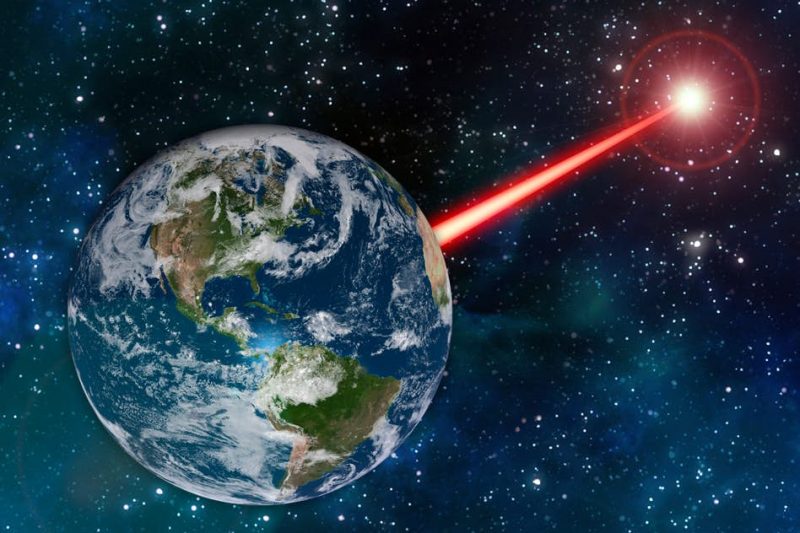
Laser light beam from glowing object in space, pointed toward globe of Earth against starry sky.

VERITAS will be used to help search for laser-like optical light pulses that could be beacons from an advanced alien civilization. Image via MIT/New Atlas.

The Search for Extraterrestrial Intelligence (SETI) has traditionally looked for radio signals of artificial origin, i.e. coming from an alien civilization at least as advanced as our own. We humans have been broadcasting radio waves into space for about 100 years now, since Marconi pioneered long-distance radio transmission. The reasoning has been that other civilizations might use radio, too. While that approach continues to be highly debated, there is another kind of search that is starting to be considered more seriously now as well: looking for optical signals – brief flashes of light like pulsing lasers – that could be used as beacons to communicate over interstellar distances.

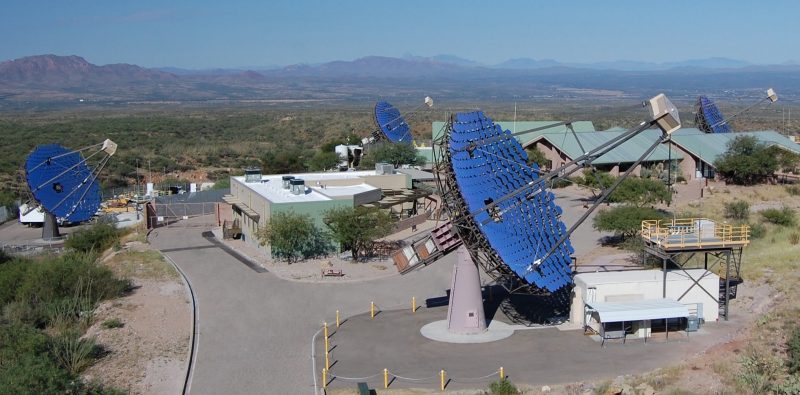
On July 17, 2019, Breakthrough Initiatives – founded in 2015 by entrepreneur Yuri Milnerannounced a new partnership with the VERITAS Collaboration to focus on this strategy. VERITAS (the Very Energetic Radiation Imaging Telescope Array System) will search for such pulsed optical beacons, as well as radio signals, with its array of four 12-meter telescopes at the Whipple Observatory in Amado, Arizona.

Breakthrough Listen, part of Breakthrough Initiatives, has already been conducting searches using its still-ongoing radio frequency survey and spectroscopic optical laser survey. But VERITAS can take the search to a new level. It was built to detect cosmic gamma rays and is the most powerful telescope array in the world for studying high energy astrophysics. As it turns out, it can also be used to look for “pulsed optical beacons” – laser-like pulses of light – that are very short in duration, only a few nanoseconds (one nanosecond is a billionth of a second).

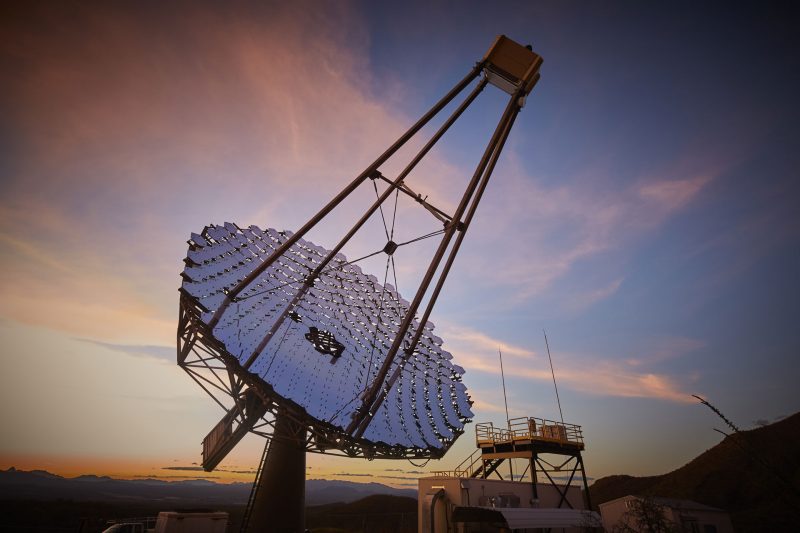
Dish-style telescope made up of many panels, pointing at the sky.

Closer view of one of the 4 telescopes in the VERITAS array. Image via CfA/SciTechDaily.

An advantage of this method is that any artificial pulses could outshine stars that happen to lie in the same direction. The use of all four telescopes would also help to eliminate false positives from any detections made. VERITAS will provide a unique way of expanding the search for alien intelligence beyond previous methods, as noted by Yuri Milner:

When it comes to intelligent life beyond Earth, we don’t know where it exists or how it communicates. So our philosophy is to look in as many places, and in as many ways, as we can. VERITAS expands our range of observation even further.

Andrew Siemion at the Berkeley SETI Research Center added:

Breakthrough Listen is already the most powerful, comprehensive, and intensive search yet undertaken for signs of intelligent life beyond Earth. Now, with the addition of VERITAS, we’re sensitive to an important new class of signals: fast optical pulses. Optical communication has already been used by NASA to transmit high definition images to Earth from the moon, so there’s reason to believe that an advanced civilization might use a scaled-up version of this technology for interstellar communication.

VERITAS will be able to detect very faint light signals, if any exist, according to Jamie Holder at the University of Delaware:

Using the huge mirror area of the four VERITAS telescopes will allow us to search for these extremely faint optical flashes in the night sky, which could correspond to signals from an extraterrestrial civilization.

Four bright blue dish-style telescopes and buildings.

Aerial view of the VERITAS telescope array and the Fred Lawrence Whipple Observatory basecamp in Amado, Arizona. Image via VERITAS.

Just how sensitive is VERITAS? The most powerful lasers on Earth can transmit a pulse of 500 terawatts lasting only a few nanoseconds. If one were placed at the distance of Tabby’s Star – that weird dimming star about 1,470 light-years away – then VERITAS could detect it. However, most of the stars that VERITAS will observe are 10-100 times closer than that, so feasibly a pulse of light 100-10,000 times fainter than that earthly laser could be found.

VERITAS being able to search for alien light signals is a great bonus, since that is not what it was designed for. As David Williams at the University of California, Santa Cruz said:

It is impressive how well-suited the VERITAS telescopes are for this project, since they were built only with the purpose of studying very-high-energy gamma rays in mind.

In California, the SETI Institute is also using Lick Observatory‘s 40-inch Nickel Telescope on Mount Hamilton with a new pulse-detection system, to look for similar laser beacons from civilizations many light-years distant. Optical SETI has its advantages over radio SETI, such as no radio signal interference, according to Frank Drake, director of the Carl Sagan Center for Research:

One great advantage of optical SETI is that there’s no terrestrial interference. It’s an exciting new field.

This Lick experiment is unique as it uses three light detectors (photomultipliers) to search for bright pulses that arrive in a short period of time (less than a billionth of a second). Light from the star itself can also trigger the detectors as well, but seldom will all three photomultipliers be hit by photons within a billionth of a second time frame. This means few false alarms are expected, only about one per year.

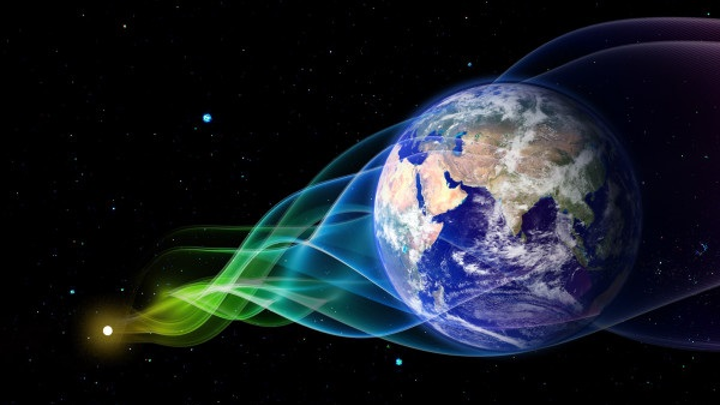
Globe of Earth with wavelike streamers from distant dot, representing laser pulses reaching Earth.

Other SETI searches, such as with Lick Observatory’s 40-inch Nickel Telescope, are also looking for laser pulses from advanced civilizations. Image via SETI/LaserFocusWorld.

New and novel ways of looking for evidence of extraterrestrial intelligence are welcome, since the previous, traditional SETI method of just searching for radio signals is considered by many to be antiquated. Would a civilization thousands or millions of years more advanced then us still be using radio waves to communicate? SETI and other searches should be as broad as possible, and consider alternate possibilities for the best chance of success. With billions of stars in our galaxy alone, the hunt for such signals is like looking for a needle in a haystack. VERITAS is just one such alternate method, but it is a good start.

Breakthrough Listen is a comprehensive initiative to search for evidence of intelligent, technological life from nearby stars to the universe at large. The objective is to examine one million nearby stars, all the stars in the galactic plane and 100 nearby galaxies, for both radio and optical signals. Not a small undertaking, but if there is to be any chance of finding an alien light show, then we must look.

Galaxy with enlarged square full of stars with a very small pale blue dot in the middle.

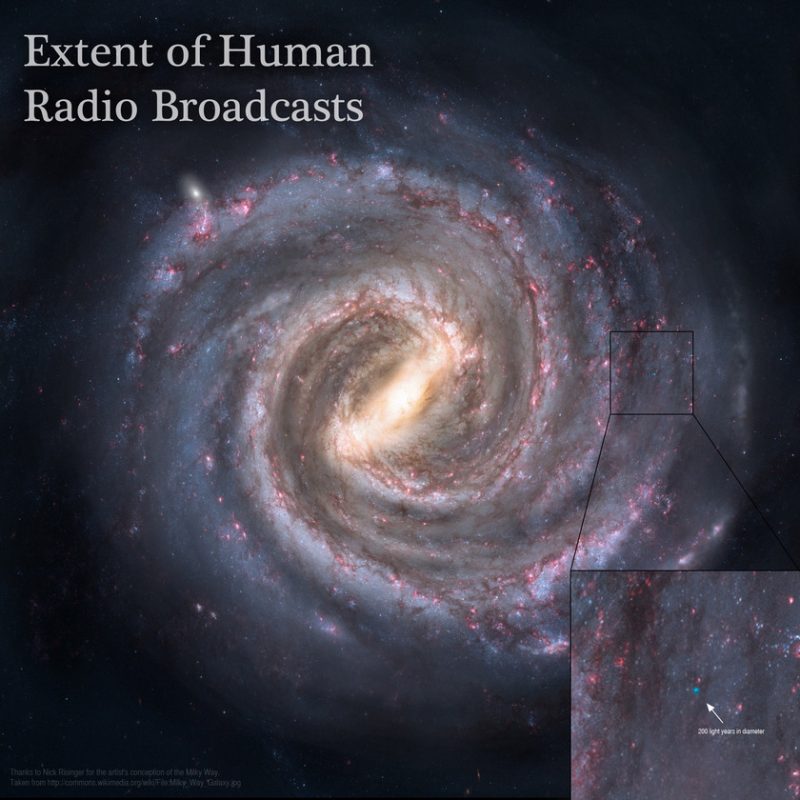
This is how far human radio broadcasts have reached into the galaxy – not the black square – but the little blue dot at the center of that zoomed-in square. The ever-expanding bubble announcing humanity’s presence to anyone listening in the Milky Way is now only about 200 light-years wide, in contrast to our 100,000-light-year galaxy. Graphic created by Adam Grossman. Read more from Emily Lakdawalla at the Planetary Society.

Bottom line: Using VERITAS, the search for intelligent alien life will broaden in its scope, looking not only for radio signals but also laser-like optical flashes of light that an advanced civilization might use as communication beacons.

Via Breakthrough Initiatives


from EarthSky https://ift.tt/2OpgqEO
Laser light beam from glowing object in space, pointed toward globe of Earth against starry sky.

VERITAS will be used to help search for laser-like optical light pulses that could be beacons from an advanced alien civilization. Image via MIT/New Atlas.

The Search for Extraterrestrial Intelligence (SETI) has traditionally looked for radio signals of artificial origin, i.e. coming from an alien civilization at least as advanced as our own. We humans have been broadcasting radio waves into space for about 100 years now, since Marconi pioneered long-distance radio transmission. The reasoning has been that other civilizations might use radio, too. While that approach continues to be highly debated, there is another kind of search that is starting to be considered more seriously now as well: looking for optical signals – brief flashes of light like pulsing lasers – that could be used as beacons to communicate over interstellar distances.

On July 17, 2019, Breakthrough Initiatives – founded in 2015 by entrepreneur Yuri Milnerannounced a new partnership with the VERITAS Collaboration to focus on this strategy. VERITAS (the Very Energetic Radiation Imaging Telescope Array System) will search for such pulsed optical beacons, as well as radio signals, with its array of four 12-meter telescopes at the Whipple Observatory in Amado, Arizona.

Breakthrough Listen, part of Breakthrough Initiatives, has already been conducting searches using its still-ongoing radio frequency survey and spectroscopic optical laser survey. But VERITAS can take the search to a new level. It was built to detect cosmic gamma rays and is the most powerful telescope array in the world for studying high energy astrophysics. As it turns out, it can also be used to look for “pulsed optical beacons” – laser-like pulses of light – that are very short in duration, only a few nanoseconds (one nanosecond is a billionth of a second).

Dish-style telescope made up of many panels, pointing at the sky.

Closer view of one of the 4 telescopes in the VERITAS array. Image via CfA/SciTechDaily.

An advantage of this method is that any artificial pulses could outshine stars that happen to lie in the same direction. The use of all four telescopes would also help to eliminate false positives from any detections made. VERITAS will provide a unique way of expanding the search for alien intelligence beyond previous methods, as noted by Yuri Milner:

When it comes to intelligent life beyond Earth, we don’t know where it exists or how it communicates. So our philosophy is to look in as many places, and in as many ways, as we can. VERITAS expands our range of observation even further.

Andrew Siemion at the Berkeley SETI Research Center added:

Breakthrough Listen is already the most powerful, comprehensive, and intensive search yet undertaken for signs of intelligent life beyond Earth. Now, with the addition of VERITAS, we’re sensitive to an important new class of signals: fast optical pulses. Optical communication has already been used by NASA to transmit high definition images to Earth from the moon, so there’s reason to believe that an advanced civilization might use a scaled-up version of this technology for interstellar communication.

VERITAS will be able to detect very faint light signals, if any exist, according to Jamie Holder at the University of Delaware:

Using the huge mirror area of the four VERITAS telescopes will allow us to search for these extremely faint optical flashes in the night sky, which could correspond to signals from an extraterrestrial civilization.

Four bright blue dish-style telescopes and buildings.

Aerial view of the VERITAS telescope array and the Fred Lawrence Whipple Observatory basecamp in Amado, Arizona. Image via VERITAS.

Just how sensitive is VERITAS? The most powerful lasers on Earth can transmit a pulse of 500 terawatts lasting only a few nanoseconds. If one were placed at the distance of Tabby’s Star – that weird dimming star about 1,470 light-years away – then VERITAS could detect it. However, most of the stars that VERITAS will observe are 10-100 times closer than that, so feasibly a pulse of light 100-10,000 times fainter than that earthly laser could be found.

VERITAS being able to search for alien light signals is a great bonus, since that is not what it was designed for. As David Williams at the University of California, Santa Cruz said:

It is impressive how well-suited the VERITAS telescopes are for this project, since they were built only with the purpose of studying very-high-energy gamma rays in mind.

In California, the SETI Institute is also using Lick Observatory‘s 40-inch Nickel Telescope on Mount Hamilton with a new pulse-detection system, to look for similar laser beacons from civilizations many light-years distant. Optical SETI has its advantages over radio SETI, such as no radio signal interference, according to Frank Drake, director of the Carl Sagan Center for Research:

One great advantage of optical SETI is that there’s no terrestrial interference. It’s an exciting new field.

This Lick experiment is unique as it uses three light detectors (photomultipliers) to search for bright pulses that arrive in a short period of time (less than a billionth of a second). Light from the star itself can also trigger the detectors as well, but seldom will all three photomultipliers be hit by photons within a billionth of a second time frame. This means few false alarms are expected, only about one per year.

Globe of Earth with wavelike streamers from distant dot, representing laser pulses reaching Earth.

Other SETI searches, such as with Lick Observatory’s 40-inch Nickel Telescope, are also looking for laser pulses from advanced civilizations. Image via SETI/LaserFocusWorld.

New and novel ways of looking for evidence of extraterrestrial intelligence are welcome, since the previous, traditional SETI method of just searching for radio signals is considered by many to be antiquated. Would a civilization thousands or millions of years more advanced then us still be using radio waves to communicate? SETI and other searches should be as broad as possible, and consider alternate possibilities for the best chance of success. With billions of stars in our galaxy alone, the hunt for such signals is like looking for a needle in a haystack. VERITAS is just one such alternate method, but it is a good start.

Breakthrough Listen is a comprehensive initiative to search for evidence of intelligent, technological life from nearby stars to the universe at large. The objective is to examine one million nearby stars, all the stars in the galactic plane and 100 nearby galaxies, for both radio and optical signals. Not a small undertaking, but if there is to be any chance of finding an alien light show, then we must look.

Galaxy with enlarged square full of stars with a very small pale blue dot in the middle.

This is how far human radio broadcasts have reached into the galaxy – not the black square – but the little blue dot at the center of that zoomed-in square. The ever-expanding bubble announcing humanity’s presence to anyone listening in the Milky Way is now only about 200 light-years wide, in contrast to our 100,000-light-year galaxy. Graphic created by Adam Grossman. Read more from Emily Lakdawalla at the Planetary Society.

Bottom line: Using VERITAS, the search for intelligent alien life will broaden in its scope, looking not only for radio signals but also laser-like optical flashes of light that an advanced civilization might use as communication beacons.

Via Breakthrough Initiatives


from EarthSky https://ift.tt/2OpgqEO

June 2019 hottest on record for globe

Map of world 9 red dots, 1 green, 1 blue, 1 orange, each with text.

View larger. | An annotated map of the world showing notable climate events that occurred around the world in June 2019. Find out more. Image via NOAA.

According to a NOAA report published on July 18, scorching temperatures made June 2019 the hottest June for the globe in the agency’s 140-year global temperature dataset. The year-to-date temperature for 2019 was the second warmest January–June on record. And for the second month in a row, warmth brought Antarctic sea-ice coverage to a new low.

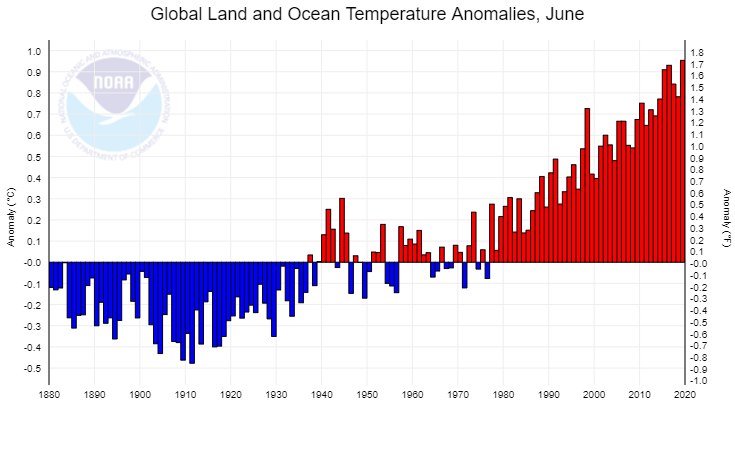
The average global temperature in June was 1.71 degrees Fahrenheit (.95 degrees Celsius) above the 20th-century average of 59.9 degrees F (15.5 degrees C), making it the hottest June in the 140-year record, according to scientists at NOAA’s National Centers for Environmental Information.

World map mostly covered in shades of pink representing warmer to record heat.

View larger. | Image via NOAA.

Nine of the 10 warmest Junes have occurred since 2010. June 1998 is the only year from the previous century that’s among the 10 warmest Junes on record (the eighth warmest June on record).

June 2019 also marks the 43rd consecutive June and the 414th consecutive month with temperatures, at least nominally, above the 20th century average.

Read the complete NOAA report.

Bar graph, steeply rising red bars on right from 1960 to 2020.

Image via NOAA.

Average Antarctic sea-ice coverage was 8.5 percent below the 1981-2010 average – the smallest on record for June. Average Arctic sea ice coverage was 10.5 percent below average – the second-smallest on record for June.

Bottom line: According to NOAA, June 2019 was the planet’s hottest June in the climate record, which dates back to 1880.

Via NOAA


from EarthSky https://ift.tt/2LCA9hR
Map of world 9 red dots, 1 green, 1 blue, 1 orange, each with text.

View larger. | An annotated map of the world showing notable climate events that occurred around the world in June 2019. Find out more. Image via NOAA.

According to a NOAA report published on July 18, scorching temperatures made June 2019 the hottest June for the globe in the agency’s 140-year global temperature dataset. The year-to-date temperature for 2019 was the second warmest January–June on record. And for the second month in a row, warmth brought Antarctic sea-ice coverage to a new low.

The average global temperature in June was 1.71 degrees Fahrenheit (.95 degrees Celsius) above the 20th-century average of 59.9 degrees F (15.5 degrees C), making it the hottest June in the 140-year record, according to scientists at NOAA’s National Centers for Environmental Information.

World map mostly covered in shades of pink representing warmer to record heat.

View larger. | Image via NOAA.

Nine of the 10 warmest Junes have occurred since 2010. June 1998 is the only year from the previous century that’s among the 10 warmest Junes on record (the eighth warmest June on record).

June 2019 also marks the 43rd consecutive June and the 414th consecutive month with temperatures, at least nominally, above the 20th century average.

Read the complete NOAA report.

Bar graph, steeply rising red bars on right from 1960 to 2020.

Image via NOAA.

Average Antarctic sea-ice coverage was 8.5 percent below the 1981-2010 average – the smallest on record for June. Average Arctic sea ice coverage was 10.5 percent below average – the second-smallest on record for June.

Bottom line: According to NOAA, June 2019 was the planet’s hottest June in the climate record, which dates back to 1880.

Via NOAA


from EarthSky https://ift.tt/2LCA9hR

Harbor lightning

Fotograf Göran Strand captured this image on July 19, 2019. He wrote:

Of all different weather types, thunder and lightning is one of my favorite. Not just for the spectacular show, but also for the difficulty in photographing lightning during daytime.

I’ve done this for several years now but this is perhaps my best lightning photo so far. I always strive for interesting content in the photo, and this makes things a bit harder. But in this case I got lucky to catch a really beautiful lightning over a small harbor and the entire lighting was visible in the frame.

Thanks Göran!


from EarthSky https://ift.tt/2Gp2Ni8

Fotograf Göran Strand captured this image on July 19, 2019. He wrote:

Of all different weather types, thunder and lightning is one of my favorite. Not just for the spectacular show, but also for the difficulty in photographing lightning during daytime.

I’ve done this for several years now but this is perhaps my best lightning photo so far. I always strive for interesting content in the photo, and this makes things a bit harder. But in this case I got lucky to catch a really beautiful lightning over a small harbor and the entire lighting was visible in the frame.

Thanks Göran!


from EarthSky https://ift.tt/2Gp2Ni8

Moon near Uranus in July 25 predawn sky

Unless you’re a night owl, you’re not likely to see the moon and the planet Uranus before your bedtime in late July 2019. They’ll come up in the east more or less together around the midnight hour, and then will climb upward during the early morning dark hours. Visit the Sunrise Sunset Calendars site to know when dawn’s first light comes to your sky, remembering to check the box for astronomical twilight. The moon and Uranus soar highest up for the night just before dawn’s first light.

So the dark hour before dawn finds Uranus highest in the sky and easiest to spot in late July 2019. Uranus is the seventh planet outward from our sun, and it’s theoretically visible to the eye. But it’s not one of the bright planets, and you’ll surely need a dark sky – probably optical aid – and a good sky chart to see this faint world.

Once you spot it, do try to see it with the eye alone. People with exceptional eyesight can see Uranus as a dim speck of light on a dark, moonless night.

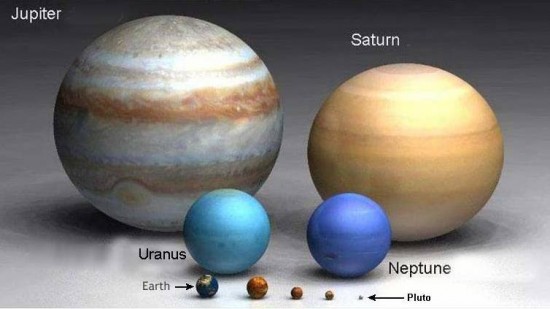
Spheres sitting on a surface marked like the planets; different sizes.

This artist’s concept depicts the relative sizes of the planets. Jupiter’s diameter is about 11 times that of Earth whereas Uranus’ diameter is about 4 times greater.

By the way, the moon will be at its last quarter phase on July 25, 2019, at 01:18 UTC. A last quarter moon rises around midnight, appearing with half its lunar disk lit by sunshine (daytime on the moon), while the other half is engulfed in the moon’s own shadow (nighttime on the moon). The lunar terminator – or shadow line dividing the lunar day from the lunar night – shows you where it’s sunset on the waning moon.

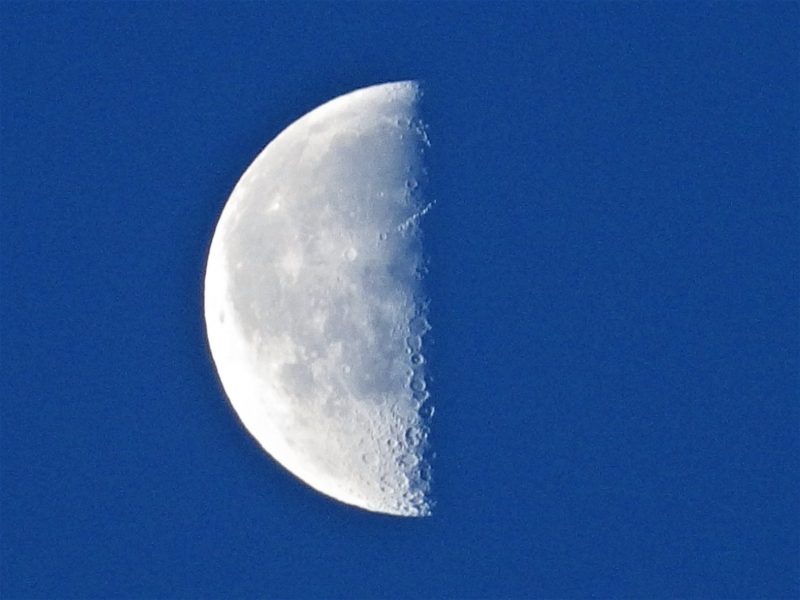
Left half of gray moon against black sky; right half invisible.

Three quarters of the way into its orbital cycle, the moon is in third or last quarter, rising roughly at midnight and setting at roughly noon the following day.

The moon will be slightly past its last quarter phase when it passes 5 degrees (10 moon diameters) south of Uranus on July 25, 2019, at about 7 Universal Time (3 a.m. EDT, 2 a.m. CDT, 1 a.m. MDT and 12 midnight PDT).

Uranus sits in front of the rather faint constellation Aries the Ram. Despite the lunar glare, you might be able to make out Aries’ brightest star, Hamal. Once you become familiar with Hamal, this modestly-bright 2nd-magnitude star will help you locate Aries when the moon has left this area of the sky.

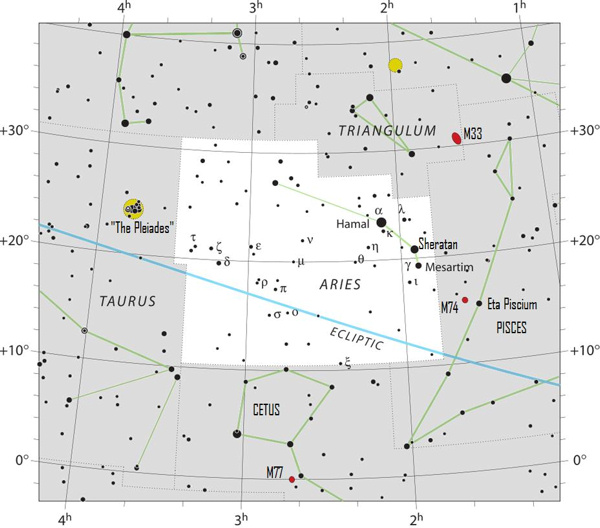
A good familiarity with Aries is your ticket to star-hopping to Uranus, using a sky chart such as this one. Uranus is difficult to see with the eye alone, but quite easy to view with binoculars. Even so, Uranus looks like a dim star, and you need a telescope magnifying Uranus by 100 times or more to discern this planet as a tiny disk instead of a star.

Star chart, black stars on white, of constellation Aries.

Sky chart via IAU. Uranus is now in front of the constellation Aries the Ram.

Although the moon and Uranus are fairly close together on the sky’s dome in the morning nighttime hours on July 25, 2019, these two worlds are nowhere near one another in space. Uranus lies way out there, at better than 7,500 times the moon’s distance from us. Visit unitarium.com to know the moon’s present distance and Heavens Above for Uranus’ present distance in astronomical units.

Bottom line: Before sunrise on July 25, 2019, you’ll find the moon at or near its last quarter phase and in the vicinity of the 7th planet, Uranus.

Read more: Hubble Sets Its Sights on the Ice Giants, via SkyandTelescope.com


from EarthSky https://ift.tt/2Y1MEdD

Unless you’re a night owl, you’re not likely to see the moon and the planet Uranus before your bedtime in late July 2019. They’ll come up in the east more or less together around the midnight hour, and then will climb upward during the early morning dark hours. Visit the Sunrise Sunset Calendars site to know when dawn’s first light comes to your sky, remembering to check the box for astronomical twilight. The moon and Uranus soar highest up for the night just before dawn’s first light.

So the dark hour before dawn finds Uranus highest in the sky and easiest to spot in late July 2019. Uranus is the seventh planet outward from our sun, and it’s theoretically visible to the eye. But it’s not one of the bright planets, and you’ll surely need a dark sky – probably optical aid – and a good sky chart to see this faint world.

Once you spot it, do try to see it with the eye alone. People with exceptional eyesight can see Uranus as a dim speck of light on a dark, moonless night.

Spheres sitting on a surface marked like the planets; different sizes.

This artist’s concept depicts the relative sizes of the planets. Jupiter’s diameter is about 11 times that of Earth whereas Uranus’ diameter is about 4 times greater.

By the way, the moon will be at its last quarter phase on July 25, 2019, at 01:18 UTC. A last quarter moon rises around midnight, appearing with half its lunar disk lit by sunshine (daytime on the moon), while the other half is engulfed in the moon’s own shadow (nighttime on the moon). The lunar terminator – or shadow line dividing the lunar day from the lunar night – shows you where it’s sunset on the waning moon.

Left half of gray moon against black sky; right half invisible.

Three quarters of the way into its orbital cycle, the moon is in third or last quarter, rising roughly at midnight and setting at roughly noon the following day.

The moon will be slightly past its last quarter phase when it passes 5 degrees (10 moon diameters) south of Uranus on July 25, 2019, at about 7 Universal Time (3 a.m. EDT, 2 a.m. CDT, 1 a.m. MDT and 12 midnight PDT).

Uranus sits in front of the rather faint constellation Aries the Ram. Despite the lunar glare, you might be able to make out Aries’ brightest star, Hamal. Once you become familiar with Hamal, this modestly-bright 2nd-magnitude star will help you locate Aries when the moon has left this area of the sky.

A good familiarity with Aries is your ticket to star-hopping to Uranus, using a sky chart such as this one. Uranus is difficult to see with the eye alone, but quite easy to view with binoculars. Even so, Uranus looks like a dim star, and you need a telescope magnifying Uranus by 100 times or more to discern this planet as a tiny disk instead of a star.

Star chart, black stars on white, of constellation Aries.

Sky chart via IAU. Uranus is now in front of the constellation Aries the Ram.

Although the moon and Uranus are fairly close together on the sky’s dome in the morning nighttime hours on July 25, 2019, these two worlds are nowhere near one another in space. Uranus lies way out there, at better than 7,500 times the moon’s distance from us. Visit unitarium.com to know the moon’s present distance and Heavens Above for Uranus’ present distance in astronomical units.

Bottom line: Before sunrise on July 25, 2019, you’ll find the moon at or near its last quarter phase and in the vicinity of the 7th planet, Uranus.

Read more: Hubble Sets Its Sights on the Ice Giants, via SkyandTelescope.com


from EarthSky https://ift.tt/2Y1MEdD

Last quarter moon is July 24-25

Large moon. Left half bright white against cobalt blue sky; left half invisible.

The moon was almost exactly at last quarter when Deirdre Horan in Dublin, Ireland, captured this photo. The terminator line, or line between light and dark on the moon, appears straight.

A last quarter moon appears half-lit by sunshine and half-immersed in its own shadow. It rises in the middle of the night, appears at its highest in the sky around dawn, and sets around midday. The moon reaches its exact half-illuminated phase, as viewed from Earth, on July 25, 2019, at 01:18 UTC; that translates to 9:18 p.m. EDT on July 24. Translate UTC to your time.

On a last quarter moon, the lunar terminator – the shadow line dividing day and night – shows you where it’s sunset on the moon.

A last quarter moon provides a great opportunity to think of yourself on a three-dimensional world in space. For example, it’s fun to see this moon just after moonrise, shortly after midnight. Then the lighted portion points downward, to the sun below your feet. Think of the last quarter moon as a mirror to the world you’re standing on. Think of yourself standing in the middle of Earth’s nightside, on the midnight portion of Earth.

Also, a last quarter moon can be used as a guidepost to Earth’s direction of motion in orbit around the sun.

In other words, when you look toward a last quarter moon high in the predawn sky, for example, you’re gazing out approximately along the path of Earth’s orbit, in a forward direction. The moon is moving in orbit around the sun with the Earth and never holds still. But, if we could somehow anchor the moon in space … tie it down, keep it still … Earth’s orbital speed of 18 miles per second would carry us across the space between us and the moon in only a few hours.

Want to read more about the last quarter moon as a guidepost for Earth’s motion? Astronomer Guy Ottewell talks about it here.

A great thing about using the moon as a guidepost to Earth’s motion is that you can do it anywhere … as, for example, in the photo below, from large cities.

Daytime sky. High small moon, left half visible, above conical-top water tower and tall tan brick chimney.

Ben Orlove wrote from New York City: “I was sitting in the roof garden of my building, and there was the moon, right in front of me. You were right, this is a perfect time to visualize … the Earth’s motion.”

As the moon orbits Earth, it changes phase in an orderly way. Follow the links below to understand the phases of the moon.

New moon
Waxing crescent moon
First quarter moon
Waxing gibbous moon
Full moon
Waning gibbous moon
Last quarter moon
Waning crescent moon

Read more: 4 keys to understanding moon phases

Bottom line: The next last quarter moon falls on July 25, 2019, at 01:18 UTC; that translates to 9:18 p.m. EDT on July 24. Translate UTC to your time.


from EarthSky https://ift.tt/2ze0n1D
Large moon. Left half bright white against cobalt blue sky; left half invisible.

The moon was almost exactly at last quarter when Deirdre Horan in Dublin, Ireland, captured this photo. The terminator line, or line between light and dark on the moon, appears straight.

A last quarter moon appears half-lit by sunshine and half-immersed in its own shadow. It rises in the middle of the night, appears at its highest in the sky around dawn, and sets around midday. The moon reaches its exact half-illuminated phase, as viewed from Earth, on July 25, 2019, at 01:18 UTC; that translates to 9:18 p.m. EDT on July 24. Translate UTC to your time.

On a last quarter moon, the lunar terminator – the shadow line dividing day and night – shows you where it’s sunset on the moon.

A last quarter moon provides a great opportunity to think of yourself on a three-dimensional world in space. For example, it’s fun to see this moon just after moonrise, shortly after midnight. Then the lighted portion points downward, to the sun below your feet. Think of the last quarter moon as a mirror to the world you’re standing on. Think of yourself standing in the middle of Earth’s nightside, on the midnight portion of Earth.

Also, a last quarter moon can be used as a guidepost to Earth’s direction of motion in orbit around the sun.

In other words, when you look toward a last quarter moon high in the predawn sky, for example, you’re gazing out approximately along the path of Earth’s orbit, in a forward direction. The moon is moving in orbit around the sun with the Earth and never holds still. But, if we could somehow anchor the moon in space … tie it down, keep it still … Earth’s orbital speed of 18 miles per second would carry us across the space between us and the moon in only a few hours.

Want to read more about the last quarter moon as a guidepost for Earth’s motion? Astronomer Guy Ottewell talks about it here.

A great thing about using the moon as a guidepost to Earth’s motion is that you can do it anywhere … as, for example, in the photo below, from large cities.

Daytime sky. High small moon, left half visible, above conical-top water tower and tall tan brick chimney.

Ben Orlove wrote from New York City: “I was sitting in the roof garden of my building, and there was the moon, right in front of me. You were right, this is a perfect time to visualize … the Earth’s motion.”

As the moon orbits Earth, it changes phase in an orderly way. Follow the links below to understand the phases of the moon.

New moon
Waxing crescent moon
First quarter moon
Waxing gibbous moon
Full moon
Waning gibbous moon
Last quarter moon
Waning crescent moon

Read more: 4 keys to understanding moon phases

Bottom line: The next last quarter moon falls on July 25, 2019, at 01:18 UTC; that translates to 9:18 p.m. EDT on July 24. Translate UTC to your time.


from EarthSky https://ift.tt/2ze0n1D

Draco, great Dragon of the north

Tonight … if you have a dark sky, make your acquaintance with the constellation Draco the Dragon, starting at nightfall. At mid-northern latitudes, Draco is a circumpolar constellation, meaning it is out all night long every night of the year. Northern Hemisphere summer evenings are the best time to look, because this is when the Dragon’s flashing eyes look down upon you from up high in the northern sky.

The chart at the top of this post – showing Draco – covers a lot more sky than our charts usually do. That’s because Draco is big! This serpentine star figure wanders in between the Big and Little Dippers, with its tail found between the bowl of the Big Dipper and the star Polaris.

I always notice the two stars in the Dragon’s head when looking at the bright star Vega in the constellation Lyra. If you’re familiar with the Summer Triangle, draw an imaginary line from the star Altair through the star Vega to find the Dragon’s eyes glaring at you from high overhead on July and August evenings. These two stars are Rastaban and Eltanin – lovely, romantic names for the Dragon’s stars.

Watch Draco tonight as it circles around the North Star, Polaris.

Antique color etching of long snake-like dragon with a bear to the side and stars.

Draco, with Ursa Minor or the Little Dipper, as depicted in Urania’s Mirror, a set of constellation cards published in London c. 1825.

Another noteworthy star in Draco is Thuban, which is high in the sky in the evening at this time of year. Thuban is an interesting star because – around 3000 B.C. – Thuban used to be the Pole Star.

The constellation Draco, by the way, has been associated with a dragon in many cultures. A Babylonian myth links Draco to the dragon god Tiamat, who was subdued by the god of the sun.

Bottom line: Here is Draco the Dragon on a July evening. Meet Rastaban and Eltanin – lovely, romantic names for Dragon stars! They represent the Eyes of the Dragon.

Read more: Eltanin and Rastaban, the Dragon’s Eyes

EarthSky’s meteor shower guide for 2019

Help support posts like these at the EarthSky store. Fun astronomy gifts and tools for all ages!


from EarthSky https://ift.tt/2XYoSz3

Tonight … if you have a dark sky, make your acquaintance with the constellation Draco the Dragon, starting at nightfall. At mid-northern latitudes, Draco is a circumpolar constellation, meaning it is out all night long every night of the year. Northern Hemisphere summer evenings are the best time to look, because this is when the Dragon’s flashing eyes look down upon you from up high in the northern sky.

The chart at the top of this post – showing Draco – covers a lot more sky than our charts usually do. That’s because Draco is big! This serpentine star figure wanders in between the Big and Little Dippers, with its tail found between the bowl of the Big Dipper and the star Polaris.

I always notice the two stars in the Dragon’s head when looking at the bright star Vega in the constellation Lyra. If you’re familiar with the Summer Triangle, draw an imaginary line from the star Altair through the star Vega to find the Dragon’s eyes glaring at you from high overhead on July and August evenings. These two stars are Rastaban and Eltanin – lovely, romantic names for the Dragon’s stars.

Watch Draco tonight as it circles around the North Star, Polaris.

Antique color etching of long snake-like dragon with a bear to the side and stars.

Draco, with Ursa Minor or the Little Dipper, as depicted in Urania’s Mirror, a set of constellation cards published in London c. 1825.

Another noteworthy star in Draco is Thuban, which is high in the sky in the evening at this time of year. Thuban is an interesting star because – around 3000 B.C. – Thuban used to be the Pole Star.

The constellation Draco, by the way, has been associated with a dragon in many cultures. A Babylonian myth links Draco to the dragon god Tiamat, who was subdued by the god of the sun.

Bottom line: Here is Draco the Dragon on a July evening. Meet Rastaban and Eltanin – lovely, romantic names for Dragon stars! They represent the Eyes of the Dragon.

Read more: Eltanin and Rastaban, the Dragon’s Eyes

EarthSky’s meteor shower guide for 2019

Help support posts like these at the EarthSky store. Fun astronomy gifts and tools for all ages!


from EarthSky https://ift.tt/2XYoSz3

adds 2