aads

Government says England will be smokefree by 2030. But how will it get there?

Smoking causes nearly 1 in 5 cancer cases and more than 1 in 4 cancer deaths each year in the UK. Decades of policy action have steadily cut the UK’s smoking rates to one of the lowest in Europe. But with around 1 in 7 people still smoking, tobacco continues to place an enormous cost on our society and our economy.

Last November, the UK Government published its vision to put “prevention at the heart of our nation’s health”, recognising the importance of preventing cancer amongst other long-term health conditions. A new ‘green paper’, published yesterday, poses some new and old ways that the Government might deliver on this. And when it comes to tackling smoking, the plan to make England smokefree by 2030 is bold.

“We want to see smoking become a thing of the past, so it’s great to see the Government pledge to make this happen,” says Kruti Shrotri, Cancer Research UK’s policy manager.

But getting there can’t just be business as usual. If the Government really intends on achieving a smokefree England by the end of the next decade, continued action on smoking is vital.

NHS and local government need support

“To make the England smokefree by 2030, we need to help people to quit smoking, particularly those who are hard to reach,” says Shrotri.

NHS England has promised that, by 2024, every hospital patient who smokes will be offered treatment to help them quit. But this isn’t enough. People also need to be offered treatment to quit by their GP. And local governments need funding to help them pay for vital services that are proven to bring smoking rates down.

“Smoking cessation services in local communities are being increasingly threatened,” says, Shrotri, referring to the impact of ongoing public health funding cuts across the country.

Slashed budgets have jeopardised vital public health services. And since 2015, the public health budget has fallen by £700 million. Funding for wider tobacco control measures and stop smoking services have been among the worst hit.

“We know stop smoking services, which offer smokers a combination of pharmacotherapy and behavioural support, are the most successful way to support smokers to stop,” says Shrotri. “However, ongoing cuts to public health funding have meant that just over half the local authorities in England have a specialist stop smoking service open to all smokers in the area.”

Reducing smoking rates will also help tackle health inequality. Right now, the gap in life expectancy between the richest and the poorest is widening. And because smoking rates are highest amongst the most vulnerable in society, tackling smoking is the single best thing we can do to improve that gap.

Possibility of a ‘polluter pays’ approach

Tobacco companies are responsible for the greatest and most enduring man-made public health epidemic in history, yet they continue to profit from a product that kills one in two people who use it. In its green paper, the Government recognises that charging tobacco companies in France and the USA for the damage they cause has helped to fund some tobacco control efforts, suggesting that the UK may be open to a similar approach.

“These new Government proposals mention a charge on the tobacco industry,” says Shrotri. “This is something we and others have been trying to push since 2015, so we’re really pleased they’ve acknowledged it as part of a potential solution to plug the current funding gap for tobacco control.”

More than 7 in 10 adults in England said they’d support a fee on tobacco manufacturers that could fund stop smoking services and prevent young people from taking up smoking, according to a YouGov survey commissioned by Action on Smoking and Health (ASH).

“It’s a matter of fairness,” says Shrotri, “that the tobacco industry should pay for the damage to health that they’ve caused.”

Alongside this, the green paper also suggests that an insert carrying quitting advice could be included inside cigarette packs. Canada is the only country in the world that does this, and evidence suggests this could discourage young adult smokers from continuing to smoke.

What happens next?

This latest Government document is only a series of suggestions. The proposals are now out in the public domain and open for debate.

Organisations and companies with an interest in the proposed measures – whether they prioritise public health or not – are now free to weigh in and attempt to influence how these proposals are taken forward.

What about obesity?

Overweight and obesity is the second biggest preventable cause of cancer after smoking. Some plans are already underway to tackle this, and the green paper updated on some others:

  • The Government will look at whether the tax on sugary drinks should be extended to milk-based drinks
  • We’re still waiting for the Government to publish its plans on the mandatory calorie labelling of food items, restricting junk food bargain buys and a introducing a 9pm watershed on junk food advertising promotions.

“Clearly our NHS is overburdened,” says Shrotri. “We know that there are things that the

Government can do to reduce people’s chance of getting cancer.” These proposals are a positive start. But clear plans are now needed so that by the time we reach 2030, the UK is happier, healthier and completely smokefree.

Gabi


from Cancer Research UK – Science blog https://ift.tt/2JMsTh6

Smoking causes nearly 1 in 5 cancer cases and more than 1 in 4 cancer deaths each year in the UK. Decades of policy action have steadily cut the UK’s smoking rates to one of the lowest in Europe. But with around 1 in 7 people still smoking, tobacco continues to place an enormous cost on our society and our economy.

Last November, the UK Government published its vision to put “prevention at the heart of our nation’s health”, recognising the importance of preventing cancer amongst other long-term health conditions. A new ‘green paper’, published yesterday, poses some new and old ways that the Government might deliver on this. And when it comes to tackling smoking, the plan to make England smokefree by 2030 is bold.

“We want to see smoking become a thing of the past, so it’s great to see the Government pledge to make this happen,” says Kruti Shrotri, Cancer Research UK’s policy manager.

But getting there can’t just be business as usual. If the Government really intends on achieving a smokefree England by the end of the next decade, continued action on smoking is vital.

NHS and local government need support

“To make the England smokefree by 2030, we need to help people to quit smoking, particularly those who are hard to reach,” says Shrotri.

NHS England has promised that, by 2024, every hospital patient who smokes will be offered treatment to help them quit. But this isn’t enough. People also need to be offered treatment to quit by their GP. And local governments need funding to help them pay for vital services that are proven to bring smoking rates down.

“Smoking cessation services in local communities are being increasingly threatened,” says, Shrotri, referring to the impact of ongoing public health funding cuts across the country.

Slashed budgets have jeopardised vital public health services. And since 2015, the public health budget has fallen by £700 million. Funding for wider tobacco control measures and stop smoking services have been among the worst hit.

“We know stop smoking services, which offer smokers a combination of pharmacotherapy and behavioural support, are the most successful way to support smokers to stop,” says Shrotri. “However, ongoing cuts to public health funding have meant that just over half the local authorities in England have a specialist stop smoking service open to all smokers in the area.”

Reducing smoking rates will also help tackle health inequality. Right now, the gap in life expectancy between the richest and the poorest is widening. And because smoking rates are highest amongst the most vulnerable in society, tackling smoking is the single best thing we can do to improve that gap.

Possibility of a ‘polluter pays’ approach

Tobacco companies are responsible for the greatest and most enduring man-made public health epidemic in history, yet they continue to profit from a product that kills one in two people who use it. In its green paper, the Government recognises that charging tobacco companies in France and the USA for the damage they cause has helped to fund some tobacco control efforts, suggesting that the UK may be open to a similar approach.

“These new Government proposals mention a charge on the tobacco industry,” says Shrotri. “This is something we and others have been trying to push since 2015, so we’re really pleased they’ve acknowledged it as part of a potential solution to plug the current funding gap for tobacco control.”

More than 7 in 10 adults in England said they’d support a fee on tobacco manufacturers that could fund stop smoking services and prevent young people from taking up smoking, according to a YouGov survey commissioned by Action on Smoking and Health (ASH).

“It’s a matter of fairness,” says Shrotri, “that the tobacco industry should pay for the damage to health that they’ve caused.”

Alongside this, the green paper also suggests that an insert carrying quitting advice could be included inside cigarette packs. Canada is the only country in the world that does this, and evidence suggests this could discourage young adult smokers from continuing to smoke.

What happens next?

This latest Government document is only a series of suggestions. The proposals are now out in the public domain and open for debate.

Organisations and companies with an interest in the proposed measures – whether they prioritise public health or not – are now free to weigh in and attempt to influence how these proposals are taken forward.

What about obesity?

Overweight and obesity is the second biggest preventable cause of cancer after smoking. Some plans are already underway to tackle this, and the green paper updated on some others:

  • The Government will look at whether the tax on sugary drinks should be extended to milk-based drinks
  • We’re still waiting for the Government to publish its plans on the mandatory calorie labelling of food items, restricting junk food bargain buys and a introducing a 9pm watershed on junk food advertising promotions.

“Clearly our NHS is overburdened,” says Shrotri. “We know that there are things that the

Government can do to reduce people’s chance of getting cancer.” These proposals are a positive start. But clear plans are now needed so that by the time we reach 2030, the UK is happier, healthier and completely smokefree.

Gabi


from Cancer Research UK – Science blog https://ift.tt/2JMsTh6

Skeptical Science New Research for Week #29, 2019

A relatively small haul of 42 articles. 

The usual proportion of climate-related research domain output is notably reversed this week. Knock-on effects of climate change and how to deal with them dominated the raw feed of articles.

The physical science of climate change remains fascinating in itself as a matter of pure abstract curiosity. We could wish we only were witnessing a scientific phenomenon as a matter of pure science but with stakes at risk rising in scope and urgency, research focused on mitigation, adaptation and cultural impacts of climate change is burgeoning.

Unlike the study of cosmology or mantle convection, in this broad arena of science we're the central player and can write our script. And— let's not forget— we've previously successfully or at least forthrightly negotiated unintended outcomes of our prowess. For instance after a brief period of unalloyed delight the emergence of automobiles focused attention on outcomes of relatively simple physics producing complicated, painful and expensive effects.  Momentum, inertia, 1/2MV2, human skulls, hard unforgiving objects and nasty, sad permutations of these things inexorably led to research on improvements. It's just so with the climate change we know we're causing— we've identified problems and now we figure out how to fix those problems. We get to shape our future for the better. 

It's not complicated, not in principle. When with our clever brains we unleash forces unaddressed by our anatomy— or the normal functioning of the planet— we survive and thrive by further extension of our intelligence, not by pretending to be stupid and ignorant despite evidence to the contrary.

In short, research "ancillary" to the physical science of climate change is the smartest and arguably best side of our behavior on display, enlightened self-interest at work. 

Another lesson to be drawn from our weekly research synopsis is more centrally germane to the mission of Skeptical Science. As inquiry extends from physical principles of climate change and workers in other domains inevitably assess conditions in the light of new information we find ever more confirmation of what the physical science of climate change tells us is to be expected. This week's biology section is rife with examples. The intellectual bankruptcy of denial of anthropogenic climate change is becoming ever more obvious as the acuity and breadth of our accountancy improves. 

Physical science of anthropogenic climate change
Freshwater requirements of large-scale bioenergy plantations for limiting global warming to 1.5 °C

Contrasting responses in dissolved organic carbon to extreme climate events from adjacent boreal landscapes in Northern Sweden

Estimating power plant CO 2 emission using OCO-2 XCO 2 and high resolution WRF-Chem simulations

A 40-y record reveals gradual Antarctic sea ice increases followed by decreases at rates far exceeding the rates seen in the Arctic 

Enhanced flood risk with 1.5 °C global warming in the Ganges–Brahmaputra–Meghna basin

Changes in the thickness and circulation of multiyear ice in the Beaufort Gyre determined from pseudo‐Lagrangian methods from 2003‐2015

Turbulence Observations beneath Larsen C Ice Shelf, Antarctica

Extratropical Cyclone Clouds in the GFDL climate model: diagnosing biases and the associated causes

The relevance of mid-Holocene Arctic warming to the future

Towards monitoring localized CO2 emissions from space: co-located regional CO2 and NO2 enhancements observed by the OCO-2 and S5P satellites

Research on how to cope with the anthropogenic climate mess we're making

Spatio-temporal trend in heat waves over India and its impact assessment on wheat crop

Evolution of Mediterranean extreme dry spells during the wet season under climate change

Mid-century emission pathways in Japan associated with the global 2 °C goal: national and globalmodels’ assessments based on carbon budgets

Assessing the degree of hydrologic stress due to climate change

Evaluating sea-level rise vulnerability assessments in the USA

The salience of climate change in farmer decision-making within smallholder semi-arid agroecosystems

Diversity in collaboration: Networks in urban climate change governance

Detection of a climate change signal in extreme heat, heat stress and cold in Europe from observations

Assessing the impact of sea level rise on port operability using LiDAR-derived digital elevation models

Principles and considerations for mainstreaming climate change risk into national social protection frameworks in developing countries

Economic integration and CO2 emissions: evidence from emerging economies

Passive survivability of buildings under changing urban climates across eight US cities

Sustainable urban planning strategies for mitigating climate change in Saudi Arabia

Co-benefits of China’s climate policy for air quality and human health in China and transboundary regions in 2030

Nationalizing a global phenomenon: A study of how the press in 45 countries and territories portrays climate change

Role of market agents in mitigating the climate change effects on food economy

Shocks, states, and societal corporatism: a shorter path to sustainability?

Global mitigation potential of carbon stored in harvested wood products

Community as an equal partner for region-based climate change vulnerability, risk, and resilience assessments

Coal and climate change

Responsibility for climate change adaptation

Largely underestimated carbon emission from land use and land cover change in the conterminous US

Effects of climate and land‐use change scenarios on fire probability during the 21st century in the Brazilian Amazon

Biology and anthropogenic climate change

Estimating aboveground net biomass change for tropical and subtropical forests: refinement of IPCC default rates using forest plot data

Climate change alters elevational phenology patterns of the European spruce bark beetle (Ips typographus)

 Post‐industrial late summer warming recorded in tree‐ring density in the eastern Tibetan Plateau

Climate change increases the potential for extreme wildfires

Observed impacts of anthropogenic climate change on wildfire in California

Tree‐ring reconstructions of stemwood biomass indicate increases in the growth rate of black spruce trees across boreal forests of Canada

Nonlinear increases in extreme temperatures paradoxically dampen increases in extreme humid-heat

Arctic climate shifts drive rapid ecosystem responses across the West Greenland landscape

Spatiotemporal differences in the climatic growing season in the Qinling Mountains of China under the influence of global warming from 1964 to 2015


The previous edition of Skeptical Science new climate research may be found here. 


from Skeptical Science https://ift.tt/2y7guxW

A relatively small haul of 42 articles. 

The usual proportion of climate-related research domain output is notably reversed this week. Knock-on effects of climate change and how to deal with them dominated the raw feed of articles.

The physical science of climate change remains fascinating in itself as a matter of pure abstract curiosity. We could wish we only were witnessing a scientific phenomenon as a matter of pure science but with stakes at risk rising in scope and urgency, research focused on mitigation, adaptation and cultural impacts of climate change is burgeoning.

Unlike the study of cosmology or mantle convection, in this broad arena of science we're the central player and can write our script. And— let's not forget— we've previously successfully or at least forthrightly negotiated unintended outcomes of our prowess. For instance after a brief period of unalloyed delight the emergence of automobiles focused attention on outcomes of relatively simple physics producing complicated, painful and expensive effects.  Momentum, inertia, 1/2MV2, human skulls, hard unforgiving objects and nasty, sad permutations of these things inexorably led to research on improvements. It's just so with the climate change we know we're causing— we've identified problems and now we figure out how to fix those problems. We get to shape our future for the better. 

It's not complicated, not in principle. When with our clever brains we unleash forces unaddressed by our anatomy— or the normal functioning of the planet— we survive and thrive by further extension of our intelligence, not by pretending to be stupid and ignorant despite evidence to the contrary.

In short, research "ancillary" to the physical science of climate change is the smartest and arguably best side of our behavior on display, enlightened self-interest at work. 

Another lesson to be drawn from our weekly research synopsis is more centrally germane to the mission of Skeptical Science. As inquiry extends from physical principles of climate change and workers in other domains inevitably assess conditions in the light of new information we find ever more confirmation of what the physical science of climate change tells us is to be expected. This week's biology section is rife with examples. The intellectual bankruptcy of denial of anthropogenic climate change is becoming ever more obvious as the acuity and breadth of our accountancy improves. 

Physical science of anthropogenic climate change
Freshwater requirements of large-scale bioenergy plantations for limiting global warming to 1.5 °C

Contrasting responses in dissolved organic carbon to extreme climate events from adjacent boreal landscapes in Northern Sweden

Estimating power plant CO 2 emission using OCO-2 XCO 2 and high resolution WRF-Chem simulations

A 40-y record reveals gradual Antarctic sea ice increases followed by decreases at rates far exceeding the rates seen in the Arctic 

Enhanced flood risk with 1.5 °C global warming in the Ganges–Brahmaputra–Meghna basin

Changes in the thickness and circulation of multiyear ice in the Beaufort Gyre determined from pseudo‐Lagrangian methods from 2003‐2015

Turbulence Observations beneath Larsen C Ice Shelf, Antarctica

Extratropical Cyclone Clouds in the GFDL climate model: diagnosing biases and the associated causes

The relevance of mid-Holocene Arctic warming to the future

Towards monitoring localized CO2 emissions from space: co-located regional CO2 and NO2 enhancements observed by the OCO-2 and S5P satellites

Research on how to cope with the anthropogenic climate mess we're making

Spatio-temporal trend in heat waves over India and its impact assessment on wheat crop

Evolution of Mediterranean extreme dry spells during the wet season under climate change

Mid-century emission pathways in Japan associated with the global 2 °C goal: national and globalmodels’ assessments based on carbon budgets

Assessing the degree of hydrologic stress due to climate change

Evaluating sea-level rise vulnerability assessments in the USA

The salience of climate change in farmer decision-making within smallholder semi-arid agroecosystems

Diversity in collaboration: Networks in urban climate change governance

Detection of a climate change signal in extreme heat, heat stress and cold in Europe from observations

Assessing the impact of sea level rise on port operability using LiDAR-derived digital elevation models

Principles and considerations for mainstreaming climate change risk into national social protection frameworks in developing countries

Economic integration and CO2 emissions: evidence from emerging economies

Passive survivability of buildings under changing urban climates across eight US cities

Sustainable urban planning strategies for mitigating climate change in Saudi Arabia

Co-benefits of China’s climate policy for air quality and human health in China and transboundary regions in 2030

Nationalizing a global phenomenon: A study of how the press in 45 countries and territories portrays climate change

Role of market agents in mitigating the climate change effects on food economy

Shocks, states, and societal corporatism: a shorter path to sustainability?

Global mitigation potential of carbon stored in harvested wood products

Community as an equal partner for region-based climate change vulnerability, risk, and resilience assessments

Coal and climate change

Responsibility for climate change adaptation

Largely underestimated carbon emission from land use and land cover change in the conterminous US

Effects of climate and land‐use change scenarios on fire probability during the 21st century in the Brazilian Amazon

Biology and anthropogenic climate change

Estimating aboveground net biomass change for tropical and subtropical forests: refinement of IPCC default rates using forest plot data

Climate change alters elevational phenology patterns of the European spruce bark beetle (Ips typographus)

 Post‐industrial late summer warming recorded in tree‐ring density in the eastern Tibetan Plateau

Climate change increases the potential for extreme wildfires

Observed impacts of anthropogenic climate change on wildfire in California

Tree‐ring reconstructions of stemwood biomass indicate increases in the growth rate of black spruce trees across boreal forests of Canada

Nonlinear increases in extreme temperatures paradoxically dampen increases in extreme humid-heat

Arctic climate shifts drive rapid ecosystem responses across the West Greenland landscape

Spatiotemporal differences in the climatic growing season in the Qinling Mountains of China under the influence of global warming from 1964 to 2015


The previous edition of Skeptical Science new climate research may be found here. 


from Skeptical Science https://ift.tt/2y7guxW

Perseid meteors 2019: All you need to know

Bright nearly vertical streak in sky above long pier sticking out into calm body of water.

Perseid meteor on the morning of August 12, 2017, from Hrvoje Crnjak in Šibenik, Croatia. Notice the variations in brightness and color throughout, and the little “pop” of brightness toward the bottom. A brightness “pop” like that comes from a clump of vaporizing debris. Thank you, Hrvoje! Click for more photos of 2017 Perseids.

The annual Perseid meteor shower is one of the most beloved meteor showers of the year, especially in the Northern Hemisphere, where the shower peaks on warm summer nights. No matter where you live worldwide, the 2019 Perseid meteor shower will probably produce the greatest number of meteors on the mornings of August 11, 12 and 13. Unfortunately, on the peak mornings in 2019, a bright moon will drown many Perseids from view. For those serious about seeing the greatest number of Perseids in 2019, we recommend viewing several mornings in a row, beginning the weekend of Friday, August 9 to Sunday, August 11. There will be considerably more moon-free viewing time then than at the Perseids’ likely peak from late evening August 12 until dawn August 13.

Visit the Sunrise Sunset Calendars site to find out when the moon sets in your sky, remembering to check the moonrise and moonset box.

But don’t wait. The 2019 Perseid meteor shower has already begun its slow and steady rise to its peak. And the new moon comes on July 31/August 1, meaning the morning hours in early August will be moon-free.

Camping in early August? Yes, please! The weekend of August 2 to 4 would be grand. Be on the lookout for Perseid meteors in the hours between midnight and dawn. Also remember, the the Delta Aquariid meteor shower will still be rambling along steadily. You’ll see mostly Perseids, but also some Delta Aquariids in the mix. There’s an explanation of how to tell the difference toward the bottom of this article.

The first full week of August (say, around August 5 to 8) will also offer moon-free skies – and hopefully some pleasant meteor-viewing – in those prime midnight-to-dawn hours.

In the Northern Hemisphere, we rank the August Perseids as an all-time favorite meteor shower of every year. For us, this major shower takes place during the lazy, hazy days of summer, when many families are on vacation. And what could be more luxurious than taking a siesta in the heat of the day and watching this summertime classic in the relative coolness of night?

People tend to focus on the peak mornings of the shower and that’s entirely appropriate. But meteors in annual showers – which come from streams of debris left behind in space by comets – typically last weeks, not days. Perseid meteors have been streaking across our skies since around July 17. We’ll see Perseids for 10 days or so after the peak mornings on August 11, 12 and 13. What’s more, the Perseids tend to build up gradually, yet fall off rapidly. So, any morning in late July through mid-August should offer a sprinkling of Perseid meteors.

Don’t rule out early evenings, either. In a typical year, although the meteor numbers increase after midnight, the Perseid meteors still start to fly at mid-to-late evening from northerly latitudes. South of the equator, the Perseids start to streak the sky around midnight. If fortune smiles upon you, the evening hours might offer you an earthgrazer – a looooong, slow, colorful meteor traveling horizontally across the evening sky. Earthgrazer meteors are rare but memorable. Perseid earthgrazers appear before midnight, when the radiant point of the shower is close to the horizon.

Chart of constellation Perseus with arrows pointing outward from spot near its top.

The radiant point for the Perseid meteor shower is in the constellation Perseus. But you don’t have to find a shower’s radiant point to see meteors. Instead, the meteors will be flying in all parts of the sky.

What is the radiant point for the Perseid meteor shower? If you trace all the Perseid meteors backward, they all seem to come from the constellation Perseus, near the famous Double Cluster. Hence, the meteor shower is named in the honor of the constellation Perseus the Hero.

However, this is a chance alignment of the meteor shower radiant with the constellation Perseus. The stars in Perseus are light-years distant while these meteors burn up about 60 miles (100 km) above the Earth’s surface. If any meteor survives its fiery plunge to hit the ground intact, the remaining portion is called a meteorite. Few – if any – meteors in meteor showers become meteorites, however, because of the flimsy nature of comet debris. Most meteorites are the remains of asteroids.

In ancient Greek star lore, Perseus is the son of the god Zeus and the mortal Danae. It is said that the Perseid shower commemorates the time when Zeus visited Danae, the mother of Perseus, in a shower of gold.

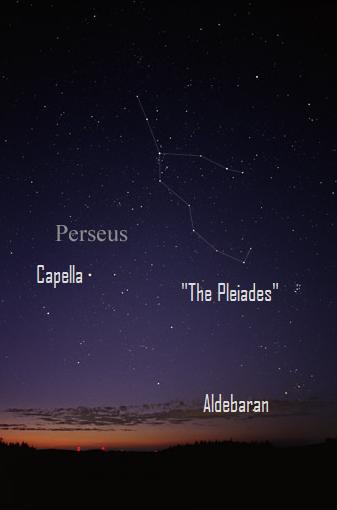
Sky photo with Perseus constellation, stars, and Pleiades labeled.

From mid-neorthern latitudes, the constellation Perseus, the stars Capella and Aldebaran, and the Pleiades cluster light up the northeast sky in the wee hours after midnight on August nights. The meteors radiate from Perseus.

Sky photo with constellation Cassiopeia lines marked and arrow pointing to two small smudges.

Here’s a cool binocular object to look for while you’re watching the meteors. The constellation Cassiopeia points out the famous Double Cluster in northern tip of the constellation Perseus. Plus, the Double Cluster nearly marks the radiant of the Perseid meteor shower. Photo by Flickr user madmiked.

General rules for Perseid-watching. No special equipment, or knowledge of the constellations, needed.

Find a dark, open sky to enjoy the show. An open sky is essential because these meteors fly across the sky in many different directions and in front of numerous constellations.

Give yourself at least an hour of observing time, because the meteors in meteor showers come in spurts and are interspersed with lulls. Remember, your eyes can take as long as 20 minutes to adapt to the darkness of night. So don’t rush the process.

Know that the meteors all come from a single point in the sky. If you trace the paths of the Perseid meteors backwards, you’d find they all come from a point in front of the constellation Perseus. Don’t worry about which stars are Perseus. Just enjoying knowing and observing that they all come from one place on the sky’s dome.

Enjoy the comfort of a reclining lawn chair. Bring along some other things you might enjoy also, like a thermos filled with a hot drink.

Remember … all good things come to those who wait. Meteors are part of nature. There’s no way to predict exactly how many you’ll see on any given night. Find a good spot, watch, wait.

You’ll see some.

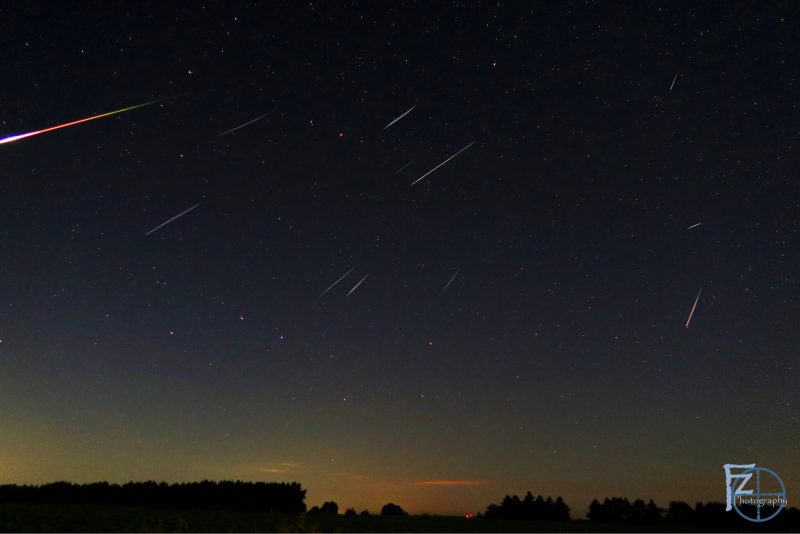
Dark horizon and night sky with multiple bright streaks diagonally right to left.

Composite of 12 images acquired on August 13, 2017, by Felix Zai in Toronto. He wrote: “Perseid meteor shower gave a good show even though the moonlight drowned out most of the fainter ones. A huge fireball was captured in this photo.” Thanks, Felix! By the way, it’s only in a meteor “storm” that you’d see this many meteors at once. Even in a rich shower, you typically see only 1 or 2 meteors at a time.

What’s the source of the Perseid meteor shower? Every year, from around July 17 to August 24, our planet Earth crosses the orbital path of Comet Swift-Tuttle, the parent of the Perseid meteor shower. Debris from this comet litters the comet’s orbit, but we don’t really get into the thick of the comet rubble until after the first week of August. The bits and pieces from Comet Swift-Tuttle slam into the Earth’s upper atmosphere at some 130,000 miles (210,000 km) per hour, lighting up the nighttime with fast-moving Perseid meteors.

If our planet happens to pass through an unusually dense clump of meteoroids – comet rubble – we’ll see an elevated number of meteors. We can always hope!

Comet Swift-Tuttle has a very eccentric – oblong – orbit that takes this comet outside the orbit of Pluto when farthest from the sun, and inside the Earth’s orbit when closest to the sun. It orbits the sun in a period of about 133 years. Every time this comet passes through the inner solar system, the sun warms and softens up the ices in the comet, causing it to release fresh comet material into its orbital stream.

Comet Swift-Tuttle last reached perihelion – closest point to the sun – in December 1992 and will do so next in July 2126.

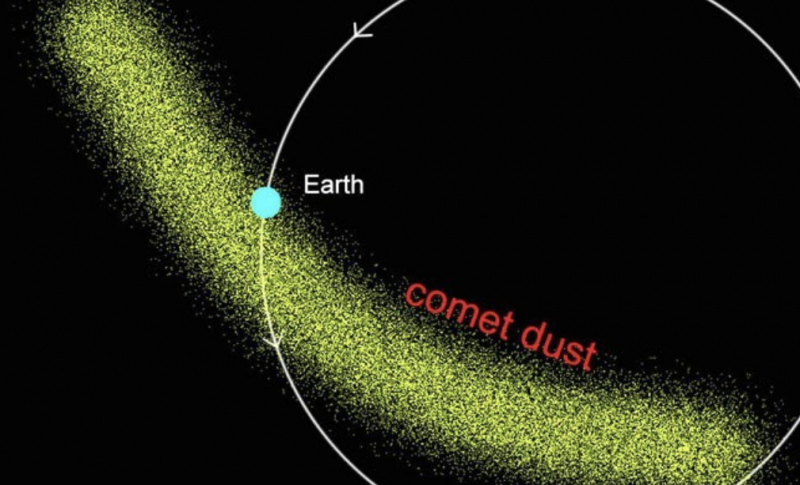
Diagram: Earth's orbit around the sun, crossing a wide arc of tiny dots representing cometary debris.

Meteors in annual showers happen when Earth encounters debris left behind by a comet. Astronomers have learned to calculate the various streams of debris in space, left behind by comets as various passages near the sun. Image by AstroBob.

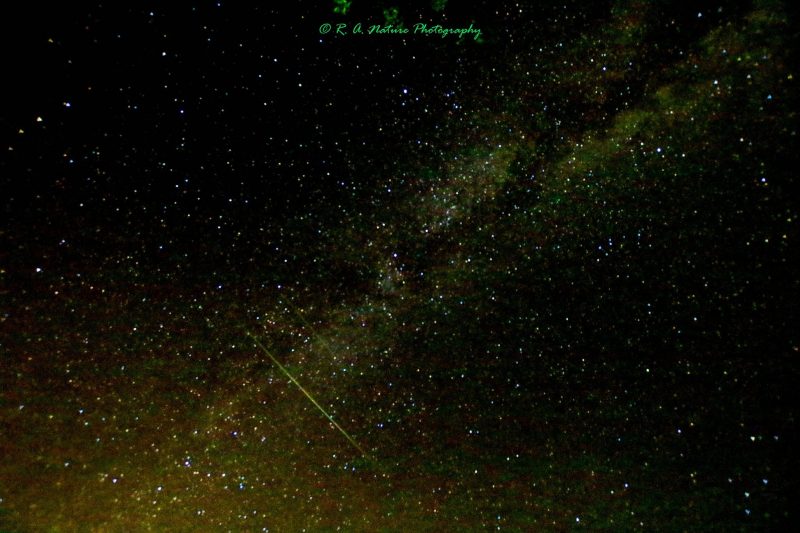
Bright streaks against dense star field.

Russ Adams caught these 2 meteors, traveling on parallel paths, on the morning of August 11, 2017. Click for more 2017 Perseids.

Looking for a dark area to observe from? Check out EarthSky’s interactive, worldwide Best Places to Stargaze map.

Bottom line: The 2019 Perseid meteor shower is expected to produce the most meteors in the predawn hours of August 11, 12, and 13, though under the light of a bright waxing gibbous moon. But we recommend watching the Perseids on the weekend starting on Friday, August 9, as there will be more moon-free viewing time than on the expected peak date.

Everything you need to know: Delta Aquariid meteor shower


from EarthSky https://ift.tt/2OavTIz
Bright nearly vertical streak in sky above long pier sticking out into calm body of water.

Perseid meteor on the morning of August 12, 2017, from Hrvoje Crnjak in Šibenik, Croatia. Notice the variations in brightness and color throughout, and the little “pop” of brightness toward the bottom. A brightness “pop” like that comes from a clump of vaporizing debris. Thank you, Hrvoje! Click for more photos of 2017 Perseids.

The annual Perseid meteor shower is one of the most beloved meteor showers of the year, especially in the Northern Hemisphere, where the shower peaks on warm summer nights. No matter where you live worldwide, the 2019 Perseid meteor shower will probably produce the greatest number of meteors on the mornings of August 11, 12 and 13. Unfortunately, on the peak mornings in 2019, a bright moon will drown many Perseids from view. For those serious about seeing the greatest number of Perseids in 2019, we recommend viewing several mornings in a row, beginning the weekend of Friday, August 9 to Sunday, August 11. There will be considerably more moon-free viewing time then than at the Perseids’ likely peak from late evening August 12 until dawn August 13.

Visit the Sunrise Sunset Calendars site to find out when the moon sets in your sky, remembering to check the moonrise and moonset box.

But don’t wait. The 2019 Perseid meteor shower has already begun its slow and steady rise to its peak. And the new moon comes on July 31/August 1, meaning the morning hours in early August will be moon-free.

Camping in early August? Yes, please! The weekend of August 2 to 4 would be grand. Be on the lookout for Perseid meteors in the hours between midnight and dawn. Also remember, the the Delta Aquariid meteor shower will still be rambling along steadily. You’ll see mostly Perseids, but also some Delta Aquariids in the mix. There’s an explanation of how to tell the difference toward the bottom of this article.

The first full week of August (say, around August 5 to 8) will also offer moon-free skies – and hopefully some pleasant meteor-viewing – in those prime midnight-to-dawn hours.

In the Northern Hemisphere, we rank the August Perseids as an all-time favorite meteor shower of every year. For us, this major shower takes place during the lazy, hazy days of summer, when many families are on vacation. And what could be more luxurious than taking a siesta in the heat of the day and watching this summertime classic in the relative coolness of night?

People tend to focus on the peak mornings of the shower and that’s entirely appropriate. But meteors in annual showers – which come from streams of debris left behind in space by comets – typically last weeks, not days. Perseid meteors have been streaking across our skies since around July 17. We’ll see Perseids for 10 days or so after the peak mornings on August 11, 12 and 13. What’s more, the Perseids tend to build up gradually, yet fall off rapidly. So, any morning in late July through mid-August should offer a sprinkling of Perseid meteors.

Don’t rule out early evenings, either. In a typical year, although the meteor numbers increase after midnight, the Perseid meteors still start to fly at mid-to-late evening from northerly latitudes. South of the equator, the Perseids start to streak the sky around midnight. If fortune smiles upon you, the evening hours might offer you an earthgrazer – a looooong, slow, colorful meteor traveling horizontally across the evening sky. Earthgrazer meteors are rare but memorable. Perseid earthgrazers appear before midnight, when the radiant point of the shower is close to the horizon.

Chart of constellation Perseus with arrows pointing outward from spot near its top.

The radiant point for the Perseid meteor shower is in the constellation Perseus. But you don’t have to find a shower’s radiant point to see meteors. Instead, the meteors will be flying in all parts of the sky.

What is the radiant point for the Perseid meteor shower? If you trace all the Perseid meteors backward, they all seem to come from the constellation Perseus, near the famous Double Cluster. Hence, the meteor shower is named in the honor of the constellation Perseus the Hero.

However, this is a chance alignment of the meteor shower radiant with the constellation Perseus. The stars in Perseus are light-years distant while these meteors burn up about 60 miles (100 km) above the Earth’s surface. If any meteor survives its fiery plunge to hit the ground intact, the remaining portion is called a meteorite. Few – if any – meteors in meteor showers become meteorites, however, because of the flimsy nature of comet debris. Most meteorites are the remains of asteroids.

In ancient Greek star lore, Perseus is the son of the god Zeus and the mortal Danae. It is said that the Perseid shower commemorates the time when Zeus visited Danae, the mother of Perseus, in a shower of gold.

Sky photo with Perseus constellation, stars, and Pleiades labeled.

From mid-neorthern latitudes, the constellation Perseus, the stars Capella and Aldebaran, and the Pleiades cluster light up the northeast sky in the wee hours after midnight on August nights. The meteors radiate from Perseus.

Sky photo with constellation Cassiopeia lines marked and arrow pointing to two small smudges.

Here’s a cool binocular object to look for while you’re watching the meteors. The constellation Cassiopeia points out the famous Double Cluster in northern tip of the constellation Perseus. Plus, the Double Cluster nearly marks the radiant of the Perseid meteor shower. Photo by Flickr user madmiked.

General rules for Perseid-watching. No special equipment, or knowledge of the constellations, needed.

Find a dark, open sky to enjoy the show. An open sky is essential because these meteors fly across the sky in many different directions and in front of numerous constellations.

Give yourself at least an hour of observing time, because the meteors in meteor showers come in spurts and are interspersed with lulls. Remember, your eyes can take as long as 20 minutes to adapt to the darkness of night. So don’t rush the process.

Know that the meteors all come from a single point in the sky. If you trace the paths of the Perseid meteors backwards, you’d find they all come from a point in front of the constellation Perseus. Don’t worry about which stars are Perseus. Just enjoying knowing and observing that they all come from one place on the sky’s dome.

Enjoy the comfort of a reclining lawn chair. Bring along some other things you might enjoy also, like a thermos filled with a hot drink.

Remember … all good things come to those who wait. Meteors are part of nature. There’s no way to predict exactly how many you’ll see on any given night. Find a good spot, watch, wait.

You’ll see some.

Dark horizon and night sky with multiple bright streaks diagonally right to left.

Composite of 12 images acquired on August 13, 2017, by Felix Zai in Toronto. He wrote: “Perseid meteor shower gave a good show even though the moonlight drowned out most of the fainter ones. A huge fireball was captured in this photo.” Thanks, Felix! By the way, it’s only in a meteor “storm” that you’d see this many meteors at once. Even in a rich shower, you typically see only 1 or 2 meteors at a time.

What’s the source of the Perseid meteor shower? Every year, from around July 17 to August 24, our planet Earth crosses the orbital path of Comet Swift-Tuttle, the parent of the Perseid meteor shower. Debris from this comet litters the comet’s orbit, but we don’t really get into the thick of the comet rubble until after the first week of August. The bits and pieces from Comet Swift-Tuttle slam into the Earth’s upper atmosphere at some 130,000 miles (210,000 km) per hour, lighting up the nighttime with fast-moving Perseid meteors.

If our planet happens to pass through an unusually dense clump of meteoroids – comet rubble – we’ll see an elevated number of meteors. We can always hope!

Comet Swift-Tuttle has a very eccentric – oblong – orbit that takes this comet outside the orbit of Pluto when farthest from the sun, and inside the Earth’s orbit when closest to the sun. It orbits the sun in a period of about 133 years. Every time this comet passes through the inner solar system, the sun warms and softens up the ices in the comet, causing it to release fresh comet material into its orbital stream.

Comet Swift-Tuttle last reached perihelion – closest point to the sun – in December 1992 and will do so next in July 2126.

Diagram: Earth's orbit around the sun, crossing a wide arc of tiny dots representing cometary debris.

Meteors in annual showers happen when Earth encounters debris left behind by a comet. Astronomers have learned to calculate the various streams of debris in space, left behind by comets as various passages near the sun. Image by AstroBob.

Bright streaks against dense star field.

Russ Adams caught these 2 meteors, traveling on parallel paths, on the morning of August 11, 2017. Click for more 2017 Perseids.

Looking for a dark area to observe from? Check out EarthSky’s interactive, worldwide Best Places to Stargaze map.

Bottom line: The 2019 Perseid meteor shower is expected to produce the most meteors in the predawn hours of August 11, 12, and 13, though under the light of a bright waxing gibbous moon. But we recommend watching the Perseids on the weekend starting on Friday, August 9, as there will be more moon-free viewing time than on the expected peak date.

Everything you need to know: Delta Aquariid meteor shower


from EarthSky https://ift.tt/2OavTIz

Joshua trees facing extinction

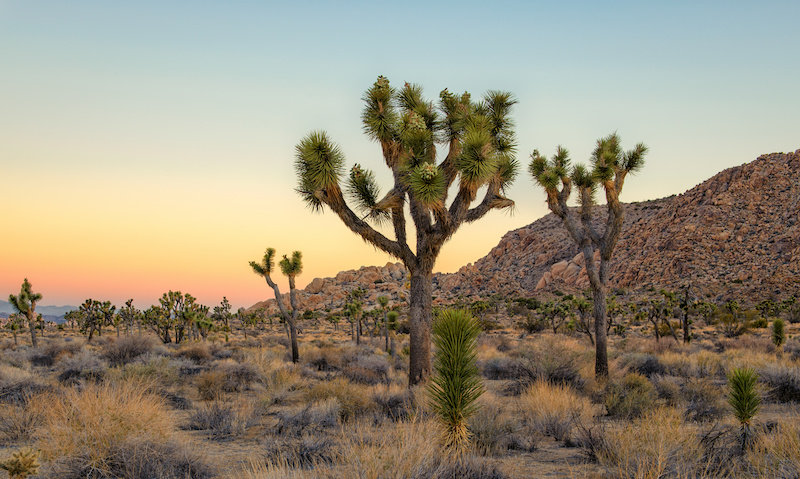
Branched cactus-like tree with brush of spiky leaves on each branch in desert landscape.

Joshua trees. Image © Doug/Adobe Stock.

A new study that looked at global warming’s impact on trees in California’s Joshua Tree National Park suggests that without dramatic action to reduce climate change, the iconic trees won’t survive much past this century.

The study, published June 3, 2019, in the peer-reviewed journal Ecosphere, examined data from more than 4,000 trees in order to predict how our warming climate might effect the park’s namesake trees, as well as to find out whether the trees are already in trouble.

The researchers found that Joshua trees have been migrating to higher elevation parts of the park that have cooler weather and more moisture in the ground. In hotter, drier areas, the adult trees aren’t producing as many younger plants, and the ones they do produce aren’t surviving.

Single brush-like spike-leaved stem protruding from desert floor.

Young Joshua trees like this one may be unable to survive under climate change. Image via Lynn Sweet/UCR.

Joshua trees as a species have existed since the Pleistocene era, about 2.5 million years ago, and individual trees can live up to 300 years. One of the ways adult trees survive so long is by storing large reserves of water to weather droughts. But younger trees and seedlings aren’t capable of holding reserves in this way, and the most recent, 376-week-long drought in California left the ground in some places without enough water to support new young plants. As the climate changes, long periods of drought are likely to occur with more frequency, leading to issues with the trees like those already observed, says the study.

An additional finding of the study is that in the cooler, wetter parts of the park the biggest threat, other than climate change, is fire. Fewer than 10 percent of Joshua trees survive wildfires, said the researchers.

Milky Way Galaxy arching over a Joshua tree against dense star field.

The Milky Way arching over a Joshua tree, photographed by Manish Mamtani

According to the researchers, the new study suggests several possible outcomes. In the best-case scenario, major efforts to reduce heat-trapping gasses in the atmosphere would save 19 percent of the tree habitat after the year 2070. In the worst case, with no reduction in carbon emissions, the park would retain a mere 0.02 percent of its Joshua tree habitat.

Many Joshua trees in desert with bare rocky hills in background.

Joshua Tree National Park. Image via California Travel and Tourism.

Bottom line: A new study predicts a gloomy future for the trees in California’s Joshua Tree National Park.

Source: Congruence between future distribution models and empirical data for an iconic species at Joshua Tree National Park

Via University of California, Riverside


from EarthSky https://ift.tt/2y2dfYq
Branched cactus-like tree with brush of spiky leaves on each branch in desert landscape.

Joshua trees. Image © Doug/Adobe Stock.

A new study that looked at global warming’s impact on trees in California’s Joshua Tree National Park suggests that without dramatic action to reduce climate change, the iconic trees won’t survive much past this century.

The study, published June 3, 2019, in the peer-reviewed journal Ecosphere, examined data from more than 4,000 trees in order to predict how our warming climate might effect the park’s namesake trees, as well as to find out whether the trees are already in trouble.

The researchers found that Joshua trees have been migrating to higher elevation parts of the park that have cooler weather and more moisture in the ground. In hotter, drier areas, the adult trees aren’t producing as many younger plants, and the ones they do produce aren’t surviving.

Single brush-like spike-leaved stem protruding from desert floor.

Young Joshua trees like this one may be unable to survive under climate change. Image via Lynn Sweet/UCR.

Joshua trees as a species have existed since the Pleistocene era, about 2.5 million years ago, and individual trees can live up to 300 years. One of the ways adult trees survive so long is by storing large reserves of water to weather droughts. But younger trees and seedlings aren’t capable of holding reserves in this way, and the most recent, 376-week-long drought in California left the ground in some places without enough water to support new young plants. As the climate changes, long periods of drought are likely to occur with more frequency, leading to issues with the trees like those already observed, says the study.

An additional finding of the study is that in the cooler, wetter parts of the park the biggest threat, other than climate change, is fire. Fewer than 10 percent of Joshua trees survive wildfires, said the researchers.

Milky Way Galaxy arching over a Joshua tree against dense star field.

The Milky Way arching over a Joshua tree, photographed by Manish Mamtani

According to the researchers, the new study suggests several possible outcomes. In the best-case scenario, major efforts to reduce heat-trapping gasses in the atmosphere would save 19 percent of the tree habitat after the year 2070. In the worst case, with no reduction in carbon emissions, the park would retain a mere 0.02 percent of its Joshua tree habitat.

Many Joshua trees in desert with bare rocky hills in background.

Joshua Tree National Park. Image via California Travel and Tourism.

Bottom line: A new study predicts a gloomy future for the trees in California’s Joshua Tree National Park.

Source: Congruence between future distribution models and empirical data for an iconic species at Joshua Tree National Park

Via University of California, Riverside


from EarthSky https://ift.tt/2y2dfYq

Delta Aquariids 2019: All you need to know

Representation of Earth's orbit around the sun, crossing a wide arc of tiny dots that represent cometary debris.

Meteors in annual showers happen when Earth encounters debris left behind by a comet. Astronomers have learned to calculate the various streams of debris in space, left behind by comets as various passages near the sun. Image by AstroBob.

Late July 2019 – around July 28 – presents the nominal peak of the Delta Aquariid meteor shower. But don’t let that date thwart you, if you have a chance to be in a dark place for meteor-watching, anytime in the coming weeks. The long and rambling Delta Aquariid shower is officially active from about July 12 to August 23 each year. The coming new moon on July 31/August 1 (depending on your time zone) means lovely waning crescents in the optimum predawn hours in late July. It means dark skies throughout most of the night all through the first week of August.

The Delta Aquariid shower favors the Southern Hemisphere, though is still visible from mid-northern latitudes. In years when the moon is out of the way, the broad maximum of this shower can be expected to produce 10 to 20 meteors per hour. But, even in early August, you’ll likely see some Perseids, too. This shower overlaps with the more famous Perseid meteor shower, which in early August is rising to its peak (this year on the mornings of August 11, 12 and 13, unfortunately under the light of a bright moon). Those who observe the Perseids are likely to see some Delta Aquariid meteors flying on the same nights.

For the Delta Aquariids, as for most meteor showers, the best viewing hours are after midnight and before dawn for all time zones around the world.

Everything you need to know: Perseid meteor shower

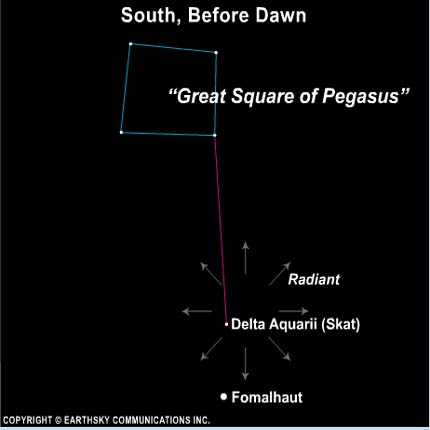
Chart with Great Square, line to bright star, arrows pointing out from spot near closeby dim star.

The radiant point for Delta Aquariid shower is near star Skat, or Delta Aquarii. This star is near in the sky to a much brighter star, Fomalhaut, which can be found roughly on a line drawn southward through the stars on the west side of the Great Square. This chart shows the Northern Hemisphere view. From the Southern Hemisphere, the radiant is closer to overhead. And don’t worry too much about radiant points. The meteors will appear in all parts of the sky.

How can I tell Perseid meteors from Delta Aquariid meteors? This is where the concept of a radiant point comes in handy. If you trace all the Delta Aquariid meteors backward, they appear to radiate from a certain point in front of the constellation Aquarius the Water Bearer, which, as viewed from the Northern Hemisphere, arcs across the southern sky. The radiant point of the shower nearly aligns with the star Skat (Delta Aquarii). The meteor shower is named in the honor of this star.

Meanwhile, the Perseids radiate from the constellation Perseus, in the northeast to high in the north between midnight and dawn. So – assuming you’re in the Northern Hemisphere – if you’re watching the Perseids, and you see meteors coming from the northeast or north … they are Perseids. If you see them coming from the south … they are Delta Aquariids. In a particularly rich year for meteors, if you have a dark sky, you might even see them cross paths! It can be an awesome display.

The Delta Aquariid meteors may tend to be a bit fainter than the Perseids and meteors seen in other major showers. That makes a dark sky free of moonlight even more imperative for watching the annual Delta Aquariid shower. About five to ten percent of the Delta Aquariid meteors leave persistent trains – glowing ionized gas trails that last a second or two after the meteor has passed. The meteors burn up in the upper atmosphere about 60 miles (100 km) above Earth’s surface.

Rememeber, you never have to locate a shower’s radiant point to enjoy the meteors. However, it does help to have a dark night without moonlight. This year – in 2019 – the prospects for watching the Delta Aquariids in late July and early August are very good, with little moonlight to ruin the show.

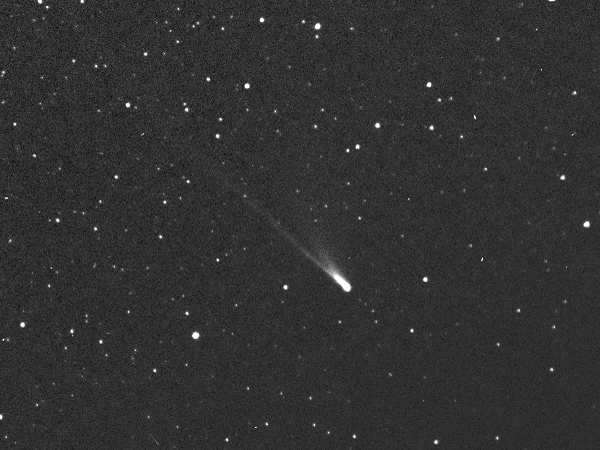
Starry background, largish bright dot with two fuzzy tails.

Comet 96P Machholz, the possible parent of the Delta Aquariid meteor shower, was discovered on May 12, 1986, by Donald Machholz. Image via Wikimedia Commons[./caption]

Delta Aquariid meteors may come from Comet 96P Machholz. Meteor showers happen when our planet Earth crosses the orbital path of a comet. When a comet nears the sun and warms up, it sheds bits and pieces that spread out into that comet’s orbital stream. This comet debris slams into the Earth’s upper atmosphere at about 90,000 miles (150,000 km) per hour, vaporizing – burning up – as meteors or shooting stars.

The parent body of the Delta Aquariid meteor is not known with certainty. It was once thought to have originated from the breakup of what are now the Marsden and Kracht sungrazing comets. More recently, the Comet 96P Machholz has loomed as the primary candidate for being the Delta Aquariids’ parent body.

Donald Machholz discovered this comet in 1986. It’s a short-period comet whose orbit carries it around the sun once in a little over five years. At aphelion – its greatest distance from the sun – this comet goes out beyond the orbit of Jupiter. At perihelion – its closest point to the sun – Comet 96P Machholz swings well inside Mercury’s orbit. Comet 96P/Machholz last came to perihelion on October 27, 2017 and will next come to perihelion on January 31, 2023.

[caption id="attachment_203199" align="aligncenter" width="800"]Starry sky with Milky Way visible and fuzzy bright green dot with short glowing trail near horizon. David S. Brown caught this meteor in late July in 2014, in southwest Wyoming.

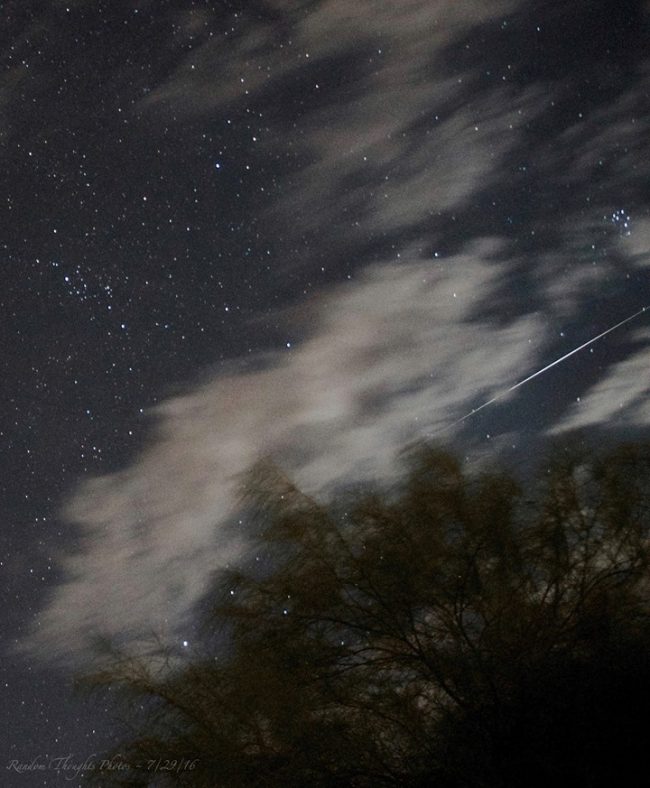
Long bright diagonal line streaking among clouds.

Kelly Dreller caught this meteor in late July of 2016, in Lake Havasu City, Arizona.

Bottom line: The Delta Aquariid meteor shower lacks a very definite peak. It rambles along pretty steadily in late July and August, coinciding with the Perseids. The nominal peak is in late July, shortly before the new moon on August 1, 2019. From any time zone, the best viewing window lasts for several hours, centered on roughly 2 a.m. (3 a.m. daylight saving time). Find an open sky away from artificial lights, lie down on a reclining lawn chair and look upward.

Everything you need to know: Perseid meteor shower


from EarthSky https://ift.tt/30Tf32p
Representation of Earth's orbit around the sun, crossing a wide arc of tiny dots that represent cometary debris.

Meteors in annual showers happen when Earth encounters debris left behind by a comet. Astronomers have learned to calculate the various streams of debris in space, left behind by comets as various passages near the sun. Image by AstroBob.

Late July 2019 – around July 28 – presents the nominal peak of the Delta Aquariid meteor shower. But don’t let that date thwart you, if you have a chance to be in a dark place for meteor-watching, anytime in the coming weeks. The long and rambling Delta Aquariid shower is officially active from about July 12 to August 23 each year. The coming new moon on July 31/August 1 (depending on your time zone) means lovely waning crescents in the optimum predawn hours in late July. It means dark skies throughout most of the night all through the first week of August.

The Delta Aquariid shower favors the Southern Hemisphere, though is still visible from mid-northern latitudes. In years when the moon is out of the way, the broad maximum of this shower can be expected to produce 10 to 20 meteors per hour. But, even in early August, you’ll likely see some Perseids, too. This shower overlaps with the more famous Perseid meteor shower, which in early August is rising to its peak (this year on the mornings of August 11, 12 and 13, unfortunately under the light of a bright moon). Those who observe the Perseids are likely to see some Delta Aquariid meteors flying on the same nights.

For the Delta Aquariids, as for most meteor showers, the best viewing hours are after midnight and before dawn for all time zones around the world.

Everything you need to know: Perseid meteor shower

Chart with Great Square, line to bright star, arrows pointing out from spot near closeby dim star.

The radiant point for Delta Aquariid shower is near star Skat, or Delta Aquarii. This star is near in the sky to a much brighter star, Fomalhaut, which can be found roughly on a line drawn southward through the stars on the west side of the Great Square. This chart shows the Northern Hemisphere view. From the Southern Hemisphere, the radiant is closer to overhead. And don’t worry too much about radiant points. The meteors will appear in all parts of the sky.

How can I tell Perseid meteors from Delta Aquariid meteors? This is where the concept of a radiant point comes in handy. If you trace all the Delta Aquariid meteors backward, they appear to radiate from a certain point in front of the constellation Aquarius the Water Bearer, which, as viewed from the Northern Hemisphere, arcs across the southern sky. The radiant point of the shower nearly aligns with the star Skat (Delta Aquarii). The meteor shower is named in the honor of this star.

Meanwhile, the Perseids radiate from the constellation Perseus, in the northeast to high in the north between midnight and dawn. So – assuming you’re in the Northern Hemisphere – if you’re watching the Perseids, and you see meteors coming from the northeast or north … they are Perseids. If you see them coming from the south … they are Delta Aquariids. In a particularly rich year for meteors, if you have a dark sky, you might even see them cross paths! It can be an awesome display.

The Delta Aquariid meteors may tend to be a bit fainter than the Perseids and meteors seen in other major showers. That makes a dark sky free of moonlight even more imperative for watching the annual Delta Aquariid shower. About five to ten percent of the Delta Aquariid meteors leave persistent trains – glowing ionized gas trails that last a second or two after the meteor has passed. The meteors burn up in the upper atmosphere about 60 miles (100 km) above Earth’s surface.

Rememeber, you never have to locate a shower’s radiant point to enjoy the meteors. However, it does help to have a dark night without moonlight. This year – in 2019 – the prospects for watching the Delta Aquariids in late July and early August are very good, with little moonlight to ruin the show.

Starry background, largish bright dot with two fuzzy tails.

Comet 96P Machholz, the possible parent of the Delta Aquariid meteor shower, was discovered on May 12, 1986, by Donald Machholz. Image via Wikimedia Commons[./caption]

Delta Aquariid meteors may come from Comet 96P Machholz. Meteor showers happen when our planet Earth crosses the orbital path of a comet. When a comet nears the sun and warms up, it sheds bits and pieces that spread out into that comet’s orbital stream. This comet debris slams into the Earth’s upper atmosphere at about 90,000 miles (150,000 km) per hour, vaporizing – burning up – as meteors or shooting stars.

The parent body of the Delta Aquariid meteor is not known with certainty. It was once thought to have originated from the breakup of what are now the Marsden and Kracht sungrazing comets. More recently, the Comet 96P Machholz has loomed as the primary candidate for being the Delta Aquariids’ parent body.

Donald Machholz discovered this comet in 1986. It’s a short-period comet whose orbit carries it around the sun once in a little over five years. At aphelion – its greatest distance from the sun – this comet goes out beyond the orbit of Jupiter. At perihelion – its closest point to the sun – Comet 96P Machholz swings well inside Mercury’s orbit. Comet 96P/Machholz last came to perihelion on October 27, 2017 and will next come to perihelion on January 31, 2023.

[caption id="attachment_203199" align="aligncenter" width="800"]Starry sky with Milky Way visible and fuzzy bright green dot with short glowing trail near horizon. David S. Brown caught this meteor in late July in 2014, in southwest Wyoming.

Long bright diagonal line streaking among clouds.

Kelly Dreller caught this meteor in late July of 2016, in Lake Havasu City, Arizona.

Bottom line: The Delta Aquariid meteor shower lacks a very definite peak. It rambles along pretty steadily in late July and August, coinciding with the Perseids. The nominal peak is in late July, shortly before the new moon on August 1, 2019. From any time zone, the best viewing window lasts for several hours, centered on roughly 2 a.m. (3 a.m. daylight saving time). Find an open sky away from artificial lights, lie down on a reclining lawn chair and look upward.

Everything you need to know: Perseid meteor shower


from EarthSky https://ift.tt/30Tf32p

Ophiuchus, 13th constellation of zodiac

Tonight, look for the faint constellation Ophiuchus the Serpent Bearer. From the Northern Hemisphere, look southward at nightfall. From the Southern Hemisphere, look more overhead around mid-evening. From all parts of Earth, Ophiuchus crosses the sky westward as Earth spins under the sky, and as evening deepens into late night. Ophiuchus is sometimes called the 13th or forgotten constellation of the zodiac.

The sun passes in front of Ophiuchus from about November 30 to December 18. And yet no one ever says they’re born when the sun is in Ophiuchus. That’s because Ophiuchus is a constellation – not a sign – of the zodiac.

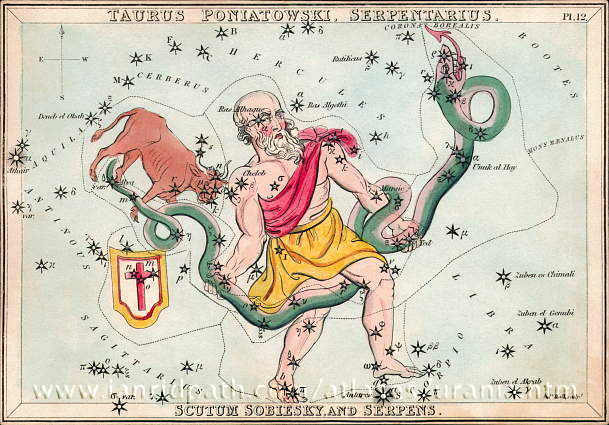
Antique color etching of old bald bearded man in ancient Greek garb holding a long snake.

Ophiuchus in Urania’s Mirror, a boxed set of 32 constellation cards first published in 1824. Image via www.ianridpath.com.

What’s the difference? The 12 signs of the tropical zodiac represent equal 30 degree divisions of the sky, while the 13 constellations of the zodiac are of various sizes.

That’s why, for example, the sun resides in front of each zodiacal sign for a precise interval of about a month. Meanwhile, the sun is in front of the constellations for varying amounts of time, for example, in front of the constellation Virgo for about 1 1/2 months and in front of constellation Scorpius for about a week.

The planet Jupiter and the bright red star Antares in the constellation Scorpius the Scorpion can help you find Ophiuchus in the night sky. Jupiter actually shines in front of Ophiuchus in 2019. Meanwhile, Ophiuchus is to the north of the star Antares.

Even after Jupiter moves into different constellations of the zodiac in the years ahead, you can look for Ophiuchus a short hop to the north of Antares in any year. Ophiuchus’ brightest star – the 2nd-magnitude star called Rasalhague – highlights the head of Ophiuchus. (See Rasalhague in the Ophiuchus chart below.) It’s nowhere as bright as the planet Jupiter or the 1st-magnitude star Antares.

Help support posts like these at the EarthSky store. Fun astronomy gifts and tools for all ages.

Star chart with black stars on white showing constellation Ophiuchus.

Ophiuchus the Serpent Bearer, via Wikimedia Commons.

On sky maps, Ophiuchus the Serpent Bearer is depicted as holding Serpens the Serpent, which is considered a separate constellation. According to ancient Greek star lore, Ophiuchus is Asclepius, the physician who concocted a healing potion from the Serpent’s venom, mixing it with the Gorgon’s blood and an unknown herb. This potion gave humans access to immortality, until the god of the underworld appealed to Zeus to reconsider the ramifications of the death of death.

Even today, the Staff of Asclepius – the symbol of the World Heath Organization – pays tribute to the constellation Ophiuchus the Serpent Bearer.

Bottom line: Will you see faint Ophiuchus, the overlooked zodiacal constellation, tonight?

Read more: Born between November 29 and December 18? Here’s your constellation

Dates of sun’s entry into each constellation of the zodiac

Enjoying EarthSky so far? Sign up for our free daily newsletter today!


from EarthSky https://ift.tt/2Z6phvR

Tonight, look for the faint constellation Ophiuchus the Serpent Bearer. From the Northern Hemisphere, look southward at nightfall. From the Southern Hemisphere, look more overhead around mid-evening. From all parts of Earth, Ophiuchus crosses the sky westward as Earth spins under the sky, and as evening deepens into late night. Ophiuchus is sometimes called the 13th or forgotten constellation of the zodiac.

The sun passes in front of Ophiuchus from about November 30 to December 18. And yet no one ever says they’re born when the sun is in Ophiuchus. That’s because Ophiuchus is a constellation – not a sign – of the zodiac.

Antique color etching of old bald bearded man in ancient Greek garb holding a long snake.

Ophiuchus in Urania’s Mirror, a boxed set of 32 constellation cards first published in 1824. Image via www.ianridpath.com.

What’s the difference? The 12 signs of the tropical zodiac represent equal 30 degree divisions of the sky, while the 13 constellations of the zodiac are of various sizes.

That’s why, for example, the sun resides in front of each zodiacal sign for a precise interval of about a month. Meanwhile, the sun is in front of the constellations for varying amounts of time, for example, in front of the constellation Virgo for about 1 1/2 months and in front of constellation Scorpius for about a week.

The planet Jupiter and the bright red star Antares in the constellation Scorpius the Scorpion can help you find Ophiuchus in the night sky. Jupiter actually shines in front of Ophiuchus in 2019. Meanwhile, Ophiuchus is to the north of the star Antares.

Even after Jupiter moves into different constellations of the zodiac in the years ahead, you can look for Ophiuchus a short hop to the north of Antares in any year. Ophiuchus’ brightest star – the 2nd-magnitude star called Rasalhague – highlights the head of Ophiuchus. (See Rasalhague in the Ophiuchus chart below.) It’s nowhere as bright as the planet Jupiter or the 1st-magnitude star Antares.

Help support posts like these at the EarthSky store. Fun astronomy gifts and tools for all ages.

Star chart with black stars on white showing constellation Ophiuchus.

Ophiuchus the Serpent Bearer, via Wikimedia Commons.

On sky maps, Ophiuchus the Serpent Bearer is depicted as holding Serpens the Serpent, which is considered a separate constellation. According to ancient Greek star lore, Ophiuchus is Asclepius, the physician who concocted a healing potion from the Serpent’s venom, mixing it with the Gorgon’s blood and an unknown herb. This potion gave humans access to immortality, until the god of the underworld appealed to Zeus to reconsider the ramifications of the death of death.

Even today, the Staff of Asclepius – the symbol of the World Heath Organization – pays tribute to the constellation Ophiuchus the Serpent Bearer.

Bottom line: Will you see faint Ophiuchus, the overlooked zodiacal constellation, tonight?

Read more: Born between November 29 and December 18? Here’s your constellation

Dates of sun’s entry into each constellation of the zodiac

Enjoying EarthSky so far? Sign up for our free daily newsletter today!


from EarthSky https://ift.tt/2Z6phvR

Cheerleader study highlights need for real-time energy balance

"It's not just how much you eat and what you eat but when you eat it that matters," says Dan Benardot, senior author of the study and a professor of practice at Emory's Center for the Study of Human Health.

It’s well-known that many athletes, especially women athletes and those participating in sports with an aesthetic component, can be chronically energy deficient. A new study suggests that professional cheerleaders also struggle to maintain an optimal balance between energy consumed and energy burned during exercise.

The Journal of Science in Sport and Exercise published the finding, led by researchers at Emory University’s Center for the Study of Human Health and Rollins School of Public Health. The results showed that some study participants had hourly energy balance deficits that were significantly below their estimated energy needs during a typical training day.

“An offensive lineman doesn’t have to worry about what he looks like but appearance matters for professional cheerleaders, and that may affect their food choices,” says Moriah Bellissimo, first author of the study and a graduate student at Rollins. “Some of our study participants reported really low caloric intakes for the amount of physical training they do. Those with the lowest caloric intakes were not eating enough to maintain an optimal body composition of lean mass compared to fat for high-performance athletics.”

“It is not just how much you eat and what you eat but when you eat it that matters,” adds senior author Dan Benardot, professor of practice at Emory’s Center for the Study of Human Health.

Benardot, who is also an emeritus professor of nutrition at Georgia State University, is an expert in the interrelationship between energy intake, body composition and within-day energy balance, and has worked as a team nutritionist for Olympians and professional athletes.

“The body works in real time,” Benardot says. “If you’re not eating enough and not often enough to avoid low blood sugar and high cortisol, your body adapts to this negative energy balance. Your brain will direct the body to find more energy by breaking down muscle mass to satisfy the need for energy. It sets you up for a downward spiral where you continually have to eat less and less to keep from gaining weight.”

The problem is particularly acute for athletes, especially female athletes and those in aesthetic sports, who deplete lean muscle mass at a faster rate than less active people because of the exercise-associated severe energy balance deficit they achieve. The researchers wanted to investigate whether professional cheerleaders, who may train four hours a day practicing dance routines, faced a similar challenge for real-time energy balance as some other female athletes in aesthetic sports.

“I have a vested interest in human performance and nutrition from a personal standpoint,” says Bellissimo, who was a collegiate athlete for five years before entering the Rollins PhD program for Nutrition and Health Science. “I know that how you are eating makes a difference in how you perform.”

Bellissimo says it was challenging to maintain a proper nutritional balance when she was an undergraduate and master’s student, while also competing in Division I volleyball tournaments. She notes that professional cheerleaders often work full-time jobs on top of training and performing and may find it especially challenging to carefully strategize all of their nutritional needs.

For the current study, the researchers conducted 24-hour dietary and activity surveys with professional cheerleaders during an active training period — including an hour-by-hour assessment of what and how much they ate, and hourly energy expenditures throughout the day. They inputted the data into a software tool called NutriTiming®, developed by Benardot, to calculate each participants’ hourly energy balance — and whether they were exercising at a calorie surplus or deficit.

For female athletes, previous research has shown that sustaining an energy balance of plus or minus 300 calories throughout the day is beneficial to avoid the lean tissue breakdown associated with larger energy deficits.

The body mass and body composition of the study participants was also measured, using a bioelectrical impedance analyzer — which painlessly assesses the density of biological tissue.

The results showed that those participants who spent fewer hours in a negative energy balance had a lower, more optimal, percentage of body fat and those who spent more time within the plus-or-minus zone of 300 calories also had a lower percentage of body fat.

The cheerleader study was small and of short duration, but the finding is consistent with other research on female athletes and other populations, Benardot says.

“Athletes expend energy rapidly,” he adds. “They need to eat frequently, just not too much at a time, so their bodies have enough fuel to burn as they need it.”

It is important to study the nutritional needs of people involved in competitive sports and other intensive exercise, both to help them perform at their maximum level and to maintain their health, Bellissimo says. “Research has shown that chronic energy balance deficits in athletes can lead to hormonal imbalances, and that can have long-term health implications,” she says.

Additional authors of the study include Ashley Licata, from the University of Alabama at Birmingham, and Anita Nucci and Walt Thompson, from Georgia State University.

Related:
'Nutrition for the Performing Arts' course focuses on science behind peak performance

from eScienceCommons https://ift.tt/2OcpuwC
"It's not just how much you eat and what you eat but when you eat it that matters," says Dan Benardot, senior author of the study and a professor of practice at Emory's Center for the Study of Human Health.

It’s well-known that many athletes, especially women athletes and those participating in sports with an aesthetic component, can be chronically energy deficient. A new study suggests that professional cheerleaders also struggle to maintain an optimal balance between energy consumed and energy burned during exercise.

The Journal of Science in Sport and Exercise published the finding, led by researchers at Emory University’s Center for the Study of Human Health and Rollins School of Public Health. The results showed that some study participants had hourly energy balance deficits that were significantly below their estimated energy needs during a typical training day.

“An offensive lineman doesn’t have to worry about what he looks like but appearance matters for professional cheerleaders, and that may affect their food choices,” says Moriah Bellissimo, first author of the study and a graduate student at Rollins. “Some of our study participants reported really low caloric intakes for the amount of physical training they do. Those with the lowest caloric intakes were not eating enough to maintain an optimal body composition of lean mass compared to fat for high-performance athletics.”

“It is not just how much you eat and what you eat but when you eat it that matters,” adds senior author Dan Benardot, professor of practice at Emory’s Center for the Study of Human Health.

Benardot, who is also an emeritus professor of nutrition at Georgia State University, is an expert in the interrelationship between energy intake, body composition and within-day energy balance, and has worked as a team nutritionist for Olympians and professional athletes.

“The body works in real time,” Benardot says. “If you’re not eating enough and not often enough to avoid low blood sugar and high cortisol, your body adapts to this negative energy balance. Your brain will direct the body to find more energy by breaking down muscle mass to satisfy the need for energy. It sets you up for a downward spiral where you continually have to eat less and less to keep from gaining weight.”

The problem is particularly acute for athletes, especially female athletes and those in aesthetic sports, who deplete lean muscle mass at a faster rate than less active people because of the exercise-associated severe energy balance deficit they achieve. The researchers wanted to investigate whether professional cheerleaders, who may train four hours a day practicing dance routines, faced a similar challenge for real-time energy balance as some other female athletes in aesthetic sports.

“I have a vested interest in human performance and nutrition from a personal standpoint,” says Bellissimo, who was a collegiate athlete for five years before entering the Rollins PhD program for Nutrition and Health Science. “I know that how you are eating makes a difference in how you perform.”

Bellissimo says it was challenging to maintain a proper nutritional balance when she was an undergraduate and master’s student, while also competing in Division I volleyball tournaments. She notes that professional cheerleaders often work full-time jobs on top of training and performing and may find it especially challenging to carefully strategize all of their nutritional needs.

For the current study, the researchers conducted 24-hour dietary and activity surveys with professional cheerleaders during an active training period — including an hour-by-hour assessment of what and how much they ate, and hourly energy expenditures throughout the day. They inputted the data into a software tool called NutriTiming®, developed by Benardot, to calculate each participants’ hourly energy balance — and whether they were exercising at a calorie surplus or deficit.

For female athletes, previous research has shown that sustaining an energy balance of plus or minus 300 calories throughout the day is beneficial to avoid the lean tissue breakdown associated with larger energy deficits.

The body mass and body composition of the study participants was also measured, using a bioelectrical impedance analyzer — which painlessly assesses the density of biological tissue.

The results showed that those participants who spent fewer hours in a negative energy balance had a lower, more optimal, percentage of body fat and those who spent more time within the plus-or-minus zone of 300 calories also had a lower percentage of body fat.

The cheerleader study was small and of short duration, but the finding is consistent with other research on female athletes and other populations, Benardot says.

“Athletes expend energy rapidly,” he adds. “They need to eat frequently, just not too much at a time, so their bodies have enough fuel to burn as they need it.”

It is important to study the nutritional needs of people involved in competitive sports and other intensive exercise, both to help them perform at their maximum level and to maintain their health, Bellissimo says. “Research has shown that chronic energy balance deficits in athletes can lead to hormonal imbalances, and that can have long-term health implications,” she says.

Additional authors of the study include Ashley Licata, from the University of Alabama at Birmingham, and Anita Nucci and Walt Thompson, from Georgia State University.

Related:
'Nutrition for the Performing Arts' course focuses on science behind peak performance

from eScienceCommons https://ift.tt/2OcpuwC

Corals spreading to subtropical waters

World map with tropics in pink with yellow dotted lines defining subtropics north and south.

Map showing the location of Earth’s tropics and subtropics. Scientists have noted increased coral growth in the subtropics, the area between tropical and temperate latitudes, as climate warms. Map via Wikimedia Commons.

Scientists have detected increases in coral populations in subtropical waters, which could help to offset some of the coral declines in warming waters around the equator. The new research was published in the peer-reviewed journal Marine Ecology Progress Series on July 4, 2019.

Warming waters around the equator are inducing coral bleaching events and die-offs. Unlike fish and crustaceans, which are mobile and able to relocate to cooler waters when living conditions deteriorate, adult corals are sessile organisms for which migration is not possible. Hence, they are particularly susceptible to heat stress induced by El Nino events and climate change.

Coral larvae, however, are mobile. After new larvae are produced through fertilization, they swim around in the ocean for days to weeks searching for a nice hard spot to land. Once settled, the larvae metamorphasize into sessile polyps and form new coral colonies and reefs. Scientists routinely assess the recruitment of new coral larvae by placing artificial tiles around the ocean bottom and counting the number of polyps that develop over time.

Bunches of green algae and gray coral made up of many little tubes on underwater rocks.

Coral growth in the temperate waters around Nagasaki, Japan. Image via Soyoka Muko, Nagasaki University.

In this new research, scientists first compiled a long-term coral recruitment database from past studies conducted from 1974 to 2012. Then, they examined the trends in recruitment over time. The findings showed that new coral recruitment has declined by 85% in tropical waters (<20 degrees latitude), but surprisingly, a 78% increase in recruitment was observed in cooler, subtropical waters (>20 degrees latitude). Places with increases in recruitment include Shikoku, Japan, and the Flower Garden Banks in the northern Gulf of Mexico. The increases in recruitment were observed on both sides of the equator, thus indicating that this is a global trend and not just a site specific one.

Nichole Price, lead author of the study and senior research scientist at the Bigelow Laboratory for Ocean Sciences, commented on the findings in a press release. She said:

Climate change seems to be redistributing coral reefs, the same way it is shifting many other marine species. The clarity in this trend is stunning, but we don’t yet know whether the new reefs can support the incredible diversity of tropical systems.

The scientists think that the best places for new coral recruitment in a future, warmer world may be in narrow zones just above tropical waters. At more northerly or southerly latitudes, coral growth would likely be limited by the low winter light intensity among other factors. Hence, despite the good news, coral conservation in tropical waters remains a critical issue.

Five small square blue tiles with bolt in center anchored to underwater rock next to pink and green corals.

Coral recruitment tiles installed at the Palmyra Atoll National Wildlife Refuge for the study of new coral growth in the region. Image via Nichole Price, Bigelow Laboratory for Ocean Sciences.

Price also emphasized that more follow-up research is necessary:

So many questions remain about which species are and are not making it to these new locations, and we don’t yet know the fate of these young corals over longer time frames. The changes we are seeing in coral reef ecosystems are mind-boggling, and we need to work hard to document how these systems work and learn what we can do to save them before it’s too late.

The new research was published by an international team of 19 scientists, with funding support from the U.S. National Science Foundation and the Okinawa Institute of Science and Technology.

World map with colored dots indicating coral reef study sites.

View larger. | Coral recruitment study sites (n = 185). Shaded shapes of various colors (see key) indicate Marine Ecosystems of the World (MEOW) marine provinces. Within the colored shaded shapes, red dots identify the 12 locations – where long-immersion tiles were deployed over at least 4 years – used for analyses of changes in recruitment over time; black dots identify all other study sites. Map via Price et. al.

Bottom line: New long-term data show that coral populations have declined by 85 percent in tropical waters over the past few decades, but risen by 78 percent in a narrow zone of cooler subtropical waters.

Source: Global biogeography of coral recruitment: tropical decline and subtropical increase

Via EurekAlert


from EarthSky https://ift.tt/2M307dO
World map with tropics in pink with yellow dotted lines defining subtropics north and south.

Map showing the location of Earth’s tropics and subtropics. Scientists have noted increased coral growth in the subtropics, the area between tropical and temperate latitudes, as climate warms. Map via Wikimedia Commons.

Scientists have detected increases in coral populations in subtropical waters, which could help to offset some of the coral declines in warming waters around the equator. The new research was published in the peer-reviewed journal Marine Ecology Progress Series on July 4, 2019.

Warming waters around the equator are inducing coral bleaching events and die-offs. Unlike fish and crustaceans, which are mobile and able to relocate to cooler waters when living conditions deteriorate, adult corals are sessile organisms for which migration is not possible. Hence, they are particularly susceptible to heat stress induced by El Nino events and climate change.

Coral larvae, however, are mobile. After new larvae are produced through fertilization, they swim around in the ocean for days to weeks searching for a nice hard spot to land. Once settled, the larvae metamorphasize into sessile polyps and form new coral colonies and reefs. Scientists routinely assess the recruitment of new coral larvae by placing artificial tiles around the ocean bottom and counting the number of polyps that develop over time.

Bunches of green algae and gray coral made up of many little tubes on underwater rocks.

Coral growth in the temperate waters around Nagasaki, Japan. Image via Soyoka Muko, Nagasaki University.

In this new research, scientists first compiled a long-term coral recruitment database from past studies conducted from 1974 to 2012. Then, they examined the trends in recruitment over time. The findings showed that new coral recruitment has declined by 85% in tropical waters (<20 degrees latitude), but surprisingly, a 78% increase in recruitment was observed in cooler, subtropical waters (>20 degrees latitude). Places with increases in recruitment include Shikoku, Japan, and the Flower Garden Banks in the northern Gulf of Mexico. The increases in recruitment were observed on both sides of the equator, thus indicating that this is a global trend and not just a site specific one.

Nichole Price, lead author of the study and senior research scientist at the Bigelow Laboratory for Ocean Sciences, commented on the findings in a press release. She said:

Climate change seems to be redistributing coral reefs, the same way it is shifting many other marine species. The clarity in this trend is stunning, but we don’t yet know whether the new reefs can support the incredible diversity of tropical systems.

The scientists think that the best places for new coral recruitment in a future, warmer world may be in narrow zones just above tropical waters. At more northerly or southerly latitudes, coral growth would likely be limited by the low winter light intensity among other factors. Hence, despite the good news, coral conservation in tropical waters remains a critical issue.

Five small square blue tiles with bolt in center anchored to underwater rock next to pink and green corals.

Coral recruitment tiles installed at the Palmyra Atoll National Wildlife Refuge for the study of new coral growth in the region. Image via Nichole Price, Bigelow Laboratory for Ocean Sciences.

Price also emphasized that more follow-up research is necessary:

So many questions remain about which species are and are not making it to these new locations, and we don’t yet know the fate of these young corals over longer time frames. The changes we are seeing in coral reef ecosystems are mind-boggling, and we need to work hard to document how these systems work and learn what we can do to save them before it’s too late.

The new research was published by an international team of 19 scientists, with funding support from the U.S. National Science Foundation and the Okinawa Institute of Science and Technology.

World map with colored dots indicating coral reef study sites.

View larger. | Coral recruitment study sites (n = 185). Shaded shapes of various colors (see key) indicate Marine Ecosystems of the World (MEOW) marine provinces. Within the colored shaded shapes, red dots identify the 12 locations – where long-immersion tiles were deployed over at least 4 years – used for analyses of changes in recruitment over time; black dots identify all other study sites. Map via Price et. al.

Bottom line: New long-term data show that coral populations have declined by 85 percent in tropical waters over the past few decades, but risen by 78 percent in a narrow zone of cooler subtropical waters.

Source: Global biogeography of coral recruitment: tropical decline and subtropical increase

Via EurekAlert


from EarthSky https://ift.tt/2M307dO

Meet a family of NASA space robots

Climbing robot LEMUR against a starry sky background.

The climbing robot LEMUR rests after scaling a cliff in Death Valley, California in early 2019. The robot uses special gripping technology that has helped lead to a series of new, off-roading robots that can explore other worlds. Image via NASA/JPL-Caltech.

From uncovering the first clues of liquid water on Mars to crossing our solar system, NASA’s missions have been adventurous, to say the least. Ranger 3 was NASA’s first attempt to land a rover on the moon in 1962. Since then, numerous robots have followed Ranger 3 from Earth into space. Yet the surfaces of planets and moons in our solar system remain largely unexplored, partly because current space robots haven’t been capable of scaling cliffs, gripping icy surfaces and otherwise conquering hard-to-reach places.

This month (July 10, 2019), NASA’s Jet Propulsion Laboratory described its work on a new family of robots that can roll, climb, and use artificial intelligence (AI) to navigate around obstacles in rough terrains. These robots are currently being tested on Earth and will later be sent to places that are otherwise inaccessible by humans, helping scientists do meaningful science along the way.

Animated picture of small dark object throwing radial hooks ahead of it as it climbs straight up.

A tiny climbing robot rolls up a wall, gripping with fishhooks – technology adapted from LEMUR’s gripping feet. Image via NASA/JPL-Caltech.

This new class of space robots will have functionalities inspired by the Limbed Excursion Mechanical Utility Robot (LEMUR), which was originally conceived as a repair robot for the International Space Station. In the video below, NASA describes LEMUR’s last field test, in Death Valley, California in early 2019. The robot used hundreds of fishhooks to climb walls and AI to avoid obstacles that it could not climb. It also used its suite of scientific instruments to scan the rock for ancient fossils, and, as the video explains, it found some!

A direct application of this LEMUR field test would be searching for biosignatures – substances that provide evidence of life – on the planet Mars, perhaps in lake beds thought to hold signs of Martian life from the distant past.

While the LEMUR itself will not be sent into space, the engineers did adopt much of its AI and structural features into the next generation of robots that will act as our eyes and ears beyond Earth. Each one of them has unique features built into it to tackle the harsh conditions and uncertain environments. Keep reading, to meet this new generation of space explorers.

Two red legs connected with a cylinder, one supporting as the other reaches up.

Ice Worm was put to its first field test in the cave walls at Mount St. Helens in August 2018. The robot was belayed with a rope to ensure that it wasn’t damaged if it fell. Image via NASA/JPL-Caltech.

Ice Worm

Engineers at NASA’s Jet Propulsion Laboratory in Pasadena, California are developing a robot called Ice Worm in an attempt to navigate slippery surfaces. True to its name, the robot – adapted from a single limb of LEMUR – compacts its body before extending it to move forward. It proceeds an inch at a time by drilling one end of a limb into an icy surface, uses a grip to steady itself, then brings in the second limb to join the first using the same technique.

To move forward, it unscrews one foot, lengthens its body and screws it back into the ice a few meters ahead. Using the pressure sensors that instruct it how hard to drill into the ice, it repeats this over and over again to “inchworm” forward. Ice Worm also uses this method to anchor itself while analyzing the surface beneath to collect material in its legs that can be used to test salinity concentrations for microbial life.

Aaron Parness, an engineer at JPL, has been sure to train Ice Worm in the remote regions of Antarctica, which is the harshest place they could find on Earth. The slippery ice coupled with the harsh environment will prepare the robot for similar conditions on the moons of Jupiter and Saturn. Another set of tests are lined up in glaciers on Mt. Rainer in Seattle. Parness commented:

Field testing shows you things that are hard to learn in the laboratory.

This 1.4-meter long robot is also being equipped with pattern recognition and machine learning – aspects of AI that allow it to learn from past mistakes and make optimal decisions. The robot will need to investigate patterns left behind by life in cave formations. In order to do so, it needs to be tiny and mobile enough to scuttle through the cave’s tiny gaps. For this, Parness and his team are working on miniaturized remote sensing and data analysis instruments that Ice Worm can wear like a backpack. Once ready, robots of this kind will be sent to the icy moons of Saturn and Jupiter to bring back samples for further analyses.

Read more about Ice Worm

Man standing next to yellow cylinder up on four sturdy bent legs with wheels.

RoboSimian during a field test in California. Image via NASA/JPL-Caltech.

RoboSimian

While this four-legged robot is also inspired by LEMUR in its size and build, RoboSimian has supple wheels made of music wire in contrast to LEMUR’s gripping ones, thus having greater flexibility on rough terrains. This concept first materialized as a part of the DARPA Robotics Challenge, which promoted robotic technology for disaster-response operations. The robot is built and trained to operate in dangerous environments, so it’s not surprising that RoboSimian – a four-legged robot that can walk, crawl, slide on its belly, and even do cartwheels – will most likely be sent to Saturn’s moon Enceladus. Saltwater oceans are theorized to be present under the icy surface of that distant moon. The geysers may also contain signs of microbial life.

Nicknamed King Louie after a character in the film Jungle Book, RoboSimian is equipped with spectroscopic instruments that could explore Enceladus’ polar regions.

Read more about RoboSimian

Bottom view through glass of five wide ridged toes.

NASA engineers were inspired by gecko feet, such as the one shown here, in designing a gripping system for space. Just as a gecko’s foot has tiny adhesive hairs, so the JPL devices incorporate small structures that work in similar ways. Image via NASA/ Wikimedia Commons.

Building robots the gecko way

You can use tape only so many times before the adhesion wears off. Geckos, on the other hand, offer inspiration for glues that stick even after multiple uses. These tiny lizards have hair on their feet that allow them to cling to a wall with ease. Parness and his team designed a robot with similar features – gecko-inspired adhesives – synthetic hair that sticks to any surface.

These grippers can sustain up to 150 Newtons of force and have been tested in simulated microgravity environments. The gecko material itself was tested 300,000 times to make sure the stickiness does not wear off. This robot will one-day repair satellites, service them, and even snatch space garbage.

Read more about gecko-inspired robot grippers

Cylinder with many bent 'fingers' attached radially to one end.

Underwater Gripper at work. Image via Nautilus.

Underwater grippers

Yet another robot inspired by LEMUR, the Underwater Gripper adopted LEMUR’s 16 fingers and 250 fishhooks to hold on tightly to surfaces and drill into formations. This is particularly useful in environments where there is little to no gravity, especially underwater where the force of the drill could push the robot away.

As of now the robot is working with Nautilus – an underwater research vessel – to collect samples from water that are a mile below the surface. Eventually, it might be sent to explore the surfaces of asteroids and other similar bodies.

Read more about underwater robot grippers

Two counter-rotating helicopter blades atop machine with large, flat square base.

NASA’s Mars Helicopter in NASA’s Jet Propulsion Laboratory in Pasadena, California. Image via NASA/JPL.

A helicopter that will do more than just fly

A tiny, solar-powered helicopter shall accompany the Mars 2020 rover. Arash Kalantari, a JPL engineer modified LEMUR’s design to build a robot that lands not just horizontally, but also vertically by clinging to rocks like a dragonfly.

MiMi Aung, project manager for the Mars Helicopter at NASA’s Jet Propulsion Laboratory in Pasadena, California, said:

Nobody’s built a Mars Helicopter before, so we are continuously entering new territory.

The Mars Helicopter is expected to reach Mars by February 2021 and will conduct geological assessments on the landing sites, assess natural resources and hazards for future space missions.

Read more about the Mars Helicopter

Bottom line: A new class of space robots have functionalities inspired by the Limbed Excursion Mechanical Utility Robot (LEMUR). While each design is unique in its abilities, there is one common goal that unites them all: the hunt for life beyond Earth.

Via NASA


from EarthSky https://ift.tt/32JsROA
Climbing robot LEMUR against a starry sky background.

The climbing robot LEMUR rests after scaling a cliff in Death Valley, California in early 2019. The robot uses special gripping technology that has helped lead to a series of new, off-roading robots that can explore other worlds. Image via NASA/JPL-Caltech.

From uncovering the first clues of liquid water on Mars to crossing our solar system, NASA’s missions have been adventurous, to say the least. Ranger 3 was NASA’s first attempt to land a rover on the moon in 1962. Since then, numerous robots have followed Ranger 3 from Earth into space. Yet the surfaces of planets and moons in our solar system remain largely unexplored, partly because current space robots haven’t been capable of scaling cliffs, gripping icy surfaces and otherwise conquering hard-to-reach places.

This month (July 10, 2019), NASA’s Jet Propulsion Laboratory described its work on a new family of robots that can roll, climb, and use artificial intelligence (AI) to navigate around obstacles in rough terrains. These robots are currently being tested on Earth and will later be sent to places that are otherwise inaccessible by humans, helping scientists do meaningful science along the way.

Animated picture of small dark object throwing radial hooks ahead of it as it climbs straight up.

A tiny climbing robot rolls up a wall, gripping with fishhooks – technology adapted from LEMUR’s gripping feet. Image via NASA/JPL-Caltech.

This new class of space robots will have functionalities inspired by the Limbed Excursion Mechanical Utility Robot (LEMUR), which was originally conceived as a repair robot for the International Space Station. In the video below, NASA describes LEMUR’s last field test, in Death Valley, California in early 2019. The robot used hundreds of fishhooks to climb walls and AI to avoid obstacles that it could not climb. It also used its suite of scientific instruments to scan the rock for ancient fossils, and, as the video explains, it found some!

A direct application of this LEMUR field test would be searching for biosignatures – substances that provide evidence of life – on the planet Mars, perhaps in lake beds thought to hold signs of Martian life from the distant past.

While the LEMUR itself will not be sent into space, the engineers did adopt much of its AI and structural features into the next generation of robots that will act as our eyes and ears beyond Earth. Each one of them has unique features built into it to tackle the harsh conditions and uncertain environments. Keep reading, to meet this new generation of space explorers.

Two red legs connected with a cylinder, one supporting as the other reaches up.

Ice Worm was put to its first field test in the cave walls at Mount St. Helens in August 2018. The robot was belayed with a rope to ensure that it wasn’t damaged if it fell. Image via NASA/JPL-Caltech.

Ice Worm

Engineers at NASA’s Jet Propulsion Laboratory in Pasadena, California are developing a robot called Ice Worm in an attempt to navigate slippery surfaces. True to its name, the robot – adapted from a single limb of LEMUR – compacts its body before extending it to move forward. It proceeds an inch at a time by drilling one end of a limb into an icy surface, uses a grip to steady itself, then brings in the second limb to join the first using the same technique.

To move forward, it unscrews one foot, lengthens its body and screws it back into the ice a few meters ahead. Using the pressure sensors that instruct it how hard to drill into the ice, it repeats this over and over again to “inchworm” forward. Ice Worm also uses this method to anchor itself while analyzing the surface beneath to collect material in its legs that can be used to test salinity concentrations for microbial life.

Aaron Parness, an engineer at JPL, has been sure to train Ice Worm in the remote regions of Antarctica, which is the harshest place they could find on Earth. The slippery ice coupled with the harsh environment will prepare the robot for similar conditions on the moons of Jupiter and Saturn. Another set of tests are lined up in glaciers on Mt. Rainer in Seattle. Parness commented:

Field testing shows you things that are hard to learn in the laboratory.

This 1.4-meter long robot is also being equipped with pattern recognition and machine learning – aspects of AI that allow it to learn from past mistakes and make optimal decisions. The robot will need to investigate patterns left behind by life in cave formations. In order to do so, it needs to be tiny and mobile enough to scuttle through the cave’s tiny gaps. For this, Parness and his team are working on miniaturized remote sensing and data analysis instruments that Ice Worm can wear like a backpack. Once ready, robots of this kind will be sent to the icy moons of Saturn and Jupiter to bring back samples for further analyses.

Read more about Ice Worm

Man standing next to yellow cylinder up on four sturdy bent legs with wheels.

RoboSimian during a field test in California. Image via NASA/JPL-Caltech.

RoboSimian

While this four-legged robot is also inspired by LEMUR in its size and build, RoboSimian has supple wheels made of music wire in contrast to LEMUR’s gripping ones, thus having greater flexibility on rough terrains. This concept first materialized as a part of the DARPA Robotics Challenge, which promoted robotic technology for disaster-response operations. The robot is built and trained to operate in dangerous environments, so it’s not surprising that RoboSimian – a four-legged robot that can walk, crawl, slide on its belly, and even do cartwheels – will most likely be sent to Saturn’s moon Enceladus. Saltwater oceans are theorized to be present under the icy surface of that distant moon. The geysers may also contain signs of microbial life.

Nicknamed King Louie after a character in the film Jungle Book, RoboSimian is equipped with spectroscopic instruments that could explore Enceladus’ polar regions.

Read more about RoboSimian

Bottom view through glass of five wide ridged toes.

NASA engineers were inspired by gecko feet, such as the one shown here, in designing a gripping system for space. Just as a gecko’s foot has tiny adhesive hairs, so the JPL devices incorporate small structures that work in similar ways. Image via NASA/ Wikimedia Commons.

Building robots the gecko way

You can use tape only so many times before the adhesion wears off. Geckos, on the other hand, offer inspiration for glues that stick even after multiple uses. These tiny lizards have hair on their feet that allow them to cling to a wall with ease. Parness and his team designed a robot with similar features – gecko-inspired adhesives – synthetic hair that sticks to any surface.

These grippers can sustain up to 150 Newtons of force and have been tested in simulated microgravity environments. The gecko material itself was tested 300,000 times to make sure the stickiness does not wear off. This robot will one-day repair satellites, service them, and even snatch space garbage.

Read more about gecko-inspired robot grippers

Cylinder with many bent 'fingers' attached radially to one end.

Underwater Gripper at work. Image via Nautilus.

Underwater grippers

Yet another robot inspired by LEMUR, the Underwater Gripper adopted LEMUR’s 16 fingers and 250 fishhooks to hold on tightly to surfaces and drill into formations. This is particularly useful in environments where there is little to no gravity, especially underwater where the force of the drill could push the robot away.

As of now the robot is working with Nautilus – an underwater research vessel – to collect samples from water that are a mile below the surface. Eventually, it might be sent to explore the surfaces of asteroids and other similar bodies.

Read more about underwater robot grippers

Two counter-rotating helicopter blades atop machine with large, flat square base.

NASA’s Mars Helicopter in NASA’s Jet Propulsion Laboratory in Pasadena, California. Image via NASA/JPL.

A helicopter that will do more than just fly

A tiny, solar-powered helicopter shall accompany the Mars 2020 rover. Arash Kalantari, a JPL engineer modified LEMUR’s design to build a robot that lands not just horizontally, but also vertically by clinging to rocks like a dragonfly.

MiMi Aung, project manager for the Mars Helicopter at NASA’s Jet Propulsion Laboratory in Pasadena, California, said:

Nobody’s built a Mars Helicopter before, so we are continuously entering new territory.

The Mars Helicopter is expected to reach Mars by February 2021 and will conduct geological assessments on the landing sites, assess natural resources and hazards for future space missions.

Read more about the Mars Helicopter

Bottom line: A new class of space robots have functionalities inspired by the Limbed Excursion Mechanical Utility Robot (LEMUR). While each design is unique in its abilities, there is one common goal that unites them all: the hunt for life beyond Earth.

Via NASA


from EarthSky https://ift.tt/32JsROA

Summer Triangle and smallest constellations

The Summer Triangle is not a constellation but a large asterism consisting of three bright stars in three separate constellations. These stars are Vega, Deneb and Altair. If you can find the Summer Triangle, you can use it to locate three of the sky’s smallest constellations: Vulpecula the Fox, Delphinus the Dolphin and Sagitta the Arrow. All three would be impossible to see from the city, but they’re lots of fun to see in a dark sky.

How can you find them? Look at the detailed chart below, and try picking out Vega, Deneb and Altair. Notice the large triangle they make if you draw lines between them. This triangle pattern – which is easily found in the sky on Northern Hemisphere summer evenings – is the Summer Triangle.

Now – still using the chart at the bottom of this post – or maybe after purchasing this awesome constellation chart from the store at Skyandtelescope.org – look within and around the Summer Triangle for Delphinus, Sagitta and Vulpecula.

Delphinus is a truly delightful little constellation that really resembles a dolphin leaping among the waves. Delphinus is one of the earliest constellations, first catalogued by the Greek astronomer Ptolemy in the 2nd century. Sometimes, Delphinus is said to be the Dolphin that carried a Greek poet – Arion – safely away from his enemies. Other times, this sky Dolphin is said to represent the dolphin sent by the sea god Poseidon to find Amphitrite, the Nereid he wanted to marry.

Sagitta – the 3rd smallest constellation in our sky – is near Vulpecula on the sky’s dome. Its name means “the arrow” in Latin. If you look for Sagitta, you’ll see why. This little star pattern does have a shape reminiscent of an arrow. Sagitta is also one of the earlist constellations, named by Ptolemy in the 2nd century. Sagitta is sometimes said to be an arrow shot from the bow of Hercules, a mythological hero and god.

Vulpecula means “the little fox” in Latin, and it’s the hardest to find of these three small constellations because it lacks a distinctive shape. Vulpecula is a relatively new constellation, introduced by the Polish astronomer Johannes Hevelius in the late 17th century. If you’re up for a binocular challenge, also try finding the Coathanger asterism in Vulpecula.

View larger. | Once you’re familiar with the Summer Triangle, star-hop from there to the nearby small constellations. Chart via IAU and Sky & Telescope (Roger Sinnott & Rick Fienberg)/Wikimedia Commons.

Want more about the Summer Triangle? Check out these articles.

Part 1: Vega and its constellation Lyra

Part 2: Deneb and its constellation Cygnus

Part 3: Altair and its constellation Aquila

Bottom line: You need a dark country sky to see these 3 small constellations: Vulpecula the Fox, Delphinus the Dolphin and Sagitta the Arrow.


from EarthSky https://ift.tt/30PY3d8

The Summer Triangle is not a constellation but a large asterism consisting of three bright stars in three separate constellations. These stars are Vega, Deneb and Altair. If you can find the Summer Triangle, you can use it to locate three of the sky’s smallest constellations: Vulpecula the Fox, Delphinus the Dolphin and Sagitta the Arrow. All three would be impossible to see from the city, but they’re lots of fun to see in a dark sky.

How can you find them? Look at the detailed chart below, and try picking out Vega, Deneb and Altair. Notice the large triangle they make if you draw lines between them. This triangle pattern – which is easily found in the sky on Northern Hemisphere summer evenings – is the Summer Triangle.

Now – still using the chart at the bottom of this post – or maybe after purchasing this awesome constellation chart from the store at Skyandtelescope.org – look within and around the Summer Triangle for Delphinus, Sagitta and Vulpecula.

Delphinus is a truly delightful little constellation that really resembles a dolphin leaping among the waves. Delphinus is one of the earliest constellations, first catalogued by the Greek astronomer Ptolemy in the 2nd century. Sometimes, Delphinus is said to be the Dolphin that carried a Greek poet – Arion – safely away from his enemies. Other times, this sky Dolphin is said to represent the dolphin sent by the sea god Poseidon to find Amphitrite, the Nereid he wanted to marry.

Sagitta – the 3rd smallest constellation in our sky – is near Vulpecula on the sky’s dome. Its name means “the arrow” in Latin. If you look for Sagitta, you’ll see why. This little star pattern does have a shape reminiscent of an arrow. Sagitta is also one of the earlist constellations, named by Ptolemy in the 2nd century. Sagitta is sometimes said to be an arrow shot from the bow of Hercules, a mythological hero and god.

Vulpecula means “the little fox” in Latin, and it’s the hardest to find of these three small constellations because it lacks a distinctive shape. Vulpecula is a relatively new constellation, introduced by the Polish astronomer Johannes Hevelius in the late 17th century. If you’re up for a binocular challenge, also try finding the Coathanger asterism in Vulpecula.

View larger. | Once you’re familiar with the Summer Triangle, star-hop from there to the nearby small constellations. Chart via IAU and Sky & Telescope (Roger Sinnott & Rick Fienberg)/Wikimedia Commons.

Want more about the Summer Triangle? Check out these articles.

Part 1: Vega and its constellation Lyra

Part 2: Deneb and its constellation Cygnus

Part 3: Altair and its constellation Aquila

Bottom line: You need a dark country sky to see these 3 small constellations: Vulpecula the Fox, Delphinus the Dolphin and Sagitta the Arrow.


from EarthSky https://ift.tt/30PY3d8

adds 2