aads

Delta Aquariids 2019: All you need to know

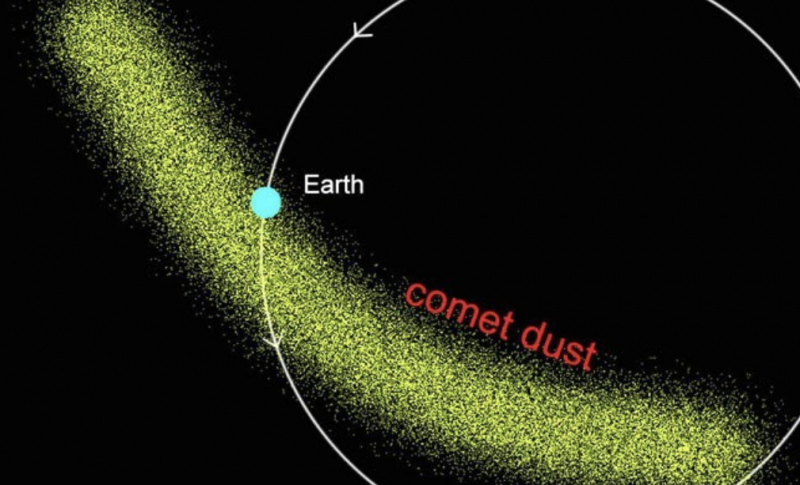
Representation of Earth's orbit around the sun, crossing a wide arc of tiny dots that represent cometary debris.

Meteors in annual showers happen when Earth encounters debris left behind by a comet. Astronomers have learned to calculate the various streams of debris in space, left behind by comets as various passages near the sun. Image by AstroBob.

Late July 2019 – around July 28 – presents the nominal peak of the Delta Aquariid meteor shower. But don’t let that date thwart you, if you have a chance to be in a dark place for meteor-watching, anytime in the coming weeks. The long and rambling Delta Aquariid shower is officially active from about July 12 to August 23 each year. The coming new moon on July 31/August 1 (depending on your time zone) means lovely waning crescents in the optimum predawn hours in late July. It means dark skies throughout most of the night all through the first week of August.

The Delta Aquariid shower favors the Southern Hemisphere, though is still visible from mid-northern latitudes. In years when the moon is out of the way, the broad maximum of this shower can be expected to produce 10 to 20 meteors per hour. But, even in early August, you’ll likely see some Perseids, too. This shower overlaps with the more famous Perseid meteor shower, which in early August is rising to its peak (this year on the mornings of August 11, 12 and 13, unfortunately under the light of a bright moon). Those who observe the Perseids are likely to see some Delta Aquariid meteors flying on the same nights.

For the Delta Aquariids, as for most meteor showers, the best viewing hours are after midnight and before dawn for all time zones around the world.

Everything you need to know: Perseid meteor shower
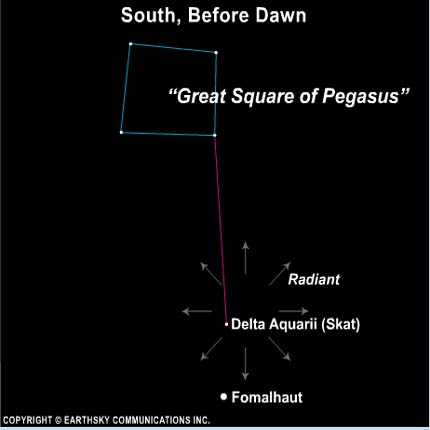
Chart with Great Square, line to bright star, arrows pointing out from spot near closeby dim star.

The radiant point for Delta Aquariid shower is near star Skat, or Delta Aquarii. This star is near in the sky to a much brighter star, Fomalhaut, which can be found roughly on a line drawn southward through the stars on the west side of the Great Square. This chart shows the Northern Hemisphere view. From the Southern Hemisphere, the radiant is closer to overhead. And don’t worry too much about radiant points. The meteors will appear in all parts of the sky.

How can I tell Perseid meteors from Delta Aquariid meteors? This is where the concept of a radiant point comes in handy. If you trace all the Delta Aquariid meteors backward, they appear to radiate from a certain point in front of the constellation Aquarius the Water Bearer, which, as viewed from the Northern Hemisphere, arcs across the southern sky. The radiant point of the shower nearly aligns with the star Skat (Delta Aquarii). The meteor shower is named in the honor of this star.

Meanwhile, the Perseids radiate from the constellation Perseus, in the northeast to high in the north between midnight and dawn. So – assuming you’re in the Northern Hemisphere – if you’re watching the Perseids, and you see meteors coming from the northeast or north … they are Perseids. If you see them coming from the south … they are Delta Aquariids. In a particularly rich year for meteors, if you have a dark sky, you might even see them cross paths! It can be an awesome display.

The Delta Aquariid meteors may tend to be a bit fainter than the Perseids and meteors seen in other major showers. That makes a dark sky free of moonlight even more imperative for watching the annual Delta Aquariid shower. About five to ten percent of the Delta Aquariid meteors leave persistent trains – glowing ionized gas trails that last a second or two after the meteor has passed. The meteors burn up in the upper atmosphere about 60 miles (100 km) above Earth’s surface.

Rememeber, you never have to locate a shower’s radiant point to enjoy the meteors. However, it does help to have a dark night without moonlight. This year – in 2019 – the prospects for watching the Delta Aquariids in late July and early August are very good, with little moonlight to ruin the show.
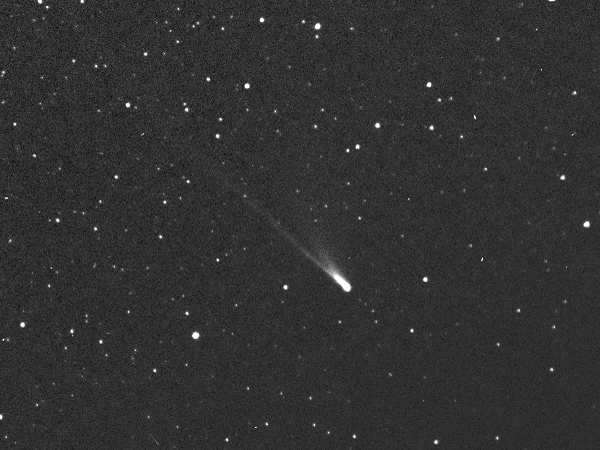
Starry background, largish bright dot with two fuzzy tails.

Comet 96P Machholz, the possible parent of the Delta Aquariid meteor shower, was discovered on May 12, 1986, by Donald Machholz. Image via Wikimedia Commons[./caption]

Delta Aquariid meteors may come from Comet 96P Machholz. Meteor showers happen when our planet Earth crosses the orbital path of a comet. When a comet nears the sun and warms up, it sheds bits and pieces that spread out into that comet’s orbital stream. This comet debris slams into the Earth’s upper atmosphere at about 90,000 miles (150,000 km) per hour, vaporizing – burning up – as meteors or shooting stars.

The parent body of the Delta Aquariid meteor is not known with certainty. It was once thought to have originated from the breakup of what are now the Marsden and Kracht sungrazing comets. More recently, the Comet 96P Machholz has loomed as the primary candidate for being the Delta Aquariids’ parent body.

Donald Machholz discovered this comet in 1986. It’s a short-period comet whose orbit carries it around the sun once in a little over five years. At aphelion – its greatest distance from the sun – this comet goes out beyond the orbit of Jupiter. At perihelion – its closest point to the sun – Comet 96P Machholz swings well inside Mercury’s orbit. Comet 96P/Machholz last came to perihelion on October 27, 2017 and will next come to perihelion on January 31, 2023.

[caption id="attachment_203199" align="aligncenter" width="800"]Starry sky with Milky Way visible and fuzzy bright green dot with short glowing trail near horizon. David S. Brown caught this meteor in late July in 2014, in southwest Wyoming.
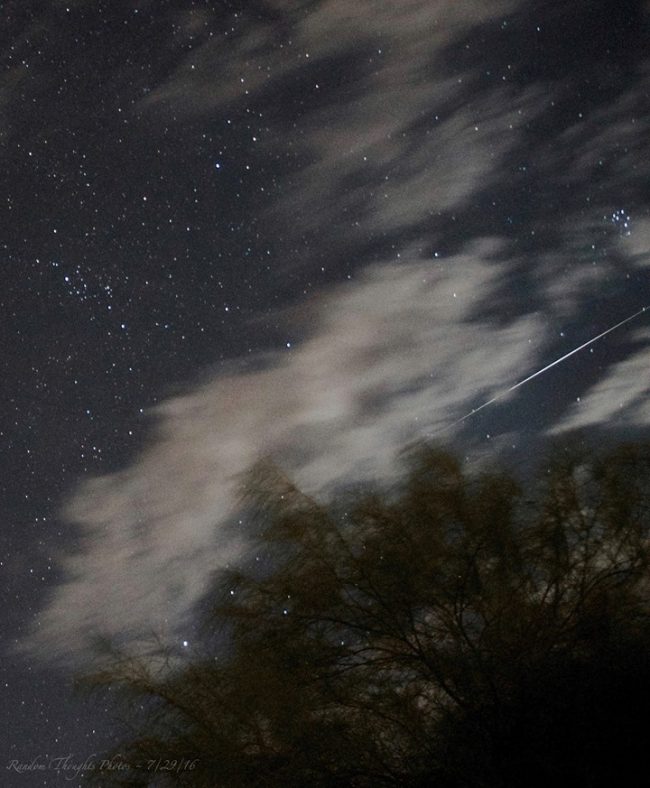
Long bright diagonal line streaking among clouds.

Kelly Dreller caught this meteor in late July of 2016, in Lake Havasu City, Arizona.

Bottom line: The Delta Aquariid meteor shower lacks a very definite peak. It rambles along pretty steadily in late July and August, coinciding with the Perseids. The nominal peak is in late July, shortly before the new moon on August 1, 2019. From any time zone, the best viewing window lasts for several hours, centered on roughly 2 a.m. (3 a.m. daylight saving time). Find an open sky away from artificial lights, lie down on a reclining lawn chair and look upward.

Everything you need to know: Perseid meteor shower


from EarthSky https://ift.tt/30Tf32p
Representation of Earth's orbit around the sun, crossing a wide arc of tiny dots that represent cometary debris.

Meteors in annual showers happen when Earth encounters debris left behind by a comet. Astronomers have learned to calculate the various streams of debris in space, left behind by comets as various passages near the sun. Image by AstroBob.

Late July 2019 – around July 28 – presents the nominal peak of the Delta Aquariid meteor shower. But don’t let that date thwart you, if you have a chance to be in a dark place for meteor-watching, anytime in the coming weeks. The long and rambling Delta Aquariid shower is officially active from about July 12 to August 23 each year. The coming new moon on July 31/August 1 (depending on your time zone) means lovely waning crescents in the optimum predawn hours in late July. It means dark skies throughout most of the night all through the first week of August.

The Delta Aquariid shower favors the Southern Hemisphere, though is still visible from mid-northern latitudes. In years when the moon is out of the way, the broad maximum of this shower can be expected to produce 10 to 20 meteors per hour. But, even in early August, you’ll likely see some Perseids, too. This shower overlaps with the more famous Perseid meteor shower, which in early August is rising to its peak (this year on the mornings of August 11, 12 and 13, unfortunately under the light of a bright moon). Those who observe the Perseids are likely to see some Delta Aquariid meteors flying on the same nights.

For the Delta Aquariids, as for most meteor showers, the best viewing hours are after midnight and before dawn for all time zones around the world.

Everything you need to know: Perseid meteor shower

Chart with Great Square, line to bright star, arrows pointing out from spot near closeby dim star.

The radiant point for Delta Aquariid shower is near star Skat, or Delta Aquarii. This star is near in the sky to a much brighter star, Fomalhaut, which can be found roughly on a line drawn southward through the stars on the west side of the Great Square. This chart shows the Northern Hemisphere view. From the Southern Hemisphere, the radiant is closer to overhead. And don’t worry too much about radiant points. The meteors will appear in all parts of the sky.

How can I tell Perseid meteors from Delta Aquariid meteors? This is where the concept of a radiant point comes in handy. If you trace all the Delta Aquariid meteors backward, they appear to radiate from a certain point in front of the constellation Aquarius the Water Bearer, which, as viewed from the Northern Hemisphere, arcs across the southern sky. The radiant point of the shower nearly aligns with the star Skat (Delta Aquarii). The meteor shower is named in the honor of this star.

Meanwhile, the Perseids radiate from the constellation Perseus, in the northeast to high in the north between midnight and dawn. So – assuming you’re in the Northern Hemisphere – if you’re watching the Perseids, and you see meteors coming from the northeast or north … they are Perseids. If you see them coming from the south … they are Delta Aquariids. In a particularly rich year for meteors, if you have a dark sky, you might even see them cross paths! It can be an awesome display.

The Delta Aquariid meteors may tend to be a bit fainter than the Perseids and meteors seen in other major showers. That makes a dark sky free of moonlight even more imperative for watching the annual Delta Aquariid shower. About five to ten percent of the Delta Aquariid meteors leave persistent trains – glowing ionized gas trails that last a second or two after the meteor has passed. The meteors burn up in the upper atmosphere about 60 miles (100 km) above Earth’s surface.

Rememeber, you never have to locate a shower’s radiant point to enjoy the meteors. However, it does help to have a dark night without moonlight. This year – in 2019 – the prospects for watching the Delta Aquariids in late July and early August are very good, with little moonlight to ruin the show.

Starry background, largish bright dot with two fuzzy tails.

Comet 96P Machholz, the possible parent of the Delta Aquariid meteor shower, was discovered on May 12, 1986, by Donald Machholz. Image via Wikimedia Commons[./caption]

Delta Aquariid meteors may come from Comet 96P Machholz. Meteor showers happen when our planet Earth crosses the orbital path of a comet. When a comet nears the sun and warms up, it sheds bits and pieces that spread out into that comet’s orbital stream. This comet debris slams into the Earth’s upper atmosphere at about 90,000 miles (150,000 km) per hour, vaporizing – burning up – as meteors or shooting stars.

The parent body of the Delta Aquariid meteor is not known with certainty. It was once thought to have originated from the breakup of what are now the Marsden and Kracht sungrazing comets. More recently, the Comet 96P Machholz has loomed as the primary candidate for being the Delta Aquariids’ parent body.

Donald Machholz discovered this comet in 1986. It’s a short-period comet whose orbit carries it around the sun once in a little over five years. At aphelion – its greatest distance from the sun – this comet goes out beyond the orbit of Jupiter. At perihelion – its closest point to the sun – Comet 96P Machholz swings well inside Mercury’s orbit. Comet 96P/Machholz last came to perihelion on October 27, 2017 and will next come to perihelion on January 31, 2023.

[caption id="attachment_203199" align="aligncenter" width="800"]Starry sky with Milky Way visible and fuzzy bright green dot with short glowing trail near horizon. David S. Brown caught this meteor in late July in 2014, in southwest Wyoming.

Long bright diagonal line streaking among clouds.

Kelly Dreller caught this meteor in late July of 2016, in Lake Havasu City, Arizona.

Bottom line: The Delta Aquariid meteor shower lacks a very definite peak. It rambles along pretty steadily in late July and August, coinciding with the Perseids. The nominal peak is in late July, shortly before the new moon on August 1, 2019. From any time zone, the best viewing window lasts for several hours, centered on roughly 2 a.m. (3 a.m. daylight saving time). Find an open sky away from artificial lights, lie down on a reclining lawn chair and look upward.

Everything you need to know: Perseid meteor shower


from EarthSky https://ift.tt/30Tf32p

Ophiuchus, 13th constellation of zodiac

Tonight, look for the faint constellation Ophiuchus the Serpent Bearer. From the Northern Hemisphere, look southward at nightfall. From the Southern Hemisphere, look more overhead around mid-evening. From all parts of Earth, Ophiuchus crosses the sky westward as Earth spins under the sky, and as evening deepens into late night. Ophiuchus is sometimes called the 13th or forgotten constellation of the zodiac.

The sun passes in front of Ophiuchus from about November 30 to December 18. And yet no one ever says they’re born when the sun is in Ophiuchus. That’s because Ophiuchus is a constellation – not a sign – of the zodiac.

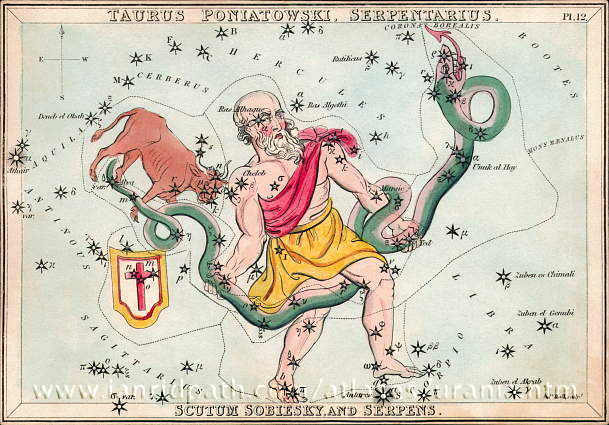
Antique color etching of old bald bearded man in ancient Greek garb holding a long snake.

Ophiuchus in Urania’s Mirror, a boxed set of 32 constellation cards first published in 1824. Image via www.ianridpath.com.

What’s the difference? The 12 signs of the tropical zodiac represent equal 30 degree divisions of the sky, while the 13 constellations of the zodiac are of various sizes.

That’s why, for example, the sun resides in front of each zodiacal sign for a precise interval of about a month. Meanwhile, the sun is in front of the constellations for varying amounts of time, for example, in front of the constellation Virgo for about 1 1/2 months and in front of constellation Scorpius for about a week.

The planet Jupiter and the bright red star Antares in the constellation Scorpius the Scorpion can help you find Ophiuchus in the night sky. Jupiter actually shines in front of Ophiuchus in 2019. Meanwhile, Ophiuchus is to the north of the star Antares.

Even after Jupiter moves into different constellations of the zodiac in the years ahead, you can look for Ophiuchus a short hop to the north of Antares in any year. Ophiuchus’ brightest star – the 2nd-magnitude star called Rasalhague – highlights the head of Ophiuchus. (See Rasalhague in the Ophiuchus chart below.) It’s nowhere as bright as the planet Jupiter or the 1st-magnitude star Antares.

Help support posts like these at the EarthSky store. Fun astronomy gifts and tools for all ages.

Star chart with black stars on white showing constellation Ophiuchus.

Ophiuchus the Serpent Bearer, via Wikimedia Commons.

On sky maps, Ophiuchus the Serpent Bearer is depicted as holding Serpens the Serpent, which is considered a separate constellation. According to ancient Greek star lore, Ophiuchus is Asclepius, the physician who concocted a healing potion from the Serpent’s venom, mixing it with the Gorgon’s blood and an unknown herb. This potion gave humans access to immortality, until the god of the underworld appealed to Zeus to reconsider the ramifications of the death of death.

Even today, the Staff of Asclepius – the symbol of the World Heath Organization – pays tribute to the constellation Ophiuchus the Serpent Bearer.

Bottom line: Will you see faint Ophiuchus, the overlooked zodiacal constellation, tonight?

Read more: Born between November 29 and December 18? Here’s your constellation

Dates of sun’s entry into each constellation of the zodiac

Enjoying EarthSky so far? Sign up for our free daily newsletter today!


from EarthSky https://ift.tt/2Z6phvR

Tonight, look for the faint constellation Ophiuchus the Serpent Bearer. From the Northern Hemisphere, look southward at nightfall. From the Southern Hemisphere, look more overhead around mid-evening. From all parts of Earth, Ophiuchus crosses the sky westward as Earth spins under the sky, and as evening deepens into late night. Ophiuchus is sometimes called the 13th or forgotten constellation of the zodiac.

The sun passes in front of Ophiuchus from about November 30 to December 18. And yet no one ever says they’re born when the sun is in Ophiuchus. That’s because Ophiuchus is a constellation – not a sign – of the zodiac.

Antique color etching of old bald bearded man in ancient Greek garb holding a long snake.

Ophiuchus in Urania’s Mirror, a boxed set of 32 constellation cards first published in 1824. Image via www.ianridpath.com.

What’s the difference? The 12 signs of the tropical zodiac represent equal 30 degree divisions of the sky, while the 13 constellations of the zodiac are of various sizes.

That’s why, for example, the sun resides in front of each zodiacal sign for a precise interval of about a month. Meanwhile, the sun is in front of the constellations for varying amounts of time, for example, in front of the constellation Virgo for about 1 1/2 months and in front of constellation Scorpius for about a week.

The planet Jupiter and the bright red star Antares in the constellation Scorpius the Scorpion can help you find Ophiuchus in the night sky. Jupiter actually shines in front of Ophiuchus in 2019. Meanwhile, Ophiuchus is to the north of the star Antares.

Even after Jupiter moves into different constellations of the zodiac in the years ahead, you can look for Ophiuchus a short hop to the north of Antares in any year. Ophiuchus’ brightest star – the 2nd-magnitude star called Rasalhague – highlights the head of Ophiuchus. (See Rasalhague in the Ophiuchus chart below.) It’s nowhere as bright as the planet Jupiter or the 1st-magnitude star Antares.

Help support posts like these at the EarthSky store. Fun astronomy gifts and tools for all ages.

Star chart with black stars on white showing constellation Ophiuchus.

Ophiuchus the Serpent Bearer, via Wikimedia Commons.

On sky maps, Ophiuchus the Serpent Bearer is depicted as holding Serpens the Serpent, which is considered a separate constellation. According to ancient Greek star lore, Ophiuchus is Asclepius, the physician who concocted a healing potion from the Serpent’s venom, mixing it with the Gorgon’s blood and an unknown herb. This potion gave humans access to immortality, until the god of the underworld appealed to Zeus to reconsider the ramifications of the death of death.

Even today, the Staff of Asclepius – the symbol of the World Heath Organization – pays tribute to the constellation Ophiuchus the Serpent Bearer.

Bottom line: Will you see faint Ophiuchus, the overlooked zodiacal constellation, tonight?

Read more: Born between November 29 and December 18? Here’s your constellation

Dates of sun’s entry into each constellation of the zodiac

Enjoying EarthSky so far? Sign up for our free daily newsletter today!


from EarthSky https://ift.tt/2Z6phvR

Cheerleader study highlights need for real-time energy balance

"It's not just how much you eat and what you eat but when you eat it that matters," says Dan Benardot, senior author of the study and a professor of practice at Emory's Center for the Study of Human Health.

It’s well-known that many athletes, especially women athletes and those participating in sports with an aesthetic component, can be chronically energy deficient. A new study suggests that professional cheerleaders also struggle to maintain an optimal balance between energy consumed and energy burned during exercise.

The Journal of Science in Sport and Exercise published the finding, led by researchers at Emory University’s Center for the Study of Human Health and Rollins School of Public Health. The results showed that some study participants had hourly energy balance deficits that were significantly below their estimated energy needs during a typical training day.

“An offensive lineman doesn’t have to worry about what he looks like but appearance matters for professional cheerleaders, and that may affect their food choices,” says Moriah Bellissimo, first author of the study and a graduate student at Rollins. “Some of our study participants reported really low caloric intakes for the amount of physical training they do. Those with the lowest caloric intakes were not eating enough to maintain an optimal body composition of lean mass compared to fat for high-performance athletics.”

“It is not just how much you eat and what you eat but when you eat it that matters,” adds senior author Dan Benardot, professor of practice at Emory’s Center for the Study of Human Health.

Benardot, who is also an emeritus professor of nutrition at Georgia State University, is an expert in the interrelationship between energy intake, body composition and within-day energy balance, and has worked as a team nutritionist for Olympians and professional athletes.

“The body works in real time,” Benardot says. “If you’re not eating enough and not often enough to avoid low blood sugar and high cortisol, your body adapts to this negative energy balance. Your brain will direct the body to find more energy by breaking down muscle mass to satisfy the need for energy. It sets you up for a downward spiral where you continually have to eat less and less to keep from gaining weight.”

The problem is particularly acute for athletes, especially female athletes and those in aesthetic sports, who deplete lean muscle mass at a faster rate than less active people because of the exercise-associated severe energy balance deficit they achieve. The researchers wanted to investigate whether professional cheerleaders, who may train four hours a day practicing dance routines, faced a similar challenge for real-time energy balance as some other female athletes in aesthetic sports.

“I have a vested interest in human performance and nutrition from a personal standpoint,” says Bellissimo, who was a collegiate athlete for five years before entering the Rollins PhD program for Nutrition and Health Science. “I know that how you are eating makes a difference in how you perform.”

Bellissimo says it was challenging to maintain a proper nutritional balance when she was an undergraduate and master’s student, while also competing in Division I volleyball tournaments. She notes that professional cheerleaders often work full-time jobs on top of training and performing and may find it especially challenging to carefully strategize all of their nutritional needs.

For the current study, the researchers conducted 24-hour dietary and activity surveys with professional cheerleaders during an active training period — including an hour-by-hour assessment of what and how much they ate, and hourly energy expenditures throughout the day. They inputted the data into a software tool called NutriTiming®, developed by Benardot, to calculate each participants’ hourly energy balance — and whether they were exercising at a calorie surplus or deficit.

For female athletes, previous research has shown that sustaining an energy balance of plus or minus 300 calories throughout the day is beneficial to avoid the lean tissue breakdown associated with larger energy deficits.

The body mass and body composition of the study participants was also measured, using a bioelectrical impedance analyzer — which painlessly assesses the density of biological tissue.

The results showed that those participants who spent fewer hours in a negative energy balance had a lower, more optimal, percentage of body fat and those who spent more time within the plus-or-minus zone of 300 calories also had a lower percentage of body fat.

The cheerleader study was small and of short duration, but the finding is consistent with other research on female athletes and other populations, Benardot says.

“Athletes expend energy rapidly,” he adds. “They need to eat frequently, just not too much at a time, so their bodies have enough fuel to burn as they need it.”

It is important to study the nutritional needs of people involved in competitive sports and other intensive exercise, both to help them perform at their maximum level and to maintain their health, Bellissimo says. “Research has shown that chronic energy balance deficits in athletes can lead to hormonal imbalances, and that can have long-term health implications,” she says.

Additional authors of the study include Ashley Licata, from the University of Alabama at Birmingham, and Anita Nucci and Walt Thompson, from Georgia State University.

Related:
'Nutrition for the Performing Arts' course focuses on science behind peak performance

from eScienceCommons https://ift.tt/2OcpuwC
"It's not just how much you eat and what you eat but when you eat it that matters," says Dan Benardot, senior author of the study and a professor of practice at Emory's Center for the Study of Human Health.

It’s well-known that many athletes, especially women athletes and those participating in sports with an aesthetic component, can be chronically energy deficient. A new study suggests that professional cheerleaders also struggle to maintain an optimal balance between energy consumed and energy burned during exercise.

The Journal of Science in Sport and Exercise published the finding, led by researchers at Emory University’s Center for the Study of Human Health and Rollins School of Public Health. The results showed that some study participants had hourly energy balance deficits that were significantly below their estimated energy needs during a typical training day.

“An offensive lineman doesn’t have to worry about what he looks like but appearance matters for professional cheerleaders, and that may affect their food choices,” says Moriah Bellissimo, first author of the study and a graduate student at Rollins. “Some of our study participants reported really low caloric intakes for the amount of physical training they do. Those with the lowest caloric intakes were not eating enough to maintain an optimal body composition of lean mass compared to fat for high-performance athletics.”

“It is not just how much you eat and what you eat but when you eat it that matters,” adds senior author Dan Benardot, professor of practice at Emory’s Center for the Study of Human Health.

Benardot, who is also an emeritus professor of nutrition at Georgia State University, is an expert in the interrelationship between energy intake, body composition and within-day energy balance, and has worked as a team nutritionist for Olympians and professional athletes.

“The body works in real time,” Benardot says. “If you’re not eating enough and not often enough to avoid low blood sugar and high cortisol, your body adapts to this negative energy balance. Your brain will direct the body to find more energy by breaking down muscle mass to satisfy the need for energy. It sets you up for a downward spiral where you continually have to eat less and less to keep from gaining weight.”

The problem is particularly acute for athletes, especially female athletes and those in aesthetic sports, who deplete lean muscle mass at a faster rate than less active people because of the exercise-associated severe energy balance deficit they achieve. The researchers wanted to investigate whether professional cheerleaders, who may train four hours a day practicing dance routines, faced a similar challenge for real-time energy balance as some other female athletes in aesthetic sports.

“I have a vested interest in human performance and nutrition from a personal standpoint,” says Bellissimo, who was a collegiate athlete for five years before entering the Rollins PhD program for Nutrition and Health Science. “I know that how you are eating makes a difference in how you perform.”

Bellissimo says it was challenging to maintain a proper nutritional balance when she was an undergraduate and master’s student, while also competing in Division I volleyball tournaments. She notes that professional cheerleaders often work full-time jobs on top of training and performing and may find it especially challenging to carefully strategize all of their nutritional needs.

For the current study, the researchers conducted 24-hour dietary and activity surveys with professional cheerleaders during an active training period — including an hour-by-hour assessment of what and how much they ate, and hourly energy expenditures throughout the day. They inputted the data into a software tool called NutriTiming®, developed by Benardot, to calculate each participants’ hourly energy balance — and whether they were exercising at a calorie surplus or deficit.

For female athletes, previous research has shown that sustaining an energy balance of plus or minus 300 calories throughout the day is beneficial to avoid the lean tissue breakdown associated with larger energy deficits.

The body mass and body composition of the study participants was also measured, using a bioelectrical impedance analyzer — which painlessly assesses the density of biological tissue.

The results showed that those participants who spent fewer hours in a negative energy balance had a lower, more optimal, percentage of body fat and those who spent more time within the plus-or-minus zone of 300 calories also had a lower percentage of body fat.

The cheerleader study was small and of short duration, but the finding is consistent with other research on female athletes and other populations, Benardot says.

“Athletes expend energy rapidly,” he adds. “They need to eat frequently, just not too much at a time, so their bodies have enough fuel to burn as they need it.”

It is important to study the nutritional needs of people involved in competitive sports and other intensive exercise, both to help them perform at their maximum level and to maintain their health, Bellissimo says. “Research has shown that chronic energy balance deficits in athletes can lead to hormonal imbalances, and that can have long-term health implications,” she says.

Additional authors of the study include Ashley Licata, from the University of Alabama at Birmingham, and Anita Nucci and Walt Thompson, from Georgia State University.

Related:
'Nutrition for the Performing Arts' course focuses on science behind peak performance

from eScienceCommons https://ift.tt/2OcpuwC

Corals spreading to subtropical waters

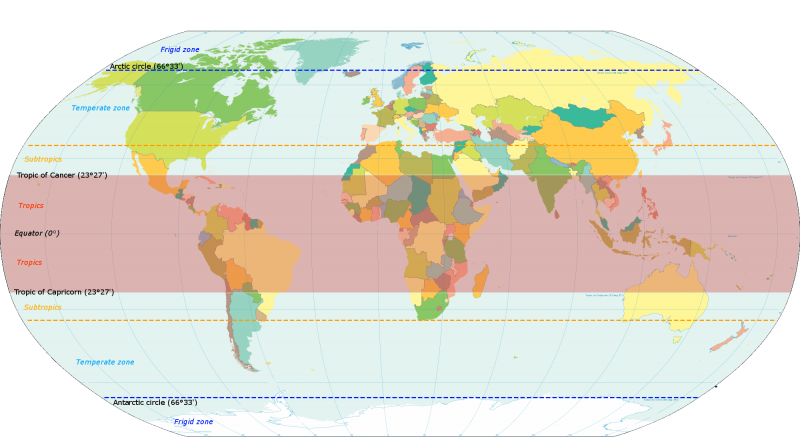
World map with tropics in pink with yellow dotted lines defining subtropics north and south.

Map showing the location of Earth’s tropics and subtropics. Scientists have noted increased coral growth in the subtropics, the area between tropical and temperate latitudes, as climate warms. Map via Wikimedia Commons.

Scientists have detected increases in coral populations in subtropical waters, which could help to offset some of the coral declines in warming waters around the equator. The new research was published in the peer-reviewed journal Marine Ecology Progress Series on July 4, 2019.

Warming waters around the equator are inducing coral bleaching events and die-offs. Unlike fish and crustaceans, which are mobile and able to relocate to cooler waters when living conditions deteriorate, adult corals are sessile organisms for which migration is not possible. Hence, they are particularly susceptible to heat stress induced by El Nino events and climate change.

Coral larvae, however, are mobile. After new larvae are produced through fertilization, they swim around in the ocean for days to weeks searching for a nice hard spot to land. Once settled, the larvae metamorphasize into sessile polyps and form new coral colonies and reefs. Scientists routinely assess the recruitment of new coral larvae by placing artificial tiles around the ocean bottom and counting the number of polyps that develop over time.

Bunches of green algae and gray coral made up of many little tubes on underwater rocks.

Coral growth in the temperate waters around Nagasaki, Japan. Image via Soyoka Muko, Nagasaki University.

In this new research, scientists first compiled a long-term coral recruitment database from past studies conducted from 1974 to 2012. Then, they examined the trends in recruitment over time. The findings showed that new coral recruitment has declined by 85% in tropical waters (<20 degrees latitude), but surprisingly, a 78% increase in recruitment was observed in cooler, subtropical waters (>20 degrees latitude). Places with increases in recruitment include Shikoku, Japan, and the Flower Garden Banks in the northern Gulf of Mexico. The increases in recruitment were observed on both sides of the equator, thus indicating that this is a global trend and not just a site specific one.

Nichole Price, lead author of the study and senior research scientist at the Bigelow Laboratory for Ocean Sciences, commented on the findings in a press release. She said:

Climate change seems to be redistributing coral reefs, the same way it is shifting many other marine species. The clarity in this trend is stunning, but we don’t yet know whether the new reefs can support the incredible diversity of tropical systems.

The scientists think that the best places for new coral recruitment in a future, warmer world may be in narrow zones just above tropical waters. At more northerly or southerly latitudes, coral growth would likely be limited by the low winter light intensity among other factors. Hence, despite the good news, coral conservation in tropical waters remains a critical issue.

Five small square blue tiles with bolt in center anchored to underwater rock next to pink and green corals.

Coral recruitment tiles installed at the Palmyra Atoll National Wildlife Refuge for the study of new coral growth in the region. Image via Nichole Price, Bigelow Laboratory for Ocean Sciences.

Price also emphasized that more follow-up research is necessary:

So many questions remain about which species are and are not making it to these new locations, and we don’t yet know the fate of these young corals over longer time frames. The changes we are seeing in coral reef ecosystems are mind-boggling, and we need to work hard to document how these systems work and learn what we can do to save them before it’s too late.

The new research was published by an international team of 19 scientists, with funding support from the U.S. National Science Foundation and the Okinawa Institute of Science and Technology.

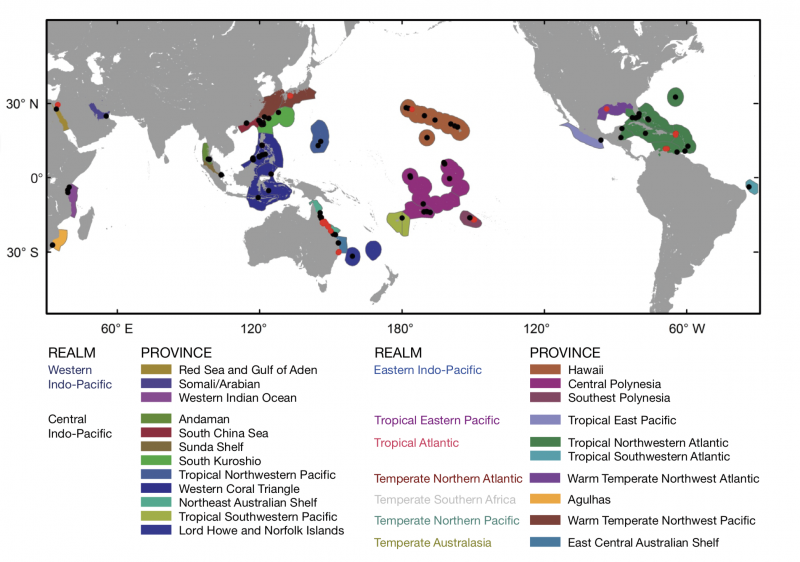
World map with colored dots indicating coral reef study sites.

View larger. | Coral recruitment study sites (n = 185). Shaded shapes of various colors (see key) indicate Marine Ecosystems of the World (MEOW) marine provinces. Within the colored shaded shapes, red dots identify the 12 locations – where long-immersion tiles were deployed over at least 4 years – used for analyses of changes in recruitment over time; black dots identify all other study sites. Map via Price et. al.

Bottom line: New long-term data show that coral populations have declined by 85 percent in tropical waters over the past few decades, but risen by 78 percent in a narrow zone of cooler subtropical waters.

Source: Global biogeography of coral recruitment: tropical decline and subtropical increase

Via EurekAlert


from EarthSky https://ift.tt/2M307dO
World map with tropics in pink with yellow dotted lines defining subtropics north and south.

Map showing the location of Earth’s tropics and subtropics. Scientists have noted increased coral growth in the subtropics, the area between tropical and temperate latitudes, as climate warms. Map via Wikimedia Commons.

Scientists have detected increases in coral populations in subtropical waters, which could help to offset some of the coral declines in warming waters around the equator. The new research was published in the peer-reviewed journal Marine Ecology Progress Series on July 4, 2019.

Warming waters around the equator are inducing coral bleaching events and die-offs. Unlike fish and crustaceans, which are mobile and able to relocate to cooler waters when living conditions deteriorate, adult corals are sessile organisms for which migration is not possible. Hence, they are particularly susceptible to heat stress induced by El Nino events and climate change.

Coral larvae, however, are mobile. After new larvae are produced through fertilization, they swim around in the ocean for days to weeks searching for a nice hard spot to land. Once settled, the larvae metamorphasize into sessile polyps and form new coral colonies and reefs. Scientists routinely assess the recruitment of new coral larvae by placing artificial tiles around the ocean bottom and counting the number of polyps that develop over time.

Bunches of green algae and gray coral made up of many little tubes on underwater rocks.

Coral growth in the temperate waters around Nagasaki, Japan. Image via Soyoka Muko, Nagasaki University.

In this new research, scientists first compiled a long-term coral recruitment database from past studies conducted from 1974 to 2012. Then, they examined the trends in recruitment over time. The findings showed that new coral recruitment has declined by 85% in tropical waters (<20 degrees latitude), but surprisingly, a 78% increase in recruitment was observed in cooler, subtropical waters (>20 degrees latitude). Places with increases in recruitment include Shikoku, Japan, and the Flower Garden Banks in the northern Gulf of Mexico. The increases in recruitment were observed on both sides of the equator, thus indicating that this is a global trend and not just a site specific one.

Nichole Price, lead author of the study and senior research scientist at the Bigelow Laboratory for Ocean Sciences, commented on the findings in a press release. She said:

Climate change seems to be redistributing coral reefs, the same way it is shifting many other marine species. The clarity in this trend is stunning, but we don’t yet know whether the new reefs can support the incredible diversity of tropical systems.

The scientists think that the best places for new coral recruitment in a future, warmer world may be in narrow zones just above tropical waters. At more northerly or southerly latitudes, coral growth would likely be limited by the low winter light intensity among other factors. Hence, despite the good news, coral conservation in tropical waters remains a critical issue.

Five small square blue tiles with bolt in center anchored to underwater rock next to pink and green corals.

Coral recruitment tiles installed at the Palmyra Atoll National Wildlife Refuge for the study of new coral growth in the region. Image via Nichole Price, Bigelow Laboratory for Ocean Sciences.

Price also emphasized that more follow-up research is necessary:

So many questions remain about which species are and are not making it to these new locations, and we don’t yet know the fate of these young corals over longer time frames. The changes we are seeing in coral reef ecosystems are mind-boggling, and we need to work hard to document how these systems work and learn what we can do to save them before it’s too late.

The new research was published by an international team of 19 scientists, with funding support from the U.S. National Science Foundation and the Okinawa Institute of Science and Technology.

World map with colored dots indicating coral reef study sites.

View larger. | Coral recruitment study sites (n = 185). Shaded shapes of various colors (see key) indicate Marine Ecosystems of the World (MEOW) marine provinces. Within the colored shaded shapes, red dots identify the 12 locations – where long-immersion tiles were deployed over at least 4 years – used for analyses of changes in recruitment over time; black dots identify all other study sites. Map via Price et. al.

Bottom line: New long-term data show that coral populations have declined by 85 percent in tropical waters over the past few decades, but risen by 78 percent in a narrow zone of cooler subtropical waters.

Source: Global biogeography of coral recruitment: tropical decline and subtropical increase

Via EurekAlert


from EarthSky https://ift.tt/2M307dO

Meet a family of NASA space robots

Climbing robot LEMUR against a starry sky background.

The climbing robot LEMUR rests after scaling a cliff in Death Valley, California in early 2019. The robot uses special gripping technology that has helped lead to a series of new, off-roading robots that can explore other worlds. Image via NASA/JPL-Caltech.

From uncovering the first clues of liquid water on Mars to crossing our solar system, NASA’s missions have been adventurous, to say the least. Ranger 3 was NASA’s first attempt to land a rover on the moon in 1962. Since then, numerous robots have followed Ranger 3 from Earth into space. Yet the surfaces of planets and moons in our solar system remain largely unexplored, partly because current space robots haven’t been capable of scaling cliffs, gripping icy surfaces and otherwise conquering hard-to-reach places.

This month (July 10, 2019), NASA’s Jet Propulsion Laboratory described its work on a new family of robots that can roll, climb, and use artificial intelligence (AI) to navigate around obstacles in rough terrains. These robots are currently being tested on Earth and will later be sent to places that are otherwise inaccessible by humans, helping scientists do meaningful science along the way.

Animated picture of small dark object throwing radial hooks ahead of it as it climbs straight up.

A tiny climbing robot rolls up a wall, gripping with fishhooks – technology adapted from LEMUR’s gripping feet. Image via NASA/JPL-Caltech.

This new class of space robots will have functionalities inspired by the Limbed Excursion Mechanical Utility Robot (LEMUR), which was originally conceived as a repair robot for the International Space Station. In the video below, NASA describes LEMUR’s last field test, in Death Valley, California in early 2019. The robot used hundreds of fishhooks to climb walls and AI to avoid obstacles that it could not climb. It also used its suite of scientific instruments to scan the rock for ancient fossils, and, as the video explains, it found some!

A direct application of this LEMUR field test would be searching for biosignatures – substances that provide evidence of life – on the planet Mars, perhaps in lake beds thought to hold signs of Martian life from the distant past.

While the LEMUR itself will not be sent into space, the engineers did adopt much of its AI and structural features into the next generation of robots that will act as our eyes and ears beyond Earth. Each one of them has unique features built into it to tackle the harsh conditions and uncertain environments. Keep reading, to meet this new generation of space explorers.

Two red legs connected with a cylinder, one supporting as the other reaches up.

Ice Worm was put to its first field test in the cave walls at Mount St. Helens in August 2018. The robot was belayed with a rope to ensure that it wasn’t damaged if it fell. Image via NASA/JPL-Caltech.

Ice Worm

Engineers at NASA’s Jet Propulsion Laboratory in Pasadena, California are developing a robot called Ice Worm in an attempt to navigate slippery surfaces. True to its name, the robot – adapted from a single limb of LEMUR – compacts its body before extending it to move forward. It proceeds an inch at a time by drilling one end of a limb into an icy surface, uses a grip to steady itself, then brings in the second limb to join the first using the same technique.

To move forward, it unscrews one foot, lengthens its body and screws it back into the ice a few meters ahead. Using the pressure sensors that instruct it how hard to drill into the ice, it repeats this over and over again to “inchworm” forward. Ice Worm also uses this method to anchor itself while analyzing the surface beneath to collect material in its legs that can be used to test salinity concentrations for microbial life.

Aaron Parness, an engineer at JPL, has been sure to train Ice Worm in the remote regions of Antarctica, which is the harshest place they could find on Earth. The slippery ice coupled with the harsh environment will prepare the robot for similar conditions on the moons of Jupiter and Saturn. Another set of tests are lined up in glaciers on Mt. Rainer in Seattle. Parness commented:

Field testing shows you things that are hard to learn in the laboratory.

This 1.4-meter long robot is also being equipped with pattern recognition and machine learning – aspects of AI that allow it to learn from past mistakes and make optimal decisions. The robot will need to investigate patterns left behind by life in cave formations. In order to do so, it needs to be tiny and mobile enough to scuttle through the cave’s tiny gaps. For this, Parness and his team are working on miniaturized remote sensing and data analysis instruments that Ice Worm can wear like a backpack. Once ready, robots of this kind will be sent to the icy moons of Saturn and Jupiter to bring back samples for further analyses.

Read more about Ice Worm

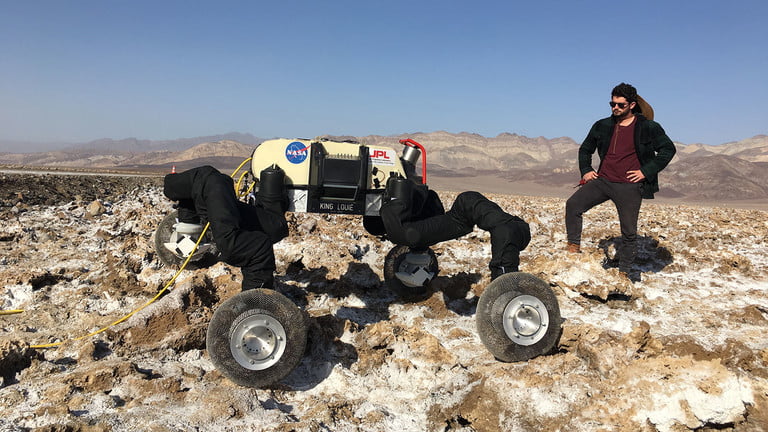
Man standing next to yellow cylinder up on four sturdy bent legs with wheels.

RoboSimian during a field test in California. Image via NASA/JPL-Caltech.

RoboSimian

While this four-legged robot is also inspired by LEMUR in its size and build, RoboSimian has supple wheels made of music wire in contrast to LEMUR’s gripping ones, thus having greater flexibility on rough terrains. This concept first materialized as a part of the DARPA Robotics Challenge, which promoted robotic technology for disaster-response operations. The robot is built and trained to operate in dangerous environments, so it’s not surprising that RoboSimian – a four-legged robot that can walk, crawl, slide on its belly, and even do cartwheels – will most likely be sent to Saturn’s moon Enceladus. Saltwater oceans are theorized to be present under the icy surface of that distant moon. The geysers may also contain signs of microbial life.

Nicknamed King Louie after a character in the film Jungle Book, RoboSimian is equipped with spectroscopic instruments that could explore Enceladus’ polar regions.

Read more about RoboSimian

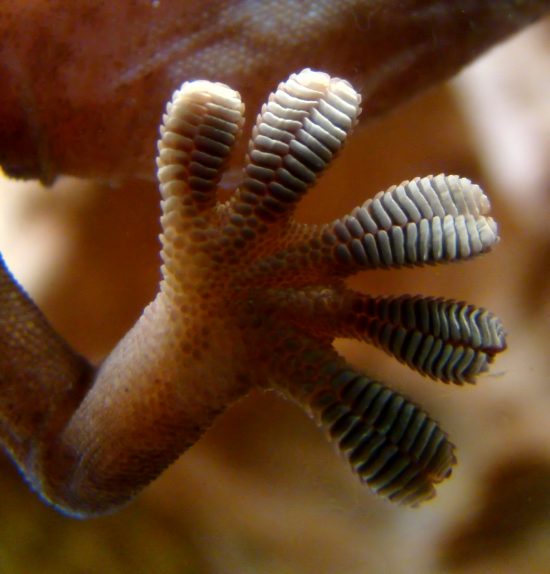
Bottom view through glass of five wide ridged toes.

NASA engineers were inspired by gecko feet, such as the one shown here, in designing a gripping system for space. Just as a gecko’s foot has tiny adhesive hairs, so the JPL devices incorporate small structures that work in similar ways. Image via NASA/ Wikimedia Commons.

Building robots the gecko way

You can use tape only so many times before the adhesion wears off. Geckos, on the other hand, offer inspiration for glues that stick even after multiple uses. These tiny lizards have hair on their feet that allow them to cling to a wall with ease. Parness and his team designed a robot with similar features – gecko-inspired adhesives – synthetic hair that sticks to any surface.

These grippers can sustain up to 150 Newtons of force and have been tested in simulated microgravity environments. The gecko material itself was tested 300,000 times to make sure the stickiness does not wear off. This robot will one-day repair satellites, service them, and even snatch space garbage.

Read more about gecko-inspired robot grippers

Cylinder with many bent 'fingers' attached radially to one end.

Underwater Gripper at work. Image via Nautilus.

Underwater grippers

Yet another robot inspired by LEMUR, the Underwater Gripper adopted LEMUR’s 16 fingers and 250 fishhooks to hold on tightly to surfaces and drill into formations. This is particularly useful in environments where there is little to no gravity, especially underwater where the force of the drill could push the robot away.

As of now the robot is working with Nautilus – an underwater research vessel – to collect samples from water that are a mile below the surface. Eventually, it might be sent to explore the surfaces of asteroids and other similar bodies.

Read more about underwater robot grippers

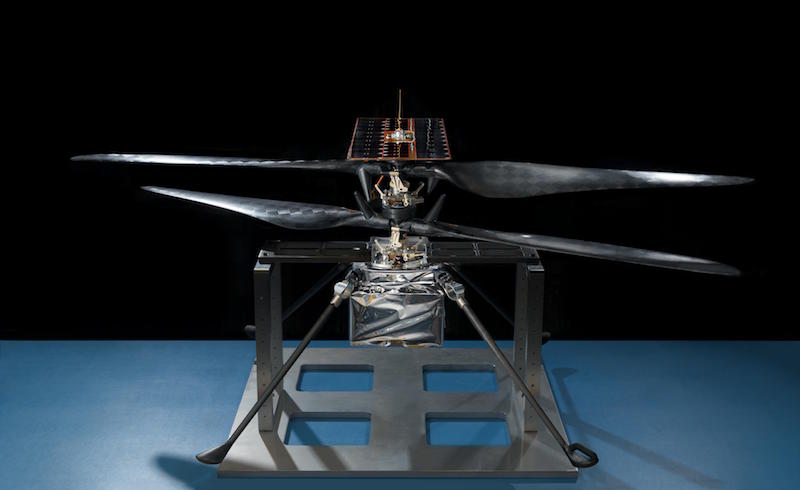
Two counter-rotating helicopter blades atop machine with large, flat square base.

NASA’s Mars Helicopter in NASA’s Jet Propulsion Laboratory in Pasadena, California. Image via NASA/JPL.

A helicopter that will do more than just fly

A tiny, solar-powered helicopter shall accompany the Mars 2020 rover. Arash Kalantari, a JPL engineer modified LEMUR’s design to build a robot that lands not just horizontally, but also vertically by clinging to rocks like a dragonfly.

MiMi Aung, project manager for the Mars Helicopter at NASA’s Jet Propulsion Laboratory in Pasadena, California, said:

Nobody’s built a Mars Helicopter before, so we are continuously entering new territory.

The Mars Helicopter is expected to reach Mars by February 2021 and will conduct geological assessments on the landing sites, assess natural resources and hazards for future space missions.

Read more about the Mars Helicopter

Bottom line: A new class of space robots have functionalities inspired by the Limbed Excursion Mechanical Utility Robot (LEMUR). While each design is unique in its abilities, there is one common goal that unites them all: the hunt for life beyond Earth.

Via NASA


from EarthSky https://ift.tt/32JsROA
Climbing robot LEMUR against a starry sky background.

The climbing robot LEMUR rests after scaling a cliff in Death Valley, California in early 2019. The robot uses special gripping technology that has helped lead to a series of new, off-roading robots that can explore other worlds. Image via NASA/JPL-Caltech.

From uncovering the first clues of liquid water on Mars to crossing our solar system, NASA’s missions have been adventurous, to say the least. Ranger 3 was NASA’s first attempt to land a rover on the moon in 1962. Since then, numerous robots have followed Ranger 3 from Earth into space. Yet the surfaces of planets and moons in our solar system remain largely unexplored, partly because current space robots haven’t been capable of scaling cliffs, gripping icy surfaces and otherwise conquering hard-to-reach places.

This month (July 10, 2019), NASA’s Jet Propulsion Laboratory described its work on a new family of robots that can roll, climb, and use artificial intelligence (AI) to navigate around obstacles in rough terrains. These robots are currently being tested on Earth and will later be sent to places that are otherwise inaccessible by humans, helping scientists do meaningful science along the way.

Animated picture of small dark object throwing radial hooks ahead of it as it climbs straight up.

A tiny climbing robot rolls up a wall, gripping with fishhooks – technology adapted from LEMUR’s gripping feet. Image via NASA/JPL-Caltech.

This new class of space robots will have functionalities inspired by the Limbed Excursion Mechanical Utility Robot (LEMUR), which was originally conceived as a repair robot for the International Space Station. In the video below, NASA describes LEMUR’s last field test, in Death Valley, California in early 2019. The robot used hundreds of fishhooks to climb walls and AI to avoid obstacles that it could not climb. It also used its suite of scientific instruments to scan the rock for ancient fossils, and, as the video explains, it found some!

A direct application of this LEMUR field test would be searching for biosignatures – substances that provide evidence of life – on the planet Mars, perhaps in lake beds thought to hold signs of Martian life from the distant past.

While the LEMUR itself will not be sent into space, the engineers did adopt much of its AI and structural features into the next generation of robots that will act as our eyes and ears beyond Earth. Each one of them has unique features built into it to tackle the harsh conditions and uncertain environments. Keep reading, to meet this new generation of space explorers.

Two red legs connected with a cylinder, one supporting as the other reaches up.

Ice Worm was put to its first field test in the cave walls at Mount St. Helens in August 2018. The robot was belayed with a rope to ensure that it wasn’t damaged if it fell. Image via NASA/JPL-Caltech.

Ice Worm

Engineers at NASA’s Jet Propulsion Laboratory in Pasadena, California are developing a robot called Ice Worm in an attempt to navigate slippery surfaces. True to its name, the robot – adapted from a single limb of LEMUR – compacts its body before extending it to move forward. It proceeds an inch at a time by drilling one end of a limb into an icy surface, uses a grip to steady itself, then brings in the second limb to join the first using the same technique.

To move forward, it unscrews one foot, lengthens its body and screws it back into the ice a few meters ahead. Using the pressure sensors that instruct it how hard to drill into the ice, it repeats this over and over again to “inchworm” forward. Ice Worm also uses this method to anchor itself while analyzing the surface beneath to collect material in its legs that can be used to test salinity concentrations for microbial life.

Aaron Parness, an engineer at JPL, has been sure to train Ice Worm in the remote regions of Antarctica, which is the harshest place they could find on Earth. The slippery ice coupled with the harsh environment will prepare the robot for similar conditions on the moons of Jupiter and Saturn. Another set of tests are lined up in glaciers on Mt. Rainer in Seattle. Parness commented:

Field testing shows you things that are hard to learn in the laboratory.

This 1.4-meter long robot is also being equipped with pattern recognition and machine learning – aspects of AI that allow it to learn from past mistakes and make optimal decisions. The robot will need to investigate patterns left behind by life in cave formations. In order to do so, it needs to be tiny and mobile enough to scuttle through the cave’s tiny gaps. For this, Parness and his team are working on miniaturized remote sensing and data analysis instruments that Ice Worm can wear like a backpack. Once ready, robots of this kind will be sent to the icy moons of Saturn and Jupiter to bring back samples for further analyses.

Read more about Ice Worm

Man standing next to yellow cylinder up on four sturdy bent legs with wheels.

RoboSimian during a field test in California. Image via NASA/JPL-Caltech.

RoboSimian

While this four-legged robot is also inspired by LEMUR in its size and build, RoboSimian has supple wheels made of music wire in contrast to LEMUR’s gripping ones, thus having greater flexibility on rough terrains. This concept first materialized as a part of the DARPA Robotics Challenge, which promoted robotic technology for disaster-response operations. The robot is built and trained to operate in dangerous environments, so it’s not surprising that RoboSimian – a four-legged robot that can walk, crawl, slide on its belly, and even do cartwheels – will most likely be sent to Saturn’s moon Enceladus. Saltwater oceans are theorized to be present under the icy surface of that distant moon. The geysers may also contain signs of microbial life.

Nicknamed King Louie after a character in the film Jungle Book, RoboSimian is equipped with spectroscopic instruments that could explore Enceladus’ polar regions.

Read more about RoboSimian

Bottom view through glass of five wide ridged toes.

NASA engineers were inspired by gecko feet, such as the one shown here, in designing a gripping system for space. Just as a gecko’s foot has tiny adhesive hairs, so the JPL devices incorporate small structures that work in similar ways. Image via NASA/ Wikimedia Commons.

Building robots the gecko way

You can use tape only so many times before the adhesion wears off. Geckos, on the other hand, offer inspiration for glues that stick even after multiple uses. These tiny lizards have hair on their feet that allow them to cling to a wall with ease. Parness and his team designed a robot with similar features – gecko-inspired adhesives – synthetic hair that sticks to any surface.

These grippers can sustain up to 150 Newtons of force and have been tested in simulated microgravity environments. The gecko material itself was tested 300,000 times to make sure the stickiness does not wear off. This robot will one-day repair satellites, service them, and even snatch space garbage.

Read more about gecko-inspired robot grippers

Cylinder with many bent 'fingers' attached radially to one end.

Underwater Gripper at work. Image via Nautilus.

Underwater grippers

Yet another robot inspired by LEMUR, the Underwater Gripper adopted LEMUR’s 16 fingers and 250 fishhooks to hold on tightly to surfaces and drill into formations. This is particularly useful in environments where there is little to no gravity, especially underwater where the force of the drill could push the robot away.

As of now the robot is working with Nautilus – an underwater research vessel – to collect samples from water that are a mile below the surface. Eventually, it might be sent to explore the surfaces of asteroids and other similar bodies.

Read more about underwater robot grippers

Two counter-rotating helicopter blades atop machine with large, flat square base.

NASA’s Mars Helicopter in NASA’s Jet Propulsion Laboratory in Pasadena, California. Image via NASA/JPL.

A helicopter that will do more than just fly

A tiny, solar-powered helicopter shall accompany the Mars 2020 rover. Arash Kalantari, a JPL engineer modified LEMUR’s design to build a robot that lands not just horizontally, but also vertically by clinging to rocks like a dragonfly.

MiMi Aung, project manager for the Mars Helicopter at NASA’s Jet Propulsion Laboratory in Pasadena, California, said:

Nobody’s built a Mars Helicopter before, so we are continuously entering new territory.

The Mars Helicopter is expected to reach Mars by February 2021 and will conduct geological assessments on the landing sites, assess natural resources and hazards for future space missions.

Read more about the Mars Helicopter

Bottom line: A new class of space robots have functionalities inspired by the Limbed Excursion Mechanical Utility Robot (LEMUR). While each design is unique in its abilities, there is one common goal that unites them all: the hunt for life beyond Earth.

Via NASA


from EarthSky https://ift.tt/32JsROA

Summer Triangle and smallest constellations

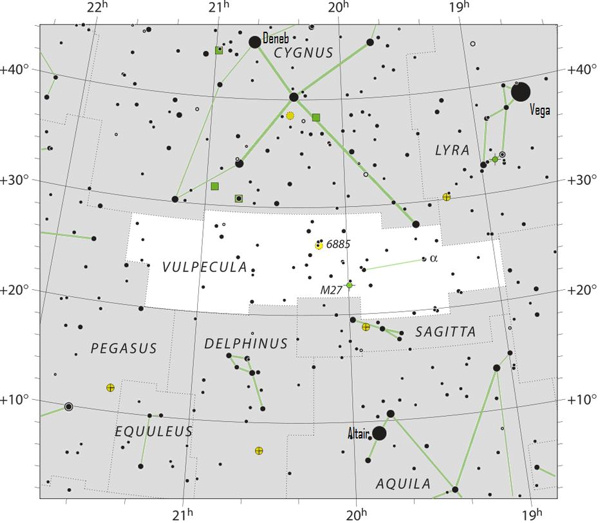
The Summer Triangle is not a constellation but a large asterism consisting of three bright stars in three separate constellations. These stars are Vega, Deneb and Altair. If you can find the Summer Triangle, you can use it to locate three of the sky’s smallest constellations: Vulpecula the Fox, Delphinus the Dolphin and Sagitta the Arrow. All three would be impossible to see from the city, but they’re lots of fun to see in a dark sky.

How can you find them? Look at the detailed chart below, and try picking out Vega, Deneb and Altair. Notice the large triangle they make if you draw lines between them. This triangle pattern – which is easily found in the sky on Northern Hemisphere summer evenings – is the Summer Triangle.

Now – still using the chart at the bottom of this post – or maybe after purchasing this awesome constellation chart from the store at Skyandtelescope.org – look within and around the Summer Triangle for Delphinus, Sagitta and Vulpecula.

Delphinus is a truly delightful little constellation that really resembles a dolphin leaping among the waves. Delphinus is one of the earliest constellations, first catalogued by the Greek astronomer Ptolemy in the 2nd century. Sometimes, Delphinus is said to be the Dolphin that carried a Greek poet – Arion – safely away from his enemies. Other times, this sky Dolphin is said to represent the dolphin sent by the sea god Poseidon to find Amphitrite, the Nereid he wanted to marry.

Sagitta – the 3rd smallest constellation in our sky – is near Vulpecula on the sky’s dome. Its name means “the arrow” in Latin. If you look for Sagitta, you’ll see why. This little star pattern does have a shape reminiscent of an arrow. Sagitta is also one of the earlist constellations, named by Ptolemy in the 2nd century. Sagitta is sometimes said to be an arrow shot from the bow of Hercules, a mythological hero and god.

Vulpecula means “the little fox” in Latin, and it’s the hardest to find of these three small constellations because it lacks a distinctive shape. Vulpecula is a relatively new constellation, introduced by the Polish astronomer Johannes Hevelius in the late 17th century. If you’re up for a binocular challenge, also try finding the Coathanger asterism in Vulpecula.

View larger. | Once you’re familiar with the Summer Triangle, star-hop from there to the nearby small constellations. Chart via IAU and Sky & Telescope (Roger Sinnott & Rick Fienberg)/Wikimedia Commons.

Want more about the Summer Triangle? Check out these articles.

Part 1: Vega and its constellation Lyra

Part 2: Deneb and its constellation Cygnus

Part 3: Altair and its constellation Aquila

Bottom line: You need a dark country sky to see these 3 small constellations: Vulpecula the Fox, Delphinus the Dolphin and Sagitta the Arrow.


from EarthSky https://ift.tt/30PY3d8

The Summer Triangle is not a constellation but a large asterism consisting of three bright stars in three separate constellations. These stars are Vega, Deneb and Altair. If you can find the Summer Triangle, you can use it to locate three of the sky’s smallest constellations: Vulpecula the Fox, Delphinus the Dolphin and Sagitta the Arrow. All three would be impossible to see from the city, but they’re lots of fun to see in a dark sky.

How can you find them? Look at the detailed chart below, and try picking out Vega, Deneb and Altair. Notice the large triangle they make if you draw lines between them. This triangle pattern – which is easily found in the sky on Northern Hemisphere summer evenings – is the Summer Triangle.

Now – still using the chart at the bottom of this post – or maybe after purchasing this awesome constellation chart from the store at Skyandtelescope.org – look within and around the Summer Triangle for Delphinus, Sagitta and Vulpecula.

Delphinus is a truly delightful little constellation that really resembles a dolphin leaping among the waves. Delphinus is one of the earliest constellations, first catalogued by the Greek astronomer Ptolemy in the 2nd century. Sometimes, Delphinus is said to be the Dolphin that carried a Greek poet – Arion – safely away from his enemies. Other times, this sky Dolphin is said to represent the dolphin sent by the sea god Poseidon to find Amphitrite, the Nereid he wanted to marry.

Sagitta – the 3rd smallest constellation in our sky – is near Vulpecula on the sky’s dome. Its name means “the arrow” in Latin. If you look for Sagitta, you’ll see why. This little star pattern does have a shape reminiscent of an arrow. Sagitta is also one of the earlist constellations, named by Ptolemy in the 2nd century. Sagitta is sometimes said to be an arrow shot from the bow of Hercules, a mythological hero and god.

Vulpecula means “the little fox” in Latin, and it’s the hardest to find of these three small constellations because it lacks a distinctive shape. Vulpecula is a relatively new constellation, introduced by the Polish astronomer Johannes Hevelius in the late 17th century. If you’re up for a binocular challenge, also try finding the Coathanger asterism in Vulpecula.

View larger. | Once you’re familiar with the Summer Triangle, star-hop from there to the nearby small constellations. Chart via IAU and Sky & Telescope (Roger Sinnott & Rick Fienberg)/Wikimedia Commons.

Want more about the Summer Triangle? Check out these articles.

Part 1: Vega and its constellation Lyra

Part 2: Deneb and its constellation Cygnus

Part 3: Altair and its constellation Aquila

Bottom line: You need a dark country sky to see these 3 small constellations: Vulpecula the Fox, Delphinus the Dolphin and Sagitta the Arrow.


from EarthSky https://ift.tt/30PY3d8

2019 SkS Weekly Climate Change & Global Warming Digest #29

Article of the Week... Toon of the Week... Coming Soon on SkS... Climate Feedback Claim Review... SkS Week in Review...Poster of the Week...

Article of the Week...

June 2019: Earth's Hottest June on Record

Hindu priests in tubs 

In this picture taken on June 6, 2019, Hindu priests sit inside large vessels filled with water as they perform the 'Parjanya Japa' and offer prayers to appease the rain god for timely monsoons at the Huligamma Devi Temple in Koppal District, some 300 km from Bangalore, India. A 33-year-old man died after a fight over water in southern India, police said on June 7, as huge parts of the country gasped from drought and a brutal summer heatwave. The heat wave was blamed for 210 deaths in June, making it Earth’s deadliest weather-related disaster of the month. Image credit: STR/AFP/Getty Images.

June 2019 was the planet's warmest June since record keeping began in 1880, said NOAA's National Centers for Environmental Information (NCEI) on Tuesday. NASA also rated June 2019 as the warmest June on record, well of ahead of the previous record set in 2015.

The global heat in June is especially impressive and significant given that only a weak (and weakening) El Niño event was in place. As human-produced greenhouse gases continue to heat up our planet, most global heat records are set during El Niño periods, because the warm waters that spread upward and eastward across the surface of the tropical Pacific during El Niño transfer heat from the ocean to the atmosphere.

Global ocean temperatures during June 2019 were tied with 2016 for warmest on record, according to NOAA, and global land temperatures were the warmest on record. Global satellite-measured temperatures in June 2019 for the lowest 8 km of the atmosphere were the warmest or second warmest in the 41-year record, according to RSS and the University of Alabama Huntsville (UAH), respectively.

As of July 15, July 2019 was on track to be the warmest month in Earth’s history (in absolute terms, not in terms of temperature departure from average)--just ahead of the record set in July 2017. 

June 2019: Earth's Hottest June on Record by Jeff Masters, Category 6, Weather Underground, June 18, 2019 


Toon of the Week...

2019 Toon 29 


Coming Soon on SkS...

  • CCC: UK has just 18 months to avoid ’embarrassment’ over climate inaction (Simon Evans)
  • Skeptical Science New Research for Week #29, 2019 (SkS Team)
  • Analysis: How Trump’s rollback of vehicle fuel standards would increase US emissions (Zeke Hausfather)
  • What psychotherapy can do for the climate and biodiversity crises (Caroline Hickman)
  • How climate change is making hurricanes more dangerous (Jeff Berardelli)
  • 2019 SkS Weekly Climate Change & Global Warming News Roundup #30 (John Hartz)
  • 2019 SkS Weekly Climate Change & Global Warming Digest #30 (John Hartz)

Climate Feedback Claim Review...

Sky News Australia interview falsely claims that global cooling is coming soon

CLAIM:

"the Intergovernmental Panel on Climate Change is misleading humanity about climate change and sea levels, and that in fact a new solar-driven cooling period is not far off"

SOURCE: 

New sun-driven cooling period of Earth ‘not far off’, Alan Jones interviews Nils Axel-Mörner, Sky News Australia, June 2019 

VERDICT:

Incorrect 

DETAILS:

Inadequate Support: These claims contradict all the available data and published research on these topics. There is no support in the scientific literature for the claim that solar activity could significantly cool the climate in the decades to come.

KEY TAKE AWAY:

Scientists have established that observed climate change and sea level rise are clearly caused by human activities, primarily the emission of carbon dioxide through the burning of fossil fuels. Solar activity cannot explain recent warming, and even the occurrence of low solar activity in the near future would have an insignificant effect on human-caused warming.

Sky News Australia interview falsely claims that global cooling is coming soon, Edited by Scott Johnson, Claim Reviews, Climate Feedback, July 18, 2019


SkS Week in Review... 


Poster of the Week...

 2019 Poster 29


from Skeptical Science https://ift.tt/2YgkFWW

Article of the Week... Toon of the Week... Coming Soon on SkS... Climate Feedback Claim Review... SkS Week in Review...Poster of the Week...

Article of the Week...

June 2019: Earth's Hottest June on Record

Hindu priests in tubs 

In this picture taken on June 6, 2019, Hindu priests sit inside large vessels filled with water as they perform the 'Parjanya Japa' and offer prayers to appease the rain god for timely monsoons at the Huligamma Devi Temple in Koppal District, some 300 km from Bangalore, India. A 33-year-old man died after a fight over water in southern India, police said on June 7, as huge parts of the country gasped from drought and a brutal summer heatwave. The heat wave was blamed for 210 deaths in June, making it Earth’s deadliest weather-related disaster of the month. Image credit: STR/AFP/Getty Images.

June 2019 was the planet's warmest June since record keeping began in 1880, said NOAA's National Centers for Environmental Information (NCEI) on Tuesday. NASA also rated June 2019 as the warmest June on record, well of ahead of the previous record set in 2015.

The global heat in June is especially impressive and significant given that only a weak (and weakening) El Niño event was in place. As human-produced greenhouse gases continue to heat up our planet, most global heat records are set during El Niño periods, because the warm waters that spread upward and eastward across the surface of the tropical Pacific during El Niño transfer heat from the ocean to the atmosphere.

Global ocean temperatures during June 2019 were tied with 2016 for warmest on record, according to NOAA, and global land temperatures were the warmest on record. Global satellite-measured temperatures in June 2019 for the lowest 8 km of the atmosphere were the warmest or second warmest in the 41-year record, according to RSS and the University of Alabama Huntsville (UAH), respectively.

As of July 15, July 2019 was on track to be the warmest month in Earth’s history (in absolute terms, not in terms of temperature departure from average)--just ahead of the record set in July 2017. 

June 2019: Earth's Hottest June on Record by Jeff Masters, Category 6, Weather Underground, June 18, 2019 


Toon of the Week...

2019 Toon 29 


Coming Soon on SkS...

  • CCC: UK has just 18 months to avoid ’embarrassment’ over climate inaction (Simon Evans)
  • Skeptical Science New Research for Week #29, 2019 (SkS Team)
  • Analysis: How Trump’s rollback of vehicle fuel standards would increase US emissions (Zeke Hausfather)
  • What psychotherapy can do for the climate and biodiversity crises (Caroline Hickman)
  • How climate change is making hurricanes more dangerous (Jeff Berardelli)
  • 2019 SkS Weekly Climate Change & Global Warming News Roundup #30 (John Hartz)
  • 2019 SkS Weekly Climate Change & Global Warming Digest #30 (John Hartz)

Climate Feedback Claim Review...

Sky News Australia interview falsely claims that global cooling is coming soon

CLAIM:

"the Intergovernmental Panel on Climate Change is misleading humanity about climate change and sea levels, and that in fact a new solar-driven cooling period is not far off"

SOURCE: 

New sun-driven cooling period of Earth ‘not far off’, Alan Jones interviews Nils Axel-Mörner, Sky News Australia, June 2019 

VERDICT:

Incorrect 

DETAILS:

Inadequate Support: These claims contradict all the available data and published research on these topics. There is no support in the scientific literature for the claim that solar activity could significantly cool the climate in the decades to come.

KEY TAKE AWAY:

Scientists have established that observed climate change and sea level rise are clearly caused by human activities, primarily the emission of carbon dioxide through the burning of fossil fuels. Solar activity cannot explain recent warming, and even the occurrence of low solar activity in the near future would have an insignificant effect on human-caused warming.

Sky News Australia interview falsely claims that global cooling is coming soon, Edited by Scott Johnson, Claim Reviews, Climate Feedback, July 18, 2019


SkS Week in Review... 


Poster of the Week...

 2019 Poster 29


from Skeptical Science https://ift.tt/2YgkFWW

Astronomers probe a mini-Neptune’s atmosphere

Mini-Neptune exoplanet orbiting red dwarf star.

Artist’s concept of mini-Neptune exoplanet GJ 3470 b transiting, or passing in front of, its red dwarf star. In the new study, astronomers used transits and eclipses of the exoplanet to obtain spectroscopic data about the exoplanet’s atmosphere. Image via NASA/ESA/D. PLAYER/UdeMNouvelles.

Planets between the Earth and Neptune in size don’t exist in our solar system, but they seem to be common elsewhere. They are a cross between our solar system’s rocky terrestrial planets and its ice giants. Now, for the first time, astronomers have been able to analyze the atmosphere of one of these “mid-size” distant worlds, which are known, as a class, as mini-Neptunes.

The peer-reviewed findings were announced on July 2, 2019 via Hubblesite, and published in the journal Nature Astronomy on July 1, 2019.

The planet is Gliese 3470 b, a mini-Neptune orbiting a red dwarf star. It weighs a calculated 12.6 Earth masses, making it much more massive than Earth but less massive than Neptune in our solar system (17 Earth masses). If placed in our solar system, Gliese 3470 b would fit nicely between Earth and Neptune in terms of size. It’s thought that the planet has a large rocky core buried beneath a deep crushing atmosphere of hydrogen and helium.

Mini-Neptune interior, atmosphere and debris disk.

Artist’s illustration of both the atmosphere and interior of GJ 3470 b (top), as well as what the system may have looked like when the circumstellar debris disk still existed around the star (bottom). Image via NASA/ESA/L. Hustak (STScI)/Hubblesite.

Thanks to NASA’s Hubble and Spitzer space telescopes, scientists were able to study the atmosphere of Gliese 3470 b, the first time this has been done for a planet of this type. According to Björn Benneke at the University of Montreal in Canada:

This is a big discovery from the planet formation perspective. The planet orbits very close to the star and is far less massive than Jupiter – 318 times Earth’s mass – but has managed to accrete the primordial hydrogen/helium atmosphere that is largely “unpolluted” by heavier elements. We don’t have anything like this in the solar system, and that’s what makes it striking.

The researchers were able to analyze the composition of the atmosphere by measuring the absorption of starlight as the planet passed in front of the star and then passed behind the star. When the planet moves in front of the star, that is a transit, just as when our sun’s inner planets, Mercury or Venus, can be seen to transit the sun as seen from Earth. When it moves behind, that is an eclipse. These astronomers observed 12 transits and 20 eclipses in total, giving them enough data to analyze the atmosphere using spectroscopy (using light to determine the chemical fingerprints of gases in the atmosphere). As Benneke said:

For the first time we have a spectroscopic signature of such a world.

Headshot of smiling Bjorn Benneke.

Astronomer Bjorn Benneke, via UdeMNouvelles.

It also turned out that the atmosphere was mostly clear, with only a few hazes, making the study of its composition that much easier. This was a bit surprising, according to Benneke:

We expected an atmosphere strongly enriched in heavier elements like oxygen and carbon which are forming abundant water vapor and methane gas, similar to what we see on Neptune. Instead, we found an atmosphere that is so poor in heavy elements that its composition resembles the hydrogen/helium rich composition of the sun. If the planet had formed further from the star, where water and other astronomical ices can condense, we would have expected to see more water and methane in the atmosphere.

Earth and a mini-Neptune.

Artist’s concept showing size comparison of GJ 3470 b and Earth. Image via Radialvelocity/Wikipedia/CC BY-SA 4.0.

Even though there is now more data about the planet, there is still a question as to just how it should be classified, according to Bennek. Should it be called a mini-Neptune as referred to now, or rather a super-Earth (larger than Earth but smaller than a typical mini-Neptune)?

Or could this planet be similar to hot Jupiters, giant planets that are similar to Jupiter but orbit close to their stars? Unlike typical hot Jupiters, which are thought to form far out from their stars and then migrate inward, Bennett thinks that Gliese 3470 b formed just where it orbits today. He theorizes it first formed as a dry rocky planet that then rapidly accreted hydrogen from the circumstellar disk of gas and dust around the star, and that the disk dissipated before the planet could become any larger:

We’re seeing an object that was able to accrete hydrogen from the protoplanetary disk, but didn’t runaway to become a hot Jupiter. This is an intriguing regime. The planet got stuck being a sub-Neptune.

Gliese 3470 b is just one example of a mid-size planet, of course, but knowing the composition of its atmosphere helps astronomers understand how these unique worlds formed and evolved, at least in a general sense. This is important, since they appear to be one of the most common kinds of planets out there.

Telescope floating in space.

Artist’s concept of the upcoming James Webb Space Telescope. It will be able to study the atmosphere of Gliese 3470 b and other exoplanets in greater detail than ever before. Image via Northrop Grumman/Gizmodo.

It will also be interesting to see how mini-Neptunes differ from super-Earths, which are also larger than Earth-size planets (0.8 to 1.25 Earth-radii), but a bit smaller than mini-Neptunes (2 to 4 Earth-radii). Most super-Earths are thought to be rocky, and some of them may have global oceans on their surfaces, according to recent research. Along with the super-Earths, the mini-Neptunes are now thought to be the most common type of planets in our galaxy.

In the relatively near future, the upcoming James Webb Space Telescope will also take a look at Gliese 3470 b and study its atmosphere in even greater detail by viewing it in infrared wavelength. Astronomers will observe the transits and eclipses of GJ 3470 b at light wavelengths where the atmospheric hazes become increasingly transparent.

Bottom line: For the first time, astronomers have analyzed the atmosphere of a mid-size exoplanet that is substantially larger than Earth, but smaller than Neptune.

Source: A sub-Neptune exoplanet with a low-metallicity methane-depleted atmosphere and Mie-scattering clouds

Via Hubblesite

Via UdeMNouvelles


from EarthSky https://ift.tt/2Y7As6f
Mini-Neptune exoplanet orbiting red dwarf star.

Artist’s concept of mini-Neptune exoplanet GJ 3470 b transiting, or passing in front of, its red dwarf star. In the new study, astronomers used transits and eclipses of the exoplanet to obtain spectroscopic data about the exoplanet’s atmosphere. Image via NASA/ESA/D. PLAYER/UdeMNouvelles.

Planets between the Earth and Neptune in size don’t exist in our solar system, but they seem to be common elsewhere. They are a cross between our solar system’s rocky terrestrial planets and its ice giants. Now, for the first time, astronomers have been able to analyze the atmosphere of one of these “mid-size” distant worlds, which are known, as a class, as mini-Neptunes.

The peer-reviewed findings were announced on July 2, 2019 via Hubblesite, and published in the journal Nature Astronomy on July 1, 2019.

The planet is Gliese 3470 b, a mini-Neptune orbiting a red dwarf star. It weighs a calculated 12.6 Earth masses, making it much more massive than Earth but less massive than Neptune in our solar system (17 Earth masses). If placed in our solar system, Gliese 3470 b would fit nicely between Earth and Neptune in terms of size. It’s thought that the planet has a large rocky core buried beneath a deep crushing atmosphere of hydrogen and helium.

Mini-Neptune interior, atmosphere and debris disk.

Artist’s illustration of both the atmosphere and interior of GJ 3470 b (top), as well as what the system may have looked like when the circumstellar debris disk still existed around the star (bottom). Image via NASA/ESA/L. Hustak (STScI)/Hubblesite.

Thanks to NASA’s Hubble and Spitzer space telescopes, scientists were able to study the atmosphere of Gliese 3470 b, the first time this has been done for a planet of this type. According to Björn Benneke at the University of Montreal in Canada:

This is a big discovery from the planet formation perspective. The planet orbits very close to the star and is far less massive than Jupiter – 318 times Earth’s mass – but has managed to accrete the primordial hydrogen/helium atmosphere that is largely “unpolluted” by heavier elements. We don’t have anything like this in the solar system, and that’s what makes it striking.

The researchers were able to analyze the composition of the atmosphere by measuring the absorption of starlight as the planet passed in front of the star and then passed behind the star. When the planet moves in front of the star, that is a transit, just as when our sun’s inner planets, Mercury or Venus, can be seen to transit the sun as seen from Earth. When it moves behind, that is an eclipse. These astronomers observed 12 transits and 20 eclipses in total, giving them enough data to analyze the atmosphere using spectroscopy (using light to determine the chemical fingerprints of gases in the atmosphere). As Benneke said:

For the first time we have a spectroscopic signature of such a world.

Headshot of smiling Bjorn Benneke.

Astronomer Bjorn Benneke, via UdeMNouvelles.

It also turned out that the atmosphere was mostly clear, with only a few hazes, making the study of its composition that much easier. This was a bit surprising, according to Benneke:

We expected an atmosphere strongly enriched in heavier elements like oxygen and carbon which are forming abundant water vapor and methane gas, similar to what we see on Neptune. Instead, we found an atmosphere that is so poor in heavy elements that its composition resembles the hydrogen/helium rich composition of the sun. If the planet had formed further from the star, where water and other astronomical ices can condense, we would have expected to see more water and methane in the atmosphere.

Earth and a mini-Neptune.

Artist’s concept showing size comparison of GJ 3470 b and Earth. Image via Radialvelocity/Wikipedia/CC BY-SA 4.0.

Even though there is now more data about the planet, there is still a question as to just how it should be classified, according to Bennek. Should it be called a mini-Neptune as referred to now, or rather a super-Earth (larger than Earth but smaller than a typical mini-Neptune)?

Or could this planet be similar to hot Jupiters, giant planets that are similar to Jupiter but orbit close to their stars? Unlike typical hot Jupiters, which are thought to form far out from their stars and then migrate inward, Bennett thinks that Gliese 3470 b formed just where it orbits today. He theorizes it first formed as a dry rocky planet that then rapidly accreted hydrogen from the circumstellar disk of gas and dust around the star, and that the disk dissipated before the planet could become any larger:

We’re seeing an object that was able to accrete hydrogen from the protoplanetary disk, but didn’t runaway to become a hot Jupiter. This is an intriguing regime. The planet got stuck being a sub-Neptune.

Gliese 3470 b is just one example of a mid-size planet, of course, but knowing the composition of its atmosphere helps astronomers understand how these unique worlds formed and evolved, at least in a general sense. This is important, since they appear to be one of the most common kinds of planets out there.

Telescope floating in space.

Artist’s concept of the upcoming James Webb Space Telescope. It will be able to study the atmosphere of Gliese 3470 b and other exoplanets in greater detail than ever before. Image via Northrop Grumman/Gizmodo.

It will also be interesting to see how mini-Neptunes differ from super-Earths, which are also larger than Earth-size planets (0.8 to 1.25 Earth-radii), but a bit smaller than mini-Neptunes (2 to 4 Earth-radii). Most super-Earths are thought to be rocky, and some of them may have global oceans on their surfaces, according to recent research. Along with the super-Earths, the mini-Neptunes are now thought to be the most common type of planets in our galaxy.

In the relatively near future, the upcoming James Webb Space Telescope will also take a look at Gliese 3470 b and study its atmosphere in even greater detail by viewing it in infrared wavelength. Astronomers will observe the transits and eclipses of GJ 3470 b at light wavelengths where the atmospheric hazes become increasingly transparent.

Bottom line: For the first time, astronomers have analyzed the atmosphere of a mid-size exoplanet that is substantially larger than Earth, but smaller than Neptune.

Source: A sub-Neptune exoplanet with a low-metallicity methane-depleted atmosphere and Mie-scattering clouds

Via Hubblesite

Via UdeMNouvelles


from EarthSky https://ift.tt/2Y7As6f

Gaia starts mapping our Milky Way’s bar

Since its second data release in 2018, the Gaia satellite of the European Space Agency (ESA) has been revolutionizing the way we see our home galaxy, the Milky Way. On July 16, 2019, astronomers mining Gaia data in combination with infrared and optical surveys performed from ground and space – looking specifically at the distribution of 150 million Milky Way stars, of the billion tracked so far by Gaia – announced the first direct measurement of the bar-shaped collection of stars at our galaxy’s center. In the video above, you can see an artist’s concept of this bar, a large and elongated feature made of stars. In the video, orange/yellow hues indicate a greater density of stars (mostly red giants). Our sun is represented by the larger orange/yellow blob in the lower part of the image (in reality, the sun is nowhere near this bright or prominent). Astronomers called this new work:

… the first geometric indication of the galactic bar.

Because Gaia, of course, is all about geometry, about the measurements of points and lines. More specifically, in the language of astronomy, Gaia is about astrometry. The satellite is equipped to measure the positions and brightnesses of Milky Way stars and other objects, over and over, as these objects move in space around the center of our galaxy. In this way, astronomers can obtain exact distances for these objects via parallax. The ultimate goal is to construct a precision 3D map of our Milky Way. Gaia’s measurements are complicated by the fact that our galaxy is a very dusty place, and the dust obscures distant stars. In this study of the galactic bar, astronomers refined their analysis of Gaia data – giving consideration to this dust – via a computer code called StarHorse, developed by co-author Anna Queiroz and collaborators.

Friedrich Anders from University of Barcelona, Spain (@frediferente on Twitter) is lead author of the new study. He said in a statement:

We looked in particular at two of the stellar parameters contained in the Gaia data: the surface temperature of stars and the ‘extinction,’ which is basically a measure of how much dust there is between us and the stars, obscuring their light and making it appear redder.

These two parameters are interconnected, but we can estimate them independently by adding extra information obtained by peering through the dust with infrared observations.

Team member Cristina Chiappini from Leibniz Institute for Astrophysics Potsdam, Germany, added:

With the second Gaia data release, we could probe a radius around the sun of about 6,500 light-years, but with our new catalog, we can extend this ‘Gaia sphere’ by three or four times, reaching out to the center of the Milky Way.

There, these astronomers said – at the center of our galaxy – the data clearly reveal a large, elongated feature in the three-dimensional distribution of stars: the galactic bar. Anders said:

We know the Milky Way has a bar, like other barred spiral galaxies, but so far we only had indirect indications from the motions of stars and gas, or from star counts in infrared surveys. This is the first time that we see the galactic bar in 3D space, based on geometric measurements of stellar distances.

Chiappini added:

Ultimately, we are interested in galactic archaeology: we want to reconstruct how the Milky Way formed and evolved, and to do so we have to understand the history of each and every one of its components.

It is still unclear how the bar – a large amount of stars and gas rotating rigidly around the center of the galaxy – formed, but with Gaia and other upcoming surveys in the next years we are certainly on the right path to figure it out.

The team said it is looking forward to the next data release from the Apache Point Observatory Galaxy Evolution Experiment (APOGEE-2), as well as upcoming facilities such as the 4-metre Multi-Object Survey Telescope (4MOST) at the European Southern Observatory in Chile and the WEAVE (WHT Enhanced Area Velocity Explorer) survey at the William Herschel Telescope (WHT) in La Palma, Canary Islands. Their statement added:

The third Gaia data release, currently planned for 2021, will include greatly improved distance determinations for a much larger number of stars, and is expected to enable progress in our understanding of the complex region at the center of the Milky Way.

Face-on spiral galaxy with two major spiral arms and a central yellow bar with a bulge in the middle.

Artist’s concept of our Milky Way galaxy and its central bar. The larger orange/yellow blob in the lower part of the image is a glorified representation of our sun, showing its approximate location with respect to the bar. Image via ESA.

Bottom line: Data from European Space Agency’s Gaia satellite, combined with infrared and optical surveys performed from ground and space, have enabled astronomers to obtain the first direct measurements of our Milky Way’s central bar.

Via ESA


from EarthSky https://ift.tt/2YhBVeb

Since its second data release in 2018, the Gaia satellite of the European Space Agency (ESA) has been revolutionizing the way we see our home galaxy, the Milky Way. On July 16, 2019, astronomers mining Gaia data in combination with infrared and optical surveys performed from ground and space – looking specifically at the distribution of 150 million Milky Way stars, of the billion tracked so far by Gaia – announced the first direct measurement of the bar-shaped collection of stars at our galaxy’s center. In the video above, you can see an artist’s concept of this bar, a large and elongated feature made of stars. In the video, orange/yellow hues indicate a greater density of stars (mostly red giants). Our sun is represented by the larger orange/yellow blob in the lower part of the image (in reality, the sun is nowhere near this bright or prominent). Astronomers called this new work:

… the first geometric indication of the galactic bar.

Because Gaia, of course, is all about geometry, about the measurements of points and lines. More specifically, in the language of astronomy, Gaia is about astrometry. The satellite is equipped to measure the positions and brightnesses of Milky Way stars and other objects, over and over, as these objects move in space around the center of our galaxy. In this way, astronomers can obtain exact distances for these objects via parallax. The ultimate goal is to construct a precision 3D map of our Milky Way. Gaia’s measurements are complicated by the fact that our galaxy is a very dusty place, and the dust obscures distant stars. In this study of the galactic bar, astronomers refined their analysis of Gaia data – giving consideration to this dust – via a computer code called StarHorse, developed by co-author Anna Queiroz and collaborators.

Friedrich Anders from University of Barcelona, Spain (@frediferente on Twitter) is lead author of the new study. He said in a statement:

We looked in particular at two of the stellar parameters contained in the Gaia data: the surface temperature of stars and the ‘extinction,’ which is basically a measure of how much dust there is between us and the stars, obscuring their light and making it appear redder.

These two parameters are interconnected, but we can estimate them independently by adding extra information obtained by peering through the dust with infrared observations.

Team member Cristina Chiappini from Leibniz Institute for Astrophysics Potsdam, Germany, added:

With the second Gaia data release, we could probe a radius around the sun of about 6,500 light-years, but with our new catalog, we can extend this ‘Gaia sphere’ by three or four times, reaching out to the center of the Milky Way.

There, these astronomers said – at the center of our galaxy – the data clearly reveal a large, elongated feature in the three-dimensional distribution of stars: the galactic bar. Anders said:

We know the Milky Way has a bar, like other barred spiral galaxies, but so far we only had indirect indications from the motions of stars and gas, or from star counts in infrared surveys. This is the first time that we see the galactic bar in 3D space, based on geometric measurements of stellar distances.

Chiappini added:

Ultimately, we are interested in galactic archaeology: we want to reconstruct how the Milky Way formed and evolved, and to do so we have to understand the history of each and every one of its components.

It is still unclear how the bar – a large amount of stars and gas rotating rigidly around the center of the galaxy – formed, but with Gaia and other upcoming surveys in the next years we are certainly on the right path to figure it out.

The team said it is looking forward to the next data release from the Apache Point Observatory Galaxy Evolution Experiment (APOGEE-2), as well as upcoming facilities such as the 4-metre Multi-Object Survey Telescope (4MOST) at the European Southern Observatory in Chile and the WEAVE (WHT Enhanced Area Velocity Explorer) survey at the William Herschel Telescope (WHT) in La Palma, Canary Islands. Their statement added:

The third Gaia data release, currently planned for 2021, will include greatly improved distance determinations for a much larger number of stars, and is expected to enable progress in our understanding of the complex region at the center of the Milky Way.

Face-on spiral galaxy with two major spiral arms and a central yellow bar with a bulge in the middle.

Artist’s concept of our Milky Way galaxy and its central bar. The larger orange/yellow blob in the lower part of the image is a glorified representation of our sun, showing its approximate location with respect to the bar. Image via ESA.

Bottom line: Data from European Space Agency’s Gaia satellite, combined with infrared and optical surveys performed from ground and space, have enabled astronomers to obtain the first direct measurements of our Milky Way’s central bar.

Via ESA


from EarthSky https://ift.tt/2YhBVeb

Are moons forming around this distant gas giant planet?

Bright disk around star with two planets.

Composite image of a disk around the young star PDS 70, 370 light-years away. The system’s 2 planets are also marked. Astronomers have found that the young planet designated PDS 70 c has a circumplanetary disk, a possible birthplace of exomoons. Image via ALMA (ESO/NAOJ/NRAO)/A. Isella/ESO.

It’s well-known that planets are born in circumstellar disks of gas and dust that surround young stars, and many of these have been observed by astronomers. Likewise, moons are thought to form in similar disks surrounding planets, but these have been more difficult to find. This month (July 11, 2019), astronomers announced the discovery of just such a disk surrounding a young gas giant planet in the PDS 70 star system, 370 light-years away. It’s the first-ever observation of the kind of circumplanetary disk that is believed to have given birth to the moons of Jupiter, in our solar system, more than 4 billion years ago.

The peer-reviewed discovery paper was published in The Astrophysical Journal Letters on July 11.

Scientists think it is similar to the kind of disk that once surrounded Jupiter and gave birth to its many moons because it surrounds a still-developing young gas giant planet, called PDS 70 c. As astronomer Andrea Isella from Rice University explained:

Planets form from disks of gas and dust around newly forming stars, and if a planet is large enough, it can form its own disk as it gathers material in its orbit around the star. Jupiter and its moons are a little planetary system within our solar system, for example, and it’s believed Jupiter’s moons formed from a circumplanetary disk when Jupiter was very young.

As Isella also noted in an article for the National Radio Astronomy Observatory (NRAO):

For the first time, we can conclusively see the telltale signs of a circumplanetary disk, which helps to support many of the current theories of planet formation. By comparing our observations to the high-resolution infrared and optical images, we can clearly see that an otherwise enigmatic concentration of tiny dust particles is actually a planet-girding disk of dust, the first such feature ever conclusively observed.

Two different telescopic views of the PDS 70 system.

Comparison of the circumplanetary disk and PDS 70 c, as seen by ALMA (left) and earlier by VLT (right). The infrared image from VLT showed the second planet PDS 70 b, but not PDS 70 c or the disk. Image via A. Isella/ALMA (ESO/NAOJ/NRAO)/Rice University.

These kinds of circumplanetary disks are thought to not last very long, about 10 million years at most, so to find them astronomers need to look at very young star systems, where planets are still forming. Only a handful of candidate planets have been found before. According to Isella:

There are a handful of candidate planets that have been detected in disks, but this is a very new field, and they are all still debated. (PDS 70 b and PDS 70 c) are among the most robust because there have been independent observations with different instruments and techniques.

The astronomers made the discovery using the huge 66-antenna Atacama Large Millimeter/submillimeter Array (ALMA) in Chile; millimeter wave radio signals revealed the presence of dust grains where PDS 70 c and its sister planet, PDS 70 b, are still forming in the larger circumstellar disk.

PDS 70 b had first been observed in 2018 by the SPHERE instrument on the European Southern Observatory’s Very Large Telescope (VLT). SPHERE used infrared light to see the forming planets in the dust disk. In June of this year, astronomers used astronomers used a different VLT instrument called MUSE, which observes in a visible wavelength of light called H-alpha. This wavelength is emitted when hydrogen falls onto a star or planet and becomes ionized. This was even better for confirming that the planets really were there, as Isella explained:

H-alpha gives us more confidence that these are planets because it suggests they are still drawing in gas and dust and growing.

Bright disk surrounding a young star.

ALMA image of the PDS 70 system, showing the larger circumstellar disk surrounding the young star. The two fans small smudges are the two still-forming planets. Image via ALMA (ESO/NAOJ/NRAO)/A. Isella.

The new ALMA observations add to this previous evidence, showing that not only are the planets real, but they have the kind of disks surrounding them that should eventually form moons. Isella added:

It’s complimentary to the optical data and provides completely independent confirmation that there is something there.

The ALMA observations are valuable since they are less limited than those of VLT. As Isella explained:

This means we’ll be able to come back to this system at different time periods and more easily map the orbit of the planets and the concentration of dust in the system. This will give us unique insights into the orbital properties of solar systems in their very earliest stages of development.

The newer ALMA data also shows that there are distinct differences between the two planets. The innermost, PDS 70 b, is about the same distance from its star as Uranus is from our sun, and has a tail-like mass of dust behind it. According to Isella:

What this is and what it means for this planetary system is not yet known. The only conclusive thing we can say is that it is far enough from the planet to be an independent feature.

PDS 70 c, the outermost of the two planets, shines brightly in the infrared and hydrogen bands of light. This means it is likely pretty much a fully-formed planet, although additional nearby gas is still being syphoned onto the planet’s surface. PDS 70 c lies about the same distance from its star as Neptune is from our sun, and its mass is estimated to be anywhere from 1-10 times that of Jupiter. If it is on the larger end of that scale, it could have planet-sized moons, according to Isella:

If the planet is on the larger end of that estimate, it’s quite possible there might be planet-size moons in formation around it.

Andrea Isella

Andrea Isella. Image via Rice University.

One possible planet-sized moon has – maybe –  already been found, orbiting the gas giant planet Kepler-1625b, 8,000 light-years away. This moon, if real, is about the size of Neptune, something unheard of in our solar system. This potential discovery is still a subject of much debate however, and has not been confirmed yet.

These findings are exciting because planetary scientists have long thought that planets in other solar systems should have moons, just like in our own solar system. But finding them is difficult, and none have been confirmed yet, because they are much smaller than their host planets. If circumplanetary disks like the one surrounding PDS 70 c are common, then that would mean that moons are probably common as well. Some, or perhaps even many, of those might be ocean moons like Europa and Enceladus in our solar system, where life could conceivably exist.

Finding more such circumplanetary disks will also help astronomers better understand how planetary systems form overall, according to Isella:

There’s much that we don’t understand about how planets form, and we now finally have the instruments to make direct observations and begin answering questions about how our solar system formed and how other planets might form.

Gas and dust surrounding a planet.

Artist’s concept of the circumplanetary disk of gas and dust surround ing the young gas giant planet PDS 70 c. Evidence suggests there may be moons forming in this disk. Image via NRAO/AUI/NSF/S. Dagnello.

Bottom line: For the first time, astronomers have confirmed a circumplanetary disk of gas and dust around a young gas giant planet, where alien moons might be forming.

Source: Detection of Continuum Submillimeter Emission Associated with Candidate Protoplanets

Via Rice University

Via National Radio Astronomy Observatory


from EarthSky https://ift.tt/2XVN5Gb
Bright disk around star with two planets.

Composite image of a disk around the young star PDS 70, 370 light-years away. The system’s 2 planets are also marked. Astronomers have found that the young planet designated PDS 70 c has a circumplanetary disk, a possible birthplace of exomoons. Image via ALMA (ESO/NAOJ/NRAO)/A. Isella/ESO.

It’s well-known that planets are born in circumstellar disks of gas and dust that surround young stars, and many of these have been observed by astronomers. Likewise, moons are thought to form in similar disks surrounding planets, but these have been more difficult to find. This month (July 11, 2019), astronomers announced the discovery of just such a disk surrounding a young gas giant planet in the PDS 70 star system, 370 light-years away. It’s the first-ever observation of the kind of circumplanetary disk that is believed to have given birth to the moons of Jupiter, in our solar system, more than 4 billion years ago.

The peer-reviewed discovery paper was published in The Astrophysical Journal Letters on July 11.

Scientists think it is similar to the kind of disk that once surrounded Jupiter and gave birth to its many moons because it surrounds a still-developing young gas giant planet, called PDS 70 c. As astronomer Andrea Isella from Rice University explained:

Planets form from disks of gas and dust around newly forming stars, and if a planet is large enough, it can form its own disk as it gathers material in its orbit around the star. Jupiter and its moons are a little planetary system within our solar system, for example, and it’s believed Jupiter’s moons formed from a circumplanetary disk when Jupiter was very young.

As Isella also noted in an article for the National Radio Astronomy Observatory (NRAO):

For the first time, we can conclusively see the telltale signs of a circumplanetary disk, which helps to support many of the current theories of planet formation. By comparing our observations to the high-resolution infrared and optical images, we can clearly see that an otherwise enigmatic concentration of tiny dust particles is actually a planet-girding disk of dust, the first such feature ever conclusively observed.

Two different telescopic views of the PDS 70 system.

Comparison of the circumplanetary disk and PDS 70 c, as seen by ALMA (left) and earlier by VLT (right). The infrared image from VLT showed the second planet PDS 70 b, but not PDS 70 c or the disk. Image via A. Isella/ALMA (ESO/NAOJ/NRAO)/Rice University.

These kinds of circumplanetary disks are thought to not last very long, about 10 million years at most, so to find them astronomers need to look at very young star systems, where planets are still forming. Only a handful of candidate planets have been found before. According to Isella:

There are a handful of candidate planets that have been detected in disks, but this is a very new field, and they are all still debated. (PDS 70 b and PDS 70 c) are among the most robust because there have been independent observations with different instruments and techniques.

The astronomers made the discovery using the huge 66-antenna Atacama Large Millimeter/submillimeter Array (ALMA) in Chile; millimeter wave radio signals revealed the presence of dust grains where PDS 70 c and its sister planet, PDS 70 b, are still forming in the larger circumstellar disk.

PDS 70 b had first been observed in 2018 by the SPHERE instrument on the European Southern Observatory’s Very Large Telescope (VLT). SPHERE used infrared light to see the forming planets in the dust disk. In June of this year, astronomers used astronomers used a different VLT instrument called MUSE, which observes in a visible wavelength of light called H-alpha. This wavelength is emitted when hydrogen falls onto a star or planet and becomes ionized. This was even better for confirming that the planets really were there, as Isella explained:

H-alpha gives us more confidence that these are planets because it suggests they are still drawing in gas and dust and growing.

Bright disk surrounding a young star.

ALMA image of the PDS 70 system, showing the larger circumstellar disk surrounding the young star. The two fans small smudges are the two still-forming planets. Image via ALMA (ESO/NAOJ/NRAO)/A. Isella.

The new ALMA observations add to this previous evidence, showing that not only are the planets real, but they have the kind of disks surrounding them that should eventually form moons. Isella added:

It’s complimentary to the optical data and provides completely independent confirmation that there is something there.

The ALMA observations are valuable since they are less limited than those of VLT. As Isella explained:

This means we’ll be able to come back to this system at different time periods and more easily map the orbit of the planets and the concentration of dust in the system. This will give us unique insights into the orbital properties of solar systems in their very earliest stages of development.

The newer ALMA data also shows that there are distinct differences between the two planets. The innermost, PDS 70 b, is about the same distance from its star as Uranus is from our sun, and has a tail-like mass of dust behind it. According to Isella:

What this is and what it means for this planetary system is not yet known. The only conclusive thing we can say is that it is far enough from the planet to be an independent feature.

PDS 70 c, the outermost of the two planets, shines brightly in the infrared and hydrogen bands of light. This means it is likely pretty much a fully-formed planet, although additional nearby gas is still being syphoned onto the planet’s surface. PDS 70 c lies about the same distance from its star as Neptune is from our sun, and its mass is estimated to be anywhere from 1-10 times that of Jupiter. If it is on the larger end of that scale, it could have planet-sized moons, according to Isella:

If the planet is on the larger end of that estimate, it’s quite possible there might be planet-size moons in formation around it.

Andrea Isella

Andrea Isella. Image via Rice University.

One possible planet-sized moon has – maybe –  already been found, orbiting the gas giant planet Kepler-1625b, 8,000 light-years away. This moon, if real, is about the size of Neptune, something unheard of in our solar system. This potential discovery is still a subject of much debate however, and has not been confirmed yet.

These findings are exciting because planetary scientists have long thought that planets in other solar systems should have moons, just like in our own solar system. But finding them is difficult, and none have been confirmed yet, because they are much smaller than their host planets. If circumplanetary disks like the one surrounding PDS 70 c are common, then that would mean that moons are probably common as well. Some, or perhaps even many, of those might be ocean moons like Europa and Enceladus in our solar system, where life could conceivably exist.

Finding more such circumplanetary disks will also help astronomers better understand how planetary systems form overall, according to Isella:

There’s much that we don’t understand about how planets form, and we now finally have the instruments to make direct observations and begin answering questions about how our solar system formed and how other planets might form.

Gas and dust surrounding a planet.

Artist’s concept of the circumplanetary disk of gas and dust surround ing the young gas giant planet PDS 70 c. Evidence suggests there may be moons forming in this disk. Image via NRAO/AUI/NSF/S. Dagnello.

Bottom line: For the first time, astronomers have confirmed a circumplanetary disk of gas and dust around a young gas giant planet, where alien moons might be forming.

Source: Detection of Continuum Submillimeter Emission Associated with Candidate Protoplanets

Via Rice University

Via National Radio Astronomy Observatory


from EarthSky https://ift.tt/2XVN5Gb

M17 is the Omega Nebula

The Wide Field Imager on the 2.2-meter telescope at ESO’s La Silla Observatory in Chile captured this image of the rose-colored star-forming region Messier 17. Image via Messier-objects.com.

Barely visible to the unaided eye on a dark, moonless night, Messier 17 – aka the Omega Nebula – is best seen though binoculars or low power on a telescope. It’s very near another prominent nebula known as Messier 16, the Eagle Nebula, home nebula of the famous Pillars of Creation photograph. These two closely-knit patches of haze readily fit within the same binocular field of view.

Flickr user Mike Durkin captured this image of M16 and M17.

Flickr user Mike Durkin captured this image of M16 and M17.

How to star-hop from the Teapot to Messier 16 and Messier 17

How to see M17. If you want to see deep-sky objects like this one, learn to recognize the constellation Sagittarius the Archer. It’s located in the direction to the center of our Milky Way galaxy; many beautiful star clusters and nebulae can be found in this part of the sky. Luckily, this constellation contains an easy-to-find star pattern, or asterism, in the shape of a teapot. From the legendary Teapot asterism in Sagittarius, it’s fairly easy to star-hop to the Omega Nebula and its companion nebula, M16.

From the Teapot, draw an imaginary line from the star Kaus Austrinus and pass just east (left) of the star Kaus Media to locate M16 and M17. These two nebulae are close together and located about one fist-width above the Teapot.

As seen from the Northern Hemisphere, the Teapot, M16 and M17 are summertime objects. They’re highest up when due south on late August evenings. At the same time, they’re wintertime objects from the Southern Hemisphere, where they’re found closer to overhead.

VLT Survey Telescope image of the star-forming region Messier 17. Credit European Southern Observatory. Read more about this image.

VLT Survey Telescope image of the star-forming region Messier 17. Image via European Southern Observatory. Read more about this image.

Science of the Omega Nebula. Like M16, M17 Omega Nebula is a vast interstellar cloud of dust and gas giving birth to young, hot suns. It spans some 15 light-years in diameter. The cloud of interstellar matter of which this nebula is a part is roughly 40 light-years in diameter and has a mass of 30,000 solar masses. The total mass of the Omega Nebula is an estimated 800 solar masses.

The distance to the M17 Omega Nebula isn’t known with precision. There is little doubt that it lies farther away than the more brilliant Great Orion Nebula, the star-forming nebula that’s visible to the unaided eye in January and February. When you look at either M16 or M17, you’re gazing at deep-sky wonders in the next spiral arm inward: the Sagittarius arm of the Milky Way galaxy.

The M17 Omega Nebula is thought to be around 5,000 light-years away. In contrast, the Orion Nebula resides within the Orion spiral arm (the same spiral arm as our solar system) at some 1,300 light-years distant. By the way, the local geometry of the Omega Nebula is similar to that of the Orion Nebula – except that the Omega Nebula is viewed edge-on rather than face-on.

The M17 Omega Nebula also goes by the name Swan Nebula or Horseshoe Nebula.

Messier objects in the direction of the constellation Sagittarius and its Teapot asterism, via Backyard-astro.com.

Competing nebulae. There are many glorious deep-sky objects in this region of the heavens. Two of the most famous patches of nebulosity – M8 and M20 – also vie for your attention, and couple up together within the same binocular field.

Like M16 and M17, this pair resides in the Sagittarius arm and is found by star-hopping from The Teapot. Judge for yourself which pair of stellar nurseries makes the bigger splash!

Bottom line: Barely visible to the unaided eye on a dark, moonless night, the Omega Nebula (Messier 17) is best seen through binoculars, or low power in a telescope.


from EarthSky https://ift.tt/2JGuOno

The Wide Field Imager on the 2.2-meter telescope at ESO’s La Silla Observatory in Chile captured this image of the rose-colored star-forming region Messier 17. Image via Messier-objects.com.

Barely visible to the unaided eye on a dark, moonless night, Messier 17 – aka the Omega Nebula – is best seen though binoculars or low power on a telescope. It’s very near another prominent nebula known as Messier 16, the Eagle Nebula, home nebula of the famous Pillars of Creation photograph. These two closely-knit patches of haze readily fit within the same binocular field of view.

Flickr user Mike Durkin captured this image of M16 and M17.

Flickr user Mike Durkin captured this image of M16 and M17.

How to star-hop from the Teapot to Messier 16 and Messier 17

How to see M17. If you want to see deep-sky objects like this one, learn to recognize the constellation Sagittarius the Archer. It’s located in the direction to the center of our Milky Way galaxy; many beautiful star clusters and nebulae can be found in this part of the sky. Luckily, this constellation contains an easy-to-find star pattern, or asterism, in the shape of a teapot. From the legendary Teapot asterism in Sagittarius, it’s fairly easy to star-hop to the Omega Nebula and its companion nebula, M16.

From the Teapot, draw an imaginary line from the star Kaus Austrinus and pass just east (left) of the star Kaus Media to locate M16 and M17. These two nebulae are close together and located about one fist-width above the Teapot.

As seen from the Northern Hemisphere, the Teapot, M16 and M17 are summertime objects. They’re highest up when due south on late August evenings. At the same time, they’re wintertime objects from the Southern Hemisphere, where they’re found closer to overhead.

VLT Survey Telescope image of the star-forming region Messier 17. Credit European Southern Observatory. Read more about this image.

VLT Survey Telescope image of the star-forming region Messier 17. Image via European Southern Observatory. Read more about this image.

Science of the Omega Nebula. Like M16, M17 Omega Nebula is a vast interstellar cloud of dust and gas giving birth to young, hot suns. It spans some 15 light-years in diameter. The cloud of interstellar matter of which this nebula is a part is roughly 40 light-years in diameter and has a mass of 30,000 solar masses. The total mass of the Omega Nebula is an estimated 800 solar masses.

The distance to the M17 Omega Nebula isn’t known with precision. There is little doubt that it lies farther away than the more brilliant Great Orion Nebula, the star-forming nebula that’s visible to the unaided eye in January and February. When you look at either M16 or M17, you’re gazing at deep-sky wonders in the next spiral arm inward: the Sagittarius arm of the Milky Way galaxy.

The M17 Omega Nebula is thought to be around 5,000 light-years away. In contrast, the Orion Nebula resides within the Orion spiral arm (the same spiral arm as our solar system) at some 1,300 light-years distant. By the way, the local geometry of the Omega Nebula is similar to that of the Orion Nebula – except that the Omega Nebula is viewed edge-on rather than face-on.

The M17 Omega Nebula also goes by the name Swan Nebula or Horseshoe Nebula.

Messier objects in the direction of the constellation Sagittarius and its Teapot asterism, via Backyard-astro.com.

Competing nebulae. There are many glorious deep-sky objects in this region of the heavens. Two of the most famous patches of nebulosity – M8 and M20 – also vie for your attention, and couple up together within the same binocular field.

Like M16 and M17, this pair resides in the Sagittarius arm and is found by star-hopping from The Teapot. Judge for yourself which pair of stellar nurseries makes the bigger splash!

Bottom line: Barely visible to the unaided eye on a dark, moonless night, the Omega Nebula (Messier 17) is best seen through binoculars, or low power in a telescope.


from EarthSky https://ift.tt/2JGuOno

adds 2