aads

2019 SkS Weekly Climate Change & Global Warming Digest #29

Article of the Week... Toon of the Week... Coming Soon on SkS... Climate Feedback Claim Review... SkS Week in Review...Poster of the Week...

Article of the Week...

June 2019: Earth's Hottest June on Record

Hindu priests in tubs 

In this picture taken on June 6, 2019, Hindu priests sit inside large vessels filled with water as they perform the 'Parjanya Japa' and offer prayers to appease the rain god for timely monsoons at the Huligamma Devi Temple in Koppal District, some 300 km from Bangalore, India. A 33-year-old man died after a fight over water in southern India, police said on June 7, as huge parts of the country gasped from drought and a brutal summer heatwave. The heat wave was blamed for 210 deaths in June, making it Earth’s deadliest weather-related disaster of the month. Image credit: STR/AFP/Getty Images.

June 2019 was the planet's warmest June since record keeping began in 1880, said NOAA's National Centers for Environmental Information (NCEI) on Tuesday. NASA also rated June 2019 as the warmest June on record, well of ahead of the previous record set in 2015.

The global heat in June is especially impressive and significant given that only a weak (and weakening) El Niño event was in place. As human-produced greenhouse gases continue to heat up our planet, most global heat records are set during El Niño periods, because the warm waters that spread upward and eastward across the surface of the tropical Pacific during El Niño transfer heat from the ocean to the atmosphere.

Global ocean temperatures during June 2019 were tied with 2016 for warmest on record, according to NOAA, and global land temperatures were the warmest on record. Global satellite-measured temperatures in June 2019 for the lowest 8 km of the atmosphere were the warmest or second warmest in the 41-year record, according to RSS and the University of Alabama Huntsville (UAH), respectively.

As of July 15, July 2019 was on track to be the warmest month in Earth’s history (in absolute terms, not in terms of temperature departure from average)--just ahead of the record set in July 2017. 

June 2019: Earth's Hottest June on Record by Jeff Masters, Category 6, Weather Underground, June 18, 2019 


Toon of the Week...

2019 Toon 29 


Coming Soon on SkS...

  • CCC: UK has just 18 months to avoid ’embarrassment’ over climate inaction (Simon Evans)
  • Skeptical Science New Research for Week #29, 2019 (SkS Team)
  • Analysis: How Trump’s rollback of vehicle fuel standards would increase US emissions (Zeke Hausfather)
  • What psychotherapy can do for the climate and biodiversity crises (Caroline Hickman)
  • How climate change is making hurricanes more dangerous (Jeff Berardelli)
  • 2019 SkS Weekly Climate Change & Global Warming News Roundup #30 (John Hartz)
  • 2019 SkS Weekly Climate Change & Global Warming Digest #30 (John Hartz)

Climate Feedback Claim Review...

Sky News Australia interview falsely claims that global cooling is coming soon

CLAIM:

"the Intergovernmental Panel on Climate Change is misleading humanity about climate change and sea levels, and that in fact a new solar-driven cooling period is not far off"

SOURCE: 

New sun-driven cooling period of Earth ‘not far off’, Alan Jones interviews Nils Axel-Mörner, Sky News Australia, June 2019 

VERDICT:

Incorrect 

DETAILS:

Inadequate Support: These claims contradict all the available data and published research on these topics. There is no support in the scientific literature for the claim that solar activity could significantly cool the climate in the decades to come.

KEY TAKE AWAY:

Scientists have established that observed climate change and sea level rise are clearly caused by human activities, primarily the emission of carbon dioxide through the burning of fossil fuels. Solar activity cannot explain recent warming, and even the occurrence of low solar activity in the near future would have an insignificant effect on human-caused warming.

Sky News Australia interview falsely claims that global cooling is coming soon, Edited by Scott Johnson, Claim Reviews, Climate Feedback, July 18, 2019


SkS Week in Review... 


Poster of the Week...

 2019 Poster 29


from Skeptical Science https://ift.tt/2YgkFWW

Article of the Week... Toon of the Week... Coming Soon on SkS... Climate Feedback Claim Review... SkS Week in Review...Poster of the Week...

Article of the Week...

June 2019: Earth's Hottest June on Record

Hindu priests in tubs 

In this picture taken on June 6, 2019, Hindu priests sit inside large vessels filled with water as they perform the 'Parjanya Japa' and offer prayers to appease the rain god for timely monsoons at the Huligamma Devi Temple in Koppal District, some 300 km from Bangalore, India. A 33-year-old man died after a fight over water in southern India, police said on June 7, as huge parts of the country gasped from drought and a brutal summer heatwave. The heat wave was blamed for 210 deaths in June, making it Earth’s deadliest weather-related disaster of the month. Image credit: STR/AFP/Getty Images.

June 2019 was the planet's warmest June since record keeping began in 1880, said NOAA's National Centers for Environmental Information (NCEI) on Tuesday. NASA also rated June 2019 as the warmest June on record, well of ahead of the previous record set in 2015.

The global heat in June is especially impressive and significant given that only a weak (and weakening) El Niño event was in place. As human-produced greenhouse gases continue to heat up our planet, most global heat records are set during El Niño periods, because the warm waters that spread upward and eastward across the surface of the tropical Pacific during El Niño transfer heat from the ocean to the atmosphere.

Global ocean temperatures during June 2019 were tied with 2016 for warmest on record, according to NOAA, and global land temperatures were the warmest on record. Global satellite-measured temperatures in June 2019 for the lowest 8 km of the atmosphere were the warmest or second warmest in the 41-year record, according to RSS and the University of Alabama Huntsville (UAH), respectively.

As of July 15, July 2019 was on track to be the warmest month in Earth’s history (in absolute terms, not in terms of temperature departure from average)--just ahead of the record set in July 2017. 

June 2019: Earth's Hottest June on Record by Jeff Masters, Category 6, Weather Underground, June 18, 2019 


Toon of the Week...

2019 Toon 29 


Coming Soon on SkS...

  • CCC: UK has just 18 months to avoid ’embarrassment’ over climate inaction (Simon Evans)
  • Skeptical Science New Research for Week #29, 2019 (SkS Team)
  • Analysis: How Trump’s rollback of vehicle fuel standards would increase US emissions (Zeke Hausfather)
  • What psychotherapy can do for the climate and biodiversity crises (Caroline Hickman)
  • How climate change is making hurricanes more dangerous (Jeff Berardelli)
  • 2019 SkS Weekly Climate Change & Global Warming News Roundup #30 (John Hartz)
  • 2019 SkS Weekly Climate Change & Global Warming Digest #30 (John Hartz)

Climate Feedback Claim Review...

Sky News Australia interview falsely claims that global cooling is coming soon

CLAIM:

"the Intergovernmental Panel on Climate Change is misleading humanity about climate change and sea levels, and that in fact a new solar-driven cooling period is not far off"

SOURCE: 

New sun-driven cooling period of Earth ‘not far off’, Alan Jones interviews Nils Axel-Mörner, Sky News Australia, June 2019 

VERDICT:

Incorrect 

DETAILS:

Inadequate Support: These claims contradict all the available data and published research on these topics. There is no support in the scientific literature for the claim that solar activity could significantly cool the climate in the decades to come.

KEY TAKE AWAY:

Scientists have established that observed climate change and sea level rise are clearly caused by human activities, primarily the emission of carbon dioxide through the burning of fossil fuels. Solar activity cannot explain recent warming, and even the occurrence of low solar activity in the near future would have an insignificant effect on human-caused warming.

Sky News Australia interview falsely claims that global cooling is coming soon, Edited by Scott Johnson, Claim Reviews, Climate Feedback, July 18, 2019


SkS Week in Review... 


Poster of the Week...

 2019 Poster 29


from Skeptical Science https://ift.tt/2YgkFWW

Astronomers probe a mini-Neptune’s atmosphere

Mini-Neptune exoplanet orbiting red dwarf star.

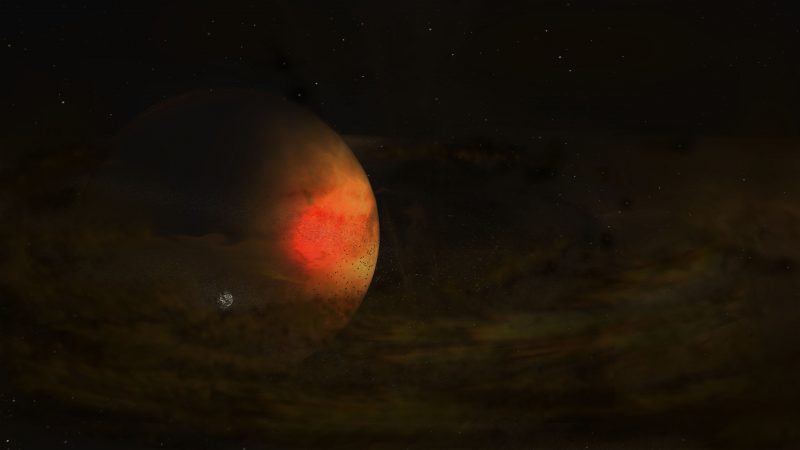
Artist’s concept of mini-Neptune exoplanet GJ 3470 b transiting, or passing in front of, its red dwarf star. In the new study, astronomers used transits and eclipses of the exoplanet to obtain spectroscopic data about the exoplanet’s atmosphere. Image via NASA/ESA/D. PLAYER/UdeMNouvelles.

Planets between the Earth and Neptune in size don’t exist in our solar system, but they seem to be common elsewhere. They are a cross between our solar system’s rocky terrestrial planets and its ice giants. Now, for the first time, astronomers have been able to analyze the atmosphere of one of these “mid-size” distant worlds, which are known, as a class, as mini-Neptunes.

The peer-reviewed findings were announced on July 2, 2019 via Hubblesite, and published in the journal Nature Astronomy on July 1, 2019.

The planet is Gliese 3470 b, a mini-Neptune orbiting a red dwarf star. It weighs a calculated 12.6 Earth masses, making it much more massive than Earth but less massive than Neptune in our solar system (17 Earth masses). If placed in our solar system, Gliese 3470 b would fit nicely between Earth and Neptune in terms of size. It’s thought that the planet has a large rocky core buried beneath a deep crushing atmosphere of hydrogen and helium.

Mini-Neptune interior, atmosphere and debris disk.

Artist’s illustration of both the atmosphere and interior of GJ 3470 b (top), as well as what the system may have looked like when the circumstellar debris disk still existed around the star (bottom). Image via NASA/ESA/L. Hustak (STScI)/Hubblesite.

Thanks to NASA’s Hubble and Spitzer space telescopes, scientists were able to study the atmosphere of Gliese 3470 b, the first time this has been done for a planet of this type. According to Björn Benneke at the University of Montreal in Canada:

This is a big discovery from the planet formation perspective. The planet orbits very close to the star and is far less massive than Jupiter – 318 times Earth’s mass – but has managed to accrete the primordial hydrogen/helium atmosphere that is largely “unpolluted” by heavier elements. We don’t have anything like this in the solar system, and that’s what makes it striking.

The researchers were able to analyze the composition of the atmosphere by measuring the absorption of starlight as the planet passed in front of the star and then passed behind the star. When the planet moves in front of the star, that is a transit, just as when our sun’s inner planets, Mercury or Venus, can be seen to transit the sun as seen from Earth. When it moves behind, that is an eclipse. These astronomers observed 12 transits and 20 eclipses in total, giving them enough data to analyze the atmosphere using spectroscopy (using light to determine the chemical fingerprints of gases in the atmosphere). As Benneke said:

For the first time we have a spectroscopic signature of such a world.

Headshot of smiling Bjorn Benneke.

Astronomer Bjorn Benneke, via UdeMNouvelles.

It also turned out that the atmosphere was mostly clear, with only a few hazes, making the study of its composition that much easier. This was a bit surprising, according to Benneke:

We expected an atmosphere strongly enriched in heavier elements like oxygen and carbon which are forming abundant water vapor and methane gas, similar to what we see on Neptune. Instead, we found an atmosphere that is so poor in heavy elements that its composition resembles the hydrogen/helium rich composition of the sun. If the planet had formed further from the star, where water and other astronomical ices can condense, we would have expected to see more water and methane in the atmosphere.

Earth and a mini-Neptune.

Artist’s concept showing size comparison of GJ 3470 b and Earth. Image via Radialvelocity/Wikipedia/CC BY-SA 4.0.

Even though there is now more data about the planet, there is still a question as to just how it should be classified, according to Bennek. Should it be called a mini-Neptune as referred to now, or rather a super-Earth (larger than Earth but smaller than a typical mini-Neptune)?

Or could this planet be similar to hot Jupiters, giant planets that are similar to Jupiter but orbit close to their stars? Unlike typical hot Jupiters, which are thought to form far out from their stars and then migrate inward, Bennett thinks that Gliese 3470 b formed just where it orbits today. He theorizes it first formed as a dry rocky planet that then rapidly accreted hydrogen from the circumstellar disk of gas and dust around the star, and that the disk dissipated before the planet could become any larger:

We’re seeing an object that was able to accrete hydrogen from the protoplanetary disk, but didn’t runaway to become a hot Jupiter. This is an intriguing regime. The planet got stuck being a sub-Neptune.

Gliese 3470 b is just one example of a mid-size planet, of course, but knowing the composition of its atmosphere helps astronomers understand how these unique worlds formed and evolved, at least in a general sense. This is important, since they appear to be one of the most common kinds of planets out there.

Telescope floating in space.

Artist’s concept of the upcoming James Webb Space Telescope. It will be able to study the atmosphere of Gliese 3470 b and other exoplanets in greater detail than ever before. Image via Northrop Grumman/Gizmodo.

It will also be interesting to see how mini-Neptunes differ from super-Earths, which are also larger than Earth-size planets (0.8 to 1.25 Earth-radii), but a bit smaller than mini-Neptunes (2 to 4 Earth-radii). Most super-Earths are thought to be rocky, and some of them may have global oceans on their surfaces, according to recent research. Along with the super-Earths, the mini-Neptunes are now thought to be the most common type of planets in our galaxy.

In the relatively near future, the upcoming James Webb Space Telescope will also take a look at Gliese 3470 b and study its atmosphere in even greater detail by viewing it in infrared wavelength. Astronomers will observe the transits and eclipses of GJ 3470 b at light wavelengths where the atmospheric hazes become increasingly transparent.

Bottom line: For the first time, astronomers have analyzed the atmosphere of a mid-size exoplanet that is substantially larger than Earth, but smaller than Neptune.

Source: A sub-Neptune exoplanet with a low-metallicity methane-depleted atmosphere and Mie-scattering clouds

Via Hubblesite

Via UdeMNouvelles


from EarthSky https://ift.tt/2Y7As6f
Mini-Neptune exoplanet orbiting red dwarf star.

Artist’s concept of mini-Neptune exoplanet GJ 3470 b transiting, or passing in front of, its red dwarf star. In the new study, astronomers used transits and eclipses of the exoplanet to obtain spectroscopic data about the exoplanet’s atmosphere. Image via NASA/ESA/D. PLAYER/UdeMNouvelles.

Planets between the Earth and Neptune in size don’t exist in our solar system, but they seem to be common elsewhere. They are a cross between our solar system’s rocky terrestrial planets and its ice giants. Now, for the first time, astronomers have been able to analyze the atmosphere of one of these “mid-size” distant worlds, which are known, as a class, as mini-Neptunes.

The peer-reviewed findings were announced on July 2, 2019 via Hubblesite, and published in the journal Nature Astronomy on July 1, 2019.

The planet is Gliese 3470 b, a mini-Neptune orbiting a red dwarf star. It weighs a calculated 12.6 Earth masses, making it much more massive than Earth but less massive than Neptune in our solar system (17 Earth masses). If placed in our solar system, Gliese 3470 b would fit nicely between Earth and Neptune in terms of size. It’s thought that the planet has a large rocky core buried beneath a deep crushing atmosphere of hydrogen and helium.

Mini-Neptune interior, atmosphere and debris disk.

Artist’s illustration of both the atmosphere and interior of GJ 3470 b (top), as well as what the system may have looked like when the circumstellar debris disk still existed around the star (bottom). Image via NASA/ESA/L. Hustak (STScI)/Hubblesite.

Thanks to NASA’s Hubble and Spitzer space telescopes, scientists were able to study the atmosphere of Gliese 3470 b, the first time this has been done for a planet of this type. According to Björn Benneke at the University of Montreal in Canada:

This is a big discovery from the planet formation perspective. The planet orbits very close to the star and is far less massive than Jupiter – 318 times Earth’s mass – but has managed to accrete the primordial hydrogen/helium atmosphere that is largely “unpolluted” by heavier elements. We don’t have anything like this in the solar system, and that’s what makes it striking.

The researchers were able to analyze the composition of the atmosphere by measuring the absorption of starlight as the planet passed in front of the star and then passed behind the star. When the planet moves in front of the star, that is a transit, just as when our sun’s inner planets, Mercury or Venus, can be seen to transit the sun as seen from Earth. When it moves behind, that is an eclipse. These astronomers observed 12 transits and 20 eclipses in total, giving them enough data to analyze the atmosphere using spectroscopy (using light to determine the chemical fingerprints of gases in the atmosphere). As Benneke said:

For the first time we have a spectroscopic signature of such a world.

Headshot of smiling Bjorn Benneke.

Astronomer Bjorn Benneke, via UdeMNouvelles.

It also turned out that the atmosphere was mostly clear, with only a few hazes, making the study of its composition that much easier. This was a bit surprising, according to Benneke:

We expected an atmosphere strongly enriched in heavier elements like oxygen and carbon which are forming abundant water vapor and methane gas, similar to what we see on Neptune. Instead, we found an atmosphere that is so poor in heavy elements that its composition resembles the hydrogen/helium rich composition of the sun. If the planet had formed further from the star, where water and other astronomical ices can condense, we would have expected to see more water and methane in the atmosphere.

Earth and a mini-Neptune.

Artist’s concept showing size comparison of GJ 3470 b and Earth. Image via Radialvelocity/Wikipedia/CC BY-SA 4.0.

Even though there is now more data about the planet, there is still a question as to just how it should be classified, according to Bennek. Should it be called a mini-Neptune as referred to now, or rather a super-Earth (larger than Earth but smaller than a typical mini-Neptune)?

Or could this planet be similar to hot Jupiters, giant planets that are similar to Jupiter but orbit close to their stars? Unlike typical hot Jupiters, which are thought to form far out from their stars and then migrate inward, Bennett thinks that Gliese 3470 b formed just where it orbits today. He theorizes it first formed as a dry rocky planet that then rapidly accreted hydrogen from the circumstellar disk of gas and dust around the star, and that the disk dissipated before the planet could become any larger:

We’re seeing an object that was able to accrete hydrogen from the protoplanetary disk, but didn’t runaway to become a hot Jupiter. This is an intriguing regime. The planet got stuck being a sub-Neptune.

Gliese 3470 b is just one example of a mid-size planet, of course, but knowing the composition of its atmosphere helps astronomers understand how these unique worlds formed and evolved, at least in a general sense. This is important, since they appear to be one of the most common kinds of planets out there.

Telescope floating in space.

Artist’s concept of the upcoming James Webb Space Telescope. It will be able to study the atmosphere of Gliese 3470 b and other exoplanets in greater detail than ever before. Image via Northrop Grumman/Gizmodo.

It will also be interesting to see how mini-Neptunes differ from super-Earths, which are also larger than Earth-size planets (0.8 to 1.25 Earth-radii), but a bit smaller than mini-Neptunes (2 to 4 Earth-radii). Most super-Earths are thought to be rocky, and some of them may have global oceans on their surfaces, according to recent research. Along with the super-Earths, the mini-Neptunes are now thought to be the most common type of planets in our galaxy.

In the relatively near future, the upcoming James Webb Space Telescope will also take a look at Gliese 3470 b and study its atmosphere in even greater detail by viewing it in infrared wavelength. Astronomers will observe the transits and eclipses of GJ 3470 b at light wavelengths where the atmospheric hazes become increasingly transparent.

Bottom line: For the first time, astronomers have analyzed the atmosphere of a mid-size exoplanet that is substantially larger than Earth, but smaller than Neptune.

Source: A sub-Neptune exoplanet with a low-metallicity methane-depleted atmosphere and Mie-scattering clouds

Via Hubblesite

Via UdeMNouvelles


from EarthSky https://ift.tt/2Y7As6f

Gaia starts mapping our Milky Way’s bar

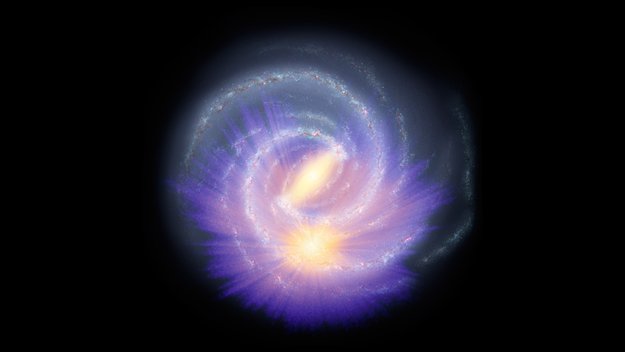
Since its second data release in 2018, the Gaia satellite of the European Space Agency (ESA) has been revolutionizing the way we see our home galaxy, the Milky Way. On July 16, 2019, astronomers mining Gaia data in combination with infrared and optical surveys performed from ground and space – looking specifically at the distribution of 150 million Milky Way stars, of the billion tracked so far by Gaia – announced the first direct measurement of the bar-shaped collection of stars at our galaxy’s center. In the video above, you can see an artist’s concept of this bar, a large and elongated feature made of stars. In the video, orange/yellow hues indicate a greater density of stars (mostly red giants). Our sun is represented by the larger orange/yellow blob in the lower part of the image (in reality, the sun is nowhere near this bright or prominent). Astronomers called this new work:

… the first geometric indication of the galactic bar.

Because Gaia, of course, is all about geometry, about the measurements of points and lines. More specifically, in the language of astronomy, Gaia is about astrometry. The satellite is equipped to measure the positions and brightnesses of Milky Way stars and other objects, over and over, as these objects move in space around the center of our galaxy. In this way, astronomers can obtain exact distances for these objects via parallax. The ultimate goal is to construct a precision 3D map of our Milky Way. Gaia’s measurements are complicated by the fact that our galaxy is a very dusty place, and the dust obscures distant stars. In this study of the galactic bar, astronomers refined their analysis of Gaia data – giving consideration to this dust – via a computer code called StarHorse, developed by co-author Anna Queiroz and collaborators.

Friedrich Anders from University of Barcelona, Spain (@frediferente on Twitter) is lead author of the new study. He said in a statement:

We looked in particular at two of the stellar parameters contained in the Gaia data: the surface temperature of stars and the ‘extinction,’ which is basically a measure of how much dust there is between us and the stars, obscuring their light and making it appear redder.

These two parameters are interconnected, but we can estimate them independently by adding extra information obtained by peering through the dust with infrared observations.

Team member Cristina Chiappini from Leibniz Institute for Astrophysics Potsdam, Germany, added:

With the second Gaia data release, we could probe a radius around the sun of about 6,500 light-years, but with our new catalog, we can extend this ‘Gaia sphere’ by three or four times, reaching out to the center of the Milky Way.

There, these astronomers said – at the center of our galaxy – the data clearly reveal a large, elongated feature in the three-dimensional distribution of stars: the galactic bar. Anders said:

We know the Milky Way has a bar, like other barred spiral galaxies, but so far we only had indirect indications from the motions of stars and gas, or from star counts in infrared surveys. This is the first time that we see the galactic bar in 3D space, based on geometric measurements of stellar distances.

Chiappini added:

Ultimately, we are interested in galactic archaeology: we want to reconstruct how the Milky Way formed and evolved, and to do so we have to understand the history of each and every one of its components.

It is still unclear how the bar – a large amount of stars and gas rotating rigidly around the center of the galaxy – formed, but with Gaia and other upcoming surveys in the next years we are certainly on the right path to figure it out.

The team said it is looking forward to the next data release from the Apache Point Observatory Galaxy Evolution Experiment (APOGEE-2), as well as upcoming facilities such as the 4-metre Multi-Object Survey Telescope (4MOST) at the European Southern Observatory in Chile and the WEAVE (WHT Enhanced Area Velocity Explorer) survey at the William Herschel Telescope (WHT) in La Palma, Canary Islands. Their statement added:

The third Gaia data release, currently planned for 2021, will include greatly improved distance determinations for a much larger number of stars, and is expected to enable progress in our understanding of the complex region at the center of the Milky Way.

Face-on spiral galaxy with two major spiral arms and a central yellow bar with a bulge in the middle.

Artist’s concept of our Milky Way galaxy and its central bar. The larger orange/yellow blob in the lower part of the image is a glorified representation of our sun, showing its approximate location with respect to the bar. Image via ESA.

Bottom line: Data from European Space Agency’s Gaia satellite, combined with infrared and optical surveys performed from ground and space, have enabled astronomers to obtain the first direct measurements of our Milky Way’s central bar.

Via ESA


from EarthSky https://ift.tt/2YhBVeb

Since its second data release in 2018, the Gaia satellite of the European Space Agency (ESA) has been revolutionizing the way we see our home galaxy, the Milky Way. On July 16, 2019, astronomers mining Gaia data in combination with infrared and optical surveys performed from ground and space – looking specifically at the distribution of 150 million Milky Way stars, of the billion tracked so far by Gaia – announced the first direct measurement of the bar-shaped collection of stars at our galaxy’s center. In the video above, you can see an artist’s concept of this bar, a large and elongated feature made of stars. In the video, orange/yellow hues indicate a greater density of stars (mostly red giants). Our sun is represented by the larger orange/yellow blob in the lower part of the image (in reality, the sun is nowhere near this bright or prominent). Astronomers called this new work:

… the first geometric indication of the galactic bar.

Because Gaia, of course, is all about geometry, about the measurements of points and lines. More specifically, in the language of astronomy, Gaia is about astrometry. The satellite is equipped to measure the positions and brightnesses of Milky Way stars and other objects, over and over, as these objects move in space around the center of our galaxy. In this way, astronomers can obtain exact distances for these objects via parallax. The ultimate goal is to construct a precision 3D map of our Milky Way. Gaia’s measurements are complicated by the fact that our galaxy is a very dusty place, and the dust obscures distant stars. In this study of the galactic bar, astronomers refined their analysis of Gaia data – giving consideration to this dust – via a computer code called StarHorse, developed by co-author Anna Queiroz and collaborators.

Friedrich Anders from University of Barcelona, Spain (@frediferente on Twitter) is lead author of the new study. He said in a statement:

We looked in particular at two of the stellar parameters contained in the Gaia data: the surface temperature of stars and the ‘extinction,’ which is basically a measure of how much dust there is between us and the stars, obscuring their light and making it appear redder.

These two parameters are interconnected, but we can estimate them independently by adding extra information obtained by peering through the dust with infrared observations.

Team member Cristina Chiappini from Leibniz Institute for Astrophysics Potsdam, Germany, added:

With the second Gaia data release, we could probe a radius around the sun of about 6,500 light-years, but with our new catalog, we can extend this ‘Gaia sphere’ by three or four times, reaching out to the center of the Milky Way.

There, these astronomers said – at the center of our galaxy – the data clearly reveal a large, elongated feature in the three-dimensional distribution of stars: the galactic bar. Anders said:

We know the Milky Way has a bar, like other barred spiral galaxies, but so far we only had indirect indications from the motions of stars and gas, or from star counts in infrared surveys. This is the first time that we see the galactic bar in 3D space, based on geometric measurements of stellar distances.

Chiappini added:

Ultimately, we are interested in galactic archaeology: we want to reconstruct how the Milky Way formed and evolved, and to do so we have to understand the history of each and every one of its components.

It is still unclear how the bar – a large amount of stars and gas rotating rigidly around the center of the galaxy – formed, but with Gaia and other upcoming surveys in the next years we are certainly on the right path to figure it out.

The team said it is looking forward to the next data release from the Apache Point Observatory Galaxy Evolution Experiment (APOGEE-2), as well as upcoming facilities such as the 4-metre Multi-Object Survey Telescope (4MOST) at the European Southern Observatory in Chile and the WEAVE (WHT Enhanced Area Velocity Explorer) survey at the William Herschel Telescope (WHT) in La Palma, Canary Islands. Their statement added:

The third Gaia data release, currently planned for 2021, will include greatly improved distance determinations for a much larger number of stars, and is expected to enable progress in our understanding of the complex region at the center of the Milky Way.

Face-on spiral galaxy with two major spiral arms and a central yellow bar with a bulge in the middle.

Artist’s concept of our Milky Way galaxy and its central bar. The larger orange/yellow blob in the lower part of the image is a glorified representation of our sun, showing its approximate location with respect to the bar. Image via ESA.

Bottom line: Data from European Space Agency’s Gaia satellite, combined with infrared and optical surveys performed from ground and space, have enabled astronomers to obtain the first direct measurements of our Milky Way’s central bar.

Via ESA


from EarthSky https://ift.tt/2YhBVeb

Are moons forming around this distant gas giant planet?

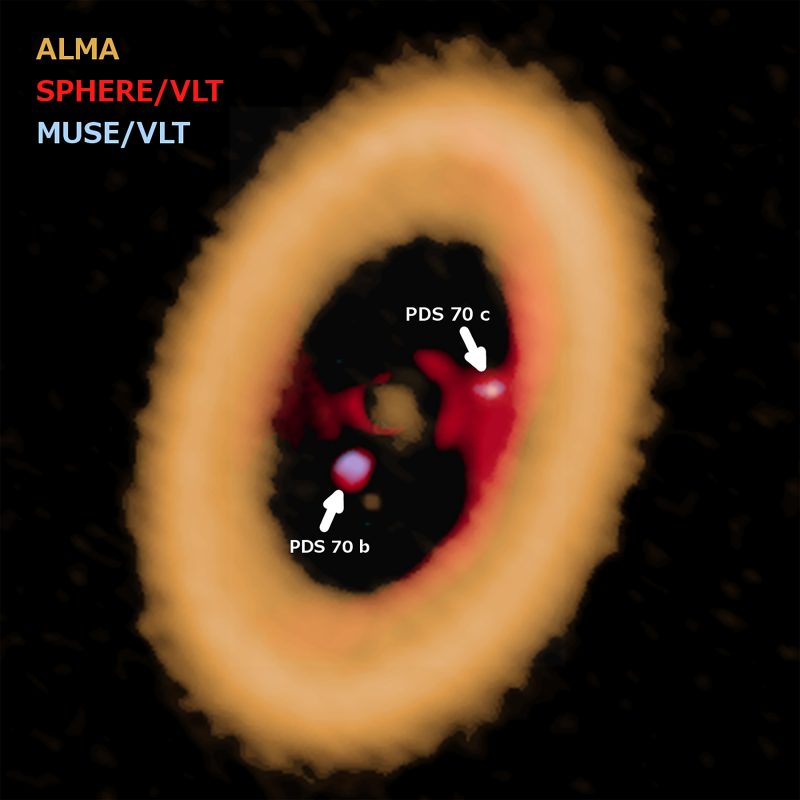
Bright disk around star with two planets.

Composite image of a disk around the young star PDS 70, 370 light-years away. The system’s 2 planets are also marked. Astronomers have found that the young planet designated PDS 70 c has a circumplanetary disk, a possible birthplace of exomoons. Image via ALMA (ESO/NAOJ/NRAO)/A. Isella/ESO.

It’s well-known that planets are born in circumstellar disks of gas and dust that surround young stars, and many of these have been observed by astronomers. Likewise, moons are thought to form in similar disks surrounding planets, but these have been more difficult to find. This month (July 11, 2019), astronomers announced the discovery of just such a disk surrounding a young gas giant planet in the PDS 70 star system, 370 light-years away. It’s the first-ever observation of the kind of circumplanetary disk that is believed to have given birth to the moons of Jupiter, in our solar system, more than 4 billion years ago.

The peer-reviewed discovery paper was published in The Astrophysical Journal Letters on July 11.

Scientists think it is similar to the kind of disk that once surrounded Jupiter and gave birth to its many moons because it surrounds a still-developing young gas giant planet, called PDS 70 c. As astronomer Andrea Isella from Rice University explained:

Planets form from disks of gas and dust around newly forming stars, and if a planet is large enough, it can form its own disk as it gathers material in its orbit around the star. Jupiter and its moons are a little planetary system within our solar system, for example, and it’s believed Jupiter’s moons formed from a circumplanetary disk when Jupiter was very young.

As Isella also noted in an article for the National Radio Astronomy Observatory (NRAO):

For the first time, we can conclusively see the telltale signs of a circumplanetary disk, which helps to support many of the current theories of planet formation. By comparing our observations to the high-resolution infrared and optical images, we can clearly see that an otherwise enigmatic concentration of tiny dust particles is actually a planet-girding disk of dust, the first such feature ever conclusively observed.

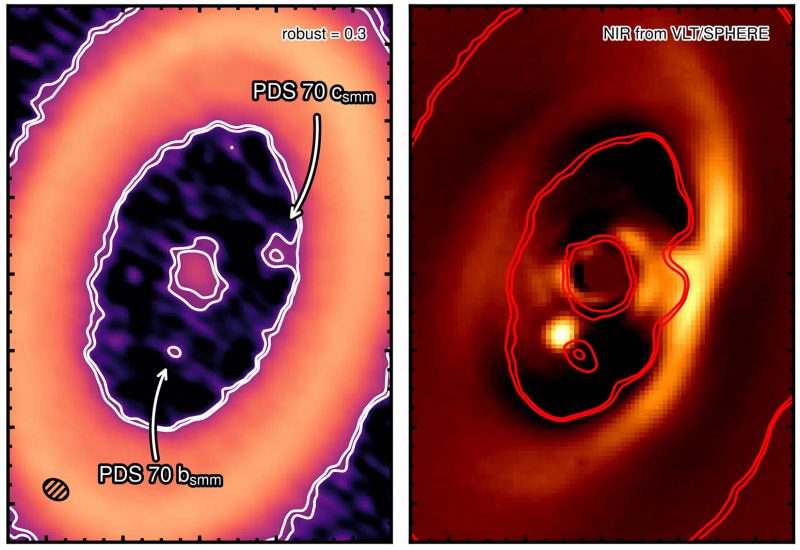
Two different telescopic views of the PDS 70 system.

Comparison of the circumplanetary disk and PDS 70 c, as seen by ALMA (left) and earlier by VLT (right). The infrared image from VLT showed the second planet PDS 70 b, but not PDS 70 c or the disk. Image via A. Isella/ALMA (ESO/NAOJ/NRAO)/Rice University.

These kinds of circumplanetary disks are thought to not last very long, about 10 million years at most, so to find them astronomers need to look at very young star systems, where planets are still forming. Only a handful of candidate planets have been found before. According to Isella:

There are a handful of candidate planets that have been detected in disks, but this is a very new field, and they are all still debated. (PDS 70 b and PDS 70 c) are among the most robust because there have been independent observations with different instruments and techniques.

The astronomers made the discovery using the huge 66-antenna Atacama Large Millimeter/submillimeter Array (ALMA) in Chile; millimeter wave radio signals revealed the presence of dust grains where PDS 70 c and its sister planet, PDS 70 b, are still forming in the larger circumstellar disk.

PDS 70 b had first been observed in 2018 by the SPHERE instrument on the European Southern Observatory’s Very Large Telescope (VLT). SPHERE used infrared light to see the forming planets in the dust disk. In June of this year, astronomers used astronomers used a different VLT instrument called MUSE, which observes in a visible wavelength of light called H-alpha. This wavelength is emitted when hydrogen falls onto a star or planet and becomes ionized. This was even better for confirming that the planets really were there, as Isella explained:

H-alpha gives us more confidence that these are planets because it suggests they are still drawing in gas and dust and growing.

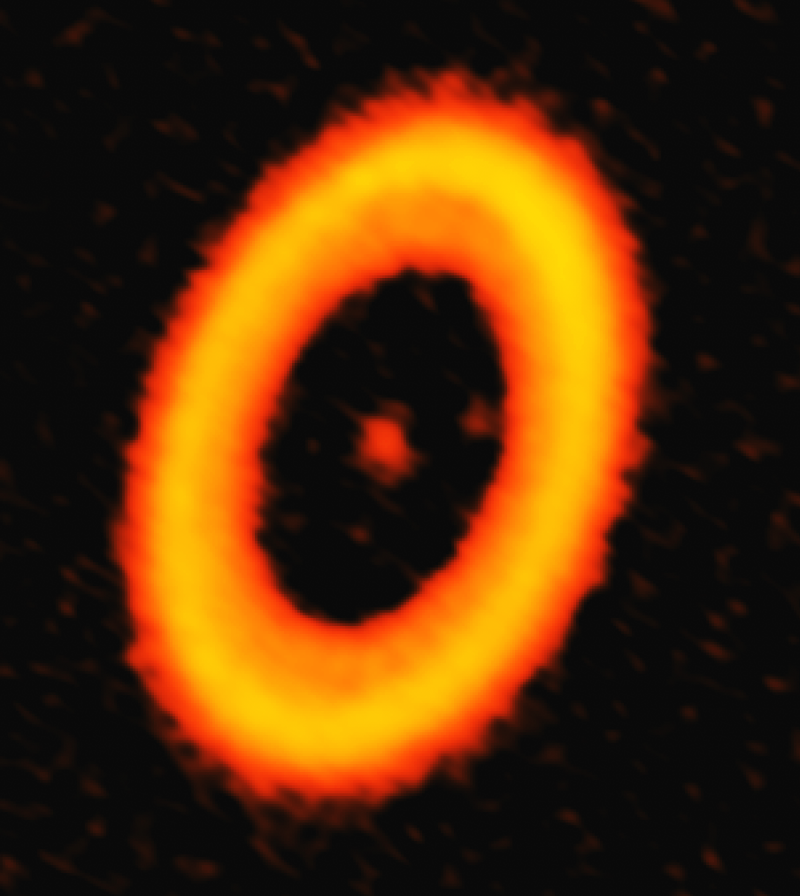
Bright disk surrounding a young star.

ALMA image of the PDS 70 system, showing the larger circumstellar disk surrounding the young star. The two fans small smudges are the two still-forming planets. Image via ALMA (ESO/NAOJ/NRAO)/A. Isella.

The new ALMA observations add to this previous evidence, showing that not only are the planets real, but they have the kind of disks surrounding them that should eventually form moons. Isella added:

It’s complimentary to the optical data and provides completely independent confirmation that there is something there.

The ALMA observations are valuable since they are less limited than those of VLT. As Isella explained:

This means we’ll be able to come back to this system at different time periods and more easily map the orbit of the planets and the concentration of dust in the system. This will give us unique insights into the orbital properties of solar systems in their very earliest stages of development.

The newer ALMA data also shows that there are distinct differences between the two planets. The innermost, PDS 70 b, is about the same distance from its star as Uranus is from our sun, and has a tail-like mass of dust behind it. According to Isella:

What this is and what it means for this planetary system is not yet known. The only conclusive thing we can say is that it is far enough from the planet to be an independent feature.

PDS 70 c, the outermost of the two planets, shines brightly in the infrared and hydrogen bands of light. This means it is likely pretty much a fully-formed planet, although additional nearby gas is still being syphoned onto the planet’s surface. PDS 70 c lies about the same distance from its star as Neptune is from our sun, and its mass is estimated to be anywhere from 1-10 times that of Jupiter. If it is on the larger end of that scale, it could have planet-sized moons, according to Isella:

If the planet is on the larger end of that estimate, it’s quite possible there might be planet-size moons in formation around it.

Andrea Isella

Andrea Isella. Image via Rice University.

One possible planet-sized moon has – maybe –  already been found, orbiting the gas giant planet Kepler-1625b, 8,000 light-years away. This moon, if real, is about the size of Neptune, something unheard of in our solar system. This potential discovery is still a subject of much debate however, and has not been confirmed yet.

These findings are exciting because planetary scientists have long thought that planets in other solar systems should have moons, just like in our own solar system. But finding them is difficult, and none have been confirmed yet, because they are much smaller than their host planets. If circumplanetary disks like the one surrounding PDS 70 c are common, then that would mean that moons are probably common as well. Some, or perhaps even many, of those might be ocean moons like Europa and Enceladus in our solar system, where life could conceivably exist.

Finding more such circumplanetary disks will also help astronomers better understand how planetary systems form overall, according to Isella:

There’s much that we don’t understand about how planets form, and we now finally have the instruments to make direct observations and begin answering questions about how our solar system formed and how other planets might form.

Gas and dust surrounding a planet.

Artist’s concept of the circumplanetary disk of gas and dust surround ing the young gas giant planet PDS 70 c. Evidence suggests there may be moons forming in this disk. Image via NRAO/AUI/NSF/S. Dagnello.

Bottom line: For the first time, astronomers have confirmed a circumplanetary disk of gas and dust around a young gas giant planet, where alien moons might be forming.

Source: Detection of Continuum Submillimeter Emission Associated with Candidate Protoplanets

Via Rice University

Via National Radio Astronomy Observatory


from EarthSky https://ift.tt/2XVN5Gb
Bright disk around star with two planets.

Composite image of a disk around the young star PDS 70, 370 light-years away. The system’s 2 planets are also marked. Astronomers have found that the young planet designated PDS 70 c has a circumplanetary disk, a possible birthplace of exomoons. Image via ALMA (ESO/NAOJ/NRAO)/A. Isella/ESO.

It’s well-known that planets are born in circumstellar disks of gas and dust that surround young stars, and many of these have been observed by astronomers. Likewise, moons are thought to form in similar disks surrounding planets, but these have been more difficult to find. This month (July 11, 2019), astronomers announced the discovery of just such a disk surrounding a young gas giant planet in the PDS 70 star system, 370 light-years away. It’s the first-ever observation of the kind of circumplanetary disk that is believed to have given birth to the moons of Jupiter, in our solar system, more than 4 billion years ago.

The peer-reviewed discovery paper was published in The Astrophysical Journal Letters on July 11.

Scientists think it is similar to the kind of disk that once surrounded Jupiter and gave birth to its many moons because it surrounds a still-developing young gas giant planet, called PDS 70 c. As astronomer Andrea Isella from Rice University explained:

Planets form from disks of gas and dust around newly forming stars, and if a planet is large enough, it can form its own disk as it gathers material in its orbit around the star. Jupiter and its moons are a little planetary system within our solar system, for example, and it’s believed Jupiter’s moons formed from a circumplanetary disk when Jupiter was very young.

As Isella also noted in an article for the National Radio Astronomy Observatory (NRAO):

For the first time, we can conclusively see the telltale signs of a circumplanetary disk, which helps to support many of the current theories of planet formation. By comparing our observations to the high-resolution infrared and optical images, we can clearly see that an otherwise enigmatic concentration of tiny dust particles is actually a planet-girding disk of dust, the first such feature ever conclusively observed.

Two different telescopic views of the PDS 70 system.

Comparison of the circumplanetary disk and PDS 70 c, as seen by ALMA (left) and earlier by VLT (right). The infrared image from VLT showed the second planet PDS 70 b, but not PDS 70 c or the disk. Image via A. Isella/ALMA (ESO/NAOJ/NRAO)/Rice University.

These kinds of circumplanetary disks are thought to not last very long, about 10 million years at most, so to find them astronomers need to look at very young star systems, where planets are still forming. Only a handful of candidate planets have been found before. According to Isella:

There are a handful of candidate planets that have been detected in disks, but this is a very new field, and they are all still debated. (PDS 70 b and PDS 70 c) are among the most robust because there have been independent observations with different instruments and techniques.

The astronomers made the discovery using the huge 66-antenna Atacama Large Millimeter/submillimeter Array (ALMA) in Chile; millimeter wave radio signals revealed the presence of dust grains where PDS 70 c and its sister planet, PDS 70 b, are still forming in the larger circumstellar disk.

PDS 70 b had first been observed in 2018 by the SPHERE instrument on the European Southern Observatory’s Very Large Telescope (VLT). SPHERE used infrared light to see the forming planets in the dust disk. In June of this year, astronomers used astronomers used a different VLT instrument called MUSE, which observes in a visible wavelength of light called H-alpha. This wavelength is emitted when hydrogen falls onto a star or planet and becomes ionized. This was even better for confirming that the planets really were there, as Isella explained:

H-alpha gives us more confidence that these are planets because it suggests they are still drawing in gas and dust and growing.

Bright disk surrounding a young star.

ALMA image of the PDS 70 system, showing the larger circumstellar disk surrounding the young star. The two fans small smudges are the two still-forming planets. Image via ALMA (ESO/NAOJ/NRAO)/A. Isella.

The new ALMA observations add to this previous evidence, showing that not only are the planets real, but they have the kind of disks surrounding them that should eventually form moons. Isella added:

It’s complimentary to the optical data and provides completely independent confirmation that there is something there.

The ALMA observations are valuable since they are less limited than those of VLT. As Isella explained:

This means we’ll be able to come back to this system at different time periods and more easily map the orbit of the planets and the concentration of dust in the system. This will give us unique insights into the orbital properties of solar systems in their very earliest stages of development.

The newer ALMA data also shows that there are distinct differences between the two planets. The innermost, PDS 70 b, is about the same distance from its star as Uranus is from our sun, and has a tail-like mass of dust behind it. According to Isella:

What this is and what it means for this planetary system is not yet known. The only conclusive thing we can say is that it is far enough from the planet to be an independent feature.

PDS 70 c, the outermost of the two planets, shines brightly in the infrared and hydrogen bands of light. This means it is likely pretty much a fully-formed planet, although additional nearby gas is still being syphoned onto the planet’s surface. PDS 70 c lies about the same distance from its star as Neptune is from our sun, and its mass is estimated to be anywhere from 1-10 times that of Jupiter. If it is on the larger end of that scale, it could have planet-sized moons, according to Isella:

If the planet is on the larger end of that estimate, it’s quite possible there might be planet-size moons in formation around it.

Andrea Isella

Andrea Isella. Image via Rice University.

One possible planet-sized moon has – maybe –  already been found, orbiting the gas giant planet Kepler-1625b, 8,000 light-years away. This moon, if real, is about the size of Neptune, something unheard of in our solar system. This potential discovery is still a subject of much debate however, and has not been confirmed yet.

These findings are exciting because planetary scientists have long thought that planets in other solar systems should have moons, just like in our own solar system. But finding them is difficult, and none have been confirmed yet, because they are much smaller than their host planets. If circumplanetary disks like the one surrounding PDS 70 c are common, then that would mean that moons are probably common as well. Some, or perhaps even many, of those might be ocean moons like Europa and Enceladus in our solar system, where life could conceivably exist.

Finding more such circumplanetary disks will also help astronomers better understand how planetary systems form overall, according to Isella:

There’s much that we don’t understand about how planets form, and we now finally have the instruments to make direct observations and begin answering questions about how our solar system formed and how other planets might form.

Gas and dust surrounding a planet.

Artist’s concept of the circumplanetary disk of gas and dust surround ing the young gas giant planet PDS 70 c. Evidence suggests there may be moons forming in this disk. Image via NRAO/AUI/NSF/S. Dagnello.

Bottom line: For the first time, astronomers have confirmed a circumplanetary disk of gas and dust around a young gas giant planet, where alien moons might be forming.

Source: Detection of Continuum Submillimeter Emission Associated with Candidate Protoplanets

Via Rice University

Via National Radio Astronomy Observatory


from EarthSky https://ift.tt/2XVN5Gb

M17 is the Omega Nebula

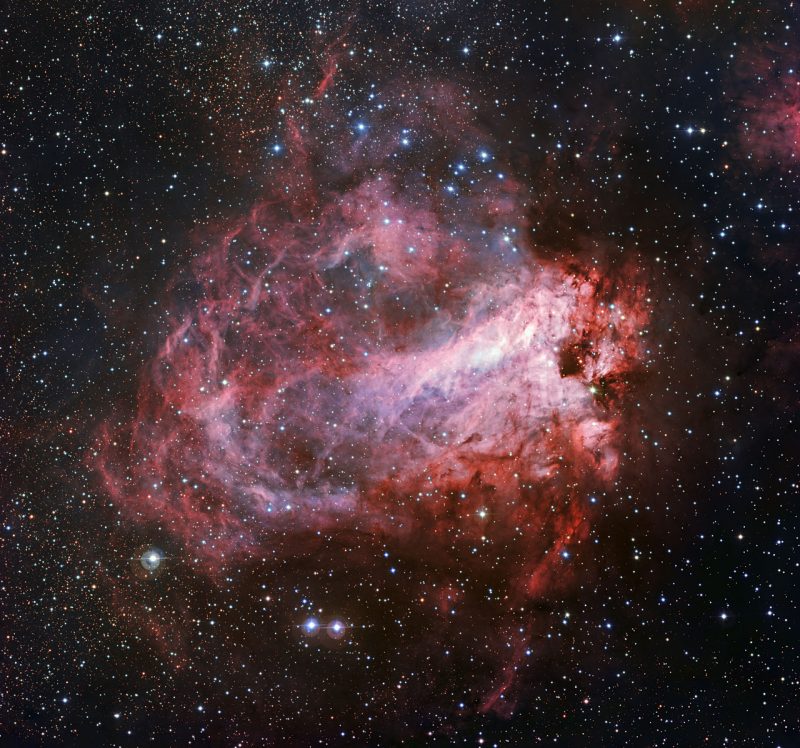
The Wide Field Imager on the 2.2-meter telescope at ESO’s La Silla Observatory in Chile captured this image of the rose-colored star-forming region Messier 17. Image via Messier-objects.com.

Barely visible to the unaided eye on a dark, moonless night, Messier 17 – aka the Omega Nebula – is best seen though binoculars or low power on a telescope. It’s very near another prominent nebula known as Messier 16, the Eagle Nebula, home nebula of the famous Pillars of Creation photograph. These two closely-knit patches of haze readily fit within the same binocular field of view.

Flickr user Mike Durkin captured this image of M16 and M17.

Flickr user Mike Durkin captured this image of M16 and M17.

How to star-hop from the Teapot to Messier 16 and Messier 17

How to see M17. If you want to see deep-sky objects like this one, learn to recognize the constellation Sagittarius the Archer. It’s located in the direction to the center of our Milky Way galaxy; many beautiful star clusters and nebulae can be found in this part of the sky. Luckily, this constellation contains an easy-to-find star pattern, or asterism, in the shape of a teapot. From the legendary Teapot asterism in Sagittarius, it’s fairly easy to star-hop to the Omega Nebula and its companion nebula, M16.

From the Teapot, draw an imaginary line from the star Kaus Austrinus and pass just east (left) of the star Kaus Media to locate M16 and M17. These two nebulae are close together and located about one fist-width above the Teapot.

As seen from the Northern Hemisphere, the Teapot, M16 and M17 are summertime objects. They’re highest up when due south on late August evenings. At the same time, they’re wintertime objects from the Southern Hemisphere, where they’re found closer to overhead.

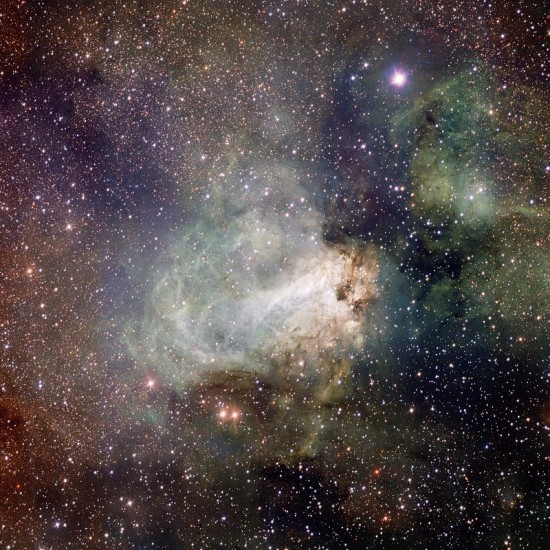
VLT Survey Telescope image of the star-forming region Messier 17. Credit European Southern Observatory. Read more about this image.

VLT Survey Telescope image of the star-forming region Messier 17. Image via European Southern Observatory. Read more about this image.

Science of the Omega Nebula. Like M16, M17 Omega Nebula is a vast interstellar cloud of dust and gas giving birth to young, hot suns. It spans some 15 light-years in diameter. The cloud of interstellar matter of which this nebula is a part is roughly 40 light-years in diameter and has a mass of 30,000 solar masses. The total mass of the Omega Nebula is an estimated 800 solar masses.

The distance to the M17 Omega Nebula isn’t known with precision. There is little doubt that it lies farther away than the more brilliant Great Orion Nebula, the star-forming nebula that’s visible to the unaided eye in January and February. When you look at either M16 or M17, you’re gazing at deep-sky wonders in the next spiral arm inward: the Sagittarius arm of the Milky Way galaxy.

The M17 Omega Nebula is thought to be around 5,000 light-years away. In contrast, the Orion Nebula resides within the Orion spiral arm (the same spiral arm as our solar system) at some 1,300 light-years distant. By the way, the local geometry of the Omega Nebula is similar to that of the Orion Nebula – except that the Omega Nebula is viewed edge-on rather than face-on.

The M17 Omega Nebula also goes by the name Swan Nebula or Horseshoe Nebula.

Messier objects in the direction of the constellation Sagittarius and its Teapot asterism, via Backyard-astro.com.

Competing nebulae. There are many glorious deep-sky objects in this region of the heavens. Two of the most famous patches of nebulosity – M8 and M20 – also vie for your attention, and couple up together within the same binocular field.

Like M16 and M17, this pair resides in the Sagittarius arm and is found by star-hopping from The Teapot. Judge for yourself which pair of stellar nurseries makes the bigger splash!

Bottom line: Barely visible to the unaided eye on a dark, moonless night, the Omega Nebula (Messier 17) is best seen through binoculars, or low power in a telescope.


from EarthSky https://ift.tt/2JGuOno

The Wide Field Imager on the 2.2-meter telescope at ESO’s La Silla Observatory in Chile captured this image of the rose-colored star-forming region Messier 17. Image via Messier-objects.com.

Barely visible to the unaided eye on a dark, moonless night, Messier 17 – aka the Omega Nebula – is best seen though binoculars or low power on a telescope. It’s very near another prominent nebula known as Messier 16, the Eagle Nebula, home nebula of the famous Pillars of Creation photograph. These two closely-knit patches of haze readily fit within the same binocular field of view.

Flickr user Mike Durkin captured this image of M16 and M17.

Flickr user Mike Durkin captured this image of M16 and M17.

How to star-hop from the Teapot to Messier 16 and Messier 17

How to see M17. If you want to see deep-sky objects like this one, learn to recognize the constellation Sagittarius the Archer. It’s located in the direction to the center of our Milky Way galaxy; many beautiful star clusters and nebulae can be found in this part of the sky. Luckily, this constellation contains an easy-to-find star pattern, or asterism, in the shape of a teapot. From the legendary Teapot asterism in Sagittarius, it’s fairly easy to star-hop to the Omega Nebula and its companion nebula, M16.

From the Teapot, draw an imaginary line from the star Kaus Austrinus and pass just east (left) of the star Kaus Media to locate M16 and M17. These two nebulae are close together and located about one fist-width above the Teapot.

As seen from the Northern Hemisphere, the Teapot, M16 and M17 are summertime objects. They’re highest up when due south on late August evenings. At the same time, they’re wintertime objects from the Southern Hemisphere, where they’re found closer to overhead.

VLT Survey Telescope image of the star-forming region Messier 17. Credit European Southern Observatory. Read more about this image.

VLT Survey Telescope image of the star-forming region Messier 17. Image via European Southern Observatory. Read more about this image.

Science of the Omega Nebula. Like M16, M17 Omega Nebula is a vast interstellar cloud of dust and gas giving birth to young, hot suns. It spans some 15 light-years in diameter. The cloud of interstellar matter of which this nebula is a part is roughly 40 light-years in diameter and has a mass of 30,000 solar masses. The total mass of the Omega Nebula is an estimated 800 solar masses.

The distance to the M17 Omega Nebula isn’t known with precision. There is little doubt that it lies farther away than the more brilliant Great Orion Nebula, the star-forming nebula that’s visible to the unaided eye in January and February. When you look at either M16 or M17, you’re gazing at deep-sky wonders in the next spiral arm inward: the Sagittarius arm of the Milky Way galaxy.

The M17 Omega Nebula is thought to be around 5,000 light-years away. In contrast, the Orion Nebula resides within the Orion spiral arm (the same spiral arm as our solar system) at some 1,300 light-years distant. By the way, the local geometry of the Omega Nebula is similar to that of the Orion Nebula – except that the Omega Nebula is viewed edge-on rather than face-on.

The M17 Omega Nebula also goes by the name Swan Nebula or Horseshoe Nebula.

Messier objects in the direction of the constellation Sagittarius and its Teapot asterism, via Backyard-astro.com.

Competing nebulae. There are many glorious deep-sky objects in this region of the heavens. Two of the most famous patches of nebulosity – M8 and M20 – also vie for your attention, and couple up together within the same binocular field.

Like M16 and M17, this pair resides in the Sagittarius arm and is found by star-hopping from The Teapot. Judge for yourself which pair of stellar nurseries makes the bigger splash!

Bottom line: Barely visible to the unaided eye on a dark, moonless night, the Omega Nebula (Messier 17) is best seen through binoculars, or low power in a telescope.


from EarthSky https://ift.tt/2JGuOno

Altair and Aquila the Eagle

In the east after dark on these July evenings, look near the horizon for Altair, the brightest star in the constellation Aquila the Eagle. This is the bottom star of the Summer Triangle; that is, it’s the last of these three bright stars to ascend over the horizon. This star is 16.7 light-years from our sun and is one of the closest stars visible to the unaided eye.

You will recognize Altair by the two fainter stars on either side of it. In her classic book “The Friendly Stars” (1907), Martha Evans Martin described the three this way:

Then there comes a soft June evening, with its lovely twilight that begins with the last song of the woodthrush and ends with the first strenuous admonitions of the whippoorwill; and, almost as if it were an impulse of nature, one walks to the eastern end of the porch and looks for Altair. It is sure to be there smiling at one just over the tree-tops, with a bright companion on either side, the three gently advancing in a straight line as if they were walking the Milky Way hand in hand and three abreast.

And indeed the Great Rift of the summer Milky Way passes through the Summer Triangle, between the stars Vega and Altair. In dark skies in June, July and August, you can see rich star fields with your binoculars on both sides of the Great Rift.

In modern western culture, Altair is probably best known for being the home star system of the aliens in the 1956 science fiction film “Forbidden Planet”. But in Asian cultures, Altair and the star Vega figure in one of the most beautiful of all stories of the night sky. In Japan, for example, Vega is sometimes called Tanabata (or Orihime), a celestial princess or goddess. She falls in love with a mortal, Kengyu (or Hikoboshi), represented by the star Altair. Read the rest of the story here.

The whole Summer Triangle area is great to observe with binoculars or in dark skies with just your eyes. If you like finding hidden pictures, get set to find a Coathanger, the North American Nebula (NGC7000) and the Ring Nebula (M57).

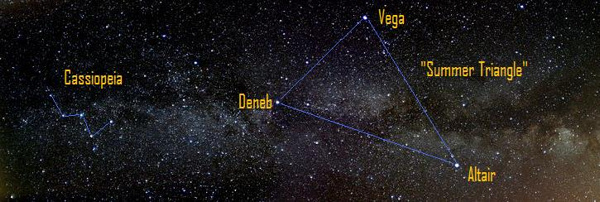
Panorama of Milky Way with dark streak along middle and Summer Triangle lines drawn in.

Great Rift of Milky Way passes through the constellation Cassiopeia and the Summer Triangle.

Our Summer Triangle series also includes:

Part 1: Vega and its constellation Lyra

Part 2: Deneb and its constellation Cygnus

Bottom line: The star Altair in Aquila the Eagle appears in the east on July evenings. You’ll recognize it by the 2 fainter stars on either side of it.

Donate: Your support means the world to us


from EarthSky https://ift.tt/2GmEdhV

In the east after dark on these July evenings, look near the horizon for Altair, the brightest star in the constellation Aquila the Eagle. This is the bottom star of the Summer Triangle; that is, it’s the last of these three bright stars to ascend over the horizon. This star is 16.7 light-years from our sun and is one of the closest stars visible to the unaided eye.

You will recognize Altair by the two fainter stars on either side of it. In her classic book “The Friendly Stars” (1907), Martha Evans Martin described the three this way:

Then there comes a soft June evening, with its lovely twilight that begins with the last song of the woodthrush and ends with the first strenuous admonitions of the whippoorwill; and, almost as if it were an impulse of nature, one walks to the eastern end of the porch and looks for Altair. It is sure to be there smiling at one just over the tree-tops, with a bright companion on either side, the three gently advancing in a straight line as if they were walking the Milky Way hand in hand and three abreast.

And indeed the Great Rift of the summer Milky Way passes through the Summer Triangle, between the stars Vega and Altair. In dark skies in June, July and August, you can see rich star fields with your binoculars on both sides of the Great Rift.

In modern western culture, Altair is probably best known for being the home star system of the aliens in the 1956 science fiction film “Forbidden Planet”. But in Asian cultures, Altair and the star Vega figure in one of the most beautiful of all stories of the night sky. In Japan, for example, Vega is sometimes called Tanabata (or Orihime), a celestial princess or goddess. She falls in love with a mortal, Kengyu (or Hikoboshi), represented by the star Altair. Read the rest of the story here.

The whole Summer Triangle area is great to observe with binoculars or in dark skies with just your eyes. If you like finding hidden pictures, get set to find a Coathanger, the North American Nebula (NGC7000) and the Ring Nebula (M57).

Panorama of Milky Way with dark streak along middle and Summer Triangle lines drawn in.

Great Rift of Milky Way passes through the constellation Cassiopeia and the Summer Triangle.

Our Summer Triangle series also includes:

Part 1: Vega and its constellation Lyra

Part 2: Deneb and its constellation Cygnus

Bottom line: The star Altair in Aquila the Eagle appears in the east on July evenings. You’ll recognize it by the 2 fainter stars on either side of it.

Donate: Your support means the world to us


from EarthSky https://ift.tt/2GmEdhV

2019 SkS Weekly Climate Change & Global Warming News Roundup #29

A chronological listing of news articles posted on the Skeptical Science Facebook Page during the past week, i.e., Sun, July 14 through Sat, July 20, 2019

Editor's Pick

A Climate Action for Every Type of Activist

No matter your age, gender, race, or political ideology, there are ways to fight climate change that fit your life and values.

It's a Match! 

YES! Illustrations by Delphine Lee 

Most of us have heard about U.N. researchers warning that we need to make dramatic changes in the next 12 years to limit our risk of extreme heat, drought, floods, and poverty caused by climate change. Report after report about a bleak climate future can leave people in despair.

But another option is good for you and the planet.

Susan Clayton, a professor of psychology and environmental studies at the College of Wooster, says getting involved with a group can help lift your climate-related anxiety and depression in three ways. Working with like-minded folks can validate your concerns, give you needed social support, and help you move from feeling helpless to empowered.

And it can make a difference. “Groups are more effective than individuals,” Clayton says. “You can see real impact.”

So join forces with like-minded citizens and push for change.

The U.S. Climate Action Network lists more than 175 member organizations, which are activist groups working through energy policy to fight climate change. And that doesn’t include all of the environmental groups out there. So you have lots of options for getting involved.

Full disclosure: I found my activism comfort zone with Citizens’ Climate Lobby. I love its bipartisan, non-confrontational style, and it suits me. What’s your climate action style?

I’ve done some matchmaking for you. Here are nine activism styles that might fit, along with some groups that align with them. Pick one, and you can start making change. 

A Climate Action for Every Type of Activist by Emily Brown, YES! Magazine, July 16, 2019 


Links posted on Facebook

Sun July 14, 2019

Mon July 15, 2019

Tue July 16, 2019

Wed July 17, 2019

Thu July 18, 2019

Fri July 19, 2019

Sat July 20, 2019


from Skeptical Science https://ift.tt/32ErAIJ
A chronological listing of news articles posted on the Skeptical Science Facebook Page during the past week, i.e., Sun, July 14 through Sat, July 20, 2019

Editor's Pick

A Climate Action for Every Type of Activist

No matter your age, gender, race, or political ideology, there are ways to fight climate change that fit your life and values.

It's a Match! 

YES! Illustrations by Delphine Lee 

Most of us have heard about U.N. researchers warning that we need to make dramatic changes in the next 12 years to limit our risk of extreme heat, drought, floods, and poverty caused by climate change. Report after report about a bleak climate future can leave people in despair.

But another option is good for you and the planet.

Susan Clayton, a professor of psychology and environmental studies at the College of Wooster, says getting involved with a group can help lift your climate-related anxiety and depression in three ways. Working with like-minded folks can validate your concerns, give you needed social support, and help you move from feeling helpless to empowered.

And it can make a difference. “Groups are more effective than individuals,” Clayton says. “You can see real impact.”

So join forces with like-minded citizens and push for change.

The U.S. Climate Action Network lists more than 175 member organizations, which are activist groups working through energy policy to fight climate change. And that doesn’t include all of the environmental groups out there. So you have lots of options for getting involved.

Full disclosure: I found my activism comfort zone with Citizens’ Climate Lobby. I love its bipartisan, non-confrontational style, and it suits me. What’s your climate action style?

I’ve done some matchmaking for you. Here are nine activism styles that might fit, along with some groups that align with them. Pick one, and you can start making change. 

A Climate Action for Every Type of Activist by Emily Brown, YES! Magazine, July 16, 2019 


Links posted on Facebook

Sun July 14, 2019

Mon July 15, 2019

Tue July 16, 2019

Wed July 17, 2019

Thu July 18, 2019

Fri July 19, 2019

Sat July 20, 2019


from Skeptical Science https://ift.tt/32ErAIJ

Find the Crown of the Scorpion

The 3 stars of the Scorpion’s Crown: Graffias (Acrab), Dschubba, and Pi Scorpii. Photo via Dennis Chabot.

The constellation Scorpius the Scorpion is one of the few constellations that looks like its name. The red star Antares lies at the Scorpion’s Heart. Two “stinger” stars, Shaula and Lesath, mark the Scorpion’s Tail. Scorpius has another charming feature you should come to know. It’s called the Crown of the Scorpion.

Look for Scorpius as a J-shaped assemblage of stars arcing across the southern sky each summer as seen from the Northern Hemisphere – and crossing overhead in winter skies as seen from the Southern Hemisphere. The Scorpion’s Crown consists of three stars near Antares, which is the brightest star in Scorpius. Individually, the Crown stars are Graffias (or Acrab), Dschubba, and Pi Scorpii.

Scorpius is one of the few constellations that looks like its namesake. The Crown of the Scorpion consists of three stars, located at the top of Scorpius to the right of Antares in this image.

It’s rare when star patterns on our sky’s dome have anything to do with real associations of stars in space, but these three stars are thought to be loosely bound by gravity. All three are located at approximately the same distance, about 500 light-years away. All are thought to be members of the Scorpius-Centaurus Association, which was first recognized by astronomers in the early part of the 20th century.

About 100 stars are known in the Scorpius-Centaurus Association, including Antares.

The Scorpius-Centaurus stars share a common motion through space. They were probably all born from a single vast cloud of gas and dust. In other words, these stars are much like a family – loosely bound – sharing a common history.

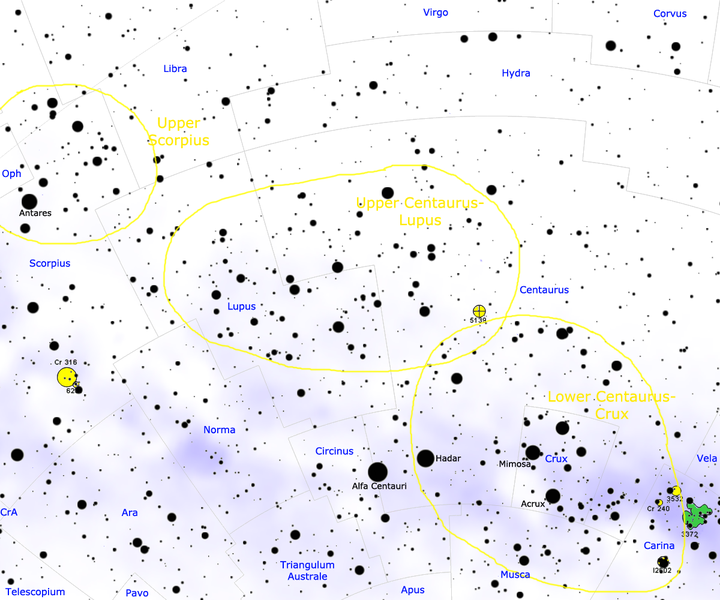
Star map showing the Scorpius-Centaurus Association. The stars of upper Scorpius are part of this association of stars in space. Read more at Wikimedia Commons.

Star map showing the Scorpius-Centaurus Association. The stars of upper Scorpius are part of this association of stars in space. Read more at Wikimedia Commons.

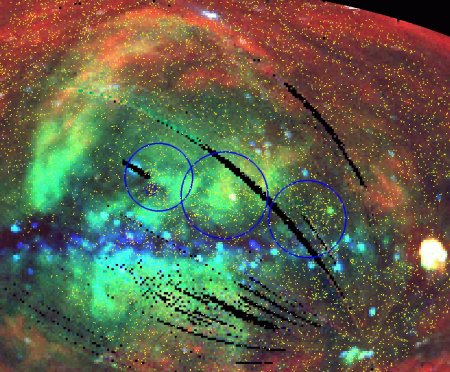
Wide field X-ray image of the Scorpius-Centaurus association constructed from the data of the ROSAT All Sky Survey Background maps. The yellow dots mark the positions of bright X-ray sources detected in the survey (only about 10% of the brightest X-ray sources are shown). The blue circles mark the three subgroups Upper Scorpius, Upper Centaurus-Lupus, and Lower Centaurus-Crux (from left to right). Image and caption via David Darling.

Wide field X-ray image of the Scorpius-Centaurus association constructed from the data of the ROSAT All Sky Survey Background maps. The yellow dots mark the positions of bright X-ray sources detected in the survey (only about 10% of the brightest X-ray sources are shown). The blue circles mark the three subgroups Upper Scorpius, Upper Centaurus-Lupus, and Lower Centaurus-Crux (from left to right). Image and caption via David Darling.

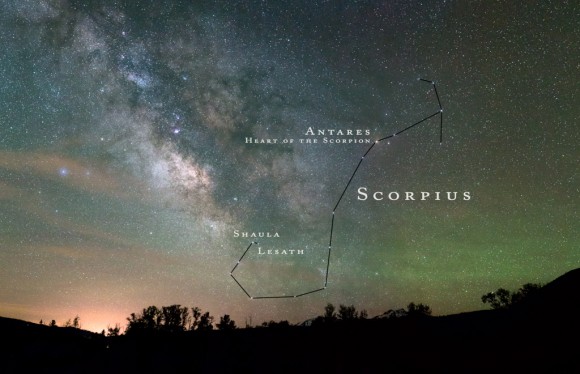
Constellation Scorpius by Daniel McVey.

Constellation Scorpius by Daniel McVey.

Bottom line: How to find the 3 stars – Graffias, Dschubba and Pi Scorpii – known as the Crown of the Scorpion.


from EarthSky https://ift.tt/2O52hMB

The 3 stars of the Scorpion’s Crown: Graffias (Acrab), Dschubba, and Pi Scorpii. Photo via Dennis Chabot.

The constellation Scorpius the Scorpion is one of the few constellations that looks like its name. The red star Antares lies at the Scorpion’s Heart. Two “stinger” stars, Shaula and Lesath, mark the Scorpion’s Tail. Scorpius has another charming feature you should come to know. It’s called the Crown of the Scorpion.

Look for Scorpius as a J-shaped assemblage of stars arcing across the southern sky each summer as seen from the Northern Hemisphere – and crossing overhead in winter skies as seen from the Southern Hemisphere. The Scorpion’s Crown consists of three stars near Antares, which is the brightest star in Scorpius. Individually, the Crown stars are Graffias (or Acrab), Dschubba, and Pi Scorpii.

Scorpius is one of the few constellations that looks like its namesake. The Crown of the Scorpion consists of three stars, located at the top of Scorpius to the right of Antares in this image.

It’s rare when star patterns on our sky’s dome have anything to do with real associations of stars in space, but these three stars are thought to be loosely bound by gravity. All three are located at approximately the same distance, about 500 light-years away. All are thought to be members of the Scorpius-Centaurus Association, which was first recognized by astronomers in the early part of the 20th century.

About 100 stars are known in the Scorpius-Centaurus Association, including Antares.

The Scorpius-Centaurus stars share a common motion through space. They were probably all born from a single vast cloud of gas and dust. In other words, these stars are much like a family – loosely bound – sharing a common history.

Star map showing the Scorpius-Centaurus Association. The stars of upper Scorpius are part of this association of stars in space. Read more at Wikimedia Commons.

Star map showing the Scorpius-Centaurus Association. The stars of upper Scorpius are part of this association of stars in space. Read more at Wikimedia Commons.

Wide field X-ray image of the Scorpius-Centaurus association constructed from the data of the ROSAT All Sky Survey Background maps. The yellow dots mark the positions of bright X-ray sources detected in the survey (only about 10% of the brightest X-ray sources are shown). The blue circles mark the three subgroups Upper Scorpius, Upper Centaurus-Lupus, and Lower Centaurus-Crux (from left to right). Image and caption via David Darling.

Wide field X-ray image of the Scorpius-Centaurus association constructed from the data of the ROSAT All Sky Survey Background maps. The yellow dots mark the positions of bright X-ray sources detected in the survey (only about 10% of the brightest X-ray sources are shown). The blue circles mark the three subgroups Upper Scorpius, Upper Centaurus-Lupus, and Lower Centaurus-Crux (from left to right). Image and caption via David Darling.

Constellation Scorpius by Daniel McVey.

Constellation Scorpius by Daniel McVey.

Bottom line: How to find the 3 stars – Graffias, Dschubba and Pi Scorpii – known as the Crown of the Scorpion.


from EarthSky https://ift.tt/2O52hMB

Morning moon

Blue sky, round white moon above pinkish clouds. Power lines with many birds sitting and flying.

Image via Lee Capps.


from EarthSky https://ift.tt/2JXgI03
Blue sky, round white moon above pinkish clouds. Power lines with many birds sitting and flying.

Image via Lee Capps.


from EarthSky https://ift.tt/2JXgI03

News digest – soaring skin cancer rates, breast milk, 5G and does eating insects really protect against cancer?

Melanoma in younger people on the rise

Our new stats show that the number of 25-49-year olds who have been diagnosed with melanoma skin cancer has soared since 2004, with plenty of media outlets picking up the trend. It’s thought the rise could be down to a number of things such as a growing number of people holidaying in countries where the sun can be stronger and an increased awareness of the disease. Over exposure to harmful UV rays can cause skin cancer which is why we want more people to own their natural skin tone.

Experts debate whether obesity should be recognised as a disease

The Independent has reported on an expert debate in the British Medical Journal about whether obesity should be recognised as a disease. Both sides agree there are complex factors that can lead to obesity and that weight stigma exists in our society.But whether obesity will be recognised as a disease is yet to be decided.

WHO calls for ban on sugary baby food

The World Health Organisation is calling for a ban on baby foods loaded with sugar. It says that even the more savoury flavours are too sugary and are helping babies develop a sweet tooth. Read the Guardian for more.

Cancer treatment containing breast milk is being tested in trials

A cancer treatment containing a molecule found in breast milk has been tested in an early-stage clinical trial. The trial involved 40 people with bladder cancer and was looking at the safety of the potential treatment. It now needs to be tested in a larger group of people to see how effective it might be against cancer. The Telegraph covered this.

Mobile data networks and cancer risk

The BBC looks at whether 5G, the latest mobile network being rolled out by phone providers, poses any health risks. In short, there is no good evidence of a link between mobile phone use and cancer.

No deal Brexit will impact scientific research, says Royal Society President

The Independent reports the Royal Society’s warning for the two Conservative leadership candidates about the future of scientific research in the UK. Professor Sir Venki Ramakrishnan, president of the Royal Society, wrote that a ‘no-deal’ Brexit will severely impact science and innovation.

Promise and price of cell therapies

The New Yorker delves into the history of cell-based cancer treatments, exploring how they’ve evolved over time. Made from human immune cells, these treatments are now used for a variety of diseases, such as the personalised treatment called CAR T cell therapy that’s available for some NHS blood cancer patients.

Second breast cancer treatment combo added to England’s Cancer Drugs Fund

We reported the latest breast cancer treatments made available to patients on the NHS in England. Price negations with the manufacturers of a targeted drug now mean some people with advanced breast cancer will have access to a combination treatment that can slow disease progression.

And finally

The Telegraph claims that eating insects could help protect against cancer, after scientists said that ants contain lots of antioxidants, which are found in so-called ‘superfoods’. But is ant eating really a way of preventing cancer? Not based on this research. The scientists didn’t actually test whether eating ants could prevent cancer in people. And evidence shows it’s unlikely that one specific type of food, on its own, could have a big impact on cancer risk. Your overall diet is more important for reducing cancer risk than eating particular individual foods.

Gabi


from Cancer Research UK – Science blog https://ift.tt/2xYLBeW

Melanoma in younger people on the rise

Our new stats show that the number of 25-49-year olds who have been diagnosed with melanoma skin cancer has soared since 2004, with plenty of media outlets picking up the trend. It’s thought the rise could be down to a number of things such as a growing number of people holidaying in countries where the sun can be stronger and an increased awareness of the disease. Over exposure to harmful UV rays can cause skin cancer which is why we want more people to own their natural skin tone.

Experts debate whether obesity should be recognised as a disease

The Independent has reported on an expert debate in the British Medical Journal about whether obesity should be recognised as a disease. Both sides agree there are complex factors that can lead to obesity and that weight stigma exists in our society.But whether obesity will be recognised as a disease is yet to be decided.

WHO calls for ban on sugary baby food

The World Health Organisation is calling for a ban on baby foods loaded with sugar. It says that even the more savoury flavours are too sugary and are helping babies develop a sweet tooth. Read the Guardian for more.

Cancer treatment containing breast milk is being tested in trials

A cancer treatment containing a molecule found in breast milk has been tested in an early-stage clinical trial. The trial involved 40 people with bladder cancer and was looking at the safety of the potential treatment. It now needs to be tested in a larger group of people to see how effective it might be against cancer. The Telegraph covered this.

Mobile data networks and cancer risk

The BBC looks at whether 5G, the latest mobile network being rolled out by phone providers, poses any health risks. In short, there is no good evidence of a link between mobile phone use and cancer.

No deal Brexit will impact scientific research, says Royal Society President

The Independent reports the Royal Society’s warning for the two Conservative leadership candidates about the future of scientific research in the UK. Professor Sir Venki Ramakrishnan, president of the Royal Society, wrote that a ‘no-deal’ Brexit will severely impact science and innovation.

Promise and price of cell therapies

The New Yorker delves into the history of cell-based cancer treatments, exploring how they’ve evolved over time. Made from human immune cells, these treatments are now used for a variety of diseases, such as the personalised treatment called CAR T cell therapy that’s available for some NHS blood cancer patients.

Second breast cancer treatment combo added to England’s Cancer Drugs Fund

We reported the latest breast cancer treatments made available to patients on the NHS in England. Price negations with the manufacturers of a targeted drug now mean some people with advanced breast cancer will have access to a combination treatment that can slow disease progression.

And finally

The Telegraph claims that eating insects could help protect against cancer, after scientists said that ants contain lots of antioxidants, which are found in so-called ‘superfoods’. But is ant eating really a way of preventing cancer? Not based on this research. The scientists didn’t actually test whether eating ants could prevent cancer in people. And evidence shows it’s unlikely that one specific type of food, on its own, could have a big impact on cancer risk. Your overall diet is more important for reducing cancer risk than eating particular individual foods.

Gabi


from Cancer Research UK – Science blog https://ift.tt/2xYLBeW

Deneb and Cygnus the Swan

Tonight’s chart has you looking eastward at the famous Summer Triangle. Today, notice the star Deneb, the northernmost star in the Summer Triangle. Its constellation is Cygnus the Swan. In a dark country sky, you can see that Cygnus is flying along the starlit trail of the summer Milky Way.

The photo below is from Annie Lewis in Spain. She solved the problem of picking out the Summer Triangle from among many stars in the night sky by looking for the Triangle in the east soon after sunset. These three stars are, after all, among the brightest in the sky.

EarthSky’s meteor shower guide for 2019

EarthSky astronomy kits are perfect for beginners. Order yours today.

Medium blue sky with a few scattered stars, three bright ones labeled.

EarthSky Facebook friend Annie Lewis in Madrid, Spain, captured this photo of the Summer Triangle shortly after nightfall on a summer night. In fact, she said, the only stars visible to the unaided eye when she took the photo were the three in the Triangle. But her camera knew better. Thanks, Annie.

If it’s darker out, you might recognize the Summer Triangle by noticing that there is a cross within the Triangle. The constellation Cygnus is that cross. In fact, the constellation Cygnus is sometimes called the Northern Cross.

Okay, I’ve given you a lot of names here: Summer Triangle, Cygnus, Northern Cross.

Just remember, the constellation Cygnus the Swan contains the Northern Cross. The Cross is – more or less – just another way to see the Swan. The Northern Cross is what’s called an asterism, or recognizable pattern within a constellation. In this case, the pattern is the whole constellation, pretty much. At least, I never see them any differently.

Except for one thing. Deneb is at the top of the Cross, but at the tail of the Swan (the star name “deneb” always means “tail”). The little star Albireo is at the head of the Swan, but at the base of the Cross. Whew!

Our Summer Triangle series also includes:

Part 1: Vega and its constellation Lyra

Part 3: Altair and its constellation Aquila

Bottom line: The Summer Triangle consists of 3 bright stars in 3 different constellations. Deneb is the tail of Cygnus the Swan.

Help support posts like these at the EarthSky store. Fun astronomy gifts and tools for all ages!


from EarthSky https://ift.tt/2Lym1pZ

Tonight’s chart has you looking eastward at the famous Summer Triangle. Today, notice the star Deneb, the northernmost star in the Summer Triangle. Its constellation is Cygnus the Swan. In a dark country sky, you can see that Cygnus is flying along the starlit trail of the summer Milky Way.

The photo below is from Annie Lewis in Spain. She solved the problem of picking out the Summer Triangle from among many stars in the night sky by looking for the Triangle in the east soon after sunset. These three stars are, after all, among the brightest in the sky.

EarthSky’s meteor shower guide for 2019

EarthSky astronomy kits are perfect for beginners. Order yours today.

Medium blue sky with a few scattered stars, three bright ones labeled.

EarthSky Facebook friend Annie Lewis in Madrid, Spain, captured this photo of the Summer Triangle shortly after nightfall on a summer night. In fact, she said, the only stars visible to the unaided eye when she took the photo were the three in the Triangle. But her camera knew better. Thanks, Annie.

If it’s darker out, you might recognize the Summer Triangle by noticing that there is a cross within the Triangle. The constellation Cygnus is that cross. In fact, the constellation Cygnus is sometimes called the Northern Cross.

Okay, I’ve given you a lot of names here: Summer Triangle, Cygnus, Northern Cross.

Just remember, the constellation Cygnus the Swan contains the Northern Cross. The Cross is – more or less – just another way to see the Swan. The Northern Cross is what’s called an asterism, or recognizable pattern within a constellation. In this case, the pattern is the whole constellation, pretty much. At least, I never see them any differently.

Except for one thing. Deneb is at the top of the Cross, but at the tail of the Swan (the star name “deneb” always means “tail”). The little star Albireo is at the head of the Swan, but at the base of the Cross. Whew!

Our Summer Triangle series also includes:

Part 1: Vega and its constellation Lyra

Part 3: Altair and its constellation Aquila

Bottom line: The Summer Triangle consists of 3 bright stars in 3 different constellations. Deneb is the tail of Cygnus the Swan.

Help support posts like these at the EarthSky store. Fun astronomy gifts and tools for all ages!


from EarthSky https://ift.tt/2Lym1pZ

Planting a flag on the moon

View from above of 2 astronauts in spacesuits deploying a US flag on the moon.

Neil A. Armstrong (left) and Edwin E. “Buzz” Aldrin, Jr. (right) with the flag on the moon during the Apollo 11 extravehicular activity. Image via NASA.

By Andrea Eastrada, University of California, Santa Barbara

When Apollo 11 astronauts Neil Armstrong and Buzz Aldrin planted the United States flag on the moon 50 years ago this month — July 20, 1969, to be exact — it was a team effort.

It also represented a major feat of engineering.

Annie Platoff, a librarian at the University of California, Santa Barbara Library and a leading expert on the Apollo program’s placement of flags on the lunar surface, said:

The flag on the moon is a great illustration of the fact that in space, nothing is simple. For me, the flag on the moon is an excellent example of something that seems very, very simple, but once you really start thinking about it, you realize is very complex.

US flag, astronaut near bent leg of Apollo 11 lunar lander. Lander's shadow on the gray lunar surface. Black sky.

Astronaut Neil Armstrong on the moon. Image via NASA.

The lunar flagpole

With virtually no atmosphere on the moon – and, therefore, no wind – flags that fly freely on Earth would hang like limp cloth in the lunar environment. So engineers had to rethink flagpole design entirely, according to Platoff. On an earthbound flagpole, the flag is attached at the hoist – the vertical section closest to the pole – at both the top and bottom of the flag. The pole might slide through a sleeve on the hoist side of the flag, or be attached by grommets or some other type of fastener. A lunar flag, however, is anchored to the pole only at the bottom. It is held in place mainly by a horizontal crossbar at the top. Platoff explained:

A lunar flagpole has three parts. There are two vertical sections, and then the horizontal crossbar that’s hinged at the top of the upper vertical section. To deploy the flag, one astronaut used a sampling hammer to pound the lower vertical section into the ground. The other astronaut extended the telescoping crossbar and raised it to a 90-degree angle with the vertical section to click it into place. Then the two astronauts slid the upper part of the pole into the lower one.

Once they got the flag up, several factors made it look as though it was flying. First there were wrinkles in it because of how tightly it was packed. And these add to the illusion that the flag is waving. Also, the astronauts didn’t always get the horizontal crossbar extended all the way – they were working in pressurized spacesuits and really cumbersome gloves, after all – which caused the flag to bunch up in places. That also made it look like it’s waving.

3 metal bars and folded flag with metal attachment along short edge.

Elements of the lunar flag assembly included the flag pole, an insulating blanket, and a thermal protective shroud. Photo via NASA.

Traveling into space

Simply getting the flag to the moon also proved a challenge for NASA engineers. Platoff said:

The Apollo 11 and 12 flags were stored on the ladder of the lunar module. It was kind of a last-minute add-on, and I think that’s why they picked that location. But they had to protect it from the engines of the lunar module. As the astronauts were coming down to land, they were firing the engines to slow themselves down. And those engines got really hot. Without adequate thermal protection, the flag would have been gone.

To protect Old Glory, engineers built a metal shroud that went around the apparatus on the ladder. They also added some insulating blanket material. On later missions, the flag was moved to a storage compartment outside the lunar module. Platoff said:

It was basically the space where they kept their cameras, hammers, sampling scoops and other equipment. And that area was already thermally protected.

Sketch of a flag and flagpole with different parts labeled and measurements.

NASA engineer Jack Kinzler’s original sketch of the lunar flag assembly. Image via Jack Kinzler.

A woman wearing a scarf printed with flags of all nations, holding a small US flag.

Annie Platoff holds a fireproof silica fiber beta cloth American flag patch for an Apollo-era spacesuit. Read more about Platoff. Image via Daniel Smith.

Bottom line: Fifty years after the Apollo 11 moon walk, the challenge of planting the flag on the moon.

Via University of California, Santa Barbara


from EarthSky https://ift.tt/2JM5fAk
View from above of 2 astronauts in spacesuits deploying a US flag on the moon.

Neil A. Armstrong (left) and Edwin E. “Buzz” Aldrin, Jr. (right) with the flag on the moon during the Apollo 11 extravehicular activity. Image via NASA.

By Andrea Eastrada, University of California, Santa Barbara

When Apollo 11 astronauts Neil Armstrong and Buzz Aldrin planted the United States flag on the moon 50 years ago this month — July 20, 1969, to be exact — it was a team effort.

It also represented a major feat of engineering.

Annie Platoff, a librarian at the University of California, Santa Barbara Library and a leading expert on the Apollo program’s placement of flags on the lunar surface, said:

The flag on the moon is a great illustration of the fact that in space, nothing is simple. For me, the flag on the moon is an excellent example of something that seems very, very simple, but once you really start thinking about it, you realize is very complex.

US flag, astronaut near bent leg of Apollo 11 lunar lander. Lander's shadow on the gray lunar surface. Black sky.

Astronaut Neil Armstrong on the moon. Image via NASA.

The lunar flagpole

With virtually no atmosphere on the moon – and, therefore, no wind – flags that fly freely on Earth would hang like limp cloth in the lunar environment. So engineers had to rethink flagpole design entirely, according to Platoff. On an earthbound flagpole, the flag is attached at the hoist – the vertical section closest to the pole – at both the top and bottom of the flag. The pole might slide through a sleeve on the hoist side of the flag, or be attached by grommets or some other type of fastener. A lunar flag, however, is anchored to the pole only at the bottom. It is held in place mainly by a horizontal crossbar at the top. Platoff explained:

A lunar flagpole has three parts. There are two vertical sections, and then the horizontal crossbar that’s hinged at the top of the upper vertical section. To deploy the flag, one astronaut used a sampling hammer to pound the lower vertical section into the ground. The other astronaut extended the telescoping crossbar and raised it to a 90-degree angle with the vertical section to click it into place. Then the two astronauts slid the upper part of the pole into the lower one.

Once they got the flag up, several factors made it look as though it was flying. First there were wrinkles in it because of how tightly it was packed. And these add to the illusion that the flag is waving. Also, the astronauts didn’t always get the horizontal crossbar extended all the way – they were working in pressurized spacesuits and really cumbersome gloves, after all – which caused the flag to bunch up in places. That also made it look like it’s waving.

3 metal bars and folded flag with metal attachment along short edge.

Elements of the lunar flag assembly included the flag pole, an insulating blanket, and a thermal protective shroud. Photo via NASA.

Traveling into space

Simply getting the flag to the moon also proved a challenge for NASA engineers. Platoff said:

The Apollo 11 and 12 flags were stored on the ladder of the lunar module. It was kind of a last-minute add-on, and I think that’s why they picked that location. But they had to protect it from the engines of the lunar module. As the astronauts were coming down to land, they were firing the engines to slow themselves down. And those engines got really hot. Without adequate thermal protection, the flag would have been gone.

To protect Old Glory, engineers built a metal shroud that went around the apparatus on the ladder. They also added some insulating blanket material. On later missions, the flag was moved to a storage compartment outside the lunar module. Platoff said:

It was basically the space where they kept their cameras, hammers, sampling scoops and other equipment. And that area was already thermally protected.

Sketch of a flag and flagpole with different parts labeled and measurements.

NASA engineer Jack Kinzler’s original sketch of the lunar flag assembly. Image via Jack Kinzler.

A woman wearing a scarf printed with flags of all nations, holding a small US flag.

Annie Platoff holds a fireproof silica fiber beta cloth American flag patch for an Apollo-era spacesuit. Read more about Platoff. Image via Daniel Smith.

Bottom line: Fifty years after the Apollo 11 moon walk, the challenge of planting the flag on the moon.

Via University of California, Santa Barbara


from EarthSky https://ift.tt/2JM5fAk

adds 2