aads

Altair and Aquila the Eagle

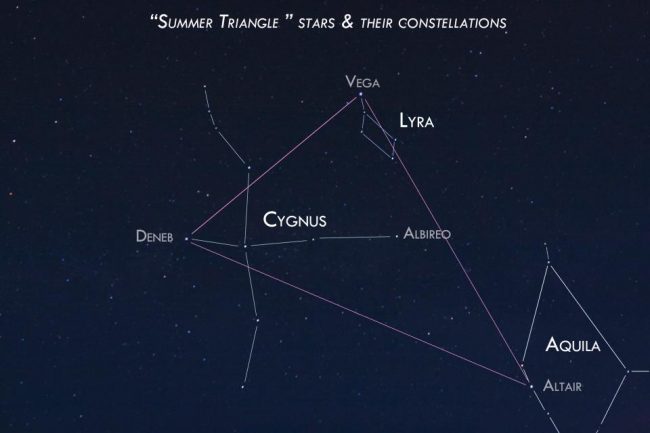
In the east after dark on these July evenings, look near the horizon for Altair, the brightest star in the constellation Aquila the Eagle. This is the bottom star of the Summer Triangle; that is, it’s the last of these three bright stars to ascend over the horizon. This star is 16.7 light-years from our sun and is one of the closest stars visible to the unaided eye.

You will recognize Altair by the two fainter stars on either side of it. In her classic book “The Friendly Stars” (1907), Martha Evans Martin described the three this way:

Then there comes a soft June evening, with its lovely twilight that begins with the last song of the woodthrush and ends with the first strenuous admonitions of the whippoorwill; and, almost as if it were an impulse of nature, one walks to the eastern end of the porch and looks for Altair. It is sure to be there smiling at one just over the tree-tops, with a bright companion on either side, the three gently advancing in a straight line as if they were walking the Milky Way hand in hand and three abreast.

And indeed the Great Rift of the summer Milky Way passes through the Summer Triangle, between the stars Vega and Altair. In dark skies in June, July and August, you can see rich star fields with your binoculars on both sides of the Great Rift.

In modern western culture, Altair is probably best known for being the home star system of the aliens in the 1956 science fiction film “Forbidden Planet”. But in Asian cultures, Altair and the star Vega figure in one of the most beautiful of all stories of the night sky. In Japan, for example, Vega is sometimes called Tanabata (or Orihime), a celestial princess or goddess. She falls in love with a mortal, Kengyu (or Hikoboshi), represented by the star Altair. Read the rest of the story here.

The whole Summer Triangle area is great to observe with binoculars or in dark skies with just your eyes. If you like finding hidden pictures, get set to find a Coathanger, the North American Nebula (NGC7000) and the Ring Nebula (M57).

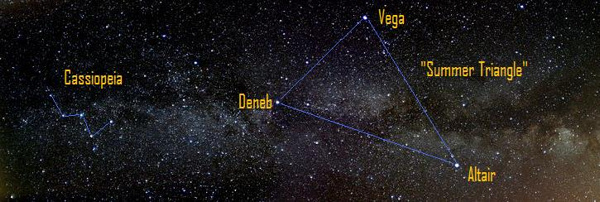
Panorama of Milky Way with dark streak along middle and Summer Triangle lines drawn in.

Great Rift of Milky Way passes through the constellation Cassiopeia and the Summer Triangle.

Our Summer Triangle series also includes:

Part 1: Vega and its constellation Lyra

Part 2: Deneb and its constellation Cygnus

Bottom line: The star Altair in Aquila the Eagle appears in the east on July evenings. You’ll recognize it by the 2 fainter stars on either side of it.

Donate: Your support means the world to us


from EarthSky https://ift.tt/2GmEdhV

In the east after dark on these July evenings, look near the horizon for Altair, the brightest star in the constellation Aquila the Eagle. This is the bottom star of the Summer Triangle; that is, it’s the last of these three bright stars to ascend over the horizon. This star is 16.7 light-years from our sun and is one of the closest stars visible to the unaided eye.

You will recognize Altair by the two fainter stars on either side of it. In her classic book “The Friendly Stars” (1907), Martha Evans Martin described the three this way:

Then there comes a soft June evening, with its lovely twilight that begins with the last song of the woodthrush and ends with the first strenuous admonitions of the whippoorwill; and, almost as if it were an impulse of nature, one walks to the eastern end of the porch and looks for Altair. It is sure to be there smiling at one just over the tree-tops, with a bright companion on either side, the three gently advancing in a straight line as if they were walking the Milky Way hand in hand and three abreast.

And indeed the Great Rift of the summer Milky Way passes through the Summer Triangle, between the stars Vega and Altair. In dark skies in June, July and August, you can see rich star fields with your binoculars on both sides of the Great Rift.

In modern western culture, Altair is probably best known for being the home star system of the aliens in the 1956 science fiction film “Forbidden Planet”. But in Asian cultures, Altair and the star Vega figure in one of the most beautiful of all stories of the night sky. In Japan, for example, Vega is sometimes called Tanabata (or Orihime), a celestial princess or goddess. She falls in love with a mortal, Kengyu (or Hikoboshi), represented by the star Altair. Read the rest of the story here.

The whole Summer Triangle area is great to observe with binoculars or in dark skies with just your eyes. If you like finding hidden pictures, get set to find a Coathanger, the North American Nebula (NGC7000) and the Ring Nebula (M57).

Panorama of Milky Way with dark streak along middle and Summer Triangle lines drawn in.

Great Rift of Milky Way passes through the constellation Cassiopeia and the Summer Triangle.

Our Summer Triangle series also includes:

Part 1: Vega and its constellation Lyra

Part 2: Deneb and its constellation Cygnus

Bottom line: The star Altair in Aquila the Eagle appears in the east on July evenings. You’ll recognize it by the 2 fainter stars on either side of it.

Donate: Your support means the world to us


from EarthSky https://ift.tt/2GmEdhV

2019 SkS Weekly Climate Change & Global Warming News Roundup #29

A chronological listing of news articles posted on the Skeptical Science Facebook Page during the past week, i.e., Sun, July 14 through Sat, July 20, 2019

Editor's Pick

A Climate Action for Every Type of Activist

No matter your age, gender, race, or political ideology, there are ways to fight climate change that fit your life and values.

It's a Match! 

YES! Illustrations by Delphine Lee 

Most of us have heard about U.N. researchers warning that we need to make dramatic changes in the next 12 years to limit our risk of extreme heat, drought, floods, and poverty caused by climate change. Report after report about a bleak climate future can leave people in despair.

But another option is good for you and the planet.

Susan Clayton, a professor of psychology and environmental studies at the College of Wooster, says getting involved with a group can help lift your climate-related anxiety and depression in three ways. Working with like-minded folks can validate your concerns, give you needed social support, and help you move from feeling helpless to empowered.

And it can make a difference. “Groups are more effective than individuals,” Clayton says. “You can see real impact.”

So join forces with like-minded citizens and push for change.

The U.S. Climate Action Network lists more than 175 member organizations, which are activist groups working through energy policy to fight climate change. And that doesn’t include all of the environmental groups out there. So you have lots of options for getting involved.

Full disclosure: I found my activism comfort zone with Citizens’ Climate Lobby. I love its bipartisan, non-confrontational style, and it suits me. What’s your climate action style?

I’ve done some matchmaking for you. Here are nine activism styles that might fit, along with some groups that align with them. Pick one, and you can start making change. 

A Climate Action for Every Type of Activist by Emily Brown, YES! Magazine, July 16, 2019 


Links posted on Facebook

Sun July 14, 2019

Mon July 15, 2019

Tue July 16, 2019

Wed July 17, 2019

Thu July 18, 2019

Fri July 19, 2019

Sat July 20, 2019


from Skeptical Science https://ift.tt/32ErAIJ
A chronological listing of news articles posted on the Skeptical Science Facebook Page during the past week, i.e., Sun, July 14 through Sat, July 20, 2019

Editor's Pick

A Climate Action for Every Type of Activist

No matter your age, gender, race, or political ideology, there are ways to fight climate change that fit your life and values.

It's a Match! 

YES! Illustrations by Delphine Lee 

Most of us have heard about U.N. researchers warning that we need to make dramatic changes in the next 12 years to limit our risk of extreme heat, drought, floods, and poverty caused by climate change. Report after report about a bleak climate future can leave people in despair.

But another option is good for you and the planet.

Susan Clayton, a professor of psychology and environmental studies at the College of Wooster, says getting involved with a group can help lift your climate-related anxiety and depression in three ways. Working with like-minded folks can validate your concerns, give you needed social support, and help you move from feeling helpless to empowered.

And it can make a difference. “Groups are more effective than individuals,” Clayton says. “You can see real impact.”

So join forces with like-minded citizens and push for change.

The U.S. Climate Action Network lists more than 175 member organizations, which are activist groups working through energy policy to fight climate change. And that doesn’t include all of the environmental groups out there. So you have lots of options for getting involved.

Full disclosure: I found my activism comfort zone with Citizens’ Climate Lobby. I love its bipartisan, non-confrontational style, and it suits me. What’s your climate action style?

I’ve done some matchmaking for you. Here are nine activism styles that might fit, along with some groups that align with them. Pick one, and you can start making change. 

A Climate Action for Every Type of Activist by Emily Brown, YES! Magazine, July 16, 2019 


Links posted on Facebook

Sun July 14, 2019

Mon July 15, 2019

Tue July 16, 2019

Wed July 17, 2019

Thu July 18, 2019

Fri July 19, 2019

Sat July 20, 2019


from Skeptical Science https://ift.tt/32ErAIJ

Find the Crown of the Scorpion

The 3 stars of the Scorpion’s Crown: Graffias (Acrab), Dschubba, and Pi Scorpii. Photo via Dennis Chabot.

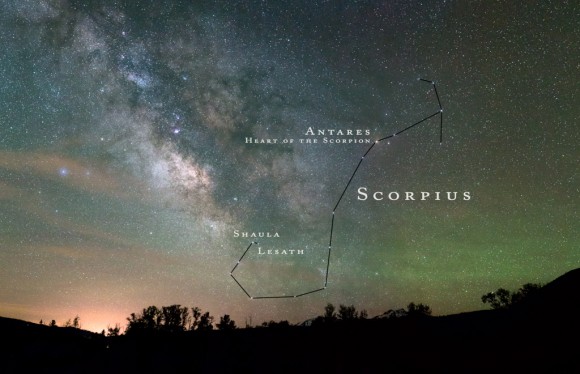
The constellation Scorpius the Scorpion is one of the few constellations that looks like its name. The red star Antares lies at the Scorpion’s Heart. Two “stinger” stars, Shaula and Lesath, mark the Scorpion’s Tail. Scorpius has another charming feature you should come to know. It’s called the Crown of the Scorpion.

Look for Scorpius as a J-shaped assemblage of stars arcing across the southern sky each summer as seen from the Northern Hemisphere – and crossing overhead in winter skies as seen from the Southern Hemisphere. The Scorpion’s Crown consists of three stars near Antares, which is the brightest star in Scorpius. Individually, the Crown stars are Graffias (or Acrab), Dschubba, and Pi Scorpii.

Scorpius is one of the few constellations that looks like its namesake. The Crown of the Scorpion consists of three stars, located at the top of Scorpius to the right of Antares in this image.

It’s rare when star patterns on our sky’s dome have anything to do with real associations of stars in space, but these three stars are thought to be loosely bound by gravity. All three are located at approximately the same distance, about 500 light-years away. All are thought to be members of the Scorpius-Centaurus Association, which was first recognized by astronomers in the early part of the 20th century.

About 100 stars are known in the Scorpius-Centaurus Association, including Antares.

The Scorpius-Centaurus stars share a common motion through space. They were probably all born from a single vast cloud of gas and dust. In other words, these stars are much like a family – loosely bound – sharing a common history.

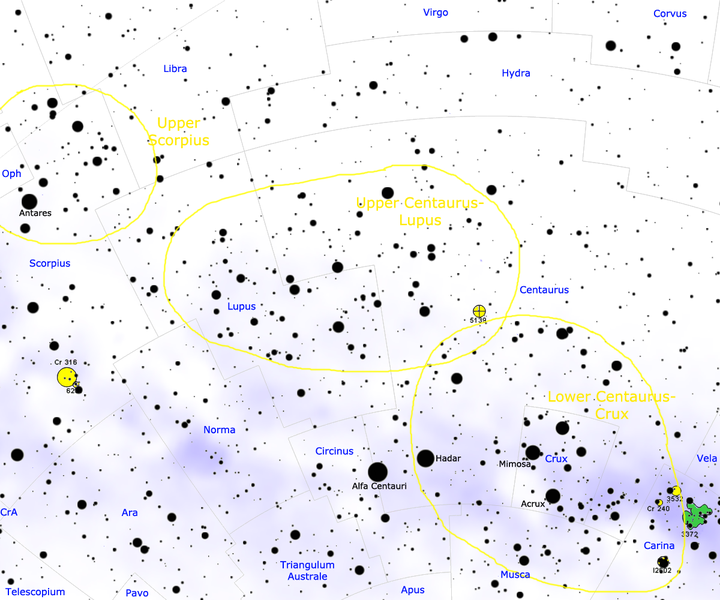
Star map showing the Scorpius-Centaurus Association. The stars of upper Scorpius are part of this association of stars in space. Read more at Wikimedia Commons.

Star map showing the Scorpius-Centaurus Association. The stars of upper Scorpius are part of this association of stars in space. Read more at Wikimedia Commons.

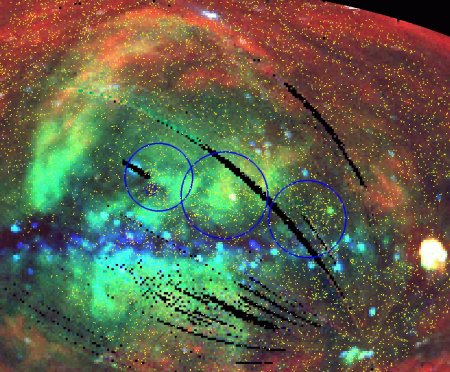
Wide field X-ray image of the Scorpius-Centaurus association constructed from the data of the ROSAT All Sky Survey Background maps. The yellow dots mark the positions of bright X-ray sources detected in the survey (only about 10% of the brightest X-ray sources are shown). The blue circles mark the three subgroups Upper Scorpius, Upper Centaurus-Lupus, and Lower Centaurus-Crux (from left to right). Image and caption via David Darling.

Wide field X-ray image of the Scorpius-Centaurus association constructed from the data of the ROSAT All Sky Survey Background maps. The yellow dots mark the positions of bright X-ray sources detected in the survey (only about 10% of the brightest X-ray sources are shown). The blue circles mark the three subgroups Upper Scorpius, Upper Centaurus-Lupus, and Lower Centaurus-Crux (from left to right). Image and caption via David Darling.

Constellation Scorpius by Daniel McVey.

Constellation Scorpius by Daniel McVey.

Bottom line: How to find the 3 stars – Graffias, Dschubba and Pi Scorpii – known as the Crown of the Scorpion.


from EarthSky https://ift.tt/2O52hMB

The 3 stars of the Scorpion’s Crown: Graffias (Acrab), Dschubba, and Pi Scorpii. Photo via Dennis Chabot.

The constellation Scorpius the Scorpion is one of the few constellations that looks like its name. The red star Antares lies at the Scorpion’s Heart. Two “stinger” stars, Shaula and Lesath, mark the Scorpion’s Tail. Scorpius has another charming feature you should come to know. It’s called the Crown of the Scorpion.

Look for Scorpius as a J-shaped assemblage of stars arcing across the southern sky each summer as seen from the Northern Hemisphere – and crossing overhead in winter skies as seen from the Southern Hemisphere. The Scorpion’s Crown consists of three stars near Antares, which is the brightest star in Scorpius. Individually, the Crown stars are Graffias (or Acrab), Dschubba, and Pi Scorpii.

Scorpius is one of the few constellations that looks like its namesake. The Crown of the Scorpion consists of three stars, located at the top of Scorpius to the right of Antares in this image.

It’s rare when star patterns on our sky’s dome have anything to do with real associations of stars in space, but these three stars are thought to be loosely bound by gravity. All three are located at approximately the same distance, about 500 light-years away. All are thought to be members of the Scorpius-Centaurus Association, which was first recognized by astronomers in the early part of the 20th century.

About 100 stars are known in the Scorpius-Centaurus Association, including Antares.

The Scorpius-Centaurus stars share a common motion through space. They were probably all born from a single vast cloud of gas and dust. In other words, these stars are much like a family – loosely bound – sharing a common history.

Star map showing the Scorpius-Centaurus Association. The stars of upper Scorpius are part of this association of stars in space. Read more at Wikimedia Commons.

Star map showing the Scorpius-Centaurus Association. The stars of upper Scorpius are part of this association of stars in space. Read more at Wikimedia Commons.

Wide field X-ray image of the Scorpius-Centaurus association constructed from the data of the ROSAT All Sky Survey Background maps. The yellow dots mark the positions of bright X-ray sources detected in the survey (only about 10% of the brightest X-ray sources are shown). The blue circles mark the three subgroups Upper Scorpius, Upper Centaurus-Lupus, and Lower Centaurus-Crux (from left to right). Image and caption via David Darling.

Wide field X-ray image of the Scorpius-Centaurus association constructed from the data of the ROSAT All Sky Survey Background maps. The yellow dots mark the positions of bright X-ray sources detected in the survey (only about 10% of the brightest X-ray sources are shown). The blue circles mark the three subgroups Upper Scorpius, Upper Centaurus-Lupus, and Lower Centaurus-Crux (from left to right). Image and caption via David Darling.

Constellation Scorpius by Daniel McVey.

Constellation Scorpius by Daniel McVey.

Bottom line: How to find the 3 stars – Graffias, Dschubba and Pi Scorpii – known as the Crown of the Scorpion.


from EarthSky https://ift.tt/2O52hMB

Morning moon

Blue sky, round white moon above pinkish clouds. Power lines with many birds sitting and flying.

Image via Lee Capps.


from EarthSky https://ift.tt/2JXgI03
Blue sky, round white moon above pinkish clouds. Power lines with many birds sitting and flying.

Image via Lee Capps.


from EarthSky https://ift.tt/2JXgI03

News digest – soaring skin cancer rates, breast milk, 5G and does eating insects really protect against cancer?

Melanoma in younger people on the rise

Our new stats show that the number of 25-49-year olds who have been diagnosed with melanoma skin cancer has soared since 2004, with plenty of media outlets picking up the trend. It’s thought the rise could be down to a number of things such as a growing number of people holidaying in countries where the sun can be stronger and an increased awareness of the disease. Over exposure to harmful UV rays can cause skin cancer which is why we want more people to own their natural skin tone.

Experts debate whether obesity should be recognised as a disease

The Independent has reported on an expert debate in the British Medical Journal about whether obesity should be recognised as a disease. Both sides agree there are complex factors that can lead to obesity and that weight stigma exists in our society.But whether obesity will be recognised as a disease is yet to be decided.

WHO calls for ban on sugary baby food

The World Health Organisation is calling for a ban on baby foods loaded with sugar. It says that even the more savoury flavours are too sugary and are helping babies develop a sweet tooth. Read the Guardian for more.

Cancer treatment containing breast milk is being tested in trials

A cancer treatment containing a molecule found in breast milk has been tested in an early-stage clinical trial. The trial involved 40 people with bladder cancer and was looking at the safety of the potential treatment. It now needs to be tested in a larger group of people to see how effective it might be against cancer. The Telegraph covered this.

Mobile data networks and cancer risk

The BBC looks at whether 5G, the latest mobile network being rolled out by phone providers, poses any health risks. In short, there is no good evidence of a link between mobile phone use and cancer.

No deal Brexit will impact scientific research, says Royal Society President

The Independent reports the Royal Society’s warning for the two Conservative leadership candidates about the future of scientific research in the UK. Professor Sir Venki Ramakrishnan, president of the Royal Society, wrote that a ‘no-deal’ Brexit will severely impact science and innovation.

Promise and price of cell therapies

The New Yorker delves into the history of cell-based cancer treatments, exploring how they’ve evolved over time. Made from human immune cells, these treatments are now used for a variety of diseases, such as the personalised treatment called CAR T cell therapy that’s available for some NHS blood cancer patients.

Second breast cancer treatment combo added to England’s Cancer Drugs Fund

We reported the latest breast cancer treatments made available to patients on the NHS in England. Price negations with the manufacturers of a targeted drug now mean some people with advanced breast cancer will have access to a combination treatment that can slow disease progression.

And finally

The Telegraph claims that eating insects could help protect against cancer, after scientists said that ants contain lots of antioxidants, which are found in so-called ‘superfoods’. But is ant eating really a way of preventing cancer? Not based on this research. The scientists didn’t actually test whether eating ants could prevent cancer in people. And evidence shows it’s unlikely that one specific type of food, on its own, could have a big impact on cancer risk. Your overall diet is more important for reducing cancer risk than eating particular individual foods.

Gabi


from Cancer Research UK – Science blog https://ift.tt/2xYLBeW

Melanoma in younger people on the rise

Our new stats show that the number of 25-49-year olds who have been diagnosed with melanoma skin cancer has soared since 2004, with plenty of media outlets picking up the trend. It’s thought the rise could be down to a number of things such as a growing number of people holidaying in countries where the sun can be stronger and an increased awareness of the disease. Over exposure to harmful UV rays can cause skin cancer which is why we want more people to own their natural skin tone.

Experts debate whether obesity should be recognised as a disease

The Independent has reported on an expert debate in the British Medical Journal about whether obesity should be recognised as a disease. Both sides agree there are complex factors that can lead to obesity and that weight stigma exists in our society.But whether obesity will be recognised as a disease is yet to be decided.

WHO calls for ban on sugary baby food

The World Health Organisation is calling for a ban on baby foods loaded with sugar. It says that even the more savoury flavours are too sugary and are helping babies develop a sweet tooth. Read the Guardian for more.

Cancer treatment containing breast milk is being tested in trials

A cancer treatment containing a molecule found in breast milk has been tested in an early-stage clinical trial. The trial involved 40 people with bladder cancer and was looking at the safety of the potential treatment. It now needs to be tested in a larger group of people to see how effective it might be against cancer. The Telegraph covered this.

Mobile data networks and cancer risk

The BBC looks at whether 5G, the latest mobile network being rolled out by phone providers, poses any health risks. In short, there is no good evidence of a link between mobile phone use and cancer.

No deal Brexit will impact scientific research, says Royal Society President

The Independent reports the Royal Society’s warning for the two Conservative leadership candidates about the future of scientific research in the UK. Professor Sir Venki Ramakrishnan, president of the Royal Society, wrote that a ‘no-deal’ Brexit will severely impact science and innovation.

Promise and price of cell therapies

The New Yorker delves into the history of cell-based cancer treatments, exploring how they’ve evolved over time. Made from human immune cells, these treatments are now used for a variety of diseases, such as the personalised treatment called CAR T cell therapy that’s available for some NHS blood cancer patients.

Second breast cancer treatment combo added to England’s Cancer Drugs Fund

We reported the latest breast cancer treatments made available to patients on the NHS in England. Price negations with the manufacturers of a targeted drug now mean some people with advanced breast cancer will have access to a combination treatment that can slow disease progression.

And finally

The Telegraph claims that eating insects could help protect against cancer, after scientists said that ants contain lots of antioxidants, which are found in so-called ‘superfoods’. But is ant eating really a way of preventing cancer? Not based on this research. The scientists didn’t actually test whether eating ants could prevent cancer in people. And evidence shows it’s unlikely that one specific type of food, on its own, could have a big impact on cancer risk. Your overall diet is more important for reducing cancer risk than eating particular individual foods.

Gabi


from Cancer Research UK – Science blog https://ift.tt/2xYLBeW

Deneb and Cygnus the Swan

Tonight’s chart has you looking eastward at the famous Summer Triangle. Today, notice the star Deneb, the northernmost star in the Summer Triangle. Its constellation is Cygnus the Swan. In a dark country sky, you can see that Cygnus is flying along the starlit trail of the summer Milky Way.

The photo below is from Annie Lewis in Spain. She solved the problem of picking out the Summer Triangle from among many stars in the night sky by looking for the Triangle in the east soon after sunset. These three stars are, after all, among the brightest in the sky.

EarthSky’s meteor shower guide for 2019

EarthSky astronomy kits are perfect for beginners. Order yours today.

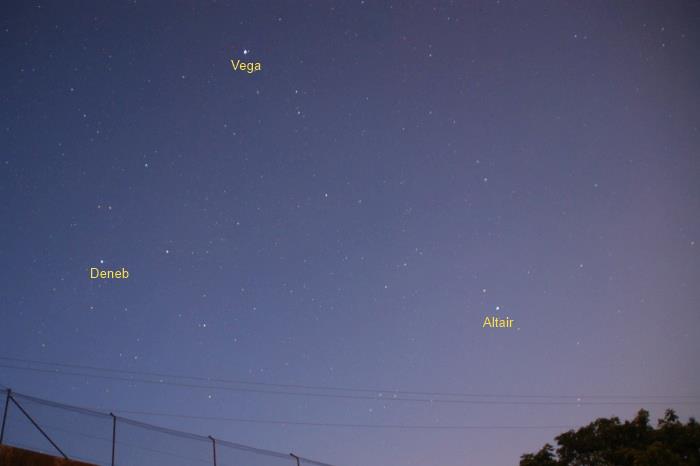
Medium blue sky with a few scattered stars, three bright ones labeled.

EarthSky Facebook friend Annie Lewis in Madrid, Spain, captured this photo of the Summer Triangle shortly after nightfall on a summer night. In fact, she said, the only stars visible to the unaided eye when she took the photo were the three in the Triangle. But her camera knew better. Thanks, Annie.

If it’s darker out, you might recognize the Summer Triangle by noticing that there is a cross within the Triangle. The constellation Cygnus is that cross. In fact, the constellation Cygnus is sometimes called the Northern Cross.

Okay, I’ve given you a lot of names here: Summer Triangle, Cygnus, Northern Cross.

Just remember, the constellation Cygnus the Swan contains the Northern Cross. The Cross is – more or less – just another way to see the Swan. The Northern Cross is what’s called an asterism, or recognizable pattern within a constellation. In this case, the pattern is the whole constellation, pretty much. At least, I never see them any differently.

Except for one thing. Deneb is at the top of the Cross, but at the tail of the Swan (the star name “deneb” always means “tail”). The little star Albireo is at the head of the Swan, but at the base of the Cross. Whew!

Our Summer Triangle series also includes:

Part 1: Vega and its constellation Lyra

Part 3: Altair and its constellation Aquila

Bottom line: The Summer Triangle consists of 3 bright stars in 3 different constellations. Deneb is the tail of Cygnus the Swan.

Help support posts like these at the EarthSky store. Fun astronomy gifts and tools for all ages!


from EarthSky https://ift.tt/2Lym1pZ

Tonight’s chart has you looking eastward at the famous Summer Triangle. Today, notice the star Deneb, the northernmost star in the Summer Triangle. Its constellation is Cygnus the Swan. In a dark country sky, you can see that Cygnus is flying along the starlit trail of the summer Milky Way.

The photo below is from Annie Lewis in Spain. She solved the problem of picking out the Summer Triangle from among many stars in the night sky by looking for the Triangle in the east soon after sunset. These three stars are, after all, among the brightest in the sky.

EarthSky’s meteor shower guide for 2019

EarthSky astronomy kits are perfect for beginners. Order yours today.

Medium blue sky with a few scattered stars, three bright ones labeled.

EarthSky Facebook friend Annie Lewis in Madrid, Spain, captured this photo of the Summer Triangle shortly after nightfall on a summer night. In fact, she said, the only stars visible to the unaided eye when she took the photo were the three in the Triangle. But her camera knew better. Thanks, Annie.

If it’s darker out, you might recognize the Summer Triangle by noticing that there is a cross within the Triangle. The constellation Cygnus is that cross. In fact, the constellation Cygnus is sometimes called the Northern Cross.

Okay, I’ve given you a lot of names here: Summer Triangle, Cygnus, Northern Cross.

Just remember, the constellation Cygnus the Swan contains the Northern Cross. The Cross is – more or less – just another way to see the Swan. The Northern Cross is what’s called an asterism, or recognizable pattern within a constellation. In this case, the pattern is the whole constellation, pretty much. At least, I never see them any differently.

Except for one thing. Deneb is at the top of the Cross, but at the tail of the Swan (the star name “deneb” always means “tail”). The little star Albireo is at the head of the Swan, but at the base of the Cross. Whew!

Our Summer Triangle series also includes:

Part 1: Vega and its constellation Lyra

Part 3: Altair and its constellation Aquila

Bottom line: The Summer Triangle consists of 3 bright stars in 3 different constellations. Deneb is the tail of Cygnus the Swan.

Help support posts like these at the EarthSky store. Fun astronomy gifts and tools for all ages!


from EarthSky https://ift.tt/2Lym1pZ

Planting a flag on the moon

View from above of 2 astronauts in spacesuits deploying a US flag on the moon.

Neil A. Armstrong (left) and Edwin E. “Buzz” Aldrin, Jr. (right) with the flag on the moon during the Apollo 11 extravehicular activity. Image via NASA.

By Andrea Eastrada, University of California, Santa Barbara

When Apollo 11 astronauts Neil Armstrong and Buzz Aldrin planted the United States flag on the moon 50 years ago this month — July 20, 1969, to be exact — it was a team effort.

It also represented a major feat of engineering.

Annie Platoff, a librarian at the University of California, Santa Barbara Library and a leading expert on the Apollo program’s placement of flags on the lunar surface, said:

The flag on the moon is a great illustration of the fact that in space, nothing is simple. For me, the flag on the moon is an excellent example of something that seems very, very simple, but once you really start thinking about it, you realize is very complex.

US flag, astronaut near bent leg of Apollo 11 lunar lander. Lander's shadow on the gray lunar surface. Black sky.

Astronaut Neil Armstrong on the moon. Image via NASA.

The lunar flagpole

With virtually no atmosphere on the moon – and, therefore, no wind – flags that fly freely on Earth would hang like limp cloth in the lunar environment. So engineers had to rethink flagpole design entirely, according to Platoff. On an earthbound flagpole, the flag is attached at the hoist – the vertical section closest to the pole – at both the top and bottom of the flag. The pole might slide through a sleeve on the hoist side of the flag, or be attached by grommets or some other type of fastener. A lunar flag, however, is anchored to the pole only at the bottom. It is held in place mainly by a horizontal crossbar at the top. Platoff explained:

A lunar flagpole has three parts. There are two vertical sections, and then the horizontal crossbar that’s hinged at the top of the upper vertical section. To deploy the flag, one astronaut used a sampling hammer to pound the lower vertical section into the ground. The other astronaut extended the telescoping crossbar and raised it to a 90-degree angle with the vertical section to click it into place. Then the two astronauts slid the upper part of the pole into the lower one.

Once they got the flag up, several factors made it look as though it was flying. First there were wrinkles in it because of how tightly it was packed. And these add to the illusion that the flag is waving. Also, the astronauts didn’t always get the horizontal crossbar extended all the way – they were working in pressurized spacesuits and really cumbersome gloves, after all – which caused the flag to bunch up in places. That also made it look like it’s waving.

3 metal bars and folded flag with metal attachment along short edge.

Elements of the lunar flag assembly included the flag pole, an insulating blanket, and a thermal protective shroud. Photo via NASA.

Traveling into space

Simply getting the flag to the moon also proved a challenge for NASA engineers. Platoff said:

The Apollo 11 and 12 flags were stored on the ladder of the lunar module. It was kind of a last-minute add-on, and I think that’s why they picked that location. But they had to protect it from the engines of the lunar module. As the astronauts were coming down to land, they were firing the engines to slow themselves down. And those engines got really hot. Without adequate thermal protection, the flag would have been gone.

To protect Old Glory, engineers built a metal shroud that went around the apparatus on the ladder. They also added some insulating blanket material. On later missions, the flag was moved to a storage compartment outside the lunar module. Platoff said:

It was basically the space where they kept their cameras, hammers, sampling scoops and other equipment. And that area was already thermally protected.

Sketch of a flag and flagpole with different parts labeled and measurements.

NASA engineer Jack Kinzler’s original sketch of the lunar flag assembly. Image via Jack Kinzler.

A woman wearing a scarf printed with flags of all nations, holding a small US flag.

Annie Platoff holds a fireproof silica fiber beta cloth American flag patch for an Apollo-era spacesuit. Read more about Platoff. Image via Daniel Smith.

Bottom line: Fifty years after the Apollo 11 moon walk, the challenge of planting the flag on the moon.

Via University of California, Santa Barbara


from EarthSky https://ift.tt/2JM5fAk
View from above of 2 astronauts in spacesuits deploying a US flag on the moon.

Neil A. Armstrong (left) and Edwin E. “Buzz” Aldrin, Jr. (right) with the flag on the moon during the Apollo 11 extravehicular activity. Image via NASA.

By Andrea Eastrada, University of California, Santa Barbara

When Apollo 11 astronauts Neil Armstrong and Buzz Aldrin planted the United States flag on the moon 50 years ago this month — July 20, 1969, to be exact — it was a team effort.

It also represented a major feat of engineering.

Annie Platoff, a librarian at the University of California, Santa Barbara Library and a leading expert on the Apollo program’s placement of flags on the lunar surface, said:

The flag on the moon is a great illustration of the fact that in space, nothing is simple. For me, the flag on the moon is an excellent example of something that seems very, very simple, but once you really start thinking about it, you realize is very complex.

US flag, astronaut near bent leg of Apollo 11 lunar lander. Lander's shadow on the gray lunar surface. Black sky.

Astronaut Neil Armstrong on the moon. Image via NASA.

The lunar flagpole

With virtually no atmosphere on the moon – and, therefore, no wind – flags that fly freely on Earth would hang like limp cloth in the lunar environment. So engineers had to rethink flagpole design entirely, according to Platoff. On an earthbound flagpole, the flag is attached at the hoist – the vertical section closest to the pole – at both the top and bottom of the flag. The pole might slide through a sleeve on the hoist side of the flag, or be attached by grommets or some other type of fastener. A lunar flag, however, is anchored to the pole only at the bottom. It is held in place mainly by a horizontal crossbar at the top. Platoff explained:

A lunar flagpole has three parts. There are two vertical sections, and then the horizontal crossbar that’s hinged at the top of the upper vertical section. To deploy the flag, one astronaut used a sampling hammer to pound the lower vertical section into the ground. The other astronaut extended the telescoping crossbar and raised it to a 90-degree angle with the vertical section to click it into place. Then the two astronauts slid the upper part of the pole into the lower one.

Once they got the flag up, several factors made it look as though it was flying. First there were wrinkles in it because of how tightly it was packed. And these add to the illusion that the flag is waving. Also, the astronauts didn’t always get the horizontal crossbar extended all the way – they were working in pressurized spacesuits and really cumbersome gloves, after all – which caused the flag to bunch up in places. That also made it look like it’s waving.

3 metal bars and folded flag with metal attachment along short edge.

Elements of the lunar flag assembly included the flag pole, an insulating blanket, and a thermal protective shroud. Photo via NASA.

Traveling into space

Simply getting the flag to the moon also proved a challenge for NASA engineers. Platoff said:

The Apollo 11 and 12 flags were stored on the ladder of the lunar module. It was kind of a last-minute add-on, and I think that’s why they picked that location. But they had to protect it from the engines of the lunar module. As the astronauts were coming down to land, they were firing the engines to slow themselves down. And those engines got really hot. Without adequate thermal protection, the flag would have been gone.

To protect Old Glory, engineers built a metal shroud that went around the apparatus on the ladder. They also added some insulating blanket material. On later missions, the flag was moved to a storage compartment outside the lunar module. Platoff said:

It was basically the space where they kept their cameras, hammers, sampling scoops and other equipment. And that area was already thermally protected.

Sketch of a flag and flagpole with different parts labeled and measurements.

NASA engineer Jack Kinzler’s original sketch of the lunar flag assembly. Image via Jack Kinzler.

A woman wearing a scarf printed with flags of all nations, holding a small US flag.

Annie Platoff holds a fireproof silica fiber beta cloth American flag patch for an Apollo-era spacesuit. Read more about Platoff. Image via Daniel Smith.

Bottom line: Fifty years after the Apollo 11 moon walk, the challenge of planting the flag on the moon.

Via University of California, Santa Barbara


from EarthSky https://ift.tt/2JM5fAk

5 moon-landing innovations that changed life on Earth

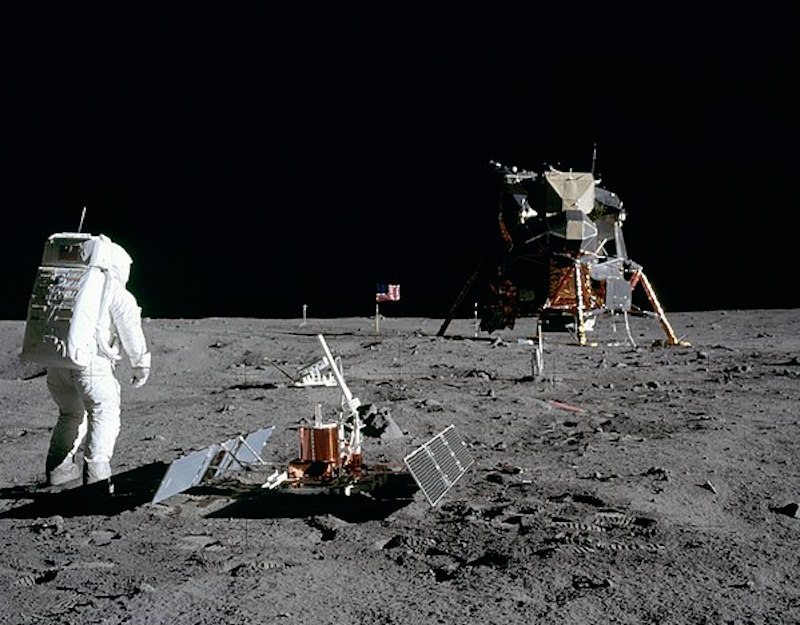
Astronaut standing next to complicated device on the ground, flag and lunar lander in background.

Astronaut Buzz Aldrin on the moon during the Apollo 11 mission. Image via Neil Armstrong/NASA.

Jean Creighton, University of Wisconsin-Milwaukee

Much of the technology common in daily life today originates from the drive to put a human being on the moon. This effort reached its pinnacle when Neil Armstrong stepped off the Eagle landing module onto the lunar surface 50 years ago.

As a NASA airborne astronomy ambassador and director of the University of Wisconsin-Milwaukee Manfred Olson Planetarium, I know that the technologies behind weather forecasting, GPS and even smartphones can trace their origins to the race to the moon.

Rocket on a launchpad against a blue sky, with smoke billowing at its base and red gantry next to it.

A Saturn V rocket carrying Apollo 11 and its crew toward the moon lifts off on July 16, 1969. Image via NASA.

1. Rockets

October 4, 1957 marked the dawn of the Space Age, when the Soviet Union launched Sputnik 1, the first human-made satellite. The Soviets were the first to make powerful launch vehicles by adapting World War II-era long-range missiles, especially the German V-2.

From there, space propulsion and satellite technology moved fast: Luna 1 escaped the Earth’s gravitational field to fly past the moon on January 4, 1959; Vostok 1 carried the first human, Yuri Gagarin, into space on April 12, 1961; and Telstar, the first commercial satellite, sent TV signals across the Atlantic Ocean on July 10, 1962.

The 1969 lunar landing also harnessed the expertise of German scientists, such as Wernher von Braun, to send massive payloads into space. The F-1 engines in Saturn V, the Apollo program’s launch vehicle, burned a total of 2,800 tons of fuel at a rate of 12.9 tons per second.

Saturn V still stands as the most powerful rocket ever built, but rockets today are far cheaper to launch. For example, whereas Saturn V cost US$185 million, which translates into over $1 billion in 2019, today’s Falcon Heavy launch costs only $90 million. Those rockets are how satellites, astronauts and other spacecraft get off the Earth’s surface, to continue bringing back information and insights from other worlds.

2. Satellites

The quest for enough thrust to land a man on the moon led to the building of vehicles powerful enough to launch payloads to heights of 21,200 to 22,600 miles (34,100 to 36,440 km) above the Earth’s surface. At such altitudes, satellites’ orbiting speed aligns with how fast the planet spins – so satellites remain over a fixed point, in what is called geosynchronous orbit. Geosynchronous satellites are responsible for communications, providing both internet connectivity and TV programming.

At the beginning of 2019, there were 4,987 satellites orbiting Earth; in 2018 alone, there were more than 382 orbital launches worldwide. Of the currently operational satellites, approximately 40% of payloads enable communications, 36% observe the Earth, 11% demonstrate technologies, 7% improve navigation and positioning and 6% advance space and earth science.

Rows of large chunky, thick circuitry about five times bigger than a laptop.

The Apollo Guidance Computer next to a laptop computer. Image via Autopilot/Wikimedia Commons.

3. Miniaturization

Space missions – back then and even today – have strict limits on how big and how heavy their equipment can be, because so much energy is required to lift off and achieve orbit. These constraints pushed the space industry to find ways to make smaller and lighter versions of almost everything: Even the walls of the lunar landing module were reduced to the thickness of two sheets of paper.

From the late 1940s to the late 1960s, the weight and energy consumption of electronics was reduced by a factor of several hundred at least – from the 30 tons and 160 kilowatts of the Electric Numerical Integrator and Computer to the 70 pounds and 70 watts of the Apollo guidance computer. This weight difference is equivalent to that between a humpback whale and an armadillo.

Manned missions required more complex systems than earlier, unmanned ones. For example, in 1951, the Universal Automatic Computer was capable of 1,905 instructions per second, whereas the Saturn V’s guidance system performed 12,190 instructions per second. The trend toward nimble electronics has continued, with modern hand-held devices routinely capable of performing instructions 120 million times faster than the guidance system that enabled the liftoff of Apollo 11. The need to miniaturize computers for space exploration in the 1960s motivated the entire industry to design smaller, faster and more energy-efficient computers, which have affected practically every facet of life today, from communications to health and from manufacturing to transportation.

4. Global network of ground stations

Communicating with vehicles and people in space was just as important as getting them up there in the first place. An important breakthrough associated with the 1969 lunar landing was the construction of a global network of ground stations, called the Deep Space Network, to let controllers on Earth communicate constantly with missions in highly elliptical Earth orbits or beyond. This continuity was possible because the ground facilities were placed strategically 120 degrees apart in longitude so that each spacecraft would be in range of one of the ground stations at all times.

Because of the spacecraft’s limited power capacity, large antennas were built on Earth to simulate “big ears” to hear weak messages and to act as “big mouths” to broadcast loud commands. In fact, the Deep Space Network was used to communicate with the astronauts on Apollo 11 and was used to relay the first dramatic TV images of Neil Armstrong stepping onto the moon. The network was also critical for the survival of the crew on Apollo 13 because they needed guidance from ground personnel without wasting their precious power on communications.

Several dozen missions use the Deep Space Network as part of the continuing exploration of our solar system and beyond. In addition, the Deep Space Network permits communications with satellites that are on highly elliptical orbits, to monitor the poles and deliver radio signals.

Blue and white Earth hanging in space against black sky with lunar landscape seen from orbit below.

‘Earthrise,’ a view of Earth while orbiting the moon. Image via Bill Anders, Apollo 8/NASA

5. Looking back at Earth

Getting to space has allowed people to turn their research efforts toward Earth. In August 1959, the unmanned satellite Explorer VI took the first crude photos of Earth from space on a mission researching the upper atmosphere, in preparation for the Apollo program.

Almost a decade later, the crew of Apollo 8 took a famous picture of the Earth rising over the lunar landscape, aptly named “Earthrise.” This image helped people understand our planet as a unique shared world and boosted the environmental movement.

Pale, vague, vertical gray and brown stripes with tiny dot in one stripe.

Earth from the edge of the solar system, visible as a minuscule pale blue dot in the center of the right-most brown stripe. Image via Voyager 1/NASA/

Understanding of our planet’s role in the universe deepened with Voyager 1’s “pale blue dot” photo – an image received by the Deep Space Network.

People and our machines have been taking pictures of the Earth from space ever since. Views of Earth from space guide people both globally and locally. What started in the early 1960s as a U.S. Navy satellite system to track its Polaris submarines to within 600 feet (185 meters) has blossomed into the Global Positioning System network of satellites providing location services worldwide.

Images from a series of Earth-observing satellites called Landsat are used to determine crop health, identify algae blooms and find potential oil deposits. Other uses include identifying which types of forest management are most effective in slowing the spread of wildfires or recognizing global changes such as glacier coverage and urban development.

As we learn more about our own planet and about exoplanets – planets around other stars – we become more aware of how precious our planet is. Efforts to preserve Earth itself may yet find help from fuel cells, another technology from the Apollo program. These storage systems for hydrogen and oxygen in the Apollo Service Module, which contained life-support systems and supplies for the lunar landing missions, generated power and produced potable water for the astronauts. Much cleaner energy sources than traditional combustion engines, fuel cells may play a part in transforming global energy production to fight climate change.

We can only wonder what innovations from the effort to send people to other planets will affect earthlings 50 years after the first Marswalk.

Jean Creighton, Planetarium Director, NASA Airborne Astronomy Ambassador, University of Wisconsin-Milwaukee

This article is republished from The Conversation under a Creative Commons license. Read the original article.

Bottom line: Apollo 11 moon-landing innovations that changed life on Earth.

The Conversation


from EarthSky https://ift.tt/32MgzFo
Astronaut standing next to complicated device on the ground, flag and lunar lander in background.

Astronaut Buzz Aldrin on the moon during the Apollo 11 mission. Image via Neil Armstrong/NASA.

Jean Creighton, University of Wisconsin-Milwaukee

Much of the technology common in daily life today originates from the drive to put a human being on the moon. This effort reached its pinnacle when Neil Armstrong stepped off the Eagle landing module onto the lunar surface 50 years ago.

As a NASA airborne astronomy ambassador and director of the University of Wisconsin-Milwaukee Manfred Olson Planetarium, I know that the technologies behind weather forecasting, GPS and even smartphones can trace their origins to the race to the moon.

Rocket on a launchpad against a blue sky, with smoke billowing at its base and red gantry next to it.

A Saturn V rocket carrying Apollo 11 and its crew toward the moon lifts off on July 16, 1969. Image via NASA.

1. Rockets

October 4, 1957 marked the dawn of the Space Age, when the Soviet Union launched Sputnik 1, the first human-made satellite. The Soviets were the first to make powerful launch vehicles by adapting World War II-era long-range missiles, especially the German V-2.

From there, space propulsion and satellite technology moved fast: Luna 1 escaped the Earth’s gravitational field to fly past the moon on January 4, 1959; Vostok 1 carried the first human, Yuri Gagarin, into space on April 12, 1961; and Telstar, the first commercial satellite, sent TV signals across the Atlantic Ocean on July 10, 1962.

The 1969 lunar landing also harnessed the expertise of German scientists, such as Wernher von Braun, to send massive payloads into space. The F-1 engines in Saturn V, the Apollo program’s launch vehicle, burned a total of 2,800 tons of fuel at a rate of 12.9 tons per second.

Saturn V still stands as the most powerful rocket ever built, but rockets today are far cheaper to launch. For example, whereas Saturn V cost US$185 million, which translates into over $1 billion in 2019, today’s Falcon Heavy launch costs only $90 million. Those rockets are how satellites, astronauts and other spacecraft get off the Earth’s surface, to continue bringing back information and insights from other worlds.

2. Satellites

The quest for enough thrust to land a man on the moon led to the building of vehicles powerful enough to launch payloads to heights of 21,200 to 22,600 miles (34,100 to 36,440 km) above the Earth’s surface. At such altitudes, satellites’ orbiting speed aligns with how fast the planet spins – so satellites remain over a fixed point, in what is called geosynchronous orbit. Geosynchronous satellites are responsible for communications, providing both internet connectivity and TV programming.

At the beginning of 2019, there were 4,987 satellites orbiting Earth; in 2018 alone, there were more than 382 orbital launches worldwide. Of the currently operational satellites, approximately 40% of payloads enable communications, 36% observe the Earth, 11% demonstrate technologies, 7% improve navigation and positioning and 6% advance space and earth science.

Rows of large chunky, thick circuitry about five times bigger than a laptop.

The Apollo Guidance Computer next to a laptop computer. Image via Autopilot/Wikimedia Commons.

3. Miniaturization

Space missions – back then and even today – have strict limits on how big and how heavy their equipment can be, because so much energy is required to lift off and achieve orbit. These constraints pushed the space industry to find ways to make smaller and lighter versions of almost everything: Even the walls of the lunar landing module were reduced to the thickness of two sheets of paper.

From the late 1940s to the late 1960s, the weight and energy consumption of electronics was reduced by a factor of several hundred at least – from the 30 tons and 160 kilowatts of the Electric Numerical Integrator and Computer to the 70 pounds and 70 watts of the Apollo guidance computer. This weight difference is equivalent to that between a humpback whale and an armadillo.

Manned missions required more complex systems than earlier, unmanned ones. For example, in 1951, the Universal Automatic Computer was capable of 1,905 instructions per second, whereas the Saturn V’s guidance system performed 12,190 instructions per second. The trend toward nimble electronics has continued, with modern hand-held devices routinely capable of performing instructions 120 million times faster than the guidance system that enabled the liftoff of Apollo 11. The need to miniaturize computers for space exploration in the 1960s motivated the entire industry to design smaller, faster and more energy-efficient computers, which have affected practically every facet of life today, from communications to health and from manufacturing to transportation.

4. Global network of ground stations

Communicating with vehicles and people in space was just as important as getting them up there in the first place. An important breakthrough associated with the 1969 lunar landing was the construction of a global network of ground stations, called the Deep Space Network, to let controllers on Earth communicate constantly with missions in highly elliptical Earth orbits or beyond. This continuity was possible because the ground facilities were placed strategically 120 degrees apart in longitude so that each spacecraft would be in range of one of the ground stations at all times.

Because of the spacecraft’s limited power capacity, large antennas were built on Earth to simulate “big ears” to hear weak messages and to act as “big mouths” to broadcast loud commands. In fact, the Deep Space Network was used to communicate with the astronauts on Apollo 11 and was used to relay the first dramatic TV images of Neil Armstrong stepping onto the moon. The network was also critical for the survival of the crew on Apollo 13 because they needed guidance from ground personnel without wasting their precious power on communications.

Several dozen missions use the Deep Space Network as part of the continuing exploration of our solar system and beyond. In addition, the Deep Space Network permits communications with satellites that are on highly elliptical orbits, to monitor the poles and deliver radio signals.

Blue and white Earth hanging in space against black sky with lunar landscape seen from orbit below.

‘Earthrise,’ a view of Earth while orbiting the moon. Image via Bill Anders, Apollo 8/NASA

5. Looking back at Earth

Getting to space has allowed people to turn their research efforts toward Earth. In August 1959, the unmanned satellite Explorer VI took the first crude photos of Earth from space on a mission researching the upper atmosphere, in preparation for the Apollo program.

Almost a decade later, the crew of Apollo 8 took a famous picture of the Earth rising over the lunar landscape, aptly named “Earthrise.” This image helped people understand our planet as a unique shared world and boosted the environmental movement.

Pale, vague, vertical gray and brown stripes with tiny dot in one stripe.

Earth from the edge of the solar system, visible as a minuscule pale blue dot in the center of the right-most brown stripe. Image via Voyager 1/NASA/

Understanding of our planet’s role in the universe deepened with Voyager 1’s “pale blue dot” photo – an image received by the Deep Space Network.

People and our machines have been taking pictures of the Earth from space ever since. Views of Earth from space guide people both globally and locally. What started in the early 1960s as a U.S. Navy satellite system to track its Polaris submarines to within 600 feet (185 meters) has blossomed into the Global Positioning System network of satellites providing location services worldwide.

Images from a series of Earth-observing satellites called Landsat are used to determine crop health, identify algae blooms and find potential oil deposits. Other uses include identifying which types of forest management are most effective in slowing the spread of wildfires or recognizing global changes such as glacier coverage and urban development.

As we learn more about our own planet and about exoplanets – planets around other stars – we become more aware of how precious our planet is. Efforts to preserve Earth itself may yet find help from fuel cells, another technology from the Apollo program. These storage systems for hydrogen and oxygen in the Apollo Service Module, which contained life-support systems and supplies for the lunar landing missions, generated power and produced potable water for the astronauts. Much cleaner energy sources than traditional combustion engines, fuel cells may play a part in transforming global energy production to fight climate change.

We can only wonder what innovations from the effort to send people to other planets will affect earthlings 50 years after the first Marswalk.

Jean Creighton, Planetarium Director, NASA Airborne Astronomy Ambassador, University of Wisconsin-Milwaukee

This article is republished from The Conversation under a Creative Commons license. Read the original article.

Bottom line: Apollo 11 moon-landing innovations that changed life on Earth.

The Conversation


from EarthSky https://ift.tt/32MgzFo

Vega and its constellation Lyra

Tonight, look eastward during the evening hours, and it’s hard to miss the season’s signature star formation, called the Summer Triangle. Its stars – Vega, Deneb and Altair – are the first three to light up the eastern half of sky after sunset, and their bright and sparkling radiance is even visible from light-polluted cities or on a moonlit night.

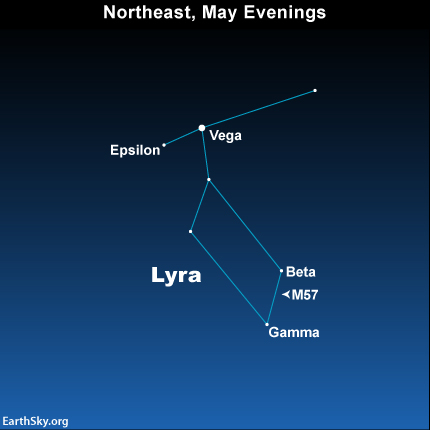
Try looking first for the most prominent star in the eastern sky, which is Vega in the constellation Lyra the Harp. Vega is blue-white in color. It’s sometimes called the Harp Star. And many people recognize its constellation, Lyra, as a triangle of stars connected to a parallelogram.

The constellation Lyra the Harp.

It’s hard to gauge the humongous size of the Summer Triangle by looking at our little chart. A 12-inch ruler, when placed at an arm’s length from your eye, spans the approximate distance from Vega to the star Altair. And an outstretched hand more or less fills the gap between Vega and Deneb.

More than any other month, July is the month of the Summer Triangle. At mid-northern latitudes, the Summer Triangle’s stars – as if a trio of school kids on vacation – stay out from dusk till dawn, dancing amid the stars of our Milky Way galaxy. As our Earth turns tonight, Vega, Deneb and Altair travel westward across the sky. The Summer Triangle shines high overhead in the middle of the night, and sparkles in the west as the rose-colored dawn begins to color the sky.

The Summer Triangle, photographed by Susan Jensen in Odessa, Washington.

Our Summer Triangle series also includes:

Part 2: Deneb and its constellation Cygnus

Part 3: Altair and its constellation Aquila

EarthSky astronomy kits are perfect for beginners. Order yours today.

Bottom line: The Summer Triangle consists of 3 bright stars in 3 different constellations. The brightest is Vega in the constellation Lyra.


from EarthSky https://ift.tt/2LtdODm

Tonight, look eastward during the evening hours, and it’s hard to miss the season’s signature star formation, called the Summer Triangle. Its stars – Vega, Deneb and Altair – are the first three to light up the eastern half of sky after sunset, and their bright and sparkling radiance is even visible from light-polluted cities or on a moonlit night.

Try looking first for the most prominent star in the eastern sky, which is Vega in the constellation Lyra the Harp. Vega is blue-white in color. It’s sometimes called the Harp Star. And many people recognize its constellation, Lyra, as a triangle of stars connected to a parallelogram.

The constellation Lyra the Harp.

It’s hard to gauge the humongous size of the Summer Triangle by looking at our little chart. A 12-inch ruler, when placed at an arm’s length from your eye, spans the approximate distance from Vega to the star Altair. And an outstretched hand more or less fills the gap between Vega and Deneb.

More than any other month, July is the month of the Summer Triangle. At mid-northern latitudes, the Summer Triangle’s stars – as if a trio of school kids on vacation – stay out from dusk till dawn, dancing amid the stars of our Milky Way galaxy. As our Earth turns tonight, Vega, Deneb and Altair travel westward across the sky. The Summer Triangle shines high overhead in the middle of the night, and sparkles in the west as the rose-colored dawn begins to color the sky.

The Summer Triangle, photographed by Susan Jensen in Odessa, Washington.

Our Summer Triangle series also includes:

Part 2: Deneb and its constellation Cygnus

Part 3: Altair and its constellation Aquila

EarthSky astronomy kits are perfect for beginners. Order yours today.

Bottom line: The Summer Triangle consists of 3 bright stars in 3 different constellations. The brightest is Vega in the constellation Lyra.


from EarthSky https://ift.tt/2LtdODm

What will Earth’s next supercontinent look like?

Planet Earth. Image via Triff/Shutterstock

Over geologic timescales, Earth’s continents continually change. Geologists believe that, every few hundred million years, the continents combine to create massive supercontinents. The most famous past supercontinent is probably the most recent one, Pangea. This article on future supercontinents was originally published November 27, 2018. EarthSky blogger Deanna Conners brought it to our attention last week, and we couldn’t resist it. It gives 4 possible scenarios describing what our planet might look like when the next supercontinent forms.

By Mattias Green, Bangor University; Hannah Sophia Davies, Universidade de Lisboa , and Joao C. Duarte, Universidade de Lisboa

The outer layer of the Earth, the solid crust we walk on, is made up of broken pieces, much like the shell of a broken egg. These pieces, the tectonic plates, move around the planet at speeds of a few centimeters per year. Every so often they come together and combine into a supercontinent, which remains for a few hundred million years before breaking up. The plates then disperse or scatter and move away from each other, until they eventually – after another 400-600 million years – come back together again.

The last supercontinent, Pangea, formed around 310 million years ago, and started breaking up around 180 million years ago. It has been suggested that the next supercontinent will form in 200-250 million years, so we are currently about halfway through the scattered phase of the current supercontinent cycle. The question is: how will the next supercontinent form, and why?

There are four fundamental scenarios for the formation of the next supercontinent: Novopangea, Pangea Ultima, Aurica and Amasia. How each forms depends on different scenarios but ultimately are linked to how Pangea separated, and how the world’s continents are still moving today.

The breakup of Pangea led to the formation of the Atlantic Ocean, which is still opening and getting wider today. Consequently, the Pacific Ocean is closing and getting narrower. The Pacific is home to a ring of subduction zones along its edges (the “ring of fire”), where ocean floor is brought down, or subducted, under continental plates and into the Earth’s interior. There, the old ocean floor is recycled and can go into volcanic plumes. The Atlantic, by contrast, has a large ocean ridge producing new ocean plate, but is only home to two subduction zones: the Lesser Antilles Arc in the Caribbean and the Scotia Arc between South America and Antarctica.

1. Novopangea

If we assume that present day conditions persist, so that the Atlantic continues to open and the Pacific keeps closing, we have a scenario where the next supercontinent forms in the antipodes of Pangea. The Americas would collide with the northward drifting Antarctica, and then into the already collided Africa-Eurasia. The supercontinent that would then form has been named Novopangea, or Novopangaea.

Stretched globe map with labeled, outlined continents all pressed together.

Novopangea.

2. Pangea Ultima

The Atlantic opening may, however, slow down and actually start closing in the future. The two small arcs of subduction in the Atlantic could potentially spread all along the east coasts of the Americas, leading to a reforming of Pangea as the Americas, Europe and Africa are brought back together into a supercontinent called Pangea Ultima. This new supercontinent would be surrounded by a super Pacific Ocean.

Stretched globe map with continents pressed together around a central sea.

Pangea Ultima, formed by the Atlantic closing.

3. Aurica

However, if the Atlantic was to develop new subduction zones – something that may already be happening – both the Pacific and Atlantic oceans may be fated to close. This means that a a new ocean basin would have to form to replace them.

In this scenario the Pan-Asian rift currently cutting through Asia from west of India up to the Arctic opens to form the new ocean. The result is the formation of the supercontinent Aurica. Because of Australia’s current northwards drift it would be at the center of the new continent as East Asia and the Americas close the Pacific from either side. The European and African plates would then rejoin the Americas as the Atlantic closes.

4. Amasia

The fourth scenario predicts a completely different fate for future Earth. Several of the tectonic plates are currently moving north, including both Africa and Australia. This drift is believed to be driven by anomalies left by Pangea, deep in the Earth’s interior, in the part called the mantle. Because of this northern drift, one can envisage a scenario where the continents, except Antarctica, keep drifting north. This means that they would eventually gather around the North Pole in a supercontinent called Amasia. In this scenario, both the Atlantic and the Pacific would mostly remain open.

Stretched globe map with most continents at north with Antarctica at bottom.

Amasia, the fourth scenario.

Of these four scenarios we believe that Novopangea is the most likely. It is a logical progression of present day continental plate drift directions, while the other three assume that another process comes into play. There would need to be new Atlantic subduction zones for Aurica, the reversal of the Atlantic opening for Pangea Ultima, or anomalies in the Earth’s interior left by Pangea for Amasia.

Investigating the Earth’s tectonic future forces us to push the boundaries of our knowledge, and to think about the processes that shape our planet over long time scales. It also leads us to think about the Earth system as a whole, and raises a series of other questions – what will the climate of the next supercontinent be? How will the ocean circulation adjust? How will life evolve and adapt? These are the kind of questions that push the boundaries of science further because they push the boundaries of our imagination.

Mattias Green, Reader in Physical Oceanography, Bangor University; Hannah Sophia Davies, Ph.D. Researcher, Universidade de Lisboa, and Joao C. Duarte, Researcher and Coordinator of the Marine Geology and Geophysics Group, Universidade de Lisboa

This article is republished from The Conversation under a Creative Commons license. Read the original article.

Bottom line: What planet Earth might look like when the next supercontinent forms – four scenarios.

The Conversation


from EarthSky https://ift.tt/2Y9aUcW

Planet Earth. Image via Triff/Shutterstock

Over geologic timescales, Earth’s continents continually change. Geologists believe that, every few hundred million years, the continents combine to create massive supercontinents. The most famous past supercontinent is probably the most recent one, Pangea. This article on future supercontinents was originally published November 27, 2018. EarthSky blogger Deanna Conners brought it to our attention last week, and we couldn’t resist it. It gives 4 possible scenarios describing what our planet might look like when the next supercontinent forms.

By Mattias Green, Bangor University; Hannah Sophia Davies, Universidade de Lisboa , and Joao C. Duarte, Universidade de Lisboa

The outer layer of the Earth, the solid crust we walk on, is made up of broken pieces, much like the shell of a broken egg. These pieces, the tectonic plates, move around the planet at speeds of a few centimeters per year. Every so often they come together and combine into a supercontinent, which remains for a few hundred million years before breaking up. The plates then disperse or scatter and move away from each other, until they eventually – after another 400-600 million years – come back together again.

The last supercontinent, Pangea, formed around 310 million years ago, and started breaking up around 180 million years ago. It has been suggested that the next supercontinent will form in 200-250 million years, so we are currently about halfway through the scattered phase of the current supercontinent cycle. The question is: how will the next supercontinent form, and why?

There are four fundamental scenarios for the formation of the next supercontinent: Novopangea, Pangea Ultima, Aurica and Amasia. How each forms depends on different scenarios but ultimately are linked to how Pangea separated, and how the world’s continents are still moving today.

The breakup of Pangea led to the formation of the Atlantic Ocean, which is still opening and getting wider today. Consequently, the Pacific Ocean is closing and getting narrower. The Pacific is home to a ring of subduction zones along its edges (the “ring of fire”), where ocean floor is brought down, or subducted, under continental plates and into the Earth’s interior. There, the old ocean floor is recycled and can go into volcanic plumes. The Atlantic, by contrast, has a large ocean ridge producing new ocean plate, but is only home to two subduction zones: the Lesser Antilles Arc in the Caribbean and the Scotia Arc between South America and Antarctica.

1. Novopangea

If we assume that present day conditions persist, so that the Atlantic continues to open and the Pacific keeps closing, we have a scenario where the next supercontinent forms in the antipodes of Pangea. The Americas would collide with the northward drifting Antarctica, and then into the already collided Africa-Eurasia. The supercontinent that would then form has been named Novopangea, or Novopangaea.

Stretched globe map with labeled, outlined continents all pressed together.

Novopangea.

2. Pangea Ultima

The Atlantic opening may, however, slow down and actually start closing in the future. The two small arcs of subduction in the Atlantic could potentially spread all along the east coasts of the Americas, leading to a reforming of Pangea as the Americas, Europe and Africa are brought back together into a supercontinent called Pangea Ultima. This new supercontinent would be surrounded by a super Pacific Ocean.

Stretched globe map with continents pressed together around a central sea.

Pangea Ultima, formed by the Atlantic closing.

3. Aurica

However, if the Atlantic was to develop new subduction zones – something that may already be happening – both the Pacific and Atlantic oceans may be fated to close. This means that a a new ocean basin would have to form to replace them.

In this scenario the Pan-Asian rift currently cutting through Asia from west of India up to the Arctic opens to form the new ocean. The result is the formation of the supercontinent Aurica. Because of Australia’s current northwards drift it would be at the center of the new continent as East Asia and the Americas close the Pacific from either side. The European and African plates would then rejoin the Americas as the Atlantic closes.

4. Amasia

The fourth scenario predicts a completely different fate for future Earth. Several of the tectonic plates are currently moving north, including both Africa and Australia. This drift is believed to be driven by anomalies left by Pangea, deep in the Earth’s interior, in the part called the mantle. Because of this northern drift, one can envisage a scenario where the continents, except Antarctica, keep drifting north. This means that they would eventually gather around the North Pole in a supercontinent called Amasia. In this scenario, both the Atlantic and the Pacific would mostly remain open.

Stretched globe map with most continents at north with Antarctica at bottom.

Amasia, the fourth scenario.

Of these four scenarios we believe that Novopangea is the most likely. It is a logical progression of present day continental plate drift directions, while the other three assume that another process comes into play. There would need to be new Atlantic subduction zones for Aurica, the reversal of the Atlantic opening for Pangea Ultima, or anomalies in the Earth’s interior left by Pangea for Amasia.

Investigating the Earth’s tectonic future forces us to push the boundaries of our knowledge, and to think about the processes that shape our planet over long time scales. It also leads us to think about the Earth system as a whole, and raises a series of other questions – what will the climate of the next supercontinent be? How will the ocean circulation adjust? How will life evolve and adapt? These are the kind of questions that push the boundaries of science further because they push the boundaries of our imagination.

Mattias Green, Reader in Physical Oceanography, Bangor University; Hannah Sophia Davies, Ph.D. Researcher, Universidade de Lisboa, and Joao C. Duarte, Researcher and Coordinator of the Marine Geology and Geophysics Group, Universidade de Lisboa

This article is republished from The Conversation under a Creative Commons license. Read the original article.

Bottom line: What planet Earth might look like when the next supercontinent forms – four scenarios.

The Conversation


from EarthSky https://ift.tt/2Y9aUcW

Ancient hyenas roamed the Arctic

Two white hyenas standing on a dead mammoth, one barking at some carrion crows.

An artist’s rendering of ancient Arctic hyenas. Image via Julius T. Csotonyi/University of Buffalo.

A new study reports that two enigmatic fossil teeth found in Yukon Territory in Canada in the 1970s belonged to an extinct hyena, the so-called “running hyena” or Chasmaporthetes.

Modern hyenas are hunters and scavengers in the Asian and African savannas. But the study, published June 18, 2019, in the peer-reviewed journal Open Quaternary, reveals that during the last ice age these powerful carnivores also roamed the frigid Arctic.

Government of Yukon paleontologist Grant Zazula is a study co-author. He said in a statement:

It is amazing to imagine hyenas thriving in the harsh conditions above the Arctic Circle during the ice age. Chasmaporthetes probably hunted herds of ice age caribou and horses or scavenged carcasses of mammoths on the vast steppe-tundra that stretched from Siberia to Yukon Territory.

The findings fill an important gap in scientists’ knowledge of how hyenas reached North America. Previously, Chasmaporthetes fossils had been found as far north as Mongolia in Asia and the southern United States in North America, with no sites in between. University of Buffalo paleontologist Jack Tseng is the paper’s first author. Tseng said:

Fossils of this genus of hyenas had been found in Africa, Europe and Asia, and also in the southern United States. But where and how did these animals get to North America? The teeth we studied, even though they were just two teeth, start to answer those questions.

Irregular black pointed object lying on a bed of cotton in a box with a label.

This ice age fossil tooth – tucked away for years in the collections of the Canadian Museum of Nature – belonged to the “running hyena” Chasmaporthetes, according to a new University at Buffalo-led study. This tooth, found in 1977, and one other are the first known hyena fossils found in the Arctic. Image via Grant Zazula/Government of Yukon.

According to the researchers, ancient hyenas likely entered North America via Beringia, an area, including Alaska and Yukon Territory, that connects Asia with North America during periods of low sea levels. From there, the animals made their way south all the way to Mexico, scientists say. The newly-described fossils provide the first proof of ancient hyenas living in Beringia. Tseng said:

Our previous understanding of where these far-ranging hyenas lived was based on fossil records in southern North America on one hand, and Asia, Europe and Africa on the other. These rare records of hyenas in the Arctic fill in a massive gap in a location where we expected evidence of their crossing between continents, but had no proof until now.

The fossil teeth are most likely between about 1.4 million and 850,000 years old, according to the researchers’ analysis. But the first hyenas crossed into North America long before that, says Tseng, as the earliest known hyena fossils on the continent date back about 5 million years.

Aerial view of flat green land with meandering river and many lakes.

The fossil teeth were collected in the 1970s during paleontological expeditions in the remote Old Crow River region (Vuntut Gwitchin First Nation) in northern Yukon Territory, an area known for its rich deposits of fossils. The ancient hyena teeth are among 50,000 fossils recovered from the region in the last century. Image via Duane Froese/University of Alberta.

Though there are four living species of hyena today (three bone-crushing species, plus the ant-eating aardwolf), hyenas disappeared from North America before the first people arrived. Although the reasons for this extinction between 1 and 0.5 million years ago remain unclear, it is possible that the animals’ bone-crushing, scavenging niche was replaced by the impressive short-faced bear, which lived across North America until the end of the ice age about 12,000 years ago.

Bottom line: Fossil teeth suggest ancient hyenas roamed the Arctic.

Source: First Fossils of Hyenas (Chasmaporthetes, Hyaenidae, Carnivora) from North of the Arctic Circle

Via University of Buffalo


from EarthSky https://ift.tt/2SlbzCJ
Two white hyenas standing on a dead mammoth, one barking at some carrion crows.

An artist’s rendering of ancient Arctic hyenas. Image via Julius T. Csotonyi/University of Buffalo.

A new study reports that two enigmatic fossil teeth found in Yukon Territory in Canada in the 1970s belonged to an extinct hyena, the so-called “running hyena” or Chasmaporthetes.

Modern hyenas are hunters and scavengers in the Asian and African savannas. But the study, published June 18, 2019, in the peer-reviewed journal Open Quaternary, reveals that during the last ice age these powerful carnivores also roamed the frigid Arctic.

Government of Yukon paleontologist Grant Zazula is a study co-author. He said in a statement:

It is amazing to imagine hyenas thriving in the harsh conditions above the Arctic Circle during the ice age. Chasmaporthetes probably hunted herds of ice age caribou and horses or scavenged carcasses of mammoths on the vast steppe-tundra that stretched from Siberia to Yukon Territory.

The findings fill an important gap in scientists’ knowledge of how hyenas reached North America. Previously, Chasmaporthetes fossils had been found as far north as Mongolia in Asia and the southern United States in North America, with no sites in between. University of Buffalo paleontologist Jack Tseng is the paper’s first author. Tseng said:

Fossils of this genus of hyenas had been found in Africa, Europe and Asia, and also in the southern United States. But where and how did these animals get to North America? The teeth we studied, even though they were just two teeth, start to answer those questions.

Irregular black pointed object lying on a bed of cotton in a box with a label.

This ice age fossil tooth – tucked away for years in the collections of the Canadian Museum of Nature – belonged to the “running hyena” Chasmaporthetes, according to a new University at Buffalo-led study. This tooth, found in 1977, and one other are the first known hyena fossils found in the Arctic. Image via Grant Zazula/Government of Yukon.

According to the researchers, ancient hyenas likely entered North America via Beringia, an area, including Alaska and Yukon Territory, that connects Asia with North America during periods of low sea levels. From there, the animals made their way south all the way to Mexico, scientists say. The newly-described fossils provide the first proof of ancient hyenas living in Beringia. Tseng said:

Our previous understanding of where these far-ranging hyenas lived was based on fossil records in southern North America on one hand, and Asia, Europe and Africa on the other. These rare records of hyenas in the Arctic fill in a massive gap in a location where we expected evidence of their crossing between continents, but had no proof until now.

The fossil teeth are most likely between about 1.4 million and 850,000 years old, according to the researchers’ analysis. But the first hyenas crossed into North America long before that, says Tseng, as the earliest known hyena fossils on the continent date back about 5 million years.

Aerial view of flat green land with meandering river and many lakes.

The fossil teeth were collected in the 1970s during paleontological expeditions in the remote Old Crow River region (Vuntut Gwitchin First Nation) in northern Yukon Territory, an area known for its rich deposits of fossils. The ancient hyena teeth are among 50,000 fossils recovered from the region in the last century. Image via Duane Froese/University of Alberta.

Though there are four living species of hyena today (three bone-crushing species, plus the ant-eating aardwolf), hyenas disappeared from North America before the first people arrived. Although the reasons for this extinction between 1 and 0.5 million years ago remain unclear, it is possible that the animals’ bone-crushing, scavenging niche was replaced by the impressive short-faced bear, which lived across North America until the end of the ice age about 12,000 years ago.

Bottom line: Fossil teeth suggest ancient hyenas roamed the Arctic.

Source: First Fossils of Hyenas (Chasmaporthetes, Hyaenidae, Carnivora) from North of the Arctic Circle

Via University of Buffalo


from EarthSky https://ift.tt/2SlbzCJ

Watch for a daytime moon

In the coming mornings, watch for a daytime moon. No matter where you are on Earth, look generally westward after sunrise to see the moon in a blue daytime sky, assuming yours is clear.

Why can you see the moon in the daytime now? The full moon – and partial lunar eclipse – happened during the night of Tuesday, July 16, 2019 (or the morning of Wednesday, July 17, for some). In the days after full moon, the moon is officially in a waning gibbous phase, rising after nightfall and setting in a westward direction shortly after sunrise.

Sunrise light on water tower and roof structures with slightly cloudy blue sky and high gibbous moon.

July 29, 2018, daytime moon – caught from a rooftop in New York City – via our friend Ben Orlove.

If you look for the moon at the same time every morning, you’ll see this week’s waning moon appearing higher and higher in the western sky each early morning, for several days. To understand why, think about where the sun is in early morning. A full moon is opposite the sun, in the west when the sun is in the east. Except now it’s after full moon. The moon is moving in its orbit around Earth – moving toward the east, as it always does – drawing closer and closer to the Earth-sun line.

By July 25, 2019, the moon will be at the last quarter phase – rising around midnight and southward around dawn. Then the moon will turn new again on August 1. It’ll be rising and setting with the sun, giving us deliciously dark skies for the upcoming Delta Aquariid meteor shower, plus a waxing crescent moon in early August, when the annual Perseid meteor shower is rising to its peak.

People love to see the daytime moon. They wonder about it, and ask about it. Once, a reader in Kansas City wrote in with the name children’s moon to describe a moon visible during the day. She said this name stemmed from the idea that children can’t stay up at night late enough to see the moon when it appears only in darkness.

That story prompted another reader to send in an alternate version for the origin of the name children’s moon. She wrote:

I heard a daytime moon was called a ‘children’s moon’ because their eyes were sharp enough to pick it out, where the old folks, with fading vision, could not tell it from the clouds.

Can you see the daytime moon in the next few mornings?

Dim morning scene, large conical mountain in distance with large moon on its horizon.

Here’s another July daytime moon – from the year 2017 – from Jeff Hagan in Yakima, Washington. He wrote: “I woke up early and stepped onto the deck at our house in Yakima to check the weather. I was just in time to watch the full moon set over Mt. Adams, a 12,300-foot glaciated volcano in the Cascade Mountains. The moon appeared to be rolling down the north ridge of the mountain.”

Bottom line: In the days after every full moon, the moon appears in the west after sunrise, in a blue sky. Watch for it.

A planisphere is virtually indispensable for beginning stargazers. Order your EarthSky planisphere today.

Four keys to understanding moon phases


from EarthSky https://ift.tt/2YWMpNl

In the coming mornings, watch for a daytime moon. No matter where you are on Earth, look generally westward after sunrise to see the moon in a blue daytime sky, assuming yours is clear.

Why can you see the moon in the daytime now? The full moon – and partial lunar eclipse – happened during the night of Tuesday, July 16, 2019 (or the morning of Wednesday, July 17, for some). In the days after full moon, the moon is officially in a waning gibbous phase, rising after nightfall and setting in a westward direction shortly after sunrise.

Sunrise light on water tower and roof structures with slightly cloudy blue sky and high gibbous moon.

July 29, 2018, daytime moon – caught from a rooftop in New York City – via our friend Ben Orlove.

If you look for the moon at the same time every morning, you’ll see this week’s waning moon appearing higher and higher in the western sky each early morning, for several days. To understand why, think about where the sun is in early morning. A full moon is opposite the sun, in the west when the sun is in the east. Except now it’s after full moon. The moon is moving in its orbit around Earth – moving toward the east, as it always does – drawing closer and closer to the Earth-sun line.

By July 25, 2019, the moon will be at the last quarter phase – rising around midnight and southward around dawn. Then the moon will turn new again on August 1. It’ll be rising and setting with the sun, giving us deliciously dark skies for the upcoming Delta Aquariid meteor shower, plus a waxing crescent moon in early August, when the annual Perseid meteor shower is rising to its peak.

People love to see the daytime moon. They wonder about it, and ask about it. Once, a reader in Kansas City wrote in with the name children’s moon to describe a moon visible during the day. She said this name stemmed from the idea that children can’t stay up at night late enough to see the moon when it appears only in darkness.

That story prompted another reader to send in an alternate version for the origin of the name children’s moon. She wrote:

I heard a daytime moon was called a ‘children’s moon’ because their eyes were sharp enough to pick it out, where the old folks, with fading vision, could not tell it from the clouds.

Can you see the daytime moon in the next few mornings?

Dim morning scene, large conical mountain in distance with large moon on its horizon.

Here’s another July daytime moon – from the year 2017 – from Jeff Hagan in Yakima, Washington. He wrote: “I woke up early and stepped onto the deck at our house in Yakima to check the weather. I was just in time to watch the full moon set over Mt. Adams, a 12,300-foot glaciated volcano in the Cascade Mountains. The moon appeared to be rolling down the north ridge of the mountain.”

Bottom line: In the days after every full moon, the moon appears in the west after sunrise, in a blue sky. Watch for it.

A planisphere is virtually indispensable for beginning stargazers. Order your EarthSky planisphere today.

Four keys to understanding moon phases


from EarthSky https://ift.tt/2YWMpNl

adds 2