aads

The eclipse that marked the start of the Iroquois Confederacy

Iroquois Confederacy

Original Iroquois League was known as the Five Nations

My wife Alice regularly brings home the Indian Time news journal, a publication from the Akwesasne Mohawk Nation Territory in northern New York. It was with great interest that I came across an article titled Dating the Iroquois Confederacy by Bruce E. Johansen.

What really attracted my attention was that a total, or near total, solar eclipse marked the beginning of the Haudenosaunee (Iroquois) Confederacy, the oldest living democracy in North America and possibly on Earth. American democracy is said to have been modeled upon the democratic ideals of the Iroquois Confederacy, which originally consisted of five nations (Mohawk, Oneida, Onondaga, Cayuga and Seneca). The sixth nation – the Tuscarora – joined the Iroquois Confederacy in the early eighteenth century (1701-1800).

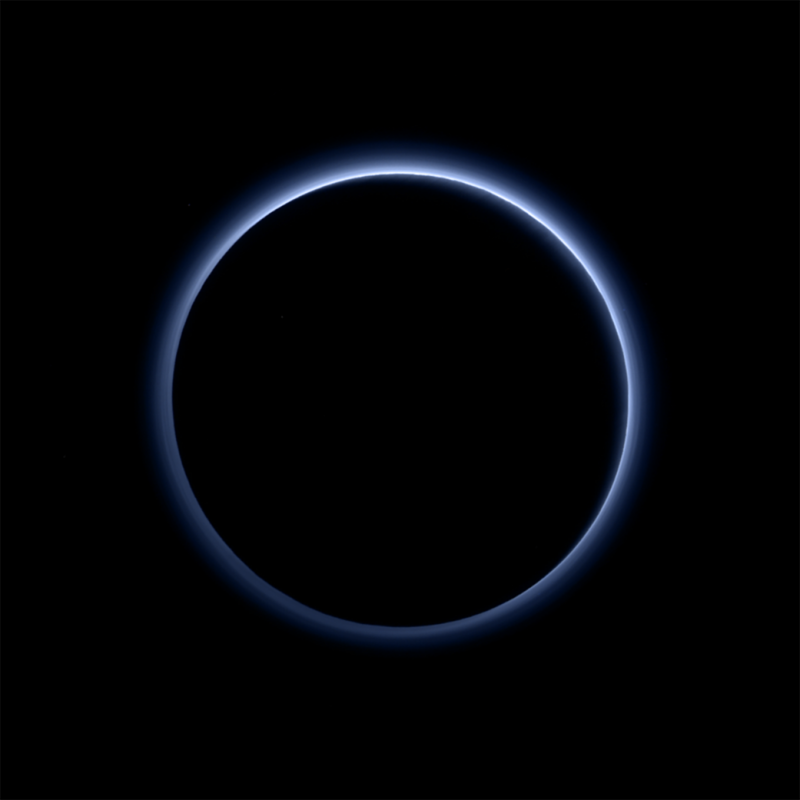
Total solar eclipse of the sun on July 2, 2019
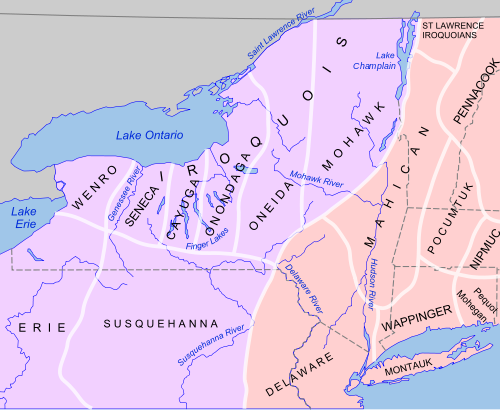
Map of the New York tribes before European arrival. Lavender indicates Iroquoian tribes. Orange indicates Algonquian tribes. Source: Smithsonian Institution

Iroquois, one of the historical figures of the Maisonneuve Monument, by Louis-Philippe Hébert, 1895, Place d’Armes, Montreal. Photo via Wikimedia Commons.

Bruce E. Johansen refers to the research done by Barbara A. Mann and Jerry L. Fields, which uses eclipse data as well as oral history to challenge the common notion that the Iroquois Confederacy or Iroquois League started in the fifteenth (1401-1500) or sixteenth (1501-1600) century. They state:

We know this much: During a ratification council held at Ganondagan (near modern-day Victor, New York) the sky darkened in a total, or near total, eclipse. The time of day was afternoon, as Councils are held between noon and sunset. The time of year was either Second Hoeing (early July) or Green Corn (late August to early September). Thus, we must look for an eclipse path that would totally cover Ganondagan between July and September, in mid-afternoon.

Mann and Fields settled upon the total solar eclipse of August 22, 1142 as satisfying the stated criteria. Bruce E. Johansen even pinpoints where the ratification of the Iroquois League took place:

The ratification council convened at a site that is now a football field in Victor, New York. The site is called Gonandaga by the Seneca.

Traditional Iroquois Longhouse. Source: Wilber F. Gordy

I looked up the August 1142 total solar eclipse at the NASA Eclipse Web Site. You can see this map for yourself by clicking here.

Map showing Victor, NY, and August 1142 eclipse path
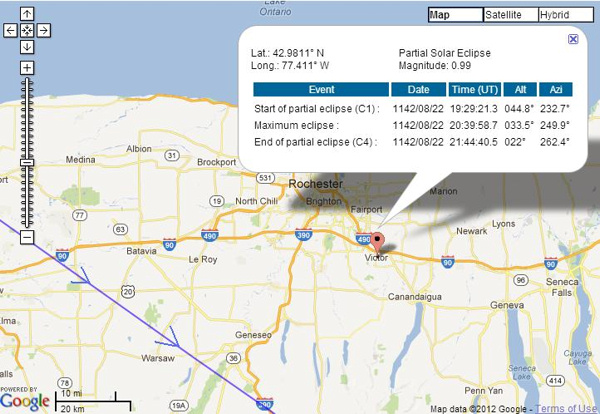
Map Credit: NASA Eclipse Web Site

For the fun of it, I zoomed into the August 1142 eclipse map until finding Victor, New York. Looking along the zoomed-in eclipse path above, you can see Victor a short way to the north of the northern limit of total solar eclipse path (in blue). Nonetheless, it would have been very close to a total solar eclipse at greatest eclipse. Rounding off to the nearest minute, the partial eclipse started at 19:29 Universal Time (2:29 p.m. Eastern Standard Time), maximum eclipse arrived at 20:40 UT (3:40 p.m. EST) and the partial eclipse ended at 21:45 UT (4:45 p.m. EST).
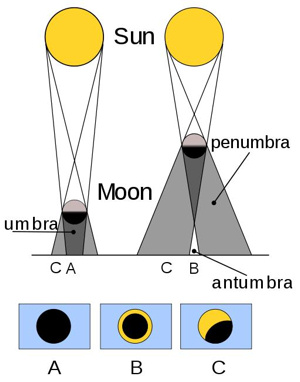
Contrasting a total solar eclipse (A) with an annular eclipse (B) Image credit: Wikimedia Commons

Other proposed dates include June 28, 1451 and June 18, 1536. But the total solar eclipse of 1451 June 28 did not swing as close to Victor as did the one on 1142 August 22. The path of 1536 June 18 eclipse didn’t pass particularly close to Victor either, and moreover, it came at the wrong time of day, and was an annular eclipse, rather than a total eclipse of the sun.

See the diagram at right to contrast a total solar eclipse with an annular eclipse. During a total solar eclipse, the new moon totally covers over the solar disk; during an annular eclipse, the new moon lies too far from Earth to completely cover over the sun, so a thin annulus – or ring – of sunshine circles the new moon silhouette.

Could it have been an annular solar eclipse that convinced the Seneca to join the Haudenosaunee (Iroquois) Confederacy at Gonandaga (Victor, NY)? If so, the formation of Haudenosaunee (Five Nations) might go all the way back to the annular eclipse of August 18, 909. The middle of the eclipse path (in red) on the below chart almost exactly crosses Victor, NY!

Map showing Victor, NY, and August 909 eclipse path
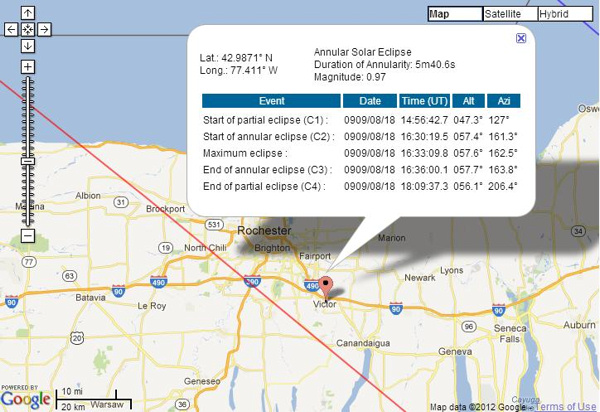
Map Credit: NASA Eclipse Web Site

These web pages can help you search out eclipse history in more detail: Major Solar Eclipses Visible from New York, NY and Five Millennium Catalog of Solar Eclipses.

Eclipses are a great way to document history. But the real item of importance, as far as I’m concerned, is the acceptance of the Peacemaker and the democratic ideals of the Iroquois Confederacy.

Bottom line: Research suggests the total solar eclipse of August 22, 1142 coincided with the birth of the Iroquois (Five Nations) Confederacy, near modern-day Victor, New York.


from EarthSky https://ift.tt/2lvB4F5
Iroquois Confederacy

Original Iroquois League was known as the Five Nations

My wife Alice regularly brings home the Indian Time news journal, a publication from the Akwesasne Mohawk Nation Territory in northern New York. It was with great interest that I came across an article titled Dating the Iroquois Confederacy by Bruce E. Johansen.

What really attracted my attention was that a total, or near total, solar eclipse marked the beginning of the Haudenosaunee (Iroquois) Confederacy, the oldest living democracy in North America and possibly on Earth. American democracy is said to have been modeled upon the democratic ideals of the Iroquois Confederacy, which originally consisted of five nations (Mohawk, Oneida, Onondaga, Cayuga and Seneca). The sixth nation – the Tuscarora – joined the Iroquois Confederacy in the early eighteenth century (1701-1800).

Total solar eclipse of the sun on July 2, 2019

Map of the New York tribes before European arrival. Lavender indicates Iroquoian tribes. Orange indicates Algonquian tribes. Source: Smithsonian Institution

Iroquois, one of the historical figures of the Maisonneuve Monument, by Louis-Philippe Hébert, 1895, Place d’Armes, Montreal. Photo via Wikimedia Commons.

Bruce E. Johansen refers to the research done by Barbara A. Mann and Jerry L. Fields, which uses eclipse data as well as oral history to challenge the common notion that the Iroquois Confederacy or Iroquois League started in the fifteenth (1401-1500) or sixteenth (1501-1600) century. They state:

We know this much: During a ratification council held at Ganondagan (near modern-day Victor, New York) the sky darkened in a total, or near total, eclipse. The time of day was afternoon, as Councils are held between noon and sunset. The time of year was either Second Hoeing (early July) or Green Corn (late August to early September). Thus, we must look for an eclipse path that would totally cover Ganondagan between July and September, in mid-afternoon.

Mann and Fields settled upon the total solar eclipse of August 22, 1142 as satisfying the stated criteria. Bruce E. Johansen even pinpoints where the ratification of the Iroquois League took place:

The ratification council convened at a site that is now a football field in Victor, New York. The site is called Gonandaga by the Seneca.

Traditional Iroquois Longhouse. Source: Wilber F. Gordy

I looked up the August 1142 total solar eclipse at the NASA Eclipse Web Site. You can see this map for yourself by clicking here.

Map showing Victor, NY, and August 1142 eclipse path

Map Credit: NASA Eclipse Web Site

For the fun of it, I zoomed into the August 1142 eclipse map until finding Victor, New York. Looking along the zoomed-in eclipse path above, you can see Victor a short way to the north of the northern limit of total solar eclipse path (in blue). Nonetheless, it would have been very close to a total solar eclipse at greatest eclipse. Rounding off to the nearest minute, the partial eclipse started at 19:29 Universal Time (2:29 p.m. Eastern Standard Time), maximum eclipse arrived at 20:40 UT (3:40 p.m. EST) and the partial eclipse ended at 21:45 UT (4:45 p.m. EST).

Contrasting a total solar eclipse (A) with an annular eclipse (B) Image credit: Wikimedia Commons

Other proposed dates include June 28, 1451 and June 18, 1536. But the total solar eclipse of 1451 June 28 did not swing as close to Victor as did the one on 1142 August 22. The path of 1536 June 18 eclipse didn’t pass particularly close to Victor either, and moreover, it came at the wrong time of day, and was an annular eclipse, rather than a total eclipse of the sun.

See the diagram at right to contrast a total solar eclipse with an annular eclipse. During a total solar eclipse, the new moon totally covers over the solar disk; during an annular eclipse, the new moon lies too far from Earth to completely cover over the sun, so a thin annulus – or ring – of sunshine circles the new moon silhouette.

Could it have been an annular solar eclipse that convinced the Seneca to join the Haudenosaunee (Iroquois) Confederacy at Gonandaga (Victor, NY)? If so, the formation of Haudenosaunee (Five Nations) might go all the way back to the annular eclipse of August 18, 909. The middle of the eclipse path (in red) on the below chart almost exactly crosses Victor, NY!

Map showing Victor, NY, and August 909 eclipse path

Map Credit: NASA Eclipse Web Site

These web pages can help you search out eclipse history in more detail: Major Solar Eclipses Visible from New York, NY and Five Millennium Catalog of Solar Eclipses.

Eclipses are a great way to document history. But the real item of importance, as far as I’m concerned, is the acceptance of the Peacemaker and the democratic ideals of the Iroquois Confederacy.

Bottom line: Research suggests the total solar eclipse of August 22, 1142 coincided with the birth of the Iroquois (Five Nations) Confederacy, near modern-day Victor, New York.


from EarthSky https://ift.tt/2lvB4F5

Moon goes by Saturn night of July 15
On July 15, 2019, the almost-full waxing gibbous moon and the planet Saturn pair up together on the sky’s dome, staying out nearly all night long. Saturn just passed its yearly opposition on July 9. It’s now at its brightest and best for all of 2019. Although the July 15 moon will probably appear full to the eye, it isn’t truly full until the night of July 16. What’s more, on July 16, the northern side of the full moon will swing through the southern part of the Earth’s dark shadow, to showcase a partial lunar eclipse that’ll be visible from South America, Europe, Africa, Asia, Indonesia, and Australia – but not in North America.

Saturn will be near the moon on July 16 as well … and depending on where you live worldwide, the moon and Saturn will couple up most closely on July 15 or 16. So find Saturn on either night! And – if you’re in a place to view the eclipse – enjoy it on eclipse night.

Read more: Partial lunar eclipse on July 16-17

These two luminaries – the moon and Saturn – shine in the eastern part of the sky at dusk, as viewed from around the world. They climb highest up for the night around midnight and set in the west as darkness gives way to dawn. Saturn shines as brilliantly as a 1st-magnitude star, that is, as one of the brightest stars in our sky. Still, you might easily overlook Saturn in the moon’s glare. If you can’t see a bright point of light near the moon on July 15, try blocking out the moon with your finger.

Saturn, the sixth planet outward from the sun, is the farthest world we can easily see with the unaided eye. The moon and Saturn aren’t close together in space tonight but closely align on the same line of sight. Tonight’s moon is about a quarter million miles (400,000 km) distant, whereas far-off Saturn is nearly 3,500 times the moon’s distance from Earth.

Want to know more? Find the moon’s present distance from Earth, and Saturn’s present distance (in astronomical units) from Earth. One astronomical unit = sun-Earth distance.

Big Saturn with very small Earth beside it. Rings and all: 21 Earth diameters.

Contrasting the size of Saturn and its rings with our planet Earth via Hubble Heritage Team.

The moon will sweep 0.2 degree south of Saturn on July 16, 2019, at 7:27 Universal Time. (For reference, 0.2 degree is 40 percent of the moon’s angular diameter.) At Canadian and U.S. times zones, the moon passes south of Saturn on July 16 at 4:27 a.m. ADT, 3:27 a.m. EDT, 2:27 a.m. CDT, 1:27 a.m. MDT, 12:27 a.m. PDT – and on July 15, at 11:27 p.m. AKDT (Alaska) and 9:27 p.m. HST (Hawaii).

One thing to remember: when an almanac tells you that the moon swings so many degrees to the north or south of a planet or bright star, it means as seen from the center of the Earth. From the Earth’s surface, the moon passes farther away from Saturn at more northerly latitudes, yet closer to Saturn at more southerly latitudes.

In fact, if you’re far south on the Earth’s globe, like in Antarctica or the southern tip of South America, you would actually see the moon pass to the north of Saturn – instead of to the south of Saturn. For much of South America, however, the moon won’t pass to the south or to the north of Saturn. Look at the worldwide map below. The area in between the solid white lines will actually have the moon occult – pass directly in front of – Saturn for a portion of the night on July 15-16, 2019. In South America, this occultation will happen in the morning hours of July 16.

Earth map with arc-shaped parallel lines over Pacific and South America.

Worldwide map of the occultation of Saturn via IOTA. All places between the solid white lines have the moon occulting Saturn in a nighttime sky on the night of July 15-16, 2019. More info at IOTA.

Bottom line: As darkness falls on July 15, 2019, try finding the planet Saturn in the glare of the almost-full moon. Then watch for Saturn again the next night, especially if you’re in a part of the world that can view the July 16-17 partial lunar eclipse. North America, tough luck for us. We won’t see the eclipse.

Read more: Partial lunar eclipse on July 16-17


from EarthSky https://ift.tt/2SdCtME

On July 15, 2019, the almost-full waxing gibbous moon and the planet Saturn pair up together on the sky’s dome, staying out nearly all night long. Saturn just passed its yearly opposition on July 9. It’s now at its brightest and best for all of 2019. Although the July 15 moon will probably appear full to the eye, it isn’t truly full until the night of July 16. What’s more, on July 16, the northern side of the full moon will swing through the southern part of the Earth’s dark shadow, to showcase a partial lunar eclipse that’ll be visible from South America, Europe, Africa, Asia, Indonesia, and Australia – but not in North America.

Saturn will be near the moon on July 16 as well … and depending on where you live worldwide, the moon and Saturn will couple up most closely on July 15 or 16. So find Saturn on either night! And – if you’re in a place to view the eclipse – enjoy it on eclipse night.

Read more: Partial lunar eclipse on July 16-17

These two luminaries – the moon and Saturn – shine in the eastern part of the sky at dusk, as viewed from around the world. They climb highest up for the night around midnight and set in the west as darkness gives way to dawn. Saturn shines as brilliantly as a 1st-magnitude star, that is, as one of the brightest stars in our sky. Still, you might easily overlook Saturn in the moon’s glare. If you can’t see a bright point of light near the moon on July 15, try blocking out the moon with your finger.

Saturn, the sixth planet outward from the sun, is the farthest world we can easily see with the unaided eye. The moon and Saturn aren’t close together in space tonight but closely align on the same line of sight. Tonight’s moon is about a quarter million miles (400,000 km) distant, whereas far-off Saturn is nearly 3,500 times the moon’s distance from Earth.

Want to know more? Find the moon’s present distance from Earth, and Saturn’s present distance (in astronomical units) from Earth. One astronomical unit = sun-Earth distance.

Big Saturn with very small Earth beside it. Rings and all: 21 Earth diameters.

Contrasting the size of Saturn and its rings with our planet Earth via Hubble Heritage Team.

The moon will sweep 0.2 degree south of Saturn on July 16, 2019, at 7:27 Universal Time. (For reference, 0.2 degree is 40 percent of the moon’s angular diameter.) At Canadian and U.S. times zones, the moon passes south of Saturn on July 16 at 4:27 a.m. ADT, 3:27 a.m. EDT, 2:27 a.m. CDT, 1:27 a.m. MDT, 12:27 a.m. PDT – and on July 15, at 11:27 p.m. AKDT (Alaska) and 9:27 p.m. HST (Hawaii).

One thing to remember: when an almanac tells you that the moon swings so many degrees to the north or south of a planet or bright star, it means as seen from the center of the Earth. From the Earth’s surface, the moon passes farther away from Saturn at more northerly latitudes, yet closer to Saturn at more southerly latitudes.

In fact, if you’re far south on the Earth’s globe, like in Antarctica or the southern tip of South America, you would actually see the moon pass to the north of Saturn – instead of to the south of Saturn. For much of South America, however, the moon won’t pass to the south or to the north of Saturn. Look at the worldwide map below. The area in between the solid white lines will actually have the moon occult – pass directly in front of – Saturn for a portion of the night on July 15-16, 2019. In South America, this occultation will happen in the morning hours of July 16.

Earth map with arc-shaped parallel lines over Pacific and South America.

Worldwide map of the occultation of Saturn via IOTA. All places between the solid white lines have the moon occulting Saturn in a nighttime sky on the night of July 15-16, 2019. More info at IOTA.

Bottom line: As darkness falls on July 15, 2019, try finding the planet Saturn in the glare of the almost-full moon. Then watch for Saturn again the next night, especially if you’re in a part of the world that can view the July 16-17 partial lunar eclipse. North America, tough luck for us. We won’t see the eclipse.

Read more: Partial lunar eclipse on July 16-17


from EarthSky https://ift.tt/2SdCtME

Cactus blossom near Shimla, India

Tall cactus with yellow blooms on a scrubby hillside.

View at EarthSky Community Photos. | Swami Krishnananda captured the images on this page in July 2019, near Shimla, India. He wrote to EarthSky: “Yesterday, on my daily walk, I saw this cactus blooming from far away, and decided to go near to enjoy its beauty. I had to climb hard climb up a hill to reach it. As the photos will show, it was worth the adventure.”

Tall plant with yellow blossoms against dark hilly background.

View at EarthSky Community Photos. | Swami Krishnananda commented: “There are three different varieties of cacti in this region near Shimla. This one takes several months to bloom fully, starting with the long shoot.”

Thin branches with big yellow blossoms.

View at EarthSky Community Photos. | Close-up on cactus blossoms.

Yellow blossoms and a red bird.

View at EarthSky Community Photos. | “Here we see a crimson sunbird feeding on the nectar,” Swami Krishnananda wrote.

Yellow blossoms and bees.

View at EarthSky Community Photos. | “And these bees were feeding on the nectar, too. Once the blossom is over and wilted, the cactus seems to have fulfilled its life’s purpose and dies. The same thing is said to happen to us human beings. Once God’s purpose of blossoming the Sahasrar Chakra is done, the body perishes within a week or so. Jai Guru!Swami Krishnananda wrote.

Bottom line: A photo essay of a walk up a hillside near Shimla, India, closer and closer to a cactus blossom, with thoughts on impermanence.

More from Swami Krishnananda: Birds and birds


from EarthSky https://ift.tt/2k1b7N7
Tall cactus with yellow blooms on a scrubby hillside.

View at EarthSky Community Photos. | Swami Krishnananda captured the images on this page in July 2019, near Shimla, India. He wrote to EarthSky: “Yesterday, on my daily walk, I saw this cactus blooming from far away, and decided to go near to enjoy its beauty. I had to climb hard climb up a hill to reach it. As the photos will show, it was worth the adventure.”

Tall plant with yellow blossoms against dark hilly background.

View at EarthSky Community Photos. | Swami Krishnananda commented: “There are three different varieties of cacti in this region near Shimla. This one takes several months to bloom fully, starting with the long shoot.”

Thin branches with big yellow blossoms.

View at EarthSky Community Photos. | Close-up on cactus blossoms.

Yellow blossoms and a red bird.

View at EarthSky Community Photos. | “Here we see a crimson sunbird feeding on the nectar,” Swami Krishnananda wrote.

Yellow blossoms and bees.

View at EarthSky Community Photos. | “And these bees were feeding on the nectar, too. Once the blossom is over and wilted, the cactus seems to have fulfilled its life’s purpose and dies. The same thing is said to happen to us human beings. Once God’s purpose of blossoming the Sahasrar Chakra is done, the body perishes within a week or so. Jai Guru!Swami Krishnananda wrote.

Bottom line: A photo essay of a walk up a hillside near Shimla, India, closer and closer to a cactus blossom, with thoughts on impermanence.

More from Swami Krishnananda: Birds and birds


from EarthSky https://ift.tt/2k1b7N7

Eclipses make animals do strange things

Totally eclipsed sun in darkened sky over a desert campground. Background: hills with distant pylons.

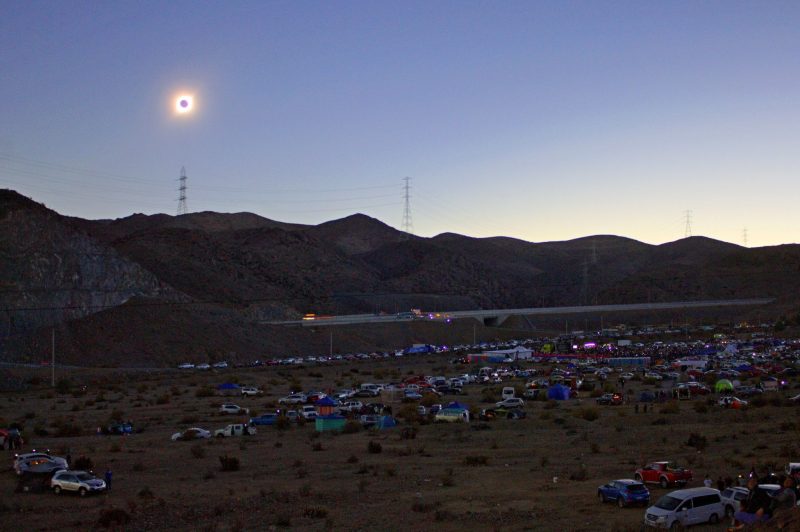
View at EarthSky Community Photos. | Pablo Goffard caught the July 2, 2019, total solar eclipse from Incahuasi, Chile. He wrote: “This is just a photo, a tiny part of the experience. Incahuasi is a small town in the Atacama desert. Here is seen the camp installed especially for the eclipse.”

By Steve Portugal, Royal Holloway

Looking for information on the July 16-17, 2019 partial lunar eclipse? Click here

For most animals, the structure of their day – and indeed their year – depends on the light-dark cycle. These regular and rhythmic cycles in the length of days tell animals when they should be foraging, when they should be asleep, when it’s time to migrate and when it’s time to breed. Animals can tell all this from how many hours of daylight they experience, but the moon’s cycles also strongly influence their behavior.

The lunar synodic cycle – the moon’s regular journey from full moon to full moon again over 28 nights – causes changes in the Earth’s magnetic field, the moon’s gravitational pull on Earth, and light levels at night. Many species can detect this and use it to synchronize their breeding. Mass spawning in corals sees tens of millions of eggs released at once on reefs to coincide with full or new moons. But what happens to animals when the moon or the sun does something unusual or unexpected, such as an eclipse?

Yellow coral branches, many fringed openings, some with pink or blue spheres emerging.

A coral (Acropora millepora) releases egg and sperm bundles during the annual spawning event on the Great Barrier Reef, following the full moon in late November. Image via Coral Brunner/Shutterstock.

Solar eclipses

Of all the cosmic events, solar eclipses prompt perhaps the biggest change in animal behavior. Puzzled animals that are active during the day head back to their nighttime abodes while nocturnal animals think they’ve overslept. A solar eclipse occurs when the sun, moon and Earth are aligned on the same axis so that the moon completely blocks the sun. Around the world, unusual incidences of behavior are usually reported while everyone else is watching the eclipse.

Some spider species begin to break down their webs during an eclipse, as they typically do at the end of the day. Once the eclipse has passed, they begin to rebuild them again, possibly lamenting the lack of rest in between. Similarly, fish and birds that are active during the day head for their nighttime resting places, while nocturnal bats appear, seemingly tricked by the sudden darkness.

Hippos in Zimbabwe were observed leaving their rivers during an eclipse, heading towards their nocturnal feeding grounds on dry land. Midway through their departure, the eclipse passed, daylight returned and the hippos aborted their efforts. The animals appeared agitated and stressed following the eclipse for the remainder of the day.

Walking hippo draped in water hyacinths with a white bird sitting on its back.

Leaving in a hurry. Image via Jez Bennett/Shutterstock

The moon

A lunar eclipse happens when the moon, Earth and sun are very closely aligned, with the Earth positioned between the two. As the moon passes directly behind us, Earth blocks sunlight from directly reaching the moon, causing a reddish glow to appear. These so-called “blood moons” can only occur when there is a full moon, so it’s difficult to separate the impacts that lunar eclipses have on animals compared to a standard full moon.

A study in 2010 discovered that Azara’s owl monkeys – a typically nocturnal species – stopped foraging in Argentina during a lunar eclipse as their world became suddenly darker. They may have struggled to see their food, or felt too unnerved to move safely through the trees.

Small furry animal with very big red eyes clinging to large bamboo.

Azara’s owl monkeys stop feeding during lunar eclipses. Image via </<a href="https://en.wikipedia.org/wiki/Azara%27s_night_monkey#/media/File:Aotus_azarae_infulatus.jpg" target="_blank" rel="noopener noreferrer">Rich Hoyer/Flickr.

Around three times a year, a “supermoon” occurs, which is when a full moon coincides with perigee – the point at which the moon is closest to the Earth. The moon’s distance to Earth varies throughout the month, because the moon’s orbit is not a perfect circle. During a perigee event, the moon is about 29,000 miles (46,000 km) closer to the Earth than during apogee – when the moon is farthest from Earth.

During a supermoon, light levels at night are around 30 percent brighter than at any point in the moon’s monthly cycle, and it appears much larger in the sky. Our recent study found that wild barnacle geese responded to these supermoon events while they over-winter in southwest Scotland. We fitted small devices to the animals which measure their behavior and found that the geese’s heart rate and body temperature increased at night during supermoons, when typically at this time of day they’d be subdued.

The birds didn’t respond to “supermoon” events when the moon was hidden by heavy cloud and the night stayed quite dark. So it appears that, a bit like with humans, the bright light of a supermoon woke the geese up, causing their heart rate and body temperature to increase, potentially in preparation for daytime.

Dark orange circle on a black background.

Blood moons – despite their foreboding name – underwhelm barnacle geese. Image via Justinas Vitkus/Shutterstock.

The lunar cycle and us

For centuries, people have been fascinated about the relationship between human behavior and the lunar cycle. Many folklores and fables were connected to our interactions with the moon, the most extreme example perhaps being that of mythical beasts such as werewolves. It isn’t too surprising then that previously the term “lunatic” – from the Latin “lunaticus”, meaning “of the moon” – was used to describe people deemed to be mentally ill, crazy or unpredictable, until 1930, when more appropriate and sensitive terms were introduced.

It was once believed that the lunar cycle influenced a range of strange changes to a person’s physiology and the behavior of wider society, with everything from birth rate, fertility, epilepsy and overall argumentativeness thought to be influenced. Many still believe that incidences of violent crime and general disorder increase around the time of a full moon.

A series of studies published in the late 1980s found no evidence at all of any link between the lunar cycle and human behavior. The moon’s influence on us might remain the stuff of legend, but the confusion it sows among wild animals is very real indeed.

Steve Portugal, Reader in Animal Biology and Physiology, Royal Holloway

This article is republished from The Conversation under a Creative Commons license. Read the original article.

Bottom line: How do solar and lunar eclipses influence animal behavior?

The Conversation

Looking for information on the July 16-17, 2019 partial lunar eclipse? Click here


from EarthSky https://ift.tt/2XKTKCQ
Totally eclipsed sun in darkened sky over a desert campground. Background: hills with distant pylons.

View at EarthSky Community Photos. | Pablo Goffard caught the July 2, 2019, total solar eclipse from Incahuasi, Chile. He wrote: “This is just a photo, a tiny part of the experience. Incahuasi is a small town in the Atacama desert. Here is seen the camp installed especially for the eclipse.”

By Steve Portugal, Royal Holloway

Looking for information on the July 16-17, 2019 partial lunar eclipse? Click here

For most animals, the structure of their day – and indeed their year – depends on the light-dark cycle. These regular and rhythmic cycles in the length of days tell animals when they should be foraging, when they should be asleep, when it’s time to migrate and when it’s time to breed. Animals can tell all this from how many hours of daylight they experience, but the moon’s cycles also strongly influence their behavior.

The lunar synodic cycle – the moon’s regular journey from full moon to full moon again over 28 nights – causes changes in the Earth’s magnetic field, the moon’s gravitational pull on Earth, and light levels at night. Many species can detect this and use it to synchronize their breeding. Mass spawning in corals sees tens of millions of eggs released at once on reefs to coincide with full or new moons. But what happens to animals when the moon or the sun does something unusual or unexpected, such as an eclipse?

Yellow coral branches, many fringed openings, some with pink or blue spheres emerging.

A coral (Acropora millepora) releases egg and sperm bundles during the annual spawning event on the Great Barrier Reef, following the full moon in late November. Image via Coral Brunner/Shutterstock.

Solar eclipses

Of all the cosmic events, solar eclipses prompt perhaps the biggest change in animal behavior. Puzzled animals that are active during the day head back to their nighttime abodes while nocturnal animals think they’ve overslept. A solar eclipse occurs when the sun, moon and Earth are aligned on the same axis so that the moon completely blocks the sun. Around the world, unusual incidences of behavior are usually reported while everyone else is watching the eclipse.

Some spider species begin to break down their webs during an eclipse, as they typically do at the end of the day. Once the eclipse has passed, they begin to rebuild them again, possibly lamenting the lack of rest in between. Similarly, fish and birds that are active during the day head for their nighttime resting places, while nocturnal bats appear, seemingly tricked by the sudden darkness.

Hippos in Zimbabwe were observed leaving their rivers during an eclipse, heading towards their nocturnal feeding grounds on dry land. Midway through their departure, the eclipse passed, daylight returned and the hippos aborted their efforts. The animals appeared agitated and stressed following the eclipse for the remainder of the day.

Walking hippo draped in water hyacinths with a white bird sitting on its back.

Leaving in a hurry. Image via Jez Bennett/Shutterstock

The moon

A lunar eclipse happens when the moon, Earth and sun are very closely aligned, with the Earth positioned between the two. As the moon passes directly behind us, Earth blocks sunlight from directly reaching the moon, causing a reddish glow to appear. These so-called “blood moons” can only occur when there is a full moon, so it’s difficult to separate the impacts that lunar eclipses have on animals compared to a standard full moon.

A study in 2010 discovered that Azara’s owl monkeys – a typically nocturnal species – stopped foraging in Argentina during a lunar eclipse as their world became suddenly darker. They may have struggled to see their food, or felt too unnerved to move safely through the trees.

Small furry animal with very big red eyes clinging to large bamboo.

Azara’s owl monkeys stop feeding during lunar eclipses. Image via </<a href="https://en.wikipedia.org/wiki/Azara%27s_night_monkey#/media/File:Aotus_azarae_infulatus.jpg" target="_blank" rel="noopener noreferrer">Rich Hoyer/Flickr.

Around three times a year, a “supermoon” occurs, which is when a full moon coincides with perigee – the point at which the moon is closest to the Earth. The moon’s distance to Earth varies throughout the month, because the moon’s orbit is not a perfect circle. During a perigee event, the moon is about 29,000 miles (46,000 km) closer to the Earth than during apogee – when the moon is farthest from Earth.

During a supermoon, light levels at night are around 30 percent brighter than at any point in the moon’s monthly cycle, and it appears much larger in the sky. Our recent study found that wild barnacle geese responded to these supermoon events while they over-winter in southwest Scotland. We fitted small devices to the animals which measure their behavior and found that the geese’s heart rate and body temperature increased at night during supermoons, when typically at this time of day they’d be subdued.

The birds didn’t respond to “supermoon” events when the moon was hidden by heavy cloud and the night stayed quite dark. So it appears that, a bit like with humans, the bright light of a supermoon woke the geese up, causing their heart rate and body temperature to increase, potentially in preparation for daytime.

Dark orange circle on a black background.

Blood moons – despite their foreboding name – underwhelm barnacle geese. Image via Justinas Vitkus/Shutterstock.

The lunar cycle and us

For centuries, people have been fascinated about the relationship between human behavior and the lunar cycle. Many folklores and fables were connected to our interactions with the moon, the most extreme example perhaps being that of mythical beasts such as werewolves. It isn’t too surprising then that previously the term “lunatic” – from the Latin “lunaticus”, meaning “of the moon” – was used to describe people deemed to be mentally ill, crazy or unpredictable, until 1930, when more appropriate and sensitive terms were introduced.

It was once believed that the lunar cycle influenced a range of strange changes to a person’s physiology and the behavior of wider society, with everything from birth rate, fertility, epilepsy and overall argumentativeness thought to be influenced. Many still believe that incidences of violent crime and general disorder increase around the time of a full moon.

A series of studies published in the late 1980s found no evidence at all of any link between the lunar cycle and human behavior. The moon’s influence on us might remain the stuff of legend, but the confusion it sows among wild animals is very real indeed.

Steve Portugal, Reader in Animal Biology and Physiology, Royal Holloway

This article is republished from The Conversation under a Creative Commons license. Read the original article.

Bottom line: How do solar and lunar eclipses influence animal behavior?

The Conversation

Looking for information on the July 16-17, 2019 partial lunar eclipse? Click here


from EarthSky https://ift.tt/2XKTKCQ

What’s a Blood Moon?

spiral of moons with orange-red eclipsed moon in center

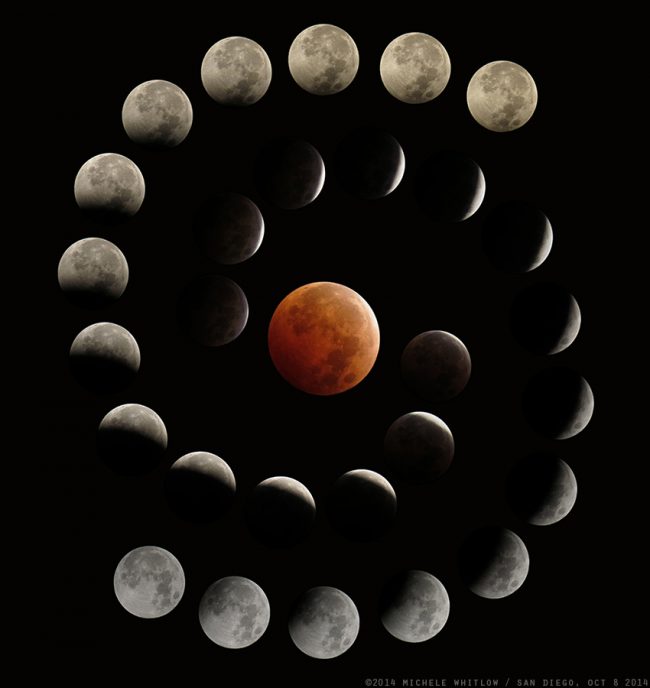
October 8, 2014, lunar eclipse composite by Michele Whitlow.

EarthSky lunar calendars are cool! They make great gifts. Order now. Going fast!

The term Blood Moon once was used in some sects of Christian prophesy to describe a total lunar eclipse that belonged to a tetrad of total lunar eclipses. The most recent Blood Moon – at least by this definition – took place on September 28, 2015. The next one won’t come until April 25, 2032.

Around the year 2013, when the expression Blood Moon first gained widespread popularity, a Blood Moon didn’t refer to just any total lunar eclipse, but to a member of a special series: four totally eclipsed moons in a row, each separated by six lunar months, with no partial lunar eclipses in between. Such a series is called a lunar tetrad. Two Christian pastors popularized the term Blood Moon in their book, in which they discussed the upcoming lunar tetrad (April 14 and October 8, 2014; April 8 and September 28, 2015) in apocalyptic terms.

The four lunar eclipses came and went, and, although the world didn’t end, we gained another dubious meme: Blood Moon.

Large deep orange moon

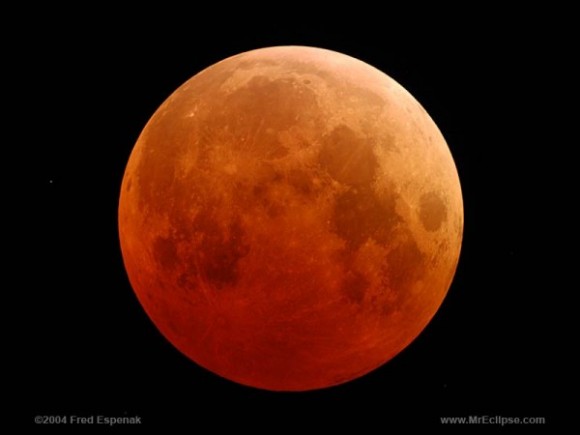
Here’s what a total eclipse looks like. This is the total eclipse of October 27, 2004, via Fred Espenak of NASA. Visit Fred’s page here. We astronomy writers often describe a totally eclipsed moon as appearing “blood red.” Here’s why the moon turns red during a total eclipse.

It’s not that the words “blood” and “moon” never appeared together in the same sentence before 2013, especially as regards eclipses. A full moon nearly always appears coppery red during a total lunar eclipse. That’s because the dispersed light from all the Earth’s sunrises and sunsets falls on the face of the moon at mid-eclipse. For some decades at least, it’s been common for astronomy writers like us to describe an eclipsed moon as blood red. You just didn’t, until recently, hear the same eclipsed moon called a Blood Moon.

And there’s another kind of Blood Moon in astronomy, unrelated to eclipses. In folklore, all the full moons have names. The names typically coincide with months of the year, or seasons. One of the most famous moon names is the Hunter’s Moon. It’s the full moon immediately following the Harvest Moon, which is the full moon occurring most closely to the autumnal equinox.

The Hunter’s Moon, in skylore, is also sometimes called the Blood Moon. Why? Probably because it’s a characteristic of these autumn full moons that they appear nearly full – and rise soon after sunset – for several evenings in a row. Many people see them when they are low in the sky, shortly after they’ve risen, at which time there’s more atmosphere between you and the moon than when the moon is overhead. When you see the moon low in the sky, the extra air between you and the moon makes the moon look reddish. Voila. Blood Moon.

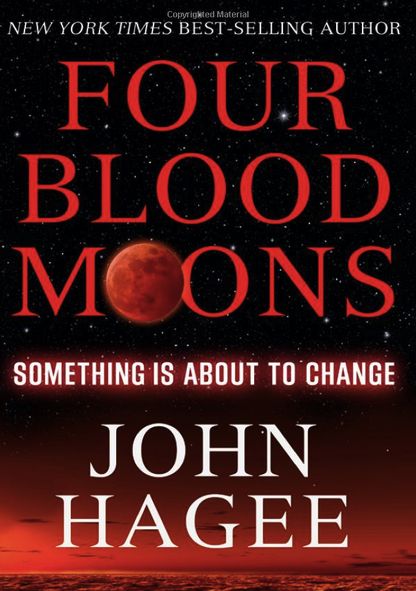
Still, the term Blood Moon in regard to total lunar eclipses might have been given new meaning by the Christian pastor John Hagee, who wrote a 2013 book about Blood Moons.

This book, published in 2013, is apparently what launched all the questions to our astronomy website about Blood Moons. We confess. We haven't read it.

This book, published in 2013, is apparently what launched all the questions to our astronomy website about Blood Moons.

What is a lunar tetrad? The word tetrad refers to four things in a group. In astronomy, the word is used to describe four successive total lunar eclipses, with no partial lunar eclipses in between, each of which is separated from the other by six lunar months (six full moons).

Nowadays, each of these four-in-a-row totally eclipsed moons has come to be called a Blood Moon. Why? We don’t know for sure, but the answer may lie in the book pictured above.

We’re not experts on prophecy of any kind. But we’ll tell you what we know about the modern definition for Blood Moon that raised many questions over years.

From what we’ve been able to gather, two Christian pastors, Mark Blitz and John Hagee, used the term Blood Moon to apply to the full moons of the 2014-2015 tetrad. John Hagee appears to have popularized the term in his 2013 book Four Blood Moons: Something is About to Change.

Mark Blitz and John Hagee spoke of the 2014-2015 lunar tetrad as representing a fulfillment of Biblical prophecy. After all, the moon is supposed to turn blood red before the end times, isn’t it? As described in Joel 2:31 (Common English Bible):

The sun will be turned to darkness, and the moon to blood before the great and dreadful day of the LORD comes.

That description, by the way, sounds like two different astronomical events: a total solar eclipse and total lunar eclipse. Sun turned to darkness = moon directly between the Earth and sun in a total solar eclipse. Moon turned to blood = Earth directly between the sun and moon, Earth’s shadow falling on the moon in a total lunar eclipse. Solar and lunar eclipses are very ordinary and frequent happenings that have occurred many times in our lifetimes. In fact, every year, there are four to seven eclipses, some lunar, some solar, some total, some partial.

Moon photo with Chinese characters down the sides.

In addition to its being a supermoon – and the last Blood Moon until 2032 – the September 28, 2015, full moon also marked the Mid-Autumn Festival in China. Photo from Hong Kong by Matthew Chin. See more photos like this.

The last lunar tetrad took place over the years 2014 and 2015. The first Blood Moon eclipse in the series of four happened on the night of April 14-15, 2014. The second one took place October 7-8, 2014, and the third one (the shortest total lunar eclipse of the 21st century) was April 4, 2015.

The fourth and final total lunar eclipse of the 2014-2015 tetrad – the last Blood Moon – fell on the night of September 27-28. It was also a supermoon. The eclipse was visible to sky watchers in North America, and the partial phases were seen from various places around the world. Many saw it!

Best photos: September 27-28 total lunar eclipse

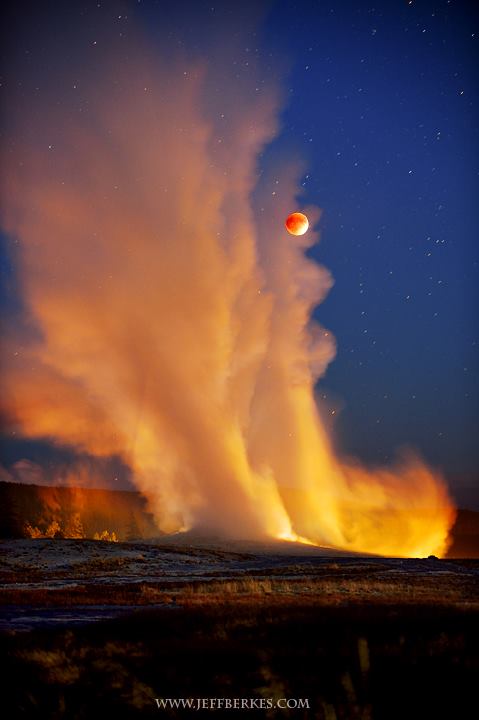
Old Faithful geyser at Yellowstone National Park erupts during Blood Moon maximum eclipse!

Old Faithful geyser at Yellowstone National Park in eruption during September 27-28, 2015, Blood Moon eclipse. “Over a year of planning paid off!” said Jeff Berkes Photography. See more photos like this.

When is the next lunar tetrad? There are a total of 8 tetrads in the 21st century (2001 to 2100). The next four total lunar eclipses in a row (spaced six lunar months apart, with no partial lunar eclipses in between) will take place in 2032 and 2033. Click here to learn more about lunar tetrads in this century, courtesy of Fred Espenak.

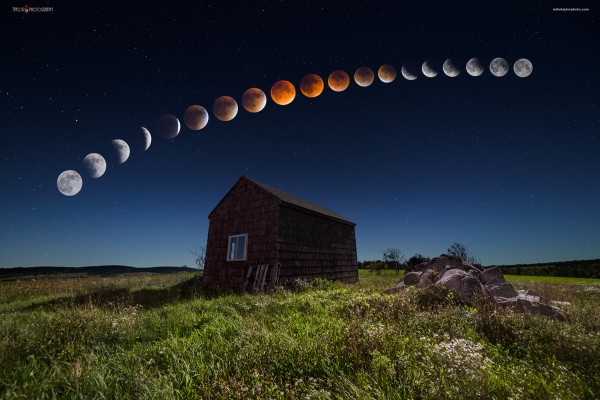
row of moons from full to full with red-orange eclipsed moon in the middle.

Super blood moon eclipse times 19! Composite of the September 27-28, 2015, lunar eclipse by Mike Taylor Photo in central Maine. See more photos like this.

How common is a tetrad of total lunar eclipses? Depending upon the century in which you live, a lunar tetrad (four consecutive total lunar eclipses) may happen fairly frequently – or not at all.

For instance, in our 21st century (2001-2100), there are a total 8 tetrads, but in the 17th, 18th and 19th centuries, there were none at all. If we include all the centuries from the 1st century (A.D. 1-100) through the 21st century (2001-2100), inclusive, there are a total of 62 tetrads. The last one happened in 2014-2015, and the next one will happen in 2032-2033.

The 2014-2015 tetrad fell on the Jewish feasts of Passover and Tabernacles. That happens a total of 8 in these 21 centuries:

1. 162-163 C.E. (Common Era)
2. 795-796 C.E.
3. 842-843 C.E.
4. 860-861 C.E.
5. 1493-1494 C.E.
6. 1949-1950 C.E.
7. 1967-1968 C.E.
8. 2014-2015 C.E.

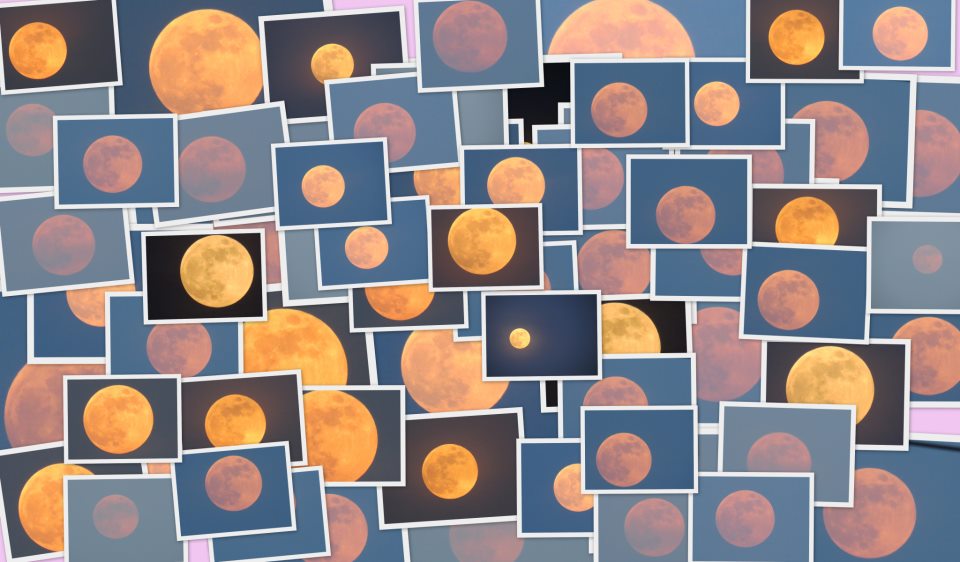
patchwork of many pictures of full moons

View larger. | Hunter’s Moon collage from EarthSky Facebook friend Kausor Khan in Hyberabad, India. Notice that she choose reddish moons to depict the Hunter’s Moon. That’s because many people see the Hunter’s Moon low in the sky, and moons seen low in the sky appear reddish.

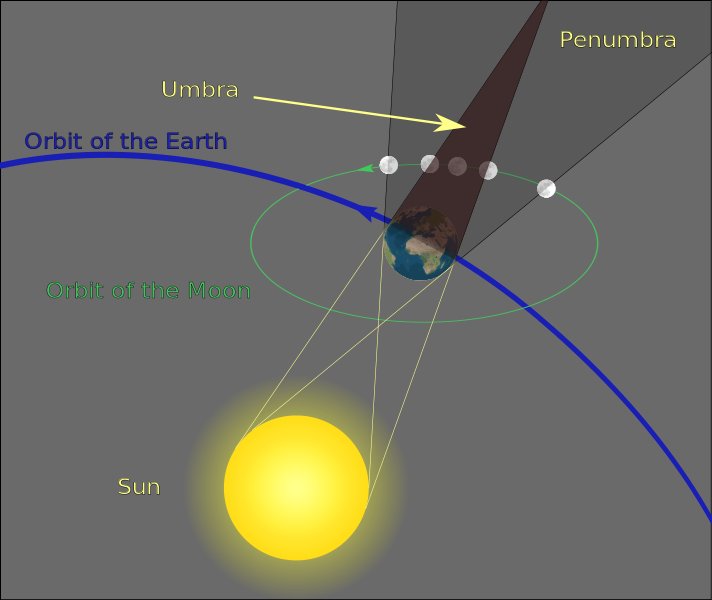
diagram of earth and moon orbits

A lunar eclipse can only happen at full moon. At such times, Earth is directly between the sun and moon, and Earth’s dark umbral shadow falls on the moon’s face.

Bottom line: The term Blood Moon in Biblical prophecy appears to have been popularized by two Christian pastors, Mark Blitz and John Hagee. They used the term to apply to the full moons of the 2014-2015 lunar tetrad – four successive total lunar eclipses, each separated by six lunar months, with no partial lunar eclipses in between. Nowadays, it seems, the term Blood Moon is being used for any and all total lunar eclipses.

A planisphere is virtually indispensable for beginning stargazers. Order your EarthSky planisphere today.


from EarthSky https://ift.tt/2SfsN4t
spiral of moons with orange-red eclipsed moon in center

October 8, 2014, lunar eclipse composite by Michele Whitlow.

EarthSky lunar calendars are cool! They make great gifts. Order now. Going fast!

The term Blood Moon once was used in some sects of Christian prophesy to describe a total lunar eclipse that belonged to a tetrad of total lunar eclipses. The most recent Blood Moon – at least by this definition – took place on September 28, 2015. The next one won’t come until April 25, 2032.

Around the year 2013, when the expression Blood Moon first gained widespread popularity, a Blood Moon didn’t refer to just any total lunar eclipse, but to a member of a special series: four totally eclipsed moons in a row, each separated by six lunar months, with no partial lunar eclipses in between. Such a series is called a lunar tetrad. Two Christian pastors popularized the term Blood Moon in their book, in which they discussed the upcoming lunar tetrad (April 14 and October 8, 2014; April 8 and September 28, 2015) in apocalyptic terms.

The four lunar eclipses came and went, and, although the world didn’t end, we gained another dubious meme: Blood Moon.

Large deep orange moon

Here’s what a total eclipse looks like. This is the total eclipse of October 27, 2004, via Fred Espenak of NASA. Visit Fred’s page here. We astronomy writers often describe a totally eclipsed moon as appearing “blood red.” Here’s why the moon turns red during a total eclipse.

It’s not that the words “blood” and “moon” never appeared together in the same sentence before 2013, especially as regards eclipses. A full moon nearly always appears coppery red during a total lunar eclipse. That’s because the dispersed light from all the Earth’s sunrises and sunsets falls on the face of the moon at mid-eclipse. For some decades at least, it’s been common for astronomy writers like us to describe an eclipsed moon as blood red. You just didn’t, until recently, hear the same eclipsed moon called a Blood Moon.

And there’s another kind of Blood Moon in astronomy, unrelated to eclipses. In folklore, all the full moons have names. The names typically coincide with months of the year, or seasons. One of the most famous moon names is the Hunter’s Moon. It’s the full moon immediately following the Harvest Moon, which is the full moon occurring most closely to the autumnal equinox.

The Hunter’s Moon, in skylore, is also sometimes called the Blood Moon. Why? Probably because it’s a characteristic of these autumn full moons that they appear nearly full – and rise soon after sunset – for several evenings in a row. Many people see them when they are low in the sky, shortly after they’ve risen, at which time there’s more atmosphere between you and the moon than when the moon is overhead. When you see the moon low in the sky, the extra air between you and the moon makes the moon look reddish. Voila. Blood Moon.

Still, the term Blood Moon in regard to total lunar eclipses might have been given new meaning by the Christian pastor John Hagee, who wrote a 2013 book about Blood Moons.

This book, published in 2013, is apparently what launched all the questions to our astronomy website about Blood Moons. We confess. We haven't read it.

This book, published in 2013, is apparently what launched all the questions to our astronomy website about Blood Moons.

What is a lunar tetrad? The word tetrad refers to four things in a group. In astronomy, the word is used to describe four successive total lunar eclipses, with no partial lunar eclipses in between, each of which is separated from the other by six lunar months (six full moons).

Nowadays, each of these four-in-a-row totally eclipsed moons has come to be called a Blood Moon. Why? We don’t know for sure, but the answer may lie in the book pictured above.

We’re not experts on prophecy of any kind. But we’ll tell you what we know about the modern definition for Blood Moon that raised many questions over years.

From what we’ve been able to gather, two Christian pastors, Mark Blitz and John Hagee, used the term Blood Moon to apply to the full moons of the 2014-2015 tetrad. John Hagee appears to have popularized the term in his 2013 book Four Blood Moons: Something is About to Change.

Mark Blitz and John Hagee spoke of the 2014-2015 lunar tetrad as representing a fulfillment of Biblical prophecy. After all, the moon is supposed to turn blood red before the end times, isn’t it? As described in Joel 2:31 (Common English Bible):

The sun will be turned to darkness, and the moon to blood before the great and dreadful day of the LORD comes.

That description, by the way, sounds like two different astronomical events: a total solar eclipse and total lunar eclipse. Sun turned to darkness = moon directly between the Earth and sun in a total solar eclipse. Moon turned to blood = Earth directly between the sun and moon, Earth’s shadow falling on the moon in a total lunar eclipse. Solar and lunar eclipses are very ordinary and frequent happenings that have occurred many times in our lifetimes. In fact, every year, there are four to seven eclipses, some lunar, some solar, some total, some partial.

Moon photo with Chinese characters down the sides.

In addition to its being a supermoon – and the last Blood Moon until 2032 – the September 28, 2015, full moon also marked the Mid-Autumn Festival in China. Photo from Hong Kong by Matthew Chin. See more photos like this.

The last lunar tetrad took place over the years 2014 and 2015. The first Blood Moon eclipse in the series of four happened on the night of April 14-15, 2014. The second one took place October 7-8, 2014, and the third one (the shortest total lunar eclipse of the 21st century) was April 4, 2015.

The fourth and final total lunar eclipse of the 2014-2015 tetrad – the last Blood Moon – fell on the night of September 27-28. It was also a supermoon. The eclipse was visible to sky watchers in North America, and the partial phases were seen from various places around the world. Many saw it!

Best photos: September 27-28 total lunar eclipse

Old Faithful geyser at Yellowstone National Park erupts during Blood Moon maximum eclipse!

Old Faithful geyser at Yellowstone National Park in eruption during September 27-28, 2015, Blood Moon eclipse. “Over a year of planning paid off!” said Jeff Berkes Photography. See more photos like this.

When is the next lunar tetrad? There are a total of 8 tetrads in the 21st century (2001 to 2100). The next four total lunar eclipses in a row (spaced six lunar months apart, with no partial lunar eclipses in between) will take place in 2032 and 2033. Click here to learn more about lunar tetrads in this century, courtesy of Fred Espenak.

row of moons from full to full with red-orange eclipsed moon in the middle.

Super blood moon eclipse times 19! Composite of the September 27-28, 2015, lunar eclipse by Mike Taylor Photo in central Maine. See more photos like this.

How common is a tetrad of total lunar eclipses? Depending upon the century in which you live, a lunar tetrad (four consecutive total lunar eclipses) may happen fairly frequently – or not at all.

For instance, in our 21st century (2001-2100), there are a total 8 tetrads, but in the 17th, 18th and 19th centuries, there were none at all. If we include all the centuries from the 1st century (A.D. 1-100) through the 21st century (2001-2100), inclusive, there are a total of 62 tetrads. The last one happened in 2014-2015, and the next one will happen in 2032-2033.

The 2014-2015 tetrad fell on the Jewish feasts of Passover and Tabernacles. That happens a total of 8 in these 21 centuries:

1. 162-163 C.E. (Common Era)
2. 795-796 C.E.
3. 842-843 C.E.
4. 860-861 C.E.
5. 1493-1494 C.E.
6. 1949-1950 C.E.
7. 1967-1968 C.E.
8. 2014-2015 C.E.

patchwork of many pictures of full moons

View larger. | Hunter’s Moon collage from EarthSky Facebook friend Kausor Khan in Hyberabad, India. Notice that she choose reddish moons to depict the Hunter’s Moon. That’s because many people see the Hunter’s Moon low in the sky, and moons seen low in the sky appear reddish.

diagram of earth and moon orbits

A lunar eclipse can only happen at full moon. At such times, Earth is directly between the sun and moon, and Earth’s dark umbral shadow falls on the moon’s face.

Bottom line: The term Blood Moon in Biblical prophecy appears to have been popularized by two Christian pastors, Mark Blitz and John Hagee. They used the term to apply to the full moons of the 2014-2015 lunar tetrad – four successive total lunar eclipses, each separated by six lunar months, with no partial lunar eclipses in between. Nowadays, it seems, the term Blood Moon is being used for any and all total lunar eclipses.

A planisphere is virtually indispensable for beginning stargazers. Order your EarthSky planisphere today.


from EarthSky https://ift.tt/2SfsN4t

2019 SkS Weekly Climate Change & Global Warming Digest #28

Debunk of the Week... El Niño/La Niña Update... Toon of the Week... Coming Soon on SkS... Poster of the Week... SkS Week in Review...

Debunk of the Week...

Non-peer-reviewed manuscript falsely claims natural cloud changes can explain global warming

CLAIM: "Man-made Climate Change Doesn't Exist In Practice... During the last hundred years the temperature is increased [sic] about 0.1°C because of carbon dioxide. The human contribution was about 0.01°C."

Some news outlets are publishing articles stating that this claim is based on a new study. In reality, there is no new published study. The claim comes from a six-page document uploaded to arXiv, a website traditionally used by scientists to make manuscripts available before publication. This means that this article has not been peer-reviewed, so there is no guarantee to its credibility.

If the blogs that covered this as a new study had contacted independent scientists for insight, instead of accepting this short document as revolutionary science, they would have found that it does not have any scientific credibility.

As the scientists who examined this claim explained, the document relies on circular reasoning to claim that cloud cover and relative humidity have caused the change in global temperature, and ignores many additional factors affecting global temperature—including aerosol pollution, volcanic eruptions, and natural ocean oscillations. The published, peer-reviewed scientific research on this topic clearly shows that human activities are responsible for climate change.

Non-peer-reviewed manuscript falsely claims natural cloud changes can explain global warming, Claims Review Edited by Scott Johnson, Climate Feedback, July 12, 2019


El Niño/La Niña Update...

July 2019 El Niño update: I think I’ll go for a walk

El Niño is hanging on by its fingernails, but forecasters predict this event will wind down within the next couple of months. It’s likely that the temperature of the tropical Pacific Ocean surface will return to near-average soon, qualifying for “ENSO-neutral” conditions. Neutral conditions are favored to remain through the fall and winter.

Not dead yet

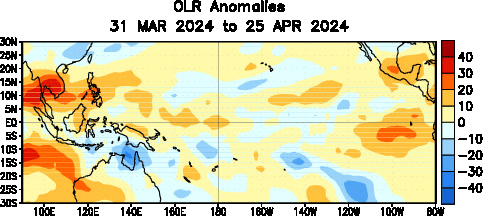
The June Niño3.4 index, our primary ENSO measurement, was 0.6°C above the long-term average, just above the El Niño threshold of 0.5°C. There is some evidence that the atmosphere over the central Pacific is still responding to that extra heating, as a bit more clouds and rain than average were present in June.

The Southern Oscillation Index and Equatorial Southern Oscillation Index were both slightly negative in June, also indicating some continuation of the weakened Walker circulation we expect to see with El Niño. But the upper-level and near-surface winds over the equatorial Pacific, another component of the Walker circulation, were close to average during June. All in all, El Niño is still present, but just barely.

That’s no ordinary rabbit

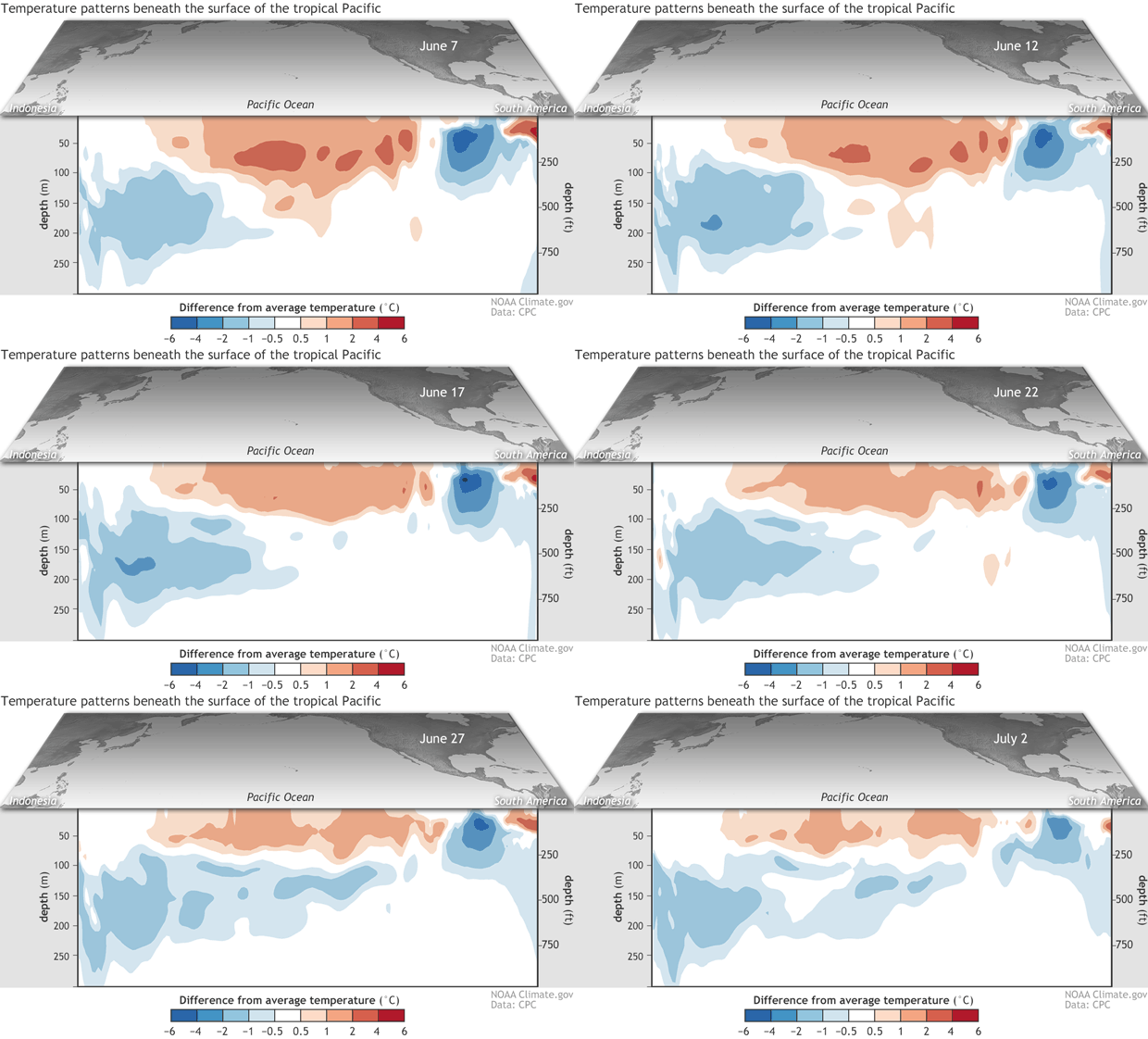
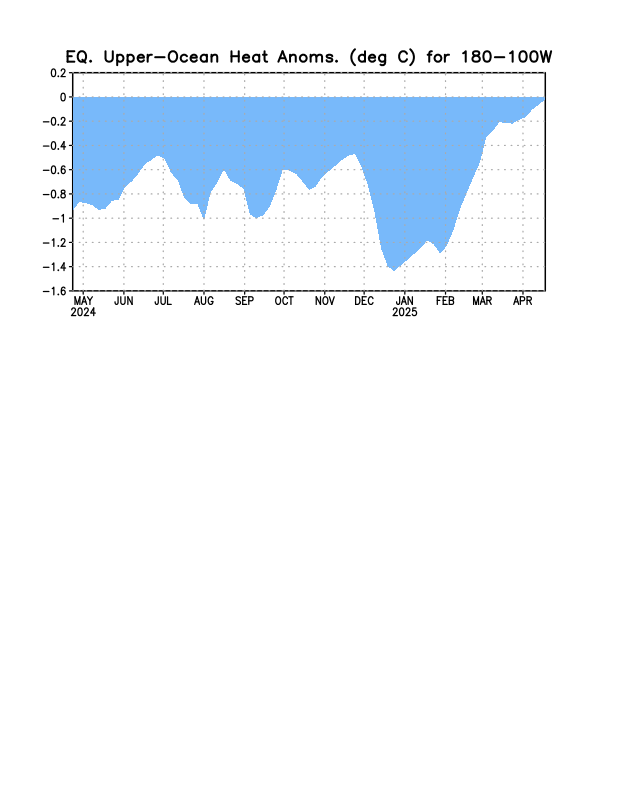
As frequent readers of this blog will know, we closely monitor the temperature of the water under the surface of the tropical Pacific. This can tell us if there is a source of warmer-than-average water to supply the surface, continuing to fuel El Niño, or not. In early June, there was a small downwelling  Kelvin wave of warmer waters moving eastward under the surface of the Pacific, but this wave has dissipated recently.

El Nino Animation

Departure from average of the surface and subsurface tropical Pacific sea temperature averaged over 5-day periods starting in early June 2019. The vertical axis is depth below the surface (meters) and the horizontal axis is longitude, from the western to eastern tropical Pacific. This cross-section is right along the equator. Climate.gov figure from CPC data.

Overall, the heat content in the top 300 meters of the equatorial Pacific is just about average now, in early July. This is one of the major factors in our forecast for a return to near-average surface temperatures and neutral ENSO conditions. Once the surface temperatures return to average, and the source of extra heat to the air above the central Pacific is gone, the atmospheric component of El Niño—that weakened Walker circulation—will also return to average.

July 2019 El Niño update: I think I’ll go for a walk by Emily Becker, NOAA's Climate.gov, July 11, 2019 


Toon of the Week...

 Frogs in Boiling Water


Coming Soon on SkS...

  • 10 things a committed U.S. President and Congress could do about climate change (Craig Chandler)
  • New Research Reloaded (Doug Bostrom)
  • 97% consensus study hits one million downloads! (John Cook)
  • What psychotherapy can do for the climate and biodiversity crises (Caroline Hickman)
  • How climate change is making hurricanes more dangerous (Jeff Berardelli)
  • 2019 SkS Weekly Climate Change & Global Warming News Roundup #29 (John Hartz)
  • 2019 SkS Weekly Climate Change & Global Warming Weekly Digest #29 (John Hartz)

Poster of the Week...

2019 Poster 28 


SkS Week in Review... 


from Skeptical Science https://ift.tt/2Loll6f

Debunk of the Week... El Niño/La Niña Update... Toon of the Week... Coming Soon on SkS... Poster of the Week... SkS Week in Review...

Debunk of the Week...

Non-peer-reviewed manuscript falsely claims natural cloud changes can explain global warming

CLAIM: "Man-made Climate Change Doesn't Exist In Practice... During the last hundred years the temperature is increased [sic] about 0.1°C because of carbon dioxide. The human contribution was about 0.01°C."

Some news outlets are publishing articles stating that this claim is based on a new study. In reality, there is no new published study. The claim comes from a six-page document uploaded to arXiv, a website traditionally used by scientists to make manuscripts available before publication. This means that this article has not been peer-reviewed, so there is no guarantee to its credibility.

If the blogs that covered this as a new study had contacted independent scientists for insight, instead of accepting this short document as revolutionary science, they would have found that it does not have any scientific credibility.

As the scientists who examined this claim explained, the document relies on circular reasoning to claim that cloud cover and relative humidity have caused the change in global temperature, and ignores many additional factors affecting global temperature—including aerosol pollution, volcanic eruptions, and natural ocean oscillations. The published, peer-reviewed scientific research on this topic clearly shows that human activities are responsible for climate change.

Non-peer-reviewed manuscript falsely claims natural cloud changes can explain global warming, Claims Review Edited by Scott Johnson, Climate Feedback, July 12, 2019


El Niño/La Niña Update...

July 2019 El Niño update: I think I’ll go for a walk

El Niño is hanging on by its fingernails, but forecasters predict this event will wind down within the next couple of months. It’s likely that the temperature of the tropical Pacific Ocean surface will return to near-average soon, qualifying for “ENSO-neutral” conditions. Neutral conditions are favored to remain through the fall and winter.

Not dead yet

The June Niño3.4 index, our primary ENSO measurement, was 0.6°C above the long-term average, just above the El Niño threshold of 0.5°C. There is some evidence that the atmosphere over the central Pacific is still responding to that extra heating, as a bit more clouds and rain than average were present in June.

The Southern Oscillation Index and Equatorial Southern Oscillation Index were both slightly negative in June, also indicating some continuation of the weakened Walker circulation we expect to see with El Niño. But the upper-level and near-surface winds over the equatorial Pacific, another component of the Walker circulation, were close to average during June. All in all, El Niño is still present, but just barely.

That’s no ordinary rabbit

As frequent readers of this blog will know, we closely monitor the temperature of the water under the surface of the tropical Pacific. This can tell us if there is a source of warmer-than-average water to supply the surface, continuing to fuel El Niño, or not. In early June, there was a small downwelling  Kelvin wave of warmer waters moving eastward under the surface of the Pacific, but this wave has dissipated recently.

El Nino Animation

Departure from average of the surface and subsurface tropical Pacific sea temperature averaged over 5-day periods starting in early June 2019. The vertical axis is depth below the surface (meters) and the horizontal axis is longitude, from the western to eastern tropical Pacific. This cross-section is right along the equator. Climate.gov figure from CPC data.

Overall, the heat content in the top 300 meters of the equatorial Pacific is just about average now, in early July. This is one of the major factors in our forecast for a return to near-average surface temperatures and neutral ENSO conditions. Once the surface temperatures return to average, and the source of extra heat to the air above the central Pacific is gone, the atmospheric component of El Niño—that weakened Walker circulation—will also return to average.

July 2019 El Niño update: I think I’ll go for a walk by Emily Becker, NOAA's Climate.gov, July 11, 2019 


Toon of the Week...

 Frogs in Boiling Water


Coming Soon on SkS...

  • 10 things a committed U.S. President and Congress could do about climate change (Craig Chandler)
  • New Research Reloaded (Doug Bostrom)
  • 97% consensus study hits one million downloads! (John Cook)
  • What psychotherapy can do for the climate and biodiversity crises (Caroline Hickman)
  • How climate change is making hurricanes more dangerous (Jeff Berardelli)
  • 2019 SkS Weekly Climate Change & Global Warming News Roundup #29 (John Hartz)
  • 2019 SkS Weekly Climate Change & Global Warming Weekly Digest #29 (John Hartz)

Poster of the Week...

2019 Poster 28 


SkS Week in Review... 


from Skeptical Science https://ift.tt/2Loll6f

Dragonfly aims for Saturn’s moon Titan

Reprinted with permission from AmeriaSpace.

It was a much-anticipated announcement, but the winner of NASA’s next New Frontiers mission selection is … Dragonfly! This ambitious mission will be the first return to Saturn’s moon Titan since Cassini/Huygens, and this drone-like rotorcraft will fly to various locations on Titan to search for clues to the origins of life, and possibly even evidence of life itself, on this alien yet remarkably Earth-like moon.

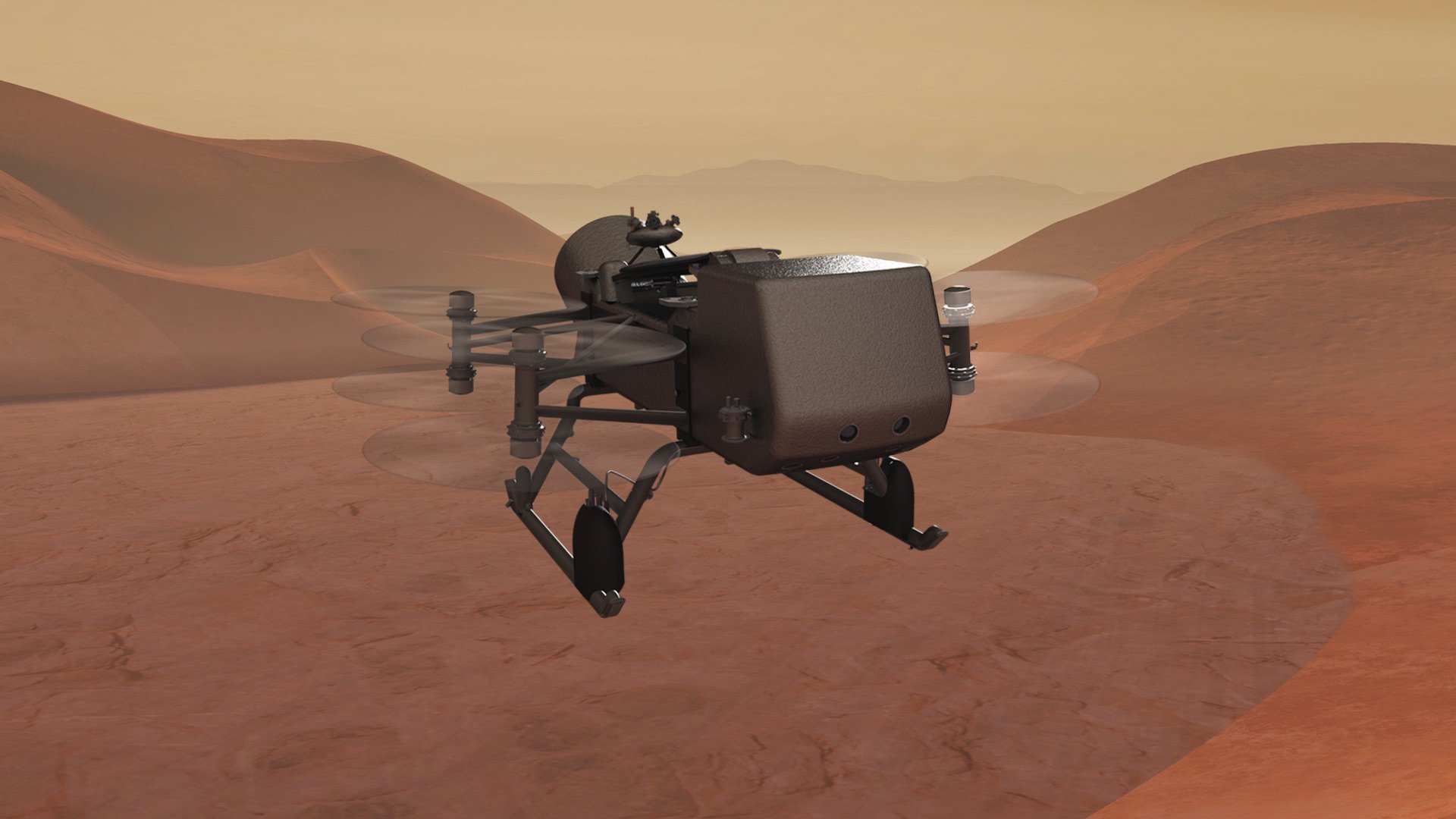
Instead of a rover as on Mars, NASA chose a drone-like design for Dragonfly. It will be able to fly to different locations and take samples of the organic-rich sands to analyze them. Since Titan’s atmosphere is four times denser than Earth’s, it is actually easier to fly on Titan than on Earth. Dragonfly will be the first such rotorcraft sent to explore another world. NASA Administrator Jim Bridenstine said:

With the Dragonfly mission, NASA will once again do what no one else can do. Visiting this mysterious ocean world could revolutionize what we know about life in the universe. This cutting-edge mission would have been unthinkable even just a few years ago, but we’re now ready for Dragonfly’s amazing flight.

This is an exciting mission, but it will take time to get to Titan. Dragonfly will launch in 2026 and arrive in 2034. The Saturn system is a long ways away from Earth, at 886 million miles (1.4 billion kilometers) from the sun (about 10 times farther than Earth).

Titan is one of the most fascinating and exotic worlds in our solar system, a moon larger than Mercury with rain, rivers, lakes and oceans. But it is also bitterly cold – about -290 degrees Fahrenheit (-179 degrees Celsius) – and Titan’s “water” is liquid methane/ethane. Yet the landscape of rivers and shorelines looks eerily Earth-like.

Titan also has vast sand dunes composed of hydrocarbons – organic materials – that cover the surface. Titan’s thick nitrogen atmosphere is filled with an organic smog that obscures the surface from view from orbit. As well as the rain, other organic materials fall to the surface like snow. Titan is rich in these organics, and scientists think it is similar to what the early Earth looked like, and has similar pre-biotic chemistry to what led to life on our planet.

There is even now thought to be a subsurface water ocean on Titan, similar to those on moons like Europa, Enceladus and Ganymede, among others.

Gray spacecraft over barren orange hills and plain with a yellow sky.

Illustration of Dragonfly scoring over Titan’s surface. Image via NASA/JHU-APL.

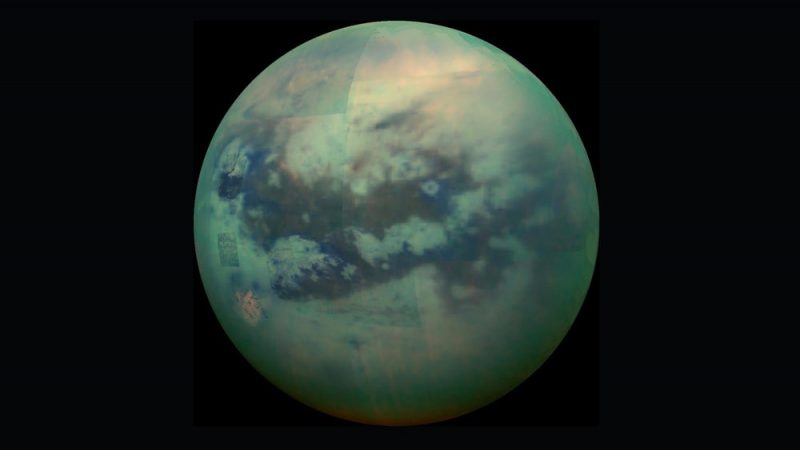
Mottled blue-green ball agains a black background.

Titan, as seen in radar images from NASA’s Cassini spacecraft, is a complex world with methane/ethane rain, rivers, lakes and seas. Could it support life of some kind? Image via NASA/JPL

Thomas Zurbuchen is NASA’s associate administrator for Science at the agency’s Headquarters in Washington. He said:

Titan is unlike any other place in the solar system, and Dragonfly is like no other mission. It’s remarkable to think of this rotorcraft flying miles and miles across the organic sand dunes of Saturn’s largest moon, exploring the processes that shape this extraordinary environment. Dragonfly will visit a world filled with a wide variety of organic compounds, which are the building blocks of life and could teach us about the origin of life itself.

With liquids both on the surface and below, and plenty of organics, some scientists even speculate there could some form of primitive life on Titan right now, despite the severe cold.

NASA’s last visit to Titan was back in 2005, when the Huygens probe, part of the Cassini mission, successfully landed on what appeared to be a dry riverbed, strewn with stones and boulders of rock-hard water ice.

The Dragonfly mission has a lot of science and other data to help it succeed – 13 years worth from the Cassini mission at Saturn, which ended in late 2017. It will be able to use a calm weather period to land, find a safe initial landing site and scout scientifically interesting targets.

Barren orange brown rocky ground.

The surface of Titan as seen, for the first time ever, by the Huygens probe on Jan. 14, 2005. The “rocks” are actually rounded blocks of solid water ice. Image via ESA/NASA/JPL/University of Arizona.

It will first land at the equatorial Shangri-La dune fields, which are similar to the linear dunes in Namibia in southern Africa. Dragonfly will explore this region in short flights, building up to a series of longer “leapfrog” flights of up to 5 miles (8 km). It will pause along the way to take samples from areas with diverse geography. It will later reach Selk Crater, where there is evidence of past liquid water, organics and energy, which together make up the recipe for life. Dragonfly will eventually fly more than 108 miles (175 km), nearly double the distance traveled to date by all the Mars rovers combined.

Dragonfly was one of two finalists for the next New Frontiers mission, the other being a new comet sample-return mission called Comet Astrobiology Exploration Sample Return (CAESAR). Unfortunately due to budget, only one of the two missions could be chosen, and this time it was Dragonfly. Lori Glaze, director of NASA’s Planetary Science Division, said:

The New Frontiers program has transformed our understanding of the solar system, uncovering the inner structure and composition of Jupiter’s turbulent atmosphere, discovering the icy secrets of Pluto’s landscape, revealing mysterious objects in the Kuiper belt, and exploring a near-Earth asteroid for the building blocks of life. Now we can add Titan to the list of enigmatic worlds NASA will explore.

The Dragonfly mission will be an exciting one in the exploration of the outer solar system. Not only will it search for clues as to how life originated on Earth by studying the pre-biotic chemistry of Titan, it may even find evidence that life itself existed – or still exists – on this oddly Earth-like yet utterly alien world.

Bottom line: Scheduled for launch in 2026, Dragonfly is scheduled for launch in 2026 and due to arrive at Titan in 2034. It will look for clues to the origins of life, and possibly even evidence of life itself, on Saturn’s largest moon.


from EarthSky https://ift.tt/2xN3i0R

Reprinted with permission from AmeriaSpace.

It was a much-anticipated announcement, but the winner of NASA’s next New Frontiers mission selection is … Dragonfly! This ambitious mission will be the first return to Saturn’s moon Titan since Cassini/Huygens, and this drone-like rotorcraft will fly to various locations on Titan to search for clues to the origins of life, and possibly even evidence of life itself, on this alien yet remarkably Earth-like moon.

Instead of a rover as on Mars, NASA chose a drone-like design for Dragonfly. It will be able to fly to different locations and take samples of the organic-rich sands to analyze them. Since Titan’s atmosphere is four times denser than Earth’s, it is actually easier to fly on Titan than on Earth. Dragonfly will be the first such rotorcraft sent to explore another world. NASA Administrator Jim Bridenstine said:

With the Dragonfly mission, NASA will once again do what no one else can do. Visiting this mysterious ocean world could revolutionize what we know about life in the universe. This cutting-edge mission would have been unthinkable even just a few years ago, but we’re now ready for Dragonfly’s amazing flight.

This is an exciting mission, but it will take time to get to Titan. Dragonfly will launch in 2026 and arrive in 2034. The Saturn system is a long ways away from Earth, at 886 million miles (1.4 billion kilometers) from the sun (about 10 times farther than Earth).

Titan is one of the most fascinating and exotic worlds in our solar system, a moon larger than Mercury with rain, rivers, lakes and oceans. But it is also bitterly cold – about -290 degrees Fahrenheit (-179 degrees Celsius) – and Titan’s “water” is liquid methane/ethane. Yet the landscape of rivers and shorelines looks eerily Earth-like.

Titan also has vast sand dunes composed of hydrocarbons – organic materials – that cover the surface. Titan’s thick nitrogen atmosphere is filled with an organic smog that obscures the surface from view from orbit. As well as the rain, other organic materials fall to the surface like snow. Titan is rich in these organics, and scientists think it is similar to what the early Earth looked like, and has similar pre-biotic chemistry to what led to life on our planet.

There is even now thought to be a subsurface water ocean on Titan, similar to those on moons like Europa, Enceladus and Ganymede, among others.

Gray spacecraft over barren orange hills and plain with a yellow sky.

Illustration of Dragonfly scoring over Titan’s surface. Image via NASA/JHU-APL.

Mottled blue-green ball agains a black background.

Titan, as seen in radar images from NASA’s Cassini spacecraft, is a complex world with methane/ethane rain, rivers, lakes and seas. Could it support life of some kind? Image via NASA/JPL

Thomas Zurbuchen is NASA’s associate administrator for Science at the agency’s Headquarters in Washington. He said:

Titan is unlike any other place in the solar system, and Dragonfly is like no other mission. It’s remarkable to think of this rotorcraft flying miles and miles across the organic sand dunes of Saturn’s largest moon, exploring the processes that shape this extraordinary environment. Dragonfly will visit a world filled with a wide variety of organic compounds, which are the building blocks of life and could teach us about the origin of life itself.

With liquids both on the surface and below, and plenty of organics, some scientists even speculate there could some form of primitive life on Titan right now, despite the severe cold.

NASA’s last visit to Titan was back in 2005, when the Huygens probe, part of the Cassini mission, successfully landed on what appeared to be a dry riverbed, strewn with stones and boulders of rock-hard water ice.

The Dragonfly mission has a lot of science and other data to help it succeed – 13 years worth from the Cassini mission at Saturn, which ended in late 2017. It will be able to use a calm weather period to land, find a safe initial landing site and scout scientifically interesting targets.

Barren orange brown rocky ground.

The surface of Titan as seen, for the first time ever, by the Huygens probe on Jan. 14, 2005. The “rocks” are actually rounded blocks of solid water ice. Image via ESA/NASA/JPL/University of Arizona.

It will first land at the equatorial Shangri-La dune fields, which are similar to the linear dunes in Namibia in southern Africa. Dragonfly will explore this region in short flights, building up to a series of longer “leapfrog” flights of up to 5 miles (8 km). It will pause along the way to take samples from areas with diverse geography. It will later reach Selk Crater, where there is evidence of past liquid water, organics and energy, which together make up the recipe for life. Dragonfly will eventually fly more than 108 miles (175 km), nearly double the distance traveled to date by all the Mars rovers combined.

Dragonfly was one of two finalists for the next New Frontiers mission, the other being a new comet sample-return mission called Comet Astrobiology Exploration Sample Return (CAESAR). Unfortunately due to budget, only one of the two missions could be chosen, and this time it was Dragonfly. Lori Glaze, director of NASA’s Planetary Science Division, said:

The New Frontiers program has transformed our understanding of the solar system, uncovering the inner structure and composition of Jupiter’s turbulent atmosphere, discovering the icy secrets of Pluto’s landscape, revealing mysterious objects in the Kuiper belt, and exploring a near-Earth asteroid for the building blocks of life. Now we can add Titan to the list of enigmatic worlds NASA will explore.

The Dragonfly mission will be an exciting one in the exploration of the outer solar system. Not only will it search for clues as to how life originated on Earth by studying the pre-biotic chemistry of Titan, it may even find evidence that life itself existed – or still exists – on this oddly Earth-like yet utterly alien world.

Bottom line: Scheduled for launch in 2026, Dragonfly is scheduled for launch in 2026 and due to arrive at Titan in 2034. It will look for clues to the origins of life, and possibly even evidence of life itself, on Saturn’s largest moon.


from EarthSky https://ift.tt/2xN3i0R

Big earthquakes today in Australia and Indonesia

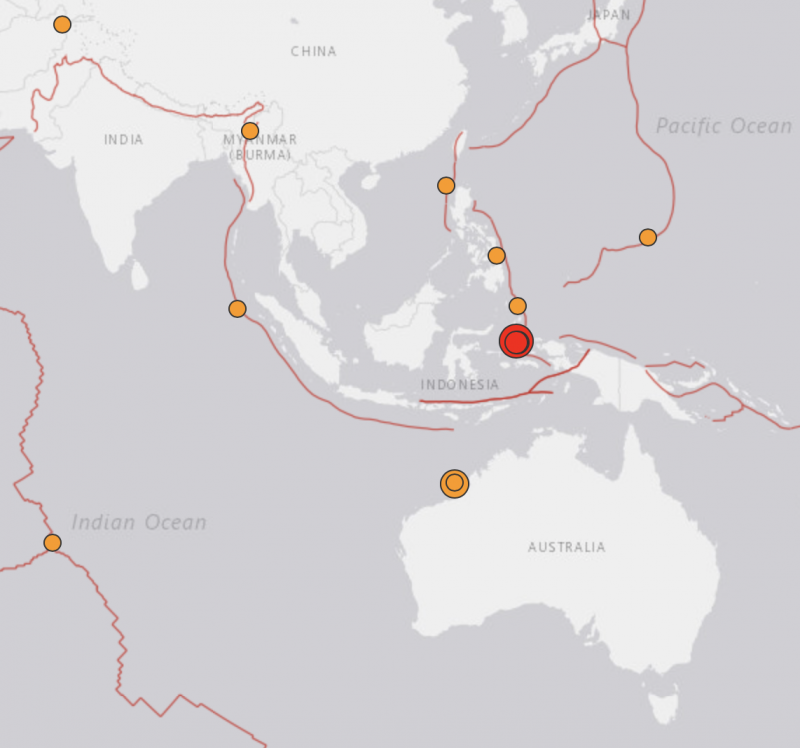
Map showing location of Australian and Indonesian earthquakes of July 14, 2019, plus smaller recent quakes.

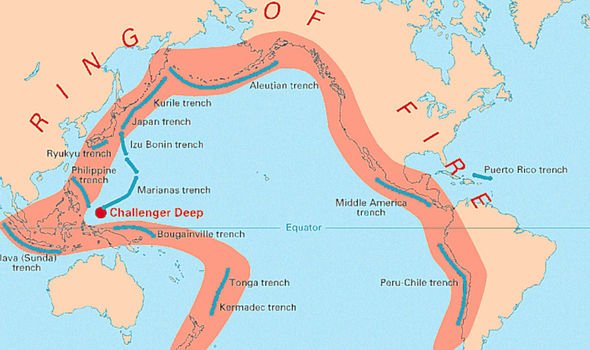
Two strong earthquakes struck along the Pacific Ring of Fire on July 14, 2019. The red dot indicates the 7.3 magnitude earthquake in Indonesia, and the largest orange dot indicates the 6.6 magnitude earthquake off the west coast of Australia. Map via USGS.

There are lots of small earthquakes going on all the time, but earthquakes over magnitude 6 are more rare. They are the big ones, whose shaking more strongly near their epicenters, and which can be felt over longer distances. Today – July 14, 2019 – so far there have been two large earthquakes relatively near each other. The first was a 6.6-magnitude undersea quake off the western coast of Australia. It was equal in magnitude to the largest earthquake ever recorded in Australia, which happened in 1988. It took place 202 km W of Broome, Australia. Today’s second large earthquake had its epicenter 102 km NNE of Laiwui, Indonesia. It was an even bigger earthquake, with a magnitude of 7.3.

Aftershocks are continuing in both places. There was no threat of tsunami from either earthquake, as reported by the Pacific Tsunami Warning Center.

In Indonesia, where the larger quake struck a shorter time ago, there have been no immediate reports of damages or casualties in the quake. The quake struck in the Maluku Islands – or the Moluccas – an archipelago in eastern Indonesia, said to be a tourist hotspot. Iksan Subur, an official with Indonesia’s disaster mitigation agency based in the regency of South Halmahera, near the earthquake’s epicenter, told Reuters:

There are no reports of infrastructure damage yet. But people panicked and ran out of their houses. Some people who live near the ocean are starting to move to higher ground.

The following information is provided by the U.S. Geological Survey:

Region: Halmahera, Indonesia
Geographic coordinates: 0.529S, 128.093E
Magnitude: 7.3
Depth: 10 km
Universal Time (UTC): 14 Jul 2019 09:10:51
Time near the Epicenter: 14 Jul 2019 18:10:51
Local standard time in your area: 14 Jul 2019 09:10:51

Location with respect to nearby cities:
152.1 km (94.3 mi) SSE of Sofifi, Indonesia
165.9 km (102.9 mi) SSE of Ternate, Indonesia
249.8 km (154.9 mi) S of Tobelo, Indonesia
324.1 km (201.0 mi) NNW of Amahai, Indonesia
350.3 km (217.2 mi) N of Ambon, Indonesia

GeoScience Australia reported that the 6.6-magnitude undersea quake struck at 3.39 p.m. AEST on Sunday, off the coast between Port Hedland and Broome. GeoScience Australia duty seismologist Dan Connolly commented:

As it stands for as long as today, it is the biggest-equal earthquake in Australia ever recorded.

It’s reported to have shaken items off shelves and stunned local residents, some of whom had never felt such a strong earthquake before. It was equal in magnitude to an earthquake recorded in Tennant Creek, Northern Territory in 1988. There was no threat of a tsunami to the Australian mainland, islands or territories, according to GeoScience Australia.

The USGS provided this information about the Australian quake:

Region: Western Australia
Geographic coordinates: 18.202S, 120.337E
Magnitude: 6.6
Depth: 10 km
Universal Time (UTC): 14 Jul 2019 05:39:24
Time near the Epicenter: 14 Jul 2019 13:39:24
Local standard time in your area: 14 Jul 2019 05:39:24

Location with respect to nearby cities:
203.2 km (126.0 mi) W of Broome, Australia
295.8 km (183.4 mi) NE of Port Hedland, Australia
461.6 km (286.2 mi) NE of Karratha, Australia
945.5 km (586.2 mi) S of Waingapu, Indonesia
956.0 km (592.7 mi) SSW of Kupang, Indonesia

Today’s two earthquakes happened along the Pacific Ring of Fire, an earthquake- and volcano-prone ring around the Pacific. The large earthquakes that struck California in early July also happened along the Ring of Fire.

Read more: What is the Ring of Fire?

Map showing location of Pacific Ring of Fire.

Many volcanoes on Earth are located around the Pacific Ring of Fire. Image Image via U.S. Geological Survey.

Bottom line: Two large earthquakes – a 6.6-magnitude off the coast of Western Australia and a 7.3-magnitude in Indonesia – struck on July 14, 2019.


from EarthSky https://ift.tt/2JwyKHw
Map showing location of Australian and Indonesian earthquakes of July 14, 2019, plus smaller recent quakes.

Two strong earthquakes struck along the Pacific Ring of Fire on July 14, 2019. The red dot indicates the 7.3 magnitude earthquake in Indonesia, and the largest orange dot indicates the 6.6 magnitude earthquake off the west coast of Australia. Map via USGS.

There are lots of small earthquakes going on all the time, but earthquakes over magnitude 6 are more rare. They are the big ones, whose shaking more strongly near their epicenters, and which can be felt over longer distances. Today – July 14, 2019 – so far there have been two large earthquakes relatively near each other. The first was a 6.6-magnitude undersea quake off the western coast of Australia. It was equal in magnitude to the largest earthquake ever recorded in Australia, which happened in 1988. It took place 202 km W of Broome, Australia. Today’s second large earthquake had its epicenter 102 km NNE of Laiwui, Indonesia. It was an even bigger earthquake, with a magnitude of 7.3.

Aftershocks are continuing in both places. There was no threat of tsunami from either earthquake, as reported by the Pacific Tsunami Warning Center.

In Indonesia, where the larger quake struck a shorter time ago, there have been no immediate reports of damages or casualties in the quake. The quake struck in the Maluku Islands – or the Moluccas – an archipelago in eastern Indonesia, said to be a tourist hotspot. Iksan Subur, an official with Indonesia’s disaster mitigation agency based in the regency of South Halmahera, near the earthquake’s epicenter, told Reuters:

There are no reports of infrastructure damage yet. But people panicked and ran out of their houses. Some people who live near the ocean are starting to move to higher ground.

The following information is provided by the U.S. Geological Survey:

Region: Halmahera, Indonesia
Geographic coordinates: 0.529S, 128.093E
Magnitude: 7.3
Depth: 10 km
Universal Time (UTC): 14 Jul 2019 09:10:51
Time near the Epicenter: 14 Jul 2019 18:10:51
Local standard time in your area: 14 Jul 2019 09:10:51

Location with respect to nearby cities:
152.1 km (94.3 mi) SSE of Sofifi, Indonesia
165.9 km (102.9 mi) SSE of Ternate, Indonesia
249.8 km (154.9 mi) S of Tobelo, Indonesia
324.1 km (201.0 mi) NNW of Amahai, Indonesia
350.3 km (217.2 mi) N of Ambon, Indonesia

GeoScience Australia reported that the 6.6-magnitude undersea quake struck at 3.39 p.m. AEST on Sunday, off the coast between Port Hedland and Broome. GeoScience Australia duty seismologist Dan Connolly commented:

As it stands for as long as today, it is the biggest-equal earthquake in Australia ever recorded.

It’s reported to have shaken items off shelves and stunned local residents, some of whom had never felt such a strong earthquake before. It was equal in magnitude to an earthquake recorded in Tennant Creek, Northern Territory in 1988. There was no threat of a tsunami to the Australian mainland, islands or territories, according to GeoScience Australia.

The USGS provided this information about the Australian quake:

Region: Western Australia
Geographic coordinates: 18.202S, 120.337E
Magnitude: 6.6
Depth: 10 km
Universal Time (UTC): 14 Jul 2019 05:39:24
Time near the Epicenter: 14 Jul 2019 13:39:24
Local standard time in your area: 14 Jul 2019 05:39:24

Location with respect to nearby cities:
203.2 km (126.0 mi) W of Broome, Australia
295.8 km (183.4 mi) NE of Port Hedland, Australia
461.6 km (286.2 mi) NE of Karratha, Australia
945.5 km (586.2 mi) S of Waingapu, Indonesia
956.0 km (592.7 mi) SSW of Kupang, Indonesia

Today’s two earthquakes happened along the Pacific Ring of Fire, an earthquake- and volcano-prone ring around the Pacific. The large earthquakes that struck California in early July also happened along the Ring of Fire.

Read more: What is the Ring of Fire?

Map showing location of Pacific Ring of Fire.

Many volcanoes on Earth are located around the Pacific Ring of Fire. Image Image via U.S. Geological Survey.

Bottom line: Two large earthquakes – a 6.6-magnitude off the coast of Western Australia and a 7.3-magnitude in Indonesia – struck on July 14, 2019.


from EarthSky https://ift.tt/2JwyKHw

Today in 2015: New Horizons at Pluto

Pluto in natural color.

A natural color view of Pluto, as seen by NASA’s New Horizons spacecraft in 2015. The heart-shaped feature measures approximately 1,000 miles (1,600 km) across. Pluto is known to be made mostly of ices. New research – published in 2019 – adds to the evidence for a subsurface ocean beneath the dwarf planet’s icy outer crust. Image via NASA/ Johns Hopkins University Applied Physics Laboratory/ Southwest Research Institute/ Alex Parker.

July 14, 2015. NASA’s New Horizons spacecraft made its closest approach to distant Pluto on this date, sweeping only about 7,750 miles (12,500 km) above its surface (roughly the same distance as from New York to Mumbai, India). The fast-moving spacecraft had traveled almost 10 years and 3 billion miles (5 billion km) to that closest point at Pluto, on our solar system’s outskirts. The entire long journey took only about one minute less than predicted when the craft was launched in January 2006. At Pluto, New Horizons “threaded a needle” through a 36-by-57 mile (60 by 90 kilometers) window in space; it was the equivalent of a commercial airliner arriving no more off target than the width of a tennis ball. New Horizons became the first-ever space mission to view Pluto and its moons (Charon, Nix, Hydra, Styx and Kerberos) up close. It’ll likely be the only space mission to Pluto in the lifetimes of many of us.

The Pluto story began early in the 20th century when young Clyde Tombaugh was given the task of looking for Planet X, theorized to exist beyond the orbit of Neptune. On February 18, 1930, he discovered a faint point of light that we now know as Pluto. Among New Horizons’ most immediate, stunning and visible findings was a bright heart-shaped feature on Pluto, which you can see at the photo at the top of this page. Scientists named it Tombaugh Regio after Clyde Tombaugh. Its nickname is simply The Heart.

Read more about The Heart on Pluto

On the left, a blurry round ball, on the right a much-crisper image of Pluto with its heart-shaped feature.

Best image of Pluto from Hubble Space Telescope (l) in contrast to a New Horizons image of Pluto. Scientists knew there was a large bright spot on Pluto, but it took a spacecraft flyby to reveal that bright spot as Pluto’s iconic Heart.

Three New Horizons team members react with joy and amazement at the incoming images.

The NASA New Horizons Pluto Flyby team view the last image before the flyby of Pluto. Image via NASA.

Consider that our solar system consists of four rocky inner planets (Earth, Mars, Venus and Mercury) and four outer gas giants (Jupiter, Saturn, Uranus and Neptune). In the terminology of astronomers, Pluto and its largest moon, Charon, belong to a third category known as ice dwarfs, or plutoids. These outer worlds have solid surfaces like the inner planets, or like the moons of the outer planets. But they are made mostly of ices. When the New Horizons mission was being planned, it was a high priority for NASA to learn about the outer ice dwarfs in our solar system’s Kuiper Belt, which is an outer region populated by icy objects ranging in size from boulders to dwarf planets like Pluto.

New Horizons is the only spacecraft so far to obtain images from objects in the Kuiper Belt. It showed us that – like the asteroid belt between Mars and Jupiter, the Kuiper Belt is populated by objects made individual by their unique environments and evolutions. For example, another stunning finding of New Horizons was that of ice mountains on Pluto, with peaks jutting as high as 11,000 feet (3,500 meters) above Pluto’s surface, along an equatorial region, near the base of The Heart. Scientists quickly realized that these mountains on Pluto likely formed no more than 100 million years ago, making them extremely young in contrast to the 4.56-billion-year age of our solar system. Jeff Moore, a New Horizons imaging team member, commented at the time:

This is one of the youngest surfaces we’ve ever seen in the solar system.

And it’s still true. This finding from New Horizons suggests that this region on Pluto, which covers about one percent of Pluto’s surface, may still be geologically active today.

Read more about mountains on Pluto

Spacecraft image of mountains on Pluto.

New Horizons images of a region near Pluto’s equator revealed a range of young mountains rising as high as 11,000 feet (3,500 meters) above the surface of the icy body. Scientists base the youthful age estimate on the lack of craters in the image above. Like the rest of Pluto, this region would presumably have been pummeled by space debris for billions of years and would have once been heavily cratered — unless recent activity had given the region a facelift, erasing those pockmarks. Image via NASA/ JHU APL/ SwRI.

An illuminated edge of Pluto, backlit so that you can see its atmosphere.

New Horizons captured this image 15 minutes after its closest approach to Pluto on July 14, 2015, as it looked back toward the sun. The image was taken from a distance of 11,000 miles (18,000 km) to Pluto; the scene is 780 miles (1,250 km) wide. The backlighting highlights over a dozen layers of haze in Pluto’s tenuous but distended atmosphere. You can see Pluto’s rugged, icy mountains and the flat ice plains extending to Pluto’s horizon. The smooth expanse of the informally named icy plain Sputnik Planitia (right) – part of Pluto’s Heart – is flanked to the west (left) by rugged mountains up to 11,000 feet (3,500 meters) high, including the informally named Norgay Montes in the foreground and Hillary Montes on the skyline. To the right, east of Sputnik, rougher terrain is cut by apparent glaciers. Image via NASA/ JHUAPL/ SwRI.

A year after the New Horizons flyby, the mission’s principal investigator Alan Stern of the Southwest Research Institute, Boulder, Colorado, listed the mission’s most surprising and amazing findings:

– The complexity of Pluto and its satellites is far beyond what we expected.
The degree of current activity on Pluto’s surface and the youth of some surfaces on Pluto are simply astounding.
– Pluto’s atmospheric hazes and lower-than-predicted atmospheric escape rate upended all of the pre-flyby models.
– Charon’s enormous equatorial extensional tectonic belt hints at the freezing of a former water ice ocean inside Charon in the distant past. Other evidence found by New Horizons indicates Pluto could well have an internal water-ice ocean today.
– All of Pluto’s moons that can be age-dated by surface craters have the same, ancient age—adding weight to the theory that they were formed together in a single collision between Pluto and another planet in the Kuiper Belt long ago.
– Charon’s dark, red polar cap is unprecedented in the solar system and may be the result of atmospheric gases that escaped Pluto and then accreted on Charon’s surface.
Pluto’s vast 1,000-kilometer-wide heart-shaped nitrogen glacier (informally called Sputnik Planum) that New Horizons discovered is the largest known glacier in the solar system.
– Pluto shows evidence of vast changes in atmospheric pressure and, possibly, past presence of running or standing liquid volatiles on its surface – something only seen elsewhere on Earth, Mars and Saturn’s moon Titan in our solar system.
– The lack of additional Pluto satellites beyond what was discovered before New Horizons was unexpected.
– Pluto’s atmosphere is blue. Who knew?

At that time, Hal Weaver, New Horizons project scientist from the Johns Hopkins University Applied Physics Laboratory in Laurel, Maryland, commented:

It’s strange to think that only a year ago, we still had no real idea of what the Pluto system was like. But it didn’t take long for us to realize Pluto was something special, and like nothing we ever could have expected. We’ve been astounded by the beauty and complexity of Pluto and its moons and we’re excited about the discoveries still to come.

If you asked these scientists today – years after the flyby – I think they’d express a lot of that same excitement.

New Horizons is still speeding outward in our solar system. In early 2019, it encountered a second Kuiper Belt object, officially known as 2014 MU69 and nicknamed Ultima Thule. Read more about the Ultima Thule encounter here.

Team leader Alan Stern has said there is potential for a third flyby of a Kuiper Belt object by New Horizons in the 2020s. But, as yet, a suitable Kuiper belt object – close enough to the spacecraft’s current trajectory – still needs to be confirmed.

Science team members react to the latest image of Pluto at the Johns Hopkins University Applied Physics Lab on July 10, 2015. Image credit: Michael Soluri

Science team members react to the latest image of Pluto at the Johns Hopkins University Applied Physics Lab on July 10, 2015. Left to right: Cathy Olkin, Jason Cook, Alan Stern, Will Grundy, Casey Lisse, and Carly Howett. Image via Michael Soluri.

Dark silhouette of backlit Pluto, surrounded by blue haze.

The “blue skies of Pluto” as seen by New Horizons after closest approach, with Pluto backlit by the Sun. It is one of the most iconic images of the mission. Image via NASA/ JHUAPL/ SwRI.

Bottom line: The New Horizons spacecraft’s flyby of the Pluto system was on July 14, 2015.

Top 10 pics from the Pluto flyby

View all images of the Pluto encounter from the LORRI imager on New Horizons

Enjoying EarthSky? Sign up for our free daily newsletter today!


from EarthSky https://ift.tt/2lglqgA
Pluto in natural color.

A natural color view of Pluto, as seen by NASA’s New Horizons spacecraft in 2015. The heart-shaped feature measures approximately 1,000 miles (1,600 km) across. Pluto is known to be made mostly of ices. New research – published in 2019 – adds to the evidence for a subsurface ocean beneath the dwarf planet’s icy outer crust. Image via NASA/ Johns Hopkins University Applied Physics Laboratory/ Southwest Research Institute/ Alex Parker.

July 14, 2015. NASA’s New Horizons spacecraft made its closest approach to distant Pluto on this date, sweeping only about 7,750 miles (12,500 km) above its surface (roughly the same distance as from New York to Mumbai, India). The fast-moving spacecraft had traveled almost 10 years and 3 billion miles (5 billion km) to that closest point at Pluto, on our solar system’s outskirts. The entire long journey took only about one minute less than predicted when the craft was launched in January 2006. At Pluto, New Horizons “threaded a needle” through a 36-by-57 mile (60 by 90 kilometers) window in space; it was the equivalent of a commercial airliner arriving no more off target than the width of a tennis ball. New Horizons became the first-ever space mission to view Pluto and its moons (Charon, Nix, Hydra, Styx and Kerberos) up close. It’ll likely be the only space mission to Pluto in the lifetimes of many of us.

The Pluto story began early in the 20th century when young Clyde Tombaugh was given the task of looking for Planet X, theorized to exist beyond the orbit of Neptune. On February 18, 1930, he discovered a faint point of light that we now know as Pluto. Among New Horizons’ most immediate, stunning and visible findings was a bright heart-shaped feature on Pluto, which you can see at the photo at the top of this page. Scientists named it Tombaugh Regio after Clyde Tombaugh. Its nickname is simply The Heart.

Read more about The Heart on Pluto

On the left, a blurry round ball, on the right a much-crisper image of Pluto with its heart-shaped feature.

Best image of Pluto from Hubble Space Telescope (l) in contrast to a New Horizons image of Pluto. Scientists knew there was a large bright spot on Pluto, but it took a spacecraft flyby to reveal that bright spot as Pluto’s iconic Heart.

Three New Horizons team members react with joy and amazement at the incoming images.

The NASA New Horizons Pluto Flyby team view the last image before the flyby of Pluto. Image via NASA.

Consider that our solar system consists of four rocky inner planets (Earth, Mars, Venus and Mercury) and four outer gas giants (Jupiter, Saturn, Uranus and Neptune). In the terminology of astronomers, Pluto and its largest moon, Charon, belong to a third category known as ice dwarfs, or plutoids. These outer worlds have solid surfaces like the inner planets, or like the moons of the outer planets. But they are made mostly of ices. When the New Horizons mission was being planned, it was a high priority for NASA to learn about the outer ice dwarfs in our solar system’s Kuiper Belt, which is an outer region populated by icy objects ranging in size from boulders to dwarf planets like Pluto.

New Horizons is the only spacecraft so far to obtain images from objects in the Kuiper Belt. It showed us that – like the asteroid belt between Mars and Jupiter, the Kuiper Belt is populated by objects made individual by their unique environments and evolutions. For example, another stunning finding of New Horizons was that of ice mountains on Pluto, with peaks jutting as high as 11,000 feet (3,500 meters) above Pluto’s surface, along an equatorial region, near the base of The Heart. Scientists quickly realized that these mountains on Pluto likely formed no more than 100 million years ago, making them extremely young in contrast to the 4.56-billion-year age of our solar system. Jeff Moore, a New Horizons imaging team member, commented at the time:

This is one of the youngest surfaces we’ve ever seen in the solar system.

And it’s still true. This finding from New Horizons suggests that this region on Pluto, which covers about one percent of Pluto’s surface, may still be geologically active today.

Read more about mountains on Pluto

Spacecraft image of mountains on Pluto.

New Horizons images of a region near Pluto’s equator revealed a range of young mountains rising as high as 11,000 feet (3,500 meters) above the surface of the icy body. Scientists base the youthful age estimate on the lack of craters in the image above. Like the rest of Pluto, this region would presumably have been pummeled by space debris for billions of years and would have once been heavily cratered — unless recent activity had given the region a facelift, erasing those pockmarks. Image via NASA/ JHU APL/ SwRI.

An illuminated edge of Pluto, backlit so that you can see its atmosphere.

New Horizons captured this image 15 minutes after its closest approach to Pluto on July 14, 2015, as it looked back toward the sun. The image was taken from a distance of 11,000 miles (18,000 km) to Pluto; the scene is 780 miles (1,250 km) wide. The backlighting highlights over a dozen layers of haze in Pluto’s tenuous but distended atmosphere. You can see Pluto’s rugged, icy mountains and the flat ice plains extending to Pluto’s horizon. The smooth expanse of the informally named icy plain Sputnik Planitia (right) – part of Pluto’s Heart – is flanked to the west (left) by rugged mountains up to 11,000 feet (3,500 meters) high, including the informally named Norgay Montes in the foreground and Hillary Montes on the skyline. To the right, east of Sputnik, rougher terrain is cut by apparent glaciers. Image via NASA/ JHUAPL/ SwRI.

A year after the New Horizons flyby, the mission’s principal investigator Alan Stern of the Southwest Research Institute, Boulder, Colorado, listed the mission’s most surprising and amazing findings:

– The complexity of Pluto and its satellites is far beyond what we expected.
The degree of current activity on Pluto’s surface and the youth of some surfaces on Pluto are simply astounding.
– Pluto’s atmospheric hazes and lower-than-predicted atmospheric escape rate upended all of the pre-flyby models.
– Charon’s enormous equatorial extensional tectonic belt hints at the freezing of a former water ice ocean inside Charon in the distant past. Other evidence found by New Horizons indicates Pluto could well have an internal water-ice ocean today.
– All of Pluto’s moons that can be age-dated by surface craters have the same, ancient age—adding weight to the theory that they were formed together in a single collision between Pluto and another planet in the Kuiper Belt long ago.
– Charon’s dark, red polar cap is unprecedented in the solar system and may be the result of atmospheric gases that escaped Pluto and then accreted on Charon’s surface.
Pluto’s vast 1,000-kilometer-wide heart-shaped nitrogen glacier (informally called Sputnik Planum) that New Horizons discovered is the largest known glacier in the solar system.
– Pluto shows evidence of vast changes in atmospheric pressure and, possibly, past presence of running or standing liquid volatiles on its surface – something only seen elsewhere on Earth, Mars and Saturn’s moon Titan in our solar system.
– The lack of additional Pluto satellites beyond what was discovered before New Horizons was unexpected.
– Pluto’s atmosphere is blue. Who knew?

At that time, Hal Weaver, New Horizons project scientist from the Johns Hopkins University Applied Physics Laboratory in Laurel, Maryland, commented:

It’s strange to think that only a year ago, we still had no real idea of what the Pluto system was like. But it didn’t take long for us to realize Pluto was something special, and like nothing we ever could have expected. We’ve been astounded by the beauty and complexity of Pluto and its moons and we’re excited about the discoveries still to come.

If you asked these scientists today – years after the flyby – I think they’d express a lot of that same excitement.

New Horizons is still speeding outward in our solar system. In early 2019, it encountered a second Kuiper Belt object, officially known as 2014 MU69 and nicknamed Ultima Thule. Read more about the Ultima Thule encounter here.

Team leader Alan Stern has said there is potential for a third flyby of a Kuiper Belt object by New Horizons in the 2020s. But, as yet, a suitable Kuiper belt object – close enough to the spacecraft’s current trajectory – still needs to be confirmed.

Science team members react to the latest image of Pluto at the Johns Hopkins University Applied Physics Lab on July 10, 2015. Image credit: Michael Soluri

Science team members react to the latest image of Pluto at the Johns Hopkins University Applied Physics Lab on July 10, 2015. Left to right: Cathy Olkin, Jason Cook, Alan Stern, Will Grundy, Casey Lisse, and Carly Howett. Image via Michael Soluri.

Dark silhouette of backlit Pluto, surrounded by blue haze.

The “blue skies of Pluto” as seen by New Horizons after closest approach, with Pluto backlit by the Sun. It is one of the most iconic images of the mission. Image via NASA/ JHUAPL/ SwRI.

Bottom line: The New Horizons spacecraft’s flyby of the Pluto system was on July 14, 2015.

Top 10 pics from the Pluto flyby

View all images of the Pluto encounter from the LORRI imager on New Horizons

Enjoying EarthSky? Sign up for our free daily newsletter today!


from EarthSky https://ift.tt/2lglqgA

adds 2