aads

Uranus, Neptune, Pluto: A longer view

Book cover with drawings of mythological figures on it.

Editor’s Note: Guy Ottewell’s book – Uranus, Neptune, Pluto: A Longer View – looks at least a dozen years ahead. There are 73 short chapters, plus Ottewell’s unique and beautiful charts. You can order the book here. The following article was originally posted at Guy Ottewell’s blog in 2018. Reprinted here with permission.

My original announcement of my book was rather curt, so Deborah Byrd – editor-in-chief at EarthSky.org – has asked me to say more about it.

Well. I produced my Astronomical Calendar for many a year, and, every year, as I labored through each task, such as the section on one of the planets – making the calculations, choosing the limits for the chart, choosing among the remarks that could be made and the other features that space might allow – I found myself mostly pouring material into a mold, even if with improvements. It occurred to me that I would rather be making charts for many years ahead. Then instead of just mentioning that Mars’s path for the year is part of a two-year pattern, or Venus’s is part of an eight-year pattern or Jupiter’s of a 12-year pattern, I could show the patterns whole.

So now, instead of the annual book, I hope to make a series of Longer View books.

Why start with Uranus and Neptune, the “last” planets? Because, I thought, that would be quickest. I had featured them together in the Astronomical Calendar, because they were advancing in their stately way through the same region of the sky (around 1993 they could be shown in one chart). In various years, I thought of six or seven extra illustrations for them, such as a graph showing how Uranus overtakes Neptune every 172 years …
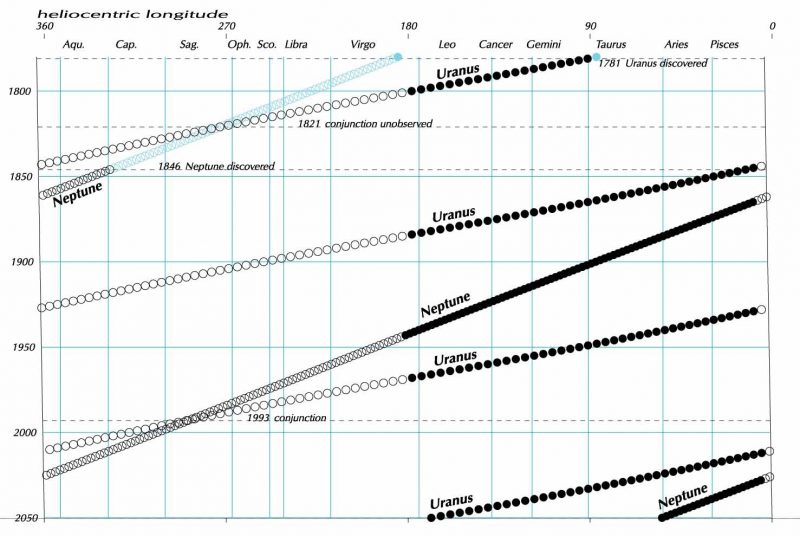
Chart with intersecting paths of planets from 1800 to 2050.

View larger. | Uranus overtakes Neptune, via Guy Ottewell.

And I could provide a diagram of Uranus spinning on its side …
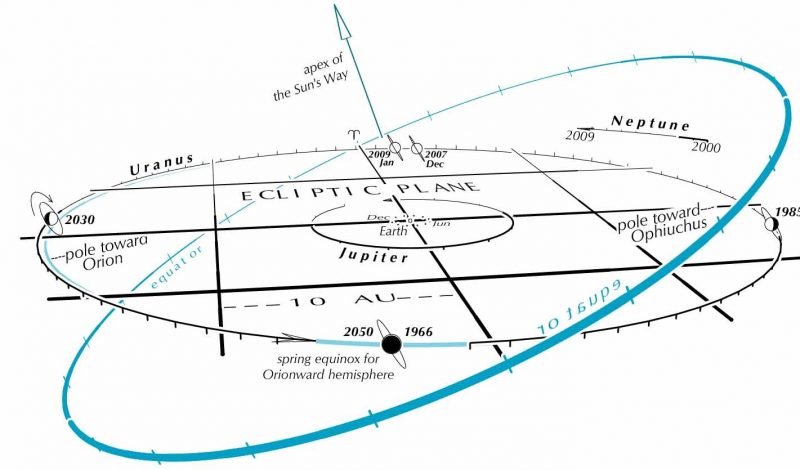
Solar system diagram with ringed outer planet with poles nearly perpendicular to the ecliptic.

View larger. | Uranus spins on its side with respect to the plane of the solar system, via Guy Ottewell.

But, each year, I had to choose only one of these to fit into the page. In a Longer View book, there would be room for them all. And for remarks that needn’t be kept so brief.

And why include Pluto, no longer classed as a major planet? Because the discovery story, the story of the first additions to the ancient planet family, goes Uranus-Neptune-Pluto. Each led to the next. True, the story goes on to 1992 QB1 and Eris and the other transneptunians, but their discovery wasn’t the consequence of Pluto’s as Pluto’s was of Neptune’s and Neptune’s of Uranus’s. And though Pluto is far below visibility to the unaided eye, it is far higher in observability than the other transneptunians, all smaller or more remote. And there is now, because of the New Horizons spacecraft visit, much more to say about it; indeed, there is much more detail to it than to Uranus and Neptune.

I finished the book on June 1. I had expected to finish it some time back in 2017, when I started it, but there proved to be more of interest than I had expected. Writing about these bodies was like opening a series of closets and finding them as large as rooms, some leading to other rooms.

For instance, several of the twists in the story of why Neptune came to be discovered at Berlin and not at Cambridge are not quite as often told – the reason why Adams didn’t get a response to his knock at the Astronomer Royal’s door was that the Astronomer Royal’s beautiful wife was having a miscarriage; the reason why Le Verrier sent his prediction to Galle may have been that he guiltily owed him a letter.
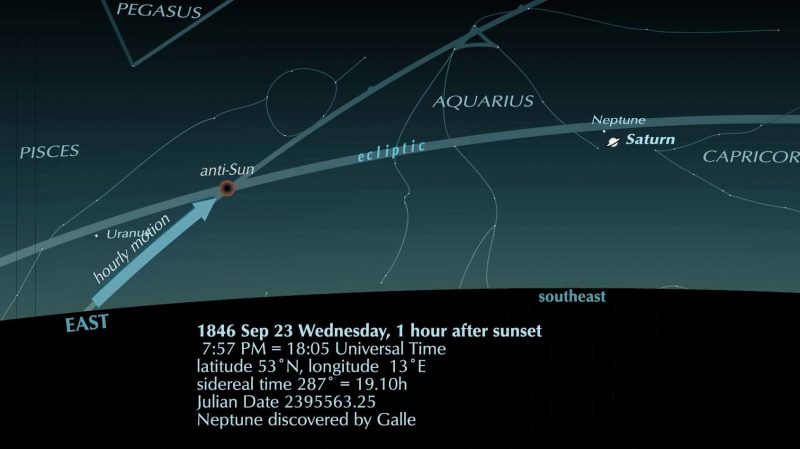
Sky chart, constellations, line of ecliptic, small dot marked Neptune in ecliptic.

Chart showing the night sky on September 23, 1846, the night of Neptune’s discovery, via Guy Ottewell.

And in 1993, when Neptune for the first since its discovery was passed by Uranus, there was a highly improbable episode that most of us weren’t aware of: a conjunction that came within a celestial hairbreadth of happening but failed to happen …
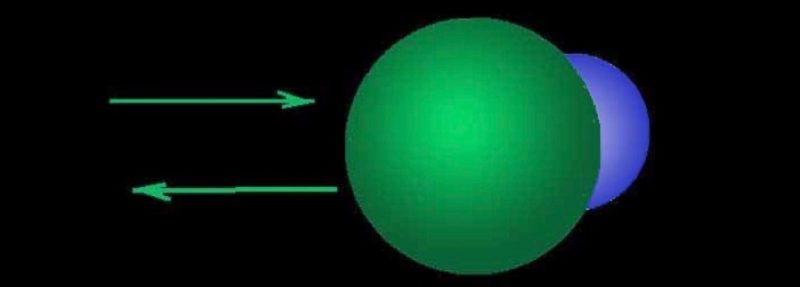
Green sphere nearly blocking smaller blue sphere.

This is how Uranus and Neptune would have looked if they had been at the same declination during their conjunction. Image via Guy Ottewell.

And there is what I call the Neptune-Pluto standoff: Pluto crosses over Neptune’s orbit (so that it was once suspected of being an escaped Neptune satellite); yet, in a sort of rigid geometrical ballet, it has always stayed as far from Neptune as it can – in fact, it comes nearer to Uranus.

Oblique diagram of solar system with Pluto's orbit at an angle to the plane of the ecliptic.

View larger. | Pluto crosses Neptune’s orbit, but stays as far from Neptune as it can. Image via Guy Ottewell.

And there is the Pluto-Charon embrace: they are the nearest thing to being a double planet. They keep their same faces to each other as they rotate slowly around a common point (which, unlike that for the Earth-moon nearly-double-planet system, is not inside the larger body but is in the space between them); they exchange material with each other.

And: Uranus, as is well known, rotates on its side, which brings the whole concept of north into dispute. Meanwhile, Pluto’s spin axis is tilted even further.
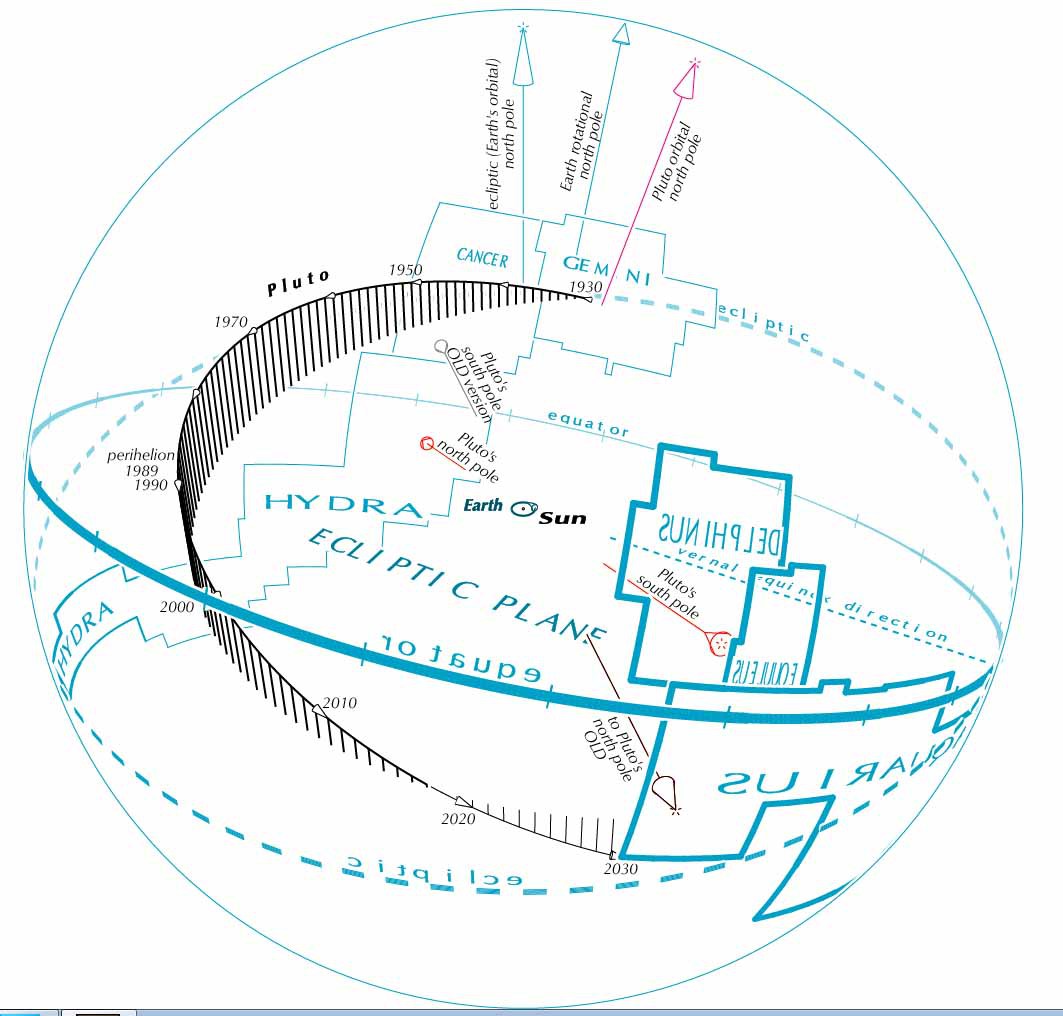
Sphere of the sky with constellations, ecliptic, and Pluto's orbit shown.

Pluto spin axis. Image via Guy Ottewell.

And, Uranus’s oppositions coincide with Earth’s new moon and full moon in alternate years – why?

And there are issues over not only titles like planet and dwarf planet but designations – 10000 Pluto vs. 134340 Pluto – and names – Georgium Sidus vs. Uranus, Ohnehtn vs. Pluto, Xena vs. Eris, Persephone vs. Charon. And there is this remark:

I’m not sure I would want to identify my wife with the janitor of hell.

I’m not sure that was a remark I should have made, but, being my own editor, I can venture bits of irreverence toward the scientists that a textbook writer would not get away with.

The book’s table of contents, shown before merely like a photo, appeared slightly indistinct, so click here to see it as a PDF, which should be as sharp as in print. The small images in it are only thumbnails of a few of those in the book. Here are some at fuller size.
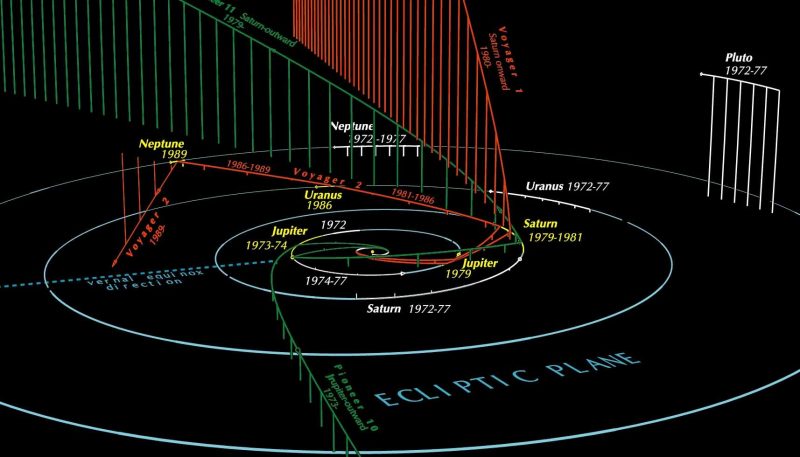
Oblique diagram of solar system with orbits and spacecraft paths exiting system to north and south.

View larger. | Paths of the outer solar planets, and some outbound spacecraft, via Guy Ottewell.
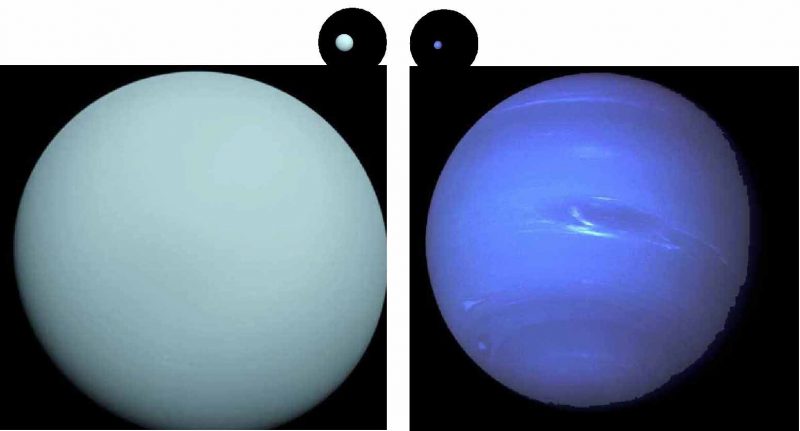
Pale blue featureless planet on left, slightly striped blue planet on right.

Spacecraft images of Uranus (l) and Neptune (r), via Guy Ottewell.
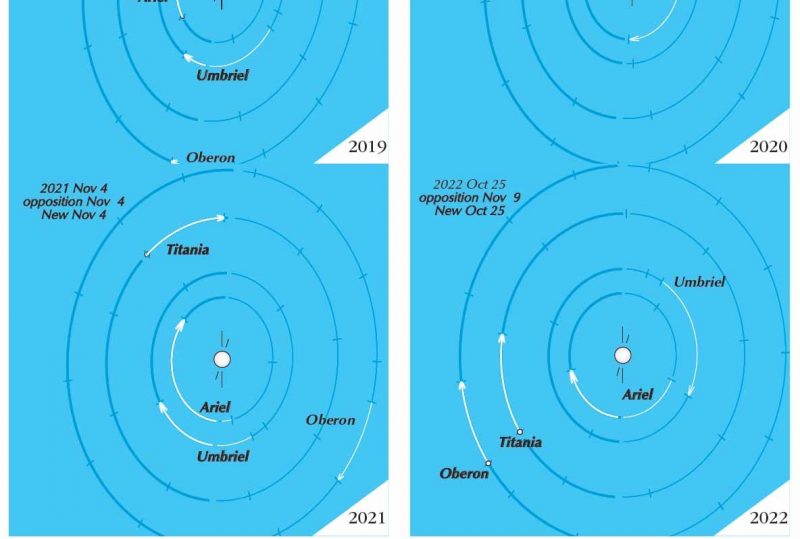
Diagram of locations of moons of Uranus from 2019 to 2022.

Uranus has 5 major moons: Miranda, Ariel, Umbriel, Titania, and Oberon. Image via Guy Ottewell.
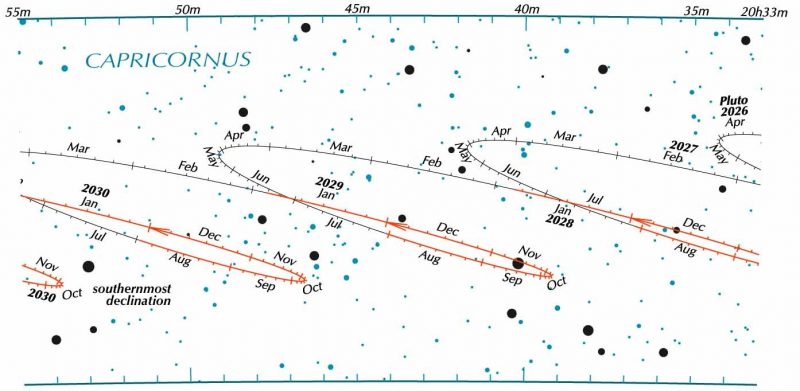
Star chart with Pluto's looping path with retrogrades in red.

Pluto’s path in Earth’s sky, 2016-2030, via Guy Ottewell.

This isn’t a fruit salad but a (necessarily small) photo of pages 18-19, showing sizes on four different scales …
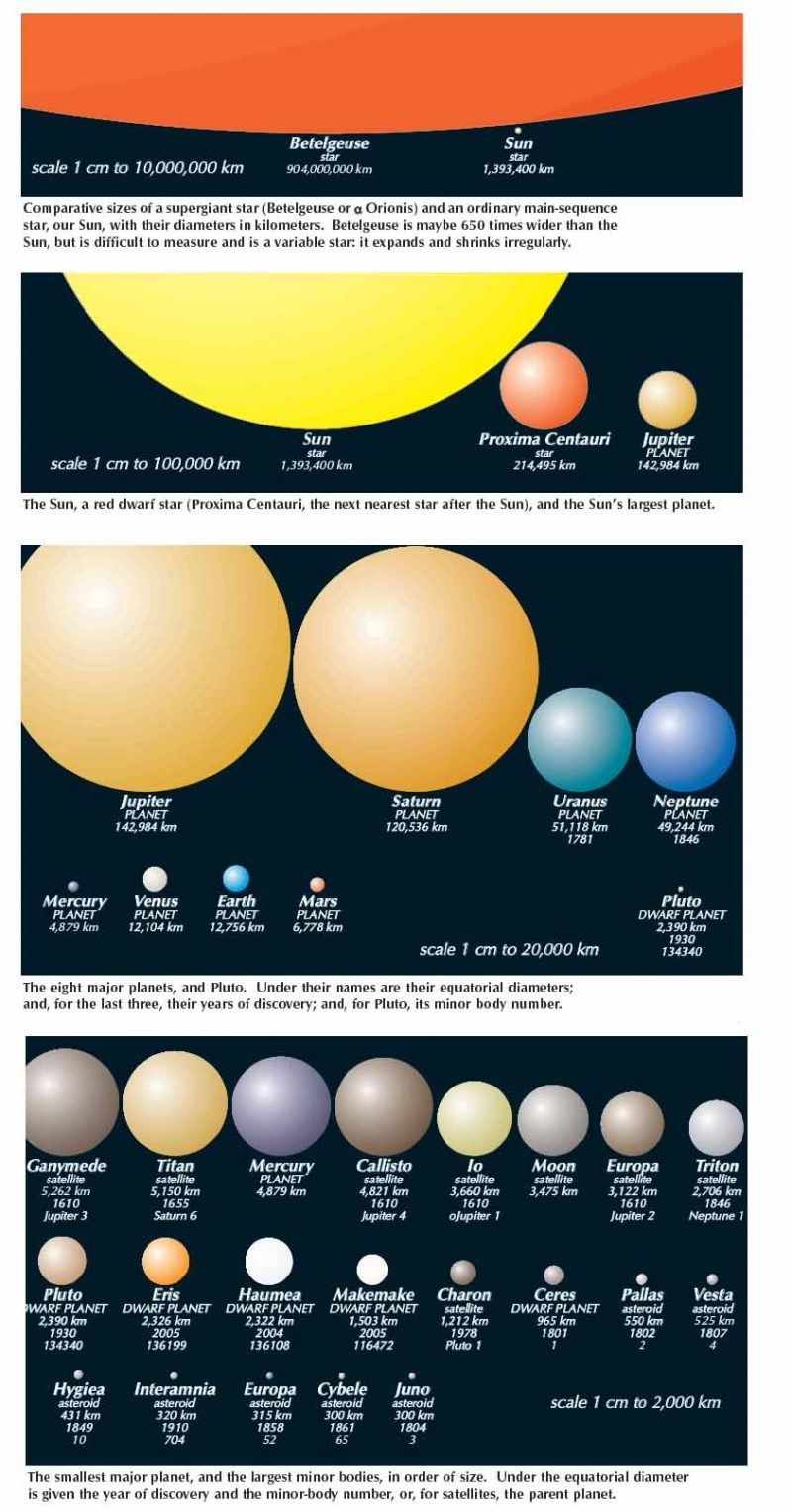
Diagrams with many spheres ranging from 904 million kilometers to 300 kilometers.

Bottom line: Astronomer Guy Ottewell describes his book titled Uranus, Neptune, Pluto: A Longer View. You can purchase the book from Amazon here.


from EarthSky https://ift.tt/2LMlC2u

Book cover with drawings of mythological figures on it.

Editor’s Note: Guy Ottewell’s book – Uranus, Neptune, Pluto: A Longer View – looks at least a dozen years ahead. There are 73 short chapters, plus Ottewell’s unique and beautiful charts. You can order the book here. The following article was originally posted at Guy Ottewell’s blog in 2018. Reprinted here with permission.

My original announcement of my book was rather curt, so Deborah Byrd – editor-in-chief at EarthSky.org – has asked me to say more about it.

Well. I produced my Astronomical Calendar for many a year, and, every year, as I labored through each task, such as the section on one of the planets – making the calculations, choosing the limits for the chart, choosing among the remarks that could be made and the other features that space might allow – I found myself mostly pouring material into a mold, even if with improvements. It occurred to me that I would rather be making charts for many years ahead. Then instead of just mentioning that Mars’s path for the year is part of a two-year pattern, or Venus’s is part of an eight-year pattern or Jupiter’s of a 12-year pattern, I could show the patterns whole.

So now, instead of the annual book, I hope to make a series of Longer View books.

Why start with Uranus and Neptune, the “last” planets? Because, I thought, that would be quickest. I had featured them together in the Astronomical Calendar, because they were advancing in their stately way through the same region of the sky (around 1993 they could be shown in one chart). In various years, I thought of six or seven extra illustrations for them, such as a graph showing how Uranus overtakes Neptune every 172 years …

Chart with intersecting paths of planets from 1800 to 2050.

View larger. | Uranus overtakes Neptune, via Guy Ottewell.

And I could provide a diagram of Uranus spinning on its side …

Solar system diagram with ringed outer planet with poles nearly perpendicular to the ecliptic.

View larger. | Uranus spins on its side with respect to the plane of the solar system, via Guy Ottewell.

But, each year, I had to choose only one of these to fit into the page. In a Longer View book, there would be room for them all. And for remarks that needn’t be kept so brief.

And why include Pluto, no longer classed as a major planet? Because the discovery story, the story of the first additions to the ancient planet family, goes Uranus-Neptune-Pluto. Each led to the next. True, the story goes on to 1992 QB1 and Eris and the other transneptunians, but their discovery wasn’t the consequence of Pluto’s as Pluto’s was of Neptune’s and Neptune’s of Uranus’s. And though Pluto is far below visibility to the unaided eye, it is far higher in observability than the other transneptunians, all smaller or more remote. And there is now, because of the New Horizons spacecraft visit, much more to say about it; indeed, there is much more detail to it than to Uranus and Neptune.

I finished the book on June 1. I had expected to finish it some time back in 2017, when I started it, but there proved to be more of interest than I had expected. Writing about these bodies was like opening a series of closets and finding them as large as rooms, some leading to other rooms.

For instance, several of the twists in the story of why Neptune came to be discovered at Berlin and not at Cambridge are not quite as often told – the reason why Adams didn’t get a response to his knock at the Astronomer Royal’s door was that the Astronomer Royal’s beautiful wife was having a miscarriage; the reason why Le Verrier sent his prediction to Galle may have been that he guiltily owed him a letter.

Sky chart, constellations, line of ecliptic, small dot marked Neptune in ecliptic.

Chart showing the night sky on September 23, 1846, the night of Neptune’s discovery, via Guy Ottewell.

And in 1993, when Neptune for the first since its discovery was passed by Uranus, there was a highly improbable episode that most of us weren’t aware of: a conjunction that came within a celestial hairbreadth of happening but failed to happen …

Green sphere nearly blocking smaller blue sphere.

This is how Uranus and Neptune would have looked if they had been at the same declination during their conjunction. Image via Guy Ottewell.

And there is what I call the Neptune-Pluto standoff: Pluto crosses over Neptune’s orbit (so that it was once suspected of being an escaped Neptune satellite); yet, in a sort of rigid geometrical ballet, it has always stayed as far from Neptune as it can – in fact, it comes nearer to Uranus.

Oblique diagram of solar system with Pluto's orbit at an angle to the plane of the ecliptic.

View larger. | Pluto crosses Neptune’s orbit, but stays as far from Neptune as it can. Image via Guy Ottewell.

And there is the Pluto-Charon embrace: they are the nearest thing to being a double planet. They keep their same faces to each other as they rotate slowly around a common point (which, unlike that for the Earth-moon nearly-double-planet system, is not inside the larger body but is in the space between them); they exchange material with each other.

And: Uranus, as is well known, rotates on its side, which brings the whole concept of north into dispute. Meanwhile, Pluto’s spin axis is tilted even further.

Sphere of the sky with constellations, ecliptic, and Pluto's orbit shown.

Pluto spin axis. Image via Guy Ottewell.

And, Uranus’s oppositions coincide with Earth’s new moon and full moon in alternate years – why?

And there are issues over not only titles like planet and dwarf planet but designations – 10000 Pluto vs. 134340 Pluto – and names – Georgium Sidus vs. Uranus, Ohnehtn vs. Pluto, Xena vs. Eris, Persephone vs. Charon. And there is this remark:

I’m not sure I would want to identify my wife with the janitor of hell.

I’m not sure that was a remark I should have made, but, being my own editor, I can venture bits of irreverence toward the scientists that a textbook writer would not get away with.

The book’s table of contents, shown before merely like a photo, appeared slightly indistinct, so click here to see it as a PDF, which should be as sharp as in print. The small images in it are only thumbnails of a few of those in the book. Here are some at fuller size.

Oblique diagram of solar system with orbits and spacecraft paths exiting system to north and south.

View larger. | Paths of the outer solar planets, and some outbound spacecraft, via Guy Ottewell.

Pale blue featureless planet on left, slightly striped blue planet on right.

Spacecraft images of Uranus (l) and Neptune (r), via Guy Ottewell.

Diagram of locations of moons of Uranus from 2019 to 2022.

Uranus has 5 major moons: Miranda, Ariel, Umbriel, Titania, and Oberon. Image via Guy Ottewell.

Star chart with Pluto's looping path with retrogrades in red.

Pluto’s path in Earth’s sky, 2016-2030, via Guy Ottewell.

This isn’t a fruit salad but a (necessarily small) photo of pages 18-19, showing sizes on four different scales …

Diagrams with many spheres ranging from 904 million kilometers to 300 kilometers.

Bottom line: Astronomer Guy Ottewell describes his book titled Uranus, Neptune, Pluto: A Longer View. You can purchase the book from Amazon here.


from EarthSky https://ift.tt/2LMlC2u

Eltanin and Rastaban, the Dragon’s Eyes

Draco and its stars Rastaban and Eltanin, as captured from Indonesia by Martin Marthadinata on May 25, 2017.

Our human eyes and brains easily pick out pairs of stars on the dome of night, especially if the two stars are relatively bright. Few such couplings represent true partner stars in space, however. Some well-known stellar pairs that are not truly bound include the two stars of the constellation Gemini the Twins – Castor and Pollux – as well as the Little Dipper’s bowl stars Kochab and Pherkad. On Northern Hemisphere summer nights, another famous pair of stars – not gravitationally bound – peers down at us from the northern sky. These stars are Eltanin and Rastaban, representing the fiery Eyes of the constellation Draco the Dragon. Follow the links below to learn more.

How to spot Eltanin and Rastaban

Science and history of the Dragon’s Eyes

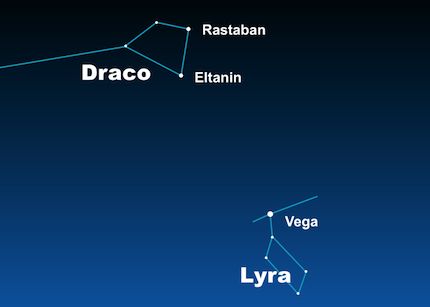
Eltanin and Rastaban mark the head of Draco the Dragon. You'll find these stars in the northern sky.

The long and winding star figure of Draco can be found in the northern sky on northern summer evenings. In a dark sky, look for the Dragon’s tail to snake in between the Big and Little Dippers.

Eltanin and Rastaban near bright star Vega

If you’re in a city or suburb, look for Eltanin and Rastaban near bright star Vega in the constellation Lyra.

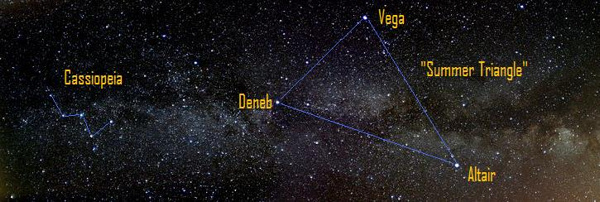
How to spot Eltanin and Rastaban. Once you become familiar with the brilliant Summer Triangle star pattern – a large asterism consisting of three bright stars in three different constellations – it’s easy to star-hop to the Dragon’s Eyes.

Draw an imaginary line from the star Altair through the star Vega to locate nearby Eltanin and Rastaban.

The Dragon’s eyes appear in the northeast sky on spring evenings, nearly overhead on late summer evenings and in the northwest evening sky in late autumn and early winter.

View larger. | The Milky Way passes through the Summer Triangle. Draw an imaginary line from the star Altair through the star Vega to locate nearby Eltanin and Rastaban.

Science and history of the Dragon’s Eyes. Modern astronomy has determined that the star Rastaban lies well over 200 light-years farther away than its counterpart in Draco, Eltanin. Best estimates place Eltanin at 148 light-years and Rastaban at 362 light-years distant.

As seen from Earth, Eltanin appears as the brighter star, but that’s because it’s so much closer to us than Rastaban. If these stars were the same distance away, Rastaban would shine some six times more brightly than Eltanin, and we’d probably no longer see the two stars as the Dragon’s Eyes.

Eltanin looms large in the history of astronomy. James Kaler has written on his website:

In attempting to find stellar parallax, the annual shift in stellar position caused by the shifting position of the orbiting Earth (from which we get stellar distance), in 1728 James Bradley discovered an “aberration of starlight,” which is caused by the velocity of the moving Earth relative to the speed of the light coming from the star.

The discovery once and for all proved that Copernicus was right and that the Earth truly does move around the central sun.

Eltanin is the Gamma star in its constellation Draco, and yet it is Draco’s brightest star. It outshines Rastaban (Beta Draconis) and also outshines Thuban (Alpha Draconis). Why does Thuban have the Alpha designation in Draco? It’s because Thuban is a former pole star!

Yet the mathematical wizard Jean Meeus (page 363 of Mathematical Astronomy Morsels V) calls Eltanin the “Queen of the Poles” because this star will be the north pole star in the year 92020 and then the south pole star in the year 2083470!

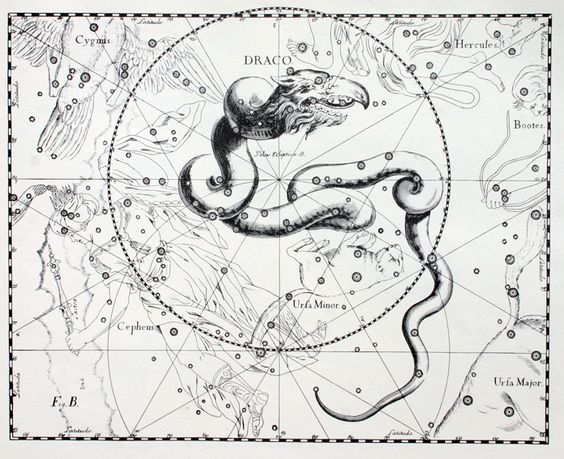
The constellation Draco from Uranographia by Johannes Hevelius, 1690, via Pinterest.

The constellation Draco from Uranographia by Johannes Hevelius, 1690, via Pinterest.

Bottom line: Eltanin and Rastaban represent the fiery Eyes of the constellation Draco the Dragon.

Big and Little Dippers: noticeable in northern sky

Summer Triangle: Vega, Deneb, Altair


from EarthSky https://ift.tt/2jQNhn9

Draco and its stars Rastaban and Eltanin, as captured from Indonesia by Martin Marthadinata on May 25, 2017.

Our human eyes and brains easily pick out pairs of stars on the dome of night, especially if the two stars are relatively bright. Few such couplings represent true partner stars in space, however. Some well-known stellar pairs that are not truly bound include the two stars of the constellation Gemini the Twins – Castor and Pollux – as well as the Little Dipper’s bowl stars Kochab and Pherkad. On Northern Hemisphere summer nights, another famous pair of stars – not gravitationally bound – peers down at us from the northern sky. These stars are Eltanin and Rastaban, representing the fiery Eyes of the constellation Draco the Dragon. Follow the links below to learn more.

How to spot Eltanin and Rastaban

Science and history of the Dragon’s Eyes

Eltanin and Rastaban mark the head of Draco the Dragon. You'll find these stars in the northern sky.

The long and winding star figure of Draco can be found in the northern sky on northern summer evenings. In a dark sky, look for the Dragon’s tail to snake in between the Big and Little Dippers.

Eltanin and Rastaban near bright star Vega

If you’re in a city or suburb, look for Eltanin and Rastaban near bright star Vega in the constellation Lyra.

How to spot Eltanin and Rastaban. Once you become familiar with the brilliant Summer Triangle star pattern – a large asterism consisting of three bright stars in three different constellations – it’s easy to star-hop to the Dragon’s Eyes.

Draw an imaginary line from the star Altair through the star Vega to locate nearby Eltanin and Rastaban.

The Dragon’s eyes appear in the northeast sky on spring evenings, nearly overhead on late summer evenings and in the northwest evening sky in late autumn and early winter.

View larger. | The Milky Way passes through the Summer Triangle. Draw an imaginary line from the star Altair through the star Vega to locate nearby Eltanin and Rastaban.

Science and history of the Dragon’s Eyes. Modern astronomy has determined that the star Rastaban lies well over 200 light-years farther away than its counterpart in Draco, Eltanin. Best estimates place Eltanin at 148 light-years and Rastaban at 362 light-years distant.

As seen from Earth, Eltanin appears as the brighter star, but that’s because it’s so much closer to us than Rastaban. If these stars were the same distance away, Rastaban would shine some six times more brightly than Eltanin, and we’d probably no longer see the two stars as the Dragon’s Eyes.

Eltanin looms large in the history of astronomy. James Kaler has written on his website:

In attempting to find stellar parallax, the annual shift in stellar position caused by the shifting position of the orbiting Earth (from which we get stellar distance), in 1728 James Bradley discovered an “aberration of starlight,” which is caused by the velocity of the moving Earth relative to the speed of the light coming from the star.

The discovery once and for all proved that Copernicus was right and that the Earth truly does move around the central sun.

Eltanin is the Gamma star in its constellation Draco, and yet it is Draco’s brightest star. It outshines Rastaban (Beta Draconis) and also outshines Thuban (Alpha Draconis). Why does Thuban have the Alpha designation in Draco? It’s because Thuban is a former pole star!

Yet the mathematical wizard Jean Meeus (page 363 of Mathematical Astronomy Morsels V) calls Eltanin the “Queen of the Poles” because this star will be the north pole star in the year 92020 and then the south pole star in the year 2083470!

The constellation Draco from Uranographia by Johannes Hevelius, 1690, via Pinterest.

The constellation Draco from Uranographia by Johannes Hevelius, 1690, via Pinterest.

Bottom line: Eltanin and Rastaban represent the fiery Eyes of the constellation Draco the Dragon.

Big and Little Dippers: noticeable in northern sky

Summer Triangle: Vega, Deneb, Altair


from EarthSky https://ift.tt/2jQNhn9

Full moon falls on July 16

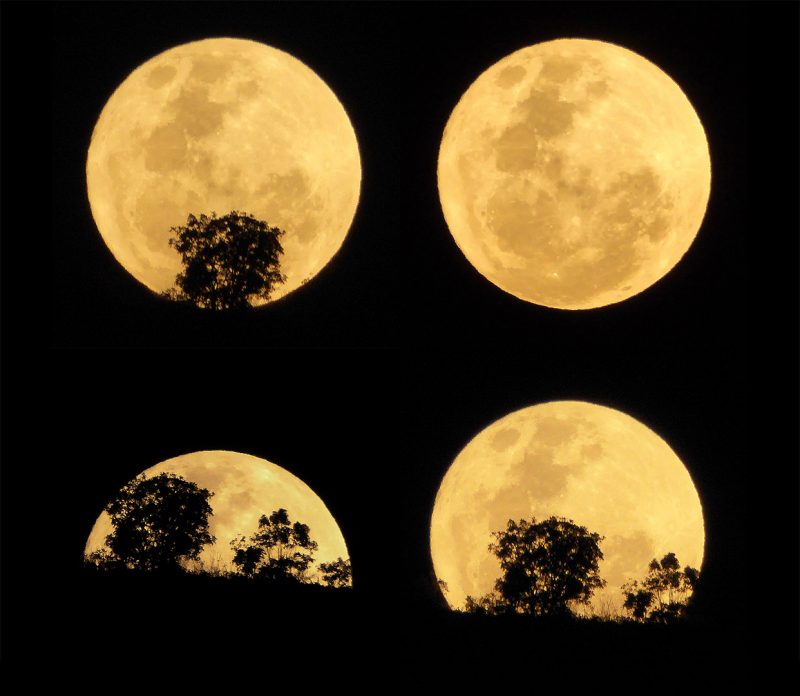
Four shots of a full, round, golden moon ascending above a horizon.

Full moon rising, by Peter Lowenstein in Mutare, Zimbabwe.

The moon appears full to the eye for two to three nights. However, astronomers regard the moon as full at a precisely defined instant, when the moon is exactly 180 degrees opposite the sun in ecliptic longitude. That full moon instant falls on July 16, 2019, at 21:38 UTC. Translate UTC to your time zone.

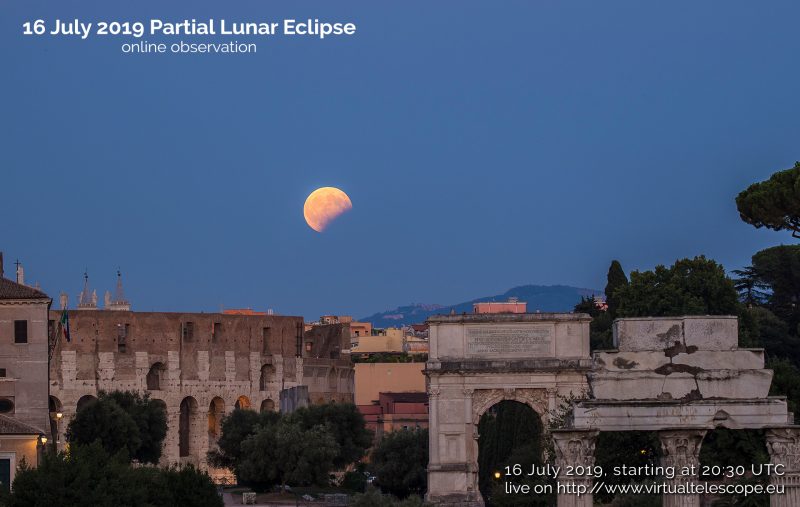
This upcoming full moon will undergo a partial lunar eclipse. Unfortunately, North America misses out on this eclipse entirely. The eclipse is visible from South America at early evening July 16. From Europe and Africa, it happens later in the evening July 16. In Asia and Australia, watch for the eclipse to occur during the morning nighttime hours July 17. From South America, the moon is already in eclipse as it rises around sunset July 16; and in Australia, the moon is in eclipse as it sets around sunrise July 17. The worldwide map below shows more specifically where the eclipse is visible.

Read more: Partial lunar eclipse on July 16-17

Worldwide map of coverage of July 16, 2019, partial lunar eclipse.

View larger. | South America sees the moon rising in eclipse around sunset July 16, whereas eastern Asia and Australia see the moon in eclipse as it sets around sunrise July 17. Eastern Africa and the Middle East see the greatest eclipse around midnight July 16-17. The dark gray swath of the globe between P1 and U1 (passing through Japan and New Zealand’s North Island), and between U4 and P4 (passing through northwestern South America and Cuba) depicts the moon in the Earth’s penumbral shadow, meaning the eclipse is essentially invisible from this part of the world.

Poster showing a partial lunar eclipse, with time and date of online observing session.

The Virtual Telescope Project is offering free online viewing of this eclipse. The online observing session to see the partial lunar eclipse is scheduled for July 16, 2019, starting at 20:30 UTC; translate UTC to your time. Want to join the online observing session? Click here for more info.

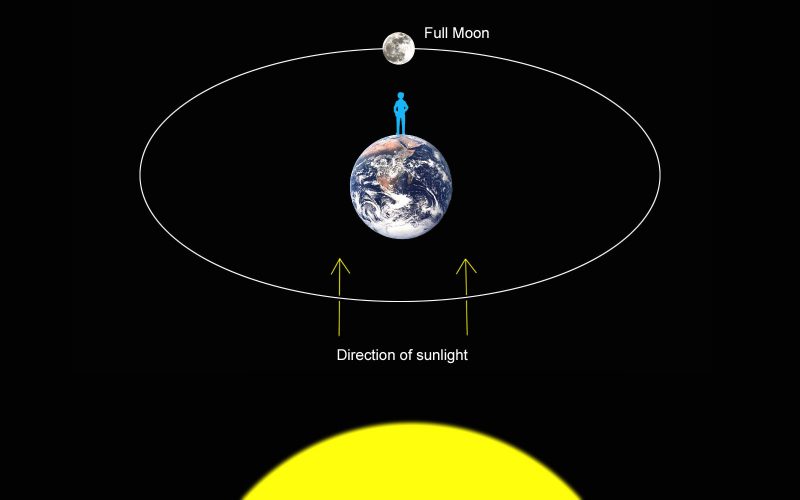
Why does a full moon look full? Remember that half the moon is always illuminated by the sun. That lighted half is the moon’s day side. In order to appear full to us on Earth, we have to see the entire day side of the moon. That happens only when the moon is opposite the sun in our sky. So a full moon looks full because it’s opposite the sun.

That’s also why every full moon rises in the east around sunset – climbs highest up for the night midway between sunset and sunrise (around midnight) – and sets around sunrise. Stand outside tonight around sunset and look for the moon. Sun going down while the moon is coming up? That’s a full moon, or close to one.

Just be aware that the moon will look full for at least a couple of night around the instant of full moon.

Diagram showing a full moon on the opposite side of Earth from the sun.

A full moon is opposite the sun. We see all of its dayside. Illustration via Bob King.

Often, you’ll find two different dates on calendars for the date of full moon. That’s because some calendars list moon phases in Coordinated Universal Time, also called Universal Time Coordinated (UTC). And other calendars list moon phases in local time, a clock time of a specific place, usually the place that made and distributed the calendars. Translate UTC to your local time.

Want to know the instant of full moon in your part of the world, as well as the moonrise and moonset times? Visit the Sunrise Sunset Calendars site, remembering to check the moon phases plus moonrise and moonset boxes.

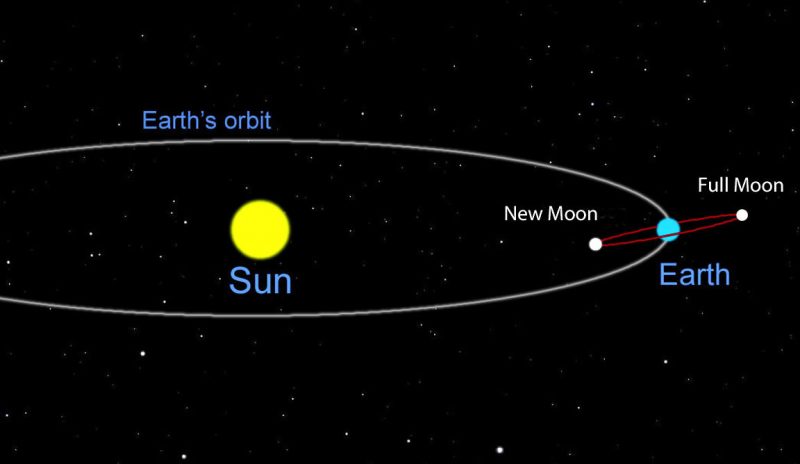
If a full moon is opposite the sun, why doesn’t Earth’s shadow fall on the moon at every full moon? The reason is that the moon’s orbit is titled by 5.1 degrees with respect to Earth’s orbit around the sun. At every full moon, Earth’s shadow sweeps near the moon. But, in most months, there’s no eclipse.

Oblique diagram of earth, sun, moon orbits. Moon orbit slightly slanted in relation to Earth's.

A full moon normally passes above or below Earth’s shadow, with no eclipse. Illustration by Bob King.

As the moon orbits Earth, it changes phase in an orderly way. Follow these links to understand the various phases of the moon.

New moon
Waxing crescent moon
First quarter moon
Waxing gibbous moon
Full moon
Waning gibbous moon
Last quarter moon
Waning crescent moon

Bottom line: Full moon – when the moon is most opposite the sun for this month – falls on July 16, 2019, at 21:38 UTC. Translate UTC to your time zone. This full moon will undergo a partial lunar eclipse.

Read more: Partial lunar eclipse on July 16-17

Read more: 4 keys to understanding moon phases

Read more: What are the full moon names?


from EarthSky https://ift.tt/2CEamRl
Four shots of a full, round, golden moon ascending above a horizon.

Full moon rising, by Peter Lowenstein in Mutare, Zimbabwe.

The moon appears full to the eye for two to three nights. However, astronomers regard the moon as full at a precisely defined instant, when the moon is exactly 180 degrees opposite the sun in ecliptic longitude. That full moon instant falls on July 16, 2019, at 21:38 UTC. Translate UTC to your time zone.

This upcoming full moon will undergo a partial lunar eclipse. Unfortunately, North America misses out on this eclipse entirely. The eclipse is visible from South America at early evening July 16. From Europe and Africa, it happens later in the evening July 16. In Asia and Australia, watch for the eclipse to occur during the morning nighttime hours July 17. From South America, the moon is already in eclipse as it rises around sunset July 16; and in Australia, the moon is in eclipse as it sets around sunrise July 17. The worldwide map below shows more specifically where the eclipse is visible.

Read more: Partial lunar eclipse on July 16-17

Worldwide map of coverage of July 16, 2019, partial lunar eclipse.

View larger. | South America sees the moon rising in eclipse around sunset July 16, whereas eastern Asia and Australia see the moon in eclipse as it sets around sunrise July 17. Eastern Africa and the Middle East see the greatest eclipse around midnight July 16-17. The dark gray swath of the globe between P1 and U1 (passing through Japan and New Zealand’s North Island), and between U4 and P4 (passing through northwestern South America and Cuba) depicts the moon in the Earth’s penumbral shadow, meaning the eclipse is essentially invisible from this part of the world.

Poster showing a partial lunar eclipse, with time and date of online observing session.

The Virtual Telescope Project is offering free online viewing of this eclipse. The online observing session to see the partial lunar eclipse is scheduled for July 16, 2019, starting at 20:30 UTC; translate UTC to your time. Want to join the online observing session? Click here for more info.

Why does a full moon look full? Remember that half the moon is always illuminated by the sun. That lighted half is the moon’s day side. In order to appear full to us on Earth, we have to see the entire day side of the moon. That happens only when the moon is opposite the sun in our sky. So a full moon looks full because it’s opposite the sun.

That’s also why every full moon rises in the east around sunset – climbs highest up for the night midway between sunset and sunrise (around midnight) – and sets around sunrise. Stand outside tonight around sunset and look for the moon. Sun going down while the moon is coming up? That’s a full moon, or close to one.

Just be aware that the moon will look full for at least a couple of night around the instant of full moon.

Diagram showing a full moon on the opposite side of Earth from the sun.

A full moon is opposite the sun. We see all of its dayside. Illustration via Bob King.

Often, you’ll find two different dates on calendars for the date of full moon. That’s because some calendars list moon phases in Coordinated Universal Time, also called Universal Time Coordinated (UTC). And other calendars list moon phases in local time, a clock time of a specific place, usually the place that made and distributed the calendars. Translate UTC to your local time.

Want to know the instant of full moon in your part of the world, as well as the moonrise and moonset times? Visit the Sunrise Sunset Calendars site, remembering to check the moon phases plus moonrise and moonset boxes.

If a full moon is opposite the sun, why doesn’t Earth’s shadow fall on the moon at every full moon? The reason is that the moon’s orbit is titled by 5.1 degrees with respect to Earth’s orbit around the sun. At every full moon, Earth’s shadow sweeps near the moon. But, in most months, there’s no eclipse.

Oblique diagram of earth, sun, moon orbits. Moon orbit slightly slanted in relation to Earth's.

A full moon normally passes above or below Earth’s shadow, with no eclipse. Illustration by Bob King.

As the moon orbits Earth, it changes phase in an orderly way. Follow these links to understand the various phases of the moon.

New moon
Waxing crescent moon
First quarter moon
Waxing gibbous moon
Full moon
Waning gibbous moon
Last quarter moon
Waning crescent moon

Bottom line: Full moon – when the moon is most opposite the sun for this month – falls on July 16, 2019, at 21:38 UTC. Translate UTC to your time zone. This full moon will undergo a partial lunar eclipse.

Read more: Partial lunar eclipse on July 16-17

Read more: 4 keys to understanding moon phases

Read more: What are the full moon names?


from EarthSky https://ift.tt/2CEamRl

Disappearing sea ice is changing the whole ecosystem of the Arctic Ocean

Graham J. C. Underwood, Professor of Marine and Freshwater Biology, University of Essex

This article is republished from The Conversation under a Creative Commons license. Read the original article.

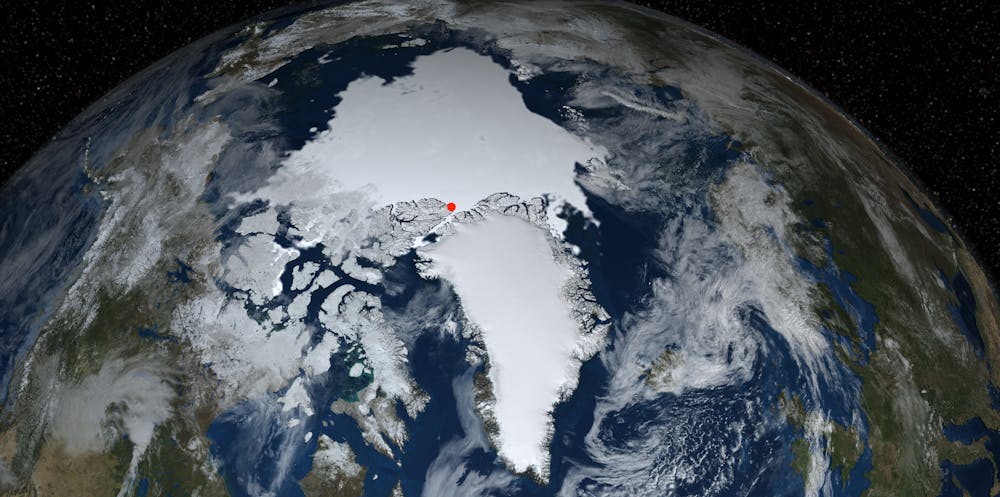
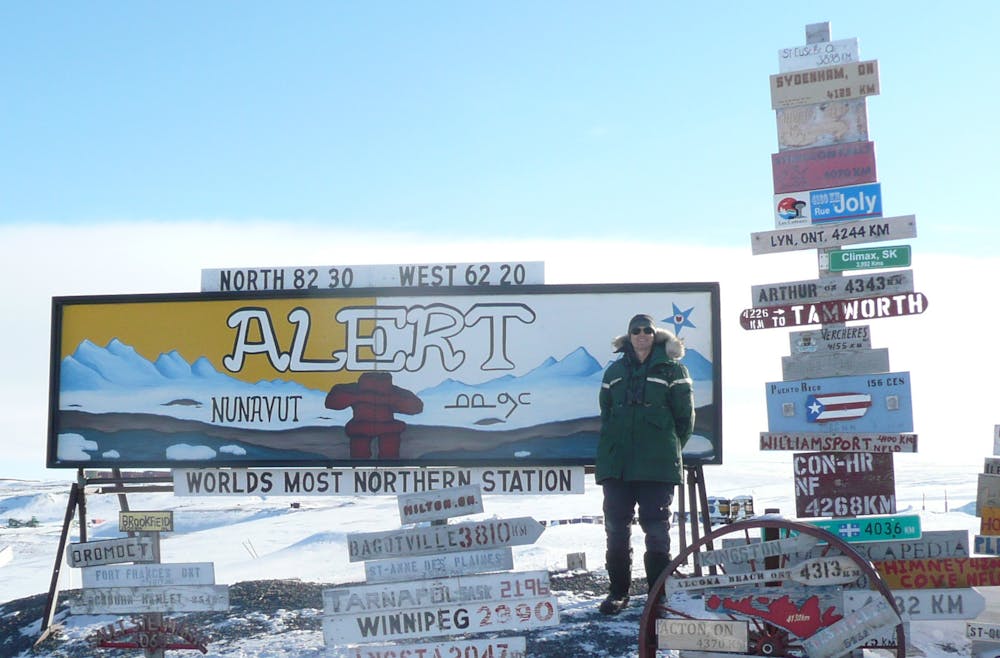
I drafted this while looking north over the frozen Lincoln Sea, at the northernmost tip of Ellesmere Island in Canada. I was at Alert, a Canadian Forces Station which, at 82°N, is the most northerly permanently inhabited place on Earth. Just 815km away, across the Arctic Ocean, lay the North Pole.

It was May, and the sea should have still been frozen, but this year the bridge of sea ice between Ellesmere and Greenland broke up early, and Arctic ice began flowing down the narrow Nares Channel and south into Baffin Bay. All across the Arctic Ocean, the amount and persistence of sea ice is declining – September ice cover has fallen around 30% since 1980.

Alert (red dot) is at the northern end of Canada’s most northerly island. NASA/Goddard Space Flight Center

The Arctic is warming at twice the rate of the rest of the planet, and images of polar bears on small ice floes capture the imagination. But those images represent (excusing the pun) only the tip of the iceberg – the consequences of ice loss are profound and start from the very bottom of the food chain, in the microbial processes that drive the biology of the ocean.

Arctic food chains sometimes start in sea ice

Sea ice forms when seawater temperature falls below -1.8℃. As the ice crystals form, salt is forced out and ice brines and other dissolved constituents become trapped in a honeycomb of small channels in the ice. Cold salty water draining from the ice also sinks deep to the bottom of the oceans and drives water circulation across the globe.

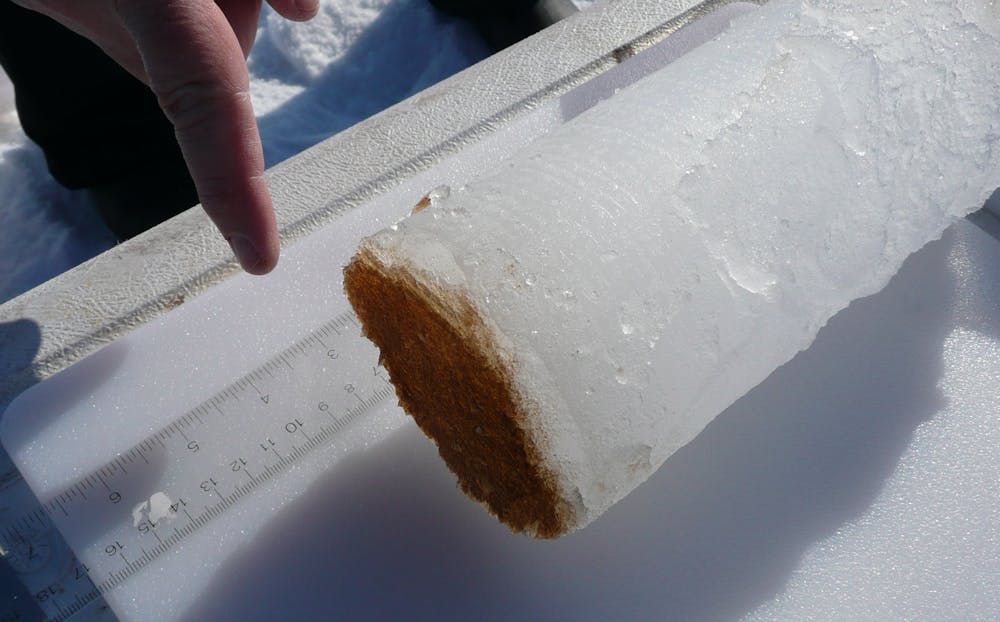
As the air grows colder, the ice thickens downwards and, in the brine channels and across the ice bottom, specialised algae and bacteria grow. When sunlight returns to the Arctic in the spring and penetrates through the ice (which is rarely more than a few metres thick) these ice-algal communities start to photosynthesise, producing algal biomass and abundant dissolved organic matter.

Ice algae growing on the bottom of an ice core. Graham Underwood, Author provided

This feeds a wide range of microscopic creatures known as zooplankton, which graze across the bottom of the ice. These zooplankton in turn feed larger animals and drive the food chain throughout spring.

When the ice melts more of this material flows out into the seas, providing more food resources at the bottom of food chains. In a recent study published in Nature Climate Change, colleagues and I showed how the different components of this organic matter derived from ice-algae are used by different species of bacteria and at different rates in underlying seawater, so that more melting ice will change the patterns of organic matter turnover in surface waters during spring.

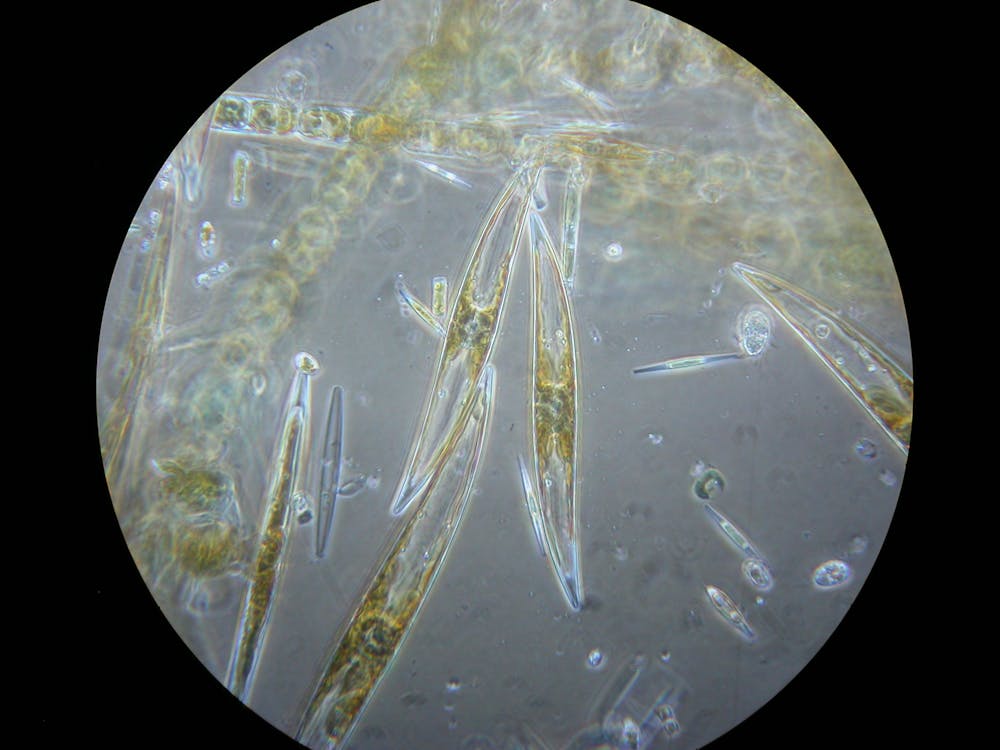
Ice-algae diatoms, right at the bottom of the Arctic food chain. Graham Underwood, Author provided

Different food chains may develop

Not all sea ice melts each summer – or at least it didn’t. Multi-year ice can go through a number of years of melting and growing, getting thicker and more structurally complex. But, over time, this multi-year ice has become rarer. In the 1980s, around one-third of the Arctic’s ice cover was more than four years old – today, such ice is almost nonexistent. Instead, more first-year ice will form and completely melt each year, providing new food inputs into areas of ocean that were previously permanently covered in ice.

This has significant consequences. Less ice cover in summer means more open ocean water, which – as it is darker – absorbs more sunlight and heat, making it harder to freeze in the autumn. Open water also means the wind can stir up the sea and slow the process of refreezing. More open water in summer will change the plankton communities, and then the animals that feed on them.

Some species are moving north. Already the Barents Sea between Norway and Svalbard is now rarely covered in ice in winter – and North Atlantic species such as cod and top predators such as orca are moving in. Specialist species that rely on ice such as polar bears, ringed seals, walrus and Arctic cod are losing their habitats, while non-indigenous species are expanding their range.

The author, at 82ºN. Graham Underwood, Author provided

For some, a warmer Arctic brings opportunities. Reduced ice cover means ships can use the north-east and north-west passages, significantly shortening journey times between the Atlantic and the Pacific. New fisheries may develop, and less ice means access to oil and gas resources becomes possible.

But these benefits to some, come at potentially huge costs. In addition to the changes in the ocean, a warmer Arctic could disrupt ocean circulation and global weather systems, while permafrost will continue to thaw, potentially releasing greenhouse gases currently locked up in frozen soils.

A whole ecosystem, rich in specialist species – many barely studied – is changing before our eyes. The Arctic is a beautiful and harsh place, posing serious logistical challenges for scientific investigation. But even there, on the top of the world, far from centres of human population, our impact is evident.


from Skeptical Science https://ift.tt/32pIyu5

Graham J. C. Underwood, Professor of Marine and Freshwater Biology, University of Essex

This article is republished from The Conversation under a Creative Commons license. Read the original article.

I drafted this while looking north over the frozen Lincoln Sea, at the northernmost tip of Ellesmere Island in Canada. I was at Alert, a Canadian Forces Station which, at 82°N, is the most northerly permanently inhabited place on Earth. Just 815km away, across the Arctic Ocean, lay the North Pole.

It was May, and the sea should have still been frozen, but this year the bridge of sea ice between Ellesmere and Greenland broke up early, and Arctic ice began flowing down the narrow Nares Channel and south into Baffin Bay. All across the Arctic Ocean, the amount and persistence of sea ice is declining – September ice cover has fallen around 30% since 1980.

Alert (red dot) is at the northern end of Canada’s most northerly island. NASA/Goddard Space Flight Center

The Arctic is warming at twice the rate of the rest of the planet, and images of polar bears on small ice floes capture the imagination. But those images represent (excusing the pun) only the tip of the iceberg – the consequences of ice loss are profound and start from the very bottom of the food chain, in the microbial processes that drive the biology of the ocean.

Arctic food chains sometimes start in sea ice

Sea ice forms when seawater temperature falls below -1.8℃. As the ice crystals form, salt is forced out and ice brines and other dissolved constituents become trapped in a honeycomb of small channels in the ice. Cold salty water draining from the ice also sinks deep to the bottom of the oceans and drives water circulation across the globe.

As the air grows colder, the ice thickens downwards and, in the brine channels and across the ice bottom, specialised algae and bacteria grow. When sunlight returns to the Arctic in the spring and penetrates through the ice (which is rarely more than a few metres thick) these ice-algal communities start to photosynthesise, producing algal biomass and abundant dissolved organic matter.

Ice algae growing on the bottom of an ice core. Graham Underwood, Author provided

This feeds a wide range of microscopic creatures known as zooplankton, which graze across the bottom of the ice. These zooplankton in turn feed larger animals and drive the food chain throughout spring.

When the ice melts more of this material flows out into the seas, providing more food resources at the bottom of food chains. In a recent study published in Nature Climate Change, colleagues and I showed how the different components of this organic matter derived from ice-algae are used by different species of bacteria and at different rates in underlying seawater, so that more melting ice will change the patterns of organic matter turnover in surface waters during spring.

Ice-algae diatoms, right at the bottom of the Arctic food chain. Graham Underwood, Author provided

Different food chains may develop

Not all sea ice melts each summer – or at least it didn’t. Multi-year ice can go through a number of years of melting and growing, getting thicker and more structurally complex. But, over time, this multi-year ice has become rarer. In the 1980s, around one-third of the Arctic’s ice cover was more than four years old – today, such ice is almost nonexistent. Instead, more first-year ice will form and completely melt each year, providing new food inputs into areas of ocean that were previously permanently covered in ice.

This has significant consequences. Less ice cover in summer means more open ocean water, which – as it is darker – absorbs more sunlight and heat, making it harder to freeze in the autumn. Open water also means the wind can stir up the sea and slow the process of refreezing. More open water in summer will change the plankton communities, and then the animals that feed on them.

Some species are moving north. Already the Barents Sea between Norway and Svalbard is now rarely covered in ice in winter – and North Atlantic species such as cod and top predators such as orca are moving in. Specialist species that rely on ice such as polar bears, ringed seals, walrus and Arctic cod are losing their habitats, while non-indigenous species are expanding their range.

The author, at 82ºN. Graham Underwood, Author provided

For some, a warmer Arctic brings opportunities. Reduced ice cover means ships can use the north-east and north-west passages, significantly shortening journey times between the Atlantic and the Pacific. New fisheries may develop, and less ice means access to oil and gas resources becomes possible.

But these benefits to some, come at potentially huge costs. In addition to the changes in the ocean, a warmer Arctic could disrupt ocean circulation and global weather systems, while permafrost will continue to thaw, potentially releasing greenhouse gases currently locked up in frozen soils.

A whole ecosystem, rich in specialist species – many barely studied – is changing before our eyes. The Arctic is a beautiful and harsh place, posing serious logistical challenges for scientific investigation. But even there, on the top of the world, far from centres of human population, our impact is evident.


from Skeptical Science https://ift.tt/32pIyu5

2019 SkS Weekly Climate Change & Global Warming News Roundup #28

A chronological listing of news articles posted on the Skeptical Science Facebook Page during the past week, i.e., Sun, July 7 through Sat, July 13, 2019

Editor's Pick

Climate Change Fills Storms With More Rain, Analysis Shows

New Orleans Flooding 

A flooded street in New Orleans on Wednesday. Credit Ryan Pasternak

When a tropical storm is approaching, its intensity or wind speed often gets the bulk of the attention. But as Tropical Storm Barry bears down on the Gulf Coast in the coming days, it’s the water that the storm will bring with it that has weather watchers worried.

The National Weather Service is calling for roughly 10 to 20 inches of rain to fall from late Thursday night through Saturday. The average rainfall for July in New Orleans, which is in the path of the storm, is just under six inches.

And Tropical Storm Barry, which may become a Category 1 hurricane before making landfall, will drop rain on already saturated land. On Wednesday, the region was hit by severe thunderstorms, which dropped as much as seven inches of rain according to preliminary National Weather Service data.

“Climate change is in general increasing the frequency and intensity of heavy rainfall storms,” said Andreas Prein, a project scientist with the National Center for Atmospheric Research. 

Climate Change Fills Storms With More Rain, Analysis Shows by Kendra Pierre-Louis, Climate, New York Times, July 11, 2019


Links posted on Facebook

Sun July 7, 2019

Mon July 8, 2019

Tue July 9, 2019

Wed July 10, 2019

Thu July 11, 2019

Fri July 12, 2019

Sat July 13, 2019


from Skeptical Science https://ift.tt/2jLRsRk
A chronological listing of news articles posted on the Skeptical Science Facebook Page during the past week, i.e., Sun, July 7 through Sat, July 13, 2019

Editor's Pick

Climate Change Fills Storms With More Rain, Analysis Shows

New Orleans Flooding 

A flooded street in New Orleans on Wednesday. Credit Ryan Pasternak

When a tropical storm is approaching, its intensity or wind speed often gets the bulk of the attention. But as Tropical Storm Barry bears down on the Gulf Coast in the coming days, it’s the water that the storm will bring with it that has weather watchers worried.

The National Weather Service is calling for roughly 10 to 20 inches of rain to fall from late Thursday night through Saturday. The average rainfall for July in New Orleans, which is in the path of the storm, is just under six inches.

And Tropical Storm Barry, which may become a Category 1 hurricane before making landfall, will drop rain on already saturated land. On Wednesday, the region was hit by severe thunderstorms, which dropped as much as seven inches of rain according to preliminary National Weather Service data.

“Climate change is in general increasing the frequency and intensity of heavy rainfall storms,” said Andreas Prein, a project scientist with the National Center for Atmospheric Research. 

Climate Change Fills Storms With More Rain, Analysis Shows by Kendra Pierre-Louis, Climate, New York Times, July 11, 2019


Links posted on Facebook

Sun July 7, 2019

Mon July 8, 2019

Tue July 9, 2019

Wed July 10, 2019

Thu July 11, 2019

Fri July 12, 2019

Sat July 13, 2019


from Skeptical Science https://ift.tt/2jLRsRk

Kelvin-Helmholtz clouds over Nova Scotia

Clouds that look ocean waves over gray-blue water with a small tugboat on it.

Image via Tanvi Javkar.

Kelvin-Helmholtz clouds look like breaking ocean waves, with the rolling eddies seen at the top of the cloud layers. The eddies are usually evenly spaced, making the clouds easily identifiable. Find out more about them, and see more beautiful images of these distinctive-looking clouds.


from EarthSky https://ift.tt/2jH1p2B
Clouds that look ocean waves over gray-blue water with a small tugboat on it.

Image via Tanvi Javkar.

Kelvin-Helmholtz clouds look like breaking ocean waves, with the rolling eddies seen at the top of the cloud layers. The eddies are usually evenly spaced, making the clouds easily identifiable. Find out more about them, and see more beautiful images of these distinctive-looking clouds.


from EarthSky https://ift.tt/2jH1p2B

News digest – sugary drinks, vagina bacteria, NHS info through Amazon’s Alexa and ‘War in the Blood’

Soft drink cans

Potential link between sugary drinks and cancer

A new study suggests there may be a link between consuming sugary drinks and a slight raised risk of cancer, even after taking weight into account. Researchers found that for every 1,000 people in their study, there were 22 cancers diagnosed over an average of 5 years. This increased to 26 cancers per 1,000 people in those who drank an extra 100ml of sugary drink per day. This reinforces that cutting down on sugary drinks, including fruit juice, is a good idea. But more research is needed to show if there is a direct link and if so, what is behind it.

HPV vaccination could prevent over 100,000 cancers

The Guardian reports on the plans to vaccinate boys aged 12 and 13 in England against HPV from this September. New research predicts that the HPV vaccination programme could prevent over 100,000 cancer cases in the UK over a period of 50 years, almost 29,000 of which would occur in men.

Funding boost to tackle obesity in Scotland

The Scottish Government has allocated £1.7 million to fund initiatives aimed at halving the number of under 18s who are overweight by 2030. The BBC says the money will be prioritised in areas of low income to tackle health inequality.

Government plans for a smokefree UK leaked

The Mail Online has leaked Government plans to make the UK smokefree by 2030. Draft proposals include making tobacco companies pay for services to help people to stop smoking while another proposes putting stop smoking leaflets in cigarette packs.

Make up of vagina bacteria could flag ovarian cancer risk

Scientists at University College London have shown a potential link between a lack of certain ‘good’ bacteria in the vagina and a person’s risk of developing ovarian cancer. It’s still too soon to act on this finding as there’s still so much we don’t know about these microbes. Watch this video for more on the microbiome and how it’s linked to cancer.

NHS teams up with Amazon’s Alexa

The NHS has teamed up with Amazon’s Alexa in a bid to make its health information more accessible, reports the Guardian. Smart devices will now be able to answer questions like ‘Alexa, what are the symptoms of the flu?’ using the same patient information found online.

Non-Hispanic black women have increased aggressive breast cancer risk

Non-Hispanic black women are more than twice as likely as white women to be diagnosed with an aggressive type of breast cancer called triple-negative breast cancer, reports Reuters. The same study also found that women under 40 were nearly twice as likely to be diagnosed with this specific disease compared to those aged 50 to 64.

Phone app highlights molecules useful for cancer research

An app that uses the processing power of a mobile phone while it’s on standby has found molecules that could be of interest for cancer research. The app’s algorithm measured the properties of more than 8,000 everyday foods against a database, looking for molecules that have successfully killed cancer cells in lab tests using cell cultures or animals. It’s a fascinating use of technology, but there’s a long way to go until these findings could help develop new treatments.

Three new cancer treatments available for NHS patients in Scotland

A breast cancer drug and two blood cancer treatments have been recommended for use on the NHS in Scotland. But a melanoma drug was rejected because it wasn’t deemed cost effective. We covered the latest decisions from Scottish Medicines Consortium.

‘My proton beam therapy video diary’

The BBC’s technology correspondent, Rory Cellan-Jones, has recorded his proton beam therapy treatment for a type of melanoma in the eye. Follow his video diary to see the machinery at work.

And finally

If you’re wondering what to watch this weekend we recommend this powerful feature-length BBC Two documentary. It follows two patients taking part in the ‘first in-human’ trials for a type of personalised immunotherapy called CAR T cell therapy. And also stars a Cancer Research UK-funded scientist who is pioneering these new treatments.

Gabi

Would you be interested in a podcast produced by Cancer Research UK?

We’re looking at new ways to tell stories about cancer and our work so we can improve the news and information we offer.

> Find out more about our future podcast


from Cancer Research UK – Science blog https://ift.tt/2JE3TaO
Soft drink cans

Potential link between sugary drinks and cancer

A new study suggests there may be a link between consuming sugary drinks and a slight raised risk of cancer, even after taking weight into account. Researchers found that for every 1,000 people in their study, there were 22 cancers diagnosed over an average of 5 years. This increased to 26 cancers per 1,000 people in those who drank an extra 100ml of sugary drink per day. This reinforces that cutting down on sugary drinks, including fruit juice, is a good idea. But more research is needed to show if there is a direct link and if so, what is behind it.

HPV vaccination could prevent over 100,000 cancers

The Guardian reports on the plans to vaccinate boys aged 12 and 13 in England against HPV from this September. New research predicts that the HPV vaccination programme could prevent over 100,000 cancer cases in the UK over a period of 50 years, almost 29,000 of which would occur in men.

Funding boost to tackle obesity in Scotland

The Scottish Government has allocated £1.7 million to fund initiatives aimed at halving the number of under 18s who are overweight by 2030. The BBC says the money will be prioritised in areas of low income to tackle health inequality.

Government plans for a smokefree UK leaked

The Mail Online has leaked Government plans to make the UK smokefree by 2030. Draft proposals include making tobacco companies pay for services to help people to stop smoking while another proposes putting stop smoking leaflets in cigarette packs.

Make up of vagina bacteria could flag ovarian cancer risk

Scientists at University College London have shown a potential link between a lack of certain ‘good’ bacteria in the vagina and a person’s risk of developing ovarian cancer. It’s still too soon to act on this finding as there’s still so much we don’t know about these microbes. Watch this video for more on the microbiome and how it’s linked to cancer.

NHS teams up with Amazon’s Alexa

The NHS has teamed up with Amazon’s Alexa in a bid to make its health information more accessible, reports the Guardian. Smart devices will now be able to answer questions like ‘Alexa, what are the symptoms of the flu?’ using the same patient information found online.

Non-Hispanic black women have increased aggressive breast cancer risk

Non-Hispanic black women are more than twice as likely as white women to be diagnosed with an aggressive type of breast cancer called triple-negative breast cancer, reports Reuters. The same study also found that women under 40 were nearly twice as likely to be diagnosed with this specific disease compared to those aged 50 to 64.

Phone app highlights molecules useful for cancer research

An app that uses the processing power of a mobile phone while it’s on standby has found molecules that could be of interest for cancer research. The app’s algorithm measured the properties of more than 8,000 everyday foods against a database, looking for molecules that have successfully killed cancer cells in lab tests using cell cultures or animals. It’s a fascinating use of technology, but there’s a long way to go until these findings could help develop new treatments.

Three new cancer treatments available for NHS patients in Scotland

A breast cancer drug and two blood cancer treatments have been recommended for use on the NHS in Scotland. But a melanoma drug was rejected because it wasn’t deemed cost effective. We covered the latest decisions from Scottish Medicines Consortium.

‘My proton beam therapy video diary’

The BBC’s technology correspondent, Rory Cellan-Jones, has recorded his proton beam therapy treatment for a type of melanoma in the eye. Follow his video diary to see the machinery at work.

And finally

If you’re wondering what to watch this weekend we recommend this powerful feature-length BBC Two documentary. It follows two patients taking part in the ‘first in-human’ trials for a type of personalised immunotherapy called CAR T cell therapy. And also stars a Cancer Research UK-funded scientist who is pioneering these new treatments.

Gabi

Would you be interested in a podcast produced by Cancer Research UK?

We’re looking at new ways to tell stories about cancer and our work so we can improve the news and information we offer.

> Find out more about our future podcast


from Cancer Research UK – Science blog https://ift.tt/2JE3TaO

Science Surgery: ‘Does cancer attack every age group?’

Our Science Surgery series answers your cancer science questions. 

Rich asked: Does cancer attack every age group? 

Every two minutes someone in the UK is diagnosed with cancer. So whether it’s a friend, family member or your own diagnosis, cancer touches all of us, no matter how old.  

But when it comes to who develops cancer, age plays a significant role. 

We see cases in every age group but many more cases in older people, says Dr Katrina Brown, Cancer Research UK’s statistical information and risk manager. 

“In the UK the highest rate of cancer cases is seen in the 85 to 89 age group, says Brown. “Our risk of being diagnosed with cancer increases as we get older she adds. And more than a third of all cancer cases in the UK are diagnosed in people aged 75 and over.  

People under the age of 49 are much less likely to develop the disease, with only a tenth of cancer cases overall in the UK each year being diagnosed in people aged 25 to 49. 

These stats can largely be explained by biology. Cancer develops because of a buildup of DNA damage in genes that control how a cell grows. The older you are, the more your cells will have divided, increasing the chances that DNA errors will occurAs life goes on, you’re also exposed more to other factors that can damage your DNA, such as tobacco smoke and excess body weight. 

And because cells are more likely to have more genetic faults as a person gets older, it’s more likely that some of these errors may lead to cancer. 

Are some cancers more common in certain age groups? 

Even though overall cancer is much more common in older people, there are three common cancer types that are more likely to diagnosed in younger people than older people.  

The rates of people being diagnosed are highest at age 25 to 29 for cervical cancer, at age 30 to 34 for testicular cancer, and at age 0 to 4 for a type of blood cancer called acute lymphoblastic leukaemiaBut those are really the only common cancer types where the older age groups don’t have the main share of the cases, says Brown. 

Cervical cancer is more likely to be diagnosed around this age because virtually all cases are caused by the human papillomavirus (HPV), and exposure to this virus usually begins in adolescence. Cervical screening is offered to people with a cervix from the age of 25, which helps pick these cancers up at an early stage and also prevent future cases developing.

“For testicular cancer and acute lymphoblastic leukaemia, we are less clear why peak incidence rates are in younger people, because there’s limited evidence on the causes of these diseases, says Brown. 

Children’s cancers differ from adult cancers 

The cancer types that children and young people are typically diagnosed with are different to those most common in adultsThe most common cancer types in children are leukaemiaslymphomastumours of the central nervous system and tumours in and around the brain” says Brown. But they are still rare. Each year around 160 children per 100,000 in the UK are diagnosed with any form of cancer. And biologically, these tumours can be quite different to those diagnosed in adults. 

In fact, the number of cancer cases in children aged 0 to 14 and young people aged 15 to 24 each make up less than 1% of the total number of cancer cases diagnosed in the UK each year.  

For almost every cancer type you look at, older adults are still the biggest contributor of cases.

– Dr Katrina Brown, Cancer Research UK

For almost every cancer type you look at, older adults are still the biggest contributor of cases, says Brown. And this is an important distinction to make. Brown says that one misconception she’s come across in her work is that leukaemia only affects children. “That’s absolutely not true, she says. 

Reducing cancer risk 

Age is the biggest risk factor for cancerAnd pinning down the causes in younger people can be hard. Some will have inherited faulty genes that increase their risk of developing particular types of cancer. While for others, it may just be bad luck. 

We can’t always control random changes to our genes as we get older or those passed down the family line. But around 4 in 10 cancers are preventable, so there’s definitely a few things we can do to stack the odds in our favourNot smoking and keeping a healthy weight are the best places to start. 

Gabi 

We’d like to thank Rich for asking this question. If you’d like to ask us something, post a comment below or email sciencesurgery@cancer.org.uk with your question and first name. 


from Cancer Research UK – Science blog https://ift.tt/2Y2xILs

Our Science Surgery series answers your cancer science questions. 

Rich asked: Does cancer attack every age group? 

Every two minutes someone in the UK is diagnosed with cancer. So whether it’s a friend, family member or your own diagnosis, cancer touches all of us, no matter how old.  

But when it comes to who develops cancer, age plays a significant role. 

We see cases in every age group but many more cases in older people, says Dr Katrina Brown, Cancer Research UK’s statistical information and risk manager. 

“In the UK the highest rate of cancer cases is seen in the 85 to 89 age group, says Brown. “Our risk of being diagnosed with cancer increases as we get older she adds. And more than a third of all cancer cases in the UK are diagnosed in people aged 75 and over.  

People under the age of 49 are much less likely to develop the disease, with only a tenth of cancer cases overall in the UK each year being diagnosed in people aged 25 to 49. 

These stats can largely be explained by biology. Cancer develops because of a buildup of DNA damage in genes that control how a cell grows. The older you are, the more your cells will have divided, increasing the chances that DNA errors will occurAs life goes on, you’re also exposed more to other factors that can damage your DNA, such as tobacco smoke and excess body weight. 

And because cells are more likely to have more genetic faults as a person gets older, it’s more likely that some of these errors may lead to cancer. 

Are some cancers more common in certain age groups? 

Even though overall cancer is much more common in older people, there are three common cancer types that are more likely to diagnosed in younger people than older people.  

The rates of people being diagnosed are highest at age 25 to 29 for cervical cancer, at age 30 to 34 for testicular cancer, and at age 0 to 4 for a type of blood cancer called acute lymphoblastic leukaemiaBut those are really the only common cancer types where the older age groups don’t have the main share of the cases, says Brown. 

Cervical cancer is more likely to be diagnosed around this age because virtually all cases are caused by the human papillomavirus (HPV), and exposure to this virus usually begins in adolescence. Cervical screening is offered to people with a cervix from the age of 25, which helps pick these cancers up at an early stage and also prevent future cases developing.

“For testicular cancer and acute lymphoblastic leukaemia, we are less clear why peak incidence rates are in younger people, because there’s limited evidence on the causes of these diseases, says Brown. 

Children’s cancers differ from adult cancers 

The cancer types that children and young people are typically diagnosed with are different to those most common in adultsThe most common cancer types in children are leukaemiaslymphomastumours of the central nervous system and tumours in and around the brain” says Brown. But they are still rare. Each year around 160 children per 100,000 in the UK are diagnosed with any form of cancer. And biologically, these tumours can be quite different to those diagnosed in adults. 

In fact, the number of cancer cases in children aged 0 to 14 and young people aged 15 to 24 each make up less than 1% of the total number of cancer cases diagnosed in the UK each year.  

For almost every cancer type you look at, older adults are still the biggest contributor of cases.

– Dr Katrina Brown, Cancer Research UK

For almost every cancer type you look at, older adults are still the biggest contributor of cases, says Brown. And this is an important distinction to make. Brown says that one misconception she’s come across in her work is that leukaemia only affects children. “That’s absolutely not true, she says. 

Reducing cancer risk 

Age is the biggest risk factor for cancerAnd pinning down the causes in younger people can be hard. Some will have inherited faulty genes that increase their risk of developing particular types of cancer. While for others, it may just be bad luck. 

We can’t always control random changes to our genes as we get older or those passed down the family line. But around 4 in 10 cancers are preventable, so there’s definitely a few things we can do to stack the odds in our favourNot smoking and keeping a healthy weight are the best places to start. 

Gabi 

We’d like to thank Rich for asking this question. If you’d like to ask us something, post a comment below or email sciencesurgery@cancer.org.uk with your question and first name. 


from Cancer Research UK – Science blog https://ift.tt/2Y2xILs

Scorpius? Here’s your constellation

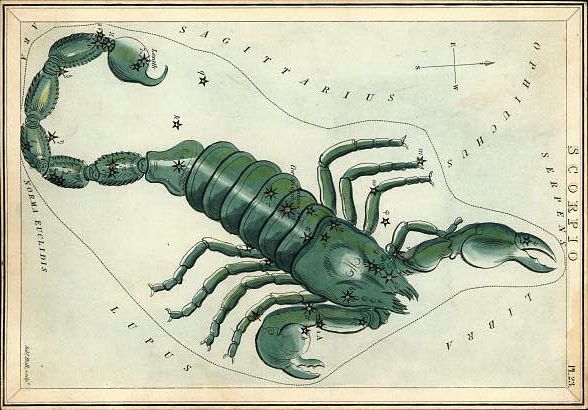
Antique drawing of a green scorpion with stars marked on it.

Scorpius, via Constellation of Words.

Scorpius the Scorpion – the southernmost constellation of the Zodiac – is a major showpiece of the starry sky. This J-shaped assemblage of stars actually looks like its namesake. The red star Antares is fortuitously placed in the sky just where the Scorpion’s Heart should be. What’s more, the fishhook-shaped Scorpion’s Stinger – made up of two stars, Shaula and Lesath – dips into the Milky Way’s stream of stars, allowing you to catch many a galactic treasure.

Photo of star field with constellation lines superimposed.

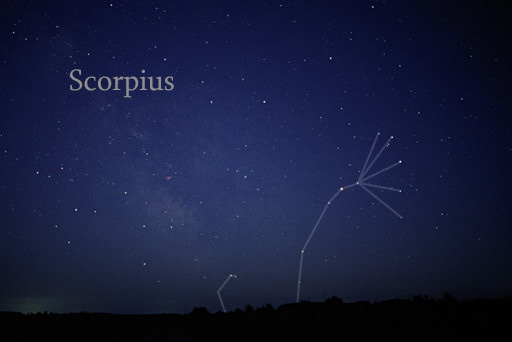
The constellation Scorpius. See the bright reddish star at the ‘heart’ of this constellation? This star is very noticeable in the night sky. It’s called Antares.

Star chart of constellation Scorpius, stars black against white background.
Diagram of constellation Scorpius with stars labeled.

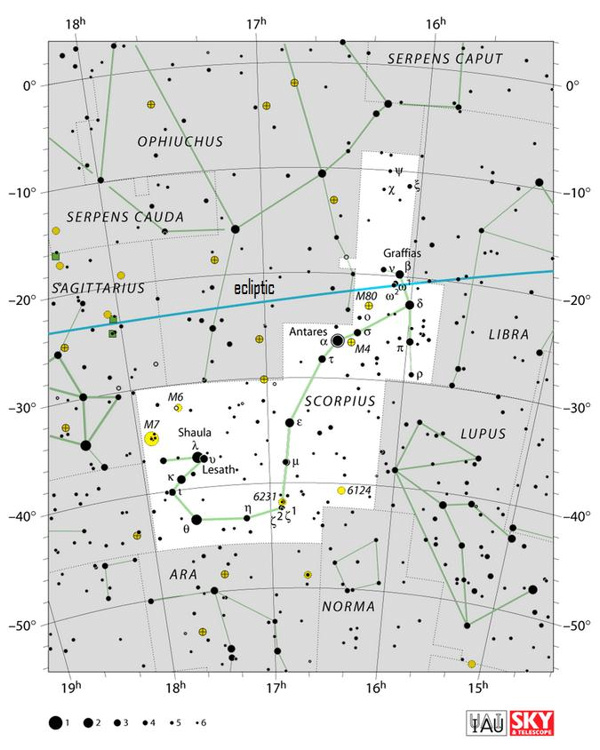
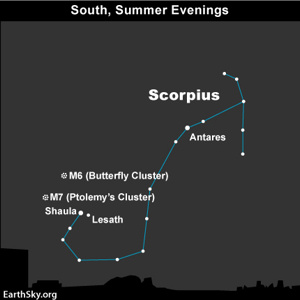
The constellation Scorpius. From the Northern Hemisphere, it is highest up in the evening on hot summer nights of July and August. Notice the two stars at the tip of the Scorpion's Tail. They are Shaula and Lesath, also known as The Stinger.

How to locate the constellation Scorpius. For evening viewing, July and August are prime-time months for observing this wondrous constellation. In the Northern Hemisphere, we associate the ruby star Antares – or Ant-ares, the Rival of Mars – with the hot summer season. And I personally associate Antares with the blooming of wild cardinal flowers on my favorite hiking trail. As the summer season wanes, Antares’ fading into the southwestern dusk presages the cooler days of autumn.

In early July, in either the Northern or Southern Hemisphere, Scorpius climbs to its highest point in the sky at about 10 p.m. local time (11 p.m. local daylight saving time). Because the stars return to the same place in the sky about one-half earlier with each passing week, look for the celestial Scorpion in mid-July to soar highest up around 9 p.m. local time (10 p.m. local daylight saving time), and by late July around 8 p.m. local time (9 p.m. local daylight saving time).

As seen from mid-northern latitudes, such as the central U.S., Scorpius never climbs high in the sky, but rather skitters along the horizon, so you need an unobstructed view southward to see this constellation in its entirety. From northern U.S. states and most of Canada, the Scorpion’s Tail stays at least partially submerged below the horizon, but its most brilliant star Antares can be seen as far north as southern Alaska.

Antares is the Heart of the Scorpion

Shaula and Lesath: Scorpion’s stinger stars

M6 and M7: Deep-sky gems in Tail of Scorpius

Constellation Scorpius diagram with line of ecliptic and sun's location.

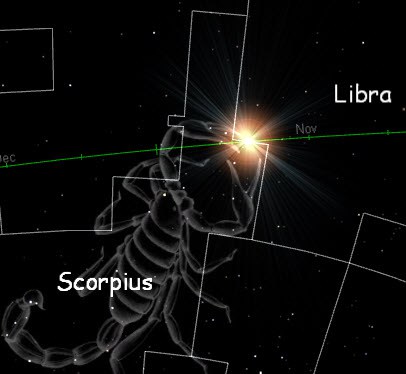
The sun doesn’t spend much time in front of the constellation Scorpius each year. It’s there for about a week, between about November 22 and 29. Read more about the sun in Scorpius from Bob’s Spaces. Bob also created this illustration.

Sun’s passage in front of Scorpius. Given Scorpius’ great prominence to the eye, it’s ironic that the sun spends less time in front of the Scorpion than any other constellation of the zodiac. Each year, the sun shines in the constellation Scorpius for a week, from about November 22 through November 29. If these dates seem to be in conflict with what you read on the horoscope page, remember that astrologers are referring to the sign Scorpio, not the constellation Scorpius.

Sun’s entry into each constellation of the zodiac

When the sun reaches a point on the ecliptic that’s 30 degrees to 60 degrees east of the September equinox point, then the sun is said to be in the sign Scorpio – irrespective of which constellation or constellations backdrop the sun at this period of time. The sun passes through the sign Scorpio (not the constellation Scorpius) from about October 23 to November 21, even though the sun is actually in front of the constellations Virgo and then Libra during this same stretch of time.

The astrological signs remain fixed relative to the solstice and equinox points. But, in the sky, these seasonal markers slowly but surely shift westward relative to the constellations, or backdrop stars. Some five thousand years ago, for instance, the star Antares marked the Northern Hemisphere’s autumnal equinox point. In our day, Antares and the sun have their annual conjunction on or near December 1 – some three weeks before the December 21 solstice. Antares will mark the December solstice point some 1,500 years into the future.

The International Astronomical Union (IAU) decreed the boundaries of the 88 official constellations in 1930, and the sun has been destined to spend only a week in front of Scorpius yearly ever since. As the boundaries are presently defined, the sun spends close to three weeks in front of the constellation Ophiuchus (November 29-December 18), the constellation immediately north of Scorpius. Note on the sky chart above that the IAU chose to draw most of the Ophiuchus-Scorpius border to the south of the ecliptic – the sun’s yearly pathway in front of the stars. Had the IAU chosen to draw the border to the north of the ecliptic, then the sun’s duration within Scorpius would be closer to one month.

Early astronomers used key stars and easy-to-recognize star patterns (constellations) to track the motions of the sun, moon and planets upon the zodiac. That being the case, olden astronomers were probably more inclined to use the “fixed” stars of Scorpius than of Ophiuchus for referencing the whereabouts of the wandering planets. After all, the ancients watched the red planet Mars pair up with the ruddy star Antares in recurring cycles, and it’s no wonder that Antares was given the appellation “the rival of Mars.” Moreover, the moon routinely occults – passes in front of – Antares at certain stages in the moon’s 18.6-year cycle, although the next series of Antares ocultations won’t begin until August 25, 2023.

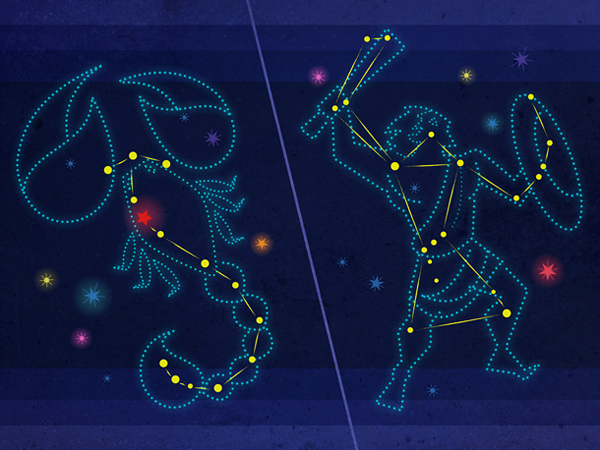
Picture of scorpion constellation on left, Orion the Hunter constellation on right.

In the skylore, and in the real sky, Scorpius (left) and Orion (right) are never seen in the sky at the same time. Illustration from a project by Hyaku at behance.net.

Scorpius in mythology. According to star lore, the Scorpion’s stinger brought about the death of Orion the Mighty Hunter. So when the gods gave the Scorpion and Orion their final resting places in the high heavens, they made sure to place the archenemies at opposite ends of the sky. That’s why you can never see these two constellations in the same sky together. To this day, Orion only rises in the east after Scorpius sets in the southwest, and the reverse is also true: Scorpius won’t rise in the southeast until Orion’s departure in the west.

From either the Northern or the Southern hemisphere, July is the month for Scorpius the Scorpion to reign supreme and for Orion to take his place in the underworld. But six months before or after – in the month of January – Orion has his turn to lord over the nighttime sky.

Bottom line: The constellation Scorpius is easy to pick out with the eye, because it looks like its namesake.

Taurus? Here’s your constellation
Gemini? Here’s your constellation
Cancer? Here’s your constellation
Leo? Here’s your constellation
Virgo? Here’s your constellation
Libra? Here’s your constellation
Scorpius? Here’s your contellation
Sagittarius? Here’s your constellation
Capricornus? Here’s your constellation
Aquarius? Here’s your constellation
Pisces? Here’s your constellation
Aries? Here’s your constellation
Birthday late November to early December? Here’s your constellation


from EarthSky https://ift.tt/2LgRc91
Antique drawing of a green scorpion with stars marked on it.

Scorpius, via Constellation of Words.

Scorpius the Scorpion – the southernmost constellation of the Zodiac – is a major showpiece of the starry sky. This J-shaped assemblage of stars actually looks like its namesake. The red star Antares is fortuitously placed in the sky just where the Scorpion’s Heart should be. What’s more, the fishhook-shaped Scorpion’s Stinger – made up of two stars, Shaula and Lesath – dips into the Milky Way’s stream of stars, allowing you to catch many a galactic treasure.

Photo of star field with constellation lines superimposed.

The constellation Scorpius. See the bright reddish star at the ‘heart’ of this constellation? This star is very noticeable in the night sky. It’s called Antares.

Star chart of constellation Scorpius, stars black against white background.
Diagram of constellation Scorpius with stars labeled.

The constellation Scorpius. From the Northern Hemisphere, it is highest up in the evening on hot summer nights of July and August. Notice the two stars at the tip of the Scorpion's Tail. They are Shaula and Lesath, also known as The Stinger.

How to locate the constellation Scorpius. For evening viewing, July and August are prime-time months for observing this wondrous constellation. In the Northern Hemisphere, we associate the ruby star Antares – or Ant-ares, the Rival of Mars – with the hot summer season. And I personally associate Antares with the blooming of wild cardinal flowers on my favorite hiking trail. As the summer season wanes, Antares’ fading into the southwestern dusk presages the cooler days of autumn.

In early July, in either the Northern or Southern Hemisphere, Scorpius climbs to its highest point in the sky at about 10 p.m. local time (11 p.m. local daylight saving time). Because the stars return to the same place in the sky about one-half earlier with each passing week, look for the celestial Scorpion in mid-July to soar highest up around 9 p.m. local time (10 p.m. local daylight saving time), and by late July around 8 p.m. local time (9 p.m. local daylight saving time).

As seen from mid-northern latitudes, such as the central U.S., Scorpius never climbs high in the sky, but rather skitters along the horizon, so you need an unobstructed view southward to see this constellation in its entirety. From northern U.S. states and most of Canada, the Scorpion’s Tail stays at least partially submerged below the horizon, but its most brilliant star Antares can be seen as far north as southern Alaska.

Antares is the Heart of the Scorpion

Shaula and Lesath: Scorpion’s stinger stars

M6 and M7: Deep-sky gems in Tail of Scorpius

Constellation Scorpius diagram with line of ecliptic and sun's location.

The sun doesn’t spend much time in front of the constellation Scorpius each year. It’s there for about a week, between about November 22 and 29. Read more about the sun in Scorpius from Bob’s Spaces. Bob also created this illustration.

Sun’s passage in front of Scorpius. Given Scorpius’ great prominence to the eye, it’s ironic that the sun spends less time in front of the Scorpion than any other constellation of the zodiac. Each year, the sun shines in the constellation Scorpius for a week, from about November 22 through November 29. If these dates seem to be in conflict with what you read on the horoscope page, remember that astrologers are referring to the sign Scorpio, not the constellation Scorpius.

Sun’s entry into each constellation of the zodiac

When the sun reaches a point on the ecliptic that’s 30 degrees to 60 degrees east of the September equinox point, then the sun is said to be in the sign Scorpio – irrespective of which constellation or constellations backdrop the sun at this period of time. The sun passes through the sign Scorpio (not the constellation Scorpius) from about October 23 to November 21, even though the sun is actually in front of the constellations Virgo and then Libra during this same stretch of time.

The astrological signs remain fixed relative to the solstice and equinox points. But, in the sky, these seasonal markers slowly but surely shift westward relative to the constellations, or backdrop stars. Some five thousand years ago, for instance, the star Antares marked the Northern Hemisphere’s autumnal equinox point. In our day, Antares and the sun have their annual conjunction on or near December 1 – some three weeks before the December 21 solstice. Antares will mark the December solstice point some 1,500 years into the future.

The International Astronomical Union (IAU) decreed the boundaries of the 88 official constellations in 1930, and the sun has been destined to spend only a week in front of Scorpius yearly ever since. As the boundaries are presently defined, the sun spends close to three weeks in front of the constellation Ophiuchus (November 29-December 18), the constellation immediately north of Scorpius. Note on the sky chart above that the IAU chose to draw most of the Ophiuchus-Scorpius border to the south of the ecliptic – the sun’s yearly pathway in front of the stars. Had the IAU chosen to draw the border to the north of the ecliptic, then the sun’s duration within Scorpius would be closer to one month.

Early astronomers used key stars and easy-to-recognize star patterns (constellations) to track the motions of the sun, moon and planets upon the zodiac. That being the case, olden astronomers were probably more inclined to use the “fixed” stars of Scorpius than of Ophiuchus for referencing the whereabouts of the wandering planets. After all, the ancients watched the red planet Mars pair up with the ruddy star Antares in recurring cycles, and it’s no wonder that Antares was given the appellation “the rival of Mars.” Moreover, the moon routinely occults – passes in front of – Antares at certain stages in the moon’s 18.6-year cycle, although the next series of Antares ocultations won’t begin until August 25, 2023.

Picture of scorpion constellation on left, Orion the Hunter constellation on right.

In the skylore, and in the real sky, Scorpius (left) and Orion (right) are never seen in the sky at the same time. Illustration from a project by Hyaku at behance.net.

Scorpius in mythology. According to star lore, the Scorpion’s stinger brought about the death of Orion the Mighty Hunter. So when the gods gave the Scorpion and Orion their final resting places in the high heavens, they made sure to place the archenemies at opposite ends of the sky. That’s why you can never see these two constellations in the same sky together. To this day, Orion only rises in the east after Scorpius sets in the southwest, and the reverse is also true: Scorpius won’t rise in the southeast until Orion’s departure in the west.

From either the Northern or the Southern hemisphere, July is the month for Scorpius the Scorpion to reign supreme and for Orion to take his place in the underworld. But six months before or after – in the month of January – Orion has his turn to lord over the nighttime sky.

Bottom line: The constellation Scorpius is easy to pick out with the eye, because it looks like its namesake.

Taurus? Here’s your constellation
Gemini? Here’s your constellation
Cancer? Here’s your constellation
Leo? Here’s your constellation
Virgo? Here’s your constellation
Libra? Here’s your constellation
Scorpius? Here’s your contellation
Sagittarius? Here’s your constellation
Capricornus? Here’s your constellation
Aquarius? Here’s your constellation
Pisces? Here’s your constellation
Aries? Here’s your constellation
Birthday late November to early December? Here’s your constellation


from EarthSky https://ift.tt/2LgRc91

adds 2