aads

We love sunflowers! Your best photos

We asked you to share your sunflowers pics for our 2019 sunflower gallery, and wow! Here are some of our favorites. Enjoy! Thank you so much to everyone who shared photos with us!

Close up of a backlit, pale yellow sunflower with tousled petals.

Image via Eleni Ioannou.

Closed yellow sunflower surrounded by green leaf-like sepals.

Sherri DeLozier Carter said, “This has always been one of my favorite sunflower pics I’ve taken.”

Closup center of sunflower with bright yellow petals around it.

Photo via Mary Kate Best.

Closeup of a sunflower center with a bee on the edge of the center.

Photo by Shivani Kumar.

Three panels of two little girls looking up at a tall sunflower.

Photo via Jessica Pinkerton.

A field of backlit sunflowers under a partly sunny sky.

Laura Bates-Haberstroh took this photo in Middleton, Wisconsin.

Bee and orange-and-black butterfly on two small red-orange sunflowers.

Curtis Beaird wrote, “Bees, butterflies and hummingbirds love these sunflowers. Mexican sunflower, Japanese sunflower (Tithonia diversifolia) … We had a field day with the six plants that managed to germinate and grow. Birds really like the seeds.”

Fringe-edged leaves enclosing sunflower bud on hairy stem.

Tzila Z Duenzl said, “I believe the buds are as beautiful as the flower … and as beautiful as any lotus. Texas wild sunflower.”

Two sunflowers brightly lit from the side.

Photo by Sam Marshall.

A stand of tall yellow sunflowers with wide round black centers.

“Hi, You asked for pictures of sunflowers. Here’s some I grew on my allotment.” Image via Clarita.

Sunflower from below, night sky, blurry yellow moon.

Image via Marcia White Bower.

Closeup of sunflower from the side with at least 4 bees on it.

Jenni Wallis-Moreno wrote, “The bees say thanks to their bird pals for planting some sunflowers in the yard.”

Drooping yellow sunflower with green center.

Allee Bennett Farey wrote, “A neighboring farmer plants acres of sunflowers each year for birds & pollinators.”

Small black and yellow bird perched on top of sunflower plant with flowers.

Photo via Paula J Quatkemeyer. She wrote, “Female goldfinch, loving the volunteer sunflowers, one petal at a time. My backyard, Dent, Ohio.”

Blue flower spikes in front of field of sunflowers, mountains in background.

Photo via Kev’s Kaptures.

Butterfly with eye-like spots on its wings on a sunflower.

Jennifer Coulter said, “The common buckeye butterfly & a South Carolina sunflower … a match made in heaven!”

Field of red-centered sunflowers under a bright blue sky.

Chapin, South Carolina. Image via Jennifer Coulter.

Large yellow sunflower with wide round green center.

Alabama sunflower by Jenna Wingate.

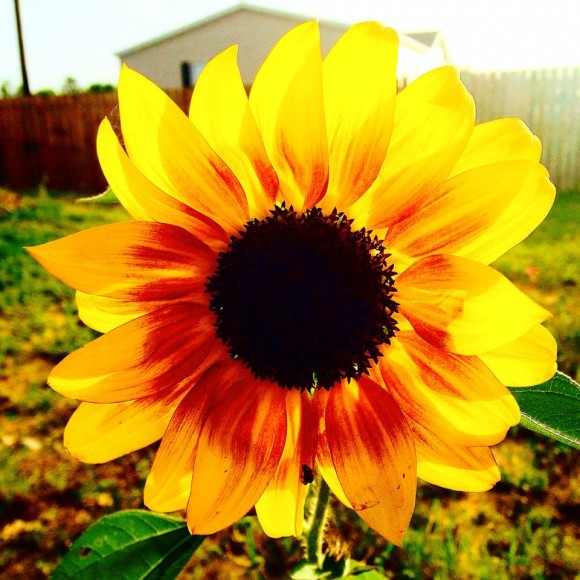
Sunflower with black center and petals marked with red next to center.

From central Louisiana, by Benjamin Lewis.

Silhouette of large sunflower against a twilight sky.

Selby, South Dakota. Photo via Eric Miller.

Orange-ish sunflower in bright sun.

Photo via Pleskonics Ferenc.

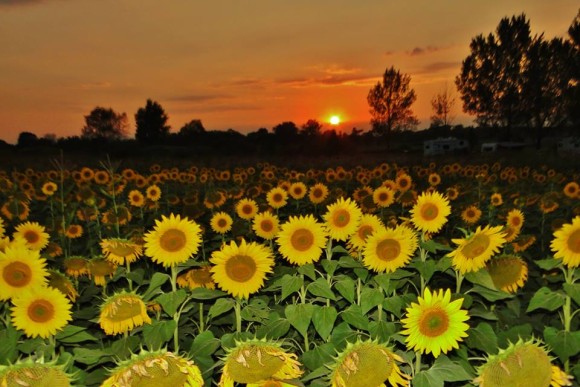
Array of plate-like yellow sunflowers with brown centers against a sunset.

“Here’s a sunset from last August in Western Michigan.” Photo via Rick Trommater.

Closeup of sunflower from the side against blue sky with small white half moon.

“Vincent Van Gogh aimait les tournesols, j’en ai choisi un hier soir pour accompagner le gros Quartier de Lune.” [“Vincent Van Gogh loved sunflowers, I chose one last night to accompany the big quarter moon.”] Photo via Jean-Baptiste Feldmann.

Closeup of part of a bright yellow flower with wide dark center.

“Full bloom~Okinawa” Photo via Beverly Fish.

2 yellow bees on center of sunflower showing disc flowers.

Michelle Whitaker wrote, “Bees in one of my sunflowers. Sparks, Nevada.”

Green bug on sunflower with striking double-spiral center.

“Sunflower with ‘Green Guy.’ The last of the sun today before the rains came. South Georgia. Having fun with sunflowers we planted around the bird feeders.” Photo via Curtis Beaird.

Small red sunflower with yellow-tipped petals and bright black center.

“Happy Face – Taken in my backyard in Salt Lake City, Utah.” Photo via Shanna Dennis.

Straggly sunflower plant with other colorful flowers.

Flagstaff, Arizona. Photo via Jamie Fontana Galea.

Bottom line: Sunflower photo gallery 2019.


from EarthSky https://ift.tt/2JdJaLP

We asked you to share your sunflowers pics for our 2019 sunflower gallery, and wow! Here are some of our favorites. Enjoy! Thank you so much to everyone who shared photos with us!

Close up of a backlit, pale yellow sunflower with tousled petals.

Image via Eleni Ioannou.

Closed yellow sunflower surrounded by green leaf-like sepals.

Sherri DeLozier Carter said, “This has always been one of my favorite sunflower pics I’ve taken.”

Closup center of sunflower with bright yellow petals around it.

Photo via Mary Kate Best.

Closeup of a sunflower center with a bee on the edge of the center.

Photo by Shivani Kumar.

Three panels of two little girls looking up at a tall sunflower.

Photo via Jessica Pinkerton.

A field of backlit sunflowers under a partly sunny sky.

Laura Bates-Haberstroh took this photo in Middleton, Wisconsin.

Bee and orange-and-black butterfly on two small red-orange sunflowers.

Curtis Beaird wrote, “Bees, butterflies and hummingbirds love these sunflowers. Mexican sunflower, Japanese sunflower (Tithonia diversifolia) … We had a field day with the six plants that managed to germinate and grow. Birds really like the seeds.”

Fringe-edged leaves enclosing sunflower bud on hairy stem.

Tzila Z Duenzl said, “I believe the buds are as beautiful as the flower … and as beautiful as any lotus. Texas wild sunflower.”

Two sunflowers brightly lit from the side.

Photo by Sam Marshall.

A stand of tall yellow sunflowers with wide round black centers.

“Hi, You asked for pictures of sunflowers. Here’s some I grew on my allotment.” Image via Clarita.

Sunflower from below, night sky, blurry yellow moon.

Image via Marcia White Bower.

Closeup of sunflower from the side with at least 4 bees on it.

Jenni Wallis-Moreno wrote, “The bees say thanks to their bird pals for planting some sunflowers in the yard.”

Drooping yellow sunflower with green center.

Allee Bennett Farey wrote, “A neighboring farmer plants acres of sunflowers each year for birds & pollinators.”

Small black and yellow bird perched on top of sunflower plant with flowers.

Photo via Paula J Quatkemeyer. She wrote, “Female goldfinch, loving the volunteer sunflowers, one petal at a time. My backyard, Dent, Ohio.”

Blue flower spikes in front of field of sunflowers, mountains in background.

Photo via Kev’s Kaptures.

Butterfly with eye-like spots on its wings on a sunflower.

Jennifer Coulter said, “The common buckeye butterfly & a South Carolina sunflower … a match made in heaven!”

Field of red-centered sunflowers under a bright blue sky.

Chapin, South Carolina. Image via Jennifer Coulter.

Large yellow sunflower with wide round green center.

Alabama sunflower by Jenna Wingate.

Sunflower with black center and petals marked with red next to center.

From central Louisiana, by Benjamin Lewis.

Silhouette of large sunflower against a twilight sky.

Selby, South Dakota. Photo via Eric Miller.

Orange-ish sunflower in bright sun.

Photo via Pleskonics Ferenc.

Array of plate-like yellow sunflowers with brown centers against a sunset.

“Here’s a sunset from last August in Western Michigan.” Photo via Rick Trommater.

Closeup of sunflower from the side against blue sky with small white half moon.

“Vincent Van Gogh aimait les tournesols, j’en ai choisi un hier soir pour accompagner le gros Quartier de Lune.” [“Vincent Van Gogh loved sunflowers, I chose one last night to accompany the big quarter moon.”] Photo via Jean-Baptiste Feldmann.

Closeup of part of a bright yellow flower with wide dark center.

“Full bloom~Okinawa” Photo via Beverly Fish.

2 yellow bees on center of sunflower showing disc flowers.

Michelle Whitaker wrote, “Bees in one of my sunflowers. Sparks, Nevada.”

Green bug on sunflower with striking double-spiral center.

“Sunflower with ‘Green Guy.’ The last of the sun today before the rains came. South Georgia. Having fun with sunflowers we planted around the bird feeders.” Photo via Curtis Beaird.

Small red sunflower with yellow-tipped petals and bright black center.

“Happy Face – Taken in my backyard in Salt Lake City, Utah.” Photo via Shanna Dennis.

Straggly sunflower plant with other colorful flowers.

Flagstaff, Arizona. Photo via Jamie Fontana Galea.

Bottom line: Sunflower photo gallery 2019.


from EarthSky https://ift.tt/2JdJaLP

More amazing images of the July 2 eclipse

Also, check out Eliot Herman’s images. He caught the July 2, 2019 eclipse from La Serena, Chile.

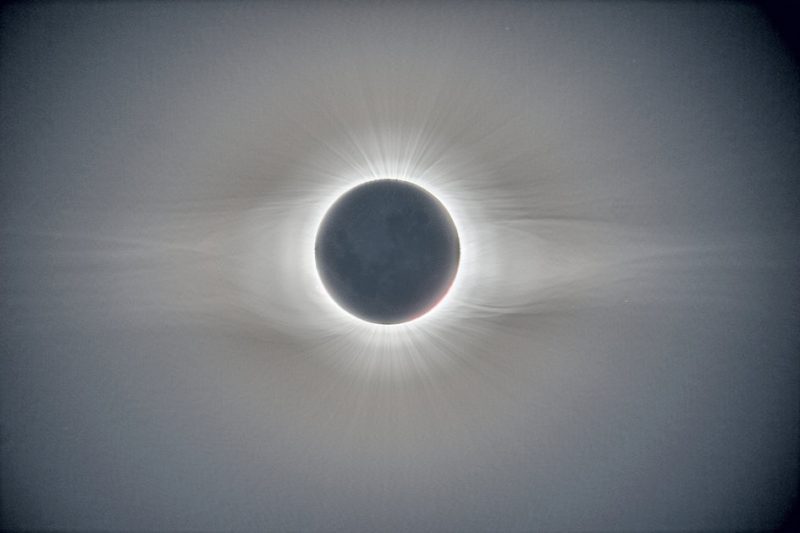
Intricate composite image of total solar eclipse.

This composite image captures the drama of totality during the July 2, 2019 total solar eclipse. When – as seen from Earth – the moon passes directly in front of the sun, the sun’s light is blocked and its extended atmosphere or corona can be seen. The processing of this image highlights the intricate detail of the corona, its structures shaped by the sun’s magnetic field. Some details of the lunar surface can also be seen. The image was created by the ESA-CESAR team observing the eclipse from ESO’s La Silla Observatory in Chile, South America. Image ESA/ CESAR/ Observatorio Astrofisico di Torino.

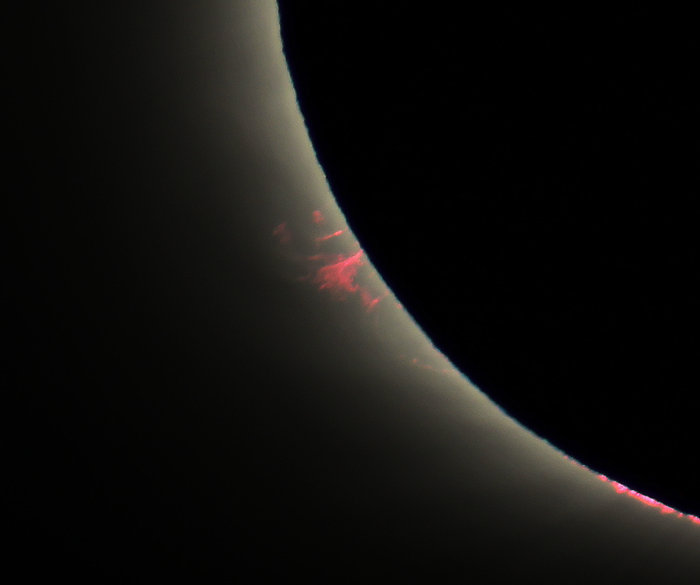
Close-up of one edge of the eclipsed sun, with a red prominence extending upward.

A prominence seen in the sun’s chromosphere during the July 2, 2019 total solar eclipse. Prominences are made of tangled magnetic field lines that keep dense concentrations of solar plasma suspended above the sun’s surface. They are anchored to the sun’s visible surface and extend outwards through the chromosphere and out into the corona. The red hue of the chromosphere is only apparent during an eclipse. This image – via ESA – was taken by the ESA-CESAR team observing the eclipse from ESO’s La Silla Observatory in Chile, South America.

While some observers on the southern part of Earth saw a total solar eclipse, the European Space Agency’s Proba-2 satellite’s SWAP imager in space saw a partial eclipse, as shown in the video below. The images are in ultraviolet light, revealing the turbulent nature of the sun’s surface and corona. ESA said:

During this eclipse the satellite was passing through the South Atlantic Anomaly at the time of the largest occultation [covering of the sun]. In this region the spacecraft is exposed to higher levels of radiation. The increased flux of energetic particles falling on the satellite’s detector is the cause for all the bright dots and streaks in the images.

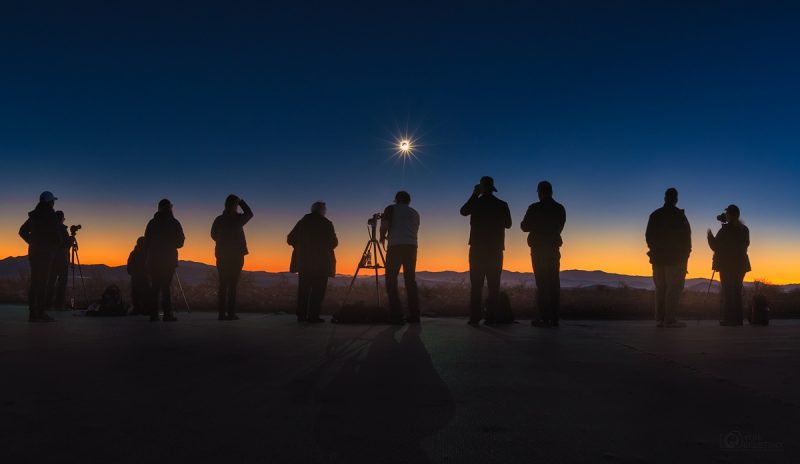
Watchers on a beach, under a dark sky, with the eclipsed sun in the sky.

This image of watchers from Yuri Beletsky the Chilean coast was chosen as an Astronomy Photo of the Day for July 4, 2019. Note that diffraction spikes are from the camera lens aperture.

Bottom line: More amazing images of the July 2, 2019 total solar eclipse.


from EarthSky https://ift.tt/30egsjL

Also, check out Eliot Herman’s images. He caught the July 2, 2019 eclipse from La Serena, Chile.

Intricate composite image of total solar eclipse.

This composite image captures the drama of totality during the July 2, 2019 total solar eclipse. When – as seen from Earth – the moon passes directly in front of the sun, the sun’s light is blocked and its extended atmosphere or corona can be seen. The processing of this image highlights the intricate detail of the corona, its structures shaped by the sun’s magnetic field. Some details of the lunar surface can also be seen. The image was created by the ESA-CESAR team observing the eclipse from ESO’s La Silla Observatory in Chile, South America. Image ESA/ CESAR/ Observatorio Astrofisico di Torino.

Close-up of one edge of the eclipsed sun, with a red prominence extending upward.

A prominence seen in the sun’s chromosphere during the July 2, 2019 total solar eclipse. Prominences are made of tangled magnetic field lines that keep dense concentrations of solar plasma suspended above the sun’s surface. They are anchored to the sun’s visible surface and extend outwards through the chromosphere and out into the corona. The red hue of the chromosphere is only apparent during an eclipse. This image – via ESA – was taken by the ESA-CESAR team observing the eclipse from ESO’s La Silla Observatory in Chile, South America.

While some observers on the southern part of Earth saw a total solar eclipse, the European Space Agency’s Proba-2 satellite’s SWAP imager in space saw a partial eclipse, as shown in the video below. The images are in ultraviolet light, revealing the turbulent nature of the sun’s surface and corona. ESA said:

During this eclipse the satellite was passing through the South Atlantic Anomaly at the time of the largest occultation [covering of the sun]. In this region the spacecraft is exposed to higher levels of radiation. The increased flux of energetic particles falling on the satellite’s detector is the cause for all the bright dots and streaks in the images.

Watchers on a beach, under a dark sky, with the eclipsed sun in the sky.

This image of watchers from Yuri Beletsky the Chilean coast was chosen as an Astronomy Photo of the Day for July 4, 2019. Note that diffraction spikes are from the camera lens aperture.

Bottom line: More amazing images of the July 2, 2019 total solar eclipse.


from EarthSky https://ift.tt/30egsjL

What’s the July birthstone?

A rock with large pink and red crystals embedded in it.

Natural ruby crystals. Image via Wikipedia.

The ruby, birthstone for July, is among the most highly prized of gemstones. Large rubies are harder to find than large diamonds, emeralds and sapphires. As a result, rubies’ value increases with size more than any other gemstone.

Along with its close relative, the sapphire, the ruby is a form of the mineral corundum, which is normally drab and grey in color. Red gemstone corundum is called ruby. All other gemstone corundum colors – orange, yellow, brown, green, blue, purple, violet, black, and colorless – are called sapphires.

The Mogok valley of Upper Burma is famous as the source for the finest and rarest rubies of all, known as “pigeon’s blood” for the stones’ intense red color. Another major source of rubies is Thailand, well-known for dark, brownish-red rubies. Both Thailand and Burma regard the ruby as their national stone.

In the Orient, rubies were once believed to contain the spark of life – “a deep drop of the heart’s blood of Mother Earth,” according to ancient Eastern legends. Ancient Asian stories tell that the ruby was self-luminous. They called it “glowing stone” or “lamp stone.” It’s said that an emperor of China once used a large ruby to light his chamber, where it glowed as bright as day. Brahmins – Hindu priests of the highest caste – believed that the homes of the gods were lit by enormous emeralds and rubies. Later, Greek legends told the story of a female stork, who repaid the kindness of Heraclea by bringing her a brilliant ruby – a ruby so bright that it illuminated Heraclea’s room at night.

Several small rocks with irregular dark red roundish gems embedded in them.

Raw Tanzanian rubies embedded in a rock matrix. Image via Jarno.

Ancient Hindus, Burmese, and Ceylonese regarded sapphires as unripe rubies, believing that if they buried the sapphire in the ground, it would mature to a rich red ruby.

In the Middle Ages, rubies were thought to bring good health, as well as guard against wicked thoughts, amorous desires, and disputes. Rubies, along with other types of red stones, were said to cure bleeding. And it was believed that the ruby held the power to warn its owner of coming misfortunes, illness, or death, by turning darker in color. It is said that Catherine of Aragon, first wife of King Henry VIII, predicted her downfall in seeing the darkening of her ruby.

Because of their rarity, there are very few famous large rubies. In his 13th-century books of his travels, Marco Polo relates the tale of a magnificent gemstone – believed to be a ruby nine inches long and as thick as a man’s arm – belonging to the king of Ceylon. Kublai Khan, the emperor of China, offered an entire city in exchange for the enormous stone, to which the king of Ceylon replied that he would never part with his prize for all the treasures of the world.

The word ruby is derived from the Latin “ruber,” meaning red. This name was once used to describe all red stones, including red spinel, red tourmaline, and red garnet. Many famous rubies in history turned out not to be rubies after all. For example, the famed Timur ruby – given to Queen Victoria in 1851 – was later found to be ruby spinel.

Three large clear red faceted rubies.

Faceted rubies. Photo via Shutterstock.

Find out about the birthstones for the other months of the year.
January birthstone
February birthstone
March birthstone
April birthstone
May birthstone
June birthstone
July birthstone
August birthstone
September birthstone
October birthstone
November birthstone
December birthstone

Bottom line: The birthstone for July is the ruby.

Enjoying EarthSky so far? Sign up for our free daily newsletter today!


from EarthSky https://ift.tt/2YFwinj
A rock with large pink and red crystals embedded in it.

Natural ruby crystals. Image via Wikipedia.

The ruby, birthstone for July, is among the most highly prized of gemstones. Large rubies are harder to find than large diamonds, emeralds and sapphires. As a result, rubies’ value increases with size more than any other gemstone.

Along with its close relative, the sapphire, the ruby is a form of the mineral corundum, which is normally drab and grey in color. Red gemstone corundum is called ruby. All other gemstone corundum colors – orange, yellow, brown, green, blue, purple, violet, black, and colorless – are called sapphires.

The Mogok valley of Upper Burma is famous as the source for the finest and rarest rubies of all, known as “pigeon’s blood” for the stones’ intense red color. Another major source of rubies is Thailand, well-known for dark, brownish-red rubies. Both Thailand and Burma regard the ruby as their national stone.

In the Orient, rubies were once believed to contain the spark of life – “a deep drop of the heart’s blood of Mother Earth,” according to ancient Eastern legends. Ancient Asian stories tell that the ruby was self-luminous. They called it “glowing stone” or “lamp stone.” It’s said that an emperor of China once used a large ruby to light his chamber, where it glowed as bright as day. Brahmins – Hindu priests of the highest caste – believed that the homes of the gods were lit by enormous emeralds and rubies. Later, Greek legends told the story of a female stork, who repaid the kindness of Heraclea by bringing her a brilliant ruby – a ruby so bright that it illuminated Heraclea’s room at night.

Several small rocks with irregular dark red roundish gems embedded in them.

Raw Tanzanian rubies embedded in a rock matrix. Image via Jarno.

Ancient Hindus, Burmese, and Ceylonese regarded sapphires as unripe rubies, believing that if they buried the sapphire in the ground, it would mature to a rich red ruby.

In the Middle Ages, rubies were thought to bring good health, as well as guard against wicked thoughts, amorous desires, and disputes. Rubies, along with other types of red stones, were said to cure bleeding. And it was believed that the ruby held the power to warn its owner of coming misfortunes, illness, or death, by turning darker in color. It is said that Catherine of Aragon, first wife of King Henry VIII, predicted her downfall in seeing the darkening of her ruby.

Because of their rarity, there are very few famous large rubies. In his 13th-century books of his travels, Marco Polo relates the tale of a magnificent gemstone – believed to be a ruby nine inches long and as thick as a man’s arm – belonging to the king of Ceylon. Kublai Khan, the emperor of China, offered an entire city in exchange for the enormous stone, to which the king of Ceylon replied that he would never part with his prize for all the treasures of the world.

The word ruby is derived from the Latin “ruber,” meaning red. This name was once used to describe all red stones, including red spinel, red tourmaline, and red garnet. Many famous rubies in history turned out not to be rubies after all. For example, the famed Timur ruby – given to Queen Victoria in 1851 – was later found to be ruby spinel.

Three large clear red faceted rubies.

Faceted rubies. Photo via Shutterstock.

Find out about the birthstones for the other months of the year.
January birthstone
February birthstone
March birthstone
April birthstone
May birthstone
June birthstone
July birthstone
August birthstone
September birthstone
October birthstone
November birthstone
December birthstone

Bottom line: The birthstone for July is the ruby.

Enjoying EarthSky so far? Sign up for our free daily newsletter today!


from EarthSky https://ift.tt/2YFwinj

Earth farthest from the sun on July 4

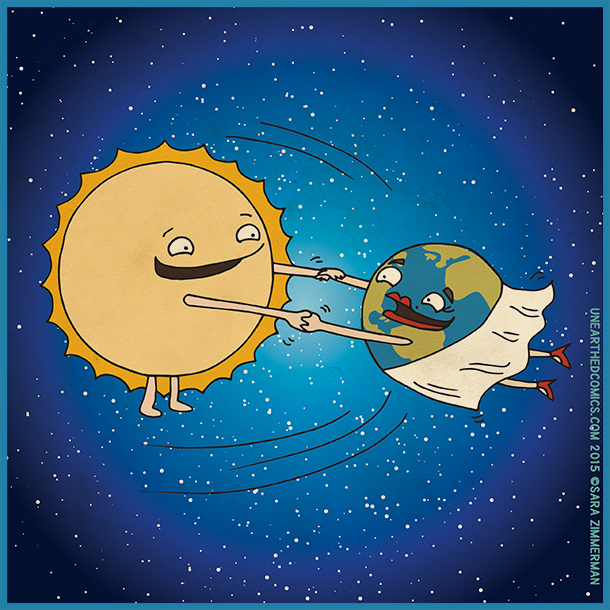
Via Sara Zimmerman at Unearthed Comics.

Planet Earth reaches a milestone today, as it swings out to aphelion, its most distant point from the sun. We reach this point on July 4, 2019, at 22:11 UTC. That’s 5:11 p.m. Central Daylight Time in the U.S. Translate UTC to your time.

Is it hot outside for you on your part of Earth right now? Or cold out? Earth’s aphelion comes in the midst of Northern Hemisphere summer and Southern Hemisphere winter. That should tell you that our distance from the sun doesn’t cause the seasons. More about that below.

Image top of post by Sara Zimmerman at Unearthed Comics. Thanks, Sara!

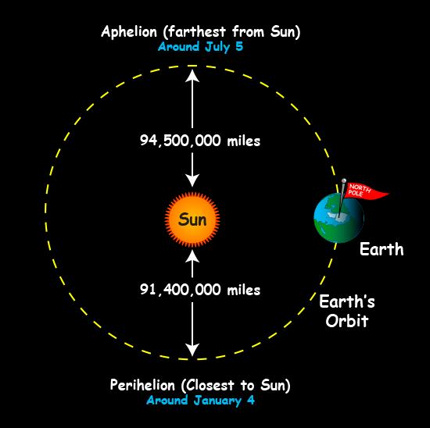
NASA diagram showing Earth's closest and farthest points for the year

Image credit: NASA

The fact is, Earth’s orbit is almost, but not quite, circular. So our distance from the sun doesn’t change much. Today, we’re about 3 million miles (5 million km) farther from the sun than we will be six months from now. That’s in contrast to our average distance from the sun of about 93 million miles (150 million km).

The word aphelion, by the way, comes from the Greek words apo meaning away, off, apart and helios, for the Greek god of the sun. Apart from the sun. That’s us, today.

Looking for Earth’s exact distance from the sun at aphelion? It’s 94,513,221 miles (152,104,285 km) . Last year, on July 6, 2018, the Earth at aphelion was a tiny bit closer, at 94,507,803 miles (152,095,566 km).

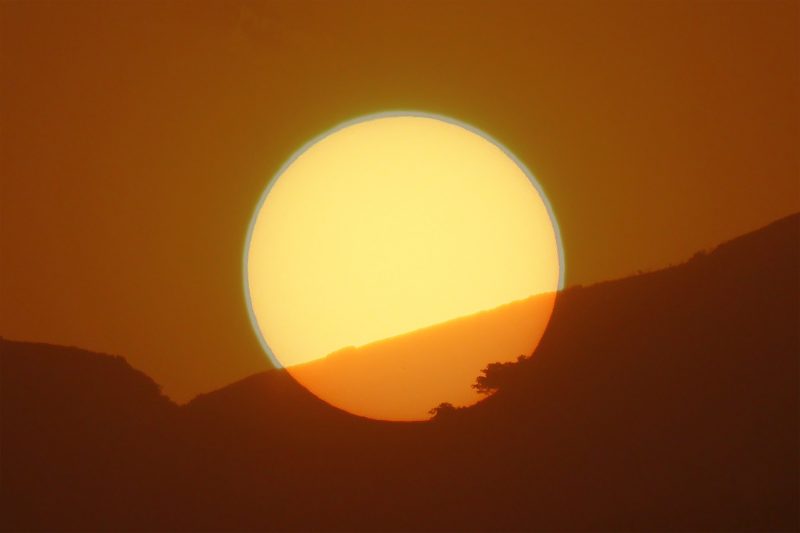
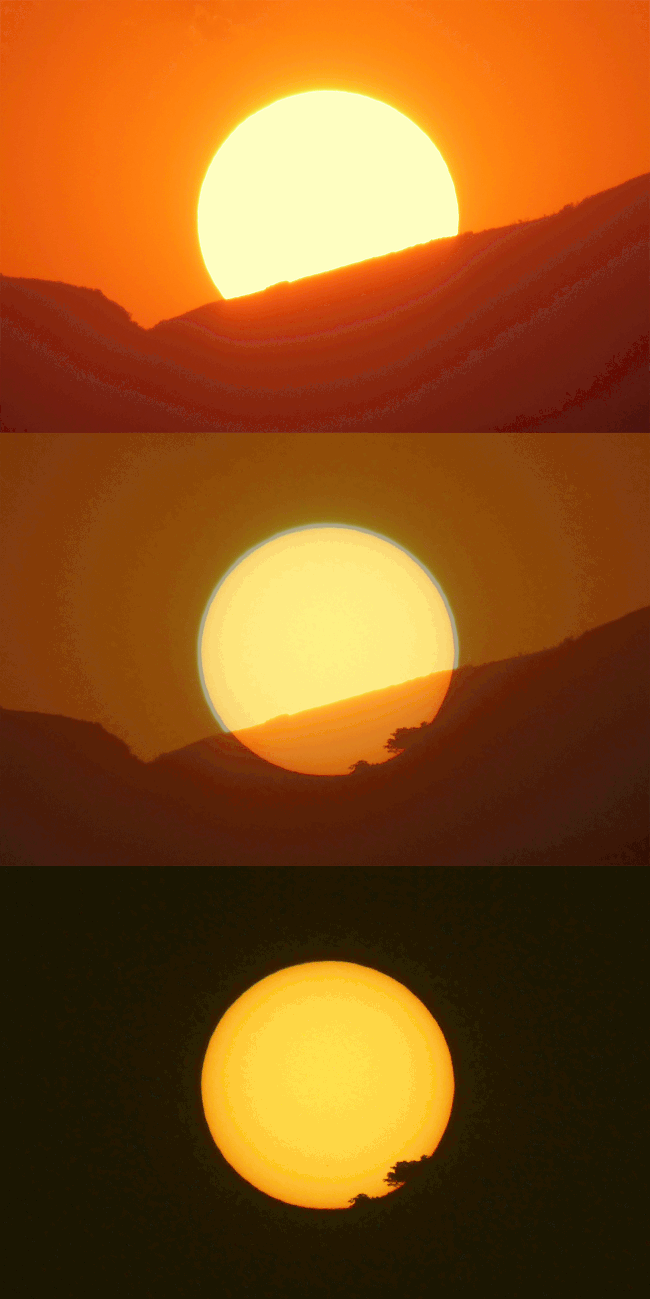
The sun at aphelion appears smaller in our sky, as shown in this composite image. This image consists of 2 photos, taken just days away from a perihelion (Earth’s closest point to sun) in January, 2016, and an aphelion (Earth’s farthest point from sun) in July, 2017. The gray rim around the sun (actually the perihelion photo) illustrates that, as seen in our sky, the sun is about 3.6% bigger at perihelion than aphelion. This difference is, of course, too small to detect with the eye. Peter Lowenstein in Mutare, Zimbabwe – who captured the photos and created the composite – wrote: “Although taken 18 months apart, and a few days from the events due to adverse weather conditions, they show that there is an unmistakable size difference of the sun as viewed from Earth when it is closest at perihelion and furthest away at aphelion.”

This animation shows what’s also in the image above … the size difference of the sun between Earth’s perihelion (closest point) and aphelion (farthest point).

Here’s what does cause the seasons. It’s not a distance thing. We’re always farthest from the sun in early July during northern summer and closest in January during northern winter.

It’s a tilt thing. Right now, it’s summer in the Northern Hemisphere because the northern part of Earth is tilted most toward the sun.

Meanwhile, it’s winter in the Southern Hemisphere because the southern part of Earth is tilted most away from the sun.

Earth’s varying distance from the sun does affect the length of the seasons. That’s because, at our farthest from the sun, like now, Earth is traveling most slowly in its orbit. That makes summer the longest season in the Northern Hemisphere and winter the longest season on the southern half of the globe.

Conversely, winter is the shortest season in the Northern Hemisphere, and summer is the shortest in the Southern Hemisphere, in each instance by nearly five days.

Earth at perihelion and aphelion 2001 to 2100

Bottom line: Planet Earth reaches its most distant point from the sun for 2019 on July 4. Astronomers call this yearly point in Earth’s orbit our aphelion.

EarthSky astronomy kits are perfect for beginners. Order yours today.

Why isn’t the hottest weather on the year’s longest day?


from EarthSky https://ift.tt/2KX7bJ4

Via Sara Zimmerman at Unearthed Comics.

Planet Earth reaches a milestone today, as it swings out to aphelion, its most distant point from the sun. We reach this point on July 4, 2019, at 22:11 UTC. That’s 5:11 p.m. Central Daylight Time in the U.S. Translate UTC to your time.

Is it hot outside for you on your part of Earth right now? Or cold out? Earth’s aphelion comes in the midst of Northern Hemisphere summer and Southern Hemisphere winter. That should tell you that our distance from the sun doesn’t cause the seasons. More about that below.

Image top of post by Sara Zimmerman at Unearthed Comics. Thanks, Sara!

NASA diagram showing Earth's closest and farthest points for the year

Image credit: NASA

The fact is, Earth’s orbit is almost, but not quite, circular. So our distance from the sun doesn’t change much. Today, we’re about 3 million miles (5 million km) farther from the sun than we will be six months from now. That’s in contrast to our average distance from the sun of about 93 million miles (150 million km).

The word aphelion, by the way, comes from the Greek words apo meaning away, off, apart and helios, for the Greek god of the sun. Apart from the sun. That’s us, today.

Looking for Earth’s exact distance from the sun at aphelion? It’s 94,513,221 miles (152,104,285 km) . Last year, on July 6, 2018, the Earth at aphelion was a tiny bit closer, at 94,507,803 miles (152,095,566 km).

The sun at aphelion appears smaller in our sky, as shown in this composite image. This image consists of 2 photos, taken just days away from a perihelion (Earth’s closest point to sun) in January, 2016, and an aphelion (Earth’s farthest point from sun) in July, 2017. The gray rim around the sun (actually the perihelion photo) illustrates that, as seen in our sky, the sun is about 3.6% bigger at perihelion than aphelion. This difference is, of course, too small to detect with the eye. Peter Lowenstein in Mutare, Zimbabwe – who captured the photos and created the composite – wrote: “Although taken 18 months apart, and a few days from the events due to adverse weather conditions, they show that there is an unmistakable size difference of the sun as viewed from Earth when it is closest at perihelion and furthest away at aphelion.”

This animation shows what’s also in the image above … the size difference of the sun between Earth’s perihelion (closest point) and aphelion (farthest point).

Here’s what does cause the seasons. It’s not a distance thing. We’re always farthest from the sun in early July during northern summer and closest in January during northern winter.

It’s a tilt thing. Right now, it’s summer in the Northern Hemisphere because the northern part of Earth is tilted most toward the sun.

Meanwhile, it’s winter in the Southern Hemisphere because the southern part of Earth is tilted most away from the sun.

Earth’s varying distance from the sun does affect the length of the seasons. That’s because, at our farthest from the sun, like now, Earth is traveling most slowly in its orbit. That makes summer the longest season in the Northern Hemisphere and winter the longest season on the southern half of the globe.

Conversely, winter is the shortest season in the Northern Hemisphere, and summer is the shortest in the Southern Hemisphere, in each instance by nearly five days.

Earth at perihelion and aphelion 2001 to 2100

Bottom line: Planet Earth reaches its most distant point from the sun for 2019 on July 4. Astronomers call this yearly point in Earth’s orbit our aphelion.

EarthSky astronomy kits are perfect for beginners. Order yours today.

Why isn’t the hottest weather on the year’s longest day?


from EarthSky https://ift.tt/2KX7bJ4

July 2 solar eclipse from La Serena, Chile

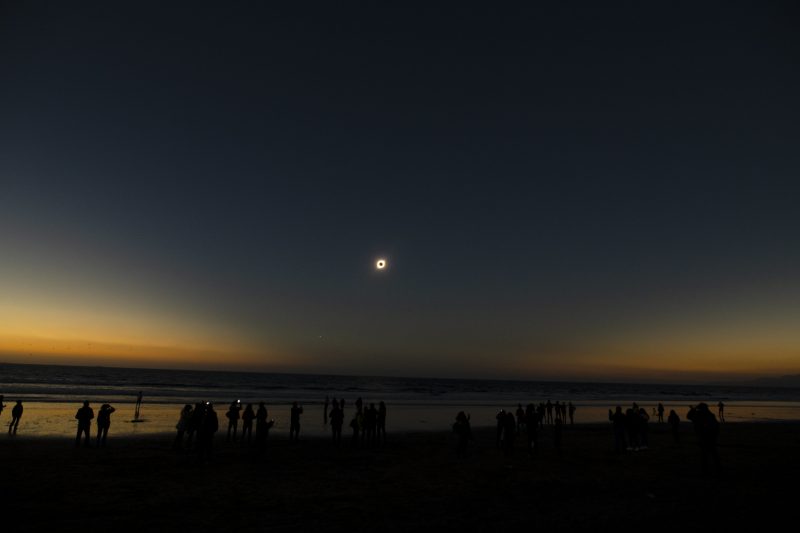
The sun is midway up in the sky, the black moon silhouette is in front of it, and people stand on a beach un der a darkened sky.

View larger. | The scene on the beach during totality – darkness during the daytime on July 2, 2019 – in La Serena, Chile. Photo by Eliot Herman.

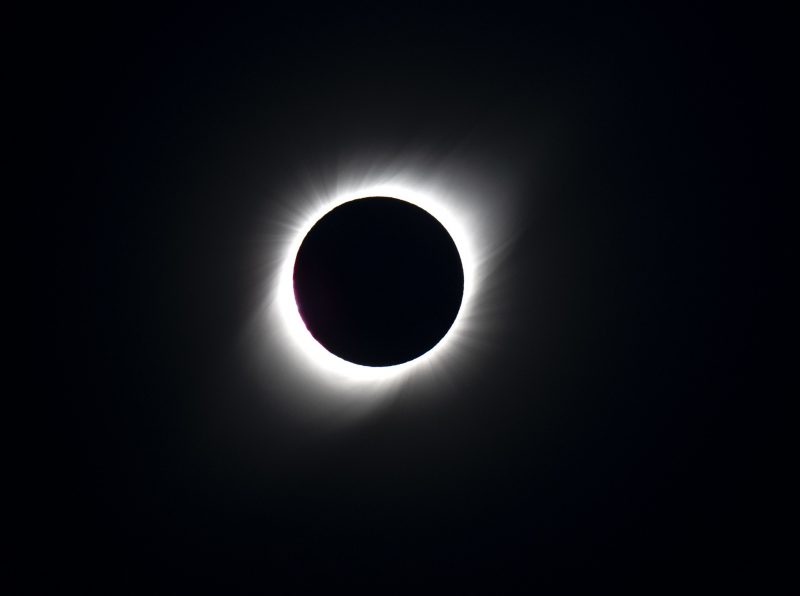
Dark moon silhouette with the fiery corona surrounding it.

View larger. | The beautiful totality of the July 2, 2019 total solar eclipse, as captured from La Serena, Chile, by Eliot Herman. Thank you, Eliot!

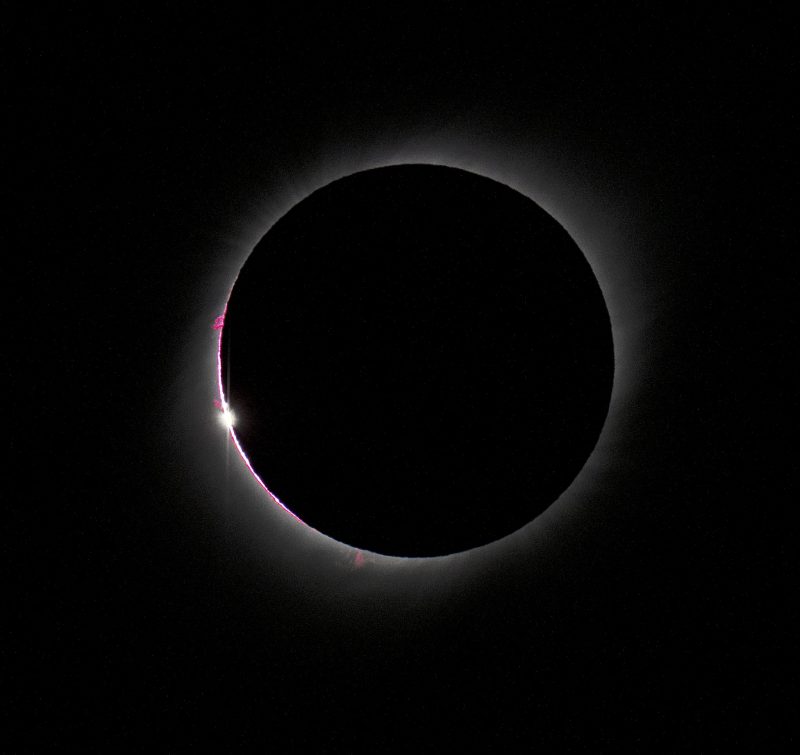
Dark moon silhouette, with beads of light along one rim.

View larger. | During totality, a row of brilliant points of sunlight shines through valleys on the edge of the moon. These beads of light – called Baily’s Beads – are seen for a few seconds just before and after the central phase. Photo from La Serena, Chile – July 2, 2019 – via Eliot Herman.


from EarthSky https://ift.tt/2NuIy8L
The sun is midway up in the sky, the black moon silhouette is in front of it, and people stand on a beach un der a darkened sky.

View larger. | The scene on the beach during totality – darkness during the daytime on July 2, 2019 – in La Serena, Chile. Photo by Eliot Herman.

Dark moon silhouette with the fiery corona surrounding it.

View larger. | The beautiful totality of the July 2, 2019 total solar eclipse, as captured from La Serena, Chile, by Eliot Herman. Thank you, Eliot!

Dark moon silhouette, with beads of light along one rim.

View larger. | During totality, a row of brilliant points of sunlight shines through valleys on the edge of the moon. These beads of light – called Baily’s Beads – are seen for a few seconds just before and after the central phase. Photo from La Serena, Chile – July 2, 2019 – via Eliot Herman.


from EarthSky https://ift.tt/2NuIy8L

Uranus’ rings surprisingly bright in ‘heat’ images

Ball with bands, bright spot, and thick atmosphere encompassed by narrow greenish rings.

Here’s a composite thermal image, showing both Uranus’ atmosphere and rings. These observations marked the first measurement of the “heat” of the rings, which are actually extremely cold. Image via UC Berkeley/Edward Molter/Imke de Pater.

Saturn is, of course, famous for its majestic rings, but Jupiter, Uranus and Neptune all have ring systems as well. Those ring systems are all much less massive and fainter than Saturn’s, and you need a very powerful telescope or a spacecraft to see them well. But now astronomers have taken some new earth-based thermal images of Uranus’ rings, where they look surprisingly bright. For the first time, researchers were also able to measure the temperature of the rings: a very chilly 320 degrees below zero Fahrenheit (-195 Celsius).

The peer-reviewed results were published this week in The Astronomical Journal by Imke de Pater at UC Berkeley and Michael Roman and Leigh Fletcher from the University of Leicester in the United Kingdom.

4 views, yellow circles in center of each with thin orange rings around it.

Uranus’ ring system as seen in 2019 by the ALMA and VLT telescopes. The planet itself is masked off as it is much brighter than the rings. Uranus’ rings are normally so faint that they can’t be seen through telescopes. They were only discovered in 1977, when astronomers saw them passing in front of a star, blocking its light. Image via Edward Molter/Imke de Pater/Michael Roman/Leigh Fletcher, 2019.

Two different telescopes – the Atacama Large Millimeter/submillimeter Array (ALMA) and the Very Large Telescope (VLT), both in northern Chile – captured the new images. They found that Uranus’ brightest and densest ring – the epsilon ring – is unlike any other known ring in the solar system. The data show how it differs from Saturn’s rings in composition, with only larger particles, according to de Pater:

Saturn’s mainly icy rings are broad, bright and have a range of particle sizes, from micron-sized dust in the innermost D ring, to tens of meters in size in the main rings. The small end is missing in the main rings of Uranus; the brightest ring, epsilon, is composed of golf ball-sized and larger rocks.

Single planetary ring, against a black background.

Voyager 2 acquired this high-resolution image of the epsilon ring of Uranus on January 23, 1986, from a distance of 1.12 million kilometers (690,000 miles). Image via NASA JPL. Read more about the epsilon ring.

Uranus’ rings are also markedly different from Jupiter’s or Neptune’s rings. The particles in Jupiter’s rings are very small, micron-sized dust, only a thousandth of a millimeter in size, while Neptune’s rings are mostly dust-sized particles. But Uranus does also have broad sheets of dust, in between the main rings composed of the larger particles. As noted by graduate student Edward Molter:

We already know that the epsilon ring is a bit weird, because we don’t see the smaller stuff. Something has been sweeping the smaller stuff out, or it’s all glomming together. We just don’t know. This is a step toward understanding their composition and whether all of the rings came from the same source material, or are different for each ring.

Ring system below planet, 4 bright, wide rings with Greek letter labels.

This near-infrared image of Uranus’ rings was taken by the Keck telescope in Hawaii in July 2004. Unlike the other images on this page – which are heat images, showing heat radiating – this one shows sunlight reflected off the rings. Image via UC Berkeley/Imke de Pater/Seran Gibbard/Heidi Hammel, 2006.

How else are Uranus’ rings unique? They are very dark and narrow, as Molter explained:

The rings of Uranus are compositionally different from Saturn’s main ring, in the sense that in optical and infrared, the albedo is much lower: they are really dark, like charcoal. They are also extremely narrow compared to the rings of Saturn. The widest, the epsilon ring, varies from 20 to 100 kilometers wide [12 to 125 miles], whereas Saturn’s are hundreds or tens of thousands of kilometers wide.

He added that he was surprised when his equipment showed Uranus’ rings. The rings, after all, weren’t known until 1977, and then astronomers didn’t actually see them from Earth; they only deduced their presence when the rings passed in front of a star, blocking its light. Molter commented:

It’s cool that we can even do this with the instruments we have [now]. I was just trying to image the planet as best I could and I saw the rings. It was amazing.

All in all, the new observation results from ALMA and VLT were surprising to the scientists; they were not expecting the rings to look as bright as they did. They were actually using the telescopes to measure the temperature of Uranus’ atmosphere instead, and the bright rings were a bonus. As Fletcher noted:

We were astonished to see the rings jump out clearly when we reduced the data for the first time.

Partial view of wide, faint rings with short star trails seen through them.

The closest look we have so far of Uranus’ rings, as seen by Voyager 2 on January 24, 1986. Image via NASA.

Bright, thin rings partial view with stars in background.

Another view of the rings from Voyager 2. Image via NASA/Wikipedia.

Uranus has 13 known rings, along with the bands of smaller dust-sized particles between them. Just why the rings themselves only have larger particles isn’t known yet, but it’s interesting to see the variation of rings among different planets. NASA’s Voyager 2 spacecraft first photographed Uranus’ rings up close in 1986 and also found that the main rings had little to no smaller particles in them. Unfortunately, it wasn’t equipped to measure their temperature, however.

Until another mission is eventually sent to Uranus, scientists will have to mostly rely on observations from Earth to further study the ice giant and its rings and moons. But before that, the upcoming James Webb Space Telescope (JWST) will be able to take a more detailed look at the rings, including spectroscopic analysis. They may not be as spectacular as Saturn’s, but they do glow brighter than ever before in these latest images.

Bottom line: New thermal images of Uranus’ rings from the ALMA and VLT telescopes show them glowing more brightly than ever seen before.

Source: Thermal Emission from the Uranian Ring System

Via Berkeley News


from EarthSky https://ift.tt/2FQiJdf
Ball with bands, bright spot, and thick atmosphere encompassed by narrow greenish rings.

Here’s a composite thermal image, showing both Uranus’ atmosphere and rings. These observations marked the first measurement of the “heat” of the rings, which are actually extremely cold. Image via UC Berkeley/Edward Molter/Imke de Pater.

Saturn is, of course, famous for its majestic rings, but Jupiter, Uranus and Neptune all have ring systems as well. Those ring systems are all much less massive and fainter than Saturn’s, and you need a very powerful telescope or a spacecraft to see them well. But now astronomers have taken some new earth-based thermal images of Uranus’ rings, where they look surprisingly bright. For the first time, researchers were also able to measure the temperature of the rings: a very chilly 320 degrees below zero Fahrenheit (-195 Celsius).

The peer-reviewed results were published this week in The Astronomical Journal by Imke de Pater at UC Berkeley and Michael Roman and Leigh Fletcher from the University of Leicester in the United Kingdom.

4 views, yellow circles in center of each with thin orange rings around it.

Uranus’ ring system as seen in 2019 by the ALMA and VLT telescopes. The planet itself is masked off as it is much brighter than the rings. Uranus’ rings are normally so faint that they can’t be seen through telescopes. They were only discovered in 1977, when astronomers saw them passing in front of a star, blocking its light. Image via Edward Molter/Imke de Pater/Michael Roman/Leigh Fletcher, 2019.

Two different telescopes – the Atacama Large Millimeter/submillimeter Array (ALMA) and the Very Large Telescope (VLT), both in northern Chile – captured the new images. They found that Uranus’ brightest and densest ring – the epsilon ring – is unlike any other known ring in the solar system. The data show how it differs from Saturn’s rings in composition, with only larger particles, according to de Pater:

Saturn’s mainly icy rings are broad, bright and have a range of particle sizes, from micron-sized dust in the innermost D ring, to tens of meters in size in the main rings. The small end is missing in the main rings of Uranus; the brightest ring, epsilon, is composed of golf ball-sized and larger rocks.

Single planetary ring, against a black background.

Voyager 2 acquired this high-resolution image of the epsilon ring of Uranus on January 23, 1986, from a distance of 1.12 million kilometers (690,000 miles). Image via NASA JPL. Read more about the epsilon ring.

Uranus’ rings are also markedly different from Jupiter’s or Neptune’s rings. The particles in Jupiter’s rings are very small, micron-sized dust, only a thousandth of a millimeter in size, while Neptune’s rings are mostly dust-sized particles. But Uranus does also have broad sheets of dust, in between the main rings composed of the larger particles. As noted by graduate student Edward Molter:

We already know that the epsilon ring is a bit weird, because we don’t see the smaller stuff. Something has been sweeping the smaller stuff out, or it’s all glomming together. We just don’t know. This is a step toward understanding their composition and whether all of the rings came from the same source material, or are different for each ring.

Ring system below planet, 4 bright, wide rings with Greek letter labels.

This near-infrared image of Uranus’ rings was taken by the Keck telescope in Hawaii in July 2004. Unlike the other images on this page – which are heat images, showing heat radiating – this one shows sunlight reflected off the rings. Image via UC Berkeley/Imke de Pater/Seran Gibbard/Heidi Hammel, 2006.

How else are Uranus’ rings unique? They are very dark and narrow, as Molter explained:

The rings of Uranus are compositionally different from Saturn’s main ring, in the sense that in optical and infrared, the albedo is much lower: they are really dark, like charcoal. They are also extremely narrow compared to the rings of Saturn. The widest, the epsilon ring, varies from 20 to 100 kilometers wide [12 to 125 miles], whereas Saturn’s are hundreds or tens of thousands of kilometers wide.

He added that he was surprised when his equipment showed Uranus’ rings. The rings, after all, weren’t known until 1977, and then astronomers didn’t actually see them from Earth; they only deduced their presence when the rings passed in front of a star, blocking its light. Molter commented:

It’s cool that we can even do this with the instruments we have [now]. I was just trying to image the planet as best I could and I saw the rings. It was amazing.

All in all, the new observation results from ALMA and VLT were surprising to the scientists; they were not expecting the rings to look as bright as they did. They were actually using the telescopes to measure the temperature of Uranus’ atmosphere instead, and the bright rings were a bonus. As Fletcher noted:

We were astonished to see the rings jump out clearly when we reduced the data for the first time.

Partial view of wide, faint rings with short star trails seen through them.

The closest look we have so far of Uranus’ rings, as seen by Voyager 2 on January 24, 1986. Image via NASA.

Bright, thin rings partial view with stars in background.

Another view of the rings from Voyager 2. Image via NASA/Wikipedia.

Uranus has 13 known rings, along with the bands of smaller dust-sized particles between them. Just why the rings themselves only have larger particles isn’t known yet, but it’s interesting to see the variation of rings among different planets. NASA’s Voyager 2 spacecraft first photographed Uranus’ rings up close in 1986 and also found that the main rings had little to no smaller particles in them. Unfortunately, it wasn’t equipped to measure their temperature, however.

Until another mission is eventually sent to Uranus, scientists will have to mostly rely on observations from Earth to further study the ice giant and its rings and moons. But before that, the upcoming James Webb Space Telescope (JWST) will be able to take a more detailed look at the rings, including spectroscopic analysis. They may not be as spectacular as Saturn’s, but they do glow brighter than ever before in these latest images.

Bottom line: New thermal images of Uranus’ rings from the ALMA and VLT telescopes show them glowing more brightly than ever seen before.

Source: Thermal Emission from the Uranian Ring System

Via Berkeley News


from EarthSky https://ift.tt/2FQiJdf

Astronomers ponder halos around galaxies

Fuzzy ring of pink with white nodes in it around 2 yellow galaxies, with other galaxies in background.

A galactic halo, or corona, stands out as an ethereal glowing ring in this image from the Hubble Space Telescope. The image shows a magnified galaxy, due to the gravitational lensing effect, behind a massive galaxy cluster. Image via ESO/NASA/ESA/A.Claeyssens/EWASS.

When we think of galaxies, we think of huge disks of billions of stars, dust and gas. Many are reminiscent of giant pinwheels. With the right instruments, though, astronomers can see more: halos of light, composed of neutral hydrogen, around galaxies. On June 24, 2019, the Centre de Recherche Astrophysique de Lyon announced that its researchers have made new observations of distant galactic halos – sometimes called galactic coronae – using the MUSE instrument on ESO’s Very Large Telescope in Chile. The astronomers said MUSE sees halos around almost all distant galaxies it observes, but even then they are generally too small to show much detail or structure. To help with this, the new study combined the MUSE observations with what’s called gravitational lensing to study the halos in more detail.

The images and other data were presented at the annual meeting of the European Astronomical Society (EWASS 2019) in Lyon, France, on June 25. Over 1,200 astronomers gathered for the meeting.

Scattered oblong pink blobs, lighter toward the center, with smaller scattered yellow dots.

Another partial galaxy halo in a Hubble Space Telescope image. As in the image above, the image shows a magnified galaxy, due to the gravitational lensing effect, behind a massive galaxy cluster. Image via ESO/NASA/ESA/A.Claeyssens/EWASS.

Astronomer Adélaïde Claeyssens, a Ph.D. student at the Centre de Recherche Astrophysique de Lyon, presented these results at EWASS 2019. She explained:

Indeed, massive clusters have the property to bend light rays passing through their center, as predicted by Einstein. This produces the effect of a magnifying glass: the images of background galaxies are magnified.

There are two primary observations that the MUSE instrument has been able to conduct of halos so far.

The first is where the halo appears as an almost complete ring of light encircling a galaxy. MUSE can focus in on the ring enough to study how gases vary across parts of the halo. Until now, that has been difficult to accomplish, and the data tells astronomers how homogenous the gases in the halos are and in what manner they move around the galaxy.

Secondly, the unique way in which MUSE data is combined with the gravitational lensing effects provides more clues as to how galaxies formed in the early universe.

Red and purple, multicolored, and green blobs with line graph above each.

Here’s an example of a map of how a galactic halo’s hydrogen gas might structure itself around a galaxy. The new MUSE observations let astronomers see significant variations of the gas properties across a halo. They said the results enable them “to study in detail [a halo’s] complex structure and the physical process at play.” Image via ESO/Claeyssens/EWASS.

Galactic halos have also been observed with the Hubble Space Telescope, producing some of the images on this page. In 2015, it was reported that galactic halos are more common than had previously been thought.

These halos can also be observed in the radio spectrum, such as with the Karl G. Jansky Very Large Array (VLA) near Socorro, New Mexico. VLA observed the halos of 35 galaxies in 2015. Astronomers say that studying galactic halos with radio telescopes lets them probe a whole range of associated phenomena, including the rate of star formation within the disk, the winds from exploding stars, and the nature and origin of the galaxies’ magnetic fields.

Irregular target shape with rings of yellow, red and blue around white center.

This is a traditional radio image of a galactic halo, in this case, of the mini-halo in the Perseus galaxy cluster. Image via Caltech. Read more about this image.

Meanwhile, the astronomers in Lyon said the MUSE instrument on the Very Large Telescope produces more detail than ever before. MUSE is a highly specialized instrument, according to Fernando Selman, Instrument Scientist:

MUSE has been built with the intention of studying the content and processes going on in the very early universe, when the first stars and galaxies were forming. Closer in time and space, MUSE will map the dark matter distribution in clusters of galaxies using the gravitational microlensing effect on background galaxies. MUSE will also provide detailed information about the internal dynamics of many classes of galaxies with unprecedented detail. It has already been used to study the Sombrero Galaxy in Virgo, and, in the same cluster, a recently discovered new type of object — a galaxy being destroyed after falling into the cluster and encountering the cluster’s hot gaseous corona.

The findings from MUSE and other observations show how, as is often the case in astronomy, there can be more than initially meets the eye. Galaxies are beautiful enough on their own, but seeing their glowing halos makes them even more so.

Tangle of very many wires, tubes and thick cables.

The complex MUSE instrument on ESO’s Very Large Telescope (VLT). Image via ESO.

Bottom line: Thanks to advanced instrumentation like MUSE, astronomers can now get better views not only of distant galaxies, but also the lesser-known halos of light that surround them.

Via EWASS


from EarthSky https://ift.tt/2FSv8NQ
Fuzzy ring of pink with white nodes in it around 2 yellow galaxies, with other galaxies in background.

A galactic halo, or corona, stands out as an ethereal glowing ring in this image from the Hubble Space Telescope. The image shows a magnified galaxy, due to the gravitational lensing effect, behind a massive galaxy cluster. Image via ESO/NASA/ESA/A.Claeyssens/EWASS.

When we think of galaxies, we think of huge disks of billions of stars, dust and gas. Many are reminiscent of giant pinwheels. With the right instruments, though, astronomers can see more: halos of light, composed of neutral hydrogen, around galaxies. On June 24, 2019, the Centre de Recherche Astrophysique de Lyon announced that its researchers have made new observations of distant galactic halos – sometimes called galactic coronae – using the MUSE instrument on ESO’s Very Large Telescope in Chile. The astronomers said MUSE sees halos around almost all distant galaxies it observes, but even then they are generally too small to show much detail or structure. To help with this, the new study combined the MUSE observations with what’s called gravitational lensing to study the halos in more detail.

The images and other data were presented at the annual meeting of the European Astronomical Society (EWASS 2019) in Lyon, France, on June 25. Over 1,200 astronomers gathered for the meeting.

Scattered oblong pink blobs, lighter toward the center, with smaller scattered yellow dots.

Another partial galaxy halo in a Hubble Space Telescope image. As in the image above, the image shows a magnified galaxy, due to the gravitational lensing effect, behind a massive galaxy cluster. Image via ESO/NASA/ESA/A.Claeyssens/EWASS.

Astronomer Adélaïde Claeyssens, a Ph.D. student at the Centre de Recherche Astrophysique de Lyon, presented these results at EWASS 2019. She explained:

Indeed, massive clusters have the property to bend light rays passing through their center, as predicted by Einstein. This produces the effect of a magnifying glass: the images of background galaxies are magnified.

There are two primary observations that the MUSE instrument has been able to conduct of halos so far.

The first is where the halo appears as an almost complete ring of light encircling a galaxy. MUSE can focus in on the ring enough to study how gases vary across parts of the halo. Until now, that has been difficult to accomplish, and the data tells astronomers how homogenous the gases in the halos are and in what manner they move around the galaxy.

Secondly, the unique way in which MUSE data is combined with the gravitational lensing effects provides more clues as to how galaxies formed in the early universe.

Red and purple, multicolored, and green blobs with line graph above each.

Here’s an example of a map of how a galactic halo’s hydrogen gas might structure itself around a galaxy. The new MUSE observations let astronomers see significant variations of the gas properties across a halo. They said the results enable them “to study in detail [a halo’s] complex structure and the physical process at play.” Image via ESO/Claeyssens/EWASS.

Galactic halos have also been observed with the Hubble Space Telescope, producing some of the images on this page. In 2015, it was reported that galactic halos are more common than had previously been thought.

These halos can also be observed in the radio spectrum, such as with the Karl G. Jansky Very Large Array (VLA) near Socorro, New Mexico. VLA observed the halos of 35 galaxies in 2015. Astronomers say that studying galactic halos with radio telescopes lets them probe a whole range of associated phenomena, including the rate of star formation within the disk, the winds from exploding stars, and the nature and origin of the galaxies’ magnetic fields.

Irregular target shape with rings of yellow, red and blue around white center.

This is a traditional radio image of a galactic halo, in this case, of the mini-halo in the Perseus galaxy cluster. Image via Caltech. Read more about this image.

Meanwhile, the astronomers in Lyon said the MUSE instrument on the Very Large Telescope produces more detail than ever before. MUSE is a highly specialized instrument, according to Fernando Selman, Instrument Scientist:

MUSE has been built with the intention of studying the content and processes going on in the very early universe, when the first stars and galaxies were forming. Closer in time and space, MUSE will map the dark matter distribution in clusters of galaxies using the gravitational microlensing effect on background galaxies. MUSE will also provide detailed information about the internal dynamics of many classes of galaxies with unprecedented detail. It has already been used to study the Sombrero Galaxy in Virgo, and, in the same cluster, a recently discovered new type of object — a galaxy being destroyed after falling into the cluster and encountering the cluster’s hot gaseous corona.

The findings from MUSE and other observations show how, as is often the case in astronomy, there can be more than initially meets the eye. Galaxies are beautiful enough on their own, but seeing their glowing halos makes them even more so.

Tangle of very many wires, tubes and thick cables.

The complex MUSE instrument on ESO’s Very Large Telescope (VLT). Image via ESO.

Bottom line: Thanks to advanced instrumentation like MUSE, astronomers can now get better views not only of distant galaxies, but also the lesser-known halos of light that surround them.

Via EWASS


from EarthSky https://ift.tt/2FSv8NQ

How to see Pluto in your sky

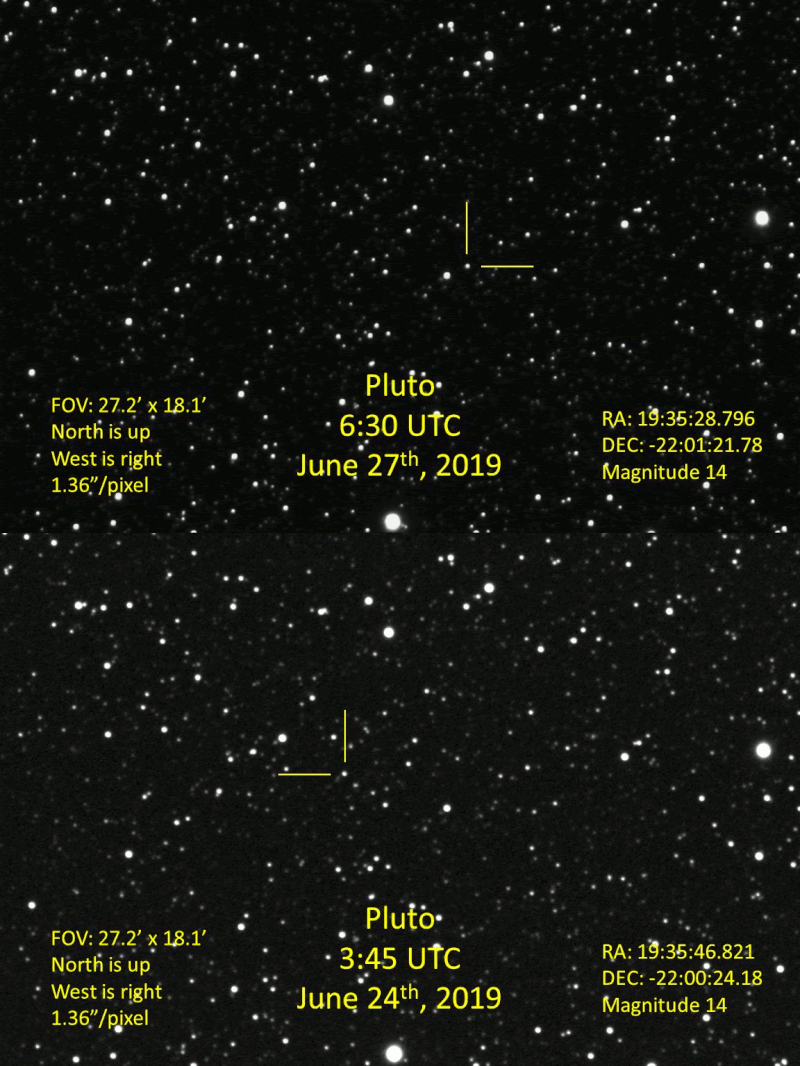
In a star field, one tiny dot moves from one position to another.

Steven Bellavia in Mattituck, New York, captured Pluto on 2 separate nights, June 24 and June 27. In this animated gif, you can see that Pluto moved in front of the stars between those 2 nights. Steven wrote: “Most of the motion you see is actually from the Earth, not Pluto, since our motion changes our perspective of the much-closer Pluto against the backdrop of the much-farther stars.” Thanks, Steven!

Small icy Pluto – discovered in 1930 – requires a telescope to be seen. It’s some 1,000 times too faint to see with the eye alone. How can you spot it? The only way is to locate Pluto’s starfield through a telescope, and watch over several nights for the object that moves. That’ll be Pluto! It’s seen to move because it’s so much closer to us than the distant stars.

In fact, Pluto is the most distant object in our solar system that can be viewed through amateur telescopes.

And the best time of year to see Pluto through a small telescope is here! The planet will reach its opposition on July 14, 2019. At opposition, Pluto appears more or less opposite the sun in our sky, rising in the east as the sun sets in the west. At this time, our planet Earth is passing approximately between Pluto and the sun; we aren’t going directly between Pluto and the sun this year as we did in 2018. Also, don’t let that opposition date – July 14 – fool you. Pluto is visible somewhere in the sky, for some hours of the night, for most of every year. July 14 just marks the middle of the best time of year to see it.

Here are few tips for spotting Pluto in 2019:

– You’ll need at least an 8-inch telescope. A 12-inch telescope – like the one used by Efrain Morales to capture the image at the bottom of this post – will capture even more light from this distant world.

– You’ll want dark, clear, country skies. Visit EarthSky’s Best Places to Stargaze page for dark locations near you.

– Pluto is traveling in front of the constellation Sagittarius this year, as seen from Earth.

Scattered bright dots of stars with one smaller one marked, the planet Pluto.

Pluto as seen with a 12″ S/C telescope (14.3 mag.) on July 10, 2015. Photo by Efrain Morales, of Sociedad de Astronomia del Caribe. More information about Pluto’s current location.

Bottom line: The only way to spot it is to locate Pluto’s starfield through a telescope, and watch over several nights for the object that moves. That’ll be Pluto. Over the weeks following its opposition, Pluto will rise four minutes earlier each night. That means it’ll be in the east at sundown, setting before dawn, by August. Finding it requires patience and a telescope! But it’s very satisfying to see Pluto with your own eyes.


from EarthSky https://ift.tt/2XkisVG
In a star field, one tiny dot moves from one position to another.

Steven Bellavia in Mattituck, New York, captured Pluto on 2 separate nights, June 24 and June 27. In this animated gif, you can see that Pluto moved in front of the stars between those 2 nights. Steven wrote: “Most of the motion you see is actually from the Earth, not Pluto, since our motion changes our perspective of the much-closer Pluto against the backdrop of the much-farther stars.” Thanks, Steven!

Small icy Pluto – discovered in 1930 – requires a telescope to be seen. It’s some 1,000 times too faint to see with the eye alone. How can you spot it? The only way is to locate Pluto’s starfield through a telescope, and watch over several nights for the object that moves. That’ll be Pluto! It’s seen to move because it’s so much closer to us than the distant stars.

In fact, Pluto is the most distant object in our solar system that can be viewed through amateur telescopes.

And the best time of year to see Pluto through a small telescope is here! The planet will reach its opposition on July 14, 2019. At opposition, Pluto appears more or less opposite the sun in our sky, rising in the east as the sun sets in the west. At this time, our planet Earth is passing approximately between Pluto and the sun; we aren’t going directly between Pluto and the sun this year as we did in 2018. Also, don’t let that opposition date – July 14 – fool you. Pluto is visible somewhere in the sky, for some hours of the night, for most of every year. July 14 just marks the middle of the best time of year to see it.

Here are few tips for spotting Pluto in 2019:

– You’ll need at least an 8-inch telescope. A 12-inch telescope – like the one used by Efrain Morales to capture the image at the bottom of this post – will capture even more light from this distant world.

– You’ll want dark, clear, country skies. Visit EarthSky’s Best Places to Stargaze page for dark locations near you.

– Pluto is traveling in front of the constellation Sagittarius this year, as seen from Earth.

Scattered bright dots of stars with one smaller one marked, the planet Pluto.

Pluto as seen with a 12″ S/C telescope (14.3 mag.) on July 10, 2015. Photo by Efrain Morales, of Sociedad de Astronomia del Caribe. More information about Pluto’s current location.

Bottom line: The only way to spot it is to locate Pluto’s starfield through a telescope, and watch over several nights for the object that moves. That’ll be Pluto. Over the weeks following its opposition, Pluto will rise four minutes earlier each night. That means it’ll be in the east at sundown, setting before dawn, by August. Finding it requires patience and a telescope! But it’s very satisfying to see Pluto with your own eyes.


from EarthSky https://ift.tt/2XkisVG

Zombie ants

Cordyceps growing out of an ant’s head. Via BBC/GIPHY

By Gino Brignoli, UCL

In the understory of a tropical forest, a carpenter ant has descended from the canopy away from her regular foraging trails and staggers drunkenly along a branch. Her movements are jerky and conspicuous. She twitchily moves forwards and suddenly starts convulsing with such ferocity that she falls from the branch onto the ground before resuming her erratic, zigzagging path. This is a “zombie ant”, and she’s unwittingly become part of the lifecycle of a parasitic fungus commonly known as Cordyceps.

Around noon, after several hours of climbing and aimless lurching, the ant is now no more than about 10 inches (25 cm) above the ground, crawling aimlessly on the underside of a sapling leaf where, without warning, she forcefully sinks her powerful jaws into one of the leaf’s veins, gripping it firmly between her tightly locked mandibles.

Within six hours, she is dead. After two days, white hairs bristle from between her joints and a few days later these have become a thick, brown mat covering the whole insect. A pinkish-white stalk starts to erupt from the base of the ant’s head and continues to grow. Within two weeks it has reached twice the length of the ant’s body reaching down towards the ground below.

Finally, the stalk will release its spores into the air, ready to float off and infect more unsuspecting ants.

Image via shunfa/shutterstock.

This bizarre behavior was first recorded by Alfred Russell Wallace in Indonesia in 1859, but was not researched in much detail until quite recently. It has since been discovered that the fungus disrupts the normal behavior of the ant through chemical interference in the brain, causing the infected ant to behave in ways that will improve the opportunities for the fungus to spread its spores and so reproduce.

The fungus grows throughout the body cavity of the ant, using internal organs as food while the ant’s strong exoskeleton serves as a kind of capsule, protecting the fungus from drying out, being eaten, or further infection.

Fending off the fungi

The earliest known record of a fungus visibly parasitizing an insect dates from about 105m years ago. It is a male scale insect, preserved in amber, with two fungal stalks projecting from its head. But this fossil cannot tell us if the infected insect’s regular behavior was changed or disrupted in any way.

Cordyceps infected ant from Sabah, Borneo, Malaysia. Image via Gino Brignoli.

Definitive evidence of “zombie-ant” behavior, dating to around 48m years ago, comes from fossilized leaves that show the distinct markings on either side of leaf veins left by the lock-jawed mandibles of infected ants. Not only is this association between ant and fungus evidently ancient, it is also very common – about 1,000 species of fungal parasites of insects have been discovered so far.

In this age-old struggle for survival the ants have developed adaptations to protect themselves and their nests from fungal infections. By grooming themselves and socially cleaning each other (allogrooming) they remove potentially harmful spores before they can penetrate the skin and take hold. Some ants spray poison in their nests to act as fungicides and if that fails to stop an infestation, they partition their nests by sealing off contaminated chambers.

In some cases infected individuals are carried out of the nest by healthy workers, and as a last resort the entire colony relocates, abandoning their infected nest.

The fungal pathogens have evolved to become either strictly species-specific or more generalist in their choice of insect host, with some able to infect hundreds of different species. This astonishing variety of fungal pathogens and potential hosts has created some peculiar behavior in insects as they have co-evolved to cope with the tactics of the fungi.

It is sometimes difficult to know what behavior is entirely involuntary and driven by the fungus to improve its own reproductive success, and what has evolved as a form of defense against the infection. For example, when the ant host climbs to an elevated position in what is known as “summit disease”, this behavior increases the area over which spores can spread through wind dispersal – but it also removes the ant from close proximity to its relatives in the colony, preventing the spread of infection to its sisters.

It is unclear if this behavior is a zombie state caused by the fungus or if it is an altruistic act of self-sacrifice by the ant. If it is a deliberate act by the ant, it might be saving the rest of the colony from succumbing to the infection in what is sometimes called “adaptive suicide”.

Zombie-like behavior in insects is also caused by many other types of parasites including bacteria and even other invertebrates. This raises fascinating questions about the nature of any organism’s true independence in what are undoubtedly highly complex interrelated living systems. Zombie-ants provide us with a glimpse into this intricately tangled web of molecular influences and behavioral adaptations. It leads us to wonder who, ultimately, controls whom?

Gino Brignoli, PhD Researcher in Tropical Ecology at the Institute of Zoology and, UCL

This article is republished from The Conversation under a Creative Commons license. Read the original article.

Bottom line: A parasitic fungi takes control of living insects, turning them into ‘zombie ants’.

The Conversation


from EarthSky https://ift.tt/2XoWSo5

Cordyceps growing out of an ant’s head. Via BBC/GIPHY

By Gino Brignoli, UCL

In the understory of a tropical forest, a carpenter ant has descended from the canopy away from her regular foraging trails and staggers drunkenly along a branch. Her movements are jerky and conspicuous. She twitchily moves forwards and suddenly starts convulsing with such ferocity that she falls from the branch onto the ground before resuming her erratic, zigzagging path. This is a “zombie ant”, and she’s unwittingly become part of the lifecycle of a parasitic fungus commonly known as Cordyceps.

Around noon, after several hours of climbing and aimless lurching, the ant is now no more than about 10 inches (25 cm) above the ground, crawling aimlessly on the underside of a sapling leaf where, without warning, she forcefully sinks her powerful jaws into one of the leaf’s veins, gripping it firmly between her tightly locked mandibles.

Within six hours, she is dead. After two days, white hairs bristle from between her joints and a few days later these have become a thick, brown mat covering the whole insect. A pinkish-white stalk starts to erupt from the base of the ant’s head and continues to grow. Within two weeks it has reached twice the length of the ant’s body reaching down towards the ground below.

Finally, the stalk will release its spores into the air, ready to float off and infect more unsuspecting ants.

Image via shunfa/shutterstock.

This bizarre behavior was first recorded by Alfred Russell Wallace in Indonesia in 1859, but was not researched in much detail until quite recently. It has since been discovered that the fungus disrupts the normal behavior of the ant through chemical interference in the brain, causing the infected ant to behave in ways that will improve the opportunities for the fungus to spread its spores and so reproduce.

The fungus grows throughout the body cavity of the ant, using internal organs as food while the ant’s strong exoskeleton serves as a kind of capsule, protecting the fungus from drying out, being eaten, or further infection.

Fending off the fungi

The earliest known record of a fungus visibly parasitizing an insect dates from about 105m years ago. It is a male scale insect, preserved in amber, with two fungal stalks projecting from its head. But this fossil cannot tell us if the infected insect’s regular behavior was changed or disrupted in any way.

Cordyceps infected ant from Sabah, Borneo, Malaysia. Image via Gino Brignoli.

Definitive evidence of “zombie-ant” behavior, dating to around 48m years ago, comes from fossilized leaves that show the distinct markings on either side of leaf veins left by the lock-jawed mandibles of infected ants. Not only is this association between ant and fungus evidently ancient, it is also very common – about 1,000 species of fungal parasites of insects have been discovered so far.

In this age-old struggle for survival the ants have developed adaptations to protect themselves and their nests from fungal infections. By grooming themselves and socially cleaning each other (allogrooming) they remove potentially harmful spores before they can penetrate the skin and take hold. Some ants spray poison in their nests to act as fungicides and if that fails to stop an infestation, they partition their nests by sealing off contaminated chambers.

In some cases infected individuals are carried out of the nest by healthy workers, and as a last resort the entire colony relocates, abandoning their infected nest.

The fungal pathogens have evolved to become either strictly species-specific or more generalist in their choice of insect host, with some able to infect hundreds of different species. This astonishing variety of fungal pathogens and potential hosts has created some peculiar behavior in insects as they have co-evolved to cope with the tactics of the fungi.

It is sometimes difficult to know what behavior is entirely involuntary and driven by the fungus to improve its own reproductive success, and what has evolved as a form of defense against the infection. For example, when the ant host climbs to an elevated position in what is known as “summit disease”, this behavior increases the area over which spores can spread through wind dispersal – but it also removes the ant from close proximity to its relatives in the colony, preventing the spread of infection to its sisters.

It is unclear if this behavior is a zombie state caused by the fungus or if it is an altruistic act of self-sacrifice by the ant. If it is a deliberate act by the ant, it might be saving the rest of the colony from succumbing to the infection in what is sometimes called “adaptive suicide”.

Zombie-like behavior in insects is also caused by many other types of parasites including bacteria and even other invertebrates. This raises fascinating questions about the nature of any organism’s true independence in what are undoubtedly highly complex interrelated living systems. Zombie-ants provide us with a glimpse into this intricately tangled web of molecular influences and behavioral adaptations. It leads us to wonder who, ultimately, controls whom?

Gino Brignoli, PhD Researcher in Tropical Ecology at the Institute of Zoology and, UCL

This article is republished from The Conversation under a Creative Commons license. Read the original article.

Bottom line: A parasitic fungi takes control of living insects, turning them into ‘zombie ants’.

The Conversation


from EarthSky https://ift.tt/2XoWSo5

Watch for a young moon after sunset

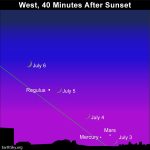
Over the next few evenings – July 3 to 6, 2019 – watch for the young moon in the west after sunset. Fresh from the July 2 South American solar eclipse, the moon will be a very thin crescent and hard to catch on July 3. But, especially if you live in the Americas or on an island in the Pacific, you might catch it shortly after sunset. From the world’s Eastern Hemisphere – Europe, Africa, Asia, Australia and New Zealand – you might have to wait until after sunset July 4 for your first glimpse of the evening crescent. For the fun of it, we label Mercury and Mars on the feature chart above, but we expect few – if any – skywatchers to spot these worlds, which are thousands of times fainter than the young moon and exceedingly near the sunset now.

Astronomers use the term young moon for a waxing crescent in the days following new moon. They use the term old moon for a waning crescent shortly before new moon.

To maximize your chances of spotting the whisker-thin lunar crescent on July 3, find an unobstructed horizon in the direction of sunset. If you can stand atop a hill or balcony, so that you can peek a little farther over the horizon, all the better. And don’t forget binoculars, as the sky is often hazy or murky along the horizon. Even in a clear sky, the slender crescent is likely to appear pale and bleached out at evening dusk.

Don’t dally! Start your search for the young crescent as soon as possible after sunset. Even from mid-northern latitudes in North America, the moon sets an hour or so after sunset on July 3. Click here to know more specifically when the moon sets in your sky, remembering to check the moonrise and moonset box.

Day by day, the moon will be waxing larger and staying out longer after sundown. After July 3, it’ll probably be easier to spot the soft glow of earthshine on the darkened portion of the moon. Earthshine is twice-reflected sunlight – sunlight that’s reflected from Earth to the moon, and then from the moon back to Earth. When the moon is a thin crescent in Earth’s sky, the Earth exhibits an almost-full waning gibbous phase in the moon’s sky. Hence, the almost-full Earth lights up the nighttime side of a crescent moon.

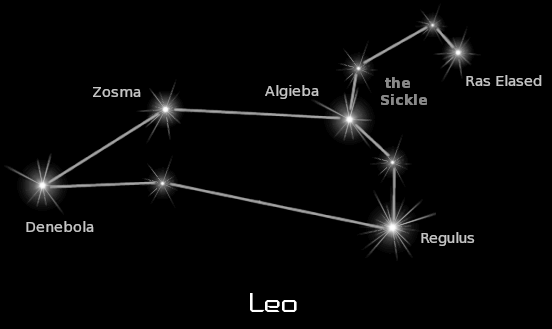
By July 5, 2019, the moon will be easy to see after sunset, and it’ll be pairing up with the bright star Regulus, considered the Heart of the Lion in the constellation Leo. We show Regulus but not the constellation Leo on the feature chart at top, but Regulus lies at the tip of a striking pattern of stars on the sky’s dome – shaped like a backwards question mark – called The Sickle.

Illustration of constellation Leo, with The Sickle marked.

Regulus is part of a backwards question mark pattern known as The Sickle in Leo. Image via Derekscope.

By the way, the lunar terminator – the shadow line dividing the lunar day and night – shows you where it’s sunrise on the waxing moon. By the time the full moon comes on July 16, 2019, we’ll be seeing all of the moon’s lighted side and none of its nighttime side. But once the moon starts to wane in phase, the lunar terminator – the shadow line dividing the lunar day and night – will show you where it’s sunset on the waning moon.

Bottom line: Try catching the young moon after sunset on July 3 or 4, 2019. The watch for the waxing crescent moon to pair up with Regulus, the brightest star in the constellation Leo the lion, on or near July 5, 2019.

Read more: Leo, here’s your constellation


from EarthSky https://ift.tt/2XGFf2l

Over the next few evenings – July 3 to 6, 2019 – watch for the young moon in the west after sunset. Fresh from the July 2 South American solar eclipse, the moon will be a very thin crescent and hard to catch on July 3. But, especially if you live in the Americas or on an island in the Pacific, you might catch it shortly after sunset. From the world’s Eastern Hemisphere – Europe, Africa, Asia, Australia and New Zealand – you might have to wait until after sunset July 4 for your first glimpse of the evening crescent. For the fun of it, we label Mercury and Mars on the feature chart above, but we expect few – if any – skywatchers to spot these worlds, which are thousands of times fainter than the young moon and exceedingly near the sunset now.

Astronomers use the term young moon for a waxing crescent in the days following new moon. They use the term old moon for a waning crescent shortly before new moon.

To maximize your chances of spotting the whisker-thin lunar crescent on July 3, find an unobstructed horizon in the direction of sunset. If you can stand atop a hill or balcony, so that you can peek a little farther over the horizon, all the better. And don’t forget binoculars, as the sky is often hazy or murky along the horizon. Even in a clear sky, the slender crescent is likely to appear pale and bleached out at evening dusk.

Don’t dally! Start your search for the young crescent as soon as possible after sunset. Even from mid-northern latitudes in North America, the moon sets an hour or so after sunset on July 3. Click here to know more specifically when the moon sets in your sky, remembering to check the moonrise and moonset box.

Day by day, the moon will be waxing larger and staying out longer after sundown. After July 3, it’ll probably be easier to spot the soft glow of earthshine on the darkened portion of the moon. Earthshine is twice-reflected sunlight – sunlight that’s reflected from Earth to the moon, and then from the moon back to Earth. When the moon is a thin crescent in Earth’s sky, the Earth exhibits an almost-full waning gibbous phase in the moon’s sky. Hence, the almost-full Earth lights up the nighttime side of a crescent moon.

By July 5, 2019, the moon will be easy to see after sunset, and it’ll be pairing up with the bright star Regulus, considered the Heart of the Lion in the constellation Leo. We show Regulus but not the constellation Leo on the feature chart at top, but Regulus lies at the tip of a striking pattern of stars on the sky’s dome – shaped like a backwards question mark – called The Sickle.

Illustration of constellation Leo, with The Sickle marked.

Regulus is part of a backwards question mark pattern known as The Sickle in Leo. Image via Derekscope.

By the way, the lunar terminator – the shadow line dividing the lunar day and night – shows you where it’s sunrise on the waxing moon. By the time the full moon comes on July 16, 2019, we’ll be seeing all of the moon’s lighted side and none of its nighttime side. But once the moon starts to wane in phase, the lunar terminator – the shadow line dividing the lunar day and night – will show you where it’s sunset on the waning moon.

Bottom line: Try catching the young moon after sunset on July 3 or 4, 2019. The watch for the waxing crescent moon to pair up with Regulus, the brightest star in the constellation Leo the lion, on or near July 5, 2019.

Read more: Leo, here’s your constellation


from EarthSky https://ift.tt/2XGFf2l

Astronomers pinpoint source of fast radio burst

Lines representing radio waves and light reaching radio and optical telescopes from a distant galaxy.

Artist’s concept of the Australian SKA Pathfinder radio telescope (ASKAP) finding a fast radio burst and determining its precise location. The KECK, VLT and Gemini South optical telescopes joined ASKAP with follow-up observations to image the host galaxy. Image via CSIRO/Andrew Howells/EWASS.

An Australian-led international team of astronomers said on June 27, 2019, that it has now determined the precise location of a powerful but brief burst of cosmic radio waves, known as a fast radio burst. That’s exciting because – although astronomers have observed several dozen of these bursts since they spotted the first one in 2007 – the bursts, which last less than a millisecond, have been challenging to pinpoint in space. These astronomers were able to determine the exact location of a burst labeled FRB 180924. They linked it to a distant galaxy known only as DES J214425.25-405400.81. The team said the burst originated in the outskirts of this galaxy, which is about the size of our Milky Way, located about 4 billion light-years away. Lead author Keith Bannister said:

This is the big breakthrough that the field has been waiting for since astronomers discovered fast radio bursts in 2007.

Bannister’s team used the new Australian Square Kilometer Array Pathfinder (ASKAP) radio telescope in Western Australia to pinpoint the burst. The team accomplished it by developing new technology to freeze and save ASKAP data less than a second after a burst arrived at the telescope. Bannister commented:

If we were to stand on the moon and look down at the Earth with this precision, we would be able to tell not only which city the burst came from, but which postcode – and even which city block.

After pinpointing the burst’s home galaxy, other astronomers around the world were alerted, and the galaxy was then imaged by three of the world’s largest optical telescopes – Keck, Gemini South and ESO’s Very Large Telescope.

A representative of the team – Wael Farah of Swinburne University, Melbourne, Australia – made the announcement of the fast radio burst’s location at the annual meeting of the European Astronomical Society (EWASS 2019), held June 24-28, 2019 in Lyon, France. The result is also published in the peer-reviewed journal Science.

The astronomers’ statement explained:

In the 12 years since [the first fast radio burst was seen], a global hunt has netted 85 of these bursts. Most have been ‘one-offs’ but a small fraction are ‘repeaters’ that recur in the same location. In 2017 astronomers found a repeater’s home galaxy but localizing a one-off burst has been much more challenging.

The newly pinpointed burst is a one-off, and thus this is the first time a one-off fast radio burst has been pinpointed.

4 dish-type radio telescopes, one close, aimed upward, in a desert landscape.

The Australian Square Kilometre Array Pathfinder radio telescope (ASKAP) is located at the Murchison Radio-Astronomy Observatory in Western Australia. The telescope and observatory are run by Australia’s national science agency, CSIRO. Image via CSIRO/Dragonfly Media/EWASS.

ASKAP is an array of multiple dish antennas and the burst had to travel a different distance to each dish, reaching them all at a slightly different time. Team member Adam Deller of Swinburne University of Technology explained:

From these tiny time differences – just a fraction of a billionth of a second – we identified the burst’s home galaxy and even its exact starting point, 13,000 light-years out from the galaxy’s center in the galactic suburbs.

He added that the only previously localized burst, the “repeater,” is coming from a very tiny galaxy that is forming lots of stars, explaining:

The burst we localized and its host galaxy look nothing like the ‘repeater’ and its host. It comes from a massive galaxy that is forming relatively few stars. This suggests that fast radio bursts can be produced in a variety of environments, or that the seemingly one-off bursts detected so far by ASKAP are generated by a different mechanism to the repeater.

The cause of fast radio bursts remains unknown but the ability to determine their exact location is a big leap towards solving this mystery, these astronomers said.

Read more about this study via EWASS

Bottom line: For the first time, astronomers determined the exact location of a one-off fast radio burst labeled FRB 180924. They linked it to a distant and little-known galaxy labeled DES J214425.25-405400.81. The team said the burst originated in the outskirts of this galaxy, which is about the size of our Milky Way, located about 4 billion light-years away.


from EarthSky https://ift.tt/2NBDr74
Lines representing radio waves and light reaching radio and optical telescopes from a distant galaxy.

Artist’s concept of the Australian SKA Pathfinder radio telescope (ASKAP) finding a fast radio burst and determining its precise location. The KECK, VLT and Gemini South optical telescopes joined ASKAP with follow-up observations to image the host galaxy. Image via CSIRO/Andrew Howells/EWASS.

An Australian-led international team of astronomers said on June 27, 2019, that it has now determined the precise location of a powerful but brief burst of cosmic radio waves, known as a fast radio burst. That’s exciting because – although astronomers have observed several dozen of these bursts since they spotted the first one in 2007 – the bursts, which last less than a millisecond, have been challenging to pinpoint in space. These astronomers were able to determine the exact location of a burst labeled FRB 180924. They linked it to a distant galaxy known only as DES J214425.25-405400.81. The team said the burst originated in the outskirts of this galaxy, which is about the size of our Milky Way, located about 4 billion light-years away. Lead author Keith Bannister said:

This is the big breakthrough that the field has been waiting for since astronomers discovered fast radio bursts in 2007.

Bannister’s team used the new Australian Square Kilometer Array Pathfinder (ASKAP) radio telescope in Western Australia to pinpoint the burst. The team accomplished it by developing new technology to freeze and save ASKAP data less than a second after a burst arrived at the telescope. Bannister commented:

If we were to stand on the moon and look down at the Earth with this precision, we would be able to tell not only which city the burst came from, but which postcode – and even which city block.

After pinpointing the burst’s home galaxy, other astronomers around the world were alerted, and the galaxy was then imaged by three of the world’s largest optical telescopes – Keck, Gemini South and ESO’s Very Large Telescope.

A representative of the team – Wael Farah of Swinburne University, Melbourne, Australia – made the announcement of the fast radio burst’s location at the annual meeting of the European Astronomical Society (EWASS 2019), held June 24-28, 2019 in Lyon, France. The result is also published in the peer-reviewed journal Science.

The astronomers’ statement explained:

In the 12 years since [the first fast radio burst was seen], a global hunt has netted 85 of these bursts. Most have been ‘one-offs’ but a small fraction are ‘repeaters’ that recur in the same location. In 2017 astronomers found a repeater’s home galaxy but localizing a one-off burst has been much more challenging.

The newly pinpointed burst is a one-off, and thus this is the first time a one-off fast radio burst has been pinpointed.

4 dish-type radio telescopes, one close, aimed upward, in a desert landscape.

The Australian Square Kilometre Array Pathfinder radio telescope (ASKAP) is located at the Murchison Radio-Astronomy Observatory in Western Australia. The telescope and observatory are run by Australia’s national science agency, CSIRO. Image via CSIRO/Dragonfly Media/EWASS.

ASKAP is an array of multiple dish antennas and the burst had to travel a different distance to each dish, reaching them all at a slightly different time. Team member Adam Deller of Swinburne University of Technology explained:

From these tiny time differences – just a fraction of a billionth of a second – we identified the burst’s home galaxy and even its exact starting point, 13,000 light-years out from the galaxy’s center in the galactic suburbs.

He added that the only previously localized burst, the “repeater,” is coming from a very tiny galaxy that is forming lots of stars, explaining:

The burst we localized and its host galaxy look nothing like the ‘repeater’ and its host. It comes from a massive galaxy that is forming relatively few stars. This suggests that fast radio bursts can be produced in a variety of environments, or that the seemingly one-off bursts detected so far by ASKAP are generated by a different mechanism to the repeater.

The cause of fast radio bursts remains unknown but the ability to determine their exact location is a big leap towards solving this mystery, these astronomers said.

Read more about this study via EWASS

Bottom line: For the first time, astronomers determined the exact location of a one-off fast radio burst labeled FRB 180924. They linked it to a distant and little-known galaxy labeled DES J214425.25-405400.81. The team said the burst originated in the outskirts of this galaxy, which is about the size of our Milky Way, located about 4 billion light-years away.


from EarthSky https://ift.tt/2NBDr74

adds 2