aads

Today in science: Tunguska explosion

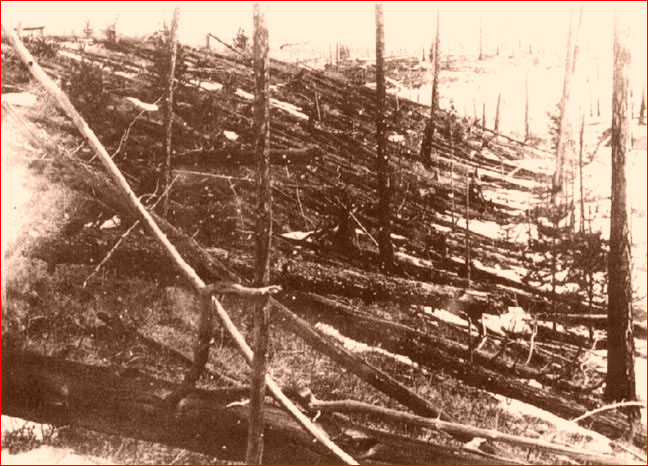
Many rows of fallen trees with some standing upright stripped of branches.

A 1929 image of fallen trees at Tunguska in Siberia. It wasn’t until 1927 that Russian scientists – led by Leonid Kulik – were finally able to get to the scene. Today, a global asteroid-awareness campaign (#WorldAsteroidDay) is held every June 30, the anniversary of the Tunguska event. Photo via the Soviet Academy of Science/Wikimedia Commons.

June 30 is Asteroid Day 2019

June 30, 1908 In a remote part of Russia, a fireball was seen streaking across the daytime sky. Within moments, something exploded in the atmosphere above Siberia’s Podkamennaya Tunguska River in what is now Krasnoyarsk Krai, Russia. This event – now widely known as the Tunguska event – is believed to have been caused by an incoming asteroid (or comet), which never actually struck Earth but instead exploded in the atmosphere, causing what is known as an air burst, three to six miles (5–10 kilometers) above Earth’s surface.

The explosion released enough energy to kill reindeer and flatten trees for many kilometers around the blast site. But no crater was ever found. At the time, it was difficult to reach this remote part of Siberia. It wasn’t until 1927 that Leonid Kulik led the first Soviet research expedition to investigate the Tunguska event. He made a initial trip to the region, interviewed local witnesses and explored the region where the trees had been felled. He became convinced that they were all turned with their roots to the center. He did not find any meteorite fragments, and he did not find a meteorite crater.

Over the years, scientists and others concocted fabulous explanations for the Tunguska explosion. Some were pretty wild – such as the encounter of Earth with an alien spacecraft, or a mini-black-hole, or a particle of antimatter.

The truth is more ordinary. In all likelihood, a small icy comet or stony asteroid collided with Earth’s atmosphere on June 30, 1908. If it were an asteroid, it might have been about a third as big as a football field – moving at about 15 kilometers (10 miles) per second.

In 2019, new research – inspired by a workshop held at NASA’s Ames Research Center in Silicon Valley and sponsored by the NASA Planetary Defense Coordination Office – was published about the Tunguska event, in series of papers in a special issue of the journal Icarus. The theme of the workshop was reexamining the astronomical cold case of the 1908 Tunguska impact event.
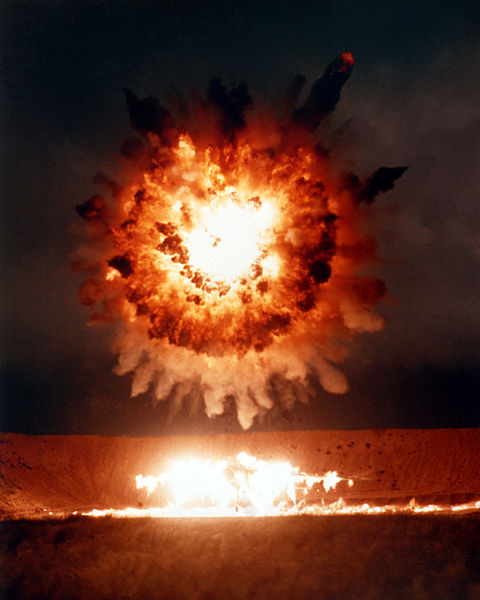
Instantaneous brilliantly glowing spherical burst of flame and smoke in midair.

Photo of an air burst, in this case from a U.S. Navy submarine-launched Tomamhawk cruise missile. An air burst from an incoming comet or asteroid is thought to have flattened trees in Siberia in 1908. Image via Wikimedia Commons
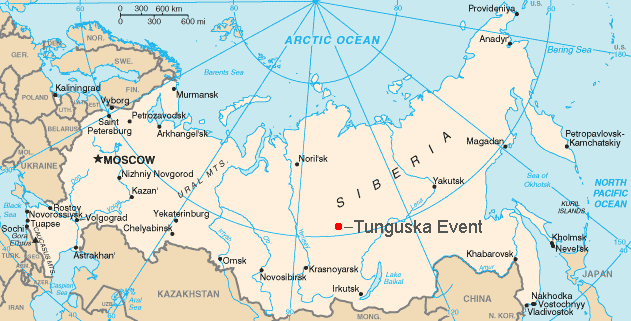
Map with Russia in light tan, with red dot near center of Siberia.

Map showing the approximate location of the Tunguska event of 1908.

Vital clues to the Tunguska event appeared on February 15, 2013, when a smaller but still impressive meteor burst in the atmosphere near Chelyabinsk, Russia. NASA explained:

New evidence to help solve the mystery of Tunguska had arrived. This highly documented fireball created an opportunity for researchers to apply modern computer modeling techniques to explain what was seen, heard and felt.

The models were used with video observations of the fireball and maps of the damage on the ground to reconstruct the original size, motion and speed of the Chelyabinsk object. The resulting interpretation is that Chelyabinsk was most likely a stony asteroid the size of a five-story building that broke apart 15 miles above the ground. This generated a shock wave equivalent to a 550-kiloton explosion. The explosion’s shockwave blew out roughly a million windows and injured more than a thousand people. Fortunately, the force of the explosion was not enough to knock down trees or structures.

Per current understanding of the asteroid population, an object like the Chelyabinsk meteor can impact the Earth every 10 to 100 years on average.

Read more about the new research on the Tunguska event

In recent decades, astronomers have come to take the possibility of comet and asteroid impacts very seriously indeed. They now have regular observing programs to watch for Near-Earth Objects, as they’re called. They meet regularly to discuss what might happen if we did find an object on a collision course with Earth. And space scientists are planning missions to an asteroid, including Hera and __.

Lorien Wheeler – a researcher at NASA Ames Research Center, working on NASA’s Asteroid Threat Assessment Project – said:

Because there are so few observed cases, a lot of uncertainty remains about how large asteroids break up in the atmosphere and how much damage they could cause on the ground. However, recent advancements in computational models, along with analyses of the Chelyabinsk and other meteor events, are helping to improve our understanding of these factors so that we can better evaluate potential asteroid threats in the future.

Astronomer David Morrison, also at NASA Ames Research Center, commented:

Tunguska is the largest cosmic impact witnessed by modern humans. It also is characteristic of the sort of impact we are likely to have to protect against in the future.

Long, thick, white smoke trail in a twilight sky over snowy landscape.

Chelyabinsk meteor smoke trail, February 15, 2013. Image via Alex Alishevskikh., who caught it about a minute after the blast.

Bottom line: On June 30, 1908, an object from space exploded above Siberia. The explosion killed reindeer and flattened trees, in what has become known as the Tunguska event. Recent research shows that the object was most likely a stony asteroid the size of a five-story building that broke apart 15 miles above the ground.

Source: Icarus special papers on Tunguska

No, asteroid 2006 QV89 won’t strike Earth in September 2019


from EarthSky https://ift.tt/2KOzXMd
Many rows of fallen trees with some standing upright stripped of branches.

A 1929 image of fallen trees at Tunguska in Siberia. It wasn’t until 1927 that Russian scientists – led by Leonid Kulik – were finally able to get to the scene. Today, a global asteroid-awareness campaign (#WorldAsteroidDay) is held every June 30, the anniversary of the Tunguska event. Photo via the Soviet Academy of Science/Wikimedia Commons.

June 30 is Asteroid Day 2019

June 30, 1908 In a remote part of Russia, a fireball was seen streaking across the daytime sky. Within moments, something exploded in the atmosphere above Siberia’s Podkamennaya Tunguska River in what is now Krasnoyarsk Krai, Russia. This event – now widely known as the Tunguska event – is believed to have been caused by an incoming asteroid (or comet), which never actually struck Earth but instead exploded in the atmosphere, causing what is known as an air burst, three to six miles (5–10 kilometers) above Earth’s surface.

The explosion released enough energy to kill reindeer and flatten trees for many kilometers around the blast site. But no crater was ever found. At the time, it was difficult to reach this remote part of Siberia. It wasn’t until 1927 that Leonid Kulik led the first Soviet research expedition to investigate the Tunguska event. He made a initial trip to the region, interviewed local witnesses and explored the region where the trees had been felled. He became convinced that they were all turned with their roots to the center. He did not find any meteorite fragments, and he did not find a meteorite crater.

Over the years, scientists and others concocted fabulous explanations for the Tunguska explosion. Some were pretty wild – such as the encounter of Earth with an alien spacecraft, or a mini-black-hole, or a particle of antimatter.

The truth is more ordinary. In all likelihood, a small icy comet or stony asteroid collided with Earth’s atmosphere on June 30, 1908. If it were an asteroid, it might have been about a third as big as a football field – moving at about 15 kilometers (10 miles) per second.

In 2019, new research – inspired by a workshop held at NASA’s Ames Research Center in Silicon Valley and sponsored by the NASA Planetary Defense Coordination Office – was published about the Tunguska event, in series of papers in a special issue of the journal Icarus. The theme of the workshop was reexamining the astronomical cold case of the 1908 Tunguska impact event.

Instantaneous brilliantly glowing spherical burst of flame and smoke in midair.

Photo of an air burst, in this case from a U.S. Navy submarine-launched Tomamhawk cruise missile. An air burst from an incoming comet or asteroid is thought to have flattened trees in Siberia in 1908. Image via Wikimedia Commons

Map with Russia in light tan, with red dot near center of Siberia.

Map showing the approximate location of the Tunguska event of 1908.

Vital clues to the Tunguska event appeared on February 15, 2013, when a smaller but still impressive meteor burst in the atmosphere near Chelyabinsk, Russia. NASA explained:

New evidence to help solve the mystery of Tunguska had arrived. This highly documented fireball created an opportunity for researchers to apply modern computer modeling techniques to explain what was seen, heard and felt.

The models were used with video observations of the fireball and maps of the damage on the ground to reconstruct the original size, motion and speed of the Chelyabinsk object. The resulting interpretation is that Chelyabinsk was most likely a stony asteroid the size of a five-story building that broke apart 15 miles above the ground. This generated a shock wave equivalent to a 550-kiloton explosion. The explosion’s shockwave blew out roughly a million windows and injured more than a thousand people. Fortunately, the force of the explosion was not enough to knock down trees or structures.

Per current understanding of the asteroid population, an object like the Chelyabinsk meteor can impact the Earth every 10 to 100 years on average.

Read more about the new research on the Tunguska event

In recent decades, astronomers have come to take the possibility of comet and asteroid impacts very seriously indeed. They now have regular observing programs to watch for Near-Earth Objects, as they’re called. They meet regularly to discuss what might happen if we did find an object on a collision course with Earth. And space scientists are planning missions to an asteroid, including Hera and __.

Lorien Wheeler – a researcher at NASA Ames Research Center, working on NASA’s Asteroid Threat Assessment Project – said:

Because there are so few observed cases, a lot of uncertainty remains about how large asteroids break up in the atmosphere and how much damage they could cause on the ground. However, recent advancements in computational models, along with analyses of the Chelyabinsk and other meteor events, are helping to improve our understanding of these factors so that we can better evaluate potential asteroid threats in the future.

Astronomer David Morrison, also at NASA Ames Research Center, commented:

Tunguska is the largest cosmic impact witnessed by modern humans. It also is characteristic of the sort of impact we are likely to have to protect against in the future.

Long, thick, white smoke trail in a twilight sky over snowy landscape.

Chelyabinsk meteor smoke trail, February 15, 2013. Image via Alex Alishevskikh., who caught it about a minute after the blast.

Bottom line: On June 30, 1908, an object from space exploded above Siberia. The explosion killed reindeer and flattened trees, in what has become known as the Tunguska event. Recent research shows that the object was most likely a stony asteroid the size of a five-story building that broke apart 15 miles above the ground.

Source: Icarus special papers on Tunguska

No, asteroid 2006 QV89 won’t strike Earth in September 2019


from EarthSky https://ift.tt/2KOzXMd

The first complete picture of how long it takes to diagnose cancer in England

NHS hospital bike

Waiting for cancer tests and results is stressful. As well as the emotional impact, how long people wait can also affect how likely their treatment is to work and if they will be fit enough to tolerate treatment.

The NHS’s struggle to meet cancer waiting time targets is a regular feature in the news, but gauging how the NHS is doing on cancer diagnosis waiting times right now is based on incomplete data. In fact, how long most people with cancer wait for a diagnosis isn’t captured in NHS stats.

In 2015, just 4 in 10 people (43%) who were diagnosed with cancer in England had the time they waited for their diagnosis recorded by the NHS. This covers those referred urgently from a GP or through screening. But it misses the majority.

With changes to the NHS waiting times targets in England on the horizon, including the introduction of a ’28 day diagnosis standard’ for people with suspected cancer, it’s vital that all patients are accounted for.

In a first attempt, a research analysis team from Cancer Research UK and Public Health England has gathered the most complete picture of how long people wait for a cancer diagnosis in England, from when they have a relevant interaction in secondary care for their cancer to their date of diagnosis, based on data from 2014 and 2015. The figures include around 95% of patients diagnosed with 25 types of cancer – whether they were referred urgently or otherwise.

Thanks to this research, we can now say how long people waited for their cancer diagnosis within secondary care in England – something that wasn’t possible before.

What about Scotland, Wales and Northern Ireland?

This research used data for patients in England so doesn’t provide a picture of the devolved nations.

Each nation has different cancer waiting times, with variations in the targets, patients and cancer types included. And no nation records the time waited for diagnostic tests for all patients.

Can health services meet NHS England’s new standards?

The findings for lung and bowel cancer, published in the journal Cancer Epidemiology, paint a concerning picture. From April 2020, health services in England will be expected to diagnose or give the all clear to everyone referred by a healthcare professional with an urgent suspicion of cancer within 28 days. This is part of NHS England’s long-term plan to ensure people with cancer can start treatment sooner.

But will our health services be ready?

In 2014 and 2015, people who were urgently referred with suspected lung cancer were diagnosed, on average, within 36 days. Even if we assume the figures are still the same today, that’s 8 days longer than the target set for 2020. This is not the case for all cancers, the average time for a diagnosis was less than 20 days for leukaemia, breast and stomach cancer, among others.

Professor Mick Peake, Clinical Director of the Centre for Cancer Outcomes at University College London Hospitals, was a specialist clinical advisor on this study. Despite saying that “there are many examples of great practice within the NHS,” he acknowledges there are some big challenges that diagnostic services will need to overcome.

Peake says that diagnosing lung cancer is particularly complicated. “The national lung cancer audit found over two thirds of lung cancer patients had their care managed by two or more hospital trusts, either for diagnostic tests or treatment, requiring additional coordination.”

And if those being referred urgently are already waiting too long, what’s happening to everyone else?

Should everyone be counted?

By focusing on people referred urgently we lose sight of people who aren’t covered by NHS England’s targets. And the new data makes it clear just how long some of these people are waiting.

The average time for a diagnosis of bowel or lung cancer following a routine GP referral was 61 and 69 days respectively, according to this study. But 1 in 4 people diagnosed with bowel cancer in this way waited at least 102 days. This grew to 126 days for those with lung cancer.

And it’s not just true for lung and bowel cancers. A quarter of people diagnosed with 20 of the 25 cancer types following a routine referral waited 80 days or longer for their diagnosis.

While we don’t know who will be affected by a longer wait, it’s vital that everyone has the best chance of successful treatment following their diagnosis. People urgently referred should be seen quickly, but this shouldn’t cause longer waits for other people.

Time for the NHS to commit to change

One of the biggest hurdles facing the NHS is staff shortages. Increasing demands on diagnostic staff and difficulties filling vacancies make it difficult for the NHS to diagnose cancers early. In Peake’s experience, “there is a resource issue in terms of workforce. Some of these delays are not organisational, they are not logistical – they are purely down to workforce.”

Without significant growth in the NHS workforce, there’s only so much that struggling services can do. And with a growing and ageing population, this staffing crisis is only going to get worse.

It’s in the hands of the Government to fund a workforce plan that ensures all patients, now and in the future, have the best chance of an early, and quick, diagnosis.

Ben Yarnall is an early diagnosis manager at Cancer Research UK

Reference

Pearson, et al., (2019) Establishing population-based surveillance of diagnostic timeliness using linked cancer registry and administrative data for patients with colorectal and lung cancer. Cancer Epidemiology. DOI: 10.1016/j.canep.2019.05.010


from Cancer Research UK – Science blog https://ift.tt/2xix3q8
NHS hospital bike

Waiting for cancer tests and results is stressful. As well as the emotional impact, how long people wait can also affect how likely their treatment is to work and if they will be fit enough to tolerate treatment.

The NHS’s struggle to meet cancer waiting time targets is a regular feature in the news, but gauging how the NHS is doing on cancer diagnosis waiting times right now is based on incomplete data. In fact, how long most people with cancer wait for a diagnosis isn’t captured in NHS stats.

In 2015, just 4 in 10 people (43%) who were diagnosed with cancer in England had the time they waited for their diagnosis recorded by the NHS. This covers those referred urgently from a GP or through screening. But it misses the majority.

With changes to the NHS waiting times targets in England on the horizon, including the introduction of a ’28 day diagnosis standard’ for people with suspected cancer, it’s vital that all patients are accounted for.

In a first attempt, a research analysis team from Cancer Research UK and Public Health England has gathered the most complete picture of how long people wait for a cancer diagnosis in England, from when they have a relevant interaction in secondary care for their cancer to their date of diagnosis, based on data from 2014 and 2015. The figures include around 95% of patients diagnosed with 25 types of cancer – whether they were referred urgently or otherwise.

Thanks to this research, we can now say how long people waited for their cancer diagnosis within secondary care in England – something that wasn’t possible before.

What about Scotland, Wales and Northern Ireland?

This research used data for patients in England so doesn’t provide a picture of the devolved nations.

Each nation has different cancer waiting times, with variations in the targets, patients and cancer types included. And no nation records the time waited for diagnostic tests for all patients.

Can health services meet NHS England’s new standards?

The findings for lung and bowel cancer, published in the journal Cancer Epidemiology, paint a concerning picture. From April 2020, health services in England will be expected to diagnose or give the all clear to everyone referred by a healthcare professional with an urgent suspicion of cancer within 28 days. This is part of NHS England’s long-term plan to ensure people with cancer can start treatment sooner.

But will our health services be ready?

In 2014 and 2015, people who were urgently referred with suspected lung cancer were diagnosed, on average, within 36 days. Even if we assume the figures are still the same today, that’s 8 days longer than the target set for 2020. This is not the case for all cancers, the average time for a diagnosis was less than 20 days for leukaemia, breast and stomach cancer, among others.

Professor Mick Peake, Clinical Director of the Centre for Cancer Outcomes at University College London Hospitals, was a specialist clinical advisor on this study. Despite saying that “there are many examples of great practice within the NHS,” he acknowledges there are some big challenges that diagnostic services will need to overcome.

Peake says that diagnosing lung cancer is particularly complicated. “The national lung cancer audit found over two thirds of lung cancer patients had their care managed by two or more hospital trusts, either for diagnostic tests or treatment, requiring additional coordination.”

And if those being referred urgently are already waiting too long, what’s happening to everyone else?

Should everyone be counted?

By focusing on people referred urgently we lose sight of people who aren’t covered by NHS England’s targets. And the new data makes it clear just how long some of these people are waiting.

The average time for a diagnosis of bowel or lung cancer following a routine GP referral was 61 and 69 days respectively, according to this study. But 1 in 4 people diagnosed with bowel cancer in this way waited at least 102 days. This grew to 126 days for those with lung cancer.

And it’s not just true for lung and bowel cancers. A quarter of people diagnosed with 20 of the 25 cancer types following a routine referral waited 80 days or longer for their diagnosis.

While we don’t know who will be affected by a longer wait, it’s vital that everyone has the best chance of successful treatment following their diagnosis. People urgently referred should be seen quickly, but this shouldn’t cause longer waits for other people.

Time for the NHS to commit to change

One of the biggest hurdles facing the NHS is staff shortages. Increasing demands on diagnostic staff and difficulties filling vacancies make it difficult for the NHS to diagnose cancers early. In Peake’s experience, “there is a resource issue in terms of workforce. Some of these delays are not organisational, they are not logistical – they are purely down to workforce.”

Without significant growth in the NHS workforce, there’s only so much that struggling services can do. And with a growing and ageing population, this staffing crisis is only going to get worse.

It’s in the hands of the Government to fund a workforce plan that ensures all patients, now and in the future, have the best chance of an early, and quick, diagnosis.

Ben Yarnall is an early diagnosis manager at Cancer Research UK

Reference

Pearson, et al., (2019) Establishing population-based surveillance of diagnostic timeliness using linked cancer registry and administrative data for patients with colorectal and lung cancer. Cancer Epidemiology. DOI: 10.1016/j.canep.2019.05.010


from Cancer Research UK – Science blog https://ift.tt/2xix3q8

2019 SkS Weekly Climate Change & Global Warming News Roundup #26

A chronological listing of news articles posted on the Skeptical Science Facebook Page during the past week, i.e., Sun, Jun 23 through Sat, June 29, 2019

Editor's Pick

When Alexandria Ocasio-Cortez met Greta Thunberg: 'Hope is contagious'

Alexandria Ocasio-Cortez and Greta Thunberg 

Alexandria Ocasio-Cortez and Greta Thunberg. Photograph: Stephen Voss, Anna Schori/The Guardian 

Alexandria Ocasio-Cortez enters a boardroom at her constituency office in Queens, New York, after a short delay which, a political aide hopes, hasn’t been caused by a constituent waylaying her in the corridor. (“They can get really excited to meet her.”) Greta Thunberg is in her home in Sweden, her father testing the technology for the video link while the teenager waits in the background. The activists have never met nor spoken but, as two of the most visible climate campaigners in the world, they are keenly aware of each other. 

Thunberg, now 16, catapulted to fame last year for skipping school every Friday to stand outside the Swedish parliament, protesting against political inaction over the climate crisis and sparking an international movement, the school strike for climate, in which millions of other children followed suit. Ocasio-Cortez, the Democratic Representative for New York’s 14th congressional district is, at 29, the youngest woman ever to serve in Congress, whose election over a well-funded incumbent in 2018 was a huge upset to politics-as-usual. She has been in office for less than a year, which seems extraordinary given the amount of coverage she has generated. In February, Ocasio-Cortez submitted the Green New Deal to the US House of Representatives, calling for, among other things, the achievement of “net-zero” greenhouse gases within a decade and “a full transition off fossil fuels”, as well as retrofitting all buildings in the US to meet new energy efficient standards.

The Green New Deal, while garnering support from Democratic presidential candidates Elizabeth Warren, Kamala Harris and Amy Klobuchar, was mocked by speaker Nancy Pelosi (“the green dream or whatever they call it”), and defeated in the Senate by Republicans. Like Thunberg, however, Ocasio-Cortez gives every appearance of being galvanised by opposition, and has the kind of energy that has won her 4.41 million Twitter followers and makes establishment politicians in her path very nervous.

In the course of their conversation, Ocasio-Cortez and Thunberg discuss what it is like to be dismissed for their age, how depressed we should be about the future, and what tactics, as an activist, really work. Ocasio-Cortez speaks with her customary snap and brilliance that, held up against the general waffle of political discourse, seems startlingly direct. Thunberg, meanwhile, is phenomenally articulate, well-informed and self-assured, holding her own in conversation with an elected official nearly twice her age and speaking in deliberate, thoughtful English. They are, in some ways, as different as two campaigners can get – the politician working the system with Washington polish, and the teenager in her socks and leggings, working from her bedroom to reach the rest of the world. There is something very moving about the conversation between these young women, a sense of generational rise that, as we know from every precedent from the Renaissance onwards, has the power to ignite movements and change history. 

When Alexandria Ocasio-Cortez met Greta Thunberg: 'Hope is contagious' by Emma Brockes, Environment, Guardian, June 29, 2019 


Links posted on Facebook

Sun June 23 2019

Mon June 24 2019

Tue June 25 2019

Wed June 26 2019

Thu June 27 2019

Fri June 28 2019

Sat June 29 2019


from Skeptical Science https://ift.tt/2IXWnrZ
A chronological listing of news articles posted on the Skeptical Science Facebook Page during the past week, i.e., Sun, Jun 23 through Sat, June 29, 2019

Editor's Pick

When Alexandria Ocasio-Cortez met Greta Thunberg: 'Hope is contagious'

Alexandria Ocasio-Cortez and Greta Thunberg 

Alexandria Ocasio-Cortez and Greta Thunberg. Photograph: Stephen Voss, Anna Schori/The Guardian 

Alexandria Ocasio-Cortez enters a boardroom at her constituency office in Queens, New York, after a short delay which, a political aide hopes, hasn’t been caused by a constituent waylaying her in the corridor. (“They can get really excited to meet her.”) Greta Thunberg is in her home in Sweden, her father testing the technology for the video link while the teenager waits in the background. The activists have never met nor spoken but, as two of the most visible climate campaigners in the world, they are keenly aware of each other. 

Thunberg, now 16, catapulted to fame last year for skipping school every Friday to stand outside the Swedish parliament, protesting against political inaction over the climate crisis and sparking an international movement, the school strike for climate, in which millions of other children followed suit. Ocasio-Cortez, the Democratic Representative for New York’s 14th congressional district is, at 29, the youngest woman ever to serve in Congress, whose election over a well-funded incumbent in 2018 was a huge upset to politics-as-usual. She has been in office for less than a year, which seems extraordinary given the amount of coverage she has generated. In February, Ocasio-Cortez submitted the Green New Deal to the US House of Representatives, calling for, among other things, the achievement of “net-zero” greenhouse gases within a decade and “a full transition off fossil fuels”, as well as retrofitting all buildings in the US to meet new energy efficient standards.

The Green New Deal, while garnering support from Democratic presidential candidates Elizabeth Warren, Kamala Harris and Amy Klobuchar, was mocked by speaker Nancy Pelosi (“the green dream or whatever they call it”), and defeated in the Senate by Republicans. Like Thunberg, however, Ocasio-Cortez gives every appearance of being galvanised by opposition, and has the kind of energy that has won her 4.41 million Twitter followers and makes establishment politicians in her path very nervous.

In the course of their conversation, Ocasio-Cortez and Thunberg discuss what it is like to be dismissed for their age, how depressed we should be about the future, and what tactics, as an activist, really work. Ocasio-Cortez speaks with her customary snap and brilliance that, held up against the general waffle of political discourse, seems startlingly direct. Thunberg, meanwhile, is phenomenally articulate, well-informed and self-assured, holding her own in conversation with an elected official nearly twice her age and speaking in deliberate, thoughtful English. They are, in some ways, as different as two campaigners can get – the politician working the system with Washington polish, and the teenager in her socks and leggings, working from her bedroom to reach the rest of the world. There is something very moving about the conversation between these young women, a sense of generational rise that, as we know from every precedent from the Renaissance onwards, has the power to ignite movements and change history. 

When Alexandria Ocasio-Cortez met Greta Thunberg: 'Hope is contagious' by Emma Brockes, Environment, Guardian, June 29, 2019 


Links posted on Facebook

Sun June 23 2019

Mon June 24 2019

Tue June 25 2019

Wed June 26 2019

Thu June 27 2019

Fri June 28 2019

Sat June 29 2019


from Skeptical Science https://ift.tt/2IXWnrZ

When asteroids photobomb galaxies

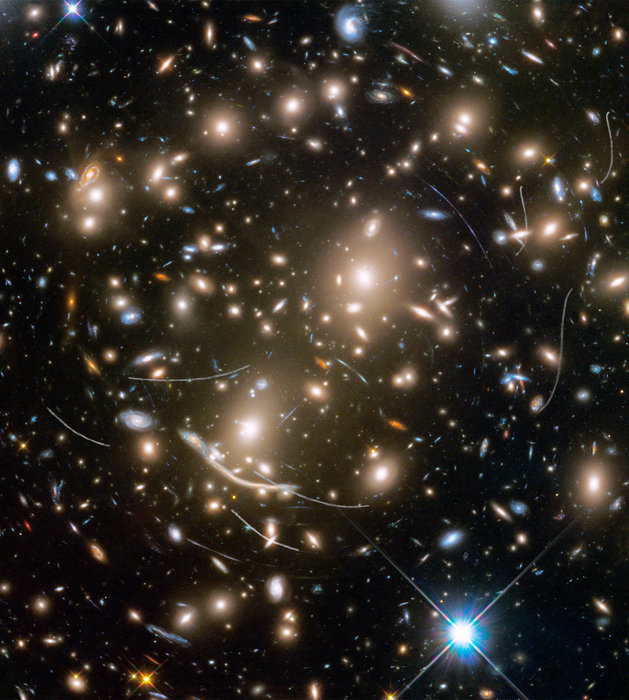
Those streaks are asteroid trails, caught in front of the distant galaxies in the Abell 370 galaxy cluster. The effect of parallax causes the asteroid trails to appear curved. Click here for high-res version. Image via ESA.

Asteroids are common in our solar system, and astronomers find new ones frequently. The first two images on this page, though, show how astronomers have found asteroids while looking for something else, in this case galaxy clusters billions of light-years away. They came across the asteroids by chance. You could say that the asteroids photobombed the galaxy photoshoot!

You can help astronomers find asteroids in this way, too. More about that newly launched Zooniverse project below.

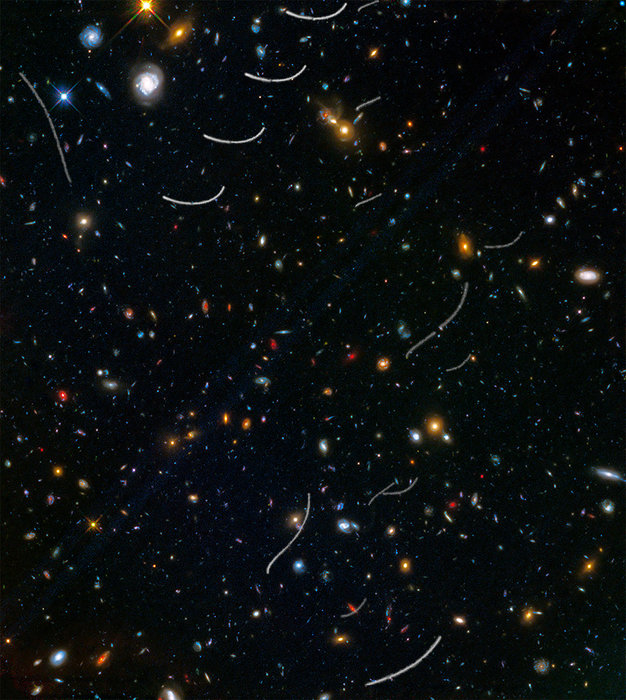
Asteroids – or actually asteroid “trails,” created as the asteroids move in their orbits, closer to us than the stars and galaxies beyond – are seen in these first two images on this page. The images were released by the European Space Agency (ESA) on June 24 and 25, 2019, in conjunction with the annual Asteroid Day festivities in the days leading up to and on June 30.

The trails are created by the movement of the asteroids, as seen in multiple exposures taken by the Hubble Space Telescope. Those multiple exposures can then be combined to create a single image, such as those you see above and below. The images were taken as part of the Frontier Fields program, which aims to use the Hubble Space Telescope to its maximum capabilities.

The astronomers were observing the huge galaxy clusters, containing thousands of galaxies as well as hot gas and dark matter. The asteroids were found accidentally. And now you can participate in a project that aims to find them, intentionally. Keep reading.

Colorful galaxy clusters and asteroid trails.

Asteroids are members of our solar system; because they’re relatively close to us, we see them move apart from the more distant background of space. This image from the Hubble Space Telescope shows the distant galaxy cluster Abell 370. There are also 20 asteroid trails in this image, resulting from 7 individual asteroids, 5 of which had never been seen before because they were too faint. The curved or S-shaped trails stand out sharply against the background of galaxies. Click here for high-res version. Image via ESA.

How you can help astronomers find asteroids. This month, astronomers launched a new citizen-science project called the Hubble Asteroid Hunter, part of the larger Zooniverse project. Astronomers, planetary scientists and software engineers at ESA and other institutions initiated Hubble Asteroid Hunter. Here’s what ESA said when it announced the new project on June 24:

… a team of astronomers, planetary scientists and software engineers based at ESA and other research institutes has launched a new citizen science project: the Hubble Asteroid Hunter. The project was developed as part of the Zooniverse – the world’s largest and most popular platform for people-powered research.

The new project features a collection of archival Hubble images where calculations indicate that an asteroid might have been crossing the field of view at the time of the observation. Everyone can participate! By identifying the asteroids potentially present in these images and marking the exact position of their trails, you too can help the team improve the asteroid orbit determination and better characterise these objects. Precise knowledge of the orbit is particularly important for so-called near-Earth asteroids, those potentially flying close to our planet.

ESA said the citizen-science project particularly useful for finding near-Earth asteroids, those that could pose a possible risk to our planet. Astronomers are always on the lookout for those, since an impact from one could be catastrophic.

Astronomers know of hundreds of thousands of asteroids in our solar system. The current count is 796,059, according to NASA. Yet we also know there are still many more asteroids waiting to be discovered.

And you can help. Click here to go to Hubble Asteroid Hunter.

Asteroid near Earth.

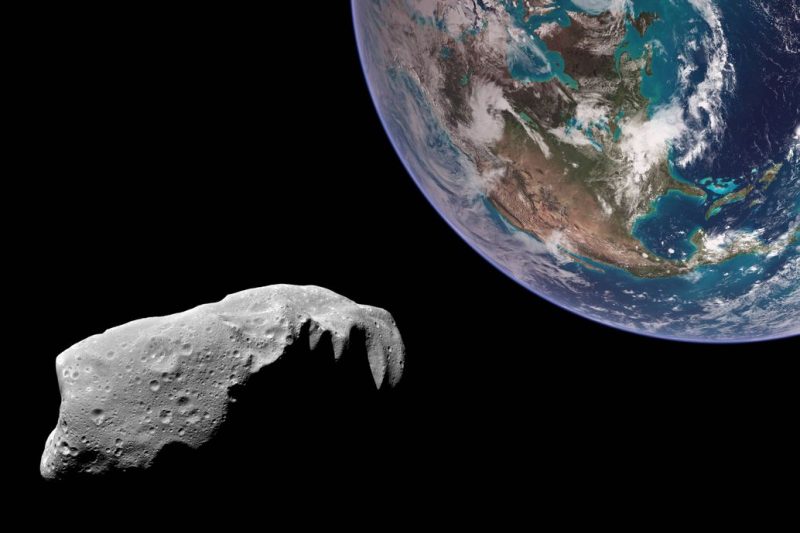
You can participate in projects like Hubble Asteroid Hunter. Click here to learn how. The goal is to find new asteroids in archived images, including near-Earth asteroids that could potentially pose a threat. Image via DepositPhotos/ Popular Science.

Bottom line: Although they weren’t specifically looking for them at the time, astronomers found some bonus asteroids while taking some deep-space images of distant galaxy clusters. You can participate in a similar project via Hubble Asteroid Hunter.

Via ESA


from EarthSky https://ift.tt/2LqWXAn

Those streaks are asteroid trails, caught in front of the distant galaxies in the Abell 370 galaxy cluster. The effect of parallax causes the asteroid trails to appear curved. Click here for high-res version. Image via ESA.

Asteroids are common in our solar system, and astronomers find new ones frequently. The first two images on this page, though, show how astronomers have found asteroids while looking for something else, in this case galaxy clusters billions of light-years away. They came across the asteroids by chance. You could say that the asteroids photobombed the galaxy photoshoot!

You can help astronomers find asteroids in this way, too. More about that newly launched Zooniverse project below.

Asteroids – or actually asteroid “trails,” created as the asteroids move in their orbits, closer to us than the stars and galaxies beyond – are seen in these first two images on this page. The images were released by the European Space Agency (ESA) on June 24 and 25, 2019, in conjunction with the annual Asteroid Day festivities in the days leading up to and on June 30.

The trails are created by the movement of the asteroids, as seen in multiple exposures taken by the Hubble Space Telescope. Those multiple exposures can then be combined to create a single image, such as those you see above and below. The images were taken as part of the Frontier Fields program, which aims to use the Hubble Space Telescope to its maximum capabilities.

The astronomers were observing the huge galaxy clusters, containing thousands of galaxies as well as hot gas and dark matter. The asteroids were found accidentally. And now you can participate in a project that aims to find them, intentionally. Keep reading.

Colorful galaxy clusters and asteroid trails.

Asteroids are members of our solar system; because they’re relatively close to us, we see them move apart from the more distant background of space. This image from the Hubble Space Telescope shows the distant galaxy cluster Abell 370. There are also 20 asteroid trails in this image, resulting from 7 individual asteroids, 5 of which had never been seen before because they were too faint. The curved or S-shaped trails stand out sharply against the background of galaxies. Click here for high-res version. Image via ESA.

How you can help astronomers find asteroids. This month, astronomers launched a new citizen-science project called the Hubble Asteroid Hunter, part of the larger Zooniverse project. Astronomers, planetary scientists and software engineers at ESA and other institutions initiated Hubble Asteroid Hunter. Here’s what ESA said when it announced the new project on June 24:

… a team of astronomers, planetary scientists and software engineers based at ESA and other research institutes has launched a new citizen science project: the Hubble Asteroid Hunter. The project was developed as part of the Zooniverse – the world’s largest and most popular platform for people-powered research.

The new project features a collection of archival Hubble images where calculations indicate that an asteroid might have been crossing the field of view at the time of the observation. Everyone can participate! By identifying the asteroids potentially present in these images and marking the exact position of their trails, you too can help the team improve the asteroid orbit determination and better characterise these objects. Precise knowledge of the orbit is particularly important for so-called near-Earth asteroids, those potentially flying close to our planet.

ESA said the citizen-science project particularly useful for finding near-Earth asteroids, those that could pose a possible risk to our planet. Astronomers are always on the lookout for those, since an impact from one could be catastrophic.

Astronomers know of hundreds of thousands of asteroids in our solar system. The current count is 796,059, according to NASA. Yet we also know there are still many more asteroids waiting to be discovered.

And you can help. Click here to go to Hubble Asteroid Hunter.

Asteroid near Earth.

You can participate in projects like Hubble Asteroid Hunter. Click here to learn how. The goal is to find new asteroids in archived images, including near-Earth asteroids that could potentially pose a threat. Image via DepositPhotos/ Popular Science.

Bottom line: Although they weren’t specifically looking for them at the time, astronomers found some bonus asteroids while taking some deep-space images of distant galaxy clusters. You can participate in a similar project via Hubble Asteroid Hunter.

Via ESA


from EarthSky https://ift.tt/2LqWXAn

News digest – HPV vaccine, prostate cancer urine test, IVF breast cancer risk and baby food

An image of the human papillomavirus (HPV) vaccine

Review adds to the evidence of HPV vaccination success

A review of lots of different studies has added to evidence showing that the HPV vaccination in girls has reduced rates of HPV infection, and pre-cancerous cervical changes, in several countries. Experts say it’s still too early to see the effect of the HPV vaccine on cervical cancer. But, with reductions in early cell changes that can become cancer, they expect to see a drop in cases of cervical cancer over the coming years.

Experimental urine test for prostate cancer shows promise

An experimental urine test could feature among the detection tech used for prostate cancer. According to the BBC, UK researchers say the test may be able to point out who will need aggressive treatment as well as those who can be monitored. Now the early results need to be confirmed in a larger group of patients.

Cancer patients waiting longer for treatment in Scotland

A lack of staff could be to blame for cancer patients in Scotland waiting longer to start treatment. BBC Scotland reports new figures showing that in the first three months of this year, just over 81 in 100 cancer patients started treatment within the Scottish Government’s 62-day target, compared with 85 in 100 a year earlier.

What’s on the horizon in immunotherapy?

The Atlantic suggests that current therapies approved to treat certain cancers, which unleash the immune system against cancer, are just the beginning.

Government yet to make progress on childhood obesity plans

Health campaigners say plans to tackle childhood obesity have been held up by government’s focus on Brexit, reports the BBC. Several measures central to the refreshed obesity strategy announced a year ago are yet to be introduced. This includes a ban on energy drink sales to under-16s and a crackdown on junk food advertising. We spoke to a former junk food advertiser turned campaigner about why restrictions on junk food advertising are important.

Potential link between fertility treatments and breast cancer risk in older women

Results of a large study presented at a conference this week suggest that women above the age of 40 who use fertility treatments, such as IVF, to get pregnant might be at greater risk of developing breast cancer, reports The Independent. However, overall research evidence hasn’t shown that women who’ve had fertility treatments are at higher risk of breast cancer. More work is needed before we can say anything for sure, as there could be other underlying reasons at play.

Vaping is cheaper than smoking

The Mail Online reports that switching from cigarettes to e-cigarettes could save smokers money. A study from scientists at UCL suggests some people could save up to £15 a week making the change. The researchers’ calculations were based on an average of around six cigarettes per day.

And finally

Baby food can often come with a hefty dose of sugar, according to a study from the Royal College of Paediatrics and Child Health covered by the BBC. It warns that even weaning products that claim to have ‘no added sugar’ are often sweetened by honey or fruit juice. The researchers say that the amount of sugar in baby food should be restricted because eating sugary foods can contribute to children becoming overweight and obese.

Gabi


from Cancer Research UK – Science blog https://ift.tt/2IV7NN7
An image of the human papillomavirus (HPV) vaccine

Review adds to the evidence of HPV vaccination success

A review of lots of different studies has added to evidence showing that the HPV vaccination in girls has reduced rates of HPV infection, and pre-cancerous cervical changes, in several countries. Experts say it’s still too early to see the effect of the HPV vaccine on cervical cancer. But, with reductions in early cell changes that can become cancer, they expect to see a drop in cases of cervical cancer over the coming years.

Experimental urine test for prostate cancer shows promise

An experimental urine test could feature among the detection tech used for prostate cancer. According to the BBC, UK researchers say the test may be able to point out who will need aggressive treatment as well as those who can be monitored. Now the early results need to be confirmed in a larger group of patients.

Cancer patients waiting longer for treatment in Scotland

A lack of staff could be to blame for cancer patients in Scotland waiting longer to start treatment. BBC Scotland reports new figures showing that in the first three months of this year, just over 81 in 100 cancer patients started treatment within the Scottish Government’s 62-day target, compared with 85 in 100 a year earlier.

What’s on the horizon in immunotherapy?

The Atlantic suggests that current therapies approved to treat certain cancers, which unleash the immune system against cancer, are just the beginning.

Government yet to make progress on childhood obesity plans

Health campaigners say plans to tackle childhood obesity have been held up by government’s focus on Brexit, reports the BBC. Several measures central to the refreshed obesity strategy announced a year ago are yet to be introduced. This includes a ban on energy drink sales to under-16s and a crackdown on junk food advertising. We spoke to a former junk food advertiser turned campaigner about why restrictions on junk food advertising are important.

Potential link between fertility treatments and breast cancer risk in older women

Results of a large study presented at a conference this week suggest that women above the age of 40 who use fertility treatments, such as IVF, to get pregnant might be at greater risk of developing breast cancer, reports The Independent. However, overall research evidence hasn’t shown that women who’ve had fertility treatments are at higher risk of breast cancer. More work is needed before we can say anything for sure, as there could be other underlying reasons at play.

Vaping is cheaper than smoking

The Mail Online reports that switching from cigarettes to e-cigarettes could save smokers money. A study from scientists at UCL suggests some people could save up to £15 a week making the change. The researchers’ calculations were based on an average of around six cigarettes per day.

And finally

Baby food can often come with a hefty dose of sugar, according to a study from the Royal College of Paediatrics and Child Health covered by the BBC. It warns that even weaning products that claim to have ‘no added sugar’ are often sweetened by honey or fruit juice. The researchers say that the amount of sugar in baby food should be restricted because eating sugary foods can contribute to children becoming overweight and obese.

Gabi


from Cancer Research UK – Science blog https://ift.tt/2IV7NN7

How meteors create Mars’ clouds

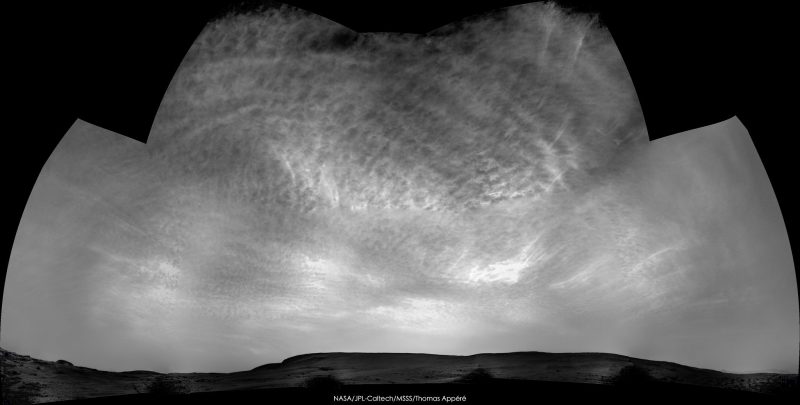
Semicircle view of gray sky with white striped clouds, with low hills on horizon.

A stunning view of cirrus-like clouds seen by the Curiosity rover on Mars, on sol 2417. This is a cloudy day for Mars! Image via NASA/JPL-Caltech/MSSS/Thomas Appéré.

Mars’ atmosphere is very thin, but – much like Earth – Mars does have clouds, silently gracing the pinkish-colored skies. But how do they form? A new study from the University of Colorado Boulder (CU Boulder) has found that meteors play a big role in cloud-formation on Mars. This new insight by scientists was published on June 17, 2019, in the peer-reviewed journal Nature Geoscience.

The wispy clouds in Mars’ middle atmosphere, at about 18 miles (29 km) altitude and similar to cirrus clouds on Earth, are formed at least partially from what is called “meteoric smoke,” icy dust created by space debris slamming into the planet’s atmosphere, as also happens on Earth. According to Victoria Hartwick, a graduate student at CU Boulder:

We’re used to thinking of Earth, Mars and other bodies as these really self-contained planets that determine their own climates. But climate isn’t independent of the surrounding solar system.

Just as on Earth, clouds can’t just form spontaneously out of nowhere. They need some kind of “seeds” to start, particles around which water molecules can condense. On Earth – because we have a denser atmosphere – those particles might include grains of sea salt or dust, carried upward by winds. As earthly water molecules condense around these particles, the cloud formations can grow larger and larger. As Hartwick noted:

Clouds don’t just form on their own. They need something that they can condense onto.

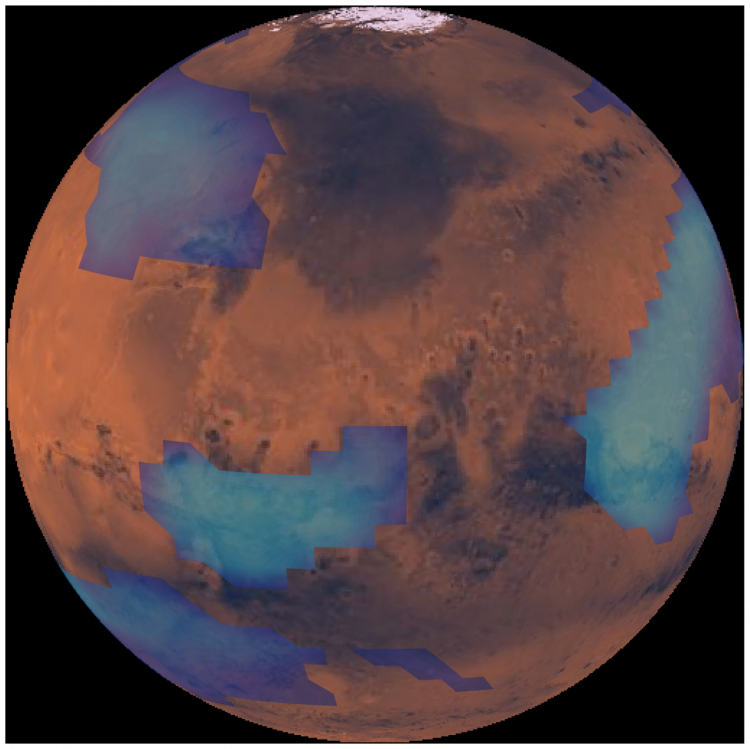
Dark orange planet with scattered large blue patches.

Computer simulation of middle altitude noctilucent clouds on Mars. Image via Victoria Hartwick.

On Mars, however – with its vastly thinner atmosphere – there is a lack of those kinds of particles in the middle atmosphere. So how do the clouds form? That’s where meteors come in. When small meteors hit Mars’ atmosphere, they burn up, just as they do in Earth’s atmosphere. As a result, a lot of fine dust is created – the “meteoric smoke” – the particles of which can serve as the needed seeds for clouds to form. Hartwick’s team used computer simulations to test this hypothesis, and indeed, clouds did form after such meteor strikes. According to Hartwick:

Our model couldn’t form clouds at these altitudes before. But now, they’re all there, and they seem to be in all the right places.

The study shows that interplanetary dust can create Martian clouds, but there is still a limit on what kinds of clouds, due to the extreme thinness of Mars’ atmosphere. Pretty much all Martian clouds are wispy and cotton candy-like, very similar to cirrus clouds on Earth. You don’t see the big, puffy clouds that you would lie on the grass and gaze up at as a kid on Earth. Nevertheless, clouds on Mars can affect the Martian environment, according to Hartwick:

But just because they’re thin and you can’t really see them doesn’t mean they can’t have an effect on the dynamics of the climate.

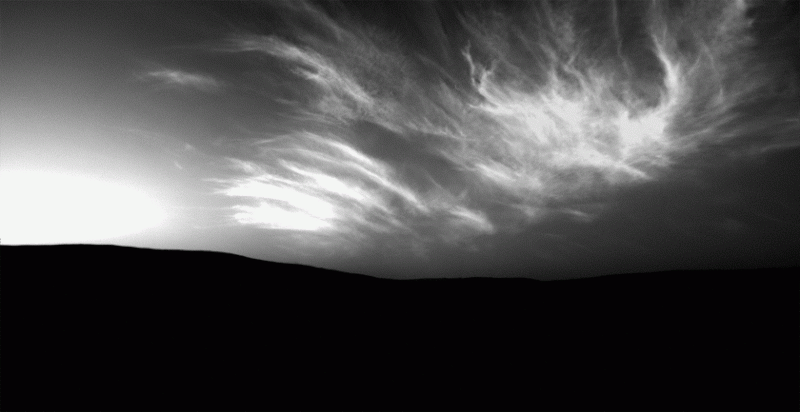
Feathery clouds on Mars in white on gray.

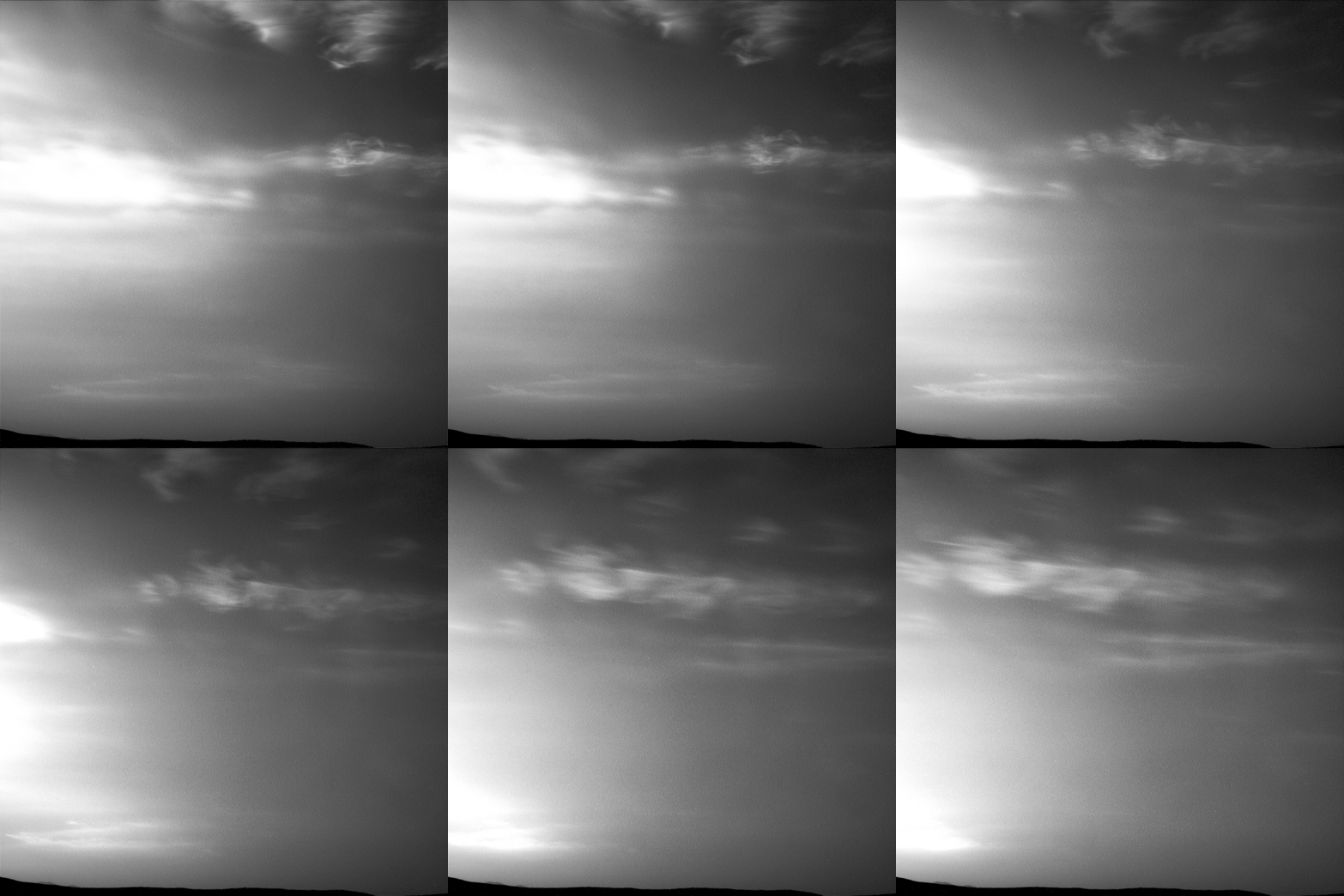
Noctilucent clouds in Mars’ sky, seen by the Curiosity rover. Curiosity captured these clouds on Sol 2410 (May 18, 2019). The clouds are sunlit although the sun has set; they’re noctilucent clouds or night-shining clouds. Image via NASA/JPL-Caltech/Justin Cowart/The Planetary Society.

Short animated photo of fuzzy white clouds passing through dark gray sky.

Noctilucent clouds in motion, Curiosity, Sol 2405. Curiosity looked upward after sunset on Sol 2405 (May 13, 2019) and saw wispy cirrus clouds in motion, high above the ground. Because of their high elevation, the clouds are still sunlit, making them noctilucent (night-shining) clouds. Image via NASA/JPL-Caltech/Justin Cowart/The Planetary Society.

The research team found that the clouds could cause temperatures at those altitudes to increase or decrease by as much as 18 degrees Fahrenheit (10 degrees Celsius). These kinds of observations can also provide clues about the evolution of the Martian atmosphere and how it changed from being able to support liquid water on Mars’ surface to the thin, cold atmosphere we see today. As noted by Brian Toon, a professor at CU Boulder:

More and more climate models are finding that the ancient climate of Mars, when rivers were flowing across its surface and life might have originated, was warmed by high altitude clouds. It is likely that this discovery will become a major part of that idea for warming Mars.

Earth also has clouds formed from meteoric dust, called noctilucent clouds. They are the highest clouds in the atmosphere, at about 50 miles (80 km) altitude. They can be seen after the sun has set, but are still reflecting sunlight, giving them a bright blue glow. The month of June marks the start of noctilucent cloud season on Earth, and this June, in particular, has been a great month for seeing them.

View recent photos: Amazing June for noctilucent clouds

Visit Noctilucent Clouds Around the World, on Facebook

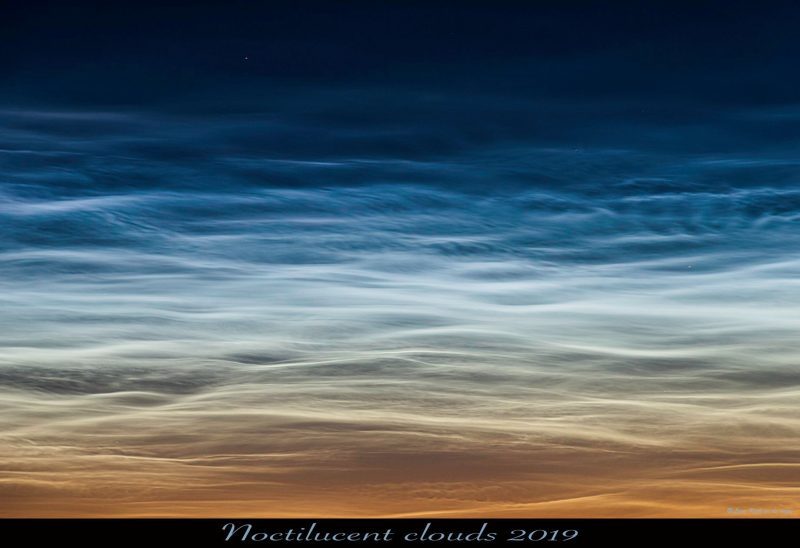
High, wavelike, glowing white clouds against deepening twilight sky.

An example of noctilucent clouds on Earth. Leon KijkindeVegte in the Netherlands caught this photo on the night of June 12, 2019. He posted it at the great Facebook page Noctilucent Clouds Around The World.

Martian clouds have been observed ever since the first telescopes were aimed at the planet. Some are composed of water vapor/ice while others are carbon dioxide ice. They can often be seen hanging around the summit of Olympus Mons, the largest volcano in the solar system, and elsewhere on Mars. They have been photographed by orbiting spacecraft as well as landers and rovers on the surface. Some beautiful new images were just taken recently by the Curiosity rover in Gale Crater, showing one of the best displays ever seen so far, almost giving the skies an Earth-like overcast look.

These clouds are too tenuous, and the atmosphere too thin, for rain to ever occur, but the Phoenix lander did observe snow falling from high above its location near the north pole in 2008. Fog is also common on Mars, often filling valleys and craters, and frost has also been observed on the ground, condensing from the thin air at night. This is all part of a water cycle on Mars that in many ways mimics that of Earth, despite the minuscule atmosphere and lack of surface water.

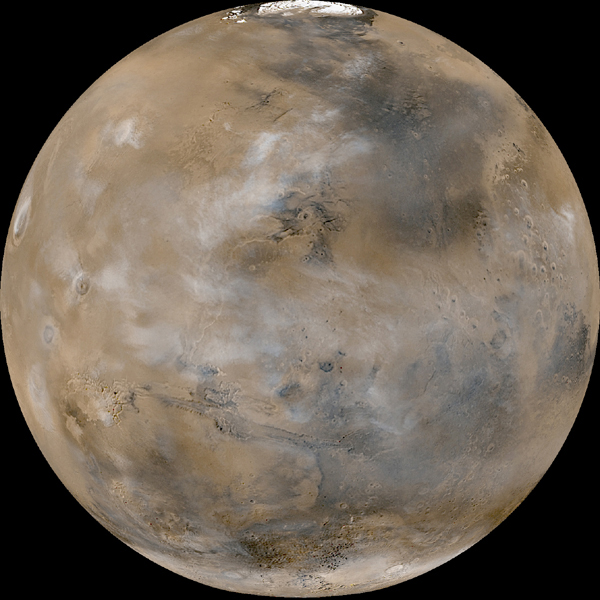
Tan planet with darker markings and patches of white clouds seen from orbit.

Patchy clouds on Mars, as seen by the Mars Reconnaissance Orbiter, using the MARCI camera. Image via NASA/JPL/Malin Space Science Systems.

Bottom line: New research shows that clouds on Mars are formed largely from icy dust left behind by small meteors hitting the atmosphere.

Source: High-altitude water ice cloud formation on Mars controlled by interplanetary dust particles

Via CU Boulder Today


from EarthSky https://ift.tt/2FEOQfG
Semicircle view of gray sky with white striped clouds, with low hills on horizon.

A stunning view of cirrus-like clouds seen by the Curiosity rover on Mars, on sol 2417. This is a cloudy day for Mars! Image via NASA/JPL-Caltech/MSSS/Thomas Appéré.

Mars’ atmosphere is very thin, but – much like Earth – Mars does have clouds, silently gracing the pinkish-colored skies. But how do they form? A new study from the University of Colorado Boulder (CU Boulder) has found that meteors play a big role in cloud-formation on Mars. This new insight by scientists was published on June 17, 2019, in the peer-reviewed journal Nature Geoscience.

The wispy clouds in Mars’ middle atmosphere, at about 18 miles (29 km) altitude and similar to cirrus clouds on Earth, are formed at least partially from what is called “meteoric smoke,” icy dust created by space debris slamming into the planet’s atmosphere, as also happens on Earth. According to Victoria Hartwick, a graduate student at CU Boulder:

We’re used to thinking of Earth, Mars and other bodies as these really self-contained planets that determine their own climates. But climate isn’t independent of the surrounding solar system.

Just as on Earth, clouds can’t just form spontaneously out of nowhere. They need some kind of “seeds” to start, particles around which water molecules can condense. On Earth – because we have a denser atmosphere – those particles might include grains of sea salt or dust, carried upward by winds. As earthly water molecules condense around these particles, the cloud formations can grow larger and larger. As Hartwick noted:

Clouds don’t just form on their own. They need something that they can condense onto.

Dark orange planet with scattered large blue patches.

Computer simulation of middle altitude noctilucent clouds on Mars. Image via Victoria Hartwick.

On Mars, however – with its vastly thinner atmosphere – there is a lack of those kinds of particles in the middle atmosphere. So how do the clouds form? That’s where meteors come in. When small meteors hit Mars’ atmosphere, they burn up, just as they do in Earth’s atmosphere. As a result, a lot of fine dust is created – the “meteoric smoke” – the particles of which can serve as the needed seeds for clouds to form. Hartwick’s team used computer simulations to test this hypothesis, and indeed, clouds did form after such meteor strikes. According to Hartwick:

Our model couldn’t form clouds at these altitudes before. But now, they’re all there, and they seem to be in all the right places.

The study shows that interplanetary dust can create Martian clouds, but there is still a limit on what kinds of clouds, due to the extreme thinness of Mars’ atmosphere. Pretty much all Martian clouds are wispy and cotton candy-like, very similar to cirrus clouds on Earth. You don’t see the big, puffy clouds that you would lie on the grass and gaze up at as a kid on Earth. Nevertheless, clouds on Mars can affect the Martian environment, according to Hartwick:

But just because they’re thin and you can’t really see them doesn’t mean they can’t have an effect on the dynamics of the climate.

Feathery clouds on Mars in white on gray.

Noctilucent clouds in Mars’ sky, seen by the Curiosity rover. Curiosity captured these clouds on Sol 2410 (May 18, 2019). The clouds are sunlit although the sun has set; they’re noctilucent clouds or night-shining clouds. Image via NASA/JPL-Caltech/Justin Cowart/The Planetary Society.

Short animated photo of fuzzy white clouds passing through dark gray sky.

Noctilucent clouds in motion, Curiosity, Sol 2405. Curiosity looked upward after sunset on Sol 2405 (May 13, 2019) and saw wispy cirrus clouds in motion, high above the ground. Because of their high elevation, the clouds are still sunlit, making them noctilucent (night-shining) clouds. Image via NASA/JPL-Caltech/Justin Cowart/The Planetary Society.

The research team found that the clouds could cause temperatures at those altitudes to increase or decrease by as much as 18 degrees Fahrenheit (10 degrees Celsius). These kinds of observations can also provide clues about the evolution of the Martian atmosphere and how it changed from being able to support liquid water on Mars’ surface to the thin, cold atmosphere we see today. As noted by Brian Toon, a professor at CU Boulder:

More and more climate models are finding that the ancient climate of Mars, when rivers were flowing across its surface and life might have originated, was warmed by high altitude clouds. It is likely that this discovery will become a major part of that idea for warming Mars.

Earth also has clouds formed from meteoric dust, called noctilucent clouds. They are the highest clouds in the atmosphere, at about 50 miles (80 km) altitude. They can be seen after the sun has set, but are still reflecting sunlight, giving them a bright blue glow. The month of June marks the start of noctilucent cloud season on Earth, and this June, in particular, has been a great month for seeing them.

View recent photos: Amazing June for noctilucent clouds

Visit Noctilucent Clouds Around the World, on Facebook

High, wavelike, glowing white clouds against deepening twilight sky.

An example of noctilucent clouds on Earth. Leon KijkindeVegte in the Netherlands caught this photo on the night of June 12, 2019. He posted it at the great Facebook page Noctilucent Clouds Around The World.

Martian clouds have been observed ever since the first telescopes were aimed at the planet. Some are composed of water vapor/ice while others are carbon dioxide ice. They can often be seen hanging around the summit of Olympus Mons, the largest volcano in the solar system, and elsewhere on Mars. They have been photographed by orbiting spacecraft as well as landers and rovers on the surface. Some beautiful new images were just taken recently by the Curiosity rover in Gale Crater, showing one of the best displays ever seen so far, almost giving the skies an Earth-like overcast look.

These clouds are too tenuous, and the atmosphere too thin, for rain to ever occur, but the Phoenix lander did observe snow falling from high above its location near the north pole in 2008. Fog is also common on Mars, often filling valleys and craters, and frost has also been observed on the ground, condensing from the thin air at night. This is all part of a water cycle on Mars that in many ways mimics that of Earth, despite the minuscule atmosphere and lack of surface water.

Tan planet with darker markings and patches of white clouds seen from orbit.

Patchy clouds on Mars, as seen by the Mars Reconnaissance Orbiter, using the MARCI camera. Image via NASA/JPL/Malin Space Science Systems.

Bottom line: New research shows that clouds on Mars are formed largely from icy dust left behind by small meteors hitting the atmosphere.

Source: High-altitude water ice cloud formation on Mars controlled by interplanetary dust particles

Via CU Boulder Today


from EarthSky https://ift.tt/2FEOQfG

See super-detailed images of Saturn’s rings

Smooth gray stripes of various widths running lower left to upper right.

New images of Saturn’s rings show how adjacent rings, even those in very close proximity, may have different textures. Note the straw-like textures and clumps. Image via NASA/JPL-Caltech/Space Science Institute.

The wonderful Cassini mission to Saturn – which ended in 2017 – just keeps on giving. This month (June 13, 2019), scientists released new, incredibly detailed images of Saturn’s rings, captured as Cassini was just above the planet’s cloudtops at the end of its mission, prior to its dramatic plunge into the clouds and depths of Saturn. Cassini scientists said these images give them an even more intimate view of the rings than before. They said each examination reveals new complexities. Cassini Project Scientist Linda Spilker, of NASA’s Jet Propulsion Laboratory, said:

It’s like turning the power up one more notch on what we could see in the rings. Everyone just got a clearer view of what’s going on. Getting that extra resolution answered many questions, but so many tantalizing ones remain.

Thin gray and brown horizontal stripes with one wavy band.

A false-color image mosaic shows Daphnis, one of Saturn’s ring-embedded moons, and the waves it kicks up. Read more about this image. Image via NASA/JPL-Caltech/Space Science Institute.

A new paper published on June 13 in the peer-reviewed journal Science describes results from four Cassini instruments’ closest-ever observations of the main rings.

Findings include fine details of features sculpted by masses embedded within the rings. Textures and patterns, from clumpy to straw-like, pop out of the images, raising questions about the interactions that shaped them. New maps reveal how colors, chemistry and temperature change across the rings.

Read more about the study.

According to the research, tiny moons embedded in Saturn’s rings (named A through G, in order of their discovery) interact with the particles around them. Cassini scientist Matt Tiscareno of the SETI Institute, is the study lead author. Tiscareno said in a statement:

These new details of how the moons are sculpting the rings in various ways provide a window into solar system formation, where you also have disks evolving under the influence of masses embedded within them.

The close-up ring images brought into focus three distinct textures – clumpy, smooth and streaky – and made it clear that these textures occur in belts with sharp boundaries. But why? In many places the belts aren’t connected to any ring characteristics that scientists have yet identified. Tiscareno said:

This tells us the way the rings look is not just a function of how much material there is. There has to be something different about the characteristics of the particles, perhaps affecting what happens when two ring particles collide and bounce off each other. And we don’t yet know what it is.

Ball with rings around it. At right, a closeup of a section of the rings.

This false-color image to the right shows an infrared spectral map of Saturn’s A, B and C rings. The new spectral map also sheds light on the composition of the rings. While scientists already knew that water ice is the main component, the spectral map ruled out detectable ammonia ice and methane ice as ingredients. But it also doesn’t see organic compounds – a surprise, given the organic material Cassini has discovered flowing from the D ring into Saturn’s atmosphere. More about this image. Image via NASA/JPL.

The data analyzed were gathered during the Cassini spacecraft’s Ring Grazing Orbits (December 2016 to April 2017) and the Grand Finale (April to September 2017). As the spacecraft was running out of fuel, the mission team deliberately plunged it into the planet’s atmosphere in September 2017.

Bottom line: Detailed images of Saturn’s rings from the Cassini spacecraft.

Source: Close-range remote sensing of Saturn’s rings during Cassini’s ring-grazing orbits and Grand Finale

Via NASA


from EarthSky https://ift.tt/2YfdWJo
Smooth gray stripes of various widths running lower left to upper right.

New images of Saturn’s rings show how adjacent rings, even those in very close proximity, may have different textures. Note the straw-like textures and clumps. Image via NASA/JPL-Caltech/Space Science Institute.

The wonderful Cassini mission to Saturn – which ended in 2017 – just keeps on giving. This month (June 13, 2019), scientists released new, incredibly detailed images of Saturn’s rings, captured as Cassini was just above the planet’s cloudtops at the end of its mission, prior to its dramatic plunge into the clouds and depths of Saturn. Cassini scientists said these images give them an even more intimate view of the rings than before. They said each examination reveals new complexities. Cassini Project Scientist Linda Spilker, of NASA’s Jet Propulsion Laboratory, said:

It’s like turning the power up one more notch on what we could see in the rings. Everyone just got a clearer view of what’s going on. Getting that extra resolution answered many questions, but so many tantalizing ones remain.

Thin gray and brown horizontal stripes with one wavy band.

A false-color image mosaic shows Daphnis, one of Saturn’s ring-embedded moons, and the waves it kicks up. Read more about this image. Image via NASA/JPL-Caltech/Space Science Institute.

A new paper published on June 13 in the peer-reviewed journal Science describes results from four Cassini instruments’ closest-ever observations of the main rings.

Findings include fine details of features sculpted by masses embedded within the rings. Textures and patterns, from clumpy to straw-like, pop out of the images, raising questions about the interactions that shaped them. New maps reveal how colors, chemistry and temperature change across the rings.

Read more about the study.

According to the research, tiny moons embedded in Saturn’s rings (named A through G, in order of their discovery) interact with the particles around them. Cassini scientist Matt Tiscareno of the SETI Institute, is the study lead author. Tiscareno said in a statement:

These new details of how the moons are sculpting the rings in various ways provide a window into solar system formation, where you also have disks evolving under the influence of masses embedded within them.

The close-up ring images brought into focus three distinct textures – clumpy, smooth and streaky – and made it clear that these textures occur in belts with sharp boundaries. But why? In many places the belts aren’t connected to any ring characteristics that scientists have yet identified. Tiscareno said:

This tells us the way the rings look is not just a function of how much material there is. There has to be something different about the characteristics of the particles, perhaps affecting what happens when two ring particles collide and bounce off each other. And we don’t yet know what it is.

Ball with rings around it. At right, a closeup of a section of the rings.

This false-color image to the right shows an infrared spectral map of Saturn’s A, B and C rings. The new spectral map also sheds light on the composition of the rings. While scientists already knew that water ice is the main component, the spectral map ruled out detectable ammonia ice and methane ice as ingredients. But it also doesn’t see organic compounds – a surprise, given the organic material Cassini has discovered flowing from the D ring into Saturn’s atmosphere. More about this image. Image via NASA/JPL.

The data analyzed were gathered during the Cassini spacecraft’s Ring Grazing Orbits (December 2016 to April 2017) and the Grand Finale (April to September 2017). As the spacecraft was running out of fuel, the mission team deliberately plunged it into the planet’s atmosphere in September 2017.

Bottom line: Detailed images of Saturn’s rings from the Cassini spacecraft.

Source: Close-range remote sensing of Saturn’s rings during Cassini’s ring-grazing orbits and Grand Finale

Via NASA


from EarthSky https://ift.tt/2YfdWJo

See moon and stars of Taurus before sunrise

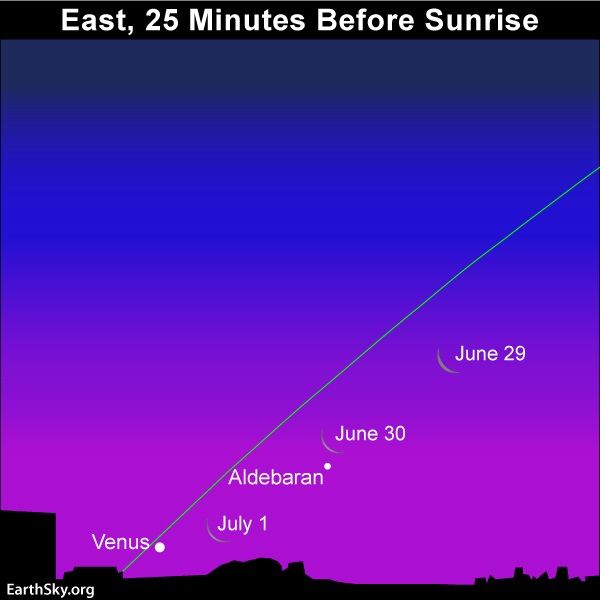
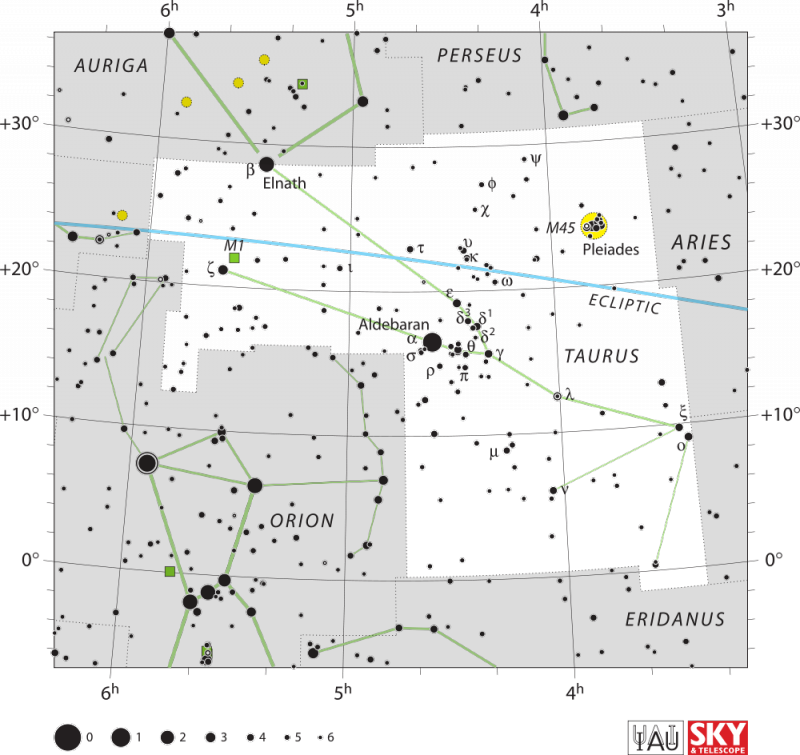
The moon is soon to swing by the Pleiades star cluster and star Aldebaran, which rank as the two most prominent signposts in the constellation Taurus the Bull. The moon swings to the south of the Pleiades cluster on June 29, 2019, and then to the north of Aldebaran on June 30, 2019. Finally, the moon will meet up with the planet Venus in the glow of morning dawn on or near July 1, 2019.

Here’s the tricky part of this observation. You probably won’t see all of the aforementioned objects at the same time. By the time that Venus rises into your sky, chances are the Pleiades star cluster and Aldebaran will have faded from sight in the glare of morning twilight. Venus, like the moon, also shines in front of the constellation Taurus in late June and early July 2019.

However, the moon will move out of the constellation Taurus and into the constellation Gemini on or near July 2. Then, Venus too will move out of of Taurus and into Gemini, on or near July 4.

The chart below shows the moon’s movement in late June and early July with respect to Venus. Will you see the star Aldebaran in the morning twilight, at the same time as Venus? Maybe. Venus is much, much brighter. Both Aldebaran and Venus will be near the sunrise, so you’ll need an unobstructed horizon to see them. Binoculars might help, too!

Star chart with positions of very thin crescent moon on succeeding days.

It’ll be a big challenge to catch the star Aldebaran and the planet Venus before sunrise in late June and early July 2019.

The Pleiades star cluster – a tiny, misty dipper in a dark-enough sky – is fainter still. You’ll probably need to be up before dawn’s first light, to see the Pleiades with the eye alone. Astronomers have a special name for dawn’s first light; it’s the same name they use for the last traces of evening twilight. They call it astronomical twilight. Want to know when astronomical twilight arrives in your sky? Click here and check the astronomical twilight box.

Want to know when the moon rises into your sky? Click here and check the moonrise and moonset box.

To find out the rising time of Aldebaran, click here and choose Aldebaran as your celestial object of interest.

We in the Northern Hemisphere tend to associate the constellation Taurus with the winter season because that’s when this constellation comes at nightfall and beautifies our winter nights. If you live in the Southern Hemisphere, then the constellation Taurus lights up your summer evenings.

Chart of constellation Taurus with Pleiades and Aldebaran labeled.

The sun passes in front of the constellation Taurus each year from about May 14 to June 21, at which time this constellation is lost in the sun’s glare. Taurus is just beginning to make its return to the morning sky in late June and early July.

Despite the hot weather in the Northern Hemisphere at present, the first inklings of winter season – the constellation Taurus – can now be seen before sunrise. (Or if you live in the Southern Hemisphere, Taurus’ initial morning appearance signals the inevitable coming of summer.) Because the stars rise some four minutes earlier daily, or 1/2 hour earlier weekly or two hours earlier monthly, the constellation Taurus the Bull’s presence in the morning sky will become more prominent with each passing month.

By the middle of November, the Pleiades cluster will be out all night long; and by around December 1, the star Aldebaran will put on its all-night appearance. The all-night appearances of the Pleiades cluster and then the star Aldebaran some two weeks later signal that late autumn is soon to give way to winter in the Northern Hemisphere.

Bottom line: On these late June and early July mornings, let the waning crescent moon serve as your guide to the constellation Taurus’ two major signposts: the Pleiades star cluster and the red giant star, Aldebaran. Wait just before sunrise, and you’ll see Venus rise over your eastern horizon, too.


from EarthSky https://ift.tt/2IVlwnn

The moon is soon to swing by the Pleiades star cluster and star Aldebaran, which rank as the two most prominent signposts in the constellation Taurus the Bull. The moon swings to the south of the Pleiades cluster on June 29, 2019, and then to the north of Aldebaran on June 30, 2019. Finally, the moon will meet up with the planet Venus in the glow of morning dawn on or near July 1, 2019.

Here’s the tricky part of this observation. You probably won’t see all of the aforementioned objects at the same time. By the time that Venus rises into your sky, chances are the Pleiades star cluster and Aldebaran will have faded from sight in the glare of morning twilight. Venus, like the moon, also shines in front of the constellation Taurus in late June and early July 2019.

However, the moon will move out of the constellation Taurus and into the constellation Gemini on or near July 2. Then, Venus too will move out of of Taurus and into Gemini, on or near July 4.

The chart below shows the moon’s movement in late June and early July with respect to Venus. Will you see the star Aldebaran in the morning twilight, at the same time as Venus? Maybe. Venus is much, much brighter. Both Aldebaran and Venus will be near the sunrise, so you’ll need an unobstructed horizon to see them. Binoculars might help, too!

Star chart with positions of very thin crescent moon on succeeding days.

It’ll be a big challenge to catch the star Aldebaran and the planet Venus before sunrise in late June and early July 2019.

The Pleiades star cluster – a tiny, misty dipper in a dark-enough sky – is fainter still. You’ll probably need to be up before dawn’s first light, to see the Pleiades with the eye alone. Astronomers have a special name for dawn’s first light; it’s the same name they use for the last traces of evening twilight. They call it astronomical twilight. Want to know when astronomical twilight arrives in your sky? Click here and check the astronomical twilight box.

Want to know when the moon rises into your sky? Click here and check the moonrise and moonset box.

To find out the rising time of Aldebaran, click here and choose Aldebaran as your celestial object of interest.

We in the Northern Hemisphere tend to associate the constellation Taurus with the winter season because that’s when this constellation comes at nightfall and beautifies our winter nights. If you live in the Southern Hemisphere, then the constellation Taurus lights up your summer evenings.

Chart of constellation Taurus with Pleiades and Aldebaran labeled.

The sun passes in front of the constellation Taurus each year from about May 14 to June 21, at which time this constellation is lost in the sun’s glare. Taurus is just beginning to make its return to the morning sky in late June and early July.

Despite the hot weather in the Northern Hemisphere at present, the first inklings of winter season – the constellation Taurus – can now be seen before sunrise. (Or if you live in the Southern Hemisphere, Taurus’ initial morning appearance signals the inevitable coming of summer.) Because the stars rise some four minutes earlier daily, or 1/2 hour earlier weekly or two hours earlier monthly, the constellation Taurus the Bull’s presence in the morning sky will become more prominent with each passing month.

By the middle of November, the Pleiades cluster will be out all night long; and by around December 1, the star Aldebaran will put on its all-night appearance. The all-night appearances of the Pleiades cluster and then the star Aldebaran some two weeks later signal that late autumn is soon to give way to winter in the Northern Hemisphere.

Bottom line: On these late June and early July mornings, let the waning crescent moon serve as your guide to the constellation Taurus’ two major signposts: the Pleiades star cluster and the red giant star, Aldebaran. Wait just before sunrise, and you’ll see Venus rise over your eastern horizon, too.


from EarthSky https://ift.tt/2IVlwnn

US revamps volcano early warning system

Dark brown volcanic crater with sides slumping in, and roads beside it.

Aerial view of the Halema’uma’u crater within Hawaii’s Kilauea volcano taken from a helicopter on June 18, 2018. Image via U.S. Geological Survey.

There are 161 active volcanoes in the United States, distributed within 12 states and two territories, and more than 1/3 of these have been classified as posing a very high or high threat to nearby communities. To ensure that communities are given adequate warnings in the event of an impending eruption, a new law was enacted on March 12, 2019. This new law Public Law No. 116-9 – aims to improve volcano monitoring at potentially dangerous volcanoes.

Historically, the United States has experienced several damaging volcanic eruptions. In 1980, for example, the eruption at Mount St. Helens in Washington caused 57 deaths and 1.1 billion dollars in damage. More recently, in 2018, a slow eruption at K?lauea in Hawaii destroyed hundreds of homes that were in the path of the lava flow.

Volcanoes are somewhat unique among destructive natural hazards such as earthquakes and tornadoes in that scientists can often make accurate predictions of an eruption well in advance of the event. Thus, evacuations and other protective measures can be taken to minimize the damage. However, such predictions are only possible if monitoring technology is installed at a volcano.

David Applegate, associate director for natural hazards at the U.S. Geological Survey, commented on the new law as it was being proposed to lawmakers during a hearing in 2017. He said:

Unlike many other natural disasters…volcanic eruptions can be predicted well in advance of their occurrence if adequate in-ground instrumentation is in place that allows earliest detection of unrest, providing the time needed to mitigate the worst of their effects.

Clearly, volcano monitoring technology can save lives and is a worthwhile investment.

The new legislation that was finally passed and signed into law on March 12, 2019, will boost the nation’s capacity to respond to volcano-related hazards. Specifically, the new law will create (1) a unified National Volcano Early Warning System (NVEWS), (2) a watch office that will be staffed continuously around the clock, and (3) a grant system for funding volcano monitoring research.

The new legislation can be expected to improve the monitoring systems that are already in place at five critical areas, namely, the Alaska Volcano Observatory, Hawaiian Volcano Observatory, Cascades Volcano Observatory, Yellowstone Volcano Observatory, and California Volcano Observatory, through equipment upgrades and other types of activities. The new legislation will also help to expand coverage to potentially dangerous volcanoes where there are no monitoring systems in place.

Map of mountainous landscape with many dots and triangles in different colors.

Seismic monitoring stations used by the Yellowstone Volcano Observatory. Image via University of Utah.

You can access more details about the new initiative in the EOS article published April 23, 2019.

Bottom line: The United State’s volcano monitoring system will be improved following passage of a new law on March 12, 2019. The improvements will include equipment upgrades, an expansion of monitoring sites, and enhanced coordination of volcano monitoring activities.

Donate: Your support means the world to us


from EarthSky https://ift.tt/2FygLOo
Dark brown volcanic crater with sides slumping in, and roads beside it.

Aerial view of the Halema’uma’u crater within Hawaii’s Kilauea volcano taken from a helicopter on June 18, 2018. Image via U.S. Geological Survey.

There are 161 active volcanoes in the United States, distributed within 12 states and two territories, and more than 1/3 of these have been classified as posing a very high or high threat to nearby communities. To ensure that communities are given adequate warnings in the event of an impending eruption, a new law was enacted on March 12, 2019. This new law Public Law No. 116-9 – aims to improve volcano monitoring at potentially dangerous volcanoes.

Historically, the United States has experienced several damaging volcanic eruptions. In 1980, for example, the eruption at Mount St. Helens in Washington caused 57 deaths and 1.1 billion dollars in damage. More recently, in 2018, a slow eruption at K?lauea in Hawaii destroyed hundreds of homes that were in the path of the lava flow.

Volcanoes are somewhat unique among destructive natural hazards such as earthquakes and tornadoes in that scientists can often make accurate predictions of an eruption well in advance of the event. Thus, evacuations and other protective measures can be taken to minimize the damage. However, such predictions are only possible if monitoring technology is installed at a volcano.

David Applegate, associate director for natural hazards at the U.S. Geological Survey, commented on the new law as it was being proposed to lawmakers during a hearing in 2017. He said:

Unlike many other natural disasters…volcanic eruptions can be predicted well in advance of their occurrence if adequate in-ground instrumentation is in place that allows earliest detection of unrest, providing the time needed to mitigate the worst of their effects.

Clearly, volcano monitoring technology can save lives and is a worthwhile investment.

The new legislation that was finally passed and signed into law on March 12, 2019, will boost the nation’s capacity to respond to volcano-related hazards. Specifically, the new law will create (1) a unified National Volcano Early Warning System (NVEWS), (2) a watch office that will be staffed continuously around the clock, and (3) a grant system for funding volcano monitoring research.

The new legislation can be expected to improve the monitoring systems that are already in place at five critical areas, namely, the Alaska Volcano Observatory, Hawaiian Volcano Observatory, Cascades Volcano Observatory, Yellowstone Volcano Observatory, and California Volcano Observatory, through equipment upgrades and other types of activities. The new legislation will also help to expand coverage to potentially dangerous volcanoes where there are no monitoring systems in place.

Map of mountainous landscape with many dots and triangles in different colors.

Seismic monitoring stations used by the Yellowstone Volcano Observatory. Image via University of Utah.

You can access more details about the new initiative in the EOS article published April 23, 2019.

Bottom line: The United State’s volcano monitoring system will be improved following passage of a new law on March 12, 2019. The improvements will include equipment upgrades, an expansion of monitoring sites, and enhanced coordination of volcano monitoring activities.

Donate: Your support means the world to us


from EarthSky https://ift.tt/2FygLOo

Asteroid Day 2019 is June 30

Space scene with many floating rocks illuminated with sunlight.

Image via Debbie Lewis.

The fifth annual International Asteroid Day happens this Sunday, June 30, 2019. Recognized by the United Nations, Asteroid Day marks a global opportunity to raise awareness of the threat and opportunity posed by the numerous rocky bodies zooming through space.

This year, Asteroid Day events will focus on the role of asteroids in the formation of our solar system and advances in technology to better detect, track and analyze asteroids and review our ability to deflect a rogue asteroid headed towards Earth.

Asteroid Day events range from asteroid quizzes in a Dublin bar, to high-level discussions of policy and programs at the National Air and Space Museum in Washington, D.C. There’s a list of events all around the world here. To find an Asteroid Day event near you, scroll down to the middle of the page and enter your location.

A new program of Asteroid Day 2019 is Asteroid Day TV. The five-day broadcast – on asteroids and space topics – begins June 27 at 10:00 UTC (translate UTC to your time). There’s a program schedule, plus how to watch, wherever you are, here.

Find out more and keep up with the action by visiting the Asteroid Day website, Youtube channel or Twitter.

Bunch of children and teens in logo t-shirts looking up in a tall well-lit room.

Image via Asteroid Day.

Central to Asteroid Day this year is what’s called the 100x Declaration, calling for a 100-fold increase in the detection and monitoring of asteroids. Signed to date by more than 50,000 people around the world, the Declaration resolves to “solve humanity’s greatest challenges to safeguard our families and quality of life on Earth in the future.” If you want to sign, the Declaration is available online here.

Bright white smoke trail above bare trees in snowy landscape.

Early in the morning on February 15, 2013, a small, previously unknown asteroid entered Earth’s atmosphere at 37,280 miles per hour (66,000 km/h) and exploded high above Chelyabinsk, Russia, with 20–30 times the energy of the Hiroshima atomic bomb. Photo via Alex Alishevskikh/Flickr.

Asteroid Day is held on the anniversary of the most devastating asteroid impact in Earth’s recent history – an event that took place on June 30, 1908, known as the Tunguska explosion, when a small asteroid struck the Earth over Tunguska, Siberia. Here’s the premise of Asteroid Day, in the words of co-founder Brian May, astrophysicist, guitarist and songwriter for the band Queen:

Our goal is to dedicate one day each year to learn about asteroids, the origins of our universe, and to support the resources necessary to see, track and deflect dangerous asteroids from Earth’s orbital path. Asteroids are a natural disaster we know how to prevent.


The story of Asteroid Day
.

For asteroid news and updates, follow AsteroidWatch on Twitter.

Bottom line: International Asteroid Day 2019 happens on Sunday, June 30.


from EarthSky https://ift.tt/2KDhe65
Space scene with many floating rocks illuminated with sunlight.

Image via Debbie Lewis.

The fifth annual International Asteroid Day happens this Sunday, June 30, 2019. Recognized by the United Nations, Asteroid Day marks a global opportunity to raise awareness of the threat and opportunity posed by the numerous rocky bodies zooming through space.

This year, Asteroid Day events will focus on the role of asteroids in the formation of our solar system and advances in technology to better detect, track and analyze asteroids and review our ability to deflect a rogue asteroid headed towards Earth.

Asteroid Day events range from asteroid quizzes in a Dublin bar, to high-level discussions of policy and programs at the National Air and Space Museum in Washington, D.C. There’s a list of events all around the world here. To find an Asteroid Day event near you, scroll down to the middle of the page and enter your location.

A new program of Asteroid Day 2019 is Asteroid Day TV. The five-day broadcast – on asteroids and space topics – begins June 27 at 10:00 UTC (translate UTC to your time). There’s a program schedule, plus how to watch, wherever you are, here.

Find out more and keep up with the action by visiting the Asteroid Day website, Youtube channel or Twitter.

Bunch of children and teens in logo t-shirts looking up in a tall well-lit room.

Image via Asteroid Day.

Central to Asteroid Day this year is what’s called the 100x Declaration, calling for a 100-fold increase in the detection and monitoring of asteroids. Signed to date by more than 50,000 people around the world, the Declaration resolves to “solve humanity’s greatest challenges to safeguard our families and quality of life on Earth in the future.” If you want to sign, the Declaration is available online here.

Bright white smoke trail above bare trees in snowy landscape.

Early in the morning on February 15, 2013, a small, previously unknown asteroid entered Earth’s atmosphere at 37,280 miles per hour (66,000 km/h) and exploded high above Chelyabinsk, Russia, with 20–30 times the energy of the Hiroshima atomic bomb. Photo via Alex Alishevskikh/Flickr.

Asteroid Day is held on the anniversary of the most devastating asteroid impact in Earth’s recent history – an event that took place on June 30, 1908, known as the Tunguska explosion, when a small asteroid struck the Earth over Tunguska, Siberia. Here’s the premise of Asteroid Day, in the words of co-founder Brian May, astrophysicist, guitarist and songwriter for the band Queen:

Our goal is to dedicate one day each year to learn about asteroids, the origins of our universe, and to support the resources necessary to see, track and deflect dangerous asteroids from Earth’s orbital path. Asteroids are a natural disaster we know how to prevent.


The story of Asteroid Day
.

For asteroid news and updates, follow AsteroidWatch on Twitter.

Bottom line: International Asteroid Day 2019 happens on Sunday, June 30.


from EarthSky https://ift.tt/2KDhe65

Moonlit night in Yosemite

Rainbow over a rocky waterfall with star trails in night sky above.

View at EarthSky Community Photos. | Image via Fred Walder.

Fred Walder captured this image on June 17, 2019 in California’s Yosemite National Park. Fred wrote:

In the spring around the nights of the full moon when the snow is melting in the mountains, it is possible to see rainbows at night in the mist of waterfalls in Yosemite National Park. These lunar rainbows, to the camera, look like the ones produced by sunlight during the days that are visible to our eyes.

This image was taken during the June full moon at lower Yosemite Falls. It is a combination of 25x 30-second images to provide the equivalent of 12 and half minutes of exposure to show the stars circling the north pole. The camera lens needed to be wiped dry between shots due to the large amount of mist at the base of the waterfall, so the star trails wiggle a little as this moved the camera a bit … I find it really cool that the light of the full moon can produce this rich color at night.

You can see the euqipment Fred used for the photo, and post-processing details here.

Thank you Fred!


from EarthSky https://ift.tt/2FA5Jbu
Rainbow over a rocky waterfall with star trails in night sky above.

View at EarthSky Community Photos. | Image via Fred Walder.

Fred Walder captured this image on June 17, 2019 in California’s Yosemite National Park. Fred wrote:

In the spring around the nights of the full moon when the snow is melting in the mountains, it is possible to see rainbows at night in the mist of waterfalls in Yosemite National Park. These lunar rainbows, to the camera, look like the ones produced by sunlight during the days that are visible to our eyes.

This image was taken during the June full moon at lower Yosemite Falls. It is a combination of 25x 30-second images to provide the equivalent of 12 and half minutes of exposure to show the stars circling the north pole. The camera lens needed to be wiped dry between shots due to the large amount of mist at the base of the waterfall, so the star trails wiggle a little as this moved the camera a bit … I find it really cool that the light of the full moon can produce this rich color at night.

You can see the euqipment Fred used for the photo, and post-processing details here.

Thank you Fred!


from EarthSky https://ift.tt/2FA5Jbu

adds 2