aads

Latest sunsets follow summer solstice

Image at top: Peter Gipson in Stowmarket, Suffolk, England, June 2018. Submit your image to EarthSky here.

For people living around 40 degrees north latitude, the latest sunset of the year happens on or near June 27. And in the Southern Hemisphere, at 40 degrees south latitude, it’s the year’s latest sunrise that happens around now. That’s in spite of the fact that the Northern Hemisphere’s longest (or Southern Hemisphere’s shortest) day of the year fell on the June 21st solstice.

The year’s latest sunset always comes after the summer solstice, even though the exact date of the latest sunset depends on your latitude. Farther north – at Seattle – the latest sunset happened around June 25. Farther south – at Mexico City or Hawaii – the latest sunset won’t happen until early July.

Want to know your date of latest sunset? Try this custom sunrise/sunset calendar.

Perspective view of dark clouds over bright sunset, long pier running toward horizon.

June sunset – Pere Marquette Beach in Muskegon, Michigan – via Jerry James Photography. Thank you, Jerry!

The latest sunset comes after the summer solstice because the day is more than 24 hours long at this time of the year.

For several weeks, around the June solstice, the day (as measured by successive returns of the midday sun) is nearly 1/4 minute longer than 24 hours. Hence, the midday sun (solar noon) comes later by the clock in late June than it does on the June solstice. Therefore, the sunrise and sunset times also come later by the clock, as the table below helps to explain.

For Denver, Colorado

Date Sunrise Midday (Solar Noon) Sunset Daylight Hours
June 21 5:32 a.m. 1:01 p.m. 8:31 p.m. 14h 59m 14s
June 27 5:33 a.m. 1:03 p.m. 8:32 p.m. 14h 58m 07s

Source: timeanddate.com

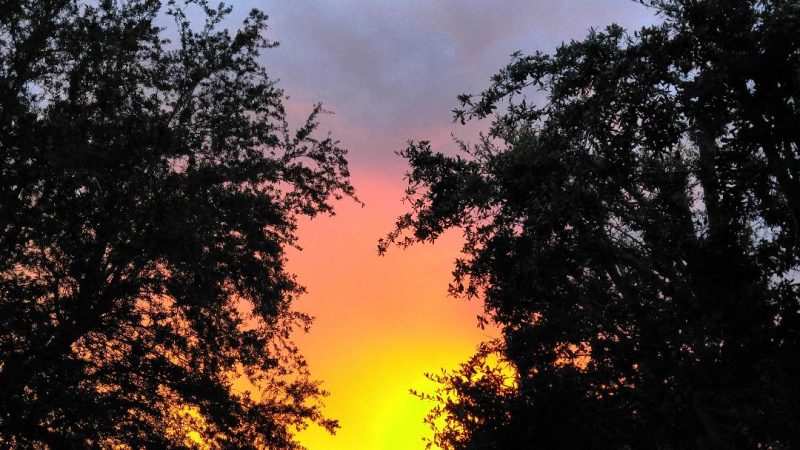
Dark trees each side, colors yellow to orange to lavender to blue in sky.

Juan Argudin in Pembroke Pines, Florida, wrote on June 21, 2018: “We’ve taken dozens of sunset pictures but cannot remember such beautiful sunset colors. This was the first sunset after summer solstice, taken between 2 live oak trees in front of our house. Thank you for your excellent newsletter. We have learned a lot.” Photo by Olga Argudin. Thank you, Juan and Olga!

If the Earth’s axis stood upright as our world circled the sun, and if, in addition, the Earth stayed the same distance from the sun all year long, then clock time and sun time would always agree. However, the Earth’s axis is titled 23.44 degrees out of vertical, and our distance from the sun varies by about 3 million miles (5 million km) throughout the year. At and around the equinoxes, solar days are shorter than 24 hours, yet at the solstices, solar days are longer than 24 hours.

The latest sunset always comes on or near June 27 at mid-northern latitudes every year.

Bottom line: Why don’t the latest sunsets come on the longest day (the solstice)? In a nutshell, it’s a discrepancy between the sun and the clock. Thus, for mid-northern latitudes, the latest sunsets always come in late June.

Enjoying EarthSky so far? Sign up for our free daily newsletter

Donate: Your support means the world to us


from EarthSky https://ift.tt/2KHCZSn

Image at top: Peter Gipson in Stowmarket, Suffolk, England, June 2018. Submit your image to EarthSky here.

For people living around 40 degrees north latitude, the latest sunset of the year happens on or near June 27. And in the Southern Hemisphere, at 40 degrees south latitude, it’s the year’s latest sunrise that happens around now. That’s in spite of the fact that the Northern Hemisphere’s longest (or Southern Hemisphere’s shortest) day of the year fell on the June 21st solstice.

The year’s latest sunset always comes after the summer solstice, even though the exact date of the latest sunset depends on your latitude. Farther north – at Seattle – the latest sunset happened around June 25. Farther south – at Mexico City or Hawaii – the latest sunset won’t happen until early July.

Want to know your date of latest sunset? Try this custom sunrise/sunset calendar.

Perspective view of dark clouds over bright sunset, long pier running toward horizon.

June sunset – Pere Marquette Beach in Muskegon, Michigan – via Jerry James Photography. Thank you, Jerry!

The latest sunset comes after the summer solstice because the day is more than 24 hours long at this time of the year.

For several weeks, around the June solstice, the day (as measured by successive returns of the midday sun) is nearly 1/4 minute longer than 24 hours. Hence, the midday sun (solar noon) comes later by the clock in late June than it does on the June solstice. Therefore, the sunrise and sunset times also come later by the clock, as the table below helps to explain.

For Denver, Colorado

Date Sunrise Midday (Solar Noon) Sunset Daylight Hours
June 21 5:32 a.m. 1:01 p.m. 8:31 p.m. 14h 59m 14s
June 27 5:33 a.m. 1:03 p.m. 8:32 p.m. 14h 58m 07s

Source: timeanddate.com

Dark trees each side, colors yellow to orange to lavender to blue in sky.

Juan Argudin in Pembroke Pines, Florida, wrote on June 21, 2018: “We’ve taken dozens of sunset pictures but cannot remember such beautiful sunset colors. This was the first sunset after summer solstice, taken between 2 live oak trees in front of our house. Thank you for your excellent newsletter. We have learned a lot.” Photo by Olga Argudin. Thank you, Juan and Olga!

If the Earth’s axis stood upright as our world circled the sun, and if, in addition, the Earth stayed the same distance from the sun all year long, then clock time and sun time would always agree. However, the Earth’s axis is titled 23.44 degrees out of vertical, and our distance from the sun varies by about 3 million miles (5 million km) throughout the year. At and around the equinoxes, solar days are shorter than 24 hours, yet at the solstices, solar days are longer than 24 hours.

The latest sunset always comes on or near June 27 at mid-northern latitudes every year.

Bottom line: Why don’t the latest sunsets come on the longest day (the solstice)? In a nutshell, it’s a discrepancy between the sun and the clock. Thus, for mid-northern latitudes, the latest sunsets always come in late June.

Enjoying EarthSky so far? Sign up for our free daily newsletter

Donate: Your support means the world to us


from EarthSky https://ift.tt/2KHCZSn

dJ-DP4 and iJ-DP4: including coupling constants

I have written quite a number of posts on using quantum mechanics computations to predict NMR spectra that can aid in identifying chemical structure. Perhaps the most robust technique is Goodman’s DP4 method (post), which has seen some recent revisions (updated DP4, DP4+). I have also posted on the use of computed coupling constants (posts).

Grimblat, Gavín, Daranas and Sarotti have now combined these two approaches, using computed 1H and 13C chemical shifts and 3JHH coupling constants with the DP4 framework to predict chemical structure.1

They describe two different approaches to incorporate coupling constants:

  • dJ-DP4 (direct method) incorporates the coupling constants into a new probability function, using the coupling constants in an analogous way as chemical shifts. This requires explicit computation of all chemical shifts and 3JHH coupling constants for all low-energy conformations.
  • iJ-DP4 (indirect method) uses the experimental coupling constants to set conformational constraints thereby reducing the number of total conformations that need be sampled. Thus, large values of the coupling constant (3JHH > 8 Hz) selects conformations with coplanar hydrogens, while small values (3JHH < 4 Hz) selects conformations with perpendicular hydrogens. Other values are ignored. Typically, only one or two coupling constants are used to select the viable conformations.

The authors test these two variants on 69 molecules. The original DP4 method predicted the correct stereoisomer for 75% of the examples, while dJ-DP4 correct identifies 96% of the cases. As a test of the indirect method, they examined marilzabicycloallenes A and B (1 and 2). DP4 predicts the correct stereoisomer with only 3.1% (1) or <0.1% (2) probability. dJ-DP4 predicts the correct isomer for 1 with 99.9% probability and 97.6% probability for 2. The advantage of iJ-DP4 is that using one coupling constant reduces the number of conformations that must be computed by 84%, yet maintains a probability of getting the correct assignment at 99.2% or better. Using two coupling constants to constrain conformations means that only 7% of all of the conformations need to be samples, and the predictive power is maintained.


1

2

Both of these new methods clearly deserve further application.

References

1. Grimblat, N.; Gavín, J. A.; Hernández Daranas, A.; Sarotti, A. M., “Combining the Power of J Coupling and DP4 Analysis on Stereochemical Assignments: The J-DP4 Methods.” Org. Letters 2019, 21, 4003-4007, DOI: 10.1021/acs.orglett.9b01193.

InChIs

1: InChI=1S/C15H21Br2ClO4/c1-8-15(20)14-6-10(17)12(19)7-11(18)13(22-14)5-9(21-8)3-2-4-16/h3-4,8-15,19-20H,5-7H2,1H3/t2-,8-,9+,10-,11+,12+,13+,14+,15-/m0/s1
InChIKey=APNVVMOUATXTFG-NTSAAJDMSA-N

2: InChI=1S/C15H21Br2ClO4/c1-8-15(20)14-6-10(17)12(19)7-11(18)13(22-14)5-9(21-8)3-2-4-16/h3-4,8-15,19-20H,5-7H2,1H3/t2-,8-,9-,10-,11+,12+,13+,14+,15-/m0/s1
InChIKey=APNVVMOUATXTFG-SSBNIETDSA-N


from Computational Organic Chemistry https://ift.tt/2YbmMYC

I have written quite a number of posts on using quantum mechanics computations to predict NMR spectra that can aid in identifying chemical structure. Perhaps the most robust technique is Goodman’s DP4 method (post), which has seen some recent revisions (updated DP4, DP4+). I have also posted on the use of computed coupling constants (posts).

Grimblat, Gavín, Daranas and Sarotti have now combined these two approaches, using computed 1H and 13C chemical shifts and 3JHH coupling constants with the DP4 framework to predict chemical structure.1

They describe two different approaches to incorporate coupling constants:

  • dJ-DP4 (direct method) incorporates the coupling constants into a new probability function, using the coupling constants in an analogous way as chemical shifts. This requires explicit computation of all chemical shifts and 3JHH coupling constants for all low-energy conformations.
  • iJ-DP4 (indirect method) uses the experimental coupling constants to set conformational constraints thereby reducing the number of total conformations that need be sampled. Thus, large values of the coupling constant (3JHH > 8 Hz) selects conformations with coplanar hydrogens, while small values (3JHH < 4 Hz) selects conformations with perpendicular hydrogens. Other values are ignored. Typically, only one or two coupling constants are used to select the viable conformations.

The authors test these two variants on 69 molecules. The original DP4 method predicted the correct stereoisomer for 75% of the examples, while dJ-DP4 correct identifies 96% of the cases. As a test of the indirect method, they examined marilzabicycloallenes A and B (1 and 2). DP4 predicts the correct stereoisomer with only 3.1% (1) or <0.1% (2) probability. dJ-DP4 predicts the correct isomer for 1 with 99.9% probability and 97.6% probability for 2. The advantage of iJ-DP4 is that using one coupling constant reduces the number of conformations that must be computed by 84%, yet maintains a probability of getting the correct assignment at 99.2% or better. Using two coupling constants to constrain conformations means that only 7% of all of the conformations need to be samples, and the predictive power is maintained.


1

2

Both of these new methods clearly deserve further application.

References

1. Grimblat, N.; Gavín, J. A.; Hernández Daranas, A.; Sarotti, A. M., “Combining the Power of J Coupling and DP4 Analysis on Stereochemical Assignments: The J-DP4 Methods.” Org. Letters 2019, 21, 4003-4007, DOI: 10.1021/acs.orglett.9b01193.

InChIs

1: InChI=1S/C15H21Br2ClO4/c1-8-15(20)14-6-10(17)12(19)7-11(18)13(22-14)5-9(21-8)3-2-4-16/h3-4,8-15,19-20H,5-7H2,1H3/t2-,8-,9+,10-,11+,12+,13+,14+,15-/m0/s1
InChIKey=APNVVMOUATXTFG-NTSAAJDMSA-N

2: InChI=1S/C15H21Br2ClO4/c1-8-15(20)14-6-10(17)12(19)7-11(18)13(22-14)5-9(21-8)3-2-4-16/h3-4,8-15,19-20H,5-7H2,1H3/t2-,8-,9-,10-,11+,12+,13+,14+,15-/m0/s1
InChIKey=APNVVMOUATXTFG-SSBNIETDSA-N


from Computational Organic Chemistry https://ift.tt/2YbmMYC

A small asteroid hit us last weekend

Weather satellite image of a bright flash above the ocean.

The small, harmless, 4-meter near-Earth asteroid – now designated 2019 MO – created this bright flash when it struck Earth’s atmosphere on June 22, 2019, over the Caribbean. Images via RAMMB/CIRA/Colorado State University.

Scientists have confirmed a meteor impact with Earth’s atmosphere over the Caribbean last weekend. The bright flash was detected by by NOAA’s GOES-16 satellite and other meteorological satellites, showing the event occurred on Saturday, June 22, 2019, at around 5:25 p.m. EDT (21:25 UTC) some 170 miles (274 km) south of Puerto Rico. Astronomer Peter Brown, a meteor expert from Western University in Ontario, Canada, said that an infrasound station located in Bermuda did detect airwaves produced by the space rock’s impact in the atmosphere. The object is believed to have been a small asteroid, and it was unusual in that it was detected prior to its impact – in the hours before – by the Atlas (Asteroid Terrestrial-impact Last Alert System) in Hawaii. Brown said the impact was:

… consistent with 3 to 5 kilotons (of energy).

By contrast, the atomic bomb dropped on Hiroshima on August 6, 1945, exploded with an energy of about 15 kilotons of TNT. Both the energy released, as well as the observations made from the Atlas Observatory, suggest the June 22 space rock was about 13 feet (4 meters) in diameter. Originally designated A10eoM1, the rock has now been designated as asteroid 2019 MO.

Although small space rocks and fragments rain down on Earth’s atmosphere continuously, experts at NASA’s Center for Near Earth Object Studies say that large events such as the one on June 22 occur about once or twice a year. Earth’s atmosphere does its job in protecting us in these cases, causing drag or friction that disintegrates most of these small objects before they strike the ground (although a few do strike, and more fall into the ocean). Read more: Whoa! 26 atom-bomb-scale asteroid impacts since 2000

After analyzing the satellite images, expert meteor photographer Frankie Lucena commented:

Looks to be a mighty impressive event, for sure.

Some satellite images show the bright flash produced by the meteor, and seconds later, a line of its dissipating smoke trail.

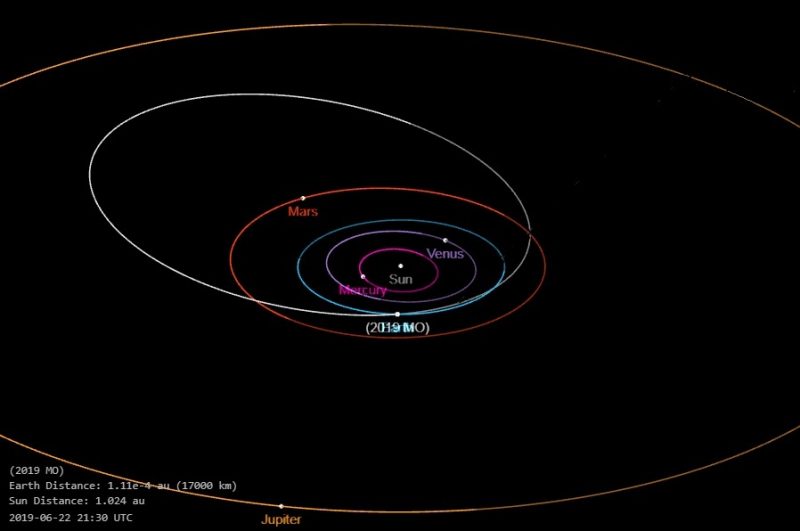
Diagram of planetary orbits with oblong asteroid orbit.

Asteroid 2019 MO is believed to have had an orbit outside that of Earth and extending almost to Jupiter’s orbit. Image via NASA/JPL-Caltech.

According to Italian amateur astronomer Ernesto Guido, this is only the fourth time in history that an impacting object was observed prior to atmospheric entry.

Bottom line: Asteroid 2019 MO exploded in Earth’s atmosphere on June 22, 2019, with an energy equivalent to about 3 to 5 kilotons of TNT. Such events happen unexpectedly, once or twice yearly, astronomers say. This one was unusual in that the asteroid was detected in the hours before it struck.


from EarthSky https://ift.tt/2XwKeCK
Weather satellite image of a bright flash above the ocean.

The small, harmless, 4-meter near-Earth asteroid – now designated 2019 MO – created this bright flash when it struck Earth’s atmosphere on June 22, 2019, over the Caribbean. Images via RAMMB/CIRA/Colorado State University.

Scientists have confirmed a meteor impact with Earth’s atmosphere over the Caribbean last weekend. The bright flash was detected by by NOAA’s GOES-16 satellite and other meteorological satellites, showing the event occurred on Saturday, June 22, 2019, at around 5:25 p.m. EDT (21:25 UTC) some 170 miles (274 km) south of Puerto Rico. Astronomer Peter Brown, a meteor expert from Western University in Ontario, Canada, said that an infrasound station located in Bermuda did detect airwaves produced by the space rock’s impact in the atmosphere. The object is believed to have been a small asteroid, and it was unusual in that it was detected prior to its impact – in the hours before – by the Atlas (Asteroid Terrestrial-impact Last Alert System) in Hawaii. Brown said the impact was:

… consistent with 3 to 5 kilotons (of energy).

By contrast, the atomic bomb dropped on Hiroshima on August 6, 1945, exploded with an energy of about 15 kilotons of TNT. Both the energy released, as well as the observations made from the Atlas Observatory, suggest the June 22 space rock was about 13 feet (4 meters) in diameter. Originally designated A10eoM1, the rock has now been designated as asteroid 2019 MO.

Although small space rocks and fragments rain down on Earth’s atmosphere continuously, experts at NASA’s Center for Near Earth Object Studies say that large events such as the one on June 22 occur about once or twice a year. Earth’s atmosphere does its job in protecting us in these cases, causing drag or friction that disintegrates most of these small objects before they strike the ground (although a few do strike, and more fall into the ocean). Read more: Whoa! 26 atom-bomb-scale asteroid impacts since 2000

After analyzing the satellite images, expert meteor photographer Frankie Lucena commented:

Looks to be a mighty impressive event, for sure.

Some satellite images show the bright flash produced by the meteor, and seconds later, a line of its dissipating smoke trail.

Diagram of planetary orbits with oblong asteroid orbit.

Asteroid 2019 MO is believed to have had an orbit outside that of Earth and extending almost to Jupiter’s orbit. Image via NASA/JPL-Caltech.

According to Italian amateur astronomer Ernesto Guido, this is only the fourth time in history that an impacting object was observed prior to atmospheric entry.

Bottom line: Asteroid 2019 MO exploded in Earth’s atmosphere on June 22, 2019, with an energy equivalent to about 3 to 5 kilotons of TNT. Such events happen unexpectedly, once or twice yearly, astronomers say. This one was unusual in that the asteroid was detected in the hours before it struck.


from EarthSky https://ift.tt/2XwKeCK

Viewing Saturn’s rings soon? Read me 1st

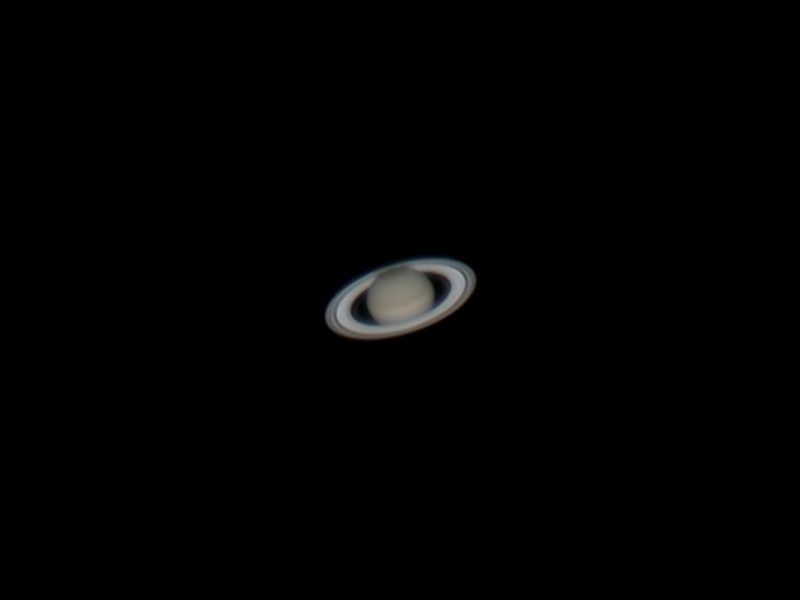
Fuzzy view of Saturn with bands and distinct slanted rings, mostly gray on black.

James Martin in Albuquerque, New Mexico, caught this photo of Saturn at the 2017 opposition of the planet, when the rings were maximally tilted toward Earth. Opposition marks the middle of the best time of year to see a planet. The 2019 opposition will happen on July 9.

It’s that magical time of year again, when our solar system’s most beautiful planet – Saturn – is well placed for viewing in our sky. Looking starlike to the eye alone, with a distinct golden color, Saturn is a lovely object even without optical aid. Binoculars will enhance its color, and a small telescope will let you see Saturn’s rings. That makes the coming month or so a great time to go to a star party, where amateur astronomers are set up to show you telescopic objects. Check the club map at NASA’s Night Sky Network to find star parties near you. Or try this list of astronomy clubs by state from the Astronomical League. Or call a local university or science museum and ask about star parties. Or maybe a neighbor, or friend, has a telescope stashed in a closet? More possibilities:

Astronomy Clubs Near Me & Organizations, from SkyandTelescope.com.

2018 Astronomy Club Directory, from Go-Astronomy.com.

Astronomy Clubs Near Me, from LoveTheNightSky.com.

Even the smallest telescopes should show you Saturn’s rings. Veteran observer Alan MacRobert at SkyandTelescope.com has written:

The rings of Saturn should be visible in even the smallest telescope at 25x [magnified by 25 times]. A good 3-inch scope at 50x [magnified by 50 times] can show them as a separate structure detached on all sides from the ball of the planet.

You want to see Saturn’s rings. We know you do! Here are some basics:

1. Telescope. Don’t expect to see the rings in binoculars. You really do need a telescope.

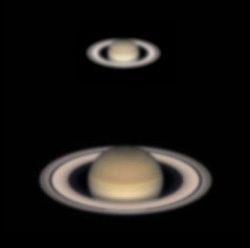
Two images of Saturn, the top one smaller and less distinct.

These images suggest how the ringed planet Saturn might look when seen through a telescope with an aperture 4 inches (100 mm) in diameter (top) and through a larger instrument with an 8-inch aperture (bottom). Image via SkyandTelescope.com/NASA/Hubble Space Telescope.

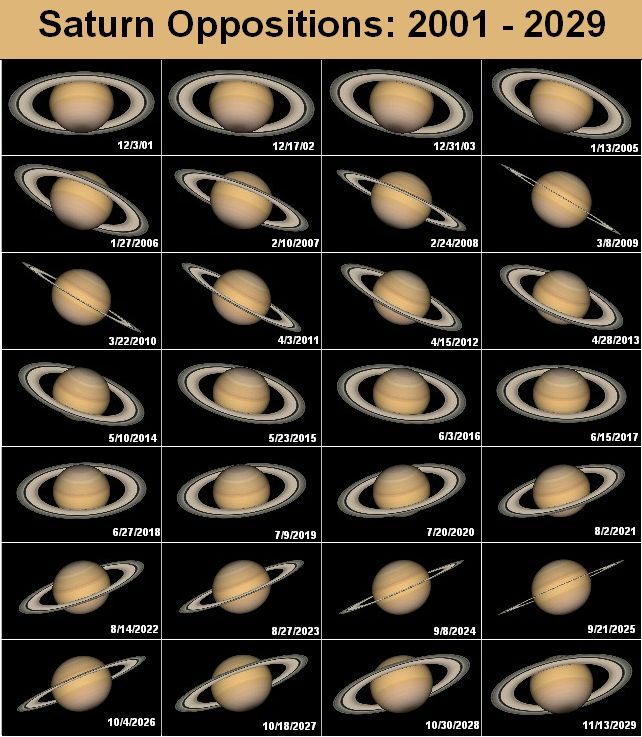
2. Tilt. Notice the tilt of the rings. As with so much in space (and on Earth), the appearance of Saturn’s rings from Earth is cyclical. In 2017, the north side of the rings opened up most widely (27 degrees), as seen from Earth. That’s the most open this face of the rings has been since since 1988. In 2019, we’re past the peak of the north ring face opening, but Saturn’s rings are still inclined at about 24 to 25 degrees from edge-on, still exhibiting their northern face. By the year 2025, by the way, the rings will appear edge-on as seen from Earth. After that, we’ll begin to see the south side of Saturn’s rings and their openness will gradually increase to a maximum inclination of 27 degrees by May 2032.

28 views of Saturn, some with wide rings and some with edge-on rings.

The tilt of Saturn’s rings has a great impact on the planet’s overall brightness as seen from Earth. In years when Saturn’s rings are edge-on as seen from Earth (2009 and 2025), Saturn does appear considerably dimmer than in years when Saturn’s rings are maximally tilted toward Earth (2017 and 2032). These Saturn views were simulated with a computer program written by Tom Ruen. Image via Wikimedia Commons.

3. 3D. Ask yourself … do Saturn’s rings look three-dimensional? Again quoting Alan MacRobert at SkyandTelescope.com:

Saturn has a more three-dimensional appearance than any other object in the sky — at least that’s how it looks to me with a 6-inch ‘scope on a night of fine seeing.

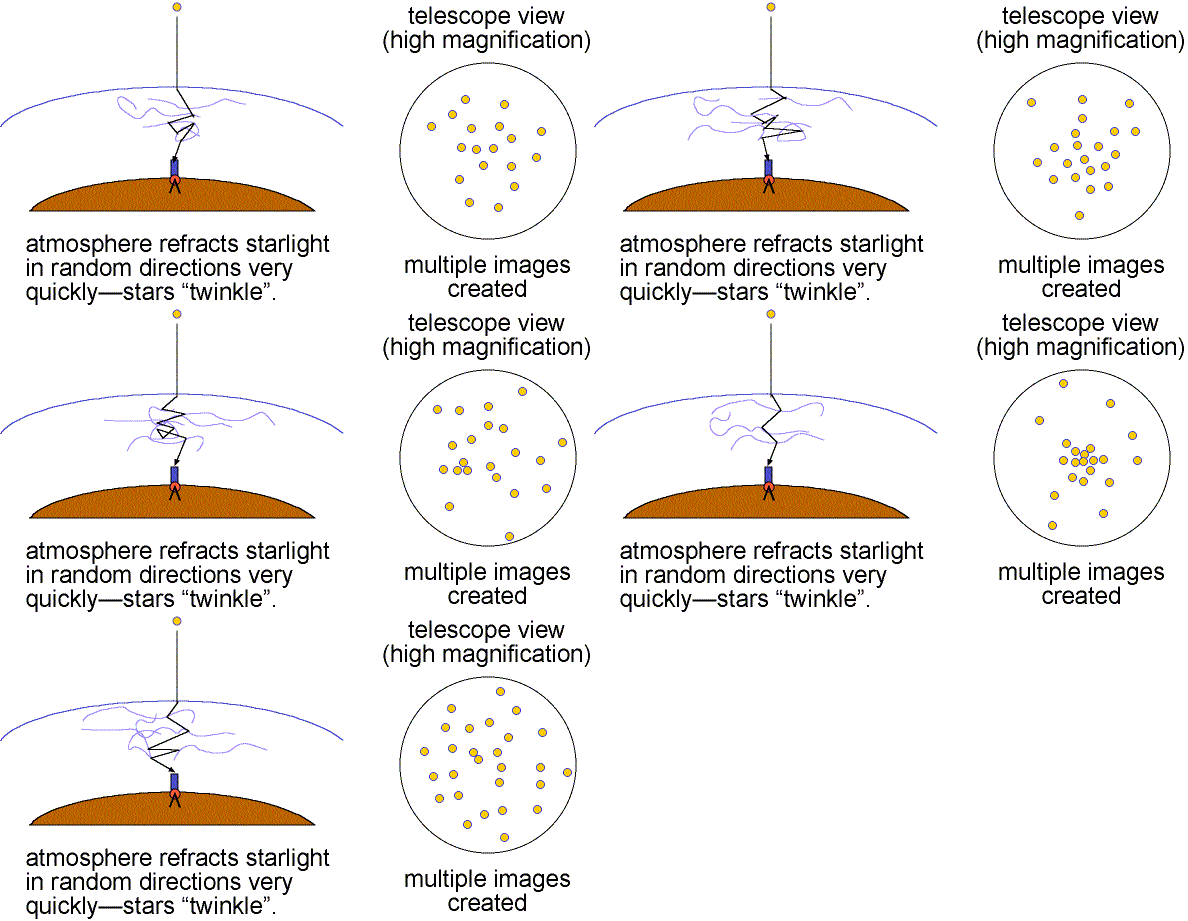
4. Seeing. What was Alan talking about in that quote above when he mentioned seeing? Both amateur and professional astronomers talk about the night’s seeing, which affects how clearly and sharply you can see a telescopic image. Seeing isn’t a quality of the telescope; it’s a quality of the air above you. It’s the reason the stars twinkle more on some nights than others. When the air is particularly turbulent, astronomers say there’s bad seeing. The images at the telescope shimmy and dance. When the air is particularly still, astronomers say there’s good seeing. Seeing can shift from moment to moment, as parcels of air move above you. So, as you’re gazing at Saturn, stand as quietly as you can – for as long as you can – and just look. You’ll notice moments when the image suddenly comes into sharper focus.

Diagram of moving air on left, moving dots in circle on right.

Turbulent air makes for poor seeing. But the air above you can also “settle” suddenly. When viewing Saturn, wait for those moments. Image via AstronomyNotes.com.

5. Other things to think about. Once you get comfortable viewing Saturn – assuming you’re able to view it again and again, with a telescope of your own – you’ll begin to notice details in the rings. Today, thanks to spacecraft, we know that Saturn’s rings are incredibly detailed. But, as you stand at your telescope gazing upward, you might be thrilled to witness just one primary division in the rings, the Cassini Division between the A and B rings, named for its French discoverer Jean Cassini. Seeing this dark division is a good test of the night’s seeing and your telescope’s optical quality, and also of your own eyes’ ability to simply look and notice what you see. By the way, if you’re looking at the rings – which means you’re viewing Saturn through a telescope – look also for one or more of Saturn’s many moons, most notably Titan.

Have fun!

Large, clear, sharp view of large yellowish Saturn with many rings.

Alas, you won’t see Saturn look like this through a telescope. This is a spacecraft view, from Cassini in 2016, showing Saturn’s northern hemisphere. Image via NASA/JPL-Caltech/Space Science Institute.

Bottom line: In 2019, Saturn’s opposition – marking the middle of the best time of year to see it – comes on July 9. Here are some tips for beginners, either those with new telescopes or those attending star parties, for things to look for and think about when you are planning to see Saturn’s rings.

Read more … Viewing Saturn: Rings, Planet and Moons

Help EarthSky keep going! Please donate.


from EarthSky https://ift.tt/2Y9hEUV
Fuzzy view of Saturn with bands and distinct slanted rings, mostly gray on black.

James Martin in Albuquerque, New Mexico, caught this photo of Saturn at the 2017 opposition of the planet, when the rings were maximally tilted toward Earth. Opposition marks the middle of the best time of year to see a planet. The 2019 opposition will happen on July 9.

It’s that magical time of year again, when our solar system’s most beautiful planet – Saturn – is well placed for viewing in our sky. Looking starlike to the eye alone, with a distinct golden color, Saturn is a lovely object even without optical aid. Binoculars will enhance its color, and a small telescope will let you see Saturn’s rings. That makes the coming month or so a great time to go to a star party, where amateur astronomers are set up to show you telescopic objects. Check the club map at NASA’s Night Sky Network to find star parties near you. Or try this list of astronomy clubs by state from the Astronomical League. Or call a local university or science museum and ask about star parties. Or maybe a neighbor, or friend, has a telescope stashed in a closet? More possibilities:

Astronomy Clubs Near Me & Organizations, from SkyandTelescope.com.

2018 Astronomy Club Directory, from Go-Astronomy.com.

Astronomy Clubs Near Me, from LoveTheNightSky.com.

Even the smallest telescopes should show you Saturn’s rings. Veteran observer Alan MacRobert at SkyandTelescope.com has written:

The rings of Saturn should be visible in even the smallest telescope at 25x [magnified by 25 times]. A good 3-inch scope at 50x [magnified by 50 times] can show them as a separate structure detached on all sides from the ball of the planet.

You want to see Saturn’s rings. We know you do! Here are some basics:

1. Telescope. Don’t expect to see the rings in binoculars. You really do need a telescope.

Two images of Saturn, the top one smaller and less distinct.

These images suggest how the ringed planet Saturn might look when seen through a telescope with an aperture 4 inches (100 mm) in diameter (top) and through a larger instrument with an 8-inch aperture (bottom). Image via SkyandTelescope.com/NASA/Hubble Space Telescope.

2. Tilt. Notice the tilt of the rings. As with so much in space (and on Earth), the appearance of Saturn’s rings from Earth is cyclical. In 2017, the north side of the rings opened up most widely (27 degrees), as seen from Earth. That’s the most open this face of the rings has been since since 1988. In 2019, we’re past the peak of the north ring face opening, but Saturn’s rings are still inclined at about 24 to 25 degrees from edge-on, still exhibiting their northern face. By the year 2025, by the way, the rings will appear edge-on as seen from Earth. After that, we’ll begin to see the south side of Saturn’s rings and their openness will gradually increase to a maximum inclination of 27 degrees by May 2032.

28 views of Saturn, some with wide rings and some with edge-on rings.

The tilt of Saturn’s rings has a great impact on the planet’s overall brightness as seen from Earth. In years when Saturn’s rings are edge-on as seen from Earth (2009 and 2025), Saturn does appear considerably dimmer than in years when Saturn’s rings are maximally tilted toward Earth (2017 and 2032). These Saturn views were simulated with a computer program written by Tom Ruen. Image via Wikimedia Commons.

3. 3D. Ask yourself … do Saturn’s rings look three-dimensional? Again quoting Alan MacRobert at SkyandTelescope.com:

Saturn has a more three-dimensional appearance than any other object in the sky — at least that’s how it looks to me with a 6-inch ‘scope on a night of fine seeing.

4. Seeing. What was Alan talking about in that quote above when he mentioned seeing? Both amateur and professional astronomers talk about the night’s seeing, which affects how clearly and sharply you can see a telescopic image. Seeing isn’t a quality of the telescope; it’s a quality of the air above you. It’s the reason the stars twinkle more on some nights than others. When the air is particularly turbulent, astronomers say there’s bad seeing. The images at the telescope shimmy and dance. When the air is particularly still, astronomers say there’s good seeing. Seeing can shift from moment to moment, as parcels of air move above you. So, as you’re gazing at Saturn, stand as quietly as you can – for as long as you can – and just look. You’ll notice moments when the image suddenly comes into sharper focus.

Diagram of moving air on left, moving dots in circle on right.

Turbulent air makes for poor seeing. But the air above you can also “settle” suddenly. When viewing Saturn, wait for those moments. Image via AstronomyNotes.com.

5. Other things to think about. Once you get comfortable viewing Saturn – assuming you’re able to view it again and again, with a telescope of your own – you’ll begin to notice details in the rings. Today, thanks to spacecraft, we know that Saturn’s rings are incredibly detailed. But, as you stand at your telescope gazing upward, you might be thrilled to witness just one primary division in the rings, the Cassini Division between the A and B rings, named for its French discoverer Jean Cassini. Seeing this dark division is a good test of the night’s seeing and your telescope’s optical quality, and also of your own eyes’ ability to simply look and notice what you see. By the way, if you’re looking at the rings – which means you’re viewing Saturn through a telescope – look also for one or more of Saturn’s many moons, most notably Titan.

Have fun!

Large, clear, sharp view of large yellowish Saturn with many rings.

Alas, you won’t see Saturn look like this through a telescope. This is a spacecraft view, from Cassini in 2016, showing Saturn’s northern hemisphere. Image via NASA/JPL-Caltech/Space Science Institute.

Bottom line: In 2019, Saturn’s opposition – marking the middle of the best time of year to see it – comes on July 9. Here are some tips for beginners, either those with new telescopes or those attending star parties, for things to look for and think about when you are planning to see Saturn’s rings.

Read more … Viewing Saturn: Rings, Planet and Moons

Help EarthSky keep going! Please donate.


from EarthSky https://ift.tt/2Y9hEUV

See the Dragon’s Eyes on summer evenings

Tonight, find the Dragon’s Eyes. For years, I’ve glanced up in the north at this time of year and spied the two stars marked on today’s chart, Rastaban and Eltanin in the constellation Draco. They’re noticeable because they’re relatively bright and near each other. There’s always that split-second when I ask myself with some excitement what two stars are those? It’s then that my eyes drift to blue-white Vega nearby … and I know, by Vega’s nearness, that they are the stars Rastaban and Eltanin.

These two stars represent the fiery Eyes of the constellation Draco the Dragon. Moreover, these stars nearly mark the radiant point for the annual October Draconid meteor shower.

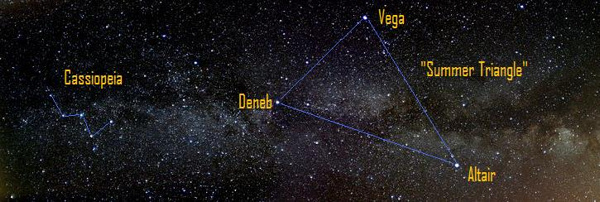
Because the stars stay fixed relative to each other, Vega is always near these stars. Vega, by the way, lodges at the apex of the Summer Triangle, a famous pattern consisting of three bright stars in three separate constellations, also prominent at this time of year.

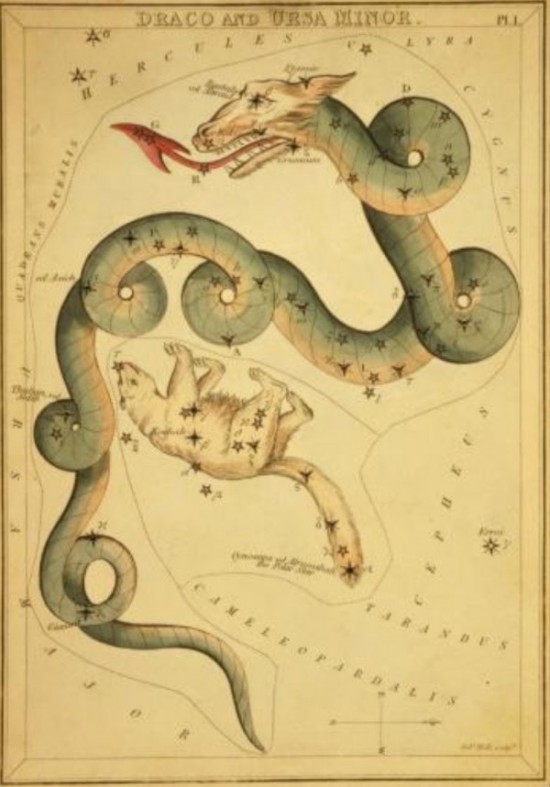
Antique drawing of snake-like dragon with bright red tongue.

Draco the Dragon. Image via Old Book Image Art Gallery.

From tropical and subtropical latitudes in the Southern Hemisphere, the stars Rastaban and Eltanin shine quite low in the northern sky (below Vega). In either hemisphere, at all time zones, the Dragon’s eyes climb highest up in the sky around midnight (1 a.m. daylight saving time) in mid-June, 11 p.m. (midnight daylight saving time) in early July, and 9 p.m. (10 p.m. daylight saving time) in early August. But from temperate latitudes in the Southern Hemisphere (southern Australia and New Zealand), the Dragon’s eyes never climb above your horizon. However, you can catch the star Vega way low in your northern sky.

People at mid-northern latitudes get to view the Dragon’s eyes all night long!

Speaking of Rastaban and Eltanin, one of you asked:

What are constellations?

The answer is that they’re just patterns of stars on the sky’s dome. The Greeks and Romans, for example, named them for their gods and goddesses, and also for many sorts of animals. In the 20th century, the International Astronomical Union (IAU) formalized the names and boundaries of the constellations. Now every star in the sky belongs to one or another constellation.

The stars within constellations aren’t connected, except in the mind’s eye of stargazers. The stars in general lie at vastly different distances from Earth. It’s by finding juxtaposed patterns on the sky’s dome that you’ll come to know the constellations – much as I identify Rastaban and Eltanin at this time of year by looking for the star Vega.

Bottom line: Look in the northeast on these June evenings – near the star Vega. You’ll see Rastaban and Eltanin, two stars that are bright and close together.

EarthSky astronomy kits are perfect for beginners. Order today from the EarthSky store

Donate: Your support means the world to us

Enjoying EarthSky so far? Sign up for our free daily newsletter today!


from EarthSky https://ift.tt/2xenGYI

Tonight, find the Dragon’s Eyes. For years, I’ve glanced up in the north at this time of year and spied the two stars marked on today’s chart, Rastaban and Eltanin in the constellation Draco. They’re noticeable because they’re relatively bright and near each other. There’s always that split-second when I ask myself with some excitement what two stars are those? It’s then that my eyes drift to blue-white Vega nearby … and I know, by Vega’s nearness, that they are the stars Rastaban and Eltanin.

These two stars represent the fiery Eyes of the constellation Draco the Dragon. Moreover, these stars nearly mark the radiant point for the annual October Draconid meteor shower.

Because the stars stay fixed relative to each other, Vega is always near these stars. Vega, by the way, lodges at the apex of the Summer Triangle, a famous pattern consisting of three bright stars in three separate constellations, also prominent at this time of year.

Antique drawing of snake-like dragon with bright red tongue.

Draco the Dragon. Image via Old Book Image Art Gallery.

From tropical and subtropical latitudes in the Southern Hemisphere, the stars Rastaban and Eltanin shine quite low in the northern sky (below Vega). In either hemisphere, at all time zones, the Dragon’s eyes climb highest up in the sky around midnight (1 a.m. daylight saving time) in mid-June, 11 p.m. (midnight daylight saving time) in early July, and 9 p.m. (10 p.m. daylight saving time) in early August. But from temperate latitudes in the Southern Hemisphere (southern Australia and New Zealand), the Dragon’s eyes never climb above your horizon. However, you can catch the star Vega way low in your northern sky.

People at mid-northern latitudes get to view the Dragon’s eyes all night long!

Speaking of Rastaban and Eltanin, one of you asked:

What are constellations?

The answer is that they’re just patterns of stars on the sky’s dome. The Greeks and Romans, for example, named them for their gods and goddesses, and also for many sorts of animals. In the 20th century, the International Astronomical Union (IAU) formalized the names and boundaries of the constellations. Now every star in the sky belongs to one or another constellation.

The stars within constellations aren’t connected, except in the mind’s eye of stargazers. The stars in general lie at vastly different distances from Earth. It’s by finding juxtaposed patterns on the sky’s dome that you’ll come to know the constellations – much as I identify Rastaban and Eltanin at this time of year by looking for the star Vega.

Bottom line: Look in the northeast on these June evenings – near the star Vega. You’ll see Rastaban and Eltanin, two stars that are bright and close together.

EarthSky astronomy kits are perfect for beginners. Order today from the EarthSky store

Donate: Your support means the world to us

Enjoying EarthSky so far? Sign up for our free daily newsletter today!


from EarthSky https://ift.tt/2xenGYI

Confessions of a former junk food ad exec  

Image of a mother helping daughter use an iPad

In June 2018, the UK Government announced its ambition to halve childhood obesity by 2030, and proposed restrictions on junk food ads before 9pm on TV and online. 

One year on, and ahead of the Government’s decision on what to do next, Dan Parker, advertiser turned campaigner and founder of Living Loud, reveals why restrictions on junk food advertising are important. 

Photo of Dan Parker.

Dan Parker is a former ad exec turned campaigner.

I worked in advertising for about 20 years. As a creative director, and eventually owner of my own agency, I would come up with ideas for adverts for my clients – who were mostly junk food brands.

Then, in 2014, I was diagnosed with type 2 diabetes. It made me step outside of my advertising bubble. And as I learned how to manage my condition, I also learned about the obesity crisis.

My dad had a long and miserable death because he was obese and had type 2 diabetes, among other things. So did my aunt, my grandfather – anyone as far back as we could remember. And by this point, I had my own child and didn’t want that for him.

I realised I had dedicated a lot of time and energy trying to get people to eat another packet of crisps. I was part of the problem.

Tricks of the trade

Advertising is not just about getting you to buy something. An awful lot of advertising is about planting the seeds over a long time, to make a product cool or to associate it with a particular emotion.

When people make decisions about food, it’s often an irrational, emotional decision rather than a logical one. And advertisers understand and play on this, particularly when it comes to children.

Even though kids don’t always have their own purchasing power, they do have ‘pester power’. As a parent, I get pestered every day!

When marketing to children, advertisers essentially use a two-pronged attack. They create an environment that will make a child pester their parents for a product, but also make the parent feel sufficiently assured to purchase the product.

Kids don’t really care about where food comes from or its nutritional value, they care if it’s fun. Food isn’t inherently fun, so as an advertiser you need to find a way to make your product desirable. You might stick a cartoon character on the packet, give away a toy with it or include a footballer in the advert.

You’ve then got to make sure the parent puts that item in their shopping basket. When I worked in the advertising industry we were constantly asking, “what in this advert will pacify mum?” We would offer a price discount or a bigger box or put something reassuring on the box, like a picture of a strawberry.

Or we’d make the food look healthier in the advert.

Picture an advert for a burger compared to what the burger looks like when you actually buy it – there’s an abundance of lettuce tumbling out in the photo. These messages are designed to make you think “oh, it’s got lettuce in, it’s fine”.

The 9pm watershed is simple, but it needs to be part of a broader package

We shouldn’t be advertising junk food to children. And the consumer goods industry is always going to out-market public health – it has more money, takes more risks and, fundamentally, it has a more desirable product to sell. We can’t outrun these organisations, so we need to think about how we can limit their worst excesses.

What I like about a 9pm watershed on junk food marketing is that it’s reasonably simple. It puts junk food into the same bracket as other content we believe to be a bad influence on our children, like violence and swearing.

And ultimately, it gives control back to the parents. It’s close to impossible to monitor what our kids see online, but if we know that before 9pm is safe time then we can worry a little less.

But a watershed won’t work on its own – it must be part of a broader package.

The way media is consumed has changed

I’ve heard people say the 9pm watershed is unnecessary because kids are being exposed to less junk food marketing, but that’s fundamentally untrue. It’s simply migrated to evening family TV – in just one episode of Britain’s Got Talent there are more junk food adverts than the ad industry claims kids see in a week.

And it’s not just TV we need to worry about. You have celebrities making sponsored posts online, competitions on social media and in-play adverts for mobile and videogames.

None of this is truly factored into the current rules. We’re looking at the 2019 media landscape through the lens of the early noughties and walking away with a false picture. If you compare it to smoking, it took us 50 years to fully regulate against advertising – and unless we take urgent action there is a danger we will end up in the same situation for junk food.

It’s up to Government to define the rules

Most of us would like for our children to grow up free from the influence of things that do them harm, and for food choices to genuinely sit with the parent. But to have true parental responsibility, there has to be a degree on honesty and transparency. Right now, too much power sits with industry.

Some people have said these new rules will have a negative impact on the advertising industry. But I’ve spoken to people who work in advertising about it, and most will say they’re happy to work within whatever boundaries as long as the rules are clear.

When I was a creative director, I used to run each new idea by a team of lawyers who would warn me of the rules I might be breaking. We’d then refine it until it pushed right up to the edge. Advertising agencies, and to a great extent their clients, would say that it’s not their job to define the moral code behind regulations. And they can only compete on an even playing field defined by regulations.

It’s up to Government to define the rules. And the advertising industry will innovate again, no matter what rules they’re given. They will always come back strong.

Dan Parker


from Cancer Research UK – Science blog http://bit.ly/2ZJqgSr
Image of a mother helping daughter use an iPad

In June 2018, the UK Government announced its ambition to halve childhood obesity by 2030, and proposed restrictions on junk food ads before 9pm on TV and online. 

One year on, and ahead of the Government’s decision on what to do next, Dan Parker, advertiser turned campaigner and founder of Living Loud, reveals why restrictions on junk food advertising are important. 

Photo of Dan Parker.

Dan Parker is a former ad exec turned campaigner.

I worked in advertising for about 20 years. As a creative director, and eventually owner of my own agency, I would come up with ideas for adverts for my clients – who were mostly junk food brands.

Then, in 2014, I was diagnosed with type 2 diabetes. It made me step outside of my advertising bubble. And as I learned how to manage my condition, I also learned about the obesity crisis.

My dad had a long and miserable death because he was obese and had type 2 diabetes, among other things. So did my aunt, my grandfather – anyone as far back as we could remember. And by this point, I had my own child and didn’t want that for him.

I realised I had dedicated a lot of time and energy trying to get people to eat another packet of crisps. I was part of the problem.

Tricks of the trade

Advertising is not just about getting you to buy something. An awful lot of advertising is about planting the seeds over a long time, to make a product cool or to associate it with a particular emotion.

When people make decisions about food, it’s often an irrational, emotional decision rather than a logical one. And advertisers understand and play on this, particularly when it comes to children.

Even though kids don’t always have their own purchasing power, they do have ‘pester power’. As a parent, I get pestered every day!

When marketing to children, advertisers essentially use a two-pronged attack. They create an environment that will make a child pester their parents for a product, but also make the parent feel sufficiently assured to purchase the product.

Kids don’t really care about where food comes from or its nutritional value, they care if it’s fun. Food isn’t inherently fun, so as an advertiser you need to find a way to make your product desirable. You might stick a cartoon character on the packet, give away a toy with it or include a footballer in the advert.

You’ve then got to make sure the parent puts that item in their shopping basket. When I worked in the advertising industry we were constantly asking, “what in this advert will pacify mum?” We would offer a price discount or a bigger box or put something reassuring on the box, like a picture of a strawberry.

Or we’d make the food look healthier in the advert.

Picture an advert for a burger compared to what the burger looks like when you actually buy it – there’s an abundance of lettuce tumbling out in the photo. These messages are designed to make you think “oh, it’s got lettuce in, it’s fine”.

The 9pm watershed is simple, but it needs to be part of a broader package

We shouldn’t be advertising junk food to children. And the consumer goods industry is always going to out-market public health – it has more money, takes more risks and, fundamentally, it has a more desirable product to sell. We can’t outrun these organisations, so we need to think about how we can limit their worst excesses.

What I like about a 9pm watershed on junk food marketing is that it’s reasonably simple. It puts junk food into the same bracket as other content we believe to be a bad influence on our children, like violence and swearing.

And ultimately, it gives control back to the parents. It’s close to impossible to monitor what our kids see online, but if we know that before 9pm is safe time then we can worry a little less.

But a watershed won’t work on its own – it must be part of a broader package.

The way media is consumed has changed

I’ve heard people say the 9pm watershed is unnecessary because kids are being exposed to less junk food marketing, but that’s fundamentally untrue. It’s simply migrated to evening family TV – in just one episode of Britain’s Got Talent there are more junk food adverts than the ad industry claims kids see in a week.

And it’s not just TV we need to worry about. You have celebrities making sponsored posts online, competitions on social media and in-play adverts for mobile and videogames.

None of this is truly factored into the current rules. We’re looking at the 2019 media landscape through the lens of the early noughties and walking away with a false picture. If you compare it to smoking, it took us 50 years to fully regulate against advertising – and unless we take urgent action there is a danger we will end up in the same situation for junk food.

It’s up to Government to define the rules

Most of us would like for our children to grow up free from the influence of things that do them harm, and for food choices to genuinely sit with the parent. But to have true parental responsibility, there has to be a degree on honesty and transparency. Right now, too much power sits with industry.

Some people have said these new rules will have a negative impact on the advertising industry. But I’ve spoken to people who work in advertising about it, and most will say they’re happy to work within whatever boundaries as long as the rules are clear.

When I was a creative director, I used to run each new idea by a team of lawyers who would warn me of the rules I might be breaking. We’d then refine it until it pushed right up to the edge. Advertising agencies, and to a great extent their clients, would say that it’s not their job to define the moral code behind regulations. And they can only compete on an even playing field defined by regulations.

It’s up to Government to define the rules. And the advertising industry will innovate again, no matter what rules they’re given. They will always come back strong.

Dan Parker


from Cancer Research UK – Science blog http://bit.ly/2ZJqgSr

Zubeneschamali: A green star?

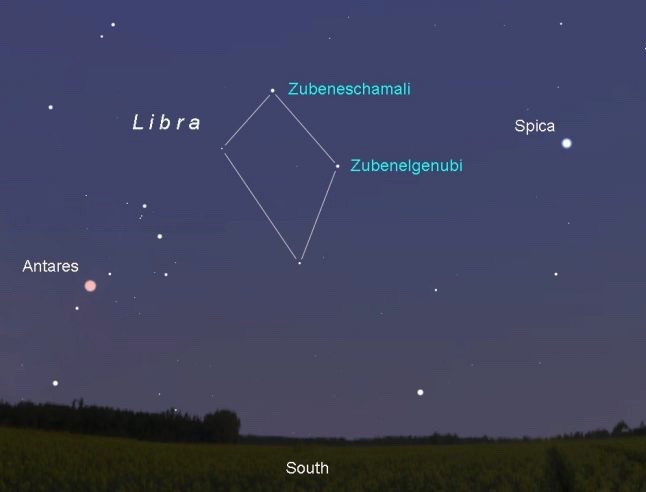
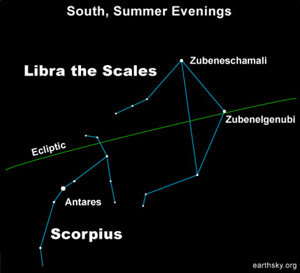
Star chart with constellation Libra. Antares, Spica, and 2 Zuben stars labeled.

Facing south around 10 p.m. in mid- to late June. Libra is a faint, diamond-shaped pattern of stars. Maps created with Stellarium by AstroBob. Used with permission.

Zubeneschamali, aka Beta Librae, is the brightest star in the constellation Libra the Scales. It’s just a touch brighter than the other bright star in Libra, called Zubenelgenubi. The incomparable Burnham’s Celestial Handbook quotes the star enthusiast Willian Tyler Olcott, who refers to this star as “… the only naked-eye star that is green in color.” Some other stargazers agree. Others don’t. If, indeed, Zubeneschamali is truly green in color, it’s the only green star among the bright stars in the sky.

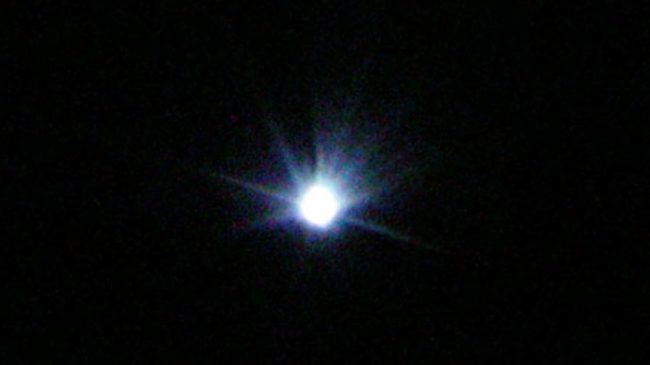
Large bright white dot with bluish rays coming out.

Zubeneschamali looks blue in this photo, but stargazers call it green. Photo via nikomi.net.

How to find Zubeneschamali. Check this star out for yourself on a Northern Hemisphere summer evening. Assuming you’re in the Northern Hemisphere, it shines high in your southern sky each summer and is easy to find.

Look for Zubeneschamali a good two fist-widths to the northwest (upper right) of the brilliant ruddy star Antares in the constellation Scorpius – one of the few constellations that look like the creature for which it was named. Hold your fist an arm’s length away.

Zubeneschamali is slightly brighter than its brother star Zubenelgenubi. But Zubenelgenubi is designated as the alpha star of the constellation Libra. Why isn’t the brighter star the alpha star of its constellation? It might be because Zubenelgenubi sits on the ecliptic – the annual pathway of the sun in front of the background stars.

If Zubeneschamali doesn’t look green to your unaided eye, try binoculars. Have your friends look at this star too. You might discover that people see colors differently!

Closeup photo of claw end of a scorpion with large claw and head.

Zubeneschamali represents the Northern Claw of the Scorpion in the constellation Scorpius.

Blindfolded statue holding scales with hooks on short end and weight on long end.

The constellation Libra represents the (not always equal) Scales of Justice. Image via thenonist.com.

History and mythology of Zubeneschamali. Both of these star names – Zubeneschamali and Zubenelgenubi – rhyme with Obi-Wan Kenobi of Star Wars fame. They are Arabic phrases meaning the Northern Claw (of the Scorpion) and the Southern Claw (of the Scorpion), respectively. Many thousands of years ago in ancient Babylon, these two stars once belonged to the constellation Scorpius the Scorpion, and once depicted the Scorpion’s outstretched claws.

Apparently, the ancient Greeks and Romans redrew the boundaries, creating the constellation Libra the Scales. Well over 2,000 years ago, the sun on the autumn equinox shone in front of Libra, the balance symbolizing the equal duration of day and night on the equinox. At present, the sun is in front of the constellation Virgo the Maiden on the autumn equinox, which falls annually on or near September 22.

In the star lore of the ancient Greeks, the constellation Virgo represents Astrea, the goddess of justice, holding Libra the Scales and weighing judgment upon human souls. It’s thought that Roman citizens associated Libra with Augustus, the dispenser of divine judgment.

Zubeneschamali science. Science has helped Zubeneschamali to one-up its biggest rival in Libra, the alpha star Zubenelgenubi. Astronomers have determined that Libra’s beta star is considerably brighter intrinsically than its rival Zubenelgenubi. Although these two Libra stars appear nearly the same brightness as seen from Earth, that’s because Zubenelgenubi lies at less than half Zubeneschamali’s distance. Zubenelgenubi is 77 light-years away, whereas it’s 160 light-years to Zubeneschamali. Zubeneschamali’s intrinsic luminosity is nearly five times that of Zubenelgenubi and 130 times that of the sun.

The sun passes in front of Libra from about November 1 to November 22, and the sun has its annual conjunction with Zubenelgenubi or or near November 7.

Zubeneschamali’s position: RA: 15h 17.5m, dec: -9° 25′

Bottom line: Is Zubeneschamali green? Learn about this brightest star in the constellation Libra.


from EarthSky http://bit.ly/2Nbu25E
Star chart with constellation Libra. Antares, Spica, and 2 Zuben stars labeled.

Facing south around 10 p.m. in mid- to late June. Libra is a faint, diamond-shaped pattern of stars. Maps created with Stellarium by AstroBob. Used with permission.

Zubeneschamali, aka Beta Librae, is the brightest star in the constellation Libra the Scales. It’s just a touch brighter than the other bright star in Libra, called Zubenelgenubi. The incomparable Burnham’s Celestial Handbook quotes the star enthusiast Willian Tyler Olcott, who refers to this star as “… the only naked-eye star that is green in color.” Some other stargazers agree. Others don’t. If, indeed, Zubeneschamali is truly green in color, it’s the only green star among the bright stars in the sky.

Large bright white dot with bluish rays coming out.

Zubeneschamali looks blue in this photo, but stargazers call it green. Photo via nikomi.net.

How to find Zubeneschamali. Check this star out for yourself on a Northern Hemisphere summer evening. Assuming you’re in the Northern Hemisphere, it shines high in your southern sky each summer and is easy to find.

Look for Zubeneschamali a good two fist-widths to the northwest (upper right) of the brilliant ruddy star Antares in the constellation Scorpius – one of the few constellations that look like the creature for which it was named. Hold your fist an arm’s length away.

Zubeneschamali is slightly brighter than its brother star Zubenelgenubi. But Zubenelgenubi is designated as the alpha star of the constellation Libra. Why isn’t the brighter star the alpha star of its constellation? It might be because Zubenelgenubi sits on the ecliptic – the annual pathway of the sun in front of the background stars.

If Zubeneschamali doesn’t look green to your unaided eye, try binoculars. Have your friends look at this star too. You might discover that people see colors differently!

Closeup photo of claw end of a scorpion with large claw and head.

Zubeneschamali represents the Northern Claw of the Scorpion in the constellation Scorpius.

Blindfolded statue holding scales with hooks on short end and weight on long end.

The constellation Libra represents the (not always equal) Scales of Justice. Image via thenonist.com.

History and mythology of Zubeneschamali. Both of these star names – Zubeneschamali and Zubenelgenubi – rhyme with Obi-Wan Kenobi of Star Wars fame. They are Arabic phrases meaning the Northern Claw (of the Scorpion) and the Southern Claw (of the Scorpion), respectively. Many thousands of years ago in ancient Babylon, these two stars once belonged to the constellation Scorpius the Scorpion, and once depicted the Scorpion’s outstretched claws.

Apparently, the ancient Greeks and Romans redrew the boundaries, creating the constellation Libra the Scales. Well over 2,000 years ago, the sun on the autumn equinox shone in front of Libra, the balance symbolizing the equal duration of day and night on the equinox. At present, the sun is in front of the constellation Virgo the Maiden on the autumn equinox, which falls annually on or near September 22.

In the star lore of the ancient Greeks, the constellation Virgo represents Astrea, the goddess of justice, holding Libra the Scales and weighing judgment upon human souls. It’s thought that Roman citizens associated Libra with Augustus, the dispenser of divine judgment.

Zubeneschamali science. Science has helped Zubeneschamali to one-up its biggest rival in Libra, the alpha star Zubenelgenubi. Astronomers have determined that Libra’s beta star is considerably brighter intrinsically than its rival Zubenelgenubi. Although these two Libra stars appear nearly the same brightness as seen from Earth, that’s because Zubenelgenubi lies at less than half Zubeneschamali’s distance. Zubenelgenubi is 77 light-years away, whereas it’s 160 light-years to Zubeneschamali. Zubeneschamali’s intrinsic luminosity is nearly five times that of Zubenelgenubi and 130 times that of the sun.

The sun passes in front of Libra from about November 1 to November 22, and the sun has its annual conjunction with Zubenelgenubi or or near November 7.

Zubeneschamali’s position: RA: 15h 17.5m, dec: -9° 25′

Bottom line: Is Zubeneschamali green? Learn about this brightest star in the constellation Libra.


from EarthSky http://bit.ly/2Nbu25E

Zubenelgenubi is Libra’s alpha star

Star chart with constellation Libra outlined with three labeled stars.

Look to the west of the brilliant ruddy star Antares for Zubenelgenubi and Zubeneschamali. Image credit: All the Sky

Use binoculars to peer at Zubenelgenubi – otherwise known as Alpha Librae – and you’ll see that it’s a double star. Astronomers have studied the motions of Zubenelgenubi’s two stars, thinking that it’s probably a binary – two physically related stars orbiting a common center of mass. However, the rather wide separation between these two stars must mean a long orbital period of perhaps 200,000 years. That suggests these two stars may not be bound by gravity, after all. Zubenelgenubi is more intrinsically luminous than our sun. It resides some 77 light-years away.

Star chart with constellations Scorpius and Libra with green ecliptic line across chart.

Zubenelgenubi is a bit fainter than the other bright star in Libra, Zubeneschamali. It might have received the Alpha designation because it’s closer to the ecliptic.

How to see Zubenelgenubi. Shortly after Halloween each year, Zubenelgenubi rises and sets with the sun, and can’t be seen at all. Annually, the sun and this star are in conjunction on or near November 7.

Half a year later, by early May of each year when this star stands opposite the sun in Earth’s sky, the best time to view Zubenelgenubi has arrived. Shortly after May Day, Zubenelgenubi rises around sunset, stays up all night, then sets around sunrise. In early May, this star transits – soars to its highest spot in the southern sky – around midnight for all observers around the globe (1 a.m. local daylight saving time). Because this star (and all stars) returns to the same spot in the sky 4 minutes earlier daily (or 2 hours earlier monthly), Zubenelgenubi transits due south around 10 p.m. (11 p.m. local daylight saving time) in early June, and earlier still in July and August.

That’s why Northern Hemisphere summer (or Southern Hemisphere winter) evenings present a good time for viewing this star. During these months, it’s high up at a convenient time of night. Zubenelgenubi, though a rather faint star, is easily visible in a dark country sky. It is fairly easy to locate near its fellow star in Libra, Zubeneschamali.

Zubenelgenubi is a touch fainter than Zubeneschamali. Nonetheless, Zubenelgenubi enjoys the alpha designation in the constellation Libra the Scales, probably because of its proximity to the ecliptic – the path of the sun, moon and planets in our sky.

Zubenelgenubi sits midway between two brilliant stars in other constellations. It’s between Antares in the constellation Scorpius and Spica of the constellation Virgo. Zubenelgenubi shines to the west (right) of ruddy Antares, and to the east (left) of blue-white Spica.

Antique drawing of pan-type scales with stars marked forming the constellation Libra.

The constellation Libra from Urania’s Mirror, a boxed set of 32 constellation cards first published in or before 1825. Via ianridpath.com

History and mythology of Zubenelgenubi. The names of Libra’s two brightest stars are derived from Arabic. Zubenelgenubi means “the Southern Claw (of the Scorpion)” and Zubeneschamali means the “the Northern Claw.” These names hark back to the times of the ancient Babylonians, who saw these Libra stars as part of the constellation Scorpius the Scorpion.

Apparently, the Greeks and Romans separated this part of Scorpius into the constellation Libra the Scales, because the sun shone in front of this constellation on the autumn equinox. The balance symbolizes the equal lengths of the day and night that come with the equinox. Libra marked the position of the autumn equinox well over 2,000 years ago. At present, the sun shines in front of the constellation Virgo on the autumn equinox.

According to Greek mythology, Virgo represents Astrea, the goddess of justice, holding Libra the Scales. Richard Hinkley Allen, in his classic work “Star Names,” says Libra in Roman eyes may have been the deification of Augustus as the arbiter of justice.

Zubenelgenubi’s position is at RA: 14h 51.4m, dec: -16° 5′

Bottom line: Learn to recognize Zubenelgenubi, the constellation Libra’s alpha star.


from EarthSky http://bit.ly/2FtaJPe
Star chart with constellation Libra outlined with three labeled stars.

Look to the west of the brilliant ruddy star Antares for Zubenelgenubi and Zubeneschamali. Image credit: All the Sky

Use binoculars to peer at Zubenelgenubi – otherwise known as Alpha Librae – and you’ll see that it’s a double star. Astronomers have studied the motions of Zubenelgenubi’s two stars, thinking that it’s probably a binary – two physically related stars orbiting a common center of mass. However, the rather wide separation between these two stars must mean a long orbital period of perhaps 200,000 years. That suggests these two stars may not be bound by gravity, after all. Zubenelgenubi is more intrinsically luminous than our sun. It resides some 77 light-years away.

Star chart with constellations Scorpius and Libra with green ecliptic line across chart.

Zubenelgenubi is a bit fainter than the other bright star in Libra, Zubeneschamali. It might have received the Alpha designation because it’s closer to the ecliptic.

How to see Zubenelgenubi. Shortly after Halloween each year, Zubenelgenubi rises and sets with the sun, and can’t be seen at all. Annually, the sun and this star are in conjunction on or near November 7.

Half a year later, by early May of each year when this star stands opposite the sun in Earth’s sky, the best time to view Zubenelgenubi has arrived. Shortly after May Day, Zubenelgenubi rises around sunset, stays up all night, then sets around sunrise. In early May, this star transits – soars to its highest spot in the southern sky – around midnight for all observers around the globe (1 a.m. local daylight saving time). Because this star (and all stars) returns to the same spot in the sky 4 minutes earlier daily (or 2 hours earlier monthly), Zubenelgenubi transits due south around 10 p.m. (11 p.m. local daylight saving time) in early June, and earlier still in July and August.

That’s why Northern Hemisphere summer (or Southern Hemisphere winter) evenings present a good time for viewing this star. During these months, it’s high up at a convenient time of night. Zubenelgenubi, though a rather faint star, is easily visible in a dark country sky. It is fairly easy to locate near its fellow star in Libra, Zubeneschamali.

Zubenelgenubi is a touch fainter than Zubeneschamali. Nonetheless, Zubenelgenubi enjoys the alpha designation in the constellation Libra the Scales, probably because of its proximity to the ecliptic – the path of the sun, moon and planets in our sky.

Zubenelgenubi sits midway between two brilliant stars in other constellations. It’s between Antares in the constellation Scorpius and Spica of the constellation Virgo. Zubenelgenubi shines to the west (right) of ruddy Antares, and to the east (left) of blue-white Spica.

Antique drawing of pan-type scales with stars marked forming the constellation Libra.

The constellation Libra from Urania’s Mirror, a boxed set of 32 constellation cards first published in or before 1825. Via ianridpath.com

History and mythology of Zubenelgenubi. The names of Libra’s two brightest stars are derived from Arabic. Zubenelgenubi means “the Southern Claw (of the Scorpion)” and Zubeneschamali means the “the Northern Claw.” These names hark back to the times of the ancient Babylonians, who saw these Libra stars as part of the constellation Scorpius the Scorpion.

Apparently, the Greeks and Romans separated this part of Scorpius into the constellation Libra the Scales, because the sun shone in front of this constellation on the autumn equinox. The balance symbolizes the equal lengths of the day and night that come with the equinox. Libra marked the position of the autumn equinox well over 2,000 years ago. At present, the sun shines in front of the constellation Virgo on the autumn equinox.

According to Greek mythology, Virgo represents Astrea, the goddess of justice, holding Libra the Scales. Richard Hinkley Allen, in his classic work “Star Names,” says Libra in Roman eyes may have been the deification of Augustus as the arbiter of justice.

Zubenelgenubi’s position is at RA: 14h 51.4m, dec: -16° 5′

Bottom line: Learn to recognize Zubenelgenubi, the constellation Libra’s alpha star.


from EarthSky http://bit.ly/2FtaJPe

Meet an iconic spiral galaxy

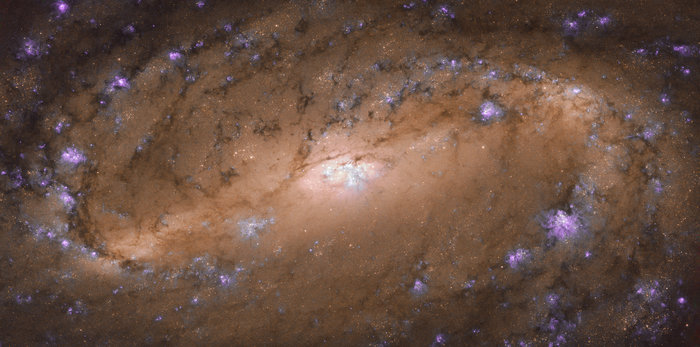
Large galaxy with foggy lighted center and spiral arms with pinkish spots along them.

View larger. | This image from the Hubble Space Telescope – first published on April 29, 2019 – shows a classic example of a spiral galaxy. This galaxy is labeled NGC 2903, and it’s located about 30 million light-years away in the constellation Leo the Lion. Hubble surveyed this galaxy as part of a study of the central regions of roughly 145 nearby disk galaxies. This study aimed to help astronomers understand the relationship between the colossal black holes in the cores of galaxies like these, and the bulge of stars, gas, and dust at the galaxy’s center, such as that seen in this image. Image via ESA.


from EarthSky http://bit.ly/2Nm6kDM
Large galaxy with foggy lighted center and spiral arms with pinkish spots along them.

View larger. | This image from the Hubble Space Telescope – first published on April 29, 2019 – shows a classic example of a spiral galaxy. This galaxy is labeled NGC 2903, and it’s located about 30 million light-years away in the constellation Leo the Lion. Hubble surveyed this galaxy as part of a study of the central regions of roughly 145 nearby disk galaxies. This study aimed to help astronomers understand the relationship between the colossal black holes in the cores of galaxies like these, and the bulge of stars, gas, and dust at the galaxy’s center, such as that seen in this image. Image via ESA.


from EarthSky http://bit.ly/2Nm6kDM

New Research for week #25, 2019

49 publications for this week. 

The last paper in this week's list features Skeptical Science volunteer and highly cited researcher Stephan Lewandowsky along with Skeptical Science founder John Cook as first and second authors respectively, working with regular collaborator Gilles Gignac. Their paper identifies, confirms and examines what seems to many laypersons to be peer pressure to conform to perceived dominant opinions in discussions of climate change at online venues. The paper helps to  illustrate and exemplify how human psychology with its inherent flaws and virtues may be our most significant hurdle in dealing with the climate change we're causing. The problem might be said to lie between our ears, not up in the air. See also the aptly named I’ll See It When I Believe It: Motivated Numeracy in Perceptions of Climate Change Risk for more treatment of our dubious reasoning capability when we're confused by extraneous factors, the publication itself also being a nice example of extending and solidifying previous research.

Method for composition of Research News: This synopsis is principally composed via RSS feeds from a variety of academic publishers, employing fairly broad filters. The filter sieves 200-300 publications per week for further inspection. The resulting raw list  includes interesting but off-topic papers; human inspection winnows output to perhaps 100-150 works involving global atmospheric climate to a greater or lesser extent. Due to the volume of publications and limited time scrutiny is chiefly via reading abstracts unless compelling curiosity or reason for concern about the claims of a paper leads further. Some results are "down in the weeds," being narrow discussions of arcane climate model behaviors, or highly regional studies with little "big picture" impact, or tenuous results that will  likely benefit from more research; these are discarded. The final result is the few dozen publications per week cited here, involving extraordinary breadth and depth. Global anthropogenic climate change instigates and nourishes an astounding, grand collision of a multitude of scientific disciplines.

We'll perennially note: dry titles can't convey the content of an abstract let alone the full potential implications of a given paper. The publications cited in this list all fit the specification of plausibly being important components of a puzzle we're solving. We're working on providing easy access to abstracts but in the meantime we feel the articles we choose to highlight are worth a click to reach and read.

To the matter of clicking for abstracts, a question for readers: should clicking a paper title open a new window, or is it better to go "forth and back" from SkS to a given paper and vice versa? Please let us know preferences down below in comments— perhaps a consensus will emerge. Thanks!  

Global Health Implications of Nutrient Changes in Rice under High Atmospheric Carbon Dioxide (OA)

Increasing organic carbon biolability with depth in yedoma permafrost: ramifications for future climate change

Climate sensitivity from both physical and carbon cycle feedbacks

 Deepening of the winter mixed layer in the Canada Basin, Arctic Ocean over 2006‐2017

Arctic Ocean freshwater dynamics: transient response to increasing river runoff and precipitation

ENSO regime changes responsible for decadal phase relationship variations between ENSO sea surface temperature and warm water volume

Radiative Heating of an Ice‐free Arctic Ocean

Climate Impacts from Large Volcanic Eruptions in a High‐resolution Climate Model: the Importance of Forcing Structure

Evaluating a Moist Isentropic Framework for Poleward Moisture Transport: Implications for Water Isotopes over Antarctica

Automatically Finding Ship‐tracks to Enable Large‐scale Analysis of Aerosol‐Cloud Interactions

Simultaneous Abiotic Production of Greenhouse Gases (CO2, CH4, and N2O) in Subtropical Soils

Contrasting temperature sensitivity of CO2 exchange in peatlands of the Hudson Bay Lowlands, Canada

An ensemble data set of sea‐surface temperature change from 1850: the Met Office Hadley Centre HadSST.4.0.0.0 data set

Physical Drivers of Changes in Probabilistic Surge Hazard under Sea Level Rise

Atlantic‐Pacific SST gradient change responsible for the weakening of North Tropical Atlantic‐ENSO relationship due to global warming

Release of perfluoroalkyl substances from melting glacier of the Tibetan Plateau: Insights into the impact of global warming on the cycling of emerging pollutants

Comparing surface and stratospheric impacts of geoengineering with different SO2 injection strategies

When will spaceborne cloud radar detect upward shifts in cloud heights?

New estimates of aerosol direct radiative effects and forcing from A‐Train satellite observations

Evidence for increasing rainfall extremes remains elusive at large spatial scales: the case of Italy

A high-resolution 1983-2016 Tmax climate data record based on InfraRed Temperatures and Stations by the Climate Hazard Center

Climate assessments for local action (OA)

Evidence for fire in the Pliocene Arctic in response to amplified temperature

Effects of atmospheric CO2 variability of the past 800 kyr on the biomes of southeast Africa

Warming temperatures are impacting the hydrometeorological regime of Russian rivers in the zone of continuous permafrost

Elevation-dependent warming of maximum air temperature in Nepal during 1976–2015

The highest monthly precipitation in the area of the Ukrainian and the Polish Carpathian Mountains in the period from 1984 to 2013

Impacts of climate changes on the maximum and minimum temperature in Iran

The relationship between atmospheric blocking and precipitation changes in Turkey between 1977 and 2016

Changes of actual evapotranspiration and its components in the Yangtze River valley during 1980–2014 from satellite assimilation product

Taking some heat off the NDCs? The limited potential of additional short-lived climate forcers’ mitigation

Investing in a good pair of wellies: how do non-experts interpret the expert terminology of climate change impacts and adaptation? (OA)

Lateral attitude change on environmental issues: implications for the climate change debate

Long-term trends in large-scale circulation behaviour and wind storms for North Atlantic islands: a multi-data analysis using ERA-20C and meteorological station data

Genes on the edge: a framework to detect genetic diversity imperiled by climate change

The response of reference evapotranspiration to climate change in Xinjiang, China: Historical changes, driving forces and future projections

Phytoplankton decline in the eastern North Pacific transition zone associated with atmospheric blocking

Enfranchising the future: Climate justice and the representation of future generations

Thermal stress induces persistently altered coral reef fish assemblages

Meridional Structure and Future Changes of Tropopause Height and Temperature

Regime shifts of Mediterranean forest carbon uptake and reduced resilience driven by multidecadal ocean surface temperatures

Subregional differences in groundfish distributional responses to anomalous ocean bottom temperatures in the northeast Pacific

Anticipated changes to the snow season in Alaska: Elevation dependency, timing and extremes

Meta‐analysis reveals enhanced growth of marine harmful algae from temperate regions with warming and elevated CO2 levels

I’ll See It When I Believe It: Motivated Numeracy in Perceptions of Climate Change Risk

Assessment of changing pattern of crop water stress in Bangladesh

Detecting and understanding co-benefits generated in tackling climate change and environmental degradation in China

Cognitive complexity increases climate change belief

Large greenhouse gas savings due to changes in the post-Soviet food systems

A Bayesian Networks approach for the assessment of climate change impacts on nutrients loading

Science by social media: Attitudes towards climate change are mediated by perceived social consensus


from Skeptical Science http://bit.ly/2Nds30N

49 publications for this week. 

The last paper in this week's list features Skeptical Science volunteer and highly cited researcher Stephan Lewandowsky along with Skeptical Science founder John Cook as first and second authors respectively, working with regular collaborator Gilles Gignac. Their paper identifies, confirms and examines what seems to many laypersons to be peer pressure to conform to perceived dominant opinions in discussions of climate change at online venues. The paper helps to  illustrate and exemplify how human psychology with its inherent flaws and virtues may be our most significant hurdle in dealing with the climate change we're causing. The problem might be said to lie between our ears, not up in the air. See also the aptly named I’ll See It When I Believe It: Motivated Numeracy in Perceptions of Climate Change Risk for more treatment of our dubious reasoning capability when we're confused by extraneous factors, the publication itself also being a nice example of extending and solidifying previous research.

Method for composition of Research News: This synopsis is principally composed via RSS feeds from a variety of academic publishers, employing fairly broad filters. The filter sieves 200-300 publications per week for further inspection. The resulting raw list  includes interesting but off-topic papers; human inspection winnows output to perhaps 100-150 works involving global atmospheric climate to a greater or lesser extent. Due to the volume of publications and limited time scrutiny is chiefly via reading abstracts unless compelling curiosity or reason for concern about the claims of a paper leads further. Some results are "down in the weeds," being narrow discussions of arcane climate model behaviors, or highly regional studies with little "big picture" impact, or tenuous results that will  likely benefit from more research; these are discarded. The final result is the few dozen publications per week cited here, involving extraordinary breadth and depth. Global anthropogenic climate change instigates and nourishes an astounding, grand collision of a multitude of scientific disciplines.

We'll perennially note: dry titles can't convey the content of an abstract let alone the full potential implications of a given paper. The publications cited in this list all fit the specification of plausibly being important components of a puzzle we're solving. We're working on providing easy access to abstracts but in the meantime we feel the articles we choose to highlight are worth a click to reach and read.

To the matter of clicking for abstracts, a question for readers: should clicking a paper title open a new window, or is it better to go "forth and back" from SkS to a given paper and vice versa? Please let us know preferences down below in comments— perhaps a consensus will emerge. Thanks!  

Global Health Implications of Nutrient Changes in Rice under High Atmospheric Carbon Dioxide (OA)

Increasing organic carbon biolability with depth in yedoma permafrost: ramifications for future climate change

Climate sensitivity from both physical and carbon cycle feedbacks

 Deepening of the winter mixed layer in the Canada Basin, Arctic Ocean over 2006‐2017

Arctic Ocean freshwater dynamics: transient response to increasing river runoff and precipitation

ENSO regime changes responsible for decadal phase relationship variations between ENSO sea surface temperature and warm water volume

Radiative Heating of an Ice‐free Arctic Ocean

Climate Impacts from Large Volcanic Eruptions in a High‐resolution Climate Model: the Importance of Forcing Structure

Evaluating a Moist Isentropic Framework for Poleward Moisture Transport: Implications for Water Isotopes over Antarctica

Automatically Finding Ship‐tracks to Enable Large‐scale Analysis of Aerosol‐Cloud Interactions

Simultaneous Abiotic Production of Greenhouse Gases (CO2, CH4, and N2O) in Subtropical Soils

Contrasting temperature sensitivity of CO2 exchange in peatlands of the Hudson Bay Lowlands, Canada

An ensemble data set of sea‐surface temperature change from 1850: the Met Office Hadley Centre HadSST.4.0.0.0 data set

Physical Drivers of Changes in Probabilistic Surge Hazard under Sea Level Rise

Atlantic‐Pacific SST gradient change responsible for the weakening of North Tropical Atlantic‐ENSO relationship due to global warming

Release of perfluoroalkyl substances from melting glacier of the Tibetan Plateau: Insights into the impact of global warming on the cycling of emerging pollutants

Comparing surface and stratospheric impacts of geoengineering with different SO2 injection strategies

When will spaceborne cloud radar detect upward shifts in cloud heights?

New estimates of aerosol direct radiative effects and forcing from A‐Train satellite observations

Evidence for increasing rainfall extremes remains elusive at large spatial scales: the case of Italy

A high-resolution 1983-2016 Tmax climate data record based on InfraRed Temperatures and Stations by the Climate Hazard Center

Climate assessments for local action (OA)

Evidence for fire in the Pliocene Arctic in response to amplified temperature

Effects of atmospheric CO2 variability of the past 800 kyr on the biomes of southeast Africa

Warming temperatures are impacting the hydrometeorological regime of Russian rivers in the zone of continuous permafrost

Elevation-dependent warming of maximum air temperature in Nepal during 1976–2015

The highest monthly precipitation in the area of the Ukrainian and the Polish Carpathian Mountains in the period from 1984 to 2013

Impacts of climate changes on the maximum and minimum temperature in Iran

The relationship between atmospheric blocking and precipitation changes in Turkey between 1977 and 2016

Changes of actual evapotranspiration and its components in the Yangtze River valley during 1980–2014 from satellite assimilation product

Taking some heat off the NDCs? The limited potential of additional short-lived climate forcers’ mitigation

Investing in a good pair of wellies: how do non-experts interpret the expert terminology of climate change impacts and adaptation? (OA)

Lateral attitude change on environmental issues: implications for the climate change debate

Long-term trends in large-scale circulation behaviour and wind storms for North Atlantic islands: a multi-data analysis using ERA-20C and meteorological station data

Genes on the edge: a framework to detect genetic diversity imperiled by climate change

The response of reference evapotranspiration to climate change in Xinjiang, China: Historical changes, driving forces and future projections

Phytoplankton decline in the eastern North Pacific transition zone associated with atmospheric blocking

Enfranchising the future: Climate justice and the representation of future generations

Thermal stress induces persistently altered coral reef fish assemblages

Meridional Structure and Future Changes of Tropopause Height and Temperature

Regime shifts of Mediterranean forest carbon uptake and reduced resilience driven by multidecadal ocean surface temperatures

Subregional differences in groundfish distributional responses to anomalous ocean bottom temperatures in the northeast Pacific

Anticipated changes to the snow season in Alaska: Elevation dependency, timing and extremes

Meta‐analysis reveals enhanced growth of marine harmful algae from temperate regions with warming and elevated CO2 levels

I’ll See It When I Believe It: Motivated Numeracy in Perceptions of Climate Change Risk

Assessment of changing pattern of crop water stress in Bangladesh

Detecting and understanding co-benefits generated in tackling climate change and environmental degradation in China

Cognitive complexity increases climate change belief

Large greenhouse gas savings due to changes in the post-Soviet food systems

A Bayesian Networks approach for the assessment of climate change impacts on nutrients loading

Science by social media: Attitudes towards climate change are mediated by perceived social consensus


from Skeptical Science http://bit.ly/2Nds30N

Come to know the Summer Triangle

We in the Northern Hemisphere can see the Summer Triangle for part of the night at any time of the year. But seeing it in summer is the most fun! As suggested by its name, the Summer Triangle is most prominent during the summer season, for us at mid-northern latitudes. Seeing the Summer Triangle again and again on summer nights is a deep pleasure that adds to the enjoyment of this season. So, as dusk deepens into night on a warm June or July night, look eastward for this great star pattern … not a constellation, but instead an asterism made of three bright stars in three different constellations.

It’s difficult to convey the huge size of the Summer Triangle. At nightfall in northern summer, look for the brightest star in your eastern sky. That’s Vega, the brightest star in the constellation Lyra the Harp.

Look to the lower left of Vega for another bright star – Deneb, the brightest in the constellation Cygnus the Swan and the third brightest in the Summer Triangle. An outstretched hand at arm’s length approximates the distance from Vega to Deneb.

Look to the lower right of Vega to locate the Summer Triangle’s second brightest star. That’s Altair, the brightest star in the constellation Aquila the Eagle. A ruler held at arm’s length fills the gap between these two stars.

Photo of Suymmer Triangle stars, and their constellations, annotated.

The Summer Triangle, as captured and composed by our friend Susan Gies Jensen in Odessa, Washington.

Summer Triangle as a road map to the Milky Way. If you’re lucky enough to be under a dark starry sky on a moonless night, you’ll see the great swath of stars known as the Milky Way passing in between the Summer Triangle stars Vega and Altair. The star Deneb bobs in the middle of this river of stars that passes through the Summer Triangle, and arcs across the sky. Although every star that you see with the unaided eye is actually a member of our Milky Way galaxy, often the term Milky Way refers to the cross-sectional view of the galactic disk, whereby innumerable far-off suns congregate into a cloudy trail of stars.

Once you master the Summer Triangle, you can always locate the Milky Way on a clear, dark night. How about making the most of a dark summer night to explore this band of stars – this starlit boulevard abounding with celestial delights? Use binoculars to reel in the gossamer beauty of it all, the haunting nebulae and star clusters of a midsummer night’s dream!

Some see the Summer Triangle as a great big “V” for vacation, with Altair marking the point of the “V.” In summer, the Summer Triangle appears in the east at nightfall, high overhead after midnight and in the west at dawn. All night long on a summer night, the stars of the Summer Triangle – as if school kids on vacation – waltz amidst the streetlights of the Milky Way galaxy.

Enjoying EarthSky so far? Sign up for our free daily newsletter today!

Panoramic view of Milky Way, with Summer Triangle marked.

View larger. | Great Rift of Milky Way passes through the constellation Cassiopeia and the Summer Triangle.

Summer Triangle as nature’s seasonal calendar. The Summer Triangle serves as a stellar calendar, marking the seasons. When the stars of the Summer Triangle light up the eastern twilight dusk in middle to late June, it’s a sure sign of the change of seasons, of spring giving way to summer. However, when the Summer Triangle is seen high in the south to overhead at dusk and early evening, the Summer Triangle’s change of position indicates that summer has ebbed into fall.

Bottom line: Coming to know the Summer Triangle, then seeing it again and again on summer nights, is a deep pleasure that adds to the enjoyment of this season.

EarthSky astronomy kits are perfect for beginners. Order today from the EarthSky store

Donate: Your support means the world to us


from EarthSky http://bit.ly/2X5m8j4

We in the Northern Hemisphere can see the Summer Triangle for part of the night at any time of the year. But seeing it in summer is the most fun! As suggested by its name, the Summer Triangle is most prominent during the summer season, for us at mid-northern latitudes. Seeing the Summer Triangle again and again on summer nights is a deep pleasure that adds to the enjoyment of this season. So, as dusk deepens into night on a warm June or July night, look eastward for this great star pattern … not a constellation, but instead an asterism made of three bright stars in three different constellations.

It’s difficult to convey the huge size of the Summer Triangle. At nightfall in northern summer, look for the brightest star in your eastern sky. That’s Vega, the brightest star in the constellation Lyra the Harp.

Look to the lower left of Vega for another bright star – Deneb, the brightest in the constellation Cygnus the Swan and the third brightest in the Summer Triangle. An outstretched hand at arm’s length approximates the distance from Vega to Deneb.

Look to the lower right of Vega to locate the Summer Triangle’s second brightest star. That’s Altair, the brightest star in the constellation Aquila the Eagle. A ruler held at arm’s length fills the gap between these two stars.

Photo of Suymmer Triangle stars, and their constellations, annotated.

The Summer Triangle, as captured and composed by our friend Susan Gies Jensen in Odessa, Washington.

Summer Triangle as a road map to the Milky Way. If you’re lucky enough to be under a dark starry sky on a moonless night, you’ll see the great swath of stars known as the Milky Way passing in between the Summer Triangle stars Vega and Altair. The star Deneb bobs in the middle of this river of stars that passes through the Summer Triangle, and arcs across the sky. Although every star that you see with the unaided eye is actually a member of our Milky Way galaxy, often the term Milky Way refers to the cross-sectional view of the galactic disk, whereby innumerable far-off suns congregate into a cloudy trail of stars.

Once you master the Summer Triangle, you can always locate the Milky Way on a clear, dark night. How about making the most of a dark summer night to explore this band of stars – this starlit boulevard abounding with celestial delights? Use binoculars to reel in the gossamer beauty of it all, the haunting nebulae and star clusters of a midsummer night’s dream!

Some see the Summer Triangle as a great big “V” for vacation, with Altair marking the point of the “V.” In summer, the Summer Triangle appears in the east at nightfall, high overhead after midnight and in the west at dawn. All night long on a summer night, the stars of the Summer Triangle – as if school kids on vacation – waltz amidst the streetlights of the Milky Way galaxy.

Enjoying EarthSky so far? Sign up for our free daily newsletter today!

Panoramic view of Milky Way, with Summer Triangle marked.

View larger. | Great Rift of Milky Way passes through the constellation Cassiopeia and the Summer Triangle.

Summer Triangle as nature’s seasonal calendar. The Summer Triangle serves as a stellar calendar, marking the seasons. When the stars of the Summer Triangle light up the eastern twilight dusk in middle to late June, it’s a sure sign of the change of seasons, of spring giving way to summer. However, when the Summer Triangle is seen high in the south to overhead at dusk and early evening, the Summer Triangle’s change of position indicates that summer has ebbed into fall.

Bottom line: Coming to know the Summer Triangle, then seeing it again and again on summer nights, is a deep pleasure that adds to the enjoyment of this season.

EarthSky astronomy kits are perfect for beginners. Order today from the EarthSky store

Donate: Your support means the world to us


from EarthSky http://bit.ly/2X5m8j4

The Trump EPA strategy to undo Clean Power Plan

This is a re-post from Yale Climate Connections

The Trump administration’s Environmental Protection Agency (EPA) on June 19 published its “Affordable Clean Energy” (ACE) rule to replace the Obama EPA’s Clean Power Plan (CPP).

The replacement plan is essentially the Trump administration’s attempt to adhere to the letter of the law mandating that carbon pollution be regulated, while requiring the smallest possible changes from the power utility industry. Preliminary research suggests that the ACE rule will barely reduce carbon emissions more than a scenario with no EPA policy whatsoever.

Current law says EPA must regulate carbon pollution

This story begins in 2003, when in response to a petition that the federal government regulate greenhouse gas emissions from motor vehicles, the George W. Bush EPA concluded that it did not have authority to do so under the Clean Air Act. Disagreeing with that determination, Democratic attorneys general of 12 states teamed up with several cities and environmental organizations to challenge that EPA action in court. The resulting litigation made it to the Supreme Court in 2007, and in the landmark Massachusetts v. Environmental Protection Agency ruling, the justices ruled 5-4 against the Bush administration and its EPA.

As a result, the agency was required to determine whether carbon dioxide and other greenhouse gases are air pollutants under the Clean Air Act, meaning that they “cause or contribute to air pollution which may reasonably be anticipated to endanger public health or welfare.”

In December 2009, EPA under President Obama completed its Endangerment Finding review of the scientific evidence and concluded that carbon pollution and other greenhouse gas emissions responsible for human-caused climate change clearly endanger public health and welfare. That determination led directly to the conclusion that the Clean Air Act requires that EPA regulate those pollutants, leading in turn to the Obama EPA’s CPP to strictly regulate utilities’ greenhouse gas emissions.

Emissions from motor vehicle tailpipes are addressed through corporate average fuel economy (CAFE) standards, which the Trump administration is also proposing to dramatically weaken in a battle with California and several other states, again all Democratically-controlled. To address pollution from power plants, the Obama EPA developed the CPP, which, if implemented, would have established national carbon emissions performance rates for coal and natural gas power plants while giving individual states some flexibility in finding ways to meet those standards.

Efforts to repeal and replace the Clean Power Plan

Opponents to the Obama EPA rulemaking wasted little time in launching numerous legal attacks against the CPP. The argument that had the most traction interpreted the Section 111(d) New Source Performance Standards elements of the Clean Air Act as giving EPA the authority to regulate only “within the fence line” of individual power plants. Under that interpretation, the agency would have exceeded its authority by regulating emissions from the power sector as a whole.

States, cities, and environmental organizations supportive of that CPP rule have argued that it is on solid legal ground with supporting precedents. But in 2016, the Supreme Court issued a stay to temporarily halt EPA enforcement of the plan pending lower court rulings on associated lawsuits. Barely two months into his term, President Trump signed an executive order calling on EPA under then-Administrator Scott Pruitt to review the CPP. Soon thereafter, the administration requested an indefinite suspension of the rule (a continued temporary suspension was granted).

Some persistent opponents of climate change rule-making efforts, like Trump EPA transition team members Myron Ebell and Steven Milloy and the fossil fuel-funded Competitive Enterprise Institute, have pressed the agency to challenge the Endangerment Finding. However, Pruitt disagreed with that strategy, fearing such an effort could backfire and be overruled by the courts in light of the compelling scientific basis for health concerns arising from climate change impacts. In fact, a February 2019 study published in the prestigious journal Science found that the scientific evidence supporting the Endangerment Finding has only strengthened over the past decade.

Instead, Pruitt and his successor at EPA, Andrew Wheeler, opted to replace the CPP with a more industry-friendly alternative, the “Affordable Clean Energy” rule, which is designed to help extend the lifetimes of expensive and heavily polluting coal-fired power plants. The June 19 release of the ACE rule now renders the CPP and associated lawsuits moot.

The new rule effectively implements the legal argument against the CPP by applying EPA regulations only to within the fence lines of individual power plants. Once implemented, it would provide states with various technological options that coal plants can install to help make them more efficient, thus potentially extending their lifespans. Because the new ACE rule establishes no numerical target for greenhouse gas emissions and allows states to consider factors like a plant’s “remaining useful life,” it could also allow state decisionmakers to conclude that no changes are needed at individual power plants.

The Trump administration has also argued that the CPP is no longer necessary. The plan’s goal was to cut carbon emissions from the power sector by 32 percent below 2005 levels by 2030; in 2017 they were already 28 percent below 2005 levels. However, U.S. power plant emissions rose slightly in 2018, a reflection of increased demand for natural gas. Critics of the new EPA rule caution that the trend toward cleaner electricity could certainly be slowed by fossil fuel-friendly policies such as the new ACE rule.

In addition, critics of ACE argue that since the power sector has been meeting the CPP targets so easily, EPA should be issuing more stringent targets and regulations to accelerate the clean energy transition, especially considering America’s current “critically insufficient” climate policies. A study published in Environmental Research Letters in April 2019 estimated that the ACE rule would lead to a negligible reduction in greenhouse gas emissions as compared to a “no policy” scenario. An analysis by the Natural Resources Defense Council (NDRC), a key national environmental organization, estimates that with the falling costs of clean energy, a stronger rule could cut power sector carbon pollution by 60 percent below 2005 levels by 2030, and do so at less cost than the initial estimated costs of the CPP. The NRDC study claimed billions of dollars in health benefits would result from cleaner air along with thousands of prevented premature deaths, consistent with EPA’s own analysis of ACE.

What comes next? Litigation and a big election

Numerous state attorneys general and environmental groups are certain to sue EPA over the new rule, arguing that it’s insufficient in scope to meet the agency’s regulatory obligations. Some legal experts have said they think the Trump administration would welcome a court challenge that could result in a Supreme Court ruling limiting EPA’s ability to regulate sector-wide greenhouse gas emissions from power plants.

The court challenges are expected to move forward slowly and incrementally, and if President Trump wins re-election for a second term in 2020, the Supreme Court will almost certainly be presented the case in the early 2020s. Those hoping for a supportive Supreme Court finding backing the new Trump rules appear hopeful – perhaps even confident – that the Court’s 2016 decision to temporarily halt the CPP is a sign that a majority of current justices are sympathetic to the Trump administration’s arguments.

With 2019 presidential campaign jockeying now well under way, most of the nearly two-dozen 2020 Democratic presidential hopefuls have said they plan to restore and/or strengthen the Obama-era CPP. But their succeeding with such an effort would require surviving an inevitable Supreme Court challenge. Congressional climate legislation – perhaps reflecting the general approach of the Green New Deal conceptually supported by most of the Democratic presidential candidates – could potentially negate the need for EPA power plant regulations. However, passage of comprehensive climate legislation would require that Democrats not only take control of the White House, but also win a majority in the Senate and maintain their majority in the House … and then also pass reforms to current Senate rules on filibusters.

None of those steps will come easily or, perhaps, come at all. So, in short, curbing carbon pollution is a major challenge under the current U.S. political system. Most conservative policymakers oppose climate legislation of the scale needed to address the problem, and the conservative-leaning Supreme Court – let alone a future Court that could have more Trump-nominated and Senate-confirmed justices – may be friendly to arguments against EPA’s authority to regulate the power sector under the existing Clean Air Act.

When it comes to U.S. action on climate change, uncertainty, for the time being, appears to be the only certainty.


from Skeptical Science http://bit.ly/2N8NIat

This is a re-post from Yale Climate Connections

The Trump administration’s Environmental Protection Agency (EPA) on June 19 published its “Affordable Clean Energy” (ACE) rule to replace the Obama EPA’s Clean Power Plan (CPP).

The replacement plan is essentially the Trump administration’s attempt to adhere to the letter of the law mandating that carbon pollution be regulated, while requiring the smallest possible changes from the power utility industry. Preliminary research suggests that the ACE rule will barely reduce carbon emissions more than a scenario with no EPA policy whatsoever.

Current law says EPA must regulate carbon pollution

This story begins in 2003, when in response to a petition that the federal government regulate greenhouse gas emissions from motor vehicles, the George W. Bush EPA concluded that it did not have authority to do so under the Clean Air Act. Disagreeing with that determination, Democratic attorneys general of 12 states teamed up with several cities and environmental organizations to challenge that EPA action in court. The resulting litigation made it to the Supreme Court in 2007, and in the landmark Massachusetts v. Environmental Protection Agency ruling, the justices ruled 5-4 against the Bush administration and its EPA.

As a result, the agency was required to determine whether carbon dioxide and other greenhouse gases are air pollutants under the Clean Air Act, meaning that they “cause or contribute to air pollution which may reasonably be anticipated to endanger public health or welfare.”

In December 2009, EPA under President Obama completed its Endangerment Finding review of the scientific evidence and concluded that carbon pollution and other greenhouse gas emissions responsible for human-caused climate change clearly endanger public health and welfare. That determination led directly to the conclusion that the Clean Air Act requires that EPA regulate those pollutants, leading in turn to the Obama EPA’s CPP to strictly regulate utilities’ greenhouse gas emissions.

Emissions from motor vehicle tailpipes are addressed through corporate average fuel economy (CAFE) standards, which the Trump administration is also proposing to dramatically weaken in a battle with California and several other states, again all Democratically-controlled. To address pollution from power plants, the Obama EPA developed the CPP, which, if implemented, would have established national carbon emissions performance rates for coal and natural gas power plants while giving individual states some flexibility in finding ways to meet those standards.

Efforts to repeal and replace the Clean Power Plan

Opponents to the Obama EPA rulemaking wasted little time in launching numerous legal attacks against the CPP. The argument that had the most traction interpreted the Section 111(d) New Source Performance Standards elements of the Clean Air Act as giving EPA the authority to regulate only “within the fence line” of individual power plants. Under that interpretation, the agency would have exceeded its authority by regulating emissions from the power sector as a whole.

States, cities, and environmental organizations supportive of that CPP rule have argued that it is on solid legal ground with supporting precedents. But in 2016, the Supreme Court issued a stay to temporarily halt EPA enforcement of the plan pending lower court rulings on associated lawsuits. Barely two months into his term, President Trump signed an executive order calling on EPA under then-Administrator Scott Pruitt to review the CPP. Soon thereafter, the administration requested an indefinite suspension of the rule (a continued temporary suspension was granted).

Some persistent opponents of climate change rule-making efforts, like Trump EPA transition team members Myron Ebell and Steven Milloy and the fossil fuel-funded Competitive Enterprise Institute, have pressed the agency to challenge the Endangerment Finding. However, Pruitt disagreed with that strategy, fearing such an effort could backfire and be overruled by the courts in light of the compelling scientific basis for health concerns arising from climate change impacts. In fact, a February 2019 study published in the prestigious journal Science found that the scientific evidence supporting the Endangerment Finding has only strengthened over the past decade.

Instead, Pruitt and his successor at EPA, Andrew Wheeler, opted to replace the CPP with a more industry-friendly alternative, the “Affordable Clean Energy” rule, which is designed to help extend the lifetimes of expensive and heavily polluting coal-fired power plants. The June 19 release of the ACE rule now renders the CPP and associated lawsuits moot.

The new rule effectively implements the legal argument against the CPP by applying EPA regulations only to within the fence lines of individual power plants. Once implemented, it would provide states with various technological options that coal plants can install to help make them more efficient, thus potentially extending their lifespans. Because the new ACE rule establishes no numerical target for greenhouse gas emissions and allows states to consider factors like a plant’s “remaining useful life,” it could also allow state decisionmakers to conclude that no changes are needed at individual power plants.

The Trump administration has also argued that the CPP is no longer necessary. The plan’s goal was to cut carbon emissions from the power sector by 32 percent below 2005 levels by 2030; in 2017 they were already 28 percent below 2005 levels. However, U.S. power plant emissions rose slightly in 2018, a reflection of increased demand for natural gas. Critics of the new EPA rule caution that the trend toward cleaner electricity could certainly be slowed by fossil fuel-friendly policies such as the new ACE rule.

In addition, critics of ACE argue that since the power sector has been meeting the CPP targets so easily, EPA should be issuing more stringent targets and regulations to accelerate the clean energy transition, especially considering America’s current “critically insufficient” climate policies. A study published in Environmental Research Letters in April 2019 estimated that the ACE rule would lead to a negligible reduction in greenhouse gas emissions as compared to a “no policy” scenario. An analysis by the Natural Resources Defense Council (NDRC), a key national environmental organization, estimates that with the falling costs of clean energy, a stronger rule could cut power sector carbon pollution by 60 percent below 2005 levels by 2030, and do so at less cost than the initial estimated costs of the CPP. The NRDC study claimed billions of dollars in health benefits would result from cleaner air along with thousands of prevented premature deaths, consistent with EPA’s own analysis of ACE.

What comes next? Litigation and a big election

Numerous state attorneys general and environmental groups are certain to sue EPA over the new rule, arguing that it’s insufficient in scope to meet the agency’s regulatory obligations. Some legal experts have said they think the Trump administration would welcome a court challenge that could result in a Supreme Court ruling limiting EPA’s ability to regulate sector-wide greenhouse gas emissions from power plants.

The court challenges are expected to move forward slowly and incrementally, and if President Trump wins re-election for a second term in 2020, the Supreme Court will almost certainly be presented the case in the early 2020s. Those hoping for a supportive Supreme Court finding backing the new Trump rules appear hopeful – perhaps even confident – that the Court’s 2016 decision to temporarily halt the CPP is a sign that a majority of current justices are sympathetic to the Trump administration’s arguments.

With 2019 presidential campaign jockeying now well under way, most of the nearly two-dozen 2020 Democratic presidential hopefuls have said they plan to restore and/or strengthen the Obama-era CPP. But their succeeding with such an effort would require surviving an inevitable Supreme Court challenge. Congressional climate legislation – perhaps reflecting the general approach of the Green New Deal conceptually supported by most of the Democratic presidential candidates – could potentially negate the need for EPA power plant regulations. However, passage of comprehensive climate legislation would require that Democrats not only take control of the White House, but also win a majority in the Senate and maintain their majority in the House … and then also pass reforms to current Senate rules on filibusters.

None of those steps will come easily or, perhaps, come at all. So, in short, curbing carbon pollution is a major challenge under the current U.S. political system. Most conservative policymakers oppose climate legislation of the scale needed to address the problem, and the conservative-leaning Supreme Court – let alone a future Court that could have more Trump-nominated and Senate-confirmed justices – may be friendly to arguments against EPA’s authority to regulate the power sector under the existing Clean Air Act.

When it comes to U.S. action on climate change, uncertainty, for the time being, appears to be the only certainty.


from Skeptical Science http://bit.ly/2N8NIat

Unusually high methane levels detected on Mars

Gray rocky area with nameplate saying 'Curiosity

This image was taken by the Curiosity Mars rover’s camera on June 18, 2019. Image via NASA/JPL-Caltech.

In a statement released yesterday (June 23, 2919) NASA reported that last week, its Curiosity Mars rover measured the largest yet level of methane in the Martian atmosphere – about 21 parts per billion units by volume (ppbv) – since landing on the planet in August 2012.

One ppbv means that if you take a volume of air on Mars, one billionth of the volume of air is methane.

It’s exciting, NASA said, because here on Earth, microbial life is an important source of the methane gas in our air, although methane can also be created through interactions between rocks and water. As for how the methane was produced on Mars, scientists aren’t sure. Curiosity doesn’t have instruments that can definitively pinpoint the methane’s source.

NASA’s Curiosity Mars rover took this selfie on May 12, 2019. Image via NASA/JPL-Caltech/MSSS

Mission scientist Paul Mahaffy, of NASA’s Goddard Spaceflight Center, said:

With our current measurements, we have no way of telling if the methane source is biology or geology, or even ancient or modern.

The Curiosity team has detected methane many times over the course of the mission. Previous papers have documented how background levels of the gas seem to rise and fall seasonally, and noted sudden spikes of methane.

But the science team knows very little about how long these transient plumes last or why they’re different from the seasonal patterns. The new measurement also deepens the mystery of why the European Space Agency’s ExoMars Space Gas Orbiter, a probe sent to Mars to look for methane, has so far found no traces of the gas. Read more about the strange case of Mars’ disappearing methane.

NASA scientists plan further experiments for to gather more information on what might be a transient plume. Whatever they find — even if it’s an absence of methane — will add context to the recent measurement.

Via NASA

Bottom line: NASAs Mars Curiosity rover detected its largest-yet spike of methane.


from EarthSky http://bit.ly/2KC4QTK
Gray rocky area with nameplate saying 'Curiosity

This image was taken by the Curiosity Mars rover’s camera on June 18, 2019. Image via NASA/JPL-Caltech.

In a statement released yesterday (June 23, 2919) NASA reported that last week, its Curiosity Mars rover measured the largest yet level of methane in the Martian atmosphere – about 21 parts per billion units by volume (ppbv) – since landing on the planet in August 2012.

One ppbv means that if you take a volume of air on Mars, one billionth of the volume of air is methane.

It’s exciting, NASA said, because here on Earth, microbial life is an important source of the methane gas in our air, although methane can also be created through interactions between rocks and water. As for how the methane was produced on Mars, scientists aren’t sure. Curiosity doesn’t have instruments that can definitively pinpoint the methane’s source.

NASA’s Curiosity Mars rover took this selfie on May 12, 2019. Image via NASA/JPL-Caltech/MSSS

Mission scientist Paul Mahaffy, of NASA’s Goddard Spaceflight Center, said:

With our current measurements, we have no way of telling if the methane source is biology or geology, or even ancient or modern.

The Curiosity team has detected methane many times over the course of the mission. Previous papers have documented how background levels of the gas seem to rise and fall seasonally, and noted sudden spikes of methane.

But the science team knows very little about how long these transient plumes last or why they’re different from the seasonal patterns. The new measurement also deepens the mystery of why the European Space Agency’s ExoMars Space Gas Orbiter, a probe sent to Mars to look for methane, has so far found no traces of the gas. Read more about the strange case of Mars’ disappearing methane.

NASA scientists plan further experiments for to gather more information on what might be a transient plume. Whatever they find — even if it’s an absence of methane — will add context to the recent measurement.

Via NASA

Bottom line: NASAs Mars Curiosity rover detected its largest-yet spike of methane.


from EarthSky http://bit.ly/2KC4QTK

adds 2