aads

Opinion: ‘New brain tumour research projects reflect Tessa Jowell’s legacy’

Michelle Mitchell CEO Cancer Research UK

The word ‘legacy’ is often overused, but not about the late Baroness Tessa Jowell. I only worked with her briefly, during a stint as a Parliamentary researcher in the mid-90s but, as for practically everyone who met her, her warmth, her commitment to collaboration, and her determination to tackle seemingly immovable obstacles, left a lasting impression on me.

Baroness Tessa Jowell

Baroness Tessa Jowell. Credit: Wikimedia Commons/CC BY-SA 4.0

They were qualities that helped her achieve so much in her life and career. Sure Start and the Olympic bid were merely the culmination of a life that saw her ceaselessly champion the less fortunate and underprivileged, first as a social worker, then as a politician.

In January 2018, in the late stages of treatment for an incurable brain tumour, she rose in the House of Lords to highlight the need to break down barriers preventing more research into her condition. Few will forget the steely passion with which she spoke. “For what would every cancer patient want?” she asked. “To know that the best, the latest science was being used – wherever in the world it was developed, whoever began it.”

Last week, I had the privilege – as chief executive of Cancer Research UK – to announce three new multimillion pound projects inspired, in part, by Tessa’s legacy. It gave me cause to reflect on how these projects came into being, how they exemplify the qualities that Tessa sought to champion – and how they drive me in leading one of the UK’s largest charities.

Breaking down barriers

Tessa was a change-maker, and knew first-hand that complex problems rarely have simple solutions. In the field of cancer research, there are few problems more challenging than brain tumours.

The brain’s incredible complexity allows you to read these words, to love, to hope and to mourn. Tumours that affect the brain are diseases – plural, there are more than 130 different types – arise in the organ that carries our very self. This complexity means that advances in understanding how the brain develops – and how cancers start and grow – have lagged behind advances elsewhere. A particular challenge is that brain itself is wrapped in a complex layer called the blood-brain barrier – any drugs that are to effectively treat brain tumours need to cross it. But all too often, brain tumour drugs are ‘repurposed’ from other fields of medicine – even modern targeted drugs. Finding new ways forward literally means working across barriers.

Bringing people together

Tessa was also a convener, and these projects are, on every level, collaborative. They bring together researchers from across the UK with those in Canada and the United States, with skills ranging from basic laboratory biology to chemical engineering and data science. And they’re funded thanks to a partnership between two medical research charities – ourselves and The Brain Tumour Charity.

They’re the culmination of a journey that started several years ago, when we made a commitment to boost funding into several of the hardest-to-treat cancers – brain tumours among them. Medical research isn’t simply a matter of pouring more money into a given area – to make a difference, funders like Cancer Research UK rely on a vibrant research community to bring forward cutting-edge ideas. But compared to other forms of cancer, the field of brain tumour research lacked such a network. So we set out to create one.

In bringing together cancer researchers, neuro-oncologists, surgeons, patients and funders, we helped map out the biggest challenges in brain tumour research – and made a commitment last year to fund research teams who could help solve them. I hope Tessa would have been proud of the outcome. They certainly inspired an overwhelming sense of hope and progress when announced at an event in the House of Lords last week. It was heartening to hear people from across the political spectrum commit to future progress, and to help people affected by this awful disease.

An inspiration

On a personal level, as a woman leading a complex medical research charity, I look back on Tessa’s career, leadership and legacy, and draw further inspiration. Fundamentally, charities exist to provide funding to overcome barriers. But they are also there to bring people together, to define a shared mission, and to act as vehicles for change. There are more than 200 forms of cancer, each posing a unique challenge – both to the medical and scientific community as they strive for future progress, but above all for people affected by them.

Tessa’s daughter Jess Mills’ words rung true at the event: “It is up to all of us here to ensure we are never deterred by a sense of the impossible, but inspired by it”. It’s an inspiration that must keep us moving forward, together, because there is still so much more to do, for all people affected by cancer.

Michelle Mitchell is chief executive of Cancer Research UK

Read more about the three teams funded through our Brain Tumour Awards.


from Cancer Research UK – Science blog http://bit.ly/2ZIMeoX
Michelle Mitchell CEO Cancer Research UK

The word ‘legacy’ is often overused, but not about the late Baroness Tessa Jowell. I only worked with her briefly, during a stint as a Parliamentary researcher in the mid-90s but, as for practically everyone who met her, her warmth, her commitment to collaboration, and her determination to tackle seemingly immovable obstacles, left a lasting impression on me.

Baroness Tessa Jowell

Baroness Tessa Jowell. Credit: Wikimedia Commons/CC BY-SA 4.0

They were qualities that helped her achieve so much in her life and career. Sure Start and the Olympic bid were merely the culmination of a life that saw her ceaselessly champion the less fortunate and underprivileged, first as a social worker, then as a politician.

In January 2018, in the late stages of treatment for an incurable brain tumour, she rose in the House of Lords to highlight the need to break down barriers preventing more research into her condition. Few will forget the steely passion with which she spoke. “For what would every cancer patient want?” she asked. “To know that the best, the latest science was being used – wherever in the world it was developed, whoever began it.”

Last week, I had the privilege – as chief executive of Cancer Research UK – to announce three new multimillion pound projects inspired, in part, by Tessa’s legacy. It gave me cause to reflect on how these projects came into being, how they exemplify the qualities that Tessa sought to champion – and how they drive me in leading one of the UK’s largest charities.

Breaking down barriers

Tessa was a change-maker, and knew first-hand that complex problems rarely have simple solutions. In the field of cancer research, there are few problems more challenging than brain tumours.

The brain’s incredible complexity allows you to read these words, to love, to hope and to mourn. Tumours that affect the brain are diseases – plural, there are more than 130 different types – arise in the organ that carries our very self. This complexity means that advances in understanding how the brain develops – and how cancers start and grow – have lagged behind advances elsewhere. A particular challenge is that brain itself is wrapped in a complex layer called the blood-brain barrier – any drugs that are to effectively treat brain tumours need to cross it. But all too often, brain tumour drugs are ‘repurposed’ from other fields of medicine – even modern targeted drugs. Finding new ways forward literally means working across barriers.

Bringing people together

Tessa was also a convener, and these projects are, on every level, collaborative. They bring together researchers from across the UK with those in Canada and the United States, with skills ranging from basic laboratory biology to chemical engineering and data science. And they’re funded thanks to a partnership between two medical research charities – ourselves and The Brain Tumour Charity.

They’re the culmination of a journey that started several years ago, when we made a commitment to boost funding into several of the hardest-to-treat cancers – brain tumours among them. Medical research isn’t simply a matter of pouring more money into a given area – to make a difference, funders like Cancer Research UK rely on a vibrant research community to bring forward cutting-edge ideas. But compared to other forms of cancer, the field of brain tumour research lacked such a network. So we set out to create one.

In bringing together cancer researchers, neuro-oncologists, surgeons, patients and funders, we helped map out the biggest challenges in brain tumour research – and made a commitment last year to fund research teams who could help solve them. I hope Tessa would have been proud of the outcome. They certainly inspired an overwhelming sense of hope and progress when announced at an event in the House of Lords last week. It was heartening to hear people from across the political spectrum commit to future progress, and to help people affected by this awful disease.

An inspiration

On a personal level, as a woman leading a complex medical research charity, I look back on Tessa’s career, leadership and legacy, and draw further inspiration. Fundamentally, charities exist to provide funding to overcome barriers. But they are also there to bring people together, to define a shared mission, and to act as vehicles for change. There are more than 200 forms of cancer, each posing a unique challenge – both to the medical and scientific community as they strive for future progress, but above all for people affected by them.

Tessa’s daughter Jess Mills’ words rung true at the event: “It is up to all of us here to ensure we are never deterred by a sense of the impossible, but inspired by it”. It’s an inspiration that must keep us moving forward, together, because there is still so much more to do, for all people affected by cancer.

Michelle Mitchell is chief executive of Cancer Research UK

Read more about the three teams funded through our Brain Tumour Awards.


from Cancer Research UK – Science blog http://bit.ly/2ZIMeoX

NHS to ‘fast track’ new personalised cancer medicines – but it’s not ready quite yet

NHS hospital bike

The NHS in England is gearing up to review “revolutionary” cancer drugs that could “treat a wide range of cancers,” according to headlines today.

This new breed of cancer drug was singled out by the head of NHS England, Simon Stevens, in a speech to health leaders. They’re exciting because, unlike most cancer drugs, they’re designed to target specific changes in cancer cells’ DNA, rather than where the cancer is growing in the body. This means that patients with various different cancer types may be able to benefit from the drugs.

“It’s moving away from dividing up patients by disease type to looking for common molecular or genetic features within the tumours,” says Dr Matthew Krebs, an expert in precision medicine at the University of Manchester.

But while these drugs might become an important option for some patients, the genetic variations targeted are a lot less common than the headlines suggest.

And there’s plenty of work for the NHS to do before patients see the benefits of these new ‘tumour agnostic’ medicines – which is why Stevens announced that the NHS will be working with drug manufacturers in the coming months to get the NHS ready.

Why are these drugs special?

Drugs that target particular changes inside or on the surface of cancer cells aren’t new. And many are already used on the NHS to treat various cancers, the most famous being the breast cancer drug trastuzumab (Herceptin).

Like other targeted drugs, those named in today’s news – larotrectinib and entrectinib – take aim at cancer cells that carry a genetic change which can accelerate cancer growth. In the case of these drugs, that genetic change is called a NTRK fusion.

But unlike other targeted drugs, these precision treatments have been developed to target the fault regardless of where in the body the cancer is growing.

“The concept is that it doesn’t matter where the cancer develops, whether it’s in the bowel, breast, lung or a rarer cancer type – if you share the same underlying genetic abnormality then trials have shown you can get a response to this drug regardless of where the cancer is,” says Krebs.

These so-called ‘tissue agnostic’ drugs are being developed against several genetic abnormalities found in a range of cancers, but most of these are still in clinical trials. The furthest along are drugs targeting the NTRK fusion found in some cancers.

Who could benefit from these new drugs?

“If we put the TRK fusion in context it’s actually very rare,” says Krebs.

Less than 1 in 100 patients with more common cancer types will have the genetic alteration that might be targeted by the new drugs, he says. But there are some rare cancers, like a subtype of salivary gland cancer and certain children’s cancers, where almost all patients have the genetic change.

“For these rare cancers the drugs could have a very significant impact, because there aren’t many good existing therapies,” says Krebs.

Three quarters of the 55 patients taking larotrectinib as part of a trial spanning 17 cancers responded to the experimental drug, according to results published in 2018. Seven patients saw their cancer disappear completely and 34 patients’ cancers shrank after treatment. Updated results were presented at a recent cancer conference, with data from more patients showing a similar effect. But it’s not yet clear if some of these responses will turn in to long-term survival.

And in results presented at another recent cancer conference, 6 in 10 of the 54 adult cancers treated with entrectinib responded, with responses lasting an average of 10 months.

But as with lots of targeted drug treatments, the cancers can find a way to dodge the drug’s effects.

“We’ve seen some very good responses, but the treatments don’t work indefinitely, eventually the cancer develops resistance,” says Krebs. Drug companies are now developing new treatments that target these resistance mechanisms, with some already in clinical trials.

Finally, most side effects seen in trials were mild. Krebs says that although there are some side effects, “generally people tolerate the treatment very well”.

When will the drugs be available?

While exciting, today’s announcement doesn’t alter the fact that these drugs remain a long way off being routinely available for NHS patients.

Both larotrectinib and entrectinib are yet to be assessed by the National Institute for Health and Care Excellence (NICE) to determine if they offer enough value for money to be made available on the NHS. And as with any new treatment, the NHS will need to agree a price for both drugs. 

Added to this, neither drug has received the European licence needed before they can be looked at by NICE.

And crucially, even if the drugs are approved, their unusual nature could also cause challenges for the NHS in getting them to patients.

Challenges for the NHS

The clinical trials for these drugs have shown their effectiveness in patients with some cancer types, but that doesn’t mean the drugs won’t be effective in any others. Equally, the drugs haven’t been effective against all the cancer types they’ve been tested in. So NICE will need to work with the NHS to identify the right patients to receive the medicines.

There are a number of other questions that haven’t been resolved by clinical trials so far either.

Because the trials included patients who had already received varying numbers of other treatments, NICE can’t yet be sure how soon in a patient’s care the drugs should be considered, and where the drugs will provide the best value.

The trials also haven’t been running for long enough to give data on long-term outcomes, like how long patients taking the drugs live.

Another challenge is the availability of genetic testing. As these drugs target a particular genetic fault, patients’ tumours will need to be tested to determine if they could benefit from the treatment.

This adds an extra layer of complexity for the NHS. It will need to ensure doctors routinely test for the NTRK variation in everyone who could benefit, and that this test is available across the whole country.

Preparations are already underway to offer NTRK testing for patients diagnosed with some cancers, such as salivary gland cancer. But the test isn’t yet widely available and – depending on which cancer types the drug is ultimately approved for – the test may need to be expanded to more patients.

Planning is key. So it’s encouraging that the NHS is acknowledging these challenges and considering how to overcome them. This approach should prevent delays in tumour agnostic drugs reaching the small number of patients that could benefit, if and when they’re approved by NICE.

Duncan Sim is a policy advisor at Cancer Research UK


from Cancer Research UK – Science blog http://bit.ly/31JUZk8
NHS hospital bike

The NHS in England is gearing up to review “revolutionary” cancer drugs that could “treat a wide range of cancers,” according to headlines today.

This new breed of cancer drug was singled out by the head of NHS England, Simon Stevens, in a speech to health leaders. They’re exciting because, unlike most cancer drugs, they’re designed to target specific changes in cancer cells’ DNA, rather than where the cancer is growing in the body. This means that patients with various different cancer types may be able to benefit from the drugs.

“It’s moving away from dividing up patients by disease type to looking for common molecular or genetic features within the tumours,” says Dr Matthew Krebs, an expert in precision medicine at the University of Manchester.

But while these drugs might become an important option for some patients, the genetic variations targeted are a lot less common than the headlines suggest.

And there’s plenty of work for the NHS to do before patients see the benefits of these new ‘tumour agnostic’ medicines – which is why Stevens announced that the NHS will be working with drug manufacturers in the coming months to get the NHS ready.

Why are these drugs special?

Drugs that target particular changes inside or on the surface of cancer cells aren’t new. And many are already used on the NHS to treat various cancers, the most famous being the breast cancer drug trastuzumab (Herceptin).

Like other targeted drugs, those named in today’s news – larotrectinib and entrectinib – take aim at cancer cells that carry a genetic change which can accelerate cancer growth. In the case of these drugs, that genetic change is called a NTRK fusion.

But unlike other targeted drugs, these precision treatments have been developed to target the fault regardless of where in the body the cancer is growing.

“The concept is that it doesn’t matter where the cancer develops, whether it’s in the bowel, breast, lung or a rarer cancer type – if you share the same underlying genetic abnormality then trials have shown you can get a response to this drug regardless of where the cancer is,” says Krebs.

These so-called ‘tissue agnostic’ drugs are being developed against several genetic abnormalities found in a range of cancers, but most of these are still in clinical trials. The furthest along are drugs targeting the NTRK fusion found in some cancers.

Who could benefit from these new drugs?

“If we put the TRK fusion in context it’s actually very rare,” says Krebs.

Less than 1 in 100 patients with more common cancer types will have the genetic alteration that might be targeted by the new drugs, he says. But there are some rare cancers, like a subtype of salivary gland cancer and certain children’s cancers, where almost all patients have the genetic change.

“For these rare cancers the drugs could have a very significant impact, because there aren’t many good existing therapies,” says Krebs.

Three quarters of the 55 patients taking larotrectinib as part of a trial spanning 17 cancers responded to the experimental drug, according to results published in 2018. Seven patients saw their cancer disappear completely and 34 patients’ cancers shrank after treatment. Updated results were presented at a recent cancer conference, with data from more patients showing a similar effect. But it’s not yet clear if some of these responses will turn in to long-term survival.

And in results presented at another recent cancer conference, 6 in 10 of the 54 adult cancers treated with entrectinib responded, with responses lasting an average of 10 months.

But as with lots of targeted drug treatments, the cancers can find a way to dodge the drug’s effects.

“We’ve seen some very good responses, but the treatments don’t work indefinitely, eventually the cancer develops resistance,” says Krebs. Drug companies are now developing new treatments that target these resistance mechanisms, with some already in clinical trials.

Finally, most side effects seen in trials were mild. Krebs says that although there are some side effects, “generally people tolerate the treatment very well”.

When will the drugs be available?

While exciting, today’s announcement doesn’t alter the fact that these drugs remain a long way off being routinely available for NHS patients.

Both larotrectinib and entrectinib are yet to be assessed by the National Institute for Health and Care Excellence (NICE) to determine if they offer enough value for money to be made available on the NHS. And as with any new treatment, the NHS will need to agree a price for both drugs. 

Added to this, neither drug has received the European licence needed before they can be looked at by NICE.

And crucially, even if the drugs are approved, their unusual nature could also cause challenges for the NHS in getting them to patients.

Challenges for the NHS

The clinical trials for these drugs have shown their effectiveness in patients with some cancer types, but that doesn’t mean the drugs won’t be effective in any others. Equally, the drugs haven’t been effective against all the cancer types they’ve been tested in. So NICE will need to work with the NHS to identify the right patients to receive the medicines.

There are a number of other questions that haven’t been resolved by clinical trials so far either.

Because the trials included patients who had already received varying numbers of other treatments, NICE can’t yet be sure how soon in a patient’s care the drugs should be considered, and where the drugs will provide the best value.

The trials also haven’t been running for long enough to give data on long-term outcomes, like how long patients taking the drugs live.

Another challenge is the availability of genetic testing. As these drugs target a particular genetic fault, patients’ tumours will need to be tested to determine if they could benefit from the treatment.

This adds an extra layer of complexity for the NHS. It will need to ensure doctors routinely test for the NTRK variation in everyone who could benefit, and that this test is available across the whole country.

Preparations are already underway to offer NTRK testing for patients diagnosed with some cancers, such as salivary gland cancer. But the test isn’t yet widely available and – depending on which cancer types the drug is ultimately approved for – the test may need to be expanded to more patients.

Planning is key. So it’s encouraging that the NHS is acknowledging these challenges and considering how to overcome them. This approach should prevent delays in tumour agnostic drugs reaching the small number of patients that could benefit, if and when they’re approved by NICE.

Duncan Sim is a policy advisor at Cancer Research UK


from Cancer Research UK – Science blog http://bit.ly/31JUZk8

What is the mystery mass on the moon?

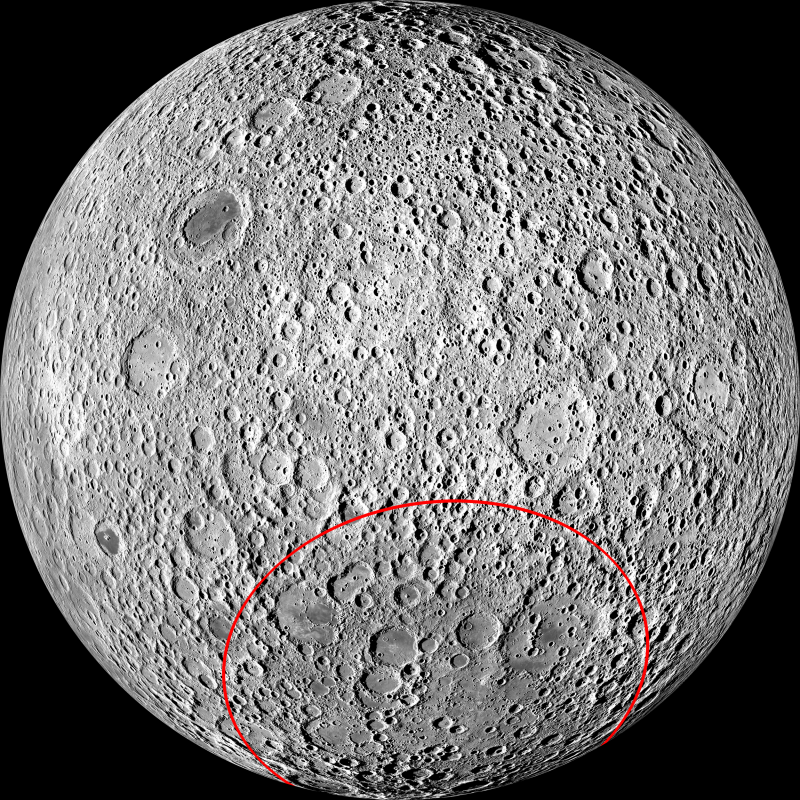
Far side of the full moon with red oval around lower part of picture.

The South Pole-Aitken Basin (outlined) on the far side of the moon. The unusual mass is beneath the surface in this area. Image via NASA.

What is hiding beneath the largest crater on Earth’s moon (in fact, the largest crater in our solar system)? That’s what scientists said they’d like to find out after an unusual large mass of material was discovered lurking underneath the lunar South Pole-Aitken Basin. It’s a lot of mass, too, according to Peter B. James, assistant professor of planetary geophysics in Baylor University’s College of Arts & Sciences:

Imagine taking a pile of metal five times larger than the Big Island of Hawaii and burying it underground. That’s roughly how much unexpected mass we detected.

The intriguing peer-reviewed findings were first published in the April 15, 2019, issue of the journal Geophysical Research Letters. From the abstract:

The South Pole-Aitken Basin is a gigantic impact structure on the far side of the moon, with an inner rim extending approximately 2,000 kilometers [1,200 miles] in the long-axis dimension. The structure and history of this basin are illuminated by gravity and topography data, which constrain the subsurface distribution of mass. These data point to the existence of a large excess of mass in the moon’s mantle under the South Pole-Aitken Basin. This anomaly … likely extends to depths of more than 300 km [about 200 miles].

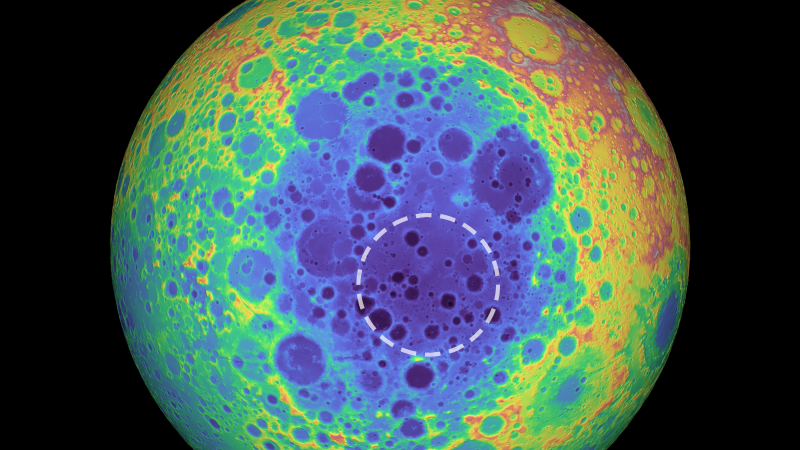
Moon with large blue patch in center, white dotted line in middle of blue area.

False-color map of the far side of the moon, showing the location of the unusual massive subsurface deposit beneath the South Pole-Aitken Basin. Image via NASA Goddard Space Flight Center/ University of Arizona/ Baylor University.

So what is this mysterious mass?

It is most likely metal of some kind, given its density and the fact that it is weighing the crater basin floor down by more than half a mile (0.8 km). An ancient asteroid impact would be a logical solution. Computer simulations of large asteroid impacts suggest that, under the right conditions, an iron-nickel core of an asteroid might be lodged into the upper mantle of the moon (the layer between the moon’s crust and core) during an impact, in this case the impact that created the South Pole-Aitken Basin.

Researchers analyzed data from spacecraft used for NASA’s Gravity Recovery and Interior Laboratory (GRAIL) mission to measure very small changes in gravity around the moon. As James explained:

When we combined that with lunar topography data from the Lunar Reconnaissance Orbiter (LRO), we discovered the unexpectedly large amount of mass hundreds of miles underneath the South Pole-Aitken basin. One of the explanations of this extra mass is that the metal from the asteroid that formed this crater is still embedded in the moon’s mantle. We did the math and showed that a sufficiently dispersed core of the asteroid that made the impact could remain suspended in the moon’s mantle until the present day, rather than sinking to the moon’s core.

The South Pole-Aitken Basin is estimated to have been formed about 4 billion years ago. The solar system was a very chaotic place back then, with collisions occurring between rocky and metallic bodies such as asteroids and young protoplanets – planetary embryos – on a pretty much regular basis. It seems quite feasible, then, that this is how the dense subsurface mass on the moon got there.

One other plausible theory, however, is that the mass might be a concentration of dense oxides associated with the last stage of lunar magma ocean solidification. It is theorized that the moon once had an ocean of sorts – not of water, but of magma, or molten rock – which then cooled and solidified. In the process, the oxides could have been deposited in this region, forming the large mass. 

These scientists say an asteroid impact is still the leading hypothesis, however, and James referred to the South Pole-Aitken Basin as one of the best natural laboratories for studying catastrophic impacts in the early solar system.

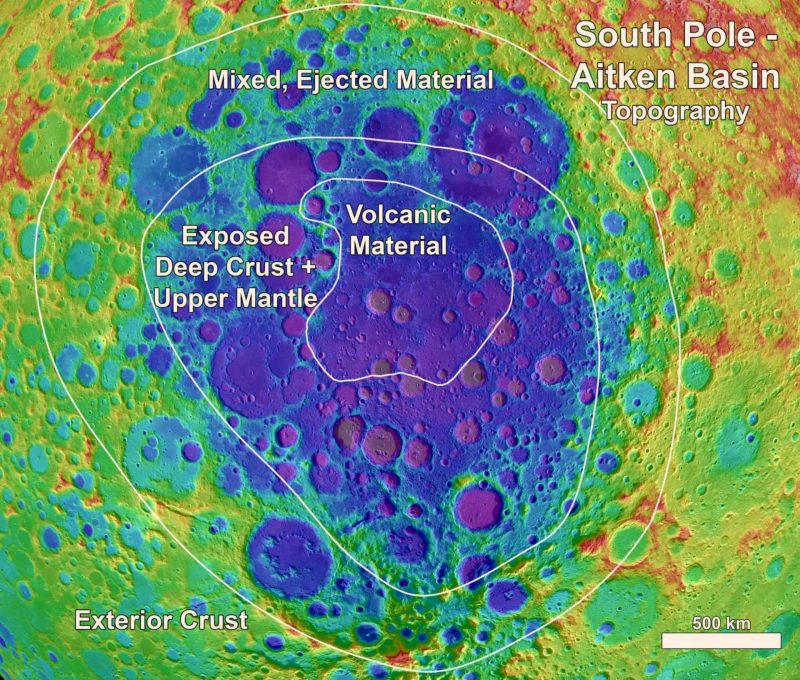
Closeup of blue patch with irregular concentric lines and labeled surface materials.

Topographic map of the South Pole-Aitken Basin on the moon. Image via Goddard Space Flight Center.

The South Pole-Aitken Basis is the largest known crater in the solar system. Measured from outer rim to outer rim, it’s about 1,600 miles (2,500 km) in diameter and 8.1 miles (13 km) deep. It was named for two features on opposite sides of the basin: Aitken Crater on the northern end and the lunar south pole at the other end. The basin’s existence had been suspected since 1962, based on data from the Luna 3 and Zond 3 orbiters, but was not confirmed until the mid-1960s by the Lunar Orbiter program.

On January 3, 2019, China’s Chang’e 4 spacecraft landed within this basin, in the smaller and younger Von Kármán Crater. This was the first time that any spacecraft has landed on the far side of the moon. It has studied samples of material thought to have come from deeper within the moon’s mantle, excavated during the impact that created the crater. This is a unique opportunity to explore in detail not only the crater, but a small portion of the larger basin as well.

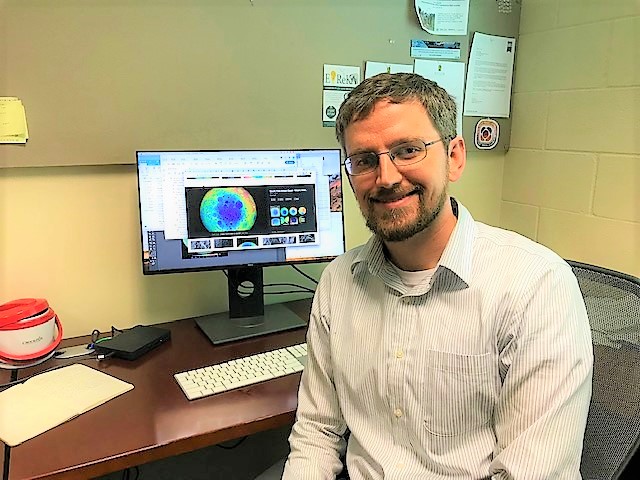
Smiling man seated in front of computer monitor with same picture as above displayed on it.

Peter B. James via Baylor University.

Bottom line: The massive dense deposit below the largest crater on the moon is a very interesting discovery, and may be metal left over from a huge asteroid impact 4 billion years ago.

Source: Deep Structure of the Lunar South Pole-Aitken Basin

Via Baylor University


from EarthSky http://bit.ly/2RwyLO9
Far side of the full moon with red oval around lower part of picture.

The South Pole-Aitken Basin (outlined) on the far side of the moon. The unusual mass is beneath the surface in this area. Image via NASA.

What is hiding beneath the largest crater on Earth’s moon (in fact, the largest crater in our solar system)? That’s what scientists said they’d like to find out after an unusual large mass of material was discovered lurking underneath the lunar South Pole-Aitken Basin. It’s a lot of mass, too, according to Peter B. James, assistant professor of planetary geophysics in Baylor University’s College of Arts & Sciences:

Imagine taking a pile of metal five times larger than the Big Island of Hawaii and burying it underground. That’s roughly how much unexpected mass we detected.

The intriguing peer-reviewed findings were first published in the April 15, 2019, issue of the journal Geophysical Research Letters. From the abstract:

The South Pole-Aitken Basin is a gigantic impact structure on the far side of the moon, with an inner rim extending approximately 2,000 kilometers [1,200 miles] in the long-axis dimension. The structure and history of this basin are illuminated by gravity and topography data, which constrain the subsurface distribution of mass. These data point to the existence of a large excess of mass in the moon’s mantle under the South Pole-Aitken Basin. This anomaly … likely extends to depths of more than 300 km [about 200 miles].

Moon with large blue patch in center, white dotted line in middle of blue area.

False-color map of the far side of the moon, showing the location of the unusual massive subsurface deposit beneath the South Pole-Aitken Basin. Image via NASA Goddard Space Flight Center/ University of Arizona/ Baylor University.

So what is this mysterious mass?

It is most likely metal of some kind, given its density and the fact that it is weighing the crater basin floor down by more than half a mile (0.8 km). An ancient asteroid impact would be a logical solution. Computer simulations of large asteroid impacts suggest that, under the right conditions, an iron-nickel core of an asteroid might be lodged into the upper mantle of the moon (the layer between the moon’s crust and core) during an impact, in this case the impact that created the South Pole-Aitken Basin.

Researchers analyzed data from spacecraft used for NASA’s Gravity Recovery and Interior Laboratory (GRAIL) mission to measure very small changes in gravity around the moon. As James explained:

When we combined that with lunar topography data from the Lunar Reconnaissance Orbiter (LRO), we discovered the unexpectedly large amount of mass hundreds of miles underneath the South Pole-Aitken basin. One of the explanations of this extra mass is that the metal from the asteroid that formed this crater is still embedded in the moon’s mantle. We did the math and showed that a sufficiently dispersed core of the asteroid that made the impact could remain suspended in the moon’s mantle until the present day, rather than sinking to the moon’s core.

The South Pole-Aitken Basin is estimated to have been formed about 4 billion years ago. The solar system was a very chaotic place back then, with collisions occurring between rocky and metallic bodies such as asteroids and young protoplanets – planetary embryos – on a pretty much regular basis. It seems quite feasible, then, that this is how the dense subsurface mass on the moon got there.

One other plausible theory, however, is that the mass might be a concentration of dense oxides associated with the last stage of lunar magma ocean solidification. It is theorized that the moon once had an ocean of sorts – not of water, but of magma, or molten rock – which then cooled and solidified. In the process, the oxides could have been deposited in this region, forming the large mass. 

These scientists say an asteroid impact is still the leading hypothesis, however, and James referred to the South Pole-Aitken Basin as one of the best natural laboratories for studying catastrophic impacts in the early solar system.

Closeup of blue patch with irregular concentric lines and labeled surface materials.

Topographic map of the South Pole-Aitken Basin on the moon. Image via Goddard Space Flight Center.

The South Pole-Aitken Basis is the largest known crater in the solar system. Measured from outer rim to outer rim, it’s about 1,600 miles (2,500 km) in diameter and 8.1 miles (13 km) deep. It was named for two features on opposite sides of the basin: Aitken Crater on the northern end and the lunar south pole at the other end. The basin’s existence had been suspected since 1962, based on data from the Luna 3 and Zond 3 orbiters, but was not confirmed until the mid-1960s by the Lunar Orbiter program.

On January 3, 2019, China’s Chang’e 4 spacecraft landed within this basin, in the smaller and younger Von Kármán Crater. This was the first time that any spacecraft has landed on the far side of the moon. It has studied samples of material thought to have come from deeper within the moon’s mantle, excavated during the impact that created the crater. This is a unique opportunity to explore in detail not only the crater, but a small portion of the larger basin as well.

Smiling man seated in front of computer monitor with same picture as above displayed on it.

Peter B. James via Baylor University.

Bottom line: The massive dense deposit below the largest crater on the moon is a very interesting discovery, and may be metal left over from a huge asteroid impact 4 billion years ago.

Source: Deep Structure of the Lunar South Pole-Aitken Basin

Via Baylor University


from EarthSky http://bit.ly/2RwyLO9

Could a superflare happen on our sun?

Bright flaming yellow-orange ball on black background. Planet with atmosphere being swept away.

An artist’s depiction of a superflare on an alien star. Image via NASA/ESA/D. Player.

In recent years, astronomers probing the edges of the Milky Way have observed very strong explosions on stars, which they’ve dubbed “superflares,” that have energies up to 10,000 times that of typical solar flares.

Superflares happen when stars – for reasons that scientists still don’t understand- eject huge bursts of energy that can be seen from hundreds of light years away. Until recently, researchers assumed that such explosions occurred mostly on stars that, unlike Earth’s sun, were young and active.

Now, new research suggests superflares can also occur on older, quieter stars like our own sun, albeit more rarely, perhaps once every few thousand years.

University of Colorado researcher Yuta Notsu is the lead author of the peer-reviewed study, published May 3, 2019, in The Astrophysical Journal. Notsu said the study results should be a wake-up call for life on our planet. That’s because if a superflare erupted from the sun, he said, Earth would likely sit in the path of a wave of high-energy radiation. Such a blast could disrupt electronics across the globe, causing widespread blackouts and shorting out communication satellites in orbit. Notsu said in a statement:

Our study shows that superflares are rare events. But there is some possibility that we could experience such an event in the next 100 years or so.

Scientists first discovered superflares via NASA’s Kepler Space Telescope. The spacecraft, which looks for exoplanets circling distant stars, also found something odd about those stars themselves. In rare events, the light from distant stars seemed to get suddenly, and momentarily, brighter.

Notsu explained that normal-sized flares are common on the sun. But what the Kepler data was showing seemed to be much bigger, on the order of hundreds to thousands of times more powerful than the largest flare ever recorded with modern instruments on Earth. And, Notsu said, that data raised an obvious question: Could a superflare also occur on our own sun? Notsu said:

When our sun was young, it was very active because it rotated very fast and probably generated more powerful flares. But we didn’t know if such large flares occur on the modern sun with very low frequency.

To find out, Notsu and an international team of researchers turned to data on superflares from the European Space Agency’s Gaia spacecraft and from the Apache Point Observatory in New Mexico. Based on the team’s calculations, younger stars tend to produce the most superflares. But older stars like our sun, at 4.6 billion years old, aren’t off the hook. Notsu said:

Young stars have superflares once every week or so. For the sun, it’s once every few thousand years on average.

Notsu can’t be sure when the next big solar light show is due to hit Earth. But he said that it’s a matter of when, not if. Still, that could give humans time to prepare, protecting electronics on the ground and in orbit from radiation in space. He said:

If a superflare occurred 1,000 years ago, it was probably no big problem. People may have seen a large aurora. Now, it’s a much bigger problem because of our electronics.

Bottom line: New research suggests a superflare could happen on our sun.

Source: Do Kepler Superflare Stars Really Include Slowly Rotating Sun-like Stars?—Results Using APO 3.5 m Telescope Spectroscopic Observations and Gaia-DR2 Data

Via University of Colorado Boulder


from EarthSky http://bit.ly/2L1KJxY
Bright flaming yellow-orange ball on black background. Planet with atmosphere being swept away.

An artist’s depiction of a superflare on an alien star. Image via NASA/ESA/D. Player.

In recent years, astronomers probing the edges of the Milky Way have observed very strong explosions on stars, which they’ve dubbed “superflares,” that have energies up to 10,000 times that of typical solar flares.

Superflares happen when stars – for reasons that scientists still don’t understand- eject huge bursts of energy that can be seen from hundreds of light years away. Until recently, researchers assumed that such explosions occurred mostly on stars that, unlike Earth’s sun, were young and active.

Now, new research suggests superflares can also occur on older, quieter stars like our own sun, albeit more rarely, perhaps once every few thousand years.

University of Colorado researcher Yuta Notsu is the lead author of the peer-reviewed study, published May 3, 2019, in The Astrophysical Journal. Notsu said the study results should be a wake-up call for life on our planet. That’s because if a superflare erupted from the sun, he said, Earth would likely sit in the path of a wave of high-energy radiation. Such a blast could disrupt electronics across the globe, causing widespread blackouts and shorting out communication satellites in orbit. Notsu said in a statement:

Our study shows that superflares are rare events. But there is some possibility that we could experience such an event in the next 100 years or so.

Scientists first discovered superflares via NASA’s Kepler Space Telescope. The spacecraft, which looks for exoplanets circling distant stars, also found something odd about those stars themselves. In rare events, the light from distant stars seemed to get suddenly, and momentarily, brighter.

Notsu explained that normal-sized flares are common on the sun. But what the Kepler data was showing seemed to be much bigger, on the order of hundreds to thousands of times more powerful than the largest flare ever recorded with modern instruments on Earth. And, Notsu said, that data raised an obvious question: Could a superflare also occur on our own sun? Notsu said:

When our sun was young, it was very active because it rotated very fast and probably generated more powerful flares. But we didn’t know if such large flares occur on the modern sun with very low frequency.

To find out, Notsu and an international team of researchers turned to data on superflares from the European Space Agency’s Gaia spacecraft and from the Apache Point Observatory in New Mexico. Based on the team’s calculations, younger stars tend to produce the most superflares. But older stars like our sun, at 4.6 billion years old, aren’t off the hook. Notsu said:

Young stars have superflares once every week or so. For the sun, it’s once every few thousand years on average.

Notsu can’t be sure when the next big solar light show is due to hit Earth. But he said that it’s a matter of when, not if. Still, that could give humans time to prepare, protecting electronics on the ground and in orbit from radiation in space. He said:

If a superflare occurred 1,000 years ago, it was probably no big problem. People may have seen a large aurora. Now, it’s a much bigger problem because of our electronics.

Bottom line: New research suggests a superflare could happen on our sun.

Source: Do Kepler Superflare Stars Really Include Slowly Rotating Sun-like Stars?—Results Using APO 3.5 m Telescope Spectroscopic Observations and Gaia-DR2 Data

Via University of Colorado Boulder


from EarthSky http://bit.ly/2L1KJxY

Circumpolar stars don’t rise or set

Circumpolar stars stay above the horizon all hours of the day, every day of the year. These stars neither rise nor set but always remain in our sky. Even when you can’t see them – when the sun is out and it’s daytime – these stars are up there, circling endlessly around the sky’s north or south pole.

For instance, the stars of the famous Big Dipper asterism are circumpolar at all latitudes north of 41 degrees north latitude, which includes the northern half of the mainland United States and most of Europe.

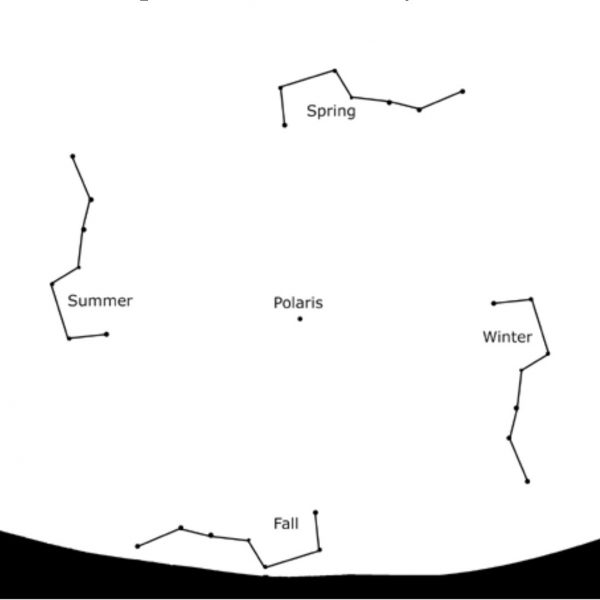
Diagram of Big Dipper in four positions in the sky relative to central point.

From the northern U.S., Canada or similar latitudes, the Big Dipper is circumpolar, always above your horizon. Image shows Big Dipper at midnight at various seasons. “Spring up and fall down” for the Dipper’s appearance in our northern sky. It ascends in the northeast on spring evenings and descends in the northwest on fall evenings. Image via Night Sky Interlude – Spring Skies.

How many circumpolar stars appear in your sky depends on where you are. At the Earth’s North and South Poles, every visible star is circumpolar. That is, at Earth’s North Pole, every star north of the celestial equator is circumpolar, while every star south of the celestial equator stays below the horizon. At the Earth’s South Pole, it’s the exact opposite. Every star south of the celestial equator is circumpolar, whereas every star north of the celestial equator remains beneath the horizon.

At the Earth’s equator, no star is circumpolar because all the stars rise and set daily in that part of the world. You can (theoretically) see every star in the night sky over the course of one year. In practice, of course, things like clouds and horizon haze get in the way.

Places in between the equator and poles have some stars that are circumpolar, some stars that rise and set daily (like the sun), and some stars that remain below the horizon all year round. In short, the closer you are to the North or South Pole, the greater the circle of circumpolar stars; the closer you are to the Earth’s equator, the smaller the circle of circumpolar stars.

We in the Northern Hemisphere are lucky to have a moderately-bright star, Polaris, nearly coinciding with the north celestial pole – the point in the sky that’s at zenith (straight overhead) at the Earth’s North Pole.

Draw an imaginary line straight down from Polaris, the North Star, to the horizon, and presto, you have what it takes to draw out the circle of circumpolar stars in your sky.

Star chart with thin vertical line and constellations Cepheus and Cassiopeia.

In the Northern Hemisphere, an imaginary vertical line from the north celestial pole to your horizon serves as a radius measure for the circle of circumpolar stars in your sky. The closer you are to the Earth’s North Pole, the closer the north celestial pole is to your zenith (overhead point).

For people in the Northern Hemisphere, Polaris nearly pinpoints the center of the great big circle of circumpolar stars on the sky’s dome; and the imaginary vertical line from Polaris to the horizon depicts the radius measure. (See the above chart, which has this line drawn in for you.) Let your arm serve as a circle compass, enabling you to envision the circle of circumpolar stars with your mind’s eye. Closer to the equator, the circle of circumpolar stars grows smaller; nearer to the North Pole (or South Pole) the circle of circumpolar stars grows larger.

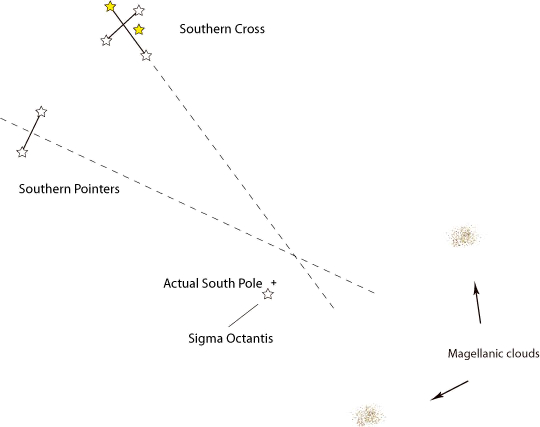
This technique for locating the circle of circumpolar stars works in the Southern Hemisphere, as well. However, it’s trickier to star-hop to the south celestial pole – the point on the sky’s dome that’s at zenith over the Earth’s South Pole. Practiced stargazers in the Southern Hemisphere rely on the Southern Cross, and key stars, to star-hop to the south celestial pole, as depicted in the illustration below:

Diagram of southern sky with dotted lines converging near south pole.

Star-hopping to south celestial pole via the Southern Cross and the bright stars Alpha Centauri and Hadar. Read more: Use the Southern Cross to find due south.

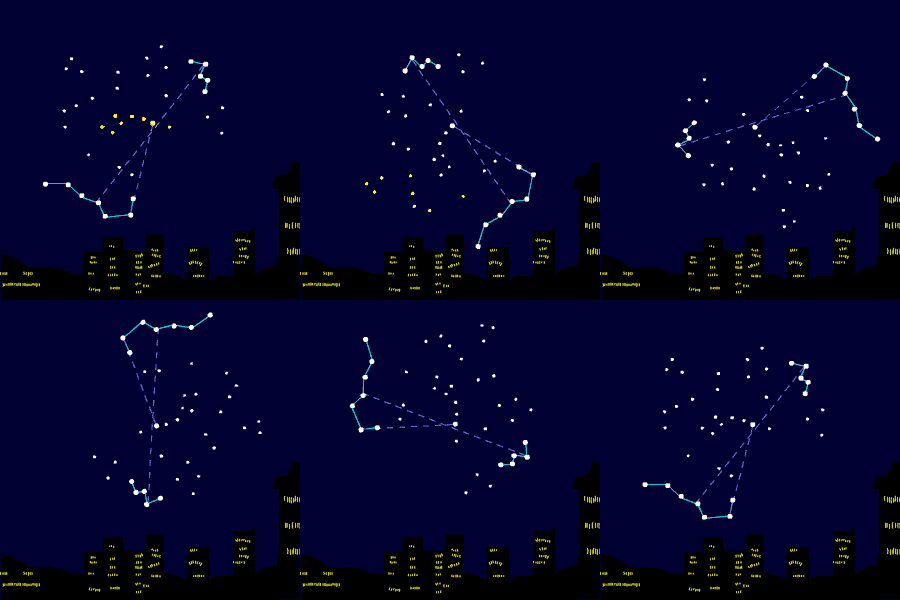
Animated chart with Big Dipper and Cassiopeia with other stars circling north pole.

The Big Dipper and the W-shaped constellation Cassiopeia circle around Polaris, the North Star, in a period of 23 hours and 56 minutes. The Big Dipper is circumpolar at 41 degrees north latitude, and all latitudes farther north.

The Southern Cross is circumpolar anywhere south of 35 degrees south latitude; yet, in the Northern Hemisphere, it’s the W or M-shaped constellation Cassiopeia that’s circumpolar at all places north of 35 degrees north latitude. (Scroll upward to the chart showing Cassiopeia at nightfall for mid-northern latitudes.)

By the way, Cassiopeia lies on the opposite side of Polaris from the Big Dipper. So from mid-northern latitudes, the Big Dipper and Polaris help you to locate Cassiopeia. See the above animation, in which all the stars revolve full circle around the celestial pole each day – or more precisely: every 23 hours and 56 minutes.

If Cassiopeia is circumpolar in your sky, then the Southern Cross never climbs above your horizon; and conversely, if the Southern Cross is circumpolar in your sky, then the constellation Cassiopeia never climbs above the horizon.

As seen from the tropics (and subtropics), neither the Southern Cross nor Cassiopeia is circumpolar. From this part of the world, the Southern Cross rises over the southern horizon when Cassiopeia sinks below the northern horizon; and conversely, Cassiopeia rises over the northern horizon when the Southern Cross sinks below the southern horizon.

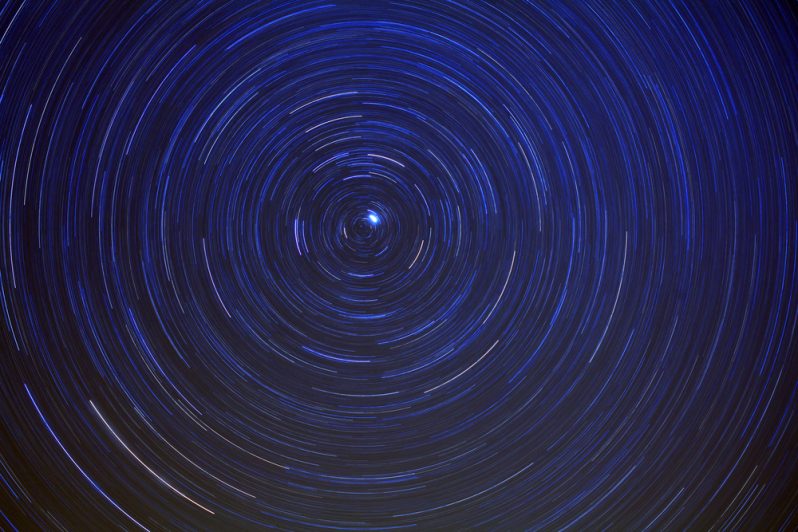
Very many circular concentric white lines surrounding a bright white dot.

Sky wheeling around Polaris, the North Star. Image via Shutterstock.

Bottom line: Circumpolar stars stay above the horizon all hours of the day, every day of the year. Although you can’t see them, they’re up even in daytime.

Read more: Use the Southern Cross to find due south

.


from EarthSky http://bit.ly/2IrNaIw

Circumpolar stars stay above the horizon all hours of the day, every day of the year. These stars neither rise nor set but always remain in our sky. Even when you can’t see them – when the sun is out and it’s daytime – these stars are up there, circling endlessly around the sky’s north or south pole.

For instance, the stars of the famous Big Dipper asterism are circumpolar at all latitudes north of 41 degrees north latitude, which includes the northern half of the mainland United States and most of Europe.

Diagram of Big Dipper in four positions in the sky relative to central point.

From the northern U.S., Canada or similar latitudes, the Big Dipper is circumpolar, always above your horizon. Image shows Big Dipper at midnight at various seasons. “Spring up and fall down” for the Dipper’s appearance in our northern sky. It ascends in the northeast on spring evenings and descends in the northwest on fall evenings. Image via Night Sky Interlude – Spring Skies.

How many circumpolar stars appear in your sky depends on where you are. At the Earth’s North and South Poles, every visible star is circumpolar. That is, at Earth’s North Pole, every star north of the celestial equator is circumpolar, while every star south of the celestial equator stays below the horizon. At the Earth’s South Pole, it’s the exact opposite. Every star south of the celestial equator is circumpolar, whereas every star north of the celestial equator remains beneath the horizon.

At the Earth’s equator, no star is circumpolar because all the stars rise and set daily in that part of the world. You can (theoretically) see every star in the night sky over the course of one year. In practice, of course, things like clouds and horizon haze get in the way.

Places in between the equator and poles have some stars that are circumpolar, some stars that rise and set daily (like the sun), and some stars that remain below the horizon all year round. In short, the closer you are to the North or South Pole, the greater the circle of circumpolar stars; the closer you are to the Earth’s equator, the smaller the circle of circumpolar stars.

We in the Northern Hemisphere are lucky to have a moderately-bright star, Polaris, nearly coinciding with the north celestial pole – the point in the sky that’s at zenith (straight overhead) at the Earth’s North Pole.

Draw an imaginary line straight down from Polaris, the North Star, to the horizon, and presto, you have what it takes to draw out the circle of circumpolar stars in your sky.

Star chart with thin vertical line and constellations Cepheus and Cassiopeia.

In the Northern Hemisphere, an imaginary vertical line from the north celestial pole to your horizon serves as a radius measure for the circle of circumpolar stars in your sky. The closer you are to the Earth’s North Pole, the closer the north celestial pole is to your zenith (overhead point).

For people in the Northern Hemisphere, Polaris nearly pinpoints the center of the great big circle of circumpolar stars on the sky’s dome; and the imaginary vertical line from Polaris to the horizon depicts the radius measure. (See the above chart, which has this line drawn in for you.) Let your arm serve as a circle compass, enabling you to envision the circle of circumpolar stars with your mind’s eye. Closer to the equator, the circle of circumpolar stars grows smaller; nearer to the North Pole (or South Pole) the circle of circumpolar stars grows larger.

This technique for locating the circle of circumpolar stars works in the Southern Hemisphere, as well. However, it’s trickier to star-hop to the south celestial pole – the point on the sky’s dome that’s at zenith over the Earth’s South Pole. Practiced stargazers in the Southern Hemisphere rely on the Southern Cross, and key stars, to star-hop to the south celestial pole, as depicted in the illustration below:

Diagram of southern sky with dotted lines converging near south pole.

Star-hopping to south celestial pole via the Southern Cross and the bright stars Alpha Centauri and Hadar. Read more: Use the Southern Cross to find due south.

Animated chart with Big Dipper and Cassiopeia with other stars circling north pole.

The Big Dipper and the W-shaped constellation Cassiopeia circle around Polaris, the North Star, in a period of 23 hours and 56 minutes. The Big Dipper is circumpolar at 41 degrees north latitude, and all latitudes farther north.

The Southern Cross is circumpolar anywhere south of 35 degrees south latitude; yet, in the Northern Hemisphere, it’s the W or M-shaped constellation Cassiopeia that’s circumpolar at all places north of 35 degrees north latitude. (Scroll upward to the chart showing Cassiopeia at nightfall for mid-northern latitudes.)

By the way, Cassiopeia lies on the opposite side of Polaris from the Big Dipper. So from mid-northern latitudes, the Big Dipper and Polaris help you to locate Cassiopeia. See the above animation, in which all the stars revolve full circle around the celestial pole each day – or more precisely: every 23 hours and 56 minutes.

If Cassiopeia is circumpolar in your sky, then the Southern Cross never climbs above your horizon; and conversely, if the Southern Cross is circumpolar in your sky, then the constellation Cassiopeia never climbs above the horizon.

As seen from the tropics (and subtropics), neither the Southern Cross nor Cassiopeia is circumpolar. From this part of the world, the Southern Cross rises over the southern horizon when Cassiopeia sinks below the northern horizon; and conversely, Cassiopeia rises over the northern horizon when the Southern Cross sinks below the southern horizon.

Very many circular concentric white lines surrounding a bright white dot.

Sky wheeling around Polaris, the North Star. Image via Shutterstock.

Bottom line: Circumpolar stars stay above the horizon all hours of the day, every day of the year. Although you can’t see them, they’re up even in daytime.

Read more: Use the Southern Cross to find due south

.


from EarthSky http://bit.ly/2IrNaIw

Summer solstice tale of 2 cities

Many tall buildings glowing brilliantly gold against a slate-blue sky.

Sunset over Manhattan, June 5, 2016, by Jennifer Khordi. Visit Khordi Photography on Facebook.

Around the time of the June solstice, the sun sets at virtually the same time in both New York City, New York, and St. Augustine, Florida. On June 21, 2019, the sun sets around 8:30 p.m. Eastern Daylight Time (EDT) in both places.

What’s going on here? Doesn’t the sun set later farther north at this time of year? What about the phenomenon of midnight twilight and midnight sun, after all? It’s true that – for places farther north in summer – the sun stays out longer. But St. Augustine lodges about 7.5 degrees of longitude to the west of New York City. Our planet takes about 30 minutes to rotate this 7.5 degrees.

Therefore, on any day of the year, the sun reaches its noontime position some 30 minutes later in St. Augustine than it does in New York City. For instance, on June 21, 2018, the noonday sun reaches its high point for the day at 12:58 p.m. EDT in New York City – yet in St. Augustine, solar noon comes about 30 minutes later, at 1:27 p.m. EDT.

Because New York is appreciably north of St. Augustine, New York’s afternoon daylight (from solar noon to sunset) lasts some 30 minutes longer on the day of the June solstice than it does in St. Augustine.

Thus, the longer period of daylight in New York cancels out the later noontime appearance of the sun in St. Augustine, to give both localities the same sunset time on the day of the June solstice. The table below helps to clarify.

Sunrise/solar noon/sunset times on June 21, 2019, via the U.S. Naval Observatory

City Sunrise Solar Noon Sunset
New York 5:25 a.m. 12:58 p.m. 8:30 p.m.
St. Augustine 6:25 a.m. 1:27 p.m. 8:29 p.m.
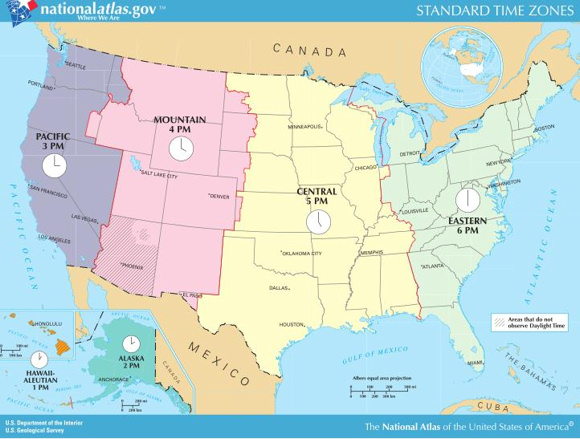
Map of the United States with irregular vertical pastel stripes (time zones).

NYC and St. Augustine both use Eastern time. But the noonday sun comes 30 minutes later to St. Augustine because it resides 7.5 degrees of longitude west of New York City.

In other words, from sunrise to sunset on the June solstice, New York City has about an hour more daylight than St. Augustine does. (That’s 30 minutes more morning daylight and 30 minutes more afternoon daylight.) Although the sunset occurs at virtually the same time for both cities, the sunrise happens an hour earlier in New York City. Look again at the sunrise/solar noon/sunset table above.

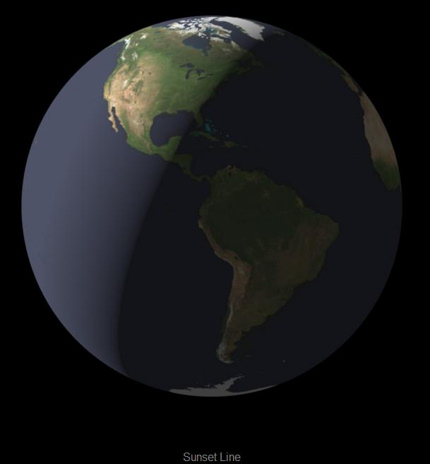
Earth globe showing the Americas with half the globe in darkness and half light.

Earth’s terminator – line of sunset – nearly parallels the Eastern Seaboard on the day of the June solstice.

The image above is a simulated view of Earth as the sun is setting around the time of the June summer solstice. Note that the terminator pretty much aligns with the U. S. East Coast, providing a similar sunset time for coastal dwellers.

Enter the equinoxes

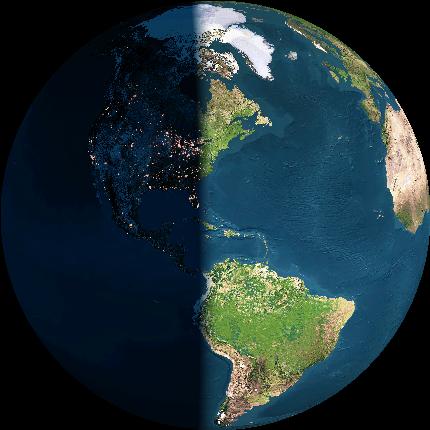
Some three – and nine – months after the June solstice, St. Augustine and New York City receive the same amount of daylight on the days of the September and March equinoxes. On the equinoxes, noontime as well as sunrise and sunset come 30 minutes later in St. Augustine than they do in New York City. The simulated view of Earth below shows the terminator – the sunrise line – running due north and south on the equinox. Neither the sunrise terminator nor sunset terminator comes anywhere close to aligning with the U.S. East Coast at either equinox.

Sunrise/solar noon/sunset times on September 22, 2019 via the U.S. Naval Observatory

City Sunrise Solar Noon Sunset
New York 6:44 a.m. 12:48 p.m. 6:53 p.m.
St. Augustine 7:14 a.m. 1:18 p.m. 7:22 p.m.
Earth globe exactly one half dark and one half light.

The terminator – sunrise line – runs due north and south on the equinoxes. The sunset line, though not shown, also runs north and south. Image via Earth and Moon Viewer.

Sunrise/solar noon/sunset times on March 20, 2020

City Sunrise Solar Noon Sunset
New York 6:59 a.m. 1:03 p.m. 7:09 p.m.
St. Augustine 7:29 a.m. 1:33 p.m. 7:37 p.m.

Enter the December solstice

Six months after the June solstice, it’s the December winter solstice for the Northern Hemisphere, coming yearly on or near December 21. Now, the situation is reversed from the June solstice, with St. Augustine receiving an hour more daylight than New York City.

Because St. Augustine lies appreciably south of New York City, St. Augustine’s morning daylight (from sunrise to solar noon) lasts 30 minutes longer than in New York City on the day of the December winter solstice. Thus, the more daylight in St. Augustine cancels out the earlier noontime in New York City, to give both localities the same sunrise time on the December solstice. (See sunrise/solar noon/sunset table below.)

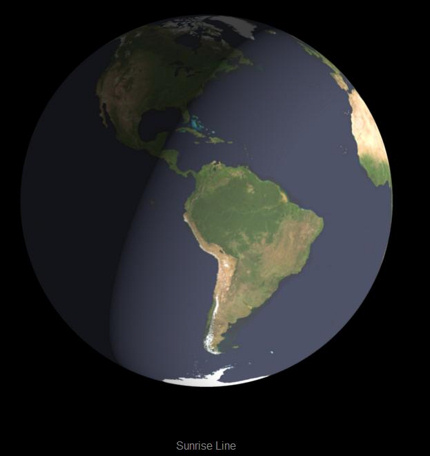
Globe of Earth divided into dark half and light half at an angle.

Simulation of the line of sunrise as it hits the U.S. eastern seaboard around the December solstice. Image via U.S. Naval Observatory.

Look above at the simulated view of Earth as the sun is rising over the Eastern Seaboard of the United States on the day of the winter solstice. Note that the terminator – the sunrise line – pretty much coincides with the East Coast, giving a similar sunrise time for residents along the Atlantic Seaboard.

Sunrise/solar noon/sunset times on December 21, 2019 via the U..S Naval Observatory

City Sunrise Solar Noon Sunset
New York 7:16 a.m. 11:54 a.m. 4:31 p.m.
St. Augustine 7:17 a.m. 12:23 p.m. 5:30 p.m.

From sunrise to sunset on the day of the winter solstice, St. Augustine residents enjoy about an hour more daylight than those in New York City. Although the sunrise occurs at about the same time for both cities, the sunset happens an hour later in St. Augustine on the day of the winter solstice.

Bottom Line: On the day of the June summer solstice, the sun sets at the same time in both St. Augustine, Florida, and New York City, New York. However, New York City enjoys an hour more daylight. Six months later, on the day of the December solstice, it’s the exact opposite. It’s the sunrise that happens at the same time in both places, yet it’s then St. Augustine’s turn to enjoy an extra hour of sunshine.

Help EarthSky keep going! Please donate what you can.


from EarthSky http://bit.ly/2ZAgDFx
Many tall buildings glowing brilliantly gold against a slate-blue sky.

Sunset over Manhattan, June 5, 2016, by Jennifer Khordi. Visit Khordi Photography on Facebook.

Around the time of the June solstice, the sun sets at virtually the same time in both New York City, New York, and St. Augustine, Florida. On June 21, 2019, the sun sets around 8:30 p.m. Eastern Daylight Time (EDT) in both places.

What’s going on here? Doesn’t the sun set later farther north at this time of year? What about the phenomenon of midnight twilight and midnight sun, after all? It’s true that – for places farther north in summer – the sun stays out longer. But St. Augustine lodges about 7.5 degrees of longitude to the west of New York City. Our planet takes about 30 minutes to rotate this 7.5 degrees.

Therefore, on any day of the year, the sun reaches its noontime position some 30 minutes later in St. Augustine than it does in New York City. For instance, on June 21, 2018, the noonday sun reaches its high point for the day at 12:58 p.m. EDT in New York City – yet in St. Augustine, solar noon comes about 30 minutes later, at 1:27 p.m. EDT.

Because New York is appreciably north of St. Augustine, New York’s afternoon daylight (from solar noon to sunset) lasts some 30 minutes longer on the day of the June solstice than it does in St. Augustine.

Thus, the longer period of daylight in New York cancels out the later noontime appearance of the sun in St. Augustine, to give both localities the same sunset time on the day of the June solstice. The table below helps to clarify.

Sunrise/solar noon/sunset times on June 21, 2019, via the U.S. Naval Observatory

City Sunrise Solar Noon Sunset
New York 5:25 a.m. 12:58 p.m. 8:30 p.m.
St. Augustine 6:25 a.m. 1:27 p.m. 8:29 p.m.
Map of the United States with irregular vertical pastel stripes (time zones).

NYC and St. Augustine both use Eastern time. But the noonday sun comes 30 minutes later to St. Augustine because it resides 7.5 degrees of longitude west of New York City.

In other words, from sunrise to sunset on the June solstice, New York City has about an hour more daylight than St. Augustine does. (That’s 30 minutes more morning daylight and 30 minutes more afternoon daylight.) Although the sunset occurs at virtually the same time for both cities, the sunrise happens an hour earlier in New York City. Look again at the sunrise/solar noon/sunset table above.

Earth globe showing the Americas with half the globe in darkness and half light.

Earth’s terminator – line of sunset – nearly parallels the Eastern Seaboard on the day of the June solstice.

The image above is a simulated view of Earth as the sun is setting around the time of the June summer solstice. Note that the terminator pretty much aligns with the U. S. East Coast, providing a similar sunset time for coastal dwellers.

Enter the equinoxes

Some three – and nine – months after the June solstice, St. Augustine and New York City receive the same amount of daylight on the days of the September and March equinoxes. On the equinoxes, noontime as well as sunrise and sunset come 30 minutes later in St. Augustine than they do in New York City. The simulated view of Earth below shows the terminator – the sunrise line – running due north and south on the equinox. Neither the sunrise terminator nor sunset terminator comes anywhere close to aligning with the U.S. East Coast at either equinox.

Sunrise/solar noon/sunset times on September 22, 2019 via the U.S. Naval Observatory

City Sunrise Solar Noon Sunset
New York 6:44 a.m. 12:48 p.m. 6:53 p.m.
St. Augustine 7:14 a.m. 1:18 p.m. 7:22 p.m.
Earth globe exactly one half dark and one half light.

The terminator – sunrise line – runs due north and south on the equinoxes. The sunset line, though not shown, also runs north and south. Image via Earth and Moon Viewer.

Sunrise/solar noon/sunset times on March 20, 2020

City Sunrise Solar Noon Sunset
New York 6:59 a.m. 1:03 p.m. 7:09 p.m.
St. Augustine 7:29 a.m. 1:33 p.m. 7:37 p.m.

Enter the December solstice

Six months after the June solstice, it’s the December winter solstice for the Northern Hemisphere, coming yearly on or near December 21. Now, the situation is reversed from the June solstice, with St. Augustine receiving an hour more daylight than New York City.

Because St. Augustine lies appreciably south of New York City, St. Augustine’s morning daylight (from sunrise to solar noon) lasts 30 minutes longer than in New York City on the day of the December winter solstice. Thus, the more daylight in St. Augustine cancels out the earlier noontime in New York City, to give both localities the same sunrise time on the December solstice. (See sunrise/solar noon/sunset table below.)

Globe of Earth divided into dark half and light half at an angle.

Simulation of the line of sunrise as it hits the U.S. eastern seaboard around the December solstice. Image via U.S. Naval Observatory.

Look above at the simulated view of Earth as the sun is rising over the Eastern Seaboard of the United States on the day of the winter solstice. Note that the terminator – the sunrise line – pretty much coincides with the East Coast, giving a similar sunrise time for residents along the Atlantic Seaboard.

Sunrise/solar noon/sunset times on December 21, 2019 via the U..S Naval Observatory

City Sunrise Solar Noon Sunset
New York 7:16 a.m. 11:54 a.m. 4:31 p.m.
St. Augustine 7:17 a.m. 12:23 p.m. 5:30 p.m.

From sunrise to sunset on the day of the winter solstice, St. Augustine residents enjoy about an hour more daylight than those in New York City. Although the sunrise occurs at about the same time for both cities, the sunset happens an hour later in St. Augustine on the day of the winter solstice.

Bottom Line: On the day of the June summer solstice, the sun sets at the same time in both St. Augustine, Florida, and New York City, New York. However, New York City enjoys an hour more daylight. Six months later, on the day of the December solstice, it’s the exact opposite. It’s the sunrise that happens at the same time in both places, yet it’s then St. Augustine’s turn to enjoy an extra hour of sunshine.

Help EarthSky keep going! Please donate what you can.


from EarthSky http://bit.ly/2ZAgDFx

New Research for Week #24, 2019

A note of appreciation and a changing of the guard
For the past over eight years Skeptical Science staff volunteer Ari Jokimäki has produced a weekly list of links to recent academic publications concerning the fundamental science of climate change, global warming and the role of humans in creating this emerging new reality. As our understanding of the theoretical and empirical situation has improved so has research output relating to subordinate effects and responses to the challenges presented by climate change burgeoned. Keeping track of the expanding sphere of climate change related research and winnowing germane references from the continuous firehose of general scientific inquiry has consumed countless hours of Ari's time, an investment that is massively appreciated.

Now Ari has hung up his spurs for the time being. Thank you, Ari!

New Research, Reloaded
Rather than let this key feature of Skeptical Science lapse, we'll continue with a change of crew. Readers of New Research can expect some experimentation with the format, possible changes in emphasis and quite likely some initial incompetence. There is enough material appearing that we might even do some thematic distillations, entirely focusing on particular disciplines for a given week.

As the publication feeds we use for provisioning include material already published, articles announced but not yet published let alone that sometimes we'll need to circle back to missed items, SkS New Research will change its own publication title to hinge on the week of its publication.

Suggestions and comments are as always welcome.

New Research for week #24 of 2019

Trends in summer heatwaves in Central Asia from 1917 to 2016: association with large‐scale atmospheric circulation patterns

High‐quality sea surface temperature measurements along coast of the Bohai and Yellow Seas in China and their long‐term trends during 1960–2012

No direct link between North Atlantic currents, sea level along New England coast

Warming waters in western tropical Pacific may affect West Antarctic Ice Sheet

Climate as a risk factor for armed conflict

Food choices, health and environment: Effects of cutting Europe's meat and dairy intake

Weaponizing vulnerability to climate change

Climate change drives widespread and rapid thermokarst development in very cold permafrost in the Canadian High Arctic

Arctic amplification response to individual climate drivers

Modelling the impacts of urbanization on summer thermal comfort: the role of urban land use and anthropogenic heat

Weakening of the teleconnection from El Niño‐Southern Oscillation to the Arctic stratosphere over the past few decades: What can be learned from subseasonal forecast models?

Concurrent 2018 hot extremes across Northern Hemisphere due to human‐induced climate change (OA)

Robust Adaptation to Multi‐Scale Climate Variability (OA)

Projected slowdown of Antarctic Bottom Water formation in response to amplified meltwater contributions

Summer Climate Change in the Midwest and Great Plains Due to Agricultural Development During the 20th Century

Observed Link of Extreme Hourly Precipitation Changes to Urbanization over Coastal South China (OA)

Motor Vehicle CO2 Emissions in the U.S.: Potential Behavioral Feedback and Global Warming

Impacts of climate warming on aviation fuel consumption

Climate Change Amplification of Natural Drought Variability: The Historic Mid-Twentieth Century North American Drought In a Warmer World

Mechanisms for an amplified precipitation seasonal cycle in the U.S. West Coast under global warming

Rapid environmental responses to climate-induced hydrographic changes in the Baltic Sea entrance

Optimal urban form for global and local emissions under electric vehicle and renewable energy scenarios

Integrated impacts of climate change on glacier tourism

A new look at roles of the cryosphere in sustainable development

Climate change and uncertainty from ‘above’ and ‘below’: perspectives from India

Impact of model resolution on Arctic sea ice and North Atlantic Ocean heat transport

Trends in summer air temperature and vapor pressure and their impacts on thermal comfort in China

Beliefs about climate change in the aftermath of extreme flooding

Climate change communicators’ carbon footprints affect their audience’s policy support

Climate change perceptions and responsive strategies in Benin: the case of maize farmers

Governance and stakeholder perspectives of managed re-alignment: adapting to sea level rise in the Inner Forth estuary, Scotland

Climate Trends in the East Antilles Islands

Cloud cover and cloud types in the Eurasian Arctic in 1936–2012

Analysis of spatiotemporal variability in temperature extremes in the Yellow and Yangtze River basins during 1961‐2014 based on high‐density gauge observations

Key challenges for China\'s carbon emissions trading program

Fixing a snag in carbon emissions estimates from wildfires

Legacies of more frequent drought in ponderosa pine across the western United States

At home, in public, and in between: gender differences in public, private and transportation pro-environmental behaviors in the US Intermountain West

Influencing factors of consumers’ willingness to purchase green housing: a survey from Shandong Province, China

Promoting climate-friendly diets: What should we tell consumers in Denmark, Finland and France?


from Skeptical Science http://bit.ly/2WP0pMb

A note of appreciation and a changing of the guard
For the past over eight years Skeptical Science staff volunteer Ari Jokimäki has produced a weekly list of links to recent academic publications concerning the fundamental science of climate change, global warming and the role of humans in creating this emerging new reality. As our understanding of the theoretical and empirical situation has improved so has research output relating to subordinate effects and responses to the challenges presented by climate change burgeoned. Keeping track of the expanding sphere of climate change related research and winnowing germane references from the continuous firehose of general scientific inquiry has consumed countless hours of Ari's time, an investment that is massively appreciated.

Now Ari has hung up his spurs for the time being. Thank you, Ari!

New Research, Reloaded
Rather than let this key feature of Skeptical Science lapse, we'll continue with a change of crew. Readers of New Research can expect some experimentation with the format, possible changes in emphasis and quite likely some initial incompetence. There is enough material appearing that we might even do some thematic distillations, entirely focusing on particular disciplines for a given week.

As the publication feeds we use for provisioning include material already published, articles announced but not yet published let alone that sometimes we'll need to circle back to missed items, SkS New Research will change its own publication title to hinge on the week of its publication.

Suggestions and comments are as always welcome.

New Research for week #24 of 2019

Trends in summer heatwaves in Central Asia from 1917 to 2016: association with large‐scale atmospheric circulation patterns

High‐quality sea surface temperature measurements along coast of the Bohai and Yellow Seas in China and their long‐term trends during 1960–2012

No direct link between North Atlantic currents, sea level along New England coast

Warming waters in western tropical Pacific may affect West Antarctic Ice Sheet

Climate as a risk factor for armed conflict

Food choices, health and environment: Effects of cutting Europe's meat and dairy intake

Weaponizing vulnerability to climate change

Climate change drives widespread and rapid thermokarst development in very cold permafrost in the Canadian High Arctic

Arctic amplification response to individual climate drivers

Modelling the impacts of urbanization on summer thermal comfort: the role of urban land use and anthropogenic heat

Weakening of the teleconnection from El Niño‐Southern Oscillation to the Arctic stratosphere over the past few decades: What can be learned from subseasonal forecast models?

Concurrent 2018 hot extremes across Northern Hemisphere due to human‐induced climate change (OA)

Robust Adaptation to Multi‐Scale Climate Variability (OA)

Projected slowdown of Antarctic Bottom Water formation in response to amplified meltwater contributions

Summer Climate Change in the Midwest and Great Plains Due to Agricultural Development During the 20th Century

Observed Link of Extreme Hourly Precipitation Changes to Urbanization over Coastal South China (OA)

Motor Vehicle CO2 Emissions in the U.S.: Potential Behavioral Feedback and Global Warming

Impacts of climate warming on aviation fuel consumption

Climate Change Amplification of Natural Drought Variability: The Historic Mid-Twentieth Century North American Drought In a Warmer World

Mechanisms for an amplified precipitation seasonal cycle in the U.S. West Coast under global warming

Rapid environmental responses to climate-induced hydrographic changes in the Baltic Sea entrance

Optimal urban form for global and local emissions under electric vehicle and renewable energy scenarios

Integrated impacts of climate change on glacier tourism

A new look at roles of the cryosphere in sustainable development

Climate change and uncertainty from ‘above’ and ‘below’: perspectives from India

Impact of model resolution on Arctic sea ice and North Atlantic Ocean heat transport

Trends in summer air temperature and vapor pressure and their impacts on thermal comfort in China

Beliefs about climate change in the aftermath of extreme flooding

Climate change communicators’ carbon footprints affect their audience’s policy support

Climate change perceptions and responsive strategies in Benin: the case of maize farmers

Governance and stakeholder perspectives of managed re-alignment: adapting to sea level rise in the Inner Forth estuary, Scotland

Climate Trends in the East Antilles Islands

Cloud cover and cloud types in the Eurasian Arctic in 1936–2012

Analysis of spatiotemporal variability in temperature extremes in the Yellow and Yangtze River basins during 1961‐2014 based on high‐density gauge observations

Key challenges for China\'s carbon emissions trading program

Fixing a snag in carbon emissions estimates from wildfires

Legacies of more frequent drought in ponderosa pine across the western United States

At home, in public, and in between: gender differences in public, private and transportation pro-environmental behaviors in the US Intermountain West

Influencing factors of consumers’ willingness to purchase green housing: a survey from Shandong Province, China

Promoting climate-friendly diets: What should we tell consumers in Denmark, Finland and France?


from Skeptical Science http://bit.ly/2WP0pMb

Science Surgery: ‘How is skin cancer related to sun exposure?’

Picture of a sunny sky.

Our Science Surgery series answers your cancer science questions.

Jenny asked: “How is skin cancer related to sun exposure?”

“When we talk about skin cancer, we’re actually talking about a number of different types,” says Professor Richard Marais, a skin cancer expert and director of the Cancer Research UK Manchester Institute. “And for almost all of these types, it’s very clear that the environmental carcinogen is sunlight.”

More specifically, it’s the ultraviolet (UV) radiation given out by the sun that causes these cancers. This type of radiation can penetrate the skin and damage the DNA inside cells.

In fact, it’s this damage that can cause skin to change colour.

“UV light causes DNA damage which means certain cells in your skin distribute a pigment called melanin to other cells. This causes the skin to darken and is what people call a tan. You only get the tan if you have the DNA damage,” says Marais.

Sun signatures and skin cancer

The link between UV radiation and skin cancer was discovered in stages. First, UV radiation was linked to particular types of DNA damage.

“Scientists would expose cells in a test tube to UV light and then look at the DNA for the types of changes that occurred,” says Marais. “And they were able to see that UV light causes a specific type of change in the DNA.”

This type of DNA damage (mutation) was different to that caused by other carcinogens, such as tobacco. In other words, UV radiation left a unique mark on the DNA, often called a ‘UV signature’.

It was this signature that led scientists to connect sun exposure and skin cancer.

“When scientists were able to sequence massive numbers of tumours, they found that the exact same mutations that had been defined in the lab were found in skin cancers,” says Marais.

Marais says that each skin cancer has on average around 30,000 DNA faults caused by exposure to sunlight.

“Now of course, not all of these are what’s driving the cancer, but the more mutations you have the more chance there is that you’ll hit the wrong combinations of genes and you will get a cancer.”

Is it all skin cancers?

While most skin cancers are tied to sun exposure, there are some that don’t seem to share this link. One of these is a rare type of cancer that develops on skin without hair, called acral skin.

“It’s the skin on the palms of the hands, the soles of the feet and underneath your nail beds where you can develop acral melanomas,” says Marais. “And around half of acral melanomas don’t seem to have a UV signature, which means they aren’t caused by UV light.”

Marais says there are also a small number of cases of the more common skin cancers where the UV signature in the tumour seems to be very low.

“The same is true of other carcinogens like tobacco – around 10% of lung cancers aren’t caused by smoking,” he adds.

Scientists are looking at other factors that could contribute to skin cancer risk, including our genes.

Is it just sunlight?

“Some people have a higher predisposition to skin cancer, people with blonde hair and fairer skin for example,” says Marais.

People with paler skin produce less of the skin pigment eumelanin. This pigment in particular can help protect cells from getting DNA damage by absorbing UV radiation.

But according to Marais, it’s not a direct relationship between skin tone and hair colour and melanin production. “It’s also about the rest of your genetic makeup,” he says

This could include DNA variants that affect how effectively someone’s cells are able to repairDNA damage. Marais says that people whose cells are less able to repair DNA damage have a higher risk of developing skin cancer.

“It’s likely to be a combination of many different things.”

How much sunlight?

When it comes to knowing how much sun is too much, Marais says there isn’t a clear answer.

“What we do know is that in lab studies, one shot of exposure is enough to increase the chances of getting skin cancer,” says Marais. “And from large population studies, we know that the more often you burn the higher your chances are.”

Staying safe in the sun

  • The best way to enjoy the sun safely and protect your skin is to use a combination of shade, clothing and sunscreen.
  • Shade and clothing are more effective than sunscreen at protecting your skin.

Visit our website for more information on ways to enjoy the sun safely.

Marais says it may be that each person has an individual threshold of damage.

“It’s a numbers game really, you have millions and millions of melanocytes in your skin,” says Marais. “And the more you expose yourself the more likely it is that one of those cells will pick up the wrong constellation of damage in the wrong constellation of genes, and unfortunately that will lead to melanoma.”

Katie

We’d like to thank Jenny for asking this question. If you’d like to ask us something, post a comment below or email sciencesurgery@cancer.org.uk with your question and first name.


from Cancer Research UK – Science blog http://bit.ly/2WOfj0b
Picture of a sunny sky.

Our Science Surgery series answers your cancer science questions.

Jenny asked: “How is skin cancer related to sun exposure?”

“When we talk about skin cancer, we’re actually talking about a number of different types,” says Professor Richard Marais, a skin cancer expert and director of the Cancer Research UK Manchester Institute. “And for almost all of these types, it’s very clear that the environmental carcinogen is sunlight.”

More specifically, it’s the ultraviolet (UV) radiation given out by the sun that causes these cancers. This type of radiation can penetrate the skin and damage the DNA inside cells.

In fact, it’s this damage that can cause skin to change colour.

“UV light causes DNA damage which means certain cells in your skin distribute a pigment called melanin to other cells. This causes the skin to darken and is what people call a tan. You only get the tan if you have the DNA damage,” says Marais.

Sun signatures and skin cancer

The link between UV radiation and skin cancer was discovered in stages. First, UV radiation was linked to particular types of DNA damage.

“Scientists would expose cells in a test tube to UV light and then look at the DNA for the types of changes that occurred,” says Marais. “And they were able to see that UV light causes a specific type of change in the DNA.”

This type of DNA damage (mutation) was different to that caused by other carcinogens, such as tobacco. In other words, UV radiation left a unique mark on the DNA, often called a ‘UV signature’.

It was this signature that led scientists to connect sun exposure and skin cancer.

“When scientists were able to sequence massive numbers of tumours, they found that the exact same mutations that had been defined in the lab were found in skin cancers,” says Marais.

Marais says that each skin cancer has on average around 30,000 DNA faults caused by exposure to sunlight.

“Now of course, not all of these are what’s driving the cancer, but the more mutations you have the more chance there is that you’ll hit the wrong combinations of genes and you will get a cancer.”

Is it all skin cancers?

While most skin cancers are tied to sun exposure, there are some that don’t seem to share this link. One of these is a rare type of cancer that develops on skin without hair, called acral skin.

“It’s the skin on the palms of the hands, the soles of the feet and underneath your nail beds where you can develop acral melanomas,” says Marais. “And around half of acral melanomas don’t seem to have a UV signature, which means they aren’t caused by UV light.”

Marais says there are also a small number of cases of the more common skin cancers where the UV signature in the tumour seems to be very low.

“The same is true of other carcinogens like tobacco – around 10% of lung cancers aren’t caused by smoking,” he adds.

Scientists are looking at other factors that could contribute to skin cancer risk, including our genes.

Is it just sunlight?

“Some people have a higher predisposition to skin cancer, people with blonde hair and fairer skin for example,” says Marais.

People with paler skin produce less of the skin pigment eumelanin. This pigment in particular can help protect cells from getting DNA damage by absorbing UV radiation.

But according to Marais, it’s not a direct relationship between skin tone and hair colour and melanin production. “It’s also about the rest of your genetic makeup,” he says

This could include DNA variants that affect how effectively someone’s cells are able to repairDNA damage. Marais says that people whose cells are less able to repair DNA damage have a higher risk of developing skin cancer.

“It’s likely to be a combination of many different things.”

How much sunlight?

When it comes to knowing how much sun is too much, Marais says there isn’t a clear answer.

“What we do know is that in lab studies, one shot of exposure is enough to increase the chances of getting skin cancer,” says Marais. “And from large population studies, we know that the more often you burn the higher your chances are.”

Staying safe in the sun

  • The best way to enjoy the sun safely and protect your skin is to use a combination of shade, clothing and sunscreen.
  • Shade and clothing are more effective than sunscreen at protecting your skin.

Visit our website for more information on ways to enjoy the sun safely.

Marais says it may be that each person has an individual threshold of damage.

“It’s a numbers game really, you have millions and millions of melanocytes in your skin,” says Marais. “And the more you expose yourself the more likely it is that one of those cells will pick up the wrong constellation of damage in the wrong constellation of genes, and unfortunately that will lead to melanoma.”

Katie

We’d like to thank Jenny for asking this question. If you’d like to ask us something, post a comment below or email sciencesurgery@cancer.org.uk with your question and first name.


from Cancer Research UK – Science blog http://bit.ly/2WOfj0b

Exciting progress on NASA’s next Mars mission

With its thin atmosphere and low gravity, Mars offers unique challenges for those who want to fly an aircraft there. But – as part of its Mars 2020 mission – NASA has developed a technology demonstration for a heavier-than-air vehicle on the red planet. NASA said on June 6, 2019, that its Mars Helicopter flight demonstration project has now successfully passed a number of key tests. It said:

The small, autonomous helicopter will be the first vehicle in history to attempt to establish the viability of heavier-than-air vehicles flying on another planet.

That first test flight above the surface of Mars is scheduled for 2021. MiMi Aung, project manager for the Mars Helicopter at NASA’s Jet Propulsion Laboratory in Pasadena, California, said:

Nobody’s built a Mars Helicopter before, so we are continuously entering new territory. Our flight model – the actual vehicle that will travel to Mars – has recently passed several important tests.

Helicopter propeller mounted on a metal stand framework, resting on a tabletop.

View larger. | This image of the flight model of NASA’s Mars Helicopter was taken on Feb. 14, 2019, in a cleanroom at NASA’s Jet Propulsion Laboratory in Pasadena, California. The aluminum base plate, side posts, and crossbeam around the helicopter protect the helicopter’s landing legs and the attachment points that will hold it to the belly of the Mars 2020 rover. Image via NASA/JPL-Caltech.

NASA explained:

Back in January 2019 the team operated the flight model in a simulated Martian environment. Then the helicopter was moved to Lockheed Martin Space in Denver for compatibility testing with the Mars Helicopter Delivery System, which will hold the 4-pound (1.8-kilogram) spacecraft against the belly of the Mars 2020 rover during launch and interplanetary cruise before deploying it onto the surface of Mars after landing.

As a technology demonstrator, the Mars Helicopter carries no science instruments. Its purpose is to confirm that powered flight in the tenuous Martian atmosphere (which has 1 percent the density of Earth’s) is possible and that it can be controlled from Earth over large interplanetary distances. But the helicopter also carries a camera capable of providing high-resolution color images to further demonstrate the vehicle’s potential for documenting the red planet.

Future Mars missions could enlist second-generation helicopters to add an aerial dimension to their explorations. They could investigate previously unvisited or difficult-to-reach destinations such as cliffs, caves and deep craters, act as scouts for human crews or carry small payloads from one location to another. But before any of that happens, a test vehicle has to prove it is possible.

Aung commented:

We expect to complete our final tests and refinements and deliver the helicopter to the High Bay 1 clean room for integration with the rover sometime this summer, but we will never really be done with testing the helicopter until we fly at Mars.

In other news about Mars 2020, NASA said on June 14, 2019, that its engineers have now successfully attached the remote sensing mast to the Mars 2020 rover. The engineers were excited and happy about it, as you can see from the image below.

Five engineers in clean-room garb gather around Mars j2020 rover's newly installed mast.

View larger. | Engineers working on NASA’s Mars 2020 project take a moment after attaching the remote sensing mast to the Mars 2020 rover. This image was taken on June 5, 2019, in the Spacecraft Assembly Facility’s High Bay 1 clean room at NASA’s Jet Propulsion Laboratory in Pasadena, California. Read more about this image.

The Mars 2020 rover – with the Mars Helicopter test – will launch on a United Launch Alliance Atlas V rocket in July 2020 from Space Launch Complex 41 at Cape Canaveral Air Force Station, Florida. When the mission lands in Mars’ Jezero Crater on February 18, 2021, the 2020 rover will conduct geological assessments of its landing site on Mars, determine the habitability of the environment, search for signs of ancient Martian life and assess natural resources and hazards for future human explorers. The Mars Helicopter will be a step foward in heavier-than-air travel above the surface of Mars. Click here more information about Mars 2020.

If you want to send your name to Mars with NASA’s 2020 mission, it’s not too late to do so. You have until September 30, 2019, to add your name to the list and obtain a souvenir boarding pass to Mars.

Bottom line: NASA’s Mars 2020 mission is making great progress. The Mars Helicopter project has passed some key tests. Engineers at NASA’s Jet Propulsion Laboratory have now attached the Mars 2020 rover’s remote sensing mast.

Via NASA/JPL-Caltech (Helicopter Project and remote sensing mast)


from EarthSky http://bit.ly/2Io2juk

With its thin atmosphere and low gravity, Mars offers unique challenges for those who want to fly an aircraft there. But – as part of its Mars 2020 mission – NASA has developed a technology demonstration for a heavier-than-air vehicle on the red planet. NASA said on June 6, 2019, that its Mars Helicopter flight demonstration project has now successfully passed a number of key tests. It said:

The small, autonomous helicopter will be the first vehicle in history to attempt to establish the viability of heavier-than-air vehicles flying on another planet.

That first test flight above the surface of Mars is scheduled for 2021. MiMi Aung, project manager for the Mars Helicopter at NASA’s Jet Propulsion Laboratory in Pasadena, California, said:

Nobody’s built a Mars Helicopter before, so we are continuously entering new territory. Our flight model – the actual vehicle that will travel to Mars – has recently passed several important tests.

Helicopter propeller mounted on a metal stand framework, resting on a tabletop.

View larger. | This image of the flight model of NASA’s Mars Helicopter was taken on Feb. 14, 2019, in a cleanroom at NASA’s Jet Propulsion Laboratory in Pasadena, California. The aluminum base plate, side posts, and crossbeam around the helicopter protect the helicopter’s landing legs and the attachment points that will hold it to the belly of the Mars 2020 rover. Image via NASA/JPL-Caltech.

NASA explained:

Back in January 2019 the team operated the flight model in a simulated Martian environment. Then the helicopter was moved to Lockheed Martin Space in Denver for compatibility testing with the Mars Helicopter Delivery System, which will hold the 4-pound (1.8-kilogram) spacecraft against the belly of the Mars 2020 rover during launch and interplanetary cruise before deploying it onto the surface of Mars after landing.

As a technology demonstrator, the Mars Helicopter carries no science instruments. Its purpose is to confirm that powered flight in the tenuous Martian atmosphere (which has 1 percent the density of Earth’s) is possible and that it can be controlled from Earth over large interplanetary distances. But the helicopter also carries a camera capable of providing high-resolution color images to further demonstrate the vehicle’s potential for documenting the red planet.

Future Mars missions could enlist second-generation helicopters to add an aerial dimension to their explorations. They could investigate previously unvisited or difficult-to-reach destinations such as cliffs, caves and deep craters, act as scouts for human crews or carry small payloads from one location to another. But before any of that happens, a test vehicle has to prove it is possible.

Aung commented:

We expect to complete our final tests and refinements and deliver the helicopter to the High Bay 1 clean room for integration with the rover sometime this summer, but we will never really be done with testing the helicopter until we fly at Mars.

In other news about Mars 2020, NASA said on June 14, 2019, that its engineers have now successfully attached the remote sensing mast to the Mars 2020 rover. The engineers were excited and happy about it, as you can see from the image below.

Five engineers in clean-room garb gather around Mars j2020 rover's newly installed mast.

View larger. | Engineers working on NASA’s Mars 2020 project take a moment after attaching the remote sensing mast to the Mars 2020 rover. This image was taken on June 5, 2019, in the Spacecraft Assembly Facility’s High Bay 1 clean room at NASA’s Jet Propulsion Laboratory in Pasadena, California. Read more about this image.

The Mars 2020 rover – with the Mars Helicopter test – will launch on a United Launch Alliance Atlas V rocket in July 2020 from Space Launch Complex 41 at Cape Canaveral Air Force Station, Florida. When the mission lands in Mars’ Jezero Crater on February 18, 2021, the 2020 rover will conduct geological assessments of its landing site on Mars, determine the habitability of the environment, search for signs of ancient Martian life and assess natural resources and hazards for future human explorers. The Mars Helicopter will be a step foward in heavier-than-air travel above the surface of Mars. Click here more information about Mars 2020.

If you want to send your name to Mars with NASA’s 2020 mission, it’s not too late to do so. You have until September 30, 2019, to add your name to the list and obtain a souvenir boarding pass to Mars.

Bottom line: NASA’s Mars 2020 mission is making great progress. The Mars Helicopter project has passed some key tests. Engineers at NASA’s Jet Propulsion Laboratory have now attached the Mars 2020 rover’s remote sensing mast.

Via NASA/JPL-Caltech (Helicopter Project and remote sensing mast)


from EarthSky http://bit.ly/2Io2juk

Today in science: Sally Ride in space

Woman astronaut in blue NASA uniform floating inside space shuttle control cabin.

Sally Ride aboard space shuttle mission STS-7/Challenger. Image via NASA.

June 18, 1983. On this date, physicist Sally Ride became the first American woman in space. She was the third woman in space overall, after USSR cosmonauts Valentina Tereshkova (1963) and Svetlana Savitskaya (1982). Ride was an astronaut aboard space shuttle mission STS-7, NASA’s seventh space shuttle mission and the second mission for the shuttle Challenger.

The mission lasted 147 hours. Ride’s job was to work a robotic arm, used to help put satellites into Earth orbit. She flew on the space shuttle again (mission STS-41G) in 1984.

Four male astronauts and one woman astronaut crowded together in shuttle control cabin.

STS-7/Challenger crew during Ride’s historic 1st flight in 1983. Image via NASA Flickr.

Ride was scheduled to board the shuttle again, on proposed shuttle mission STS-61M, which was canceled due to the 1986 Challenger disaster. Ride later helped investigate the Challenger accident, as a member of the Rogers Commission. According to a 2016 article in Popular Mechanics, it was Sally Ride who revealed to General Donald Kutyna – another member of the Rogers Commission – that the O-rings used in the shuttle become stiff at low temperatures, a fact that eventually led to identification of the cause of the explosion.

Black and white photo of smiling, seated, long-haired young woman holding a tennis racket.

Sally K. Ride as a teenager. She was passionate about tennis and participated in national championships. Image via Afflictor.com.

Sally Ride was born in Los Angeles, California, on May 26, 1951. As a teenager, she loved sports such as running, volleyball, softball and, especially, tennis. After receiving undergraduate degrees in physics and in English from Stanford University in 1973, she obtained her Ph.D. in physics.

While Ride was studying physics, in 1977, NASA was looking for women astronauts. Ride saw an ad in the school newspaper inviting women to apply to the astronaut program and decided to apply for the job. She was one of six women chosen as an astronaut candidate in 1978.

The following year, she began training as a Mission Specialist for future space flights.

Two middle-aged women side by side, one gesturing with both hands.

Sally Ride and her partner of 27 years, Tam O’Shaughnessy. Image via Daily Mail.

In 1989 – when her career with NASA ended – Ride began teaching physics at the University of California, in Los Angeles. In 2001, she began inspiring other young women to pursue STEM careers through  Sally Ride Science, a company she co-founded with her partner, Tam O’Shaughnessy. Her company targeted middle school students and their parents. With O’Shaughnessy, Ride wrote five science books for children and undertook many other projects to motivate young people toward the sciences.

Sally Ride died on July 23, 2012, after suffering pancreatic cancer.

Sally Ride Science, her legacy, is still directed by Tam O’Shaughnessy.

Read more about Sally Ride from NASA

Read more about her at Sally Ride Science

Sally Ride in NASA uniform in space shuttle by window with sunlight.

Sally Ride in space, via NASA.

Bottom line: Sally Ride became the first American woman in space on June 18, 1983.


from EarthSky http://bit.ly/2XULgW3
Woman astronaut in blue NASA uniform floating inside space shuttle control cabin.

Sally Ride aboard space shuttle mission STS-7/Challenger. Image via NASA.

June 18, 1983. On this date, physicist Sally Ride became the first American woman in space. She was the third woman in space overall, after USSR cosmonauts Valentina Tereshkova (1963) and Svetlana Savitskaya (1982). Ride was an astronaut aboard space shuttle mission STS-7, NASA’s seventh space shuttle mission and the second mission for the shuttle Challenger.

The mission lasted 147 hours. Ride’s job was to work a robotic arm, used to help put satellites into Earth orbit. She flew on the space shuttle again (mission STS-41G) in 1984.

Four male astronauts and one woman astronaut crowded together in shuttle control cabin.

STS-7/Challenger crew during Ride’s historic 1st flight in 1983. Image via NASA Flickr.

Ride was scheduled to board the shuttle again, on proposed shuttle mission STS-61M, which was canceled due to the 1986 Challenger disaster. Ride later helped investigate the Challenger accident, as a member of the Rogers Commission. According to a 2016 article in Popular Mechanics, it was Sally Ride who revealed to General Donald Kutyna – another member of the Rogers Commission – that the O-rings used in the shuttle become stiff at low temperatures, a fact that eventually led to identification of the cause of the explosion.

Black and white photo of smiling, seated, long-haired young woman holding a tennis racket.

Sally K. Ride as a teenager. She was passionate about tennis and participated in national championships. Image via Afflictor.com.

Sally Ride was born in Los Angeles, California, on May 26, 1951. As a teenager, she loved sports such as running, volleyball, softball and, especially, tennis. After receiving undergraduate degrees in physics and in English from Stanford University in 1973, she obtained her Ph.D. in physics.

While Ride was studying physics, in 1977, NASA was looking for women astronauts. Ride saw an ad in the school newspaper inviting women to apply to the astronaut program and decided to apply for the job. She was one of six women chosen as an astronaut candidate in 1978.

The following year, she began training as a Mission Specialist for future space flights.

Two middle-aged women side by side, one gesturing with both hands.

Sally Ride and her partner of 27 years, Tam O’Shaughnessy. Image via Daily Mail.

In 1989 – when her career with NASA ended – Ride began teaching physics at the University of California, in Los Angeles. In 2001, she began inspiring other young women to pursue STEM careers through  Sally Ride Science, a company she co-founded with her partner, Tam O’Shaughnessy. Her company targeted middle school students and their parents. With O’Shaughnessy, Ride wrote five science books for children and undertook many other projects to motivate young people toward the sciences.

Sally Ride died on July 23, 2012, after suffering pancreatic cancer.

Sally Ride Science, her legacy, is still directed by Tam O’Shaughnessy.

Read more about Sally Ride from NASA

Read more about her at Sally Ride Science

Sally Ride in NASA uniform in space shuttle by window with sunlight.

Sally Ride in space, via NASA.

Bottom line: Sally Ride became the first American woman in space on June 18, 1983.


from EarthSky http://bit.ly/2XULgW3

Asperitas clouds ahead of the rain

Gray-colored clouds, which look somewhat like mammatus clouds, but with a smoother undersurface overall.

View at EarthSky Community Photos. | Asperitas clouds, caught on June 10, 2019, by Kent Reinhard in Bennet, Nebraska. The World Meteorological Organization officially recognized this type of cloud in the 2017 version of its International Cloud Atlas. It was the first new addition to the Atlas in over half a century. See more asperitas clouds, and learn how they came to be Earth’s newest officially recognized cloud.


from EarthSky http://bit.ly/31EBPMH
Gray-colored clouds, which look somewhat like mammatus clouds, but with a smoother undersurface overall.

View at EarthSky Community Photos. | Asperitas clouds, caught on June 10, 2019, by Kent Reinhard in Bennet, Nebraska. The World Meteorological Organization officially recognized this type of cloud in the 2017 version of its International Cloud Atlas. It was the first new addition to the Atlas in over half a century. See more asperitas clouds, and learn how they came to be Earth’s newest officially recognized cloud.


from EarthSky http://bit.ly/31EBPMH

adds 2