aads

Is Jupiter’s Great Red Spot disintegrating?

Bands in colors on Jupiter with large oval white spot.

Infrared image of Jupiter’s Great Red Spot from the Gemini Observatory on May 18, 2018. The image shows a hook-like cloud on the western side and a long streamer on the eastern side. Image via Gemini Observatory/AURA/NSF/JPL-Caltech/NASA.

Jupiter’s Great Red Spot is iconic, the largest and longest-lasting storm ever seen in the solar system. It has been around for at least hundreds of years, but is it now nearing its end? Recent observations show that the storm seems to be coming apart, with streamers “peeling off” the main spot as often as every week. The streamers and associated features have also been described as “hooks,” “blades” and “flakes” breaking off the main Great Red Spot. Some reports have called this process “unraveling” although that isn’t really the best description. Could the Great Red Spot actually be self-destructing? Is it nearing its end?

Amateur astronomer Anthony Wesley in Australia photographed one such streamer on May 19, 2019, which stretched more than 10,000 km (6,000 miles) from the Great Red Spot, joining up with a nearby jet stream. He saw the same features again on May 22. As he noted:

I haven’t seen this before in my 17-or-so years of imaging Jupiter.

Wesley was also recently featured in Australia’s ABC News about his photographs of the Great Red Spot:

It’s been quite dramatic … [the images have been] showing the spot in a state that nobody’s ever seen before. It’s suddenly, in the last two months or so, started to undergo these massive peeling, or flaking events. No one has really seen this happen before and no one can really predict what is going to happen.

Another amateur astronomer, Christopher Go, also observed a reddish extension on the left side of the Great Red Spot on May 17.
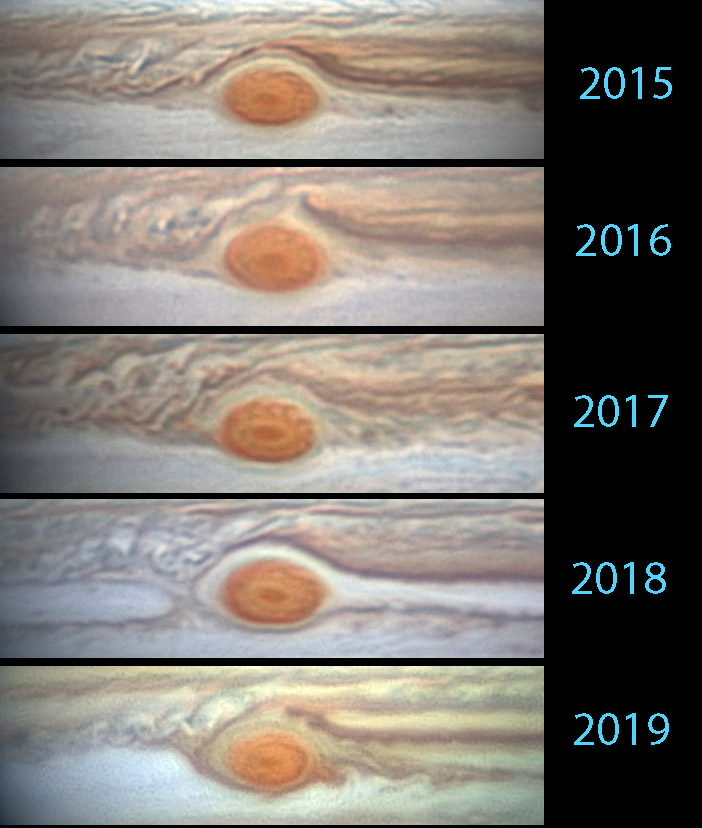
Series of Jupiter photos - 2015 to 2019 - showing changes in the Red Spot.

You can see subtle changes in and around the Great Red Spot in this sequence of images taken over the past 5 years. The wraparound cloud shaped like a spoon appears to have formed sometime last spring. Image via Christopher Go/SkyandTelescope.com.

All of Jupiter with bands and orange oval to lower right.

Jupiter as seen by amateur astronomer Anthony Wesley on May 19, 2019.

Jupiter in black and white with large black spot below the equator.

Another view of Jupiter from Anthony Wesley on May 22, 2019.

A similar but smaller streamer was seen back in May 2017 by the Gemini North telescope (part of the Gemini Observatory) using adaptive optics, on the summit of Maunakea in Hawaii. The adaptive optics remove distortions due to the turbulence in the Earth’s atmosphere, producing extremely high-resolution images. Gemini can currently see features as small as Ireland on Jupiter. Glenn Orton of NASA’s Jet Propulsion Laboratory (JPL) said he saw a hook-like feature on the western side of the Great Red Spot. He said:

Back in May, Gemini zoomed in on intriguing features in and around Jupiter’s Great Red Spot: including a swirling structure on the inside of the spot, a curious hook-like cloud feature on its western side and a lengthy, fine-structured wave extending off from its eastern side. Events like this show that there’s still much to learn about Jupiter’s atmosphere; the combination of Earth-based and spacecraft observations is a powerful one-two punch in exploring Jupiter.

The Gemini Observatory uses special filters that focus on specific colors of light that can penetrate the upper atmosphere and clouds of Jupiter. These images are sensitive to increasing absorption by mixtures of methane and hydrogen gas in Jupiter’s atmosphere. This is great for observing the details of the streamers, hooks, blades and flakes.

Jupiter's Great Red Spot closeup in grayscale and in color with flamelike clouds around it.

Closer views of the Great Red Spot from the Gemini Observatory on May 18, 2017 (top two panels) and January 11, 2017 (bottom panel), Image via Gemini Observatory/AURA/NSF/JPL-Caltech/NASA/UC Berkeley.

These features are unusual, and may indicate that the Great Red Spot itself is indeed breaking apart, after other observations have shown that the Spot has shrunk considerably in size in recent years. It used to be large enough to hold three Earths, but now could only hold about one or two. Wesley described the behavior of the streamers:

Each streamer appears to disconnect from the Great Red Spot and dissipate. Then, after about a week, a new streamer forms and the process repeats. You have to be lucky to catch it happening. Jupiter spins on its axis every 10 hours and the Great Red Spot is not always visible. A joint effort between many amateurs is underway to get clear images of the process.

It’s not just astronomers on Earth who have been observing these changes. NASA’s Juno spacecraft currently orbiting Jupiter has as well. Some of its images, from its 17th and 18th flybys, have shown the same streamers, blades and flakes. The red-colored flakes were seen to last for more than a week. Juno will fly over the Great Red Spot again in July 2019. Juno had also sometimes seen these features in the past, but they were rare until 2017. According to Orton:

Some observers implied that these [blades] were induced by the arrival of vortices in a jet just south of the Great Red Spot moving from east to west that enter a dark area surrounding it that is characterized by deeper clouds, known as the ‘Red Spot Hollow.’ Stay tuned, as the dark region around the Great Red Spot is growing in length, and we’ll see what happens next.

Crescent of Jupiter and very large, orange oval in one end of crescent.

Jupiter and the Great Red Spot as seen by the Juno spacecraft on February 12, 2019. A large “hook” can clearly be seen on the western side of the spot. Image via NASA/SwRI/MSSS.

Juno was launched in August 2011 and began orbiting Jupiter in early July 2016. It has already transformed our understanding of how Jupiter formed and evolved, from its thick cloud layers to its deepest core.

June 2019 will be a great time to observe Jupiter too, as the planet will be four times brighter than the star Sirius, especially in the weeks and months around Jupiter’s opposition on June 10.

What exactly is happening with the Great Red Spot isn’t completely clear, and no one knows how long it may take for the Great Red Spot to completely disappear, if it does in our lifetimes, but it will be very interesting to see what happens in the months and years ahead. It would be missed, of course, if it did disappear, but that process would also provide scientists with valuable data on how Jupiter’s atmosphere behaves.
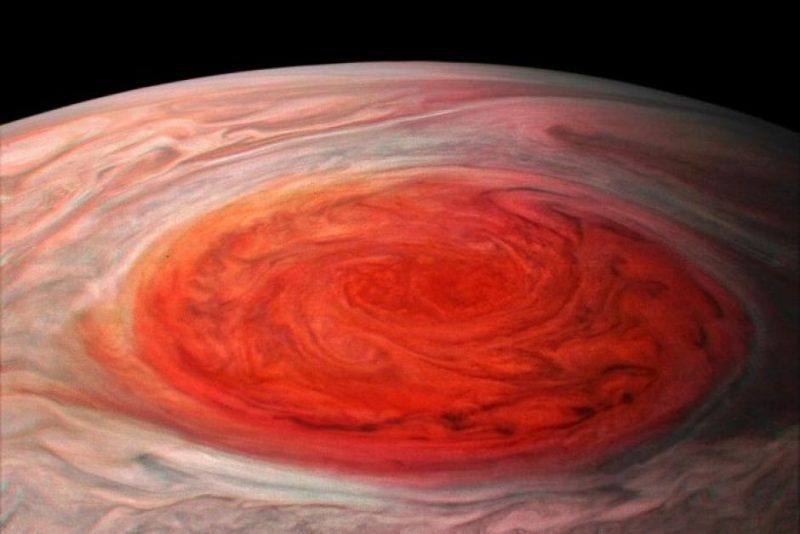
Great Red Spot closeup with many complex swirls inside it.

A closer view of Jupiter’s Great Red Spot, as seen by Juno in 2017. Image via NASA/JPL-Caltech/SwRI/MSSS/Roman Tkachenko.

Bottom line: Jupiter’s massive Great Red Spot has been acting a bit odd lately, and may be in the process of coming apart and even disappearing completely eventually. Continued observations will help determine what fate awaits the solar system’s biggest and longest-lived storm that has fascinated humanity for centuries.

Via spaceweatherarchive.com

Via Space.com

Read more: We go between Jupiter and the sun June 10, 2019


from EarthSky http://bit.ly/2IyxmCe
Bands in colors on Jupiter with large oval white spot.

Infrared image of Jupiter’s Great Red Spot from the Gemini Observatory on May 18, 2018. The image shows a hook-like cloud on the western side and a long streamer on the eastern side. Image via Gemini Observatory/AURA/NSF/JPL-Caltech/NASA.

Jupiter’s Great Red Spot is iconic, the largest and longest-lasting storm ever seen in the solar system. It has been around for at least hundreds of years, but is it now nearing its end? Recent observations show that the storm seems to be coming apart, with streamers “peeling off” the main spot as often as every week. The streamers and associated features have also been described as “hooks,” “blades” and “flakes” breaking off the main Great Red Spot. Some reports have called this process “unraveling” although that isn’t really the best description. Could the Great Red Spot actually be self-destructing? Is it nearing its end?

Amateur astronomer Anthony Wesley in Australia photographed one such streamer on May 19, 2019, which stretched more than 10,000 km (6,000 miles) from the Great Red Spot, joining up with a nearby jet stream. He saw the same features again on May 22. As he noted:

I haven’t seen this before in my 17-or-so years of imaging Jupiter.

Wesley was also recently featured in Australia’s ABC News about his photographs of the Great Red Spot:

It’s been quite dramatic … [the images have been] showing the spot in a state that nobody’s ever seen before. It’s suddenly, in the last two months or so, started to undergo these massive peeling, or flaking events. No one has really seen this happen before and no one can really predict what is going to happen.

Another amateur astronomer, Christopher Go, also observed a reddish extension on the left side of the Great Red Spot on May 17.

Series of Jupiter photos - 2015 to 2019 - showing changes in the Red Spot.

You can see subtle changes in and around the Great Red Spot in this sequence of images taken over the past 5 years. The wraparound cloud shaped like a spoon appears to have formed sometime last spring. Image via Christopher Go/SkyandTelescope.com.

All of Jupiter with bands and orange oval to lower right.

Jupiter as seen by amateur astronomer Anthony Wesley on May 19, 2019.

Jupiter in black and white with large black spot below the equator.

Another view of Jupiter from Anthony Wesley on May 22, 2019.

A similar but smaller streamer was seen back in May 2017 by the Gemini North telescope (part of the Gemini Observatory) using adaptive optics, on the summit of Maunakea in Hawaii. The adaptive optics remove distortions due to the turbulence in the Earth’s atmosphere, producing extremely high-resolution images. Gemini can currently see features as small as Ireland on Jupiter. Glenn Orton of NASA’s Jet Propulsion Laboratory (JPL) said he saw a hook-like feature on the western side of the Great Red Spot. He said:

Back in May, Gemini zoomed in on intriguing features in and around Jupiter’s Great Red Spot: including a swirling structure on the inside of the spot, a curious hook-like cloud feature on its western side and a lengthy, fine-structured wave extending off from its eastern side. Events like this show that there’s still much to learn about Jupiter’s atmosphere; the combination of Earth-based and spacecraft observations is a powerful one-two punch in exploring Jupiter.

The Gemini Observatory uses special filters that focus on specific colors of light that can penetrate the upper atmosphere and clouds of Jupiter. These images are sensitive to increasing absorption by mixtures of methane and hydrogen gas in Jupiter’s atmosphere. This is great for observing the details of the streamers, hooks, blades and flakes.

Jupiter's Great Red Spot closeup in grayscale and in color with flamelike clouds around it.

Closer views of the Great Red Spot from the Gemini Observatory on May 18, 2017 (top two panels) and January 11, 2017 (bottom panel), Image via Gemini Observatory/AURA/NSF/JPL-Caltech/NASA/UC Berkeley.

These features are unusual, and may indicate that the Great Red Spot itself is indeed breaking apart, after other observations have shown that the Spot has shrunk considerably in size in recent years. It used to be large enough to hold three Earths, but now could only hold about one or two. Wesley described the behavior of the streamers:

Each streamer appears to disconnect from the Great Red Spot and dissipate. Then, after about a week, a new streamer forms and the process repeats. You have to be lucky to catch it happening. Jupiter spins on its axis every 10 hours and the Great Red Spot is not always visible. A joint effort between many amateurs is underway to get clear images of the process.

It’s not just astronomers on Earth who have been observing these changes. NASA’s Juno spacecraft currently orbiting Jupiter has as well. Some of its images, from its 17th and 18th flybys, have shown the same streamers, blades and flakes. The red-colored flakes were seen to last for more than a week. Juno will fly over the Great Red Spot again in July 2019. Juno had also sometimes seen these features in the past, but they were rare until 2017. According to Orton:

Some observers implied that these [blades] were induced by the arrival of vortices in a jet just south of the Great Red Spot moving from east to west that enter a dark area surrounding it that is characterized by deeper clouds, known as the ‘Red Spot Hollow.’ Stay tuned, as the dark region around the Great Red Spot is growing in length, and we’ll see what happens next.

Crescent of Jupiter and very large, orange oval in one end of crescent.

Jupiter and the Great Red Spot as seen by the Juno spacecraft on February 12, 2019. A large “hook” can clearly be seen on the western side of the spot. Image via NASA/SwRI/MSSS.

Juno was launched in August 2011 and began orbiting Jupiter in early July 2016. It has already transformed our understanding of how Jupiter formed and evolved, from its thick cloud layers to its deepest core.

June 2019 will be a great time to observe Jupiter too, as the planet will be four times brighter than the star Sirius, especially in the weeks and months around Jupiter’s opposition on June 10.

What exactly is happening with the Great Red Spot isn’t completely clear, and no one knows how long it may take for the Great Red Spot to completely disappear, if it does in our lifetimes, but it will be very interesting to see what happens in the months and years ahead. It would be missed, of course, if it did disappear, but that process would also provide scientists with valuable data on how Jupiter’s atmosphere behaves.

Great Red Spot closeup with many complex swirls inside it.

A closer view of Jupiter’s Great Red Spot, as seen by Juno in 2017. Image via NASA/JPL-Caltech/SwRI/MSSS/Roman Tkachenko.

Bottom line: Jupiter’s massive Great Red Spot has been acting a bit odd lately, and may be in the process of coming apart and even disappearing completely eventually. Continued observations will help determine what fate awaits the solar system’s biggest and longest-lived storm that has fascinated humanity for centuries.

Via spaceweatherarchive.com

Via Space.com

Read more: We go between Jupiter and the sun June 10, 2019


from EarthSky http://bit.ly/2IyxmCe

Earth and Jupiter closest on June 12
Jupiter with bands and large orange oval in lower right.

Jupiter as seen by amateur astronomer Anthony Wesley on May 19, 2019. Image via Anthony Wesley.

On June 12, 2019, at 03:00 UTC, the giant planet Jupiter will be closest to Earth for all of 2019. At its closest, Jupiter comes to within 398 million miles (641 million km).

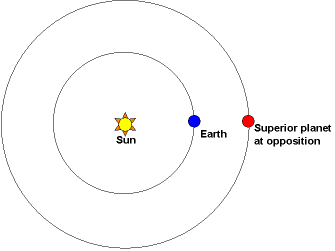
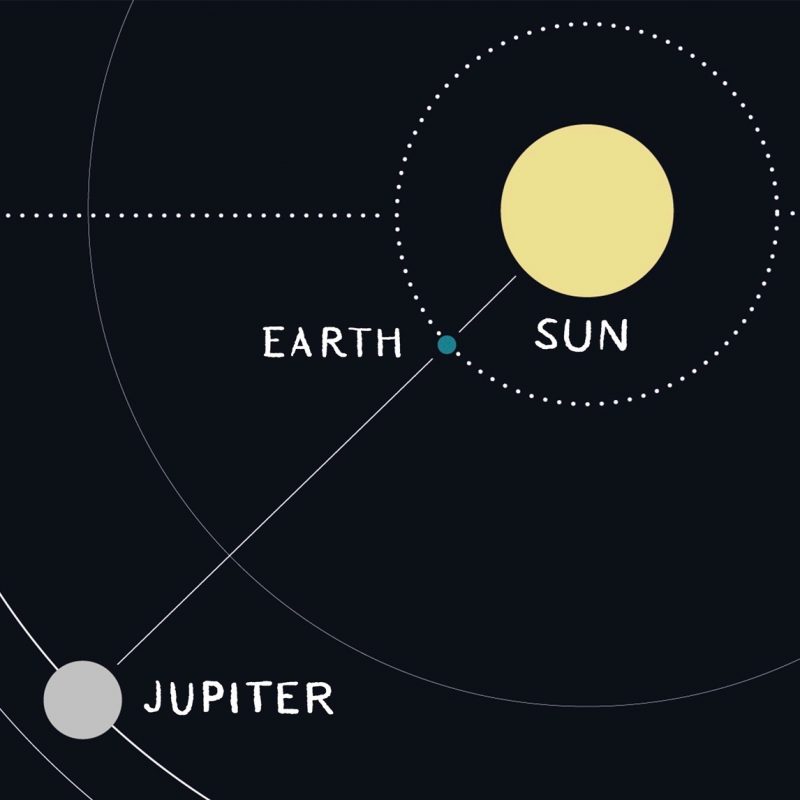
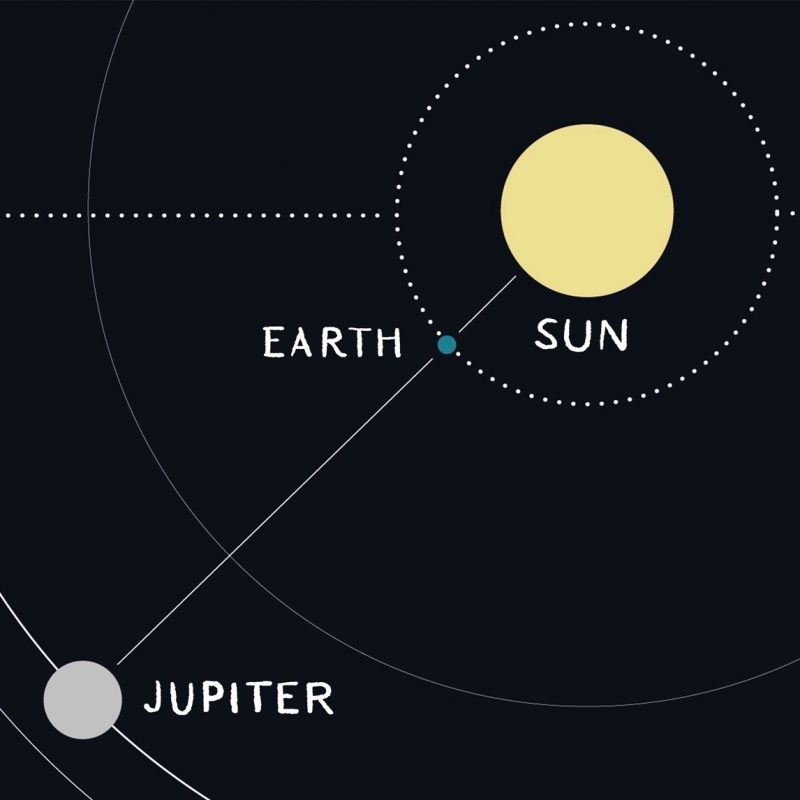
Yet, Jupiter’s opposition happens on June 10, at 15:00 UTC. At opposition, Earth in its orbit flies between Jupiter and the sun, placing Jupiter opposite the sun in our sky.

You’d think Jupiter would be closest to Earth on the day of opposition. But it isn’t. Why not?

Simple diagram of orbits of Earth and a superior planet.

Opposition happens when Earth flies between an outer planet, like Jupiter, and the sun. Why aren’t Earth and Jupiter closest on the day of opposition? Illustration via Heavens Above.

Why aren’t Jupiter and Earth closest on the day of Jupiter’s opposition? They would be, if the orbits of Earth and Jupiter were perfect circles and if our two worlds orbited on the same exact plane. Both Earth and Jupiter have orbits that are very nearly circular. They go around the sun on almost the same plane. But – in both cases – not quite.

Consider that, because Jupiter’s orbit is elliptical, not circular, its distance from the sun varies. Likewise, Earth’s orbit is elliptical, not circular. Our distance from the sun varies, too.

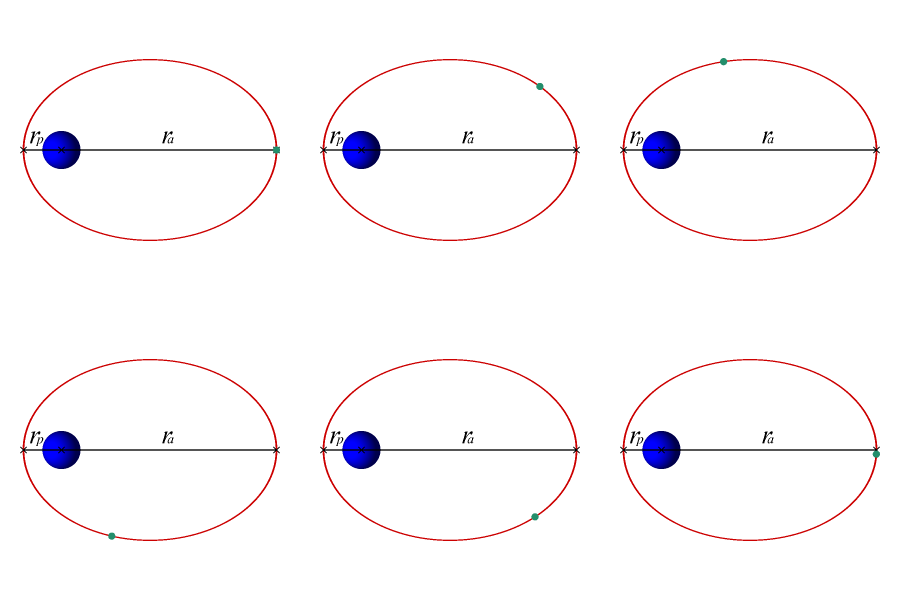
Animated diagram, small black dot orbiting large blue object.

This animation shows an orbit that’s vastly more elliptical than either Earth’s or Jupiter’s. Still, you get the idea. Perihelion = closest to sun. Aphelion = farthest from sun. Image via Brandir/Wikipedia.

Jupiter’s orbit takes 11.9 Earth-years. Earth’s orbit takes one year.

Right now, we’re headed toward a perihelion of Jupiter. In other words, every single day, Jupiter is closer to the sun than it was the day before. Are you beginning to see how it can be closer to Earth after we go between it and the sun?

Not yet? Keep reading …

The starry band of the Milky Way, with bright dot in front of it.

View at EarthSky Community Photos. | In 2019, Jupiter is nearly in front of the broadest and brightest part of the starry band of the Milky Way, in the direction to the galaxy’s center. JV Noriega in Batangas, Philippines, captured this images of Jupiter (the bright one!) on June 8, 2019. Thank you, JV!

Jupiter passed aphelion – its farthest point from the sun in its orbit – on February 18, 2017. Jupiter will reach perihelion – its closest point – on January 25, 2023. So Jupiter is getting closer to the sun each day. And what is Earth doing?

Earth’s perihelion happens every year in early January. So Earth is getting a bit farther from the sun each day now.

Jupiter is now getting closer to the sun – bit by bit, closer and closer – every earthly day. And Earth is getting farther from the sun – bit by bit, farther and farther – every day.

And that’s how Jupiter and Earth can be closest for 2019 some one and a half days after our planet passes between Jupiter and the sun.

Understand? If not, check out these two links … or let’s talk in the comments below …

Geocentric ephemeris for Jupiter: 2019

Geocentric ephemeris for Sun: 2019

Here are those numbers again:

Jupiter’s opposition June 10 at 15:00 UTC (June 10 at 10 a.m. CDT).

Jupiter closest June 12 at 03:00 UTC (June 11 at 10 p.m CDT).

Big diagram with partial orbits of Jupiter and Earth lined up with the sun.

Another artist’s concept of Jupiter and Earth at opposition, when Earth passes between the sun and Jupiter.

Bottom line: You’d think Jupiter would be closest to Earth on the day we pass between it and the sun. But, in 2019, Jupiter’s opposition comes about a day and a half before its closest point to Earth. Why?

Read more: We go between Jupiter and the sun June 10, 2019

Read more: Is Jupiter’s Great Red Spot disintegrating?


from EarthSky http://bit.ly/2wIMR5f
Jupiter with bands and large orange oval in lower right.

Jupiter as seen by amateur astronomer Anthony Wesley on May 19, 2019. Image via Anthony Wesley.

On June 12, 2019, at 03:00 UTC, the giant planet Jupiter will be closest to Earth for all of 2019. At its closest, Jupiter comes to within 398 million miles (641 million km).

Yet, Jupiter’s opposition happens on June 10, at 15:00 UTC. At opposition, Earth in its orbit flies between Jupiter and the sun, placing Jupiter opposite the sun in our sky.

You’d think Jupiter would be closest to Earth on the day of opposition. But it isn’t. Why not?

Simple diagram of orbits of Earth and a superior planet.

Opposition happens when Earth flies between an outer planet, like Jupiter, and the sun. Why aren’t Earth and Jupiter closest on the day of opposition? Illustration via Heavens Above.

Why aren’t Jupiter and Earth closest on the day of Jupiter’s opposition? They would be, if the orbits of Earth and Jupiter were perfect circles and if our two worlds orbited on the same exact plane. Both Earth and Jupiter have orbits that are very nearly circular. They go around the sun on almost the same plane. But – in both cases – not quite.

Consider that, because Jupiter’s orbit is elliptical, not circular, its distance from the sun varies. Likewise, Earth’s orbit is elliptical, not circular. Our distance from the sun varies, too.

Animated diagram, small black dot orbiting large blue object.

This animation shows an orbit that’s vastly more elliptical than either Earth’s or Jupiter’s. Still, you get the idea. Perihelion = closest to sun. Aphelion = farthest from sun. Image via Brandir/Wikipedia.

Jupiter’s orbit takes 11.9 Earth-years. Earth’s orbit takes one year.

Right now, we’re headed toward a perihelion of Jupiter. In other words, every single day, Jupiter is closer to the sun than it was the day before. Are you beginning to see how it can be closer to Earth after we go between it and the sun?

Not yet? Keep reading …

The starry band of the Milky Way, with bright dot in front of it.

View at EarthSky Community Photos. | In 2019, Jupiter is nearly in front of the broadest and brightest part of the starry band of the Milky Way, in the direction to the galaxy’s center. JV Noriega in Batangas, Philippines, captured this images of Jupiter (the bright one!) on June 8, 2019. Thank you, JV!

Jupiter passed aphelion – its farthest point from the sun in its orbit – on February 18, 2017. Jupiter will reach perihelion – its closest point – on January 25, 2023. So Jupiter is getting closer to the sun each day. And what is Earth doing?

Earth’s perihelion happens every year in early January. So Earth is getting a bit farther from the sun each day now.

Jupiter is now getting closer to the sun – bit by bit, closer and closer – every earthly day. And Earth is getting farther from the sun – bit by bit, farther and farther – every day.

And that’s how Jupiter and Earth can be closest for 2019 some one and a half days after our planet passes between Jupiter and the sun.

Understand? If not, check out these two links … or let’s talk in the comments below …

Geocentric ephemeris for Jupiter: 2019

Geocentric ephemeris for Sun: 2019

Here are those numbers again:

Jupiter’s opposition June 10 at 15:00 UTC (June 10 at 10 a.m. CDT).

Jupiter closest June 12 at 03:00 UTC (June 11 at 10 p.m CDT).

Big diagram with partial orbits of Jupiter and Earth lined up with the sun.

Another artist’s concept of Jupiter and Earth at opposition, when Earth passes between the sun and Jupiter.

Bottom line: You’d think Jupiter would be closest to Earth on the day we pass between it and the sun. But, in 2019, Jupiter’s opposition comes about a day and a half before its closest point to Earth. Why?

Read more: We go between Jupiter and the sun June 10, 2019

Read more: Is Jupiter’s Great Red Spot disintegrating?


from EarthSky http://bit.ly/2wIMR5f

How to see Jupiter’s moons

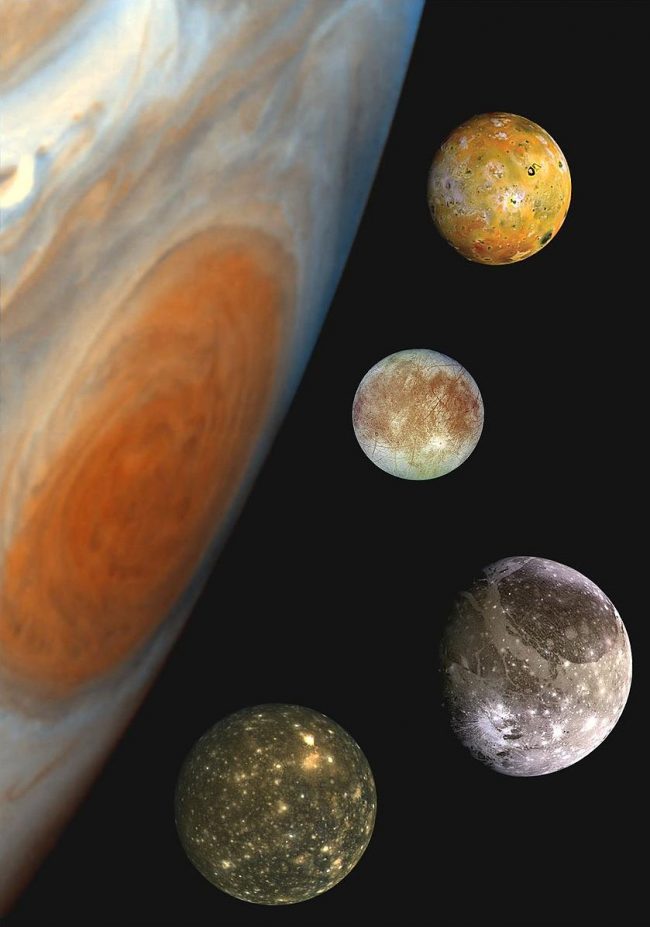
Composite image of Jupiter and its 4 Galilean moons. From top to bottom the moons are Io, Europa, Ganymede, Callisto. The Galileo spacecraft obtained the images to make this composite in 1996. Image via NASA PhotoJournal.

If you have binoculars or a telescope, it’s fairly easy whenever Jupiter is visible to see the giant planet’s four largest moons. They look like pinpricks of light – like tiny “stars” – all on or near the same plane crossing the planet. They’re often called the Galilean moons to honor Galileo, who discovered them in 1610.

In their order from Jupiter, these moons are Io, Europa, Ganymede and Callisto.

Jupiter and 3 of its 4 Galilean satellites, as they’d appear in a small telescope. Illustration via SkyandTelescope.com.

Writing at SkyandTelescope.com this year, Bob King said:

Etched in my brain cells is an image of a sharp, gleaming disk striped with two dark belts and accompanied by four star-like moons through my 2.4-inch refractor in the winter of 1966. A 6-inch reflector will make you privy to nearly all of the planet’s secrets …

When magnified at 150× or higher [the four Galilean moons] lose their star-like appearance and show disks that range in size from 1.0? to 1.7? (current opposition). Europa’s the smallest and Ganymede largest.

Ganymede also casts the largest shadow on the planet’s cloud tops when it transits in front of Jupiter. Shadow transits are visible at least once a week with ‘double transits’ — two moons casting shadows simultaneously — occurring once or twice a month. Ganymede’s shadow looks like a bullet hole, while little Europa’s more resembles a pinprick. Moons also fade away and then reappear over several minutes when they enter and exit Jupiter’s shadow during eclipse. Or a moon may be occulted by the Jovian disk and hover at the planet’s edge like a pearl before fading from sight.

You’ll find a complete list of all eclipses, transits, and occultations for 2019 by downloading Sky & Telescope’s Phenomena of Jupiter’s Moons pdf. You can also gets daily predictions for the moons and a diagram showing their relative positions by consulting the online Jupiter’s Moons Observing Tool.

Read more: We go between the sun and Jupiter this week

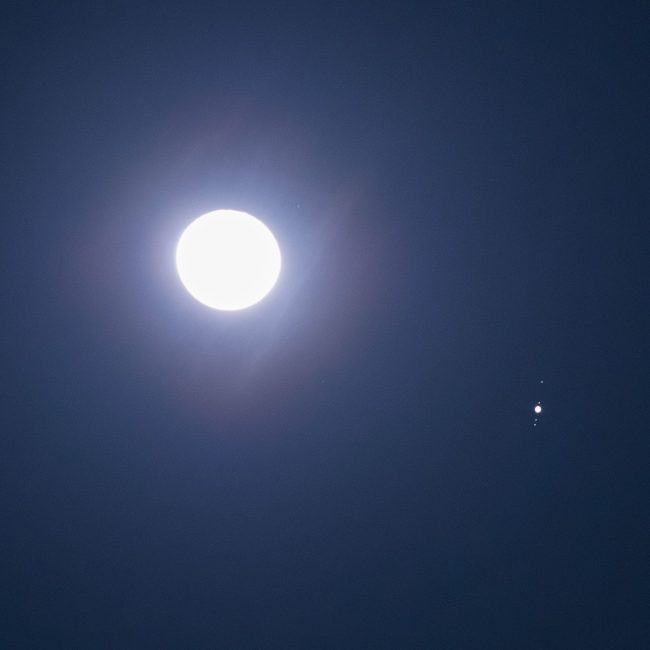
A bright round full moon, with the bright dot of Jupiter nearby, and 4 pinpricks of light aligned in space near Jupiter, along the giant planet's equator.

View at EarthSky Community Photos. | Beautiful shot of Earth’s moon – plus Jupiter and its 4 largest moons – on May 20, 2019, via Asthadi Setyawan in Malang, East Java, Indonesia. Thank you, Asthadi!

The Galilean moons orbit Jupiter around its equator. We do see their orbits almost exactly edge-on, but, as with so much in astronomy, there’s a cycle for viewing the edge-on-ness of Jupiter’s moons. This particular cycle is six years long. That is, every six years, we view Jupiter’s equator – and the moons orbiting above its equator – most edge-on.

And that’s why, in 2015, we were able to view a number of mutual events (eclipses and shadow transits) involving Jupiter’s moons, through telescopes.

Starting in late 2016, Jupiter’s axis began tilting enough toward the sun and Earth so that the outermost of the four moons, Callisto, had not been passing in front of Jupiter or behind Jupiter, as seen from our vantage point. This will continue for a period of about three years, during which time Callisto is perpetually visible to those with telescopes, alternately swinging above and below Jupiter as seen from Earth.

The next eclipse series of Callisto, whereby this moon actually passes behind Jupiter, starts on November 9, 2019, and ends on August 22, 2022, to present a total of 61 eclipses. After that, the next eclipse series will occur from May 29, 2025 to June 7, 2028, to feature 67 eclipses.

Click here for a Jupiter’s moons almanac, courtesy of SkyandTelescope.com.

Click here for recommended sky almanacs; they can tell you Jupiter’s rising time in your sky.

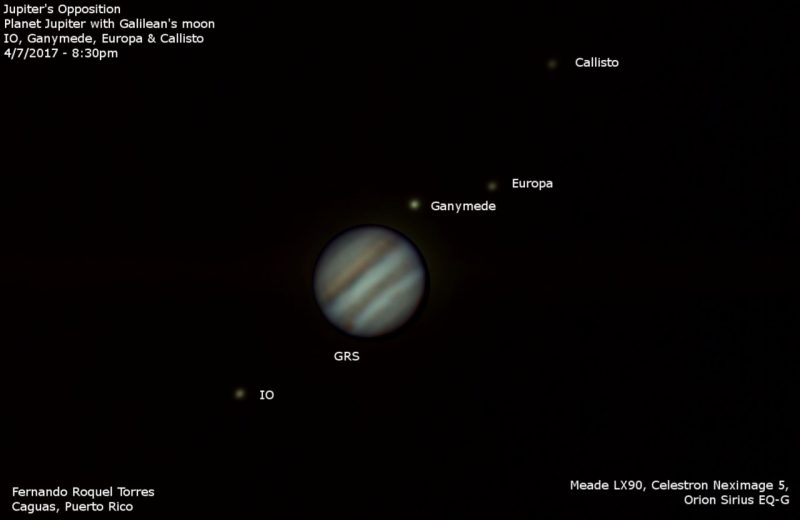
Fernando Roquel Torres in Caguas, Puerto Rico, captured Jupiter, its Great Red Spot and all 4 of its largest moons – the Galilean satellites – at Jupiter’s 2017 opposition.

Bottom line: How to see Jupiter’s moons.


from EarthSky http://bit.ly/2XENNUe

Composite image of Jupiter and its 4 Galilean moons. From top to bottom the moons are Io, Europa, Ganymede, Callisto. The Galileo spacecraft obtained the images to make this composite in 1996. Image via NASA PhotoJournal.

If you have binoculars or a telescope, it’s fairly easy whenever Jupiter is visible to see the giant planet’s four largest moons. They look like pinpricks of light – like tiny “stars” – all on or near the same plane crossing the planet. They’re often called the Galilean moons to honor Galileo, who discovered them in 1610.

In their order from Jupiter, these moons are Io, Europa, Ganymede and Callisto.

Jupiter and 3 of its 4 Galilean satellites, as they’d appear in a small telescope. Illustration via SkyandTelescope.com.

Writing at SkyandTelescope.com this year, Bob King said:

Etched in my brain cells is an image of a sharp, gleaming disk striped with two dark belts and accompanied by four star-like moons through my 2.4-inch refractor in the winter of 1966. A 6-inch reflector will make you privy to nearly all of the planet’s secrets …

When magnified at 150× or higher [the four Galilean moons] lose their star-like appearance and show disks that range in size from 1.0? to 1.7? (current opposition). Europa’s the smallest and Ganymede largest.

Ganymede also casts the largest shadow on the planet’s cloud tops when it transits in front of Jupiter. Shadow transits are visible at least once a week with ‘double transits’ — two moons casting shadows simultaneously — occurring once or twice a month. Ganymede’s shadow looks like a bullet hole, while little Europa’s more resembles a pinprick. Moons also fade away and then reappear over several minutes when they enter and exit Jupiter’s shadow during eclipse. Or a moon may be occulted by the Jovian disk and hover at the planet’s edge like a pearl before fading from sight.

You’ll find a complete list of all eclipses, transits, and occultations for 2019 by downloading Sky & Telescope’s Phenomena of Jupiter’s Moons pdf. You can also gets daily predictions for the moons and a diagram showing their relative positions by consulting the online Jupiter’s Moons Observing Tool.

Read more: We go between the sun and Jupiter this week

A bright round full moon, with the bright dot of Jupiter nearby, and 4 pinpricks of light aligned in space near Jupiter, along the giant planet's equator.

View at EarthSky Community Photos. | Beautiful shot of Earth’s moon – plus Jupiter and its 4 largest moons – on May 20, 2019, via Asthadi Setyawan in Malang, East Java, Indonesia. Thank you, Asthadi!

The Galilean moons orbit Jupiter around its equator. We do see their orbits almost exactly edge-on, but, as with so much in astronomy, there’s a cycle for viewing the edge-on-ness of Jupiter’s moons. This particular cycle is six years long. That is, every six years, we view Jupiter’s equator – and the moons orbiting above its equator – most edge-on.

And that’s why, in 2015, we were able to view a number of mutual events (eclipses and shadow transits) involving Jupiter’s moons, through telescopes.

Starting in late 2016, Jupiter’s axis began tilting enough toward the sun and Earth so that the outermost of the four moons, Callisto, had not been passing in front of Jupiter or behind Jupiter, as seen from our vantage point. This will continue for a period of about three years, during which time Callisto is perpetually visible to those with telescopes, alternately swinging above and below Jupiter as seen from Earth.

The next eclipse series of Callisto, whereby this moon actually passes behind Jupiter, starts on November 9, 2019, and ends on August 22, 2022, to present a total of 61 eclipses. After that, the next eclipse series will occur from May 29, 2025 to June 7, 2028, to feature 67 eclipses.

Click here for a Jupiter’s moons almanac, courtesy of SkyandTelescope.com.

Click here for recommended sky almanacs; they can tell you Jupiter’s rising time in your sky.

Fernando Roquel Torres in Caguas, Puerto Rico, captured Jupiter, its Great Red Spot and all 4 of its largest moons – the Galilean satellites – at Jupiter’s 2017 opposition.

Bottom line: How to see Jupiter’s moons.


from EarthSky http://bit.ly/2XENNUe

Andromeda, Jupiter, Milky Way over Montana

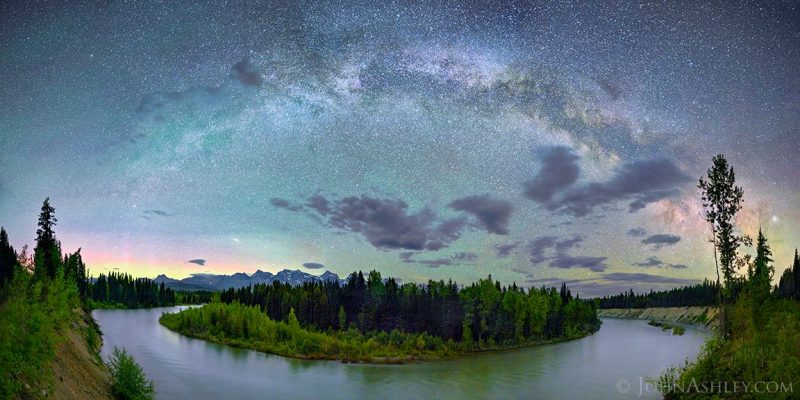
Wide symmetric image of Milky Way arcing over a river, tiny fuzzy oval at left, bright dot to right.

View larger at EarthSky Community Photos. | The oval-shaped Andromeda galaxy rises above the northern lights (left), while Jupiter (bright, far right) leads the Milky Way’s arch towards the southern horizon. John Ashley captured this panoramic image – about 200 degrees wide – on June 4 at Glacier National Park and the North Fork of the Flathead River. Thank you, John.


from EarthSky http://bit.ly/2I3ZLkG
Wide symmetric image of Milky Way arcing over a river, tiny fuzzy oval at left, bright dot to right.

View larger at EarthSky Community Photos. | The oval-shaped Andromeda galaxy rises above the northern lights (left), while Jupiter (bright, far right) leads the Milky Way’s arch towards the southern horizon. John Ashley captured this panoramic image – about 200 degrees wide – on June 4 at Glacier National Park and the North Fork of the Flathead River. Thank you, John.


from EarthSky http://bit.ly/2I3ZLkG

We go between the sun and Jupiter June 10

Image at top taken June 2, 2019 by Dr Ski in the Philippines. The bright planet is Jupiter. The red star is Antares in the constellation Scorpius the Scorpion.

On June 10, 2019, our planet Earth flies between the sun and the outer planet Jupiter. Our faster motion places Jupiter – largest world in our solar system, and an exceedingly bright planet in our sky – opposite the sun about once each year. In other words, Jupiter is now rising in the east as the sun is setting below the western horizon. Astronomers call this event an opposition of Jupiter.

Opposition marks the middle of the best time of year to see a planet. That’s because it’s when the planet is up all night and generally closest for the year (the exact date of Jupiter at its closest this year is June 12).

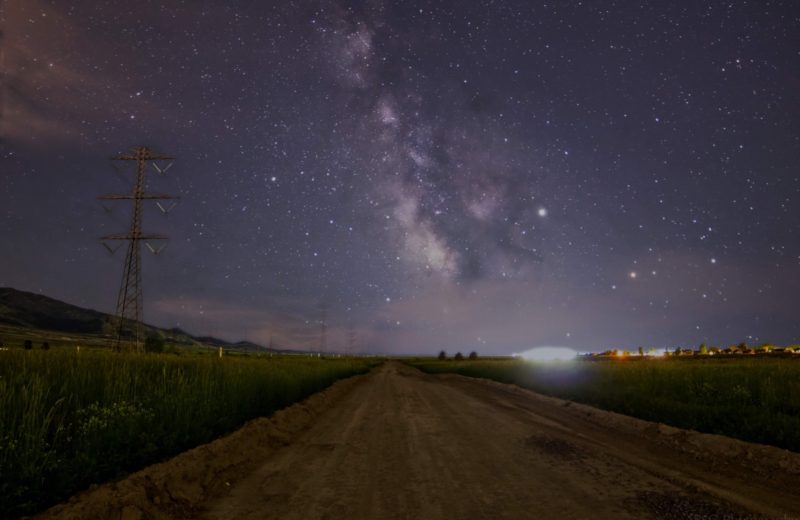
The view is looking forward along a country road at night, with the Milky Way stretched above the road, Jupiter to one side of the Milky Way and Saturn to the other side.

View at EarthSky Community Photos. | Eli Frisbie created this composite image from photos gathered on June 6, in Eagle Mountain, Utah. He wrote: “The Milky Way shines over a country road with light pollution in the distance. The bright “star” to the right of the Milky Way is the planet Jupiter. The slightly less-bright star to the upper left is the planet Saturn.” Thank you, Eli!

Jupiter is now in the east around sunset. It climbs highest in the sky at midnight (that is, midway between sunset and sunrise). It sets in the west around sunrise.

Jupiter is always bright; it’s the largest planet in our solar system. It shines more brightly than any star in the evening sky. At this 2019 opposition, Jupiter shines in the vicinity of Antares, the brightest star in the constellation Scorpius the Scorpion. There’s no way to mistake Antares for Jupiter, though, because dazzling Jupiter outshines this 1st-magnitude star by nearly 30 times. With the exception of the sun and moon, only Venus – the brightest planet, now low in the east before sunrise – outshines Jupiter.

Try catching both Venus and Jupiter at morning dawn. Venus will be blazing low in the east while Jupiter is sitting low in the west. You’ll need an unobstructed horizon in both directions to see both Venus and Jupiter before sunrise.

Diagram showing sun, Earth, Jupiter, with Earth moving between Jupiter and the sun in orbit.

When Earth goes between the sun and Jupiter, the giant planet appears opposite the sun in our sky, rising in the east at sunset. Astronomers call this an “opposition” of Jupiter.

Jupiter (red) completes one orbit of the sun (center) for every 11.86 orbits of the Earth (blue). Our orbit is smaller, and we move faster! Animation via Wikimedia Commons.

Technically, as it reaches its 2019 opposition, Jupiter isn’t in front of Scorpius. It’s just north (above) the Scorpion’s northern border. That places Jupiter officially in the constellation Ophiuchus the Serpent Bearer at this 2019 opposition. Jupiter will remain in Ophiuchus until nearly the end of this year. Next year, in 2020, Jupiter will be in front of the constellation Sagittarius the Archer when it comes to opposition.

Ophiuchus isn’t the world’s brightest contellation. Maybe you’ve never taken the time to pick out its stars. If you want to do so, be sure to look in a dark sky. The chart below might help:

Sky chart of the constellation Ophiuchus

Let Jupiter be your guide to the constellation Ophiuchus in 2019. Next year, in 2020, Jupiter will serve as your guide to the constellation Sagittarius. Sky chart via the IAU.

Jupiter comes to opposition about every 13 months. That’s how long Earth takes to travel once around the sun relative to Jupiter. As a result – according to our earthly calendars – Jupiter’s opposition comes about a month later each year.

Last year – in 2018 – Jupiter’s opposition date was May 9.

Next year – in 2020 – it’ll be July 14.

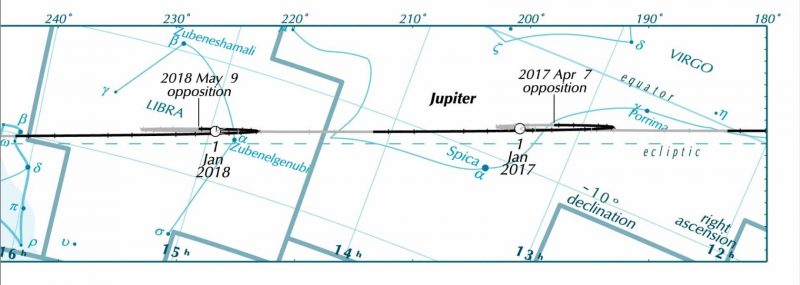
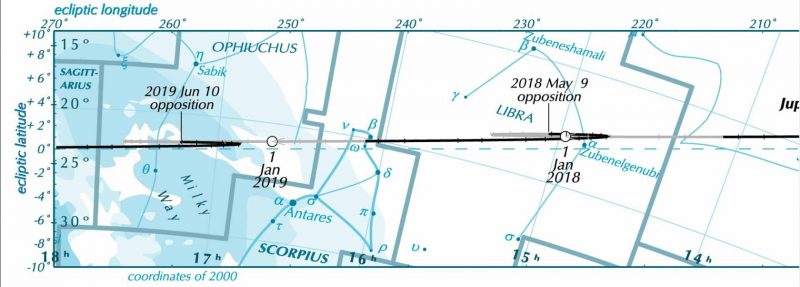
Astronomer Guy Ottewell has a great post at his blog on Jupiter’s oppositions in 2017, 2018 and 2019. Note on the charts below (used with Guy’s permission) that Jupiter at opposition shifts one constellation eastward each year:

April 7, 2017 opposition: Virgo

May 9, 2018 opposition: Libra

June 10, 2019 opposition: Ophiuchus

Jupiter’s path across the sky and opposition dates, 2017-2018, via Guy Ottewell’s blog.

Jupiter’s path across the sky and opposition dates, 2018-2019, via Guy Ottewell’s blog.

Jupiter isn’t a rocky planet like Earth. It’s more like a failed star, not massive enough or hot enough inside to spark thermonuclear fusion reactions, but some 2.5 times more massive than all the other planets in our solar system combined. Jupiter shows us nature magnified!

There’s a NASA spacecraft orbiting Jupiter now. The Juno spacecraft’s orbit carries it low over Jupiter’s poles, providing never-before-seen glimpses of the giant planet’s polar regions. NASA has asked citizen scientists to help process Juno’s images. NASA explained at its JunoCam image processing gallery:

We invite you to download [the raw images], do your own image processing, and we encourage you to upload your creations for us to enjoy and share. The types of image processing we’d love to see range from simply cropping an image to highlighting a particular atmospheric feature, as well as adding your own color enhancements, creating collages and adding advanced color reconstruction.

Here’s a recent image, processed by a citizen scientist:

Bottom line: Look for Jupiter on the night of June 10, 2019, as this world comes to opposition, the point opposite the sun in our sky. You’d need some 80 Jupiters – rolled into a ball – to be hot enough inside for thermonuclear reactions … for Jupiter to shine as stars do. Yet on this May night – as Jupiter rises opposite the sun – you can imagine it beaming down on us as a tiny sun all night long.

Read more: How to see Jupiter’s moons

Read more: Why is Jupiter closest after we go between it and the sun?

Read more: Is Jupiter’s Great Red Spot disintegrating?

Donate: Your support means the world to us


from EarthSky http://bit.ly/2MzS4Hi

Image at top taken June 2, 2019 by Dr Ski in the Philippines. The bright planet is Jupiter. The red star is Antares in the constellation Scorpius the Scorpion.

On June 10, 2019, our planet Earth flies between the sun and the outer planet Jupiter. Our faster motion places Jupiter – largest world in our solar system, and an exceedingly bright planet in our sky – opposite the sun about once each year. In other words, Jupiter is now rising in the east as the sun is setting below the western horizon. Astronomers call this event an opposition of Jupiter.

Opposition marks the middle of the best time of year to see a planet. That’s because it’s when the planet is up all night and generally closest for the year (the exact date of Jupiter at its closest this year is June 12).

The view is looking forward along a country road at night, with the Milky Way stretched above the road, Jupiter to one side of the Milky Way and Saturn to the other side.

View at EarthSky Community Photos. | Eli Frisbie created this composite image from photos gathered on June 6, in Eagle Mountain, Utah. He wrote: “The Milky Way shines over a country road with light pollution in the distance. The bright “star” to the right of the Milky Way is the planet Jupiter. The slightly less-bright star to the upper left is the planet Saturn.” Thank you, Eli!

Jupiter is now in the east around sunset. It climbs highest in the sky at midnight (that is, midway between sunset and sunrise). It sets in the west around sunrise.

Jupiter is always bright; it’s the largest planet in our solar system. It shines more brightly than any star in the evening sky. At this 2019 opposition, Jupiter shines in the vicinity of Antares, the brightest star in the constellation Scorpius the Scorpion. There’s no way to mistake Antares for Jupiter, though, because dazzling Jupiter outshines this 1st-magnitude star by nearly 30 times. With the exception of the sun and moon, only Venus – the brightest planet, now low in the east before sunrise – outshines Jupiter.

Try catching both Venus and Jupiter at morning dawn. Venus will be blazing low in the east while Jupiter is sitting low in the west. You’ll need an unobstructed horizon in both directions to see both Venus and Jupiter before sunrise.

Diagram showing sun, Earth, Jupiter, with Earth moving between Jupiter and the sun in orbit.

When Earth goes between the sun and Jupiter, the giant planet appears opposite the sun in our sky, rising in the east at sunset. Astronomers call this an “opposition” of Jupiter.

Jupiter (red) completes one orbit of the sun (center) for every 11.86 orbits of the Earth (blue). Our orbit is smaller, and we move faster! Animation via Wikimedia Commons.

Technically, as it reaches its 2019 opposition, Jupiter isn’t in front of Scorpius. It’s just north (above) the Scorpion’s northern border. That places Jupiter officially in the constellation Ophiuchus the Serpent Bearer at this 2019 opposition. Jupiter will remain in Ophiuchus until nearly the end of this year. Next year, in 2020, Jupiter will be in front of the constellation Sagittarius the Archer when it comes to opposition.

Ophiuchus isn’t the world’s brightest contellation. Maybe you’ve never taken the time to pick out its stars. If you want to do so, be sure to look in a dark sky. The chart below might help:

Sky chart of the constellation Ophiuchus

Let Jupiter be your guide to the constellation Ophiuchus in 2019. Next year, in 2020, Jupiter will serve as your guide to the constellation Sagittarius. Sky chart via the IAU.

Jupiter comes to opposition about every 13 months. That’s how long Earth takes to travel once around the sun relative to Jupiter. As a result – according to our earthly calendars – Jupiter’s opposition comes about a month later each year.

Last year – in 2018 – Jupiter’s opposition date was May 9.

Next year – in 2020 – it’ll be July 14.

Astronomer Guy Ottewell has a great post at his blog on Jupiter’s oppositions in 2017, 2018 and 2019. Note on the charts below (used with Guy’s permission) that Jupiter at opposition shifts one constellation eastward each year:

April 7, 2017 opposition: Virgo

May 9, 2018 opposition: Libra

June 10, 2019 opposition: Ophiuchus

Jupiter’s path across the sky and opposition dates, 2017-2018, via Guy Ottewell’s blog.

Jupiter’s path across the sky and opposition dates, 2018-2019, via Guy Ottewell’s blog.

Jupiter isn’t a rocky planet like Earth. It’s more like a failed star, not massive enough or hot enough inside to spark thermonuclear fusion reactions, but some 2.5 times more massive than all the other planets in our solar system combined. Jupiter shows us nature magnified!

There’s a NASA spacecraft orbiting Jupiter now. The Juno spacecraft’s orbit carries it low over Jupiter’s poles, providing never-before-seen glimpses of the giant planet’s polar regions. NASA has asked citizen scientists to help process Juno’s images. NASA explained at its JunoCam image processing gallery:

We invite you to download [the raw images], do your own image processing, and we encourage you to upload your creations for us to enjoy and share. The types of image processing we’d love to see range from simply cropping an image to highlighting a particular atmospheric feature, as well as adding your own color enhancements, creating collages and adding advanced color reconstruction.

Here’s a recent image, processed by a citizen scientist:

Bottom line: Look for Jupiter on the night of June 10, 2019, as this world comes to opposition, the point opposite the sun in our sky. You’d need some 80 Jupiters – rolled into a ball – to be hot enough inside for thermonuclear reactions … for Jupiter to shine as stars do. Yet on this May night – as Jupiter rises opposite the sun – you can imagine it beaming down on us as a tiny sun all night long.

Read more: How to see Jupiter’s moons

Read more: Why is Jupiter closest after we go between it and the sun?

Read more: Is Jupiter’s Great Red Spot disintegrating?

Donate: Your support means the world to us


from EarthSky http://bit.ly/2MzS4Hi

Iridescent cloud? Or circumhorizon arc?

Wispy clouds over the sea. A line of rainbow colors in them, with blue on the bottom and red at top.

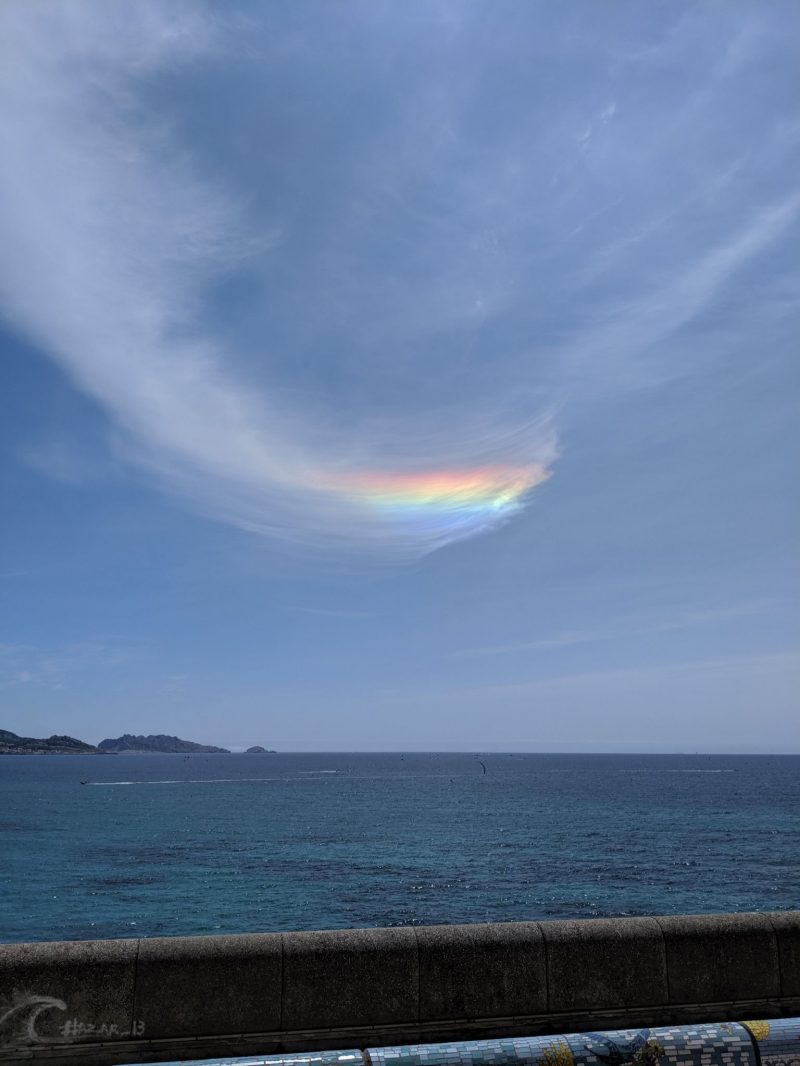
View at EarthSky Community Photos. | Eric Broneer in Marseille, France, caught this circumhorizon arc on June 3, 2019. He wrote, “Beautiful weather, very dry, sun behind me.”

Here at EarthSky, we often receive photos of various kinds of rainbow-like arcs and bands in the sky. Many are not rainbows, but other sorts of optical phenomena. Two of these that are commonly confused are iridescent clouds and circumhorizon arcs (also called circumhorizontal arcs). It was George Preoteasa responding to the photo below – first published at our site in July 2017 – taken by Joan Helle-Fasolo at Ship Bottom, New Jersey. EarthSky originally misidentified it as a photo of iridescent clouds. In fact, it’s a circumhorizon arc.

Mistaking one for the other is easy, especially if all you have to go on is a photo.

Beach with umbrellas. Above, cloudy sky with rainbow stripe across the clouds.

Here’s Joan Helle-Fasolo’s July 4, 2017 image, which EarthSky misidentified as an iridescent cloud. In fact, this is an entirely different sky phenomenon, called a circumhorizon arc.

How can you tell the difference in the sky, or in a picture?

George Preoteasa had an answer for us. He said he’d also mistakenly identified one sky phenomenon for the other, and so made a study of how to tell them apart. George wrote:

The circumhorizon arc is a band parallel to the horizon. So, to the extent that the horizon is an arc, this is one, too. The colors in a circumhorizon arc are well organized, red at the top, indigo at the bottom. With cloud iridescence, the colors are more randomly distributed.

Circumhorizon arcs have a certain fuzziness. They are caused by ice crystals in cirrus clouds, much as solar and lunar halos are. Iridescence, on the other hand, is caused by water droplets.

For a circumhorizon arc to occur, the sun must be high up, over 58 degrees above the horizon. Iridescence usually occurs close to the sun, which makes it difficult to photograph. You need to hide the sun so that sunlight does not overwhelm the colors in the cloud.

Sun peeking out from behind structure, high clouds with patches of color.

This is an iridescent cloud. The colors are not as organized as in a circumhorizon arc, and they tend to be seen near the sun. Best way to see one is to place the sun itself behind some foreground object, a building or mountain, for example. Duke Marsh captured this image in 2012 in New Albany, Indiana.

George continued:

It’s funny, but I made the same mistake. I was using the CloudSpotter app from the Cloud Appreciation Society. If you see clouds or cloud features or optical phenomena, you can take a picture and submit it for verification. I submitted the shot below as iridescence, and the moderator pointed out it’s not, but rather a fragment of a circumhorizon arc.

After that, I went to Les Cowley’s website – Atmospheric Optics – and immediately it became clear that the Cloud Appreciation Society moderator was right. So now I’m spreading the knowledge :-)

Thank you, George!

Treetops below blue sky with wispy clouds, rainbow stripe across clouds.

Here’s the image George Preoteasa captured, which he at first thought was an example of an iridescent cloud. Now he knows it’s a circumhorizon arc, and he described these arcs this way: “Imagine a horizontal band at the level where you see the colors. If you had cirrus clouds with the same properties as the one with the colors, you would get a nice colored arc parallel to the horizon. For a circumhorizon arc to occur, the sun must be high up in the sky, above 58 degrees. The fact that the sun does not appear in this picture is another clue it’s not iridescence.”

George also very kindly went into an EarthSky article about iridescent clouds and found three photos that are really circumhorizon arcs. We next sent those three photos to the world’s sky optics guru, Les Cowley of Atmospheric Optics, for confirmation. Les – who is a long-time friend of EarthSky and often helps us identify sky phenomena – confirmed that, yes, the photos below are all circumhorizon arcs. He also confirmed that:

… one key difference between a circumhorizon arc and iridescence is color structure. A circumhorizon arc has a spectral sequence of color with red at top and blue/violet lowest.

A circumhorizon arc is always about two outstretched hand-widths below the sun. Iridescent clouds are usually rather closer.

Thank you, Les.

Read more about circumhorizon arcs on Les Cowley’s website, Atmospheric Optics

Below are the three photos EarthSky had misidentified:

Sky above conifer trees, wide rainbow stripe on clouds.

Circumhorizon arc. The band is parallel to the horizon with red at the top, indigo at the bottom. The sun is well out of the picture. For circumhorizon arcs, the sun is always at least twice the span from thumb to little finger of your outstretched hand, held at arm’s length. Photo taken May 31, 2016, by Laura Berry.

Sky with puffy clouds, short rainbow stripe about halfway up.

Circumhorizon arc. Parallel to horizon. Red at top, indigo at bottom. Sun well out of picture, at least 2 hand-spans away. A circumhorizon arc can look slightly curved in photographs, but the curvature isn’t real; it’s due to the distortion that camera lenses can make. In the sky, circumhorizon arcs are completely straight. Photo taken May 27, 2013, by Mike O’Neal.

Streaks of wispy clouds, with short rainbow patch on one part.

Circumhorizon arc. If there were more cloud here, you could see more of the arc, which is parallel to the horizon with red at the top, indigo at the bottom. Photo taken May 24, 2017, by Zaneta Kosiba Vargas in Santa Barbara, California.

The Cloud Appreciation Society had this to say about the likelihood of seeing a circumhorizon arc:

The rarity of the circumhorizon arc depends on where you’re based. The lower the latitude, the greater your chance of spotting a circumhorizon arc when Cirrus or Cirrostratus clouds are in the sky. Les Cowley … reports in his Atmospheric Optics site that from most locations in the U.S. they can be observed about five times a year, but from locations in northern Europe you might see them only once or twice. Likewise, they’re more commonly seen in Australia than in New Zealand. You’ll never see a circumhorizon arc, however, from latitudes above 56 degrees – in the Northern Hemisphere, that’s anywhere north of Copenhagen, Denmark – since the sun never climbs high enough in the sky.

Nor is it possible, unless you’re near the equator, to see a circumhorizon arc throughout the year. For most of us, the dependence of this vibrant optical effect on a such high sun means that its horizontal streak of pure, spectral color will only ever grace our skies during the summertime.

Bottom line: It’s easy to confuse iridescent clouds with circumhorizon arcs. Here are some tips that can help you tell these two elusive, colorful, beautiful sky phenomena apart.


from EarthSky http://bit.ly/2Zh0ODH
Wispy clouds over the sea. A line of rainbow colors in them, with blue on the bottom and red at top.

View at EarthSky Community Photos. | Eric Broneer in Marseille, France, caught this circumhorizon arc on June 3, 2019. He wrote, “Beautiful weather, very dry, sun behind me.”

Here at EarthSky, we often receive photos of various kinds of rainbow-like arcs and bands in the sky. Many are not rainbows, but other sorts of optical phenomena. Two of these that are commonly confused are iridescent clouds and circumhorizon arcs (also called circumhorizontal arcs). It was George Preoteasa responding to the photo below – first published at our site in July 2017 – taken by Joan Helle-Fasolo at Ship Bottom, New Jersey. EarthSky originally misidentified it as a photo of iridescent clouds. In fact, it’s a circumhorizon arc.

Mistaking one for the other is easy, especially if all you have to go on is a photo.

Beach with umbrellas. Above, cloudy sky with rainbow stripe across the clouds.

Here’s Joan Helle-Fasolo’s July 4, 2017 image, which EarthSky misidentified as an iridescent cloud. In fact, this is an entirely different sky phenomenon, called a circumhorizon arc.

How can you tell the difference in the sky, or in a picture?

George Preoteasa had an answer for us. He said he’d also mistakenly identified one sky phenomenon for the other, and so made a study of how to tell them apart. George wrote:

The circumhorizon arc is a band parallel to the horizon. So, to the extent that the horizon is an arc, this is one, too. The colors in a circumhorizon arc are well organized, red at the top, indigo at the bottom. With cloud iridescence, the colors are more randomly distributed.

Circumhorizon arcs have a certain fuzziness. They are caused by ice crystals in cirrus clouds, much as solar and lunar halos are. Iridescence, on the other hand, is caused by water droplets.

For a circumhorizon arc to occur, the sun must be high up, over 58 degrees above the horizon. Iridescence usually occurs close to the sun, which makes it difficult to photograph. You need to hide the sun so that sunlight does not overwhelm the colors in the cloud.

Sun peeking out from behind structure, high clouds with patches of color.

This is an iridescent cloud. The colors are not as organized as in a circumhorizon arc, and they tend to be seen near the sun. Best way to see one is to place the sun itself behind some foreground object, a building or mountain, for example. Duke Marsh captured this image in 2012 in New Albany, Indiana.

George continued:

It’s funny, but I made the same mistake. I was using the CloudSpotter app from the Cloud Appreciation Society. If you see clouds or cloud features or optical phenomena, you can take a picture and submit it for verification. I submitted the shot below as iridescence, and the moderator pointed out it’s not, but rather a fragment of a circumhorizon arc.

After that, I went to Les Cowley’s website – Atmospheric Optics – and immediately it became clear that the Cloud Appreciation Society moderator was right. So now I’m spreading the knowledge :-)

Thank you, George!

Treetops below blue sky with wispy clouds, rainbow stripe across clouds.

Here’s the image George Preoteasa captured, which he at first thought was an example of an iridescent cloud. Now he knows it’s a circumhorizon arc, and he described these arcs this way: “Imagine a horizontal band at the level where you see the colors. If you had cirrus clouds with the same properties as the one with the colors, you would get a nice colored arc parallel to the horizon. For a circumhorizon arc to occur, the sun must be high up in the sky, above 58 degrees. The fact that the sun does not appear in this picture is another clue it’s not iridescence.”

George also very kindly went into an EarthSky article about iridescent clouds and found three photos that are really circumhorizon arcs. We next sent those three photos to the world’s sky optics guru, Les Cowley of Atmospheric Optics, for confirmation. Les – who is a long-time friend of EarthSky and often helps us identify sky phenomena – confirmed that, yes, the photos below are all circumhorizon arcs. He also confirmed that:

… one key difference between a circumhorizon arc and iridescence is color structure. A circumhorizon arc has a spectral sequence of color with red at top and blue/violet lowest.

A circumhorizon arc is always about two outstretched hand-widths below the sun. Iridescent clouds are usually rather closer.

Thank you, Les.

Read more about circumhorizon arcs on Les Cowley’s website, Atmospheric Optics

Below are the three photos EarthSky had misidentified:

Sky above conifer trees, wide rainbow stripe on clouds.

Circumhorizon arc. The band is parallel to the horizon with red at the top, indigo at the bottom. The sun is well out of the picture. For circumhorizon arcs, the sun is always at least twice the span from thumb to little finger of your outstretched hand, held at arm’s length. Photo taken May 31, 2016, by Laura Berry.

Sky with puffy clouds, short rainbow stripe about halfway up.

Circumhorizon arc. Parallel to horizon. Red at top, indigo at bottom. Sun well out of picture, at least 2 hand-spans away. A circumhorizon arc can look slightly curved in photographs, but the curvature isn’t real; it’s due to the distortion that camera lenses can make. In the sky, circumhorizon arcs are completely straight. Photo taken May 27, 2013, by Mike O’Neal.

Streaks of wispy clouds, with short rainbow patch on one part.

Circumhorizon arc. If there were more cloud here, you could see more of the arc, which is parallel to the horizon with red at the top, indigo at the bottom. Photo taken May 24, 2017, by Zaneta Kosiba Vargas in Santa Barbara, California.

The Cloud Appreciation Society had this to say about the likelihood of seeing a circumhorizon arc:

The rarity of the circumhorizon arc depends on where you’re based. The lower the latitude, the greater your chance of spotting a circumhorizon arc when Cirrus or Cirrostratus clouds are in the sky. Les Cowley … reports in his Atmospheric Optics site that from most locations in the U.S. they can be observed about five times a year, but from locations in northern Europe you might see them only once or twice. Likewise, they’re more commonly seen in Australia than in New Zealand. You’ll never see a circumhorizon arc, however, from latitudes above 56 degrees – in the Northern Hemisphere, that’s anywhere north of Copenhagen, Denmark – since the sun never climbs high enough in the sky.

Nor is it possible, unless you’re near the equator, to see a circumhorizon arc throughout the year. For most of us, the dependence of this vibrant optical effect on a such high sun means that its horizontal streak of pure, spectral color will only ever grace our skies during the summertime.

Bottom line: It’s easy to confuse iridescent clouds with circumhorizon arcs. Here are some tips that can help you tell these two elusive, colorful, beautiful sky phenomena apart.


from EarthSky http://bit.ly/2Zh0ODH

Waterfall illusion: Still objects seem to move


A demonstration of the Waterfall Illusion using a video of the Falls of Foyers (Scotland) taken from where Robert Addams famously observed the effect in 1834. Video courtesy of Nick Wade.

By Niia Nikolova, University of Strathclyde and Nick Wade, University of Dundee

Humans are fascinated by visual illusions, which occur when there is a mismatch between the pattern of light that falls on the retina, and what we perceive. Before books, films, and the internet allowed illusions to be shared widely, people were captivated by illusions in nature. Indeed, it is here that the long history of the study of illusions begins. Both Aristotle and Lucretius described motion illusions following observation of flowing water.

Aristotle observed pebbles beneath flowing water for some time, and noticed that afterwards pebbles beside the water appeared to be in motion. Lucretius, meanwhile, looked at the stationary leg of his horse when in the middle of a fast flowing river and noted that it seemed to be moving in the opposite direction to the flow. This is called induced motion and it has long been observed when clouds pass the moon – the moon can seem to move in the opposite direction.

But a more compelling account of such illusions was first provided by Robert Addams, a traveling natural philosophy lecturer, in 1834 following his observation of the Falls of Foyers in Scotland. After watching the waterfall for a while, he observed that the adjacent rocks appeared to move upwards:

Having steadfastly looked for a few seconds at a particular part of the cascade, admiring the confluence and decussation of the currents forming the liquid drapery of waters, and then suddenly directed my eyes to the left, to observe the vertical face of the sombre age worn rocks immediately contiguous to the water fall, I saw the rocky face as if in motion upwards, and with an apparent velocity equal to that of the descending water, which the moment before had prepared my eyes to behold this singular deception.

Motion aftereffect

This description of the phenomenon helped stimulate a torrent of research, with the effect becoming known as the “waterfall illusion”. Basically, after looking at something moving in one direction for a while, something that is still will appear to move in the opposite direction.

Addams did not need a theory to know that this was an illusion: the rocks looked stationary before looking at the waterfall but appeared to move upwards after having stared at the waterfall. All that was required was a belief that objects remain the same over time, but that the perception of them could change. This illusory movement – one that we see in a still pattern following observation of motion – is known as the motion aftereffect.

Later descriptions of the motion aftereffect were based on moving images like rotating spirals or sectored discs that can be stopped after motion. Once stopped, such shapes appear to move in the opposite direction.

Addams did provide a possible basis for the illusion. He argued that the apparent motion of the rocks was a consequence of unconscious pursuit eye movements when viewing descending water. That is, although he thought he was keeping his eyes still, he argued that, in fact, they were moving involuntarily in the direction of the descending water and then rapidly returning.

But this interpretation was completely wrong. Eye movements cannot explain this aftereffect because they would result in the whole scene appearing to move, not an isolated part of it. This was pointed out in 1875 by the physicist Ernst Mach, who showed that motion aftereffects in opposite directions can be seen at the same time but the eyes cannot move in opposite directions simultaneously.

The brain and motion illusions

So what is going on in the brain in the case of this illusion? This is fascinating to visual scientists because motion aftereffect illusions tap into an essential aspect of processing in the brain – how neurons respond to motion.

Many cells in our visual cortex are activated by movement in one particular direction. Explanations of these illusions are related to differences in the activity of these “motion detectors”.

Drawing of the human brain with a green patch toward the back.

The dorsal stream (green) is responsible for detection of location and motion and for orchestrating actions. Image via Selket/Wikimedia Commons.

When we look at something that is stationary, then the “up” and “down” detectors have nearly the same activity. But if we watch water falling down, the “down” detectors will be more active than the “up” detectors, and we say we see downwards movement. But this activation, after a while, will adapt or fatigue the “down” detectors, and they will not respond as much as before.

Say we then look at stationary rocks. The activity of the “up” detectors will now be relatively high compared to the adapted “down” detectors, and we therefore perceive upward motion. (This is the simple explanation – in fact, it’s all a bit more complicated than this.)

Observing the waterfall illusion, we can notice another interesting effect – things can appear to move without seeming to change in position. For example, in the video of the waterfall illusion, the water seems to be surging upwards but it does not get any closer to the top. This suggests that movement and position might be processed independently in the brain. In fact, rare brain injuries can prevent people from seeing movement, while still perceiving changes in position. We call this condition akinetopsia. One such patient, for example, described that flowing water looked like a glacier.

Humans have always been intrigued by illusions, but it’s only within the last century that they have been able to teach us about the workings of the brain. With many ongoing advances in neuroscience, we still stand to learn much about awareness and cognition by studying these perceptual mismatches.

Niia Nikolova, Research Associate, University of Strathclyde and Nick Wade, Emeritus Professor, University of Dundee

This article is republished from The Conversation under a Creative Commons license. Read the original article.

Bottom line: Watch a visual illusion and find out what is happening in your brain.

The Conversation


from EarthSky http://bit.ly/2ZcL3xB


A demonstration of the Waterfall Illusion using a video of the Falls of Foyers (Scotland) taken from where Robert Addams famously observed the effect in 1834. Video courtesy of Nick Wade.

By Niia Nikolova, University of Strathclyde and Nick Wade, University of Dundee

Humans are fascinated by visual illusions, which occur when there is a mismatch between the pattern of light that falls on the retina, and what we perceive. Before books, films, and the internet allowed illusions to be shared widely, people were captivated by illusions in nature. Indeed, it is here that the long history of the study of illusions begins. Both Aristotle and Lucretius described motion illusions following observation of flowing water.

Aristotle observed pebbles beneath flowing water for some time, and noticed that afterwards pebbles beside the water appeared to be in motion. Lucretius, meanwhile, looked at the stationary leg of his horse when in the middle of a fast flowing river and noted that it seemed to be moving in the opposite direction to the flow. This is called induced motion and it has long been observed when clouds pass the moon – the moon can seem to move in the opposite direction.

But a more compelling account of such illusions was first provided by Robert Addams, a traveling natural philosophy lecturer, in 1834 following his observation of the Falls of Foyers in Scotland. After watching the waterfall for a while, he observed that the adjacent rocks appeared to move upwards:

Having steadfastly looked for a few seconds at a particular part of the cascade, admiring the confluence and decussation of the currents forming the liquid drapery of waters, and then suddenly directed my eyes to the left, to observe the vertical face of the sombre age worn rocks immediately contiguous to the water fall, I saw the rocky face as if in motion upwards, and with an apparent velocity equal to that of the descending water, which the moment before had prepared my eyes to behold this singular deception.

Motion aftereffect

This description of the phenomenon helped stimulate a torrent of research, with the effect becoming known as the “waterfall illusion”. Basically, after looking at something moving in one direction for a while, something that is still will appear to move in the opposite direction.

Addams did not need a theory to know that this was an illusion: the rocks looked stationary before looking at the waterfall but appeared to move upwards after having stared at the waterfall. All that was required was a belief that objects remain the same over time, but that the perception of them could change. This illusory movement – one that we see in a still pattern following observation of motion – is known as the motion aftereffect.

Later descriptions of the motion aftereffect were based on moving images like rotating spirals or sectored discs that can be stopped after motion. Once stopped, such shapes appear to move in the opposite direction.

Addams did provide a possible basis for the illusion. He argued that the apparent motion of the rocks was a consequence of unconscious pursuit eye movements when viewing descending water. That is, although he thought he was keeping his eyes still, he argued that, in fact, they were moving involuntarily in the direction of the descending water and then rapidly returning.

But this interpretation was completely wrong. Eye movements cannot explain this aftereffect because they would result in the whole scene appearing to move, not an isolated part of it. This was pointed out in 1875 by the physicist Ernst Mach, who showed that motion aftereffects in opposite directions can be seen at the same time but the eyes cannot move in opposite directions simultaneously.

The brain and motion illusions

So what is going on in the brain in the case of this illusion? This is fascinating to visual scientists because motion aftereffect illusions tap into an essential aspect of processing in the brain – how neurons respond to motion.

Many cells in our visual cortex are activated by movement in one particular direction. Explanations of these illusions are related to differences in the activity of these “motion detectors”.

Drawing of the human brain with a green patch toward the back.

The dorsal stream (green) is responsible for detection of location and motion and for orchestrating actions. Image via Selket/Wikimedia Commons.

When we look at something that is stationary, then the “up” and “down” detectors have nearly the same activity. But if we watch water falling down, the “down” detectors will be more active than the “up” detectors, and we say we see downwards movement. But this activation, after a while, will adapt or fatigue the “down” detectors, and they will not respond as much as before.

Say we then look at stationary rocks. The activity of the “up” detectors will now be relatively high compared to the adapted “down” detectors, and we therefore perceive upward motion. (This is the simple explanation – in fact, it’s all a bit more complicated than this.)

Observing the waterfall illusion, we can notice another interesting effect – things can appear to move without seeming to change in position. For example, in the video of the waterfall illusion, the water seems to be surging upwards but it does not get any closer to the top. This suggests that movement and position might be processed independently in the brain. In fact, rare brain injuries can prevent people from seeing movement, while still perceiving changes in position. We call this condition akinetopsia. One such patient, for example, described that flowing water looked like a glacier.

Humans have always been intrigued by illusions, but it’s only within the last century that they have been able to teach us about the workings of the brain. With many ongoing advances in neuroscience, we still stand to learn much about awareness and cognition by studying these perceptual mismatches.

Niia Nikolova, Research Associate, University of Strathclyde and Nick Wade, Emeritus Professor, University of Dundee

This article is republished from The Conversation under a Creative Commons license. Read the original article.

Bottom line: Watch a visual illusion and find out what is happening in your brain.

The Conversation


from EarthSky http://bit.ly/2ZcL3xB

ALMA spies a cool gas ring around our Milky Way’s central black hole

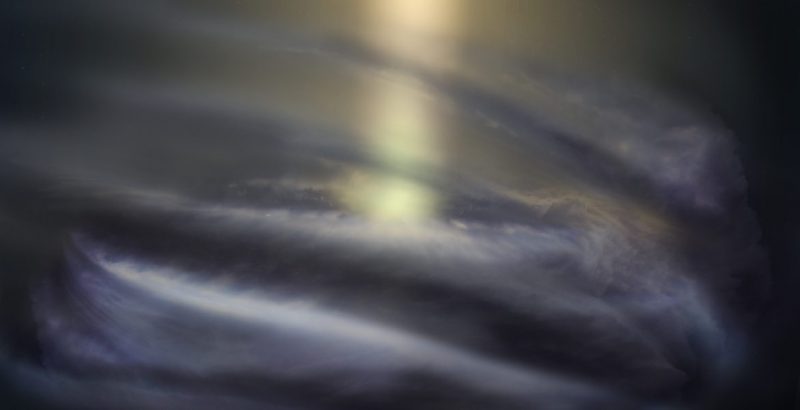
Wide gas clouds encircling a column of light - the black hole jet.

Artist’s concept of ring of cool interstellar gas surrounding the supermassive black hole at the center of our Milky Way galaxy. New observations by the ALMA telescope in Chile have revealed this structure for the first time. Image via NRAO/AUI/NSF; S. Dagnello.

For decades, since they became aware of its presence in the 1970s, astronomers have tried to eke out information about the central supermassive black hole at the heart of our Milky Way galaxy. They call it Sagittarius A* or Sag A* (pronounced Sagittarius A “star”). They know it’s 26,000 light-years away and as massive as 4 million stars the mass of our sun. But interstellar dust in the direction of the galaxy’s center has made studies of Sag A* difficult. This week (June 5, 2019), astronomers working with the ALMA telescope in Chile announced their discovery of a never-before-seen disk of cool interstellar gas wrapped around our galaxy’s giant black hole. They said this disk gives them new insights into the process of accretion, that is, the way the black hole siphons material from surrounding space. The results were published June 5 in the peer-reviewed journal Nature.

The National Radio Astronomy Observatory (which helps to operate ALMA) described the region around Sag A* in a statement:

We now know that this region is brimming with roving stars, interstellar dust clouds, and a large reservoir of both phenomenally hot and comparatively colder gases. These gases are expected to orbit the black hole in a vast accretion disk that extends a few tenths of a light-year from the black hole’s event horizon.

Until now, however, astronomers have been able to image only the tenuous, hot portion of this flow of accreting gas, which forms a roughly spherical flow and showed no obvious rotation. Its temperature is estimated to be a blistering 10 million degrees Celsius (18 million degrees Fahrenheit), or about two-thirds the temperature found at the core of our sun. At this temperature, the gas glows fiercely in X-ray light, allowing it to be studied by space-based X-ray telescopes, down to scale of about a tenth of a light-year from the black hole.

In addition to the hot gases detected by X-ray telescopes, astronomers have also seen signs of cooler gas (about 10 thousand degrees Celsius, or 18,000 degrees Fahrenheit) within a few light-years of the black hole. NRAO said:

The contribution of this cooler gas to the accretion flow onto the black hole was previously unknown.

It’s this cooler gas that the ALMA telescope has now been able to detect. ALMA – which stands for Atacama Large Millimeter/submillimeter Array – is a radio telescope, with the ability to peer through the dust between us and the galactic center. It has now produced the first-ever image of the cooler gas disk at only about a hundredth of a light-year away (or about 1,000 times the distance from the Earth to the sun) from the Milky Way’s supermassive black hole. Here’s the image:

White cross where blob of red meets blob of blue on black background.

ALMA image of the disk of cool hydrogen gas flowing around the supermassive black hole at the center of our galaxy. The colors represent the motion of the gas relative to Earth: the red portion is moving away, so the radio waves detected by ALMA are slightly stretched, or shifted, to the “redder” portion of the spectrum; the blue color represents gas moving toward Earth, so the radio waves are slightly scrunched, or shifted, to the “bluer” portion of the spectrum. Crosshairs indicate location of black hole. Image via ALMA (ESO/NAOJ/NRAO), E.M. Murchikova; NRAO/AUI/NSF, S. Dagnello.

The researchers estimate that the amount of hydrogen in this cool disk is about one tenth the mass of Jupiter, or one ten-thousandth of the mass of the sun. NRAO said:

By mapping the shifts in wavelengths of this radio light due to the Doppler effect (light from objects moving toward the Earth is slightly shifted to the “bluer” portion of the spectrum while light from objects moving away is slightly shifted to the “redder” portion), the astronomers could clearly see that the gas is rotating around the black hole. This information will provide new insights into the ways that black holes devour matter and the complex interplay between a black hole and its galactic neighborhood.

Elena Murchikova at the Institute for Advanced Study in Princeton, New Jersey is lead author on the new paper. She said:

We were the first to image this elusive disk and study its rotation. We are also probing accretion onto the black hole. This is important because this is our closest supermassive black hole. Even so, we still have no good understanding of how its accretion works. We hope these new ALMA observations will help the black hole give up some of its secrets.

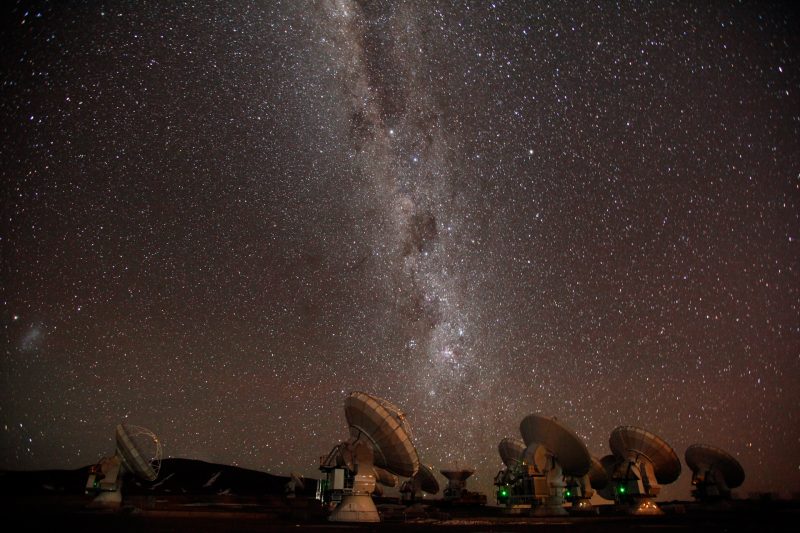
An array of dish-type radio telescopes, with the Milky Way stretched above them.

The Milky Way over the antennas of the Atacama Large Millimeter/submillimeter Array (ALMA), a sophisticated radio telescope array in the Atacama desert of northern Chile. Image via C. Padilla, NRAO/AUI/NSF.

Bottom line: New observations by the ALMA telescope in Chile have revealed a never-before-seen disk of cool interstellar gas wrapped around Sagittarius A*, the giant black hole at the center of our galaxy.

Source: A cool accretion disk around the Galactic Centre black hole

Via NRAO


from EarthSky http://bit.ly/2WnzXE1
Wide gas clouds encircling a column of light - the black hole jet.

Artist’s concept of ring of cool interstellar gas surrounding the supermassive black hole at the center of our Milky Way galaxy. New observations by the ALMA telescope in Chile have revealed this structure for the first time. Image via NRAO/AUI/NSF; S. Dagnello.

For decades, since they became aware of its presence in the 1970s, astronomers have tried to eke out information about the central supermassive black hole at the heart of our Milky Way galaxy. They call it Sagittarius A* or Sag A* (pronounced Sagittarius A “star”). They know it’s 26,000 light-years away and as massive as 4 million stars the mass of our sun. But interstellar dust in the direction of the galaxy’s center has made studies of Sag A* difficult. This week (June 5, 2019), astronomers working with the ALMA telescope in Chile announced their discovery of a never-before-seen disk of cool interstellar gas wrapped around our galaxy’s giant black hole. They said this disk gives them new insights into the process of accretion, that is, the way the black hole siphons material from surrounding space. The results were published June 5 in the peer-reviewed journal Nature.

The National Radio Astronomy Observatory (which helps to operate ALMA) described the region around Sag A* in a statement:

We now know that this region is brimming with roving stars, interstellar dust clouds, and a large reservoir of both phenomenally hot and comparatively colder gases. These gases are expected to orbit the black hole in a vast accretion disk that extends a few tenths of a light-year from the black hole’s event horizon.

Until now, however, astronomers have been able to image only the tenuous, hot portion of this flow of accreting gas, which forms a roughly spherical flow and showed no obvious rotation. Its temperature is estimated to be a blistering 10 million degrees Celsius (18 million degrees Fahrenheit), or about two-thirds the temperature found at the core of our sun. At this temperature, the gas glows fiercely in X-ray light, allowing it to be studied by space-based X-ray telescopes, down to scale of about a tenth of a light-year from the black hole.

In addition to the hot gases detected by X-ray telescopes, astronomers have also seen signs of cooler gas (about 10 thousand degrees Celsius, or 18,000 degrees Fahrenheit) within a few light-years of the black hole. NRAO said:

The contribution of this cooler gas to the accretion flow onto the black hole was previously unknown.

It’s this cooler gas that the ALMA telescope has now been able to detect. ALMA – which stands for Atacama Large Millimeter/submillimeter Array – is a radio telescope, with the ability to peer through the dust between us and the galactic center. It has now produced the first-ever image of the cooler gas disk at only about a hundredth of a light-year away (or about 1,000 times the distance from the Earth to the sun) from the Milky Way’s supermassive black hole. Here’s the image:

White cross where blob of red meets blob of blue on black background.

ALMA image of the disk of cool hydrogen gas flowing around the supermassive black hole at the center of our galaxy. The colors represent the motion of the gas relative to Earth: the red portion is moving away, so the radio waves detected by ALMA are slightly stretched, or shifted, to the “redder” portion of the spectrum; the blue color represents gas moving toward Earth, so the radio waves are slightly scrunched, or shifted, to the “bluer” portion of the spectrum. Crosshairs indicate location of black hole. Image via ALMA (ESO/NAOJ/NRAO), E.M. Murchikova; NRAO/AUI/NSF, S. Dagnello.

The researchers estimate that the amount of hydrogen in this cool disk is about one tenth the mass of Jupiter, or one ten-thousandth of the mass of the sun. NRAO said:

By mapping the shifts in wavelengths of this radio light due to the Doppler effect (light from objects moving toward the Earth is slightly shifted to the “bluer” portion of the spectrum while light from objects moving away is slightly shifted to the “redder” portion), the astronomers could clearly see that the gas is rotating around the black hole. This information will provide new insights into the ways that black holes devour matter and the complex interplay between a black hole and its galactic neighborhood.

Elena Murchikova at the Institute for Advanced Study in Princeton, New Jersey is lead author on the new paper. She said:

We were the first to image this elusive disk and study its rotation. We are also probing accretion onto the black hole. This is important because this is our closest supermassive black hole. Even so, we still have no good understanding of how its accretion works. We hope these new ALMA observations will help the black hole give up some of its secrets.

An array of dish-type radio telescopes, with the Milky Way stretched above them.

The Milky Way over the antennas of the Atacama Large Millimeter/submillimeter Array (ALMA), a sophisticated radio telescope array in the Atacama desert of northern Chile. Image via C. Padilla, NRAO/AUI/NSF.

Bottom line: New observations by the ALMA telescope in Chile have revealed a never-before-seen disk of cool interstellar gas wrapped around Sagittarius A*, the giant black hole at the center of our galaxy.

Source: A cool accretion disk around the Galactic Centre black hole

Via NRAO


from EarthSky http://bit.ly/2WnzXE1

1st quarter moon is June 9-10

Half of the moon.

Nearly first quarter moon from Suzanne Murphy in Wisconsin.

The moon reaches its first quarter phase on Monday, June 10, 2019, at 05:59 UTC (01:59 a.m. EDT; translate UTC to your time.. Although the first quarter moon comes at the same instant worldwide, the clock reads differently by time zone. At North American and U.S. times zones, look for the nearly first quarter moon on the evening of June 9.

A first quarter moon rises around noon and sets around midnight. You’ll likely spot it in late afternoon or early evening, high up in the sky. At this moon phase, the moon is showing us precisely half of its lighted half. Or you might say that – at first quarter moon – we’re seeing half the moon’s day side.

We call this moon a quarter and not a half because it is one quarter of the way around in its orbit of Earth, as measured from one new moon to the next. Also, although a first quarter moon appears half-lit to us, the illuminated portion we see of a first quarter moon truly is just a quarter. We’re now seeing half the moon’s day side, that is. Another lighted quarter of the moon shines just as brightly in the direction opposite Earth!

And what about the term half moon? That’s a beloved term, but not an official one.

Read more: 4 keys to understanding moon phases

Band of mountains on moon with a few large craters.

Tom Wildoner wrote: “One of my favorite areas to photograph on the moon near the 1st quarter! I captured this view of the sun lighting up the mountain range called Montes Apenninus. The moon was casting a nice shadow on the back side of the mountains. This mountain range is about 370 miles (600 km) long with some of the peaks rising as high as 3.1 miles (5 km).”

Half of the moon with labeled features along straight edge.

Here’s something else to look for on a 1st quarter moon. Aqilla Othman in Port Dickson, Negeri Sembilan, Malaysia, caught this photo. Notice that he caught Lunar X and Lunar V. These are similar features on the moon that fleetingly take an X or V shape when the moon appears in a 1st quarter phase from Earth.

Closeup of boundary between light and dark areas of the moon.

Here’s a closer look at Lunar X and Lunar V. Photo by Izaty Liyana in Port Dickson, Negeri Sembilan, Malaysia. What is Lunar X?

Bottom line: The first quarter moon comes on June 10 at 05:59 UTC; translate UTC to your time. As viewed from the whole Earth, it’s high up at sunset on June 9, looking like half a pie.

Check out EarthSky’s guide to the bright planets.

Help EarthSky keep going! Please donate.


from EarthSky http://bit.ly/2HbOcrl
Half of the moon.

Nearly first quarter moon from Suzanne Murphy in Wisconsin.

The moon reaches its first quarter phase on Monday, June 10, 2019, at 05:59 UTC (01:59 a.m. EDT; translate UTC to your time.. Although the first quarter moon comes at the same instant worldwide, the clock reads differently by time zone. At North American and U.S. times zones, look for the nearly first quarter moon on the evening of June 9.

A first quarter moon rises around noon and sets around midnight. You’ll likely spot it in late afternoon or early evening, high up in the sky. At this moon phase, the moon is showing us precisely half of its lighted half. Or you might say that – at first quarter moon – we’re seeing half the moon’s day side.

We call this moon a quarter and not a half because it is one quarter of the way around in its orbit of Earth, as measured from one new moon to the next. Also, although a first quarter moon appears half-lit to us, the illuminated portion we see of a first quarter moon truly is just a quarter. We’re now seeing half the moon’s day side, that is. Another lighted quarter of the moon shines just as brightly in the direction opposite Earth!

And what about the term half moon? That’s a beloved term, but not an official one.

Read more: 4 keys to understanding moon phases

Band of mountains on moon with a few large craters.

Tom Wildoner wrote: “One of my favorite areas to photograph on the moon near the 1st quarter! I captured this view of the sun lighting up the mountain range called Montes Apenninus. The moon was casting a nice shadow on the back side of the mountains. This mountain range is about 370 miles (600 km) long with some of the peaks rising as high as 3.1 miles (5 km).”

Half of the moon with labeled features along straight edge.

Here’s something else to look for on a 1st quarter moon. Aqilla Othman in Port Dickson, Negeri Sembilan, Malaysia, caught this photo. Notice that he caught Lunar X and Lunar V. These are similar features on the moon that fleetingly take an X or V shape when the moon appears in a 1st quarter phase from Earth.

Closeup of boundary between light and dark areas of the moon.

Here’s a closer look at Lunar X and Lunar V. Photo by Izaty Liyana in Port Dickson, Negeri Sembilan, Malaysia. What is Lunar X?

Bottom line: The first quarter moon comes on June 10 at 05:59 UTC; translate UTC to your time. As viewed from the whole Earth, it’s high up at sunset on June 9, looking like half a pie.

Check out EarthSky’s guide to the bright planets.

Help EarthSky keep going! Please donate.


from EarthSky http://bit.ly/2HbOcrl

2019 SkS Weekly Climate Change & Global Warming News Roundup #23

A chronological listing of news articles posted on the Skeptical Science Facebook Page during the past week, i.e., Sun, Jun 2 through Sat, June 8, 2019

Editor's Pick 

White House Tried to Stop Climate Science Testimony, Documents Show

Rod Schoonover 

Rod Schoonover at a House Intelligence Committee hearing on Wednesday. Credit: Andrew Harnik/Associated Press

The White House tried to stop a State Department senior intelligence analyst from discussing climate science in congressional testimony this week, internal emails and documents show.

The State Department’s Bureau of Intelligence and Research declined to make changes to the proposed testimony and the analyst, Rod Schoonover, an adjunct professor at Georgetown University, was ultimately allowed to speak before the House Permanent Select Committee on Intelligence on Wednesday.

But in a highly unusual move, the White House refused to approve Dr. Schoonover’s written testimony for entry into the permanent Congressional Record. The reasoning, according to a June 4 email seen by The New York Times, was that the science did not match the Trump administration’s views. 

White House Tried to Stop Climate Science Testimony, Documents Show by Lisa Friedman, Climate, New York Times, June 8, 2019


Links posted on Facebook

Sun June 2 2019

Mon June 3 2019

Tue June 4 2019

Wed June 5, 2019

Thu June 6, 2019

Fri June 7, 2019

Sat June 8, 2019


from Skeptical Science http://bit.ly/2WTM8Nk
A chronological listing of news articles posted on the Skeptical Science Facebook Page during the past week, i.e., Sun, Jun 2 through Sat, June 8, 2019

Editor's Pick 

White House Tried to Stop Climate Science Testimony, Documents Show

Rod Schoonover 

Rod Schoonover at a House Intelligence Committee hearing on Wednesday. Credit: Andrew Harnik/Associated Press

The White House tried to stop a State Department senior intelligence analyst from discussing climate science in congressional testimony this week, internal emails and documents show.

The State Department’s Bureau of Intelligence and Research declined to make changes to the proposed testimony and the analyst, Rod Schoonover, an adjunct professor at Georgetown University, was ultimately allowed to speak before the House Permanent Select Committee on Intelligence on Wednesday.

But in a highly unusual move, the White House refused to approve Dr. Schoonover’s written testimony for entry into the permanent Congressional Record. The reasoning, according to a June 4 email seen by The New York Times, was that the science did not match the Trump administration’s views. 

White House Tried to Stop Climate Science Testimony, Documents Show by Lisa Friedman, Climate, New York Times, June 8, 2019


Links posted on Facebook

Sun June 2 2019

Mon June 3 2019

Tue June 4 2019

Wed June 5, 2019

Thu June 6, 2019

Fri June 7, 2019

Sat June 8, 2019


from Skeptical Science http://bit.ly/2WTM8Nk

Young moon

Thin crescent moon in an orange sky.

Image via Heidi Gabbert.


from EarthSky http://bit.ly/2Wo0ZeK
Thin crescent moon in an orange sky.

Image via Heidi Gabbert.


from EarthSky http://bit.ly/2Wo0ZeK

Moon in Leo the Lion on June 8 and 9

On June 8 and 9, 2019, use the moon to find the Regulus, the brightest star in the constellation Leo the Lion. This blue-white gem of a star is of 1st-magnitude brightness and is the 21st brightest star to light up the nighttime sky.

The moon is rather close to Regulus for only a few days each month. So when the moon is no longer there to guide you, let the Big Dipper serve as your handy guide to this star. The two bowl stars on the handle side of the Big Dipper faithfully point to Regulus.

Big Dipper guide to the bright stars Arcturus and Regulus.

Use the Big Dipper to locate the bright stars Arcturus and Regulus.

Regulus is a blue-white gem of a star, its color revealing that this star has a high surface temperature. Considering that Regulus is nearly 80 light-years away, it must be quite luminous (intrinsically bright) to shine at 1st-magnitude brightness in Earth’s sky. Regulus is several hundred times more luminous than our sun, and at Regulus’ distance, our sun would be not even be visible to the naked eye.

Normally, a star’s blue-white color indicates that the star is in the heyday of youth (only 50 to 100 million years old). But Regulus has a very close companion star which can not be seen through the telescope but only detected with a spectroscope. It’s thought that Regulus’ companion could be a white dwarf star, in which case Regulus and its companion star would have to be at least a billion years old. Possibly, mass transfer of material from one star to the other in this close-knit binary star system acts as a fountain of youth, keeping Regulus young in its old age.

Regulus is the only 1st-magnitude star to sit almost squarely on the ecliptic – the sun’s apparent yearly pathway in front of the constellations of the zodiac. Of course, the sun’s apparent motion in front of the stars is really a reflection of our planet Earth’s revolution around the sun.

Looking at the sky chart below, notice that Regulus dots a backwards question mark of stars, called “The Sickle.” The Sickle outlines the Lion’s head and mane, whereas the star Denebola (whose name means “tail of the lion” in Arabic) marks the Lion’s tail.

Star chart of the constellation Leo the Lion

Chart of the constellation Leo via the IAU. The ecliptic depicts the annual pathway of the sun in front of the constellations of the zodiac. The sun passes in front of the constellation Leo each year from around August 10 to September 17, and has its yearly conjunction with the star Regulus on or near August 23.

Bottom line: These next few nights – June 8 and 9, 2019 – use the moon to locate the star Regulus. Once the moon leaves the evening sky, starting around the solstice, try to piece together the starlit figure of the Lion in a dark sky.


from EarthSky http://bit.ly/2WrEUvv

On June 8 and 9, 2019, use the moon to find the Regulus, the brightest star in the constellation Leo the Lion. This blue-white gem of a star is of 1st-magnitude brightness and is the 21st brightest star to light up the nighttime sky.

The moon is rather close to Regulus for only a few days each month. So when the moon is no longer there to guide you, let the Big Dipper serve as your handy guide to this star. The two bowl stars on the handle side of the Big Dipper faithfully point to Regulus.

Big Dipper guide to the bright stars Arcturus and Regulus.

Use the Big Dipper to locate the bright stars Arcturus and Regulus.

Regulus is a blue-white gem of a star, its color revealing that this star has a high surface temperature. Considering that Regulus is nearly 80 light-years away, it must be quite luminous (intrinsically bright) to shine at 1st-magnitude brightness in Earth’s sky. Regulus is several hundred times more luminous than our sun, and at Regulus’ distance, our sun would be not even be visible to the naked eye.

Normally, a star’s blue-white color indicates that the star is in the heyday of youth (only 50 to 100 million years old). But Regulus has a very close companion star which can not be seen through the telescope but only detected with a spectroscope. It’s thought that Regulus’ companion could be a white dwarf star, in which case Regulus and its companion star would have to be at least a billion years old. Possibly, mass transfer of material from one star to the other in this close-knit binary star system acts as a fountain of youth, keeping Regulus young in its old age.

Regulus is the only 1st-magnitude star to sit almost squarely on the ecliptic – the sun’s apparent yearly pathway in front of the constellations of the zodiac. Of course, the sun’s apparent motion in front of the stars is really a reflection of our planet Earth’s revolution around the sun.

Looking at the sky chart below, notice that Regulus dots a backwards question mark of stars, called “The Sickle.” The Sickle outlines the Lion’s head and mane, whereas the star Denebola (whose name means “tail of the lion” in Arabic) marks the Lion’s tail.

Star chart of the constellation Leo the Lion

Chart of the constellation Leo via the IAU. The ecliptic depicts the annual pathway of the sun in front of the constellations of the zodiac. The sun passes in front of the constellation Leo each year from around August 10 to September 17, and has its yearly conjunction with the star Regulus on or near August 23.

Bottom line: These next few nights – June 8 and 9, 2019 – use the moon to locate the star Regulus. Once the moon leaves the evening sky, starting around the solstice, try to piece together the starlit figure of the Lion in a dark sky.


from EarthSky http://bit.ly/2WrEUvv

adds 2