aads

News digest – obesity projections, immunotherapy trials, Vitamin D and cancer ‘cure’ documentaries

Immune cells

UK cancer cases caused by obesity could almost double in two decades

Cancer news was still emerging from Chicago earlier this week as the second half of the largest cancer conference in the world, the American Society of Clinical Oncology (ASCO) Annual Meeting, continued. Obesity was the subject of one of the major stories in the UK after new calculations by NHS England suggested that number of cases of cancer caused by obesity will almost double in the next 20 years. The Telegraph reported the figures, which forecast around 40,800 diagnoses linked to excess weight a year by 2035.

Precision drug combo boosts survival in younger women with advanced breast cancer

US research suggests combining a targeted drug with hormone therapy can extend the lives of younger women with advanced breast cancer, reports The Sun. The researchers say they now plan to follow the people who took part for longer and take blood samples to hunt for signs that may point to those most likely to benefit from the treatment. We also covered the promising clinical trial results presented at the ASCO Annual Meeting.

Targeted drug slows pancreatic cancer progression in trials

Survival for pancreatic cancer is devastatingly low, but results from a new trial, also presented in Chicago, suggest a precision drug could slow the progression of the disease in a small number of patients after chemo. Read our news report for the details.

Taking Vitamin D could reduce the risk of dying from cancer

More from the conference: a few studies point to the potential beneficial effects of taking vitamin D if you have cancer. Reported in The Sun, researchers say they now need to do more work to determine who might benefit from taking supplements and the recommended dose. As we told the Mirror, it’s important that cancer patients consult their doctor before taking vitamin supplements.

Immunotherapy treatment put to the test against lung and stomach cancer

The ASCO Annual Meeting also put the spotlight on a type of immunotherapy treatment that has boosted lung cancer survival. The Mail Online reported these results and we also covered unpublished data that paints a mixed picture for the same drug against some advanced stomach cancers.

Immune-boosting drug combo extends lives of advanced head and neck cancer patients

A UK study using the same immunotherapy drug as above alongside chemo, has also shown some benefit for people with head and neck cancer that has either spread or come back. Taking the immune-boosting treatment with less aggressive chemotherapy extended survival and reported side effects were less severe compared to the standard of care. The Guardian looks at the study in more detail.

Targeted radiotherapy for prostate cancer tested in trials

The Telegraph reports a recent Australian study of 50 men with advanced prostate cancer, also shared in Chicago, that tested a treatment aiming to ‘search and destroy’ prostate cancer cells. The treatment targets a molecule on the surface of prostate cancer cells and then delivers a radiation hit, with early results from small studies suggesting it might work for some.

A growing list of potential treatments for advanced prostate cancer

A new drug was added to the list of possible up-front treatment options for people diagnosed with prostate cancer that has spread, says the Independent. The study’s findings, again presented at ASCO, show that adding a hormone treatment to standard therapy extended men’s lives. This brings the number of potential treatment options to 3 based on recent trials, as we discussed in our conference round up.

Targeted drug shows promise in prostate cancer

A targeted drug that’s already used to treat ovarian cancer is showing early signs it might benefit some men whose advanced prostate cancers carry certain faulty genes. In a clinical trial, the drug – called olaparib (Lynparza) – triggered a response from just under half of cancers that carried faults in genes linked to DNA repair. The best responses were seen in men whose advanced prostate cancers had faulty BRCA genes. Read the Telegraph for more.

And finally

“Dodgy documentaries” promoting dangerous unproven cancer “cures” can be streamed on Amazon Prime, reports Wired. Searching for ‘cancer’ brought up a film about a woman who says her cancer was cured in 30 days after eating plants and taking a harmful alternative treatment that breaks down into cyanide in the gut. The fact that the platform’s recommendation algorithms are pushing viewers towards dangerous medical misinformation that can harm health and portray it as fact is cause for concern. And as our head information nurse, Martin Ledwick, says: “If something sounds too good to be true, it probably is. Anyone considering taking alternative medicine should talk it over with their doctor and be wary of people who might be trying to take advantage of them”. Read more about research into how alternative medicine might affect cancer survival in this blog post.

Gabi


from Cancer Research UK – Science blog http://bit.ly/2WjpAkI
Immune cells

UK cancer cases caused by obesity could almost double in two decades

Cancer news was still emerging from Chicago earlier this week as the second half of the largest cancer conference in the world, the American Society of Clinical Oncology (ASCO) Annual Meeting, continued. Obesity was the subject of one of the major stories in the UK after new calculations by NHS England suggested that number of cases of cancer caused by obesity will almost double in the next 20 years. The Telegraph reported the figures, which forecast around 40,800 diagnoses linked to excess weight a year by 2035.

Precision drug combo boosts survival in younger women with advanced breast cancer

US research suggests combining a targeted drug with hormone therapy can extend the lives of younger women with advanced breast cancer, reports The Sun. The researchers say they now plan to follow the people who took part for longer and take blood samples to hunt for signs that may point to those most likely to benefit from the treatment. We also covered the promising clinical trial results presented at the ASCO Annual Meeting.

Targeted drug slows pancreatic cancer progression in trials

Survival for pancreatic cancer is devastatingly low, but results from a new trial, also presented in Chicago, suggest a precision drug could slow the progression of the disease in a small number of patients after chemo. Read our news report for the details.

Taking Vitamin D could reduce the risk of dying from cancer

More from the conference: a few studies point to the potential beneficial effects of taking vitamin D if you have cancer. Reported in The Sun, researchers say they now need to do more work to determine who might benefit from taking supplements and the recommended dose. As we told the Mirror, it’s important that cancer patients consult their doctor before taking vitamin supplements.

Immunotherapy treatment put to the test against lung and stomach cancer

The ASCO Annual Meeting also put the spotlight on a type of immunotherapy treatment that has boosted lung cancer survival. The Mail Online reported these results and we also covered unpublished data that paints a mixed picture for the same drug against some advanced stomach cancers.

Immune-boosting drug combo extends lives of advanced head and neck cancer patients

A UK study using the same immunotherapy drug as above alongside chemo, has also shown some benefit for people with head and neck cancer that has either spread or come back. Taking the immune-boosting treatment with less aggressive chemotherapy extended survival and reported side effects were less severe compared to the standard of care. The Guardian looks at the study in more detail.

Targeted radiotherapy for prostate cancer tested in trials

The Telegraph reports a recent Australian study of 50 men with advanced prostate cancer, also shared in Chicago, that tested a treatment aiming to ‘search and destroy’ prostate cancer cells. The treatment targets a molecule on the surface of prostate cancer cells and then delivers a radiation hit, with early results from small studies suggesting it might work for some.

A growing list of potential treatments for advanced prostate cancer

A new drug was added to the list of possible up-front treatment options for people diagnosed with prostate cancer that has spread, says the Independent. The study’s findings, again presented at ASCO, show that adding a hormone treatment to standard therapy extended men’s lives. This brings the number of potential treatment options to 3 based on recent trials, as we discussed in our conference round up.

Targeted drug shows promise in prostate cancer

A targeted drug that’s already used to treat ovarian cancer is showing early signs it might benefit some men whose advanced prostate cancers carry certain faulty genes. In a clinical trial, the drug – called olaparib (Lynparza) – triggered a response from just under half of cancers that carried faults in genes linked to DNA repair. The best responses were seen in men whose advanced prostate cancers had faulty BRCA genes. Read the Telegraph for more.

And finally

“Dodgy documentaries” promoting dangerous unproven cancer “cures” can be streamed on Amazon Prime, reports Wired. Searching for ‘cancer’ brought up a film about a woman who says her cancer was cured in 30 days after eating plants and taking a harmful alternative treatment that breaks down into cyanide in the gut. The fact that the platform’s recommendation algorithms are pushing viewers towards dangerous medical misinformation that can harm health and portray it as fact is cause for concern. And as our head information nurse, Martin Ledwick, says: “If something sounds too good to be true, it probably is. Anyone considering taking alternative medicine should talk it over with their doctor and be wary of people who might be trying to take advantage of them”. Read more about research into how alternative medicine might affect cancer survival in this blog post.

Gabi


from Cancer Research UK – Science blog http://bit.ly/2WjpAkI

Going to the beach? Watch this video

Outgoing ocean currents – called rip currents – are the #1 danger for people at beaches. More than 100 people die each year after getting caught in them. Typical flow is 1-2 feet per second (0.5 meters per second), but they can flow faster – faster than a human can swim. Learn what to do if you get caught in a rip current, in this video. And share with your kids! Brought to you by the National Oceanic and Atmospheric Administration (NOAA).

Some main points about rip currents – see video for more information:

– Observe signs of rip currents like breaks in the waves, debris being carried out to sea, and others (see video).

– Don’t try to fight a rip current. Swim sideways, along the line of the beach, and then angle back toward the beach.

– If you see someone caught in a rip current, call 911 or a lifeguard – don’t try to rescue them yourself.

Learn more about rip currents from NOAA.

By the way, you’ll often hear rip currents called simply a rip, or you might hear them called by the misnomer rip tide. They really have nothing to do with tides.

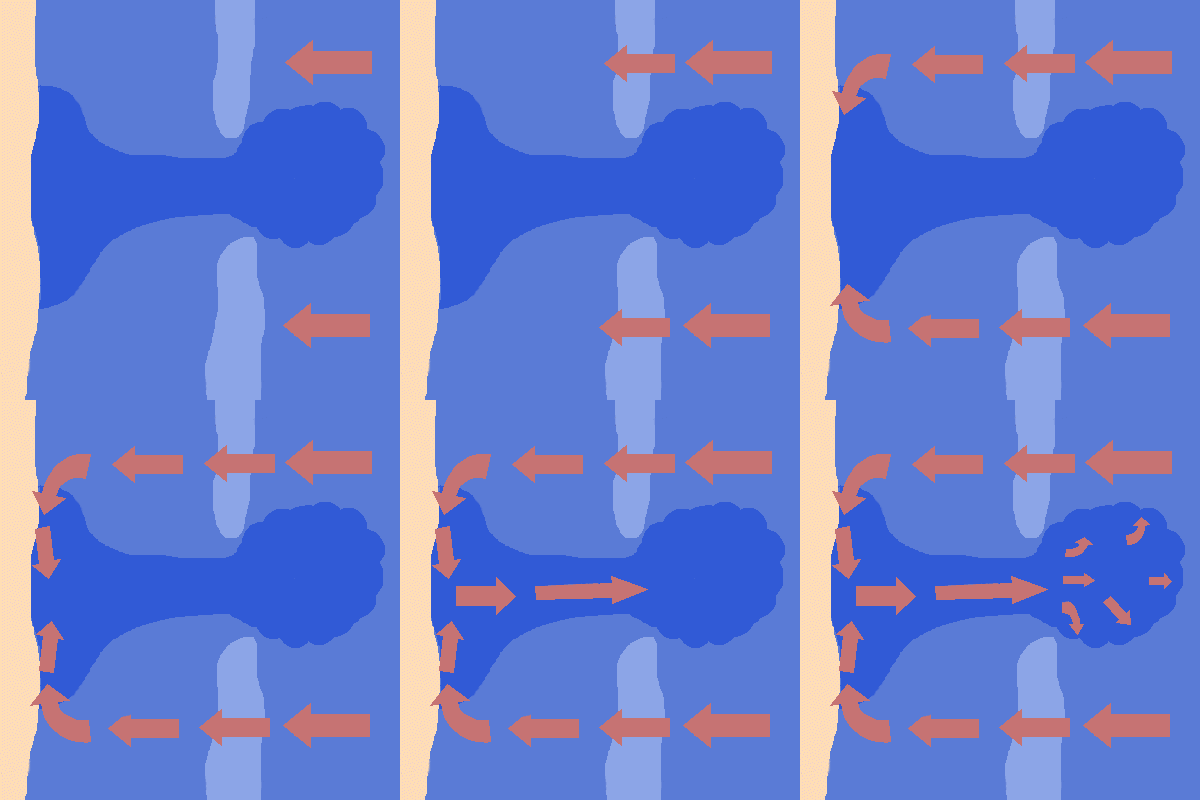
Animated diagram of dark blue stream of water with arrows, flowing perpendicularly out from beach.

Here’s how rip currents form. Breakers cross sand bars off the shore, and the water travels back to sea through the gap in the sand bars. Via Wikimedia Commons.

Bottom line: Rip currents can flow faster than humans can swim. This video explains what to do if you get caught in one.

Tides and the pull of the sun and moon


from EarthSky http://bit.ly/2WmIc38

Outgoing ocean currents – called rip currents – are the #1 danger for people at beaches. More than 100 people die each year after getting caught in them. Typical flow is 1-2 feet per second (0.5 meters per second), but they can flow faster – faster than a human can swim. Learn what to do if you get caught in a rip current, in this video. And share with your kids! Brought to you by the National Oceanic and Atmospheric Administration (NOAA).

Some main points about rip currents – see video for more information:

– Observe signs of rip currents like breaks in the waves, debris being carried out to sea, and others (see video).

– Don’t try to fight a rip current. Swim sideways, along the line of the beach, and then angle back toward the beach.

– If you see someone caught in a rip current, call 911 or a lifeguard – don’t try to rescue them yourself.

Learn more about rip currents from NOAA.

By the way, you’ll often hear rip currents called simply a rip, or you might hear them called by the misnomer rip tide. They really have nothing to do with tides.

Animated diagram of dark blue stream of water with arrows, flowing perpendicularly out from beach.

Here’s how rip currents form. Breakers cross sand bars off the shore, and the water travels back to sea through the gap in the sand bars. Via Wikimedia Commons.

Bottom line: Rip currents can flow faster than humans can swim. This video explains what to do if you get caught in one.

Tides and the pull of the sun and moon


from EarthSky http://bit.ly/2WmIc38

Video: Perpetual ocean

This visualization was originally released by NASA Goddard Space Flight Center in 2012. It’s called Perpetual Ocean, and it shows ocean surface currents around the world during the period from June 2005 through December 2007. The visualization doesn’t include a narration or annotations. It just lets you enjoy the sensational movement of the oceans on this watery planet of ours. NASA said in 2012:

… the goal was to use ocean flow data to create a simple, visceral experience.

I think they did it! Do you? This is one of my all-time favorite NASA videos. NASA also said:
This visualization was produced using NASA/JPL’s computational model called Estimating the Circulation and Climate of the Ocean, Phase II or ECCO2. ECCO2 is a high-resolution model of the global ocean and sea-ice. ECCO2 attempts to model the oceans and sea ice to increasingly accurate resolutions that begin to resolve ocean eddies and other narrow-current systems which transport heat and carbon in the oceans.

The ECCO2 model simulates ocean flows at all depths, but only surface flows are used in this visualization. The dark patterns under the ocean represent the undersea bathymetry [ocean floor]. Topographic land exaggeration is 20x and bathymetric exaggeration is 40x.

There are two versions of this video, by the way, a 20-minute version and a 3-minute version. Both are available in high definition here: http://svs.gsfc.nasa.gov/goto?3827

Read more from NASA about this visualization here

Bottom line: A video visualization of ocean currents around the world from NASA Goddard Space Flight Center. The video shows the period from June 2005 through December 2007.


from EarthSky http://bit.ly/2MBiRTy

This visualization was originally released by NASA Goddard Space Flight Center in 2012. It’s called Perpetual Ocean, and it shows ocean surface currents around the world during the period from June 2005 through December 2007. The visualization doesn’t include a narration or annotations. It just lets you enjoy the sensational movement of the oceans on this watery planet of ours. NASA said in 2012:

… the goal was to use ocean flow data to create a simple, visceral experience.

I think they did it! Do you? This is one of my all-time favorite NASA videos. NASA also said:

This visualization was produced using NASA/JPL’s computational model called Estimating the Circulation and Climate of the Ocean, Phase II or ECCO2. ECCO2 is a high-resolution model of the global ocean and sea-ice. ECCO2 attempts to model the oceans and sea ice to increasingly accurate resolutions that begin to resolve ocean eddies and other narrow-current systems which transport heat and carbon in the oceans.

The ECCO2 model simulates ocean flows at all depths, but only surface flows are used in this visualization. The dark patterns under the ocean represent the undersea bathymetry [ocean floor]. Topographic land exaggeration is 20x and bathymetric exaggeration is 40x.

There are two versions of this video, by the way, a 20-minute version and a 3-minute version. Both are available in high definition here: http://svs.gsfc.nasa.gov/goto?3827

Read more from NASA about this visualization here

Bottom line: A video visualization of ocean currents around the world from NASA Goddard Space Flight Center. The video shows the period from June 2005 through December 2007.


from EarthSky http://bit.ly/2MBiRTy

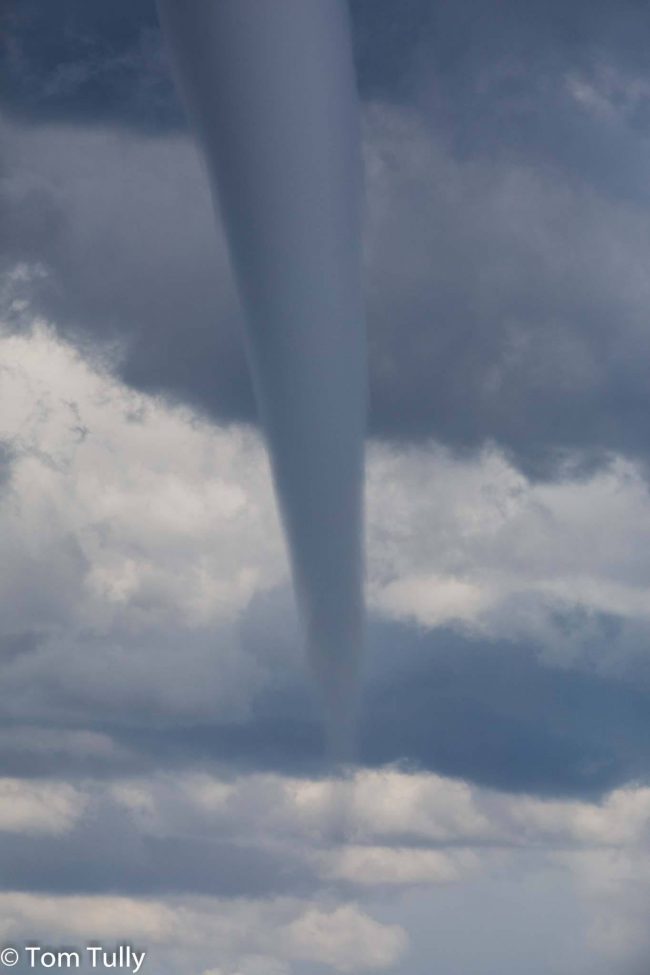
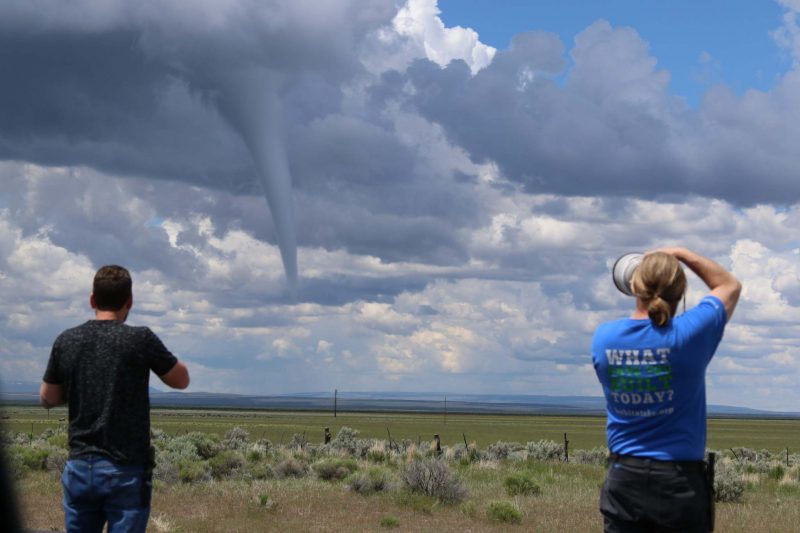
Golden eagle and funnel cloud, over Oregon

Golden eagle flying in front of a funnel cloud.

Photo by Thomas Patrick Tully. Thanks for giving us permision to post, Tom!

Bottom line: Photo from early June 2019 of a beautiful funnel cloud, not touching the ground. One photo has a golden eagle flying in front of the funnel.


from EarthSky http://bit.ly/2K2qRL8
Golden eagle flying in front of a funnel cloud.

Photo by Thomas Patrick Tully. Thanks for giving us permision to post, Tom!

Bottom line: Photo from early June 2019 of a beautiful funnel cloud, not touching the ground. One photo has a golden eagle flying in front of the funnel.


from EarthSky http://bit.ly/2K2qRL8

Southern Cross: A southern sky signpost

For our friends in the Southern Hemisphere, we’re paying tribute today to the Southern Cross, also known as the constellation Crux. No matter where you live in the Southern Hemisphere, look in your southern sky for the Southern Cross as soon as darkness falls.

At temperate latitudes in the Southern Hemisphere, where it’s now the winter season, we astronomers say the Southern Cross swings to upper meridian transit – its high point in the sky – at early evening, or somewhere around 7 to 8 p.m. local time.

The image at the top of the post is the Southern Cross as seen from Manila – latitude 14 degrees north of the equator – in 2012. The photo is from EarthSky Facebook friend Jv Noriega. View it larger.

The photo below is from the Philippines also. It’s from Dr Ski, who posts frequently to EarthSky Community Photos:

The Southern Cross, seen from the Philippines, with bright stars to left and right of it.

View larger at EarthSky Community Photos. | Dr Ski caught the Southern Cross – aka Crux – in late March 2019, around the time of its midnight culmination (in other words, around the time it was crossing the meridian – highest in the sky – around midnight). He wrote: “Alpha and Beta Centauri are the bright stars on the left. Lambda Centauri and Eta Carina nebulae are on the right.”

Because the Southern Cross is circumpolar – always above the horizon – at all places south of 35 degrees south latitude, people at mid-southern latitudes can count on seeing the Southern Cross all night long, every night of the year. Watch for the Southern Cross to move like a great big hour hand, circling around the south celestial pole in a clockwise direction throughout the night. The Southern Cross will sweep to lower meridian transit – its low point in the sky – around 7 to 8 a.m. local time tomorrow.

If the Southern Cross is circumpolar in your sky, then the Big Dipper never climbs above your horizon.

Conversely, if the Big Dipper is circumpolar in your sky, then the Southern Cross never climbs above your horizon. Additionally, the W or M-shaped constellation Cassiopeia is also circumpolar at northerly latitudes. See the animation below.

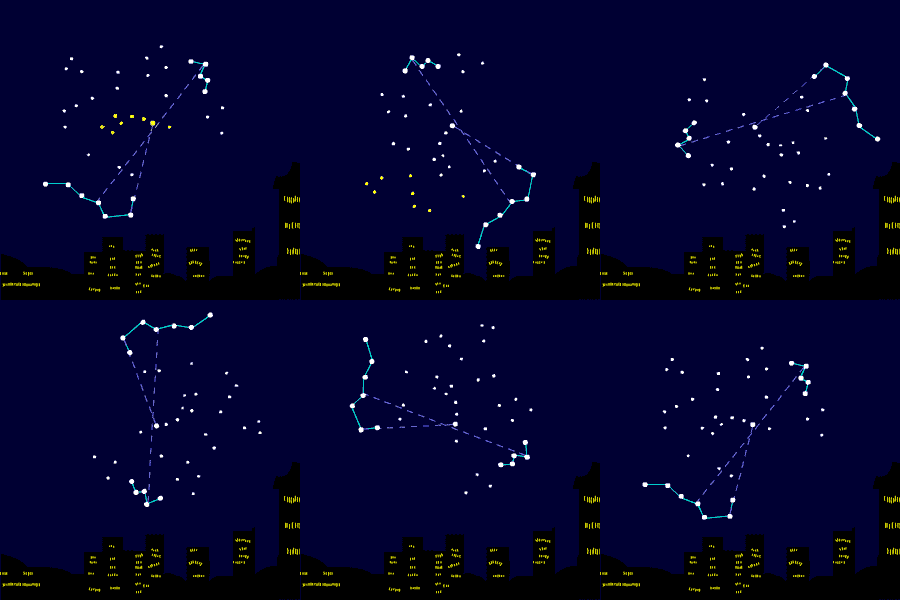
Animated diagram of the Big Dipper and the W-shaped constellation Cassiopeia circling around Polaris.

In the Northern Hemisphere, the Big Dipper and the W-shaped constellation Cassiopeia circle around Polaris, the North Star, in a period of 23 hours and 56 minutes. The Big Dipper is circumpolar at 41 degrees north latitude, and all latitudes farther north.

However, if you live in the tropics, there are times when you can actually see the Big Dipper and the Southern Cross in the same sky together. In early June, for instance, the Southern Cross and Big Dipper reach upper transit – their high point – at virtually the same time.

You have a better chance of seeing the Southern Cross and the Big Dipper in the same sky right now from the southern tropics. That’s because the winter season in the Southern Hemisphere ushers in an earlier sunset time than at comparable latitudes in the northern tropics, where it is now summer.

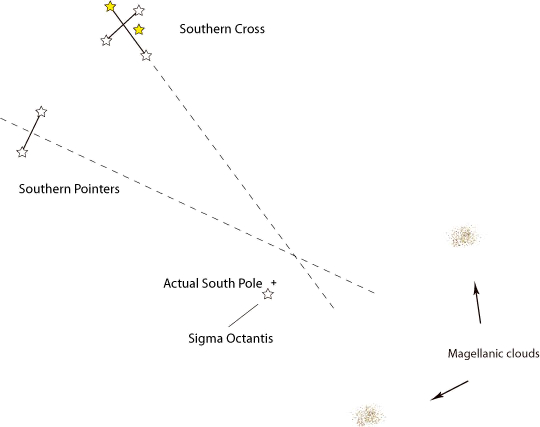
Diagram of intersecting dotted lines from Crux and pointer stars to location of South Pole.

Star-hopping to south celestial pole via the Southern Cross and the bright stars Alpha Centauri and Hadar.

Bottom line: A tribute to the Southern Cross, also known as the constellation Crux.


from EarthSky http://bit.ly/2EV6mvK

For our friends in the Southern Hemisphere, we’re paying tribute today to the Southern Cross, also known as the constellation Crux. No matter where you live in the Southern Hemisphere, look in your southern sky for the Southern Cross as soon as darkness falls.

At temperate latitudes in the Southern Hemisphere, where it’s now the winter season, we astronomers say the Southern Cross swings to upper meridian transit – its high point in the sky – at early evening, or somewhere around 7 to 8 p.m. local time.

The image at the top of the post is the Southern Cross as seen from Manila – latitude 14 degrees north of the equator – in 2012. The photo is from EarthSky Facebook friend Jv Noriega. View it larger.

The photo below is from the Philippines also. It’s from Dr Ski, who posts frequently to EarthSky Community Photos:

The Southern Cross, seen from the Philippines, with bright stars to left and right of it.

View larger at EarthSky Community Photos. | Dr Ski caught the Southern Cross – aka Crux – in late March 2019, around the time of its midnight culmination (in other words, around the time it was crossing the meridian – highest in the sky – around midnight). He wrote: “Alpha and Beta Centauri are the bright stars on the left. Lambda Centauri and Eta Carina nebulae are on the right.”

Because the Southern Cross is circumpolar – always above the horizon – at all places south of 35 degrees south latitude, people at mid-southern latitudes can count on seeing the Southern Cross all night long, every night of the year. Watch for the Southern Cross to move like a great big hour hand, circling around the south celestial pole in a clockwise direction throughout the night. The Southern Cross will sweep to lower meridian transit – its low point in the sky – around 7 to 8 a.m. local time tomorrow.

If the Southern Cross is circumpolar in your sky, then the Big Dipper never climbs above your horizon.

Conversely, if the Big Dipper is circumpolar in your sky, then the Southern Cross never climbs above your horizon. Additionally, the W or M-shaped constellation Cassiopeia is also circumpolar at northerly latitudes. See the animation below.

Animated diagram of the Big Dipper and the W-shaped constellation Cassiopeia circling around Polaris.

In the Northern Hemisphere, the Big Dipper and the W-shaped constellation Cassiopeia circle around Polaris, the North Star, in a period of 23 hours and 56 minutes. The Big Dipper is circumpolar at 41 degrees north latitude, and all latitudes farther north.

However, if you live in the tropics, there are times when you can actually see the Big Dipper and the Southern Cross in the same sky together. In early June, for instance, the Southern Cross and Big Dipper reach upper transit – their high point – at virtually the same time.

You have a better chance of seeing the Southern Cross and the Big Dipper in the same sky right now from the southern tropics. That’s because the winter season in the Southern Hemisphere ushers in an earlier sunset time than at comparable latitudes in the northern tropics, where it is now summer.

Diagram of intersecting dotted lines from Crux and pointer stars to location of South Pole.

Star-hopping to south celestial pole via the Southern Cross and the bright stars Alpha Centauri and Hadar.

Bottom line: A tribute to the Southern Cross, also known as the constellation Crux.


from EarthSky http://bit.ly/2EV6mvK

Sea sponges collect DNA from fish, penguins, seals

Coral reef scene. Rounded bright orange sponges with large intake holes and very many small outgo holes.

Image via © Jolanta Wojcicka.

You’ve probably watched enough crime shows to know that humans leave DNA behind in the places we’ve been. Like us, water-dwelling animals leave DNA behind too, in the water column. A new study, published June 3, 2019, in the peer-reviewed journal Current Biology, finds that seas sponges, which can filter 10,000 liters (2,600 gallons) of water daily, pick up DNA in their tissues from other ocean dwellers – such as fish, seals and penguins – as they filter-feed.

The researchers say that sponges can be used as a tool to help scientists to monitor biodiversity – that is, find out which species are living where.

Capturing genetic material in the ocean is a tough task. Marine ecologist Stefano Mariani of the University of Salford is the lead author of the study. He says sponges could give scientists an effective and environmentally-friendly method of collecting DNA samples both in the ocean and in freshwater. Mariani said in a statement:

Sponges are ideal sampling units because you find them everywhere and in every aquatic habitat, including freshwater. Also, they’re not very selective filter-feeders, they don’t run away, and they don’t get hurt by sampling – you can just grab a piece, and they will regenerate nicely.

Underwater, barrel-shaped yellow-green tubes with black holes on top and small holes on the sides.

Sponge specimen, Aplysina aerophoba. Image via A. Riesgo.

Mariani and his team were able to identify 31 different species from genetic material in the tissue of the sponges they sampled, collected from Antarctic and Mediterranean waters. Most of the species were fish, but one sponge sample from Antarctica included DNA from Weddell seals and chinstrap penguins. The sample was later identified to be located offshore of a penguin breeding colony. Mariani said:

This was a really exciting find and also makes a lot of sense, because the penguins would be in and out of the water a lot, eating, swimming, and pooing.

Currently, machines with large water-sampling capabilities are being developed to allow scientists to sample DNA from water, but the authors think using a natural sampler could be just as effective. With the machines there are risks of DNA contamination. Mariani said, and degrading the DNA. Also, bringing machines into some regions might not be feasible and may be too disruptive to fragile ecosystems. Mariani said:

If you want to study an endangered species of sawfish or a manatee in a mangrove forest in Mozambique, you can’t go there with massive robots. You have to use a very low-tech approach.

I am hopeful that this method will prove itself to be useful. It’s the quintessential environmentally friendly biodiversity assessment tool.

Bottom line: New research finds that sea sponges capture DNA from other species in their tissue as they filter-feed.

Source: Sponges as natural environmental DNA samplers

Via ScienceDaily


from EarthSky http://bit.ly/2XtEGp3
Coral reef scene. Rounded bright orange sponges with large intake holes and very many small outgo holes.

Image via © Jolanta Wojcicka.

You’ve probably watched enough crime shows to know that humans leave DNA behind in the places we’ve been. Like us, water-dwelling animals leave DNA behind too, in the water column. A new study, published June 3, 2019, in the peer-reviewed journal Current Biology, finds that seas sponges, which can filter 10,000 liters (2,600 gallons) of water daily, pick up DNA in their tissues from other ocean dwellers – such as fish, seals and penguins – as they filter-feed.

The researchers say that sponges can be used as a tool to help scientists to monitor biodiversity – that is, find out which species are living where.

Capturing genetic material in the ocean is a tough task. Marine ecologist Stefano Mariani of the University of Salford is the lead author of the study. He says sponges could give scientists an effective and environmentally-friendly method of collecting DNA samples both in the ocean and in freshwater. Mariani said in a statement:

Sponges are ideal sampling units because you find them everywhere and in every aquatic habitat, including freshwater. Also, they’re not very selective filter-feeders, they don’t run away, and they don’t get hurt by sampling – you can just grab a piece, and they will regenerate nicely.

Underwater, barrel-shaped yellow-green tubes with black holes on top and small holes on the sides.

Sponge specimen, Aplysina aerophoba. Image via A. Riesgo.

Mariani and his team were able to identify 31 different species from genetic material in the tissue of the sponges they sampled, collected from Antarctic and Mediterranean waters. Most of the species were fish, but one sponge sample from Antarctica included DNA from Weddell seals and chinstrap penguins. The sample was later identified to be located offshore of a penguin breeding colony. Mariani said:

This was a really exciting find and also makes a lot of sense, because the penguins would be in and out of the water a lot, eating, swimming, and pooing.

Currently, machines with large water-sampling capabilities are being developed to allow scientists to sample DNA from water, but the authors think using a natural sampler could be just as effective. With the machines there are risks of DNA contamination. Mariani said, and degrading the DNA. Also, bringing machines into some regions might not be feasible and may be too disruptive to fragile ecosystems. Mariani said:

If you want to study an endangered species of sawfish or a manatee in a mangrove forest in Mozambique, you can’t go there with massive robots. You have to use a very low-tech approach.

I am hopeful that this method will prove itself to be useful. It’s the quintessential environmentally friendly biodiversity assessment tool.

Bottom line: New research finds that sea sponges capture DNA from other species in their tissue as they filter-feed.

Source: Sponges as natural environmental DNA samplers

Via ScienceDaily


from EarthSky http://bit.ly/2XtEGp3

Here’s a portrait of a family of stars

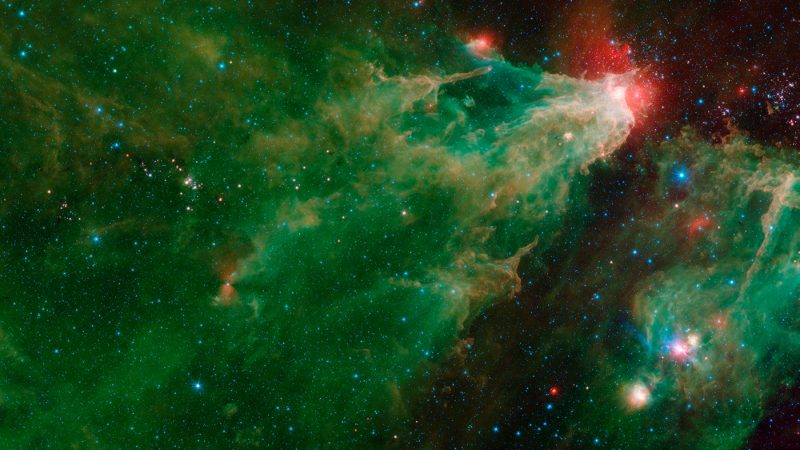
The video above offers some explanation of the large mosaic image below. You’ll want the explanation, because there’s a lot to see in this image taken by NASA’s Spitzer Space Telescope. Essentially, you’re looking at multiple clusters of stars – born from the same dense clumps of gas and dust – in the direction of the constellation Cepheus the King, located in the northern sky. Astronomers call this region the Cepheus C and B region. Some of these clusters here are older, and some are younger, and some are middle-aged.

So the mosaic is, in a sense, a family portrait of stars, featuring infants, parents and grandparents of a star-forming region, that is, a region of dense clouds of gas and dust in space.

A large green and orange nebula with stars clusters in starry sky.

View larger. | NASA’s Spitzer Space Telescope acquired the images to create this composite, before the spacecraft’s liquid helium coolant ran out in 2009. The green-and-orange delta filling most of this image is the Cepheus B and C region – a nebula – or celestial cloud of gas and dust. For details, see the video above or annotated image below. Image via NASA.

NASA wrote:

The grand green-and-orange delta filling most of the image is a faraway nebula, or a cloud of gas and dust in space. Though the cloud may appear to flow from the bright white spot at its tip, it is actually what remains of a much larger cloud that has been carved away by radiation from stars. The bright region is illuminated by massive stars, belonging to a cluster that extends above the white spot. The white color is the combination of four colors (blue, green, orange and red), each representing a different wavelength of infrared light, which is invisible to human eyes. Dust that has been heated by the stars’ radiation creates the surrounding red glow.

On the left side of this image, a dark filament runs horizontally through the green cloud. A smattering of baby stars (the red and yellow dots) appear inside it. Known as Cepheus C, the area is a particularly dense concentration of gas and dust where infant stars form. The dark vein of material will eventually be dispersed by strong winds produced as the stars get older, as well as when they eventually explode and die. This will create an illuminated puffed-up region that will look similar to the bright red-and-white region on the large nebula’s upper-right side. The region is called Cepheus C because it lies in the constellation Cepheus, which can be found near the constellation Cassiopeia. Cepheus C is about six light-years long and lies about 40 light-years from the bright spot at the tip of the nebula.

A second large nebula can be seen on the right side of the image, with a star cluster located just above it. Known as Cepheus B, the cluster sits within a few thousand light-years of our sun. A study of this region using Spitzer data found that the dramatic collection is about 4 million to 5 million years old – slightly older than those in Cepheus C.

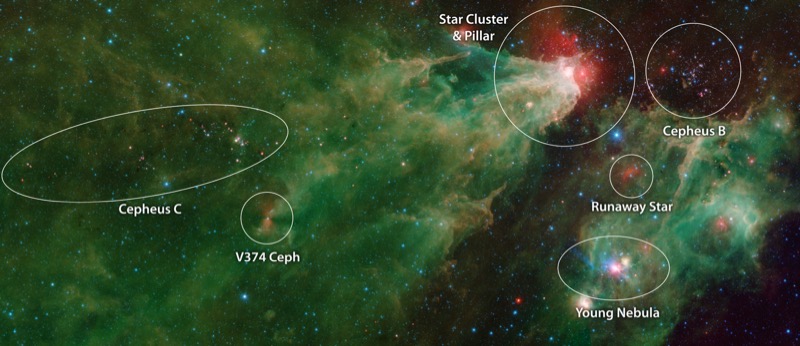
Here’s the same image as above, annotated:

Colorful gas and dust cloud in space, in places illuminated by stars, features labeled.

View larger. | An annotated mosaic of the Cepheus C and Cepheus B regions, by NASA’s Spitzer Space Telescope. Read more about this image.

NASA wrote:

The mosaic is a veritable family portrait, featuring infants, parents and grandparents of star-forming regions: Stars form in dense clouds of material, like the dark vein that makes up Cepheus C. As the stars grow, they produce winds that blow the gas and dust outward, to form beautiful, illuminated nebulas like the bright white spot at the top of the larger nebula. Finally, the dust and gas disperse, and the star clusters stand alone in space, as with Cepheus B.

The amazing features in this image don’t end there.

Look closely for the small, red hourglass shape just below Cepheus C. This is V374 Ceph. Astronomers studying this massive star have speculated that it might be surrounded by a nearly edge-on disk of dark, dusty material. The dark cones extending to the right and left of the star are a shadow of that disk.

The smaller nebula on the right side of the image includes two particularly interesting objects. In the upper-left portion of the nebula, try to find a blue star crowned by a small, red arc of light. This “runaway star” is plowing through the gas and dust at a rapid clip, creating a shock wave, or “bow shock,” in front of itself.

Also hidden within this second nebula, a small cluster of newborn stars illuminates the dense cloud of gas and dust where they formed. This feature appears as a bright teal splash.

Bottom line: Spectacular mosaic of the Cepheus B and C star-forming region, explained by NASA.

Via NASA’s Spitzer Space Telescope


from EarthSky http://bit.ly/2HZNn5s

The video above offers some explanation of the large mosaic image below. You’ll want the explanation, because there’s a lot to see in this image taken by NASA’s Spitzer Space Telescope. Essentially, you’re looking at multiple clusters of stars – born from the same dense clumps of gas and dust – in the direction of the constellation Cepheus the King, located in the northern sky. Astronomers call this region the Cepheus C and B region. Some of these clusters here are older, and some are younger, and some are middle-aged.

So the mosaic is, in a sense, a family portrait of stars, featuring infants, parents and grandparents of a star-forming region, that is, a region of dense clouds of gas and dust in space.

A large green and orange nebula with stars clusters in starry sky.

View larger. | NASA’s Spitzer Space Telescope acquired the images to create this composite, before the spacecraft’s liquid helium coolant ran out in 2009. The green-and-orange delta filling most of this image is the Cepheus B and C region – a nebula – or celestial cloud of gas and dust. For details, see the video above or annotated image below. Image via NASA.

NASA wrote:

The grand green-and-orange delta filling most of the image is a faraway nebula, or a cloud of gas and dust in space. Though the cloud may appear to flow from the bright white spot at its tip, it is actually what remains of a much larger cloud that has been carved away by radiation from stars. The bright region is illuminated by massive stars, belonging to a cluster that extends above the white spot. The white color is the combination of four colors (blue, green, orange and red), each representing a different wavelength of infrared light, which is invisible to human eyes. Dust that has been heated by the stars’ radiation creates the surrounding red glow.

On the left side of this image, a dark filament runs horizontally through the green cloud. A smattering of baby stars (the red and yellow dots) appear inside it. Known as Cepheus C, the area is a particularly dense concentration of gas and dust where infant stars form. The dark vein of material will eventually be dispersed by strong winds produced as the stars get older, as well as when they eventually explode and die. This will create an illuminated puffed-up region that will look similar to the bright red-and-white region on the large nebula’s upper-right side. The region is called Cepheus C because it lies in the constellation Cepheus, which can be found near the constellation Cassiopeia. Cepheus C is about six light-years long and lies about 40 light-years from the bright spot at the tip of the nebula.

A second large nebula can be seen on the right side of the image, with a star cluster located just above it. Known as Cepheus B, the cluster sits within a few thousand light-years of our sun. A study of this region using Spitzer data found that the dramatic collection is about 4 million to 5 million years old – slightly older than those in Cepheus C.

Here’s the same image as above, annotated:

Colorful gas and dust cloud in space, in places illuminated by stars, features labeled.

View larger. | An annotated mosaic of the Cepheus C and Cepheus B regions, by NASA’s Spitzer Space Telescope. Read more about this image.

NASA wrote:

The mosaic is a veritable family portrait, featuring infants, parents and grandparents of star-forming regions: Stars form in dense clouds of material, like the dark vein that makes up Cepheus C. As the stars grow, they produce winds that blow the gas and dust outward, to form beautiful, illuminated nebulas like the bright white spot at the top of the larger nebula. Finally, the dust and gas disperse, and the star clusters stand alone in space, as with Cepheus B.

The amazing features in this image don’t end there.

Look closely for the small, red hourglass shape just below Cepheus C. This is V374 Ceph. Astronomers studying this massive star have speculated that it might be surrounded by a nearly edge-on disk of dark, dusty material. The dark cones extending to the right and left of the star are a shadow of that disk.

The smaller nebula on the right side of the image includes two particularly interesting objects. In the upper-left portion of the nebula, try to find a blue star crowned by a small, red arc of light. This “runaway star” is plowing through the gas and dust at a rapid clip, creating a shock wave, or “bow shock,” in front of itself.

Also hidden within this second nebula, a small cluster of newborn stars illuminates the dense cloud of gas and dust where they formed. This feature appears as a bright teal splash.

Bottom line: Spectacular mosaic of the Cepheus B and C star-forming region, explained by NASA.

Via NASA’s Spitzer Space Telescope


from EarthSky http://bit.ly/2HZNn5s

Lightning!

Eelix Fui captured this spectacular lightning in Kota Kinabalu, Sabah, North Borneo, Malaysia, on the night of May 30, 2019. Eelix said:

There was non-stop lightning that night. The lightning phenomenon happened every night during the last 2 weeks. It’s so beautiful, but so scary too.

Thanks for sharing your image with us, Eelix!


from EarthSky http://bit.ly/2KwdYsc

Eelix Fui captured this spectacular lightning in Kota Kinabalu, Sabah, North Borneo, Malaysia, on the night of May 30, 2019. Eelix said:

There was non-stop lightning that night. The lightning phenomenon happened every night during the last 2 weeks. It’s so beautiful, but so scary too.

Thanks for sharing your image with us, Eelix!


from EarthSky http://bit.ly/2KwdYsc

How to celebrate World Oceans Day 2019

Scuba diver under water.

All of humanity is intimately connected to Earth’s oceans. Image via @WorldOceansDay on Instagram.

World Oceans Day is June 8, 2019. It’s a time to celebrate the oceans and take steps to protect ocean health. The World Oceans Day 2019 website recommends three ways to participate in the day.

Browse event ideas and/or download resources. More promotional materials here (posters available in 17+ languages!). Find resources specific to plastic pollution here.

Register your event and activities at the World Oceans Day website.

Show your support on social media. Download social media assets including cover photos, social media tiles and more. Check out World Oceans Day gifs and stickers through Giphy. Follow @WorldOceansDay on Facebook, Instagram and Twitter and make sure to tag #WorldOceansDay!

Also, many zoos and aquariums are hosting special events for World Oceans Day. Check out a global map of World Oceans Day events for 2019 here.

Why celebrate Earth’s oceans at all? Whether you live near a coast, or not, we are all intimately connected with the oceans. Here are some of the connections:

Oceans cover 71% of Earth’s surface, and they hold 97% of our planet’s water.

The oceans help feed us and provide most of the oxygen that we breathe.

Oceans also play a key role in regulating the weather and climate. Water evaporating from the oceans falls inland as rain, which we then use to drink and grow crops.

A variety of life-saving medicinal compounds including anti-inflammatory and anti-cancer drugs have been discovered in the oceans.

The oceans provide us with abundant opportunities for recreation and inspiration.

Half-naked man with snorkel, standing in ocean water up to his chest, with arms upraised.

For 2019’s World Oceans Day, organizers are asking that you take a photo of yourself or a group of people with your arms in the air – crop the photo so your hands touch the upper corners of the photo frame – share your photo on social media and use the hashtag #TogetherWeCan. Image via World Oceans Day 2019.

A pink poster asking, 'How will you celebrate our ocean?'

Via @WorldOceansDay on Instagram.

Threats to the oceans include pollution, overfishing, invasive species, and rising ocean acidity due to the extensive use of fossil fuels. And we’ve all heard of the threat to the ocean via plastic waste. The problems are daunting, but there are simple steps that you can to take to help protect the ocean.

For example, always recycle and use reusable water bottles and grocery bags to help reduce plastic pollution. You can reduce your carbon footprint by turning off lights and appliances when they are not in use and purchasing energy efficient products in the future. Making sustainable seafood choices is one of the most important things you can to do protect marine life, and there are now sustainable seafood guides available for many countries around the world.

Canada first proposed the concept for World Oceans Day in 1992 at the Earth Summit in Rio de Janeiro. In December 2008, a United Nations resolution designated June 8 of each year as World Oceans Day.

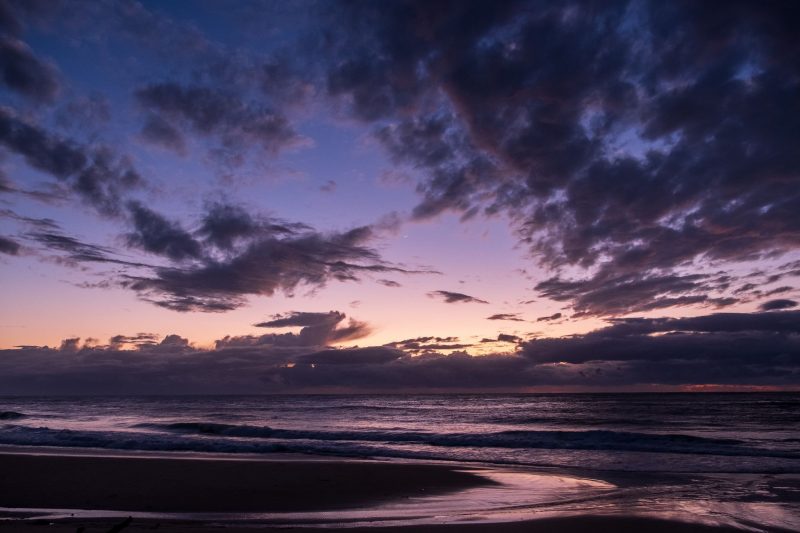
A twilight beach scene, with scattered clouds, and a tiny crescent moon.

View at EarthSky Community Photos. | Along with everything else they provide, Earth’s oceans also provide an opportunity for inspiration and meditation. Here’s view of the waning crescent moon on June 2, 2019, over Nambucca Heads, New South Wales, Australia, just before sunrise. Photo by Carol Schulz.

Bottom line: World Oceans Day is June 8, 2019. It is an annual event that is designed to encourage people to celebrate the oceans and take steps to protect ocean health.

Visit the World Oceans Day website


from EarthSky http://bit.ly/2HXcupd
Scuba diver under water.

All of humanity is intimately connected to Earth’s oceans. Image via @WorldOceansDay on Instagram.

World Oceans Day is June 8, 2019. It’s a time to celebrate the oceans and take steps to protect ocean health. The World Oceans Day 2019 website recommends three ways to participate in the day.

Browse event ideas and/or download resources. More promotional materials here (posters available in 17+ languages!). Find resources specific to plastic pollution here.

Register your event and activities at the World Oceans Day website.

Show your support on social media. Download social media assets including cover photos, social media tiles and more. Check out World Oceans Day gifs and stickers through Giphy. Follow @WorldOceansDay on Facebook, Instagram and Twitter and make sure to tag #WorldOceansDay!

Also, many zoos and aquariums are hosting special events for World Oceans Day. Check out a global map of World Oceans Day events for 2019 here.

Why celebrate Earth’s oceans at all? Whether you live near a coast, or not, we are all intimately connected with the oceans. Here are some of the connections:

Oceans cover 71% of Earth’s surface, and they hold 97% of our planet’s water.

The oceans help feed us and provide most of the oxygen that we breathe.

Oceans also play a key role in regulating the weather and climate. Water evaporating from the oceans falls inland as rain, which we then use to drink and grow crops.

A variety of life-saving medicinal compounds including anti-inflammatory and anti-cancer drugs have been discovered in the oceans.

The oceans provide us with abundant opportunities for recreation and inspiration.

Half-naked man with snorkel, standing in ocean water up to his chest, with arms upraised.

For 2019’s World Oceans Day, organizers are asking that you take a photo of yourself or a group of people with your arms in the air – crop the photo so your hands touch the upper corners of the photo frame – share your photo on social media and use the hashtag #TogetherWeCan. Image via World Oceans Day 2019.

A pink poster asking, 'How will you celebrate our ocean?'

Via @WorldOceansDay on Instagram.

Threats to the oceans include pollution, overfishing, invasive species, and rising ocean acidity due to the extensive use of fossil fuels. And we’ve all heard of the threat to the ocean via plastic waste. The problems are daunting, but there are simple steps that you can to take to help protect the ocean.

For example, always recycle and use reusable water bottles and grocery bags to help reduce plastic pollution. You can reduce your carbon footprint by turning off lights and appliances when they are not in use and purchasing energy efficient products in the future. Making sustainable seafood choices is one of the most important things you can to do protect marine life, and there are now sustainable seafood guides available for many countries around the world.

Canada first proposed the concept for World Oceans Day in 1992 at the Earth Summit in Rio de Janeiro. In December 2008, a United Nations resolution designated June 8 of each year as World Oceans Day.

A twilight beach scene, with scattered clouds, and a tiny crescent moon.

View at EarthSky Community Photos. | Along with everything else they provide, Earth’s oceans also provide an opportunity for inspiration and meditation. Here’s view of the waning crescent moon on June 2, 2019, over Nambucca Heads, New South Wales, Australia, just before sunrise. Photo by Carol Schulz.

Bottom line: World Oceans Day is June 8, 2019. It is an annual event that is designed to encourage people to celebrate the oceans and take steps to protect ocean health.

Visit the World Oceans Day website


from EarthSky http://bit.ly/2HXcupd

Martian sands move in unearthly ways

Tan linear sand dunes with dark oblong features interspersed.

Linear sand dunes in Proctor Crater as seen by the Mars Reconnaissance Orbiter (MRO) on June 10, 2007. Image via NASA/JPL/University of Arizona.

Like Earth, Mars has sand dunes, a lot of them, but scientists are now learning that the processes involved in their formation and movement can be quite different from what happens on our own planet. A team of planetary scientists from the University of Arizona (UA) has conducted the most detailed study yet of how sands move around on Mars, and how that movement differs from sand movement in deserts on Earth.

The new research was led by Matthew Chojnacki at the Lunar and Planetary Laboratory (LPL) at UA and the peer-reviewed results were published in the current issue of the journal Geology on March 11, 2019.

The team found that processes not involved in sand movement on Earth are very much involved in how sand gets transported on Mars, most notably large-scale features on the landscape and differences in landform surface temperature. As Chojnacki explained:

Because there are large sand dunes found in distinct regions of Mars, those are good places to look for changes … If you don’t have sand moving around, that means the surface is just sitting there, getting bombarded by ultraviolet and gamma radiation that would destroy complex molecules and any ancient Martian biosignatures.

Orbital view of bluish wavelike formations against more normal striped dunes.

Another stunning set of rolling sand dunes, big and small, in Proctor Crater on Mars, as seen by MRO on February 9, 2009. Image via NASA/JPL/University of Arizona.

It may seem surprising that Mars even has sand dunes, since its atmosphere is so thin – about 0.6 percent of Earth’s air pressure at sea level – but it does, and they can range from just a few feet tall to hundreds of feet in height. They have been seen from spacecraft in orbit and close-up on the ground by rovers. The sand dunes on Mars do move much more slowly, however, about two feet per Earth year (about one Martian year), while sand dunes on Earth can migrate as much as 100 feet per year. According to Chojnacki:

On Mars, there simply is not enough wind energy to move a substantial amount of material around on the surface. It might take two years on Mars to see the same movement you’d typically see in a season on Earth.

There were other questions the researchers wanted to address, such as whether the Martian sand dunes are still active today, or just relics from millions or billions of years ago when the atmosphere was thicker. As Chojnacki stated:

We wanted to know: Is the movement of sand uniform across the planet, or is it enhanced in some regions over others? We measured the rate and volume at which dunes are moving on Mars.

Orbital view of round field of dunes in center of irregular-edged crater.

Sand dunes inside Victoria Crater, near the Opportunity rover landing site as seen by MRO on October 3, 2006. Image via NASA/JPL/University of Arizona.

Pointed sand dunes, one end deeply indented.

Barchan sand dunes in the Hellespontus region, as seen by MRO on March 16, 2008. Image via NASA/JPL/University of Arizona.

Reddish surface with large dunes with small, irregular dark spots on them.

Spotted sand dunes near the Martian north pole, as seen by MRO on April 13, 2008. The spots are where carbon dioxide ice has sublimated off the dunes. Image via NASA/JPL/University of Arizona.

Elongated dune with many dark spots on lighter surface.

Frosted sand dunes near the Martian north pole, as seen by MRO on February 19, 2008. Image via NASA/JPL/University of Arizona.

In order to help figure out the causes of sand movement on Mars, the researchers used high-resolution images taken by the High Resolution Imaging Science Experiment (HiRISE) camera on NASA’s Mars Reconnaissance Orbiter (MRO). MRO has been orbiting Mars since 2006, taking thousands of detailed images of the surface all over the planet. For this particular work, the researchers mapped sand volumes, dune migration rates and heights for 54 dune fields, encompassing 495 individual dunes. Chojnacki said:

This work could not have been done without HiRISE. The data did not come just from the images, but was derived through our photogrammetry lab that I co-manage with Sarah Sutton. We have a small army of undergraduate students who work part time and build these digital terrain models that provide fine-scale topography.

What the researchers found was surprising. While there are some ancient, inactive sand dunes, there are also many still active today. They fill and sweep across craters, canyons, rifts, cracks, volcanic remnants, polar basins and plains surrounding craters. Mars’ atmosphere may be thin, but it is still good at transporting sand grains across a diverse array of landscapes.

There are three regions that have the most activity: Syrtis Major Planum, a dark area larger than Arizona; Hellespontus Montes, a mountain range about two-thirds the length of the Cascades; and Olympia Undae (North Polar Erg), a sea of sand surrounding the north polar ice cap. What makes these areas unique is that they experience conditions not known to affect terrestrial sand dunes: stark transitions in topography and surface temperatures. According to Chojnacki:

Those are not factors you would find in terrestrial geology. On Earth, the factors at work are different from Mars. For example, ground water near the surface or plants growing in the area retard dune sand movement.

Front edge of tall sand dune seen from ground.

Close-up view of a sand dune called Namib Dune, part of the Bagnold Dunes near Mount Sharp in Gale Crater, as seen by the Curiosity rover on December 18, 2015. Namib is about 16 feet (5 meters) tall. Image via NASA/JPL-Caltech/MSSS.

Array of many dark sand dunes seen from the ground.

Another view from Curiosity of part of the Bagnold Dunes near Mount Sharp in Gale Crater. Image via NASA/JPL-Caltech/MSSS.

The researchers also found that small basins filled with bright dust had higher rates of sand movement as well, as Chojnacki noted:

A bright basin reflects the sunlight and heats up the air above much more quickly than the surrounding areas, where the ground is dark, so the air will move up the basin toward the basin rim, driving the wind, and with it, the sand.

NASA’s Curiosity rover has studied a field of dunes in Gale Crater up close, called the Bagnold Dunes, and the Mars Odyssey orbiter also recently saw an unusual hexagonal-shaped dune field created by the Martian winds.

Mars is often referred to as a desert world, for good reason. Sand dunes flow across the surface just as they do in deserts on Earth, like the Sahara. In some locations, you could swear you were in the American Southwest, with the scenery being uncannily similar-looking. But Mars is not Earth, and different geological and other environmental factors play a key role in how sand dunes behave, and differ, on both worlds.

Bottom line: This new study shows how sand dunes on Mars – while visually and aesthetically similar to their earthly counterparts – can differ significantly in how they are formed and how they migrate across the surface of this cold desert world.

Source: Boundary condition controls on the high-sand-flux regions of Mars

Via UANews


from EarthSky http://bit.ly/2HVIb2d
Tan linear sand dunes with dark oblong features interspersed.

Linear sand dunes in Proctor Crater as seen by the Mars Reconnaissance Orbiter (MRO) on June 10, 2007. Image via NASA/JPL/University of Arizona.

Like Earth, Mars has sand dunes, a lot of them, but scientists are now learning that the processes involved in their formation and movement can be quite different from what happens on our own planet. A team of planetary scientists from the University of Arizona (UA) has conducted the most detailed study yet of how sands move around on Mars, and how that movement differs from sand movement in deserts on Earth.

The new research was led by Matthew Chojnacki at the Lunar and Planetary Laboratory (LPL) at UA and the peer-reviewed results were published in the current issue of the journal Geology on March 11, 2019.

The team found that processes not involved in sand movement on Earth are very much involved in how sand gets transported on Mars, most notably large-scale features on the landscape and differences in landform surface temperature. As Chojnacki explained:

Because there are large sand dunes found in distinct regions of Mars, those are good places to look for changes … If you don’t have sand moving around, that means the surface is just sitting there, getting bombarded by ultraviolet and gamma radiation that would destroy complex molecules and any ancient Martian biosignatures.

Orbital view of bluish wavelike formations against more normal striped dunes.

Another stunning set of rolling sand dunes, big and small, in Proctor Crater on Mars, as seen by MRO on February 9, 2009. Image via NASA/JPL/University of Arizona.

It may seem surprising that Mars even has sand dunes, since its atmosphere is so thin – about 0.6 percent of Earth’s air pressure at sea level – but it does, and they can range from just a few feet tall to hundreds of feet in height. They have been seen from spacecraft in orbit and close-up on the ground by rovers. The sand dunes on Mars do move much more slowly, however, about two feet per Earth year (about one Martian year), while sand dunes on Earth can migrate as much as 100 feet per year. According to Chojnacki:

On Mars, there simply is not enough wind energy to move a substantial amount of material around on the surface. It might take two years on Mars to see the same movement you’d typically see in a season on Earth.

There were other questions the researchers wanted to address, such as whether the Martian sand dunes are still active today, or just relics from millions or billions of years ago when the atmosphere was thicker. As Chojnacki stated:

We wanted to know: Is the movement of sand uniform across the planet, or is it enhanced in some regions over others? We measured the rate and volume at which dunes are moving on Mars.

Orbital view of round field of dunes in center of irregular-edged crater.

Sand dunes inside Victoria Crater, near the Opportunity rover landing site as seen by MRO on October 3, 2006. Image via NASA/JPL/University of Arizona.

Pointed sand dunes, one end deeply indented.

Barchan sand dunes in the Hellespontus region, as seen by MRO on March 16, 2008. Image via NASA/JPL/University of Arizona.

Reddish surface with large dunes with small, irregular dark spots on them.

Spotted sand dunes near the Martian north pole, as seen by MRO on April 13, 2008. The spots are where carbon dioxide ice has sublimated off the dunes. Image via NASA/JPL/University of Arizona.

Elongated dune with many dark spots on lighter surface.

Frosted sand dunes near the Martian north pole, as seen by MRO on February 19, 2008. Image via NASA/JPL/University of Arizona.

In order to help figure out the causes of sand movement on Mars, the researchers used high-resolution images taken by the High Resolution Imaging Science Experiment (HiRISE) camera on NASA’s Mars Reconnaissance Orbiter (MRO). MRO has been orbiting Mars since 2006, taking thousands of detailed images of the surface all over the planet. For this particular work, the researchers mapped sand volumes, dune migration rates and heights for 54 dune fields, encompassing 495 individual dunes. Chojnacki said:

This work could not have been done without HiRISE. The data did not come just from the images, but was derived through our photogrammetry lab that I co-manage with Sarah Sutton. We have a small army of undergraduate students who work part time and build these digital terrain models that provide fine-scale topography.

What the researchers found was surprising. While there are some ancient, inactive sand dunes, there are also many still active today. They fill and sweep across craters, canyons, rifts, cracks, volcanic remnants, polar basins and plains surrounding craters. Mars’ atmosphere may be thin, but it is still good at transporting sand grains across a diverse array of landscapes.

There are three regions that have the most activity: Syrtis Major Planum, a dark area larger than Arizona; Hellespontus Montes, a mountain range about two-thirds the length of the Cascades; and Olympia Undae (North Polar Erg), a sea of sand surrounding the north polar ice cap. What makes these areas unique is that they experience conditions not known to affect terrestrial sand dunes: stark transitions in topography and surface temperatures. According to Chojnacki:

Those are not factors you would find in terrestrial geology. On Earth, the factors at work are different from Mars. For example, ground water near the surface or plants growing in the area retard dune sand movement.

Front edge of tall sand dune seen from ground.

Close-up view of a sand dune called Namib Dune, part of the Bagnold Dunes near Mount Sharp in Gale Crater, as seen by the Curiosity rover on December 18, 2015. Namib is about 16 feet (5 meters) tall. Image via NASA/JPL-Caltech/MSSS.

Array of many dark sand dunes seen from the ground.

Another view from Curiosity of part of the Bagnold Dunes near Mount Sharp in Gale Crater. Image via NASA/JPL-Caltech/MSSS.

The researchers also found that small basins filled with bright dust had higher rates of sand movement as well, as Chojnacki noted:

A bright basin reflects the sunlight and heats up the air above much more quickly than the surrounding areas, where the ground is dark, so the air will move up the basin toward the basin rim, driving the wind, and with it, the sand.

NASA’s Curiosity rover has studied a field of dunes in Gale Crater up close, called the Bagnold Dunes, and the Mars Odyssey orbiter also recently saw an unusual hexagonal-shaped dune field created by the Martian winds.

Mars is often referred to as a desert world, for good reason. Sand dunes flow across the surface just as they do in deserts on Earth, like the Sahara. In some locations, you could swear you were in the American Southwest, with the scenery being uncannily similar-looking. But Mars is not Earth, and different geological and other environmental factors play a key role in how sand dunes behave, and differ, on both worlds.

Bottom line: This new study shows how sand dunes on Mars – while visually and aesthetically similar to their earthly counterparts – can differ significantly in how they are formed and how they migrate across the surface of this cold desert world.

Source: Boundary condition controls on the high-sand-flux regions of Mars

Via UANews


from EarthSky http://bit.ly/2HVIb2d

Melting small glaciers could add 10 inches to sea level by 2100

Snow-capped mountains and long white river-like streams of ice near sea inlet.

The Kennicott Glacier flows out of the Wrangell Mountains in Alaska. Image via Regine Hock.

According to a new analysis, glaciers worldwide are projected to lose anywhere from 18 to 36 percent of their mass by 2100, resulting in almost 10 inches (25 cm) of sea level rise. That’s without any contribution from melting of the vast Greenland and Antarctic ice sheets, which were not included in the study. According the researchers, the behavior of smaller glaciers requires modeling methods unlike those for the major ice sheets.

The researchers examined the mass changes for over 200,000 glaciers worldwide, totaling an area equal to the size of Texas. Regine Hock, from the University Alaska Fairbanks Geophysical Institute, is lead author of the study, published May 16, 2019, in the Journal of Glaciology. She said in a statement:

The clear message is that there’s mass loss – substantial mass loss – all over the world.

The anticipated loss of ice varies by region, said Hock, but the pattern is evident:

We have more than 200 computer simulations, and they all say the same thing. Even though there are some differences, that’s really consistent.

The study results indicate that the smaller glaciers could play a much larger role in sea level rise than researchers had previously thought. Most research has focused on ice sheets in Greenland and Antarctica, due to their size and prominence, but the effect of smaller glaciers is significant, said Hock.

For example, Alaska’s 25,000 glaciers are projected to lose between 30 and 50 percent of their mass by the end of this century. Once they do, Alaska will be the largest global regional sea level contributor in the Northern Hemisphere, apart from Greenland.

Hock said:

Globally, there’s almost 10 inches of sea level rise by 2100 only from the smaller glaciers, whereas everybody thinks it’s only Antarctica and Greenland. But these relatively small glaciers in the world have an enormous impact.

The study compared glacier simulations from research groups around the world, which were tied to more than 25 climate models using a range of climate scenarios. These scenarios are based on several different trajectories for greenhouse gas concentrations and atmospheric conditions adopted by the Intergovernmental Panel on Climate Change (IPCC). Currently, the planet is moving toward the higher estimates of greenhouse gas concentrations.

White wall of ice next to bright blue water.

Kennicott Glacier. Image © Galyna Andrushko/Adobe Stock

Bottom line: A new review of glacial research suggest that melting small glaciers could add 10 inches (25 cm) to sea level by the year 2100.

Source: GlacierMIP – A model intercomparison of global-scale glacier mass-balance models and projections

Via University of Alaska Fairbanks


from EarthSky http://bit.ly/2Zb1Dh9
Snow-capped mountains and long white river-like streams of ice near sea inlet.

The Kennicott Glacier flows out of the Wrangell Mountains in Alaska. Image via Regine Hock.

According to a new analysis, glaciers worldwide are projected to lose anywhere from 18 to 36 percent of their mass by 2100, resulting in almost 10 inches (25 cm) of sea level rise. That’s without any contribution from melting of the vast Greenland and Antarctic ice sheets, which were not included in the study. According the researchers, the behavior of smaller glaciers requires modeling methods unlike those for the major ice sheets.

The researchers examined the mass changes for over 200,000 glaciers worldwide, totaling an area equal to the size of Texas. Regine Hock, from the University Alaska Fairbanks Geophysical Institute, is lead author of the study, published May 16, 2019, in the Journal of Glaciology. She said in a statement:

The clear message is that there’s mass loss – substantial mass loss – all over the world.

The anticipated loss of ice varies by region, said Hock, but the pattern is evident:

We have more than 200 computer simulations, and they all say the same thing. Even though there are some differences, that’s really consistent.

The study results indicate that the smaller glaciers could play a much larger role in sea level rise than researchers had previously thought. Most research has focused on ice sheets in Greenland and Antarctica, due to their size and prominence, but the effect of smaller glaciers is significant, said Hock.

For example, Alaska’s 25,000 glaciers are projected to lose between 30 and 50 percent of their mass by the end of this century. Once they do, Alaska will be the largest global regional sea level contributor in the Northern Hemisphere, apart from Greenland.

Hock said:

Globally, there’s almost 10 inches of sea level rise by 2100 only from the smaller glaciers, whereas everybody thinks it’s only Antarctica and Greenland. But these relatively small glaciers in the world have an enormous impact.

The study compared glacier simulations from research groups around the world, which were tied to more than 25 climate models using a range of climate scenarios. These scenarios are based on several different trajectories for greenhouse gas concentrations and atmospheric conditions adopted by the Intergovernmental Panel on Climate Change (IPCC). Currently, the planet is moving toward the higher estimates of greenhouse gas concentrations.

White wall of ice next to bright blue water.

Kennicott Glacier. Image © Galyna Andrushko/Adobe Stock

Bottom line: A new review of glacial research suggest that melting small glaciers could add 10 inches (25 cm) to sea level by the year 2100.

Source: GlacierMIP – A model intercomparison of global-scale glacier mass-balance models and projections

Via University of Alaska Fairbanks


from EarthSky http://bit.ly/2Zb1Dh9

Find the Summer Triangle

June is here. In the Northern Hemisphere, the days are long, the sun is at its most intense for the year, and the weather is warm, but not as warm as it will be later this summer. And the summer sky is with us, too. The famous Summer Triangle is ascending in the eastern sky on these June evenings.

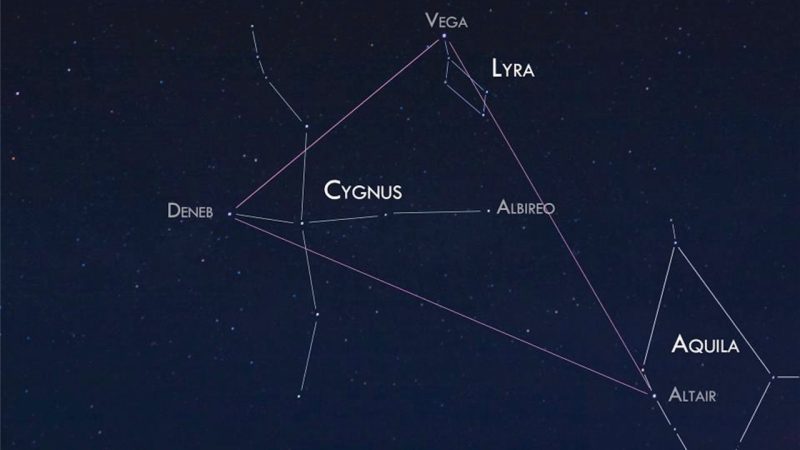
The Summer Triangle isn’t a constellation. It’s an asterism, or noticeable pattern of stars. This pattern consists of three bright stars in three separate constellations – Deneb in the constellation Cygnus the Swan, Vega in the constellation Lyra the Harp, and Altair in the constellation Aquila the Eagle.

Learn to recognize the Summer Triangle asterism now, and you can watch it all summer as it shifts higher in the east, then finally appears high overhead in the late northern summer and early northern autumn sky.

Help EarthSky keep going! Please donate what you can to our annual crowd-funding campaign.

Image via Susan Jensen in Odessa, Washington.

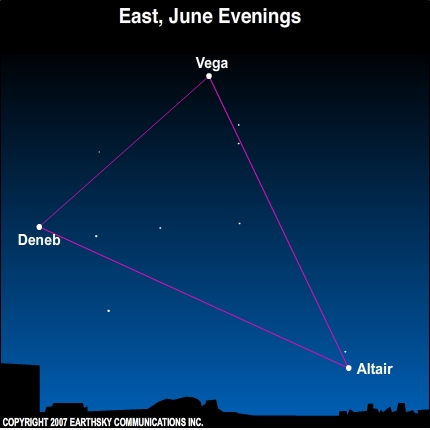
How to find the Summer Triangle. As night falls in June or July, look east for a sparkling blue-white star. That will be Vega, in Lyra. Reigning at the apex of the celebrated Summer Triangle, Vega is also the brightest of the Summer Triangle’s three stars, which all are bright enough to be seen from many light-polluted cities.

Look to the lower right of Vega to locate the Summer Triangle’s second brightest star. That’s Altair, the brightest star in the constellation Aquila the Eagle. A ruler held at an arm’s length fills the gap between these two stars.

Look to the lower left of Vega for another bright star – Deneb, the brightest in the constellation Cygnus the Swan and the third brightest in the Summer Triangle. An outstretched hand at an arm’s length approximates the distance from Vega to Deneb.

It’s difficult to convey the huge size of the Summer Triangle asterism. But you’ll see it. These three bright stars – Vega, Deneb and Altair – will become summertime favorites.

Look for these three bright stars in a triangle pattern, ascending in the east on June evenings.

The Summer Triangle, ascending in the east on June evenings.

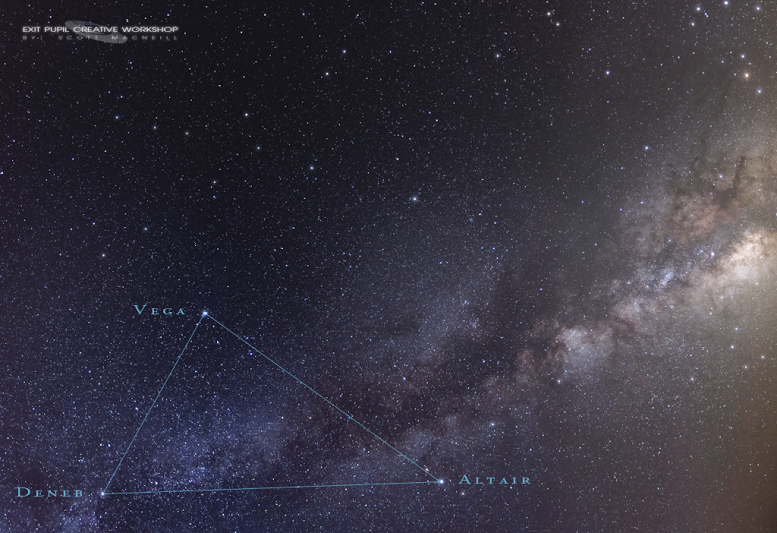
Summer Triangle as a road map to the Milky Way. If you’re lucky enough to be under a dark starry sky on a moonless night, you’ll see the great swath of stars passing in between the Summer Triangle stars Vega and Altair. The star Deneb bobs in the middle of this river of stars, which arcs across dark summer skies. This sky river is, of course, the edgewise view into our own Milky Way galaxy. Although every star that you see with the unaided eye is a member of the Milky Way, at this time of year we can see clearly into the galaxy’s flat disk, where most of the stars congregate. By August and September, we have a good view toward the galaxy’s center.

Once you master the Summer Triangle, you can always locate the Milky Way on a clear, dark night. How about making the most of a dark summer night to explore this band of stars – this starlit boulevard with its celestial delights? Use binoculars to reel in the gossamer beauty of it all, the haunting nebulae and bejeweled star clusters along the starlit trail.

Scott MacNeill of Exit Pupil Creative Workshop captured this photo of the Summer Triangle, constellation Hercules, bright Milky Way, and the bright red star Antares among more.

Summer Triangle as nature’s seasonal calendar. The Summer Triangle serves as a stellar calendar, marking the seasons. When the stars of the Summer Triangle light up the eastern twilight dusk in middle to late June, it’s a sure sign of the change of seasons, of spring giving way to summer. However, when the Summer Triangle is seen high in the south to overhead at dusk and early evening, the Summer Triangle’s change of position indicates that summer has ebbed into fall.

View larger. | Great Rift of Milky Way passes through the constellation Cassiopeia and the Summer Triangle.

A word about asterisms. As we mentioned above, asterisms aren’t constellations; they’re just patterns on the sky’s dome. Constellations generally come to us from ancient times. In the 1930s, the International Astronomical Union officially drew the boundaries of the 88 constellations we recognize today.

Meanwhile, you can make up and name your own asterisms, in much the same way you can recognize shapes in puffy clouds on a summer day.

Some asterisms are so obvious that they’re recognized around the world. The Summer Triangle is one of these.

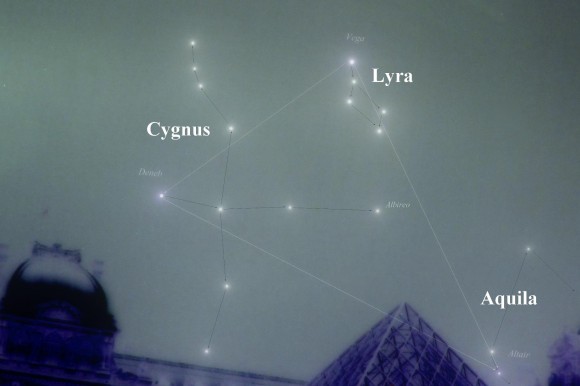
Summer Triangle and the top of the Louvre Pyramid from EarthSky Facebook friend VegaStar Carpentier in Paris.

Bottom line: Watch for the Summer Triangle, a large pattern made of three bright stars. On June and July evenings, you’ll find it in the east at nightfall. It swings high overhead in the wee hours after midnight and sits in the west at daybreak.

Help EarthSky keep going! Please donate what you can to our annual crowd-funding campaign.


from EarthSky http://bit.ly/2KythAZ

June is here. In the Northern Hemisphere, the days are long, the sun is at its most intense for the year, and the weather is warm, but not as warm as it will be later this summer. And the summer sky is with us, too. The famous Summer Triangle is ascending in the eastern sky on these June evenings.

The Summer Triangle isn’t a constellation. It’s an asterism, or noticeable pattern of stars. This pattern consists of three bright stars in three separate constellations – Deneb in the constellation Cygnus the Swan, Vega in the constellation Lyra the Harp, and Altair in the constellation Aquila the Eagle.

Learn to recognize the Summer Triangle asterism now, and you can watch it all summer as it shifts higher in the east, then finally appears high overhead in the late northern summer and early northern autumn sky.

Help EarthSky keep going! Please donate what you can to our annual crowd-funding campaign.

Image via Susan Jensen in Odessa, Washington.

How to find the Summer Triangle. As night falls in June or July, look east for a sparkling blue-white star. That will be Vega, in Lyra. Reigning at the apex of the celebrated Summer Triangle, Vega is also the brightest of the Summer Triangle’s three stars, which all are bright enough to be seen from many light-polluted cities.

Look to the lower right of Vega to locate the Summer Triangle’s second brightest star. That’s Altair, the brightest star in the constellation Aquila the Eagle. A ruler held at an arm’s length fills the gap between these two stars.

Look to the lower left of Vega for another bright star – Deneb, the brightest in the constellation Cygnus the Swan and the third brightest in the Summer Triangle. An outstretched hand at an arm’s length approximates the distance from Vega to Deneb.

It’s difficult to convey the huge size of the Summer Triangle asterism. But you’ll see it. These three bright stars – Vega, Deneb and Altair – will become summertime favorites.

Look for these three bright stars in a triangle pattern, ascending in the east on June evenings.

The Summer Triangle, ascending in the east on June evenings.

Summer Triangle as a road map to the Milky Way. If you’re lucky enough to be under a dark starry sky on a moonless night, you’ll see the great swath of stars passing in between the Summer Triangle stars Vega and Altair. The star Deneb bobs in the middle of this river of stars, which arcs across dark summer skies. This sky river is, of course, the edgewise view into our own Milky Way galaxy. Although every star that you see with the unaided eye is a member of the Milky Way, at this time of year we can see clearly into the galaxy’s flat disk, where most of the stars congregate. By August and September, we have a good view toward the galaxy’s center.

Once you master the Summer Triangle, you can always locate the Milky Way on a clear, dark night. How about making the most of a dark summer night to explore this band of stars – this starlit boulevard with its celestial delights? Use binoculars to reel in the gossamer beauty of it all, the haunting nebulae and bejeweled star clusters along the starlit trail.

Scott MacNeill of Exit Pupil Creative Workshop captured this photo of the Summer Triangle, constellation Hercules, bright Milky Way, and the bright red star Antares among more.

Summer Triangle as nature’s seasonal calendar. The Summer Triangle serves as a stellar calendar, marking the seasons. When the stars of the Summer Triangle light up the eastern twilight dusk in middle to late June, it’s a sure sign of the change of seasons, of spring giving way to summer. However, when the Summer Triangle is seen high in the south to overhead at dusk and early evening, the Summer Triangle’s change of position indicates that summer has ebbed into fall.

View larger. | Great Rift of Milky Way passes through the constellation Cassiopeia and the Summer Triangle.

A word about asterisms. As we mentioned above, asterisms aren’t constellations; they’re just patterns on the sky’s dome. Constellations generally come to us from ancient times. In the 1930s, the International Astronomical Union officially drew the boundaries of the 88 constellations we recognize today.

Meanwhile, you can make up and name your own asterisms, in much the same way you can recognize shapes in puffy clouds on a summer day.

Some asterisms are so obvious that they’re recognized around the world. The Summer Triangle is one of these.

Summer Triangle and the top of the Louvre Pyramid from EarthSky Facebook friend VegaStar Carpentier in Paris.

Bottom line: Watch for the Summer Triangle, a large pattern made of three bright stars. On June and July evenings, you’ll find it in the east at nightfall. It swings high overhead in the wee hours after midnight and sits in the west at daybreak.

Help EarthSky keep going! Please donate what you can to our annual crowd-funding campaign.


from EarthSky http://bit.ly/2KythAZ

Meteor Crater, Arizona

A deep crater, the Milky Way stretched above it, the light of Winslow shining along the crater rim, and streaks of green air glow.

View at EarthSky Community Photos. | Meteor Crater at night, with the Milky Way and airglow. This is a composite of 2 panoramas – one for the sky and one for the foreground – blended together. The glow in the center is light from the town of Winslow, Arizona. Photo by Joe Neely. Thanks, Joe!


from EarthSky http://bit.ly/2MJgn5V
A deep crater, the Milky Way stretched above it, the light of Winslow shining along the crater rim, and streaks of green air glow.

View at EarthSky Community Photos. | Meteor Crater at night, with the Milky Way and airglow. This is a composite of 2 panoramas – one for the sky and one for the foreground – blended together. The glow in the center is light from the town of Winslow, Arizona. Photo by Joe Neely. Thanks, Joe!


from EarthSky http://bit.ly/2MJgn5V

adds 2