

When is Easter in 2026?
Here’s the rule for Easter Sunday. It generally falls on the first Sunday after the first full moon on or after the vernal equinox.
And so Easter is a movable feast. Its date is different from year to year. The 2026 equinox was March 20. It marked an unofficial beginning of spring for the Northern Hemisphere and autumn for the Southern Hemisphere. The first full moon after the March equinox arrives overnight on April 1-2, 2026. Voilà! In 2026, Easter is April 5.
And then Eastern Orthodox Easter falls on April 12, 2026. Generally, that date is a little different because it follows the Julian calendar.
How is Easter determined?
The Council of Nicaea – first ecumenical council of the Christian church – established the date of Easter when it met in Turkey in the year 325 CE. By ecclesiastical rules set centuries ago, there are 35 dates on which Easter can take place.
The earliest possible date for Easter is March 22 and the latest possible date is April 25.
Easter can never come as early as March 21, though. That’s because, by ecclesiastical rules, the vernal equinox is fixed on March 21. That’s in spite of the fact that in the 21st century (2001 to 2100) every March equinox after the year 2007 will fall on March 19 or March 20.
The last time Easter fell on March 22 (earliest possible date) was in 1818, and the next time will be in 2285. The most recent time an Easter came in March was March 27, 2016.

More details and dates
The earliest Easter in the 21st century came in the year 2008 (March 23, 2008). Another March 23 Easter won’t come again until the year 2160.
The century’s latest Easter will occur in the year 2038 (April 25, 2038). After that, it will next fall on April 25 in the year 2190.
See dates of Easter from 1700 to 2299 at Thomas Larsen’s list.
One last detail. Most of us celebrate Easter Sunday via a combination of ecclesiastical rules set long ago and real events in our night sky. But these don’t always coincide. For example, an ecclesiastical full moon doesn’t usually happen on the same date as the full moon you see at night. Ecclesiastical full moons are formally fixed as the 14th day of the ecclesiastical lunar month.
So it’s possible for an ecclesiastical Easter and an astronomical Easter to occur on different dates, as well.
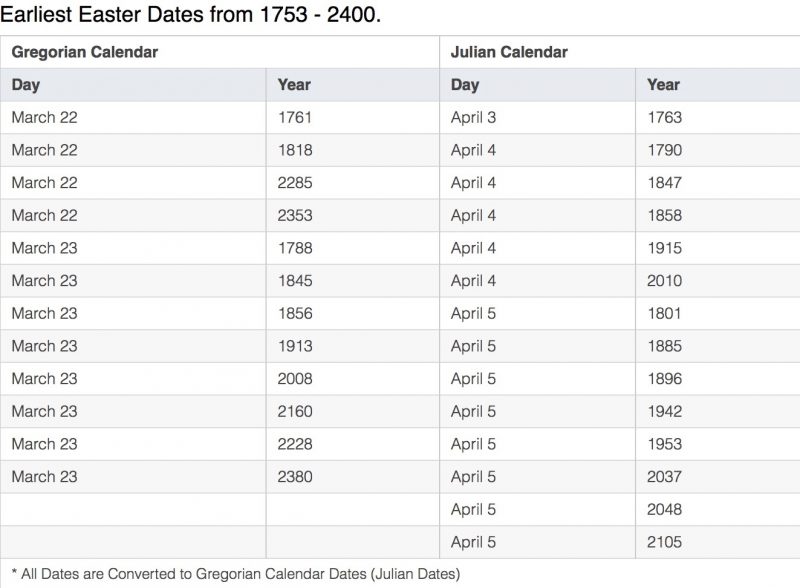
Bottom line: How the date of Easter is determined, and some dates of earliest and latest Easters. Happy Easter to all who celebrate!
The post Easter is April 5 and Orthodox Easter is April 12 first appeared on EarthSky.
from EarthSky https://ift.tt/x4hZRCo
When is Easter in 2026?
Here’s the rule for Easter Sunday. It generally falls on the first Sunday after the first full moon on or after the vernal equinox.
And so Easter is a movable feast. Its date is different from year to year. The 2026 equinox was March 20. It marked an unofficial beginning of spring for the Northern Hemisphere and autumn for the Southern Hemisphere. The first full moon after the March equinox arrives overnight on April 1-2, 2026. Voilà! In 2026, Easter is April 5.
And then Eastern Orthodox Easter falls on April 12, 2026. Generally, that date is a little different because it follows the Julian calendar.
How is Easter determined?
The Council of Nicaea – first ecumenical council of the Christian church – established the date of Easter when it met in Turkey in the year 325 CE. By ecclesiastical rules set centuries ago, there are 35 dates on which Easter can take place.
The earliest possible date for Easter is March 22 and the latest possible date is April 25.
Easter can never come as early as March 21, though. That’s because, by ecclesiastical rules, the vernal equinox is fixed on March 21. That’s in spite of the fact that in the 21st century (2001 to 2100) every March equinox after the year 2007 will fall on March 19 or March 20.
The last time Easter fell on March 22 (earliest possible date) was in 1818, and the next time will be in 2285. The most recent time an Easter came in March was March 27, 2016.
More details and dates
The earliest Easter in the 21st century came in the year 2008 (March 23, 2008). Another March 23 Easter won’t come again until the year 2160.
The century’s latest Easter will occur in the year 2038 (April 25, 2038). After that, it will next fall on April 25 in the year 2190.
See dates of Easter from 1700 to 2299 at Thomas Larsen’s list.
One last detail. Most of us celebrate Easter Sunday via a combination of ecclesiastical rules set long ago and real events in our night sky. But these don’t always coincide. For example, an ecclesiastical full moon doesn’t usually happen on the same date as the full moon you see at night. Ecclesiastical full moons are formally fixed as the 14th day of the ecclesiastical lunar month.
So it’s possible for an ecclesiastical Easter and an astronomical Easter to occur on different dates, as well.
Bottom line: How the date of Easter is determined, and some dates of earliest and latest Easters. Happy Easter to all who celebrate!
The post Easter is April 5 and Orthodox Easter is April 12 first appeared on EarthSky.
from EarthSky https://ift.tt/x4hZRCo

Aucun commentaire:
Enregistrer un commentaire