

New dinosaur highway dig reveals record-breaking footprints
In 2024, paleontologists excavated a quarry in Oxfordshire, U.K., to reveal a stunning ‘dinosaur highway’ made up of hundreds of dinosaur footprints. And having performed further excavations in the summer of 2025, researchers from the Universities of Oxford, Birmingham and Liverpool John Moores announced on October 14, 2025, that they’ve unearthed four more amazingly preserved dinosaur trackways.
The trackways comprise around 200 individual footprints, all created by long-necked, herbivorous sauropod dinosaurs some 166 million years ago. These newly discovered paths include Europe’s longest sauropod trackway, stretching approximately 220 meters (more than a quarter of a mile) from first to last exposed footprint.
Duncan Murdock, one of the dig’s leaders, said following the recent excavation:
What is most exciting about this site is the sheer size and number of footprints. We now have evidence of tens of individuals moving through this area at around the same time, perhaps as a herd.

Hundreds of dinosaur footprints
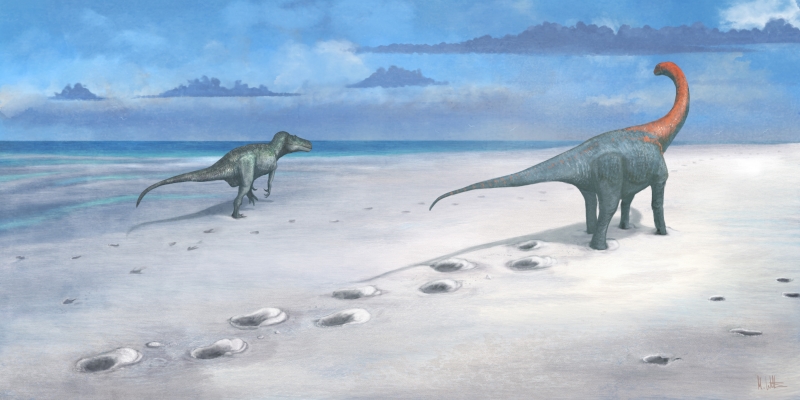
The new findings add to the five enormous trackways unearthed in 2024, each stretching between 50 and 150 meters (164 and 492 feet). Like the newly discovered trackways, scientists attributed four of these to sauropods. Specifically, they suggested the most likely culprit was the cetiosaurus: an 18-meter (60-foot) long cousin of the much-loved diplodocus.
But the fifth track was different. A megalosaurus – a fearsome 9-meter (30-foot) long carnivore that walked on two legs – appears to have created it. Megalosaurus was the first dinosaur ever named, in 1824. And paleontologists first discovered it in Oxfordshire, not far from these tracks.
And now, scientists have found four more trackways alongside the original five, including the longest sauropod trackway ever found in Europe. Another of these new trackways appears to be a continuation of footprints discovered in 2022. Each of these prints is around a meter (yard) across, or twice the diameter of an elephant’s.
The network of footprints connects to a nearby site excavated in 1997, where more than 40 dinosaur trackways were discovered. And this consecutive year of fresh findings, almost three decades later, suggests the area still has much more to offer.
Kirsty Edgar, another of the excavation’s leaders, said:
This site in Oxfordshire is the largest dinosaur track site in the U.K., and arguably now the largest mapped dinosaur track site in the world when we consider finds dating back to the 1990s on the same surface nearby.
Did these dinosaurs interact?
One of the most interesting findings from the 2024 dig was that the megalosaurus might have crossed paths with one of the cetiosaurs … quite literally. An overlap between two of the tracks led the researchers to question whether and how these individuals might have interacted. Murdock told EarthSky:
Unlike fossil bones, finds like these tell us about the behavior of extinct animals. The size, shape and position of the footprints can tell us how these dinosaurs moved, their size and speed. And where trackways cross, we get a glimpse of the potential interactions between different species like the carnivorous Megalosaurus and the giant herbivorous sauropods.
Megalosaurs and cetiosaurs roamed the Earth around 166 million years ago during the Middle Jurassic Period. At this time, the sea largely covered Oxfordshire, with patches of mudflats and shallow lagoons. And the footprints reflect this environment. Murdock explained:
The preservation is so detailed that we can see how the mud was deformed as the dinosaurs’ feet squelched in and out. Along with other fossils like burrows, shells and plants we can bring to life the muddy lagoon environment the dinosaurs walked through.
Discovering the dinosaur highway
Buried by mud, the footprints remained hidden for millions of years until a quarry worker happened upon them in 2022. Gary Johnson was stripping back clay in Dewars Farm Quarry when his vehicle hit a bump. And then another … and then another. He told BBC news that the same 3-meter (10-foot) gap separated each bump. And this was enough to make him realize he could be feeling the gait of a mighty prehistoric creature.
This thought came to Johnson because he knew a dinosaur discovery had already been made nearby almost 30 years ago. More than 40 dinosaur tracks were discovered at the adjacent Ardley Quarry in 1997, leading it to be recognised as a national Site of Special Scientific Interest. These tracks have since been reburied for protection.
Following Johnson’s initial discovery, a team of over 100 scientists, volunteers and students from the Oxford University Museum of Natural History, Oxford University and the University of Birmingham descended on the Dewars Farm site in June 2024. And after a week-long excavation, they had revealed five dinosaur tracks. And the same teams, along with researchers from the Liverpool John Moores University, revealed four more in the summer of 2025.

Recording the discovery
Much like the site excavated in 1997, the new site will eventually be reburied for preservation. So the researchers know they need to make as detailed records as possible. They’ve captured over 20,000 images of the footprints via drones and conventional cameras, allowing them to create 3D models of both the site and the footprints themselves. These efforts, they said, will allow scientists to continue studying the dinosaur highway long after it’s reburied.
Richard Butler, one of the project’s co-leaders, said:
There is much more that we can learn from this site, which is an important part of our national Earth heritage. Our 3D models will allow researchers to continue to study and make accessible this fascinating piece of our past for generations to come.
Bottom line: A new round of excavations at the U.K.’s “dinosaur highway” has revealed hundreds more dinosaur footprints and a record-breaking sauropod trackway.
Read more: Dinosaur poop fossils give glimpse of ancient Earth
Read more: New dinosaur – a long-necked titanosaur – uncovered in Spain
The post New dinosaur highway dig reveals record-breaking footprints first appeared on EarthSky.
from EarthSky https://ift.tt/MWBuJVT
New dinosaur highway dig reveals record-breaking footprints
In 2024, paleontologists excavated a quarry in Oxfordshire, U.K., to reveal a stunning ‘dinosaur highway’ made up of hundreds of dinosaur footprints. And having performed further excavations in the summer of 2025, researchers from the Universities of Oxford, Birmingham and Liverpool John Moores announced on October 14, 2025, that they’ve unearthed four more amazingly preserved dinosaur trackways.
The trackways comprise around 200 individual footprints, all created by long-necked, herbivorous sauropod dinosaurs some 166 million years ago. These newly discovered paths include Europe’s longest sauropod trackway, stretching approximately 220 meters (more than a quarter of a mile) from first to last exposed footprint.
Duncan Murdock, one of the dig’s leaders, said following the recent excavation:
What is most exciting about this site is the sheer size and number of footprints. We now have evidence of tens of individuals moving through this area at around the same time, perhaps as a herd.
Hundreds of dinosaur footprints
The new findings add to the five enormous trackways unearthed in 2024, each stretching between 50 and 150 meters (164 and 492 feet). Like the newly discovered trackways, scientists attributed four of these to sauropods. Specifically, they suggested the most likely culprit was the cetiosaurus: an 18-meter (60-foot) long cousin of the much-loved diplodocus.
But the fifth track was different. A megalosaurus – a fearsome 9-meter (30-foot) long carnivore that walked on two legs – appears to have created it. Megalosaurus was the first dinosaur ever named, in 1824. And paleontologists first discovered it in Oxfordshire, not far from these tracks.
And now, scientists have found four more trackways alongside the original five, including the longest sauropod trackway ever found in Europe. Another of these new trackways appears to be a continuation of footprints discovered in 2022. Each of these prints is around a meter (yard) across, or twice the diameter of an elephant’s.
The network of footprints connects to a nearby site excavated in 1997, where more than 40 dinosaur trackways were discovered. And this consecutive year of fresh findings, almost three decades later, suggests the area still has much more to offer.
Kirsty Edgar, another of the excavation’s leaders, said:
This site in Oxfordshire is the largest dinosaur track site in the U.K., and arguably now the largest mapped dinosaur track site in the world when we consider finds dating back to the 1990s on the same surface nearby.
Did these dinosaurs interact?
One of the most interesting findings from the 2024 dig was that the megalosaurus might have crossed paths with one of the cetiosaurs … quite literally. An overlap between two of the tracks led the researchers to question whether and how these individuals might have interacted. Murdock told EarthSky:
Unlike fossil bones, finds like these tell us about the behavior of extinct animals. The size, shape and position of the footprints can tell us how these dinosaurs moved, their size and speed. And where trackways cross, we get a glimpse of the potential interactions between different species like the carnivorous Megalosaurus and the giant herbivorous sauropods.
Megalosaurs and cetiosaurs roamed the Earth around 166 million years ago during the Middle Jurassic Period. At this time, the sea largely covered Oxfordshire, with patches of mudflats and shallow lagoons. And the footprints reflect this environment. Murdock explained:
The preservation is so detailed that we can see how the mud was deformed as the dinosaurs’ feet squelched in and out. Along with other fossils like burrows, shells and plants we can bring to life the muddy lagoon environment the dinosaurs walked through.
Discovering the dinosaur highway
Buried by mud, the footprints remained hidden for millions of years until a quarry worker happened upon them in 2022. Gary Johnson was stripping back clay in Dewars Farm Quarry when his vehicle hit a bump. And then another … and then another. He told BBC news that the same 3-meter (10-foot) gap separated each bump. And this was enough to make him realize he could be feeling the gait of a mighty prehistoric creature.
This thought came to Johnson because he knew a dinosaur discovery had already been made nearby almost 30 years ago. More than 40 dinosaur tracks were discovered at the adjacent Ardley Quarry in 1997, leading it to be recognised as a national Site of Special Scientific Interest. These tracks have since been reburied for protection.
Following Johnson’s initial discovery, a team of over 100 scientists, volunteers and students from the Oxford University Museum of Natural History, Oxford University and the University of Birmingham descended on the Dewars Farm site in June 2024. And after a week-long excavation, they had revealed five dinosaur tracks. And the same teams, along with researchers from the Liverpool John Moores University, revealed four more in the summer of 2025.
Recording the discovery
Much like the site excavated in 1997, the new site will eventually be reburied for preservation. So the researchers know they need to make as detailed records as possible. They’ve captured over 20,000 images of the footprints via drones and conventional cameras, allowing them to create 3D models of both the site and the footprints themselves. These efforts, they said, will allow scientists to continue studying the dinosaur highway long after it’s reburied.
Richard Butler, one of the project’s co-leaders, said:
There is much more that we can learn from this site, which is an important part of our national Earth heritage. Our 3D models will allow researchers to continue to study and make accessible this fascinating piece of our past for generations to come.
Bottom line: A new round of excavations at the U.K.’s “dinosaur highway” has revealed hundreds more dinosaur footprints and a record-breaking sauropod trackway.
Read more: Dinosaur poop fossils give glimpse of ancient Earth
Read more: New dinosaur – a long-necked titanosaur – uncovered in Spain
The post New dinosaur highway dig reveals record-breaking footprints first appeared on EarthSky.
from EarthSky https://ift.tt/MWBuJVT

Aucun commentaire:
Enregistrer un commentaire