
Humpback whales can produce underwater rings for multiple reasons. One of them is to communicate with us! Image via Simon Hilbourne.
Did you know that humpback whales can produce spectacular bubble rings underwater? In August 2024, scientists discovered humpback whales use this strategy to capture their prey — small crustaceans and fish — and feed. And on June 5, 2025, a group of scientists from the SETI Institute and the University of California at Davis said humpback whales also create bubble rings to get our attention. But what are they trying to tell us?
The researchers published their study in the peer-reviewed journal Marine Mammal Science on May 15, 2025.
Humpback whales produce underwater rings for multiple reasons
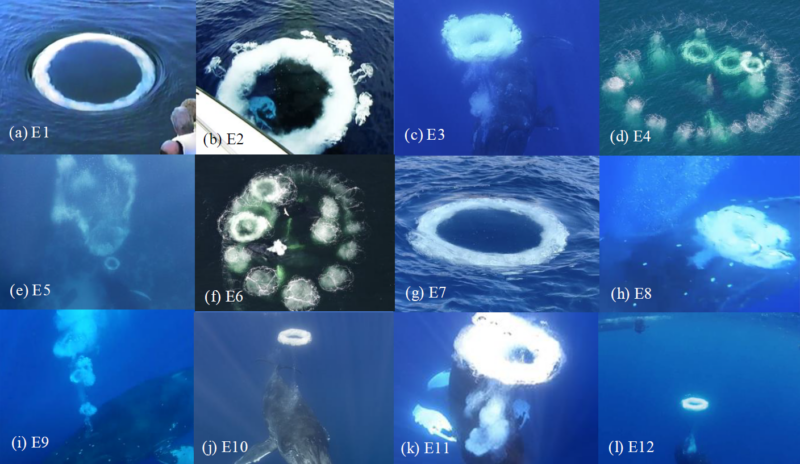
First, humpback whales use these rings to feed. But they don’t create a simple ring. They can create and modify different types of rings according to their needs. For example, they can blow a ring with more rings inside. Furthermore, these intelligent animals can control the number and size of the rings, as well as the space between them.
Thus, scientists confirmed whales use bubble nets as tools that they adapt for hunting according to the circumstances. And males also create bubble trails and bursts when competing to escort a female whale.
And now, scientists have documented for the first time how humpback whales approach humans in a friendly manner to play and socialize. The scientists said they create these rings the same way a person that smokes and creates figures with the smoke: just for fun! Co-lead author Jodi Frediani, marine wildlife photographer and U.C. Davis affiliate, said:
Humpback whales often exhibit inquisitive, friendly behavior towards boats and human swimmers. We’ve now located a dozen whales from populations around the world, the majority of which have voluntarily approached boats and swimmers, blowing bubble rings during these episodes of curious behavior.
Sociability, intelligence and communication skills
It’s no coincidence that the most intelligent and social animals have more complex communication systems. For example, the most sociable of monk parakeets talk more and learn from the other members of the group; the end up possessing a richer language. Likewise, bonobos, which are the most sociable apes, also have complex communication skills. In fact, they seem to communicate in a way scientists once thought was unique to humans.
So, whales, which are intelligent, sociable and can communicate through calls, jumps, fin slaps, eye gestures and the production of bubble rings, turn out to be great candidates for studying non-human intelligence.
Furthermore, the low-frequency sounds they produce, such as calls, can travel up to 12,500 miles (20,000 km), allowing populations separated by long distances to communicate. It’s no wonder the SETI Institute uses the incredible humpback whale as an example in its search for extraterrestrial intelligence.
A known, friendly female humpback whale named Watchtower blows a bubble ring next to a boat full of passengers who scream and drum with excitement off Lahaina, Maui. Video via Molly Gaughan. Used with permission.
A system to communicate with aliens?
It seems that social animals desire to interact with other members of their own species and also with other species. Laurance Doyle of the SETI Institute, a scientist and co-author on the paper, said:
Because of current limitations on technology, an important assumption of the search for extraterrestrial intelligence is that extraterrestrial intelligence and life will be interested in making contact and thus target human receivers. This important assumption is certainly supported by the independent evolution of curious behavior in humpback whales.
The Whale-SETI team was created to study intelligent, non-terrestrial (aquatic), and non-human communication systems. Its goal is to develop filters that help analyze cosmic signals for signs of extraterrestrial life. According to co-lead author and UC Davis affiliate Fred Sharpe:
Humpback whales live in complex societies, are acoustically diverse, use bubble tools, and assist other species being harassed by predators. Now, regarding a candidate signal, we show them blowing bubble rings in our direction in an apparent attempt to playfully interact, observe our response, and/or engage in some form of communication.
A female humpback whale swims toward a small stationary boat and blows a bubble ring beneath it near Mo’orea, French Polynesia. Video via Simon Hilbourne. Used with permission.
Will we ever be able to understand what humpback whales are trying to tell us when they approach us? Will we be able to develop a communication system that would help us establish contact with intelligent life outside our planet? What form might this communication take?
Bottom line: Humpback whales are intelligent and sociable. A new study looked at how they approach humans and produce bubble rings to interact with us.
Source: Humpback Whales Blow Poloidal Vortex Bubble Rings
Humpback whales are giving birth outside breeding grounds
Whales are the biggest living animals: Lifeform of the week
The post Humpback whales communicate with us using bubble rings first appeared on EarthSky.
from EarthSky https://ift.tt/vNAu4Mk
Humpback whales can produce underwater rings for multiple reasons. One of them is to communicate with us! Image via Simon Hilbourne.
Did you know that humpback whales can produce spectacular bubble rings underwater? In August 2024, scientists discovered humpback whales use this strategy to capture their prey — small crustaceans and fish — and feed. And on June 5, 2025, a group of scientists from the SETI Institute and the University of California at Davis said humpback whales also create bubble rings to get our attention. But what are they trying to tell us?
The researchers published their study in the peer-reviewed journal Marine Mammal Science on May 15, 2025.
Humpback whales produce underwater rings for multiple reasons
First, humpback whales use these rings to feed. But they don’t create a simple ring. They can create and modify different types of rings according to their needs. For example, they can blow a ring with more rings inside. Furthermore, these intelligent animals can control the number and size of the rings, as well as the space between them.
Thus, scientists confirmed whales use bubble nets as tools that they adapt for hunting according to the circumstances. And males also create bubble trails and bursts when competing to escort a female whale.
And now, scientists have documented for the first time how humpback whales approach humans in a friendly manner to play and socialize. The scientists said they create these rings the same way a person that smokes and creates figures with the smoke: just for fun! Co-lead author Jodi Frediani, marine wildlife photographer and U.C. Davis affiliate, said:
Humpback whales often exhibit inquisitive, friendly behavior towards boats and human swimmers. We’ve now located a dozen whales from populations around the world, the majority of which have voluntarily approached boats and swimmers, blowing bubble rings during these episodes of curious behavior.
Sociability, intelligence and communication skills
It’s no coincidence that the most intelligent and social animals have more complex communication systems. For example, the most sociable of monk parakeets talk more and learn from the other members of the group; the end up possessing a richer language. Likewise, bonobos, which are the most sociable apes, also have complex communication skills. In fact, they seem to communicate in a way scientists once thought was unique to humans.
So, whales, which are intelligent, sociable and can communicate through calls, jumps, fin slaps, eye gestures and the production of bubble rings, turn out to be great candidates for studying non-human intelligence.
Furthermore, the low-frequency sounds they produce, such as calls, can travel up to 12,500 miles (20,000 km), allowing populations separated by long distances to communicate. It’s no wonder the SETI Institute uses the incredible humpback whale as an example in its search for extraterrestrial intelligence.
A known, friendly female humpback whale named Watchtower blows a bubble ring next to a boat full of passengers who scream and drum with excitement off Lahaina, Maui. Video via Molly Gaughan. Used with permission.
A system to communicate with aliens?
It seems that social animals desire to interact with other members of their own species and also with other species. Laurance Doyle of the SETI Institute, a scientist and co-author on the paper, said:
Because of current limitations on technology, an important assumption of the search for extraterrestrial intelligence is that extraterrestrial intelligence and life will be interested in making contact and thus target human receivers. This important assumption is certainly supported by the independent evolution of curious behavior in humpback whales.
The Whale-SETI team was created to study intelligent, non-terrestrial (aquatic), and non-human communication systems. Its goal is to develop filters that help analyze cosmic signals for signs of extraterrestrial life. According to co-lead author and UC Davis affiliate Fred Sharpe:
Humpback whales live in complex societies, are acoustically diverse, use bubble tools, and assist other species being harassed by predators. Now, regarding a candidate signal, we show them blowing bubble rings in our direction in an apparent attempt to playfully interact, observe our response, and/or engage in some form of communication.
A female humpback whale swims toward a small stationary boat and blows a bubble ring beneath it near Mo’orea, French Polynesia. Video via Simon Hilbourne. Used with permission.
Will we ever be able to understand what humpback whales are trying to tell us when they approach us? Will we be able to develop a communication system that would help us establish contact with intelligent life outside our planet? What form might this communication take?
Bottom line: Humpback whales are intelligent and sociable. A new study looked at how they approach humans and produce bubble rings to interact with us.
Source: Humpback Whales Blow Poloidal Vortex Bubble Rings
Humpback whales are giving birth outside breeding grounds
Whales are the biggest living animals: Lifeform of the week
The post Humpback whales communicate with us using bubble rings first appeared on EarthSky.
from EarthSky https://ift.tt/vNAu4Mk

Aucun commentaire:
Enregistrer un commentaire