
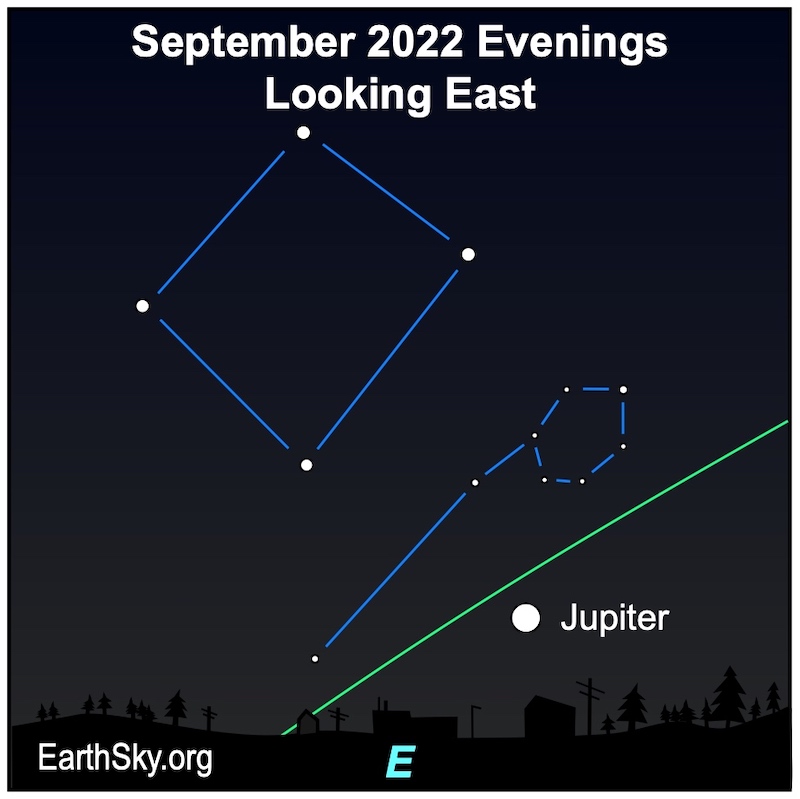
Earth will sweep between the sun and Jupiter on September 26, 2022, placing the giant planet opposite the sun in our sky and closer than in 70 years.
Jupiter in 2022: In early September, Jupiter is rising as true darkness falls. In fact, it’s the very bright object ascending in the east throughout the evening. And by the time of its September 26 opposition, Jupiter is rising in the east at sunset.
Opposition on September 26 at 20 UTC.
Closest to Earth on September 26 at 3.953 astronomical units (AU) or 367 million miles or 591 million km or 33 light minutes from Earth.
Opposition constellation: Pisces the Fishes.
Brightness at opposition: Magnitude -2.9.
Through a telescope at opposition: 50 arcseconds across.
Through binoculars (anytime): Jupiter reveals a bright disk. If you look closely, you’ll see the Galilean satellites appearing as pinpoints of light, arrayed in a line that bisects the giant planet.
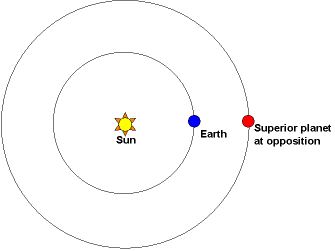
Note: By the way, Jupiter isn’t always exactly closest to Earth on the day of its opposition. But in 2022, Jupiter’s opposition to the sun and closest approach to Earth fall on the same day. That’s because opposition takes place so near in time to Jupiter’s perihelion – on January 21, 2023 – its closest point to the sun in its 12-year orbit. If it’s nearly closest to the sun, and we go between it and the sun … voila, it’s a close opposition for us! The juxtaposition of Jupiter’s opposition in late 2022, and perihelion in early 2023, brings the planet closer to Earth at this opposition than it has been for 70 years. So, Jupiter will be very bright in our sky!
For precise sun and Jupiter rising times at your location:
Old Farmer’s Almanac (U.S. and Canada)
Timeanddate.com (worldwide).
Stellarium (online planetarium program)

How often does Jupiter reach opposition?
As a matter of fact, Jupiter comes to opposition roughly every 13 months. That is how long Earth takes to travel once around the sun relative to Jupiter. So – according to our earthly calendars – Jupiter’s opposition comes about a month later each year. What’s more there are 12 constellations of the zodiac. And there are 12 months in a year. So Jupiter is in a new zodiacal constellation each year (last year, Capricornus; this year, Pisces).
2022 Jupiter opposition – September 26.
2023 Jupiter opposition – November 2.
2024 Jupiter opposition – December 7.
2026 Jupiter opposition – January 10.
Jupiter events in 2022 and early 2023
July 28, 2022: Jupiter begins retrograde motion
September 26, 2022: Jupiter at opposition
November 23, 2022: Jupiter ends retrograde motion
Jan 20, 2023: Jupiter at perihelion
February 22, 2023: Lunar occultation of Jupiter
April 11, 2023: Jupiter at solar conjunction
May 17, 2023: Lunar occultation of Jupiter
A failed star
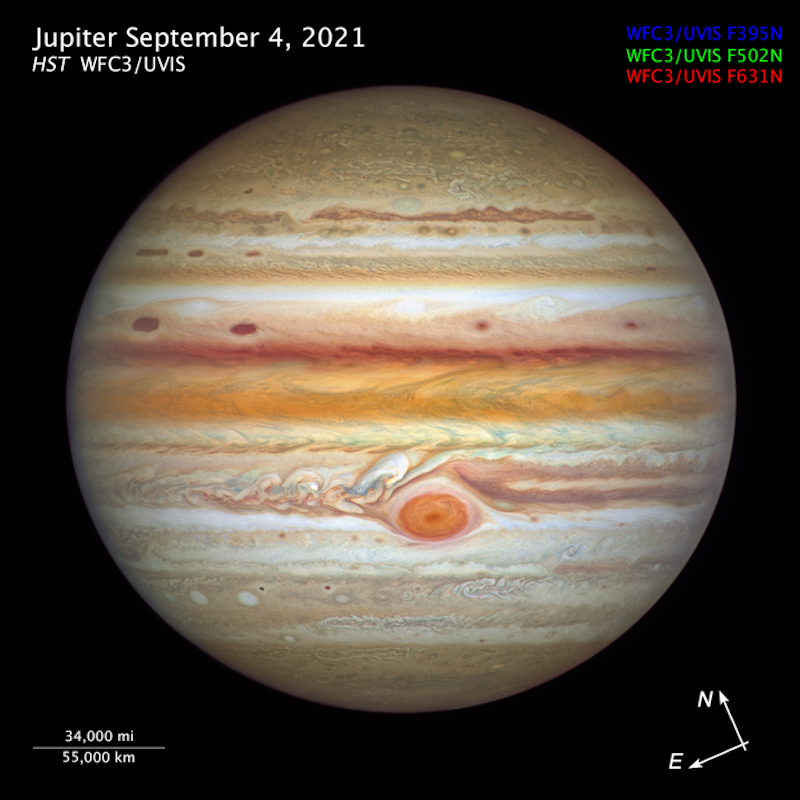
Another key point is that Jupiter isn’t a rocky planet like Earth. It’s more like a failed star, not massive enough or hot enough inside to spark thermonuclear fusion reactions, but some 2 1/2 times more massive than all the other planets in our solar system combined. So for Jupiter to shine as stars do, you’d need some 80 Jupiter’s – rolled into a ball – to be hot enough inside to spark thermonuclear reactions.
Naturally, Jupiter isn’t a star. In fact, it doesn’t shine with its own light, but by reflected sunlight. Yet on a September 2022 night – as bright Jupiter rises more or less opposite the sun – you can imagine standing on Earth and seeing Jupiter in our sky, if the giant planet did have enough mass to shine as stars do. If that were so, around Jupiter’s opposition, we’d have no night at all!
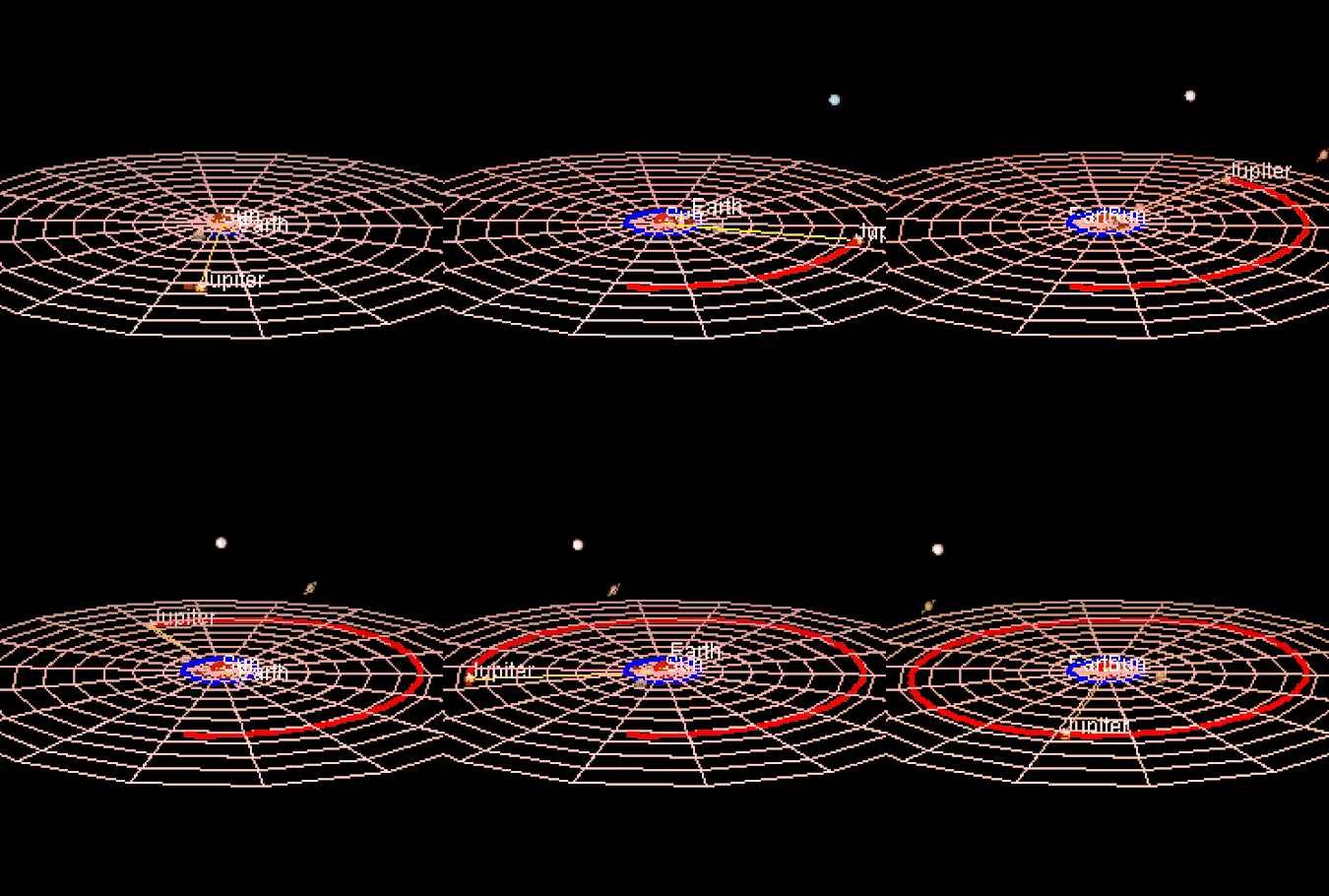
Bottom line: Look for Jupiter shining brightly in the September 2022 evening sky. The gas giant world comes to opposition, the point opposite the sun in our sky, on September 26. Opposition happens when we fly between Jupiter and the sun in our smaller, faster orbit.
Read more: How to see Jupiter’s moons
Read more: Jupiter: Closest to the sun January 20, 2023
The post Jupiter at opposition this month, closest in 70 years first appeared on EarthSky.
from EarthSky https://ift.tt/DtKENf2
Earth will sweep between the sun and Jupiter on September 26, 2022, placing the giant planet opposite the sun in our sky and closer than in 70 years.
Jupiter in 2022: In early September, Jupiter is rising as true darkness falls. In fact, it’s the very bright object ascending in the east throughout the evening. And by the time of its September 26 opposition, Jupiter is rising in the east at sunset.
Opposition on September 26 at 20 UTC.
Closest to Earth on September 26 at 3.953 astronomical units (AU) or 367 million miles or 591 million km or 33 light minutes from Earth.
Opposition constellation: Pisces the Fishes.
Brightness at opposition: Magnitude -2.9.
Through a telescope at opposition: 50 arcseconds across.
Through binoculars (anytime): Jupiter reveals a bright disk. If you look closely, you’ll see the Galilean satellites appearing as pinpoints of light, arrayed in a line that bisects the giant planet.
Note: By the way, Jupiter isn’t always exactly closest to Earth on the day of its opposition. But in 2022, Jupiter’s opposition to the sun and closest approach to Earth fall on the same day. That’s because opposition takes place so near in time to Jupiter’s perihelion – on January 21, 2023 – its closest point to the sun in its 12-year orbit. If it’s nearly closest to the sun, and we go between it and the sun … voila, it’s a close opposition for us! The juxtaposition of Jupiter’s opposition in late 2022, and perihelion in early 2023, brings the planet closer to Earth at this opposition than it has been for 70 years. So, Jupiter will be very bright in our sky!
For precise sun and Jupiter rising times at your location:
Old Farmer’s Almanac (U.S. and Canada)
Timeanddate.com (worldwide).
Stellarium (online planetarium program)
How often does Jupiter reach opposition?
As a matter of fact, Jupiter comes to opposition roughly every 13 months. That is how long Earth takes to travel once around the sun relative to Jupiter. So – according to our earthly calendars – Jupiter’s opposition comes about a month later each year. What’s more there are 12 constellations of the zodiac. And there are 12 months in a year. So Jupiter is in a new zodiacal constellation each year (last year, Capricornus; this year, Pisces).
2022 Jupiter opposition – September 26.
2023 Jupiter opposition – November 2.
2024 Jupiter opposition – December 7.
2026 Jupiter opposition – January 10.
Jupiter events in 2022 and early 2023
July 28, 2022: Jupiter begins retrograde motion
September 26, 2022: Jupiter at opposition
November 23, 2022: Jupiter ends retrograde motion
Jan 20, 2023: Jupiter at perihelion
February 22, 2023: Lunar occultation of Jupiter
April 11, 2023: Jupiter at solar conjunction
May 17, 2023: Lunar occultation of Jupiter
A failed star
Another key point is that Jupiter isn’t a rocky planet like Earth. It’s more like a failed star, not massive enough or hot enough inside to spark thermonuclear fusion reactions, but some 2 1/2 times more massive than all the other planets in our solar system combined. So for Jupiter to shine as stars do, you’d need some 80 Jupiter’s – rolled into a ball – to be hot enough inside to spark thermonuclear reactions.
Naturally, Jupiter isn’t a star. In fact, it doesn’t shine with its own light, but by reflected sunlight. Yet on a September 2022 night – as bright Jupiter rises more or less opposite the sun – you can imagine standing on Earth and seeing Jupiter in our sky, if the giant planet did have enough mass to shine as stars do. If that were so, around Jupiter’s opposition, we’d have no night at all!
Bottom line: Look for Jupiter shining brightly in the September 2022 evening sky. The gas giant world comes to opposition, the point opposite the sun in our sky, on September 26. Opposition happens when we fly between Jupiter and the sun in our smaller, faster orbit.
Read more: How to see Jupiter’s moons
Read more: Jupiter: Closest to the sun January 20, 2023
The post Jupiter at opposition this month, closest in 70 years first appeared on EarthSky.
from EarthSky https://ift.tt/DtKENf2

Aucun commentaire:
Enregistrer un commentaire