
Rainbows are big and curved and opposite a low sun in the sky. Nearly everyone can identify a rainbow. But two rainbow-like phenomena in a daytime sky can be hard to tell apart. One is called a circumhorizon arc. The other is an iridescent cloud. Both contain rainbow colors. And many people mistake one for the other, in photos submitted to EarthSky. Once you learn a couple of key features, you’ll be able to spot the difference.
In the past week, readers have submitted three images of circumhorizon arcs to our Community Photos. That’s one key right there. You can’t see circumhorizon arcs all year or from all locations. But, for us in the United States, summer is a great time to look for circumhorizon arcs.
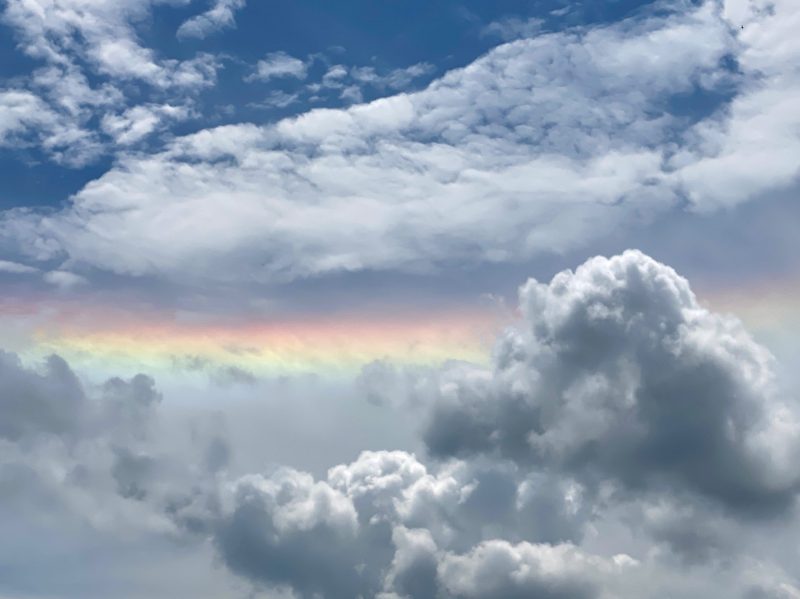
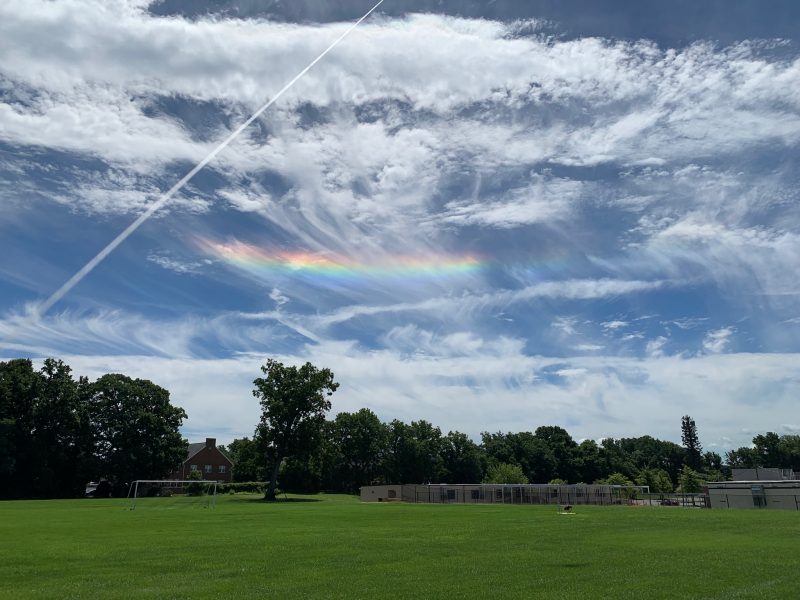
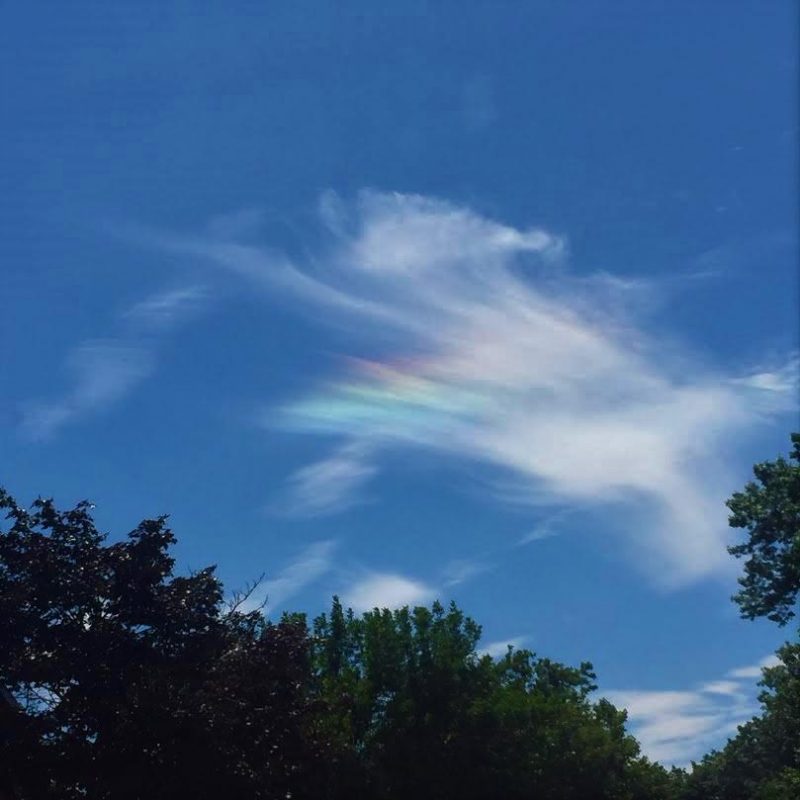
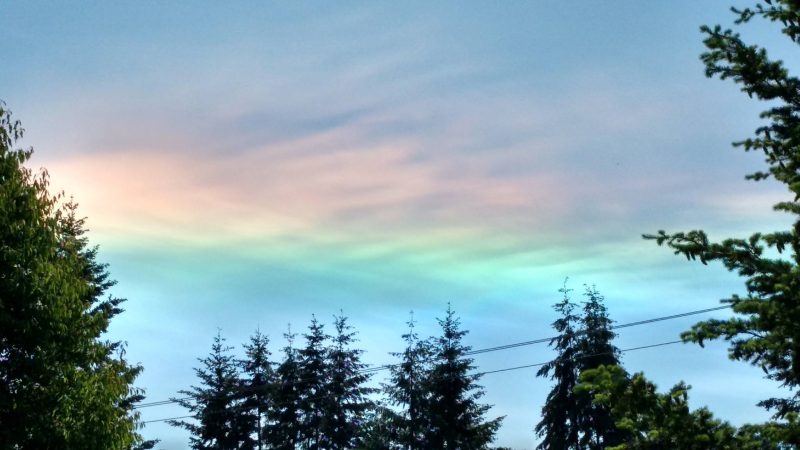
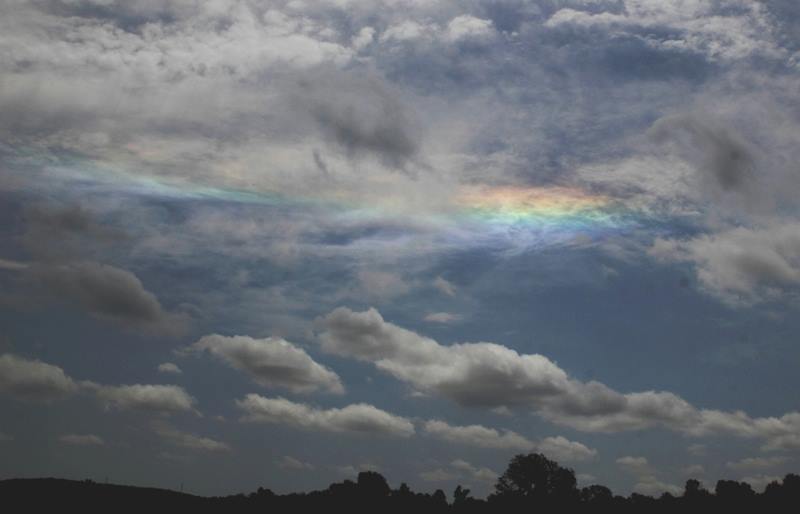
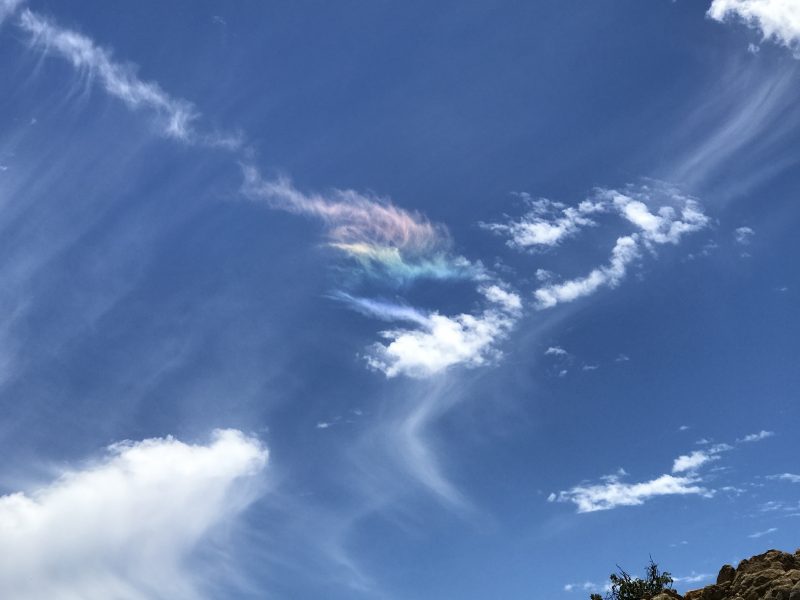
In fact, the first three images on this page are the ones we received this past week, and all are examples of circumhorizon arcs. Look carefully at the pictures and notice the order of the colors, from top to bottom. Like a rainbow, circumhorizon arcs are red at the top and indigo or violet at the bottom. This is the key feature of a circumhorizon arc.
Also, the sun has to be high above the arc and, therefore, high in the sky.
When can you see a circumhorizon arc?
The Cloud Appreciation Society explains when you’re likely to see a circumhorizon arc:
The rarity of the circumhorizon arc depends on where you’re based. The lower the latitude, the greater your chance of spotting a circumhorizon arc when cirrus or cirrostratus clouds are in the sky. Les Cowley … reports in his Atmospheric Optics site that most locations in the U.S. can see circumhorizon arcs about five times a year, but from locations in northern Europe you might see them only once or twice. Likewise, they’re more commonly seen in Australia than in New Zealand. You’ll never see a circumhorizon arc, however, from latitudes above 56 degrees – in the Northern Hemisphere, that’s anywhere north of Copenhagen, Denmark – since the sun never climbs high enough in the sky.
Nor is it possible, unless you’re near the equator, to see a circumhorizon arc throughout the year. For most of us, the dependence of this vibrant optical effect on a such high sun means that its horizontal streak of pure, spectral color will only ever grace our skies during the summertime.

Circumhorizon arc versus iridescent cloud
How can you tell the difference between an iridescent cloud and a circumhorizon arc in the sky, or in a picture?
George Preoteasa, a frequent contributor to our Community Photos, used to mistake one for the other until he made a study of how to tell them apart. He’s also helped identify the difference between the phenomena in EarthSky’s photos. George explained:
The circumhorizon arc is a band parallel to the horizon. So, to the extent that the horizon is an arc, this is one, too. The colors in a circumhorizon arc are well organized, red at the top, indigo at the bottom. With cloud iridescence, the colors are more randomly distributed.
Circumhorizon arcs have a certain fuzziness. Ice crystals in cirrus clouds create them, similar to solar and lunar halos. On the other hand, water droplets create iridescence.
For a circumhorizon arc to occur, the sun must be high up, over 58 degrees above the horizon. Iridescence usually occurs close to the sun, which makes it difficult to photograph. You need to hide the sun so that sunlight does not overwhelm the colors in the cloud.
A tip from the atmospheric optics guru
The world’s sky optics guru, Les Cowley of Atmospheric Optics – who is a long-time friend of EarthSky and often helps us identify sky phenomena – said that:
… one key difference between a circumhorizon arc and iridescence is color structure. A circumhorizon arc has a spectral sequence of color with red at top and blue/violet lowest.
A circumhorizon arc is always about two outstretched hand-widths below the sun. Iridescent clouds are usually rather closer.
Thank you, Les.
Read more about circumhorizon arcs on Les Cowley’s website, Atmospheric Optics


Circumhorizon arcs versus iridescent clouds
Now it’s your turn. Which images below are iridescent clouds and which are circumhorizon arcs? The answers are in the captions.
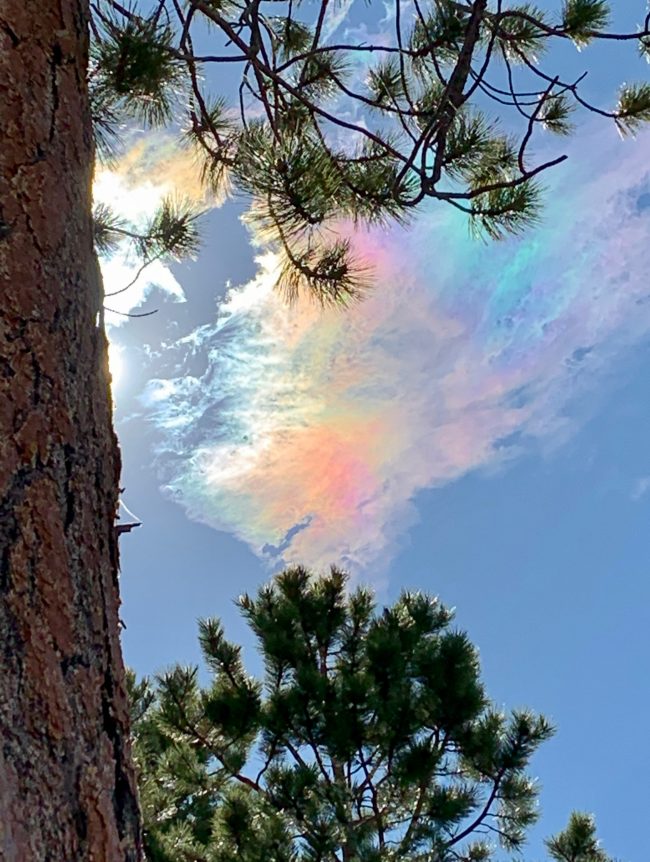


Bottom line: It can be easy to confuse circumhorizon arcs and iridescent clouds. Circumhorizon arcs follow the order of a rainbow, form a straight light above the horizon, are far from the sun, and only appear at certain times of year, such as in the summer.
The post Circumhorizon arc or iridescent cloud? first appeared on EarthSky.
from EarthSky https://ift.tt/Ndof3DX
Rainbows are big and curved and opposite a low sun in the sky. Nearly everyone can identify a rainbow. But two rainbow-like phenomena in a daytime sky can be hard to tell apart. One is called a circumhorizon arc. The other is an iridescent cloud. Both contain rainbow colors. And many people mistake one for the other, in photos submitted to EarthSky. Once you learn a couple of key features, you’ll be able to spot the difference.
In the past week, readers have submitted three images of circumhorizon arcs to our Community Photos. That’s one key right there. You can’t see circumhorizon arcs all year or from all locations. But, for us in the United States, summer is a great time to look for circumhorizon arcs.
In fact, the first three images on this page are the ones we received this past week, and all are examples of circumhorizon arcs. Look carefully at the pictures and notice the order of the colors, from top to bottom. Like a rainbow, circumhorizon arcs are red at the top and indigo or violet at the bottom. This is the key feature of a circumhorizon arc.
Also, the sun has to be high above the arc and, therefore, high in the sky.
When can you see a circumhorizon arc?
The Cloud Appreciation Society explains when you’re likely to see a circumhorizon arc:
The rarity of the circumhorizon arc depends on where you’re based. The lower the latitude, the greater your chance of spotting a circumhorizon arc when cirrus or cirrostratus clouds are in the sky. Les Cowley … reports in his Atmospheric Optics site that most locations in the U.S. can see circumhorizon arcs about five times a year, but from locations in northern Europe you might see them only once or twice. Likewise, they’re more commonly seen in Australia than in New Zealand. You’ll never see a circumhorizon arc, however, from latitudes above 56 degrees – in the Northern Hemisphere, that’s anywhere north of Copenhagen, Denmark – since the sun never climbs high enough in the sky.
Nor is it possible, unless you’re near the equator, to see a circumhorizon arc throughout the year. For most of us, the dependence of this vibrant optical effect on a such high sun means that its horizontal streak of pure, spectral color will only ever grace our skies during the summertime.
Circumhorizon arc versus iridescent cloud
How can you tell the difference between an iridescent cloud and a circumhorizon arc in the sky, or in a picture?
George Preoteasa, a frequent contributor to our Community Photos, used to mistake one for the other until he made a study of how to tell them apart. He’s also helped identify the difference between the phenomena in EarthSky’s photos. George explained:
The circumhorizon arc is a band parallel to the horizon. So, to the extent that the horizon is an arc, this is one, too. The colors in a circumhorizon arc are well organized, red at the top, indigo at the bottom. With cloud iridescence, the colors are more randomly distributed.
Circumhorizon arcs have a certain fuzziness. Ice crystals in cirrus clouds create them, similar to solar and lunar halos. On the other hand, water droplets create iridescence.
For a circumhorizon arc to occur, the sun must be high up, over 58 degrees above the horizon. Iridescence usually occurs close to the sun, which makes it difficult to photograph. You need to hide the sun so that sunlight does not overwhelm the colors in the cloud.
A tip from the atmospheric optics guru
The world’s sky optics guru, Les Cowley of Atmospheric Optics – who is a long-time friend of EarthSky and often helps us identify sky phenomena – said that:
… one key difference between a circumhorizon arc and iridescence is color structure. A circumhorizon arc has a spectral sequence of color with red at top and blue/violet lowest.
A circumhorizon arc is always about two outstretched hand-widths below the sun. Iridescent clouds are usually rather closer.
Thank you, Les.
Read more about circumhorizon arcs on Les Cowley’s website, Atmospheric Optics
Circumhorizon arcs versus iridescent clouds
Now it’s your turn. Which images below are iridescent clouds and which are circumhorizon arcs? The answers are in the captions.
Bottom line: It can be easy to confuse circumhorizon arcs and iridescent clouds. Circumhorizon arcs follow the order of a rainbow, form a straight light above the horizon, are far from the sun, and only appear at certain times of year, such as in the summer.
The post Circumhorizon arc or iridescent cloud? first appeared on EarthSky.
from EarthSky https://ift.tt/Ndof3DX

Aucun commentaire:
Enregistrer un commentaire