
Artemis 1: Rolled out and ready to launch
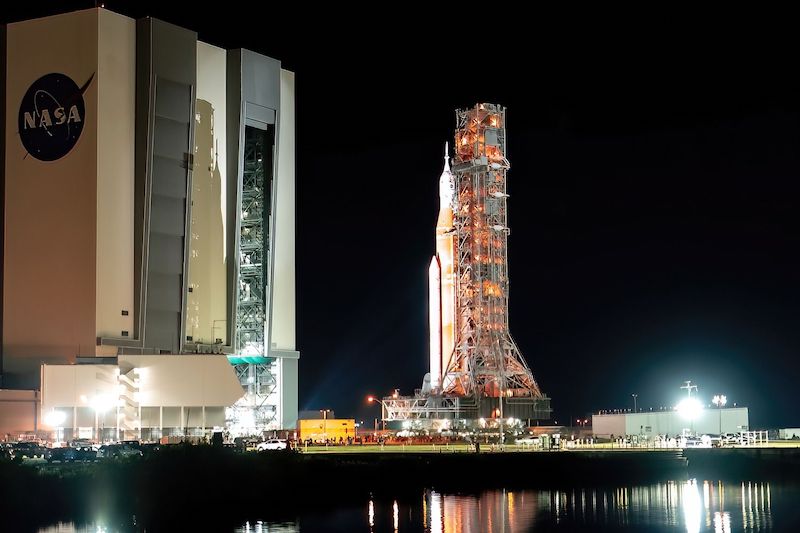
NASA seems as eager as the rest of us to get its mighty Space Launch System off the ground. It announced on August 15 that the Artemis 1 moonship – with its Orion spacecraft – was ready to be rolled out to Launch Pad 39B at Kennedy Space Center in Florida on August 16. (Previously, the schedule had indicated the rollout wouldn’t happen until the 19th.)
Then on Wednesday, August 17, the rocket successfully made the slow trek. The process took 10 hours and 8 minutes while the assembly traveled at a maximum speed of 0.8 mph (1.3 kph). Watch in the video above.
But the early rollout does not mean an early launch for Artemis 1, and NASA is still targeting a date no earlier than August 29 for liftoff.
Artemis 1’s objective is mainly to test the inaugural flight of NASA’s SLS, a rocket taller and more powerful than the mighty Saturn V rockets used during the Apollo program. The Orion spacecraft, a Multi-Purpose Crew Vehicle, will ride on top. (Orion already underwent an Earth-orbiting test in 2014.) When it flies, Artemis 1 will place the uncrewed Orion spacecraft in orbit around the moon. Afterward, the capsule will return to Earth for a splashdown in the Pacific Ocean.
We’re going back to the moon!
Many earthly spacecraft have visited the moon, but it’s been 50 years since humans have walked its surface. Now, NASA is planning to send us back. The mission is called Artemis, and the space agency has created its most powerful rocket, the Space Launch System, or SLS, to launch it.
Following Artemis 1, hopefully, no later than 2024, Artemis 2 will carry the first-ever crewed test flight of the Orion spacecraft. Artemis 3 is currently targeted for no earlier than 2025, and that mission might be the one to land humans on the lunar surface. The Artemis mission also has as one of its short-term goals to send the first woman and first person of color to the moon’s surface.
Long-term goals
But the long-term goals of the Artemis program look farther into the future. Astronauts from the Apollo program only walked the moon for, at most, days at a time. Could humans camp there for weeks? Or even months? NASA is interested in exploring the possibilities.
Then, NASA says, it’ll use what it learns on and around the moon to take the next giant leap: sending the first astronauts to Mars.
We are going.
As @NASA prepares to send astronauts to the Moon under #Artemis, we have identified 13 candidate landing regions near the lunar South Pole.
Learn about the landing regions and what sets them apart: https://t.co/XagoqjMi9b pic.twitter.com/lUwJun9yh0
— NASA Artemis (@NASAArtemis) August 19, 2022
Details of Artemis 1 mission
Visionaries have been dreaming for decades of a return to the moon. Although NASA first announced the Artemis program in December 2017, the development of the Orion crew capsule and the powerful SLS began earlier, in 2011.
The historic Launch Complex 39 was originally built as the Apollo program’s Moonport and later modified for the Space Shuttle program. NASA explained:
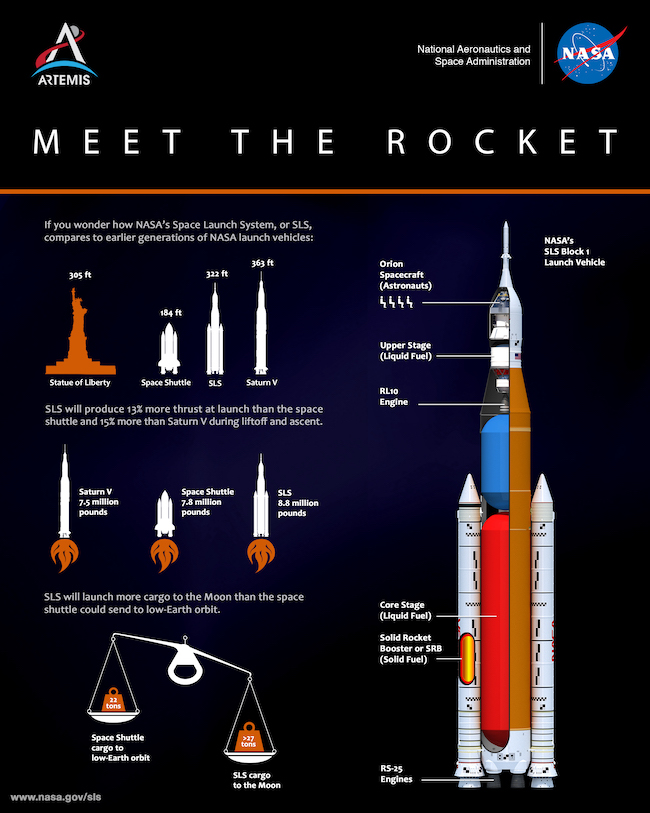
During launch and ascent, SLS will produce 8.8 million pounds of maximum thrust, 15% more thrust than the Saturn V rocket.
It’ll need that much thrust to send the 6 million pounds (3 million kg) of vehicle into orbit. As explained by Space.com, although Orion won’t have a human crew during Artemis 1:
… the commander’s seat will be occupied by a mannequin dressed in the Orion Crew Survival System, a special suit designed to help protect against radiation. Two radiation sensors will monitor radiation levels.
The mannequin will be strapped in, but the weightless environment also needs testing. So NASA is flying a ‘zero gravity indicator’ in the form of a Snoopy cuddly toy dressed in an iconic orange NASA jumpsuit. The comic strip character has a long association with lunar exploration: the crew of Apollo 10 used it as nickname for their lunar module.
How does Artemis 1 compare with Apollo?
Philippe Berthe, ESA’s project coordination manager for the module, said in a podcast interview:
The propulsion is largely the same. It is very comparable to the Apollo era.
And of course, after 50 years, there’s been technological progress. Solar cells, for example, are devices that directly convert the energy of light into electrical energy. Orion will derive most of its power from solar cells.
But naturally, the most significant difference is computing power. Computers may have been on the horizon in the Apollo era – the late 1960s and early ’70s – but, as reported at ZMEscience.com:
Your smartphone is millions of times more powerful than the Apollo 11 guidance computers.
So the Artemis program will benefit from our vast modern computing power. As Berthe said:
Computing power is another major improvement. We can program much more complex operations now. The crew don’t need to intervene directly in every nitty-gritty detail.
Piloting the mission
There was a lot of talk in Tom Wolfe’s famous 1979 book (later a classic movie and recently a series) The Right Stuff about the idea of spam in a can. That was the brave test pilot Chuck Yeager’s description of the early Mercury flights, which reduced the role of the astronauts to that of passengers (rather than pilots).
The Apollo missions had pilots, and of course, pilots are among the most glamorous of spacemen, both in science fiction and in reality. As we go further into the Artemis era, it’ll be fun to hear how much piloting takes place aboard the eventual Artemis 3 moon mission.
“But what about Earth!?”
And, of course, there’s the decades-old debate about why we need to go to the moon at all. After all, over the past decades, we’ve learned a lot about the moon via robotic spacecraft, both orbiters, and landers. Plenty of people will argue – and have argued since the Apollo era – that sending humans to the moon wastes time, money, and resources. But the answer boils down to several things, one of them being efficiency. Berthe said:
An astronaut will do in a 6-hour [moonwalk] what a robot can do in 6 months. It is more expensive, but it is more efficient.
And the main reason, of course, is that the moon is a stepping stone to space. The moon’s gravity is only 1/6 of the Earth’s, and it’s much easier to blast a rocket into space from the moon than from Earth. This factor makes the moon an excellent base for future solar system exploration.
Aiming for the lunar south pole
The crew of Artemis 3 is aiming for the moon’s south pole, a place that scientists have discovered in recent decades has large amounts of water ice. Water contains oxygen, so processing it will make it possible for future astronauts to stay longer, enabling us to have a permanent presence on the moon.
Ultimately, it’s all a part of humanity’s natural wanderlust. Future historians might look back on this as the moment humanity took a giant leap when returning to the moon, maybe this time for good.
Bottom line: On Wednesday, August 17, 2022, NASA’s Space Launch System successfully rolled out to Launch Pad 39B at the Kennedy Space Center in Florida. The slow trek was live-streamed and recorded.
Read more from EarthSky: NASA’s moon program – Artemis – boosted at White House press briefing
The post Artemis 1: Rolled out and ready to launch first appeared on EarthSky.
from EarthSky https://ift.tt/lrbpaO0
Artemis 1: Rolled out and ready to launch
NASA seems as eager as the rest of us to get its mighty Space Launch System off the ground. It announced on August 15 that the Artemis 1 moonship – with its Orion spacecraft – was ready to be rolled out to Launch Pad 39B at Kennedy Space Center in Florida on August 16. (Previously, the schedule had indicated the rollout wouldn’t happen until the 19th.)
Then on Wednesday, August 17, the rocket successfully made the slow trek. The process took 10 hours and 8 minutes while the assembly traveled at a maximum speed of 0.8 mph (1.3 kph). Watch in the video above.
But the early rollout does not mean an early launch for Artemis 1, and NASA is still targeting a date no earlier than August 29 for liftoff.
Artemis 1’s objective is mainly to test the inaugural flight of NASA’s SLS, a rocket taller and more powerful than the mighty Saturn V rockets used during the Apollo program. The Orion spacecraft, a Multi-Purpose Crew Vehicle, will ride on top. (Orion already underwent an Earth-orbiting test in 2014.) When it flies, Artemis 1 will place the uncrewed Orion spacecraft in orbit around the moon. Afterward, the capsule will return to Earth for a splashdown in the Pacific Ocean.
We’re going back to the moon!
Many earthly spacecraft have visited the moon, but it’s been 50 years since humans have walked its surface. Now, NASA is planning to send us back. The mission is called Artemis, and the space agency has created its most powerful rocket, the Space Launch System, or SLS, to launch it.
Following Artemis 1, hopefully, no later than 2024, Artemis 2 will carry the first-ever crewed test flight of the Orion spacecraft. Artemis 3 is currently targeted for no earlier than 2025, and that mission might be the one to land humans on the lunar surface. The Artemis mission also has as one of its short-term goals to send the first woman and first person of color to the moon’s surface.
Long-term goals
But the long-term goals of the Artemis program look farther into the future. Astronauts from the Apollo program only walked the moon for, at most, days at a time. Could humans camp there for weeks? Or even months? NASA is interested in exploring the possibilities.
Then, NASA says, it’ll use what it learns on and around the moon to take the next giant leap: sending the first astronauts to Mars.
We are going.
As @NASA prepares to send astronauts to the Moon under #Artemis, we have identified 13 candidate landing regions near the lunar South Pole.
Learn about the landing regions and what sets them apart: https://t.co/XagoqjMi9b pic.twitter.com/lUwJun9yh0
— NASA Artemis (@NASAArtemis) August 19, 2022
Details of Artemis 1 mission
Visionaries have been dreaming for decades of a return to the moon. Although NASA first announced the Artemis program in December 2017, the development of the Orion crew capsule and the powerful SLS began earlier, in 2011.
The historic Launch Complex 39 was originally built as the Apollo program’s Moonport and later modified for the Space Shuttle program. NASA explained:
During launch and ascent, SLS will produce 8.8 million pounds of maximum thrust, 15% more thrust than the Saturn V rocket.
It’ll need that much thrust to send the 6 million pounds (3 million kg) of vehicle into orbit. As explained by Space.com, although Orion won’t have a human crew during Artemis 1:
… the commander’s seat will be occupied by a mannequin dressed in the Orion Crew Survival System, a special suit designed to help protect against radiation. Two radiation sensors will monitor radiation levels.
The mannequin will be strapped in, but the weightless environment also needs testing. So NASA is flying a ‘zero gravity indicator’ in the form of a Snoopy cuddly toy dressed in an iconic orange NASA jumpsuit. The comic strip character has a long association with lunar exploration: the crew of Apollo 10 used it as nickname for their lunar module.
How does Artemis 1 compare with Apollo?
Philippe Berthe, ESA’s project coordination manager for the module, said in a podcast interview:
The propulsion is largely the same. It is very comparable to the Apollo era.
And of course, after 50 years, there’s been technological progress. Solar cells, for example, are devices that directly convert the energy of light into electrical energy. Orion will derive most of its power from solar cells.
But naturally, the most significant difference is computing power. Computers may have been on the horizon in the Apollo era – the late 1960s and early ’70s – but, as reported at ZMEscience.com:
Your smartphone is millions of times more powerful than the Apollo 11 guidance computers.
So the Artemis program will benefit from our vast modern computing power. As Berthe said:
Computing power is another major improvement. We can program much more complex operations now. The crew don’t need to intervene directly in every nitty-gritty detail.
Piloting the mission
There was a lot of talk in Tom Wolfe’s famous 1979 book (later a classic movie and recently a series) The Right Stuff about the idea of spam in a can. That was the brave test pilot Chuck Yeager’s description of the early Mercury flights, which reduced the role of the astronauts to that of passengers (rather than pilots).
The Apollo missions had pilots, and of course, pilots are among the most glamorous of spacemen, both in science fiction and in reality. As we go further into the Artemis era, it’ll be fun to hear how much piloting takes place aboard the eventual Artemis 3 moon mission.
“But what about Earth!?”
And, of course, there’s the decades-old debate about why we need to go to the moon at all. After all, over the past decades, we’ve learned a lot about the moon via robotic spacecraft, both orbiters, and landers. Plenty of people will argue – and have argued since the Apollo era – that sending humans to the moon wastes time, money, and resources. But the answer boils down to several things, one of them being efficiency. Berthe said:
An astronaut will do in a 6-hour [moonwalk] what a robot can do in 6 months. It is more expensive, but it is more efficient.
And the main reason, of course, is that the moon is a stepping stone to space. The moon’s gravity is only 1/6 of the Earth’s, and it’s much easier to blast a rocket into space from the moon than from Earth. This factor makes the moon an excellent base for future solar system exploration.
Aiming for the lunar south pole
The crew of Artemis 3 is aiming for the moon’s south pole, a place that scientists have discovered in recent decades has large amounts of water ice. Water contains oxygen, so processing it will make it possible for future astronauts to stay longer, enabling us to have a permanent presence on the moon.
Ultimately, it’s all a part of humanity’s natural wanderlust. Future historians might look back on this as the moment humanity took a giant leap when returning to the moon, maybe this time for good.
Bottom line: On Wednesday, August 17, 2022, NASA’s Space Launch System successfully rolled out to Launch Pad 39B at the Kennedy Space Center in Florida. The slow trek was live-streamed and recorded.
Read more from EarthSky: NASA’s moon program – Artemis – boosted at White House press briefing
The post Artemis 1: Rolled out and ready to launch first appeared on EarthSky.
from EarthSky https://ift.tt/lrbpaO0

Aucun commentaire:
Enregistrer un commentaire