By mid-April 2022, there are 4 visible planets in the sunrise direction: Venus blazing in the east before sunrise; fainter Mars and Saturn; Jupiter, which emerged in the east before sunrise in early April and has become easier to see as the month has progressed. Venus and Jupiter will have a glorious conjunction before April ends. Plus, Mercury returns to the evening sky by mid-April, to begin its best evening apparition for the year for the Northern Hemisphere.
By mid-April: 4 planets from the Northern Hemisphere
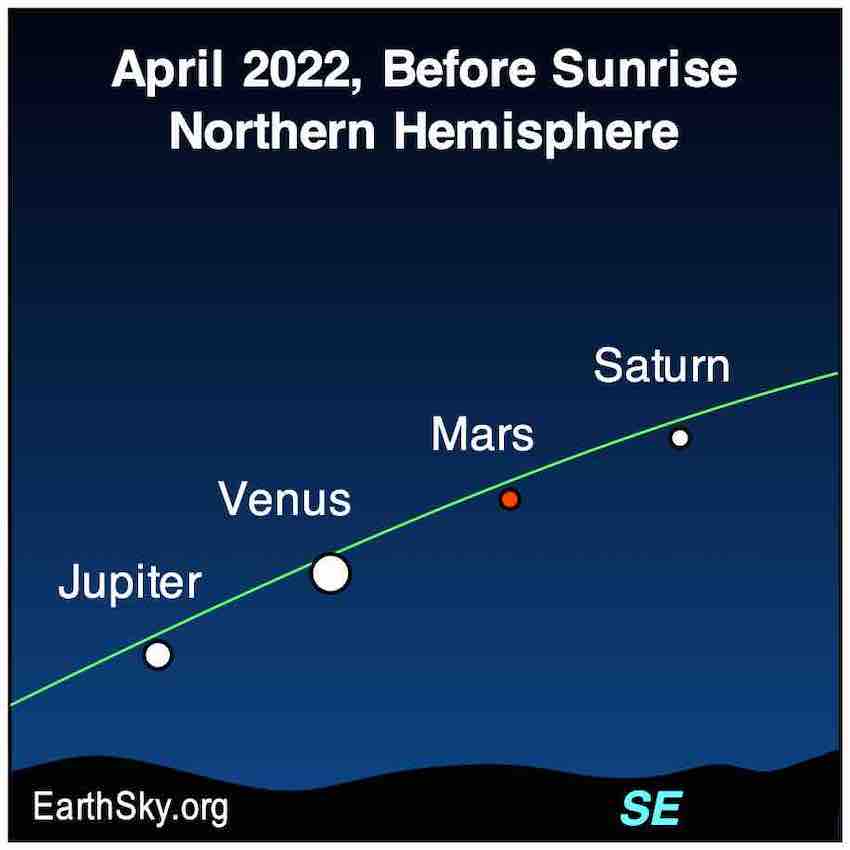
Northern Hemisphere view. Some of you might have glimpsed Jupiter near the sunrise as early as late March 2022. By mid-April, we’ll all see Jupiter in the sunrise direction, about an hour before the sun comes up. Indeed, you’ll recognize it easily as the 2nd-brightest planet, after Venus. Here, we see the placement of the 4 bright planets in the morning sky around mid-April, as viewed from the Northern Hemisphere. In like manner, the same 4 planets are visible from the Southern Hemisphere, too. See the chart below.
By mid-April: 4 planets from the Southern Hemisphere
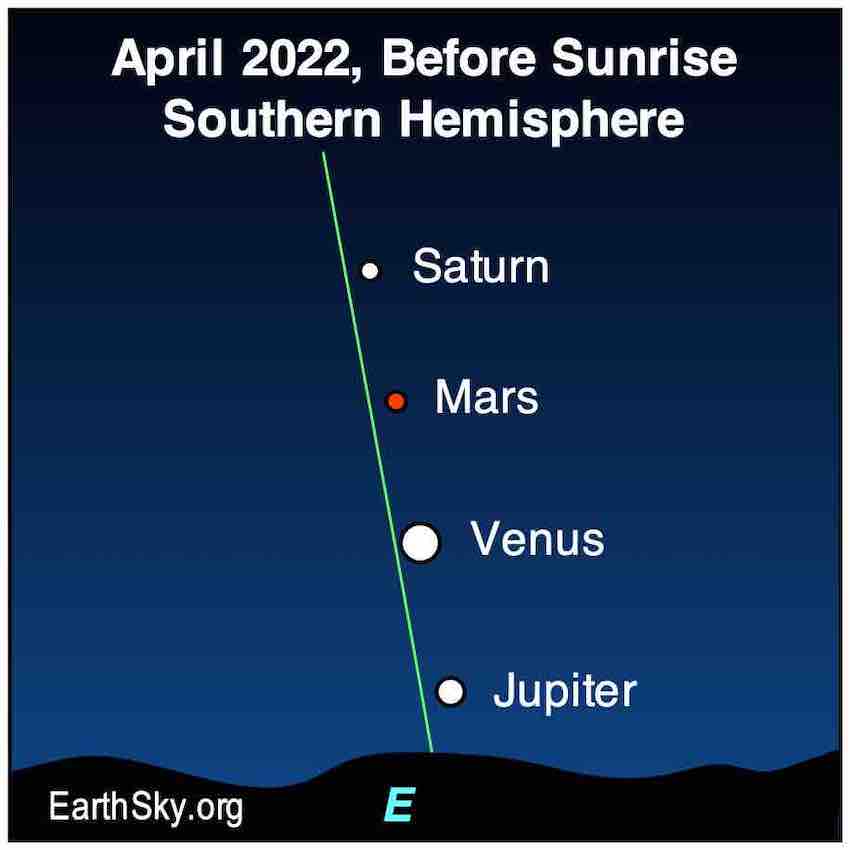
Southern Hemisphere view. Note the contrast between this chart and the one above. The same 4 planets – Jupiter, Mars, Saturn and Venus – can be seen before sunrise, with Jupiter closest to the sunrise point. However, it’s autumn now in the Southern Hemisphere. As a result, the ecliptic, or sun’s path in the sky, makes a steep angle to the morning horizon, placing the planets high above the sunrise.
April 15 and 16 evenings: Moon and Spica
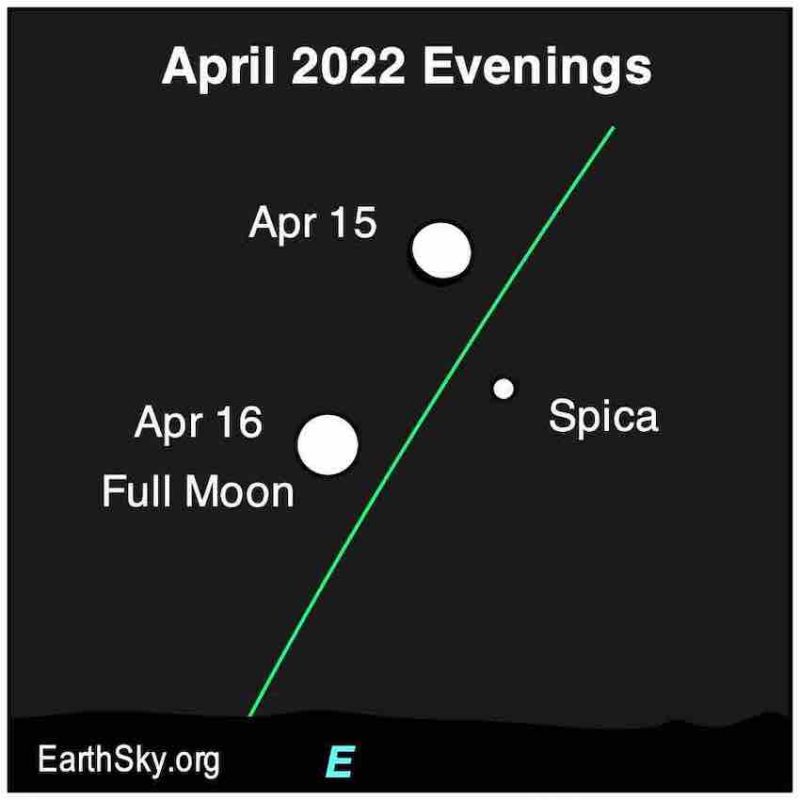
If you’re enjoying the full or nearly full moon on April 15 and 16, you’ll probably notice a bright star nearby. That star is Spica, the brightest star in the constellation Virgo the Maiden. Chart via John Jardine Goss.
April 16 evening: Full moon Northern hemisphere
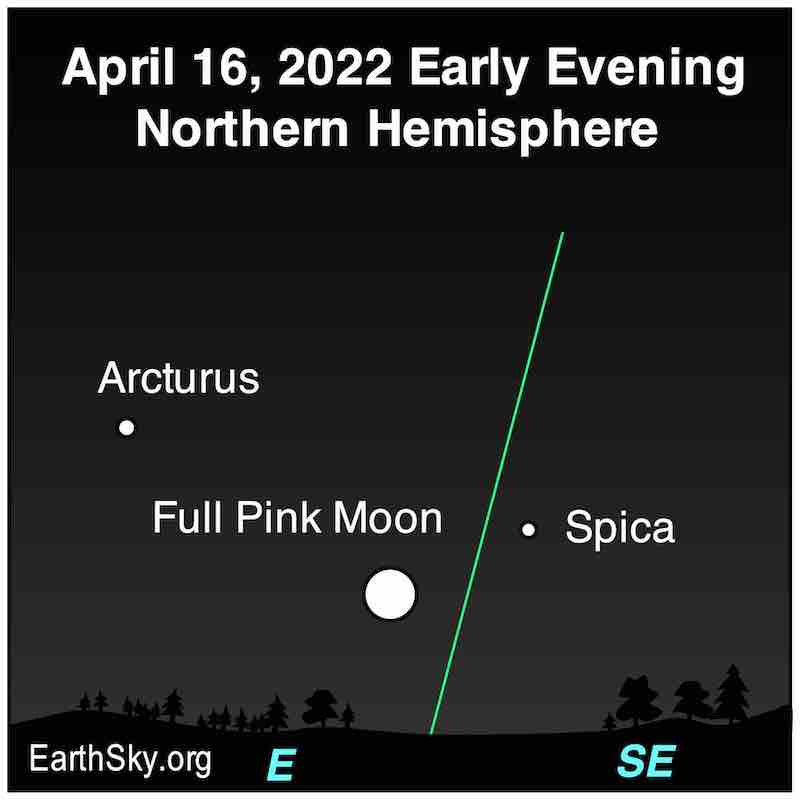
Northern Hemisphere view. The full Pink Moon rises in the east at sunset on April 16. For observers in the Northern Hemisphere, it glows to the lower left of the bright star Spica in the constellation Virgo the Maiden. Chart via John Jardine Goss.
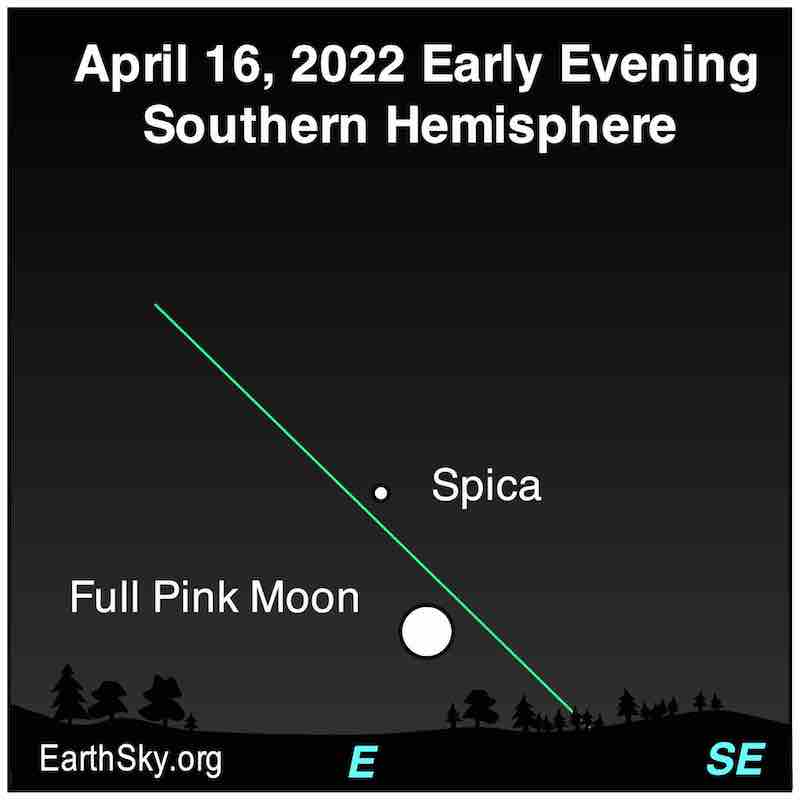
April 16 evening: Full moon Southern hemisphere
Southern Hemisphere view. We all see the same moon. So the Southern Hemisphere sees the full moon rising at sunset on April 16, too. But the orientation is different. For observers in the Southern Hemisphere, the moon in early evening will glow belowSpica in Virgo. Chart via John Jardine Goss.
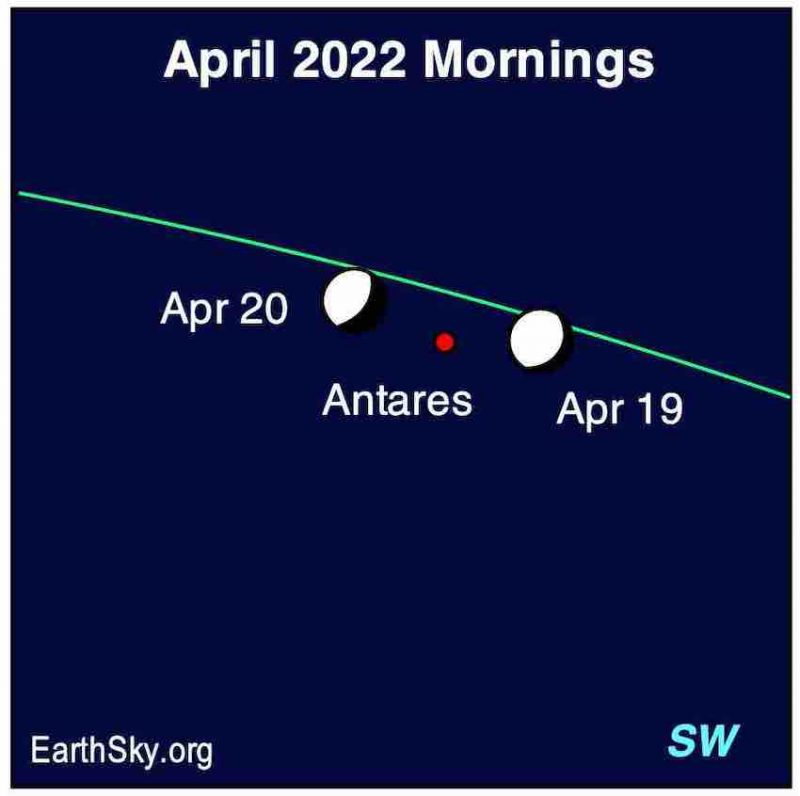
April 19 and 20 mornings: Moon and Antares
For those up early on April 19 and 20, you may be asking, “What’s that bright star by the moon?” That reddish star is Antares in the constellation Scorpius the Scorpion. A waning gibbous moon is west of Antares on April 19 and east of the reddish star on April 20. Subsequently, its phase will shrink a bit from one night to the next. Chart via John Jardine Goss.
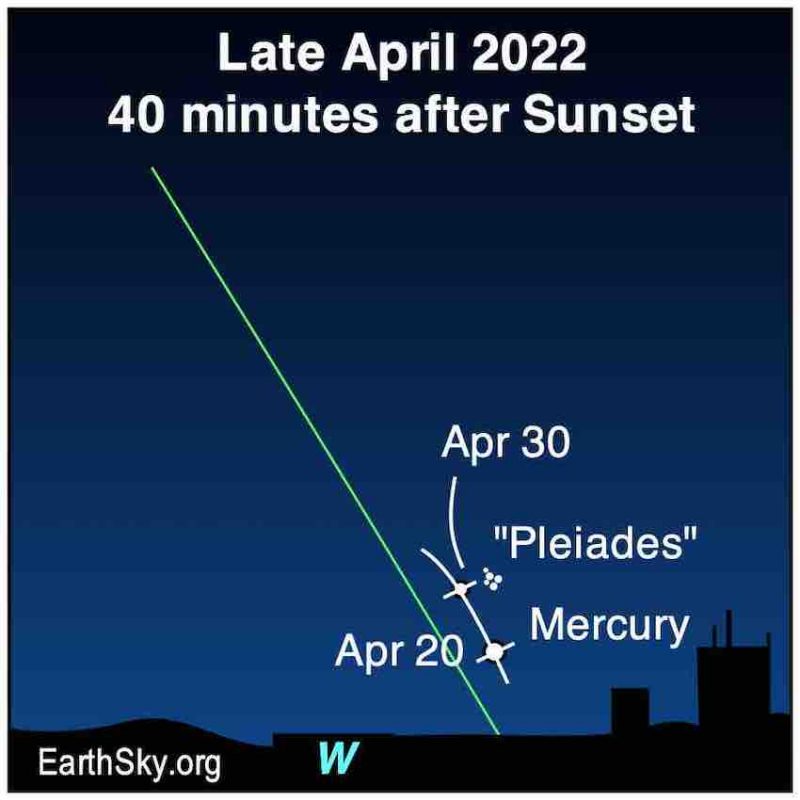
Beginning April 20 early evening: Mercury nears the Pleiades
Also, watch Mercury starting around April 20, when it’s low in the west after sunset. You’ll see the closest planet to the sun steadily climb closer to the Pleiades star cluster every night until April 29, when Mercury and the Pleiades are right next to each other. In this case, their conjunction on our sky’s dome comes at 19 UTC on April 29. Then, the star cluster and the planet are separated by 1.4 degrees. On our chart, Mercury follows the white line upward and gets dimmer (represented by the shrinking circle) as it nears the Pleiades. Chart via John Jardine Goss.
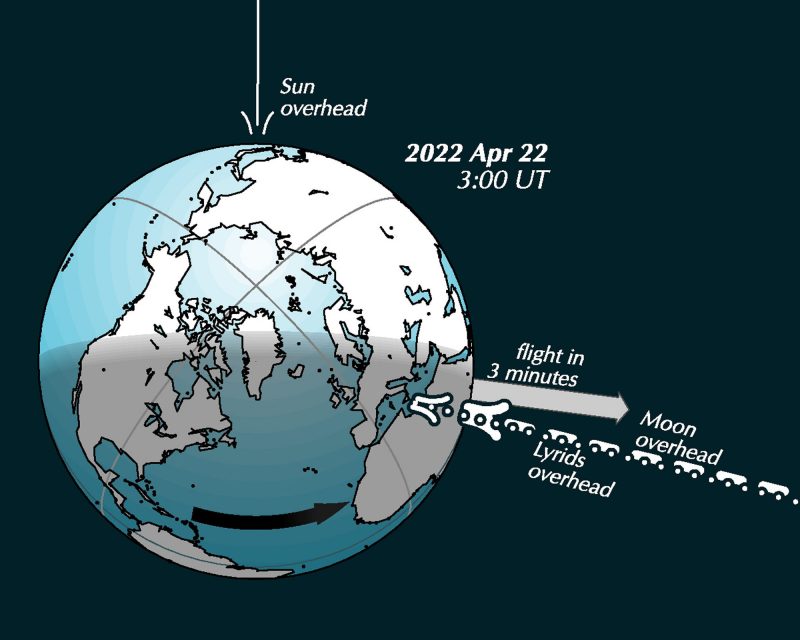
April 21 and 22 late evening: Lyrid meteor shower
The annual Lyrid meteor shower always brings an end to the meteor drought that occurs each year between January and mid-April. At the present time, the predicted peak of this shower is 4 UTC on April 22, 2022. The Lyrid radiant point rises before midnight and is highest at dawn. In addition, note that there’s a bright moon in the sky on the peak morning. See how – in the illustration above by Guy Ottewell – the Lyrids and the moon are coming from the same direction in the sky? Best bet: Watch in late evening, before moonrise, on both April 21 and April 22. Here are more tips for watching 2022’s Lyrid meteors.
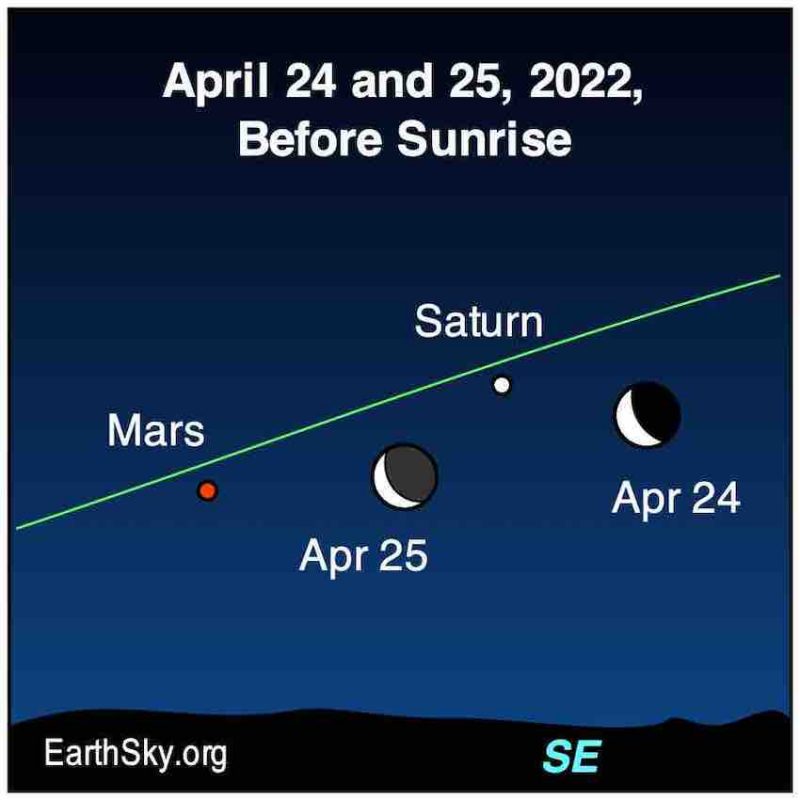
April 24 and 25 mornings: Crescent moon near planets Saturn and Mars
Here, the waning crescent moon lies west of Saturn on the morning of April 24, and east of Saturn on April 25. On the 25th, it appears between Mars and Saturn. Chart via John Jardine Goss.
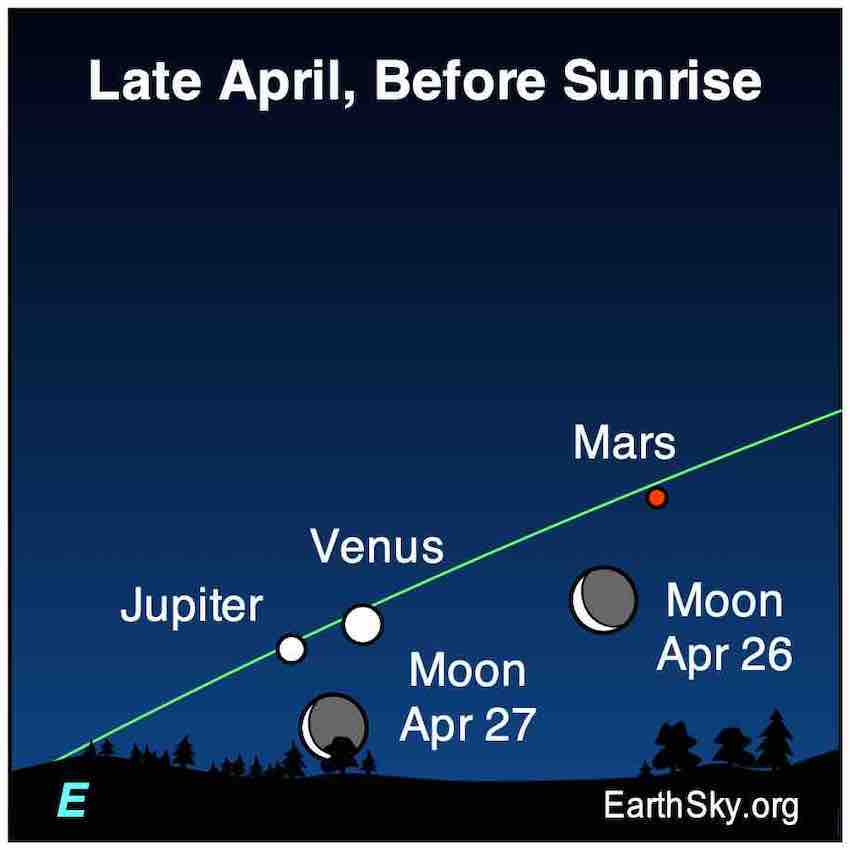
April 26 and 27 mornings: Crescent moon near 3 planets
The thin waning crescent moon first passes Mars on the morning of April 26, then hovers below Jupiter and Venus on the morning of April 27. Chart via John Jardine Goss.
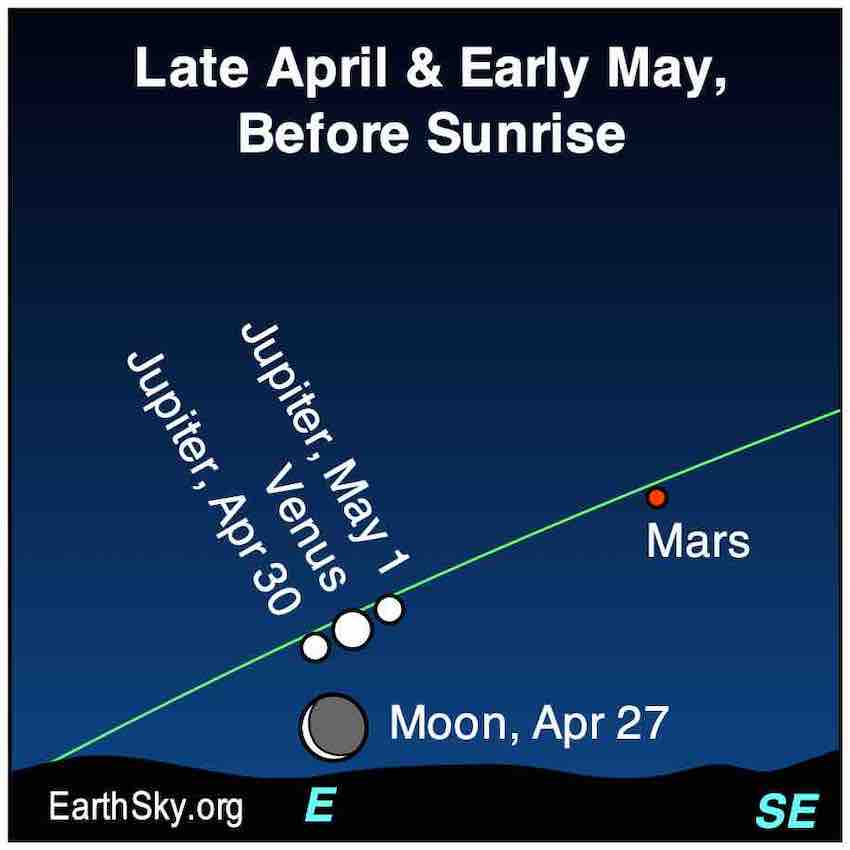
April 27 – May 1 mornings: Jupiter-Venus conjunction
Later, catch the 2 brightest planets – Venus and Jupiter – close together around the end of April and beginning of May 2022. Meanwhile, the moon will join the scene on April 27. This chart also shows that Jupiter will be on one side of Venus on April 30 and the opposite side on May 1. That’s because the 2 planets’ conjunction – when they pass one another in right ascension – comes at 19 UTC on April 30. At that time, Venus will be 0.2 degrees south of Jupiter. Also, note reddish Mars on the far right. Right now, because it’s still far ahead of us in orbit, Mars can’t compete in brightness with Venus and Jupiter! Chart via John Jardine Goss.
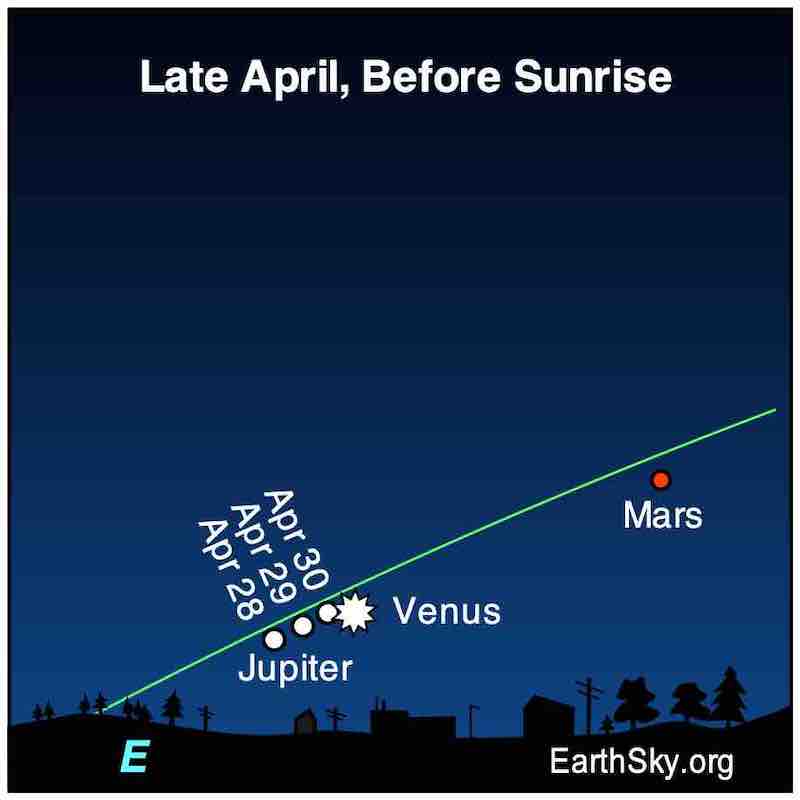
April 28 – 30 mornings: planets Jupiter and Venus getting closer
Early risers can catch brilliant Venus and bright Jupiter very close together in late April and early May. The pair will be closest at 19 UTC on April 30 when Venus is 0.2 degrees south of Jupiter. Also, notice reddish Mars is nearby the pair. Chart via John Jardine Goss.
April 30 and May 1 mornings: Binocular view of the Venus and Jupiter conjunction
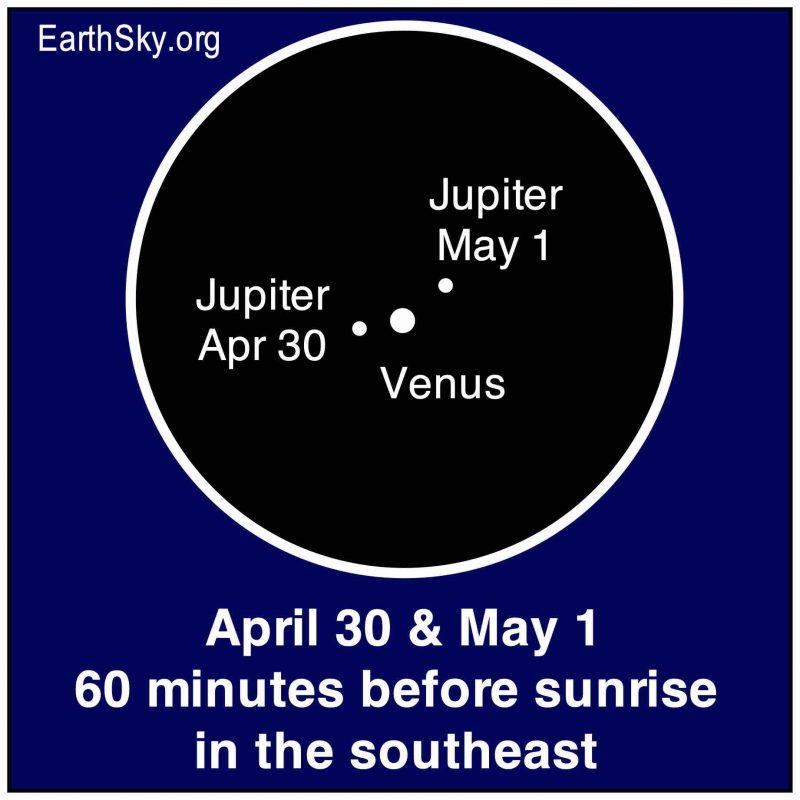
Mornings of April 30 and May 1: Jupiter and Venus nearly merge. First, bright Jupiter climbs quickly in the morning twilight and heads toward brilliant Venus in the last week of April 2022. Then, on the morning of April 27, the 2 planets are joined by the waxing moon for an eye-catching scene. Two mornings later, Jupiter and Venus will meet in conjunction, visually nearly bumping into each other. Because of the glare from both planets, many people will see them merge into one very bright glow! The morning of May 1 continues the show, but with the positions of the planets reversed. Chart via John Jardine Goss.
On April 30: A deep partial solar eclipse
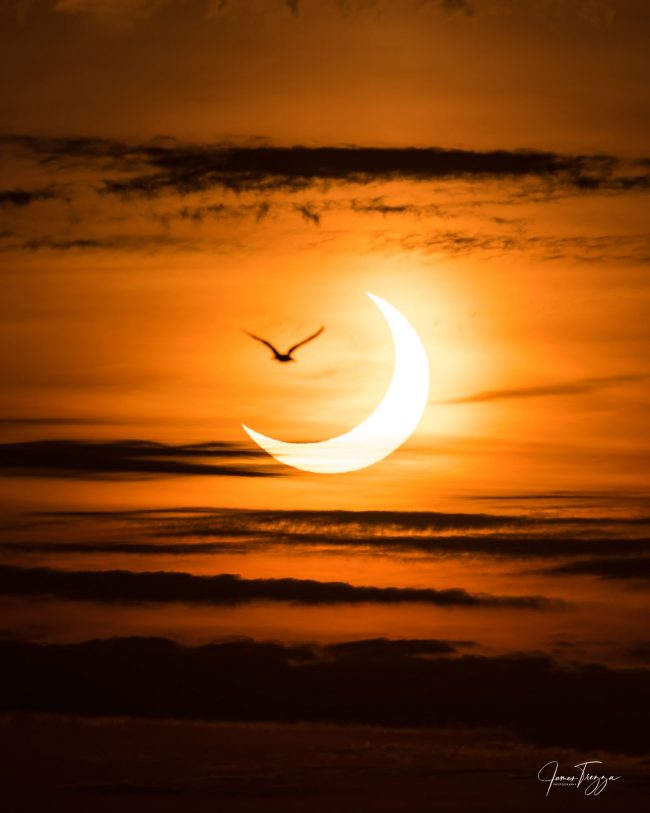
View at EarthSky Community Photos. | The April 30, 2022, eclipse will be a partial, but deep, eclipse, similar to the eclipse shown in this photo. It’s visible from the southeast Pacific and south South America. Our friend James Trezza in Cedar Beach, Mount Sinai, New York, captured this photo of the partial solar eclipse on June 10, 2021. He wrote: “Solar eclipse 2021! Nothing like perfect timing with a bird flying through the frame during the eclipse.” Thanks, James, and yes! Read more about the April 30, 2022 solar eclipse.
Visible planets: Night sky guide for May 2022
Also, find these visible planets in May 2022: Mercury wrapping up an appearance in the first few evenings of May; Venus blazing low in the east before sunrise; Jupiter rising higher and away from Venus in the southeast before sunrise; Mars and Saturn, both of similar brightness, shining to Jupiter’s west; and Jupiter approaching, then passing Mars on May 29.
May 1 morning: planets Jupiter and Venus are very close (Northern Hemisphere)
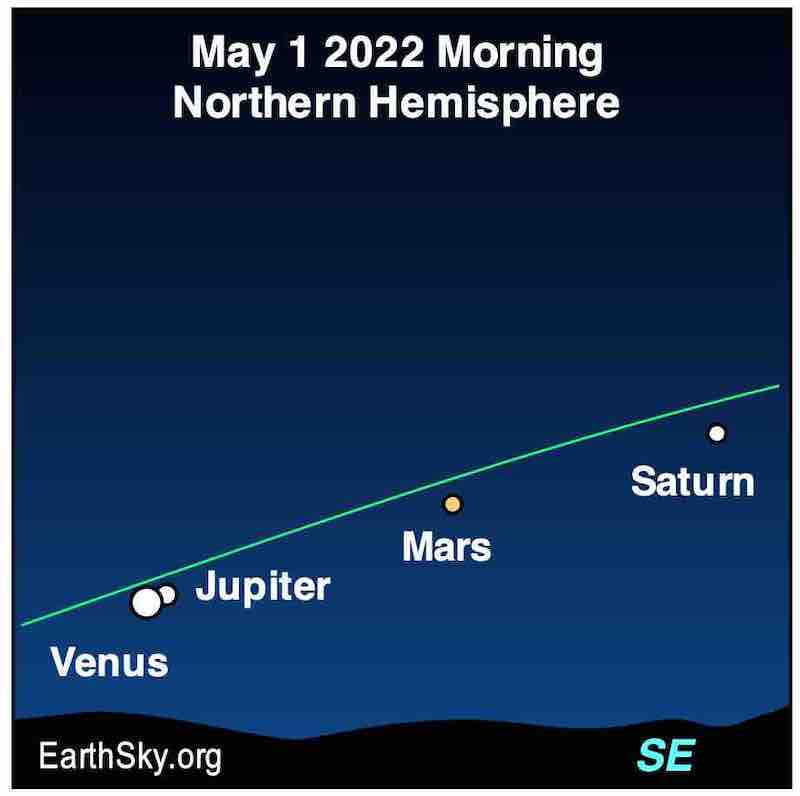
Catch the 2 brightest planets – Venus and Jupiter – very close together at the beginning of May. That’s because the 2 planets’ conjunction – when they pass one another in right ascension – comes at 19 UTC on April 30. At that time, Venus will be 0.2 degrees south of Jupiter. For observers in the Americas, they will be separated by the same angular distance as a full moon – about one-half degree. Binoculars help separate these two worlds in their bright planetary glare. Even though Venus and Jupiter appear next to each other in the sky, they are really nowhere near each other in space. Indeed, they are separated by 430 millions miles – or nearly five times the Earth–sun distance! Chart via John Goss.
May 1 morning: planets Jupiter and Saturn together (Southern Hemisphere)
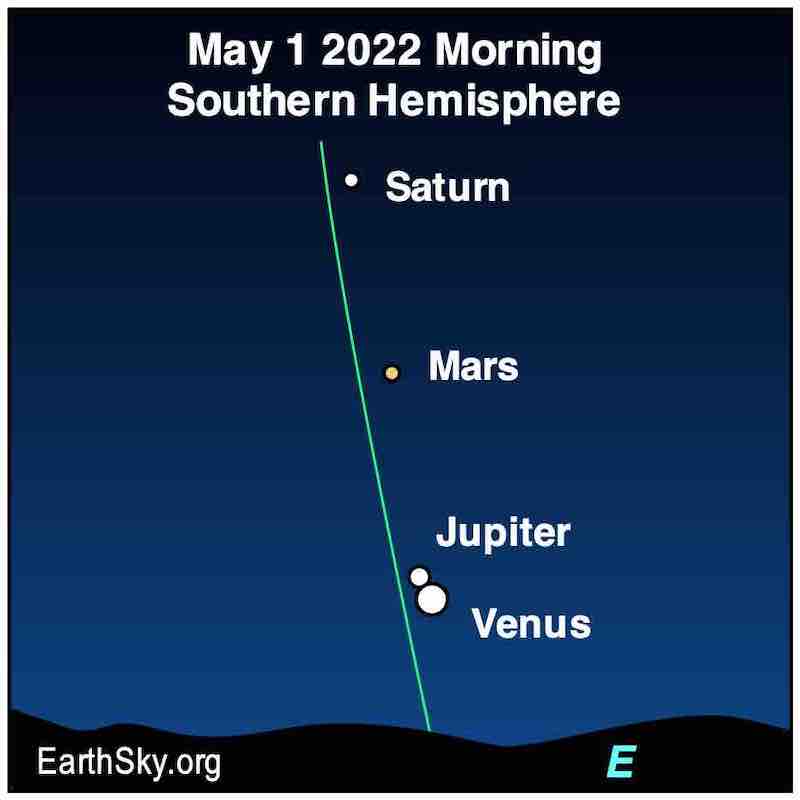
Bright Jupiter lies immediately above brilliant Venus in the east-southeast before sunrise. Use binoculars to separate the two planets. Mars lies higher than the planetary pair, and Saturn lies higher still. Chart via John Goss.
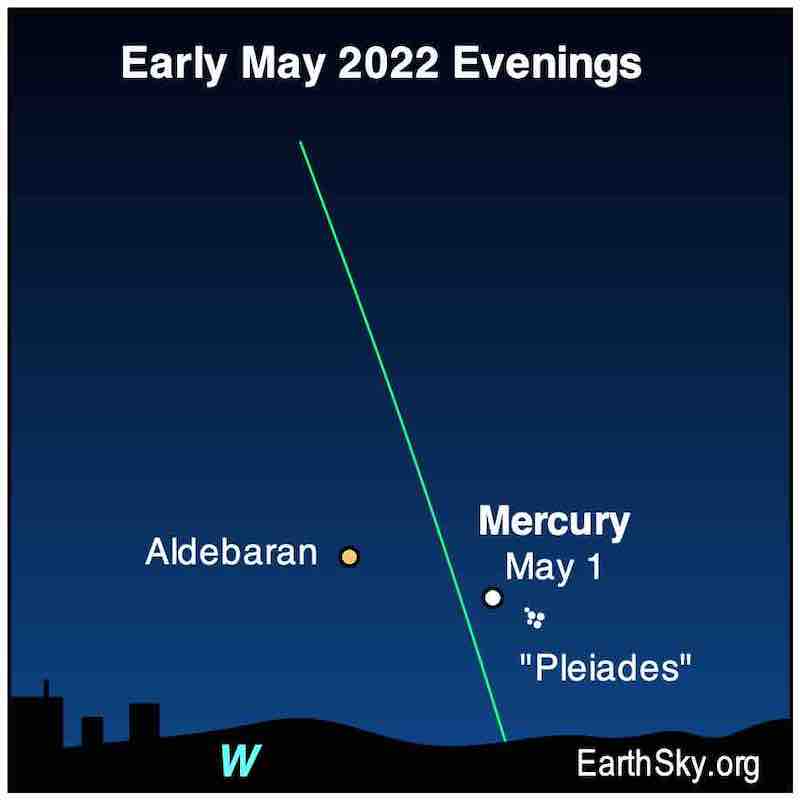
May 1 evening: Mercury near Pleiades in early twilight
Watch as Mercury winds down its brief appearance in the evening sky. On May 1, it can be seen next to the much fainter Pleiades star cluster. Look for them in the brightest part of the evening twilight making both Mercury and Pleiades difficult to spot. Binoculars will help. Also, notice reddish Aldebaran is nearby the moon as well. Chart via John Goss.
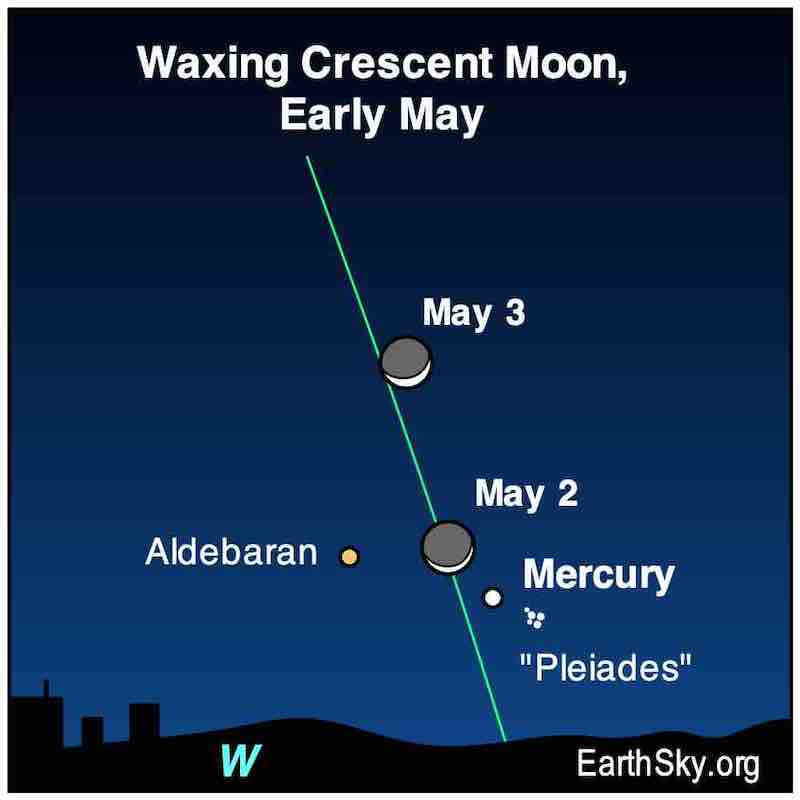
May 2 and 3 evenings: Crescent moon near Mercury and Aldebaran
A waxing crescent moon joins Mercury, glowing just above it shortly after sunset on May 2. Binoculars help reveal the Pleiades dimmed by the bright twilight. Notice reddish Aldebaran is nearby the moon as well. Look for earthshine on the young moon on both May 2 and May 3. Chart via John Goss.
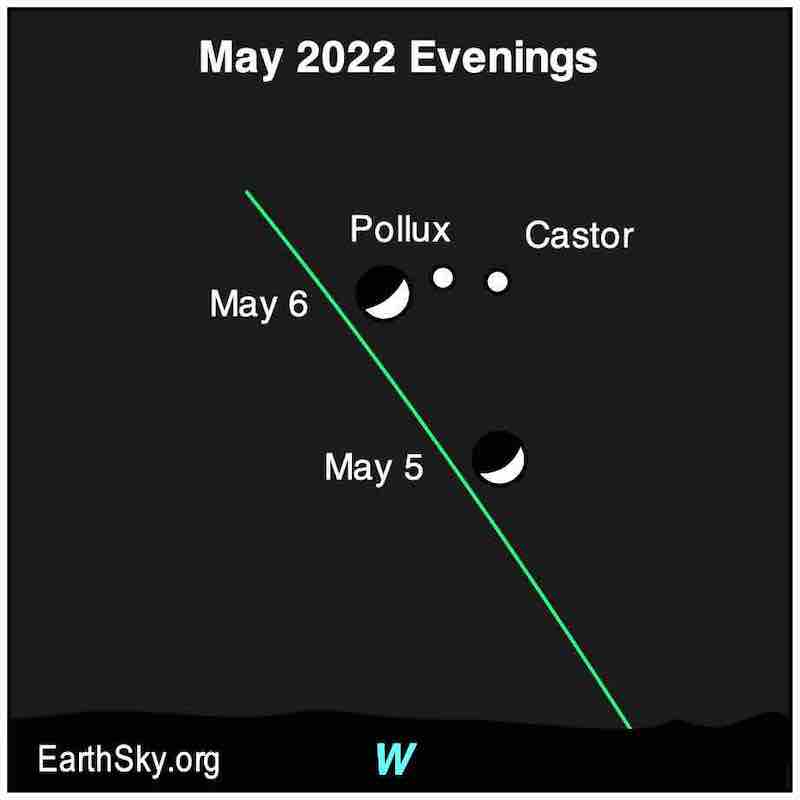
May 5 and 6 evenings: Pollux and Castor by the moon
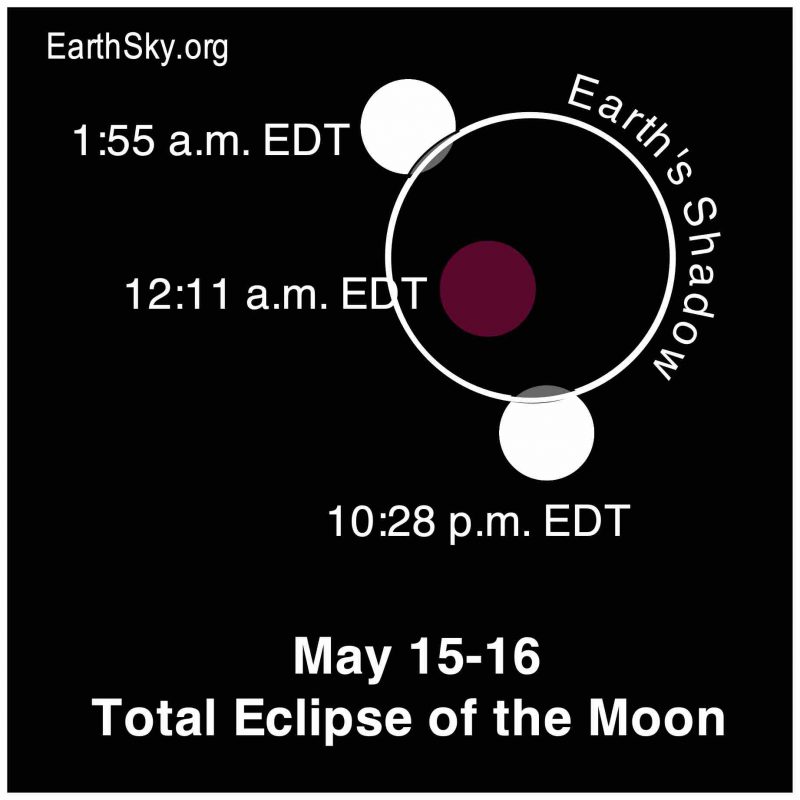
On the night of May 15-16: A total eclipse of the moon
A total lunar eclipse sweeps across the Americas, Europe and Africa during the night of May 15-16, 2022. The moon will enter Earth’s shadow at 10:28 p.m. EDT on May 15, becoming completely eclipsed about one hour later. This total eclipse is central, meaning the moon’s disk actually passes through the axis of Earth’s umbral shadow. Because they are so deep, such eclipses typically have the longest total phases. In this case, the duration of totality lasts almost an hour and a half: 84.9 minutes! Chart via John Jardine Goss. Read more about the May 15-16 total lunar eclipse.
Looking forward to June
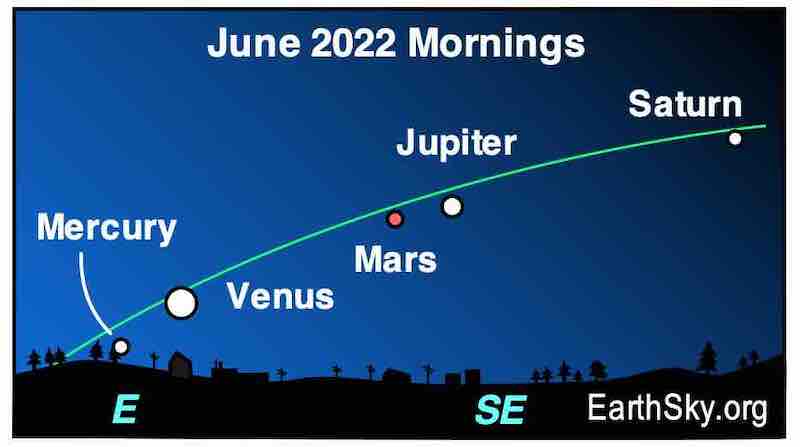
Notably, June offers early risers a chance to see a rare alignment of the 5 bright planets lining up in a row across the sky. Mid-June is probably the best time to see all the planets. You’ll need a clear view of the eastern horizon to catch Mercury and Venus. Mars, Jupiter and Saturn will be higher in the southeastern sky. Though not visible to the unaided eye, Uranus is between Venus and Mars, and Neptune is between Jupiter and Saturn. What a wonderful sight!
April 2022: Planets in depth
Venus and Jupiter
Venus dominates the morning eastern sky throughout April 2022. It’s dazzlingly bright in the sunrise direction each morning. Plus, Venus will have a glorious conjunction with our sky’s 2nd-brightest planet, Jupiter, before this month ends. Jupiter is low on the eastern horizon as April begins: a challenge to spot. But it’ll rise higher above the sunrise glare as the month progresses and by mid-month will be located along a regularly spaced line of planets – with Venus, Saturn and Mars – in the eastern predawn sky.
Venus and Jupiter are the two brightest planets. The Venus-Jupiter conjunction will come at 19 UTC on April 30. At that time, Venus will be 0.2 degrees south of Jupiter.
Venus reached its greatest elongation – its farthest angular distance from the sunrise – on March 20, 2022. It’s now slowly moving a little closer to the sunrise horizon each morning. But Venus is so bright and so beautiful. Indeed, you will enjoy it as the dazzling “morning star” for many months to come.
In comparison, Jupiter will spend the next several months of 2022 shifting from the morning to the evening sky. Its opposition – when it’s opposite the sun from Earth – will come on September 26. Then it will be rising in the east at sunset, as the sun sets in the west.
Saturn and Mars
Saturn and Mars both are much dimmer than Venus or Jupiter. In April 2022, Saturn appears a little brighter than Mars. Watch for a fascinating sight on the morning of April 4, and extending into the morning of April 5, when Mars slides 0.3 degrees south of Saturn on our sky’s dome. Their conjunction comes at 22 UTC on April 4. Note that Mars is the second-smallest planet. Saturn is the second-largest planet. Saturn shines with a golden color and Mars appears reddish; it’s called the red planet for a reason.
From the longitude of India – on the day of their conjunction – Mars appears to slide directly underneath Saturn, barely missing it! No matter what geographical location you view from, use binoculars to bring out the colors of these intriguing worlds.
Also, keep in mind how we interpret the view in April 2022: planets in 3-dimensional space projected onto a 2-dimensional dome. Even though they seem to be close in the sky, Venus, Saturn and Mars are actually nowhere near each other in space. In fact, Venus lies 72 million miles from Earth, and Mars is 95 million miles further out. Comparatively, Saturn orbits the sun just under 1 billion miles from our world!
Mars’ new cycle of visibility
Like Jupiter, Mars is now beginning a new cycle of visibility in our sky. Throughout 2022, it’ll brighten and shift into our evening sky, as Earth draws up behind Mars in our smaller, faster orbit around the sun. Earth and Mars will be closest on December 1. Moreover, our two worlds will be most nearly on a line in space – bringing Mars to its once-in-2-years opposition – on the night of December 7-8.
Also, like Jupiter and Mars, Saturn is also just beginning its cycle of visibility in Earth’s sky. It’ll come to opposition – rising in the east at sunset, highest at midnight, setting at sunrise – on August 14.
Mercury
Mercury reaches superior conjunction – sweeping to the far side of the sun from Earth – on April 2. It will emerge into the western sky after sunset by mid-month, thereby becoming the lone evening planet. It’ll be the start of Mercury’s best evening apparition of this year, for us in the Northern Hemisphere.
In addition, note that Mercury will be near the famous Pleiades star cluster – aka the Seven Sisters – in April 2022. You’ll probably start to notice Mercury near the Pleiades around April 20, and it’ll steadily climb closer to the cluster every night until April 29, when Mercury and the Pleiades are right next to each other. Their conjunction on our sky’s some comes at 19 UTC on April 29. Then, the star cluster and the planet are separated by 1.4 degrees.
In like manner, Mercury will also appear farthest from the sunset at 8 UTC on April 29, 2022. This is Mercury’s greatest elongation, its greatest apparent distance from the sun on our sky’s dome. Read more about Mercury’s greatest elongation in April 2022.
Recent planet photos from EarthSky’s community
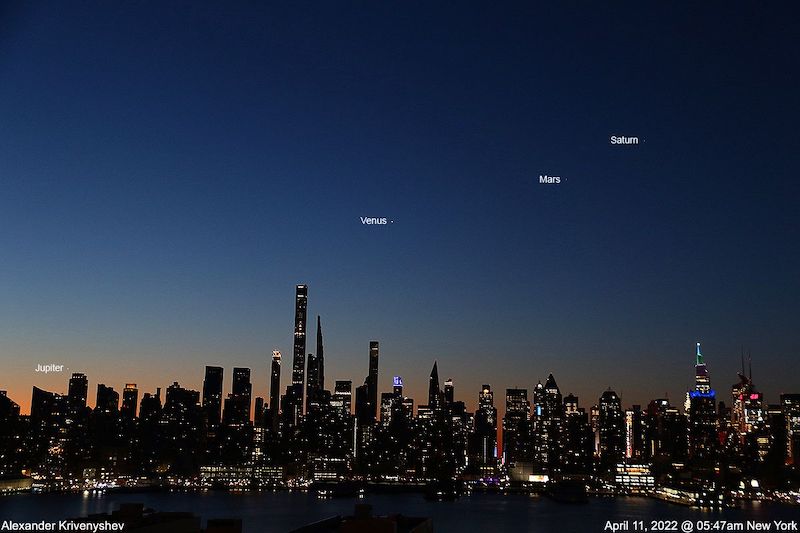
View at EarthSky Community Photos. | Alexander Krivenyshev at Weehawken, New Jersey, captured this fabulous image of the 4 bright morning planets on April 11, 2022. Alexander wrote: “The “planet parade” of Jupiter, Venus, Mars, and Saturn align over New York City.” Thank you, Alexander!View at EarthSky Community Photos. | Gail Gunstone at Loreto, Baja California Sur, Mexico, captured this great photo of Venus, Mars and Saturn on April 5, 2022. Gail wrote: “Caught an early bird with Venus, Mars and Saturn about 45 minutes before sunrise in Baja Mexico.” Thank you, Gail!
April-June 2022 heliocentric solar system
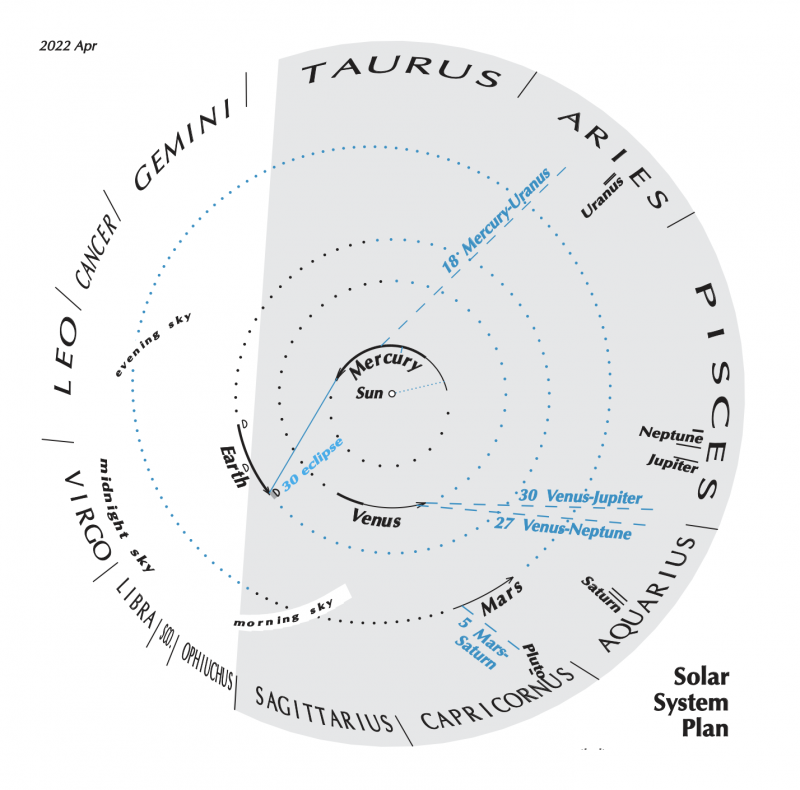
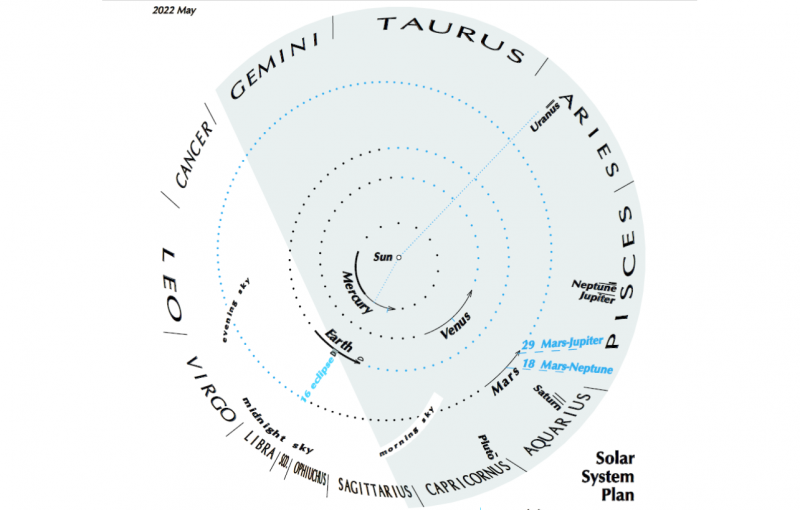
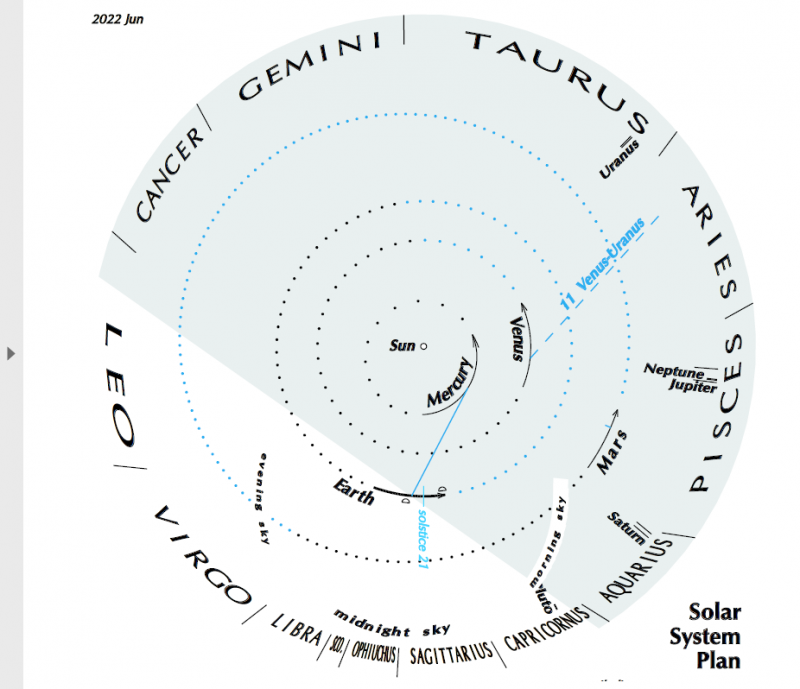
The sun-centered charts below come from Guy Ottewell. You’ll find charts like these for every month of 2022 in his Astronomical Calendar. Guy Ottwell explains:
In these views from ecliptic north, arrows (thinner when south of the ecliptic plane) are the paths of the four inner planets. Dots along the rest of the orbits are five days apart (and are black for the part of its course that a planet has trodden since the beginning of the year). Semicircles show the sunlit side of the new and full moon (vastly exaggerated in size and distance). Pairs of lines point outward to the more remote planets.
Phenomena such as perihelia (represented by ticks) and conjunctions (represented by lines between planets) are at dates that can be found in the Astronomical Calendar. Gray covers the half of the universe below the horizon around 10 p.m. at mid-month (as seen from the equator). The zodiacal constellations are in directions from the Earth at mid-month (not from the sun).
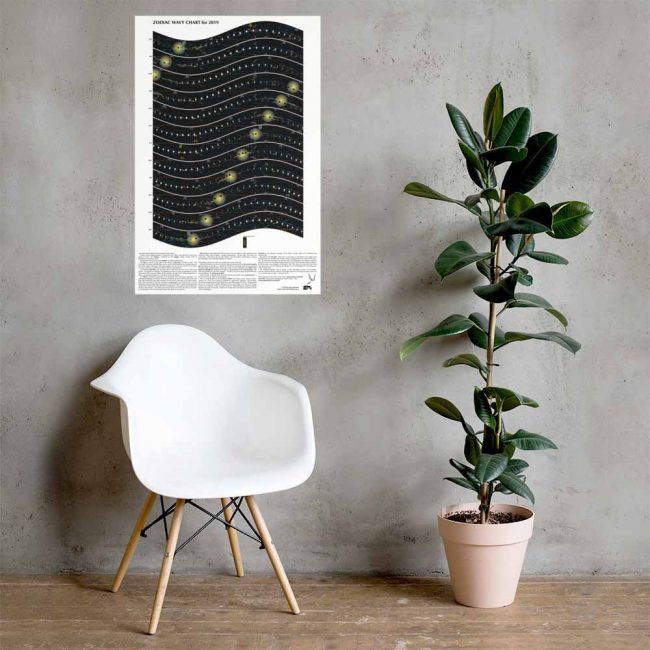
Guy Ottewell’s Zodiac Wavy Chart is a 2-by-3 foot poster displaying the movements of the sun, moon and planets throughout the year. You can purchase it here.
Bottom line: April 2022 is a month for seeing four planets in the morning sky. By mid-month, Jupiter and Venus – Saturn and Mars – will be stretched out in a line in the eastern predawn sky. Meanwhile, the sun’s innermost planet, Mercury, will return in mid-April to begin its best evening apparition of the year for Northern Hemisphere skywatchers. Plus, Mercury will appear near the famous Pleiades star cluster, aka the Seven Sisters.
By mid-April 2022, there are 4 visible planets in the sunrise direction: Venus blazing in the east before sunrise; fainter Mars and Saturn; Jupiter, which emerged in the east before sunrise in early April and has become easier to see as the month has progressed. Venus and Jupiter will have a glorious conjunction before April ends. Plus, Mercury returns to the evening sky by mid-April, to begin its best evening apparition for the year for the Northern Hemisphere.
By mid-April: 4 planets from the Northern Hemisphere
Northern Hemisphere view. Some of you might have glimpsed Jupiter near the sunrise as early as late March 2022. By mid-April, we’ll all see Jupiter in the sunrise direction, about an hour before the sun comes up. Indeed, you’ll recognize it easily as the 2nd-brightest planet, after Venus. Here, we see the placement of the 4 bright planets in the morning sky around mid-April, as viewed from the Northern Hemisphere. In like manner, the same 4 planets are visible from the Southern Hemisphere, too. See the chart below.
By mid-April: 4 planets from the Southern Hemisphere
Southern Hemisphere view. Note the contrast between this chart and the one above. The same 4 planets – Jupiter, Mars, Saturn and Venus – can be seen before sunrise, with Jupiter closest to the sunrise point. However, it’s autumn now in the Southern Hemisphere. As a result, the ecliptic, or sun’s path in the sky, makes a steep angle to the morning horizon, placing the planets high above the sunrise.
April 15 and 16 evenings: Moon and Spica
If you’re enjoying the full or nearly full moon on April 15 and 16, you’ll probably notice a bright star nearby. That star is Spica, the brightest star in the constellation Virgo the Maiden. Chart via John Jardine Goss.
April 16 evening: Full moon Northern hemisphere
Northern Hemisphere view. The full Pink Moon rises in the east at sunset on April 16. For observers in the Northern Hemisphere, it glows to the lower left of the bright star Spica in the constellation Virgo the Maiden. Chart via John Jardine Goss.
April 16 evening: Full moon Southern hemisphere
Southern Hemisphere view. We all see the same moon. So the Southern Hemisphere sees the full moon rising at sunset on April 16, too. But the orientation is different. For observers in the Southern Hemisphere, the moon in early evening will glow belowSpica in Virgo. Chart via John Jardine Goss.
April 19 and 20 mornings: Moon and Antares
For those up early on April 19 and 20, you may be asking, “What’s that bright star by the moon?” That reddish star is Antares in the constellation Scorpius the Scorpion. A waning gibbous moon is west of Antares on April 19 and east of the reddish star on April 20. Subsequently, its phase will shrink a bit from one night to the next. Chart via John Jardine Goss.
Beginning April 20 early evening: Mercury nears the Pleiades
Also, watch Mercury starting around April 20, when it’s low in the west after sunset. You’ll see the closest planet to the sun steadily climb closer to the Pleiades star cluster every night until April 29, when Mercury and the Pleiades are right next to each other. In this case, their conjunction on our sky’s dome comes at 19 UTC on April 29. Then, the star cluster and the planet are separated by 1.4 degrees. On our chart, Mercury follows the white line upward and gets dimmer (represented by the shrinking circle) as it nears the Pleiades. Chart via John Jardine Goss.
April 21 and 22 late evening: Lyrid meteor shower
The annual Lyrid meteor shower always brings an end to the meteor drought that occurs each year between January and mid-April. At the present time, the predicted peak of this shower is 4 UTC on April 22, 2022. The Lyrid radiant point rises before midnight and is highest at dawn. In addition, note that there’s a bright moon in the sky on the peak morning. See how – in the illustration above by Guy Ottewell – the Lyrids and the moon are coming from the same direction in the sky? Best bet: Watch in late evening, before moonrise, on both April 21 and April 22. Here are more tips for watching 2022’s Lyrid meteors.
April 24 and 25 mornings: Crescent moon near planets Saturn and Mars
Here, the waning crescent moon lies west of Saturn on the morning of April 24, and east of Saturn on April 25. On the 25th, it appears between Mars and Saturn. Chart via John Jardine Goss.
April 26 and 27 mornings: Crescent moon near 3 planets
The thin waning crescent moon first passes Mars on the morning of April 26, then hovers below Jupiter and Venus on the morning of April 27. Chart via John Jardine Goss.
April 27 – May 1 mornings: Jupiter-Venus conjunction
Later, catch the 2 brightest planets – Venus and Jupiter – close together around the end of April and beginning of May 2022. Meanwhile, the moon will join the scene on April 27. This chart also shows that Jupiter will be on one side of Venus on April 30 and the opposite side on May 1. That’s because the 2 planets’ conjunction – when they pass one another in right ascension – comes at 19 UTC on April 30. At that time, Venus will be 0.2 degrees south of Jupiter. Also, note reddish Mars on the far right. Right now, because it’s still far ahead of us in orbit, Mars can’t compete in brightness with Venus and Jupiter! Chart via John Jardine Goss.
April 28 – 30 mornings: planets Jupiter and Venus getting closer
Early risers can catch brilliant Venus and bright Jupiter very close together in late April and early May. The pair will be closest at 19 UTC on April 30 when Venus is 0.2 degrees south of Jupiter. Also, notice reddish Mars is nearby the pair. Chart via John Jardine Goss.
April 30 and May 1 mornings: Binocular view of the Venus and Jupiter conjunction
Mornings of April 30 and May 1: Jupiter and Venus nearly merge. First, bright Jupiter climbs quickly in the morning twilight and heads toward brilliant Venus in the last week of April 2022. Then, on the morning of April 27, the 2 planets are joined by the waxing moon for an eye-catching scene. Two mornings later, Jupiter and Venus will meet in conjunction, visually nearly bumping into each other. Because of the glare from both planets, many people will see them merge into one very bright glow! The morning of May 1 continues the show, but with the positions of the planets reversed. Chart via John Jardine Goss.
On April 30: A deep partial solar eclipse
View at EarthSky Community Photos. | The April 30, 2022, eclipse will be a partial, but deep, eclipse, similar to the eclipse shown in this photo. It’s visible from the southeast Pacific and south South America. Our friend James Trezza in Cedar Beach, Mount Sinai, New York, captured this photo of the partial solar eclipse on June 10, 2021. He wrote: “Solar eclipse 2021! Nothing like perfect timing with a bird flying through the frame during the eclipse.” Thanks, James, and yes! Read more about the April 30, 2022 solar eclipse.
Visible planets: Night sky guide for May 2022
Also, find these visible planets in May 2022: Mercury wrapping up an appearance in the first few evenings of May; Venus blazing low in the east before sunrise; Jupiter rising higher and away from Venus in the southeast before sunrise; Mars and Saturn, both of similar brightness, shining to Jupiter’s west; and Jupiter approaching, then passing Mars on May 29.
May 1 morning: planets Jupiter and Venus are very close (Northern Hemisphere)
Catch the 2 brightest planets – Venus and Jupiter – very close together at the beginning of May. That’s because the 2 planets’ conjunction – when they pass one another in right ascension – comes at 19 UTC on April 30. At that time, Venus will be 0.2 degrees south of Jupiter. For observers in the Americas, they will be separated by the same angular distance as a full moon – about one-half degree. Binoculars help separate these two worlds in their bright planetary glare. Even though Venus and Jupiter appear next to each other in the sky, they are really nowhere near each other in space. Indeed, they are separated by 430 millions miles – or nearly five times the Earth–sun distance! Chart via John Goss.
May 1 morning: planets Jupiter and Saturn together (Southern Hemisphere)
Bright Jupiter lies immediately above brilliant Venus in the east-southeast before sunrise. Use binoculars to separate the two planets. Mars lies higher than the planetary pair, and Saturn lies higher still. Chart via John Goss.
May 1 evening: Mercury near Pleiades in early twilight
Watch as Mercury winds down its brief appearance in the evening sky. On May 1, it can be seen next to the much fainter Pleiades star cluster. Look for them in the brightest part of the evening twilight making both Mercury and Pleiades difficult to spot. Binoculars will help. Also, notice reddish Aldebaran is nearby the moon as well. Chart via John Goss.
May 2 and 3 evenings: Crescent moon near Mercury and Aldebaran
A waxing crescent moon joins Mercury, glowing just above it shortly after sunset on May 2. Binoculars help reveal the Pleiades dimmed by the bright twilight. Notice reddish Aldebaran is nearby the moon as well. Look for earthshine on the young moon on both May 2 and May 3. Chart via John Goss.
May 5 and 6 evenings: Pollux and Castor by the moon
On the night of May 15-16: A total eclipse of the moon
A total lunar eclipse sweeps across the Americas, Europe and Africa during the night of May 15-16, 2022. The moon will enter Earth’s shadow at 10:28 p.m. EDT on May 15, becoming completely eclipsed about one hour later. This total eclipse is central, meaning the moon’s disk actually passes through the axis of Earth’s umbral shadow. Because they are so deep, such eclipses typically have the longest total phases. In this case, the duration of totality lasts almost an hour and a half: 84.9 minutes! Chart via John Jardine Goss. Read more about the May 15-16 total lunar eclipse.
Looking forward to June
Notably, June offers early risers a chance to see a rare alignment of the 5 bright planets lining up in a row across the sky. Mid-June is probably the best time to see all the planets. You’ll need a clear view of the eastern horizon to catch Mercury and Venus. Mars, Jupiter and Saturn will be higher in the southeastern sky. Though not visible to the unaided eye, Uranus is between Venus and Mars, and Neptune is between Jupiter and Saturn. What a wonderful sight!
April 2022: Planets in depth
Venus and Jupiter
Venus dominates the morning eastern sky throughout April 2022. It’s dazzlingly bright in the sunrise direction each morning. Plus, Venus will have a glorious conjunction with our sky’s 2nd-brightest planet, Jupiter, before this month ends. Jupiter is low on the eastern horizon as April begins: a challenge to spot. But it’ll rise higher above the sunrise glare as the month progresses and by mid-month will be located along a regularly spaced line of planets – with Venus, Saturn and Mars – in the eastern predawn sky.
Venus and Jupiter are the two brightest planets. The Venus-Jupiter conjunction will come at 19 UTC on April 30. At that time, Venus will be 0.2 degrees south of Jupiter.
Venus reached its greatest elongation – its farthest angular distance from the sunrise – on March 20, 2022. It’s now slowly moving a little closer to the sunrise horizon each morning. But Venus is so bright and so beautiful. Indeed, you will enjoy it as the dazzling “morning star” for many months to come.
In comparison, Jupiter will spend the next several months of 2022 shifting from the morning to the evening sky. Its opposition – when it’s opposite the sun from Earth – will come on September 26. Then it will be rising in the east at sunset, as the sun sets in the west.
Saturn and Mars
Saturn and Mars both are much dimmer than Venus or Jupiter. In April 2022, Saturn appears a little brighter than Mars. Watch for a fascinating sight on the morning of April 4, and extending into the morning of April 5, when Mars slides 0.3 degrees south of Saturn on our sky’s dome. Their conjunction comes at 22 UTC on April 4. Note that Mars is the second-smallest planet. Saturn is the second-largest planet. Saturn shines with a golden color and Mars appears reddish; it’s called the red planet for a reason.
From the longitude of India – on the day of their conjunction – Mars appears to slide directly underneath Saturn, barely missing it! No matter what geographical location you view from, use binoculars to bring out the colors of these intriguing worlds.
Also, keep in mind how we interpret the view in April 2022: planets in 3-dimensional space projected onto a 2-dimensional dome. Even though they seem to be close in the sky, Venus, Saturn and Mars are actually nowhere near each other in space. In fact, Venus lies 72 million miles from Earth, and Mars is 95 million miles further out. Comparatively, Saturn orbits the sun just under 1 billion miles from our world!
Mars’ new cycle of visibility
Like Jupiter, Mars is now beginning a new cycle of visibility in our sky. Throughout 2022, it’ll brighten and shift into our evening sky, as Earth draws up behind Mars in our smaller, faster orbit around the sun. Earth and Mars will be closest on December 1. Moreover, our two worlds will be most nearly on a line in space – bringing Mars to its once-in-2-years opposition – on the night of December 7-8.
Also, like Jupiter and Mars, Saturn is also just beginning its cycle of visibility in Earth’s sky. It’ll come to opposition – rising in the east at sunset, highest at midnight, setting at sunrise – on August 14.
Mercury
Mercury reaches superior conjunction – sweeping to the far side of the sun from Earth – on April 2. It will emerge into the western sky after sunset by mid-month, thereby becoming the lone evening planet. It’ll be the start of Mercury’s best evening apparition of this year, for us in the Northern Hemisphere.
In addition, note that Mercury will be near the famous Pleiades star cluster – aka the Seven Sisters – in April 2022. You’ll probably start to notice Mercury near the Pleiades around April 20, and it’ll steadily climb closer to the cluster every night until April 29, when Mercury and the Pleiades are right next to each other. Their conjunction on our sky’s some comes at 19 UTC on April 29. Then, the star cluster and the planet are separated by 1.4 degrees.
In like manner, Mercury will also appear farthest from the sunset at 8 UTC on April 29, 2022. This is Mercury’s greatest elongation, its greatest apparent distance from the sun on our sky’s dome. Read more about Mercury’s greatest elongation in April 2022.
Recent planet photos from EarthSky’s community
View at EarthSky Community Photos. | Alexander Krivenyshev at Weehawken, New Jersey, captured this fabulous image of the 4 bright morning planets on April 11, 2022. Alexander wrote: “The “planet parade” of Jupiter, Venus, Mars, and Saturn align over New York City.” Thank you, Alexander!View at EarthSky Community Photos. | Gail Gunstone at Loreto, Baja California Sur, Mexico, captured this great photo of Venus, Mars and Saturn on April 5, 2022. Gail wrote: “Caught an early bird with Venus, Mars and Saturn about 45 minutes before sunrise in Baja Mexico.” Thank you, Gail!
April-June 2022 heliocentric solar system
The sun-centered charts below come from Guy Ottewell. You’ll find charts like these for every month of 2022 in his Astronomical Calendar. Guy Ottwell explains:
In these views from ecliptic north, arrows (thinner when south of the ecliptic plane) are the paths of the four inner planets. Dots along the rest of the orbits are five days apart (and are black for the part of its course that a planet has trodden since the beginning of the year). Semicircles show the sunlit side of the new and full moon (vastly exaggerated in size and distance). Pairs of lines point outward to the more remote planets.
Phenomena such as perihelia (represented by ticks) and conjunctions (represented by lines between planets) are at dates that can be found in the Astronomical Calendar. Gray covers the half of the universe below the horizon around 10 p.m. at mid-month (as seen from the equator). The zodiacal constellations are in directions from the Earth at mid-month (not from the sun).
Guy Ottewell’s Zodiac Wavy Chart is a 2-by-3 foot poster displaying the movements of the sun, moon and planets throughout the year. You can purchase it here.
Bottom line: April 2022 is a month for seeing four planets in the morning sky. By mid-month, Jupiter and Venus – Saturn and Mars – will be stretched out in a line in the eastern predawn sky. Meanwhile, the sun’s innermost planet, Mercury, will return in mid-April to begin its best evening apparition of the year for Northern Hemisphere skywatchers. Plus, Mercury will appear near the famous Pleiades star cluster, aka the Seven Sisters.



Aucun commentaire:
Enregistrer un commentaire