
Auroras in the Red Zone !
Heads up for the Aurora gazers! The Aurora Forecast show in the Red Zone for areas in Canada and Alaska. Beautiful displays must show. See the image below.


Sun activity
The sun has shown some activity during the day on April 2, 2022 with a couple of minor burst. The chart below show the X Ray Flux went up for a couple of time. See chart below.

Solar wind prefers the north
The European Space Agency, ESA, reported today that the Solar wind prefers the north. They said: “Energy from solar wind favours the north Scientists used data from @ES’s #SwarmMission to discover, unexpectedly, that the electromagnetic energy transported by space weather clearly prefers the north”.
See ESA Tweet
Energy from solar wind favours the north ??
?Scientists used data from
@ESA
’s #SwarmMission to discover, unexpectedly, that the electromagnetic energy transported by space weather clearly prefers the north.
Heads Up Aurora chasers !
Beautiful displays of aurora have seen all around. There are good chances that this will continue at high & mid latitudes in the next hours.

we began to see beautiful dances of the northern lights. Thanks for sharing @Vincent_Ledvina ??? https://t.co/5ODRH1MDUV
— Industrial Engineer Irene Quiroz (@nenecallas) March 31, 2022
The latest M9.6 flare from AR 12975. Similar to yesterday’s X1.3 flare. pic.twitter.com/jQVfdUKMcn
— Halo CME (@halocme) April 1, 2022


X AGAIN?! An Xflare from AR2975 again or at least an M9.6 (M10 = X1) is underway. Will it every end? ?? Seen in SDO 131 and GOES X-ray. There is also a radio blackout over the Americas! pic.twitter.com/RJATC3skT3
— Dr. C. Alex Young (@TheSunToday) March 31, 2022
UPDATE APRIL 1, 2022 up to here.
UPDATE MARCH 31, 2022.
Cannibal CME is here
This has been an exciting week with all that is happening on Solar activity. Sunspot regions 2978 and in particular 2975 produced a number of solar C-class and M-clas flares on March 28, 2022. Several space agencies appointed for a Cannibal CME coming our way and anticipated its arrival by March 31, 2022. G3-class geomagnetic storms, resulting on bright auroras on the north hemisphere. All that in addition of the X flare occurred on March 30 at 17:45 UTC.

The disturbances of March 28 is here affecting Earth’s atmosphere. NOSWE reported Kp-index as high as 7 while NOAA SWPC reports 4 in their Aurora Global Nowcast graph. The Kp-index describes the disturbance of the Earth’s magnetic field caused by the solar wind.It is measured at different locations around the globe, the data is registered every 3 hours. Index ranges from 0 to 9. This data is used to learn of the tendency of this phenomenon in a way to predict Auroras displays. North Dakota be prepared for the auroras ! Michigan could be in good shape to see the auroras too, reported mlive.com.


Aurora: How do they form. Aurora colors
Auroras occur when the charged particles from the sun strike atoms and molecules in Earth’s atmosphere, they excite those atoms, causing them to light up. This effect is similar to what occurs in a neon lamp. Electricity is used to excite the atoms of neon gas inside the tube. As a result it yields its brilliant colors.
The colors in the aurora were also a source of mystery throughout human history. But science says that different gases in Earth’s atmosphere give off different colors when they are excited.
NOSWE quotes in their article: Depending on the disturbance in Earth’s magnetosphere, the auroras can be very faint or very bright, ranging from invisible to the human eye to even illuminating the ground below in shades of green. Most often auroras are seen as green bands in the sky familiar from most photographs of northern lights, but other colors appear also. Sometimes there is red above the green, and sometimes there is purplish red below the green. The different colors are a result of the energy absorption by different chemical elements of the atmosphere at different altitudes. The most common color green and the occasionally visible red above the green are both coming from oxygen atoms. The purplish color below the green, however, is coming from nitrogen molecules. Because the auroras occur quite high in the atmosphere, at roughly 100km, the same auroral display can be seen over a large area on ground. On the other hand, unfortunately, because they are above the clouds, one needs a cloudless sky to enjoy the show.

To our readers and community
We invite you all to send us your beautiful recent photos of sunspots and auroras! We love receiving your photos. To those of you who’ve already posted a photo to our community, thank you!
Aurora displays started
Auroras sights started to show after the strong sun activity registered during this last weekend. Stronger displays of auroras are forecasted for March 31, 2002 but they started to come. Below an image via Explore live cam in Churchill, Manitoba, Canada as seen last night March 30, 2022. They are coming !!

Bottom line: Cannibal CME is here. Bright auroras may be seen all around in north latitudes.
UPDATE MARCH 30, 2022


The NOAA SWPC has modeled the two coronal mass ejections which were launched during yesterday’s M-class activity. The ENLIL model predicts a combined impact (second CME is faster than the first one) just after midnight UTC on 31 March. Moderate G2 storm conditions are possible. pic.twitter.com/dnon5fqQAS
— SpaceWeatherLive (@_SpaceWeather_) March 29, 2022
UPDATE MARCH 29, 2022


BELOW HERE MARCH 25, 2022.


A large and active sunspot group rotating into view
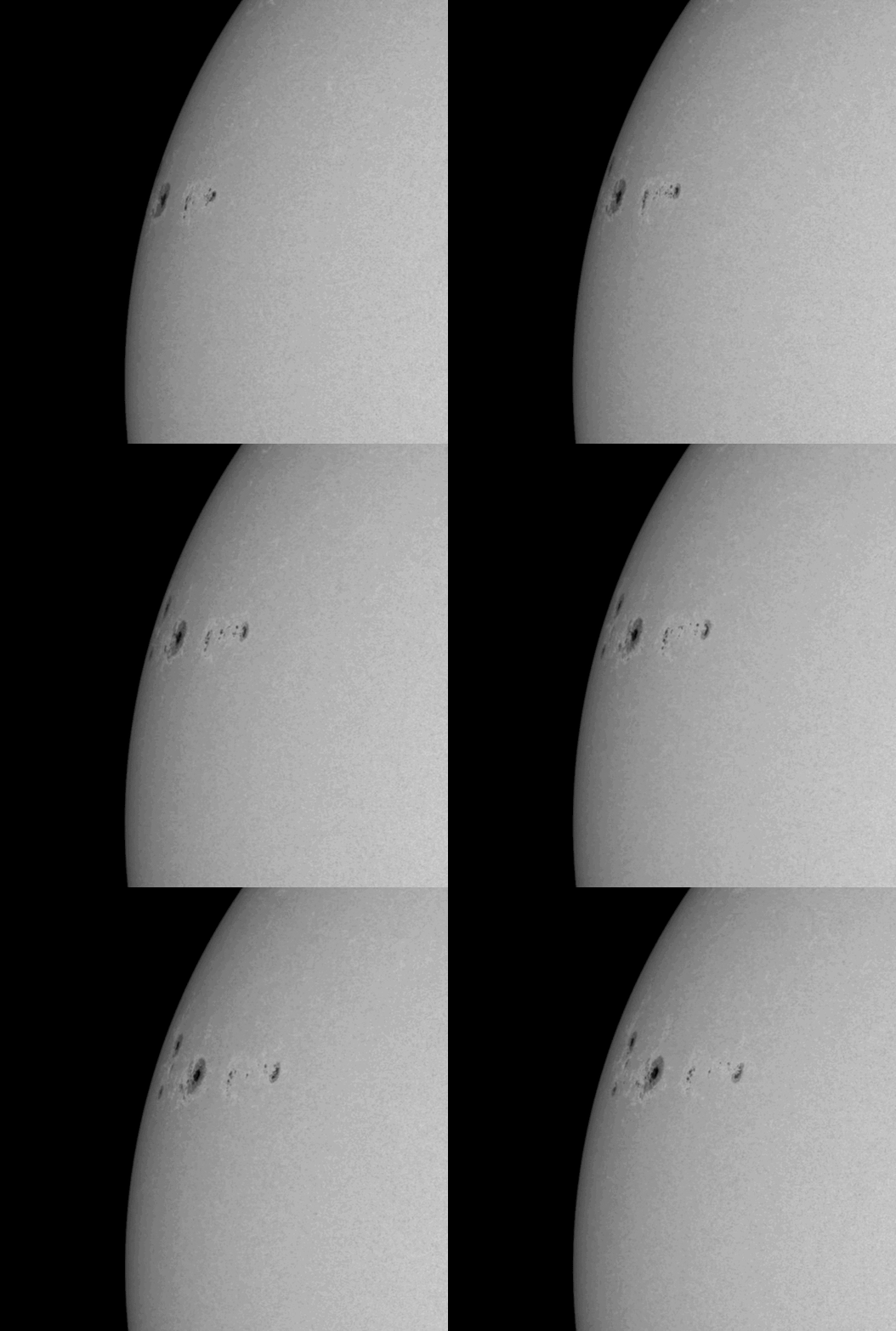
A new sunspot group or active, AR2975 is just becoming visible on the Earth-facing side of the sun. The region has produced at least 9 C-class flares in the last two days. As is rotates more into view, scientists will better determine its potential. The central part of the sunspots is at least as large as two Earths. There is a good chance this region will produce an M-flare. We will wait and see what might be coming our way.

A large coronal hole near the sun’s center is now in range to send some activity our way in the form of high-speed solar wind. When the stream reached Earth in about 3 days scientists anticipate elevated geomagnetic activity which means a good chance for aurora.

The Sun is showing a large equatorial coronal hole. Also a sunspot group emerging northeast. All this anticipate storms? Stay tuned. We will see.

To our readers and ES community
We invite all of our readers to send us your beautiful recent photos of the Auroras! We love receiving your photos. We thank our EarthSky Community for the photos you are sending and encourage you to send recent Aurora photos. if you are not in our ESC subscribe and send your photos. We will be selecting and posting the best photos received in these articles and on our Sun related articles.
Sun activity March 22, 2022
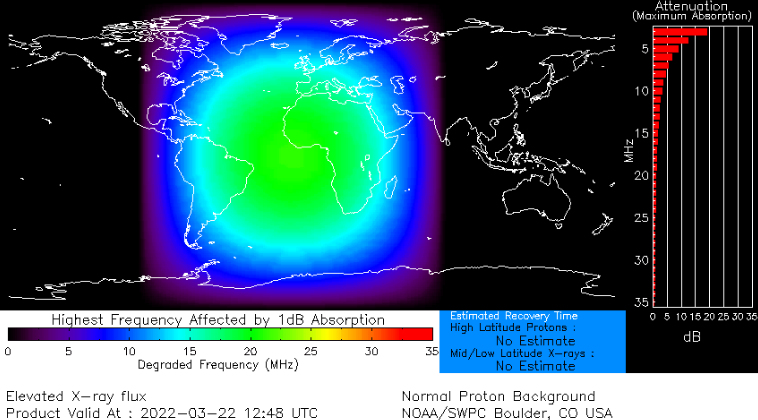
The Sun is showing activity. A new sunspot exploded March 22, 2022 producing C7-class solar flare. on this, Spaceweather.com reported “X-rays ionized the top of Earth’s atmosphere which, in turn, caused a brief shortwave radio blackout over the Atlantic Ocean. Frequencies affected were mostly below 15 MHz”.
PROMINENCE ERUPTION (AS FORECAST): A prominence on the NE limb of the Sun erupted. To get an idea of the massive scale of these eruptions I have included a image of the Earth to scale. Note the flows along the magnetic loops. This is too far east to significantly affect the Earth pic.twitter.com/CQVpZwpbrt
— Keith Strong (@drkstrong) March 23, 2022

Aurora and Equinox


More Auroras on March 21, 2022.
Another night, another gorgeous aurora display here in Tromsø, Norway ? pic.twitter.com/5UVMc8X1Rc
— Night Lights (@NightLights_AM) March 21, 2022
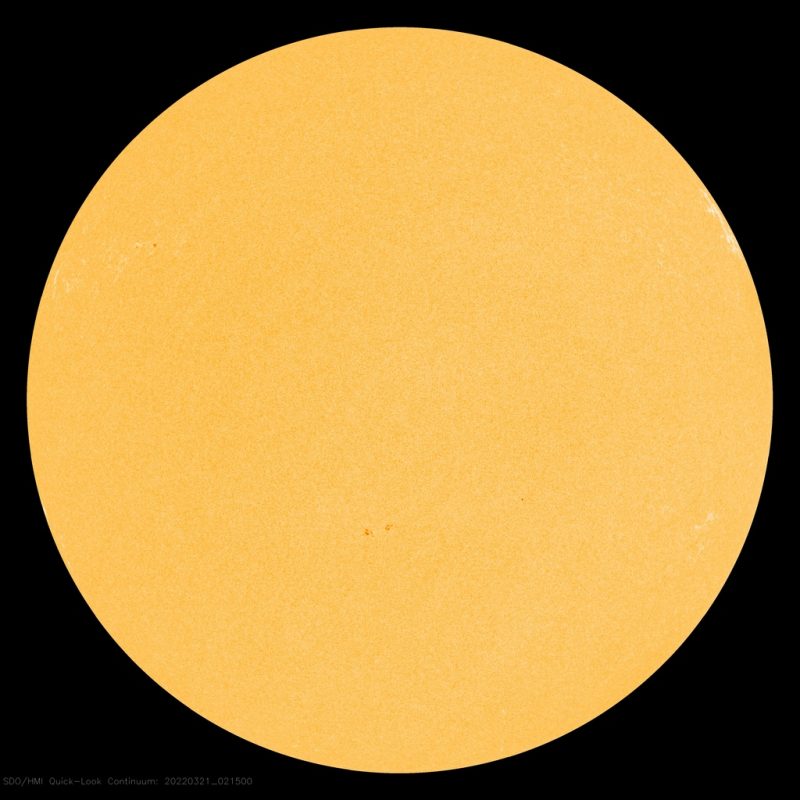


Another CME on Its Way to Earth
We continue with expectations of arrival of the CME occurred on March 16, 2022. This was predicted to start providing its effects by March 18 and continue thru March 20 but for now all the reports show low probability of Auroras for today March 18.
As reported yesterday, this CME came from a filament eruption and was expected to pass near Earth on March 17th. For now, it seems that Auroras Alerts move towards March 19.
We show data from various sources from Japan, Finland, Norway and all of them coincide in low activity.


CME Dries Out Cosmic Rays
CME occurred on March 13, 2022 besides provoking auroras all over, cleanse cosmic rays. Oulu Neutron Monitor in Finland detected a reduced cosmic radiation at the time the CME got to the Earth.Chart below shows the data.

Progression of the Solar Cycles
The Sun goes thru Solar Cycles. The chart below from Keith Strong Tweet, shows a portion of the SC 2017 thru 2022. The Sun shows minimum Solar Activity during 2017 thru 2020, being 2021 and 2022 the more active. Solar Minimum Activity was December 2019. Highest action this year 2022.

Happy people, gorgeous Auroras
Gorgeous auroras, happy people last night! ? pic.twitter.com/KLcJ1IBw2x
— Night Lights (@NightLights_AM) March 12, 2022
About the Sun
What happens when the Sun Activity produces Solar Wind waves that swipes the Earth? Among other things, they create Auroras. Something real complicate is explained in the easy way in this video by Physics & Astronomy Zone.
This is how an Auroras created pic.twitter.com/M1DfirCQCb
— Physics & Astronomy Zone (@zone_astronomy) March 16, 2022
MATERIAL BELOW THIS LINE HAS BEEN PUBLISHED (OR REVIEWED)
_________________________________________________________________


Auroras
Aurora Borealis on March 15, 2022 @ Kvaløya, Tromso, Norway. Via Marianne Bergil
Gorgeous #solarstorm launches are getting more common! This one might be partly Earth-directed! Early NASA model runs are indicating it could graze Earth late on March 19 or early March 20. Waiting for more coronagraph observations to refine predictions1 pic.twitter.com/UwGGw43IFd
— Dr. Tamitha Skov (@TamithaSkov) March 16, 2022
Notable solar activity seems to avoid AR 12965, for which some still seem to hold big hope. This movie shows a nice eruption from a smaller region AR 12967. It also kicked another filament to erupt on the northeast (upper left) limb. This eruption may not be Earth-bound. pic.twitter.com/opXIYWRugM
— Halo CME (@halocme) March 16, 2022

Standing on the beach… #auroraborealis #Iceland pic.twitter.com/HYsVyUZAq0
— Sophie Carr (@SophieCarrPhoto) March 15, 2022
NASAs Stereo

The post Sun activity DRAFT – place new text and images here. Updated April 2, 2022. first appeared on EarthSky.
from EarthSky https://ift.tt/MhFnLYe
Auroras in the Red Zone !
Heads up for the Aurora gazers! The Aurora Forecast show in the Red Zone for areas in Canada and Alaska. Beautiful displays must show. See the image below.
Sun activity
The sun has shown some activity during the day on April 2, 2022 with a couple of minor burst. The chart below show the X Ray Flux went up for a couple of time. See chart below.
Solar wind prefers the north
The European Space Agency, ESA, reported today that the Solar wind prefers the north. They said: “Energy from solar wind favours the north Scientists used data from @ES’s #SwarmMission to discover, unexpectedly, that the electromagnetic energy transported by space weather clearly prefers the north”.
See ESA Tweet
Energy from solar wind favours the north ??
?Scientists used data from
@ESA
’s #SwarmMission to discover, unexpectedly, that the electromagnetic energy transported by space weather clearly prefers the north.
Heads Up Aurora chasers !
Beautiful displays of aurora have seen all around. There are good chances that this will continue at high & mid latitudes in the next hours.
we began to see beautiful dances of the northern lights. Thanks for sharing @Vincent_Ledvina ??? https://t.co/5ODRH1MDUV
— Industrial Engineer Irene Quiroz (@nenecallas) March 31, 2022
The latest M9.6 flare from AR 12975. Similar to yesterday’s X1.3 flare. pic.twitter.com/jQVfdUKMcn
— Halo CME (@halocme) April 1, 2022
X AGAIN?! An Xflare from AR2975 again or at least an M9.6 (M10 = X1) is underway. Will it every end? ?? Seen in SDO 131 and GOES X-ray. There is also a radio blackout over the Americas! pic.twitter.com/RJATC3skT3
— Dr. C. Alex Young (@TheSunToday) March 31, 2022
UPDATE APRIL 1, 2022 up to here.
UPDATE MARCH 31, 2022.
Cannibal CME is here
This has been an exciting week with all that is happening on Solar activity. Sunspot regions 2978 and in particular 2975 produced a number of solar C-class and M-clas flares on March 28, 2022. Several space agencies appointed for a Cannibal CME coming our way and anticipated its arrival by March 31, 2022. G3-class geomagnetic storms, resulting on bright auroras on the north hemisphere. All that in addition of the X flare occurred on March 30 at 17:45 UTC.
The disturbances of March 28 is here affecting Earth’s atmosphere. NOSWE reported Kp-index as high as 7 while NOAA SWPC reports 4 in their Aurora Global Nowcast graph. The Kp-index describes the disturbance of the Earth’s magnetic field caused by the solar wind.It is measured at different locations around the globe, the data is registered every 3 hours. Index ranges from 0 to 9. This data is used to learn of the tendency of this phenomenon in a way to predict Auroras displays. North Dakota be prepared for the auroras ! Michigan could be in good shape to see the auroras too, reported mlive.com.
Aurora: How do they form. Aurora colors
Auroras occur when the charged particles from the sun strike atoms and molecules in Earth’s atmosphere, they excite those atoms, causing them to light up. This effect is similar to what occurs in a neon lamp. Electricity is used to excite the atoms of neon gas inside the tube. As a result it yields its brilliant colors.
The colors in the aurora were also a source of mystery throughout human history. But science says that different gases in Earth’s atmosphere give off different colors when they are excited.
NOSWE quotes in their article: Depending on the disturbance in Earth’s magnetosphere, the auroras can be very faint or very bright, ranging from invisible to the human eye to even illuminating the ground below in shades of green. Most often auroras are seen as green bands in the sky familiar from most photographs of northern lights, but other colors appear also. Sometimes there is red above the green, and sometimes there is purplish red below the green. The different colors are a result of the energy absorption by different chemical elements of the atmosphere at different altitudes. The most common color green and the occasionally visible red above the green are both coming from oxygen atoms. The purplish color below the green, however, is coming from nitrogen molecules. Because the auroras occur quite high in the atmosphere, at roughly 100km, the same auroral display can be seen over a large area on ground. On the other hand, unfortunately, because they are above the clouds, one needs a cloudless sky to enjoy the show.
To our readers and community
We invite you all to send us your beautiful recent photos of sunspots and auroras! We love receiving your photos. To those of you who’ve already posted a photo to our community, thank you!
Aurora displays started
Auroras sights started to show after the strong sun activity registered during this last weekend. Stronger displays of auroras are forecasted for March 31, 2002 but they started to come. Below an image via Explore live cam in Churchill, Manitoba, Canada as seen last night March 30, 2022. They are coming !!
Bottom line: Cannibal CME is here. Bright auroras may be seen all around in north latitudes.
UPDATE MARCH 30, 2022
The NOAA SWPC has modeled the two coronal mass ejections which were launched during yesterday’s M-class activity. The ENLIL model predicts a combined impact (second CME is faster than the first one) just after midnight UTC on 31 March. Moderate G2 storm conditions are possible. pic.twitter.com/dnon5fqQAS
— SpaceWeatherLive (@_SpaceWeather_) March 29, 2022
UPDATE MARCH 29, 2022
BELOW HERE MARCH 25, 2022.
A large and active sunspot group rotating into view
A new sunspot group or active, AR2975 is just becoming visible on the Earth-facing side of the sun. The region has produced at least 9 C-class flares in the last two days. As is rotates more into view, scientists will better determine its potential. The central part of the sunspots is at least as large as two Earths. There is a good chance this region will produce an M-flare. We will wait and see what might be coming our way.
A large coronal hole near the sun’s center is now in range to send some activity our way in the form of high-speed solar wind. When the stream reached Earth in about 3 days scientists anticipate elevated geomagnetic activity which means a good chance for aurora.
The Sun is showing a large equatorial coronal hole. Also a sunspot group emerging northeast. All this anticipate storms? Stay tuned. We will see.
To our readers and ES community
We invite all of our readers to send us your beautiful recent photos of the Auroras! We love receiving your photos. We thank our EarthSky Community for the photos you are sending and encourage you to send recent Aurora photos. if you are not in our ESC subscribe and send your photos. We will be selecting and posting the best photos received in these articles and on our Sun related articles.
Sun activity March 22, 2022
The Sun is showing activity. A new sunspot exploded March 22, 2022 producing C7-class solar flare. on this, Spaceweather.com reported “X-rays ionized the top of Earth’s atmosphere which, in turn, caused a brief shortwave radio blackout over the Atlantic Ocean. Frequencies affected were mostly below 15 MHz”.
PROMINENCE ERUPTION (AS FORECAST): A prominence on the NE limb of the Sun erupted. To get an idea of the massive scale of these eruptions I have included a image of the Earth to scale. Note the flows along the magnetic loops. This is too far east to significantly affect the Earth pic.twitter.com/CQVpZwpbrt
— Keith Strong (@drkstrong) March 23, 2022
Aurora and Equinox
More Auroras on March 21, 2022.
Another night, another gorgeous aurora display here in Tromsø, Norway ? pic.twitter.com/5UVMc8X1Rc
— Night Lights (@NightLights_AM) March 21, 2022
Another CME on Its Way to Earth
We continue with expectations of arrival of the CME occurred on March 16, 2022. This was predicted to start providing its effects by March 18 and continue thru March 20 but for now all the reports show low probability of Auroras for today March 18.
As reported yesterday, this CME came from a filament eruption and was expected to pass near Earth on March 17th. For now, it seems that Auroras Alerts move towards March 19.
We show data from various sources from Japan, Finland, Norway and all of them coincide in low activity.
CME Dries Out Cosmic Rays
CME occurred on March 13, 2022 besides provoking auroras all over, cleanse cosmic rays. Oulu Neutron Monitor in Finland detected a reduced cosmic radiation at the time the CME got to the Earth.Chart below shows the data.
Progression of the Solar Cycles
The Sun goes thru Solar Cycles. The chart below from Keith Strong Tweet, shows a portion of the SC 2017 thru 2022. The Sun shows minimum Solar Activity during 2017 thru 2020, being 2021 and 2022 the more active. Solar Minimum Activity was December 2019. Highest action this year 2022.
Happy people, gorgeous Auroras
Gorgeous auroras, happy people last night! ? pic.twitter.com/KLcJ1IBw2x
— Night Lights (@NightLights_AM) March 12, 2022
About the Sun
What happens when the Sun Activity produces Solar Wind waves that swipes the Earth? Among other things, they create Auroras. Something real complicate is explained in the easy way in this video by Physics & Astronomy Zone.
This is how an Auroras created pic.twitter.com/M1DfirCQCb
— Physics & Astronomy Zone (@zone_astronomy) March 16, 2022
MATERIAL BELOW THIS LINE HAS BEEN PUBLISHED (OR REVIEWED)
_________________________________________________________________
Auroras
Aurora Borealis on March 15, 2022 @ Kvaløya, Tromso, Norway. Via Marianne Bergil
Gorgeous #solarstorm launches are getting more common! This one might be partly Earth-directed! Early NASA model runs are indicating it could graze Earth late on March 19 or early March 20. Waiting for more coronagraph observations to refine predictions1 pic.twitter.com/UwGGw43IFd
— Dr. Tamitha Skov (@TamithaSkov) March 16, 2022
Notable solar activity seems to avoid AR 12965, for which some still seem to hold big hope. This movie shows a nice eruption from a smaller region AR 12967. It also kicked another filament to erupt on the northeast (upper left) limb. This eruption may not be Earth-bound. pic.twitter.com/opXIYWRugM
— Halo CME (@halocme) March 16, 2022
Standing on the beach… #auroraborealis #Iceland pic.twitter.com/HYsVyUZAq0
— Sophie Carr (@SophieCarrPhoto) March 15, 2022
NASAs Stereo
The post Sun activity DRAFT – place new text and images here. Updated April 2, 2022. first appeared on EarthSky.
from EarthSky https://ift.tt/MhFnLYe

Aucun commentaire:
Enregistrer un commentaire