
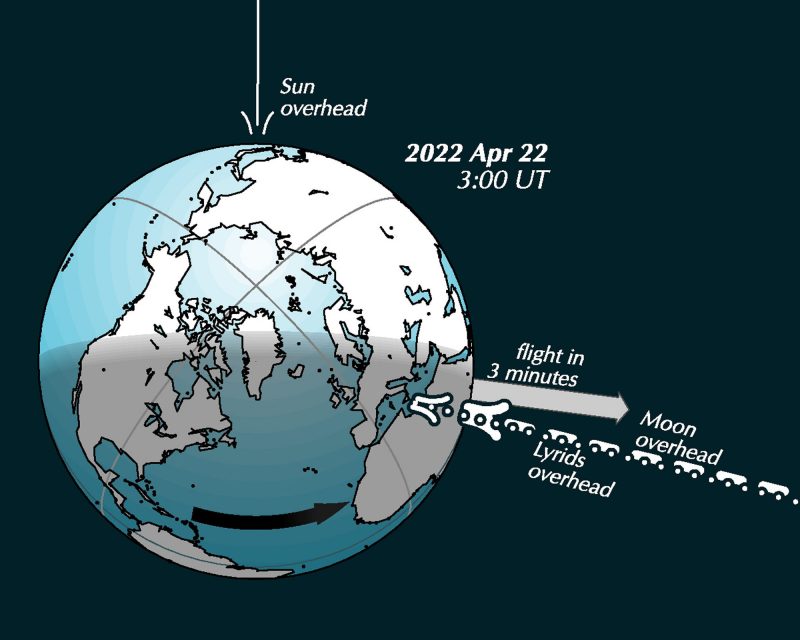
The annual Lyrid meteor shower always brings an end to the meteor drought that occurs each year between January and mid-April.
When to watch: Watch late evening until moonrise on the night of April 21-22, 2022. **The predicted peak is 4 UTC on April 22. And peak of the Lyrids is narrow. But there’s a bright moon in the sky on the peak morning. Note that it’s a waning moon. So – on the night after the peak (late evening April 22 to dawn April 23) – there will be less moon, and so you might try that night, too.
Nearest moon phase: In 2022, last quarter moon falls at 11:56 UTC on April 23.
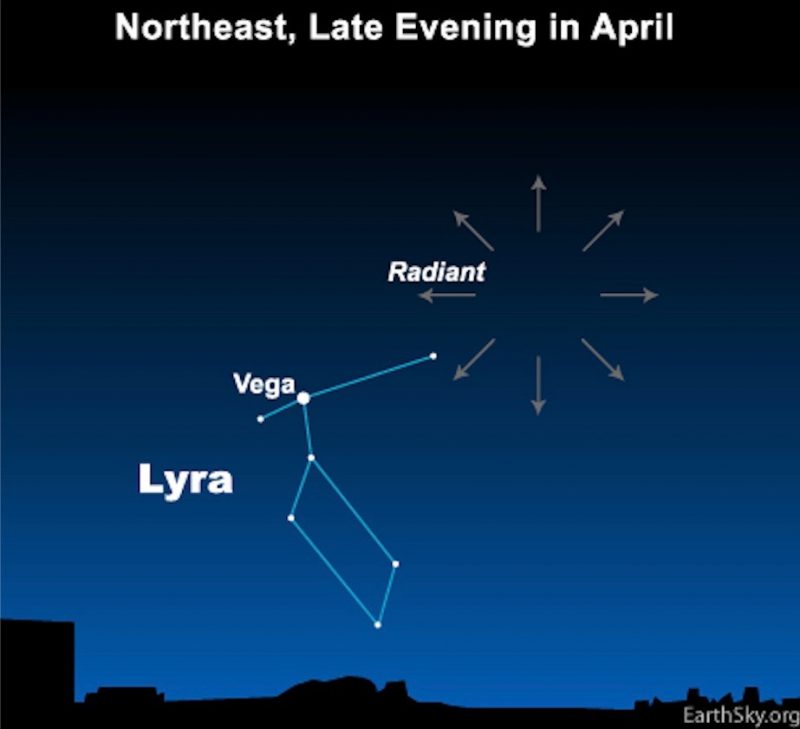
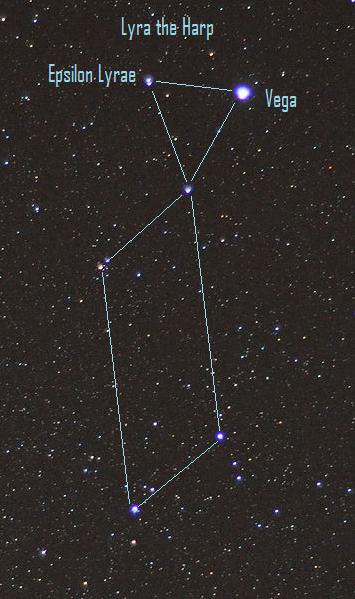
Radiant: Rises before midnight, highest in the sky at dawn. See chart below.
Duration of shower: April 15 to April 29.
Expected meteors at peak, under ideal conditions: In a dark sky with no moon, you might see 10 to 15 Lyrids per hour.
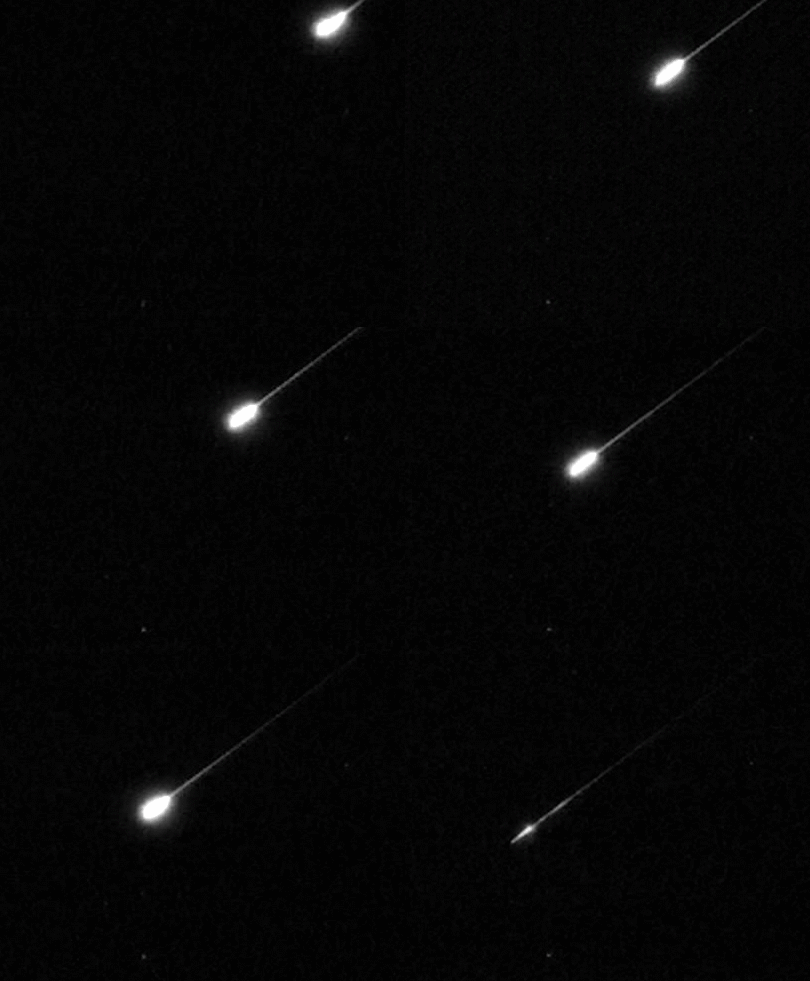
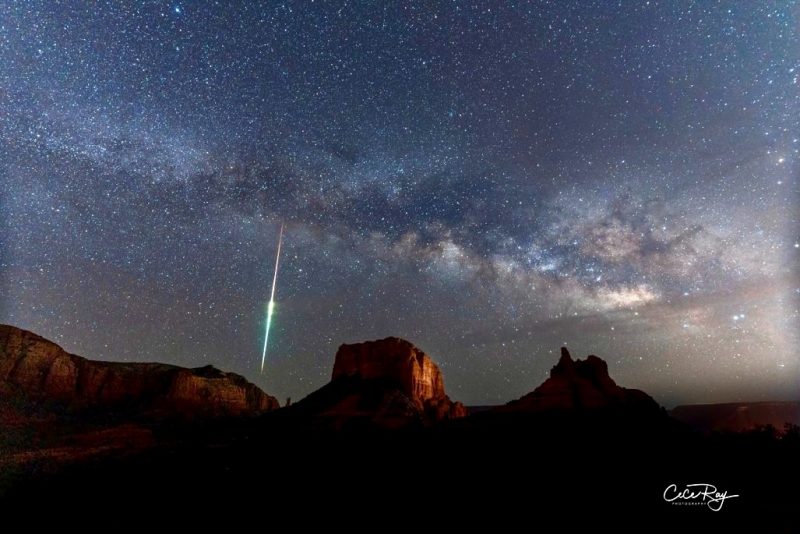
Note: The Lyrids are known for uncommon surges that can sometimes bring rates of up to 100 per hour! Read more about Lyrid outbursts below. About a quarter of Lyrid meteors leave persistent trains. A meteor train is an ionized gas trail that glows for a few seconds after the meteor has passed.
Note for Southern Hemisphere: Because this shower’s radiant point is so far north on the sky’s dome, the star Vega rises only in the hours before dawn in your sky. It’ll be lower in the sky for you than for us farther north on Earth’s globe, when dawn breaks. That’s why the Southern Hemisphere sees fewer Lyrid meteors. Still, you might see some!
Report a fireball (very bright meteor) to the American Meteor Society: it’s fun and easy!
The 2022 lunar calendars are still available. Order yours before they’re gone!
The Lyrids’ parent comet
From Don Machholz, who has discovered 12 comets …
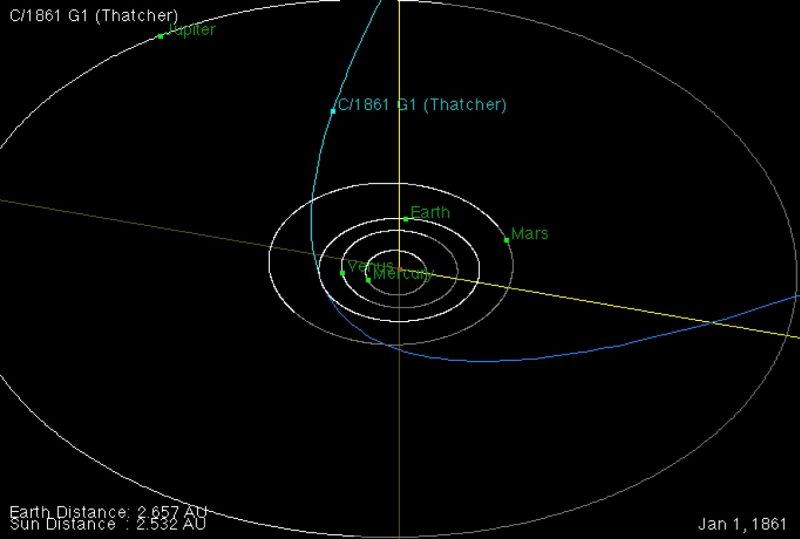
Most meteor showers are caused by debris from a passing comet. For the Lyrids, the comet is named Comet Thatcher. Maybe you’re wondering:
Have I ever observed Comet Thatcher?
But wonder no more. You haven’t. And your children won’t see it either. The comet was found in 1861 and takes 417 years to go around the sun once. Its path brings it within the Earth’s orbit, then it goes really far away. How far? It goes to a distance of 110 astronomical units (AU). That’s 110 times farther from the sun than we are.
In 2022, Comet Thatcher is 107 AU away, traveling at a turtle’s pace. It’s located in our sky in the direction of the constellation Andromeda. In another 45 years, the comet will reach its farthest point from the sun and begin its return trip.
The Lyrid meteor shower – spawned by this comet – seems to outburst or produce an unexpectedly large number of meteors, every 60 years. The next Lyrid outburst is due in 2042. The outbursts happen because of the planets’ reshaping the long trail of comet debris left behind by Comet Thatcher in its long orbit. This debris is what intercepts Earth’s orbit yearly, to create the meteor shower.
Discovery of Comet Thatcher
Alfred E. Thatcher from New York City discovered this comet – now officially C/1861 G1 (Thatcher) – on April 5, 1861. At that time the comet was in the direction of our sky’s north polar region, toward what we see as the constellation Draco. Alfred Thatcher was using a 4.5-inch-diameter (11cm) refracting telescope, magnifying 30 times. The comet was shining at magnitude 7.5, fainter than the unaided eye can see. But over the next few weeks, as the comet approached both the sun and the Earth, it brightened considerably. It became visible to the eye and remained so until it disappeared into the evening twilight in early June 1861. Observers in the Southern Hemisphere picked it up in late July and followed the comet for the next five weeks, until it became too faint to see from anywhere on Earth.
Comet Thatcher will be back in the year 2278. But its debris trail, the Lyrid meteor shower, will be here every April.
How to find the Lyrids’ radiant point
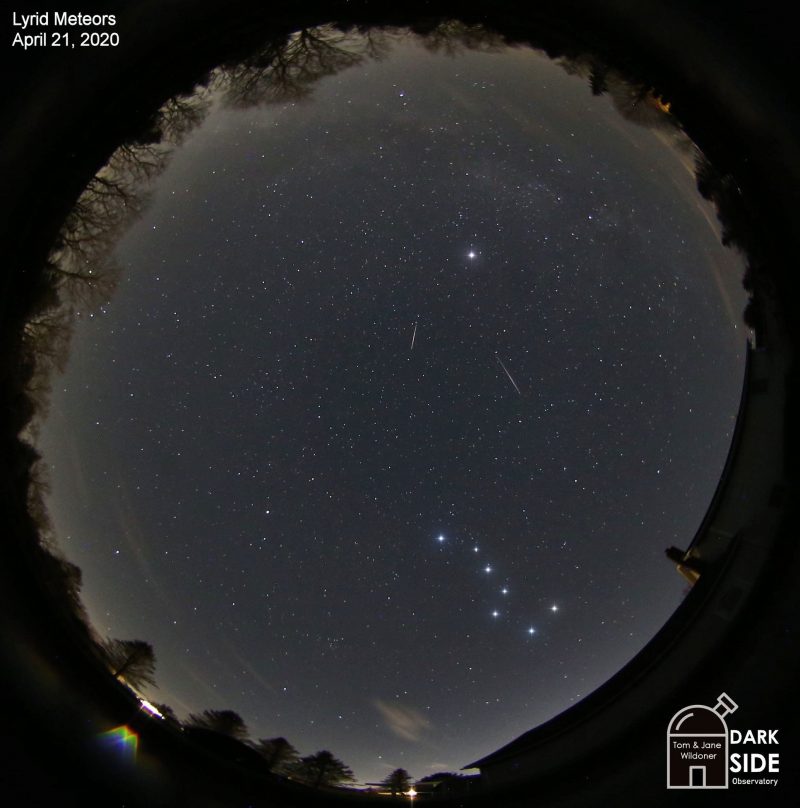
From the Northern Hemisphere. the bright star Vega in the constellation Lyra – near the radiant point for the Lyrid shower – rises above your local horizon, in the northeast, around 9 to 10 p.m. local time in April. That’s the time on your clock, from mid-latitudes, from the northern part of the globe. Vega climbs upward through the rest of the night. By midnight, Vega is high enough in the sky that meteors radiating from that direction streak across your sky. Just before dawn, Vega and the radiant point shine high overhead, and the meteors will be raining down from the top of the Northern Hemisphere sky.
From the far southerly Southern Hemisphere. Vega – and the Lyrid meteors’ radiant point – don’t rise until the hours before dawn from the southern mid-latitudes. From there, the radiant point never gets very high in the sky. Many of the meteors that come from this point head northward, below your horizon if you’re in the Southern Hemisphere. Thus, you have a narrower window for watching this particular, far-northern shower. Still, you might see some meteors!
The higher Vega appears in your sky, the more meteors you’re likely to see.
Lyrid meteor shower in history
The Lyrid meteor shower has the distinction of being among the oldest of known meteor showers. Records of this shower go back for some 2,700 years. The ancient Chinese seem to have observed the Lyrid meteors falling like rain in the year 687 BCE. That time period in ancient China, by the way, corresponds with what is called the Spring and Autumn Period (about 771 to 476 BCE), which tradition associates with the Chinese teacher and philosopher Confucius, one of the first to espouse the principle:
Do not do to others what you do not want done to yourself.

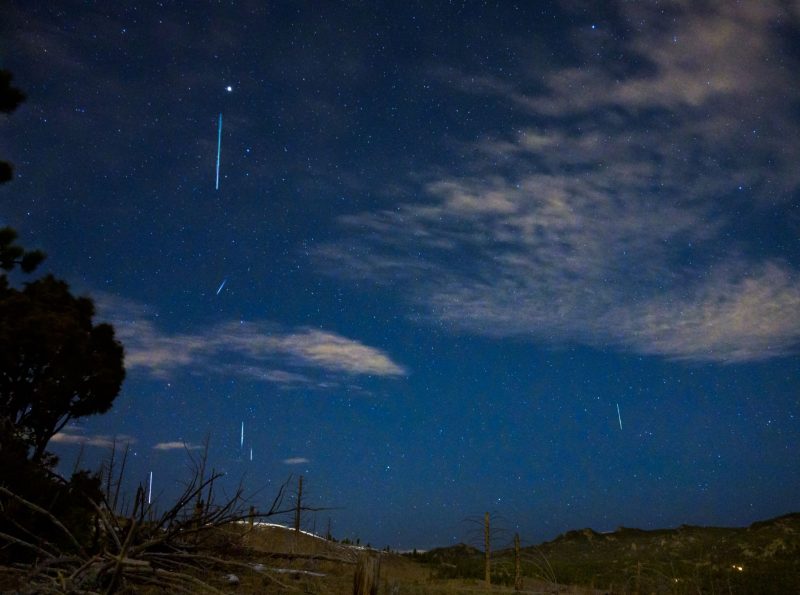
Lyrid meteor photos from the EarthSky community
Submit your night sky photos to EarthSky here
Bottom line: The Lyrid meteor shower offers 10 to 15 meteors per hour at its peak on a moonless night. In 2022, the last quarter moon interferes. Best time to watch: late evening until moonrise, nights of April 21-22 and 22-23.
**Predicted peak times and dates for 2022 meteor showers are from the American Meteor Society. Note that meteor shower peak times can vary.
Visit EarthSky’s meteor shower guide
The post 2022 Lyrid meteor shower: All you need to know first appeared on EarthSky.
from EarthSky https://ift.tt/8xH15SQ
The annual Lyrid meteor shower always brings an end to the meteor drought that occurs each year between January and mid-April.
When to watch: Watch late evening until moonrise on the night of April 21-22, 2022. **The predicted peak is 4 UTC on April 22. And peak of the Lyrids is narrow. But there’s a bright moon in the sky on the peak morning. Note that it’s a waning moon. So – on the night after the peak (late evening April 22 to dawn April 23) – there will be less moon, and so you might try that night, too.
Nearest moon phase: In 2022, last quarter moon falls at 11:56 UTC on April 23.
Radiant: Rises before midnight, highest in the sky at dawn. See chart below.
Duration of shower: April 15 to April 29.
Expected meteors at peak, under ideal conditions: In a dark sky with no moon, you might see 10 to 15 Lyrids per hour.
Note: The Lyrids are known for uncommon surges that can sometimes bring rates of up to 100 per hour! Read more about Lyrid outbursts below. About a quarter of Lyrid meteors leave persistent trains. A meteor train is an ionized gas trail that glows for a few seconds after the meteor has passed.
Note for Southern Hemisphere: Because this shower’s radiant point is so far north on the sky’s dome, the star Vega rises only in the hours before dawn in your sky. It’ll be lower in the sky for you than for us farther north on Earth’s globe, when dawn breaks. That’s why the Southern Hemisphere sees fewer Lyrid meteors. Still, you might see some!
Report a fireball (very bright meteor) to the American Meteor Society: it’s fun and easy!
The 2022 lunar calendars are still available. Order yours before they’re gone!
The Lyrids’ parent comet
From Don Machholz, who has discovered 12 comets …
Most meteor showers are caused by debris from a passing comet. For the Lyrids, the comet is named Comet Thatcher. Maybe you’re wondering:
Have I ever observed Comet Thatcher?
But wonder no more. You haven’t. And your children won’t see it either. The comet was found in 1861 and takes 417 years to go around the sun once. Its path brings it within the Earth’s orbit, then it goes really far away. How far? It goes to a distance of 110 astronomical units (AU). That’s 110 times farther from the sun than we are.
In 2022, Comet Thatcher is 107 AU away, traveling at a turtle’s pace. It’s located in our sky in the direction of the constellation Andromeda. In another 45 years, the comet will reach its farthest point from the sun and begin its return trip.
The Lyrid meteor shower – spawned by this comet – seems to outburst or produce an unexpectedly large number of meteors, every 60 years. The next Lyrid outburst is due in 2042. The outbursts happen because of the planets’ reshaping the long trail of comet debris left behind by Comet Thatcher in its long orbit. This debris is what intercepts Earth’s orbit yearly, to create the meteor shower.
Discovery of Comet Thatcher
Alfred E. Thatcher from New York City discovered this comet – now officially C/1861 G1 (Thatcher) – on April 5, 1861. At that time the comet was in the direction of our sky’s north polar region, toward what we see as the constellation Draco. Alfred Thatcher was using a 4.5-inch-diameter (11cm) refracting telescope, magnifying 30 times. The comet was shining at magnitude 7.5, fainter than the unaided eye can see. But over the next few weeks, as the comet approached both the sun and the Earth, it brightened considerably. It became visible to the eye and remained so until it disappeared into the evening twilight in early June 1861. Observers in the Southern Hemisphere picked it up in late July and followed the comet for the next five weeks, until it became too faint to see from anywhere on Earth.
Comet Thatcher will be back in the year 2278. But its debris trail, the Lyrid meteor shower, will be here every April.
How to find the Lyrids’ radiant point
From the Northern Hemisphere. the bright star Vega in the constellation Lyra – near the radiant point for the Lyrid shower – rises above your local horizon, in the northeast, around 9 to 10 p.m. local time in April. That’s the time on your clock, from mid-latitudes, from the northern part of the globe. Vega climbs upward through the rest of the night. By midnight, Vega is high enough in the sky that meteors radiating from that direction streak across your sky. Just before dawn, Vega and the radiant point shine high overhead, and the meteors will be raining down from the top of the Northern Hemisphere sky.
From the far southerly Southern Hemisphere. Vega – and the Lyrid meteors’ radiant point – don’t rise until the hours before dawn from the southern mid-latitudes. From there, the radiant point never gets very high in the sky. Many of the meteors that come from this point head northward, below your horizon if you’re in the Southern Hemisphere. Thus, you have a narrower window for watching this particular, far-northern shower. Still, you might see some meteors!
The higher Vega appears in your sky, the more meteors you’re likely to see.
Lyrid meteor shower in history
The Lyrid meteor shower has the distinction of being among the oldest of known meteor showers. Records of this shower go back for some 2,700 years. The ancient Chinese seem to have observed the Lyrid meteors falling like rain in the year 687 BCE. That time period in ancient China, by the way, corresponds with what is called the Spring and Autumn Period (about 771 to 476 BCE), which tradition associates with the Chinese teacher and philosopher Confucius, one of the first to espouse the principle:
Do not do to others what you do not want done to yourself.
Lyrid meteor photos from the EarthSky community
Submit your night sky photos to EarthSky here
Bottom line: The Lyrid meteor shower offers 10 to 15 meteors per hour at its peak on a moonless night. In 2022, the last quarter moon interferes. Best time to watch: late evening until moonrise, nights of April 21-22 and 22-23.
**Predicted peak times and dates for 2022 meteor showers are from the American Meteor Society. Note that meteor shower peak times can vary.
Visit EarthSky’s meteor shower guide
The post 2022 Lyrid meteor shower: All you need to know first appeared on EarthSky.
from EarthSky https://ift.tt/8xH15SQ

Aucun commentaire:
Enregistrer un commentaire