

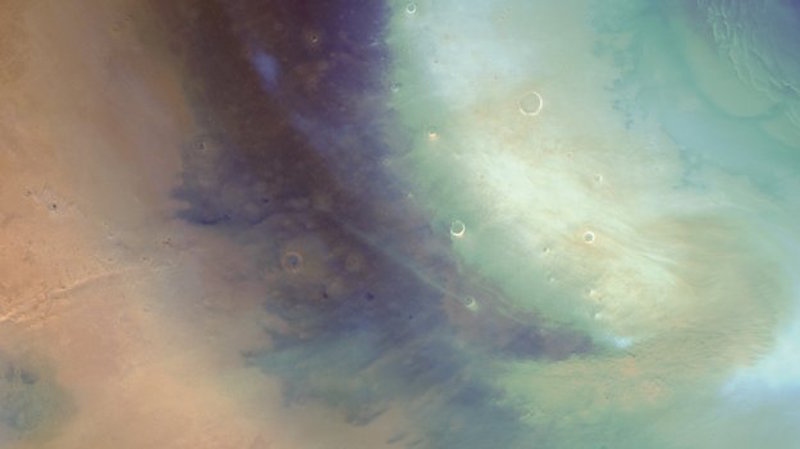
In late May 2019, a spiral-shaped dust storm at the north polar ice cap of Mars was observed by several instruments onboard Mars Express. A Mars Express camera captured this image on May 26. The dust storm’s brown color contrasts with the white ice of the north polar ice cap below. The image covers area of about 1,200 x 3,000 miles (2,000 x 5,000 km). See a larger image. Image via ESA.
The European Space Agency’s (ESA) Mars Express spacecraft has been monitoring dust storms brewing at Mars’ north pole over the last month, and watching as the storms disperse towards the equator. The spacecraft observed at least eight different storms at the edge of the ice cap between May 22 and June 10, 2019, which formed and dissipated very quickly, between one and three days.
It’s currently spring in the northern hemisphere of Mars, and water-ice clouds and small dust-lifting events are frequently observed along the edge of the seasonally retreating ice cap. Local and regional storms lasting for a few days or weeks and confined to a small area are common on Mars, but at their most severe can engulf the entire planet, as experienced last year in a global storm that circled the planet for many months.
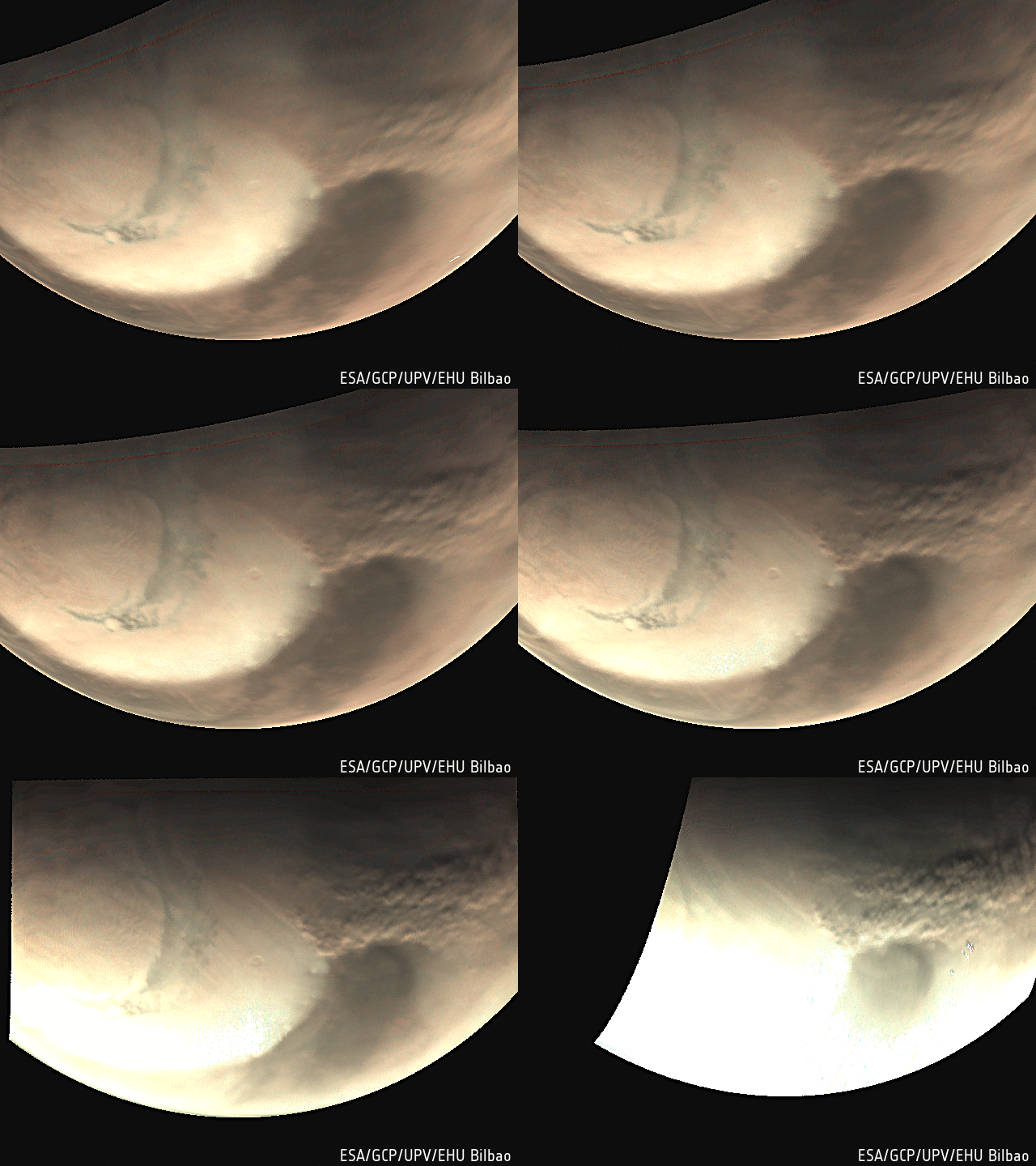
Mars dust storm in motion. This animated sequence was compiled from images of a different storm captured by the VMC over a period of 70 minutes on 29 May 29, 2019. This particular storm started on May 28 and continued to around June 1, moving towards the equator during that time. Image via ESA/GCP/UPV/EHU Bilbao.
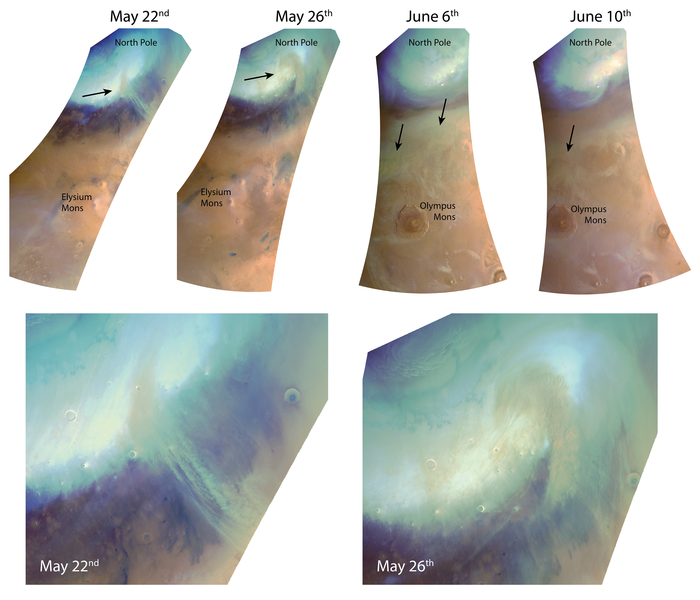
This montage of images shows 3 different storms developing on May 22, 2019, on May 26, and between June 6 and 10. In the latter case, the cameras watched the storm evolve for several days as it moved in an equator-ward direction. At the same time, wispy patches of light-coloured clouds can be seen at the outer margin of the polar cap and also several thousand kilometres away, close to the volcanoes Elysium Mons and Olympus Mons. Image via ESA/DLR/FU Berlin
Both Mars Express and NASA’s Mars Reconnaissance Orbiter observed that when the dust storms reached the large volcanoes Elysium Mons and Olympus Mons, orographic clouds – water ice clouds driven by the influence of the volcano’s leeward slope on the air flow – that had been developing, started to evaporate as a result of the air mass being heated by the influx of dust.
These regional dust storms only last a few days. The planet’s circulation moves the elevated dust spreads it out into a thin haze in the lower atmosphere. Some traces of dust and clouds remained in the volcanic province into mid-June.
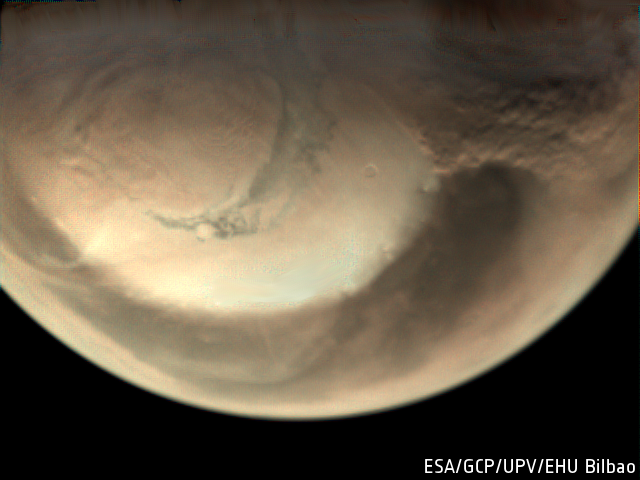
A dust storm underway at the edge of the north polar ice cap of Mars. The image was taken by the Mars Express Visual Monitoring Camera on 29 May 2019. Image via ESA/GCP/UPV/EHU Bilbao
Look out for dust storms in the daily images provided by the ESA’s Mars webcam, on Flickr and Twitter.
Bottom line: Images of dust storms at the Mars north pole, take by ESA’s Mars Express.
from EarthSky https://ift.tt/2Ju5RvH
In late May 2019, a spiral-shaped dust storm at the north polar ice cap of Mars was observed by several instruments onboard Mars Express. A Mars Express camera captured this image on May 26. The dust storm’s brown color contrasts with the white ice of the north polar ice cap below. The image covers area of about 1,200 x 3,000 miles (2,000 x 5,000 km). See a larger image. Image via ESA.
The European Space Agency’s (ESA) Mars Express spacecraft has been monitoring dust storms brewing at Mars’ north pole over the last month, and watching as the storms disperse towards the equator. The spacecraft observed at least eight different storms at the edge of the ice cap between May 22 and June 10, 2019, which formed and dissipated very quickly, between one and three days.
It’s currently spring in the northern hemisphere of Mars, and water-ice clouds and small dust-lifting events are frequently observed along the edge of the seasonally retreating ice cap. Local and regional storms lasting for a few days or weeks and confined to a small area are common on Mars, but at their most severe can engulf the entire planet, as experienced last year in a global storm that circled the planet for many months.
Mars dust storm in motion. This animated sequence was compiled from images of a different storm captured by the VMC over a period of 70 minutes on 29 May 29, 2019. This particular storm started on May 28 and continued to around June 1, moving towards the equator during that time. Image via ESA/GCP/UPV/EHU Bilbao.
This montage of images shows 3 different storms developing on May 22, 2019, on May 26, and between June 6 and 10. In the latter case, the cameras watched the storm evolve for several days as it moved in an equator-ward direction. At the same time, wispy patches of light-coloured clouds can be seen at the outer margin of the polar cap and also several thousand kilometres away, close to the volcanoes Elysium Mons and Olympus Mons. Image via ESA/DLR/FU Berlin
Both Mars Express and NASA’s Mars Reconnaissance Orbiter observed that when the dust storms reached the large volcanoes Elysium Mons and Olympus Mons, orographic clouds – water ice clouds driven by the influence of the volcano’s leeward slope on the air flow – that had been developing, started to evaporate as a result of the air mass being heated by the influx of dust.
These regional dust storms only last a few days. The planet’s circulation moves the elevated dust spreads it out into a thin haze in the lower atmosphere. Some traces of dust and clouds remained in the volcanic province into mid-June.
A dust storm underway at the edge of the north polar ice cap of Mars. The image was taken by the Mars Express Visual Monitoring Camera on 29 May 2019. Image via ESA/GCP/UPV/EHU Bilbao
Look out for dust storms in the daily images provided by the ESA’s Mars webcam, on Flickr and Twitter.
Bottom line: Images of dust storms at the Mars north pole, take by ESA’s Mars Express.
from EarthSky https://ift.tt/2Ju5RvH

Aucun commentaire:
Enregistrer un commentaire