
Earth’s magnetic field has a weak spot that’s growing
Earth’s magnetic field is like a giant protective bubble around our planet. It’s generated by the churning of molten metal in Earth’s liquid outer core. And it extends from the core out into space, where it fends off charged particles from the solar wind. But the strength of the magnetic field is not the same everywhere on Earth.
For the past 11 years, the European Space Agency’s Swarm satellite constellation has been tracking shifts in Earth’s magnetic field. Swarm consists of three identical satellites that measure magnetic signals from all over Earth, including its interior and the layers of its atmosphere.
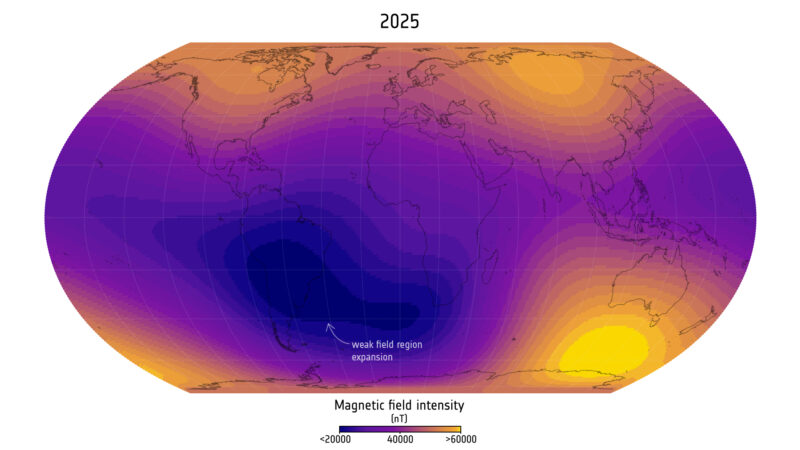
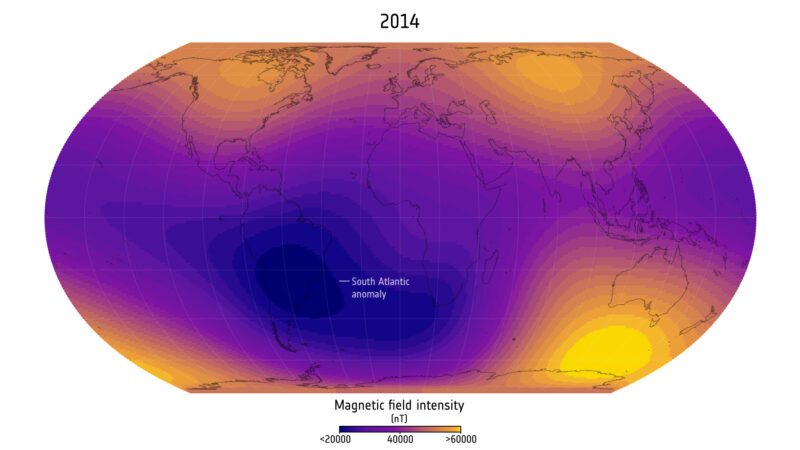
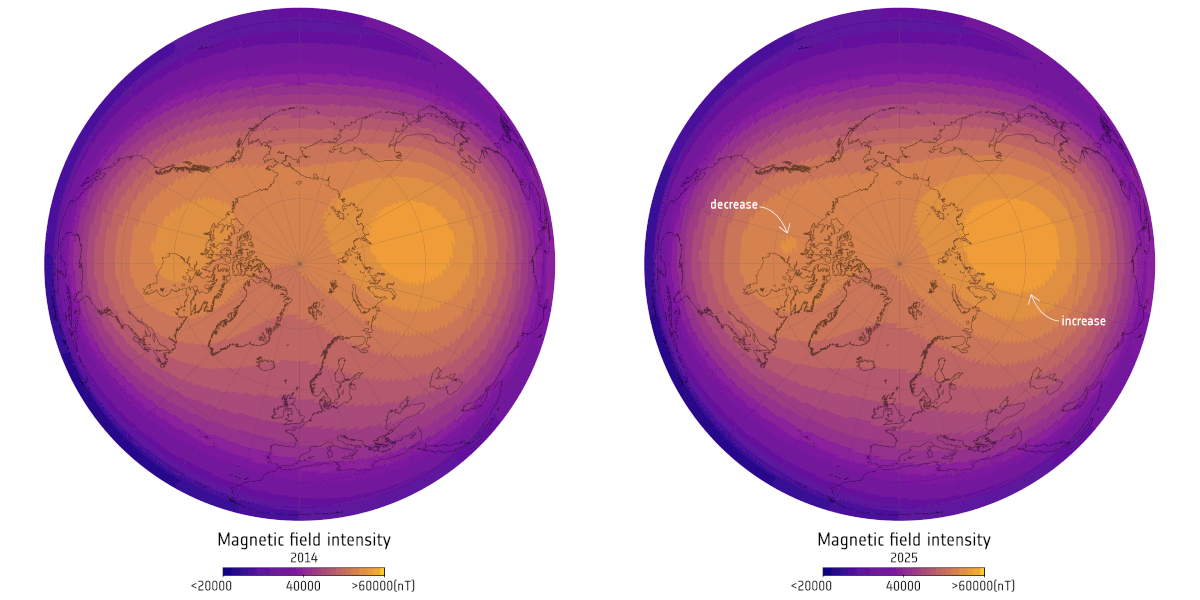
ESA said on October 13, 2025, that a weak spot over the South Atlantic and South America – which scientists call the South Atlantic Anomaly – is growing and stretching toward the tip of Africa. Meanwhile, a strong spot over Siberia is increasing.
Compare the weak spot (in purple) in the map above from 2025 to the weak spot over the South Atlantic and South America from 2014 (below).
The scientists published their study in the November 2025 issue of the peer-reviewed journal Physics of the Earth and Planetary Interiors.
South Atlantic Anomaly
Scientists have known about the weak spot in Earth’s magnetic field – the South Atlantic Anomaly – since about 1958. That was when satellites first began measuring space radiation. This was at the dawn of the space age. Today, we have thousands of satellites in space, along with humans orbiting in two space stations. They are all vulnerable to the increased radiation when passing over the South Atlantic Anomaly. Fortunately, these weakened spots do not pose a danger to life on Earth’s surface.
Increased radiation on satellites can disrupt their ability to function. More buffeting from the solar wind can reduce their lifespans. And astronauts can receive higher dosages of radiation than normal while in these weakened regions.
The past 11 years have seen the weak spot enlarging and changing. Lead author Chris Finlay of the Technical University of Denmark said:
The South Atlantic Anomaly is not just a single block. It’s changing differently toward Africa than it is near South America. There’s something special happening in this region that is causing the field to weaken in a more intense way.
In addition to the weak spot weakening even more, there are areas where the magnetic field is stronger than average. One of these areas, over Siberia, has become even stronger. But another strong area, over Canada, has weakened somewhat. The strong area around Siberia has grown by about the size of Greenland, while the Canadian strong region has shrunk by about the size of India.
What is causing these changes?
Where Earth’s liquid outer core meets the rocky mantle, the magnetic field can have variations in strength. And there are areas with reversed magnetic polarity that scientists call reverse flux patches. These areas are linked to the weakened region. Finlay said:
Normally we’d expect to see magnetic field lines coming out of the core in the southern hemisphere. But beneath the South Atlantic Anomaly we see unexpected areas where the magnetic field, instead of coming out of the core, goes back into the core. Thanks to the Swarm data we can see one of these areas moving westward over Africa, which contributes to the weakening of the South Atlantic Anomaly in this region.
Researchers associate the strengthening of the region over Siberia with the northern magnetic pole moving toward Siberia in recent years.
More on how this impacts us
EarthSky reached out to lead author Chris Finlay to ask more about how this might impact us on Earth and in space. Finlay answered:
The changes we are observing in Earth’s magnetic field (in particular the slow increase in the area of the South Atlantic weak field region) is primarily of importance to our low-Earth-orbit satellite infrastructure. Satellites in low-Earth-orbit experience more charged particles when they fly through this weak field region.
Changes in Earth’s magnetic field have less direct impact on humans, because the Earth’s thick atmosphere absorbs the majority of these charged particles, so they don’t reach the Earth’s surface. The main implication for us is in terms of our navigation systems. Many of these (e.g. in our smart phones) use Earth’s magnetic field for orientation information. The models of Earth’s magnetic field used in these systems need to be regularly updated, typically about once every five years, to account for the ongoing changes in the field geometry.
It is important to remember that we are observing just the latest part of an ongoing slow change in the Earth’s magnetic field. The growth of the weak field anomaly in the South Atlantic has been taking place for many decades. … There is nothing for people to be alarmed about here; this gradual change has been taking place at a similar rate for many decades. Now, thanks to the Swarm satellite observations, we just have a much better picture of how this is taking place.
Bottom line: Earth’s magnetic field has a growing weak spot … but it’s nothing to be alarmed about. Read more about it here.
Source: Core field changes from eleven years of Swarm satellite observations
The post Earth’s magnetic field has a weak spot that’s growing first appeared on EarthSky.
from EarthSky https://ift.tt/CEmH4gV
Aucun commentaire:
Enregistrer un commentaire