
Planet-observing is easy and fun
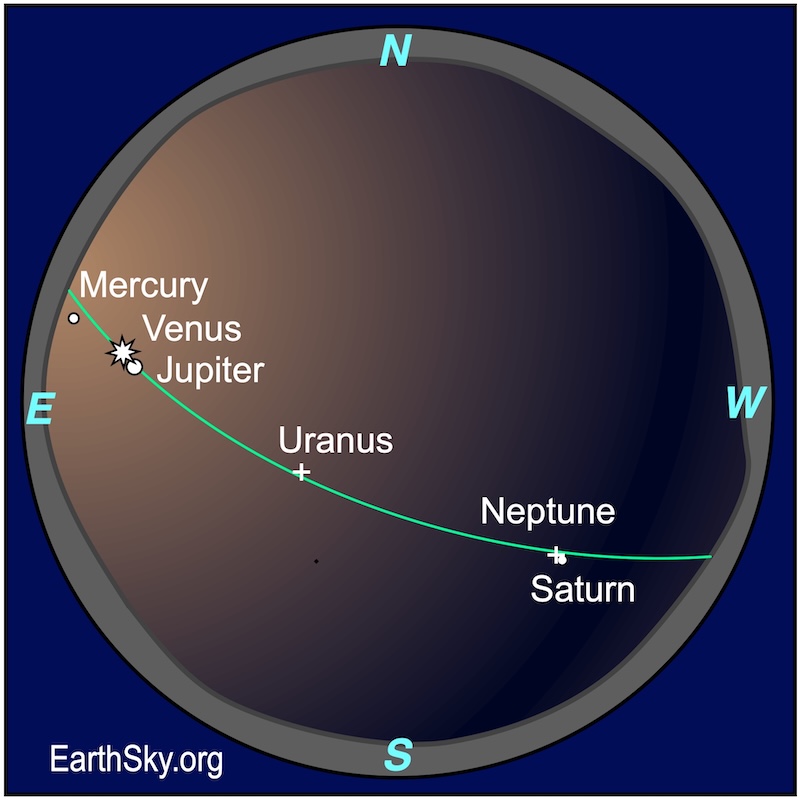
Sometimes when you’re out gazing at the brightest objects in the night sky, you’re seeing the planets without knowing it. There are five planets you can view without optical aid: Mercury, Venus, Mars, Jupiter and Saturn. And four of them are in the morning sky in August 2025. These are the classical planets that the ancients knew. They watched these planets “wander” across the sky, seemingly unattached to the stars and constellations. In fact, the word planet is from the ancient Greek word planete that means wanderer.
Maybe you’ve heard there are six planets this month in the morning sky? Yes, Uranus and Neptune are up there, too, but few will see them. Uranus is theoretically visible to the eye, but most often seen in binoculars or a telescope. Find a printable finder chart for Uranus here.
Neptune is even fainter than Uranus. You need a telescope to see Neptune. Notice the drop-down menu on this same page. It’ll let you create a finder chart for Neptune, and the other planets, too.
And you might wonder where’s Mars? It the sole planet in the evening sky until Saturn rises after sunset this month.
Best time to look for planets?
The fact is, any night under a cloud-free sky is a great time to look for planets. There’s often a planet or two, or more, up in some part of the sky for much of the night (if not all night). And the August 2025 morning sky is particularly planet-laden, with three easy planets, one harder one, and two requiring optical aid! It’s a veritable planet parade!
Tip: The bright planets are often (but not always) brighter than the brightest stars.
Tip: Watch for planetary pairings. For example, Venus and Jupiter are closest together in the morning sky on August 12.
Tip: Is it true planets don’t twinkle? Yep! Stars twinkle, but planets generally shine as a steady light.
How will you know where to find planets at any given time? Visit EarthSky’s visible planets and night sky guide. It’s updated daily.
Keep reading to meet each planet and learn a few tips on what to look for.

Mercury: Never far from the sun
Of the five classical planets, Mercury is the most elusive. By that we mean you have to look for it in the right place and at the right time. That’s because Mercury is innermost to the sun, so we on Earth never see Mercury stray far from the sun in our night sky. Mercury is sometimes visible after sunset, when it’s following the sun below the western horizon. Or, it’s up in the east, leading the sun up from behind the dawn horizon.
In mid-August 2025, Mercury is emerging in the east before sunrise. It’ll appear below the planets Venus and Jupiter starting around mid-month and it’ll be easiest to spot around August 19 when it reaches its greatest elongation from the sun. This morning elongation of Mercury is best viewed from the Northern Hemisphere.
TIP: Observe Mercury from 1st to last
It’s fun to observe Mercury from the time it first appears – either in the west after sunset or east before dawn – through the time it’s farthest from the sun (greatest elongation) – and back to when it disappears again into the sunset or sunrise glare. During these times, Mercury makes a great loop in the morning or evening twilight sky. Every Mercury apparition is a little different, depending on the time of year, your location on Earth and other factors. Mercury is now heading toward another greatest elongation in the morning sky (east before sunrise), on August 19, 2025.
TIP: A telescope reveals Mercury as a disk
As Mercury comes and goes in our sky – and as we and it travel around the sun – a telescope will show you a changing size for the disk of Mercury. Just be sure that the sun is completely below the horizon before you start searching for Mercury with a telescope. Its angular diameter (its size as seen on our sky’s dome) varies from 4.5 to 13.0 arcseconds.
TIP: The phases of Mercury (and Venus)
Mercury and Venus, being inner planets, show phases like the moon. This happens around the time of their inferior conjunctions (when they pass between us and the sun). Mercury’s last inferior conjunction was August 1, 2025. So that means you might see Mercury’s growing phases as the planet races away from the sun this month. You’ll need a telescope to see the phases of Mercury.
Venus: Brightest planet
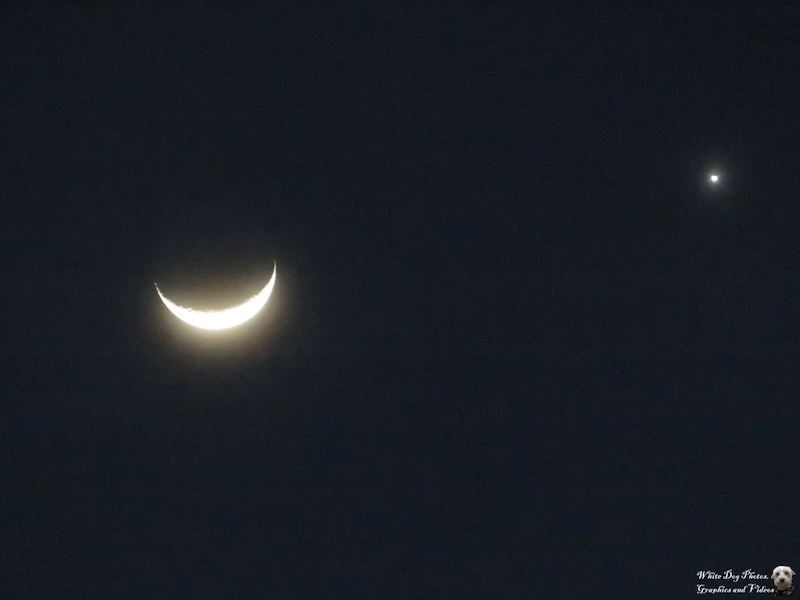
Venus is the brightest planet we can see from Earth. It outshines all the stars. When it’s close to the horizon (which it often is, being closer to the sun than Earth), people frequently mistake it for a plane with its landing lights on.
This neighboring planet is so bright because of its thick clouds and because of how close the planet is to us. It’s our nearest planetary neighbor in the solar system.
Venus is currently in the morning sky, incredibly bright, above the eastern horizon before sunrise. It’ll grace our morning sky through early November. Then, Venus moves to the evening sky starting in March 2026. Plus, watch for Venus and Jupiter when they have a close conjunction on August 12, 2025.
TIP: Watch for Venus pairings
Venus looks especially beautiful when it pairs up with a crescent moon or another planet. On the morning of August 12, 2025, Venus and Jupiter will be a spectacular pair in the morning sky. And, the moon will pass close to Venus next on August 20, 2025. Visit EarthSky’s visible planets and night sky guide regularly to learn the dates of those pairings.
TIP: Venus phases
Like Mercury, through a telescope, Venus shows phases. Its apparent size in our sky changes, much like Mercury, but even more dramatically than Mercury. Venus is so close and so bright that, even with steadily held binoculars, you can sometimes see that Venus is something other than round. If you looked at Venus through a telescope this morning (August 7, 2025), you’d see it in a 77%-illuminated phase. The phase of Venus will grow between now and when it will pass behind the sun on in January, 2026. Afterwards, it’ll emerge in the west after sunset in March 2026.
TIP: Venus at greatest brilliancy
Venus reached what astronomers call greatest brilliancy on the morning of April 27, 2025. That’s when the overall largeness of its disk balanced with the planet’s shrinking phase, so that we saw Venus as an eerie bright light in our twilight sky. The next time Venus will next be at its brightest again – this time in the evening sky – is in September 2026

Mars: The red planet
Mars is the most fascinating of the visible planets to watch with the unaided eye. That’s because it’s the planet next-outward from Earth in orbit around the sun. It’s not a very large world (smaller than Earth), and so its brightness changes dramatically throughout its visible cycle.
Mars is currently in the western evening sky. It’s red in color but fading in brightness, setting a while after sunset. It lies near the bright star Spica of Virgo. In August, Mars will blend in with other 1st-magnitude stars, as it shrinks and fades after its last opposition on January 15-16, 2025, when Earth flew between Mars and the sun. Now Earth is fleeing ahead of Mars in our smaller, faster orbit around the sun. And as a result, Mars is fading day by day and will slip out of the evening sky by November. Then it’ll emerge in the morning sky in March of 2026.
TIP: Mars is RED
The most distinctive feature of Mars to the unaided eye is its reddish color. When you view Mars from a dark-sky location, its color really pops. The red color is what drew the ancients to name the planet for the god of war. Iron oxide in the rocks, the same compound that makes rust and blood reddish on Earth, makes the surface of Mars look red, too.
TIP: Mars is round
Binoculars mounted in a tripod can show you Mars’ round disk shape. Binoculars will also accentuate Mars’ red color. Unlike Venus and Mercury, Mars doesn’t show a changing phase. That’s because it orbits one step outward from Earth. So we never see Mars go beteween us and the sun.
TIP: A telescope reveals Mars’ surface
If you want to see surface features on Mars, you’re going to need a telescope. White patches on Mars are generally ice caps or clouds. Percival Lowell thought the dark areas of Mars were canals built by Martians to carry water across the surface. Others thought the dark spots were a sign of vegetation. Various spacecraft that have studied the red planet revealed that the dark markings come from a variety of sources, such as dark volcanic basalt or landslides, but not from life. And you can expect to see more detail on Mars when it’s near opposition since it has a larger apparent size then.
Jupiter: Biggest planet with visible moons
Jupiter is ascending in the morning sky now, inching toward a close conjunction with Venus on the morning of August 12. Since Jupiter is much brighter than all the stars, it’s very easy to spot. Jupiter lies in front of the constellation Gemini.
Jupiter was at its brightest for 2025 in January and will be at its brightest again in January 2026.
TIP: Optical aid will reveal Jupiter’s moons
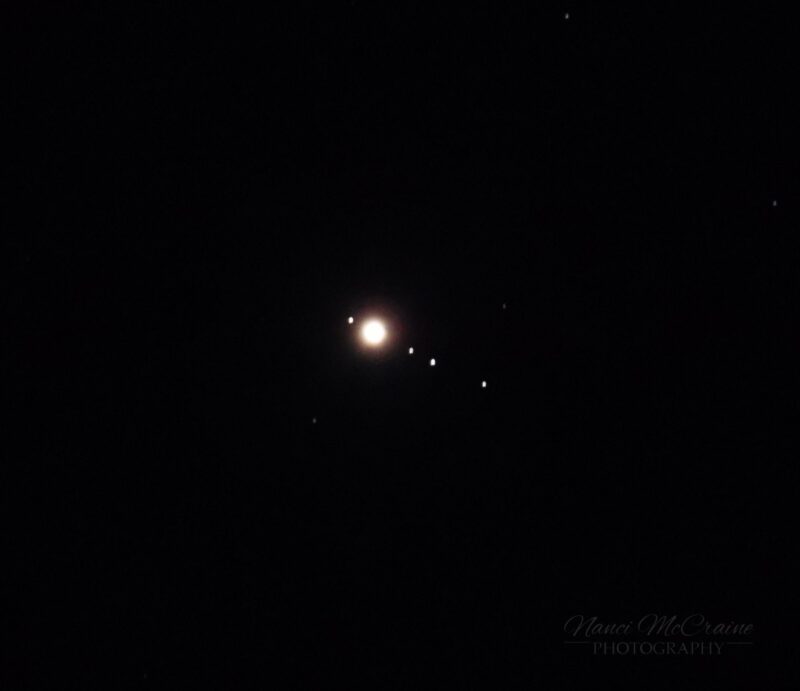
Even the smallest telescope will reveal the four largest moons of Jupiter. Binoculars will also let you glimpse a moon or two, especially if you’re looking in a pure, dark sky. The Galilean moons, as they’re known, are Io, Europa, Ganymede and Callisto. Nightly observing will show them constantly changing places as they whirl around the giant planet, sometimes passing in front of or behind Jupiter. These occultations and transits can also involve the shadows of the moons visible on the planet’s disk when viewed through a larger telescope.
TIP: Look for Jupiter’s Red Spot
The surface of Jupiter is also worth a look through a telescope. You’ll need a larger size telescope to make out the Great Red Spot, but smaller ‘scopes will still show you the light and dark belts and zones that ring the giant planet.

Saturn: Golden color, magnificent rings
Saturn is the faintest of the bright planets, and it’s currently rising after sunset in the evening sky so it’s easy to spot through dawn. You can’t see Saturn’s rings without a telescope. What can you notice about Saturn with the eye alone? Be sure to notice its golden color and steady light. It’ll be at its best next month (September) when it reaches opposition and it’ll be visible all night.
TIP: Notice the ring angle
Saturn is called the planet of the rings with good reason. The rings of Saturn are magnificent! As the years pass, and we and Saturn both orbit the sun, the angle of the rings changes with respect to Earth. Sometimes we see the north face of the rings, and sometimes the south face. Sometimes, the rings turn their razor-thin edge to us, and virtually disappear. We can’t overstate how glorious Saturn’s rings are to see. They make the planet look twice as big as it would without them.
TIP: Look for Cassini’s Division
With a small telescope, on a night of good seeing, you can make out a gap in the rings, called the Cassini Division.
TIP: Notice the shadow cast by the rings
With a small telescope, you can also look for a shadow of the rings cast onto the planet, or a shadow of the planet cast onto the rings. Now we’re having fun!
TIP: Look for Saturn’s large moon
Titan is Saturn’s brightest moon and it’s visible in telescopes. It is possible to see up to six more of Saturn’s moons through telescopes. And right now is a favorable time to see the shadow of Titan on the clouds of Saturn.


Uranus: A different pale blue dot
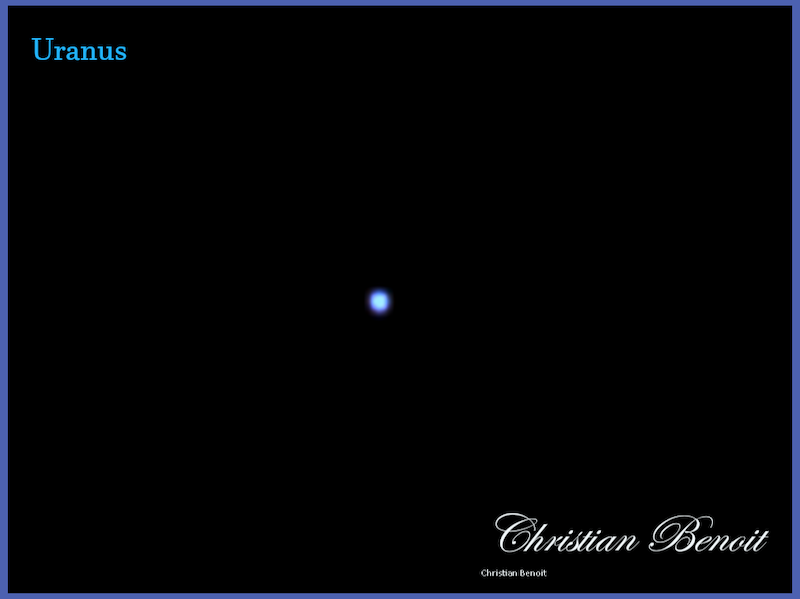
Carl Sagan described Earth as a pale blue dot when looking at a Voyager 1 image of our planet as the spacecraft sped out of the solar system. For us on Earth looking out at the solar system, the 7th planet from the sun, Uranus, appears as nothing more than a pale blue dot. And that’s through a telescope! With the eye alone, you can sometimes pick out Uranus from among the stars. But, to do it, you need absolutely pristine, dark skies.
TIP: Try searching when Uranus is paired
Uranus is easier to find when close to the moon or a bright planet.
TIP: Larger telescope show the moons
With a telescope, the surface features and rings of Uranus can’t be seen. But some larger telescopes will pick up a couple of Uranus’ moons. A medium to large size telescope might show you Titania and Oberon. They are the largest moons of Uranus and orbit far enough from the planet that you can distinguish them as separate points of light.
Neptune: Farthest major planet from the sun
And finally, Neptune is the biggest observing challenge on the list, but it’s not hard to see with optical aid and a guide star or planet. When Neptune is close to an object that’s easy to pick out of the night sky, say, Venus, you can pick it up easily in binoculars. If you have keen eyesight, binoculars will show it as a disk with a darker blue hue.
TIP: Neptune has been near Saturn
Neptune in August 2025 is near Saturn in the morning sky.
For updates, visit EarthSky’s visible planets and night sky guide.
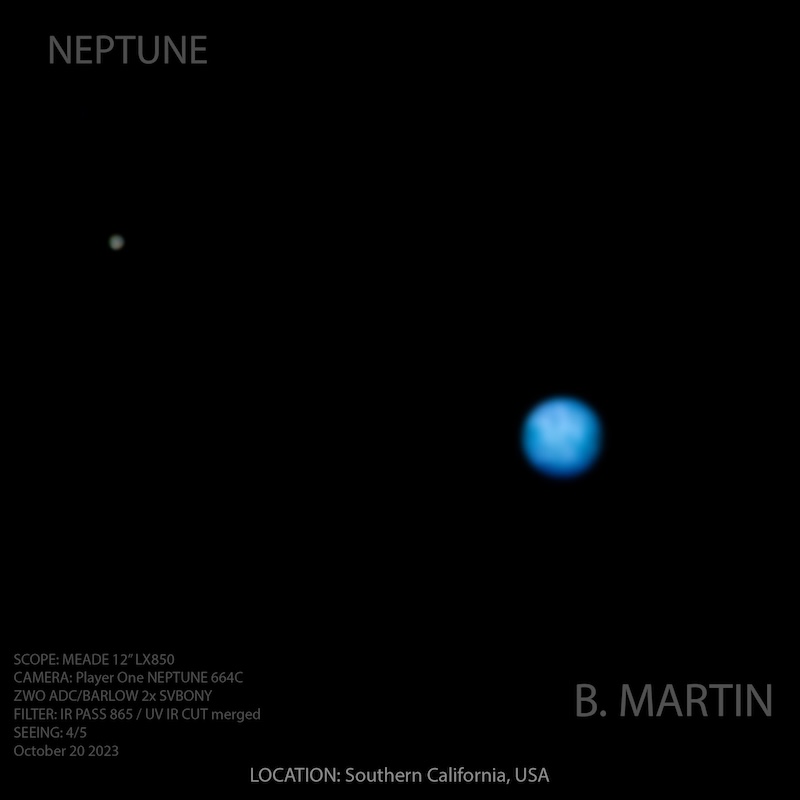
Bottom line: Get our top tips for planet observing, from innermost and elusive Mercury out to faint blue Neptune … and everything in between.
The post You will love these planet-observing tips, August 2025 first appeared on EarthSky.
from EarthSky https://ift.tt/uq7eVCg
Aucun commentaire:
Enregistrer un commentaire